Skip to Content
BuildingsBuildings
  • Article
  • Open Access

13 March 2026

A Family of Orthogonal Iteration Methods for Tracing the Nonlinear Equilibrium Path of Structures


School of Intelligent Built Environment and Architectural Engineering, Neijiang Normal University, Neijiang 641100, China

Abstract

Nonlinear structural analysis serves as a fundamental tool for accurately predicting structural bearing capacity and ultimate strength. The incremental-iterative solution scheme represents the prevailing methodology for tracing nonlinear load–displacement responses and is implemented in most commercial finite element software. To enhance the robustness and computational efficiency of existing schemes, this paper first revisits the incremental-iterative framework, providing a detailed analysis that clarifies the distinct roles of the load increment factor in the predictor and corrector phases. Subsequently, a novel framework of updated orthogonal iterative schemes (UOIS) is established. Within this framework, the current generalized stiffness parameter (CGSP) and a cumulative indicator S i are introduced in the predictor phase to adaptively control the magnitude and sign of the load increment, respectively. In the corrector phase, four enhanced orthogonal iteration strategies are formulated. Furthermore, to improve computational efficiency, a novel acceleration strategy is proposed, which embeds a secant prediction operator in the predictor phase, thereby circumventing the costly assembly and inversion of the tangent stiffness matrix. The results demonstrate that: (1) compared to the conventional generalized stiffness parameter (GSP), the proposed CGSP exhibits superior stability in tracking stiffness variations, offering a more reliable indicator for adaptive step-size control; (2) the cumulative indicator S i reliably identifies load limit points and accurately distinguishes between loading and unloading regimes; (3) the UOIS framework demonstrates strong convergence in tracing complex equilibrium paths with multiple critical points and exhibits significantly superior robustness under large increment sizes compared to the generalized displacement control method (GDCM); and (4) the secant-prediction acceleration strategy achieves substantial improvements in computational efficiency without compromising solution accuracy.

1. Introduction

Building structures often exhibit nonlinear mechanical behavior under external actions during construction and service, primarily in the form of geometric and material nonlinearity. Geometric nonlinearity, resulting from significant shape changes such as large rotations of structural components, necessitates the introduction of a geometric stiffness matrix in analysis. Material nonlinearity stems from the material’s inherent nonlinear constitutive behavior, as seen in the elastic-plastic response of jointed pipelines [1] and the mechanical behavior of snow under compression [2]. Therefore, an accurate assessment of structural bearing capacity relies on a robust nonlinear analysis. Consequently, the development of efficient, stable, and accurate numerical techniques for solving structural nonlinear problems remains a central research objective [3,4,5,6]. Under loading, a structure may undergo stiffness softening or hardening, follow stable or unstable equilibrium paths, and transition between loading and unloading states. A characteristic feature of such complex behavior is the emergence of critical points, such as limit (load) points and snap-back (displacement) points on the load–displacement curve. This is particularly evident in buckling and post-buckling analysis, where equilibrium paths may contain multiple limit and snap-back points. Reliably tracing these paths, especially near critical points, poses a significant challenge and stringently tests the stability of any nonlinear solution algorithm.
The earliest approach for tracing nonlinear equilibrium paths is the pure incremental method [7], which embodies the fundamental concept of incremental analysis. It divides the loading process into a series of sufficiently small steps, linearizing the problem within each step. However, as the solution progresses, results from this method tend to drift from the true equilibrium path because equilibrium is not enforced within each step, allowing errors to accumulate. To ensure reliability, iterative corrections are performed within each load step until equilibrium is satisfied to a specified tolerance. This forms the basis of the now widely used incremental-iterative framework [7,8]. Early implementations within this framework are the load control and displacement control methods. Both exhibit clear limitations near critical points, as they control only the load or the displacement, respectively.
To overcome numerical divergence near critical points, Wempner [9] and Riks [10,11] independently proposed the arc-length method, which simultaneously controls load and displacement by constraining the iterative step to a constant arc length. This method is effective for tracing paths with multiple critical points. Subsequent research has yielded various improvements: Crisfield [12] developed a cylindrical arc-length method; Bouwer et al. [13] proposed automatic arc-length adjustment based on structural state optimization; Pretti et al. [14] devised a displacement-controlled arc-length method for structures with non-zero displacement constraints; and Gavin et al. [15] combined arc-length control with the material point method to analyse large-deformation softening materials. Although arc-length methods and their variants can trace most smooth nonlinear paths using small increments, they may still diverge in regions of high path curvature if the step size is excessive [16,17].
Other constraint strategies include the work control method [18] and the minimum residual area method [19,20], although these lack generality and have seen limited practical use. In the displacement space, Ahmad-Abad et al. [21] proposed a family of minimum residual displacement methods. Notably, Yang and Shieh [22] employed a generalized stiffness parameter (GSP) and an orthogonal iterative strategy to develop the generalized displacement control method (GDCM). Owing to its simplicity, robustness, and numerical stability in tracing complex equilibrium paths, the GDCM has been extensively employed in various structural analysis domains, including: (1) geometric nonlinear analysis of thin-walled and spatial structures [23,24]; (2) elastoplastic analysis of steel frame structures [25,26]; (3) topology and shape optimization of large-deformation mechanical metamaterials and hyperelastic multi-material systems [27,28]; and (4) the design and analysis of advanced systems [29]. Further improvements to the original GDCM have been reported, including a more accurate estimation of the initial load increment [30], enhanced iterations through the use of other guide vectors [31], and the incorporation of a secant predictor to improve computational efficiency [32].
Based on previous research, path-following techniques present several critical challenges, each meriting in-depth investigation: (1) determining an appropriate load increment size during the predictor phase is fundamental to maintaining computational efficiency; (2) establishing the correct sign of the load increment in the predictor phase is essential for advancing forward along the equilibrium path while simultaneously preventing backtracking; and (3) accurately computing the load increment factor during the corrector phase is crucial to ensuring the overall reliability and precision of the method. Building upon the incremental-iterative framework, this paper presents a detailed analysis of the role of the load increment factor in the predictor and corrector phases. In the predictor phase, a current generalized stiffness parameter (CGSP) is introduced for adaptive increment size control, and a cumulative index S i is proposed to determine the loading/unloading state. For the corrector phase, four updated orthogonal iterative strategies are formulated, collectively establishing a family of updated orthogonal iterative schemes (UOIS) for tracing nonlinear paths. Furthermore, to enhance computational efficiency, a secant prediction operator is embedded in the predictor phase. The robustness, accuracy, and efficiency of the proposed framework are demonstrated through numerical case studies of a two-member truss and a semi-circular arch. Although demonstrated here for geometric nonlinearity in an elastic structure, the proposed method is equally applicable to material nonlinearity problems. By introducing an elastoplastic constitutive model into the numerical framework, it can be used for analyses such as pipeline elastoplasticity [33] and tunnel deformation [34].

2. Incremental-Iterative Solution Procedure

2.1. Structural Incremental Equilibrium Equations

In structural nonlinear analysis, the equilibrium equation governing the structural response, accounting for nonlinear load-bearing behavior, is expressed as
K U U = P ,  
where U is the structural displacement vector, and K U represents the structural stiffness matrix. Accounting for geometric and material nonlinearities, the stiffness matrix evolves with the displacement vector U , introducing nonlinear characteristics absent in linear analysis. The vector P denotes the externally applied loads. Accurate determination of the structural load–displacement response requires solving Equation (1). However, unlike linear analysis, Equation (1) constitutes a system of nonlinear equations in U , precluding a direct solution. Numerical strategies employing an incremental-iterative approach are adopted to trace the load–displacement path. This methodology applies the external load P in a sequence of sufficiently small increments. Within each increment, the solution is advanced using a linearized incremental equilibrium equation, while iterations are performed to ensure convergence to the true structural equilibrium. The cumulative results from all increments yield the complete load–displacement history.
For notational clarity, superscripts denote the increment number and subscripts denote the iteration count within an increment. The linearized incremental equilibrium equation for the j-th iteration of the i-th increment is
K j 1 i Δ U j i = Δ λ j i P ^ + R j 1 i .
Here, K j 1 i is the stiffness matrix evaluated at the current known state, typically the tangent stiffness (comprising elastic/elastoplastic and geometric contributions); Δ U j i is the incremental displacement vector; Δ λ j i is the load increment factor; P ^ is a prescribed reference load vector; and R j 1 i signifies the unbalanced force vector, representing the residual between the external loads and internal forces after the previous iteration. The solution of Equation (2) can be conveniently decomposed into two parts:
K j 1 i Δ U ^ j i = P ^ ,
K j 1 i Δ U j i = R j 1 i ,
where Δ U ^ j i is the displacement increment due to the reference load P ^ , and Δ U j i is the displacement increment corresponding to the unbalanced force R j 1 i . Substituting Equations (3) and (4) into Equation (2) yields the total displacement increment for the current iteration
Δ U j i = Δ λ j i Δ U ^ j i + Δ U j i .
The corresponding external load increment is
Δ P j i = Δ λ j i P ^ .
Consequently, after the j-th iteration of the i-th increment, the accumulated total displacement U j i and total external load P j i are updated as
U j i = U j 1 i + Δ U j i ,
P j i = P j 1 i + Δ λ j i P ^ .
If convergence criteria, typically requiring the norm of the unbalanced force R j i to fall below a specified tolerance, are satisfied at the end of the j-th iteration, the i-th increment is completed and the analysis proceeds to the next increment. Otherwise, subsequent iterations (j + 1, …) within the i-th increment are performed until convergence is achieved. The complete load–displacement path is then reconstructed from the converged equilibrium states of all increments, thereby fully characterizing the structural nonlinear response.

2.2. Significance of the Load Increment Factor

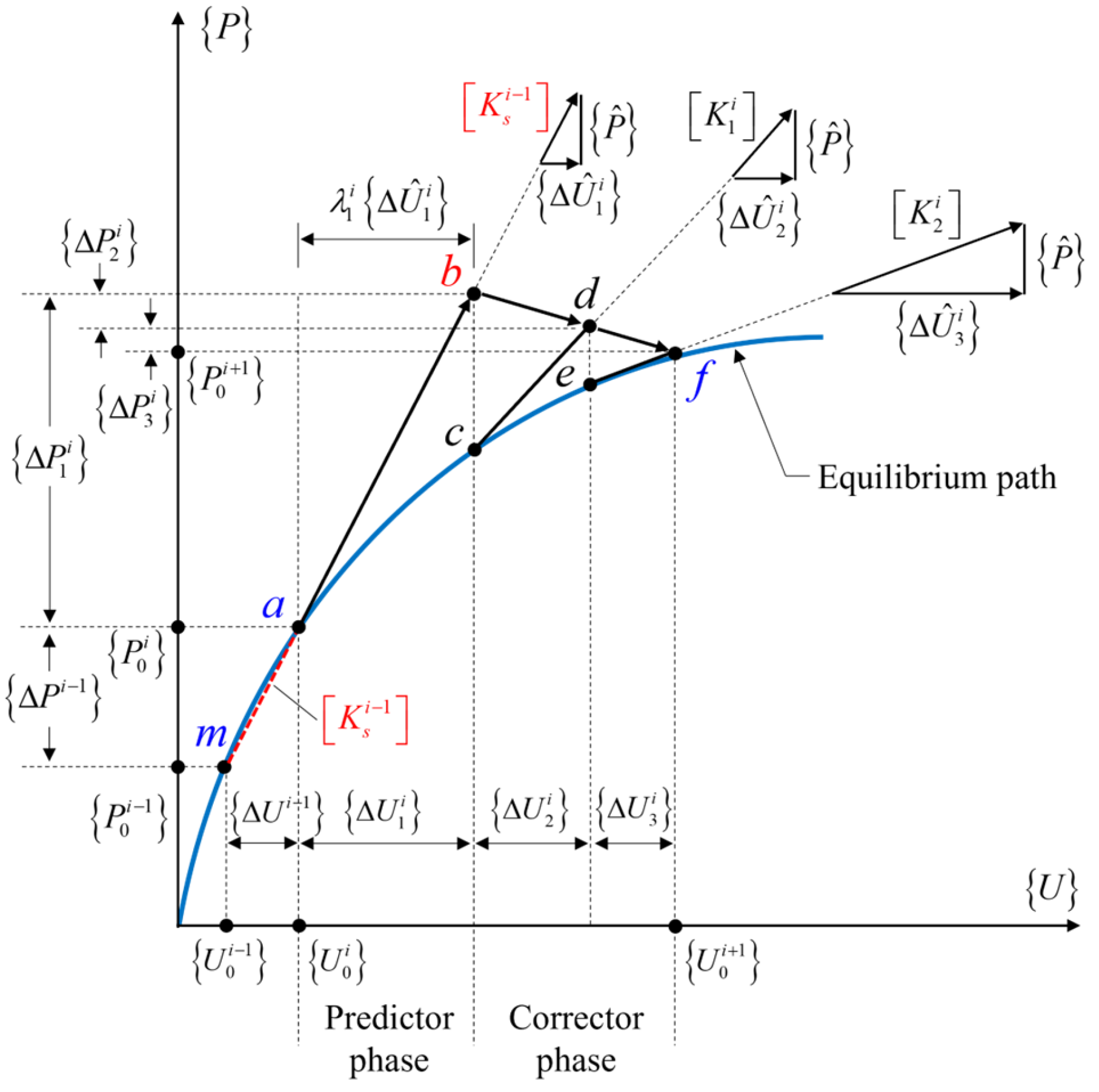
As described in Section 2.1, tracing the load–displacement path relies on computing the displacement increment (Equation (5)) and the load increment (Equation (6)) in each iteration. The central challenge lies in determining the load increment factor Δ λ j i . Equation (5) contains N + 1 unknowns—the N components of the displacement vector and the scalar Δ λ j i —but only N equations. Consequently, an additional constraint equation for Δ λ j i must be introduced to make the system determinate. Following the principles of incremental-iterative methods [21], the computational sequence within a typical increment (the i-th increment) comprises two distinct phases:
  • Predictor phase (j = 1): This single calculation step begins from a converged equilibrium state at the end of increment (i − 1), where the unbalanced force R 0 i is zero. A load increment Δ λ 1 i P ^ is applied, perturbing the equilibrium. The resulting displacement increment Δ U 1 i is estimated via a linear solution using the tangent stiffness K 0 i according to Equation (2). The magnitude of Δ λ 1 i governs the size of the load step, while its sign determines the loading direction (i.e., loading or un-loading).
  • Corrector phase (j 2): This phase may involve multiple iterations, starting from a state where the unbalanced force R j 1 i is nonzero. Its objective is to iteratively reduce this residual force, which originates from the linearization in the predictor phase, thereby restoring equilibrium for the i-th increment. Within this phase, the specific iterative algorithm (e.g., Newton-Raphson, Arc-length) provides the constraint that determines the value of Δ λ j i . The displacement increment Δ U j i is then computed by solving the linear system in Equation (2), which includes the load increment Δ λ j i P ^ and the unbalanced force R j 1 i , using the current tangent stiffness K j 1 i
  • This analysis underscores distinct considerations for each phase. The predictor phase requires careful selection of both the magnitude and sign of Δ λ 1 i . The magnitude should be adaptively controlled according to the structural state to balance efficiency and accuracy, thereby directly controlling the step size. The sign must correctly identify the loading or unloading behavior to ensure the solution follows the correct equilibrium path. The corrector phase primarily addresses the stability and efficiency of the convergence path. The constraint equation governing Δ λ j i is critical for the robustness of the numerical scheme. Based on these considerations, the following sections present an orthogonal iterative framework, detailing its formulation separately for the predictor and corrector phases.

3. Predictor Phase

3.1. Increment Size Control

The load increment factor Δ λ 1 i in the predictor phase governs the load step size. An excessively large value introduces significant unbalanced forces due to linearization, potentially requiring many iterations for convergence or even leading to divergence. Conversely, an overly small step reduces computational efficiency. An effective adaptive incremental-iterative method should therefore automatically determine the appropriate increment size based on the current structural state. In nonlinear structural analysis, the evolution of the structural stiffness provides the most direct indication of the load-bearing condition. For practical multi-degree-of-freedom systems, the structural stiffness at the predictor phase of the i-th increment can be characterized by the displacement increment under a fixed reference load:
Δ U ^ 1 i = K 0 i 1 P ^ .
Here, K 0 i is the structural tangent stiffness at the start of the i-th increment, P ^ is the prescribed reference load vector, and Δ U ^ 1 i is the corresponding displacement increment, which encapsulates the current stiffness information. Since increment size should correlate with changes in structural stiffness, it is typically adjusted by comparing the current stiffness with the initial stiffness. The initial stiffness can be represented analogously using the displacement increment from the first increment:
Δ U ^ 1 1 = K 0 1 1 P ^ ,
where K 0 1 denotes the initial tangent stiffness of the structure. This leads to the definition of a parameter that quantifies the change in structural stiffness—the current generalized stiffness parameter (CGSP):
C G S P = Δ U ^ 1 1 T Δ U ^ 1 1 Δ U ^ 1 i T Δ U ^ 1 i .
The CGSP measures the ratio of the initial stiffness to the current stiffness, serving as an indicator of the evolving structural nonlinearity. Its principal characteristics are: (1) Defined as the ratio of the norm of the first increment displacement to that of the current increment displacement, CGSP effectively tracks structural stiffness evolution and can identify both stiffening and softening behavior. (2) CGSP varies continuously near displacement snap-back points without abrupt jumps, making it robust for increment size control. (3) CGSP remains bounded throughout the loading history, promoting numerical stability in step size control. The load increment factor Δ λ 1 i , determined adaptively via CGSP, is given by
Δ λ 1 i = sign ( Δ λ 1 i ) Δ λ 1 1 C G S P ,
where Δ λ 1 1 is a user-defined initial load increment factor, based on experience in practical structural analysis, it is recommended that the value of Δ λ 1 1 P ^ be set between 5% and 10% of the first critical load. Equation (12) enables efficient, adaptive step-size control by incorporating both the structural response and the user-defined initial factor.
For comparison, the generalized displacement control method (GDCM) [22] employs the generalized stiffness parameter (GSP) to reflect stiffness changes, defined as
G S P = Δ U ^ 1 1 T Δ U ^ 1 1 Δ U ^ 1 i 1 T Δ U ^ 1 i .
The corresponding load increment factor Δ λ 1 i is determined by
Δ λ 1 i = sign ( Δ λ 1 i ) Δ λ 1 1 G S P .
Comparing Equations (11) and (13) shows that GSP incorporates the norms of both the current displacement increment Δ U ^ 1 i and the previous displacement increment Δ U ^ 1 i 1 in the denominator, whereas CGSP which uses only the current increment Δ U ^ 1 i . Consequently, GSP does not solely reflect the most recent stiffness change, potentially leading to less responsive and efficient step-size control compared to CGSP. A detailed comparative analysis is presented in the case studies. It is noteworthy that Leon et al. [31] adopted the CGSP in place of the GSP within their modified generalized displacement control method to regulate the incremental step size.

3.2. Sign Determination of the Load Increment Factor

Determining the sign of Δ λ 1 i , in addition to its magnitude from Equation (12), is crucial. Established methods for determining this sign include: (1) Using the current stiffness parameter (CSP) [35], which fails when the path exhibits snap-back behavior. (2) Relying on the sign of the determinant of the structural tangent stiffness matrix [36], which also fails near bifurcation or snap-back points. (3) Employing the generalized stiffness parameter (GSP) [22] or the projection direction of the predictor displacement increment [37], which require indirect comparison with the sign from the previous increment. (4) Applying a mathematically derived generalized criterion [38], which lacks physical insight and is computationally expensive.
This paper proposes a novel approach that uses a cumulative product indicator, denoted S i , to determine the sign of Δ λ 1 i . The indicator S i is defined as
S i = n = 1 i I n ,
where the scalar component I n is the dot product of the displacement increments from the (n − 1)-th and n-th increments:
I n = Δ U ^ 1 n 1 T Δ U ^ 1 n Δ U ^ 1 n 1 T Δ U ^ 1 n .
Note that in Equation (16), n ≥ 2 applies. For the initial case n = 1, I n is taken as 1.
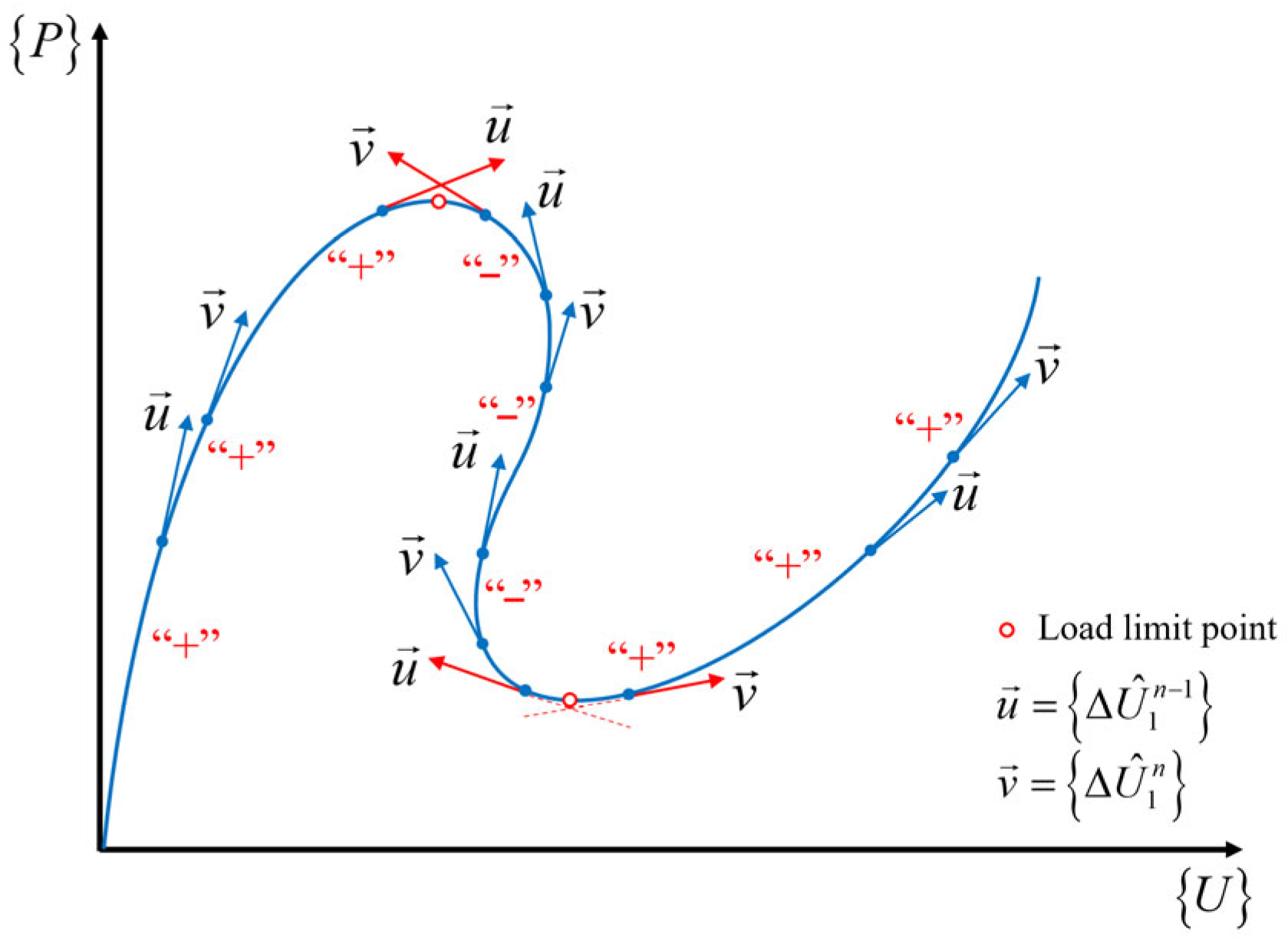
As illustrated in Figure 1, for complex equilibrium paths with multiple critical points, the angle between consecutive displacement increments Δ U ^ 1 n 1 and Δ U ^ 1 n is obtuse only when the n-th increment crosses a load limit point; it remains acute elsewhere, including near displacement limit points. Therefore, I n is negative exclusively when crossing a load limit point and positive otherwise, making I n a robust detector for load limit points. This behavior matches the required sign change in the load increment factor Δ λ 1 i : it should be positive during loading and negative during unloading, with the sign change occurring precisely upon crossing a load limit point. This correspondence is captured by the sign of the cumulative product indicator S i . Thus, the sign of the load increment factor Δ λ 1 i is identical to the sign of S i as follows:
sign ( Δ λ 1 i ) = sign ( S i ) .
Figure 1. Characteristics of the proposed indicator S i .

4. Corrector Phase: Four Updated Orthogonal Iteration Strategies

The corrector phase requires defining a convergence path for iterative computations. The chosen path critically governs both the permissible increment size and the numerical stability of the solution procedure. An efficient path enables convergence with larger load steps while maintaining robustness near critical points. For example, the arc-length method, which employs an arc-shaped constraint path, often requires severely reduced step sizes in regions of high path curvature to prevent numerical divergence [16,17].
Orthogonal iterative paths constitute a class of efficient and stable constraint strategies. The generalized displacement control method (GDCM) implements this concept by using the displacement increment Δ U ^ 1 i 1 from the predictor phase of the previous increment, as the fixed orthogonal reference vector throughout the corrector phase of the i-th increment. The corresponding constraint equation is
Δ U ^ 1 i 1 T Δ U j i = 0 , j 2 .
This stipulates that each iterative displacement correction Δ U j i must be orthogonal to the historical vector Δ U ^ 1 i 1 . Substituting Equation (5) into Equation (18) yields the expression for the load increment factor:
Δ λ j i = Δ U ^ 1 i 1 T Δ U j i Δ U ^ 1 i 1 T Δ U ^ j i , j 2 .
Although established, this approach possesses a potential limitation: the reference vector Δ U ^ 1 i 1 reflects the structural state from the previous increment. During the corrector phase of the i-th increment, a sequence of displacement increments Δ U ^ 1 i , Δ U ^ 2 i , …, Δ U ^ j 1 i , Δ U ^ j i associated with the reference load becomes available from Equation (3). These vectors inherently carry more current stiffness information than Δ U ^ 1 i 1 . Consequently, using them as the orthogonal basis can lead to more efficient convergence paths. This rationale underpins the following updated orthogonal iterative strategies (UOIS).
UOIS-1 adopts the most immediate reference, Δ U ^ 1 i , as the orthogonal vector in the corrector phase:
Δ U ^ 1 i T Δ U j i = 0 , j 2 .
Substituting Equation (5) gives the load increment factor:
Δ λ j i = Δ U ^ 1 i T Δ U j i Δ U ^ 1 i T Δ U ^ j i , j 2 .
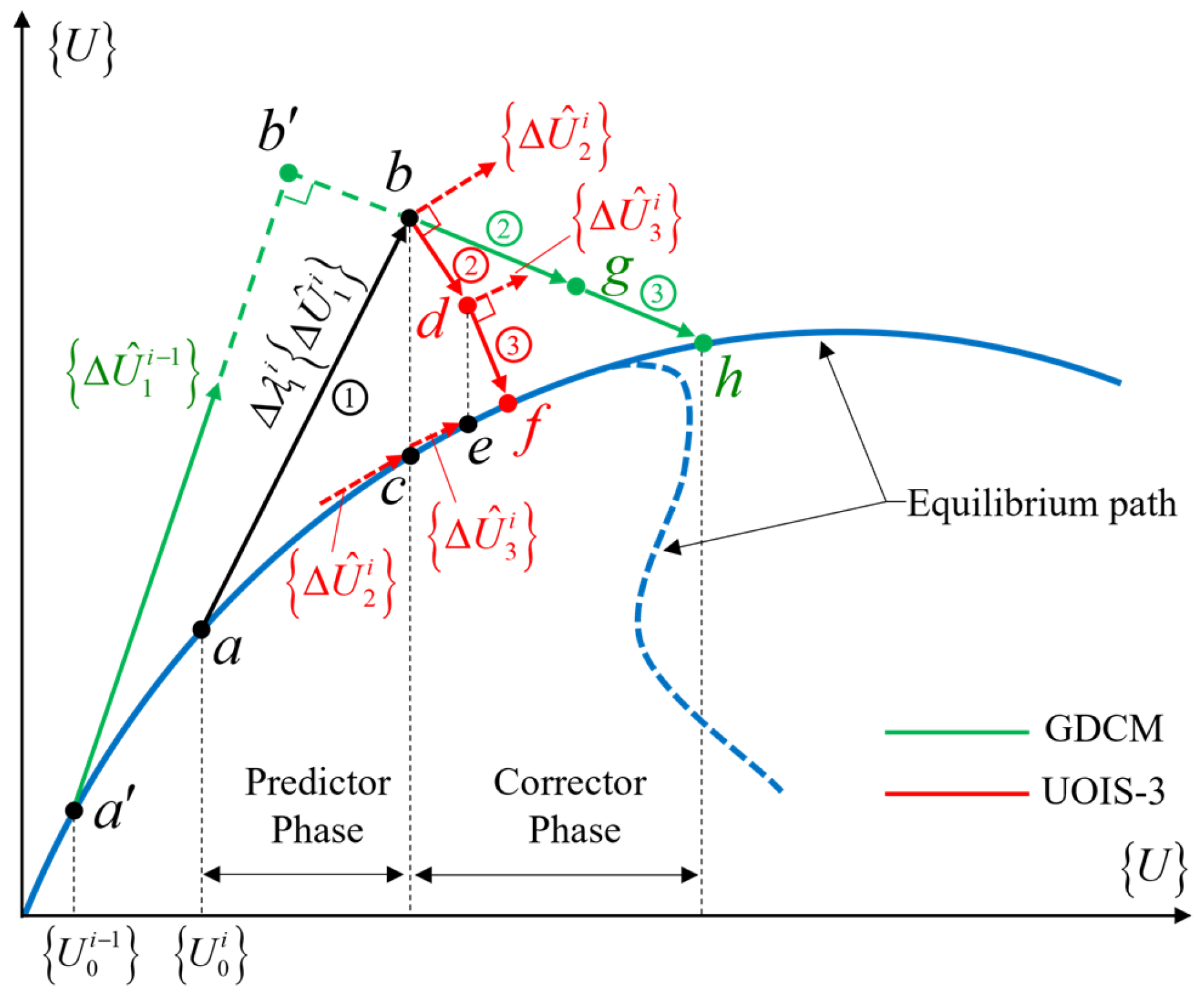
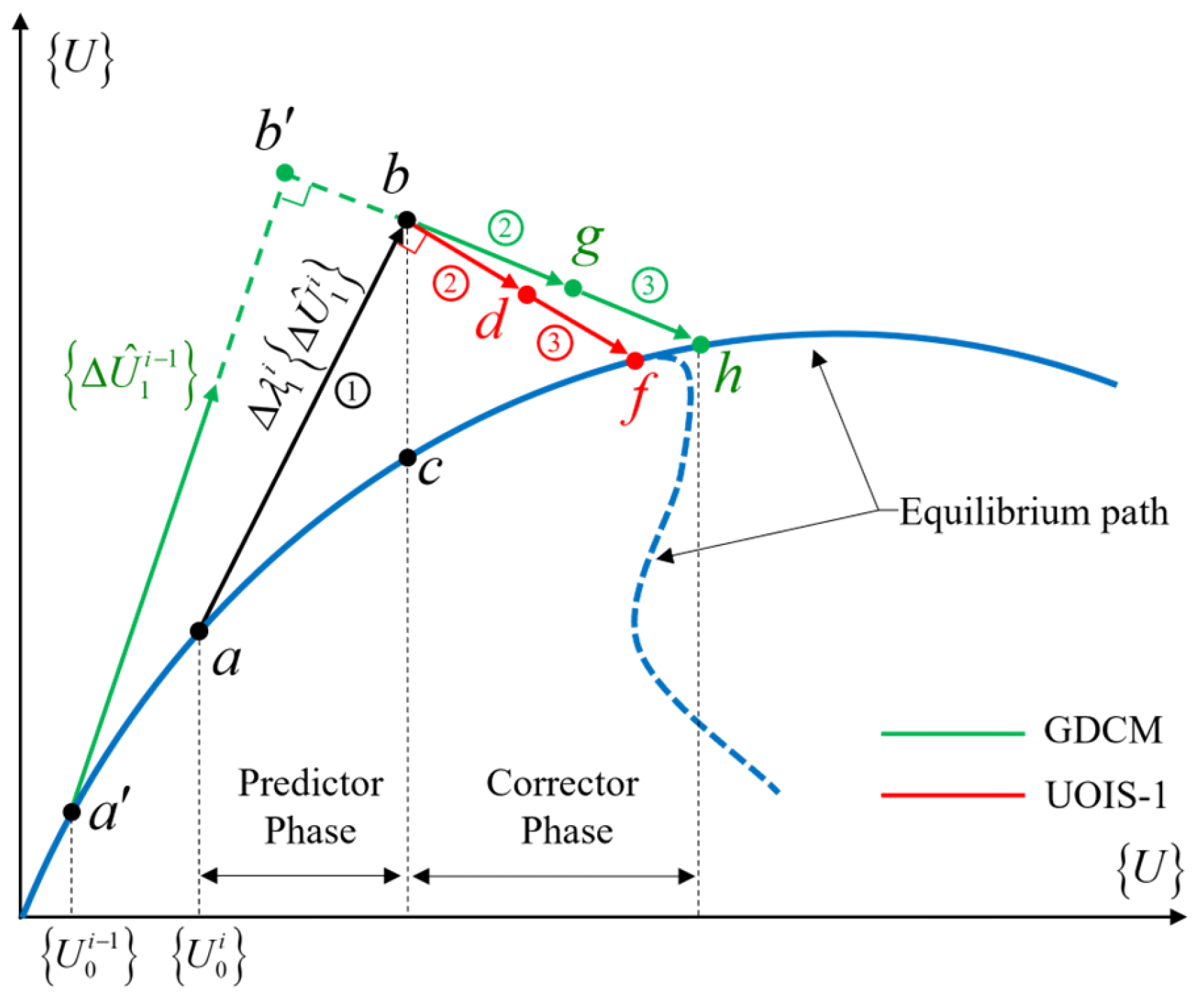
The iterative path defined by Equations (20) and (21) is illustrated in Figure 2.
Figure 2. Comparison of orthogonal iterative paths between UOIS-1 and GDCM.
In Figure 2, point a is the converged state from (i − 1) increment. The predictor phase of the i-th increment advances the solution to point b, where an unbalanced force R 1 i exists. The iterative path of GDCM (bgh), constrained by the previous increment’s vector Δ U ^ 1 i 1 , is compared with the UOIS-1 path (bdf), which uses the current vector Δ U ^ 1 i . UOIS-1 promotes faster convergence and this enhanced efficiency is particularly beneficial for maintaining stability with larger step sizes. For instance, when encountering a hypothetical equilibrium path (dashed line), UOIS-1 would likely converge successfully, whereas GDCM might diverge.
UOIS-2 dynamically updates the reference vector to the most recently computed displacement increment Δ U ^ j 1 i in each iteration:
Δ U ^ j 1 i T Δ U j i = 0 , j 2 .
Substituting Equation (5) gives the corresponding load increment factor:
Δ λ j i = Δ U ^ j 1 i T Δ U j i Δ U ^ j 1 i T Δ U ^ j i , j 2 .
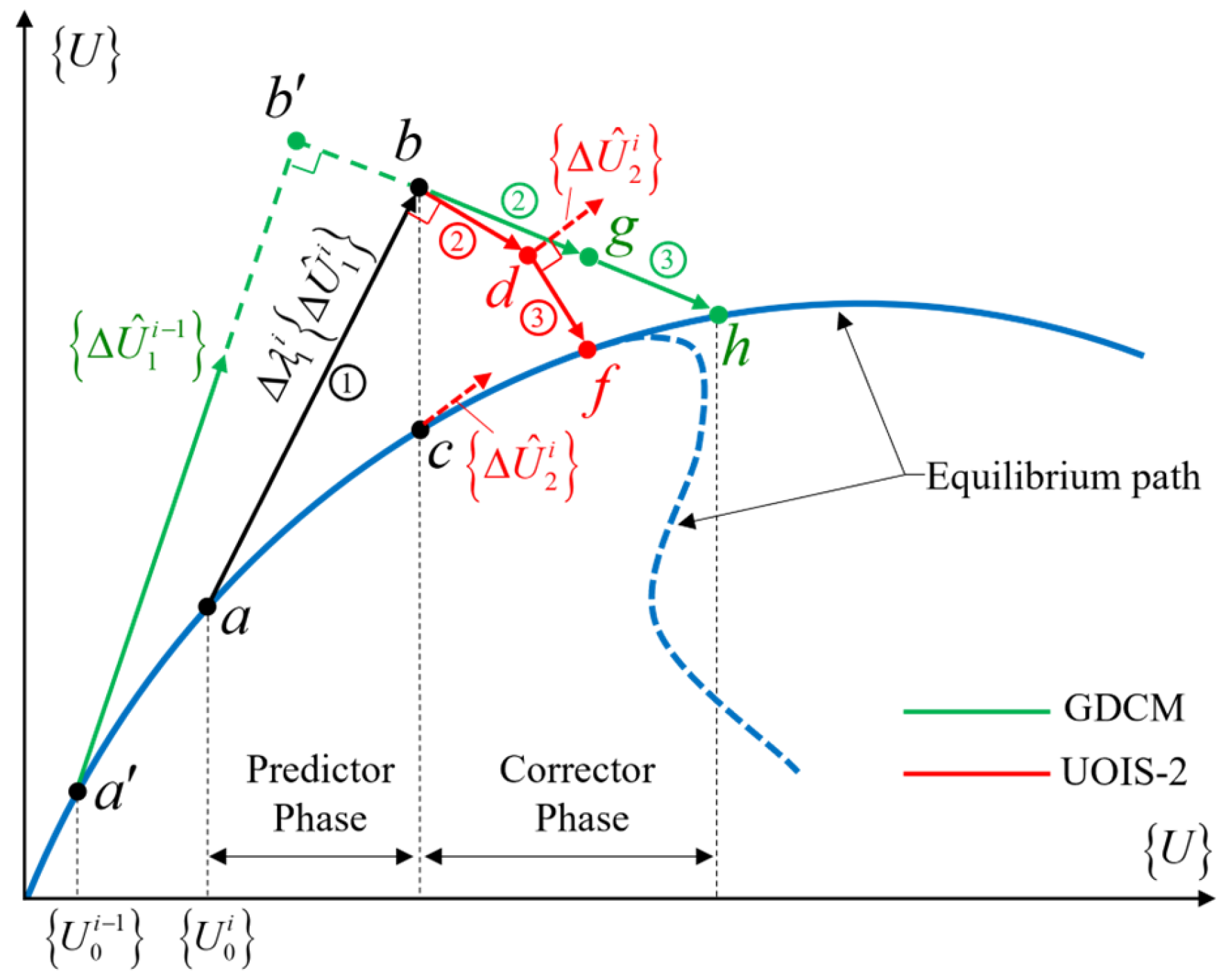
UOIS-2 generates the iterative path shown in Figure 3, where the orthogonal direction is continually updated throughout the iteration process.
Figure 3. Comparison of orthogonal iterative paths between UOIS-2 and GDCM.
In Figure 3, point b denotes the state after the predictor phase of the i-th increment, where an unbalanced force R 1 i exists. In the first iteration of UOIS-2, vector Δ U ^ 1 i is used as the orthogonal reference; in the second iteration, vector Δ U ^ 2 i is used. This updating sequence continues until convergence. The resulting convergence path, illustrated as bdf in Figure 3, demonstrates superior iterative performance compared to GDCM.
UOIS-3 uses the displacement increment Δ U ^ j i as the reference vector:
Δ U ^ j i T Δ U j i = 0 , j 2 .
Substituting Equation (5) gives the corresponding load increment factor:
Δ λ j i = Δ U ^ j i T Δ U j i Δ U ^ j i T Δ U ^ j i , j 2 .
The iterative path for UOIS-3, defined by Equations (24) and (25), is illustrated in Figure 4.
Figure 4. Comparison of orthogonal iterative paths between UOIS-3 and GDCM.
In Figure 4, during the first iteration of UOIS-3, the vector Δ U ^ 2 i is used as the orthogonal reference; in the second iteration, Δ U ^ 3 i serves as the reference. This updating sequence continues until convergence. The resulting convergence path, illustrated as bdf in Figure 4, demonstrates superior iterative performance compared to GDCM.
UOIS-4 employs the accumulated displacement increment up to the previous iteration, Δ U j i , as the reference vector:
Δ U j 1 i T Δ U j i = 0 , j 2 .
The accumulated displacement increment is defined as
Δ U j 1 i = Δ U 1 i + Δ U 2 i + + Δ U j 1 i .
Substituting Equation (5) into Equation (26) gives the load increment factor:
Δ λ j i = Δ U j 1 i T Δ U j i Δ U j 1 i T Δ U ^ j i , j 2 .
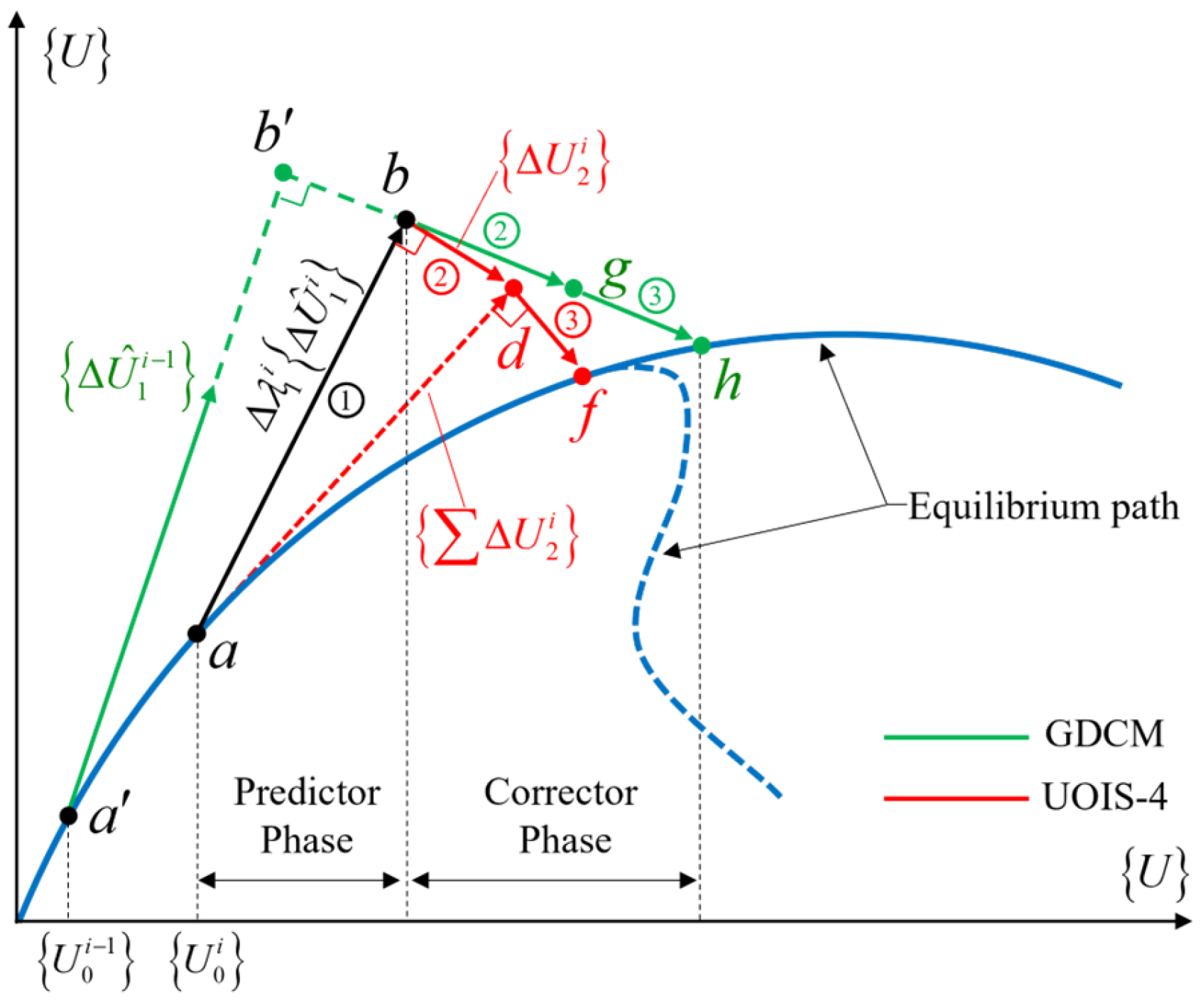
The convergence path for UOIS-4 is shown in Figure 5, illustrating its performance relative to GDCM.
Figure 5. Comparison of orthogonal iterative paths between UOIS-4 and GDCM.
In Figure 5, during the first iteration of UOIS-4, the vector Δ U 1 i = λ 1 i Δ U ^ 1 i is used as the orthogonal reference. In the second iteration, the accumulated vector Δ U 2 i = Δ U 1 i + Δ U 2 i serves as the reference vector. This updating sequence continues until convergence. The convergence path bdf likewise demonstrates superior performance compared to GDCM.
In summary, the UOIS consistently demonstrate superior iterative efficiency compared to the baseline GDCM, primarily because they utilize more contemporaneous stiffness information.

5. An Acceleration Strategy: Embedding a Secant Prediction Operator in the Predictor Phase

As described by Equations (9), (11) and (12), determining the load increment factor Δ λ 1 i conventionally requires: first, assembling the tangent stiffness matrix K 0 i at the start of the i-th increment, which comprises both the elastic stiffness K e i and the geometric stiffness K g i ; second, solving for the displacement increment Δ U ^ 1 i ; and finally, computing Δ λ 1 i   based on the CGSP and the initial load factor Δ λ 1 1 . This conventional procedure inherently involves the assembly and inversion of the global structural stiffness matrix during the predictor phase. For complex structural systems comprising a large number of finite elements, these operations are computationally expensive, significantly impairing the efficiency of the solution algorithm. To circumvent this computational cost, Yang et al. [32] integrated the secant prediction operator into the predictor phase of the GDCM. Building upon this approach, the present work adopts the same secant prediction operator to estimate the predictor displacement increment Δ U ^ 1 i . This approach avoids the need to assemble and invert the global tangent stiffness matrix during the predictor phase.
The concept is illustrated schematically in Figure 6. Point m denotes the initial state of the (i − 1)-th increment, while point a represents its converged final state. This converged state (point a) also serves as the starting point for the subsequent i-th increment. At the beginning of the i-th increment, the complete solution history of the preceding (i − 1)-th increment is known. The nominal secant stiffness K s i 1 between states m and a can be defined, which relates the cumulative load and displacement increments from the (i − 1)-th increment:
K s i 1 Δ U i 1 = Δ P i 1 .
Here, Δ U i 1 and Δ P i 1 denote the cumulative displacement and load increments, respectively, over the (i − 1)-th increment. These are defined as
Δ U i 1 = U 0 i U 0 i 1 = j = 1 n Δ U j i 1 ,
Δ P i 1 = P 0 i P 0 i 1 = j = 1 n Δ λ j i 1 P ^ ,
where n is the total number of iterations performed for convergence within the (i − 1)-th increment. Substituting Equation (31) into Equation (29) gives
K s i 1 Δ U i 1 = j = 1 n Δ λ j i 1 P ^ .
The displacement increment Δ U ^ 1 i under the reference load P ^ in the predictor phase of the i-th increment, approximated using this nominal secant stiffness, is given by
Δ U ^ 1 i = [ K s i 1 ] 1 P ^ .
By leveraging the relationship in Equations (32) and (33) can be reformulated to obtain
Δ U ^ 1 i = [ K s i 1 ] 1 P ^ = Δ U i 1 / j = 1 n Δ λ j i 1 .
Figure 6. Schematic of the prediction process incorporating the secant prediction operator.
A comparison between Equation (34) and Equation (9) reveals a key advantage: the proposed secant prediction operator utilizes readily available information from the converged preceding increment—namely, the cumulative displacement increment Δ U i 1 and the sum of the converged load factors j = 1 n Δ λ j i 1 —to estimate Δ U ^ 1 i . This approach effectively circumvents the need to assemble and invert the tangent stiffness matrix at the beginning of the new increment (point a). Consequently, the computational cost of the predictor phase is reduced. For large-scale structural models with a large number of elements, this strategy can substantially improve the overall computational efficiency.

6. Numerical Implementation

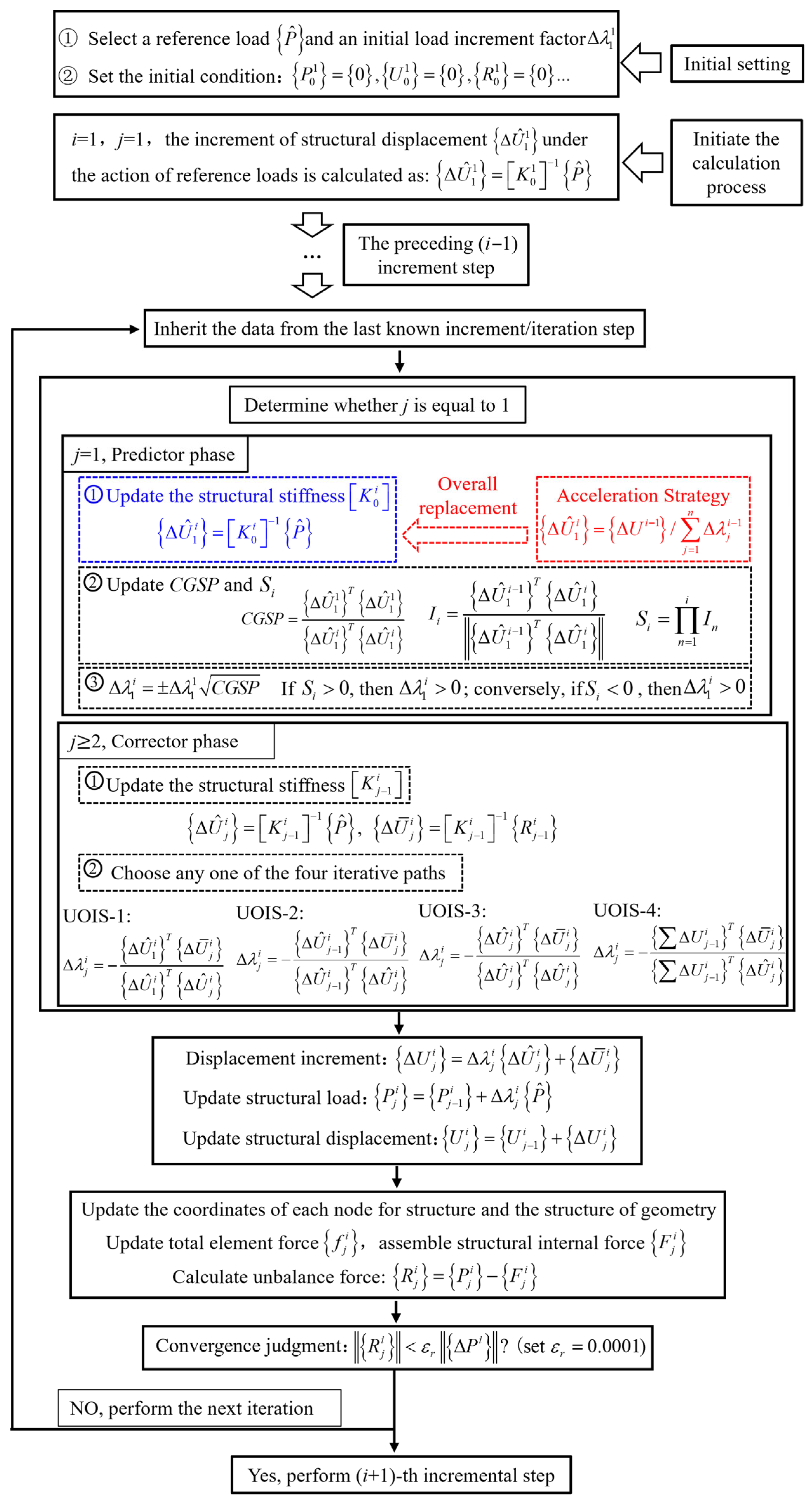
The updated orthogonal iterative framework described in the preceding sections can be efficiently implemented within a general-purpose finite element program to trace nonlinear equilibrium paths automatically, including those involving complex postbuckling responses. The computational sequence for a typical load increment is summarized below and illustrated in Figure 7. This process begins after the initialization of essential parameters, such as the reference load vector P ^ and the initial load increment factor Δ λ 1 1 .
Figure 7. Computational flowchart for a typical incremental step in the orthogonal iterative.
  • Step 1: Phase determination
The phase of the algorithm is determined by the iteration counter j. If j = 1, the calculation enters the predictor phase; if j 2, it proceeds to the corrector phase.
  • Step 2a: Predictor phase (j = 1)
    (1)
    Assemble the structural tangent stiffness matrix K 0 i .
    (2)
    Solve for the reference displacement increment Δ U ^ 1 i , using Equation (3).
    (3)
    Evaluate the current generalized stiffness parameter (CGSP) using Equation (11).
    (4)
    Compute the scalar component I i using Equation (16), and then update the indicator S i by multiplying all the scalar components from the preceding incremental steps.
    (5)
    Compute the magnitude of the load increment factor, Δ λ 1 i , via Equation (12).
    (6)
    Determine the signed value of the load increment factor Δ λ 1 i , by applying the sign convention defined in Equation (17): If S i > 0 , then Δ λ 1 i > 0 ; conversely, if S i < 0 , then Δ λ 1 i < 0 .
  • Step 2b: Corrector phase (j 2)
    (1)
    Update the structural tangent stiffness matrix K j i based on the current geometry and stress state.
    (2)
    Given the unbalanced force R j 1 i , solve for the displacement increments Δ U ^ j i and Δ U j i using Equations (3) and (4), respectively.
    (3)
    Select one of the four updated orthogonal iteration strategies (UOIS) and compute the corresponding load increment factor Δ λ j i , from its associated constraint equation.
  • Step 3: State update
    (1)
    Using the determined load increment factor (either Δ λ 1 i from the predictor or Δ λ j i from the corrector), Compute the resulting structural displacement increment Δ U j i , using Equation (5).
    (2)
    Update the total structural displacement U j i and total external load P j i , using Equations (7) and (8), respectively.
  • Step 4: Force recovery and equilibrium evaluation
    (1)
    Update all nodal coordinates and the structural geometry based on the displacement increment Δ U j i .
    (2)
    Compute the nodal forces f j i of the elements using the rigid body rule [30] in the updated configuration and assemble the global structural resisting force F j i .
    (3)
    Calculate the unbalanced force R j i , as the difference between the total external load P j i and the internal resisting force F j i : R j i = P j i F j i .
  • Step 5: Convergence check
Check whether the unbalanced force R j i satisfies the convergence criterion: R j i < ε r P i ,   ε r = 0.0001 , where ε r is a predefined tolerance.
If convergence is achieved, the current load increment is completed, and the analysis proceeds to the next incremental step. Otherwise, update the iteration counter (jj + 1) and return to Step 2b for another corrector iteration. The numerical procedure terminates once the calculated result reaches the prescribed load or displacement level.
The acceleration strategy based on the secant prediction operator, introduced in Section 5, is incorporated into this flowchart as highlighted in red in Figure 7. To employ this strategy, the corresponding process blocks in the predictor phase (shown in blue in the standard algorithm) are replaced by the red-highlighted expressions.

7. Numerical Case Studies

This section presents two representative case studies to evaluate the performance and robustness of the proposed updated orthogonal iterative strategies (UOIS) and the acceleration strategy in tracing complex structural nonlinear equilibrium paths. While a linear elastic material model is assumed throughout this study, the proposed technique can be extended to problems involving material nonlinearity. This is achieved by integrating the rigid body rule with the plastic hinge concept, where the elastic stiffness matrix is replaced by its elastoplastic counterpart [25], thus facilitating post-buckling analysis with material nonlinearities. Although the selected structure is geometrically simple, its equilibrium path is a circular curve with multiple critical points, demanding considerable robustness and computational capability from the numerical algorithm. Results obtained from the generalized displacement control method (GDCM) under identical parameters are also presented here for a comprehensive comparison. The numerical schemes investigated in this study is systematically summarized in Table 1, Schemes that embed the secant prediction operator (introduced in Section 5) are denoted by the suffix “-A”. All numerical simulations were conducted in MATLAB R2020a on a workstation equipped with an Intel® Core™ i5-12400F processor, 32.0 GB of RAM, and the Windows 11 (64-bit) operating system.
Table 1. Summary of the numerical schemes implemented.

7.1. Two-Members Truss

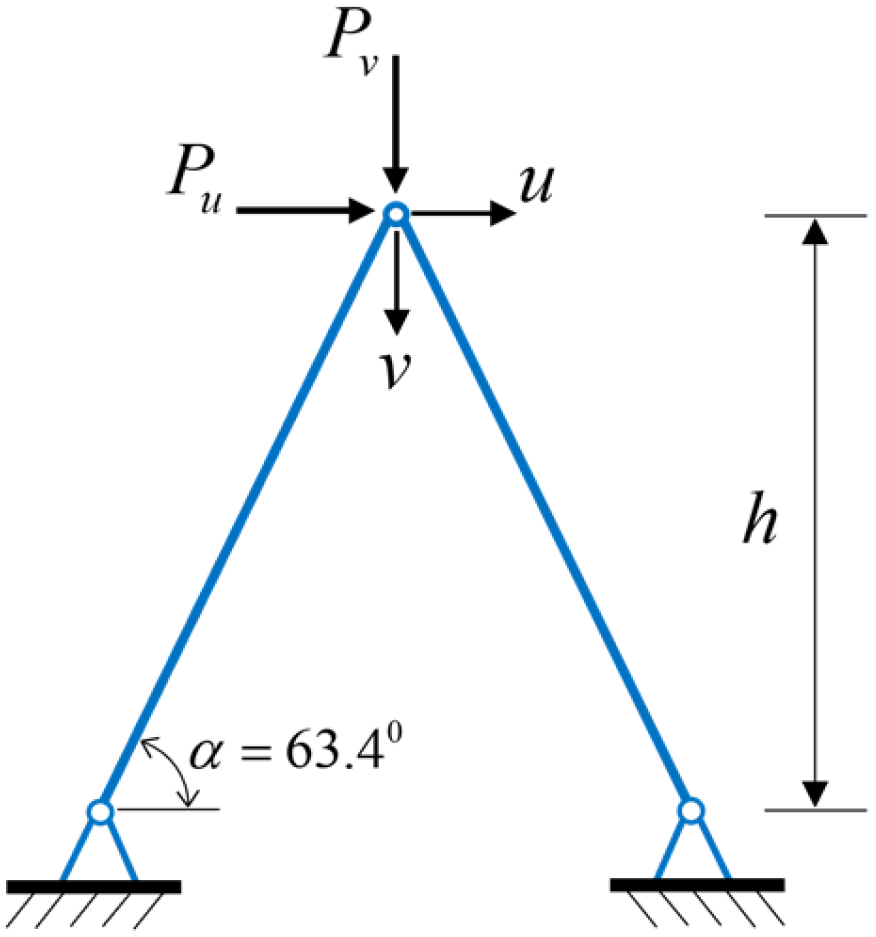
The two-member truss shown in Figure 8, though geometrically simple, serves as a demanding benchmark problem for assessing the reliability of path-tracking algorithms under various loading conditions. An analytical solution for this problem was presented by Pecknold et al. [39]. In the numerical model, the following material and geometric properties are adopted: elastic modulus E = 1.3 × 10³ kPa, cross-sectional area A = 6.45 cm2, angle α = 63.4°, and height h = 65.651 cm. Each member is modeled using a two-dimensional truss element [16]. The analysis examines the structural response under three distinct loading scenarios.
Figure 8. Schematic of the two-member truss.
First loading condition (ideal, defect-free): A vertical load P v is applied at the top vertex, while the horizontal load P u is set to zero. Due to structural symmetry and perfect load alignment, the equilibrium path exhibits a unique, single-branch response without bifurcation or adjacent equilibrium branches. The reference load is set to P ^ v = 10 N. The size of the load increment is controlled by varying the initial load increment factor Δ λ 1 1 .
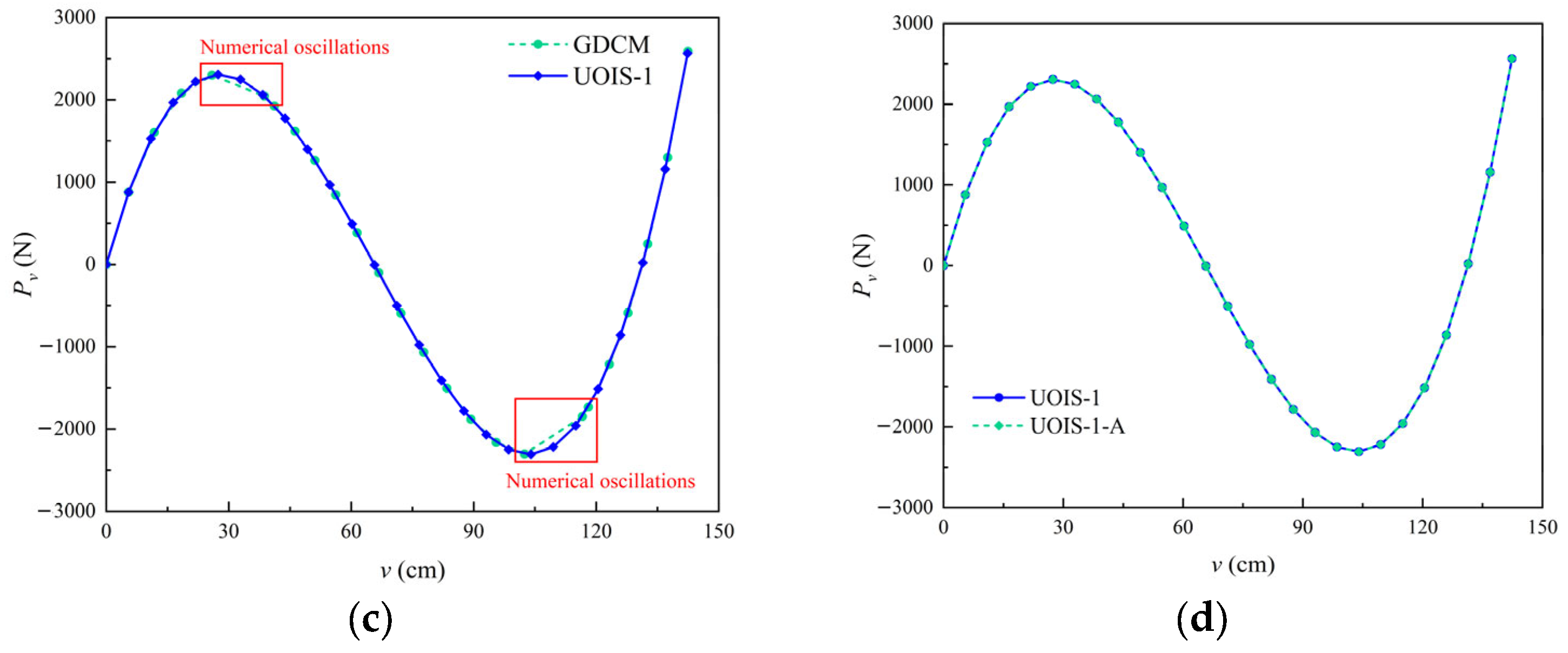
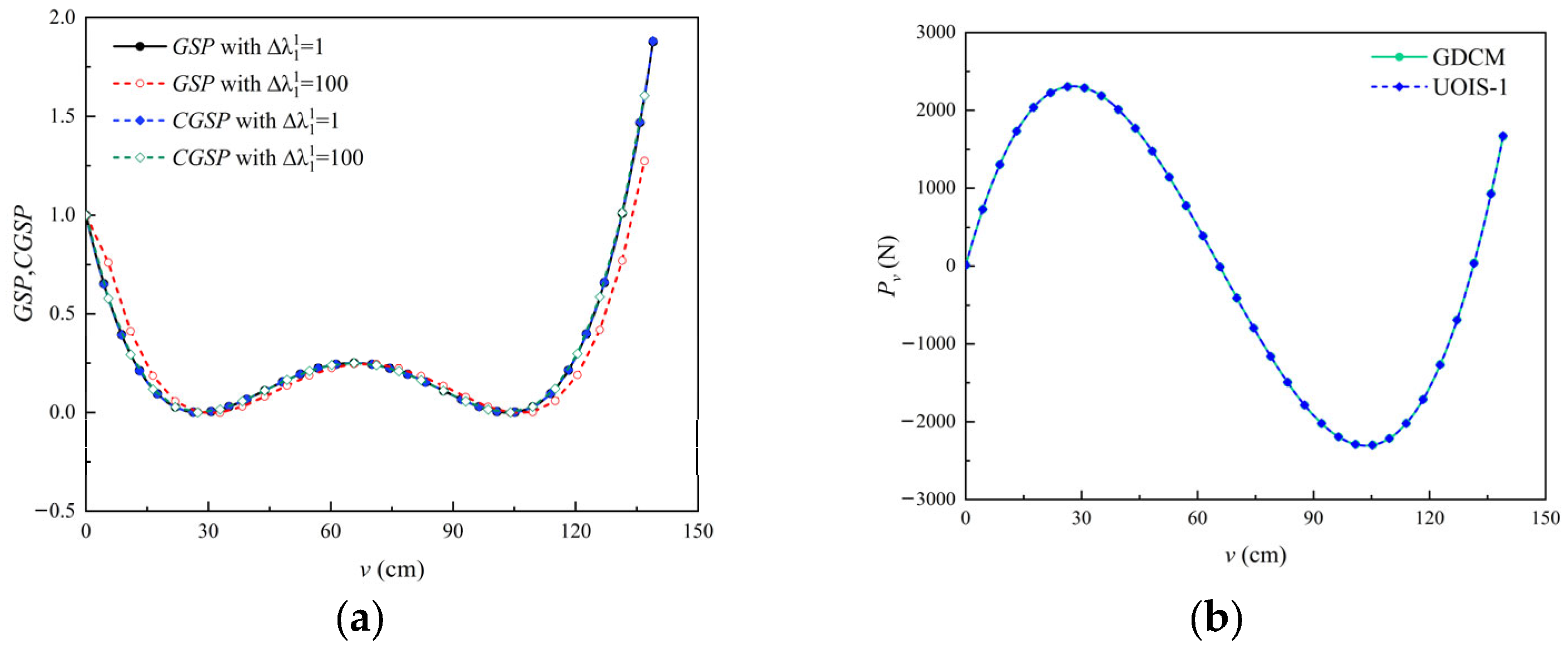
Figure 9a compares the evolution of the generalized stiffness parameter (GSP) and the current generalized stiffness parameter (CGSP) for two different initial increment sizes: a small value ( Δ λ 1 1 = 1 ) and a large value ( Δ λ 1 1 = 100 ). For a small increment size ( Δ λ 1 1 = 1 ), the GSP and CGSP curves are nearly identical. This occurs because small steps lead to minimal changes in the structural stiffness between successive increments, resulting in similar values for the stiffness parameters of consecutive increments (denoted as Δ U ^ 1 i 1 and Δ U ^ 1 i ). In contrast, for a large increment size ( Δ λ 1 1 = 100 ), the CGSP curve remains consistent with its small-step counterpart, demonstrating its insensitivity to the step size and thus its superior numerical stability. The GSP curve, however, exhibits significant deviation: it increases in structural softening regions but decreases in hardening regions. This behavior arises from the more pronounced stiffness changes between adjacent increments under large step sizes—specifically, Δ U ^ 1 i 1 becomes significantly smaller than Δ U ^ 1 i in softening regions and larger than Δ U ^ 1 i in hardening regions. In nonlinear incremental-iterative analysis, it is generally advisable to reduce the step size in softening regions and increase it in hardening regions. The trend exhibited by GSP contradicts this requirement, making algorithms relying on it prone to numerical instability (e.g., solution oscillations or divergence) when large initial increments are used. In contrast, CGSP remains stable regardless of the increment size and therefore provides a more robust indicator for adaptive step-size control.
Figure 9. Results for the two-member truss with defect-free: (a) Comparison between GSP and CGSP; (b) Comparison of path results obtained by GDCM and UOIS-1 when λ 1 1 = 1 ; (c) Comparison of path results obtained by GDCM and UOIS-1 when λ 1 1 = 100 ; (d) Comparison of path results obtained by UOIS-1 and UOIS-1-A.
For a small increment size ( Δ λ 1 1 = 1 ), the equilibrium path traced by GDCM (using GSP) coincides exactly with that obtained by the UOIS methods (using CGSP). Taking UOIS-1 as an example, Figure 9b shows a comparison of the equilibrium paths obtained from the two approaches. When a large initial increment is used ( Δ λ 1 1 = 100 ), the UOIS methods continue to produce smooth equilibrium curves. In contrast, the GDCM solution exhibits noticeable numerical oscillations near the limit point, as shown in Figure 9c. This demonstrates that the UOIS framework can accommodate larger initial load increments than GDCM, enabling larger stable step sizes and yielding higher computational efficiency. To validate the proposed acceleration strategy, results from the UOIS method incorporating the secant prediction operator (e.g., UOIS-1-A) are compared with those from the baseline UOIS implementation (e.g., UOIS-1). The corresponding equilibrium paths are identical, confirming that the acceleration strategy does not alter the solution path. For instance, Figure 9d shows a comparison of the equilibrium paths obtained from the accelerated scheme UOIS-1-A and the standard scheme UOIS-1. These results confirm that the introduced acceleration strategy preserves the solution accuracy of the original method while significantly improving its computational performance.
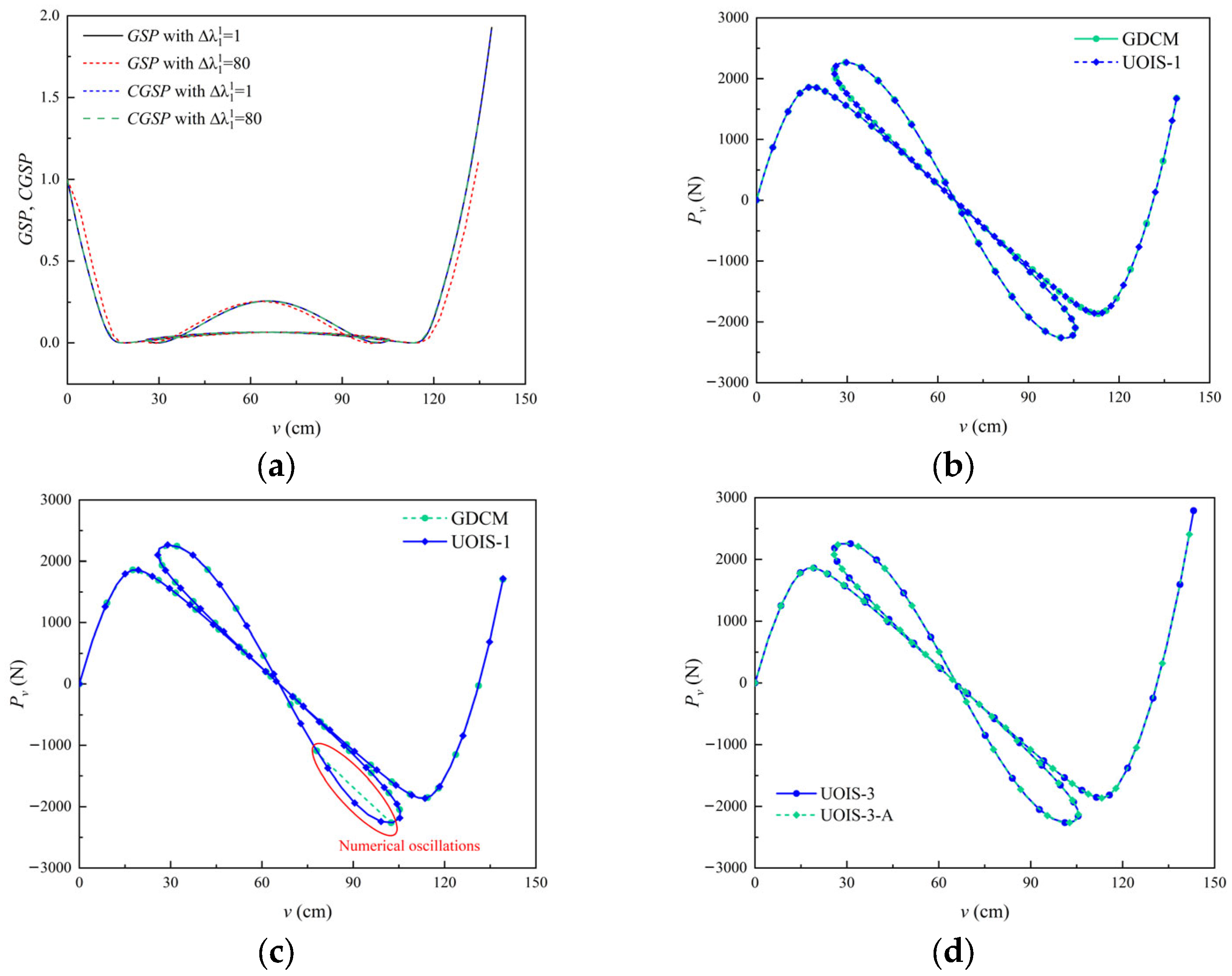
Second loading condition: A vertical load P v is applied at the top vertex together with a horizontal load P u = 0.05 P v , introducing an initial loading imperfection. Under this condition, the equilibrium path exhibits a closed-loop response with adjacent equilibrium branches. The reference loads are set to P ^ v = 10 N, P ^ u = 0.5 N. Figure 10a compares the evolution of GSP and CGSP for two increment sizes: Δ λ 1 1 = 1 (small step) and Δ λ 1 1 = 80 (large step). For small increments ( Δ λ 1 1 = 1 ), the GSP and CGSP curves closely coincide. When a large increment is used ( Δ λ 1 1 = 80 ), the CGSP curve remains consistent with its small-step counterpart, whereas the GSP curve shows noticeable deviation. This result confirms that CGSP is numerically more stable than GSP and provides a more reliable indicator for adaptive increment-size control in the presence of path looping.
Figure 10. Results for the two-member truss with a horizontal imperfection: (a) Comparison between GSP and CGSP; (b) Comparison of path results obtained by GDCM and UOIS-1 when λ 1 1 = 1 ; (c) Comparison of path results obtained by GDCM and UOIS-1 when λ 1 1 = 80 ; (d) Comparison of path results obtained by UOIS-3 and UOIS-3-A.
When the increment size is small ( Δ λ 1 1 = 1 ), the equilibrium paths obtained using GDCM and the UOIS methods are identical, as illustrated for UOIS-1 in Figure 10b. However, under a large initial increment ( Δ λ 1 1 = 80 ), the UOIS continue to trace smooth equilibrium curves, whereas the GDCM solution exhibits numerical oscillations, as seen in Figure 10c. This confirms the superior robustness of the UOIS framework in accommodating larger load increments. Furthermore, the equilibrium paths computed with the accelerated strategy (e.g., UOIS-3-A) are indistinguishable from those of the corresponding baseline methods (e.g., UOIS-3), as shown in Figure 10d. This demonstrates that incorporating the secant prediction operator preserves the solution accuracy of the original algorithm while improving computational efficiency.
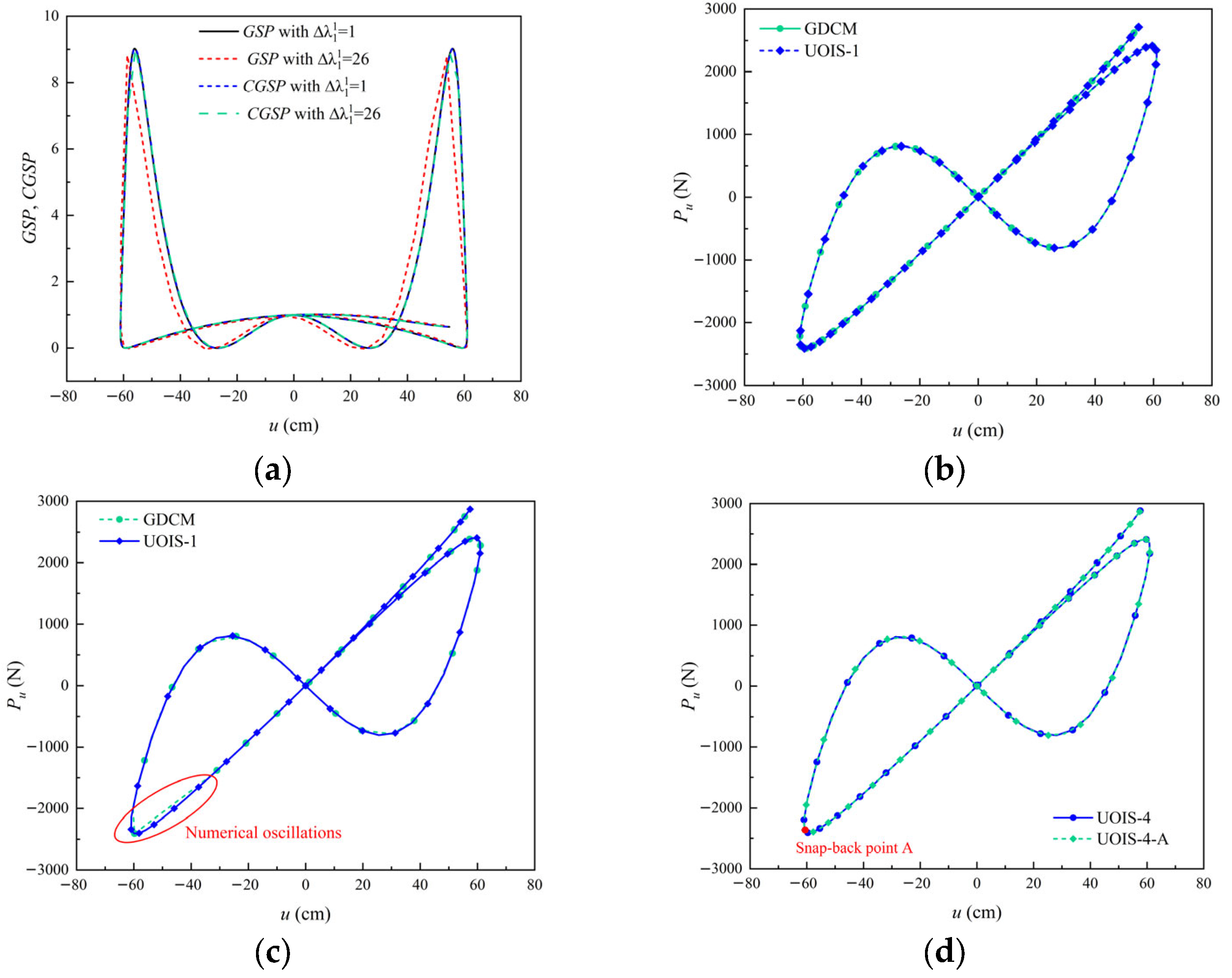
Third loading condition: A horizontal load P u is applied at the top vertex, accompanied by a vertical disturbance load P v = 0.05 P u . This introduces a vertical imperfection, causing the structural equilibrium path to also form a closed loop. The reference loads are set to P ^ u = 10 N, P ^ v = 0.5 N. Figure 11a compares the GSP and CGSP curves for increment sizes Δ λ 1 1 = 1 (small step) and Δ λ 1 1 = 26 (large step). For small increments ( Δ λ 1 1 = 1 ), the two curves nearly coincide. When a large increment is used ( Δ λ 1 1 = 26 ), the CGSP curve remains consistent with the small-step result, while the GSP curve exhibits clear deviation. This result reaffirms that CGSP is more stable than GSP and provides a more reliable indicator for adaptive increment-size control in the presence of path looping.
Figure 11. Results for the two-member truss with a horizontal imperfection: (a) Comparison between GSP and CGSP; (b) comparison of path results obtained by GDCM and UOIS-1 when λ 1 1 = 1 ; (c) comparison of path results obtained by GDCM and UOIS-1 when λ 1 1 = 26 ; (d) comparison of path results obtained by UOIS-4 and UOIS-4-A.
For a small increment size ( Δ λ 1 1 = 1 ), the equilibrium paths obtained using GDCM and the UOIS family of methods are in full agreement, as illustrated for UOIS-1 in Figure 11b. However, when a larger increment is employed ( Δ λ 1 1 = 26 ), the UOIS methods continue to produce smooth equilibrium curves, whereas the GDCM solution displays noticeable numerical oscillations (Figure 11c). This further demonstrates the ability of the UOIS framework to accommodate larger increment steps compared to GDCM. Additionally, the equilibrium paths computed with the accelerated strategy (e.g., UOIS-4-A) are indistinguishable from those of the corresponding baseline schemes (e.g., UOIS-4), as shown in Figure 11d. This confirms that the inclusion of the secant prediction operator does not compromise solution accuracy, while it enhances computational efficiency.
In the numerical analysis, the force-based convergence criterion was adopted, with the convergence tolerance, ε r , set to 10 4 . A sensitivity analysis was subsequently conducted on the UOIS-1 and UOIS-4 methods to evaluate the impact of various tolerances on computational efficiency and solution accuracy. Using the calculation of the snap-back point A (which exhibits large curvature) in Figure 11d as a benchmark, convergence tolerances ranging from 10 2 to 10 6 were tested. The error was quantified as the Euclidean (L2) norm of the difference between the snap-back points computed with looser tolerances ( 10 2 to 10 5 ) and a reference solution obtained with the most stringent tolerance ( 10 6 ). The results are presented in Table 2. It is observed that a tolerance of 10 2 yields an acceptably low error, and further tightening of the tolerance produces diminishing returns in error reduction. Setting the tolerance within the range of 10 4 to 10 5 provides an optimal balance between computational efficiency (i.e., the average number of iterations) and solution accuracy (i.e., the relative error). Consequently, a convergence tolerance of 10 4 is generally sufficient for solving a wide range of highly nonlinear problems.
Table 2. Computational data for the two-member truss with a horizontal imperfection using UOIS-1 and UOIS-4.

7.2. Hinged Semi-Circular Arch

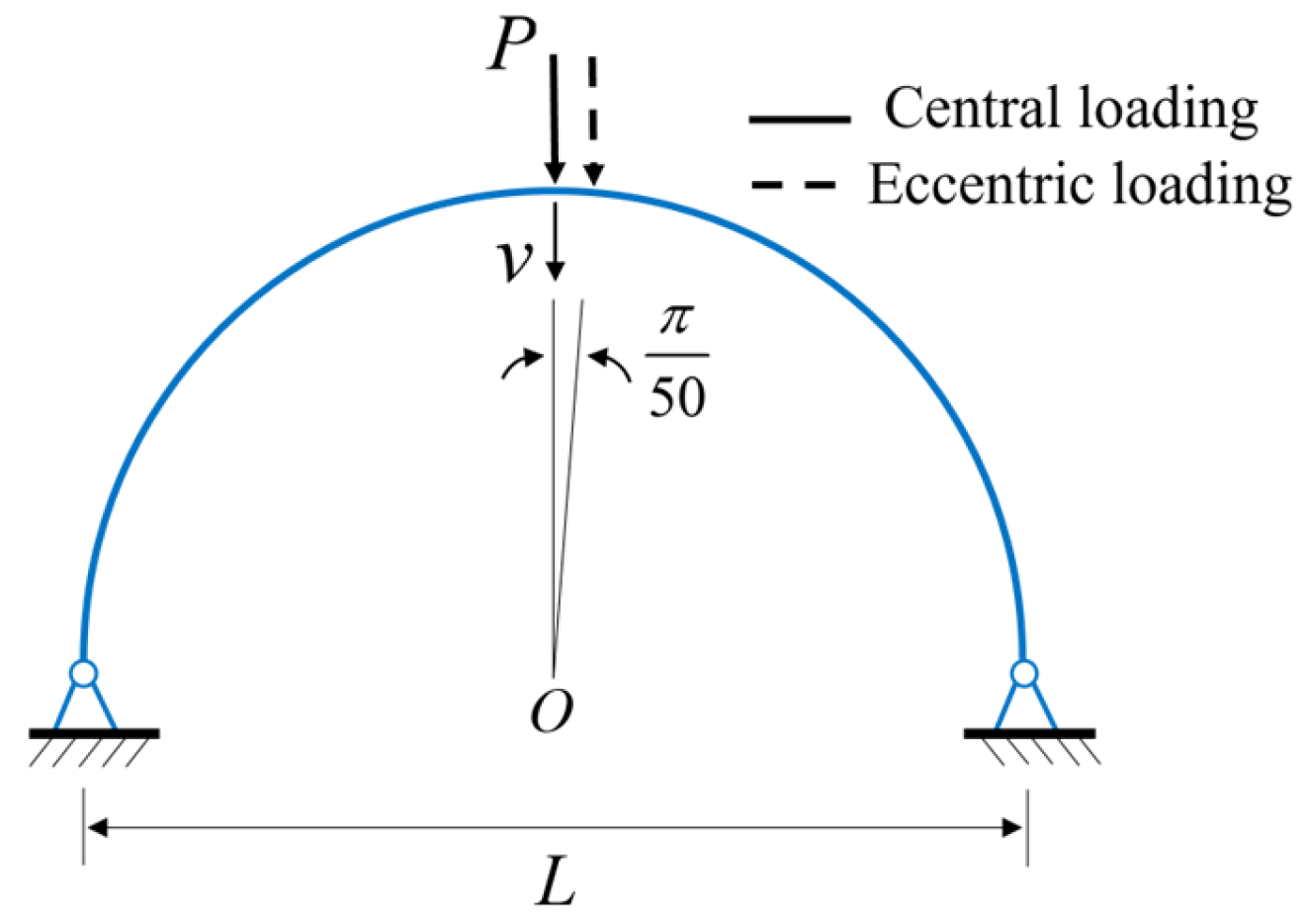
Figure 12 depicts a hinged semi-circular arch, a structure known to exhibit a complex looping equilibrium path with multiple critical points under either central or eccentric loading. This structure serves as a classical and demanding benchmark for evaluating the robustness and path-tracing capability of nonlinear solution algorithms. The material and geometric parameters adopted in the analysis are as follows: arch span L = 100 cm, elastic modulus E = 2 kN/cm2, cross-sectional area A = 1 cm2, and second moment of area I = 1 cm4. To assess the computational acceleration achieved by the proposed strategy, the arch is discretized into 100 two-dimensional beam elements [16] in the numerical model.
Figure 12. Schematic of the hinged semi-circular arch.
First loading condition (central load): A concentrated vertical load is applied at the crown of the arch. The reference load is set to P ^ = 0.01 N. For a small initial load increment factor ( Δ λ 1 1 = 5 ), the equilibrium paths obtained with GDCM and the UOIS methods coincide, as shown for GDCM and UOIS-1 in Figure 13a. This indicates that both methods can accurately trace paths containing multiple critical points when the increment size is sufficiently small. Figure 13b compares the evolution of GSP and CGSP. Although the two curves generally agree, within the region marked by the red dashed box, the GSP value is notably higher than that of CGSP. This region corresponds to a segment of the equilibrium path with high curvature, where a smaller step size is required for stable progression. The more stable and representative behavior of CGSP in this region confirms its superior suitability as an indicator for adaptive step-size control.
Figure 13. Results for the semi-circular arch under central loading: (a) Comparison of path results obtained by GDCM and UOIS-1 when λ 1 1 = 5 ; (b) comparison between GSP and CGSP; (c) comparison of path results obtained by GDCM and UOIS-1 when λ 1 1 = 18 ; (d) comparison of path results obtained by UOIS-2 and UOIS-2-A.
When the initial load factor is increased to a larger value ( Δ λ 1 1 = 18 ), GDCM fails to converge near the critical point, as shown in Figure 13c. In contrast, all UOIS variants successfully trace the complete equilibrium path, demonstrating their superior robustness and adaptability to larger increments. This improvement stems from the use of CGSP for step-size control and the more effective orthogonal iteration constraints employed in the UOIS framework. Finally, the equilibrium paths obtained with the accelerated schemes (e.g., UOIS-2-A) are indistinguishable from those of the corresponding baseline methods (e.g., UOIS-2), as illustrated in Figure 13d. This confirms that embedding the secant prediction operator preserves the solution accuracy of the original algorithm.
A quantitative comparison of the computational efficiency of each scheme is provided in Table 3 and Table 4, corresponding to the small ( Δ λ 1 1 = 5 ) and large ( Δ λ 1 1 = 18 ) initial load factors, respectively. For the smaller increment size ( Δ λ 1 1 = 5 , Table 3), the number of load steps, total iterations, and solution time required by GDCM and the UOIS methods are comparable. When the acceleration strategy is activated, the number of load steps remains essentially unchanged, the total iteration count decreases slightly, and the computational time is significantly reduced, achieving an acceleration ratio of approximately 47%. This demonstrates the effectiveness of the proposed acceleration strategy under moderate increment sizes.
Table 3. Computational performance for the semi-circular arch under central loading with Δ λ 1 1 = 5 .
Table 4. Computational performance for the semi-circular arch under central loading with Δ λ 1 1 = 18 .
When a larger increment is used ( Δ λ 1 1 = 18 , Table 4), GDCM fails to converge due to numerical instability. In contrast, all UOIS variants successfully trace the full equilibrium path, exhibiting closely matched numbers of load steps, total iterations, and solution time. With the acceleration enabled, the load-step count remains nearly identical, the total iterations decrease slightly, and the computational time is reduced by approximately 41% compared to the non-accelerated UOIS baselines.
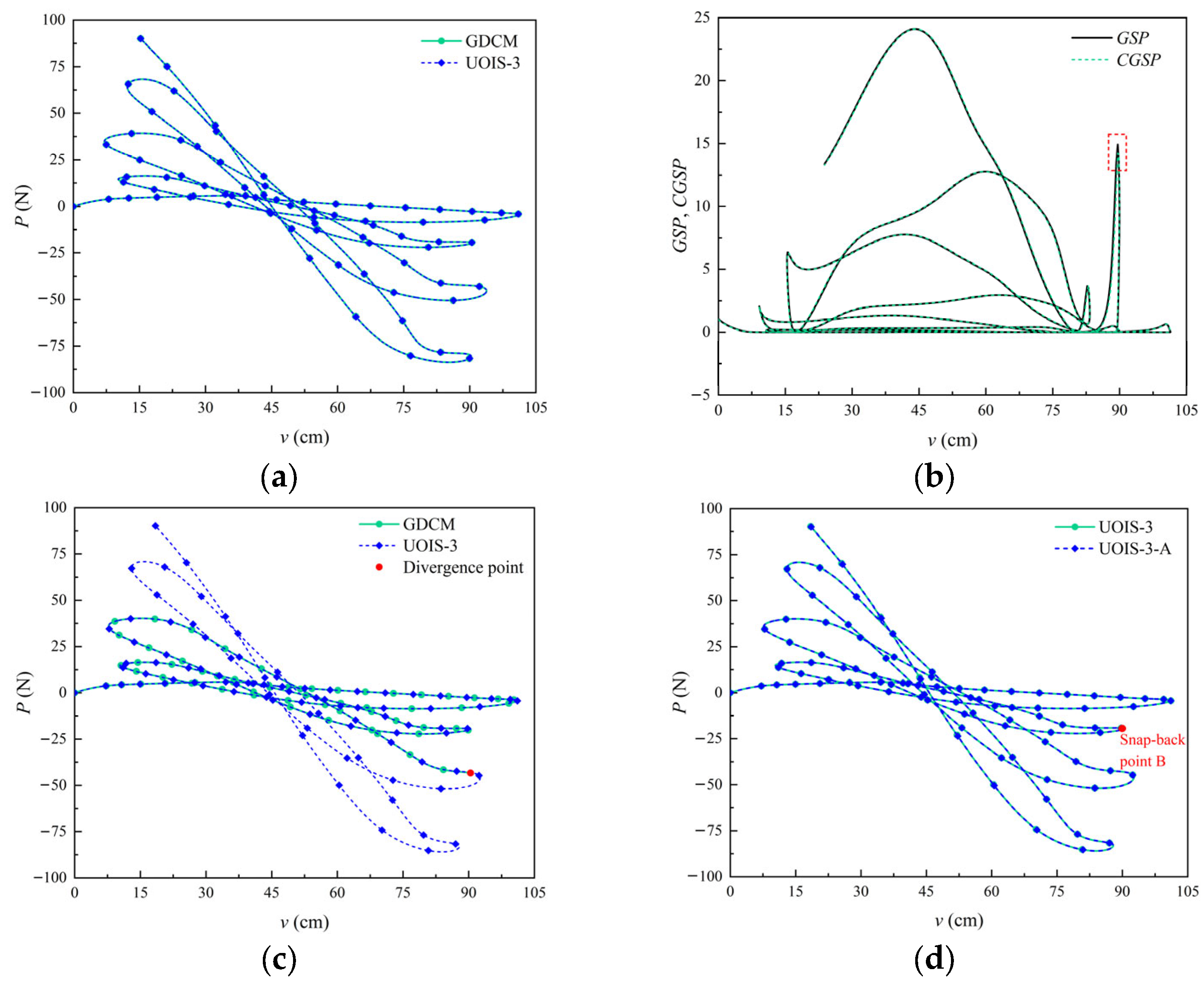
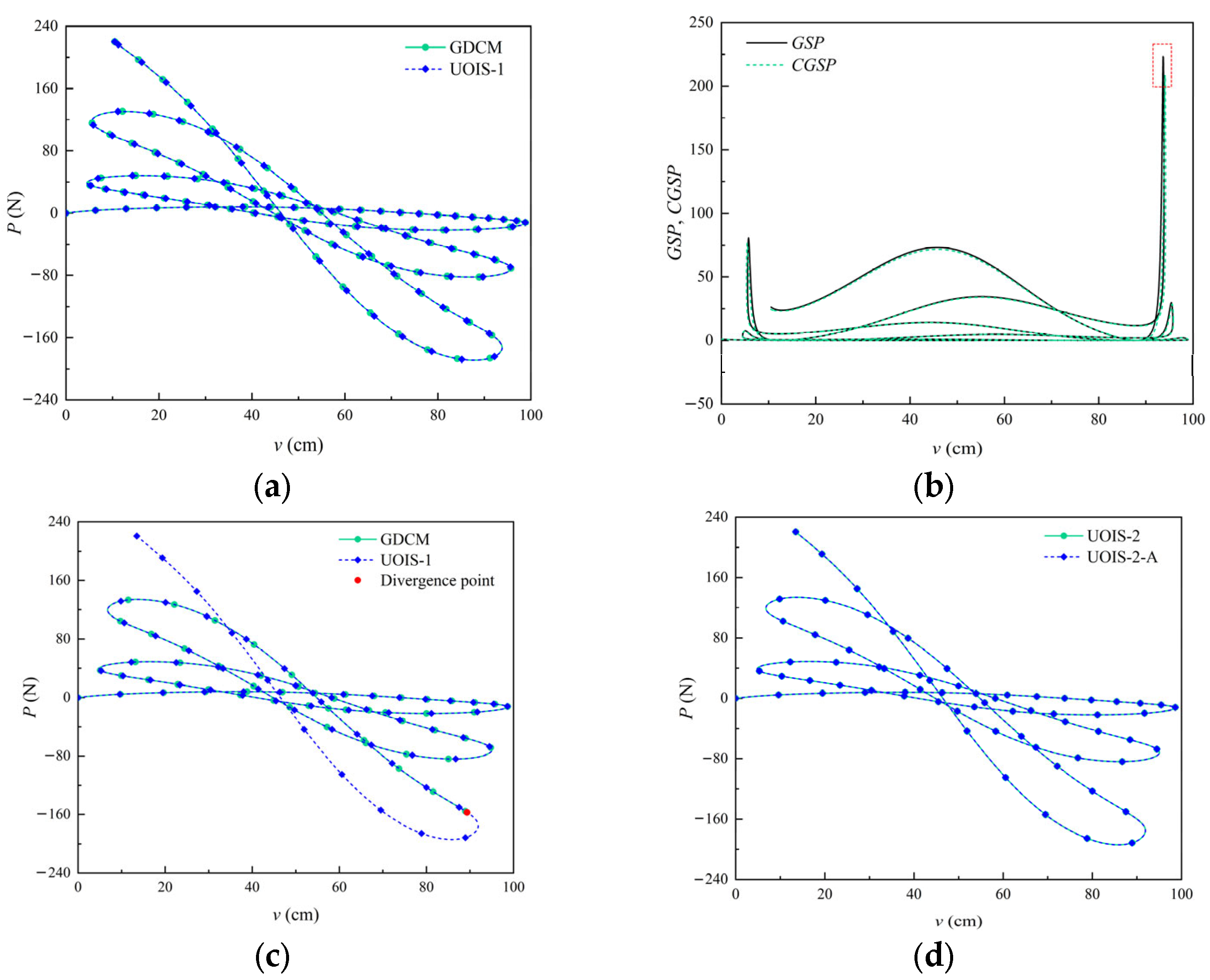
Second loading condition (eccentric load): An eccentric load is applied at an angular offset of π/50 from the crown of the arch. The magnitude of the reference load remains unchanged. For an initial load factor Δ λ 1 1 = 5 , the equilibrium paths obtained with GDCM and the UOIS methods coincide completely, as illustrated for GDCM and UOIS-3 in Figure 14a. This confirms that both approaches can reliably trace paths containing multiple critical points when the increment size is sufficiently small. A comparison of GSP and CGSP (Figure 14b) shows general agreement between the two curves; however, within the region highlighted by the red dashed box, the GSP value is markedly higher than that of CGSP. This region corresponds to a segment of high path curvature, where the more stable response of CGSP makes it a preferable indicator for step-size adaptation.
Figure 14. Results for the semi-circular arch under eccentric loading: (a) Comparison of path results obtained by GDCM and UOIS-3 when λ 1 1 = 5 ; (b) comparison between GSP and CGSP; (c) comparison of path results obtained by GDCM and UOIS-3 when λ 1 1 = 25 ; (d) comparison of path results obtained by UOIS-3 and UOIS-3-A.
When the load factor is increased to Δ λ 1 1 = 25 , GDCM exhibits numerical divergence (Figure 14c), whereas all UOIS variants successfully trace the complete equilibrium path. This superior robustness stems from the use of CGSP for step-size control, combined with the more efficient orthogonal iteration paths employed in the UOIS framework. Finally, the paths obtained with the accelerated schemes (e.g., UOIS-3-A) are indistinguishable from those of the corresponding baseline methods (e.g., UOIS-3), as shown in Figure 14d. This again verifies that the secant-based acceleration preserves the accuracy of the original solution procedure.
The computational efficiency of each scheme is further compared in Table 5 and Table 6, corresponding to initial load factors Δ λ 1 1 = 5 and Δ λ 1 1 = 25 , respectively. For the small increment Δ λ 1 1 = 5 (Table 5), all schemes require a similar number of load steps and iterations. When the acceleration strategy is applied, the computational time decreases substantially, yielding an acceleration ratio of approximately 46%, while the step count and iteration numbers remain nearly unchanged. At the larger load factor Δ λ 1 1 = 25 (Table 6), GDCM fails to converge, whereas the UOIS methods successfully trace the full equilibrium path. With acceleration enabled, the number of load steps is maintained, the total iterations are slightly reduced, and the computational time is lowered by approximately 34% relative to the non-accelerated UOIS baselines.
Table 5. Computational performance for the semi-circular arch under eccentric loading with Δ λ 1 1 = 5 .
Table 6. Computational performance for the semi-circular arch under eccentric loading with Δ λ 1 1 = 25 .
A sensitivity analysis was conducted on the UOIS-2 and UOIS-3 methods to evaluate the influence of the convergence tolerance on computational efficiency and solution accuracy. Using the large-curvature snap-back point B in Figure 14d as a benchmark, the results are presented in Table 7. The data demonstrate that a tolerance ε r of 10 3 yields an acceptably low error, and further reductions in ε r produce diminishing improvements in accuracy. An optimal balance between computational efficiency and solution accuracy is achieved when the tolerance is set within the range of 10 4 to 10 5 .
Table 7. Computational data for the semi-circular arch under eccentric loading using UOIS-2 and UOIS-3.

8. Conclusions

This study presents a comprehensive investigation within the incremental-iterative framework for tracing structural nonlinear equilibrium paths, with a detailed analysis of the role of the load increment factor in both the predictor and corrector phases. In the predictor phase, the current generalized stiffness parameter (CGSP) is introduced to enable adaptive control of the increment size, while a cumulative indicator S i is proposed to reliably identify loading and unloading transitions. In the corrector phase, four updated orthogonal iterative strategies (UOIS) are formulated, offering enhanced path-following robustness and efficiency. To enhance computational efficiency, a secant-based prediction operator is embedded in the predictor phase, circumventing the costly assembly and inversion of the global tangent stiffness matrix. The following principal conclusions are drawn from the numerical case studies:
(1)
Compared to the conventional generalized stiffness parameter (GSP), the proposed CGSP demonstrates superior numerical stability, particularly for large increments. Consequently, CGSP serves as a more effective and reliable indicator for adaptive increment-size control in nonlinear path-following analysis.
(2)
The cumulative indicator S i changes sign precisely as the equilibrium path traverses a limit point, providing a robust and reliable criterion for distinguishing between loading ( S i > 0) and unloading ( S i < 0) regimes.
(3)
The UOIS framework demonstrates strong robustness in tracing complex post-buckling equilibrium paths. Compared to the generalized displacement control method (GDCM), the UOIS maintains solution stability under significantly larger increment sizes and converges along more efficient iterative paths.
(4)
Embedding the secant prediction operator in the predictor phase effectively avoids the assembly and inversion of the global tangent stiffness matrix, with negligible impact on the total number of load steps or iterations. Consequently, this strategy achieves a substantial improvement in the computational efficiency of the incremental-iterative procedure.
The proposed numerical framework, incorporating both the updated orthogonal iterative strategies (UOIS) and the secant prediction operator, is not limited to geometric nonlinearity. It is readily applicable to other challenging problems, such as those involving material nonlinearities and complex path-tracking scenarios.

Funding

This research was funded by the Science and Technology Project of Sichuan Provincial Department of Natural Resources (Grant No.: KJ-2025-057), Science and Technology Plan Project of Neijiang (Grant No.: NJJH202316), and the Research Funding Project of Neijiang Normal University (Grant No.: 2023ZD03).

Data Availability Statement

The original contributions presented in the research are included in the article; further inquiries can be directed to the corresponding author. Data will be made available on request.

Conflicts of Interest

The author declares no potential conflicts of interest.

Abbreviations

The following abbreviations are used in this manuscript:
UOISUpdated orthogonal iterative strategies
CGSPCurrent generalized stiffness parameter
GSPGeneralized stiffness parameter
GDCMGeneralized displacement control method

References

  1. Hu, D.; Xiang, X.; Huang, J.; Qi, K.; Li, Y.; Yang, X.; Liang, X. Calculation methods for the jacking force of a rectangular pipe jacking tunnel: Overview and prospects. J. Pipeline Syst. Eng. Pract. 2025, 16, 03125001. [Google Scholar] [CrossRef]
  2. Ma, C.; Zheng, H.; Yang, N.; Sun, T.; Si, J.; Ren, D. Microstructural evolution and mechanical properties of snow under compression. Constr. Build. Mater. 2025, 472, 140883. [Google Scholar] [CrossRef]
  3. Smoljanović, H.; Balić, I.; Munjiza, A.; Hristovski, V. Rotation-free based numerical model for nonlinear analysis of thin shells. Buildings 2021, 11, 657. [Google Scholar] [CrossRef]
  4. Groh, R.M. A morphoelastic stability framework for post-critical pattern formation in growing thin biomaterials. Comput. Methods Appl. Mech. Eng. 2022, 394, 114839. [Google Scholar] [CrossRef]
  5. Wang, L.; Liu, C.; Liu, W.; Yan, Z.; Nie, X. Nonlinear dynamic response of galfenol cantilever energy harvester considering geometric nonlinear with a nonlinear energy sink. Buildings 2024, 14, 1482. [Google Scholar] [CrossRef]
  6. Chen, X. Robust path-following and branch-switching in isogeometric nonlinear bifurcation analysis of variable angle tow panels with cutouts under compression. Comput. Struct. 2025, 318, 107948. [Google Scholar] [CrossRef]
  7. Leon, S.E.; Paulino, G.H.; Pereira, A.; Menezes, I.F.M.; Lages, E.N. A unified library of nonlinear solution schemes. Appl. Mech. Rev. 2011, 64, 040803. [Google Scholar] [CrossRef]
  8. Yang, Y.B.; Chen, A.; He, S. Research on nonlinear, postbuckling and elasto-plastic analyses of framed structures and curved beams. Meccanica 2021, 56, 1587–1612. [Google Scholar] [CrossRef]
  9. Wempner, G.A. Discrete approximation related to nonlinear theories of solids. Int. J. Solids Struct. 1971, 7, 1581–1599. [Google Scholar] [CrossRef]
  10. Riks, E. The application of Newton’s method to the problem of elastic stability. J. Appl. Mech. 1972, 39, 1060–1065. [Google Scholar] [CrossRef]
  11. Riks, E. An incremental approach to the solution of snapping and buckling problems. Int. J. Solids Struct. 1979, 15, 529–551. [Google Scholar] [CrossRef]
  12. Crisfield, M.A. A fast incremental/iterative solution procedure that handles snap-through. Comput. Struct. 1981, 13, 55–62. [Google Scholar] [CrossRef]
  13. Bouwer, J.M.; Kok, S.; Wilke, D.N. Challenges and solutions to arc-length controlled structural shape design problems. Mech. Based. Des. Struc. 2021, 51, 4088–4119. [Google Scholar] [CrossRef]
  14. Pretti, G.; Coombs, W.M.; Augarde, C.E. A displacement-controlled arc-length solution scheme. Comput. Struct. 2022, 258, 106674. [Google Scholar] [CrossRef]
  15. Gavin, N.D.; Pretti, G.; Coombs, W.M.; Brigham, J.C.; Augarde, C.E. On the implementation of a material point-based arc-length method. Int. J. Numer. Meth. Eng. 2024, 125, e7438. [Google Scholar] [CrossRef]
  16. Yang, Y.B.; Lin, S.P.; Leu, L.J. Solution strategy and rigid element for nonlinear analysis of elastic structures based on updated Lagrangian formulation. Eng. Struct. 2007, 29, 1189–1200. [Google Scholar] [CrossRef]
  17. Yang, Y.B.; Chen, A.; He, S.; Wu, Y.T. Rational nonlinear analysis of framed structures and curved beams considering joint equilibrium in deformed state. Int. J. Nonlin. Mech. 2020, 125, 103538. [Google Scholar] [CrossRef]
  18. Lin, T.W.; Yang, Y.B.; Shiau, H.T. A work weighted state vector control method for geometrically nonlinear analysis. Comput. Struct. 1993, 46, 689–694. [Google Scholar] [CrossRef]
  19. Rezaiee-Pajand, M.; Rahele, N. Using residual areas for geometrically nonlinear structural analysis. Ocean Eng. 2015, 105, 327–335. [Google Scholar] [CrossRef]
  20. Rezaiee-Pajand, M.; Naserian, R.; Afsharimoghadam, H. Geometrical nonlinear analysis of structures using residual variables. Mech. Based Des. Struct. Mach. 2019, 47, 215–233. [Google Scholar] [CrossRef]
  21. Ahmad-Abad, M.S.; Maghami, A.; Ghalishooyan, M.; Shooshtari, A. A family of minimum residual displacement methods as nonlinear solution schemes for equilibrium path-following in structural mechanics. Comput. Struct. 2024, 300, 107407. [Google Scholar] [CrossRef]
  22. Yang, Y.B.; Shieh, M.S. Solution method for nonlinear problems with multiple critical points. AIAA J. 1990, 28, 2110–2116. [Google Scholar] [CrossRef]
  23. Goodarzimehr, V.; Shojaee, S.; Talatahari, S.; Hamzehei-Javaran, S. Generalized displacement control analysis and optimal design of geometrically nonlinear space structures. Int. J. Comput. Methods. 2023, 20, 2143018. [Google Scholar] [CrossRef]
  24. Yang, Y.B.; Chen, A.; Yan, Y.; Wang, Z. Using only elastic stiffness in nonlinear and postbuckling analysis of structures. Int. J. Struct. Stab. Dyn. 2019, 19, 1950112. [Google Scholar] [CrossRef]
  25. Yang, Y.B.; Chen, Z.H.; Tao, Y.C.; Li, Y.F.; Liao, M.M. Elasto-plastic analysis of steel framed structures based on rigid body rule and plastic-hinge concept. Int. J. Struct. Stab. Dyn. 2019, 19, 1950104. [Google Scholar] [CrossRef]
  26. Dang, H.K.; Thai, D.K.; Kim, S.E. Stochastic analysis of semi-rigid steel frames using a refined plastic-hinge model and Latin hypercube sampling. Eng. Struct. 2023, 291, 116313. [Google Scholar] [CrossRef]
  27. Zhang, X.S.; Chi, H.; Paulino, G.H. Adaptive multi-material topology optimization with hyperelastic materials under large deformations: A virtual element approach. Comput. Methods Appl. Mech. Eng. 2020, 370, 112976. [Google Scholar] [CrossRef]
  28. Vijayakumaran, H.; Russ, J.B.; Paulino, G.H.; Bessa, M.A. Consistent machine learning for topology optimization with microstructure-dependent neural network material models. J. Mech. Phys. Solids. 2025, 196, 106015. [Google Scholar] [CrossRef]
  29. Zhang, H.; Paik, J. Lattice-and-plate model: Mechanics modeling of physical origami robots. Soft Robot. 2023, 10, 149–158. [Google Scholar] [CrossRef]
  30. Maghami, A.; Hosseini, S.M. Initial load factor adjustment through genetic algorithm for the generalized displacement control method: Implementation on non-rigid origami analysis. Thin-Wall. Struct. 2024, 201, 111972. [Google Scholar] [CrossRef]
  31. Leon, S.E.; Lages, E.N.; de Araújo, C.N.; Paulino, G.H. On the effect of constraint parameters on the generalized displacement control method. Mech. Res. Commun. 2014, 56, 123–129. [Google Scholar] [CrossRef]
  32. Yang, Y.B.; Pang, B.; Xu, H.; Liu, L.; Chen, A. Embedded secant predictor for tracing the multi critical postbuckling response based on generalized displacement control method. Eng. Struct. 2025, 345, 121457. [Google Scholar] [CrossRef]
  33. Li, Y.; Weng, X.; Hu, D.; Tan, Z.; Qi, K.; Liu, J. Data-driven deep-learning model for predicting jacking force of rectangular pipe jacking tunnel. J. Comput. Civil. Eng. 2025, 39, 04025017. [Google Scholar] [CrossRef]
  34. Hu, D.; Liu, J.; Li, Y.; Tan, Z. Prediction method of ground settlement for rectangular tunnel construction. Tunn. Undergr. Space Technol. 2025, 164, 106814. [Google Scholar] [CrossRef]
  35. Bergan, P.G. Solution algorithms for nonlinear structural problems. Comput. Struct. 1980, 12, 497–509. [Google Scholar] [CrossRef]
  36. Karnovsky, I.A.; Lebed, O. Advanced Methods of Structural Analysis, 2nd ed.; Springer: Cham, Switzerland, 2021; pp. 715–740. [Google Scholar] [CrossRef]
  37. Kuo, S.R.; Yang, Y.B. Tracing postbuckling paths of structures containing multi-loops. Int. J. Numer. Meth. Eng. 1995, 38, 4053–4075. [Google Scholar] [CrossRef]
  38. Feng, Y.T.; Perić, D.; Owen, D.R.J. A new criterion for determination of initial loading parameter in arc-length methods. Comput. Struct. 1996, 58, 479–485. [Google Scholar] [CrossRef]
  39. Pecknold, D.A.; Ghaboussi, J.; Healey, T.J. Snap-through and bifurcation in a simple structure. J. Eng. Mech. 1985, 111, 909–922. [Google Scholar] [CrossRef]
Disclaimer/Publisher’s Note: The statements, opinions and data contained in all publications are solely those of the individual author(s) and contributor(s) and not of MDPI and/or the editor(s). MDPI and/or the editor(s) disclaim responsibility for any injury to people or property resulting from any ideas, methods, instructions or products referred to in the content.

Article Metrics

Citations

Article Access Statistics

Multiple requests from the same IP address are counted as one view.