Thermal Comfort Evaluation for the Rural Elderly Based on the Spatiotemporal Differentiation of Daily Activities During Summer in Xi’an, China

 ,
,  ,
,  ,
,  ,
, 
Abstract
1. Introduction
- To identify the daily activity contents of elderly residents in rural Xi’an and characterize the spatiotemporal differentiation patterns of their daily activities;
- To analyze thermal responses and adaptive thermal demands of elderly people across distinct activity spaces;
- To conduct a “time-segmented and zone-specific” refined evaluation of thermal comfort levels for elderly people.
2. Materials and Methods
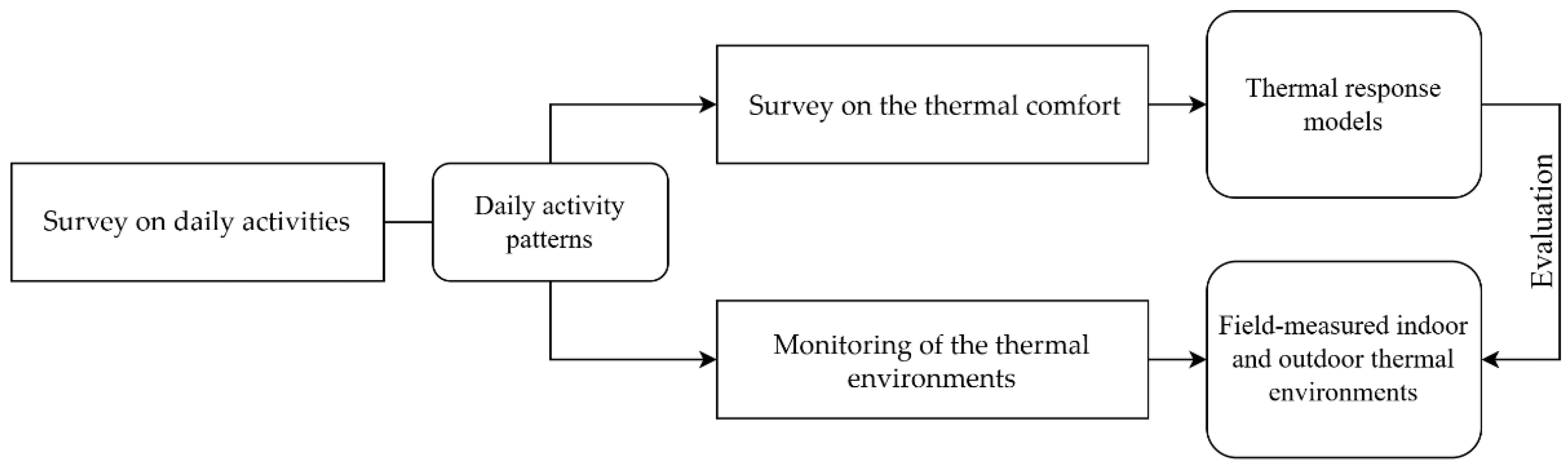
2.1. Overview of the Technical Route
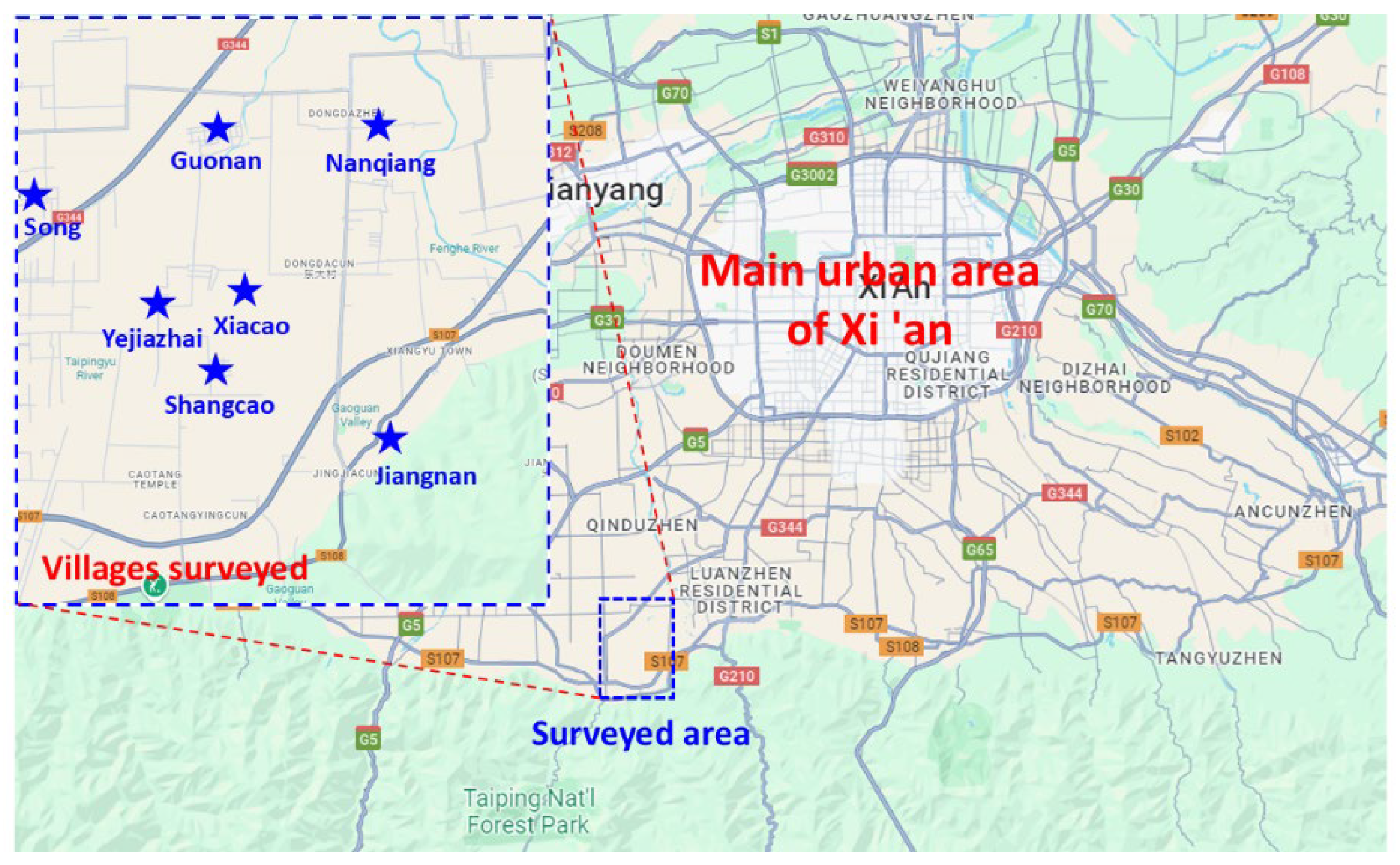
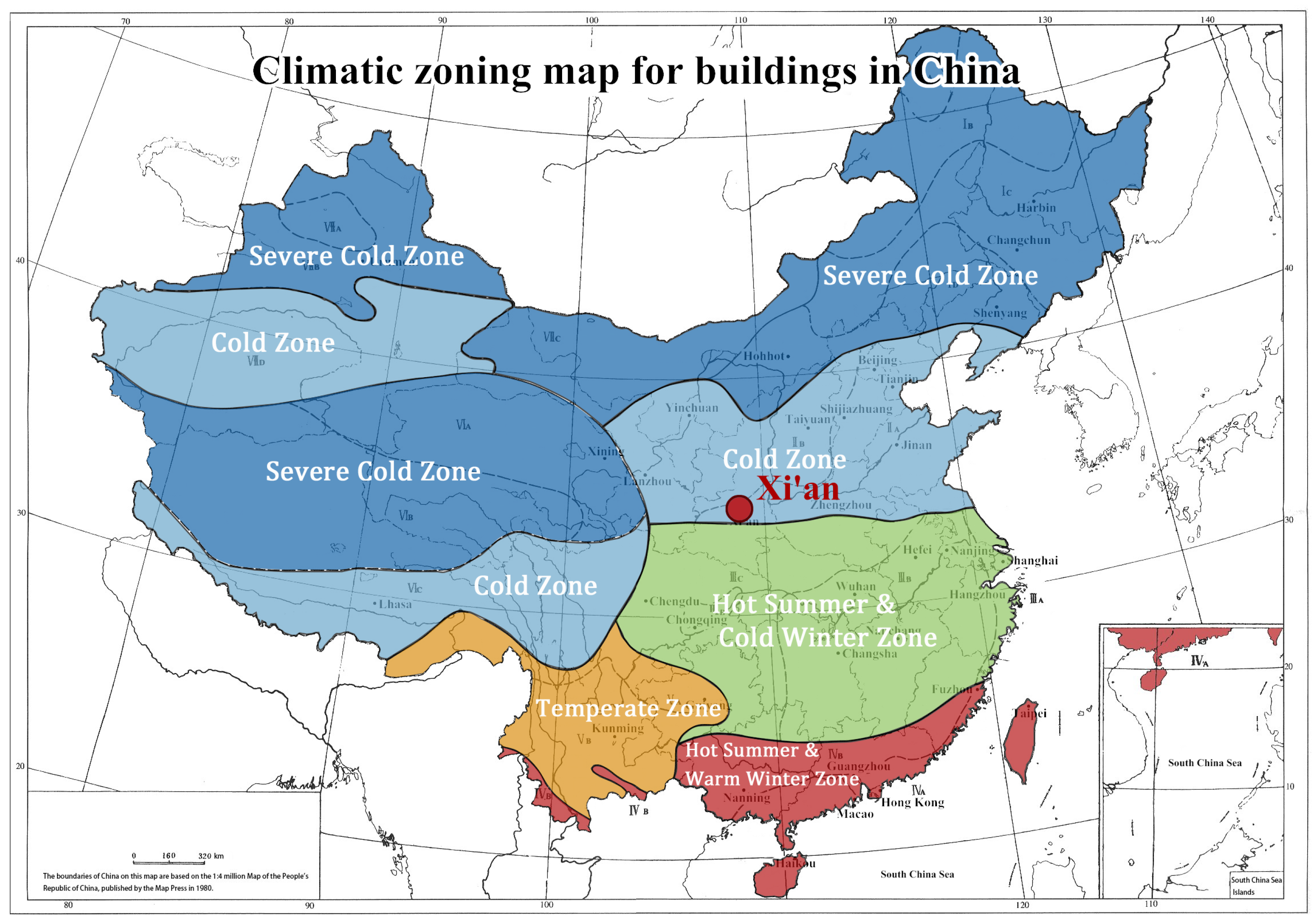
2.2. Overview of the Surveyed Area
2.3. Field Survey
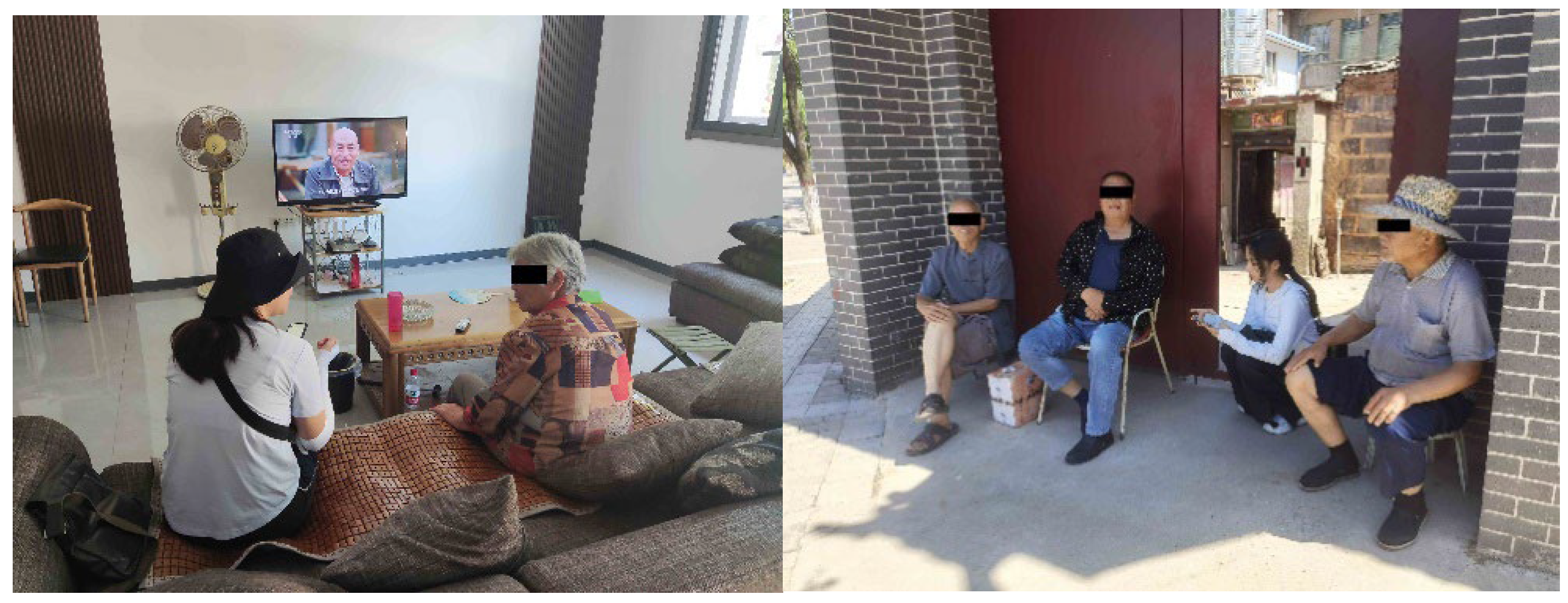
2.3.1. Survey on Daily Activities
2.3.2. Survey on the Thermal Comfort
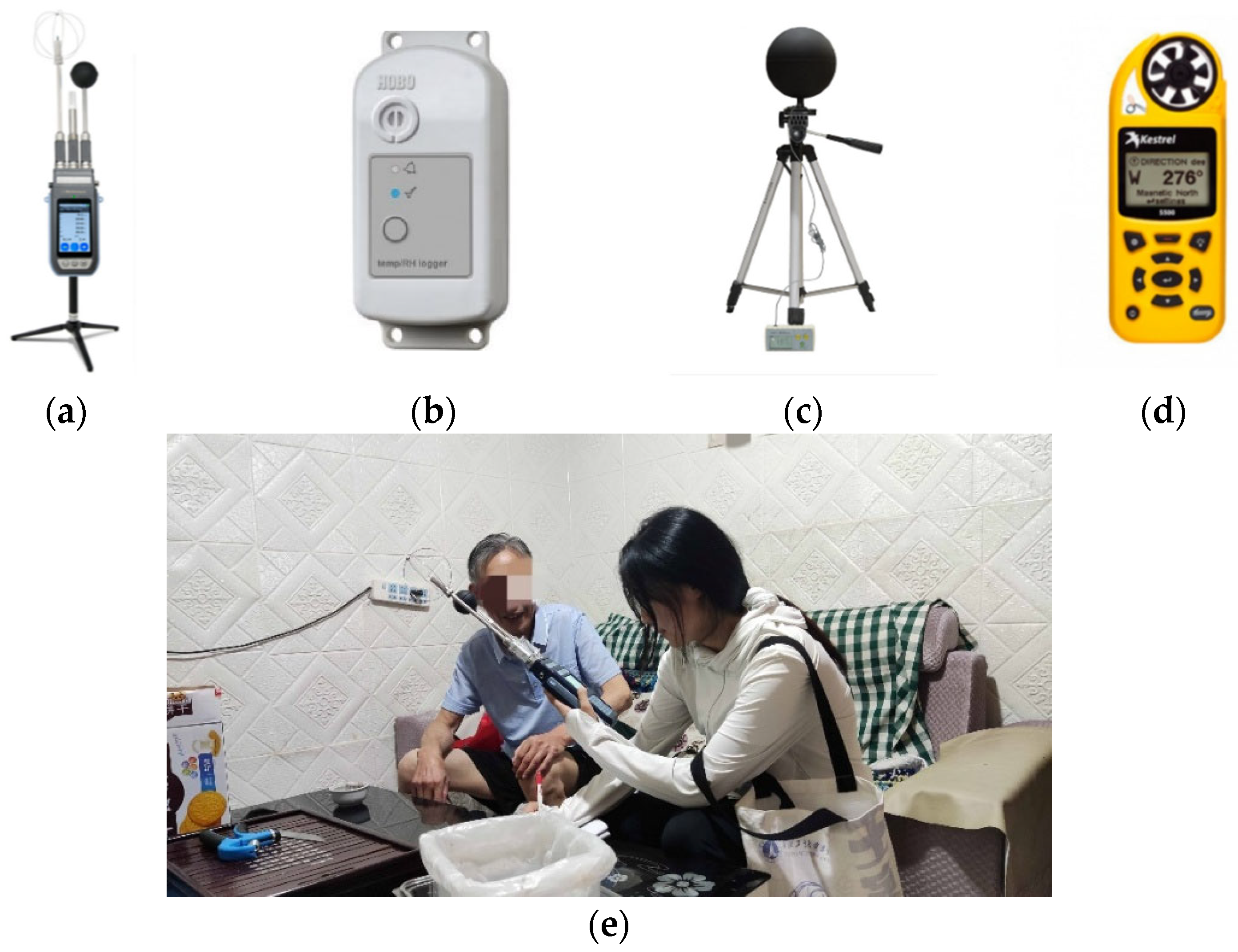
2.3.3. Monitoring of the Thermal Environments
3. Results
3.1. Daily Activity Patterns
3.1.1. Spatiotemporal Trajectory of Daily Activities
3.1.2. Content and Classification of Daily Activities
3.1.3. Spatiotemporal Differentiation Patterns of Daily Activities
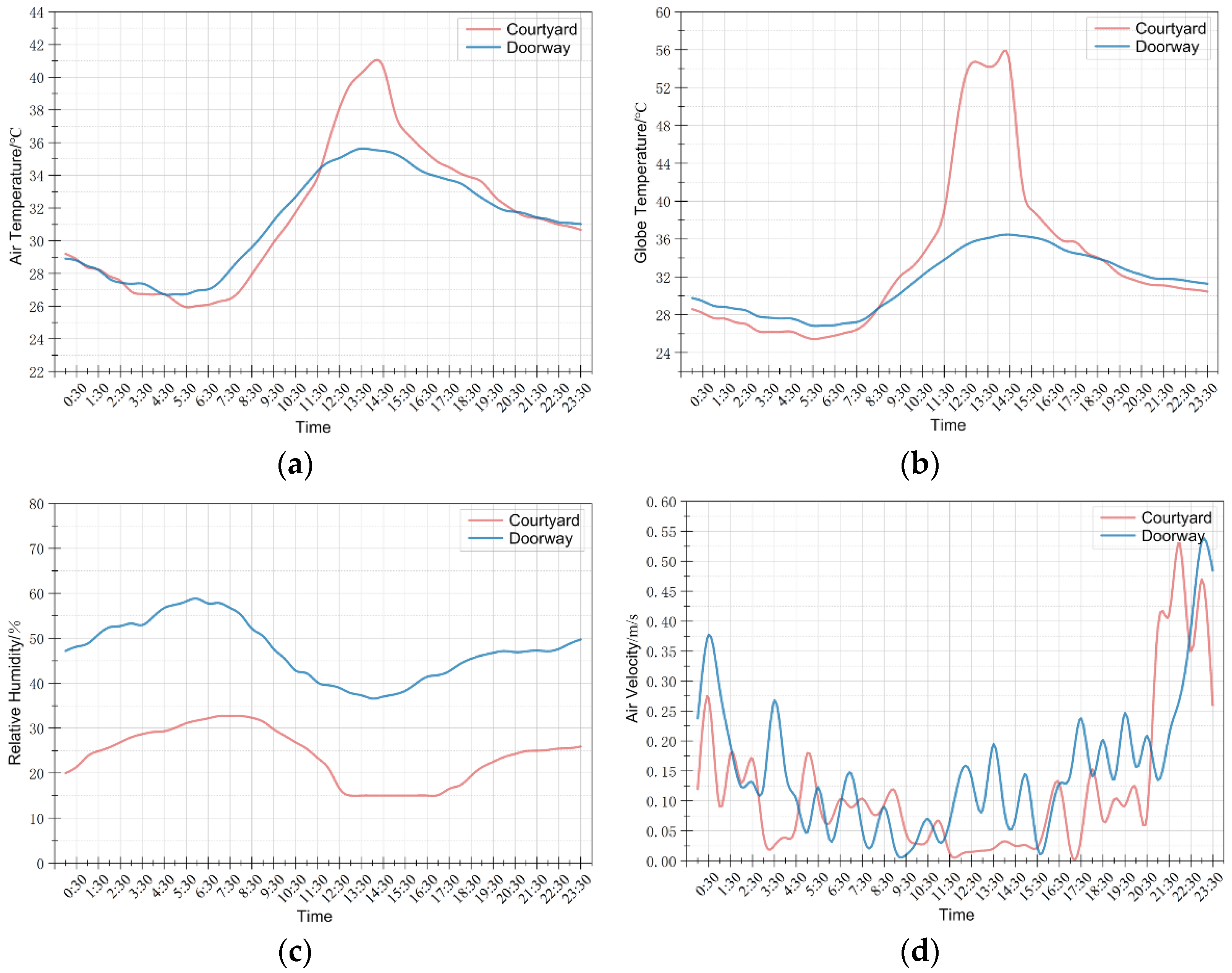
3.2. Thermal Environments and the Elderly’s Thermal Responses
3.2.1. Thermal Environments
3.2.2. Thermal Sensation and Thermal Acceptability
3.2.3. Thermal Response Models
3.3. Thermal Comfort Evaluations
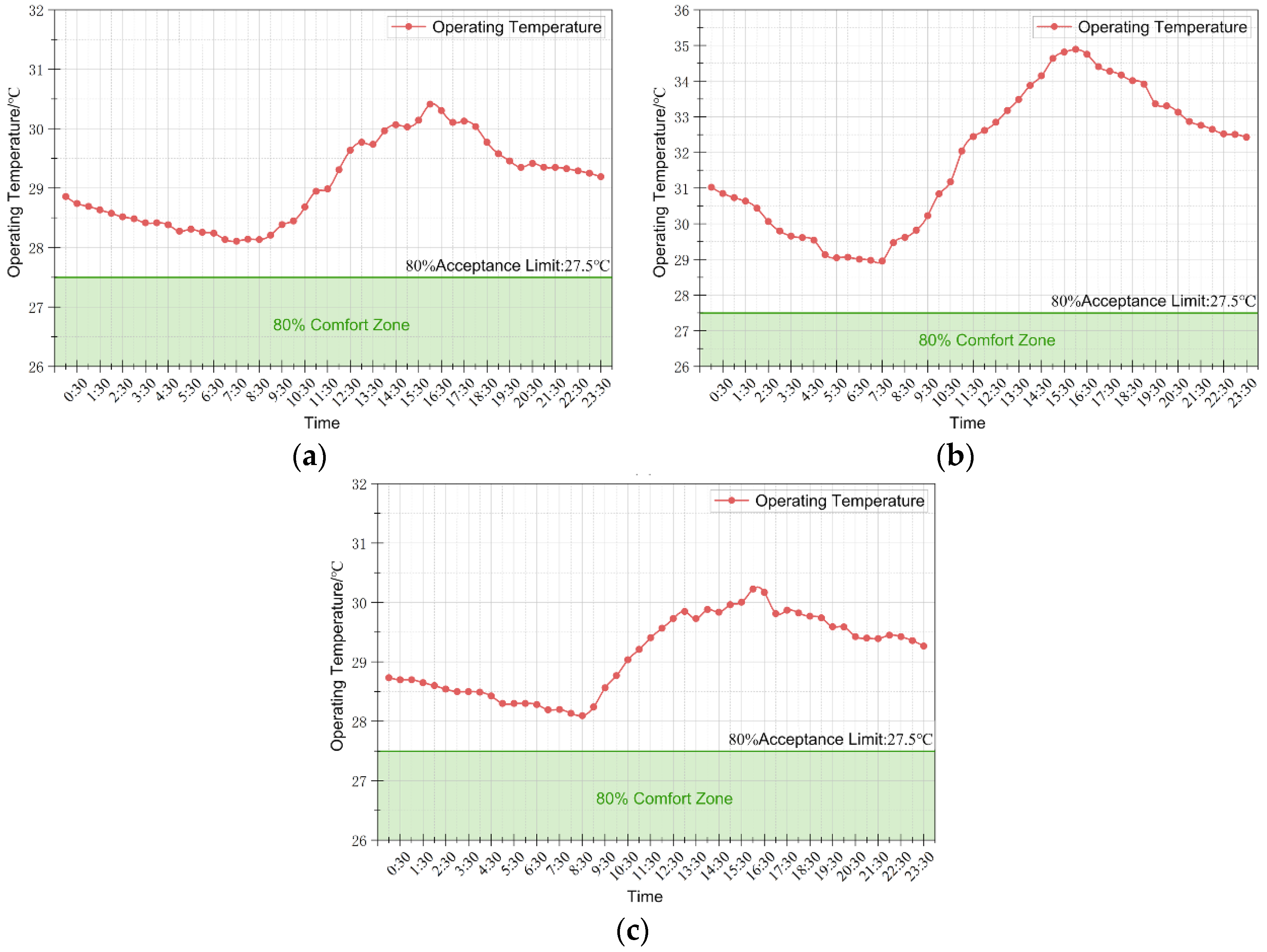
3.3.1. Thermal Environment Conditions of Daily Activity Spaces
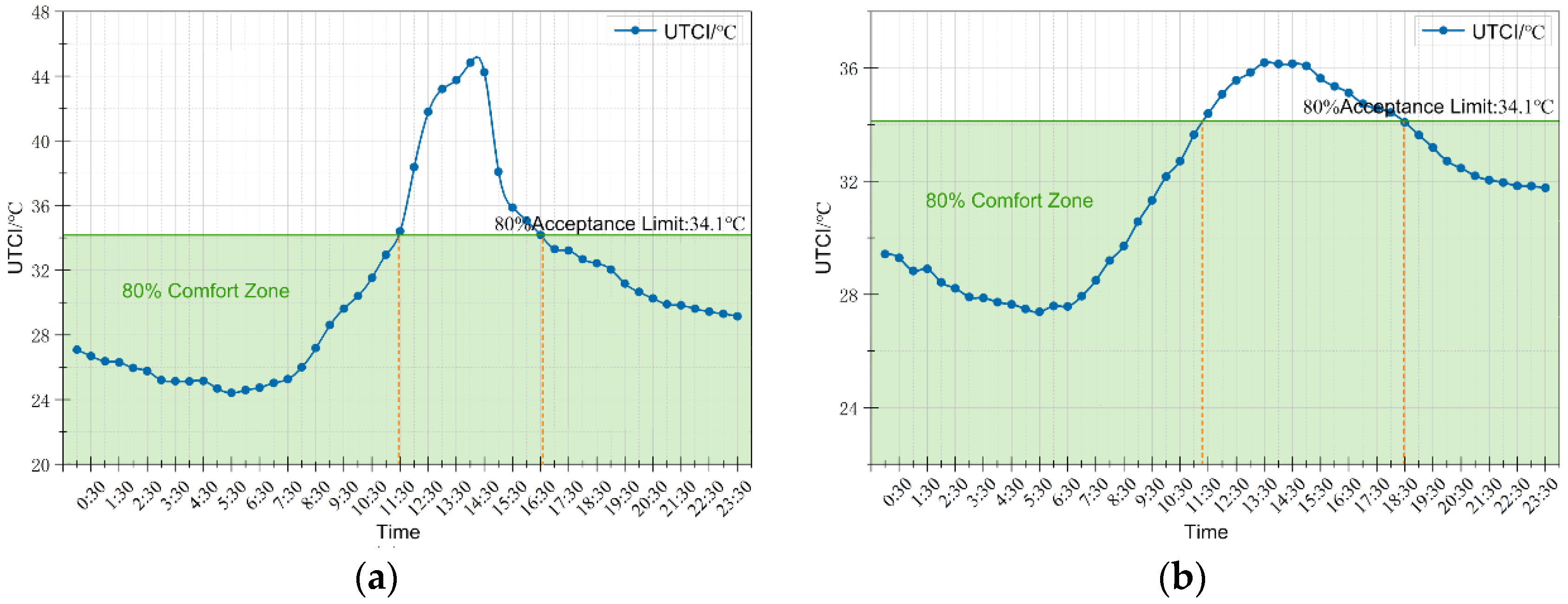
3.3.2. Evaluations of Thermal Comfort in Daily Activity Spaces
4. Discussion
4.1. Daily Activity Patterns of the Elderly
4.2. Adaptive Thermal Comfort of the Elderly in Different Daily Activity Spaces
4.3. Evaluations of Thermal Comfort Based on Spatiotemporal Differentiation of Daily Activities
4.4. Limitations and Future Work
5. Conclusions
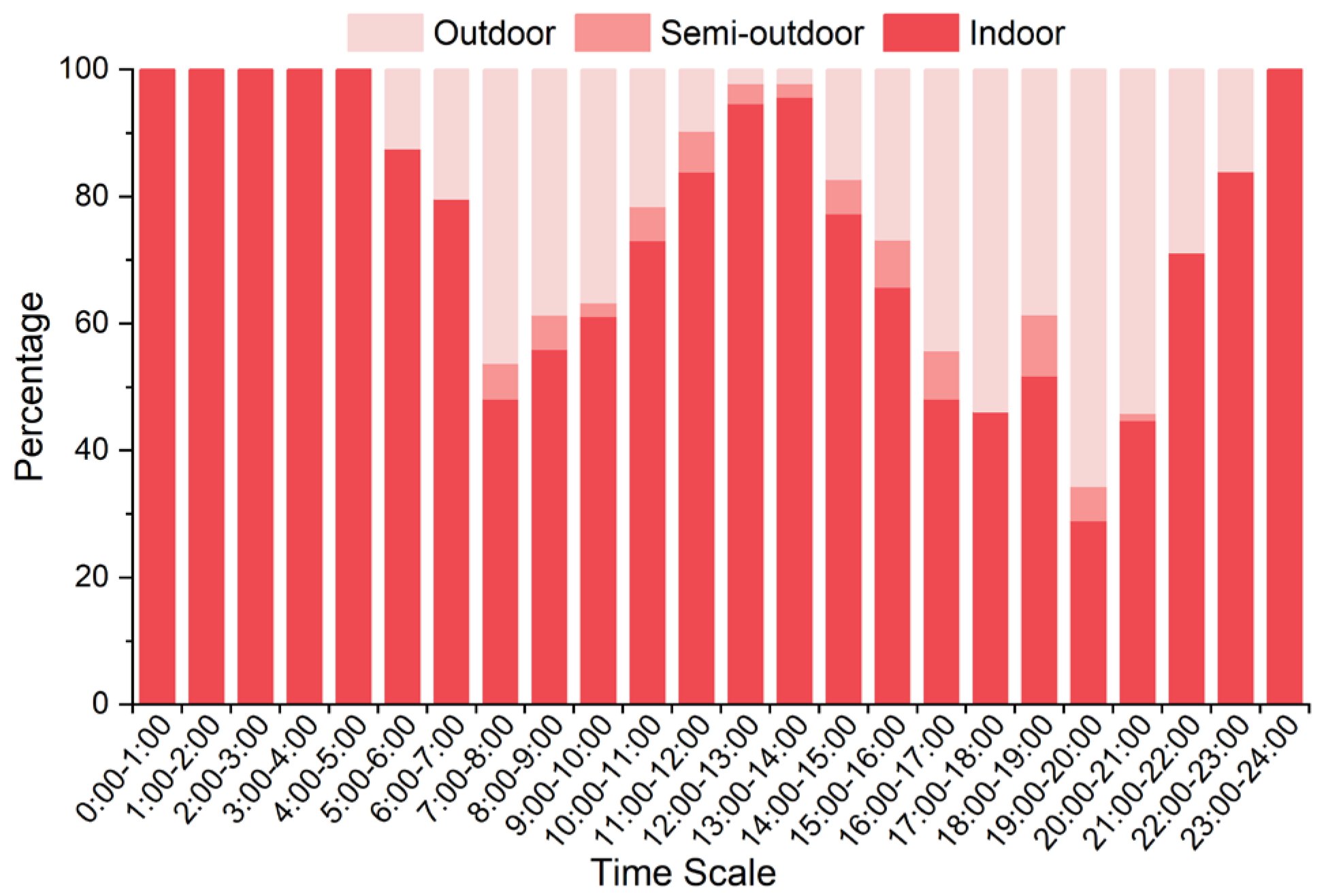
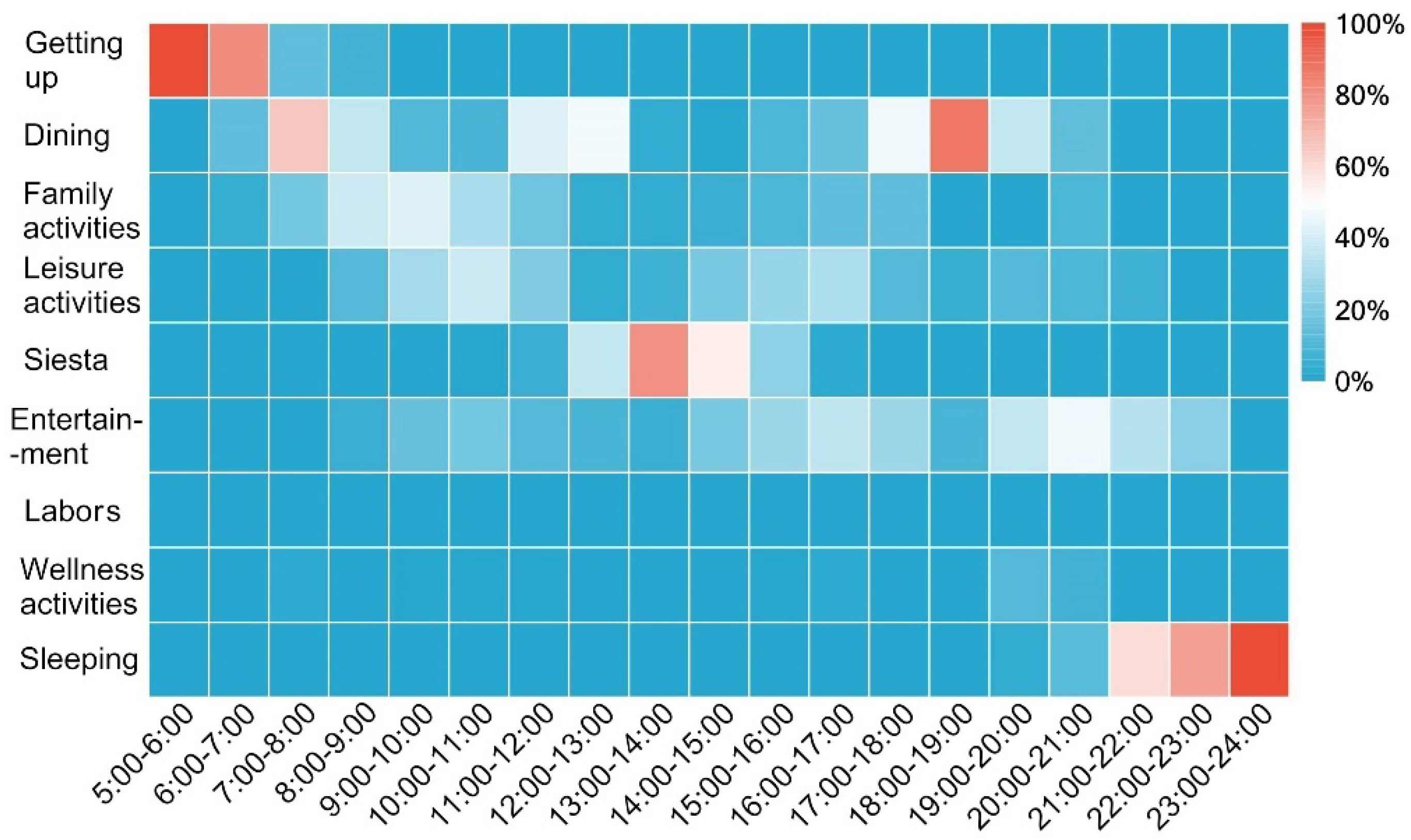
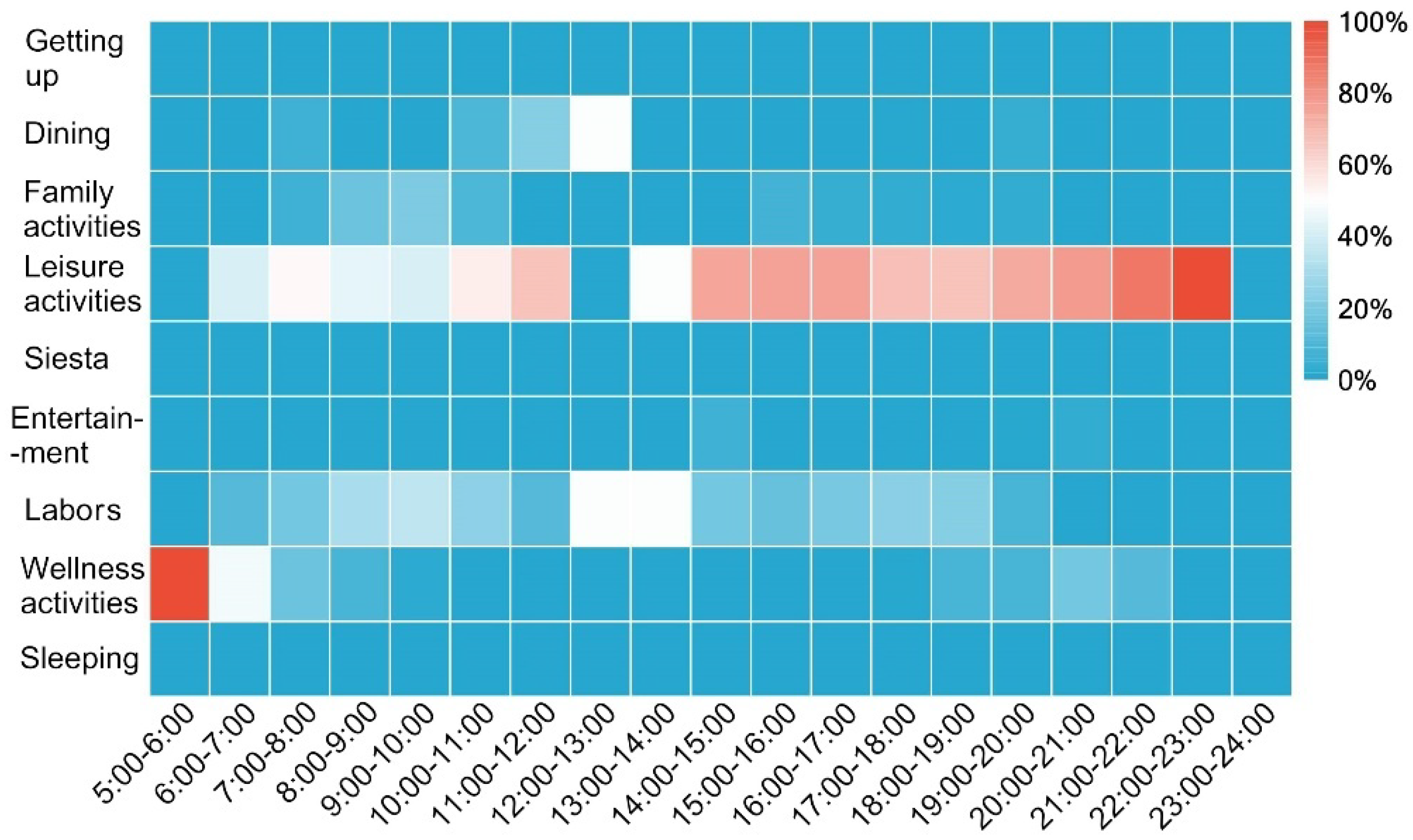
- During summer, the daily activities of rural elderly people in Xi’an primarily occur in indoor and outdoor spaces, with relatively few activities in semi-outdoor areas, and these activities exhibit a distinct spatiotemporal differentiation pattern. The content of rural elderly people’s daily activities differs slightly from that of urban elderly people: they engage in fewer shopping and medical care activities, but more physical labor. In terms of time, the daily schedules of rural and urban elderly people are largely similar: indoor activities are more frequent than outdoor ones, and both groups conduct more outdoor activities in the morning (6:00–9:00) and afternoon (17:00–19:00). However, rural elderly people participate in more outdoor activities after 19:00 compared to urban elderly people. This difference may be attributed to factors including distinct building forms between rural residences and urban residential buildings, different public space forms in rural and urban areas, and elderly people’s electrical appliance usage habits driven by the urban–rural income gap.
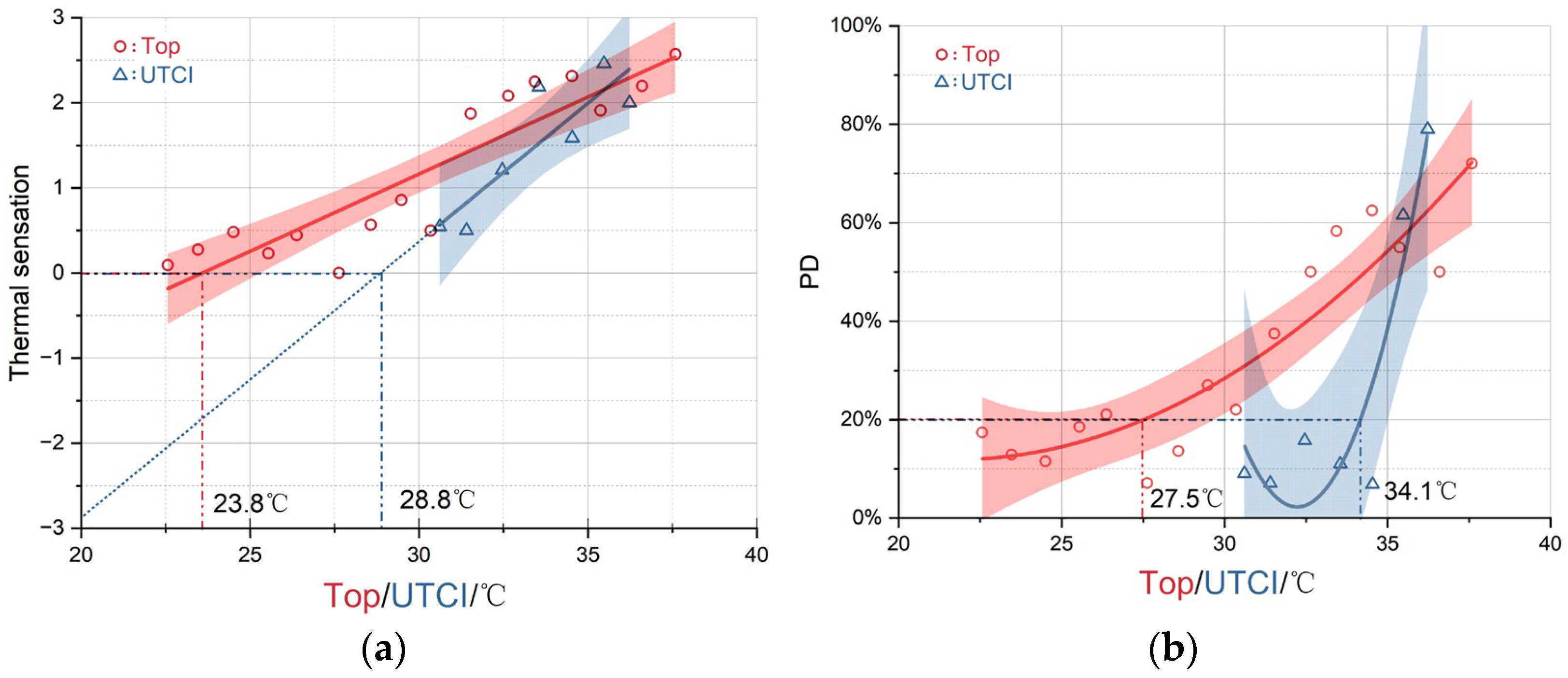
- Based on the indoor and outdoor adaptive thermal comfort models for elderly people established in this study, the measured neutral temperature for indoor operative temperature is 23.8 °C, with the upper limit of 80% thermal acceptability at 27.5 °C; the measured neutral temperature for outdoor UTCI (Universal Thermal Climate Index) is 28.8 °C, and the upper limit of 80% thermal acceptability is 34.1 °C. Compared with urban elderly people in the same cold region, rural elderly people generally exhibit higher thermal tolerance: their thermal comfort requirements for the indoor thermal environment are relatively similar, whereas their thermal tolerance for the outdoor environment is significantly higher. This may be attributed to two factors: rural elderly people have relatively fewer indoor thermal environment adjustment means compared with urban elderly people, and rural elderly people exhibit higher outdoor activity frequency and physical labor habits. Furthermore, compared with other thermal zones, elderly people in Xi’an, a representative area in the cold zone, exhibit relatively weaker adaptability to high indoor temperatures in summer.
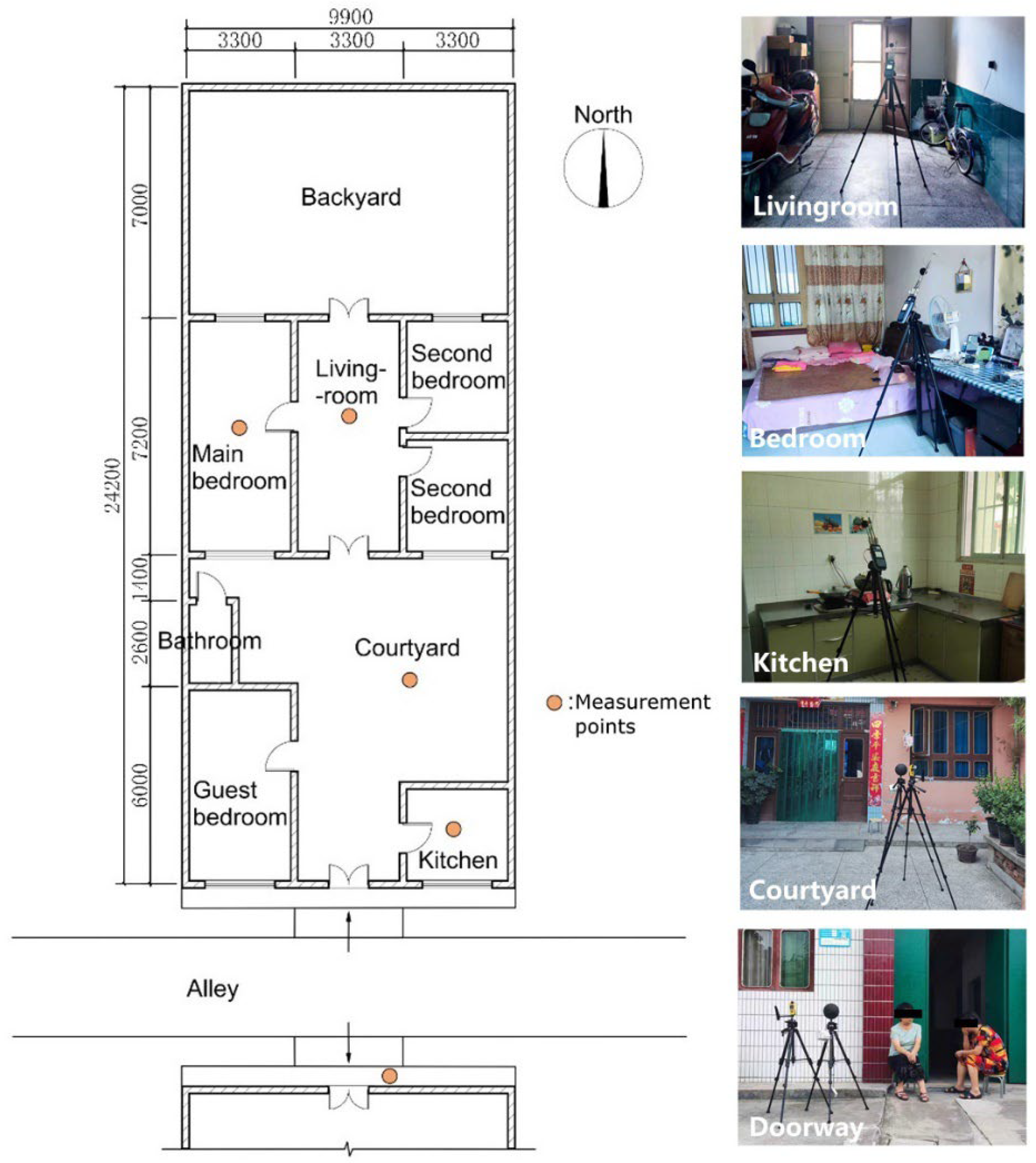
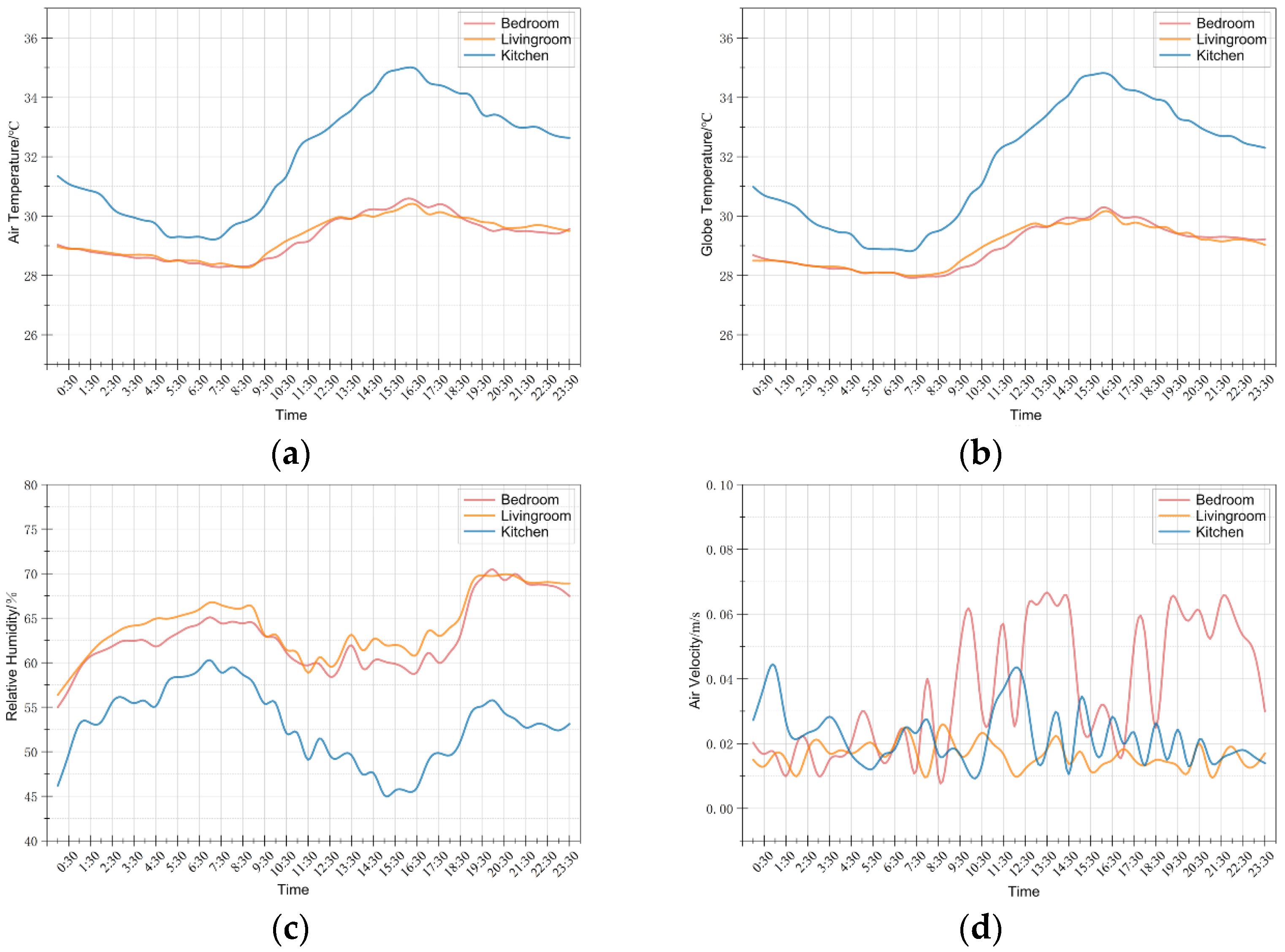
- In elderly people’s summer residential environment, the outdoor shaded areas’ environment remains within the 80% thermal acceptability range for a longer duration than that of indoors. The courtyard (except 11:30–16:30) and doorway (except 11:30–18:30) are relatively comfortable areas for elderly people’s daily activities. Indoor operative temperature exceeds the upper limit of the 80% thermal acceptability range throughout the day, with the kitchen exhibiting the worst thermal environment. These results can guide elderly people in conducting more comfortable and healthy daily activities, provide more accurate references for developing age-friendly residential environments, and address gaps in current spatial thermal environment evaluation research, including the lack of direct evaluation using measured data and precise “temporal—zonal” evaluation.
Author Contributions
Funding
Institutional Review Board Statement
Informed Consent Statement
Data Availability Statement
Conflicts of Interest
Appendix A. Daily Activity Survey Questionnaire for Rural Elderly in Xi’an Area
| Gender | □ Male □ Female | Height | ______cm | |
| Age | ________ Years | Weight | ______kg | |
| Educational Background | □ Primary School or Below □ Junior High School □ Senior High School/Technical Secondary School □ College or Above | |||
| Chronic Diseases | ||||
| Time Period | Daily Activity | Location | ||
| 5:00–6:00 | □ Bedroom □ Kitchen □ Living Room □ Courtyard □ Hallway □ Doorway □ Alley □ Square □ Others: ______ | |||
| 6:00–7:00 | □ Bedroom □ Kitchen □ Living Room □ Courtyard □ Hallway □ Doorway □ Alley □ Square □ Others: ______ | |||
| 7:00–8:00 | □ Bedroom □ Kitchen □ Living Room □ Courtyard □ Hallway □ Doorway □ Alley □ Square □ Others: ______ | |||
| 8:00–9:00 | □ Bedroom □ Kitchen □ Living Room □ Courtyard □ Hallway □ Doorway □ Alley □ Square □ Others: ______ | |||
| 9:00–10:00 | □ Bedroom □ Kitchen □ Living Room □ Courtyard □ Hallway □ Doorway □ Alley □ Square □ Others: ______ | |||
| 10:00–11:00 | □ Bedroom □ Kitchen □ Living Room □ Courtyard □ Hallway □ Doorway □ Alley □ Square □ Others: ______ | |||
| 11:00–12:00 | □ Bedroom □ Kitchen □ Living Room □ Courtyard □ Hallway □ Doorway □ Alley □ Square □ Others: ______ | |||
| 12:00–13:00 | □ Bedroom □ Kitchen □ Living Room □ Courtyard □ Hallway □ Doorway □ Alley □ Square □ Others: ______ | |||
| 13:00–14:00 | □ Bedroom □ Kitchen □ Living Room □ Courtyard □ Hallway □ Doorway □ Alley □ Square □ Others: ______ | |||
| 14:00–15:00 | □ Bedroom □ Kitchen □ Living Room □ Courtyard □ Hallway □ Doorway □ Alley □ Square □ Others: ______ | |||
| 15:00–16:00 | □ Bedroom □ Kitchen □ Living Room □ Courtyard □ Hallway □ Doorway □ Alley □ Square □ Others: ______ | |||
| 16:00–17:00 | □ Bedroom □ Kitchen □ Living Room □ Courtyard □ Hallway □ Doorway □ Alley □ Square □ Others: ______ | |||
| 17:00–18:00 | □ Bedroom □ Kitchen □ Living Room □ Courtyard □ Hallway □ Doorway □ Alley □ Square □ Others: ______ | |||
| 18:00–19:00 | □ Bedroom □ Kitchen □ Living Room □ Courtyard □ Hallway □ Doorway □ Alley □ Square □ Others: ______ | |||
| 19:00–20:00 | □ Bedroom □ Kitchen □ Living Room □ Courtyard □ Hallway □ Doorway □ Alley □ Square □ Others: ______ | |||
| 20:00–21:00 | □ Bedroom □ Kitchen □ Living Room □ Courtyard □ Hallway □ Doorway □ Alley □ Square □ Others: ______ | |||
| 21:00–22:00 | □ Bedroom □ Kitchen □ Living Room □ Courtyard □ Hallway □ Doorway □ Alley □ Square □ Others: ______ | |||
| 22:00–23:00 | □ Bedroom □ Kitchen □ Living Room □ Courtyard □ Hallway □ Doorway □ Alley □ Square □ Others: ______ | |||
Appendix B. Thermal Comfort Survey Questionnaire for Rural Elderly in Xi’an Area
| Survey Location | |||||||
| Gender | Age (years) | Height (cm) | Weight (kg) | ||||
| Educational Background | □ Primary School or Below □ Junior High School Senior □ High School/Technical Secondary School □ College or Above | ||||||
| Chronic Diseases | |||||||
| Living Alone | (Yes/No) | ||||||
| Temperature (°C) | ______ | Relative Humidity (%) | ______ | Globe Temperature (°C) | ______ | Air Velocity (m/s) | ______ |

| Common Activities | Metabolic Rate (met) | Common Activities | Metabolic Rate (met) |
|---|---|---|---|
| Sleeping | 0.7 | Cooking | 1.6–2.0 |
| Reclining | 0.8 | Cleaning | 2.0–3.4 |
| Sitting Quietly | 1.0 | Dancing | 2.4–4.4 |
| Standing Relaxed | 1.2 | Aerobics/Fitness | 3.0–4.0 |
| Walking | 1.7–2.0 | Shoveling/Digging | 4.0–4.8 |
| Others (Please specify) | |||
| Scale | |||||||
|---|---|---|---|---|---|---|---|
| 3 | 2 | 1 | 0 | −1 | −2 | −3 | |
| Sensation | Hot | Warm | Slightly warm | Neutral | Slightly cool | Cool | Cold |
| Acceptability | - | Completely Acceptable | Just Acceptable | - | Just Unacceptable | Completely Unacceptable | - |
| Preference | Cooler | No change | Warmer | ||||
| Underwear & Upper Garments | Trousers | □ Long-Sleeved Shirt Dress (Thick) 0.47 |
| □ Men’s Underwear 0.04 | □ Ultra-Short Shorts 0.06 | □ Thick Short Outerwear 0.42 |
| □ Women’s Underwear 0.04 | □ Men’s Casual Shorts 0.08 | □ Thick Long Outerwear 0.48 |
| □ Short-Sleeved T-Shirt 0.08 | □ Straight Trousers (Thin) 0.15 | □ Thin Jacket 0.22 |
| □ Sleeveless/Low-Cut Blouse 0.12 | □ Regular Trousers 0.24 | □ Thick Jacket 0.49 |
| □ Short-Sleeved Men’s Shirt 0.19 | □ Thermal Underpants 0.15 | □ Short Cotton-Padded Jacket 0.5 |
| □ Long-Sleeved Men’s Shirt 0.25 | □ Thick Thermal Underpants 0.25 | □ Mid-Length Cotton-Padded Jacket 0.6 |
| □ Undershirt 0.34 | □ Sports Trousers 0.28 | Footwear & Socks |
| □ Flannel Shirt 0.37 | □ Down Trousers 0.39 | □ Socks 0.02 |
| Sweaters & Vests | □ Cotton Trousers 0.4 | □ Sandals/Flip-Flops 0.02 |
| □ Thermal Undershirt 0.2 | □ Thickened Trousers 0.44 | □ Cloth Shoes/Sneakers 0.08 |
| □ Thick Thermal Undershirt 0.34 | Skirts & Outerwear | □ Cotton Slippers 0.03 |
| □ Vest 0.29 | □ Skirt (Thin) 0.14 | □ Boots 0.10 |
| □ Long-Sleeved Sweater 0.36 | □ Skirt (Thick) 0.23 | Headwear |
| □ Light Sweater 0.2 | □ Short-Sleeved Shirt Dress (Thin) 0.29 | □ Hat 0.02 |
| □ Wool Sweater 0.32 | □ Long-Sleeved Shirt Dress (Thin) 0.33 | □ Scarf 0.02 |
References
- 14th Five-Year Plan for Healthy Aging. 2022. Available online: https://www.gov.cn/gongbao/content/2022/content_5692863.htm (accessed on 23 December 2024).
- 13th Five-Year Plan for Healthy Aging. 2017. Available online: https://www.gov.cn/zhengce/content/2017-03/06/content_5173930.htm (accessed on 26 December 2024).
- National Bureau of Statistics. Interpretation of the Communiqué of the Seventh National Population Census. Available online: http://www.stats.gov.cn/xxgk/jd/sjjd2020/202105/t20210512_1817342.html (accessed on 26 December 2024).
- Shan, M.; Wang, P.; Li, J.; Yue, G.; Yang, X. Energy and environment in Chinese rural buildings: Situations, challenges, and intervention strategies. Build. Environ. 2015, 91, 271–282. [Google Scholar] [CrossRef]
- Fan, G.; Xie, J.; Yoshino, H.; Yanagi, U.; Hasegawa, K.; Wang, C.; Zhang, X.; Liu, J. Investigation of indoor thermal environment in the homes with elderly people during heating season in Beijing, China. Build. Environ. 2017, 126, 288–303. [Google Scholar] [CrossRef]
- Wei, L. A Living Space Research of the Elderly Based on Their Activity Pattern—A Case Study of Nanjing City. Master’s Thesis, Nanjing University, Nanjing, China, 2012. (In Chinese) [Google Scholar]
- Li, Q.; Jiang, J. Exploring the temporal and spatial characteristics of daily activities for the elderly population in Nanjing. Archit. Cult. 2024, 11, 174–176. (In Chinese) [Google Scholar] [CrossRef]
- Xiong, Y. Research on the Spatial Organization of Community Living Circles Based on Spatiotemporal Behavior of the Elderly—Taking Nanyuanmen Street of Xi’an City as an Example. Master’s Thesis, Xi’an University of Architecture and Technology, Xi’an, China, 2021. (In Chinese) [Google Scholar] [CrossRef]
- Sun, Y.; Chen, T.; Han, Y. A study on leisure behavior of the aged in Beijing. Geogr. Res. 2001, 5, 537–546. (In Chinese) [Google Scholar]
- Yu, S.; Guo, N.; Zheng, C.; Song, Y.; Hao, J. Investigating the association between outdoor environment and outdoor activities for seniors living in old residential communities. Int. J. Environ. Res. Public Health 2021, 18, 7500. [Google Scholar] [CrossRef]
- Zou, S.; Zhang, S.; Zhen, F. Measurement of community daily activity space and influencing factors of vitality based on residents’ spatiotemporal behavior: Taking Shazhou and Nanyuan streets in Nanjing as examples. Prog. Geogr. 2021, 40, 580–596. (In Chinese) [Google Scholar] [CrossRef]
- Chai, Y.; Zhang, Y.; Liu, Z. Spatial differences of home-work separation and the impacts of housing policy and urban sprawl: Evidence from household survey data in Beijing. Acta Geogr. Sin. 2011, 66, 157–166. (In Chinese) [Google Scholar]
- Ta, N.; Chai, Y. Understanding neighborhood rhythm from the perspective of space-time behavior. Hum. Geogr. 2023, 38, 29–36. (In Chinese) [Google Scholar] [CrossRef]
- Guan, Y. Research on Rural Living Circle Based on the Travel Ability of Villagers—A Case Study of Tongnan of Chongqing as an Example. Master’s Thesis, Chongqing University, Chongqing, China, 2022. (In Chinese) [Google Scholar] [CrossRef]
- Wu, S.; Wu, W.; Xia, X.; Zhou, J. Characteristics of physical activities and environmental factor preferences of older adults in rural resettlement community in Ningbo, China. J. Environ. Public Health 2022, 2022, 5414384. [Google Scholar] [CrossRef] [PubMed]
- Zheng, G.; Yue, X.; Yi, W.; Jia, R. Establishment, interpretation and application of logistic regression models for predicting thermal sensation of elderly people. Energy Build. 2024, 315, 114318. [Google Scholar] [CrossRef]
- Zhang, H.; Chen, Y.; Rui, J.; Yoshino, H.; Zhang, J.; Chen, X.; Liu, J. Effects of thermal environment on elderly in urban and rural houses during heating season in a severe cold region of China. Energy Build. 2019, 198, 61–74. [Google Scholar] [CrossRef]
- Liu, J. Design Study of Rural Aging in Southern Liaoning Province from the Perspective of Ecological Livability. Ph.D. Thesis, Dalian University of Technology, Dalian, China, 2019. (In Chinese) [Google Scholar] [CrossRef]
- Ge, S. A Study on The Thermal Neutral Temperature of Elderly People in Cold Regions in Winter and Summer Seasons. Master’s Thesis, Chang’an University, Xi’an, China, 2024. (In Chinese) [Google Scholar] [CrossRef]
- Wang, S.; Wang, Y. Survey on the winter thermal comfort of the buildings for the aged in cold regions. Urban. Archit. 2019, 16, 91–93. (In Chinese) [Google Scholar] [CrossRef]
- Zheng, G.; Wei, C.; Yue, X.; Li, K. Application of hierarchical cluster analysis in age segmentation for thermal comfort differentiation of elderly people in summer. Build. Environ. 2023, 230, 109981. [Google Scholar] [CrossRef]
- An, L.; Hong, B.; Cui, X.; Geng, Y.; Ma, X. Outdoor thermal comfort during winter in China’s cold regions: A comparative study. Sci. Total Environ. 2021, 768, 144464. [Google Scholar] [CrossRef]
- Ma, X. Improvement Design of Open Space in Urban Park for Elderly Based on Their Thermal Perceptions Evaluation. Master’s Thesis, Northwest A&F University, Yangling, China, 2022. (In Chinese) [Google Scholar] [CrossRef]
- Xu, M.; Hong, B.; Mi, J.; Yan, S. Outdoor thermal comfort in an urban park during winter in cold regions of China. Sustain. Cities Soc. 2018, 43, 208–220. [Google Scholar] [CrossRef]
- Wang, Y.; Cai, R.; Qu, K.; Hui, J. Study on summer indoor thermal comfort of elderly facilities in Baoding City. Build. Sci. 2022, 38, 51–57. (In Chinese) [Google Scholar] [CrossRef]
- Zheng, W. The Impact of Regional and Seasonal Climate Changes on Human Thermal Adaptability and Its Application. Ph.D. Thesis, Xi’an University of Architecture and Technology, Xi’an, China, 2017. (In Chinese) [Google Scholar]
- Ma, X.; Tian, Y.; Du, M.; Hong, B.; Lin, B. How to design comfortable open spaces for the elderly? Implications of their thermal perceptions in an urban park. Sci. Total Environ. 2021, 768, 144985. [Google Scholar] [CrossRef] [PubMed]
- Gu, Y.; Li, Y.; Jia, Z.; Gao, W. A study on the effect of rural indoor thermal environment on cardiovascular physiological parameters in the elderly. Build. Sci. 2023, 39, 213–218. (In Chinese) [Google Scholar] [CrossRef]
- Zheng, W.; Feng, R.; Wang, Y.; Shao, T.; Chow, D.; Zhang, L. Fundamental research on sustainable building design for the rural elderly: A field study of various subjective responses to thermal environments and comfort demands during summer in Xi’an, China. Sustainability 2024, 16, 7778. [Google Scholar] [CrossRef]
- GB 50178-93; Standard for Climatic Regionalization for Building. Ministry of Construction of the People’s Republic of China: Beijing, China, 1993.
- GB/T 50785-2012; Evaluation Standard for Indoor Thermal and Humid Environment in Civil Buildings. Ministry of Construction of the People’s Republic of China: Beijing, China, 2012.
- Liu, C. Research on the Space-Time Characteristics of Winter Activity of The Elderly in Home for the Aged. Master’s Thesis, Northeastern University, Shenyang, China, 2016. (In Chinese) [Google Scholar]
- Liu, X.; Yue, P. Investigation and study on summer indoor thermal comfort for the old in nursing home in Taiyuan City. Urban. Archit. 2018, 11, 69–72. (In Chinese) [Google Scholar] [CrossRef]
- Zheng, W.; Shao, T.; Lin, Y.; Wang, Y.; Dong, C.; Li, J. A field study on seasonal adaptive thermal comfort of the elderly in nursing homes in Xi’an, China. Build. Environ. 2022, 208, 108623. [Google Scholar] [CrossRef]
- Fang, H. The Old Outdoor Thermal Comfort Evaluation Research in Lhasa. Master’s Thesis, Southwest Jiaotong University, Chengdu, China, 2020. (In Chinese) [Google Scholar] [CrossRef]
- Su, Y.; Gong, A.; Qu, Y. Research on thermal comfort in outdoor activity spaces for the elderly in Dalian City. Low Temp. Archit. Technol. 2024, 46, 40–44. (In Chinese) [Google Scholar] [CrossRef]
- Zhang, Q.; Zhang, Q. Research on the rural residential thermal environment and thermal comfort in Shanghai. Sichuan Build. Sci. 2014, 40, 297–301. (In Chinese) [Google Scholar]
- Jiang, W. Research on Indoor Thermal Comfort Evaluation and Optimization Strategy of Pension Buildings in Changsha. Master’s Thesis, Central South University, Changsha, China, 2023. (In Chinese) [Google Scholar] [CrossRef]
- Zhou, Y.; Huang, R.; Sun, Y.; Peng, Y.; Liu, S. Research on thermal comfort of the elderly people under high temperature heatwave events—An example of old residential area in Chengdu. Green Build. 2025, 17, 95–100. (In Chinese) [Google Scholar]
- Hwang, R.; Chen, C. Field study on behaviors and adaptation of elderly people and their thermal comfort requirements in residential environments. Indoor Air 2010, 20, 235–245. [Google Scholar] [CrossRef] [PubMed]
- Wu, Y. Study on Indoor Thermal Environment and Thermal Comfort of the Elderly in Rural Residential Buildings in Northern Guangxi. Master’s Thesis, Guilin University of Technology, Guilin, China, 2024. (In Chinese) [Google Scholar] [CrossRef]
- Wang, B.; Zhao, H.; Han, B.; Jiang, X. An investigation of outdoor thermal comfort assessment for elderly individuals in a field study in northeastern China. Buildings 2023, 13, 2458. [Google Scholar] [CrossRef]
- Zhou, P.; Song, D.; Zhang, C. Outdoor thermal benchmarks for the elderly and its application to the outdoor spaces design of nursing homes in Shanghai. Energy Build. 2025, 337, 115654. [Google Scholar] [CrossRef]
- Mao, Y.; Han, K. Exploration on outdoor thermal comfort of urban parks: Cases of two urban parks in Chengdu. Urban. Archit. 2023, 20, 87–91. (In Chinese) [Google Scholar] [CrossRef]
- Wang, J.; Li, Q.; Zhu, G.; Meng, Q.; Kong, W. Screening of outdoor thermal environment evaluation indexes for the elderly with different frailty in hot and humid regions in summer. Build. Sci. 2024, 40, 131–141. (In Chinese) [Google Scholar] [CrossRef]
- Xi, T.; Lei, Y.; Wang, S.; Qin, H. Applicability of thermal comfort indices on campus in winter in severely cold area. Build. Energy Eff. 2021, 49, 126–133. (In Chinese) [Google Scholar]
- Zhang, X.; Gong, J.; Zhang, J. Research on outdoor thermal comfort in China and an analysis of the appropriateness of evaluation indicators. Chin. Overseas Archit. 2024, 12, 104–109. (In Chinese) [Google Scholar] [CrossRef]
- Wang, J. Study on Outdoor Thermal Comfort Evaluation of Wuhan Historic Lane Neighborhood in Summer. Master’s Thesis, Huazhong Agricultural University, Wuhan, China, 2024. (In Chinese) [Google Scholar] [CrossRef]
- Song, L. Study on Thermal Comfort Evaluation and Application of Urban Parks Based on Age-Friendliness. Master’s Thesis, Shandong Jianzhu University, Jinan, China, 2024. (In Chinese) [Google Scholar] [CrossRef]
- Li, L. Study on Health Evaluation and Optimization Strategy of Outdoor Thermal Environment in Residential Areas in Summer. Master’s Thesis, Xi’an University of Architecture and Technology, Xi’an, China, 2024. (In Chinese) [Google Scholar] [CrossRef]
- Wei, D.; Li, Z.; Huo, Y. Research on the winter and summer thermal comfort evaluation of the riverside space—Taking the Haihe River in the central urban area of Tianjin as an example. Landsc. Des. 2025, 23, 8–12. (In Chinese) [Google Scholar]



| Authors | Location | Research Focus | Findings | Year of Publication | Reference |
|---|---|---|---|---|---|
| Li and Jiang | Urban Nanjing, China | Temporal and spatial characteristics | Elderly people maintain a highly regular daily schedule, and the spaces where various daily activities take place are relatively fixed. | 2024 | [7] |
| Xiong | Urban Xi’an, China | Community life circle | From the perspective of the spatiotemporal behavior of the elderly, a research framework for the behavior-space coupling mechanism is proposed, and based on this, it is evaluated that there exists a mismatch between the spatiotemporal configuration of some facilities in Nanyuamen Subdistrict and the time utilization of the elderly. | 2021 | [8] |
| Sun et al. | Urban Beijing, China | Temporal and spatial characteristics | The distribution of the elderly’s outdoor activity time periods greatly affects the utilization efficiency of urban leisure spaces and facilities. Seasonal variations exert a significant impact on the content, modes and outdoor activity radius of their activities. | 2001 | [9] |
| Yu et al. | Urban Nanjing, China | The association of outdoor environment on outdoor daily activities | Different types of activities exhibit varying degrees of correlation with the road accessibility, anti-slip measures, greening, layout in the urban physical environment, as well as air quality and noise levels. | 2021 | [10] |
| Zou et al. | Urban Nanjing, China | Spatiotemporal behavior and the use of community public service facilities | Residents’ daily activity spaces exhibit hierarchical, shared, and directional characteristics, and there are significant differences in daily activity spaces among different age groups. Based on this, a differentiated supply strategy of public service facilities is proposed. | 2021 | [11] |
| Chai et al. | Urban Beijing, China | The Impact of Macroeconomic Factors on Individuals’ Daily Life Experiences | Studied the impact of urban spatial layout on the temporal–spatial behavior of individuals and their behavioral decision-making, exploring the interactive relationship between individual behavioral activities and the spatial environment | 2011 | [12] |
| Ta and Chai | Urban Beijing, China | Neighborhood rhythm and living circle | Residents in the study area have insufficient utilization of community time, and their community life time exhibits significant spatiotemporal differentiation, activity type differentiation, and group differentiation. The planning of community living circles needs to analyze the characteristics of life-time utilization and address the spatiotemporal mismatch between behavioral space and physical space. | 2023 | [13] |
| Guan | Rural Chongqing, China | Rural life circle | Villagers‘ travel purposes, travel capabilities, and travel frequencies respectively, affect the distribution, scope, and demand differences in rural daily activity spaces. | 2022 | [14] |
| Wu et al. | Rural Ningbo, China | The Degree of Influence of Environmental Factors | The degree of influence of environmental support, site safety, spatial convenience, landscape aesthetics, and facility diversity on the outdoor sports activities of the elderly decreases in sequence. | 2022 | [15] |
| Authors | Location | Findings | Year of Publication | Reference |
|---|---|---|---|---|
| Ge | Urban Xi’an, Rural Zhoukou, China | Obtained the laws of the elderly‘s thermal sensation and thermal acceptability changing with the cold and heat variations in the indoor thermal environment in different seasons, and derived the comfortable temperature range. | 2024 | [19] |
| Wang and Wang | Rural Renqiu, China | The actual indoor temperature of rural elderly care buildings in winter was higher than the indoor thermal environment temperature expected by the elderly, and there was a significant deviation between the comfort level expected by the elderly and their actual comfort perception. | 2019 | [20] |
| Zheng et al. | Urban Baoding, China | Established various subjective response models, obtained the comfortable ranges of temperature, relative humidity and air velocity, and provided a scientific basis for the improvement of the thermal environment. | 2023 | [21] |
| An et al. | Urban Beijing, Xi’an, Hami, Chima | Studied the outdoor thermal comfort of urban parks in three cold-region cities, and found that the neutral UTCI (Universal Thermal Climate Index) of residents in Xi’an was the highest, and its comfortable range was slightly wider than that of the other two cities. | 2021 | [22] |
| Ma | Urban Xi’an, China | Investigated the temporal and spatial distribution characteristics of the elderly and their thermal perception (including thermal sensation, thermal comfort and thermal acceptability) in the open space of an urban park in Xi’an, and quantitatively determined the outdoor thermal comfort benchmark for the elderly in Xi’an. | 2022 | [23] |
| Xu et al. | Urban Xi’an, China | Used the methods of climate monitoring and thermal comfort questionnaire survey to study the winter thermal comfort of different parks in Xi’an, and obtained the neutral UTCI. | 2022 | [24] |
| Wang et al. | Urban Baoding, China | Studied the indoor thermal environment of institutional elderly care facilities in Baoding by means of field investigation, questionnaire survey and on-site measurement, and obtained the neutral temperature and thermal demand of the elderly in summer. | 2022 | [25] |
| Gender | Age/yrs | Height/cm | Weight/kg | |
|---|---|---|---|---|
| Female (47) | Minimum value | 60 | 147 | 42 |
| Maximum value | 88 | 171 | 80 | |
| Average value | 70.36 | 158.34 | 60.19 | |
| Standard deviation | 7.13 | 5.19 | 8.45 | |
| Male (46) | Minimum value | 60 | 160 | 60 |
| Maximum value | 86 | 176 | 88 | |
| Average value | 70.43 | 168.28 | 68.20 | |
| Standard deviation | 6.48 | 4.53 | 7.67 |
| Instrument Type | Model | Measured Parameters | Accuracy Specifications |
|---|---|---|---|
| Thermal Comfort Meter | Delta HD32.3 | Relative Humidity: 0–100% | Relative Humidity: ±1.5% (0–90%) |
| Globe Temperature: −10–100 °C | Globe Temperature: 0.1 °C | ||
| Air Velocity: 0.1–5 m/s | Air Velocity: ±0.2 m/s (0–1 m/s); ±0.3 m/s (1–5 m/s) | ||
| Outdoor Temperature-Humidity Recorder | HOBO MX2301 | Temperature: −40–70 °C | Temperature: ±0.25 °C (−40–0 °C); ±0.2 °C (0–70 °C) |
| Humidity: 0–100% | Humidity: ±2.5% | ||
| Globe Temperature Recorder | HQZY-1 | Globe Temperature: −20–80 °C | ±0.3 °C |
| Portable Weather Station | Kestrel 5500 | Air Velocity: 0–40 m/s | 0.1 m/s |
| Space | Age/yrs | Height/cm | Weight/kg | |
|---|---|---|---|---|
| Indoor (298) | Minimum value | 60 | 140 | 40 |
| Maximum value | 90 | 183 | 90 | |
| Average value | 69.08 | 162.21 | 62.60 | |
| Standard deviation | 6.66 | 7.05 | 9.57 | |
| Outdoor (113) | Minimum value | 60 | 145 | 42 |
| Maximum value | 89 | 180 | 90 | |
| Average value | 68.56 | 162.37 | 62.46 | |
| Standard deviation | 7.25 | 7.07 | 9.72 |
| Content | Type |
|---|---|
| / | Getting up |
| Breakfast, lunch, dinner | Dining |
| Doing housework, looking after children, caring for family members | Family activities |
| Sunbathing, lying at rest, sitting at rest, walking and chatting | Leisure activities |
| / | Siesta |
| Playing mahjong, playing chess, watching TV, listening to the radio, using mobile phones, reading | Entertainment |
| Going to work, agricultural production activities, gardening activities, animal rearing | Labors |
| Dancing square dances, exercising, massaging | Wellness activities |
| Sleeping |
| Space | ta/°C | RH/% | tg/°C | va/m/s | |
|---|---|---|---|---|---|
| Indoor | Minimum value | 22.10 | 30.60 | 22.00 | 0.00 |
| Maximum value | 35.80 | 101.40 | 39.40 | 1.28 | |
| Average value | 27.34 | 67.89 | 27.93 | 0.19 | |
| Standard deviation | 3.96 | 20.64 | 4.50 | 0.20 | |
| Outdoor | Minimum value | 27.00 | 28.40 | 28.70 | 0.00 |
| Maximum value | 36.30 | 74.60 | 38.80 | 1.43 | |
| Average value | 31.87 | 55.42 | 32.29 | 0.37 | |
| Standard deviation | 2.08 | 11.79 | 1.91 | 0.26 |
| Regression Equation | R2 | Neutral Temperature/°C | |
|---|---|---|---|
| Indoor | MTSV = 0.018 Top − 4.28 | 0.83 | 23.8 |
| Outdoor | MTSV = 0.33 UTCI − 9.4 | 0.76 | 28.8 |
| Regression Equation | R2 | Upper limit Temperature of 80% Acceptance/°C | |
|---|---|---|---|
| Indoor | PD = 0.002 Top2 − 0.1 Top + 1.24 | 0.85 | 27.5 |
| Outdoor | PD = 0.05 UTCI2 − 3.03 UTCI + 48.9 | 0.87 | 34.1 |
| City | Climate Zone | Region | Time & Space | Contents | Patterns of Temporal–Spatial Differentiation | Reference |
|---|---|---|---|---|---|---|
| Xi’an | Cold | Rural | Indoor & Outdoor (Summer) | Waking up; Dining; Family activities; Leisure activities; Siesta; Entertainment; Labors; Wellness activities; Sleeping | Waking up at 6:00–7:00, sleeping at 21:00–23:00; approximately 80% of the elderly take a noon break. Family activities are mainly indoor (8:00–11:00); leisure activities are mainly concentrated outdoors (16:00–21:00); entertainment activities are mostly conducted indoors with scattered time; physical labor is all outdoor, distributed at 7:00–10:00 and 16:00–19:00; wellness activities are mainly outdoor at 6:00–8:00 and 19:00–21:00. | This study |
| Chong-qing | Hot-summer & Cold-winter | Rural | Outdoor (Whole year) | Living-related activities; Commuting-related activities; Occasional activities | / | [14] |
| Ningbo | Hot-summer & Cold-winter | Rural | Outdoor (Spring & Summer) | Health-related activities; Social-related activities; Living-related activities; Entertainment-related activities | Peak outdoor activities occur at 9:00, 15:00 and 19:00 | [15] |
| Nanjing | Hot-summer & Cold-winter | Urban | Indoor & Outdoor (Whole Year) | Sleeping or napping; Housework; Personal affairs; Leisure; Work; Shopping | Wake-up time is concentrated around 6:00; noon break time is concentrated at 12:00–14:00; sleeping time is concentrated at 20:00–22:00. Time spent on housework is long, mainly at home; shopping activities are concentrated at 8:00–10:00; leisure activities also last for a long time, with peak periods at 8:00–10:00, 14:00–17:00 and 19:00–21:00 (mostly outdoor in the morning and afternoon, mostly at home in the evening). | [7] |
| Xi’an | Cold | Urban | Outdoor (Autumn) | Family responsibility-based activities; Living-based activities; Survival-based activities | Activities with strong purposes are mostly conducted when going out in the morning, noon and evening; activities with strong entertainment, elderly service activities and family responsibility-based activities are mostly conducted in the morning and afternoon. | [8] |
| Beijing | Cold | Urban | Indoor & Outdoor (Whole Year) | Work; Housework; Shopping; Personal affairs; Sleeping or napping; Leisure & entertainment (puzzle-solving, mood-soothing, health-building, communication, public welfare) | Waking up before 7:00, sleeping before 22:00, with the habit of noon break. Outdoor leisure activities are concentrated at 6:00–10:00 and 16:00–18:00; activities after 19:00 are mainly indoor. | [9] |
| Nanjing | Hot-summer & Cold-winter | Urban | Outdoor (Spring & Summer) | Social activities; Leisure activities; Daily living activities; Natural exposure activities | / | [10] |
| Shen-yang | Severe cold | Urban | Indoor & Outdoor (Winter) | Life-essential activities; Health-building & fitness activities; Cultural & entertainment activities; Social interaction activities; Medical care activities | Wake-up time is concentrated at 5:00–6:00; noon break time is at 12:00–14:00; most fall asleep after 19:00. Health-building activities mainly occur at 6:00–7:00, 8:00–10:00 and 14:00–16:00; cultural & entertainment activities mainly occur at 7:00–11:00, 13:00–17:00 and 18:00–19:00; social interaction activities mainly occur at 8:00–12:00 and 14:00–16:00. The proportion of indoor activities is significantly higher than that of outdoor activities. | [32] |
| City | Climate Zone | Region | Indoor Neutral Temperature/°C | Outdoor Neutral Temperature/°C | Reference |
|---|---|---|---|---|---|
| Xi’an | Cold | Rural | 23.8 | 28.8 (UTCI) | This study |
| Xi’an | Cold | Urban | 24.1 | / | [34] |
| Baoding | Cold | Urban | 27.25 | / | [25] |
| Taiyuan | Cold | Urban | 27.4 | / | [33] |
| Shanghai | Hot-summer & Cold-winter | Rural | 29.8 | / | [37] |
| Changsha | Hot-summer & Cold-winter | Urban | 26.3 | / | [38] |
| Chengdu | Hot-summer & Cold-winter | Urban | 25.5 | / | [39] |
| Taiwan | Hot-summer & Warm-winter | Urban | 25.2 | / | [40] |
| Northern Guangxi | Hot-summer & Warm-winter | Rural | 27.06 | / | [41] |
| Xi’an | Cold | Urban | / | 22.1 (UTCI) | [23] |
| Lhasa | Cold | Urban | / | 19.6 (PET) | [35] |
| Dalian | Cold | Urban | / | 22.6 (PET) | [36] |
| Changchun | Severe cold | Urban | / | 5.8 (UTCI) | [42] |
| Shanghai | Hot-summer & Cold-winter | Urban | / | 24.29 (PET) | [43] |
| Chengdu | Hot-summer & Cold-winter | Urban | / | 27.01 (PET) | [44] |
| Guangzhou | Hot-summer & Warm-winter | Urban | / | 25.96 (UTCI) | [45] |
| City | Climate Zone | Region | Indoor Upper Limit of 80% Acceptable Temperature/°C | Outdoor Upper Limit of 80% Acceptable Temperature/°C | Reference |
|---|---|---|---|---|---|
| Xi’an | Cold | Rural | 27.5 | 34.1 | This study |
| Xi’an | Cold | Urban | 30.3 | / | [34] |
| Baoding | Cold | Urban | 28.97 | / | [25] |
| Taiyuan | Cold | Urban | 28.8 | / | [33] |
| Shanghai | Hot-summer & Cold-winter | Rural | 31 | / | [37] |
| Changsha | Hot-summer & Cold-winter | Urban | 29.9 | / | [38] |
| Chengdu | Hot-summer & Cold-winter | Urban | 27.2 (90%) | / | [39] |
| Taiwan | Hot-summer & Warm-winter | Urban | 27.1 | / | [40] |
| Northern Guangxi | Hot-summer & Warm-winter | Rural | 29.58 | / | [41] |
| Xi’an | Cold | Urban | / | 30 (UTCI) (Yearly) (90%) | [23] |
| Lhasa | Cold | Urban | / | 25 (PET) | [35] |
| Dalian | Cold | Urban | / | 27.08 (PET) | [36] |
| Changchun | Severe cold | Urban | / | 21.4 (UTCI) (Yearly) | [42] |
| Shanghai | Hot-summer & Cold-winter | Urban | / | 29.64 (PET) (90%) | [43] |
| Chengdu | Hot-summer & Cold-winter | Urban | / | 29.32 (PET) (90%) | [44] |
| Guangzhou | Hot-summer & Warm-winter | Urban | / | 29.89 (UTCI) | [45] |
Disclaimer/Publisher’s Note: The statements, opinions and data contained in all publications are solely those of the individual author(s) and contributor(s) and not of MDPI and/or the editor(s). MDPI and/or the editor(s) disclaim responsibility for any injury to people or property resulting from any ideas, methods, instructions or products referred to in the content. |
© 2026 by the authors. Licensee MDPI, Basel, Switzerland. This article is an open access article distributed under the terms and conditions of the Creative Commons Attribution (CC BY) license.
Share and Cite
Zheng, W.; Wang, Y.; Feng, R.; Liu, L.; Zhang, J.; Shao, T.; Chow, D.; Zhu, Z.; Cui, J.; Zhou, H. Thermal Comfort Evaluation for the Rural Elderly Based on the Spatiotemporal Differentiation of Daily Activities During Summer in Xi’an, China. Buildings 2026, 16, 1146. https://doi.org/10.3390/buildings16061146
Zheng W, Wang Y, Feng R, Liu L, Zhang J, Shao T, Chow D, Zhu Z, Cui J, Zhou H. Thermal Comfort Evaluation for the Rural Elderly Based on the Spatiotemporal Differentiation of Daily Activities During Summer in Xi’an, China. Buildings. 2026; 16(6):1146. https://doi.org/10.3390/buildings16061146
Chicago/Turabian StyleZheng, Wuxing, Yingluo Wang, Ranran Feng, Lu Liu, Jiaying Zhang, Teng Shao, David Chow, Zongzhou Zhu, Jingqiu Cui, and Haonan Zhou. 2026. "Thermal Comfort Evaluation for the Rural Elderly Based on the Spatiotemporal Differentiation of Daily Activities During Summer in Xi’an, China" Buildings 16, no. 6: 1146. https://doi.org/10.3390/buildings16061146
APA StyleZheng, W., Wang, Y., Feng, R., Liu, L., Zhang, J., Shao, T., Chow, D., Zhu, Z., Cui, J., & Zhou, H. (2026). Thermal Comfort Evaluation for the Rural Elderly Based on the Spatiotemporal Differentiation of Daily Activities During Summer in Xi’an, China. Buildings, 16(6), 1146. https://doi.org/10.3390/buildings16061146