
Article

2D and 3D Stability Analysis of Rectangular Tunnel Roof Based on Tensile Cut-Off Criterion

1
School of Automotive and Transportation Engineering, Hefei University of Technology, Hefei 230009, China
2
School of Civil Engineering, Central South University, Changsha 410075, China
3
Shenzhen Municipal Group Co., Ltd., Shenzhen 518000, China
*
Author to whom correspondence should be addressed.
Buildings 2026, 16(6), 1132; https://doi.org/10.3390/buildings16061132
Submission received: 8 January 2026 / Revised: 9 March 2026 / Accepted: 10 March 2026 / Published: 12 March 2026
(This article belongs to the Special Issue Solid Mechanics as Applied to Civil Engineering)

Abstract

Tunnel roof is subjected to a complex tension-shear stress state after excavation. A tensile cut-off strength criterion is introduced in this study and combined with the upper bound limit analysis method to investigate the stability of a rectangular tunnel roof. First, the expression for the internal energy dissipation rate is derived for the circular cut-off segment of the failure criterion. Power functionals Φ are established for both two-dimensional and three-dimensional rotational collapse mechanisms. The analytical equations for the failure surface are obtained using the variational method. The strength reduction method that incorporates the cut-off criterion is proposed to quantify roof stability. The investigation into the morphology of the collapsing block indicates that the supporting pressure and the reduction coefficient ξ have a significant influence on the collapse shape of the tunnel, suggesting that attention should be paid to the suspension effect of the tunnel roof on stability. The range of the collapsing block under three-dimensional conditions is found to be larger than that under two-dimensional conditions. Parametric influences on the safety factor are examined. Finally, dimensionless design charts for the critical reinforcement pressure are provided for practical tunnel support design.

1. Introduction

Rectangular tunnels are favored due to their high space utilization efficiency and are widely applied in engineering projects such as traffic tunnels, utility tunnels, and mine roadways. The geometric characteristics of a rectangular profile, however, make the roof more prone to collapse than a circular one. The instability of a tunnel roof primarily stems from support system failures caused by misinterpretations of geological conditions and inadequate structural designs. Appropriate tunnel design [1] and rational structural configuration [2,3] can ensure tunnel safety. Therefore, the accurate characterization of geotechnical properties and the reliable determination of reinforcement loads are crucial for roof stability.
Recently, scholars have employed various methods to investigate tunnel roof stability, including case studies [4,5], model tests [6,7], numerical simulations [8,9], and theoretical analyses [10,11]. Theoretical analysis, which establishes analytical models by abstracting physical phenomena, provides a direct mechanical basis for support system design and occupies a fundamental position in stability assessment of geotechnical engineering [12,13,14,15]. As a theoretical approach, the limit analysis method has become a research hotspot for stability assessment in recent years [16,17,18,19].
Limit analysis methods for tunnel roofs have evolved from employing simple strength criteria and two-dimensional analyses to incorporating complex criteria and three-dimensional analyses. This is due to its effectiveness in analyzing three-dimensional failure mechanisms [20,21,22] and accommodating nonlinear failure envelopes [23,24,25]. Early research by Lippmann [26] relied on simplified criteria that neglected non-linear strength characteristics, deriving limit loads by assuming failure modes. The milestone study of Fraldi and Guarracino [27] introduced a power-law criterion into a variational upper-bound framework, yielding closed-form expressions for energy dissipation and external work and defining the geometry of the collapse block via a non-linear profile. Subsequent extensions include critical support-pressure calculation [28,29], applications in shallow buried strata [30] and the influence of pore-water pressure [31].
Despite significant advancements in 2D computational models, simplifying engineering problems into 2D analyses often results in overly conservative designs. Gesualdo et al. [32] emphasized that roof collapse exhibits distinct three-dimensional 3D characteristics, and 2D models inevitably neglect longitudinal restraint effects. Currently, there are two primary approaches within limit analysis for addressing 3D problems. The first approach is variational limit analysis, which simplifies 3D problems by constructing a 3D rotational mechanism based on the rotation of a 2D profile [28]. This method has garnered widespread attention [33,34]. The second approach is the multi-block method [35,36]. Within the limit analysis framework, Park and Michalowski [35] proposed a collapse mechanism composed of multiple prismatic blocks with elliptical cross-sections. This model effectively captures the influence of longitudinal restraint on instability modes, with geometric parameters derived via optimization. However, despite its validity, the construction of multi-block models is relatively complex. The requirement to determine geometric parameters through optimization renders the calculation process cumbersome. In contrast, the variational limit analysis method yields analytical forms of the failure surface, offering a clearer and more intuitive description of the tunnel instability mechanism, along with significant computational advantages. Therefore, this study proposes a rational instability mechanism for 3D problems and applies the variational limit analysis method to derive analytical expressions for stability assessment.
Another critical consideration is the impact of the low tensile strength of geomaterials on tunnel roof stability. After excavation, the rock mass in the tunnel roof detaches from the original system and generates tensile stresses under its own weight, potentially triggering tensile failure. Tensile failure manifests as brittle fracture without plastic deformation, leading to rapid cracking and collapse of the rock mass, which poses a severe threat to engineering safety. Traditional criteria, such as the Mohr-Coulomb and Hoek-Brown criteria, prescribe tensile strengths that are significantly higher than actual values. Consequently, roof stability analyses based on these criteria often deviate from reality. To address this issue, the tension cut-off criterion explicitly incorporates the actual tensile strength of the rock mass, thereby more accurately reflecting the failure characteristics of geomaterials with high compressive strength but low tensile strength. This criterion has been applied in geotechnical engineering: Zhang et al. [37] utilized it for tunnel face stability analysis; Park and Michalowski [38] applied it to tunnel roof stability analysis; and Li et al. [39] employed it for slope problems. In this study, the internal energy dissipation rate formula under the tension cut-off criterion is derived. A corresponding functional is established to analyze the instability mechanism of the tunnel roof from the perspective of variational limit analysis.
The main contributions of this paper are as follows. 1. An analytical and convenient method is adopted to analyze the roof stability of rectangular tunnels, extending from 2D case to the 3D case. 2. The proposed method features high computational efficiency and profound theoretical implications. 3. It can characterize the failure mode of the tunnel roof under the combined action of tension and shear, thereby providing a more rigorous reference for stability analysis.
In summary, an efficient and transparent variational limit-analysis method is developed for 2D and 3D stability assessment of rectangular tunnel roof governed by the tensile cut-off strength criterion. The formula for calculating the internal energy dissipation of the tensile cut-off segment is derived in this paper, which establishes the foundation for the energy-power equations. This calculation is critical for deriving the work-energy function, establishing the roof collapse mechanism, and solving the system via the variational method to obtain a rigorous theoretical solution. The paper is organized as follows: Section 2 derives the dissipation rate under the cut-off criterion; Section 3 proposes the collapse mechanisms, constructs the energy functional Φ and obtains analytical solutions for both 3D and 2D cases; Section 4 presents parametric analyses that quantify the influence of each parameter on roof stability.

2. Internal-Energy Dissipation with Tensile Cut-Off

Based on the upper-bound limit analysis method, it is assumed that the surrounding rock mass exhibits ideal elastoplastic behavior and satisfies the associated flow rule. For the linear Mohr-Coulomb (M-C) criterion, the shear strength is
τ = σ n tan φ + c
where τ is the shear strength, c the cohesion, σn the normal stress, and φ the internal friction angle. Under the assumption of an associated flow rule, the dilation angle ψ is identical to the friction angle φ. Chen [40] derived the corresponding internal energy dissipation rate per unit area along a velocity discontinuity as:
d D = c v cos φ d S
where v represents the velocity jump of the collapsing block and dS is the differential element of the failure surface. This formula has been extensively adopted in numerous studies [41,42,43,44,45,46].
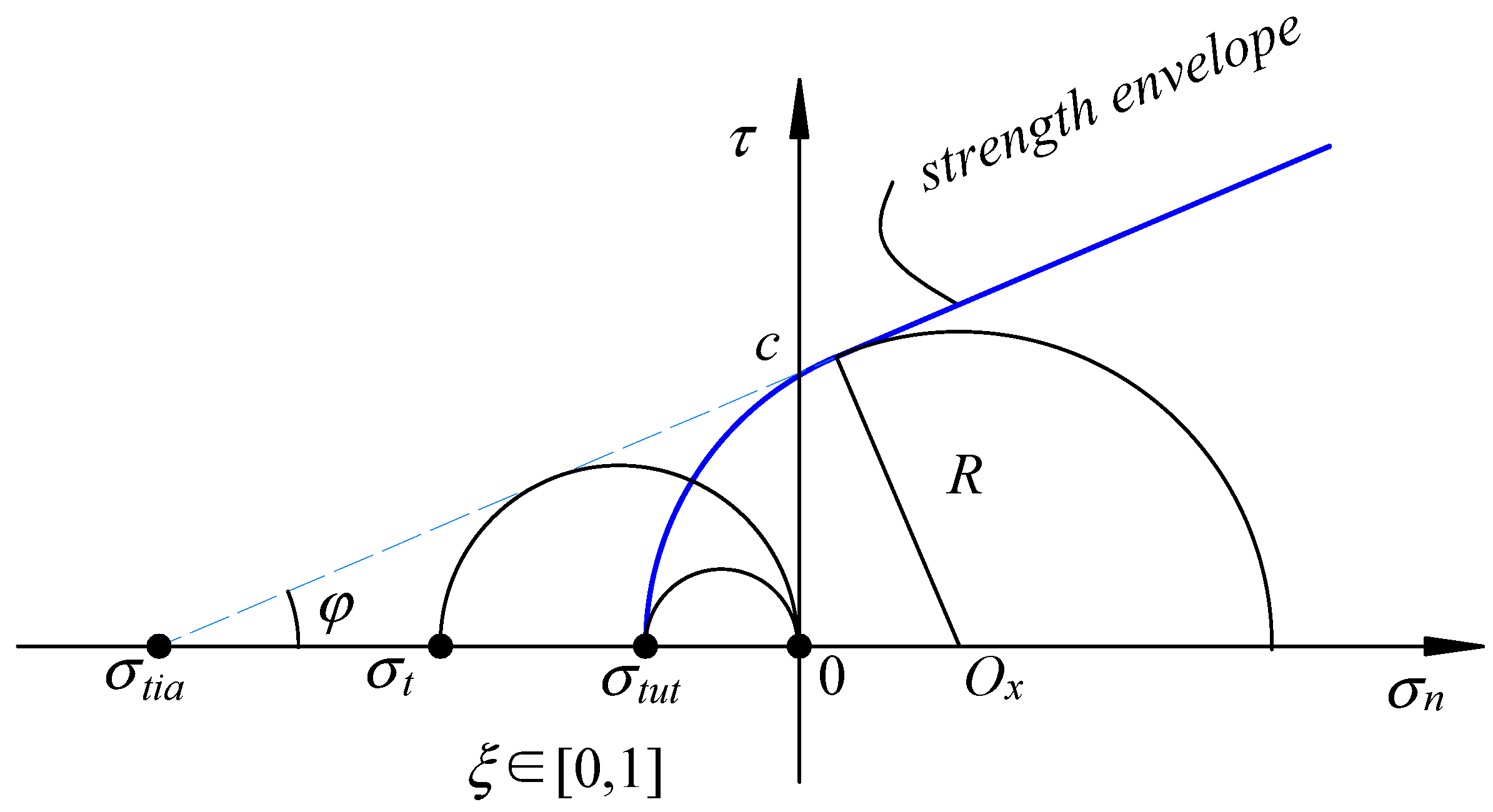
However, for the tensile cut-off M-C criterion, an additional expression is required to account for the circular cut-off segment. Figure 1 shows the τσn strength envelope featuring this tensile truncation. σₜᵢₐ is the isotropic tensile strength (σ1 = σ3), which is difficult to measure in practice; the uniaxial tensile strength σₜᵤₜ is therefore adopted. The tensile strength predicted by the linear M-C envelope is
σ t = 2 c tan ( π 4 φ 2 )
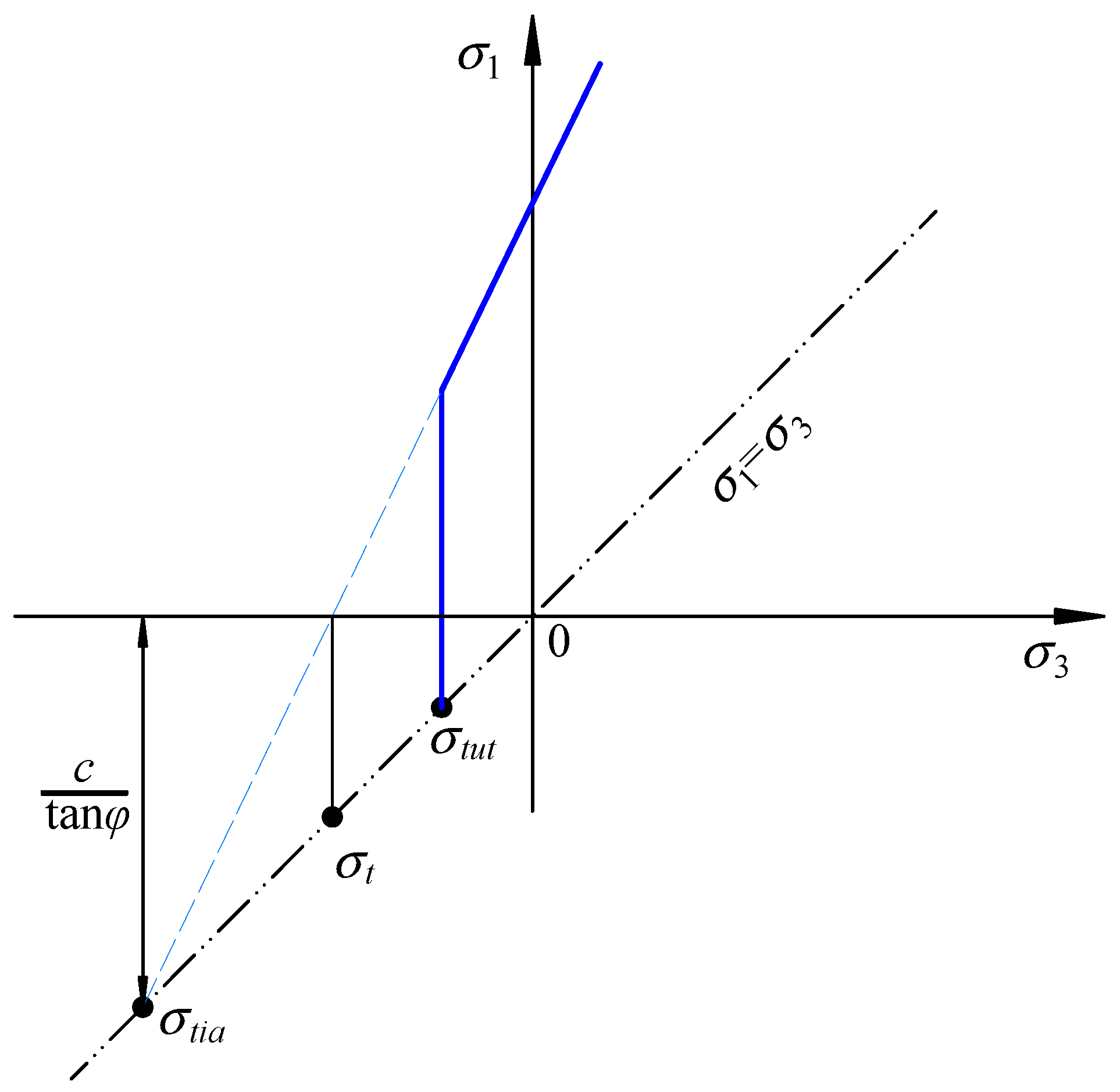
Experimental observations indicate that the theoretical tensile strength σₜ significantly overestimates the actual tensile strength of the material. Consequently, a cut-off circle tangent to the M-C envelope is introduced (blue line in Figure 1). The actual uniaxial tensile strength σₜᵤₜ is determined via direct-tension testing and defines the Mohr circle that is tangent to the linear M-C envelope. The resulting strength envelope in the principal stress space is illustrated in Figure 2.
A reduction ratio, ξ, is introduced to quantify the reduction in strength produced by the cut-off:
ξ = σ t u t σ t
Because the dilation angle δ varies continuously along the circular cut-off segment, the dissipation formulation in Equation (2) is no longer valid. The dissipation rate specific to this arc segment is derived below.
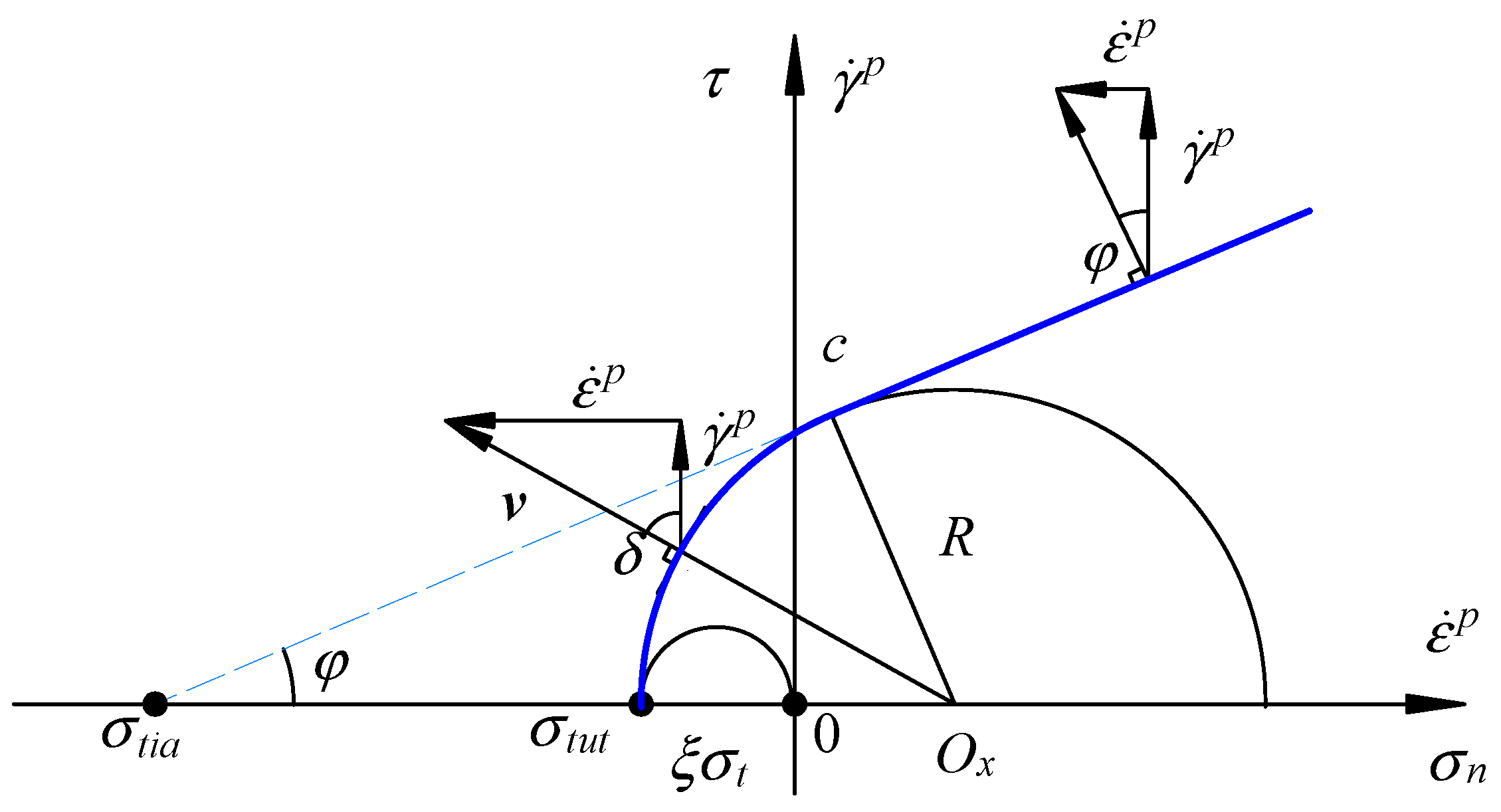
In the τ–σn stress spaces, as shown in Figure 3, let Oₓ denote the center of the Mohr circle, R be the radius. The equation governing the circular cut-off in stress space is:
τ = R 2 σ n O x 2
As can be seen from Figure 3, L A B = c / tan φ ξ σ t , and O A = c / tan φ ξ σ t + R . According to sin φ = R O A , it can be derived that R = c cos φ + ξ σ t sin φ 1 sin φ , O x = c cos φ + ξ σ t 1 sin φ .
Under the framework of plastic mechanics, the plastic potential Ω is given by:
Ω = τ R 2 σ n O x 2 0.5
According to the associated flow rule, the plastic strain rate can be expressed as:
ε ˙ n = λ Ω σ n = λ σ n O x R 2 σ n O x 2 0.5 γ ˙ n = λ Ω τ = λ
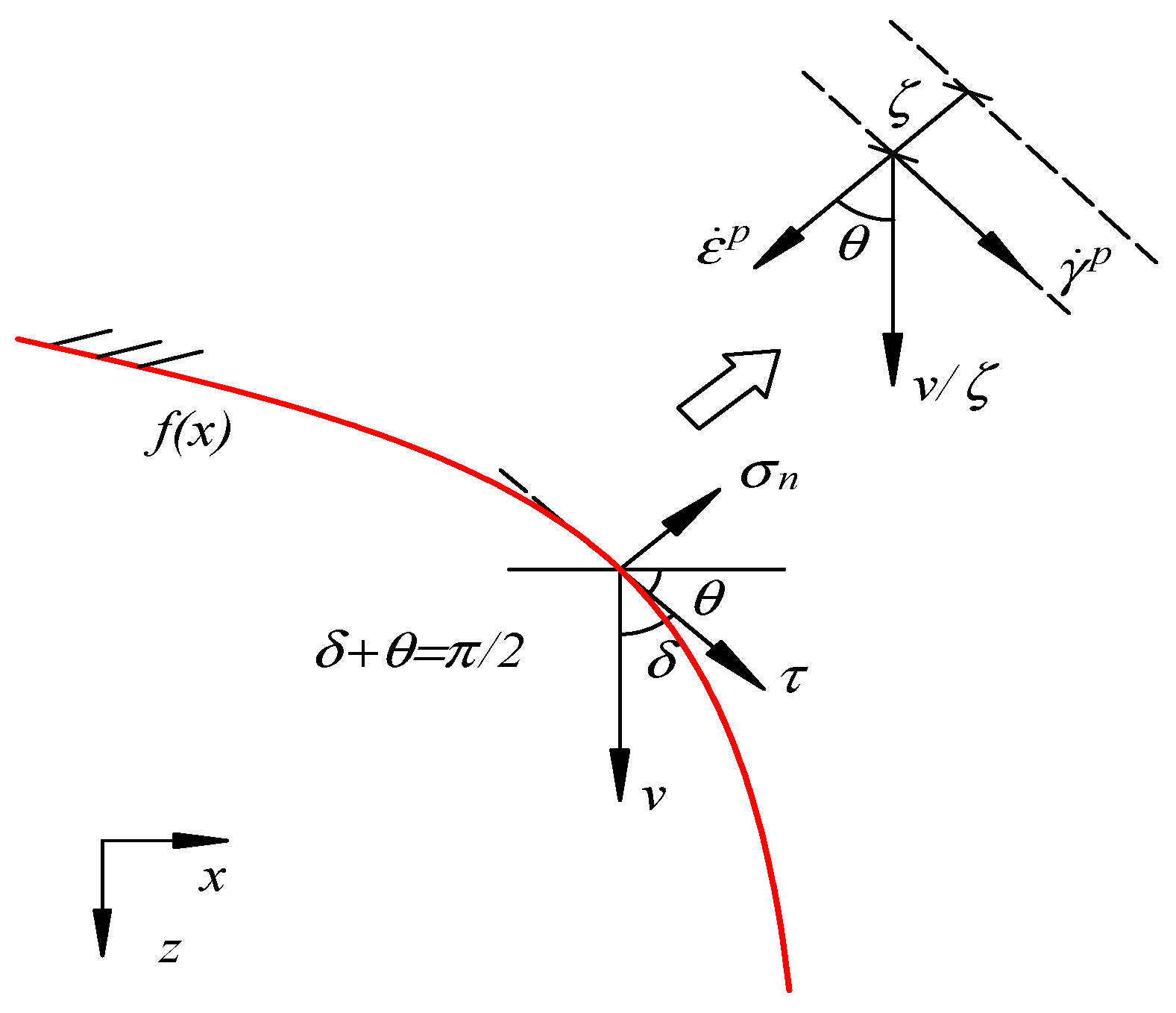
Let f(x) describe the collapse surface, as shown in Figure 4. Assuming a shear failure layer with a thickness ζ, the plastic strain rate can be determined by
ε ˙ n = v ζ 1 + f ( x ) 2 γ ˙ n = v f ( x ) ζ 1 + f ( x ) 2
Combining Equations (7) and (8) gives the relationship between the stress state and the geometry of the failure mechanism:
σ n = R 1 + f ( x ) 2 + O x
The general equation for the energy dissipation per unit area of the failure surface is d D = τ γ ˙ n σ n ε ˙ n ζ d S . By substituting the expressions of τ, σn, ε ˙ n and γ ˙ n , the closed-form expression for the cut-off segment is derived.
d D = τ γ ˙ n σ n ε ˙ n ζ d L = R 1 + f ( x ) 2 O x v 1 + f ( x ) 2 d L

3. Upper-Bound Solution for Tunnel Roof Stability

The surrounding rock mass is assumed to be homogeneous. The tunnel excavation process is assumed to be instantaneous, neglecting time-dependent effects and the weakening effect of excavation disturbance on the mechanical properties of the surrounding rock.

3.1. Derivation for 2D Conditions

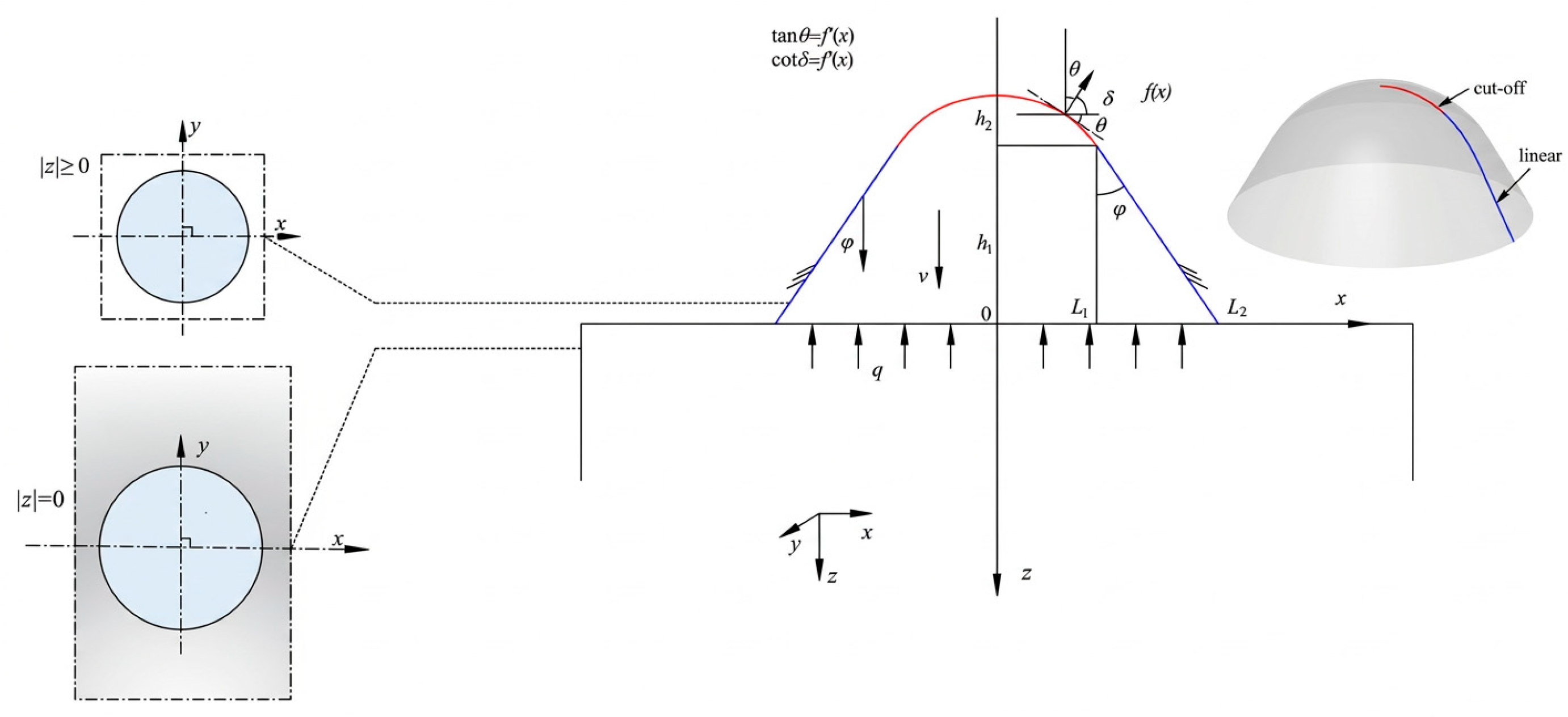
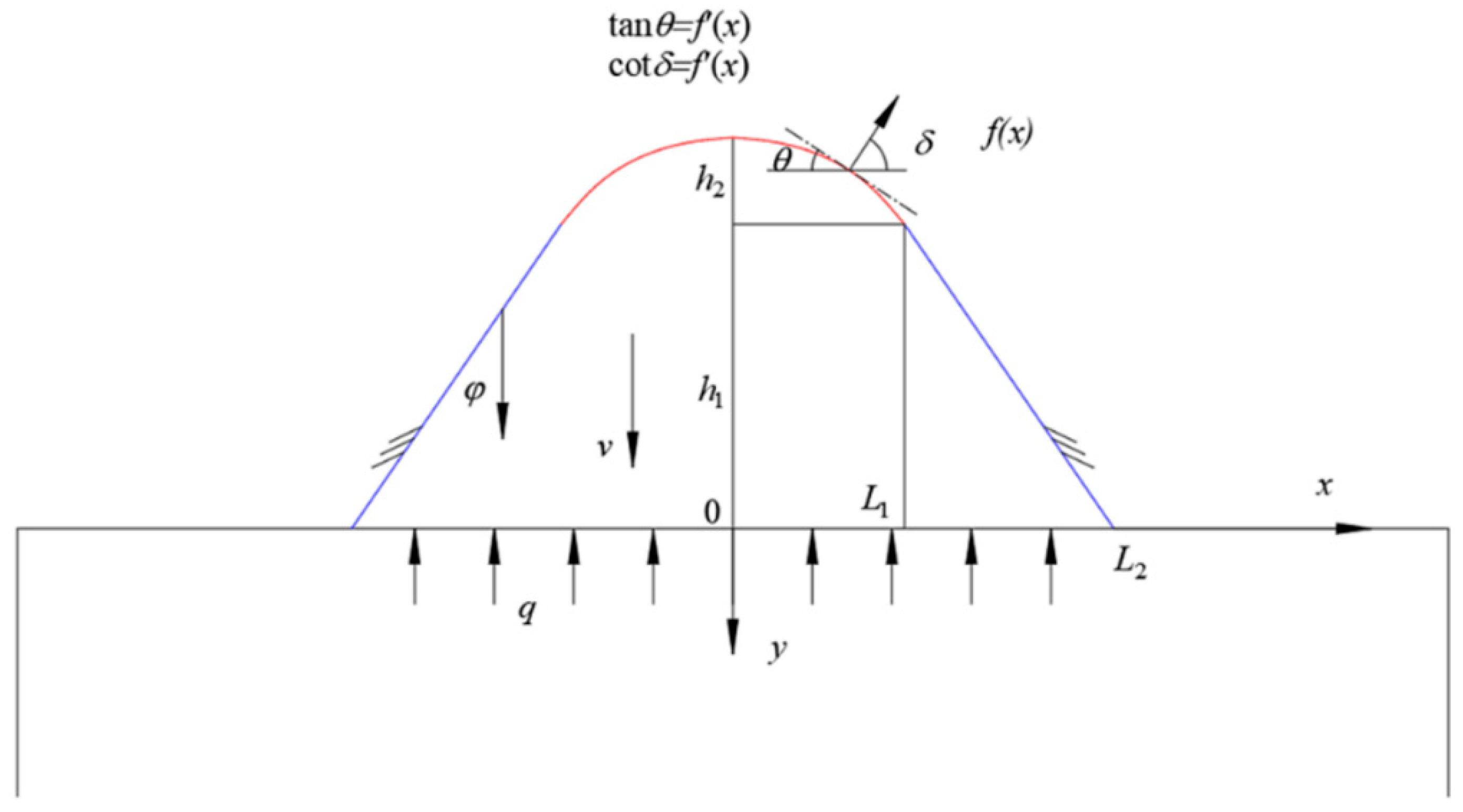
To predict the collapse profile of a deep buried rectangular tunnel subjected to a uniform support pressure q, a kinematically admissible 2D mechanism composed of straight and curved segments is constructed, as shown in Figure 5. The mechanism is symmetric about the vertical centerline. The collapsing block moves downward as a rigid body with uniform vertical velocity v. By the associated flow rule, the velocity vector is inclined to the discontinuity at the instantaneous dilation angle δ: δ = φ about the linear M-C envelope and δ = δ(x) about the cut-off segment. Therefore, the failure surface is composed of a line and a curve. A Cartesian coordinate system is established at the roof center, with the z-axis pointing downward. The curve of the failure surface is denoted as f(x). A uniform support pressure q acts vertically on the roof.
The key to calculating the upper bound solution for the critical stability state of tunnel surrounding rock is to compute the power of the failure mechanism. Equations (2) and (10) represent the internal energy dissipation formulas for the straight and curved segments of the failure surface, respectively. Accordingly, the total rate of dissipation is obtained by integrating along the entire failure surface:
P D = 0 L 1 R 1 + f ( x ) 2 O x v d x + c v cos φ ( L 2 L 1 ) sin φ
where L1 and L2 are the x-coordinates of the endpoints of the curve and the line, respectively.
The work rate done by gravity on the tunnel roof collapse body can be expressed as:
P γ = v γ 0 L 1 f ( x ) d x + 1 2 tan φ v γ L 2 L 1 2
where γ is the unit weight of the soil. The rate of work done by the tunnel supporting pressure is:
P q = q v L 2
The energy functional Φ is obtained by subtracting the rate of work done by external forces from the rate of internal energy dissipation:
Φ = P D P γ P q
Substituting Equations (11)–(13) into Equation (14) gives:
Φ = v 0 L 1 R 1 + f ( x ) 2 O x + γ f ( x ) d x 1 2 tan φ v γ L 2 L 1 2 + q v L 2 + c v ( L 2 L 1 ) tan φ
Let ψ [ f ( x ) , f ( x ) , x ] = R 1 + f ( x ) 2 O x + γ f ( x ) . It can be seen from Equation (15) that the extremum of Φ is related to ψ. By applying the variational principle, the Euler equation corresponding to the objective function can be derived, converting the original extremum problem into a differential equation solving problem. The corresponding Euler equation is:
ψ f ( x ) d d x ψ f ( x ) = 0
Solving the above equation yields the equations of f(x) and f’(x):
f ( x ) = R γ 1 ( γ R x + C 1 ) 2 1 2 + C 2 .
f ( x ) = γ R x + C 1 1 ( γ R x + C 1 ) 2
where C1 and C2 are integration constants. These two undetermined constants are determined from boundary conditions to calculate the geometric shape of the tunnel roof collapse surface.
Due to symmetry, the shear stress τ = 0 at x = 0; thus, at this point, the dilatancy angle δ = π/2 and f’(0) = 0. Thus, C1 = 0 can be derived. In addition, as shown in Figure 5, the following geometric relationship exists:
f ( x = L 1 ) = h 1 h 1 L 2 L 1 = cot φ
Substituting Equation (17) into the above equation gives
C 2 = L 2 L 1 cot φ + R γ 1 ( γ R L 1 ) 2 1 2
The failure surface remains smooth at the conjoint point. Thus, at x = L1, the expression exists: δ = ( π / 2 ) φ . Subsequently, the expression of L1 can be derived.
L 1 = R cot φ γ 1 + cot 2 φ = R γ cos φ
Based on the above derivation process, the expression of f(x) is obtained after further simplification:
f ( x ) = R γ 1 ( γ R x ) 2 1 2 L 2 cot φ + R γ 1 sin φ
After substituting into Equation (15), the function Φ for 2D condition can be simplified as:
Φ = γ 2 tan φ L 2 2 + q + c tan φ L 2 R cos φ γ O x + c tan φ + R 2 2 γ 1 tan φ + π 2 φ

3.2. Derivation for 3D Conditions

Based on the 2D curved failure mechanism described above, this section establishes and characterizes a 3D failure mechanism model for deep-buried rectangular tunnels. As shown in Figure 6, it is assumed that the surrounding rock undergoes velocity discontinuity along a curved path, thereby forming a 2D arch-shaped collapse surface in the XOZ plane. Furthermore, by rotating this curve around the Z-axis, an axisymmetric rotating body is constructed, which represents the collapsing block of surrounding rock. It should be noted that the actual collapse zone has distinct length and width, and the failure behavior falls between the 2D plane-strain condition and the 3D axisymmetric condition. The simplified 3D rotational mode makes the problem analytically tractable and provides a practical estimate for engineering practice.
According to the upper bound theorem, the surface area and volume of the rotating body are calculated to obtain the rate of internal energy dissipation and the rate of work done by external forces. An objective function containing the governing equation is then derived. The extremum of this objective function is determined using the calculus of variations, finally yielding the analytical equation for the surface of the rotating body.
For the curved conical segment, the lateral surface area of the collapse body can be calculated using the formula of a rotating body:
S = 2 π 0 L 1 x 1 + f ( x ) 2 d x
Therefore, the rate of energy dissipation on the curved conical surface can be expressed as:
P D = 2 π v 0 L 1 R 1 + f ( x ) 2 O x x d x
The lower part of the collapse block is a standard cone. Thus, the rate of energy dissipation on the cone surface is
P D = π v c L 2 2 L 1 2 tan φ
Similarly, the rate of work done by gravity on the collapse body is:
P γ = γ v 0 L 1 π x 2 f ( x ) d x
P γ = 1 3 π v L 2 3 tan φ L 1 3 tan φ γ
where Pγ and P’γ refers to the curved conical segment and the standard cone, respectively.
The rate of work done by the supporting pressures is:
P q = q v π L 2 2
Similarly, using the difference between the dissipation power and the external force power, the energy functional Φ is constructed:
Φ [ f ( x ) , f ( x ) , x ] = P D + P D P γ P γ P q
After simplification, the following equation is obtained
Φ = 2 π v 0 L 1 R 1 + f ( x ) 2 O x x γ 2 x 2 f ( x ) d x + π c v L 2 2 L 1 2 tan φ 1 3 π L 2 3 tan φ L 1 3 tan φ γ v + q v π L 2 2
where ψ [ f ( x ) , f ( x ) , x ] = R 1 + f ( x ) 2 O x x γ 2 x 2 f ( x ) .
The calculus of variations is used to solve the extremum of the functional Φ. The core of the problem is transformed into finding a particular solution to the Euler equation that satisfies the boundary conditions. The corresponding Euler equation is expressed as follows
ψ f ( x ) d d x ψ f ( x ) = 0
Substituting the expression of ψ into Equation (36) gives the corresponding Euler equation:
R f ( x ) 1 + f ( x ) 2 1 2 + x R f ( x ) 1 + f ( x ) 2 3 2 γ x = 0
This linear nonhomogeneous second-order differential equation with constant coefficients can be solved analytically. To simplify the solution process of the equation, a variable substitution method is used for order reduction. Let f ( x ) = tan θ and f ( x ) = d tan θ d θ d θ d x = 1 cos 2 θ d θ d x , transforming Equation (37) into:
d sin θ d x + sin θ x = γ R
Solving the above equation, which is a Bernoulli differential equation, can derive the expression of f’(x):
f ( x ) = tan arcsin γ x 2 R + C 1 x
Since τ = 0 at the axis of symmetry (x = 0), the integration constant C1 is equal to 0. Further integrating the equation yields the form of the solution f(x), where C2 is the integration constant that can be solved by boundary conditions.
f ( x ) = 2 R γ 1 γ x 2 R 2 + C 2
The constant C2 can be solved using geometric relationships.
f ( x = L 1 ) = h 1 h 1 L 2 L 1 = cot φ
Using the above relationship, we can obtain C 2 = L 2 L 1 cot φ + 2 R γ 1 γ L 1 2 R 2 . Thus, f(x) can be written as
f ( x ) = 2 R γ 1 γ x 2 R 2 L 2 L 1 cot φ + 2 R γ 1 γ L 1 2 R 2
Similar to the 2D condition, the failure surface remains smooth at the conjoint point. Thus, at x = L1, the slope of f(x) is equal to π/2-φ. The value of L1 can be easily determined:
L 1 = 2 R cot φ γ 1 + cot 2 φ = 2 R γ cos φ
Finally, the expression of f(x) can be shorted as
f ( x ) = 2 R γ 1 γ x 2 R 2 L 2 cot φ + 2 R γ 1 sin φ
Substituting the above formulas into Equation (30) and simplifying, the function Φ in the 3D condition can be obtained
Φ = π γ 3 tan φ L 2 3 + q + c tan φ L 2 2 4 R 2 cos 2 φ γ 2 O x + c tan φ + 8 R 3 3 γ 2 1 sin φ + 1 2 sin φ
The objective function Φ indicates the stability state of the tunnel. Φ = 0 represents the limit state, Φ > 0 represents the stable state, and Φ < 0 represents the unstable state. Combined with the strength reduction method, the safety factor is calculated as the reduction factor that places the tunnel in the limit state (Φ = 0).

3.3. Expression of Safety Factor

In engineering practice, it is customary to calculate a corresponding safety factor to evaluate the stability and safety of tunnels under various conditions. The safety factor (FS) is widely used as a direct stability index in geotechnical engineering. For the Mohr-Coulomb criterion, the expression is as follows:
F S = τ τ d = c c d = tan φ tan φ d
in which the subscript d denotes the reduced strength.
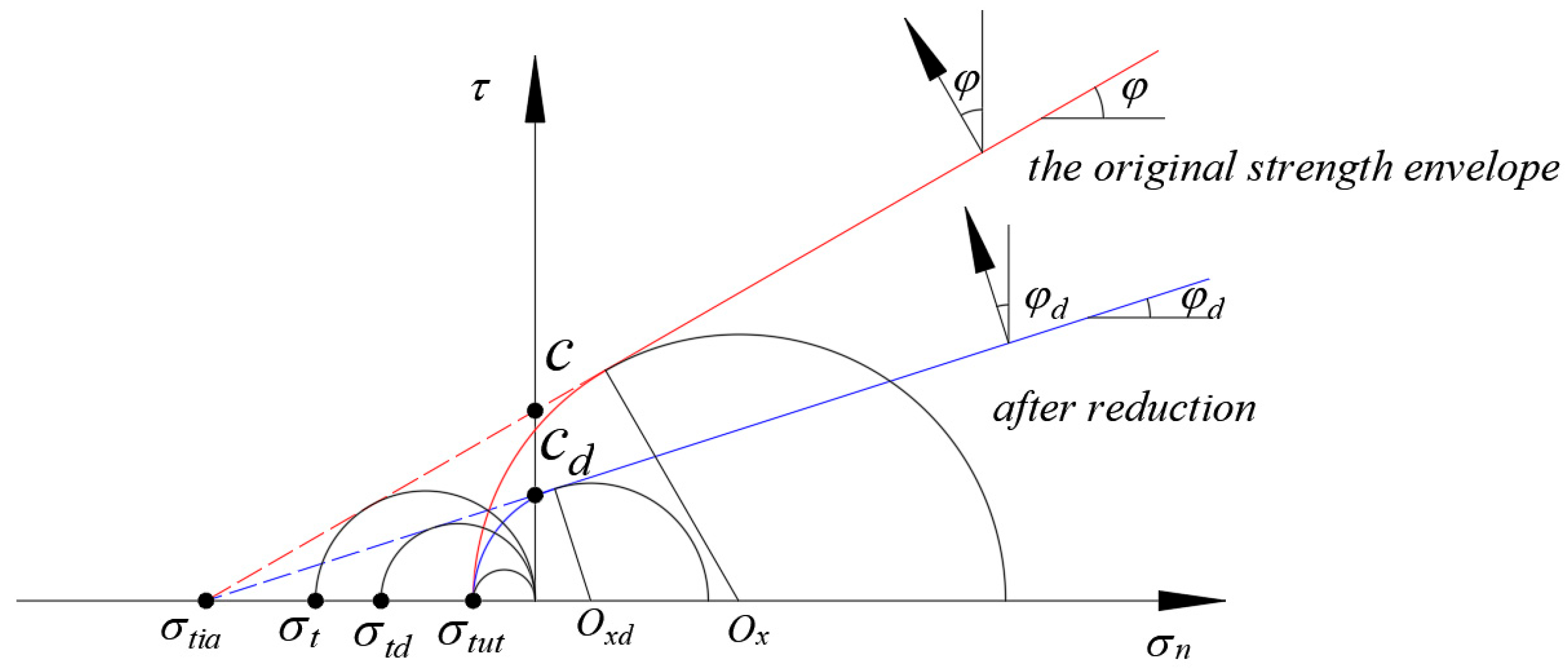
As shown in Figure 7, the red line represents the original strength envelope, and the blue line represents the reduced strength envelope. Equation (42) specifies the reduction method for the cohesion and the internal friction angle within the MC criterion. However, the reduction method for the coefficient ξ within the tension cut-off criterion requires further determination. Consistent with the strength reduction approach of the traditional M-C criterion, which reduces only the shear strength, the intercept of the strength envelope on the σn-axis remains unchanged before and after reduction, i.e., σtut remains constant. Through derivation, the strength indices of the reduced cut-off criterion are expressed as follows:
c d = c F S tan φ d = tan φ F S ξ d = ξ tan ( π 4 φ 2 ) F S tan ( π 4 φ d 2 )
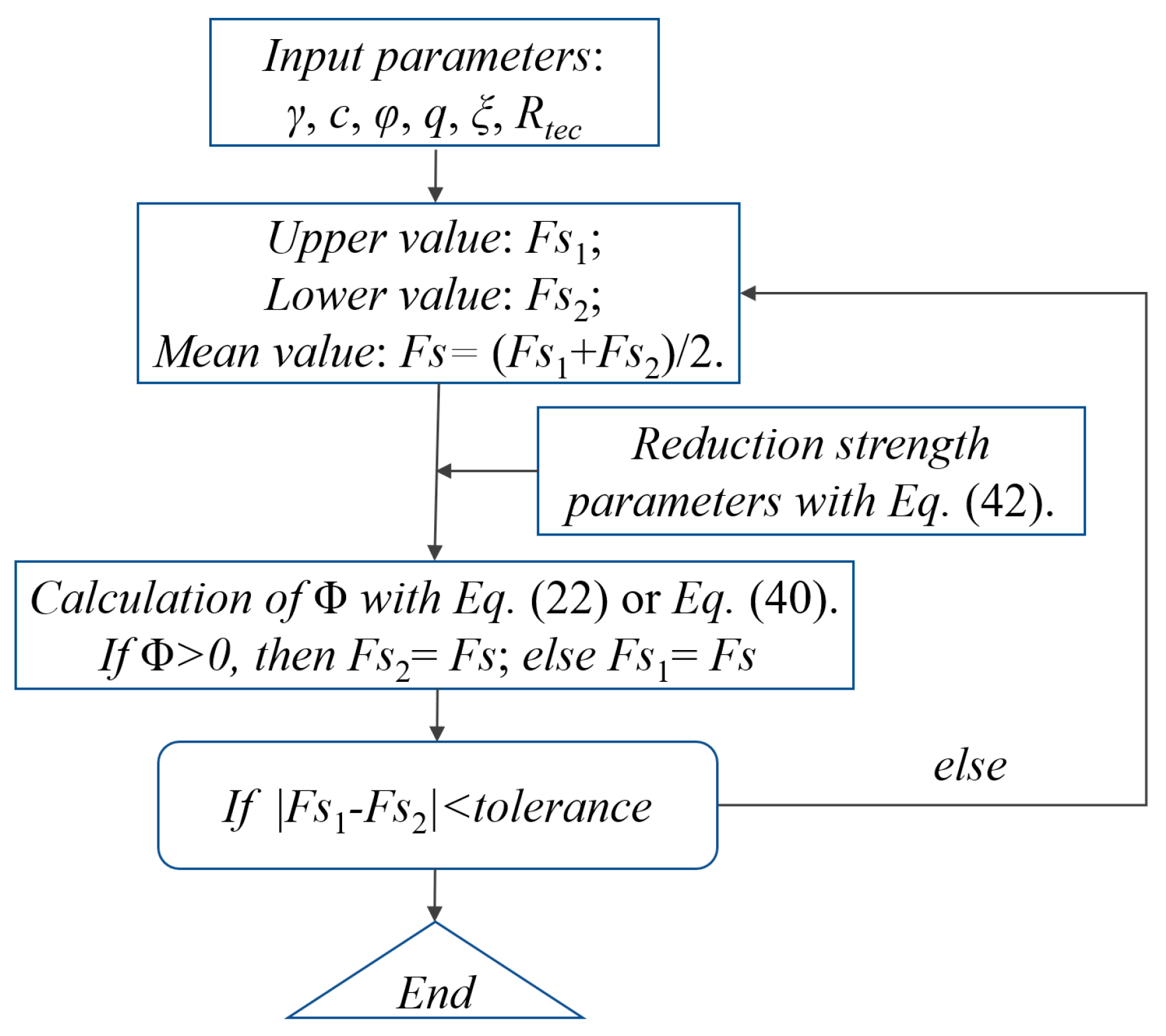
The flowchart of the computational procedure for safety factor is present in Figure 8. The safety factor is implicit within the limit analysis expressions. Given the monotonic relationship between Fs and the solution of Φ, the bisection method is used to determine the solution during the calculation of calculating the safety factor, which demonstrates high computational efficiency and accuracy.

4. Comparison with the Numerical Method

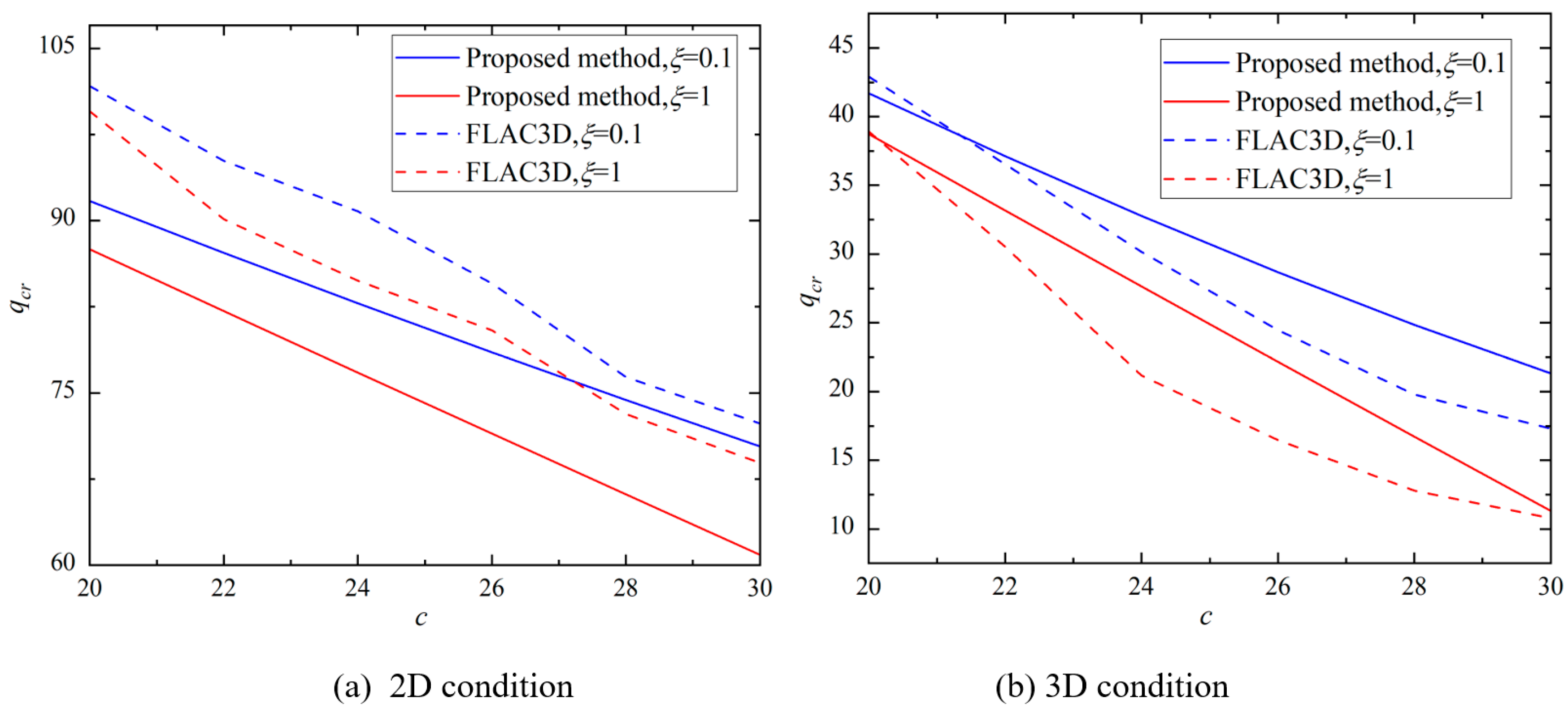
To verify the validity of the proposed method, the calculation results of this study are compared with those obtained from the FLAC3D numerical simulation [47]. Herein, the critical support pressure qcr is defined as the pressure required to maintain the tunnel in a state of critical equilibrium. For the proposed method, the qcr value corresponding to Φ = 0 can be conveniently calculated using Equations (22) and (40). In the numerical simulation method, a trial calculation approach is adopted to iteratively determine the qcr value that ensures the convergent solution for the tunnel model.
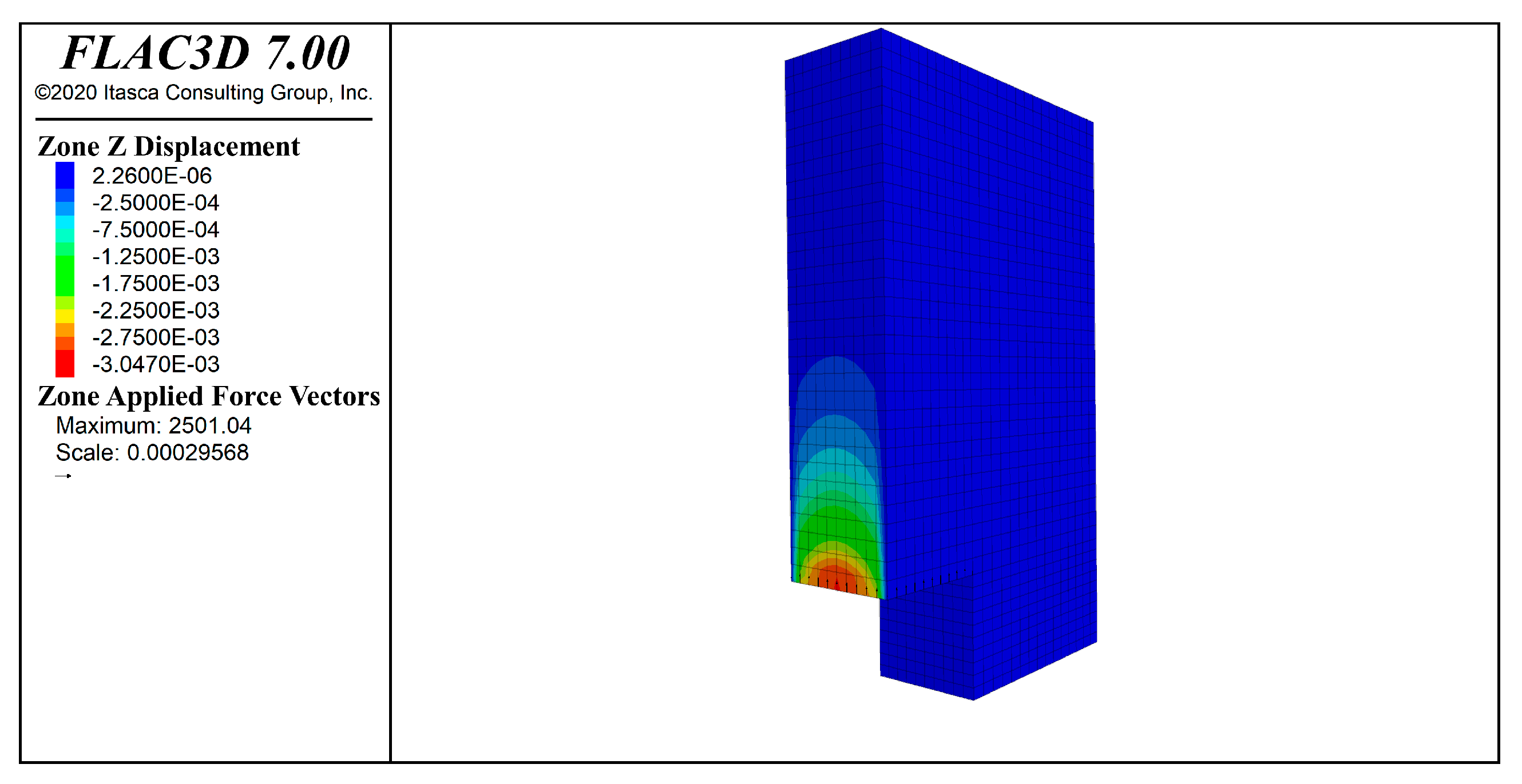
Calculations were performed under both 2D and 3D conditions, and the displacement contours from the numerical simulation are presented in Figure 9. The calculation parameters are: c = 20–30 kPa, φ = 20°, ξ = 0.1 and 1.0, γ = 20 kN/m3, Rtec = 5 m. For the 2D condition, a sliding constraint was applied along the longitudinal direction of the tunnel model; for the 3D condition, a fixed constraint was adopted for the longitudinal boundaries. With identical calculation parameters, the model results are shown in Figure 10. Due to the tolerance and grid discretization, the FLAC3D results exhibit a non-smooth trend. Through data comparison, it can be observed that the relative error between the two calculated results increases with decreasing qcr. This may be due to the limited computational accuracy, as the results in the numerical simulation are obtained via trial calculations. Nevertheless, the two sets of results exhibit consistent trends, which demonstrates the rationality of the method proposed in this study. The proposed method offers higher computational efficiency and its results possess more rigorous theoretical value. It is important to note that the proposed method is constrained by its inability to analyze tunnel deformation and its tendency to overestimate the dilation angle due to the use of the associated flow rule. Furthermore, the tensile-shear failure mode applies strictly to homogeneous geological conditions. For rock masses with well-developed fractures, the failure surface may propagate along a dominant joint, which could lead to errors in the theoretical results derived from the proposed method.

5. Parameter Analysis

5.1. Morphology of the Collapse Body

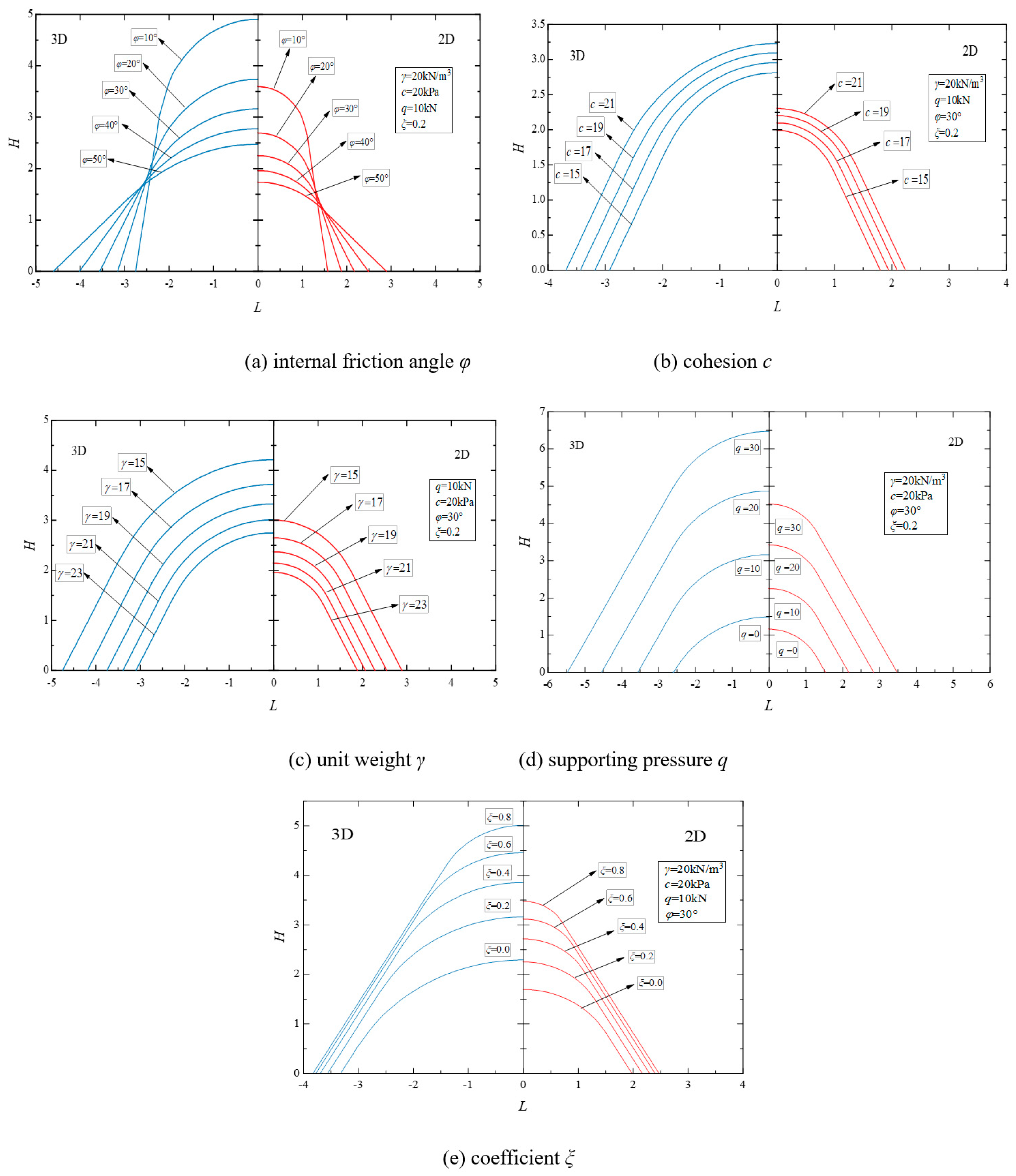
Based on Equations (21) and (37), the morphologies of the collapse block under two-dimensional and three-dimensional conditions are plotted. The morphology of the collapse body not only reflects the failure mode of the tunnel but also indicates the potential extent of instability. Accurately delineating the collapse body is essential for determining the safe excavation limits. Excavation or lack of support within this potential failure zone may lead to tunnel collapse.
Figure 11a shows the influence of the internal friction angle φ on the collapse surface shape. Similar effects of φ are observed in 2D and 3D scenarios. The lower linear segment becomes steeper with decreasing φ, while the upper circular arc segment expands with increasing φ. Figure 11b illustrates that the range of the collapse arch expands with an increase in cohesion, while the overall shape of the collapse body remains consistent. The potential failure zone helps determine the safe excavation or reinforcement radius. Figure 11c demonstrates that soil unit weight has little effect on the collapse body’s shape but significantly influences its scope, which decreases non-linearly with increasing unit weight. Figure 11d shows that supporting pressure q greatly affects the failure zone extent. As q increases, the height of the linear segment of the collapse body increases significantly. Figure 11e indicates that the reduction coefficient ξ significantly affects the morphology of the collapse body but has limited impact on its overall scope. In contrast to q, the curved segment expands significantly with decreasing ξ.
In general, the scope of the collapse body in the 2D analysis is significantly smaller than in the 3D analysis. This suggests that when boundary conditions are restricted, the tunnel exhibits greater geometric stability, potentially allowing for a larger safe excavation width compared to the 2D condition.

5.2. Stability Comparison

In practical engineering scenarios, the boundaries of the tunnel are fixed, i.e., the radius of the tunnel is constant. Under such circumstances, the safety factor method can be introduced to analyze tunnel stability. Combining the strength reduction method and the expression of the safety factor, the sensitivity of the safety factor to various parameters is analyzed under fixed tunnel radius conditions.
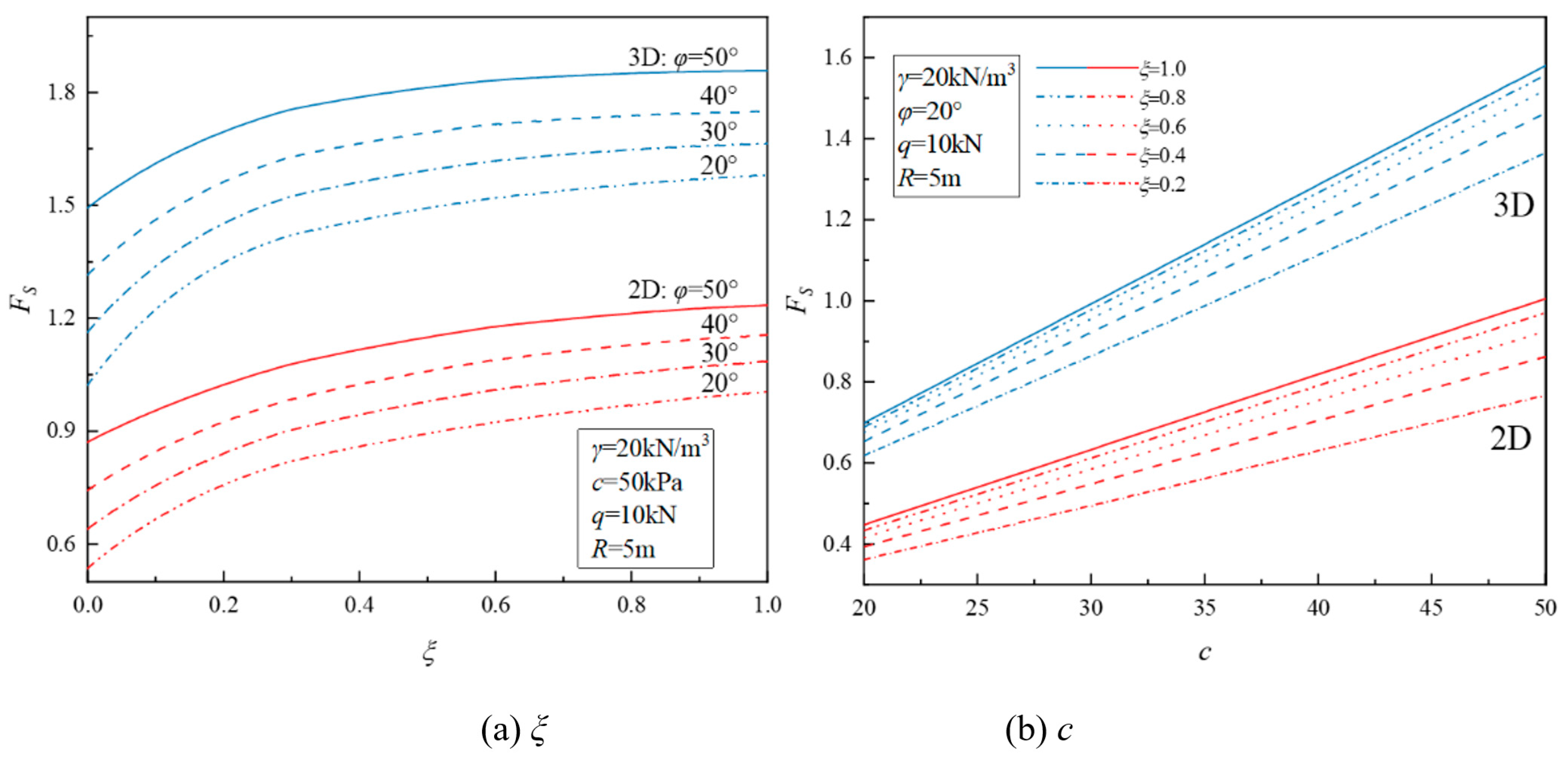
Figure 12a depicts the nonlinear influence of the parameter ξ on the safety factor FS. The red line represents the change under the 2D model, and the blue line represents the change under the 3D model. As ξ increases, the safety factor in both 2D and 3D models increases significantly between 0.0 and 0.2, and the growth rate diminishes after ξ reaches 0.4. Crucially, the sensitivity of the safety factor to variations in ξ is more pronounced when three-dimensional effects are considered. Moreover, the influence of ξ on the safety factor FS is consistent under different φ conditions. Figure 12b further analyzes the influence of cohesion c on the safety factor FS. As cohesion c increases, the safety factor in both 2D and 3D models increases linearly, and the growth rate is more pronounced under the 3D mode. Furthermore, a comparative analysis reveals that the impact of ξ on the safety factor intensifies with increasing cohesion. This phenomenon is attributed to the fact that, for a given ξ, the absolute reduction in tensile strength capacity is more substantial when the initial cohesion c is higher.
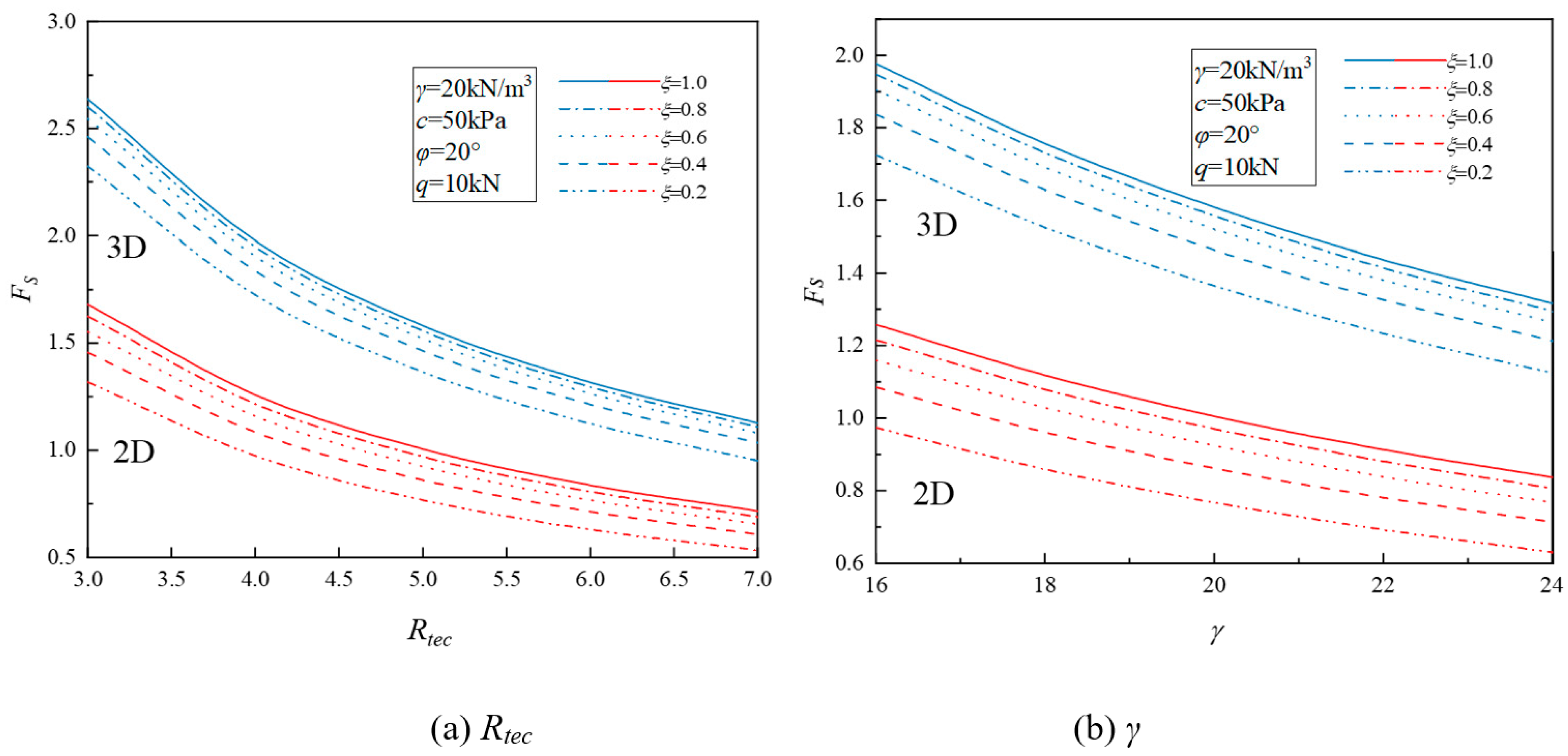
Figure 13a,b present the effects of tunnel radius Rtec and unit weight γ on the safety factor FS, respectively. The investigated radius range from 3.0 to 7.0 m encompasses typical dimensions for both small- and large-span tunnels. For smaller spans, FS declines precipitously with increasing tunnel radius Rtec. However, for larger spans, the rate of decline attenuates as Rtec continues to increase.

5.3. Critical Supporting Pressure

Building upon the stability analysis, the supporting pressure required to maintain tunnel stability, which is defined as the critical supporting pressure, is evaluated under a specified safety factor. In practical tunnel design, a conservative safety factor is typically mandated to account for geological uncertainties and ensure stability. By inputting specific tunnel geometry, soil properties, and the target safety factor into the analytical framework, the critical supporting pressure becomes the dependent variable to be solved.
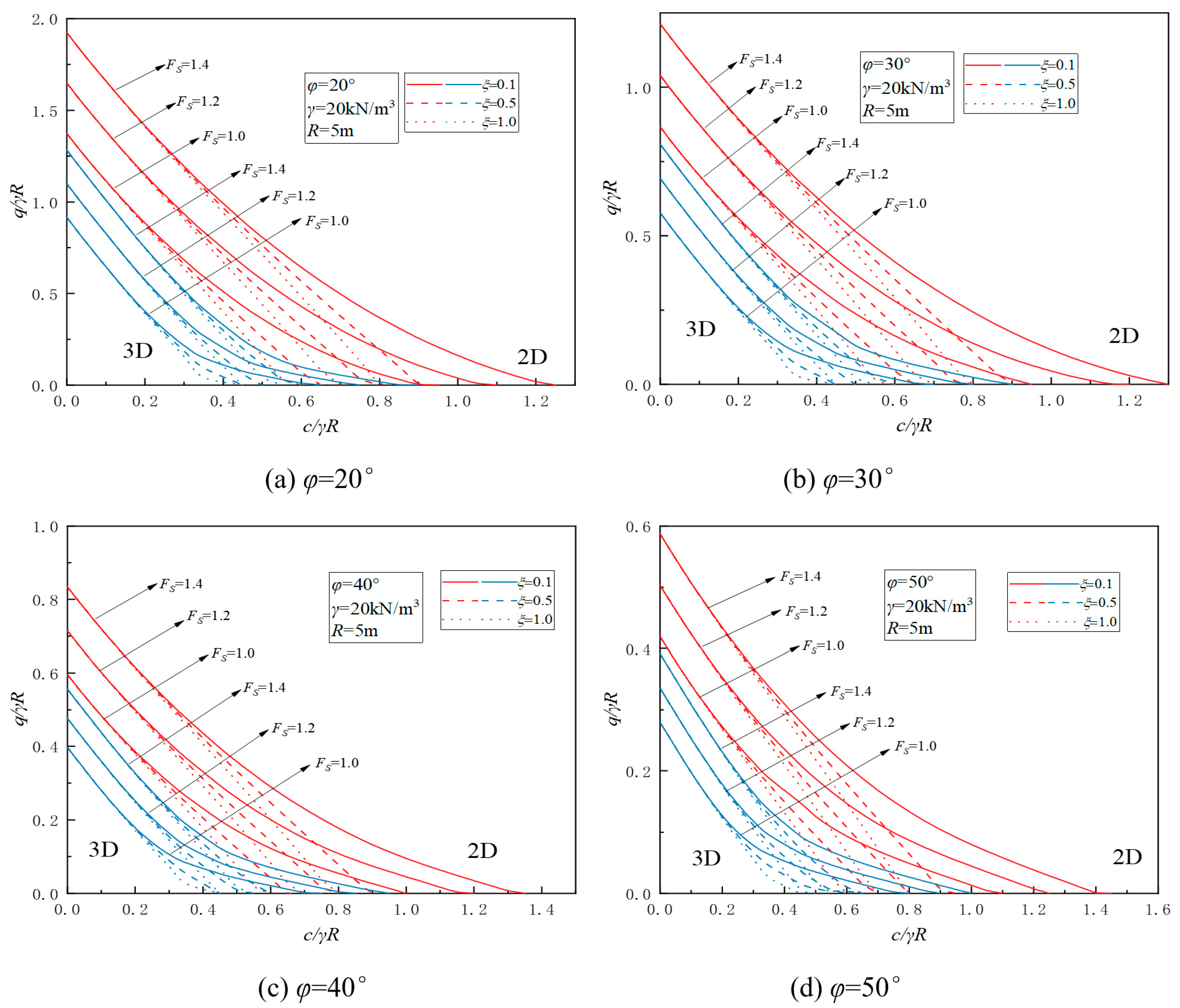
To facilitate engineering application, the critical supporting pressure qcr and cohesion c are presented in dimensionless forms. Figure 14a,d illustrate the relationship between the dimensionless cohesion c/γR and the critical supporting force coefficient qcr/γR across a range of internal friction angles φ from 20° to 50°. These design charts allow for the rapid determination of the required supporting force, thereby providing a convenient tool for preliminary engineering design.
Observations from these figures indicate that when stability conditions are unfavorable (i.e., low cohesion, large unit weight, or large tunnel radius), the required supporting force increases in an approximately linear manner. Conversely, as the stability parameters improve, the demand for supporting force diminishes significantly. This implies that superior surrounding rock quality enhances the self-supporting capacity of the tunnel, thereby reducing the external pressure required to prevent failure.

6. Conclusions

This paper presents a rigorous theoretical analysis of the roof stability for rectangular tunnels. The major conclusions drawn from this work are as follows.
(1) The influences of the internal friction angle, cohesion, soil unit weight, supporting pressure, and reduction coefficient on the morphology of the tunnel collapse body are investigated. With the increase in internal friction angle, cohesion, supporting pressure, and reduction coefficient, as well as the decrease in soil unit weight, the range of the tunnel collapse arch expands, indicating that higher stability corresponds to a larger collapse arch range, and excavation within this range is relatively safe. The supporting pressure and reduction coefficient ξ have a more significant impact on the tunnel collapse morphology, and attention should be paid to the influence of tensile failure at the tunnel crown on stability. Comparisons show that while the failure morphology remains consistent between 2D and 3D models, the spatial extent of the 3D collapse body is larger under identical conditions.
(2) Based on the strength reduction method, the influences of various parameters on the safety factor and the critical supporting pressure are analyzed. The relationships between the safety factor and parameters such as cohesion c and unit weight γ are found to be approximately linear, whereas the influences of the reduction coefficient ξ and the tunnel span Rtec are nonlinear. Finally, design charts for critical supporting pressure qcr are provided based on given tunnel and soil parameters, facilitating the rapid determination of the required supporting pressure for practical engineering applications.

Author Contributions

Methodology, Y.L.; Software, C.H.; Validation, C.H.; Formal analysis, W.C.; Investigation, G.L.; Resources, L.X.; Data curation, Y.L.; Writing—original draft, W.C.; Writing—review & editing, D.Z.; Visualization, G.L.; Supervision, D.Z.; Project administration, L.X. All authors have read and agreed to the published version of the manuscript.

Funding

This work was supported by the project “Key technologies for deformation control in shield tunneling through operated subway station and utility tunnels” of Shenzhen Municipal Group Co., Ltd., and the project “Key technologies for TBM safe tunneling under unfavorable geological conditions” of Shenzhen Municipal Group Co., Ltd.

Data Availability Statement

The original contributions presented in this study are included in the article. Further inquiries can be directed to the corresponding author.

Conflicts of Interest

Authors Long Xia, and Guihua Long were employed by the Shenzhen Municipal Group Co., Ltd. The remaining authors declare that the research was conducted in the absence of any commercial or financial relationships that could be construed as a potential conflict of interest.

References

  1. Zhao, H. A practical and efficient reliability-based design optimization method for rock tunnel support. Tunn. Undergr. Space Technol. 2022, 127, 104587. [Google Scholar] [CrossRef]
  2. Wang, Z.; Shen, S.L.; Zhou, A. Performance of composite EPDM gaskets for underground structures: Experimental and numerical investigation. Constr. Build. Mater. 2025, 500, 143951. [Google Scholar] [CrossRef]
  3. Wang, Z.; Lyu, H.M.; Zhang, R. Water-swelling behavior and self-reinforcing mechanical properties of joint sealing material in underground prefabricated structure. Constr. Build. Mater. 2025, 490, 142451. [Google Scholar] [CrossRef]
  4. Sousa, R.L.; Einstein, H.H. Lessons from accidents during tunnel construction. Tunn. Undergr. Space Technol. 2021, 113, 103916. [Google Scholar] [CrossRef]
  5. Wang, H.; Xue, S.; Jiang, Y.; Deng, D.; Shi, S.; Zhang, D. Field investigation of a roof fall accident and large roadway deformation under geologically complex conditions in an underground coal mine. Rock Mech. Rock Eng. 2018, 51, 1863–1883. [Google Scholar] [CrossRef]
  6. He, B.G.; Liu, E.R.; Zhang, Z.Q.; Zhang, Y. Failure modes of highway tunnel with voids behind the lining roof. Tunn. Undergr. Space Technol. 2021, 117, 104147. [Google Scholar] [CrossRef]
  7. Liu, C.; Zhang, S.; Zhang, D.; Zhang, K.; Wang, Z. Model tests on progressive collapse mechanism of a shallow subway tunnel in soft upper and hard lower composite strata. Tunn. Undergr. Space Technol. 2023, 131, 104824. [Google Scholar] [CrossRef]
  8. Isleyen, E.; Duzgun, H.S. Use of virtual reality in underground roof fall hazard assessment and risk mitigation. Int. J. Min. Sci. Technol. 2019, 29, 603–607. [Google Scholar] [CrossRef]
  9. Wu, W.D.; Bai, J.B.; Feng, G.R.; Wang, X.Y. Investigation on the mechanism and control methods for roof collapse caused by cable bolt shear rupture. Eng. Fail. Anal. 2021, 130, 105724. [Google Scholar] [CrossRef]
  10. Han, K.; Ju, J.W.; Kong, H.; Wang, M. Functional catastrophe analysis of progressive failures for deep tunnel roof considering variable dilatancy angle and detaching velocity. Rock Mech. Rock Eng. 2019, 52, 3987–3997. [Google Scholar] [CrossRef]
  11. Luo, W.; Xiao, G.; Tao, Z.; Chen, J.; Lu, X.; Wang, H. Nonlinear stability analysis of shallow-buried bias tunnel based on failure mode improvement. Appl. Sci. 2025, 15, 3153. [Google Scholar] [CrossRef]
  12. Li, Z.; Yang, X. Three-dimensional active earth pressure under transient unsaturated flow conditions. Comput. Geotech. 2020, 123, 103559. [Google Scholar] [CrossRef]
  13. Yang, X.L.; Li, Z.W. Upper bound analysis of 3D static and seismic active earth pressure. Soil Dyn. Earthq. Eng. 2018, 108, 18–28. [Google Scholar] [CrossRef]
  14. Kang, X.D.; Zhou, D. Analytical solution for bearing capacity of reinforced strip footings on unsaturated soils under steady flow. Mathematics 2023, 11, 3746. [Google Scholar] [CrossRef]
  15. Sun, Z.; Li, J.; Pan, Q.; Dias, D.; Li, S.; Hou, C. Discrete kinematic mechanism for nonhomogeneous slopes and its application. Int. J. Geomech. 2018, 18, 04018171. [Google Scholar] [CrossRef]
  16. Xu, J.; Wang, X.; Tian, Y.; Du, X. Roof stability analysis for a shallow-buried cylindrical tunnel in Hoek-Brown rock strata. Comput. Geotech. 2024, 175, 106685. [Google Scholar] [CrossRef]
  17. Hou, C.T.; Yang, X.L. 3D stability analysis of tunnel face with influence of unsaturated transient flow. Tunn. Undergr. Space Technol. 2022, 123, 104414. [Google Scholar] [CrossRef]
  18. Hou, C.T.; Yang, X.L. Three-dimensional face stability of tunnels in unsaturated soils with nonlinear soil strength. Int. J. Geomech. 2021, 21, 06021006. [Google Scholar] [CrossRef]
  19. Yang, X.L.; Wang, J.M. Ground movement prediction for tunnels using simplified procedure. Tunn. Undergr. Space Technol. 2011, 26, 462–471. [Google Scholar] [CrossRef]
  20. Li, Z.W.; Yang, X.L. Stability assessment of 3D reinforced soil structures under steady unsaturated infiltration. Geotext. Geomembr. 2022, 50, 371–382. [Google Scholar] [CrossRef]
  21. Li, Z.W.; Yang, X.L. Stability of 3D slope under steady unsaturated flow condition. Eng. Geol. 2018, 242, 150–159. [Google Scholar] [CrossRef]
  22. Zhang, Z.L.; Zhu, J.Q.; Yang, X.L. Three-dimensional active earth pressures for unsaturated backfills with cracks considering steady seepage. Int. J. Geomech. 2023, 23, 04022270. [Google Scholar] [CrossRef]
  23. Yang, X.L.; Li, L.; Yin, J.H. Seismic and static stability analysis for rock slopes by a kinematical approach. Geotechnique 2004, 54, 543–549. [Google Scholar] [CrossRef]
  24. Yang, X.L.; Yin, J.H. Upper bound solution for ultimate bearing capacity with a modified Hoek-Brown failure criterion. Int. J. Rock Mech. Min. Sci. 2005, 42, 550–560. [Google Scholar] [CrossRef]
  25. Yang, X.L.; Yin, J.H. Slope stability analysis with nonlinear failure criterion. J. Eng. Mech. 2004, 130, 267–273. [Google Scholar] [CrossRef]
  26. Lippmann, H. Plasticity in rock mechanics. Int. J. Mech. Sci. 1971, 13, 291–297. [Google Scholar] [CrossRef]
  27. Fraldi, M.; Guarracino, F. Limit analysis of collapse mechanisms in cavities and tunnels according to the Hoek–Brown failure criterion. Int. J. Rock Mech. Min. 2009, 46, 665–673. [Google Scholar] [CrossRef]
  28. Yang, X.L.; Huang, F. Three-dimensional failure mechanism of a rectangular cavity in a Hoek-Brown rock medium. Int. J. Rock Mech. Min. 2013, 61, 189–195. [Google Scholar] [CrossRef]
  29. Yang, X.L.; Huang, F. Collapse mechanism of shallow tunnel based on nonlinear Hoek-Brown failure criterion. Tunn. Undergr. Space Technol. 2011, 26, 686–691. [Google Scholar] [CrossRef]
  30. Liang, J.; Cui, J.; Lu, Y.; Li, Y.; Shan, Y. Limit analysis of shallow tunnels collapse problem with optimized solution. Appl. Math. Model. 2022, 109, 98–116. [Google Scholar] [CrossRef]
  31. Liu, J.J.; Chen, T.L.; Xie, C.L.; Tian, J.H.; Wei, Y.X. Limit analysis of collapse mechanisms for tunnel roofs subjected to pore water pressure: A numerical approach. Adv. Civ. Eng. 2021, 2021, 3591670. [Google Scholar] [CrossRef]
  32. Gesualdo, A.; Minutolo, V.; Nunziante, L. Local collapse in soft rock bank cavities. J. Geotech. Geoenviron. Eng. 2001, 127, 1037–1042. [Google Scholar] [CrossRef]
  33. Qin, C.; Li, Y.; Yu, J.; Chian, S.C.; Liu, H. Closed-form solutions for collapse mechanisms of tunnel crown in saturated non-uniform rock surrounds. Tunn. Undergr. Space Technol. 2022, 126, 104529. [Google Scholar] [CrossRef]
  34. Qin, C.; Li, Y.; Shi, Y.; Dai, C.; Zhang, W. On the dynamic stability of tunnel roof in nonuniform rock/soils characterized by nonlinear Mohr envelope. Tunn. Undergr. Space Technol. 2024, 145, 105490. [Google Scholar] [CrossRef]
  35. Park, D.; Michalowski, R.L. Three-dimensional roof collapse analysis in circular tunnels in rock. Int. J. Rock Mech. Min. 2020, 128, 104275. [Google Scholar] [CrossRef]
  36. Huang, F.; Wang, Y.; Zhang, M.; Chen, L. Collapse mechanism of stratum induced by subsurface excavation for a shallow buried tunnel in water-rich region. Comput. Geotech. 2026, 189, 107672. [Google Scholar] [CrossRef]
  37. Zhang, B.; Zhao, Y.; Zhang, D.; Zhang, S. Stability analysis of shield tunnels considering spatial nonhomogeneity and anisotropy of soils with tensile strength cut-off. Appl. Sci. 2025, 15, 9507. [Google Scholar] [CrossRef]
  38. Park, D.; Michalowski, R.L. Roof stability in deep rock tunnels. Int. J. Rock Mech. Min. 2019, 124, 104139. [Google Scholar] [CrossRef]
  39. Li, Y.; Tao, X.; Xu, J.; Hou, C.; Sun, Z. Unsaturated slope stability analysis for cohesive soil with tensile strength cut-off. Eng. Geol. 2024, 339, 107639. [Google Scholar] [CrossRef]
  40. Chen, W.F. Limit Analysis and Soil Plasticity; Elsevier: Amsterdam, The Netherlands, 1975. [Google Scholar]
  41. Zhang, Z.L.; Yang, X.L. Seismic stability analysis of slopes with cracks in unsaturated soils using pseudo-dynamic approach. Transp. Geotech. 2021, 19, 100583. [Google Scholar] [CrossRef]
  42. Xu, S.; Zhou, D. An analytical framework for assessing the unsaturated bearing capacity of strip footings under transient infiltration. Mathematics 2023, 11, 3480. [Google Scholar] [CrossRef]
  43. Li, Z.; Yang, X.; Li, Y. Active earth pressure coefficients based on a 3D rotational mechanism. Comput. Geotech. 2019, 112, 342–349. [Google Scholar] [CrossRef]
  44. Yang, X.L.; Zhou, T.; Li, W.T. Reliability analysis of tunnel roof in layered Hoek-Brown rock masses. Comput. Geotech. 2018, 104, 302–309. [Google Scholar] [CrossRef]
  45. Hu, Z.; Lei, M.; Zhang, H.; Jia, C.; Shi, C. Ultimate support pressure determination for shield tunnel faces in saturated strata based on seepage flow control. Appl. Sci. 2024, 14, 6781. [Google Scholar] [CrossRef]
  46. Shan, J.T.; Yang, X.L.; Xia, L.; Long, G.H.; Yang, B.Y.; Ren, L.W. Influence of plant root reinforcement on 3D geosynthetic slopes. J. Cent. South Univ. 2026. [Google Scholar] [CrossRef]
  47. Itasca’s FLAC3D Documentation. Available online: https://docs.itascacg.com/flac3d700/contents.html (accessed on 1 March 2026).
Figure 1. Tensile cut-off envelope in the τ-σn stress space.
Buildings 16 01132 g001
Figure 2. Tensile cut-off envelope in the principal stress space.
Buildings 16 01132 g002
Figure 3. Tensile cut-off M-C failure criterion.
Buildings 16 01132 g003
Figure 4. f(x) and related geometric relationships.
Buildings 16 01132 g004
Figure 5. 2D failure mechanism of rectangular tunnels.
Buildings 16 01132 g005
Figure 6. 3D failure mechanism of rectangular tunnels.
Buildings 16 01132 g006
Figure 7. Strength envelopes before and after reduction.
Buildings 16 01132 g007
Figure 8. Flowchart of the computational procedure for safety factor.
Buildings 16 01132 g008
Figure 9. Displacement contour under 3D condition.
Buildings 16 01132 g009
Figure 10. Comparison between proposed method and FLAC 3D.
Buildings 16 01132 g010
Figure 11. Influences on the morphology of collapse blocks.
Buildings 16 01132 g011
Figure 12. Influences of parameters ξ and c on the safety factor under 3D and 2D conditions.
Buildings 16 01132 g012
Figure 13. Influences of parameters Rtec and γ on the stability of the 2D collapse block.
Buildings 16 01132 g013
Figure 14. Relationships between qcr/γR and c/γR under different φ conditions.
Buildings 16 01132 g014
Disclaimer/Publisher’s Note: The statements, opinions and data contained in all publications are solely those of the individual author(s) and contributor(s) and not of MDPI and/or the editor(s). MDPI and/or the editor(s) disclaim responsibility for any injury to people or property resulting from any ideas, methods, instructions or products referred to in the content.