Monitoring–Modeling Integrated Assessment of Temperature-Induced Prestress Variations in Prestressed Concrete Beams During Construction

Abstract
1. Introduction
1.1. Engineering Background and Motivation
1.2. State-of-the-Art Reviews
1.2.1. Construction-Stage Structural Monitoring
1.2.2. Temperature Effects in Prestressed Concrete Structures
1.2.3. Monitoring Techniques and Numerical Modeling Approaches for Prestress Assessment
1.3. Existing Gaps
1.4. Aim and Methodology
2. Design and Implementation of Monitoring Systems
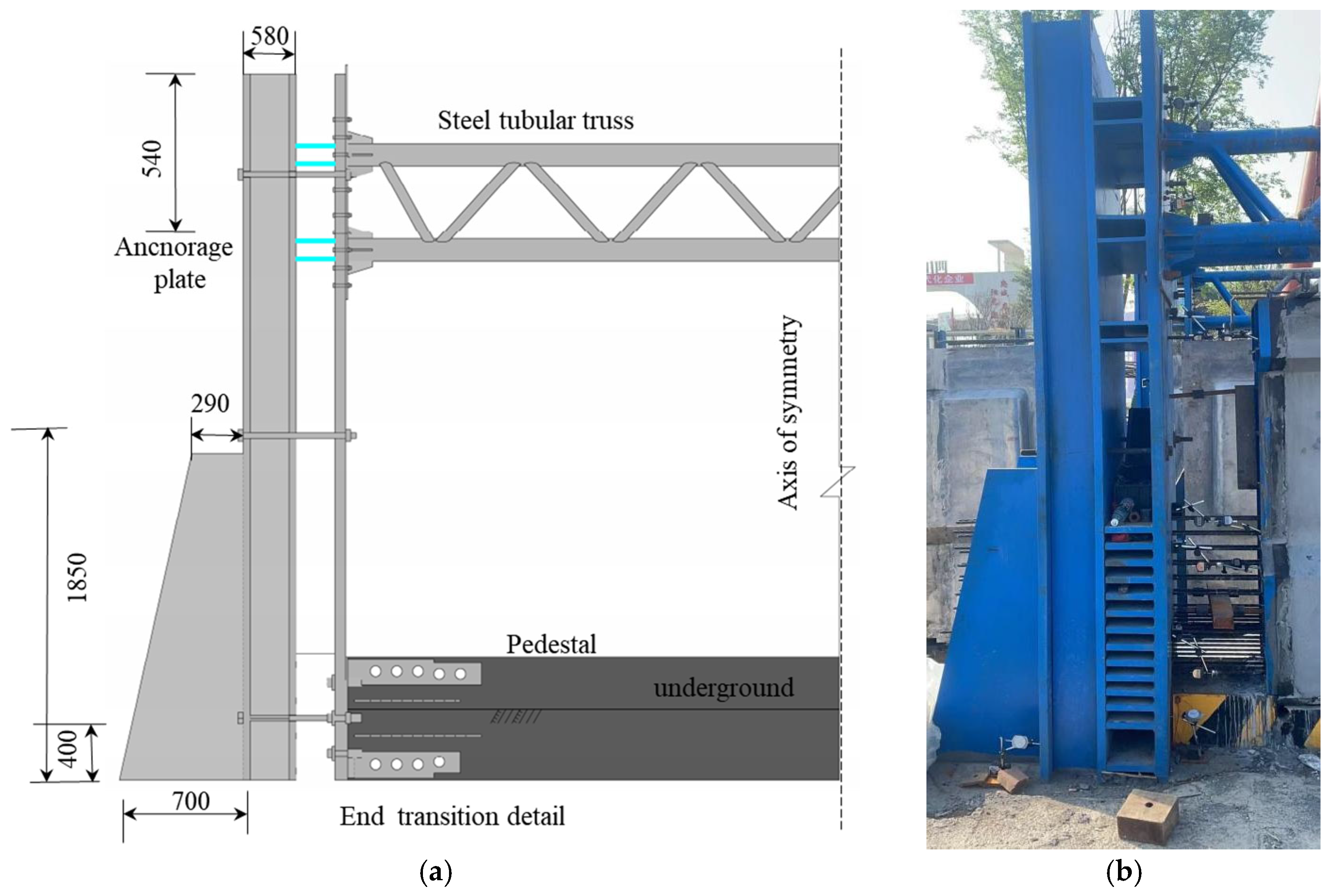
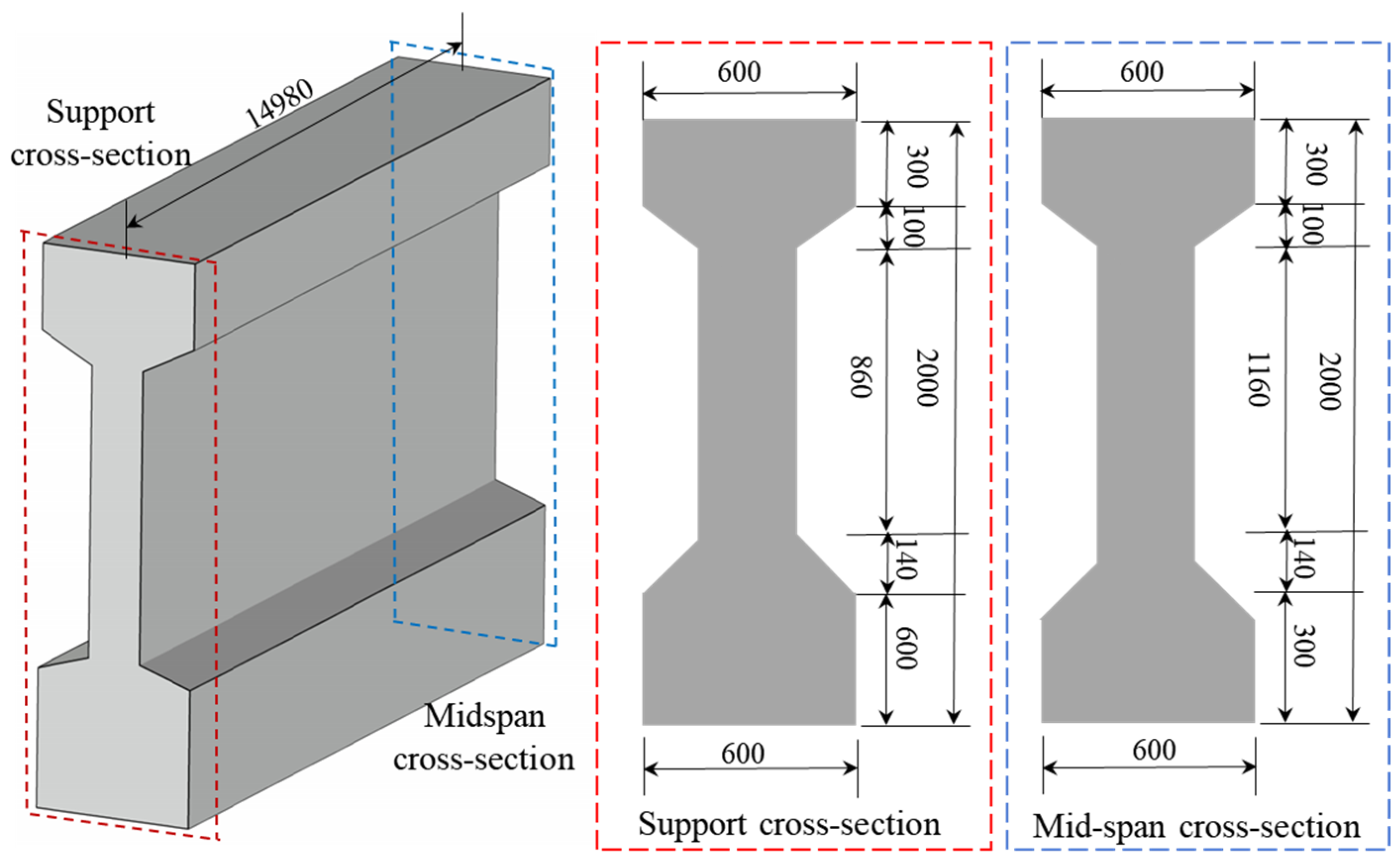
2.1. Test Specimen
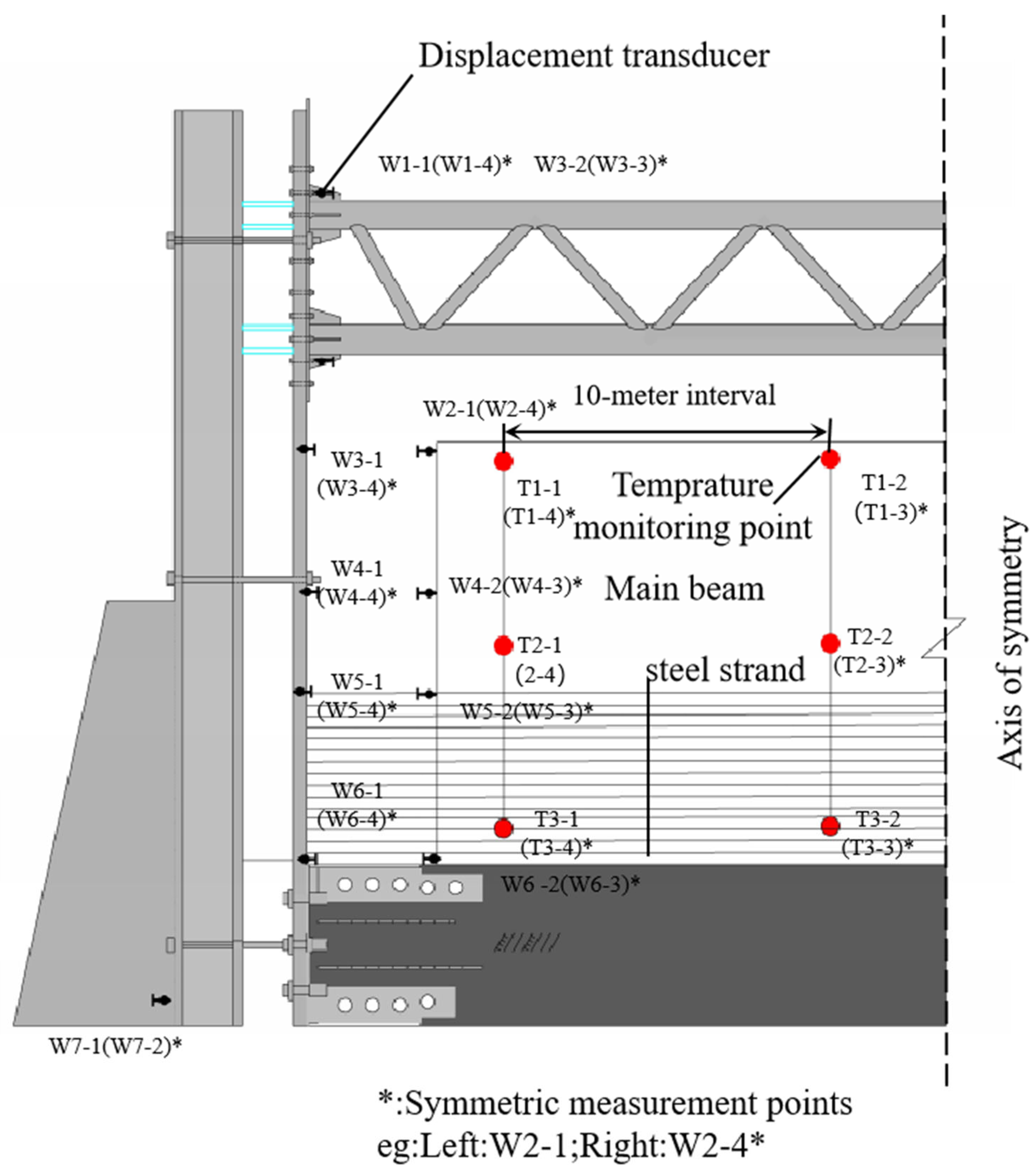
2.2. Instrumentation Layout
2.3. Testing Protocol
3. Acquisition and Processing of Monitoring Data
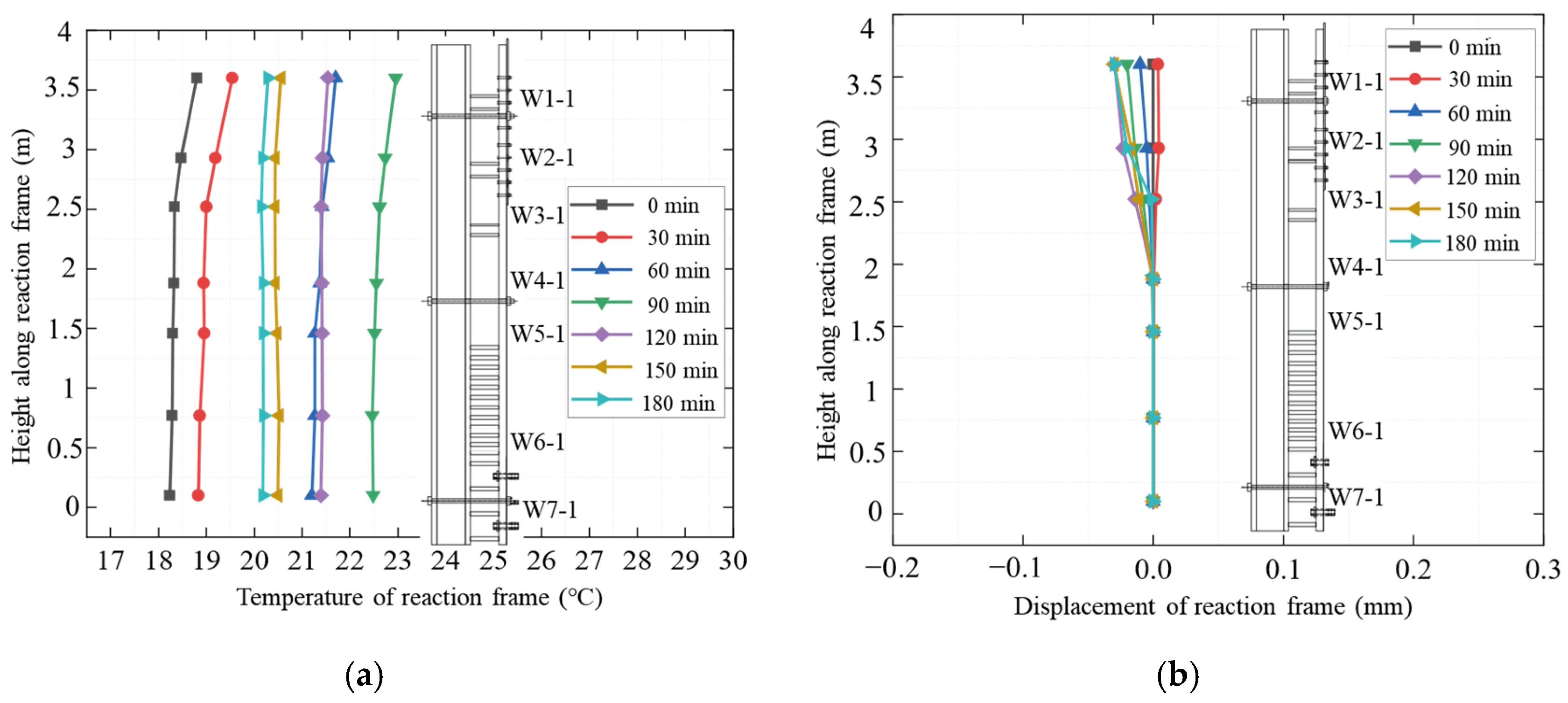
3.1. Temperature Monitoring in the Construction Phase
3.2. Monitoring of Concrete Shrinkage
3.3. Influence of Temperature on Reaction System Displacement
3.3.1. Tensioning Stage
3.3.2. Pouring to Solidification Stage
3.3.3. Formwork Removal and Curing Stage
4. Simulation Analysis of Thermal Effects on Pretensioned Prestressing
4.1. Finite Element (FE) Modeling
4.2. Validation of the FE Model
4.3. Analysis of the Influence of Temperature on Post-Tensioning
4.3.1. Effect of Post-Tensioning Temperature on Anchor-Plate Displacement
4.3.2. Effect of Post-Tensioning Temperature on Prestress
4.4. Engineering Implications
5. Conclusions
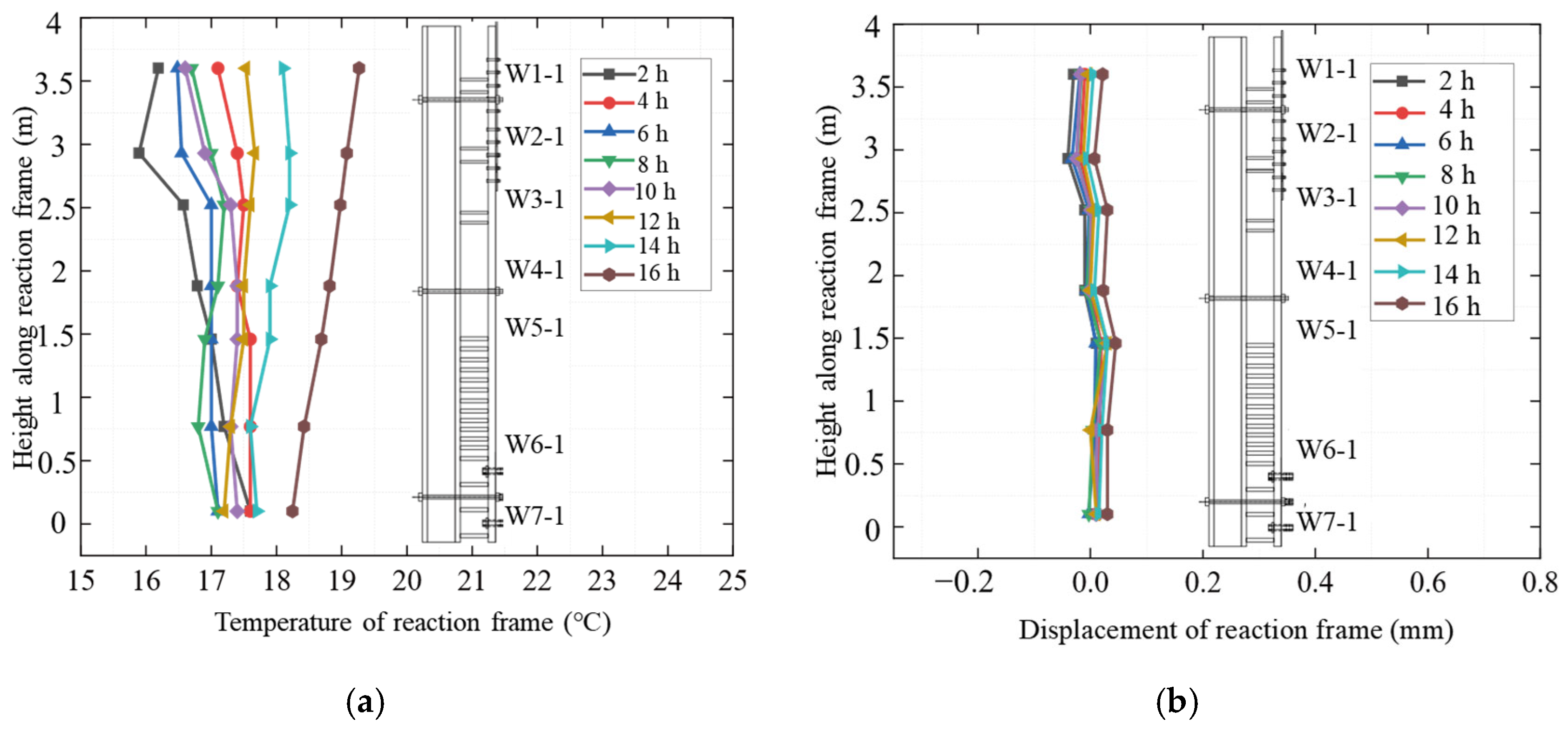
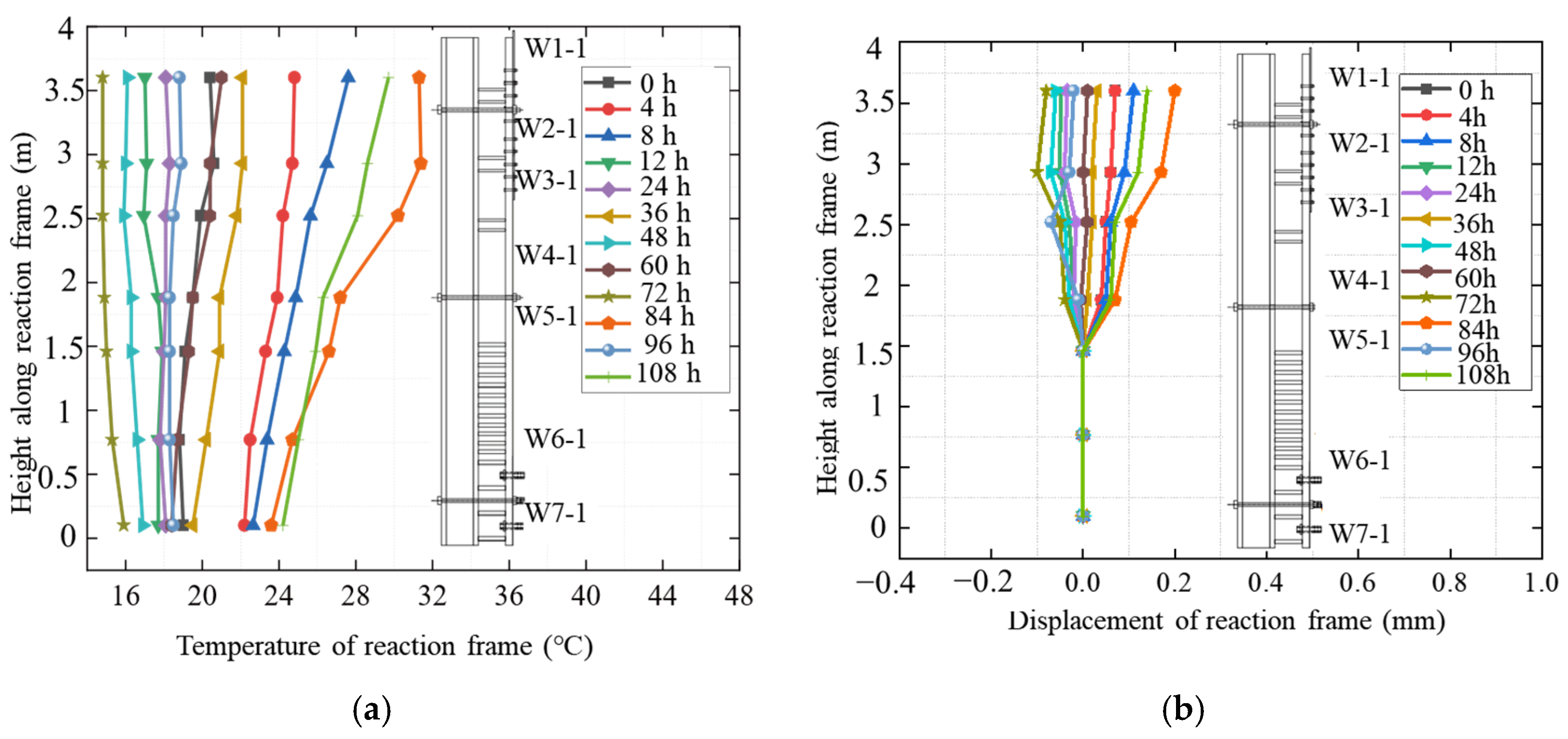
- Due to diurnal ambient variations, a persistent vertical temperature gradient formed across the reaction tensioning anchor plate during monitoring, characterized by consistently elevated temperatures in the upper region. In contrast, the effect of concrete hydration heat was limited, as heat transfer from the end formwork to the plate exhibited clear attenuation.
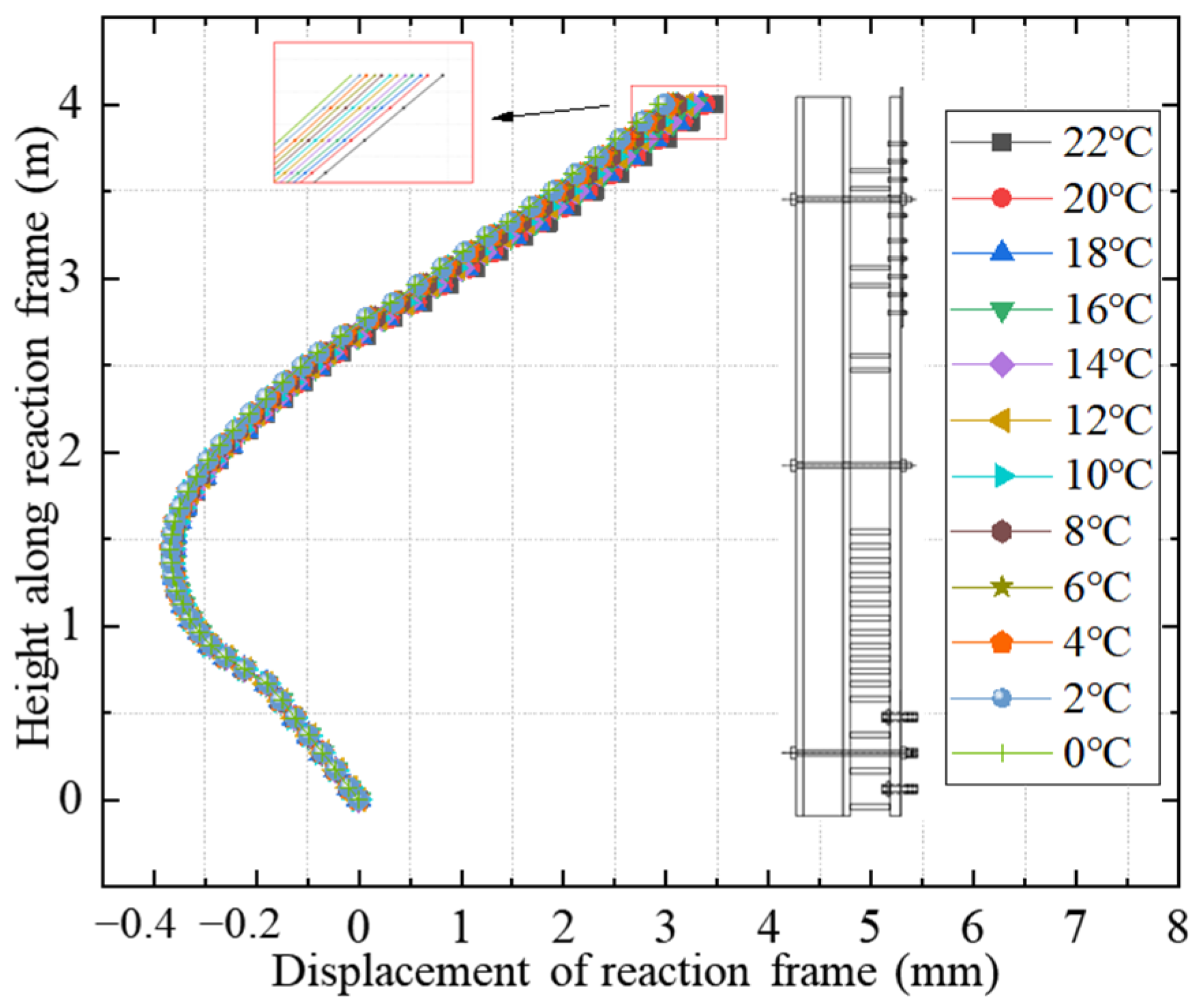
- Under combined thermal and prestressing actions, displacements in the reaction prestressing anchor plates were minimal (≤0.20 mm), occurring mainly in the crown and upper-middle regions, while the base remained essentially stable. This confirms the high global stiffness of the composite system, which ensures deformation control.
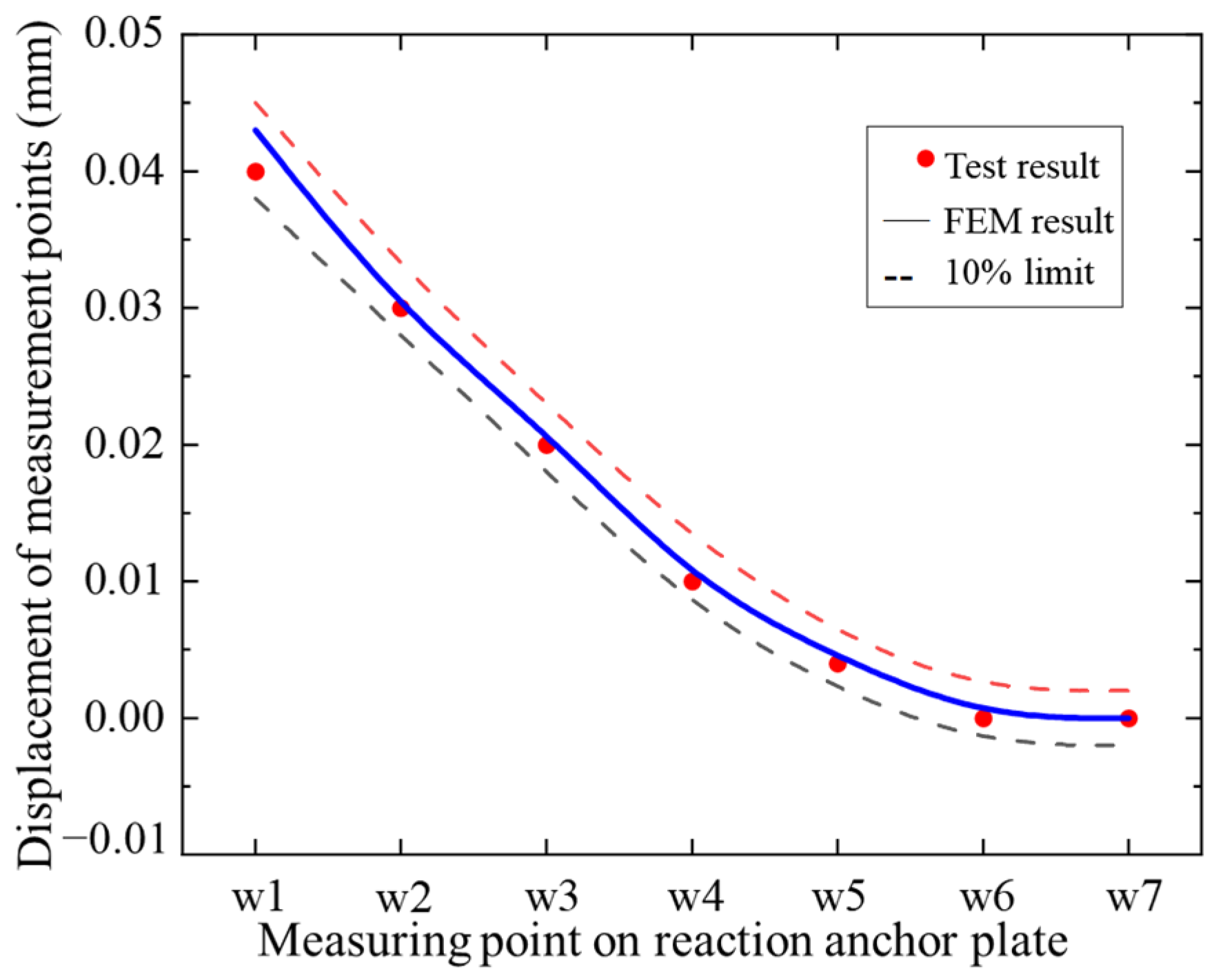
- Comparison between experimental data and finite element results shows good agreement in the longitudinal displacement pattern of the reaction tensioning anchor plate, with a maximum deviation of 7.5%, confirming the validity of the numerical model.
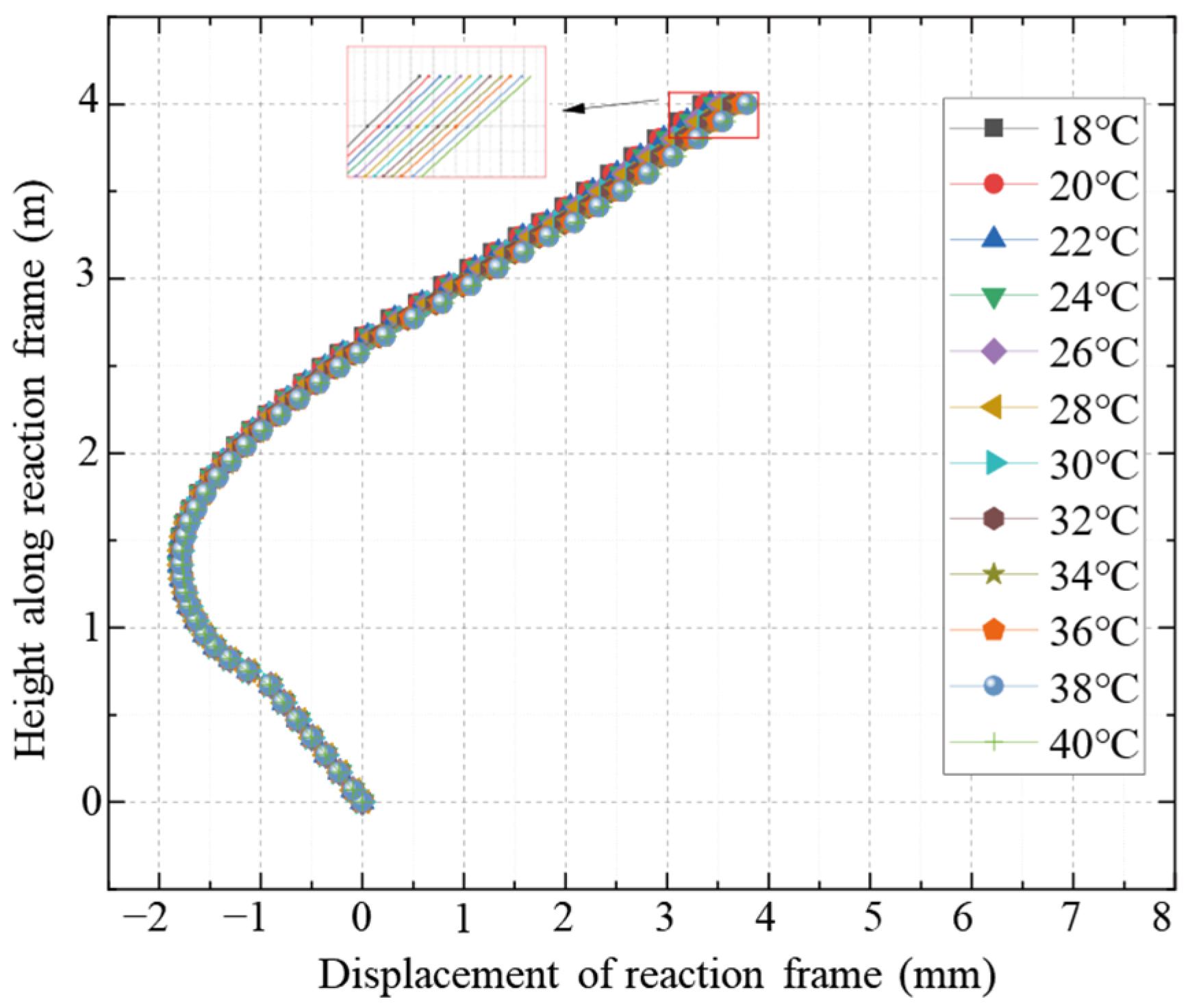
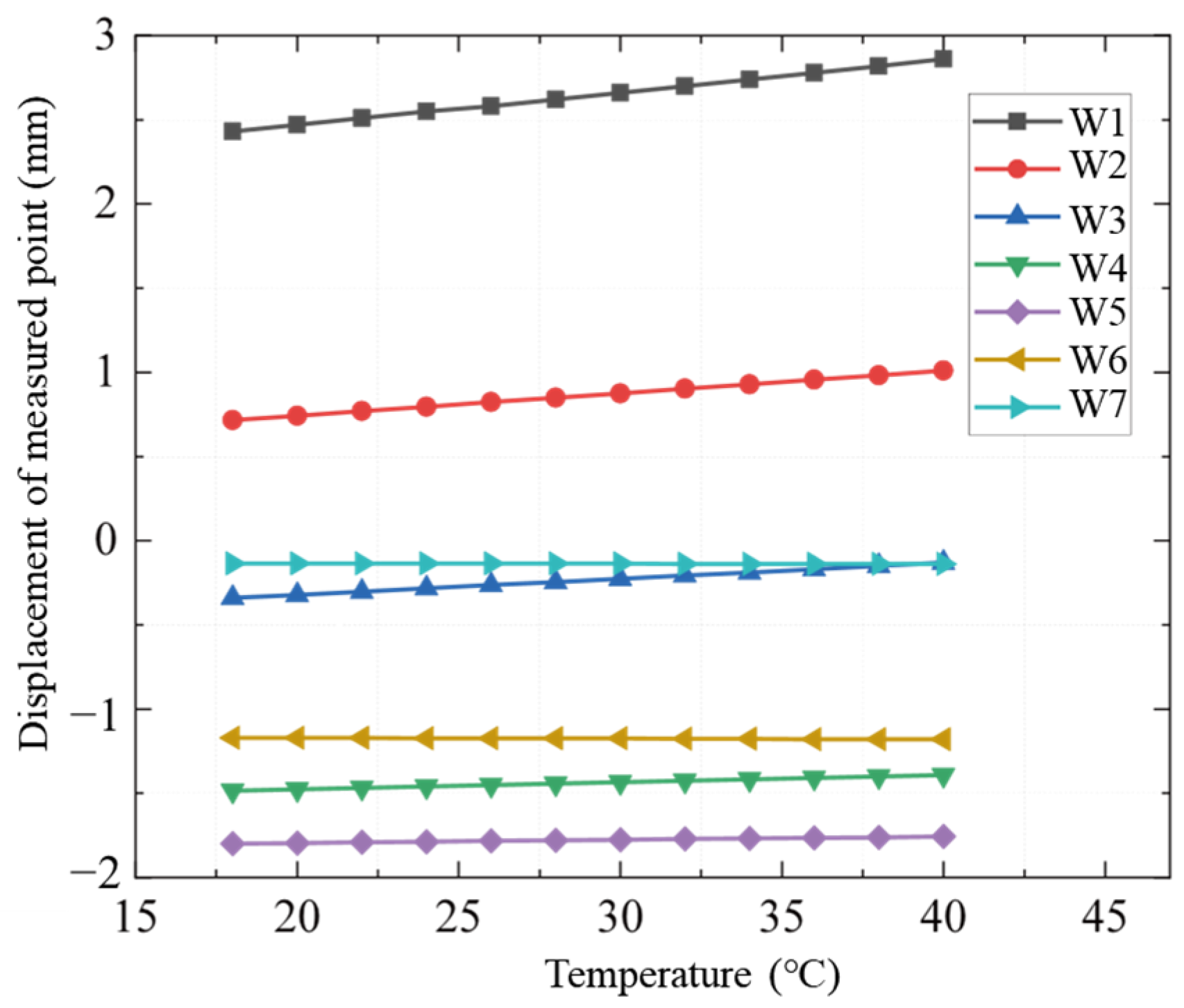
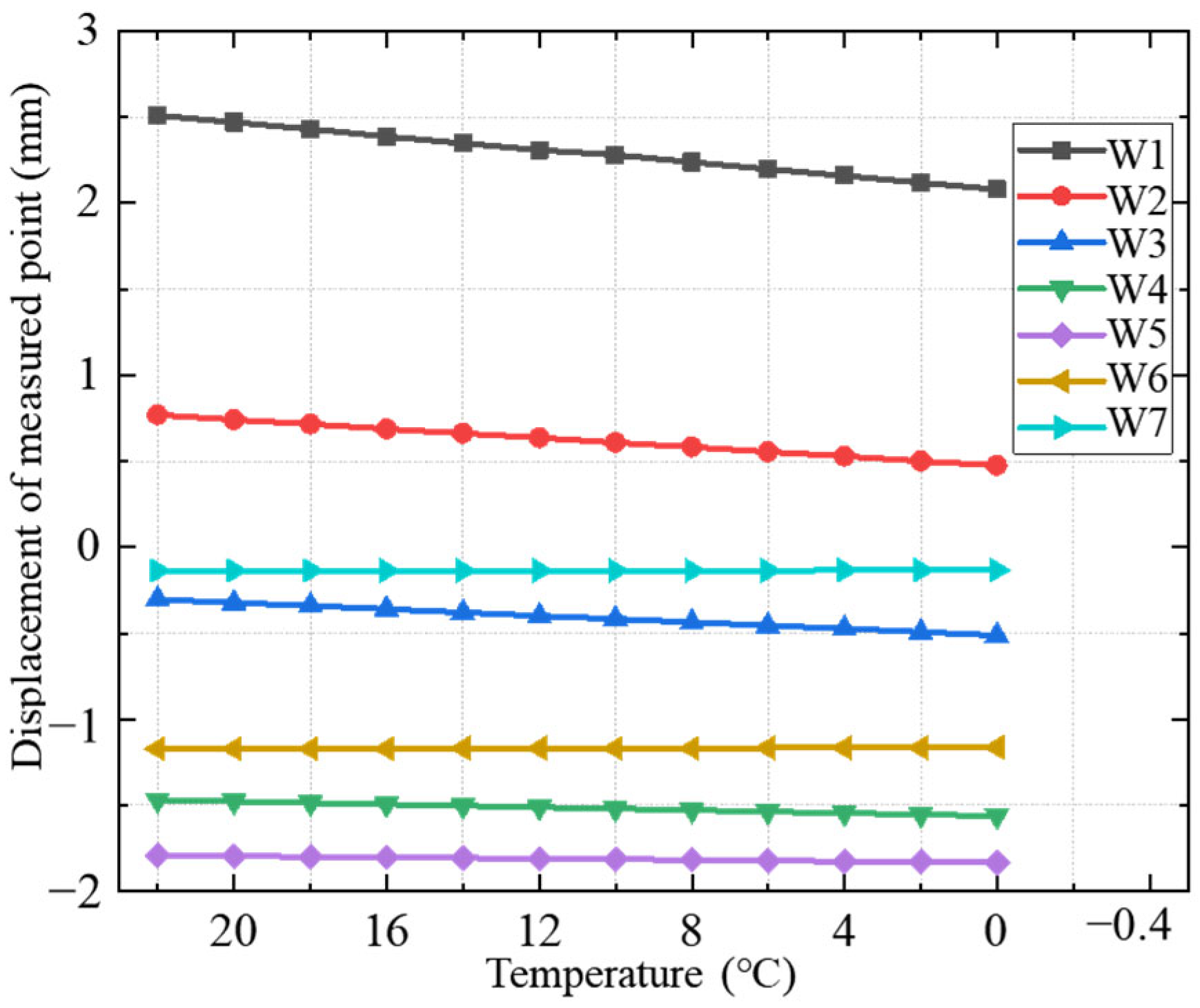
- The reaction tensioning anchor plate exhibits reversible thermal expansion and contraction. An outward expansion of 0.43 mm (17.7%) was recorded at point w1 as temperature increased from 18 °C to 40 °C, while a corresponding inward contraction of 0.43 mm (17.13%) occurred as temperature decreased from 22 °C to 0 °C.
- Prestress variation correlates directly with temperature changes. A temperature increases from 18 °C to 40 °C resulted in a prestress gain of 1.62–4.21 MPa, corresponding to 0.12–0.3% of the control stress (1395 MPa). Conversely, a temperature drops from 22 °C to 0 °C led to a prestress loss of 1.62–4.21 MPa, representing a reduction of 0.12–0.3%.
Author Contributions
Funding
Data Availability Statement
Acknowledgments
Conflicts of Interest
References
- Ruano, G.; Quintana, V.; La Scala, A.; Foti, D. On the effect of thermal strains in slender prestressed concrete beams. Mater. Struct. 2025, 58, 244. [Google Scholar] [CrossRef]
- Jonaidi, M.; Kaplan, A.; Keyvanfar, A. Innovative Approaches and Challenges in the Demolition of Large-Span Post-Tensioned Beams: Insights from a Case Study. Buildings 2024, 14, 1380. [Google Scholar] [CrossRef]
- Zhu, J.; Meng, Q.; Shi, T.; Yang, X. Long-term deformation analysis of prestressed concrete bridges under ambient thermal and vehicle loads. Struct. Infrastruct. Eng. 2023, 19, 1656–1675. [Google Scholar] [CrossRef]
- Zanini, M.A.; Faleschini, F.; Pellegrino, C. New trends in assessing the prestress loss in post-tensioned concrete bridges. Front. Built Environ. 2022, 8, 956066. [Google Scholar] [CrossRef]
- Lee, J.H. Behavior of precast prestressed concrete bridge girders involving thermal effects and initial imperfections during construction. Eng. Struct. 2012, 42, 1–8. [Google Scholar] [CrossRef]
- Yan, L.; Li, Y.; He, S.H. Statistical investigation of effective prestress in prestressed concrete bridges. ASCE-ASME J. Risk Uncertain. Eng. Syst. Part A Civ. Eng. 2017, 3, 06017001. [Google Scholar] [CrossRef]
- Jia, J.; Zhang, L.; Ou, J.; Chen, X. Nondestructive testing and health monitoring techniques for structural effective prestress. Struct. Control Health Monit. 2023, 2023, 8940008. [Google Scholar] [CrossRef]
- Yu, W.; Luo, X.; Wang, B.; Liu, J.; Zi, X. Design approaches for active prestressed and prestressed yielding anchorage systems in large deformation traffic tunnels. Tunn. Undergr. Space Technol. 2024, 152, 105942. [Google Scholar] [CrossRef]
- Zhang, J.; Liu, H.; Gong, X.; Lei, M.; Wang, L. Sensitivity analysis and monitoring of control parameters in cantilever casting construction of prestressed concrete continuous girder bridges. Sci. Rep. 2025, 15, 29295. [Google Scholar] [CrossRef] [PubMed]
- Lee, J.; Jeong, S.; Kim, H.; Lee, K.C.; Sim, S.H. Comparative study of long-term displacement measurement methods− Focusing on a Pre-stressed concrete bridge under construction. Measurement 2022, 201, 111691. [Google Scholar] [CrossRef]
- Yingjie, C.; Jingfei, S.; Zeyu, P. Application of construction monitoring for three-span pre-stressed concrete continuous rigid frame bridge. J. Civ. Eng. Urban. Plan. 2023, 5, 1–7. [Google Scholar] [CrossRef]
- Cai, Y.L.; Gao, S.B.; Wang, F.; Zhang, Z.; Zhao, Z.; Ma, B.H. Early hydration heat temperature field of precast concrete T-beam under steam curing: Experiment and simulation. Case Stud. Constr. Mater. 2023, 18, e02067. [Google Scholar] [CrossRef]
- Gao, F.; Zhou, H.; Liang, H.; Weng, S.; Zhu, H. Structural deformation monitoring and numerical simulation of a supertall building during construction stage. Eng. Struct. 2020, 209, 110033. [Google Scholar] [CrossRef]
- Aksoylu, C.; Özkılıç, Y.O.; Arslan, M.H. Damages on prefabricated concrete dapped-end purlins due to snow loads and a novel reinforcement detail. Eng. Struct. 2020, 225, 111225. [Google Scholar] [CrossRef]
- Keshmiry, A.; Hassani, S.; Mousavi, M.; Dackermann, U. Effects of environmental and operational conditions on structural health monitoring and non-destructive testing: A systematic review. Buildings 2023, 13, 918. [Google Scholar] [CrossRef]
- Nicoletti, V.; Arezzo, D.; Carbonari, S.; Gara, F. Dynamic monitoring of buildings as a diagnostic tool during construction phases. J. Build. Eng. 2022, 46, 103764. [Google Scholar] [CrossRef]
- Zheng, X.; Guan, D. Study on Construction Monitoring and Control of Multi-Span Prestressed Concrete Continuous Beam Bridge. Staveb. Obz. Civ. Eng. J. 2024, 33, 65–77. [Google Scholar] [CrossRef]
- Uva, G.; Porco, F.; Fiore, A.; Porco, G. Structural monitoring using fiber optic sensors of a pre-stressed concrete viaduct during construction phases. Case Stud. Nondestruct. Test. Eval. 2014, 2, 27–37. [Google Scholar] [CrossRef]
- Schlicke, D.; Kanavaris, F.; Lameiras, R.; Azenha, M. On-site monitoring of mass concrete. In Thermal Cracking of Massive Concrete Structures: State of the Art Report of the RILEM Technical Committee 254-CMS; Springer International Publishing: Cham, Switzerland, 2018; pp. 307–355. [Google Scholar]
- Han, S. Assessment of curing schemes for effectively controlling thermal behavior of mass concrete foundation at early ages. Constr. Build. Mater. 2020, 230, 117004. [Google Scholar] [CrossRef]
- Huang, Y.; Liu, G.; Huang, S.; Rao, R.; Hu, C. Experimental and finite element investigations on the temperature field of a massive bridge pier caused by the hydration heat of concrete. Constr. Build. Mater. 2018, 192, 240–252. [Google Scholar] [CrossRef]
- Zhou, H.; Pan, Z.; Liang, Z.; Zhao, C.; Zhou, Y.; Wang, F. Temperature field reconstruction of concrete dams based on distributed optical fiber monitoring data. KSCE J. Civ. Eng. 2019, 23, 1911–1922. [Google Scholar] [CrossRef]
- Hu, Y.; Chen, J.; Zou, F.; He, M.; Mao, J.; Liu, X.; Zhou, C.; Yuan, Z. A comparative study of temperature of mass concrete placed in August and November based on on-site measurement. Case Stud. Constr. Mater. 2021, 15, e00694. [Google Scholar] [CrossRef]
- Wang, T.; Li, D.; Zhou, J.; Zhang, J. Temperature Monitoring of Mass Concrete Structure Using Wireless Sensing System. Struct. Control Health Monit. 2025, 2025, 7847074. [Google Scholar] [CrossRef]
- Cabezas, J.; Sánchez-Rodríguez, T.; Gómez-Galán, J.A.; Cifuentes, H.; González Carvajal, R. Compact embedded wireless sensor-based monitoring of concrete curing. Sensors 2018, 18, 876. [Google Scholar] [CrossRef] [PubMed]
- Zuo, Z.; Huang, Y.; Pan, X.; Zhan, Y.; Zhang, L.; Li, X.; Zhu, M.; Zhang, L.; De Corte, W. Experimental research on remote real-time monitoring of concrete strength for highrise building machine during construction. Measurement 2021, 178, 109430. [Google Scholar] [CrossRef]
- Liang, W. Influence of temperature and humidity on crack propagation in prestressed concrete box-girder bridges: Experimental study and mechanism analysis. J. Comput. Methods Sci. Eng. 2025, 25, 2007–2023. [Google Scholar] [CrossRef]
- Zhang, T.; Wang, H.; Luo, Y.; Yuan, Y.; Wang, W. Hydration heat control of mass concrete by pipe cooling method and on-site monitoring-based influence analysis of temperature for a steel box arch bridge construction. Materials 2023, 16, 2925. [Google Scholar] [CrossRef]
- Do, T.A.; Verdugo, D.; Tia, M.; Hoang, T.T. Effect of volume-to-surface area ratio and heat of hydration on early-age thermal behavior of precast concrete segmental box girders. Case Stud. Therm. Eng. 2021, 28, 101448. [Google Scholar] [CrossRef]
- Zhu, J.; Wang, Z.; Zhang, Y.; Wang, Y. A knowledge foundation and prospect review on thermal response of bridges. Adv. Struct. Eng. 2025, 28, 2871–2892. [Google Scholar] [CrossRef]
- Wu, Y.; Wen, Q.; Dai, M.; Wang, X.; Li, X.; Tan, X. Mechanical response of long-span CFST arch bridges based on the hydration heat temperature effect. Sci. Rep. 2024, 14, 14648. [Google Scholar] [CrossRef]
- Zhang, Y.; Wang, S.; He, S.; Hao, X. Analysis of factors influencing the temperature field variation in mass concrete during hydration heat release. Case Stud. Therm. Eng. 2023, 52, 103737. [Google Scholar] [CrossRef]
- Han, S.; Liu, Y.; Lyu, Y.; Liu, J.; Zhang, N. Numerical simulation investigation on hydration heat temperature and early cracking risk of concrete box girder in cold regions. J. Traffic Transp. Eng. 2023, 10, 697–720. [Google Scholar] [CrossRef]
- Duan, Y.; Wang, Q.; Yang, Z.; Cui, X.; Liu, F.; Chen, H. Research on the effect of steam curing temperature and duration on the strength of manufactured sand concrete and strength estimation model considering thermal damage. Constr. Build. Mater. 2022, 315, 125531. [Google Scholar] [CrossRef]
- Yu, Q.; Yang, Y.; Ren, Y. Thermal Effects on Prestress Loss in Pretensioned Concrete Girders. Buildings 2024, 14, 2325. [Google Scholar] [CrossRef]
- Owen, D.R.J.; Figueiras, J.A.; Damjanic, F. Finite element analysis of reinforced and prestressed concrete structures including thermal loading. Comput. Methods Appl. Mech. Eng. 1983, 41, 323–366. [Google Scholar] [CrossRef]
- Shokoohfar, A.; Rahai, A. Prediction model of long-term prestress loss interaction for prestressed concrete containment vessels. Archives of Civil and Mechanical Engineering 2017, 17, 132–144. [Google Scholar] [CrossRef]
- Williams, M.; Menon, D.; Prasad, A.M. Creep and shrinkage in prestressed concrete beams: An experimental study. Struct. Concr. 2024, 25, 2400–2419. [Google Scholar] [CrossRef]
- Han, W.; Tian, P.; Lv, Y.; Zou, C.; Liu, T. Long-term prestress loss calculation considering the interaction of concrete shrinkage, concrete creep, and stress relaxation. Materials 2023, 16, 2452. [Google Scholar] [CrossRef]
- Sarmiento, S.J.; Agredo-Chávez, A.; Thiery, F.; Gonzalez-Libreros, J.; Wang, C.; Sas, G. Time-dependent reliability of a prestressed concrete bridge incorporating residual prestress and material properties updates for service limit state assessment. Struct. Infrastruct. Eng. 2025, 1–21. [Google Scholar] [CrossRef]
- Elshazli, M.T.; Abdulazeez, M.M.; ElGawady, M.; Ibrahim, A. Comprehensive numerical modeling of prestressed girder bridges under low-velocity impact. Buildings 2024, 14, 640. [Google Scholar] [CrossRef]
- Feng, Z.; Cheng, B.; Shao, Y.; Zhang, B.; Li, X.; Wang, X.; Liu, P. Predicting and mitigating twin-tunnel settlement in coastal soft soils: An integrated monitoring and modeling approach. Geotechnical and Geological Engineering 2025, 43, 435. [Google Scholar] [CrossRef]
- Hassani, S.; Dackermann, U. A systematic review of advanced sensor technologies for non-destructive testing and structural health monitoring. Sensors 2023, 23, 2204. [Google Scholar] [CrossRef]
- Huynh, T.C.; Kim, J.T. FOS-based prestress force monitoring and temperature effect estimation in unbonded tendons of PSC girders. J. Aerosp. Eng. 2017, 30, B4016005. [Google Scholar] [CrossRef]
- Aksoylu, C.; Özkılıç, Y.O.; Çeledir, E.; Başaran, B.; Arslan, M.H. Experimental and numerical investigation of bending performance of prestressed purlins having different longitudinal web opening. Structures 2024, 60, 105839. [Google Scholar] [CrossRef]
- Kulprapha, N.; Warnitchai, P. Structural health monitoring of continuous prestressed concrete bridges using ambient thermal responses. Eng. Struct. 2012, 40, 20–38. [Google Scholar] [CrossRef]
- Jiao, P.; Borchani, W.; Hasni, H.; Lajnef, N. A new solution of measuring thermal response of prestressed concrete bridge girders for structural health monitoring. Meas. Sci. Technol. 2017, 28, 085005. [Google Scholar] [CrossRef]
- Song, Z.; Zou, S.; Zhou, W.; Huang, Y.; Shao, L.; Yuan, J.; Gou, X.; Jin, W.; Wang, Z.; Chen, X.; et al. Clinically applicable histopathological diagnosis system for gastric cancer detection using deep learning. Nat. Commun. 2020, 11, 4294. [Google Scholar] [CrossRef]
- Kabir, H.; Wu, J.; Dahal, S.; Joo, T.; Garg, N. Automated estimation of cementitious sorptivity via computer vision. Nat. Commun. 2024, 15, 9935. [Google Scholar] [CrossRef]
- Shan, W.; Wang, X.; Jiao, Y. Modeling of temperature effect on modal frequency of concrete beam based on field monitoring data. Shock Vib. 2018, 2018, 8072843. [Google Scholar] [CrossRef]
- Jha, I.; Pathak, K.K. Synergetic concrete shape and cable layout optimization of pre-stressed concrete beams. Struct. Multidiscip. Optim. 2023, 66, 87. [Google Scholar] [CrossRef]
- Wang, H.T.; Bian, Z.N.; Wu, Q.; Hu, L.; Chen, M.S.; Tang, C. Development of a novel anchorage and tensioning system for strengthening steel beams with unbonded prestressed CFRP plates. Eng. Struct. 2024, 312, 118234. [Google Scholar] [CrossRef]
- Du, W.; Qian, C.; Xu, Y.; Wei, M.; Peng, B.; Xie, Y. Effects of ambient temperature, formwork type, and demolding time on the thermal deformation of sidewall concrete in underground engineering: Experiment, simulation, and engineering practice. Constr. Build. Mater. 2022, 353, 129083. [Google Scholar] [CrossRef]
- Bebani, B.; Kuczma, M.; Ziopaja, K. Parametric Analysis of Prestressed Concrete Beams with the Finite Element Method. Civ. Environ. Eng. Rep. 2025, 35, 234–257. [Google Scholar] [CrossRef]
- Genikomsou, A.S.; Polak, M.A. Finite-element analysis of reinforced concrete slabs with punching shear reinforcement. J. Struct. Eng. 2016, 142, 04016129. [Google Scholar] [CrossRef]
- Yapar, O.; Basu, P.K.; Nordendale, N. Accurate finite element modeling of pretensioned prestressed concrete beams. Eng. Struct. 2015, 101, 163–178. [Google Scholar] [CrossRef]
- Yang, Z.; Cai, C.; Qu, Z.; Wang, C.; Sun, Y. Study on the Cracking Mechanism of Arch Foot of CFST Tied Arch Bridge Based on Multiscale Numerical Simulation. Adv. Civ. Eng. 2022, 2022, 9040937. [Google Scholar] [CrossRef]








| Types | Selected Sensors | Sensitivities | Ranges |
|---|---|---|---|
| Temperature sensors | FeelElec FR03D Infrared Surface Thermometer | 0.1 °C | −20 to 550 °C |
| Displacement sensors | Fiaye FER20 Series LVDT Differential Displacement Extensometer | 0.1 μm | 0 to 5 mm |
| Phases | Tensioning Anchor Plates | Bottom Formwork | Concrete Formwork | ||||||
|---|---|---|---|---|---|---|---|---|---|
| Peak | Valley | Range | Peak | Valley | Range | Peak | Valley | Range | |
| Post-tensioning | 18.7 | 16.8 | 1.9 | 18.0 | 16.6 | 1.4 | - | - | - |
| Post-casting | 20.5 | 15.5 | 4.0 | 28.9 | 16.9 | 12.0 | 42.1 | 20.1 | 20.0 |
| Post-stripping | 31.4 | 14.8 | 16.6 | 39.9 | 21.8 | 18.1 | 45.6 | 25.2 | 20.4 |
| Post-release | - | - | - | - | - | - | - | - | - |
| Test Time | Average Shrinkage/mm | Percentage to 7-Day Value (%) | Percentage to 28-Day Value (%) |
|---|---|---|---|
| Day 1 | 0.042 | 0.27 | 0.19 |
| Day 3 | 0.116 | 0.74 | 0.54 |
| Day 5 | 0.146 | 0.74 | 0.68 |
| Day 7 | 0.156 | - | 0.73 |
| Day 28 | 0.214 | - | - |
| Parts | Density (kg/m3) | Elastic Modulus (GPa) | Poisson’s Ratio | Linear Expansion Coefficient (1/°C) |
|---|---|---|---|---|
| Prestressing anchor plate | 7850 | 206 | 0.3 | 1.2 × 10⁻⁵ |
| Strand | 7850 | 195 | 0.3 | 1.2 × 10⁻⁵ |
| Reaction frame | 2420 | 34.5 | 0.2 | 1.0 × 10⁻⁵ |
| ID | Displacement (mm) | (mm) | (MPa) | ||||||
|---|---|---|---|---|---|---|---|---|---|
| 18 °C | 20 °C | 24 °C | 28 °C | 32 °C | 36 °C | 40 °C | |||
| N1 | −1.51 | −1.50 | −1.47 | −1.44 | −1.41 | −1.38 | −1.35 | 0.16 | 1.93 |
| N2 | −1.47 | −1.46 | −1.43 | −1.40 | −1.37 | −1.35 | −1.32 | 0.15 | 1.86 |
| N3 | −1.25 | −1.24 | −1.21 | −1.19 | −1.16 | −1.14 | −1.11 | 0.14 | 1.69 |
| N4 | 0.10 | 0.13 | 0.19 | 0.25 | 0.32 | 0.38 | 0.44 | 0.34 | 4.21 |
| N5 | −1.13 | −1.11 | −1.09 | −1.07 | −1.04 | −1.02 | −0.99 | 0.14 | 1.65 |
| N8 | −1.45 | −1.43 | −1.40 | −1.36 | −1.33 | −1.29 | −1.26 | 0.19 | 2.30 |
| N9 | −1.51 | −1.49 | −1.46 | −1.42 | −1.39 | −1.36 | −1.33 | 0.18 | 2.19 |
| N10 | −1.53 | −1.51 | −1.48 | −1.45 | −1.42 | −1.39 | −1.36 | 0.17 | 2.10 |
| N11 | −1.53 | −1.52 | −1.49 | −1.46 | −1.43 | −1.40 | −1.37 | 0.17 | 2.01 |
| N12 | −1.42 | −1.40 | −1.38 | −1.35 | −1.32 | −1.30 | −1.27 | 0.15 | 1.79 |
| N13 | −1.34 | −1.33 | −1.30 | −1.28 | −1.25 | −1.23 | −1.20 | 0.14 | 1.73 |
| N14 | −0.96 | −0.95 | −0.93 | −0.90 | −0.88 | −0.85 | −0.83 | 0.13 | 1.62 |
| ID | Displacement (mm) | (mm) | (MPa) | |||||||
|---|---|---|---|---|---|---|---|---|---|---|
| 22 °C | 20 °C | 18 °C | 16 °C | 12 °C | 8 °C | 4 °C | 0 °C | |||
| N1 | −1.48 | −1.50 | −1.51 | −1.53 | −1.55 | −1.58 | −1.61 | −1.64 | −0.16 | −1.93 |
| N2 | −1.44 | −1.46 | −1.47 | −1.49 | −1.51 | −1.54 | −1.57 | −1.60 | −0.15 | −1.86 |
| N3 | −1.23 | −1.24 | −1.25 | −1.26 | −1.29 | −1.31 | −1.34 | −1.37 | −0.14 | −1.69 |
| N4 | 0.16 | 0.13 | 0.10 | 0.07 | 0.00 | −0.06 | −0.12 | −0.19 | −0.35 | −4.21 |
| N5 | −1.10 | −1.11 | −1.13 | −1.14 | −1.16 | −1.19 | −1.21 | −1.24 | −0.14 | −1.65 |
| N8 | −1.41 | −1.43 | −1.45 | −1.47 | −1.50 | −1.53 | −1.57 | −1.60 | −0.19 | −2.30 |
| N9 | −1.47 | −1.49 | −1.51 | −1.52 | −1.56 | −1.59 | −1.62 | −1.65 | −0.18 | −2.19 |
| N10 | −1.50 | −1.51 | −1.53 | −1.54 | −1.58 | −1.61 | −1.64 | −1.67 | −0.17 | −2.10 |
| N11 | −1.50 | −1.52 | −1.53 | −1.55 | −1.58 | −1.61 | −1.64 | −1.67 | −0.17 | −2.01 |
| N12 | −1.39 | −1.40 | −1.42 | −1.43 | −1.46 | −1.48 | −1.51 | −1.54 | −0.15 | −1.79 |
| N13 | −1.32 | −1.33 | −1.34 | −1.35 | −1.38 | −1.41 | −1.43 | −1.46 | −0.14 | −1.73 |
| N14 | −0.94 | −0.95 | −0.96 | −0.98 | −1.00 | −1.02 | −1.05 | −1.07 | −0.13 | −1.62 |
Disclaimer/Publisher’s Note: The statements, opinions and data contained in all publications are solely those of the individual author(s) and contributor(s) and not of MDPI and/or the editor(s). MDPI and/or the editor(s) disclaim responsibility for any injury to people or property resulting from any ideas, methods, instructions or products referred to in the content. |
© 2026 by the authors. Licensee MDPI, Basel, Switzerland. This article is an open access article distributed under the terms and conditions of the Creative Commons Attribution (CC BY) license.
Share and Cite
Li, C.; Zeng, K.; Zhang, T.; Tang, X.; Xu, N. Monitoring–Modeling Integrated Assessment of Temperature-Induced Prestress Variations in Prestressed Concrete Beams During Construction. Buildings 2026, 16, 1095. https://doi.org/10.3390/buildings16061095
Li C, Zeng K, Zhang T, Tang X, Xu N. Monitoring–Modeling Integrated Assessment of Temperature-Induced Prestress Variations in Prestressed Concrete Beams During Construction. Buildings. 2026; 16(6):1095. https://doi.org/10.3390/buildings16061095
Chicago/Turabian StyleLi, Chengjun, Ke Zeng, Tao Zhang, Xiao Tang, and Nuo Xu. 2026. "Monitoring–Modeling Integrated Assessment of Temperature-Induced Prestress Variations in Prestressed Concrete Beams During Construction" Buildings 16, no. 6: 1095. https://doi.org/10.3390/buildings16061095
APA StyleLi, C., Zeng, K., Zhang, T., Tang, X., & Xu, N. (2026). Monitoring–Modeling Integrated Assessment of Temperature-Induced Prestress Variations in Prestressed Concrete Beams During Construction. Buildings, 16(6), 1095. https://doi.org/10.3390/buildings16061095