Experimental Study of the Effects of Grout Filling Completeness on the Performance of Grouted Sleeve Connections

Abstract
1. Introduction
2. Experimental Program
2.1. Specimen Design
2.2. Defect Simulation
- (1)
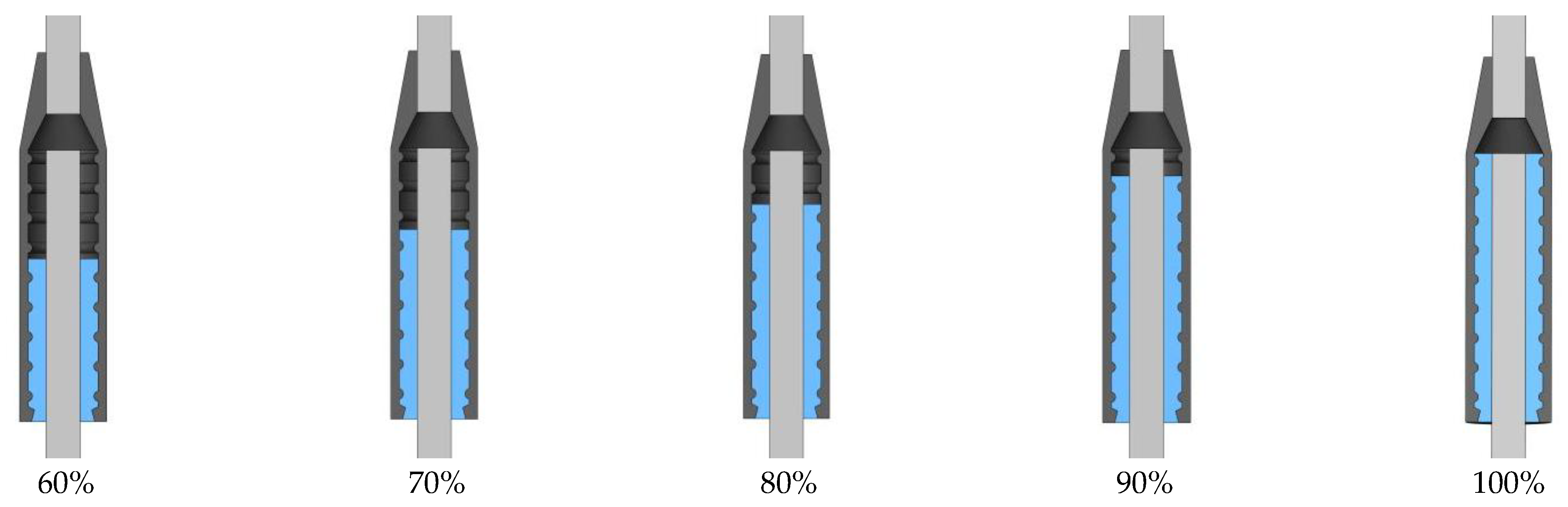
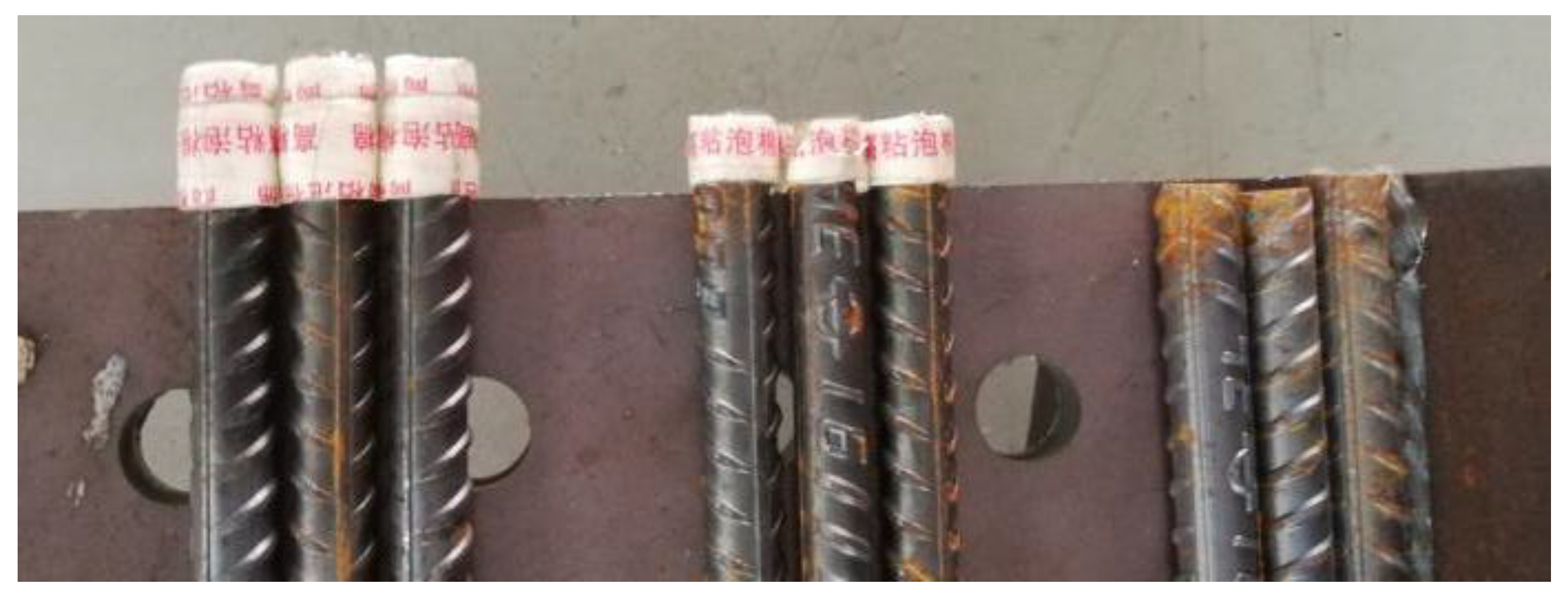
- Fabrication of the bond isolation layer: To simulate grouting defects, a specified segment of the lower rebar was tightly wrapped with foam tape, which was then secured with transparent tape to ensure a completely isolated interface between the rebar and the subsequent grouting material (Figure 3). This foam tape method was designed to replicate a simplified and idealized vertical top void defect. It should be noted that grouting defects occurring in actual practice may exhibit more irregular geometries and spatial distributions.
- (2)
- GFC-controlled parameterization. The length of the foam adhesive tape was precisely controlled according to the predefined GFC index, whereas the samples without foam adhesive wrapping served as the control group (GFC = 100%). The foam simulation of controlled “defect length” corresponds to the reduction in effective anchorage length.
- (3)
- Grouting process monitoring. The grouting process was terminated immediately when grout outflow was observed at the grout overflow vent, ensuring consistent defect formation across all the samples.

2.3. Specimen Fabrication
- (1)
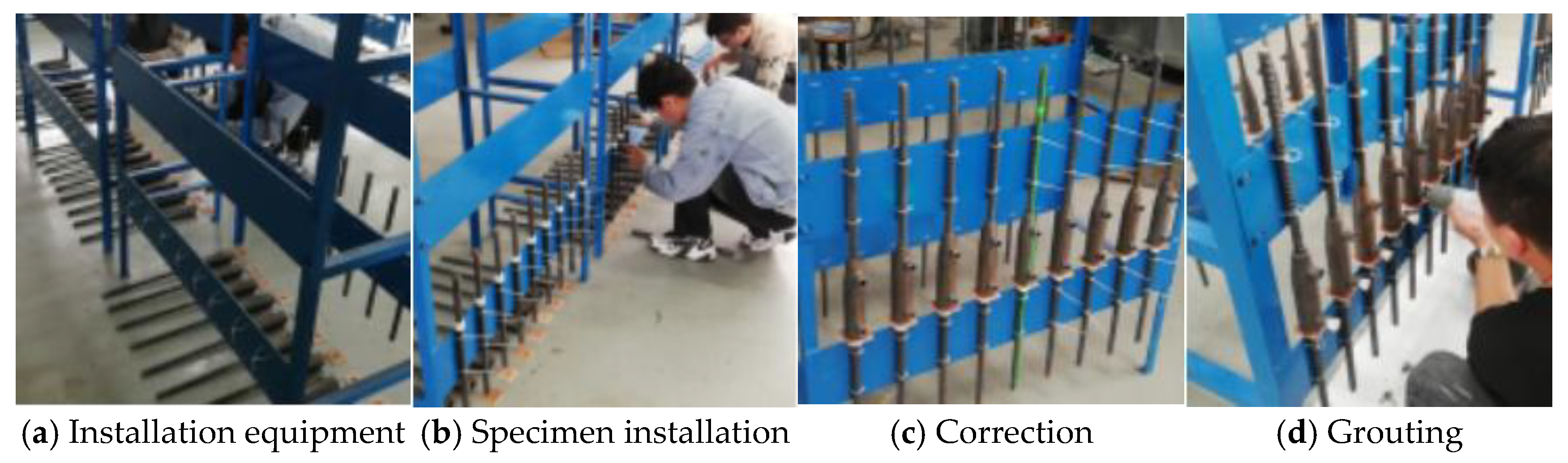
- Bracket design
- (2)
- Rebar connection and positioning
- A.
- Preparation of the lower rebar. A sealing plate was installed at the bottom of the sleeve (positioned beneath the sleeve). Foam adhesive tape and transparent tape were applied to seal the gaps between the rebar and sealing plate.
- B.
- Positioning of the lower rebar. Thread binding straps through predrilled holes in the positioning steel plate. The lower rebar pieces were secured by binding straps to maintain vertical alignment.
- C.
- Positioning of the upper rebar. The sleeve ends of the upper rebar pieces were inserted into the lower rebar. The upper rebar pieces were fixed by threading binding straps through predrilled holes in the positioning plate. Sealant was injected at the contact interface between the sleeve bottom and the lower rebar sealing plate.
- D.
- Alignment verification. A laser alignment instrument was used to calibrate the concentricity accuracy of the upper and lower rebar pieces (deviation ≤2 mm).
- (3)
- Grouting operation
2.4. Loading Protocol
3. Experimental Results
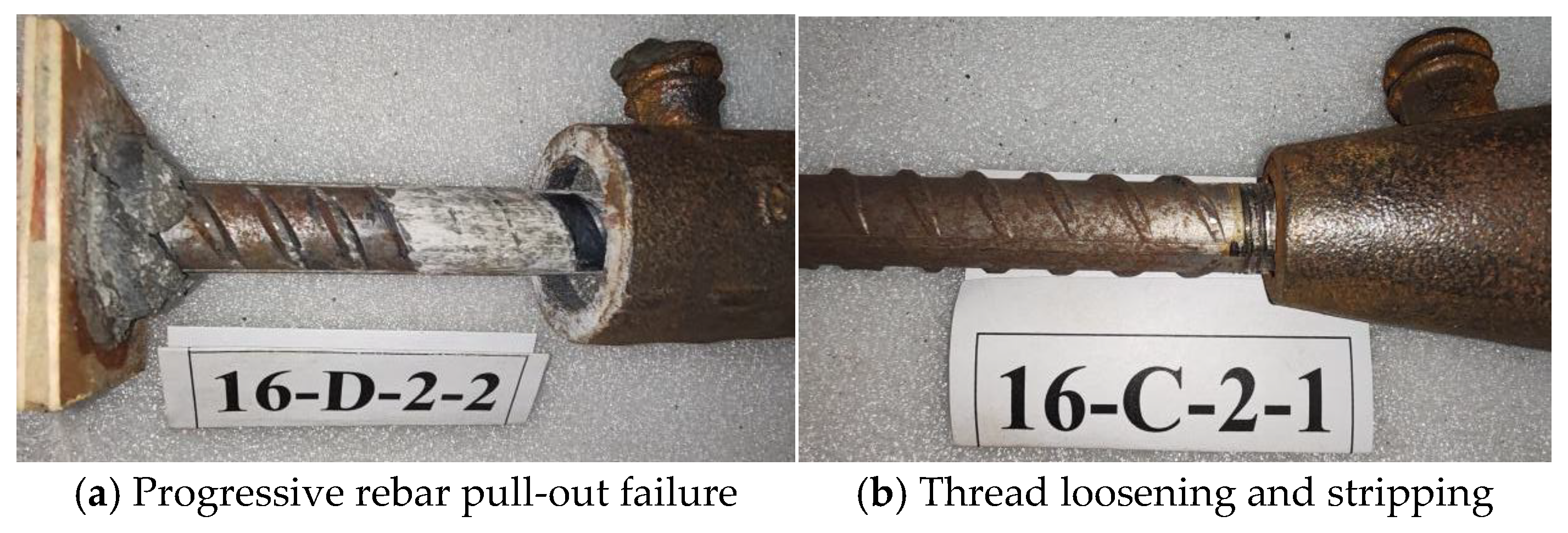
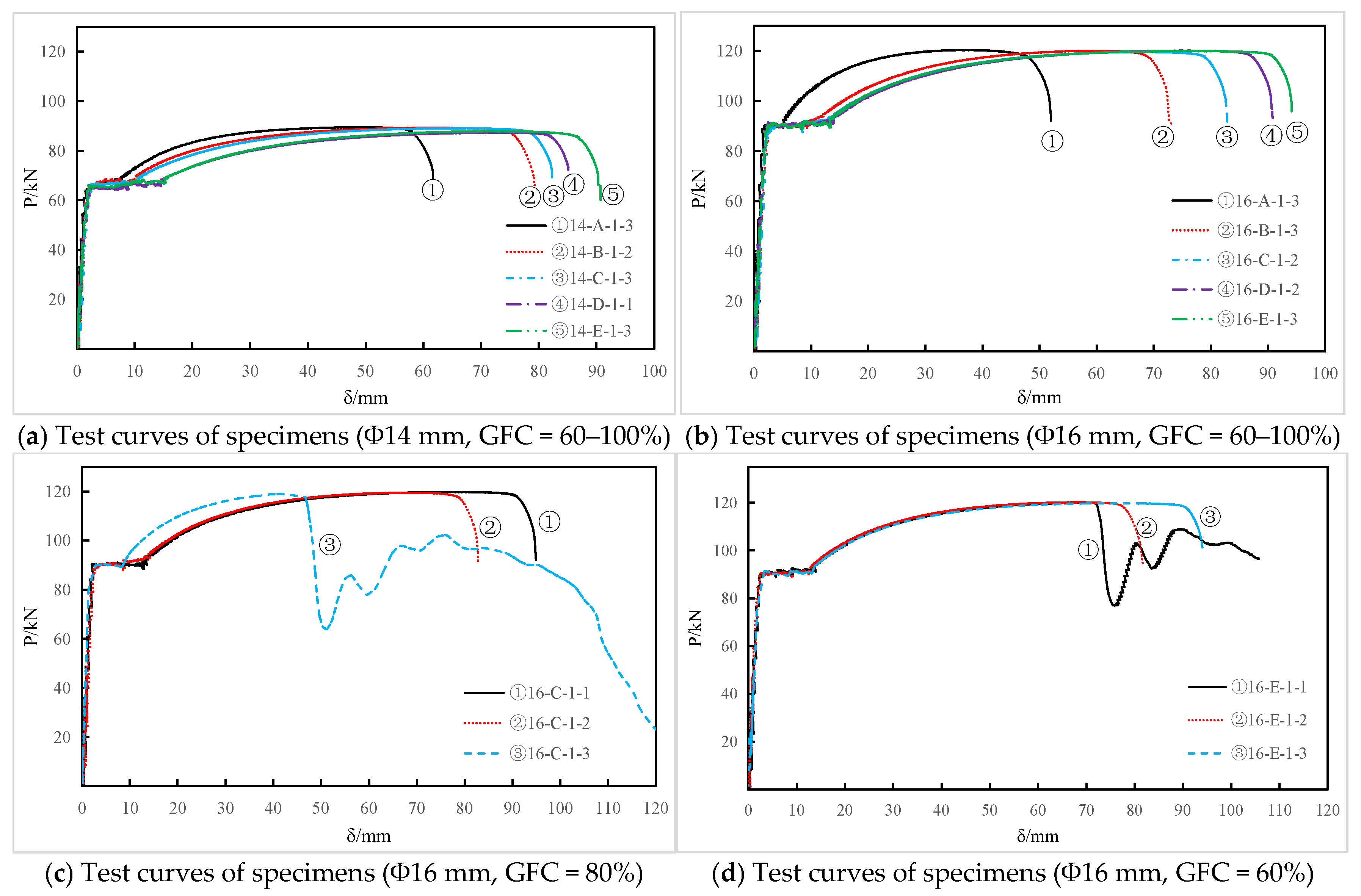
3.1. Failure Mode
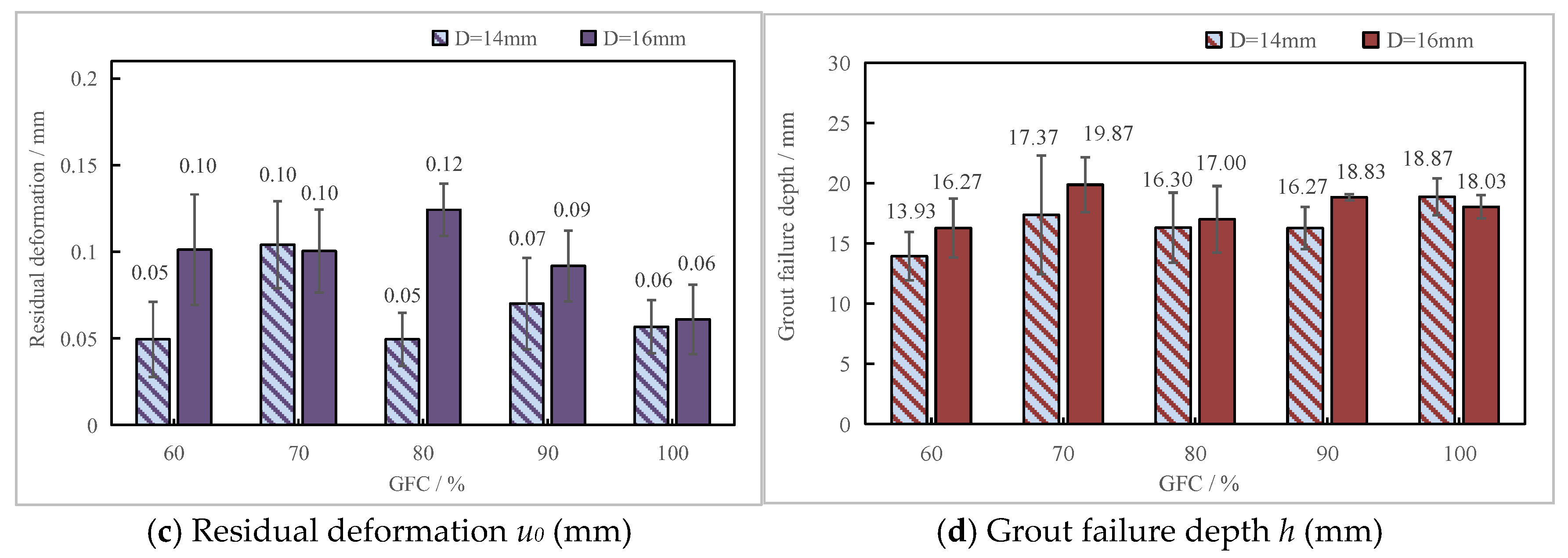
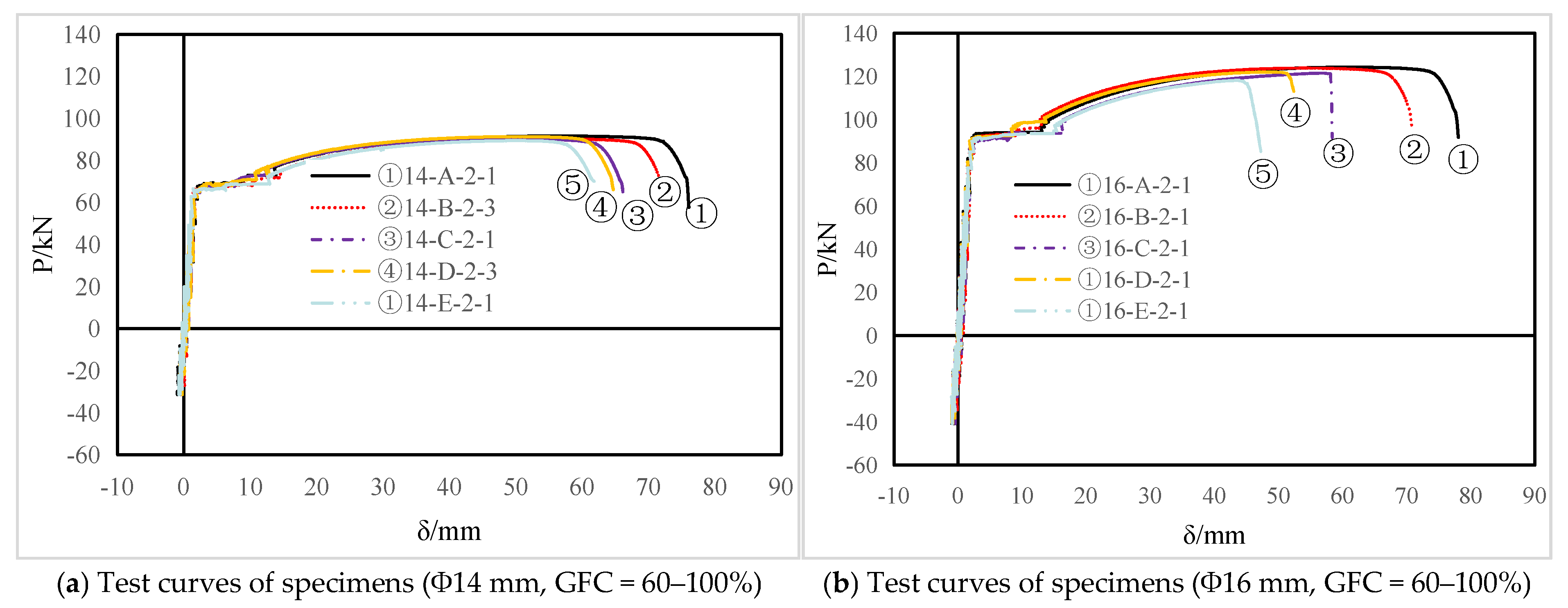
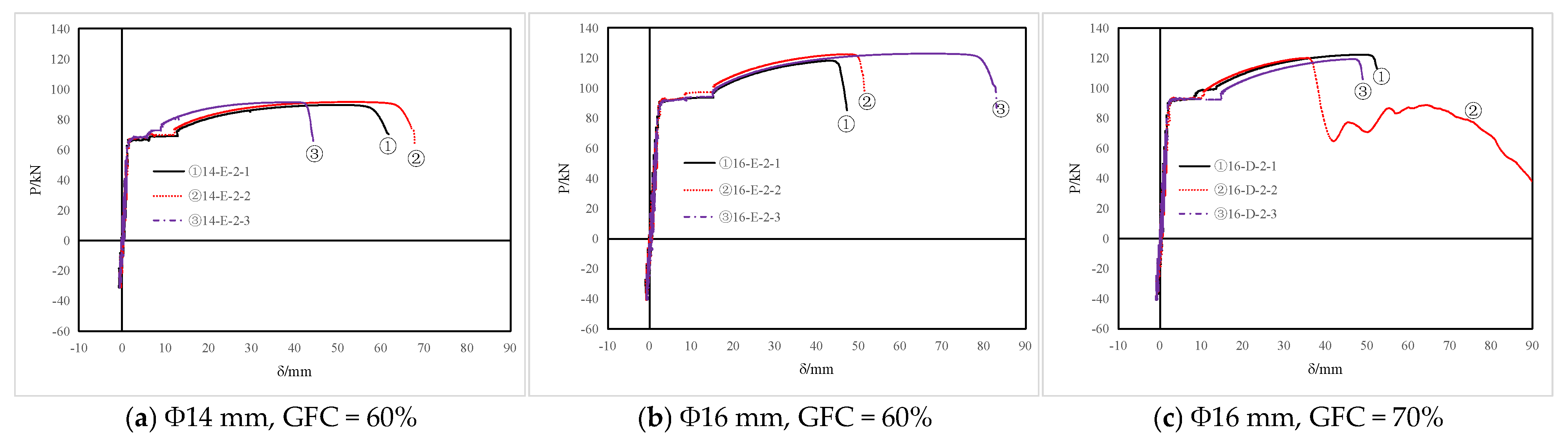
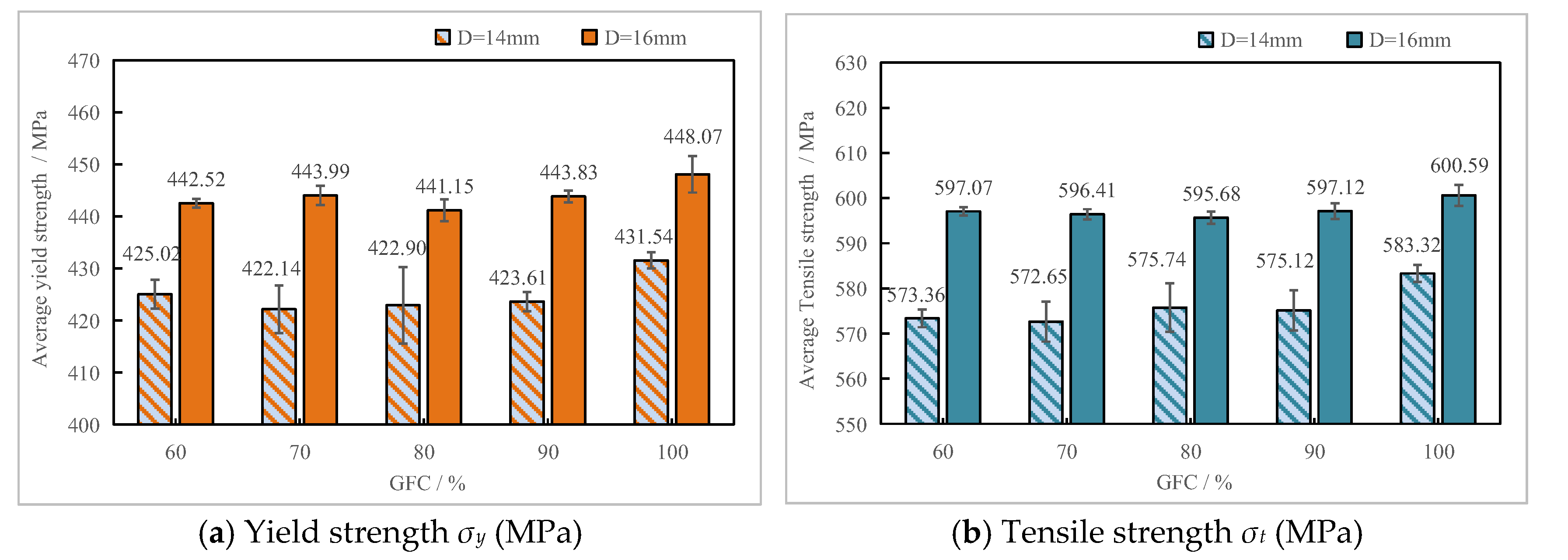
3.2. Analysis of Uniaxial Tensile Test Data

| Parameter | Pearson’s r | Correlation Type | p Value | Significance (α = 0.05) | |
|---|---|---|---|---|---|
| σy | Φ14 | −0.21 | Weak negative correlation | 0.72 | Non significant |
| Φ16 | −0.25 | Weak negative correlation | 0.68 | Non significant | |
| σt | Φ14 | −0.85 | Strong negative correlation | 0.03 | Significant |
| Φ16 | −0.83 | Strong negative correlation | 0.08 | Marginally significant | |
| u0 | Φ14 | 0.09 | Near-zero correlation | 0.87 | Non significant |
| Φ16 | 0.89 | Strong positive correlation | 0.04 | Significant | |
| h | Φ14 | 0.92 | Strong positive correlation | 0.01 | Significant |
| Φ16 | −0.39 | Weak negative correlation | 0.52 | Non significant | |
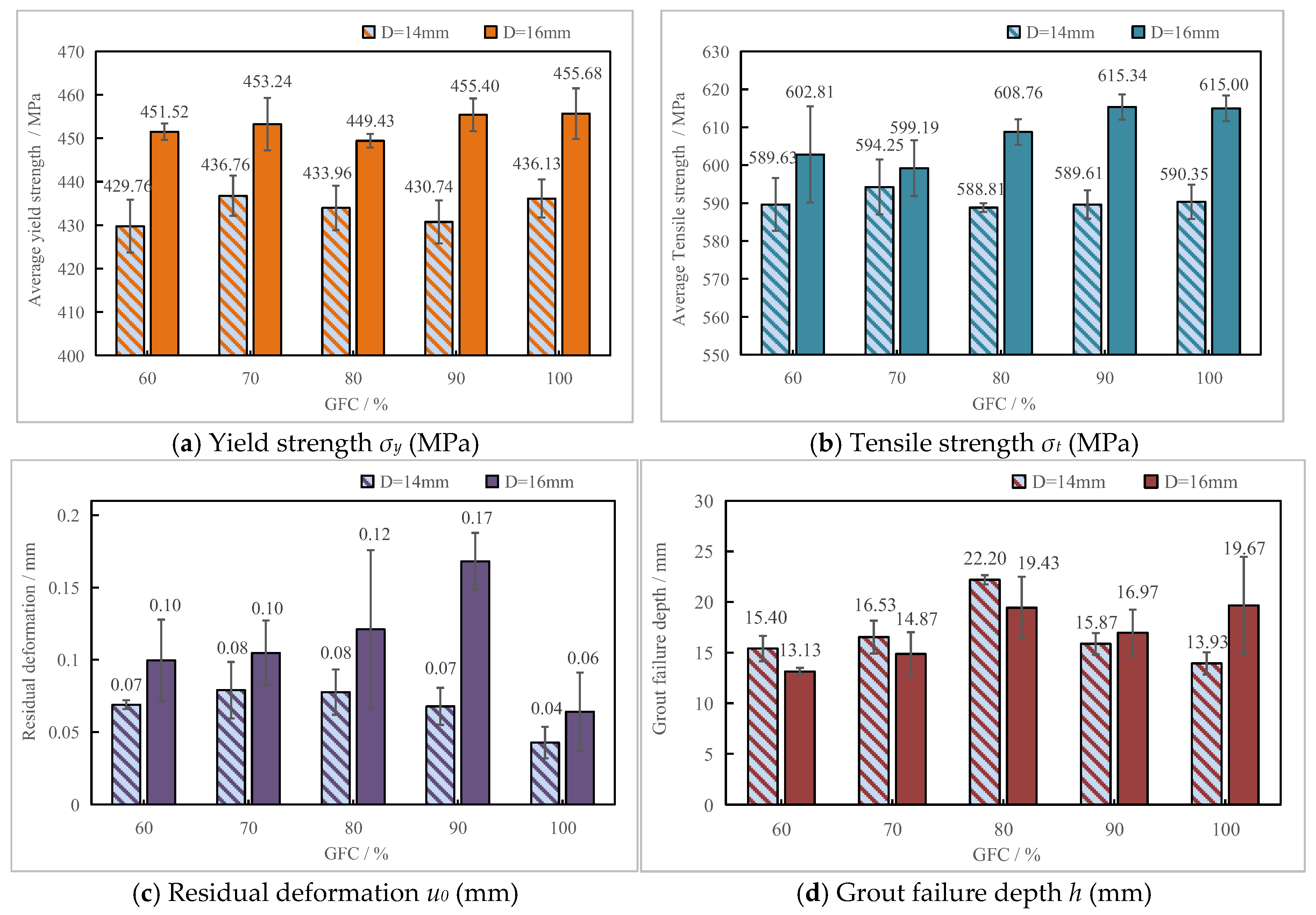
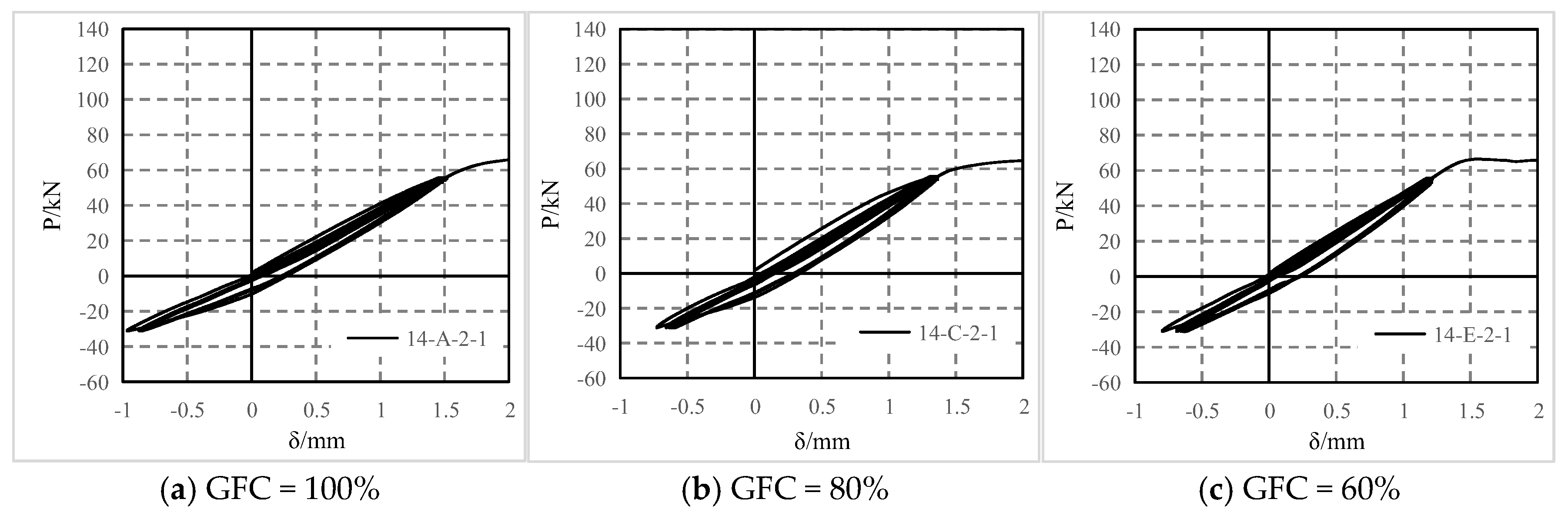
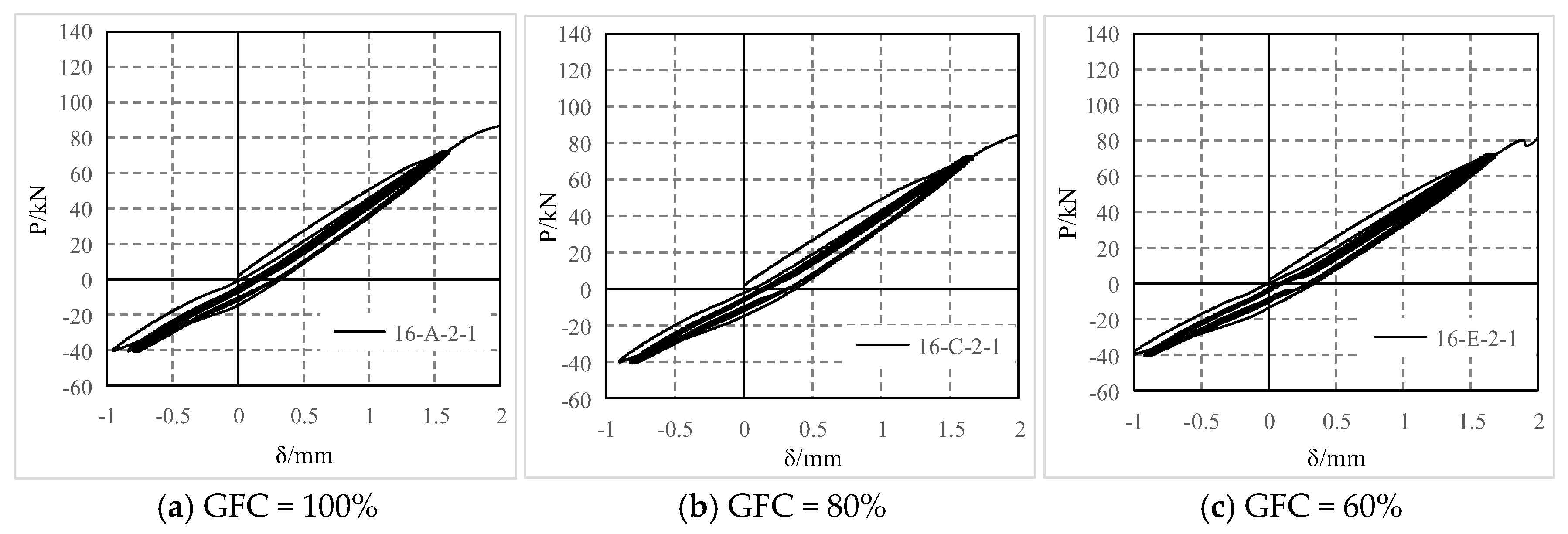
3.3. Analysis of High-Stress Cyclic Tension–Compression Test Data
4. Conclusions
- (1)
- Critical thresholds of failure modes and performance grading
- (2)
- Size-dependent sensitivity under uniaxial tension
- (3)
- Interfacial cumulative damage under cyclic loading
- (4)
- Limitations of the Study and suggested future work
Author Contributions
Funding
Institutional Review Board Statement
Informed Consent Statement
Data Availability Statement
Conflicts of Interest
References
- JGJ 1-2014; Technical Specification for Precast Concrete Structures. China Architecture & Building Press: Beijing, China, 2014.
- Henin, E.; Morcous, G. Non-proprietary bar splice sleeve for precast concrete construction. Eng. Struct. 2015, 83, 154–162. [Google Scholar] [CrossRef] [Scilit]
- Wu, T.; Liu, Q.W.; Cheng, R.; Liu, X. Experimental study and stress analysis of mechanical performance of grouted sleeve splice. Eng. Mech. 2017, 34, 68–75. [Google Scholar] [CrossRef]
- Zheng, Y.F.; Guo, Z.X.; Guan, D.Z.; Zhang, X. Parametric study on a novel grouted rolling pipe splice for precast concrete construction. Constr. Build. Mater. 2018, 166, 452–463. [Google Scholar] [CrossRef] [Scilit]
- Liu, L.L.; Xiao, J.Z.; Ding, T.; Zhang, K. Test and simulation on bond behavior between sleeve grout and high strength steel rebar. J. Tongji Univ. 2021, 49, 1273–1283. [Google Scholar] [CrossRef]
- Xie, L.L.; Zhong, B.J.; Mao, Q.S.; Chen, X.; Sun, H.L.; Yang, C.T.; Feng, X. Experimental investigation on performance of defect detectable and repairable half grouted sleeve connection under high stress cyclic tension-compression load. Eng. Mech. 2022, 39, 96–104. [Google Scholar] [CrossRef]
- Ren, G.; Wang, Q.; Zhang, Z.J.; Wang, C.J.; Tang, Y.G.; Lu, L.L. Research on the mechanical properties of semi-grouted sleeves based on grouting defects. Constr. Technol. 2022, 51, 70–73. [Google Scholar]
- Xu, C.S.; Liu, H.T.; Du, X.L. Experimental study on connection performance of grouted sleeve splicing for rebars under high stress repeated tension-compression loading. J. Build. Struct. 2018, 39, 178–184+193. [Google Scholar] [CrossRef]
- Alias, A.; Zubir, M.A.; Shahid, K.A.; Abd RAhman, A.B. Structural performance of grouted sleeve connectors with and without transverse reinforcement for precast concrete structure. Procedia Eng. 2013, 53, 116–123. [Google Scholar] [CrossRef] [Scilit]
- Chen, H.; Zhang, Z.F. Finite element analysis of the grout sleeve splicing for steel bars. J. Jiamusi Univ. 2014, 32, 341–344. [Google Scholar]
- Gao, R.D.; Li, X.M.; Zhang, F.W. Study on influences of grouting defects in different positions on joint strength of steel sleeve grouting. Constr. Technol. 2019, 48, 116–119+124. [Google Scholar]
- Li, X.M.; Gao, R.D.; Xu, Q.F.; Wang, Z.; Zhang, F. Experimental study on influence of grouting defect on joint strength of grout sleeve splicing of rebars. Build. Struct. 2018, 48, 52–56. [Google Scholar] [CrossRef]
- Liu, Q.Z.; Lin, Y.H.; Yang, H. Influence of defects on the degradation law of grouted sleeve connection performance. J. Guilin Univ. Technol. 2025, 45, 66–74. [Google Scholar] [CrossRef]
- Sun, B.; Mao, S.Y.; Ouyang, Z.P.; Wang, N. Experimental study on effect of grouting fullness on connection performance of grout sleeve with mechanical splicing end. Build. Struct. 2020, 50, 1–6. [Google Scholar] [CrossRef]
- Ma, G.; Zhang, Y.Z.; Hwang, H.J.; Kim, D.J. Mechanical properties of half grouted sleeve connections with insufficient grouting and bar eccentricity defects. Structures 2025, 75, 108852. [Google Scholar] [CrossRef] [Scilit]
- Guo, T.; Yang, J.; Wang, W.; Li, C. Experimental investigation on connection performance of fully-grouted sleeve connectors with various grouting defects. Constr. Build. Mater. 2022, 327, 126981. [Google Scholar] [CrossRef] [Scilit]
- Wang, T.; Zhou, Z.J.; Yuan, K.; Jiang, R.; Ma, X.; Li, L. Evaluation of common defects of grouted sleeve connectors. Case Stud. Constr. Mater. 2022, 17, 1605. [Google Scholar] [CrossRef] [Scilit]
- Zheng, G.Y.; Kuang, Z.P.; Xiao, J.Z.; Pan, Z. Mechanical performance for defective and repaired grouted sleeve connections under uniaxial and cyclic loadings. Constr. Build. Mater. 2020, 233, 117233. [Google Scholar] [CrossRef] [Scilit]
- GB/T228.1-2021; Metallic Materials—Tensile Testing—Part 1: Method of Test at Room Temperature. Standards Press of China: Beijing, China, 2021.
- JG/T 398-2019; The Grouting Sleeve for Rebars Splicing. Standards Press of China: Beijing, China, 2021.
- JG/T 408-2019; Cementitious Grout for Sleeve of Rebar Splicing. Standards Press of China: Beijing, China, 2019.
- JGJ 107-2016; General Technical Specification for Mechanical Splicing of Bars. China Architecture & Building Press: Beijing, China, 2016.
- JGJ 355-2015; Technical Specification for Grout Sleeve Splicing of Rebars. China Architecture & Building Press: Beijing, China, 2015.
- GB/T 51231-2016; Technical Standard for Assembled Buildings with Concrete Structures. China Architecture & Building Press: Beijing, China, 2017.
- American Statistical Association. ASA Guidelines for Statistical Practice; American Statistical Association: Washington, DC, USA, 2025. [Google Scholar]







| Specimen Number | GFC (%) | Anchorage Length (mm) | Number of Specimens |
|---|---|---|---|
| 14-A-x-y | 100 | 8 d | 6 |
| 14-B-x-y | 90 | 7.2 d | 6 |
| 14-C-x-y | 80 | 6.4 d | 6 |
| 14-D-x-y | 70 | 5.6 d | 6 |
| 14-E-x-y | 60 | 4.8 d | 6 |
| 16-A-x-y | 100 | 8 d | 6 |
| 16-B-x-y | 90 | 7.2 d | 6 |
| 16-C-x-y | 80 | 6.4 d | 6 |
| 16-D-x-y | 70 | 5.6 d | 6 |
| 16-E-x-y | 60 | 4.8 d | 6 |
| Diameter (mm) | Yield Strength (MPa) | Ultimate Strength (MPa) | Elastic Modulus (GPa) | Actual Yield-to-Tensile Ratio |
|---|---|---|---|---|
| 14 | 455 | 600 | 192 | 1.319 |
| 16 | 460 | 615 | 195 | 1.337 |
| Loading Conditions | Loading Protocol |
|---|---|
| Uniaxial Loading | 0 → 0.6 fyk 1 (applied load) → 0 (unloading, record residual deformation) → maximum tension (record tensile strength) → failure |
| Cyclic Loading | 0 → cyclic loading between 0.9 fyk (tension) and −0.5 fyk (compression) for 20 cycles → failure |
| Parameter | Pearson’s r | Correlation Type | p Value | Significance (α = 0.05) | |
|---|---|---|---|---|---|
| Φ14 | σy | 0.02 | Weak positive correlation | 0.97 | Nonsignificant |
| σt | −0.28 | Weak negative correlation | 0.65 | Nonsignificant | |
| u0 | −0.62 | Moderate negative correlation | 0.26 | Nonsignificant | |
| h | 0.45 | Moderate positive correlation | 0.45 | Nonsignificant | |
| Φ16 | σy | 0.63 | Moderate positive correlation | 0.25 | Nonsignificant |
| σt | 0.89 | Strong positive correlation | 0.04 | Significant | |
| u0 | −0.04 | Weak negative correlation | 0.95 | Nonsignificant | |
| h | 0.84 | Strong positive correlation | 0.07 | Marginally significant | |
Disclaimer/Publisher’s Note: The statements, opinions and data contained in all publications are solely those of the individual author(s) and contributor(s) and not of MDPI and/or the editor(s). MDPI and/or the editor(s) disclaim responsibility for any injury to people or property resulting from any ideas, methods, instructions or products referred to in the content. |
© 2026 by the authors. Licensee MDPI, Basel, Switzerland. This article is an open access article distributed under the terms and conditions of the Creative Commons Attribution (CC BY) license.
Share and Cite
Jiang, Y.; Wu, T.; Wang, Z.; Shen, X.; Liu, Y.; Hu, Y.; Yi, M.; Jiang, Y. Experimental Study of the Effects of Grout Filling Completeness on the Performance of Grouted Sleeve Connections. Buildings 2026, 16, 998. https://doi.org/10.3390/buildings16050998
Jiang Y, Wu T, Wang Z, Shen X, Liu Y, Hu Y, Yi M, Jiang Y. Experimental Study of the Effects of Grout Filling Completeness on the Performance of Grouted Sleeve Connections. Buildings. 2026; 16(5):998. https://doi.org/10.3390/buildings16050998
Chicago/Turabian StyleJiang, Yang, Tao Wu, Zhiyong Wang, Xiaopu Shen, Yunfang Liu, Yuanchao Hu, Miaomiao Yi, and Yalong Jiang. 2026. "Experimental Study of the Effects of Grout Filling Completeness on the Performance of Grouted Sleeve Connections" Buildings 16, no. 5: 998. https://doi.org/10.3390/buildings16050998
APA StyleJiang, Y., Wu, T., Wang, Z., Shen, X., Liu, Y., Hu, Y., Yi, M., & Jiang, Y. (2026). Experimental Study of the Effects of Grout Filling Completeness on the Performance of Grouted Sleeve Connections. Buildings, 16(5), 998. https://doi.org/10.3390/buildings16050998