Optimized Fiber Element Modeling Strategy for Concrete-Encased Steel Composite Columns: Focusing on Material Nonlinearity and Confinement Effects


Abstract
1. Introduction
2. Experimental Database and Fiber Element Modeling in Perform-3D
2.1. Comprehensive Experimental Database
- Material Strength: Concrete compressive strength (fc) ranging from normal to high-strength, and steel yield strength (fy) covering standard structural steel grades.
- Geometric Parameters: A diverse range of shear span-to-depth ratios (a/d) and structural steel ratios (ρss).
- Loading Conditions: Various levels of axial load ratios (P/P0) applied during cyclic loading tests. This dataset serves as a benchmark for evaluating whether the fiber model can accurately predict key failure modes—including flexural yielding and concrete crushing—across a wide range of design conditions.
2.2. Numerical Modeling Strategy in Perform-3D
2.2.1. Concrete Constitutive Model
- Unconfined Concrete: The cover concrete was modeled using the standard inelastic constitutive law proposed by Mander et al. [31], which accounts for the softening branch after peak strength.
- Confined Concrete (Core): A distinguishing characteristic of CES columns is the additional confinement provided not only by the transverse reinforcement but also by the flanges of the embedded steel section. To capture this dual-confinement effect, a confined concrete stress–strain model was calibrated by adjusting the peak strength and ultimate strain parameters to reflect combined confinement from both transverse reinforcement and the encased steel sections. The confinement enhancement was accounted for by increasing the peak compressive strength (f’cc) and ultimate compressive strain (εcu) to reflect the combined confinement provided by transverse reinforcement and the embedded steel section [32]. The calibration procedure and parameter selection are described in Section 3.2 and validated using the 79 test specimens.
- Tensile Behavior: The tensile strength of concrete was neglected to remain conservative by assuming fully cracked behavior under cyclic loading.
2.2.2. Steel Constitutive Model
- Kinematic Hardening: Unlike simple bilinear models, the GMP model accurately represents the Bauschinger effect, which is essential for predicting energy dissipation during earthquake excitations.
- Curve Transition: The model parameters were calibrated to achieve a smooth transition from elastic to plastic behavior, thereby preventing numerical instability during load reversals.
- Perfect Bond Assumption: Following standard practice for CES columns, a perfect bond between the steel section and the surrounding concrete was assumed, meaning strain compatibility was maintained across the section.
2.2.3. Numerical Integration and Mesh Sensitivity
3. Model Validation and Numerical Optimization
3.1. Verification Against Experimental Database
3.1.1. Hysteretic Response and Energy Dissipation
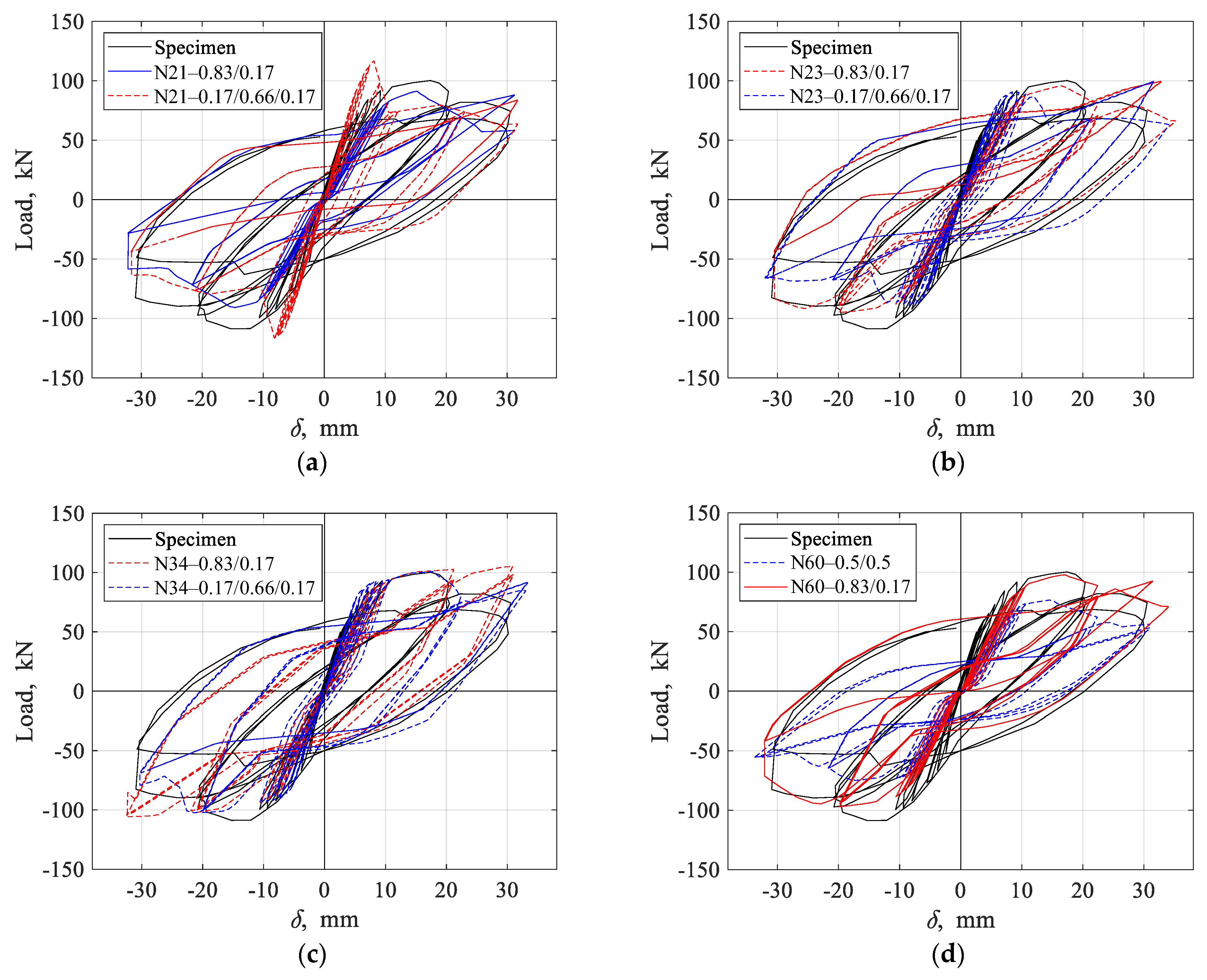
- Pinching Effect: The use of the Giffre–Menegotto–Pinto (GMP) model [34] successfully captured the “pinching” phenomenon observed in shear-critical specimens. This suggests that the model appropriately captures crack opening/closure behavior and the Bauschinger effect in the steel core.
- Stiffness Degradation: The model accurately reproduced the gradual degradation of stiffness during unloading and reloading cycles, which is critical for assessing the seismic damage accumulation.
3.1.2. Statistical Analysis of Strength Prediction
- The comparison yielded a mean ratio (Vmax,num/Vnax,exp) of 1.02 with a standard deviation of 0.058 and a COV of 0.0569 (5.7%).
- This statistical proximity to 1.0, combined with a low coefficient of variation, confirms that the proposed fiber model provides unbiased and consistent predictions across a wide range of material strengths (concrete strength up to 87.6 MPa) and geometric configurations.
- Notably, the model maintained high accuracy even for specimens with high axial load ratios (n > 0.5), a regime where conventional models often overestimate capacity due to the neglect of P-Delta effects and concrete crushing mechanisms.
3.2. Mesh Sensitivity and Optimization
3.2.1. Optimal Number of Fibers (Section Discretization)
- Results: As illustrated in Figure 5 for mesh sensitivity analysis, the flexural capacity and post-peak behavior stabilized rapidly. The analysis revealed that increasing the number of fibers beyond 23 resulted in a negligible difference (less than 1.5%) in the predicted result.
- Physical Interpretation: This indicates that the strain field across the composite section does not exhibit abrupt gradients, allowing accurate predictions even with relatively coarse discretization without compromising accuracy. Therefore, an excessive subdivision of the highly confined concrete core does not contribute significantly to the global accuracy.
- Guideline: Based on this finding, a discretization of approximately 23 fibers is recommended as a balanced choice between computational efficiency and accuracy: dividing the web into 4 fibers, each flange into 4 fibers, and the concrete core/cover into an appropriate grid. This configuration reduces computational time by approximately 40% compared to dense meshing in these analyses, without compromising the reliability of seismic performance assessment.
- A discretization on the order of ~23 fibers is recommended as a practical baseline for CES columns within the investigated database ranges (fc = 37.5–87.6 MPa, fy ≤ 414 MPa, and ρss ≤ 2.6%).
- For sections outside these ranges or with substantially different geometry/steel configuration, a brief convergence check (e.g., 23 → 34 fibers) is recommended.
3.2.2. Optimization of Numerical Integration Scheme
3.3. Comparison with Current Design Codes
- Limitations of ASCE 41-17 [3]: The current code-based approaches often lead to conservative strength estimates because composite action is not fully considered, often underestimating the flexural capacity by 15–20%. This discrepancy is attributed to the code’s simplification which underestimates the confining effect of the concrete encasement and the composite action in the plastic range.
- Advantage of Proposed Method: By explicitly modeling the material nonlinearity and dual-confinement effect using the Mirza and Skrabek model [32], the proposed fiber element strategy recovered the “hidden” capacity reserve. This allows for a more economical design and a realistic performance evaluation, preventing unnecessary retrofitting of existing structures.
3.4. Discussion
4. Conclusions
- High-Fidelity Simulation: The proposed modeling framework, integrating the Mander et al. model (modified by Mirza and Skrabek [32] for confinement) for concrete and the Giffre–Menegotto–Pinto model [34] for steel, demonstrated excellent accuracy. The statistical evaluation yielded a mean ratio of analytical-to-experimental peak lateral strength of 1.02, confirming the model’s reliability across diverse design parameters.
- Optimized Discretization: The sensitivity analysis proved that the CES column analysis exhibits mesh independence beyond a certain threshold within the investigated ranges. A cross-sectional discretization of 23 fiber elements was identified as the optimal configuration, providing precise results while significantly reducing computational cost. Refined meshing of the confined core was found to be unnecessary.
- Integration Strategy: For seismic performance assessment, defining integration points at 0.83L and 0.17L (Gauss–Lobatto rule) is recommended to accurately capture plastic hinge localization at the column ends.
- Practical Implication: Unlike conventional code-based methods (e.g., ASCE 41-17) that neglect composite action, the proposed guideline accurately accounts for the confinement effect and ductility of CES members. This allows structural engineers to achieve more rational and realistic performance-based design assessments.
- Limitations and future work: The present approach assumes perfect bond (strain compatibility) between steel and concrete and neglects concrete tensile strength, which may influence stiffness degradation and pinching under large cyclic demands. Further work is recommended to extend validation to different steel shapes/ratios and to investigate explicit interface/bond-slip modeling where partial composite action is expected.
Funding
Data Availability Statement
Conflicts of Interest
Abbreviations
| CES | Concrete-Encased Steel |
| FEA | Finite Element Analysis |
| GMP | Giffre–Menegotto–Pinto |
References
- Ricles, J.M.; Paboojian, S.D. Seismic Performance of Steel-Encased Composite Columns. J. Struct. Eng. 1994, 120, 2474–2494. [Google Scholar] [CrossRef] [Scilit]
- Zhu, W.; Jia, J.; Gao, J.; Zhang, F. Experimental study on steel reinforced high-strength concrete columns under cyclic lateral force and constant axial load. Eng. Struct. 2016, 125, 191–204. [Google Scholar] [CrossRef] [Scilit]
- ASCE/SEI 41-17; Seismic Evaluation and Retrofit of Existing Buildings. American Society of Civil Engineers: Reston, VA, USA, 2017. Available online: https://ascelibrary.org/doi/book/10.1061/9780784414859 (accessed on 10 February 2026).
- Suzuki, T.; Takiguchi, K.; Ichinose, T.; Okamoto, T. Effects of hoop reinforcement in steel and reinforced concrete composite sections. Bull. N. Z. Soc. Earthq. Eng. 1984, 17, 198–214. [Google Scholar] [CrossRef] [Scilit]
- El-Tawil, S.; Deierlein, G.G. Strength and ductility of concrete-encased composite columns. J. Struct. Eng. 1999, 125, 1009–1019. [Google Scholar] [CrossRef] [Scilit]
- Campian, C.; Sav, V.; Chira, N.; Chira, A. Strength and ductility of concrete encased composite columns. In Proceedings of the Steel Structures: Culture & Sustainability, Istanbul, Turkey, 12–14 September 2012; Available online: https://www.taylorfrancis.com/chapters/edit/10.1201/b11396-102/strength-ductility-concrete-encased-composite-columns-campian-sav-chira-chira (accessed on 22 January 2026).
- Kuramoto, H. Behavior of columns in composite CES structural system. In Proceedings of the Composite Construction in Steel and Concrete VI, Atlanta, GA, USA, 20–22 July 2011. [Google Scholar]
- Chen, C.C.; Chen, C.C.; Shen, J.H. Effects of steel-to-member depth ratio and axial load on flexural ductility of concrete-encased steel composite columns. Eng. Struct. 2018, 155, 157–166. [Google Scholar] [CrossRef] [Scilit]
- Lai, B.; Liew, J.R.; Xiong, M. Experimental study on high strength concrete encased steel composite short columns. Constr. Build. Mater. 2019, 228, 116640. [Google Scholar] [CrossRef] [Scilit]
- Chen, C.C.; Lin, N.J. Analytical model for predicting axial capacity and behavior of concrete encased steel composite stub columns. J. Constr. Steel Res. 2006, 62, 424–433. [Google Scholar] [CrossRef] [Scilit]
- Campian, C.; Nagy, Z.; Pop, M. Behavior of fully encased steel-concrete composite columns subjected to monotonic and cyclic loading. In Proceedings of the 5th International Conference on Advanced Composite Materials in Bridges and Structures (ACMBS 2015); Procedia Engineering: Amsterdam, The Netherlands, 2015; Volume 117, pp. 439–451. [Google Scholar]
- Behnamnia, A.; Barati, M. Seismic behavior of steel-concrete composite columns under cyclic lateral loading. J. Civ. Eng. Mater. Appl. 2019, 3, 183–192. [Google Scholar]
- Hassan, W.M.; Salem, F.; El-Dakhakhni, W.W.; Hegazy, A.; Abou-Elfadl, A. Seismic vulnerability and resilience of steel-reinforced concrete (SRC) composite column buildings with non-seismic details. Eng. Struct. 2021, 244, 112810. [Google Scholar] [CrossRef] [Scilit]
- Munoz, P.R.; Hsu, C.T.T. Behavior of biaxially loaded concrete-encased composite columns. J. Struct. Eng. 1997, 123, 1163–1171. [Google Scholar] [CrossRef] [Scilit]
- Hsu, H.-L.; Jan, F.-J.; Juang, J.-L. Performance of composite members subjected to axial load and bi-axial bending. J. Constr. Steel Res. 2009, 65, 869–878. [Google Scholar] [CrossRef] [Scilit]
- Samanta, A.K.; Sahu, A. Current design practice of biaxially loaded concrete encased steel composite stub column. J. Real Estate Constr. Manag. 2015, 30, 47–60. [Google Scholar] [CrossRef] [Scilit]
- Lai, B.; Liew, J.R.; Wang, T. Buckling behaviour of high strength concrete encased steel composite columns. J. Constr. Steel Res. 2019, 154, 27–42. [Google Scholar] [CrossRef] [Scilit]
- Wang, B.; Huo, G.; Sun, Y.; Zheng, S. Hysteretic behavior of steel reinforced concrete columns based on damage analysis. Appl. Sci. 2019, 9, 687. [Google Scholar] [CrossRef] [Scilit]
- Yue, J.; Qian, J.; Beskos, D.E. Seismic damage performance levels for concrete encased steel columns using acoustic emission tests and finite element analysis. Eng. Struct. 2019, 189, 471–483. [Google Scholar] [CrossRef] [Scilit]
- Aribert, J.-M.; Campian, C.; Pacurar, V. Monotonic and cyclic behaviour of fully encased composite columns and dissipative interpretation for seismic design. In Proceedings of the STESSA 2003—Behaviour of Steel Structures in Seismic Areas; Routledge: Naples, Italy, 2003; pp. 115–121. [Google Scholar]
- Elbably, A.; Ramadan, O.; Akl, A.; Zenhom, N. Behavior of encased steel-high strength concrete columns against axial and cyclic loading. J. Constr. Steel Res. 2022, 191, 107161. [Google Scholar] [CrossRef] [Scilit]
- Xue, Y.; Shang, C.; Yang, Y.; Yu, Y. Macro-modeling on cyclic behavior of concrete-encased steel short columns under shear failure. J. Build. Eng. 2022, 51, 104297. [Google Scholar] [CrossRef] [Scilit]
- Wu, N.; Tan, K.H. Testing, modelling and design of concentrically-loaded concrete-encased concrete-filled steel tube slender column. J. Constr. Steel Res. 2023, 203, 107810. [Google Scholar] [CrossRef] [Scilit]
- Tunc, G.; Othman, M.M.; Mertol, H.C. Finite element analysis of frames with reinforced concrete encased steel composite columns. Buildings 2022, 12, 375. [Google Scholar] [CrossRef] [Scilit]
- Gautham, A.S.D.R.; Sahoo, D.R. Behavior of steel-reinforced composite concrete columns under combined axial and lateral cyclic loading. J. Build. Eng. 2021, 39, 102305. [Google Scholar] [CrossRef] [Scilit]
- Huang, J.; Zheng, S.; Wang, K.; Liu, H.; Liu, X.; Lou, M. Experimental investigation on the seismic performance and shear capacity modeling of RC/ECC encased steel short columns. J. Build. Eng. 2025, 117, 114722. [Google Scholar] [CrossRef] [Scilit]
- Zhou, W.; Liu, X.C.; Chen, X.; Feng, X.Z.; Meng, K. Mechanical properties of L-section thin concrete encased steel columns under low-cycle loading. J. Build. Eng. 2025, 118, 115012. [Google Scholar] [CrossRef] [Scilit]
- İnce, E.G.; Özkal, F.M. Optimization of structural steel used in concrete-encased steel composite columns via topology optimization. Appl. Sci. 2024, 14, 1170. [Google Scholar] [CrossRef] [Scilit]
- Raveendran, N.; Vasugi, K. Evolution of concrete encased-CFST column: A comprehensive review on structural behavior and performance characteristics. Steel Compos. Struct. 2024, 51, 619–645. [Google Scholar]
- Maruthai, S.M.; Palanisami, S. Assessment of axial load carrying capacity of fully encased composite columns: Comparative study with different codes. Matéria (Rio J.) 2024, 29, e20240303. [Google Scholar] [CrossRef] [Scilit]
- Mander, J.B.; Priestley, M.J.N.; Park, R. Theoretical stress-strain model for confined concrete. J. Struct. Eng. 1988, 114, 1804–1826. [Google Scholar] [CrossRef] [Scilit]
- Mirza, S.A.; Skrabek, B.W. Reliability of short composite beam-column strength interaction. J. Struct. Eng. 1992, 118, 2320–2339. [Google Scholar] [CrossRef] [Scilit]
- El-Tawil, S.M.; Deierlein, G.G. Fiber Element Analysis of Composite Beam-Column Cross-Sections. Ph.D. Thesis, Cornell University, School of Civil and Environmental Engineering, Ithaca, NY, USA, 1996. [Google Scholar]
- Menegotto, M. Method of analysis for cyclically loaded RC plane frames including changes in geometry and non-elastic behavior of elements under combined normal force and bending. In Proceedings of the IABSE Symposium on Resistance and Ultimate Deformability of Structures Acted on by Well Defined Repeated Loads; IABSE Reports of the Working Commissions: Lisbon, Portugal, 1973; pp. 15–22. Available online: https://www.semanticscholar.org/paper/Method-of-analysis-of-cyclically-loaded-RC-plane-in-Menegotto/21cbc94306db1694835a803b8fe08802e97984a2 (accessed on 22 January 2026).
- El-Tawil, S.; Deierlein, G.G. Nonlinear analysis of mixed steel-concrete frames. I: Element formulation. J. Struct. Eng. 2001, 127, 647–655. [Google Scholar] [CrossRef] [Scilit]



| f’c [MPa] | fys [MPa] | fyr [MPa] | ρss [%] | ρsr [%] | Vu [kN] | a/d | ALR |
|---|---|---|---|---|---|---|---|
| 37.5–87.6 | 254–779 | 357–414 | 2.94–7.15 | 1.75–2.36 | 118–1227 | 0.12–0.46 | 0.3–989 |
| No. Division | Unconfined Concrete | Partially Confined Concrete | Fully Confined Concrete | Reinforced Bar | Core Steel |
|---|---|---|---|---|---|
| 21 | 4 | 4 | 2 | 8 | 3 |
| 23 | 4 | 4 | 2 | 8 | 5 |
| 25-1 | 4 | 4 | 4 | 8 | 5 |
| 25-2 | 6 | 4 | 2 | 8 | 5 |
| 26 | 8 | 4 | 2 | 8 | 4 |
| 27 | 8 | 4 | 2 | 8 | 5 |
| 29-1 | 8 | 4 | 4 | 8 | 5 |
| 29-2 | 4 | 8 | 4 | 8 | 5 |
| 31 | 8 | 8 | 2 | 8 | 5 |
| 33 | 8 | 4 | 8 | 8 | 5 |
| 34 | 8 | 8 | 4 | 8 | 6 |
| 37 | 12 | 4 | 8 | 8 | 5 |
| 38 | 12 | 4 | 8 | 8 | 6 |
| 42 | 8 | 12 | 8 | 8 | 6 |
| 52 | 12 | 12 | 8 | 8 | 12 |
| 60 | 12 | 12 | 16 | 8 | 12 |
Disclaimer/Publisher’s Note: The statements, opinions and data contained in all publications are solely those of the individual author(s) and contributor(s) and not of MDPI and/or the editor(s). MDPI and/or the editor(s) disclaim responsibility for any injury to people or property resulting from any ideas, methods, instructions or products referred to in the content. |
© 2026 by the author. Licensee MDPI, Basel, Switzerland. This article is an open access article distributed under the terms and conditions of the Creative Commons Attribution (CC BY) license.
Share and Cite
Ha, S. Optimized Fiber Element Modeling Strategy for Concrete-Encased Steel Composite Columns: Focusing on Material Nonlinearity and Confinement Effects. Buildings 2026, 16, 999. https://doi.org/10.3390/buildings16050999
Ha S. Optimized Fiber Element Modeling Strategy for Concrete-Encased Steel Composite Columns: Focusing on Material Nonlinearity and Confinement Effects. Buildings. 2026; 16(5):999. https://doi.org/10.3390/buildings16050999
Chicago/Turabian StyleHa, Seongjin. 2026. "Optimized Fiber Element Modeling Strategy for Concrete-Encased Steel Composite Columns: Focusing on Material Nonlinearity and Confinement Effects" Buildings 16, no. 5: 999. https://doi.org/10.3390/buildings16050999
APA StyleHa, S. (2026). Optimized Fiber Element Modeling Strategy for Concrete-Encased Steel Composite Columns: Focusing on Material Nonlinearity and Confinement Effects. Buildings, 16(5), 999. https://doi.org/10.3390/buildings16050999