Article

Structural Damage Identification Method and Experimental Verification Based on Multi-Head Convolutional Autoencoder


1
College of Civil Engineering and Architecture, Quzhou University, Quzhou 324000, China
2
School of Civil Engineering, Ningbo Tech University, Ningbo 315100, China
3
Institute of Structural Engineering, Zhejiang University, Hangzhou 310058, China
*
Author to whom correspondence should be addressed.
Buildings 2026, 16(5), 954; https://doi.org/10.3390/buildings16050954
Submission received: 26 January 2026 / Revised: 25 February 2026 / Accepted: 26 February 2026 / Published: 28 February 2026

Abstract

To address the prevalent challenges of limited labelled data and indistinct damage features in the domain of damage identification, an unsupervised damage identification method has been developed. The method is based on a multi-head convolutional autoencoder, which introduces multi-scale convolution kernels to extract key features from structural vibration response data. The method combines vibration signal reconstruction with difference analysis, thereby enabling automatic identification of structural damage. The validity of the proposed method is confirmed through the execution of a concrete beam hammering vibration test. The multi-head convolutional autoencoder demonstrates a high degree of accuracy in the reconstruction of vibration signals and the subsequent identification of damage. Furthermore, the multi-head one-dimensional convolution structure has been shown to outperform traditional one-dimensional convolution structures with regard to both detection accuracy and sensitivity. It is asserted that this method has the capacity to serve as a valuable reference point for the intelligent analysis of engineering Structural Health Monitoring data.

1. Introduction

The health condition of engineering structures directly affects public safety and the stable operation of socio-economic systems. During long-term service, structures are subjected to environmental erosion, material degradation, complex loading conditions, and unexpected extreme events, which inevitably lead to cumulative damage and performance deterioration [1,2]. Without timely and accurate damage identification and localization, structural failure or catastrophic accidents may occur. Therefore, the development of reliable and efficient structural damage identification methods is essential for ensuring infrastructure safety and extending service life [3,4].
Conventional damage detection approaches primarily rely on visual inspection, local non-destructive testing (e.g., ultrasonic and radiographic testing), and vibration-based methods such as modal parameter identification. Although these techniques have proven effective in many applications, their accuracy and reliability can be significantly compromised under complex operational and environmental conditions [5,6,7]. For instance, environmental noise and modelling uncertainties may mask early-stage damage features, reducing the effectiveness of traditional identification techniques. Moreover, computational simulation methods are often time-consuming, and time-varying structural parameters can introduce substantial uncertainty into model updating results [8,9]. With the increasing scale and complexity of modern infrastructure, these limitations highlight the need for advanced intelligent monitoring approaches capable of improving identification accuracy, robustness, and real-time performance.
Structural damage identification methods can generally be divided into model-based and data-driven approaches [10]. Model-based methods require the establishment of accurate finite element models that closely represent real structural behaviour. However, uncertainties in material properties, boundary conditions, and loading environments make it difficult to construct models that fully capture actual structural performance [11]. In contrast, data-driven approaches analyse structural response data—such as displacement, acceleration, and strain—without relying on explicit physical models [12]. Nevertheless, the large volume and high dimensionality of monitoring data may obscure damage-sensitive information, posing challenges for efficient feature extraction and reliable identification.
Recent advances in machine learning, particularly deep learning, have demonstrated strong capability in automatically extracting representative features from large-scale monitoring data and have been widely applied in structural health monitoring [13,14,15]. These methods establish mapping relationships between structural responses and damage conditions, enabling automated detection and classification [16,17]. The ability to handle nonlinear and high-dimensional data makes them particularly suitable for complex structural systems [18]. For example, Yang et al. [19] developed a bridge damage identification model based on a Back Propagation Neural Network (BPNN) using modal parameters, achieving reliable results on a variable cross-section box girder bridge. Roy et al. [20] proposed a Support Vector Machine (SVM)-based approach for locating damaged truss components using acoustic emission signals, achieving localization accuracy exceeding 90%. To further improve robustness, researchers have combined dimensionality reduction techniques with machine learning models. Zhang et al. [21] employed Moving Principal Component Analysis (MPCA) for feature extraction and integrated Decision Tree and Random Forest models, enhancing classification performance for high-dimensional data. Bao [22] proposed a statistical pattern-based damage identification framework incorporating multi-source sensor fusion and computer vision, providing an effective solution under complex operating conditions. In addition, integrating signal processing techniques with deep learning has further improved vibration-based damage identification accuracy. He et al. [23] developed a hybrid framework combining Ensemble Empirical Mode Decomposition (EEMD), Pearson Correlation Coefficient (PCC), and Convolutional Neural Networks (CNN), achieving high-precision detection of complex damage patterns.
Despite these advances, several challenges remain. Most deep learning models rely heavily on large-scale labelled datasets, yet data acquisition and annotation in engineering practice are costly and often impractical [24]. Consequently, unsupervised learning methods that learn latent representations directly from monitoring data without labelled samples have become an important research direction for structural damage identification [25]. Xu et al. [26] employed variational autoencoders and generative adversarial networks to model probabilistic relationships between bridge deflection and cable forces, using Wasserstein distance as a damage indicator. Akintunde et al. [27] proposed an unsupervised framework combining singular value decomposition and independent component analysis to construct a novel damage index, validated experimentally. Similarly, autoencoders have also been widely applied for feature extraction and anomaly detection due to their encoding–decoding capability [28,29]. Denoising autoencoders (DAEs) improve reconstruction robustness under noisy conditions by learning representative features, while variational autoencoders (VAEs) establish structured latent distributions that enhance damage classification accuracy [30,31,32]. Convolutional autoencoders further extend these advantages to spatial–temporal data analysis and have shown superior performance in complex pattern identification tasks [33]. Vibration signals in SHM are one-dimensional time series with strong local correlations. Convolution operations are well-suited to extract these local spatiotemporal features. Autoencoders learn the normal data distribution of healthy states through reconstruction, aligning with this study’s unsupervised anomaly detection objective. However, in practical monitoring environments, noise interference and data incompleteness may still degrade feature learning and anomaly detection performance, limiting the ability of existing models to capture comprehensive structural response characteristics [34]. Existing multi-scale convolutional autoencoder frameworks typically employ parallel branches for feature extraction but often resort to simple concatenation or summation during feature fusion. This approach overlooks the cross-branch interaction and information complementarity between features of different scales. Consequently, when confronted with structural vibration signals characterised by a low signal-to-noise ratio and subtle damage features, the robustness of these methods is often inadequate, highlighting the need for more effective feature fusion strategies.
To address these challenges, this paper proposes an unsupervised structural damage identification method based on a multi-head convolutional autoencoder (MH-CAE). The framework integrates multi-scale convolutional kernels to extract key features from structural vibration signals and employs reconstruction error as a sensitive damage indicator. This design enables end-to-end feature learning and anomaly detection without labelled data. The effectiveness of the proposed method is validated through vibration signal reconstruction and damage identification of concrete beam structures under both healthy and damaged conditions.

2. Methods

Structural Damage Identification Based on MH-CAE

The autoencoder is a representative unsupervised neural network architecture. Its primary function is to learn low-dimensional feature representations of input data. It then reconstructs the original data from these representations through its network structure. The reconstruction process is achieved by modelling the distribution of input features. In structural health monitoring, autoencoders have proven to be valuable tools. They enable effective analysis of structural response patterns under specific health conditions. When a structural state is abnormal, the input data deviates from the originally learned distribution, resulting in a significant reconstruction error during the decoding process. This error may serve as an indicator for damage identification.
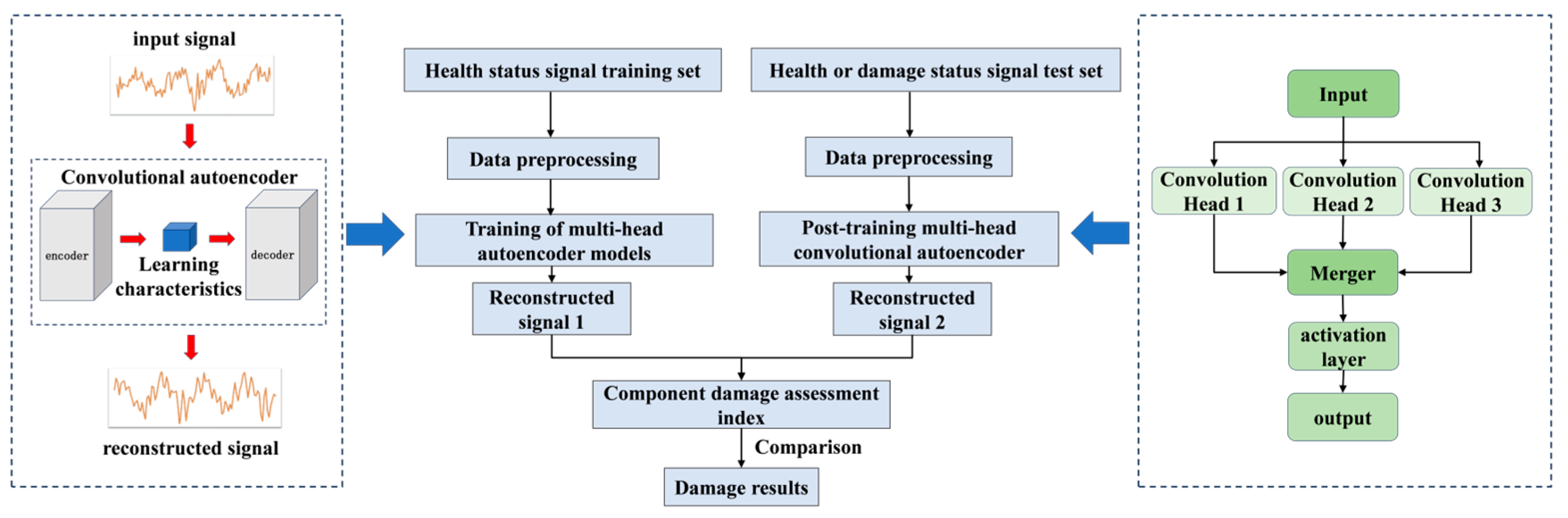
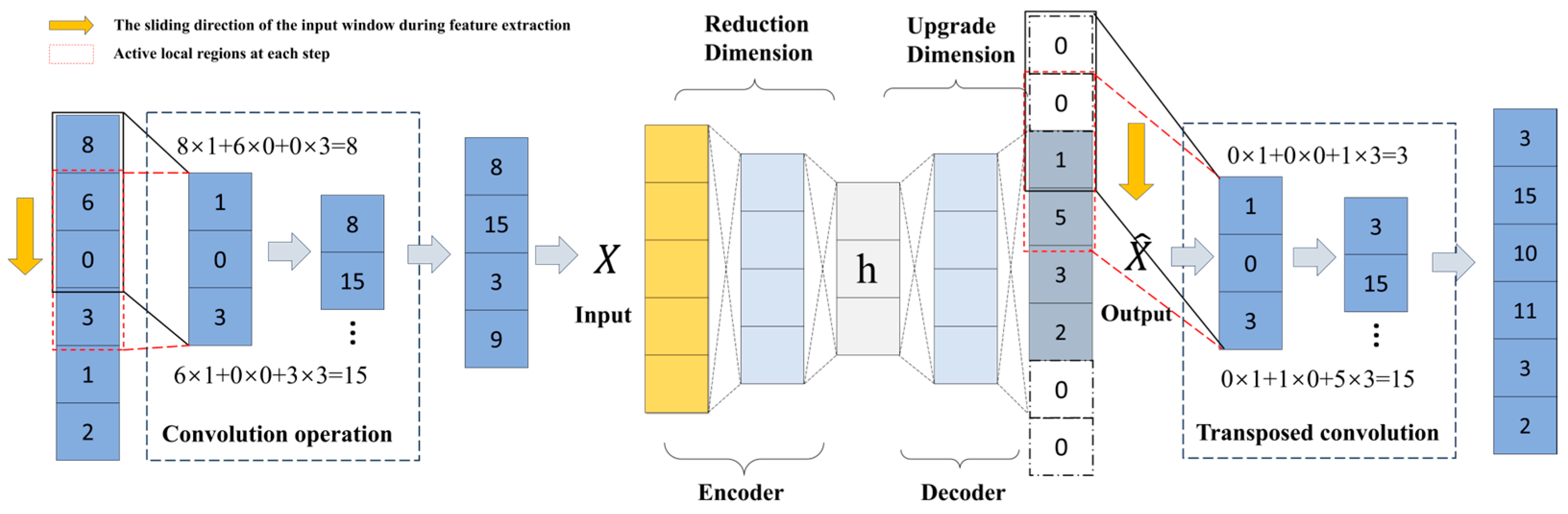
The conventional autoencoder architecture comprises two constituent components: an encoder and a decoder as shown in Figure 1. The function of the encoder is to map the input data x to a low-dimensional feature space h. The subsequent role of the decoder is to reconstruct h into the reconstructed data x ^ , the expression of which is as follows:
h = f W x + b
x ^ = f ( W h + b )
where W and W′ denote weight matrices, b and b′ are bias vectors, and f(·) denotes a nonlinear activation function. In conventional autoencoders, the primary function of the fully connected layer is to facilitate the compression and reconstruction of features. However, when applied to structural response types of one-dimensional time-series data, they exhibit limited capability in capturing temporal local patterns, while also suffering from a large parameter scale and poor generalisation capability. In order to address the aforementioned issues, a Convolutional Autoencoder (CAE) is proposed, in which convolutional operations are incorporated in order to process Structural Vibration Data. In the context of the CAE, the encoder utilises a one-dimensional convolution kernel to extract local features from the input sequence. Subsequently, the decoder employs a deconvolution operation to reconstruct these features into their original dimensional data. The following formula is employed to calculate one-dimensional convolution:
y ( t ) = i = 0 k 1   x ( t + i ) w ( i )
where x(t) is employed to denote the value of the input signal at time t. w(i) is used to represent the weight of the convolution kernel, and k is used to denote the length of the convolution kernel. In order to further enhance the model’s ability to perceive features at different scales, this paper builds upon the CAE to construct the MH-CAE. This model introduces multiple convolutional kernels of varying sizes (e.g., 3 × 1, 5 × 1, 7 × 1, etc.) in parallel within the encoder. Each convolutional branch corresponds to a “convolutional head”, which extracts the feature representation of the input signal at different temporal scales independently. The feature maps extracted from multiple convolutional channels can be integrated through concatenation, weighted fusion, or 1 × 1 convolution, and then passed to the decoder for reconstruction. The MH-CAE employs a “concatenation + 1 × 1 convolution” mechanism for feature fusion and dimensionality reduction. The workflow is outlined below. In each encoder layer, convolutional kernels of different sizes operate in parallel on the input feature map. This process generates multi-scale feature maps from different heads. These feature maps are not directly summed. Instead, they are concatenated along the channel dimension to form a composite feature map with multi-scale information. The composite feature map is then processed by a 1 × 1 convolutional layer. This operation has two main objectives. (1) It enables cross-channel feature fusion and integrates critical information across scales. (2) It controls channel number and reduces dimensionality. This ensures that the input to the next network layer remains manageable. The selection of convolution kernel sizes 3, 5, and 7 is based on local features and multi-scale dependencies in one-dimensional vibration signals. Small kernels capture high-frequency and subtle local variations. Large kernels capture medium- to low-frequency trends and broader contextual patterns. This combination enables the model to perceive multi-level dynamic information. It learns both fine-grained details and global patterns simultaneously. Consequently, the model evinces enhanced adaptability and robustness when processing sequence data characterised by variability or complexity. The process is illustrated in Figure 2 and consists of the following three steps: (1) The structural vibration signal under the Health Condition should be used as training samples to construct and train the MH-CAE model. (2) Input test signals from different operating conditions or structural states are fed into the trained model. The objective is to obtain the corresponding reconstructed signal outputs. (3) Reconstruction performance based on the damage evaluation index is assessed. This is done in order to analyse the progression of structural damage.
The MH-CAE model extracts salient features and temporal patterns from the input signal through successive convolutional operations. During the encoding stage, a downsampling strategy is applied to the feature maps. This step compresses the data and captures more representative features. In the decoding stage, multi-layer transposed convolutions are employed for upsampling. This process progressively reconstructs the original signal structure. The final output of this process is a reconstruction of the input signal. In practical structural monitoring, the model is first trained using vibration signals collected under intact structural conditions. This enables the model to learn normal response patterns. During testing, the MH-CAE reconstructs the input signals and calculates the error between the original and reconstructed data. If the reconstruction error exceeds a predefined threshold, it indicates a change in the structural state. This property provides a technical basis for detecting structural anomalies, especially in the context of bridge condition monitoring. Distinct from conventional multi-branch architectures, the core innovation of the MH-CAE lies in its “hierarchical fusion and interaction” mechanism. Specifically, at each encoding layer, different convolutional heads not only extract local and global features independently but also undergo cross-channel information interaction and dimensionality reduction via a 1 × 1 convolution after channel-wise concatenation. This deep fusion of multi-scale features makes the reconstruction error more sensitive to incipient damage, thereby addressing the vulnerability of traditional single-scale autoencoder to noise interference.
The objective is to develop a Damage Index (DI) that can quantitatively assess the reconstruction performance of the vibration signal and identify the progression trend of structural damage. The DI is based on the Mean Squared Error (MSE), a key metric in assessing the accuracy of reconstruction. By mapping all features linearly to a unified, bounded interval via min-max data normalisation, each dimension contributes equally to the MSE loss at the numerical range level. This effectively stabilises the gradient propagation process. The following formulae are employed in order to calculate the reconstruction error in the healthy and damaged states.
L h = 1 T t = 0 T 1   I h ( t ) R h ( t ) 2
L d = 1 T t = 0 T 1   I d ( t ) R d ( t ) 2
D I = L d L h L h × 100 %
where DI represents the changing rate of the MSE. L h and L d are used to denote the MSE of the signal reconstruction under both the healthy state and the damaged state, respectively. T denotes the signal length, and t is the time index, indicating the current time or sample point. I h ( t ) and I d ( t ) represent the actual signal value under the healthy state and damaged state, respectively. R h ( t ) and R d ( t ) are the respective representations of the reconstructed signal value under the healthy and damaged states.

3. Results

3.1. Test Profiles

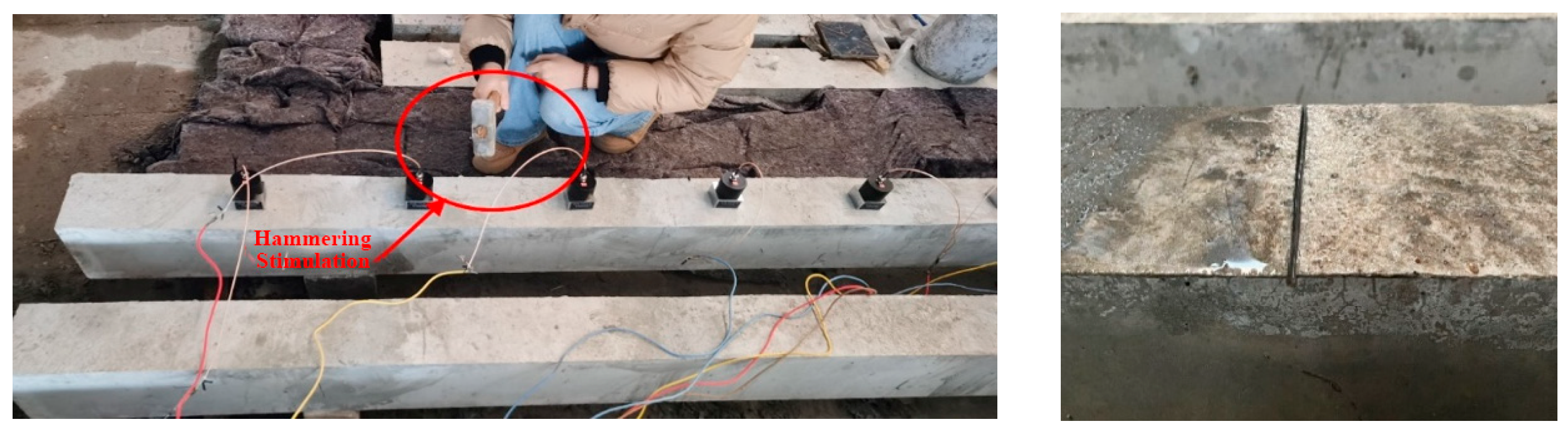
The reinforced concrete components utilised in this experiment are illustrated in Figure 3. The concrete has a strength grade of C30, and a total of two specimens were prepared for the study. After 28 days of initial curing, the target crack depths were marked on the beams using reference tags. Shallow grooves were then cut along these marks with diamond saw blades. Groove depths corresponded to the intended crack depths (5 mm, 10 mm, 15 mm, 20 mm). Groove widths were controlled at 2–3 mm to ensure uniform stress concentration. After crack formation, debris and loose particles were removed. A thin layer of cement paste was applied around the crack tips to stabilise the edges without filling the cracks. Damage was simulated by introducing artificial cracks, as illustrated in Figure 4. The damage conditions are detailed in Table 1. Given that the excitation is of the free vibration type, it can be applied at the 1/4 L and 1/2 L positions. The stiffness variation between finite element calculation results and actual measurement results for beams with different crack depths is shown in Table 2. Material constitutive differences cause discrepancies between experimental and finite element results. Nevertheless, the results confirm that cracks at mid-span and quarter-span both induce stiffness degradation in the structural member. As demonstrated in Figure 4, each condition was subjected to hammer excitation. Moreover, the impact force is not the focus of this study; its primary objective is to ensure that the striking force remains approximately consistent with each occurrence.
In the experiment, vibration sensors and the DH5922 dynamic signal testing and analysis system were used for detecting and acquiring acceleration signal data. The acceleration sensitivity is 0.3 V·s/m2, the maximum measurement range is 667 m/s2, and the sampling frequency is 200 Hz. The arrangement of the acceleration sensors on the test beam is illustrated in Figure 3. It is worth noting that throughout the course of the experiment, the monitoring nodes are programmed to automatically collect and subsequently transmit the relevant data.
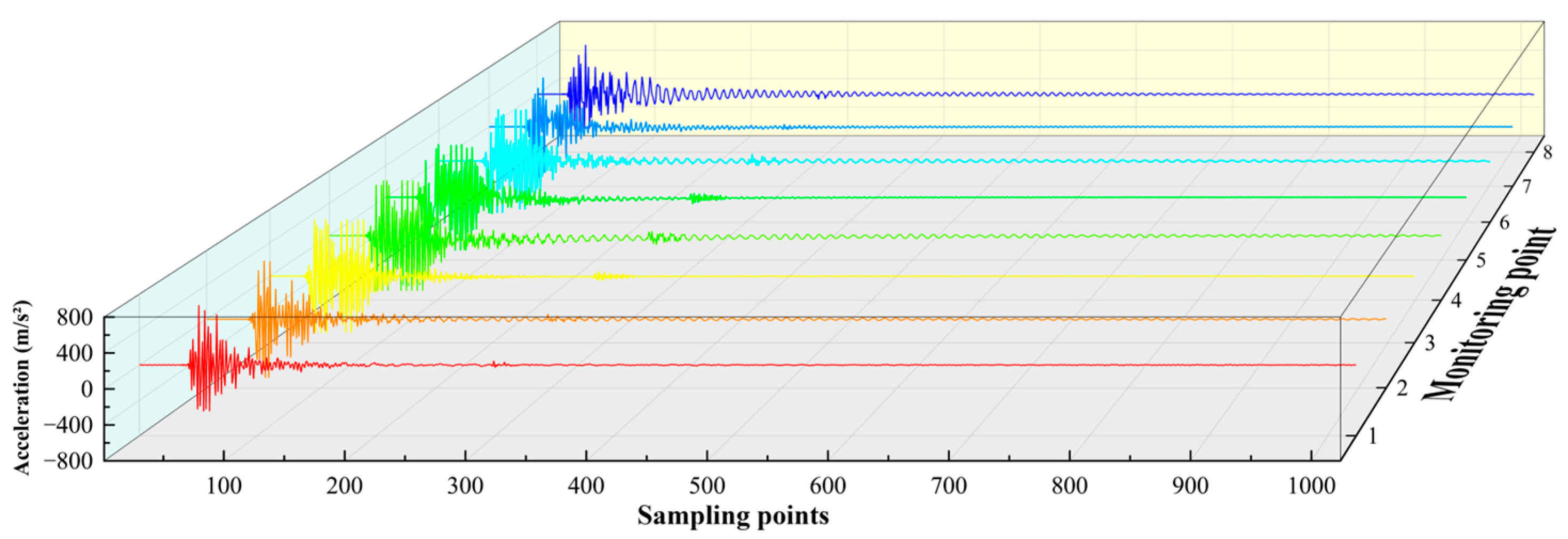
It is important to note that each operating condition included 20 hammer strikes, a procedure that ensures data representativeness. To meet the input requirements of the neural network, the collected acceleration signals were trimmed. Specifically, 50 sampling points preceding the peak and 974 points following the peak were selected, resulting in a time series of 1024 points for each signal, as shown in Figure 5. This processing preserves the characteristics of the acceleration signal during free vibration and provides sufficient features for deep learning.
To enhance the generalisation capability and robustness of the neural network and to prevent overfitting, data augmentation techniques were applied to the acceleration signals. Data augmentation simulated minor disturbances encountered in real monitoring. Gaussian white noise was added with a mean of 0 and a standard deviation of 5% of the original signal amplitude. Small random cyclic shifts were applied in the time domain, with a maximum offset of 2% of the total length. Start-point trimming and end-point padding were performed to mimic minor time jitter at signal acquisition. These techniques include noise addition, shifting, cropping, and flipping. Each augmentation method was performed twice, increasing the total number of training samples to 180.
The collected and preprocessed experimental data are then used to train a convolutional neural network model. The deep learning framework is implemented in PyTorch 2.3.1. The autoencoder’s encoder consists of three layers of one-dimensional convolution followed by three layers of multi-head one-dimensional convolution. The decoder is composed of three layers of one-dimensional transposed convolution. The detailed network architecture is illustrated in Table 3.
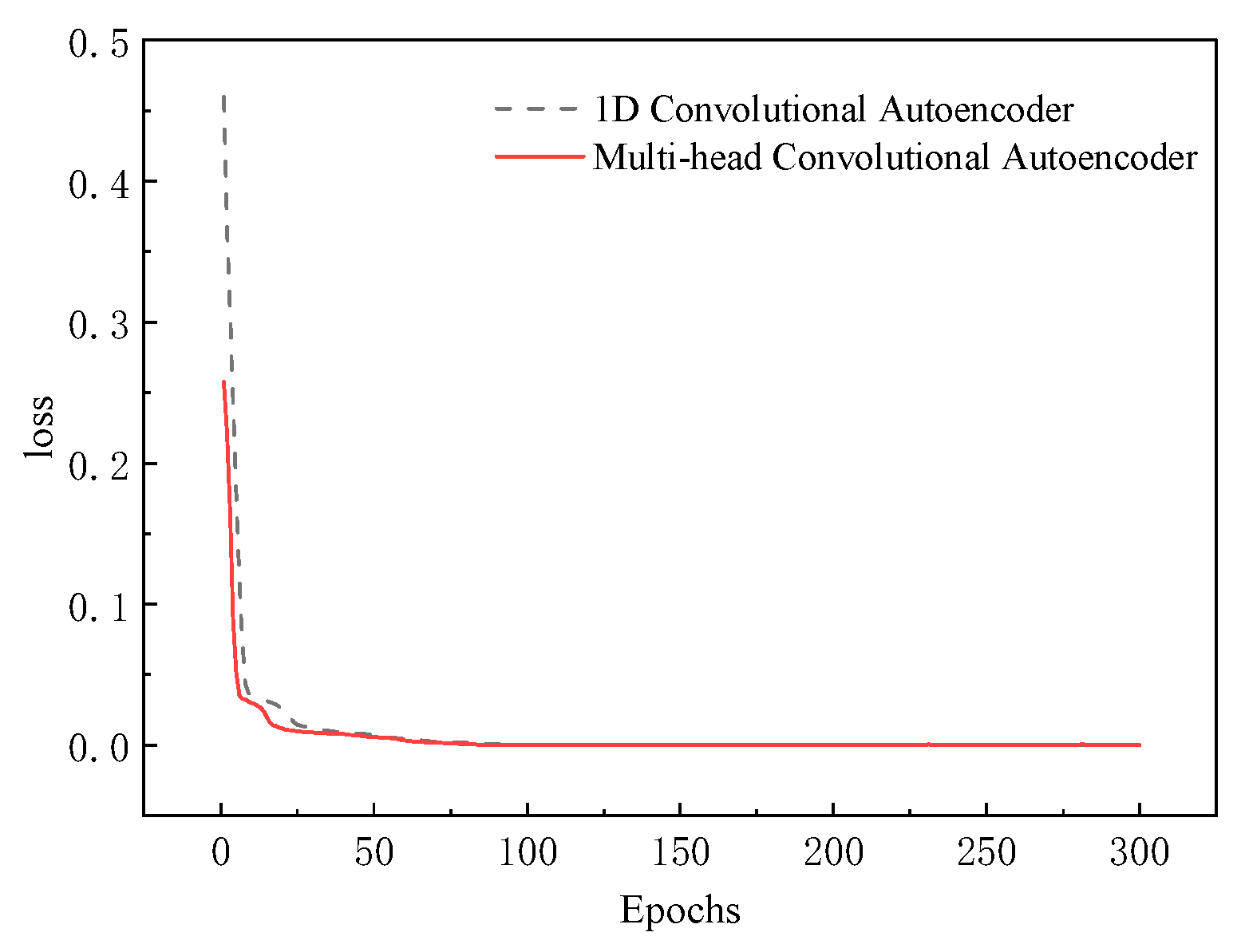
For model training, the dataset of acceleration signals was randomly divided into training and validation sets. Specifically, 80% of the signals were used for training, while the remaining 20% were reserved for validation and testing. This partitioning ensures that the model’s learning is evaluated on previously unseen data, supporting unbiased assessment of reconstruction performance. With regard to the hyperparameter settings, the number of training epochs was set to 300, the learning rate was 0.001, and the ADAM optimizer was employed. The MSE was used as the loss function. As shown in Figure 6, both CAE models converge rapidly, with MSE approaching zero, indicating effective feature acquisition from bridge vibration signals.

3.2. Results Analysis

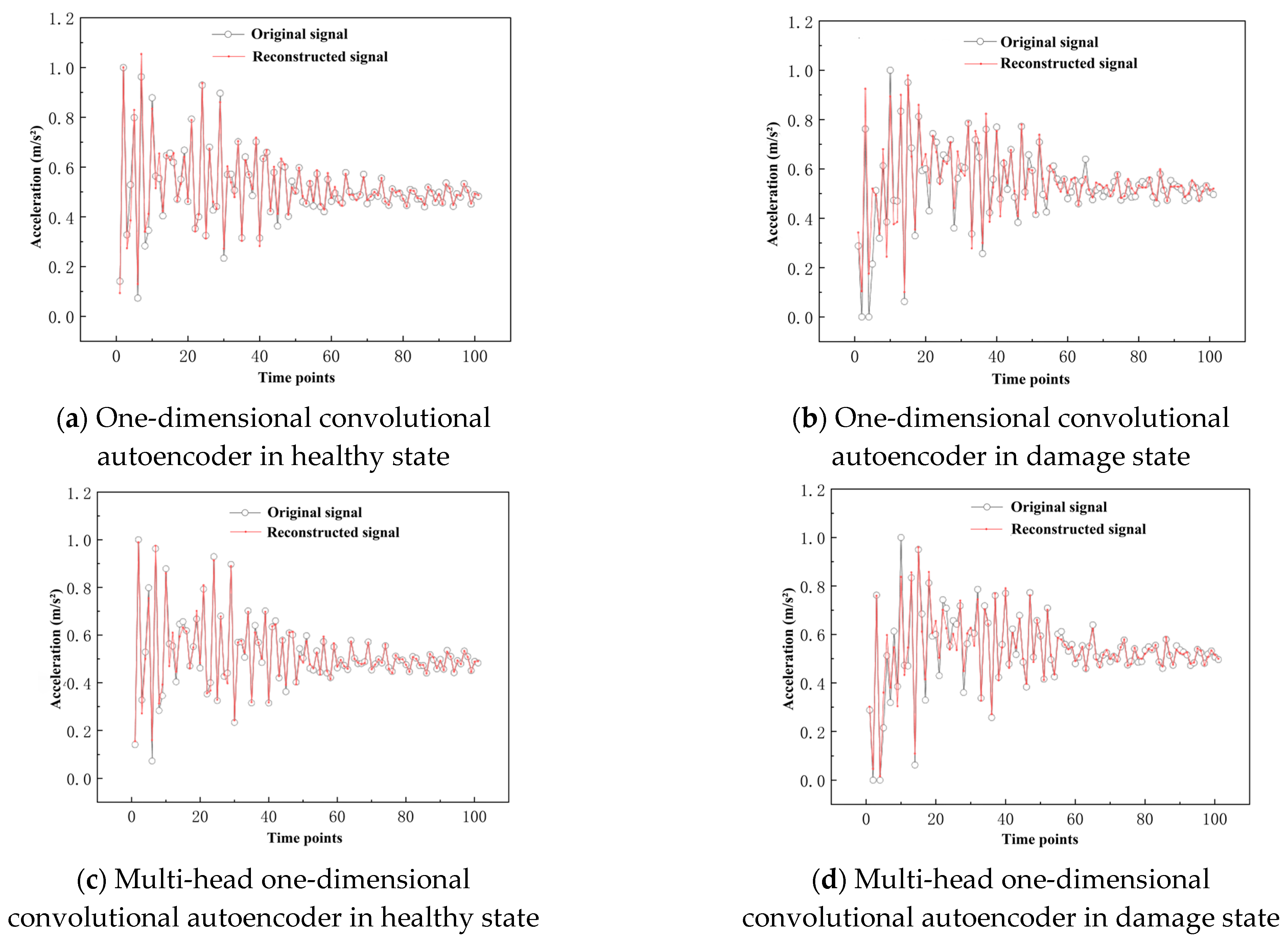
During testing, the reserved 20% of the dataset, not used during training, was employed to evaluate reconstruction performance. Figure 7 shows an example from Beam No. 1 in Experiment 1, where 100 sampling points with significant fluctuations were selected for illustration. The CAE reconstruction’s RMSE was 5.74% (healthy) and 6.91% (damaged). The MH-CAE’s RMSE was 3.57% and 4.26%. The one-dimensional CAE and MH-CAE successfully reconstructed signals in the healthy state, while deviations were observed in the damaged state (10 mm mid-span crack). This demonstrates the models’ capability to identify structural anomalies using previously unseen data.

4. Discussion

4.1. Damage Index Evolution and Experimental Observations

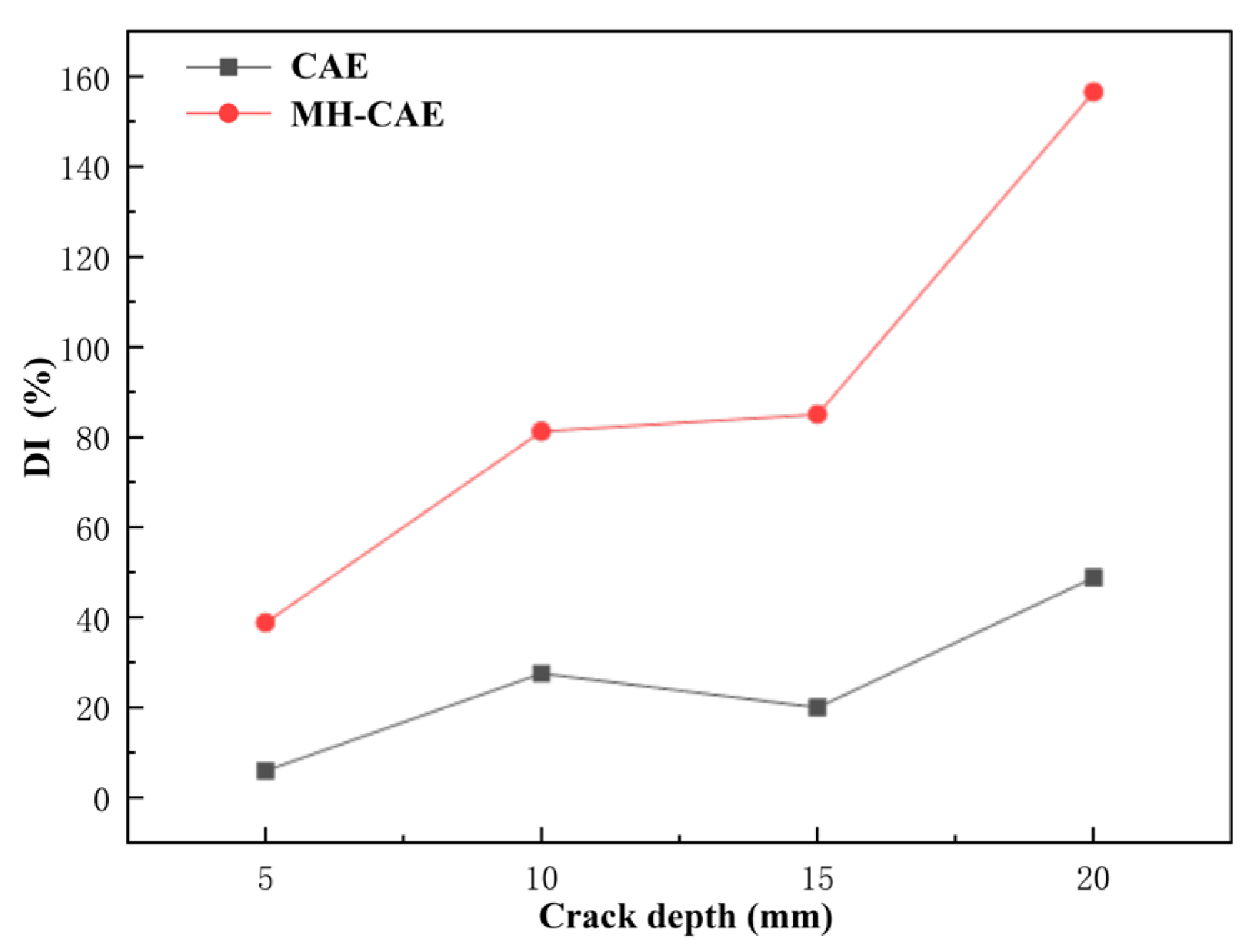
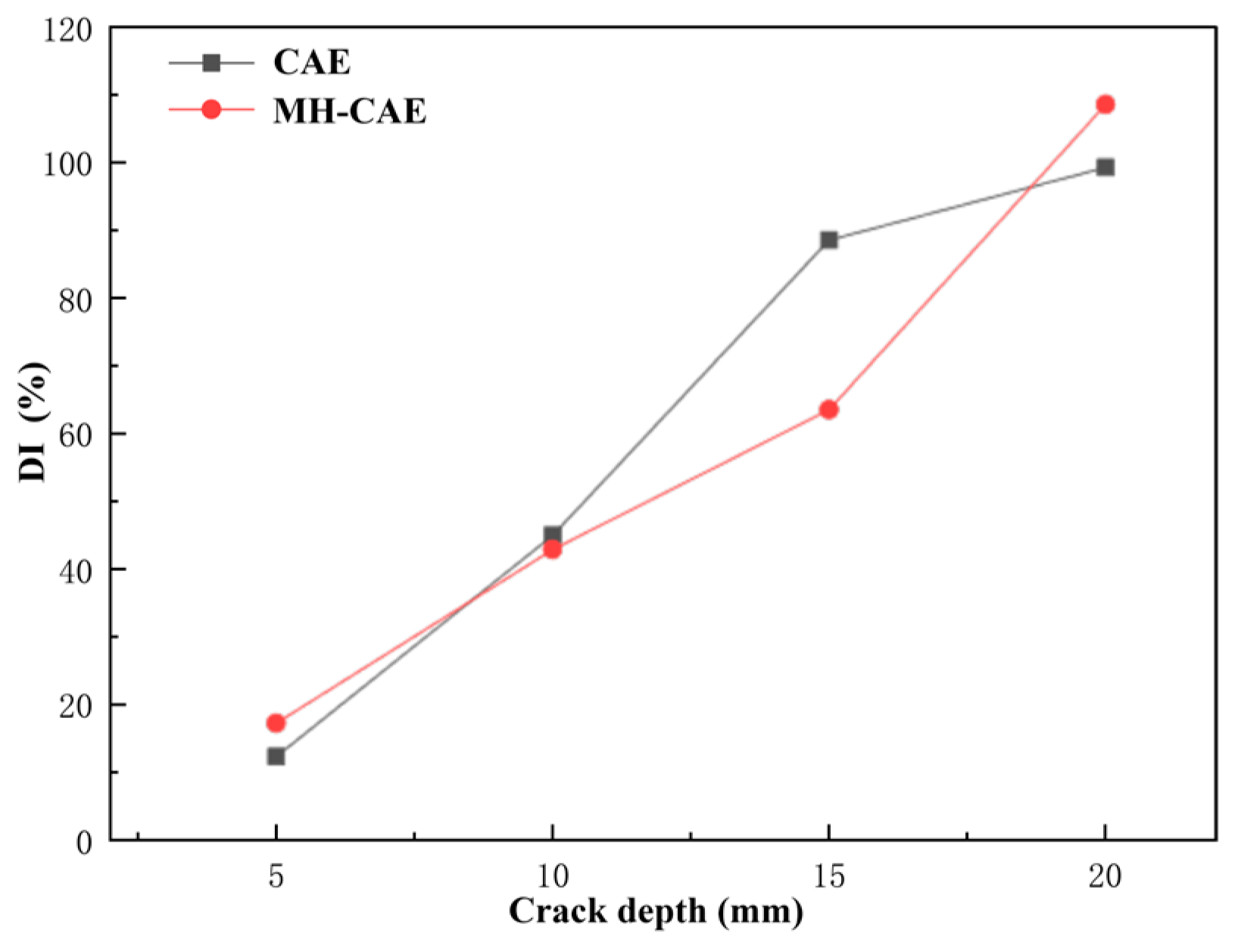
Figure 8 and Figure 9 present the mean DI values obtained from 20 hammer strikes under each damage condition. Table 4 lists the corresponding mean and standard deviation values. For all cases, the standard deviation is below 4% of the mean. This confirms low dispersion and high repeatability of the measurements. For both models, the DI increases markedly with increasing crack depth. An approximately linear relationship between DI and damage severity is observed. This trend indicates that the extracted vibration features correlate well with stiffness degradation caused by cracking. These results confirm the effectiveness of the autoencoder-based damage identification method under experimental conditions. As shown in Figure 9, the damage index progression of the CAE for Test Beam No. 2 reflects the system performance. The DI values obtained using the one-dimensional CAE are 5.34%, 27.38%, 21.26%, and 49.54%, respectively. For the MH-CAE, the corresponding DI values are 39.15%, 81.96%, 85.68%, and 157.24%. The one-dimensional CAE exhibits a noticeable deviation at a crack depth of 10 mm. The DI does not increase monotonically with further crack growth and shows only limited variation. In contrast, the DI obtained from the MH-CAE increases consistently and almost linearly with damage severity. This result demonstrates the superior sensitivity of the MH-CAE in capturing progressive structural degradation. Both models can reflect damage severity through DI variation. A strong linear relationship between DI and damage is observed in most cases. However, model performance varies between experimental beams. For Test Beam 2, the one-dimensional CAE shows reduced accuracy at certain damage levels, especially at a crack depth of 10 mm. This phenomenon may be caused by damage-related signal features being masked by environmental noise.

4.2. Mechanism Interpretation and Engineering Applicability

In practical engineering applications, variations in signal amplitude must be considered. These variations may arise from sensor gain differences and environmental excitations. Such factors can influence vibration measurements and affect DI stability. Therefore, robustness metrics that are amplitude-insensitive or normalised should be developed. Examples include correlation coefficients, spectral coherence indices, and regularised error norms.
In engineering monitoring systems, DI-based automatic warning thresholds can be defined statistically. A practical threshold can be expressed as follows:
Alarm threshold = mean DI (healthy state) + n × standard deviation
Here, n is selected according to the acceptable project risk level. This strategy allows for adaptive and interpretable health assessment in long-term monitoring.
The superior performance of the MH-CAE can be explained by its multi-scale feature extraction capability. The multi-head one-dimensional convolutional autoencoder employs convolution kernels of different sizes. These kernels capture structural dynamic features at multiple temporal and frequency scales. This structure enables comprehensive learning of multi-level vibration characteristics. It also improves performance under complex damage scenarios, such as non-uniform crack development. However, performance fluctuations are observed for Beam No. 2 with quarter-span damage. At certain damage levels, such as the 10 mm crack depth, the MH-CAE shows minor instability. This behaviour is likely caused by dynamic coupling between the damage location and sensor layout. Local stiffness reduction at the quarter span produces weaker effects on global modal responses compared to mid-span damage. As shown in Table 2, such responses are more easily masked by measurement noise and testing uncertainty. In addition, the multi-scale convolution kernels may assign suboptimal weights when capturing features of atypical local damage. This may cause identification fluctuations at specific thresholds.
Despite the experimental results demonstrating the effectiveness of the MH-CAE on beams with simulated cracks, its generalisation to real-world structures remains challenging. In order to demonstrate the effectiveness of the proposed model, further validation on real in-service structures is required. In such an eventuality, three primary factors be accorded full consideration: namely, damage location, damage mechanism, and environmental conditions.
(1)
DI sensitivity varies significantly with damage location. The DI values differ between Beam No. 1 (mid-span damage) and Beam No. 2 (quarter-span damage). This indicates that single-point DI evaluation is insufficient for complex structures. Multi-point data fusion is therefore necessary.
(2)
Real structural damage mechanisms are more complex than artificial cracks. Practical structures may suffer from reinforcement corrosion, concrete fatigue, interfacial debonding, and coupled chemical–mechanical degradation. These mechanisms alter stiffness and damping differently from simple notches. As a result, vibration features may deviate from those represented in the training dataset. This may lead to missed detection of certain damage types.
(3)
Environmental and operational variability strongly influences monitoring signals. Temperature changes, humidity variation, and traffic loads may produce signal changes comparable to early-stage damage. Such effects may mask genuine damage features or generate false alarms. A robust monitoring method must therefore distinguish environmental variability from true structural deterioration.

5. Conclusions

This paper has developed an unsupervised structural damage identification method based on a multi-head convolutional autoencoder (MH-CAE) and validated it experimentally. A mechanism combining parallel convolutional kernels with cross-channel information interaction is designed, addressing the issue of insufficient feature fusion in existing multi-scale methods. The primary conclusions that can be drawn from this analysis are as follows:
(1)
This experiment involves constructing an MH-CAE model based on the standard CAE. The model incorporates multiple convolutional kernels of different sizes in parallel within the encoder. This design enables independent extraction of feature representations from the input signal at various temporal scales. The feature maps from the multiple convolutional channels are then integrated and fed into the decoder for reconstruction, achieving multi-scale feature extraction. The MH-CAE effectively reconstructs acceleration signals in the healthy state of the test beam. However, noticeable deviations occur at several points when the beam is damaged. This demonstrates the potential of signal reconstruction for identifying damage in real engineering scenarios.
(2)
During the experiment, the CAE was unable to accurately capture damage information when the crack depth at the midspan of Beam No. 2 reached 10 mm. However, the MH-CAE consistently reflected the damage level throughout the entire identification process. These results suggest that the MH-CAE offers significant advantages in structural damage assessment, demonstrating enhanced accuracy and adaptability and positioning it as a more suitable tool for health monitoring of complex structures.
(3)
To ensure robustness in practical engineering applications, analyses must be conducted based on actual structural characteristics. It is clear that further research is needed to enable accurate damage localization and quantitative assessment. This study focuses on single-damage identification and does not address multi-damage scenarios. Future work will optimise the MH-CAE weight distribution to capture subtle features of localised damage, integrate multi-point data fusion to include richer combinations of damage location and severity, and perform a comprehensive comparison with advanced benchmarks, including standard SHM methods such as PCA, modal curvature, wavelet analysis, SVM, VAE, and LSTM. These improvements will enhance the practical applicability of the method in real structural health monitoring systems.

Author Contributions

Conceptualization, S.J. and J.Z.; methodology, S.J. and J.Z.; software, S.J. and J.Z.; validation, S.J., J.Z. and X.C.; formal analysis, S.J. and J.Z.; investigation, S.J., J.Z. and Q.L.; resources, S.J. and J.Z.; data curation, S.J. and J.Z.; preparation, S.J. and J.Z.; writing—review and editing, S.J., M.W. and J.Z.; visualization, S.J.; supervision, J.Z.; project administration, J.Z.; funding acquisition, J.Z. All authors have read and agreed to the published version of the manuscript.

Funding

This research was funded by the Natural Science Foundation of Ningbo (Grant No. 2023J041), the Key Research and Development Program of Zhejiang (Grant Nos. 2023C03183) and the Quzhou Science and Technology Bureau (Grant No. 2025K209).

Data Availability Statement

The data that support the findings of this study are available from the corresponding author upon reasonable request.

Conflicts of Interest

The authors declare no conflicts of interest.

References

  1. Luo, D.; Li, F.; Niu, D. Research progress on durability diagnosis of concrete structures based on artificial intelligence. Jianzhu Jiegou Xuebao 2024, 45, 1–13. [Google Scholar]
  2. Bertagnoli, G.; Ferrara, M.; Miceli, E.; Castaldo, P.; Giordano, L. Safety assessment of an existing bridge deck subject to different damage scenarios through the global safety format ECOV. Eng. Struct. 2024, 306, 117859. [Google Scholar] [CrossRef] [Scilit]
  3. Franceschini, L.; Vecchi, F.; Belletti, B.; Andrade, C.; Peiretti, H.C. Analytical method for the evaluation of the residual service life of prestressed concrete beams subjected to corrosion deterioration. Struct. Concr. 2022, 23, 121–137. [Google Scholar] [CrossRef] [Scilit]
  4. Garevski, M.; Mircevski, Z.; Kordoska, M.; Banovska, D.; Lazarov, L. Advancements in fire damage evaluation for prestressed concrete bridges: Insights from the Belasica Bridge. Eng. Struct. 2025, 343, 120961. [Google Scholar] [CrossRef] [Scilit]
  5. Yu, M.; Chen, W.; Hou, J. A lightweight network for concrete crack detection in complex environments based on cloud-edge collaboration. Expert Syst. Appl. 2026, 299, 130204. [Google Scholar] [CrossRef] [Scilit]
  6. Li, H.; Chen, R.; Ritha, N.; Wang, J.; Chen, Z. An automatic detection method for road damage in UAV images based on multi-level perception and feature aggregation. Adv. Eng. Inform. 2026, 69, 103814. [Google Scholar] [CrossRef] [Scilit]
  7. Jiang, Y.; Pang, D.; Li, C.; Wang, J. A method of concrete damage detection and localization based on weakly supervised learning. Comput.-Aided Civ. Infrastruct. Eng. 2024, 39, 1042–1060. [Google Scholar] [CrossRef] [Scilit]
  8. Jiang, T.; Li, L.; Samali, B.; Yu, Y.; Huang, K.; Yan, W.; Wang, L. Lightweight object detection network for multi-damage recognition of concrete bridges in complex environments. Comput.-Aided Civ. Infrastruct. Eng. 2024, 39, 3646–3665. [Google Scholar] [CrossRef] [Scilit]
  9. Xiong, C.; Luo, Z.; Zheng, J.; Xie, L.; Mei, L.; Li, L.; Long, W. Seismic damage assessment of reinforced concrete frame structures based on transfer-residual networks. Eng. Appl. Artif. Intell. 2025, 161, 112118. [Google Scholar] [CrossRef] [Scilit]
  10. El-Joukhadar, N.; Dameh, F.; Pantazopoulou, S. Seismic Modelling of Corroded Reinforced Concrete Columns. Eng. Struct. 2023, 275, 115251. [Google Scholar] [CrossRef] [Scilit]
  11. Zhang, R.; Xiong, W.; Ma, X.; Cai, C.S. Progressive bridge collapse analysis under both scour and floods by coupling simulation in structural and hydraulic fields. Part I: Numerical solver. Ocean Eng. 2023, 273, 113849. [Google Scholar] [CrossRef] [Scilit]
  12. Ho, L.V.; Bui-Tien, T.; Abdel Wahab, M. A two-step failure identification approach using a stochastic optimization-based ensemble learning model for beams without pristine data. Eng. Struct. 2025, 334, 120253. [Google Scholar] [CrossRef] [Scilit]
  13. Tan, X.; Xie, H.; Xia, C.; Ying, Y.; Hokoi, S.; Li, Y. Artificial intelligence in five key phases of architectural heritage conservation: A systematic review. J. Build. Eng. 2025, 117, 114862. [Google Scholar] [CrossRef] [Scilit]
  14. Yu, Z.; Li, B. Reinforced concrete beam full response prediction with hybrid feature-orientation transformer-LSTM model. Eng. Struct. 2025, 332, 120040. [Google Scholar] [CrossRef] [Scilit]
  15. Zhang, F.; Fu, Y.; Shen, K.; Zhang, Y.; Wang, J. Distributed edge intelligence for structural dynamic response estimation using knowledge distillation and data fusion. Eng. Struct. 2025, 335, 120406. [Google Scholar] [CrossRef] [Scilit]
  16. Wang, Z.; Chen, X.; Shi, Z.; Wu, W.; Liu, Z. Damage mode identification of CFRP sheet strengthened coral aggregate reinforced concrete beams based on acoustic emission technology. Eng. Struct. 2025, 343, 121076. [Google Scholar] [CrossRef] [Scilit]
  17. Fan, C.; Ding, Y.; Liu, X.; Yang, K. A review of crack research in concrete structures based on data-driven and intelligent algorithms. Structures 2025, 75, 108800. [Google Scholar] [CrossRef] [Scilit]
  18. Mangalathu, S.; Hwang, S.H.; Jeon, J.S. Failure mode and effects analysis of RC members based on machine-learning-based SHapley Additive exPlanations (SHAP) approach. Eng. Struct. 2020, 219, 110927. [Google Scholar] [CrossRef] [Scilit]
  19. Yang, Z.; Zhang, Y.; Wang, Y.; Wang, N.; Cui, H.; Qu, Y. Conventional Bridge Damage Identification Based on BP Neural Network. In Proceedings of the 2019 6th Annual International Conference on Material Engineering and Application, Guangzhou, China, 20–21 December 2019. [Google Scholar]
  20. Roy, P.; Bhanu Kiran, G.; Saha, N.; Topdar, P. Identification of damaged member in a truss structure using acoustic emission technique aided by SVM. Struct. Health Monit. 2025, 24, 622–635. [Google Scholar] [CrossRef] [Scilit]
  21. Zhang, G.; Tang, L.; Liu, Z.; Zhou, L.; Liu, Y.; Jiang, Z. Machine-learning-based damage identification methods with features derived from moving principal component analysis. Mech. Adv. Mater. Struct. 2020, 27, 1789–1802. [Google Scholar] [CrossRef] [Scilit]
  22. Bao, Y.Q.; Li, H. Machine learning paradigm for structural health monitoring. Struct. Health Monit.-Int. J. 2021, 20, 1353–1372. [Google Scholar] [CrossRef]
  23. He, Y.; Huang, Z.; Liu, D.; Zhang, L.; Liu, Y. A Novel Structural Damage Identification Method Using a Hybrid Deep Learning Framework. Buildings 2022, 12, 2130. [Google Scholar] [CrossRef] [Scilit]
  24. Guo, P.W.; Mahjoubi, S.; Liu, K.J.; Meng, W.A.; Bao, Y. Self-updatable AI-assisted design of low-carbon cost-effective ultra-high-performance concrete (UHPC). CASE Stud. Constr. Mater. 2023, 19, e02625. [Google Scholar] [CrossRef] [Scilit]
  25. Wang, Z.; Cha, Y.J. Unsupervised machine and deep learning methods for structural damage detection: A comparative study. Eng. Rep. 2025, 7, e12551. [Google Scholar] [CrossRef] [Scilit]
  26. Xu, Y.; Tian, Y.; Li, H. Unsupervised deep learning method for bridge condition assessment based on intra-and inter-class probabilistic correlations of quasi-static responses. Struct. Health Monit. 2023, 22, 600–620. [Google Scholar] [CrossRef] [Scilit]
  27. Akintunde, E.; Eftekhar Azam, S.; Rageh, A.; Linzell, D.G. Unsupervised Machine Learning for Robust Bridge Damage Detection: Full-Scale Experimental Validation. Eng. Struct. 2021, 249, 113250. [Google Scholar] [CrossRef] [Scilit]
  28. Perera, R.; Montes, J.; Gómez, A.; Barris, C.; Baena, M. Unsupervised autoencoders with features in the electromechanical impedance domain for early damage assessment in FRP-strengthened concrete elements. Eng. Struct. 2024, 315, 118458. [Google Scholar] [CrossRef] [Scilit]
  29. Pathirage, C.S.N.; Li, J.; Li, L.; Hao, H.; Liu, W.Q.; Ni, P.H. Structural damage identification based on autoencoder neural networks and deep learning. Eng. Struct. 2018, 172, 13–28. [Google Scholar] [CrossRef] [Scilit]
  30. Vaiyapuri, T.; Binbusayyis, A. Application of deep autoencoder as an one-class classifier for unsupervised network intrusion detection: A comparative evaluation. PeerJ Comput. Sci. 2020, 6, e327. [Google Scholar] [CrossRef] [Scilit]
  31. Lindley, C.A.; Rogers, T.; Dwyer-Joyce, R.; Dervilis, N.; Worden, K. On the application of variational auto encoders (VAE) for damage detection in rolling element bearings. In Proceedings of the 13th International Workshop on Structural Health Monitoring (IWSHM), Stanford, CA, USA, 7–9 December 2021; Volume 2021. [Google Scholar]
  32. Pakzad, S.S.; Masoodi, A.R. Early damage detection in bridges using a variational autoencoder–based hybrid unsupervised learning framework. Sci. Rep. 2025, 16, 1389. [Google Scholar] [CrossRef] [Scilit]
  33. Liang, M.; Liu, R.W.; Li, S.; Xiao, Z.; Liu, X.; Lu, F. An unsupervised learning method with convolutional auto-encoder for vessel trajectory similarity computation. Ocean Eng. 2021, 225, 108803. [Google Scholar] [CrossRef] [Scilit]
  34. Noor, M.H.M. Feature learning using convolutional denoising autoencoder for activity recognition. Neural Comput. Appl. 2021, 33, 10909–10922. [Google Scholar] [CrossRef] [Scilit]
Figure 1. Architecture of convolutional autoencoder.
Buildings 16 00954 g001
Figure 2. Signal reconstruction schematic.
Buildings 16 00954 g002
Figure 3. Reinforced concrete test beam and sensor layout design drawings (unit: mm).
Buildings 16 00954 g003
Figure 4. Schematic diagram showing cracks and hammer impact application.
Buildings 16 00954 g004
Figure 5. Example of Acceleration Sample Data.
Buildings 16 00954 g005
Figure 6. The loss curve during the training phase of the convolutional autoencoder.
Buildings 16 00954 g006
Figure 7. Signal reconstruction effect diagram of convolutional autoencoder for test beam No. 1.
Buildings 16 00954 g007
Figure 8. Damage index obtained by convolutional autoencoder for test beam No. 1.
Buildings 16 00954 g008
Figure 9. Damage index obtained by convolutional autoencoder for test beam No. 2.
Buildings 16 00954 g009
Table 1. Experimental beam damage scenario.
Test Beam NumberDamage LocationCrack Depth
Beam No. 1half span5 mm
Beam No. 1half span10 mm
Beam No. 1half span15 mm
Beam No. 1Half span20 mm
Beam No. 2quarter span5 mm
Beam No. 2quarter span10 mm
Beam No. 2quarter span15 mm
Beam No. 2quarter span20 mm
Table 2. Comparison of Finite Element and Measured Stiffness (N/mm2).
GroupsDepthFEMTest
Mid-span5 mm24,781.7123,689.32
10 mm23,971.0922,988.35
15 mm23,881.2722,971.75
20 mm23,750.3322,541.62
1/4 span5 mm24,718.7824,599.46
10 mm23,962.2723,870.23
15 mm23,826.6223,603.48
20 mm23,642.6823,302.88
Table 3. Network Structure Table.
Overall Structure NameLayer NameNumber of
Convolutional
Kernels
Convolution Size
Single-headed
one-dimensional convolutional
encoder
First layer
one-dimensional convolution
163 × 1
Second layer
one-dimensional convolution
323 × 1
Third layer
one-dimensional convolution
643 × 1
Multi-head
one-dimensional convolutional
encoder
First layer multi-head
one-dimensional convolution
3 × 16[3, 5, 7] × 1
Second layer multi-head
one-dimensional convolution
3 × 32[3, 5, 7] × 1
Third layer multi-head
one-dimensional convolution
643 × 1
DecoderFirst layer one-dimensional
transposed convolution
324 × 1
Second layer one-dimensional
transposed convolution
164 × 1
Third layer one-dimensional
transposed convolution
14 × 1
Table 4. Average and standard deviation of 20 hammer strikes.
BeamModelDepth (mm)Mean DI (%)SD DI (%)
1CAE512.340.49
1044.981.8
1588.543.54
2099.263.97
MH-CAE517.250.69
1042.871.71
1563.532.54
20108.574.34
2CAE55.340.21
1027.381.09
1521.260.85
2049.541.98
MH-CAE539.151.56
1081.963.28
1585.683.42
20157.244
Disclaimer/Publisher’s Note: The statements, opinions and data contained in all publications are solely those of the individual author(s) and contributor(s) and not of MDPI and/or the editor(s). MDPI and/or the editor(s) disclaim responsibility for any injury to people or property resulting from any ideas, methods, instructions or products referred to in the content.