Article

Multi-Objective Optimization of Production Sequence and Layout of Precast Concrete Components on the Mold Table Under Limited Mold Quantity


1
School of Civil Engineering, Sichuan University of Science and Engineering, Zigong 643000, China
2
Luzhou Key Laboratory of Intelligent Construction and Low-Carbon Technology, Luzhou 646000, China
3
Building Environment Engineering Technology Research Center, Sichuan University of Arts and Science, Dazhou 635000, China
4
School of Mechanical Engineering, Hubei University of Arts and Science, Xiangyang 441000, China
5
School of Mechanical and Electronic Engineering, Wuhan University of Technology, Wuhan 430070, China
*
Author to whom correspondence should be addressed.
Buildings 2026, 16(5), 951; https://doi.org/10.3390/buildings16050951

Submission received: 29 December 2025 / Revised: 30 January 2026 / Accepted: 25 February 2026 / Published: 28 February 2026
(This article belongs to the Section Construction Management, and Computers & Digitization)

Abstract

Precast concrete components, as one of the important structural systems in prefabricated buildings, have received widespread attention due to their efficient manufacturing characteristics on the production line. Their production sequence and layout on the mold table have a crucial impact on production energy consumption. However, a critical constraint is often overlooked in the first step of precast concrete manufacturing: the production sequence and layout of molds are planned without considering the limited availability of molds for each component type. Therefore, this article proposes a mixed-integer programming model for the production sequence and layout of precast concrete components under a limited number of molds, aiming to simultaneously minimize production energy consumption, fluctuation coefficients of mold table utilization, and mold switching time. To obtain high-quality solutions for production sequence and mold layout, a multi-objective genetic flatworm algorithm with a Tabu mapping mechanism is developed to efficiently determine the production sequence and the positions of molds on the mold tables. Through three production cases of precast concrete components with different scales, the proposed model and algorithm have been demonstrated to be highly effective in assisting decision-makers in quickly formulating the optimal production sequence and layout schemes for precast concrete components.

1. Introduction

With the accelerated pace of global urbanization and the booming development of the construction industry, the pursuit of efficiency, quality, and environmental standards in construction projects has become increasingly stringent. Prefabricated buildings, with their innovative models of prefabricated production and rapid on-site assembly, are gradually becoming an important driving force for the transformation and upgrading of the construction industry [1]. By manufacturing precast concrete components (PC/PCs) in factories and assembling them efficiently on-site, the model not only realizes the standardization, industrialization, and informatization of the construction process but also greatly improves the construction efficiency and reduces the construction cost [2,3,4], while effectively reducing construction waste and environmental pollution and exploring a new path for the pursuit of sustainability in construction practices [5].
Relevant government departments in China attach great importance to the development of prefabricated buildings. The ‘14th Five-Year Plan’ for the development of the construction industry clearly proposed that, by 2025, a target be set requiring that prefabricated buildings account for over 30% of all new construction [6,7]. Sichuan Province has set a high target of over 40% and emphasized that the assembly rate should not be less than 50%. In this context, PCs, as the core component of prefabricated building systems, have a dual guarantee of production efficiency and quality, which is crucial for ensuring the successful implementation of the entire building project.
The production of PCs is a discrete manufacturing process highly dependent on mold technology [8]. As a key tool in the production process, the rationality of the mold design and the efficiency of the layout directly determine the overall performance of the production line. Mold layout is the optimal strategy for planning the layout of PCs within a limited space on the mold tables, aiming to maximize mold tables’ utilization, shorten production cycle times, and reduce costs [9]. This process not only requires designers to possess exceptional intelligence and innovation capabilities but also tests the coordination and scheduling abilities of production managers. In view of the continuous growth of construction demand and the increasingly fierce competition in the market, it is particularly important to study the optimization of the mold layout for the production of precast PCs. Optimization of mold layout can bring multiple benefits: Firstly, it significantly improves production efficiency by reducing the frequency of mold replacement through scientific and reasonable layout design, shortening the production cycle time, and improving the continuous operation capability of the production line, thereby achieving rapid production growth while ensuring component quality. Secondly, optimizing the layout of PC molds can avoid mold turnover waste, improve mold table utilization, reduce mold wear and maintenance costs, and ultimately lower total production costs, creating greater economic benefits for the enterprise. Finally, it can also promote the standardization and automation of the PC production process, further enhancing the management level and market competitiveness of enterprises [10,11,12].
Although scholars have made many research achievements in the field of PC production planning and scheduling, there is still a lack of in-depth research on the optimization of PC production mold layout [9]. Especially in the production environment of limited mold resources and multiple varieties and small batches, effectively evaluating the impact of mold layout on PC production, balancing the workload of the mold tables, saving energy consumption, and minimizing the negative effects of mold switching have become complex and challenging topics. The main contribution of this paper includes the following aspects:
  • A mixed-integer programming (MIP) model is constructed for the production sequence and layout optimization under mold constraints (PC-PLO-MC), which considers the limitation of mold quantity and the production spacing requirements, enhancing the practical relevance of the PC-PLO-MC model.
  • With respect to the current concerns of PC production managers, three optimization objectives are defined in the PC-PLO-MC model, including minimizing the production energy consumption, balancing the utilization rate of the mold tables, and reducing mold switching time.
  • A multi-objective genetic flatworm algorithm with a Tabu mapping mechanism (GFA–Tabu) is developed to solve PC-PLO-MC, and a PC positioning selection strategy called weighted matching filling is designed. Finally, the effectiveness of the algorithm in optimizing PC production sequence and layout is verified by three cases of different scales.
The rest of this article is organized as follows. Section 2 reviews the relevant areas of focus in current PC production. Section 3 describes the optimization problem of PC production layout under mold constraints and constructs the MIP model. Section 4 details the logical steps of the work of the proposed GFA–Tabu. Section 5 validates the applicability of the proposed PC-PLO-MC model and the computational efficiency of the GFA–Tabu method through a total of four numerical cases of three different scales. The last section summarizes the conclusions of PC-PLO-MC.

2. Related Works

PC-PLO-MC has been proven to be similar to the cutting stock problem [13] and the two-dimensional bin packing problem [14,15], but it is far more complex than both. A great deal of theoretical research and practical work has been conducted by researchers and PC producers, respectively. This section mainly focuses on three aspects: the PC production process and production organization, PC production scheduling optimization, and molds in the PC production.

2.1. PC Production Process and Production Organization

The production process of PC usually undergoes the following procedures [16]. (1) Mold preparation and assembly. The molds matching the PCs to be produced are selected and precisely fixed on the mold table. (2) Installation of steel reinforcement skeleton and embedded parts. Accurately place and fix the elements to be pre-buried in the PC, such as electrical conduits, junction boxes, etc., to the designated locations. (3) Concrete pouring. The concrete is evenly cast into the mold, and the process needs to ensure that there are no air bubbles and voids inside the concrete, and the surface is flat and smooth. (4) Curing stage. The PCs are moved to a specialized curing room with a high-temperature and high-humidity environment for the PC to accelerate the hardening process as soon as possible. (5) Demolding. When the concrete strength reaches 75% or more of the design strength, the PCs can be removed from the curing room together with the molds, and the molds can be removed so that the PC is completely exposed. (6) Post-processing and inspection. After demolding, conduct a detailed inspection of the surface of the PC, and if necessary, perform precision machining such as polishing and repairing.
In terms of PC production organization, two main modes currently exist: fixed-mold table production and flow mold table production [17]. Despite their differences, both share the six core processes outlined above. The key distinction lies in the role of the mold table: in fixed-mold table production, the table remains stationary while operators, reinforcement, and concrete move between tables. This method offers broad applicability and strong versatility, making it suitable for producing non-standard PCs [18]. The other method is a mode of continuous production through automated or semi-automated production lines in a specific sequence and rhythm. The PC production line is organized into multiple workstations corresponding to the processes outlined above. Each workstation is equipped with dedicated operators and tools to perform one or a few specific tasks. During the production process, the operators remain stationary while the mold tables are transported between workstations by the production line system. This method has the advantages of high automation, high productivity, and low production costs, and it is particularly suitable for large-scale, standardized production of PCs [19].

2.2. PC Production Scheduling Optimization

Optimizing the production sequence and layout of PCs plays a key role in production planning and scheduling [18]. Since the initial proposal by Warszawski [20], numerous scholars have dedicated significant effort to this field of research. Subsequently, Chan et al. developed a foundational flow shop scheduling model for PC production, laying the groundwork for subsequent studies on PC production scheduling [10,19,21]. Subsequent research has explored various dimensions of this problem. For instance, production scheduling in a hybrid flow shop environment—where standard PCs are made-to-stock and non-standard units are made-to-order—has been examined [22]. The scheduling in multi-factory PC production has also been investigated to improve delivery performance [23]. Recognizing the continuous nature of concrete pouring and curing processes, researchers have introduced blocking constraints between mold tables to enhance model realism [7]. Dynamic scheduling models accounting for uncertainties in construction project progress have been developed, reducing the likelihood of delivery delays [12,24,25]. More recently, a comprehensive model incorporating mold preparation, PC inventory, and delivery has been proposed to improve the accuracy of the whole supply chain [17]. Recently, a production redundancy scheduling optimization model has been developed to address the issue of unstable production interruptions in PCs to minimize interruption losses in PC production [26].
The primary objectives of optimizing the production planning and scheduling of PCs can be broadly categorized into four main areas: minimizing the makespan [16,18,19,21,27,28,29], reducing production costs [7,30,31,32], minimizing inventory costs [23,33,34], and mitigating the financial penalties incurred due to delayed or early delivery. The reduction in bottlenecks and construction delays [35], the maximization of profitability and supply security [36], and so forth. The field of production scheduling is inherently complex, with the NP-hard problem representing a significant challenge [23,37]. The complexity of PC production scheduling has prompted the development of three optimization paradigms: exact algorithms, heuristics, and meta-heuristics. Exact methods—including mathematical analysis [38], MIP [39], and branch and bound [40]—provide optimal solutions but face scalability issues. Heuristic algorithms constructed based on intuition or experience can optimize the makespan with acceptable time consumption [41]. As problem size increases, however, both categories encounter limitations, driving research toward meta-heuristic algorithms. This class of methods encompasses a range of techniques, including the classical genetic algorithm [16,42], particle swarm optimization [43,44], simulated annealing [37], and hybrid algorithms such as the hybrid differential firefly algorithm [45], genetic gray wolf optimizer [46], and others. Recently, simulation [47] and reinforcement learning-based approaches [48,49] have also demonstrated efficacy in PC scheduling.

2.3. Mold Resources in PC Manufacturing

PCs flow unidirectionally between workstations on the mold table throughout a production cycle, and all of the above literature has examined the problem of production sequencing of PCs. Regarding the role of mold resources in PC production, the inclusion of identical parallel molds with shared resources in PC production was studied, aiming to reduce the total product cost [50]. Lim addressed the challenge of optimizing both production scheduling and stacking area design for PCs, considering mold table limitations [51]. The influence of custom mold availability on PC processing time was explored by Benjaoran et al. and Yang et al. [52,53]. Hu combined tool scheduling with flow shop optimization to achieve balanced tool use and reduce peak-demand-induced waste in PC production [10].

2.4. Research Gap

Research on PC production sequence and layout on the mold table remains limited. Zheng et al. applied grouping techniques to PC allocation on the mold table, addressing scheduling challenges in mixed flow production [54,55]. However, their reliance on a 0–1 random assignment method, which neglected the geometric and positional relationships between components, failed to provide a viable solution for mold assembly—a significant gap relative to actual production practices. Wang et al. addressed this limitation by proposing a MIP model that incorporates order demand, mold table dimensions, and constraints related to component positioning. Their approach maximizes the average utilization of mold tables during assembly [9]. However, this approach suffers from two shortcomings. One is its failure to account for mold quantity constraints arising from high production costs. The other is its reliance on a predefined, limited number of PC arrangement patterns on the mold table, limiting real-world usefulness.
Therefore, optimizing the production sequence and layout of PCs subject to the limited molds is of considerable importance. This study focuses on addressing such efficiency bottlenecks in PC manufacturing practice. A mixed-integer programming model is developed, which establishes three core optimization objectives: minimizing production line energy consumption, balancing mold table utilization, and reducing mold switching time. Building on this, a multi-objective genetic flatworm algorithm incorporating a Tabu mapping mechanism is proposed to solve the problem of PC-PLO-MC, with its performance effectively validated through practical case studies.

3. Mathematical Model for PC-PLO-MC

3.1. Problem Statement

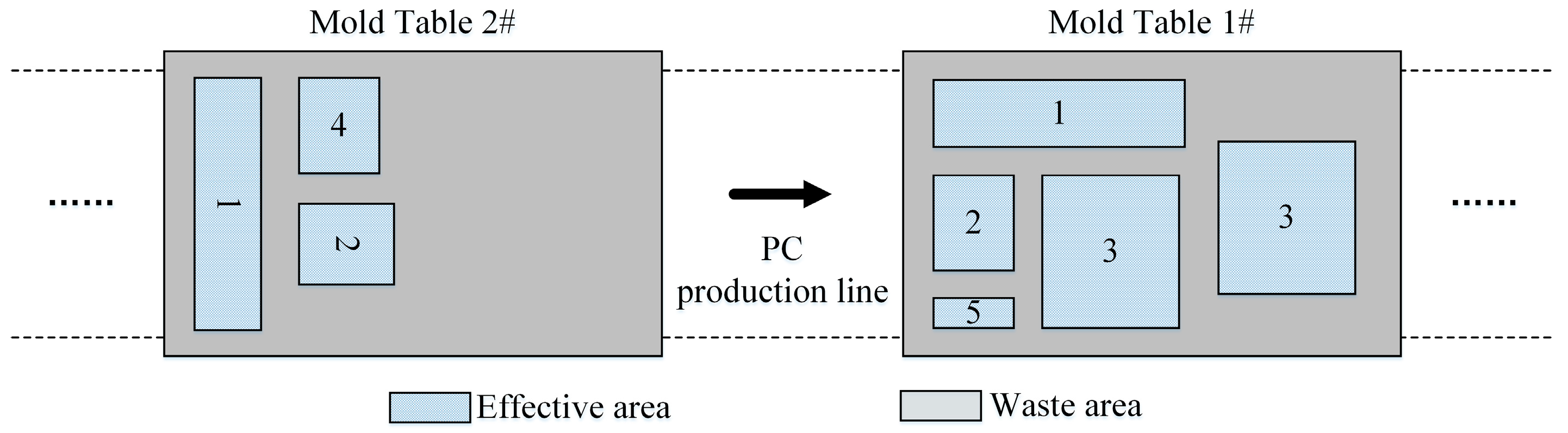
All six PC fabrication processes are carried out on a series of mold tables along the production line. As illustrated in Figure 1, two mold tables at the assembly workstation hold eight components spanning five different sizes.
The space occupied by PCs constitutes the effective utilization area of the mold table, while the remaining area is wasted. A larger total occupied area of PCs on the mold tables corresponds to a higher utilization rate. For the curing process with high energy consumption, a higher number of PCs can be cured simultaneously with the limited capacity of the curing kiln. Therefore, increasing the overall utilization of the mold tables contributes to a marked reduction in energy consumption.
Table 1 presents the order information for four types of PCs, with each column representing the corresponding mold quantity, order demand quantity, PC entity size for the concrete casting part, and the length of the extended steel bars in four directions. It should be noted that the area occupied by a PC on the mold table includes both its concrete section and the extended reinforcement portion. The impact of the production sequence and layout of PCs in Table 1 on energy consumption, production line balance, and mold switching time will be elaborated upon in Section 3.3.

3.2. Assumptions

  • The types, geometries, and order demand quantities of all PCs waiting to be produced are known.
  • The number of molds for each PC type is predetermined, regardless of the combination of molds. During the production of each type of PC, the corresponding molds participate in the layout according to the maximum available quantity.
  • Parallel alignment with the mold table edge is maintained for all PC molds in the layout, and non-parallel placement is not considered.
  • The number of mold tables is sufficient.
  • There is no difference in the demand deadline for all PCs in the production order.
  • All coefficients directly related to PC production are known.

3.3. Mathematical Model of PC-PLO-MC

When arranging PC molds on the mold table, the following geometric dimensions, positional constraints, and associated quantitative constraints should be satisfied:
0 P is Q i             i I , s S
s = 1 N s P is = d i         i I
d / 2 x i L 1 r i l i r i w i d / 2         i I
d / 2 y i W 1 r i w i r i l i d / 2         i I
x i + 1 r i l i + r i w i + d x j         i , j I
x j + 1 r j l j + r j w j + d x i         i , j I
y i + 1 r i w i + r i l i + d y j         i , j I
y j + 1 r j w j + r j l j + d y i         i , j I
i = 1 I z i p = 1           p P
r i = 0   or   1 , r j = 0   or   1         i , j I
Equation (1) denotes that the quantity of molds allocated to the ith PC does not exceed a given value in the sth layout. Equation (1) denotes that all PCs are produced after several layouts, and the demand of the order is satisfied. Equations (3) and (4) indicate that the molds for any PC are placed inside the mold table, and the spacing between each PC and the edge of the mold table is not less than half of the production spacing, where the production spacing  d = 300   m m . On the mold table, any two PCs cannot overlap each other, and their feasible relative positional relationships can be up-down or left-right. Therefore, the coordinate constraint relationship between them can be expressed as Equations (5)–(8) for a set of redundant constraints, and only one of which needs to be satisfied in practice. In a PC’s production sequence, the PC’s category at any location is uniquely determined and can be constrained by Equation (9). Equation (10) represents the feasible arrangement direction of the PCs, where 0 corresponds to parallel orientation between the PC length and mold table length, and 1 means that the two directions are perpendicular to each other.
Based on the above layout constraints, the aim is to minimize the following three objectives:
min f 1 = f 11 + f 12               f 11 = w 1 + w 2 i I l i w i h i               f 12 = w 3 α i I l i w i h i + β k K y k
min f 2 = k K ( η k max { η k } ) 2 / k K y k               η k = i I l i k w i k h i k / L W
min f 3 = w 4 k K y k + w 5 p = 1 P z p
Equation (11) represents the total energy consumption of the PCs, which, in terms of energy type, consists mainly of water, electricity, and natural gas apportioned to the PCs by the production line system. In terms of the production process,  f 1  can be divided into two parts, where  f 11  is called the process energy consumption, which consists of the energy consumption of the hot curing process and five other processes, and is positively proportional to the volume of the PCs.  f 12  is called the transportation energy consumption (also known as the non-process energy consumption), which is mainly related to the weight of the PCs to be produced and of the utilized mold tables. It is assumed that each cubic meter of reinforced concrete is 2.5 tons, and each mold table is 10 m long, 4 m wide, and weighs 6 tons, with a thickness of 60 mm for all PCs. For calculation purposes, energy consumption is measured in kilograms of standard coal equivalent (kgce). Based on the norm of energy consumption per unit of PCs,  w 1  is set to 25 kgce/m3 w 2  is set to 5 kgce/m3, and  w 3  is set to 6 kgce/t. It should be noted that the total energy consumption does not include the energy consumed by the PCs from the factory delivery to the construction site. Thus, it is clear that energy consumption is closely related to carbon emissions, with lower total energy consumption indicating a relatively cleaner production process.
η k  in Equation (12) represents the utilization efficiency of the kth mold table, expressed as the ratio of the occupied area of all PCs to the whole area of the utilized mold tables.  f 2  represents the balance coefficient of the utilization of the production line’s mold tables during the completion of all processes, which indicates the fluctuation degree of the utilization efficiency across all mold tables or the operators’ workload. Very similar to the standard deviation, the smaller the indicator, the more balanced the workload of different mold tables at the same workstation in the entire assembly line; to a large extent, the situation of sometimes idle and sometimes busy is avoided.
f 3  represents the mold switching time, which consists of two parts.  w 4  is the switching time between two mold tables, which is assumed to be 10 min, and  w 5  is the mold adjustment time for two different PCs, which is set to 2 min, and we assume that the mold adjustment time for two consecutive identical PCs is 0. In a PC layout sequence, the total number of switching times for PCs can be stated as the  p = 1 P z p . The switching time for the first precast component is counted as  z 1 = 1 . The lower the value, the less non-value-added time it takes for mold switching and adjustment, which is highly favored by workshop managers.
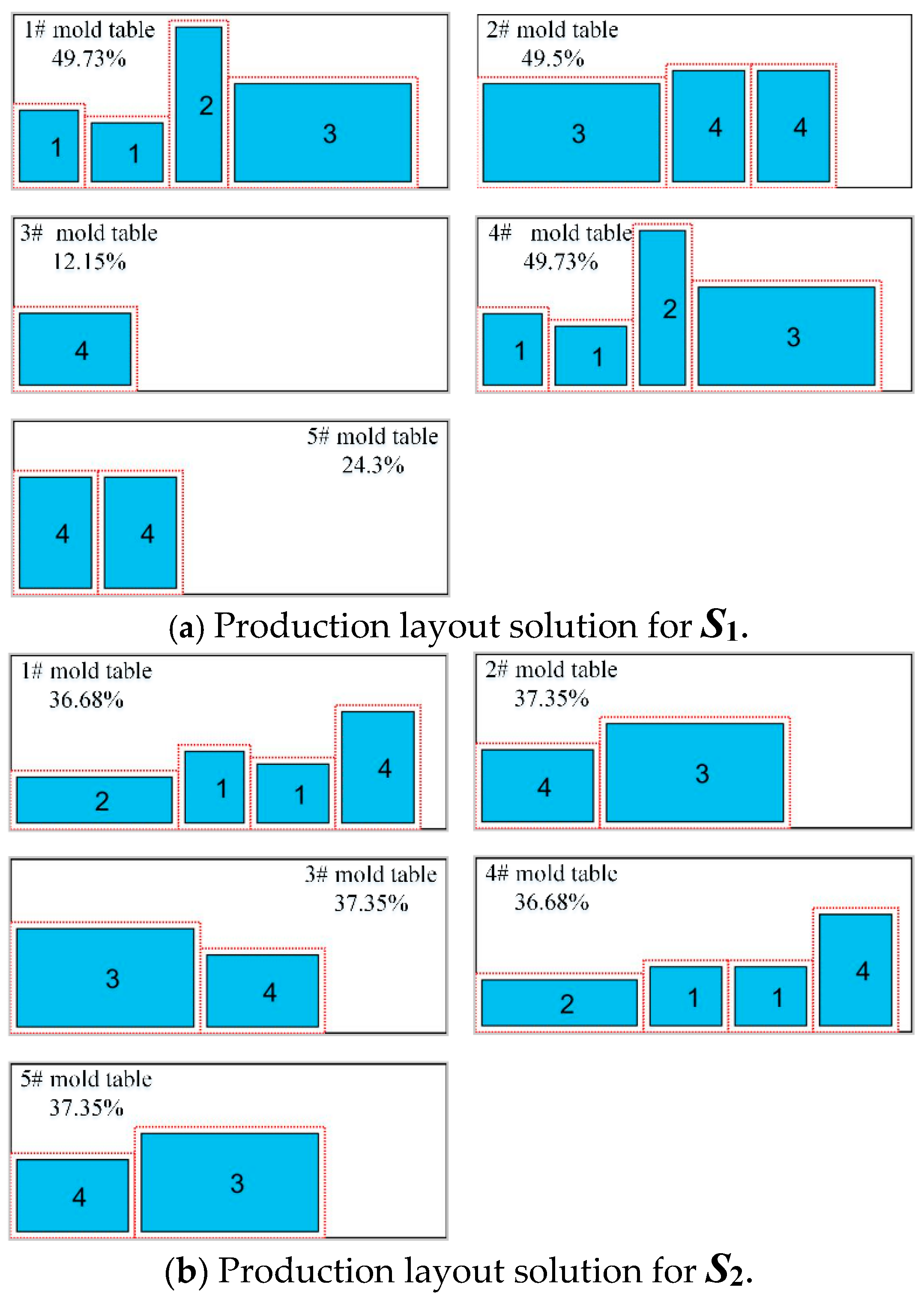
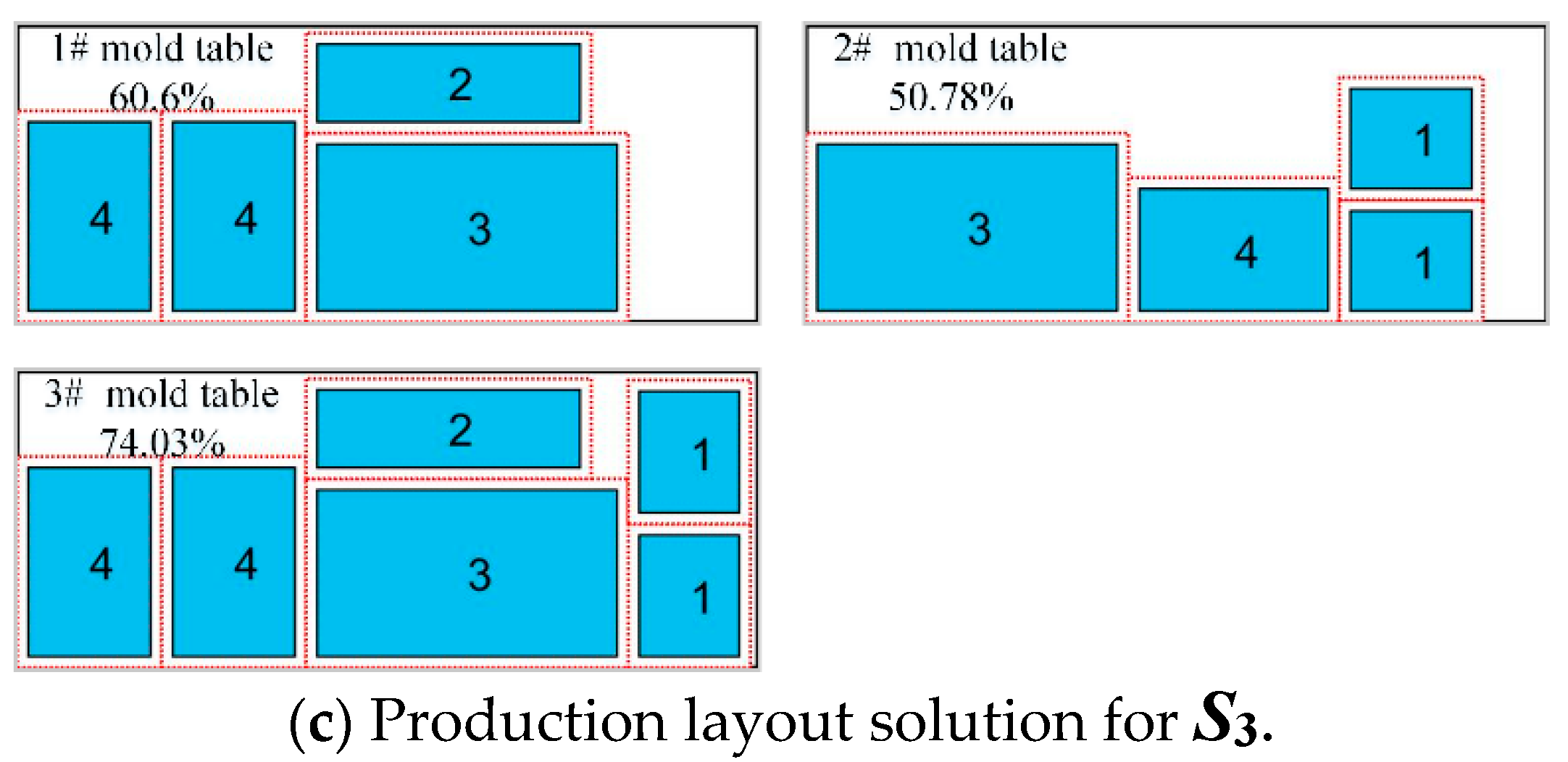
The effect of the PC production sequence and layout scheme on the optimization objectives can be demonstrated using P4 in Table 1, assuming that there are three different PC production sequences for the same production task, S1 = {11233444,112344}, S2 = {21144334,211443}, and S3 = {44334211,443211}. Obviously, the limitations on the number of molds result in all three scenarios requiring the mold to cycle at least two times to satisfy the order demand. The expression of production sequences will be detailed in the encoding part. Subject to the above constraints, three different production scenarios are shown in Figure 2, with the dark rectangles indicating the PCs placed on the mold tables and the red dashed boxes indicating the production process interval boundaries.
Intuitively, five mold tables are required by both S1 and S2 to complete the layout task, while S3 requires only three, leading to significantly higher energy consumption in S1 and S2. The usage rate per mold table is given in the blank areas in Figure 2, respectively. According to Equation (12), the mold table utilization balance rate for scheme S1 is 20.29, while it is only 0.43 for S2. Although the balanced utilization of all three mold tables in scheme S3 is above 50%, which is significantly higher than that of the other two schemes, its f2 is 15.5, which indicates that the production line has a better rhythmicity under scheme S2. Ideally, the shorter the mold switching time is when all the PCs of the same type are arranged in a layout together, so scheme S1 has the shortest switching time of 16 min. However, considering the limitation of the number of molds, the different placement order of PCs, and the preparation time for switching and cleaning the mold tables, the scheme shown in Figure 2c saves more non-value-added labor time.
PC-PLO-MC simultaneously minimizes energy consumption, mold utilization balance index, and mold switching time. The case in Figure 2 also proves the conflict between the three objectives; that is, the three objectives cannot be minimized simultaneously. Therefore, PC-PLO-MC belongs to multi-objective optimization problems. To evaluate the quality of the solution, the idea of the Pareto optimal solution (also known as the Pareto non-dominated solution) is employed, and a detailed description can be found in the classical non-dominated sorting genetic algorithm (NSGAII) [56]. Based on the characteristics of the combinatorial explosion of PC production layout schemes under the constraint of mold quantities, approaches to maximize mold table utilization while ensuring balanced workloads at each workstation, while reducing the energy consumption of the production process, and minimizing the non-value-added operation time make PC-PLO-MC more challenging and complex.

4. Genetic Flatworm Algorithm with Tabu Mapping Mechanism

The flatworm algorithm (FA), inspired by the unique growth, splitting, and regeneration mechanisms of flatworms in nature, has been ingeniously transformed and designed by Tseng and his partners [57] into an efficient search and optimization algorithm. This algorithm not only cleverly draws on the unique biological characteristics of flatworms, making its principles and operation process intuitive and easy to understand, but also stands out in the field of combinatorial optimization with its global search ability, such as disassembly sequence planning. However, the single-starting-point design of FA limits its parallel computing capabilities, making it difficult to realize its full potential in multi-core or distributed computing environments, which in turn affects search efficiency.
The standard genetic algorithm (GA) also has strong global optimal solution search ability, but extensive practice has shown that GA has the shortcomings of poor local search ability and premature convergence, while the above-mentioned FA has superior performance in local search. In response to this limitation, our research team has integrated genetic algorithms’ population diversity and hybridization advantages into FA and successfully constructed an optimized version called the genetic flatworm algorithm (GFA) [58] for multipoint parallel computing.
Although this improvement has significantly enhanced the algorithm’s parallel processing capability, the combination of FA’s built-in growth, splitting, and regeneration heuristics and the stochastic nature of the genetic operation during execution inevitably leads to the emergence of overlapping search paths and duplicate solutions, which in turn may degrade the search efficiency and quality. Therefore, we redesigned the famous Tabu list and embedded it into the genetic flatworm algorithm to develop a multi-objective genetic flatworm algorithm with a Tabu mapping mechanism (GFA–Tabu). The specific calculation process of GFA–Tabu is shown in Algorithm 1, and the following section will deeply elaborate on its working logic in solving the PC-PLO-MC problem.
Algorithm 1 GFA-Tabu for the PC-PLO-MC
Input: Information of PC production order, molds and GFA-Tabu parameters.
Output: PC production sequence and layout schemes (PS & LS) for PC-PLO-MC.
Begin:
    Import PC order demand and mold information.  // Model and parameter initialization
    GFA-Tabu parameters initialization, including: population size n, coefficients p, empty Tabu list, etc.
    Generate an initial population with n individuals (Pop) by PC production sequence representation.
    Divide Pop into two subgroups randomly, named Pop1 with np individuals, and Pop2 with (n- np) individuals.
    Determine the positioning strategy of PCs by all individuals in the Pop and update the Tabu list.
    While (termination criteria is satisfied) do  // Main loop
         For individuals (marked as Ii) in Pop1// Genetic manipulations
            Crossover and mutation;
            Check result by performing Tabu mapping mechanism;  // Tabu mapping mechanism
            If offspring Ii* performs better than Ij and the result is not tabued, then Ii* ← Ii, and update tabu list;
            Else Iiselect one with relatively better performance in Ii*, and update tabu list;
            Determine the positioning strategy of PCs by all individuals in the Pop1 and update the Tabu list.
         EndFor
         Update Pop1.    // Selection
         For individuals (marked as Ij) in P2// Flatworm manipulations
            Growth, splitting, and regeneration;
            Check result by performing Tabu mapping mechanism;   // Tabu mapping mechanism
            ⋯⋯  // Operation is similar to that in Pop1
        EndFor
        Update Pop2.
    Endwhile
    PS & LS ← PF(Pop1Pop2).   // Pareto front (PF)
End

4.1. PC Production Sequence Representation

To facilitate the application of GFA–Tabu in PC-PLO-MC, our first task is to determine the production sequence of the PCs before placing them on the mold tables. This process is called encoding in the GFA–Tabu, which is the foundation of the entire optimization process. A reasonable PC production sequence encoding must fulfill three core criteria: firstly, the encoding must be able to cover the required demand of all PC types in the production order. Secondly, the encoding needs to satisfy the limitation of mold availability on the production line. For example, for the 1# PC in Table 1, the demand is 4 pieces while the corresponding molds are only two pieces, so the two pieces of 1# PC molds have to be cycled twice to satisfy the order. For PC 4#, the situation is relatively complicated. In the second mold cycle layout, only two out of three pieces of molds are involved in production, and the other one piece is idle. Finally, a rational encoding individual in GFA–Tabu must be able to efficiently and stably perform genetic operations, as well as be easily recorded and released under the Tabu mapping mechanism. It should be noted that the strategy of keeping the PC mold layout as consistent as possible between two adjacent PC mold layouts is adopted when generating encoded individuals, which ensures that there will be the same or similar mold arrangement in different layout rounds, being more conducive to the workers’ operation.
Based on the above criteria, we have constructed a feasible PC production sequence in Table 1, as shown in Figure 3. The numbers in the encoding circles represent the PC types, with a total of 14 PC elements. The arrows from left to right in the encoding scheme in Figure 3 indicate the sequence in which PCs are produced, with the PCs at the end of the arrow taking precedence over those at the beginning.
According to the second criterion, we can easily determine that completing the order requires all PC molds to undergo two cycles of placement, with the only difference being that 3# and 4# PC molds are only partially involved in the second round. Therefore, in the encoding, the segment without a background color represents the first round of mold layout, while those with a dark background indicate the second round. The numbers 0 and 1 above the circle indicate the direction in which the PC molds are located relative to the mold table. Next, the population in the GFA–Tabu algorithm can be created based on the above encoding rules.

4.2. PC Mold Positioning Strategy

After determining the production sequence of the PCs, for a specific PC, the way and position of its layout need to be precisely determined when it is placed on the mold table. There are various ways to arrange the molds on the mold tables, and an improper layout has a significant impact on production energy consumption and other goals. As mentioned earlier, the arrangement of molds on the mold tables can be regarded as a two-dimensional bin packing problem. For medium and large computational problems, the most commonly used positioning methods are the bottom-left positioning algorithm [59], the minimum horizontal line method [60], and the rectangular interval generation and selection (IGS) method [61,62], while the bottom-left and minimum horizontal line methods are excellent for the bin packing problems with a small geometric size. Considering the special characteristics of the PC-PLO-MC problem, that is, each PC has a larger rectangular area and each mold table can generally only hold four to six PCs, the IGS method has greater advantages in dealing with the layout of large-sized PCs. Therefore, the IGS method is adopted in this paper, and in order to make the IGS have better adaptability to the PC-PLO-MC problem, we design a PC localization selection strategy called weighted matching filling (WMF) and embed it in the IGS localization method. The process of determining the positioning of the PC molds on the mold tables is detailed in Algorithm 2.
Algorithm 2 Determine the exact positions of molds on the mold tables
Input: PC production sequence and a certain number of available mold tables.
Output: Production layout plan for PC molds.
Begin
Select the first element in the PC production sequence for placement, and marked the first element index as i = 1;
Initialize the empty mold tables (without any molds on them), and marked the first empty mold table index k = 1;
While Not all molds in the PC production sequence have been placed on the mold tables
   If the mold table is empty, then the current mold i is placed in the lower left corner of the current mold table k;
   Else    // At least one set of PC molds has been placed on the mold table
     Identify a set of rectangular intervals (mark as RI) on the current mold table;   // RSG method
     For each rectangular interval in RI
       Calculate the weighted matching value for each rectangular interval;   // WMF method
     EndFor
     If there are multiple rectangular intervals with the same maximum weighted matching value
       Select one (mark as ri) of the rectangular intervals randomly;
     Else
       Select the rectangular interval (mark as ri) with the maximum WMF value;
     EndIf
     If current PC mold i can be placed in the ri on the current mold table k
       Record the placement sequence of PC mold i as PS_tabu;
       Record the current position coordinates of the PC mold i on mold table k;
       i = i + 1;   //  Jump to the (i + 1) th PC mold to be continued
     Else   //  current PC mold i cannot be placed in the ri on the current mold table k
       Save the PCs that have been placed on the current mold table k;
       Record layout scheme on mold table k as LS_tabu and PS_tabu in the Tabu list;
       k = k + 1;   //  Skip to the (k + 1) th mold table to continue placing the rest PC molds
     EndIf
EndWhile
Output the determined layout theme.
End

4.2.1. Rectangular Set Generation (RSG) Method

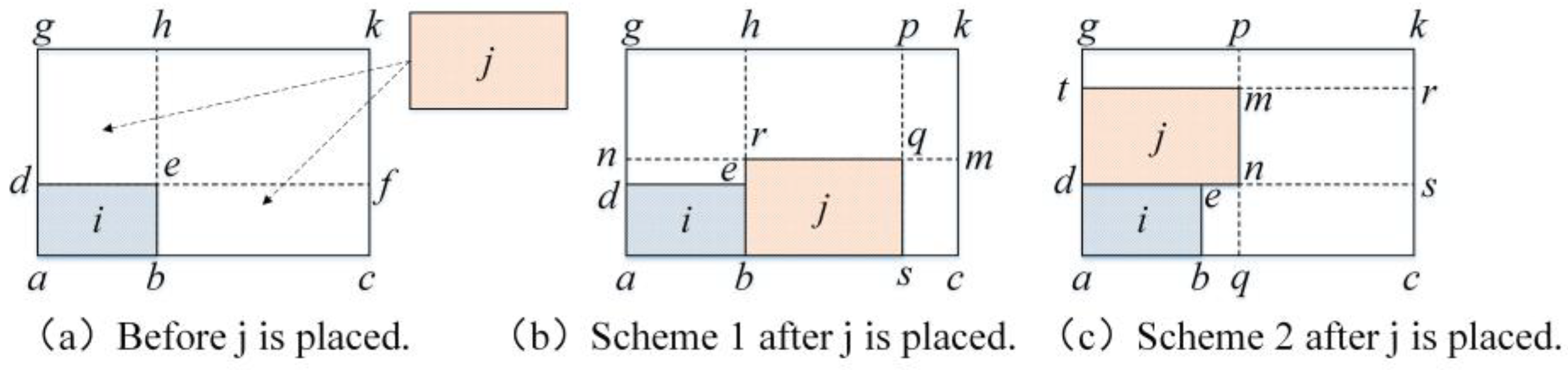
The generation of a rectangular set involves two processes: partitioning and merging rectangles. As shown in Figure 4a, for the mold table ‘ackg’, the set of rectangular intervals can be represented as RSG = {‘ackg’}. After the PC mold is placed, the remaining space on the mold table is divided into five rectangular areas—‘dehg’, ‘dfkg’, ‘bcfe’, ‘bckh’, and ‘efkh’—and the corresponding set of rectangular intervals can be denoted as RSG = {‘dehg’, ‘dfkg’, ‘bcfe’, ‘bckh’, ‘efkh’}. Then, the rectangular spaces that contain each other are deleted from the set of rectangular intervals, and the rectangles that cross and overlap each other are retained. Both ‘dehg’ and ‘efkh’ in the above set of rectangles are contained by the rectangle ‘dfkg’, so they are deleted. Similarly, the rectangle ‘bcfe’ is deleted. Therefore, the set of rectangular intervals becomes RSG = {‘dfkg’, ‘bckh’}. For the next PC mold j waiting to be placed, it is necessary to select a rectangle from ‘dfkg’ and ‘bckh’ in the set of rectangular intervals for placement. After selecting two different scenarios for placement, there are differences in the newly obtained set of rectangular intervals. As shown in Figure 4b,c, when the PC mold j is placed in the rectangular interval ‘dfkg’, according to the generation process of the rectangular interval mentioned above, then RSG becomes {‘dehg’, ‘nmkg’, ‘sckp’}. Similarly, when j is placed in the rectangular interval ‘bckh’, RSG becomes {‘trkg’, ‘qckp’, ‘bcse’}. It should be noted that the spacing between PC molds is not considered here to simplify the RSG method elaboration.

4.2.2. Weighted Matching Filling (WMF) Method

Section 4.3.1 explained that selecting different rectangular intervals has a significant impact on the subsequent placement of PC molds. However, the general selection process is as follows: firstly, the rectangular interval selected from the set of rectangular intervals must satisfy the size requirements of the PC molds, that is, the size of the rectangular interval must be greater than or equal to the size of the PC molds to be placed. Secondly, the selection principle of rectangular intervals is that there may exist more than one that meets the size requirements. Choosing a rectangular interval to place PC molds is the key problem to be solved. Traditional random selection is a fast method, but not necessarily the most beneficial for saving energy and other objectives. This paper proposes a rectangular interval selection method based on weighted matching filling, as shown in Equation (14).
M a x   W M F = λ 0 λ 1 l i L t + λ 2 w i W t + λ 3 l i w i L t W t       i I , t R I
Equation (14) represents the selection of a rectangular interval, which is jointly determined by the weighted matching function generated in terms of the length, width, and area of the rectangular interval and the PC mold.  λ 0  indicates whether the rectangular interval can accommodate the current PC mold; a value equal to 1 means yes, and 0 means no.  λ 1 λ 2 , and  λ 3  are three weight factors for the length ratio, width ratio, and area ratio of the two, with values of 0.25, 0.25, and 0.5, based on a comprehensive consideration of the following two aspects: firstly, through regression analysis of historical production data and layout schemes, it was found that the area utilization rate has the most significant impact on the overall layout compactness, so it is given a higher weight of 0.5. Secondly, the dimensions of the length and width have a relatively balanced constraint effect on the utilization of the mold table, so they are each given a weight of 0.25 to reflect their equal importance in avoiding local congestion and to ensure the process spacing between components. The higher the value of WMF, indicating that at least in one of the three dimensions, the rectangular interval is highly matched with the PC mold and is therefore prioritized for selection. The theoretical maximum value of WMF is 1, corresponding to the scenario where the rectangular interval is perfectly aligned with the size of the PC mold.

4.3. Genetic Manipulations

Genetic operations are performed on all encoded individuals in Pop1. This also reflects one of the advantages of the GFA–Tabu, as the existence of subpopulations eliminates the need for additional definitions of difficult-to-determine crossover and mutation probabilities. Regarding the PC-PLO-MC problem, each operation was elaborated as follows.

4.3.1. Crossover

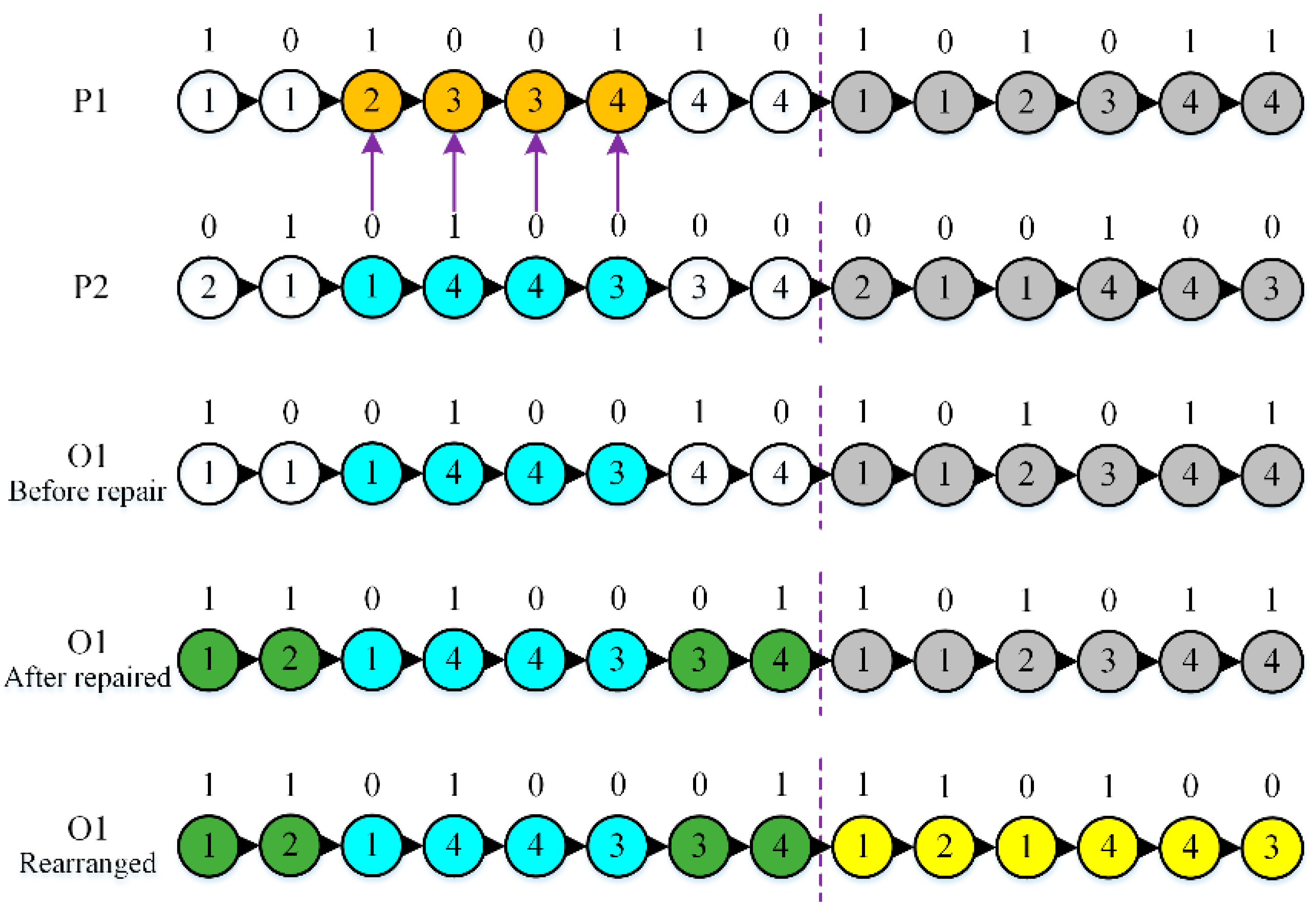
Due to the distinctiveness of the PC-PLO-MC problem, the encoding individuals generally consist of two or more sub-segments, and starting from the second and subsequent sub-segments, their PC production sequence is closely related to the first segment. Therefore, we only perform a two-point mapping crossover of the PC production sequence of the first round, but the two-point mapping crossover may result in infeasible encoding individuals, which requires a repair operation. Then, the sequence rearrangement is performed for segment 2 and subsequent sub-segments, similar to the encoding process. A crossover scheme for the two encoded individuals is given in Figure 5 with the following steps.
Step 1: Randomly select two different PC production sequences in Pop1 as parent individuals, denoted as P1 and P2.
Step 2: Generate two random integers as crossover points between the values of 1 and the length of the first sub-segment. The crossover points in Figure 5 are PCs 3# and 6# from left to right.
Step 3: P1 is used as the crossover individual, and P2 is used as the reference individual. Swap the PC subsequence {2,3,3,4} between the crossover points of P1 with {1,4,4,3} in P2, as well as swap the layout directions corresponding to each other, and keep the others unchanged. An offspring individual of P1 is obtained, denoted as O1.
Step 4: Based on the PC production order, check if the encoded offspring is feasible. If feasible, proceed to step 6; otherwise, repair operations are required. In the offspring O1, we found that the first sub-segment of P1 is {1,1,2,3,4,4,4}, while O1 is {1,1,1,4,4,3,4,4}. It is evident that all PCs of type 2 have been lost, one PC of type 3 is missing, and one more PC of types 1 and 4 has been added compared to the original. Therefore, O1 needs to be repaired.
Step 5: Repair. Specifically, after the crossover, the sub-segment of offspring 1 that has been crossed is extracted from the complement set in the original parent 2, reordered according to the order of its appearance in parent 1, and then repaired and replaced. The sub-segment of O1 after crossover is {1,4,4,3}, and its complement set is {2,1,3,4}, which is reordered as {1,2,3,4}, and O1 after repair is {1,2,1,4,4,3,3,4}.
Step 6: Rearrange the second round and subsequent sub-segments in offspring 1 by referencing the crossed sub-segment. The second sub-segment {1,1,2,3,4,4,} in O1 is rearranged to {1,2,1,4,3}.
Step 7: Similarly, swap the roles of the two parent individuals and repeat step 3 to get the offspring O2 of P2.

4.3.2. Mutation

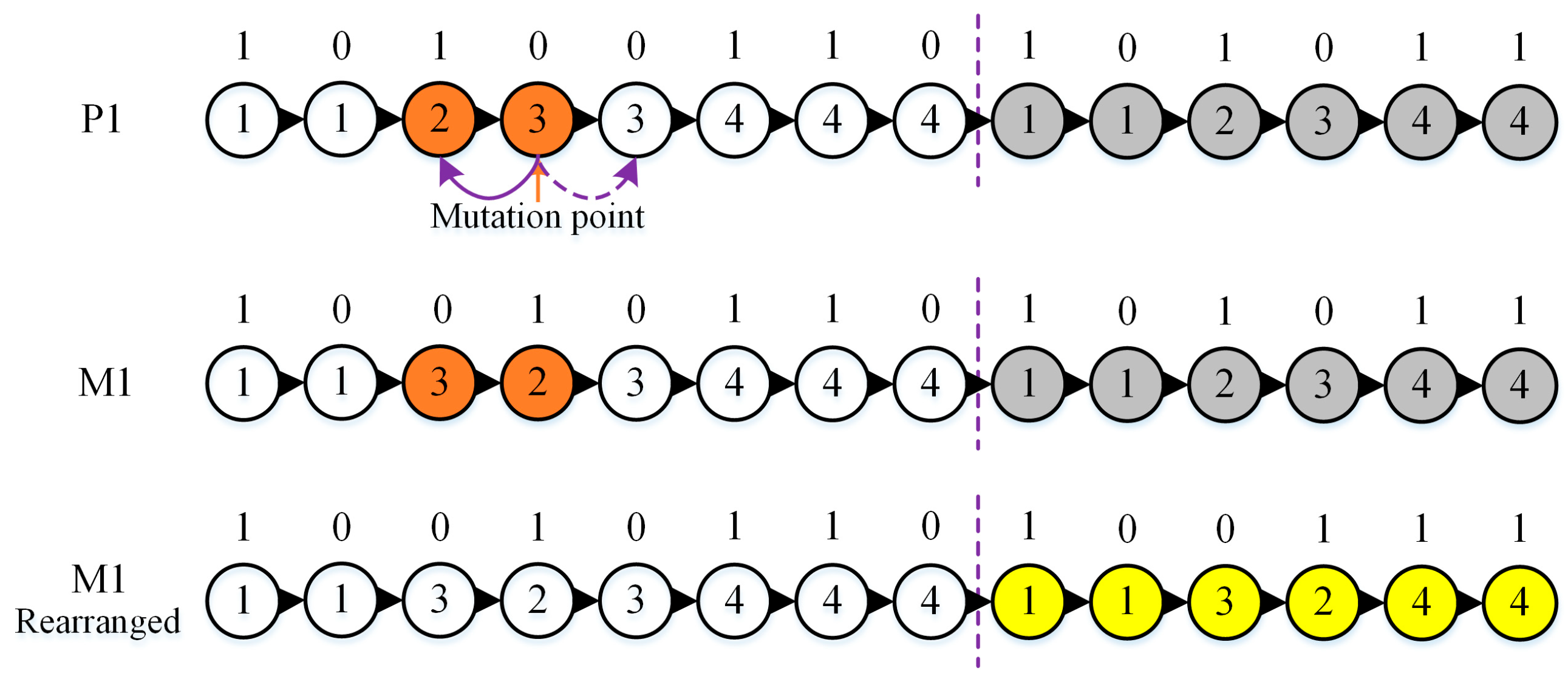
Individuals in the Pop1 subpopulation will perform mutations, and the mutation process of P1 is depicted in Figure 6. Firstly, in the first round of the PC sequence, randomly select a mutation point, assuming that the first 3# PC from left to right is selected. Then, the PC number at the mutation point can be randomly swapped with the PC number at the front or back position. Finally, similar to the crossover process, it is necessary to adjust the PC sequence of the second and subsequent rounds according to the sequence of the mutated PC in the first round to create a new mutated individual.

4.3.3. Selection

Crossover and mutation applied to Pop1 produced new individuals after genetic manipulation. These new individuals merged with the initial population to create a larger population that temporarily expanded to three times the size of the initial population. In order to maintain the appropriate population size and promote the continuation of the evolutionary process, a selection mechanism based on the Pareto dominance relation ranking and crowding distance of NSGAII is employed. Firstly, the individuals in the merged population are hierarchically sorted using the Pareto dominance relationship to identify the non-dominated solution set (also known as the Pareto front), which has reached a relatively optimal state on multiple optimization objectives, and no other solution exists that outperforms them on all objectives. Next, in order to select an equal number of individuals from the non-dominated solution set as the initial population for the next iteration, the crowding distance is used to evaluate the local crowding level of other solutions surrounding each non-dominated solution, and individuals with lower density will be retained. These selected individuals not only represent excellent solutions in the current iteration but also maintain sufficient diversity. Afterwards, crossover, mutation, and selection over hundreds or thousands of iterations drive the exploration towards a better solution space.

4.4. Flatworm Manipulations

In contrast to Section 4.3, flatworm manipulations consist primarily of the processes of growth, splitting, and regeneration of independent individuals. The working principles of each process can be found in Holstein [63], Tseng [57], and Liang [58] and will not be detailed here.

4.4.1. Growth

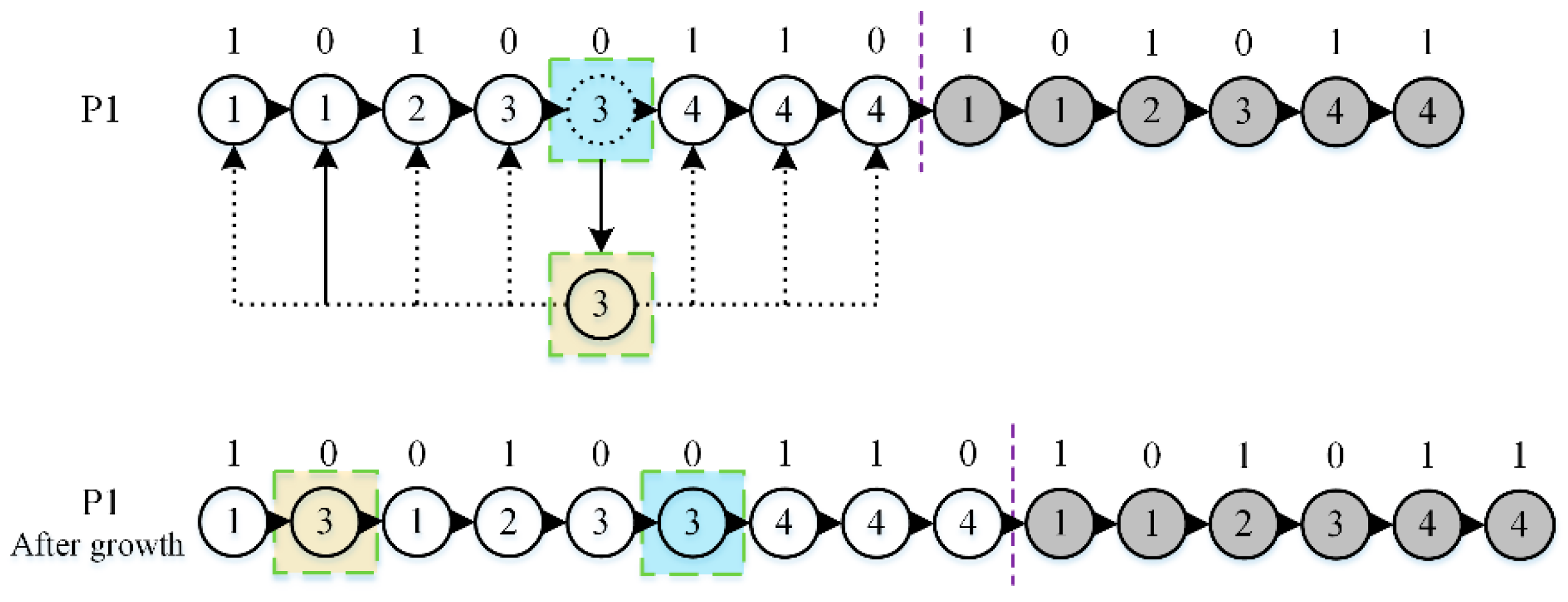
The growth operation is still only carried out for the first round of the production sequence of encoded individuals, as shown in P1 of Figure 7. Assuming that the number of PCs participating in growth does not exceed ten percent of the total number of PCs involved in the first round of production sequence and is at least one. The first production sequence in Figure 7 has a total of 8 PCs, so only one PC can participate in growth. Assuming that the second 3# PC from left to right undergoes replication growth, since there is no production priority relationship between the 8 PCs, then there is a total of seven theoretically available for insertion of the 3# PC after growth. Here, it is assumed that the replicated 3# PC is inserted before the second 1# PC from left to right. At this point, the growth process of P1 comes to an end. It should be noted that the layout direction of self-replicating PCs remains consistent with before. After the growth process, the first production sequence of the encoded individual will always have ten percent more PCs than the original, so the new encoded individual will no longer be a feasible production sequence, as it does not meet the order requirements. Also, because of this, the second and subsequent rounds of production sequences will not undergo any repair operations temporarily after this process.

4.4.2. Splitting

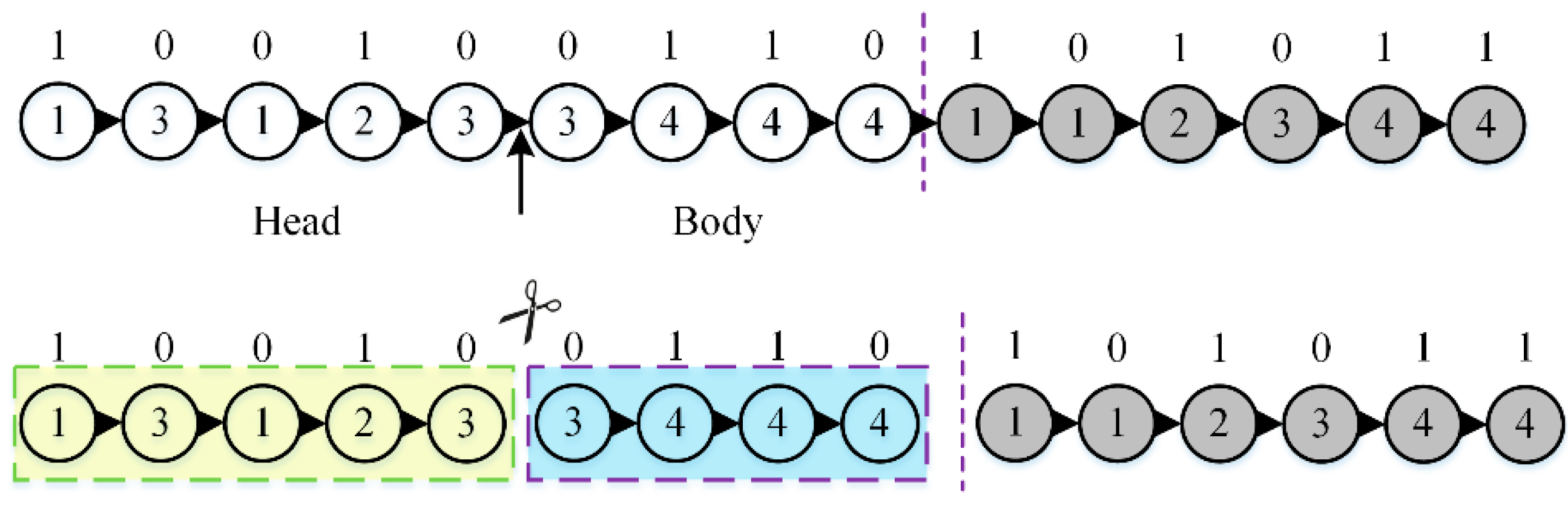
The flatworm immediately undergoes the splitting process after growth. The splitting points are all in the vicinity of that position where self-replication of the PC occurs, and the sub-segments after the break can inherit and bond with the second and subsequent production sequences, but the individual after bonding no longer fulfills the encoding requirements. Figure 8 shows the splitting process after the growth of the individual in Figure 7. The splitting point occurs on the left side of the self-replicating PC. After splitting, the first round of the production sequence is cut into two parts; the left side is called the head, and the right is called the body. There is a special situation that needs attention: if the breakpoint in Figure 8 is on the right side, after the splitting, it will be found that there are three 3# PCs on the left head, and its corresponding molds only have two sets, which no longer meet the mold number constraint, this time we need to delete the redundant PC elements randomly in the regeneration.

4.4.3. Regeneration

The fractured individual immediately starts the regeneration process, and the main implementation steps are as follows.
Step 1: Confirm whether the PC element redundancy scenario described above occurs. If so, the redundant PC elements will be randomly deleted until the mold quantity constraint is satisfied.
Step 2: For each sub-segment, identify all the missing PC information based on the order demand and the number of molds. Then, complete the missing PC information to get a new first-round production sequence, which is called the regeneration segment.
Step 3: The second and subsequent rounds of the production sequence are patched, and the process is the same as before and will not be described in detail.
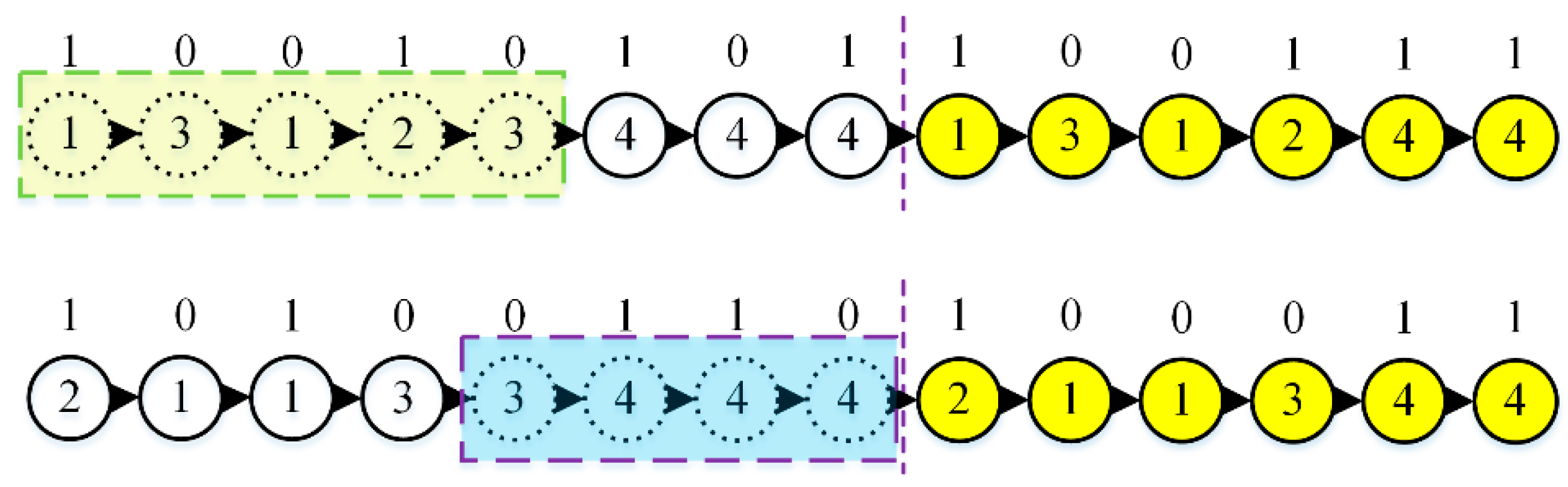
The regeneration process is usually considered to occur instantaneously and is not directly affected by the length of the encoded individual. After regeneration and repair, the head and body segments in Figure 8 are shown in Figure 9.

4.5. Tabu Mapping Mechanism

After the previous genetic and flatworm operations, an extremely rich production sequence scheme has been generated, but it is also prone to causing duplicate search problems in the production sequence schemes. Therefore, the Tabu mechanism derived from the Tabu search algorithm is incorporated into GFA–Tabu, where the Tabu search algorithm has already achieved great success in the fields of combinatorial optimization and production scheduling [64]. The so-called Tabu is to prohibit the repetition of the previous operation, which can improve search efficiency to a large extent. The traditional Tabu search generally sets the encoded neighborhood transformation structure as the Tabu object, such as the classical vehicle routing problem [65].
However, for the PC-PLO-MC problem, the storage structure of Tabu objects becomes quite complex and redundant when the number of PC orders demanded reaches hundreds or more. There are two very important operations in the PC-PLO-MC problem: one is the PC production sequence in the encoding, and the other is the PC layout scheme, significantly affected by the former. As shown in Figure 2, from the perspective of energy conservation, a higher density of PC layout on the mold table implies less energy consumption. As mentioned in Section 4.2, each mold table can usually only accommodate from four to six PCs. If the combination of PC layout on the mold table is used as the Tabu object, and then the production sequence can be easily deduced based on the order in which the PCs are placed, the complexity of the storage structure of the Tabu object can be greatly reduced. In other words, we record the Tabu object in the PC mold positioning process and map and check the state of this Tabu object during the PC production sequence generation process, which is called the Tabu mapping mechanism. Other parameters, such as Tabu length and aspiration criteria, are consistent with the Tabu search. The workflow of the Tabu mapping mechanism is shown in Algorithms 1 and 2.

5. Computational Experiments and Analysis

The GFA–Tabu algorithm was implemented in MATLAB 2021a and executed on a Windows 11 system equipped with a 3.10 GHz Intel® Core™ i5-10500 processor and 8 GB RAM. To comprehensively assess the performance of the GFA–Tabu algorithm in solving the PSLO-PC-MRC problem, three PC production cases of different sizes are carefully designed for validation.
It is worth noting that, despite researchers having accumulated considerable knowledge in PC production planning and management, detailed size information about PCs and their supporting molds is rarely mentioned in the existing literature. In view of this, we adopted a multi-source strategy to construct the case studies: for the small- and medium-scale test problems, we referred to the ‘Atlas of Truss-Reinforced Concrete Stacked Slabs,’ authoritatively released in China, which ensured the professionalism of the data and compliance with the industry standards. For the convenience of case design, the types and related size data of PCs remain unchanged, with problem scale, both order demand and mold quantity per PC type increase proportionally, but the mold resources do not exceed the PC order demand. Each type of PC size consists of two parts: the length and width of the solid part for the PC cast by concrete, and the length of the steel bars extending from the solid part in four directions.
Related literature shows NSGAII is most frequently adopted in multi-objective PC production scheduling and management [66]. PSLO-PC-MRC is a multi-objective optimization problem; therefore, we compare the performance of the proposed GFA–Tabu with GFA, NSGAII, and the classical Tabu search (TS) algorithm. Meanwhile, to assess the performance of the proposed weighted matching filling in PC mold positioning, GFA–Tabu, GFA, NSGAII, and TS with WMF strategy were designed and compared with those without WMF strategy, respectively.
These algorithms adopt disparate parameter sets and termination rules. GFA, GFA–Tabu, and NSGAII involve the common computational parameter of population size, whereas NSGAII additionally involves the crossover probability and mutation probability. GFA, GFA–Tabu, and TS also include Tabu length and aspiration criteria. Except for the subpopulation partitioning ratio n in GFA and GFA–Tabu, all other parameters are determined using analysis of variance based on equivalent scale cases from relevant literature [58,67]. The available values of p are 0.9, 0.7, and 0.5, respectively. At a significance level of 0.05, the hypervolume [68] is used as the evaluation metric to perform analysis of variance on cases of all sizes. The results indicate that hypervolume has a high significance when p is 0.7. All algorithms undergo five independent runs to ensure testing fairness and are forced to terminate when a single run exceeds time  T = I · i = 1 I d i · Q i / 10 (in seconds).

5.1. Small-Scale Case

The small-scale case is detailed on the left side of Table 2. There are 20 types with a total of 60 PCs, and the number of molds is 28. The algorithm operates with a population size of 60, a crossover rate of 0.7, and a mutation rate of 0.3. The Tabu length is set to half the number of PC molds. The production results of PCs on the mold tables are detailed in Table 3.
From Table 3, it can be intuitively seen that GFA–Tabu with WMF obtained five optimal Pareto solutions, while other algorithms obtained relatively fewer. The average energy consumption in all solutions is 704.81 kgce, the highest and lowest are 721.56 kgce and 691.56 kgce, respectively, and the lowest values are mainly concentrated in GFA–Tabu.
From the quality of optimal Pareto solutions, the first solution by GFA–Tabu, the fourth solution by GFA-WMF, and the second solution by NSGAII-WMF can all be found in the solution obtained by GFA–Tabu with WMF. If observing carefully, we will find that the solutions obtained by GFA–Tabu with WMF partially dominate the solutions obtained by other algorithms, such as the fifth solution (691.56,13.35,228) by GFA–Tabu with WMF dominating the second solution (691.56,15.96,228) and the third solution (691.56,13.55,232) of GFA–Tabu. The first and second solutions by GFA–Tabu with WMF dominate the third solution of NSGAII-WMF and the third solution of GFA-WMF. The two solutions by TS-WMF and TS are dominated by the solutions in GFA–Tabu with WMF. All of these demonstrate the effectiveness of the Tabu mechanism and the WMF method.

5.2. Medium-Scale Cases

The medium-sized cases are constructed based on the small-sized case, both of which have 20 PCs, and the data are detailed in Table 2. The first case involves 100 PCs and 48 molds, while the second comprises 147 PCs and 68 molds. For these cases, the population sizes are set to 80 and 100, respectively, with crossover and mutation probabilities fixed at 0.75 and 0.25. The Tabu length is set to half the number of molds of the respective cases. After running, the best five optimal Pareto solutions were obtained for the two cases, as shown in Table 4 and Table 5.
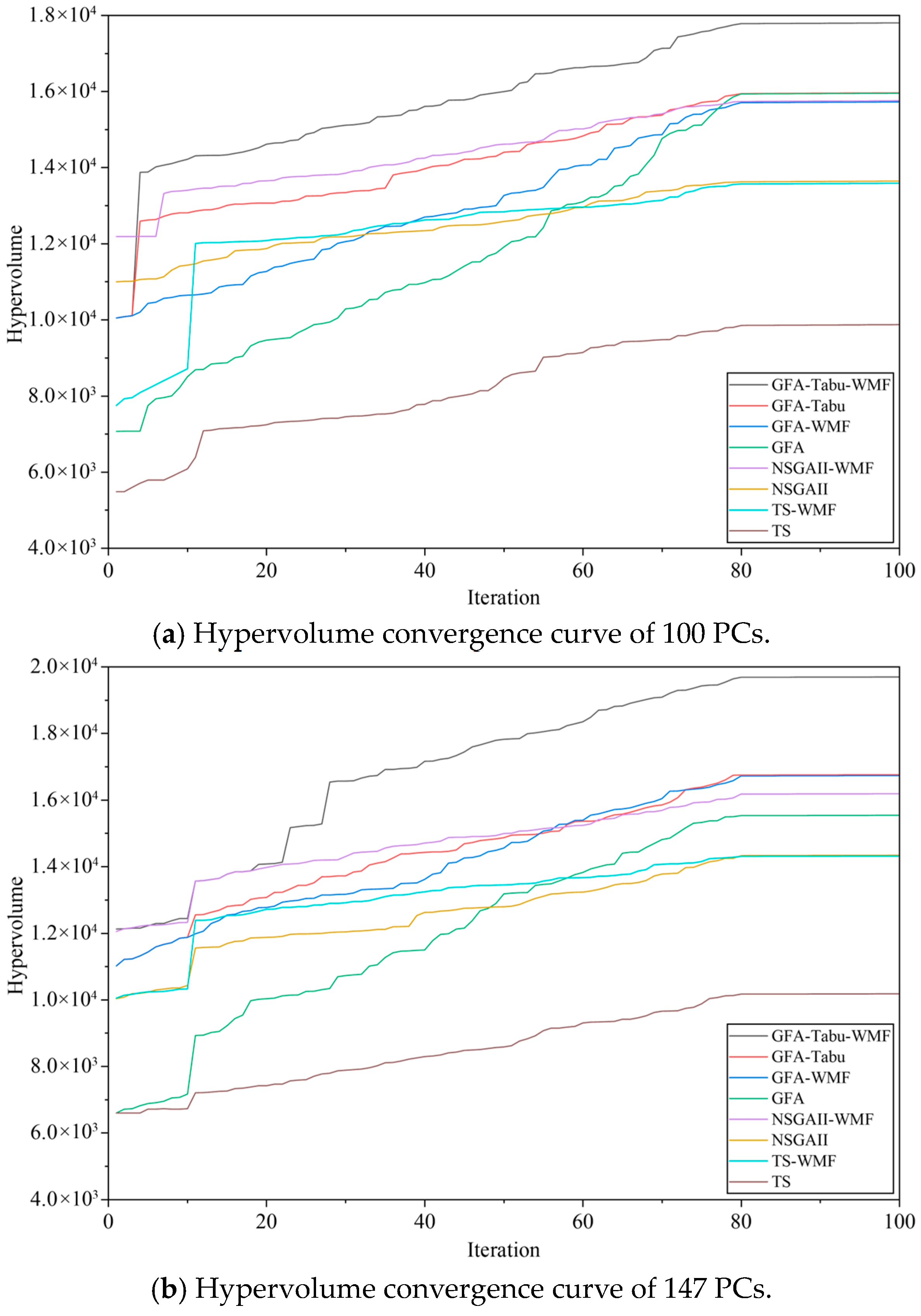
For the medium-sized case with 100 PCs, among all the production sequences and layout schemes obtained by the algorithms in Table 4, GFA–Tabu has the smallest energy consumption of 1158.19 kgce, while the other algorithms have the smallest value of 1164.19 kgce. The upper half of Table 4 shows that each algorithm is embedded with the WMF method, while the lower half does not have the WMF method. We find the fact that the optimal Pareto solutions obtained by all four algorithms without the WMF method are dominated by algorithms with the WMF method. For example, the fifth solution (1176.19,12.12,390) by GFA–Tabu with WMF dominates the third solution (1188.19,12.29,426) and the fifth solution (1188.19,12.27,428) of GFA–Tabu. The fifth solution by GFA with WMF dominates the fifth solution of GFA, the first solution by NSGAII with WMF dominates the second and fifth solutions of NSGAII, and the first solution by TS with WMF dominates the second and third solutions of TS. This indicates that the proposed WMF method plays a better role in guiding the layout of PCs onto the mold tables. Combining all the solutions, we found that the solutions obtained by other algorithms are dominated by GFA–Tabu with WMF. As shown in Table 4, except for GFA without WMF, the fifth solution of all other algorithms is dominated by the fifth solution of GFA–Tabu with WMF, and there are also cases where the solutions in GFA without WMF are dominated by GFA–Tabu with WMF.
The hypervolume convergence curve in Figure 10 also confirms the above conclusion, and similar conclusions exist when the number of PCs in medium-sized cases grows to 147, as shown in Table 5, and will not be elaborated further. The results indicate that the proposed GFA–Tabu with WMF outperforms all compared algorithms, proving the effectiveness of the Tabu mechanism and WMF method.

5.3. Analysis of Computational Complexity

The computational complexity of the proposed algorithm is primarily analyzed from two aspects. First, the complexity of the genetic operations is mainly constrained by the number of optimization objectives and the population size, expressed as O (objNum × n2) [56], where objNum denotes the number of simultaneously optimized objectives. Second, the complexity of the flatworm operations—during the growth, splitting, and regeneration stages—is closely related to both the chromosome length and the population size, expressed as O (objNum × chromLength), where chromLength represents the chromosome encoding length. Therefore, overall, the computational complexity of the proposed GFA–Tabu algorithm is O (objNum × n2) + O (objNum × chromLength) ≈ O (n2), indicating that its computational complexity does not exceed that of the classical NSGA-II.

6. Large-Scale Application Case

6.1. Case Data

For the large-scale case, we directly obtained the production order data from a PC manufacturer in Chengdu, Sichuan Province, thus enhancing the practicality and relevance of the study. The order consists of 44 laminated floor slab variants, with an overall quantity of 272 units and 95 mold configurations. The length and width of the solid part of each type of PC, as well as the length of the steel bars extending in four directions, are described in Table 6.

6.2. Comparative Testing and Result Discussion

GFA, NSGAII, and TS are still selected for performance comparison with GFA–Tabu, and the presence or absence of WMF methods will be integrated into each of the four algorithms separately. The population sizes involved in all algorithms are all set to 160, the crossover and mutation probabilities involved are set to 0.8 and 0.2, respectively, the Tabu length is set to half of the number of PC types, which is set to 22, and the coefficient p for dividing subpopulations is set to 0.7.
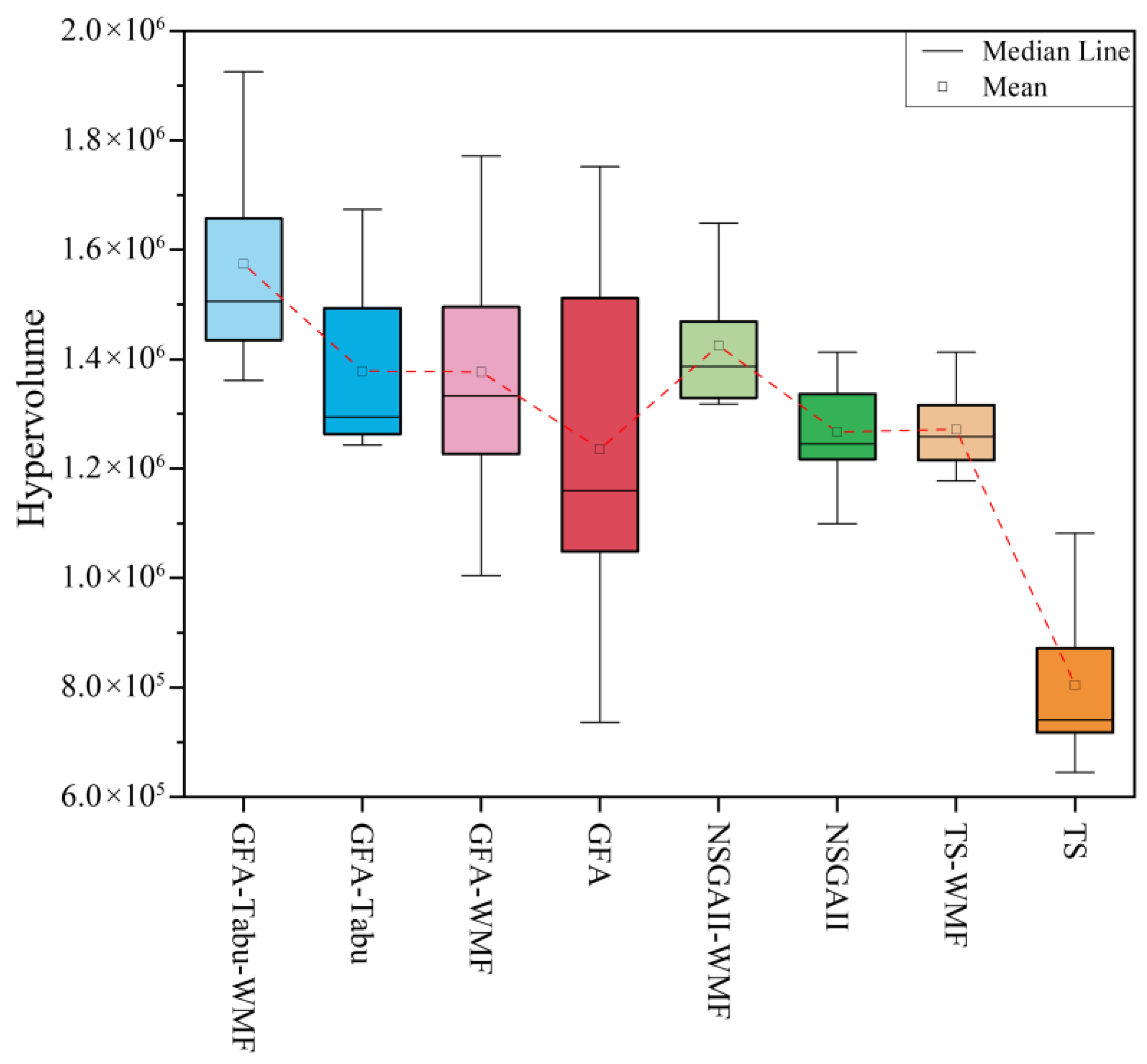
After each algorithm is run independently five times, the optimal Pareto solutions obtained by all algorithms are merged to form a more comprehensive and diverse solution set. Subsequently, the dominant relationship between these merged solutions is reevaluated, and the newly obtained Pareto optimal solution is approximated as the true Pareto front of the large-scale problem. On this basis, the hypervolume indexes of the solutions obtained by each algorithm are calculated, and their distribution is shown in Figure 11, which can intuitively reflect the coverage and degree of superiority of each algorithm in the solution space. Overall, the obtained hypervolume mean values by all algorithms with WMF are connected by red dashed lines, and it is clear that the mean values show a decreasing trend. If the hypervolume mean values obtained by the algorithms with WMF from those without WMF are viewed separately, they are roughly two parallel dashed lines. Moreover, each algorithm with WMF has a higher hypervolume mean value than those without WMF, which indicates the effectiveness of the WMF method. Looking at the four algorithms on the left side of Figure 11 individually, their corresponding hypervolume means are 1.57 × 10⁶, 1.38 × 10⁶, 1.38 × 10⁶, and 1.24 × 10⁶, indicating that the proposed GFA–Tabu performs the best in convergence and stability, while the GFA and NSGAII have comparable performances, and TS has the worst performance.
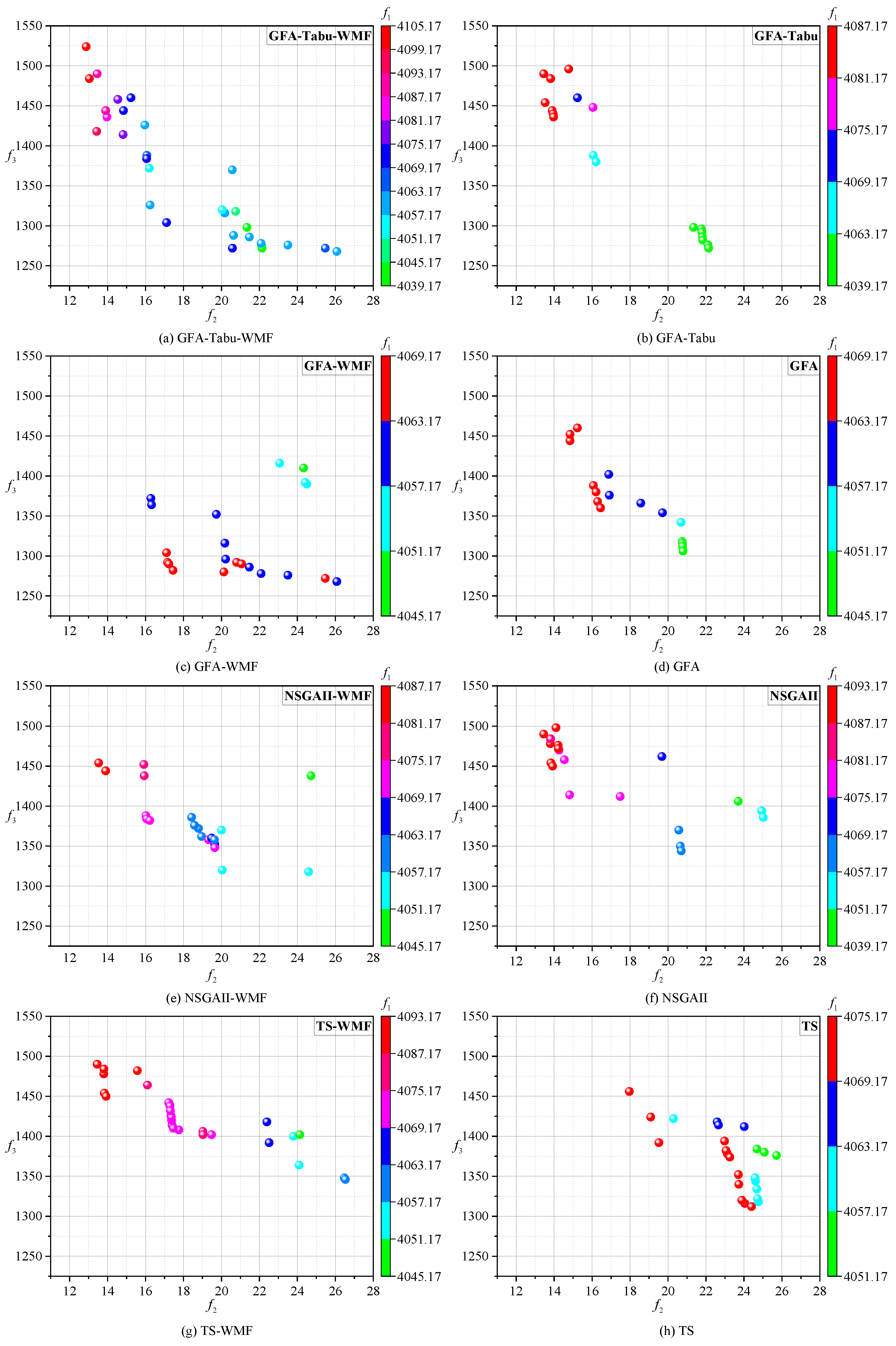
The obtained optimal Pareto solutions by the algorithms with WMF from those without WMF are depicted in Figure 12, which exhibits significant differences in spatial distribution. In terms of energy consumption, GFA–Tabu with WMF successfully obtained optimal Pareto solutions for twelve different energy consumption levels, in contrast to the other algorithms, which only provide solutions for five to eight energy consumption levels. It is noteworthy that GFA–Tabu with WMF, together with the other two algorithms, reached the lowest energy consumption, which is 4039.17 kgce. Not only that, but GFA–Tabu with WMF can also find solutions in relatively high energy consumption ranges, such as the two energy consumption points of 4099.17 kgce and 4105.17 kgce. Although these two solutions have relatively high energy consumption, the fluctuation coefficients of mold table utilization in the corresponding PC production sequence and layout scheme are relatively small, with specific values of 12.87 and 13.04, respectively.

6.3. Analysis of Mold Layout Schemes

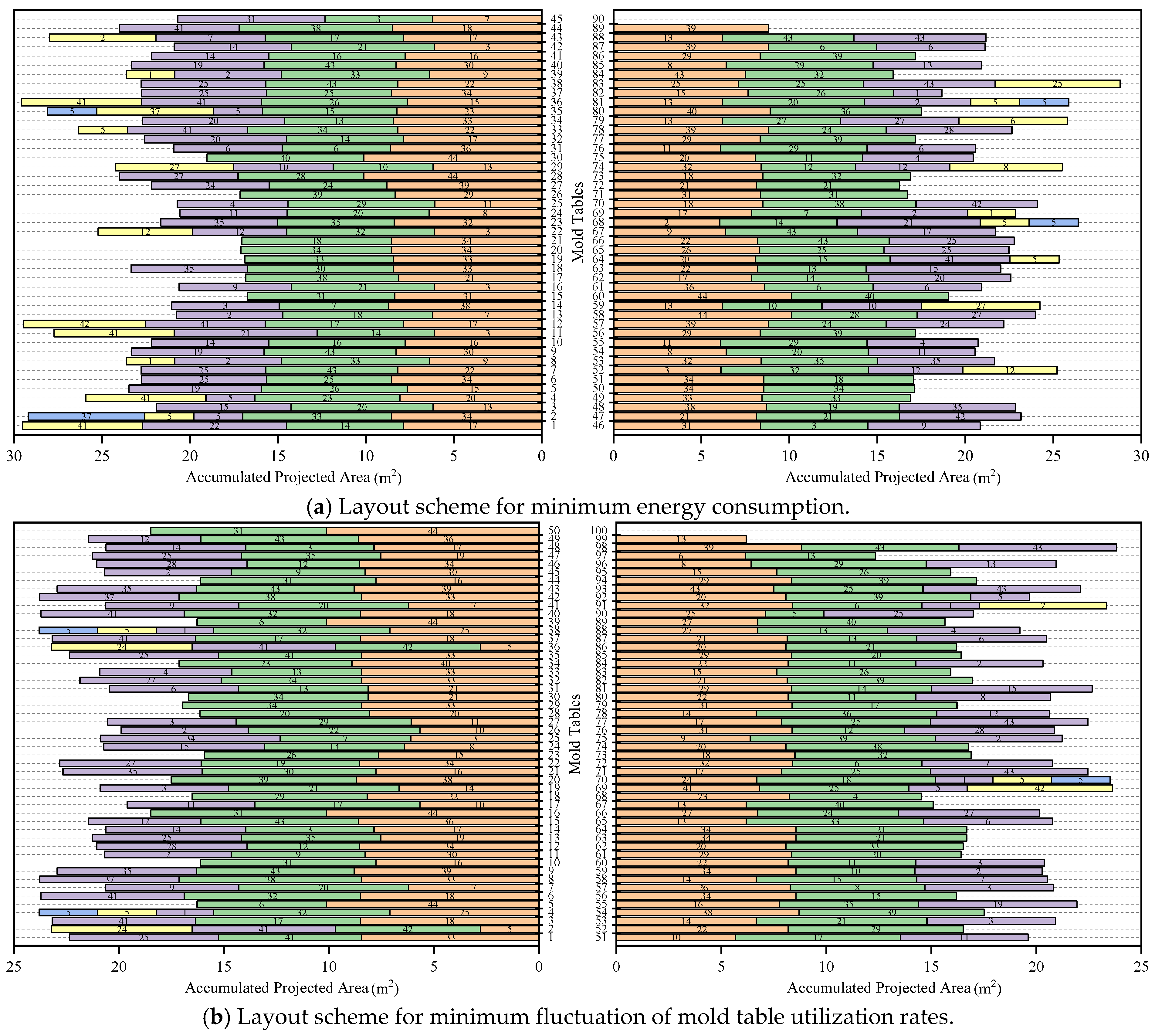
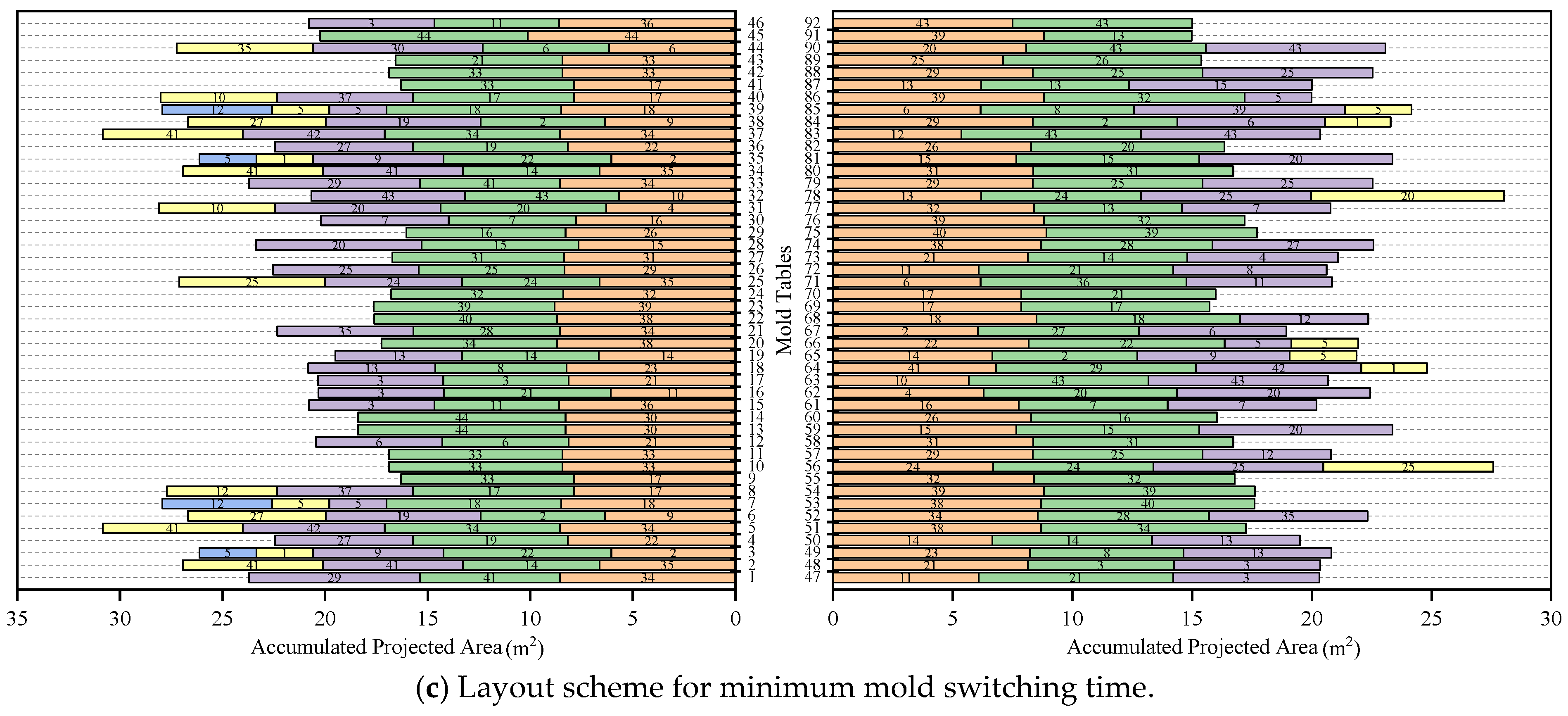
To assist in the comparative analysis of PC mold layout alternatives for decision-makers, Figure 13 presents the layout scheme when each objective is the smallest, obtained by GFA–Tabu with WMF. The horizontal axis corresponds to the PC coverage area per mold table, bounded by 40 m2 (10 m × 4 m), and the vertical axis reflects the total mold tables utilized. Since the number of mold tables consumed in this case is all over 90, the utilized mold tables are exhibited on the left and right sides in the figure. In Figure 12a, 89 mold tables are used, and the total energy consumption is 4039.17 kgce, of which the process energy consumption and transportation energy consumption are 3505.2 kgce and 534 kgce, respectively. The lowest utilization rate is 22.02% on the 89th mold table, the highest is 73.94% on the 36th mold table, the average utilization rate is 54.7%, and the mold table utilization fluctuation coefficient is 21.34. The corresponding switching time of mold tables and molds is 1298 min. In Figure 13b, 99 mold tables are used with a total energy consumption of 4099.17 kgce. The lowest utilization rate is 15.46% on the 99th mold table, and the highest is 59.52% on the 98th mold table, with an average utilization rate of 49.17% and a coefficient of fluctuation of the utilization rate of 12.87. The mold switching time is 1524 min. In Figure 13c, 92 mold tables are used, with a total energy consumption of 4057.17 kgce; the mold table utilization fluctuation coefficient is 26.08, and the mold switching time is 1268 min.
Although the energy consumption in Figure 13a is the lowest, the mold table utilization fluctuation coefficient is almost 40% higher than that in Figure 13b. Meanwhile, Figure 13b has the least fluctuating mold table utilization but sacrifices as much as 256 min of mold switching time compared to the scenario in Figure 13c. The result reveals that the key factor affecting total energy consumption is the number of mold tables consumed to fulfill PC order demand; that is, increasing the average utilization rate of mold tables to reduce their usage is beneficial for reducing PC production energy consumption. However, if energy consumption is the sole consideration, we may observe large swings in mold table utilization, which translate into workload differences across tables and serious disruptions to line balance. Each option has its own advantages and disadvantages, and the PC production manager can choose the preferred production sequence and layout plan based on the actual situation of the workshop.

7. Conclusions

This paper proposes a model for optimizing the production sequencing and layout of precast concrete components, which considers how to efficiently and reasonably allocate PC to the mold tables in the actual situation where the number of molds is limited. Subsequently, a multi-objective genetic flatworm algorithm with a Tabu mapping mechanism is developed, and a rectangular interval selection method based on a weighted matching filling strategy is designed to carry out the positioning of PC molds accurately to minimize the total energy consumption, fluctuation coefficient of mold table utilization, and mold switching time. To assess the performance of the model and algorithm, three types of cases covering different scales are carefully constructed for testing. The results indicate that:
  • In the small-scale case, the proposed model achieved minimum values of 691.56 kgce for production line energy consumption, 10.95 for the mold table utilization balance coefficient, and 228 min for mold switching time. Compared to the control group algorithms, the proposed GFA–Tabu algorithm with the weighted matching filling method not only obtained an average of two additional Pareto-optimal solutions but also demonstrated superior solution quality, with average reductions of 0.98 kgce, 2.54 in balance coefficient, and 1.5 min in switching time across the three objectives, respectively.
  • For the two medium-scale cases involving 100 and 147 PCs, the proposed model achieved minimum values of the three objectives at 1158.19 kgce, 12.12, 344 min, and 1734.13 kgce, 8.66, and 472 min, respectively. Compared to the control group algorithms, it achieved average reductions of 575.94 kgce, 3.46, and 130 min across these objectives.
  • In the large-scale application case, the proposed model and algorithm exhibit a dual-core advantage. Its average hypervolume performance metric reaches 1.57 × 10⁶, which is 10.48% higher than the second-best algorithm of NSGAII-WMF and represents improvements of 27.39% and 95.55% over the traditional GFA and TS algorithms, respectively. In terms of stability, its coefficient of variation for hypervolume is 11.27%, lower than that of GFA-WMF (16.44%) and GFA (25.79%), indicating strong robustness.
Therefore, the case study results consistently show that the proposed model and algorithm effectively address the production sequence and layout optimization problem for precast concrete components, providing decision-makers with efficient and practical solutions for PC production.

Author Contributions

Conceptualization, J.L. and Y.L.; methodology, J.L. and Y.L.; software, B.D.; validation, Y.L., X.S. and J.L.; formal analysis, J.L.; investigation, X.S. and Y.L.; resources, X.S.; data curation, X.S. and W.X.; writing—original draft preparation, J.L.; writing—review and editing, W.X. and Y.L.; visualization, B.D.; supervision, X.S. and Y.L.; project administration, B.D.; funding acquisition, B.D. All authors have read and agreed to the published version of the manuscript.

Funding

This research was supported by a grant from Luzhou Key Laboratory of Intelligent Construction and Low-carbon Technology, the Key Laboratory of Higher Education of Sichuan Province for Enterprise Informationalization and Internet of Things (grant number 2024WYY03), the National Natural Science Foundation of China (grant number 52105513), and the Natural Science Foundation of Hubei Province (grant number 2023AFB593), and by Building Environment Engineering Technology Research Center in Dazhou (Sichuan University of Arts and Sciences, grant number SDJ2024ZB-11).

Institutional Review Board Statement

Not applicable.

Informed Consent Statement

Not applicable.

Data Availability Statement

Data sharing is not applicable.

Acknowledgments

We thank all reference authors who gave us inspiration and help. The authors thank the editors and anonymous commentators for their valuable comments, which have improved the quality of this paper, and the experimental institutions that provide financial support for the paper.

Conflicts of Interest

The authors declare no conflicts of interest.

Notations

Indices
i , j Index   of   PC ,   i , j I
k Index   of   mold   table ,   k K
s Index   of   the   cycle   that   the   PC   mold   is   to   be   used ,   s S
t Index   of   rectangular   interval ,   t R I
Parameters
I Set of categories of precast components
K Set of mold tables
S The set of cycles that the PCs mold needs to be used
R I A set of rectangular intervals on the mold table
L The length of the mold table
W The width of the mold table
P The   total   required   quantity   of   all   precast   components ,   P = i I d i
l i , l j The   length   of   precast   components   i   and   j ,   i , j I
w i , w j The   width   of   precast   components   i   and   j ,   i , j I
h i , h j The   thickness   of   precast   components   i   and   j ,   i , j I
l i k , w i k , h i k The length, width, and thickness of the precast component i on the kth mold table,  i I ,   k K
r i , r j Direction   of   placed   precast   concrete   components   i   and   j ,   i , j I
L t The   length   of   the   rectangular   interval   t ,   t R I
W t The   width   of   the   rectangular   interval   t ,   t R I
P i s Number of molds of type I participated in the sth cycle layout,  P i s 0
Q i Available   quantity   of   mold   i ,   Q i 0
d i The   order   demand   of   PC   i ,   d i > 0
d Production   spacing ,   d > 0
z i p In   a   production   sequence ,   if   position   p   is   component   i ,   then   z i p = 1 ,   otherwise   z i p = 0
Decision variables
x i , y i Positioning coordinates of the lower left corner of PC i on the mold table
η k The utilization efficiency of the kth mold table
y k 1 if the kth mold table is utilized; 0 otherwise
z p In a production sequence, if positions p and p-1 are different components, then  z p = 1 ,   otherwise   z p = 0
Indicator variables
w 1 Unit energy consumption coefficient of PC in the hot curing process
w 2 Unit energy consumption coefficient of PC in the other five processes
w 3 Unit energy consumption coefficient of PC in transportation
w 4 Switching time between two mold tables
w 5 Mold adjustment time for two different PCs
α The weight of reinforced concrete per cubic meter for PC
β The weight of each mold table
λ 0 A coefficient indicating whether the rectangular interval can accommodate the current PC mold
λ 1 Weight coefficient for the length ratio
λ 2 Weight coefficient for the width ratio
λ 3 Weight coefficient for the area ratio

References

  1. Hong, J.; Shen, G.Q.; Mao, C.; Li, Z.; Li, K. Life-Cycle Energy Analysis of Prefabricated Building Components: An Input-Output-Based Hybrid Model. J. Clean. Prod. 2016, 112, 2198–2207. [Google Scholar] [CrossRef]
  2. Kong, L.; Li, H.; Luo, H.; Ding, L.; Luo, X.; Skitmore, M. Optimal Single-Machine Batch Scheduling for the Manufacture, Transportation and JIT Assembly of Precast Construction with Changeover Costs within Due Dates. Autom. Constr. 2017, 81, 34–43. [Google Scholar] [CrossRef]
  3. Aye, L.; Ngo, T.; Crawford, R.H.; Gammampila, R.; Mendis, P. Life Cycle Greenhouse Gas Emissions and Energy Analysis of Prefabricated Reusable Building Modules. Energy Build. 2012, 47, 159–168. [Google Scholar] [CrossRef]
  4. Liu, W.; Tao, X.; Mao, C.; He, W. Scheduling Optimization for Production of Prefabricated Components with Parallel Work of Serial Machines. Autom. Constr. 2023, 148, 104770. [Google Scholar] [CrossRef]
  5. Zhang, R.; Feng, X.; Mou, Z.; Zhang, Y. Green Optimization for Precast Production Rescheduling Based on Disruption Management. J. Clean. Prod. 2023, 420, 138406. [Google Scholar] [CrossRef]
  6. Xu, A.; Zhu, Y.; Wang, Z. Carbon Emission Evaluation of Eight Different Prefabricated Components during the Materialization Stage. J. Build. Eng. 2024, 89, 109262. [Google Scholar] [CrossRef]
  7. Dan, Y.; Liu, G.; Fu, Y. Optimized Flowshop Scheduling for Precast Production Considering Process Connection and Blocking. Autom. Constr. 2021, 125, 103575. [Google Scholar] [CrossRef]
  8. Du, J.; Zhang, J.; Castro-Lacouture, D.; Hu, Y. Lean Manufacturing Applications in Prefabricated Construction Projects. Autom. Constr. 2023, 150, 104790. [Google Scholar] [CrossRef]
  9. Wang, D.; Liu, G.; Li, K.; Wang, T.; Shrestha, A.; Martek, I.; Tao, X. Layout Optimization Model for the Production Planning of Precast Concrete Building Components. Sustainability 2018, 10, 1807. [Google Scholar] [CrossRef]
  10. Hu, H. A Study of Resource Planning for Precast Production. Archit. Sci. Rev. 2007, 50, 106–114. [Google Scholar] [CrossRef]
  11. Khalili, A.; Chua, D.K. Integrated Prefabrication Configuration and Component Grouping for Resource Optimization of Precast Production. J. Constr. Eng. Manag. 2014, 140, 04013052. [Google Scholar] [CrossRef]
  12. Du, J.; Dong, P.; Sugumaran, V.; Castro-Lacouture, D. Dynamic Decision Support Framework for Production Scheduling Using a Combined Genetic Algorithm and Multiagent Model. Expert Syst. 2021, 38, e12533. [Google Scholar] [CrossRef]
  13. de Athayde Prata, B.; Pitombeira-Neto, A.R.; de Moraes Sales, C.J. An Integer Linear Programming Model for the Multiperiod Production Planning of Precast Concrete Beams. J. Constr. Eng. Manag. 2015, 141, 04015029. [Google Scholar] [CrossRef]
  14. Xiang, Y.; Ma, K.; Mahamadu, A.M.; Florez-Perez, L.; Zhu, K.; Wu, Y. Embodied Carbon Determination in the Transportation Stage of Prefabricated Constructions: A Micro-Level Model Using the Bin-Packing Algorithm and Modal Analysis Model. Energy Build. 2023, 279, 112640. [Google Scholar] [CrossRef]
  15. Zou, Y.; Gao, Q.; Wang, S. Optimization of the Stacking Plans for Precast Concrete Slab Based on Assembly Sequence. Buildings 2022, 12, 1538. [Google Scholar] [CrossRef]
  16. Ko, C.H.; Wang, S.F. GA-Based Decision Support Systems for Precast Production Planning. Autom. Constr. 2010, 19, 907–916. [Google Scholar] [CrossRef]
  17. Wang, Z.; Hu, H. Improved Precast Production–Scheduling Model Considering the Whole Supply Chain. J. Comput. Civ. Eng. 2017, 31, 04017013. [Google Scholar] [CrossRef]
  18. Chan, W.T.; Hu, H. Precast Production Scheduling with Genetic Algorithms. Proc. IEEE Conf. Evol. Comput. 2000, 2, 1087–1094. [Google Scholar] [CrossRef]
  19. Chan, W.T.; Hu, H. An Application of Genetic Algorithms to Precast Production Scheduling. Comput. Struct. 2001, 79, 1605–1616. [Google Scholar] [CrossRef]
  20. Warszawski, A. Production Planning in Prefabrication Plant. Build. Environ. 1984, 19, 139–147. [Google Scholar] [CrossRef]
  21. Chan, W.T.; Hu, H. Production Scheduling for Precast Plants Using a Flow Shop Sequencing Model. J. Comput. Civ. Eng. 2002, 16, 165–174. [Google Scholar] [CrossRef]
  22. Jiang, W.; Wu, L. Flow Shop Optimization of Hybrid Make-to-Order and Make-to-Stock in Precast Concrete Component Production. J. Clean. Prod. 2021, 297, 126708. [Google Scholar] [CrossRef]
  23. Xiong, F.; Chu, M.; Li, Z.; Du, Y.; Wang, L. Just-in-Time Scheduling for a Distributed Concrete Precast Flow Shop System. Comput. Oper. Res. 2021, 129, 105204. [Google Scholar] [CrossRef]
  24. Du, J.; Dong, P.; Sugumaran, V. Dynamic Production Scheduling for Prefabricated Components Considering the Demand Fluctuation. Intell. Autom. Soft Comput. 2020, 26, 715–723. [Google Scholar] [CrossRef]
  25. Kim, T.; Kim, Y.-W.; Cho, H. Dynamic Production Scheduling Model under Due Date Uncertainty in Precast Concrete Construction. J. Clean. Prod. 2020, 257, 120527. [Google Scholar] [CrossRef]
  26. Wang, Z.; Xu, H. Scheduling Redundancy Optimization for Precast Production to Enhance Disruption Management in Prefabricated Construction. Comput. Ind. Eng. 2024, 192, 110251. [Google Scholar] [CrossRef]
  27. Leu, S.-S.; Hwang, S.T. A GA-Based Model for Maximizing Precast Plant Production under Resource Constraints. Eng. Optim. 2001, 33, 619–642. [Google Scholar] [CrossRef]
  28. Ko, C.H.; Wang, S.F. Precast Production Scheduling Using Multi-Objective Genetic Algorithms. Expert Syst. Appl. 2011, 38, 8293–8302. [Google Scholar] [CrossRef]
  29. Leu, S.-S.; Hwang, S.T. GA-Based Resource-Constrained Flow-Shop Scheduling Model for Mixed Precast Production. Autom. Constr. 2002, 11, 439–452. [Google Scholar] [CrossRef]
  30. Li, X.; Li, Z.; Wu, G. Lean Precast Production System Based on the CONWIP Method. KSCE J. Civ. Eng. 2018, 22, 2167–2177. [Google Scholar] [CrossRef]
  31. Du, J.; Xue, Y.; Sugumaran, V.; Hu, M.; Dong, P. Improved Biogeography-Based Optimization Algorithm for Lean Production Scheduling of Prefabricated Components. Eng. Constr. Archit. Manag. 2023, 30, 1601–1635. [Google Scholar] [CrossRef]
  32. Huo, Z.; Wu, X.; Cheng, T. Scheduling Model for Prefabricated Component Assembly, Production, and Transportation Stage Based on GA for Prefabricated Buildings. IEEE Access 2024, 12, 60826–60838. [Google Scholar] [CrossRef]
  33. Chan, W.T.; Hu, H. Constraint Programming Approach to Precast Production Scheduling. J. Constr. Eng. Manag. 2002, 128, 513–521. [Google Scholar] [CrossRef]
  34. Ahmad, S.; Soetanto, R.; Goodier, C. Lean Approach in Precast Concrete Component Production. Built Environ. Proj. Asset Manag. 2019, 9, 457–470. [Google Scholar] [CrossRef]
  35. Nam, S.; Yoon, J.; Kim, K.; Choi, B. Optimization of Prefabricated Components in Housing Modular Construction. Sustainability 2020, 12, 10269. [Google Scholar] [CrossRef]
  36. Liu, Y.; Dong, J.; Shen, L. A Conceptual Development Framework for Prefabricated Construction Supply Chain Management: An Integrated Overview. Sustainability 2020, 12, 1878. [Google Scholar] [CrossRef]
  37. Podolski, M. Effective Allocation of Manpower in the Production of Precast Concrete Elements With the Use of Metaheuristics. J. Civ. Eng. Manag. 2022, 28, 247–260. [Google Scholar] [CrossRef]
  38. Chang, C.; Han, M. Production Scheduling Optimization of Prefabricated Building Components Based on DDE Algorithm. Math. Probl. Eng. 2021, 2021, 6672753. [Google Scholar] [CrossRef]
  39. Liu, Z.; Liu, Z.; Liu, M.; Wang, J. Optimization of Flow Shop Scheduling in Precast Concrete Component Production via Mixed-Integer Linear Programming. Adv. Civ. Eng. 2021, 2021, 6637248. [Google Scholar] [CrossRef]
  40. Zhang, Z.; Song, X.; Huang, H.; Yin, Y.; Lev, B. Scheduling Problem in Seru Production System Considering DeJong’s Learning Effect and Job Splitting. Ann. Oper. Res. 2022, 312, 1119–1141. [Google Scholar] [CrossRef]
  41. Wang, L.; Zhao, Y.; Yin, X. Precast Production Scheduling in Off-Site Construction: Mainstream Contents and Optimization Perspective. J. Clean. Prod. 2023, 405, 137054. [Google Scholar] [CrossRef]
  42. Du, J.; Dong, P.; Wang, X. Multi-Objective Genetic Algorithm Based Prefabricated Component Production Process Optimization Considering the Demand Fluctuations in the Construction Site; Springer International Publishing: Cham, Switzerland, 2019; Volume 842, ISBN 9783319987750. [Google Scholar]
  43. Zhang, H.; Yu, L. Dynamic Transportation Planning for Prefabricated Component Supply Chain. Eng. Constr. Archit. Manag. 2020, 27, 2553–2576. [Google Scholar] [CrossRef]
  44. Zhang, H.; Yu, L. Site Layout Planning for Prefabricated Components Subject to Dynamic and Interactive Constraints. Autom. Constr. 2021, 126, 103693. [Google Scholar] [CrossRef]
  45. Zou, C.; Zhu, J.; Ma, S.; Lou, K.; Lu, N.; Li, L. Optimal Transportation Scheduling of Prefabricated Components Based on Improved Hybrid Differential Firefly Algorithm. Math. Probl. Eng. 2022, 2022, 3302983. [Google Scholar] [CrossRef]
  46. Wang, S.; Zhang, X. Production Scheduling of Prefabricated Components Considering Delivery Methods. Sci. Rep. 2023, 13, 15094. [Google Scholar] [CrossRef]
  47. Marasini, R.; Dawood, N.S.; Hobbs, B. Stockyard Layout Planning in Precast Concrete Products Industry: A Case Study and Proposed Framework. Constr. Manag. Econ. 2001, 19, 365–377. [Google Scholar] [CrossRef]
  48. Kim, T.; Kim, Y.W.; Lee, D.; Kim, M. Reinforcement Learning Approach to Scheduling of Precast Concrete Production. J. Clean. Prod. 2022, 336, 130419. [Google Scholar] [CrossRef]
  49. Du, Y.; Li, J. qing A Deep Reinforcement Learning Based Algorithm for a Distributed Precast Concrete Production Scheduling. Int. J. Prod. Econ. 2024, 268, 109102. [Google Scholar] [CrossRef]
  50. Tharmmaphornphilas, W.; Sareinpithak, N. Formula Selection and Scheduling for Precast Concrete Production. Int. J. Prod. Res. 2013, 51, 5195–5209. [Google Scholar] [CrossRef]
  51. Lim, J.; Kim, D.Y. Integrated Management Model of Production and Yard Stock for In-Situ Precast Concrete Production. J. Asian Archit. Build. Eng. 2023, 22, 286–302. [Google Scholar] [CrossRef]
  52. Benjaoran, V.; Dawood, N.; Hobbs, B. Flowshop Scheduling Model for Bespoke Precast Concrete Production Planning. Constr. Manag. Econ. 2005, 23, 93–105. [Google Scholar] [CrossRef]
  53. Yang, Z.; Ma, Z.; Wu, S. Optimized Flowshop Scheduling of Multiple Production Lines for Precast Production. Autom. Constr. 2016, 72, 321–329. [Google Scholar] [CrossRef]
  54. Zheng, R.; Li, Z.; Li, L.; Dou, Y.; Yuan, M.; Yin, X. Proposing a Lean-Optimized Scheduling Model of Mixed-Flow Prefabricated Component Production in Off-Site Construction. J. Constr. Eng. Manag. 2024, 150, 04024088. [Google Scholar] [CrossRef]
  55. Zheng, R.; Li, Z.; Li, L.; Ma, S.; Li, X. Group Technology Empowering Optimization of Mixed-Flow Precast Production in off-Site Construction. Environ. Sci. Pollut. Res. 2024, 31, 11781–11800. [Google Scholar] [CrossRef]
  56. Deb, K.; Pratap, A.; Agarwal, S.; Meyarivan, T. A Fast and Elitist Multiobjective Genetic Algorithm: NSGA-II. IEEE Trans. Evol. Comput. 2002, 6, 182–197. [Google Scholar] [CrossRef]
  57. Tseng, H.E.; Huang, Y.M.; Chang, C.C.; Lee, S.C. Disassembly Sequence Planning Using a Flatworm Algorithm. J. Manuf. Syst. 2020, 57, 416–428. [Google Scholar] [CrossRef]
  58. Liang, J.; Guo, S.; Du, B.; Liu, W.; Zhang, Y. Restart Genetic Flatworm Algorithm for Two-Sided Disassembly Line Balancing Problem Considering Negative Impact of Destructive Disassembly. J. Clean. Prod. 2022, 355, 131708. [Google Scholar] [CrossRef]
  59. Fırat, H.; Alpaslan, N. An Effective Approach to the Two-Dimensional Rectangular Packing Problem in the Manufacturing Industry. Comput. Ind. Eng. 2020, 148, 106687. [Google Scholar] [CrossRef]
  60. Hu, Y.; Zuo, Y.; Sun, Z. Combination of Simulated Annealing Algorithm and Minimum Horizontal Line Algorithm to Solve Two-Dimensional Pallet Loading Problem. In Proceedings of the 2022 Winter Simulation Conference (WSC), Singapore, 11–14 December 2022; pp. 1956–1966. [Google Scholar] [CrossRef]
  61. Lai, K.K.; Chan, J.W.M. Developing a Simulated Annealing Algorithm for the Cutting Stock Problem. Comput. Ind. Eng. 1997, 32, 115–127. [Google Scholar] [CrossRef]
  62. Zhao, H.; Wang, Y.; Feng, X. A Surplus Rectangle Fill Algorithm for Petrochemical Industry Area-Wide Layout Optimization with Key Plant Constraint. Chem. Eng. Trans. 2017, 61, 961–966. [Google Scholar] [CrossRef]
  63. Holstein, T.W. What Makes Flatworms Go to Pieces. Nature 2019, 572, 593–594. [Google Scholar] [CrossRef] [PubMed]
  64. Li, X.; Gao, L. An Effective Hybrid Genetic Algorithm and Tabu Search for Flexible Job Shop Scheduling Problem. Int. J. Prod. Econ. 2016, 174, 93–110. [Google Scholar] [CrossRef]
  65. Gmira, M.; Gendreau, M.; Lodi, A.; Potvin, J.Y. Tabu Search for the Time-Dependent Vehicle Routing Problem with Time Windows on a Road Network. Eur. J. Oper. Res. 2021, 288, 129–140. [Google Scholar] [CrossRef]
  66. Arashpour, M.; Kamat, V.; Bai, Y.; Wakefield, R.; Abbasi, B. Optimization Modeling of Multi-Skilled Resources in Prefabrication: Theorizing Cost Analysis of Process Integration in off-Site Construction. Autom. Constr. 2018, 95, 1–9. [Google Scholar] [CrossRef]
  67. Gao, K.Z.; He, Z.M.; Huang, Y.; Duan, P.Y.; Suganthan, P.N. A Survey on Meta-Heuristics for Solving Disassembly Line Balancing, Planning and Scheduling Problems in Remanufacturing. Swarm Evol. Comput. 2020, 57, 100719. [Google Scholar] [CrossRef]
  68. Shang, K.; Ishibuchi, H.; He, L.; Pang, L.M. A Survey on the Hypervolume Indicator in Evolutionary Multiobjective Optimization. IEEE Trans. Evol. Comput. 2021, 25, 1–20. [Google Scholar] [CrossRef]
Figure 1. Diagram of the assembly of PC molds on the production line.
Buildings 16 00951 g001
Figure 2. Examples of three production layout schemes.
Buildings 16 00951 g002aBuildings 16 00951 g002b
Figure 3. Three feasible encoding solutions.
Buildings 16 00951 g003
Figure 4. Process of rectangular interval generation and selection.
Buildings 16 00951 g004
Figure 5. The crossover manipulation.
Buildings 16 00951 g005
Figure 6. The mutation manipulation.
Buildings 16 00951 g006
Figure 7. The flatworm growth process.
Buildings 16 00951 g007
Figure 8. Splitting process after growth.
Buildings 16 00951 g008
Figure 9. Regeneration process after splitting.
Buildings 16 00951 g009
Figure 10. Hypervolume convergence curve for medium-scale cases.
Buildings 16 00951 g010
Figure 11. Hypervolume distributions of the tested algorithms.
Buildings 16 00951 g011
Figure 12. Distributions of optimal Pareto solutions obtained by each algorithm.
Buildings 16 00951 g012
Figure 13. Mold layout schemes by GFA–Tabu with WMF.
Buildings 16 00951 g013aBuildings 16 00951 g013b
Table 1. Production information for 4 types of PCs (P4).
PCMold
Quantity
Order
Demand
Geometric Size (mm)
LengthWidthLleftLrightLtopLbottom
1#2416101260909090150
2#123520960909090150
3#2340202400909000
4#3525201560909090150
Table 2. Information on small-scale and medium-scale cases.
Precast
Component
Small-Scale
Case
Medium-Scale
Case 1
Medium-Scale
Case 2
Geometric Size (mm)
Mold QuantityOrder DemandMold QuantityOrder DemandMold QuantityOrder DemandLengthWidthLleftLrightLtopLbottom
1#132537222010201501509090
2#24273102340132090909090
3#132435258066015090150150
4#24354825201500150150150150
5#253741029401200909000
6#2435473120170000150150
7#12263732401260909000
8#23344831201260150150150150
9#1426373420120015015000
10#122335342013201501509090
11#12233538409009090150150
12#143751340201320009090
13#2338394020126015015000
14#132531041401560909000
15#12253746201050000150
16#122335444018609090150150
17#23354746201460150150150150
18#122436492019801501509090
19#233546552066000150150
20#1223355520216015015000
Table 3. PCs production results on the mold tables for small cases.
MethodNo.PCs Production Results on the Mold Tablesf1f2f3
GFA–Tabu
with WMF
1{6,6,5,8,12},{5,4,4,8,17},{20,10,19,1},{17,15,19,7,3},{13,13,14,16},{9,2,2,11,18},
{6,6,5,8,12},{5,4,4,17,10},{20,19,1,7,3},{15,13,14,16},{9,2,2,11,18},{5,12,1,14,9,3},{12,9}
691.5612.4236
2{8,9,3,6},{6,13,12},{16,14,4},{4,7,20},{19,17,5,5},{19,17,2,2},{11,13,10,15},{18,1,8},
{8,9,3,6},{6,13,12},{16,14,4},{4,7,20},{19,17,5,5},{2,2,11,10},{15,18,1},{9,3,12},{14,5,1},{9,12}
721.5611.23284
3{6,19,5,4},{4,3,15,11,5},{20,2,9},{8,1,18},{14,19,10,2},{13,7,6,13},{8,16,12},{17,17},
{6,19,5,4},{4,3,15,11,5},{20,2,9},{8,1,18},{14,13,10},{2,7,6,12},{16,17},{5,3,9,1},{14,12},{9,12}
721.5610.95294
4{3,11,2,2,13,19,1},{4,4,13,6,9},{6,20,15,5},{17,16,19,5},{8,8,14,17},{10,18,7,12},
{3,11,2,2,13,19,1},{4,4,6,9,8},{6,20,15,5},{17,16,5,10},{14,18,7,12},{3,9,14,5,1,12},{9,12}
691.5613.33230
5{3,11,2,2,13,19,1},{4,4,6,9,13},{6,20,15,5},{17,17,8,8},{16,14,19,5},{10,18,7,12},
{3,11,2,2,13,19,1},{4,4,6,9,8},{6,20,15,5},{17,16,5,10},{14,18,7,12},{3,9,14,5,1,12},{9,12}
691.5613.35228
GFA–Tabu1{6,6,5,8,12},{5,4,4,8,17},{20,10,19,1},{17,15,19,7,3},{13,13,14,16},{9,2,2,11,18},{6,6,5,8,12},
{5,4,4,17,10},{20,19,1,7,3},{15,13,14,16},{9,2,2,11,18},{5,12,1,14,9,3},{12,9}
691.5612.4236
2{11,13,20,1,3},{5,5,17,7,9},{17,13,19,8},{18,19,8,4},{15,16,10,2,2},{4,6,6,14,12},{11,13,20,1,3},
{5,5,17,7,9},{18,19,8,4},{15,16,10,2,2},{4,6,6,14,12},{1,5,3,14,12,9},{12,9}
691.5615.96228
3{4,4,19,9,5,3},{5,8,6,6,1,2},{11,20,2,10},{18,13,19,8},{15,13,14,17},{17,16,7,12},{4,4,19,9,5,3},
{5,8,6,6,1,2},{11,20,2,10},{18,13,15,14},{17,16,7,12},{9,5,1,3,14,12},{9,12}
691.5613.55232
GFA
with WMF
1{7,6,8,8,1,2},{19,20,6,5},{18,14,19,5},{4,4,10,13,13},{16,3,15,9,11},{12,17,17,2},{7,6,8,19},
{20,6,1},{18,14,5},{5,4,4,10,13},{16,3,15,9,11},{12,17,2,2},{14,1,5,3},{12,9},{12,9}
703.5619.64252
2{5,5,10,4,4,3},{16,9,17},{17,13,13,19},{8,8,15,12},{11,20,2,2},{7,6,14,1},{6,18,19},
{5,5,10,4,4,3},{16,9,17},{13,8,15,12},{11,20,2,2},{7,6,14,1},{6,18,19},{5,3,9,1},{12,14},{9,12}
709.5616.33256
3{7,19,5,4},{4,3,15,11,5},{20,2,9},{8,1,18},{14,19,10,2},{13,6,13,8},{6,16,12},{17,17},{7,19,5,4},
{4,3,15,11,5},{20,2,9},{8,1,18},{14,13,10},{2,6,6,12},{16,17},{5,3,9,1},{14,12},{9,12}
721.5612.2290
4{6,19,5,4},{4,3,15,11,5},{20,2,9},{8,1,18},{14,19,10,2},{13,7,6,13},{8,16,12},{17,17},{6,19,5,4},
{4,3,15,11,5},{20,2,9},{8,1,18},{14,13,10},{2,7,6,12},{16,17},{5,3,9,1},{14,12},{9,12}
721.5610.95294
GFA1{6,19,5,4},{4,3,15,11,5},{20,2,9},{8,1,18},{14,19,10,2},{13,7,6,13},{8,16,12},{17,17},{6,19,5,4},
{4,3,15,11,5},{20,2,9},{8,1,18},{14,13,10},{2,7,6,12},{16,17},{5,3,9,1},{14,12},{9,12}
697.5614.64244
2{19,9,3,11,19,2},{14,17,17,5},{5,2,16,7,6},{6,18,15,10},{13,13,4,4,8},{8,20,1,12},{19,9,3,11,2},
{14,17,5,5,2},{16,7,6},{6,18,15,10},{13,4,4,8},{20,1,12},{9,3,14,5,1,12},{9,12}
697.5616.13238
3{2,2,19,19,8,8},{6,6,15,4,4},{18,11,13,3},{20,13,9,10},{7,16,5,5,1},{17,17,14,12},{2,2,19,8,6},
{6,15,4,4},{18,11,13,3},{20,9,10},{7,16,5,5,1},{17,14,12},{9,5,3,1,14,12},{9,12}
697.5618.4236
NSGAII
with WMF
1{9,11,10,15,19},{13,13,18,1,3},{17,17,7,6},{20,19,6,5},{12,16,5,2,2},{14,8,8,4,4},
{9,11,10,15,19},{13,18,1,7,3},{17,6,5,12},{20,6,5},{16,14,8},{4,4,2,2},{9,1,3,5},{12,14},{9,12}
703.5619.51252
2{8,9,3,6},{6,13,12},{16,14,4},{4,7,20},{19,17,5,5},{19,17,2,2},{11,13,10,15},{18,1,8},{8,9,3,6},
{6,13,12},{16,14,4},{4,7,20},{19,17,5,5},{2,2,11,10},{15,18,1},{9,3,12},{14,5,1},{9,12}
721.5611.23284
3{11,9,10,15,19},{13,13,18,1,3},{17,17,7,6},{20,19,6,5},{12,16,2,5,2},{14,8,8,4,4},
{11,9,10,15,19},{13,18,1,7,3},{17,6,5,12},{20,6,2},{16,5,14},{8,4,4,2},{9,1,3,5},{12,14},{9,12}
703.5619.42256
NSGAII1{17,13,19,2},{15,11,2,7,8},{9,13,8,1,4},{17,5,5,19,3},{18,10,6},{16,6,14},{20,4,12},{17,13,19,2},
{15,11,2,7,8},{9,1,4,5,5,3},{18,10,6},{16,6,14},{20,4,12},{9,1,5,3,14,12},{9,12}
703.5613.08260
2{2,17,2,9,1},{18,8,6},{6,5,13,19,3},{13,8,17,5},{16,19,7,11},{20,15,12},{4,4,10,14},{2,17,2,9,1},
{18,8,6},{6,5,13,19,3},{5,16,7,15},{20,11,12},{4,4,10,14},{9,1,5,3,12,14},{9,12}
703.5613.12258
3{17,3,8,19},{5,5,4,15,13},{11,14,4,2,2},{18,13,12},{20,8,10},{6,6,7,1,9},{16,17,19},{17,3,8,19},
{5,5,4,15,13},{11,14,4,2,2},{18,12,10},{20,6,7},{6,16,1,9},{3,5,14,12,1,9},{12,9}
703.5613.16256
TS
with WMF
1{1,14,8,2,2},{20,10,5},{16,12,17},{17,5,19,6},{19,6,8,9},{4,4,15,7,11},{18,13,13,3},{1,14,8,2,2},
{20,10,5},{16,12,17},{5,19,6,6},{9,4,4,15,7},{18,11,13,3},{1,14,5,12,9,3},{12,9}
703.5613.41252
2{1,6,14,6,8},{17,16,2,2,10},{20,19,5,12},{19,17,5,15,3},{8,4,4,9,7},{13,13,18,11},{1,6,14,6,8},
{17,16,2,2,10},{20,19,5,12},{5,15,4,4,9,3},{7,13,18,11},{1,14,5,12,9,3},{12,9}
691.5618.65238
TS1{11,7,17,6},{6,2,2,16},{12,13,1,19,3},{17,19,9,8},{18,14,13},{8,5,5,4,4},{10,15,20},{11,7,17,6},
{6,2,2,16},{12,13,1,19,3},{18,14,9},{8,5,5,4,4},{10,15,20},{12,1,14},{9,3,5},{12,9}
709.5613.01260
2{15,4,1,19},{17,14,10},{2,7,20},{13,19,4,9},{16,6,8},{18,11,8},{17,5,5,3},{2,6,13,12},
{15,4,1,19},{17,14,10},{2,7,20},{13,4,9,8},{16,6,11},{18,5,5,3},{2,6,12},{1,14,9,5},{12,3},{9,12}
721.5611.12296
Table 4. Results for the medium-sized case with 100 PCs.
MethodNo.GFA–TabuGFANSGAIITS
f1f2f3f1f2f3f1f2f3f1f2f3
WMF11176.19 14.343641164.19 16.473581188.19 11.49 4361164.19 15.99362
21164.19 15.713661164.19 16.523541188.19 11.51 4341164.19 15.88368
31164.19 16.653501170.19 15.523561164.19 16.34 3861176.19 13.46388
41158.19 18.913441176.19 14.493861164.19 16.54 3801176.19 13.67378
51176.19 12.123901176.19 13.723981176.19 14.28 4041176.19 12.77390
No WMF11188.19 10.674461170.19 14.613881170.19 15.67 3741176.19 14.85378
21188.19 11.14441176.19 15.393821188.19 11.78 4661164.19 16.82404
31188.19 12.294261164.19 21.244061164.19 17.01 3901164.19 16.71410
41170.19 16.123901170.19 15.873781170.19 15.77 3701176.19 14.6388
51188.19 12.274281176.19 15.433801188.19 13.92 4381176.19 14.59390
Table 5. Results for the medium-sized case with 147 PCs.
MethodNo.GFA–TabuGFANSGAIITS
f1f2f3f1f2f3f1f2f3f1f2f3
WMF11740.13 18.134721734.13 18.074801746.13 10.534981746.13 12.86518
21770.13 8.666001734.13 18.364761752.13 9.45561746.13 12.77526
31734.13 18.074801740.13 13.054761746.13 11.294901740.13 15.97508
41740.13 13.054761740.13 13.024801746.13 11.144941740.13 13.64530
51740.13 10.125001752.13 11.585481740.13 11.985021740.13 16.02500
No WMF11740.1313.054761740.1310.125001770.138.666001752.1311.54540
21734.1318.514741746.1311.144941746.1313.065501752.1311.55538
31740.1313.024801746.1311.294901752.1311.45601746.1315.06510
41752.1311.585481740.1310.095521764.1311.046101740.1315.7512
51740.1312.824901752.139.915961752.1311.295621746.1316.83504
Table 6. Information on large-scale cases.
Precast
Component
Large-ScaleGeometric Size (mm)
Mold QuantityOrder DemandLengthWidthLleftLrightLtopLbottom
1#14226079515090150150
2#27226024209015000
3#48250022050015090
4#1323202520909000
5#31125458550090150
6#28254521800090150
7#2525452265009090
8#14224523401501509090
9#25266519409090150150
10#24289517200090150
11#26265521009015000
12#2627651820909000
13#29264519201501509090
14#383170180000150150
15#273645180000150150
16#24351518009090150150
17#39356518009090150150
18#263495224015015000
19#243665178090909090
20#310360518609015015090
21#393630180090150150150
22#263595186015015015090
23#123680180015090150150
24#253765151590909090
25#312364516201501509090
26#14376518009090150150
27#26379013959090150150
28#13379015009090150150
29#283730180015090150150
30#23368019001501509090
31#2636801800150150150150
32#2736951800150150150150
33#5938402100909000
34#51038901860909015090
35#363915144090909090
36#133915192090909090
37#1239651360909015090
38#253965192090909090
39#29389519201501509090
40#133945186015015015090
41#494305120090150150150
42#13430512809015090150
43#210430516501509000
44#2446402100909000
Disclaimer/Publisher’s Note: The statements, opinions and data contained in all publications are solely those of the individual author(s) and contributor(s) and not of MDPI and/or the editor(s). MDPI and/or the editor(s) disclaim responsibility for any injury to people or property resulting from any ideas, methods, instructions or products referred to in the content.