Article

Seismic Behavior and Flexural Strength Prediction of HFSW Precast Thermal Self-Insulating Shear Walls

1
School of Civil Engineering, Shandong Jianzhu University, Jinan 250101, China
2
Shandong Construction Quality Inspection and Testing Center Co., Ltd., Jinan 250031, China
3
Shandong Jianke Special Construction Engineering Technology Center Co., Ltd., Jinan 250031, China
4
School of Civil Engineering, Southeast University, Nanjing 210096, China
*
Author to whom correspondence should be addressed.
Buildings 2026, 16(5), 955; https://doi.org/10.3390/buildings16050955
Submission received: 19 January 2026 / Revised: 7 February 2026 / Accepted: 16 February 2026 / Published: 28 February 2026

Abstract

Based on the dual requirements of building energy efficiency and construction industrialization, along with the development of high-strength, high thermal resistance (low thermal conductivity) foamed concrete (HLFC), this study proposes a new prefabricated high-strength foamed concrete thermal self-insulating shear wall system (called HFSW shear wall) suitable for multi-story buildings, which could address the core shortcomings of existing organic insulation materials in buildings, such as poor fire resistance and short life cycles. Concerning the research gap in the flexural performance of this wall type, this study conducted seismic tests on two full-scale wall models and systematically analyzed the fundamental performance parameters under quasi-static loading, including bending failure phenomena, load-bearing capacity, stiffness degradation, energy dissipation capacity, and ductility. The results show that HFSW walls with large shear span ratios generally exhibit typical bending failure characteristics. However, due to the relatively low material strength, extensive development of shear and flexural–shear cracks occurs, leading to minimal differences in typical seismic performance indicators compared to shear-dominated failure scenarios in traditional shear walls (indicating significant flexural–shear coupling effects). Finally, a finite element model was used to simulate the wall capacity under various parameters, including axial compression ratio, wall thickness, and longitudinal reinforcement in edge columns. Based on the validated and calibrated finite element results, and in accordance with the wall failure mode as well as the load transfer mechanism, a calculation model for the flexural strength of HFSW shear walls was established to guide design and engineering application, achieving a theoretical calculation accuracy of 0.97. The research findings provide meaningful guidance for the design and application of this wall system.

1. Introduction

With the widespread adoption of low-carbon lifestyles and the implementation of green building technologies, building energy efficiency and the development of energy-saving materials have increasingly become research hotspots, and relevant exploration and research have been conducted by scholars [1,2]. Foam concrete is a lightweight porous material (with a density of 300–1600 kg/m3) formed by uniformly mixing a cement paste matrix with foam, belonging to the category of lightweight concrete (density range of 450–1850 kg/m3) [3,4]. Due to the presence of a large number of uniformly distributed closed pores within foam concrete, it exhibits characteristics such as light weight, excellent thermal insulation, fire resistance, superior sound insulation, and waterproofing [5,6,7,8]. As a result, the use of foam concrete in construction could obviously reduce the self-weight of buildings and enhance their fire resistance, thermal insulation, and soundproofing performance [7,9,10,11,12]. However, because of its relatively low material strength, foam concrete is currently primarily used in non-load-bearing structural components. Nevertheless, in recent years, scholars have conducted exploratory research on its application in load-bearing components [6,7,8,9,10,11,12].
Mydin M.A.O et al. [6] and Prabha P., Palani G.S et al. [8] investigated the vertical bearing capacity and seismic performance of thin-walled light steel foam concrete composite sandwich walls, respectively. The results indicated that the foam concrete and the external light steel can work together effectively, with the foam concrete sandwich layer significantly enhancing the wall’s vertical and lateral stiffness, contributing over 85% of the lateral bearing capacity. Similar experimental studies by Amran Y.H.M et al. [9] confirmed that foamed concrete composite sandwich panels have sufficient load-bearing capacity and can resist deformation effectively, making them suitable for wall systems in multi-story residential buildings. Research by Mousavi S.A. and Zahrai S.M et al. [10] showed that reinforced EPS foam concrete shear walls exhibit high ductility and stable hysteretic performance, making them suitable replacements for masonry shear walls in low-rise load-bearing structures. A study by Jianchao Wang et al. on foamed concrete–light steel keel (FCLS) composite shear walls revealed that the incorporation of foamed concrete boosts lateral bearing capacity by more than 55%, with no compromise to wall ductility [11]. Additionally, the study of Zhongfan Chen et al. [12] introduced a novel composite light steel shear wall with cast-in-place foam concrete internally and straw panels externally. Seismic performance tests indicated that due to the restraining effect of the foam concrete on the light steel studs, the wall’s lateral stiffness and lateral bearing capacity were significantly improved (more than 50%). Furthermore, the development of cracks in the foam concrete positively contributed to the wall’s energy dissipation capacity.
In summary, to ensure the thermal insulation performance of the material, the foam concrete used in the aforementioned studies generally has relatively low density and strength. Consequently, it is mostly applied in composite shear walls or sandwich shear walls combined with light steel, which significantly limits its widespread adoption in rural and town buildings. How to further enhance the compressive strength of foam concrete while maintaining high thermal resistance has become a key factor determining its potential application in structural load-bearing components.
There has been extensive research in recent years on the mechanical properties of foamed concrete, primarily focusing on the influence of material density and component mix proportions on its performance. The results indicate that the compressive strength of foam concrete decreases exponentially as its density reduces [13,14,15]. Previous studies have demonstrated that the compressive strength of foamed concrete depends on several key factors, including the type of cement, water–cement ratio, choice of foaming agent, and use of additives. Li Wenbo et al. [16] conducted an in-depth analysis of the principles of foaming agents and bubble stability in foam concrete, revealing that foam concrete with a density of 990 kg/m3 prepared using a composite foaming agent can achieve a 7-day strength exceeding 8 MPa. Research by Falliano et al. demonstrated that the properties of foam concrete vary significantly depending on the type of foaming agent used; foam concrete prepared with composite foaming agents exhibits higher stability compared to those using traditional protein-based foaming agents [17].
Yafei Sun et al. [18] prepared foam concrete with a dry density of 600 kg/m3 by replacing 30% of the cement with fly ash. They found that the 28-day strength was significantly improved (more 35%) compared to foam concrete made with pure cement. The reason is that the fly ash reacts with calcium hydroxide produced by cement hydration, and the resulting products fill the micropores within the foam concrete. Fu Shifeng et al., while investigating the effect of different fly ash contents on the properties of foam concrete, discovered that at the same dry density and with fly ash content ranging from 0% to 30%, the 28-day compressive strength of the foam concrete increased as the fly ash content rose, and when the content reached 30%, fly ash significantly reduced the thermal conductivity of the foam concrete [19]. E. Pkearsley et al. prepared foam concrete by replacing a large portion of cement with fly ash. They found that the incorporation of a high volume of fly ash did not significantly affect the long-term strength (about 30%) of the foam concrete and also helped reduce production costs (15~20%). They also conducted experimental studies using two types of fly ash and found that the porosity of foam concrete is influenced by its dry density, independent of the type or dosage of fly ash. Additionally, they developed a numerical model demonstrating that the compressive strength of foam concrete is a function of porosity and curing age [20,21].
Research by Chen Bing et al. demonstrated that the addition of polypropylene (PP) fibers significantly enhances the compressive strength and split tensile strength of foam concrete, while reducing its 90-day drying shrinkage value by approximately 60%. It was also confirmed that using SF or PP fibers, and high-range water reducers enables the production of high-strength foam concrete with a density range of 1000–1500 kg/m3 and a strength of approximately 20–50 MPa. The experimental results further indicated that, at a constant density, the incorporation of SF and PP fibers can increase the compressive strength of foam concrete by up to 25–45% [22,23].
Furthermore, in recent years, there have been studies conducted that incorporate nanomaterials into foam concrete to enhance its physical and mechanical properties [24,25,26,27,28,29,30,31,32,33,34,35]. Besarion Meskhi experimentally determined the optimal dosage of polypropylene fiber and nano-modified microsilica additive, resulting in a 44% increase in compressive strength, a 73% increase in flexural strength, and a 9% reduction in thermal conductivity of the foam concrete [25]. Du Yi et al. [26] found that adding a certain proportion of nano-silica to a self-formulated composite foaming agent effectively improved foam density and stability, while also optimizing the microstructure. Sonn et al. [28] modified silica nanoparticles using dimethyldichlorosilane (DMDCS) through the activity ratio method and contact angle method, concluding that the surface hydrophobicity and wettability of silica nanoparticles significantly influence foam stability. Qu W et al. [30] conducted a comprehensive comparative analysis of the dry density, water absorption, mechanical properties, thermal conductivity, fire resistance and thermal insulation performance, and microstructure of Nano-SiO2 Aerogel Foamed Concrete (NSAFC) and Expanded Perlite Foamed Concrete (EPFC). The results indicate that as the Nano-SiO2 Aerogel (NSA) content increases, the water absorption of the foamed concrete gradually rises. In contrast, the water absorption of the foamed concrete specimens first increases and then decreases with an increase in Expanded Perlite (EP) content. Zhang C et al. [31] employed amphiphilic nano-silica (ANS) to modify the sodium dodecyl sulfate (SDS)-based foaming agent. The results indicated that the ANS-modified foam exhibited superior stability and thicker foam wall thickness, contributing to enhanced stability of the foam within the cement matrix. The foam concrete incorporated with ANS demonstrated higher strength compared to the control group. The research results of Hou L et al. [34] indicate that the addition of nano-silica (NS) can improve the stability of prefabricated foam, which may be attributed to the increased viscosity and slight modification of the surface tension of the foaming agent by NS. In contrast, the addition of graphene (G) significantly increases the surface tension of the foaming agent, leading to a decrease in the stability of the prefabricated foam. Appropriate amounts of nanoparticles incorporated into the foaming agent and the prefabricated foam can enhance the mechanical properties of the prepared foamed concrete. However, when nanoparticle-containing foaming agents are used, the improvement effects on the thermal conductivity, water absorption, and shrinkage of foamed concrete are not significant.
Considering the positive effects of the aforementioned key factors on foam concrete performance, the water–cement ratio was optimized by incorporating polycarboxylate superplasticizer (PCE) water reducer, and using the third-generation animal-based composite foaming agent with stable foaming characteristics as the base, and through orthogonal material testing, the optimal mix proportions and preparation method for the foam concrete were determined. This process yielded high-strength foam concrete (HLFC) with a density of approximately 800 kg/m3 (equivalent to the A08 density grade in relevant standards), which exhibits both high compressive strength (approximately 5 MPa, over 70% higher than the standard requirement for the same density grade) and high thermal resistance (approximately 0.14 W/(m·K), about 30% lower than the standard specification for the same density grade). Additionally, considering cost and practical application, Ordinary Portland Cement P.O. 42.5 was used as the cementitious material. The details and preparation method for HLFC can be found in the literature [36,37]. The material breakthrough achieved with HLFC makes it possible to use foam concrete as an insulation material in structural load-bearing components.
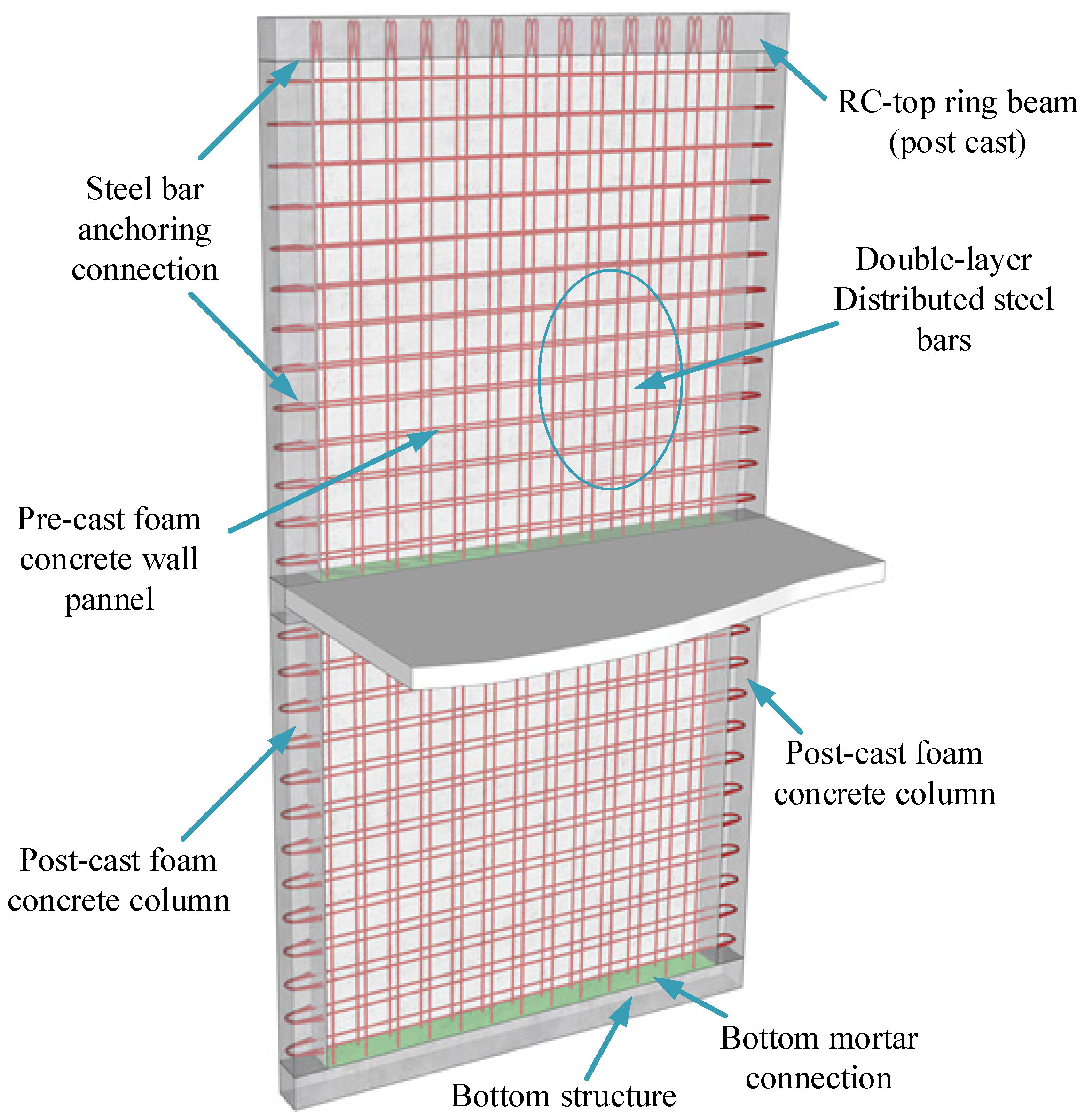
Based on the performance breakthrough of HLFC and aligned with the development attitude of energy-efficient buildings as well as construction industrialization, this study proposes a novel precast high-strength foamed concrete thermal self-insulating shear wall (HFSW shear wall) suitable for low-rise buildings. This wall system consists of a central precast wall panel and peripherally cast-in-place components such as columns and ring beams. The precast wall panel is reinforced with horizontally and vertically distributed steel bars, whose ends are anchored into the ring beams and cast-in-place columns to form an integrated structure. The precast panel is connected to the foundation (based on the structural characteristics, strip foundations are predominantly used for the underlying base of the structure) through bedding mortar, creating a precast high-strength foamed concrete shear wall system with integrated thermal self-insulation, where vertical distributed reinforcement remains discontinuous, constrained by ring beams and cast-in-place columns (as shown in Figure 1). This innovative shear wall system offers significant advantages including simplified connection details and convenient construction installation. It avoids the complex joint treatments typically required in conventional prefabricated concrete structures, substantially improving on-site assembly efficiency (increased by more than 100%) while reducing skill requirements for construction workers. Furthermore, the application of high-strength, high-thermal-resistance foam concrete enables this wall type to effectively integrate structural load-bearing capacity with thermal insulation performance when used as either enclosure structures or vertical load-bearing components.
To investigate the seismic performance of HFSW shear walls, ref. [37] conducted extensive experimental research and theoretical analysis on the shear behavior of these walls under low aspect ratios (less than 1). The test results demonstrated that for HFSW shear walls with low aspect ratios, where shear failure dominates, the significantly lower strength of foam concrete compared to conventional concrete led to the extensive development of shear cracks throughout the entire height of the wall. However, compared to traditional masonry structures commonly used in rural and town buildings, these walls exhibited favorable shear capacity and energy dissipation capabilities under horizontal loading. And, based on their failure characteristics, a calculation method for the shear strength of HFSW shear walls was put forward to guide design.
However, in multi-story HFSW thermal self-insulating shear wall structural systems, there are numerous instances of walls with high shear span ratios, where failure tends to be dominated by flexural behavior. Consequently, the shear strength calculation method for the novel HFSW shear walls derived from shear failure mechanisms in the literature [37] is no longer applicable. Currently, research on the overall flexural performance of HFSW shear walls under high shear span ratios remains unexplored, and there is a lack of corresponding design methods for flexural capacity, which limits their application in multi-story rural buildings. Therefore, this study systematically investigates and theoretically deduces the flexural performance of multi-story HFSW shear walls under high shear span ratios through full-scale model experiments, finite element parametric analysis, and the establishment of a flexural capacity calculation model. The flexural behavior of HFSW shear walls is compared with the shear-controlled failure mode observed in previous studies, highlighting the similarities and differences in wall performance under the two failure modes. Finally, a flexural capacity calculation method aligned with their bending failure mode and load transfer mechanism is established, providing a theoretical foundation and design basis for the engineering application of HFSW shear walls.

2. Experimental Program

2.1. Test Specimen

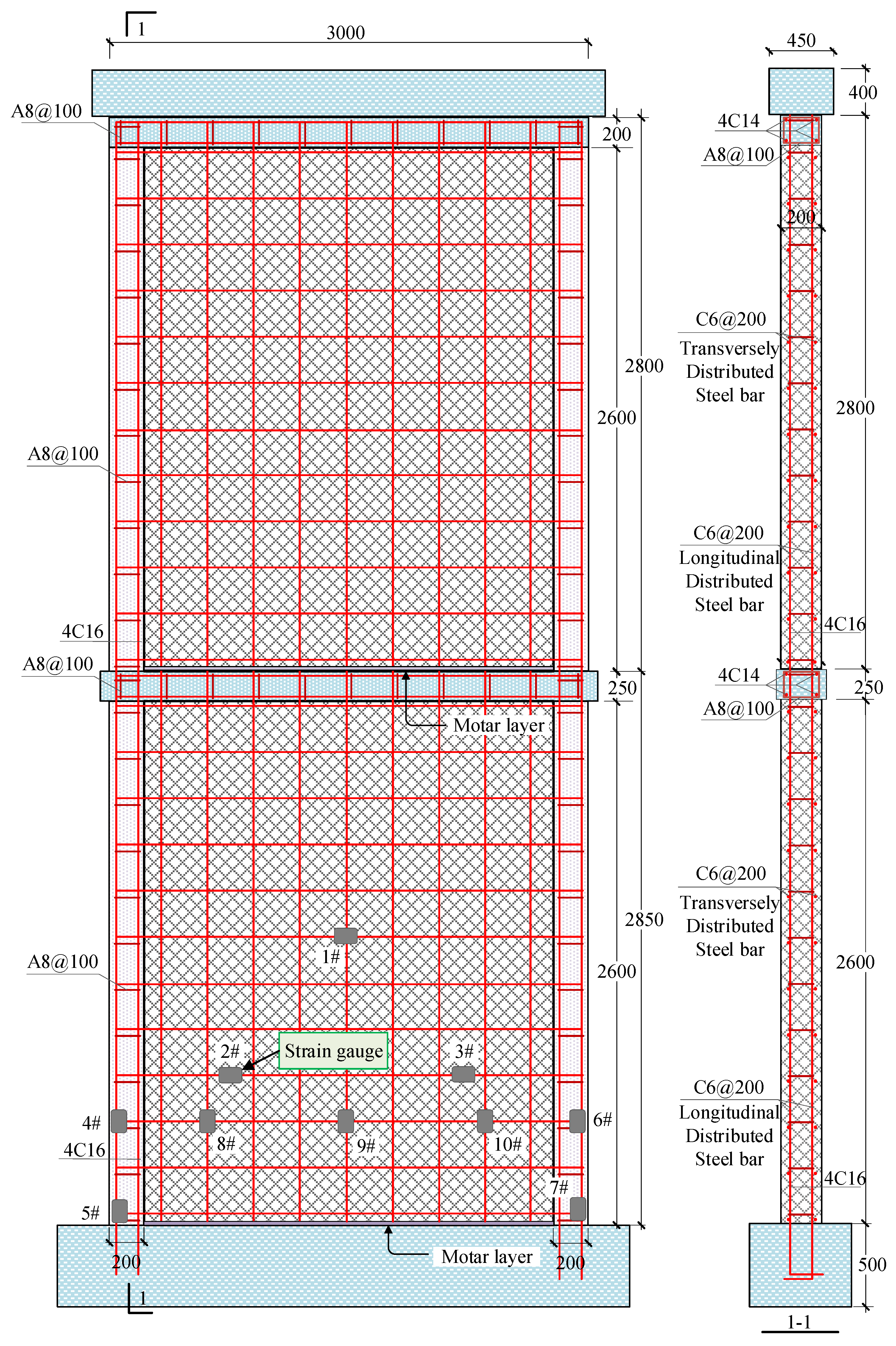
Based on the aforementioned structural configuration of the HFSW shear wall, a two-story prefabricated HFSW foam concrete shear wall specimen was designed. The design parameters are listed in Table 1 and illustrated in Figure 2.
In this study, the specimen dimensions were designed based on practical engineering conditions. The wall width was set at 3 m, corresponding to typical building bay sizes, while the wall height was determined according to common story heights (set at 2.8 m per story). The specimen measures 5850 mm in height, 3000 mm in width, and 200 mm in thickness.
Since the HFSW shear wall is a novel structural system with no dedicated design codes available for reference, this study adopted design parameters from masonry standards due to its similarities with traditional masonry structures in terms of material strength and application scenarios. The wall panel is reinforced with B6@200 distributed reinforcement. The cast-in-place columns are 200 mm wide, sharing the same thickness as the wall, with longitudinal reinforcement of 4C16 and stirrups of B8@100. The ring beams have a cross-section of 200 mm × 200 mm (except for the bottom ring beam, which serves as the loading beam and is sized at 300 mm × 250 mm to prevent premature failure due to insufficient strength). The longitudinal reinforcement in the ring beams is 4C14, with stirrups of B8@100.

2.2. Material Properties

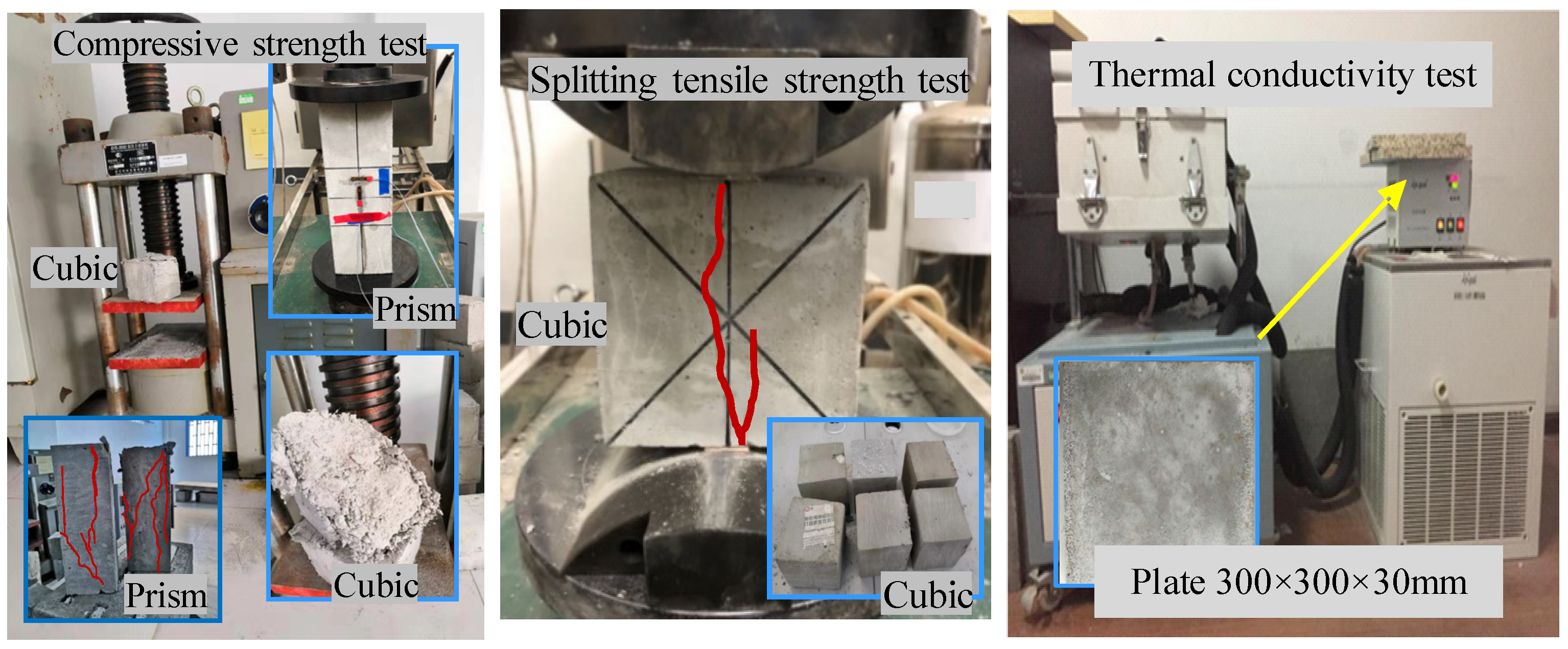
Table 2 provides a summary of the detailed parameters for the HLFC material components, as the dry density measured was 812 kg/m3. According to Chinese code JG/T 266-2011 [38], this qualifies it as A08 grade foam concrete. The average cubic compressive strength, measured using 100 mm cube specimens, was 5.20 MPa. The average axial compressive strength, measured by 100 mm × 100 mm × 300 mm prism specimens, was 4.58 MPa, with a characteristic value of 4.34 MPa. The experimental results are presented in Figure 3 and Table 3 and Table 4.
Compared to the average compressive strength (3 MPa) specified for ordinary foam concrete of the same density grade in the standard JG/T 266-2011, its cubic compressive strength is increased by 73.3%. When compared to foam concrete of the same density grade reported by other researchers [39,40], the compressive strength is approximately 40–70% higher. This enhancement is attributed to the reinforcing effect of PP fibers, the performance improvement from the high-efficiency composite water reducer, and the contribution of fly ash to the long-term strength development of the foam concrete.
In accordance with the Chinese standard GB/T 50081-2002 [41], the tensile strength was determined indirectly through splitting tests performed on 100 mm cubic specimens. As indicated in Equation (1), a value of 0.52 MPa was obtained for the average splitting tensile strength. Equation (2), which presents the conversion relationship between axial and splitting tensile strength proposed by Guo Zhenhai et al. [42,43], was used to calculate a corresponding axial tensile strength of 0.47 MPa.
f t s = 2 F π A = 0.637 F A
f t = 0.9 f t s
where f t s is the splitting tensile strength; F is the axial load; A is the area of the splitting surface; and f t is the axial tensile strength.
According to the Chinese standard GB/T 10294 [44], the thermal conductivity was measured using a set of foam concrete specimens with dimensions of 300 mm × 300 mm × 30 mm. The average measured value was 0.142 W/(m·K). With reference to the standard JG/T 266-2011, this thermal conductivity is comparable to that of A06-grade foam concrete. Compared to the specified thermal conductivity for the same density grade (A08) foam concrete in the standard (0.21 W/(m·K)), this represents a reduction of over 30%.
Through material property tests conducted on a set of 70.7 mm × 70.7 mm × 70.7 mm mortar cube specimens and 150 mm × 150 mm × 150 mm concrete cube specimens, the average compressive strength of the mortar was determined to be 18.3 MPa, while the average cubic compressive strength of the concrete was 27.2 MPa. The mechanical properties of the steel reinforcement used in the specimens are presented in Table 5.

2.3. Test Setup

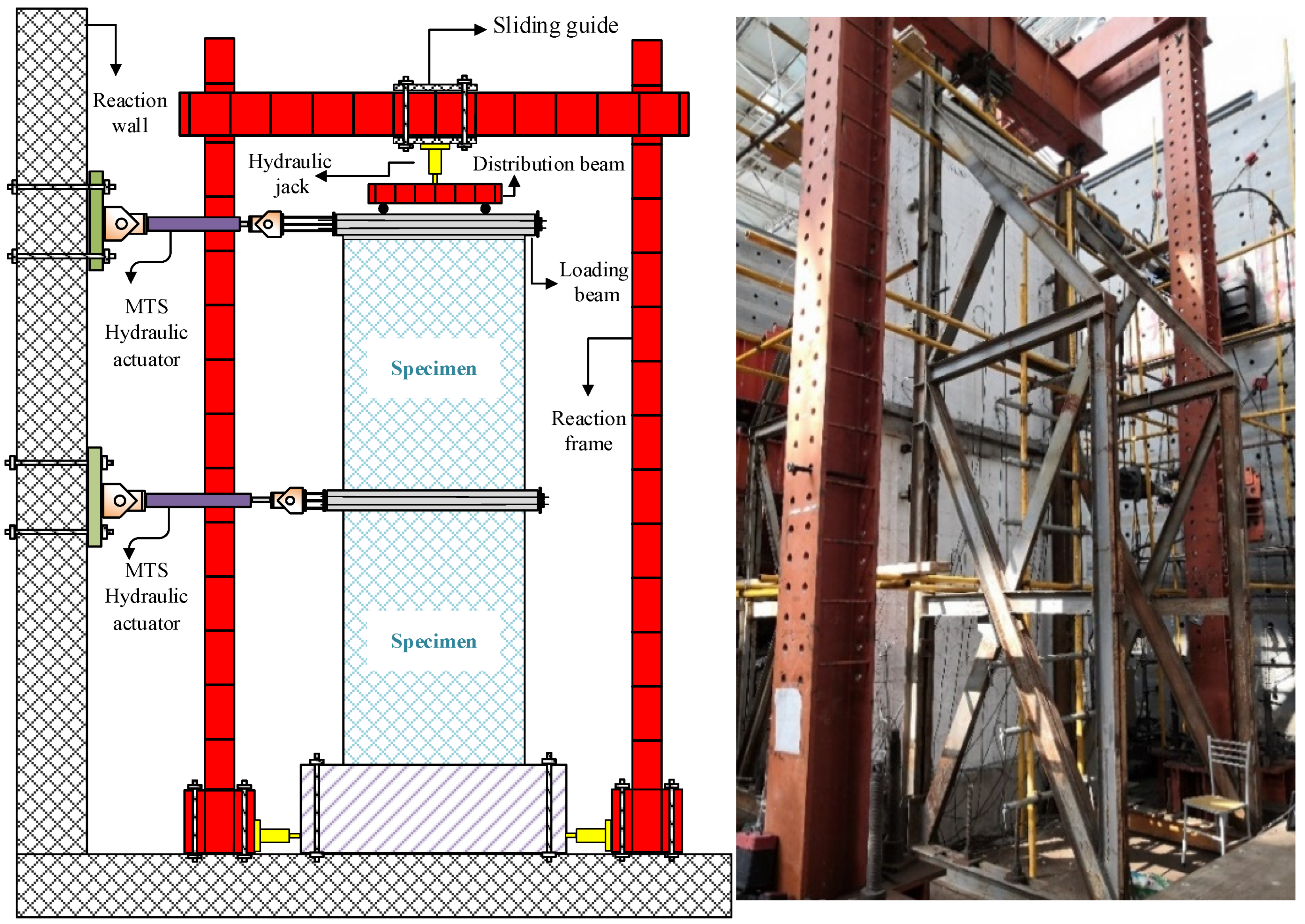
The loading setup is illustrated in Figure 4. An MTS actuator is anchored to the loading beam via tie rods. A load-distributing steel beam is placed atop the wall to ensure uniform distribution of the axial compression. The vertical load was supplied by using a 1000 kN hydraulic jack, equipped with a small roller cart against the reaction frame to minimize horizontal friction. The axial compression ratio was selected based on computational results from multi-story HFSW shear wall models (where the axial compression ratio typically ranges between 0.1 and 0.25 for structures with 1 to 4 stories). Consequently, an axial compression ratio of 0.2 was adopted for this test. Two lateral supports were installed on each side of the wall and bearing on the ring beams through horizonal pulleys to simulate the out-of-plane restraining effect of the floor slabs to the specimen.

2.4. Instrumentation Layout and Loading Procedure

The arrangement of strain gauges is shown in Figure 2. Specifically, gauges #1, #2, and #3 are used to monitor the strain in the horizontal distributed reinforcement at the mid-height and lower–middle sections of the bottom story of the specimen. Gauges #4, #5, #6, and #7 monitor the strain in the longitudinal reinforcement within the bottom-story edge columns, at the base and at a height of 500 mm above the base. Gauges #8, #9, and #10 are used to record the strain in the longitudinal distributed reinforcement at a height of 500 mm above the base of the bottom story. All strain data were recorded using a TST-3826 dynamic and static data acquisition instrument.
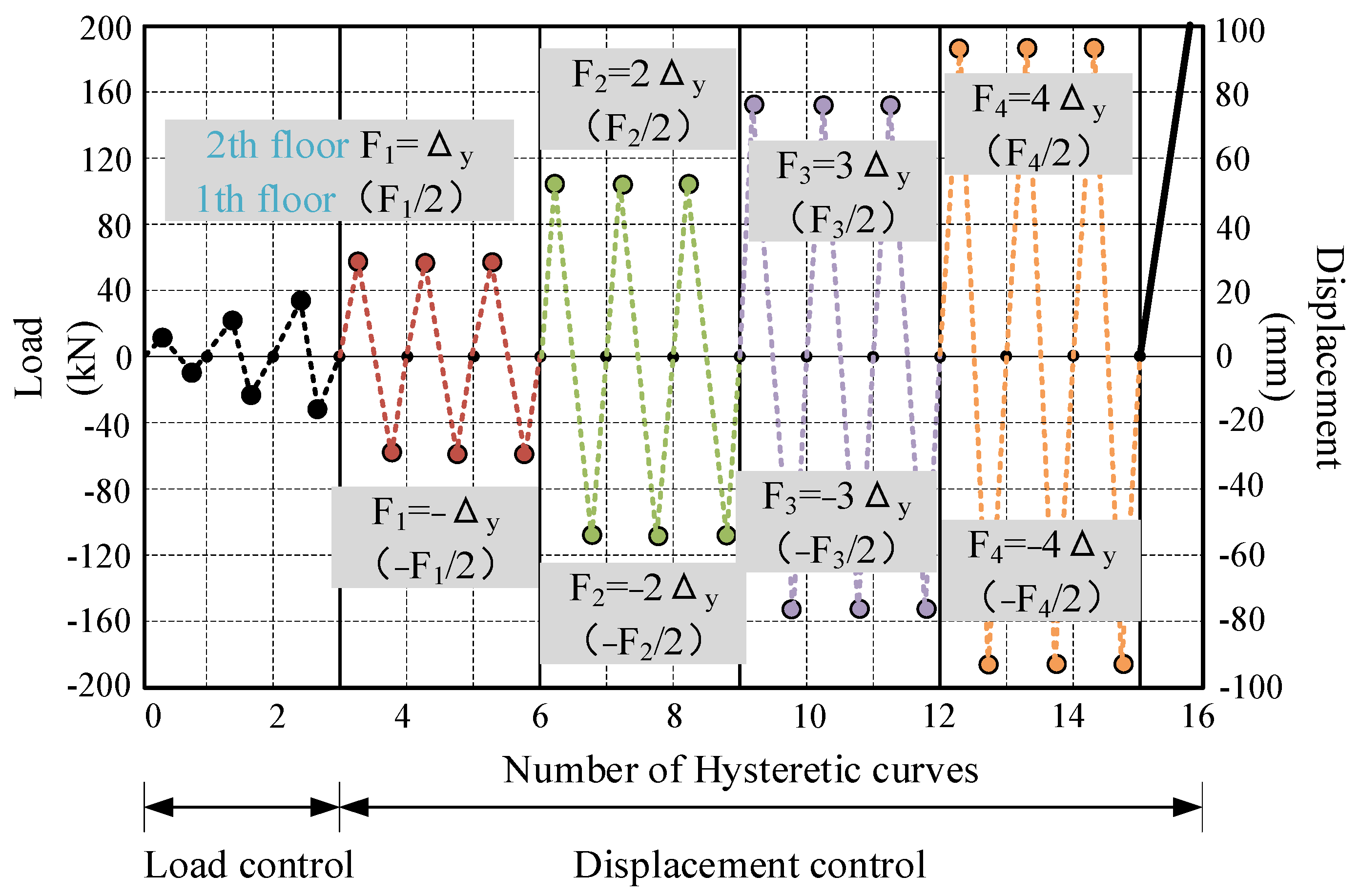
The horizontal load was applied in accordance with the ASTM standard [45]. The loading procedure is illustrated in Figure 5. The upper actuator served as the master control actuator, employing a force–displacement hybrid loading protocol. During the initial loading phase, force control was used with a load step of 20 kN, and each level was cycled once. When a distinct inflection point appeared on the load–displacement curve, indicating the wall had yielded, the control method switched to displacement control. The displacement step size was then determined as multiples of the yield displacement, with each level cycled three times. Following an inverted triangular loading pattern, the load applied by the bottom actuator was set to half of that at the top. The bottom actuator operated under force control throughout the test, with its load value being continuously calculated as half of the real-time load measured at the top actuator. The test was terminated when the specimen failed or the load dropped below 85% of the peak load.

3. Results and Discussion

3.1. Test Observations and Failure Modes

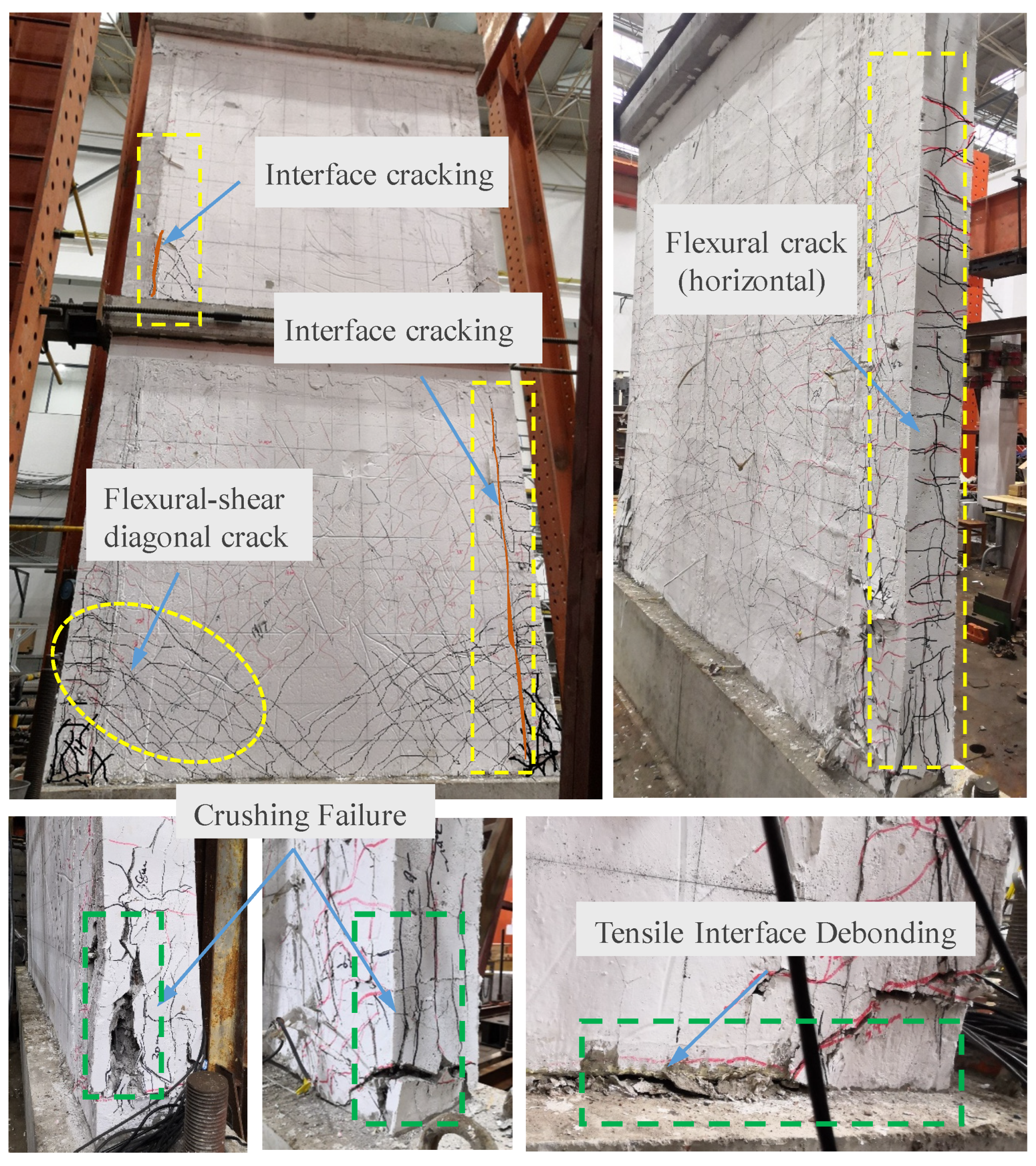
As shown in Figure 6, under horizontal loading, numerous flexural–shear diagonal cracks formed at the base of the bottom story. Simultaneously, a significant number of flexural vertical crushing cracks developed on both sides of the bottom-story edge columns. When the wall reached its peak load, crushing failure occurred at the column bases, accompanied by noticeable buckling of the longitudinal reinforcement in the edge columns. Similarly to the previously studied single-story wall controlled by shear failure [37], numerous fine shear cracks also appeared throughout the full height of the bottom story in this two-story wall. Based on field observations of actual damage to masonry or reinforced concrete shear walls during the Wenchuan earthquake in China [46], this phenomenon is fundamentally different from the failure observed in conventional reinforced concrete shear walls, primarily attributable to the low strength of the foam concrete. During loading, interface cracking occurred between the precast wall panels and the cast-in-place columns in both stories; however, no separation was observed, indicating that the vertical joint connections remained safe and reliable even under flexural failure conditions. Unlike walls controlled by shear failure, the bedding mortar layer at the base of the specimen with a large shear span ratio experienced interface debonding in the tension zone during the later stages of loading. However, this occurred near the wall’s ultimate capacity (85% of the peak load), and the wall still maintained a certain degree of integrity. Damage to the upper story of the wall was relatively minor throughout the test, with the damage concentrated mainly in the bottom story. In summary, the failure characteristics observed in specimen DW-1 align with those of flexural failure, demonstrating a typical failure mode dominated by flexural mechanisms.

3.2. Hysteretic Curves

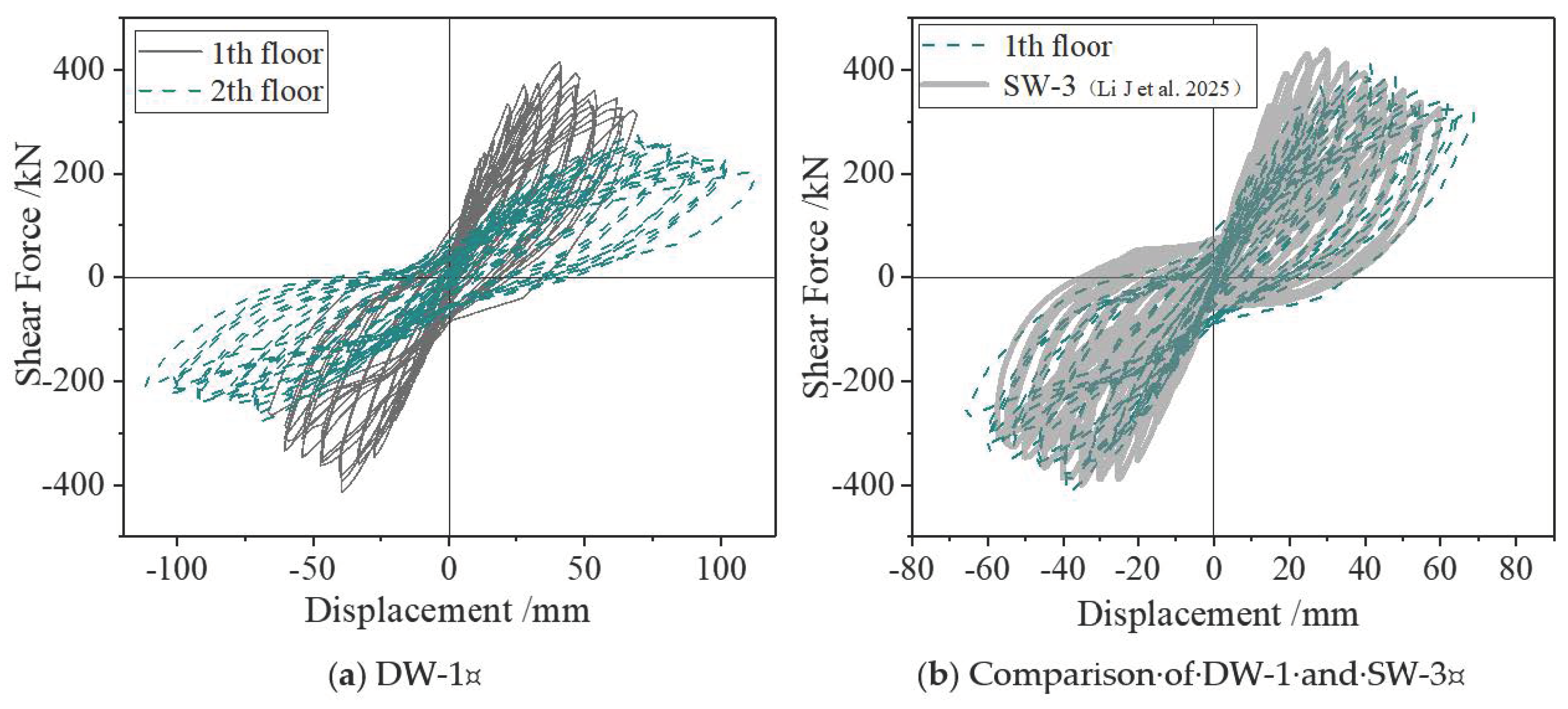
Figure 7a shows the shear force–displacement hysteresis loops for each story of wall DW-1. Due to phenomena such as interface cracking and slip between the cast-in-place columns and precast wall panels, extensive crack development within the wall, and crushing at the compressed base, the hysteresis loops exhibit significant nonlinear characteristics. Crack propagation and interfacial slip of the reinforcement resulted in pronounced pinching in the shear force–displacement curves. Overall, the shape of the hysteresis loops evolved through stages of linear, spindle-shaped, and inverse S-shaped forms, which correspond to the elastic, elastoplastic, and failure stages of the wall’s loading behavior, respectively.
Figure 7b presents a comparison between the base shear force–displacement hysteresis loop of the wall and that of a single-story specimen, SW-3 [37], with identical parameters but dominated by shear failure. The difference in the fullness of the hysteresis loops between the two is not significant, which could be primarily attributed to two reasons. Primarily owing to the comparatively low compressive strength of the foamed concrete, even in the large shear span ratio wall where flexural failure dominates, extensive diagonal shear cracks still developed. This crack pattern exacerbated the “pinching” effect in the hysteresis loops of the flexure-dominated member. Second, significant interface debonding occurred in the tension zone of the bedding mortar layer at the base of the bottom story during the later loading stages. The repeated opening and closing of this interface also contributed to the increased pinching observed in the hysteresis loops.

3.3. Envelope Curves and Characteristic Points

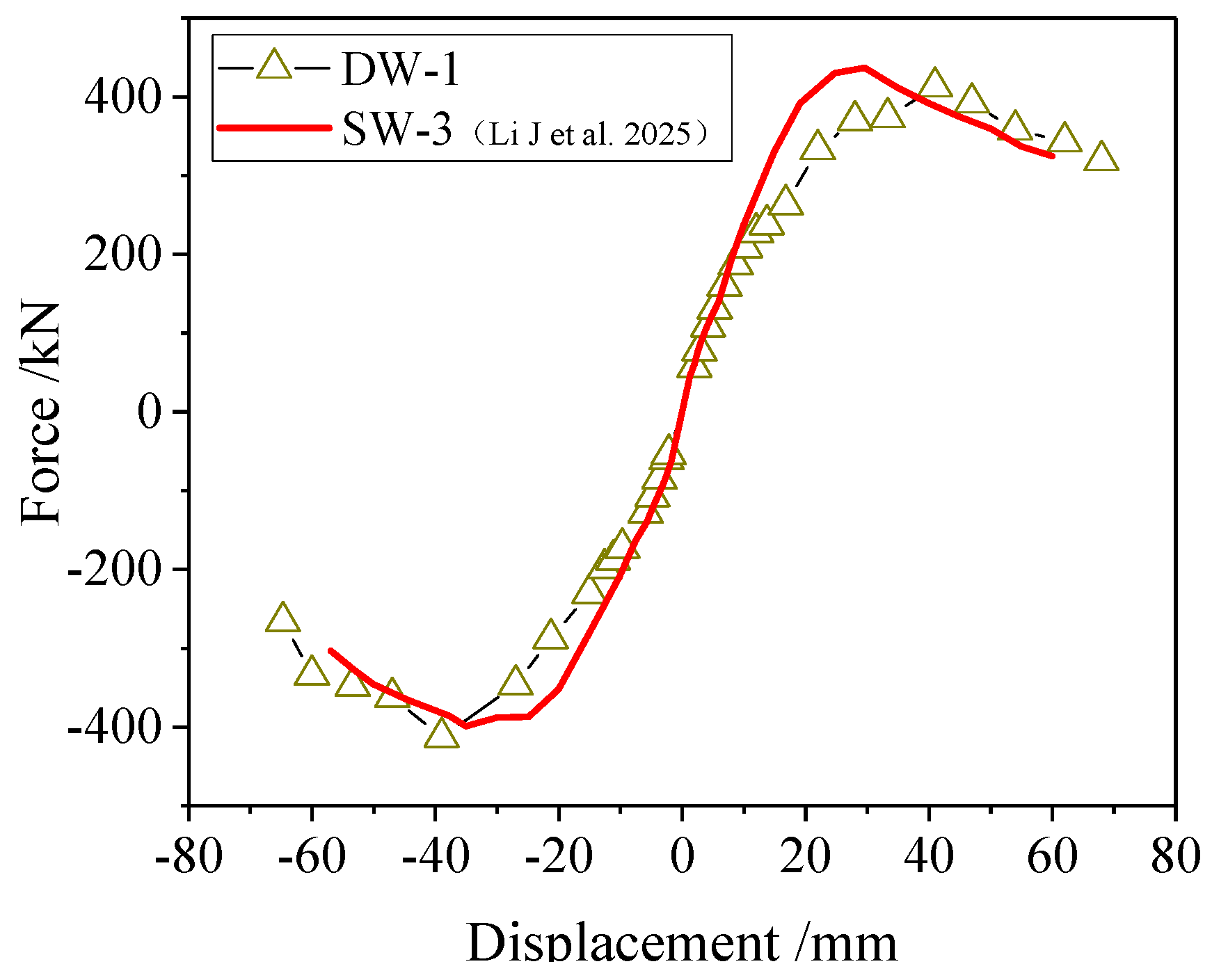
To provide an intuitive understanding of the flexural properties of the HFSW thermal self-insulation shear wall, Figure 8 presents a comparison of the shear force–displacement skeleton curves between wall DW-1 and the single-story wall SW-3. Similarly to the single-story wall, the skeleton curve of the two-story wall also exhibits no distinct yield point. During the early loading stage, both specimens were in the elastic response phase, with their skeleton curves approximating straight lines. As the walls entered the elastoplastic stage, the skeleton curves demonstrated significant nonlinearity. The curve slope for wall DW-1 during this phase was comparatively lower, primarily because the increased shear span ratio shifted the wall’s behavior to a flexure-dominated failure mode, thereby reducing its lateral stiffness.
Table 6 presents the experimental values at characteristic points of the bottom-story shear-–displacement skeleton curve for specimen DW-1, averaged from both positive and negative loading directions. The measured values indicate a peak displacement of 40.3 mm with a corresponding peak load of 413.5 kN. Compared to specimen SW-3 (with corresponding peak displacement of 32.3 mm and peak load of 418.2 kN) [37], DW-1 exhibited a slightly lower peak load but a 24.8% greater peak displacement under combined flexural–shear action. The ultimate displacement reached 55.2 mm, which is 13.6% larger than that of the single-story wall. These results indicate that the deformation capacity of the flexural failure specimen shows some improvement compared to the shear failure case. However, due to material properties that caused extensive development of shear or flexural–shear cracks in both failure modes, the reduction in peak load capacity for the flexure-controlled failure is not substantial when compared to shear-controlled failure.
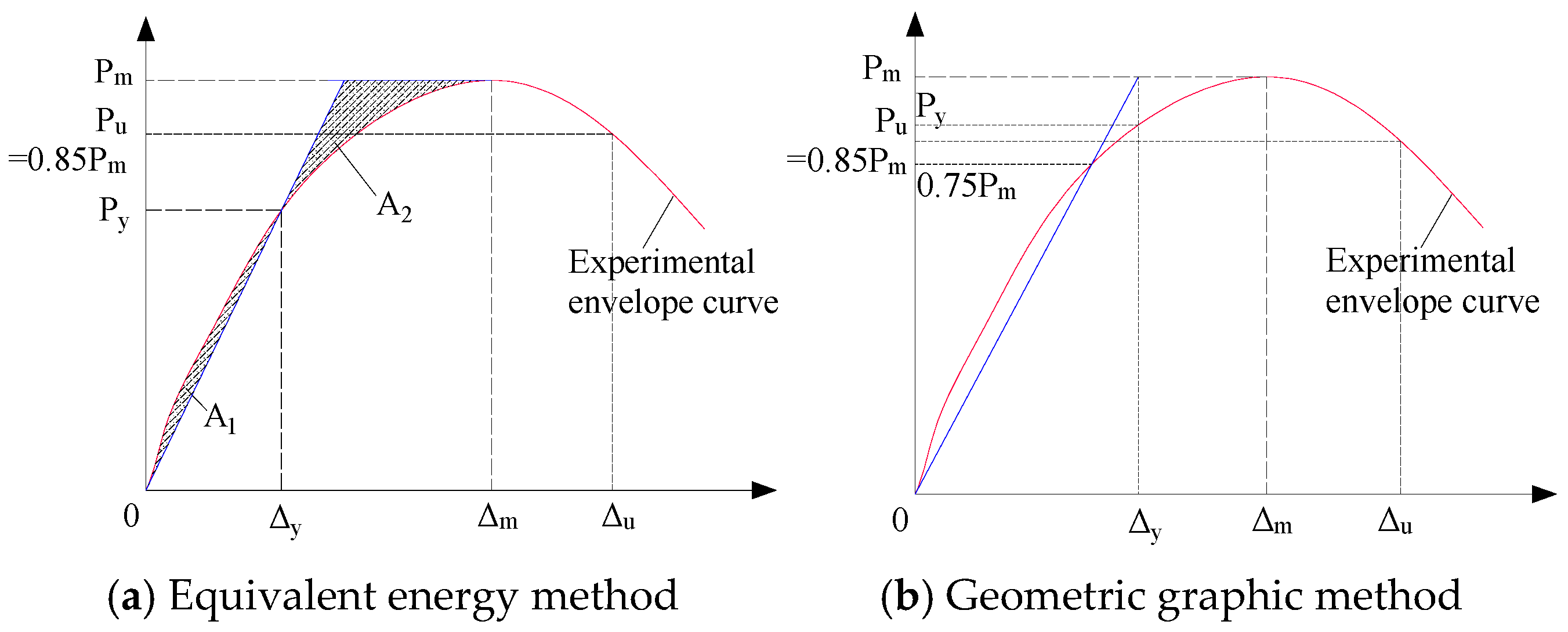
Table 7 presents the calculated yield points for the base shear–displacement skeleton curve of specimen DW-1, determined using the equivalent area method and the geometric construction method [12,47] (using the average of both methods). Here, (Δm, Pm) represents the peak point, (Δy, Py) denotes the yield point, and (Δu, Pu) indicates the ultimate point, as showed in Figure 9. The calculated base yield displacement for DW-1 is 23.1 mm with a corresponding yield load of 323.8 kN. Compared to the previous studied single-story wall, the yield displacement increased by 11.6% while the yield load decreased by 14.7%. In summary, similar to conventional reinforced concrete shear walls, the large shear span ratio (flexure-dominated) of the HFSW shear wall results in greater yield deformation capacity but lower yield strength compared to the single-story wall with a small shear span ratio (shear-dominated).

3.4. Lateral Stiffness and Ductility Ratio

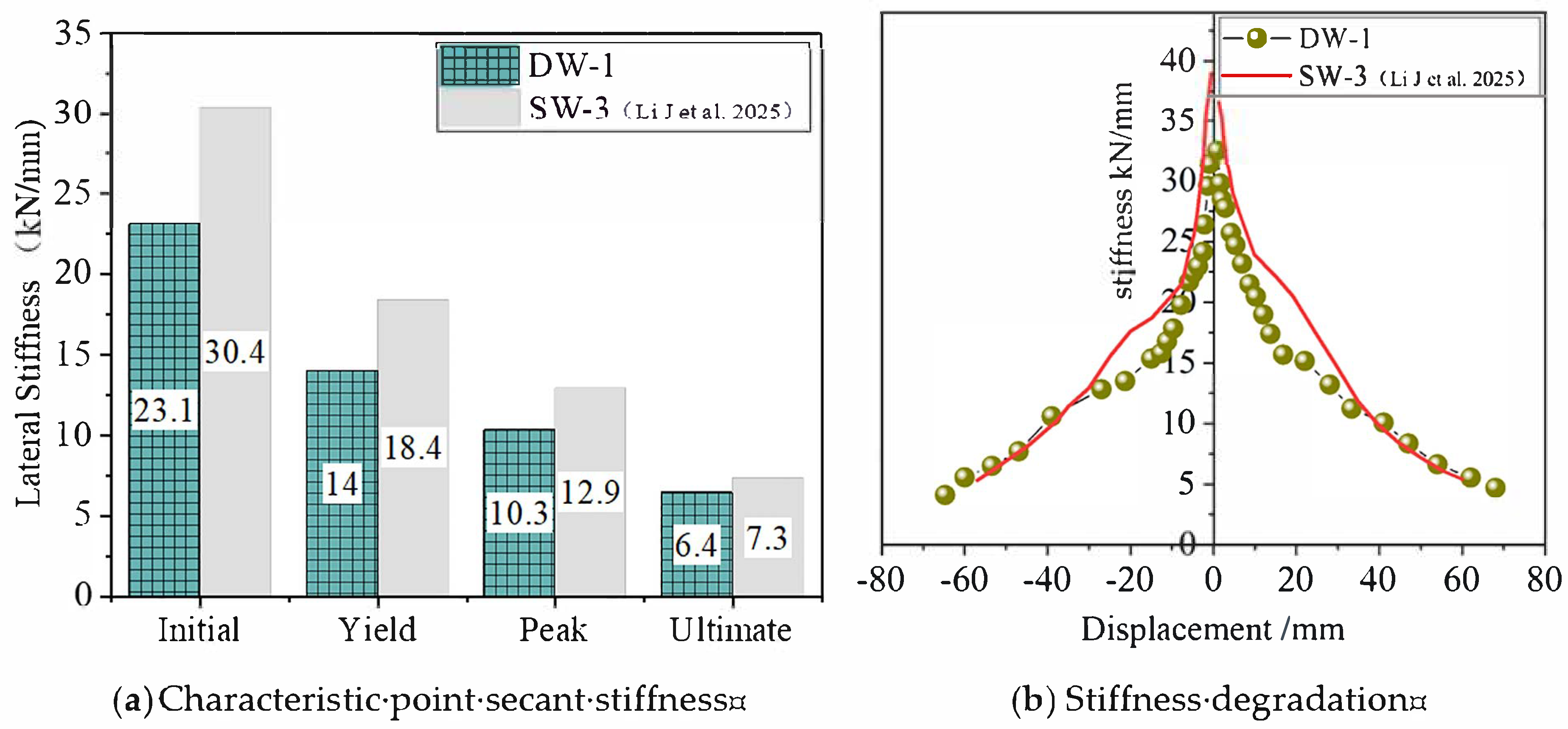
Figure 10 compares the characteristic secant stiffness and stiffness degradation between specimen DW-1 and the previous studied single-story specimen. According to the Chinese code JGJ/T 101-2015 [45], the stiffness calculation method is given by Equation (3). The yield stiffness, peak stiffness, and ultimate stiffness at the base of the two-story specimen DW-1 were 23.9%, 20.2%, and 12.3% lower, respectively, than those of the single-story wall. Since wall DW-1 experienced flexure-dominated failure, its characteristic stiffness values at all stages were lower than those of the shear-controlled failure case. However, the difference in stiffness between the two specimens showed a decreasing trend with increasing deformation. This is mainly because the low strength of the foam concrete led to extensively distributed cracks over the full height of SW-3 [37], particularly the local crushing and spalling of foam concrete at the intersection of diagonal cracks in the central wall region, which consequently reduced its lateral stiffness. This reduction caused the stiffness of the flexure-dominated wall to gradually approach that of the shear-dominated case. Figure 10b compares the stiffness degradation curves of the two walls. As shown, similar to SW-3 [37], the stiffness degradation at the base of the two-story specimen also exhibited an initial rapid decline followed by gradual stabilization. The stiffness curve of DW-1 generally lies below that of SW-3 [37], only converging in the later loading stages. This can also be attributed to the insufficient strength of the foam concrete, which resulted in excessive distributed crack development and local crushing/spalling in SW-3 [37], thereby reducing its stiffness in the later phase.
K i = + F i + F i + X i + X i
where the secant stiffness K i is calculated from the peak point loads and their corresponding displacements in both positive and negative directions during the i-th loading cycle. Specifically, + F i and F i represent these loads, while + X i and X i denote the respective displacements.
In accordance with Chinese code JGJ/T101–2015 [42], the ductility of the specimens was assessed using the displacement ductility coefficient, as defined in Equation (4).
μ = u y
where the parameters u and y represent the ultimate displacement and yield displacement, respectively, of the specimens subjected to horizontal loading.
The derived ductility coefficient at the base for DW-1 under flexural failure was 2.38, which is slightly higher than that of single-story specimen with shear failure (2.34) [37]. Although the two-story wall had a larger shear span ratio, resulting in a flexure-controlled failure mode at the base with significantly larger inter-story displacements at all stages compared to the single-story wall, its post-yield deformation capacity did not show substantial improvement over its pre-yield behavior. This is primarily because, similar to the shear failure wall, the full development of cracks in the foam concrete and the occurrence of local crushing led to a rapid decline in load-carrying capacity after the peak, thereby compromising the deformation capacity in the later stages.

3.5. Energy Dissipation Performance

Under seismic action, shear walls undergo plastic deformation, thereby dissipating energy. Consequently, energy dissipation capacity serves as a crucial indicator of the seismic performance of shear walls. This study calculated the viscous damping coefficient and cumulative energy dissipation at the base of this two-story HFSW shear wall under flexural failure conditions. To further investigate differences in energy dissipation compared to shear failure cases, the energy dissipation performance at the base of specimen DW-1 was also compared with the previous studied shear-controlled failure case. The Chinese specification JGJ/T101–2015 [42] employs the equivalent viscous damping coefficient, h e , as a metric to evaluate the energy dissipation capacity of shear walls subjected to reversed cyclic loading, as defined in Equation (5).
h e = 1 2 π S A B C + D B C S O A F + O D E
The equivalent viscous damping coefficient, h e , is quantified by the areas of the hysteretic loop, where S A B C + D B C represents the total energy dissipated per cycle (the entire area within the hysteretic loop), and S O A F + O D E denotes the elastic strain energy of an equivalent linear system (the sum of areas of triangles OBE and ODF), as illustrated in Figure 11.
As shown in Figure 12a, the viscous damping coefficient of specimen DW-1 generally followed a development trend similar to that of SW-3 [37], both showing three developmental stages. During the initial loading phase, the curves of both specimens were nearly identical, which is both attributed to the energy dissipation caused by the development of numerous flexural–shear cracks. As interfacial cracks propagated and relative slip occurred between the reinforcement and foam concrete, the viscous damping coefficient exhibited a brief, slight decrease. Subsequently, with the wall and reinforcing steel entering the yielding stage, it began to increase steadily. Overall, the viscous damping coefficient of the flexure-controlled specimen DW-1 was slightly higher than that of the shear-controlled ones, primarily due to the enhanced energy dissipation from the yielding of longitudinal reinforcement in the edge columns resulting from the flexure-controlled failure mechanism.
As shown in Figure 12b, the cumulative energy dissipation curves of the two specimens remained relatively close throughout the loading process (with the flexural failure case being slightly higher). The energy dissipation in the HFSW shear wall consists of two components: energy dissipation through foam concrete cracking and energy dissipation through internal reinforcement. However, regardless of whether the failure mode was shear-dominated or flexure-dominated, extensive diagonal shear and flexural–shear cracks developed along the full height of the wall during loading, which consequently reduced the proportion of energy dissipated by reinforcement yielding. On the other hand, based on experimental observations and hysteresis loop analysis, the flexural failure case exhibited more severe relative slip between the reinforcement skeleton and the foam concrete, leading to aggravated pinching in the hysteresis loops. This phenomenon also contributed to the reduction in energy dissipation capacity. Nevertheless, since specimen DW-1 was primarily controlled by flexural failure, its ultimate displacement was greater than that of the shear-controlled case. As a result, its final cumulative energy dissipation was 23% higher than that of SW-3 [37].

3.6. Development of Reinforcement Strain

Figure 13 shows the reinforcement strain at the base of wall DW-1. When the wall reached the yield state, the longitudinal reinforcement at the base of the edge columns had already attained yield strain. The stress in the longitudinal reinforcement at a height of 500 mm above the base was lower than that at the column base; however, it also yielded when the wall reached its peak load. The strain in the distributed longitudinal reinforcement on both sides of the wall increased steadily but did not reach yield, remaining within the range of 1600–1800 με. The horizontal distributed reinforcement at the base experienced relatively low stress levels, with maximum strains ranging from 700 to 1600 με. The strain in the horizontal distributed reinforcement in the lower–middle region of the wall was slightly greater than that in the mid-height region. Overall, the reinforcement strain distribution in the wall aligns with the characteristic patterns observed in flexural members.

3.7. Comparison to Conventional Masonry Systems

To demonstrate the bearing capacity advantages of HFSW self-insulating shear walls over traditional masonry structures that are also suitable for low-rise or multi-story rural buildings, Table 8 presents a comparative analysis of the average shear capacity per linear meter between HFSW shear walls and masonry/insulating masonry shear walls reported in relevant literature. Compared with commonly used clay brick masonry shear walls, HFSW shear walls exhibit a 76.7% increase in horizontal bearing capacity per linear meter despite a 26% lower material strength. Relative to hollow clay brick masonry shear walls, they achieve an 89.5–139% improvement in horizontal bearing capacity per linear meter while having 52–56% lower material strength. In comparison with calcium silicate masonry shear walls, HFSW shear walls show a more than fourfold enhancement in horizontal bearing capacity per linear meter with a 23% reduction in material strength. Against Lightweight Aerated Concrete masonry shear walls, they deliver a 175.6% increase in horizontal bearing capacity per linear meter alongside a 91% higher material strength. These results highlight the superior lateral load-bearing performance of the HFSW shear wall system compared to conventional masonry structures.

4. Finite Element Simulation and Analysis

The finite element software ABAQUS 2025 was employed to simulate and analyze the flexural behavior of HFSW shear walls. The foamed concrete was modeled using C3D8R 8-node linear brick elements, while the steel reinforcement was represented by T3D2 linear truss elements. To balance computational accuracy and efficiency, the main structural components (including the rear cast-in-place side columns, precast wall panels, and top ring beams) were meshed with regular hexahedral elements sized at 50 mm, while the bottom beam was meshed with elements sized at 100 mm. The calculation adopts the Static General Explicit solver. The load application is divided into two steps: Step 1 is used to apply vertical loads. To facilitate calculation convergence, it is set to automatic increment steps with a maximum of 1 × 10⁴, a minimum of 1 × 10⁻⁵, and an upper limit of 1. Step 2 is used to apply horizontal cyclic forces, with a maximum of 1 × 10⁵ increments, a minimum of 5 × 10⁻⁴, and an upper limit of 50.
The concrete damaged plasticity model is well suited for describing nonlinear and stochastic behaviors in concrete structures, such as cyclic hysteresis response and crack damage under loading. To simulate crack propagation and closure under reversed cyclic loading conditions, as well as phenomena such as material damage and stiffness recovery, the plastic damage model was adopted for the simulation.
Currently, there is no suitable damage–plasticity constitutive model specifically designed for foam concrete. Given that foam concrete is also a cementitious material like conventional concrete, they share many similar properties, its damage model and the related fundamental parameters were referenced from the approaches used for conventional ones (the dilation angle is set to 30, the eccentricity to 0.1, f b 0 / f c 0 to 1.16, K to 0.667, and the viscosity parameter to 0.0005) [53,54].
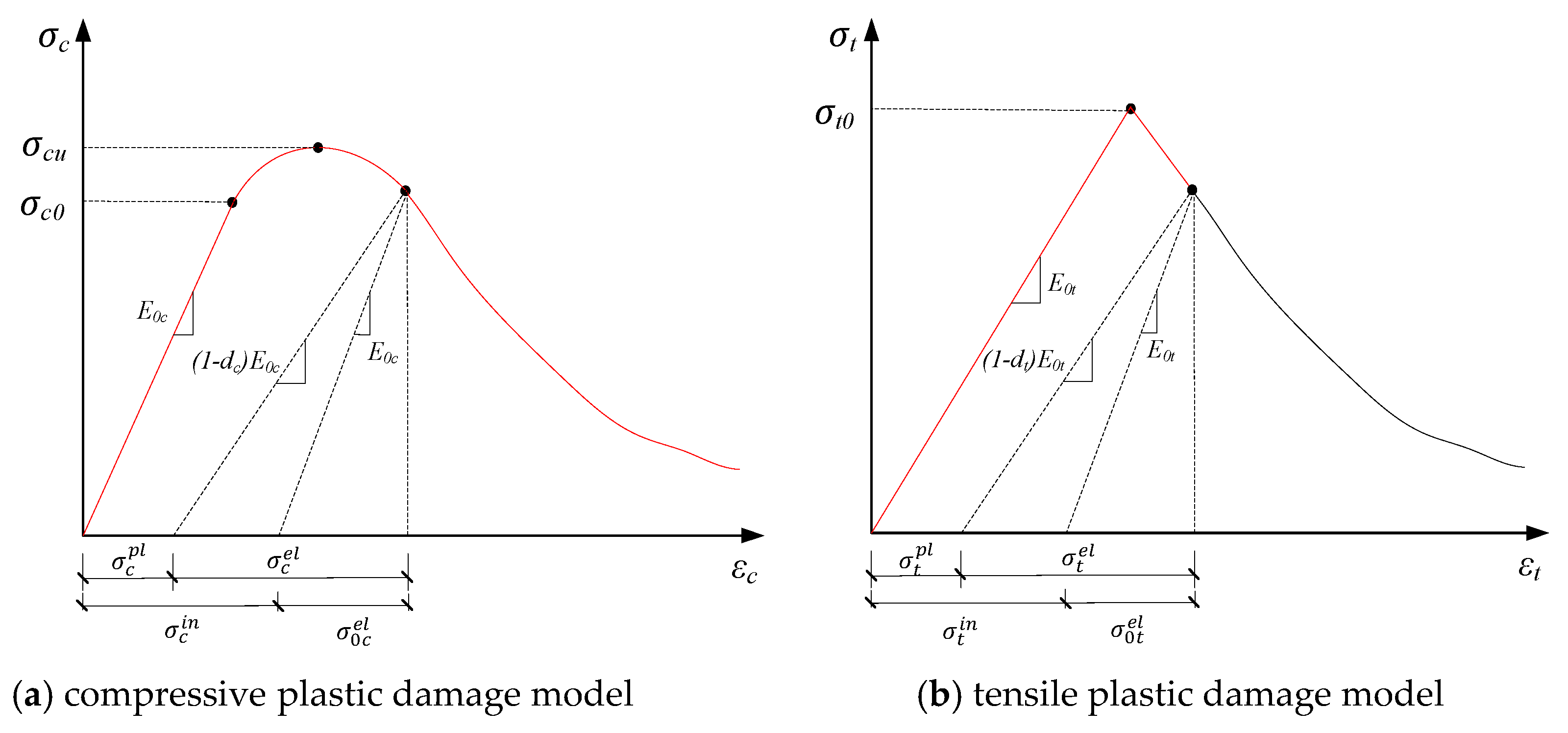
In the model, when foam concrete enters the nonlinear damage stage, the elastic modulus (compressive and tensive) of the material modified by the damage factor d is given by Equations (6) and (7). d c and d t represent the compressive and tensile damage factors, respectively. E 0 c and E 0 t represent the initial compressive and tensile elastic moduli, respectively.
E c = 1 d c E 0 c
E t = 1 d t E 0 t
Figure 14 presents the uniaxial compressive and tensile stress–strain curves of the foam concrete, along with schematic diagrams of cracking strain and inelastic strain. The stress–strain relationship expressions for the concrete material plastic damage model are provided in Equations (8) and (9) [54,55]. Here, σ c and σ t represent the compressive stress and tensile stress, respectively. The specific meanings of the other parameters in the figure are introduced in references [53,54,55].
σ c = 1 d c E 0 c ε c ε c p l
σ t = 1 d t E 0 t ε t ε t p l
Damage in concrete refers to the phenomenon where, under load, a large number of tensile and compressive crack defects are generated within the material, leading to a degradation of its mechanical properties. Currently, there are various methods for calculating damage factors. However, due to the widespread issue of convergence in finite element computational software, not all theoretical approaches are suitable for numerical analysis. Based on the energy equivalence assumption, scholar Sidoroff F [54] proposed a method for calculating the concrete damage factor that can effectively describe both tensile and compressive damage behaviors. This method meets the required accuracy in calculations while demonstrating good convergence and is therefore widely used in numerical analysis of concrete members considering plastic damage, as shown in Equations (10) and (11).
d t = 1 σ t / E 0 t ε t
d c = 1 σ c / E 0 c ε c
Due to the continuous accumulation of internal damage and the rapid decline in the slope of the material’s stress–strain relationship curve in the later stage, inputting the entire curve for calculation may lead to inaccurate results or convergence issues. To ensure the continued development of concrete damage in the later stage, although the stress–strain relationship curve is truncated in the later phase, the damage factor in this stage must continue to be calculated. Only when the damage factor exceeds 0.95 can ideal simulation results be achieved. Finally, as shown in the strain relationship in Figure 14, the accuracy of the input stress, strain, and damage factor parameters can be verified by evaluating the plastic strain values. The calculated concrete plastic strain should follow an increasing trend, with the compressive and tensile plastic strains computed as shown in Equations (12) and (13) [54,55].
ε c p l = d c 1 d c σ c E 0 c
ε t p l = d t 1 d t σ t E 0 t
Since foam concrete has relatively low strength, the overall integrity and load-bearing capacity of its interaction with reinforcement are comparatively reduced. Therefore, the Embedded Region constraint was utilized to simulate the interaction between steel reinforcement and concrete. Based on experimental observations, no interfacial separation occurred between the edge columns and precast wall panels during loading, and the connection between the top ring beam and lower components remained intact without significant interfacial cracking. Therefore, the changes in wall performance—such as strength, ductility, and energy dissipation—caused by interface failure at this location are limited. So, to reduce computational cost, the Tie constraint was adopted at these interfaces to facilitate load transfer.
As for the mortar bedding layer at the base, localized interfacial separation was observed in the later stages of loading; hence, a cohesive contact model was employed to define the interface behavior at this location. According to previous studies [56], the interfacial bond parameters of foamed concrete were selected as follows: For the interface between foamed concrete and mortar, uncoupled stiffness coefficients were used for the normal direction and the two mutually perpendicular tangential directions, with values of K n n = 1.927   N / m m 3 ,   K s s = K t t = 3.083   N / m m 3 , respectively. The peak stresses at the starting point of the softening stage were t n = 0.16   M P a for the normal direction and t s = t t = 0.37   M P a for the tangential directions. The normal fracture energy, calculated using the area method, was taken as G n C = 6.64   N / m ; the tangential fracture energy, based on the optimal simulation solution considering stiffness and the peak point, was taken as G t C = G s C = 25   N / m .

4.1. Material Constitutive Model

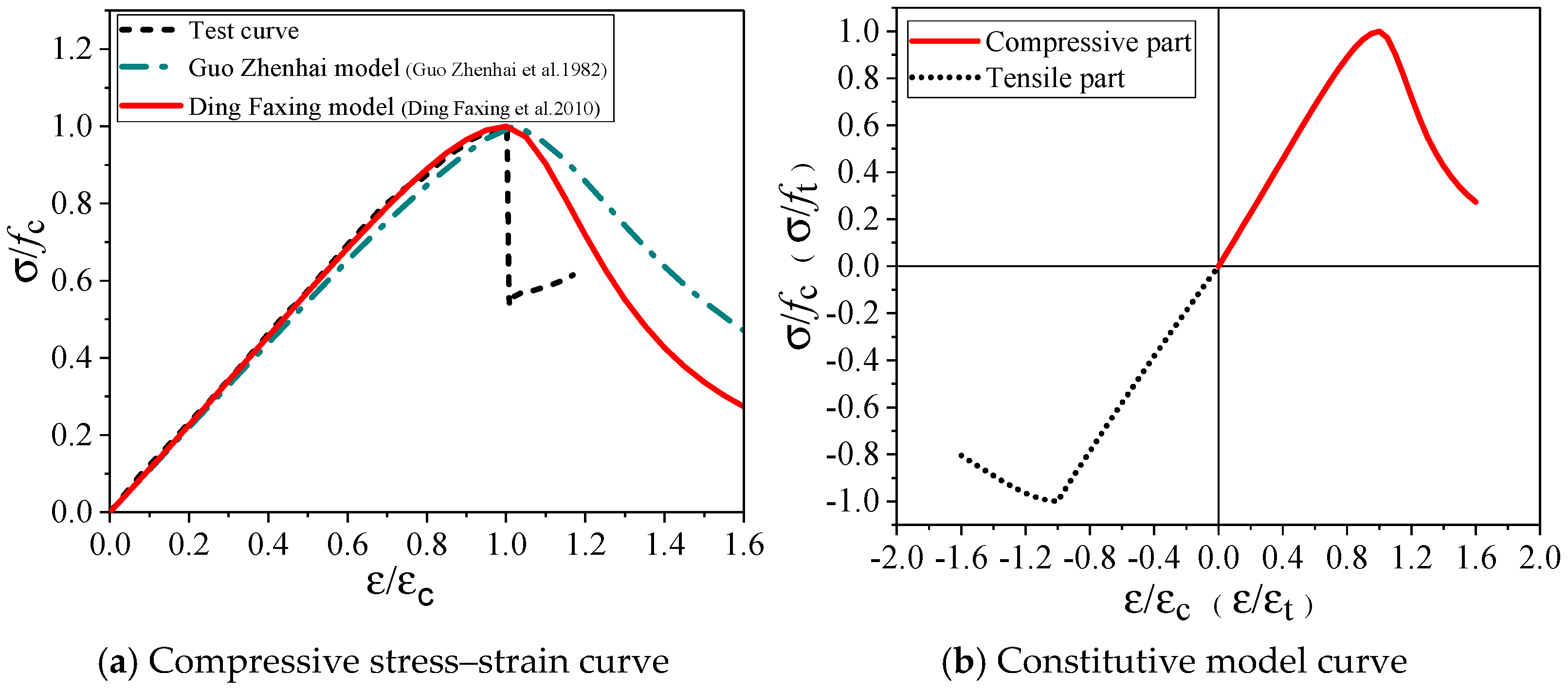
The constitutive relationship for ordinary concrete in the model was defined with reference to the Chinese standard code GB50010-2010 [57]. The experimental stress–strain curve of HLFC is shown in Figure 15a. A comparison was conducted between the constitutive equation for aerated concrete recommended by Guo Zhenhai et al. [58] and the complete stress–strain curve for lightweight aggregate concrete proposed by Ding Faxing et al. [59] against the measured data. This comparison revealed that Guo’s theoretical formula produces a lower ascending branch than the experimental curve, entering the elastoplastic stage prematurely, whereas Ding’s theoretical formula provides a better fit. Furthermore, Ding’s research indicates that the ascending branches of the uniaxial tensile and compressive stress–strain curves for lightweight concrete can be described by the same equation. Although the descending branch of the uniaxial tensile curve is steeper than that in compression, the tensile behavior of concrete has a limited impact on the simulation accuracy. Therefore, it is suggested that the descending branch of the uniaxial tensile constitutive relationship for lightweight concrete also adopts the same calculation formula as the uniaxial compressive curve. Based on the above analysis, this study proposes a dimensionless computational model for the stress–strain constitutive relationship of High-Strength Foamed Concrete (HLFC), as shown in Equations (14) and (15). The corresponding complete tensile and compressive constitutive curves are presented in Figure 15b.
y = A n x + B n 1 x 2 1 + A n 2 x + B n x 2     x 1
y = x a n x 1 2 + x     x > 1
where x and y represent the ratio of strain to peak strain and the ratio of stress to peak stress, respectively; A n is the ascending branch parameter (taken as the ratio of the elastic modulus of lightweight concrete to its peak secant modulus, here set to 0.93); B n is the parameter controlling the decay of the elastic modulus in the ascending branch (when y < 0.4 , the ascending branch of the stress–strain curve can be approximately regarded as a straight line; thus, based on the boundary conditions x < 0.4 / A n , y = 0.4 , B n can be calculated as 0.068); and a n is the descending branch parameter, obtained by fitting the experimental data and set to 0.075.

4.2. Comparison of Failure Modes

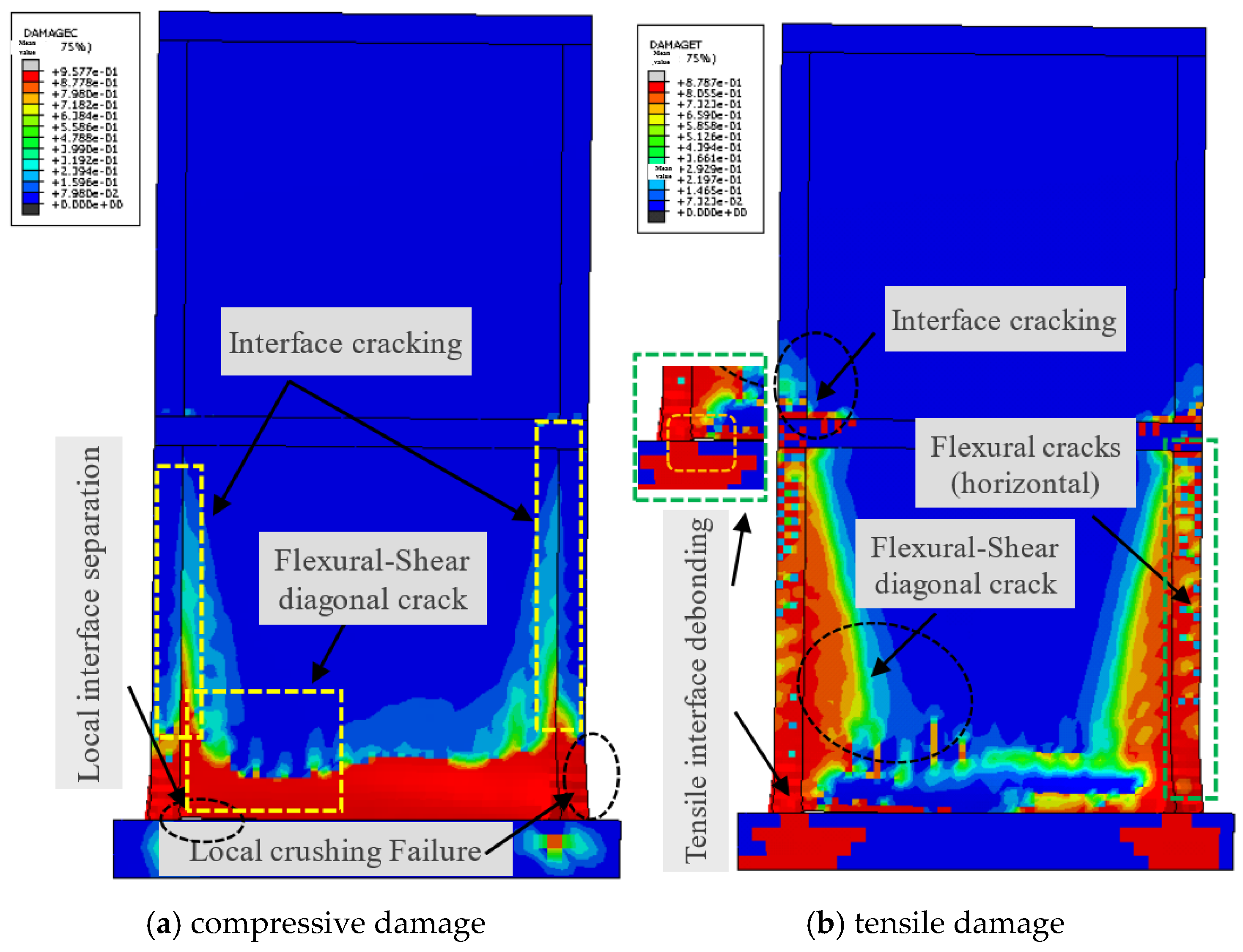
Figure 16 presents the simulated compressive and tensile damage contour plots of specimen DW-1. The damage contour plots of the computational results indicate that the model demonstrates good consistency with the experimental specimens in predicting tensile–compressive cracking and damage in the wall. Consistent with experimental observations, during the initial loading phase, damage was primarily concentrated at the interface of the bottom-story edge columns, the base mortar bedding layer, and the column-footing regions. At the failure stage, the contour plots indicate that the damage at the interfaces of the edge columns on both sides of the bottom story propagated upward to the level of the ring beam, while only localized damage appeared at the column-footing regions of the second-story edge columns. This phenomenon aligns with the experimental finding that interfacial cracking in the edge columns was mainly concentrated in the bottom story. According to Figure 16a, compressive damage was predominantly located in the lower part of the bottom-story wall, consistent with the extensive flexural cracking observed in the lower region of the bottom-story wall and the flexural crushing failure at the bottom-story column feet in the test. As shown in Figure 16b, the comparison reveals that the tensile damage contour plot from the numerical simulation shows good agreement with the tensile crack propagation observed in the experimental specimen. Both demonstrate that under horizontal loading, the side columns on both edges of the wall exhibit extensive horizontal tensile cracking due to the lower tensile strength of the foam concrete. Simultaneously, numerous horizontal flexural cracks and flexural–shear cracks develop in the middle and lower parts of the wall. Furthermore, the simulation also captured the separation between the tensile zone of the bottom-story precast wall panel and the mortar bedding layer at the failure stage.
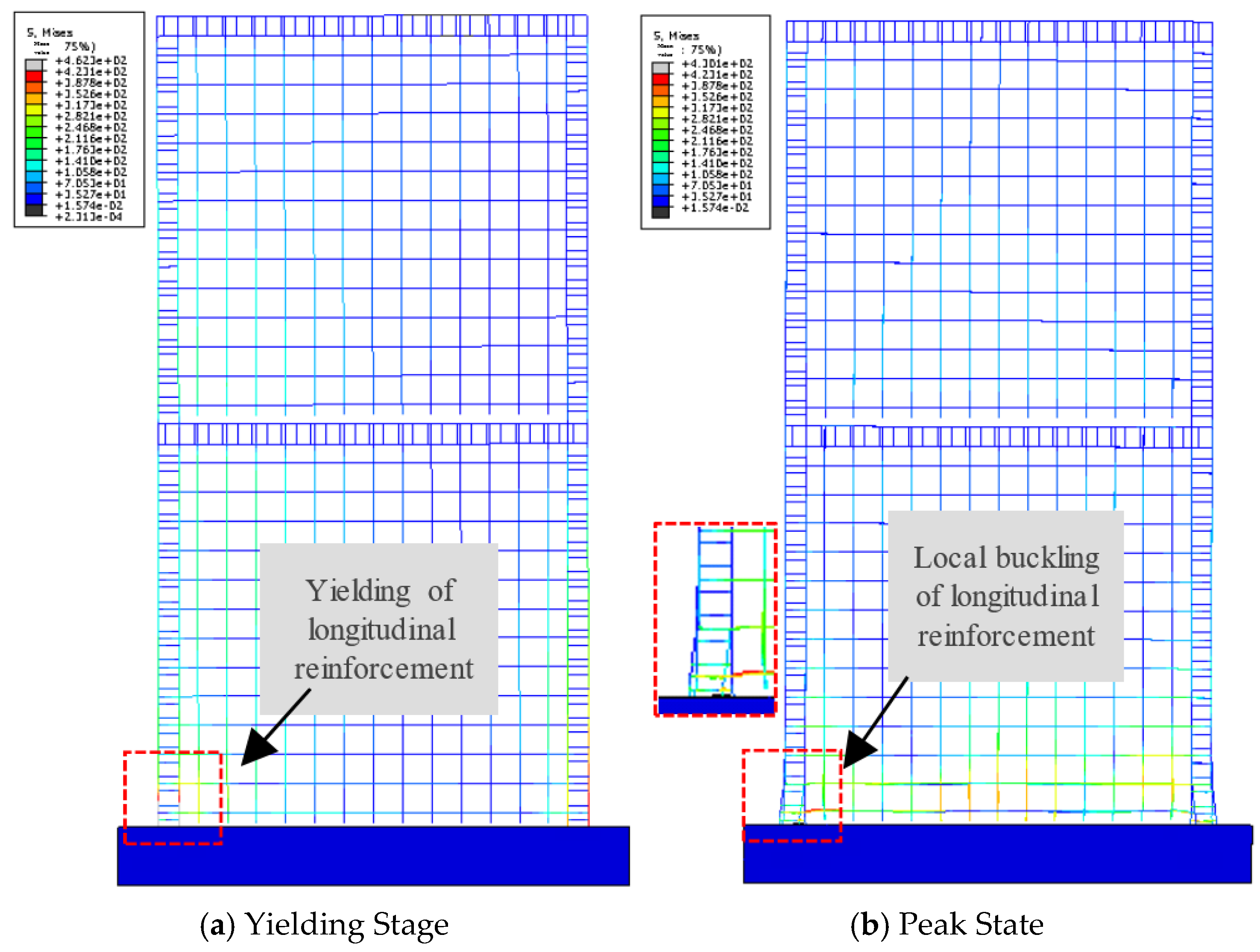
Figure 17 presents the simulated reinforcement stress contour plot. When the wall reached the yielding stage, the vertical rebars at the base of the edge columns had already attained yield strain. Upon the wall reaching the peak load stage, these vertical rebars at the base were fully yielded and exhibited significant buckling. This simulation result is consistent with the experimental observation, where the foamed concrete at the base of the bottom-story edge columns experienced severe vertical crushing and spalling, accompanied by noticeable buckling of the vertical rebars. The regions of higher stress in the wall’s distributed reinforcement were primarily concentrated in the lower part of the bottom story. The stress level in the vertical rebars was generally higher than that in the horizontal distributed reinforcement, which also aligns well with the corresponding experimental phenomena.

4.3. Comparison of Hysteretic Loops

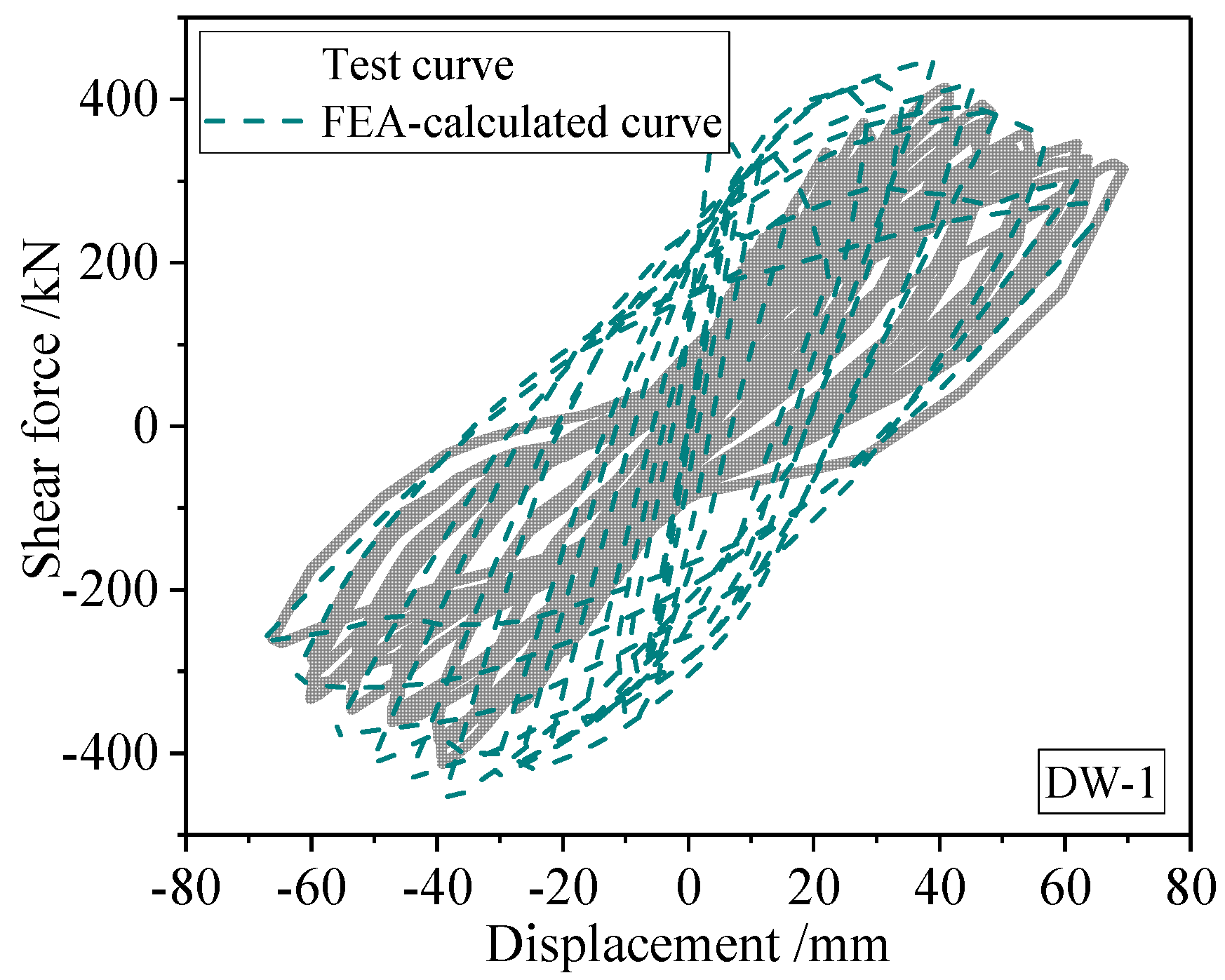
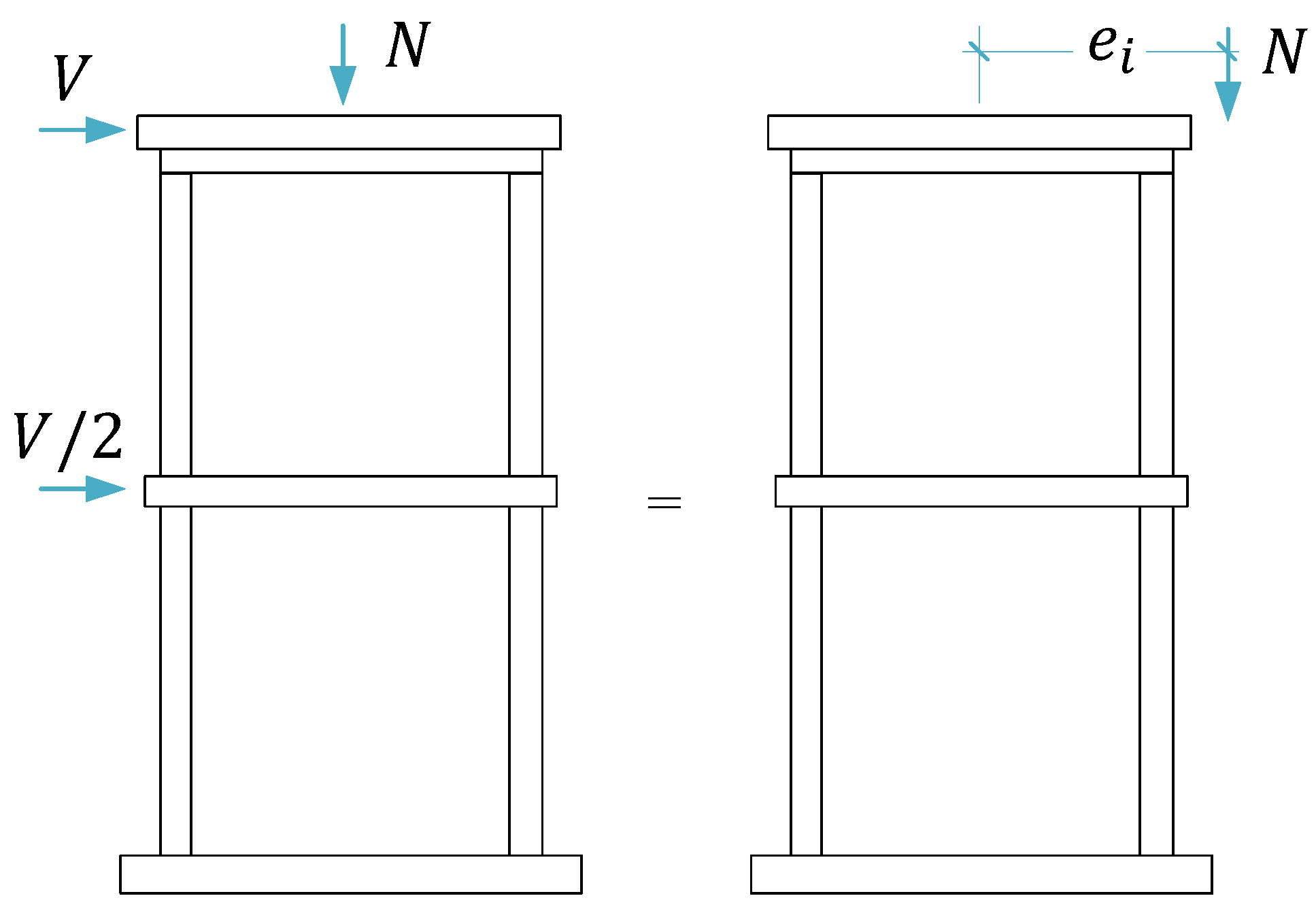
Figure 18 compares the hysteretic shear force–displacement curves of the bottom story obtained from the test and the simulation. Since the finite element model adopted a single-point loading method at the top, an equivalent top load was calculated based on the principle of equal bending moment at the wall base when correlating with the experimental loading method. The conversion calculation method is shown in Equations (16)–(18). The calculated bearing capacity from the finite element model, V e , was 313.4 kN, and the converted shear force at the base was 450.9 kN. Compared to the experimental peak base shear of 413.5 kN, the calculation accuracy ratio is 1.09. The corresponding displacement at the peak point was 39 mm, with an error of less than 5% compared to the experimental value. The hysteretic curve obtained from the numerical analysis generally agrees well with the experimental results, both exhibiting high initial stiffness and a spindle-shaped hysteresis loop in the early stage. As damage progressed, both curves demonstrated an inverse S-shaped characteristic. Notably, the peak points of both curves are relatively close, and the descending trends after peak capacity are consistent. Although the calculated hysteretic curve shows some pinching effect, it is less pronounced than in the experimental results. This is primarily because the finite element model defined the internal steel using an embedded region constraint, which cannot account for the relative slip between the reinforcement and the foamed concrete. This limitation also contributed to the higher bearing capacity in the finite element calculation compared to the test. Overall, this model can satisfactorily predict the bearing capacity of the HFSW shear wall.
M = V × H + V 2 × H 2 = 1.25 V H
V e H = 1.25 V H
V = 1.5 V = 1.2 V e
where M represents the bending moment at the base of the two-story shear wall; H denotes the height of the specimen; V e is the calculated bearing capacity from the finite element model; V refers to the shear force at the top actuator under the experimental loading method; and V indicates the converted shear force at the base of the wall.

4.4. Parametric Analysis

To further investigate the influence of three key parameters—the axial compression ratio, the diameter of the longitudinal reinforcement in the edge columns, and wall thickness—on the flexural performance of the walls, and to facilitate the subsequent derivation of a calculation method for the flexural bearing capacity, this study conducted a parametric numerical analysis based on the validated finite element model with verified computational accuracy. The axial compression ratio was selected within the range of 0.05 to 0.20, reflecting the actual distribution of axial compression ratios in multi-story HFSW shear wall structures. The wall thickness was considered at two dimensions, 200 mm and 250 mm, and the diameters of the longitudinal reinforcement in the edge columns were chosen as 14 mm, 16 mm, and 20 mm. The specific specimen parameters and finite element calculation results are presented in Table 9. Considering that the simulated values tend to be higher, the results shown in the table are corrected values obtained by dividing by a factor of 1.09.

5. Flexural Capacity Calculation

When the coupling effect of bending and shear is not considered, the stress state of a shear wall under compression and bending is similar to that of an eccentric compression member. Figure 19 shows a schematic diagram of the equivalent flexural mechanism in a shear wall. For shear walls with high shear span ratios subjected to flexural loading, the bending moment induced by shear force at the base of the wall can be equivalently represented as the eccentric moment generated by the eccentricity in an eccentric compression member. The calculations for the equivalent bending moment and eccentricity are given by Equations (19) and (20).
M = V × H + V 2 × H 2 = 1.25 V H
e i = M N
where M is the bending moment at the base of the shear wall; V is the horizontal force at the top of the wall; H is the height of the wall; and e i is the equivalent eccentricity.
According to Chinese code GB50010-2010 [57], the actual eccentricity e i shall include an additional eccentricity e a added to the theoretical eccentricity of the axial force, accounting for uncertainties in load position, the non-uniformity of concrete materials, asymmetric reinforcement distribution, and construction tolerances. Thus, the modified eccentricity e i is expressed by Equation (21).
e i = M N + e a
where e a represents the additional eccentricity. As specified in code GB50010-2010, its value shall be taken as greater than 20 mm and 1/30 of the maximum dimension of the section in the eccentric direction.
Based on experimental observations, prior to the wall reaching its peak load-bearing capacity—that is, before the column feet at the bottom of the wall on both sides were completely crushed—the longitudinal reinforcement on the tension side of the edge columns had already yielded. This behavior is consistent with the mechanical characteristics of members subjected to large eccentric compression. Since HFSW shear wall structures are primarily intended for low-rise or multi-story rural buildings, the axial compression ratio of the walls is relatively low—particularly for ratios within 0.2. Under such conditions, the failure mode is predominantly governed by large eccentric compression. Therefore, based on practical applications and actual loading conditions, the theoretical calculation formula proposed in this study is also established on the mechanism of large eccentric compression. Furthermore, by the time the wall reached its peak load-bearing capacity, the longitudinal reinforcement in the compression zone edge columns had also yielded, and the outermost vertical distributed longitudinal reinforcement in the compression zone was close to yielding. Additionally, the strain in the vertical distributed reinforcement decreased progressively with increasing distance from the compression zone edge. Therefore, to facilitate mechanical analysis and simplify calculations for the cross-section, the following two basic assumptions are made: (1) the cross-section strain of the specimen satisfies the plane section assumption; (2) at the peak state, the outermost distributed longitudinal reinforcement in the compression zone just yields, and the strain in other reinforcement positions can be determined based on a progressive decrease according to the plane section assumption.
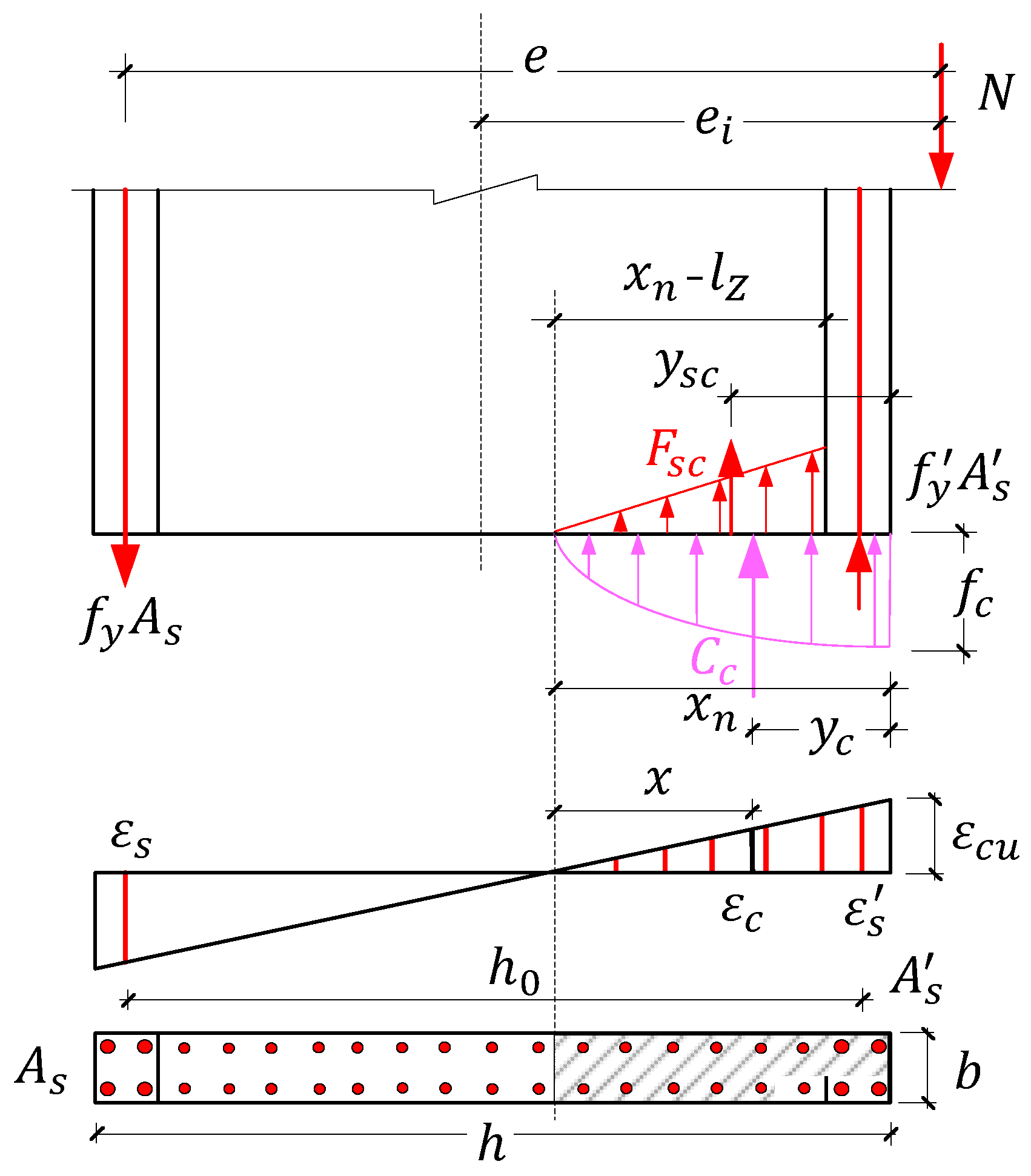
Based on the analysis of the sectional stress and the fundamental assumptions, the stress and strain distribution of the bending section of the precast HFSW shear wall is obtained as shown in Figure 20. In this configuration, the longitudinal reinforcement in the tension zone is not connected to the base structure, and its contribution to the sectional force equilibrium is neglected. Accordingly, from the sectional force equilibrium and moment equilibrium conditions, the computational relationship given in Equations (22)–(24) is derived.
N = C c + f y A s f y A s + F s c
M c a l = N e = C c h 0 y c + f y A s h 0 a s + F s c ( h 0 y s c )
e = e i + h 2 a s
where M c a l is the bending moment at the wall base; N is the axial compressive force; C c is the resultant compressive force of the foamed concrete in the compression zone, with y c being the distance from this force to the extreme compression fiber; f y and f y ′ are the yield strengths of the longitudinal reinforcement in the edge columns located in the compression and tension zones of the wall, respectively, while A s and A s are the corresponding cross-sectional areas; F s c is the resultant force of the vertical distributed reinforcement in the compression zone, and y s c is the distance from this resultant force to the extreme compression fiber; e and h 0 refer to the eccentricity of the load and the distance from the extreme compression fiber to the centroid of the longitudinal reinforcement in the tension zone edge column, respectively.
Based on the constitutive relationship curve of foamed concrete (Equations (14) and (15)), the resultant force of the foamed concrete in the compression zone C c and the corresponding y c are determined through integral operations, as shown in Equations (25) and (26).
C c = 0 x n σ c b d x
y c = x n 0 x n σ c b x d x / 0 x n σ c b d x
where x n is the depth of the compression zone of foamed concrete, σ c is the stress of foamed concrete, and b is the wall thickness.
Based on the plane section assumption illustrated in Figure 20, the strain relationship can be obtained as shown in Equation (27).
ε c u x n = ε c x
where ε c u is the ultimate strain of the foamed concrete, which is approximately taken as ε 0 (0.0026); and ε c is the foamed concrete strain at the location y .
By simultaneously solving Equations (25)–(27), and the foamed concrete stress–strain relationship expression, C c and y c can be obtained as shown in Equations (28) and (29).
C c = f c b 0 x n 0.93 x x n 0.93 x 2 x n 2 0.068 x 2 x n 2 1.07 x x n + 1 d x
y c = x n f c b 0 x n 0.93 x x n 0.93 x 2 x n 2 0.068 x 2 x n 2 1.07 x x n + 1 x d x / f c b 0 x n 0.93 x x n 0.93 x 2 x n 2 0.068 x 2 x n 2 1.07 x x n + 1 d x
Integrating Equations (28) and (29) yields the resultant force of the foamed concrete in the compression zone and the location of its point of action in the HFSW shear wall flexural specimen, as given by Equation (30).
  C c = 0.49 f c b x n y c = 0.34 x n
Owing to the inherently lower strength of foamed concrete compared to conventional concrete, the resultant force of the distributed longitudinal reinforcement in the compression zone, F s c , cannot be neglected. To simplify the calculation of the total cross-sectional area of the longitudinal reinforcement in the compression zone, an approximate calculation is performed here using the area density ρ s . The area density ρ s refers to the cross-sectional area of distributed longitudinal reinforcement per unit length of the specimen’s cross-section, and its calculation is given by Equation (31).
ρ s = A s l h 2 l z
where A s l l represents the total cross-sectional area of the distributed longitudinal reinforcement; h is the height of the wall section; and l z is the width of the edge column.
Therefore, the resultant force of the distributed longitudinal reinforcement in the compression zone, F s c , and the location of its point of action, y s c , are calculated as given in Equation (32).
F s c = 0.5 ρ s x n l z f y v y s c = 1 3 x n l z + l z = 1 3 x n + 2 3 l z  
where f y v is the yield strength of the distributed longitudinal reinforcement. By solving Equations (21)–(24) and (30)–(32) simultaneously, the peak moment M c a l of the HFSW shear wall flexural member with a high shear span ratio can be determined for various parameters.
The calculated theoretical load-bearing capacities for each wall specimen are presented in Table 9. The results obtained from the formula show good agreement with those from the finite element analysis. However, overall, the formula tends to yield conservative predictions. This is primarily attributed to the simplification that the wall reaches its peak capacity at the critical state. Specifically, there is a slight discrepancy between computational assumption and the actual behavior: depending on the reinforcement arrangement, the outermost distributed reinforcement in the compression zone has often already yielded at failure, rather than just reaching the yield point. Similarly, the longitudinal reinforcement in the tension-side edge column has typically yielded and may even have entered the strain-hardening stage. Consequently, this assumption may in some cases underestimate the flexural strength of the wall. Overall, the proposed method demonstrates satisfactory predictive capability for the flexural capacity of HFSW shear walls, achieving an average accuracy of 0.97 with a maximum deviation under 10% and a variance of 0.0024. This provides valuable guidance for the theoretical design and engineering application of HFSW shear walls.

6. Conclusions

Based on the experimental and theoretical work conducted, the following conclusions are drawn.
(1) Under cyclic loading, two-story HFSW walls with high shear span ratios exhibited flexure-dominated failure. Horizontal flexural cracks developed in side columns, with vertical crushing cracks at column bases. The lower strength of foamed concrete compared to conventional concrete (about 20% of the C20 concrete) led to extensive flexural–shear and shear diagonal cracks in the wall lower portion, demonstrating significant flexure–shear coupling.
(2) Damage concentrated primarily in the bottom story, consistent with flexural failure characteristics. Vertical interface cracks occurred without interface separation in the side columns, indicating reliable performance of the vertical joints. The bottom mortar layer only exhibited localized interface detachment at the tensile edge after peak load, while it maintained integrity before the wall reached its peak capacity. This demonstrates that the mortar bed connection method used in this study is safe and reliable for flexural failure conditions.
(3) The hysteretic curves of the flexure-dominated HFSW shear walls exhibit significant pinching behavior due to crack development and slip occurrence. Comparative analysis with existing studies indicates that HFSW shear walls with large shear span ratios (flexure-dominated failure) possess greater yield deformation capacity and lower yield strength (both within 15% variation) compared to shear-dominated failure. However, due to pronounced flexure–shear coupling effects, the peak load capacity of these specimens remains comparable to that of shear-controlled failure cases (though slightly lower in flexural failure).
(4) Under flexural failure conditions, although the characteristic stiffness of the HFSW shear wall at each stage is lower than that under shear failure, the difference shows a narrowing trend. Due to the full development of foamed concrete cracks and localized crushing of the wall, the specimen experiences a rapid decline in bearing capacity after reaching its peak, which undermines its later deformation capacity (post-peak deformation accounts for only 36% of the pre-peak deformation) and results in no significant improvement in the ductility of the bottom story compared to the shear failure case.
(5) The viscous damping coefficient developed through three stages: rapid increase, brief decline, then steady growth. Unlike conventional shear walls, flexural failure in HFSW walls exacerbates rebar slippage, diminishing their energy dissipation advantage compared to shear-controlled cases. However, the larger ultimate displacement in flexural failure results in a cumulative energy dissipation that is over 20% higher than that under shear failure conditions.
(6) The established finite element model effectively predicts the flexural failure behavior of HFSW shear walls, while the adopted embedded region method leads to a minor overestimation (under 10%) in computed load capacity. The theoretical analytical method for the flexural strength of HFSW shear walls developed by improving the eccentric compression member capacity calculation approach could provide a relatively accurate predictions of the wall’s flexural capacity, with a computational accuracy of 0.97.
The scope of this study is constrained by the limited experimental data, which affects the analysis of key parameter influences and the precision of bearing capacity predictions. Subsequent investigations will, therefore, expand the test matrix and incorporate refined finite element modeling (including the precise definition of the bond–slip relationship between reinforcement and foamed concrete, as well as the refinement of plastic damage parameters for foamed concrete) to enhance the predictive methods.


Author Contributions

Conceptualization, J.L. and Z.C.; investigation, J.L., L.X. and Y.Y.; writing—original draft preparation, J.L.; writing—review and editing, L.X. and Y.Y. All authors have read and agreed to the published version of the manuscript.

Funding

This research was funded by [Shandong Provincial Natural Science Foundation] grant number [ZR2023QE299] and The APC was funded by [ZR2023QE299].

Data Availability Statement

The original contributions presented in this study are included in the article. Further inquiries can be directed to the corresponding author.

Conflicts of Interest

The authors declare no conflict of interest. Authors Long Xu and Yuechao Yang are employed by Shandong Construction Quality Inspection and Testing Center Co., Ltd. and Shandong Jianke Special Construction Engineering Technology Center Co., Ltd., respectively. The remaining authors declare that the research was conducted in the absence of any commercial or financial relationships that could be construed as a potential conflict of interest.

References

  1. Martiradonna, S.; Ruggieri, S.; Fatiguso, F.; Uva, G.; Lombillo, I. Energetic and structural retrofit of existing RC buildings through precast concrete panels: Proposal of a new technology and explorative performance simulation. J. Archit. Eng. 2023, 29, 04022045. [Google Scholar] [CrossRef]
  2. Vettorazzi, E.; Figueiredo, A.; Rebelo, F.; Vicente, R.; Feiertag, G.A. Beyond passive House: Use of evolutionary algorithms in architectural design. J. Build. Eng. 2023, 76, 107058. [Google Scholar] [CrossRef]
  3. Li, B. Preparation and Properties of High Strength Foam Concrete. Master’s Thesis, Jilin University, Changchun, China, 2018. [Google Scholar]
  4. Siva Ranjani, I.; Ramamurthy, K. Relative assessment of density and stability of foam produced with four synthetic surfactants. Mater. Struct. 2010, 43, 1317–1325. [Google Scholar] [CrossRef]
  5. Richard, A.O.; Ramli, M. Experimental production of sustainable lightweight foamed concrete. Br. J. Appl. Sci. Technol. 2013, 3, 994. [Google Scholar] [CrossRef]
  6. Mydin, M.A.O.; Wang, Y.C. Structural performance of lightweight steel-foamed concrete–steel composite walling system under compression. Thin-Walled Struct. 2011, 49, 66–76. [Google Scholar] [CrossRef]
  7. Mydin, M.A.O. Thin-walled steel enclosed lightweight foamcrete: A novel approach to fabricate sandwich composite. Aust. J. Basic Appl. Sci. 2011, 5, 1727–1733. [Google Scholar]
  8. Prabha, P.; Palani, G.S.; Lakshmanan, N.; Senthil, R. Behaviour of steel-foam concrete composite panel under in-plane lateral load. J. Constr. Steel Res. 2017, 139, 437–448. [Google Scholar]
  9. Amran, Y.M.; Ali, A.A.; Rashid, R.S.; Hejazi, F.; Safiee, N.A. Structural behavior of axially loaded precast foamed concrete sandwich panels. Constr. Build. Mater. 2016, 107, 307–320. [Google Scholar] [CrossRef]
  10. Mousavi, S.A.; Zahrai, S.M.; Bahrami-Rad, A. Quasi-static cyclic tests on super-lightweight EPS concrete shear walls. Eng. Struct. 2014, 65, 62–75. [Google Scholar] [CrossRef]
  11. Wang, J.; Qiu, Z.; Liang, J. Experimental investigations on the lateral performance of foam concrete light steel keel composite wall. J. Build. Eng. 2023, 72, 106551. [Google Scholar] [CrossRef]
  12. Xu, Z.; Chen, Z.; Dong, X.; Zuo, Y. Experimental Study on Seismic Behavior of Lightweight Concrete-Filled Cold-Formed Steel Shear Walls Strengthened Using Horizontal Reinforcement. J. Earthq. Eng. 2023, 27, 4126–4160. [Google Scholar] [CrossRef]
  13. Huang, J.J.; Su, Q.; Zhao, W.H.; Li, T.; Zhang, X.X. Experimental study on use of lightweight foam concrete as subgrade bed filler of ballastless track. Constr. Build. Mater. 2017, 149, 911–920. [Google Scholar] [CrossRef]
  14. Othman, R.; Jaya, R.P.; Muthusamy, K.; Sulaiman, M.; Duraisamy, Y.; Abdullah, M.M.A.B.; Przybył, A.; Sochacki, W.; Skrzypczak, T.; Vizureanu, P.; et al. Relation between density and compressive strength of foamed concrete. Materials 2021, 14, 2967. [Google Scholar] [CrossRef]
  15. Li, C.; Li, X.; Guan, D.; Li, S.; Lv, W.; Cong, Z.; Soloveva, V.Y.; Dalerjon, H.; Qin, P.; Liu, X. Study on influence factors of compressive strength of low density backfill foamed concrete used in natural gas pipeline tunnel. Sustainability 2022, 14, 8333. [Google Scholar] [CrossRef]
  16. Li, W.B. To Analyse on the Foam Concrete Technical Status and Its Developing Tendency. Value Eng. 2009, 28. [Google Scholar] [CrossRef]
  17. Falliano, D.; De Domenico, D.; Ricciardi, G.; Gugliandolo, E. Experimental investigation on the compressive strength of foamed concrete:effect of curing conditions, cement type, foaming agent and dry density. Constr. Build. Mater. 2018, 165, 735–749. [Google Scholar] [CrossRef]
  18. Sun, Y.; Gao, P.; Geng, F.; Li, H.; Zhang, L.; Liu, H. Thermal conductivity and mechanical properties of porous concrete materials. Mater. Lett. 2017, 209, 349–352. [Google Scholar] [CrossRef]
  19. Fu, S.; Zhang, G.; Du, Y. Effect of Different Amount of Fly Ash on the Performance of Foamed Concrete. J. Shijiazhuang Tiedao Univ. 2016, 29, 49–52. [Google Scholar]
  20. Kearsley, E.P.; Wainwright, P.J. The effect of porosity on the strength of foamed concrete. Cem. Concr. Res. 2002, 32, 233–239. [Google Scholar] [CrossRef]
  21. Kearsley, E.P.; Wainwright, P.J. The effect of high fly ash content on the compressive strength of foamed concrete. Cem. Concr. Res. 2001, 31, 105–112. [Google Scholar] [CrossRef]
  22. Chen, B.; Liu, J. Experimental Research on Properties of Foamed Concrete Reinforced with Polypropylene Fibers. J. Build. Mater. 2010, 13, 286–290. [Google Scholar]
  23. Chen, B.; Wu, Z.; Liu, N. Experimental research on properties of highstrength foamed concrete. J. Mater. Civ. Eng. 2012, 24, 113–118. [Google Scholar] [CrossRef]
  24. Prischepa, I.A.; Sarkisov, Y.S.; Gorlenko, N.P.; Samchenko, S.V.; Zemskova, O.V. Nanomodification of Non-Autoclaved Foam Concrete. Russ. Phys. J. 2023, 66, 205–212. [Google Scholar] [CrossRef]
  25. Meskhi, B.; Beskopylny, A.N.; Stel’makh, S.A.; Shcherban’, E.M.; Mailyan, L.R.; Beskopylny, N.; Chernil’nik, A.; El’shaeva, D. Insulation foam concrete nanomodified with micro-silica and reinforced with polypropylene fiber for the improvement of characteristics. Polymers 2022, 14, 4401. [Google Scholar] [CrossRef] [PubMed]
  26. Du, Y. Preparation of Nano-Modified Foam Concrete and Its Stability and Enhancement Mechanism. Master’s Thesis, Southeast University, Nanjing, China, 2018. [Google Scholar]
  27. Yue, Y. Study on the effect of modified nano-SiO2 particles on foam stability. Contemp. Chem. Ind. 2020, 49, 597–600. [Google Scholar] [CrossRef]
  28. Sonn, J.S.; Lee, J.Y.; Jo, S.H.; Yoon, I.H.; Jung, C.H.; Lim, J.C. Effect of surface modification of silica nanoparticles by silane coupling agent on decontamination foam stability. Ann. Nucl. Energy 2018, 114, 11–18. [Google Scholar] [CrossRef]
  29. Zhu, Q.; Zhou, H.L.; Song, Y.X.; Chang, Z.D.; Li, W.J. Modification and investigation of silica particles as a foam stabilizer. Int. J. Miner. Metall. Mater. 2017, 24, 208–215. [Google Scholar] [CrossRef]
  30. Qu, W.; Liu, K.; Zeng, H.; Hu, Q.; Wang, L. Effect of SiO2 aerogel and perlite on properties of foamed concrete. Sci. Rep. 2025, 15, 10945. [Google Scholar] [CrossRef]
  31. Zhang, C.; Fan, D.; Lu, J.X.; Pang, C.; Poon, C.S. Ultra-stable foam enabled by nano silica engineering for foam concrete improvement. Cem. Concr. Compos. 2024, 150, 105575. [Google Scholar] [CrossRef]
  32. Xie, Y.; Li, J.; Lu, Z.; Jiang, J.; Niu, Y. Effects of bentonite slurry on air-void structure and properties of foamed concrete. Constr. Build. Mater. 2018, 179, 207–219. [Google Scholar] [CrossRef]
  33. She, W.; Du, Y.; Miao, C.; Liu, J.; Zhao, G.; Jiang, J.; Zhang, Y. Application of organic-and nanoparticle-modified foams in foamed concrete: Reinforcement and stabilization mechanisms. Cem. Concr. Res. 2018, 106, 12–22. [Google Scholar] [CrossRef]
  34. Hou, L.; Li, J.; Lu, Z.; Niu, Y.; Jiang, J.; Li, T. Effect of nanoparticles on foaming agent and the foamed concrete. Constr. Build. Mater. 2019, 227, 116698. [Google Scholar] [CrossRef]
  35. Chen, Y. Experimental study on application performance of foamed concrete prepared based on a colloidal NanoSiO2-stabilized foam. Constr. Build. Mater. 2023, 409, 134012. [Google Scholar] [CrossRef]
  36. Li, J.; Chen, Z.; Chen, W. Axial load-bearing capacities of pre-cast self-insulation walls made by foam concrete. Structures 2020, 27, 1951–1961. [Google Scholar] [CrossRef]
  37. Li, J.; Chen, W.; Yang, H.; Zhu, G.; Cheng, Y.; Chen, Z. Seismic behavior and shear strength calculation of pre-cast HFSW shear walls. Structures 2025, 80, 110049. [Google Scholar] [CrossRef]
  38. JG/T 266–2011; China Industry Standard, Foamed Concrete. Architecture & Industry Press of China: Beijing, China, 2011.
  39. Amran, Y.M.; Farzadnia, N.; Ali, A.A. Properties and applications of foamed concrete: A review. Constr. Build. Mater. 2015, 101, 990–1005. [Google Scholar] [CrossRef]
  40. Just, A.; Middendorf, B. Microstructure of high-strength foam concrete. Mater. Charact. 2009, 60, 741–748. [Google Scholar] [CrossRef]
  41. GB/T 50081-2002; Chinese National Standard, Standard for Test Method of Mechanical Properties of Ordinary Concrete. Ministry of Construction of China: Beijing, China, 2003.
  42. Guo, Z. Strength and Deformation of Concrete-Test Foundation and Constitutive Relation; Tsinghua University Press: Beijing, China, 1997; pp. 137–140. [Google Scholar]
  43. Guo, W.; Zhai, Z.; Cui, Y.; Yu, Z.; Wu, X. Seismic performance assessment of low-rise precast wall panel structure with bolt connections. Eng. Struct. 2019, 181, 562–578. [Google Scholar] [CrossRef]
  44. GB/T10294-2008; Chinese National Standard, Thermal Insulation-Determination of Steady-State Thermal Resistance and Related Properties-Guarded Hot Plate Apparatus. China Standards Press: Beijing, China, 2008.
  45. JGJ/T101-2015; China Industry Standard, Specification for Seismic Test of Building. Architecture & Industry Press of China: Beijing, China, 2015.
  46. Zhou, W.; Zheng, W.; Pujol, S. Seismic vulnerability of reinforced concrete structures affected by the 2008 Wenchuan earthquake. Bull. Earthq. Eng. 2013, 11, 2079–2104. [Google Scholar] [CrossRef]
  47. Li, M. Seismic Fragility Analysis of Steel Frame with Initial Connection Damage. Master’s Thesis, Southeast University, Nanjing, China, 2017. [Google Scholar]
  48. Anthoine, A.; Magonette, G.; Magenes, G. Shear-compression testing and analysis of brick masonry walls. In Proceedings of the 10th European Conference on Earthquake Engineering; ResearchGate: Berlin, Germany, 1995; Volume 3. [Google Scholar]
  49. Magenes, G.; Morandi, P.; Penna, A.; Ferrata, V. D7.1c Test Results on the Behaviour of Masonry Under Static Cyclic in Plane Lateral Loads; ESECMaSE: Padua, Italy, 2008. [Google Scholar]
  50. Messali, F.; Esposito, R.; Ravenshorst, G.J.P.; Rots, J.G. Experimental investigation of the in-plane cyclic behaviour of calcium silicate brick masonry walls. Bull. Earthq. Eng. 2020, 18, 3963–3994. [Google Scholar] [CrossRef]
  51. Fehling, E.; Stuerz, J. Test Results on the Behaviour of Masonry Under Static (Monotonic and Cyclic) in Plane Lateral Loads; ESECMaSE: Padua, Italy, 2007. [Google Scholar]
  52. Morandi, P.; Albanesi, L.; Magenes, G. URM walls with thin shell/web clay units and unfilled head-joints: Cyclic in-plane tests. In Proceedings of the 2nd European Conference on Earthquake Engineering and Seismology, Instanbul, Turkey, 25–29 August 2014. [Google Scholar]
  53. Li, B.; Jiang, J.; Xiong, H.; Zhan, Y.; Wu, Z.; Cunningham, L.S. Improved concrete plastic-damage model for FRP-confined concrete based on true tri-axial experiment. Compos. Struct. 2021, 269, 114051. [Google Scholar] [CrossRef]
  54. Sidoroff, F. Description of Anisotropic Damage Application to Elasticity. In Physical Non-Linearities in Structural Analysis; Springer: Berlin/Heidelberg, Germany, 1981; pp. 237–244. [Google Scholar]
  55. Sun, C. Study on Seismic Performance of Prefabricated Shear Wall with Rabbet-Unbonded Horizontal Connection. Ph.D. Thesis, Southeast University, Nanjing, China, 2017. [Google Scholar]
  56. Zhao, Z. Study on Mechanical Properties of Foamed Concrete Prefabricated Filled Wallboards. Master’s Thesis, Southeast University, Nanjing, China, 2019. [Google Scholar]
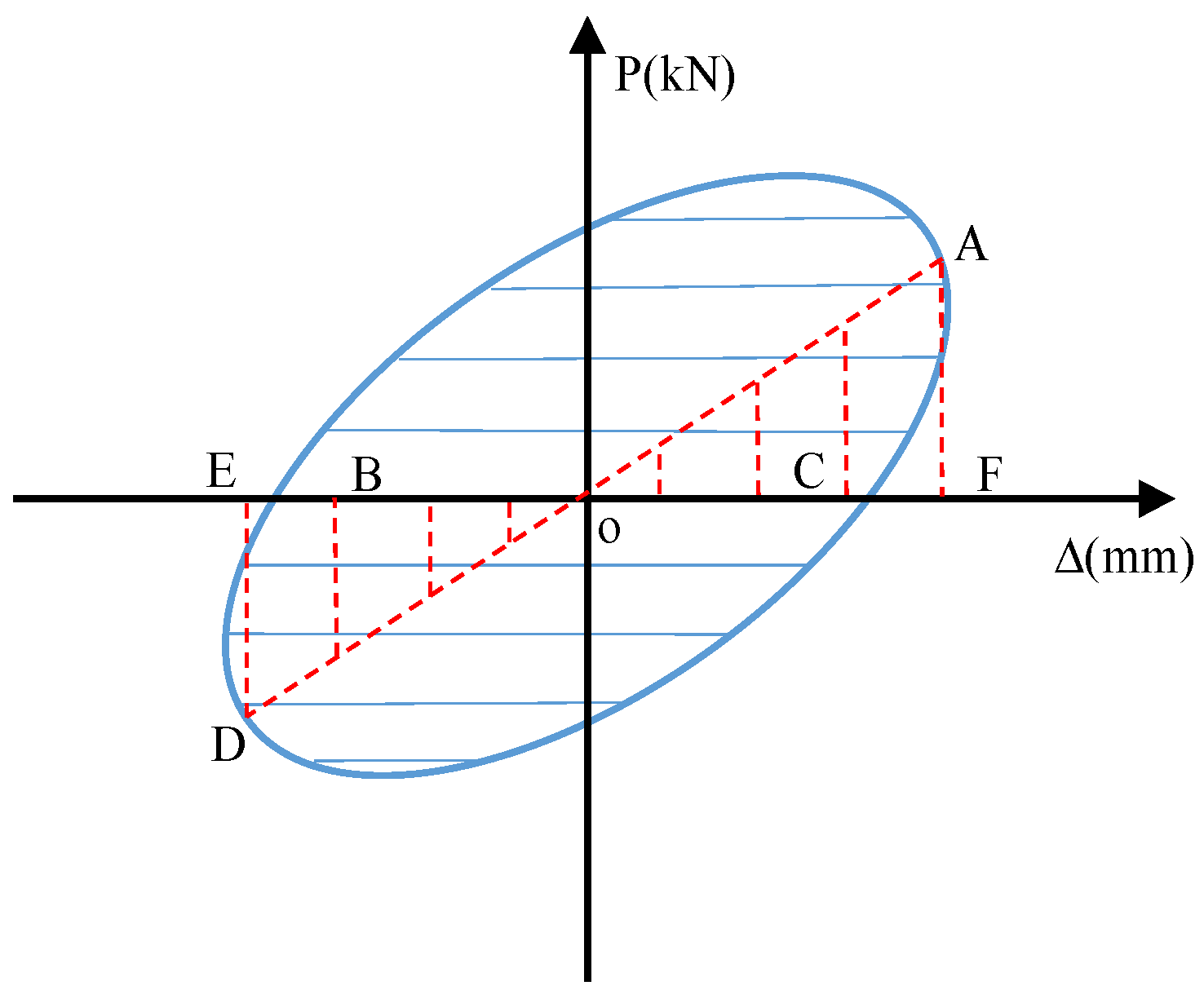
  57. GB50010-2010; Chinese National Standard, Code for Design of Concrete Structures. China Architecture & Building Press: Beijing, China, 2015.
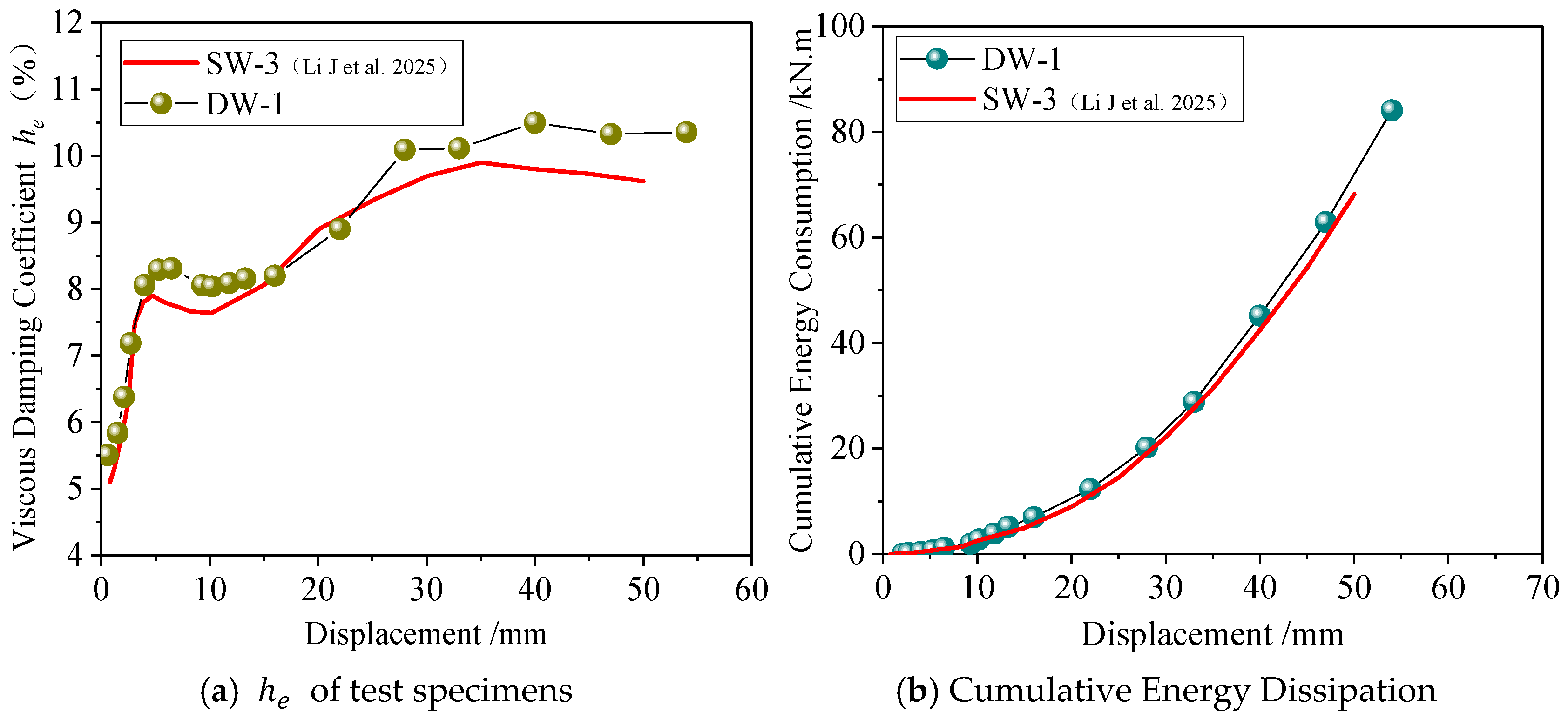
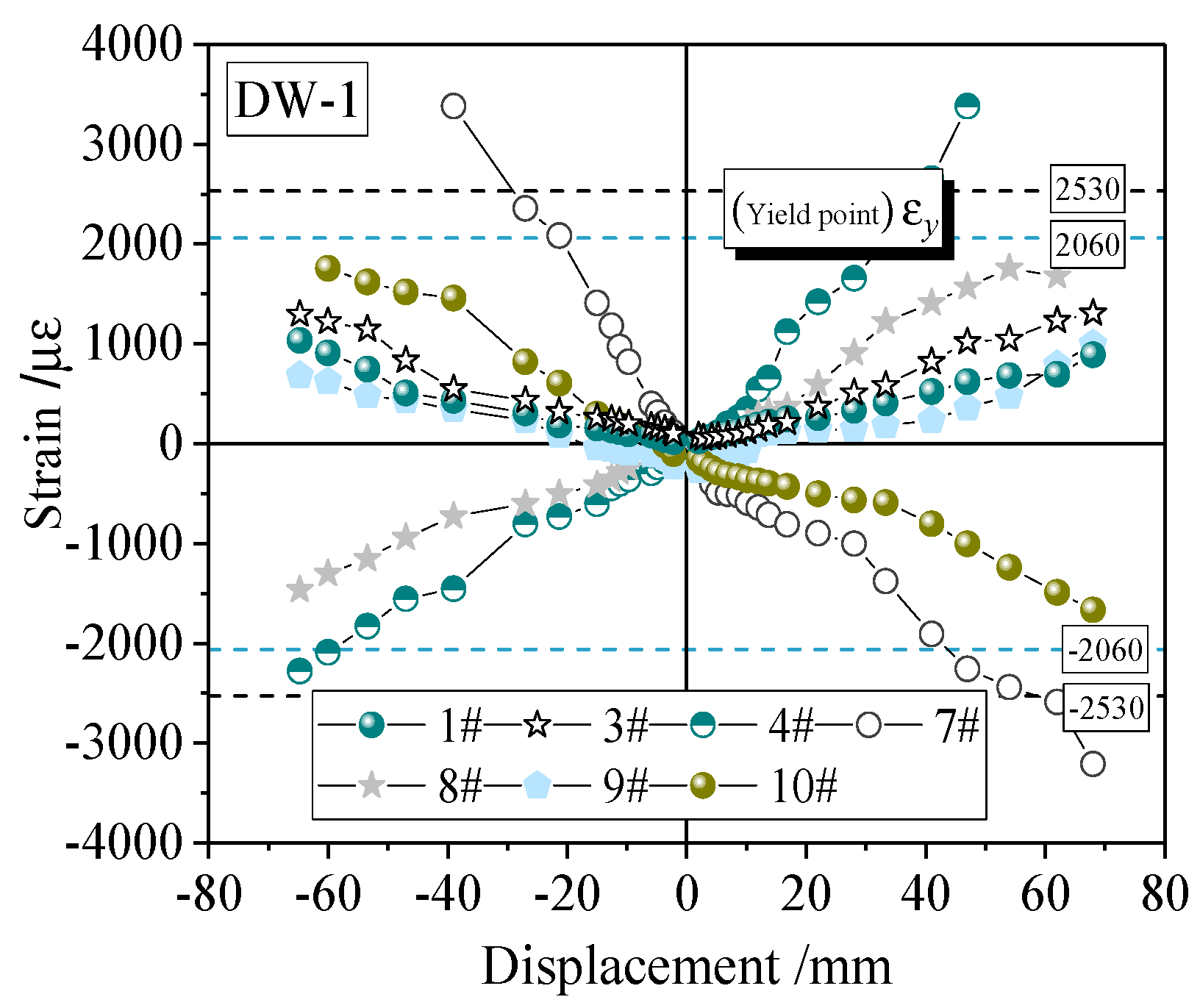
  58. Guo, Z.; Zhang, X.; Zhang, D.; Wang, R. Experimental Investigation of the Complete Stress-Strain Curve of Concrete. J. Build. Struct. 1982, 3, 1–12. [Google Scholar]
  59. Ding, F.; Ying, X.; Yu, Z. Unified Calculation Method of Uniaxial Mechanical Properties of Lightweight Aggregate Concrete. J. Cent. South Univ. 2010, 41, 1973–1979. [Google Scholar]
Figure 1. Schematic diagram of HFSW shear wall.
Buildings 16 00955 g001
Figure 2. Specimen design.
Buildings 16 00955 g002
Figure 3. Testing of HLFC material properties.
Buildings 16 00955 g003
Figure 4. Test setup.
Buildings 16 00955 g004
Figure 5. Loading procedure.
Buildings 16 00955 g005
Figure 6. Failure mode of specimen.
Buildings 16 00955 g006
Figure 7. Shear Force–Displacement Hysteresis Loop [37].
Buildings 16 00955 g007
Figure 8. Shear Force–Displacement Skeleton Curve [37].
Buildings 16 00955 g008
Figure 9. Calculation of yield point.
Buildings 16 00955 g009
Figure 10. Lateral stiffness [37].
Buildings 16 00955 g010
Figure 11. Calculation diagram of h e .
Buildings 16 00955 g011
Figure 12. Energy dissipation [37].
Buildings 16 00955 g012
Figure 13. Steel strain.
Buildings 16 00955 g013
Figure 14. Concrete compressive/tensile plastic damage model stress–strain relationship.
Buildings 16 00955 g014
Figure 15. Tensile–compressive constitutive model curve of HLFC [58,59].
Buildings 16 00955 g015
Figure 16. Compressive and tensile damage contour plots.
Buildings 16 00955 g016
Figure 17. Reinforcement stress contour plot.
Buildings 16 00955 g017
Figure 18. Comparison of hysteretic curves.
Buildings 16 00955 g018
Figure 19. Equivalent loading diagram.
Buildings 16 00955 g019
Figure 20. Stress and strain distribution diagram.
Buildings 16 00955 g020
Table 1. Dimensional characteristics of specimen.
IDDimension
(h × b × t) mm
Aspect Ratio
h/b
Edge Column (mm)D
(mm)
d
(mm)
Axial Load
(kN)
DW-15850 × 3000 × 2001.95200 × 2004C16B6@200 0.2 f c A
Note: The notations of the letters in the specimen labels are as follows: h: wall height; b: wall width; t: wall thickness; D: diameter of longitudinal reinforcement in edge column; d: diameter of distribution reinforcement.
Table 2. Properties of constituent materials in HLFC.
CementTypeSpecific Surface Area (m2/kg)Setting Time (min)Compressive Strength (MPa)Flexural Strength (MPa)
P.O. 42.5368InitialFinal3 Days28 Days3 Days28 Days
14427429.753.84.36.8
Fly ashParticle size distribution Material
density (kg/m3)
Strength activity indexWater
requirement
ratio
LOI
ratio
Water content
45 µm (9%)240095%88%3.2%0.4%
PP fiberFiber length Fiber
diameter
Tensile
strength
Elastic
modulus
Material
density
8–10 (mm)25–30 (μm)300–450 (GPa)3.5–4.0 (GPa)0.91 (g/cm2)
PCEPhysical conditionMaterial
density
Material
PH
Chloride
content
Sulfate content (as Na2SO4)Alkali level
Pale yellow liquid1.1 g/cm37–80.01%0.01%0.02%
Foam agentFoaming multiplesMaterial
density
Specific foam
volume
Material
PH
Foam stability duration
40 times1.02 (g/cm3)520 (mL/g)6.52.5 (h)
Table 3. Compressive strength of HLFC (cube test).
DimensionAxial Load (kN)Average Compressive Strength (MPa)
Cube (100 mm)54.549.252.35.20
Table 4. Compressive strength of HLFC (prism test).
DimensionAxial Load (kN)Average Compressive Strength (MPa)Characteristic Strength
f c k / (MPa)
Prism (100 × 100 × 300 mm)44.547.645.44.584.34
Table 5. Assessed mechanical properties of different steels utilized.
TypeYield Stress
f y
Yield Strain
ε y
Ultimate Stress
f u / M P a
Ultimate Strain
ε u
Elastic Modulus
E / G P a
C63120.002064130.1215200
C83270.002044370.1135200
C144330.002416520.1053210
C164550.002536470.1123205
Table 6. Characteristic points of skeleton curve.
IDPeak
Displacement
m (mm)
Peak
Load
P m (kN)
Ultimate Displacement
u (mm)
Ultimate
Load
P u (kN)
Peak Drift   Ratio   m / H Ultimate   Drift   Ratio   u / H
+ (−)Mean+ (−)Mean+ (−)Mean+ (−)MeanMeanMean
DW-139.240.3414.2413.552.455.2349.8350.61/681/49
41.3412.857.9351.3
Table 7. Yield point of skeleton curve.
IDEquivalent Area MethodGeometric Construction MethodMean Value
Yield Displacement
y (mm)
Yield
Load
P y (kN)
Yield Drift Ratio
y / H
Yield
Displacement
y (mm)
Yield
Load
P y (kN)
Yield Drift Ratio
y / H
y P y y H
+ (−)Mean+ (−)Mean+ (−)Mean+ (−)Mean+ (−)Mean
DW-125.123.5327.4328.71/11624.422.7320.3318.81/12023.1323.81/118
21.9329.920.9317.2
Table 8. Comparison with Relevant Research.
Reference/SourcesTypebhtAxial Compression Ratio f c Failure Mode V b
DW-1HFSW300058502000.24.58Flexural137.8
Athoine et al. [48]Clay brick100020002500.16.2Flexural78.0
Magenes et al. [49]Hollow clay brick125026003000.059.5Flexural57.6
Messali et al. [50]Calcium silicate110027001020.125.93Diagonal Sliding Shear25.2
Fehling et al. [51]Hollow clay brick220038001750.1010.3Tensile Diagonal Shear72.7
Magenes et al. [49]Lightweight aerated concrete250025001750.212.4Diagonal Sliding Shear50.0
Morandi et al. [52]Hollow clay brick135021403500.026.2Diagonal Sliding Shear35.6
Note: The notations of the letters in the specimen labels are as follows: h: wall height; b: wall width; t: wall thickness; V b : shear bearing capacity per meter width of the wall.
Table 9. HFSW Shear Wall Flexural Members (mm).
IDh = 5850
b × t
(mm)
Height–Width Ratio h/bD
(mm)
d
(mm)
Axial Compression Ratio λ V e (kN) M e (kN.m) M c a l (kN.m) M c a l M e
FDW12400 × 2002.4416C6@2000.0587.8513.5476.10.93
FDW20.1131.3768.3721.40.94
FDW30.15171.11001.2947.70.95
FDW40.2217.01269.51323.11.04
FDW514202.71185.61107.90.93
FDW620209.11223.11268.11.04
FDW73000 × 2001.9516C6@2000.05124.0725.3686.80.95
FDW80.1193.51131.81074.40.95
FDW90.15238.71396.51432.41.03
FDW10/DW10.2344.62015.8
Testvalue
1833.20.91
DW1114304.51781.11700.80.95
DW1220397.123232204.00.95
DW133000 × 2501.9516C6@2000.05141.4826.9791.50.96
DW140.1233.11363.61275.80.94
DW150.15280.11638.51722.41.05
DW160.2371.52173.31960.90.90
DW1714340.81993.62071.21.04
DW1820399.72338.52275.10.97
Mean value0.97
Note: The notations of the letters in the specimen labels are as follows: h: wall height; b: wall width; t: wall thickness; D: diameter of longitudinal reinforcement in edge column; d: diameter of distribution reinforcement; M e : bending moment at the base calculated by the finite element model.
Disclaimer/Publisher’s Note: The statements, opinions and data contained in all publications are solely those of the individual author(s) and contributor(s) and not of MDPI and/or the editor(s). MDPI and/or the editor(s) disclaim responsibility for any injury to people or property resulting from any ideas, methods, instructions or products referred to in the content.