Structural Damage Identification Method and Experimental Verification Based on Multi-Head Convolutional Autoencoder


Abstract
1. Introduction
2. Methods
Structural Damage Identification Based on MH-CAE
3. Results
3.1. Test Profiles
3.2. Results Analysis
4. Discussion
4.1. Damage Index Evolution and Experimental Observations
4.2. Mechanism Interpretation and Engineering Applicability
- (1)
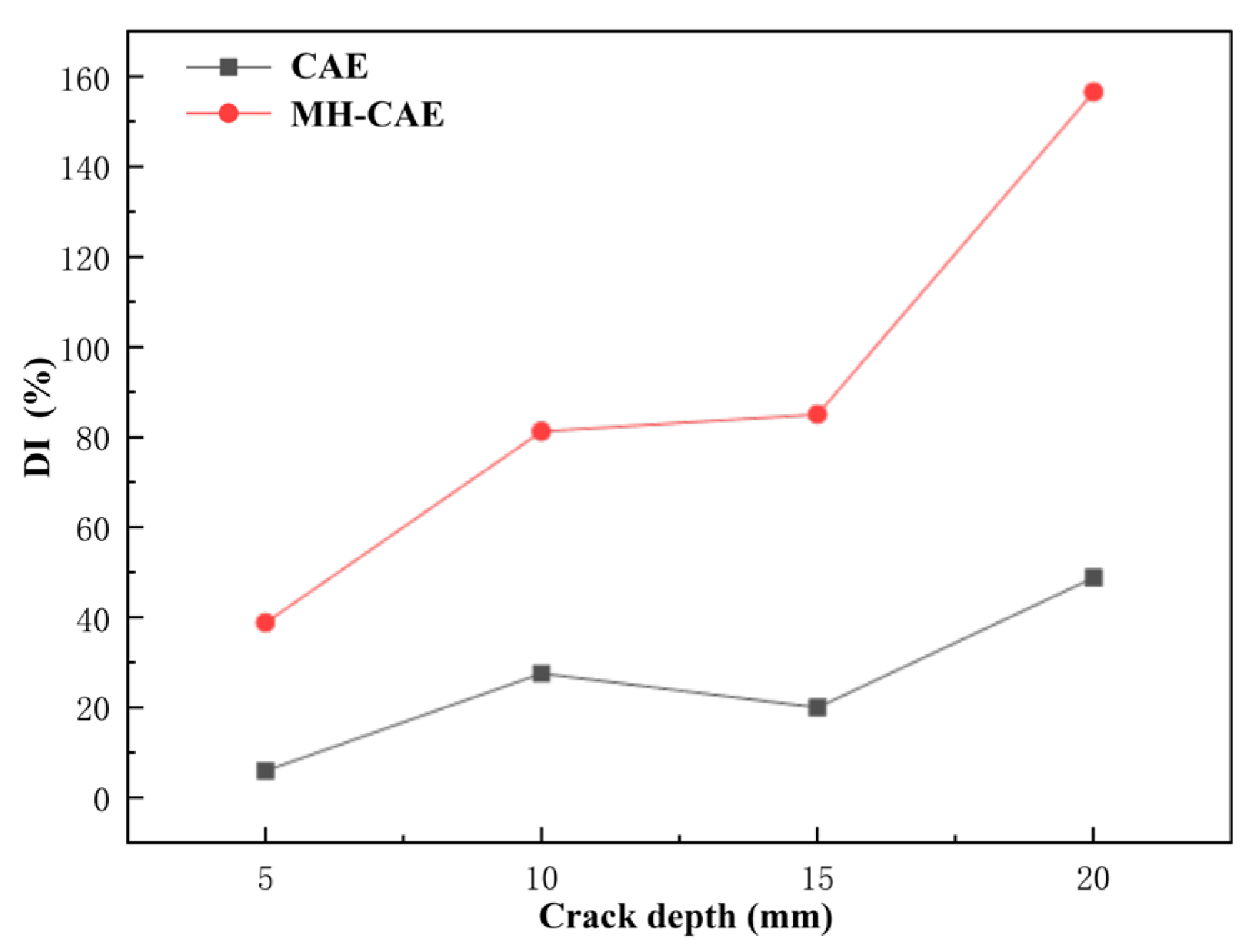
- DI sensitivity varies significantly with damage location. The DI values differ between Beam No. 1 (mid-span damage) and Beam No. 2 (quarter-span damage). This indicates that single-point DI evaluation is insufficient for complex structures. Multi-point data fusion is therefore necessary.
- (2)
- Real structural damage mechanisms are more complex than artificial cracks. Practical structures may suffer from reinforcement corrosion, concrete fatigue, interfacial debonding, and coupled chemical–mechanical degradation. These mechanisms alter stiffness and damping differently from simple notches. As a result, vibration features may deviate from those represented in the training dataset. This may lead to missed detection of certain damage types.
- (3)
- Environmental and operational variability strongly influences monitoring signals. Temperature changes, humidity variation, and traffic loads may produce signal changes comparable to early-stage damage. Such effects may mask genuine damage features or generate false alarms. A robust monitoring method must therefore distinguish environmental variability from true structural deterioration.
5. Conclusions
- (1)
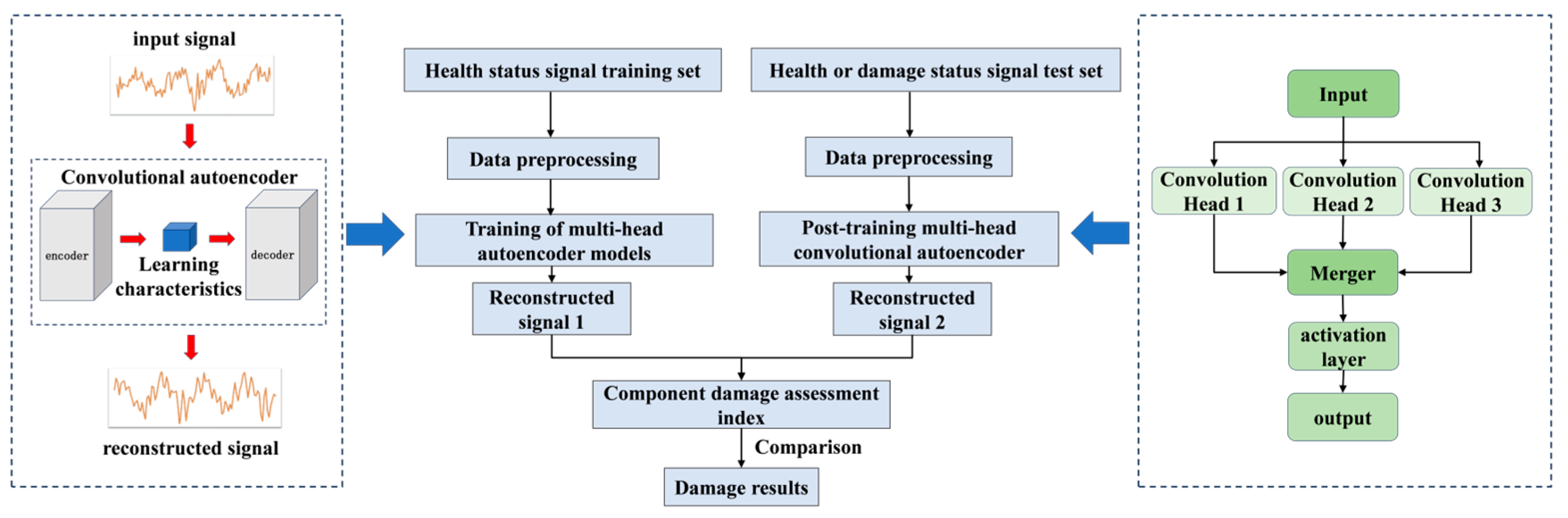
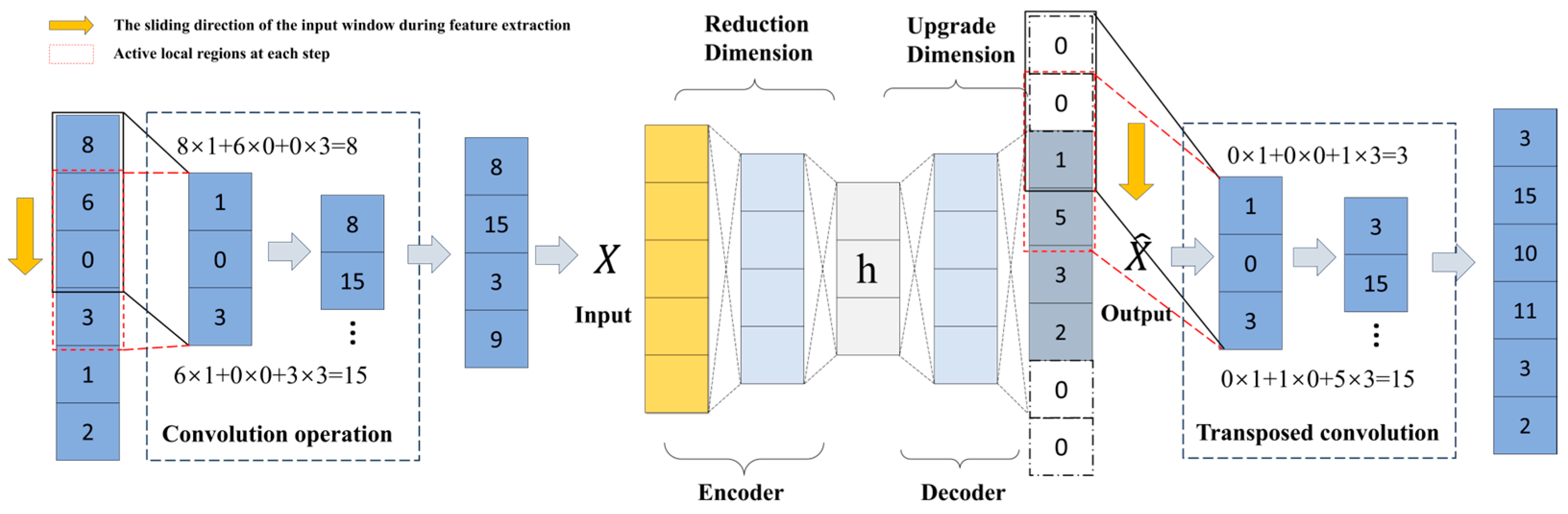
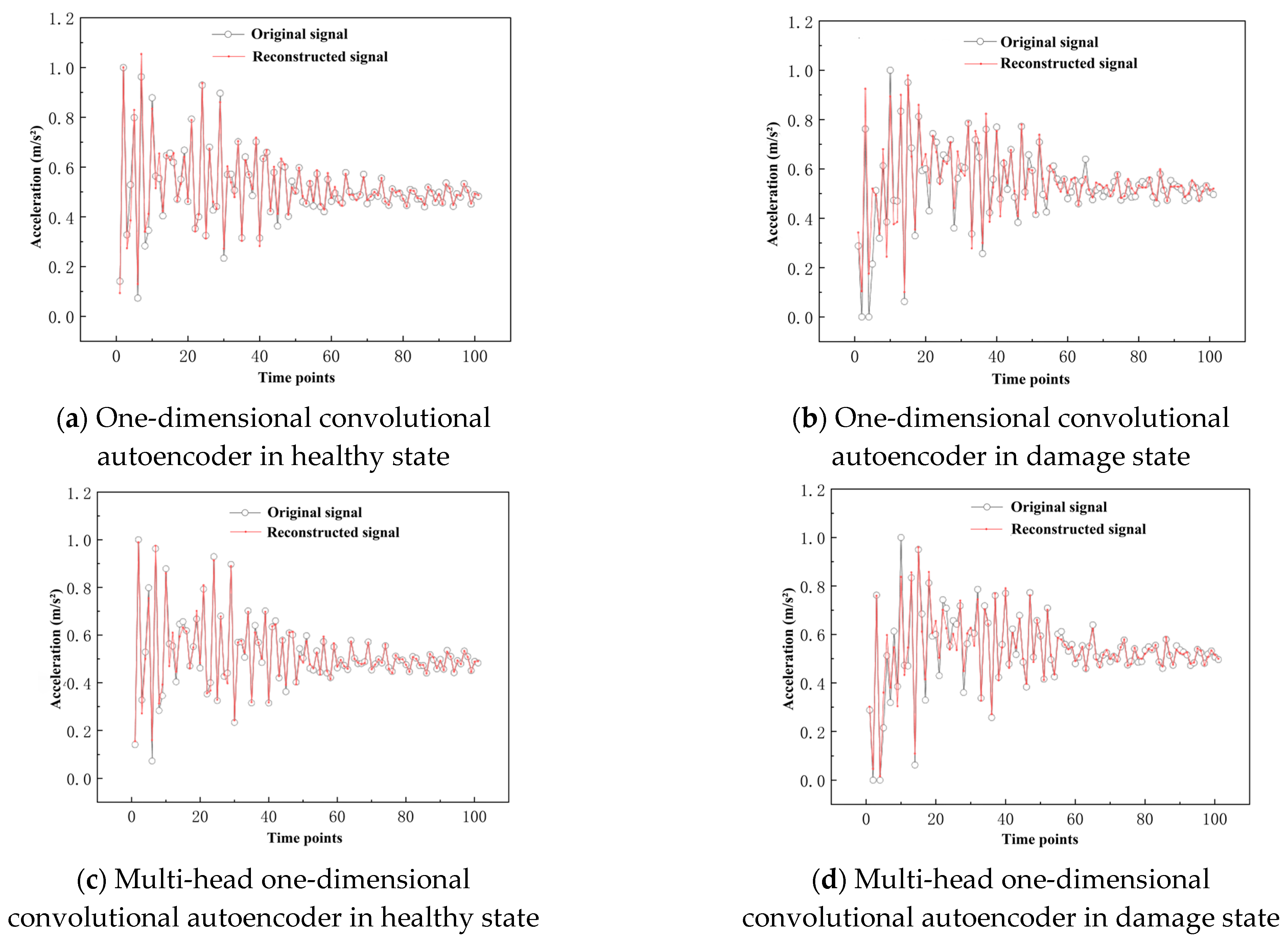
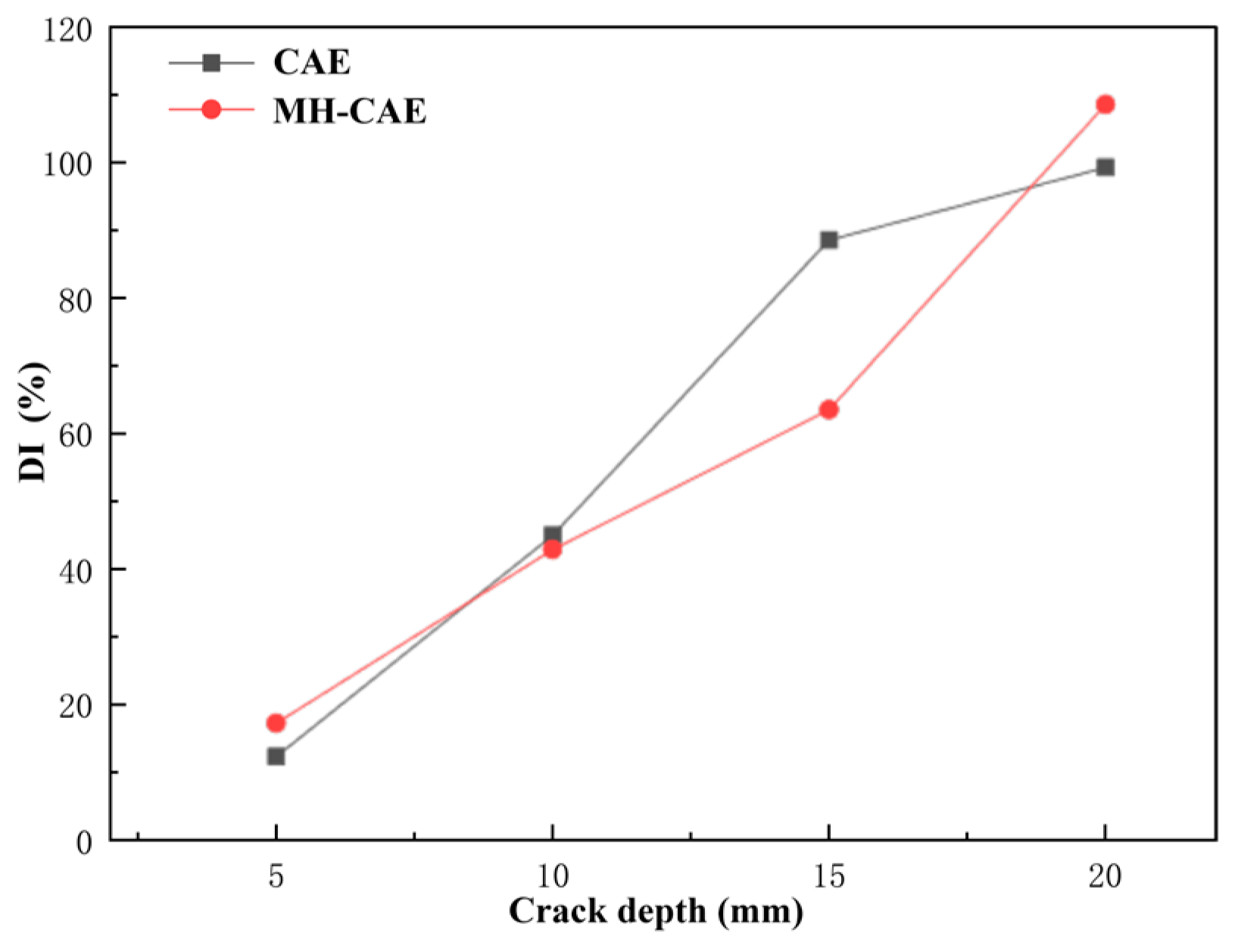
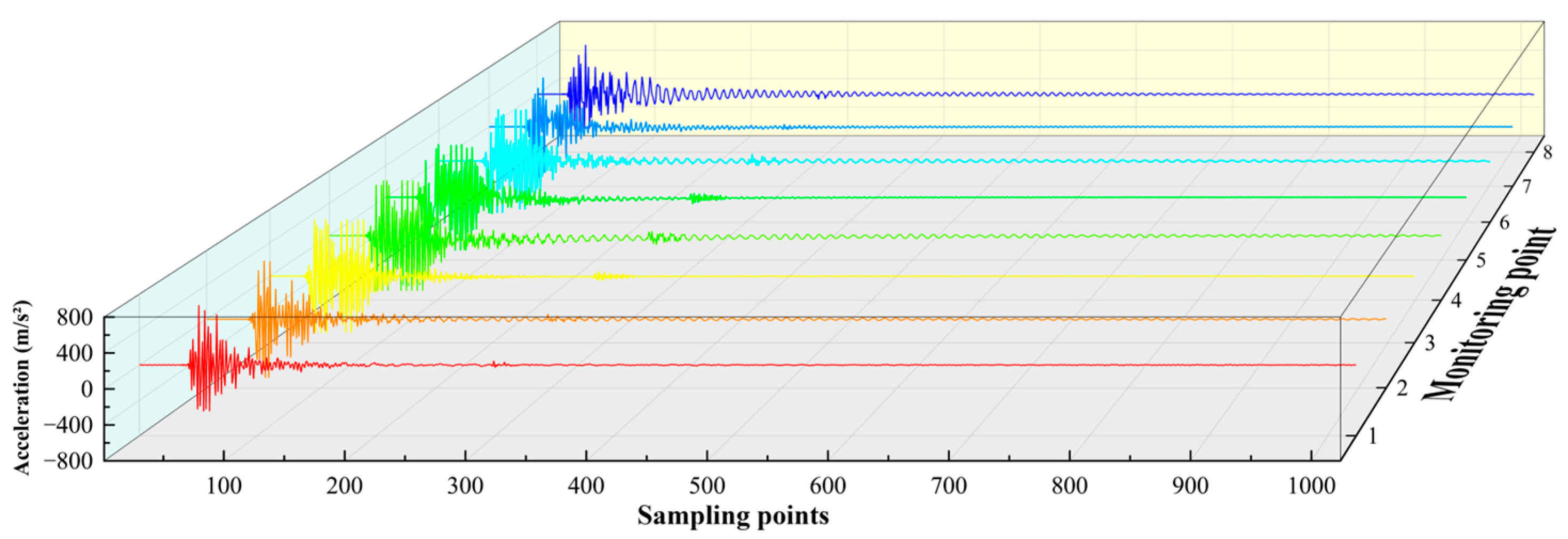
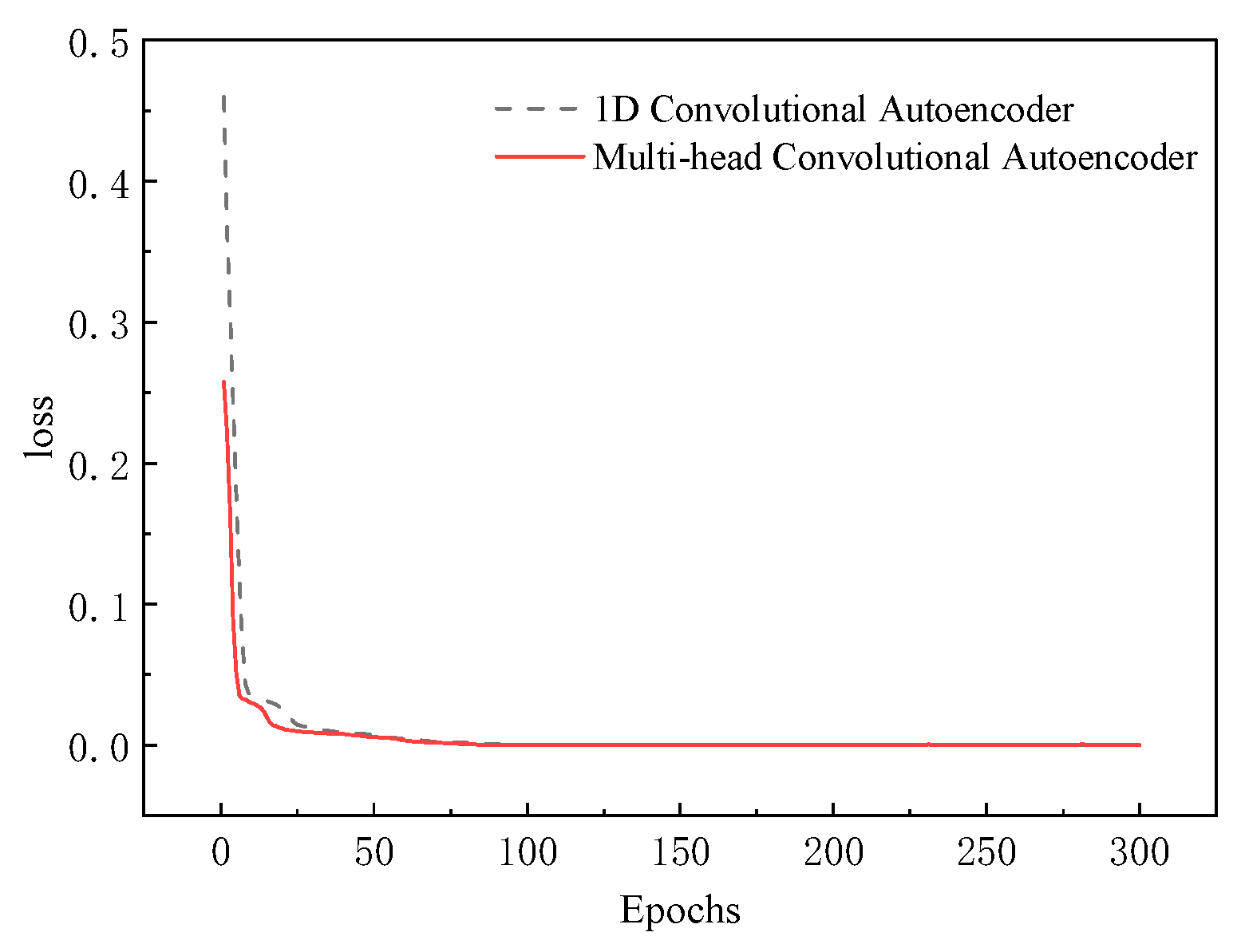
- This experiment involves constructing an MH-CAE model based on the standard CAE. The model incorporates multiple convolutional kernels of different sizes in parallel within the encoder. This design enables independent extraction of feature representations from the input signal at various temporal scales. The feature maps from the multiple convolutional channels are then integrated and fed into the decoder for reconstruction, achieving multi-scale feature extraction. The MH-CAE effectively reconstructs acceleration signals in the healthy state of the test beam. However, noticeable deviations occur at several points when the beam is damaged. This demonstrates the potential of signal reconstruction for identifying damage in real engineering scenarios.
- (2)
- During the experiment, the CAE was unable to accurately capture damage information when the crack depth at the midspan of Beam No. 2 reached 10 mm. However, the MH-CAE consistently reflected the damage level throughout the entire identification process. These results suggest that the MH-CAE offers significant advantages in structural damage assessment, demonstrating enhanced accuracy and adaptability and positioning it as a more suitable tool for health monitoring of complex structures.
- (3)
- To ensure robustness in practical engineering applications, analyses must be conducted based on actual structural characteristics. It is clear that further research is needed to enable accurate damage localization and quantitative assessment. This study focuses on single-damage identification and does not address multi-damage scenarios. Future work will optimise the MH-CAE weight distribution to capture subtle features of localised damage, integrate multi-point data fusion to include richer combinations of damage location and severity, and perform a comprehensive comparison with advanced benchmarks, including standard SHM methods such as PCA, modal curvature, wavelet analysis, SVM, VAE, and LSTM. These improvements will enhance the practical applicability of the method in real structural health monitoring systems.
Author Contributions
Funding
Data Availability Statement
Conflicts of Interest
References
- Luo, D.; Li, F.; Niu, D. Research progress on durability diagnosis of concrete structures based on artificial intelligence. Jianzhu Jiegou Xuebao 2024, 45, 1–13. [Google Scholar]
- Bertagnoli, G.; Ferrara, M.; Miceli, E.; Castaldo, P.; Giordano, L. Safety assessment of an existing bridge deck subject to different damage scenarios through the global safety format ECOV. Eng. Struct. 2024, 306, 117859. [Google Scholar] [CrossRef] [Scilit]
- Franceschini, L.; Vecchi, F.; Belletti, B.; Andrade, C.; Peiretti, H.C. Analytical method for the evaluation of the residual service life of prestressed concrete beams subjected to corrosion deterioration. Struct. Concr. 2022, 23, 121–137. [Google Scholar] [CrossRef] [Scilit]
- Garevski, M.; Mircevski, Z.; Kordoska, M.; Banovska, D.; Lazarov, L. Advancements in fire damage evaluation for prestressed concrete bridges: Insights from the Belasica Bridge. Eng. Struct. 2025, 343, 120961. [Google Scholar] [CrossRef] [Scilit]
- Yu, M.; Chen, W.; Hou, J. A lightweight network for concrete crack detection in complex environments based on cloud-edge collaboration. Expert Syst. Appl. 2026, 299, 130204. [Google Scholar] [CrossRef] [Scilit]
- Li, H.; Chen, R.; Ritha, N.; Wang, J.; Chen, Z. An automatic detection method for road damage in UAV images based on multi-level perception and feature aggregation. Adv. Eng. Inform. 2026, 69, 103814. [Google Scholar] [CrossRef] [Scilit]
- Jiang, Y.; Pang, D.; Li, C.; Wang, J. A method of concrete damage detection and localization based on weakly supervised learning. Comput.-Aided Civ. Infrastruct. Eng. 2024, 39, 1042–1060. [Google Scholar] [CrossRef] [Scilit]
- Jiang, T.; Li, L.; Samali, B.; Yu, Y.; Huang, K.; Yan, W.; Wang, L. Lightweight object detection network for multi-damage recognition of concrete bridges in complex environments. Comput.-Aided Civ. Infrastruct. Eng. 2024, 39, 3646–3665. [Google Scholar] [CrossRef] [Scilit]
- Xiong, C.; Luo, Z.; Zheng, J.; Xie, L.; Mei, L.; Li, L.; Long, W. Seismic damage assessment of reinforced concrete frame structures based on transfer-residual networks. Eng. Appl. Artif. Intell. 2025, 161, 112118. [Google Scholar] [CrossRef] [Scilit]
- El-Joukhadar, N.; Dameh, F.; Pantazopoulou, S. Seismic Modelling of Corroded Reinforced Concrete Columns. Eng. Struct. 2023, 275, 115251. [Google Scholar] [CrossRef] [Scilit]
- Zhang, R.; Xiong, W.; Ma, X.; Cai, C.S. Progressive bridge collapse analysis under both scour and floods by coupling simulation in structural and hydraulic fields. Part I: Numerical solver. Ocean Eng. 2023, 273, 113849. [Google Scholar] [CrossRef] [Scilit]
- Ho, L.V.; Bui-Tien, T.; Abdel Wahab, M. A two-step failure identification approach using a stochastic optimization-based ensemble learning model for beams without pristine data. Eng. Struct. 2025, 334, 120253. [Google Scholar] [CrossRef] [Scilit]
- Tan, X.; Xie, H.; Xia, C.; Ying, Y.; Hokoi, S.; Li, Y. Artificial intelligence in five key phases of architectural heritage conservation: A systematic review. J. Build. Eng. 2025, 117, 114862. [Google Scholar] [CrossRef] [Scilit]
- Yu, Z.; Li, B. Reinforced concrete beam full response prediction with hybrid feature-orientation transformer-LSTM model. Eng. Struct. 2025, 332, 120040. [Google Scholar] [CrossRef] [Scilit]
- Zhang, F.; Fu, Y.; Shen, K.; Zhang, Y.; Wang, J. Distributed edge intelligence for structural dynamic response estimation using knowledge distillation and data fusion. Eng. Struct. 2025, 335, 120406. [Google Scholar] [CrossRef] [Scilit]
- Wang, Z.; Chen, X.; Shi, Z.; Wu, W.; Liu, Z. Damage mode identification of CFRP sheet strengthened coral aggregate reinforced concrete beams based on acoustic emission technology. Eng. Struct. 2025, 343, 121076. [Google Scholar] [CrossRef] [Scilit]
- Fan, C.; Ding, Y.; Liu, X.; Yang, K. A review of crack research in concrete structures based on data-driven and intelligent algorithms. Structures 2025, 75, 108800. [Google Scholar] [CrossRef] [Scilit]
- Mangalathu, S.; Hwang, S.H.; Jeon, J.S. Failure mode and effects analysis of RC members based on machine-learning-based SHapley Additive exPlanations (SHAP) approach. Eng. Struct. 2020, 219, 110927. [Google Scholar] [CrossRef] [Scilit]
- Yang, Z.; Zhang, Y.; Wang, Y.; Wang, N.; Cui, H.; Qu, Y. Conventional Bridge Damage Identification Based on BP Neural Network. In Proceedings of the 2019 6th Annual International Conference on Material Engineering and Application, Guangzhou, China, 20–21 December 2019. [Google Scholar]
- Roy, P.; Bhanu Kiran, G.; Saha, N.; Topdar, P. Identification of damaged member in a truss structure using acoustic emission technique aided by SVM. Struct. Health Monit. 2025, 24, 622–635. [Google Scholar] [CrossRef] [Scilit]
- Zhang, G.; Tang, L.; Liu, Z.; Zhou, L.; Liu, Y.; Jiang, Z. Machine-learning-based damage identification methods with features derived from moving principal component analysis. Mech. Adv. Mater. Struct. 2020, 27, 1789–1802. [Google Scholar] [CrossRef] [Scilit]
- Bao, Y.Q.; Li, H. Machine learning paradigm for structural health monitoring. Struct. Health Monit.-Int. J. 2021, 20, 1353–1372. [Google Scholar] [CrossRef]
- He, Y.; Huang, Z.; Liu, D.; Zhang, L.; Liu, Y. A Novel Structural Damage Identification Method Using a Hybrid Deep Learning Framework. Buildings 2022, 12, 2130. [Google Scholar] [CrossRef] [Scilit]
- Guo, P.W.; Mahjoubi, S.; Liu, K.J.; Meng, W.A.; Bao, Y. Self-updatable AI-assisted design of low-carbon cost-effective ultra-high-performance concrete (UHPC). CASE Stud. Constr. Mater. 2023, 19, e02625. [Google Scholar] [CrossRef] [Scilit]
- Wang, Z.; Cha, Y.J. Unsupervised machine and deep learning methods for structural damage detection: A comparative study. Eng. Rep. 2025, 7, e12551. [Google Scholar] [CrossRef] [Scilit]
- Xu, Y.; Tian, Y.; Li, H. Unsupervised deep learning method for bridge condition assessment based on intra-and inter-class probabilistic correlations of quasi-static responses. Struct. Health Monit. 2023, 22, 600–620. [Google Scholar] [CrossRef] [Scilit]
- Akintunde, E.; Eftekhar Azam, S.; Rageh, A.; Linzell, D.G. Unsupervised Machine Learning for Robust Bridge Damage Detection: Full-Scale Experimental Validation. Eng. Struct. 2021, 249, 113250. [Google Scholar] [CrossRef] [Scilit]
- Perera, R.; Montes, J.; Gómez, A.; Barris, C.; Baena, M. Unsupervised autoencoders with features in the electromechanical impedance domain for early damage assessment in FRP-strengthened concrete elements. Eng. Struct. 2024, 315, 118458. [Google Scholar] [CrossRef] [Scilit]
- Pathirage, C.S.N.; Li, J.; Li, L.; Hao, H.; Liu, W.Q.; Ni, P.H. Structural damage identification based on autoencoder neural networks and deep learning. Eng. Struct. 2018, 172, 13–28. [Google Scholar] [CrossRef] [Scilit]
- Vaiyapuri, T.; Binbusayyis, A. Application of deep autoencoder as an one-class classifier for unsupervised network intrusion detection: A comparative evaluation. PeerJ Comput. Sci. 2020, 6, e327. [Google Scholar] [CrossRef] [Scilit]
- Lindley, C.A.; Rogers, T.; Dwyer-Joyce, R.; Dervilis, N.; Worden, K. On the application of variational auto encoders (VAE) for damage detection in rolling element bearings. In Proceedings of the 13th International Workshop on Structural Health Monitoring (IWSHM), Stanford, CA, USA, 7–9 December 2021; Volume 2021. [Google Scholar]
- Pakzad, S.S.; Masoodi, A.R. Early damage detection in bridges using a variational autoencoder–based hybrid unsupervised learning framework. Sci. Rep. 2025, 16, 1389. [Google Scholar] [CrossRef] [Scilit]
- Liang, M.; Liu, R.W.; Li, S.; Xiao, Z.; Liu, X.; Lu, F. An unsupervised learning method with convolutional auto-encoder for vessel trajectory similarity computation. Ocean Eng. 2021, 225, 108803. [Google Scholar] [CrossRef] [Scilit]
- Noor, M.H.M. Feature learning using convolutional denoising autoencoder for activity recognition. Neural Comput. Appl. 2021, 33, 10909–10922. [Google Scholar] [CrossRef] [Scilit]





| Test Beam Number | Damage Location | Crack Depth |
|---|---|---|
| Beam No. 1 | half span | 5 mm |
| Beam No. 1 | half span | 10 mm |
| Beam No. 1 | half span | 15 mm |
| Beam No. 1 | Half span | 20 mm |
| Beam No. 2 | quarter span | 5 mm |
| Beam No. 2 | quarter span | 10 mm |
| Beam No. 2 | quarter span | 15 mm |
| Beam No. 2 | quarter span | 20 mm |
| Groups | Depth | FEM | Test |
|---|---|---|---|
| Mid-span | 5 mm | 24,781.71 | 23,689.32 |
| 10 mm | 23,971.09 | 22,988.35 | |
| 15 mm | 23,881.27 | 22,971.75 | |
| 20 mm | 23,750.33 | 22,541.62 | |
| 1/4 span | 5 mm | 24,718.78 | 24,599.46 |
| 10 mm | 23,962.27 | 23,870.23 | |
| 15 mm | 23,826.62 | 23,603.48 | |
| 20 mm | 23,642.68 | 23,302.88 |
| Overall Structure Name | Layer Name | Number of Convolutional Kernels | Convolution Size |
|---|---|---|---|
| Single-headed one-dimensional convolutional encoder | First layer one-dimensional convolution | 16 | 3 × 1 |
| Second layer one-dimensional convolution | 32 | 3 × 1 | |
| Third layer one-dimensional convolution | 64 | 3 × 1 | |
| Multi-head one-dimensional convolutional encoder | First layer multi-head one-dimensional convolution | 3 × 16 | [3, 5, 7] × 1 |
| Second layer multi-head one-dimensional convolution | 3 × 32 | [3, 5, 7] × 1 | |
| Third layer multi-head one-dimensional convolution | 64 | 3 × 1 | |
| Decoder | First layer one-dimensional transposed convolution | 32 | 4 × 1 |
| Second layer one-dimensional transposed convolution | 16 | 4 × 1 | |
| Third layer one-dimensional transposed convolution | 1 | 4 × 1 |
| Beam | Model | Depth (mm) | Mean DI (%) | SD DI (%) |
|---|---|---|---|---|
| 1 | CAE | 5 | 12.34 | 0.49 |
| 10 | 44.98 | 1.8 | ||
| 15 | 88.54 | 3.54 | ||
| 20 | 99.26 | 3.97 | ||
| MH-CAE | 5 | 17.25 | 0.69 | |
| 10 | 42.87 | 1.71 | ||
| 15 | 63.53 | 2.54 | ||
| 20 | 108.57 | 4.34 | ||
| 2 | CAE | 5 | 5.34 | 0.21 |
| 10 | 27.38 | 1.09 | ||
| 15 | 21.26 | 0.85 | ||
| 20 | 49.54 | 1.98 | ||
| MH-CAE | 5 | 39.15 | 1.56 | |
| 10 | 81.96 | 3.28 | ||
| 15 | 85.68 | 3.42 | ||
| 20 | 157.24 | 4 |
Disclaimer/Publisher’s Note: The statements, opinions and data contained in all publications are solely those of the individual author(s) and contributor(s) and not of MDPI and/or the editor(s). MDPI and/or the editor(s) disclaim responsibility for any injury to people or property resulting from any ideas, methods, instructions or products referred to in the content. |
© 2026 by the authors. Licensee MDPI, Basel, Switzerland. This article is an open access article distributed under the terms and conditions of the Creative Commons Attribution (CC BY) license.
Share and Cite
Jiang, S.; Zhang, J.; Wang, M.; Chen, X.; Li, Q. Structural Damage Identification Method and Experimental Verification Based on Multi-Head Convolutional Autoencoder. Buildings 2026, 16, 954. https://doi.org/10.3390/buildings16050954
Jiang S, Zhang J, Wang M, Chen X, Li Q. Structural Damage Identification Method and Experimental Verification Based on Multi-Head Convolutional Autoencoder. Buildings. 2026; 16(5):954. https://doi.org/10.3390/buildings16050954
Chicago/Turabian StyleJiang, Shuai, Jun Zhang, Meng Wang, Xinting Chen, and Qiang Li. 2026. "Structural Damage Identification Method and Experimental Verification Based on Multi-Head Convolutional Autoencoder" Buildings 16, no. 5: 954. https://doi.org/10.3390/buildings16050954
APA StyleJiang, S., Zhang, J., Wang, M., Chen, X., & Li, Q. (2026). Structural Damage Identification Method and Experimental Verification Based on Multi-Head Convolutional Autoencoder. Buildings, 16(5), 954. https://doi.org/10.3390/buildings16050954