Article

Age-Related Differences in Cognitive Performance Under the Thermal Effect of Simulated Solar Radiation

1
College of Architecture and Urban Planning, Qingdao University of Technology, Qingdao 266033, China
2
School of Environment and Municipal Engineering, Qingdao University of Technology, Qingdao 266033, China
3
Qingdao University of Technology Architectural Design and Research Institute Company, Qingdao 266033, China
4
School of Architecture, Southeast University, Nanjing 210096, China
*
Author to whom correspondence should be addressed.
Buildings 2026, 16(5), 947; https://doi.org/10.3390/buildings16050947
Submission received: 13 January 2026 / Revised: 20 February 2026 / Accepted: 26 February 2026 / Published: 27 February 2026
(This article belongs to the Special Issue Carbon-Neutral Pathways for Urban Building Design)

Abstract

In research related to cognitive performance, temperature is often regarded as a core influencing factor and has received significant attention. However, as a key component of the building thermal environment, solar radiation and its mechanism of action on cognitive performance have rarely been studied. This paper conducts a laboratory study, using an infrared radiation heater to simulate the thermal effect of solar radiation, and explores the age-related differences between the elderly and the young in thermal comfort, electroencephalogram (EEG) activity, and cognitive ability under three radiation intensities (0 W, 500 W, and 1000 W). The results show that age has a relatively small impact on subjective thermal responses but a significant impact on mental state and cognitive performance. In the infrared radiation environment, the alertness (ALV score) of the elderly remains more stable, while young people show an increased sense of drowsiness. EEG analysis indicates that the frontal lobe logarithmic power of both groups of subjects is 4.55–6.79% higher than the average of other brain regions. High radiation (1000 W) inhibits the EEG activity of young people but triggers compensatory activation in the elderly, thus reducing age-related neural differences. Cognitive tests show that compared with the non-radiation condition, high infrared radiation (1000 W) significantly improves the cognitive levels of the elderly in terms of attention (CPT: +1.53%), response ability (DLT: +0.78%) and visual search ability (VST: +2.04%), while these abilities decline in young people (CPT: −2.78%, DLT: −1.21%, VST: −3.82%). The correlation analysis between EEG and cognitive tests identifies that the right frontal electrodes (F4, F8) and the occipital O1 may be potential candidate electrodes for evaluating the cognitive performance of the elderly and young people. This study provides crucial objective physiological evidence for clarifying the relationship between heat sources such as the thermal effect of solar radiation, which “acts directly on the human body”, and human thermal comfort and cognitive performance.

1. Introduction

The indoor thermal environment is a crucial aspect of research on building environmental quality. Solar radiation, as a key natural source of the indoor thermal environment, has infrared radiation (with a wavelength of 0.76–1000 μm) accounting for 43% of its energy composition, making it the main source of thermal effects in solar radiation [1]. This type of infrared radiation does not require air as a medium; it can directly interact with the surface layer of human skin, causing a rapid increase in local temperature, which in turn affects the balance of the indoor thermal environment and human physiological responses. It has an undeniable research value in the design of building thermal environments.
It is worth noting that traditional thermal comfort assessment mostly relies on subjective voting; however, individual differences in perception can easily lead to ambiguous results, and it is questionable whether the results of subjective evaluations can truly reflect human comfort [2]. The exploration of thermal comfort mechanisms should begin with an examination of human physiological parameters. The brain serves as the central organ regulating systemic energy supply, and electroencephalogram (EEG) technology provides an objective neurological basis for assessing thermal comfort. EEG captures voltage fluctuations caused by ionic currents generated by brain neurons during brain activity, which are closely related to sensation, consciousness, and cognitive behaviors. As shown in Table 1, according to the frequency from low to high, EEG can be divided into the most common δ waves, θ waves, α waves, and β waves. Among them, δ waves are generally considered to be related to sleep, θ waves are related to fatigue, α waves reflect a state of mental relaxation, and β waves are considered to represent active thinking and cognitive processes [3]. Recording the voltage fluctuations of neuronal electrical activity through these scalp electrodes helps to understand the mechanisms of individual perception and response to the thermal environment.
EEG captures the activity changes in characteristic bands in the cerebral cortex through non-invasive electrodes. The text is used to measure the neural responses of the human body to changes in the thermal environment. It demonstrates significant differences between states of thermal comfort and discomfort. As such, it provides a physiological basis for an objective evaluation index of human thermal comfort [4]. Shin et al. studied the impact of different temperatures on neural responses and found that cold stimuli trigger more delta waves and theta waves, while heat stimuli mainly activate beta waves and alpha waves [5]. Lv et al. found that when exposed to heat stimuli, compared with the ambient temperature of 25 °C, the proportion of delta band power in the right temporal and parietal regions is higher at an ambient temperature of 32 °C [6]. Son et al. [7] further explored the application of EEG signals in environments with temperature changes. By monitoring the dynamic changes in theta waves and delta waves, they confirmed that temperature fluctuations can affect emotions through neural electrical activities. These related studies have all proven that ambient temperature significantly affects EEG. It is important to note that the thermal effect of solar radiation is primarily due to infrared radiation. This mechanism triggers local thermal sensations through direct irradiation of the skin, which differs fundamentally from the thermal effect caused by simple conduction of air temperature. Existing studies mostly take the change in air temperature, a traditional physical parameter, as the core variable, and there is a distinct lack of attention to the thermal effect of solar radiation, a key natural heat source.
In addition to human thermal comfort, cognitive performance is another key focus in thermal environment research. In the 1960s, Pebler et al. conducted an exploratory experiment on the impact of indoor environments on cognitive relationships, laying the foundation for subsequent studies [8]. Early research targeted the work efficiency of office workers. In a subjective questionnaire study, Lan et al. [9] discovered that under three different room temperature conditions (17 °C, 21 °C, and 28 °C), deviations from a neutral thermal environment led to feelings of thermal discomfort among the subjects. As a result, they experienced more negative emotions, which also correlated with decreased scores in neurobehavioral tests. Chen et al. [10] further tested the cognitive function levels of the subjects at four temperatures (26 °C, 30 °C, 33 °C, and 37 °C) under conditions simulating moderate activity intensity. It was found that in a high-temperature environment of 37 °C, the accuracy of the subjects decreased and their reaction speed increased. A study by Yeganeh et al. [11] controlling the weighted average increase in air temperature by 4.34 °C, 10.04 °C, and 26.68 °C showed that cognitive performance decreased by approximately 0.40%, 5.37%, and 7.97%, respectively. Heat stress led to a significant decline in the performance of attention tasks. Cui et al. [12] further investigated the cognitive performance under five temperature conditions (22 °C, 24 °C, 26 °C, 29 °C, 32 °C) and found that the learning effect is greatly influenced by temperature. In an uncomfortable environment or one with frequent temperature changes, the learning speed slows down. When people feel more comfortable, their enthusiasm increases and their cognitive performance also improves. These studies affirm the impact of the thermal environment on cognitive performance. However, as most of the subjects are non-elderly groups such as office workers and students, whether the results can be applied to the elderly still needs further exploration.
In today’s society, the proportion of time that the elderly spend indoors can be as high as 80–100% [13], so creating a healthy and comfortable indoor environment is crucial to the well-being of the elderly. The aging process is accompanied by physiological decline in thermoregulation, sensory perception, and cognitive functions. Therefore, the indoor thermal environment, especially its interaction with solar radiation, is vital for maintaining the health and quality of life of the elderly population. Some studies suggest that there is no significant difference in thermal comfort between the elderly and young people, but in recent years, more and more studies have presented different views [14]. Some researchers have proposed that compared with young people, the elderly tend to prefer a higher ambient temperature and have a narrower range of thermal acceptability [15,16]. Soebarto et al. [17] found that the thermal sensation of the elderly at the same temperature is different from that of young people. At 25 °C, the Predicted Mean Vote (PMV) of the elderly is 0.59, while that of young people is only 0.1, indicating that the elderly are more likely to feel warm. Jin et al. [18] also pointed out that the elderly prefer a higher temperature under constant temperature conditions. When young people prefer “cool”, the average temperature is about 25 °C, while the temperature for the elderly with the same preference reaches 26 °C. In addition to the perception of temperature and thermal comfort, there are also differences in the impact of thermal stimulation on cognitive abilities. Due to the reduction in skin receptors and the decline in metabolic rate, the elderly often show insensitivity to heat perception [19], and their cognitive performance is more susceptible to environmental stressors compared with young people [20]. Wang et al. [21] found that moderate thermal stimulation can significantly improve the cognitive flexibility of the elderly. The elderly can still maintain short-term memory and visual recognition memory at a high temperature of 39.5 °C, and their cognitive flexibility is even better than that under normal temperature conditions, which indicates that heat may have a potential beneficial effect on the elderly population. However, these studies still take temperature changes as the main variable, and the impact of the thermal effect of solar radiation on age-related thermal perception and cognition remains unclear.
With the advancement of EEG technology, researchers can elucidate the relationship between the thermal environment and cognitive ability from a neuroscientific perspective. Zhu et al. [22] investigated the relationship between changes in EEG signals and cognitive task performance in 32 young people under various combinations of temperature and humidity. They found that although the subjects subjectively reported a decrease in alertness and greater difficulty in thinking performance, no correlation between the two could be determined because there was no change in cognitive task performance. However, Liu et al. [23] studied the cognitive test results of 20 young people under 5 temperature conditions (24 °C, 26 °C, 28 °C, 30 °C, and 32 °C) and found that there was a significant correlation between the relative power of the whole-brain β, δ, and θ bands and the scores of tasks focusing on attention. Among them, the O1 and P8 channels emerged as potential candidate channels for single-channel EEG signals, providing insights into understanding thermal comfort status and attention-related cognitive performance. Li et al. [24] confirmed that the EEG-based concentration index is affected by indoor temperature by studying the skin temperature, EEG activity, and task performance of subjects exposed to three temperature environments. When subjects perform cognitive tasks, relatively hot or cold indoor temperatures lead to longer reaction times and lower accuracy, thereby reducing the performance index. Wang et al. [25] used EEG to study the impact of three different thermal environments (representing slightly cool, neutral, and slightly warm thermal sensations) on occupants’ performance. By evaluating the relationship between mental workload and occupants’ performance, they found that in a slightly warm environment, subjects had a relatively higher mental workload to achieve the same performance. Choi et al. [26] measured the attention ability of subjects under seven Predicted Mean Vote (PMV) conditions (−3 to +3) using EEG. They found that the attention perceived by the subjects did not match their physiological responses. The subjects self-reported the lowest attention levels recorded at higher temperatures (PMV +2, +3), while the lowest brain activity was recorded at lower temperatures (PMV −2, −3). These studies fully demonstrate the potential application of EEG in assessing the cognitive abilities of subjects, which can help mitigate the bias caused by personal factors in subjective evaluations. However, existing studies also focus only on air temperature, a traditional physical parameter, and research on the thermal effect of solar radiation as an influencing factor remains insufficient. Additionally, it is evident that the subjects of these studies are predominantly young students or workers, and there are relatively few studies on the elderly exposed to infrared radiation, with a notable lack of effective comparative studies.
Research findings highlight significant limitations in the study of solar radiation’s thermal effects within building environments. Most existing studies focus on air temperature, neglecting the crucial impact of solar radiation as a natural heat source and the differences in their thermal effects. Additionally, research predominantly centers on young people, with insufficient attention given to the thermal perception and cognition of the elderly. This age gap in studies is notable. Based on the previous research of our team, we have explored the differences among different age groups in terms of thermal comfort and electroencephalogram responses to infrared radiation [27]. Previous studies have identified the physiological adaptations to thermal radiation in different age groups but have not addressed cognitive performance. In this new study, we introduced three cognitive tests. Through a comprehensive task performance (TP) indicator that integrates accuracy and reaction time, we compared the age differences in comfort, EEG characteristics, and cognitive performance under different radiation intensities. We aimed to make up for the deficiencies in heat source variables and research subjects in existing studies. The research results do not set universal thermal design requirements for all buildings but provide a scientific basis for the indoor thermal environment design of elderly care buildings.

2. Materials and Methods

2.1. Subjects

The sample size for the experiment was calculated using GPower3.1 (Heinrich Heine University, Düsseldorf, Germany). The calculation model we selected was repeated-measures analysis of variance. The between-subject factors included two items: young people and the elderly. The within-subject factors included three infrared radiation intensities (0 W, 500 W, 1000 W), and the effect size was set to 0.25. The results showed that to achieve a statistical power of 0.9, at least 26 people need to be recruited in each group. To ensure an adequate sample size, a total of 56 subjects were recruited for this study, comprising 28 elderly subjects and 28 young subjects. Table 2 shows the detailed information of the subjects.
All subjects had no professional background in neurology, hygiene, medicine, or other related fields, to avoid bias in cognitive test results caused by prior knowledge. The young subjects were all undergraduate or postgraduate students who had studied at Qingdao University of Technology for at least two years, and the elderly subjects were all residents who had lived in elderly care institutions in Qingdao for more than two years. All subjects received training before the formal experiment and were able to independently complete the cognitive test tasks designed in this study.
In addition, the subjects were required to refrain from behaviors that might affect neural activity, such as consuming alcohol, coffee, and staying up late, within 24 h of the experiment. All subjects were in good health and had no diseases that might interfere with the experimental results, such as cardiovascular diseases and neurological diseases.

2.2. Experimental Setup

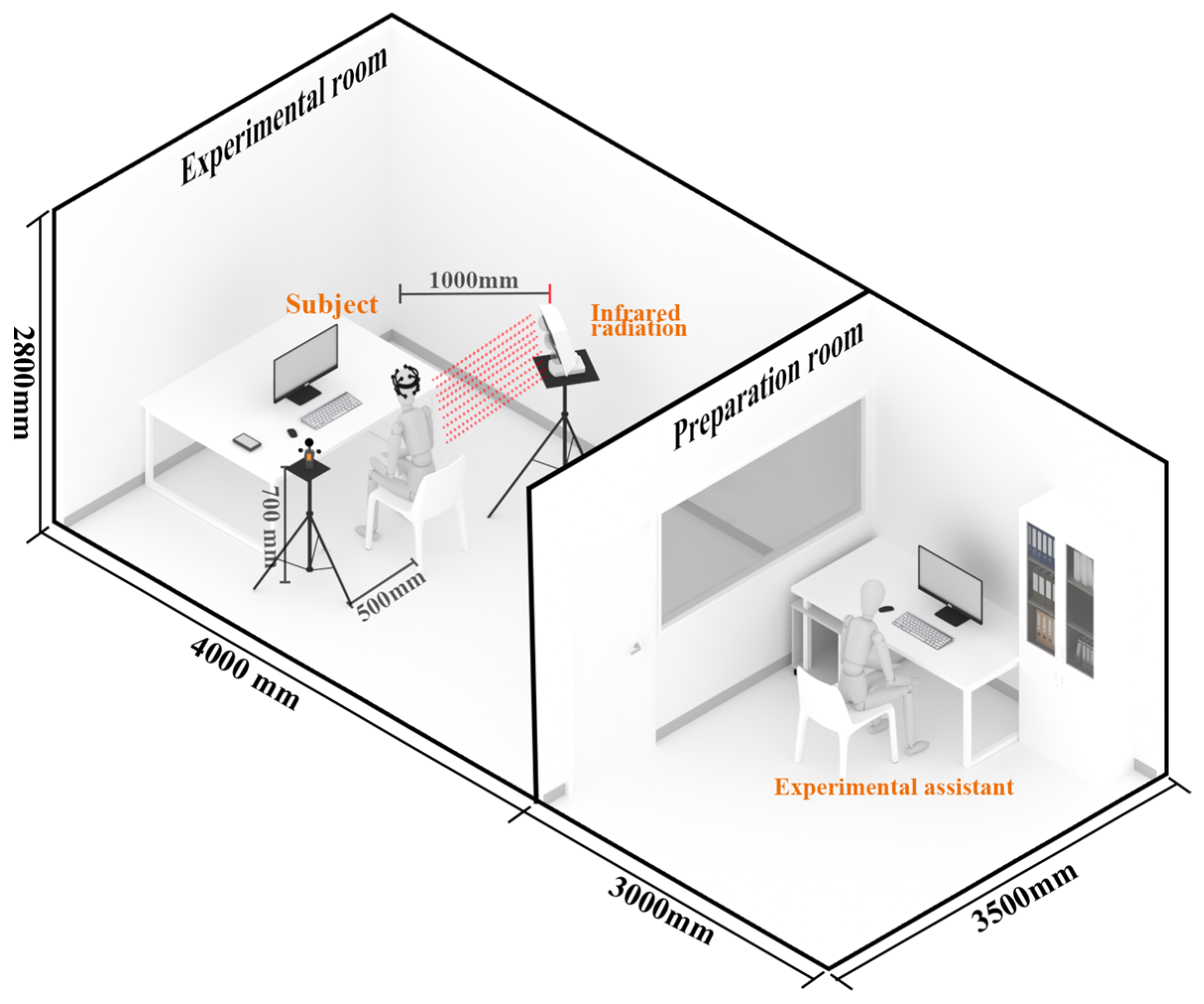
The experiment was conducted in the Climate Laboratory of Qingdao University of Technology. To ensure consistency in thermal environment control and physiological data collection, the core experimental setup reused the setup described in our previously published literature. Specifically, the laboratory environment, infrared radiator specifications, EEG equipment, and thermal comfort measurement protocol were consistent with those described in [27]. The layout of the laboratory is shown in Figure 1. The preparation area is where subjects fill in basic information and experimental assistants monitor EEG data. Experimental assistants can observe the subjects’ status through the observation window to prevent dangerous situations. Three experimental conditions with different radiation intensities were established in this experiment: no radiation (0 W), weak radiation (500 W), and strong radiation (1000 W). In the experimental area, subjects sequentially completed subjective evaluation and cognitive test tasks under the three conditions.
To determine key experimental conditions such as radiation intensity and the distance of equipment placement, this study specifically recruited 3 college students and 3 elderly people to conduct a preliminary experiment. All subjects were matched with the core characteristics of the formal experimental subjects and met the basic health requirements of the study and the cooperation requirements of the experimental tasks. This study took the verification results of the preliminary experiment as the core methodological basis, and finally set the infrared radiator on the side of the subject, maintaining a horizontal distance of 1 m from the subject, thus taking into account both the experimental safety of infrared radiation stimulation and the effectiveness of experimental data. It has been verified that this distance can prevent the subjects from experiencing extreme thermal discomfort caused by excessive radiation intensity, meet the thermal tolerance safety thresholds of different age groups, and at the same time ensure that under different radiation conditions, the subjective thermal evaluations and EEG neural response data of the subjects can show effective differentiation.
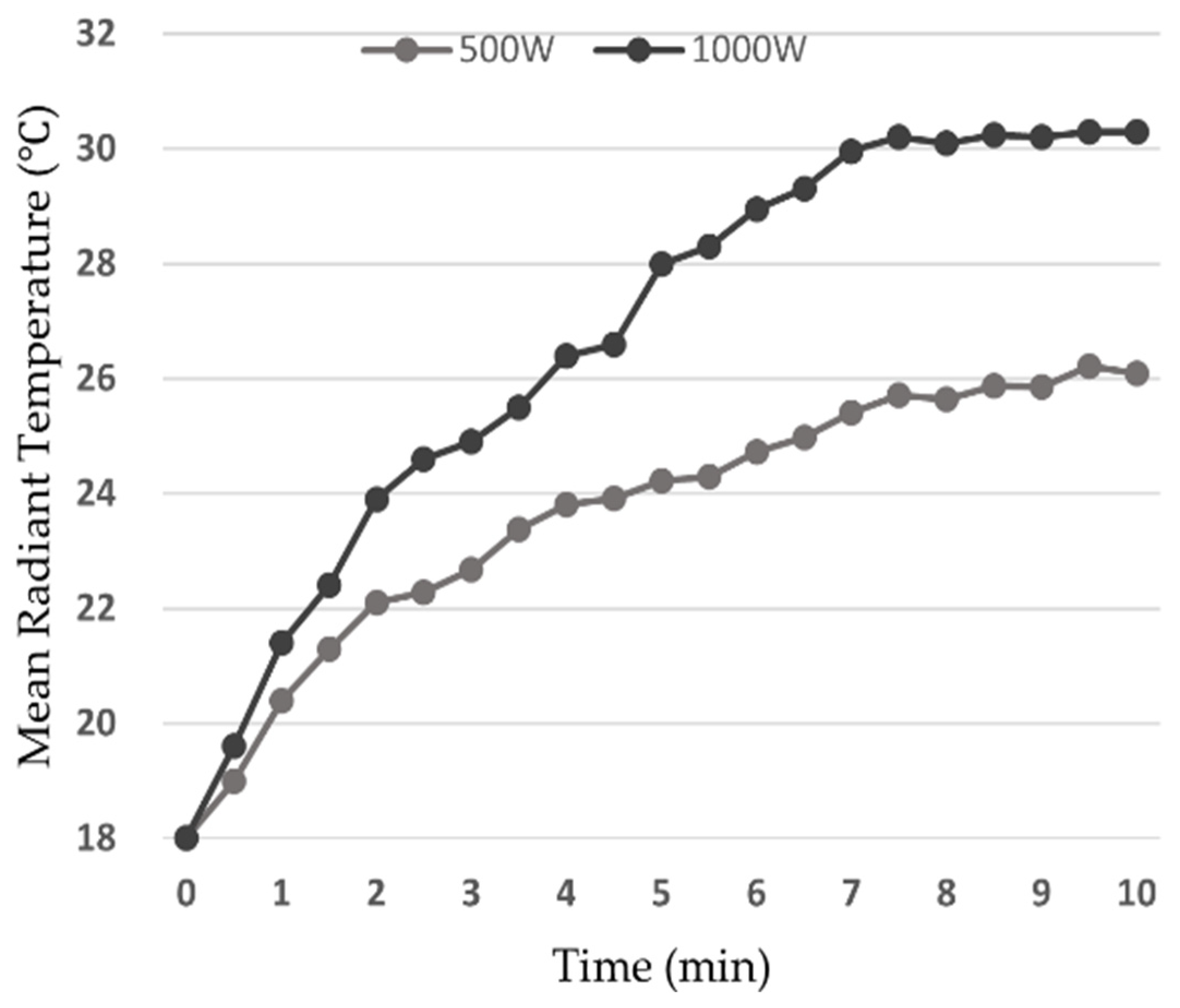
To verify the stability of the experimental environment during the operation of the infrared radiator, 10 min after the radiator was started, a black globe thermometer was used to measure the average radiant temperature around the subjects. The models of the infrared radiator and the black globe thermometer used are shown in Table 3a,b. The black globe thermometer was placed 50 cm on the opposite side of the subject, with an installation height of 70 cm to avoid the direct radiation of the infrared radiator on the thermometer probe. The experiment was carried out in a completely enclosed laboratory, with an environmental wind speed of less than 0.1 m/s. The average radiant temperature was calculated according to the B7 formula specified in the ISO7726-2023 standard [28], as shown in Equation (1).
t ¯ r = [ t g + 273 4 + 0.25 × 10 8 ε g ( t g t a D ) 1 / 4 × t g t a ] 1 / 4 273
t ¯ r represents the mean radiant temperature in °C, t g represents the globe temperature in °C, t a represents the air temperature in °C, ε g represents the emissivity, D represents the globe thermometer diameter in m.
As shown in Figure 2, after the 7 min, the mean radiant temperature (MRT) around the subjects reached a relatively stable state (with fluctuations less than ±0.5 °C), at which point the thermal environment achieved a stable state. Therefore, the duration of a single experiment was determined to be 10 min.

2.3. Experimental Procedure

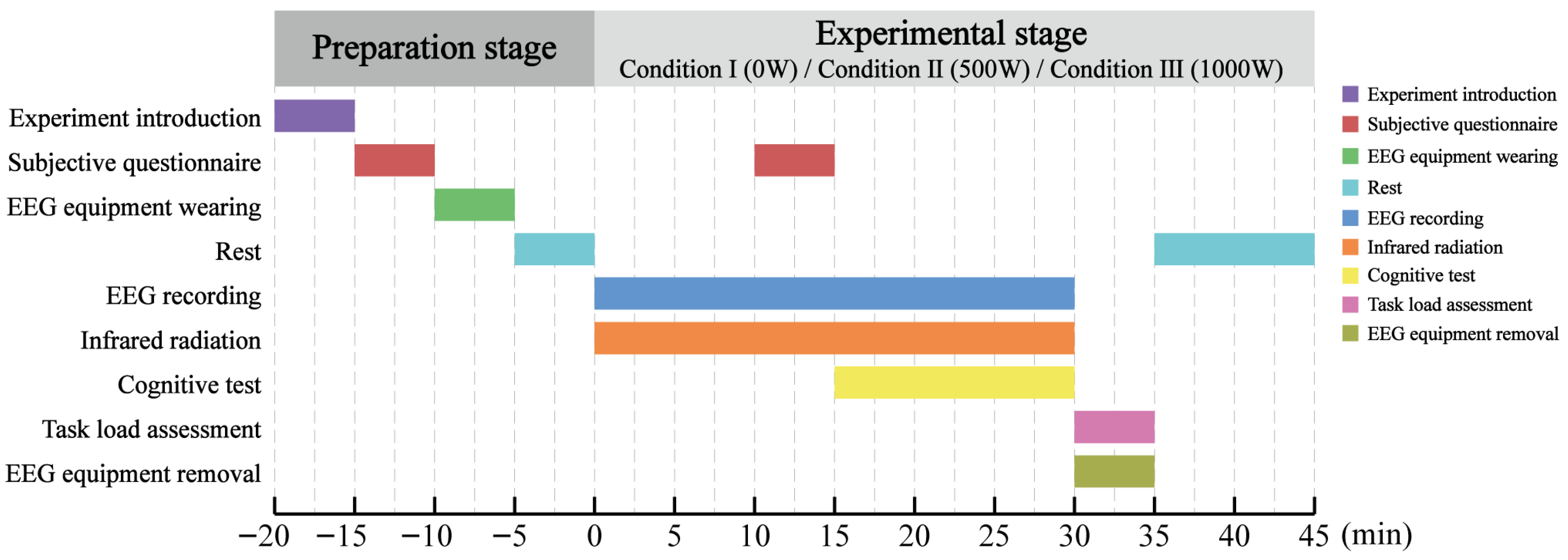
The formal experiment was conducted from April to May 2025. The experiment was carried out in the indoor experimental area, which is a fully enclosed environment with a wind speed of <0.1 m/s, a noise level of <40 dB, and is equipped with temperature and humidity control equipment. During the experiment, the temperature of the entire indoor experimental area where the subjects were located was controlled at 18 ± 0.5 °C, and the relative humidity was controlled at 55 ± 5%. These parameters were set with reference to the indoor temperature and humidity characteristics of typical elderly care institutions in Qingdao from April to May, making the experimental environment more in line with the actual target application scenarios. The specific experimental process is shown in Figure 3.
The subjects’ clothing complied with the requirements of the Chinese national standard GB/T 50785 [29], specifically including short-sleeved tops (0.05–0.15 clo), shorts (0.06–0.12 clo), thin short socks (0.02–0.05 clo), and leather shoes (0.02–0.04 clo), with total thermal resistance controlled between 0.15–0.35 clo. Subjects remained seated throughout the experiment, with an activity level of approximately 1 MET.
In the preparation stage, the subjects need to fill in their personal information. The experiment assistants explain the potential risks of the high-radiation condition (1000 W), such as thermal discomfort, skin burns, and psychological stress, and emphasize the voluntary withdrawal mechanism. Subsequently, the subjects sign the informed consent form for the experiment, wear the EEG equipment as required, and the experiment begins once the EEG signals stabilize. In the experimental stage, the subjects first underwent infrared radiation for a total of 30 min, during which their EEG data were collected simultaneously. After 10 min of the experiment, the subjects filled out a subjective evaluation questionnaire (5 min), then completed three cognitive tests in random order (15 min), after which the experimental assistants turned off all instruments and assisted the subjects in completing the task load evaluation. After each working condition, there was a 10-min rest period for the subjects to adjust their state and for the laboratory to restore the initial parameters. The order of experimental conditions and cognitive tests was designed using a Latin square to avoid errors caused by the “practice effect” and “fatigue effect”.

2.4. Data Collection and Processing

2.4.1. Questionnaires

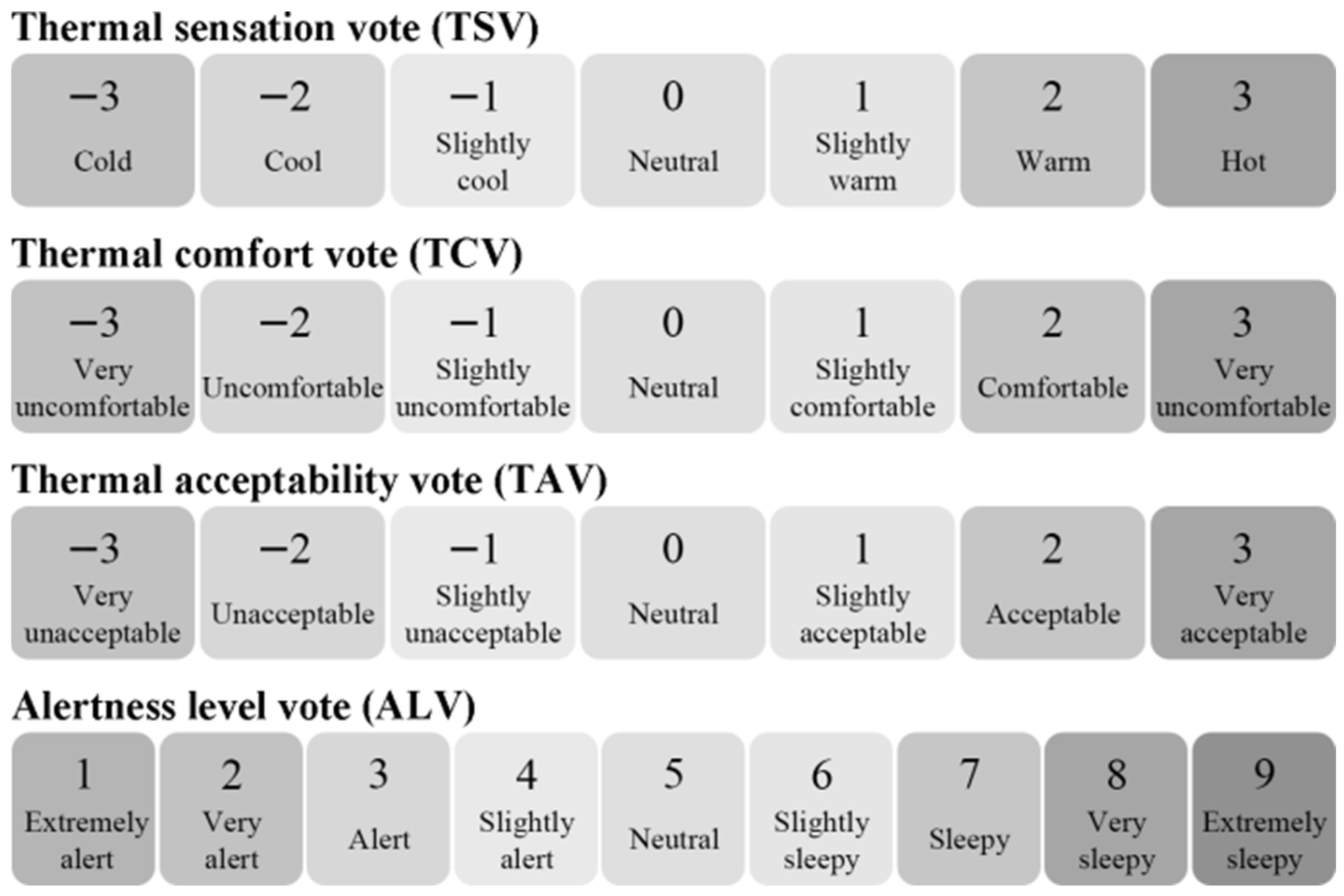
In the experiment, three common thermal environment evaluation questionnaires and one mental assessment scale were selected as the main basis for evaluating the subjects’ status. As shown in Figure 4, the thermal environment evaluation includes a thermal sensation questionnaire (TSV), a thermal comfort questionnaire (TCV), and a thermal acceptability questionnaire (TAV), all of which use the medium ASHRAE 7-point scale for evaluation [30]. The mental state evaluation employs the Alertness Vote (ALV), which is based on the Karolinska Sleepiness Scale [31], utilizing a 9-point Likert scale. To ensure the elderly can easily understand it, more understandable phrases are included.

2.4.2. EEG Signals

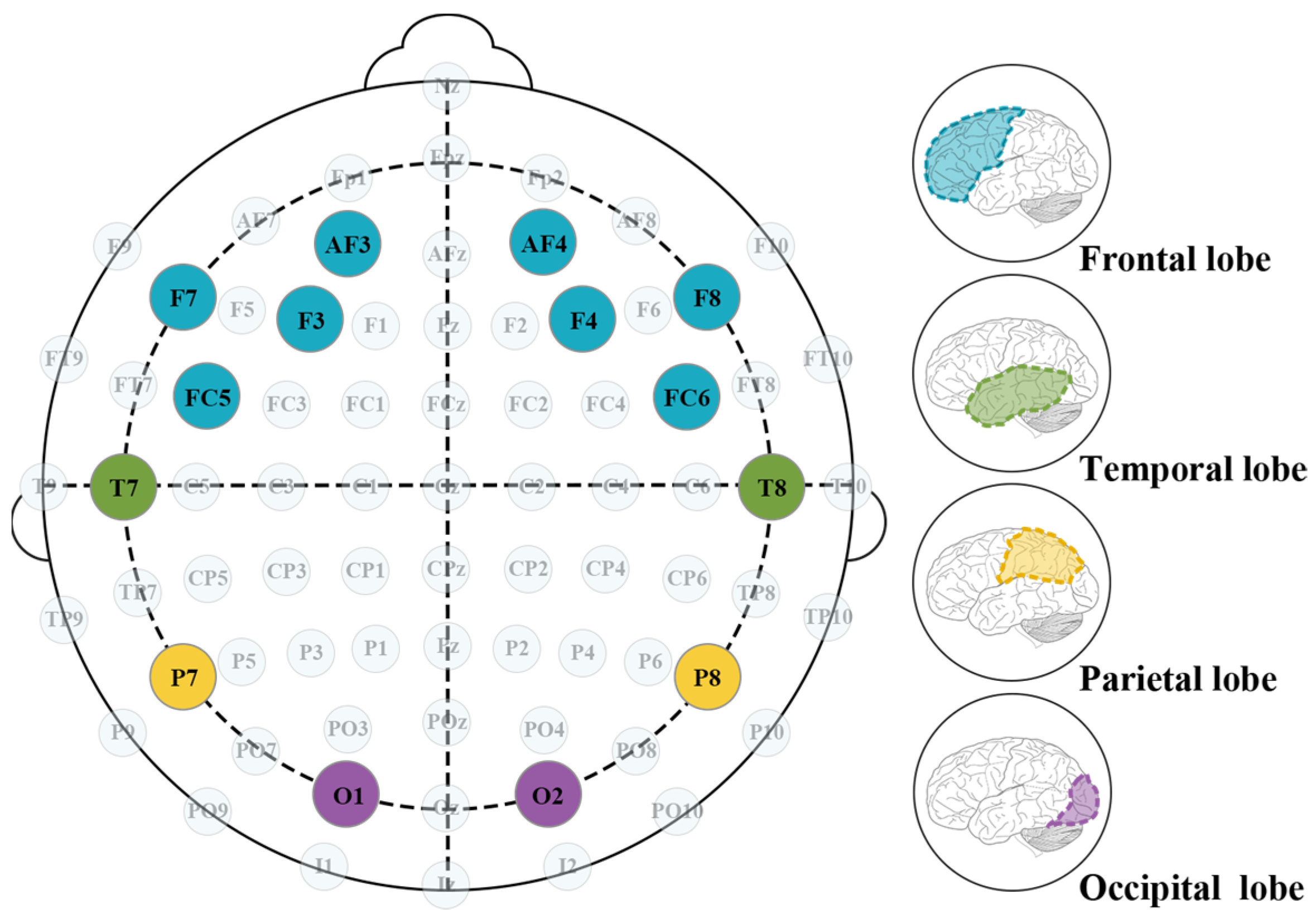
As shown in Table 3c, the device used to monitor EEG signals in the experiment was the Emotiv EPOC+ (Emotiv Systems, San Francisco, CA, USA) [32]. This device is designed with 14-channel EEG signal acquisition, and the electrode layout follows the international 10–20 system standard, covering key brain regions such as the frontal lobe and parietal lobe, and the specific distribution of the electrodes is shown in Figure 5. Since the raw data collected in the experiment contain a large amount of interfering noise that is not EEG signals and have data quality defects, preprocessing is required to ensure the accuracy of subsequent data analysis, the reliability of results, and the scientific validity of research conclusions.
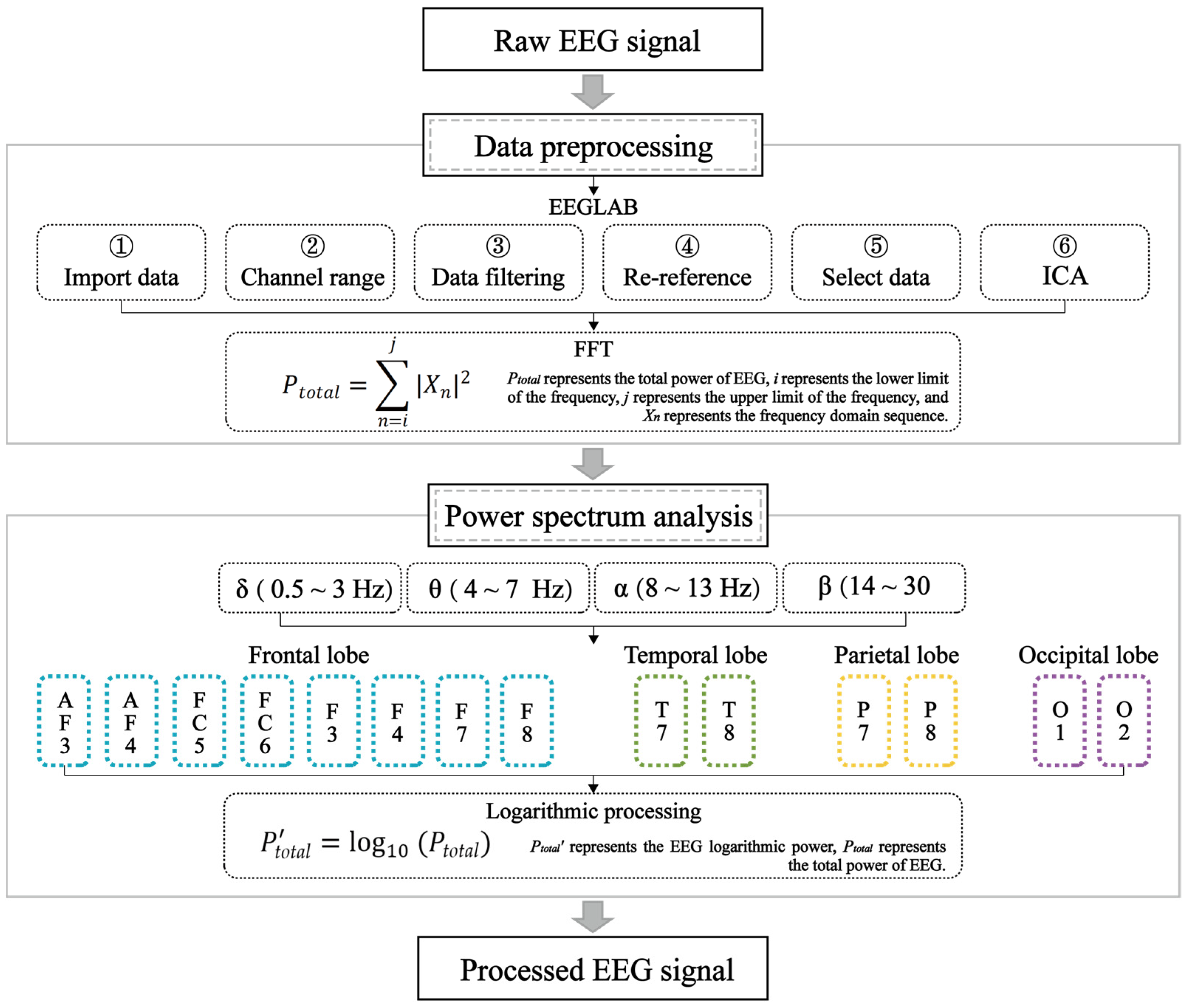
The EEG data were preprocessed using the EEGLAB plugin in MATLAB R2024a (MathWorks, Inc., Natick, MA, USA), and the specific process is shown in Figure 6. After selecting the experimental data and importing it into EEGLAB, the effective electrode channels actually deployed in the experiment were determined through manual screening. Subsequently, to suppress the influence of exogenous noise of non-biological origin and endogenous artifacts generated by other human tissues (such as electrooculogram, electromyogram, electrocardiogram, etc.), the data were subjected to filtering processing. The filtering range was set to 0.5~30 Hz, which includes four frequency bands: δ, θ, α, and β. Then, re-referencing was performed on the EEG data, and the average reference method was chosen to unify the reference potential of each electrode channel, eliminate the potential reference differences between electrodes, and improve the spatial consistency of the signals. After re-referencing, the EEG data from the 7 to 10 min (thermal environment steady state) were intercepted, and outliers were manually removed to facilitate further analysis. Finally, independent component analysis (ICA) was used to separate the independent components in the EEG signals, identify and remove artifact components (such as eye movements, electromyography), and reconstruct pure EEG signals.
After the preprocessing of EEG data is completed, the Fast Fourier Transform (FFT) is used to convert the time-domain EEG signals into frequency-domain representations, quantifying the total power of the signals within the specified frequency range. Subsequently, power spectrum analysis is performed to divide the frequency-domain signals into typical EEG rhythm bands: δ waves (0.5~3 Hz), θ waves (4~7 Hz), α waves (8~13 Hz), and β waves (14~30 Hz). Meanwhile, for the channel signals in the frontal region (AF3, AF4), temporal region (T7, T8), parietal region (P7, P8), and occipital region (O1, O2), the power of each frequency band in the corresponding brain region is calculated respectively. Due to the large magnitude of the processed data, a logarithmic transformation is performed to facilitate analysis, and finally, the processed EEG data is obtained.

2.4.3. Cognitive Tests

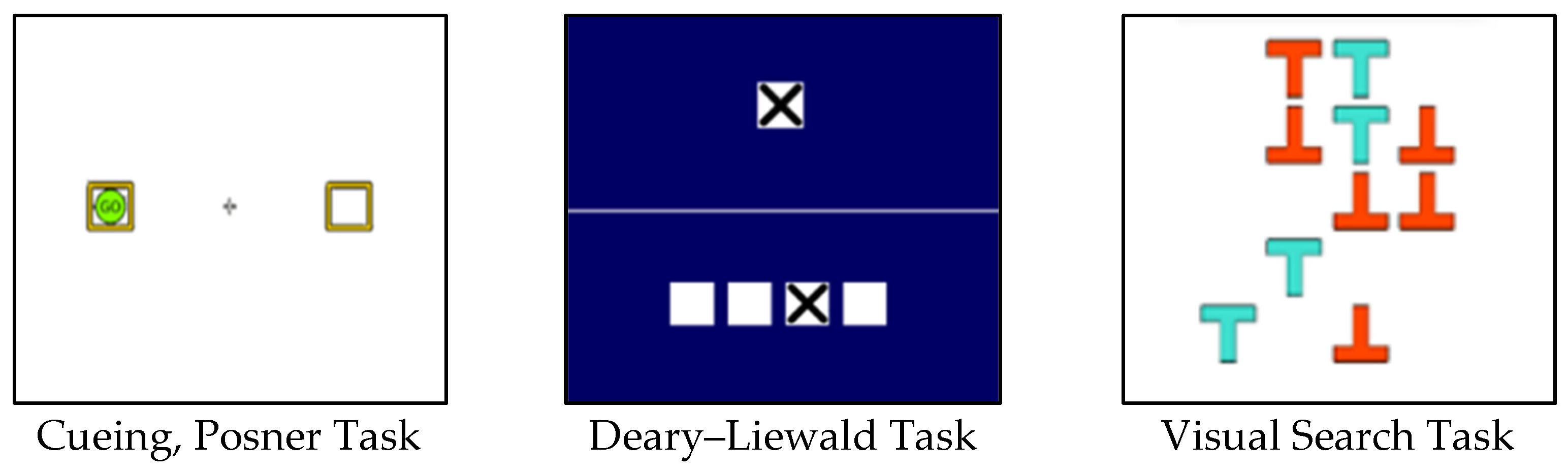
This study comprehensively evaluated the cognitive performance of the subjects from three perspectives: average accuracy, average reaction time, and standardized task performance. During the pre-experiment phase, multiple cognitive tests were selected to analyze the impact of task difficulty on different age groups. The types of tests and their corresponding evaluation dimensions include: Mackworth clock task (focus), Cueing, Posner Task (attention), 2-Back task (judgment), Deary–Liewald Task (reactivity), Visual Search Task (visual search ability), and Stroop test (executive function). A comprehensive assessment of test difficulty was conducted using task completion indicators (time consumption, accuracy rate) and subjective questionnaires. The results showed that young participants could complete all tests well, while the completion rate of elderly participants in all tests except Cueing, Posner Task, Deary–Liewald Task, and Visual Search Task was lower than 70%. To balance the ability differences between young and elderly people and ensure the rationality and effectiveness of the experiment, 3 cognitive tests with better completion performance were finally selected for the formal experiment, as shown in Figure 7.
The experimental procedure of the Cueing, Posner Task (CPT) test is as follows: The experimental interface presents two boxes on the left and right. First, the interfering stimulus “X” is randomly presented in one of the boxes, and then the target stimulus “GO” is presented. Among them, “X” is the interfering stimulus, and the subjects do not need to respond to it. When the target stimulus “GO” is presented, the subjects need to complete a quick key-press response according to the position of the box where it is located. If “GO” appears in the left box, the subjects need to press the “A” key as soon as possible; if “GO” appears in the right box, they need to press the “L” key as soon as possible.
The experimental procedure of the Deary–Liewald Task (DLT) is as follows: The first stage is a single-choice task. In the experimental interface, the target stimulus “X” is randomly presented in a single box, and the subjects need to press the spacebar as quickly as possible to complete the response. The second stage is a four-choice task. There are four boxes arranged horizontally on the interface, which have a fixed corresponding relationship with the “Z” key, “X” key, “,” key, and “.” key respectively. When “X” appears in a certain box, the subjects need to quickly identify its position and press the corresponding key (for example, when “X” appears in the third box, they need to press the “,” key).
The operation of the Visual Search Task (VST) is as follows: The experimental interface presents several letters “T” as stimuli. The stimulus parameters are set as follows: the arrangement is irregular; the quantity is 5, 10, 15, or 20 (random); the colors are blue or red; and the main form of the stimuli is the upside-down letter “T”. The target stimulus of this test is the upright red letter “T”. The experiment requires subjects to monitor the interface stimuli in real-time. When the target stimulus is detected, they need to press the spacebar as soon as possible to respond. If the interface only contains upside-down letters “T” (regardless of color) and blue letters “T” without the target stimulus, the subjects do not need to respond.

2.4.4. Self-Assessment Scales

After completing the cognitive test, the subjects were required to complete a self-evaluation. To facilitate understanding by elderly participants, the adjusted NASA Task Load Index (NASA-TLX) was used in the self-evaluation [33]. NASA-TLX is a classic subjective mental workload assessment tool developed by the National Aeronautics and Space Administration (NASA), which is widely used to evaluate the cognitive, physical, and emotional workload experienced by individuals during task performance. In this study, task workload was comprehensively assessed using six core dimensions of NASA-TLX, and the quantitative rating criteria for each dimension are presented in Table 4 (For the five subscales except Performance, a higher score represents a higher perceived workload. To unify the direction of the scoring scale, the score of the Performance dimension was reversely coded in the present experiment.).

3. Results

3.1. Results of Subjective Evaluations

SPSS 26.0 (IBM, SPSS Inc., Chicago, IL, USA) software was used to test the normality of the data distribution. The results showed that none of the subjective questionnaire data exhibited normality characteristics, so a non-parametric test method was selected for data analysis. The results of the non-parametric test are shown in Table 5, and the experimental conditions showed significant differences in the four subjective questionnaires between the elderly and young people (p < 0.01).

3.1.1. Evaluation of Thermal Environment

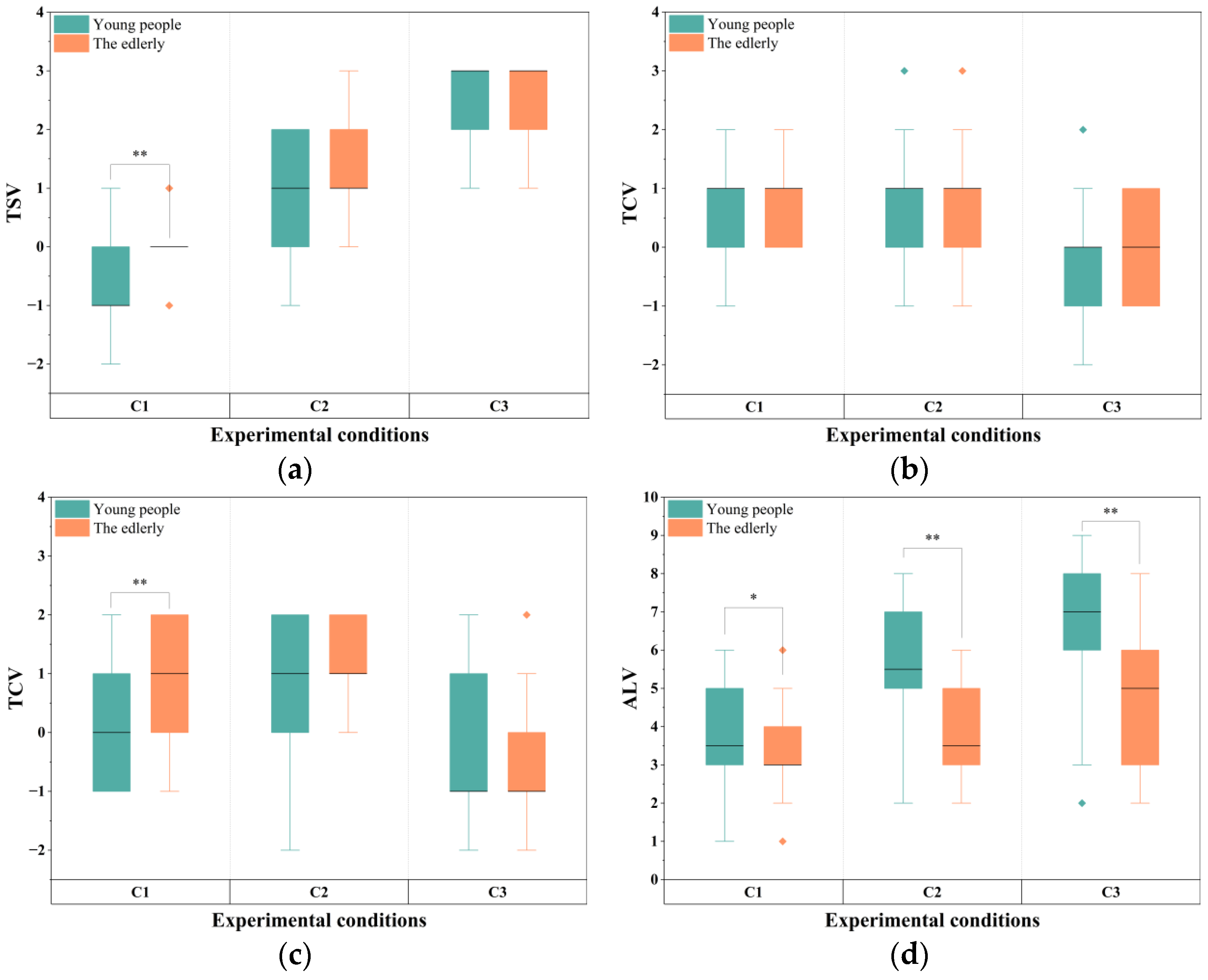
Figure 8 presents the changes in subjects’ subjective thermal evaluations under three thermal radiation conditions. Among the three thermal evaluation results, except for TCV, both TSV and TAV of the subjects exhibited highly significant differences (p < 0.01) under Condition C1 (0-watt power). As shown in Figure 8a, under the initial temperature condition (18 °C), the TSV of young people showed a larger degree of dispersion, with the overall thermal sensation score approaching −1 (slightly cool). In contrast, the TSV of the elderly was more concentrated, and their thermal sensation approached neutrality. Under Condition C2 (500-watt power), the average thermal sensation levels of young people and the elderly were close, with a median of 1 for both. However, young people exhibited slightly larger individual differences, indicating that age has a minor impact on the “average trend” of moderate radiant heat perception, while individual perceptions vary. Under Condition C3 (1000-watt power), the boxplot morphology and median (approximately 2–3) of the two groups were highly consistent, and the data dispersion was also similar. This suggests that under C3 (high thermal radiation), both young people and the elderly perceived a warm thermal sensation, with minimal age-related differences in thermal perception. High thermal radiation dominated the thermal sensation weakening the perception differences caused by age.
Figure 8b illustrates the variations in subjects’ TCV across different radiation intensities. With the increase in radiation intensity, the TCV of both subject groups generally shifted from “neutral” to “uncomfortable”. Under Conditions C1 and C2 (relatively low radiation intensity), age had a negligible impact on the “average level” of thermal comfort. In contrast, under Condition C3, young people exhibited significantly higher dispersion in comfort perception than the elderly. This increased dispersion is likely due to the diversity of their physiological regulation. The elderly, on the other hand, showed more consistent feedback regarding discomfort, which can be attributed to their relatively stable thermal adaptability. Notably, as the radiation intensity became stronger, the age-related differences in thermal comfort related to age became more pronounced.
Figure 8c presents the TAV of the subjects. In Condition C1, the TAV scores of the two groups exhibited highly significant differences (p < 0.01). In the radiation-free environment, the thermal acceptability of the elderly was significantly higher than that of young people, while the young people’s thermal acceptability to the baseline environment was more prone to differentiation. Under Condition C2, both groups were exposed to relatively low thermal radiation, leading to increased thermal acceptability in both groups. The degree of individual variation tended to converge, and the age-related impact on thermal acceptability was temporarily weakened. In Condition C3, characterized by high radiation, the thermal acceptability of both groups decreased significantly; however, young people exhibited a greater dispersion in TAV, and their acceptability to the high-temperature environment was higher than that of the elderly.

3.1.2. Evaluation of Mental State

As shown in Figure 8d, with the increase in thermal radiation intensity, the Alertness Level Vote (ALV) scores of both subject groups exhibited an overall upward trend, while age-related differences gradually became more pronounced. Under Condition C1, the ALV scores of the two groups showed a significant difference (p < 0.05), with the elderly demonstrating slightly higher alertness than young people. In Conditions C2 and C3, the ALV scores between the two groups exhibited highly significant differences (p < 0.01). Notably, the magnitude of score increase in young people was significantly greater than that in the elderly, who maintained better alertness under thermal radiation conditions. In contrast to subjective thermal evaluations, the differences in mental states between the two groups under different thermal radiation conditions were more pronounced: young people reported higher drowsiness across all conditions, while the elderly maintained better stability in alertness.

3.2. Results of EEG Features

Normality tests were performed on the EEG data of different brain regions. Since the sample size for each test exceeded 50, the Kolmogorov–Smirnov test was employed. As presented in Table 6, none of the four brain regions showed significant deviations from normality (p > 0.05), indicating that the null hypothesis (data following a normal distribution) was accepted. Specifically, the EEG data of the frontal, temporal, parietal, and occipital lobes of all subjects exhibited normality.
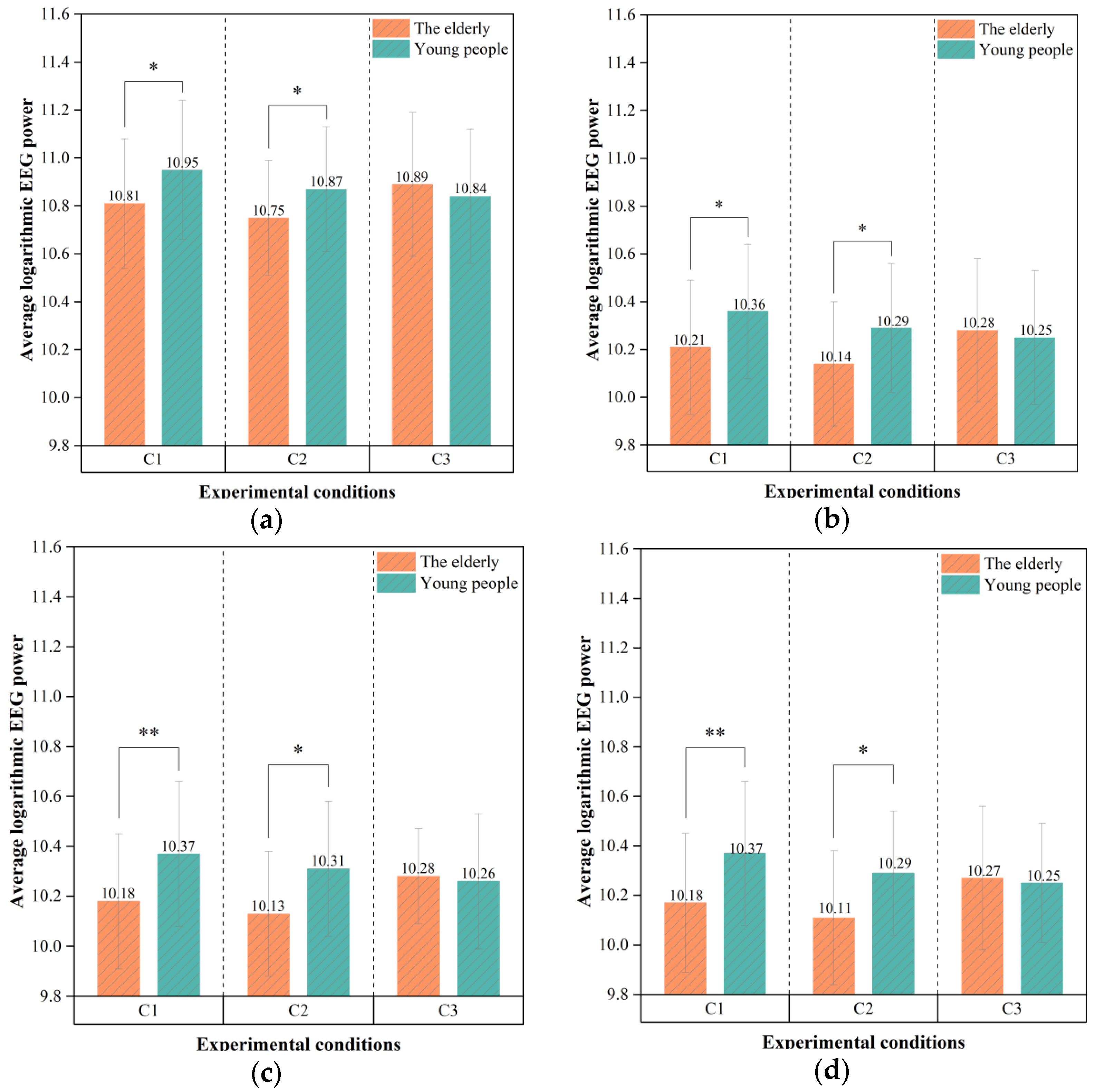
Subsequently, Analysis of Variance (ANOVA) was performed on the EEG data of the four brain regions. The results indicated that except for Condition C3, the EEG data of the four brain regions exhibited significant age-related differences under the other two conditions (C1 and C2), as presented in Table 7.
It can be observed in Figure 9 that under different thermal radiation stimuli, the average EEG logarithmic power in the frontal lobe of the subjects was higher than that in other brain regions. This indicates that the thermal effect of solar radiation exerts a more pronounced impact on brain activity in the frontal lobe, as it activates frontal lobe functions more significantly and renders its EEG activity more susceptible to changes induced by thermal radiation. Under the three experimental conditions, the logarithmic power of EEG in the frontal lobe of the elderly was 4.55%, 5.84% and 6.79% higher than the average values of the temporal lobe, parietal lobe and occipital lobe, respectively, and increased with the increase in radiation intensity. For young people, the values were 6.21%, 5.16% and 6.23% higher, respectively. These results confirm that the frontal lobe is the core brain region that responds to thermal radiation, and there are significant age-related differences in its functional advantages. Specifically, under Conditions C1 and C2, the EEG power of the two subject groups exhibited significant differences: in the radiation-free and low-radiation states, the EEG power of young people was significantly higher than that of the elderly. In contrast, under the high-radiation Condition C3, the EEG power of the elderly increased significantly, and the EEG power levels of the two groups became relatively close at this point. The experimental results suggest that the elderly exhibit “compensatory EEG activation” in response to high thermal radiation. This mechanism may buffer age-related brain function decline, providing EEG-level evidence for understanding how “environmental stimuli and age” jointly shape brain activity and cognitive performance.

3.3. Results of Cognitive Tests

Nonparametric tests were performed to examine whether there were differences in cognitive test results between elderly and young adults across different conditions, with the results presented in Table 8. Except for the accuracy rate of the visual search task, which showed no significant difference, all other evaluation indicators of cognitive tests under the remaining conditions exhibited significant age-related differences.
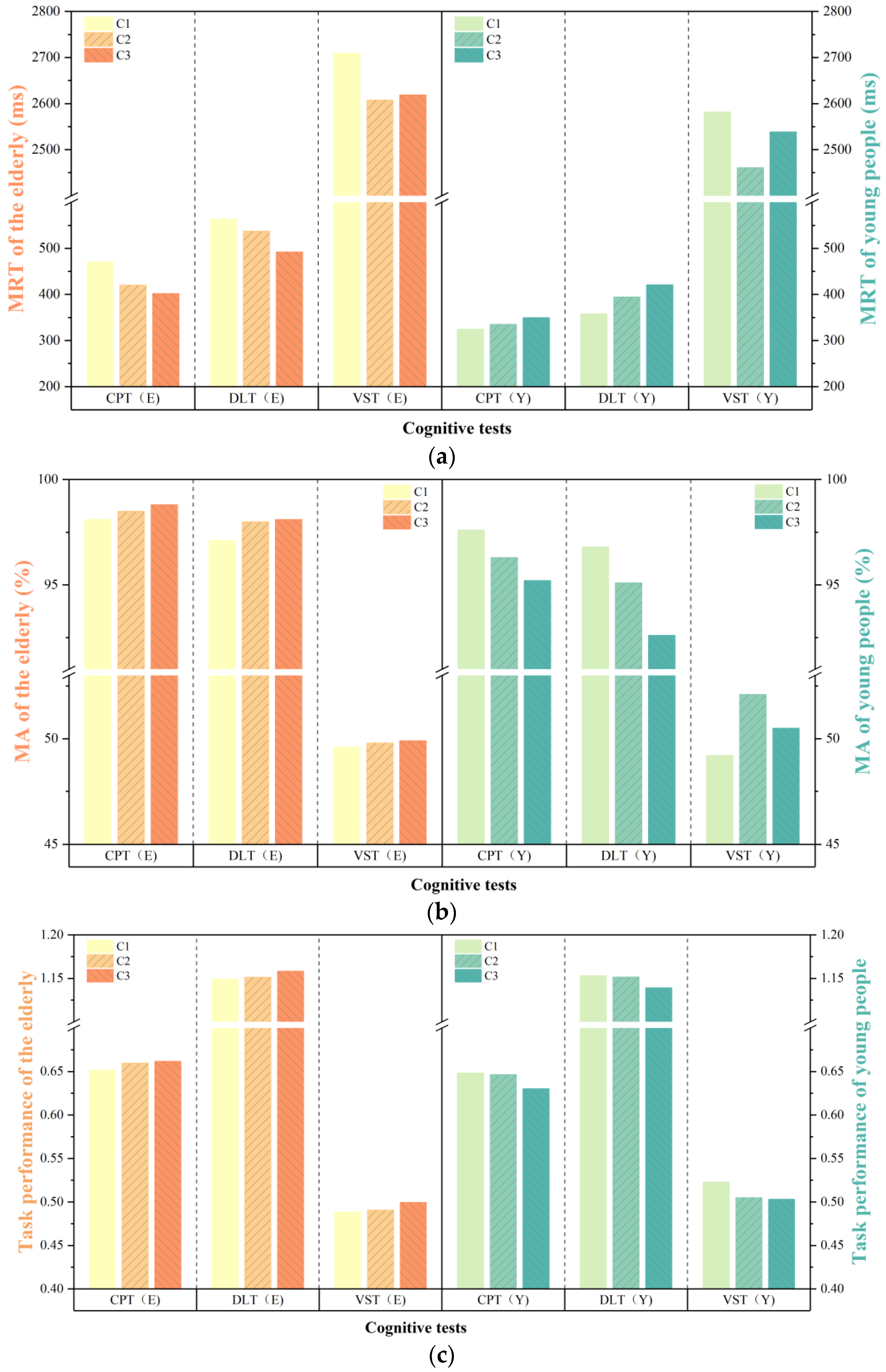
Figure 10a presents age-related differences in the mean reaction time (MRT) of cognitive tests under three conditions. It can be observed that regardless of the condition, the MRT of the elderly was consistently longer than that of young people across all three tests. Notably, with the increase in radiation intensity, the MRT of the elderly in the CPT (sustained attention) and DLT (reaction ability) gradually decreased, whereas young people exhibited an opposite trend. In the Visual Search Test (VST), the MRT for both groups initially decreased and then increased. Under the low thermal radiation condition (C2), moderate thermal radiation enhanced the subjects’ visual search ability. Although the MRT increased under the high thermal radiation condition (C3), the magnitude of the increase was still smaller than that of the initial decrease. This indicates that the inhibitory effect of high thermal radiation did not fully offset the facilitatory effects of low thermal radiation.
Figure 10b illustrates the variations in the MA of cognitive tests among subjects. In contrast to reaction time, despite the longer MRT of the elderly, no significant difference in MA was observed under the initial condition (C1). With the increase in radiation intensity, the two subject groups exhibited distinctly opposite trends in MA: the MA of the elderly in the CPT and DLT gradually increased, while that of young people decreased significantly. Furthermore, the MA of young people in the VST showed a symmetrical relationship with their MRT: specifically, under the low-radiation condition (C2), the MRT shortened but the MA increased, whereas the MA of the elderly maintained a slight upward trend.
Figure 10c displays the standardized task performance of the three cognitive tests. Task performance was calculated using the method proposed by [30], with response time (ms) and accuracy (%) as indicators, and the calculation formula is presented in Equation (2). Due to the inherent characteristics of different cognitive test types, the MRT and MA vary across tests, which renders it challenging to compare and analyze them under a unified standard. Therefore, we performed standardization on the task performance results, and the corresponding calculation method is provided in Equation (3).
t a s k   p e r f o r m a n c e = a c c u r a c y / r e a c t i o n   t i m e 2
t a s k   p e r f o r m a n c e represents the standardized task performance index, which integrates both accuracy and reaction time to provide a comprehensive measure of cognitive performance,   a c c u r a c y represents the accuracy rate of the subject in completing the cognitive task, expressed as a percentage (%), r e a c t i o n   t i m e represents t he average reaction time of the subject when completing the cognitive task, measured in milliseconds (ms).
z i = x i x ¯ s
z i represents the standardized cognitive performance, x i represents the raw cognitive performance, x ¯ represents the mean of the three cognitive performance indicators, and s represents the standard deviation of the three cognitive performance indicators.
It can be observed that although the task performance of young people and young adult groups did not exhibit significant differences under the same condition, their variation trends across different conditions showed an opposite pattern. With the increase in radiation intensity, the task performance of the elderly presented an upward trend, whereas that of young people showed the opposite. Compared with the baseline (C1), the task performance (TP) of the elderly showed a continuous improvement under thermal radiation. Specifically, the TP values increased by 1.23% and 1.53% (CPT), 0.17% and 0.78% (DLT), and 0.41% and 2.04% (VST) at C2 and C3, respectively. In contrast, young adults exhibited a declining trend: their TP values decreased by 0.15% and 2.78% (CPT), 0.09% and 1.21% (DLT), and 3.44% and 3.82% (VST) at C2 and C3, respectively. When combined with the subjects’ subjective evaluations, although the increase in radiation intensity led the thermal evaluations of both groups to converge to a consistent level, significant differences were observed in the short-term stimulation of cognitive ability. Compared with young people, the elderly maintained a better mental state (as reflected by ALV) under thermal radiation conditions, which provides supporting evidence for the improvement in their task performance.

3.4. Self-Assessment

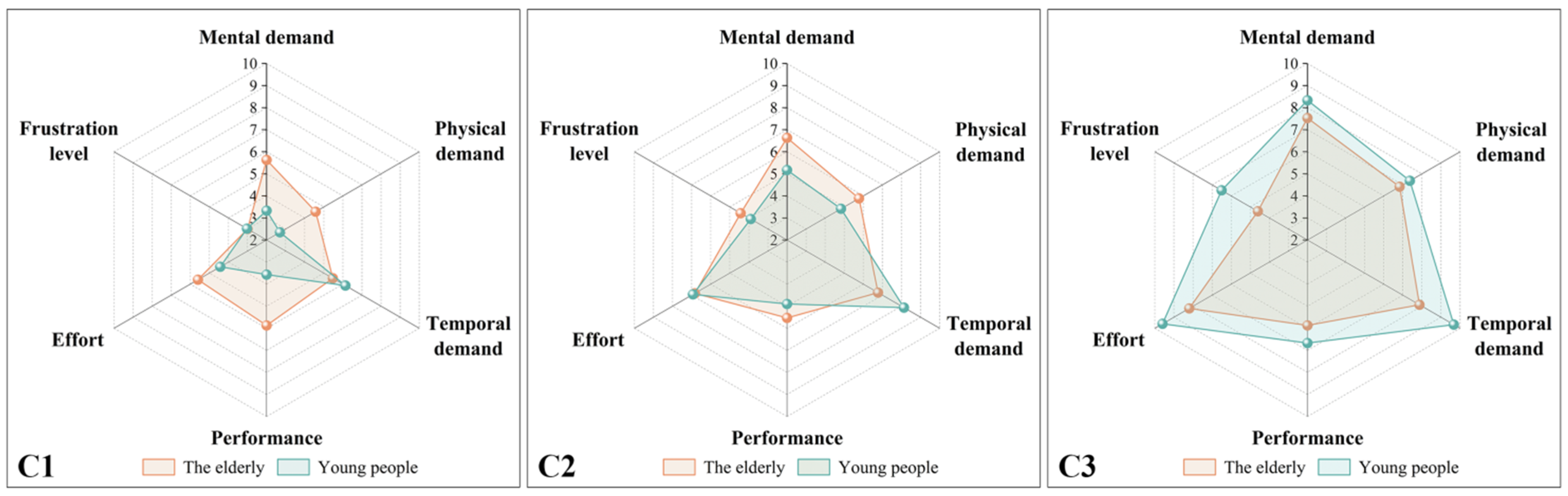
After completing the cognitive tests, the subjects were required to conduct a self-assessment using the NASA Task Load Index (NASA-TLX) to comprehensively evaluate the task load during the test from six dimensions: Mental demand, Physical demand, Temporal demand, Performance, Effort, and Frustration level. As shown in Figure 11, a larger radar chart area indicates a higher task load. Under the initial condition C1, the task load index of young people was significantly lower than that of the elderly. However, with the introduction and increase in thermal radiation intensity, the area of the task load radar chart for young people increased sharply and exceeded that of the elderly under condition C3. In contrast, the magnitude of the increase in the elderly was relatively stable. This variation trend is consistent with the subjects’ mental state evaluations presented in Figure 8d, indicating that under the effect of thermal radiation, young people needed to exert relatively more effort to complete the test tasks.

4. Discussion

4.1. Discussion of Subjective Evaluations

4.1.1. Thermal Environment

As shown in Figure 8a, the age-related difference in Thermal Sensation Vote (TSV) was most significant under the radiation-free condition (C1): the TSV scores of young people exhibited a larger degree of dispersion, with an overall trend approaching −1 (slightly cool), while the scores of the elderly were more concentrated, and their thermal sensation was close to neutrality. This is consistent with previous findings—aging reduces human sensitivity to thermal stimuli, especially mild cold stimuli, which is associated with a decrease in cutaneous temperature receptors and metabolic rate [34]. Due to the decline in physiological functions such as changes in skin structure and slowdown of metabolism, the elderly are more sensitive to cold environments. In contrast, young people have an active metabolism and may dissipate heat more quickly at the same temperature, resulting in a slightly cool feeling. This leads to a lower Thermal Sensation Vote (TSV) score for young people at lower temperatures. In contrast, age-related differences in Thermal Sensation Vote (TSV) narrowed under moderate radiation (Condition C2) and high radiation (Condition C3). For Condition C2, the average TSV of the two groups was comparable, but young people exhibited a slightly higher degree of dispersion—indicating that moderate thermal input may mask age-related differences in baseline thermal sensitivity. Increasing the intensity of experimental conditions will reduce the differences between physiological parameters, and under thermal stimulation of higher intensity, inter-individual differences may decrease [35]. At Condition C3, the boxplot morphology, median, and data dispersion of the two groups were highly consistent, demonstrating that intense thermal radiation dominates thermal sensation while diminishing age-induced perceptual differences.
Figure 8b shows the changes in the subjects’ Thermal Comfort Vote (TCV). As the radiation intensity increases, the overall TCV of both groups of subjects shifts from “neutral” to “uncomfortable”, but the age effect is most significant under high radiation. At this time, the dispersion of comfort perception among young people is significantly higher than that among the elderly, which may be related to age-related differences in thermoregulatory abilities. The elderly have decreased cardiovascular and sweat gland functions, leading to limited heat dissipation capacity, thus making them more likely to experience consistent discomfort under strong radiation [36]. In contrast, young people have a higher sweating rate and more sensitive thermoregulatory reflexes. This efficient physiological response system means that the bodies of young people may lead to more diversified subjective thermal perceptions when coping with a hot environment [37]. It is worth noting that under low-radiation conditions (C1 and C2), age has little impact on the average level of TCV. This suggests that within the range of thermal loads in typical indoor environments, age-related differences in comfort may not be significant. It indicates that under relatively broad thermal environment conditions, age itself is not a major predictor of thermal sensation, and thermal sensation is more susceptible to other environmental parameters.

4.1.2. Mental State

This study further explored age-related differences in mental states among subjects under thermal radiation environments. The results demonstrated that the interaction effect between thermal radiation intensity and age significantly influences alertness, providing novel experimental evidence for deciphering the regulatory mechanisms through which thermal environments modulate cognitive performance across distinct age groups. As depicted in Figure 8d, with increasing thermal radiation intensity, the ALV scores of both young people and the elderly exhibited an upward trend; however, the magnitude of increase in young people was significantly greater than that in the elderly. This finding indicates that under thermal radiation exposure, young people experienced stronger subjective drowsiness, whereas the elderly maintained a more stable mental state. Consistent with the research conclusions of Robison et al. [38], in a suitable environment, the elderly can maintain better attention, although their overall level is not as good as that of young people. From a physiological perspective, the elderly typically have a lower basal metabolic rate (BMR) and weaker heat production capacity compared to young people, thus being more prone to maintaining comfort in warm environments [39]. Although some studies suggest that the elderly’s temperature perception may be similar to that of young people, the overall trend indicates that the elderly require a higher temperature to achieve a comfortable thermal state [40]. This also provides an indirect explanation for the relatively stable alertness observed in the elderly under thermal radiation conditions.

4.2. Discussion of EEG

Under all infrared radiation conditions, the average EEG logarithmic power in the frontal lobe was consistently higher than that in other brain regions. This aligns with the frontal lobe’s core role in higher-order cognitive functions [41]. As a thermal environmental stimulus, infrared radiation selectively activates frontal neural networks, rendering their EEG activity more susceptible to interference from thermal radiation. This may be associated with the frontal lobe’s function in integrating sensory inputs related to thermal comfort, initiating adaptive behaviors, and regulating physiological responses [42].
Under low-radiation conditions (C1, C2), the EEG power of young adults was significantly higher than that of older adults. This finding likely reflects an age-related decline in baseline neural activation and sensory processing efficiency in the elderly population. Consistent with previous research, individuals with greater cognitive reserve exhibit increased amplitudes or oscillatory magnitudes of event-related potentials [43]. In the context of this study, young adults presumably possess stronger neural reserves, which were manifested as higher levels of spontaneous or stimulus-evoked neural activity. This is further supported by the observation that older adults exhibited significantly reduced aperiodic activity indices and offsets across the whole brain, whereas young adults maintained relatively high EEG power [44]. While the existing literature has proposed that older adults may compensate for cognitive decline through neural overactivation or network reorganization, these studies have not specifically addressed neural activity in the context of thermal stimulation. The compensatory EEG activation observed in older adults under high thermal load in the present study thus provides novel physiological evidence for the brain’s adaptive mechanisms. Specifically, this activation may represent an attempt to recruit additional neural resources to counteract age-related neural functional decline. Notably, this neurophysiological explanation aligns with our behavioral observations, wherein older adults were able to maintain thermal-related cognitive performance despite exposure to high stimulation levels.

4.3. Discussion of Cognitive Tests

In the cognitive tests (as shown in Figure 10), significant age-related differences were observed between the two subject groups under different thermal radiation conditions. Although young people outperformed the elderly across all tests, the two groups exhibited distinct variation trends. With increasing thermal radiation intensity, the elderly showed a gradual reduction in mean reaction time and a gradual increase in mean accuracy in the CPT (sustained attention) and DLT (reaction ability), whereas young people displayed the opposite trend. This phenomenon is consistent with the findings reported by Wang et al. [21]: under the thermal stimulation of a warm water bath, the cognitive flexibility of the elderly was significantly improved. Specifically, elderly participants identified more figures and exhibited shorter reaction times in the forced-choice recognition memory test, while young adults showed the opposite trend. Figure 10c presents the standardized average task performance, which intuitively indicates that the elderly achieved an overall improvement in cognitive ability following exposure to thermal stimulation, whereas young people experienced a slight decline. This result exhibits a consistent correlation with the self-assessed workload levels illustrated in Figure 11: as thermal radiation intensity increased, the workload reported by young people rose at a much faster rate than that by the elderly, who maintained relatively stable workload perceptions. This also aligns highly with the subjective evaluations of subjects’ mental states presented in Section 4.1.2.

4.4. Relationship Between EEG and Task Performance Limitations

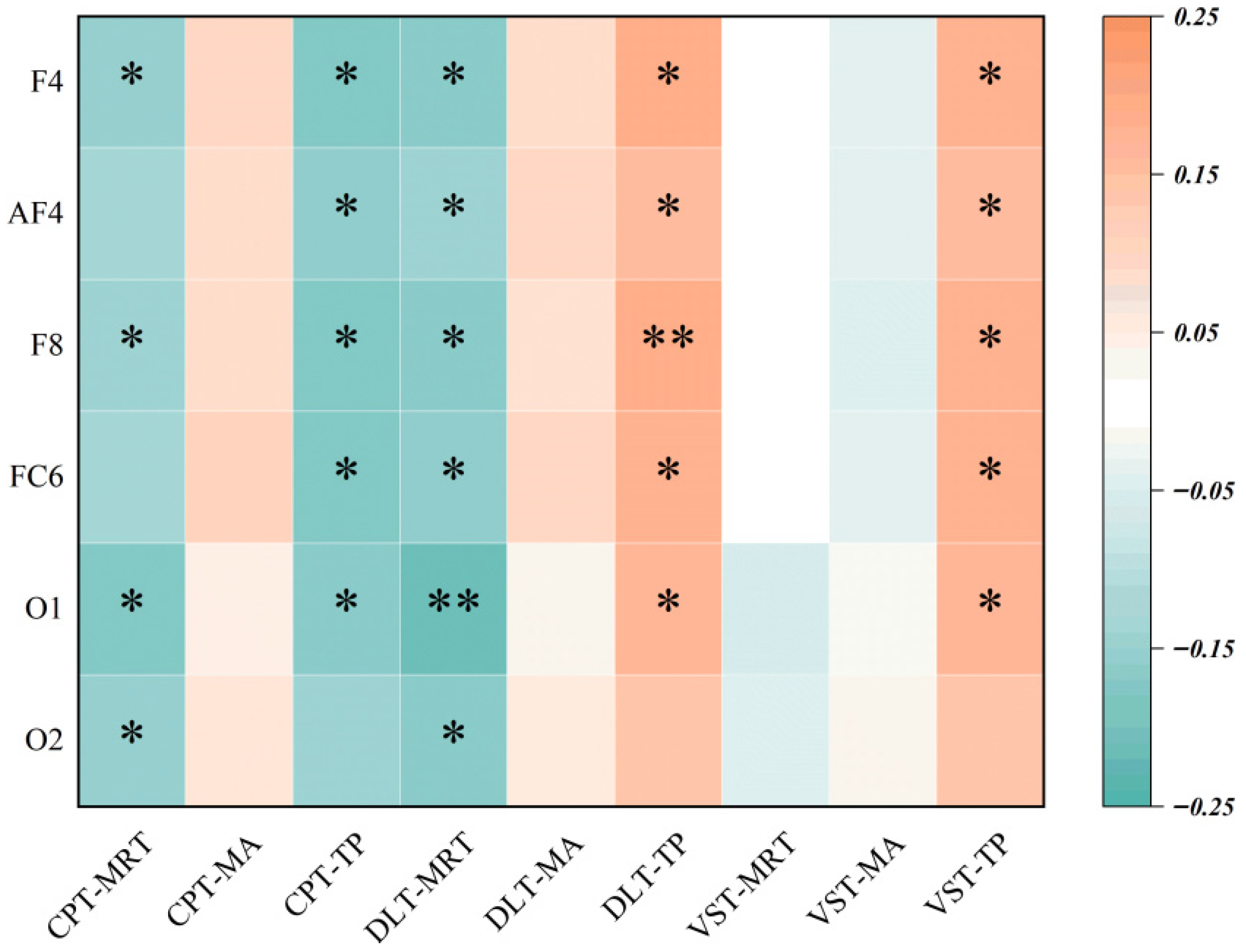
Correlation analysis was performed to explore the relationship between cognitive performance and EEG characteristics, with the results presented in Figure 12. This figure lists the electrodes that exhibited significant correlations with cognitive metrics, including mean reaction time (MRT), mean accuracy (MA), and task performance (TP) across all tasks. The electrodes associated with cognitive performance were primarily located in the right frontal lobe (F4, AF4, F8, FC6) and occipital lobe (O1, O2), indicating that these brain regions played crucial roles in the cognitive tests conducted in this study. This aligns with the findings of McCurdy et al. [45], who reported that the prefrontal cortex is associated with visual metacognition, while the occipital cortex is linked to memory metacognition. Notably, the right frontal electrodes F4 and F8 showed consistent correlations with multiple cognitive metrics, highlighting the stable and strong influence of their corresponding brain regions on complex cognitive tasks. According to Sinha et al. [46], the F4 electrode is involved in the planning of complex movements, and the F8 electrode—located in the triangular part of the frontal lobe—is active during semantic tasks such as semantic decision-making and generation. This directly validates the applicability of the F4 and F8 electrodes for evaluating subjects’ cognitive abilities.
The present study further demonstrates that the occipital region corresponding to the O1 electrode is highly sensitive to specific tasks requiring visual–cognitive integration. Its prominent negative correlation with cognitive performance suggests that the occipital lobe may influence cognitive outcomes through specialized mechanisms such as inhibitory regulation during these tasks. Furthermore, except for the occipital O2 electrode, the four frontal electrodes (F4, AF4, F8, FC6) and the O1 electrode all correlated with task performance (TP). Specifically, these electrodes showed a positive correlation with CPT (sustained attention) and negative correlations with DLT (reaction ability) and VST (visual search ability), confirming that the frontal and occipital lobes are the primary brain regions involved in processing cognitive tasks. Nevertheless, due to the limitations in the elderly’s ability to accept cognitive tests in this study, future research should select more cognitive tasks that are suitable for subjects of different age groups simultaneously to expand the diversity of the research.

4.5. Limitations

Through systematic analysis of differences in subjective evaluations, EEG characteristics, and cognitive performance among different age groups under thermal radiation environments, this study provides multidimensional evidence for understanding age-related thermal adaptation mechanisms and cognitive regulation rules. Its findings hold practical implications for optimizing the thermal environment of elderly care buildings and protecting the cognitive function of special populations.
However, this study still has certain limitations. The findings are derived from short-term, laboratory-controlled infrared radiation exposure, which, although effective for isolating and identifying specific effects, limits their direct applicability to real-world elderly care buildings. In actual built environments, solar radiation conditions, behavioral patterns of elderly occupants, and individual thermal adaptation capacities vary considerably. Therefore, the applicability of the present findings to dynamic real-world building scenarios remains uncertain. The sample size is relatively limited and focused on healthy populations, excluding elderly individuals with chronic comorbidities or cognitive impairments, which may restrict the generalizability of the conclusions. This study did not include gender as a factor in the analysis. As a potential confounding variable, the influence of gender on human physiological and cognitive responses under solar radiation heat effects remains unclear. In future work, gender will be incorporated as a variable to further improve the universality of the research conclusions. In addition, limited by the acceptability of cognitive tasks among the elderly, the ecological validity of cognitive tests needs to be improved. In subsequent research, efforts should be made to rationally design cognitive tasks, expand test categories, and diversify experimental media. These limitations point to directions for future studies, such as increasing sample heterogeneity and introducing diverse cognitive tests.

5. Conclusions

In terms of subjective evaluations, the elderly’s scores for Thermal Sensation Vote (TSV), Thermal Comfort Vote (TCV), and Thermal Acceptability Vote (TAV) remained relatively stable across different radiation conditions, exhibiting smaller individual variability compared to young people. Notably, under high radiation (1000 W) conditions, as intense thermal stimulation dominated perceptual responses, age-related differences in thermal sensation were minimized. Therefore, thermal environment design should avoid areas with excessive solar radiation. Regarding mental state (Alertness Level Vote, ALV), the elderly maintained a more stable level of alertness, whereas the subjective drowsiness of young people increased significantly with increasing radiation intensity.
Analysis of EEG data shows that the frontal lobe, a key region for advanced cognitive and thermoregulatory functions, exhibited the highest level of activity under all conditions. For the elderly, under conditions C1, C2, and C3, the frontal lobe power was 4.55%, 5.84%, and 6.79% higher than the average of the temporal, parietal, and occipital lobes, respectively. From a neurophysiological perspective, the frontal lobe is a key region responsible for advanced cognitive functions such as attention, working memory and executive control [47]. It is also involved in central thermoregulatory processing via interactions with hypothalamic temperature-regulation centers. Under low-radiation conditions (0 W and 500 W), young people had higher EEG power, reflecting a higher level of basic neural activation. However, under high-radiation conditions (1000 W), the elderly showed compensatory neural activation, narrowing the age-related gap in brain activity, and this activation pattern was significantly correlated with improved cognitive performance. This provides direct physiological evidence for understanding how thermal stimulation buffers “age-related decline in relevant brain functions”. In addition, through correlation analysis, we identified that the F4 and F8 electrodes in the right frontal lobe and the O1 electrode in the occipital lobe play a key role in cognitive responses to thermal stimulation and can be used as preferred electrodes for simultaneous assessment of the elderly and young people.
In terms of cognitive ability performance assessment, the thermal effect of infrared radiation can play a positive role in promoting the cognitive ability level of the elderly. Results from tasks including attention, reaction time, and visual search indicate that, contrary to the decline in performance among young people, the elderly showed shorter reaction times and higher accuracy as radiation increased. Quantitative analysis indicators of task performance further confirm this obvious trend. The task performance (TP) of the elderly improves with the increase in radiation intensity. Under high radiation (C3) conditions, compared with the baseline level, the scores of the Cueing, Posner Task (CPT, attention), Deary–Liewald Task (DLT, reactivity), and Visual Search Task (VST, visual search ability) have increased by 1.53%, 0.78%, and 2.04%, respectively. In contrast, under the same conditions, the task performance (TP) of young adults has decreased by 2.78% (CPT), 1.21% (DLT), and 3.82% (VST), indicating that moderate-to-high-intensity infrared radiation may improve the cognitive function of the elderly to a certain extent. Moreover, when the elderly were exposed to thermal radiation stimulation of varying degrees, their alertness level (ALV) and self-assessment of workload were better than those of young people. This experimental result also proves that the elderly can maintain better mental stability under the thermal effect of radiation.
Overall, these results highlight age-specific adaptive mechanisms in thermal perception and cognitive regulation under infrared radiation, providing objective physiological evidence for optimizing the thermal environment in elderly care institutions and designing targeted cognitive protection strategies for vulnerable groups. In the future, it is necessary to conduct studies with larger sample sizes and more diverse types and increase the variety of cognitive tasks to promote the generalization of these research results.


Author Contributions

Y.L.: methodology, software, investigation, data curation, writing—original draft, writing—review and editing; K.H.: conceptualization, resources, writing and editing, supervision, project administration, funding acquisition; M.L.: methodology, validation, writing—review and editing; P.G.: formal analysis, writing—review and editing; H.Y.: visualization, writing—review and editing; Z.K.: writing—review and editing; X.S.: writing—review and editing; Q.B.: writing—review and editing. All authors have read and agreed to the published version of the manuscript.

Funding

This research was funded by the Natural Science Foundation of Shandong Province, grant number ZR2025MS925.

Institutional Review Board Statement

This study was conducted in accordance with the Declaration of Helsinki and approved by the Research Ethics Committee of the Innovation Institute for Sustainable Maritime Architecture Research and Technology (iSMART) (Protocol Code: 2025-04-01-01; Approval Date: 1 April 2025).

Informed Consent Statement

Informed consent was obtained from all subjects involved in this study.

Data Availability Statement

The data presented in this study are available from the corresponding author upon reasonable request.

Conflicts of Interest

Author Peiping Gao was employed by the Qingdao University of Technology Architectural Design and Research Institute Company. The remaining authors declare that the research was conducted in the absence of any commercial or financial relationships that could be construed as a potential conflict of interest.

References

  1. Shen, C.; Lv, G.; Wei, S.; Zhang, C.; Ruan, C. Investigating the Performance of a Novel Solar Lighting/Heating System Using Spectrum-Sensitive Nanofluids. Appl. Energy 2020, 270, 115208. [Google Scholar] [CrossRef]
  2. Lian, Z. Revisiting Thermal Comfort and Thermal Sensation. Build. Simul. 2024, 17, 185–188. [Google Scholar] [CrossRef]
  3. Hou, K.; Liu, X.; Kong, Z.; Wang, H.; Lu, M.; Hu, S. Impacts of Corridor Design: An Investigation on Occupant Perception of Corridor Forms in Elderly Facilities. Front. Archit. Res. 2023, 12, 1047–1064. [Google Scholar] [CrossRef]
  4. Wu, M.; Li, H.; Qi, H. Using Electroencephalogram to Continuously Discriminate Feelings of Personal Thermal Comfort between Uncomfortably Hot and Comfortable Environments. Indoor Air 2020, 30, 534–543. [Google Scholar] [CrossRef]
  5. Shin, Y.; Lee, M.; Cho, H. Analysis of EEG, Cardiac Activity Status, and Thermal Comfort According to the Type of Cooling Seat during Rest in Indoor Temperature. Appl. Sci. 2021, 11, 97. [Google Scholar] [CrossRef]
  6. Lv, B.; Su, C.; Yang, L.; Wu, T. Effects of Stimulus Mode and Ambient Temperature on Cerebral Responses to Local Thermal Stimulation: An EEG Study. Int. J. Psychophysiol. 2017, 113, 17–22. [Google Scholar] [CrossRef] [PubMed]
  7. Son, Y.J.; Chun, C. Research on Electroencephalogram (EEG) to Measure Thermal Pleasure in Thermal Alliesthesia in Temperature Step-Change Environment. Indoor Air 2018, 28, 916–923. [Google Scholar] [CrossRef]
  8. Pepler, R.D.; Warner, R.E. Temperature and Learning: An Experimental Study. ASHRAE Trans. 1968, 74, 211–219. [Google Scholar]
  9. Lan, L.; Lian, Z.; Pan, L. The Effects of Air Temperature on Office Workers’ Well-Being, Workload and Productivity-Evaluated with Subjective Ratings. Appl. Ergon. 2010, 42, 29–36. [Google Scholar] [CrossRef] [PubMed]
  10. Chen, Y.; Tao, M.; Liu, W. High Temperature Impairs Cognitive Performance during a Moderate Intensity Activity. Build. Environ. 2020, 186, 107372. [Google Scholar] [CrossRef]
  11. Yeganeh, A.J.; Reichard, G.; McCoy, A.P.; Bulbul, T.; Jazizadeh, F. Correlation of Ambient Air Temperature and Cognitive Performance: A Systematic Review and Meta-Analysis. Build. Environ. 2018, 143, 701–716. [Google Scholar] [CrossRef]
  12. Cui, W.; Cao, G.; Park, J.H.; Ouyang, Q.; Zhu, Y. Influence of Indoor Air Temperature on Human Thermal Comfort, Motivation and Performance. Build. Environ. 2013, 68, 114–122. [Google Scholar] [CrossRef]
  13. Li, H.; Xu, G.; Chen, J.; Duan, J. Investigating the Adaptive Thermal Comfort of the Elderly in Rural Mutual Aid Homes in Central Inner Mongolia. Sustainability 2022, 14, 6802. [Google Scholar] [CrossRef]
  14. Tang, Y.; Yu, H.; Mao, H.; Zhang, K.; Wang, M. Indoor Thermal Comfort and Ageing: A Systematic Review. J. Build. Eng. 2025, 100, 111714. [Google Scholar] [CrossRef]
  15. Van Hoof, J.; Marston, H.R. Feature Papers “Age-Friendly Cities & Communities: State of the Art and Future Perspectives”; Marston, H.R., Ed.; MDPI—Multidisciplinary Digital Publishing Institute: Basel, Switzerland, 2021; ISBN 978-3-0365-1226-6. [Google Scholar]
  16. Bennetts, H.; Arakawa Martins, L.; van Hoof, J.; Soebarto, V. Thermal Personalities of Older People in South Australia: A Personas-Based Approach to Develop Thermal Comfort Guidelines. Int. J. Environ. Res. Public Health 2020, 17, 8402. [Google Scholar] [CrossRef]
  17. Soebarto, V.; Zhang, H.; Schiavon, S. A Thermal Comfort Environmental Chamber Study of Older and Younger People. Build. Environ. 2019, 155, 1–14. [Google Scholar] [CrossRef]
  18. Jin, Y.; Wang, F.; Payne, S.R.; Weller, R.B. A Comparison of the Effect of Indoor Thermal and Humidity Condition on Young and Older Adults’ Comfort and Skin Condition in Winter. Indoor Built Environ. 2022, 31, 759–776. [Google Scholar] [CrossRef]
  19. Wang, Z.; Yu, H.; Jiao, Y.; Chu, X.; Luo, M. Chinese Older People’s Subjective and Physiological Responses to Moderate Cold and Warm Temperature Steps. Build. Environ. 2019, 149, 526–536. [Google Scholar] [CrossRef]
  20. Khan, A.M.; Finlay, J.M.; Clarke, P.; Sol, K.; Melendez, R.; Judd, S.; Gronlund, C.J. Association between Temperature Exposure and Cognition: A Cross-Sectional Analysis of 20,687 Aging Adults in the United States. BMC Public Health 2021, 21, 1484. [Google Scholar] [CrossRef]
  21. Wang, J.; Solianik, R.; Eimantas, N.; Baranauskiene, N.; Brazaitis, M. Age-Related Difference in Cognitive Performance under Severe Whole-Body Hyperthermia Parallels Cortisol and Physical Strain Responses. Medicina 2023, 59, 1665. [Google Scholar] [CrossRef]
  22. Zhu, M.; Liu, W.; Wargocki, P. Changes in EEG Signals during the Cognitive Activity at Varying Air Temperature and Relative Humidity. J. Expo. Sci. Environ. Epidemiol. 2020, 30, 285–298. [Google Scholar] [CrossRef]
  23. Liu, W.; Wu, Y.; Shi, L.; Li, J.; Wang, Z.; Tian, X. The Relationship between Thermal Comfort, Performance, and Electroencephalogram during Cognitive Tests at Normal Indoor Temperatures in Summer. Build. Environ. 2024, 257, 111567. [Google Scholar] [CrossRef]
  24. Li, Y.; Li, S.; Gao, W.; Xu, W.; Xu, Y.; Wang, J. Exploring the Effects of Indoor Temperature on College Students’ Physiological Responses, Cognitive Performance and a Concentration Index Derived from EEG Signals. Dev. Built Environ. 2022, 12, 100095. [Google Scholar] [CrossRef]
  25. Wang, X.; Li, D.; Menassa, C.C.; Kamat, V.R. Investigating the Neurophysiological Effect of Thermal Environment on Individuals’ Performance Using Electroencephalogram. Comput. Civ. Eng. 2019, 2019, 598–605. [Google Scholar] [CrossRef]
  26. Choi, Y.; Kim, M.; Chun, C. Effect of Temperature on Attention Ability Based on Electroencephalogram Measurements. Build. Environ. 2019, 147, 299–304. [Google Scholar] [CrossRef]
  27. Gao, P.; Li, Y.; Hou, K.; Lu, M.; Liu, C.; Guan, H.; Yan, W.; Li, J. Thermal Comfort Differences Between the Elderly and Young People Under Different Infrared Radiation Conditions: A Quantitative Study Based on Subjective Evaluation and EEG Characteristics. Buildings 2025, 15, 3798. [Google Scholar] [CrossRef]
  28. ISO 7726:2023; Ergonomics of the Thermal Environment—Instruments for Measuring and Monitoring Physical Quantities. International Standardization Organization (ISO): Geneva, Switzerland, 2023.
  29. GB/T 50785-2012; Evaluation Standard for Indoor Thermal Environment in Civil Buildings. State General Administration of the People’s Republic of China for Quality Supervision and Inspection and Quarantine: Beijing, China, 2012.
  30. Sun, R.; Xu, S.; Han, Y.; Zhuang, D.; Yan, B.; Sun, C. Exploring Impacts of Thermal and Lighting Conditions on Office Workers’ Subjective Evaluations, Cognitive Performance and EEG Features in Multi-Person Offices. J. Build. Eng. 2024, 95, 110170. [Google Scholar] [CrossRef]
  31. Gwak, J.; Shino, M.; Ueda, K.; Kamata, M. An Investigation of the Effects of Changes in the Indoor Ambient Temperature on Arousal Level, Thermal Comfort, and Physiological Indices. Appl. Sci. 2019, 9, 899. [Google Scholar] [CrossRef]
  32. Ma, X.; Song, L.; Hong, B.; Li, Y.; Li, Y. Relationships between EEG and Thermal Comfort of Elderly Adults in Outdoor Open Spaces. Build. Environ. 2023, 235, 110212. [Google Scholar] [CrossRef]
  33. Kim, H.; Hong, T.; Kim, J.; Yeom, S. A Psychophysiological Effect of Indoor Thermal Condition on College Students’ Learning Performance through EEG Measurement. Build. Environ. 2020, 184, 107223. [Google Scholar] [CrossRef]
  34. Kenney, W.L.; Munce, T.A. Invited Review: Aging and Human Temperature Regulation. J. Appl. Physiol. 2003, 95, 2598–2603. [Google Scholar] [CrossRef] [PubMed]
  35. Lu, S.; Sun, L.; Peng, H.; Ji, L. Research of Interindividual Differences in Physiological Response under Hot-Dry and Warm-Wet Climates. Sustainability 2016, 8, 850. [Google Scholar] [CrossRef]
  36. Núñez-Rodríguez, S.; Collazo-Riobó, C.; Sedano, J.; Sánchez-Iglesias, A.I.; González-Santos, J. Heat Tolerance in Older Adults: A Systematic Review of Thermoregulation, Vulnerability, Environmental Change, and Health Outcomes. Healthcare 2025, 13, 2785. [Google Scholar] [CrossRef] [PubMed]
  37. Sun, S.; Cheng, W. Physical and Physiological Differences in Thermal Comfort and Regulation among Older Adults: A Systematic Review. Build. Environ. 2025, 284, 113424. [Google Scholar] [CrossRef]
  38. Robison, M.K.; Diede, N.T.; Nicosia, J.; Ball, B.H.; Bugg, J.M. A Multimodal Analysis of Sustained Attention in Younger and Older Adults. Psychol. Aging 2022, 37, 307–325. [Google Scholar] [CrossRef]
  39. Wu, Y.; Liu, H.; Li, B.; Kosonen, R.; Kong, D.; Zhou, S.; Yao, R. Thermal Adaptation of the Elderly during Summer in a Hot Humid Area: Psychological, Behavioral, and Physiological Responses. Energy Build. 2019, 203, 109450. [Google Scholar] [CrossRef]
  40. Laouadi, A.; Ji, L.; Shu, C.; Wang, L.; Lacasse, M.A. Overheating Risk Analysis in Long-Term Care Homes—Development of Overheating Limit Criteria. Buildings 2023, 13, 390. [Google Scholar] [CrossRef]
  41. Yao, Z.-F.; Hsieh, S. Age Differences of the Hierarchical Cognitive Control and the Frontal Rostro-Caudal Functional Brain Activation. Cereb. Cortex 2022, 32, 2797–2815. [Google Scholar] [CrossRef]
  42. Sharooni, P.M.; Maerefat, M.; Zolfaghari, S.A.; Dadgostar, M. A Feasibility Study on Using fNIRS Brain Signals to Recognize Personal Thermal Sensation and Thermal Comfort Conditions. J. Expo. Sci. Environ. Epidemiol. 2024, 34, 952–961. [Google Scholar] [CrossRef]
  43. Balart-Sánchez, S.A.; Bittencourt, M.; Jalili, S.; van der Naalt, J.; Maurits, N.M. The Influence of Cognitive Reserve on ERP Measures of Selective Visual Attentional Processing in Older Adults after Mild Traumatic Brain Injury. PLoS ONE 2025, 20, e0316673. [Google Scholar] [CrossRef]
  44. Merkin, A.; Sghirripa, S.; Graetz, L.; Smith, A.E.; Hordacre, B.; Harris, R.; Pitcher, J.; Semmler, J.; Rogasch, N.C.; Goldsworthy, M. Do Age-Related Differences in Aperiodic Neural Activity Explain Differences in Resting EEG Alpha? Neurobiol. Aging 2023, 121, 78–87. [Google Scholar] [CrossRef]
  45. McCurdy, L.Y.; Maniscalco, B.; Metcalfe, J.; Liu, K.Y.; de Lange, F.P.; Lau, H. Anatomical Coupling between Distinct Metacognitive Systems for Memory and Visual Perception. J. Neurosci. 2013, 33, 1897–1906. [Google Scholar] [CrossRef] [PubMed]
  46. Sinha, N.; Maszczyk, T.; Wanxuan, Z.; Tan, J.; Dauwels, J. EEG Hyperscanning Study of Inter-Brain Synchrony during Cooperative and Competitive Interaction. In Proceedings of the 2016 IEEE International Conference on Systems, Man, and Cybernetics (SMC), Budapest, Hungary, 9–12 October 2016; pp. 004813–004818. [Google Scholar]
  47. Jung, M. Does Prefrontal Cortex Oxygenation Mediate Executive Function during High-Intensity Exercise? A Systematic Review of fNIRS Studies. Behav. Brain Res. 2025, 495, 115765. [Google Scholar] [CrossRef] [PubMed]
Figure 1. Laboratory layout.
Buildings 16 00947 g001
Figure 2. Average radiant temperature change.
Buildings 16 00947 g002
Figure 3. Experimental procedure.
Buildings 16 00947 g003
Figure 4. Subjective questionnaire.
Buildings 16 00947 g004
Figure 5. EEG positions and brain regions.
Buildings 16 00947 g005
Figure 6. EEG data processing.
Buildings 16 00947 g006
Figure 7. Types of cognitive tests.
Buildings 16 00947 g007
Figure 8. Age differences in different subjective questionnaires. (a) TSV. (b) TCV. (c) TAV. (d) ALV. Note: * p < 0.05, ** p < 0.01.
Buildings 16 00947 g008
Figure 9. Age differences in EEG. (a) Frontal lobe. (b) Temporal lobe. (c) Parietal lobe. (d) Occipital lobe. Note: * p < 0.05, ** p < 0.01.
Buildings 16 00947 g009
Figure 10. Age differences in different cognitive tests. (a) Mean reaction time (MRT). (b) Mean accuracy (MA). (c) Task performance (TP).
Buildings 16 00947 g010
Figure 11. Age differences in the results of self-assessment.
Buildings 16 00947 g011
Figure 12. Electrodes significantly correlated with cognitive performance (* p < 0.05, ** p < 0.01).
Buildings 16 00947 g012
Table 1. Four typical EEG frequency bands.
Wave BandFrequency/HzCharacteristics of Brain ActivityCommon Waveforms
Delta (δ)0.5~4Fatigue, a state of lethargy without dreams, hypoxia, or brain lesionsBuildings 16 00947 i001
Theta (θ)4~8Confusion, light sleep, deep relaxation, meditation, or high concentrationBuildings 16 00947 i002
Alpha (α)8~14Relax, calm down, close your eyes but stay awakeBuildings 16 00947 i003
Beta (β)14~30Concentration, active thinking, anxiety, logical thinking, positive mental activitiesBuildings 16 00947 i004
Table 2. Basic information of subjects.
The ElderlyYoung PeopleAll
Sample282856
Age (years)67.19 ± 2.9124.73 ± 1.2245.96 ± 21.55
Weight (kg)58.19 ± 6.6359.54 ± 7.5358.87 ± 7.06
Height (cm)162.88 ± 5.60165.77 ± 8.19164.33 ± 7.10
BMI (kg/m2)21.88 ± 1.7221.61 ± 1.5821.75 ± 1.64
Table 3. Experimental equipment.
Buildings 16 00947 i005
(a) Infrared Radiator
Buildings 16 00947 i006
(b) Black Globe Thermometer
Buildings 16 00947 i007
(c) EEG Equipment
ModelCQ-51
(Xianhe Co., Ltd., Quzhou, China)
ModelAZ87785
(AZ Instrument Corp., Taichung, China)
ModelEmotiv EPOC+
(Emotiv Inc., San Francisco, CA, USA)
Power500 W/1000 WTemperature Measurement Resolution0.1 °CNumber
of channels
14
Spectrum2–25 μmDiameter75 mmBandwidth0.2–45 Hz
Frequency50 HzBlack Globe Temperature Range0~80 °CSampling
rate
128SPS/256SPS
Table 4. NASA Task Load Index.
ItemsEndpointsEvaluation Criteria
Mental demand[1–20]
Low/High
The degree of investment in cognitive resources such as attention, memory, and thinking required to complete a task
Physical demand[1–20]
Low/High
The physical exertion required to complete the task and the difficulty of performing the actions
Temporal demand[1–20]
Low/High
The sense of urgency and rhythm pressure brought by the time limit of the task
Performance[1–20]
Low/High
Individual’s subjective evaluation of the quality and efficiency of their own task completion (reverse scoring)
Effort[1–20]
Low/High
The degree of volitional effort an individual exerts to achieve a goal
Frustration level[1–20]
Low/High
The intensity of negative emotions such as frustration, anxiety, and irritability generated during the task process
Table 5. Results of non-parametric tests on subjective evaluation.
Subjective EvaluationsExperimental Condition, Median M (P25, P75)Kruskal–Wallis Test
C1 (n = 30)C2 (n = 30)C3 (n = 30)Hp
The elderlyTSV0.000 (0.0, 0.0)1.000 (1.0, 2.0)3.000 (2.0, 3.0)67.2510.000 **
TCV1.000 (0.0, 1.0)1.000 (0.0, 1.0)0.000 (−1.0, 1.0)17.7870.000 **
TAV1.000 (0.0, 2.0)1.000 (0.8, 2.0)−1.000 (−1.0, 0.0)27.9950.000 **
ALV3.000 (3.0, 4.3)3.500 (3.0, 5.0)5.000 (3.0, 6.0)9.1780.010 *
Young peopleTSV−1.000 (−1.0, 0.0)1.000 (0.0, 2.0)3.000 (2.0, 3.0)66.7530.000 **
TCV1.000 (0.0, 1.0)1.000 (0.0, 1.3)0.000 (−1.0, 0.0)21.5010.000 **
TAV0.000 (−1.0, 1.0)1.000 (0.0, 2.0)−1.000 (−1.0, 1.0)7.6180.022 *
ALV3.500 (3.0, 5.0)5.500 (5.0, 7.0)7.000 (6.0, 8.0)32.4840.000 **
Note. * p < 0.05, ** p < 0.01.
Table 6. Normality test of EEG in different brain regions.
Frontal LobeTemporal LobeParietal LobeOccipital Lobe
0.2360.1000.4130.214
Table 7. Age differences in EEG under different experimental conditions (ANOVA).
Frontal LobeTemporal LobeParietal LobeOccipital Lobe
C10.042 *0.045 *0.009 **0.010 **
C20.044 *0.024 *0.011 *0.010 *
C30.5700.6630.8080.713
Note. * p < 0.05, ** p < 0.01.
Table 8. Age differences in cognitive performance under different experimental conditions (non-parametric tests).
Cueing, Posner Task (CPT)Deary–Liewald Task (DLT)Visual Search Task (VST)
MRTMATPMRTMATPMRTMATP
C10.000 **0.047 *0.000 **0.000 **0.024 *0.000 **0.017 *0.3110.000 **
C20.000 **0.000 **0.000 **0.000 **0.000 **0.000 **0.000 **0.031 *0.000 **
C30.000 **0.000 **0.010 *0.000 **0.000 **0.010 *0.007 **0.8740.010 *
Note. * p < 0.05, ** p < 0.01.
Disclaimer/Publisher’s Note: The statements, opinions and data contained in all publications are solely those of the individual author(s) and contributor(s) and not of MDPI and/or the editor(s). MDPI and/or the editor(s) disclaim responsibility for any injury to people or property resulting from any ideas, methods, instructions or products referred to in the content.