Article

Impact of Spatial and Temporal Sampling on Inter-Story Drift and Peak-Demand Estimation Using In-Building Security Cameras


by
Ahmed Alzughaibi
Department of Electrical Engineering, College of Engineering, Qassim University, Buraydah 52571, Saudi Arabia
Buildings 2026, 16(5), 942; https://doi.org/10.3390/buildings16050942
Submission received: 4 December 2025 / Revised: 18 January 2026 / Accepted: 22 January 2026 / Published: 27 February 2026
(This article belongs to the Section Building Structures)

Abstract

Traditional post-earthquake structural health monitoring (SHM) methods based on dedicated sensors lack scalability due to installation and maintenance demands, leaving most buildings unmonitored. This study investigates the use of existing in-building surveillance cameras to infer structural demand by tracking earthquake-induced building motion. The proposed methodology repurposes ceiling-mounted surveillance cameras to estimate the inter-story drift (IDR) which is directly correlated with structural damage using FEMA guidelines. Shake-table experiments spanning a wide range of excitation intensities and dominant frequencies demonstrate that off-the-shelf surveillance cameras can estimate displacement with accuracy similar to dedicated vision-based SHM setups. To establish operating limits, we quantify how temporal sampling (frame rate) and spatial sampling (video resolution) affect drift estimation accuracy. We also evaluate peak drift/IDR estimation accuracy and peak timing sensitivity under reduced temporal sampling. The results highlight the potential of widely available camera networks as a low-cost, scalable, and rapidly deployable sensing network for post-earthquake assessment.

1. Introduction

Earthquakes pose a substantial risk to public safety and infrastructure, and recent events have highlighted the severe human and economic consequences of structural failures [1]. Post-earthquake building assessment is commonly performed through visual inspections and rapid tagging by trained teams; however, this manual workflow can be time-consuming, resource-intensive, and may delay the identification of damaged buildings that are vulnerable to aftershocks [2].
To improve scalability and speed, a broad range of structural health monitoring (SHM) approaches has been explored [3,4,5]. Vibration-based monitoring, particularly accelerometer-based systems, is among the most established and widely validated strategies for characterizing structural dynamics and tracking modal properties [6,7,8,9,10,11,12,13]. At the same time, changes in modal parameters may also be influenced by operational and environmental variability (e.g., temperature and humidity), motivating complementary approaches that directly measure response quantities related to damage [13,14]. In particular, drift-related engineering demand parameters (EDPs) are widely used in seismic performance assessment, as they represent the actual deformation demands experienced by floors and structural subsystems [15,16,17,18]. In practice, comprehensive SHM is often multi-modal, where complementary sensing and processing tools are combined to improve robustness and interpretability [13]. In this context, drift-based measurements can provide particularly informative response quantities for post-event screening, while detailed diagnosis may still require additional sensing modalities and analyses.
Vision-based methods have therefore attracted increasing interest, since cameras can track visual features to estimate structural displacements under dynamic loading without requiring dense instrumentation [19,20,21,22,23,24,25,26,27,28,29]. Recent shaking-table studies have further demonstrated that video-based processing can support seismic damage assessment; for example, Cataldo et al. used a low-cost camera with phase-based motion magnification to recover dynamic response features (e.g., modal-frequency and mode-shape-related information) and validated the results using shaking-table tests [30]. These efforts highlight the promise of vision-based SHM and the need for widescale adoption of vision-based systems, particularly for buildings where installing and maintaining dedicated camera networks is not economically feasible.
Recently, reusing existing surveillance cameras as an SHM sensor has emerged as a promising scalability solution. Wen et al. employed cameras that mimic CCTV camera configurations to measure inter-story movement and reported good tracking performance using a shake-table 3-story model [31,32]. Other studies have used video to extract modal properties (e.g., dominant frequency and mode shapes) in laboratory shaking-table settings [33,34,35]. Several practical gaps remain for wide deployment with surveillance-grade cameras for drift-based assessment: (i) reliance on pre-event camera calibration and assumptions about known intrinsics/extrinsics, (ii) demonstrations using high-fps action/professional cameras instead of typical security cameras, and (iii) computationally intensive processing pipelines that complicate scalable implementation.
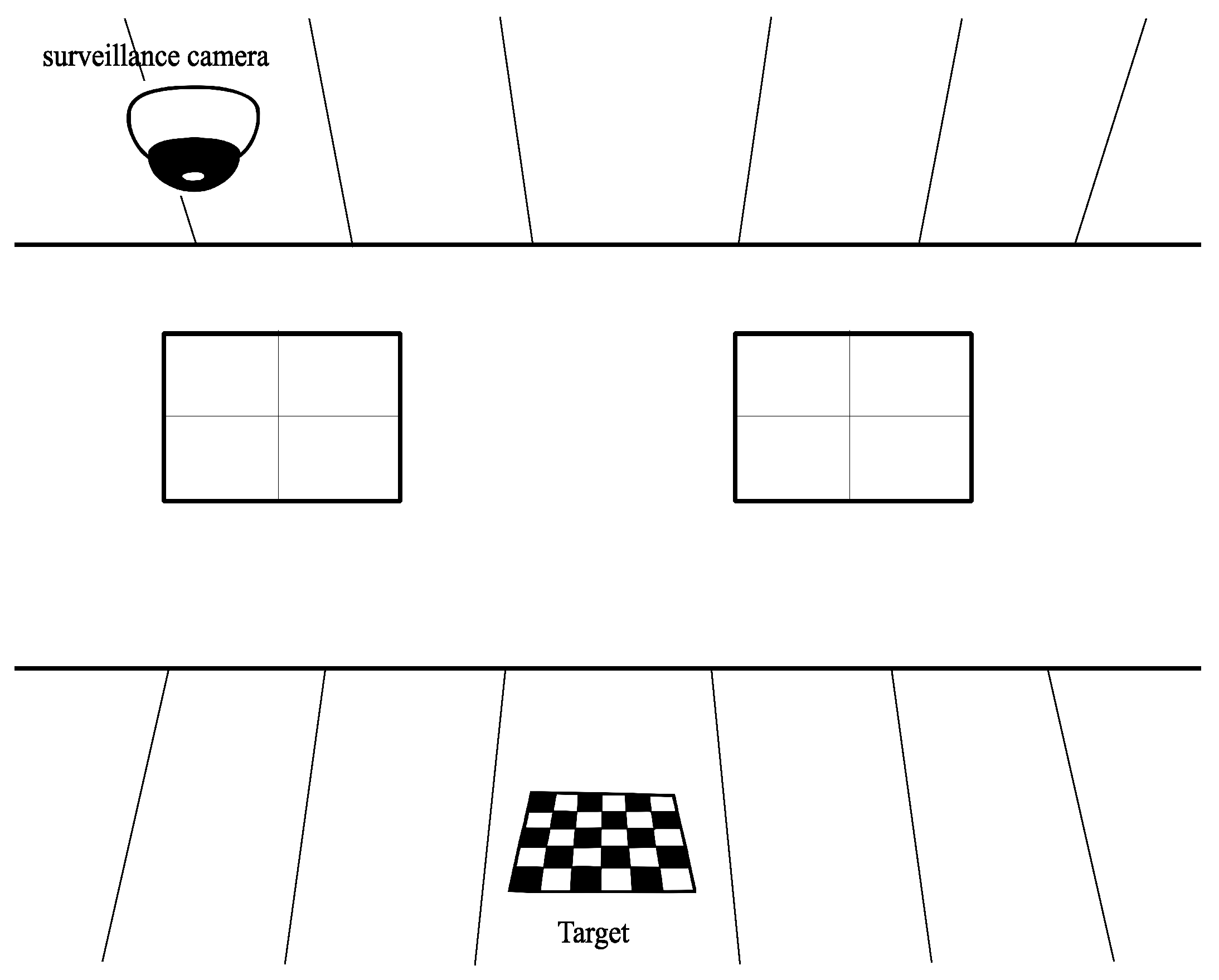
In this paper, we propose a surveillance-camera-based approach that repurposes existing building camera infrastructure for event-driven displacement monitoring. In many commercial and residential buildings, surveillance cameras are installed on ceilings facing rooms or corridors. Our method leverages this placement by using a simple in-frame reference; a small checkerboard target with known dimensions is placed in the field of view (FOV) of the surveillance camera (Figure 1), making pixel-to-millimeter conversion straightforward without requiring pre-earthquake calibration of camera intrinsics/extrinsics. This design reduces installation burden and avoids the need for specialized personnel to perform detailed camera calibration at each location.
Shake-table experiments conducted over a range of frequencies and intensities are used to quantify the measurement accuracy of the proposed pipeline. In addition to reporting displacement estimation error, we analyze empirical accuracy trends as functions of temporal sampling (frame rate) and spatial sampling (video resolution), providing practical guidance for surveillance-grade deployments. Because post-event screening and tagging decisions are typically based on peak engineering-demand parameters (EDPs), accurate estimation of peak drift/IDR is critical. This study evaluates peak-drift estimation and peak timing sensitivity under reduced frame rates representative of surveillance deployments. Leveraging widely deployed cameras and a simple visual target enables a cost-effective and minimally invasive monitoring layer that can support rapid post-event screening.
The proposed approach is intended as a complementary sensing layer for rapid, event-driven estimation of drift-related demand, rather than a replacement for accelerometers in long-term modal tracking or a standalone method for collapse prediction. Instead, the output displacement/EDP estimates may support building managers and engineers in prioritizing inspection and follow-up assessment in accordance with established drift-based evaluation guidelines [18,36,37]. This direction also aligns with smart building and smart city initiatives that leverage existing sensor infrastructure for hazard response [38,39,40].
The main contributions of this work are as follows:
  • Baseline feasibility using off-the-shelf CCTV: we validate that an existing in-building surveillance camera, combined with a simple planar target, can recover inter-story relative displacement with sub-millimeter accuracy under controlled shake-table excitations representative of strong-motion frequency content.
  • Temporal sampling study with a frequency-normalized criterion: we systematically quantify how camera frame rate affects displacement and drift estimation and show that performance trends collapse when expressed using the Nyquist ratio N , yielding a practical guideline for selecting minimum frame rate given a target dominant-response frequency.
  • Peak-demand estimation assessment: because post-event screening relies on peak drift/IDR, we separately evaluate peak estimation under reduced frame rates and show that peak metrics degrade more rapidly than full-waveform metrics due to between-frame peak underestimation.
  • Peak timing sensitivity: beyond peak amplitude error, we quantify peak timing mismatch across sampling conditions and discuss timing errors sensitivity for building-level identification metrics.
  • Spatial sampling assessment: we evaluate the effect of reducing image resolution over common surveillance settings and show the algorithm sub-pixel performance.

2. The Proposed SHM Approach

The processing pipeline is intentionally lightweight and consists of the following:
  • Initialize (first frame): detect checkerboard corners and assign their known metric coordinates based on the printed square size.
  • Track (all frames): track the same corners over time using a Kanade–Lucas–Tomasi (KLT) tracker to obtain per-frame pixel coordinates ( u [ k ] , v [ k ] ) .
  • Convert to metric motion: map tracked pixel coordinates to metric coordinates using planar homography matrix estimated from the first frame.
  • Compute drift: subtract the pre-event reference frame to obtain the relative displacement time history and extract drift-based demand metrics (e.g., peak drift/IDR).

2.1. Feature Detection and Tracking

The algorithm detects the corners of the checkerboard (grid intersections) in the initial frame, which provide repeatable high-contrast features. The corner set is then tracked across frames utilizing the Kanade–Lucas–Tomasi (KLT) algorithm. KLT follows each corner by matching a small image patch around the feature between consecutive frames and returns the updated pixel coordinates ( u [ k ] , v [ k ] ) for each corner at frame k. The resulting pixel motion of the tracked target is then converted into millimeters using homography mapping.

2.2. Planar Homography for Pixel-to-Metric Conversion

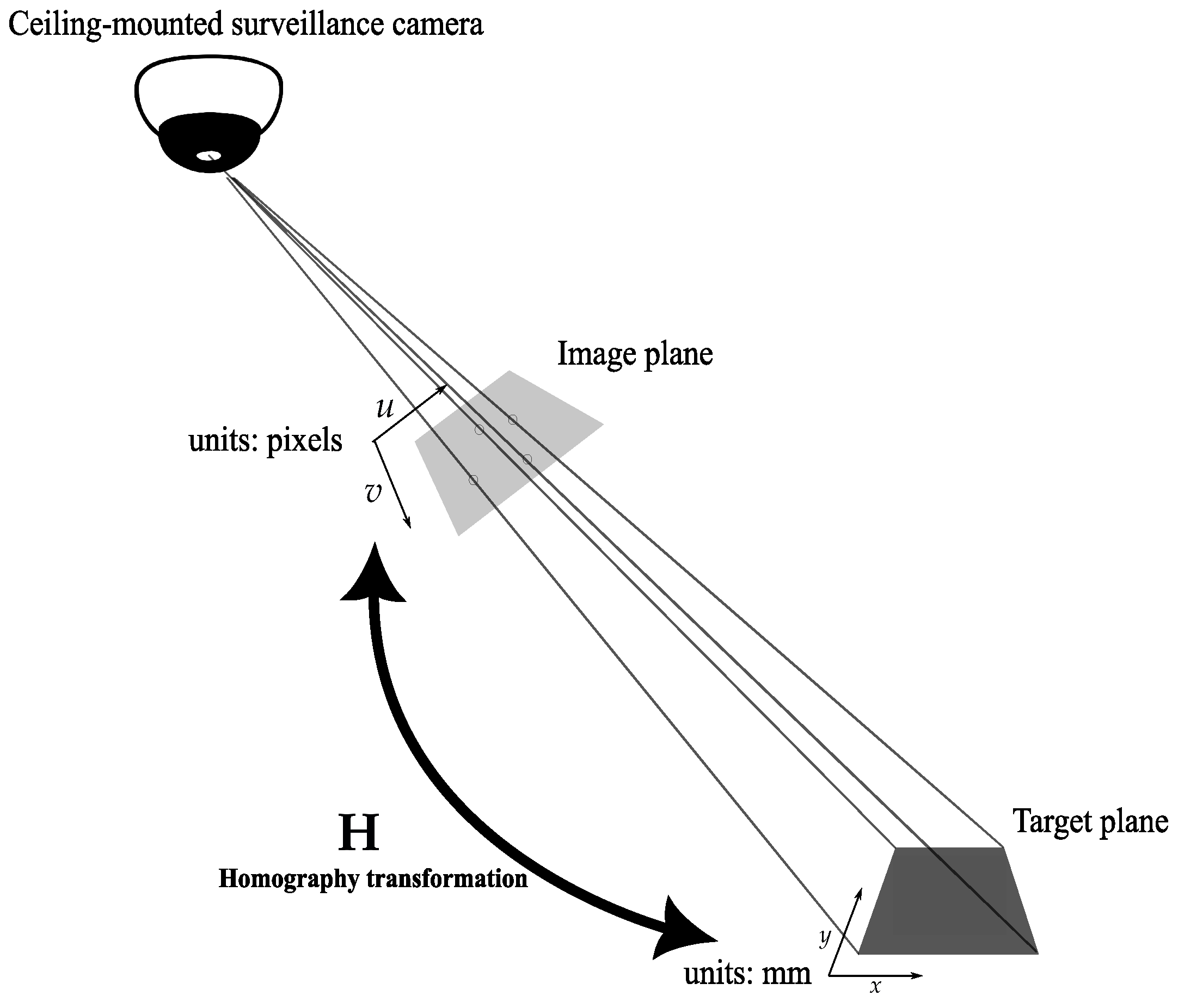
Because the checkerboard corners lie on a single plane, the pixel coordinates can be mapped to metric coordinates on the target plane using a planar homography as illustrated in Figure 2 [41,42].
Let ( x mm , y mm ) denote coordinates on the checkerboard plane and ( u , v ) denote the corresponding pixel coordinates. The mapping can be written as
s u [ k ] v [ k ] 1 = H x mm [ k ] y mm [ k ] 1 ,
where s is a projection scalar and H is a 3 × 3 homography transformation matrix. For displacement estimation, we use the inverse mapping H 1 to project tracked pixel coordinates back onto the checkerboard plane in millimeters:
x [ k ] y [ k ] w [ k ] = H 1 u [ k ] v [ k ] 1 ,
x mm [ k ] y mm [ k ] = x [ k ] / w [ k ] y [ k ] / w [ k ] .
This planar mapping absorbs the combined effect of camera pose and intrinsics for the target plane, which allows deployment without a full camera calibration procedure. The homography matrix H is only estimated once using the first frame’s known checkerboard geometry and the corresponding detected corner coordinates in the image. In practice, the estimation uses a standard normalized direct linear transform (DLT) procedure [41]. The resulting H (and H 1 ) is then held fixed while the tracked corners are mapped into metric coordinates for all subsequent frames.
The inter-story drift time history is obtained by subtracting the pre-event reference frame ( x mm i n i t i a l , y mm i n i t i a l ):
Δ x mm [ k ] = x mm [ k ] x mm i n i t i a l , a n d Δ y mm [ k ] = y mm [ k ] y mm i n i t i a l .
After that, the inter-story drift ratio (IDR) is computed by normalizing the peak lateral drift by the story height. IDR is widely used as an engineering demand parameter for post-event screening and performance-based assessment; guideline limits are typically in the order of 1–2.5% depending on the intended performance level [36,37].

2.3. Deployment Considerations

The method assumes that the camera remains stationary relative to the upper-floor slab during the measurement interval. If the camera mount undergoes noticeable vibration or re-positioning, the pixel-to-metric mapping may be biased. Practical mitigation options include using additional reference features rigidly attached to the camera floor for stabilization, automated tracking quality checks, and re-initialization if tracking confidence degrades. Handling relative motion between the camera support and the monitored story in unconstrained real buildings remains an open challenge and is outside the scope of this controlled study. Additionally, non-structural elements may undergo their own vibration and relative motion during earthquakes, potentially introducing visual motion that does not reflect the true inter-story drift. Accordingly, practical deployment should prioritize target placement on surfaces that reliably follow the floor diaphragm motion and remain visible during shaking (e.g., corridors, stairwells, utility rooms, or designated monitoring zones). Environmental conditions can also affect tracking performance. Low illumination increases image noise and reduces corner contrast; dust, motion blur, or partial occlusion can degrade corner detection and tracking. In such cases, the system can use additional illumination available in many indoor cameras, and re-initialize tracking when the number of reliably tracked corners falls below a threshold.

3. Experimental Setup

This section details the testing hardware instrumentation, data collection procedures, and methodologies used to validate the proposed security-camera-based structural health monitoring (SHM) approach.
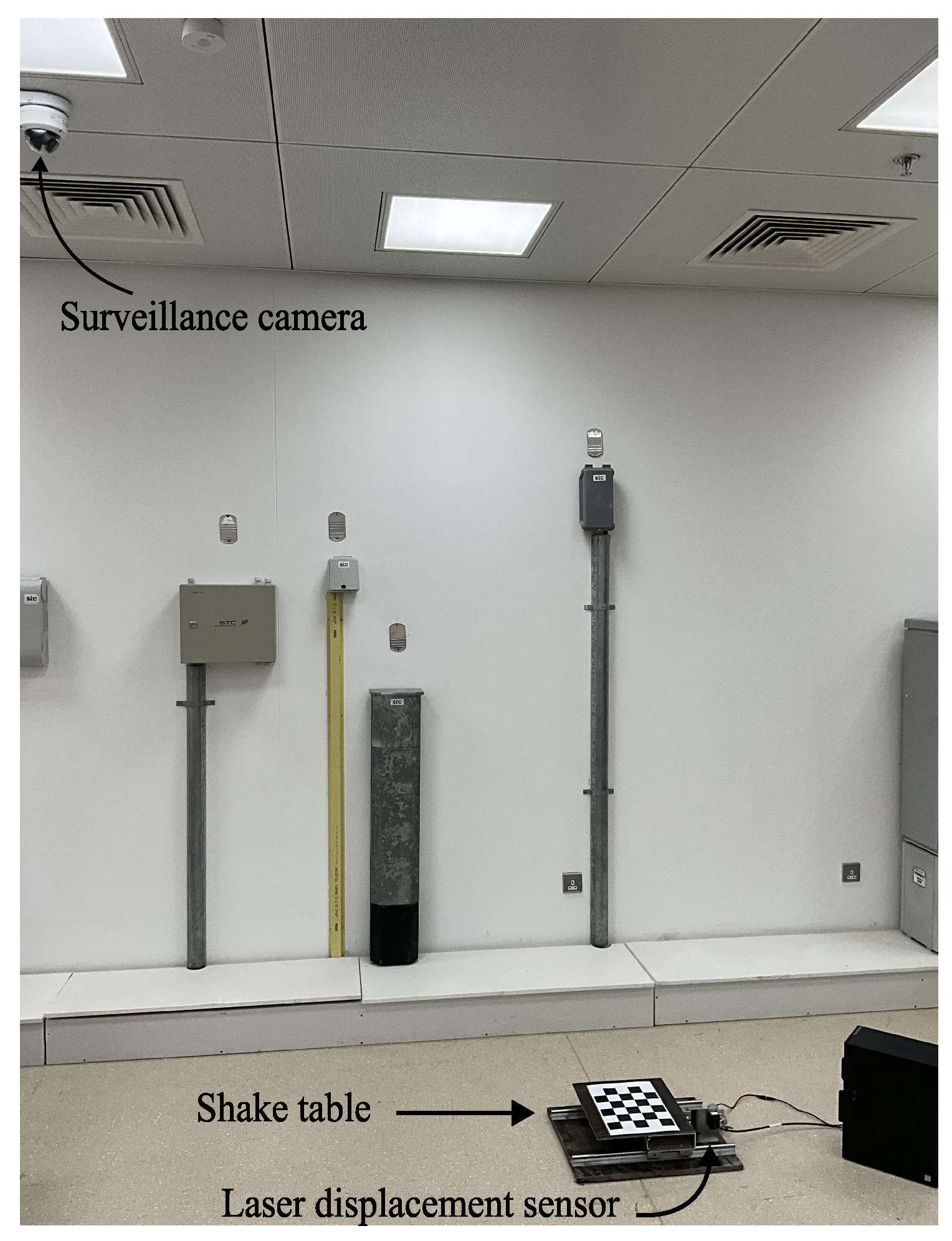
We used a seismic shake-table to validate the proposed methodology in all experiments. The shake-table can be configured to produce various frequencies and amplitudes typically observed in earthquake ground shaking, enabling a range of seismic scenarios suitable for validating SHM methods (Figure 3). Similar experimental methodologies are used in similar vision-based SHM studies, e.g., [31,32,33,34,35,43]. The checkerboard is attached to the shaking plate to simulate floor movement during a seismic event.
We used an off-the-shelf surveillance camera system. We used a typical dome-style Hikvision camera, shown in Figure 3 with model number DS-2CD2187GTH-LI [44]. The camera’s maximum resolution is 3840 × 2160 pixels and its maximum frame rate is 30 fps. The camera is attached to the ceiling of the lab to provide a testing setup similar to the proposed tracking method. The camera is stationary and angled at approximately 45°, as surveillance camera makers recommended [45]. The shake-table is placed in the center of the frame to minimize the effect of distortion. A Network Video Recorder (NVR) typically used in commercial building surveillance camera systems from Hikvision, with model number DS-7604NXI-K1/4P [46], is used to manage and acquire camera records.
To provide ground-truth measurements, a MicroEpsilon ILD 1220 laser displacement sensor (LDS) with 10 μm precision and a 1000 Hz sampling rate was mounted to the side of the shake-table to track the movement of the sliding plate [47]. Sensors of this type are widely employed for structural monitoring tests due to their high resolution and rapid response [31,32,33,34,35]. For experimental purposes, cross-correlation-based synchronization step ensured that the camera- and laser-derived signals aligned in time.
The displacement time history obtained from the video tracker, x video [ k ] , is benchmarked against the laser-based ground-truth signal, x ref [ k ] . We quantify agreement using the root mean square error (RMSE), defined as
RMSE = 1 N k = 1 N x video [ k ] x ref [ k ] 2 ,
where N denotes the total number of video frames (samples) in the record and the mean absolute error (MAE) is computed as
MAE = 1 N k = 1 N x video [ k ] x ref [ k ] ,
We also report the coefficient of determination ( R 2 ), computed as
R 2 = 1 k = 1 N x video [ k ] x ref [ k ] 2 k = 1 N x ref [ k ] x ¯ ref 2 ,
where x ¯ ref represents the mean value of the laser reference displacement.

4. Results

We conducted shake-table tests to assess the presented inter-story drift estimation pipeline spanning multiple shaking intensities and excitation frequencies representative of strong ground motion. Beyond quantifying baseline measurement accuracy using a commercial-grade security-camera setup, the experimental set was designed to isolate the effects of typical surveillance camera frame rate (temporal sampling) and video resolutions (spatial sampling) on displacement and peak-drift estimation. To characterize baseline performance, we conducted several experiments of harmonic excitations with dominant frequency content between 2.8 and 7.6 Hz and peak ground accelerations (PGA) of 0.4 g to 1.7 g. Harmonic excitations were selected to provide controlled frequency content for isolating spatial/temporal sampling effects. This frequency range is consistent with prior observations that the strong-motion content of earthquakes and the dominant dynamics relevant to building response are typically below 10 Hz [48,49].
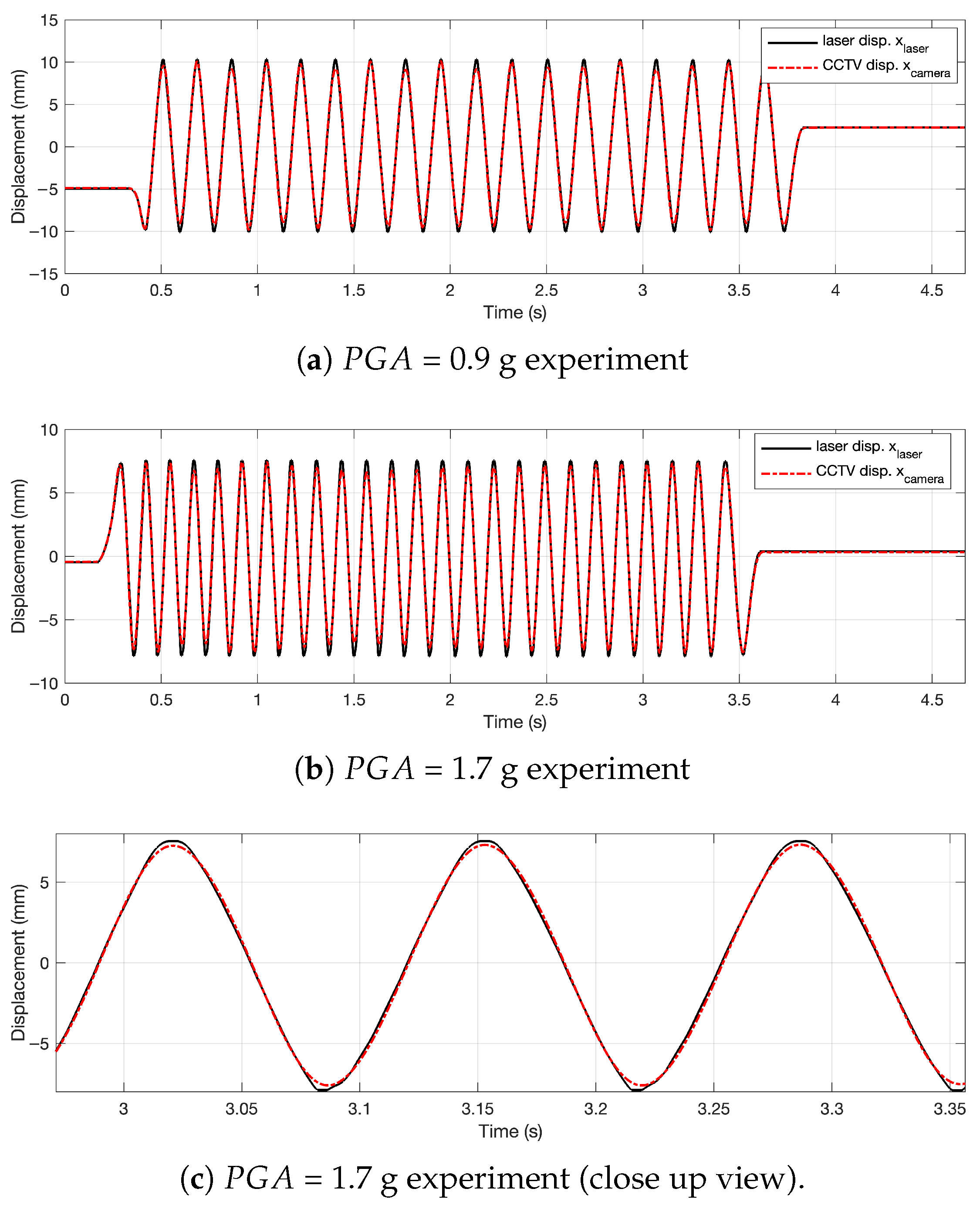
Figure 4 shows representative displacement time histories at different PGA levels, demonstrating close agreement between the camera- and laser-derived displacement. The zoomed view in Figure 4c highlights that both amplitude and phase are preserved. Table 1 summarizes representative runs using RMSE, NRMSE, and R 2 , showing sub-millimeter RMSE and high correlation. The average accuracy was RMSE = 0.43 mm, NRMSE = 2.9%, and R 2 = 0.9931 . These results are consistent with the accuracy levels reported in prior camera-based displacement and SHM studies [20,21,22,23,31,32,33,34,35,50]. The displacement estimates are then used to calculate inter-story drift ratio (IDR). As a reference, a 1 mm displacement error corresponds to an IDR error of 0.025% for a 4 m story height, which is small relative to common drift-based damage classification thresholds (1–2.5%).
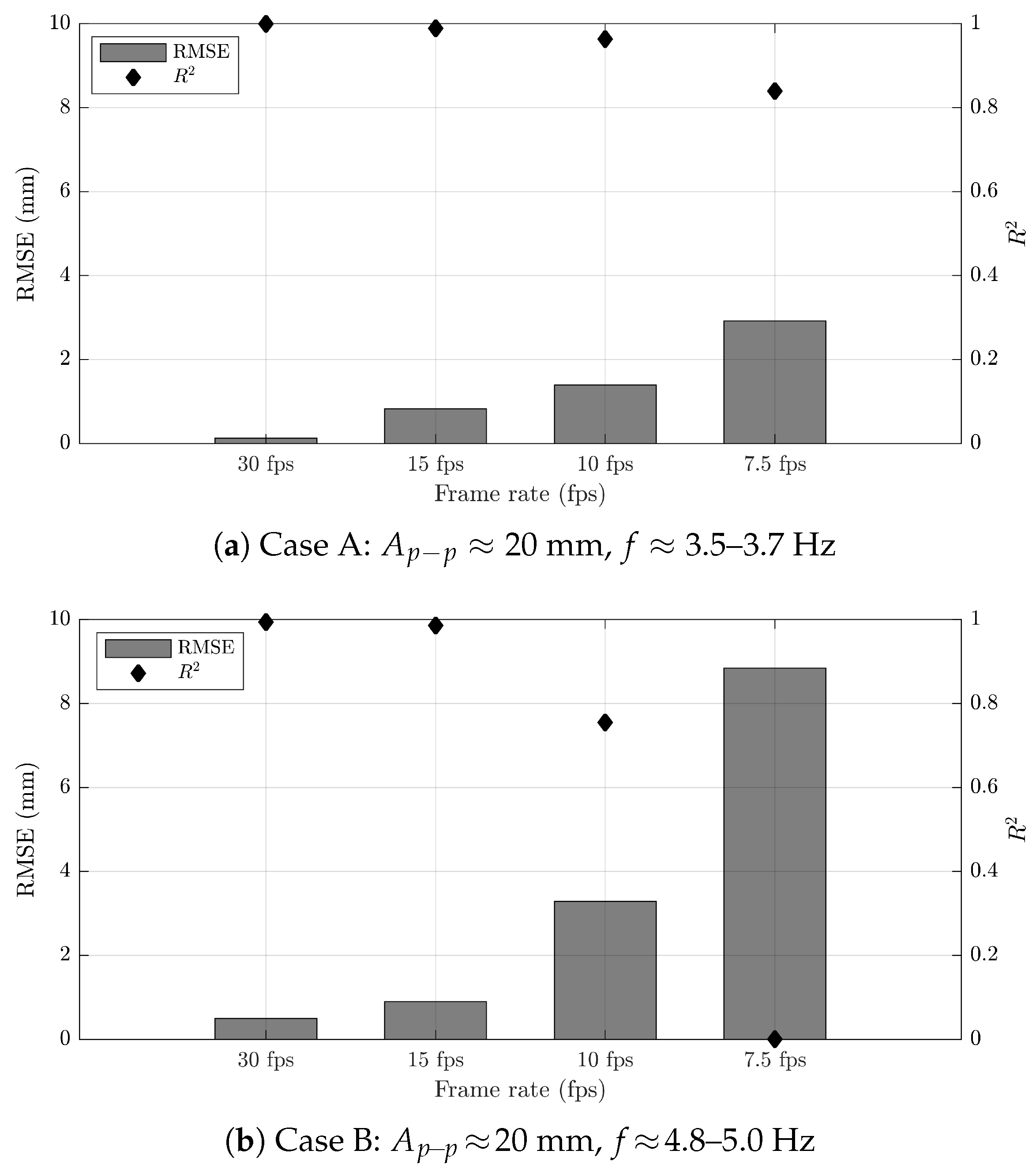
To isolate temporal sampling effects, two controlled cases were recorded at common surveillance frame rates (30, 15, 10, and 7.5 fps) while keeping the excitation amplitude approximately constant and maintaining comparable camera placement and target size. Figure 5 summarizes waveform accuracy versus frame rate for Case A (dominant frequency near 3.6 Hz) and Case B (dominant frequency near 4.9 Hz). Decreasing frame rate degrades accuracy in both cases, with a sharper deterioration for the higher-frequency case because fewer samples per cycle are available at the same frame rate. At the lowest frame rates, both amplitude tracking and correlation degrade substantially for Case B, indicating that the acquisition is approaching the practical limit for representing the dominant motion component.
Because the same frame rate can be adequate for low-frequency response yet insufficient for higher-frequency response, we present the results using a frequency-normalized metric. We define the Nyquist ratio as
N = f s 2 f d ,
where f s is the camera frame rate and f d is the dominant response frequency of signal. The Nyquist ratio directly indicates proximity to the Nyquist limit: N = 1 corresponds to sampling at the Nyquist rate for a dominant component at f d , while N < 1 implies that components near f d cannot be uniquely represented in discrete time (due to aliasing) [51,52].
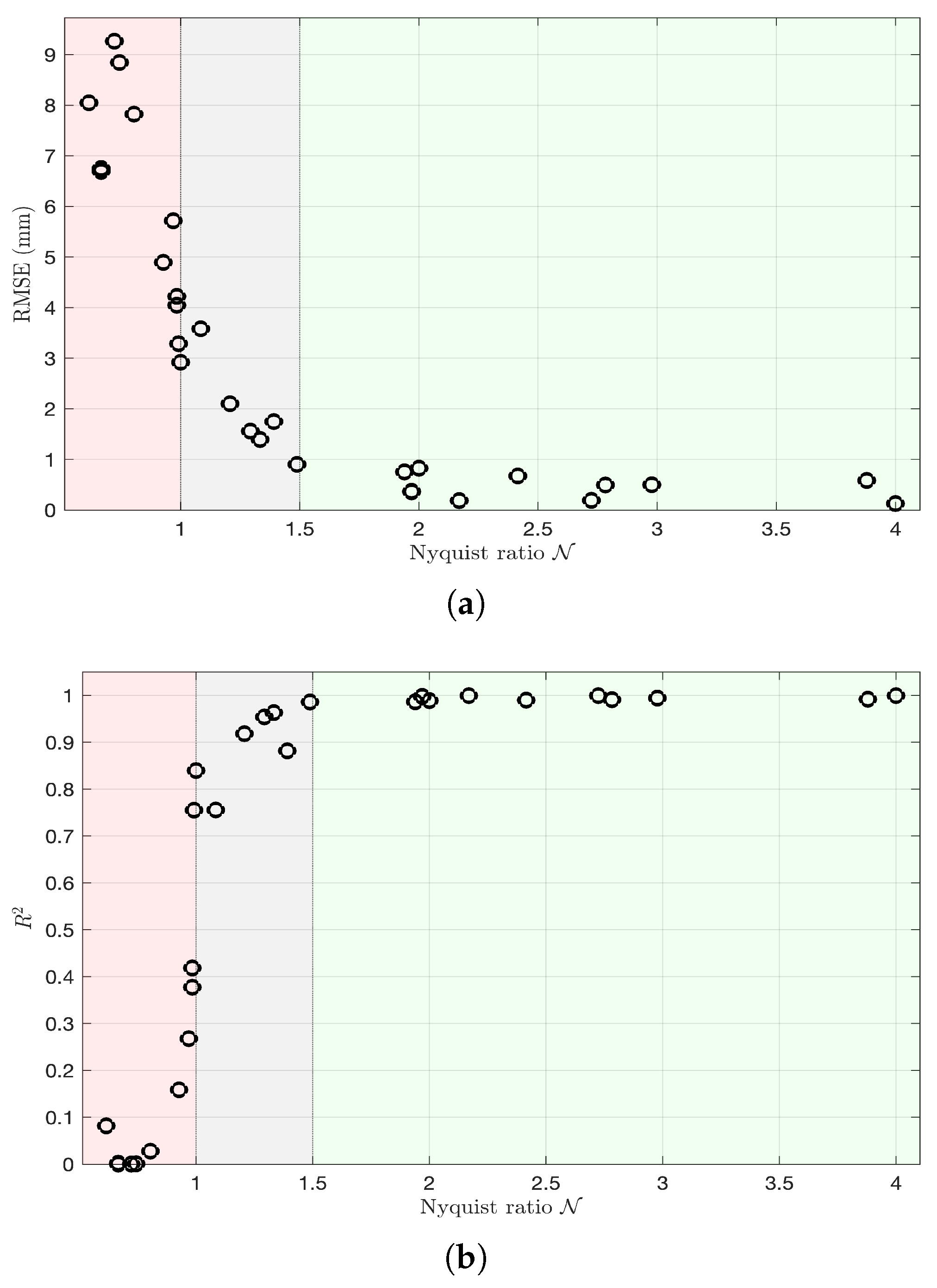
Figure 6 presents the results of the conducted experiments with experimental parameters spanning shaking amplitudes of 15–20 mm, dominant frequencies of 2.8–7.6 Hz, and camera frame rates of 7.5–30 fps. When plotted against N , the dependence of accuracy on sampling becomes clear: errors increase rapidly as N approaches 1 and deteriorate further when N < 1 . Conversely, when N is sufficiently above 1, the method achieves low RMSE and high R 2 , indicating that modern surveillance frame rates (30 fps) can provide accurate displacement tracking for the tested strong-motion conditions (<10 Hz).
The shake-table inputs are intentionally harmonic because they provide a controlled, repeatable narrowband excitation; this allows the Nyquist ratio N to be directly related to accuracy. Real seismic response is non-harmonic and broadband; however, the key sampling limitation is still governed by the highest significant frequency content in the measured drift/displacement, while many buildings exhibit a global fundamental frequency below 2 Hz, higher-mode contributions and torsional effects can introduce higher frequency components in the inter-story response. Therefore, the 2.8–7.6 Hz range is used here as a stress-test of practical CCTV settings: for a fixed frame rate, larger response frequencies reduce N and represent a more challenging condition. Consequently, performance at lower dominant frequencies (e.g., <2 Hz) is expected to be equal or better at the same f s , because N increases proportionally.
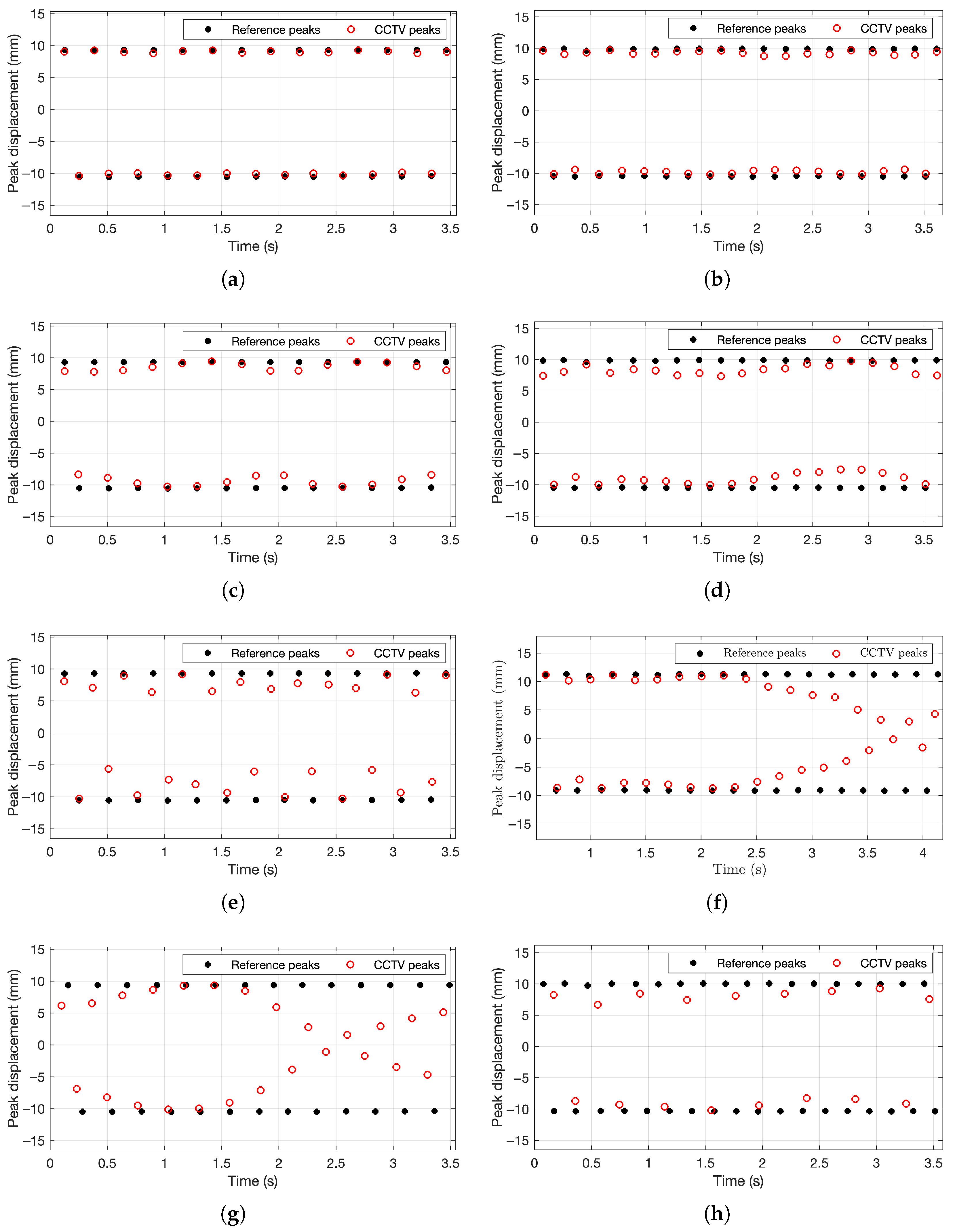
Post-event screening and drift-based damage assessment typically rely on peak engineering-demand parameters (EDPs), such as peak displacement, and peak inter-story drift ratio (IDR). These peak quantities are directly tied to performance limits, so assessing the system’s performance to estimating the peak response is essential. Peak estimates are intrinsically more sensitive to discrete-time sampling. The structural response is continuous in time, whereas the camera measures displacement only at discrete instants separated by T s = 1 / f s . The reported video peak is therefore the maximum sampled value, which is expected to be smaller than the true continuous-time maximum whenever the true peak occurs between frames. As frame rate decreases, the probability of missing the true peak increases, producing larger peak underestimation even when the overall correlation remains high.
Figure 7 visualizes peak estimation for two controlled shake-table cases recorded at multiple frame rates. Positive and negative peaks are detected cycle-by-cycle from the reference laser displacement and the camera-derived displacement. At higher frame rates, the camera peaks closely follow the reference peaks, while at lower frame rates, the peak amplitudes become increasingly biased, and in the very low frame rate case, peak pairing becomes unreliable due to insufficient temporal sampling.
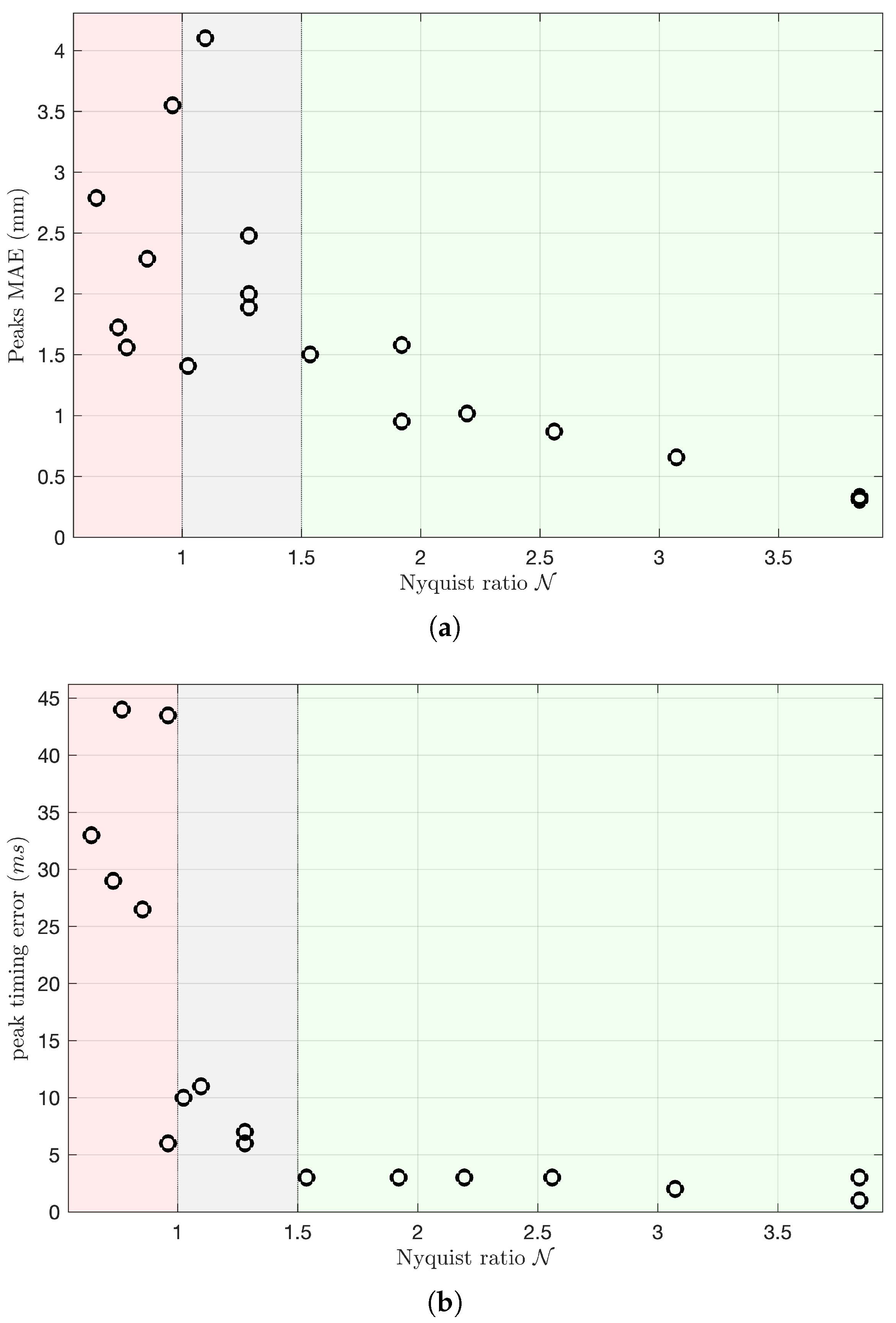
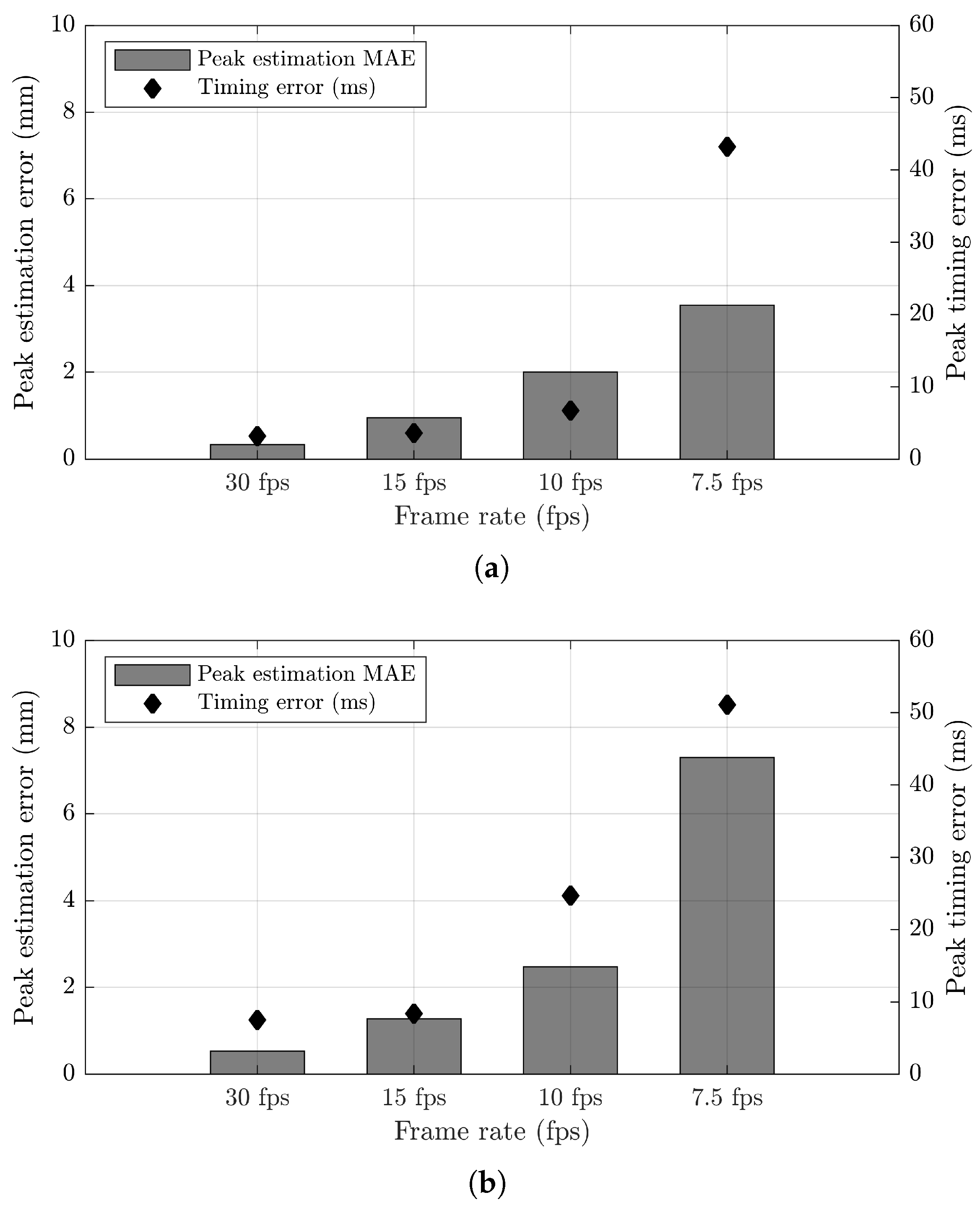
Peak estimation performance is summarized in Figure 8 using two metrics: (i) peak estimation mean absolute error (MAE), to quantify amplitude error, and (ii) peak timing error, which quantifies the time mismatch between camera and reference peaks. Importantly, reducing fps tends to penalize peak metrics more than full-record metrics because peak estimation is governed by the local sampling density around the maximum. This behavior is consistent with the observed results: peak MAE increases gradually in the lower-frequency case but deteriorates sharply in the higher-frequency case as the frame rate approaches (and falls below) the Nyquist limit. Peak timing directly affects higher-level structural assessments that depend on synchronization. For example, building-level performance metrics (e.g., transfer functions between floors, and mode shapes from multi-floor measurements) rely on accurate relative timing between signals. Timing jitter or peak-time bias at low fps can distort phase relationships and bias identified dynamic properties.
To express these results in a frequency-normalized form, peak metrics are also plotted against the Nyquist ratio N in Figure 9. Across tests, peak estimation MAE and peak timing error remain comparatively stable at higher N and degrade rapidly as N approaches 1, consistent with insufficient temporal sampling. This representation provides a practical screening rule: given an expected dominant frequency band for either the building response or the strong-motion content, one can evaluate whether a candidate camera frame rate provides an adequate margin above the Nyquist limit for peak-based drift screening and timing-sensitive system identification.
Finally, we evaluated the impact of spatial sampling by repeating experiments at 30 fps while varying camera resolution over common surveillance settings: 1920 × 1080, 1280 × 720, 960 × 540, and 640 × 360 pixels. To isolate the effect of resolution, we kept the camera placement and checkerboard target size. Across the tested configurations, reducing resolution increased the displacement error only slightly (<0.2 mm between the highest and lowest tested resolutions) mainly because of the high contrast target and sub-pixel tracking. These findings indicate that lower-resolution surveillance cameras are usable for displacement-based monitoring.
Several studies have suggested that a practical target accuracy for seismic monitoring is on the order of 0.2% IDR (approximately 8 mm for a 4 m story height) [43,53,54]. In the presented experiments, the achieved displacement accuracy corresponds to a substantially smaller IDR error (typically below 0.02%).

5. Conclusions

Most occupied buildings do not have dedicated structural health monitoring, which limits rapid post-earthquake screening. This study investigated whether existing in-building surveillance cameras can be repurposed to estimate drift-based demand using a simple in-frame planar target for pixel-to-metric conversion, without requiring pre-event camera calibration.
Shake-table validation showed that off-the-shelf CCTV systems can recover earthquake-induced displacement with high accuracy that is suitable for drift-based screening. The dominant practical limit is temporal sampling: accuracy degrades as the number of samples per motion cycle decreases, with a sharp deterioration near the Nyquist boundary. Accordingly, frame-rate suitability should be assessed against the highest relevant frequency content of the drift response, especially when peak-based demand parameters (e.g., peak drift and peak IDR) or timing-sensitive identification metrics are of interest. In contrast, reduced image resolution (from 1920 × 1080 pixels down to typical lower surveillance settings) had only a modest impact under the tested conditions due to high-contrast targets and sub-pixel tracking, suggesting that many older cameras may still be usable for displacement-based monitoring.
Overall, leveraging existing camera infrastructure provides a low-cost, scalable complementary layer for rapid post-event drift screening, while dedicated sensors remain recommended for critical facilities and long-term monitoring.

Funding

This research was funded by the Deanship of Graduate Studies and Scientific Research at Qassim University, grant number QU-APC-2026.

Data Availability Statement

The original contributions presented in the study are included in the article, further inquiries can be directed to the corresponding author.

Acknowledgments

The researchers would like to thank the Deanship of Graduate Studies and Scientific Research at Qassim University for financial support (QU-APC-2026).

Conflicts of Interest

The author declares no conflicts of interest.

Abbreviations

The following abbreviations are used in this manuscript:
SHMStructural Health Monitoring
FEMAThe Federal Emergency Management Agency
IDRInter-story Drift Ratio
EDPEngineering Demand Parameters

References

  1. Holzer, T.L.; Savage, J.C. Global earthquake fatalities and population. Earthq. Spectra 2013, 29, 155–175. [Google Scholar] [CrossRef]
  2. Federal Emergency Management Agency (FEMA). Post-Disaster Building Safety Evaluation Guidance; Technical Report; FEMA: Washington, DC, USA, 2019.
  3. Gu, J.; Xie, Z.; Zhang, J.; He, X. Advances in rapid damage identification methods for post-disaster regional buildings based on remote sensing images: A survey. Buildings 2024, 14, 898. [Google Scholar] [CrossRef]
  4. Farrar, C.R.; Dervilis, N.; Worden, K. The past, present and future of structural health monitoring: An overview of three ages. Strain 2025, 61, e12495. [Google Scholar] [CrossRef]
  5. Nirupama, P.; Raghavendra, T.; Shahanawaz, N.; Manjunath, C. A Brief Review on Smart Structural Health Monitoring Technologies. Eng. Res. Transcr. 2023, 6, 81–88. [Google Scholar]
  6. Goyal, D.; Pabla, B. The vibration monitoring methods and signal processing techniques for structural health monitoring: A review. Arch. Comput. Methods Eng. 2016, 23, 585–594. [Google Scholar] [CrossRef]
  7. Yang, Y.; Zhang, Y.; Tan, X. Review on vibration-based structural health monitoring techniques and technical codes. Symmetry 2021, 13, 1998. [Google Scholar] [CrossRef]
  8. Jayawardana, D.; Kharkovsky, S.; Liyanapathirana, R.; Zhu, X. Measurement system with accelerometer integrated RFID tag for infrastructure health monitoring. IEEE Trans. Instrum. Meas. 2015, 65, 1163–1171. [Google Scholar] [CrossRef]
  9. Jayawardana, D.; Liyanapathirana, R.; Zhu, X. RFID-Based Wireless Multi-Sensory System for Simultaneous Dynamic Acceleration and Strain Measurements of Civil Infrastructure. IEEE Sens. J. 2019, 19, 12389–12397. [Google Scholar] [CrossRef]
  10. Zonzini, F.; Malatesta, M.M.; Bogomolov, D.; Testoni, N.; Marzani, A.; De Marchi, L. Vibration-based SHM with up-scalable and low-cost Sensor Networks. IEEE Trans. Instrum. Meas. 2020, 69, 7990–7998. [Google Scholar]
  11. Rainieri, C.; Gargaro, D.; Fabbrocino, G. Hardware and software solutions for seismic SHM of hospitals. In Seismic Structural Health Monitoring; Springer: Berlin/Heidelberg, Germany, 2019; pp. 279–300. [Google Scholar]
  12. Sabato, A.; Niezrecki, C.; Fortino, G. Wireless MEMS-based accelerometer sensor boards for structural vibration monitoring: A review. IEEE Sens. J. 2016, 17, 226–235. [Google Scholar] [CrossRef]
  13. Das, S.; Saha, P.; Patro, S. Vibration-Based Damage Detection Techniques Used for Health Monitoring of Structures: A Review. J. Civ. Struct. Health Monit. 2016, 6, 477–507. [Google Scholar] [CrossRef]
  14. Skolnik, D.A.; Wallace, J.W. Critical assessment of interstory drift measurements. J. Struct. Eng. 2010, 136, 1574–1584. [Google Scholar] [CrossRef]
  15. Kamat, V.R.; El-Tawil, S. Evaluation of augmented reality for rapid assessment of earthquake-induced building damage. J. Comput. Civ. Eng. 2007, 21, 303–310. [Google Scholar] [CrossRef]
  16. Algan, B.B. Drift and Damage Considerations in Earthquake-Resistant Design of Reinforced Concrete Buildings. Ph.D. Thesis, University of Illinois at Urbana-Champaign, Champaign, IL, USA, 1982. [Google Scholar]
  17. Bozorgnia, Y.; Bertero, V.V. Improved shaking and damage parameters for post-earthquake applications. In Proceedings of the SMIP01 Seminar on Utilization of Strong-Motion Data, Los Angeles, CA, USA, 12 September 2001; Citeseer: Princeton, NJ, USA, 2001; pp. 1–22. [Google Scholar]
  18. Applied Technology Council; Agency Federal Emergency Management. Quantification of Building Seismic Performance Factors; U.S. Department of Homeland Security, FEMA: Washington, DC, USA, 2009; pp. A1–A43.
  19. Xu, Y.; Brownjohn, J.M. Review of machine-vision based methodologies for displacement measurement in civil structures. J. Civ. Struct. Health Monit. 2018, 8, 91–110. [Google Scholar] [CrossRef]
  20. Dong, C.Z.; Catbas, F.N. A review of computer vision–based structural health monitoring at local and global levels. Struct. Health Monit. 2021, 20, 692–743. [Google Scholar] [CrossRef]
  21. Sony, S.; Laventure, S.; Sadhu, A. A literature review of next-generation smart sensing technology in structural health monitoring. Struct. Control. Health Monit. 2019, 26, e2321. [Google Scholar] [CrossRef]
  22. Payawal, J.M.G.; Kim, D.K. Image-based structural health monitoring: A systematic review. Appl. Sci. 2023, 13, 968. [Google Scholar] [CrossRef]
  23. Katam, R.; Pasupuleti, V.D.K.; Kalapatapu, P. A review on structural health monitoring: Past to present. Innov. Infrastruct. Solut. 2023, 8, 248. [Google Scholar] [CrossRef]
  24. Lydon, D.; Lydon, M.; Taylor, S.; Del Rincon, J.M.; Hester, D.; Brownjohn, J. Development and field testing of a vision-based displacement system using a low cost wireless action camera. Mech. Syst. Signal Process. 2019, 121, 343–358. [Google Scholar] [CrossRef]
  25. Bhowmick, S.; Nagarajaiah, S.; Lai, Z. Measurement of full-field displacement time history of a vibrating continuous edge from video. Mech. Syst. Signal Process. 2020, 144, 106847. [Google Scholar] [CrossRef]
  26. Bhowmick, S.; Nagarajaiah, S. Identification of full-field dynamic modes using continuous displacement response estimated from vibrating edge video. J. Sound Vib. 2020, 489, 115657. [Google Scholar] [CrossRef]
  27. Khuc, T.; Catbas, F.N. Structural identification using computer vision–based bridge health monitoring. J. Struct. Eng. 2018, 144, 04017202. [Google Scholar] [CrossRef]
  28. Khuc, T.; Catbas, F.N. Completely contactless structural health monitoring of real-life structures using cameras and computer vision. Struct. Control. Health Monit. 2017, 24, e1852. [Google Scholar] [CrossRef]
  29. Cha, Y.J.; Chen, J.G.; Büyüköztürk, O. Output-only computer vision based damage detection using phase-based optical flow and unscented Kalman filters. Eng. Struct. 2017, 132, 300–313. [Google Scholar] [CrossRef]
  30. Cataldo, A.; Roselli, I.; Fioriti, V.; Saitta, F.; Colucci, A.; Tatì, A.; Ponzo, F.C.; Ditommaso, R.; Mennuti, C.; Marzani, A. Advanced Video-Based Processing for Low-Cost Damage Assessment of Buildings under Seismic Loading in Shaking Table Tests. Sensors 2023, 23, 5303. [Google Scholar] [CrossRef]
  31. Wen, W.; Zhang, C.; Hu, J.; Guo, J.; Zhai, C.; Zhou, B. Automatic monitoring method for seismic response of building structures and equipment based on indoor surveillance cameras. Mech. Syst. Signal Process. 2025, 224, 112220. [Google Scholar] [CrossRef]
  32. Wen, W.; Zhang, C.; Zhai, C.; Guo, J.; Hu, J. A method for automatic monitoring structural earthquake response using surveillance video. J. Build. Eng. 2025, 112, 113737. [Google Scholar] [CrossRef]
  33. Hosseinzadeh, A.Z.; Tehrani, M.; Harvey, P., Jr. Modal identification of building structures using vision-based measurements from multiple interior surveillance cameras. Eng. Struct. 2021, 228, 111517. [Google Scholar] [CrossRef]
  34. Hosseinzadeh, A.Z.; Harvey, P., Jr. Pixel-based operating modes from surveillance videos for structural vibration monitoring: A preliminary experimental study. Measurement 2019, 148, 106911. [Google Scholar] [CrossRef]
  35. Zhou, J.; Huo, L.; Huang, C.; Yang, Z.; Li, H. Feasibility Study of Earthquake-Induced Damage Assessment for Structures by Utilizing Images from Surveillance Cameras. Struct. Control. Health Monit. 2024, 2024, 4993972. [Google Scholar] [CrossRef]
  36. American Society of Civil Engineers. Seismic Rehabilitation of Existing Buildings; ASCE Publications: Reston, VA, USA, 2007; Volume 41, p. 12. [Google Scholar]
  37. Ghobarah, A.; Abou-Elfath, H.; Biddah, A. Response-based damage assessment of structures. Earthq. Eng. Struct. Dyn. 1999, 28, 79–104. [Google Scholar] [CrossRef]
  38. Zanella, A.; Bui, N.; Castellani, A.; Vangelista, L.; Zorzi, M. Internet of Things for Smart Cities. IEEE Internet Things J. 2014, 1, 22–32. [Google Scholar] [CrossRef]
  39. Batty, M.; Axhausen, K.W.; Giannotti, F.; Pozdnoukhov, A.; Bazzani, A.; Wachowicz, M.; Portugali, Y. Smart Cities of the Future. Eur. Phys. J. Spec. Top. 2012, 214, 481–518. [Google Scholar] [CrossRef]
  40. Alzughaibi, A.A.; Ibrahim, A.M.; Na, Y.; El-Tawil, S.; Eltawil, A.M. Community-based multi-sensory structural health monitoring system: A smartphone accelerometer and camera fusion approach. IEEE Sens. J. 2021, 21, 20539–20551. [Google Scholar] [CrossRef]
  41. Hartley, R.; Zisserman, A. Multiple View Geometry in Computer Vision; Cambridge University Press: Cambridge, UK, 2004. [Google Scholar] [CrossRef]
  42. Luo, Y.; Wang, X.; Liao, Y.; Fu, Q.; Shu, C.; Wu, Y.; He, Y. A review of homography estimation: Advances and challenges. Electronics 2023, 12, 4977. [Google Scholar] [CrossRef]
  43. Amies, A.C.; Pretty, C.G.; Rodgers, G.W.; Chase, J.G. Experimental Validation of a Radar-Based Structural Health Monitoring System. IEEE/ASME Trans. Mechatron. 2019, 24, 2064–2072. [Google Scholar] [CrossRef]
  44. Hikvision Digital Technology Co., Ltd. DS-2CD2187G2H-LI(SU) 8 MP Smart Hybrid Light with ColorVu Fixed Mini Dome Network Camera: Datasheet; Product Datasheet; Hikvision Digital Technology Co., Ltd.: Hangzhou, China, 2024. [Google Scholar]
  45. Lorex Technology Inc. N881 Series 4K Security NVR, Product manual describing installation, configuration, and recommended camera mounting angles; Lorex Technology Inc.: Markham, ON, Canada.
  46. Hikvision Digital Technology Co., Ltd. DS-7604NXI-K1/4P AcuSense Network Video Recorder: Datasheet; Product Datasheet; Hikvision Digital Technology Co., Ltd.: Hangzhou, China, 2022. [Google Scholar]
  47. Micro-Epsilon GmbH. ILD1220 Laser Displacement Sensor Datasheet. Product Datasheet. 2023. Available online: https://www.micro-epsilon.com (accessed on 7 May 2025).
  48. Fukuwa, N.; Nishizaka, R.; Yagi, S.; Tanaka, K.; Tamura, Y. Field measurement of damping and natural frequency of an actual steel-framed building over a wide range of amplitudes. J. Wind. Eng. Ind. Aerodyn. 1996, 59, 325–347. [Google Scholar] [CrossRef]
  49. Ni, Y.; Lu, X.; Lu, W. Operational modal analysis of a high-rise multi-function building with dampers by a Bayesian approach. Mech. Syst. Signal Process. 2017, 86, 286–307. [Google Scholar] [CrossRef]
  50. Dong, C.Z.; Celik, O.; Catbas, F.N.; O’Brien, E.J.; Taylor, S. Structural displacement monitoring using deep learning-based full field optical flow methods. Struct. Infrastruct. Eng. 2020, 16, 51–71. [Google Scholar] [CrossRef]
  51. Proakis, J.G. Digital Signal Processing: Principles, Algorithms, and Applications, 4/E; Pearson Education India: Chennai, India, 2007. [Google Scholar]
  52. Lyons, R.G. Understanding Digital Signal Processing, 3/E; Pearson Education India: Chennai, India, 1997. [Google Scholar]
  53. Ramirez, C.M.; Lignos, D.G.; Miranda, E.; Kolios, D. Fragility functions for pre-Northridge welded steel moment-resisting beam-to-column connections. Eng. Struct. 2012, 45, 574–584. [Google Scholar] [CrossRef]
  54. Baker, J.W. Efficient analytical fragility function fitting using dynamic structural analysis. Earthq. Spectra 2015, 31, 579–599. [Google Scholar] [CrossRef]
Figure 1. Proposed SHM methodology setup. The ceiling-mounted surveillance camera tracks the checkerboard target attached to the lower floor to infer its movement during earthquakes to estimate the building’s structural health using FEMA guidelines.
Buildings 16 00942 g001
Figure 2. Diagram illustrating the homography-based transformation from the image plane to the target plane.
Buildings 16 00942 g002
Figure 3. Overview of the experimental setup used to validate the proposed approach includes a shake-table, a reference laser displacement sensor (LDS), and a surveillance camera mounted to the laboratory ceiling. The components are arranged to closely replicate the intended deployment configuration.
Buildings 16 00942 g003
Figure 4. Displacement time histories estimated from the surveillance camera compared with the laser reference for representative shake-table inputs. The close up plot highlights close agreement in both amplitude and phase.
Buildings 16 00942 g004
Figure 5. Effect of temporal sampling (frame rate) on displacement measurement accuracy under two controlled cases. Within each case, the excitation amplitude and dominant frequency are held approximately constant and only the camera frame rate is varied (30, 15, 10, and 7.5 fps), so differences reflect temporal sampling effects. Case A (lower frequency): the 30 fps and 15 fps runs satisfy the Nyquist criterion and therefore exhibit low error; 10 fps is near the borderline and shows a noticeable accuracy drop; 7.5 fps is borderline and produces a clearer increase in error. Case B (higher frequency): the 30 fps and 15 fps runs satisfy the Nyquist criterion and remain accurate, while 10 fps is borderline and degrades further; 7.5 fps does not satisfy the Nyquist criterion, leading to severe distortion (aliasing).
Buildings 16 00942 g005
Figure 6. Frequency-normalized temporal sampling results using Nyquist ratio N . Performance (measured using (a) RMSE (mm) and (b) R 2 ) of the performed experiments spanning amplitudes 15–20 mm, dominant frequencies 2.8–7.6 Hz, and camera frame rates 7.5–30 fps. Each point represents one experiment. Plotting against N collapses experiments with different frequencies onto a common axis: the Nyquist condition is violated for N < 1 (aliasing). A borderline, high-sensitivity region is observed for 1 N 1.5 , whereas performance is more robust for N 1.5 . (a) RMSE (mm) vs. Nyquist ratio N . performance remains stable at high N and degrades sharply as N approaches (or drops below) 1, consistent with insufficient temporal sampling. (b) R 2 vs. Nyquist ratio N . performance remains stable at high N and degrades sharply as N approaches (or drops below) 1, consistent with insufficient temporal sampling.
Buildings 16 00942 g006
Figure 7. Peak drift estimation. Each plot compares local peaks from the camera-derived displacement (red markers) against the reference peaks (black solid markers). As fps decreases, the probability of true maxima to occur between frames increases, producing peak underestimation. Plots (a,c,e,g) correspond to Case A ( f 3.7 Hz) and plots (b,d,f,h) correspond to Case B ( f 5 Hz), each recorded at 30, 15, 10, and 7.5 fps. (a) Case A: f 3.7 Hz, frame rate = 30 fps. (b) Case B: f 5 Hz, frame rate = 30 fps. (c) Case A: f 3.7 Hz, frame rate = 15 fps. (d) Case B: f 5 Hz, frame rate = 15 fps. (e) Case A: f 3.7 Hz, frame rate = 10 fps. (f) Case B: f 5 Hz, frame rate = 10 fps. Some peaks missed or severely underestimated. (g) Case A: f 3.7 Hz, frame rate = 7.5 fps. Some peaks missed or severely underestimated. (h) Case B: f 5 Hz, frame rate = 7.5 fps. Many peaks completely missed.
Buildings 16 00942 g007
Figure 8. Peak-based accuracy vs. frame rate (engineering-demand viewpoint). Bars show peak MAE (mm), and markers show the peak retention ratio (dimensionless). Unlike RMSE over the full time history, peak metrics directly quantify error in peak drift/peak IDR. The results show that lowering fps increases peak error and reduces peak retention due to between-frame peak miss (continuous-time peaks not sampled exactly at the peak). (a) Case A ( f 3.7 Hz). (b) Case B ( f 5 Hz). Peak MAE sharply increases and peak retention ratio drops at 7.5 fps because of Nyquist violation.
Buildings 16 00942 g008
Figure 9. Frequency-normalized temporal sampling peaks measurement metrics using Nyquist ratio N . Peak estimation, MAE, and peak timing error are plotted versus Nyquist ratio N . Both peak estimation metrics degrade sharply as N approaches 1, consistent with increased aliasing risk and between-frame peak miss (underestimating the peak). Using N provides a frequency-normalized criterion for selecting minimum fps for peak-based drift screening. (a) Peak MAE (mm) vs. N . Peak estimation error increases as N approaches 1. (b) Peak timing error vs. N . Peak timing mismatch grows at low N , reflecting sparse sampling.
Buildings 16 00942 g009
Table 1. Experimental parameters and results of three representative experiments, showing that the method consistently achieves precision comparable with prior dedicated camera-based SHM systems [31,32,33,34,35,50].
PGA (g)Freq. (Hz)RMSE (mm)NRMSE (%) R 2
0.73.80.582.90.9917
0.95.50.493.20.9909
1.77.60.372.830.9960
Disclaimer/Publisher’s Note: The statements, opinions and data contained in all publications are solely those of the individual author(s) and contributor(s) and not of MDPI and/or the editor(s). MDPI and/or the editor(s) disclaim responsibility for any injury to people or property resulting from any ideas, methods, instructions or products referred to in the content.