Predicting Blast-Induced Area of Tunnel Face in Tunnel Excavations Using Multiple Regression Analysis and Artificial Intelligence


 ,
,
Abstract
1. Introduction
2. Methodology of the Study
2.1. Case Study and Data
2.2. Multiple Linear Regression Analysis (MLRA) Model
2.3. Multiple Nonlinear Regression (MNLR) Model
2.4. Artificial Neural Network (ANN) Model
2.5. The Hybrid GA-ANN Model
2.5.1. Contents of the Genetic Algorithm (GA)
2.5.2. The Parameters of the GA-ANN Hybrid Model
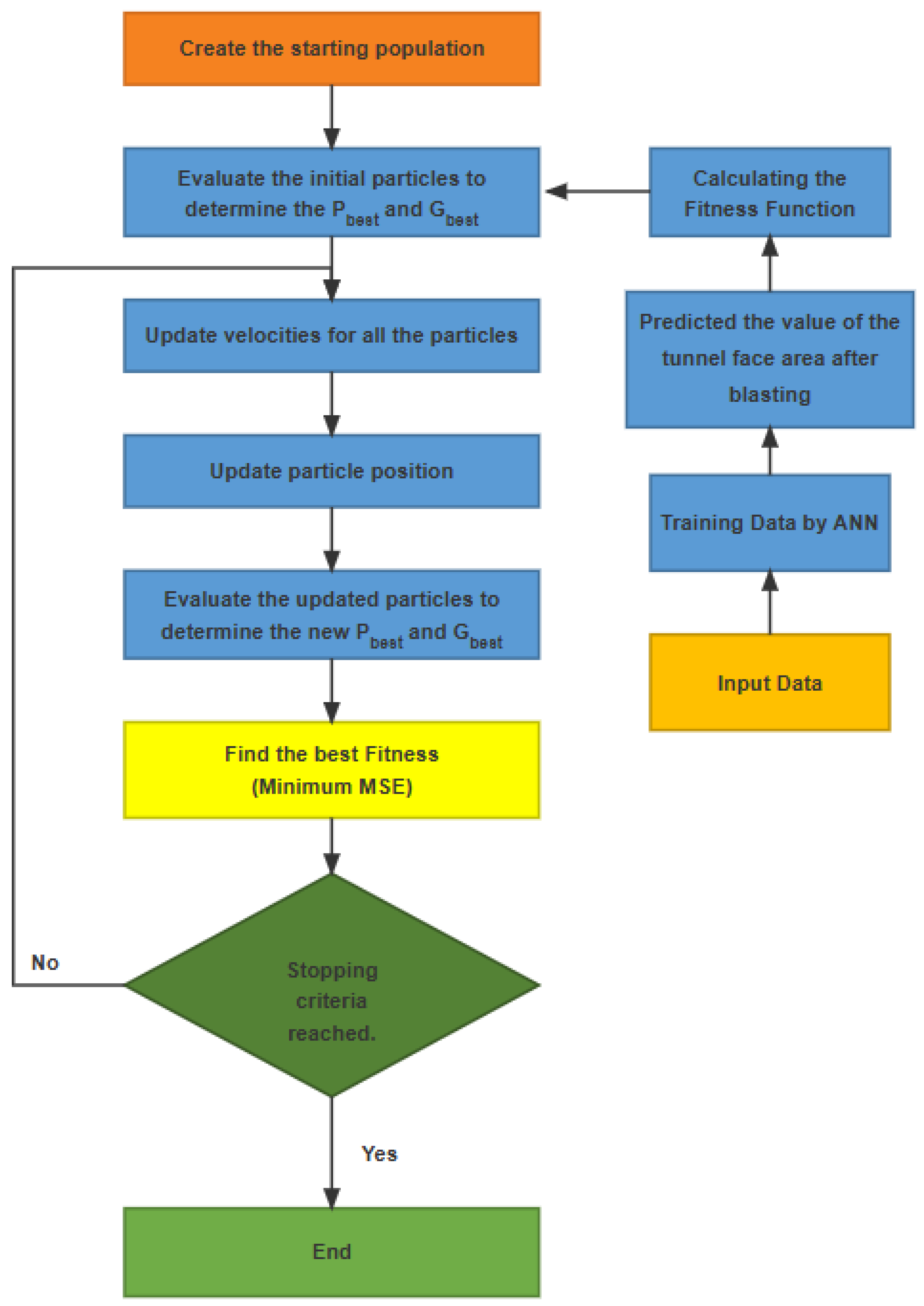
2.6. The Hybrid PSO-ANN Model
2.6.1. Contents of the Hybrid PSO-ANN Model
2.6.2. Parameters of the Hybrid PSO-ANN Model
- The swarm size of the PSO-ANN model

- 2.
- Termination criteria for the optimal algorithm in the hybrid PSO-ANN model
- 3.
- Determining the coefficients C1 and C2 of the velocity equation in the hybrid PSO-base ANN model
- 4.
- Inertia weight (w) for the PSO-ANN model
3. Results and Discussion
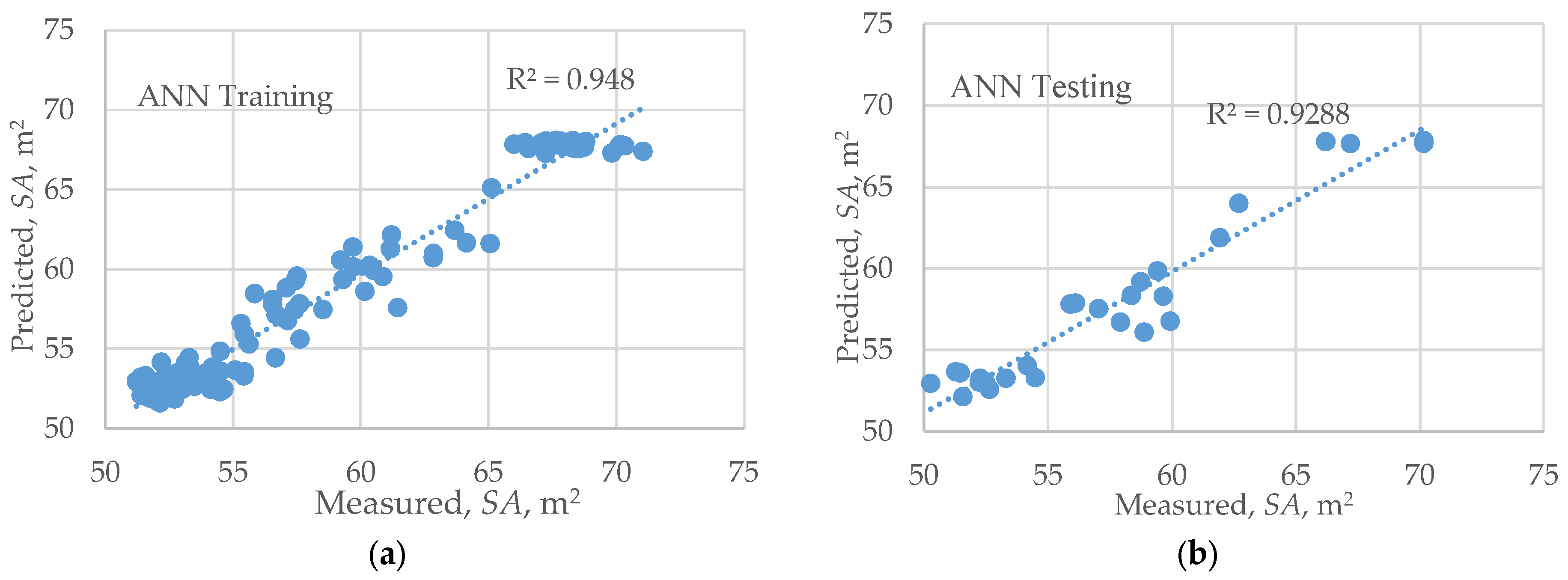
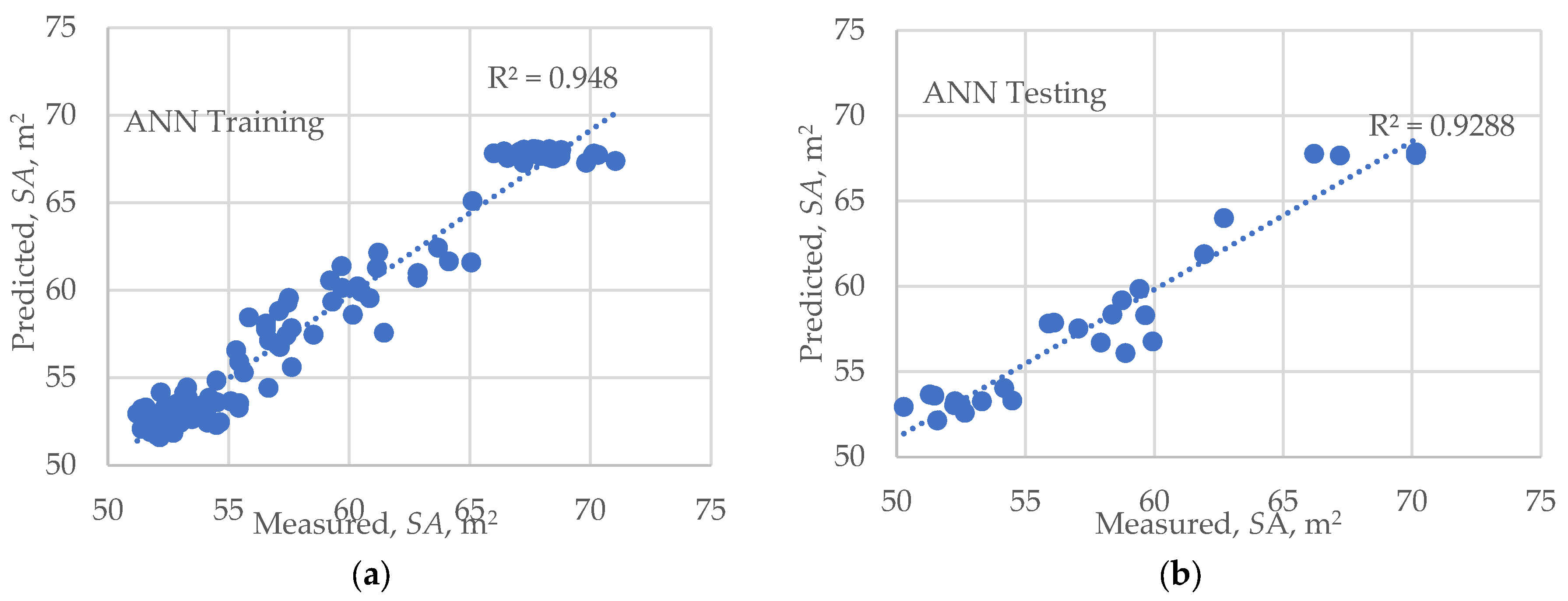
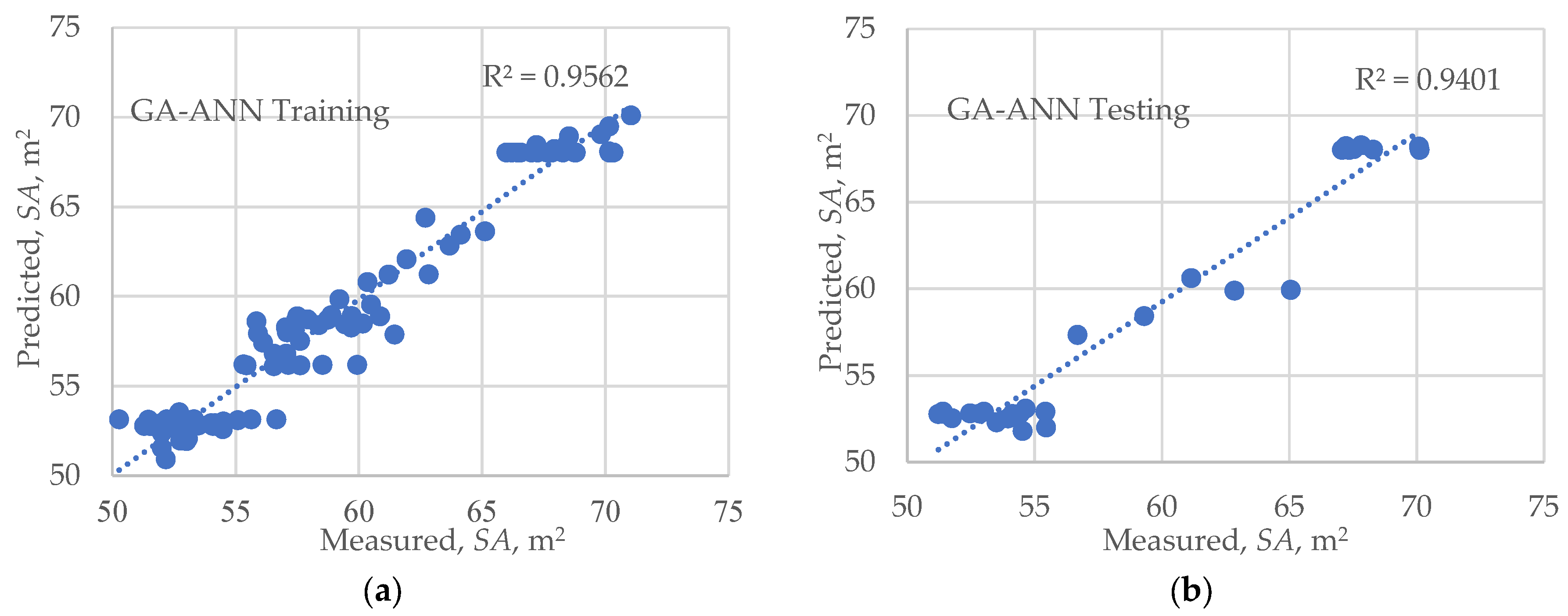
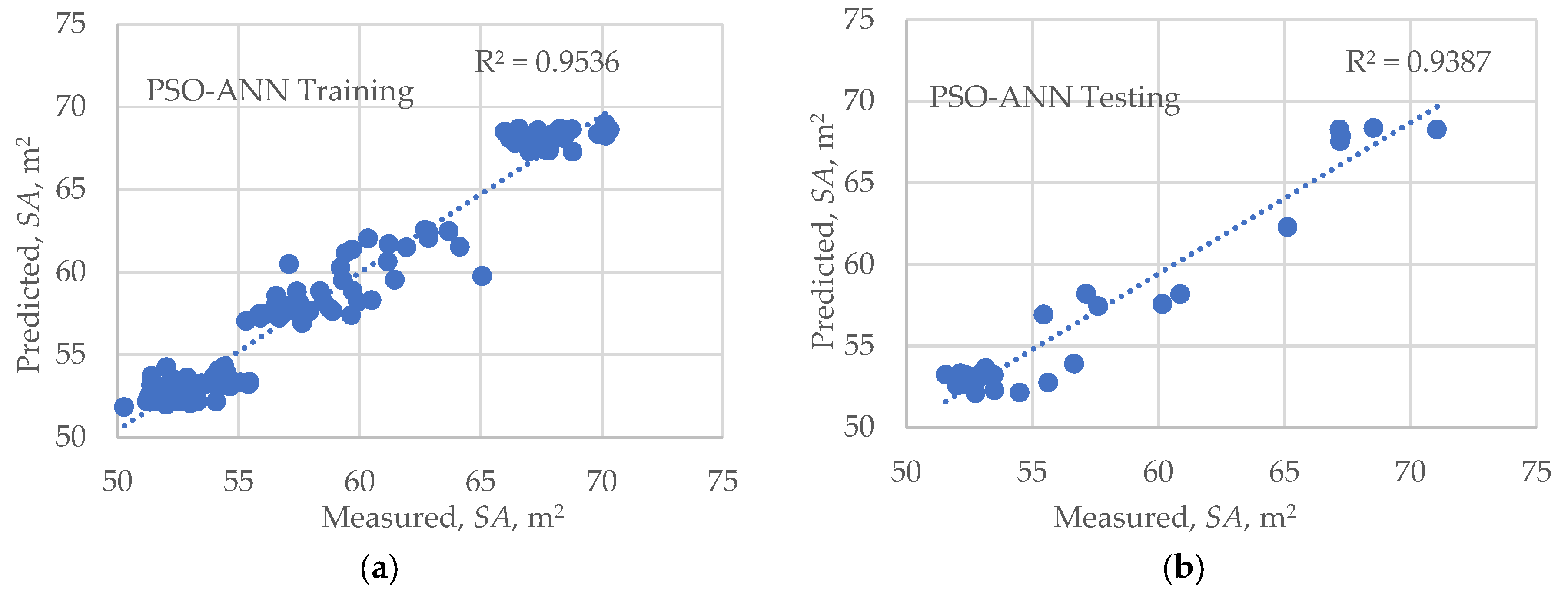
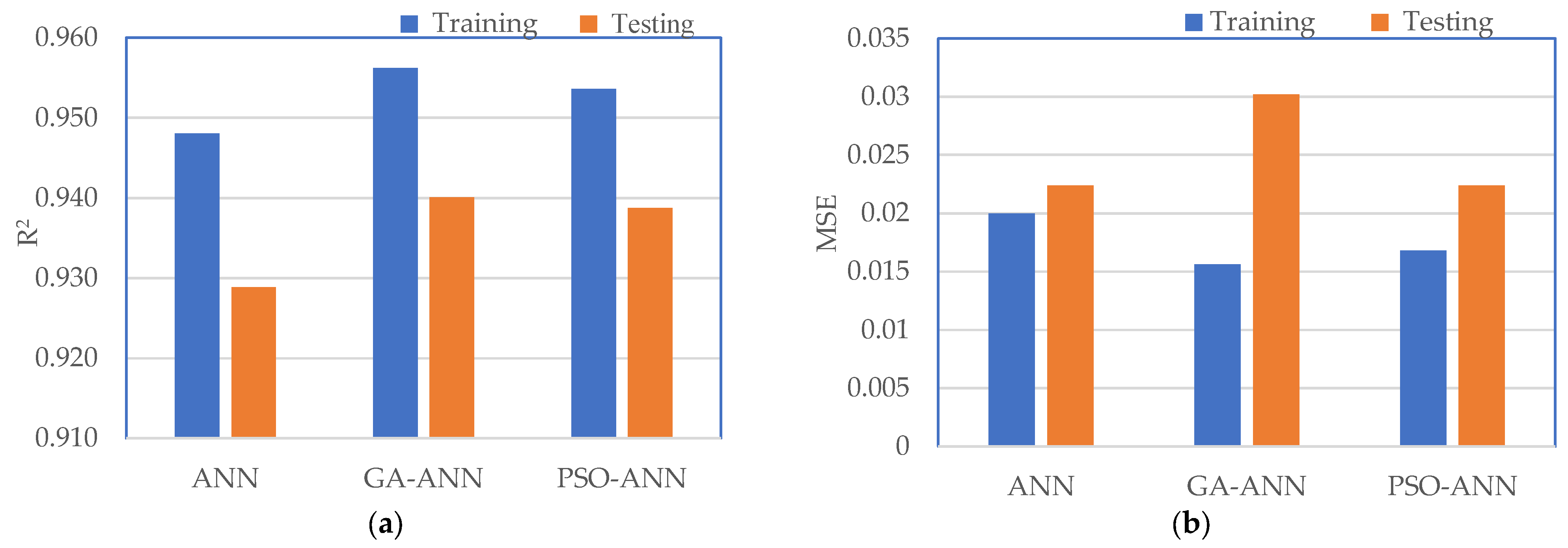
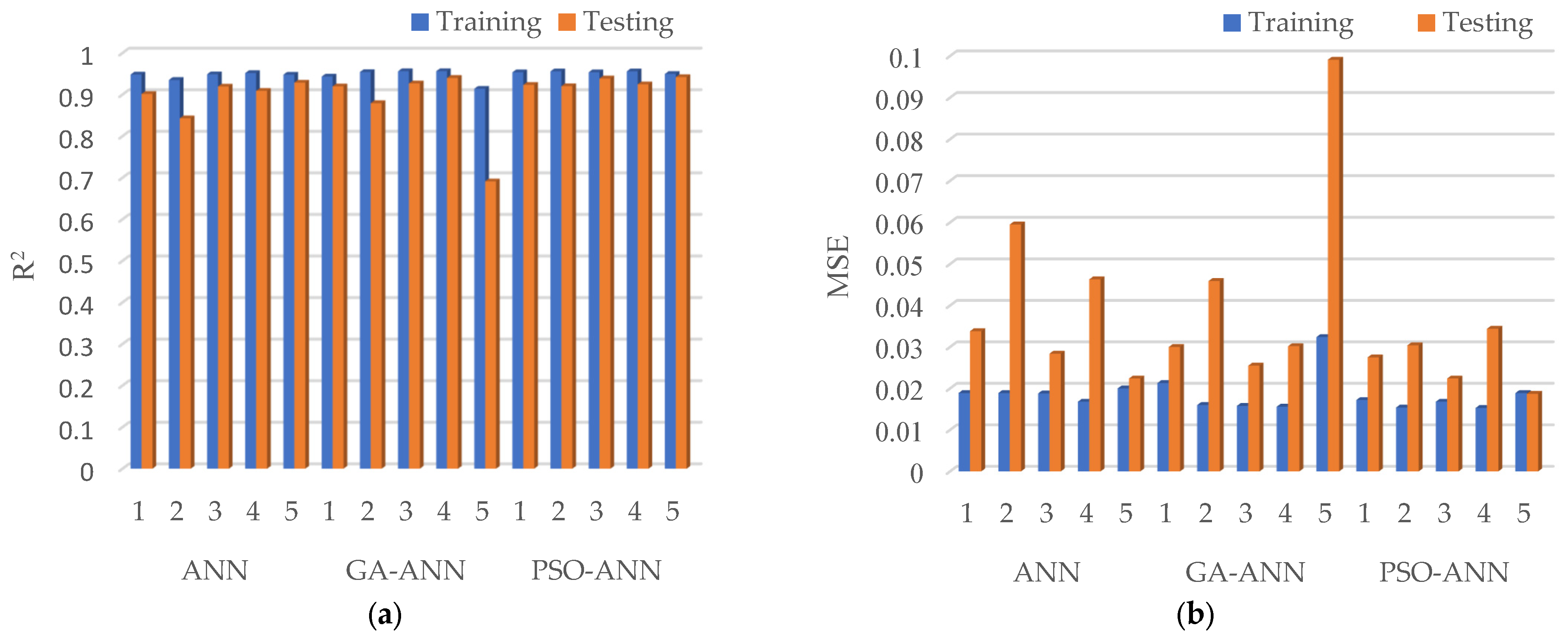
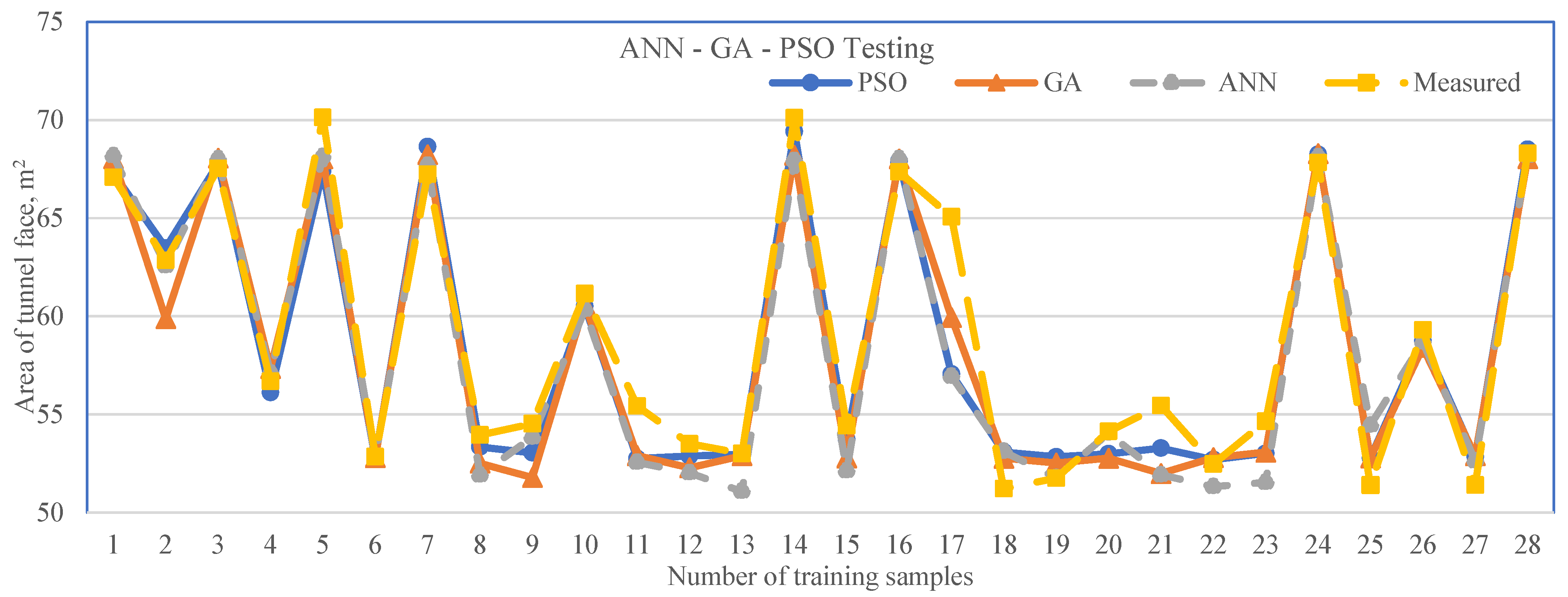
- The optimal model using the hybrid GA-ANN model (a genetic algorithm combined with an artificial neural network) demonstrated the best performance and accuracy, with R2training = 0.9562, R2testing = 0.94, MSEtraining = 0.0156, and MSEtesting = 0.0302. The optimal hybrid PSO-ANN (the particle swarm optimization PSO algorithm combined with the artificial neural network ANN) model achieved the next best results, with R2training = 0.9536, R2testing = 0.9387, MSEtraining = 0.0168, and MSEtesting = 0.0224. The optimal ANN model performed the worst (lowest model accuracy), with R2training = 0.948, R2testing = 0.9288, MSEtraining = 0.02, and MSEtesting = 0.0224;
- Due to the use of random data, the results of these algorithms can vary, depending on the size and quality of the database used for training and testing. For the hybrid GA-ANN model (the genetic algorithm combined with an artificial neural network), the population size was a key parameter that required optimization for each model. Similarly, for the hybrid PSO-ANN model (particle swarm optimization combined with an artificial neural network), the parameters to be optimized included the swarm size, the velocity coefficients C1 and C2, and the initial weight w.
- The use of hybrid models (GA-ANN and PSO-ANN) improved the accuracy of the model results. However, the processing time required by these hybrid models also tended to increase proportionally to their accuracy. In the GA-ANN hybrid model, in which the genetic algorithm (GA) is used to optimize the ANN model, the average processing time to produce results with the same input dataset used in this study was 3862.65 s. For the hybrid PSO-ANN model, the average processing time with the same input dataset was 1867.8 s. In comparison, the ANN model alone processed the same data in just 8 to 25 s. The computer used has the following specifications: Core i7, 7820 HQ configuration, 3.2 GHz CPU, and 16 GB of RAM.
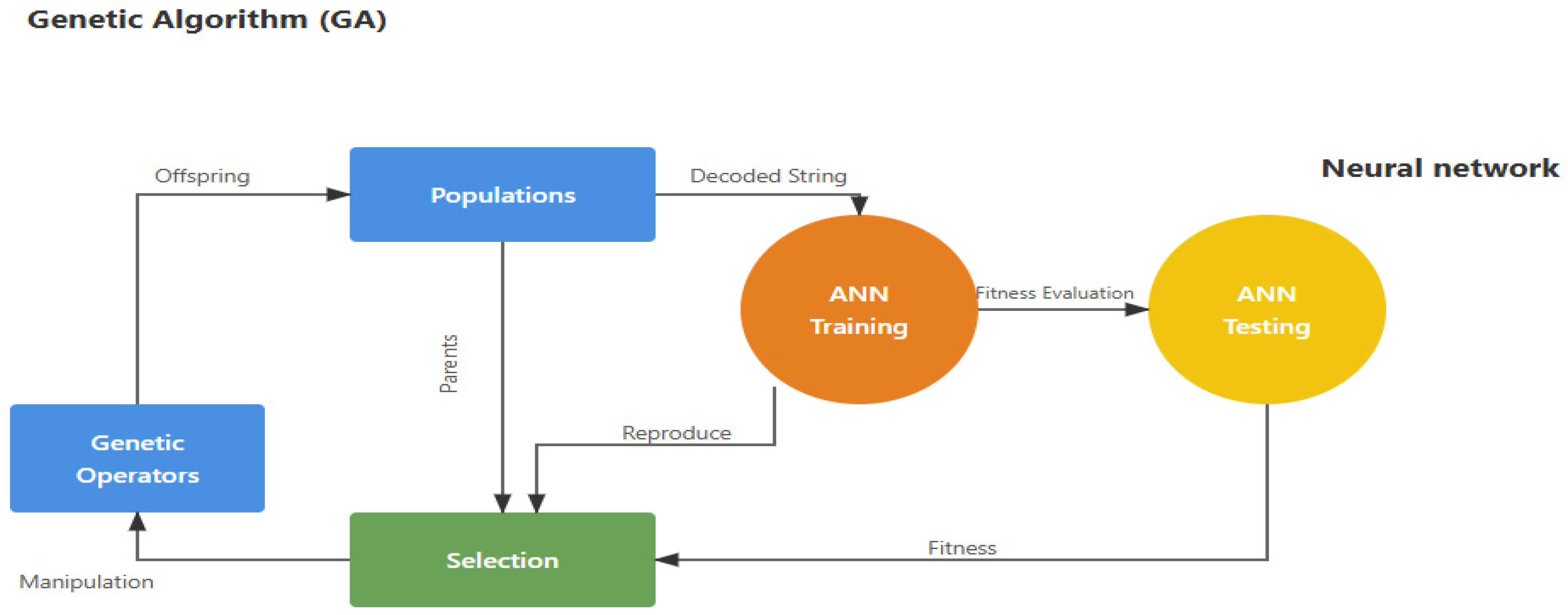
- Genetic algorithms (GAs) and particle swarm optimization (PSO) differ in their mechanisms. A GA uses genetic operations, such as crossover and mutation, to evolve solutions. PSO, on the other hand, uses social interaction and individual memory to guide particle movement. Regarding information sharing, a GA shares information indirectly through selection and crossover, while a PSO algorithm shares information directly using pbest (personal best) and gbest (global best) values. To maintain diversity, a GA relies on mutation to introduce new variations, while a PSO algorithm maintains diversity through the independent movement of particles and their stored best individual positions. In terms of suitability, GAs are often effective for a wide range of optimization problems, including discrete and combinatorial ones. PSO works especially well for continuous optimization problems and often converges more quickly. In this study, GA-ANN hybrid models outperformed PSO-ANN hybrid models in predicting the tunnel face area after blasting. This difference in performance can be attributed to the operating characteristics of the GA and PSO algorithms. Given the characteristics of the data used to build these models, some input variables exhibited significantly different properties compared to others. Consequently, the PSO algorithm, which models the social behavior of bird flocks to find optimal solutions without using genetic operators, may have been less effective. PSO relies on memorizing the best solutions found by individual particles and the entire swarm. Therefore, its predictions of the tunnel face area after blasting were not as accurate as those of the GA model, which uses selection, crossover, and mutation to evolve a set of potential solutions.
4. Sensitivity Analysis
5. Suggestions and Further Study
6. Conclusions
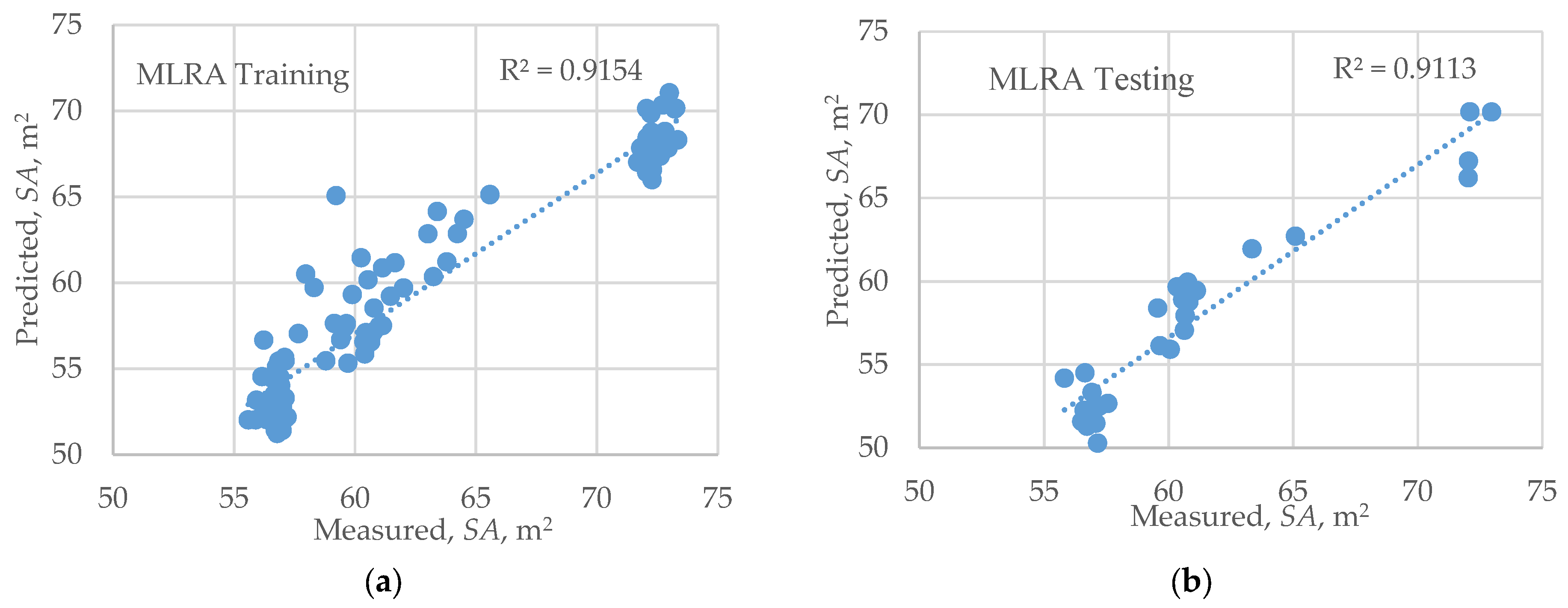
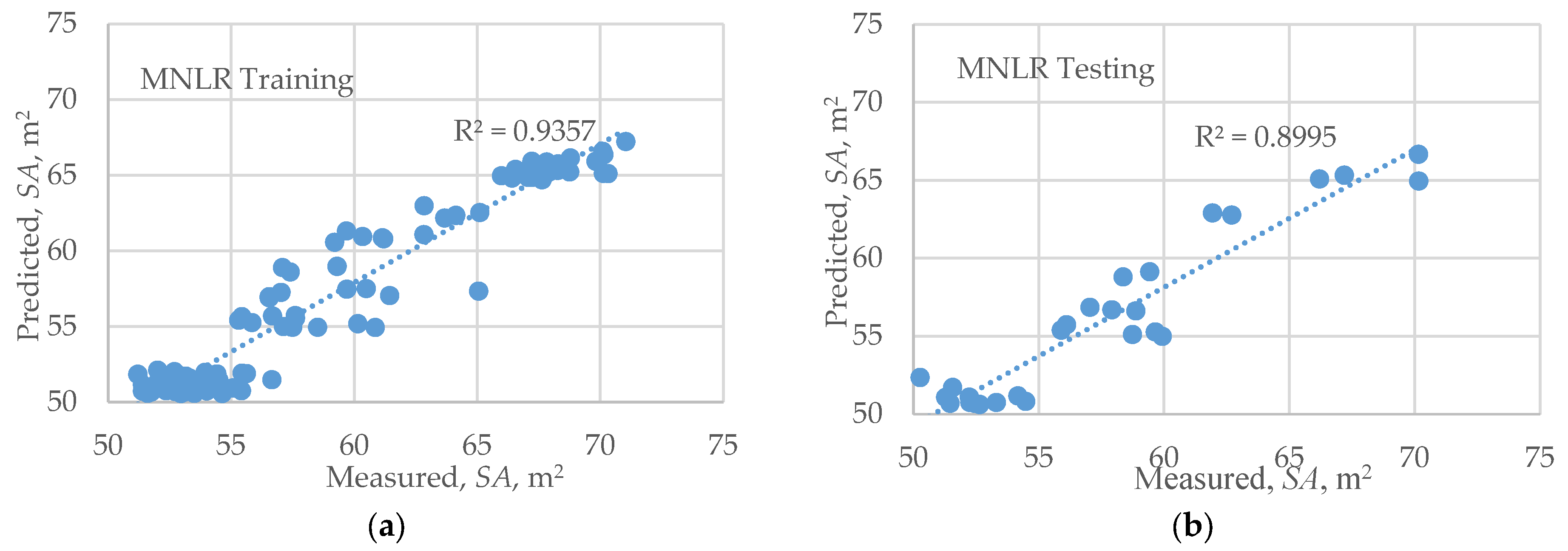
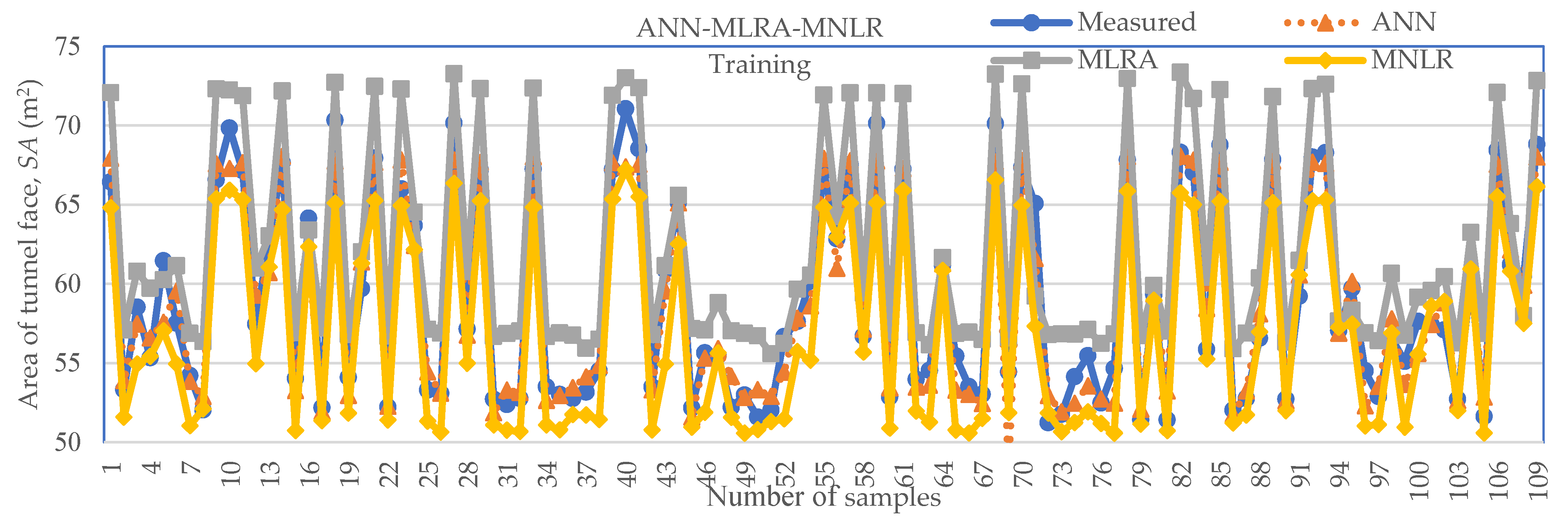
- Both multiple linear regression analysis (MLRA) and multiple nonlinear regression (MNLR) models can accurately calculate and predict the area of a tunnel face after blasting. However, the multiple nonlinear regression (MNLR) model provides more accurate results than the multiple linear regression analysis (MLRA) model.
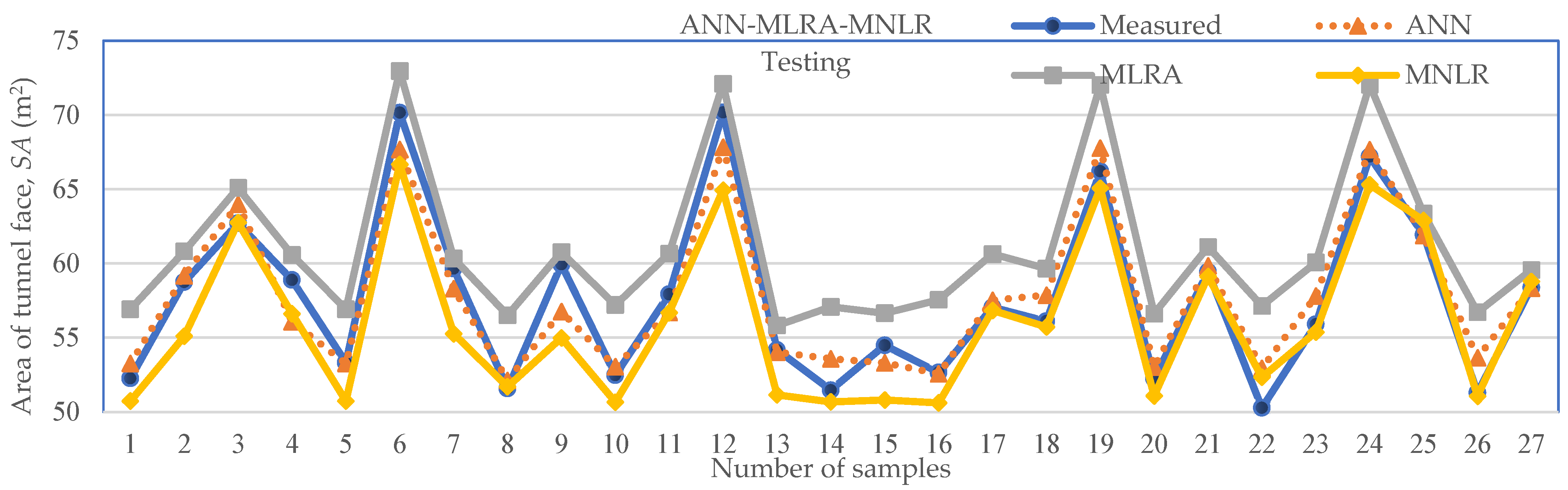
- This study employed deep learning, specifically an artificial neural network (ANN), to predict the area of a tunnel face after blasting with greater accuracy than multiple linear regression analysis (MLRA) and multiple nonlinear regression (MNLR) models. The ANN model’s prediction performance (R2) in both the training and testing datasets surpassed that of the multiple linear regression analysis (MLRA) model and the multiple nonlinear regression (MNLR) model.
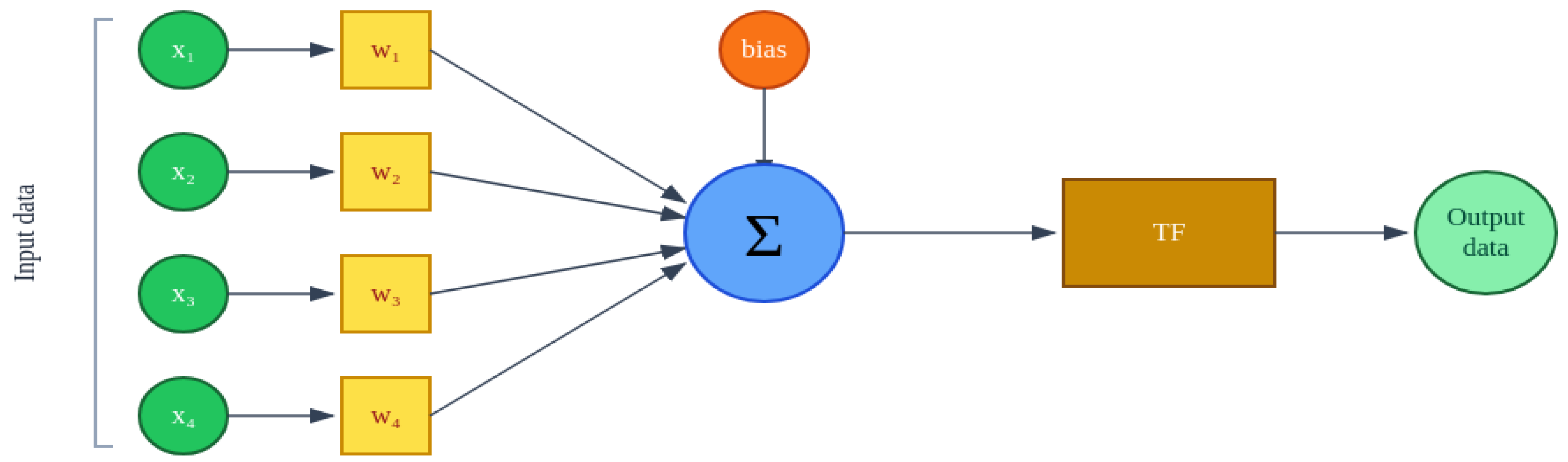
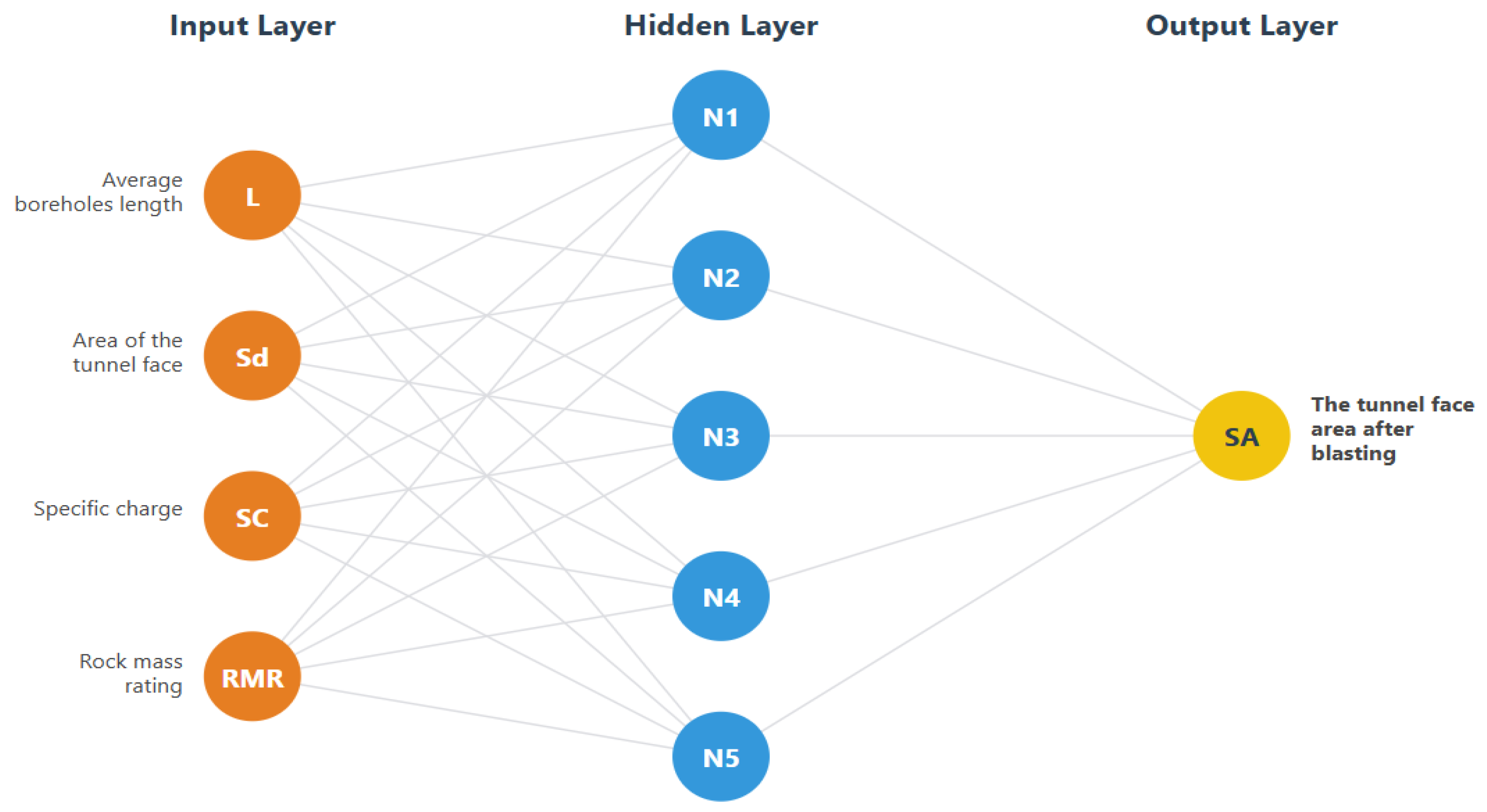
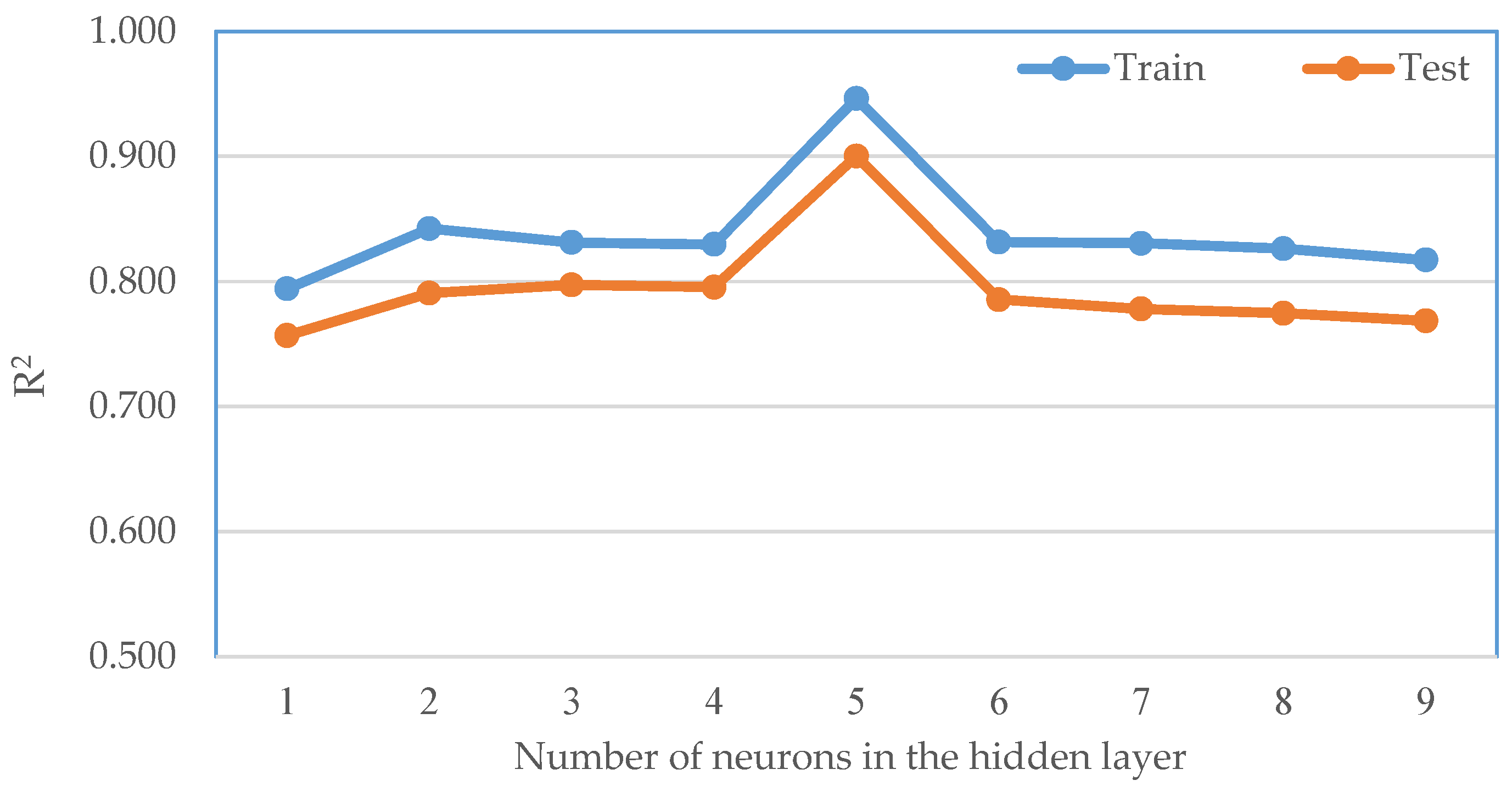
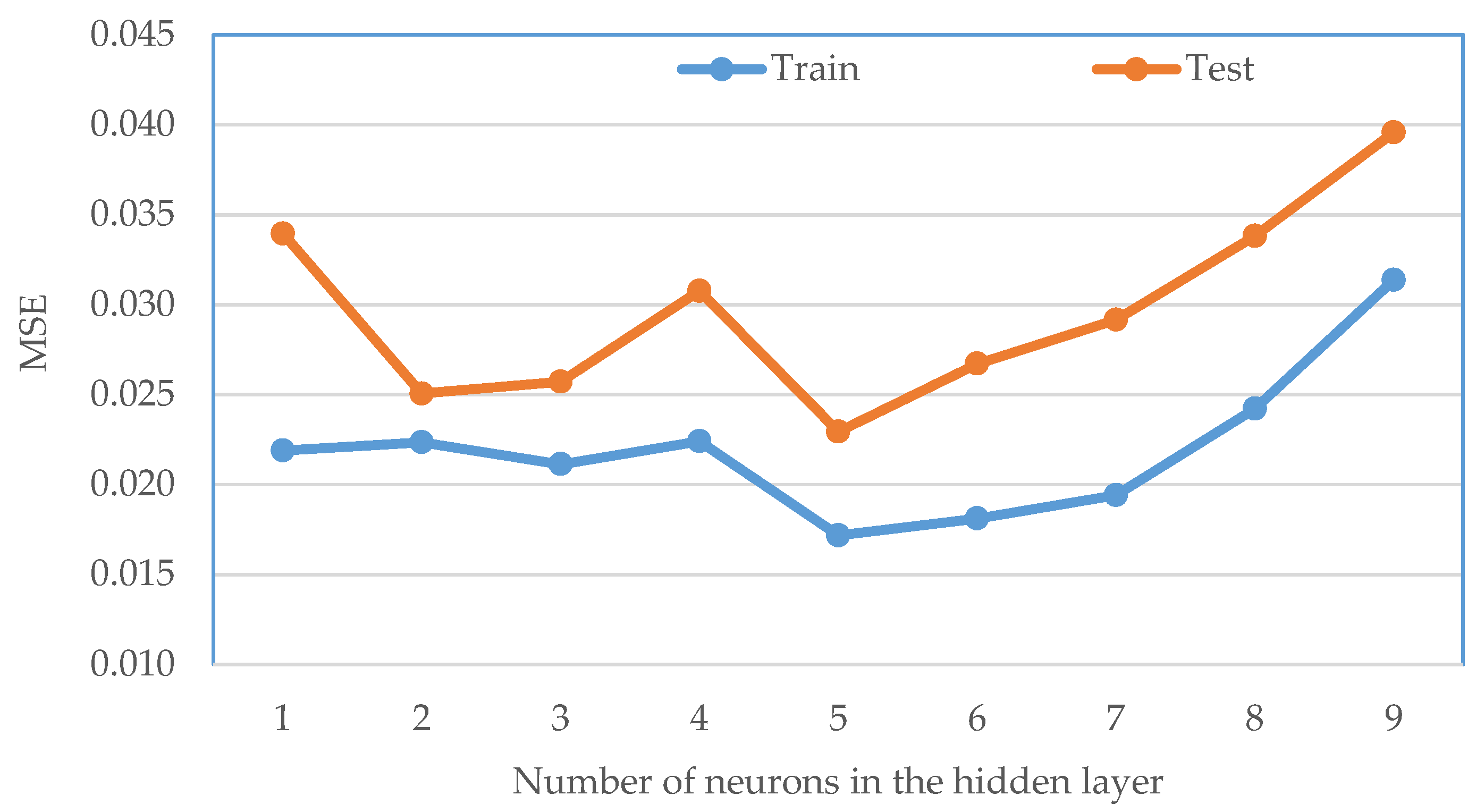
- The results obtained with the ANN model informed the optimal architecture for the ANN model (in this study, 4 × 5 × 1 was chosen as the best architecture for the ANN model).
- Hybrid models can be useful in predicting the area of a tunnel face after blasting. These models combine artificial neural networks (ANNs) with optimization algorithms, like genetic algorithms (GAs) or particle swarm optimization (PSO). However, building these models necessitates determining the optimal parameter settings for the algorithms they employ.
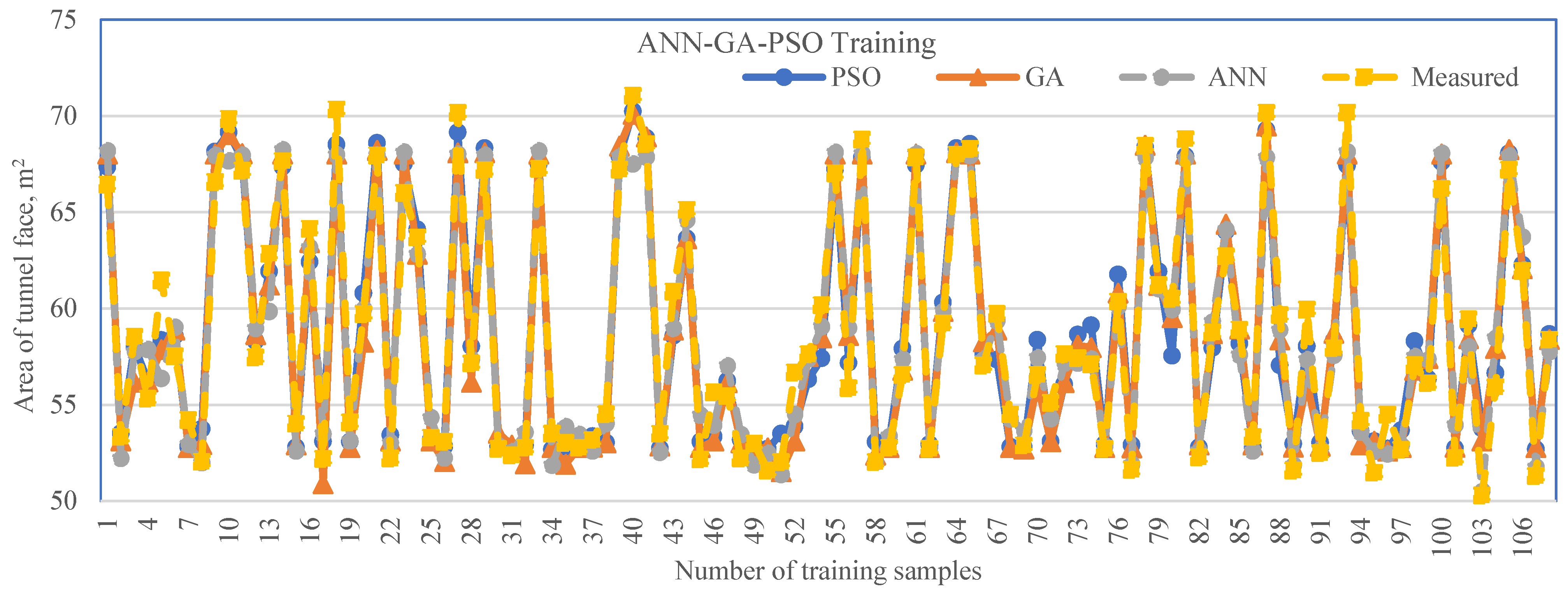
- Combining a genetic algorithm (GA) and particle swarm optimization (PSO) with an artificial neural network (ANN) resulted in models capable of predicting and calculating the area of the tunnel face after blasting with very high accuracy. However, these hybrid models require more powerful hardware and longer processing times compared to ANN models alone. Based on a ranking method using selected performance indices, the best hybrid GA-ANN models were identified (R2training = 0.9562; R2testing = 0.94 and MSEtraining = 0.0156; MSEtesting = 0.0302). However, as indicated in Table 14, the PSO-ANN models exhibited the highest mean accuracy when evaluating the aggregate performance of the GA-ANN, PSO-ANN, and ANN architectures.
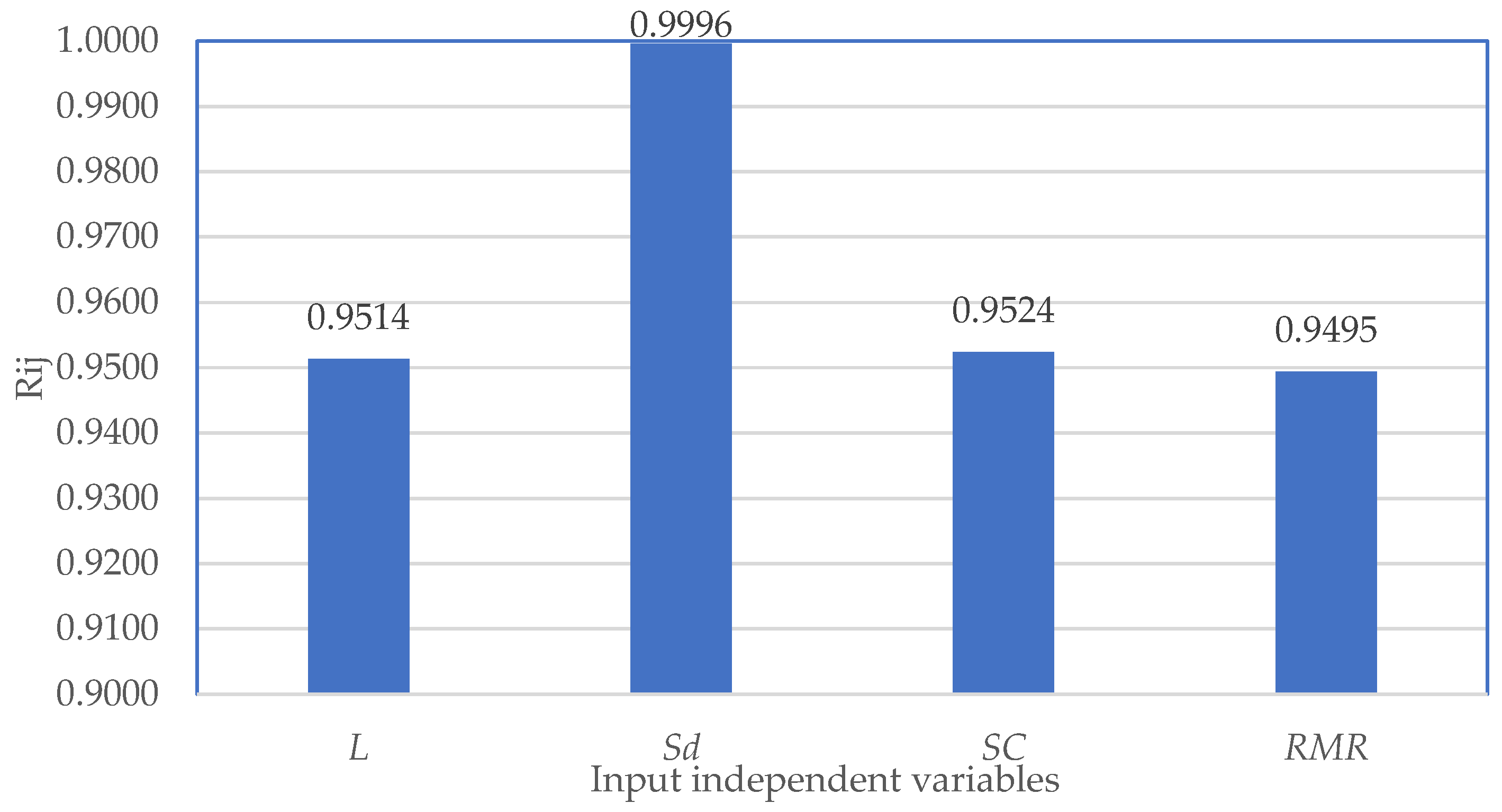
- By analyzing the influence of the parameters (input variables) of the geological environment surrounding the tunnel, the parameters of the tunnel, and the explosives used in the tunnel construction could be determined. In conclusion, the designed tunnel face area Sd is the most influential input variable regarding the models’ results.
- Using a dataset with varying ranges of input variables—including the designed tunnel face area (Sd), specific charge (SC), average borehole length (L), and rock mass rating (RMR)—enables both the artificial intelligence model and the statistical model to predict the area of the tunnel face after blasting across a broad spectrum of input values. However, when the input data fall outside the ranges present in this dataset, the parameters and characteristics of both models must be adjusted to ensure that they maintain accuracy when predicting the tunnel face area after blasting.
Author Contributions
Funding
Data Availability Statement
Acknowledgments
Conflicts of Interest
References
- Lawal, A.; Kwon, S. Application of artificial intelligence to rock mechanics: An overview. J. Rock Mech. Geotech. Eng. 2021, 13, 248–266. [Google Scholar] [CrossRef]
- Jang, H.; Topal, E. Optimizing over break prediction based on geological parameters comparing multiple regression analysis and artificial neural network. Tunn. Undergr. Space Technol. 2013, 38, 161–169. [Google Scholar] [CrossRef]
- Dey, K.; Murthy, V.M.S.R. Prediction of blast induced over break from un-controlled burn-cut blasting in tunnel driven through medium rock class. Tunn. Undergr. Space Technol. 2012, 28, 49–56. [Google Scholar] [CrossRef]
- Chakraborty, A.K.; Raina, A.K.; Ramulu, M.; Choudhury, P.B.; Haldar, A.; Sahoo, P.; Bandopadhyay, C. Development of rational models for tunnel blast prediction based on a parametric study. Geotech. Geol. Eng. 2004, 22, 477–496. [Google Scholar] [CrossRef]
- Murthy, V.M.S.R.; Dey, K.; Raitani, R. Prediction of over break in underground tunnel blasting a case study. J. Can. Tunn. Can. 2003, 109–115. [Google Scholar]
- Innaurato, N.; Mancini, R.; Cardu, M. On the influence of rock mass quality on the quality of blasting work in tunnel driving. Tunn. Undergr. Space Technol. 1998, 13, 81–89. [Google Scholar] [CrossRef]
- Ibarra, J.A.; Maerz, N.H.; Franklin, J.A. Overbreak and under break in underground openings Part2: Causes and implications. Geotech. Geol. Eng. 1996, 14, 325–340. [Google Scholar] [CrossRef]
- Mandal, S.K.; Singh, M.M.; Dasgupta, S. Theoretical concept to understand plan and design smooth blasting pattern. Geotech. Geol. Eng. 2008, 26, 399–416. [Google Scholar] [CrossRef]
- Singh, S.P.; Xavier, P. Causes, impact and control of over break in underground excavation. Tunn. Undergr. Space Technol. 2005, 20, 63–71. [Google Scholar] [CrossRef]
- Shiwei, S.; Lie, N.; Shulin, D.; Yan, X. Influence mechanism of lamella joints on tunnel blasting effect. Res. J. Appl. Sci. Eng. Technol. 2013, 5, 4905–4908. [Google Scholar]
- Mottahedi, A.; Sereshki, F.; Ataei, M. Development of overbreak prediction models in drill and blast tunneling using soft computing methods. Eng. Comput. 2018, 34, 45–58. [Google Scholar] [CrossRef]
- Monjezi, M.; Dehghani, H. Evaluation of effect of blasting pattern parameters on back break using neural networks. Int. J. Rock Mech. Min. Sci. 2008, 45, 1446–1453. [Google Scholar] [CrossRef]
- Khandelwal, M.; Singh, T.N. Prediction of blast-induced ground vibration using artificial neural network. Int. J. Rock Mech. Min. Sci. 2009, 46, 1214–1222. [Google Scholar] [CrossRef]
- Monjezi, M.; Ahmadi, M.; Sheikhan, A.; Bahrami, M.; Salimi, A.R. Predicting blast-induced ground vibration using various types of neural networks. Soil Dyn. Earthq. Eng. 2010, 30, 1233–1236. [Google Scholar] [CrossRef]
- Rezaei, M.; Monjezi, A.; Yazdian, V. Development of a fuzzy model to predict flyrock in surface mining. Saf. Sci. 2011, 49, 298–305. [Google Scholar] [CrossRef]
- Jang, H.; Topal, E. A review of soft computing technology applications in several mining problems. Appl. Soft Comput. 2014, 22, 638–651. [Google Scholar] [CrossRef]
- Bazzazi, A.; Esmaeili, M. Prediction of Backbreak in Open Pit Blasting by Adaptive Neuro-Fuzzy Inference System. Arch. Min. Sci. 2012, 57, 933–943. [Google Scholar] [CrossRef]
- Ghasemi, E.; Kalhori, H.; Bagherpour, R. A new hybrid ANFIS–PSO model for prediction of peak particle velocity due to bench blasting. Eng. Comput. 2016, 32, 607–614. [Google Scholar] [CrossRef]
- Armaghani, D.J.; Shoib, R.S.N.; Faizi, K.; Rashid, A.S.A. Developing a hybrid PSO-ANN model for estimating the ultimate bearing capacity of rock-socketed piles. Neural Comput. Appl. 2015, 28, 391–405. [Google Scholar] [CrossRef]
- Mohamad, E.T.; Armaghani, A.J.; Hasanipanah, M.; Bhatawdekar, R. Estimation of air-overpressure produced by blasting operation through a neuro-genetic technique. Environ. Earth Sci. 2016, 75, 174. [Google Scholar] [CrossRef]
- Hasanipanah, M.; Naderi, R.; Kashir, J.; Noorani, S.A.; Qaleh, A.Z.A. Prediction of blast-produced ground vibration using particle swarm optimization. Eng. Comput. 2017, 33, 173–179. [Google Scholar] [CrossRef]
- Hasanipanah, M.; Saeid, B.G.; Larki, I.A.; Yazdanpanah, M. Estimation of blast-induced ground vibration through a soft computing framework. Eng. Comput. 2017, 33, 951–959. [Google Scholar] [CrossRef]
- Mohammadi, H.; Barati, B.; Chamzini, A.I. Prediction of Blast-Induced Overbreak Based on Geomechanical Parameters, Blasting Factors and the Area of Tunnel Face. Geotech. Geol. Eng. 2018, 36, 425–437. [Google Scholar] [CrossRef]
- Chen, X.L.; Fu, J.P.; Yao, J.L.; Gan, J.F. Prediction of shear strength for squat RC walls using a hybrid ANN–PSO model. Eng. Comput. 2018, 34, 367–383. [Google Scholar] [CrossRef]
- Mottahedi, A.; Sereshki, F.; Mohammad, A. Overbreak prediction in underground excavations using hybrid ANFIS-PSO model. Tunn. Undergr. Space Technol. 2018, 80, 1–9. [Google Scholar] [CrossRef]
- Nguyen, H.; Bui, X.-N.; Tran, Q.-H.; Moayedi, H. Predicting blast-induced peak particle velocity using BGAMs, ANN and SVM: A case study at the Nui Beo open-pit coal mine in Vietnam. Environ. Earth Sci. 2019, 78, 479. [Google Scholar] [CrossRef]
- Liu, Y.; Hou, S. Rockburst prediction based on particle swarm optimization and machine learning algorithm. In Proceedings of the 3rd International Conference on Information Technology in Geo-Engineering (3rd ICITG2019), Guimarães, Portugal, 29 September–2 October 2019; pp. 290–303. [Google Scholar]
- Roy, G.D.; Singh, T.N. Predicting deformational properties of Indian coal: Soft computing and regression analysis approach. Measurement 2019, 149, 106975. [Google Scholar] [CrossRef]
- Shang, Y.; Nguyen, H.; Bui, X.N.; Tran, Q.H. A Novel Artificial Intelligence Approach to Predict Blast- Induced Ground Vibration in Open-Pit Mines Based on the Firefly Algorithm and Artificial Neural Network. Nat. Resour. Res. 2019, 29, 723–737. [Google Scholar] [CrossRef]
- Chi, T.N.; Do, N.A.; Pham, V.V.; Nguyen, P.T.; Gospodarikov, A. Prediction of blast-induced the area of the tunnel face in underground excavations. Int. J. GEOMATE 2022, 23, 136–143. [Google Scholar] [CrossRef]
- Rustan, A.P. Micro-sequential contour blasting-how does it influence the surrounding rock mass. Eng. Geol. 1998, 49, 303–313. [Google Scholar] [CrossRef]
- Germain, P.; Hadjigeorgiou, J. Influence of stope geometry and blasting patterns on recorded overbreak. Int. J. Rock Mech. Min. Sci. 1997, 34, 115.e1–115.e12. [Google Scholar] [CrossRef]
- Imashev, A.; Mussin, A.; Adoko, A.C. Investigating an Enhanced Contour Blasting Technique Considering Rock Mass Structural Properties. Appl. Sci 2024, 14, 11461. [Google Scholar] [CrossRef]
- Mahtab, M.A.; Rossler, K.; Kalamaras, G.S.; Grasso, P. Assessment of geological overbreak for tunnel design and contractual claims. Int. J. Rock Mech. Min. Sci. 1997, 34, 185.e1–185.e13. [Google Scholar] [CrossRef]
- Maerz, N.H.; Ibarra, J.A.; Franklin, J.A. Overbreak and underbreak in underground openings Part 1: Measurement using the light sectioning method digital image processing. Geotech. Geol. Eng. 1996, 14, 307–323. [Google Scholar] [CrossRef]
- Konya, C.J.; Walter, E.J. Surface Blast Design; Prentice Hall: Englewood Cliffs, NJ, USA, 1990. [Google Scholar]
- Mohammadi, M.; Farouq, M.H.; Mirzapour, B.; Hajiantilaki, N. Use of fuzzy set theory for minimizing overbreak in underground blasting operations—A case study of Alborz Tunnel, Iran. Int. J. Min. Sci. Technol. 2015, 25, 439–445. [Google Scholar] [CrossRef]
- Mohamad, E.T.; Faradonbeh, R.S.; Armaghani, D.J.; Monjezi, M.; Majid, M.Z.A. An optimized ANN model based on genetic algorithm for predicting ripping production. Neural Comput. Appl. 2017, 28, 393–406. [Google Scholar] [CrossRef]
- Hajihassani, M.; Armaghani, D.J.; Sohaei, H.; Tonnizam, E.M.; Marto, A. Prediction of airblast-overpressure induced by blasting using a hybrid artificial neural network and particle swarm optimization. Appl. Acoust. 2014, 80, 57–67. [Google Scholar] [CrossRef]
- Basser, H.; Karami, H.; Shamshirband, S.; Akib, S.; Mohsen Amirmojahedi, M.; Ahmad, R.; Jahangirzadeh, A.; Javidnia, H. Hybrid ANFIS–PSO approach for predicting optimum parameters of a protective spur dike. Appl. Soft Comput. 2015, 30, 642–649. [Google Scholar] [CrossRef]
- Guo, Z.; Xu, L.; Zheng, Y.; Xie, J.; Wang, T. Bearing fault diagnostic framework under unknown working conditions based on condition-guided diffusion model. Measurement 2025, 242, 115951. [Google Scholar] [CrossRef]
- Guo, Z.; Li, J.; Wang, T.; Xie, J.; Yang, J.; Niu, B. Dynamically Constrained Digital Twin-Based Mechanical Diagnosis Framework Under Undetermined States Without Fault Data. IEEE Trans. Instrum. Meas. 2025, 74, 3547715. [Google Scholar] [CrossRef]
- Gokceoglu, C.; Zorlu, K. A Fuzzy Model to Predict the Uniaxial Compressive Strength and the Modulus of Elasticity of a Problematic Rock. Eng. Appl. Artif. Intell. 2004, 17, 61–72. [Google Scholar] [CrossRef]
- Neter, J.; Wasserman, W.; Kutner, M.H. Applied Linear Regression Models, 2nd ed.; Richard, D. Irwin Inc.: Homewood, IL, USA, 1989. [Google Scholar]
- Bui, M.T.; Chi, T.; Gospodarikov, A.P.; Zatsepin, M.A. Developing prediction models for the cross-sectional areas of tunnels during drilling and blasting. Min. Inf. Anal. Bull. 2024, 6, 31–49. [Google Scholar] [CrossRef]
- Craparo, R.M. Significance level. In Encyclopedia of Measurement and Statistics; Salkind, N.J., Ed.; SAGE Publications: Thousand Oaks, CA, USA, 2007; pp. 889–891. [Google Scholar]
- Fisher, M. Exploration in savings behaviour. Bull. Oxf. Univ. Inst. Econ. Stat. 1956, 18, 201–277. [Google Scholar] [CrossRef]
- Specht, D.F. A General Regression Neural Network. IEEE Trans. Neural Netw. 1991, 2, 568–576. [Google Scholar] [CrossRef] [PubMed]
- Simpson, P.K. Artificial Neural System: Foundation, Paradigms Applications and Implementations; Pergamon: New York, NY, USA, 1990. [Google Scholar]
- Yılmaz, I.; Yuksek, A.G. An Example of Artificial Neural Network (ANN) Application for Indirect Estimation of Rock Parameters. Rock Mech. Rock Eng. 2008, 41, 781–795. [Google Scholar] [CrossRef]
- Armaghani, D.J.; Mohamad, E.T.; Narayanasamy, M.S.; Narita, N. Development of hybrid intelligent models for predicting TBM penetration rate in hard rock condition. Tunn. Undergr. Space Technol. 2017, 63, 29–43. [Google Scholar] [CrossRef]
- Basheer, I.; Hajmeer, M.N. Artificial Neural Networks: Fundamentals, Computing, Design, and Application. J. Microbiol. Methods 2001, 43, 3–31. [Google Scholar] [CrossRef]
- Motahari, M. Development of a PSO-ANN Model for Rainfall-Runoff Response in Basins, Case Study: Karaj. Civ. Eng. J. 2017, 3, 35–44. [Google Scholar] [CrossRef]
- Hecht-Nielsen, R. Kolmogorov’s mapping neural network existence theorem. In Proceedings of the First IEEE International Conference on Neural Networks, San Diego, CA, USA, 21–24 June 1987; pp. 11–14. [Google Scholar]
- Ripley, B.D. Statistical aspects of neural networks. In Networks and Chaos-Statistical and Probabilistic Aspects; Barndoff-Neilsen, O.E., Jensen, J.L., Kendall, W.S., Eds.; Chapman & Hall: London, UK, 1993; pp. 40–123. [Google Scholar]
- Paola, J.D. Neural Network Classification of Multispectral Imagery. Master’s Thesis, The University of Arizona, Tucson, AZ, USA, 1994. [Google Scholar]
- Wang, C. A Theory of Generalization in Learning Machines with Neural Application. Ph.D. Thesis, The University of Pennsylvania, Philadelphia, PA, USA, 1994. [Google Scholar]
- Masters, T. Practical Neural Network Recipes in C++; Academic Press: Boston, MA, USA, 1994. [Google Scholar]
- Kaastra, I.; Boyd, M. Designing a neural network for forecasting financial and economic time series. Neurocomputing 1996, 10, 215–236. [Google Scholar] [CrossRef]
- Holland, J.H. Adaptation in Natural and Artificial Systems: An Introductory Analysis with Applications to Biology, Control, and Artificial Intelligence; University of Michigan Press: Ann Arbor, MI, USA, 1975. [Google Scholar]
- Do, H.H.; Bui, M.T.; Nguyen, C.T. Optimizing an artificial Intelligence model to predict the tunnel face area after blasting. J. Pol. Miner. Eng. Soc. 2025, 1, 291–304. [Google Scholar] [CrossRef]
- Diamantidis, N.A.; Karlis, D.; Giakoumakis, E.A. Unsupervised Stratification of Cross-Validation for Accuracy Estimation. Artif. Intell. 2000, 116, 1–16. [Google Scholar] [CrossRef]
- Zorlu, K.; Gokceoglu, C.; Ocakoglu, F.; Nefeslioglu, H.A.; Acikalin, S. Prediction of uniaxial compressive strength of sandstones using petrography- based models. Eng. Geol. 2008, 96, 141–158. [Google Scholar] [CrossRef]
- Kennedy, J.; Eberhart, R. Particle swarm optimization. In Proceedings of the IEEE International Conference on Neural Networks, Perth, WA, Australia, 27 November–1 December 1995; pp. 1942–1948. [Google Scholar]
- Clerc, M.; Kennedy, J. The Particle Swarm: Explosion, Stability, and Convergence in a Multi-Dimensional Complex Space. IEEE Trans. Evol. Comput. 2002, 6, 58–73. [Google Scholar] [CrossRef]
- Momeni, E.; Armaghani, D.J.; Hajihassani, M.; Amin, M.F.M. Prediction of uniaxial compressive strength of rock samples using hybrid particle swarm optimization-based artificial neural networks. Measurement 2015, 60, 50–63. [Google Scholar] [CrossRef]
- Zhao, S.; Wang, L.; Cao, M. Chaos Game Optimization-Hybridized Artificial Neural Network for Predicting Blast-Induced Ground Vibration. Appl. Sci. 2024, 14, 3759. [Google Scholar] [CrossRef]
- Yang, Y.; Zang, O. A hierarchical analysis for rock engineering using artificial neural networks. Rock Mech. Rock Eng. 1997, 30, 207–222. [Google Scholar] [CrossRef]








| Number | Authors | Areas of Study | Models Used |
|---|---|---|---|
| 1 | Monjezi et al. [12] | Evaluating of blasting pattern’s influence on back break | ANN |
| 2 | Khandelwal et al. [13] | Prediction of ground vibration caused by blasting | SVM |
| 3 | Monjezi et al. [14] | Backbreak prediction in open-pit blasting | Fuzzy |
| 4 | Rezaei et al. [15] | Prediction of flyrock in surface mining | Fuzzy |
| 5 | Jang and Topal [2,16] | Prediction of overbreak in tunnel blasting | LMRA, NMRA, and ANN |
| 6 | Bazzazi A. et al. [17] | Prediction of backbreak in open-pit blasting | ANN and ANFIS |
| 7 | Ghasemi et al. [18] | Prediction of peak particle velocity | ANFIS-PSO |
| 8 | Armaghani D.J. et al. [19] | Developing a hybrid PSO-ANN model for estimating ultimate bearing capacity of rock-socketed piles | PSO-ANN |
| 9 | Mohamad E. et al. [20] | Estimating air overpressure from blasting operations | ANN and GA-ANN |
| 10 | Hasanipanah et al. [21] | Prediction of blast-induced ground vibration | PSO |
| 11 | Hasanipanah et al. [22] | Estimation of blast-induced ground vibration | ANN and GA |
| 12 | Mohammadi H. et al. [23] | Prediction of blast-induced overbreak | LMRA |
| 13 | Chen X.L. et al. [24] | Prediction of shear strength for squat RC walls using a hybrid ANN–PSO model. | ANN and PSO |
| 14 | Mottahedi A. et al. [25] | Overbreak prediction in underground excavations | ANFIS and PSO |
| 15 | Nguyen H. et al. [26] | Predicting blast-induced peak particle velocity using BGAMs, ANN, and SVM: case study at Nui Beo open-pit coal mine in Vietnam | BGAMs, ANN, and SVM |
| 16 | Liu, Y., Hou, S. [27] | Rockburst prediction based on particle swarm optimization and machine learning algorithm | ANN-GA |
| 17 | Roy, D.H., Singh, T.N. [28] | Predicting deformational properties of Indian coal: soft computing and regression analysis approach | ANN and ANFIS |
| 18 | Shang, Y. et al. [29] | Novel artificial intelligence approach to predicting blast-induced ground vibration in open-pit mines | ANN, SVM, and KNN |
| 19 | Chi T.N. et al. [30] | Prediction of blast-induced area of tunnel face in underground excavations | ANN and ANFIS |
| Parameter | Symbol | Unit | Category | Min | Max | Mean | Std. Deviation |
|---|---|---|---|---|---|---|---|
| Average borehole length | L | m | Input | 1.0 | 3.2 | 1.9569 | 0.6691 |
| Designed tunnel face area | Sd | m2 | Input | 49.26 | 64.855 | 54.6973 | 6.1486 |
| Specific charge | SC | kg/m3 | Input | 0.32 | 2.54 | 1.4092 | 0.4608 |
| Rock mass rating | RMR | - | Input | 5.0 | 74.0 | 49.7982 | 17.1133 |
| Tunnel face area after blasting | SA | m2 | Output | 50.276 | 71.049 | 59.0051 | 6.3834 |
| Model | Unstandardized Coefficients | Standardized Coefficients | t | Sig | Collinearity Statistics | ||
|---|---|---|---|---|---|---|---|
| B | Std. Error | Beta | Tolerance | VIF | |||
| Constant | 3.997 | 1.406 | 2.842 | 0.05 | |||
| Average borehole length (L) | −0.355 | 0.383 | −0.037 | −0.926 | 0.356 | 0.365 | 2.739 |
| Designed tunnel face area (Sd) | 1.018 | 0.27 | 0.981 | 37.618 | 0.000 | 0.867 | 1.154 |
| Specific charge (SC) | −0.248 | 0.624 | −0.018 | −0.398 | 0.691 | 0.291 | 3.442 |
| Rock mass rating (RMR) | 0.07 | 0.020 | 0.020 | 0.371 | 0.711 | 0.205 | 4.869 |
| Input Variables | R2 of Equations | ||||||||
|---|---|---|---|---|---|---|---|---|---|
| Liners | Logarithmic | Quadratic | Cubic | Compound | Power | Inverse | Exponential | S | |
| Average borehole length (L) | 0.105 | 0.061 | 0.312 | 0.360 | 0.092 | 0.051 | 0.028 | 0.092 | 0.021 |
| Designed tunnel face area (Sd) | 0.938 | 0.940 | 0.941 | 0.941 | 0.928 | 0.935 | 0.941 | 0.930 | 0.938 |
| Specific charge (SC) | 0.046 | 0.02 | 0.093 | 0.119 | 0.04 | 0.016 | 0.004 | 0.04 | 0.002 |
| Rock mass rating (RMR) | 0.067 | 0.011 | 0.420 | 0.540 | 0.056 | 0.007 | 0.00 | 0.038 | 0.00 |
| Heuristic | Reference |
|---|---|
| Hecht-Nielsen [54] | |
| Ripley [55] | |
| Paola [56] | |
| Wang [57] | |
| Masters [58] | |
| Kaastra and Boyd [59] |
| Model | Number of Neurons in the Hidden Layer | Model Results | |||||||||||
|---|---|---|---|---|---|---|---|---|---|---|---|---|---|
| R2 | |||||||||||||
| Iteration 1 | Iteration 2 | Iteration 3 | Iteration 4 | Iteration 5 | Average | ||||||||
| Training | Testing | Training | Testing | Training | Testing | Training | Testing | Training | Testing | Training | Testing | ||
| 1 | 1 | 0.756 | 0.769 | 0.952 | 0.791 | 0.774 | 0.723 | 0.753 | 0.760 | 0.734 | 0.739 | 0.794 | 0.756 |
| 2 | 2 | 0.939 | 0.771 | 0.934 | 0.762 | 0.754 | 0.777 | 0.822 | 0.740 | 0.762 | 0.900 | 0.842 | 0.791 |
| 3 | 3 | 0.939 | 0.758 | 0.921 | 0.740 | 0.771 | 0.769 | 0.760 | 0.756 | 0.763 | 0.962 | 0.831 | 0.797 |
| 4 | 4 | 0.933 | 0.755 | 0.951 | 0.762 | 0.757 | 0.759 | 0.757 | 0.735 | 0.750 | 0.965 | 0.829 | 0.795 |
| 5 | 5 | 0.948 | 0.901 | 0.935 | 0.842 | 0.949 | 0.919 | 0.952 | 0.909 | 0.948 | 0.929 | 0.946 | 0.901 |
| 6 | 6 | 0.937 | 0.768 | 0.952 | 0.687 | 0.764 | 0.778 | 0.757 | 0.725 | 0.746 | 0.968 | 0.831 | 0.785 |
| 7 | 7 | 0.933 | 0.721 | 0.924 | 0.766 | 0.757 | 0.779 | 0.770 | 0.748 | 0.768 | 0.875 | 0.830 | 0.777 |
| 8 | 8 | 0.933 | 0.736 | 0.927 | 0.759 | 0.743 | 0.741 | 0.761 | 0.733 | 0.765 | 0.901 | 0.826 | 0.774 |
| 9 | 9 | 0.932 | 0.725 | 0.944 | 0.750 | 0.742 | 0.711 | 0.743 | 0.729 | 0.723 | 0.926 | 0.817 | 0.768 |
| Model Number | Number of Neurons in the Hidden Layer | Model Results | |||||||||||
|---|---|---|---|---|---|---|---|---|---|---|---|---|---|
| MSE | |||||||||||||
| Iteration 1 | Iteration 2 | Iteration 3 | Iteration 4 | Iteration 5 | Average | ||||||||
| Training | Testing | Training | Testing | Training | Testing | Training | Testing | Training | Testing | Training | Testing | ||
| 1 | 1 | 0.02180 | 0.02480 | 0.01829 | 0.06117 | 0.01524 | 0.03576 | 0.02168 | 0.02413 | 0.03246 | 0.02390 | 0.02189 | 0.03395 |
| 2 | 2 | 0.02210 | 0.02910 | 0.02390 | 0.02194 | 0.02232 | 0.01779 | 0.02344 | 0.01806 | 0.01999 | 0.03839 | 0.02235 | 0.02506 |
| 3 | 3 | 0.02210 | 0.03470 | 0.02771 | 0.02962 | 0.01652 | 0.01867 | 0.02069 | 0.01834 | 0.01864 | 0.02726 | 0.02113 | 0.02572 |
| 4 | 4 | 0.02420 | 0.04490 | 0.01922 | 0.02173 | 0.02006 | 0.02238 | 0.02552 | 0.03844 | 0.02306 | 0.02638 | 0.02241 | 0.03077 |
| 5 | 5 | 0.01970 | 0.03380 | 0.02350 | 0.0595 | 0.01876 | 0.02838 | 0.01678 | 0.04633 | 0.00201 | 0.02241 | 0.01718 | 0.02294 |
| 6 | 6 | 0.02430 | 0.03020 | 0.01746 | 0.04356 | 0.01809 | 0.01841 | 0.01859 | 0.03124 | 0.01213 | 0.01016 | 0.01811 | 0.02671 |
| 7 | 7 | 0.01960 | 0.03050 | 0.01898 | 0.01785 | 0.02835 | 0.01669 | 0.01831 | 0.03385 | 0.01178 | 0.04692 | 0.01940 | 0.02916 |
| 8 | 8 | 0.02907 | 0.02010 | 0.02528 | 0.03684 | 0.03034 | 0.05216 | 0.01898 | 0.04617 | 0.01740 | 0.01383 | 0.02421 | 0.03382 |
| 9 | 9 | 0.02930 | 0.03270 | 0.02195 | 0.03742 | 0.03767 | 0.04872 | 0.02837 | 0.04029 | 0.03957 | 0.03871 | 0.03137 | 0.03957 |
| Model | R2 | Total Rank | |||
|---|---|---|---|---|---|
| Training | Rank | Testing | Rank | ||
| MLRA | 0.915 | 1 | 0.911 | 2 | 3 |
| MNLR | 0.935 | 2 | 0.899 | 1 | 3 |
| ANN | 0.948 | 3 | 0.928 | 3 | 6 |
| Model | Population Size | GA-ANN Results | ||||||||
|---|---|---|---|---|---|---|---|---|---|---|
| Training | Testing | Total Rank | ||||||||
| R2 | Rank | MSE | Rank | R2 | Rank | MSE | Rank | |||
| 1 | 25 | 0.214 | 1 | 0.3465 | 1 | 0.019 | 1 | 0.5751 | 9 | 12 |
| 2 | 50 | 0.765 | 3 | 0.0850 | 3 | 0.070 | 2 | 1.0908 | 4 | 12 |
| 3 | 75 | 0.915 | 10 | 0.0347 | 7 | 0.873 | 9 | 0.0936 | 12 | 38 |
| 4 | 100 | 0.839 | 5 | 0.0588 | 5 | 0.828 | 6 | 0.9032 | 5 | 21 |
| 5 | 150 | 0.764 | 2 | 0.1231 | 2 | 0.954 | 14 | 0.1292 | 11 | 29 |
| 6 | 200 | 0.909 | 8 | 0.0328 | 9 | 0.788 | 5 | 4.0290 | 3 | 25 |
| 7 | 250 | 0.846 | 6 | 0.0557 | 6 | 0.868 | 8 | 0.0872 | 13 | 33 |
| 8 | 300 | 0.805 | 4 | 0.0703 | 4 | 0.645 | 3 | 19.213 | 2 | 13 |
| 9 | 350 | 0.911 | 9 | 0.0323 | 10 | 0.779 | 4 | 0.5836 | 8 | 31 |
| 10 | 400 | 0.949 | 14 | 0.0187 | 14 | 0.950 | 12 | 0.1578 | 10 | 50 |
| 11 | 450 | 0.947 | 13 | 0.0190 | 13 | 0.951 | 13 | 0.8288 | 6 | 45 |
| 12 | 500 | 0.904 | 7 | 0.0346 | 8 | 0.887 | 10 | 58.594 | 1 | 26 |
| 13 | 550 | 0.944 | 12 | 0.0210 | 12 | 0.939 | 11 | 0.0363 | 14 | 49 |
| 14 | 600 | 0.941 | 11 | 0.0212 | 11 | 0.851 | 7 | 0.7892 | 7 | 36 |
| Model | Swarm Size | PSO-ANN Results | ||||||||
|---|---|---|---|---|---|---|---|---|---|---|
| Training | Testing | Total Rank | ||||||||
| R2 | Rank | MSE | Rank | R2 | Rank | MSE | Rank | |||
| 1 | 25 | 0.920 | 1 | 0.0293 | 2 | 0.879 | 3 | 0.13065 | 2 | 8 |
| 2 | 50 | 0.946 | 2 | 0.0194 | 3 | 0.948 | 6 | 0.05114 | 8 | 19 |
| 3 | 75 | 0.950 | 4 | 0.0180 | 5 | 0.952 | 9 | 0.03593 | 9 | 27 |
| 4 | 100 | 0.946 | 3 | 0.0193 | 4 | 0.948 | 7 | 0.06733 | 7 | 21 |
| 5 | 150 | 0.952 | 7 | 0.0172 | 7 | 0.689 | 1 | 0.34053 | 1 | 16 |
| 6 | 200 | 0.952 | 8 | 0.0172 | 7 | 0.958 | 11 | 0.02491 | 11 | 37 |
| 7 | 250 | 0.952 | 9 | 0.0171 | 8 | 0.837 | 2 | 0.12382 | 3 | 22 |
| 8 | 300 | 0.950 | 5 | 0.0179 | 6 | 0.917 | 5 | 0.07579 | 6 | 22 |
| 9 | 350 | 0.953 | 11 | 0.0168 | 9 | 0.952 | 8 | 0.11582 | 4 | 32 |
| 10 | 400 | 0.953 | 10 | 0.0666 | 1 | 0.883 | 4 | 0.09505 | 5 | 20 |
| 11 | 450 | 0.950 | 6 | 0.0179 | 6 | 0.957 | 10 | 0.02779 | 10 | 32 |
| Model | C1 | C2 | PSO-ANN Results | ||||||||
|---|---|---|---|---|---|---|---|---|---|---|---|
| Training | Testing | Total Rank | |||||||||
| R2 | Rank | MSE | Rank | R2 | Rank | MSE | Rank | ||||
| 1 | 2.0 | 2.0 | 0.946 | 9 | 0.0193 | 7 | 0.728 | 1 | 0.2151 | 2 | 19 |
| 2 | 2.5 | 1.5 | 0.952 | 17 | 0.0172 | 14 | 0.945 | 11 | 0.0446 | 10 | 52 |
| 3 | 3.0 | 1.0 | 0.948 | 10 | 0.0186 | 8 | 0.949 | 14 | 0.0431 | 11 | 33 |
| 4 | 0.8 | 3.2 | 0.953 | 18 | 0.0169 | 15 | 0.917 | 8 | 0.1262 | 5 | 46 |
| 5 | 1.333 | 2.667 | 0.951 | 14 | 0.0177 | 12 | 0.947 | 13 | 0.0313 | 14 | 53 |
| 6 | 2.286 | 1.714 | 0.952 | 16 | 0.0172 | 14 | 0.958 | 17 | 0.0249 | 16 | 63 |
| 7 | 3.6 | 0.4 | 0.941 | 3 | 0.0212 | 4 | 0.957 | 16 | 0.0238 | 18 | 41 |
| 8 | 3.0 | 2.0 | 0.919 | 2 | 0.0304 | 1 | 0.902 | 5 | 0.0580 | 8 | 16 |
| 9 | 1.0 | 2.0 | 0.941 | 5 | 0.0212 | 4 | 0.759 | 2 | 0.1631 | 4 | 15 |
| 10 | 1.5 | 2.0 | 0.952 | 15 | 0.0173 | 13 | 0.912 | 6 | 0.0493 | 9 | 43 |
| 11 | 2.5 | 2.0 | 0.943 | 7 | 0.0293 | 3 | 0.815 | 3 | 0.1149 | 6 | 19 |
| 12 | 2.0 | 2.5 | 0.941 | 4 | 0.0212 | 4 | 0.918 | 9 | 0.0626 | 7 | 24 |
| 13 | 1.714 | 2.286 | 0.949 | 13 | 0.0183 | 11 | 0.832 | 4 | 0.3999 | 1 | 29 |
| 14 | 2.667 | 1.333 | 0.948 | 11 | 0.0185 | 9 | 0.946 | 12 | 0.0314 | 13 | 45 |
| 15 | 0.4 | 3.6 | 0.948 | 12 | 0.0184 | 10 | 0.929 | 10 | 0.0383 | 12 | 44 |
| 16 | 2.0 | 3.0 | 0.917 | 1 | 0.03 | 2 | 0.914 | 7 | 0.1891 | 3 | 13 |
| 17 | 2.0 | 1.0 | 0.942 | 6 | 0.0209 | 5 | 0.949 | 15 | 0.0306 | 15 | 41 |
| 18 | 2.0 | 1.5 | 0.945 | 8 | 0.0198 | 6 | 0.959 | 18 | 0.0241 | 17 | 49 |
| Model | Inertia Weight (w) | PSO-ANN Network Results | ||||||||
|---|---|---|---|---|---|---|---|---|---|---|
| Training | Testing | Total Rank | ||||||||
| R2 | Rank | MSE | Rank | R2 | Rank | MSE | Rank | |||
| 1 | 0.25 | 0.952 | 4 | 0.0172 | 4 | 0.958 | 4 | 0.0249 | 4 | 12 |
| 2 | 0.5 | 0.948 | 3 | 0.0187 | 3 | 0.930 | 1 | 0.0437 | 2 | 9 |
| 3 | 0.75 | 0.939 | 2 | 0.0218 | 2 | 0.940 | 2 | 0.0321 | 3 | 9 |
| 4 | 1.0 | 0.895 | 1 | 0.0456 | 1 | 0.942 | 3 | 0.0447 | 1 | 6 |
| Method | Model | Training | Testing | Sum Rank | ||||||
|---|---|---|---|---|---|---|---|---|---|---|
| R2 | Rank | MSE | Rank | R2 | Rank | MSE | Rank | |||
| ANN | 1 | 0.948 | 5 | 0.01969 | 5 | 0.901 | 4 | 0.03383 | 6 | 20 |
| 2 | 0.935 | 2 | 0.02346 | 2 | 0.843 | 2 | 0.05951 | 2 | 8 | |
| 3 | 0.949 | 6 | 0.01876 | 7 | 0.919 | 6 | 0.02838 | 10 | 29 | |
| 4 | 0.951 | 8 | 0.01678 | 9 | 0.909 | 5 | 0.04633 | 3 | 25 | |
| 5 | 0.948 | 4 | 0.02001 | 4 | 0.928 | 12 | 0.02241 | 13 | 33 | |
| GA-ANN | 1 | 0.943 | 3 | 0.02130 | 3 | 0.919 | 7 | 0.03 | 9 | 22 |
| 2 | 0.954 | 11 | 0.01600 | 11 | 0.879 | 3 | 0.0459 | 4 | 29 | |
| 3 | 0.956 | 14 | 0.01580 | 12 | 0.926 | 11 | 0.0255 | 12 | 49 | |
| 4 | 0.956 | 15 | 0.01560 | 13 | 0.940 | 14 | 0.0302 | 8 | 50 | |
| 5 | 0.914 | 1 | 0.03240 | 1 | 0.691 | 1 | 0.0991 | 1 | 4 | |
| PSO-ANN | 1 | 0.953 | 10 | 0.01720 | 8 | 0.923 | 9 | 0.0275 | 11 | 37 |
| 2 | 0.956 | 13 | 0.01540 | 14 | 0.920 | 8 | 0.0304 | 7 | 42 | |
| 3 | 0.953 | 9 | 0.01680 | 10 | 0.938 | 13 | 0.0224 | 13 | 46 | |
| 4 | 0.955 | 12 | 0.01530 | 15 | 0.924 | 10 | 0.0344 | 5 | 42 | |
| 5 | 0.949 | 7 | 0.01890 | 6 | 0.941 | 15 | 0.0187 | 15 | 43 | |
| Method | Training | Testing | ||
|---|---|---|---|---|
| R2 Average | MSE Average | R2 Average | MSE Average | |
| ANN | 0.946 | 0.0197 | 0.900 | 0.0381 |
| GA-ANN | 0.944 | 0.0202 | 0.871 | 0.0461 |
| PSO-ANN | 0.953 | 0.0167 | 0.929 | 0.0267 |
| Input Variables | The Designed Tunnel Face Area, Sd | The Average Borehole Length, L | The Specific Charge, SC | The Rock Mass Rating, RMR |
|---|---|---|---|---|
| Rij | 0.99962 | 0.95137 | 0.95238 | 0.94946 |
Disclaimer/Publisher’s Note: The statements, opinions and data contained in all publications are solely those of the individual author(s) and contributor(s) and not of MDPI and/or the editor(s). MDPI and/or the editor(s) disclaim responsibility for any injury to people or property resulting from any ideas, methods, instructions or products referred to in the content. |
© 2026 by the authors. Licensee MDPI, Basel, Switzerland. This article is an open access article distributed under the terms and conditions of the Creative Commons Attribution (CC BY) license.
Share and Cite
Do, H.H.; Bui, M.T.; Nguyen, C.T.; Pham, Q.N.; Alexandr, G. Predicting Blast-Induced Area of Tunnel Face in Tunnel Excavations Using Multiple Regression Analysis and Artificial Intelligence. Buildings 2026, 16, 915. https://doi.org/10.3390/buildings16050915
Do HH, Bui MT, Nguyen CT, Pham QN, Alexandr G. Predicting Blast-Induced Area of Tunnel Face in Tunnel Excavations Using Multiple Regression Analysis and Artificial Intelligence. Buildings. 2026; 16(5):915. https://doi.org/10.3390/buildings16050915
Chicago/Turabian StyleDo, Hiep Hoang, Manh Tung Bui, Chi Thanh Nguyen, Quang Nam Pham, and Gospodarikov Alexandr. 2026. "Predicting Blast-Induced Area of Tunnel Face in Tunnel Excavations Using Multiple Regression Analysis and Artificial Intelligence" Buildings 16, no. 5: 915. https://doi.org/10.3390/buildings16050915
APA StyleDo, H. H., Bui, M. T., Nguyen, C. T., Pham, Q. N., & Alexandr, G. (2026). Predicting Blast-Induced Area of Tunnel Face in Tunnel Excavations Using Multiple Regression Analysis and Artificial Intelligence. Buildings, 16(5), 915. https://doi.org/10.3390/buildings16050915