


Abstract
Current bridge design codes specify combination coefficients for wind–temperature joint actions, yet few studies have addressed these for bridges in plateau canyon regions. This study investigates the joint actions and combination coefficients for Haihuang Bridge, which is in a plateau canyon region surrounded by mountains. Using long-term structural health monitoring data, trivariate normal copulas and Con-KRP were applied to estimate joint probabilities of wind speed and air temperature in different directions. The combination coefficients range from 0.68 to 0.92 for temperature actions and 0.56 to 0.75 for wind actions, obtained based on the principle that bivariate Con-KRP equals univariate Con-KRP. Significant differences in the joint actions are found in different directions. Furthermore, the combination coefficients in the plateau canyon region are much larger than those in the subtropical coastal plain region, indicating a need for further study on the regional difference.
1. Introduction
Long-span bridges are persistently exposed to environmental actions throughout their service life, the impacts of which must be accounted for in design and assessment [1,2,3,4]. Among these, wind and temperature effects are particularly critical for structural durability and safety [5,6]. Hence, the joint action of these two actions should be considered seriously in long-span bridge design [5,6,7,8]. Current design codes address this joint action through simplified combination rules [9,10]. JTG D60-2015 [9] adopts a simplified method based on the superposition of extreme values, which may lead to overly conservative designs due to the low coincidence probability of extreme wind and temperature events [11]. In contrast, Eurocode [10] introduces combination coefficients to account for this reduced likelihood, applying a factor of 0.6 to temperature when wind is the dominant action, and 0.75 to wind when temperature governs. However, these provisions may not be applicable in China, due to the significant difference in meteorological characteristics. Unproper consideration of combination coefficients could lead to overestimation of environmental effects on bridges and further cause budget waste, or lead to underestimation of environmental effects and cause adverse design.
A more scientifically rigorous approach is to model the joint probability distribution of these environmental variables. This is particularly critical in topographically complex regions like plateau canyons, where local wind fields are heavily modulated by surrounding terrain, resulting in pronounced inhomogeneity in both speed and direction [8,12,13]. Ignoring the directional dimension of wind can significantly underestimate its structural impact. Since the uniform temperature action on a bridge superstructure can be derived from ambient air temperature records [9], the core challenge reduces to establishing a reliable probabilistic model for the trivariate relationship between wind direction, wind speed, and air temperature.
Advances in statistical theory, particularly copula functions, provide a powerful framework for constructing such multivariate joint distributions without restricting marginal behavior. Since its formalization through Sklar’s theorem [14,15], copula theory has become a cornerstone for analyzing dependent natural extremes [16]. Subsequent developments, such as the Kendall Return Period, have further refined the framework for risk assessment of joint events [17]. These methods have seen successful application across various engineering fields, including flood, rainfall, and wind analysis [18,19,20,21,22]. Concurrently, the rapid advancement of data-driven methods and hybrid modeling paradigms is reshaping civil engineering practice. Machine learning and multi-source authentic data are now leveraged to address complex problems such as fatigue life prediction of bridge welds [23] and damage detection in underwater foundations [24]. Furthermore, interpretable surrogate models are being developed to achieve rapid and accurate structural performance assessment, effectively bridging high-fidelity simulation and engineering application [25]. These studies exemplify the growing trend of integrating physical models with data-driven insights to enhance accuracy and generalizability.
However, the application of such models to the specific problem of wind–temperature joint action for long-span bridges remains limited [7,26]. Crucially, existing studies have predominantly focused on bridges located in subtropical coastal or plain regions. This constitutes a significant research gap, as bridges in plateau canyon regions experience radically different environmental regimes: harsher, colder climates with greater diurnal and seasonal temperature swings, and highly channeled, direction-sensitive wind patterns due to the complex topography. The joint probabilistic behavior of wind and temperature in such settings is likely distinct and cannot be extrapolated from studies in other environments.
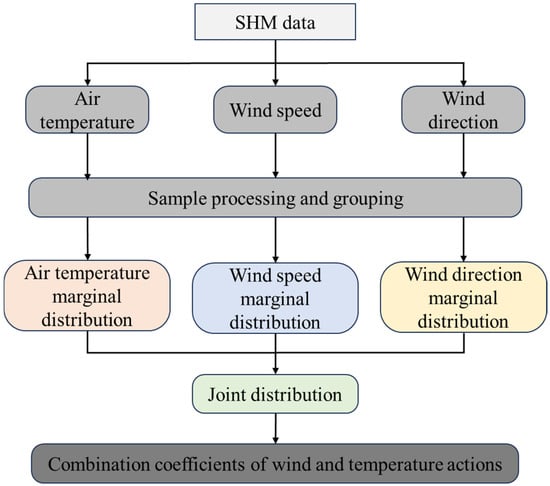
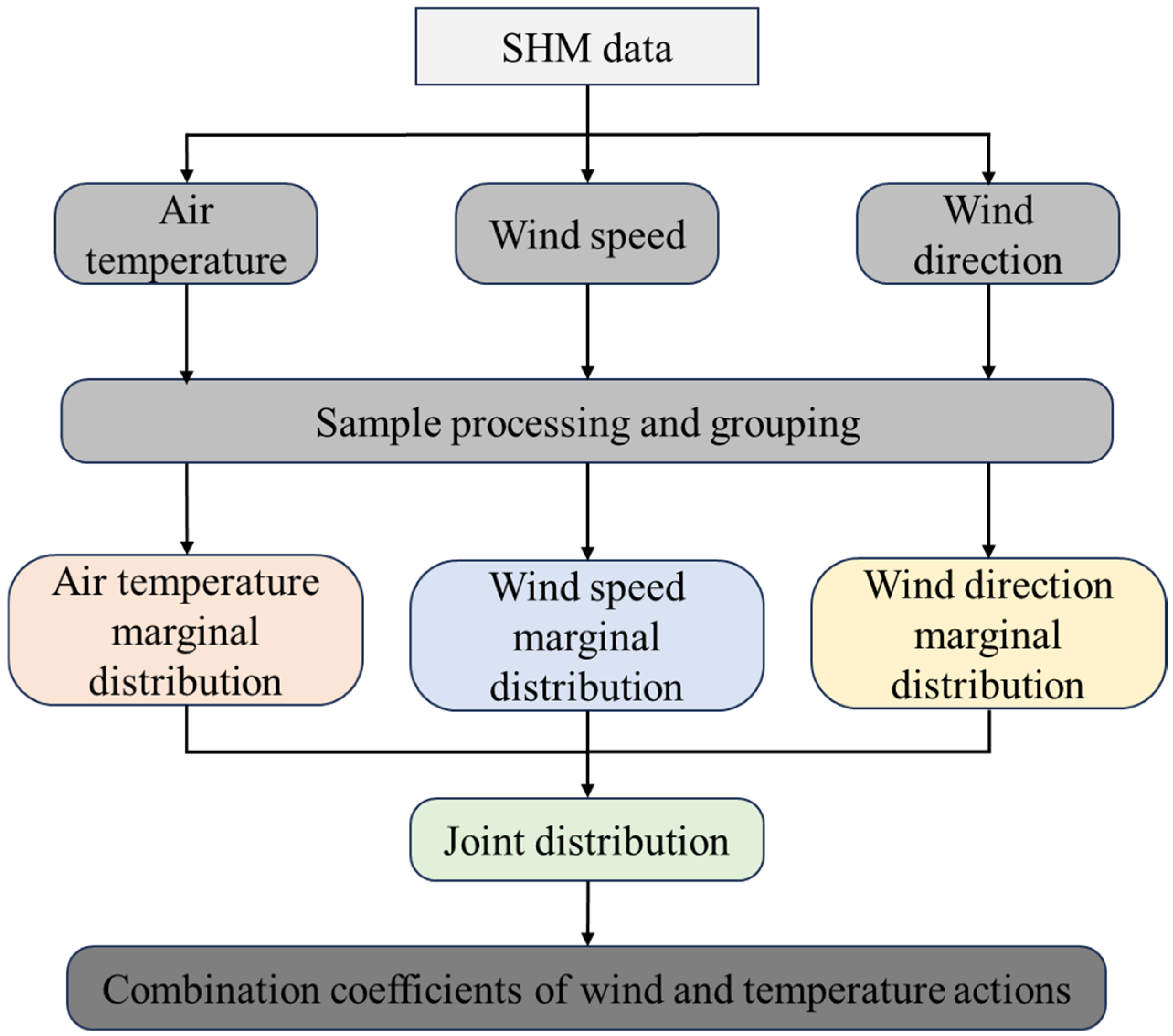
Therefore, this study aims to fill this gap by investigating the joint action of wind and temperature for a long-span cable-stayed bridge in a plateau canyon region, utilizing long-term structural health monitoring (SHM) data. A copula-based probabilistic framework is employed to establish a trivariate joint distribution of wind direction, wind speed, and air temperature. The core novelty lies in deriving site- and direction-specific load combination coefficients based on the Conditional Kendall Return Period, moving beyond the simplified, code-prescribed values. The overall logic of the research is also summarized in the flowchart presented in Figure 1.
Figure 1.
Methodology flowchart.
2. Methods
2.1. Overall Framework and Procedure
This study develops a probabilistic framework to derive direction-specific combination coefficients for wind and temperature actions on a long-span bridge in a plateau canyon region. The procedure, outlined in Figure 1, comprises four main stages. First, monitoring data are acquired and preprocessed. Second, four sample subsets are constructed to represent distinct extreme-event scenarios. Third, the marginal distributions of wind direction, speed, and temperature are estimated nonparametrically using kernel density estimation, and their joint dependence is modeled with a trivariate normal copula. Finally, the Conditional Kendall Return Period is applied to the joint model to determine concomitant wind and temperature values corresponding to specified return periods, conditioned on critical bridge directions. Then the final combination coefficient is calculated.
2.2. Copula Theory and Basics
The most common method to build a joint distribution is to establish a multivariate joint probability distribution directly. This requires all marginal distributions to be of the same type, which is difficult to satisfy in high dimensions [27]. The copula method, based on Sklar’s theorem [14,15], offers a more flexible approach. It states that for a d-dimensional continuous random vector X = (X1, X2, …, Xd)T with joint distribution F and marginal distributions F1, F2, …, Fd, there exists a copula function C that connects them:
The corresponding joint probability density function (PDF) is derived from the copula density and the marginal densities (see Appendix A.1 for details). This formulation separates the modeling of marginal distributions from their dependence structure, providing great flexibility for variables of different types.
2.3. Normal Copula
The normal copula has been widely used in many fields, including engineering, meteorology, and finance [28]. In this study, it is employed to model the dependence among wind direction, wind speed, and air temperature. The normal copula efficiently captures flexible pairwise correlation structures through a symmetric correlation matrix with intuitive physical interpretation. Its analytical tractability is particularly advantageous, facilitating the derivation of conditional distributions that are central to the directional analysis and the Conditional Kendall Return Period framework. While the Gaussian copula assumes tail independence, this simplification is considered reasonable for engineering design focused on characteristic values at a 100-year return period, where accurately modeling the central dependence structure takes precedence over extreme tail behavior. The copula is used to establish trivariate and bivariate joint distributions, as well as conditional distributions.
For random variables X1, X2 and X3 with marginal distributions U1, U2 and U3, the trivariate normal copula function can be expressed as
in which Φ−1 (•) denotes the inverse function of univariate standard normal distribution. represents the linear correlation coefficient matrix. The copula density function is provided in Appendix A.2.
2.4. Parameter Estimations and Goodness-of-Fit Tests
Maximum likelihood estimation (MLE) is a fundamental and widely adopted method for parameter estimation in statistics [27]. Its core principle is to select the parameter values that maximize the likelihood of the observed data. Given its effectiveness, MLE is extensively used for estimating copula parameters [29]. In this study, we apply MLE to estimate the parameters of the normal copula. To assess the goodness of fit of the copula models, we compare them against a nonparametric benchmark—the empirical copula—which is derived directly from the observed data using empirical distribution functions [30] (the detailed expression is provided in Appendix A.3).
Goodness-of-fit tests are essential for evaluating the applicability of copula models to samples. Here, the expected models are compared to the sample-based empirical copulas. The coefficient of determination R2 and root mean square error (RMSE) are employed to measure deviations:
in which Cexp and Ce denote the expected copula and empirical copula, respectively. The optimal model should have a big R2 and small RMSE [31,32].
2.5. Conditional Kendall Return Period
A return period is the average number of time intervals in which an event is repeated [33]. In the field of engineering, it has been widely used in the context of action value analysis. When it comes to jointly determining the values of wind speed and air temperature in a specific direction, the concept of “Con-KRP” is introduced [34].
The Conditional Kendall Return Period is a multivariate extension of the univariate return period, tailored for determining joint environmental actions conditioned on a specific variable. In this study, it is applied to determine the joint values of wind speed and air temperature for winds aligned with the bridge’s longitudinal and transverse directions, corresponding to a specified return period.
The expression of Con-KRP is given as follows:
in which KC,Con (t) = , where is a conditional normal copula. The analytical expression for the conditional bivariate normal copula is derived [35] and provided in Appendix A.4.
The principle of “bivariate Con-KRP equals univariate Con-KRP” is applied for design. This means that we identify the pair of values (wind speed, temperature) on the conditional joint probability contour that corresponds to the same return period as the univariate characteristic value of the dominant action, ensuring risk consistency. A numerical method [26] is adopted to obtain KC, Con(t).
3. Data Source
3.1. Bridge Profile and SHM System
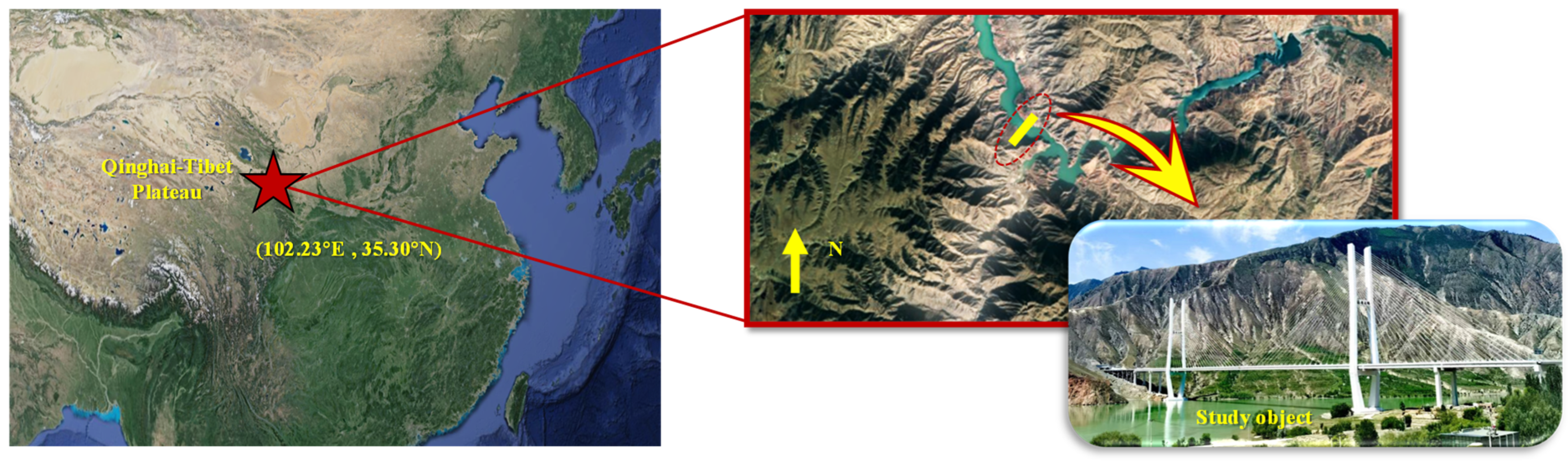
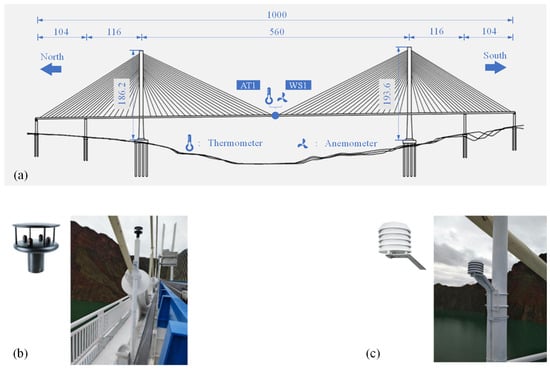
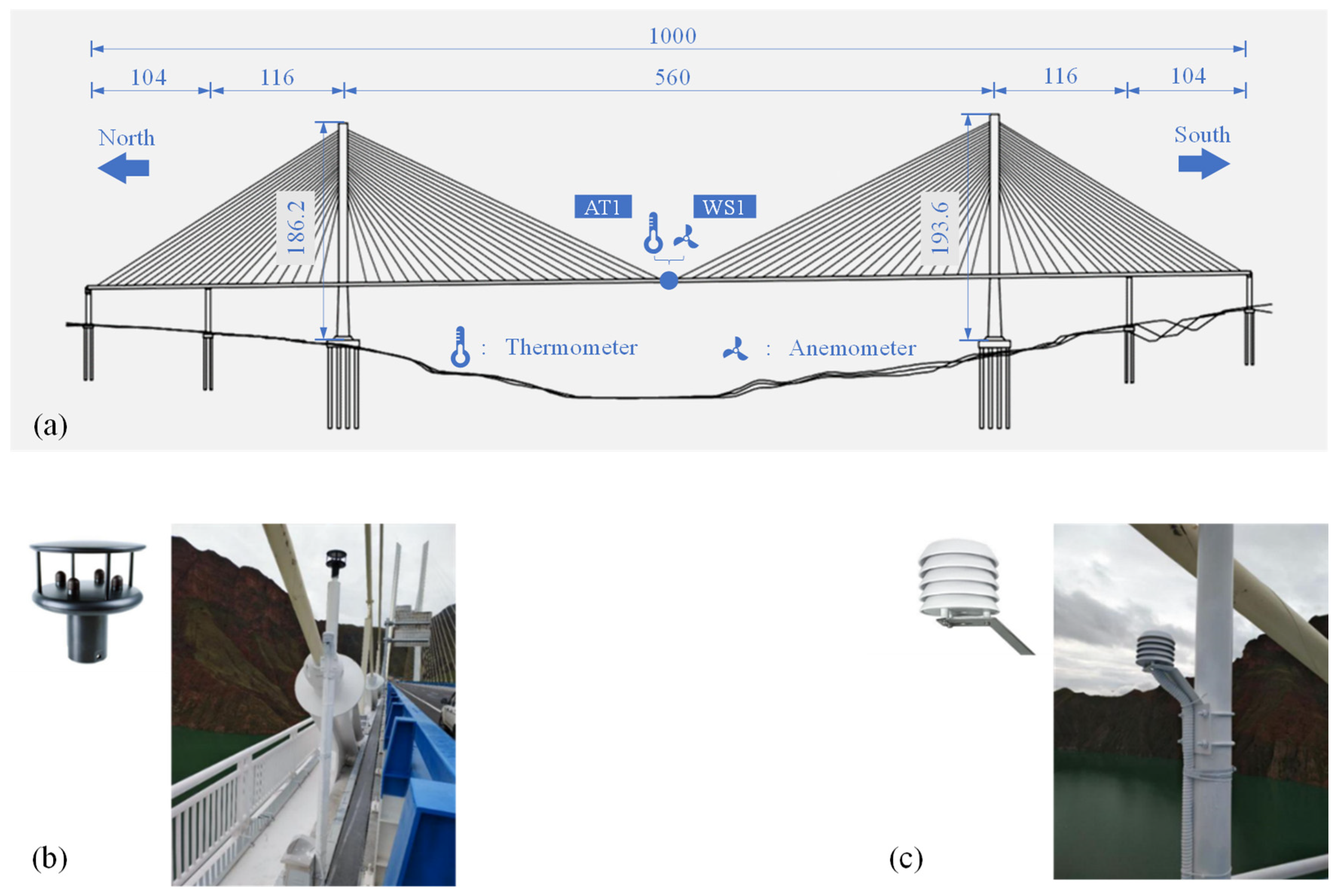
In this paper, Haihuang Bridge, the largest composite girder cable-stayed bridge in the Qinghai–Tibet Plateau, is adopted as the study object, which spans over the Yellow River and is surrounded by mountains. Geolocation of the bridge is depicted in Figure 2. At an altitude of 2150 m, the bridge site (35.3° N, 102.23° E) has varied topography and a large elevation difference. In addition, the angle between the bridge alignment and the north direction is 33°. The span arrangement is (104 + 116 + 560 + 116 + 104) m, as shown in Figure 3a.
Figure 2.
Geolocation of the study object.
Figure 3.
Bridge profile and monitoring devices: (a) general layout (m); (b) anemometer; (c) thermometer.
In order to obtain the real temperature and wind environment parameters at the bridge site, the wind speed, wind direction and ambient temperature acquisition equipment is installed on the bridge. Two-dimensional Wind Sonic anemometers are employed to monitor wind speeds ranging from 0 to 60 m/s (116 Knots) and wind directions from 0 to 360°, with a measurement interval of 4 s. The anemometer possesses a resolution of 2% for speed measurements and 3° for directional measurements. The test point WS1 is located at the 1/2 section of the main girder. The anemometer is installed on a vertical rod base, as shown in Figure 3b. The sensor is calibrated to orient towards the north, before the measurement.
Meanwhile, an NH121 intelligent thermometer is adopted for the measurement of ambient temperature ranging from −50 °C to 80 °C. The deployed thermometer possesses a 0.2 °C resolution and 5 s sampling interval. The test point AT1 is also arranged at the mid-span. And the thermometer is installed on the same base, as shown in Figure 3c.
3.2. Sample Preparation
The joint actions of wind and temperature are considered through combinations of actions, which are divided into the combinations of wind and uniform heating actions and those of wind and uniform cooling actions. Moreover, the extremes of wind and temperature actions cannot be reached simultaneously. Therefore, considering the combinations of actions, when the aforementioned actions reach their extremes, four groups of samples are generated:
1. Maximum wind speed (with wind direction) + companion air temperature (hot);
2. Maximum wind speed (with wind direction) + companion air temperature (cold);
3. Maximum air temperature (hot) + companion wind speed (with wind direction);
4. Minimum air temperature (cold) + companion wind speed (with wind direction).
To obtain the samples of the aforementioned four combinations, monitored SHM data should be processed. Detailed information is given in Section 3.2.1 and Section 3.2.2.
3.2.1. Data Conditioning
The SHM data collected from 1 January 2018 to 31 December 2018 is selected for this study. First, the collected data is resampled to a 10 min interval. Then, the 10 min average air temperature data is acquired directly by the method of the arithmetic average. Meanwhile, the 10 min average wind speed and wind direction data are obtained from the two-dimensional wind speed data by the following equations [36,37]:
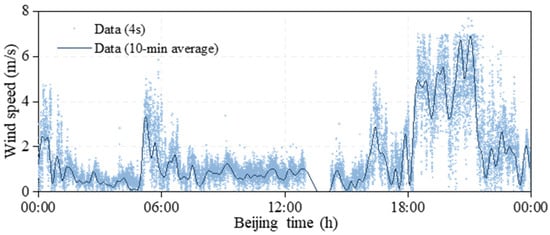
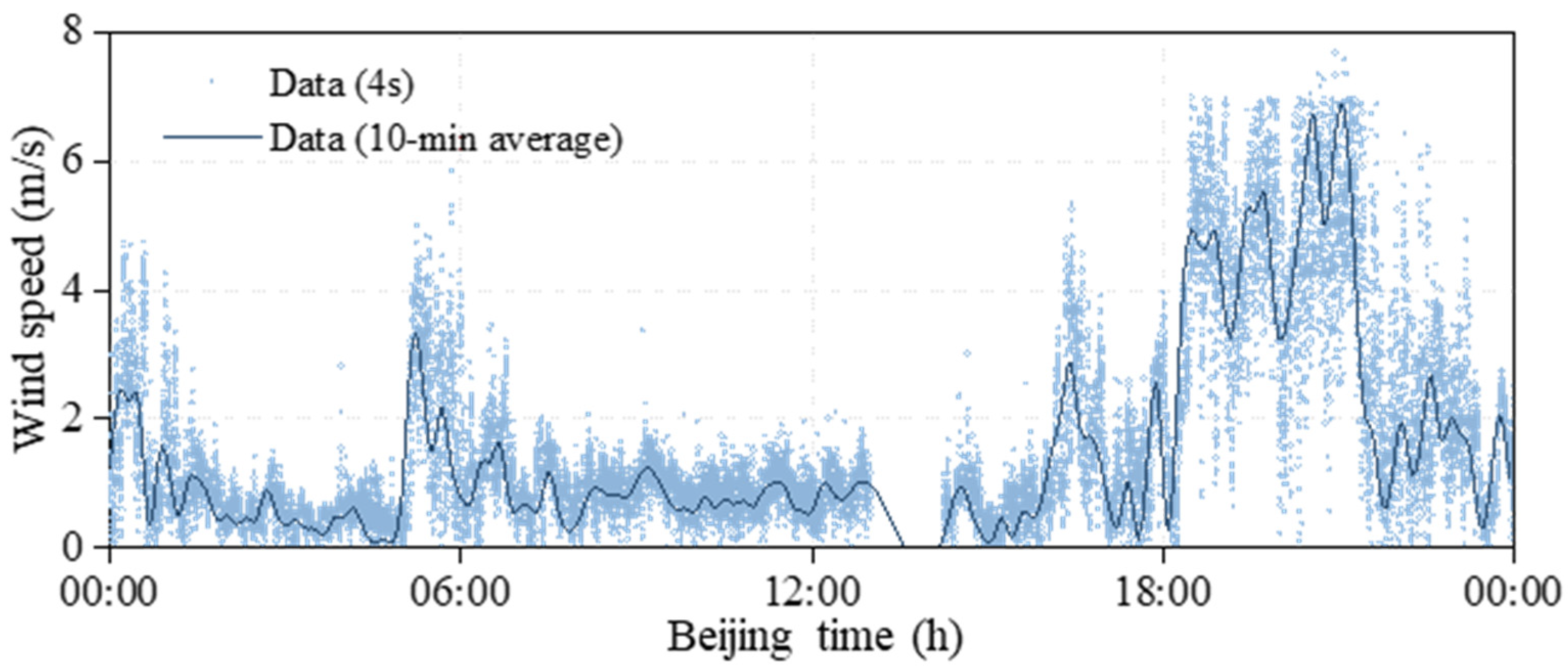
in which and denote 10 min average wind directions and wind speeds; and represent 10 min average wind speeds in the north and east directions; and vx,i and vy,i are the original two-dimensional wind speeds with an interval of 4 s. As an illustration, the wind speed data for a specific day, processed using the aforementioned method, is presented in Figure 4.
Figure 4.
Sample data processing.
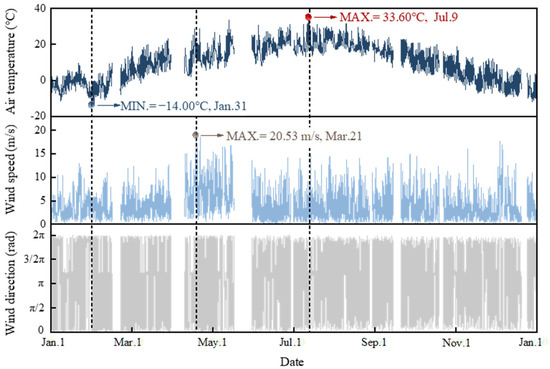
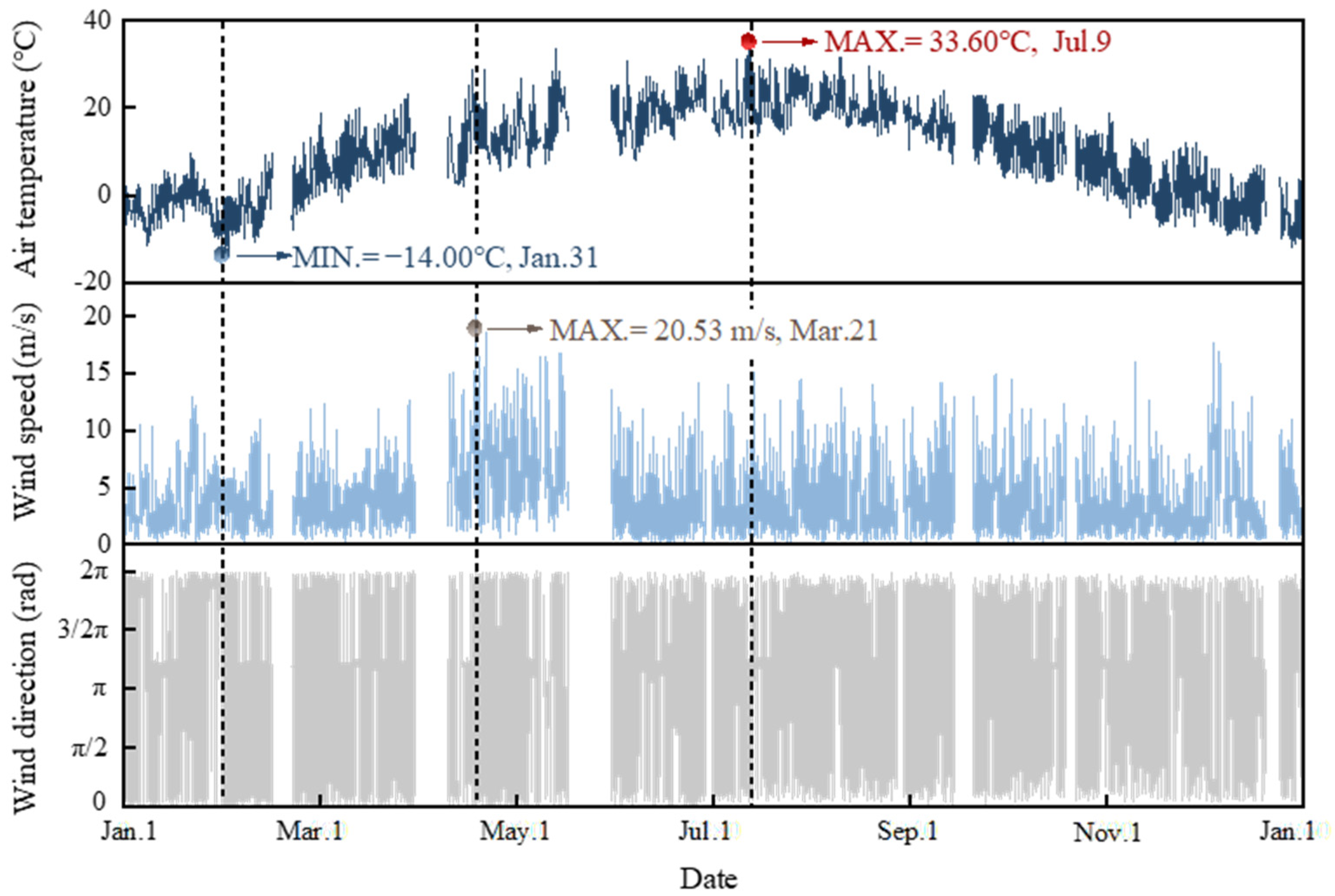
The 10 min average data of air temperature, wind speed and wind direction are displayed in Figure 5. It can be seen that the air temperature changes seasonally, with the highest temperature being 33.60 °C on 9 July and the lowest temperature being −14.00 °C on 31 January. Meanwhile, the maximum wind speed 20.53 m/s is reached on 21 March. This indicates that the extremes of wind speed and air temperature cannot be reached at the same time.
Figure 5.
Environmental monitoring data.
3.2.2. Sample Grouping
The joint actions of wind and temperature are considered through combinations of wind and temperature actions, which are divided into the combinations of wind and uniform heating actions and those of wind and uniform cooling actions. In addition, the extremes of wind and temperature actions cannot be reached simultaneously. Therefore, when the aforementioned actions reach their extremes, three groups of samples are produced preliminarily:
1. Maximum wind speed group (G1): daily maximum wind speed (with wind direction), companion air temperature;
2. Maximum air temperature group (G2): daily maximum air temperature, companion wind speed (with wind direction);
3. Minimum air temperature group (G3): daily minimum air temperature, companion wind speed (with wind direction).
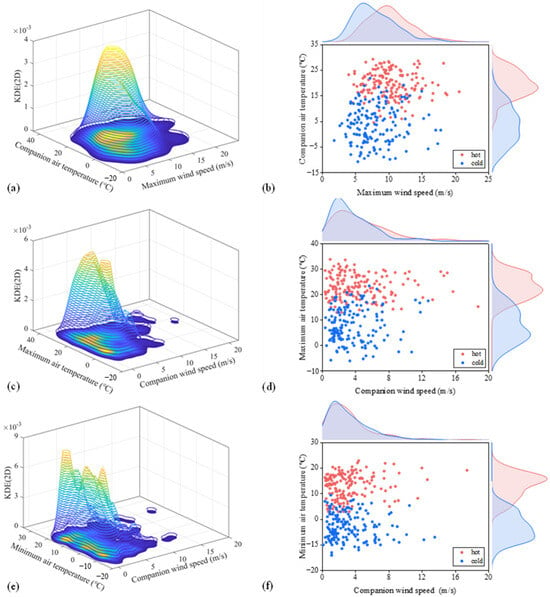
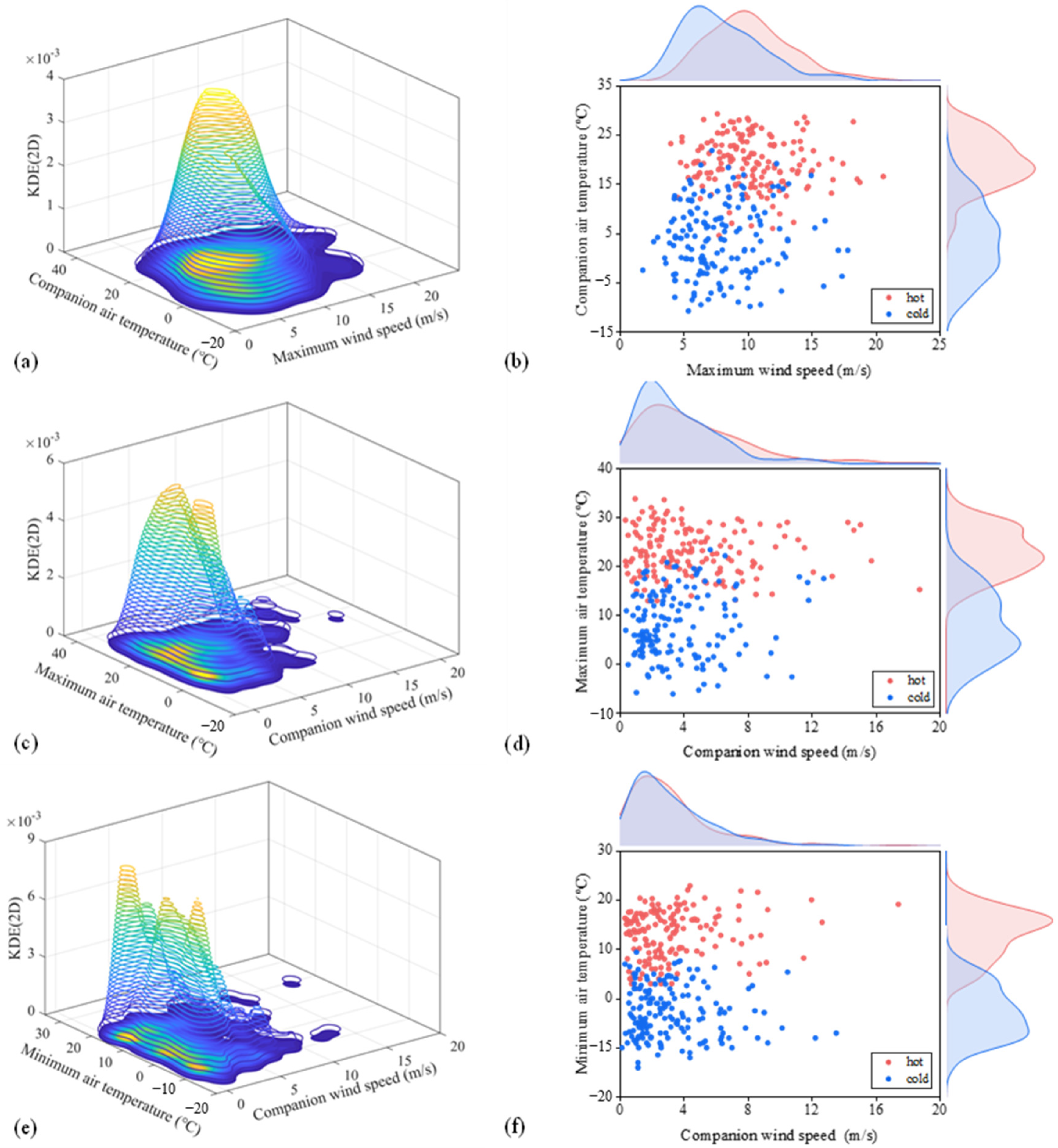
It is worth noting that maximum uniform heating and cooling actions are reached in hot and cold seasons, respectively. The previous grouping strategy seems to be not accurate enough. Thus, the three groups need to be subdivided based on hot and cold seasons. To explore of the boundary between hot and cold seasons, two-dimensional kernel density estimation (KDE(2D)) figures and grouped marginal diagrams of G1, G2 and G3 are plotted. After several attempts, the hot season encompasses the period from 16th April to 15th October, while the cold season includes the remaining days. Distribution characteristics of wind speed and air temperature are displayed in Figure 6. Multi-peak distribution along the air temperature dimension is shown. This is consistent with the characteristics of the hot and cold seasons. Grouping with hot and cold seasons helps in studying uniform heating and cooling actions independently, providing a base for the establishment of the joint distribution.
Figure 6.
Distribution characteristics of wind speed and air temperature: (a) KDE(2D) of G1; (b) grouped marginal plot of G1; (c) KDE(2D) of G2; (d) grouped marginal plot of G2; (e) KDE(2D) of G3; (f) grouped marginal plot of G3.
After that, the three groups are subdivided into six subgroups. But not all subgroups are utilized in subsequent analysis. The selection of the final four subsets (S1–S4) follows the engineering rationale for combination analysis: only the companion environmental actions concurrent with the design-controlling thermal extremes are considered. The cold-season part of the maximum air temperature group and the hot-season part of the minimum air temperature group are discarded. This is because, for uniform heating action, the controlling condition is the maximum temperature in the hot season; thus, maximum temperatures in the cold season are irrelevant. Similarly, for uniform cooling action, the controlling condition is the minimum temperature in the cold season. In summary, the samples for application are as follows:
S1: Maximum wind speed (with wind direction) + companion air temperature (hot);
S2: Maximum wind speed (with wind direction) + companion air temperature (cold);
S3: Maximum air temperature (hot) + companion wind speed (with wind direction);
S4: Minimum air temperature (cold) + companion wind speed (with wind direction).
This subgroup construction yields four distinct design scenarios. While the subgroups originate from the same annual dataset and are not statistically independent, this structure is physically meaningful. Each subgroup directly corresponds to a specific load combination case required for design verification. The analysis therefore proceeds by modeling each scenario independently to derive its specific combination coefficients, enabling a clear comparison of directional and seasonal effects on joint load behavior.
4. Marginal Distribution
4.1. Univariate KDE
KDE is a nonparametric statistical method. It directly estimates the probability density distribution from a set of observed data and has been widely used in the estimation of PDFs of linear and circular variables [38,39]. In this study, KDE is introduced to estimate the PDF of wind speed, air temperature and wind direction.
The general KDE expression can be written as follows [40]:
in which n is the size of the sample; K(·) is the kernel function; and h is the bandwidth. The kernel function is used to measure the contribution of sample points at certain positions. The selection of kernel function will affect the accuracy of density estimation. Different kernel functions have different properties. For example, the Gaussian kernel function is better in estimating smooth density, and it is the most commonly used kernel in application. Consequently, the Gaussian kernel function is chosen as the kernel function of linear variables, i.e., wind speed and air temperature. The Gaussian kernel function can be expressed as
Accordingly, the PDF of wind speed and air temperature can be derived as follows:
in which xi is the observed value.
For wind direction, a von Mises kernel is introduced to describe the circular variable. The PDF of wind direction is shown below [41]:
in which θi is the observed wind direction; υ is the smoothing parameter (also known as Taylor’s bandwidth); and I0 is the 0-order modified Bessel function of the first category. The bandwidth is an important parameter that determines the width and smoothness of the kernel function. Its selection significantly influences the accuracy and smoothness of the KDE. A bandwidth that is excessively small will result in overly coarse estimation outcomes, whereas a large bandwidth may result in excessive smoothing and loss of detailed information. Therefore, appropriate selection of bandwidth is vital. While KDE is excellent for capturing the overall shape and central tendencies of a distribution from observed data, it has inherent limitations in extrapolating or precisely characterizing the extreme tails of the distribution, where data are inherently sparse. The primary objective of employing KDE here is to provide a flexible and accurate nonparametric representation of the marginal distributions for subsequent copula modeling, rather than to perform extreme value analysis on the tails of individual variables.
For wind speed and air temperature, the noted Silverman’s rule of thumb [40] is introduced to estimate the bandwidth. It can be written as
in which = min{σ, IQR/1.34}; σ is the standard deviation; and IQR is the interquartile range.
For the estimation of wind direction, the plug-in rule proposed by Taylor [41] is adopted:
in which is the result of maximum likelihood estimation of the concentration parameter κ [37].
R2 and RMSE [42] are used to perform the goodness-of-fit tests.
4.2. Wind Speed Distribution
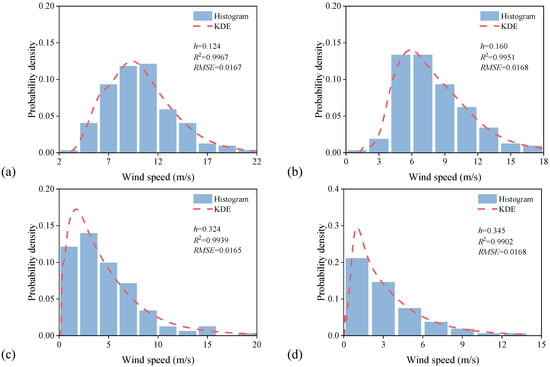
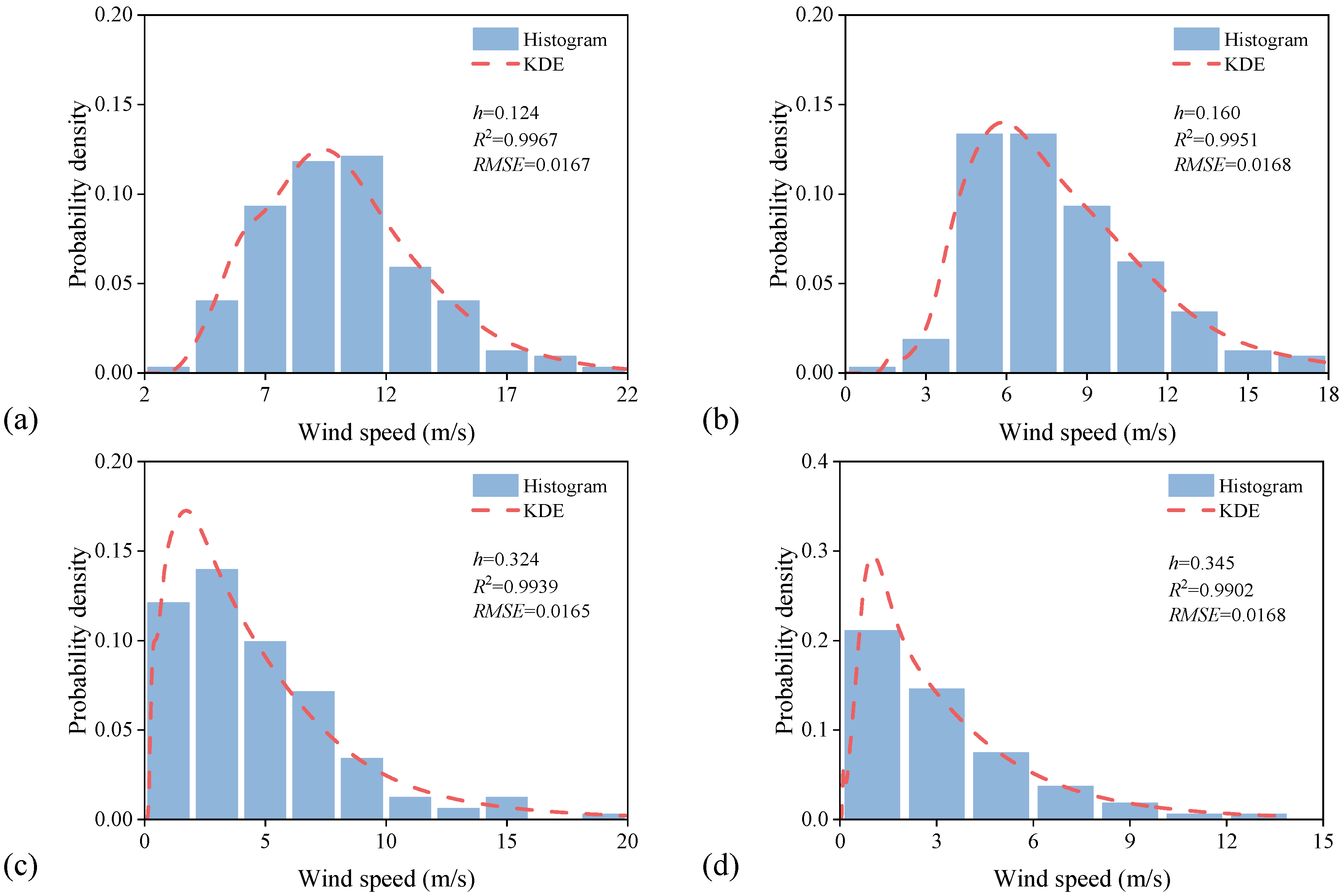
The results of goodness-of-fit tests are displayed in Table 1. The results indicate that all R2 values exceed 0.99. RMSE values are relatively low, as the maximum is 0.0225. In Figure 7, the fitted curves and frequency histograms are displayed. Each curve fits well with the bars. These results demonstrate that the KDE equations used in this study have good fitting results on the four sets of samples. In the four subgroups, S1 has the largest maximum wind speed. Additionally, results from the four subgroups are unimodal, indicating that each possesses a relatively concentrated level of wind speed. This unimodal and concentrated nature of wind speed distributions can be attributed to the dominant channeling effect of the plateau canyon topography at the bridge site. The mountains on both sides of the Yellow River constrain the wind flow, leading to a prevailing wind regime with speeds concentrated within a range amplified and guided by the canyon geometry, rather than exhibiting a wide, dispersed distribution typical of open terrains.
Table 1.
Bandwidth parameters and goodness-of-fit tests for wind speed.
Figure 7.
Marginal distribution and fitting results of wind speed: (a) S1; (b) S2; (c) S3; (d) S4.
4.3. Air Temperature Distribution
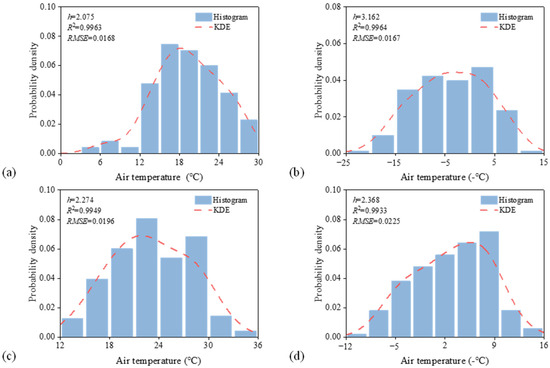
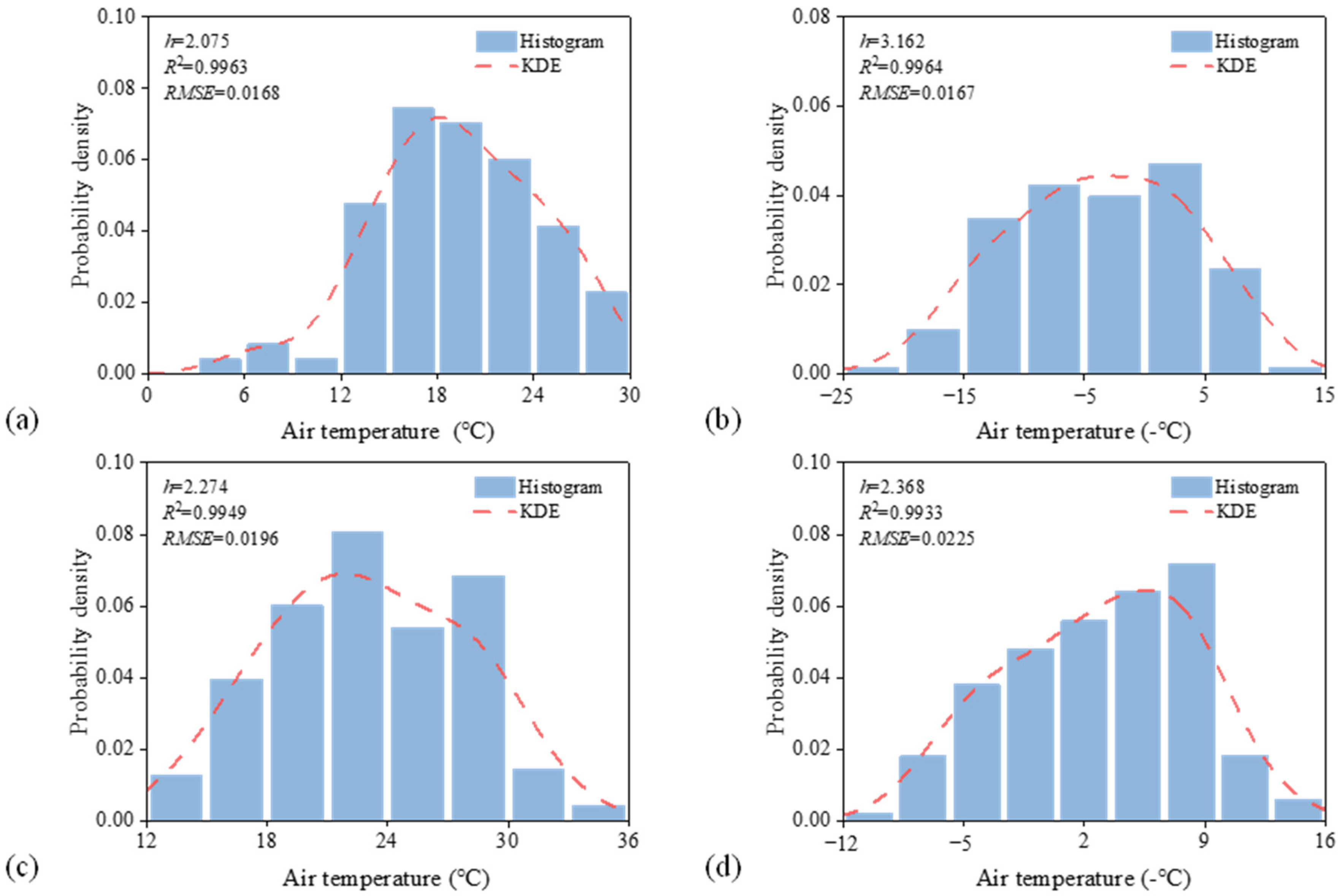
Silverman’s rule of thumb performs well in the bandwidth selection of air temperature. Each subgroup has a high R2 and low RMSE, as shown in Table 2. In order to study the minimum value samples more conveniently, the temperature values in S2 and S4 are taken to be opposite, and their unit is made to be “−°C”. The histograms describe the distribution characteristics of air temperature. Figure 8 shows that the maximum temperature in S3 is higher than that in S1. Similarly, the minimum temperature in S4 is lower than that in S2. The significant diurnal and seasonal temperature variation, reflected in the spread of these distributions, is a hallmark of high-altitude plateau regions. The large elevation difference and thin air at the bridge site contribute to rapid heat loss and gain, resulting in the observed range of extreme temperatures. The separation between hot-season and cold-season subgroups clearly captures this site-specific climatic characteristic.
Table 2.
Bandwidth parameters and goodness-of-fit tests for air temperature.
Figure 8.
Marginal distribution and fitting results of air temperature: (a) S1; (b) S2; (c) S3; (d) S4.
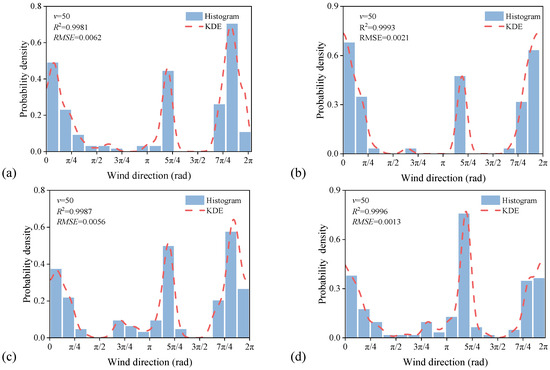
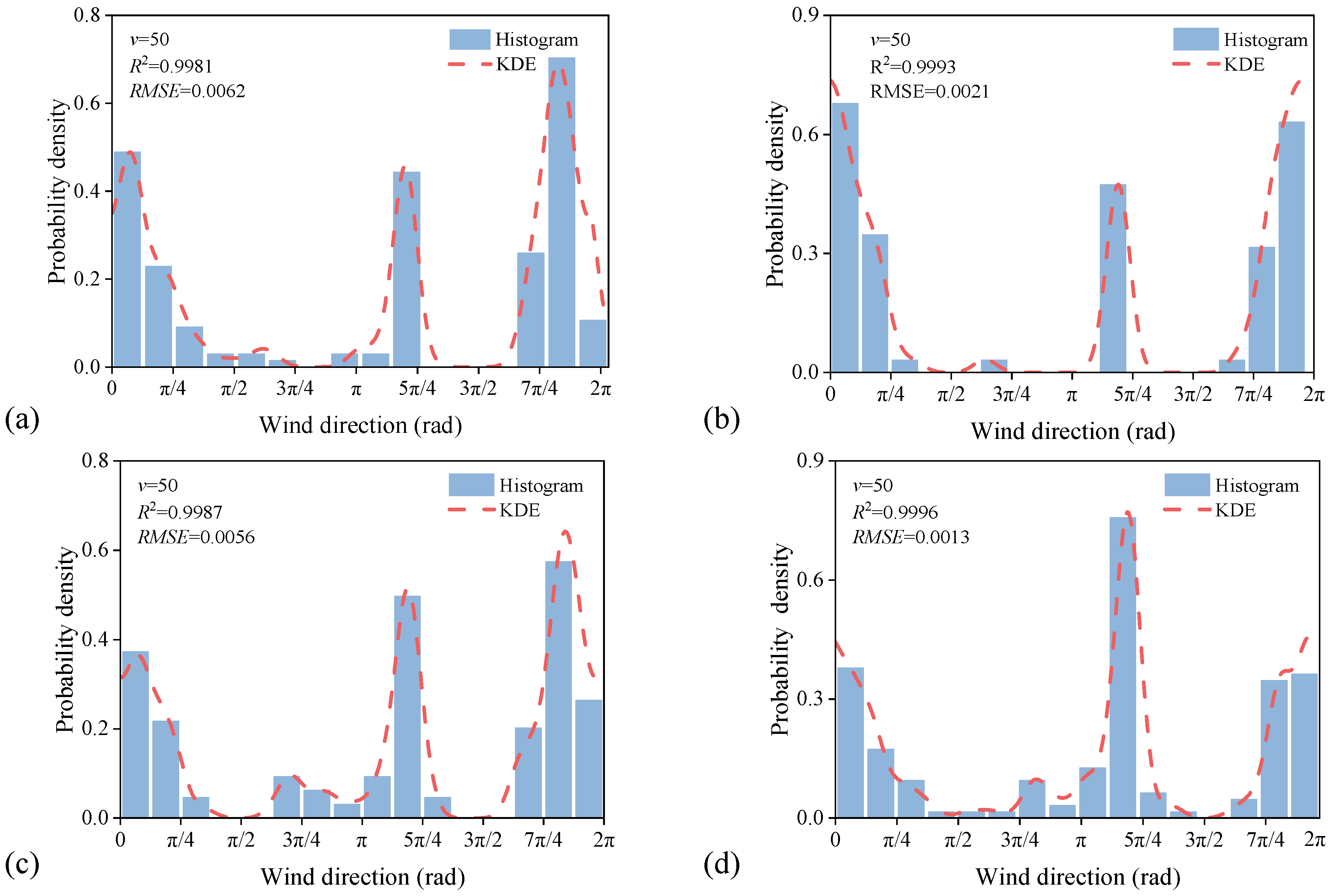
4.4. Wind Direction Distribution
Taylor’s plug-in rule performs well in the bandwidth selection of wind direction, as shown in Table 3. The results indicate that all R2 values exceed 0.99. RMSE values are relatively low, as the maximum is 0.0162. Figure 9 displays the distribution features of wind direction. In each histogram, the wind direction is divided into 16 bars ranging from 0 to 2π, with an interval of π/8. Meanwhile, the PDF curve in each subgroup presents a trimodal characteristic. This indicates that the wind directions possess three relatively concentrated levels, namely, northwest, southwest and northeast directions. This pronounced trimodal distribution is a direct consequence of the complex topography surrounding the Haihuang Bridge site. The three predominant wind direction clusters correspond to the major wind pathways dictated by the local canyon terrain: northwest and northeast winds likely funnel through different sections of the mountainous terrain bordering the Yellow River, while southwest winds may be associated with larger-scale synoptic patterns channeled by the regional valley orientation. This multimodal pattern starkly contrasts with the unimodal or broadly scattered distributions often observed in flat, homogeneous areas and underscores the strong topographic control on local wind flow.
Table 3.
Bandwidth parameters and goodness-of-fit tests for wind direction.
Figure 9.
Marginal distribution and fitting results of wind direction: (a) S1; (b) S2; (c) S3; (d) S4.
5. Joint Distribution
5.1. Correlation Analysis
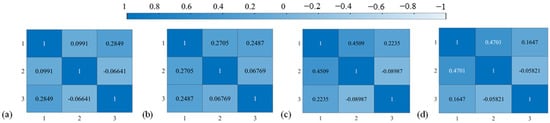
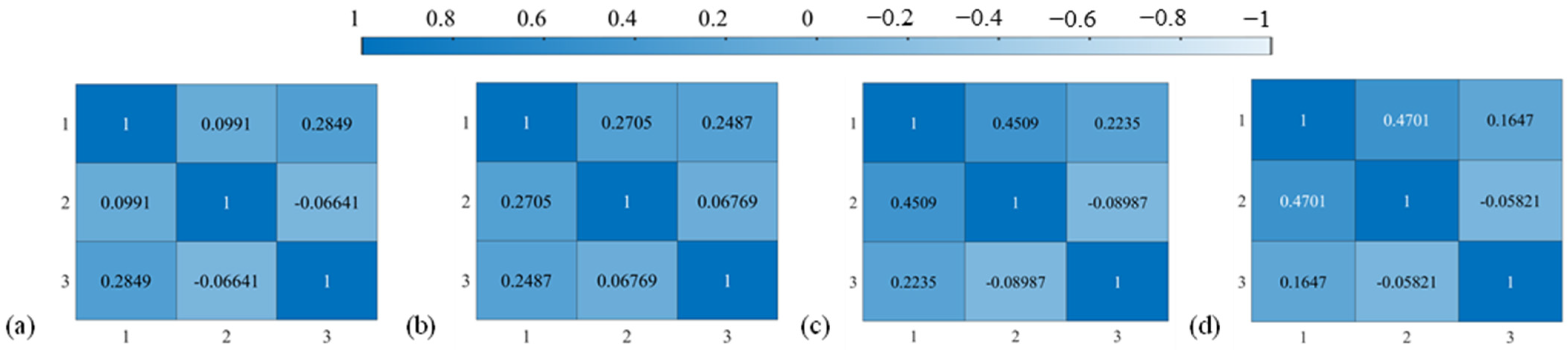
Correlation heatmaps are plotted to observe the correlation between two variables. The noted Pearson correlation coefficient is introduced to describe the correlation between the two linear variables of wind speed and temperature. The correlation between circular and linear variables can be investigated as follows [43,44]:
in which X and Θ are linear and circular variables, respectively; is the correlation coefficient between linear and circular variables. In the heatmaps in Figure 10, the gradient from deep blue to light blue signifies a correlation coefficient ranging from −1 to 1. In addition, 1, 2 and 3 denote wind direction, wind speed and air temperature. The initial daily samples are used in this section. In all four subgroups, wind direction is positively correlated with wind speed. Similarly, there is also a positive correlation between wind direction and air temperature. In most cases, air temperature is negatively correlated with wind speed. In general, the correlation between wind speed and wind direction is stronger than that between wind speed and air temperature. From an engineering perspective, these observed dependencies reflect the coupled wind–thermal environment in the canyon. The positive wind direction–speed correlation suggests that winds from those directions aligned with the canyon axis tend to be stronger, likely due to topographic channeling. The negative speed–temperature correlation, particularly evident in some subgroups, may indicate that stronger canyon winds are often associated with adiabatic cooling or specific synoptic conditions that simultaneously bring lower temperatures.
Figure 10.
Correlation heatmap among wind direction, wind speed and air temperature: (a) S1; (b) S2; (c) S3; (d) S4.
5.2. Trivariate Normal Copula
The joint distribution is constructed using nonparametric KDE for the marginal distributions and a normal copula for the dependence structure. This modeling approach effectively captures the empirical dependence observed in the data, as evidenced by the high goodness-of-fit metrics (R2 > 0.985, RMSE < 0.02) presented in Table 4. The normal copula provides a balance of flexibility and analytical tractability, which is particularly advantageous for deriving the conditional distributions required in the subsequent directional analysis and Conditional Kendall Return Period framework.
Table 4.
Parameters and goodness-of-fit tests for trivariate normal copula.
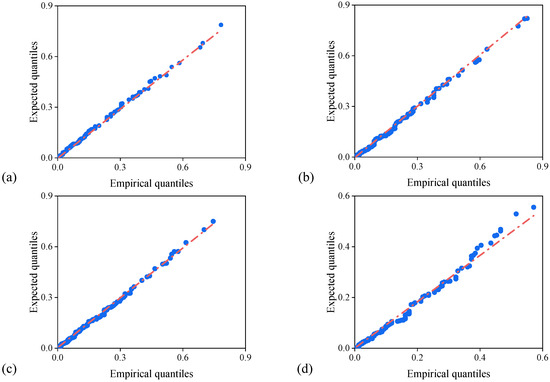
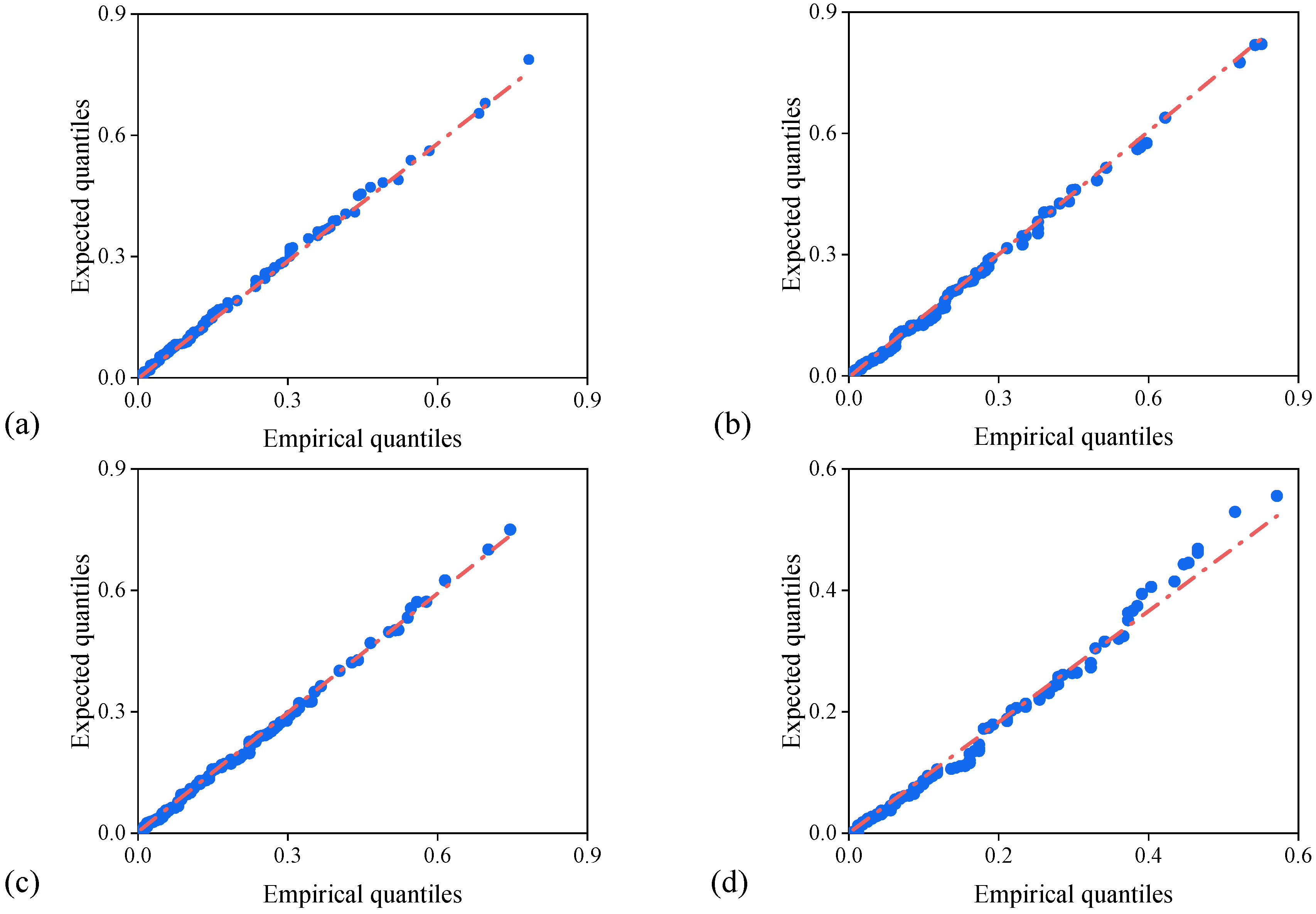
In the development of a copula, marginal distribution establishment is the first step. After that, the dependence structure (i.e., copula) can be built. For each subgroup, a trivariate normal copula is established. The air temperature samples used in S2 and S4 are taken to be inverses before the construction process. The parameters and fitting results are shown in Table 4. This table suggests that the trivariate normal copula performs well in the construction of copulas of wind direction, wind speed and air temperature. All four subgroups represent a high R2 and low RMSE. The minimum R2 reaches 0.9854, while the maximum RMSE can be up to 0.0197. Moreover, Quantile–Quantile plots (Q-Q plots) are also introduced. In the Q-Q plots, the lateral axis is the quantiles of the empirical copula, the vertical axis denotes the quantiles of the expected trivariate normal copula, and the red line represents the empirical copula. The scattered points are closely distributed on both sides of the red line, as shown in Figure 11. These results indicate that all the expected normal copulas have satisfactory goodness of fit.
Figure 11.
Q-Q plot in each subgroup: (a) S1; (b) S2; (c) S3; (d) S4.
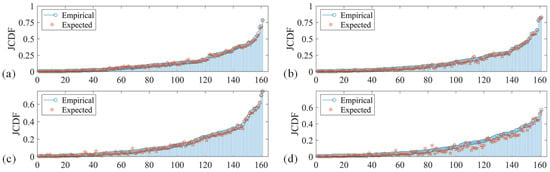
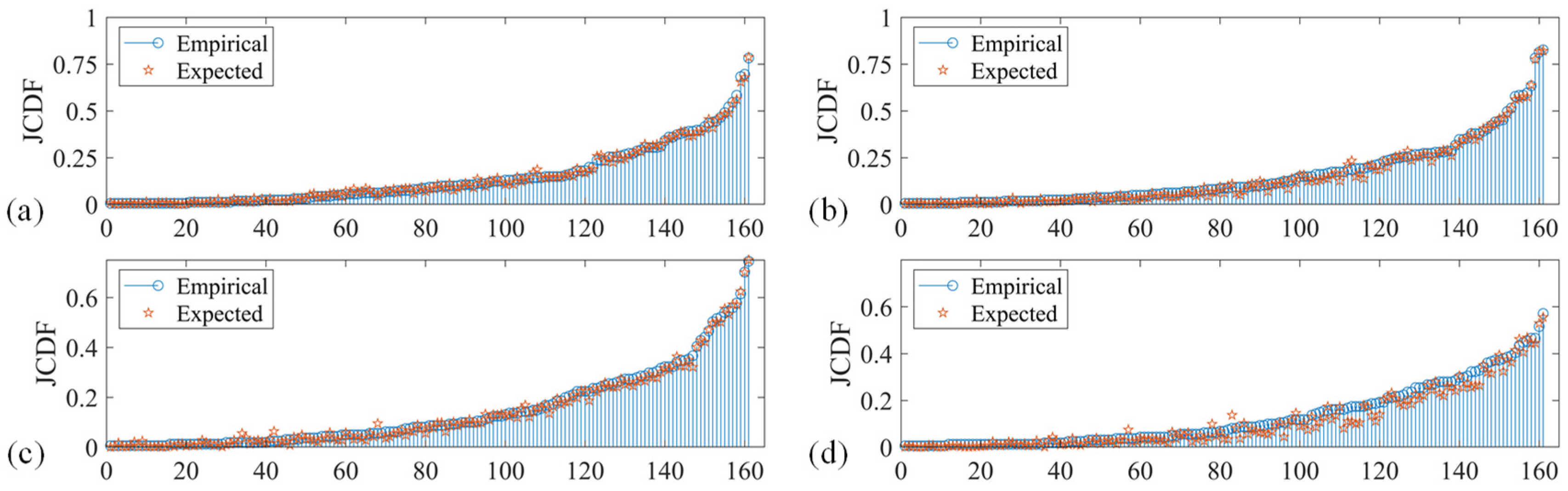
In order to clarify the applicability of the proposed models, comparisons between the expected JCDF and the empirical JCDF at the sample points are performed. In Figure 12, the lateral axis represents the order of the sample points in each subgroup, and the vertical axis is the JCDF at these sample points. The sequence is arranged from smallest to largest based on empirical JCDF values at the sample points. The lollipops and pentagrams denote the JCDF of the empirical copula and the expected copula at sample points. In each plot, it is shown that the pentagrams are tightly scattered around the lollipops, which further prove good fitness of the models. The consistent high goodness of fit across all four subgroups, despite their different seasonal and extremal characteristics, supports the robustness of the normal copula for modeling the dependence in this specific environment.
Figure 12.
Comparison of empirical JCDF and expected JCDF in each subgroup: (a) S1; (b) S2; (c) S3; (d) S4.
6. Combination Coefficients of Wind and Temperature Actions
The derived combination coefficients (ω) quantify the probabilistic relationship between wind and temperature actions at the Haihuang Bridge site. These coefficients enable the determination of realistic concomitant environmental loads for structural design, moving beyond conservative assumptions of simultaneous extremes.
In order to obtain the combination coefficients of wind and temperature joint action, a three-step strategy is implemented.
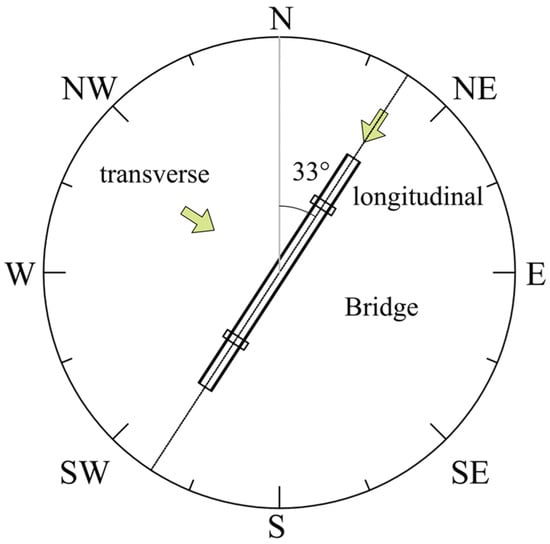
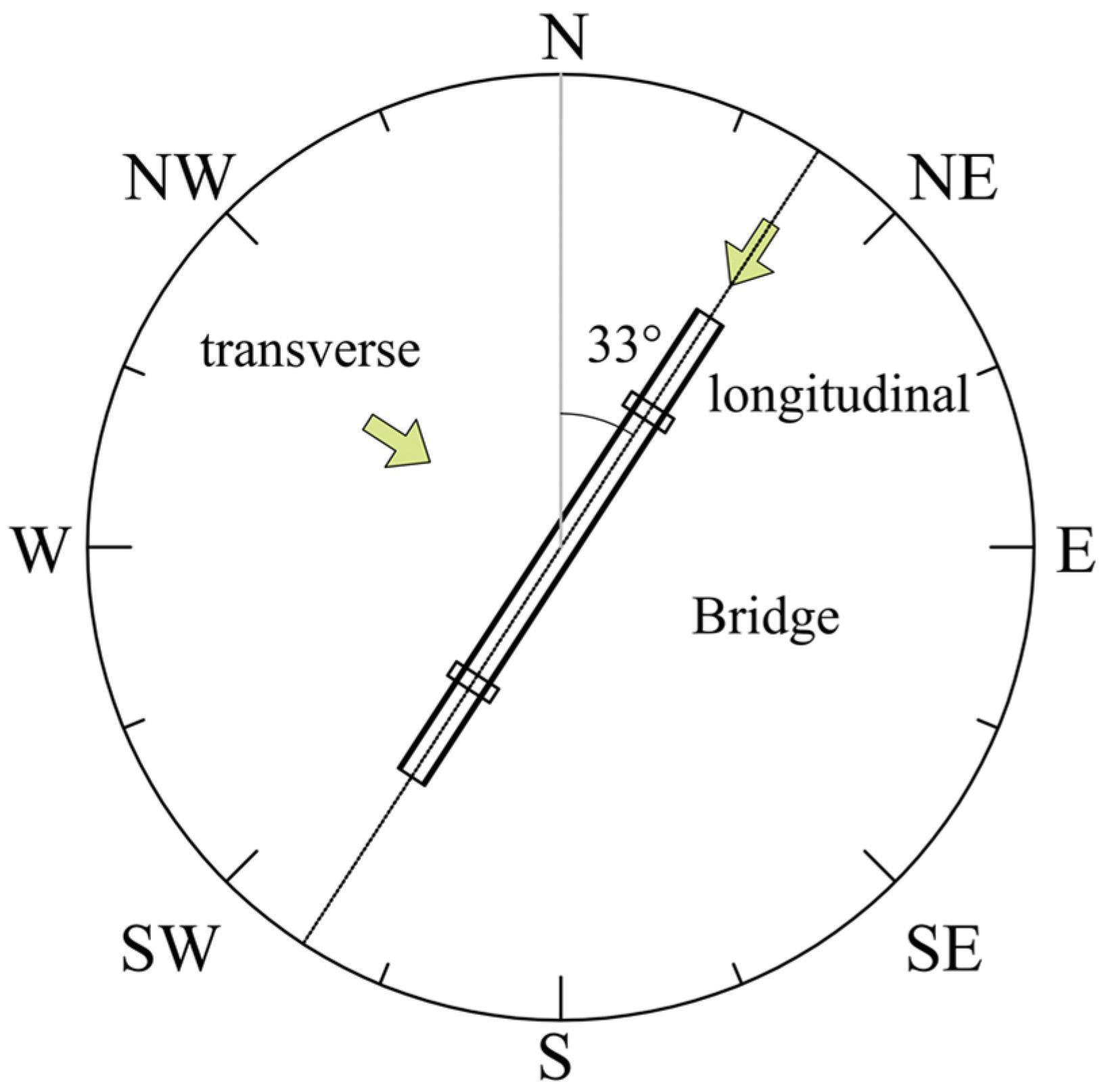
The first step is constructing a wind speed distribution in longitudinal and transverse directions () and air temperature distribution in longitudinal and transverse directions (). The longitudinal and transverse directions of Haihuang Bridge are 33° and 303°, respectively, as depicted in Figure 13. Then, on the basis of Con-KRP, mentioned in Section 2.4., the characteristics of wind speed and air temperature in longitudinal and transverse directions can be summarized, as shown in Table 5. For subgroups S1 and S2, two representative wind speed values are calculated. However, only the maximum wind speed is the controlling factor of design, which means that there ought to be one representative wind speed for wind action. Therefore, the wind speeds of 20.62 m/s and 22.63 m/s in S1 are selected. Meanwhile, for subgroups S3 and S4, the maximum and minimum representative values of temperature are calculated, namely 36.01 °C, 36.11 °C, −19.56 °C and −19.51 °C. The difference between the two directions is quite small.
Figure 13.
Wind directions adopted in bridge design.
Table 5.
Characteristics of wind speed and air temperature in longitudinal and transverse directions (100-year return period).
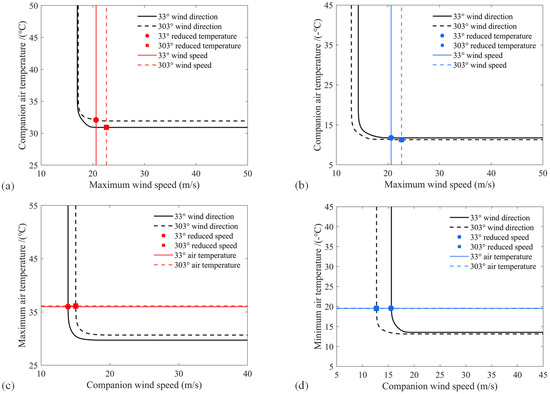
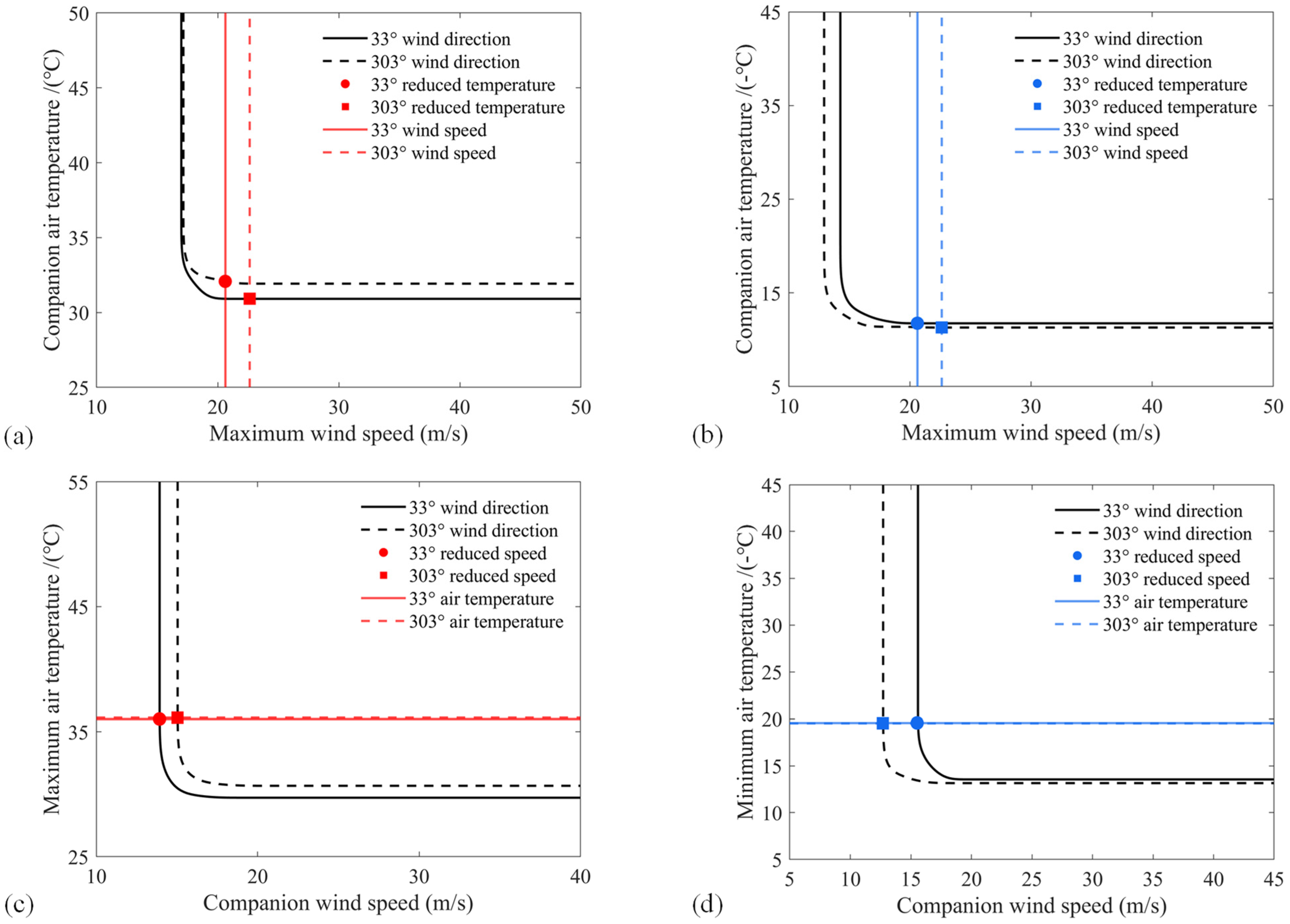
The second step is establishing the joint distribution of wind speed and air temperature in longitudinal and transverse directions of the bridge (). In this step, four conditional bivariate distributions are established. The conditional joint action contours can be obtained with the concept of bivariate Con-KRP, shown in Figure 14. When one action (wind or temperature) reaches the conditional univariate characteristic value, the other action (temperature or wind) would be reduced. The reduced results are displayed in Table 6 and Table 7. When wind speeds reach their extremes, little reduction is observed for companion air temperatures in the hot season, while those in the cold season are reduced by 45–47%. Meanwhile, when air temperatures reach their extremes, the wind speeds get reduced greatly; 25–44% reduction is achieved.
Figure 14.
Contours of wind speed and air temperature in longitudinal and transverse directions (100-year return period): (a) S1; (b) S2; (c) S3; (d) S4.
Table 6.
Reduced values of temperature.
Table 7.
Reduced values of wind speed.
The third step is determining the combination coefficients. The wind speed and air temperature should be converted into actionable correlation effects. For wind action, the wind speed at the height of the main girder is always utilized in bridge design. However, for the initial wind speeds collected at the main girder, the wind speeds are used directly. Accordingly, the air temperature should also be converted to uniform temperature action. Uniform temperature action is defined as the difference between the effective temperature and the initial temperature. The initial temperature T0 is taken as 5 °C. The uniform temperature action of bridges is given as follows [9]:
in which and are the uniform heating action and uniform cooling action, respectively; Te,max and Te,min are the maximum and minimum effective temperatures; and Tt is air temperature. After the conversion, the combination coefficient can be defined as
in which and denote the combination coefficients of uniform heating action and uniform cooling action, respectively; and are the combination coefficients of wind action in heating and cooling periods, respectively; (•)1 and (•)2 represent conditional univariate values and reduced values; and is wind speed. The results of combination coefficients are displayed in Table 8. The combination coefficients of uniform heating action are 0.9 or so, indicating a strong correlation between wind action and uniform heating action. Meanwhile, when wind actions reach their extremes, uniform cooling actions are 68–70% of their characteristic values. For most combination coefficients of wind actions, they are around 0.65–0.75. However, the coefficient in the transverse direction is just 0.56. The difference in combination coefficients between longitudinal and transverse directions is significant. In addition, the combination coefficients in the transverse direction are smaller than those in the longitudinal direction, which suggests that the correlation between wind action and uniform temperature action in the longitudinal direction is stronger.
Table 8.
Results of combination coefficients.
The site-specific combination coefficients directly inform the load combination for structural design. For instance, a coefficient of = 0.92 for longitudinal heating indicates that the concomitant uniform heating action is 92% of its characteristic maximum when combined with the design wind speed. Similarly, = 0.56 for transverse cooling reflects a more pronounced reduction in wind action. These coefficients, derived from the site’s probabilistic characteristics, provide a basis for design that balances safety with economic efficiency, differing from the prescriptive values in current codes.
7. Discussion
In the General Specifications [9], the joint action of wind and temperature is addressed through a simple superposition approach, without accounting for potential reductions. In contrast, the Eurocodes [10] provide a more detailed methodology for this joint action. Specifically, when wind speed reaches its extreme, the combination coefficient for uniform temperature action is set at 0.60. Conversely, when uniform temperature action is specified to its extreme, the combination coefficient for wind speed is established at 0.75. However, the specifications in the Eurocodes may not be applicable to China. Wang et al. [7] investigated the combination coefficients for wind speed and uniform temperature action at Changtai Yangtze River Bridge. They revealed that when one of the two coupled actions (wind or temperature) reached its extreme, the other one did not exceed 60% of its own univariate characteristic value in most cases. Additionally, Zhang et al. [26] incorporated the influence of wind direction into their models and proposed adjusted combination coefficients for Changtai Yangtze River Bridge. They indicated that slight differences in the combination coefficients were found between the longitudinal and transverse directions of the bridge.
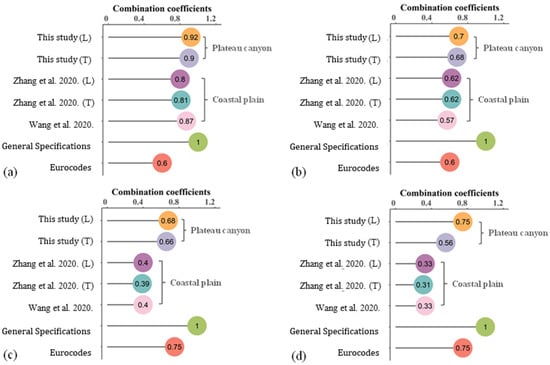
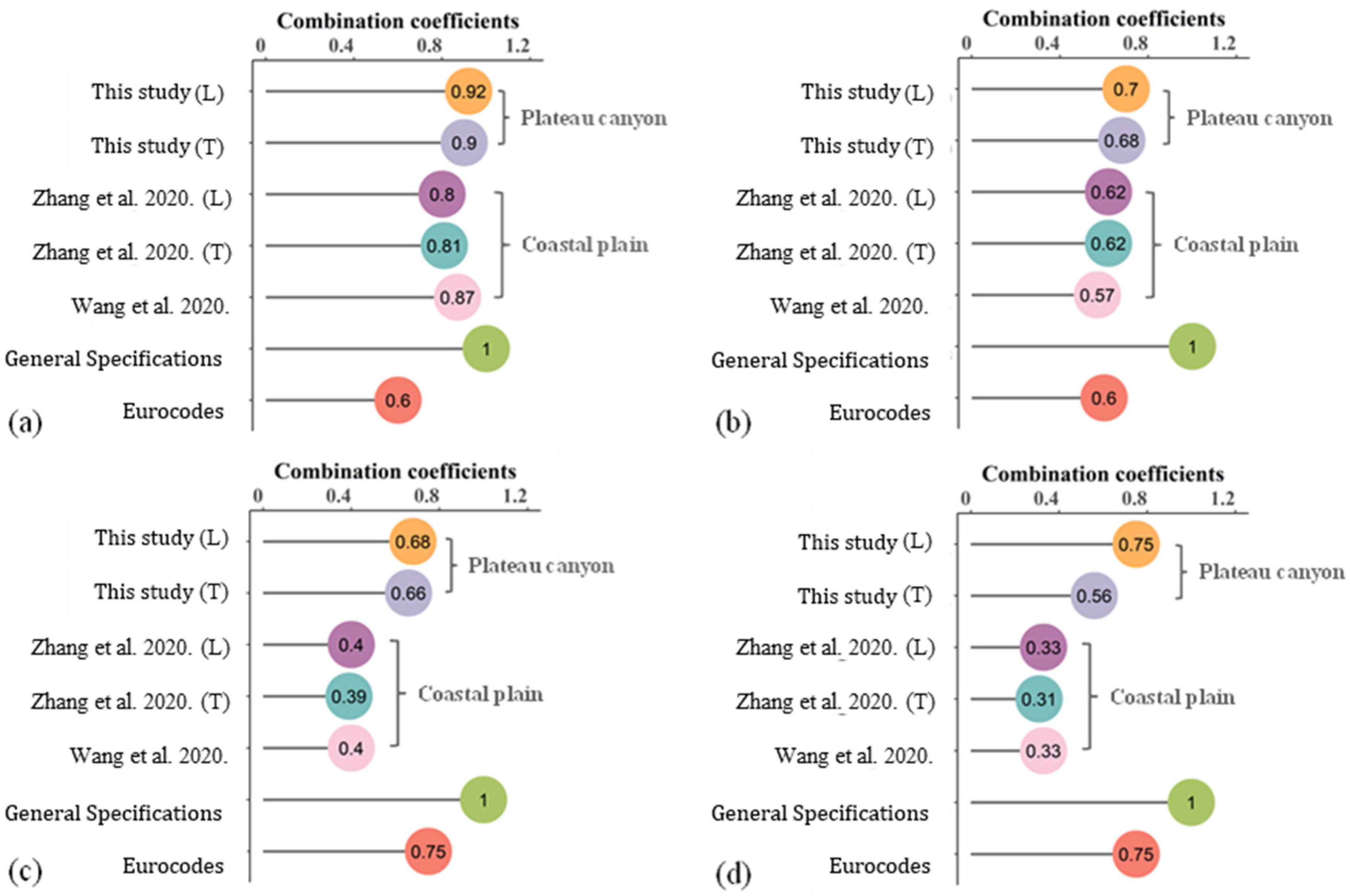
Comparisons are presented in Figure 15. L and T denote longitudinal and transverse directions, respectively. All coefficients proposed in this study are lower than those in General Specifications. This shows the conservative security of General Specifications. The coefficients in the extreme-wind situation are 0.92, 0.9, 0.70 and 0.68, which are higher than the 0.60 in Eurocodes. This suggests that for this plateau canyon bridge, the concomitant temperature action when wind is extreme is significantly larger than the level assumed in Eurocodes, potentially leading to underestimation of the combined effect if the European code is applied directly. The values of 0.68, 0.66, 0.75 and 0.56 in the extreme-temperature situation from this study are less than the 0.75 set by Eurocodes. The provisions in Eurocodes are not applicable for China, due to significant differences in topographic and climatic characteristics. The combination coefficients in this study are larger than those in Zhang et al. [26] and Wang et al. [7], indicating stronger correlations between wind actions and temperature actions in plateau canyon regions than those in subtropical coastal plain regions. In other words, in this bridge site with varied topography and large elevation differences, wind speed is at a relatively high level all year round, leading to higher chances that extreme temperatures coincide with extreme wind speeds. Moreover, it can be observed that the probability of longitudinal gales co-occurring with extremely low temperatures is larger than that in the transverse direction, especially in the extreme-low-temperature situation. This directional asymmetry in joint probability is a critical site-specific finding. It likely arises because the longitudinal direction of the bridge aligns more closely with one of the dominant wind channels identified in Section 4.4, making extreme winds from that direction more frequent and thus resulting in a higher probability of coinciding with extreme thermal events. In contrast, the transverse direction may correspond to a less frequent or topographically constrained wind regime. Meanwhile, in subtropical coastal plain regions, the gaps between the two directions are not obvious as such. This is largely related to the plateau canyon topography. In the open regions, the distribution of wind is more homogeneous compared to that in plateau canyon regions.
Figure 15.
Comparisons of the combination coefficients: (a) ; (b) ; (c) ; (d) [7,26].
However, the combination coefficients presented in this study are derived from one year of monitoring data at a specific plateau canyon site. Their direct applicability to other geographical settings or bridge types is therefore limited. This regional specificity highlights the necessity of conducting site-specific assessments for major bridges in topographically complex regions, rather than relying solely on generalized code provisions. The observed discrepancies between the derived coefficients and those in current codes highlight a significant consideration for future code development or supplementation. While prescribing unique coefficients for every region is impractical, the results advocate for a more performance-based or regionally guided approach in design specifications. The probabilistic framework demonstrated herein could be recommended as a rational method for determining joint actions in non-standard environments. While the specific coefficient values are site-dependent, the underlying methodology is transferable to other bridge types in similar plateau canyon climates, enabling the generation of location-specific design data. Therefore, the primary generalization potential of this work lies in its adaptable methodology, which can be employed to generate location-specific design data, rather than in its direct numerical results.
This study quantifies the joint wind–temperature actions for a long-span bridge in a plateau canyon region, revealing correlations that exceed code assumptions and differ from patterns observed in subtropical plains. The results demonstrate the significant influence of local topography on multivariate environmental loads. Consequently, the design of long-span bridges in geographically unique regions requires climate- and topography-aware approaches, where site-specific probabilistic assessment can valuably supplement prescriptive code provisions.
8. Conclusions
This paper investigates the joint actions and combination coefficients of wind and temperature for a long-span cable-stayed bridge located in a plateau canyon region. Surrounded by mountains, the bridge site has strongly inhomogeneous wind characteristics and tremendous variations in temperature. Wind speeds, air temperatures and wind directions obtained from the SHM system are utilized in subsequent analysis. In light of copulas, the joint actions of wind speed and air temperature in longitudinal and transverse directions of the bridge are established. And the combination coefficients of wind action and temperature action are obtained. Furthermore, a comparative analysis is made with previous studies. Based on these results, the following conclusions are drawn:
(1) The integrated methodology, employing kernel density estimation for marginal distributions and copula theory for dependence modeling, proved effective. Gaussian KDE accurately characterized wind speed and air temperature, while von Mises KDE was essential for the wind direction variable, and the trivariate normal copula successfully captured their joint dependencies.
(2) The Conditional Kendall Return Period provided a statistically robust basis for determining concomitant wind and temperature values conditioned on the critical longitudinal and transverse bridge directions, forming the direct link between probabilistic modeling and engineering design parameters.
(3) The analysis yielded site-specific combination coefficients that deviate notably from prescriptive code values. When wind action is extreme, the concomitant temperature action remains high, exceeding the Eurocode specification of 0.6. A key novel finding is the significant directional difference, particularly the low wind coefficient in the transverse direction during extreme cooling, which is attributed to topographically channeled wind regimes.
(4) The derived coefficients are consistently larger than those reported for subtropical coastal plains. This indicates a stronger correlation between extreme wind and temperature events in the plateau canyon environment, highlighting a distinct regional characteristic that generic codes may not capture.
(5) The specific numerical results are primarily applicable to the studied site and similar environments, and their direct transfer to other regions is not advised. A primary limitation is the use of one year of data, suggesting that longer-term monitoring would enhance statistical robustness for extreme value estimation.
(6) For major bridges in topographically complex regions, a site-specific probabilistic assessment of joint actions is recommended. The framework demonstrated here offers a viable methodology, moving beyond sole reliance on generic code coefficients and contributing to more economically efficient and rationally safe designs.
Author Contributions
J.L.: Supervision, Project administration, Writing—Review and Editing. Z.L.: Writing—Original Draft, Conceptualization, Investigation. Z.M.: Methodology, Conceptualization, Investigation. Y.T.: Investigation, Supervision. C.W.: Investigation. L.Z.: Writing—Review and Editing. Y.L.: Writing—Review and Editing, Supervision. All authors have read and agreed to the published version of the manuscript.
Funding
This study is funded by the Key R &D and transformation plan of Qinghai Province (Grant Number: 2025-QY-245) and the Special Fund for Basic Scientific Research of Central College of Chang’an University (Grant No. 300102214205), which are gratefully acknowledged.
Data Availability Statement
Data will be made available on request.
Conflicts of Interest
Authors Yagang Tong and Chendi Wang were employed by the company Qinghai Provincial Transportation Construction Management Co., Ltd. The remaining authors declare that the research was conducted in the absence of any commercial or financial relationships that could be construed as a potential conflict of interest.
Nomenclature
| X | d-dimensional continuous random vector |
| F | Joint distribution |
| Fi | ith marginal distribution, i = 1, 2, …, d |
| Φ−1 (•) | Inverse function of univariate standard normal distribution |
| Linear correlation coefficient matrix of normal copula | |
| x1i, x2i, x3i | Observed data, i = 1, 2, …, n |
| u1i, u2i, u3i | Empirical marginal distribution at observed points, i = 1, 2, …, n |
| n | Sample size |
| p | Parameter of empirical copula |
| RP | Return period |
| TK,Con | Conditional Kendall Return Period |
| Conditional normal copula | |
| KC,Con | Kendall’s measure of conditional normal copula |
| 10 min average wind direction, rad | |
| 10 min average wind speed, m/s | |
| 10 min average wind speed in north direction, m/s | |
| 10 min average wind speed in east direction, m/s | |
| vx,i | Observed wind speed in north direction, m/s |
| vy,i | Observed wind speed in east direction, m/s |
| KDE(2D) | Two-dimensional kernel density estimation |
| K(·) | Kernel function of kernel density estimation |
| h | Bandwidth of kernel density estimation |
| I0 | 0-order modified Bessel function of first category |
| θi | Observed wind direction, i = 1, 2, …, n |
| Taylor’s bandwidth of kernel density estimation | |
| IQR | Interquartile range |
| κ | Concentration parameter of von Mises distribution |
| Correlation coefficient between linear and circular variables | |
| Te,max | Maximum effective temperature, °C |
| Te,min | Minimum effective temperature, °C |
| Uniform heating action, °C | |
| Uniform cooling action, °C | |
| Combination coefficients of uniform heating action | |
| Combination coefficients of uniform cooling action | |
| Combination coefficients of wind action in heating period | |
| Combination coefficients of wind action in cooling period |
Appendix A. Mathematical Derivations
Appendix A.1. Joint Probability Density Function from Copula
The joint probability density function (PDF) f(x) for a d-dimensional random vector X = (X1, X2, …, Xd)T with copula C and marginal PDFs fi(xi) is given by
Appendix A.2. Density of the Trivariate Normal Copula
For random variables X1, X2 and X3 with marginal distributions U1, U2 and U3, the density is expressed as
Appendix A.3. Parameter Estimation for Trivariate Normal Copula
For the estimation of the parameter ρ on observed data x1i, x2i and x3i with empirical marginal distributions u1i, u2i and u3i, i = 1, …, n, n is the sample size (i.e., dimension of each observed vector). The joint log-likelihood for trivariate normal copula density can be defined as
The empirical copula can be expressed as
Appendix A.4. Conditional Bivariate Normal Copula
The conditional bivariate normal can be expressed as
References
- Zhu, J.; Huang, X.; Li, Y.; Zhao, J. A field study of temperature field distribution characteristics of flat steel box girder and its influential environmental factors. J. Wind Eng. Ind. Aerodyn 2024, 251, 105800. [Google Scholar] [CrossRef] [Scilit]
- Song, J.L.; Li, J.W.; Flay, R.G.; Pirooz, A.A.S.; Fu, J.Y. Validation and application of pressure-driven RANS approach for wind parameter predictions in mountainous terrain. J. Wind Eng. Ind. Aerodyn 2023, 240, 105483. [Google Scholar] [CrossRef] [Scilit]
- Fan, J.S.; Li, B.L.; Liu, C.; Liu, Y.F. An efficient model for simulation of temperature field of steel-concrete composite beam bridges. Structures 2022, 43, 1868–1880. [Google Scholar] [CrossRef] [Scilit]
- Liu, Y.J.; Liu, J. Review on Temperature Action and Effect of Steel-concrete Composite Girder Bridge. J. Traffic Transp. Eng. 2020, 20, 42–59. (In Chinese) [Google Scholar] [CrossRef]
- Liu, Y.J.; Liu, J.; Zhang, N. Review on Solar Temperature Actions of Bridge Structures. China Civ. Eng. J. 2019, 52, 59–78. (In Chinese) [Google Scholar] [CrossRef]
- Li, J.; Wu, P.; Hao, J.; Pan, H. Experimental and numerical studies on the two “lock-in” regions characteristic of vertical vortex-induced vibration of Π-shaped composite bridge deck. J. Wind Eng. Ind. Aerodyn. 2022, 228, 105122. [Google Scholar] [CrossRef] [Scilit]
- Wang, Z.W.; Zhang, W.M.; Tian, G.M.; Liu, Z. Joint values determination of wind and temperature actions on long-span bridges: Copula-based analysis using long-term meteorological data. Eng. Struct. 2020, 219, 110866. [Google Scholar] [CrossRef] [Scilit]
- Chen, Q.; Yu, C.; Li, Y. General strategies for modeling joint probability density function of wind speed, wind direction and wind attack angle. J. Wind Eng. Ind. Aerodyn. 2022, 225, 104985. [Google Scholar] [CrossRef] [Scilit]
- JTG D60-2015; General Specifications for Design of Highway Bridges and Culverts. Ministry of Transport of the People’s Republic of China: Beijing, China, 2015. (In Chinese)
- EN 1991-1-5; Eurocode 1: Actions on Structures—Part 1–5: General Actions—Thermal Actions. European Committee for Standardization (CEN): Brussels, Belgium, 2003.
- Hu, J.; Zheng, Q.G.; Zhang, W.M. Study of Combined Effects of Wind and Thermal Loads on Changtai Changjiang River Bridge. Bridge Constr. 2020, 50, 6. (In Chinese) [Google Scholar] [CrossRef]
- Simiu, E.; Scanlan, R.H. Wind Effects on Structures: Fundamentals and Applications to Design, 3rd ed.; John Wiley&Sons: New York, NY, USA, 1996. [Google Scholar]
- Fan, W.L.; Li, Z.L.; Zhang, P. Modeling of the joint probabilistic structure of wind direction and speed. China Civ. Eng. J. 2012, 45, 81–90. (In Chinese) [Google Scholar] [CrossRef]
- Nelsen, R.B. An Introduction to Copulas, 2nd ed.; Springer: New York, NY, USA, 2006. [Google Scholar]
- Sklar, A. Fonctions de répartition à n dimensions et leurs marges. Publ. Inst. Statist. Univ. Paris 1959, 8, 229–231. [Google Scholar]
- Salvadori, G.; De Michele, C.; Kottegoda, N.T.; Rosso, R. Extremes in Nature: An Approach Using Copulas; Springer: Dordrecht, The Netherlands, 2007. [Google Scholar]
- Salvadori, G.; De Michele, C.; Durante, F. On the return period and design in a multivariate framework. Hydrol. Earth Syst. Sci. 2011, 15, 3293–3305. [Google Scholar] [CrossRef] [Scilit]
- Bevacqua, E.; Maraun, D.; Hobæk Haff, I.; Widmann, M.; Vrac, M. Multivariate statistical modelling of compound events via pair-copula constructions: Analysis of floods in Ravenna (Italy). Hydrol. Earth Syst. Sci. 2017, 21, 2701–2723. [Google Scholar] [CrossRef] [Scilit]
- Gao, C.; Hao, M.; Chen, J.; Gu, C. Simulation and design of joint distribution of rainfall and tide level in Wuchengxiyu Region, China. Urban Clim. 2021, 40, 101005. [Google Scholar] [CrossRef] [Scilit]
- Varol, T.; Atesoglu, A.; Ozel, H.B.; Mehmet, C. Copula-based multivariate standardized drought index (MSDI) and length, severity, and frequency of hydrological drought in the Upper Sakarya Basin, Turkey. Nat. Hazards 2023, 116, 3669–3683. [Google Scholar] [CrossRef] [Scilit]
- Zhang, F.; Cui, N.; Guo, S.; Yue, Q.; Jiang, S.; Zhu, B.; Yu, X. Irrigation strategy optimization in irrigation districts with seasonal agricultural drought in southwest China: A copula-based stochastic multiobjective approach. Agric. Water Manag. 2023, 282, 108293. [Google Scholar] [CrossRef] [Scilit]
- Li, H.N.; Zheng, X.W.; Li, C. Copula-based joint distribution analysis of wind speed and direction. J. Eng. Mech. 2019, 145, 04019024. [Google Scholar] [CrossRef] [Scilit]
- Zhang, H.; Zhao, L.; Chen, F.; Luo, Y.; Xiao, X.; Liu, Y.; Deng, Y. A machine learning and multi-source authentic data-driven framework for accurate fatigue life prediction of welds in existing steel bridge decks. Thin-Walled Struct. 2026, 222, 114559. [Google Scholar] [CrossRef] [Scilit]
- Zhang, H.; Yang, X.; Luo, Y.; Chen, F.; Lu, N.; Liu, Y.; Deng, Y. A novel hybrid algorithm for damage detection in bridge foundations under complex underwater environments using ROV capture pictures. Eng. Struct. 2026, 352, 122131. [Google Scholar] [CrossRef] [Scilit]
- Chen, F.; Tan, B.; Tang, H.; Zhang, H.; Luo, Y.; Xiao, X.; Liu, Y.; Lu, N. An interpretable random forest surrogate for rapid SIF prediction and fatigue life assessment of double-sided U-rib welds in orthotropic steel decks. Eng. Fail. Anal. 2026, 187, 110582. [Google Scholar] [CrossRef] [Scilit]
- Zhang, W.M.; Wang, Z.W.; Liu, Z. Joint distribution of wind speed, wind direction, and air temperature actions on long-span bridges derived via trivariate metaelliptical and Plackett copulas. J. Bridge Eng. 2020, 25, 04020069. [Google Scholar] [CrossRef] [Scilit]
- Genest, C.; Favre, A.C. Everything you always wanted to know about copula modeling but were afraid to ask. J. Hydrol. Eng. 2007, 12, 347–368. [Google Scholar] [CrossRef] [Scilit]
- Meyer, C. The bivariate normal copula. Commun. Stat.-Theory Methods 2013, 42, 2402–2422. [Google Scholar] [CrossRef] [Scilit]
- Ko, V.; Hjort, N.L. Copula information criterion for model selection with two-stage maximum likelihood estimation. Econom. Stat. 2019, 12, 167–180. [Google Scholar] [CrossRef] [Scilit]
- Deheuvels, P. La fonction de dépendence empirique et ses propriétés. Un test non paramétrique d’indépendence. Acad. R Belg. Bul. Cl Sci. 1979, 65, 274–292. [Google Scholar]
- Chicco, D.; Warrens, M.J.; Jurman, G. The coefficient of determination R-squared is more informative than SMAPE, MAE, MAPE, MSE and RMSE in regression analysis evaluation. PeerJ Comput. Sci. 2021, 7, e623. [Google Scholar] [CrossRef] [Scilit]
- Chai, T.; Draxler, R.R. Root mean square error (RMSE) or mean absolute error (MAE)?—Arguments against avoiding RMSE in the literature. Geosci. Model Dev. 2014, 7, 1247–1250. [Google Scholar] [CrossRef] [Scilit]
- Wang, Z.C. Building Water Supply and Drainage Engineering, 5th ed.; China Architecture & Building Press: Beijing, China, 2005. [Google Scholar]
- Jiang, T.; Su, X.; Zhang, G.; Zhang, T.; Wu, H. Estimating propagation probability from meteorological to ecological droughts using a hybrid machine learning copula method. Hydrol. Earth Syst. Sci. 2023, 27, 559–576. [Google Scholar] [CrossRef] [Scilit]
- Zhang, L.; Singh, V.P. Gumbel-Hougaard copula for trivariate rainfall frequency analysis. J. Hydrol. Eng. 2007, 12, 409–419. [Google Scholar] [CrossRef] [Scilit]
- Han, Q.K.; Hao, Z.L.; Hu, T.; Chu, F.L. Nonparametric models for joint probabilistic distributions of wind speed and direction data. Renew. Energy 2018, 126, 1032–1042. [Google Scholar] [CrossRef] [Scilit]
- Wang, Z.W.; Zhang, W.M.; Zhang, Y.F.; Liu, Z. Circular-linear-linear probabilistic model based on vine copulas: An application to the joint distribution of wind direction, wind speed, and air temperature. J. Wind Eng. Ind. Aerodyn. 2021, 215, 104704. [Google Scholar] [CrossRef] [Scilit]
- Han, Q.; Ma, S.; Wang, T.; Chu, F. Kernel density estimation model for wind speed probability distribution with applicability to wind energy assessment in China. Renew. Sustain. Energy Rev. 2019, 115, 109387. [Google Scholar] [CrossRef] [Scilit]
- García-Portugués, E.; Crujeiras, R.M.; González-Manteiga, W. Exploring wind direction and SO2 concentration by circular–linear density estimation. Stoch. Environ. Res. Assess. 2013, 27, 1055–1067. [Google Scholar] [CrossRef] [Scilit]
- Silverman, B.W. Density Estimation for Statistics and Data Analysis; Springer: New York, NY, USA, 1986. [Google Scholar]
- Taylor, C.C. Automatic bandwidth selection for circular density estimation. Comput. Stat. Data Anal. 2008, 52, 3493–3500. [Google Scholar] [CrossRef] [Scilit]
- Soukissian, T.H.; Karathanasi, F.E. On the selection of bivariate parametric models for wind data. Appl. Energy 2017, 188, 280–304. [Google Scholar] [CrossRef] [Scilit]
- Mardia, K.V.; Jupp, P.E. Directional Statistics; John Wiley & Sons: Chichester, UK, 2000. [Google Scholar]
- Soukissian, T.H. Probabilistic modeling of directional and linear characteristics of wind and sea states. Ocean Eng. 2014, 91, 91–110. [Google Scholar] [CrossRef] [Scilit]

Disclaimer/Publisher’s Note: The statements, opinions and data contained in all publications are solely those of the individual author(s) and contributor(s) and not of MDPI and/or the editor(s). MDPI and/or the editor(s) disclaim responsibility for any injury to people or property resulting from any ideas, methods, instructions or products referred to in the content. |
© 2026 by the authors. Licensee MDPI, Basel, Switzerland. This article is an open access article distributed under the terms and conditions of the Creative Commons Attribution (CC BY) license.