Article

Form Meets Flow: Linking Historic Corridor Morphology to Multi-Scale Accessibility and Pedestrian Interface on Beishan Street, West Lake

1
Department of Landscape Architecture, School of Architectural Engineering, Zhejiang Sci-Tech University, Hangzhou 310018, China
2
Department of Landscape Architecture, School of Architecture, Tianjin University, Tianjin 300072, China
3
School of Cultural Heritage, Northwest University, Xi’an 710127, China
4
International School of Engineering, Tianjin Chengjian University, Tianjin 300380, China
5
Department of Landscape Architecture, School of Architecture, Tianjin Chengjian University, Tianjin 300384, China
*
Authors to whom correspondence should be addressed.
Buildings 2026, 16(5), 889; https://doi.org/10.3390/buildings16050889
Submission received: 11 January 2026 / Revised: 7 February 2026 / Accepted: 10 February 2026 / Published: 24 February 2026
(This article belongs to the Special Issue Advanced Study on Urban Environment by Big Data Analytics)

Abstract

Historic linear corridors in living-heritage settings concentrate identity, everyday mobility, and visitor experience. Balancing authenticity, adaptability, and publicness therefore benefits from evidence that jointly characterizes long-term physical change, network accessibility, and eye-level interface conditions. Existing assessments often focus on façades or single time slices, leaving limited evidence that relates decades of built-fabric reconfiguration (changes in building footprints, street edges, and open-space fragmentation) to multi-scale accessibility and pedestrian-facing qualities. We propose an integrated and interpretable workflow for the Beishan Street corridor in the West Lake World Heritage core (Hangzhou) over 1929–2024. Scale-sensitive morphological metrics, multi-radius network measures (integration and centrality), and street-view semantic segmentation are aligned at corridor-segment resolution and examined together with segment-level functional intensity derived from POIs using transparent linear models. The results indicate a long-term shift from a lakeshore-led to a road-led spatial logic, followed by post-2000 stabilization near saturation. Average integration increases, while the high-integration tail becomes thinner. In connector-removal scenarios, the eastern segment shows a relative accessibility decline, and a central hinge node emerges as a vulnerability hotspot (bottleneck) where through-movement concentrates. Eye-level profiles differ by segment: the west exhibits maximal canopy and lower sky visibility, the center shows stronger continuous walls around compounds with intermittent forecourt openings, and the east is characterized by compact residential heritage frontage with low vegetation. Segment-level associations suggest that address and wayfinding density tends to co-occur with clearer frontages, wider sky cones, and stronger tree cover. Transportation-related and access/passage facilities tend to co-occur with higher ground-plane legibility, measured as wider and more continuous road and sidewalk surfaces. Medical and government clusters tend to co-occur with lower sky openness. Recommended actions include the following: (1) mesh-aware protection of key connectors and the hinge, (2) segment-specific targets for façade share and ground cues with planned punctuations, (3) tailored interface standards for institutional clusters, (4) scalable address and wayfinding systems, and (5) event staging that preserves effective roadway and sidewalk capacity.

1. Introduction

Historic urban streets and linear heritage corridors have become pivotal arenas for contemporary urban governance because they concentrate layered cultural meanings, everyday livelihoods, and public-realm value, while mediating trade-offs between authenticity protection, functional adaptability, and inclusive use. These places act simultaneously as repositories of collective memory and as working infrastructure for walkability, tourism, local economies, and environmental comfort. Framed within the Historic Urban Landscape (HUL) approach, they demand tools that integrate heritage values with urban development objectives and social needs [1,2]. Classic urban design and morphology scholarship established why such corridors matter for imageability, diversity, and human-scale public life, as well as how their spatial configuration structures movement and co-presence [3,4,5,6,7,8]. At the same time, complexity science and urban-form research emphasized that built environments evolve through multi-scale processes with path dependence and threshold effects rather than linear change [9,10]. Foundational works on patterns of everyday urbanism and conservation ethics underline the stakes of negotiating continuity and change in living-heritage contexts [11,12,13,14]. However, despite these insights, practice often oscillates between codified façade control and ad hoc renewal, while the deeper dynamics connecting long-duration morphological change, multi-scale accessibility, street-level perception, and functional organization remain weakly evidenced. This motivates a central problem statement for linear heritage corridors: how to balance authenticity, readability, adaptability, and publicness through an integrated and interpretable chain of indicators linking form, network, perception, and use in one system [6,7,8,9,10].
Four interrelated gaps shape the methodological agenda: First, a temporal gap persists because many assessments rely on single-season audits or one-time visual surveys, with few comparable metrics able to reveal phases, thresholds, and reorganizations across decades or policy cycles. Even when historical cartography exists, it is seldom converted into consistent measures of morphological complexity or growth regimes that allow cross-period comparison [9,10,11,12,13,14,15,16]. Second, a structural gap persists because studies seldom connect (i) street-level public-realm qualities that shape perceived comfort and legibility (façade continuity, skyline rhythm, shade, and edge definition) with (ii) network accessibility indicators (connectivity, integration, and centrality) that describe movement potential and the distribution of through-flows [7,8,11,17,18,19,20]. Third, a perceptual–functional gap endures because few analyses build a coherent chain from street-level perception—enclosure, greenness, sky openness, signage, and visual clutter—to the location, intensity, and diversity of everyday uses—retail, catering, housing, cultural venues, mobility services, and micro-amenities—despite the emergence of street-view imagery, crowdsourced perception datasets, and computer vision pipelines [21,22,23,24,25,26,27,28]. Fourth, an institutional gap concerns instrumented governance, where zoning slogans and style manuals dominate discussion, while interpretable indicators that stakeholders can track, communicate, and debate within HUL frameworks remain underdeveloped. Bridging these gaps requires a framework that fuses historical cartography with quantitative morphology maps and multi-scale accessibility, derives semantically rich pedestrian-interface indicators from street imagery, and couples them with functional point data through transparent models in a way that is portable and auditable for planners, conservation officers, community groups, and property owners [1,2,29,30,31,32,33,34].
Four analytical questions structure our agenda: First (time and regimes), do corridor fabrics exhibit regime shifts (expansion, consolidation, reorganization) that can be detected with scale-aware morphology metrics, rather than being treated as a single linear trend? We operationalize this with time-sliced fractal/lacunarity indicators and breakpoint detection. Second (structure–interface coupling), under what conditions do network accessibility and through-movement potential (integration/centrality across radii) co-vary with street-level comfort/legibility features (enclosure, continuity, shade and edge definition) at the segment scale, and where do they decouple? We address this by aligning multi-radius centralities with segment-aggregated interface indicators. Third (interface–function coupling), how do measurable eye-level interface signatures (sky openness, greenery, ground-plane legibility, signage/clutter proxies) relate to the intensity and diversity of everyday uses (POI-based functional portraits) when both are aligned to the same segment geometry? We evaluate this via transparent models and segment-level diagnostics. Fourth (governance operability), can the resulting indicators be translated into tiered, monitorable guidance that stakeholders can interpret, debate, and track within an HUL process, rather than remaining as stand-alone visualizations? We address this by reporting interpretable effect directions/magnitudes and proposing segment-specific targets and monitoring routines.
Viewed along a broad timeline, the knowledge base has evolved through intertwined waves. The earliest wave codified a visual and social language for city form and public life, emphasizing imageability, diversity, small-scale sociability, and the choreography of everyday spaces. This work produced enduring guidance for humane streets and warned against oversimplified modernization [3,4,5,6,13]. A second wave—rooted in urban morphology, configurational theory, and complexity science—examined lots and blocks, typologies, and the geometry of street networks using figure–ground mapping, graph analysis, and spatial reasoning. It linked configuration to movement potentials, clarified how spatial structure co-produces activity patterns, and highlighted nonlinearity and multi-scale coupling in urban growth [7,9,11,12,17]. A third wave delivered policy instruments such as view corridors, height limits, façade-improvement schemes, and stylistic control manuals—especially in World Heritage settings—yet longitudinal evidence was thin, and cross-scale links between accessibility, perceived continuity, and use mix were seldom quantified, creating a compliance-heavy but sometimes fragile streetscape [1,2,31,33]. Across these waves the persistent limitations are clear: scarce time-series diagnostics, weak coupling between network metrics and interface qualities, limited integration of perception and functional data, and a gap between measurement and tiered governance within collaborative HUL processes. These gaps are particularly acute within the linear corridors of World Heritage core zones: facade and character controls are often prioritized, yet there is a lack of verifiable longitudinal evidence demonstrating how “accessibility—perceptible continuity—mixed use” co-evolve at the segmented scale.
Contemporary research is beginning to close these gaps by mobilizing computational tools, open data, and cross-disciplinary evidence. Network science and space syntax offer connectivity, integration, and centrality indices that can be compared through time, while open-source workflows such as OSMnx democratize the acquisition, analysis, and visualization of complex street networks. Historical imagery and parcel maps enable reconstruction of footprints, edges, and vegetation, enabling tests for phase transitions and reorganization events [17,18,19,20,21,35,36]. At the pedestrian scale, street-view computer vision quantifies interface elements—sky, building, vegetation, road, sidewalk, and signage—and supports perceptual modeling of qualities such as safety, liveliness, wealth, beauty, and related affective dimensions, drawing on Place Pulse and other datasets [21,22,23,24,25,26,28]. Functional portraits inferred from points of interest and observational traces document the semantic structure of everyday life and enable analyses of diversity, clustering, and complementarity across corridor segments [29,30,31]. However, challenges remain: siloed, single-method studies miss interaction effects across morphology, network, perception, and function; black-box prediction undermines interpretability for public decision-making; and translation to tiered HUL governance often stops at visualization rather than specifying indicators, thresholds, and monitoring routines. Recent advances in interpretable machine learning—including efficient gradient boosting and unified model-explanation frameworks—provide a route to policy-ready analysis if embedded carefully within domain logic and stakeholder processes [36,37,38]. Altogether, the state of the art points to a practical need: an integrated and interpretable evidence chain that can be computed from heterogeneous open data, communicated to non-technical stakeholders, and translated into tiered, monitorable corridor guidance under heritage-sensitive planning [1,2,30,31].
Responding to these needs, this study proposes and demonstrates an integrated framework that is long-term, multi-scale, data-rich, and interpretable. First, we reconstruct the evolution of the corridor fabric using morphological-complexity measures that are sensitive to scaling regimes and fragmentation to identify stages of expansion, consolidation, and reorganization, and to situate local interventions within longer trajectories [10,11,15]. Second, we analyze street-network structure using time-sliced street graphs and multi-radius accessibility metrics (integration and centrality). Changes are assessed by comparing metric distributions across periods and by computing segment-level differences; we also test connector-removal scenarios to reveal where accessibility is most sensitive to path loss and where through-movement concentrates [7,9,19,20,21,36]. Third, we extract pedestrian-interface indicators from street-level imagery to obtain consistent measures of sky openness, façade proportion, vegetation presence, continuous edges, ground-plane legibility, signage density, and visual clutter, and we link these measures to perception signals reported in large-scale studies [21,22,23,24,25,26,27]. Fourth, we assemble a functional portrait from points of interest and complementary observations to characterize everyday activity structures and semantic diversity at the segment level [29,30,31]. Fifth, we connect these layers with transparent modeling strategies that estimate the direction and magnitude of effects in policy-ready language, and we apply model-explanation techniques to make contributions traceable for different stakeholders [36,37,38]. Finally, we translate our findings into a tiered set of guidance strategies that balance authenticity, readability, adaptability, and public value across different corridor segments, and we develop a monitoring scheme aligned with the Historic Urban Landscape (HUL) approach. Beyond presenting an integrated workflow, we further propose a constraint-based theory of collaborative co-evolution for living-heritage corridors. We argue that when corridor structure approaches long-term morphological saturation under heritage governance constraints, accessibility can still evolve; however, its trajectory is more likely to be realized through a redistribution of centrality (i.e., a shift toward a flatter hierarchy), rather than through the continued dominance of a few “super-spine” segments. In practice, we operationalize HUL principles as tiered, segment-specific guidelines and monitoring indicators, enabling planners and conservation practitioners to prioritize interventions, justify trade-offs, and track corridor dynamics over time. The proposed workflow is designed to be replicable and can be extended to other linear heritage corridors with comparable open-data coverage.

2. Study Area and Materials

2.1. Study Area

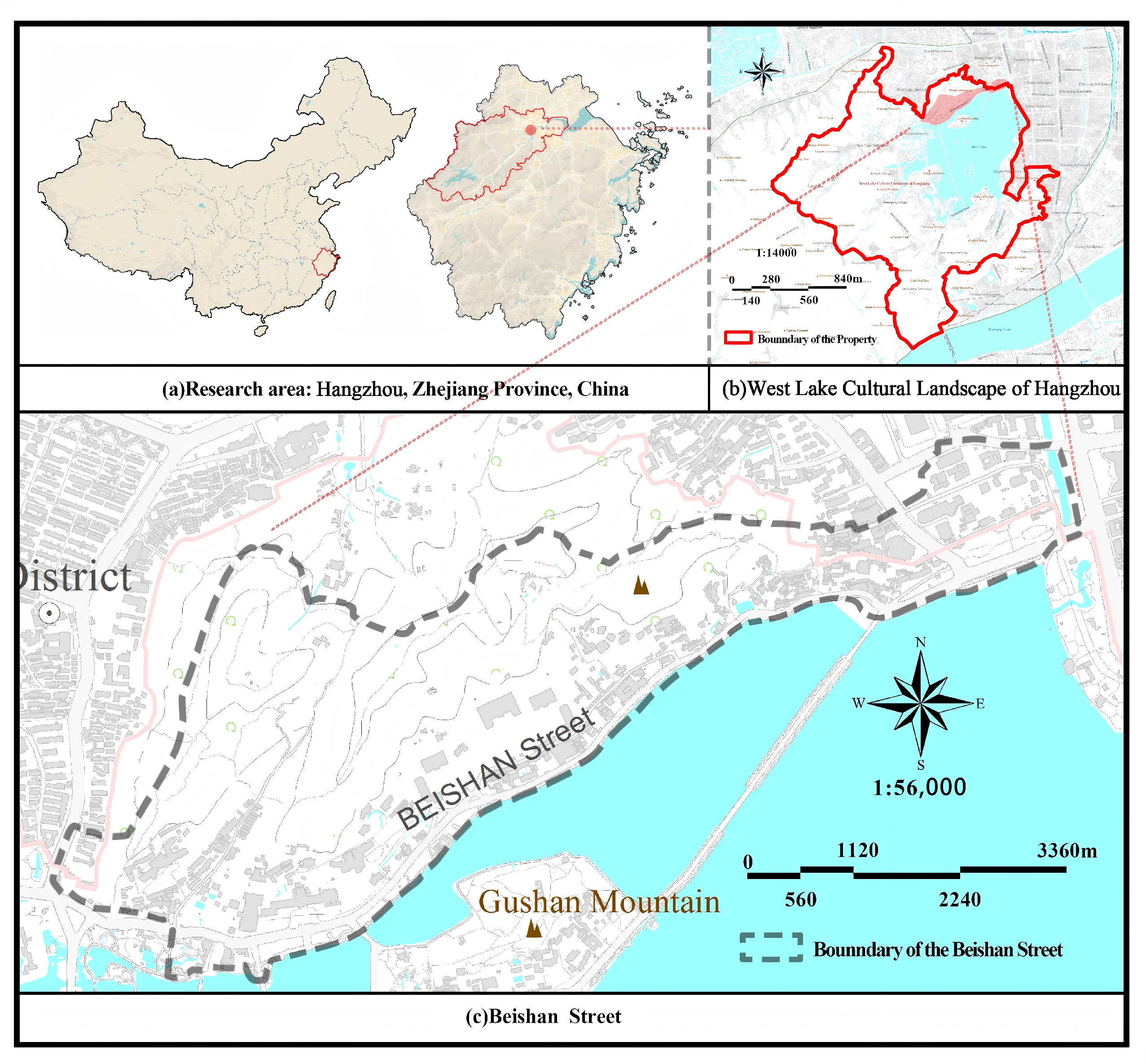
This study selects the Beishan Street linear corridor in the core zone of West Lake, Hangzhou, because it concentrates heritage significance, everyday use, and policy relevance within a compact and clearly bounded setting (Figure 1). The corridor occupies a distinctive mountain city lake edge where topography, historic fabric, and contemporary activity meet, producing a continuous sequence of waterfront and foothill spaces that make trade-offs between authenticity, active use, and visitor pressure both visible and measurable. Its human-scale blocks, varied frontages, and closely spaced nodes—such as gateways, viewpoints, pocket squares, cultural venues, community services, and small businesses—create a fine-grained laboratory for examining how street configuration and interface qualities shape movement, encounter, comfort, and legibility. The area also benefits from unusually rich longitudinal evidence in historical maps and imagery, supporting the reconstruction of long-term morphological trajectories and the identification of phases such as consolidation, fragmentation, and reorganization rather than a static snapshot. Functionally, Beishan Street sits at a hinge between scenic precincts and residential neighborhoods, generating clear gradients of multi-scale accessibility and distinct patterns of pedestrian demand that suit network analysis and segment-by-segment comparison. The corridor presents a wide spectrum of pedestrian-facing interfaces including garden walls, forecourts, shopfronts, shaded sidewalks, and lakeside walks, enabling consistent measurement of façade continuity, sky openness, greenery presence, signage density, and ground-plane legibility. Governance conditions further justify the choice, since view and height controls coexist with micro-renewal projects, creating a real-world arena to translate empirical indicators into tiered guidance and test coordination across heritage, transport, landscape, and community stakeholders. Finally, high-quality open-data coverage and manageable length allow reproducible workflows, periodic monitoring, and scenario testing. Together, these qualities make Beishan Street a compelling and transferable site for developing methods that balance authenticity, adaptability, and publicness in linear heritage corridors.

2.2. Data Source

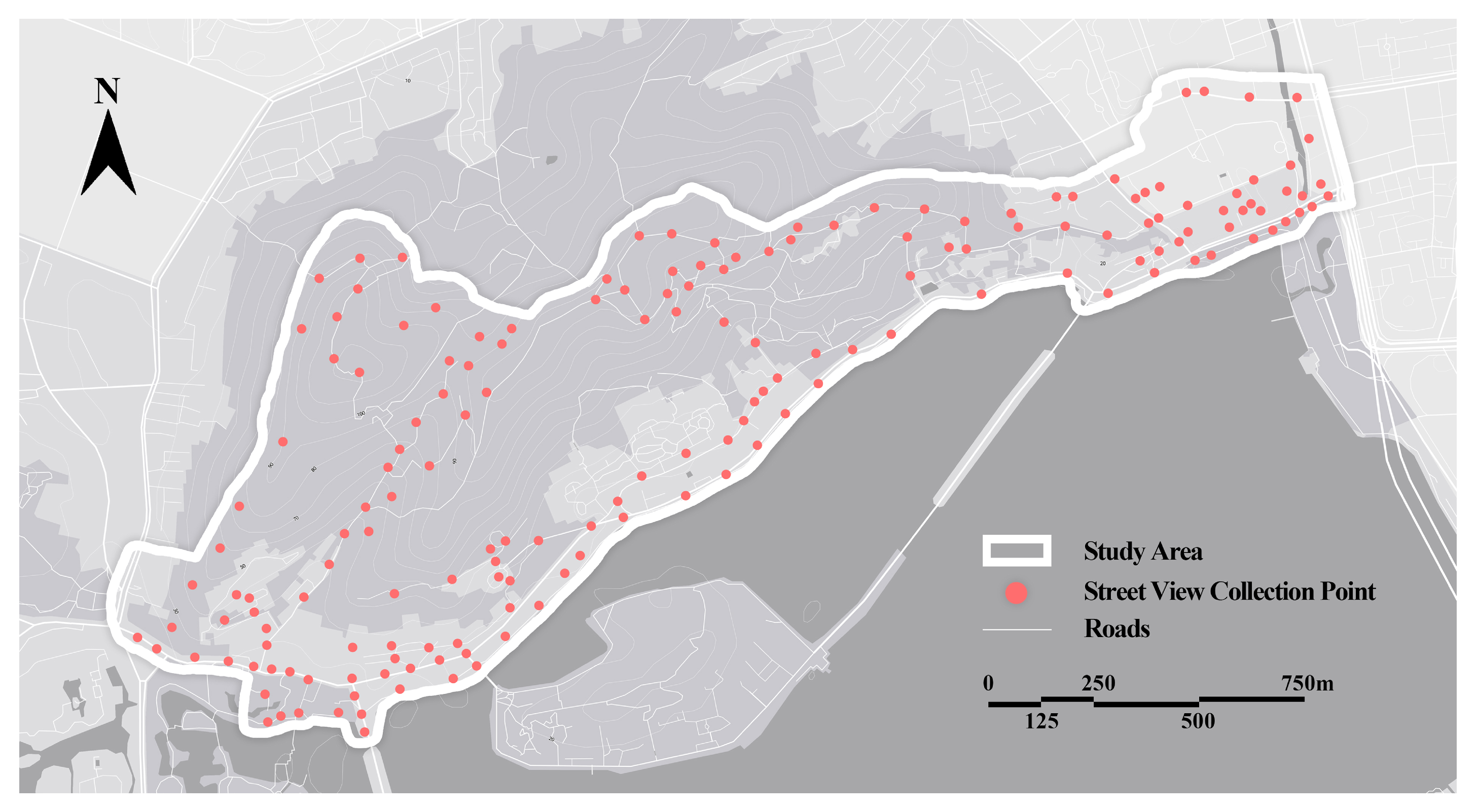
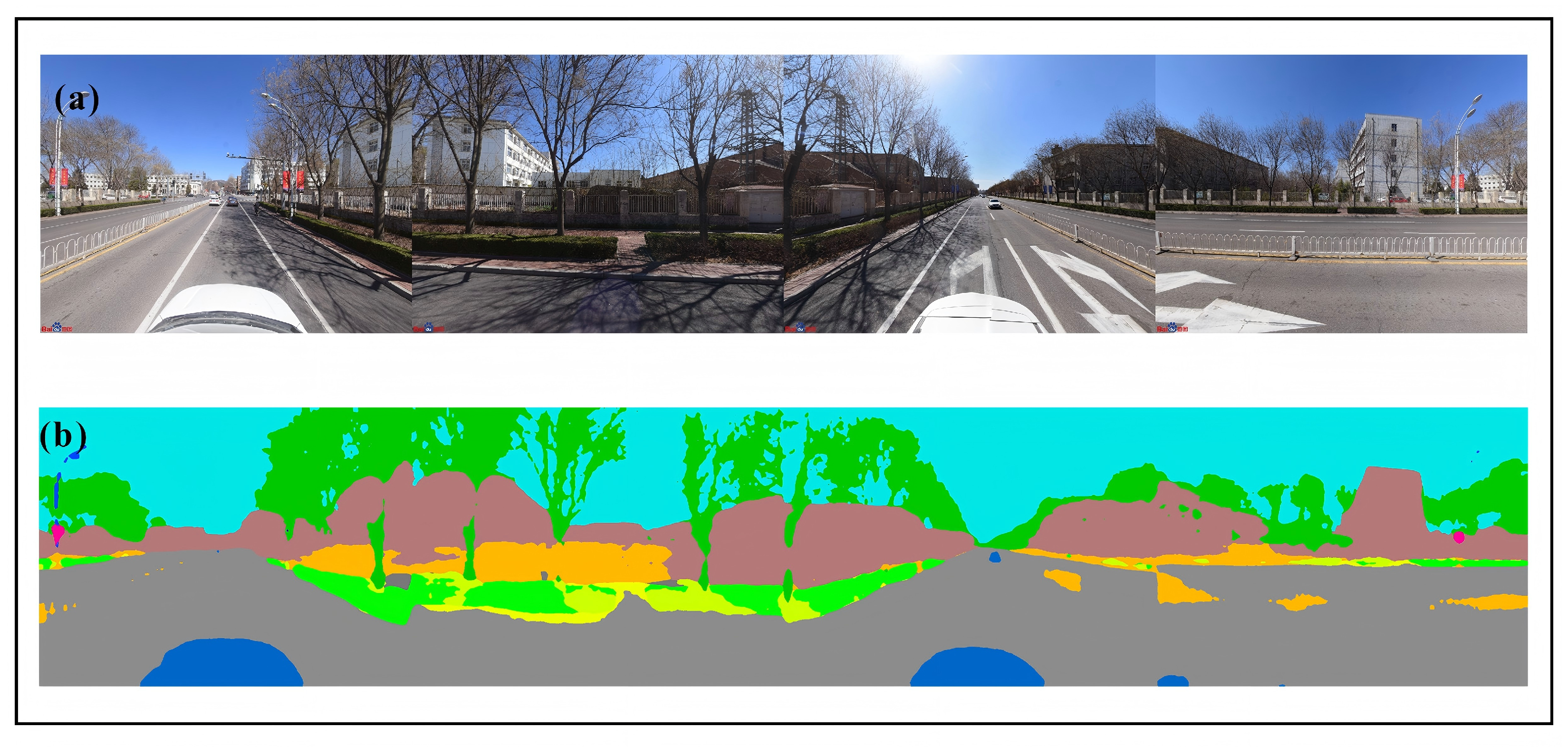
Urban road network data was obtained from OpenStreetMap. Prior to street-view sampling and image retrieval, it underwent processing via a reproducible geospatial workflow based on the generalized procedure proposed by Li [22]. Street-view panoramas were acquired through Baidu Maps Open Platform’s Panorama Service and Panorama Static Image API (access date: 27 November 2025). Following import via GeoPandas(v1.1.2), the raw linear features underwent data cleansing to eliminate duplicate road segments and fragmented splits. Topological consistency was enhanced through shared node alignment. All geometries were projected to a metric coordinate system to support distance-based operations. Based on the cleaned network, we placed sampling points every 50 m along traversable street centerlines. We verified coverage in ArcGIS 10.8, removed points located on ramps or service lanes where imagery was unreliable, and clipped the final set to the study boundary. For each sampling point, we queried the nearest available Baidu panorama and recorded the panorama identifier, acquisition month, and camera pose. We then requested the corresponding 360° panorama. To create comparable street-facing views across locations, we rendered tiles at a resolution of 2560 × 1440 pixels with 24-bit color, fixed the virtual camera to a forward-looking orientation, and applied uniform field-of-view parameters. A custom Python(v3.8) script orchestrated the download queue with throttling and automatic retries, logged all requests and responses, and wrote raw responses to disk to support auditing. Quality control was conducted in Pandas(v3.0) and GeoPandas: we removed locations that returned no imagery, discarded corrupted or partial downloads, merged duplicate records that referenced the same panorama identifier, and flagged scenes with heavy occlusion for optional review. After quality control, we retained 3200 sampling points linked to 400 streetscape images and 3400 panoramic streetscape images (Figure 2). These images were then used as inputs to a semantic segmentation model to extract physical attributes of the streetscape interface. Variables quantified at each location include walls, buildings, roads, pedestrians, sky visibility, sidewalks, trees, bushes, and grass. The outputs provide per-point measurements that can be aggregated by corridor buffers or administrative units and joined back to the network via unique location identifiers. Typical constraints of Baidu Street View remain—including uneven coverage, variation in acquisition dates, and transient occlusions—mitigated via consistent view parameterization, metadata logging, and conservative filtering.
Points of interest (POIs) were collected from Gaode Map to represent meso-scale functions shaping routine activities. The study boundary used the same projected coordinate system as the network and imagery for consistent spatial operations. The boundary was divided into a grid to ensure full coverage within request limits. For each cell, we issued place searches by city code and type keywords, iterating through the official Gaode category list so that common amenities, retail and service facilities, medical and educational institutions, public service locations, and recreation sites were included. Responses were stored in raw JSON with query parameters and timestamps for reproducibility, paginated where necessary, throttled to respect rate limits, and retried on transient failures. Records were parsed into a GeoDataFrame, re-projected to the analysis CRS, and clipped to the boundary. Exact duplicates were removed using a composite key (name, address, coordinates); near-duplicates were collapsed using a small spatial tolerance plus normalized names. Records with missing or out-of-extent coordinates were discarded, and fields were standardized for naming and category labels. We then recoded Gaode categories into the CMEPR classification [39], assigning each record to commerce, medical, education, public, or recreation via a transparent crosswalk and priority rules. Synonyms were merged, and records flagged as closed were removed when available. The final database contained 1779 cleaned POIs. For downstream analysis we prepared (i) the raw point layer and (ii) summaries aligned with the street network and capture locations—counts within corridor buffers and administrative units, densities normalized by area and road length, and distances to the nearest facility of a given type. Where responses included the last update time, we recorded it and favored records within the imagery window; otherwise, we retained crawl time and normalized totals by overall POI reporting intensity. All intermediate files, logs, and data dictionaries were versioned. The result is an analysis-ready dataset coupling 1779 POIs with 3400 network-anchored capture points and the corresponding 3200 streetscape images and 800 panoramas.
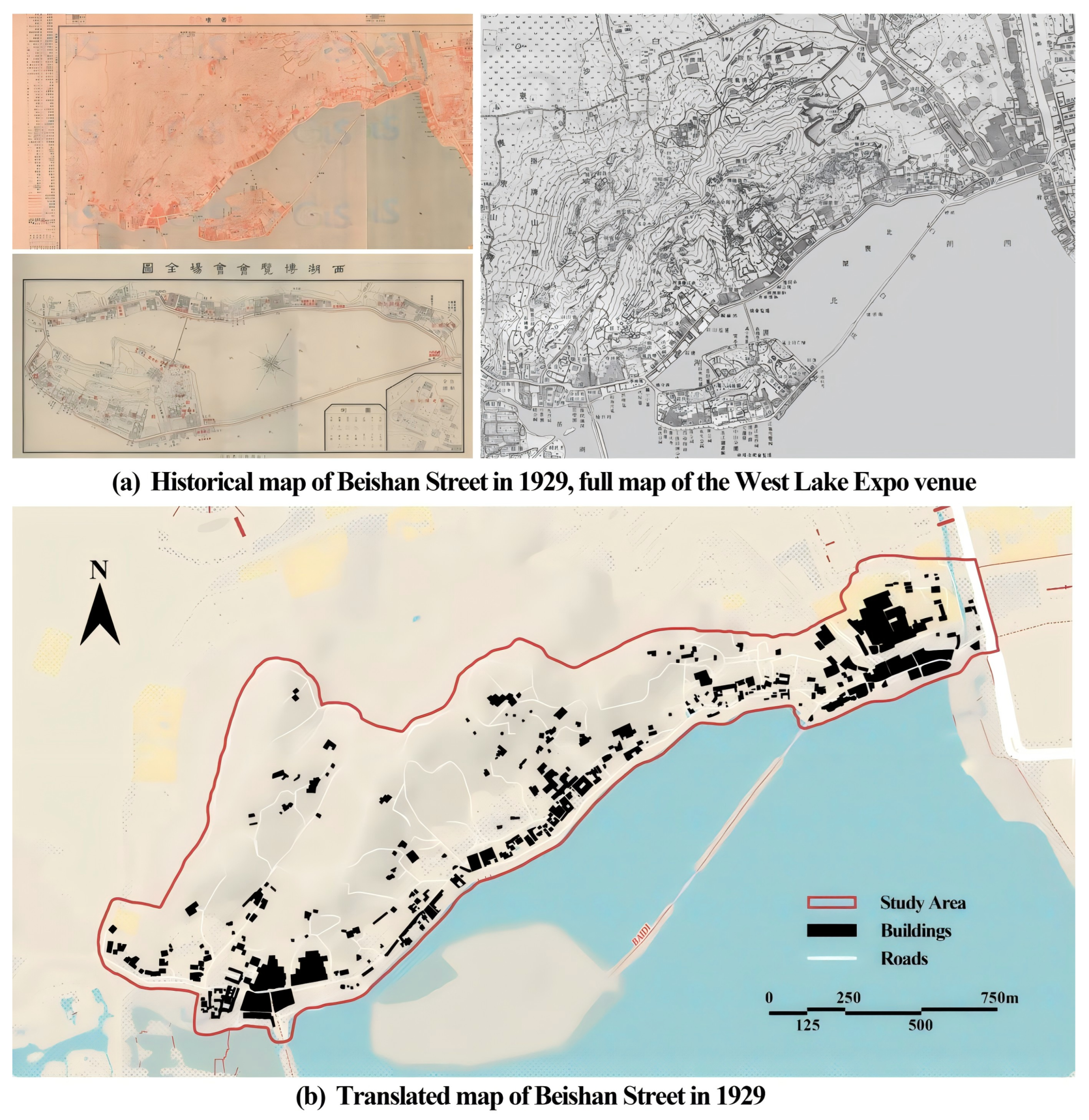
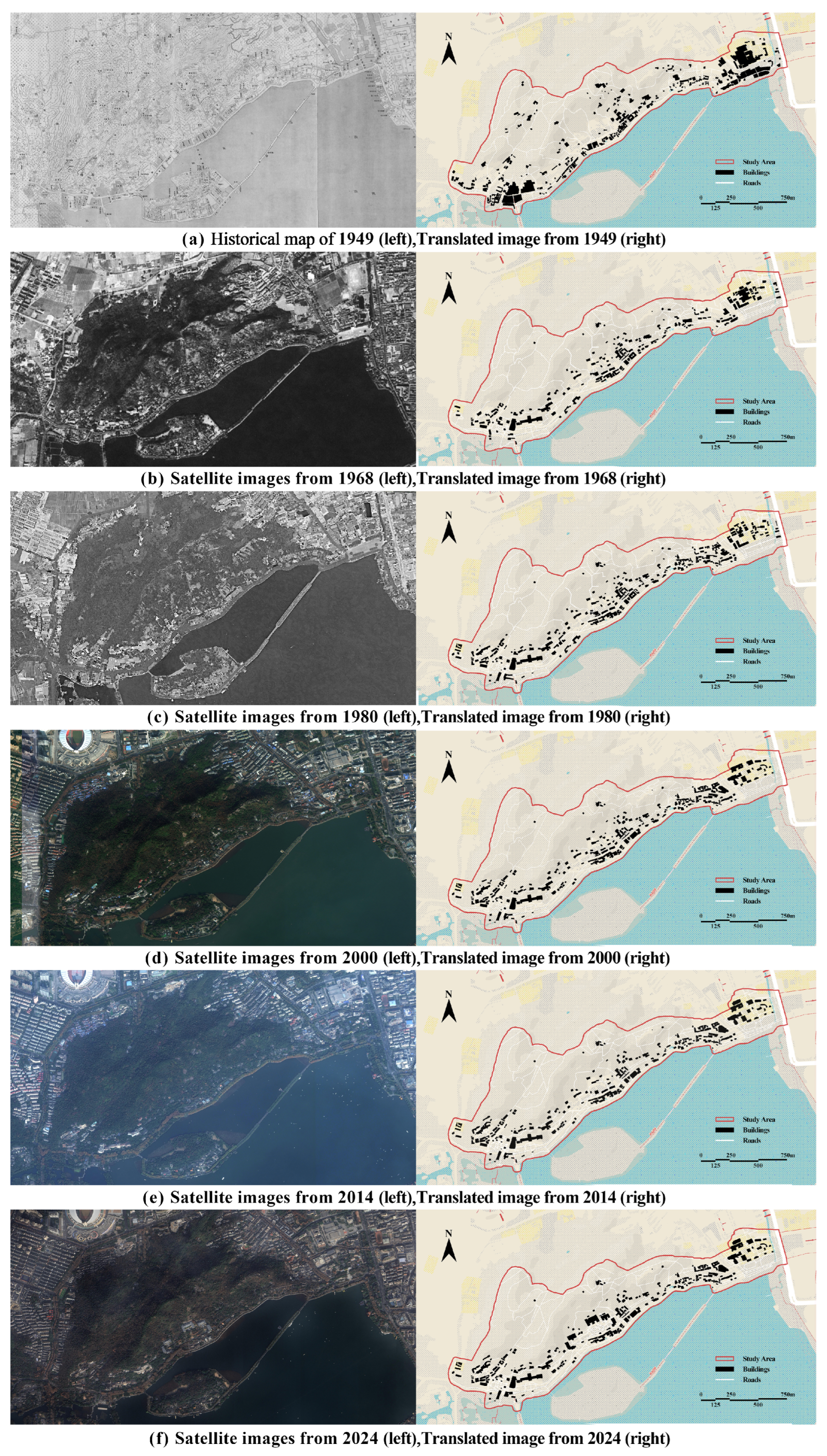
Through a systematic review of historical maps, multi-temporal imagery, and planning documents of the Beishan Street Historic District, it is evident that the inaugural West Lake Expo in 1929 catalyzed a major transformation (Figure 3). Since 1949, construction activities have become increasingly disordered, progressively eroding the integrity of the streetscape’s character. Hangzhou was designated as a National Historic and Cultural City in 1982. In 2003, the conservation plan for Beishan Street formally delineated the district’s boundaries along an east–west axis for the first time. The inscription of West Lake on the World Heritage List in 2011, the 2014 approval of the Beishan Street conservation project proposal, its listing as a Provincial Historic Cultural District in 2016, and the approval of the Conservation Plan in December 2023 collectively mark a new phase of conservation and management. Meanwhile, since 2011, rapid urbanization and developments in adjacent areas have also affected the district’s landscape character and spatial fabric.
Based on these milestones, we analyze four periods with significant morphological change: 1929–1949, 1949–1980, 1980–2000, and 2000–2024 (Figure 4). Primary data for 1929 and 1949 were obtained from historical survey maps (e.g., Complete Map of the West Lake Expo Site (1929), Measured Map of Hangzhou West Lake (1929), Map of Hangzhou City (1947, 1949)). Data for 1968, 1980, 2000, 2014, and 2024 were derived from satellite imagery, cross-checked with publications such as Villas around the West Lake, An Illustrated Account of the First West Lake Expo, and Cultural Relics Protection Sites of Hangzhou. All historical maps were digitized by cartographic translation and georeferenced in ArcGIS for coordinate unification and comparability Table 1.

3. Methodology

3.1. Long-Duration Urban Morphology via Fractal Metrics and Lacunarity

Historic corridors evolve through accretion, consolidation, and reorganization rather than smooth, linear change. A technique is needed that is scale-aware and sensitive to discontinuities. Fractal morphology and lacunarity satisfy these requirements. Fractal dimension captures how occupied urban fabric fills space across observation scales, while lacunarity quantifies the texture of gaps and, thus, distinguishes “compact but perforated” fabrics from “sparse yet even” ones. Together, they provide a robust, comparable language across decades for the same corridor and enable breakpoint detection that marks phase transitions. Unlike single-scale density indicators, fractal metrics remain stable under rescaling, which is essential when source maps differ in resolution or cartographic generalization.
For each historical time slice t, we rasterize the building footprint layer and the impermeable ground plane into a binary field I t ( x , y ) { 0 , 1 } on a square grid with cell size g. All rasters are aligned to a common local coordinate system and clipped to a constant analysis polygon A (corridor plus a fixed contextual buffer) to avoid edge artefacts. To isolate corridor form from cartographic noise, we apply a morphological opening with a structuring element of one cell in radius; sensitivity tests confirm that the results are unchanged within a small band of g.
For each scale ε { ε 1 , , ε m } , we overlay a square mesh of box size ε and count the number of non-empty boxes N t ( ε ) (boxes that intersect any occupied cell). The empirical fractal dimension D ^ t is the slope of the log–log relationship, as shown in Equation (1):
D ^ t = d log N t ( ε ) d log ε
as estimated by ordinary least squares on the linear segment(s) of log N t ( ε ) versus log ε . In practice, we fit a piecewise linear regression with at most two segments. A single segment indicates scale-invariant filling, whereas a two-segment fit with a statistically significant change in slope indicates a characteristic scale ε * where the growth regime changes (for example, courtyard infill below ε * and block reconfiguration above ε * ). Confidence intervals for D ^ t follow from the regression standard error; we propagate these into time-series comparisons using a parametric bootstrap.
Lacunarity Λ t ( r ) measures the heterogeneity of gaps at window radius r. Given a moving window W r , let M r be the local mass (total occupied cells) for each window placement. Denoting μ r = E [ M r ] and σ r 2 = Var ( M r ) , the gliding-box lacunarity is Equation (2):
Λ t ( r ) = 1 + σ r 2 μ r 2
A large Λ t ( r ) indicates clumpy fabrics with uneven voids, while a small Λ t ( r ) implies evenly sprinkled mass or evenly distributed voids. By analyzing Λ t ( r ) across r, we distinguish “porous but ordered” frontage systems from “patchy and discontinuous” segments. Because lacunarity is sensitive to window choice, we report the area under the lacunarity curve AUL t = r Λ t ( r ) Δ r as a scale-aggregated summary, and we normalize by the maximum observed across time to enable comparison.
To understand directional consolidation along the corridor axis, we compute the orientation distribution of façade edges. From a Canny edge map of I t , we derive the rose histogram p t ( θ ) for θ [ 0 , π ) . Anisotropy is A t = 1 H ( p t ) log K , where H is the Shannon entropy over K bins. A larger A t means stronger alignment, often signaling coherent frontage lines.
We assemble the multivariate time series Z t = [ D ^ t , AUL ¯ t , A t ] . We fit a penalized piecewise-constant model with a total-variation penalty to identify years where the multivariate mean shifts. Formally, we minimize Equation (3):
min { m t } t = 1 T Z t m t 2 2 + λ t = 2 T m t m t 1 2
where λ > 0 controls the number of change points. Dates with m t m t 1 2 > 0 are selected as breaks and used to interpret policy or construction cycles.
The method yields (i) fractal dimension trajectories indicating compactness and scale regimes, (ii) lacunarity profiles indicating the texture of voids and permeability, (iii) anisotropy tracing frontage alignment, and (iv) statistically grounded change points. This combination allows us to state not just how much fabric changed but how the corridor reorganized across scales, which is essential for evidence-based, tiered guidance.

3.2. Multi-Scale Accessibility via Space Syntax and Network Centralities

Corridor performance depends on how the street network channels pedestrian movement, service access, and visitor flows at multiple radii. Space syntax and network science metrics quantify configuration beyond simple length or lane counts and are directly actionable for segment prioritization, detour mitigation, and wayfinding. By computing centralities at multiple radii, we capture local vitality potentials and corridor-level through-movement simultaneously, which is critical for balancing authenticity and publicness.
We model the walkable network as a primal, weighted graph G = ( V , E ) , where vertices are intersections and endpoints and edges are street segments with length ( e ) . For fine-grained realism, we include pedestrian connectors such as lakeside paths and internal passages when legally open. We define three distance notions: topological steps d top , metric distance d met , and angular deviation d ang . A composite generalized distance is Equation (4):
d λ ( p , q ) = α d ang ( p , q ) + β d met ( p , q ) + γ d top ( p , q ) , α , β , γ 0 , α + β + γ = 1
with non-negative weights α , β , γ 0 and α + β + γ = 1 . This convex combination lets us tune analyses from “turn-cost dominated” navigation to “metric-length dominated” behavior.
Let σ s t be the number of shortest paths between nodes s and t under d λ , and σ s t ( v ) the number that pass through node v. Betweenness centrality at radius R is determined by Equation (5):
C B ( R ) ( v ) = s v t d λ ( s , t ) R σ s t ( v ) σ s t
which measures potential through-movement within catchment R. Closeness at radius R is determined by Equation (6):
C C ( R ) ( v ) = u V d λ ( u , v ) R d λ ( u , v ) 1
capturing how near a node is to others. We also compute edge betweenness C B ( R ) ( e ) to identify load-bearing segments, as well as straightness S ( v ) = 1 | U | u U x u x v 2 d met ( u , v ) over a chosen set U.
Let k ( v ) be the number of nodes reachable within radius R in topological steps. The mean depth is MD ( R ) ( v ) = 1 k ( v ) u steps ( u , v ) . Integration is the inverse depth normalized to a [ 0 , 1 ] index Equation (7):
Int ( R ) ( v ) = k ( v ) 1 2 MD ( R ) ( v ) 1 · 1 N 2
which increases as v becomes more to-hand within its catchment. For angular integration, we substitute steps with a cumulative turn angle along the shortest angular paths. Segment-based “choice” is the edge analog of betweenness under angular costs.
For each node or segment, we produce a centrality spectrum S R = C B ( R ) , C C ( R ) , Int ( R ) over radii R { 200 , 400 , 800 , 1600 } m . The slope of C B ( R ) versus log R reveals whether importance is predominantly local (steep early rise then plateau) or corridor-level (gradual rise across radii). To quantify alignment with the corridor axis, we compute the projection of edge betweenness onto the corridor polyline and compare it to the isotropic expectation via a permutation test; a significant excess implies a structural channeling of flows that deserves protection and careful micro-design.
We test the effect of temporary closures by removing a subset of edges E and recomputing centralities. Let Δ C B ( R ) ( e ) = C B ( R ) e G E C B ( R ) e G . Segments with large positive Δ C B ( R ) become detour magnets when neighbors are closed; these are candidates for interim signage, pavement upgrades, or time-based crowd management. We summarize resilience with the area-weighted average of relative betweenness loss, as shown in Equation (8):
L ¯ = e E ( e ) max 0 , C B ( R ) ( e ) C B ( R ) e G E e E ( e ) C B ( R ) ( e )
This technique yields spatial fields of centralities at multiple radii, corridor-alignment statistics, and resilience diagnostics under closures. These outputs support design-ready questions: which segments are through-movement backbones, which nodes are locally central but globally peripheral, where do closures induce problematic detours, and how do proposed micro-renewals affect to-handness without over-concentrating flows?

3.3. Quantitative Interface of Street Landscape Based on DeepLabV3+

We quantify the pedestrian-facing interface of the corridor by translating street-level panoramas into physically interpretable indicators via semantic segmentation with DeepLabV3+. Following the sampling in Section 2.2, Baidu Street View panoramas were retrieved at 50 m intervals along traversable streets, rendered to a consistent forward-looking field of view (2560 × 1440), quality-controlled, and linked to unique capture locations on the cleaned OSM network; these images constitute the sole inputs to the segmentation stage and anchor every output back to the network geometry for aggregation and modeling later on.
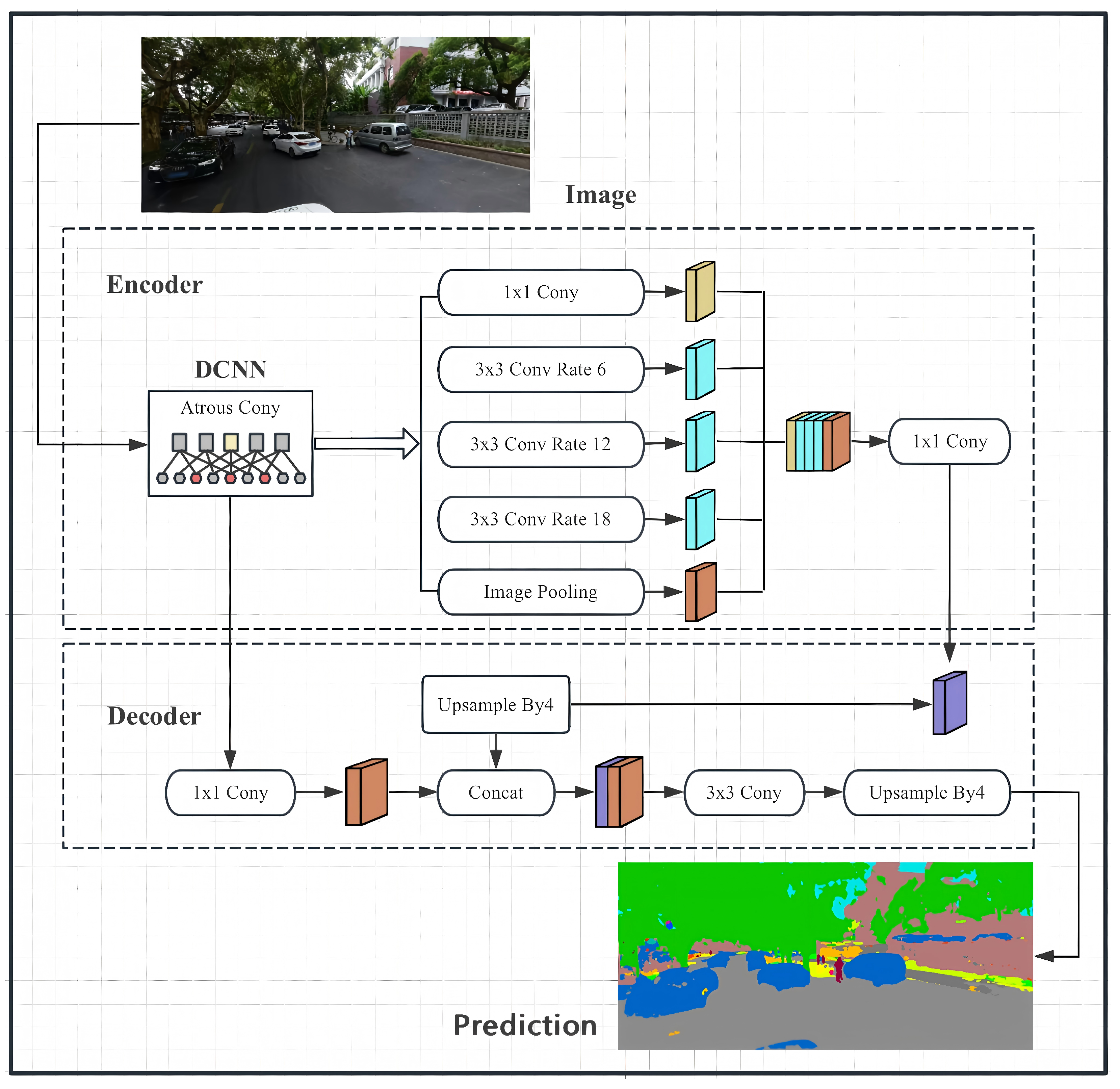
Architecturally, we employ the standard encoder–decoder DeepLabV3+ configuration with Atrous Spatial Pyramid Pooling (ASPP) for multi-scale context aggregation and boundary localization (Figure 5). The network is initialized with publicly released weights pre-trained on the Cityscapes semantic urban-scene benchmark [40]. Cityscapes provides 5000 finely annotated street-scene images collected from 50 cities, with an official split of 2975 training, 500 validation, and 1525 test images [40]. Model performance reported in this manuscript was obtained on the official Cityscapes validation split using the standard evaluation protocol and scripts released with the dataset. To ensure downstream reliability of pedestrian-interface indicators under class imbalance, we report per-class performance (IoU and class-wise pixel accuracy) in Table A1. In addition, we provide representative failure cases observed when applying the model to Baidu Street View panoramas (e.g., thin railings/fences, small signs, vegetation boundaries, and transient occlusions) in Appendix A, Figure A1. These error patterns motivate the conservative indicator design and segment-level aggregation adopted in the subsequent analyses. The selected checkpoints achieve 81.4% mIoU and 96.2% overall pixel accuracy under this protocol.
In each segmented image, we derive a set of dimensionless indicators (all expressed as shares of the image plane within [ 0 , 1 ] , unless otherwise noted) to capture interpretable properties that are directly relevant to street-interface design. We first compute sky visibility S, defined as the proportion of sky pixels within the upper image band (top 60 % of rows), quantifying vertical openness at eye level. An all-image variant is retained for subsequent robustness-oriented sensitivity checks to ensure that variations in illumination and occlusions do not significantly impact the measure. Next, we calculate the façade share B and wall continuity W. B denotes the proportion of building pixels, and W adds a horizontal run-length statistic in the central image band (rows 25– 60 % ) to capture long, uninterrupted linear edges typical of compound boundaries. This statistic underpins the “continuity” term used in the Results section, offering a robust indicator of façade organization. Ground-plane legibility G combines the shares of road and sidewalk pixels, introducing a baseline-width proxy defined as the normalized horizontal extent (95th percentile) of contiguous ground pixels within the bottom 20 % of rows. This reflects both the clarity of the traversable surface and width cues, key elements for pedestrian navigation. Vegetation indicators, including tree share T, shrub/bush share H, and groundcover share C, distinguish between vertical canopy (trees) and near-ground greenery (shrubs and grass). These proportions are taken as class-wise pixel shares to avoid conflating vertical and low vegetation. Finally, pedestrian presence P is defined as the proportion of pedestrian pixels in the scene. Due to acquisition-time variability in footfall, we use P as a relative, segment-scale proxy for pedestrian density, with caution, and we explicitly note that foot traffic patterns may vary seasonally. Taken together, these indicators operationalize key perceptual dimensions—openness, interface composition, continuous edges, ground-surface cues, and greenery—into computable image evidence. They provide a consistent and reproducible measurement basis for subsequent descriptive analyses and model inference. As detailed in our Validation section, these results were derived from a model validated on the Cityscapes dataset, and we present performance metrics and failure cases in Appendix A, Figure A1.

4. Results

4.1. Long-Duration Morphology of the Corridor

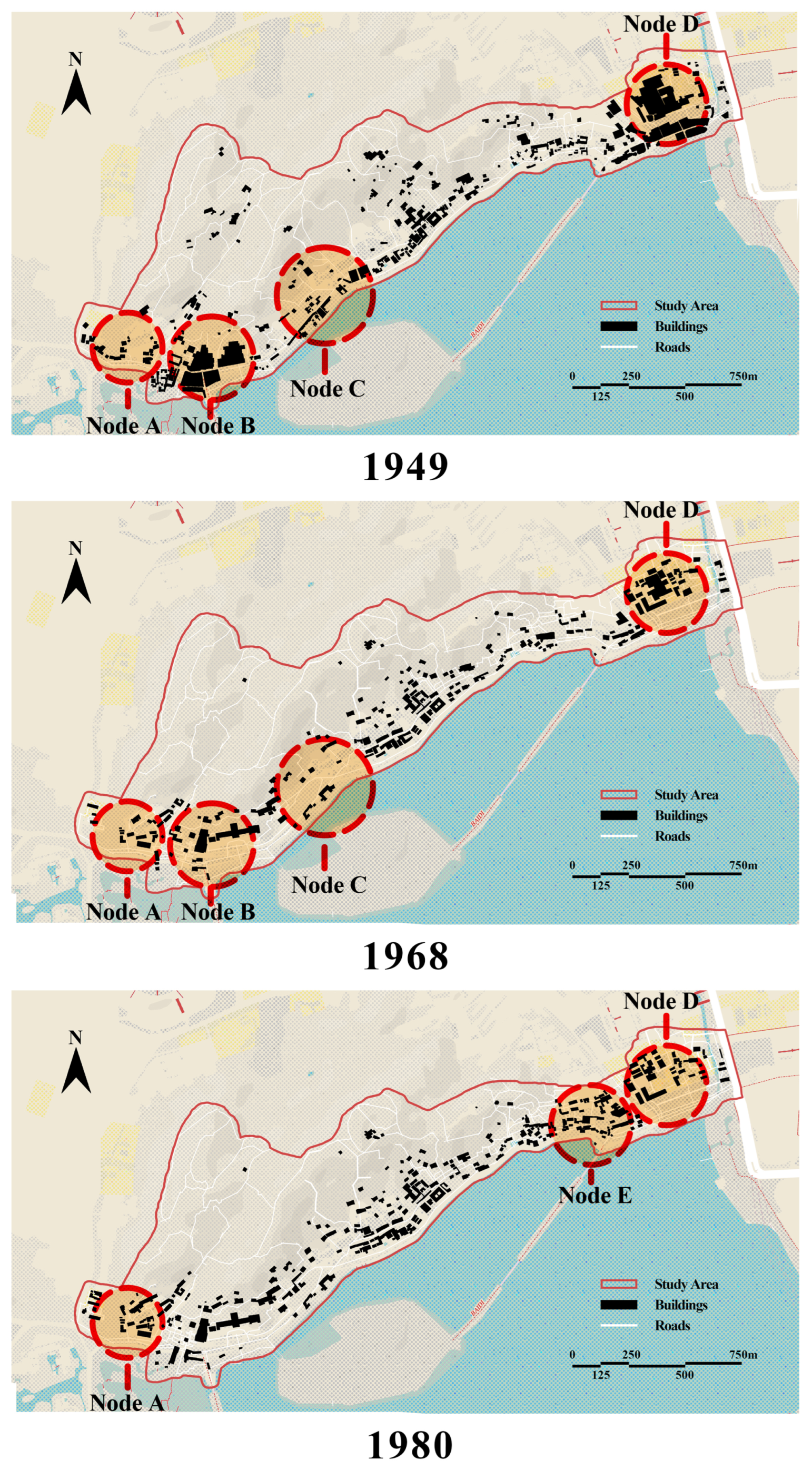
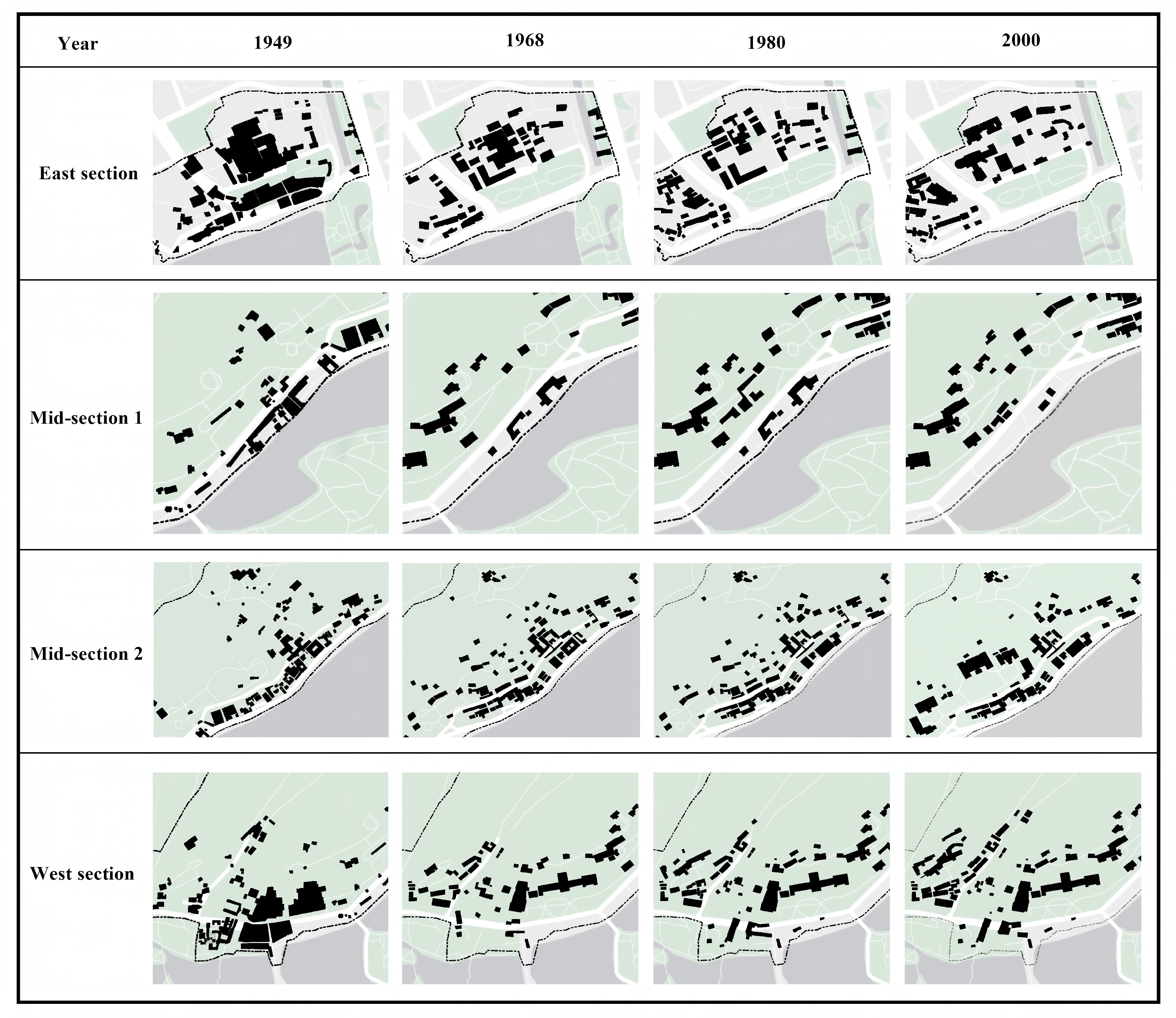
Across the full observation window, the Beishan Street historic corridor shows a stepwise evolution rather than a single uniform trend, with clear phase characteristics tied to distinct stages in the city’s development. In plan, the earliest configuration is dominated by a lakeside belt of larger groups and an inland belt that is already denser. From the late 1960s onward, the dominant spatial logic migrates from “waterfront–led” to “road-led,” and building groups realign parallel to the road network, producing a linear texture that is especially legible along secondary streets such as Qixiangling Road and Baochu Road. When the corridor is read west-to-east with Ge Ling Road as a dividing marker, three segments display different trajectories: the western segment transitions from lakeside clusters to bands organized by Qixiangling Road; the central segment moves from regular banding to fragmentation, and then to regrouping constrained by contour lines; and the eastern segment maintains block surfaces on gentler terrain, but the blocks are cut by roads and evolve asymmetrically on opposite sides.
Table 2 shows that the fractal analysis results corroborate these shifts. During 1929–1949, the fractal dimension rises from 1.661 to 1.700, reflecting greater overall coherence in the fabric. This period coincides with the First West Lake Exposition, when new exhibition and leisure buildings were added along Beishan Street and temporary commercial structures intensified the fill-in of space. In the following decades, the fractal dimension declines, reaching 1.598 by 1980—a drop linked to demolition, conversion, and the loss or reconfiguration of temple complexes and other historic compounds. Specific nodes include Fenglin Temple being replaced by Hangzhou Hotel and repeated damage and conversion around Zhaoqing Temple. After 1980, conservation and restoration activities strengthen again—the series shows 1.611 (2000), 1.620 (2014), and 1.622 (2024)—and from 2000 to 2024 the dimension is essentially stable, consistent with a saturated fabric under protective regulation.
Narrative detail places these numbers in spatial context (Figure 6). The 1949 fabric is arranged along the West Lake embankment, with medium-to-large clusters at both corridor ends and a relatively even distribution overall. After 1968, the building fabric retreats from the embankment toward the mountain side; the road structure rather than the lake edge becomes the primary organizer, block sizes decrease, geometry aligns more closely with street directions, and the middle sector becomes sparser with discrete elements while the two ends present clusters or bands. The 1949–1980 stage records the strongest degradation of coherence, explicitly connecting declines in fabric complexity to policy and construction changes and to the conversion of many buildings into housing or work compounds (for example, dispersed reoccupation at the Dafosi and Manao Temple sites), which fragment previously unified sites. Subsequent conservation actions—including repairs at Yue Fei Temple and the listing of multiple sites as protected units—coincide with the re-emergence of more regular forms without returning to the earlier large-mass pattern.
A segment-scale reading reinforces this picture (Figure 7). In the east, the overall building interface is the dominant visual component, averaging about one-quarter of the field, with low vegetation and groundcover interlacing a residential heritage texture around the Dafosi relics area. In the center, continuous walls and enclosed interfaces rise clearly above one-third, especially around the former Expo Industrial Hall and the Baoqing Villa protection area, while only a few nodes such as the Xinxin Hotel create larger open pockets. In the west, tree canopy and groundcover reach the highest corridor values, exceeding four-fifths locally around Lake Mirror Hall, and the average sky visibility is lower than the corridor mean because of vertical interfaces at landmark facilities such as the Shangri-La Hotel and the Yue Temple complex. Taken together, these morphology results establish a corridor that shifted from a lakeside-dominated system to a road-dominated system over the long run, with a stable and near-saturated fractal signature after 2000, and with marked west–center–east differentiation in enclosure, vegetation presence, and openings toward the lake. These empirical patterns set a precise baseline for interpreting the street-network and street-level interface findings that follow.

4.2. Multi-Scale Accessibility and Corridor Structure

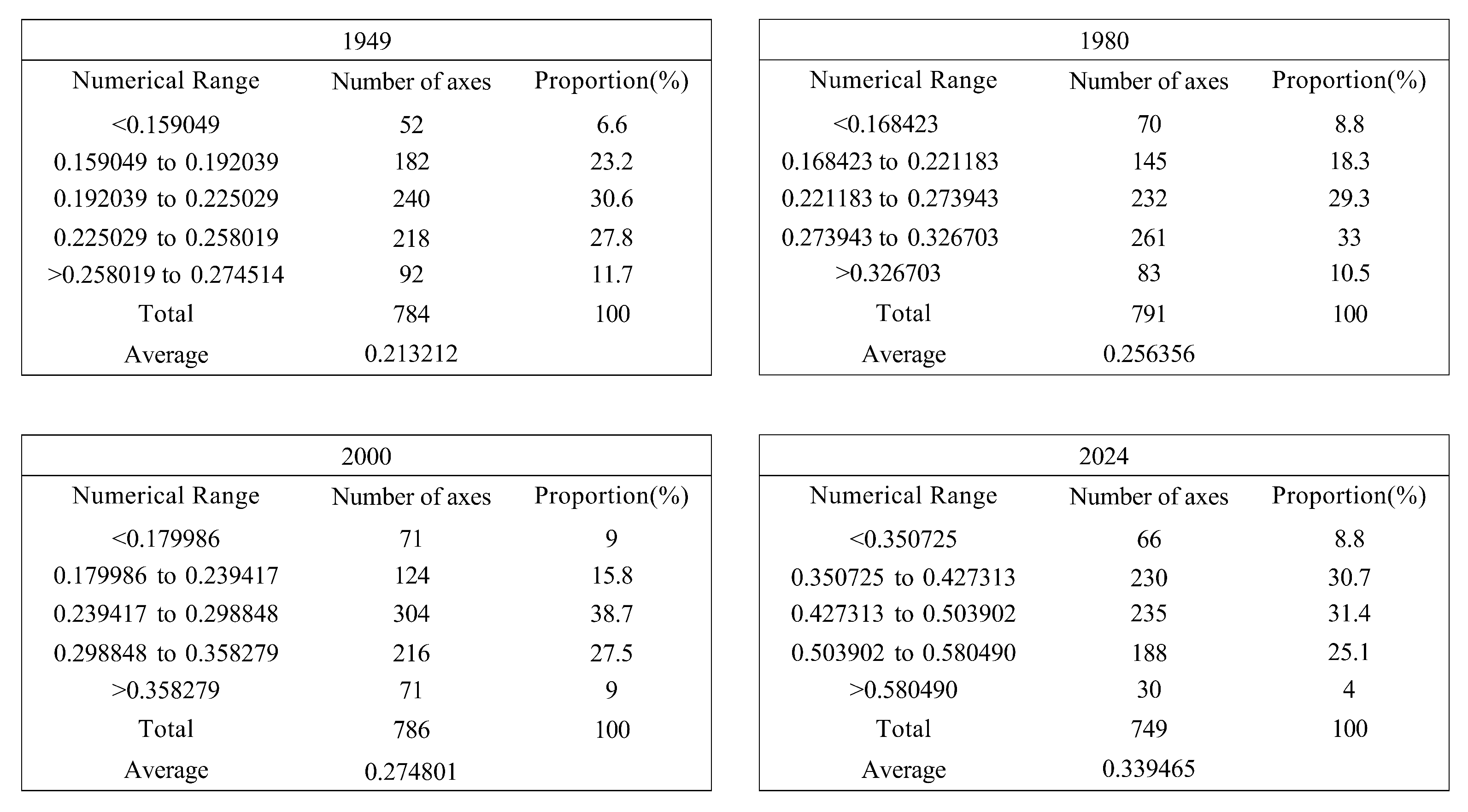
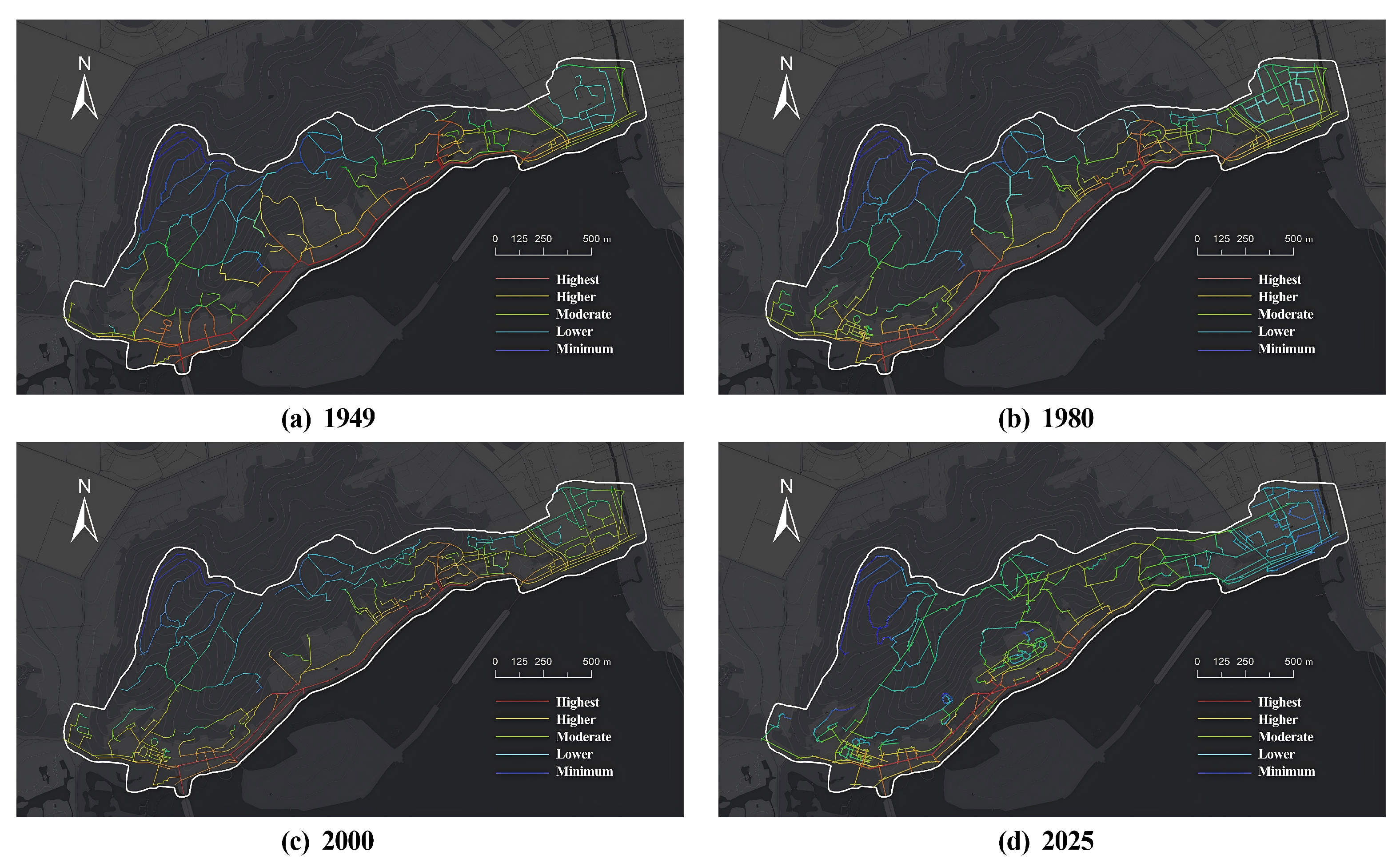
The axis model compiled for 2024 contains 749 axial lines in the study area and its immediate surroundings (Figure 8). The average global integration is 0.34, and the distribution is concentrated in the 0.35–0.50 range at 62.1 percent of lines, while high-integration streets make up a small minority at 30 lines, or about 4 percent. At the same time, a relative decline in accessibility is evident in the eastern part of the corridor in the most recent period. In long-term comparison, the average integration rises from 0.21 in 1949 to 0.34 in 2024, indicating a substantive increase in overall accessibility; however, the share of high-integration streets drops from 11.7 percent in 1949 to 4 percent in 2024, implying that dominance is more dispersed across the network than before. This dispersion aligns with the addition of connecting minor paths, reduction in dead ends, further completion of the Baoshi Mountain greenway, and an increase in north–south streets. North–south permeability is a recurrent theme, and while Beishan Street remains the key corridor, its relative advantage is shared with other routes, with Ge Ling Road singled out as newly prominent in the internal structure.
Spatial evidence shows that the accessibility field is not uniform along the corridor (Figure 9). The western segment maintains strong connectivity due to longstanding public functions around Yue Temple and large hotel facilities; this stability is associated with a street texture that changes less dramatically over time. The central segment shows the biggest swings in local pathways, reflecting phases of neighborhood construction and later resident relocation, including periods of added paths and subsequent pruning, with the present-day configuration shaped by the completion of the greenway and multi-functional ecological and traffic embeddings in the 2000s and 2010s. The eastern segment experiences the sharpest rise and then drop in accessibility measures; densification of streets during 1949–2000 for resident needs is followed by a post 2000 decline linked to demolition and the disappearance of small connective paths as residential functions recede. These patterns represent empirical observations of spatial differentiation and temporal layering in the path system, rather than normative judgments, and they emphasize that measured integration maps reproduce how multiple actors and decisions over time leave traces in the network that are legible at the segment scale.
Tabulated distributions support these headline numbers (Figure 8). For the 1949 slice, the frequency of lines is highest in mid-range integration bins, with 11.7 percent above the upper threshold reported as high integration. By 2000 and 2024 mid-to-upper bins still dominate the counts, but the high-integration tail is thinner, consistent with the noted dispersion of centrality. The averages in the tables align with the trend, rising from approximately 0.21 in 1949 to around one-third or more in the contemporary period. The 2024 figure also carries a qualitative note that the east end’s pattern is less accessible in aggregate despite network completion elsewhere.
As a synthesized reading of the results, the corridor network evolves toward higher overall accessibility while flattening the dominance of any single spine. This flattening does not erase the importance of Beishan Street itself; instead, it positions the corridor within an enriched lattice of connectors that include greenway links and additional north–south ties. The west retains a stable public-facing network, the center expresses the combined signature of earlier residential intensification and later reconfiguration, and the east shows a contraction in small-path connectivity that corresponds to the disappearance of some local functions. These empirical results are measurable outcomes of historic street system evolution and offer a factual basis for later discussion about the alignment or misalignment between planned accessibility and used accessibility in different phases and subareas.

4.3. Pedestrian Interface, Functional Composition, and Segment-Level Associations

The street-level image analysis yields a consistent set of pedestrian-facing indicators and shows strong spatial variation across the corridor. In the east, the building interface is the primary visual element, at roughly one-quarter of the field on average. Around the Dafosi relics area, residential heritage façades occupy a similar share, with low shrubs and groundcover interlacing the texture. This expresses a compact residential grain with small-scale greenery threads. In the center, continuous wall segments rise to more than one-third of the field; and around the former Expo Industrial Hall and Baoqing Villa protection cluster, the proportion of enclosed interfaces climbs toward two-fifths. Only a handful of hotel and forecourt nodes open up the space locally. In the west, tree canopy and groundcover reach their corridor maxima, locally exceeding four-fifths in the Lake Mirror Hall area, while the mean sky visibility in this segment is about 18.3 percent, lower than the corridor average due to strong vertical frontage along landmark facilities. At the corridor-wide level, the totals indicate a dense building interface with historical façades around 37.6% ± 5.2%, wall continuity 28.4% ± 4.8%, and road-width share 19.1% ± 3.6%; new buildings contribute 12.7% and act as a source of local discontinuity in style. Vegetation indicators show 14.3% ± 2.9% for trees and 8.5% ± 1.7% for groundcover with a north–south gradient, while sky visibility averages 21.8% ± 6.4% and dips to 16.2% ± 3.1% in medical-service clusters. Sidewalk continuity averages 15.2% ± 3.3%, and pedestrian density (6.8% ± 2.1%) peaks at commercial nodes, where the sidewalk share reaches about 18.9% ± 2.4%.
On the activity side, the POI dataset used for analysis contains 1779 effective points after cleaning from 2034 raw items, covering the core area and a 500-m buffer. The data acquisition and filtering thresholds clarify coverage and representativeness. The regression setup uses the image-derived interface shares—for example, wall, building, sky, road, sidewalk, and vegetation—as dependent variables and category-specific POI densities as independent variables. Diagnostics include variance inflation values under 10 and explanatory power in a moderate-to-high range, indicating substantial spatial associations between function distribution and particular interface features (Table 3). The variance inflation table lists category-by-category values, all below commonly used thresholds, supporting the interpretation of stable estimates for the set considered.
Coefficient tables highlight several consistent associations (Table 4). Address information density shows a positive and statistically significant association with wall integrity and continuity (e.g., Coef = 0.228 ); it is also positively associated with sky visibility ( Coef = 0.417 ) and with tree cover ( Coef = 0.704 ), suggesting that segments with more complete addressing and signage systems co-occur with clearer frontage definition, more open sky cones, and stronger canopy presence in the images. Traffic service and passage facilities are positively associated with road-width share and with pedestrian-space quality proxies—for example, road width Coef = 0.446 and 0.158 across related categories, both significant—reflecting that segments near transport facilities present wider or more legible ground planes. Business–residential categories are positively associated with the building interface and road width in the models (e.g., Coef = 0.213 and 0.405 , both significant), consistent with segments where mixed business and residential presence intensifies frontage and route definition. In contrast, medical services show negative coefficients in several models, including sky visibility and building variables (e.g., sky visibility Coef = 0.102 ), mirroring descriptive observations that clusters of medical buildings compress the skyline locally and alter the interface balance. The government facilities category also shows negative associations in multiple tables (e.g., Coef = 0.196 in sky visibility models), indicating that around administrative clusters the measured pedestrian-view composition shifts in a different way from commercial or residential segments. The tree cover model further records positive associations with address information and traffic services and negative ones with medical and government facilities, reinforcing the pattern at the natural-element level (e.g., tree model positive Coef = 0.704 and 0.317 ; negative Coef = 0.179 and 0.340 ).
Bringing these results together, the corridor exhibits a distinctive interface profile by segment, a functional dataset with adequate coverage, and a set of linear associations that explain a meaningful share of variance in interface composition with interpretable signs. The east is characterized by residential heritage frontage interlaced with low vegetation, the center by high wall continuity and enclosed heritage compounds punctuated at a few nodes, and the west by maximal canopy and groundcover with lower mean sky visibility, all measured in the segmentation output. Functionally, categories linked to everyday navigation and access align with wider ground planes and clearer frontage, while categories such as medical and government facilities align with lower values on openness-oriented indicators in the image-derived measures. These empirical results provide a factual platform for the subsequent discussion to examine thresholds and trade-offs segment by segment, without revisiting methods, using the quantitative ranges and directions already established in the tables and maps.

5. Discussion

5.1. From Lakeshore Logic to Road-Led Logic, Social Drivers, and Layered Heritage Within an HUL Frame

This section discusses findings derived from the long-term, time-sliced reconstruction of corridor morphology and street-network structure (1929–2024). The interpretation here is longitudinal and limited to the historical cartography and periodized network layers. A Historic Urban Landscape perspective helps interpret the morphological evidence as the outcome of interacting layers, rather than as a purely geometric shift [41]. The long-duration indicators show a clear pivot from a waterfront-led ordering to a road-led ordering, and the quantitative path of complexity supports that reading. The fractal dimension increases from 1.661 in 1929 to 1.700 in 1949, then declines to 1.612 in 1968 and 1.598 in 1980, and finally stabilizes within a narrow band at 1.611 in 2000, 1.620 in 2014, and 1.622 in 2024. Under an HUL lens, these swings map to changes in how different layers of the corridor were activated and governed. Early growth aligns with lake-oriented programs and new public buildings that intensified the urban grain along the embankment. The mid-century decline corresponds to demolition, conversion, and subdivision that fragmented temple precincts and villa compounds, which weakened the coherence that the early value of place had created. Stabilization after 2000 indicates the arrival of a protective regime that narrows the margin of physical change and channels it into smaller, more controllable sites. HUL does not read such stabilization as a final state. It reads it as a governance condition in which interventions must reconcile authenticity, integrity, and living functions across multiple layers [42].
The segment contrasts observed in the results make these layers concrete. The west maintains a strong and ceremonially legible frontage because longstanding public functions around Yue Temple and later large hotel facilities keep that layer active. The center experiences additions, pruning, and then the insertion of greenway and landscape layers that now guide both plan geometry and everyday circulation. The east records a rise in fine-grained paths when resident needs dominate and a later contraction when those needs and units recede. HUL interprets this not as noise but as the lived metabolism of the corridor. The illegal attachments and encroachments that surrounded several heritage compounds illustrate how coping practices can deliver necessary space yet erode interface continuity and reduce the measured complexity of form. Later rounds of repair and protection improve fabric integrity, but without program updates they can decouple interface quality from use. The eye-level composition figures point to where this tension is visible. In the east, the building interface averages around one-quarter of the field and is braided with low vegetation, which expresses a compact residential grain [43]. In the center, continuous walls rise clearly above one-third and approach two-fifths around major compounds, strengthening orientation yet leaving fewer opportunities for pause unless gates and forecourts are present. In the west, tree canopy and groundcover approach or exceed four-fifths locally around Lake Mirror Hall, but the average sky cone is smaller than the corridor mean because tall frontages anchor the view. These signatures are the tangible expression of layered values in different segments, and HUL asks that management plan for them as attributes rather than accidents [44].
Selection within the heritage narrative is a second HUL concern that is visible in the measured record [42]. If conservation practice and design attention emphasize Republican-era villas and later scenic constructs, while earlier religious or landscape structures receive less reinforcement, the composite figure can satisfy formal guidelines yet thin out older strata of meaning. The path from a waterfront-led logic to a road-led logic and the stable post-2000 complexity level show that geometric form has already absorbed several turns of policy and program. To keep the corridor alive, the HUL approach suggests mapping values and attributes by segment, tying them to measurable proxies from the results. Enclosure can be tracked by wall continuity and façade share, view and sky values by sky visibility, everyday permeability by sidewalk continuity and by the presence of short connectors, and natural layers by tree and groundcover shares. With that matrix in hand, small design moves can address the tensions already detected. Very long walls that score highly on orientation can receive gate forecourts or controlled porches to create punctuation that supports dwell and visibility while remaining consistent with the wall narrative. Lakeside openness that aligns with movement can be paired with shaded resting points to support comfort without adding visual clutter. Where residential fine grain has thinned, micro-connectors or shared courtyards can be reintroduced without violating protected building lines or view cones. The first key finding, expressed in HUL terms, is that the shift from lakeshore- to road-led logic and the later stabilization of complexity are spatial imprints of governance, programming, and community practice acting on a layered landscape. Policies that aim only at form risk freezing a single layer. Policies that engage values and uses together can manage controlled change while keeping the system coherent and useful.
Our findings support a constraint-based co-evolution account for living-heritage corridors that links long-run fabric change, network accessibility, and eye-level interface conditions. Once the corridor fabric approaches morphological saturation (high spatial filling with only marginal changes in fragmentation), accessibility tends to adjust less through large-scale network rewiring and more through redistribution within the existing mesh, consistent with post-2000 morphological stabilization alongside increasing average integration and a thinning of the very-high-integration tail. Under such constrained meshes, a limited set of nodes and fine-grained connectors can act as structural hinges that concentrate through-movement opportunities and become sensitivity hotspots under temporary closures or access filtering, implying that governance actions and event operations may have uneven network consequences. At the same time, accessibility evolution does not necessarily entail interface convergence: segment-level street-interface signatures remain differentiated across west–center–east sections and co-vary with functional clusters, topography, and conservation controls, suggesting that HUL-aligned guidance should combine mesh-aware protection of critical hinges/connectors with segment-specific interface targets rather than one-size-fits-all prescriptions.

5.2. Accessibility Flattening, Hidden Stratification, and Co-Production of the Network Through a Historic Urban Landscape Approach

This section discusses present-day interface and function patterns measured from Baidu Street View imagery and POI data. Because these layers represent a contemporary snapshot, the relationships reported below are interpreted as contemporaneous associations rather than cross-temporal causal sequences. Network results point to rising overall accessibility and a flatter distribution of centrality, and an HUL reading explains why this matters for stewardship [18]. In 2024, the axis model counts 749 lines, average global integration stands at 0.34, about 62.1 percent of lines lie in the 0.35 to 0.50 band, and only about 4 percent are in the high-integration class. In long comparison, the average integration increases from 0.21 in 1949 to 0.34 in 2024, while the high tail contracts from 11.7 percent to 4 percent. This means that a larger share of the network now participates in through-movement and to-handness. The spatial notes identify mechanisms that fit the flattening pattern, including more connecting minor paths, fewer dead ends, completion of the Baoshi Mountain greenway, and stronger north-to-south ties. From an HUL perspective, movement networks are not neutral utilities. They are a primary layer of the historic landscape because they shape how people experience, reproduce, and value the corridor in daily life. The flattening of dominance is therefore not only an efficiency gain but also a redistribution of stewardship roles across institutions, communities, and visitors.
Segment differentiation remains pronounced, and it carries direct implications for value-based management. The west keeps a robust mesh because public functions are durable, which is why geometry changes little even when specific links are adjusted. The center shows the largest swings in local paths over time and today bears the imprint of the ecological and mobility layer introduced by the greenway. The east shows the clearest example of how planned accessibility can drift away from used accessibility. Between 1949 and 2000, small paths densify with resident needs. After 2000, demolition and the retreat of neighborhood functions remove a portion of these connectors, and the results record a relative decline in aggregate accessibility even though the wider network looks more complete. HUL frames that decline as the loss of a layer of everyday mobility that once sustained local errands and social routines. Accounting for such losses requires pairing syntactic measures with participatory audits and seasonal observations so that silent layers of use are identified before they are displaced [45].
The results also identify a small hinge near the center where corridor-level paths concentrate. When that hinge is closed for works or events, detours load onto a short list of secondary links with narrow width or tighter curvature, and the stress is most visible at intermediate radii that match visitor walking ranges. Under HUL, this hinge is part of the setting of heritage assets and deserves focused care in wayfinding, pavement durability, and interim routing. The same logic applies to short segments that peak at small radii and long straight runs that peak at large radii. The former serve neighborhood permeability, and the latter serve long traverse. Both are landscape attributes that support different values. The second key finding is therefore twofold: Rising average accessibility does not guarantee uniform benefit, and flattening hides stratifications that result from how different layers are programmed. A mesh-aware plan that identifies specific connectors that redistribute flows, audits their condition and legibility during temporary works and peaks, and builds redundancy where stress is concentrated will perform better than a spine-centric plan that assumes that the named street is the only place that matters. In the east, where small-path contraction coincides with lower aggregate accessibility, interventions should not simply celebrate scenic order. They should add substitutes that preserve everyday mobility, such as time-limited internal passages, shared surface treatments that keep desire lines legible, or negotiated passage rights with compound managers. In short, an HUL approach treats connectivity choices as heritage decisions and aligns them with layered values and lived practices rather than treating them as purely technical fixes.

5.3. Street-Level Interface, Functional Mix, and the Social Meaning of Measured Associations Under HUL

We then synthesize the longitudinal structural diagnosis (morphology/network) with contemporary interface–function diagnostics to derive HUL-aligned, segment-specific guidance and monitoring indicators. The interface numbers and the functional portfolio explain how the corridor reads at eye level and why that reading varies by segment, and an HUL frame translates those measurements into guidance tied to values [46]. Corridor-wide figures show a dense historic interface with historical façades near 37.6 percent, wall continuity near 28.4 percent, and road width near 19.1 percent, while new buildings hold around 12.7 percent as localized discontinuities. Tree and groundcover shares average roughly 14.3 percent and 8.5 percent, respectively; and sky visibility averages about 21.8 percent, with a lower value near 18.3 percent in the west, and dips to near 16.2 percent in medical clusters. These aggregates match the segment portraits. The east presents compact residential heritage frontage with interlaced low greenery. The center carries the corridor’s highest wall continuity around heritage compounds, with a small number of openings at hotel or forecourt nodes. The west shows maximal canopy and groundcover near Lake Mirror Hall but a compressed sky cone near tall landmarks. Under HUL, these are not only scenic facts; they are attributes of authenticity, integrity, and everyday readability that the management plan should maintain and tune.
The association tests add operational detail. Address and wayfinding density aligns positively with wall integrity, sky visibility, and trees, with coefficients in the order of 0.228 for wall integrity, 0.417 for sky, and 0.704 for trees. This suggests that investment in legibility can coexist with and even support both material interfaces and the natural layer [47]. Traffic and passage services align with wider ground planes and pedestrian space quality proxies—for example, road width coefficients around 0.446 for traffic services and in the 0.158 to 0.317 range for passage facilities. Mixed business and residential presence aligns with stronger wall and road width measures—for example, coefficients around 0.213 and 0.405, consistent with active edges and clear route definition. Medical and government facilities align with lower sky visibility and with negative values in the tree model—for example, around minus 0.102 for medical in sky visibility and minus 0.179 and minus 0.340 in the tree model, indicating that institutional clusters tend to compress skyline cones and reduce canopy unless countermeasures are adopted. Event activity correlates negatively with road width and sidewalk integrity, which signals the need for staging that protects the historic grain while making room for temporary structures.
HUL translates these measured patterns into levers tied to landscape values. Where continuous walls are long and orientation is strong, planned punctuation can make the narrative of the wall legible without fragmenting it. Gate forecourts, recesses that read as porch space, and timed openings can support dwell and small-business visibility while keeping the heritage frame intact. Where lakeside openness aligns with movement, design should enable comfortable stopping through shaded seating integrated with view management and materials that keep the ground plane clear [48]. Where medical or administrative clusters compress the skyline and reduce canopy, interface standards can require step-backs, planted forecourts, and queue management that preserves sidewalk integrity. The positive alignment between address systems and multiple desirable indicators shows that legibility is not cosmetic. It is structural in how people understand and inhabit the corridor; therefore, it is a scalable investment. A practical next step consistent with HUL is to convert the indicators into a monitoring dashboard that tracks human-scale proxies for authenticity and integrity—such as wall continuity, sky cones, and canopy presence by segment—and that couples these with functional presence and accessibility spectra. The third key finding is that categories linked to everyday navigation and access often reinforce landscape attributes of continuity and openness, while certain institutional concentrations tend to compress or fragment these attributes unless design and management explicitly compensate. Because an HUL approach is value-based and layered, these tools can be applied incrementally across segments without heavy construction and can be adapted as monitoring shows change, keeping the corridor both coherent and useful over time.

6. Conclusions

An integrated lens was applied to a living-heritage corridor to connect what has changed, how it is connected, and what is perceived at eye level. A long-duration account of urban form was paired with a multi-scale account of accessibility and a street-level account of the pedestrian interface, and these measurable layers were anchored to the current distribution of functions along the corridor. The evolution of the urban fabric was reconstructed across distinct historical slices and summarized with scale-sensitive indicators. Corridor and neighborhood movement potentials were mapped with multi-radius network measures. Street photography was translated into segment-level indicators of openness, greenery, façade presence, wall continuity, and ground-plane legibility through a validated semantic segmentation pipeline. Points of interest and other functional data were assembled to portray day-to-day activity structure and to test how the interface relates to the distribution of uses. Transparent linear models were employed not for prediction as an end in itself but to provide readable signs and magnitudes that decision-makers can interpret. Taken together, these steps produce a single chain of evidence running from form to function that is replicable, auditable, and suitable for monitoring cycles in a Historic Urban Landscape context, allowing different agencies and communities to read the same indicators in comparable ways.
Our findings are consistent across methods and scales, and they converge on a clear narrative. Over the long run, the corridor pivots from a lakeshore logic to a road-led logic. Early patterns organize themselves along the water, while later patterns align more closely with secondary streets and the topographic frame, with a reduction in grain size and stronger parallelism to the street skeleton. After the turn of the century, the fabric enters a stable and near-saturated condition in which large recompositions are rare and change concentrates in smaller, controllable sites. This trajectory is uneven along the alignment and is best understood by reading west, center, and east as three related but distinct segments. The west retains a longstanding public-facing role with stable frontage. The center records the largest oscillation in small connectors and subsequently receives an ecological and mobility layer that leaves a durable imprint on circulation. The east shows the strongest rise and later contraction in fine-grained paths as resident functions grow and then recede. On the network side, average accessibility increases, but the extreme dominance of a few spines flattens into a mesh in which minor connectors and north-to-south ties share more of the load. A central hinge emerges as a structure that carries a disproportionate share of through-movement and becomes the stress point when closures are simulated at intermediate walking radii. At eye level, the west achieves the strongest canopy, with lower mean sky visibility because tall frontages constrict the vertical field near landmarks. The center shows the highest wall continuity around heritage compounds with forecourt or hotel punctuation that supplies limited openings. The east presents compact residential heritage frontage intertwined with low vegetation and groundcover. Associations between interface and function are interpretable and stable. Address and wayfinding density aligns with clearer frontage, wider sky cones, and stronger trees. Mobility servicing and passage facilities align with wider or more legible ground planes. Medical and government clusters align with reduced sky visibility and shifts in building variables that compress openness unless mitigated. Event activity aligns with reductions in effective road width and sidewalk integrity if unmanaged. Read together, these strands portray a corridor whose present shape is the social product of programs, protections, and everyday practices rather than a static scene, and they explain why different segments feel different and perform differently under stress.
Despite the multi-scale framework that we developed, our conclusions still have several limitations. Historical maps and images vary widely in resolution, mapping style, and completeness. Although we used consistent projections, scale-appropriate measures, and sensitivity checks, early-period data may still contain systematic errors that influence some local details, even if they are unlikely to change the overall long-term patterns or the timing of major turning points. Our street-view image analysis can also misread small or thin elements—such as slim railings, columns, narrow building edges, or small signs—and uneven coverage across places and years may introduce bias when results are aggregated by segment. In addition, POI update times do not always match the dates when street-view images were captured, which may create minor timing mismatches when discussing whether physical features and nearby activities appear together. We chose simple linear models for clarity, but they can only show associations rather than cause and effect, and some important influences may be missing, such as local governance practices, permits, or other small-scale rules. Likewise, the network model simplifies real-world movement and cannot fully reflect temporary controls or day-to-day changes in management during festivals, construction, or emergencies. Finally, because this study focuses on a single heritage corridor, the findings may not generalize to other settings. Future work will add comparison corridors with similar street form and activity levels but different heritage characteristics, allowing cross-case testing and transfer of model settings to separate broad patterns from effects that are specific to heritage contexts. Overall, our results are most reliable for long-term trends and for comparing relative differences between segments, while more caution is needed when using them for very fine-grained identification, tight date-to-date matching, or short-term, rapidly changing situations.
Implications flow from the measurable patterns and from the ways in which the strands fit together. First, stewardship benefits from mesh-aware management rather than spine-only thinking. Specific connectors that redistribute flows and the central hinge that concentrates through paths deserve targeted wayfinding, pavement durability, lighting, and interim routing support in planned works and peak seasons. Protecting the backbone is necessary but not sufficient if the hinge fails, or if secondary links that carry detours remain weak. Second, segment-based guidance outperforms generic corridor rules. Segments that combine moderate façade share with clear ground-plane cues and planned punctuation tend to perform better on movement and readability, whereas very long unbroken walls benefit from deliberate gates, squares, or porch-like recesses that add pause and visibility without sacrificing identity or integrity. Third, institutional interfaces call for tailored standards. Medical and administrative clusters correlate with lower sky visibility and altered frontage rhythms. These effects can be mitigated with careful massing step-backs, entry and queue management to preserve sidewalk continuity, planted forecourts that restore canopy, and façade treatments that keep legibility high. Fourth, address and wayfinding systems operate as scalable levers. Their positive alignment with multiple desirable indicators suggests that investment in legibility is structural in how people inhabit and understand the corridor, and that it can be deployed quickly with durable benefits. Fifth, event staging should follow routing and edge protection protocols that keep effective road width and sidewalk integrity within safe and legible ranges while temporary structures are in place, and it should include time windows and removable protections where wall plinths or heritage surfaces are vulnerable. Sixth, monitoring should become routine. The combined indicators are reproducible and can feed a living dashboard that tracks morphology, accessibility, and interface quality together with functional presence, enabling before-and-after evaluation of small interventions and supporting communication across agencies and communities. Finally, transfer matters. The same workflow can be applied to other linear heritage corridors with adjustments to local class sets, segmentation, and governance questions, creating a shared evidence language that supports peer learning between places facing comparable pressures. In short, by aligning form, flow, and frontage in one interpretable chain, a living-heritage corridor can be governed as a landscape that honors authenticity while sustaining everyday life and accommodating well-managed change.

Author Contributions

Conceptualization, D.L. and M.D.; Methodology, D.L., Z.D. and J.W.; Software, D.L. and Z.D.; Validation, D.L., J.Y., S.Z., H.P., Z.D. and J.W.; Formal Analysis, D.L. and Y.S.; Investigation, D.L., J.Y., S.Z., Y.S., H.P., X.G. and Y.Y.; Resources, M.D., S.Z., H.P. and Y.Y.; Data Curation, D.L., J.Y. and X.G.; Writing—Original Draft, D.L., M.D. and Z.D.; Writing—Review and Editing, D.L., M.D., S.Z., J.Y., Y.S. and J.W.; Visualization, D.L. and Y.S.; Supervision, M.D., S.Z. and J.W.; Project Administration, D.L., M.D. and Y.Y.; Funding Acquisition, M.D. and S.Z. All authors have read and agreed to the published version of the manuscript.

Funding

This research received no external funding.

Data Availability Statement

Further inquiries can be directed to the corresponding author.

Acknowledgments

The authors would like to acknowledge the data centers that provided data for this research and the scholars who were engaged in relevant research.

Conflicts of Interest

The authors declare no conflicts of interest.

Abbreviations

POIPoint of Interest
mIoUMean Intersection over Union
BSVBaidu Street View
HULHistoric Urban Landscape
OSMOpenStreetMap
F1F-Measure
IoUIntersection over Union
DeepLabV3+DeepLab Version 3+ (Semantic Segmentation Model)
ASPPAtrous Spatial Pyramid Pooling
TCATemporal Change Analysis
QAQuality Assurance
CIConfidence Interval
VIFVariance Inflation Factor

Appendix A

Table A1. Per-class performance metrics: IoU and accuracy (Acc) for each class in the segmentation task.
ClassIoU (%)Accuracy (%)
Road98.599.19
Sidewalk87.4392.96
Building93.6196.99
Wall64.5975.45
Fence65.5174.9
Pole67.4878.05
Traffic light73.6984.83
Traffic sign81.2188.2
Vegetation93.1997.05
Terrain68.0575.46
Sky95.3898.32
Person83.8991.73
Rider67.4379.62
Car95.3797.97
Truck84.789.4
Bus90.4595.08
Train84.9790.13
Motorcycle72.3783.9
Bicycle79.1190.4
Figure A1. Representative segmentation failure cases in Baidu Street View imagery: (a) Original street-view panorama depicting roads, trees, and surrounding infrastructure. (b) Segmentation results highlighting typical errors.
Buildings 16 00889 g0a1

References

  1. Li, H. Unpacking the drivers of maladaptation for urban heritage climate change adaptation. In Proceedings of the AESOP Annual Congress 2025, Istanbul, Turkey, 7–11 July 2025. [Google Scholar] [CrossRef]
  2. Bandarin, F.; van Oers, R. The Historic Urban Landscape: Managing Heritage in an Urban Century; Wiley-Blackwell: Chichester, UK, 2012. [Google Scholar] [CrossRef]
  3. Gehl, J. Cities for People; Island Press: Washington, DC, USA, 2010. [Google Scholar]
  4. Jacobs, J. The Death and Life of Great American Cities; Random House: New York, NY, USA, 1961. [Google Scholar]
  5. Carmona, M. Public Places Urban Spaces: The Dimensions of Urban Design, 3rd ed.; Routledge: London, UK, 2021. [Google Scholar]
  6. Avrami, E.; Mason, R.; de la Torre, M. Values and Heritage Conservation: Research Report; Getty Conservation Institute: Los Angeles, CA, USA, 2000. [Google Scholar]
  7. Hillier, B.; Hanson, J. The Social Logic of Space; Cambridge University Press: Cambridge, UK, 1984. [Google Scholar] [CrossRef]
  8. Hillier, B. Space Is the Machine: A Configurational Theory of Architecture; Cambridge University Press: Cambridge, UK, 1996; ISBN 978-0521645287. [Google Scholar]
  9. Batty, M.; Longley, P. Fractal Cities: A Geometry of Form and Function; Academic Press: San Diego, CA, USA, 1994. [Google Scholar]
  10. Batty, M. Cities and Complexity: Understanding Cities with Cellular Automata, Agent-Based Models, and Fractals; MIT Press: Cambridge, MA, USA, 2005. [Google Scholar]
  11. Alexander, C.; Ishikawa, S.; Silverstein, M. A Pattern Language: Towns, Buildings, Construction; Oxford University Press: New York, NY, USA, 1977. [Google Scholar]
  12. Ashworth, G.J.; Tunbridge, J.E. The Tourist Historic City; Routledge: London, UK, 1990. [Google Scholar]
  13. Whyte, W.H. The Social Life of Small Urban Spaces; Project for Public Spaces: New York, NY, USA, 1980. [Google Scholar]
  14. Jokilehto, J. A History of Architectural Conservation; Butterworth-Heinemann: Oxford, UK, 1999. [Google Scholar]
  15. Frankhauser, P. The fractal approach: A new tool for the spatial analysis of urban agglomerations. Popul. Engl. Sel. 1998, 10, 205–240. [Google Scholar] [CrossRef]
  16. Porta, S.; Crucitti, P.; Latora, V. The Network Analysis of Urban Streets: A Primal Approach. Environ. Plan. B Plan. Des. 2006, 33, 705–725. [Google Scholar] [CrossRef]
  17. Crucitti, P.; Latora, V.; Porta, S. Centrality in Networks of Urban Streets: A Primal Approach. Chaos 2006, 16, 015113. [Google Scholar] [CrossRef]
  18. Boeing, G. OSMnx: New Methods for Acquiring, Constructing, Analyzing, and Visualizing Complex Street Networks. Comput. Environ. Urban Syst. 2017, 65, 126–139. [Google Scholar] [CrossRef]
  19. Barthélemy, M. Spatial Networks. Phys. Rep. 2011, 499, 1–101. [Google Scholar] [CrossRef]
  20. Naik, N.; Philipoom, J.; Raskar, R.; Hidalgo, C.A. Streetscore—Predicting the Perceived Safety of One Million Streetscapes. In Proceedings of the IEEE Conference on Computer Vision and Pattern Recognition Workshops, Columbus, OH, USA, 23–28 June 2014; IEEE: New York, NY, USA, 2014; pp. 793–799. [Google Scholar] [CrossRef]
  21. Dubey, A.; Naik, N.; Parikh, D.; Raskar, R.; Hidalgo, C.A. Deep Learning the City: Quantifying Urban Perception at a Global Scale. In Computer Vision—ECCV 2016 Workshops: Amsterdam, The Netherlands, 8–10 and 15–16 October 2016, Proceedings, Part I; Springer: Cham, Switzerland, 2016; pp. 196–212. [Google Scholar] [CrossRef]
  22. Li, X.; Ratti, C.; Seiferling, I. Quantifying Urban Greenery Using Google Street View. Urban For. Urban Green. 2015, 14, 675–685. [Google Scholar] [CrossRef]
  23. Gebru, T.; Krause, J.; Wang, Y.; Chen, D.; Deng, J.; Aiden, E.L.; Fei-Fei, L. Using Deep Learning and Google Street View to Estimate the Demographic Makeup of Neighborhoods. Proc. Natl. Acad. Sci. USA 2017, 114, 13108–13113. [Google Scholar] [CrossRef]
  24. Seresinhe, C.I.; Moat, H.S.; Preis, T. Quantifying scenic areas using crowdsourced data. Environ. Plan. B Urban Anal. City Sci. 2018, 45, 567–582. [Google Scholar] [CrossRef]
  25. Salesses, P.; Schechtner, K.; Hidalgo, C.A. The Collaborative Image of the City: Mapping the Inequality of Urban Perception. PLoS ONE 2013, 8, e68400. [Google Scholar] [CrossRef]
  26. Gao, S.; Janowicz, K.; Couclelis, H.; Montello, D.R.; Scheider, S.; Bröring, A.; Huang, Q.; Yan, B.; Yu, B.; Jin, P. Extracting Urban Functional Regions from Points of Interest and Human Activities. Trans. GIS 2017, 21, 446–467. [Google Scholar] [CrossRef]
  27. Hu, S.; He, Z.; Wu, L.; Yin, L.; Xu, Y.; Cui, H. A framework for extracting urban functional regions based on multiprototype word embeddings using points-of-interest data. Comput. Environ. Urban Syst. 2020, 80, 101442. [Google Scholar] [CrossRef]
  28. Niu, H.; Silva, E.A. Delineating urban functional use from points of interest data with neural network embedding: A case study in Greater London. Comput. Environ. Urban Syst. 2021, 88, 101651. [Google Scholar] [CrossRef]
  29. ICOMOS. The Nara Document on Authenticity; UNESCO World Heritage Centre: Paris, France, 1994. [Google Scholar]
  30. Marshall, S. Streets and Patterns; Spon Press: London, UK, 2005. [Google Scholar]
  31. Newman, P.; Kenworthy, J. Sustainability and Cities: Overcoming Automobile Dependence; Island Press: Washington, DC, USA, 1999. [Google Scholar]
  32. Cervero, R. The Transit Metropolis: A Global Inquiry; Island Press: Washington, DC, USA, 1998. [Google Scholar]
  33. Ewing, R.; Cervero, R. Travel and the Built Environment: A Meta-Analysis. J. Am. Plan. Assoc. 2010, 76, 265–294. [Google Scholar] [CrossRef]
  34. Boeing, G. Measuring the Complexity of Urban Form and Design. J. Urban Des. 2018, 23, 842–855. [Google Scholar] [CrossRef]
  35. Haklay, M. How Good Is Volunteered Geographical Information? The Case of OpenStreetMap. Cartogr. Int. J. Geogr. Inf. Geovisualization 2010, 43, 315–330. [Google Scholar] [CrossRef]
  36. Ke, G.; Meng, Q.; Finley, T.; Wang, T.; Chen, W.; Ma, W.; Ye, Q.; Liu, T.Y. LightGBM: A Highly Efficient Gradient Boosting Decision Tree. In Advances in Neural Information Processing Systems 30 (NeurIPS 2017), Proceedings of the 31st International Conference on Neural Information Processing Systems, Long Beach, CA, USA, 4–9 December 2017; Guyon, I., Luxburg, U.V., Bengio, S., Wallach, H., Fergus, R., Vishwanathan, S., Garnett, R., Eds.; Curran Associates Inc.: Red Hook, NY, USA, 2017; pp. 3146–3154. [Google Scholar]
  37. Lundberg, S.M.; Lee, S.I. A Unified Approach to Interpreting Model Predictions. In Advances in Neural Information Processing Systems 30 (NeurIPS 2017), Proceedings of the 31st International Conference on Neural Information Processing Systems, Long Beach, CA, USA, 4–9 December 2017; Guyon, I., Luxburg, U.V., Bengio, S., Wallach, H., Fergus, R., Vishwanathan, S., Garnett, R., Eds.; Curran Associates Inc.: Red Hook, NY, USA, 2017; pp. 4765–4774. [Google Scholar]
  38. Breiman, L. Random Forests. Mach. Learn. 2001, 45, 5–32. [Google Scholar] [CrossRef]
  39. Yang, M.; Kong, B.; Dang, R.; Yan, X. Classifying urban functional regions by integrating buildings and points-of-interest using a stacking ensemble method. Int. J. Appl. Earth Obs. Geoinf. 2022, 108, 102753. [Google Scholar]
  40. Cordts, M.; Omran, M.; Ramos, S.; Rehfeld, T.; Enzweiler, M.; Benenson, R.; Franke, U.; Roth, S.; Schiele, B. The Cityscapes Dataset for Semantic Urban Scene Understanding. In Proceedings of the IEEE Conference on Computer Vision and Pattern Recognition (CVPR), Las Vegas, NV, USA, 27–30 June 2016; IEEE: New York, NY, USA, 2016; pp. 3721–3730. [Google Scholar] [CrossRef]
  41. Cunha Ferreira, T.; Rey-Pérez, J.; Pereira Roders, A.; Tarrafa Silva, A.; Coimbra, I.; Breda Vazquez, I. The Historic Urban Landscape Approach and the Governance of World Heritage in Urban Contexts: Reflections from Three European Cities. Land 2023, 12, 1020. [Google Scholar] [CrossRef]
  42. Gong, L.; Greenop, K.; Landorf, C. Slow Progress: Integrating the HUL Approach into the World Heritage Operational Guidelines. Herit. Soc. 2025, ahead-of-print, 1–23. [Google Scholar] [CrossRef]
  43. Li, Y.; Lu, J.; Meng, Y.; Luo, Y.; Ren, J. Exploring Urban Spatial Quality Through Street View Imagery and Human Perception Analysis. Buildings 2025, 15, 3116. [Google Scholar] [CrossRef]
  44. Chen, J.; Zhao, X.; Wang, H.; Yan, J.; Yang, D.; Xie, K. Portraying Heritage Corridor Dynamics and Cultivating Conservation Strategies Based on Environment Spatial Model: An Integration of Multi-Source Data and Image Semantic Segmentation. Herit. Sci. 2024, 12, 419. [Google Scholar] [CrossRef]
  45. Jenelius, E.; Mattsson, L.G. Road network vulnerability analysis of area-covering disruptions: A grid-based approach with case study. Transp. Res. Part A Policy Pract. 2012, 46, 746–760. [Google Scholar] [CrossRef]
  46. Biljecki, F.; Ito, K. Street view imagery in urban analytics and GIS: A review. Landsc. Urban Plan. 2021, 215, 104217. [Google Scholar] [CrossRef]
  47. Ki, D.; Lee, S. Analyzing the effects of Green View Index of neighborhood streets on walking time using Google Street View and deep learning. Landsc. Urban Plan. 2021, 205, 103920. [Google Scholar] [CrossRef]
  48. Zomer, L.B.; Schneider, F.; Ton, D.; Hoogendoorn-Lanser, S.; Duives, D.; Cats, O.; Hoogendoorn, S. Determinants of urban wayfinding styles. Travel Behav. Soc. 2019, 17, 72–85. [Google Scholar] [CrossRef]
Figure 1. Spatial distribution of the linear corridor along Beishan Street in the core area of West Lake, Hangzhou.
Buildings 16 00889 g001
Figure 2. Street-view capture points are spatially distributed at 50 m intervals.
Buildings 16 00889 g002
Figure 3. Historical sources and translated 1929 map of the Beishan Street Historic District: (a) representative historical sheets around the 1929 West Lake Expo; (b) translated map (study boundary, buildings, roads) derived via cartographic digitization and georeferencing in ArcGIS.
Buildings 16 00889 g003
Figure 4. Multi-temporal sources and cartographic translations for the Beishan Street Historic District (1949–2024). For each date—(a) 1949 historical city map; (b) 1968, (c) 1980, (d) 2000, (e) 2014, and (f) 2024 satellite imagery—the left panel shows the original image, while the right panel shows the translated GIS map (study boundary in red, buildings in black, roads in gray) generated via georeferencing and digitization in ArcGIS.
Buildings 16 00889 g004
Figure 5. Employing the DeepLabV3+ semantic segmentation workflow, we quantify the composition of street interfaces from street-view imagery. The encoder extracts multi-scale feature maps, which undergo aggregation via the Atrous Spatial Pyramid Pooling (ASPP) module and subsequent image-level pooling.
Buildings 16 00889 g005
Figure 6. Evolution of building fabric and spatial nodes along the West Lake embankment during 1949–1980, showing spatial retreat from the lakeside toward the mountain side, fragmentation of the middle sector, and clustering at the corridor ends.
Buildings 16 00889 g006
Figure 7. Segment-scale evolution of building fabric along the corridor (1949–2000): a long-term shift from a lakeside- to a road-dominated system, with stable post-2000 fractal signature and clear west–center–east differentiation in enclosure, vegetation presence, and openings to the lake.
Buildings 16 00889 g007
Figure 8. Temporal changes in global integration values of the axial model (1949–2024), showing a rise in average accessibility alongside a decline in the share of highly integrated streets, indicating dispersal of dominance within the network.
Buildings 16 00889 g008
Figure 9. Temporal evolution of accessibility integration (1949–2025): the west remains strongly connected, the center fluctuates, and the east rises then declines.
Buildings 16 00889 g009
Table 1. Cultural heritage and historic buildings within Beishan Street Historic District.
No.NameEraLevelAnnouncement DateBatchLocation
Hangzhou Municipal-Level Cultural Relics Protection Sites
1Baoshi Hill CarvingsMing–QingMunicipal-Level Protection Site2003.10.31Baoshishanxia Lane 1
2Former Japanese ConsulateRepublic of ChinaMunicipal-Level Protection Site2003.10.311 Shihan Road
3Chiang Ching-kuo’s Former ResidenceRepublic of ChinaMunicipal-Level Protection Site2004.7.1327 Shihan Road
4Zhejiang–Jiangxi Railway SiteRepublic of ChinaMunicipal-Level Protection Site2004.7.13213 Beishan Street
5Jianguo VillaRepublic of ChinaMunicipal-Level Protection Site2004.7.13229, 32 Beishan Street
6Qiushui VillaRepublic of ChinaMunicipal-Level Protection Site2004.7.132West of Xinxin Hotel
7Quyuan Fenghe SiteQing DynastyMunicipal-Level Protection Site2004.7.132West of Northern Su Causeway
8Former Zhigong Temple SiteRepublic of ChinaMunicipal-Level Protection Site2004.7.1323 Geling Road
9Jingyi VillaRepublic of ChinaMunicipal-Level Protection Site2004.7.1325 Geling Road
10Huang Binhong’s Former ResidenceModernMunicipal-Level Protection Site2003.10.3131 Qixia Ling
11Inscription by Xu FantiRepublic of ChinaMunicipal-Level Protection Site2004.7.132Inside Xiangshan Cave, Qixia Ling
12Ziyun Cave Cliff InscriptionsQing DynastyMunicipal-Level Protection Site2004.7.132Inside Xiangshan Cave, Qixia Ling
Hangzhou Municipal-Level Cultural Relics Protection Units
1Dashifoyuan CarvingsNorthern SongMunicipal-Level Protection Unit2000.7.93Baoshishanxia Lane 1
2Baochu Pagoda1933Municipal-Level Protection Unit1986.4.231Summit of Baoshi Hill
3Tomb of Chen WenlongSouthern SongMunicipal-Level Protection Unit1992.1.122Geling Road
4Tomb of Nü GaoSouthern SongMunicipal-Level Protection Unit1986.4.231Qixia Ling
51st West Lake Expo Industry PavilionRepublic of ChinaMunicipal-Level Protection Unit2000.7.9341–42 Beishan Street
6Central and Western Buildings of Xinxin HotelRepublic of ChinaMunicipal-Level Protection Unit2000.7.9358 Beishan Street
National Key Cultural Relics Protection Units
1Tomb and Temple of Yue FeiSouthern SongNational Key Cultural Relics Protection Unit1961.3.4180 Beishan Street
Hangzhou Historic Buildings
1Villa at 6 Shihan RoadRepublic of ChinaHangzhou Historic Building2004.5.1416 Shihan Road
2Run LuRepublic of ChinaHangzhou Historic Building2004.5.1411 Baoshishanxia Road
3Ru LaRepublic of ChinaHangzhou Historic Building2004.5.14134 Beishan Street
4Sheng LuRepublic of ChinaHangzhou Historic Building2004.5.14136 Beishan Street
5Yuxiu ConventRepublic of ChinaHangzhou Historic Building2004.5.14137–38 Beishan Street
6Baoqing VillaRepublic of ChinaHangzhou Historic Building2004.5.14140 Beishan Street
7Wenhuai LodgeRepublic of ChinaHangzhou Historic Building2004.5.14145 Beishan Street
8Bodhi LodgeRepublic of ChinaHangzhou Historic Building2004.5.14145–47 Beishan Street
9Chunrun LuRepublic of ChinaHangzhou Historic Building2004.5.14154 Beishan Street
10Site of Zhaoxian TempleRepublic of ChinaHangzhou Historic Building2004.5.14161 Beishan Street
Table 2. Box-count results at each grid level and the estimated fractal dimension.
YearGrid LevelGrid Size
2 3 4 6 8 12 16 32 64
1929Number of grids242,664112,16565,47431,31418,864949559412057786
Fractal dimension1.661
1949Number of grids245,350112,65365,28230,88018,355909156311899695
Fractal dimension1.700
1968Number of grids174,75781,50647,94123,21814,169729346311695666
Fractal dimension1.612
1980Number of grids183,43685,97750,86324,87515,297790450961876722
Fractal dimension1.598
2000Number of grids190,78589,10752,62025,55415,619803051121856728
Fractal dimension1.611
2014Number of grids184,37785,94150,65124,52714,931763948611746685
Fractal dimension1.620
2024Number of grids187,90688,13751,99225,27915,406793450331808687
Fractal dimension1.622
Table 3. Multicollinearity test ( n = 2147 ).
IDFeatureVIF
1Catering1.332358
2Place name and address information1.037759
3Scenic spots1.096003
4Public facilities1.039179
5Company1.156106
6Shopping services1.263643
7Transportation service facilities1.107081
8Financial insurance1.039092
9Science, education, and culture1.078149
10Automotive services1.009133
11Serviced apartment1.044993
12Life services1.788452
13Event activity1.019811
14Sports and leisure1.422241
15Access facilities1.244109
16Medical services1.010280
17Governmental facilities1.071211
18Accommodation services1.295145
Table 4. Robust regression results ( n = 2147 ).
FeatureCoef.Std. Errtp95% CI
Wall Variables
Place name and address information0.2280.0713.2260.001 **[0.090, 0.367]
Serviced apartment0.2130.1062.0130.044 *[0.006, 0.421]
Event activity−0.0430.018−2.4000.016 *[−0.079, −0.008]
Access facilities0.1240.0442.7990.005 **[0.037, 0.210]
Medical services−0.0590.014−4.1060.000 **[−0.087, −0.031]
Governmental facility−0.1320.034−3.9310.000 **[−0.199, −0.066]
Accommodation services−0.0100.066−0.1460.884[−0.138, 0.119]
Building Variables
Public facilities−0.0250.008−3.2750.001 **[−0.039, −0.010]
Medical services−0.0420.012−3.4320.001 **[−0.066, −0.018]
Sky Visibility Variables
Place name and address information0.4170.1522.7460.006 **[0.119, 0.714]
Transportation service facilities0.2370.0972.4310.015 *[0.046, 0.428]
Event activity−0.0940.027−3.4840.000 **[−0.147, −0.041]
Access facilities0.1580.0772.0570.040 *[0.007, 0.308]
Medical services−0.1020.026−3.9660.000 **[−0.153, −0.052]
Governmental facilities−0.1960.081−2.4260.015 *[−0.354, −0.038]
Road-Width Variables
Place name and address information0.7640.1844.1540.000 **[0.404, 1.125]
Transportation service facilities0.4460.1383.2260.001 **[0.175, 0.717]
Serviced apartment0.4050.1333.0360.002 **[0.144, 0.667]
Event activity−0.1220.040−3.0240.002 **[−0.202, −0.043]
Sports and leisure−0.3010.128−2.3490.019 *[−0.552, −0.050]
Medical services−0.1190.030−3.9490.000 **[−0.178, −0.060]
Pedestrian Variables
Place name and address information0.2680.1062.5280.011 *[0.060, 0.477]
Transportation service facilities0.1080.0512.1170.034 *[0.008, 0.209]
Serviced apartment0.2030.0712.8760.004 **[0.065, 0.342]
Access facilities0.2080.0663.1280.002 **[0.078, 0.338]
Medical services−0.0960.021−4.5110.000 **[−0.138, −0.055]
Governmental facilities−0.2080.064−3.2260.001 **[−0.334, −0.082]
Pedestrian Quantity Variable
Place name and address information0.4680.1114.2020.000 **[0.250, 0.686]
Transportation service facilities0.1410.0682.0730.038 *[0.008, 0.275]
Medical services−0.0610.023−2.6760.007 **[−0.106, −0.016]
Governmental facilities−0.1280.051−2.5120.012 *[−0.227, −0.028]
Natural Elements—Shrub Variables
Serviced apartment0.1370.0662.0760.038 *[0.008, 0.266]
Access facilities0.1700.0592.8640.004 **[0.054, 0.287]
Medical services−0.0820.020−4.0190.000 **[−0.122, −0.042]
Governmental facilities−0.1560.046−3.4180.001 **[−0.245, −0.066]
Natural Elements: Ground-Cover Variables
Public facilities−0.0190.006−3.5000.000 **[−0.030, −0.008]
Company−0.0300.013−2.3240.020 *[−0.055, −0.005]
Serviced apartment0.0550.0232.3620.018 *[ 0.009,  0.101]
Access facilities0.0480.0212.2410.025 *[ 0.006,  0.089]
Medical services−0.0230.007−3.2270.001 **[−0.037, −0.009]
Natural Elements: Tree Variables
Place name and address information0.7040.1764.0040.000 **[ 0.359,  1.048]
Transportation service facilities0.3240.1172.7690.006 **[ 0.095,  0.553]
Serviced apartment0.4410.1363.2370.001 **[ 0.174,  0.709]
Sports and leisure−0.2660.125−2.1360.033 *[−0.511, −0.022]
Access facilities0.3170.1062.9880.003 **[ 0.109,  0.525]
Medical services−0.1790.037−4.8660.000 **[−0.251, −0.107]
Governmental facilities−0.3400.092−3.7030.000 **[−0.520, −0.160]
Notes: Coef. = coefficient; Std. Err. = robust standard error; CI = confidence interval (robust). Significance: * p < 0.05, ** p < 0.01.
Disclaimer/Publisher’s Note: The statements, opinions and data contained in all publications are solely those of the individual author(s) and contributor(s) and not of MDPI and/or the editor(s). MDPI and/or the editor(s) disclaim responsibility for any injury to people or property resulting from any ideas, methods, instructions or products referred to in the content.