Article

Polymer-Modified Fiber-Reinforced Electrically Conductive Composites with Enhanced Bond Properties


1
Department of Civil and Environmental Engineering, University of Balamand, Tripoli P.O. Box 100, Lebanon
2
Department of Civil and Environmental Engineering, United Arab Emirates University, Al Ain P.O. Box 15551, United Arab Emirates
*
Author to whom correspondence should be addressed.
Buildings 2026, 16(5), 1074; https://doi.org/10.3390/buildings16051074
Submission received: 9 February 2026 / Revised: 28 February 2026 / Accepted: 6 March 2026 / Published: 8 March 2026
(This article belongs to the Section Building Materials, and Repair & Renovation)

Abstract

This study examines the combined effects of styrene–butadiene rubber (SBR) latex and fiber reinforcement on the mechanical and electrical properties of a high-performance fiber-reinforced composite (HPFRC). Mixtures incorporating steel fibers (SF, 0–4.5%), carbon fibers (CF, 0–1%), and hybrid SF/CF systems were evaluated, with 10–20% of the mixing water replaced by SBR. Electrical resistivity, rheological behavior, mechanical properties, and durability-related parameters were assessed and compared with plain and fiber-reinforced mixtures. Results showed that SBR significantly improved rheological behavior, flexural performance, durability, and interfacial bonding, while moderately enhancing compressive strength. The incorporation of fibers led to reduced electrical resistivity, with CF being more effective than SF, and the lowest resistivity of 4 Ω·m was achieved using a hybrid system of 0.25% CF and 1.5% SF. The addition of SF up to 1.5% increased compressive strength by up to 21%, whereas CF at 0.5% yielded the highest strength of 120 MPa. Durability indicators, including water absorption, sorptivity, and ultrasonic pulse velocity, were significantly improved at low SBR and fiber dosages. Interfacial treatment with SBR enhanced slant shear and pull-off strengths by up to 75% and 121%, respectively, confirming the effectiveness of polymer modification for multifunctional and repair-oriented HPFRC applications.

1. Introduction

Electrically conductive concrete (ECC) is widely used in smart infrastructure, integrating electric and piezoelectric properties for real-time structural health monitoring functions [1,2,3]. ECC technology enables cementitious materials to intrinsically monitor stress, deformation, damage, and crack development in situ [4,5]. ECC mixtures incorporate conductive functional fillers, such as fibers and powders, to serve as intrinsic sensors that detect stress, strain, and damage without external monitoring devices [6,7,8]. Typical conductive materials include steel fibers (SF) and carbon fibers (CF), which have been successfully employed in electrically conductive concrete systems for snow-melting and de-icing applications [9,10]. As a result, electrically conductive concrete offers advantages including reasonable cost, automatic monitoring, long service life, and good compatibility with existing concrete structures [11,12,13]. Indeed, ECC is particularly vital for early damage protection and microcrack detection for infrastructure maintenance and repair works. When used as a repair mortar or coating, ECC enables monitoring the continued integrity of a patched area and its bonding to the original structure in real time. Although initial costs are higher, studies have shown that ECC significantly reduces long-term maintenance expenses by preventing sudden structural failures and optimizing inspection schedules [14,15,16].
High-performance fiber-reinforced composite (HPFRC) is an ideal material for structural health monitoring applications due to its inherent conductive capability combined with superior mechanical strength and durability. Such composites are characterized by a low water-to-binder ratio (typically less than 0.25), refined aggregate gradation for optimal packing density, and a relatively increased dose of high-range water-reducing admixture to ensure proper [17,18,19]. Fiber reinforcement is often introduced to enhance toughness and post-cracking performance [14,20,21,22,23]. Owing to their distinctive properties, HPFRC mixtures have gained wide acceptance for the repair and retrofitting of deteriorated members, as well as for the new thin-bonded overlay construction, where the use of fibers effectively bridges interfacial discontinuities and mitigates distress induced by repeated loading [24,25,26]. Their compressive and flexural strengths can reach 120 and 15 MPa, respectively, making them exceptionally durable under extreme weather conditions [27]. Indeed, the global civil engineering sector faces the persistent challenge of aging buildings and infrastructure. As these structures remain in service, they experience progressive deterioration and multiple durability problems linked to mechanical actions and environmental aggressors [28,29,30]. Such conditions accelerate irreversible damage, manifested as cracking, deformation, spalling, and wear, ultimately undermining structural performance and potentially leading to collapse and severe casualties [31]. Increasing the sectional area of structural members is among the most common techniques recommended by design codes for the rehabilitation of concrete structures [32,33]. Such methods underscore the necessity of compatibility between the concrete substrate and the repair material, which is primarily controlled by their physical and chemical characteristics. Accordingly, it is essential to evaluate the performance of advanced repair materials to determine those capable of delivering long-term durability, economic efficiency, and satisfactory aesthetic outcomes. Given the need to assess progressive repair materials and determine the most reliable ones capable of delivering long-lasting, economical, and visually appealing repairs, HPFRC has emerged as a promising alternative.
The durability and long-term effectiveness of HPFRC depend strongly on the quality of bonding to the existing substrate [34,35]. Despite their superior mechanical performance, studies indicate that the interface with the existing substrate is a critical weak zone, largely due to poor surface preparation, particularly in inaccessible regions, and disparities in elastic modulus and thermal properties between the repair material and the existing substrate [36,37]. In fact, the bond interface between the substrate and high-strength cementitious material is the most critical part of the section. Extensive research has been conducted on its bond behavior, recognizing it as a decisive parameter in repair applications [25,38]. Existing studies consistently report that HPFRC exhibits excellent bonding performance with concrete substrates, resulting in enhanced adhesion and reduced susceptibility to cracking or debonding [39,40]. The enhanced performance is associated with the action of steel fibers, which redistribute stresses and limit crack propagation by absorbing fracture energy, and with silica fume, which reduces calcium hydroxide content and densifies the interfacial transition zone at the substrate–repair interface [14].
The use of polymers, particularly acrylic ester and styrene–butadiene rubber (SBR) latexes, is expected to improve monolithic behavior between the substrate and repair material [41]. Earlier studies showed that incorporating SBR improved flowability and intrinsic tensile and adhesion properties, including interfacial interactions with existing substrates. The incorporation of latexes results in a pronounced increase in plastic viscosity, mainly due to the water-soluble latex phase that undergoes coalescence and forms polymer co-matrices within the cementitious matrix [42]. This behavior is associated with increased stickiness of the liquid segment and the spherical shape of polymer particles, which induces a ball-bearing effect that improves suspension movement. In the hardened state, increasing the polymer content generally enhances tensile and bond strengths; however, a marginal decrease in compressive strength has also been reported. For instance, El-Mir et al. demonstrated that adding SBR to pervious concrete increased splitting tensile strength. This behavior was linked to improved interfacial bonding resulting from latex polymer films that bridge microcracks at the interfacial transition zones between the cement paste and aggregate particles [19]. Similarly, Assaad and Khayat reported that partially replacing the mixing water with SBR led to significant enhancements in both flexural performance and pull-off bond strength [17]. These improvements were attributed to the formation of polymer films within the cementitious matrix, which enhanced interfacial adhesion and crack-bridging capacity. Such behavior is particularly relevant for repair applications, as it promotes improved stress transfer at the substrate–overlay interface, ensures monolithic behavior between the repair material and the existing concrete, and contributes to the long-term integrity and durability of the repaired system. To date, limited studies have explored the effects of incorporating SBR latexes into HPFRC mixtures intended for repair and conductivity applications, including their use as surface treatments for the composite system. Polymer modification is expected to enhance the deformation capacity and ductility of HPFRC by improving crack-bridging behavior and interfacial cohesion. In addition, the formation of continuous polymer films can seal micro-pores within the cementitious matrix, thereby reducing water and chloride ion permeability. This densification effect helps protect the conductive network from environmental disturbances, such as moisture fluctuations, and supports more stable, reliable performance under service conditions [41].
The objective of this study is to evaluate the synergistic effects of styrene–butadiene rubber (SBR) latex admixture and fiber reinforcement on the electrical conductivity, mechanical performance, and durability of high-performance fiber-reinforced composite (HPFRC). The performance of SBR-modified composite was characterized in terms of electrical resistivity/conductivity, compressive strength, flexural strength, water absorption, sorptivity, ultrasonic pulse velocity, bond strength, and slant shear strength, and compared with HPFRC counterparts incorporating steel fibers (SF), carbon fibers (CF), or hybrid SF/CF systems. A prepackaged fiber-free high-strength grout was used as the reference material and modified by adding SBR at replacement levels of 10% and 20% of the mixing water by mass, as well as by surface application on the substrate, to assess its influence on interfacial bonding. Steel and carbon fibers were introduced individually and in hybrid form at volume fractions of up to 4.5% and 1.0%, respectively. The findings provide practical guidance for engineers and contractors seeking to develop multifunctional composites for combined repair and electrical conductivity applications.

2. Experimental Program

2.1. Materials

This study employed a ready-to-use and commercially available high-performance composite. It is formulated with Portland cement, silica fume, specialty admixtures, and graded quartz aggregates to ensure a high packing density. The specific gravities of cement and silica fume were 3.1 and 2.22, respectively, while their specific surface areas were 335 m2/kg and 20,120 m2/kg.
Two distinct fiber types were employed in this study (Figure 1), namely steel fibers (SF) and carbon fibers (CF), owing to their inherent electrical conductivity characteristics [7]. These fibers differ markedly in their physical and geometrical attributes, leading to distinct dispersion, connectivity, and crack-bridging mechanisms within the cementitious matrix. Table 1 summarizes the physical and geometrical characteristics of the fibers used in this investigation.
Styrene–butadiene rubber (SBR) is widely applied to improve the waterproofing and flexibility characteristics of cement-based composites [33]. The material is a solvent-free, stabilized by an emulsifier, with a specific gravity of 1.05, pH of 8.5, viscosity of 120 cP, a maximum particle size of 0.22 μm, and a minimum film-forming temperature of −5 °C. The SBR used in this study was composed of 53.5% solids and 46.5% water by mass.

2.2. Mixture Proportioning and Testing Workflow

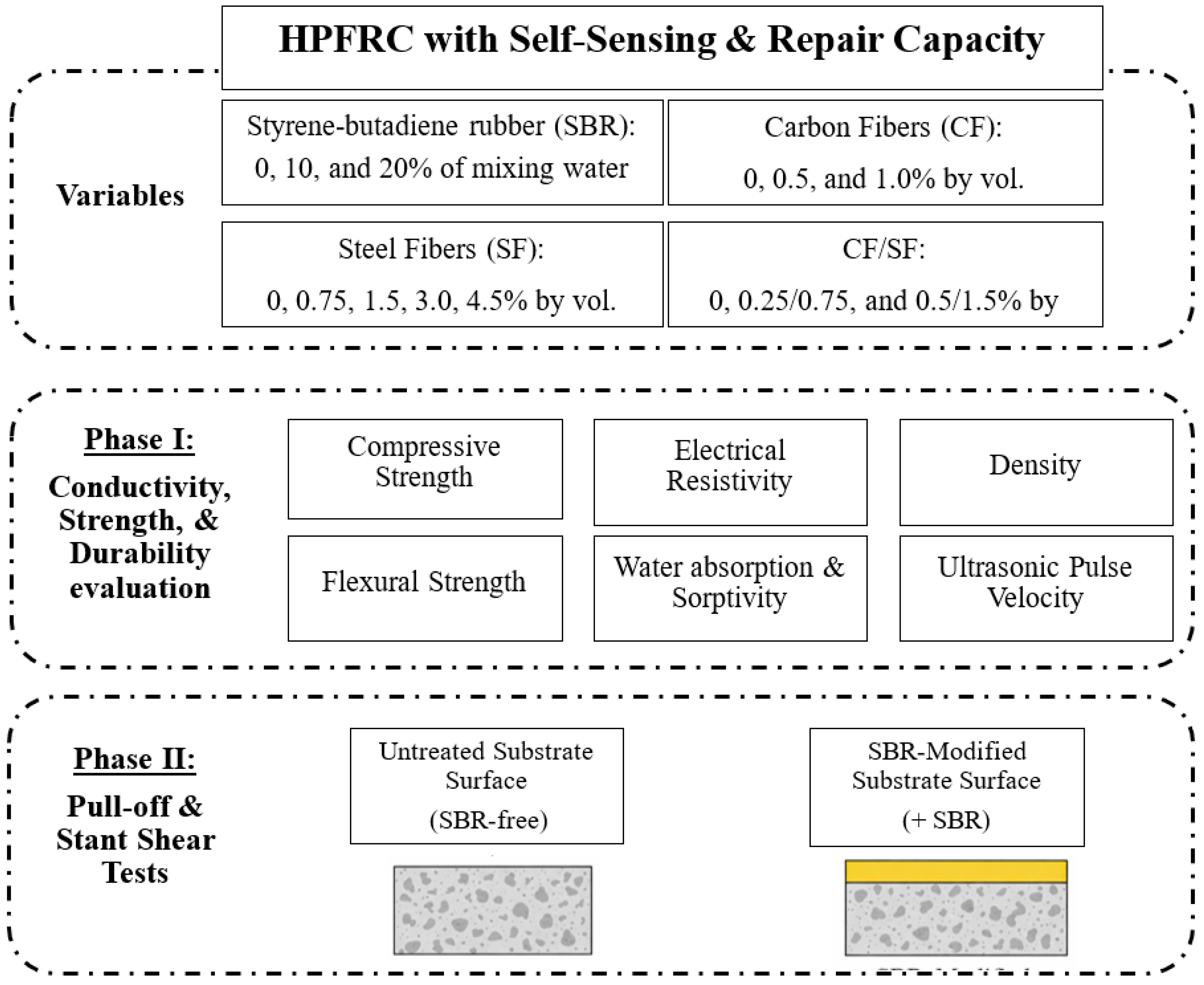
The HPFRC mixtures were formulated to balance workability with enhanced mechanical and durability properties, while achieving the required electrical conductivity and bond performance. A total of 11 mixtures were produced, incorporating varying contents of SBR (0, 0.1, and 0.2 of the mixing water by latex), SF (0, 0.75, 1.5, 3.0, and 4.5% by volume), CF (0, 0.5, and 1.0% by volume), and hybrid CF/SF combinations (0, 0.25/0.75, and 0.5/1.5% by volume). Upon incorporating SBR latex, the water present in the polymer emulsion was accounted for as part of the total mixing water when calculating the effective water-to-binder ratio of the developed mixtures. This adjustment ensured that all mixtures were proportioned on an equivalent basis, allowing a reliable comparison of mechanical and durability properties. The experimental program was conducted in two phases. In this context, the percent incorporation of the different fibers was limited by the composites’ workability; i.e., higher percentages resulted in mixes with a flow below 20 cm (an acceptable flow was set to 24 ± 1 cm, as shown later). In the first phase, the fresh and hardened properties of the proposed mixtures were determined. It is worth noting that the adequacy of fiber dispersion was verified through visual examination of the fresh mixtures and hardened specimens [43]. Following performance screening, the mixtures exhibiting the most favorable overall behavior were selected for further investigation. In the second phase, bond properties were assessed using pull-off and slant shear tests, while styrene–butadiene rubber was additionally applied to the substrate surface to evaluate its effect on interfacial bonding. The workflow of the experimental program is illustrated in Figure 2.
The HPFRC mixtures were prepared using a predefined quantity of liquid to achieve a flow of 24 ± 1 cm. The mixing procedure consisted of an initial stage at 140 rpm for 1.5 min, a 30 s pause, and a final stage at 270 rpm for 3 min. Fibers, when incorporated, were dry-mixed at 140 rpm for 30 s before water addition. For SBR-modified mixtures, the liquid phase was prepared by replacing 10 or 20% of the water with SBR latex, which was then slowly added during mixing.

2.3. Testing Methods

Upon completion of mixing, rheological parameters, air content, and flow time were evaluated per the procedure of Assaad and Khayat [17]. The flow time was determined using 1000 mL samples on a customized Marsh cone with an outer radius of 12.5 mm. A four-bladed vane connected to a rheometer was used to measure the yield stress (τ0) and plastic viscosity (η). The vane’s height and diameter were 24 and 12 mm, respectively, and it was inserted in a large bucket. The testing protocol consisted of pre-shearing the fresh mortar at 400 rpm over 30 s. The rotational speed was then reduced to 50 rpm over 90 s, with the corresponding torque continuously recorded. The conversion of rotational speed and torque measurements into international units (i.e., Pa and Pa.s) was based on the assumption of a uniform stress distribution along a cylinder circumscribed by the vane blade tips in an infinite medium.
HPFRC specimens were prepared as 40 × 40 × 160 mm prisms and 100 × 200 mm cylinders, demolded after 24 h, and cured for 28 days in sealed polyethylene bags. This curing regime maintained a relative humidity of at least 90%, enabling adequate strength development of the unmodified material and avoiding polymer film degradation that may occur under continuous water curing. For each mixture and test condition, three replicate specimens were prepared and tested, and the reported values represent the average of these measurements.
The compressive and flexural strengths were determined in accordance with BS EN 196-1 [44]. In this procedure, compressive testing was performed on the two halves obtained from the flexural strength test.
The electrical resistivity (ER) measurements of cylindrical specimens were conducted as a direct indication of electrical conductivity using a Giatec® RCON™ resistivity device following ASTM C1876 [45]. For this test, a 100 × 200 mm cylindrical specimen was positioned between two plates, with moist sponges inserted at the interfaces to establish electrical continuity. Prior to testing, all specimens were conditioned to saturated surface-dry (SSD) conditions to ensure consistent moisture states and minimize variability associated with pore solution saturation, which is known to significantly influence resistivity measurements. Testing was carried out at curing ages of 7, 14, and 28 days, and the corresponding bulk resistivity values were recorded.
The ultrasonic pulse velocity test was conducted in accordance with ASTM C597 [46] to assess the quality and uniformity of the hardened HPFRC. Measurements were performed by transmitting ultrasonic pulses through the specimens, and the pulse velocity was calculated based on the travel time between the transmitting and receiving transducers.
Water absorption and sorptivity were evaluated in accordance with ASTM C642 [47] and C1585 [48], respectively. Cylindrical specimens measuring 100 × 200 mm were oven-dried and then immersed in water for 48 h to determine the mass gain. For the sorptivity test, concrete discs with a diameter of 100 mm and a height of 50 mm were exposed to water on one surface and weighed at regular intervals over a 6 h period. Sorptivity was calculated as the slope of the linear relationship between water absorption (I, mm) and the square root of time.
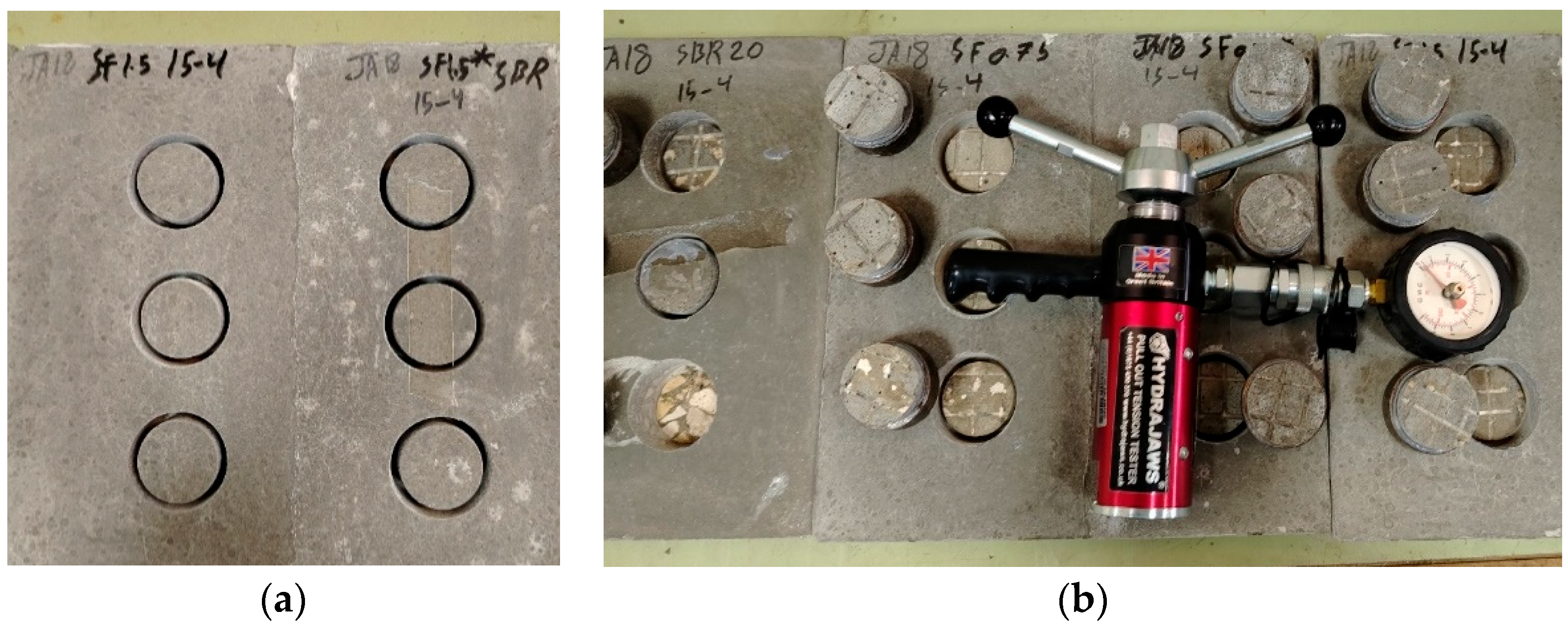
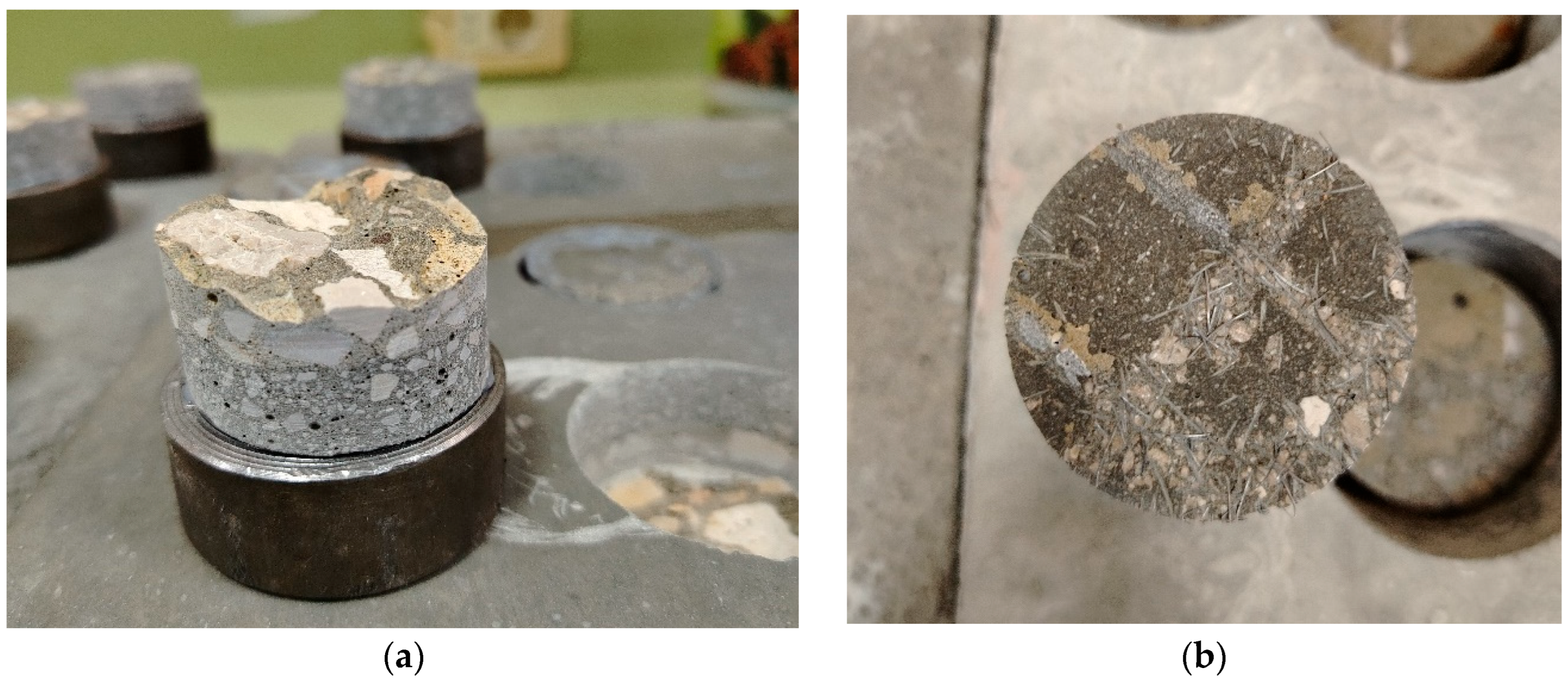
The pull-off bond strength was assessed in accordance with BS EN 1542 [49]. Substrate slabs measuring 300 × 300 mm2 were cast using high-strength concrete with a compressive strength of 40 ± 4 MPa and subsequently mechanically roughened and scratched to an approximate depth of 1 mm to remove laitance and loose particles (Figure 3). Fresh concrete was placed on the prepared substrate to produce an overlay thickness of approximately 10 mm. Two 50 mm diameter cores were drilled from each slab, and the pull-off bond strength was calculated as the ratio of the maximum tensile load at failure to the bonded interface area of 1963 mm2.
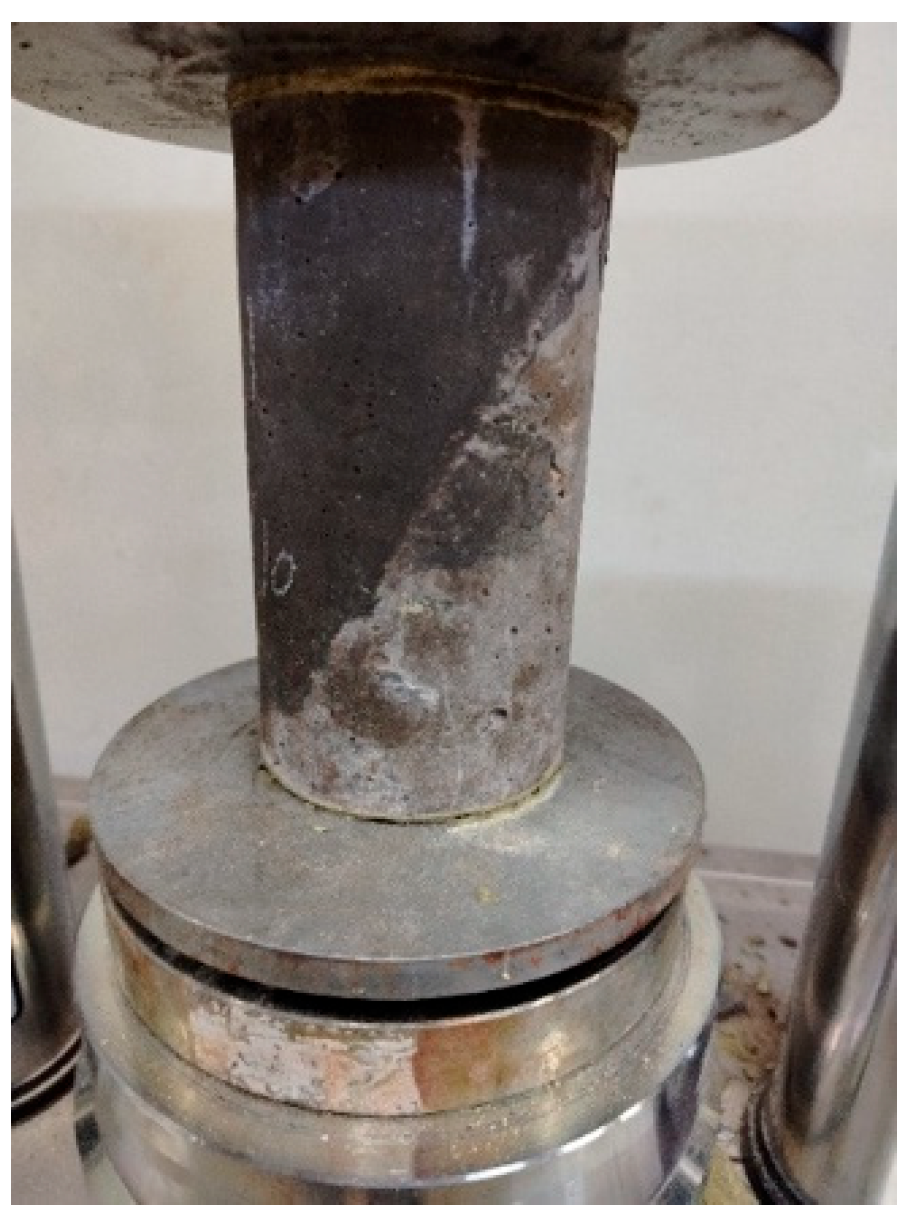
Furthermore, slant shear testing was conducted in accordance with ASTM C882/C882M [50] under uniaxial compression at a constant loading rate of 3 kN/s, using the same testing apparatus as for compressive strength testing. During loading, the specimen was carefully aligned with the center of the plates to avoid friction-induced effects (Figure 4). The peak load corresponding to shear failure was recorded.

3. Results and Discussion

3.1. Flow and Rheological Characterization

Table 2 presents the water demand required to attain a flow response of 24 ± 1 cm, together with the air content, fresh density, flow time, and rheological properties of the freshly mixed composites. The water demand decreased from 12.7% for the control mix to 11.3% and 10.5% with the incorporation of 10% and 20% SBR, respectively. The improved flowability is mainly due to the spherical morphology of SBR particles and the action of surfactants, which promote ball-bearing and plasticizing effects [35]. In contrast, water demand increased with SF additions, due to increased internal friction from entangled fibers during flow [17]. Hence, the water demand reached 13.5% for the mix containing 4% SF.
The tested mixtures exhibited an air content of 2.9 ± 0.1% and a fresh density of about 2200 ± 80 kg/m3 (Table 2). The plain mix exhibited a Marsh cone flow time of 18.5 s, which increased to 28.5 s with 20% SBR and further to 43.5 s with 4% SF. Such response can be linked to improved viscosity of the liquid phase due to polymer modification, while the presence of fibers is known to accentuate internal friction and act as obstacles during flow [17].
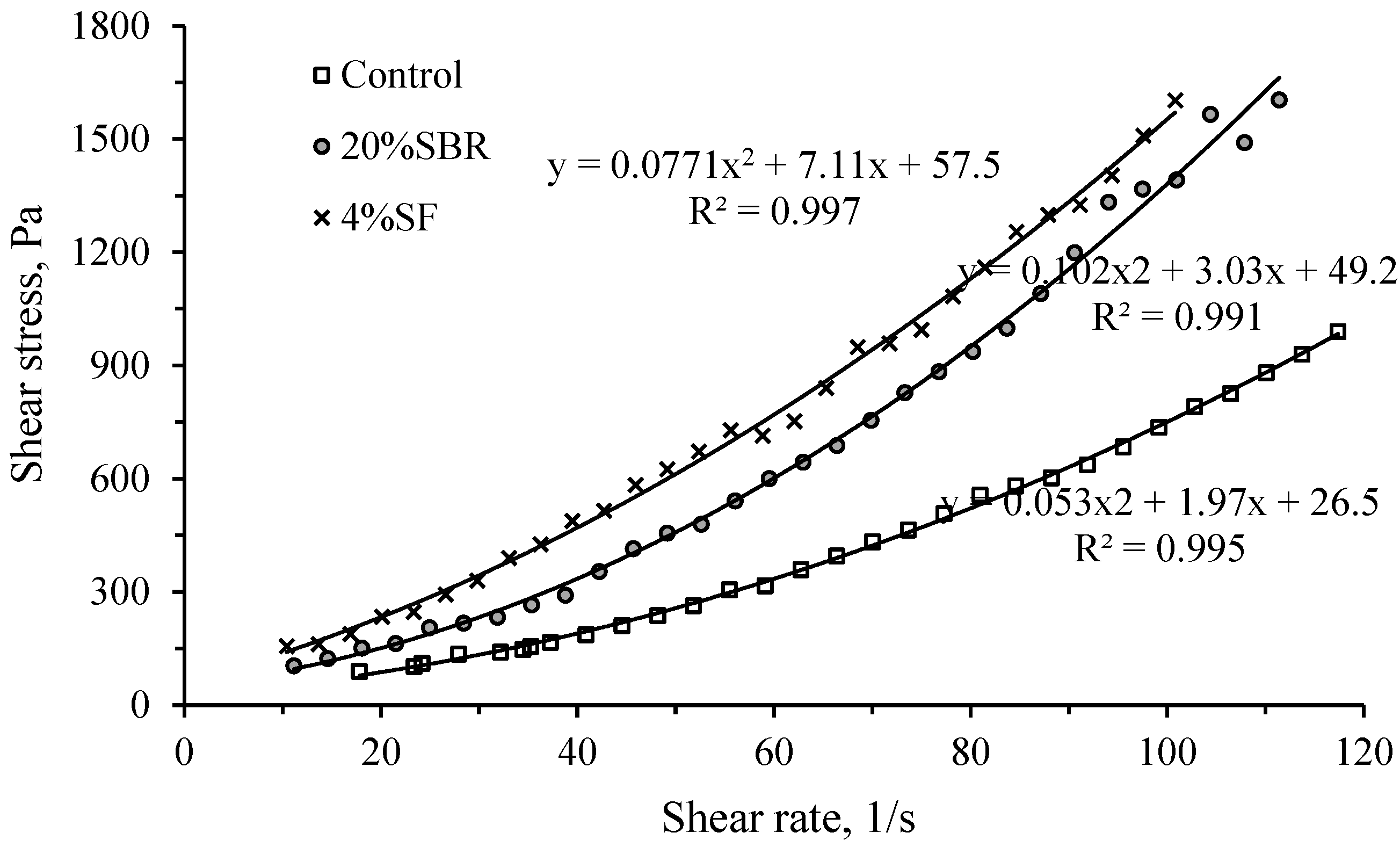
Typical rheograms for the plain (control) mix and those containing 20% SRB or 4% SF are plotted in Figure 5. The rheological properties were evaluated using the modified Bingham model, τ = τ0 + ηγ + cγ2, where c, τ, γ, and refer to the proportionality constant, shear stress, and shear rate, respectively. In addition, this second-order term model is regarded as an extension of the Bingham and Herschel–Bulkley models, since this prevents abnormal negative τ0 values as well as their over-estimation at low shear rates. As shown, all rheograms exhibited a shear-thickening behavior typically encountered in cementitious materials, whereby the shear stresses follow an increasing trend with the increase in shear rate. The τ0 and η for the plain mix were 26.5 Pa and 1.97 Pa.s, while gradually increased with SBR polymer modification or SF additions. Hence, this reached 49.2 Pa and 3.03 Pa.s for the 20% SBR mix, and as high as 57.5 Pa and 7.11 Pa.s for the mix containing 4% SF (Table 2). Such results are in concordance with the flow time measurements, reflecting the relevance of accounting for the presence of such additions to ensure proper flowability with minimal segregation during repair applications [22].

3.2. Electrical Resistivity

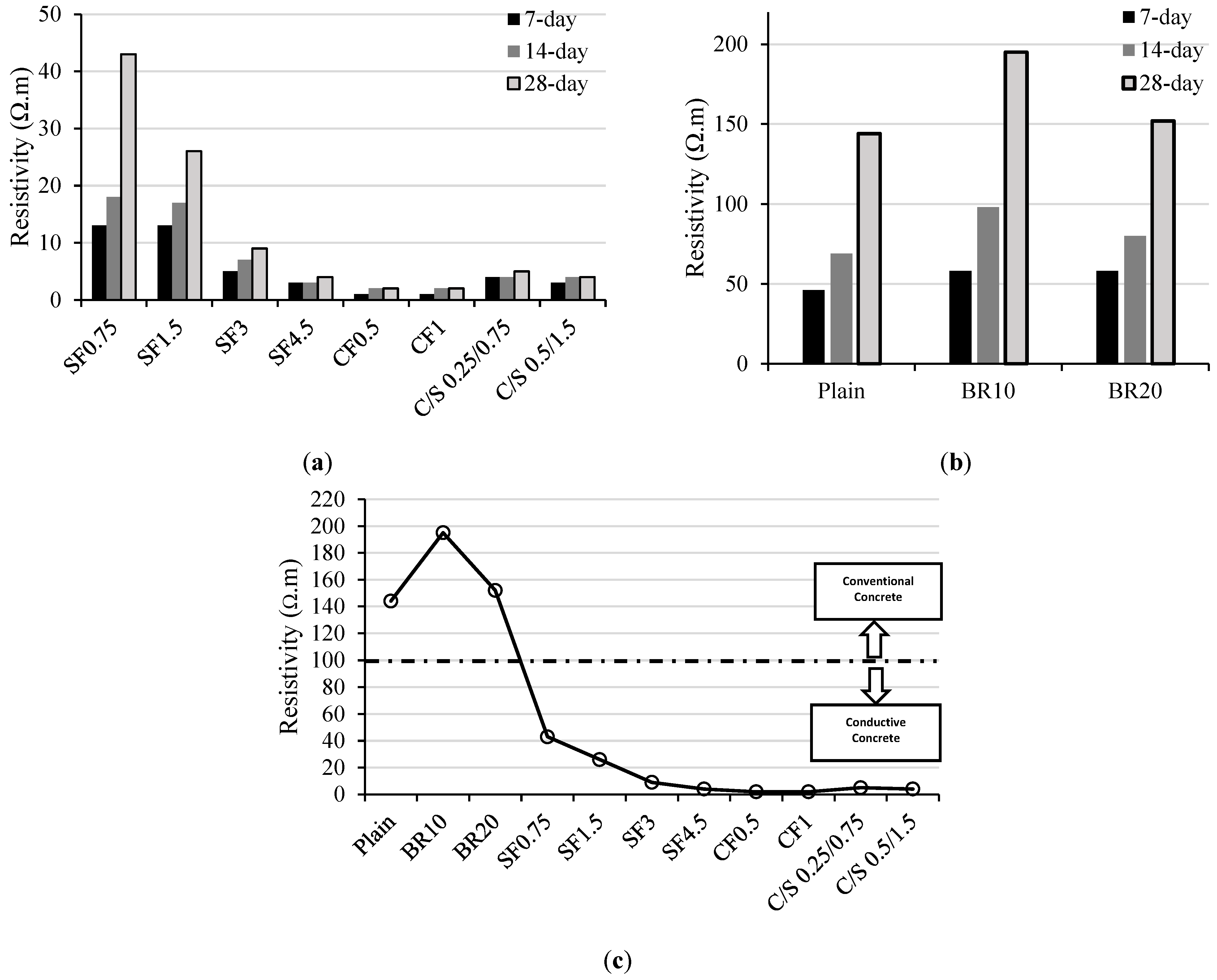
Table 3 and Table 4 summarize the average values of the reported measurements along with their corresponding standard deviations. It can be noticed that the standard deviation values are generally low, indicating reliable and repeatable measurements, while the slightly higher variability observed in fiber-reinforced mixtures is attributed to the inherent randomness of fiber distribution [15]. Figure 6a illustrates the evolution of ER with curing age for mixtures incorporating different conductive materials. For the control plain mix, a clear age-dependent increase in resistivity was observed, consistent with the literature [6]. As curing progresses from 7 to 28 days, resistivity increases due to continuous hydration of the cement matrix, depletion of free pore water, and reduced ionic conductivity. At early ages, electrical transport was dominated by ionic conduction through pore solution, whereas at later ages, the densification of hydration products and reduced pore connectivity significantly hindered charge transport. Conversely, the incorporation of conductive materials significantly altered the resistivity response. As shown in Figure 6a, mixtures containing SF, CF, and hybrid systems exhibited a substantial reduction in resistivity compared with the plain mixture at all curing ages. Increasing the SF content led to a pronounced decrease in resistivity, indicating the formation of effective conductive networks via direct fiber contact and electron transport pathways. Indeed, the addition of CF further enhanced conductivity due to their intrinsic electrical properties and their ability to bridge microcracks and pores within the matrix [9,51].
Figure 6b compares the resistivity of plain concrete with mixtures containing SBR at different ages. Although resistivity increased with time for all mixtures, the relative ranking remains unchanged, confirming that the conductive phase governed the dominant transport mechanism rather than curing age alone. The addition of SBR resulted in a modest increase in resistivity irrespective of curing age. At 14 days, the resistivity increased from 69.4 Ω·m in the SBR-free mixture to 98.6 Ω·m and 80.5 Ω·m for concretes containing 10% and 20% SBR, respectively, indicating a slight insulating effect of the polymer phase. This increase is mainly attributed to the polymer phase promoting air entrainment and micro-void formation, which disrupts conductive pathways within the cementitious matrix and slightly enhances the insulating behavior of the composite [52].
Figure 6c highlights the transition from conventional to electrically conductive concrete evaluated at 28 days, which is commonly regarded as a curing age at which cement hydration is nearly complete and the pore structure has reached a relatively stable state, allowing the intrinsic effect of conductive materials on electrical behavior to be clearly identified. Clearly, the resistivity of the plain and SBR mixtures remained within the range typical of conventional concrete, whereas the introduction of SF, CF, and their hybrid combinations shifted the material into the electrically conductive range [27]. In comparison, the addition of SF at volume fractions of 0.75, 1.5, 3, and 4.5% resulted in resistivity values ranging from 3.02 to 18.1 Ω·m, reflecting reductions of up to 97% relative to the plain mixtures at 7 and 14 days. Such trends corroborate previous findings that attributed the pronounced decrease in resistivity to the formation of conductive pathways by SF within cement-based composites, thereby increasing their electrical conductivity [53]. Moreover, the addition of CF at volume fractions of 0.5 and 1% led to a reduction in resistivity of up to 98% relative to the plain mixture. Compared with SF, CF was more effective in establishing continuous conductive networks within the cement matrix, as reflected by the markedly lower resistivity values. At similar fiber contents of 0.75–1%, the 28-day bulk resistivity reached nearly 2.03 Ω·m for CF, in contrast to approximately 43.2 Ω·m for SF. This behavior is primarily attributed to the much smaller diameter of CF compared with SF. CF typically has a diameter of about 7 µm, whereas SF is on the order of 200 µm. For an equivalent fiber volume fraction, the finer diameter of CF results in a higher number of fibers per unit volume, facilitating the formation of a denser conductive network. Moreover, the higher aspect ratio of CF enhances fiber interconnectivity and reduces the electrical percolation threshold, enabling more continuous electron transport pathways. Combined with the higher intrinsic conductivity of CF, as also observed in our earlier work, these geometric advantages lead to significantly lower electrical resistivity compared with SF-reinforced mixtures, in which larger diameters and lower effective connectivity limit network continuity [54]. The very low resistivity values obtained for the carbon-fiber mixtures (≈1.01–5.05 Ω·m) indicate the formation of an interconnected conductive network within the matrix. This behavior is characteristic of conductive fiber systems approaching or exceeding the electrical percolation threshold, where fiber-to-fiber contact creates continuous pathways for charge transport. Consequently, resistivity decreases sharply compared to non-conductive or metallic fiber systems, which primarily influence resistivity through pore structure rather than electronic conduction. Nevertheless, the addition of carbon fibers proved effective in establishing a more advanced hierarchical conductive pathway in concrete, thereby significantly reducing its electrical resistivity [55].
In addition, the incorporation of hybrid CF–SF systems at volume fractions of C/S 0.25/0.75 and 0.5/1.5 resulted in very low resistivity values, remaining well within the conductive concrete range. This pronounced reduction was attributed to the synergistic interaction between CF and SF, in which CF established fine, continuous conductive networks while SF enhanced long-range connectivity within the cementitious matrix. Accordingly, at these hybrid fiber contents, the 28-day bulk resistivity was reduced to approximately 4.08–5.05 Ω·m, which was comparable to CF-only mixtures and markedly lower than that of SF-reinforced concrete. The sharp drop in resistivity beyond a critical filler content suggested the attainment of a percolation threshold, where continuous conductive pathways were established throughout the matrix. Below this threshold, conduction was mainly governed by tunneling and contact resistance, while above it, electron transport occurred through interconnected conductive networks. At higher fiber contents, only marginal reductions in resistivity were observed, indicating saturation of conductive pathways. In some cases, a slight increase may have occurred due to fiber agglomeration or reduced workability, which could disrupt uniform dispersion and increase contact resistance. Nevertheless, the results demonstrated that properly dosed conductive fibers enabled the production of electrically conductive concrete with resistivity values well below the commonly accepted limit of 10 Ω·m for conductivity and functional applications, such as de-icing and structural health monitoring [54,56].

3.3. Mechanical Properties

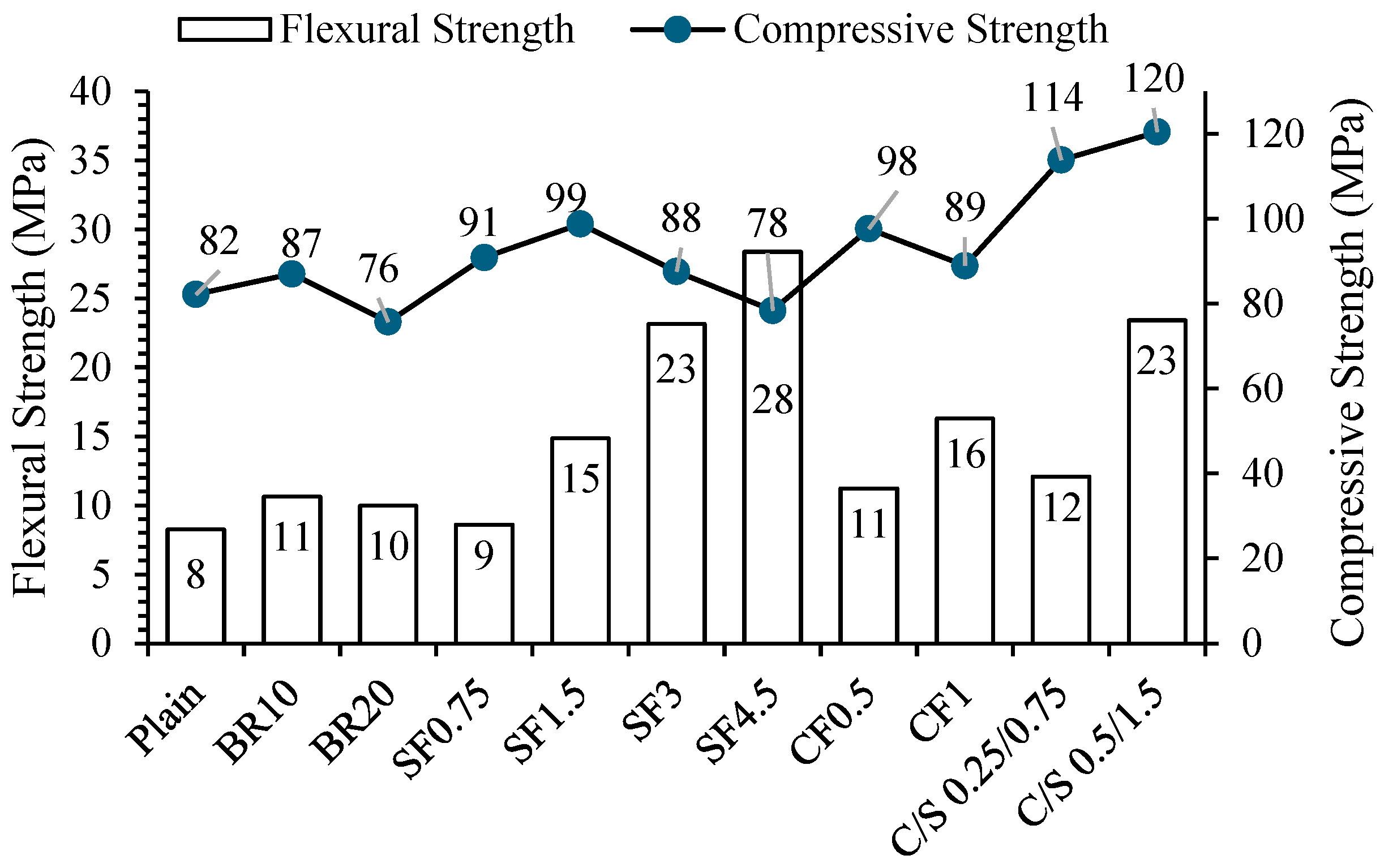
Figure 7 illustrates the variations in compressive and flexural strengths of mixtures containing different proportions of SBR, SF, CF, and hybrid CF/SF reinforcements. The results indicate that incorporating SBR significantly improved the compressive strength response at contents up to 10%. In particular, the compressive strength increased from 82.7 MPa in the control mixture to 87.5 MPa in the SBR-modified concrete, reflecting an enhancement of about 6%. In contrast, increasing the SBR dosage to 20% reduced the compressive strength to 76.2 MPa. These findings are consistent with previous studies reporting that SBR contents around 15–20% led to a reduction in compressive strength [17]. The reduction in compressive strength is commonly attributed to the combined effects of increased air entrainment induced by the surfactants used to stabilize the latex, the development of closed porosity at the cement–aggregate interfaces, and polymer–cement interactions that ultimately produce a matrix with lower stiffness and compressive resistance compared to pure hydrated cement [34].
The incorporation of SF at a volume fraction of 1.5% increased the compressive strength to 99.07 MPa, compared with 82.7 MPa for plain concrete. This gain is mainly attributed to SF’s role in delaying the initiation and propagation of microcracks [57]. Supporting findings were reported by You et al., who reported that compressive strength reached 144 MPa at the same fiber dosage [58]. Nevertheless, increasing the SF content to 4.5% led to a marked reduction in compressive strength, which decreased to 78.2 MPa and became lower than that of the control mixture. Similarly, incorporating CF enhanced the compressive strength response. For instance, the compressive strength increased from 82.7 MPa for the control mixture to 98.2 MPa and 89.4 MPa for mixtures containing 0.5% and 1.0% CF by volume, respectively, corresponding to improvements of 19% and 8%. This trend is consistent with previous findings, which reported compressive strength enhancements of up to 9% upon the addition of CF [59]. As for the hybrid incorporation of carbon and steel fibers, the C/S mixtures containing 0.25/0.75% and 0.5/1.5% CF/SF demonstrated the highest compressive strength among all tested mixes, achieving 114.1 MPa and 120.2 MPa, respectively. The present findings are in good agreement with prior investigations, reinforcing the evidence that adding SF and CF leads to a continuous enhancement in compressive strength [59].
The flexural strength results presented in Figure 7 reveal a notable enhancement following the incorporation of SBR latex and fibers. For instance, adding 10% and 20% SBR increased the flexural strength from 8.3 MPa in plain concrete to 10.1 MPa and 11.04 MPa, respectively, highlighting the beneficial role of SBR in improving matrix toughness and crack-bridging capacity. This enhancement can be attributed to the formation of polymer films within the interfacial transition zones, which improve the bond between the cementitious paste and aggregates and restrict the initiation and propagation of microcracks [17,34].
Similarly, the use of SF led to noticeable improvements in flexural strength. The mixtures containing 0.75% and 1.5% SF achieved flexural strengths of 9.3 MPa and 15.08 MPa, respectively, confirming the role of SF in bridging cracks and improving the load transfer capacity across the fracture plane. A substantial increase in flexural strength was observed with higher fiber content, reaching 23.05 MPa and 28.1 MPa for mixtures containing 3% and 4.5% SF, respectively. This progressive enhancement reflects the superior crack-bridging ability of SF at elevated dosages, although careful dispersion is required to maintain adequate workability and uniform fiber distribution [60]. This marked enhancement can be attributed to the higher density of crack-bridging fibers within the matrix, which promotes multiple cracking behavior and improves stress redistribution mechanisms. At elevated fiber dosages, the probability of fiber interception across potential crack planes increases significantly, resulting in improved pull-out resistance, enhanced energy absorption capacity, and greater fracture toughness. The synergistic interaction between fibers and matrix strengthens the interfacial bond and increases the resistance to crack opening, ultimately leading to superior flexural capacity.
The incorporation of CF also produced significant improvements. The flexural strength reached 11.2 MPa and 16.1 MPa for mixtures with 0.5% and 1% CF, respectively. The superior performance of CF can be attributed to its higher aspect ratio and stiffness, which favor the formation of a denser, more efficient crack-bridging network within the cementitious matrix [14]. As expected, the hybrid CF/SF mixtures also exhibited improved flexural strength; however, they did not outperform the SF mixtures at higher dosages. The C/S 0.25/0.75 and C/S 0.5/1.5 mixes achieved flexural strengths of 12.2 MPa and 23.5 MPa, respectively, indicating a beneficial but moderate enhancement compared with the plain and single-fiber systems [59]. Consequently, the hybrid system offers a balanced and optimized reinforcement mechanism, resulting in superior flexural performance compared to mixtures reinforced with single fiber types.

3.4. Durability Indicators

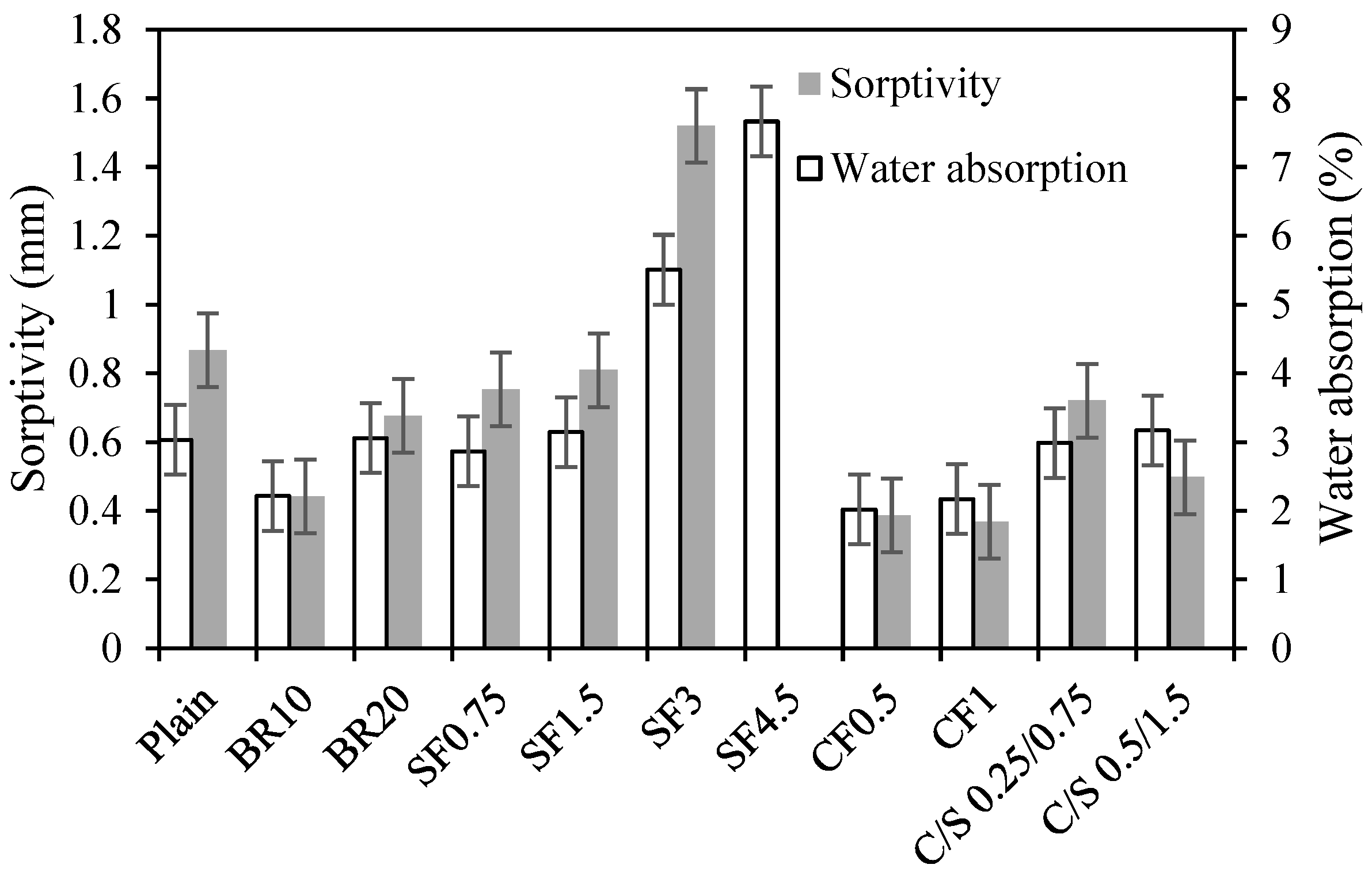
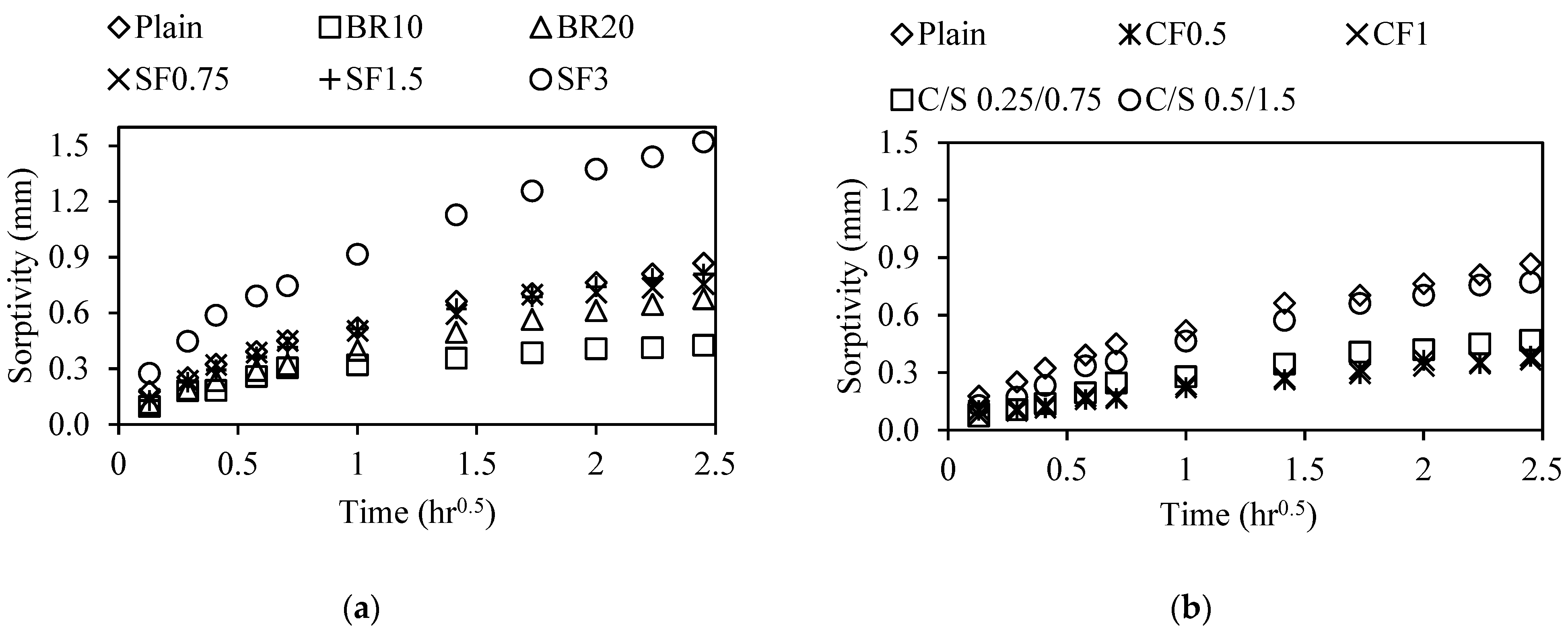
Figure 8 illustrates the typical sorptivity trends as a function of the square root of time for the plain, SBR, and fiber-reinforced mixtures. In this study, sorptivity values, which indicate the rate of water absorption, were determined from the slopes of straight-line regressions over the initial 6 h of measurement. Clearly, the incorporation of SBR significantly reduced the sorptivity response. For instance, the sorptivity decreased from 0.867 mm/hr0.5 for the plain mixture to 0.441 and 0.676 mm/hr0.5 for the BR10 and BR20 mixtures containing 10% and 20% SBR, respectively. These findings are consistent with earlier work [41], where lower water absorption was linked to the hydrophobic behavior of the polymer that produces a dispersed, impermeable membrane network. Meanwhile, the incorporation of fibers significantly affected the sorptivity behavior of the mixtures. At relatively low SF dosages (0.75% and 1.5%), the sorptivity values were 0.753 and 0.809 mm/hr0.5, respectively, remaining close to that of the plain mixture. This indicates that moderate fiber content does not markedly alter permeability-related properties. Similar to plastic inclusions, such as crosslinked polyethylene waste, which act as internal barriers to water ingress, leading to lower sorptivity values [61]. However, increasing the SF content led to a noticeable increase in sorptivity. The mixture containing 3% SF exhibited the highest sorptivity among all compositions, with a value of 1.51 mm/hr0.5. This trend is attributed to the disruption of the pore structure and the development of preferential capillary channels along the fiber–matrix interfaces, which facilitate water ingress [60].
Conversely, the use of CF in mixtures reduced sorptivity responses. In fact, the CF0.5 and CF1 mixtures recorded the lowest sorptivity values of 0.386 and 0.368 mm/hr0.5, respectively. This behavior suggests that the smaller diameter and improved dispersion of CF lead to pore refinement and enhanced resistance to capillary suction. The hybrid fiber systems (CF/SF) also demonstrated superior performance compared with mixtures reinforced with SF. In particular, the hybrid combinations achieved lower sorptivity values than the corresponding SF mixtures, with the C/S 0.5/1.5 mix recording a sorptivity of 0.498 mm/hr0.5. This highlights the effectiveness of CF in mitigating the increase in sorptivity induced by SF [9].
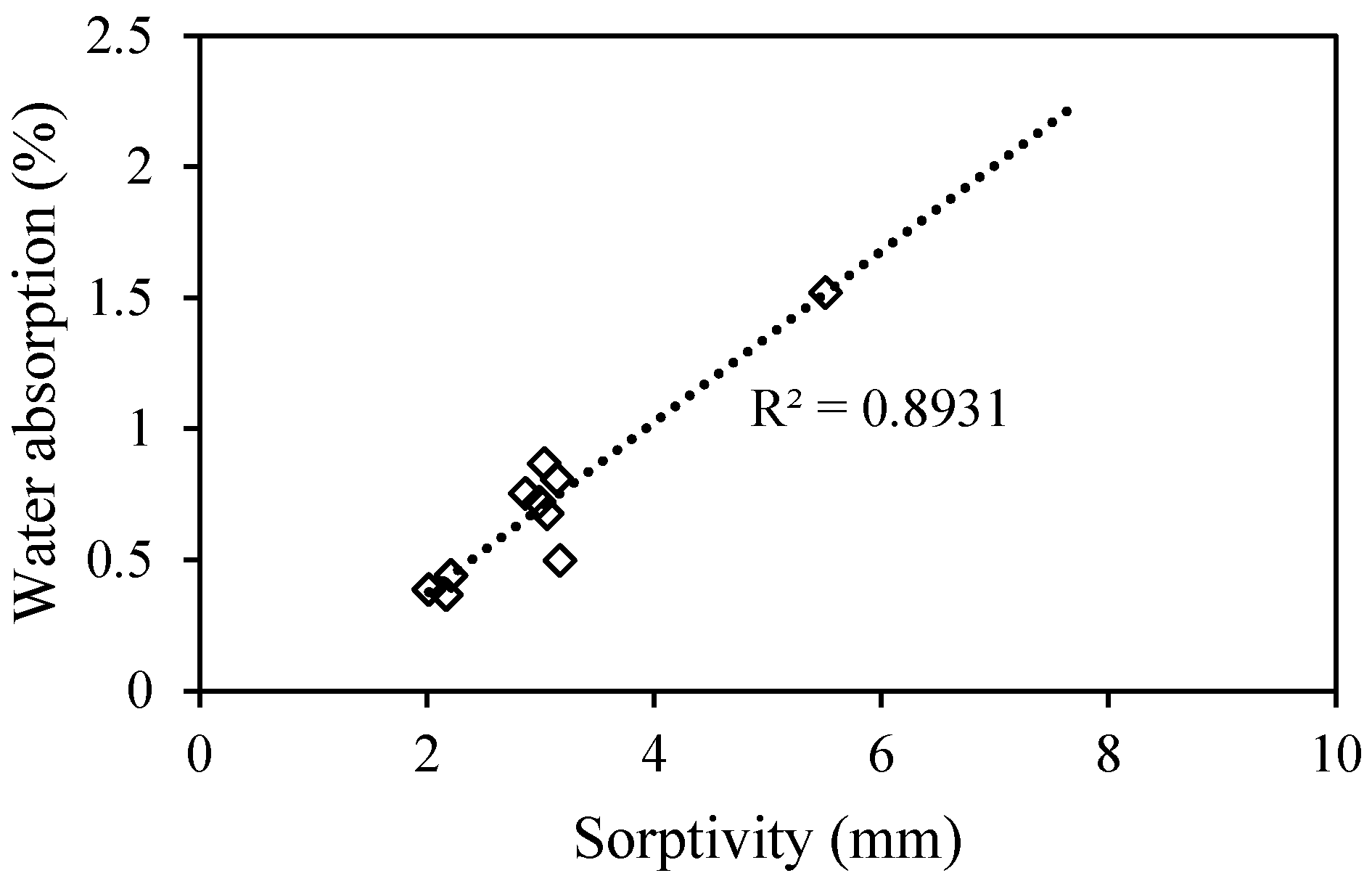
Figure 9 shows the water absorption of concrete mixtures containing different SBR contents and fiber fractions. The absorption trend closely matches the sorptivity behavior. Incorporating 10% and 20% SBR resulted in water absorption of 2.2% and 3.1%, respectively, with the 10% SBR mixture achieving the greatest reduction due to its ability to fill the matrix’s internal voids. This trend is consistent with compressive strength and sorptivity results, which show that SBR had a beneficial effect up to 10%. Conversely, the incorporation of fibers significantly influenced the water absorption behavior. At lower SF contents (0.75% and 1.5% by volume), the absorption values remained close to that of the plain mixture, averaging around 3%. However, increasing the SF dosage led to higher absorption, with the 4.5% SF mixture exhibiting the maximum value of 7.7%, attributed to the formation of interfacial voids and microcracks that enhance water ingress. Unlike SF mixtures, the incorporation of CF led to a clear reduction in water absorption. The CF0.5 and CF1 mixtures achieved values of 2.2% and 2.0%, respectively, due to improved pore refinement and matrix compactness. The hybrid CF/SF mixtures further demonstrated this advantage. For example, the C/S 0.5/1.5 mixture showed a water absorption of 3.2%, underscoring the positive contribution of carbon fibers in mitigating the permeability increase induced by SF. Figure 10 shows the correlation between sorptivity and water absorption, with a coefficient of determination of 0.893, indicating a strong correlation.
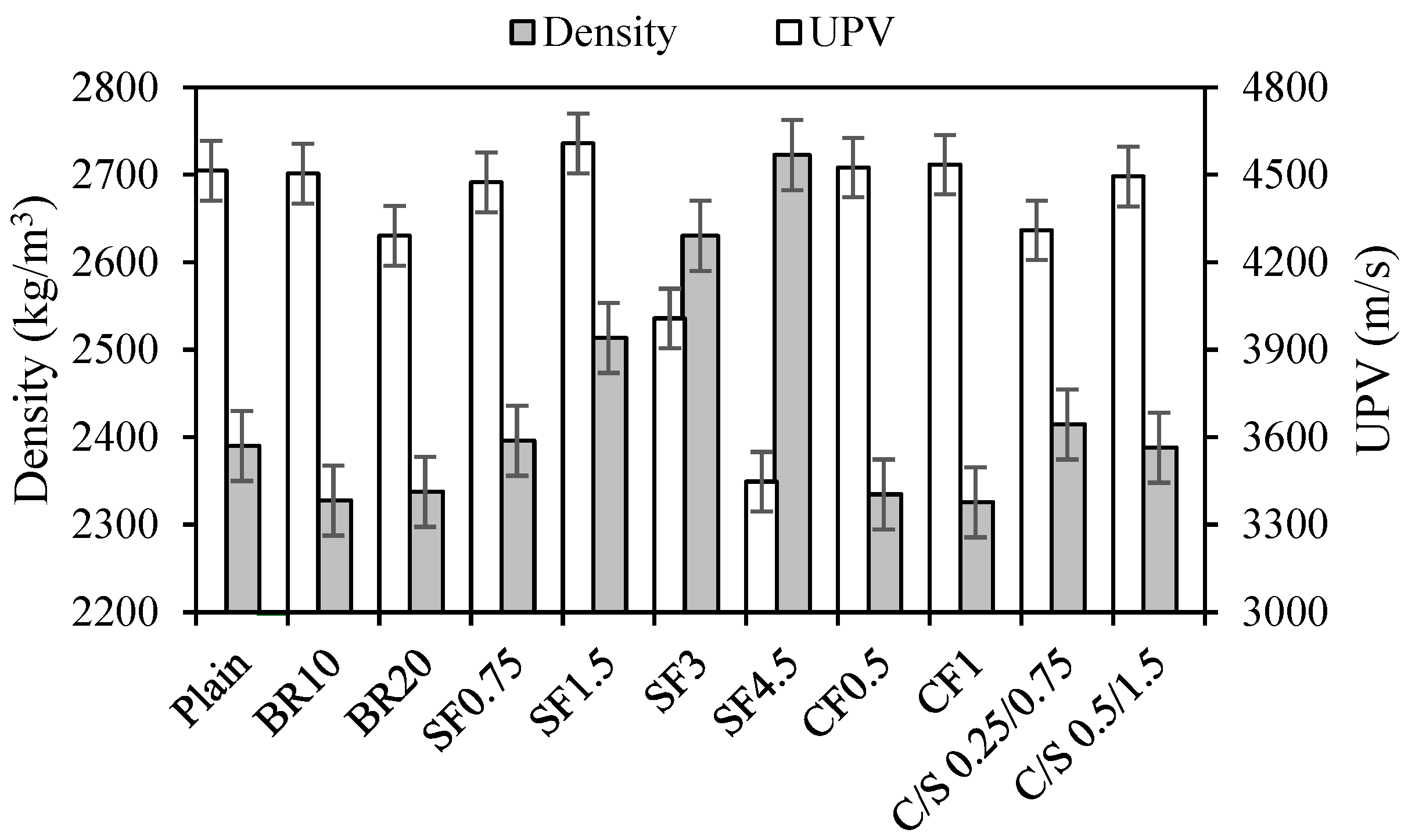
As illustrated in Figure 11, the incorporation of SBR and fibers exerted a pronounced influence on both the density and UPV responses of the mixtures. The plain mixture exhibited a density of 2390 kg/m3 and a UPV of 4514 m/s, indicating a relatively dense, homogeneous matrix. The inclusion of SBR resulted in a gradual reduction in both properties, with the BR20 mixture reaching a minimum density of 2338 kg/m3 and a corresponding UPV of 4291 m/s. This concurrent decline was primarily attributed to the lower specific gravity of the polymer and its inherent air-entraining effect, which increases internal porosity, disrupts matrix continuity, and intensifies ultrasonic wave scattering, thereby reducing both bulk density and wave propagation efficiency.
For the SF–reinforced mixtures, the density remained nearly unchanged at low fiber dosages but increased markedly at higher SF contents, reaching 2514, 2630, and 2723 kg/m3 for SF1.5, SF3, and SF4.5, respectively, due to the high specific gravity of SF and their progressive contribution to the composite solid skeleton. However, despite the increase in density, the UPV exhibited an inverse trend, decreasing significantly at increased fiber dosages, from 4474 m/s (SF0.75) to 4008 m/s and 3448 m/s for SF3 and SF4.5, respectively. This apparent contradiction can be attributed to SF agglomeration, increased entrapped air, and localized heterogeneities between the SF and cement matrix induced by excessive fiber contents, which amplify internal reflection and scattering of ultrasonic waves, thereby impairing wave transmission despite the denser bulk material [17]. Similar findings were reported in earlier studies investigating SF contents up to 1.5%. In those investigations, UPV values of SF–reinforced concretes decreased with increasing unit weight. This apparent contradiction was attributed to difficulties in properly compacting mixtures containing higher fiber volumes, which led to increased internal porosity. The presence of excess fibers can hinder effective consolidation, promote fiber interlocking, and trap air within the matrix. As a result, despite the increase in bulk density due to steel inclusion, the internal microstructure becomes more heterogeneous and discontinuous, impairing ultrasonic wave transmission. Consequently, the reduction in UPV was primarily associated with increased porosity and wave scattering effects rather than changes in material density alone [62].
In contrast, CF and hybrid CF/SF mixtures exhibited relatively high UPV values, reaching up to 4535 m/s for CF1 and 4494 m/s for the C/S 0.5/1.5 mixture, while maintaining moderate density levels. This favorable behavior was mainly attributed to the fine diameter, high dispersion capability, and crack-bridging efficiency of carbon fibers, which promote pore refinement and matrix densification without inducing significant flow obstruction or fiber clustering. Consequently, CF and hybrid reinforcements contributed to improved microstructural homogeneity, facilitating efficient ultrasonic wave propagation and confirming their beneficial role in optimizing the internal structure of high-performance cementitious composites.
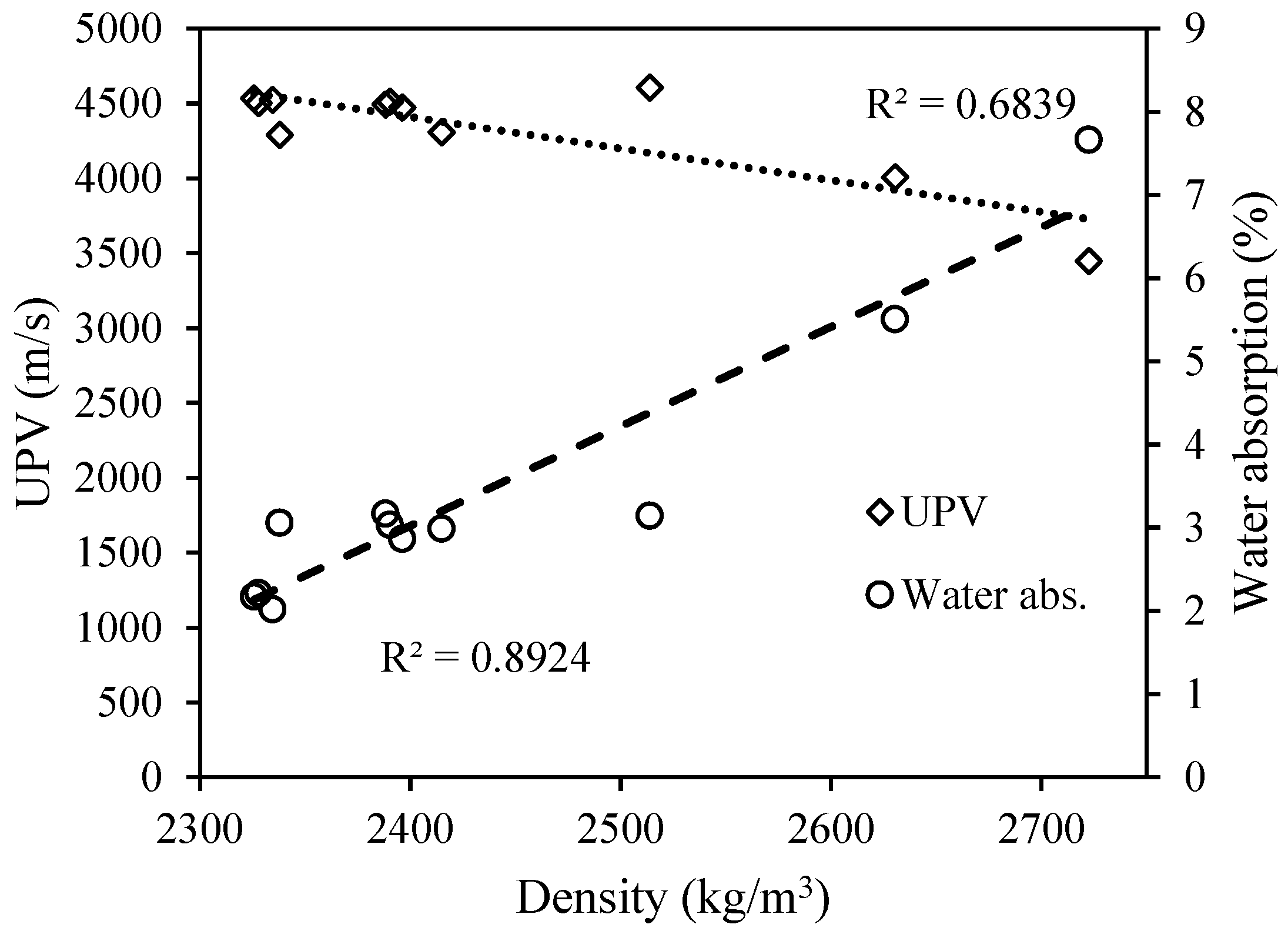
As shown in Figure 12, robust correlations were observed between density and both UPV and water absorption for the tested HPFRC mixtures with varying SBR and fiber dosages. These correlations enabled accurate prediction of UPV and water absorption as functions of density, with coefficients of determination (R2) reaching 0.89, highlighting the strong interdependence between these parameters.

3.5. Bond Properties

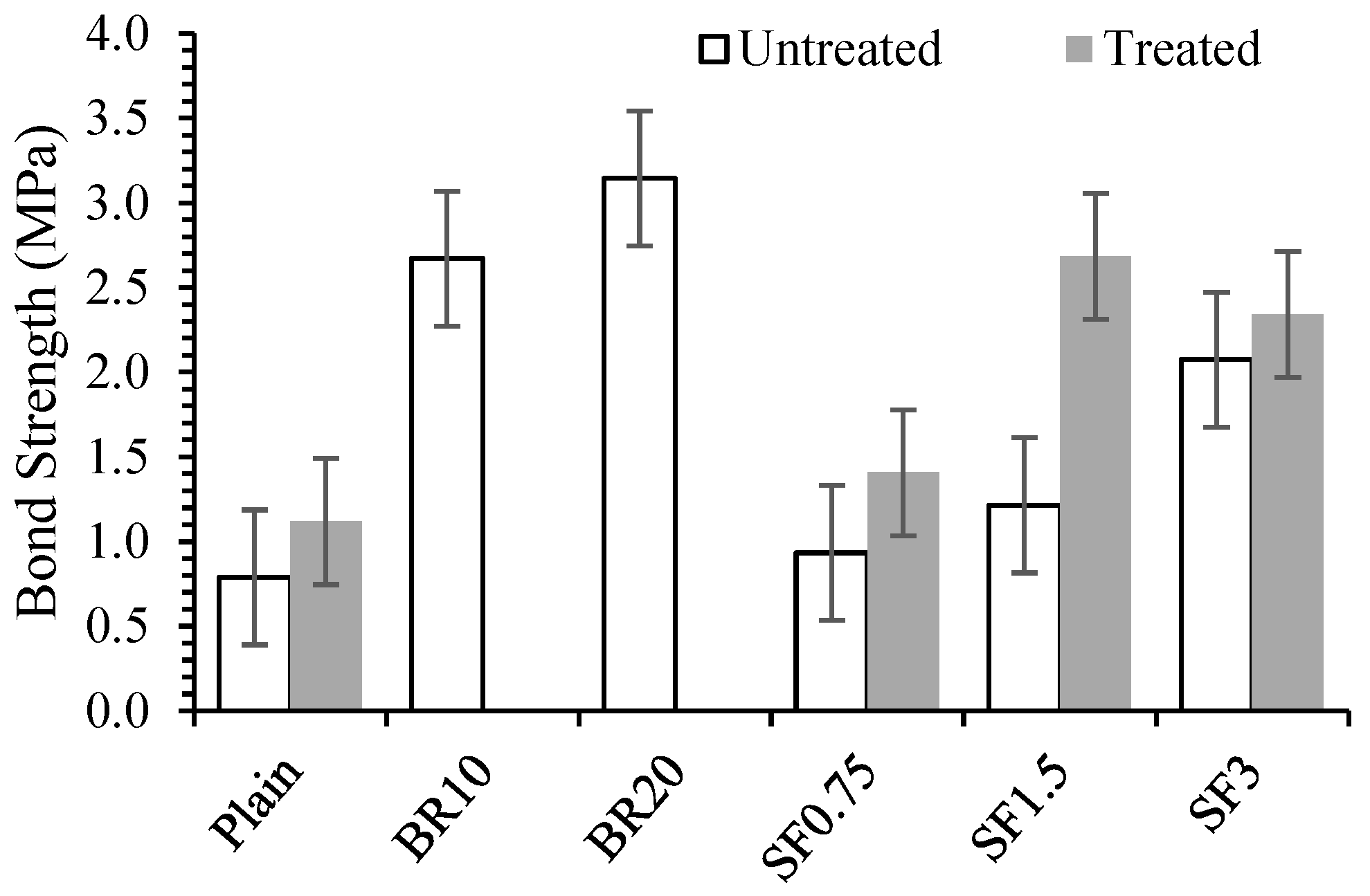
At this stage, the impact of surface treatment was investigated by testing substrates in two conditions, untreated and SBR-treated, to quantify the effect of SBR on the pull-off strength (Figure 13). The addition of SBR on the substrate surface improved the pull-off strength. The values increased from 0.79, 0.93, 1.21, and 2.08 MPa for the untreated mixtures C1, SF0.75, SF1.5, and SF3, respectively, to 1.12, 1.41, 2.68, and 2.34 MPa after SBR surface treatment. This corresponded to an improvement in pull-off strength ranging from 12.5% to 121.5%. This phenomenon was well established in the literature and is mainly explained by two factors: improved surface smoothness that sealed the substrate porosity, and the development of a monolithic bond provided by SBR polymer films that enhance adhesion and elasticity [17]. Even without surface treatment, adding SBR or SF to the mix improved the pull-off strength. Compared with the plain mixture (0.79 MPa), the pull-off strength reached 1.41, 1.21, and 2.08 MPa for the SF0.75, SF1.5, and SF3 mixtures, respectively. Similar findings have been reported in the literature, showing that incorporating SF increases bond and pull-off strengths by improving interface confinement and mechanical interlock [63].
As illustrated in Figure 14a, mixtures incorporating SBR exhibited a transition toward S-type failure, indicating enhanced interfacial bonding that shifted the rupture location into the substrate concrete. Conversely, A-type failure was observed when failure occurred at the interface between the substrate and overlay for SF1.5 mixtures, confirming that the interface represented the weakest zone in the system. The modification in fracture behavior is primarily associated with the penetration of polymer-modified paste into the substrate pores and the formation of continuous polymer films, which promote effective micromechanical interlocking between the overlay and substrate materials [17]. These findings underscore the advantages of SBR relative to steel fibers in securing monolithic bonding and improving the durability performance of the composite system.
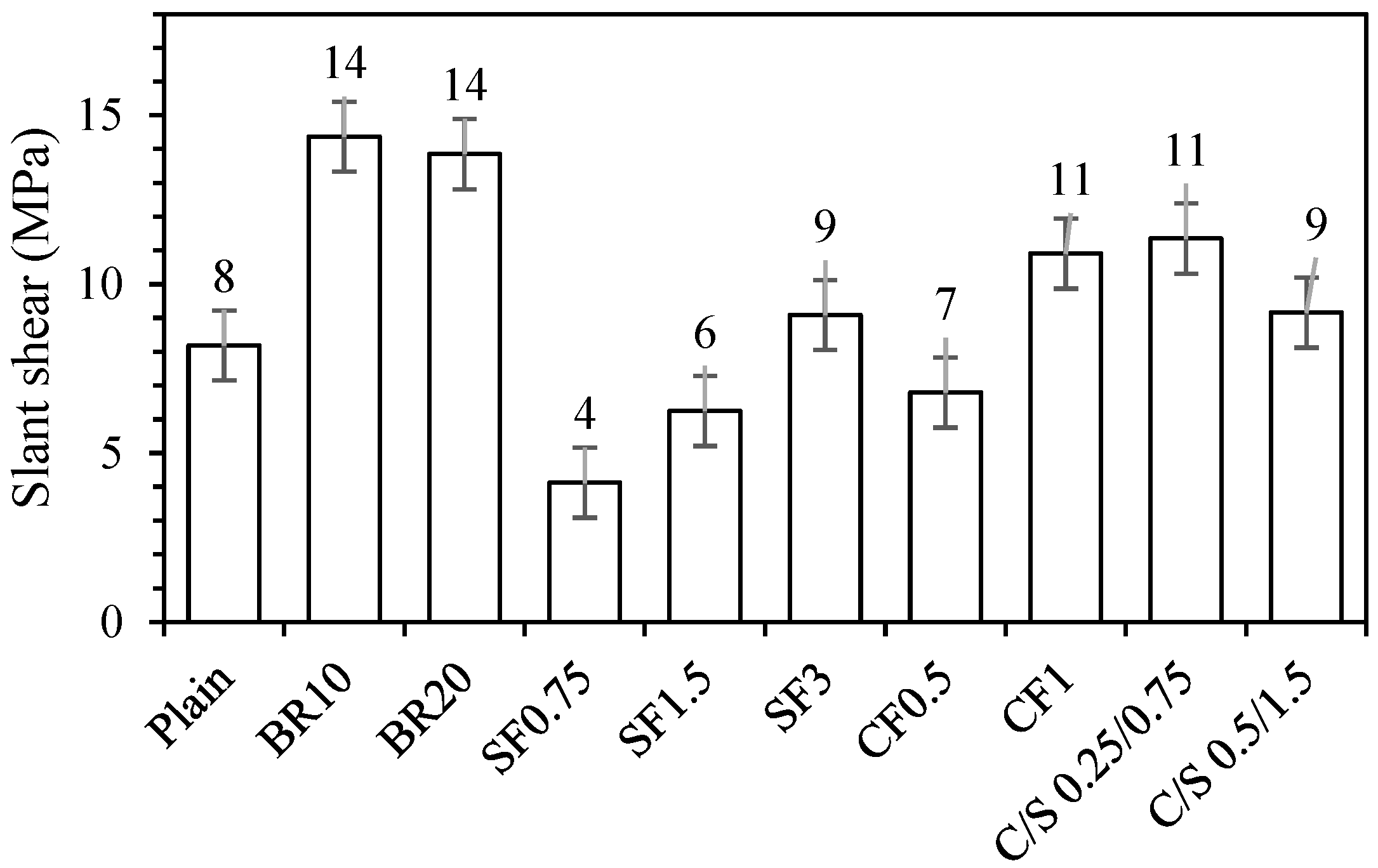
Based on the favorable performance of SBR at the interface between the substrate and the overlay, all slant shear specimens were treated with SBR at the interfacial surface. The slant shear strength results are presented in Figure 15 for both the plain and modified mixtures. The measured strengths ranged from 4 to 14 MPa, reflecting the strong influence of the adopted modification strategy on interfacial shear transfer. The plain mixture recorded a strength of about 8 MPa, which served as the reference value. Clearly, the addition of SBR resulted in the greatest enhancement. Both BR10 and BR20 achieved slant shear strengths of approximately 14 MPa, representing an increase of about 75% compared with the plain mixture. This consistent improvement indicates that the polymer phase effectively enhances interfacial bonding and shear resistance by filling pores and developing a more continuous polymer–cement film that improves mechanical interlocking and mitigates stress concentrations [33]. Notably, the results are consistent with previous findings reported in the literature, where SEM observations demonstrated that the formation of polymer films within the cementitious matrix enhances interfacial bonding and microstructural integrity [64]. In polymer-modified systems, the bond between steel fibers, aggregates, and the surrounding cement matrix is significantly improved compared with mixtures containing steel fibers alone. This improvement is attributed to the polymer film acting as a bridging and filling phase that reduces interfacial voids, refines the ITZ, and promotes stronger mechanical interlock and adhesion. Consequently, the concrete constituents become more compactly integrated, which contributes to enhanced load transfer efficiency and, ultimately, higher flexural strength. Moreover, as the steel fibers become well dispersed within the modified matrix, a denser and more homogeneous microstructure develops, indicating that the polymer film has fully coalesced and effectively reinforced the internal composite network.
In comparison, SF mixtures exhibited a non-monotonic trend. The SF0.75 mixture showed a marked reduction in strength to around 4 MPa, nearly 50% lower than the reference, likely due to increased heterogeneity or interface voids. However, increasing the SF content improved the response, with SF1.5 and SF3 reaching approximately 6 and 9 MPa, respectively, confirming that higher fiber volumes enhance resistance to interfacial sliding through crack bridging [14]. In addition, the slant shear strength increased from about 7 MPa for CF0.5 to nearly 11 MPa for CF1, demonstrating a clearer positive effect of CF dosage. This behavior is attributed to the ability of CF to refine the crack network and improve matrix continuity at the interface. The hybrid CF/SF systems also performed well, with C/S 0.25/0.75 and C/S 0.5/1.5 reaching approximately 11 and 9 MPa, respectively. Although hybridization maintained strong shear performance, it did not exceed the polymer-modified or CF1 mixtures, suggesting that workability and packing effects may limit the full benefits of combined fibers.
From a practical implementation standpoint, the developed mixtures demonstrate strong potential for field application. The relatively low variability observed in mechanical and durability properties confirms good reproducibility, which is essential for large-scale production. Although mixtures containing conductive SF exhibited low resistivity values, their workability remained within acceptable limits, indicating that the formation of conductive networks did not adversely affect casting feasibility. In addition, the bond performance results further support the practical suitability of these systems. Surface treatment with SBR significantly enhanced pull-off strength which is attributed to substrate pore sealing and the formation of continuous polymer films that promote monolithic adhesion. Even without surface treatment, the incorporation of SBR or steel fibers improved bond strength relative to the plain mixture, reflecting enhanced interfacial confinement and mechanical interlock. As such, these findings highlight that the proposed mixtures not only provide improved mechanical performance and durability but also exhibit reliable bonding characteristics, making them suitable for structural repair, overlay applications, and multifunctional infrastructure requiring both mechanical robustness and long-term performance.

4. Conclusions

This study investigates the incorporation of styrene–butadiene rubber (SBR) latex and fibers to develop a high-performance fiber-reinforced composite (HPFRC) exhibiting enhanced electrical conductivity and self-repair functionality. The rheological properties, electrical resistivity, compressive strength, flexural strength, durability, and bond performance of the developed HPFRC were systematically evaluated. The results were benchmarked against corresponding mixtures incorporating different types and dosages of conductive materials, including steel fibers (SF), carbon fibers (CF), and hybrid CF/SF systems. Based on these experimental investigations, the following conclusions can be drawn:
  • HPFRC mixtures containing styrene–butadiene rubber (SBR) showed improved rheological performance due to the combined influence of increased interstitial liquid viscosity from the latex and higher internal friction induced by fiber incorporation.
  • The incorporation of SF significantly influenced the flow spread and homogeneity, primarily due to fiber clumping and intensified interactions with the solid constituents. Accordingly, the maximum acceptable SF volume fraction was determined to be 3%.
  • The addition of conductive fibers, including SF and CF, significantly decreased the electrical resistivity of HPFRC. Compared to SF, CF demonstrated a stronger influence on enhancing electrical conductivity. The lowest resistivity value of 4 Ω·m was achieved using a hybrid fiber system comprising 0.5% CF and 1.5% SF by volume.
  • The addition of SF at volume fractions up to 1.5% resulted in a substantial improvement in compressive strength, with gains reaching 21% relative to the control mixture. Likewise, CF enhanced its compressive strength, particularly at low contents, with a peak improvement observed at 0.5% by volume. The highest compressive strength of 120 MPa was achieved for such an optimally reinforced mixture.
  • The inclusion of SBR led to a noticeable improvement in flexural strength. Furthermore, the use of SF, CF, and hybrid CF/SF systems resulted in a substantial improvement in flexural performance relative to their plain counterparts.
  • The durability performance, in terms of water absorption, sorptivity, and UPV, improved for mixtures incorporating SBR, SF, or CF when low volumetric dosages were employed, regardless of fiber type or polymer inclusion.
  • SBR surface treatment increased the pull-off strength by up to 121.5% by improving pore sealing and interfacial bonding, while steel fibers provided additional enhancement through mechanical interlocking.
  • SBR interfacial treatment resulted in the highest slant shear strength, with a 75% improvement due to enhanced bonding and polymer film formation. Fiber reinforcement, particularly CF and hybrid systems, also improved shear transfer through crack-bridging mechanisms, albeit to a lesser extent.
  • The optimal fiber contents to achieve electrical conductivity while enhancing durability and bond performance were 1.5% SF and 1% CF. At these dosages, electrical resistivity reached 26.17 Ω·m (SF) and 2.01 Ω·m (CF), with reduced water absorption of 3.17% and 2.19%, respectively. Slant shear strengths of 6 MPa (SF) and 11 MPa (CF) further confirm the improved bonding performance, indicating that these compositions provide a balanced multifunctional design for conductive repair applications.
  • Upon using hybrid systems of SF and CF, the combination of 0.25% CF and 0.75% SF exhibited optimal performance, achieving a conductivity of 5.05 Ω·m, water absorption of 3.06%, and a slant shear strength of 11 MPa, indicating a well-balanced enhancement in electrical, durability, and bonding properties.

Author Contributions

Conceptualization, A.E.-M., J.J.A., A.E.-D. and H.E.-H.; Methodology, A.E.-M. and M.G.; Validation, M.G. and J.J.A.; Investigation, A.E.-M. and M.G.; Data curation, A.E.-M.; Writing—original draft, A.E.-M.; Writing—review & editing, M.G., J.J.A., A.E.-D. and H.E.-H.; Visualization, A.E.-D.; Project administration, H.E.-H. All authors have read and agreed to the published version of the manuscript.

Funding

The authors acknowledge the financial support of the University of Balamand (UOB) under research grant RGA/FOE/22-23/006.

Data Availability Statement

The original contributions presented in this study are included in the article material. Further inquiries can be directed to the corresponding author.

Conflicts of Interest

The authors declare no conflict of interest.

References

  1. Zhao, C.; Dong, W.; Liu, J.; Peng, S.; Li, W. Toward Intelligent Buildings and Civil Infrastructure: A Review on Multifunctional Concrete through Nanotechnology. Cem. Concr. Compos. 2025, 163, 106165. [Google Scholar] [CrossRef]
  2. Barraj, F.; Jahami, A.; Hatoum, A.; Ghanoum, M. 3—Geopolymers and Alkali-Activated Materials in Pervious Concrete. In Woodhead Publishing Series in Civil and Structural Engineering; El-Hassan, H., Hamouda, M.A.B.T.-P.C.P., Eds.; Woodhead Publishing: Sawston, UK, 2025; pp. 35–75. ISBN 978-0-443-21704-3. [Google Scholar]
  3. Li, W.; Guo, Y.; Zhang, X.; Dong, W.; Li, X.; Yu, T.; Wang, K. Development of Self-Sensing Ultra-High-Performance Concrete Using Hybrid Carbon Black and Carbon Nanofibers. Cem. Concr. Compos. 2024, 148, 105466. [Google Scholar] [CrossRef]
  4. Sony, S.; Laventure, S.; Sadhu, A. A Literature Review of Next-Generation Smart Sensing Technology in Structural Health Monitoring. Struct. Control Health Monit. 2019, 26, e2321. [Google Scholar] [CrossRef]
  5. El-mir, A.; Nehme, S.G.; Assaad, J.J. Effect of Binder Content and Sand Type on Mechanical Characteristics of Ultra-High Performance Concrete. Arab. J. Sci. Eng. 2022, 47, 13021–13034. [Google Scholar] [CrossRef]
  6. Li, H.; Long, W.; Li, H.; Luo, J.; Feng, G.; Hu, K.; Guo, R. Self-Sensing Concrete Technologies: Advances in Formulation, Fabrication, and Sensing Characterization. J. Build. Eng. 2026, 117, 114922. [Google Scholar] [CrossRef]
  7. El-Mir, A.; Najm, O.; El-Hassan, H.; El-Dieb, A.; Alzamly, A. Enhancing the Electrical Conductivity of Concrete Using Metal-Organic Frameworks. Constr. Build. Mater. 2024, 425, 136061. [Google Scholar] [CrossRef]
  8. Jahami, A.; Chamseddine, F.; Salhab, A.A.; Ibrahim, M.; Zaiter, B.; Isleem, H.F. Enhancing Concrete Properties with Steel Waste: A Comprehensive Review of GGBS, SS, and Steel Waste Utilization. Innov. Infrastruct. Solut. 2024, 9, 391. [Google Scholar] [CrossRef]
  9. Wu, Y.; Li, Y.; Li, C.; Liu, X.; Zhu, W.; Yao, S.; Wang, H. Snow-Melting Behavior Enhancement Mechanism of RGO-CF-SF Ternary Electrically Conductive Concrete for Cold-Region Road Surfaces. Constr. Build. Mater. 2025, 485, 141928. [Google Scholar] [CrossRef]
  10. Anwar, F.H.; El-Hassan, H.; Hamouda, M.; El-Mir, A. Evaluation of Pervious Geopolymer Concrete Pavements Performance for Effective Stormwater Infiltration and Water Purification Using Taguchi Method. Mater. Today Proc. 2023, 70, 7–11. [Google Scholar] [CrossRef]
  11. Li, Y.; Zeng, X.; Yin, B.; Wang, J.; Liew, K.M. Electrical Resistivity of Cement-Based Materials through Ion Conduction Mechanisms for Enhancing Resilient Infrastructures. Cem. Concr. Compos. 2024, 154, 105792. [Google Scholar] [CrossRef]
  12. Barraj, F.; Joumblat, R.; Elkordi, A. Evaluation of the Validity of a Minimum VMA Requirement in Superpave Mixtures. Int. J. Pavement Res. Technol. 2024, 17, 18–35. [Google Scholar] [CrossRef]
  13. Han, B.; Yu, X.; Ou, J. Self-Sensing Concrete in Smart Structures. In Butterworth-Heinemann; Elsevier: Amsterdam, The Netherlands, 2014. [Google Scholar] [CrossRef]
  14. Song, F.; Chen, Q.; Zheng, Q. Multifunctional Ultra-High Performance Fibre-Reinforced Concrete with Integrated Self-Sensing and Repair Capabilities towards in-Situ Structure Monitoring. Compos. Struct. 2023, 321, 117240. [Google Scholar] [CrossRef]
  15. Ghannoum, M.; Assaad, J.; Daaboul, M.; El-Mir, A. Deterministic and Stochastic Finite Element Modeling of Reinforced Concrete Beams without Stirrups Containing Plastic Wastes. Int. J. Build. Pathol. Adapt. 2024, 43, 614–632. [Google Scholar] [CrossRef]
  16. Jahami, A.; Dayaa, L.; Assaad, J.J.; Baalbaki, O.; Khatib, J. Flexural Strength of Structural Beams Cast Using Combined Normal-Weight and Lightweight Concrete Mixtures. Buildings 2024, 14, 3787. [Google Scholar] [CrossRef]
  17. Assaad, J.J.; Khayat, K.H. Rheology of Fiber-Reinforced High-Strength Grout Modified with Polymer Latexes. ACI Mater. J. 2021, 118, 49–60. [Google Scholar] [CrossRef]
  18. Ravichandran, D.; Prem, P.R.; Kaliyavaradhan, S.K.; Ambily, P. Influence of Fibers on Fresh and Hardened Properties of Ultra High Performance Concrete (UHPC)—A Review. J. Build. Eng. 2025, 57, 104922. [Google Scholar] [CrossRef]
  19. El-Mir, A.; Tannouri, P.; Assaad, J.J.; Nasr, D.; Ghannoum, M.; Barraj, F.; El-Hassan, H. Performance Optimization of SBR-Modified Pervious Composite Incorporating Recycled Concrete Aggregates. J. Compos. Sci. 2025, 9, 372. [Google Scholar] [CrossRef]
  20. Barraj, F.; Hatoum, A.; Assaad, J.J.; Alhakim, G.; Khatib, J.; Assaf, Y.; Elkordi, A. Characterisation of Superpave Recycled Asphalt Mixtures Utilising Optimum Contents of Fatty Amine-Based Asphalt Additive. Int. J. Mason. Res. Innov. 2024, 10, 76–99. [Google Scholar] [CrossRef]
  21. Venkataravanappa, R.Y.; Lakshmikanthan, A.; Kapilan, N.; Chandrashekarappa, M.P.G.; Der, O.; Ercetin, A. Physico-Mechanical Property Evaluation and Morphology Study of Moisture-Treated Hemp–Banana Natural-Fiber-Reinforced Green Composites. J. Compos. Sci. 2023, 7, 266. [Google Scholar] [CrossRef]
  22. Assaad, J.J. Correlating water extraction to viscosity variations of injection grouts. Constr. Build. Mater. 2015, 77, 74–82. [Google Scholar] [CrossRef]
  23. Islam, Z.; Sarker, E.; Rahman, M.; Islam, R.; Ahmed, A.T.M.F.; Mahmud, S. Green composites from natural fibers and biopolymers: A review on processing, properties, and applications. J. Reinf. Plast. Compos. 2022, 41, 526–557. [Google Scholar] [CrossRef]
  24. Mir, A.E.; Nehme, S.G. Porosity of Self-Compacting Concrete. Procedia Eng. 2015, 123, 145–152. [Google Scholar] [CrossRef]
  25. Ma, R.; Chen, Q.; Jiang, Z.; Qian, X.; Song, Y.; Ruan, S. Performances of UHPC Bonded Cementitious Composite Systems Containing Styrene-Butadiene Rubber Latex in a Chloride-Rich Environment. Constr. Build. Mater. 2022, 353, 129126. [Google Scholar] [CrossRef]
  26. El-Mir, A.; Fayad, E.; Assaad, J.J.; El-Hassan, H. Multi-Response Optimization of Semi-Lightweight Concrete Incorporating Expanded Polystyrene Beads. Sustainability 2023, 15, 8757. [Google Scholar] [CrossRef]
  27. Dong, S.; Gu, J.; Ouyang, X.; Jang, S.-H.; Han, B. Enhancing Mechanical Properties, Durability and Multifunctionality of Concrete Structures via Using Ultra-High Performance Concrete Layer: A Review. Compos. Part B 2025, 297, 112329. [Google Scholar] [CrossRef]
  28. An, H.; Geum, S.-K.; Lee, J.-H. Improved Non-Uniform Aging Model Considering Spatial Variability and Corrosion Tendency for Aging Bridge. Reliab. Eng. Syst. Saf. 2026, 266, 111771. [Google Scholar] [CrossRef]
  29. Abdulkader, E.-M.; Salem, N.; Joseph, A. Feasibility of Concrete Mixtures Containing Coarse and/or Fine Recycled Brick Aggregates. Mag. Civ. Eng. 2022, 116, 11603. [Google Scholar]
  30. Hwalla, J.; El-Hassan, H.; El-Mir, A.; Assaad, J.J.; El-Maaddawy, T. Development of Geopolymer and Cement-Based Shotcrete Mortar: Impact of Mix Design Parameters and Spraying Process. Constr. Build. Mater. 2024, 449, 138457. [Google Scholar] [CrossRef]
  31. Kopiika, N.; Robery, P.; Ninic, J.; Mitoulis, S.-A. Remaining Life of Ageing RC Infrastructure for Sustainable Development—Deterioration Under Climate Change. Case Stud. Constr. Mater. 2025, 22, e04757. [Google Scholar] [CrossRef]
  32. Maheswaran, J.; Chellapandian, M.; Arunachelam, N. Retrofitting of Severely Damaged Reinforced Concrete Members Using Fiber Reinforced Polymers: A Comprehensive Review. Structures 2022, 38, 1257–1276. [Google Scholar] [CrossRef]
  33. Assaad, J.J.; Gerges, N.; Khayat, K.H.; Lattouf, N.; Mansour, J. Assessment of Bond Strength of Underwater Polymer-Modified Concrete. ACI Mater. J. 2019, 116, 169–178. [Google Scholar] [CrossRef]
  34. El-Mir, A.; Fayad, T.; Assaad, J.J.; El Dandachy, M.E.; Khatib, J.; El-Hassan, H. Multi-Criteria Optimization of SBR-Modified Mortar Incorporating Polyethylene Terephthalate Waste. Case Stud. Constr. Mater. 2024, 20, e03295. [Google Scholar] [CrossRef]
  35. Assaad, J.J.; Gerges, N. Styrene-Butadiene Rubber Modified Cementitious Grouts for Embedding Anchors in Humid Environments. Tunn. Undergr. Space Technol. 2019, 84, 317–325. [Google Scholar] [CrossRef]
  36. Haber, Z.B.; Munoz, J.F.; De la Varga, I.; Graybeal, B.A. Bond Characterization of UHPC Overlays for Concrete Bridge Decks: Laboratory and Field Testing. Constr. Build. Mater. 2018, 190, 1056–1068. [Google Scholar] [CrossRef]
  37. Valikhani, A.; Jahromi, A.J.; Mantawy, I.M.; Azizinamini, A. Experimental Evaluation of Concrete-to-UHPC Bond Strength with Correlation to Surface Roughness for Repair Application. Constr. Build. Mater. 2020, 238, 117753. [Google Scholar] [CrossRef]
  38. Feng, S.; Xiao, H.; Liu, R.; Liu, M. The Bond Properties between Ultra-High-Performance Concrete and Normal Strength Concrete Substrate: Bond Macro-Performance and Overlay Transition Zone Microstructure. Cem. Concr. Compos. 2022, 128, 104436. [Google Scholar] [CrossRef]
  39. Baloch, W.L.; Siad, H.; Lachemi, M.; Sahmaran, M. A Review on the Durability of Concrete-to-Concrete Bond in Recent Rehabilitated Structures. J. Build. Eng. 2021, 44, 103315. [Google Scholar] [CrossRef]
  40. Feng, S.; Xiao, H.; Li, Y. Influence of Interfacial Parameters and Testing Methods on UHPC–NSC Bond Strength: Slant Shear vs. Direct Tensile Testing. Cem. Concr. Compos. 2022, 131, 104568. [Google Scholar] [CrossRef]
  41. Assaad, J.J.; El Mir, A. Durability of Polymer-Modified Lightweight Flowable Concrete Made Using Expanded Polystyrene. Constr. Build. Mater. 2020, 249, 118764. [Google Scholar] [CrossRef]
  42. Betioli, A.M.; Gleize, P.J.P.; John, V.M.; Pileggi, R.G. Effect of EVA on the Fresh Properties of Cement Paste. Cem. Concr. Compos. 2012, 34, 255–260. [Google Scholar] [CrossRef]
  43. Cao, M.; Mao, Y.; Khan, M.; Si, W.; Shen, S. Different Testing Methods for Assessing the Synthetic Fiber Distribution in Cement-Based Composites. Constr. Build. Mater. 2018, 184, 128–142. [Google Scholar] [CrossRef]
  44. BS EN 196-1:2016; Methods of Testing Cement—Part 1: Determination of Strength. British Standards Institution: London, UK, 2016.
  45. ASTM C1876–19; Standard Test Method for Bulk Electrical Resistivity of Concrete. ASTM International: West Conshohocken, PA, USA, 2019.
  46. ASTM C597–22; Standard Test Method for Pulse Velocity Through Concrete. ASTM International: West Conshohocken, PA, USA, 2022.
  47. ASTM C642–21; Standard Test Method for Density, Absorption, and Voids in Hardened Concrete. ASTM International: West Conshohocken, PA, USA, 2021.
  48. ASTM C1585–20; Standard Test Method for Measurement of Rate of Absorption of Water by Hydraulic-Cement Concretes. ASTM International: West Conshohocken, PA, USA, 2020.
  49. BS EN 1542:1999; Products and Systems for the Protection and Repair of Concrete Structures—Test Methods—Measurement of bond Strength by Pull-Off. British Standards Institution: London, UK, 1999.
  50. ASTM C882/C882M; Standard Test Method for Bond Strength of Epoxy-Resin Systems Used with Concrete by Slant Shear. ASTM International: West Conshohocken, PA, USA, 2020.
  51. Piao, R.; Woo, S.Y.; Li, W.; Yoo, D.-Y. Enhancement of Mechanical and Electrical Properties of Ultra-High-Performance Concrete through Optimization of Steel Fiber Aspect Ratio and Multi-Walled Carbon Nanotube Dosage. J. Build. Eng. 2025, 111, 113320. [Google Scholar] [CrossRef]
  52. Idrees, M.; Saeed, F.; Amin, A.; Hussain, T. Improvement in Compressive Strength of Styrene-Butadiene-Rubber (SBR) Modified Mortars by Using Powder Form and Nanoparticles. J. Build. Eng. 2021, 44, 102651. [Google Scholar] [CrossRef]
  53. Belli, A.; Mobili, A.; Bellezze, T.; Tittarelli, F. Commercial and Recycled Carbon/Steel Fibers for Fiber-Reinforced Cement Mortars with High Electrical Conductivity. Cem. Concr. Compos. 2020, 109, 103569. [Google Scholar] [CrossRef]
  54. Abdualla, H.; Ceylan, H.; Kim, S.; Gopalakrishnan, K.; Taylor, P.C.; Turkan, Y. System Requirements for Electrically Conductive Concrete Heated Pavements. Transp. Res. Rec. 2016, 2569, 70–79. [Google Scholar] [CrossRef]
  55. Gwon, S.; Moon, J.; Shin, M. Self-Heating Capacity of Electrically Conductive Cement Composites: Effects of Curing Conditions. Constr. Build. Mater. 2022, 353, 129087. [Google Scholar] [CrossRef]
  56. Yehia, S.; Tuan, C.Y.; Ferdon, D.; Chen, B. Conductive Concrete Overlay for Bridge Deck Deicing: Mixture Proportioning, Optimization, and Properties. ACI Struct. J. 2000, 97, 172–181. [Google Scholar]
  57. Yoo, D.-Y.; Shin, H.-O.; Yang, J.-M.; Yoon, Y.-S. Material and Bond Properties of Ultra High Performance Fiber Reinforced Concrete with Micro Steel Fibers. Compos. Part B Eng. 2014, 58, 122–133. [Google Scholar] [CrossRef]
  58. You, X.; Qiao, S.; Xiao, G.; Liu, L.; Fu, B. Dynamic Splitting Behavior of UHPC with Steel Fibers Being Partly Replaced by Macro Fibers Recycled from Waste GFRP. J. Build. Eng. 2026, 119, 115118. [Google Scholar] [CrossRef]
  59. Yu, Q.; Liu, X.; Wang, Z.; Wei, S.; Gao, H.; Lei, C. Effects of Hybrid Carbon and Steel Fibres on Self-Sensing and Electromagnetic Wave Absorbing Properties of Concrete. Constr. Build. Mater. 2025, 460, 139848. [Google Scholar] [CrossRef]
  60. Du, J.; Meng, W.; Khayat, K.H.; Bao, Y.; Guo, P.; Lyu, Z.; Abu-Obeidah, A.; Nassif, H.; Wang, H. New Development of Ultra-High-Performance Concrete (UHPC). Compos. Part B 2021, 224, 109220. [Google Scholar] [CrossRef]
  61. Zéhil, G.-P.; Assaad, J.J. Feasibility of Concrete Mixtures Containing Cross-Linked Polyethylene Waste Materials. Constr. Build. Mater. 2019, 226, 1–10. [Google Scholar] [CrossRef]
  62. Yazıcı, Ş.; İnan, G.; Tabak, V. Effect of Aspect Ratio and Volume Fraction of Steel Fiber on the Mechanical Properties of SFRC. Constr. Build. Mater. 2007, 21, 1250–1253. [Google Scholar] [CrossRef]
  63. Abdulrahman, P.I.; Bzeni, D.K.; Ahmed, S.M. Pull-off and Slant-Shear Tests for Evaluating Bond Strength in Polymer-Modified Cement Mortar Reinforced with Polypropylene Fibers. J. Build. Eng. 2025, 104, 112259. [Google Scholar] [CrossRef]
  64. Li, G.; Zhao, X.; Rong, C.; Wang, Z. Properties of Polymer Modified Steel Fiber-Reinforced Cement Concretes. Constr. Build. Mater. 2010, 24, 1201–1206. [Google Scholar] [CrossRef]
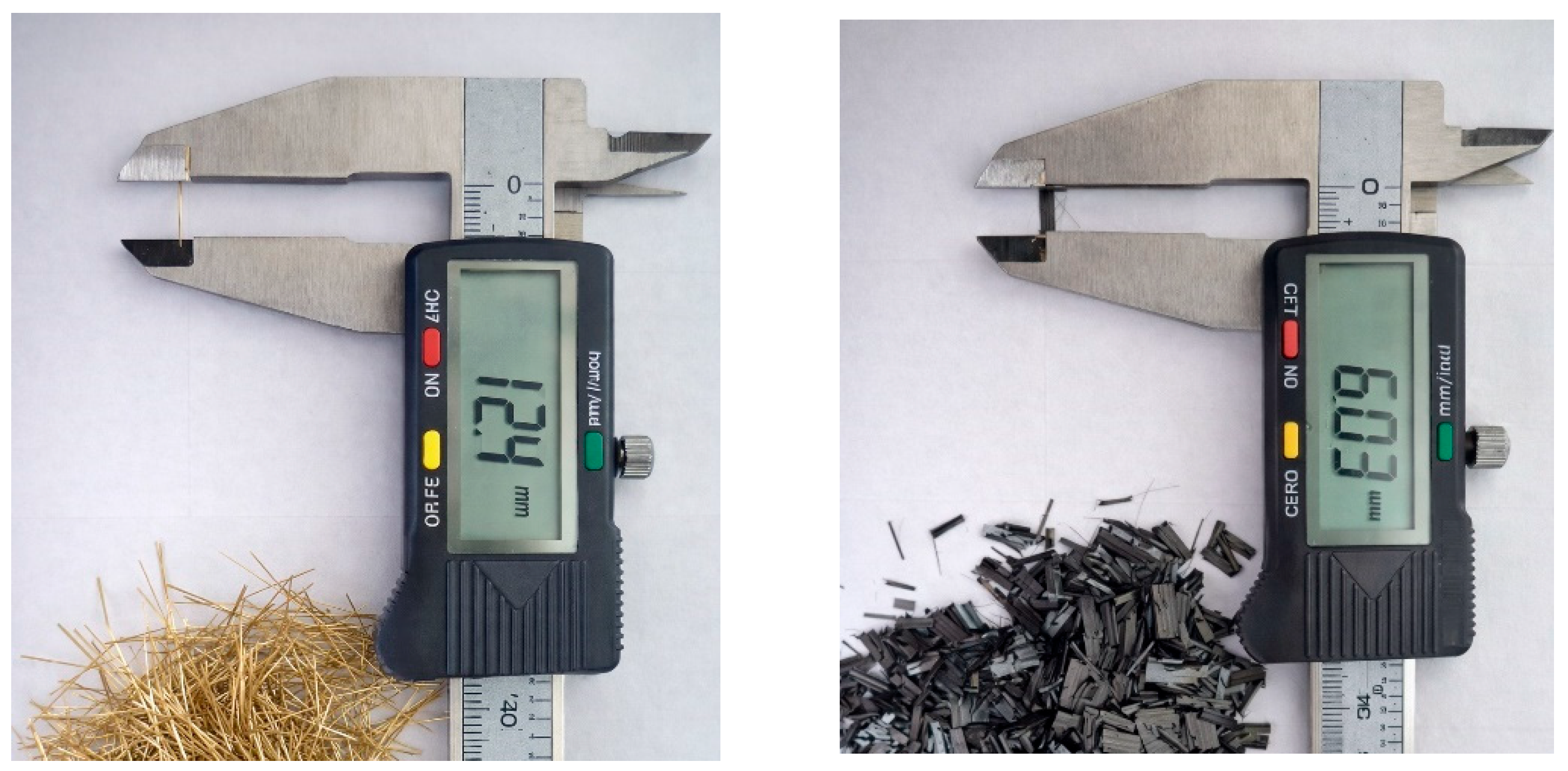
Figure 1. Steel and carbon fibers.
Buildings 16 01074 g001
Figure 2. Flow chart of the experimental workflow.
Buildings 16 01074 g002
Figure 3. Set-up for bond evaluation of tested mixtures after coring (a) and (b) pull-off testing.
Buildings 16 01074 g003
Figure 4. Slant shear testing.
Buildings 16 01074 g004
Figure 5. Typical rheograms for the control, 20% SBR, and 4% SF mixtures.
Buildings 16 01074 g005
Figure 6. Development of electrical resistivity of concrete made with different rates of (a) fibers, (b) SBR, and (c) the combination of all materials, relative to the plain reference mixture.
Buildings 16 01074 g006
Figure 7. Development of compressive and flexural strengths of concrete.
Buildings 16 01074 g007
Figure 8. Sorptivity of concrete mixtures after 6 h. made with different dosages of (a) SBR, (b) SF, and CF.
Buildings 16 01074 g008
Figure 9. Sorptivity and water absorption of concrete mixtures made with different rates of SBR, SF, and CF.
Buildings 16 01074 g009
Figure 10. Relationship between water absorption and sorptivity of concrete mixtures.
Buildings 16 01074 g010
Figure 11. Density and UPV of concrete mixtures made with SBR. SF, and CF.
Buildings 16 01074 g011
Figure 12. Relationships between density, UPV, and water absorption.
Buildings 16 01074 g012
Figure 13. Bond strength (pull-off) of concrete mixtures made with SBR and SF.
Buildings 16 01074 g013
Figure 14. Pull-off bond failure modes for (a) BR20 and (b) SF1.5 mixture.
Buildings 16 01074 g014
Figure 15. Slant shear strength of concrete mixtures made with different rates of SBR. SF, and CF.
Buildings 16 01074 g015
Table 1. Physical and geometrical characteristics of fibers.
PropertySteel Fibers (SF)Carbon Fibers (CF)
Length (mm)12.56
Diameter (µm)2007
Density (g/cm3)7.850.55
Tensile strength (GPa)2.403.5
Table 2. Water demand and rheological characterization for the tested mixtures.
Water
Demand, %
Air
Content, %
Fresh Density, kg/m3Flow Time, sτ0, Paη, Pa.s
Control12.72.8213818.526.51.97
10% SBR11.3321831943.52.49
20% SBR10.53.1216828.549.23.03
1% SF12.8n/a215020.535.16.21
2% SF12.82.7226328305.95
3% SF13n/a223836.571.47.12
4% SF13.53227543.557.57.11
Table 3. Resistivity and strength characterization for the tested mixtures.
7-Day ER (Ω·m)14-Day ER (Ω·m)28-Day ERfc (MPa)fr (MPa)
Plain46.32 ± 2.369.43 ± 3.4144.98 ± 7.282.77 ± 5.98.32 ± 1.1
BR1058.38 ± 2.998.66 ± 4.9196.37 ± 9.887.59 ± 4.610.11 ± 1.4
BR2058.39 ± 2.980.53 ± 8.1153.08 ± 13.376.21 ± 6.711.04 ± 0.9
SF0.7513.09 ± 0.618.12 ± 1.843.29 ± 5.391.43 ± 6.49.30 ± 1.1
SF1.513.07 ± 0.617.11 ± 1.126.17 ± 5.699.07 ± 8.415.08 ± 1.3
SF35.03 ± 0.57.04 ± 0.79.06 ± 1.988.15 ± 7.223.05 ± 1.7
SF4.53.02 ± 0.33.02 ± 0.44.03 ± 0.978.28 ± 5.728.10 ± 2.1
CF0.51.07 ± 0.12.03 ± 0.32.03 ± 0.598.27 ± 4.711.23 ± 1.1
CF11.01 ± 0.12.01 ± 0.52.01 ± 0.789.47 ± 7.316.10 ± 1.4
C/S 0.25/0.754.03 ± 0.44.02 ± 0.35.05 ± 0.6114.12 ± 8.212.27 ± 1.2
C/S 0.5/1.53.03 ± 0.34.03 ± 0.24.08 ± 0.3121.26 ± 7.523.57 ± 2.2
Table 4. Density, water permeability, and UPV characterization for the tested mixtures.
Density (kg/m3)Sorptivity (mm)Water Absorption (%)UPV (m/s)
Plain2406.24 ± 45.10.87 ± 0.053.05 ± 0.34544.20 ± 213.2
BR102343.38 ± 21.80.44 ± 0.032.23 ± 0.14534.18 ± 315.4
BR202353.48 ± 22.30.68 ± 0.043.08 ± 0.24319.75 ± 218.6
SF0.752412.17 ± 65.40.76 ± 0.062.89 ± 0.14503.98 ± 323.1
SF1.52530.70 ± 31.60.81 ± 0.063.17 ± 0.34638.87 ± 313.1
SF32647.92 ± 57.91.53 ± 0.095.54 ± 0.44034.85 ± 311.7
SF4.52740.75 ± 42.5N/A7.71 ± 0.53471.10 ± 318.1
CF0.52350.22 ± 32.20.39 ± 0.092.03 ± 0.14555.32 ± 417.4
CF12341.34 ± 51.70.37 ± 0.032.19 ± 0.24565.38 ± 213.2
C/S 0.25/0.752431.02 ± 66.40.73 ± 0.053.06 ± 0.24338.88 ± 318.5
C/S 0.5/1.52404.20 ± 45.20.50 ± 0.043.19 ± 0.24524.11 ± 453.2
Disclaimer/Publisher’s Note: The statements, opinions and data contained in all publications are solely those of the individual author(s) and contributor(s) and not of MDPI and/or the editor(s). MDPI and/or the editor(s) disclaim responsibility for any injury to people or property resulting from any ideas, methods, instructions or products referred to in the content.