Article

Simple Solutions for Lateral Buckling Loads of C-Section Purlins with Two or Three Anti-Sag Bars Under Wind Suction


1
The Architectural Design & Research Institute of Zhejiang University Co., Ltd., Hangzhou 310028, China
2
Nanxun Innovation Institute, Zhejiang University of Water Resource and Electric Power, Hangzhou 310018, China
3
Department of Civil Engineering, Zhejiang University, Hangzhou 310058, China
*
Author to whom correspondence should be addressed.
Buildings 2026, 16(5), 1053; https://doi.org/10.3390/buildings16051053
Submission received: 2 February 2026 / Revised: 25 February 2026 / Accepted: 2 March 2026 / Published: 6 March 2026
(This article belongs to the Section Building Structures)

Abstract

Lateral buckling is the governing failure mode affecting the strength of cold-formed steel purlins. In industrial roofing systems, these purlins are frequently restrained by two or three anti-sag bars within their spans. Previous research by the authors indicated that under wind suction, the buckling behaviour of purlins with multiple anti-sag bars differs significantly from those with fewer restraints, primarily due to the semi-rigid nature of the bracing. This paper investigates the lateral buckling of C-section purlins with two or three anti-sag bars, explicitly accounting for lateral restraints provided by both the roof sheeting and the bars. Simplified analytical solutions are derived to facilitate practical design. Notably, a novel parameter is introduced to identify the controlling buckling mode, which significantly simplifies the calculation procedure. The proposed solutions show excellent agreement with results obtained from both commercial and custom-developed finite element codes.

1. Introduction

Cold-formed steel purlins are widely used in roof systems of industrial buildings to support roof sheeting and transfer wind and gravity loads to the main structural system [1,2]. Due to the low torsional rigidity of their cross-sections (e.g., C-sections), lateral buckling is the primary failure mode controlling the strength of cold-formed steel purlins [3,4,5,6].
In existing design codes (e.g., [7,8]), simplified methods are provided for estimating the lateral buckling loads of general thin-walled beams. However, these methods are not directly applicable to the cold-formed steel purlins examined in this study. One key reason is that roof sheeting, when connected to the top flange of the purlin, can significantly enhance its lateral stiffness. For instance, when self-drilling screws are used to fasten the purlin to the sheeting, the in-plane shear stiffness of the sheeting is often sufficient to restrain lateral translation of the top flange [9]. Nevertheless, lateral buckling remains a critical concern under wind suction, as the compressive bottom flange is laterally unrestrained under such loading conditions.
To improve lateral stability, anti-sag bars are commonly used in medium- to long-span purlin systems. Previous studies on the lateral buckling of cold-formed steel purlins have incorporated the restraining effects of roof sheeting on lateral deflection and/or twist [3,4,10,11,12]. In these studies, anti-sag bars are typically idealized as rigid lateral restraints, and the distance between adjacent bars is taken as the effective buckling length in load calculations [3,4]. However, recent research [6,13,14,15] has demonstrated that the bracing efficiency of anti-sag bars can be considerably reduced due to local web deformations near the connection points. This effect can lead to a significant overestimation of buckling loads when anti-sag bars are assumed to provide rigid restraint [14].
Solutions for predicting the lateral buckling loads of C-section cold-formed steel purlins, with top flanges connected to roof sheeting, are available in most widely adopted design codes [10,11,12]. However, the application of these solutions requires compliance with several restrictive conditions [11,12]; otherwise, full-scale tests are required. Moreover, the treatment of anti-sag bars in these codes is either not explicitly specified [11,12] or is simplistically assumed to provide rigid lateral restraint [10,11,12]. Therefore, developing simplified solutions for cold-formed steel purlins that fully account for the combined restraints from roof sheeting and anti-sag bars is essential for practical engineering applications.
The lateral buckling loads of C-section purlins with a single anti-sag bar at mid-span have been investigated by Zhang and Tong [14], who also proposed corresponding simplified solutions. Nevertheless, installing only one anti-sag bar is insufficient for simply supported purlins in many practical scenarios. For instance, in China, two anti-sag bars are typically recommended for simply supported cold-formed steel purlins with spans exceeding 6 m, and three for those longer than 8 m; this configuration is widely used in industrial construction.
This paper presents an investigation into the lateral buckling of simply supported C-section cold-formed steel purlins equipped with two or three anti-sag bars, based on which simplified solutions for predicting buckling loads are derived. The study also introduces a dedicated parameter to identify the dominant buckling mode for each configuration, which considerably streamlines buckling mode determination compared with the approach proposed by Zhang and Tong [14]. It should be noted that the elastic buckling is only considered in this study.
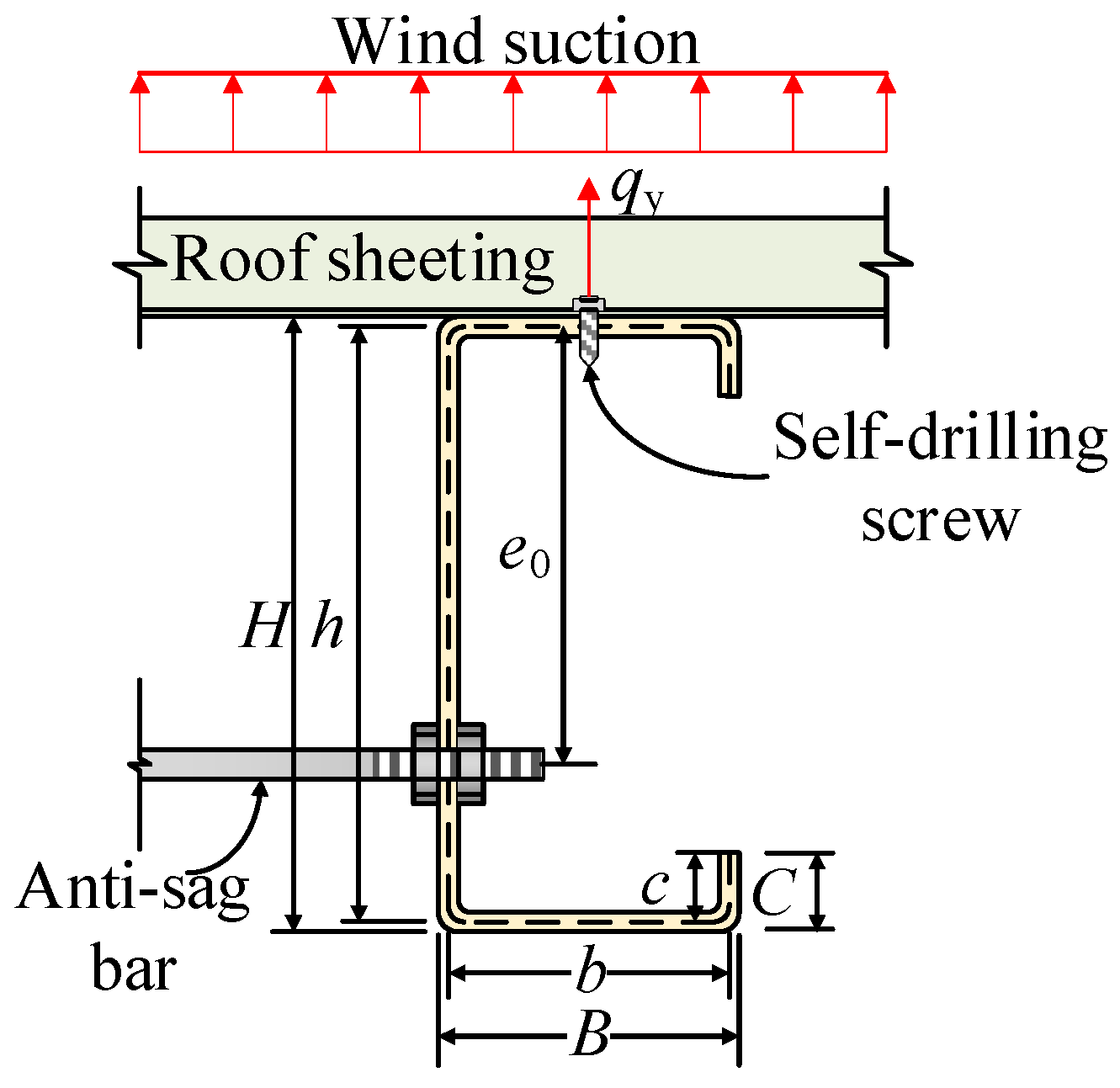
In the present analysis, both the restraint from roof sheeting and the semi-rigid restraint from anti-sag bars are considered. The steel roof sheeting is assumed to provide rigid lateral restraint to the purlin top flanges, which is applicable to roof systems connected using self-drilling screws. Only wind suction loading is considered in this study (Figure 1).

2. Existing Methods in Design Code

Solutions or methods for predicting lateral buckling loads are provided in many existing design codes [10,11,12]. According to AISI S100 [11], the moment resistance of a C-section loaded in a plane parallel to the web, with the tension flange through-fastened to roof or wall sheeting and the compression flange laterally unbraced, can be calculated in accordance with:
M n = R S e f y
where Se is the section modulus of the cross-section; fy is the material yield stress; and the reduction factor R depends on the cross-section depth, loading conditions, and boundary conditions. It should be noted that the solution presented in Equation (1) is essentially based on cross-sectional resistance. In addition, as specified in AISI S100 [11], the use of this solution must satisfy a number of requirements, such as limitations on cross-section dimensions, fastener type, steel yield stress, and span range; otherwise, full-scale testing is required. The influence of anti-sag bars on the buckling strength of the purlins under uplift loading is not explicitly addressed.
A method similar to that in AISI S100 [11] is adopted in AS/NZS 4600 [12] for purlins with one flange through-fastened to sheeting. In AS/NZS 4600 [12], only bridging capable of preventing lateral and torsional deformation at support points is considered.
Different from the methods in AISI S100 [11] and AS/NZS 4600 [12], EC3 [10] adopts a calculation model for predicting lateral buckling loads in which the cold-formed steel purlin is simplified into a stud consisting of the compressive flange and a portion of the web. In this method, the laterally unbraced length of the compressive flange is taken as the stud span, which implicitly assumes rigid bracing provided by anti-sag bars, although this is not explicitly stated.
When anti-sag bars are assumed to provide rigid lateral restraint, cold-formed steel purlins can be treated as simply supported beams with spans equal to the distance between adjacent anti-sag bars when calculating buckling loads. However, a recent study by Zhang and Tong [13] showed that the bracing efficiency of anti-sag bars commonly used in practice may be significantly reduced due to local web deformation near the connection locations. Consequently, anti-sag bars cannot be treated as rigid lateral supports for these cold-formed steel purlins. This implies that the solutions and methods in current design codes (i.e., [10,11,12]) may not be applicable to cold-formed steel purlins laterally braced by anti-sag bars.

3. Effective Stiffness of Anti-Sag Bar

According to Zhang and Tong [13], the reduction in stiffness caused by local web deformation near the anti-sag bar connection should be considered when calculating the effective stiffness of the anti-sag bar (kLT). An approximate solution for kLT was proposed by Zhang and Tong [13]:
1 k L T = 1 k w + 1 k s b
where ksb is the axial tensile stiffness of the anti-sag bar, which can be expressed as:
k s b = E A s b l s b
where E is the Young’s modulus of steel, Asb is the cross-sectional area of the anti-sag bar, and lsb is the length of the anti-sag bar. In Equation (2), the effects of local web deformation are accounted for using the parameter kw, which can be expressed as:
k w = 13.21 E t 3 h 2 1 cos 2 π ξ 0.64 ξ 2 ξ + 1.25 1 20 t h 1.4
where h is the distance between the mid-thicknesses of the top and bottom flanges (Figure 1), and ξ is the normalized distance between the anti-sag bar and the mid-thickness of the bottom flange:
ξ = 1 e 0 h
where e0 is the distance between the mid-thickness of the top flange and the anti-sag bar (Figure 1). Very good agreement between the predictions from Equation (2) and finite element (FE) analysis results was reported by Zhang and Tong [13].

4. Total Potential for Lateral Buckling of Cold-Formed Steel Purlins

As discussed by Zhang and Tong [6], a number of buckling theories have been developed for the lateral buckling of thin-walled beams. However, the general expressions for total potential based on these theories are not suitable for the lateral buckling analysis of the cold-formed steel purlins considered in this study [14]. This is because the horizontal restraints at the top flange provided by roof sheeting, together with the anti-sag bars connected to the web, may lead to notable differences in the total potential expressions compared with those for general thin-walled beams.

4.1. Expression of Total Potential

Two typical total potential formulations for the lateral buckling of thin-walled beams reported in the literature have been discussed in Zhang and Tong [6,14]. Based on the theory proposed by Zhang and Tong [14], a new total potential formulation was presented for the lateral buckling of C-section purlins with a single anti-sag bar at mid-span.
This total potential consists of the linear potential and nonlinear potentials arising from longitudinal normal stress, shear stress, and transverse normal stress. As demonstrated by Zhang and Tong [14], the contribution of transverse normal stresses induced by the restraint from roof sheeting and anti-sag bars, which has not been considered in existing theories, should be included in the total potential. The proposed total potential was successfully applied by Zhang and Tong [14] to the lateral buckling analysis of C-section purlins with a single anti-sag bar at mid-span.
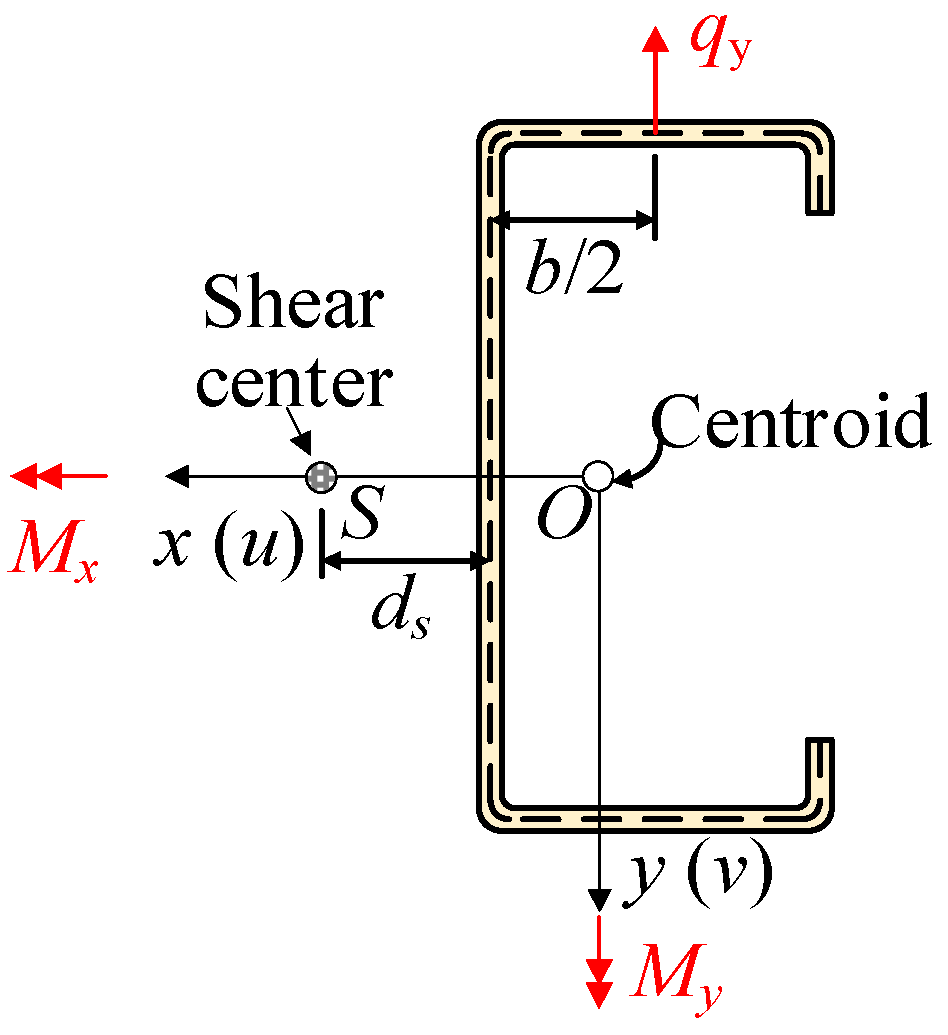
As shown in Figure 2, a right-handed xyz coordinate system is established for the C-section, where the origin o is located at the centroid of the cross-section. Following a procedure similar to that described by Zhang and Tong [14], the total potential for the lateral buckling of C-section purlins with two anti-sag bars located at one-third points of the span can be expressed as:
= 1 2 0 L E I y u 2 + E I x v 2 + E I ω θ 2 + G I k θ 2 2 M y v θ + 2 M x u θ + 2 M y β y θ 2 + q y a y + q x a x θ 2 d z + 1 2 k L T u L / 3 , e 0 2 + u 2 L / 3 , e 0 2 + 1 2 F L T a L T θ L / 3 2 + θ 2 L / 3 2
where u and v are the buckling displacements in the x- and y-directions, respectively (Figure 2), and θ is the twist angle of the cross-section. E and G are the Young’s modulus and shear modulus of the material, respectively. Ix and Iy are the second moments of area about the x- and y-axes, respectively; Ixy is the product moment of area of the cross-section; Ik is the free torsion constant; and Iω is the warping constant of the cross-section. Bω is the bi-moment of the cross-section. L is the span of the purlin. The terms u L / 3 , e 0 and u 2 L / 3 , e 0 representing the lateral displacements at the anti-sag bar locations correspond to positions L/3 and 2L/3. βy and βω represent the mono-symmetry parameters of the cross-section and can be expressed as:
β y = A x x 2 + y 2 d A 2 I y x 0
β ω = A ω x 2 + y 2 d A
where x0 is the x-coordinate of the shear centre S (Figure 2), and ω is the principal sectorial coordinate with respect to the shear centre of the cross-section.
As noted by Zhang and Tong [6,14], Mx, My, qx and qy in Equation (6) are resultants of the pre-buckling stresses in the cross-section. Among these stress resultants, Mx and My are the bending moments about the x and y axes caused by longitudinal normal stresses, while qx and qy are the resultants of transverse normal stress. It has been shown that qy and qx are equal to the external distributed loads in the y-direction and the reaction forces in the x-direction provided by horizontal bracing at the top flange of the cross-section, respectively (Zhang and Tong [6,14]). In Equations (9) and (10), ax and ay are related to the distances between the load application points and the shear centre of the cross-section (see Figure 2).
In this study, the external distributed load along the y-axis, qy, is assumed to be acted at the same positions as the horizontal restraints at the top flange of cross-sections, indicating that both the external load and the horizontal restraint are transferred from the roof sheeting to the purlin through the fasteners. For the general case considered herein, vertical loads are applied at the mid-width of the top flange, which gives:
a y = h 2
a x = b 2 + d s
The values of ax and ay defined in Equations (9) and (10) are used in the remainder of this paper unless otherwise stated.
The corresponding terms F L T a L T θ L / 3 2 + θ 2 L / 3 2 / 2 in Equation (6) represent the transverse stress effects caused by the reaction force from the anti-sag bar (FLT). This force is derived by considering the term containing qxax, as a concentrated force can be approximated as a uniformly distributed load over an infinitesimal width. aLT represents the relative horizontal position of FLT with respect to the shear centre of the cross-section. For the configuration considered in this study, the anti-sag bar is connected to the web of the cross-section (Figure 1).
a L T = d s
For the C-section purlins with the top flange laterally restrained, the relationship between the buckling displacements u and θ can be expressed as:
u = 1 2 h θ
Considering the relationship in Equation (12), Equation (6) can be rewritten as:
= 1 2 0 L E I ¯ ω θ 2 + E I x v 2 + G I k θ 2 M x h θ θ 2 M y v θ + 2 M y β y θ 2 + q y a y + q x a x θ 2 d z + 1 2 k L T u L / 3 , e 0 2 + u 2 L / 3 , e 0 2 + 1 2 F L T a L T θ L / 3 2 + θ 2 L / 3 2
where
I ¯ ω = I ω + h 2 I y 4

4.2. Verification of Total Potential

The total potential formulation for the lateral buckling of C-section purlins with two anti-sag bars proposed in this study is first verified. The buckling loads predicted using the total potential formulation are compared with those obtained from finite element (FE) analysis using shell element modelling. The buckling loads based on the total potential formulation (Equation (6)) are obtained using an in-house FE program employing the eigenvalue method, which is widely used in buckling analysis of structural members. The validity of shell element modelling for verifying total potential formulations of thin-walled beams and cold-formed steel purlins in lateral buckling analysis has been demonstrated in previous studies [6,14].
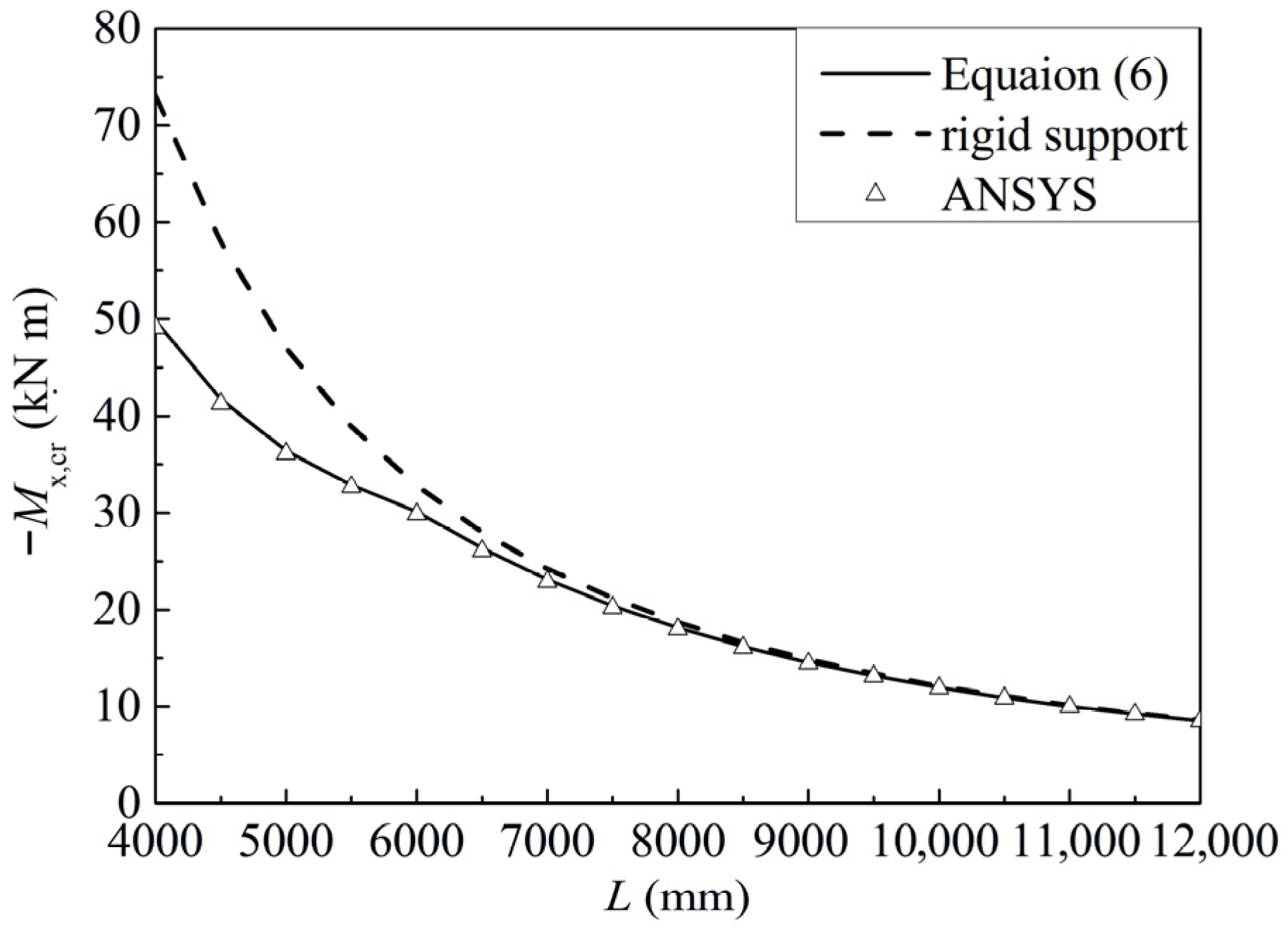
Comparisons between results obtained from shell element modelling using ANSYS 16.0 [16] and those from the FE program based on the total potential formulation are shown in Figure 3 for C-section purlins. In all analyses, the material properties are taken as: elastic modulus E = 206,000 N/mm2, Poisson’s ratio υ = 0.3, and shear modulus G = E/2(1+ υ). These material properties are used throughout this paper. The values of kLT are calculated using Equation (2) for all cases shown in Figure 3. The dimensions of C-section used in Figure 3 C200t2.0 is given in Table 1.
In Figure 3, the vertical axis Mx,cr represents the absolute value of the maximum bending moment about the x-axis along the span at lateral buckling. The positive directions of Mx and My used in this paper are shown in Figure 2. It can be observed that the results obtained using the total potential formulation proposed in this study (Equation (6)) agree closely with those from shell element modelling (ANSYS) for all cases, indicating that the proposed total potential formulation is capable of accurately predicting the lateral buckling behaviour of the C-section purlins considered herein. The buckling loads based on the assumption of rigid lateral restraint provided by anti-sag bars are also shown in Figure 3 (rigid support), which may significantly overestimate the buckling loads, particularly for purlins with relatively short spans.

5. Simple Solutions of Buckling Loads

Explicit analytical solutions are valuable for practical engineering design and for developing provisions in design codes, although buckling loads can be obtained through numerical analysis. Therefore, simplified solutions for the buckling loads of cold-formed C-section purlins with two anti-sag bars are developed in this section. The derivation is based on the total potential formulation given in Equation (13) using the Rayleigh–Ritz method.
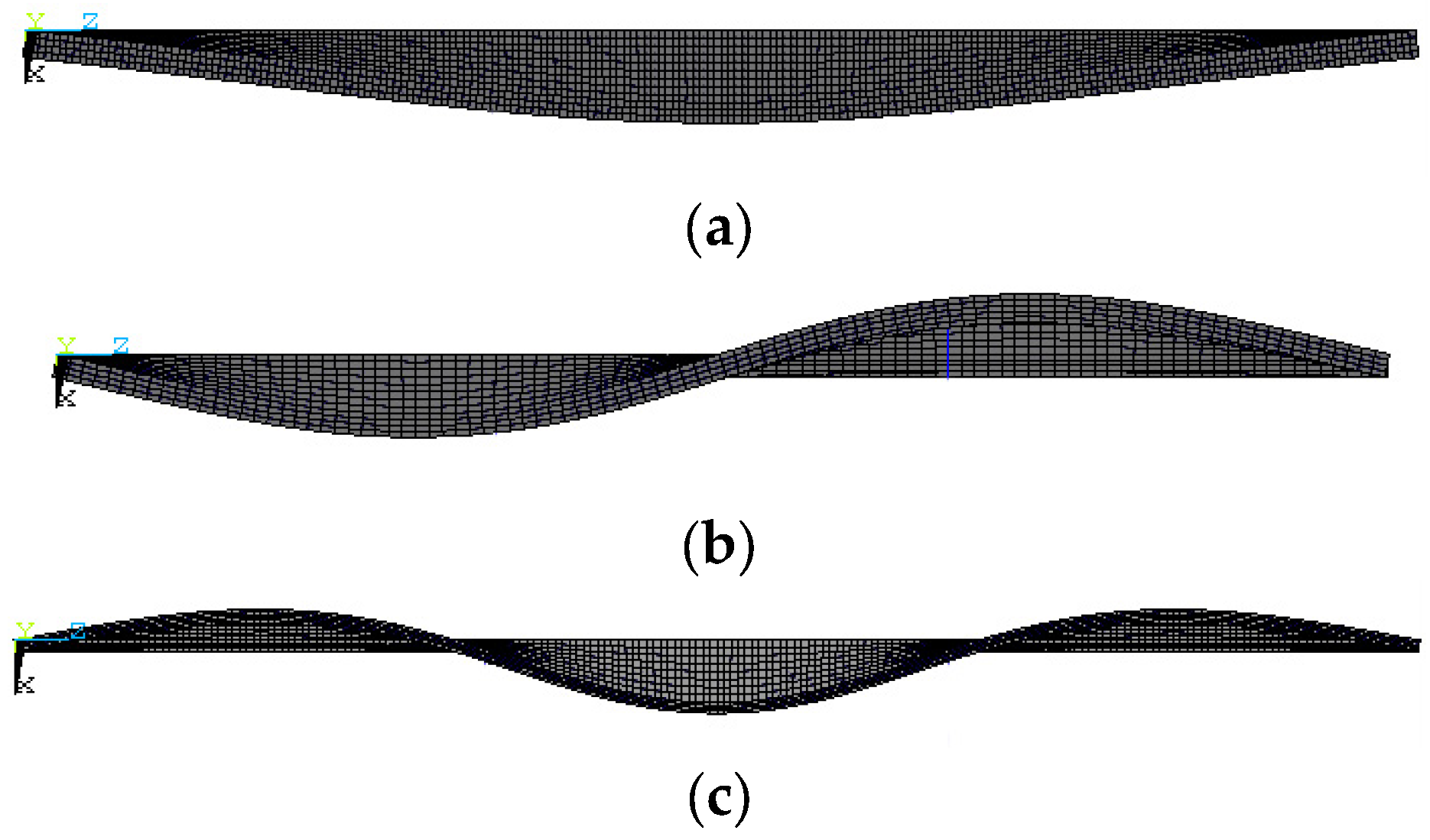
Finite element (FE) analyses using shell element modelling (ANSYS 16.0) indicate that the dominant lateral buckling mode of C-section purlins with two anti-sag bars may correspond to one half-wave, two half-waves, or three half-waves (Figure 4). For small values of kLT (i.e., weak lateral bracing provided by the anti-sag bars), purlins tend to fail in the one-half-wave mode, whereas the two-half-wave and three-half-wave modes may occur for medium and large values of kLT, respectively.
Similar to Zhang and Tong [14], simplified solutions for buckling loads corresponding to one, two, and three half-wave failure modes are developed in the following sections. The minimum value among these three buckling loads is taken as the governing buckling load for each case.

5.1. Calculation Model for My and qx of C-Section Purlins

To derive simplified buckling load solutions using the Rayleigh–Ritz method, simplified expressions for the stress resultants Mx, My, qx and qy, are required. The distributions of Mx and qy can be obtained directly from loading and boundary conditions, whereas My and qx depend on the reaction forces associated with the restraints provided by roof sheeting and anti-sag bars. As noted by Zhang and Tong [6,14], analytical solutions for My and qx are complicated even for C-section purlins with a single anti-sag bar, which makes it difficult to derive simplified buckling load solutions using the Rayleigh–Ritz method. Therefore, a simplified calculation model was proposed by Zhang and Tong [14] for the distributions of My and qx, based on which simplified buckling solutions were successfully derived for C-section purlins with one anti-sag bar. A similar calculation model is adopted here for C-section purlins with two anti-sag bars.
Due to symmetry of deformation in the pre-buckling state, the reaction forces and deformations at the two anti-sag bar connection sections are identical. Therefore, in developing the equivalent uniformly distributed load in the x-direction (qEx), the forces and deformations at either connection section can be considered. The C-section purlin is taken as the representative example in this section.
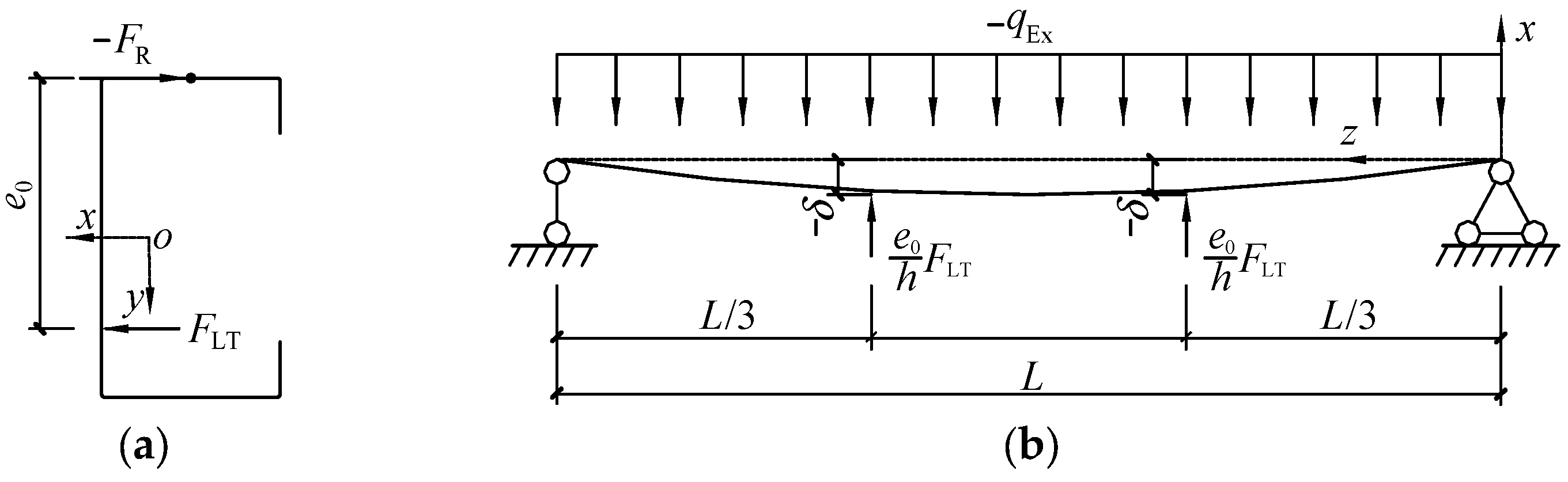
As illustrated in Figure 5, lateral translation of the C-section purlin results from the combined action of the equivalent uniformly distributed load qEx, representing reactions from lateral restraints at the top flange, and concentrated forces at the one-third span locations, corresponding to the reaction forces from the anti-sag bars (FLT). The reaction force from the anti-sag bar is mainly resisted by two substructures, each consisting of one flange together with the adjacent lip and a portion of the web. The resistance force of each substructure against FLT is assumed to be inversely proportional to the distance between the loading position of FLT and the corresponding flange. For the purlins considered in this study, lateral translation of the top flange is restrained. Therefore, the reaction force provided by the lateral restraint at the top flange due to FLT acting on the corresponding substructure (FR, see Figure 5a) is equal to the resistance force of this substructure.
F R = h e 0 h F L T
where FR acts in the opposite direction to FLT (Figure 5a). Consequently, the resultant concentrated force at each one-third span location, combining FLT and FR, becomes:
F L T , E = F R + F L T = e 0 h F L T
Under the actions of FLT,E and qEX, the lateral deflection at the one-third span location can be expressed as:
δ = δ q E x + δ F L T , E
where δqEx and δ F L T , E are the lateral deflections caused by qEX and FLT,E, respectively. Using classical structural mechanics:
δ q E x = 17 q E x L 4 1458 E I y
δ F L T , E = F L T , E e 0 h 5 L 3 162 E I y
The lateral deflections given in Equations (18)–(19b) are defined with respect to the shear centre of the cross-section. Meanwhile, FLT can be determined directly once kLT is known:
F L T = u L T , e 0 k L T = δ e 0 h / 2 k L T
which can be rewritten as:
δ = F L T h / 2 e 0 k L T
Substituting Equations (18a), (18b) and (19b) into Equation (17) gives:
q E x = 1458 E I y F L T 17 L 4 5 L 3 e 0 162 h E I y + h 2 k L T e 0
The reaction force from the anti-sag bar, FLT, in the pre-buckling state can be obtained from Equation (19a), provided that the lateral displacement at the bracing points u L T , e 0 is known:
u L T , e 0 = e 0 θ L T
For a simply supported C-section purlin with two anti-sag bars, the twist angle θ can be obtained analytically by solving:
E I ¯ ω θ ( 4 ) G I k θ = q y a x
By applying the boundary and continuity conditions, the solution for θ can be obtained, and subsequently the twist at the bracing locations θLT in Equation (21a). Substituting this result into Equation (19a), the analytical solution for FLT can be expressed as:
F L T = χ C 2 q y
where
χ C 2 = k L T e 0 a x L 3 2 + ψ C 1 λ C 2 G I k k L T e 0 2 ψ C λ C sinh λ C L 3 L 3
and:
ψ C = cosh λ C L 6 / cosh λ C L 2
λ C = G I k E I ¯ ω
Substituting Equation (22a) into Equation (20), and considering Equations (22b)–(23b) gives:
q E x = η C 2 q y
where
η C 2 = 1458 E I y χ C 2 17 L 4 5 L 3 e 0 162 h E I y + h 2 k L T e 0
The analytical solution of qx obtained by solving Equation (21b) together with:
M y = E I y u = E I y h 2 θ
q x = M y
Equation (26b) shows that the distribution of qx along the span is non-uniform. In this study, the approximate solution given in Equation (24) is used to derive simplified buckling load solutions. To reduce the error introduced by using qEx instead of qx, the coefficient ηC2 in Equation (25) is replaced by η ¯ C 2 :
η ¯ C 2 = 89 E I y χ C 2 L 4 5 L 3 e 0 162 h E I y + h 2 k L T e 0
Consequently, the bending moment about the y-axis under the combined action of qEX and FLT,E can be expressed as:
For   0 z < L 3 ,   M y = q E x 2 L z z 2 + e 0 F L T , E h z = η ¯ C 2 2 L z z 2 e 0 χ C 2 h z       q y
For   L 3 z < 2 L 3 ,   M y = q E x 2 L z z 2 + e 0 F L T , E h L 3 = η ¯ C 2 2 L z z 2 e 0 χ C 2 h L 3   q y
For   2 L 3 z L ,   M y = q E x 2 L z z 2 + e 0 F L T , E h L z = η ¯ C 2 2 L z z 2 e 0 χ C 2 h L z   q y        
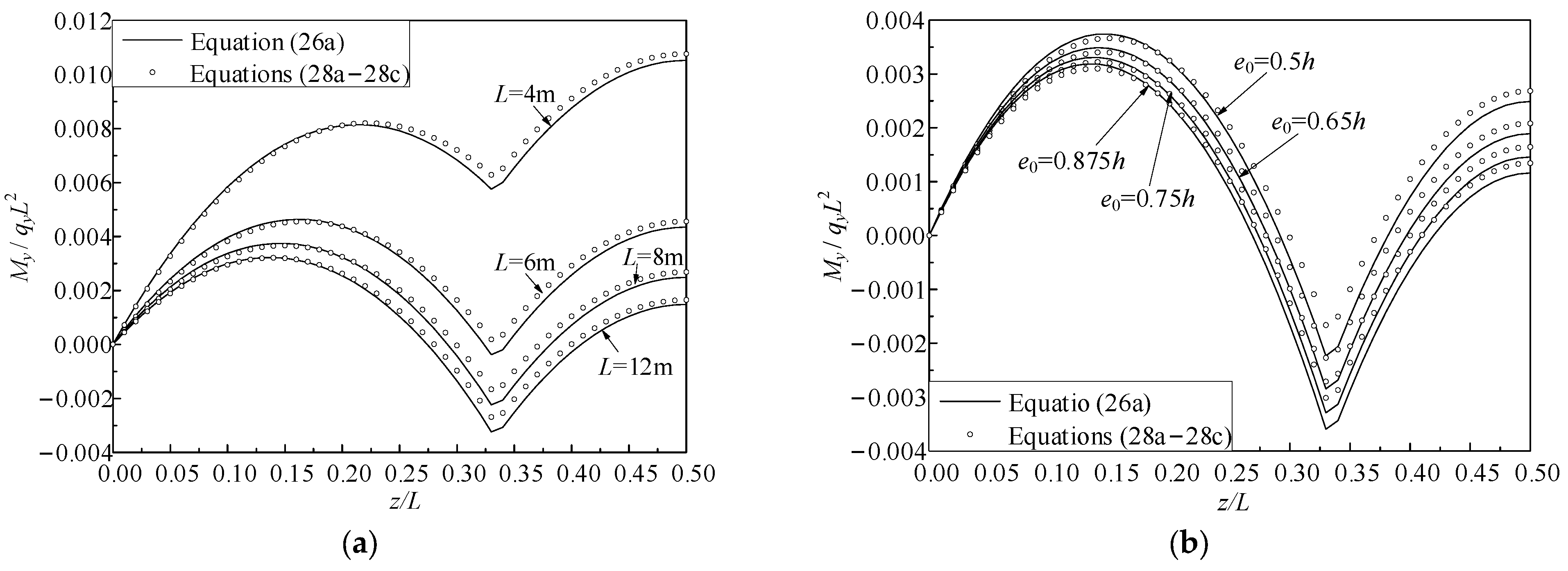
Predictions from Equations (28a)–(28c) are compared with analytical results obtained using Equation (26a).
The distributions of My for purlins with different spans (i.e., L = 4.0 m, 6.0 m, 8.0 m and 12.0 m) are shown in Figure 6a, where C200t2.0 and e0 = 0.5h are used. Good agreement is observed between Equations (28a)–(28c) and Equation (26a). Similar agreement is also observed for different values of e0, as shown in Figure 6b (C200t2.0 and L = 8000 mm).
The influence of the transverse stress due to the action of FR should be considered in the total potential as long as the uniformly distributed load qEx is adopted. This influence would be automatically included in the term due to the action of qx if the analytical results of qx are used in the development. Therefore, the total potential of Equation (13) becomes:
= 1 2 0 L E I ¯ ω θ 2 + E I x v 2 + G I k θ 2 M x h θ θ 2 M y v θ + 2 M y β y θ 2 + q y a y + q E x a x θ 2 d z + 1 2 k L T u L / 3 , e 0 2 + u 2 L / 3 , e 0 2 + 1 2 F L T a L T + F R d s + b 2 θ L / 3 2 + θ 2 L / 3 2
The possible lateral buckling modes shown in Figure 4 indicate that the buckling deformations at L/3 and 2L/3 may be symmetric or anti-symmetric, leading to:
u L T , e 0 2 = u L / 3 , e 0 2 = u 2 L / 3 , e 0 2
θ L T 2 = θ L / 3 2 = θ 2 L / 3 2
Therefore, Equation (29) can be rewritten as:
= 1 2 0 L E I ¯ ω θ 2 + E I x v 2 + G I k θ 2 M x h θ θ 2 M y v θ + 2 M y β y θ 2 + q y a y + q E x a x θ 2 d z + k L T u L T , e 0 2 + F L T a L T + F R d s + b 2 θ L T 2

5.2. Simple Solutions of Buckling Load of C-Section Purlins

FE analyses presented in previous sections show that the dominant buckling mode of C-section purlins with two anti-sag bars may correspond to one, two, or three half-wave modes (Figure 4), depending on the effective stiffness of the anti-sag bars. Simplified solutions corresponding to these three buckling modes are therefore derived.
The buckling displacement functions for twist angle θ and vertical displacement v are assumed as:
θ = A n 1 sin n π z L
v = A n 2 sin n π z L
where n (=1, 2 or 3) is the number of half-waves; and An1 and An2 are constants. Substituting Equations (32a) and (32b) into Equation (31), and requiring the determinant of the coefficient matrix of the resulting equations to be zero:
Π A n 1 = 0
Π A n 2 = 0
The buckling loads can then be expressed as:
M x c r , n = C n 1 P x C n 2 a y + η ¯ C 2 a x + C n 3 β y + C n 4 C n 2 a y + η ¯ C 2 a x + C n 3 β y + C n 4 2 + P ω n P x + 3 3 n 2 k L T e 0 2 L 4 π 2 P x
where n = 1, 2 or 3; the subscript “n” in Mxcr,n, Cn1Cn4 and P ω n represents the number of buckling half-waves.
P ω n = n 2 π 2 E I ¯ ω L 2 + G I k
P x = π 2 E I x L 2
Other parameters in Equation (34) are listed in Table 2.
The constants k11k32 used in Table 2 are given by:
k 11 = 1 72 π 2 3 η ¯ C 2 π 2 + 3 + 8 π 2 + 27 e 0 χ C 2 h L
k 12 = 1 72 π 2 3 η ¯ C 2 π 2 3 + 8 π 2 27 e 0 χ C 2 h L
k 21 = 1 288 π 2 3 η ¯ C 2 4 π 2 + 3 + 32 π 2 + 27 e 0 χ C 2 h L
k 22 = 1 288 π 2 3 η ¯ C 2 4 π 2 3 + 32 π 2 27 e 0 χ C 2 h L
k 31 = 1 72 π 2 η ¯ C 2 3 π 2 + 1 + 8 π 2 e 0 χ C 2 h L
k 32 = 1 72 π 2 η ¯ C 2 3 π 2 1 + 8 π 2 e 0 χ C 2 h L
It should be noted that the constants 0.85, 0.92, and 0.88 in Cn1 for n = 1, 2 and 3, respectively, are calibration coefficients used to account for approximations in the assumed My distribution and differences between the actual and assumed buckling displacement functions.

6. Buckling Load of C-Section Purlins with Three Anti-Sag Bars

In this section, three anti-sag bars are assumed to be located at the quarter points of the span. Unlike purlins with two anti-sag bars, the dominant buckling mode of C-section purlins with three anti-sag bars may correspond to two-, three-, or four-half-wave modes. The closed-form solutions for the lateral buckling loads are directly presented in this section, as the derivation procedure based on the Rayleigh–Ritz method is similar to that used for the two anti-sag bar cases.
The buckling loads of C-section purlins with three anti-sag bars can be expressed as:
M x c r , n = C n 1 P x C n 2 a y + η ¯ C 3 a x + C n 3 β y + C n 4 C n 2 a y + η ¯ C 3 a x + C n 3 β y + C n 4 2 + P ω n P x + 4 n 11 n k L T e 0 2 L 18 π 2 P x
in which n = 2, 3 or 4 correspond to the possible dominant buckling modes; Px and P ω n are given in Equations (35a) and (35b). The constants Cn1–Cn4 are summarized in Table 3.
The constants k ¯ 21 k ¯ 42 used in Table 3 are given in Equations (38)–(43).
k ¯ 21 = 1 96 π 2 4 π 2 + 3 η ¯ C 3 + 3 e 0 h L 3 π 2 + 4 χ C 31 + 2 π 2 χ C 32
k ¯ 22 = 1 96 π 2 4 π 2 3 η ¯ C 3 + 3 e 0 h L 3 π 2 4 χ C 31 + 2 π 2 χ C 32
k ¯ 31 = 1 288 π 2 4 3 π 2 + 1 η ¯ C 3 + 27 π 2 + 8 e 0 h L χ C 31 + 18 π 2 + 8 e 0 h L χ C 32
k ¯ 32 = 1 288 π 2 4 3 π 2 1 η ¯ C 3 + 27 π 2 8 e 0 h L χ C 31 + 18 π 2 8 e 0 h L χ C 32
k ¯ 41 = 1 384 π 2 16 π 2 + 3 η ¯ C 3 + 12 π 2 e 0 h L 3 χ C 31 + 2 χ C 32
k ¯ 42 = 1 384 π 2 16 π 2 3 η ¯ C 3 + 12 π 2 e 0 h L 3 χ C 31 + 2 χ C 32
η ¯ C 3 = 112 E I y L 4 h 2 k L T e 0 + L 3 e 0 48 h E I y χ C 31 + 11 L 3 e 0 768 h E I y χ C 32
χ C 31 = Ω C ψ C 4 λ C 3 3 λ C 2 l 2 + K l 3 2 2 λ C 3 ψ C 2 + K λ C 2 l 2 ψ C 1 3 ψ C 2 2 + 2 K λ C l ψ C 2 ψ C 1 ψ C 2 1 / ψ C 4 λ C 2 2 λ C 4 + 4 λ C 2 K l + K 2 l 2 + 2 λ C 3 K ψ C 3 + 2 λ C l K 2 ψ C 1 2 ψ C 2 1 K 2 ψ C 1 2
χ C 32 = Ω C ψ C 4 λ C 3 4 λ C 2 l 2 + K l 3 + ψ C 1 λ C 2 4 λ C ψ C 1 3 K l 2 + 4 K l 2 ψ C 2 + 2 K λ C l ψ C 1 ψ C 2 1 / ψ C 4 λ C 2 2 λ C 4 + 4 λ C 2 K l + K 2 l 2 + 2 λ C 3 K ψ C 3 + 2 λ C l K 2 ψ C 1 2 ψ C 2 1 K 2 ψ C 1 2
in which
Ω C = k L T e 0 λ C a x G I k
K = k L T e 0 2 E I ¯ ω
l = L 4
ψ C 1 = sinh λ C l
ψ C 2 = cosh λ C l
ψ C 3 = sinh 2 λ C l
ψ C 4 = cosh 2 λ C l

7. Results and Discussions

7.1. Comparisons of Buckling Loads

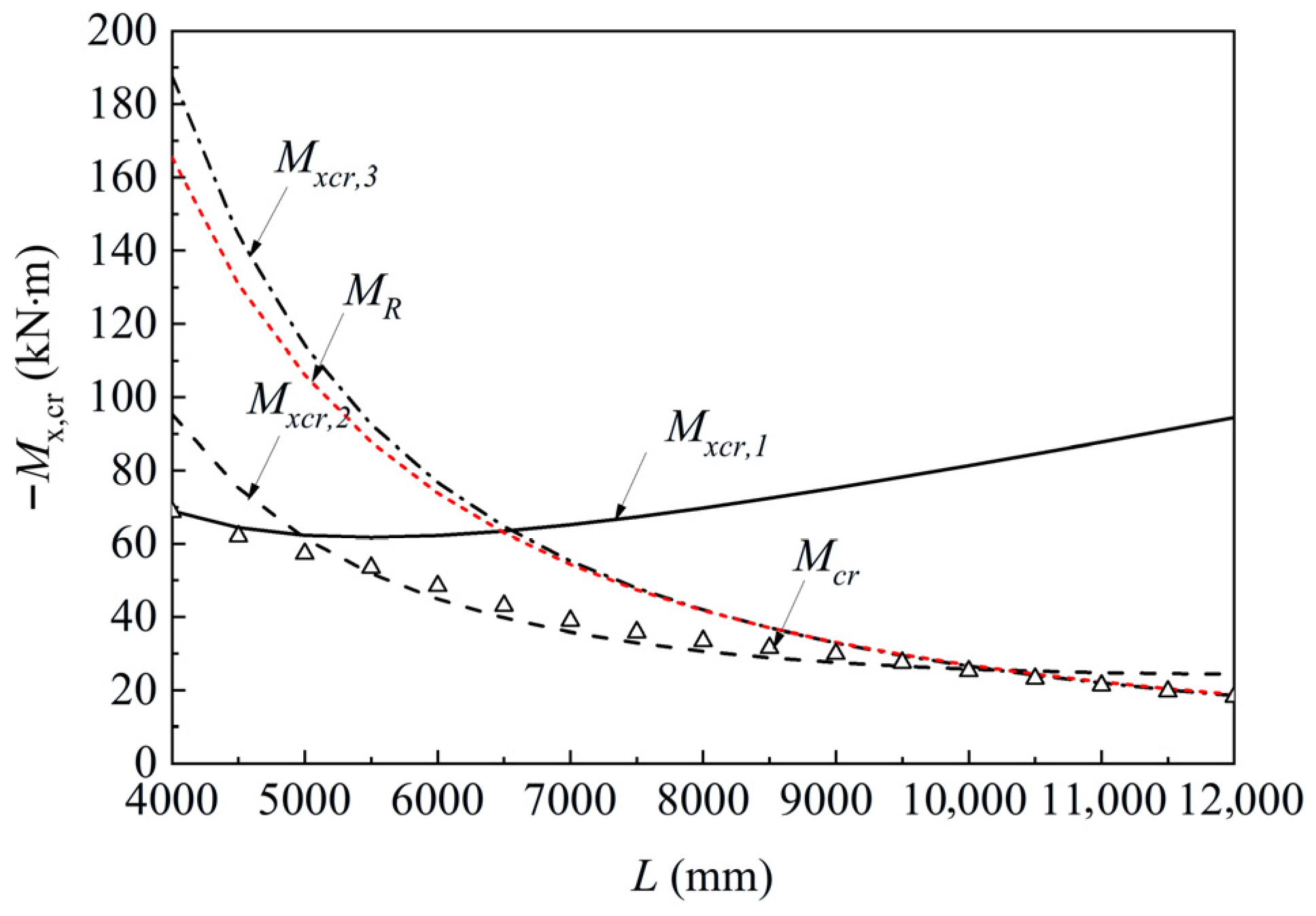
Comparisons between the predictions of the proposed solutions and the FE results are shown in Figure 7 for C300t2.0 purlins (Table 1) with two anti-sag bars. In Figure 7, Mxcr,1, Mxcr,2 and Mxcr,3, obtained using Equation (34), represent the buckling loads corresponding to the one-, two-, and three-half-wave failure modes, respectively. It can be observed from Figure 7 that the minimum values of Mxcr,1, Mxcr,2 and Mxcr,3 agree well with the FE results (Mcr) for all cases. Here, Mcr denotes the buckling load corresponding to the first buckling mode obtained from FE analysis using the developed FE code. The results based on the assumption of rigid lateral restraints provided by anti-sag bars (McrR) are also included in Figure 7. These results may significantly overestimate the buckling loads, particularly for purlins with relatively short spans. Acceptable accuracy of McrR is only observed when the three-half-wave mode is the dominant failure mode, i.e., when Mxcr,3 governs.
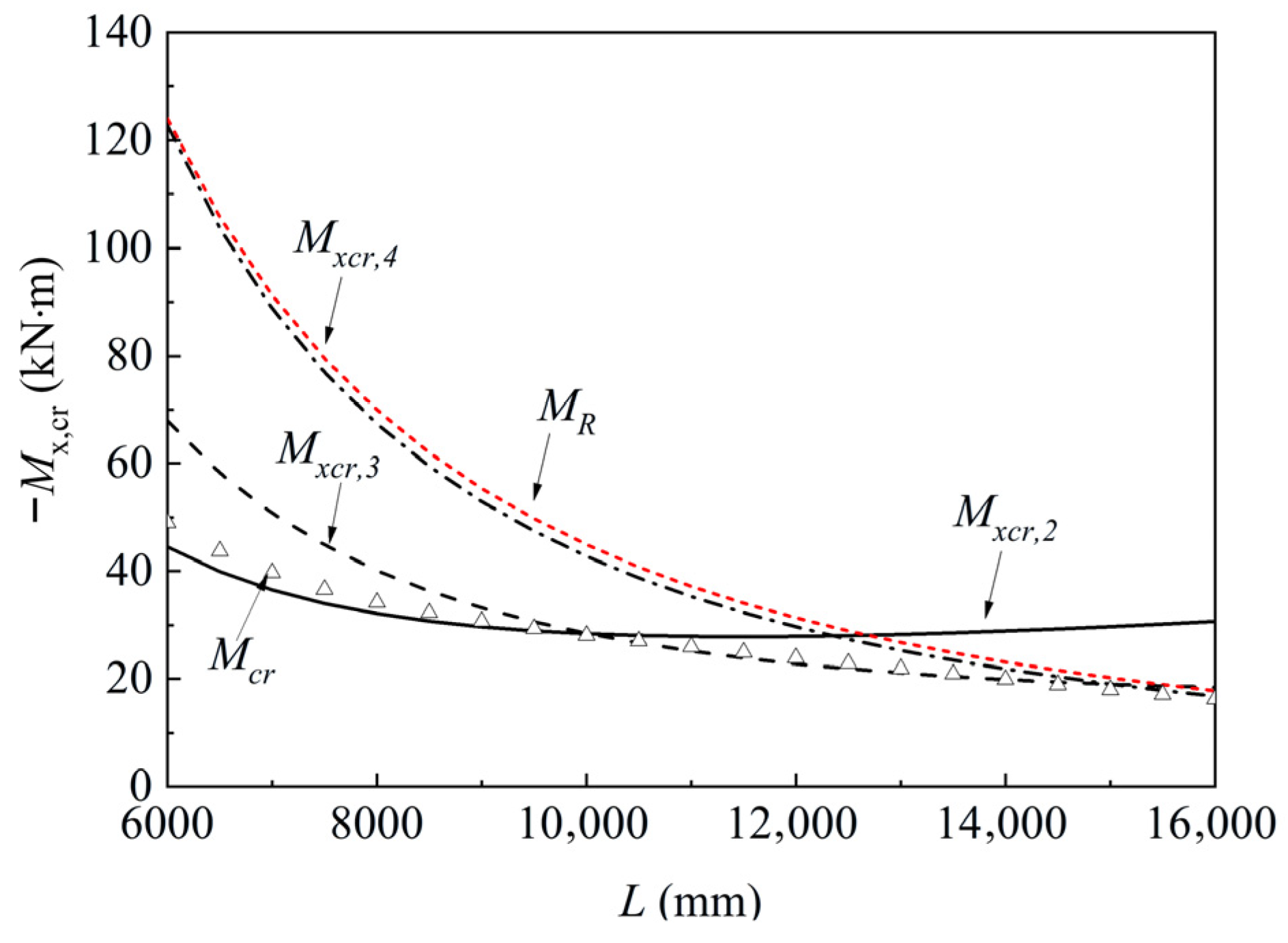
Comparisons between the predictions of the proposed solutions for purlins with three anti-sag bars and the FE results (Mcr) are presented in Figure 8. The minimum values of Mxcr,2, Mxcr,3 and Mxcr,4, calculated using Equation (37), provide accurate predictions of the buckling loads for the considered purlins. The results based on the rigid bracing assumption (McrR) are close to Mxcr,4 in Figure 8; otherwise, they may significantly overestimate the buckling loads.
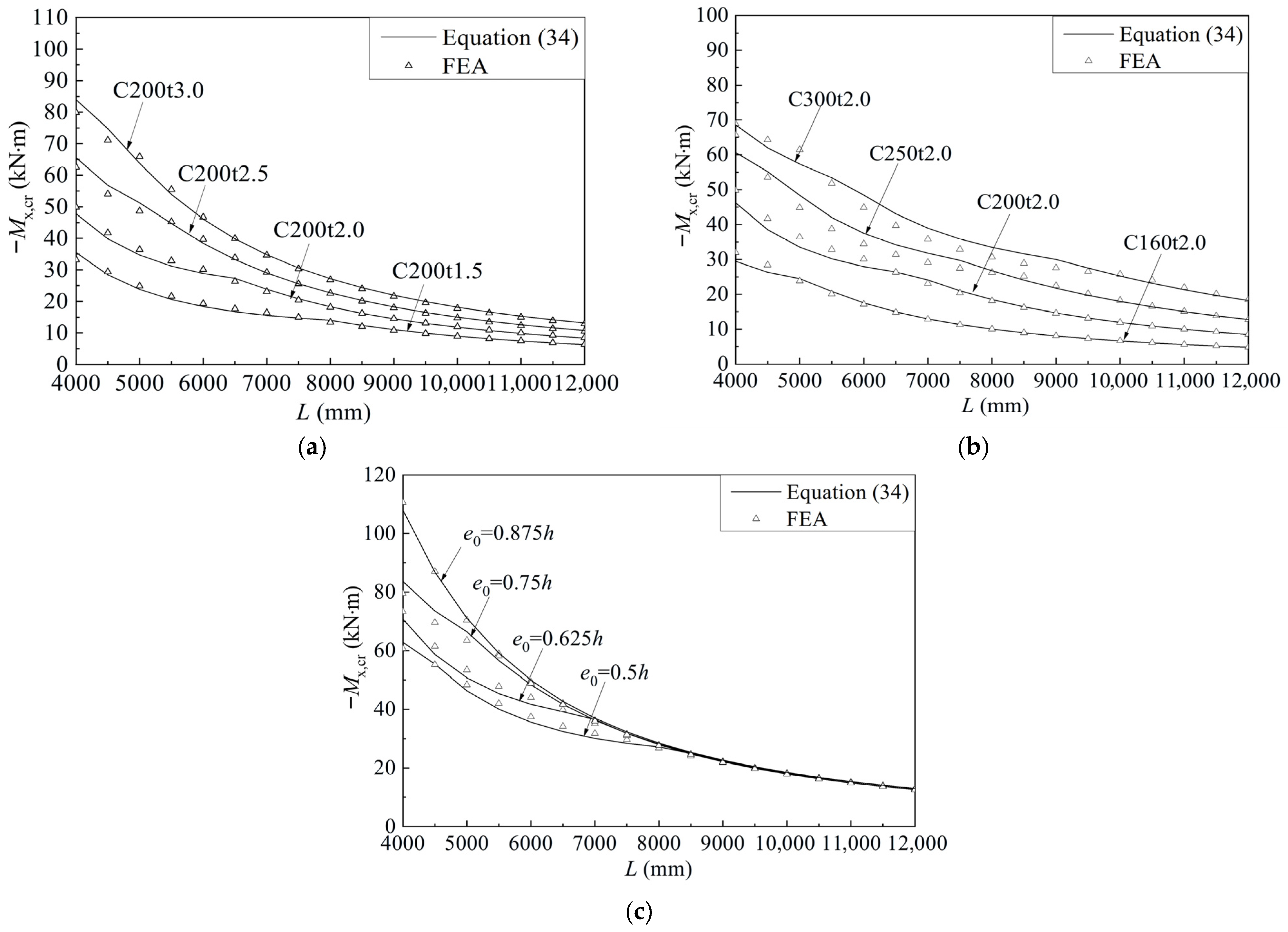
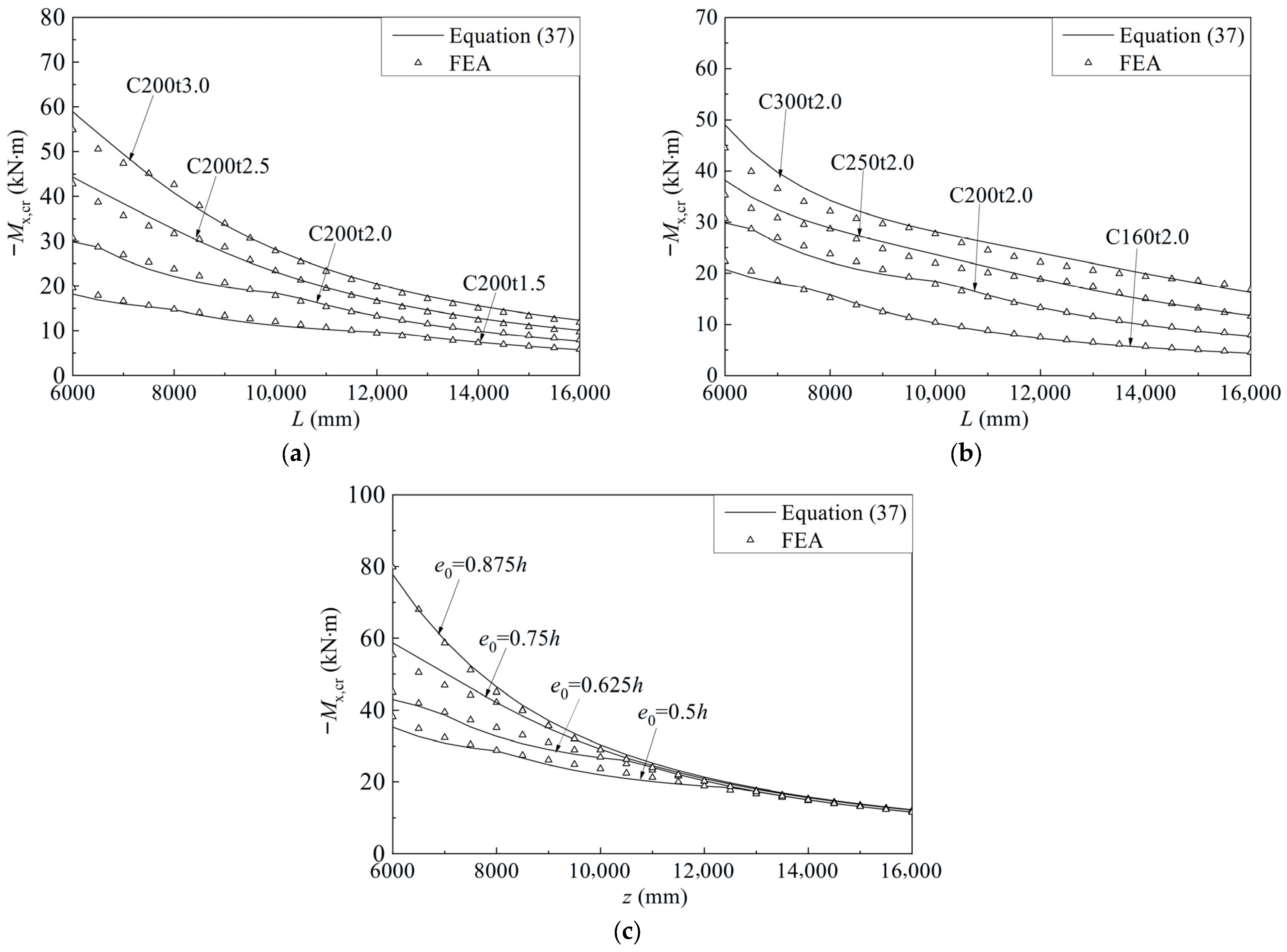
Further comparisons are presented in Figure 9a–c for C-section purlins with two anti-sag bars considering different cross-section thicknesses (Figure 9a), cross-section heights (Figure 9b), and vertical locations of anti-sag bars (Figure 9c). The predictions of the proposed solution (Equation (34)) show good agreement with the FE results. In these comparisons, the minimum value among the three buckling loads corresponding to the possible dominant modes is taken as the predicted buckling load. Similar agreement between the proposed solutions (Equation (37)) and the FE results is observed for C-section purlins with three anti-sag bars, as shown in Figure 10a–c.

7.2. Determination of Dominant Buckling Mode

As discussed above, the dominant buckling mode of the considered purlins varies depending on the cross-section properties, span, number of anti-sag bars, and vertical location of the anti-sag bars. Therefore, in the previous sections, the minimum value among the buckling loads corresponding to the possible failure modes was used to predict the buckling load for each case. However, this requires calculation of buckling loads for all possible modes. To simplify the calculation, a parameter, φ, is introduced to determine the dominant buckling mode:
φ = k LT e 0 2 L 3 E I ¯ ω
The values of φ for determining the dominant buckling loads of C-section purlins with two or three anti-sag bars are listed in Table 4.
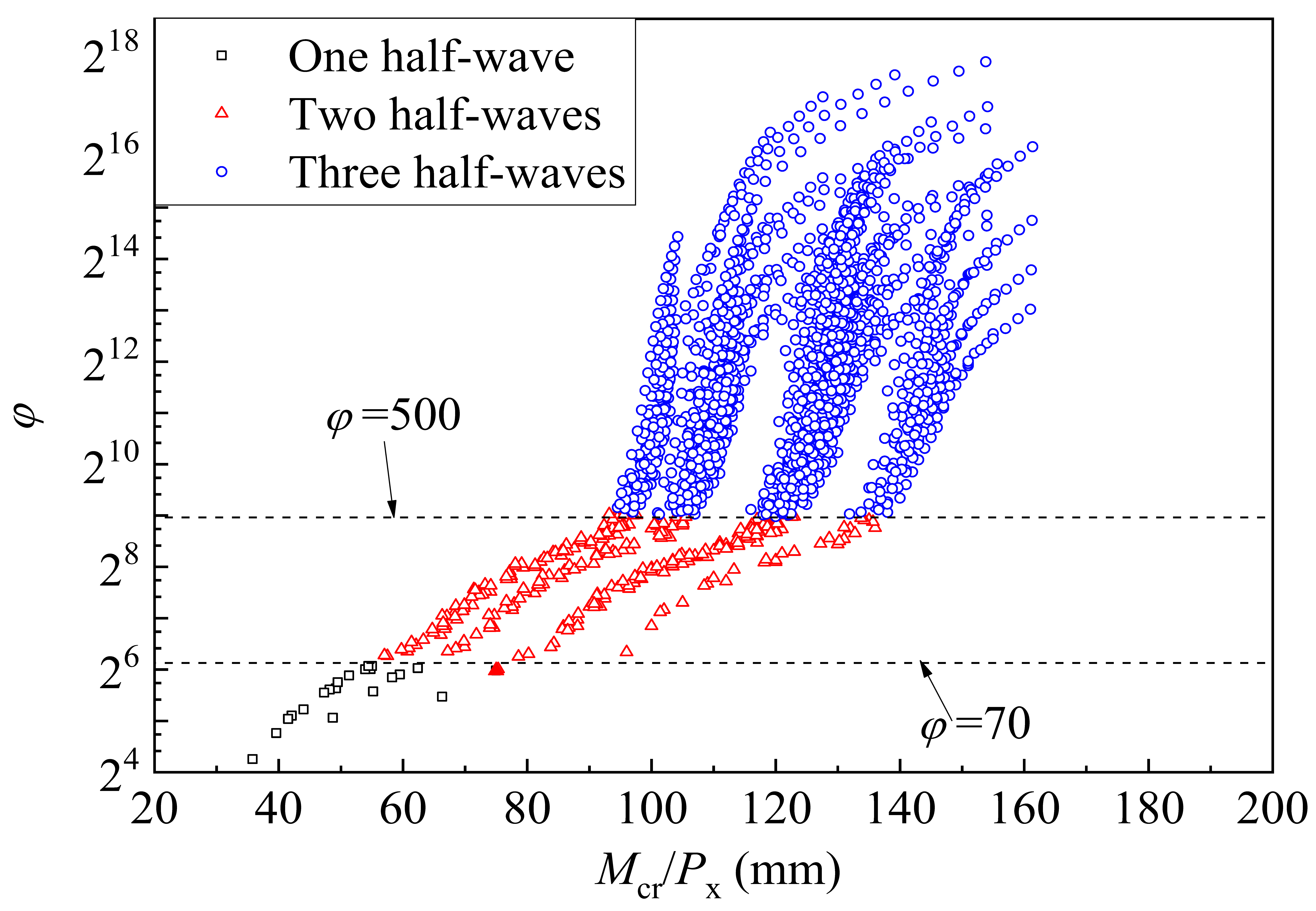
The values of φ for C-section purlins with two anti-sag bars are illustrated in Figure 11, where all C-sections listed in Table 1 are considered. Four vertical locations of anti-sag bars within the web (i0 = 0.5h, 0.675h, 0.75h and 0.875h) are adopted. The purlin span varies from 4000 mm to 12,000 mm at intervals of 500 mm. All results shown in Figure 11 are obtained from FE analysis using the previously developed FE code.
It can be seen from Figure 11 that the dominant buckling mode of C-section purlins with two anti-sag bars can be accurately determined using the φ values provided in Table 4. In a few cases where φ is very close to the boundary values (e.g., φ = 500 and 70 in Figure 11), misclassification of the buckling mode may occur. However, in such cases, the buckling loads corresponding to the adjacent modes are very close, and the prediction accuracy of the buckling load remains satisfactory. For example, φ = 63.14 (close to one of the boundary values 70) is obtained using Equation (48) for the purlin C220t1.5 with e0 = 0.5h and L = 4500 mm (shown in Figure 11 using “Solid Triangle”). The dominant buckling mode is the one-half-wave mode according to Table 4, while the FE result indicates a two-half-wave failure mode. However, the difference in predicted buckling loads is negligible (Mxcr,1 = 36.56 kN∙m and Mxcr,2 = 36.80 kN∙m using Equation (34)).
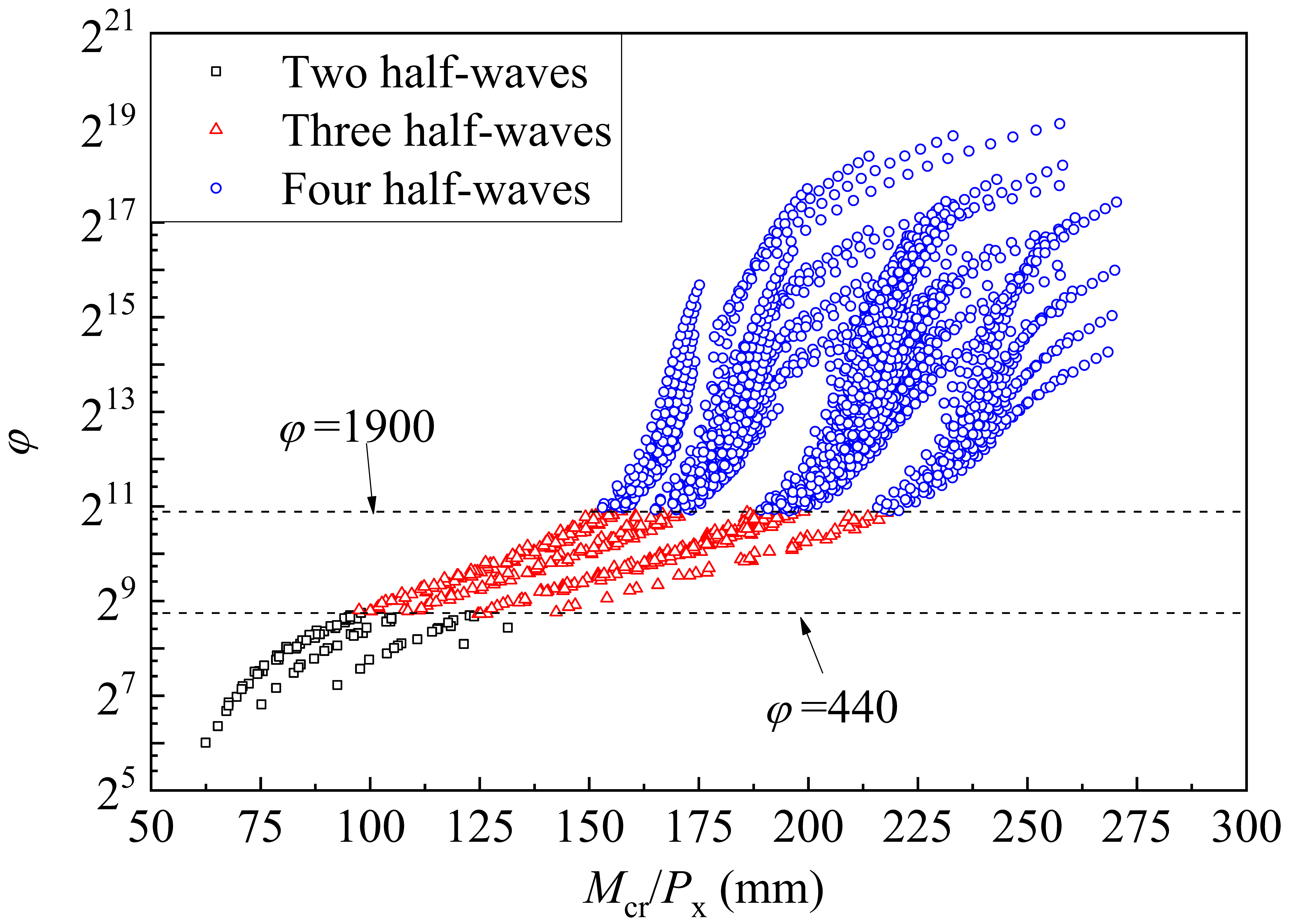
The applicability of φ for determining the dominant buckling mode of C-section purlins with three anti-sag bars is demonstrated in Figure 12, which also shows good agreement.

8. Conclusions

The lateral buckling behaviour of C-section purlins with two or three anti-sag bars is investigated in this study by considering the effective stiffness of the anti-sag bars. The total potential energy expressions, based on the buckling theory recently proposed by the authors, are first established, incorporating the effects of lateral restraints at the top flange and the anti-sag bars. Based on the proposed total potential, closed-form solutions for the lateral buckling loads of C-section purlins are developed, which can be used for hand calculations.
The performance of the proposed solutions is evaluated by comparing the predicted buckling loads with those obtained from the FE code developed in this study. Very good agreement is observed between the two sets of results. In addition, a parameter φ is proposed to determine the dominant buckling mode of C-section purlins with two or three anti-sag bars. Comparisons with FE results demonstrate that φ can accurately identify the dominant buckling mode of the considered purlins, thereby simplifying the calculation of buckling loads using the proposed solutions.
For ease of using the presented solutions, the buckling loads of C-section purlins with two or three anti-sag bars can be calculated following the procedures in Table 5.

Author Contributions

Conceptualization, L.Z. and G.T.; methodology, L.Z. and G.T.; software, L.Z. and Y.Y.; formal analysis, L.Z. and Y.Y.; investigation, Y.Y. and Z.X.; writing—original draft preparation, Y.Y.; writing—review and editing, Z.X.; supervision, L.Z. and G.T.; funding acquisition, Z.X. All authors have read and agreed to the published version of the manuscript.

Funding

This research was funded by the Hangzhou Natural Science Foundation, grant number 2025SZRJJ1392.

Data Availability Statement

The original contributions presented in this study are included in the article. Further inquiries can be directed to the corresponding author.

Conflicts of Interest

Yun Ye was employed by the company The Architectural Design & Research Institute of Zhejiang University Co., Ltd. The remaining authors declare that the research was conducted in the absence of any commercial or financial relationships that could be construed as a potential conflict of interest.

References

  1. Luan, W.; Li, Y.-Q. Experimental Investigation on Wind Uplift Capacity of Single Span Z-Purlins Supporting Standing Seam Roof Systems. Thin-Walled Struct. 2019, 144, 106324. [Google Scholar] [CrossRef]
  2. Pařenica, P.; Mynarčík, P.; Lehner, P. Experimental Study of High Thin-Walled Cold-Rolled Z Cross-Sections Purlins. J. Constr. Steel Res. 2023, 208, 108017. [Google Scholar] [CrossRef]
  3. Chu, X.; Kettle, R.; Li, L. Lateral-Torsion Buckling Analysis of Partial-Laterally Restrained Thin-Walled Channel-Section Beams. J. Constr. Steel Res. 2004, 60, 1159–1175. [Google Scholar] [CrossRef]
  4. Li, L. Lateral–Torsional Buckling of Cold-Formed Zed-Purlins Partial-Laterally Restrained by Metal Sheeting. Thin-Walled Struct. 2004, 42, 995–1011. [Google Scholar] [CrossRef]
  5. Sokol, L. Stability of Cold Formed Purlins Braced by Steel Sheeting. Thin-Walled Struct. 1996, 25, 247–268. [Google Scholar] [CrossRef]
  6. Zhang, L.; Tong, G. Lateral Buckling of Simply Supported C- and Z-Section Purlins with Top Flange Horizontally Restrained. Thin-Walled Struct. 2016, 99, 155–167. [Google Scholar] [CrossRef]
  7. ANSI/AISC 360-22; Specification for Structural Steel Buildings. AISC: Chicago, IL, USA, 2022.
  8. En 1993-1-1:2022; Eurocode 3: Design of Steel Structures—Part 1-1: General Rules and Rules for Buildings. European Committee for Standardization (CEN): Brussels, Belgium, 2022.
  9. Lucas, R.M.; Al-Bermani, F.G.A.; Kitipornchai, S. Modelling of Cold-Formed Purlin-Sheeting Systems—Part 2. Simplified Model. Thin-Walled Struct. 1997, 27, 263–286. [Google Scholar] [CrossRef]
  10. En 1993-1-3:2024; Eurocode 3: Design of Steel Structures—Part 1-3: General Rules—Supplementary Rules for Cold-Formed Members and Sheeting. European Committee for Standardization (CEN): Brussels, Belgium, 2024.
  11. AISI S100-24; North American Specification for the Design of Cold-Formed Steel Structural Members. AISI: Washington, DC, USA, 2024.
  12. AN/NZS 4600:2018; Cold-Formed Steel Structures. Australia/New Zealand Standards: Sydney, Australia, 2018.
  13. Zhang, L.; Tong, G. Stress Analysis on Cold-Formed C-Purlins Subjected to Wind Suction Load Considering the Effective Stiffness of Anti-Sag Bar. Thin-Walled Struct. 2015, 90, 107–118. [Google Scholar] [CrossRef]
  14. Zhang, L.; Tong, G.-S. Lateral Buckling of C-Section Purlins with One Anti-Sag Bar at Middle Span Section. Thin-Walled Struct. 2016, 102, 246–257. [Google Scholar] [CrossRef]
  15. Polyzois, D. Sag Rods as Lateral Supports for Girts and Purlins. J. Struct. Eng. 1987, 113, 1521–1531. [Google Scholar] [CrossRef]
  16. ANSYS. 18.2 Theory Reference; SAS IP. Inc.: Cary, NC, USA, 2017. [Google Scholar]
Figure 1. Schematic diagram and dimensions of the C-section purlin in a roof system.
Buildings 16 01053 g001
Figure 2. Coordinate system of C-section purlin [14].
Buildings 16 01053 g002
Figure 3. Comparison of buckling loads for purlins with two anti-sag bars (C200t2.0, e0 = 0.5h).
Buildings 16 01053 g003
Figure 4. Possible dominant buckling modes: (a) one-half-wave mode; (b) two-half-wave mode; (c) three-half-wave mode.
Buildings 16 01053 g004
Figure 5. Calculation model for My of C-section purlins: (a) Reaction due to FLT; (b) Calculation model.
Buildings 16 01053 g005
Figure 6. Distributions of My along the span: (a) Different spans (e0 = 0.5h), (b) Different values of e0.
Buildings 16 01053 g006
Figure 7. Comparison of buckling loads of purlins with two anti-sag bars (C300t2.0).
Buildings 16 01053 g007
Figure 8. Comparison of buckling loads of purlins with three anti-sag bars (C300t2.0).
Buildings 16 01053 g008
Figure 9. Comparisons of buckling loads of C-section purlins with two anti-sag bars: (a) Different thicknesses of cross-section, (b) Different heights of cross-sections, (c) Different locations of anti-sag bar (C250t2.0).
Buildings 16 01053 g009
Figure 10. Comparisons of buckling loads of C-section purlins with three anti-sag bars: (a) Different thicknesses of cross-section, (b) Different heights of cross-sections, (c) Different locations of anti-sag bar (C250t2.0).
Buildings 16 01053 g010
Figure 11. Buckling modes of C-section purlins with two anti-sag bars.
Buildings 16 01053 g011
Figure 12. Buckling modes of C-section purlins with three anti-sag bars.
Buildings 16 01053 g012
Table 1. Dimensions of cross-sections.
IDSectionH (mm)B (mm)C (mm)t (mm)Diagram
C140t(1.5–3.0)C140 × 50 × 20 × (1.5–3.0)14050201.5–3.0Buildings 16 01053 i001
C160t(1.5–3.0)C160 × 60 × 20 × (1.5–3.0)16060201.5–3.0
C180t(1.5–3.0)C180 × 70 × 20 × (1.5–3.0)18070201.5–3.0
C200t(1.5–3.0)C200 × 70 × 20 × (1.5–3.0)20070201.5–3.0
C220t(1.5–3.0)C220 × 75 × 20 × (1.5–3.0)22075201.5–3.0
C250t(1.5–3.0)C250 × 75 × 20 × (1.5–3.0)25075201.5–3.0
C300t(1.5–3.0)C300 × 80 × 20 × (1.5–3.0)30080201.5–3.0
Table 2. Parameters for C-section purlins with two anti-sag bars.
nCn1Cn2Cn3Cn4
1 0.85 1 16 k 11 1 4 π 2 k 11 k 12 k 11 1 16 π 2 k 11 3 + π 2 3 h + 12 L χ C 2 d s + ξ a x
2 0.92 1 8 k 21 1 8 π 2 k 21 2 k 22 k 21 1 32 π 2 k 21 3 + 4 π 2 3 h + 12 L χ C 2 d s + ξ a x
3 0.88 3 16 k 31 1 12 π 2 k 31 3 k 32 k 31 1 + 3 π 2 h 48 π 2 k 31
Table 3. Parameters for C-section purlins with three anti-sag bars.
nCn1 * Cn2Cn3Cn4
2 0.88 1 8 k ¯ 21 1 8 π 2 k ¯ 21 2 k ¯ 22 k ¯ 21 1 32 π 2 k ¯ 21 3 + 4 π 2 h 3 + 16 χ C 31 L d s + ξ a x
3 0.72 3 16 k ¯ 31 1 12 π 2 k ¯ 31 3 k ¯ 32 k ¯ 31 1 48 π 2 k ¯ 31 1 + 3 π 2 h + 8 χ C 31 + χ C 32 L d s + ξ a x
4 0.82 1 4 k ¯ 41 1 16 π 2 k ¯ 41 4 k ¯ 42 k ¯ 41 3 + 16 π 2 h 192 π 2 k ¯ 41
* The values 0.88, 0.72, and 0.82 in C21, C31 and C41, respectively, are adjustment coefficients.
Table 4. Values of φ for determining dominant buckling modes.
Number of Anti-Sag BarDominant Buckling ModeCondition
2one half-waveφ ≤ 70
two half-waves70 < φ < 500
three half-wavesφ ≥ 500
3one half-waveφ ≤ 440
two half-waves440 < φ < 1900
three half-wavesφ ≥ 1900
Table 5. Calculation procedure for buckling loads.
StepsWith Two Anti-Sag RodsStepsWith Three Anti-Sag Rods
1 L , h , I ω , I y , I k , I ¯ ω , d s , a x , e 0 , β y , ξ 1 L , h , I ω , I y , I k , I ¯ ω , d s , a x , e 0 , β y , ξ
2 χ C 2 ( Equation   ( 22 b ) ) , η ¯ C 2 ( Equation   ( 27 ) ) 2 χ C 31 , χ C 32 ( Equations   ( 45 a )   and   ( 45 b ) )   η ¯ C 3 ( Equation   ( 44 ) )
3 k 11 ~ k 32 ( Equations   ( 36 a ) ( 36 f ) ) 3 k ¯ 11 ~ k ¯ 42 ( Equations   ( 38 ) ( 43 ) )
4 C n 1 ~ C n 4 ( Table   2 ) 4 C n 1 ~ C n 4 ( Table   3 )
5 M c r 1 ~ M c r 3 ( Equation   ( 34 ) ) 5 M c r 1 ~ M c r 4 ( Equation   ( 37 ) )
6Buckling load = min(Mcr1~Mcr3)6Buckling load = min(Mcr1~Mcr4)
Disclaimer/Publisher’s Note: The statements, opinions and data contained in all publications are solely those of the individual author(s) and contributor(s) and not of MDPI and/or the editor(s). MDPI and/or the editor(s) disclaim responsibility for any injury to people or property resulting from any ideas, methods, instructions or products referred to in the content.