Article

Automated Dimensional Measurement of Large-Scale Prefabricated Components Based on UAV Multi-View Images and Improved 3D Gaussian Splatting


Department of Civil Engineering, School of Mechanics and Engineering Science, Shanghai University, Shanghai 200444, China
*
Author to whom correspondence should be addressed.
Buildings 2026, 16(5), 1054; https://doi.org/10.3390/buildings16051054
Submission received: 25 January 2026 / Revised: 26 February 2026 / Accepted: 5 March 2026 / Published: 6 March 2026
(This article belongs to the Section Construction Management, and Computers & Digitization)

Abstract

The geometric dimensional accuracy of large-scale prefabricated components is critical for the successful implementation of prefabricated construction. However, traditional manual contact-based inspection methods are inefficient and are often simplified or even neglected in practice due to operational difficulties. To address this challenge, this study proposes an automated non-contact dimensional inspection system based on UAV photogrammetry. The system consists of three core modules: First, the 3D Model Generation Module utilizes UAV-captured multi-view imagery to rapidly reconstruct high-fidelity 3D models of construction sites using improved 3D Gaussian Splatting technology, while recovering true physical scales by integrating GPS metadata. Second, the Segmentation Module extracts target components from complex backgrounds through flexible target selection and achieves automated planar segmentation using the Region Growing algorithm. Finally, the Dimensional Inspection Module accurately calculates geometric dimensions using a self-developed “Measurement Tree” algorithm. Engineering validation demonstrates that the system achieves an average relative error of only 0.35% in the inspection of prefabricated bent caps, exhibiting excellent measurement accuracy and robustness. This study provides an efficient, precise, and intelligent solution for the quality control of prefabricated components, effectively bridging the gaps inherent in traditional inspection methods.

1. Introduction

The global construction industry is undergoing a profound transformation towards industrialization and digitalization, with prefabricated construction serving as the cornerstone of this paradigm shift. By transferring production processes from construction sites to controlled factory environments, prefabrication technologies have demonstrated significant advantages in construction efficiency, sustainability, and quality control [1,2]. However, the success of this component-assembly-based construction mode largely depends on the geometric accuracy of individual components. Unlike cast-in-place concrete, which allows for on-site error adjustments, large-scale prefabricated components—such as bridge bent caps and box girders—must strictly adhere to dimensional specifications to ensure seamless assembly. Geometric deviations can not only compromise the structural integrity and aesthetic quality of infrastructure but also lead to costly rework, schedule delays, and safety hazards during hoisting [3]. Recent studies have further highlighted the critical role of precise geometric data in assessing structural behavior. For instance, accurate 3D measurements are essential for evaluating the deflections of excavation support plates [4] and analyzing the response of structural elements under thermal loads [5]. Similarly, experimental validation of lateral pressure distribution relies heavily on reliable geometric inputs [6].Consequently, pre-shipment dimensional inspection of prefabricated components is not merely a critical step in quality assurance but a prerequisite for the feasibility of modern industrialized construction.
Traditional inspection methods primarily rely on manual contact-based measurements using tape measures, calipers, and total stations. These methods are labor-intensive, time-consuming, and prone to human error. Furthermore, for large-scale irregular components, sparse single-point sampling often fails to capture overall volumetric deformations. Additionally, safety concerns frequently restrict personnel access to complex geometric areas, resulting in the simplification or omission of comprehensive dimensional inspections in practice, thereby leaving significant gaps in the quality control loop. To overcome the limitations of manual inspection, non-contact optical measurement technologies have garnered increasing attention in recent years. Advanced 3D scanning and modelling techniques have been successfully applied to the multi-criteria diagnostics of complex structures, such as historic buildings, proving their efficacy in capturing detailed geometric information for preservation and analysis [7]. Although Terrestrial Laser Scanning (TLS) has established itself as a means of acquiring high-fidelity point clouds [8,9,10], its high equipment costs, complex operational procedures, and lengthy data acquisition cycles have hindered its widespread adoption as a routine inspection tool in dynamic factory environments [11].
As a more cost-effective alternative, computer vision-based photogrammetry techniques—particularly Structure from Motion (SfM) combined with Multi-View Stereo (MVS) [12,13]—have been widely applied in the Architecture, Engineering, and Construction (AEC) domain [14,15,16,17]. Unmanned Aerial Vehicles (UAVs) equipped with high-resolution cameras can rapidly acquire multi-view images of large components, which are then processed via SfM-MVS pipelines to generate dense point clouds with millimeter-level accuracy. However, MVS algorithms often perform poorly in weakly textured regions (e.g., uniform concrete surfaces) and suffer from low computational efficiency and long reconstruction cycles in large-scale scenarios [18], making it difficult to meet the demands for real-time quality control in factory settings.
In recent years, the emergence of Neural Radiance Fields (NeRF) has introduced a new paradigm for 3D reconstruction [19]. While NeRF has demonstrated immense potential in novel view synthesis, its implicit representation typically makes extracting explicit geometric surfaces required for metrology difficult, and its training costs are prohibitively high [20]. As a breakthrough advancement, 3D Gaussian Splatting (3DGS) combines explicit point cloud representation with differentiable rasterization rendering, retaining the high fidelity of neural rendering while achieving real-time rendering speeds [21]. Recently, various improved algorithms based on 3D Gaussians have emerged, such as FlashGS, DoGaussian, and FatesGS for enhancing reconstruction speed [22,23,24]; Mip-Splatting and Scaffold-GS for improving rendering quality [25,26]; and 2DGS, Gsdf, and PGSR for refining geometric accuracy [27,28,29]. Although 3DGS has performed exceptionally well in computer graphics and some scholars have attempted to introduce it into the AEC field [30], its application in engineering surveying is still in its infancy, and its measurement accuracy has not been well validated. In particular, verifying its geometric accuracy and recovering absolute scale from monocular images remains a gap that urgently needs exploration.
After acquiring high-fidelity 3D models, precisely isolating target components from complex construction backgrounds for dimensional calculation presents another key challenge for automated quality inspection. Existing point cloud segmentation methods are mainly categorized into direct 3D semantic segmentation and 2D-to-3D projection mapping. Although end-to-end 3D deep learning networks represented by PointNet++, Swin3D, and Point Transformer V3 [31,32,33] have made significant progress, compared to mature 2D vision algorithms, 3D segmentation technologies are still limited by high data annotation costs and scarce training samples, leading to relatively lagging feature extraction capabilities and generalization performance. In contrast, methods based on 2D semantic segmentation projected into 3D space [34] offer advantages such as error compensability, high algorithm reusability, and low annotation costs. However, such data-driven approaches often exhibit significant domain dependency, meaning models struggle to transfer directly to unseen component types. More critically, existing algorithms generally face the challenge of “Instance Selection Ambiguity,” where it is difficult to automatically parse and lock onto the specific target intended for measurement by engineers within complex large-scale scenes containing numerous similar objects. On the other hand, classical geometric segmentation algorithms do not rely on training data but struggle to balance robustness and semantic understanding: RANSAC is robust against noise but limited to single-plane extraction and lacks semantic discrimination (e.g., difficulty distinguishing ground from components); while Region Growing algorithms can ensure topological integrity of multi-plane segmentation, their effectiveness strictly depends on pre-segmented clean component point clouds, making them difficult to apply directly to noisy raw scenes.
At the dimensional measurement level, existing automated methods still have limitations in accuracy stability and topological reasoning capabilities. Mainstream boundary fitting methods [35,36] are highly dependent on the density and quality of edge point clouds; when data is sparse or occluded, the fitted geometric boundaries often exhibit significant uncertainty. The widely used “Scan-vs-BIM” technique [37,38], while capable of intuitively displaying overall deformations, essentially focuses on qualitative deviation color mapping and struggles to directly extract quantitative geometric parameters—such as length, width, and height—that satisfy industrial tolerance standards.
To address these challenges, this study proposes an automated non-contact dimensional inspection system specifically designed for large-scale prefabricated components. The main contributions of this study are as follows:
  • A 3D reconstruction framework based on improved 3D Gaussian Splatting (PGSR) [29] is proposed, utilizing GPS data to achieve absolute scale recovery, thereby filling the gap in the application of 3DGS in the field of engineering surveying.
  • A hybrid segmentation strategy combining “geometric perception and interactive guidance” is introduced, which not only resolves the instance selection ambiguity of automated algorithms but also utilizes the Region Growing algorithm to ensure the topological integrity of polyhedral segmentation.
  • A specialized “Measurement Tree” algorithm is developed to construct a fully automated topological reasoning mechanism, achieving automated reconstruction from unordered planes to structured wireframe models and high-precision dimensional calculation.
This study aims to provide a robust, efficient, and automated solution for the quality control of prefabricated components, promoting the digital transformation of the construction industry.

2. Methodology

2.1. Overview

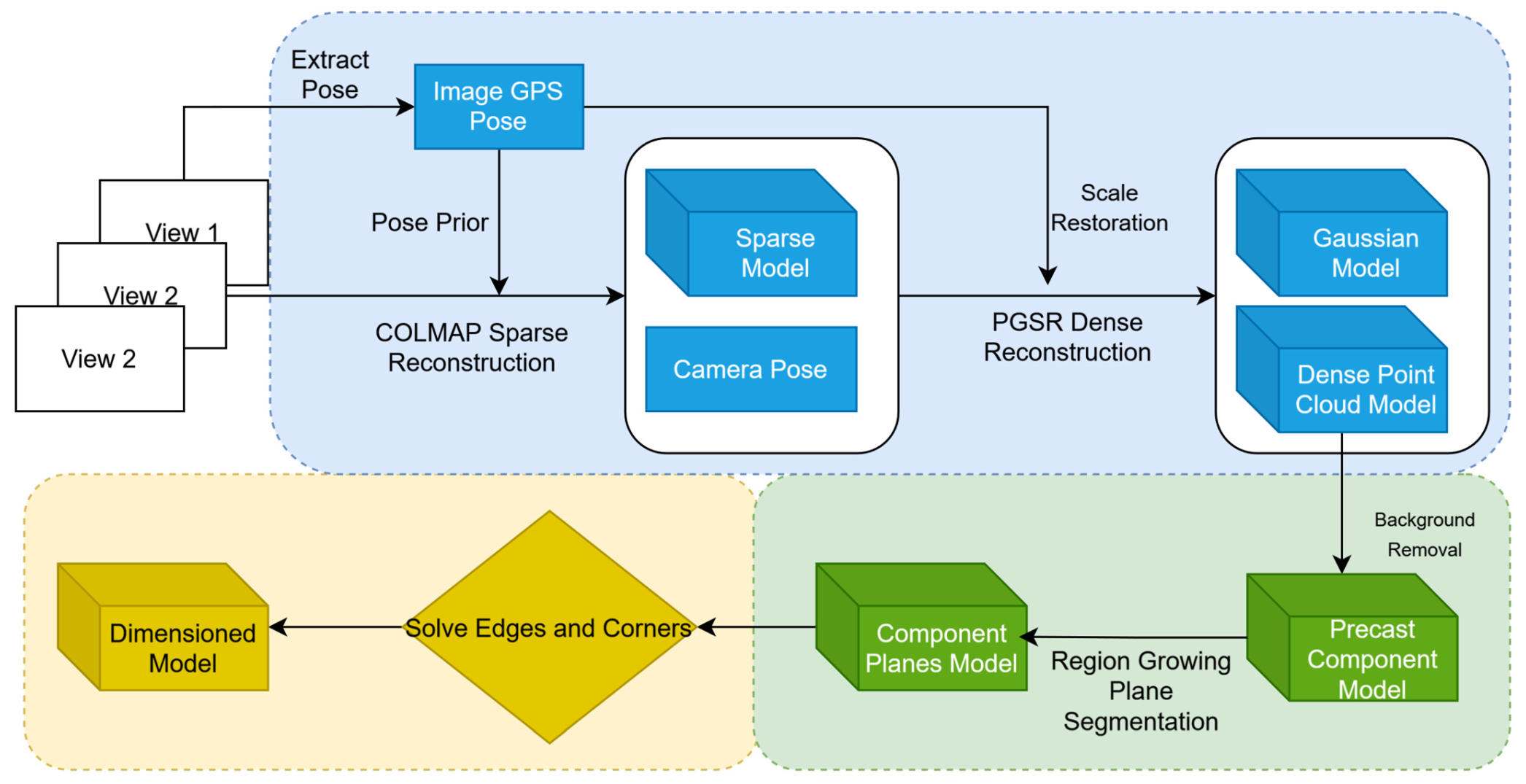
This study proposes an automated dimensional measurement framework for prefabricated components based on 3D Gaussian Splatting (3DGS) and topological correlation analysis. The framework aims to address the challenges of difficult geometric feature extraction, loss of topological relationships, and low automation levels inherent in traditional point cloud measurement methods. The overall technical route is illustrated in Figure 1 and consists of three core phases: (1) High-fidelity 3D model construction and scale recovery based on multi-view imagery; (2) Component point cloud extraction and planar segmentation combining interactive guidance and geometric perception; (3) Development of a “Measurement Tree” data structure to achieve systematic dimensional calculation based on planar topological intersection relationship.

2.2. 3D Reconstruction

To acquire high-precision 3D models of prefabricated components with true physical scales, this study employs an overall SfM-to-PGSR (Planar-based Gaussian Splatting for Efficient and High-Fidelity Surface Reconstruction) pipeline. This pipeline utilizes COLMAP’s(v3.12) pose_prior_mapper function to enhance sparse reconstruction accuracy and applies the model_aligner function based on GPS coordinates to achieve scale recovery of the 3D model.

2.2.1. Sparse Reconstruction with Pose Priors

In the data acquisition phase, a UAV equipped with an RTK positioning module is used to capture multi-view image sequences of the prefabricated components. First, Structure from Motion (SfM) technology is utilized for sparse reconstruction. To improve reconstruction robustness, this study extracts camera pose parameters from the UAV images as prior information to constrain the SfM process, generating a sparse point cloud containing camera poses.
Specifically, the COLMAP open-source framework is selected to execute the sparse reconstruction task. As the current state-of-the-practice benchmark in 3D reconstruction, COLMAP provides high-precision initial values for camera poses for subsequent processes. The reconstruction follows the standard SfM pipeline: first, spatial adjacency relationships between images are established through feature extraction and matching algorithms; subsequently, to introduce absolute geo-referencing and constrain cumulative errors, latitude and longitude information is parsed from image metadata and converted into local East-North-Up (ENU) coordinates; finally, the transformed ENU coordinates are integrated into the Bundle Adjustment process as prior constraints using the pose_prior_mapper module. This strategy effectively enhances the robustness of sparse reconstruction in weakly textured or repetitive texture regions, ensuring the geometric consistency of camera pose estimation.

2.2.2. Dense Reconstruction via PGSR

Building upon the sparse point cloud, the Improved 3D Gaussian Splatting (PGSR) algorithm is introduced for dense reconstruction. While the standard reconstruction workflow in photogrammetry is SfM-to-MVS, this study adopts a Gaussian-based dense reconstruction scheme due to its superior rendering quality and faster reconstruction speed compared to traditional methods. Regarding geometric accuracy—a critical concern in surveying—PGSR has achieved state-of-the-art (SOTA) levels among Gaussian reconstruction algorithms. Through a series of innovative designs, including reshaping Gaussian morphology via planar constraints, optimizing depth calculation methods, and adding multiple regularization terms, PGSR significantly improves geometric accuracy. Compared to the original 3DGS method, it more efficiently reconstructs geometric features with flat surfaces and sharp edges, effectively suppressing noise on concrete surfaces.

2.2.3. Recovery of True Physical Scale

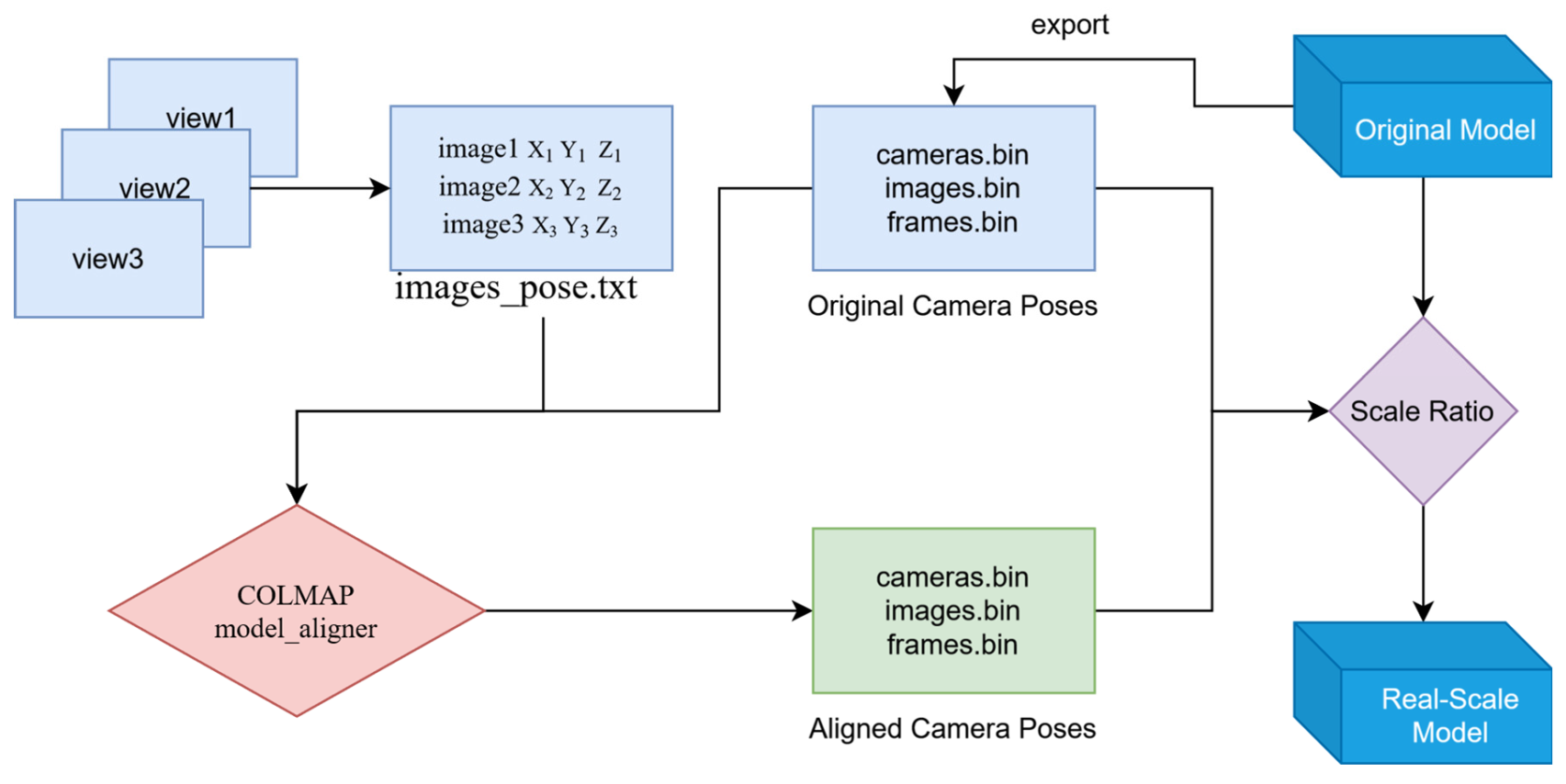
Due to the inherent Scale Ambiguity in monocular vision reconstruction, the model defaults to a relative coordinate system. This study utilizes GPS/RTK coordinates from image metadata and employs COLMAP’s model_aligner method to perform a Similarity Transformation. This aligns the reconstructed model to the real-world scale, thereby recovering its true physical dimensions and establishing a metric foundation for subsequent precision measurement (as shown in Figure 2).
In the specific implementation, high-precision GPS/RTK latitude and longitude information contained in the image metadata is first parsed and projected into metric ENU coordinates to construct an absolute spatial reference frame. Subsequently, COLMAP’s model_aligner algorithm executes a similarity transformation, rigidly aligning the camera trajectory from the sparse reconstruction with the ENU coordinate system by minimizing reprojection errors. During this process, the system automatically solves for the Global Scaling Factor that maps the relative coordinate system to the true physical coordinate system. Finally, this scaling factor is applied to the point cloud or Gaussian model generated by dense reconstruction to eliminate scale ambiguity, thereby recovering the precise metric geometric features of the prefabricated component.

2.3. Segmentation

To provide high-precision geometric data for the subsequent measurement phase, the primary task is to accurately extract the point cloud model of the target prefabricated component from the complex construction site background. Since prefabricated components typically present polyhedral structures enclosed by multiple planes, this study further segments the extracted complete component into independent geometric planes to meet dimensional inspection requirements.

2.3.1. Component Point Cloud Extraction

In complex construction scenarios, prefabricated components are densely stacked and varied in type. Determining the measurement target often relies on the subjective decisions and actual needs of on-site engineers. While currently popular fully automated deep learning segmentation methods can identify object categories, they struggle to accurately capture the engineer’s specific measurement intent (i.e., the “which one to measure” problem) in multi-object scenarios. Therefore, this study proposes a human-in-the-loop Dual-Seed Guided Segmentation algorithm, introducing human prior knowledge to resolve the ambiguity of target selection.
The specific process is as follows: First, the operator selects a Ground Seed Point and a Component Seed Point in the 3D point cloud view.
To accurately capture the local ground elevation while avoiding interference from the component itself, Ground Seed Point is typically selected on the ground near the target but maintaining a safe horizontal distance (e.g., >1.0 m) from the component’s edge. The algorithm then constructs a local neighborhood (R = 1.0 m) centered on the Ground Seed Point and utilizes RANSAC to robustly fit the ground plane equation. Based on this, a distance constraint filter is constructed to eliminate ground points and non-target background noise.
Subsequently, in the non-connected space with the ground removed, the component seed point serves as the indexing core for target extraction using DBSCAN. Since this algorithm relies on density connectivity rather than Euclidean distance from the seed, the selection of component seed point is highly robust—choosing any point on the surface of the target component (preferably in the central region) will yield an identical segmentation result, ensuring consistent performance regardless of minor manual click deviations.
Through this method, the study enables rapid and accurate segmentation of independent target prefabricated component point clouds from complex construction backgrounds, providing a complete and clean data foundation for subsequent multi-plane segmentation and dimensional measurement.

2.3.2. Multi-Plane Segmentation

After obtaining the independent target component point cloud, it must be further deconstructed into geometrically meaningful independent planes to facilitate dimensional measurement. Prefabricated components are typically enclosed by multiple regular planes, characterized by significant geometric features: point clouds within the same plane exhibit high consistency in surface normal direction and minimal local curvature variation.
For such segmentation tasks with distinct geometric features, existing mainstream algorithms primarily include RANSAC and Region Growing. Although RANSAC demonstrates strong robustness in fitting single mathematical models (e.g., planes, spheres) and effectively eliminating outliers, its essence involves iteratively finding the “maximum consensus set” with the most points in the scene. This means RANSAC struggles to identify multiple distinct planes in a single run and is prone to “over-segmentation” or “under-segmentation” between parallel planes.
In contrast, the Region Growing algorithm is more suitable for the refined segmentation of complex polyhedra. Based on the principle of “similarity aggregation,” this algorithm treats point cloud segmentation as a process of diffusion from seed points. Its core mechanisms include:
  • Normal Estimation: Calculating the normal vector and curvature for each point using eigenvalue decomposition of the local neighborhood covariance matrix.
  • Growing Criterion: The algorithm begins growing from the point with the minimum curvature (the flattest point). It compares the Normal Angle Difference and Curvature Difference between the current seed point and its neighbors. If the differences are below preset thresholds, the points are considered to belong to the same smooth surface and are merged into the current cluster.
  • Multi-class Parallelism: This process iterates continuously until all points are classified or judged as residual noise, enabling the one-time, adaptive segmentation of the component into multiple independent geometric planes (e.g., top face, side faces) while preserving topological boundary information between planes. This makes it highly suitable for the dimensional inspection requirements of prefabricated components in this study.
Through the above iterative process, the algorithm adaptively segments the component point cloud into several independent planes. This processing not only provides pure datasets for fitting high-precision plane equations subsequently but also lays a solid structural foundation for the topological reconstruction and dimensional calculation based on the “Measurement Tree” in the next section.

2.4. Measurement

Addressing the issue that traditional 2D tables cannot effectively express the complex topological relationships (point-line-plane associations) of 3D entities, this study proposes a hierarchical data structure named “Measurement Tree” and its accompanying measurement algorithm. This method discards the traditional edge detection and fitting approach, adopting instead an analytic geometry method based on planar intersection, which significantly enhances measurement robustness.

2.4.1. Definition of Data Structure

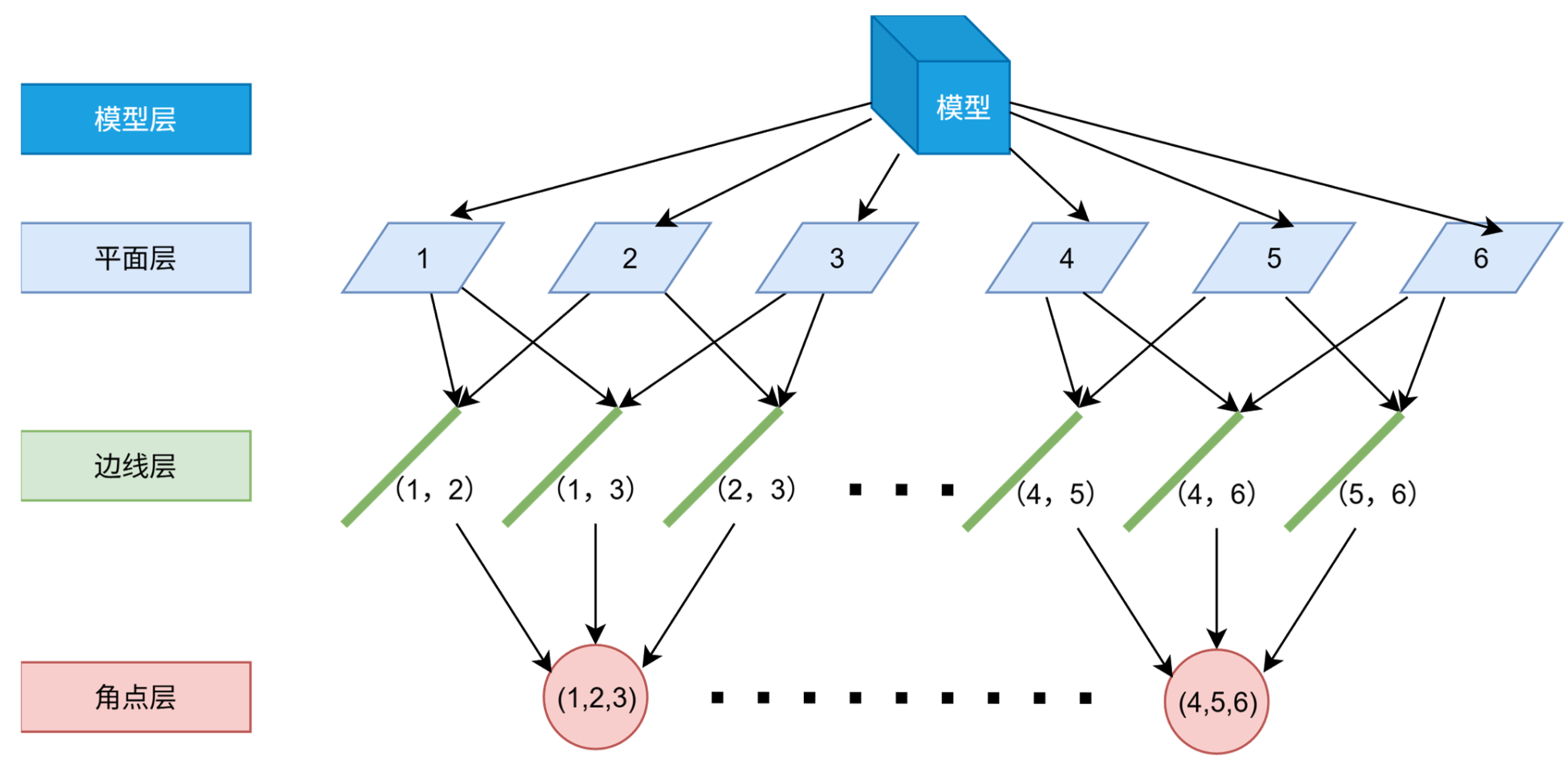
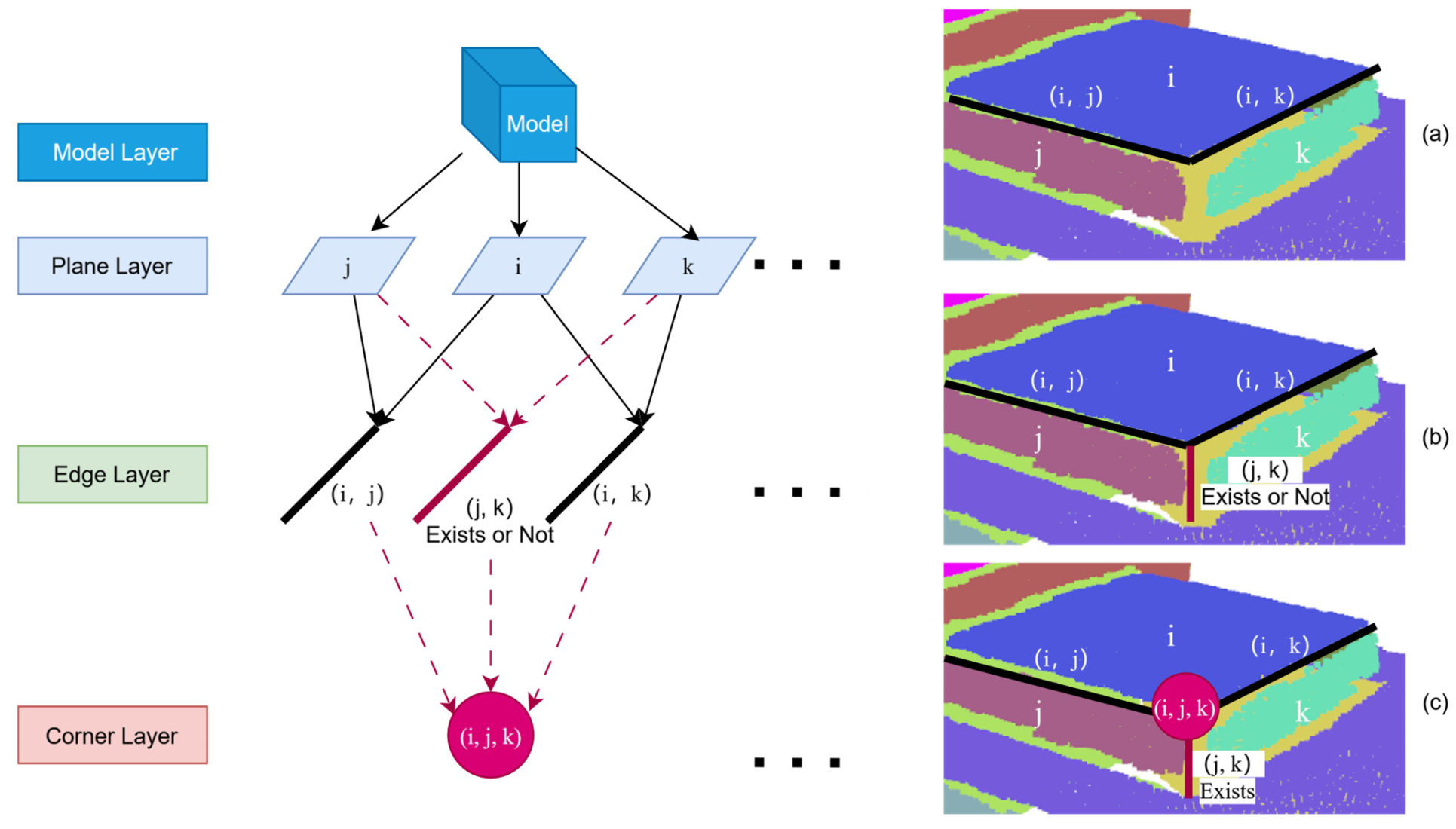
The “Measurement Tree” is a multi-way tree structure (as shown in Figure 3) designed to systematically store the geometric primitives and topological reference relationships of prefabricated components. Each tree node contains four member variables: ID, points, equation, and childrenList. Its structure is defined as follows:
  • Root Node: Represents the entire prefabricated component model object.
  • Level-1 Child Nodes (Plane Nodes): Store the point clouds and plane equations of all independent planes (e.g., top surface, side surfaces) calculated via the RANSAC algorithm.
  • Level-2 Child Nodes (Line Nodes): Store the infinite line equations generated by the intersection of two parent Plane Nodes. Each Line Node is indexed simultaneously by two Plane Nodes.
  • Level-3 Child Nodes (Point Nodes): Store the corner coordinates obtained from the intersection of three Line Nodes (or three planes).
This structure not only achieves structured storage of measurement data but also completely preserves the generation logic among “planes-lines-points,” supporting efficient Create, Read, Update, and Delete (CRUD) operations and providing clear data interfaces for subsequent algorithm development.
Taking a cube as an illustrative example, we can use a Measurement Tree to store its point, line, and plane data. As shown in Figure 3, the entire cube corresponds to the Root Node; if dealing with a point cloud model, the Root Node stores the overall model point cloud data. The six faces of the cube are stored at the Plane Level as child nodes of the Root Node, added to the Root Node’s childrenList. Each plane is assigned a unique integer ID (e.g., 1–6), with the points variable storing the subset of point cloud data belonging to that plane and the equation variable storing its plane equation parameters. When two planes intersect to form an edge, a Line Node is created. The ID of this Line Node is a tuple of its two parent plane IDs; for instance, the intersection of Plane 1 and Plane 2 forms Line Node (1, 2), and this node (1, 2) is added to the childrenList of both Plane 1 and Plane 2 nodes. Similarly, when three intersecting lines form a corner, the ID of the resulting Point Node is the set of the three parent plane IDs. For example, the corner formed by Line Nodes (1, 2), (1, 3), and (2, 3) is identified as Point Node (1, 2, 3). In this manner, we can comprehensively store and describe the geometric relationships among the points, lines, and planes of the cube.

2.4.2. Geometric Topological Calculation Based on “Measurement Tree”

Based on the “Measurement Tree” structure, the core of dimensional measurement lies in reconstructing the boundary topology of the entity from the unordered point cloud. The specific steps are as follows:
(1)
Plane Fitting and Equation Acquisition: For the extracted component point cloud, the Region Growing algorithm is used for initial segmentation, and the RANSAC algorithm is then applied to each planar point cloud for plane fitting to obtain high-precision plane equations:
Ax + By + Cz + D = 0
These planes serve as the first-level nodes of the tree, with node names being positive integers.
(2)
Edge Generation: Traverse all adjacent planar point cloud pairs and solve for the intersection line by simultaneously solving their plane equations (Equation (2)). All calculated intersection lines are stored in the tree as child nodes of the associated planes. The node name is a set containing the names of the two parent nodes. Compared to extracting edges directly from noisy point clouds, line equations obtained based on plane-plane intersection possess higher mathematical precision and noise resistance.
{ A 1 x + B 1 y + C 1 z + D 1 = 0 A 2 x +   B 2 y +   C 2 z +   D 2 = 0
(3)
Corner Extraction and Closure: To intercept real component edge segments from infinite intersection lines, the endpoints of the segments (model corners) must be determined. This study proposes a corner judgment logic based on graph theory loop detection (as shown in Figure 4):
  • For two intersection line child nodes (i, j) (intersection of i and j) and (i, k) (intersection of i and k) within the same plane i.
  • Judgment Criterion: Check if the other parent plane j of (i, j) and the other parent plane k of (i, k) also have an intersection relationship, i.e., whether an intersection line node (j, k) exists in the tree.
  • If (j, k) exists, it proves that planes i, j, k intersect pairwise, and the three planes must intersect at a single point (i, j, k). This point is the common endpoint of (i, j) and (i, k), and also an endpoint of (j, k).
  • The calculated corner is stored in the tree as a child node of the relevant intersection lines. Specifically, corner (i, j, k) is stored as a child node of (i, j), (i, k), and (j, k) in the “Measurement Tree”.
Figure 4. Solving the Measurement Tree. (a) The black lines and nodes represent geometric elements that have already been established in the Measurement Tree; (b) The reasoning logic is that as long as the red line segment (Line j, k) and its corresponding node are confirmed to exist, the triangular topology is closed; (c) It allows the algorithm to automatically generate the target Corner Node (i, j, k) and its associated spatial coordinates.
Buildings 16 01054 g004
(4)
Dimensional Calculation and Visualization: After the above processing, each real Line Segment is bounded by its two endpoint child nodes. By connecting the two corner child nodes under each intersection line node, the complete wireframe model of the component can be reconstructed.
  • Edge Length Measurement: Calculate the Euclidean distance between two corner points.
  • Overall Dimension Measurement: Calculate the perpendicular distance between parallel planes with opposite or similar normal directions.
Finally, the calculation results are plotted on the 3D model for end-to-end visual display, realizing a fully automated process from raw images to the final dimensional report.

3. Case Study

3.1. Experimental Setup

To verify the reliability of the proposed system, this study conducted a non-contact automated dimensional measurement and validation on a bent cap produced by a prefabrication factory in Shanghai. The measuring object is a prefabricated bent cap with an overall length of 21.5 m and a width of 2.5 m.
This specific component was selected as the primary validation subject because its high geometric complexity serves as a rigorous testbed for the proposed system. Unlike simple rectangular beams, this bent cap features complex topological characteristics, including multiple intersecting planes with varying normal vectors and re-entrant corners, which challenge the algorithm’s spatial reasoning capabilities. Furthermore, the top surface has protruding reinforcing bars (rebars) in certain regions, introducing significant noise and occlusion that test the robustness of the segmentation algorithm against outliers. Additionally, the component’s extensive, smooth concrete surface presents a typical challenge for photogrammetry due to weak texture features. Validating the system on such a large-scale, unconventional component provides a robust initial assessment of its capabilities in handling complex precast geometries.
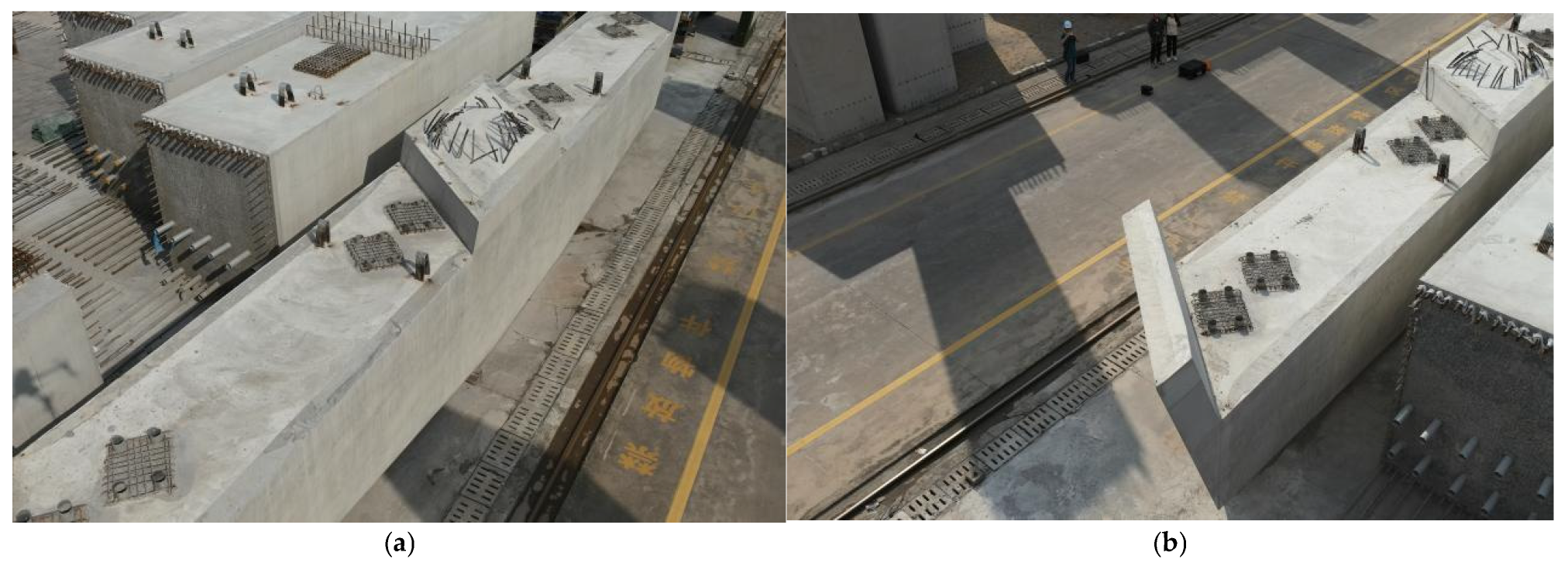
The equipment used for this validation is as follows: A DJI Matrice 300 RTK (Shenzhen DJI Innovations Co., Ltd., Shenzhen, China) UAV was employed to carry the camera to higher perspectives that are difficult for humans to access, thereby acquiring richer and more complete images of the prefabricated component. A Zenmuse P1 (Shenzhen DJI Innovations Co., Ltd., Shenzhen, China) camera with 45 megapixels (8K resolution) was used to capture high-definition imagery. A GPS + RTK module was utilized to obtain positioning data at the centimeter level during image capture. A total of 143 images were captured on-site, with a data acquisition time of 7 min and 7 s (as shown in Figure 5). All computational processing was performed on a high-performance workstation equipped with an Intel Core i7-13700KF CPU (Intel Corporation, Santa Clara, CA, USA), 64 GB of RAM, and an NVIDIA GeForce RTX 4090 GPU with 24 GB VRAM (NVIDIA Corporation, Santa Clara, CA, USA).

3.2. Reconstruction

This section presents the results of pose-prior-aided COLMAP sparse reconstruction using UAV multi-view imagery, scale recovery based on GPS coordinates, PGSR dense reconstruction, and point cloud model extraction.
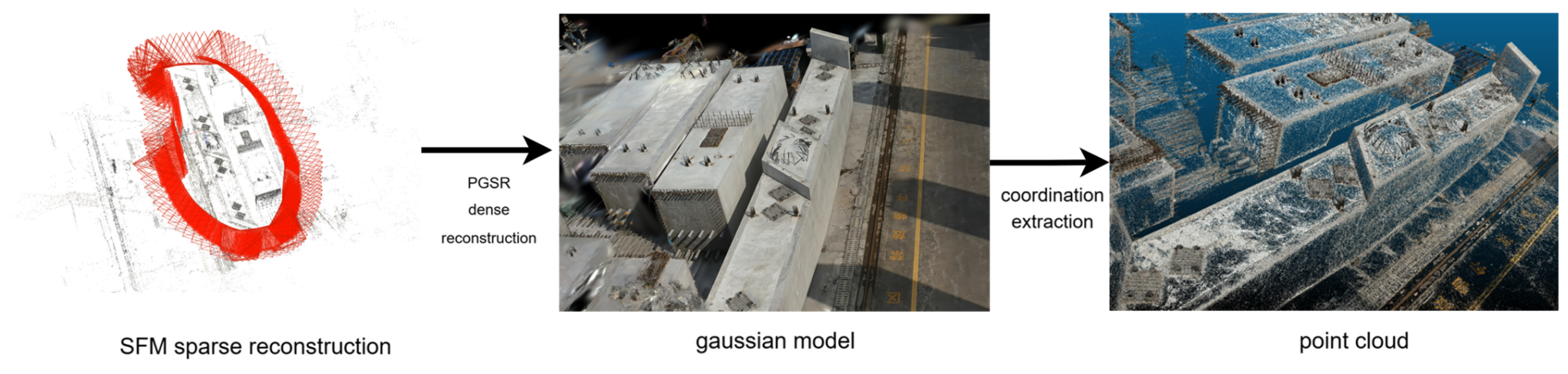
First, the GPS poses were extracted from the images. The pose_prior_mapper function in COLMAP was used to load the 143 bent cap images and their GPS poses to complete the sparse reconstruction, which took approximately 30 min. This process generated a sparse point cloud of the scene, with all images successfully registered (Registration Rate = 100%), as shown in Figure 6 (Left). Based on this, the model_aligner method in COLMAP was used to calculate the aligned pose based on GPS poses and model poses, and to compute the scaling ratio from the model pose to the aligned pose, resulting in a scaling factor of 2.920820358.
Subsequently, the PGSR algorithm was applied to complete the dense reconstruction, requiring about 35 min. All distance values in the dense model were multiplied by the scaling factor to obtain a model with true physical scale. Figure 6 (Center) displays the dense reconstruction result after scale correction, showing a complete model surface with clear textures. Finally, by extracting the geometric centers of the optimized Gaussian primitives, an explicit point cloud model for subsequent measurement was obtained (Figure 6 Right), whose point cloud density and distribution characteristics fully preserved the geometric details of the component.

3.3. Segmentation

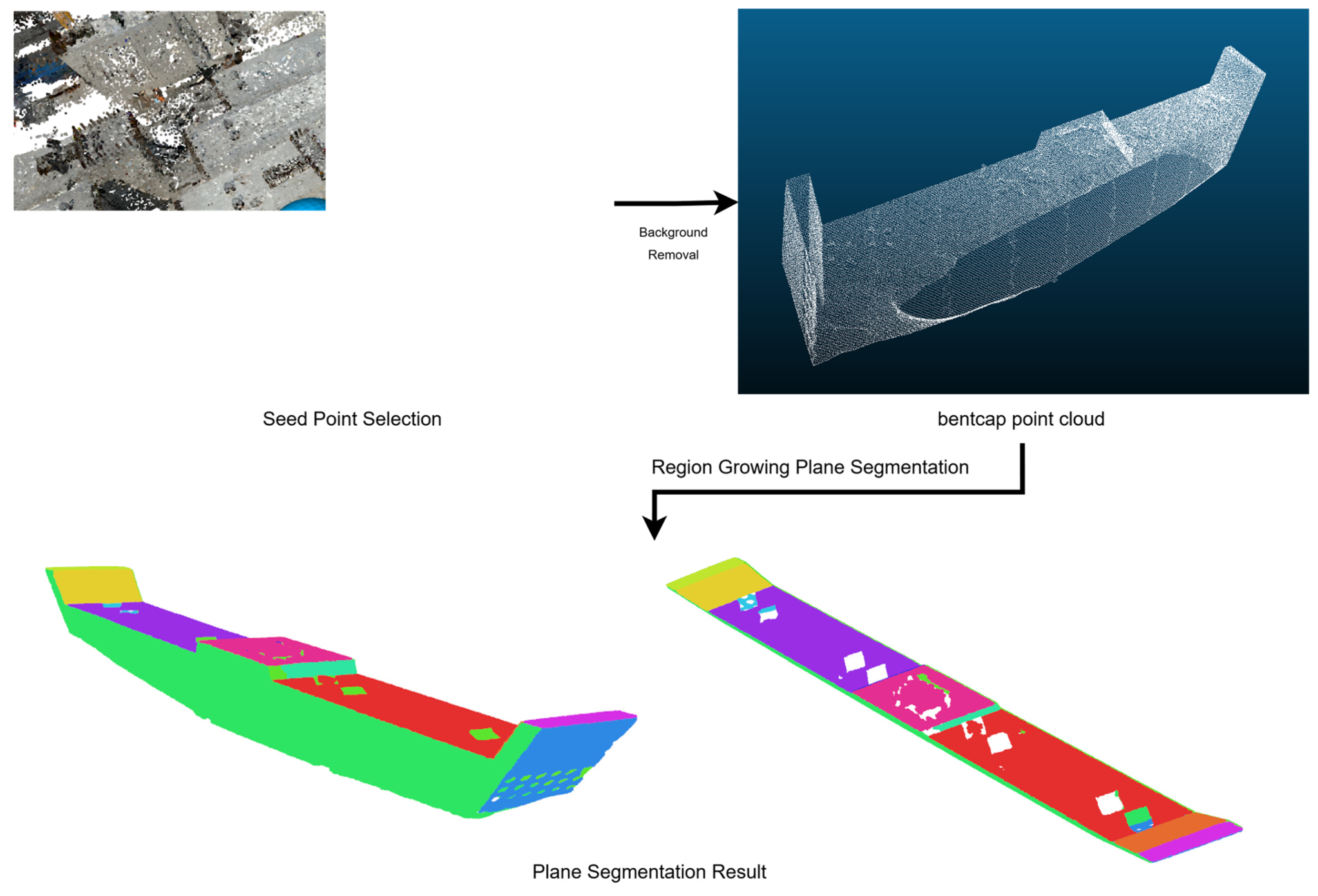
This section presents the results of extracting the bent cap point cloud from the site model and segmenting the bent cap planar point cloud, as shown in Figure 7.
First, a Ground Seed Point (indicated by the yellow point in the Key Point Selection view) and a Component Seed Point (indicated by the blue point) were selected in the model. The RANSAC algorithm was used to fit the maximum plane to the point cloud within a 1-m radius of the ground seed point; this plane equation served as the ground plane equation at the bottom of the component. By filtering out points within ±5 cm of the ground plane, the ground was effectively removed. Then, using the component seed point as the starting point, Density-Based Spatial Clustering of Applications with Noise (DBSCAN) was executed with a distance threshold of 0.1 m and a minimum cluster size of 10,000 points, successfully obtaining a clean bent cap point cloud (Figure 7 Bent Cap Point Cloud).
Next, the Region Growing algorithm was employed for multi-plane segmentation, which took approximately 1 min. A KD-Tree was used for K-nearest neighbor search, with the number of search points set to K = 50 to calculate robust surface normals and curvatures. In the region growing phase, to balance segmentation smoothness and edge sensitivity, the Normal Smoothness Threshold was set to 1.8° (i.e., adjacent points with a normal angle difference less than this value are considered the same plane), and the Curvature Threshold was set to 1.1 to effectively prevent the growing process from crossing the angular boundaries of the component.
Figure 7 (Planar Segmentation Result) displays the final outcome of the segmentation. It can be observed that the algorithm successfully segmented the bent cap point cloud into 13 planes, including the top face, bottom face, and various side faces (different colors in the figure represent different plane clusters). The boundaries of the segmented planes are distinct, with no obvious over-segmentation. This provides high-quality data support for subsequent plane-based dimensional fitting and measurement. Notably, the top view of the segmentation result reveals many holes on the top surface of the component. These areas originally corresponded to rebar point clouds; however, because the normal deviation of the rebar points was too large, they were not included in the planar points. This demonstrates the robustness of the method, which efficiently removes outliers (noise) while retaining only the component planes of primary interest.

3.4. Measurement

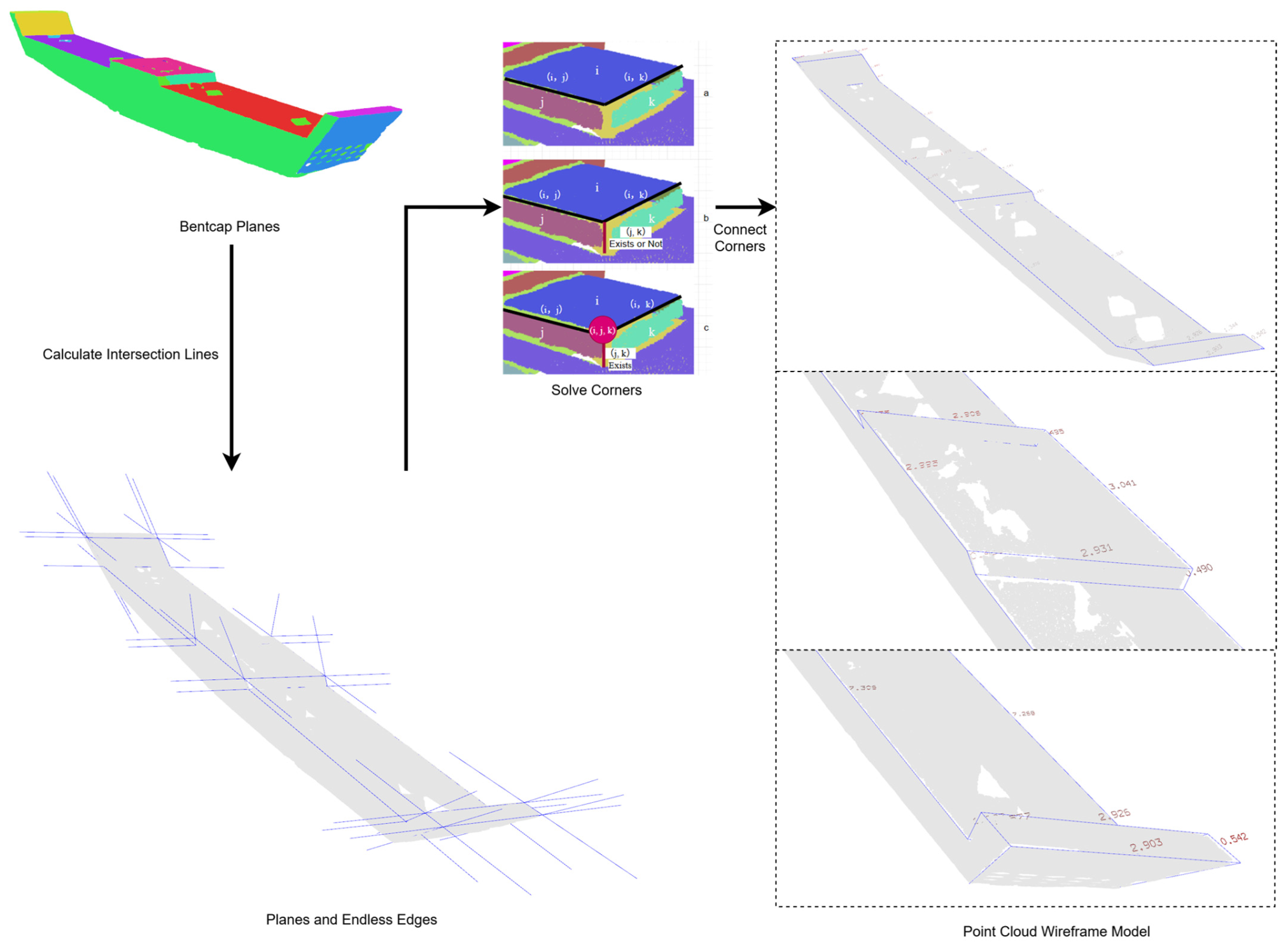
This section presents the results of solving for edge lines and corner points using the planar point cloud data of the bent cap component (as shown in Figure 8) and analyzes the accuracy of the dimensional measurement.
Based on the 13 independent planar clusters obtained from the segmentation stage, RANSAC plane fitting was applied to each cluster to robustly solve for the precise plane equations. As shown in the Component Planes view in Figure 8, the fitted planes (Node IDs: 0–12) completely covered the top face and all side elevations of the component. Subsequently, all plane nodes were correctly mounted to the Plane Level of the Measurement Tree for topological reasoning.
Subsequently, the program traversed all plane nodes and solved for intersection line equations based on analytic geometry principles. After eliminating parallel and non-adjacent planes, a total of 32 valid intersecting lines (Edge Generation) were solved. As shown in the Planes and Lines view in Figure 8, these infinite lines accurately described the geometric boundaries between various faces of the component, constituting the second-level child nodes of the Measurement Tree.
Finally, through a corner reasoning logic based on Graph Theory Loop Detection (Corner Extraction), the algorithm automatically identified and calculated 20 key corner coordinates. These corners not only accurately corresponded to the physical vertices of the component in spatial position but also established a strong “point-line-plane” topological correlation in the data structure. The resulting “Measurement Tree” structure was complete and logically clear, achieving automated reconstruction from discrete point clouds to a parametric wireframe model (as shown in the Point Cloud-Wireframe Model view in Figure 8). In terms of computational performance, the entire automated measurement process—including RANSAC-based plane fitting (23.8 s) and topological solving (21.2 s)—was completed in approximately 45 s on the experimental hardware.
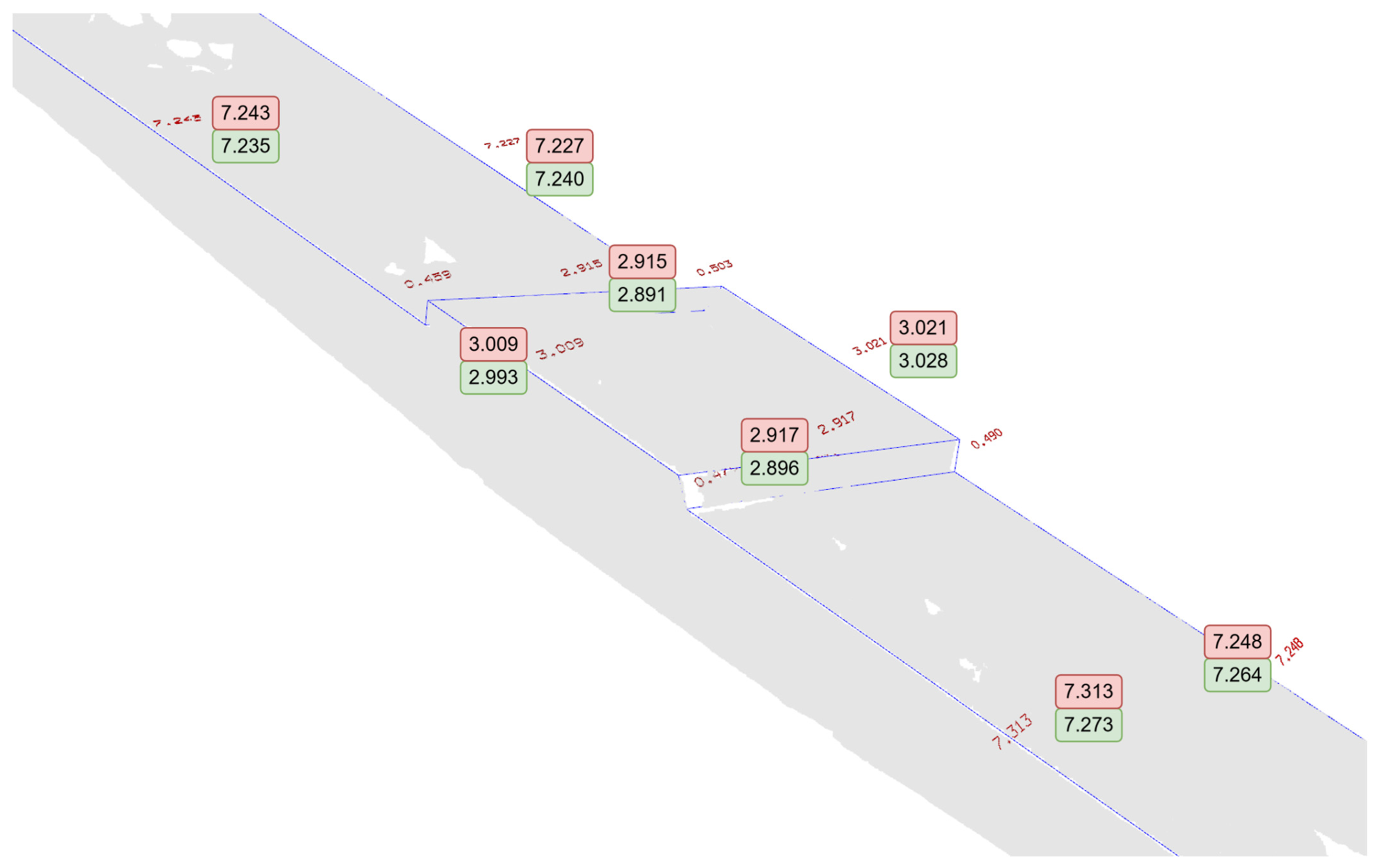
To quantitatively evaluate the measurement accuracy of the system, the experiment selected 8 representative characteristic edge lines of the component as validation objects and used on-site manual tape measurements as the Ground Truth for comparative analysis. Although the sample size is constrained by the logistical challenges of accessing high-elevation edges on the active construction site, these selected edges cover various lengths and orientations, providing a meaningful preliminary validation of the system’s performance. Figure 9 visually displays the comparison of measurement results: the blue wireframe represents the component outline automatically extracted by the algorithm, red annotations indicate the dimensional values calculated by the Measurement Tree, and green annotations represent the corresponding manual ground truth values. Detailed error statistics are presented in Table 1.
The analysis results indicate that for large-scale component edge measurements up to 7 m, this method achieved a high degree of measurement consistency. First, the Mean Absolute Error (MAE) for the 8 samples was calculated to be 1.8 cm. To assess the impact of large errors, the Root Mean Square Error (RMSE) was found to be 2.1 cm. The fact that the RMSE (2.1 cm) is only slightly larger than the MAE (1.8 cm) indicates a uniform error distribution free from significant outliers. Furthermore, the Standard Deviation (SD) of the absolute errors was low at 1.1 cm, signifying excellent measurement stability with errors tightly clustered around the mean. The reliability of these results is further confirmed by the 95% Confidence Interval (CI)of ±0.9 cm, implying a 95% probability that the true mean error lies within 1.8 ± 0.9 cm. Overall, the method achieved a Mean Relative Error (MRE) of just 0.35%. This level of accuracy demonstrates that the automated measurement method proposed in this paper, based on PGSR and the Measurement Tree, possesses good geometric fidelity, meeting centimeter-level measurement standards.
To further understand the reliability of the measurements, we analyzed the dominant error sources in the workflow. The total measurement uncertainty primarily stems from three stages:
  • Reconstruction Noise: The inherent noise in the 3DGS point cloud (typically 5–10 mm) introduces random errors during the initial plane segmentation.
  • Fitting Residuals: Although RANSAC effectively filters outliers, the fitted plane equations still contain residual errors, which propagate to the intersection lines.
  • Scale Recovery Bias: Since the absolute scale relies on GPS metadata, any systematic offset in the GPS positioning introduces a global scaling bias affecting all linear measurements proportionally.
The observation that the RMSE is close to the MAE suggests that random errors (Noise & Fitting) are effectively controlled by the “Integral Smoothing Effect” of the planar regression. Consequently, the primary residual error component is likely the systematic scaling bias derived from the GPS data, which can be further mitigated in future applications by integrating higher-precision RTK modules.

4. Discussion

The automated dimensional measurement framework proposed in this study has been fully validated through the inspection of a bent cap at a prefabrication plant in Shanghai. This chapter provides an in-depth analysis of the experimental results from three dimensions—measurement accuracy, algorithmic robustness, operational efficiency and Data Acquisition Parameters Influence —and discusses the limitations of existing methods.

4.1. Reliability Analysis of Geometric Accuracy and Scale Recovery

One of the core innovations of this study is the utilization of the improved 3DGS algorithm constrained by GPS metadata for non-contact scale recovery. Quantitative experimental results indicate that the global scaling factor (2.9208), solved via COLMAP’s model_aligner, successfully constructed a high-fidelity metric space.
In terms of accuracy data, measurement results for 8 key edge lines show a Mean Absolute Error (MAE) of 1.8 cm and a Mean Relative Error (MRE) as low as 0.35%. This “centimeter-level” accuracy is particularly remarkable given the absence of Ground Control Points (GCPs), fully satisfying the engineering requirements for preliminary dimensional verification in precast component yards.
From the perspective of error distribution mechanisms, the achievement of such accuracy validates the superiority of the “Plane-Intersection” strategy over traditional edge extraction algorithms. Dimensional inspection of prefabricated components is essentially a measurement of the relative distances between geometric features. Unlike directly extracting discrete points with significant noise at point cloud edges (e.g., using Canny or Sobel operators), this method utilizes the RANSAC algorithm to perform least-squares fitting on thousands of planar points. This Integral Smoothing Effect greatly suppresses Gaussian noise on single points, enabling the intersection lines (edges) solved from two fitted planes to break through the limitations of edge detection algorithms in terms of linearity and robustness. In the experiment, the system maintained stable measurement accuracy for both long edges (7.2 m class) and short edges (2.9 m class), further confirming the robustness of this scale recovery and feature extraction framework.

4.2. Advantages of “Measurement Tree” in Complex Topology

The bent cap component selected for this experiment possesses typical non-orthogonal geometric features (e.g., trapezoidal sections, non-vertical side faces), which directly challenge traditional simplified measurement algorithms based on Axis-Aligned Bounding Boxes (AABB) or Oriented Bounding Boxes (OBB). Unlike the AABB method, which forcibly abstracts components into regular hexahedrons leading to volume estimation bias, the “Measurement Tree” algorithm accurately describes the Intrinsic Geometry of the component through a plane-to-point topological reasoning mechanism. It faithfully restores the non-orthogonal connection relationships between the various faces of the bent cap without relying on prior shape assumptions.
Beyond its geometric adaptability, the proposed framework demonstrates three distinct advantages over existing mature algorithms and commercial software:
  • Full Automation vs. Manual Interaction: While commercial software (e.g., CloudCompare (v2.13.1)) offers high-precision measurement tools, they heavily rely on human interaction—users must manually pick points, fit planes, or trace edges. This manual process is time-consuming and subjective. In contrast, the “Measurement Tree” framework enables fully automated batch processing. It takes raw point clouds as input and outputs a parametric wireframe model without human intervention, which is critical for efficient large-scale inspection on construction sites.
  • Topological Consistency: Conventional edge detection methods (e.g., curvature-based or region-growing algorithms) often produce fragmented edges or unconnected corner points due to point cloud noise. Our method, based on global plane intersection, inherently enforces topological constraints: edges are mathematically derived from intersecting planes, ensuring that the resulting wireframe is geometrically closed and logically consistent (“Watertight”). This guarantees that every corner is the precise intersection of three edges, a feature often lacking in traditional boundary extraction methods.
  • Robustness to Occlusion: In real-world construction data, edges are frequently occluded or sparse. Our approach leverages the redundancy of planar data (thousands of points on a face) to infer the position of edges and corners, even if the edge data itself is missing. This “Global Fitting for Local Inference” capability offers superior robustness compared to local feature-based methods.
The successful parsing of 13 independent planes, 32 topological edges, and 20 closed-loop corners from the experimental data confirms the universality and flexibility of this data structure. It provides a robust new technical path for high-precision wireframe reconstruction of diverse irregular prefabricated components (such as irregular beams and stair flights) in industrial digitalization.

4.3. Balance Between Automation Efficiency and Human–Machine Collaboration

Efficiency analysis shows that the entire data acquisition process took only about 7 min (143 images) without any physical contact with the component, significantly reducing operational risks and complexity. In the data processing stage, although 3DGS training and point cloud segmentation require certain computational resources, the system possesses a clear advantage in overall time cost compared to the repetitive climbing and reading required by traditional manual tape measurement.
Particularly worth discussing is the “Dual-Seed Guided” semi-automated segmentation strategy adopted in this study. Although fully automated deep learning (e.g., PointNet++) is a current research hotspot, such algorithms often fail due to “semantic ambiguity” in actual component yards with high repetition rates and multiple targets. By injecting the engineer’s measurement intent into the algorithm through extremely low-cost human interaction (only two clicks required), this study avoids complex model training while ensuring a target extraction accuracy of 100%. This “Human-in-the-Loop” design philosophy has proven to be the optimal solution for balancing automation levels with system robustness in current engineering practice.

4.4. Influence of Data Acquisition Parameters

The accuracy and robustness of the proposed dimensional inspection system are intrinsically linked to the quality of the input data. Although a quantitative sensitivity analysis was not the primary focus of this study, the theoretical impact of key parameters based on photogrammetric principles and experimental observations is critical for practical implementation:
  • GPS Accuracy and Scale Recovery: A core innovation of this system is the reliance on GPS metadata for absolute scale recovery in 3DGS, eliminating the need for Ground Control Points (GCPs). Consequently, measurement accuracy is directly dependent on positioning precision. The use of RTK-GPS (centimeter-level) in our experiment ensured reliable scaling (Global Scaling Factor: 2.9208). Standard GPS modules with meter-level errors would introduce significant systematic bias in linear measurements, making them unsuitable for high-precision metrology without external references.
  • Image Overlap and Quantity: The topological completeness of the “Measurement Tree” relies on sufficient image overlap (typically >70%) to ensure dense point cloud generation. Insufficient overlap or low image counts in complex areas (e.g., re-entrant corners or under the corbels) can lead to “holes” in the Gaussian splatting, causing the plane segmentation algorithm to fail in closing the topology. Conversely, excessive image redundancy increases computational time without proportional accuracy gains.
  • Lighting and Texture: As a passive optical method, the system’s performance is sensitive to environmental lighting. Consistent, diffuse lighting conditions are optimal for minimizing noise in the generated point cloud. Extreme lighting (e.g., strong shadows or overexposure) can degrade feature matching quality, potentially affecting the precision of the reconstructed planar surfaces.

4.5. Limitations Analysis

Although the framework proposed in this study demonstrates good robustness and accuracy in the dimensional inspection of conventional polyhedral prefabricated components, the following technical limitations remain when dealing with extreme conditions and specific geometric forms:
  • Limited Validation Scope and Occlusion Issues: The current validation is based on a single, albeit complex, case study. While the bent cap encompasses many challenging features (e.g., large scale, weak texture, complex intersections), the method’s generalizability to other component types with distinct topologies (e.g., hollow box girders, square columns) requires further verification. Additionally, current UAV oblique photography primarily relies on top-down and side views. For components that are densely stacked or lying flat on the ground, it is difficult for the camera to capture texture information of the bottom surface and occluded areas. This leads to holes in the 3DGS reconstructed model in these regions, which in turn prevents the “Measurement Tree” from closing the bottom topology, limiting the precise calculation of full-component volumetric parameters.
  • Applicability Constraints on Curved Geometry: The core algorithm of this system is based on the geometric assumption of “plane segmentation-plane fitting-plane-plane intersection-line-line intersection,” which is only applicable to polyhedral components with distinct planar features. For curved components containing cylindrical surfaces, hyperbolic surfaces, or Free-form Surfaces, the current plane segmentation and fitting strategies fail, making it impossible to directly solve for key dimensional parameters such as curvature radius or arc length.
  • Computational Cost and Real-time Bottlenecks: Although 3DGS significantly improves reconstruction speed compared to traditional MVS workflows, the total time for sparse and dense reconstruction when processing high-resolution image datasets remains at the hour level and is highly dependent on high-end GPU hardware resources. This makes the current system more suitable for offline quality inspection and difficult to meet the dynamic inspection demands of “Real-time Feedback” on production lines.

5. Conclusions and Future Work

5.1. Conclusions

Facing the stringent requirements for geometric accuracy of prefabricated components in industrialized construction, this study proposed and validated an end-to-end automated dimensional measurement system based on monocular UAV imagery. The main research achievements are as follows:
  • High-Fidelity Reconstruction and Scale Unification: Integrating SfM with pose priors and the improved 3D Gaussian Splatting (PGSR) algorithm, the system enhances both reconstruction speed compared to traditional MVS algorithms and geometric accuracy compared to traditional 3D Gaussians. Furthermore, it successfully utilizes GPS metadata to achieve absolute scale recovery, eliminating the dependence on expensive Ground Control Points.
  • Precise Segmentation Based on Geometric Features: A dual-seed guided hybrid segmentation strategy was proposed, effectively resolving the ambiguity of target component extraction in complex construction scenarios. Combined with the Region Growing algorithm, adaptive segmentation of polyhedral component faces was achieved.
  • Precision Measurement Based on Topological Reasoning: A “Measurement Tree” data structure was constructed, discarding the unstable direct edge point extraction method in favor of an analytic geometry intersection strategy based on plane equations. This method achieves automated reconstruction from unordered point clouds to parametric wireframe models, demonstrating exceptional robustness and accuracy when handling non-orthogonal and irregular components.
In summary, this system not only significantly improves inspection efficiency and safety but also provides an efficient and highly robust technical paradigm for the digital quality control of prefabricated components.

5.2. Future Work

Future research will focus on the following directions:
  • Multi-Source Data Fusion: Exploring the fusion of UAV high-altitude top-down data with multi-view image data from ground-based quadruped robots to address bottom occlusion and blind spot issues in complex stacking scenarios.
  • Enhancing Reconstruction Efficiency: Optimizing the computational efficiency of the PGSR reconstruction algorithm to reduce reconstruction time, and even attempting to deploy it on edge computing terminals to achieve real-time “measure-as-you-fly” feedback.
  • Scan-vs-BIM Inspection: Automatically registering the measured wireframe model with the design BIM model and performing deviation analysis to generate intelligent quality inspection reports containing deviation heatmaps and dimensional compliance judgments, further bridging the “last mile” of dimensional verification.
  • Curved Surface Feature Extraction and Parametric Modeling: Extending the algorithm’s adaptability to non-planar geometries and researching high-order geometric extraction methods for surface fitting. The aim is to achieve automated recognition and precision measurement of circular sections, arched structures, and free-form surface components, perfecting a universal component inspection system.

Author Contributions

Conceptualization, Z.X. and D.W.; methodology, Z.X.; software, Z.X.; validation, Z.X.; formal analysis, Z.X.; investigation, Z.X.; resources, Z.X.; data curation, Z.X.; writing—original draft preparation, Z.X.; writing—review and editing, D.W.; visualization, Z.X.; supervision, D.W.; project administration, D.W.; funding acquisition, D.W. All authors have read and agreed to the published version of the manuscript.

Funding

This research was funded by the Shanghai Special Fund for Promoting High-Quality Industrial Development, grant number 2023-GZL-RGZN-01031.

Data Availability Statement

The data that support the findings of this study are available from the corresponding author upon reasonable request.

Conflicts of Interest

The authors declare no conflicts of interest.

References

  1. Parameswaran, A.; Tam, V.W.; Geng, L.; Le, K.N. Application of Lean Techniques and Tools in the Precast Concrete Manufacturing Process for Sustainable Construction: A Critical Review. J. Clean. Prod. 2025, 503, 145444. [Google Scholar] [CrossRef]
  2. Oesterreich, T.D.; Teuteberg, F. Understanding the Implications of Digitisation and Automation in the Context of Industry 4.0: A Triangulation Approach and Elements of a Research Agenda for the Construction Industry. Comput. Ind. 2016, 83, 121–139. [Google Scholar] [CrossRef]
  3. Ma, Z.; Liu, Y.; Li, J. Review on Automated Quality Inspection of Precast Concrete Components. Autom. Constr. 2023, 150, 104828. [Google Scholar] [CrossRef]
  4. Gogolik, S.; Kopras, M.; Szymczak-Graczyk, A.; Tschuschke, W. Experimental Evaluation of the Size and Distribution of Lateral Pressure on the Walls of the Excavation Support. J. Build. Eng. 2023, 73, 106831. [Google Scholar] [CrossRef]
  5. Szymczak-Graczyk, A. Rectangular Plates of a Trapezoidal Cross-Section Subjected to Thermal Load. IOP Conf. Ser. Mater. Sci. Eng. 2019, 603, 032095. [Google Scholar] [CrossRef]
  6. Kopras, M.; Buczkowski, W.; Szymczak-Graczyk, A.; Walczak, Z.; Gogolik, S. Experimental Validation of Deflections of Temporary Excavation Support Plates with the Use of 3D Modelling. Materials 2022, 15, 4856. [Google Scholar] [CrossRef]
  7. Szymczak-Graczyk, A.; Walczak, Z.; Ksit, B.; Szyguła, Z. Multi-Criteria Diagnostics of Historic Buildings with the Use of 3D Laser Scanning (a Case Study). Bull. Pol. Acad. Sci. Tech. Sci. 2022, 70, 140373. [Google Scholar] [CrossRef]
  8. Kim, M.-K.; Sohn, H.; Chang, C.-C. Automated Dimensional Quality Assessment of Precast Concrete Panels Using Terrestrial Laser Scanning. Autom. Constr. 2014, 45, 163–177. [Google Scholar] [CrossRef]
  9. Liu, J.; Li, D.; Feng, L.; Liu, P.; Wu, W. Towards Automatic Segmentation and Recognition of Multiple Precast Concrete Elements in Outdoor Laser Scan Data. Remote Sens. 2019, 11, 1383. [Google Scholar] [CrossRef]
  10. Wang, Q.; Kim, M.-K.; Sohn, H.; Cheng, J.C. Surface Flatness and Distortion Inspection of Precast Concrete Elements Using Laser Scanning Technology. Smart Struct. Syst. 2016, 18, 601–623. [Google Scholar] [CrossRef]
  11. Kim, M.-K.; Wang, Q.; Yoon, S.; Sohn, H. A Mirror-Aided Laser Scanning System for Geometric Quality Inspection of Side Surfaces of Precast Concrete Elements. Measurement 2019, 141, 420–428. [Google Scholar] [CrossRef]
  12. Moulon, P.; Monasse, P.; Perrot, R.; Marlet, R. OpenMVG: Open Multiple View Geometry. In Reproducible Research in Pattern Recognition; Kerautret, B., Colom, M., Monasse, P., Eds.; Lecture Notes in Computer Science; Springer International Publishing: Cham, Switzerland, 2017; Volume 10214, pp. 60–74. [Google Scholar] [CrossRef]
  13. Schonberger, J.L.; Frahm, J.-M. Structure-from-Motion Revisited. In Proceedings of the 2016 IEEE Conference on Computer Vision and Pattern Recognition (CVPR), Las Vegas, NV, USA, 26 June–1 July 2016; pp. 4104–4113. [Google Scholar] [CrossRef]
  14. Lee, D.; Nie, G.-Y.; Han, K. Vision-Based Inspection of Prefabricated Components Using Camera Poses: Addressing Inherent Limitations of Image-Based 3D Reconstruction. J. Build. Eng. 2023, 64, 105710. [Google Scholar] [CrossRef]
  15. Xu, Y.; Zhang, J. UAV-Based Bridge Geometric Shape Measurement Using Automatic Bridge Component Detection and Distributed Multi-View Reconstruction. Autom. Constr. 2022, 140, 104376. [Google Scholar] [CrossRef]
  16. Chang, C.-C.; Huang, T.-W.; Chen, Y.-H.; Lin, J.J.; Chen, C.-S. Autonomous Dimensional Inspection and Issue Tracking of Rebar Using Semantically Enriched 3D Models. Autom. Constr. 2024, 160, 105303. [Google Scholar] [CrossRef]
  17. Li, Q.; Yang, Y.; Yao, G.; Wei, F.; Xue, G.; Qin, H. Multiobject Real-Time Automatic Detection Method for Production Quality Control of Prefabricated Laminated Slabs. J. Constr. Eng. Manag. 2024, 150, 05023017. [Google Scholar] [CrossRef]
  18. Chen, H.; Cao, J.; An, J.; Li, W.; Bai, X.; Xu, D. 3D Reconstruction of Orchard Scenes Based on UAV Images and Neural Radiance Fields. Biosyst. Eng. 2025, 260, 104319. [Google Scholar] [CrossRef]
  19. Mildenhall, B.; Srinivasan, P.P.; Tancik, M.; Barron, J.T.; Ramamoorthi, R.; Ng, R. NeRF: Representing Scenes as Neural Radiance Fields for View Synthesis. Commun. ACM 2021, 65, 99–106. [Google Scholar] [CrossRef]
  20. Zheng, Z.; Zhou, D.; Shao, Y.; Yang, X. EGU-GS: Efficient Gaussian Utilization for Real-Time 3D Gaussian Splatting. Image Vis. Comput. 2025, 162, 105687. [Google Scholar] [CrossRef]
  21. Kerbl, B.; Kopanas, G.; Leimkuehler, T.; Drettakis, G. 3D Gaussian Splatting for Real-Time Radiance Field Rendering. ACM Trans. Graph. 2023, 42, 1–14. [Google Scholar] [CrossRef]
  22. Feng, G.; Chen, S.; Fu, R.; Liao, Z.; Wang, Y.; Liu, T.; Hu, B.; Xu, L.; Pei, Z.; Li, H.; et al. FlashGS: Efficient 3D Gaussian Splatting for Large-Scale and High-Resolution Rendering. In Proceedings of the Computer Vision and Pattern Recognition Conference, Nashville, TN, USA, 13–15 June 2025. [Google Scholar]
  23. Chen, Y.; Lee, G.H. DOGS: Distributed-Oriented Gaussian Splatting for Large-Scale 3D Reconstruction Via Gaussian Consensus. Adv. Neural Inf. Process. Syst. 2024, 37, 34487–34512. [Google Scholar]
  24. Huang, H.; Wu, Y.; Deng, C.; Gao, G.; Gu, M.; Liu, Y.-S. FatesGS: Fast and Accurate Sparse-View Surface Reconstruction Using Gaussian Splatting with Depth-Feature Consistency. Proc. AAAI Conf. Artif. Intell. 2025, 39, 3644–3652. [Google Scholar] [CrossRef]
  25. Yu, Z.; Chen, A.; Huang, B.; Sattler, T.; Geiger, A. Mip-Splatting: Alias-Free 3D Gaussian Splatting. In Proceedings of the 2024 IEEE/CVF Conference on Computer Vision and Pattern Recognition (CVPR), Seattle, WA, USA, 17–21 June 2024; pp. 19447–19456. [Google Scholar] [CrossRef]
  26. Lu, T.; Yu, M.; Xu, L.; Xiangli, Y.; Wang, L.; Lin, D.; Dai, B. Scaffold-GS: Structured 3D Gaussians for View-Adaptive Rendering. In Proceedings of the 2024 IEEE/CVF Conference on Computer Vision and Pattern Recognition (CVPR), Seattle, WA, USA, 17–21 June 2024; pp. 20654–20664. [Google Scholar] [CrossRef]
  27. Huang, B.; Yu, Z.; Chen, A.; Geiger, A.; Gao, S. 2D Gaussian Splatting for Geometrically Accurate Radiance Fields. In Special Interest Group on Computer Graphics and Interactive Techniques Conference Conference Papers; Association for Computing Machinery (ACM): Denver, CO, USA, 2024; pp. 1–11. [Google Scholar] [CrossRef]
  28. Yu, M.; Lu, T.; Xu, L.; Jiang, L.; Xiangli, Y.; Dai, B. GSDF: 3DGS Meets SDF for Improved Neural Rendering and Reconstruction. Adv. Neural Inf. Process. Syst. 2024, 37, 129507–129530. [Google Scholar]
  29. Chen, D.; Li, H.; Ye, W.; Wang, Y.; Xie, W.; Zhai, S.; Wang, N.; Liu, H.; Bao, H.; Zhang, G. PGSR: Planar-Based Gaussian Splatting for Efficient and High-Fidelity Surface Reconstruction. IEEE Trans. Vis. Comput. Graph. 2025, 31, 6100–6111. [Google Scholar] [CrossRef] [PubMed]
  30. Gao, K.; Lu, D.; He, H.; Li, L.; Xu, L.; Chapman, M.A.; Li, J. Gaussian Building Mesh (GBM): Extract a Building’s 3D Mesh with Google Earth and Gaussian Splatting. Remote Sens. Appl. Soc. Environ. 2025, 40, 101807. [Google Scholar] [CrossRef]
  31. Qi, C.R.; Yi, L.; Su, H.; Guibas, L.J. PointNet++: Deep Hierarchical Feature Learning on Point Sets in a Metric Space. Adv. Neural Inf. Process. Syst. 2017, 30. [Google Scholar]
  32. Yang, Y.-Q.; Guo, Y.-X.; Xiong, J.-Y.; Liu, Y.; Pan, H.; Wang, P.-S.; Tong, X.; Guo, B. Swin3D: A Pretrained Transformer Backbone for 3D Indoor Scene Understanding. Comput. Vis. Media 2025, 11, 83–101. [Google Scholar] [CrossRef]
  33. Wu, X.; Jiang, L.; Wang, P.-S.; Liu, Z.; Liu, X.; Qiao, Y.; Ouyang, W.; He, T.; Zhao, H. Point Transformer V3: Simpler, Faster, Stronger. In Proceedings of the 2024 IEEE/CVF Conference on Computer Vision and Pattern Recognition (CVPR), Seattle, WA, USA, 17–21 June 2024; pp. 4840–4851. [Google Scholar] [CrossRef]
  34. Van Marrewijk, B.M.; Van Daalen, T.; Xin, B.; Van Henten, E.J.; Polder, G.; Kootstra, G. 3D Plant Segmentation: Comparing a 2D-to-3D Segmentation Method with State-of-the-Art 3D Segmentation Algorithms. Biosyst. Eng. 2025, 254, 104147. [Google Scholar] [CrossRef]
  35. Ren, H.; Fu, Z.; Zhang, Z.; Ji, B.; Wang, Z. Geometric Quality Inspection of Precast Concrete Components Assisted by Point Cloud Data. J. Build. Eng. 2025, 108, 112927. [Google Scholar] [CrossRef]
  36. Shu, J.; Li, W.; Zhang, C.; Gao, Y.; Xiang, Y.; Ma, L. Point Cloud-Based Dimensional Quality Assessment of Precast Concrete Components Using Deep Learning. J. Build. Eng. 2023, 70, 106391. [Google Scholar] [CrossRef]
  37. Gao, M.Y.; Han, C.; Dong, Y.; Tiong, R.L.K.; Yang, Y. Automated Construction Quality Monitoring Using Trajectory Planning and Scan-vs-BIM Integration. Dev. Built Environ. 2025, 24, 100783. [Google Scholar] [CrossRef]
  38. Wang, B.; Lin, F.; Li, M.; Liang, Z.; Chen, Z.; Wang, M.; Cheng, J.C.P. Informative As-Built Modeling as a Foundation for Digital Twins Based on Fine-Grained Object Recognition and Object-Aware Scan-vs.-BIM for MEP Scenes. Adv. Eng. Inform. 2025, 65, 103382. [Google Scholar] [CrossRef]
Figure 1. Framework for Automated Dimensional Measurement of Prefabricated Components.
Buildings 16 01054 g001
Figure 2. Process of True Physical Scale Recovery.
Buildings 16 01054 g002
Figure 3. The Measurement Tree.
Buildings 16 01054 g003
Figure 5. Images of the prefabricated component. (a) Front view 1; (b) Rear view 2.
Buildings 16 01054 g005
Figure 6. Reconstruction results.
Buildings 16 01054 g006
Figure 7. Extraction and segmentation results.
Buildings 16 01054 g007
Figure 8. Measurement results.
Buildings 16 01054 g008
Figure 9. Dimension comparison.
Buildings 16 01054 g009
Table 1. Measurement error analysis.
Edge IDMeasured Length (m)Actual Length (m)Absolute Difference (cm)
17.2437.2350.8
27.2277.2401.3
37.3137.2734.0
47.2487.2641.6
52.9152.8912.4
62.9172.8962.3
73.0092.9931.6
83.0213.0280.7
Mean Absolute Error1.8 cm
Mean Relative Error0.35%
Root Mean Square Error2.1 cm
Standard Deviation1.1 cm
Disclaimer/Publisher’s Note: The statements, opinions and data contained in all publications are solely those of the individual author(s) and contributor(s) and not of MDPI and/or the editor(s). MDPI and/or the editor(s) disclaim responsibility for any injury to people or property resulting from any ideas, methods, instructions or products referred to in the content.