Evacuation Safety Evaluation for Deep Underground Railways Using Digital Twin Map Topology

Abstract
1. Introduction
- (1)
- The heightened lethality of smoke propagation and toxic gas accumulation in deeper underground environments;
- (2)
- The catastrophic consequences of interrupted or unclear evacuation routes;
- (3)
- The need for performance-based evacuation design reflecting passenger behavior patterns;
- (4)
- The importance of advanced fire and smoke control technologies that incorporate underground environmental characteristics such as ventilation conditions, pressure differentials, and humidity.
2. Literature Review
2.1. Digital Twin in Rail Transport Subsection
2.2. Map Topology Modeling Techniques
- (1)
- Representation of multi-level and long-vertical connectivity;
- (2)
- Explicit encoding of directional, capacity, and functional constraints of vertical circulation elements;
- (3)
- Seamless interoperability with fire simulation and agent-based evacuation models.
2.3. Human Behavior Modeling and Evacuation Simulation
2.4. DUR Facility Safety
2.5. Research Gap and Contribution
- (1)
- Development of a Digital Twin-based map topology framework that integrates 3D geometry, multi-level connectivity, functional zoning, and directional flow constraints to accurately represent the spatial structure of deep underground stations.
- (2)
- Establishment of a Digital Twin-compatible evacuation framework that can accommodate CFD-based fire modeling, while the present study applies scenario-based hazard assumptions for evacuation performance comparison.
- (3)
- Establishment of a performance-based evacuation safety evaluation model for DUR facilities, incorporating human behavioral factors, vertical circulation constraints, and deep-depth tenability considerations.
- (4)
- Application of the proposed framework to DUR environments, demonstrating its ability to address safety challenges that current standards and simulation methods cannot sufficiently evaluate.
3. Methodology
- Digital Twin Map Topology Construction: The spatial structure of Suseo Station, including platform geometry, vertical circulation, refuge areas, and ground-level exits, is converted into a node–link topological network. This allows connectivity-based modeling of evacuation routes beyond the limitations of purely geometric CAD/BIM shapes.
- Evacuation Parameter Definition: Walking speeds, body size constraints, pre-movement times, and population distributions are derived from domestic datasets and performance-based design guidelines. Peak-hour passenger volumes and train capacities are used to compute the design evacuation load.
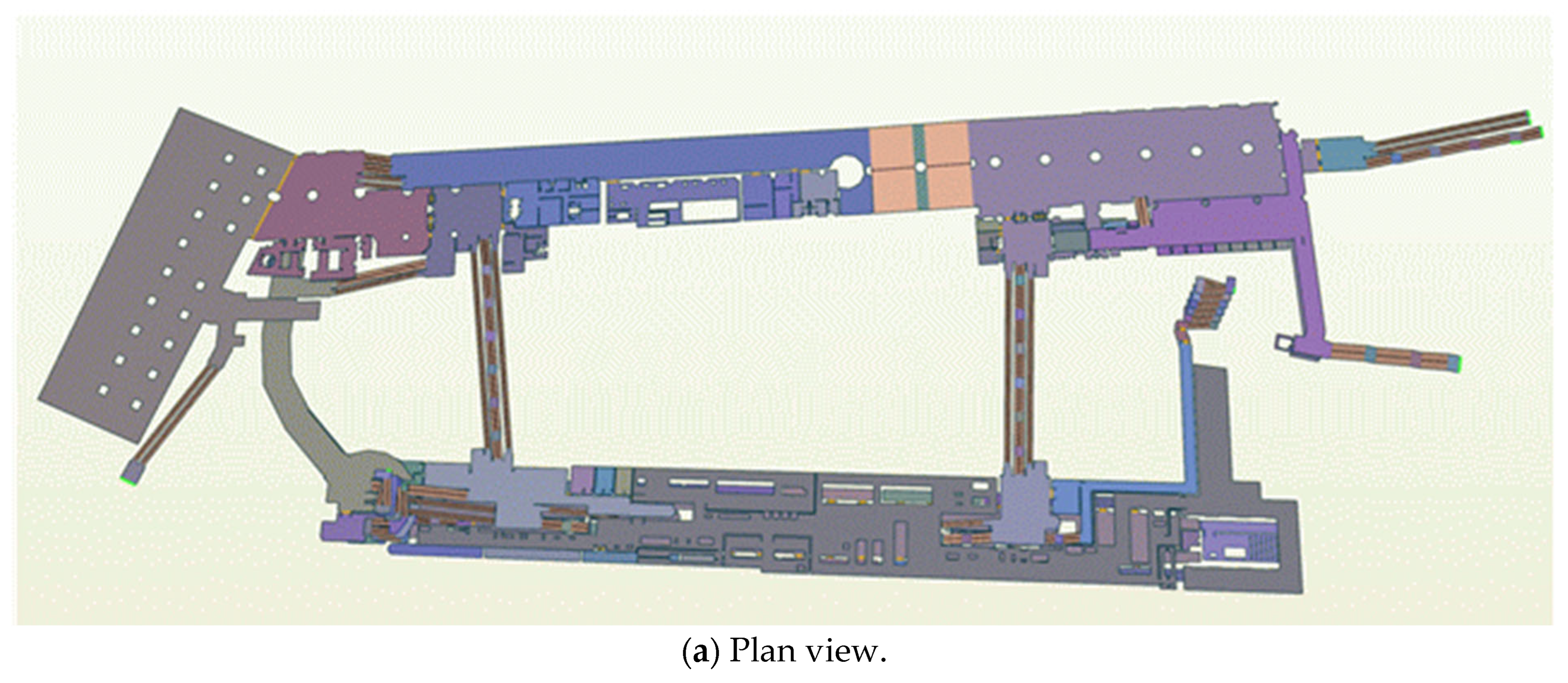
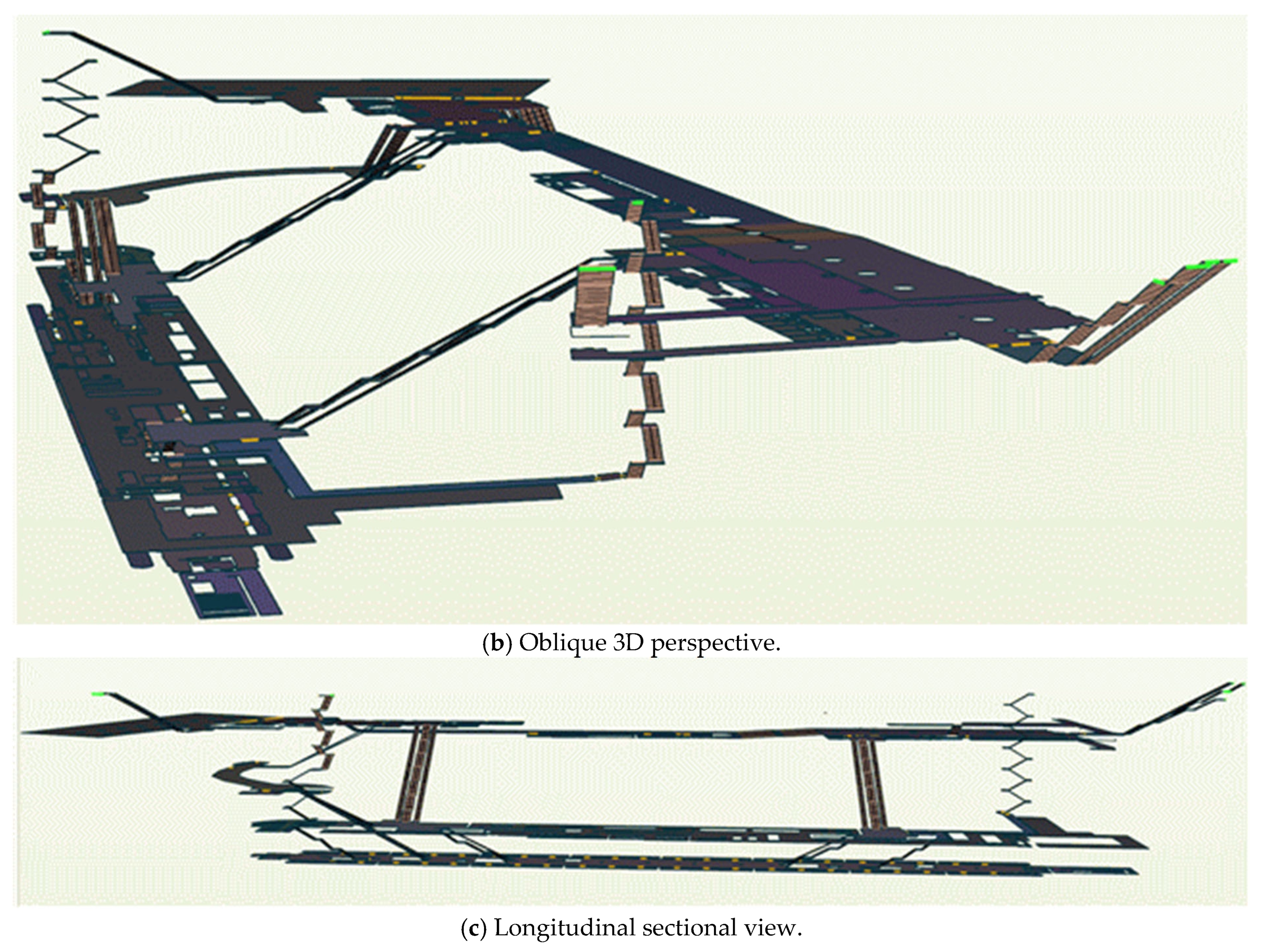
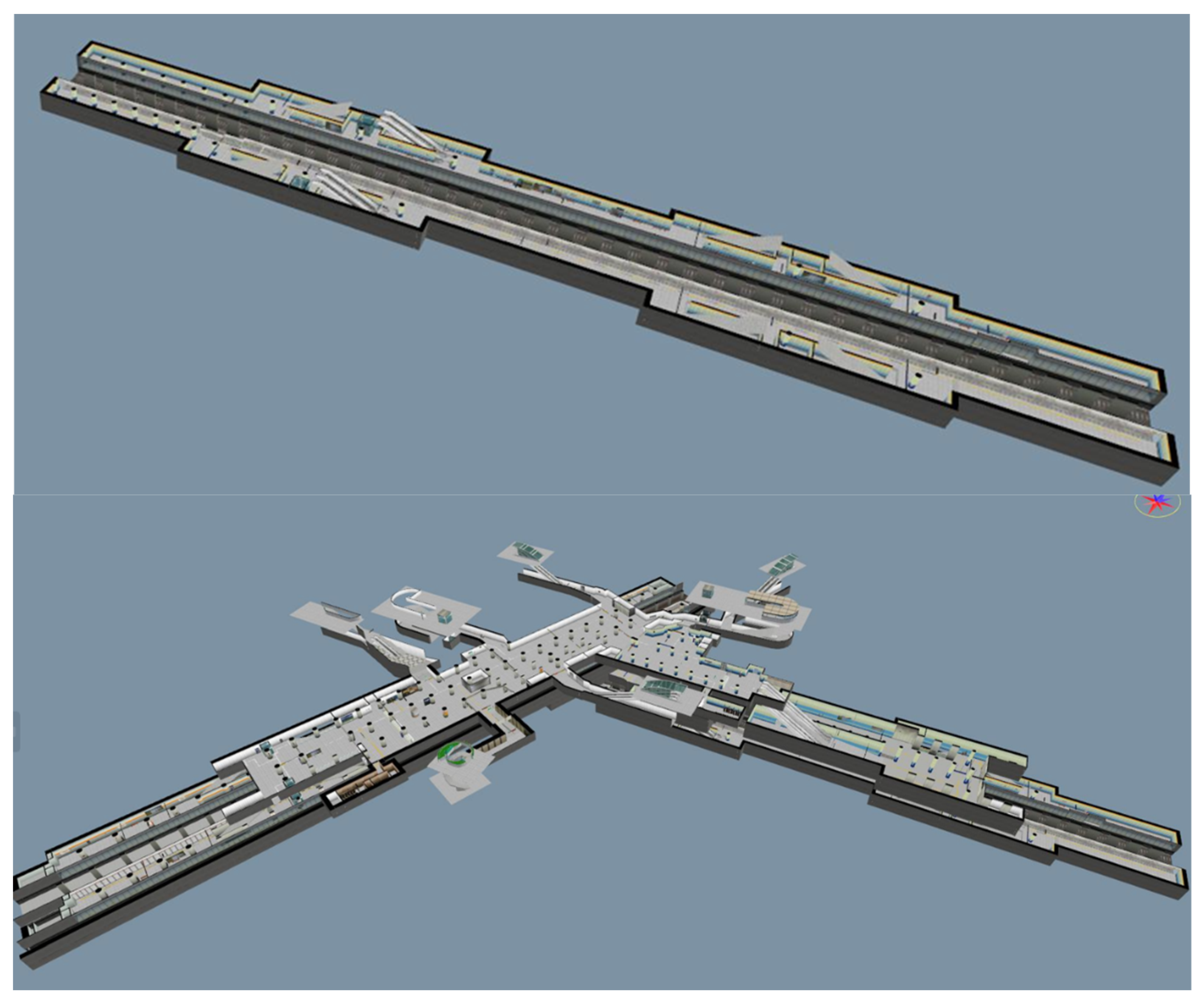
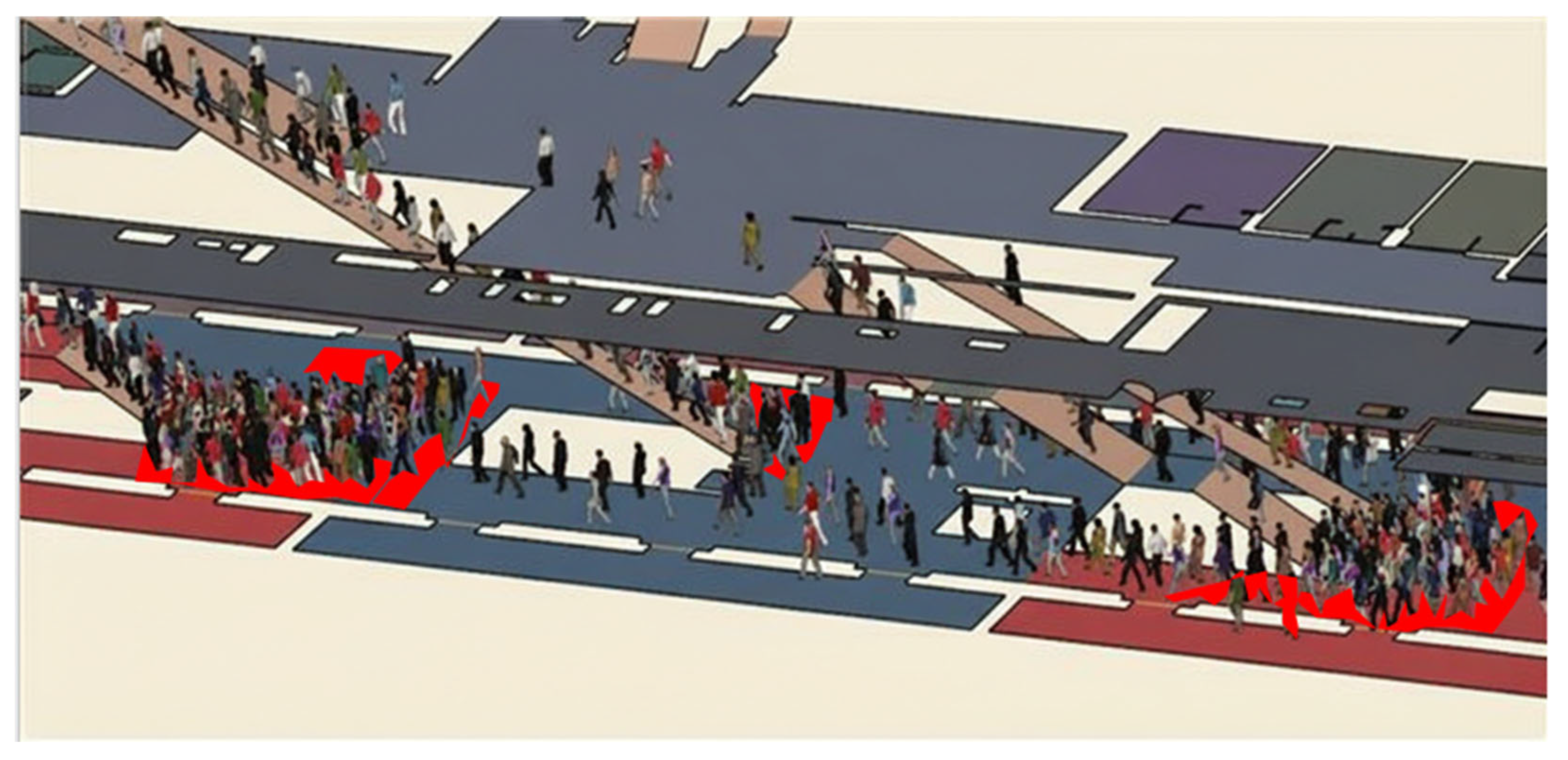
- Scenario Development and Simulation Modeling: Ten evacuation scenarios are constructed to assess the effects of fire location, exit availability, vertical circulation constraints, fire shutter functionality, and evacuation guidance. The station is modeled in Pathfinder using the constructed topology, with geometry simplified only where necessary to preserve navigational behavior and flow characteristics.
- Performance-based Evaluation: Simulation outputs—including total evacuation time, platform clearance time, congestion hotspots, and route utilization—are compared against relevant standards. Differences across scenarios are analyzed to identify structural vulnerabilities and evaluate the effectiveness of evacuation guidance strategies.
3.1. Station Digital Twin Map Topology Construction
3.1.1. Spatial Node Definition
3.1.2. Link Construction and Connectivity Modeling
3.1.3. Digital Twin Map Topology Integration into Simulation
3.2. Evacuation Parameter Definition
3.2.1. Walking Speed Subsubsection
3.2.2. Body Size and Corridor Capacity
3.2.3. Pre-Movement Time
3.2.4. Evacuation Population and Demographic Composition
3.3. Platform Evacuation Criteria
3.3.1. Platform Evacuation Standards
3.3.2. Peak-Hour Boarding and Alighting Volume
3.3.3. Evacuation Population Calculation
- (1)
- Platform Fire Scenario
- ▪
- Peak 1 h passengers: 2153 persons;
- ▪
- Peak 15 min demand (30% of peak hour): 646 persons;
- ▪
- Train capacity: 1268 persons (416 seated + 852 standing).
- ▪
- Platform fire: 646 persons;
- ▪
- Train fire: 646 + 1268 = 1914 persons (train passengers added).
- (2)
- Train Fire Scenario
- (3)
- Concourse and Non-Platform Areas
- ▪
- Adults (male/female): 40%/40%;
- ▪
- Elderly (male/female): 10%/10%.
3.4. Evacuation Scenario Configuration and Modeling
- (1)
- Scenario Framework Overview
- (i)
- Baseline conditions with full circulation availability;
- (ii)
- Vertical circulation degradation;
- (iii)
- Fire-induced route restrictions;
- (iv)
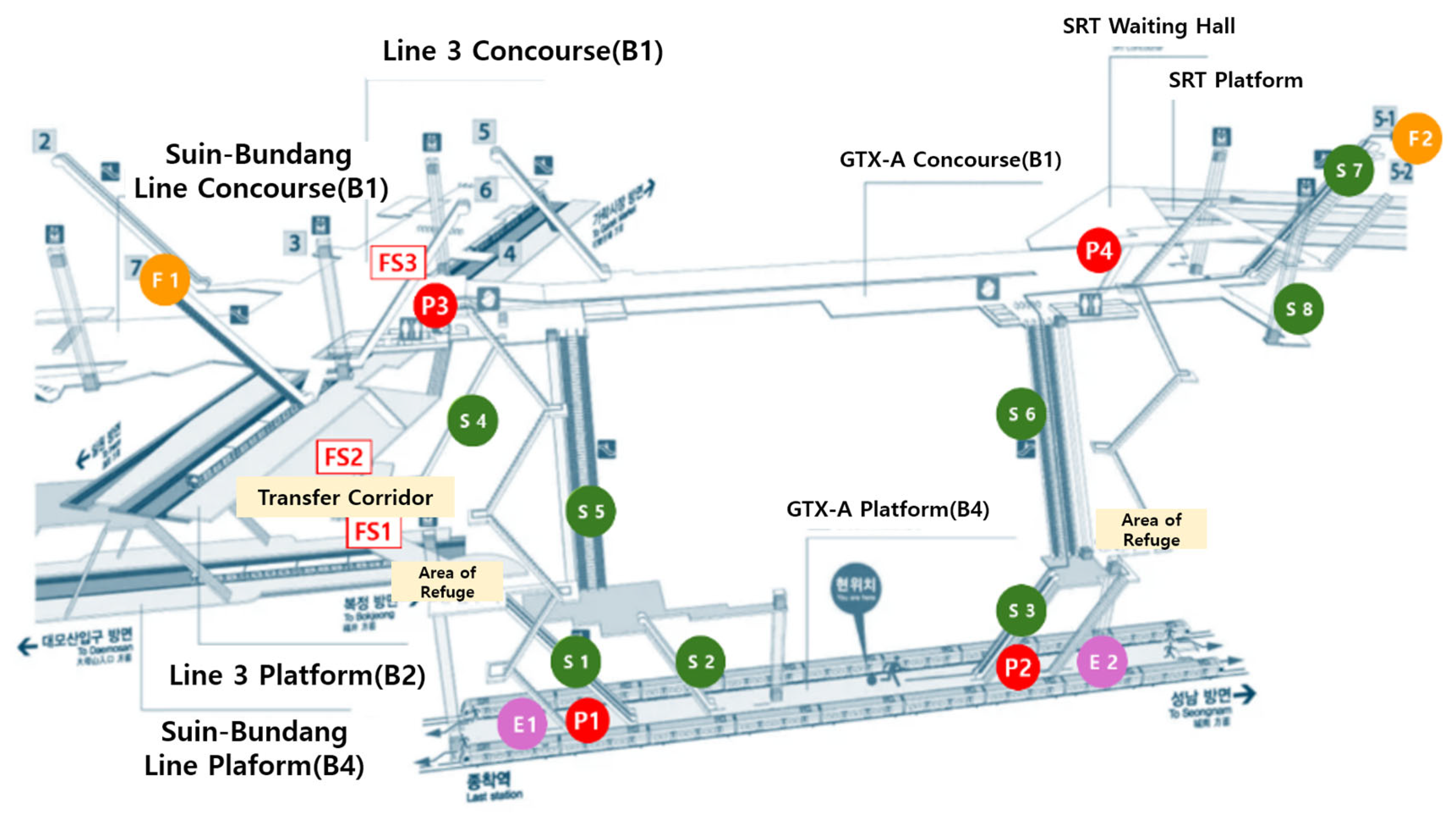
- Variations in passenger load (Figure 1).
- (2)
- Scenario Parameter Definitions
- (3)
- Functional Role of the Scenario Framework
Modeling of the Analysis Domain
3.5. Evacuation Simulation Results
3.5.1. Evaluation Framework for Evacuation Performance
3.5.2. Total Evacuation Time
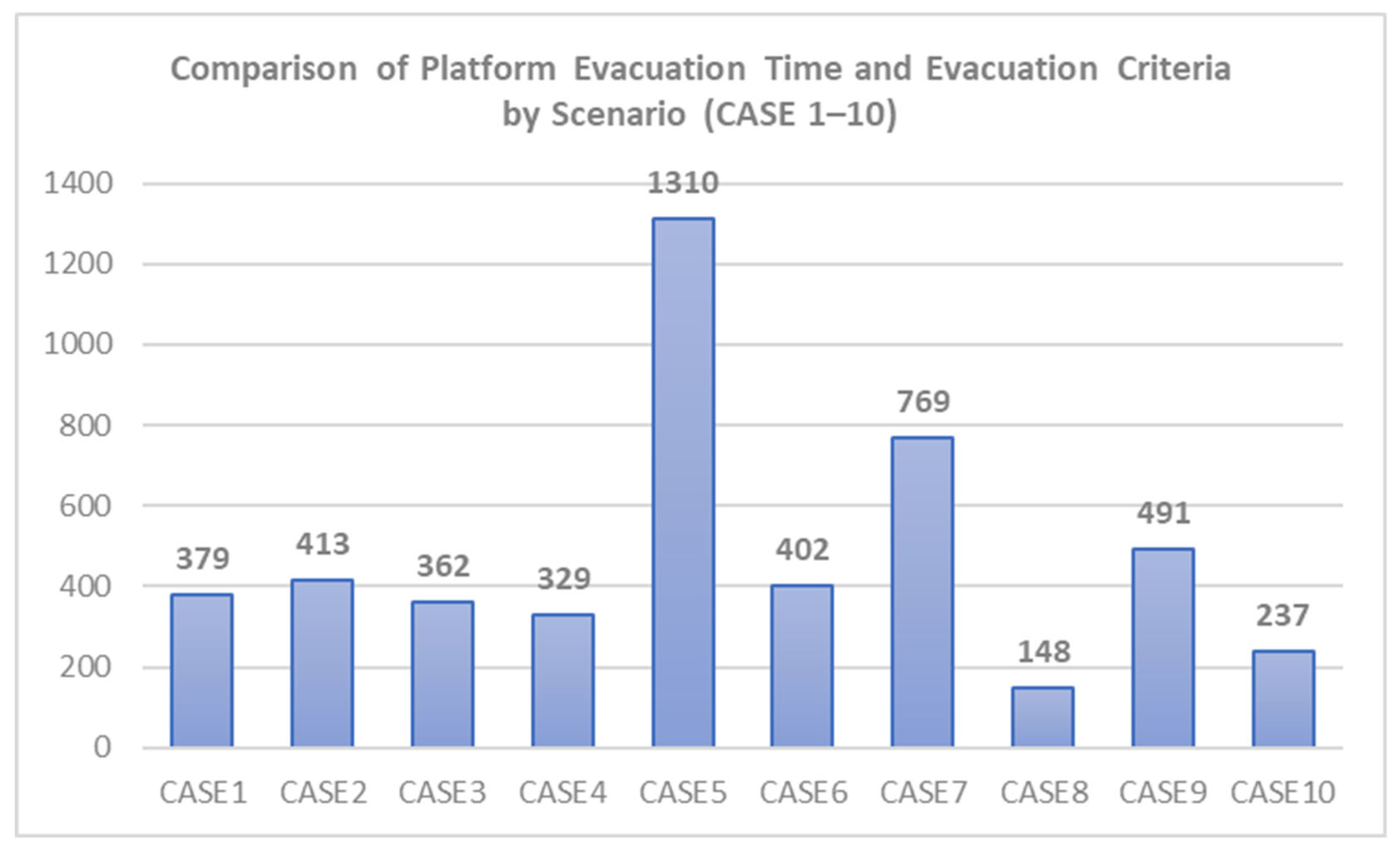
3.5.3. Platform Evacuation Time and Conformance to Standards
3.5.4. Impact of Fire Location and Exit Blockages
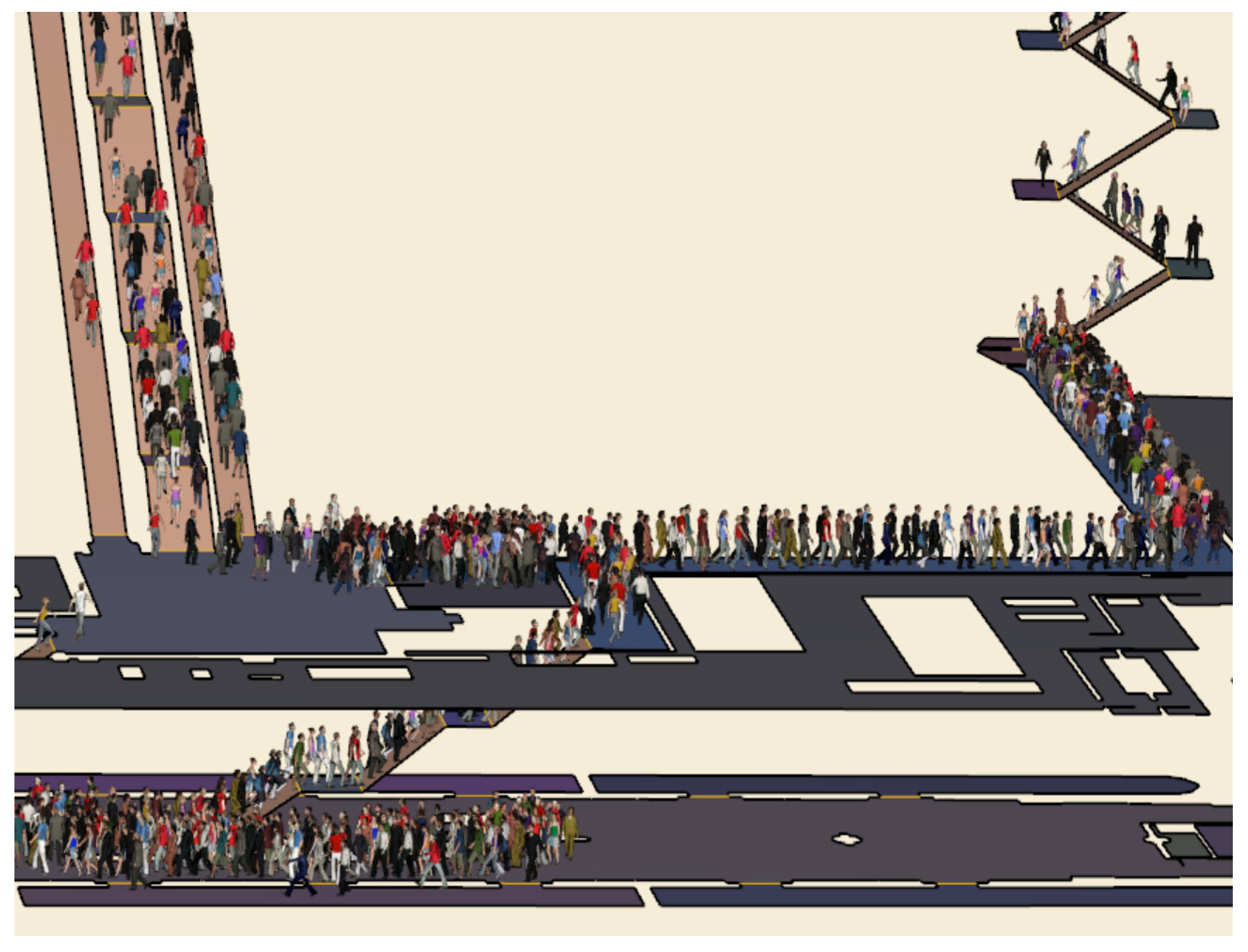
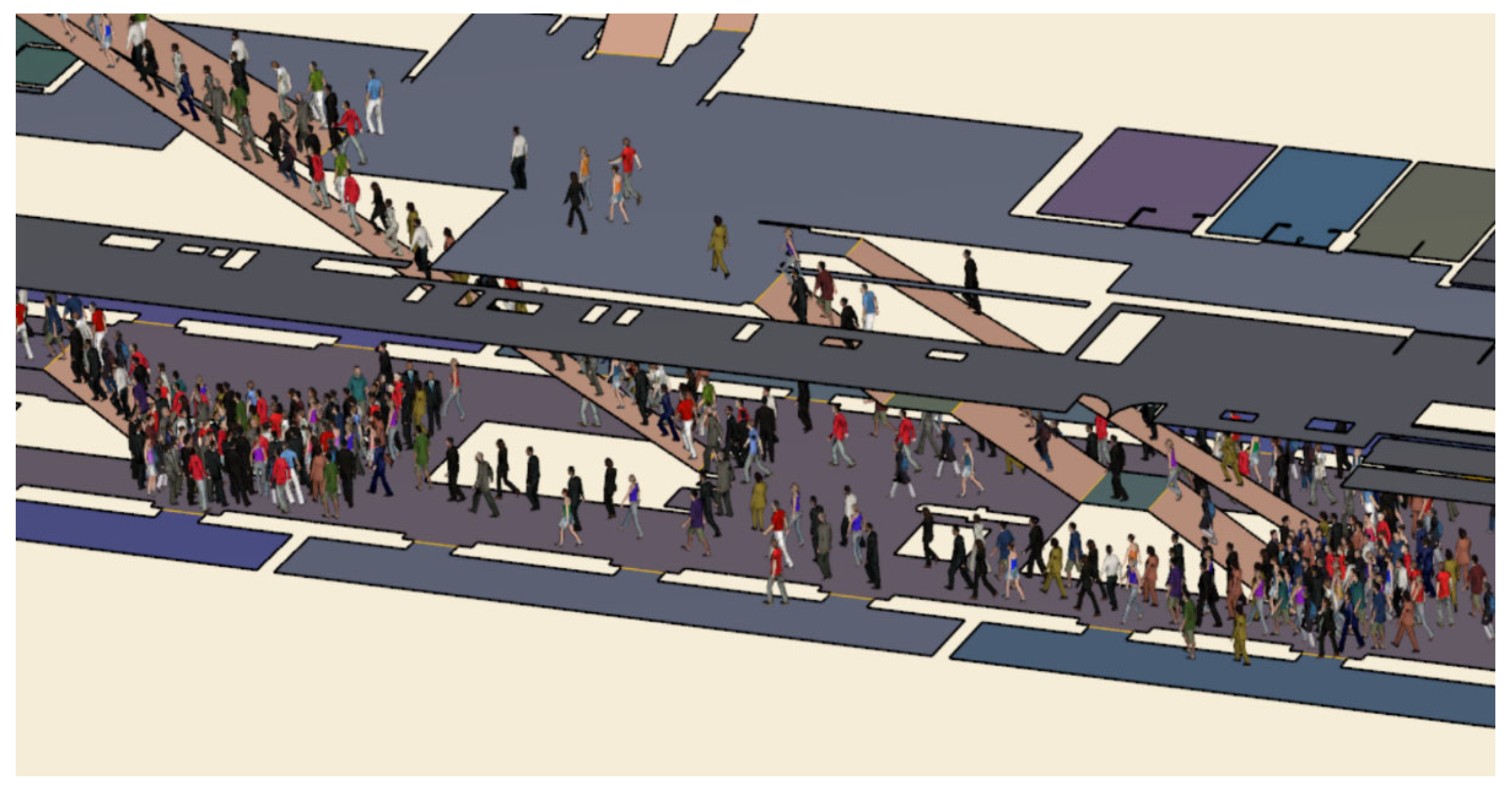
- Platform fire scenarios (P1): Produced substantial vertical congestion, especially when the nearest emergency stair (E1 or E2) was blocked.
- Train fire scenarios (P2): Increased platform-to-concourse travel times due to early-stage crowding near PSD lines.
- Concourse fire scenarios (P3): Forced rerouting toward more distant exits (F1–F3), extending travel distance and increasing conflict flow.
- Blocked final exits (F1–F3): Increased reliance on vertical circulation, adding critical load to emergency stairs and causing localized queuing.
3.5.5. Scenarios Without Onboard Passengers (CASE 8–9)
3.5.6. Summary of Key Findings
4. Digital Twin-Based Implementation Framework for Evacuation Safety in DUR Stations
4.1. Digital Twin-Based Implementation Framework for DUR Stations
4.2. Multi-Layer Spatial Topology Construction
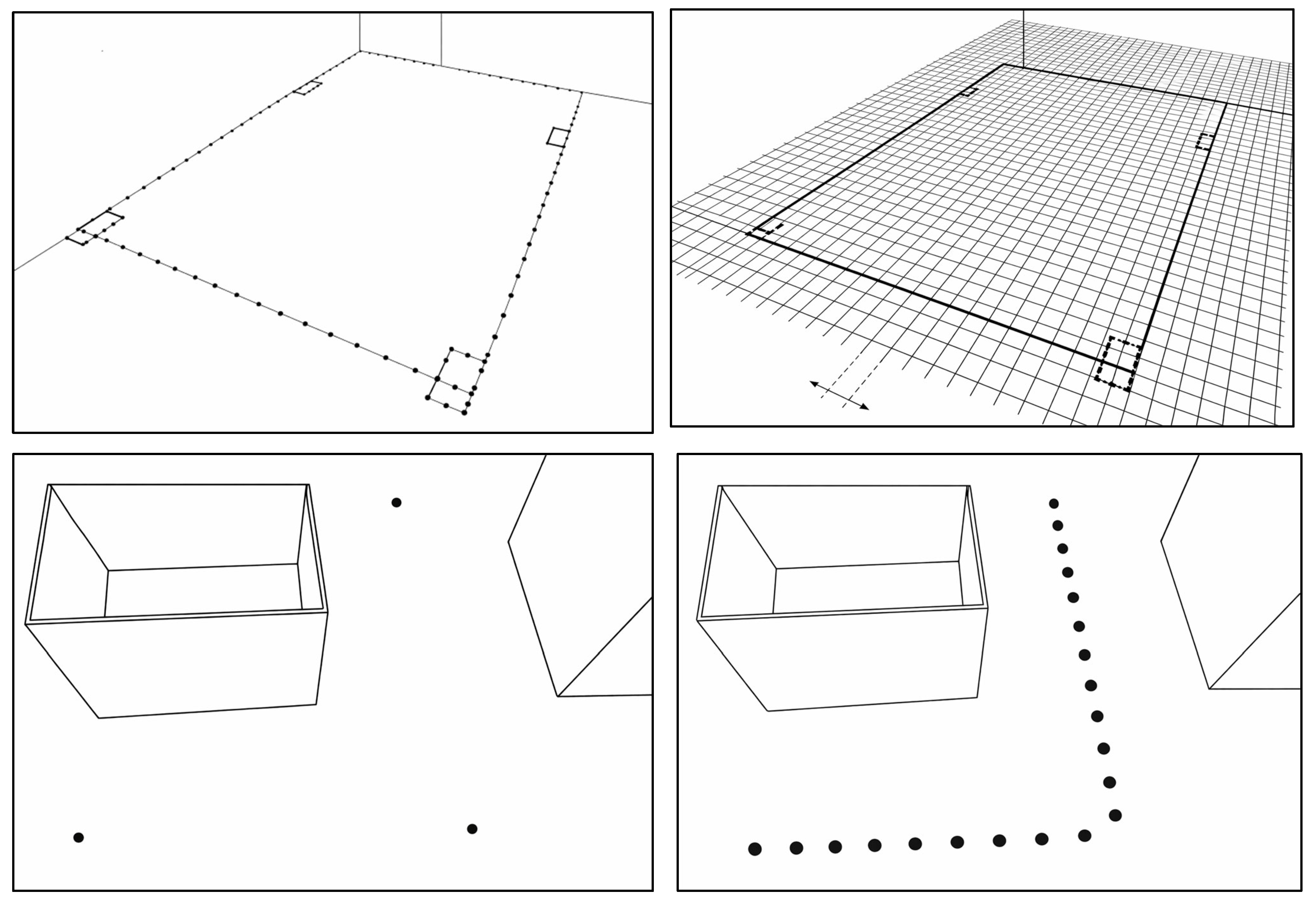
4.2.1. Spatial Parsing and Navigable Area Extraction
- A.
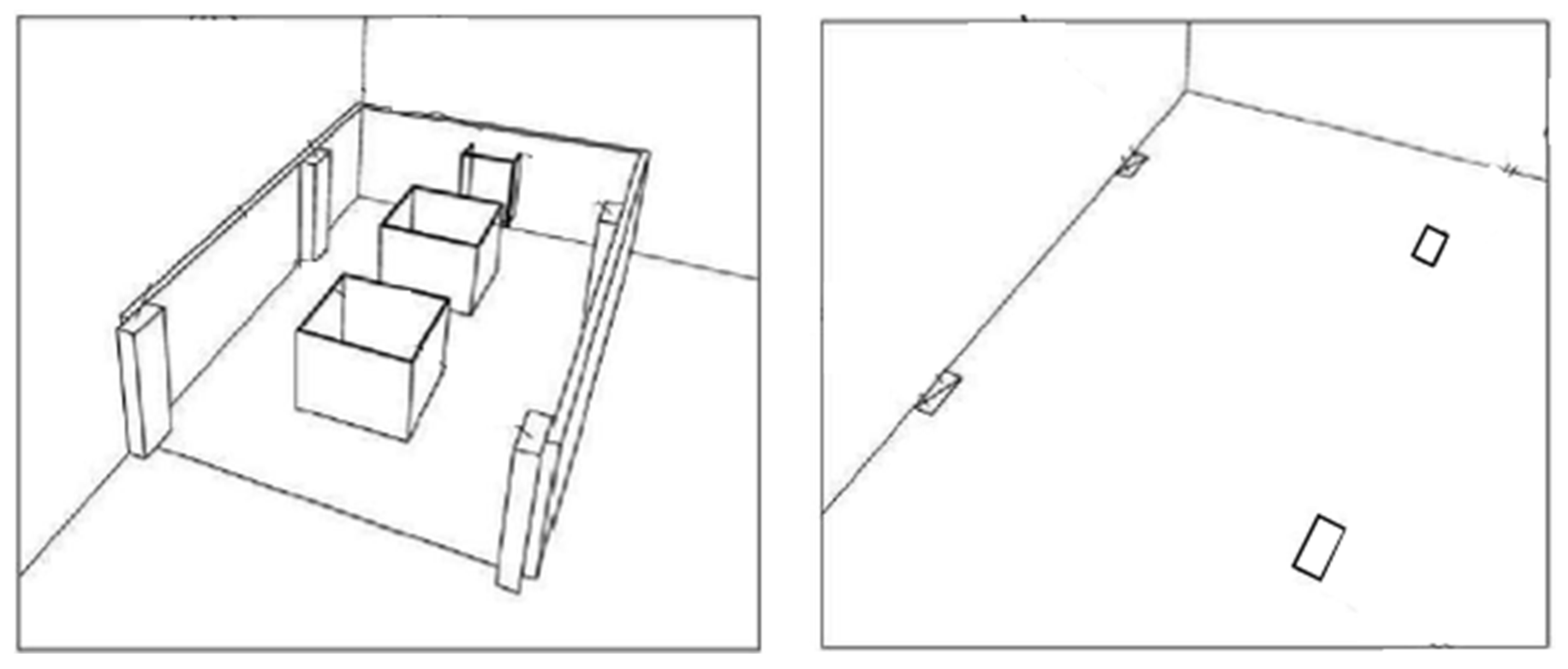
- Separation of structural obstacles (walls, columns, mechanical equipment rooms);
- B.
- Automated extraction of walkable regions using polygon decomposition;
- C.
- Semantic zoning and categorizing areas into platform zones, concourse zones, interconnecting passages, stair and escalator zones, refuge areas, and final exit pathways.
4.2.2. Region Decomposition and Node Generation Subsubsection
- ▪
- Platform nodes representing PSD-adjacent walking regions;
- ▪
- Vertical circulation nodes representing E1–E2 stairs and S1–S8 escalators;
- ▪
- Transition nodes linking platform, concourse, and exit levels;
- ▪
- Hazard control nodes marking shutter zones or smoke compartment boundaries.
4.2.3. Link Formation and Connectivity Encoding
- ▪
- Representation of bidirectional vs. unidirectional movement (e.g., escalators);
- ▪
- Capacity encoding based on effective width, derived from Korean anthropometric measurements;
- ▪
- Automatic blocking or cost augmentation of links during hazard propagation;
- ▪
- Explicit modeling of vertical link constraints (stair inclination, escalator status).
4.2.4. Multi-Level Graph Integration
4.2.5. Dynamic Edge Weighting Under Hazard Conditions
4.2.6. Validation Against Physical Station Conditions
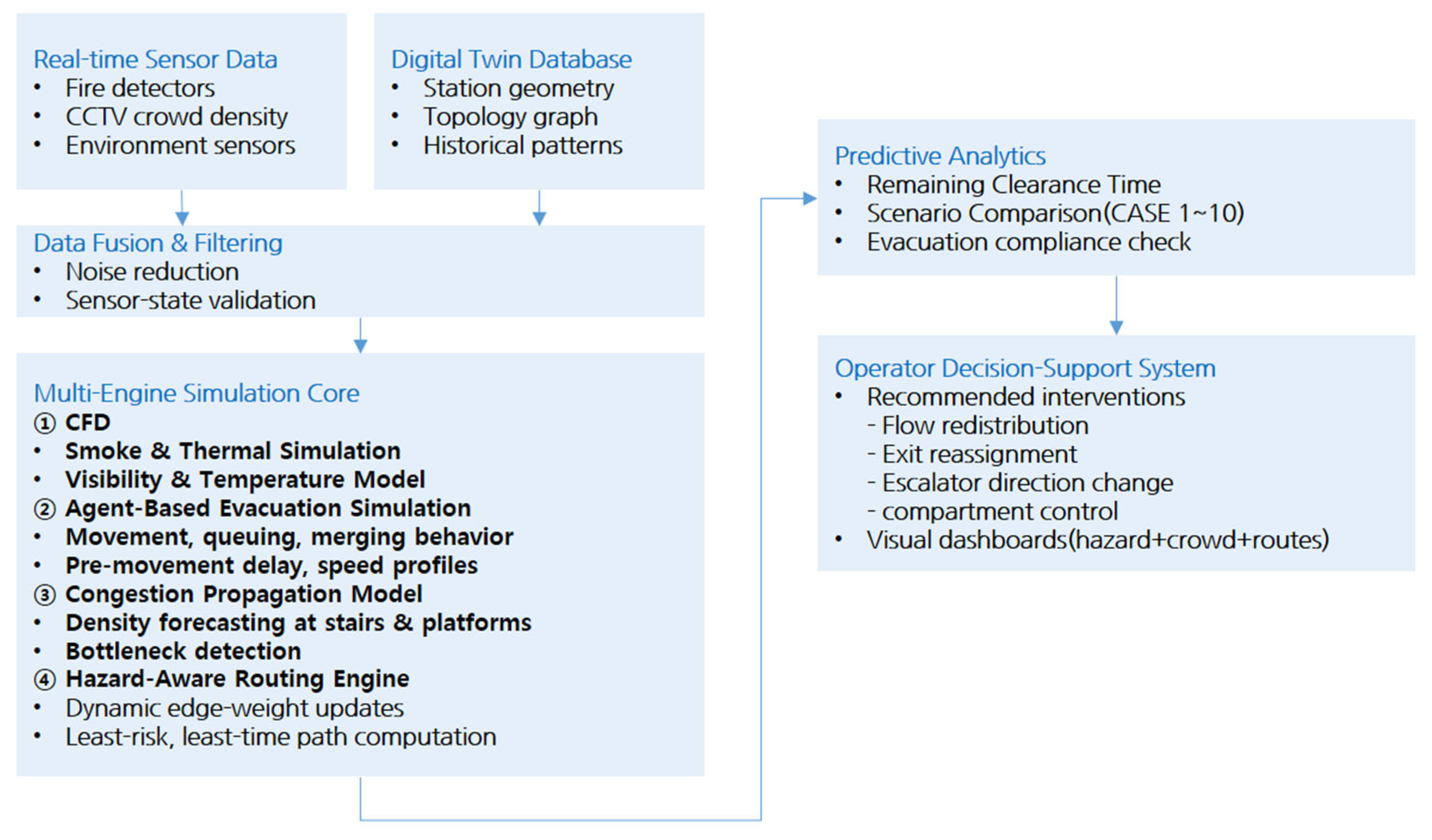
4.3. Integrated Digital Twin Simulation and Operational Framework (Revised and Enhanced Version)
4.3.1. Predictive Multi-Engine Simulation Architecture
4.3.2. Hazard-Aware Dynamic Routing Mechanism
4.3.3. Predictive Clearance Time Evaluation
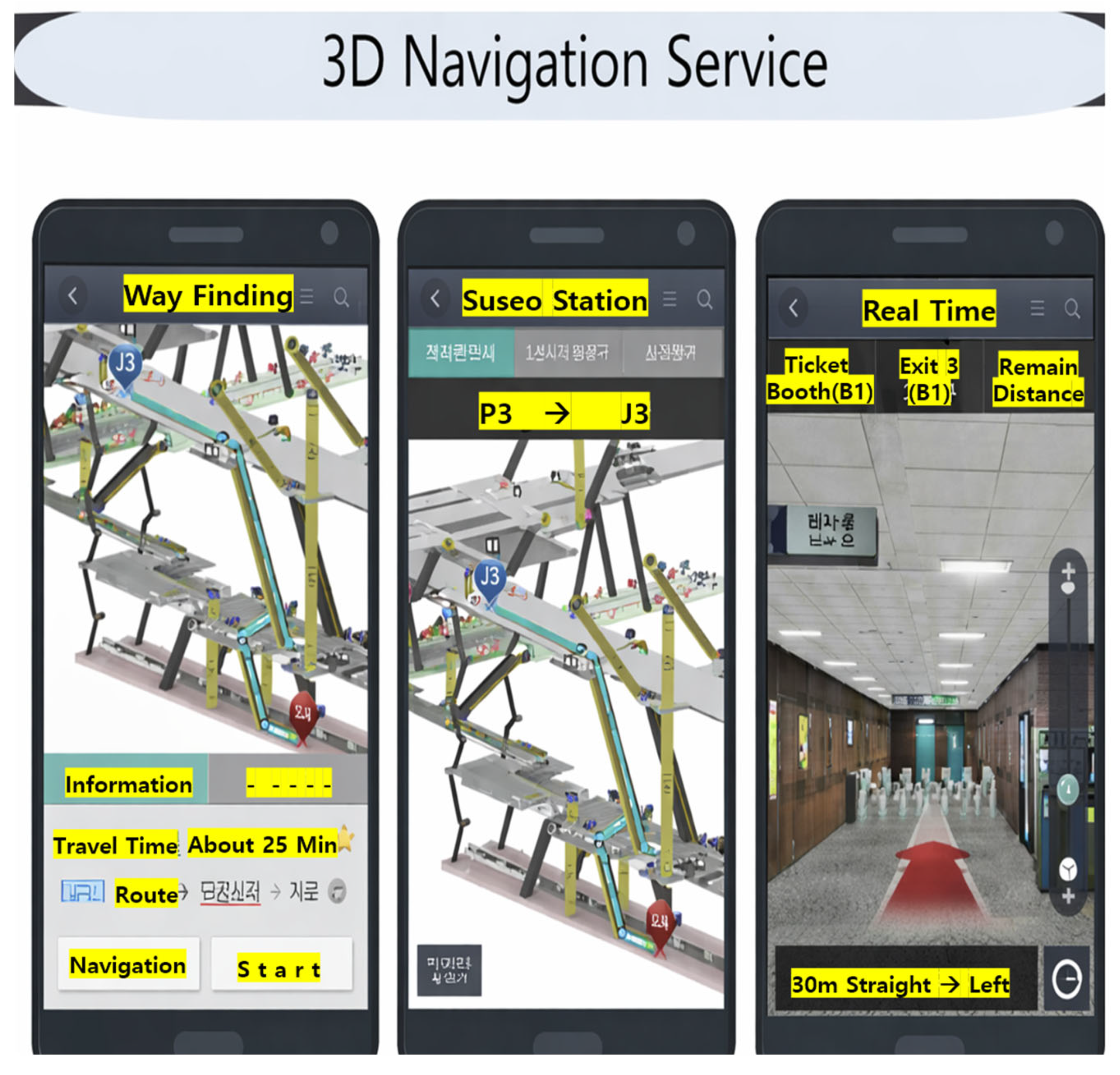
4.4. Real-Time Digital Twin Updating and Predictive Evacuation
4.5. Discussion
5. Conclusions
Author Contributions
Funding
Institutional Review Board Statement
Informed Consent Statement
Data Availability Statement
Conflicts of Interest
References
- Wu, D.; Zheng, A.; Yu, W.; Cao, H.; Ling, Q.; Liu, J.; Zhou, D. Digital Twin Technology in Transportation Infrastructure: A Comprehensive Survey of Current Applications, Challenges, and Future Directions. Appl. Sci. 2025, 15, 1911. [Google Scholar] [CrossRef]
- Zhao, Y.; Liu, Y.; Mu, E. A Review of Intelligent Subway Tunnels Based on Digital Twin Technology. Buildings 2024, 14, 2452. [Google Scholar] [CrossRef]
- Vieira, J.; Poças Martins, J.; Marques de Almeida, N.; Patrício, H.; Gomes Morgado, J. Towards Resilient and Sustainable Rail and Road Networks: A Systematic Literature Review on Digital Twins. Sustainability 2022, 14, 7060. [Google Scholar] [CrossRef]
- Jeschke, S.; Grassmann, R. Development of a Generic Implementation Strategy of Digital Twins in Logistics Systems under Consideration of the German Rail Transport. Appl. Sci. 2021, 11, 10289. [Google Scholar] [CrossRef]
- Lu, Q.; Xie, X.; Heaton, J.; Parlikad, A.K.; Schooling, J. From BIM to Digital Twin: An Integrated Framework for Information Management in the Built Environment. Autom. Constr. 2020, 114, 103179. [Google Scholar] [CrossRef]
- Boschert, S.; Rosen, R. Digital Twin—The Simulation Aspect. In Mechatronic Futures; Hehenberger, P., Bradley, D., Eds.; Springer: Cham, Switzerland, 2016; pp. 59–74. [Google Scholar] [CrossRef]
- Jiang, F.; Ma, L.; Broyd, T.; Chen, W.; Luo, H. Building Digital Twins of Existing Highways Using Map Data Based on Engineering Expertise. Autom. Constr. 2022, 134, 104081. [Google Scholar] [CrossRef]
- Guo, P.; Tian, W.; Chai, Q.; Zhu, J. Graph-Theoretic Optimization Strategy for Subway Station Evacuation Assistance System. J. Build. Eng. 2025, 86, 109410. [Google Scholar] [CrossRef]
- Chen, J.; Zhang, J.; Li, J.; Song, W. Dynamic path planning for indoor evacuation based on visibility graph and improved A* algorithm. Build. Environ. 2016, 102, 73–82. [Google Scholar] [CrossRef]
- Tao, F.; Zhang, M.; Nee, A.Y.C. Digital Twin Driven Smart Manufacturing; Academic Press: Cambridge, MA, USA, 2019. [Google Scholar]
- Turner, A. Depthmap: A Program to Perform Visibility Graph Analysis. In Proceedings of the 3rd International Symposium on Space Syntax; Georgia Institute of Technology: Atlanta, GA, USA, 2001; pp. 31.1–31.9. [Google Scholar]
- Chen, L.; Pan, X.; Dauber, V. A Topological Representation for Real-Time Indoor Evacuation Routing. Saf. Sci. 2018, 110, 144–156. [Google Scholar] [CrossRef]
- Hui, Y.; Su, S.; Peng, H. Evaluation of Subway Emergency Evacuation Based on Combined Theoretical and Simulation Methods. Appl. Sci. 2024, 14, 11580. [Google Scholar] [CrossRef]
- Yoo, Y.H.; Yoon, C.H.; Yoon, S.W.; Kim, J. A Study on Walking Speed for Evacuation Safety Design; Korea Institute of Construction Technology (KICT): Goyang, Republic of Korea, 2009. [Google Scholar]
- Kuligowski, E.D.; Peacock, R.D.; Hoskins, B.L. A Review of Building Evacuation Models; NIST Technical Note 1680; National Institute of Standards and Technology: Gaithersburg, MD, USA, 2010. [Google Scholar]
- Qin, J.; Liu, C.; Huang, Q. Simulation on Fire Emergency Evacuation in Special Subway Station Based on Pathfinder. Tunn. Undergr. Space Technol. 2020, 98, 103313. [Google Scholar] [CrossRef]
- SFPE. SFPE Handbook of Fire Protection Engineering, 5th ed.; Hurley, M.J., Gottuk, D., Hall, J.R., Harada, K., Kuligowski, E., Puchovsky, M., Torero, J., Watts, J.M., Wieczorek, C., Eds.; Springer: New York, NY, USA, 2016. [Google Scholar] [CrossRef]
- Thunderhead Engineering. Pathfinder—Technical Reference Manual; Thunderhead Engineering Consultants, Inc.: Manhattan, KS, USA, 2021. [Google Scholar]
- Qin, Y.; Chen, T.; Xu, X.; Sun, J. Simulation of emergency evacuation in a subway station based on Pathfinder. Procedia Eng. 2014, 71, 284–289. [Google Scholar] [CrossRef]
- Helbing, D.; Johansson, A. Social force model of pedestrian dynamics: Models, simulation, and applications. Transp. Sci. 2009, 43, 395–415. [Google Scholar] [CrossRef][Green Version]
- Gwynne, S.; Kuligowski, E. Modeling Human Behavior during Fire Evacuation. Fire Technol. 2017, 53, 191–210. [Google Scholar]
- Ji, J.; Gao, Z.; Fan, C.; Sun, J. Numerical investigation on smoke movement and visibility in a subway station fire. Build. Environ. 2012, 47, 149–156. [Google Scholar] [CrossRef]
- Kim, J.-H.; Hong, W.-H.; Jeon, G.-Y. Lessons learned from the Daegu subway fire accident in Korea. Build. Environ. 2004, 39, 1059–1066. [Google Scholar] [CrossRef]
- National Fire Protection Association (NFPA). NFPA 130: Standard for Fixed Guideway Transit and Passenger Rail Systems; NFPA: Quincy, MA, USA, 2023. [Google Scholar]
- Beard, A.; Carvel, R. The Handbook of Tunnel Fire Safety, 2nd ed.; ICE Publishing: London, UK, 2012. [Google Scholar]
- Ministry of Land, Infrastructure and Transport (MOLIT). Guidelines for Performance-Based Fire Safety Design; MOLIT: Sejong, Republic of Korea, 2021.
- Korean Agency for Technology and Standards (KATS). The 8th Size Korea Anthropometric Survey (2020–2023); KATS: Seoul, Republic of Korea, 2023.
- Korea Rail Network Authority (KR). KRCODE: Railway Station Fire Safety and Evacuation Design Standards; Korea Rail Network Authority: Daejeon, Republic of Korea, 2021. [Google Scholar]
- Seoul Metropolitan Rapid Transit Construction Headquarters. Design Guidelines for Urban Railway Stations and Transfer Safety; Seoul Metropolitan Government: Seoul, Republic of Korea, 2018.
- National Fire Agency (NFA). Performance-Based Design Evaluation Standard Guideline for Fire Protection Systems; NFA: Seoul, Republic of Korea, 2023.






| Category | Sex | Children (2–10 Years) | Adolescents (10–20 Years) | Adults (20–60 Years) | Elderly (≥60 Years) | Persons with Disabilities |
|---|---|---|---|---|---|---|
| Average Walking Speed | Male | 1.0 m/s | 1.3 m/s | 1.2 m/s | 0.7 m/s | 0.5 m/s |
| Female | 1.0 m/s | 1.3 m/s | 1.1 m/s | 0.97 m/s |
| Category | Male | Female | ||||
|---|---|---|---|---|---|---|
| Mean | SD | Max | Mean | SD | Max | |
| Shoulder Breadth (mm) | 297.43 | 18.89 | 494 | 352.95 | 16.14 | 414 |
| Use | W1 (min) | W2 (min) | W3 (min) |
|---|---|---|---|
| Offices, commercial & industrial buildings, schools, universities (Occupants are familiar with the building interior, alarm, and exits, and are awake) | <1 | 3 | >4 |
| Shops, museums, leisure sports centers, and cultural facilities (Occupants are awake but unfamiliar with the interior, alarm, or exits) | <2 | 3 | >6 |
| Dormitories, mid-/high-rise residential buildings (Occupants are familiar with the building interior, alarm, and exits; may be asleep) | <2 | 4 | >5 |
| Hotels, boarding facilities (Occupants are unfamiliar with the interior, alarm, and exits; may be asleep) | <2 | 4 | >6 |
| Hospitals, nursing homes, and public care facilities (Most occupants require assistance) | <3 | 5 | >8 |
| Category | Criterion | Evaluation Method | Evacuation Population | Assumption |
|---|---|---|---|---|
| NFPA 130 | ≤4 min | Evacuation time from platform | Peak 15 min platform demand + train capacity × 2 | – |
| ≤6 min | Time to reach a safe location from the most remote point of the platform | |||
| Hong Kong MTR | ≤4.5 min | Evacuation from platform to exit | – | – |
| NFPA 130 | ≤4 min | Evacuation time from platform | Peak 15 min platform demand + train capacity × 2 | Escalator failure |
| ≤6 min | Time to reach a safe location from the most remote point of the platform | |||
| Hong Kong MTR Seoul Metropolitan Subway Construction HQ | ≤4.5 min | Evacuation from platform to exit | Peak 15 min platform demand + train capacity × 2 | Escalator failure |
| ≤4 min | Evacuation to the 1st safety zone | |||
| Urban Railway Station & Transfer Design Guideline (MOLIT) | ≤6 min | Evacuation to the 2nd safety zone | Peak 15 min platform demand + train capacity × 2 | Escalator failure |
| ≤4 min | Evacuation from platform | |||
| KRCODE (Korea Rail Network Authority) | ≤4 min | Platform evacuation | Peak 15 min platform demand + train capacity × 2 | Escalator failure |
| ≤6 min | Time to reach a safe area outside smoke and toxic gases |
| Station | Date | Time | Passenger Count |
|---|---|---|---|
| Suseo | 28 November 2024 | 08:00–08:59 | 2153 persons |
| Scenario | Platform | Train | Concourse | Total |
|---|---|---|---|---|
| Platform Fire | 646 | – | 108 | 754 |
| Train Fire | 646 | 1268 | 108 | 2022 |
| Category | Adults (Male) | Adults (Female) | Elderly (Male) | Elderly (Female) |
|---|---|---|---|---|
| Proportion (%) | 40 | 40 | 10 | 10 |
| Platform | 258 | 258 | 65 | 65 |
| Train | 378 | 378 | 95 | 95 |
| Concourse | 43 | 43 | 11 | 11 |
| Category | Parameter | CASE 1 | CASE 2 | CASE 3 | CASE 4 | CASE 5 | CASE 6 | CASE 7 | CASE 8 | CASE 9 | CASE 10 |
|---|---|---|---|---|---|---|---|---|---|---|---|
| Fire Location | P1 (Platform) | Not applied | Not applied | Not applied | Train | Platform | Not applied | ||||
| P2 (Train) | Train | Platform | |||||||||
| P3 (Concourse) | Train | ||||||||||
| P4 (Corridor) | Train | ||||||||||
| Final Exit | F1 | Avail. | Avail. | Not avail. | Avail. | Avail. | Avail. | Avail. | Avail. | Avail. | Avail. |
| F2 | Avail. | Avail. | Not avail. | Avail. | Avail. | Avail. | Not avail. | Avail. | Avail. | Avail. | |
| Vertical Circulation | E1 (Special Stair) | Avail. | Avail. | Avail. | Not avail. | Avail. | Avail. | Avail. | Not avail. | Avail. | Avail. |
| E2 (Special Stair) | Avail. | Avail. | Avail. | Avail. | Not avail. | Avail. | Avail. | Avail. | Not avail. | Avail. | |
| S1 | Avail. | Partially | Not avail. | Not avail. | Partially | Partially | Partially | Not avail. | Partially | Avail. | |
| S2 | Avail. | Avail. | Not avail. | Avail. | Avail. | Avail. | Avail. | Avail. | Avail. | Avail. | |
| S3 | Avail. | Avail. | Not avail. | Avail. | Not avai | Avail. | Avail. | Avail. | Not avail. | Avail. | |
| S4 | Avail. | Partially | Not avail. | Partially | Partially | Partially | Partially | Partially | Partially | Avail. | |
| S5 | Avail. | Partially | Not avail. | Partially | Partially | Partially | Partially | Partially | Partially | Avail. | |
| S6 | Avail. | Partially | Not avail. | Partially | Partially | Partially | Partially | Partially | Partially | Avail. | |
| S7 | Avail. | Partially | Not avail. | Partially | Partially | Partially | Partially | Partially | Partially | Avail. | |
| S8 | Avail. | Avail. | Not avail. | Avail. | Avail. | Availa | Availa | Availa | Avail. | Avail. | |
| Fire Shutters | FS1 | Not op. | Not op. | Not op. | Not op. | Not op. | Operational | Not op. | Not op. | Not op. | Not op. |
| FS2 | Not op. | Not op. | Not op. | Not op. | Not op. | Not op. | Not op. | Not op. | Not op. | Not op. | |
| FS3 | Not op. | Not op. | Not op. | Not op. | Not op. | Not op. | Not op. | Not op. | Not op. | Not op. | |
| Evacuation Population | Platform | 646 | 646 | 646 | 646 | 646 | 646 | 646 | 646 | 646 | 646 |
| Train | 945 | 945 | 945 | 945 | 945 | 945 | 945 | – | – | 945 | |
| Concourse | 108 | 108 | - | 108 | 108 | 108 | 108 | 108 | 108 | 108 |
| Metric | Description | Evaluation Criterion | Reference |
|---|---|---|---|
| Total evacuation time | Time for all occupants to reach outdoor safe areas | Informative (scenario comparison) | This study |
| Platform evacuation time | Time to clear all occupants from platform level | ≤4 min (240 s) | NFPA 130 [24] |
| Time to place of safety | Time to reach smoke-free relative safety area | ≤6 min | NFPA 130 [24] |
| Vertical circulation congestion | Density and queuing at stairs/escalators | Qualitative/comparative | This study |
| Bottleneck persistence | Duration of high-density conditions at critical nodes | Qualitative | This study |
| Category | CASE 1 | CASE 2 | CASE 3 | CASE 4 | CASE 5 | CASE 6 | CASE 7 | CASE 8 | CASE 9 | CASE 10 | |
|---|---|---|---|---|---|---|---|---|---|---|---|
| Evacuation Population (Persons) | Platform | 646 | 646 | 646 | 646 | 646 | 646 | 646 | 646 | 646 | 646 |
| On-board train | 945 | 945 | 945 | 945 | 945 | 945 | 945 | - | - | 945 | |
| Concourse | 108 | 108 | 108 | 108 | 108 | 108 | 108 | 108 | 108 | 108 | |
| Total | 1699 | 1699 | 1591 | 1699 | 1699 | 1699 | 1699 | 754 | 754 | 1699 | |
| Final Eva.time | 1232 | 1202 | 1298 | 1231 | 1806 | 1229 | 1303 | 677 | 928 | 769 | |
| Evacuation Time Result(s) | Platform | 379 | 413 | 362 | 329 | 1310 | 402 | 769 | 148 | 491 | 237 |
| Refuge Area 1 | 685 | 619 | 750 | 774 | 1108 | 668 | 645 | 409 | 355 | 249 | |
| Refuge Area 2 | 281 | 602 | 997 | 261 | 5 | 577 | 989 | 154 | 7 | 145 | |
| F1 | 400 | 387 | - | 683 | 927 | - | 521 | 234 | 234 | 557 | |
| F2 | 351 | 786 | - | 410 | 153 | 781 | - | 153 | 153 | 550 | |
| E1 | 1232 | 1202 | 1298 | 982 | 1806 | 1229 | 1212 | 625 | 928 | 769 | |
| E2 | 1097 | 887 | 1283 | 1231 | 141 | 895 | 1303 | 677 | 141 | 562 | |
Disclaimer/Publisher’s Note: The statements, opinions and data contained in all publications are solely those of the individual author(s) and contributor(s) and not of MDPI and/or the editor(s). MDPI and/or the editor(s) disclaim responsibility for any injury to people or property resulting from any ideas, methods, instructions or products referred to in the content. |
© 2026 by the authors. Licensee MDPI, Basel, Switzerland. This article is an open access article distributed under the terms and conditions of the Creative Commons Attribution (CC BY) license.
Share and Cite
Yoon, J.; Song, D.; Park, M. Evacuation Safety Evaluation for Deep Underground Railways Using Digital Twin Map Topology. Buildings 2026, 16, 1033. https://doi.org/10.3390/buildings16051033
Yoon J, Song D, Park M. Evacuation Safety Evaluation for Deep Underground Railways Using Digital Twin Map Topology. Buildings. 2026; 16(5):1033. https://doi.org/10.3390/buildings16051033
Chicago/Turabian StyleYoon, Jaemin, Dongwoo Song, and Minkyu Park. 2026. "Evacuation Safety Evaluation for Deep Underground Railways Using Digital Twin Map Topology" Buildings 16, no. 5: 1033. https://doi.org/10.3390/buildings16051033
APA StyleYoon, J., Song, D., & Park, M. (2026). Evacuation Safety Evaluation for Deep Underground Railways Using Digital Twin Map Topology. Buildings, 16(5), 1033. https://doi.org/10.3390/buildings16051033