Article

Evacuation Safety Evaluation for Deep Underground Railways Using Digital Twin Map Topology

1
Pluxity Co., Ltd., Anyang-si 14056, Republic of Korea
2
Department of Fire Safety, Halla University, Wonju-si 26404, Republic of Korea
3
Department of Railway Operation Systems, Halla University, Wonju-si 26404, Republic of Korea
*
Author to whom correspondence should be addressed.
Buildings 2026, 16(5), 1033; https://doi.org/10.3390/buildings16051033
Submission received: 6 January 2026 / Revised: 10 February 2026 / Accepted: 17 February 2026 / Published: 5 March 2026
(This article belongs to the Section Construction Management, and Computers & Digitization)

Abstract

DUR (Deep Underground Railways) stations, such as Suseo Station in Korea, present unique evacuation challenges stemming from multi-level spatial depth, long vertical circulation paths, and rapid smoke spread dynamics. Conventional design guidelines often fail to capture these complexities, underscoring the need for advanced, simulation-driven safety evaluation frameworks. This study proposes a comprehensive Digital Twin-based methodology that integrates spatial topology modeling, agent-based evacuation simulation, and dynamic hazard-aware routing. A multi-layer map topology was constructed from high-fidelity architectural geometry, decomposing the station into functional regions and encoding connectivity across platforms, concourses, corridors, and vertical circulation elements. Real-time hazard conditions were reflected through dynamic adjustments to edge weights, allowing evacuation paths to adapt to blocked exits, fire shutter operations, and smoke-infiltrated domains. Ten evacuation scenarios were developed to assess sensitivity to fire origin, exit availability, vertical circulation failures, and onboard passenger loads. Simulation results reveal that evacuation performance is primarily constrained by vertical circulation bottlenecks, with emergency stairways (E1 and E2) serving as critical choke points under high-density conditions. Cases involving exit closures or fire-compartment failures produced significant delays, frequently exceeding NFPA 130 and KRCODE performance criteria. Conversely, guided evacuation strategies demonstrated marked improvements, reducing congestion and enabling compliance with platform evacuation thresholds even in full-load scenarios. These findings highlight the necessity of transitioning from static design evaluations toward Digital Twin-enabled, predictive safety management. The proposed framework enables real-time visualization, intervention testing, and operator decision support, offering a scalable foundation for next-generation evacuation planning in extreme-depth railway infrastructures.

1. Introduction

The concentration of populations in major metropolitan areas and the increasing densification of urban spaces have created structural limitations in expanding existing railway infrastructure. In particular, the surface and shallow underground zones have become extremely constrained due to the high density of urban utilities, including roads, underground pipelines, water and sewage systems, and telecommunication ducts. These spatial restrictions, combined with growing traffic congestion and prolonged construction periods, have significantly increased the social and economic costs associated with new surface-level railway development. To overcome these limitations, major cities in Korea have increasingly adopted the deep underground railway (DUR), typically constructed at depths of 40–50 m or more below ground level, as a strategic next-generation railway infrastructure solution. DUR systems minimize surface-space occupation while enabling high-speed, high-capacity urban and metropolitan transit, making them an effective means of addressing rapidly growing transportation demand. In particular, evacuation distances in DUR stations are typically 1.5–2.3 times longer than those of conventional subway stations, and the smoke spread in deeper environments can reduce the available safe egress time (ASET) by up to 40%, highlighting the unique safety challenges inherent to deep structures.
The Korean government, in the forthcoming 5th National Railway Network Master Plan, is expected to significantly expand metropolitan express railway systems—such as the GTX (Great Train Express) network—in the Seoul Capital Area, Busan, and Daegu. Representative examples include the GTX-A, -B, and -C lines and several deep-level extensions of the Seoul Metropolitan Subway. In particular, GTX-A operates at a maximum commercial speed of 180 km/h, serving as a major catalyst for redistributing passenger flows between Seoul and the surrounding metropolitan region. Consequently, the expansion of the DUR is not merely an increase in the number of railway lines, but a strategic effort aimed at restructuring urban space, enabling high-speed metropolitan transit, and integrating regional commuting zones. The step-by-step opening of the GTX-A line in 2024–2025 and the government’s strengthened safety guidelines for DUR stations have further emphasized the urgent need for advanced evacuation performance evaluations tailored to such high-speed DUR.
Despite the rapid expansion of the DUR, Korea remains highly sensitive—both socially and institutionally—to fire safety issues in subway systems due to the 2003 Daegu Subway Fire. The incident, which resulted in 192 fatalities and 151 injuries due to rapid smoke spread and failures in evacuation control within an underground station, is recognized as one of the worst subway fire disasters worldwide. This event profoundly raised public awareness of fire hazards in underground environments and triggered comprehensive reforms in relevant laws, facility design standards, fire detection systems, smoke control strategies, and evacuation management protocols. The Daegu disaster also underscored several critical lessons:
(1)
The heightened lethality of smoke propagation and toxic gas accumulation in deeper underground environments;
(2)
The catastrophic consequences of interrupted or unclear evacuation routes;
(3)
The need for performance-based evacuation design reflecting passenger behavior patterns;
(4)
The importance of advanced fire and smoke control technologies that incorporate underground environmental characteristics such as ventilation conditions, pressure differentials, and humidity.
These lessons highlight that traditional station design criteria—largely developed for shallow-depth subway environments—do not sufficiently address the complex thermal, geometric, and behavioral aspects of evacuation in deep underground infrastructures.
These historical experiences have prompted Korea to prioritize fire and evacuation safety as a fundamental consideration in planning and constructing DUR systems. In deep environments, evacuation distances are significantly longer, smoke extraction becomes more challenging, and thermal-pressure conditions within long tunnels become more complex. Such factors reveal the inherent limitations in applying traditional safety standards—originally designed for shallow underground stations—to substantially deeper railway infrastructures. Consequently, domestic research institutions and local governments have begun establishing scientific evaluation frameworks for DUR safety using performance-based design (PBD), computational fluid dynamics (CFD) fire modeling (e.g., FDS), agent-based evacuation simulations (e.g., Pathfinder), and Digital Twin-based real-time risk assessment systems. Among these, Digital Twin map topology provides a 3D geometric–topological representation of stations and tunnels, enabling the dynamic modeling of node connectivity, bottleneck formation, and flow–density interactions—capabilities not available in conventional evacuation evaluation methods.
However, the existing studies tend to focus on either construction technologies or fire/evacuation analysis, with few addressing the entire life cycle of DUR systems—including design, construction, operation, and risk management—in an integrated manner. Moreover, most prior research relies on simplified 2D layouts or static evacuation models that do not account for the topological structure of deep underground stations, real-time passenger movement dynamics, or multi-hazard fire–smoke interaction effects. Research that integrates CFD-based fire modeling, agent-based evacuation behavior, and Digital Twin map topological structures remains scarce both domestically and internationally.
In this context, the Digital Twin map topology proposed in this study is fundamentally distinguished from conventional BIM- or GIS-based topology models in three key aspects. First, the topology is designed as a navigable, behavior-oriented structure rather than a static geometric representation, enabling direct coupling with agent-based evacuation simulation. Second, vertical dependency is explicitly modeled as a first-class topological element, allowing systematic evaluation of the capacity constraints, congestion formation, and failure sensitivity of vertical circulation systems—features that are critical in deep underground railway stations but largely absent in existing indoor topology models. Third, the topology supports hazard-aware dynamic reconfiguration, in which connectivity and traversal costs are adaptively updated according to fire location, circulation degradation, and compartment isolation, enabling realistic assessment under degraded and worst-case evacuation conditions.
Therefore, the objectives of this study are to analyze the policy, urban–spatial, and historical factors driving the expansion of DUR in Korea; to examine the latest technological trends and safety engineering requirements for their construction and operation; and to present future expansion prospects and associated challenges. Through this work, we aim to contribute to the development of advanced safety evaluation frameworks suitable for DUR systems and to support the establishment of next-generation disaster management technologies for DUR infrastructure. In particular, this study contributes by proposing a Digital Twin map topology-based evacuation analysis framework that integrates real-time structural topology, fire–smoke simulation outputs, and agent-based behavioral modeling, enabling more accurate identification of evacuation bottlenecks and critical-path delays than traditional methods.

2. Literature Review

2.1. Digital Twin in Rail Transport Subsection

Digital Twin technology has rapidly emerged as a key paradigm for the life cycle management of transportation infrastructure. Survey research shows a clear shift from static, design-oriented digital models toward integrated cyber–physical platforms that combine BIM, GIS, IoT sensor networks, and AI-based analytics to support real-time monitoring and predictive maintenance across the entire system life cycle [1]. Within the railway sector, however, most applications of Digital Twin technology remain asset-centric, focusing on tunnel condition monitoring, track geometry degradation, or rolling stock maintenance rather than on safety functions such as evacuation modeling or disaster-response decision support.
Zhao et al. reviewed the state of intelligent subway tunnels based on Digital Twin technology and emphasized that the current implementations are still in an early research stage, typically limited to high-fidelity geometric modeling, construction process management, or ventilation and fire safety simulation tightly coupled to tunnel structures [2]. Human behavior, crowd dynamics, and evacuation path modeling are largely missing from existing tunnel Digital Twins. Similarly, Vieira et al. demonstrated that most Digital Twin applications in rail and road networks have been developed to enhance system resilience and infrastructure sustainability, but only a small number incorporate passenger-centric safety or emergency-response capabilities [3]. In the operational domain, Jeschke and Grassmann proposed a Digital Twin implementation strategy for German rail logistics; however, their model treats stations merely as nodes in a logistics network and does not include internal spatial topology or evacuation route structures [4].
Recent Digital Twin research in the broader built-environment domain highlights a critical shift from asset-oriented Digital Twins toward safety-oriented and decision support-oriented Digital Twins. Lu et al. demonstrated that next-generation Digital Twins must integrate real-time simulation, predictive analytics, and human-centric performance evaluation to support operational decision-making during abnormal or emergency conditions [5]. Boschert and Rosen further emphasized that the defining feature of a true Digital Twin lies not in geometric fidelity but in its ability to continuously synchronize simulation models with real-world system states, enabling proactive risk assessment rather than reactive visualization [6].
Despite these conceptual advancements, their practical application to railway evacuation safety—particularly in DUR stations—remains extremely limited. Most railway Digital Twin studies still lack an integration of spatial topology, dynamic hazard propagation, and human evacuation behavior within a unified computational framework [7].
In this study, Digital Twin is therefore defined not merely as a high-fidelity digital replica, but as a cyber–physical safety management framework capable of synchronizing multi-layer station topology, human evacuation behavior, and fire–smoke simulation outputs in real time, representing a broader and more functional interpretation than conventional asset-centric Digital Twins.
It should be noted that, within the scope of this study, fire and smoke effects are not introduced through direct CFD–evacuation co-simulation. Instead, hazard influences are represented at a functional and scenario-based level to support comparative evacuation performance assessment within a Digital Twin framework.

2.2. Map Topology Modeling Techniques

Map topology provides a structural abstraction of spatial connectivity within railway stations and underground facilities. Graph-based topology techniques represent circulation spaces—such as platforms, concourses, corridors, stairs, and escalators—as nodes, while pedestrian movement paths are encoded as edges. This abstraction enables connectivity-based analysis independent of precise geometric coordinates.
Kong et al. applied a graph-theoretic optimization approach to subway evacuation assistance systems, demonstrating that node–edge network representations can support the multi-objective optimization of evacuation time, congestion mitigation, and route balancing [8]. Grid-graph and visibility-graph methods have also been widely adopted in indoor evacuation planning, particularly for dynamic rerouting under changing hazard conditions such as smoke spread or exit blockage [9].
Beyond engineering-oriented graph models, spatial cognition and architectural research have long emphasized that topological connectivity—rather than geometric distance alone—governs human wayfinding and evacuation behavior in complex built environments. Space syntax theory, introduced by Turner, demonstrates that network depth, connectivity hierarchy, and integration values strongly influence pedestrian route choice, especially in multi-level facilities [10].
Indoor navigation research similarly shows that human evacuees rely on simplified topological mental maps rather than metric-optimal paths, particularly under stress or reduced visibility conditions [11]. Chen et al. proposed a real-time indoor evacuation routing model based on topological representations, illustrating that topology-based routing remains robust under partial network failures and hazard-induced path closures [12].
Recent Digital Twin studies for indoor built environments integrate geometric meshes with semantic attributes and topological connectivity, enabling realistic simulation of occupant flows and emergency evacuations [13,14]. However, these models are typically developed for conventional buildings or shallow underground spaces and do not account for the extreme vertical depth, long ascent paths, and hierarchical inter-level dependencies characteristic of DUR stations.
For Digital Twin-driven evacuation safety assessment in DURs, map topology must fulfill three critical requirements:
(1)
Representation of multi-level and long-vertical connectivity;
(2)
Explicit encoding of directional, capacity, and functional constraints of vertical circulation elements;
(3)
Seamless interoperability with fire simulation and agent-based evacuation models.
Despite advances in GIS-based indoor modeling and BIM-derived navigation graphs, a railway-specific topological framework capable of bridging Digital Twin platforms, CFD fire models, and evacuation simulators remains an unresolved research challenge.

2.3. Human Behavior Modeling and Evacuation Simulation

Traditional evacuation assessment for underground transport facilities relies on analytical methods from the SFPE Handbook, which estimate evacuation time using pre-movement delay, pedestrian walking speed, stair/doorway capacities, and simplified route choice assumptions. These analytical methods, however, cannot fully capture localized congestion, counter-flow, emergent crowd behavior, or adaptive rerouting in complex multi-level subway stations [15].
Agent-based modeling (ABM) has become the dominant approach for detailed evacuation simulation. Tools such as Pathfinder, FDS+Evac, and Mass Motion represent each individual as an autonomous agent responding to environmental factors such as smoke density, reduced visibility, temperature, and crowd congestion. Comparative evaluations show that Pathfinder’s SFPE and steering-mode algorithms are particularly effective for multi-level station evacuation modeling, while FDS+Evac offers strong coupling between CFD fire simulations and evacuation dynamics at the cost of high computational load [16,17].
While CFD–evacuation coupling provides high-fidelity representation of fire–human interactions, many evacuation studies adopt non-coupled or semi-coupled approaches when the primary objective is relative performance comparison across scenarios rather than absolute tenability prediction.
In such cases, scenario-based or criteria-driven hazard representations are considered sufficient and methodologically appropriate.
Hui et al. developed a hybrid analytical–simulation framework that combines SFPE formulas with Pathfinder simulations to evaluate emergency evacuation performance under different platform fire scenarios [13]. Qin et al. used Pathfinder to analyze special subway station layouts and confirmed that platform type, corridor width, and staircase configuration significantly influence the clearance time and congestion development [15]. These works underscore the importance of high-quality spatial topology for accurate evacuation simulation.
From a behavioral science perspective, numerous studies have shown that evacuation dynamics are governed not only by physical constraints but also by social interaction, decision uncertainty, and stress-induced behavioral adaptation. Helbing’s social force model and subsequent extensions illustrate how crowd pressure, local density, and interpersonal forces produce nonlinear congestion phenomena that cannot be predicted by analytical formulas alone [18]. Gwynne and Kuligowski further emphasized that pre-movement behavior, perception of risk, and information availability critically influence evacuation outcomes, particularly in unfamiliar underground environments [19].
Despite these advances, most evacuation simulations remain offline, scenario-specific analyses that rely on manually constructed route networks. These models lack the ability to dynamically update evacuation paths in response to evolving hazard conditions, congestion propagation, or operational interventions. Consequently, they are poorly suited for real-time decision support or adaptive evacuation management in DUR stations.
Furthermore, a systematic review of evacuation simulation studies published since 2015 indicates that fewer than 5% explicitly address deep underground stations exceeding 40 m in depth, and virtually none integrate agent-based evacuation modeling with Digital Twin topology or real-time hazard feedback. This highlights a critical methodological gap in current evacuation research for next-generation DUR infrastructure.

2.4. DUR Facility Safety

DUR stations introduce unique safety challenges due to the long evacuation paths, extended reliance on vertical circulation, and more complex smoke behavior caused by stratification and limited natural ventilation. CFD-based analyses of subway fires indicate that smoke propagation and visibility loss often determine tenability more critically than temperature or toxic gases [20]. These effects are even more pronounced in deep underground environments.
Recent fire engineering studies highlight that vertical shafts in DUR stations can induce stack effects and pressure differentials that accelerate smoke movement far more rapidly than predicted by shallow-station models, resulting in significantly reduced available safe egress time (ASET).
In Korea, concerns regarding underground fire safety are strongly influenced by the 2003 Daegu Subway Fire, which resulted in catastrophic casualties due to rapid smoke spread, unclear evacuation routes, and ineffective passenger guidance [21]. Since then, Korea has strengthened safety standards for underground railways by integrating performance-based design principles rooted in NFPA 130, European standards, and domestic Urban Railroad Act requirements [22].
NFPA 130 provides the minimum criteria for egress paths, evacuation time, and smoke control for fixed guideway transit systems, but it does not explicitly address extreme station depths such as those planned for GTX-type deep underground lines [23]. International research shows that applying shallow-station design criteria may underestimate risks in DUR stations, particularly where long vertical shafts can accelerate smoke movement [24].
Some studies recommend additional refuge areas, increased egress capacity, or extended performance-based evaluation for deep underground stations; however, these assessments are typically conducted as isolated simulation cases without integration into a comprehensive Digital Twin framework that combines topology modeling, CFD fire simulation, and agent-based evacuation analysis.
This highlights the need for a unified, Digital Twin-driven risk assessment framework specifically tailored for DUR environments.

2.5. Research Gap and Contribution

Despite the steady advancement of Digital Twin technologies, topology modeling methods, and human-centered evacuation simulations, the literature reveals several critical research gaps that remain unresolved for DUR environments.
First, existing Digital Twin implementations in the railway sector are predominantly asset-centric, focusing on structural monitoring, maintenance, or construction management, while passenger-centric safety functions—such as evacuation behavior modeling, dynamic route analytics, and real-time disaster response—are largely absent [1,2,3,4]. No existing Digital Twin framework fully integrates human behavior models, station topology, and hazard simulation for DUR facilities.
Second, current topology modeling approaches—whether graph-based, grid-based, or BIM/GIS-derived—lack the ability to represent the multi-level, long-vertical, hierarchically connected spatial structures characteristic of deep (>40 m) underground stations. Existing indoor topology models do not provide a unified structure usable across Digital Twin platforms, CFD fire simulations, and agent-based evacuation simulators [8,9].
Third, state-of-the-art evacuation simulations using tools such as Pathfinder, FDS+Evac, or MassMotion still rely on manually constructed or software-specific route networks, which are disconnected from evolving station designs or real-time operational data [8,9]. As a result, these simulations cannot support the flexible, Digital Twin-driven risk analyses required for real-time disaster management.
Fourth, the safety challenges of DUR stations—such as extended evacuation times, vertical congestion, smoke stratification, and pressurization effects—have not yet been addressed through an integrated, performance-based design (PBD) framework that connects fire dynamics, evacuation dynamics, and Digital Twin modeling. Existing standards such as NFPA 130 and domestic railway safety regulations provide baseline requirements but do not fully capture the extreme-depth characteristics of next-generation systems like Korea’s GTX [22].
Given these gaps, the primary contribution of this study is to propose a unified framework for Digital Twin-driven evacuation safety assessment specifically tailored to DUR stations. The key contributions are summarized as follows:
(1)
Development of a Digital Twin-based map topology framework that integrates 3D geometry, multi-level connectivity, functional zoning, and directional flow constraints to accurately represent the spatial structure of deep underground stations.
(2)
Establishment of a Digital Twin-compatible evacuation framework that can accommodate CFD-based fire modeling, while the present study applies scenario-based hazard assumptions for evacuation performance comparison.
(3)
Establishment of a performance-based evacuation safety evaluation model for DUR facilities, incorporating human behavioral factors, vertical circulation constraints, and deep-depth tenability considerations.
(4)
Application of the proposed framework to DUR environments, demonstrating its ability to address safety challenges that current standards and simulation methods cannot sufficiently evaluate.
Unlike previous studies that treat topology generation, fire simulation, and evacuation modeling as separate components, the proposed framework forms a unified Digital Twin-based pipeline capable of automatically updating evacuation networks as station designs or sensor-derived conditions evolve.
Overall, this study bridges the existing gap between Digital Twin technology, map topology modeling, and deep underground evacuation safety, providing an integrated foundation for next-generation disaster management in high-depth railway infrastructures.

3. Methodology

This study proposes a Digital Twin-driven evacuation safety evaluation framework specifically tailored to environments. The methodology integrates (1) Digital Twin map topology construction, (2) human behavioral and physical parameter definition, (3) performance-based scenario development, and (4) agent-based evacuation simulation using Pathfinder. Through this procedure, the complex spatial configuration and passenger flow characteristics of Suseo Station—a representative deep underground transfer hub—are quantitatively evaluated with respect to domestic and international safety criteria such as NFPA 130 [22].
The methodological framework consists of four major steps:
  • Digital Twin Map Topology Construction: The spatial structure of Suseo Station, including platform geometry, vertical circulation, refuge areas, and ground-level exits, is converted into a node–link topological network. This allows connectivity-based modeling of evacuation routes beyond the limitations of purely geometric CAD/BIM shapes.
  • Evacuation Parameter Definition: Walking speeds, body size constraints, pre-movement times, and population distributions are derived from domestic datasets and performance-based design guidelines. Peak-hour passenger volumes and train capacities are used to compute the design evacuation load.
  • Scenario Development and Simulation Modeling: Ten evacuation scenarios are constructed to assess the effects of fire location, exit availability, vertical circulation constraints, fire shutter functionality, and evacuation guidance. The station is modeled in Pathfinder using the constructed topology, with geometry simplified only where necessary to preserve navigational behavior and flow characteristics.
  • Performance-based Evaluation: Simulation outputs—including total evacuation time, platform clearance time, congestion hotspots, and route utilization—are compared against relevant standards. Differences across scenarios are analyzed to identify structural vulnerabilities and evaluate the effectiveness of evacuation guidance strategies.

3.1. Station Digital Twin Map Topology Construction

To accurately reflect the evacuation dynamics of a deep underground station, this study constructs a Digital Twin map topology of Suseo Station using architectural data, floor area distributions, and vertical circulation information. Suseo Station is a multi-level facility with a depth of approximately 50 m, a total floor area of 13,851.76 m2, and an island-type platform located on B4. Its complex circulation system—comprising special evacuation stairs, internal stairs, escalators, elevators, refuge areas, and multiple external exits—makes it an ideal case for topology-based evacuation modeling.

3.1.1. Spatial Node Definition

In this study, the station environment is abstracted into a set of discrete spatial nodes, each defined by essential geometric and operational attributes, including floor level, effective usable area, clear width, and holding capacity. This node-based abstraction enables systematic decomposition of the multi-level deep underground station into analytically manageable units while preserving evacuation-relevant characteristics.
At the platform level (B4), nodes include the platform area (1626.37 m2), platform screen door (PSD) zones, connecting corridors, and associated vertical circulation elements. These nodes represent the primary passenger accumulation area and the starting point of vertical evacuation. Intermediate levels (B2–B3) are modeled as transitional nodes comprising connecting corridors, designated refuge areas, and internal stairways, functioning as buffering zones that redistribute evacuee flow between the platform and concourse. At the concourse level (B1), nodes consist of the main concourse (4034.71 m2), fare-gate areas, passenger facilities, and vertical circulation elements, serving as the principal aggregation and route selection space during evacuation. External exits and ground-level connectors (F1–F3) are modeled as terminal nodes, defining the system boundary and determining the final evacuation clearance.
Within the simulation, each node operates as a dynamic container that regulates flow based on local density, allowing congestion formation and real-time redistribution of evacuees. This spatial node definition forms the structural basis for high-resolution evacuation modeling and supports seamless integration with the Digital Twin-based simulation and performance evaluation framework.

3.1.2. Link Construction and Connectivity Modeling

Building on the spatial node definition, the nodes are interconnected through directional links that represent the station’s physical circulation system, forming a node–link network that captures both vertical and horizontal connectivity across the multi-level underground structure. These links translate the geometric layout of the station into a functional movement network that governs evacuee routing and flow interaction.
Vertical links include two dedicated emergency evacuation stairways (E1 and E2), eight internal stair cores, eleven escalators with a nominal clear width of 1200 mm, and five elevators with a capacity of approximately 20–24 passengers per unit. These elements control level-to-level passenger transfer and constitute the dominant constraints on evacuation performance in deep underground stations, where prolonged vertical ascent and limited shaft capacity strongly influence the clearance time.
Horizontal links consist of platform-to-concourse corridors, intermediate-level hallways, and connectors to designated refuge areas. These links enable lateral redistribution of evacuees within each level, providing alternative routing options and mitigating localized congestion when primary vertical paths become saturated.
Each link is assigned essential geometric and operational attributes, including effective length, clear width, slope, and directional constraints (one-way or bidirectional). This structured representation allows realistic modeling of capacity limits, directional conflicts, and anisotropic flow behavior under emergency conditions. Collectively, the integrated node–link network provides a functional abstraction of Suseo Station’s circulation system and serves as the structural basis for simulating evacuation dynamics and assessing performance sensitivity across diverse emergency scenarios.

3.1.3. Digital Twin Map Topology Integration into Simulation

The constructed node–link topology is directly mapped onto the three-dimensional simulation environment of Pathfinder, forming a Digital Twin representation of the station’s evacuation infrastructure. To ensure computational tractability while maintaining behavioral fidelity, the geometric mesh resolution is selectively simplified. However, all safety-critical spatial elements—including effective circulation widths, queue-forming zones, bottleneck-prone areas, and vertical circulation components—are preserved without abstraction. This topology-driven integration enables automated route selection grounded in the station’s actual connectivity structure, allowing evacuees to dynamically adapt their movement in response to congestion and local density conditions. Moreover, the explicit preservation of critical links facilitates the accurate emergence and reproduction of bottlenecks under high-demand evacuation scenarios. Importantly, the model reflects the intrinsic characteristics of deeply embedded underground stations, such as extended vertical ascent distances and a strong reliance on stairs, escalators, and elevators for egress. As a result, the Digital Twin map topology functions as the structural backbone of the evacuation simulation framework, supporting scenario-based analyses, cross-scenario performance comparisons, and quantitative evaluation of evacuation efficiency and resilience.

3.2. Evacuation Parameter Definition

To ensure the realistic simulation of occupant movement in Suseo Station, evacuation parameters were defined using domestic anthropometric datasets, performance-based design guidelines, and peak-hour passenger demand. All parameters were derived from publicly available domestic standards or prior research and were incorporated directly into the Pathfinder environment.

3.2.1. Walking Speed Subsubsection

Walking speeds were assigned according to demographic characteristics, density conditions, and age groups. Standard values proposed by Yoo et al were used for adults and children [14], while mobility-impaired evacuees were modeled using the lower-bound speed of 0.5 m/s as suggested byKuligowski et al. [15]. These values reflect conservative assumptions for deep underground evacuation [16,17]. Male and female adult speeds ranged between 1.1 and 1.3 m/s, while elderly evacuees were assigned reduced speeds (0.7 m/s or lower) [16]. Walking speeds were implemented in Pathfinder through agent attributes, allowing density-dependent speed reduction through its built-in SFPE movement model (Table 1).

3.2.2. Body Size and Corridor Capacity

Body size parameters were determined using the 8th Korean Anthropometric Survey (2020–2023). Maximum shoulder breadths of 494 mm (male) and 414 mm (female) were applied to reflect realistic occupant spacing and corridor flow capacity. These were converted into agent radio within Pathfinder, influencing the effective width of stairs, escalators, and connecting corridors—parameters that are particularly important in DUR stations where vertical circulation is limited (Table 2).

3.2.3. Pre-Movement Time

Pre-movement time was defined with reference to the performance-based design evaluation standard guideline for fire protection systems issued by the National Fire Agency of Korea in 2023. Because metro-specific criteria for reaction time are not explicitly provided, the guideline requires that reaction times be distinguished between fire rooms and non-fire rooms to appropriately reflect differences in occupant awareness and hazard recognition. In the context of DUR stations, this distinction is critical as environmental conditions and detection visibility can vary significantly across spatial compartments.
For this study, the W1 condition—representing awake occupants who are unfamiliar with the facility but receive real-time verbal instructions from a control room equipped with CCTV—was applied. A uniform pre-movement delay of 120 s was assigned to all agents to represent typical initial response behavior under supervised evacuation conditions in railway environments.
Additionally, the guideline specifies that the final exit in performance-based evacuation simulations must be defined as an outdoor assembly point directly connected to the exterior ground level, where safety from fire, smoke, and structural hazards is ensured. Internal refuge areas located within the building are not considered final evacuation floors and therefore cannot be designated as terminal evacuation destinations in simulation modeling [25]. Accordingly, all simulations in this study designated outdoor ground-level assembly points as the final safe egress locations (Table 3).

3.2.4. Evacuation Population and Demographic Composition

The design occupant load was derived from the observed peak-hour ridership of Suseo Station. The maximum boarding and alighting demand recorded during 08:00–08:59 on 28 November 2024 was 2153 passengers. Following domestic metro design practices, platform occupants were estimated using 30% of the peak 1 h ridership (15 min load), yielding 646 persons. Concourse occupants were estimated using observed dwell times, producing 108 persons.
Under train fire scenarios, one full trainset (1268 passengers) was added, resulting in a total evacuation population of 1699 persons. For platform-only fire scenarios, the total population was 754 people.
Evacuees were classified into four demographic groups—adult male, adult female, elderly male, and elderly female—with a 40–40–10–10 distribution, reflecting typical Korean metropolitan transit usage patterns. Each demographic group was assigned corresponding walking speeds and behavioral parameters within the simulation.
This methodology enables comprehensive performance evaluation by combining Digital Twin topology, human-centered behavioral modeling, and multi-scenario evacuation simulation.

3.3. Platform Evacuation Criteria

3.3.1. Platform Evacuation Standards

Platform evacuation criteria for DUR stations were established with reference to major domestic and international standards, including NFPA 130, the Hong Kong MTR Fire Safety Requirements, the Seoul Metropolitan Subway Construction Headquarters Design Guide, the Urban Railway Station and Transfer Design Guideline (MOLIT), and KRCODE issued by the Korea Rail Network Authority [26,27,28]. Despite institutional differences, these standards consistently require that evacuation from the platform to a place of relative safety be completed within approximately 4 min, and that complete evacuation to a smoke-free external location be achieved within approximately 6 min.
NFPA 130 defines platform evacuation as the movement of all occupants from the most remote point of the platform to the first available safe area beyond the hazard zone, thereby emphasizing worst-case travel distance. Comparable domestic guidelines adopt nearly identical thresholds and apply conservative assumptions, including peak 15 min platform demand, full train passenger loading, and partial escalator outage conditions [29,30]. Such assumptions are particularly critical for deep underground stations such as Suseo Station, where extended vertical travel distances and limited shaft capacity strongly govern evacuation clearance and can rapidly induce congestion during emergency egress.
A comparative overview of these standards is provided in Table 4, which forms the regulatory and methodological basis for evaluating the evacuation performance of Suseo Station and verifying compliance with the 4 min and 6 min performance benchmarks (Table 4).

3.3.2. Peak-Hour Boarding and Alighting Volume

Peak-hour passenger demand was analyzed using operational data from Suseo Station. On 28 November 2024, the highest boarding and alighting volume occurred between 08:00 and 08:59, with a total of 2153 passengers. Given that Suseo Station functions as a major interchange hub for GTX-A, SRT, and the Suin–Bundang Line, the demand level reflects a high concentration of transfer and waiting passengers during morning peaks (Table 5).
Following domestic performance-based design guidelines, peak 15 min platform demand was derived by applying a 30% factor to the peak hourly demand. This value was further converted to a per-minute basis to reflect the number of passengers expected to be present on the platform at the onset of a fire scenario. These adjustments are essential to ensure conservative modeling, particularly for DUR stations where evacuation bottlenecks are more likely to form.

3.3.3. Evacuation Population Calculation

(1)
Platform Fire Scenario
When a fire originates on the platform, the evacuation population must include both waiting passengers and the full occupancy of up to two trains, reflecting the possibility of simultaneous arrival or delayed departure:
Evacuation PopulationPlatform = Peak 15 min Demand + (Train Capacity × 2)
This formulation aligns with NFPA 130 and domestic PBD guidelines, which require modeling of worst-case conditions. The approach accounts for immediate crowding, bidirectional movement, and the likelihood that passengers located near train doors may contribute disproportionately to initial congestion.
Based on the observed data,
Peak 1 h passengers: 2153 persons;
Peak 15 min demand (30% of peak hour): 646 persons;
Train capacity: 1268 persons (416 seated + 852 standing).
Thus, evacuation populations were computed as follows:
Platform fire: 646 persons;
Train fire: 646 + 1268 = 1914 persons (train passengers added).
(2)
Train Fire Scenario
In the event of a fire inside the train, a substantial portion of evacuees originates from onboard passengers, who must first disembark before moving toward vertical circulation routes. Therefore, the same calculation as the platform fire scenario was adopted:
Evacuation PopulationTrain = Peak 15 min Demand + (Full-Load Train Capacity)
Suseo Station’s rolling stock accommodates 1268 passengers (416 seated, 852 standing). This yields a significantly higher immediate occupant load on the platform, increasing the risk of congestion and queue formation at stairways and escalators (Table 6).
(3)
Concourse and Non-Platform Areas
For concourse-level fires, the evacuation population was estimated based on typical operational demand:
E v a c u a t i o n   P o p u l a t i o n C o n c o u r s e =   H o u r l y   B o a r d i n g   a n d   A l i g h t i n g   V o l u m e 2 ×   5   m i n 15   m i n
This reflects the average concentration of passengers waiting or transferring during typical intervals and provides a realistic estimate of occupant density during a fire.
To incorporate realistic pedestrian flow characteristics into the Pathfinder model, the evacuation population was further disaggregated by age and gender. This allows assignment of differentiated walking speeds, body sizes, and behavioral parameters (Table 7).
Passenger composition was distributed according to the typical demographic ratios observed in metropolitan railway use:
Adults (male/female): 40%/40%;
Elderly (male/female): 10%/10%.

3.4. Evacuation Scenario Configuration and Modeling

Evacuation analysis for Suseo Station was performed using a scenario-based framework designed to represent realistic fire and operational conditions in DUR stations. The framework systematically varies key factors that directly influence evacuation performance, including fire location, evacuation route availability, vertical circulation capacity, fire shutter operation, and passenger load. All scenarios were implemented within a unified digital model of the station to support agent-based evacuation simulation.
To evaluate evacuation behavior under diverse emergency conditions, ten evacuation scenarios (CASE 1–10) were defined. The scenarios combine credible fire events with operational degradations and variations in vertical circulation availability, reflecting the constraints inherent to extreme-depth stations such as Suseo. Each scenario was constructed by controlling five governing parameters: fire origin, final exit availability, vertical circulation operability, fire shutter status, and the inclusion of onboard train passengers.
The scenarios serve as a common analytical basis for comparing evacuation performance across normal, degraded, and worst-case conditions. This configuration enables the systematic assessment of evacuation robustness, congestion sensitivity, and the influence of vertical circulation constraints, which are known to be critical determinants of evacuation performance in DUR environments.
(1)
Scenario Framework Overview
The evacuation scenarios comprise ten cases (CASE 1–10) designed to represent both nominal and degraded operating conditions in DUR stations. The scenarios are grouped into four categories according to the primary factor influencing evacuation performance:
(i)
Baseline conditions with full circulation availability;
(ii)
Vertical circulation degradation;
(iii)
Fire-induced route restrictions;
(iv)
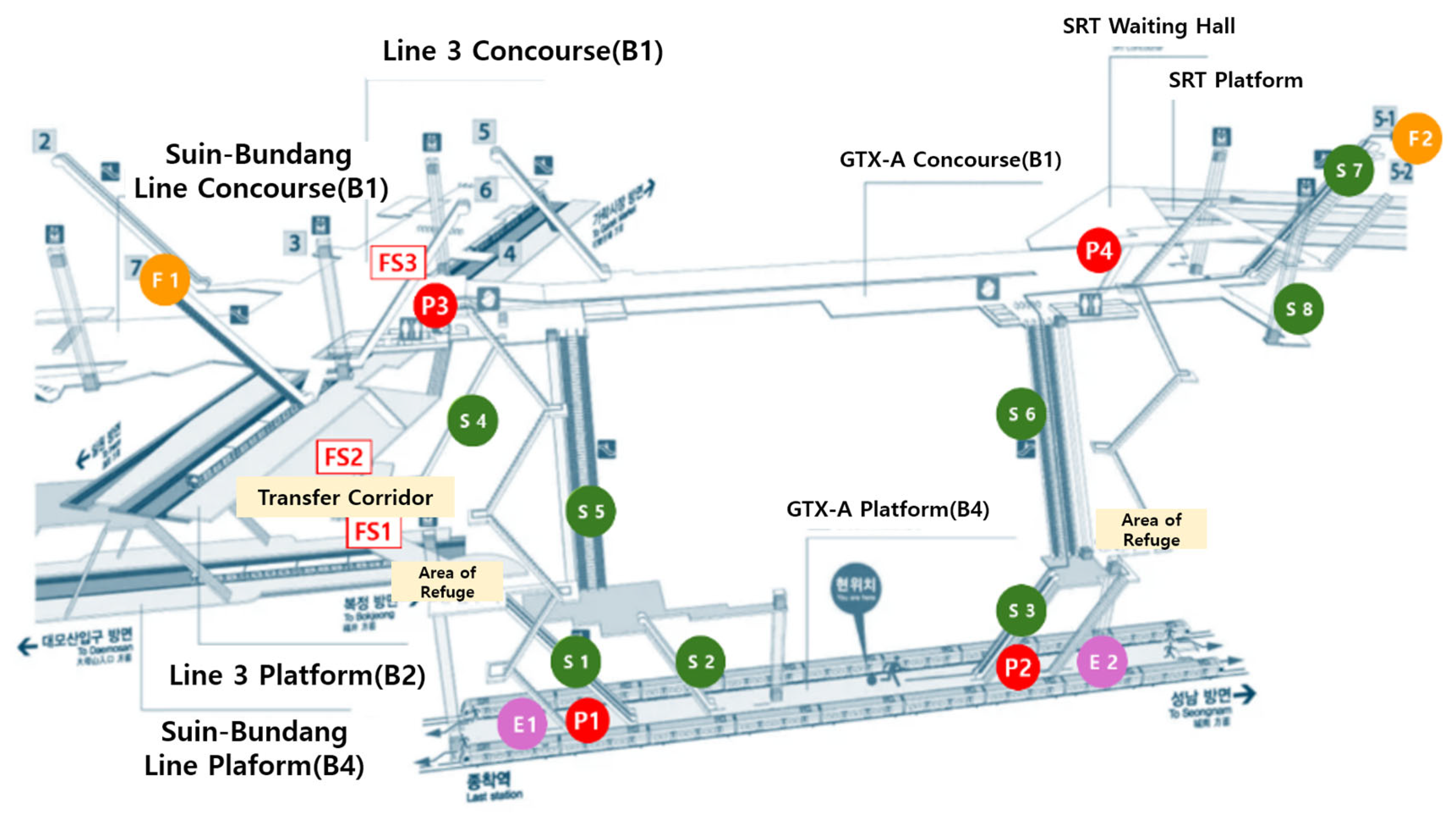
Variations in passenger load (Figure 1).
CASE 1 and CASE 10 serve as baseline references. CASE 1 assumes the full availability of all evacuation facilities, while CASE 10 retains the same physical configuration but introduces trained evacuation guidance personnel to evaluate the effectiveness of active crowd management. CASE 2 and CASE 3 address vertical capacity loss. CASE 2 represents partial degradation through a single escalator failure, whereas CASE 3 models an extreme condition in which only special evacuation stairways remain available.
CASE 4–CASE 9 represent fire-induced accessibility constraints. These scenarios restrict either key evacuation stairways (E1 or E2) or final exits (F1–F3) depending on fire location, thereby altering the vertical flow distribution and increasing detour distances. Platform fire scenarios (CASE 8–9) exclude onboard passengers to reflect conditions in which the train is not present.
Across all cases, the evacuation population is fixed based on peak-hour demand estimates to ensure direct comparability. This scenario framework provides a consistent basis for evaluating evacuation efficiency, congestion sensitivity, and system resilience under realistic and worst-case conditions in DUR environments (Figure 1).
(2)
Scenario Parameter Definitions
Evacuation performance was evaluated using a set of core scenario parameters that represent the dominant spatial, operational, and demand-related factors governing evacuation in DUR stations. (Table 8)
Fire location (P1–P4) was defined using four representative ignition points: platform (P1), train interior (P2), concourse (P3), and connecting corridor (P4). These locations correspond to critical functional zones where fire and smoke rapidly impair visibility, tenability, and route connectivity, thereby altering feasible evacuation paths.
Final exit availability (F1–F3) was modeled with variable accessibility to represent obstruction caused by hazard proximity or physical blockage. Exit closure forces rerouting toward remaining exits, increases travel distance, and concentrates flow demand on limited vertical circulation elements. Scenarios with multiple blocked exits represent extreme egress constraints and strongly affect the total evacuation clearance time.
Vertical circulation availability (E1, E2, S1–S8) was treated as the primary determinant of evacuation performance, reflecting the reliance of deep underground stations on sustained upward movement. Scenario conditions range from full availability to partial or complete loss of general stairs and escalators, with exclusive reliance on special evacuation stairways under extreme degradation (CASE 3).
Fire shutter operation (FS1–FS3) was included to account for its influence on smoke containment and route usability. Operational shutters delay smoke spread and preserve tenability, whereas non-operational shutters accelerate hazard propagation and reduce effective evacuation time.
Passenger load conditions were varied by including or excluding onboard train passengers. Full train occupancy was assumed in CASE 1–CASE 7 to represent peak-hour demand. CASE 8 and CASE 9 exclude onboard passengers, while CASE 10 incorporates guided evacuation under full load to assess the effect of active crowd management. Passenger load directly governs congestion formation, particularly within vertical circulation bottlenecks.
Collectively, these parameters provide a structured basis for assessing evacuation efficiency, congestion sensitivity, and system resilience under a wide range of credible emergency conditions in DUR environments.
(3)
Functional Role of the Scenario Framework
The integrated scenario framework serves multiple analytical purposes in evaluating evacuation performance. It enables systematic sensitivity analysis by isolating the effects of fire location and circulation degradation, thereby clarifying the relative influence of key system components on evacuation outcomes. The framework also supports bottleneck identification by revealing spatial and temporal congestion patterns, particularly within vertical circulation elements that dominate evacuation performance in deep underground stations.
In addition, the framework facilitates robustness assessment by testing evacuation performance against NFPA 130 and relevant domestic standards under progressively degraded operating conditions. This approach verifies whether performance requirements are satisfied not only under nominal configurations but also when critical circulation elements are partially or fully unavailable.
The framework further supports operational preparedness evaluation by quantifying the effectiveness of guided evacuation strategies, as demonstrated in CASE 10, where trained personnel actively redistribute flow and mitigate congestion. Finally, by combining maximum passenger demand with minimum available egress capacity, the framework captures worst-case evacuation performance, providing conservative estimates of clearance time and identifying structural and operational vulnerabilities under extreme yet plausible emergency conditions.
The selection of the ten evacuation scenarios was guided by a structured prioritization strategy rather than exhaustive combinatorial enumeration. Scenario combinations were defined to represent operationally and safety-critical conditions that are most influential on evacuation performance in DUR stations. Specifically, vertical circulation failures (E1/E2 and major stairs/escalators) and fire shutter conditions were prioritized because previous studies and regulatory guidelines identify vertical egress capacity and smoke compartmentation as dominant determinants of evacuation clearance time in deep underground environments. Fire locations and exit availability were combined to reflect credible worst-case and degraded operating conditions specified in NFPA 130 and domestic performance-based design guidelines. By focusing on these high-sensitivity parameters, the scenario set forms a representative and reproducible basis for evaluating evacuation robustness, while avoiding unnecessary expansion into low-impact or redundant combinations.

Modeling of the Analysis Domain

The analysis domain was developed as a high-fidelity digital representation of Suseo Station’s deep underground environment. The station extends to an approximate depth of 50 m, requiring accurate representation of both vertical and horizontal circulation systems. The model integrates architectural geometry, functional zoning, circulation constraints, fire-compartment boundaries, and scenario-dependent accessibility conditions to support agent-based evacuation simulation consistent with performance-based design (PBD) principles.
Model development followed three sequential steps: (i) three-dimensional geometric reconstruction, (ii) functional zoning and connectivity definition, and (iii) agent initialization with boundary condition integration.
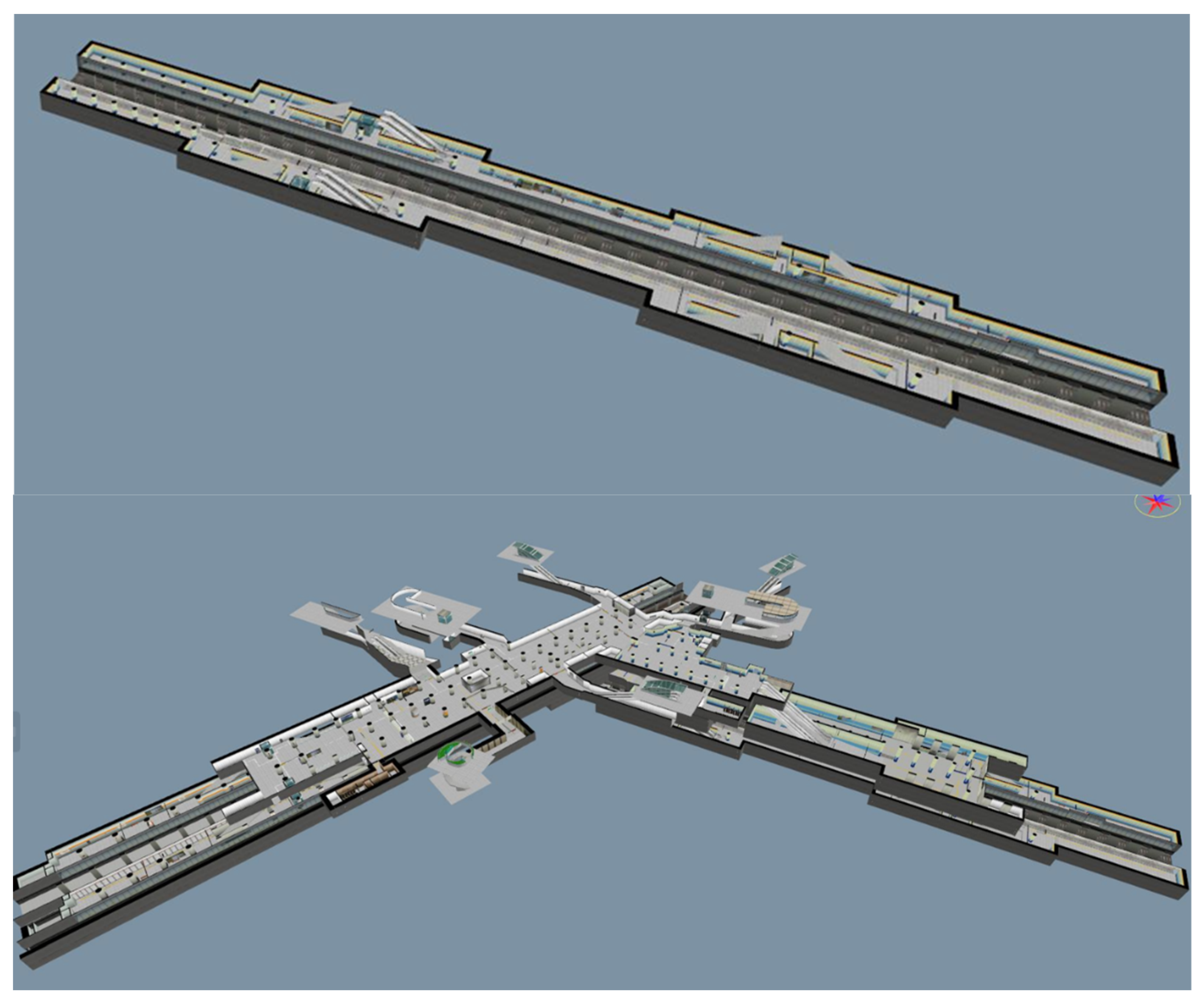
First, three-dimensional reconstruction was performed using detailed architectural drawings. All evacuation-relevant spaces were explicitly modeled, including the platform level (B4), platform screen door (PSD) zones, concourse and intermediate circulation spaces, connecting passages (#1–#3), two refuge areas, special evacuation stairways (E1 and E2), general stairways and escalators (S1–S8), and final exits (F1–F3) linked to ground-level assembly points. Fire-related mechanical spaces, such as fire shutter zones, were also included. Key geometric attributes—corridor widths, stair inclinations, landings, and vertical elevation differences—were preserved to ensure a realistic representation of travel distance, congestion risk, and circulation capacity.
Second, functional zoning and connectivity were defined to structure pedestrian movement. The station was subdivided into platforms, concourses, refuge areas, corridors, and vertical shafts. Fire compartments and smoke control boundaries associated with fire shutters (FS1–FS3) were explicitly represented. Directional constraints, including escalator operating directions and one-way passages, were applied together with width-based capacity limits. Scenario-dependent closures—such as blocked evacuation stairs (E1/E2), final exits (F1–F3), and fire location-dependent corridor restrictions (P1–P4)—were embedded through scenario-specific connectivity matrices, ensuring that agents could access only feasible evacuation routes.
Third, agents were initialized based on the estimated evacuation population. Occupants were distributed across the platform (646 persons), train interior (945 persons in CASE 1–CASE 7 and CASE 10), and concourse areas (108 persons) according to peak-hour density patterns. Each agent was assigned physical and behavioral attributes, including body dimensions derived from the 8th Korean Anthropometric Survey, age- and gender-dependent walking speeds, and a uniform pre-movement time consistent with the W1 criteria of Korea’s PBD guidelines. Pedestrian behavior was simulated using Pathfinder’s steering-based dynamics. Boundary conditions, including final exit destinations, refuge area routing, and scenario-specific blockages, were applied to reproduce realistic queue formation and congestion.
Scenario conditions were then systematically embedded prior to simulation execution. These include fire location-dependent accessibility, exit closures, partial or complete loss of vertical circulation, fire shutter operability, inclusion or exclusion of onboard train passengers, and guided evacuation effects in CASE 10. This integration ensures that each scenario accurately reflects its intended hazard and operational configuration.
Overall, the modeling framework provides a unified and reproducible digital foundation for evacuation analysis. It supports the comparative evaluation of evacuation performance across scenarios, quantitative assessment of vertical congestion and bottleneck development, sensitivity analysis of circulation degradation and fire-compartment failures, and validation of guided evacuation strategies under extreme-depth conditions. The framework thus enables robust, simulation-based evacuation assessment consistent with international fire safety standards (Figure 2).
In this study, fire and smoke effects are not directly coupled with the evacuation simulation through CFD (e.g., FDS). Instead, scenario-based and criteria-driven hazard conditions were applied to enable the consistent comparison of evacuation performance across multiple scenarios.

3.5. Evacuation Simulation Results

This section presents a detailed analysis of the evacuation performance for the ten simulation scenarios (CASE 1–10). Each scenario incorporates variations in fire location, exit availability, vertical circulation accessibility, and the presence or absence of onboard passengers. The results quantify evacuation times for all key evacuation nodes—including the platform, emergency stairwells (E1, E2), safety zones, and final exits (F1, F2)—and evaluate compliance with domestic and international performance criteria such as the 4 min platform evacuation requirement.

3.5.1. Evaluation Framework for Evacuation Performance

To improve clarity, the evacuation performance metrics and corresponding evaluation criteria used in this study are summarized in Table 9. The assessment follows NFPA 130 requirements for platform evacuation and time to relative safety, while additional indicators such as congestion patterns and bottleneck persistence are used for comparative scenario analysis.

3.5.2. Total Evacuation Time

Table 10’s results indicate that the total evacuation time across scenarios ranged from 677 s to 1806 s, demonstrating substantial sensitivity to vertical circulation losses and exit blockages. Scenarios incorporating full onboard passenger loads (CASE 1–7 and CASE 10) exhibited the highest total evacuation times due to the increased congestion and intensified demand for vertical circulation capacity. Scenarios that removed train passengers (CASE 8–9) showed significantly reduced evacuation times, reflecting the dominant influence of passenger load on movement efficiency (Figure 3).

3.5.3. Platform Evacuation Time and Conformance to Standards

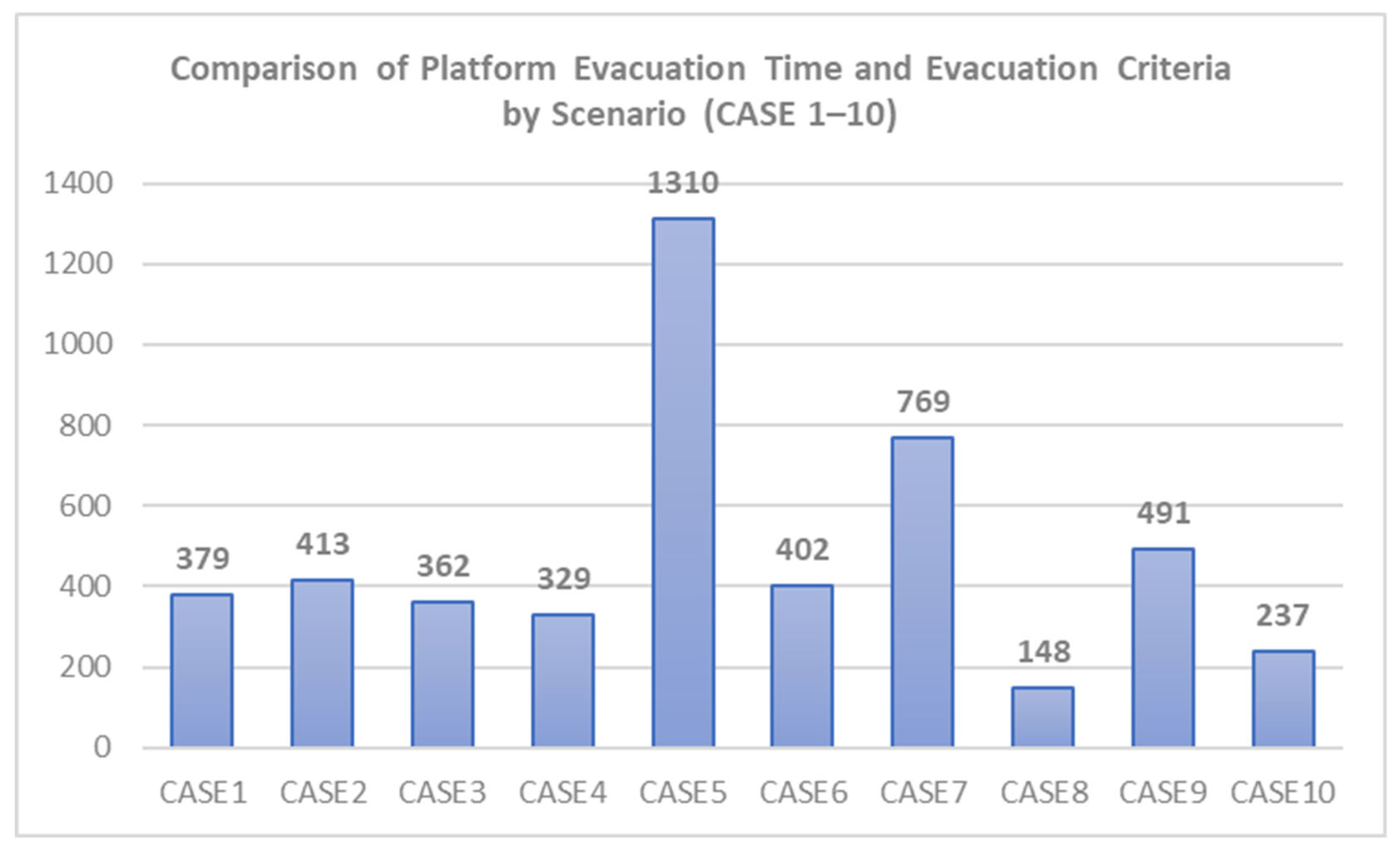
Platform evacuation time is a key performance indicator and must not exceed 4 min (240 s) in accordance with NFPA 130 and comparable domestic guidelines. In most scenarios with onboard passengers (CASE 1–7), this requirement was not satisfied. Platform clearance times ranged from 329 s to 1310 s, indicating systematic non-compliance under full passenger load conditions.
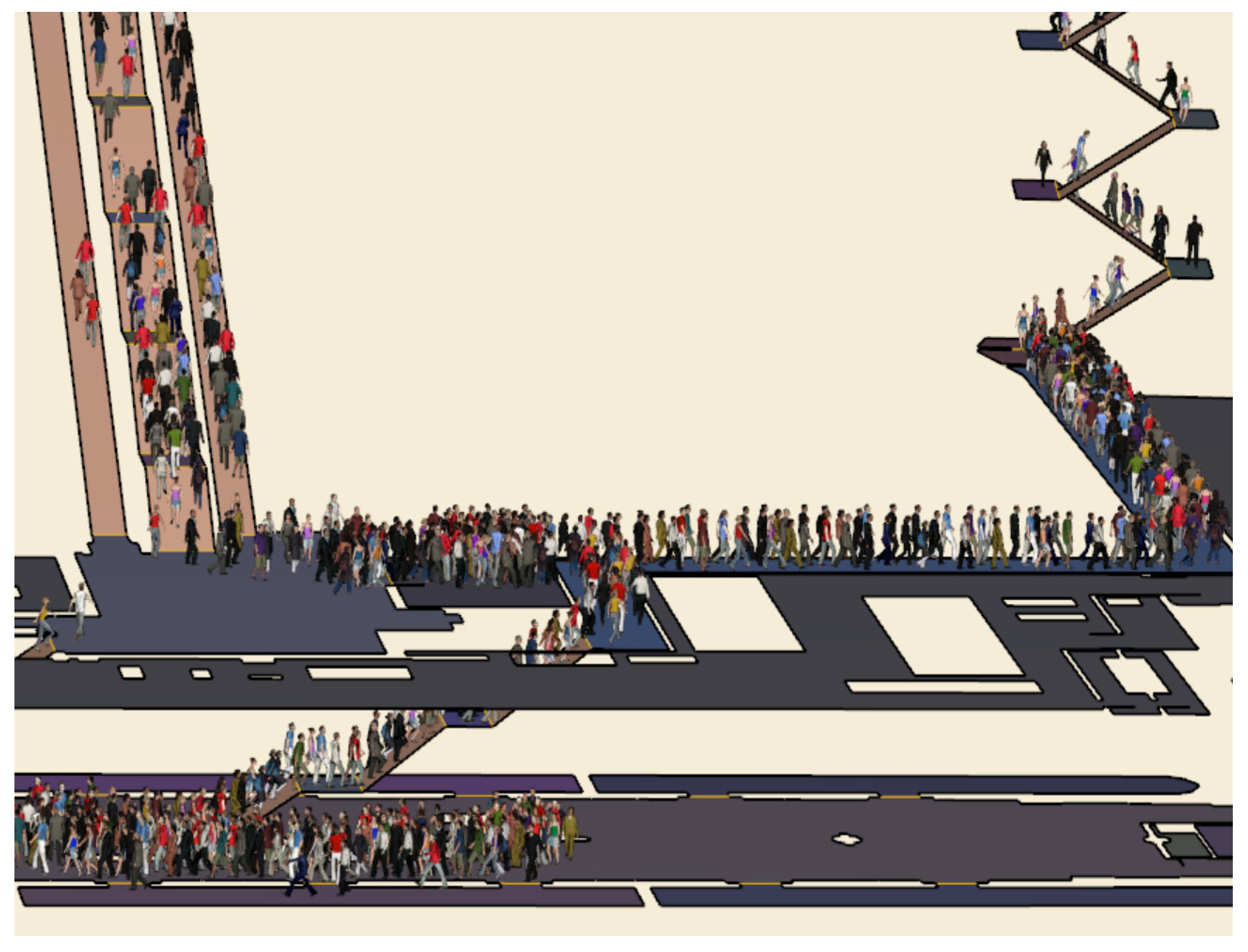
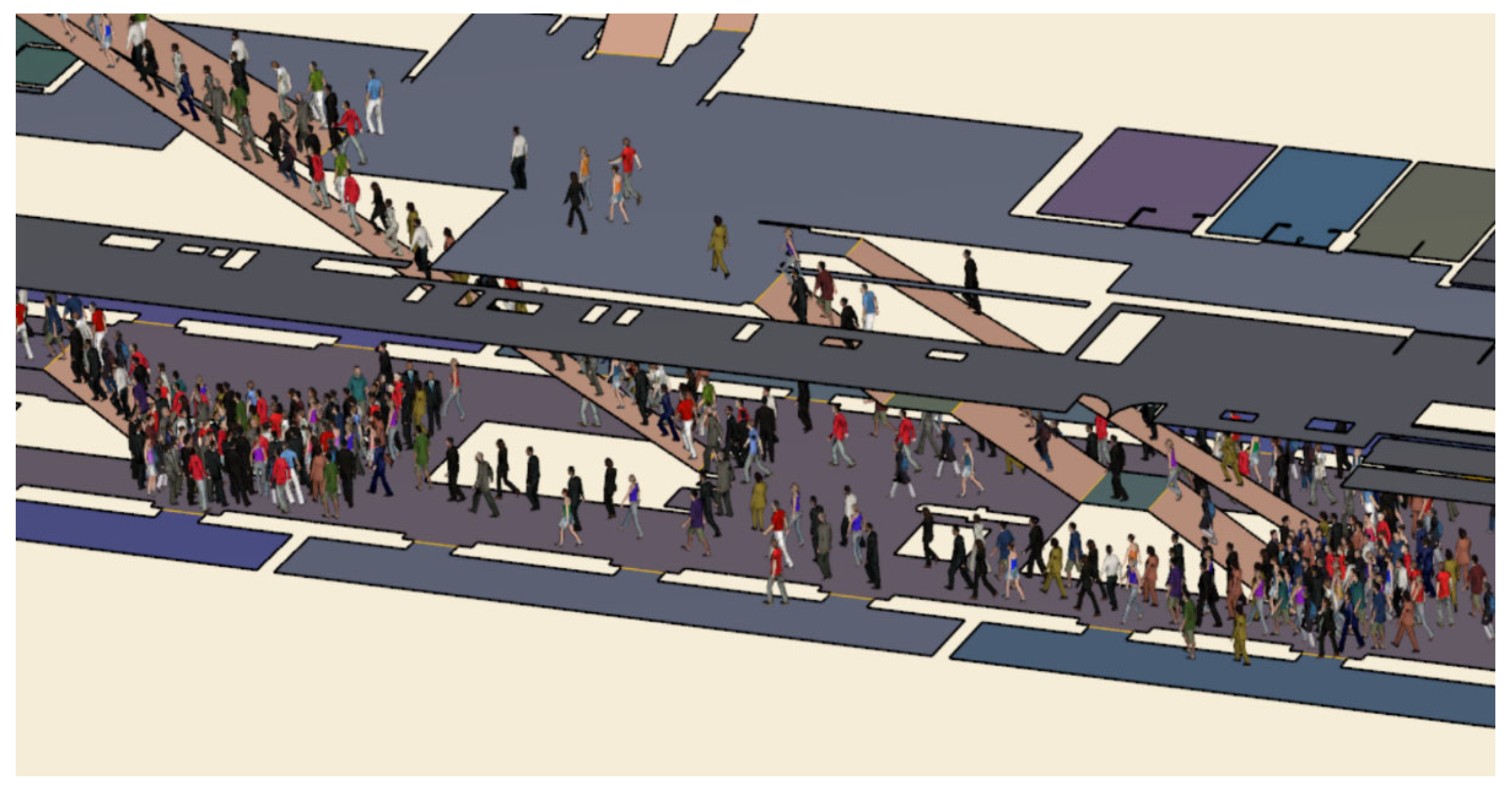
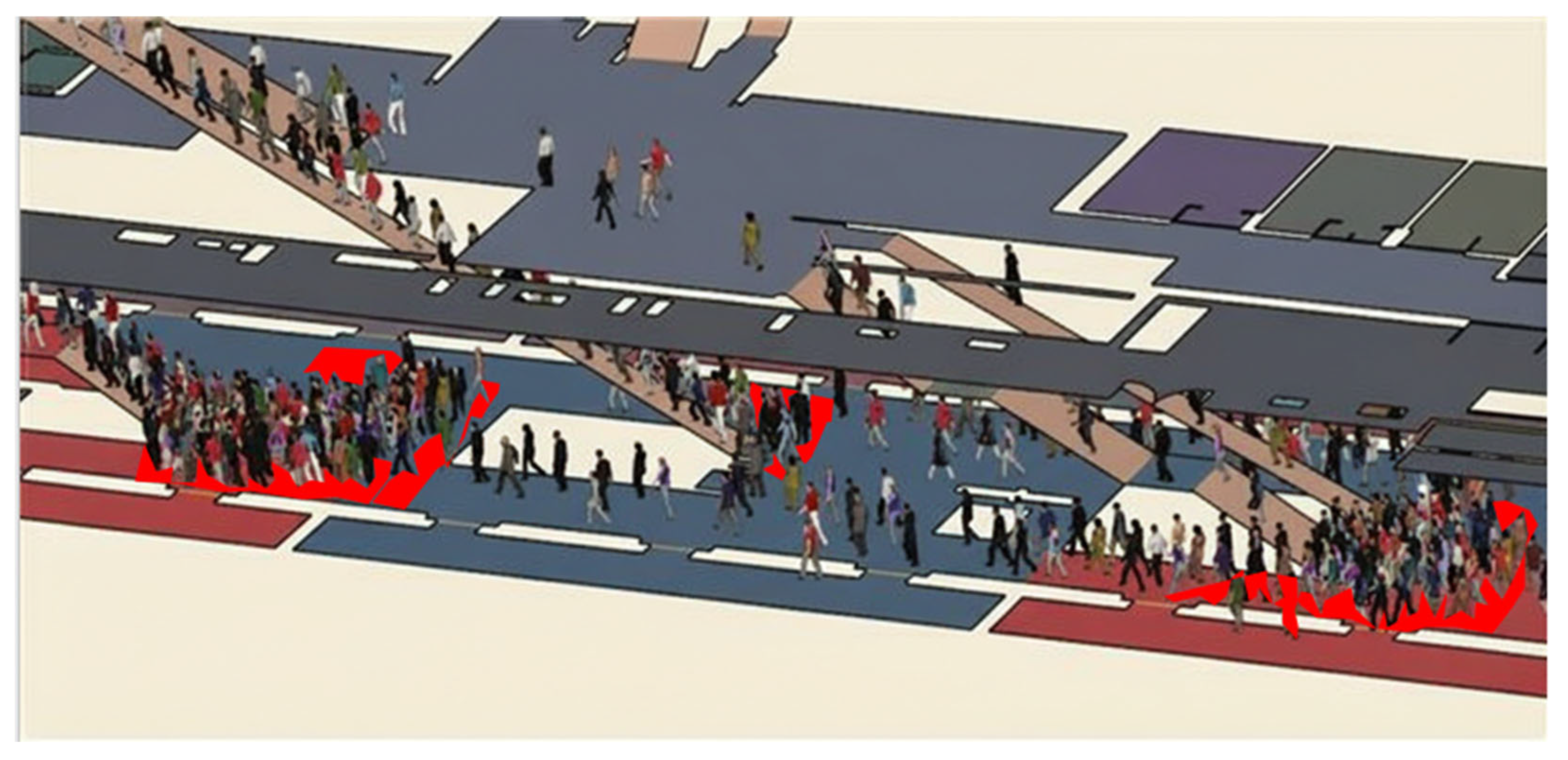
An exception was CASE 10, which incorporated guided evacuation. In this scenario, platform clearance was achieved within 237 s, satisfying the 4 min criterion. The result indicates that active passenger guidance effectively redistributes evacuation flow across multiple routes and mitigates the natural tendency for evacuees to concentrate at the nearest special evacuation stairs. In contrast, the baseline scenario (CASE 1) exhibited severe congestion at the E2 stair entrance, leading to persistent upstream bottlenecks and delayed platform clearance (Figure 4).

3.5.4. Impact of Fire Location and Exit Blockages

Fire-origin scenarios and exit closures significantly influenced evacuation performance in Figure 5:
  • Platform fire scenarios (P1): Produced substantial vertical congestion, especially when the nearest emergency stair (E1 or E2) was blocked.
  • Train fire scenarios (P2): Increased platform-to-concourse travel times due to early-stage crowding near PSD lines.
  • Concourse fire scenarios (P3): Forced rerouting toward more distant exits (F1–F3), extending travel distance and increasing conflict flow.
  • Blocked final exits (F1–F3): Increased reliance on vertical circulation, adding critical load to emergency stairs and causing localized queuing.
Cases 4 and 5 demonstrated the most severe impacts due to the loss of key emergency stairwells (E1 or E2), resulting in total evacuation times exceeding 1800 s in CASE 5, the highest among all scenarios

3.5.5. Scenarios Without Onboard Passengers (CASE 8–9)

These were when only platform and concourse occupants were included:
CASE 8 (E1 unavailable): Evacuation proceeded within acceptable time limits, and platform clearance occurred efficiently despite partial loss of vertical circulation.
CASE 9 (E2 unavailable): Congestion intensified significantly around remaining available stairways, resulting in extended platform evacuation times (491 s) and indicating that E2 plays a more critical role in platform-level clearance.
These results highlight the asymmetric contribution of emergency stairs E1 and E2 to evacuation functionality, and underscore the vulnerability of deep underground stations to specific circulation failures.

3.5.6. Summary of Key Findings

Onboard passenger load is the dominant factor affecting total evacuation performance in DUR stations. Vertical circulation bottlenecks—especially at E1 and E2—govern evacuation success or failure under most scenarios. Guided evacuation (CASE 10) substantially improves performance, enabling compliance with platform evacuation criteria even under full-load conditions. Exit blockages and fire-origin scenarios significantly alter route selection and congestion propagation. Deep underground geometry amplifies localized congestion, requiring targeted strategies such as flow redistribution, dynamic signage, or adaptive exit control.
Overall, the results demonstrate that deep underground stations such as Suseo require advanced, digitally supported evacuation planning to ensure reliable performance under degraded conditions.

4. Digital Twin-Based Implementation Framework for Evacuation Safety in DUR Stations

DUR stations such as Suseo exhibit complex spatial structures, strong dependency on vertical circulation, high passenger density, and rapid smoke propagation under fire conditions. These characteristics create evacuation risks that cannot be adequately addressed by traditional prescriptive design standards. The findings from Chapter 3 revealed significant performance degradation, including persistent bottlenecks and non-compliance with the 4 min platform clearance requirement.
To address these limitations, this section proposes a Digital Twin-based implementation framework specifically designed for evacuation safety management in DUR stations. Unlike conventional digital models that focus on static visualization or isolated simulations, the proposed framework integrates multi-layer spatial topology, hazard-aware routing, predictive evacuation simulation, and operational decision support into a unified cyber–physical system.

4.1. Digital Twin-Based Implementation Framework for DUR Stations

DUR stations, such as Suseo Station, present evacuation challenges that exceed those of conventional metro facilities. Extreme depth, reliance on limited vertical circulation, high peak-hour demand, and rapid smoke migration collectively create conditions that prescriptive design standards alone cannot adequately address. The results in Chapter 3 confirm that these constraints lead to prolonged evacuation times, persistent bottlenecks at critical nodes (E1 and E2), and repeated violations of the 4 min platform clearance requirement specified by KRCODE.
To overcome these limitations, this study proposes a Digital Twin-based implementation framework tailored to DUR stations. The framework extends beyond static visualization by integrating multi-layer spatial topology, real-time hazard information, dynamic routing, predictive evacuation simulation, and operator-oriented decision support. As a result, the Digital Twin functions as an adaptive computational environment that identifies hazardous conditions, anticipates congestion, and supports informed evacuation decisions under evolving scenarios.
A central feature of the framework is a multi-resolution spatial topology that explicitly represents platforms, concourses, vertical circulation elements, and external assembly points. By unifying geometric, operational, and hazard-related attributes, the system enables robust evacuation modeling and real-time adaptation to degraded states such as exit blockages, escalator failures, and fire-compartment isolation.
Overall, the proposed framework provides a methodological basis for transforming DUR stations into hazard-responsive and decision support-driven environments. Its application enhances the predictability and reliability of evacuation operations, directly addressing the vulnerabilities identified in Chapter 3 and offering a scalable model for future railway safety management systems.

4.2. Multi-Layer Spatial Topology Construction

Unlike conventional BIM-/GIS-derived topology models, the proposed Digital Twin map topology is explicitly designed as a navigable, behavior-oriented structure.
It directly supports agent-based evacuation simulation, explicitly represents vertical dependency, and enables hazard-aware dynamic reconfiguration of connectivity. These features allow evacuation performance to be evaluated under degraded and worst-case conditions, which are not addressed by static geometric or connectivity models.
The construction of a multi-layer spatial topology forms the foundation of the proposed Digital Twin framework for DUR stations. Unlike conventional BIM or CAD models, which primarily describe architectural geometry, evacuation analysis requires a computational topology that explicitly represents walkable spaces, movement constraints, vertical transitions, and dynamically changing hazard conditions.
In this study, the physical layout of Suseo Station is transformed into a graph-based, behavior-aware navigation topology that supports predictive evacuation simulation and real-time operational decision-making. The topology construction workflow consists of five sequential steps: (1) spatial parsing and navigable area extraction, (2) hierarchical region and node decomposition, (3) link generation with attribute assignment, (4) multi-level graph integration, and (5) hazard-aware dynamic updating. Each step is described in the following subsections.

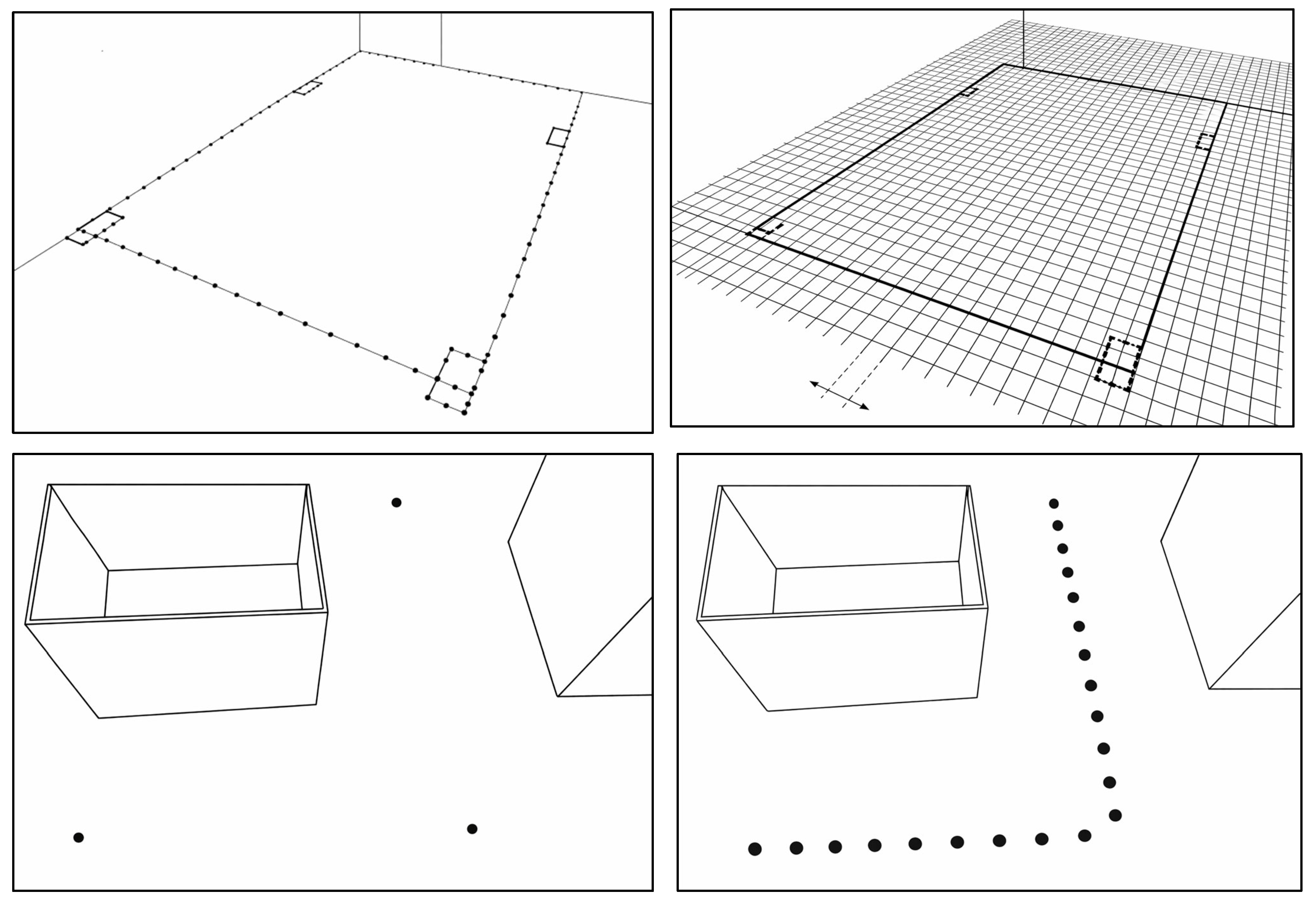
4.2.1. Spatial Parsing and Navigable Area Extraction

This stage converts raw station geometry into walkable and non-walkable regions through automated processing of object-level architectural data. Using structural information for walls, columns, equipment zones, and mechanical rooms, the Digital Twin removes impediments and isolates circulation-relevant space. The workflow is as follows:
A.
Separation of structural obstacles (walls, columns, mechanical equipment rooms);
B.
Automated extraction of walkable regions using polygon decomposition;
C.
Semantic zoning and categorizing areas into platform zones, concourse zones, interconnecting passages, stair and escalator zones, refuge areas, and final exit pathways.
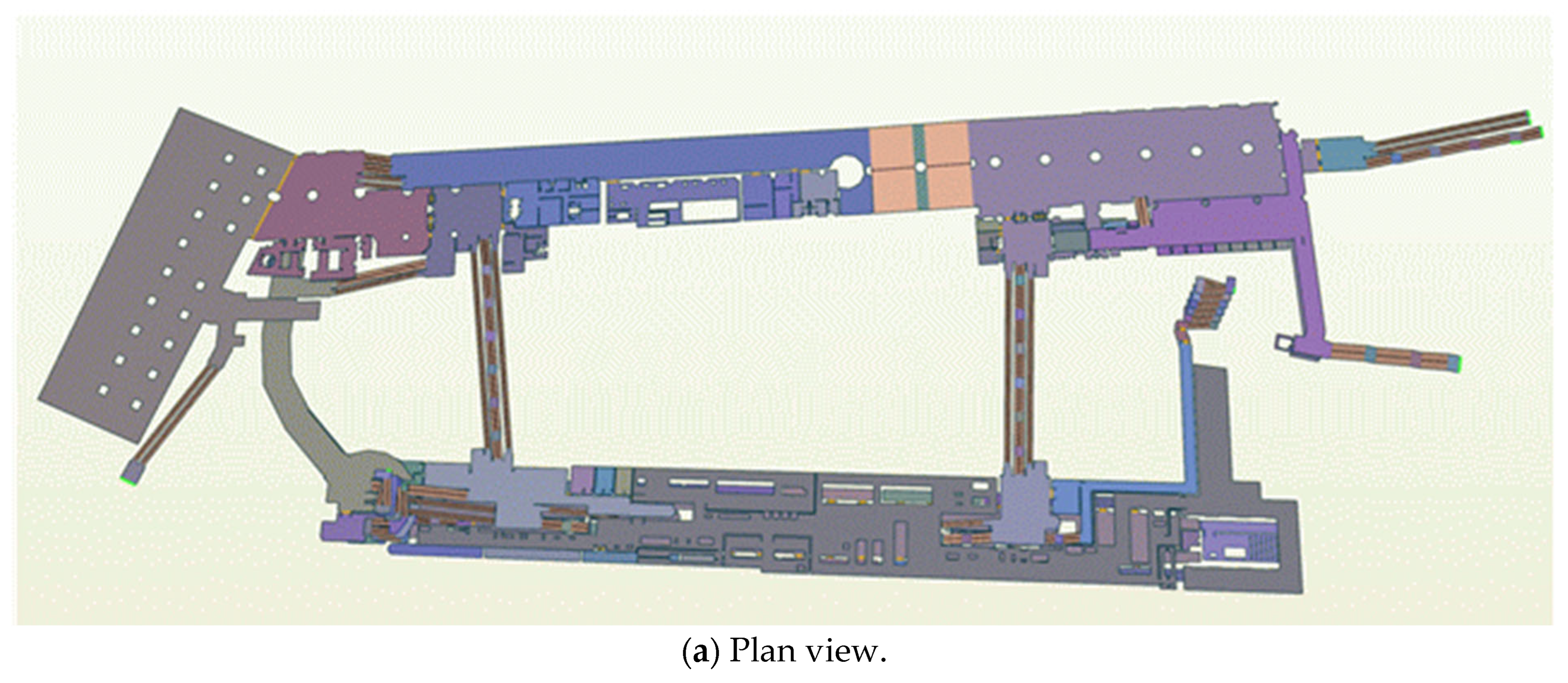
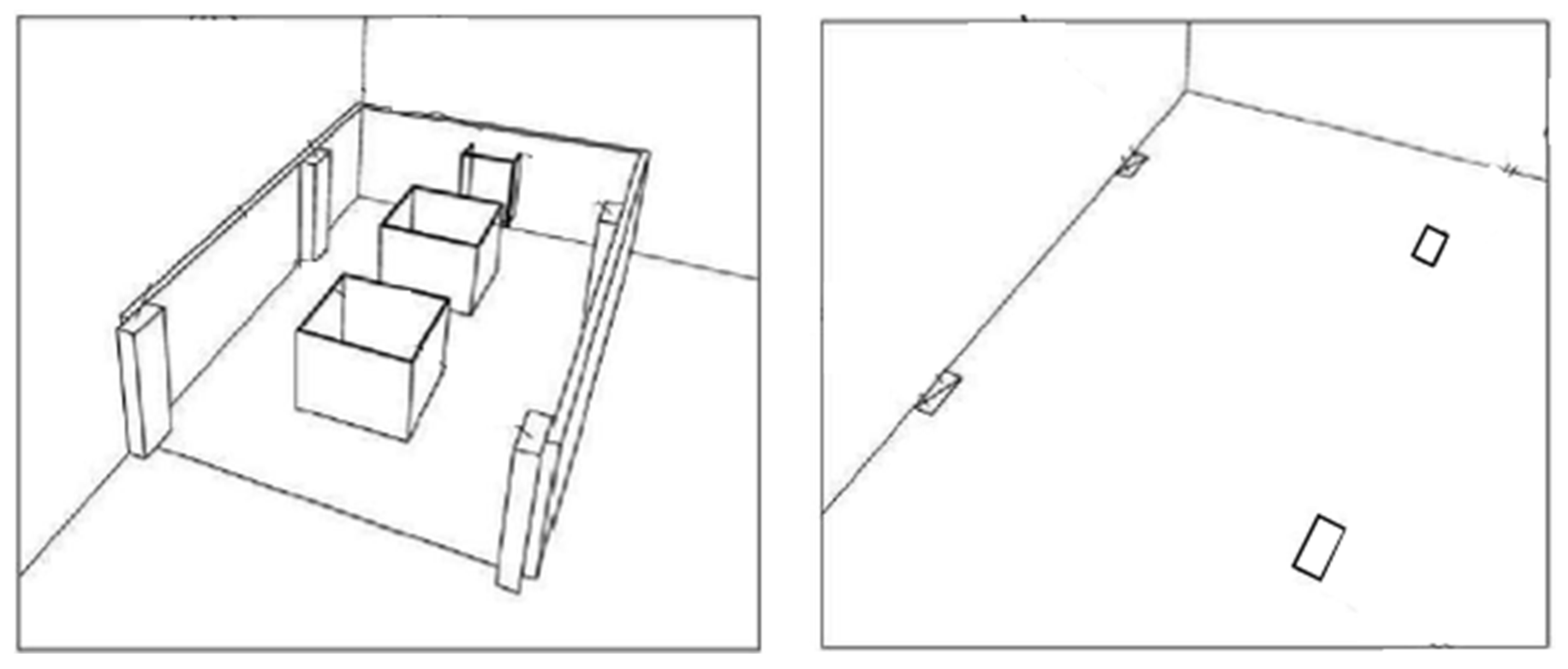
These regions collectively form the actionable area, from which route networks and hazard-aware path-finding layers are constructed (Figure 6).

4.2.2. Region Decomposition and Node Generation Subsubsection

Following spatial parsing, the walkable areas are subdivided into computational cells that serve as nodes in the topology graph. Each node carries semantic attributes describing its function, location (floor level), and its role in evacuation modeling.
Examples of node classifications include the following:
Platform nodes representing PSD-adjacent walking regions;
Vertical circulation nodes representing E1–E2 stairs and S1–S8 escalators;
Transition nodes linking platform, concourse, and exit levels;
Hazard control nodes marking shutter zones or smoke compartment boundaries.
This decomposition ensures that the resulting topology can capture both the geometric fidelity and functional behavior of the station environment.

4.2.3. Link Formation and Connectivity Encoding

Links (edges) are then generated between nodes to represent feasible movement paths. Each link is assigned to both static attributes (distance, width, slope) and dynamic attributes (hazard intensity, congestion level, shutter status).
Key features include the following:
Representation of bidirectional vs. unidirectional movement (e.g., escalators);
Capacity encoding based on effective width, derived from Korean anthropometric measurements;
Automatic blocking or cost augmentation of links during hazard propagation;
Explicit modeling of vertical link constraints (stair inclination, escalator status).
This enables the graph to serve as both a behavioral substrate for agent-based simulation and a computational network for real-time routing optimization (Figure 7).

4.2.4. Multi-Level Graph Integration

Suseo Station consists of multiple underground layers, extending from the platform level (B4) through intermediate levels (B3/B2), the concourse level (B1), and ground-level exits. To represent evacuation behavior across this vertically complex structure, an integrated multi-level graph was constructed to explicitly encode both horizontal and vertical connectivity.
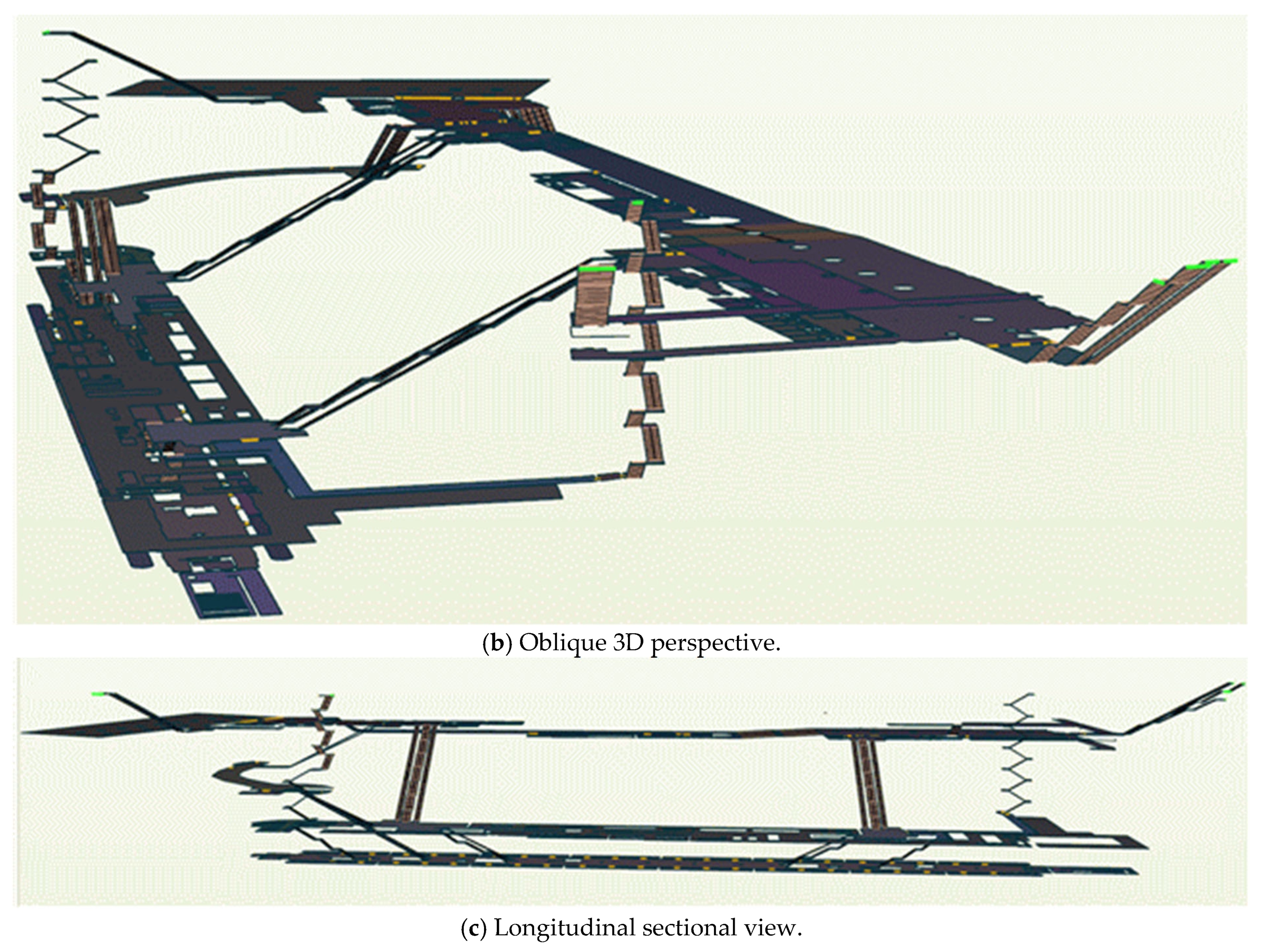
The topology comprises interconnected subgraphs representing platform areas, intermediate circulation levels, concourse spaces, vertical circulation elements (special evacuation stairs E1–E2 and general stairs and escalators S1–S8), and exit routes leading to outdoor assembly points. These subgraphs are unified within a single routing framework, enabling continuous traversal across station levels (Figure 8).
Vertical transitions are modeled as explicit inter-layer nodes, allowing the routing engine to capture the cost of upward movement, including increased travel distance, reduced walking speed, and capacity constraints of vertical circulation elements. This representation also supports dynamic rerouting under circulation failures or hazard-induced inaccessibility, ensuring feasible evacuation paths under degraded conditions.
Through this multi-level integration, the topology provides a computationally robust foundation for evacuation simulation in DUR stations, where vertical dependency is a primary driver of clearance time and congestion formation.

4.2.5. Dynamic Edge Weighting Under Hazard Conditions

To support hazard-aware evacuation routing, link weights in the multi-level graph are dynamically updated in response to real-time or simulated fire conditions. Instead of static distance-based costs, each link is assigned a time-varying composite cost that reflects environmental degradation and operational constraints.
Edge weighting incorporates key hazard- and flow-related factors, including smoke density and visibility loss, temperature relative to human tenability thresholds, and congestion-induced speed reductions. The operational states of vertical circulation elements (e.g., stair and escalator availability) and fire shutter activation are directly encoded through link penalization or deactivation.
Based on these updates, routing algorithms—such as hazard-weighted Dijkstra or predictive A* variants—compute evacuation paths that minimize both travel time and hazard exposure. This dynamic weighting enables adaptive rerouting under evolving fire and crowd conditions, yielding least-risk, least-time evacuation paths and realistically reproducing evacuation behavior in rapidly changing emergencies (Figure 9).

4.2.6. Validation Against Physical Station Conditions

The evacuation topology was systematically validated to ensure consistency with the physical and operational characteristics of Suseo Station. First, the digital topology was compared with architectural and operational drawings to verify spatial layout and circulation logic. Key geometric parameters—including corridor widths, stair inclinations, landing configurations, and evacuation path continuity—were checked against as-built conditions.
Second, the topology was cross-validated with the station’s fire-compartmentation scheme, including fire shutter locations and boundaries, to ensure the accurate representation of smoke control zones and potential path closures under fire scenarios. Finally, on-site walkthrough inspections were conducted to confirm that modeled circulation routes, visibility constraints, and connectivity reflect actual operational conditions.
Through this multi-stage validation process, the Digital Twin topology was confirmed to provide a reliable representation of station geometry and operational constraints, ensuring the credibility of subsequent evacuation simulation results.

4.3. Integrated Digital Twin Simulation and Operational Framework (Revised and Enhanced Version)

The proposed Digital Twin for DUR stations, such as Suseo Station, is designed as a predictive and continuously updating analytical system, rather than a static geometric replica. It integrates hazard simulation, evacuation routing, congestion prediction, and operator-oriented decision support into a unified framework to enable real-time operational response under emergency conditions. It should be noted that the evacuation simulations presented in this study are conducted under an offline, scenario-based configuration. References to real-time data integration, dynamic routing, and online Digital Twin operation describe the architectural capabilities of the proposed framework rather than functions fully implemented and validated in the present case study.

4.3.1. Predictive Multi-Engine Simulation Architecture

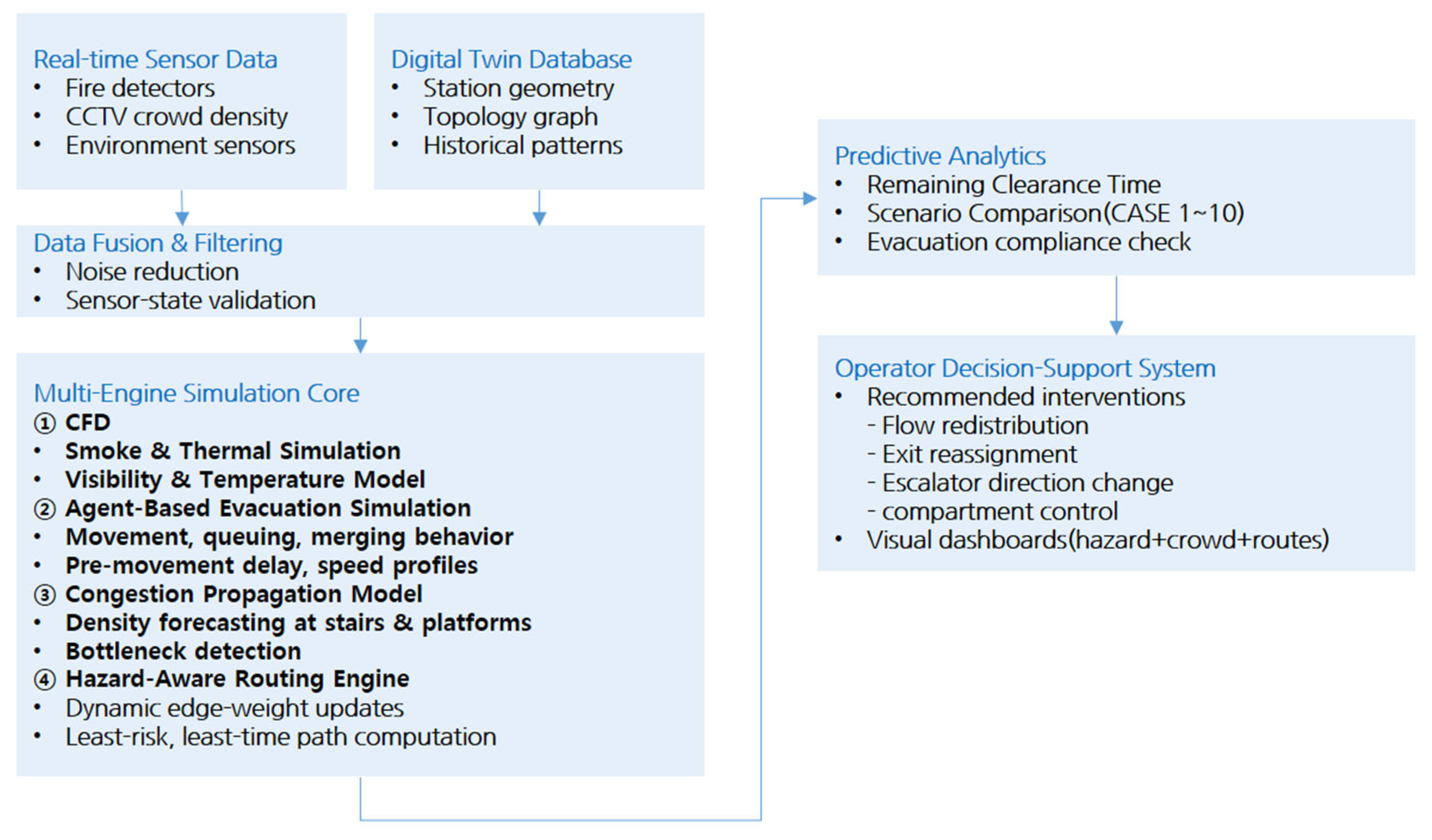
The Digital Twin is built on a predictive multi-engine simulation architecture that integrates hazard evolution, pedestrian behavior, and congestion dynamics within a shared multi-layer spatial topology. Three tightly coupled simulation engines operate synchronously to support adaptive evacuation routing under evolving fire conditions.
A hazard simulation module estimates fire-induced environmental degradation, including smoke spread, visibility loss, and thermal effects. These outputs dynamically update the evacuation topology by modifying link costs according to real-time tenability conditions. Pedestrian movement is modeled using an agent-based crowd simulation that captures heterogeneous walking speeds, pre-movement delays, and interaction effects such as queuing and merging. This behavioral model is continuously synchronized with hazard conditions, allowing evacuees to adapt their movement in response to environmental changes.
To capture system-level instability, a mesoscopic congestion model predicts density accumulation and bottleneck formation at critical circulation elements, particularly vertical routes. When predefined density thresholds are exceeded, the system proactively triggers route redistribution or generates operational alerts.
Through this tightly integrated architecture, the Digital Twin enables least-risk, least-time evacuation prediction and provides a robust foundation for real-time decision support in DUR stations (Figure 10).

4.3.2. Hazard-Aware Dynamic Routing Mechanism

Evacuation routing in the proposed Digital Twin framework is governed by a hazard-aware dynamic reweighting mechanism applied to the multi-layer spatial topology. Routing decisions are continuously updated to identify least-risk and most feasible evacuation paths, rather than relying on predefined shortest routes. At each simulation step, link traversal costs are adaptively adjusted to reflect the geometric distance, local congestion, smoke-induced visibility loss, and proximity to hazardous zones. By jointly considering these factors, the routing logic balances travel efficiency and safety, which is essential in DUR stations where hazards and congestion can rapidly degrade evacuation feasibility.
The routing mechanism is intentionally formulated at a conceptual and framework level, without prescribing fixed cost functions or routing heuristics. This design choice enhances flexibility and interoperability, allowing the framework to incorporate diverse fire and evacuation simulation tools within a Digital Twin environment.
In parallel with dynamic cost adaptation, the topology itself is continuously updated to reflect changes in station operability. Fire shutter activation, escalator shutdown, exit blockage, smoke infiltration, and hazardous inter-level connections are directly translated into link penalization or temporary deactivation, thereby excluding unsafe routes from consideration. Through the combined processes of topology-level dynamic reweighting and state updating, the framework enables adaptive routing under evolving hazard, congestion, and circulation failure conditions.
Accordingly, the contribution of this hazard-aware dynamic routing lies not in proposing a new routing algorithm, but in establishing a system-level integration mechanism that embeds existing routing logics within a continuously updating Digital Twin topology.
This approach enables evacuation routing to adapt dynamically without algorithmic modification, representing a structural and operational advancement over static or predefined routing models. Although direct CFD–evacuation co-simulation is not implemented in the present study, the framework is structurally designed to accommodate future coupling with CFD-based fire and smoke models through dynamic topology updates and hazard-aware edge weighting.

4.3.3. Predictive Clearance Time Evaluation

The proposed Digital Twin operates through an integrated runtime architecture that synchronizes data acquisition, system-state updating, predictive simulation, decision support, and visualization. This architecture enables coherent system-wide responses to evolving emergency conditions.
At runtime, heterogeneous sensor data and system status information are fused to represent current hazard and operational conditions. These inputs dynamically update the spatial topology, reflecting changes in accessibility, capacity, and connectivity. Based on the updated topology, predictive simulations estimate near-term evacuation behavior, including congestion development, bottleneck formation, and clearance time evolution.
Simulation results are processed by a decision support module that issues alerts or recommended actions when the projected evacuation performance exceeds acceptable limits. Recommendations are presented through an integrated visualization interface, supporting operator decision-making while preserving human authority.
The same architecture supports multiple operational modes, including offline design evaluation, real-time emergency operation, and simulation-based training. By enabling seamless transition across these modes, the framework provides a scalable and adaptive evacuation management solution for DUR stations, where strong vertical dependency and rapidly evolving hazards require continuous situational awareness.
Accordingly, the real-time updating, online prediction, and operational decision support functions discussed in this section represent envisioned extensions of the proposed Digital Twin framework. The current study focuses on validating the methodological feasibility of the framework through offline, scenario-driven evacuation simulations.

4.4. Real-Time Digital Twin Updating and Predictive Evacuation

The proposed Digital Twin is designed as a continuously updating operational model, rather than a static geometric replica. Real-time sensing data and facility status information are directly integrated into the spatial topology and simulation engines, enabling accurate representation of evolving hazard, congestion, and operational conditions.
Heterogeneous data streams—including environmental sensors, video-based see crowd estimation, train control systems, and facility monitoring—are fused through a unified data processing pipeline. Environmental measurements update hazard attributes such as smoke density and thermal conditions, while operational data (e.g., fire shutters, escalators, exits) dynamically modify the connectivity and cost structure of the evacuation topology. Through continuous projection onto the multi-layer graph, node and edge attributes are updated at short intervals, ensuring that simulations operate on the current station state.
Based on the updated topology, the Digital Twin implements hazard-aware dynamic routing that continuously re-optimizes evacuation paths. Routing decisions explicitly account for hazard exposure, congestion buildup, and operational constraints, enabling immediate rerouting when routes become unsafe or unavailable. Predictive elements are incorporated by considering anticipated smoke spread and crowd propagation, allowing evacuation guidance to anticipate near-future conditions.
In parallel, a real-time predictive simulation engine performs short-horizon forecasts of evacuation performance, including congestion development at critical vertical circulation elements and overall clearance time. When projected performance exceeds predefined safety thresholds, the system generates recommended interventions such as route redistribution or operational adjustments.
Finally, predefined emergency scenarios are integrated to support rapid what-if analysis for operators. By simulating alternative configurations—such as exit blockages or circulation degradation—the Digital Twin functions as an active decision support platform. This capability is particularly important in DUR stations, where strong vertical dependency and rapid hazard escalation magnify the consequences of localized failures. Overall, the framework demonstrates how real-time data integration, predictive simulation, and hazard-aware routing can be cohesively combined to enhance evacuation resilience and operational preparedness (Figure 11).

4.5. Discussion

This study proposes a Digital Twin-based framework for evacuation safety assessment in deep underground railway stations and demonstrates its applicability through a scenario-based case study of Suseo Station. The results confirm that the proposed framework is effective for the comparative evaluation of evacuation performance, identification of critical vertical circulation bottlenecks, and assessment of evacuation vulnerability under degraded operating conditions.
It is important to clarify that the results are intended to demonstrate methodological feasibility and relative performance comparison, rather than empirical predictive accuracy. Explicit validation using full-scale evacuation drills, historical incident data, or independent simulation tools was not conducted and lies beyond the scope of this study. For deep underground railway stations, such validation is inherently constrained due to the rarity of real fire events and the impracticality of large-scale evacuation experiments. Accordingly, scenario-based simulation represents an appropriate and widely accepted approach for relative evacuation performance assessment and vulnerability analysis in such environments.
The evacuation simulations adopt simplified and standardized behavioral assumptions, including prescribed walking speed distributions and pre-movement times, while excluding panic behavior, group dynamics, and information uncertainty. This modeling choice was made to ensure consistency with performance-based design frameworks and to support stable and reproducible comparison across scenarios. Given that the primary objective of this study is to isolate the effects of station topology, vertical circulation capacity, and route availability, the introduction of highly uncertain behavioral variables could obscure the structural drivers of evacuation performance. Nevertheless, the authors acknowledge that panic, group behavior, and information uncertainty may further degrade evacuation performance in real emergencies. The exclusion of these factors therefore represents a limitation and may result in optimistic evacuation estimates, which should be addressed in future studies incorporating advanced behavioral models.
Although the case study is based on a single deep underground railway station, the proposed Digital Twin map topology and evaluation framework are generalizable at a methodological and structural level. Suseo Station represents a typical deep underground railway configuration characterized by extreme depth, strong dependence on vertical circulation, high peak-hour passenger demand, and NFPA 130-based regulatory constraints. While numerical evacuation results are inherently site-specific, the multi-layer topology modeling approach, scenario-based evaluation logic, and hazard-aware routing mechanism can be readily adapted to other station typologies by adjusting station-specific parameters such as depth, circulation layout, passenger demand profiles, and local regulatory requirements.
Finally, while the present study is based on offline, scenario-driven simulations, the proposed framework is structurally designed to support future extensions toward real-time Digital Twin operation, including sensor-based data integration and CFD-based fire and smoke coupling. The current results should therefore be interpreted as establishing a robust methodological foundation for Digital Twin-driven evacuation safety assessment, rather than as a fully implemented real-time operational system.

5. Conclusions

Deep underground railway (DUR) stations represent a distinct class of rail infrastructure characterized by extreme depth, prolonged vertical evacuation paths, and rapid deterioration of tenability under fire conditions. Conventional evacuation assessment methods, largely developed for shallow or surface-level stations, are insufficient to capture the complex spatial hierarchy, vertical congestion mechanisms, and hazard sensitivity inherent to such environments.
In response, this study proposed a Digital Twin-based evacuation safety evaluation framework tailored to DUR stations and demonstrated its applicability through a scenario-based case study of Suseo Station. The primary contribution lies in the development of a Digital Twin map topology framework that integrates the multi-level spatial structure, vertical connectivity, functional zoning, and circulation constraints into a unified navigable graph. Unlike conventional CAD- or BIM-based evacuation models, the proposed topology explicitly represents vertical dependency, capacity limitations, and scenario-dependent accessibility changes, enabling consistent and comparative evacuation performance assessment.
Scenario-based evacuation simulations revealed that evacuation performance in DUR stations is governed predominantly by vertical circulation bottlenecks, rather than horizontal travel distance. Special evacuation stairways were consistently identified as critical choke points under peak demand conditions, frequently resulting in non-compliance with the 4 min platform clearance criterion specified in NFPA 130-based standards. Scenarios involving exit blockages, circulation loss, or fire-compartment constraints exhibited pronounced performance degradation, demonstrating that nominal design compliance does not ensure robustness under degraded or worst-case conditions.
A key operational insight is the demonstrated effectiveness of guided evacuation strategies. The scenario incorporating trained evacuation guidance personnel achieved substantial congestion mitigation and enabled compliance with platform evacuation criteria under full passenger load. This finding highlights the importance of operational interventions—such as active flow redistribution and guidance—in complementing structural design measures for DUR stations.
Beyond offline evaluation, the proposed framework conceptually extends toward Digital Twin-enabled evacuation safety management, incorporating hazard-aware routing logic and predictive simulation capabilities. While the present study is based on offline, scenario-driven simulations, the framework is structurally designed to support future integration with real-time data streams and CFD-based hazard modeling, providing a pathway toward adaptive and decision support-oriented evacuation management.
Several limitations should be acknowledged. Fire and smoke effects were represented using static or criteria-based assumptions rather than fully coupled CFD–evacuation simulations. This choice is appropriate for the study objective, which focuses on relative evacuation performance, bottleneck identification, and scenario comparison, rather than absolute tenability prediction. In addition, behavioral assumptions were simplified to ensure reproducibility and consistency with performance-based design practice. Finally, the case study focused on a single DUR station; thus, numerical results are site-specific, although the proposed methodology is generalizable through parameter adaptation.
In conclusion, this study demonstrates that Digital Twin map topology-based evacuation modeling provides a robust and scalable methodological foundation for evaluating evacuation safety in deep underground railway stations. By integrating spatial topology, circulation constraints, and hazard-aware analysis within a unified framework, the proposed approach addresses the critical limitations of the existing evacuation assessment methods and supports the development of resilient safety strategies for next-generation underground rail systems.

Author Contributions

Conceptualization, M.P. and D.S.; Methodology, M.P. and D.S.; Validation, M.P. and D.S.; Formal analysis, D.S. and J.Y.; Investigation, M.P. and J.Y.; Resources, J.Y.; Writing—original draft, M.P.; Writing—review/editing, M.P. and J.Y.; Supervision, M.P. and D.S. All authors have read and agreed to the published version of the manuscript.

Funding

This work is supported by the Korea Agency for Infrastructure Technology Advancement (KAIA) grant funded by the Ministry of Land, Infrastructure and Transport (Grant RS-0023-00239464).

Institutional Review Board Statement

Not applicable.

Informed Consent Statement

Not applicable.

Data Availability Statement

The datasets used and/or analyzed during the current study are available from the corresponding author on reasonable request.

Conflicts of Interest

Author Jaemin Yoon was employed by the company Pluxity. The remaining authors declare that the research was conducted in the absence of any commercial or financial relationships that could be construed as a potential conflict of interest.

References

  1. Wu, D.; Zheng, A.; Yu, W.; Cao, H.; Ling, Q.; Liu, J.; Zhou, D. Digital Twin Technology in Transportation Infrastructure: A Comprehensive Survey of Current Applications, Challenges, and Future Directions. Appl. Sci. 2025, 15, 1911. [Google Scholar] [CrossRef]
  2. Zhao, Y.; Liu, Y.; Mu, E. A Review of Intelligent Subway Tunnels Based on Digital Twin Technology. Buildings 2024, 14, 2452. [Google Scholar] [CrossRef]
  3. Vieira, J.; Poças Martins, J.; Marques de Almeida, N.; Patrício, H.; Gomes Morgado, J. Towards Resilient and Sustainable Rail and Road Networks: A Systematic Literature Review on Digital Twins. Sustainability 2022, 14, 7060. [Google Scholar] [CrossRef]
  4. Jeschke, S.; Grassmann, R. Development of a Generic Implementation Strategy of Digital Twins in Logistics Systems under Consideration of the German Rail Transport. Appl. Sci. 2021, 11, 10289. [Google Scholar] [CrossRef]
  5. Lu, Q.; Xie, X.; Heaton, J.; Parlikad, A.K.; Schooling, J. From BIM to Digital Twin: An Integrated Framework for Information Management in the Built Environment. Autom. Constr. 2020, 114, 103179. [Google Scholar] [CrossRef]
  6. Boschert, S.; Rosen, R. Digital Twin—The Simulation Aspect. In Mechatronic Futures; Hehenberger, P., Bradley, D., Eds.; Springer: Cham, Switzerland, 2016; pp. 59–74. [Google Scholar] [CrossRef]
  7. Jiang, F.; Ma, L.; Broyd, T.; Chen, W.; Luo, H. Building Digital Twins of Existing Highways Using Map Data Based on Engineering Expertise. Autom. Constr. 2022, 134, 104081. [Google Scholar] [CrossRef]
  8. Guo, P.; Tian, W.; Chai, Q.; Zhu, J. Graph-Theoretic Optimization Strategy for Subway Station Evacuation Assistance System. J. Build. Eng. 2025, 86, 109410. [Google Scholar] [CrossRef]
  9. Chen, J.; Zhang, J.; Li, J.; Song, W. Dynamic path planning for indoor evacuation based on visibility graph and improved A* algorithm. Build. Environ. 2016, 102, 73–82. [Google Scholar] [CrossRef]
  10. Tao, F.; Zhang, M.; Nee, A.Y.C. Digital Twin Driven Smart Manufacturing; Academic Press: Cambridge, MA, USA, 2019. [Google Scholar]
  11. Turner, A. Depthmap: A Program to Perform Visibility Graph Analysis. In Proceedings of the 3rd International Symposium on Space Syntax; Georgia Institute of Technology: Atlanta, GA, USA, 2001; pp. 31.1–31.9. [Google Scholar]
  12. Chen, L.; Pan, X.; Dauber, V. A Topological Representation for Real-Time Indoor Evacuation Routing. Saf. Sci. 2018, 110, 144–156. [Google Scholar] [CrossRef]
  13. Hui, Y.; Su, S.; Peng, H. Evaluation of Subway Emergency Evacuation Based on Combined Theoretical and Simulation Methods. Appl. Sci. 2024, 14, 11580. [Google Scholar] [CrossRef]
  14. Yoo, Y.H.; Yoon, C.H.; Yoon, S.W.; Kim, J. A Study on Walking Speed for Evacuation Safety Design; Korea Institute of Construction Technology (KICT): Goyang, Republic of Korea, 2009. [Google Scholar]
  15. Kuligowski, E.D.; Peacock, R.D.; Hoskins, B.L. A Review of Building Evacuation Models; NIST Technical Note 1680; National Institute of Standards and Technology: Gaithersburg, MD, USA, 2010. [Google Scholar]
  16. Qin, J.; Liu, C.; Huang, Q. Simulation on Fire Emergency Evacuation in Special Subway Station Based on Pathfinder. Tunn. Undergr. Space Technol. 2020, 98, 103313. [Google Scholar] [CrossRef]
  17. SFPE. SFPE Handbook of Fire Protection Engineering, 5th ed.; Hurley, M.J., Gottuk, D., Hall, J.R., Harada, K., Kuligowski, E., Puchovsky, M., Torero, J., Watts, J.M., Wieczorek, C., Eds.; Springer: New York, NY, USA, 2016. [Google Scholar] [CrossRef]
  18. Thunderhead Engineering. Pathfinder—Technical Reference Manual; Thunderhead Engineering Consultants, Inc.: Manhattan, KS, USA, 2021. [Google Scholar]
  19. Qin, Y.; Chen, T.; Xu, X.; Sun, J. Simulation of emergency evacuation in a subway station based on Pathfinder. Procedia Eng. 2014, 71, 284–289. [Google Scholar] [CrossRef]
  20. Helbing, D.; Johansson, A. Social force model of pedestrian dynamics: Models, simulation, and applications. Transp. Sci. 2009, 43, 395–415. [Google Scholar] [CrossRef][Green Version]
  21. Gwynne, S.; Kuligowski, E. Modeling Human Behavior during Fire Evacuation. Fire Technol. 2017, 53, 191–210. [Google Scholar]
  22. Ji, J.; Gao, Z.; Fan, C.; Sun, J. Numerical investigation on smoke movement and visibility in a subway station fire. Build. Environ. 2012, 47, 149–156. [Google Scholar] [CrossRef]
  23. Kim, J.-H.; Hong, W.-H.; Jeon, G.-Y. Lessons learned from the Daegu subway fire accident in Korea. Build. Environ. 2004, 39, 1059–1066. [Google Scholar] [CrossRef]
  24. National Fire Protection Association (NFPA). NFPA 130: Standard for Fixed Guideway Transit and Passenger Rail Systems; NFPA: Quincy, MA, USA, 2023. [Google Scholar]
  25. Beard, A.; Carvel, R. The Handbook of Tunnel Fire Safety, 2nd ed.; ICE Publishing: London, UK, 2012. [Google Scholar]
  26. Ministry of Land, Infrastructure and Transport (MOLIT). Guidelines for Performance-Based Fire Safety Design; MOLIT: Sejong, Republic of Korea, 2021.
  27. Korean Agency for Technology and Standards (KATS). The 8th Size Korea Anthropometric Survey (2020–2023); KATS: Seoul, Republic of Korea, 2023.
  28. Korea Rail Network Authority (KR). KRCODE: Railway Station Fire Safety and Evacuation Design Standards; Korea Rail Network Authority: Daejeon, Republic of Korea, 2021. [Google Scholar]
  29. Seoul Metropolitan Rapid Transit Construction Headquarters. Design Guidelines for Urban Railway Stations and Transfer Safety; Seoul Metropolitan Government: Seoul, Republic of Korea, 2018.
  30. National Fire Agency (NFA). Performance-Based Design Evaluation Standard Guideline for Fire Protection Systems; NFA: Seoul, Republic of Korea, 2023.
Figure 1. Scenario-specific key parameter locations. Legend: Red circles indicate primary analysis points (P), green circles represent intermediate nodes (S), purple circles denote exits (E), and orange circles indicate fire source locations (F). Abbreviations: FS (Fire Source), P (Passenger Initial Position), E (Exit), F (Fire/Smoke Spread Node), S (Stairway/Evacuation Route Node).
Buildings 16 01033 g001
Figure 2. Digital Twin-based modeling of the analysis domain: (a) plan view, (b) 3D oblique perspective, and (c) longitudinal section.
Buildings 16 01033 g002aBuildings 16 01033 g002b
Figure 3. Digital Twin-based modeling of the analysis domain.
Buildings 16 01033 g003
Figure 4. Congestion and bottleneck conditions around the special evacuation stair (E2) and refuge area entrances under CASE 1.
Buildings 16 01033 g004
Figure 5. Bottleneck formation on the platform level under CASE 9.
Buildings 16 01033 g005
Figure 6. Workflow for walkable space extraction.
Buildings 16 01033 g006
Figure 7. Connectivity graph with annotated link attributes.
Buildings 16 01033 g007
Figure 8. Multi-layer spatial configuration across platform–concourse–exit levels.
Buildings 16 01033 g008
Figure 9. Dynamic weight adjustment according to hazard conditions (red color: high risk level).
Buildings 16 01033 g009
Figure 10. Integrated simulation engine architecture.
Buildings 16 01033 g010
Figure 11. 3D-based passenger guidance service using Digital Twin spatial data.
Buildings 16 01033 g011
Table 1. Walking speeds.
CategorySexChildren
(2–10 Years)
Adolescents
(10–20 Years)
Adults
(20–60 Years)
Elderly
(≥60 Years)
Persons with Disabilities
Average Walking SpeedMale1.0 m/s1.3 m/s1.2 m/s0.7 m/s0.5 m/s
Female1.0 m/s1.3 m/s1.1 m/s0.97 m/s
Table 2. Shoulder breadth of Korean adults.
CategoryMaleFemale
MeanSDMaxMeanSDMax
Shoulder Breadth (mm)297.4318.89494352.9516.14414
Source: The 8th Korean Anthropometric Survey (2020–2023).
Table 3. Criteria for allowable evacuation time.
UseW1
(min)
W2
(min)
W3
(min)
Offices, commercial & industrial buildings, schools, universities
(Occupants are familiar with the building interior, alarm, and exits, and are awake)
<13>4
Shops, museums, leisure sports centers, and cultural facilities
(Occupants are awake but unfamiliar with the interior, alarm, or exits)
<23>6
Dormitories, mid-/high-rise residential buildings
(Occupants are familiar with the building interior, alarm, and exits; may be asleep)
<24>5
Hotels, boarding facilities
(Occupants are unfamiliar with the interior, alarm, and exits; may be asleep)
<24>6
Hospitals, nursing homes, and public care facilities
(Most occupants require assistance)
<35>8
Notes: W1: When a control room equipped with CCTV can provide real-time verbal instructions, or trained staff can directly notify all occupants. W2: When recorded voice messages or trained staff are available to provide warning instructions. W3: When only fire alarm signals are provided, together with untrained staff.
Table 4. Comparison of platform evacuation criteria in domestic and international standards.
CategoryCriterionEvaluation MethodEvacuation PopulationAssumption
NFPA 130≤4 minEvacuation time from platformPeak 15 min platform demand + train capacity × 2
≤6 minTime to reach a safe location from the most remote point of the platform
Hong Kong MTR≤4.5 minEvacuation from platform to exit
NFPA 130≤4 minEvacuation time from platformPeak 15 min platform demand + train capacity × 2Escalator failure
≤6 minTime to reach a safe location from the most remote point of the platform
Hong Kong MTR
Seoul Metropolitan Subway Construction HQ
≤4.5 minEvacuation from platform to exitPeak 15 min platform demand + train capacity × 2Escalator failure
≤4 minEvacuation to the 1st safety zone
Urban Railway Station & Transfer Design Guideline (MOLIT)≤6 minEvacuation to the 2nd safety zonePeak 15 min platform demand + train capacity × 2Escalator failure
≤4 minEvacuation from platform
KRCODE (Korea Rail Network Authority)≤4 minPlatform evacuationPeak 15 min platform demand + train capacity × 2Escalator failure
≤6 minTime to reach a safe area outside smoke and toxic gases
Table 5. Peak-hour maximum passenger count.
StationDateTimePassenger Count
Suseo28 November 202408:00–08:592153 persons
Table 6. Calculated evacuation population.
ScenarioPlatformTrainConcourseTotal
Platform Fire646108754
Train Fire64612681082022
Table 7. Distribution of evacuation population by age and gender.
CategoryAdults (Male)Adults (Female)Elderly (Male)Elderly (Female)
Proportion (%)40401010
Platform2582586565
Train3783789595
Concourse43431111
Table 8. Variable-Based Scenario Classification.
CategoryParameterCASE 1CASE 2CASE 3CASE 4CASE 5CASE 6CASE 7CASE 8CASE 9CASE 10
Fire LocationP1 (Platform)Not appliedNot appliedNot appliedTrain Platform Not applied
P2 (Train) Train Platform
P3 (Concourse) Train
P4 (Corridor) Train
Final ExitF1Avail.Avail.Not avail.Avail.Avail.Avail.Avail.Avail.Avail.Avail.
F2Avail.Avail.Not avail.Avail.Avail.Avail.Not avail.Avail.Avail.Avail.
Vertical CirculationE1 (Special Stair)Avail.Avail.Avail.Not avail.Avail.Avail.Avail.Not avail.Avail.Avail.
E2 (Special Stair)Avail.Avail.Avail.Avail.Not avail.Avail.Avail.Avail.Not avail.Avail.
S1Avail.PartiallyNot avail.Not avail.PartiallyPartiallyPartiallyNot avail.PartiallyAvail.
S2Avail.Avail.Not avail.Avail.Avail.Avail.Avail.Avail.Avail.Avail.
S3Avail.Avail.Not avail.Avail.Not avaiAvail.Avail.Avail.Not avail.Avail.
S4Avail.PartiallyNot avail.PartiallyPartiallyPartiallyPartiallyPartiallyPartiallyAvail.
S5Avail.PartiallyNot avail.PartiallyPartiallyPartiallyPartiallyPartiallyPartiallyAvail.
S6Avail.PartiallyNot avail.PartiallyPartiallyPartiallyPartiallyPartiallyPartiallyAvail.
S7Avail.PartiallyNot avail.PartiallyPartiallyPartiallyPartiallyPartiallyPartiallyAvail.
S8Avail.Avail.Not avail.Avail.Avail.AvailaAvailaAvailaAvail.Avail.
Fire ShuttersFS1Not op.Not op.Not op.Not op.Not op.OperationalNot op.Not op.Not op.Not op.
FS2Not op.Not op.Not op.Not op.Not op.Not op.Not op.Not op.Not op.Not op.
FS3Not op.Not op.Not op.Not op.Not op.Not op.Not op.Not op.Not op.Not op.
Evacuation PopulationPlatform646646646646646646646646646646
Train945945945945945945945945
Concourse108108-108108108108108108108
Table 9. Evaluation metrics and performance criteria.
MetricDescriptionEvaluation Criterion Reference
Total evacuation timeTime for all occupants to reach
outdoor safe areas
Informative
(scenario comparison)
This study
Platform evacuation timeTime to clear all occupants
from platform level
≤4 min (240 s)NFPA 130 [24]
Time to place of safetyTime to reach smoke-free
relative safety area
≤6 minNFPA 130 [24]
Vertical circulation congestionDensity and queuing
at stairs/escalators
Qualitative/comparativeThis study
Bottleneck persistenceDuration of high-density conditions
at critical nodes
QualitativeThis study
Table 10. Scenario-Based Evacuation Time Results.
CategoryCASE 1CASE 2CASE 3CASE 4CASE 5CASE 6CASE 7CASE 8CASE 9CASE 10
Evacuation Population
(Persons)
Platform646646646646646646646646646646
On-board train945945945945945945945--945
Concourse108108108108108108108108108108
Total16991699159116991699169916997547541699
Final Eva.time1232120212981231180612291303677928769
Evacuation Time Result(s)Platform3794133623291310402769148491237
Refuge Area 16856197507741108668645409355249
Refuge Area 228160299726155779891547145
F1400387-683927-521234234557
F2351786-410153781-153153550
E1123212021298982180612291212625928769
E21097887128312311418951303677141562
Disclaimer/Publisher’s Note: The statements, opinions and data contained in all publications are solely those of the individual author(s) and contributor(s) and not of MDPI and/or the editor(s). MDPI and/or the editor(s) disclaim responsibility for any injury to people or property resulting from any ideas, methods, instructions or products referred to in the content.