Article

Experimental Investigation of the Fatigue Behavior of RC Beams Strengthened with CFRP Grid–PCM Composite After Freeze–Thaw Cycles

1
Liaoning Provincial College of Communications, Shenyang 110122, China
2
School of Architecture Engineering, Shenyang University, Shenyang 110044, China
3
School of infrastructure engineering, Dalian University of Technology, Dallian 116024, China
*
Author to whom correspondence should be addressed.
Buildings 2026, 16(4), 849; https://doi.org/10.3390/buildings16040849
Submission received: 20 January 2026 / Revised: 13 February 2026 / Accepted: 18 February 2026 / Published: 20 February 2026
(This article belongs to the Section Building Materials, and Repair & Renovation)

Abstract

To investigate the effects of freeze–thaw cycles on the fatigue performance of reinforced concrete beams strengthened with carbon fiber reinforced polymer (CFRP) grid-polymer modified cement mortar (PCM) composites, this study conducted experimental research under combined freeze–thaw and fatigue loading on beams with two reinforcement ratios (0.84% and 1.31%). The evolution of failure modes, variations in fatigue life, accumulation of residual deformation, and the development of strains in various materials were analyzed. Experimental results show that CFRP grid–PCM strengthening can significantly improve the fatigue performance of beams. The fatigue life of beams with a low reinforcement ratio increased by approximately 275% after strengthening; even after undergoing freeze–thaw cycles, beams with a high reinforcement ratio could withstand over 3 million fatigue load cycles, demonstrating excellent long-term fatigue resistance. Under combined freeze–thaw and fatigue loading, the crack development in strengthened beams exhibited a typical three-stage characteristic, and the failure mode transitioned from fatigue fracture of steel reinforcement to a composite form involving fiber pull-out of the CFRP grid or interfacial debonding. Based on experimental data, a cumulative evolution model considering the synergistic damage of concrete, CFRP grid, and interfacial bonding was established, which effectively describes the stiffness degradation and damage accumulation process under combined freeze–thaw and fatigue action. The research findings provide a theoretical basis for the fatigue performance evaluation and life prediction of CFRP grid-strengthened RC structures in cold regions.

1. Introduction

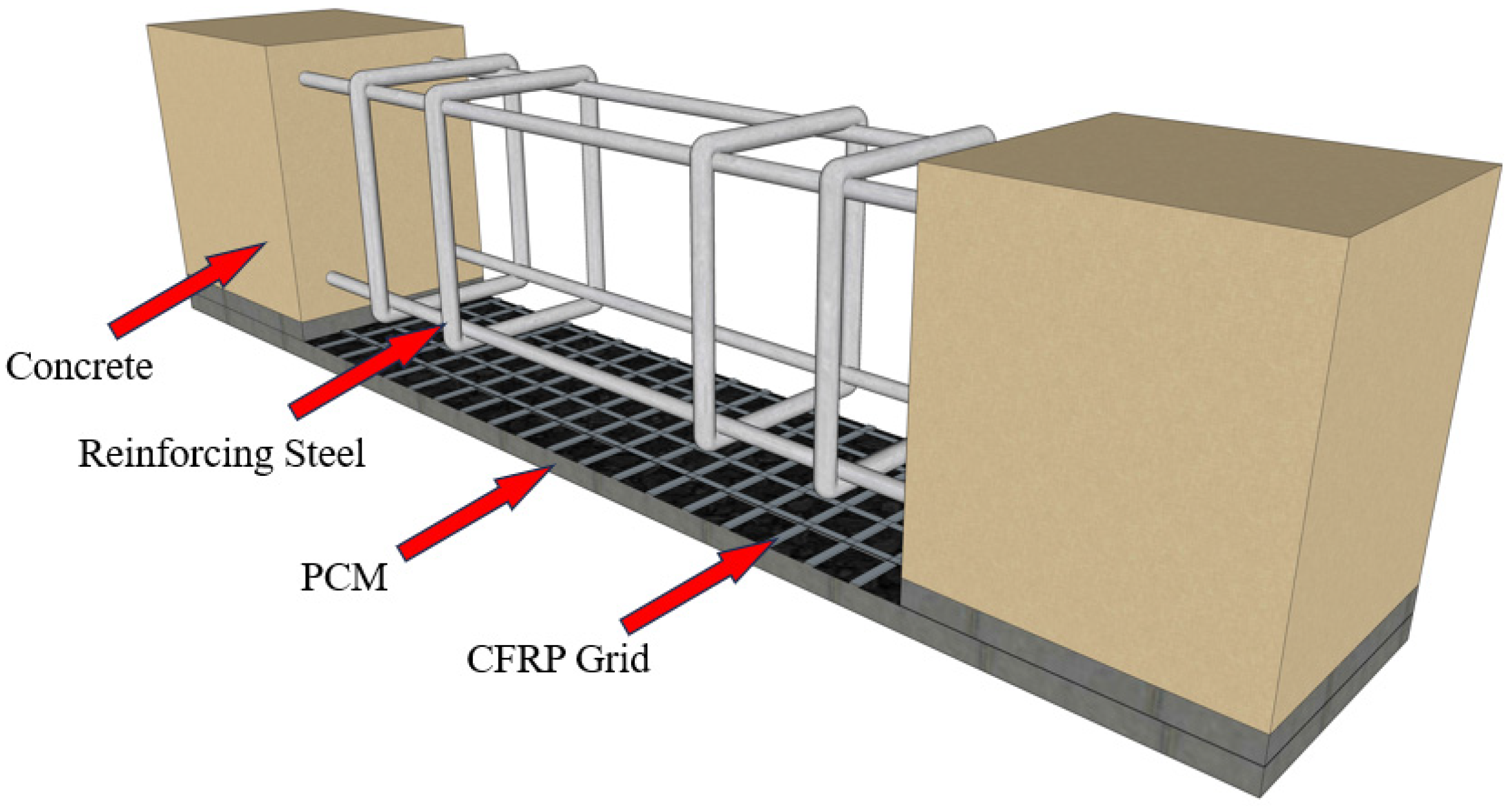
Carbon fiber-reinforced polymer has been widely used in the strengthening of civil engineering structures. Among them, the CFRP grid composite strengthening system, as an emerging technology, demonstrates unique engineering advantages. The CFRP grid is fabricated by weaving carbon fiber bundles at specified spacings, offering excellent properties such as light weight, high strength, and corrosion resistance [1]. In practical strengthening applications, it is often combined with PCM, which not only protects the CFRP grid from environmental degradation but also provides a reliable bonding interface, ensuring effective load transfer and composite action between the CFRP grid and the reinforced concrete (RC) beam [2,3]. Existing studies have shown that the CFRP grid composite strengthening system not only enhances the load-bearing capacity of RC beams but also significantly improves their crack resistance and durability [4]. Compared with traditional CFRP sheet strengthening, the grid structure offers better stress dispersion and geometric adaptability, enabling more uniform stress transfer. This makes it particularly suitable for strengthening concrete components with complex geometries or large surface areas. The CFRP grid composite strengthening technology is illustrated in Figure 1.
In recent years, systematic research has been conducted on the static performance of this composite strengthening system. Wang B et al. [5] analyzed the mechanical behavior and failure mechanisms of the CFRP grid–PCM strengthening system under shear loading. Guo R et al. [6,7] established nonlinear design formulas that consider the contributions of bidirectional CFRP grids and, through parametric experimental studies on flexural performance, proposed analytical models capable of accurately predicting load-bearing capacity. Niu, P et al. [8] investigated the flexural strengthening mechanisms of this system for damaged RC beams, while Dai H et al. [9] focused on the interfacial bonding behavior and mechanical mechanisms between the CFRP grid–PCM strengthening layer and the existing concrete substrate. Furthermore, Senesavath S et al. [10] studied the dynamic response and failure patterns of this system under impact loading. These findings provide a significant foundation for the theoretical development and engineering application of CFRP grid–PCM strengthening technology.
Reinforced concrete bridges commonly experience fatigue damage accumulation and performance degradation under the coupled effects of long-term traffic loads and environmental factors. To effectively mitigate damage progression and ensure structural safety and durability, the adoption of high-performance strengthening techniques has become an important engineering requirement. CFRP demonstrates significant application potential in the repair and strengthening of fatigue-sensitive structures due to its exceptional fatigue resistance [11,12] and corrosion resistance [13]. Extensive research has been conducted on the fatigue performance of CFRP-strengthened RC beams. Al-Rousan R et al. [14] found through constant-amplitude fatigue tests that increasing load levels leads to a decline in the fatigue performance of strengthened beams, with failure modes shifting from steel bar fracture to CFRP debonding and concrete interface shear failure. Deng L et al. [15] achieved real-time monitoring of the loading process in strengthened beams by embedding fiber Bragg gratings into CFRP plates, effectively extending their fatigue life. Research by Peng H et al. [16] indicated that prestressed CFRP plates not only significantly improve both the static and fatigue performance of beams but also reduce deflection and steel strain, while inducing stress redistribution upon debonding initiation. Heffernan P J et al. [17], through parametric testing, concluded that CFRP sheets effectively enhance beam fatigue performance, with increased load amplitude drastically shortening fatigue life, whereas adding more CFRP layers significantly prolongs it. Based on finite element simulations, Zhang Z et al. [18] found that reducing load amplitude, increasing concrete strength, and raising the FRP strengthening ratio all contribute to improved fatigue performance of strengthened beams. Huang H et al. [19] experimentally demonstrated that beams strengthened with post-tensioned prestressed CFRP sheets exhibited significantly superior fatigue performance compared to unstrengthened beams and those with non-prestressed strengthening, with failure modes primarily characterized by tensile steel fracture. Research by Wang Q et al. [20] showed that higher prestressing levels and the use of alloy rib anchorage at the ends effectively suppress fatigue damage development and CFRP tendon slippage failure. Zou C et al. [21], through finite element analysis, found that adding U-wraps at the ends when CFRP plates are bonded to the sides significantly reduces interfacial damage and extends fatigue life, proposing corresponding fatigue life prediction formulas.
Regarding the coupling effects of complex environments and loads, Chen Z et al. [22] systematically revealed the synergistic deterioration mechanism of CFRP-strengthened beams under hygrothermal environments and variable-amplitude overloads, identifying interfacial bond degradation and early-stage steel bar failure as the primary causes of performance decay, and accordingly proposed a modified Miner’s rule for life prediction. For fatigue issues in corrosive environments, Zhang Z et al. [23] quantified the influence of bond degradation caused by steel corrosion on beam behavior through a numerical model, establishing corresponding methods for calculating stiffness and deflection with good accuracy. Lin J et al. [24], through coupled fatigue tests involving temperature and random vehicle loads, revealed the significant influence of temperature-load coupling on the damage mechanism of CFRP-strengthened beams and proposed an improved theoretical model capable of effectively predicting such complex fatigue behavior. These studies further confirm that CFRP strengthening can effectively enhance the fatigue life and crack resistance of RC beams.
In cold regions, the coupled effect of freeze–thaw cycles and fatigue loading is a critical factor leading to the accelerated degradation of CFRP-strengthened reinforced concrete (RC) beams. Research indicates that freeze–thaw damage increases concrete porosity and leads to internal structural loosening, significantly weakening the bond performance at the CFRP–concrete interface [25,26,27,28,29], which in turn affects stress transfer efficiency and collaborative working capacity under fatigue loading. Although existing studies have addressed the adverse effects of freeze–thaw environments on strengthened structures [30,31], systematic experimental research on CFRP grid–polymer cement mortar (PCM)-strengthened RC beams under combined freeze–thaw and fatigue action remains notably insufficient. Limited by experimental duration and cost, current findings have largely focused on static performance analysis [32,33,34], failing to adequately reveal the damage evolution mechanisms and interfacial behavior under coupled conditions. Consequently, the design and assessment of such systems under fatigue loading in cold regions lack a reliable basis. Therefore, this study employs multi-scale monitoring to systematically investigate the fatigue performance evolution and failure mechanisms of CFRP grid–PCM strengthened RC beams under coupled freeze–thaw and fatigue actions, aiming to provide theoretical support and technical reference for engineering applications in cold regions.

2. General Description of the Experiments

2.1. Specimen Design

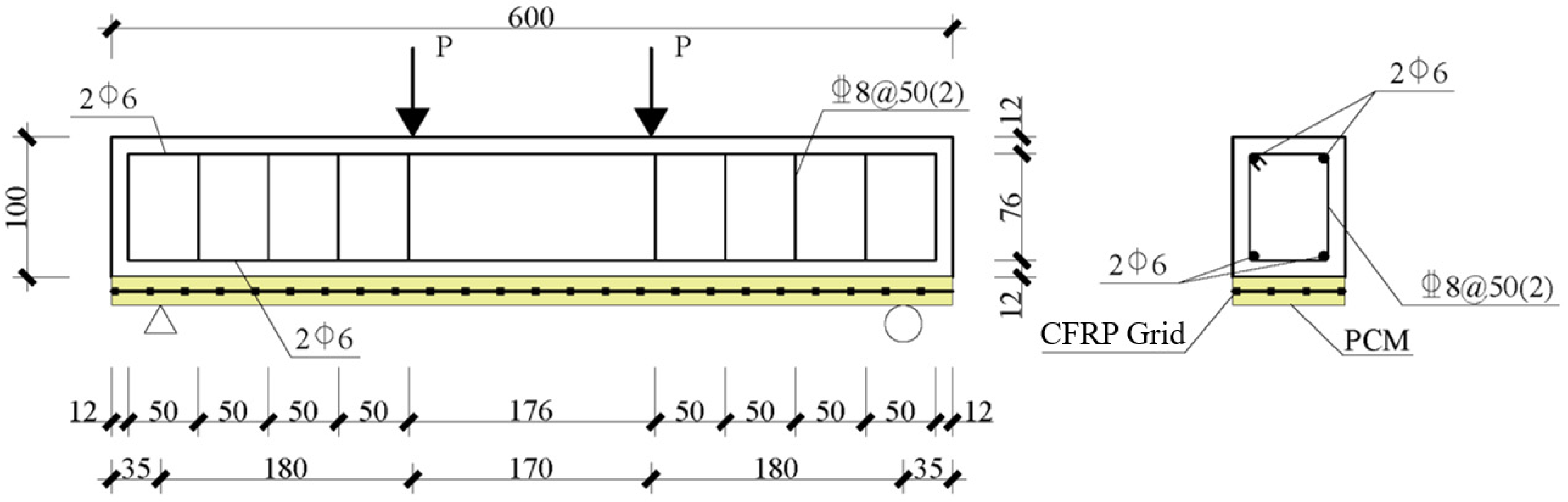
A total of seven test beams were designed in this study to investigate the fatigue performance of CFRP grid-strengthened RC beams under freeze–thaw cycles. To accommodate the dimensional limitations of the freeze–thaw testing equipment, all specimens were designed as scaled models. The detailed dimensions, reinforcement details, and strengthening configurations are provided in Figure 2. Regarding the consideration of specimen size effect, Du X et al. [35] summarized existing studies and pointed out that the flexural strength of appropriately reinforced beams generally shows no significant size effect. Chen Z et al. [36] also demonstrated through experiments on CFRP sheet-strengthened beams that, under the same reinforcement ratio and strengthening ratio, their flexural strength similarly exhibited no size effect. Currently, dedicated studies on the size effect of the CFRP grid–PCM system remain unavailable. However, the primary objective of this paper is to reveal the damage mechanisms and performance evolution under the coupled action of freeze–thaw cycles and fatigue loading. Scaled models can effectively serve the goals of qualitative comparison and mechanistic analysis in this context. Therefore, the experimental design in this study was primarily based on existing knowledge of CFRP sheets.
All test beams were cast using C40 concrete. Based on cross-sectional dimensions and reinforcement ratios, the specimens were divided into two groups: the first group consisted of four beams with a cross-section of 80 mm × 100 mm and a reinforcement ratio of 0.84%, each reinforced with two 6 mm diameter HRB300 longitudinal bars in both the tension and compression zones, and 8 mm diameter HRB400 stirrups spaced at 50 mm; the second group comprised four beams with a cross-section of 160 mm × 100 mm and a reinforcement ratio of 1.31%. Detailed design parameters of the specimens are summarized in Table 1, where the ultimate loads of beams S6F0R0 and S9F0R0 under static loading were 15.16 kN and 46.91 kN, respectively.

2.2. Strengthening and Freeze–Thaw Treatment of Test Beams

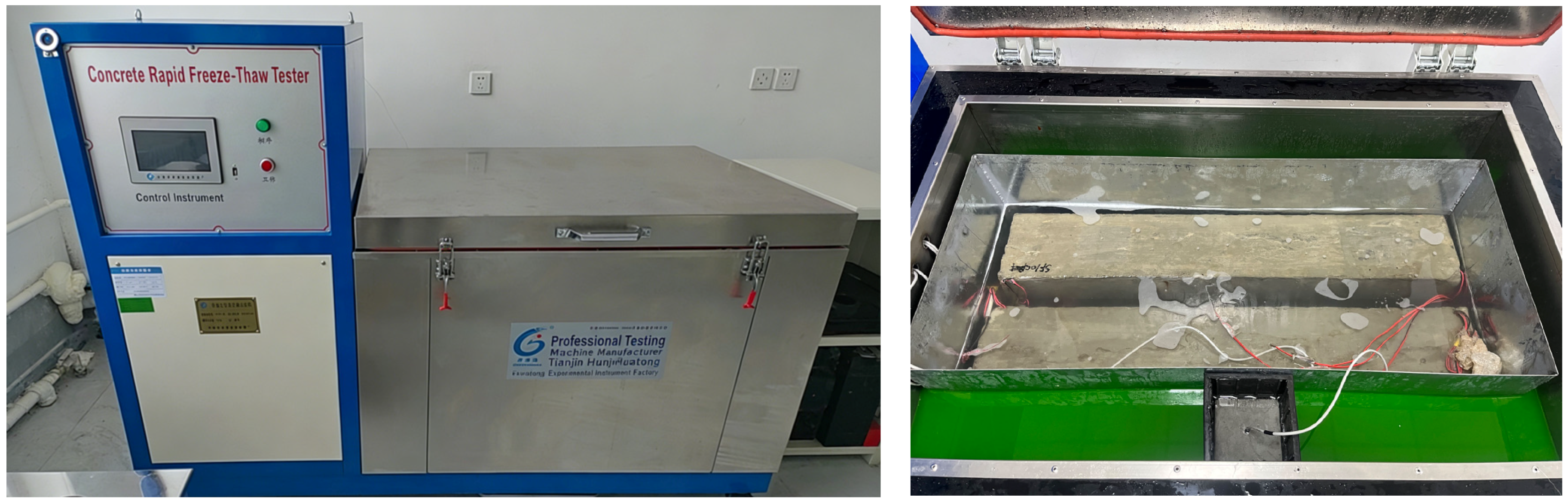
The strengthening process for the test beams is briefly outlined as follows: (1) Cut the CFRP grid to match the dimensions of the surface to be strengthened. (2) Roughen the surface of the test beam to be strengthened by mechanical abrasion. (3) Use wooden boards or similar materials to form edge details at the strengthening layer interface, allowing for a 20 mm thickness of the strengthening layer. (4) Mix the polymer-modified cement mortar (PCM). First, apply a thin layer of PCM to cover the strengthened surface. Place the pre-cut CFRP grid onto the surface and secure its edges. Continue pouring PCM into the formwork, level the surface, and finally conduct water curing. To simulate the actual damaged state of structural members under freeze–thaw conditions, the cured beams underwent water-saturation pretreatment. The procedure complied with the Chinese National Standard GB/T 50082-2024 [37], where specimens were fully immersed in (20 ± 2)°C water for at least 4 days to achieve saturation. Subsequently, the specimens were transferred to a TDR-28 rapid freeze–thaw testing machine for freeze–thaw cycling. The test setup is illustrated in Figure 3.
To quantify the damage to concrete induced by freeze–thaw cycles, parallel freeze–thaw tests were carried out on concrete cube specimens cured under the same conditions, while the beams were subjected to freeze–thaw cycling. The testing procedure followed the standard [37]. After 100 rapid freeze–thaw cycles, the specimens exhibited an average mass loss of 2.5% and a relative loss in dynamic elastic modulus of 32%. These results demonstrate that the rapid freeze–thaw regime employed in this study caused significant deterioration of the concrete material. With reference to climatic data from typical severe cold regions (e.g., Northeast China), the number of freeze–thaw cycles applied corresponds approximately to the cumulative freeze–thaw damage experienced by a structure exposed to the natural environment for 2 to 4 years.

2.3. Material Properties

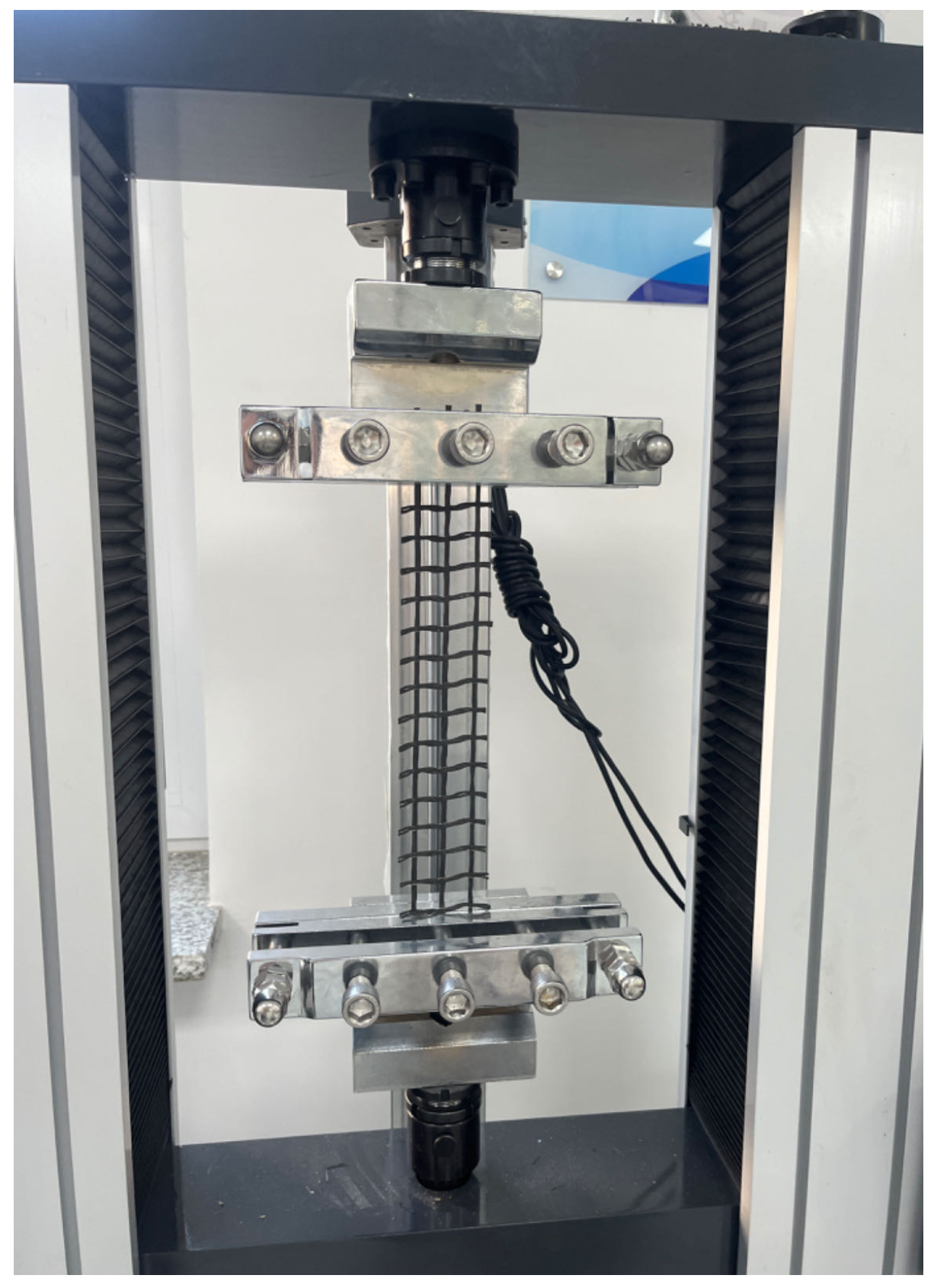
During the casting of the test beams, concrete and PCM specimens were prepared and cured under identical conditions. The average compressive strength of the concrete cubes was measured to be 40.8 MPa. PCM, serving as the bonding and load-transfer medium between the CFRP grid and concrete, forms a high-strength adhesive layer on the rough concrete surface due to its polymer-enhanced mechanism, ensuring complete anchorage and full encapsulation of the CFRP grid while also providing good workability. The interfacial bonding performance of this composite system has been validated in previous studies [9,38], with relevant key material parameters listed in Table 2. The mechanical properties of the steel reinforcement used in the tests are provided in Table 3. Regarding the mechanical characterization of the CFRP grid, considering the actual load-bearing width of a single fiber bundle within the grid cross-section, this study adopts CFRP grid strips consisting of three fiber bundles as the basic load-bearing unit, with their tensile strength taken as the design reference value. A typical tensile test setup for the CFRP grid is illustrated in Figure 4, and the corresponding mechanical performance parameters are summarized in Table 4.

2.4. Test Equipment and Loading Protocol

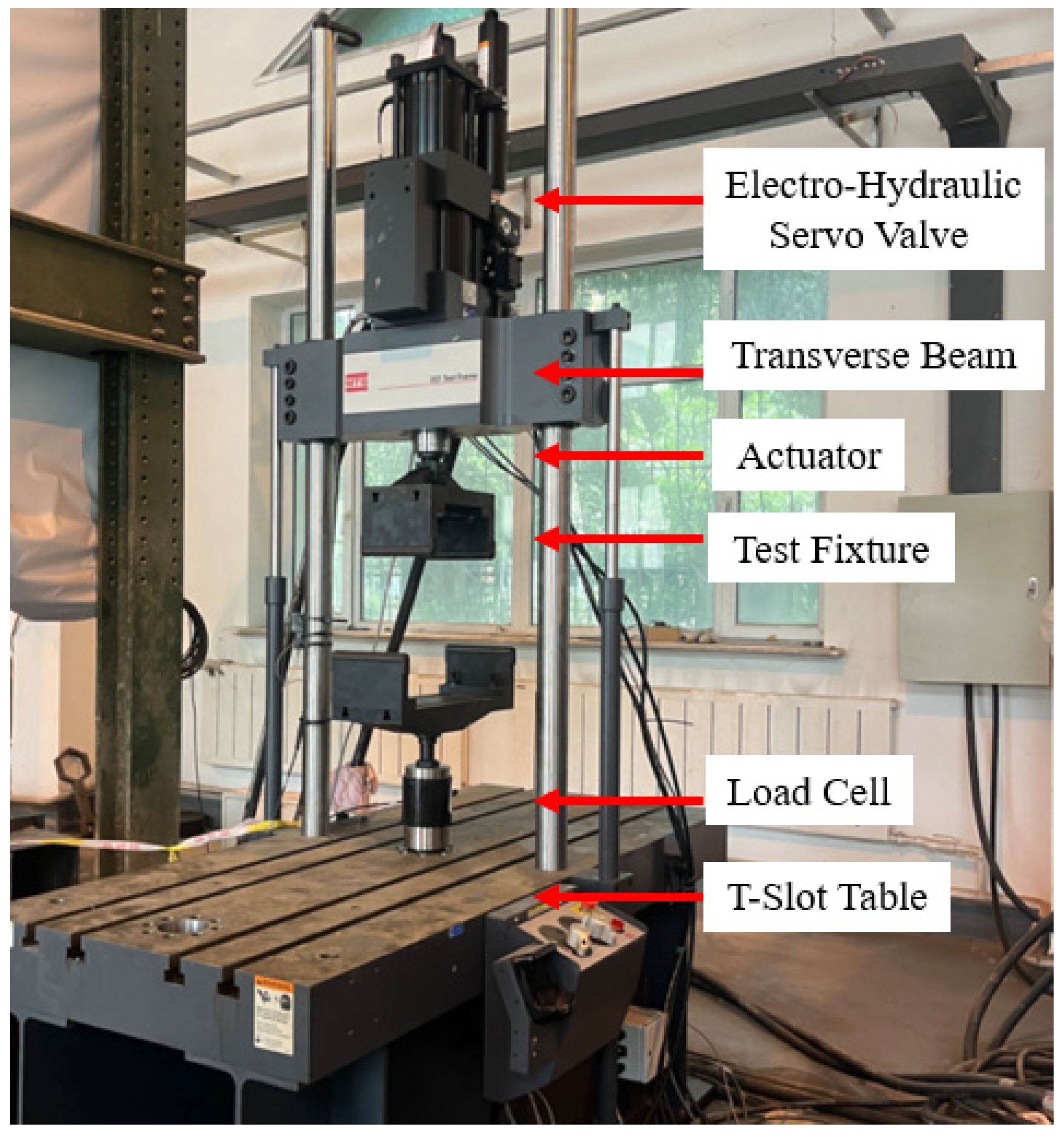
This study employed an MTS322.31 electro-hydraulic servo fatigue testing machine to conduct the experiments. The machine has a maximum load capacity of ±250 kN with a load accuracy of ±0.5%. It is primarily composed of a crossbeam, actuator, specialized fixtures, load sensors, hydraulic servo valves, and a T-shaped working platform, and it is capable of performing both static and fatigue loading. The tests adopted a third-point loading scheme, with the loading configuration illustrated in Figure 5.
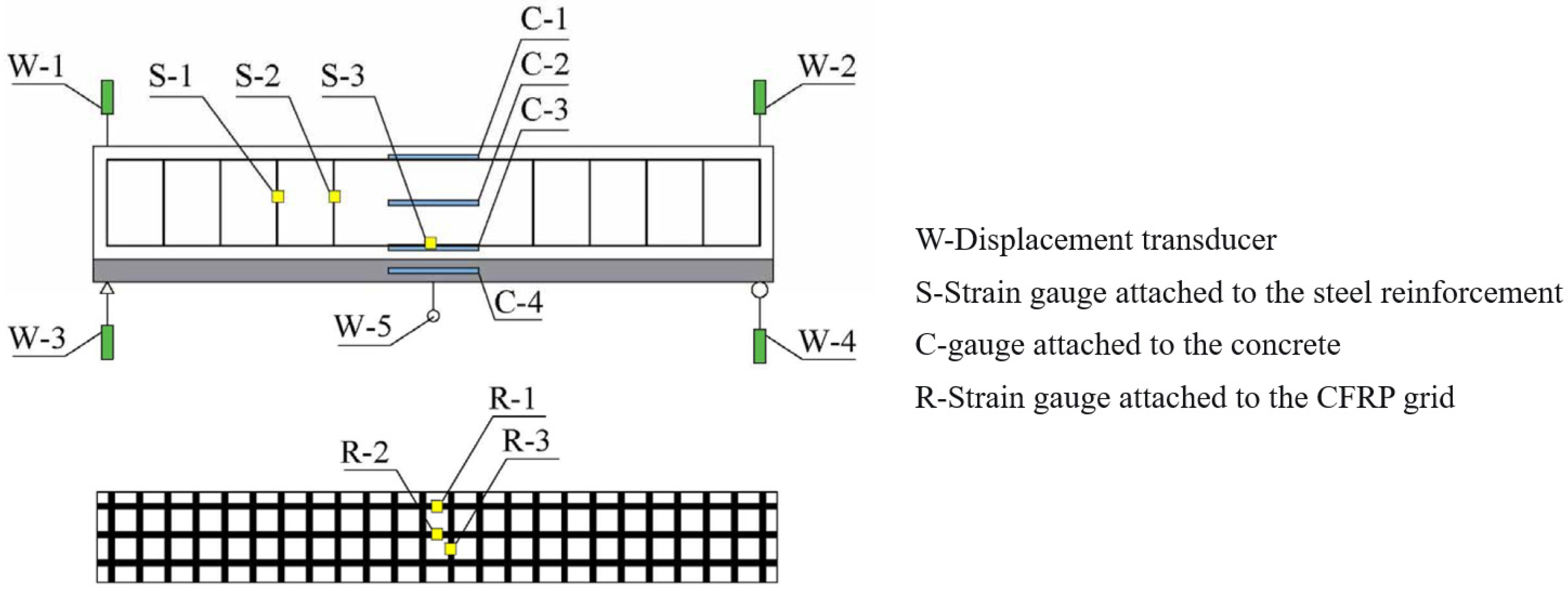
During the test, load data were directly collected by the high-precision built-in sensors of the testing machine. To capture the strain response at critical sections, high-accuracy resistance strain gauges were arranged along the height of the mid-span section to measure the strains in the longitudinal reinforcement and concrete. In addition, strain gauges were installed at the bottom of the mid-span section to monitor the strain in the CFRP grid. The CFRP grid strain measurement points were concentrated in a single cross-section within the pure bending region of the mid-span. This arrangement was based on the flexural characteristics of three-point loading, where the bending moment in the mid-span region remains constant, and the strain distribution is relatively uniform, aiming to preferentially capture the strain evolution at the most critical section during the fatigue damage process. Furthermore, self-resetting displacement transducers were placed at the two supports, the two loading points, and the mid-span position to monitor the deflection development and support settlement of the specimen under loading. All strain and displacement signals were synchronously acquired using an IM3818 dynamic-static strain measurement system and transmitted in real time to a computer via wireless technology for processing and storage. The detailed layout of the measurement points on the test beams is shown in Figure 6.
To accurately capture the actual stress state of CFRP grid-strengthened concrete beams subjected to coupled freeze–thaw and fatigue loading, the fatigue load levels in this study were determined based on existing findings [14,17,19]. Previous research indicates that, when the upper fatigue load exceeds 0.8 times the ultimate load-bearing capacity, the fatigue life of the member decreases significantly, whereas, when the upper limit is below 0.5 times the ultimate capacity, most specimens can withstand over 2 million loading cycles. The lower load limit has a relatively minor influence on fatigue life and is typically set at approximately 0.1 times the ultimate capacity. Integrating these established conclusions with the objectives of the present study and to ensure complete observation of the entire fatigue damage process within a feasible experimental period, the upper fatigue load limits were set differentially according to the reinforcement ratio: for beams with a reinforcement ratio of 0.84%, the upper fatigue load was taken as 75% of their ultimate load-bearing capacity; for beams with a reinforcement ratio of 1.31%, the upper limit was taken as 70% of their ultimate capacity. The lower load limit was uniformly set at 12% of the ultimate capacity. This load range corresponds to the most critical fatigue-damaging load interval in actual bridge structures.
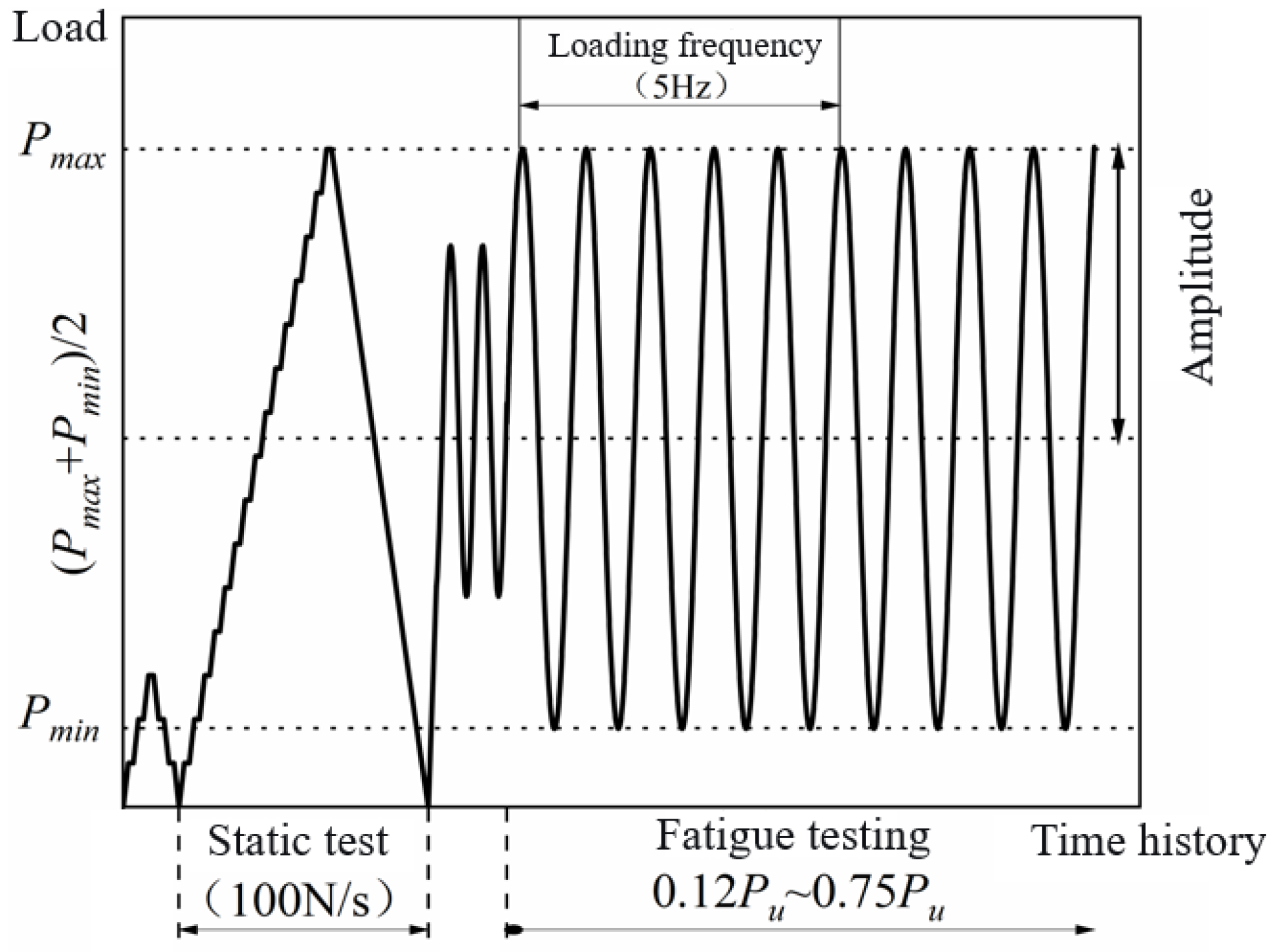
Before testing, each beam was statically loaded to the preset fatigue upper limit at a loading rate of 100 N/s. Initial crack development was monitored and recorded in real time. The fatigue loading protocol is shown in Figure 7, after which the beam was unloaded to zero. Prior to formal cyclic loading, 2–3 preliminary cycles were applied to dynamically calibrate the load control system. Subsequently, stable sinusoidal cyclic loading at a frequency of 5 Hz was initiated. This frequency is widely adopted in fatigue studies of concrete and FRP composites. Existing studies have shown that at 5 Hz or similar moderate loading frequencies, the temperature rise in specimens is negligible (typically <2–3 °C), and the fatigue life and failure modes are insensitive to frequency variations [37,39]. To observe the accumulation of fatigue damage, a method combining intermittent cyclic loading and static load testing was employed. Fatigue loading was paused at 10,000, 50,000, and 100,000 cycles, respectively, and static load tests up to the fatigue upper limit were conducted after unloading. This procedure was repeated every subsequent 100,000 accumulated cycles. During each static loading stage, crack propagation, mid-span deflection, and strains at key points were recorded to capture the stage-wise evolution characteristics of fatigue damage.

3. Test Results and Analysis

3.1. Experimental Observations and Failure Modes

The fatigue failure process and crack development of the test beams exhibited distinct phased patterns. Based on the structural characteristics of the specimens (unstrengthened, CFRP-strengthened, and subjected to freeze–thaw cycles), notable differences were observed in their loading responses and failure modes, as analyzed in detail below:
Fatigue Response of Unstrengthened Test Beams (Specimens F6F0R0).
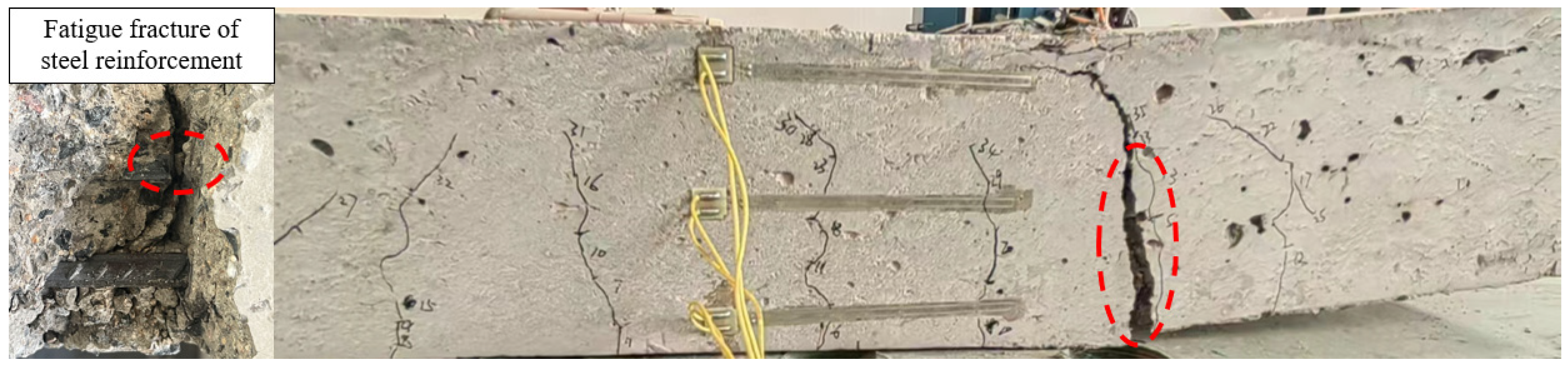
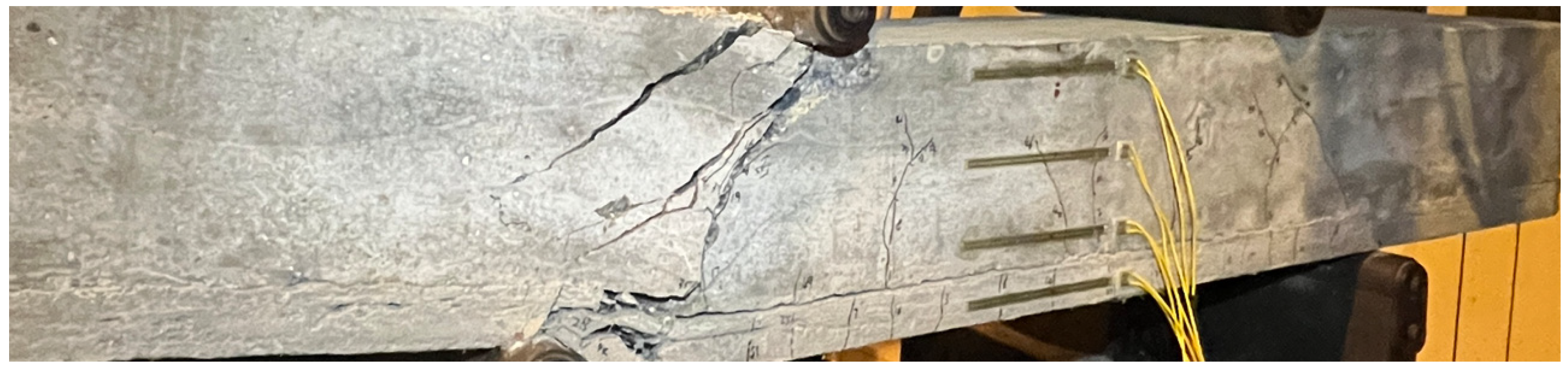
The fatigue damage of the unstrengthened specimen F6F0R0 exhibited a distinct time-dependent evolution pattern. During the static preloading stage, cracks initiated in the pure bending region at mid-span and progressively extended toward the loading points and the shear span, forming initial damage for subsequent fatigue loading. The maximum crack width at this stage was approximately 0.12 mm. In the early fatigue loading stage (0–10,000 cycles), existing cracks continued to propagate toward the beam top and gradually widened. By 10,000 cycles, the maximum crack width increased to about 0.25 mm, and audible slippage sounds from the steel reinforcement were first detected at the 12,792nd cycle. As loading continued, crack development entered a stable phase, with both crack length and width increasing at a significantly reduced rate. At 50,000 cycles, the maximum crack width reached approximately 0.30 mm. Thereafter, the crack system stabilized, showing no significant growth in length or width, and no new cracks formed. When the number of cycles approached 95% of the fatigue life (around 98,000 cycles), the damage entered an unstable stage: the width of the main crack increased abruptly to over 0.8 mm within a short period, accompanied by fracture of the tensile reinforcement and a sudden increase in mid-span deflection. The specimen ultimately failed at 103,059 cycles, exhibiting a typical fatigue fracture morphology of the steel reinforcement, as shown in Figure 8.
Fatigue Response of CFRP Grid-Strengthened Test Beams (Specimens F6F0R1 and F6F1R1).
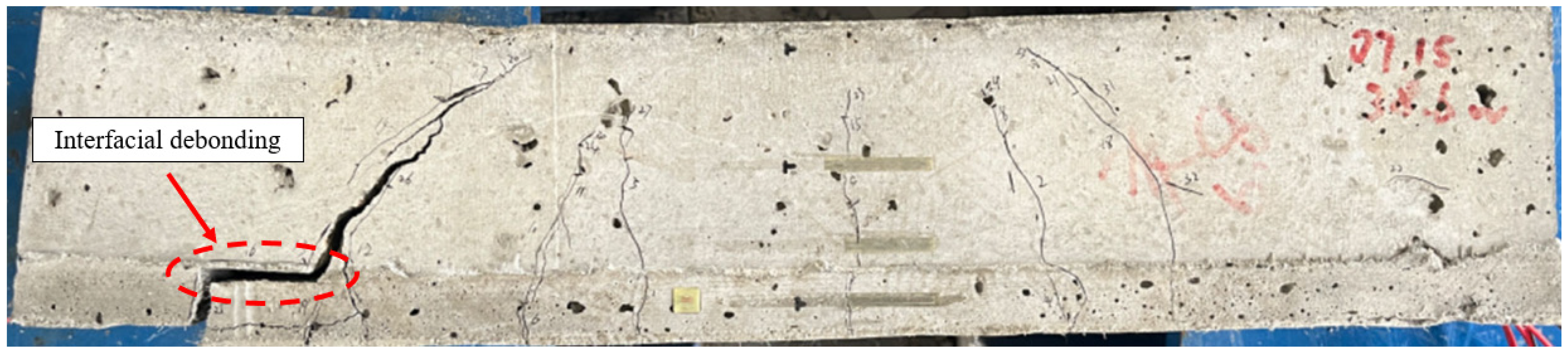
The non-freeze–thaw specimen F6F0R1 exhibited the following behavior. During static loading, cracks first appeared in the strengthening layer, followed by the simultaneous formation of multiple vertical cracks at the mid-span and loading points, with diagonal cracks also developing in the shear-span region. In the fatigue loading stage, existing cracks continued to extend toward the beam top during the initial phase (0–10,000 cycles), with the maximum crack width increasing from about 0.15 mm after static loading to 0.22 mm. By 50,000 cycles, the diagonal cracks had propagated through the loading points, at which point the maximum crack width reached approximately 0.28 mm. Thereafter, the crack system remained largely stable during a prolonged steady phase (approximately 100,000–350,000 cycles), with the maximum width maintained between 0.30 mm and 0.35 mm. In contrast to the unstrengthened specimen, no audible slippage sounds from the steel reinforcement were observed throughout the entire process, indicating that the CFRP grid effectively enhanced the overall stiffness of the beam and restrained the development of longitudinal steel strain and interfacial slip. As failure approached (after about 380,000 cycles), the main crack propagated rapidly, its width increasing to over 0.8 mm within a short period, and new cracks formed in the interfacial zone. After the tensile steel fractured, the CFRP grid continued to temporarily carry part of the load, eventually leading to local debonding between the PCM layer and the concrete substrate, with a measured debonding length of about 60 mm. Subsequently, the CFRP grid in the debonded region ruptured due to stress concentration. The failure morphology is shown in Figure 9. This failure process reveals that, during the stress-redistribution stage following steel fracture, the PCM–concrete interface became a new weak link, while the CFRP grid continued to provide a certain degree of ductile load-carrying capacity in the post-peak stage, demonstrating the toughening characteristics of the composite strengthening system.
The strengthened specimen F6F1R1, subjected to 100 freeze–thaw cycles, exhibited the following behavior. During the static loading stage, cracks propagated from the pure bending region toward the shear-span zone. Cracks at the loading points appeared earlier and with a slightly larger initial width (about 0.18 mm) compared to specimen F6F0R1, indicating that freeze–thaw action reduced the cracking resistance of the concrete. In the fatigue loading phase, existing cracks continued to propagate during the initial stage (0–10,000 cycles), with the width increasing to about 0.25 mm. This was followed by a transition stage (10,000–50,000 cycles), during which the crack growth rate decreased. Between 50,000 and 100,000 cycles, slight extension occurred at the cracks near the loading points. After 100,000 cycles, the crack system entered a stable phase, with all cracks developing slowly along paths already formed during static loading. The maximum crack width stabilized in the range of 0.32–0.40 mm, which was overall slightly larger than that of specimen F6F0R1 at the same stage, though no new cracks formed. As failure approached, the tensile steel reinforcement fractured first, after which the CFRP grid continued to carry load. Only fine transverse cracks appeared in the strengthening layer, with no interfacial debonding observed. The specimen ultimately failed after 355,704 cycles, exhibiting a failure mode characterized by steel rupture accompanied by fiber pull-out in the CFRP grid, as shown in Figure 10. This failure process indicates that, under the present experimental conditions, while freeze–thaw action accelerated crack initiation and early propagation and resulted in overall wider cracks, it did not alter the ultimate failure mechanism of the strengthened beam. Failure remained dominated by material fracture of the steel reinforcement and the CFRP grid, rather than by debonding at the PCM–concrete interface.
Fatigue Response of Test Beams with 1.31% Reinforcement Ratio (Specimens F9F1R0 and F9F1R1)
The unstrengthened specimen F9F1R0, which underwent 100 freeze–thaw cycles, exhibited crack development and failure processes largely consistent with those of specimen F6F0R0. During the static loading stage, initial cracks formed simultaneously in the pure bending region and at the loading points, with a maximum crack width of about 0.10 mm. In the early stage of fatigue loading (0–10,000 cycles), only the existing cracks propagated slowly, and no new cracks were observed; the maximum crack width increased to approximately 0.20 mm. As the number of cycles increased, crack development entered a stable phase until about 50,000 cycles, when one new crack appeared. Thereafter, the specimen remained in a state of stable damage accumulation, with cracks extending gradually. By 500,000 cycles, the maximum crack width reached about 0.45 mm. After exceeding 700,000 cycles, damage entered an accelerated phase: crack width increased abruptly to over 0.9 mm within a short period, crack length also extended rapidly upward, and beam deflection grew significantly. The specimen finally failed at 701,186 cycles due to crushing of the top concrete and fracture of the tensile reinforcement, as shown in Figure 11.
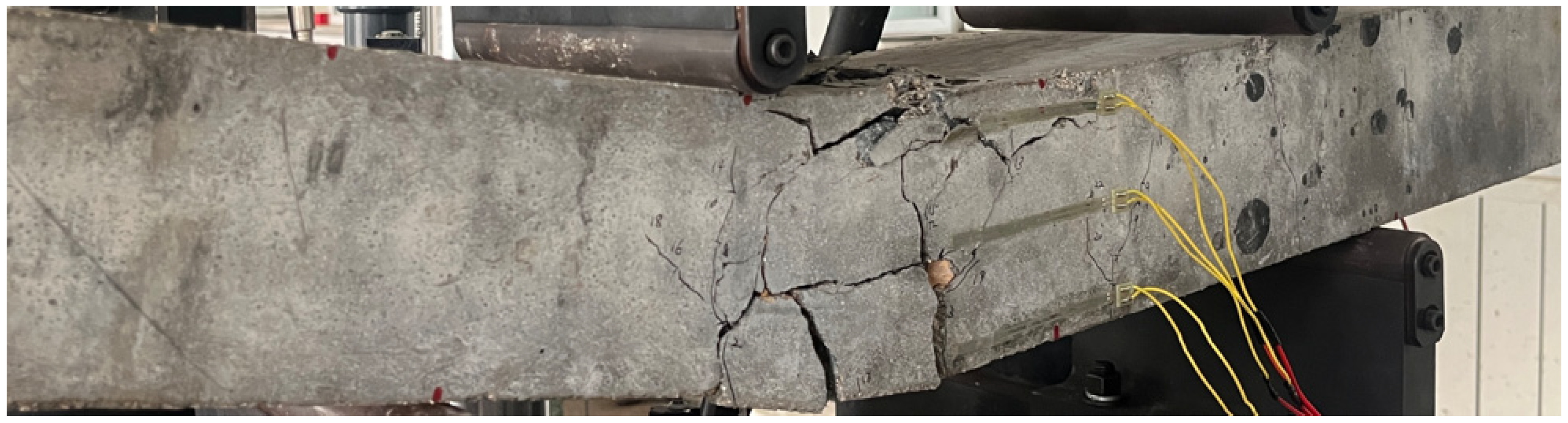
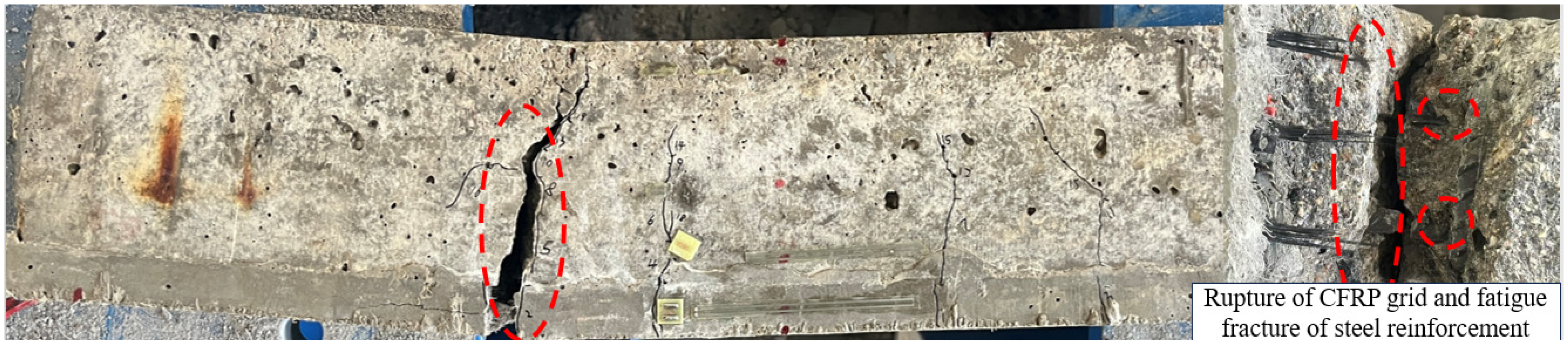
The CFRP-strengthened beam with a reinforcement ratio of 1.31% exhibited excellent fatigue resistance. For specimen F9F1R1, cracks at the loading points propagated rapidly during the early stage of fatigue loading (0–10,000 cycles), while cracks in the pure bending region remained stable. By 600,000 cycles, only slight extension of existing cracks was observed. Over the interval from 600,000 to 1,800,000 cycles, the crack system remained essentially stable, with no significant further development. The specimen did not experience fatigue failure even after 3 million loading cycles. According to the evaluation criteria for structural fatigue performance specified in the Chinese National Standard GB/T 50082-2024 [37], a specimen is considered to meet the high-cycle fatigue life requirement if it withstands 2 × 10⁶ cycles under the specified load level without fatigue failure. In the subsequent static loading test conducted to induce failure, the beam ultimately failed due to crushing of the top concrete and fracture of the CFRP grid, as shown in Figure 12. This failure process indicates that for CFRP-strengthened beams with a reinforcement ratio of 1.31%, the fatigue behavior follows an “initial propagation—long-term stabilization” pattern: the strengthening and restraining effect of the CFRP grid significantly delayed damage progression, substantially extending the fatigue life, and ultimately shifted the failure mode from fatigue-governed degradation to static ultimate failure. This demonstrates the reliability and durability of this strengthening system under long-term cyclic loading.
Based on the above experimental observations, the crack development and macroscopic mechanical responses exhibited the following patterns: Cracks in all beams were predominantly concentrated in the pure bending region, at the bottom of the loading points, and in the shear span. Prior to failure, all cracks showed abrupt width expansion and rapid upward propagation, displaying a three-stage time-history evolution of “initiation—stabilization—instability,” which closely corresponded to the fatigue damage accumulation process. The influence of environmental and structural factors on the above process was mainly reflected in two aspects: freeze–thaw action deteriorated the concrete matrix, reducing its cracking resistance, which led to earlier initiation and larger widths of initial cracks. During the fatigue process, the number of cracks decreased while their widths increased, indicating irreversible damage to the concrete microstructure and weakened interfacial stress transfer efficiency caused by freeze–thaw cycles. The CFRP grid composite strengthening system fundamentally reconfigured the controlling mechanism of structural failure. Its core lies in transforming the failure mode from a single “series” mechanism dominated by fatigue of the steel reinforcement to a “parallel-series” composite mechanism jointly governed by the multi-material interfaces among the steel reinforcement, CFRP grid, mortar, and concrete. This implies that the potential failure path extends from simple rupture of the reinforcement to a failure sequence that includes CFRP grid fracture and interfacial debonding. The ultimate failure mode is thus determined by the weakest link within this sequence.

3.2. Fatigue Life and Critical Damage

Table 5 summarizes the fatigue life and damage conditions of all test beams. According to the data in the table, for specimens with a reinforcement ratio of 0.84%, compared to the reference beam F6F0R0, the CFRP grid-strengthened beam exhibited an increase in fatigue life of 283,390 cycles, representing a relative improvement of approximately 275%. After undergoing 100 freeze–thaw cycles, the fatigue life of this strengthened beam decreased by 30,745 cycles, corresponding to a relative reduction of about 8%. This indicates that CFRP grid strengthening can significantly enhance the flexural fatigue performance of beams, and the strengthened beams still demonstrate good durability in freeze–thaw environments, with a relatively limited reduction in fatigue life. For specimens with a reinforcement ratio of 1.31%, after CFRP grid strengthening, the fatigue life exceeded 3 million cycles. Compared to the 701,186-cycle fatigue life of the unstrengthened component, this represents a substantial improvement, further highlighting the reinforcing effect of the CFRP grid system on the fatigue performance of beams.

4. Analysis of Mechanical Response Characteristics of Test Beams

4.1. Load–Displacement Curve

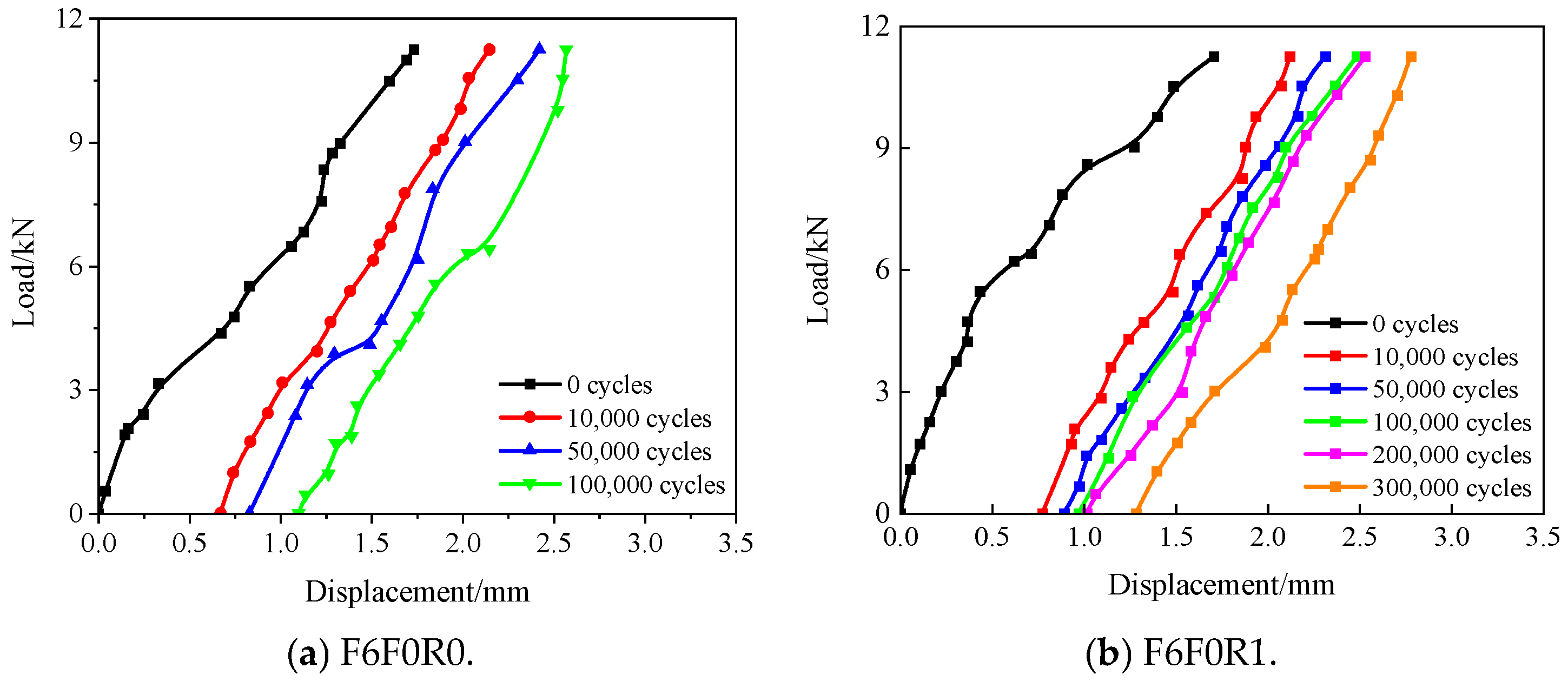
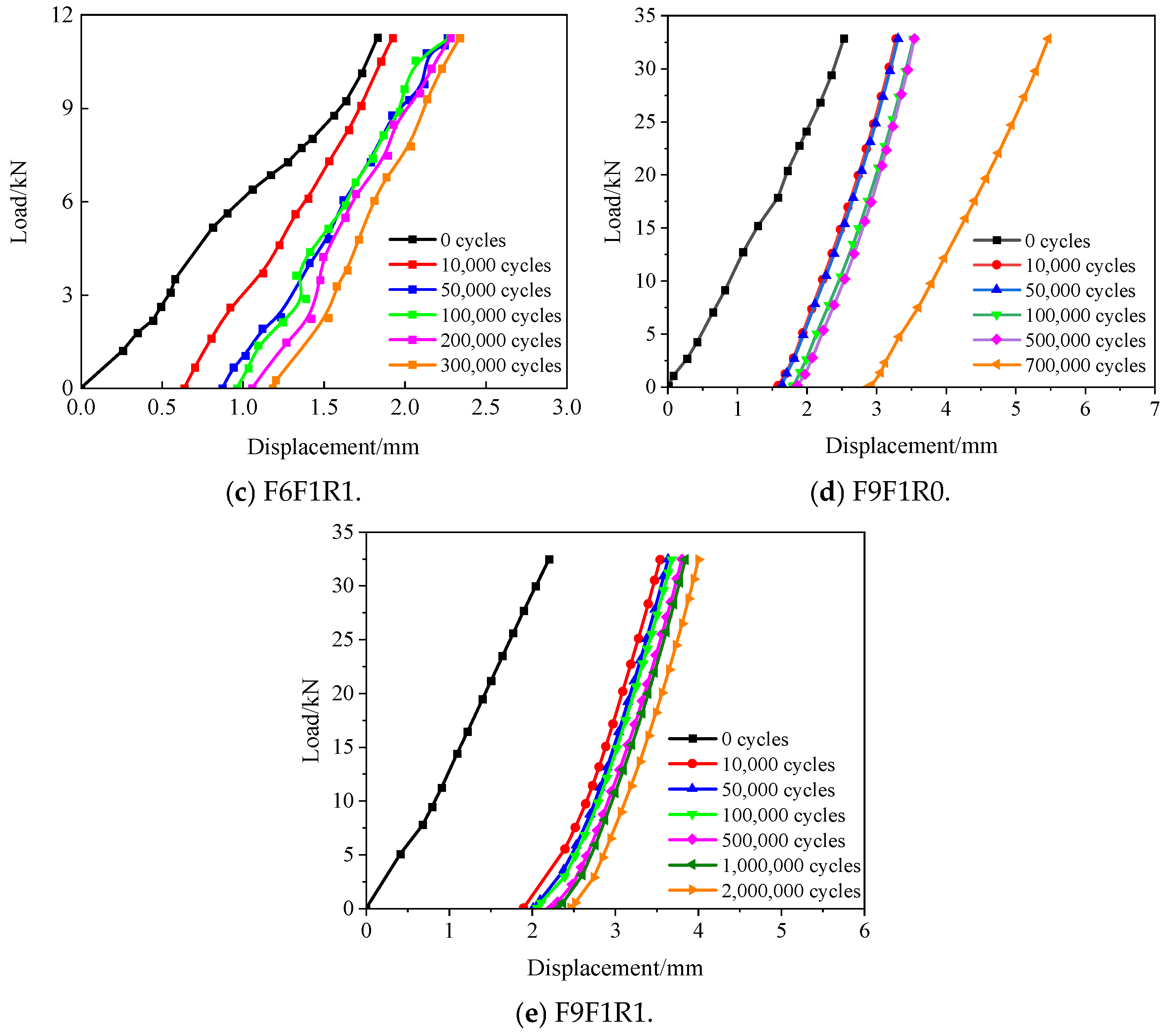
To evaluate the mechanical properties at different stages of fatigue damage, static loading tests were conducted at cumulative fatigue loading cycles of 0, 10,000, 50,000, and 100,000, and subsequently at every 100,000 cycles thereafter. The measured load–displacement curves are shown in Figure 13. From the information in the figure, it can be observed that all test beams exhibited certain residual deformations after 10,000 fatigue loading cycles. Specifically, the residual deformations for specimens F6F0R0, F6F0R1, and F6F1R1 after 10,000 cycles were 0.67 mm, 0.77 mm, and 0.64 mm, respectively. Furthermore, the residual deformations measured during the first static loading test and the static loading test near failure were significantly larger than those measured during the intermediate stages. This phenomenon can be attributed to the following: during the first static loading test, most cracks did not fully close after unloading once they formed, leading to significant residual deformation. In the stage nearing failure, rapid crack propagation accompanied by the formation of new cracks similarly resulted in increased residual deformation. In contrast, the curves during the intermediate stages were relatively dense and closely spaced, indicating that during the mid-phase of fatigue loading, crack development in the concrete stabilized, and structural stiffness degradation proceeded at a slower rate.
Based on the load–displacement curves, the stiffness degradation index of each specimen during the first 100,000 critical fatigue cycles was calculated, and the results are presented in Table 6. The findings indicate that, with increasing cycles, the stiffness of all specimens exhibited a gradual degradation trend. Freeze–thaw action significantly intensified internal damage in the concrete and accelerated stiffness decay, whereas CFRP grid strengthening and a higher reinforcement ratio effectively restrained crack propagation and delayed stiffness deterioration. After 50,000 cycles, the rate of stiffness degradation slowed markedly, indicating that the structure had entered a stable working phase.
Further analysis of the damage mechanism evolution throughout the entire fatigue process reveals that the correlation between stiffness degradation and displacement development exhibited distinct stage-dependent characteristics. In the early stage of fatigue loading, micro-cracking of concrete and interfacial slip led to a notable increase in displacement; however, due to the restraining effect of the CFRP grid, the decline in stiffness remained relatively gradual. During the stable stage, steady crack propagation resulted in a strong synergistic evolution between stiffness reduction and displacement growth. As failure approached, abrupt damage events such as steel reinforcement fracture or interfacial debonding triggered a sudden jump in displacement, at which point the continuous degradation of stiffness could no longer fully characterize the instantaneous instability of the structure. This phenomenon essentially reflects the transition of the dominant damage mechanism across different fatigue stages—from the accumulation of microscopic damage within the material, to the stable propagation of macroscopic cracks, and finally to the sudden failure of critical load-bearing components.

4.2. Concrete Compressive Strain

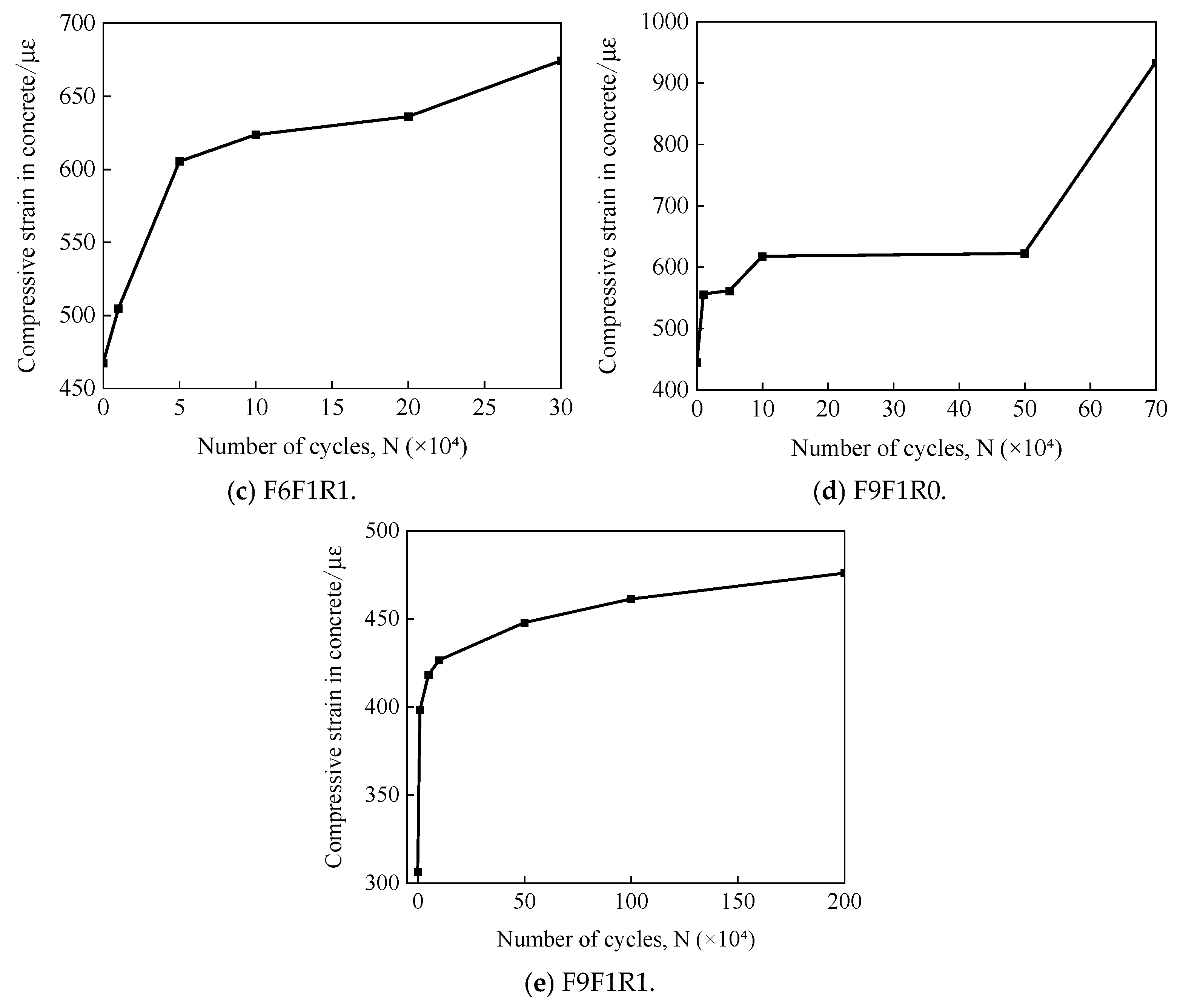
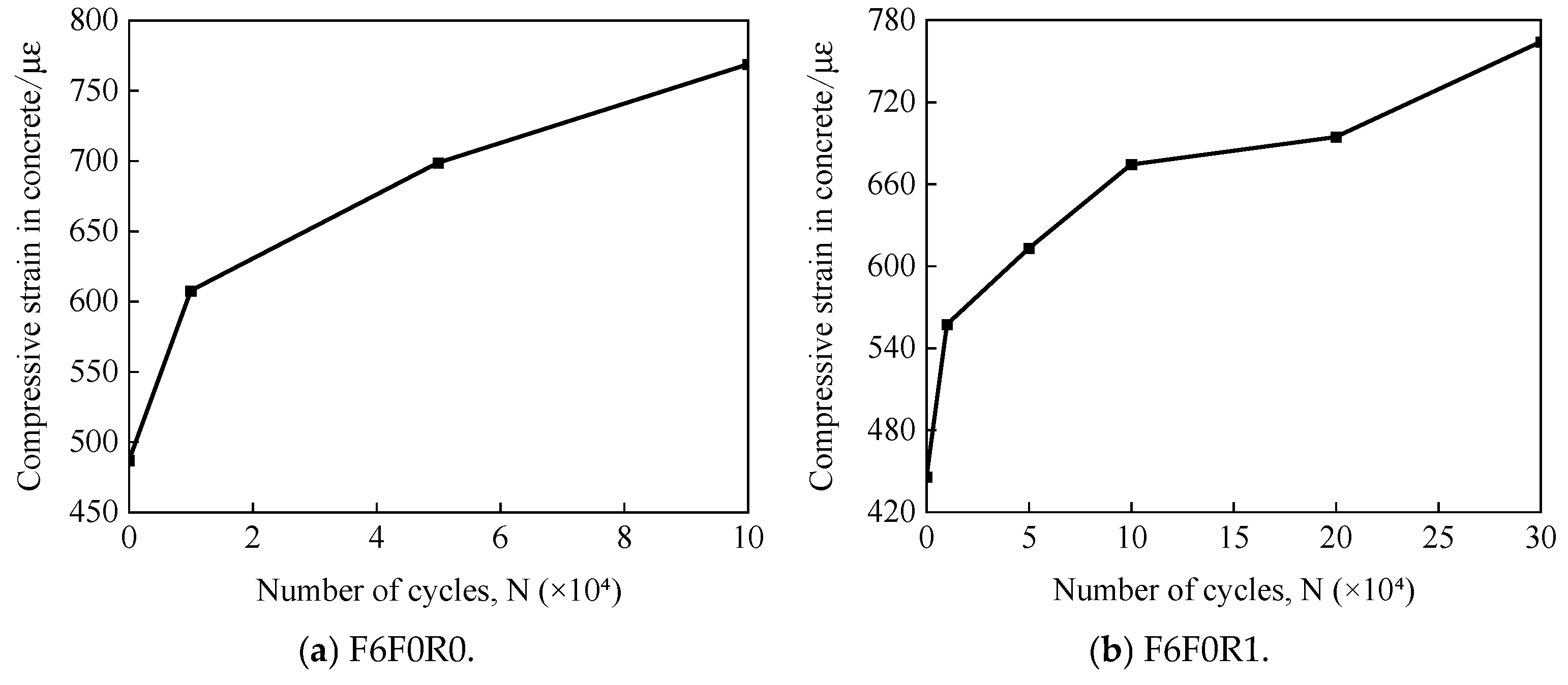
Figure 14 illustrates the evolution of compressive strain in the mid-span concrete of each test beam under fatigue loading as a function of the number of cycles. During continuous cyclic loading, the compressive strain of the concrete exhibited a progressively accumulating trend. For specimens strengthened with CFRP grids, the baseline compressive strain recorded after the first static loading was significantly lower than that of unstrengthened specimens. Moreover, throughout the entire subsequent fatigue loading process, the strain accumulation rate of the strengthened beams was generally lower than that of the unstrengthened beams. Under freeze–thaw conditions, CFRP grid strengthening continued to effectively restrain the development of compressive strain in the concrete zone. Compared with unstrengthened beams under the same freeze–thaw exposure, the strain-cycle curves of the strengthened beams were generally flatter. This indicates that the CFRP grid strengthening system can inhibit the initiation and propagation of micro-cracks in the concrete through an interfacial stress redistribution mechanism, effectively delaying the damage evolution process in the compressive concrete zone, thereby enhancing the fatigue durability of concrete beams after freeze–thaw exposure.
Based on the stage-wise evolutionary characteristics observed in the experimental curves, the growth of concrete compressive strain under coupled freeze–thaw and fatigue loading can be divided into two phases: an initial rapid growth phase and a subsequent slow growth phase. The transition point between these two phases is defined as the critical threshold of concrete compressive strain damage. This threshold essentially represents the turning point at which micro-cracks within the concrete transition from unconstrained rapid initiation and propagation to stable development under interfacial constraint. Once the compressive strain reaches this threshold, concrete damage enters an accelerated phase, and the fatigue load-bearing capacity of the structure decreases significantly. The curve characteristics indicate that freeze–thaw cycles and CFRP grid strengthening exert notably different effects on this threshold. Freeze–thaw cycles introduce initial micro-defects in the concrete, resulting in a higher initial compressive strain in the compression zone and accelerated early-stage growth. This shifts the critical threshold toward a lower number of cycles and increases the critical strain value. In contrast, CFRP grid strengthening, through interfacial synergy, restrains the propagation of micro-cracks, reduces the strain accumulation rate, delays the occurrence of the threshold, and lowers the critical strain. The threshold proposed in this study is based on specific experimental conditions and is influenced by factors such as concrete strength and CFRP interfacial properties. In engineering practice, an appropriate threshold can be determined through targeted experiments or numerical simulations that account for the specific service environment, loading conditions, and material parameters, thereby serving as a quantitative reference for structural fatigue monitoring and life prediction.

4.3. Steel Reinforcement Strain and Stress Range

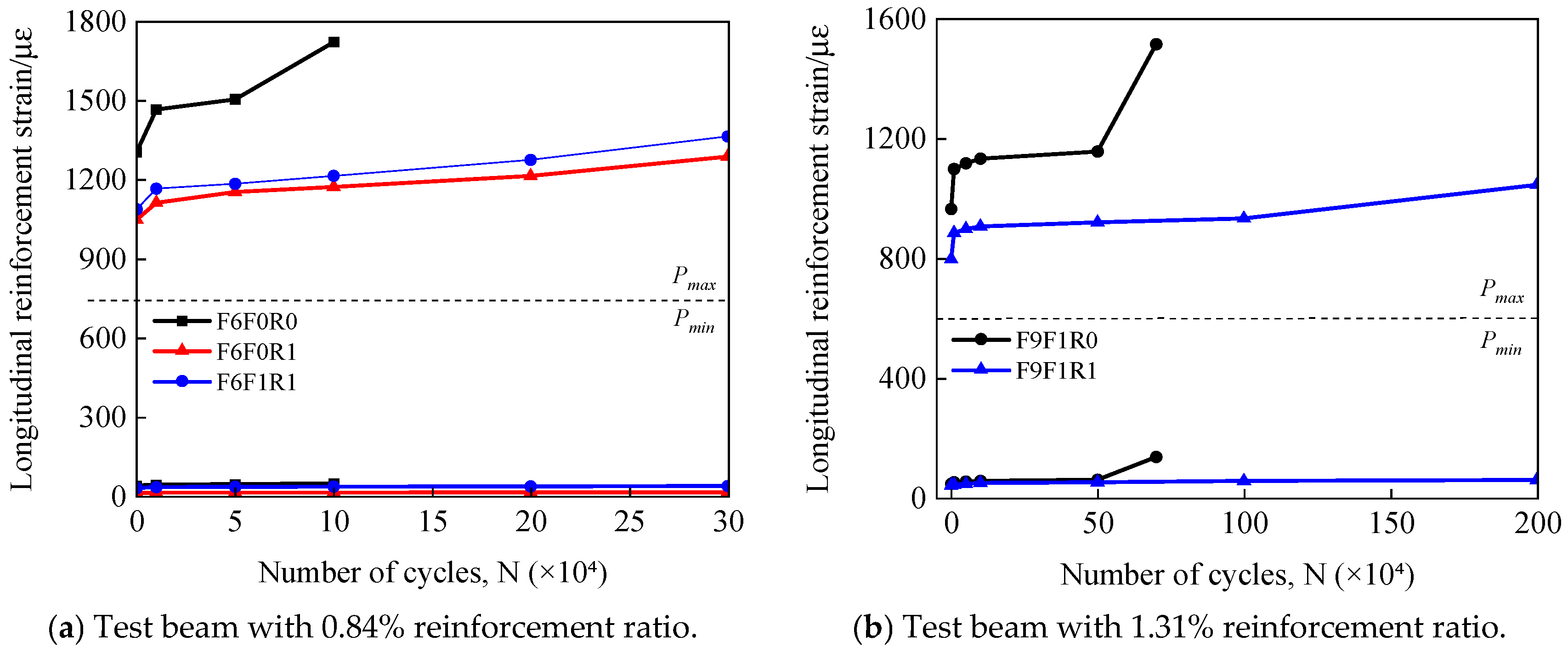
Figure 15 presents the variation in tensile steel reinforcement strain under fatigue loading for test beams with different reinforcement ratios. In the initial loading stage, strain increased sharply due to rapid crack development, followed by a stable phase characterized by a gradual strain growth rate. As failure approached, the strain rate accelerated again. Notably, the strain corresponding to the lower fatigue load limit showed minimal change throughout the entire process. For the group with a 0.84% reinforcement ratio, strain increased by 7.24% to 12.30% compared to the initial value during the first 10,000 loading cycles. By the end of the test, the cumulative increase relative to the first static loading was 22.86% to 31.93%. For the group with a 1.31% reinforcement ratio, strain increased by 10.17% to 13.88% after 10,000 loading cycles. By the end of the test, the cumulative increase relative to the first static loading was 29.56% to 57.14%. The comparison indicates that the increase in steel reinforcement strain is smaller in strengthened beams than in unstrengthened beams. Furthermore, freeze–thaw cycles exacerbate the fatigue response of the steel reinforcement.
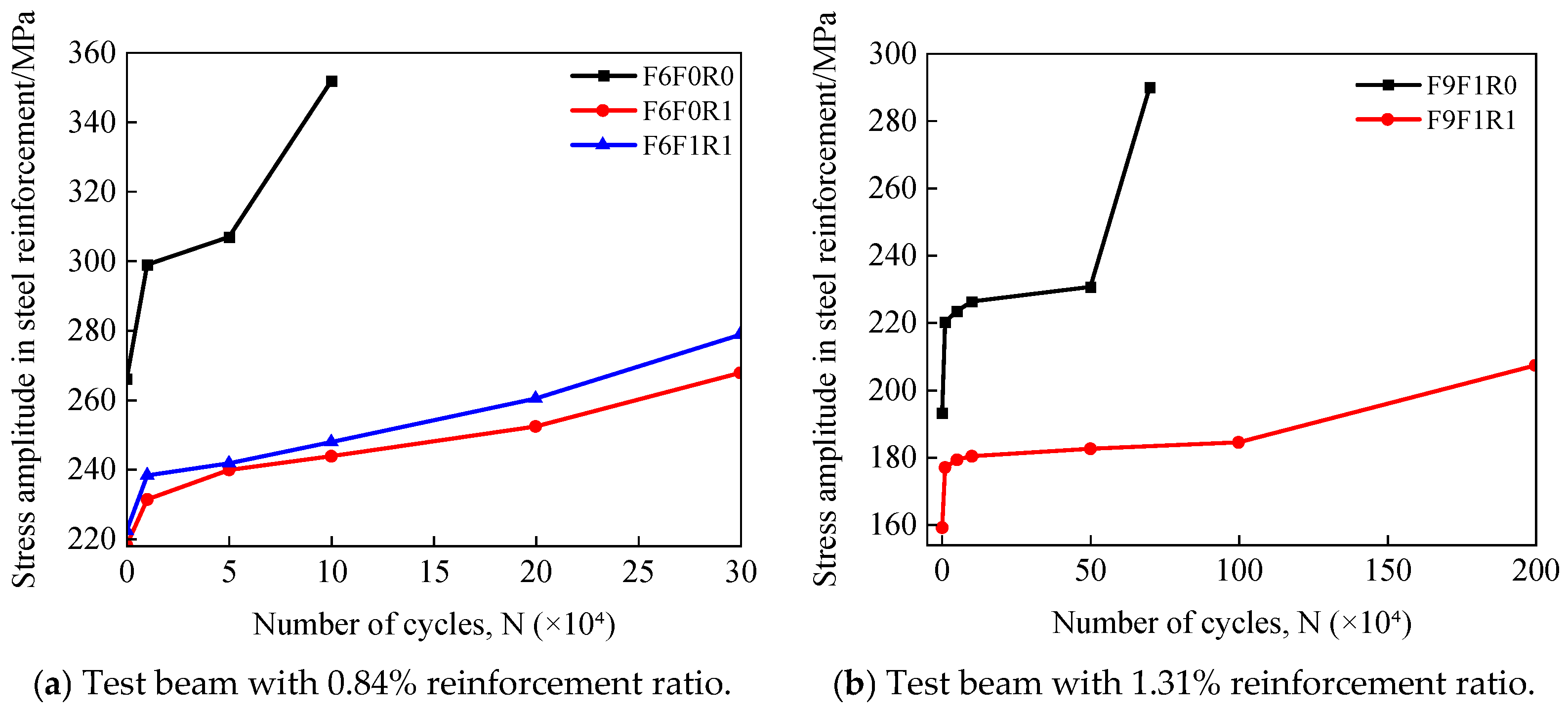
Figure 16 presents the relationship curves of steel reinforcement stress range versus the number of fatigue loading cycles for test beams with different reinforcement ratios. The steel reinforcement stress range is defined as the difference between the steel stress corresponding to the upper and lower fatigue load limits. Analyzing the variation in the stress range at different stages provides insight into the evolution of internal stress within the specimens. As shown in the figure, the steel reinforcement stress range also exhibits a “three-stage” development pattern. For specimens with a reinforcement ratio of 0.84%, during the first loading, the stress ranges for beams F6F0R0, F6F0R1, and F6F1R1 were approximately 266 MPa, 218 MPa, and 222 MPa, respectively. After 10,000 fatigue cycles, their stress ranges increased by 12.36%, 6.02%, and 7.18%, respectively. For specimens with a reinforcement ratio of 1.31%, the initial stress ranges for beams F9F1R0 and F9F1R1 were approximately 193 MPa and 158 MPa, respectively. After 10,000 fatigue cycles, these increased by 14.00% and 11.27%, respectively. The results indicate that an increase in steel reinforcement stress range leads to a reduction in the fatigue life of the specimens. Continuous accumulation of stress range accelerates the specimens’ entry into the rapid failure stage. A comprehensive analysis reveals that the strengthening effect of the CFRP grid significantly reduces the initial stress range in the tensile reinforcement, whereas freeze–thaw cycles cause an increase in the steel stress range, thereby exacerbating fatigue damage in the reinforcement.

4.4. CFRP Grid Strain

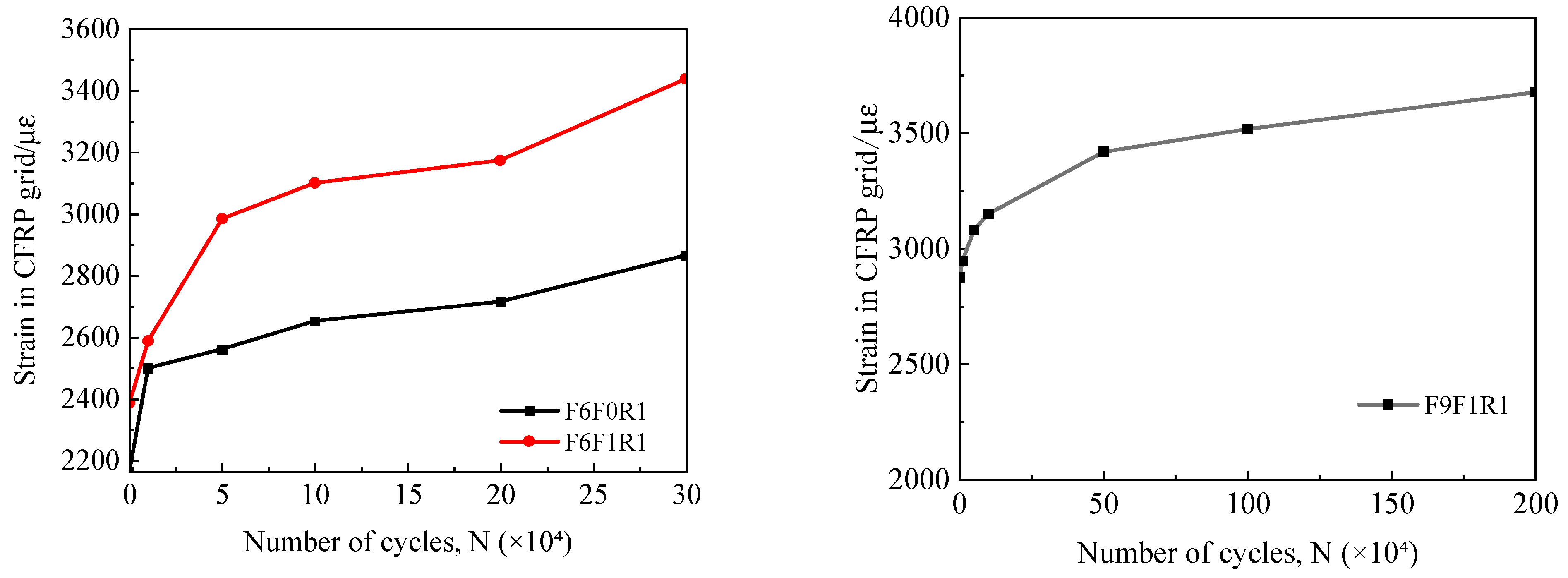
Figure 17 illustrates the strain evolution characteristics of the CFRP grid in the serviceability limit state. The strain levels (approximately 2200–3600 με) are well below the ultimate tensile strain of the material, indicating that the CFRP grid remains in an elastic working state throughout the fatigue process. Nevertheless, the development path and rate of the strain can sensitively reflect the accumulation of damage in the overall structure. For specimens with a reinforcement ratio of 0.84%, freeze–thaw exposure caused the strain in specimen F6F1R1 to consistently exceed that in specimen F6F0R1, with an accelerated increase observed in the later stage, reflecting the exacerbating effect of coupled freeze–thaw and fatigue on damage in both concrete and the interface. In contrast, for specimen F9F1R1 with a reinforcement ratio of 1.31%, the strain growth in the mid-to-late stage significantly slowed down. This indicates that a higher reinforcement ratio can enhance the synergy between the steel reinforcement and the CFRP grid, optimizing stress distribution and suppressing the development of overall damage.

4.5. Residual Deformation and Deflection

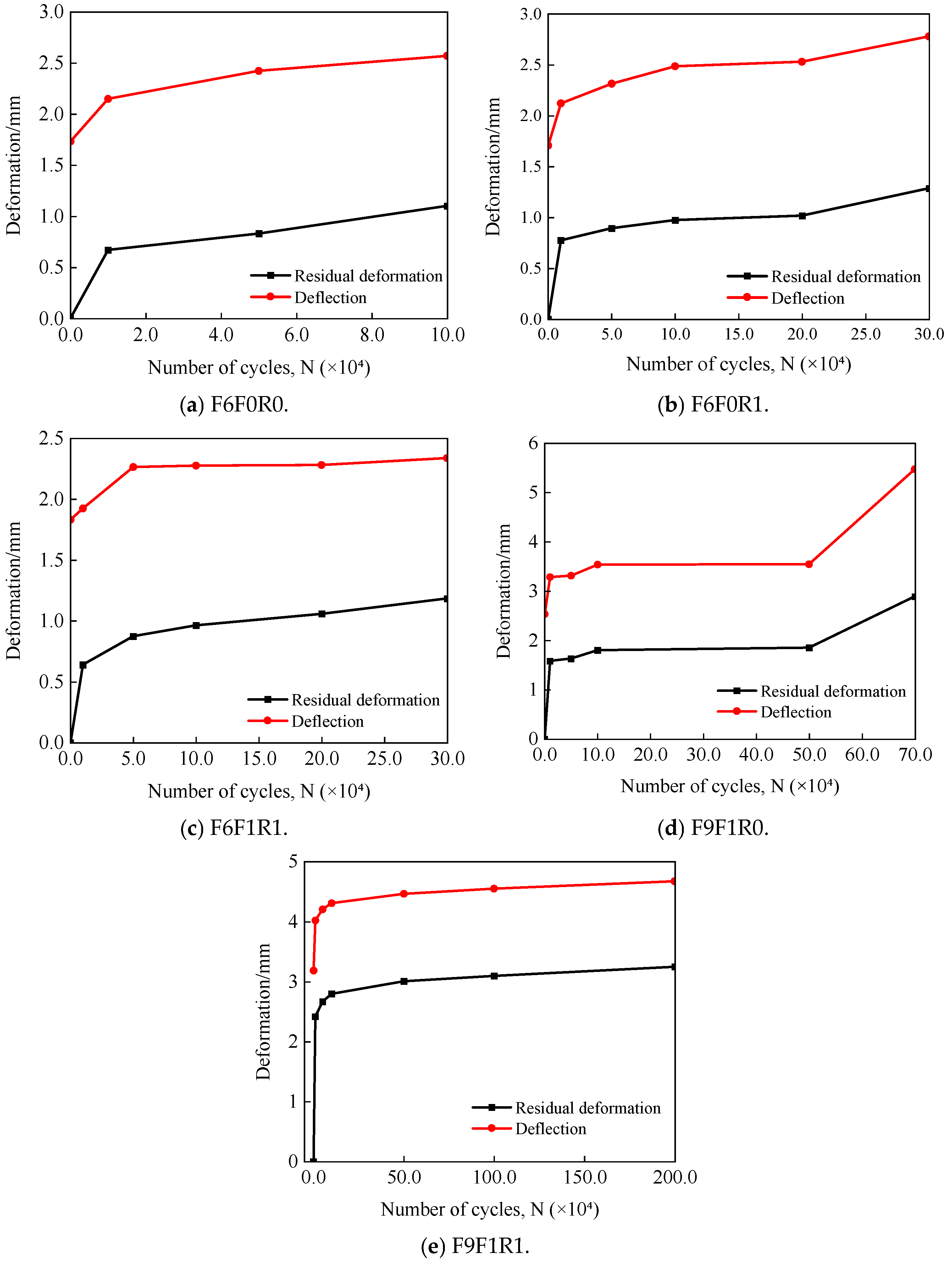
Experimental observations indicate that as fatigue loading progresses, cracks in the test beams continuously propagate. Upon unloading, existing cracks do not fully close, resulting in significant residual deformation at the mid-span of the beams. Concurrently, the ongoing development of cracks alters the overall deformation capacity of the test beams, which is reflected in the changes in mid-span deflection during static loading tests at different fatigue stages. Figure 18 presents the residual deformation of each test beam after unloading, as well as the evolution of mid-span deflection with the number of fatigue loading cycles during static loading tests at various stages.
From Figure 18, it can be observed that both the residual deformation and mid-span deflection of the specimens significantly increased after the first static loading. This is primarily attributed to concrete cracking induced by the initial loading. The curves exhibit an overall monotonic upward trend, indicating continuous accumulation of residual deformation during the fatigue process. As loading progresses, crack development stabilizes, and the growth rates of both residual deformation and mid-span deflection gradually slow, reflected by a decreasing slope of the curves. It is noteworthy that, for specimen F9R1R0, the growth rates of residual deformation and mid-span deflection abruptly increased during the final static loading test. This phenomenon can be attributed to the small number of loading cycles between this static test and the ultimate fatigue failure of the beam. At this stage, the structure was near failure, with damage accelerating, leading to a pronounced increase in deformation.

5. Fatigue Degradation Analysis of CFRP Grid-Strengthened Beams After Freeze–Thaw Cycles

Under fatigue loading, the damage accumulation in CFRP grid-strengthened beams is primarily reflected in the progressive deterioration of the concrete matrix and the interfacial layers between materials. Stiffness, serving as a macroscopic mechanical indicator of the composite action between materials and interfaces, can effectively describe the evolution of fatigue damage. Experimental results indicate that the stiffness degradation of strengthened beams exhibits a typical three-stage characteristic: an initial rapid decline stage, mainly caused by the propagation of concrete microcracks and the activation of initial interfacial defects; a mid-term stable decline stage where damage accumulates approximately linearly and steadily; and a final accelerated degradation stage, accompanied by concentrated damage development such as interfacial debonding and crack penetration, leading to rapid fatigue failure of the component. Freeze–thaw cycles further exacerbate this damage process. The matrix loosening and interfacial weakening induced by freeze–thaw action amplify the initial damage in the component, accelerating the degradation rate of stiffness across all stages, thereby significantly reducing the fatigue life of the strengthened beam.
Based on Lemaitre’s classical damage theory and combined with the CFRP grid strain monitoring data obtained from experiments, a nonlinear cumulative damage model incorporating CFRP grid damage is established by decomposing multiple damage components. This model accurately describes the overall structural damage evolution. The total cumulative structural damage, denoted as D , consists of three coupled components: concrete matrix damage D c , CFRP grid damage D c f , and interfacial bond damage D i . Considering the synergistic interaction among these damage components, the total damage follows a multiplicative coupling relationship:
D = 1 1 D c 1 D c f 1 D i
Among these components, concrete matrix damage D c is defined based on stiffness degradation. Interfacial bond damage D i is closely related to freeze–thaw cycles and fatigue loading, while CFRP grid damage D c f is quantified through strain accumulation. These three components collectively govern the fatigue deterioration process of the structure.
Based on the stiffness degradation pattern, concrete matrix damage is defined as:
D c = 1 B c , n B c , 0
where B c , 0 is the initial stiffness of the concrete matrix, and B c , n is the residual stiffness of the concrete matrix after n cycles, obtained by subtracting the contributions of the CFRP grid and PCM layer from the measured overall structural stiffness.
Damage in the CFRP grid primarily manifests as progressive fiber fracture and strain accumulation. Based on the CFRP grid strain monitoring data from experiments, its damage evolution follows a three-stage characteristic of “initial elasticity—stable damage—accelerated fracture,” defined as:
D c f = 1 ε c f , n ε c f , u
where ε c f , n is the residual strain of the CFRP grid after n fatigue cycles, and ε c f , u is the ultimate tensile strain of the CFRP grid. Based on the experimental data, the relationship between CFRP grid strain accumulation, the number of fatigue cycles, and the number of freeze–thaw cycles is fitted as:
ε c f , n = ε c f , 0 + k 1 n k 2 · e k 3 n
where ε c f , 0 is the initial strain of the CFRP grid after the first static loading; k 1 = 0.002 and k 2 = 0.65 are fatigue loading-related coefficients; k 3 = 0.0012 is the freeze–thaw impact coefficient; and n is the number of freeze–thaw cycles.
Substituting into the expression for D c f gives:
D c f = 1 ε c f , 0 + 0.002 n 0.65 · e 0.0012 n 15,000
Interfacial bond damage is influenced by the coupled effects of freeze–thaw cycles and fatigue loading. Based on the observed interfacial debonding phenomena and stiffness degradation data from the experiments, it is fitted as:
D i = 0.001 n 0.5 · n N f 0.4
where N f represents the fatigue life. This formulation reflects the trend that interfacial bond damage becomes more severe with an increasing number of freeze–thaw cycles and as the fatigue cycles approach the end of the fatigue life.
Integrating the evolution patterns of each damage component and introducing weighting and coupling coefficients, the revised total cumulative damage model is expressed as:
D = D c r 1 1 n N f α · 1 D c f δ 1 γ n N f β · e λ n
where α is the damage evolution rate coefficient of the concrete matrix, characterizing the nonlinear growth rate of concrete matrix damage under coupled freeze–thaw and fatigue loading; β is the nonlinear correction coefficient for overall structural damage, reflecting the degree of nonlinear coupling among multiple damage components including concrete, CFRP grid, and interfacial bond; γ is the freeze–thaw initial damage amplification coefficient, whose absolute value represents the amplifying effect of irreversible freeze–thaw initial damage on fatigue degradation; δ is the damage weighting coefficient of the CFRP grid, quantifying the contribution proportion of CFRP grid damage to the total structural damage; λ is the coupling deterioration coefficient for freeze–thaw and interfacial bond, characterizing the accelerating effect of freeze–thaw action on the fatigue degradation of the CFRP grid–PCM–concrete interfacial bond; and D c r is the critical damage value, i.e., the total damage at which fatigue failure of the structure occurs.
Equation (8) presents the correlation coefficient R 2 evaluation method for assessing nonlinear mathematical regression models [40]. Here, ( x i , y i ) represent the given fitting data; y ¯ i is the mean value of the given data y i ; and y ^ i is the value corresponding to y i based on the fitted curve. The closer the correlation coefficient R is to 1, the higher the fitting accuracy of the model to the given data. Conversely, when R approaches 0, the fitting quality is poorer.
R 2 = 1 i = 1 n ( y i y ^ i ) 2 i = 1 n y i y ¯ i
To more comprehensively validate the model fitting accuracy, the root mean square error (RMSE) is also introduced to evaluate the level of absolute error between the model-calculated values and the experimentally measured values. The calculation formula is as follows:
R M S E = 1 n i 1 n y i y ^ i 2
Based on the fitting of experimental data, the model parameters under different reinforcement ratios and freeze–thaw conditions are obtained and presented in Table 7. All parameters exhibit correlation coefficients R2 greater than 0.98 and root mean square errors RMSE less than 0.02, indicating that the model can accurately describe the stiffness degradation and damage accumulation process under coupled freeze–thaw and fatigue loading. The model has been validated within the experimental scope of this study, and its general applicability is rooted in the coupled damage mechanism among concrete, CFRP, and the interface. For strengthened beams exhibiting similar failure modes, the model offers a theoretical framework for fatigue damage assessment. When extending the model to different service conditions, it is recommended to recalibrate the key coefficients governing concrete damage evolution and interfacial damage evolution based on the actual application scenario.

6. Conclusions

(1)
The CFRP grid–PCM composite strengthening system can significantly enhance the fatigue performance of RC beams, with its strengthening effectiveness being minimally affected by freeze–thaw cycles. For beams with a low reinforcement ratio (0.84%), the fatigue life increased by approximately 275% after strengthening. For beams with a high reinforcement ratio (1.31%), the strengthened beams were able to withstand over 2 million fatigue load cycles even after exposure to freeze–thaw cycles, demonstrating excellent long-term fatigue resistance.
(2)
Under the combined action of freeze–thaw cycles and fatigue loading, crack development and failure modes in strengthened beams exhibit typical three-stage characteristics: an initial rapid propagation stage, a mid-term stable development stage, and an accelerated failure stage as failure approaches. CFRP strengthening effectively suppresses crack propagation rate and steel bar slippage, altering the failure mode from being dominated by fatigue fracture of steel reinforcement to a composite form involving fiber pull-out of the CFRP grid or interfacial debonding.
(3)
Freeze–thaw cycles exacerbate the initial damage in strengthened beams, manifested as accelerated accumulation of compressive strain in concrete, stress range in steel reinforcement, and strain in the CFRP grid, particularly with significant effects during the early loading stages. However, the strengthening effect of the CFRP grid can still effectively delay the overall stiffness degradation of the component, enhancing its durability under harsh environmental conditions.
(4)
Based on experimental data and monitoring results, a coupled evolution model considering synergistic damage in the concrete matrix, CFRP grid, and interfacial bonding was established. This model accurately characterizes the damage accumulation process in strengthened beams under combined freeze–thaw and fatigue actions, providing a theoretical basis for the fatigue performance evaluation and life prediction of CFRP grid-strengthened beams in cold regions.
Based on scaled model tests, this study investigated the damage evolution laws and failure mechanisms of CFRP grid–PCM strengthened RC beams subjected to coupled freeze–thaw and fatigue loading. Nevertheless, the following limitations remain: Although the scaled specimens satisfied the requirements for mechanistic analysis, full-scale design still necessitates further experimental investigation into size effects. The multi-layer strengthening effect on beams with relatively low reinforcement ratios requires systematic examination, which is planned to be addressed through a combination of numerical simulation and experimentation. Each test condition involved only a single specimen; while this sufficed to support the core conclusions, it did not allow for statistical significance testing. In addition, the number of CFRP grid tensile specimens was three ( n = 3), which, although adequate for characterizing basic material properties, is insufficient for conducting statistical variability analysis. Future research can build upon the present work by incorporating multiple replicate specimens and refined numerical simulations and by conducting systematic comparative studies on size effects and multi-layer strengthening configurations. These efforts will provide a more robust basis for the reliable application and standardized design of this strengthening system in cold-region engineering.

Author Contributions

Conceptualization, C.J. and P.N.; methodology, P.N.; software, Z.C. and R.M.; validation, P.N. and P.Z.; formal analysis, Z.C.; investigation, Z.C.; resources, C.J.; data curation, C.J. and P.N.; writing—original draft preparation, C.J.; writing—review and editing, P.N. and P.Z.; visualization, R.M.; supervision, P.N. and Z.C.; project administration, P.N., and C.J.; funding acquisition, P.N. and C.J. All authors have read and agreed to the published version of the manuscript.

Funding

This research work is supported by the National Natural Science Foundation of China (12102269), Science and Technology Program of Liaoning Provincial Department of Housing and Urban-Rural Development (LNSJSKJ-2025-067), the China Scholarship Council (202308210352), and Overseas Talents Project of Shenyang Science and Technology Bureau (RC230011).

Data Availability Statement

The original contributions presented in this study are included in the article; further inquiries can be directed to the corresponding author.

Conflicts of Interest

The authors declare no conflicts of interest.

References

  1. Li, J.; Yang, Y.; Jia, B.; Li, B.; Huang, H.; Zhao, J.; Wang, T. Experimental study on the durability of single CFRP grid strands based on elastic modulus as an indicator. Compos. Sci. Eng. 2021, 10, 34–41+66. [Google Scholar] [CrossRef]
  2. Wang, B.; Uji, K.; Wu, T.; Dai, H.; Yan, D.; Guo, R. Experimental investigation of stress transfer and failure mechanism between existing concrete and CFRP grid-sprayed PCM. Constr. Build. Mater. 2019, 215, 43–58. [Google Scholar] [CrossRef]
  3. Guo, R.; Cai, L.; Pan, Y.; Liu, Y. Experimental study on bond behavior of polymer modified cement mortar-carbon fiber grid strengthening layer-concrete interface. J. Build. Struct. 2018, 39, 167–174. [Google Scholar] [CrossRef]
  4. Wang, B.; Wang, Z.; Uji, K. Experimental verification of a novel anchorage method of CFRP grid in mortar. Structures 2020, 28, 1646–1660. [Google Scholar] [CrossRef]
  5. Wang, B.; Wang, Z.; Uji, K.; Zhang, J.; Guo, R. Experimental investigation on shear behavior of RC beams strengthened by CFRP grids and PCM. Structures 2020, 27, 1994–2010. [Google Scholar] [CrossRef]
  6. Guo, R.; Pan, Y.; Cai, L.; Hino, S. Study on design formula of shear capacity of RC beams reinforced by CFRP grid with PCM shotcrete method. Eng. Struct. 2018, 166, 427–440. [Google Scholar] [CrossRef]
  7. Guo, R.; Hu, W.; Li, M.; Wang, B. Study on the flexural strengthening effect of RC beams reinforced by FRP grid with PCM shotcrete. Compos. Struct. 2020, 239, 112000. [Google Scholar] [CrossRef]
  8. Niu, P.; Chen, Z.; Jin, C.; Hui, Y.; Shi, F.; Ma, R. Flexural Behavior and Capacity Modeling of Damaged RC Beams Strengthened with CFRP Grid. Buildings 2026, 16, 205. [Google Scholar] [CrossRef]
  9. Dai, H.; Wang, B.; Zhang, J.; Zhang, J.; Uji, K. Study of the Interfacial Bond Behavior between CFRP Grid–PCM Reinforcing Layer and Concrete via a Simplified Mechanical Model. Materials 2021, 14, 7053. [Google Scholar] [CrossRef]
  10. Senesavath, S.; Sonoda, Y.; Tamai, H.; Lu, C. Impact Response in Flexural Strengthening of Reinforced Concrete Beams with CFRP Grid and PCM. Int. J. Civ. Eng. 2024, 23, 539–562. [Google Scholar] [CrossRef]
  11. Jian, Z.; Kim, B.H.; Gai, J.; Zhao, Y.; Yang, X. Fatigue Performance Enhancement of Open-Hole Steel Plates Under Alternating Tension–Compression Loading via Hotspot-Targeted CFRP Reinforcement. Buildings 2026, 16, 313. [Google Scholar] [CrossRef]
  12. Agrawal, M.; Gupta, M.; Prabhakaran, R.T.D.; Mahajan, P. A comparative study of static and fatigue performance of glass and basalt fiber reinforced epoxy composites. Polym. Compos. 2023, 45, 3551–3565. [Google Scholar] [CrossRef]
  13. Wang, Z.; Zhao, X.-L.; Xian, G.; Wu, G.; Raman, R.S.; Al-Saadi, S. Durability study on interlaminar shear behaviour of basalt-, glass- and carbon-fibre reinforced polymer (B/G/CFRP) bars in seawater sea sand concrete environment. Constr. Build. Mater. 2017, 156, 985–1004. [Google Scholar] [CrossRef]
  14. Al-Rousan, R.; Issa, M. Fatigue performance of reinforced concrete beams strengthened with CFRP sheets. Constr. Build. Mater. 2011, 25, 3520–3529. [Google Scholar] [CrossRef]
  15. Deng, L.; Li, H.; Xie, H.; Liao, L.; Lei, L.; Mo, X. Experimental study on flexural fatigue performance of RC beams strengthened with intelligent CFRP plates. Concrete 2023, 5, 44–47+55. [Google Scholar] [CrossRef]
  16. Peng, H.; Zhang, J.; Shang, S.; Liu, Y.; Cai, C. Experimental study of flexural fatigue performance of reinforced concrete beams strengthened with prestressed CFRP plates. Eng. Struct. 2016, 127, 62–72. [Google Scholar] [CrossRef]
  17. Heffernan, P.J.; Erki, M.A. Fatigue Behavior of Reinforced Concrete Beams Strengthened with Carbon Fiber Reinforced Plastic Laminates. J. Compos. Constr. 2004, 8, 132–140. [Google Scholar] [CrossRef]
  18. Zhang, Z.; Yang, M. Flexural fatigue performance of externally bonded FRP-strengthened reinforced concrete beams based on ABAQUS simulation. J. Nanjing Univ. Sci. Technol. 2021, 45, 116–126. [Google Scholar] [CrossRef]
  19. Huang, H.; Wang, W.W.; Dai, J.G.; Brigham, J.C. Fatigue Behavior of Reinforced Concrete Beams Strengthened with Externally Bonded Prestressed CFRP Sheets. J. Compos. Constr. 2016, 21, 04016108. [Google Scholar] [CrossRef]
  20. Wang, Q.; Zhu, H.; Su, W.; Du, H.; Chen, D. Fatigue performance of CFRP reinforced pretensioned prestressed beams. Constr. Build. Mater. 2022, 324, 126509. [Google Scholar] [CrossRef]
  21. Zou, C.; Ibrahim, Z.; Hashim, H.; Liang, Q.Q.; Ayough, P.; Jameel, M. Fatigue performance simulation of reinforced concrete beams externally strengthened with side bonded CFRP sheets. Eng. Struct. 2024, 316, 118530. [Google Scholar] [CrossRef]
  22. Chen, Z.; Huang, P.; Yao, G.; Guo, X.; Yang, Y.; Li, W.; Wu, B. Experimental study on fatigue performance of RC beams strengthened with CFRP under variable amplitude overload and hot-wet environment. Compos. Struct. 2020, 244, 112308. [Google Scholar] [CrossRef]
  23. Zhang, Z.; Li, T. Deformation Performance of CFRP-Strengthened Corroded Reinforced Concrete Beams after Fatigue Loading. Appl. Sci. 2023, 13, 6198. [Google Scholar] [CrossRef]
  24. Lin, J.; Huang, P.; Guo, X.; Zheng, X.; Zhao, C. Fatigue performance of RC beams strengthened with CFRP under coupling action of temperatures and vehicle random loads. Fatigue Fract. Eng. Mater. Struct. 2018, 42, 31–44. [Google Scholar] [CrossRef]
  25. Jiang, F.; Han, X.; Wang, Y.; Wang, P.; Zhao, T.; Zhang, K. Effect of freeze-thaw cycles on tensile properties of CFRP, bond behavior of CFRP-concrete, and flexural performance of CFRP-strengthened concrete beams. Cold Reg. Sci. Technol. 2021, 194, 103461. [Google Scholar] [CrossRef]
  26. Zhang, J.; Li, H.; Liu, S.; Sun, L.; Yang, C.; Zhang, R. Effects of sulfate and freeze–thaw cycles on the bond behavior of CFRP-concrete interface. Constr. Build. Mater. 2023, 368, 130368. [Google Scholar] [CrossRef]
  27. Wu, Q.; Zhang, J.; Huang, W.; Han, S.; Zheng, Y.; Hu, P.; Niu, Y. Comparative Study of the Degradation of CFRP–Concrete Interfacial Bond Performance with EP and MPC Adhesives Under Sulfate Freeze–Thaw Cycles. Buildings 2025, 15, 4111. [Google Scholar] [CrossRef]
  28. Pan, Y.; Xian, G.; Li, H. Effects of Freeze-Thaw Cycles on the Behavior of the Bond between CFRP Plates and Concrete Substrates. J. Compos. Constr. 2018, 22, 04018011. [Google Scholar] [CrossRef]
  29. Mabry, N.J.; Seracino, R.; Peters, K.J. The effects of accelerated Freeze-Thaw conditioning on CFRP strengthened concrete with pre-existing bond defects. Constr. Build. Mater. 2018, 163, 286–295. [Google Scholar] [CrossRef]
  30. Yun, Y.; Wu, Y.-F. Durability of CFRP–concrete joints under freeze–thaw cycling. Cold Reg. Sci. Technol. 2011, 65, 401–412. [Google Scholar] [CrossRef]
  31. Choi, S.; Gartner, A.L.; Van Etten, N.; Hamilton, H.R.; Douglas, E.P. Durability of concrete beams externally reinforced with CFRP composites exposed to various environments. J. Compos. Constr. 2012, 16, 10–20. [Google Scholar] [CrossRef]
  32. Zhang, Z.-W.; Zhang, Z.-H.; Wang, X.; Zhou, C.-H. Dynamic and static interfacial bonding properties of CFRP–concrete subjected to freeze–thaw cycles. Structures 2022, 37, 947–959. [Google Scholar] [CrossRef]
  33. Peng, H.; Wang, H.; Fu, J.; Li, Z.; Zhang, K. Durability of prestressed CFRP plate-strengthened reinforced concrete beams under freeze-thaw cycles. J. Exp. Mech. 2014, 29, 344–352. [Google Scholar] [CrossRef]
  34. Al-Rousan, R.Z.; Issa, M.A. Flexural behavior of RC beams externally strengthened with CFRP composites exposed to severe environment conditions. KSCE J. Civ. Eng. 2016, 21, 2300–2309. [Google Scholar] [CrossRef]
  35. Du, X.; Jin, L.; Li, D. Review of size effects in concrete and concrete structures (I): At material level. China Civ. Eng. J. 2017, 50, 28–45. [Google Scholar] [CrossRef]
  36. Chen, Z.; Xu, M. Experimental study on RC beams flexurally strengthened with CFRP sheets. Earthq. Resist. Eng. Retrofit. 2006, 4, 47–51. [Google Scholar] [CrossRef]
  37. GB/T 50082-2024; Standard for Test Methods of Long-Term Performance and Durability of Ordinary Concrete. China Architecture & Building Press: Beijing, China, 2024.
  38. Jo, Y.-K. Adhesion in tension of polymer cement mortar by curing conditions using polymer dispersions as cement modifier. Constr. Build. Mater. 2020, 242, 118134. [Google Scholar] [CrossRef]
  39. Huang, C.; Gao, D.; Zhu, H. Effect of loading frequency on fatigue performance of fiber reinforced asphalt concrete. J. North China Univ. Water Resour. Electr. Power 2012, 33, 106–111. [Google Scholar] [CrossRef]
  40. Zhao, S. Analysis and evaluation of factors influencing the goodness-of-fit R2. J. Dongbei Univ. Financ. Econ. 2003, 3, 56–58. [Google Scholar] [CrossRef]
Figure 1. CFRP grid composite strengthening technique.
Buildings 16 00849 g001
Figure 2. Dimensions and reinforcement details of the test beams.
Buildings 16 00849 g002
Figure 3. Freeze–thaw cycles of the test beams.
Buildings 16 00849 g003
Figure 4. Tensile test of the CFRP grid.
Buildings 16 00849 g004
Figure 5. Schematic diagram of the loading system.
Buildings 16 00849 g005
Figure 6. Layout of measurement points on the specimen.
Buildings 16 00849 g006
Figure 7. Fatigue loading history.
Buildings 16 00849 g007
Figure 8. Failure mode of test beam F6F0R0.
Buildings 16 00849 g008
Figure 9. Failure mode of specimen F6F0R1.
Buildings 16 00849 g009
Figure 10. Failure mode of beam F6F1R1.
Buildings 16 00849 g010
Figure 11. Fatigue failure mode of beam F9F1R0.
Buildings 16 00849 g011
Figure 12. Failure mode of beam F9F1R1.
Buildings 16 00849 g012
Figure 13. Load–displacement curves of test beams under different numbers of fatigue cycles.
Buildings 16 00849 g013aBuildings 16 00849 g013b
Figure 14. Concrete compressive strain versus number of fatigue loading cycles for the test beams.
Buildings 16 00849 g014aBuildings 16 00849 g014b
Figure 15. Tensile reinforcement strain versus number of fatigue loading cycles for the test beams.
Buildings 16 00849 g015
Figure 16. Stress range in tensile reinforcement versus number of fatigue loading cycles for the test beams.
Buildings 16 00849 g016
Figure 17. CFRP grid strain versus number of fatigue loading cycles for the test beams. (a) CFRP grid strain versus number of fatigue loading cycles for test beams with a 0.84% reinforcement ratio. (b) CFRP grid strain versus number of fatigue loading cycles for test beams with a 1.31% reinforcement ratio.
Buildings 16 00849 g017
Figure 18. Residual deformation and mid-span deflection curves of the test beams.
Buildings 16 00849 g018
Table 1. Design scheme of the test beams.
Specimen DesignationReinforcement RatioStrengthening SchemeNumber of Freeze–Thaw CyclesNumber of Strengthening LayersPmax/PuPmin/Pu
S6F0R00.84%unstrengthened00//
F6F0R00.84%unstrengthened000.750.12
F6F0R10.84%CFRP grid strengthening010.750.12
F6F1R10.84%CFRP grid strengthening10010.750.12
S9F0R01.31%unstrengthened00//
F9F1R01.31%unstrengthened10000.700.12
F9F1R11.31%CFRP grid strengthening10010.700.12
Note: The naming convention for the test beams follows the pattern “Loading Type–Total Beam Length–Number of Freeze–Thaw Cycles–Number of Strengthening Layers,” representing sequentially: S (Static load)/F (Fatigue load); 6 (600 mm)/9 (900 mm); F0 (0 cycles)/F1 (100 freeze–thaw cycles); R0 (Unstrengthened)/R1 (1 layer of CFRP grid).
Table 2. Parameters of PCM material.
Tensile Bond Strength with Concrete/MPaCube Compressive Strength/MPaElastic Modulus
/MPa
Water–Cement
Ratio
3.084.0416,80015%
Table 3. Mechanical properties of steel reinforcement.
Grade of Steel ReinforcementDiameterYield Strength/MPaUltimate Tensile Strength/MPa
HRB3006 mm300438
HRB4008 mm535602
HRB40010 mm532.5610
Table 4. Mechanical properties of the CFRP grid.
Dimensions of the CFRP Grid/mmNumber of CFRP Grid SpecimensCross-Sectional Area of Grid Strands/mm2Tensile Strength/MPa
20 × 2031.82333.33
Table 5. Fatigue life and damage condition of the test beams.
Specimen DesignationReinforcement RatioNumber of Strengthening LayersNumber of Freeze–Thaw CyclesFatigue LifeCondition of CFRP Grid
F6F0R00.84%00103,059-
F6F0R10.84%10386,449Fiber pull-out rupture
F6F1R10.84%1100355,704Fiber pull-out rupture
F9F1R01.31%0100701,186-
F9F1R11.31%1100>3,000,000-
Table 6. Stiffness degradation indices of the specimens within the first 100,000 fatigue cycles.
Specimen Designation Stiffness   Degradation   Index   K N / K 0 010,00050,000100,000
F6F0R0 K N / K 0 1.0000.8060.7150.674
F6F0R1 K N / K 0 1.0000.8300.7900.750
F6F1R1 K N / K 0 1.0000.8220.7690.734
F9F1R0 K N / K 0 1.0000.7640.7140.714
F9F1R1 K N / K 0 1.0000.7810.7520.736
Table 7. Model parameters considering CFRP grid damage (after 100 freeze–thaw cycles).
Reinforcement Ratio α β γ δ λ D c r R 2 R M S E
0.84%17.250.293−3.91−2.150.00080.330.9870.018
1.31%18.620.278−4.15−3.820.00080.310.9830.019
Disclaimer/Publisher’s Note: The statements, opinions and data contained in all publications are solely those of the individual author(s) and contributor(s) and not of MDPI and/or the editor(s). MDPI and/or the editor(s) disclaim responsibility for any injury to people or property resulting from any ideas, methods, instructions or products referred to in the content.