Comparative Selection of Staggered Jacking Schemes for a Large-Span Double-Layer Space Frame: A Case Study of the Han Culture Museum Grand Hall

 ,
,
Abstract
1. Introduction
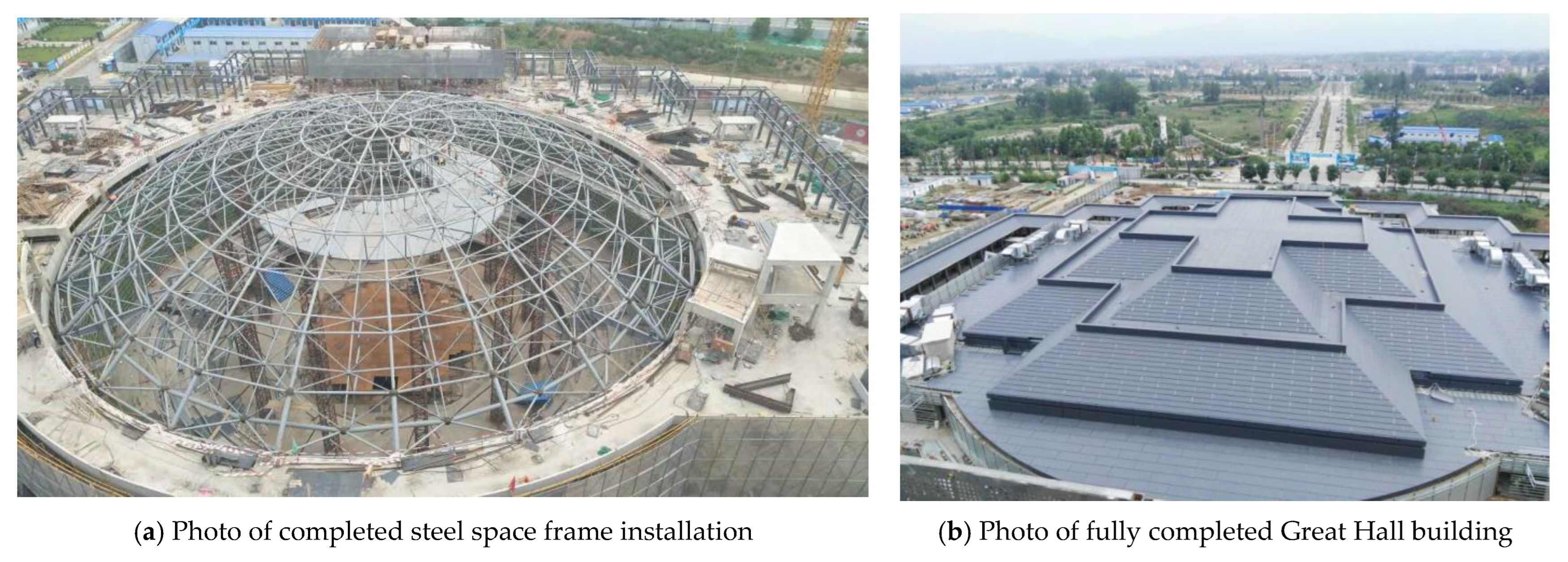
2. Project Overview
3. Jacking Construction Scheme
3.1. Jacking Construction Technique
3.2. Construction Scheme
3.3. Numerical Simulation Analysis
3.3.1. Element Types and Material Properties
3.3.2. Load Specifications
4. Comparison of Schemes Based on Numerical Results
4.1. Maximum Vertical Displacement and Maximum Stress
4.2. Proportion of Members with Changed Stress States at Each Construction Stage
4.3. Stress Evolution of Critical Members Throughout the Entire Process
4.4. Proportion of Members with Changed Stress States at Each Construction Stage
5. Monitoring Results and Their Comparison with Numerical Simulation Results
5.1. Layout of Monitoring Points
5.2. Displacement Monitoring Results and Comparison with Numerical Simulation Results
6. Conclusions
- (1)
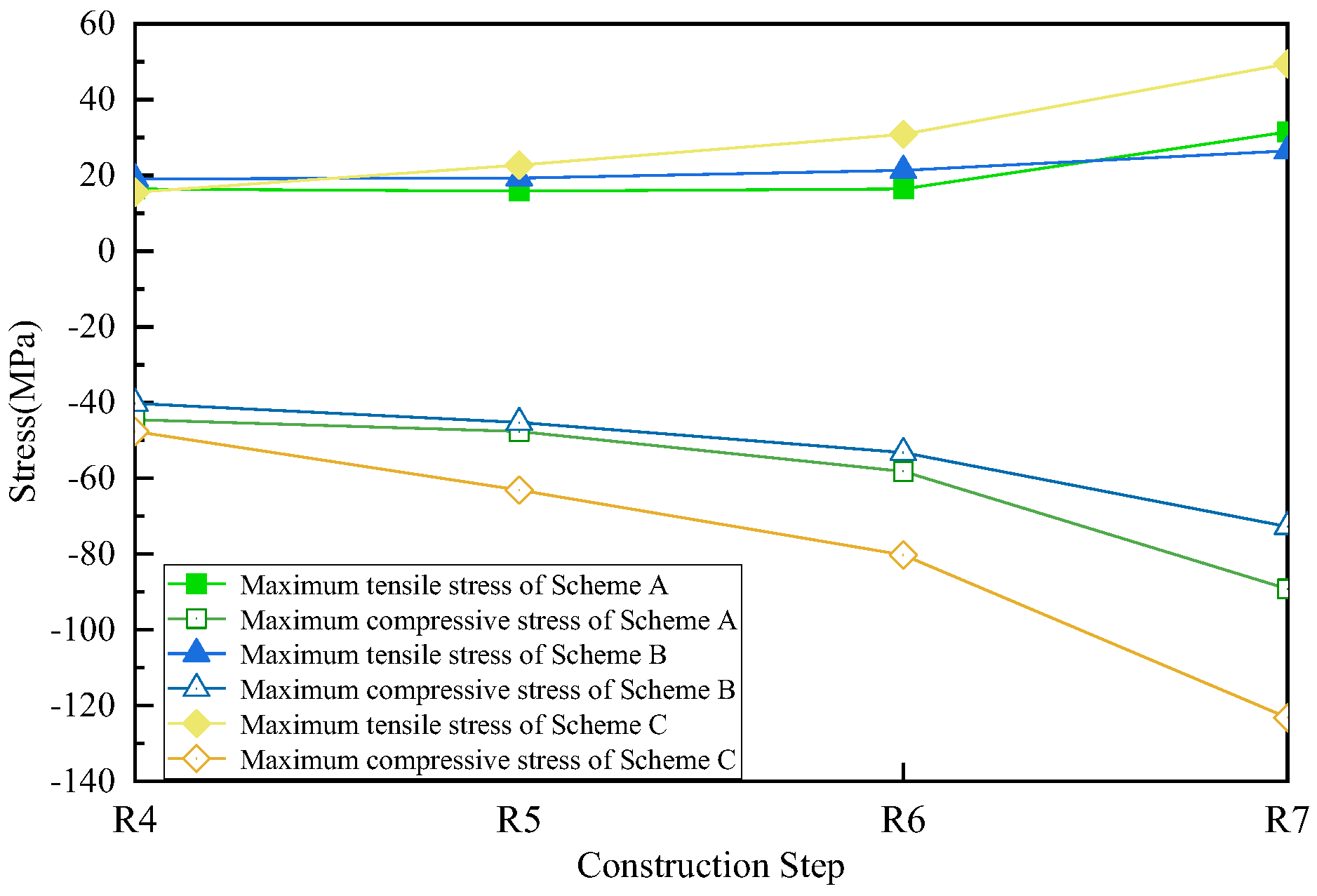
- By comparing the monitored and simulated member stresses at each construction stage, it is found that, for all schemes, the member stresses remain below the material yield strength. Among them, Scheme B achieves the best control of peak stresses under critical conditions and provides the largest structural safety margin, thereby confirming the necessity and effectiveness of adding auxiliary supports during the jacking process.
- (2)
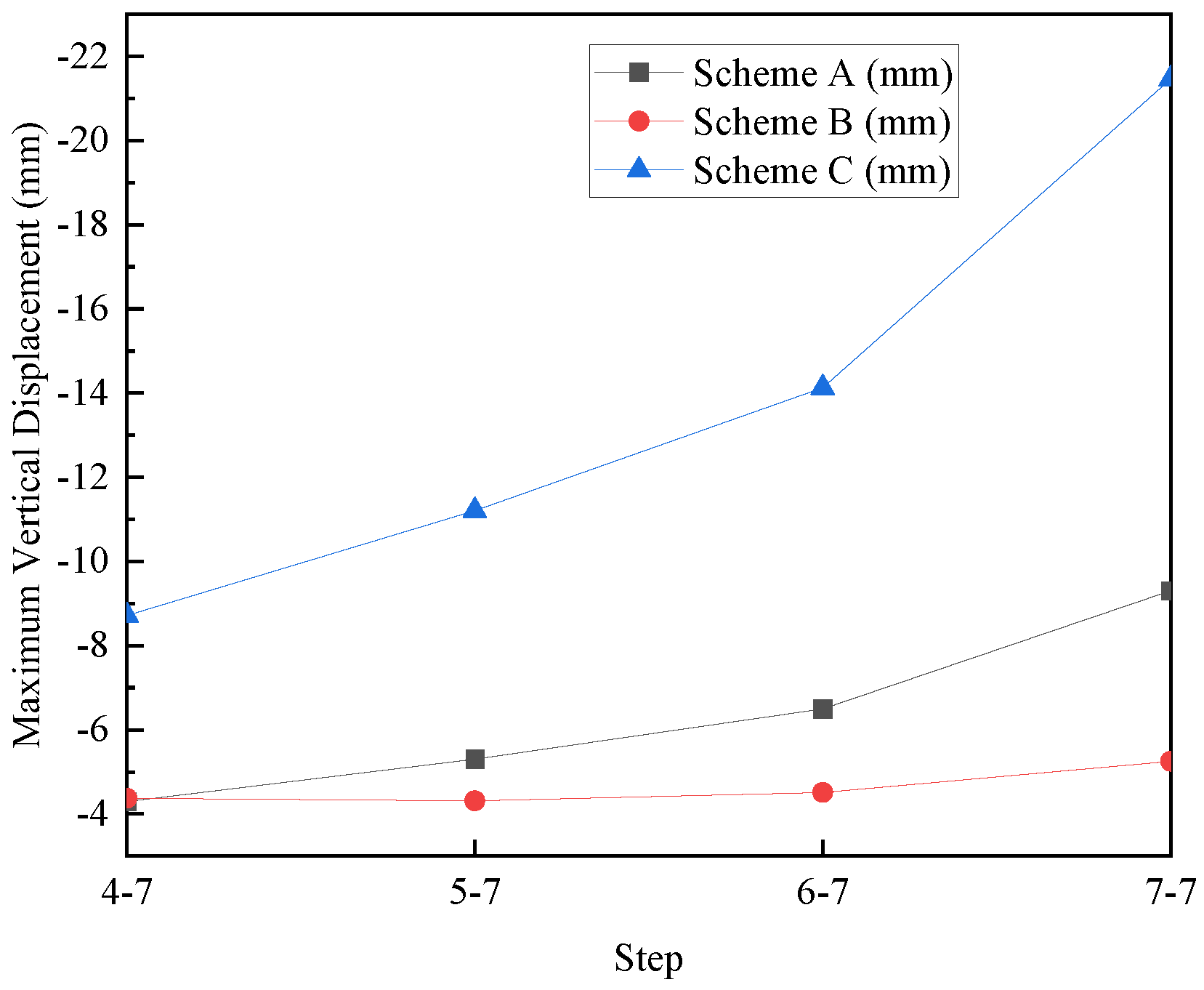
- In terms of deformation control, Scheme B exhibits the most favorable performance, with a maximum vertical displacement of −5.25 mm, which is about 44% lower than that of Scheme A. The evolution of displacement is smooth and essentially linear, suggesting that the supporting system has a high stiffness and a well-defined force transfer mechanism, thus providing reliable assurance for both the global stability of the structure and the safety of the excavation during construction.
- (3)
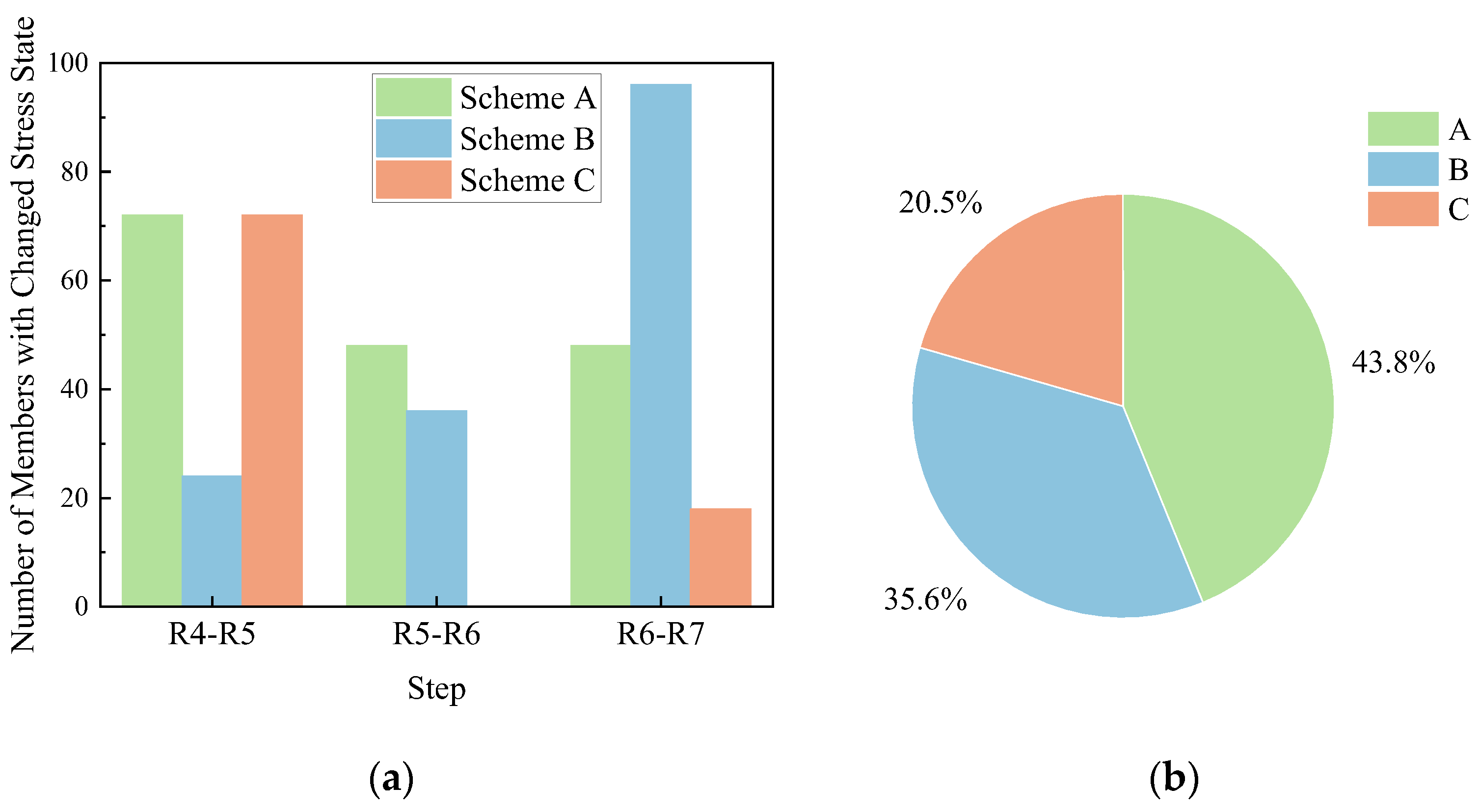
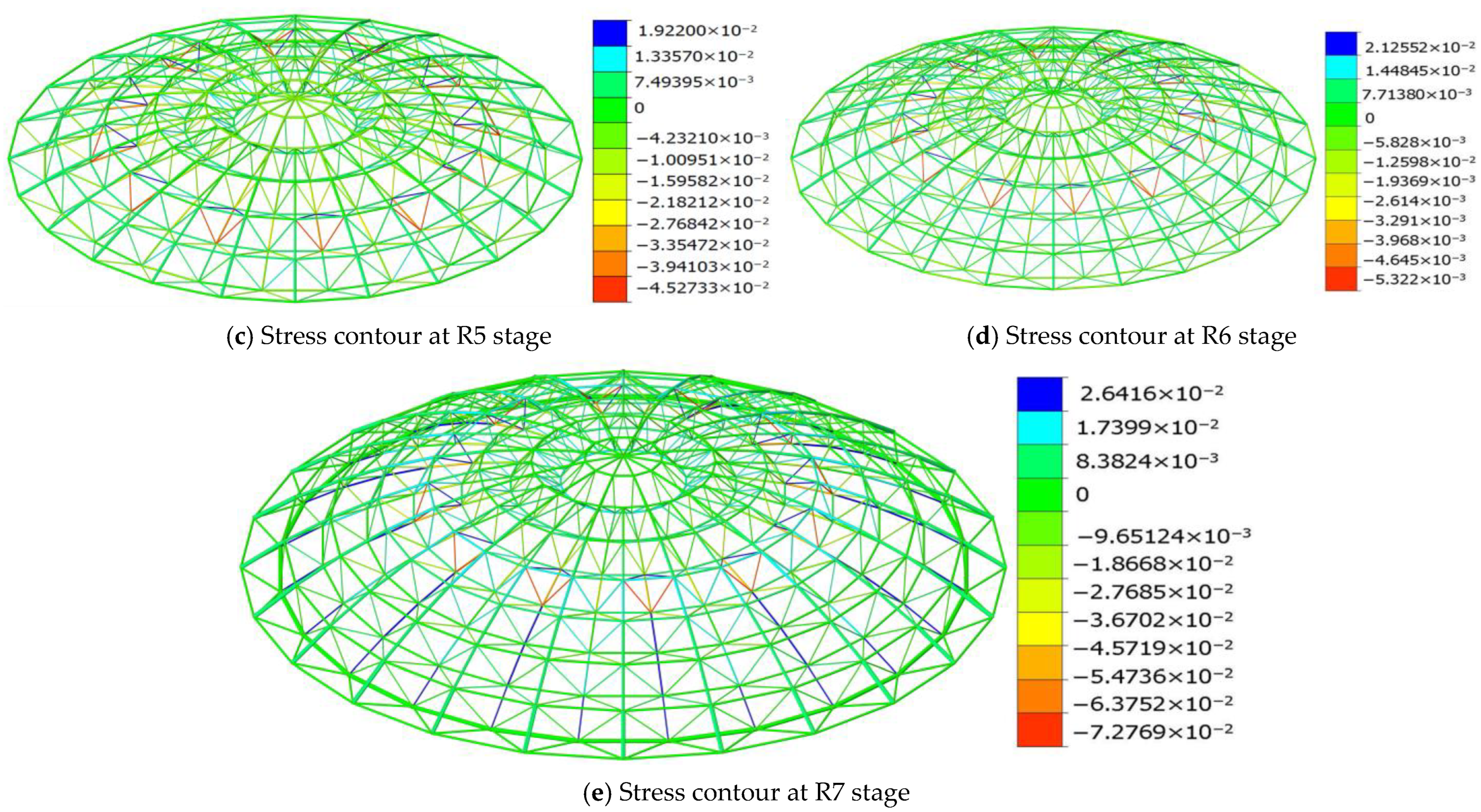
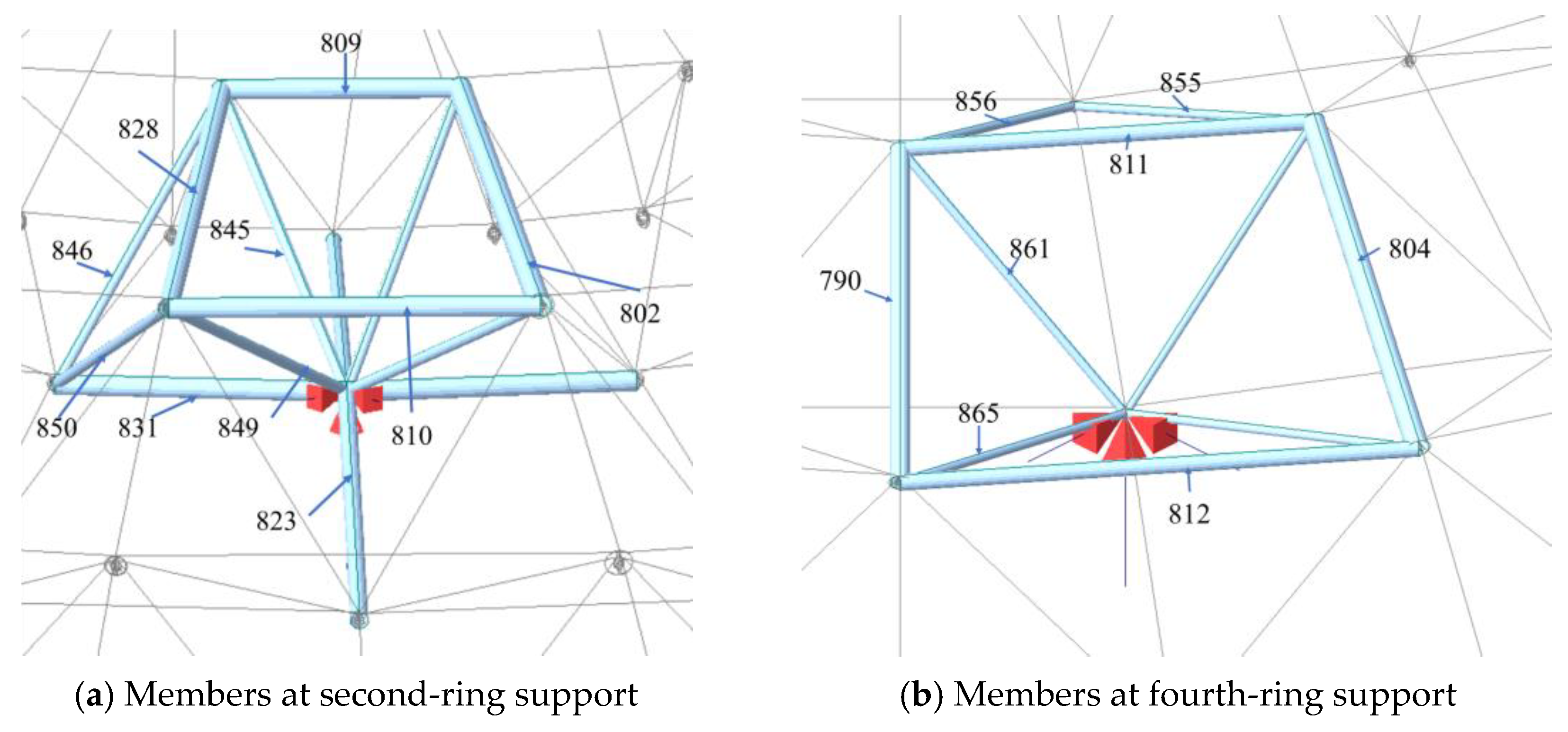
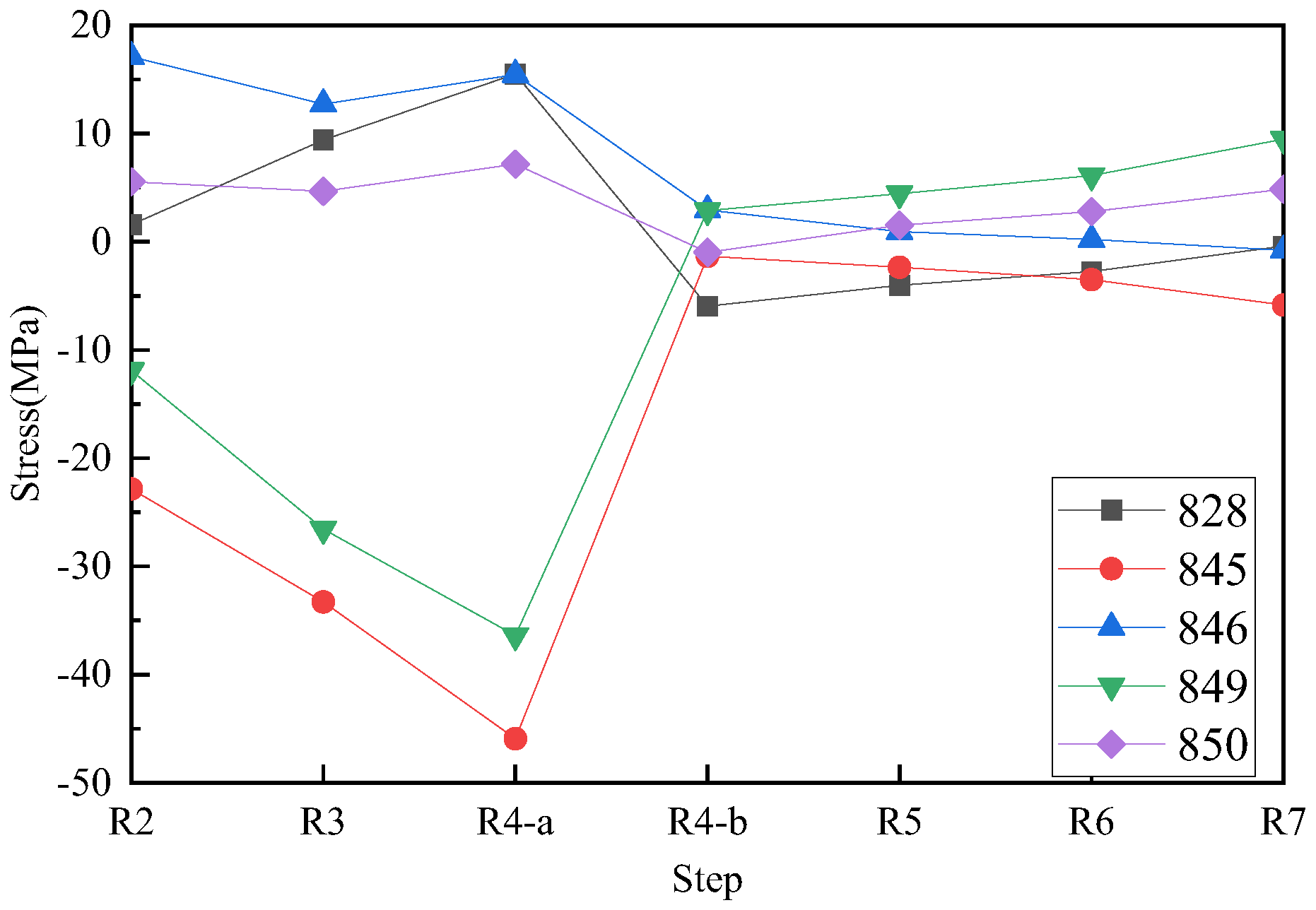
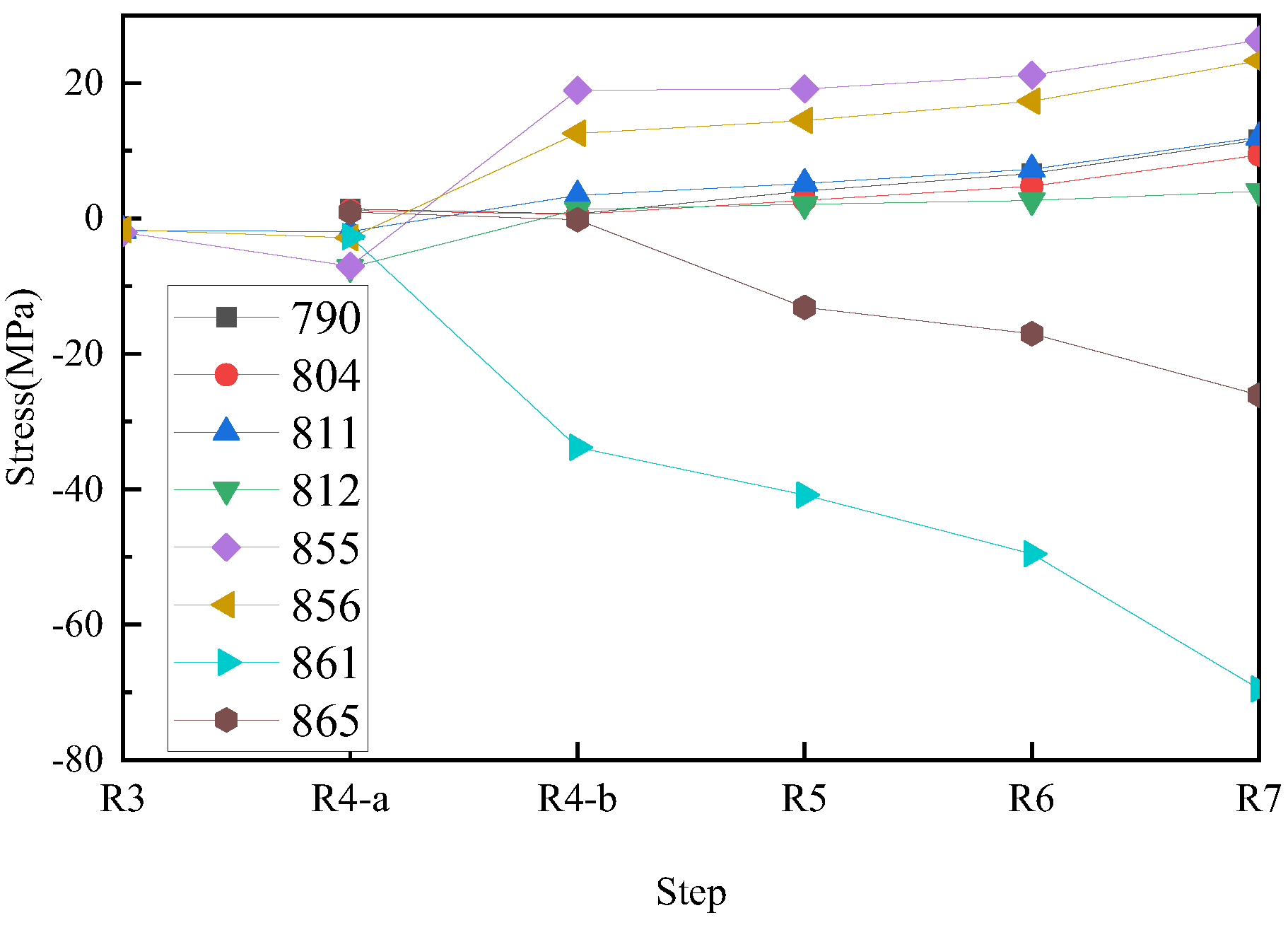
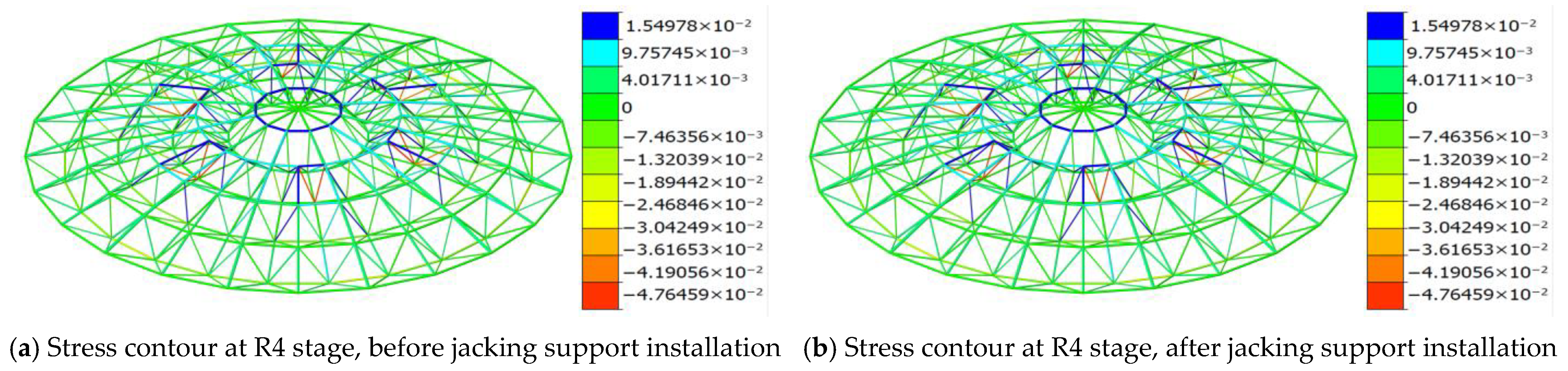
- During construction, the region of stress concentration in the structure gradually shifts from the supports of the sixth ring to those of the fourth ring. In the course of the system transformation, the stresses in some members (such as web members No. 845 and No. 849) exhibit abrupt changes from compression to tension, which is a typical manifestation of load path reconstruction. Field measurements indicate that this process is globally controllable and does not trigger any structural instability.
- (4)
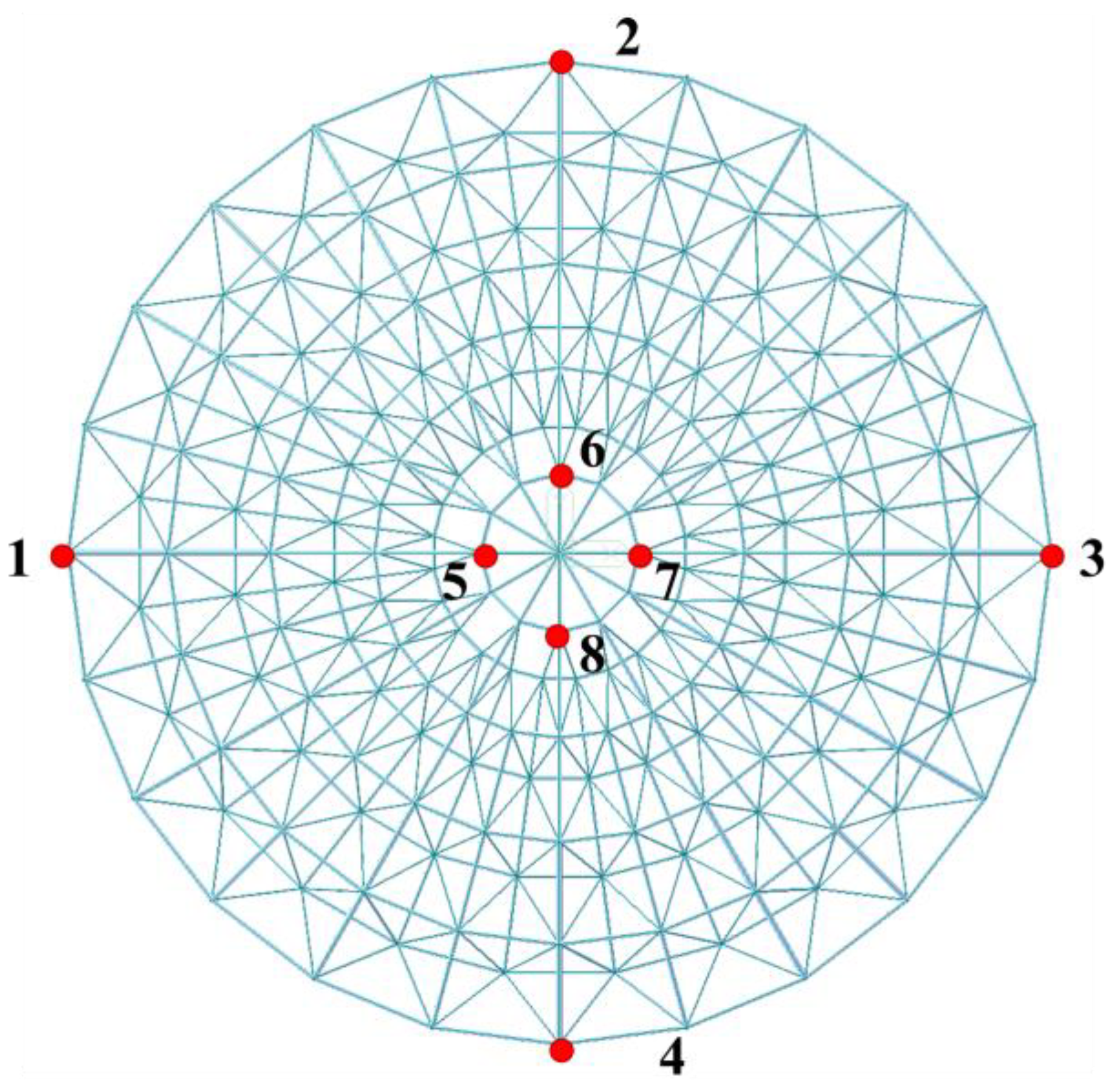
- In some local regions, such as the 3–7 measurement-point pair with an abnormal deflection of 29 mm, and at several supports where the elevation deviation is relatively large (up to 28 mm), discrepancies in local support conditions are indicated. It is recommended that the bearing conditions in these areas be re-examined and finely adjusted where necessary, and that they be designated as priority zones for long-term structural health monitoring, so as to ensure the durability of the structural performance in service.
Author Contributions
Funding
Data Availability Statement
Conflicts of Interest
Appendix A
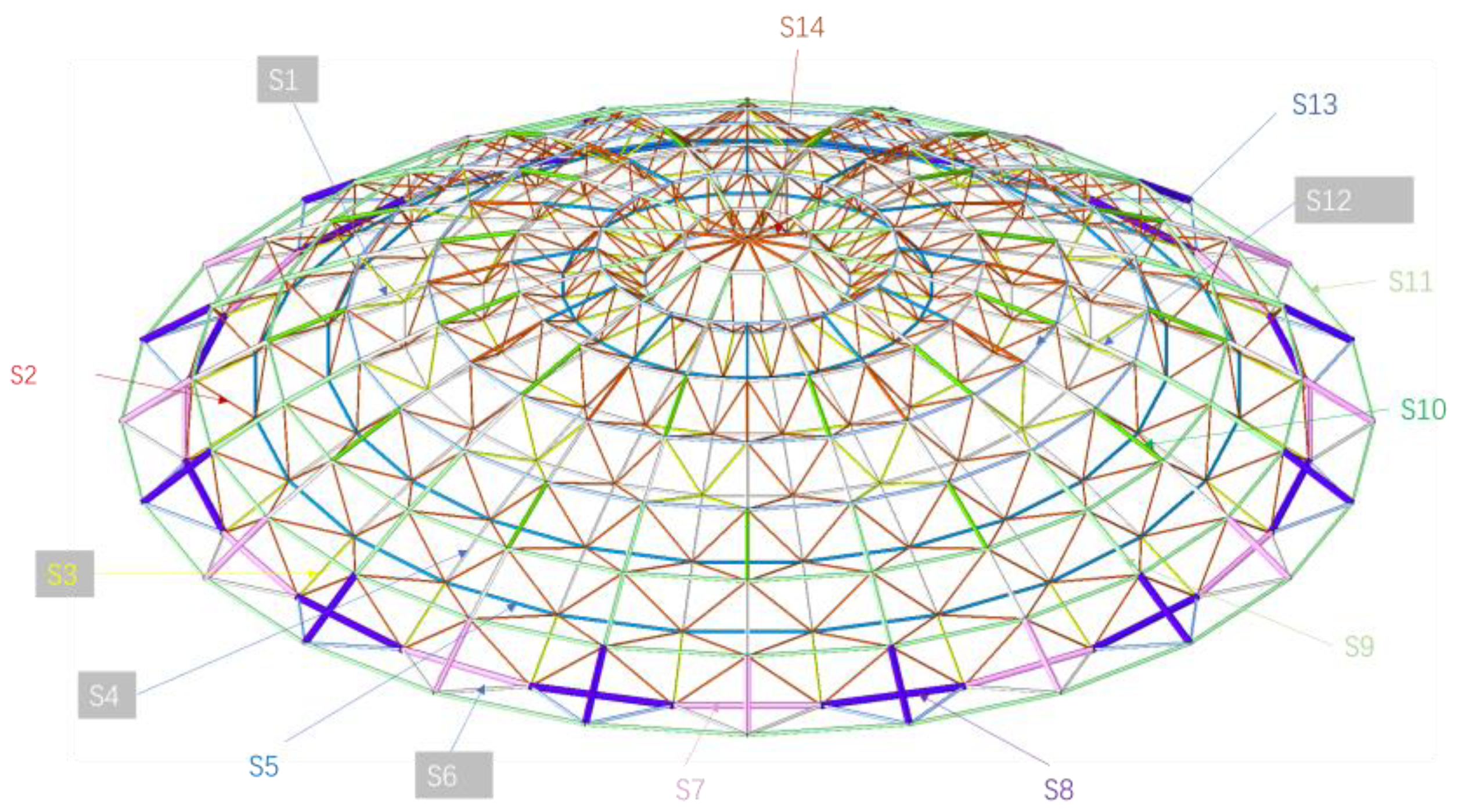
Appendix A.1. Member Section Properties


| Section Type | Diameter (mm) | Thickness (mm) |
|---|---|---|
| S1 | 180 | 14 |
| S2 | 88.5 | 4 |
| S3 | 114 | 4 |
| S4 | 140 | 4 |
| S5 | 159 | 6 |
| S6 | 159 | 8 |
| S7 | 325 | 16 |
| S8 | 351 | 18 |
| S9 | 245 | 14 |
| S10 | 219 | 12 |
| S11 | 180 | 12 |
| S12 | 219 | 14 |
| S13 | 159 | 10 |
| S14 | 219 | 12 |
References
- Shen, S.Z. Development of Long-Span Spatial Structures—Review and Outlook. J. Civ. Eng. 1998, 31, 5–14. (In Chinese) [Google Scholar]
- Bach, M.F. Spatial Structures; Springer Science & Business Media: Berlin, Germany, 2012. [Google Scholar]
- Li, Y.; Cai, J.; Jiang, H.; Zhang, Q.; Kueh, A.B.; Wang, Z.; Feng, J. Experimental study of twisted thin-walled box components in single-layer domes. Case Stud. Constr. Mater. 2023, 19, e02610. [Google Scholar] [CrossRef]
- Liu, Y.; Dong, Y.; Li, Q.; Pan, P.; Ding, Y. Static behavior of a novel steel grid concrete composite shell: Analytical and numerical study on the ideal dome. Thin-Walled Struct. 2025, 207, 113880. [Google Scholar] [CrossRef]
- Wu, Y.; Ma, K.; Zhang, H.; Song, Y. Research on the dynamic characteristics of herringbone multi-ribbed reticulated shell concrete structures. Case Stud. Constr. Mater. 2022, 17, e01514. [Google Scholar] [CrossRef]
- El-Mahdy, D.; Sameh, H.; Fekry, M. Structural stability of 3D-printed earthen catenary domes: Experimental and analytical insights. Structures 2025, 81, 110273. [Google Scholar] [CrossRef]
- Zhao, J.; Liu, H.; Zhao, J.; Zhao, S.; Chen, Z. Experimental research of a single-layer glulam reticulated shell with reinforced joints. J. Build. Eng. 2025, 92, 113266. [Google Scholar] [CrossRef]
- Wang, H.; Huang, Y.; Zhang, Z.; Zhao, Y.; Sun, Y. Generative design and topology optimization research for single-layer aluminium alloy grid shell connections. Case Stud. Constr. Mater. 2024, 21, e03781. [Google Scholar] [CrossRef]
- Du, W.; Li, X.; Zhu, L. Collapse mechanism of double-layer latticed shell structures in view of energy dissipation under seismic excitation. Structures 2025, 81, 110318. [Google Scholar] [CrossRef]
- Huang, S.-H.; Hu, D.; Yang, Z.; Zhu, M.-L.; Guo, T.; Shan, Z.-W.; Chen, W.; Looi, D.T.-W.; Su, R. An innovative two-stage damage detection method for space latticed structures. Structures 2025, 81, 110225. [Google Scholar] [CrossRef]
- Du, W.F.; Zhu, Z.H.; Zhu, L.M. Comparison of four structural schemes for the roof design of Qinyang Stadium. In Proceedings of the 2nd International Conference on Civil Engineering and Building Materials (ICCEBM 2013), Chengdu, China, 17–18 May 2013. [Google Scholar]
- Liu, Z.; Jin, C.; Zhang, Q. Intelligent safety control modeling and construction process control of steel mesh frame structures. Structures 2025, 78, 109158. [Google Scholar] [CrossRef]
- Guo, X.; Sui, Z.; Li, Z.; Zhang, J.; Zhang, Y.; Zong, S. Efficient analysis and evaluation method for overall lifting of large-span spatial grid structures. J. Build. Eng. 2024, 96, 110657. [Google Scholar] [CrossRef]
- Tang, Y.; Huang, B.; Wang, S.; Zhou, J.; Xiang, Z.; Sheng, C.; He, C.; Wang, H.; Ruan, L. Computer vision-based real-time continuous monitoring of the pose for large-span bridge cable lifting structures. Autom. Constr. 2024, 162, 105383. [Google Scholar] [CrossRef]
- Li, Z.; Dong, X.; Chen, H.; Chi, L.; Zhang, Z. Overall lifting construction control method for large-segment steel arch bridges based on unstressed state control theory. Buildings 2025, 15, 523. [Google Scholar] [CrossRef]
- Zeng, P.; Wu, P.; Wang, Y.; Lai, M.; Wang, R.; Chen, J.; Lin, M. Study on sliding construction technology of complex steel structure roof system: A case study of Xiamen, China. In Proceedings of the International Conference on Geosynthetics and Environmental Engineering, Singapore, 15–17 December 2023. [Google Scholar]
- Qiu, D.W.; Wang, Y.M.; Chen, X.Z. Large building overhead installation control surveying. In Proceedings of the 2nd International Conference on Civil Engineering and Architecture (ICCEA 2011), Guilin, China, 18–20 November 2011. [Google Scholar]
- Zhang, J.; Liu, A.; Ma, Z.J.; Huang, H.; Mei, L.; Li, Y. Behavior of self-anchored suspension bridges in the structural system transformation. J. Bridge Eng. 2013, 18, 712–721. [Google Scholar] [CrossRef]
- Fedorova, N.; Savin, S. Structural transformation of reinforced concrete structural system at sudden loss of stability of one of its elements. In Proceedings of the International Scientific Conference on Mechanics, Architecture and Construction (MACE 2018), Saint Petersburg, Russia, 19–21 June 2018. [Google Scholar]
- Tian, Y.; Chen, J.; Du, C.; Xu, D.; Zhou, H.; Sun, Z.; Li, Q.; Wang, D.; Wang, T. Large-scale hybrid test of a curved bridge considering complete boundary condition by a large spatial loading system. Earthq. Eng. Struct. Dyn. 2024, 53, 2032–2054. [Google Scholar] [CrossRef]
- Wang, Q.L.; Zhou, L.Y.; Shi, J.Z.; Xu, B.L.; Bu, Z.M.; Wang, B. Research on rapid integral lifting method and progressive collapse prevention analysis of long-span steel latticed shells. J. Cent. South Univ. (Sci. Technol.) 2024, 55, 538–549. (In Chinese) [Google Scholar]
- Sun, G.; Xiao, S.; Wu, J.; Yu, S.; Wei, M.; Qin, J.; Zang, M. Study on the static stability of aluminum alloy single-layer spherical reticulated shell. J. Build. Eng. 2024, 84, 108595. [Google Scholar] [CrossRef]
- Yang, G.; Wang, W.W.; Tang, Y.; Hu, H.; Huang, Q. Analysis of the mechanical performance of large-span steel arch bridge by using the two-stage construction method. Structures 2025, 81, 110349. [Google Scholar] [CrossRef]
- Ye, X.W.; Liu, Z.X.; Chen, Y.B.; Lu, C.R.; Song, Y.J.; Li, X.J.; Zhao, L.A. Deformation of existing underpasses due to pile cutting and shield tunneling: Observations from field monitoring and explanations by analytical model. Case Stud. Constr. Mater. 2024, 21, e03836. [Google Scholar] [CrossRef]
- GB 50755-2012; Code for Construction of Steel Structures. China Architecture & Building Press: Beijing, China, 2012.
- JGJ 276-2012; Technical Code for Safety of Lifting in Construction. Ministry of Housing and Urban-Rural Development of the People’s Republic of China; China Architecture & Building Press: Beijing, China, 2012.
- Rizzo, F.; Barbato, M.; Sepe, V. Shape dependence of wind pressure peak factor statistics in hyperbolic paraboloid roofs. J. Build. Eng. 2021, 43, 103203. [Google Scholar] [CrossRef]
- Peng, X.; Yang, L.; Gavanski, E.; Gurley, K.R.; Prevatt, D.O. A comparison of methods to estimate peak wind loads on buildings. J. Wind Eng. Ind. Aerodyn. 2014, 126, 11–23. [Google Scholar] [CrossRef]
- Gavanski, E.; Yang, L.; Peng, X. Wind-induced pressure and peak factor considerations for spatial structures. Eng. Struct. 2014, 70, 112–125. [Google Scholar] [CrossRef]
- Li, T.; Qu, H.; Zhao, Y.; Honerkamp, R.; Yan, G.; Chowdhury, A.; Zisis, I. Wind Effects on Dome Structures and Evaluation of CFD Simulations through Wind Tunnel Testing. Sustainability 2023, 15, 4635. [Google Scholar] [CrossRef]




| Material | Density (kg/m3) | Elastic Modulus (GPa) | Poisson’s Ratio | Yield Strength (MPa) |
|---|---|---|---|---|
| Q235 | 7850 | 206 | 0.3 | 235 |
| Q355 | 7850 | 206 | 0.3 | 355 |
| Mode | Eigenvalue | Tolerance |
|---|---|---|
| 1 | 5.231908 | 0.0000 |
| 2 | 9.885741 | 0.0000 |
| 3 | 17.268686 | 0.0000 |
| 4 | 18.053742 | 0.0000 |
| 5 | 18.053742 | 0.0000 |
| 6 | 20.587083 | 0.0000 |
| 7 | 20.587083 | 0.0000 |
| 8 | 25.474009 | 0.0000 |
| 9 | 25.474009 | 0.0000 |
| 10 | 35.206405 | 0.0000 |
| 11 | 35.206405 | 0.0000 |
| 12 | 41.179249 | 0.0000 |
| 13 | 41.179249 | 0.0000 |
| 14 | 150.386791 | 5.2570 × 10−89 |
| 15 | 150.386791 | 3.0782 × 10−89 |
| 16 | 176.521376 | 8.9909 × 10−63 |
| 17 | 176.521376 | 1.2754 × 10−62 |
| 18 | 191.075212 | 4.7365 × 10−58 |
| 19 | 191.075212 | 8.5190 × 10−47 |
| 20 | 195.868943 | 3.6804 × 10−42 |
| Number | Elevation (m) | Actual Height Difference (m) | Simulation Result (m) | Deflection Deviation (mm) |
|---|---|---|---|---|
| 2 | −1.334 | 7.998 | 8.002 | −4 |
| 6 | 6.664 | |||
| 3 | −1.367 | 8.031 | 8.002 | 29 |
| 7 | 6.664 | |||
| 1 | −1.337 | 8.001 | 8.002 | 1 |
| 5 | 6.664 | |||
| 4 | −1.334 | 7.998 | 8.002 | −4 |
| 8 | 6.664 |
| Monitoring Point | Measured Value (m) | Elevation from Numerical Analysis (m) | Deviation (mm) |
|---|---|---|---|
| 1 | 5.674 | 5.675 | 1 |
| 2 | 5.675 | 5.675 | 0 |
| 3 | 5.68 | 5.675 | −5 |
| 4 | 5.658 | 5.675 | 17 |
| 5 | 5.679 | 5.675 | −4 |
| 6 | 5.655 | 5.675 | 20 |
| 7 | 5.691 | 5.675 | −16 |
| 8 | 5.654 | 5.675 | 21 |
| 9 | 5.675 | 5.675 | 0 |
| 10 | 5.647 | 5.675 | 28 |
| 11 | 5.69 | 5.675 | −15 |
| 12 | 5.674 | 5.675 | 1 |
| 13 | 5.682 | 5.675 | −7 |
| 14 | 5.679 | 5.675 | −4 |
| 15 | 5.667 | 5.675 | 8 |
| 16 | 5.659 | 5.675 | 16 |
| 17 | 5.677 | 5.675 | −2 |
| 18 | 5.648 | 5.675 | 27 |
| 19 | 5.673 | 5.675 | 2 |
| 20 | 5.661 | 5.675 | 14 |
| 21 | 5.668 | 5.675 | 7 |
| 22 | 5.665 | 5.675 | 10 |
| 23 | 5.676 | 5.675 | −1 |
| 24 | 5.664 | 5.675 | 11 |
Disclaimer/Publisher’s Note: The statements, opinions and data contained in all publications are solely those of the individual author(s) and contributor(s) and not of MDPI and/or the editor(s). MDPI and/or the editor(s) disclaim responsibility for any injury to people or property resulting from any ideas, methods, instructions or products referred to in the content. |
© 2026 by the authors. Licensee MDPI, Basel, Switzerland. This article is an open access article distributed under the terms and conditions of the Creative Commons Attribution (CC BY) license.
Share and Cite
Zhang, X.; Yang, Z.; Ren, J.; Yue, Y.; Dong, Y.; Zhang, J.; Guan, H.; Liu, C.; Cui, L.; Ma, J. Comparative Selection of Staggered Jacking Schemes for a Large-Span Double-Layer Space Frame: A Case Study of the Han Culture Museum Grand Hall. Buildings 2026, 16, 791. https://doi.org/10.3390/buildings16040791
Zhang X, Yang Z, Ren J, Yue Y, Dong Y, Zhang J, Guan H, Liu C, Cui L, Ma J. Comparative Selection of Staggered Jacking Schemes for a Large-Span Double-Layer Space Frame: A Case Study of the Han Culture Museum Grand Hall. Buildings. 2026; 16(4):791. https://doi.org/10.3390/buildings16040791
Chicago/Turabian StyleZhang, Xiangwei, Zheng Yang, Jianbo Ren, Yanchao Yue, Yuanyuan Dong, Jiaguo Zhang, Haibin Guan, Chenlu Liu, Li Cui, and Jianjun Ma. 2026. "Comparative Selection of Staggered Jacking Schemes for a Large-Span Double-Layer Space Frame: A Case Study of the Han Culture Museum Grand Hall" Buildings 16, no. 4: 791. https://doi.org/10.3390/buildings16040791
APA StyleZhang, X., Yang, Z., Ren, J., Yue, Y., Dong, Y., Zhang, J., Guan, H., Liu, C., Cui, L., & Ma, J. (2026). Comparative Selection of Staggered Jacking Schemes for a Large-Span Double-Layer Space Frame: A Case Study of the Han Culture Museum Grand Hall. Buildings, 16(4), 791. https://doi.org/10.3390/buildings16040791