1. Introduction
1.1. Background
The preservation and renewal of historic districts is shifting from an object-centered repair logic toward a people-centered strategy aimed at improving spatial quality [
1,
2,
3]. Public open spaces (POSs) within historic districts often serve multiple functions, including daily interaction, tourist stays, cultural ceremonies, and urban image display [
4]. The organization of these spatial elements directly impacts the emotional state, cognitive load, and subjective preferences of residents and visitors. Meanwhile, the issue of building environmental equity has been widely discussed in recent years [
5,
6,
7,
8]. Which means that POSs in contemporary urban areas, especially those with landscape attributes and environmental regulation functions, are multifaceted, playing a pivotal role in contributing to the physical and mental well-being of residents [
9,
10,
11,
12,
13,
14,
15]. Historical district public open spaces (HDPOSs) [
16] involve the idea of community, as understood through its spatiotemporal past, and encompass its area of development over time [
17], including how historic remnants influence the current urban spatial cognitive map [
18] and identity of the locals [
19]. Furthermore, serving as crucial elements for urban sustainable development [
20], historic districts not only hold significant economic importance [
21] but also contain collective memory, which binds the community together [
22,
23]. Preserving the unique environment accommodating traditional way for local people also could be the main factor in the success of the preservation process [
24,
25,
26].
Traditional evaluation methods, relying primarily on questionnaires, interviews, and expert judgment, are susceptible to recall bias and societal expectations and struggle to capture the immediate psychological and physiological changes under short-term, continuous visual stimuli. Therefore, obtaining more objective and repeatable evidence of spatial experiences under controllable conditions and establishing interpretable connections between this evidence and spatial elements is a key challenge in the research and renewal practice of public open spaces in historic districts. Virtual reality (VR) provides a controllable and immersive experimental paradigm for this purpose [
27,
28]. It can present spatial scenes consistently while minimizing environmental disturbances such as temperature, noise, and crowding, yet still approximate real experience in terms of visual perception and spatial sensation, thereby facilitating comparisons of psychological responses elicited by different space types and element configurations. Meanwhile, electroencephalography (EEG) can capture real-time neural activity during scene viewing, offering objective cues about cognitive states beyond self-reported preference. Existing research has shown that the power in different EEG frequency bands, as well as the ratios between these bands, is statistically correlated with states such as relaxation, tension, and cognitive load [
29], making them suitable as quantitative indicators under short-term visual stimulation conditions.
However, within the context of the study of HDPOSs, two gaps remain significant: (1) first, it is still unclear how specific in-view landscape elements encountered during locals’ routine daily activities are visually perceived and translated into spatial preference, limiting the development of feedback mechanisms that link physical elements to residents’ emotional experience; (2) second, existing studies often implicitly assume consistency between stated preference and physiological response, even though in culturally symbolic or highly familiar places preference ratings may diverge from indices of tension or cognitive load.
1.2. Research Objective
Based on the issues identified above, this study takes typical POS in the Quanzhou historic district as the research object and develops a unified analytical framework that combines VR-based EEG measurement with quantitative visual-element assessment. First, multiple types of POS scenes are presented in VR while EEG is recorded simultaneously to derive a Relaxation index value (RIv) and an Attention index value (AIv). Second, image semantic segmentation and pixel-based statistics are applied to transform key visible landscape elements into comparable proportion-based variables. Finally, within a consistent statistical framework, we examine the correlations among visual elements, EEG indices, and stated preference, with particular attention to identifying space types in which “perception–preference” mismatches may occur and to exploring the potential mechanisms underlying such mismatches.
Accordingly, this study proposes and tests the following research hypotheses:
RH1 (Elements–Relaxation): as the proportion of visually perceived elements related to nature and respite increases, RIv tends to increase, indicating higher relaxation.
RH2 (Elements–Tension): as the proportion of visually perceived elements associated with traffic, boundaries, hard paving, or higher visual information density increases, AIv tends to increase, indicating higher cognitive tension load.
RH3 (Perception–Preference Divergence): in space types with distinctive cultural symbolism or high familiarity, stated preference ratings may not follow the same trend as AIv.
2. Related Works
2.1. Spatial Cognition of Historical District Public Open Space
Spatial cognition refers to the process by which individuals acquire, organize, and interpret information about their physical environment and spatial relationships [
30,
31]. The perception of space in the built environment arises through the placement and combination of multiple physical elements, encompassing all tangible materials that shape the physical characteristics and functional quality of POS, including landscape features [
32], street furniture [
33], pathways [
34], paving, lighting, vegetation, and architectural elements [
35]. These elements are essential in determining the accessibility, aesthetic appeal, and overall user experience of outdoor spaces [
36,
37]. Place-related identity is also receiving increasing attention within the environmental psychology field [
38,
39]. Additionally, quantifying spatial cognition from the behavior of a specific population is inherently complex, which makes it challenging to integrate multiple quantitative perceptual analysis methods into a single framework [
40,
41].
In the macro study of regeneration strategies for historic districts, the efficiency of land utilization and functional area coordination has attracted considerable attention. Research focuses on improving the spatial structure by optimizing the historical public space pattern and route network via tourism satisfaction and quantitative tourist routes data [
42,
43]. Additionally, for a certain historic district, related results suggested that HDPOS could be categorized as successful public places due to their culture, natural, functional and emotional related aspects [
44]. This research focuses more on the various embodied perceptions of individuals and aims to improve the human spatial experience in historical districts through solutions such as the implementation of nature-based micro-scenarios to alleviate heat stress [
45], exploration of the correlation mechanism between soundscape and spatial experience [
46], revealing the correlation mechanism between landscape visual quality and recognizable features of the built environment [
47], developing outdoor thermal comfort model for tourists visiting [
48] and community vitality enhancement [
49], and adjusting vegetation density to balance shading effectiveness of street trees with the facade exposure of existing historical building [
50]. Such examples suggest that academic discussions often focus on the interplay between preserving historical integrity and adapting to contemporary tourist-related commercial needs. On the other hand, the maintenance of communities in historical district is also crucial for the sustainable development of this region [
51], reflecting an interplay between past and present experiences that define the community’s identity and cohesion over time.
2.2. Factors Affecting Spatial Preferences and Perceptions
More generalized research subjects in spatial preferences are multi-faceted, likely influenced by a confluence of social [
52,
53], cultural [
54], environmental [
55], and individual factors [
14,
28]. In the study of the correlation mechanism between environment and human behavior, a series of physical behavior characteristics of humans can be analyzed to determine the positive impact of spatial characteristics on human physical activity level [
33]. In addition, research on outdoor pedestrian activities also indicates that the space composition characteristics of the outdoor environment can affect behavioral spatial preferences [
56]. Early research found that preferences for urban POS were determined by spatial categories and several predictor variables related to spatial quality [
57], which is determined by attributes of more detailed built-environment elements such as the availability of facilities [
58], the meticulous division of space [
56,
59], color characteristics [
60], green coverage [
61,
62], vegetation type [
63], and shade [
64], which affect individuals’ behavior and experiences. Studies focus on more detailed and specific attributes associated with people’s subjective embodied perception, such as activity type [
65], space crowding [
66], thermal comfort [
56,
67], accessibility [
68] and safety [
8] of POS as indicators to evaluate its quality, which affects the behavioral characteristics and even mental health of residents [
69].
Perception is the process of understanding the environment through human senses [
70]. In the process of interacting with specific spatial elements of POS, people could have embodied subjective perceptions caused by visual, auditory, olfactory, and thermal [
71] stimuli, including physical and psychological factors, driving them to exhibit specific spatial preference behavior [
72]. Through strategic design and optimization of crucial elements within POS, it is possible to elicit a positive impact on individuals’ mental health, as evidenced by feedback from the affected populations [
10,
13,
73]. For example, adjusting the types and richness of urban street trees can alleviate pedestrians’ stress levels [
74]. Increasing vitality, which refers to the capacity of POS to accommodate a variety of activities, is positively associated with positive mental well-being [
75], and the proportion of spaces dedicated to entertainment, nature, and sports activities is among the most significant factors [
76]. At the community level, local residents could have a collective understanding of a specific area, relating needs and perceptions to the physical environment [
77], thereby providing favorable guidelines for community building.
2.3. Spatial Experience Measurement Methods
Spatial experience measurement is a comprehensive evaluation approach that involves analyzing data from multiple sources, often combining quantitative and qualitative measures by humans. It is widely used in healthcare fields [
78] to provide a more holistic understanding of a subject or issue. The evaluation of spatial cognition is a relatively complex process, which is generally divided by the theory of environmental psychology into four steps: sensation, perception, behavior, and cognition [
79]. Generally speaking, sensation and perception occur simultaneously in this process and are closely related to the characteristics of the spatial environment in which humans are located [
80]. The emergence of spatial perception comes from the stimulation of human senses by external physical environmental features. These features can be transformed into quantitative data through various quantitative processing methods, such as using sensors to extract environmental physical information [
67,
70,
81], quantifying the proportion of spatial elements through image segmentation techniques [
60,
82], and so on. In terms of obtaining quantitative human factors data, modalities of bioelectrical signals are collected by wearable devices [
66], such as EEG measurement [
61,
83,
84,
85] and electrodermal activity measurement [
66,
86], and other physiological data measured by traditional method, such as body core temperature [
87], visual movement [
30,
31,
88,
89], and blood pressure [
61].
In this process, human emotional responses and psychological states are also critical evaluation metrics [
86]. Extensive research has demonstrated that these aspects can be accurately quantified and recognized as objective data. This includes various physiological metrics produced by the human body and brain wave activity levels [
90,
91,
92,
93], alongside traditional methods such as psychological questionnaires [
74], Profile of Mood States (POMS) assessment [
94,
95] and real-time surveys [
86] for the analysis of psychological states. In addition to the above methods, crawling the spatial preference keywords of online social media comments is also an effective way to obtain a large number of emotional evaluation data samples [
71,
96]. These human factor data are commonly used to understand the arousal mechanism of environmental factors on human physiological characteristics and to evaluate environmental quality based on this, such as outdoor thermal comfort perception evaluation [
83], pedestrian walking experience on urban pedestrian roads [
66], indoor office space pressure assessment [
89], the effects of green space behaviors [
61], and urban landscape composition quality [
27].
To sum up, previous research has demonstrated that the factors influencing human perception of the built environment are complex and multifaceted. Sensory elements such as temperature, humidity, sound, and visual stimuli all contribute to embodied perception. Moreover, the relative impact of these objective factors varies across different built environments. To minimize the confounding effects of non-visual sensory factors under real-world conditions, we established the visual cognition experiments (VCEs) setting and introduced an immersive VR environment to approximate realistic spatial perception while keeping the visual stimuli comparable [
97]. To quantify spatial preference, we adopted a generic composite measurement mechanism that combines EEG data with subjective evaluation scores [
61,
83,
98,
99]. This dual approach serves as our method for measuring spatial experience and elucidating preferences.
2.4. VR and AI Assisted Spatial Perception Research
With the rapid advancement of immersive media technologies and artificial intelligence, virtual reality (VR) and AI-driven analytical methods have increasingly been introduced into spatial cognition, landscape evaluation, and environmental perception research. Compared with conventional laboratory-based image viewing and in situ field investigations, VR-based experimental environments enable participants to obtain highly realistic and immersive spatial experiences under strictly controlled conditions, thereby effectively balancing ecological validity and experimental rigor [
100]. This advantage makes VR particularly suitable for studying perceptual and emotional responses to complex spatial environments, such as urban public spaces and landscape scenes [
101].
Recent studies have demonstrated that VR-based immersive experiments can reliably reproduce visual depth, spatial enclosure, and environmental composition, eliciting perceptual, behavioral, and physiological responses comparable to those observed in real-world settings [
102]. Accordingly, VR has been widely applied in evaluating spatial comfort, aesthetic perception, emotional arousal, and spatial preference in urban streetscapes, green spaces, architectural interiors, and landscape environments [
103]. In spatial preference research, VR provides a powerful platform for systematically manipulating environmental variables, enabling controlled comparisons of different spatial configurations that are difficult to implement in real environments [
104].
In parallel, advances in AI, particularly deep learning-based image segmentation and computer vision techniques, have significantly enhanced the capability to quantitatively extract environmental features from complex landscape scenes [
105]. AI-driven analysis allows fine-grained identification of vegetation, paving, built elements, sky exposure, and shading patterns, providing an objective and scalable means of characterizing environmental composition [
106]. These techniques have been increasingly applied in urban morphology analysis, streetscape evaluation, and landscape quality assessment, offering robust quantitative support for correlating built environmental attributes with human perceptual and physiological responses.
Despite these advances, existing studies rarely integrate immersive VR experiments with AI-based environmental feature extraction and multimodal physiological sensing within a unified analytical framework, particularly in the context of historic communities and public open spaces [
107]. This methodological gap limits the ability to systematically investigate the complex interactions between environmental composition, cultural symbolism, and local residents’ psychological responses [
108]. Therefore, combining VR-based immersive experiments with AI-driven environmental quantification provides a promising methodological pathway for advancing spatial preference research in historically sensitive urban environments.
3. Material and Methods
3.1. Study Sites
3.1.1. Location
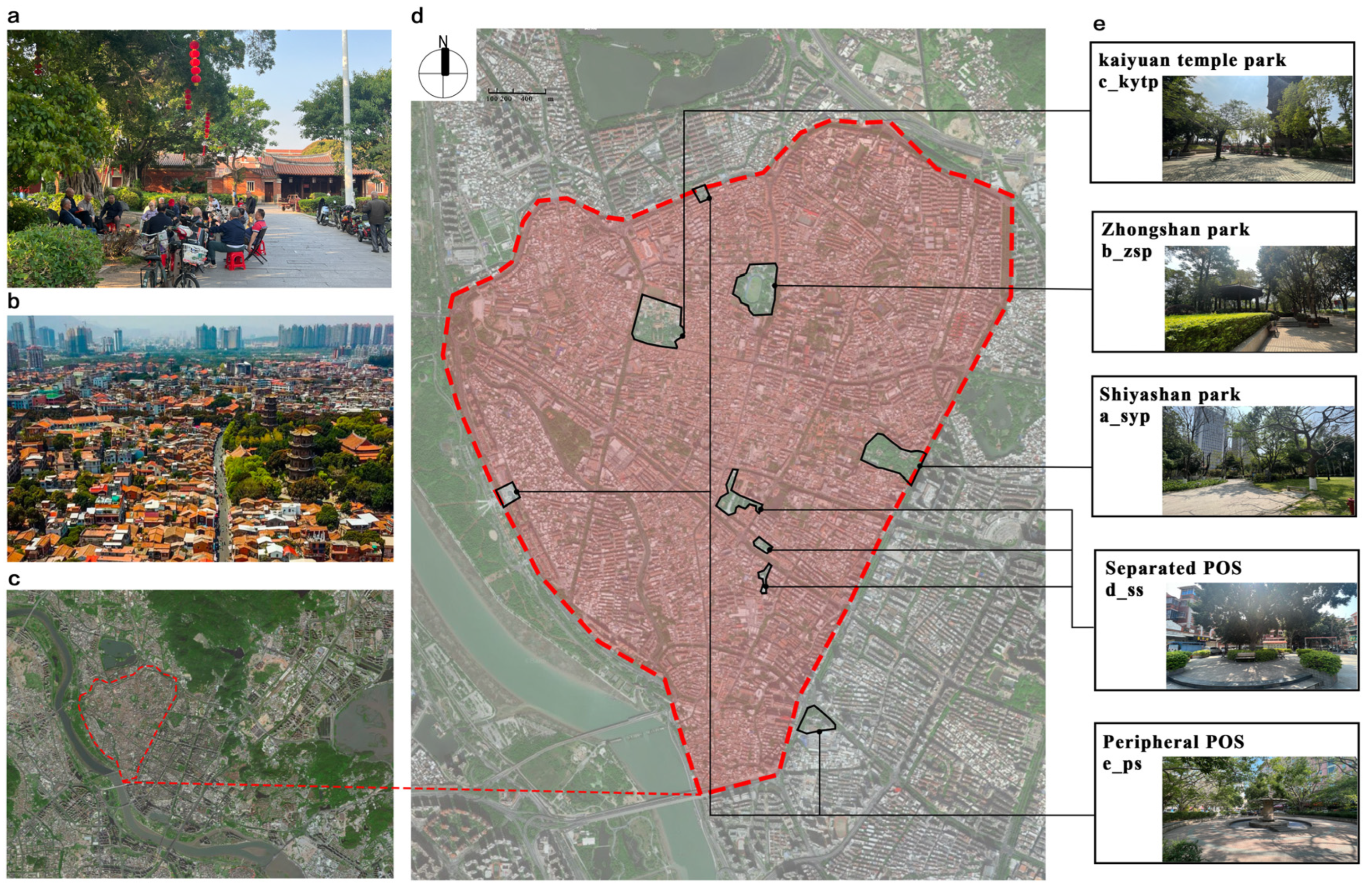
Quanzhou historic preservation district (QZHPD) is located in the middle of Quanzhou City in the southeast coastal region of China (118.5° E, 25° N) and was once an important starting point of the Maritime Silk Road (
Figure 1c). There are many religious artifacts and historical sites in this district, and its public environment exhibits unique religious inclusiveness. In addition to large religious buildings such as Kaiyuan Temple, Qingjing Temple, and Guandi Temple, there are also various POSs scattered around, as symbols of community spirit and public activity venues at different scales (
Figure 1b). The urban fabric of the QZHPD retains the scale and dimensions from the Tang Dynasty and has undergone three urban renewals since 1920s. This process has resulted in the formation of open residential clusters that exhibit characteristics from three distinct eras: the Ming and Qing Dynasties, the Republic of China period, and the early years following the founding of the People’s Republic of China [
109]. The majority of local residents in this area are non-migratory, with their community relationships characterized by an intricate interweaving of kinship, social, and geographical networks. This configuration results in locals’ daily social interactions exhibiting a clustered aggregation and stabilization trend (
Figure 1b) due to shared place memory and identity recognition, compared to the dynamic and linear spatial cognitive construction of architectural layout, cultural landscape, and historical features by tourists [
110].
3.1.2. Sample Selection of Historical District Public Open Spaces
The historical community within Quanzhou is characterized by a diverse array of open spaces, reflecting the rich cultural and architectural heritage of this district [
111]. Accordingly, perception-oriented studies have increasingly examined VR-based immersive exposure, enabling controlled stimulus presentation and objective element quantification for linking built-environment features to perceptual responses [
112,
113]. This study selected five types of HDPOSs with various built environmental attributes (
Table 1;
Figure 1e), including three types of public open parks (c_kytp; b_zsp; a_syp) and two types of scattered POSs composed of abnormal spaces and community pocket parks (d_ss; e_ps). By analyzing the elements that define the character of the built environment in the aforementioned representative POS, it is evident that their commonalities are primarily reflected in the environmental vegetation and built elements. This is specifically manifested through the surrounding high-density tropical trees with broad canopies, such as banyans and camphor trees. Additionally, some sites feature architectural elements with distinct traditional historical styles. These include brick and stone paving; stone and wood seat walls; patio furniture; some traditional-style corridors and pavilions; as well as the facades and eaves of temples, all of which further accentuate the historical ambiance of these spaces (
Table 1). It is worth noting that although the HDPOSs defined in this study are mostly located within urban parks, they cannot be simply classified as park-type spaces. Some samples do not exhibit the multi-functional characteristics typically associated with parks; instead, in terms of function and form, they align more closely with the commonly accepted definition of POS in the field—namely, open areas of a scale sufficient to accommodate residents’ everyday activities.
3.2. Experimental Design
3.2.1. Procedures
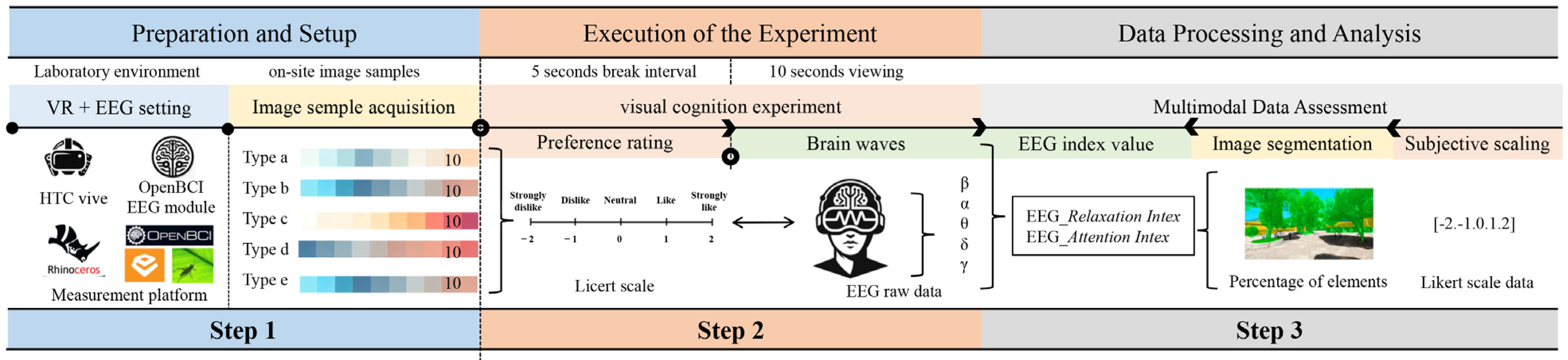
Step1: preparation and setup. In the initial phase of the VCE, the aim of evaluating how landscape images influence spatial perception through an immersive VR environment was clearly defined. Approximately 30 participants were recruited after the necessary ethical approval was obtained. All devices, including the VR headset and the EEG system, were then checked to ensure correct connections and stable signal transmission. The VR platform was loaded with the prepared landscape images, and the EEG synchronization was thoroughly tested.
Step2: execution of the VCE. Participants were placed in a controlled environment, where they were briefly introduced to the VCE program and received training on the equipment. Each participant viewed a series of prepared landscape images in the VR environment while real-time EEG data were recorded to capture psychological responses. Participants’ preference ratings were also collected immediately after each viewing period to capture subjective responses to the visual stimuli.
Step3: data processing and analysis. After the experiment, EEG data were analyzed using OpenBCI software (openbcigui_v5.2.2 was used) to extract relevant brainwave patterns and frequency-domain features. Statistical analyses, including regression and
t-tests, were conducted to identify the specific effects of segmented spatial elements on locals’ perceptual responses by integrating the image-segmentation variables with the subjective rating dataset within a multimodal assessment framework (
Figure 2).
3.2.2. Landscape Image Samples Acquisition
To ensure a comprehensive representation of spatial features across the selected HDPOS sites, sampling and imaging were conducted using randomly selected capture points. The image acquisition parameters were strictly controlled, including a focal length of 1.57 mm, an aperture of f/1.6, and a 16:9 aspect ratio, producing images at 4032 × 2268 pixels. The capture angle was standardized to approximate the human viewpoint using a single-point perspective. The vanishing point was set within the lower portion of the frame—between the lower third and the midpoint of the composition—to maintain consistent perceived depth and spatial accuracy across samples. Image collection was restricted to 10:00 AM–2:00 PM to keep the solar angle within a relatively stable range and to obtain comparable vegetation-shaded shadow patterns. This control helped ensure consistent illumination conditions and improved the reliability of spatial feature analysis. In total, ten landscape images were captured for each of the five site types (
Table 2) and were randomly ordered into image sequences for subsequent VCE.
3.2.3. VR + EEG: Immersive Experimental Environment Establishment
In order to exclude environmental factors such as temperature, humidity, noise, etc., which are not related to the research object in the field experiment, this study used the method of VCE in a laboratory environment [
85,
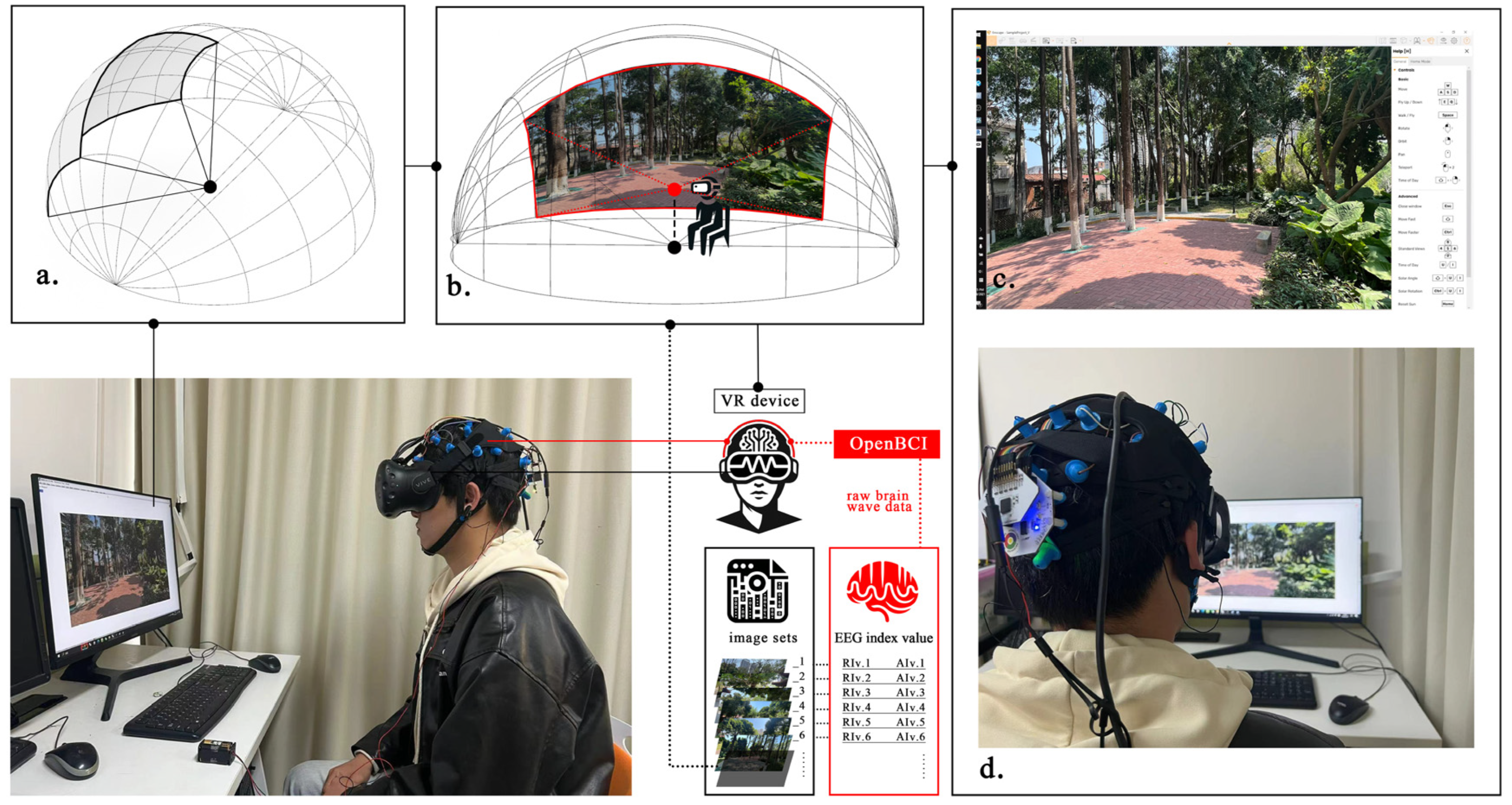
114]. Therefore, this study established a VR environment in the experimental preparation stage (
Figure 3). The VR environment platform applied Rhino, a 3D modeling software tool (Rhinoceros 7.0 was used) equipped with the Enscape rendering engine (
Figure 3c). The environmental image was proportionally assigned to the spherical surface cross-section in front of the virtual viewpoint through rendering textures (
Figure 3a), and fixed observation points were adjusted by simulating the real viewpoint distance (
Figure 3b).
3.3. Measurements
3.3.1. Participants
To ensure sufficient statistical power, an a priori power analysis was conducted using G*Power 3.1.9.7 and assuming a medium effect size (Cohen’s f = 0.25). This value was selected based on commonly accepted conventions in behavioral and environmental psychology research, where f = 0.25 is widely adopted as a representative medium effect size for perceptual and cognitive experiments, particularly in studies involving repeated-measures designs and subjective evaluations [
115,
116,
117,
118,
119]. With an alpha level of 0.05, a desired power of 0.80, and five repeated measurements (corresponding to five image categories), the correlation among repeated measures was set to 0.5, with no sphericity correction ε = 1. Based on the “ANOVA: Repeated measures, within factors” model, the required sample size was estimated to be 21 participants to detect within-subject differences with sufficient power. Although the absolute number of participants may appear limited, the experimental design adopted a within-subject repeated-measures paradigm, in which each participant evaluated all 50 landscape images. This design substantially increased the effective data volume and statistical power by generating a total of 1500 observations (30 participants × 50 images). Repeated-measures designs are widely recognized as statistically efficient for perceptual and physiological experiments, as they enable reliable detection of systematic effects while effectively controlling for individual variability. Therefore, combined with the results of the a priori power analysis, the final sample size of 30 participants provides adequate statistical robustness and reliability for investigating residents’ spatial preferences and psychological responses across multiple image stimuli.
The experiment recruited 30 local residents using a stratified random sampling strategy with purposive constraints, targeting individuals who had lived within the Quanzhou Historic Preservation District for more than five years, aged between 20 and 70 years. Among them, 50% were male, and 50% were female; 20% were young (20–30), 40% middle-aged (30–60), and 40% elderly (60–70). Initially, all participants underwent a rigorous screening process to ensure they met the specific inclusion criteria for the experiment. This included age, visual acuity restrictions, and the absence of neurological diseases that could affect the quality of EEG data. Specifically, for this experiment, individuals with skin allergies or scalp problems, as well as those with ocular diseases or conditions, were excluded. Within 24 h prior to the experiment, participants were required to abstain from substances that could affect neural activity, including caffeine and alcohol. On the day of the experiment, participants first completed a questionnaire regarding their health and visual status. Subsequently, participants were asked to take a cleansing routine for the scalp and eyes to enhance the contact quality of EEG electrodes.
To ensure a strong contextual linkage between participants and the selected public open spaces within the historic community, all recruited participants were frequent users of the selected sites in their daily activities and possessed a high level of spatial familiarity. Prior to the experiment, participants were asked to confirm their routine exposure to and experiential knowledge of the selected public open spaces. This ensured that the recorded perceptual evaluations and physiological responses reflected authentic place-based cognition and emotional experience, rather than first-time impressions or tourist-oriented perceptions.
This study was reviewed and approved by the Biomedical Ethics Committee of Hefei University of Technology, China (ethical approval code: HFUT20250806001H). All procedures involving human participants were conducted in accordance with the Declaration of Helsinki, relevant national regulations, and institutional ethical standards. The research protocol was submitted for ethical review on 1 August 2025 and formally approved on 6 August 2025. The committee confirmed that the procedures involved minimal risk to participants and granted approval for the use, analysis and anonymized publication of the data reported herein.
3.3.2. EEG Measurement
OpenBCI EEG module, widely used as consumer grade brain sensing device was chosen in our EEG data acquisition process. OpenBCI records EEG signals at 250 Hz frequency [
91] and shows comparable accuracy and precision compared to more costly EEG devices in the past [
93]. HTC Vive was chosen as the VR headset device in our experiment, which is also widely applied in recent research. Before the setup of the EEG and VR headsets, participants received a brief instrument from the experiment assistant about the purpose and the procedure of the experiment. Lastly, participants received pre-experimental training to familiarize themselves with the response methods, ensuring they could accurately perform the required tasks during the VCE while minimizing data interference from unnecessary bodily or ocular movements. Participants were informed that they would be viewing a series of virtual reality images of HDPOS and were expected to react naturally during the viewing.
Once the experiment began, participants viewed the preset VR images one by one. Each image was displayed for a set duration (10 s) [
120] with short breaks (5 s) in between to prevent visual fatigue or overload. Through the viewing process, the EEG devices continuously recorded the participants’ brainwave activity to capture their perceptual responses to different images. After each image was displayed, participants were asked to provide immediate feedback in break interval by scoring from five scales (−2, −1, 0, 1, 2) verbally about their preference perceptual experiences and recorded by experimenters. This feedback was combined with EEG data to further analyze the correlation between landscape features and EEG activity.
The presentation duration of 10 s was determined based on prior experimental studies in visual perception and environmental psychology, which indicate that this time window is sufficient for participants to complete initial visual scanning, spatial interpretation, and affective appraisal of complex scenes, while avoiding excessive cognitive fatigue and attentional drift [
121,
122,
123,
124].
Moreover, a fixed viewing duration was adopted instead of self-controlled exposure in order to standardize stimulus conditions across participants, thereby minimizing variability induced by individual differences in visual processing speed and viewing strategies. This controlled presentation paradigm ensures experimental comparability and statistical consistency, which is particularly critical for physiological signal acquisition and subsequent cross-subject analysis.
3.3.3. Preference Survey
The questionnaire survey was designed to capture participants’ subjective spatial preferences and perceptual evaluations, thereby providing a complementary dataset to the physiological measurements. While EEG signals reflect objective neurophysiological responses, subjective ratings enable direct assessment of conscious perception and affective appraisal. The integration of these two data sources allows a more comprehensive understanding of how built environmental elements influence residents’ spatial experience.
The questionnaire consisted of two main parts. The first part collected basic demographic information, including age, gender, education level, and length of residence in the historic district. The second part employed a five-point Likert scale to assess participants’ overall spatial preference, perceived comfort, emotional arousal, and environmental satisfaction for each presented scene, which are widely adopted indicators in environmental psychology and landscape evaluation research.
A simplified affective evaluation questionnaire was administered to participants to rate their preference for image samples. To avoid interference with the experimental process, this step was conducted after the conclusion of the previous visual cognition experiments. The design of the questionnaire aimed to elucidate three main questions: (1) preferences regarding the visual perception of individual sample landscape (this part was recorded by the experimenters through their timely scoring feedback during the experimental process of the subjects); (2) overall preferences for the type of setting to which the individual samples belonged; and (3) preferences concerning the immersive environmental experience set up for this experiment. We measured preference using five Likert-scale questions [
125] and offered five options, ranging from −2 = “Strongly dislike” to 2 = “Strongly like”, allowing the data to be analyzed in order to understand overall preferences among the participants.
The same group of participants completed both the questionnaire survey and the EEG-based immersive VR experiment, enabling direct within-subject comparison and integration of subjective and physiological data. Specifically, subjective preference ratings were statistically correlated with EEG-derived indicators of relaxation and attention to examine the consistency and divergence between conscious perception and neurophysiological responses.
3.4. Data Processing and Analyses
3.4.1. Dataset Structure
In the standardized dataset format established for this study (
Table 3), each landscape image was assigned a distinct and unique ID tag, with the serial number indicating the order in which it was presented to the subjects during the experimental data collection process. The EEG data generated by a single subject during the VCE of each sample were averaged and recorded in the corresponding image ID data list. The EEG data from all participants were stored in a sublist within this list. In this experiment, a total of 7 EEG data values were recorded, namely θ, α, β, δ, γ, and two standardized EEG index values (which are described in detail in the subsequent section). Additionally, the data list corresponding to each image ID also sequentially included: POS-type labels of the image (a_syp, b_zsp, c_kytp, d_ss, e_ps), Likert-scale data (LSD) reflecting the subjects’ preferences, and quantitative data on the image features following further image processing.
3.4.2. Index Value of EEG
Initially, the raw EEG data from each participant were segmented according to the 50 images viewed. These data were first subjected to a preprocessing stage where typical signal corrections such as filtering and artifact rejection were implemented. At present, most devices can accept brain waves of 4–5 frequencies: delta, theta, alpha, beta [
84], and gamma. In our experiment, hardware drivers incorporating a filtering algorithm compatible with OpenBCI hardware devices were used for raw data processing, and the active frequency of the 16 channels was standardized [
93] using a widely recognized average value processing method. The brainwave data generated by this process were transmitted to an external Python-based platform through a UDP interface for further processing and storage [
126].
Subsequently, artifact removal was performed using Independent Component Analysis (ICA), followed by automatic classification of components with the ICLabel algorithm. Components related to non-neural sources such as power-line interference, eye blinks, cardiac signals, and muscle movements were identified and removed. All automated results were then manually verified by trained researchers to ensure the integrity of neural signals and to minimize the risk of removing brain-origin components. This procedure ensured high-quality EEG data for subsequent spectral band analysis.
There is a significant correlation between brainwave frequency and human perceptual feedback [
90] (
Table 4). The most commonly used forms of EEG indicators are the single frequency index (θ, α, β) and the ratio (θ/β, β/α, θ/(α + β), (α + θ)/β, (α + θ)/(α + β)) [
28]. In our analysis of the collected EEG data, our primary focus was on the θ and β frequency bands, calculating their ratios to the overall middle and high frequency band values using the following Formula (1) which could separately reflect the degree of relaxation and attention of the subjects in a conscious state. Since no pressure test was conducted during our experiment, we anticipated that the experimental data might not exhibit significant frequency fluctuations in range of 8–13 Hz [
92]. Consequently, we also incorporated the α frequency as a key reference point in our ratio calculations. The EEG relaxation index value (RIv) and EEG attention index value (
AIv), obtained through data processing, underwent Pearson correlation coefficient tests, which is a statistical measure used to test the strength and direction of the linear relationship between two variables. These tests were conducted both without classification and with classification based on site type. Meanwhile, a scatter plot was created to illustrate these two data points, along with a regression line and confidence intervals that were fitted using a linear regression model.
It should be clarified that the RIv and AIv indices in this study are relative neurophysiological indicators, rather than direct measures of positive or negative experience. Higher relaxation does not necessarily imply a universally positive emotional state, nor does elevated attention inherently indicate tension or discomfort. In complex spatial environments, increased attentional activation may reflect interest, cognitive engagement, or heightened situational awareness, while reduced relaxation may arise from emotional arousal, symbolic stimulation, or culturally embedded meaning rather than negative affect. Therefore, RIv and AIv should be interpreted in relation to specific spatial contexts and environmental attributes, rather than as absolute indicators of experiential quality. This contextualized interpretation is particularly important in historic communities, where spatial perception is often shaped by layered cultural symbolism and long-term emotional associations.
3.4.3. Standardization of EEG Index Value
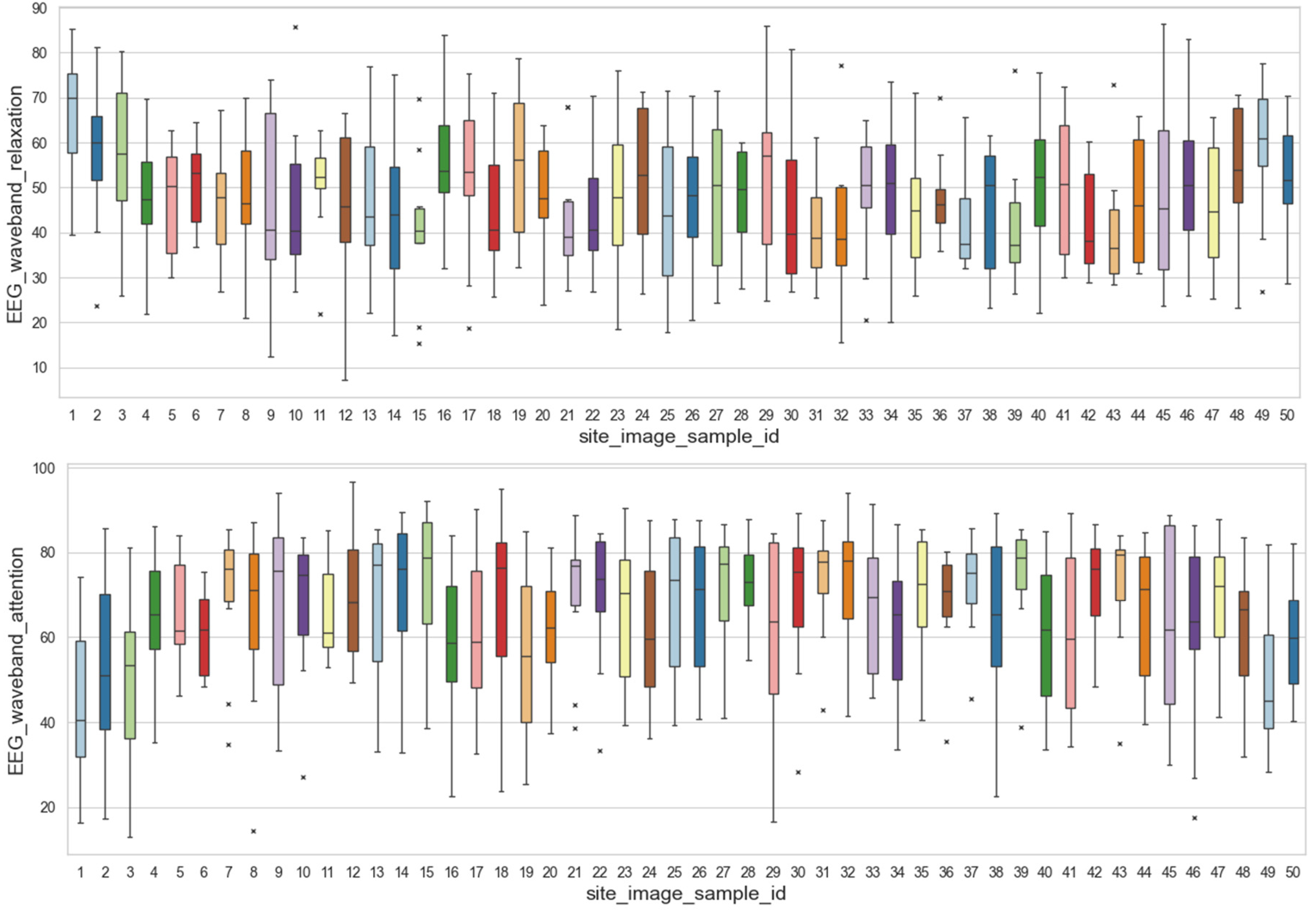
Before standardizing the EEG data for each group, we calculated confidence intervals for the samples composed of EEG data from 30 participants in each group, with a set confidence level of 95%, to evaluate the reliability of obtaining smaller sample data. Then, we adopted the use of box plots as a strategic approach to visually summarize the distribution of data and identify potential outliers before further processing. This method proved invaluable in ensuring the standardization of the EEG recordings across different experimental sample and subjects. For each cleaned segment, a box plot was generated (
Figure 4). The quartiles of the EEG amplitude data were calculated, where the interquartile range (IQR), calculated as Q3-Q1, was used to determine the whiskers of the box plot, which extended to the smallest and largest values no more than 1.5 times the IQR from Q1 and Q3, respectively. Data points found beyond the whisker boundaries were plotted as outliers. During the process of EEG signal acquisition, approximately 15% of the data contained anomalies due to interference from other bio-electrical signals generated by human activities [
91] or computational errors in algorithm models during the filtering and classification of EEG [
126]. The analysis of this experimental data adhered to predefined error values, and any identified outliers were excluded from our study. In our study, the medians of the two EEG index values, Med (RIv) and Med (AIv)
, served as crucial reference points, providing a more accurate reflection of the average perceptual state of all participants for the same landscape image sample [
83,
122,
127]. This median value is instrumental as a standardized benchmark for conducting correlation statistical analysis with data from other modalities.
3.4.4. Image Segmentation and Elements Statistics
We performed semantic segmentation on the 50 collected landscape image samples to quantify the proportions of visually perceived environmental elements. A commonly used semantic segmentation architecture in the OpenCV ecosystem, DeepLabv3+ (implemented through the OpenCV DNN pipeline via an ONNX-exported model), was adopted to generate pixel-wise labels under a unified inference setting. All images were resized to 512 × 512 for inference and then remapped back to the original resolution for area statistics.
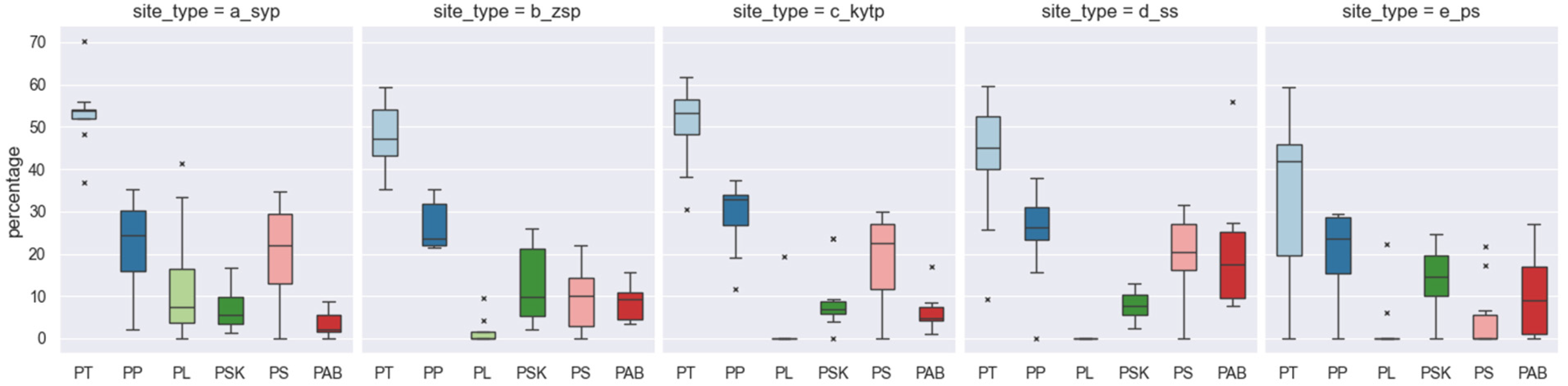
To operationalize variables consistent with the built-environment semantics of this study, the original segmentation classes were further mapped into six interpretable categories: vegetation (PT), hard paving (PP), lawn (PL), sky exposure (PSK), surrounding artificial objects (PAB), and ground shadow under canopy (PS). Specifically, vegetation aggregated labels (such as tree, shrub, plant); lawn was defined as grass-like pixels within the ground region; hard paving aggregated road surfaces; sky exposure used the sky label; and surrounding artificial objects aggregated man-made categories (such as building, wall, bench, pavilion, and other constructed features). To reduce small spurious regions, we applied morphological opening/closing with a 3 × 3 kernel and removed connected components smaller than 0.05% of the image area. In addition, we quantified the proportion of low-brightness shadow areas caused by canopy shading on the ground, which may affect locals’ perception [
50]. Shadow was computed only within the horizontal ground region (paving + lawn). The resulting PS was normalized by the total ground pixels (paving + lawn). After segmentation, each category was assigned a unique color tag (
Table 5), and the proportional area (PEnv) of each category was computed. All PEnv variables were merged with the EEG indices dataset (
Figure 5), and correlation analyses were conducted between PEnv and the median EEG index values at the POS level.
Because segmentation-derived metrics served as explanatory variables, we conducted a basic validation using a stratified subset of 10 images (2 images per POS type). For each selected image, we performed a point-based spot check by uniformly sampling 300 pixels (10 × 300, total 3000 points) through human verification following the category definitions above. We then reported (1) overall point-wise accuracy and macro-averaged F1-score [
128] across the six categories and (2) the mean absolute error (MAE) [
129] of category proportions between segmentation outputs and the human-verified point estimates. The validation results were overall accuracy = 0.89, macro-F1 = 0.79, and the MAE of the PEnv proportions = 0.03. These checks support the reliability of the proportion-based visual-element variables used in subsequent analyses.
4. Results
To ensure the validity of data analysis, normality tests and inter-subject consistency checks were conducted for the two main EEG indices (EEG_relaxation_index and EEG_attention_index) across all participants. These indices were derived from ratios between frequency band proportions, making them dimensionless measures that are more likely to conform to the assumption of normality compared to raw band power values. The Shapiro–Wilk test indicated that most of the sample data satisfied the normality assumption. In addition, under different image group conditions, the participants exhibited consistent trends in index variation. Specifically, increases or decreases in EEG indicators tended to occur in the same direction across the majority of subjects. This inter-subject consistency in directional changes was statistically significant, further demonstrating the stability and validity of the EEG indices used in this study.
4.1. Association Between Spatial Preferences and Psychological Response
4.1.1. Relaxation (α + θ) and Attention (α + β) Index Values
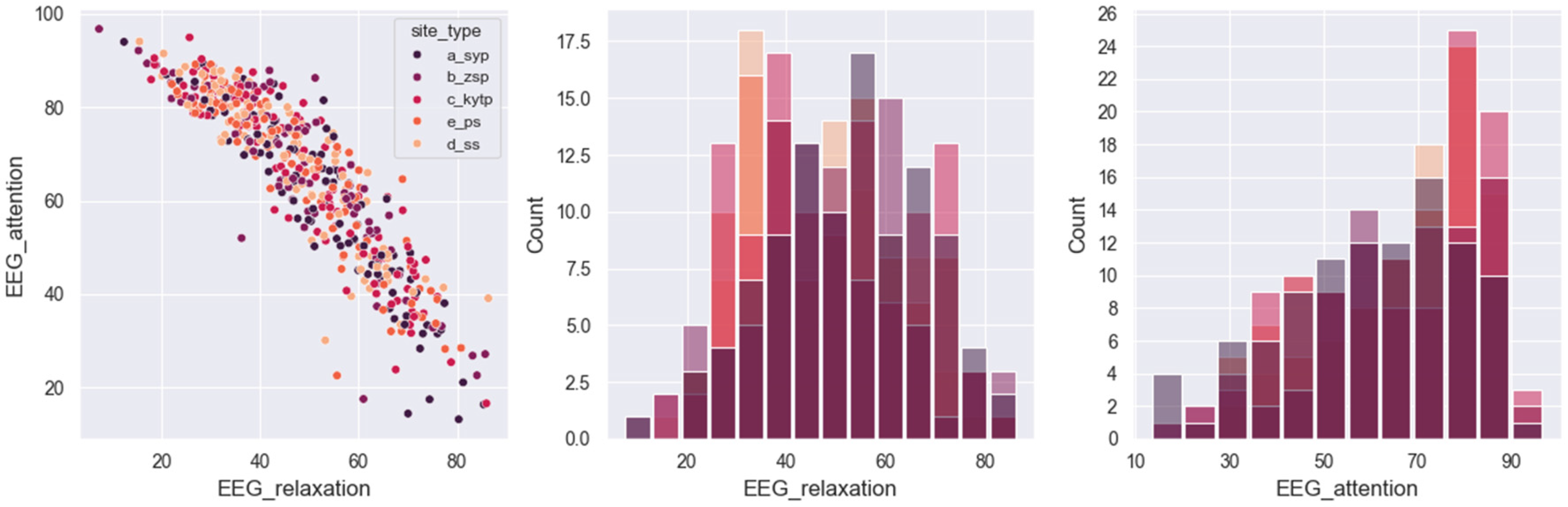
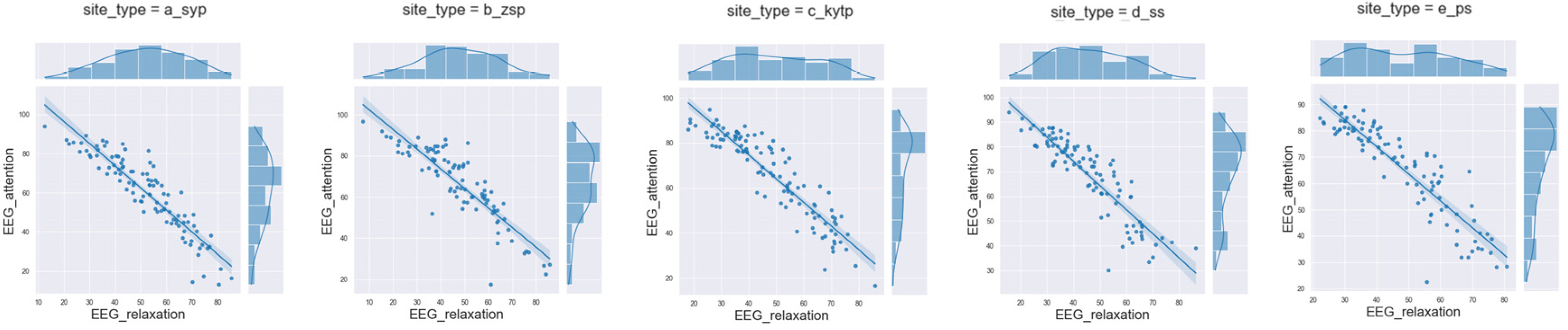
The Pearson product–moment correlation coefficients for RIv and AIv across all EEG data subjects ranged from −0.85 to −0.95 (
Table 6), indicating a robust negative linear correlation (
Figure 6). The same conclusion could be obtained by conducting linear regression analysis on each POS type separately (
Figure 7). Notably, among various types of sites, the Pearson r value for the type c_kytp was closest to −1, suggesting a stronger link to relaxation and a reduction in tension within these environments. This pronounced effect likely stemmed from the uniformity and consistency in the environmental characteristics of the type c_kytp samples. In contrast, the type b_zsp samples showed a wider variation in environmental features, providing a more complex array of stimuli and potentially less predictable effects on subject relaxation and tension.
4.1.2. Correlation of Subjective Preferences and EEG
Statistical analysis was conducted to correlate both RIv and AIv with preference ratings. Pearson correlation coefficients [
125] were calculated to determine the strength and significance of these relationships (
Table 7). The result highlighted a generally strong positive correlation across all landscape image samples, including most of the site types, indicating that a higher relaxation level typically corresponded to higher preference scores. This suggests that the participants tended to favor environments that they found more relaxing. The attention level is the opposite.
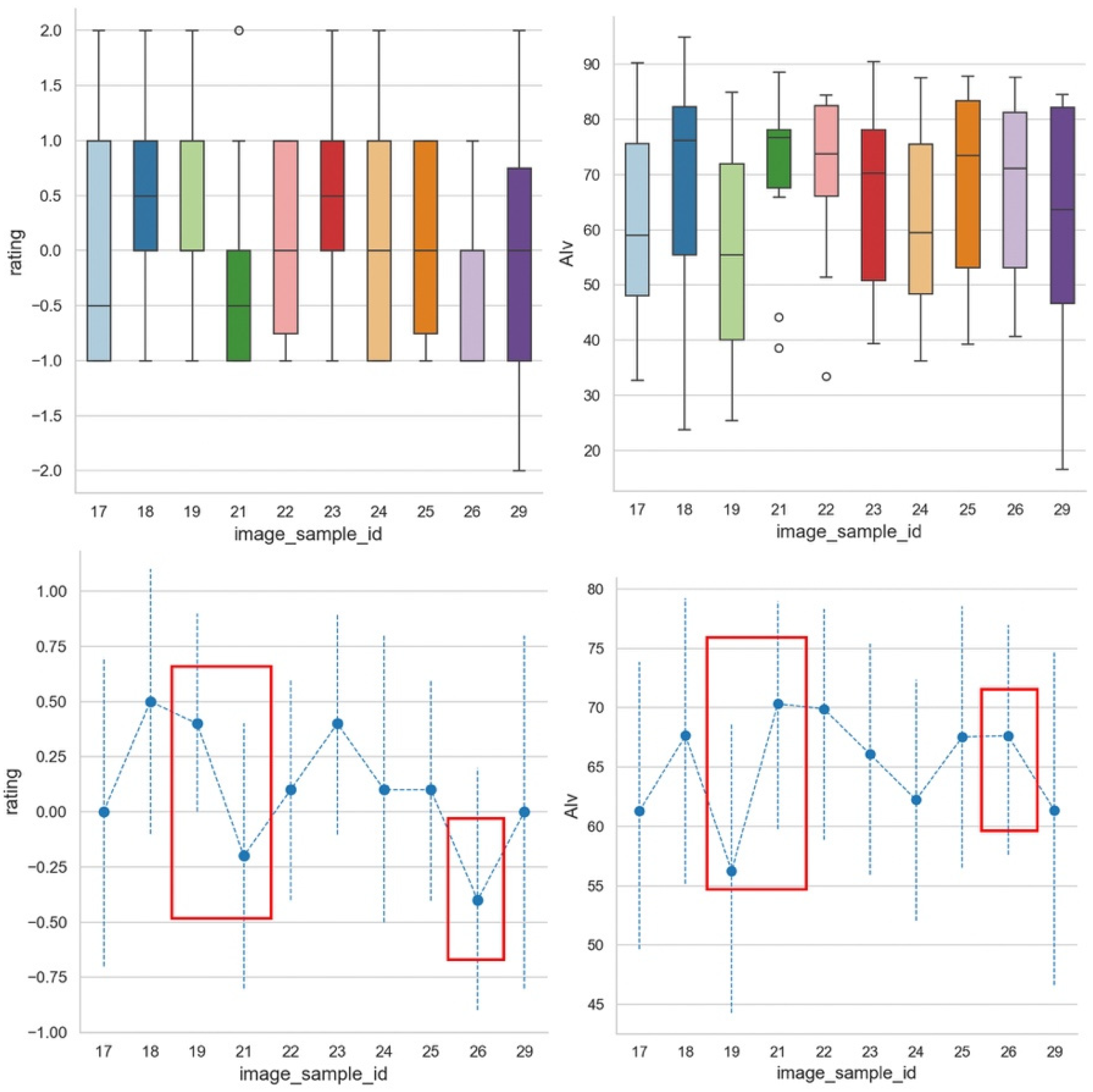
However, an exception was noted in the type labeled c_kytp, where the correlation between AIv and LSD(c_kytp) did not achieve statistical significance, with a
p-value greater than the 0.05 value we set in this study. After further comparing the interval distributions of LSD and AIv values for 10 landscape samples in class c_kytp, it was found that, except for the landscape samples labeled sample_19, sample_21, and sample_26, which showed opposite interval distributions, the other seven samples showed no significant correlation (
Figure 8). This particular outcome suggests that the c_kytp type might have unique environmental, visual attributes, or place significance that do not align as closely with the general trend observed in other categories. This deviation provides a fascinating point of discussion regarding the specific elements that might influence the psychological impact of HDPOS differently, urging further detailed exploration in future studies to understand the underlying factors contributing to these differences.
4.2. Psychological Response Differences of Locals in Various Types of POS
4.2.1. Differences in Types of POS Site
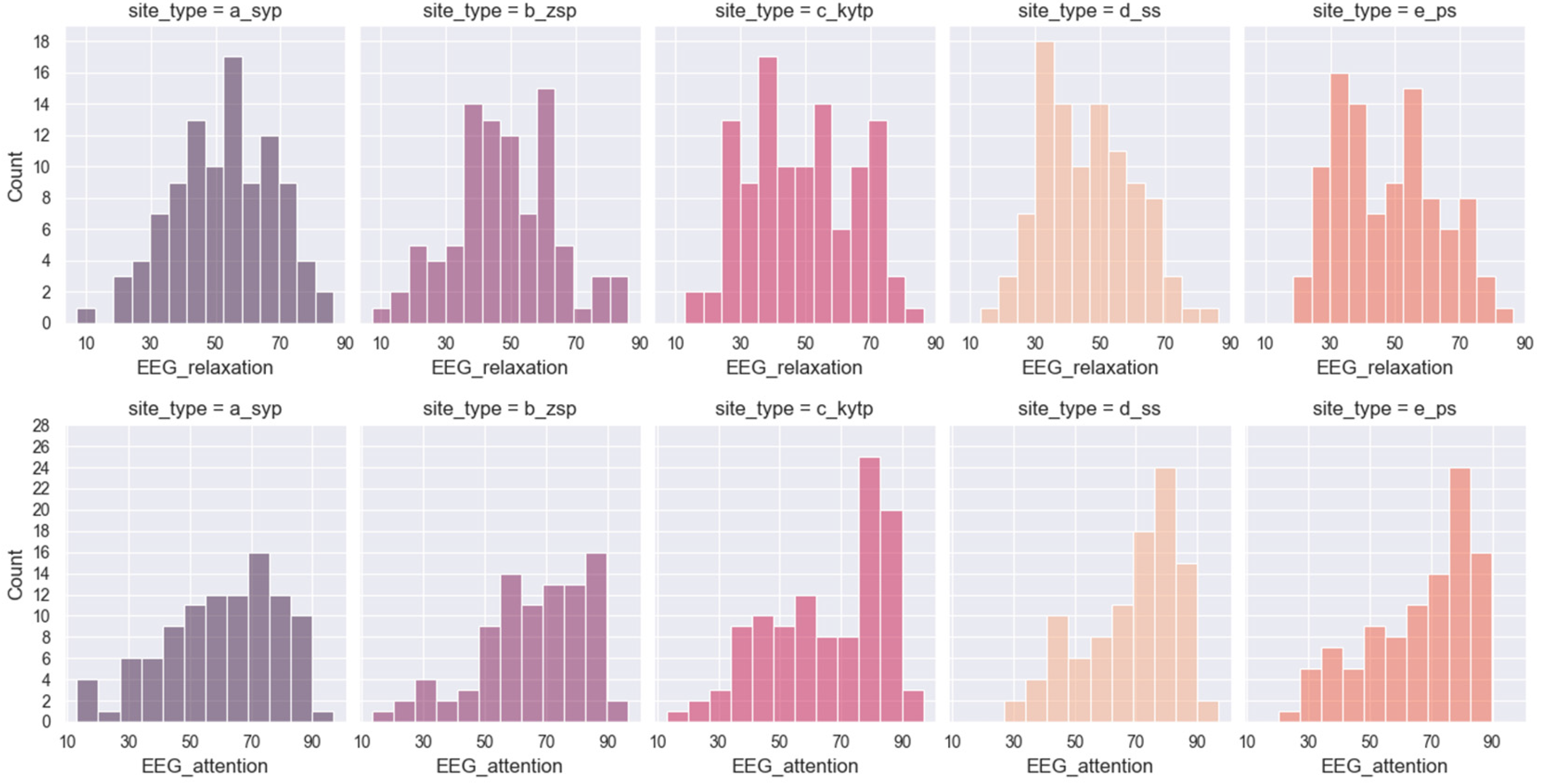
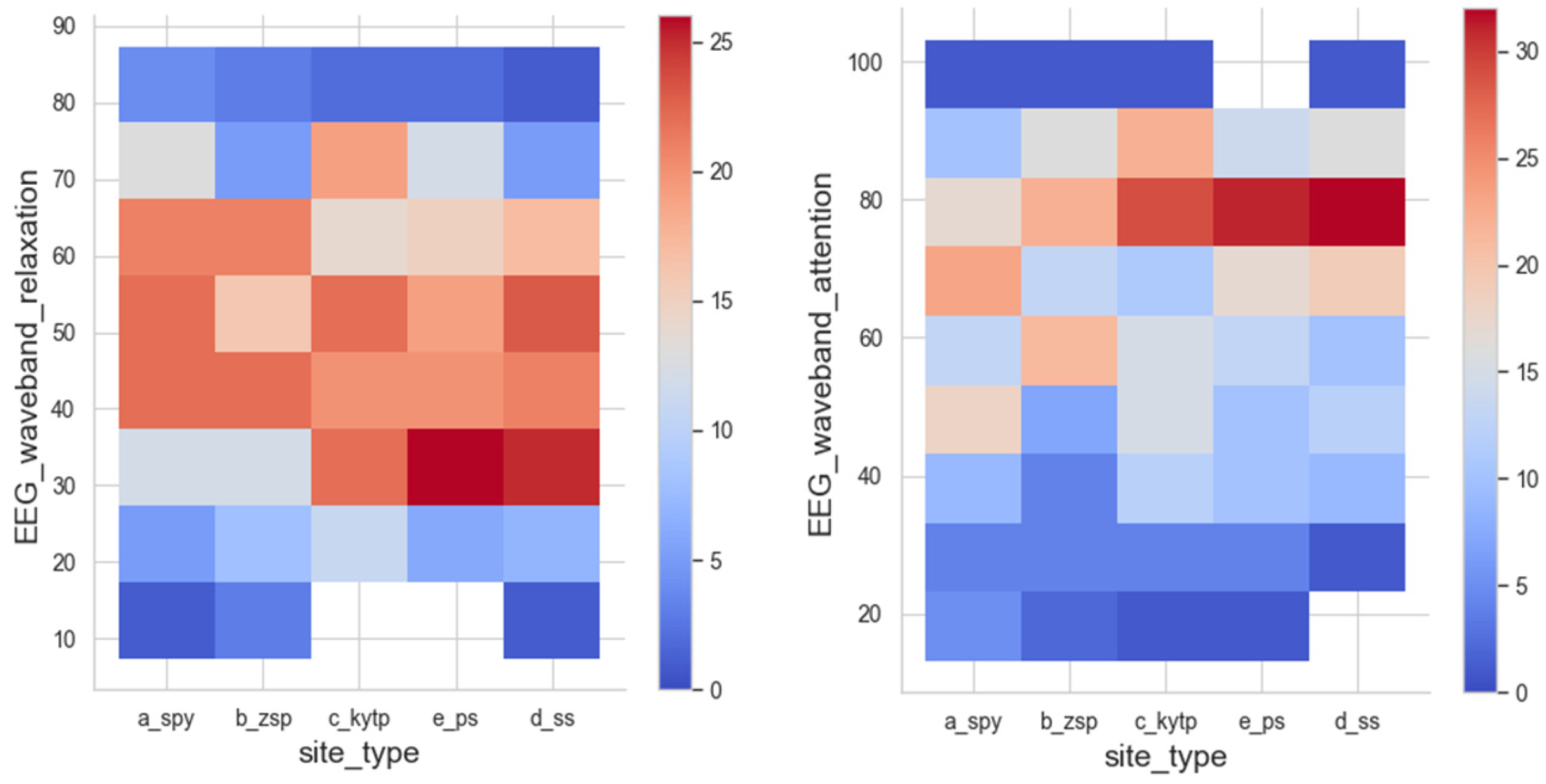
Furthermore, an analysis of histograms that evaluated the frequency distribution of different index value ranges led to several conclusions regarding the effectiveness of various types in inducing relaxation in subjects (
Figure 9, EEG_relaxation). It was found that type a_syp generally performed better, with most high-frequency index values predominantly clustered in the range of 50 to 70. This was closely followed by type b_zsp. In contrast, type c_kytp showed a more divided pattern, exhibiting similar frequency distributions in the ranges of 30 to 50 and 50 to 70. Meanwhile, the environmental characteristics of the two types d_ss and e_ps were more commonly associated with focused and tense emotional states in subjects (
Figure 9 EEG_attention), with type c_kytp also displaying a marked tendency towards higher attention index values.
According to the
t-test, the
p-values and t- score were calculated using the RIv between each pair of types to assess the differences between the sample means and the assumed population means employed in this study (
Table 8). It was inferred that the differences in environmental factors between type a_syp and both types d_ss and e_ps were significant enough to reject the null hypothesis (
p < 0.05). This suggests that the observed differences might not be attributable to random variations. Similarly,
t-tests were conducted to compare different types of AIvs, and the resulting
p-values and t-score were analyzed (
Table 9). Among these, the feature differences between the two types a_syp and d_ss were found to be below the significance level that we had set (
p < 0.05). This indicates that these two types of POSs exhibit statistically significant differences in inducing the psychological states of focus and tension in the subjects.
Based on the
t-test results for the two EEG index values previously discussed, significant differences in the psychological state of environmental perception were observed among participants in the spatial types a_syp versus d_ss and a_syp versus e_ps. Considering the combined analysis results of histogram statistics for EEG index values across different types (
Figure 7 and
Figure 9), it was concluded that type a_syp is particularly effective in inducing a state of relaxation in locals’ psychological response, whereas type d_ss tends to have the opposite effect (
Figure 10).
4.2.2. Differences Among All Landscape Samples
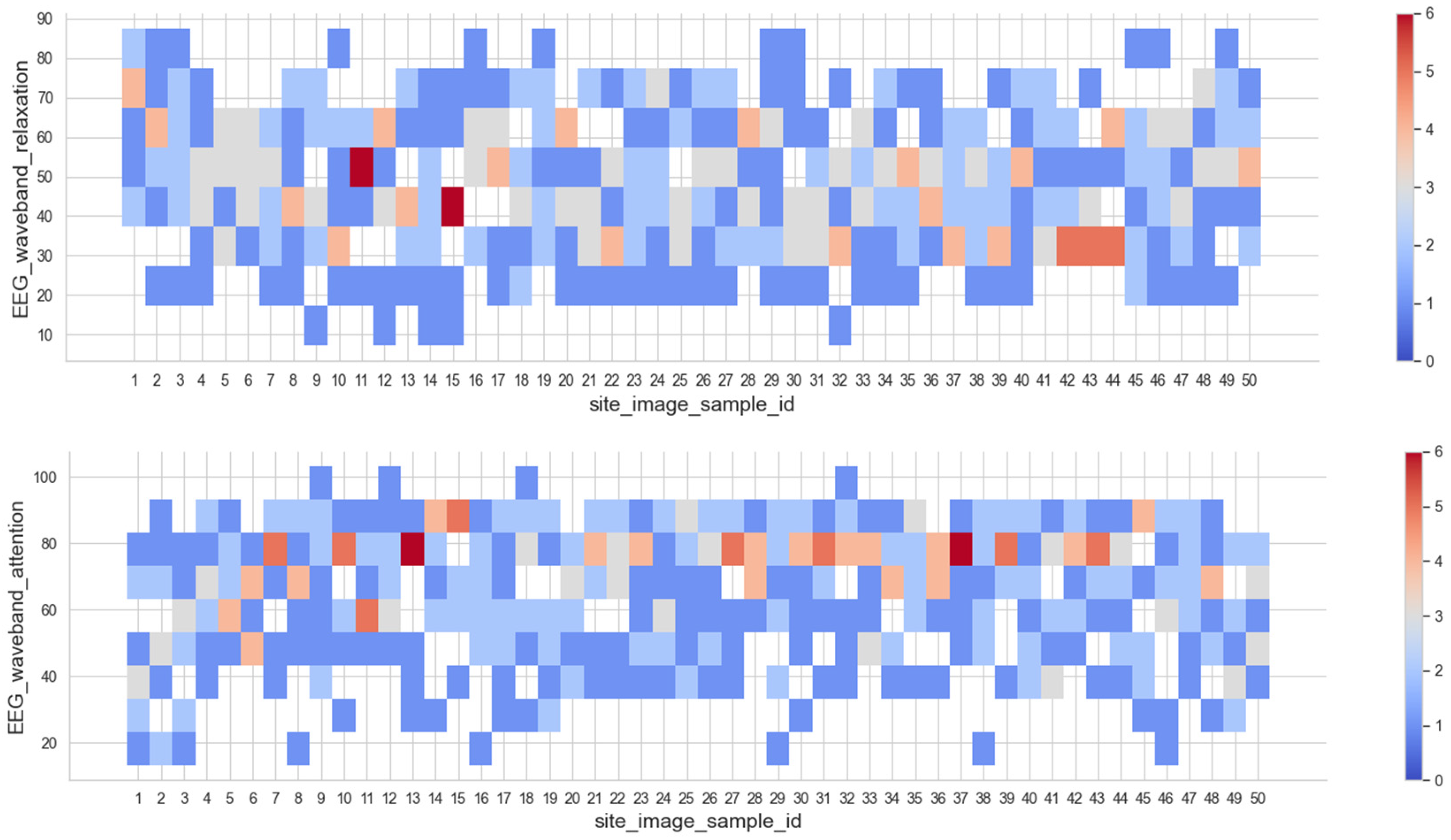
After analyzing and comparing the EEG index values to assess the impact of different site types on psychological response, we expanded our analysis to include all image samples from these types for a comprehensive inter-sample comparison. This was done in an effort to derive more specific conclusions. We conducted a binary histogram analysis on the raw EEG index values from 50 samples (
Figure 11) and organized the sample IDs in ascending order according to the median of the RIv and AIv within each dataset. This approach intuitively displays the sample IDs that frequently exhibit high EEG index values.
Therefore, we can conclude that the top 30% of landscape sample IDs associated with high Med(RIv) values are grouped as (_34, _50, _11, _40, _24, _6, _17, _16, _48, _19, _29, _3, _2, _49, _1), while the top 30% of landscape sample IDs associated with high Med(AIv) values are grouped as (_37, _30, _9, _42, _14, _7, _18, _21, _13, _27, _31, _32, _15, _39, _43). In the high RIv group, the proportions of POS types, a_syp, b_zsp, c_kytp, d_ss, and e_ps were 33%, 13%, 27%, 7%, and 20%. Respectively, in the high AIv group, the proportions of each type were 13%, 27%, 13%, 20%, and 27%. This is basically consistent with the conclusion drawn in the previous section regarding the frequency statistics of EEG index values for each individual type. This means that the landscape features of a_syp perform the best in creating a relaxed and enjoyable perception state, followed by c_kytp, while d_ss is relatively the worst. Among the types that are more likely to cause people to feel tense and focused, both b_zsp and e_ps have a positive promoting effect.
4.3. Identification of Environmental Elements Influencing Emotional Feedback
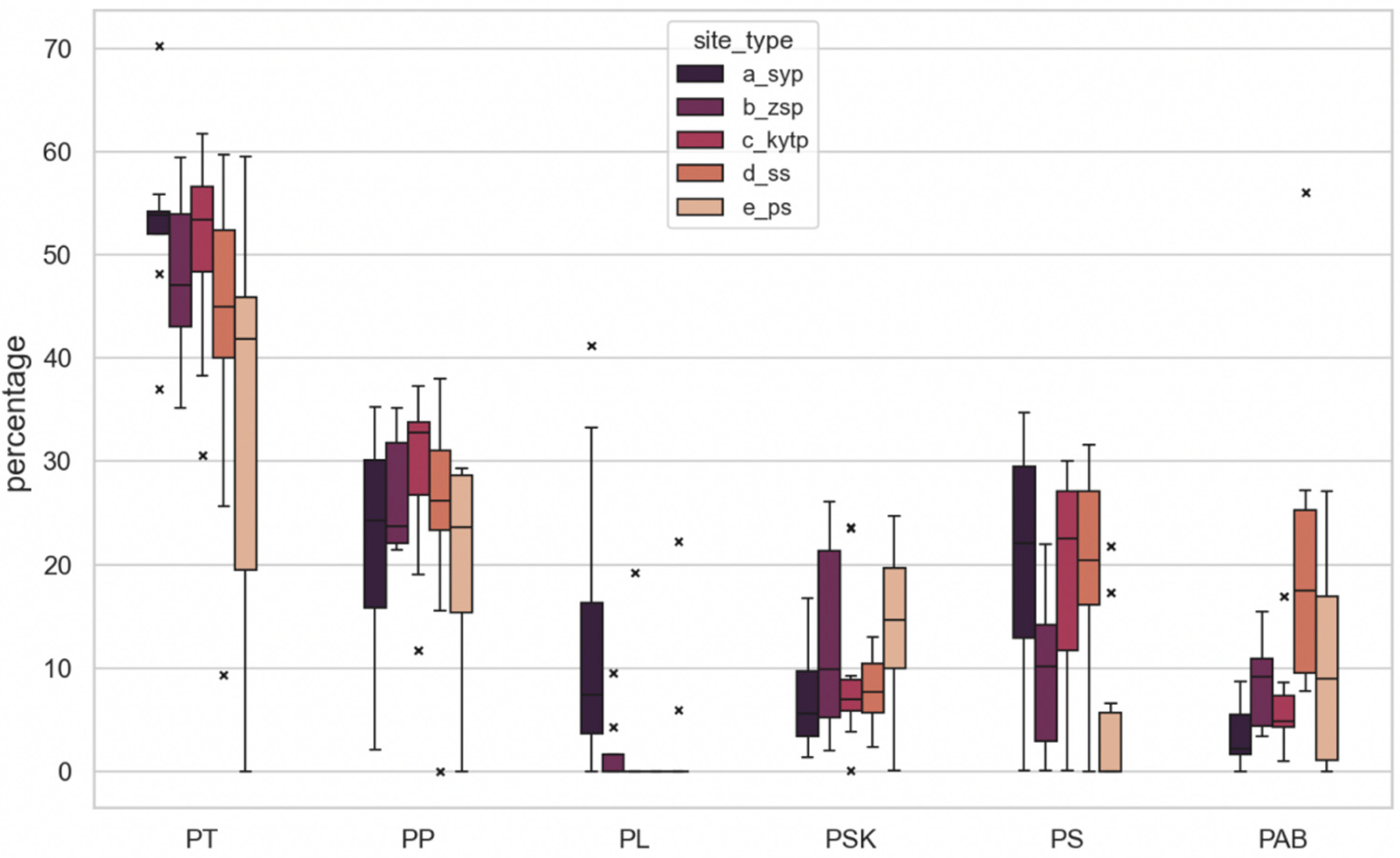
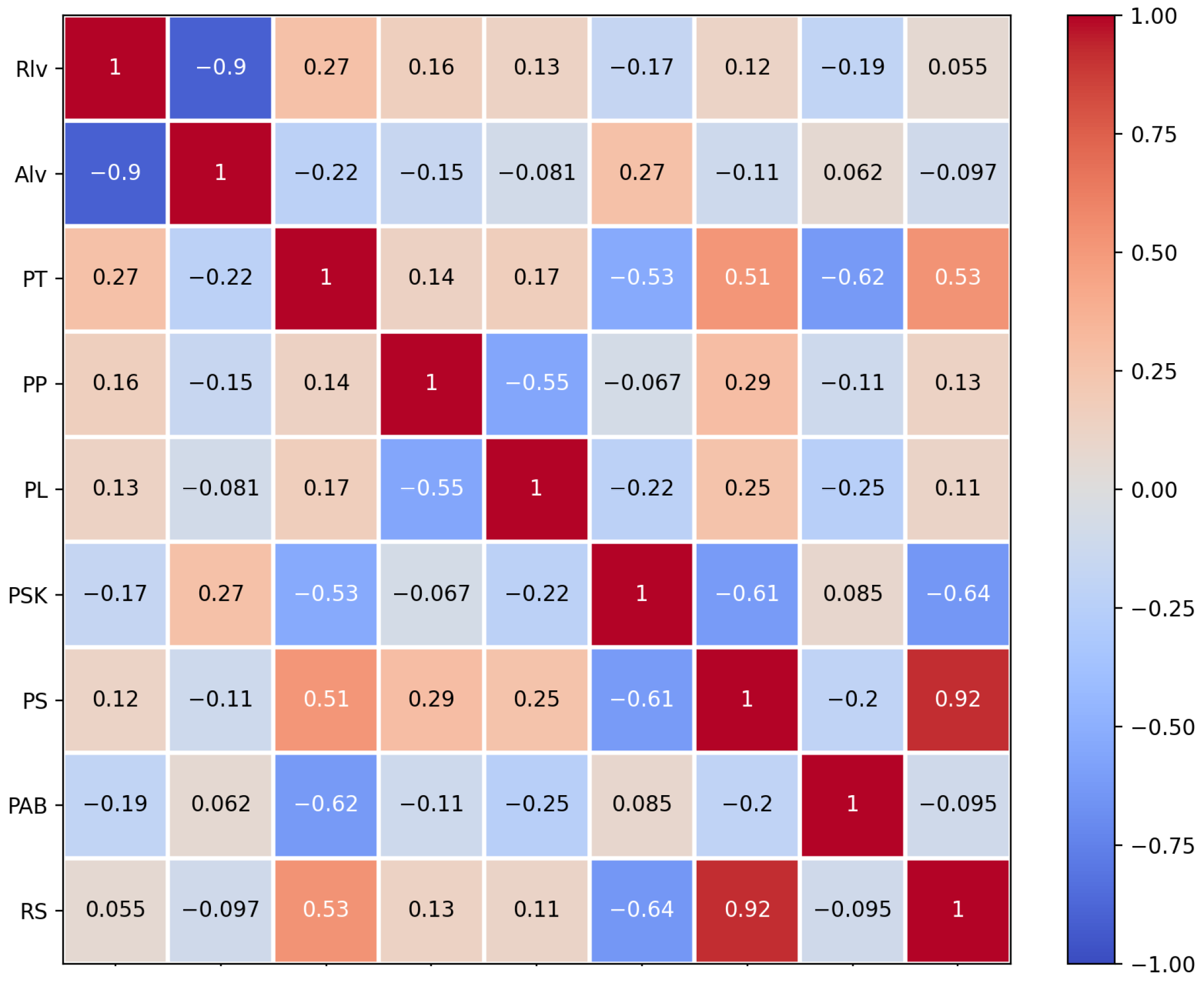
After standardizing the data of PEnv for all image samples, the general similarity characteristics of POSs in QZHPD can be roughly seen, which are reflected in the following points (
Figure 12): (1) Basically, they all have a high density of vegetation enclosure of over 40%, including spatial horizontal and vertical directions. The spatial horizontal density is reflected in the low percentage range where PSK falls, which is due to the fact that many local tree species have broad canopies. (2) The proportion of hard-paved areas is significantly larger than that of lawns, which can be compared to the proportion range of PP and PL. Correspondingly, the significant differences between types are concentrated in PL, with almost 0 percentage in all other types, except for type a_syp, which becomes the most significant feature that distinguishes a_syp from the other types.
To investigate the mechanisms through which various environmental elements evoke local perceptual feedback, we conducted correlation analyses between the EEG index values and these six primary elements identified following landscape image segmentation. In addition, we also attempted to incorporate the indicator values of tree species into the landscape feature group for significance analysis (
Table 10). Considering the limited effectiveness of the indicator r, which reflects the degree of linear correlation between the two variables, we adjusted the significance level to 0.1. The analysis revealed that a higher proportion of vegetation in a landscape significantly enhances relaxation in individuals, whereas increased visibility of the sky tends to heighten focus and tension, which also proves that the degree of tree enclosure in the environment is negatively correlated with the degree of sky exposure in QZHPD (
Figure 13). These findings are in line with the conclusions drawn from existing research [
30,
50,
61,
64,
68,
112]. In summary, from the overall perception index values Med (RIv) and Med (AIv) of all 50 landscape samples, it can be seen that tree density and enclosure degree are beneficial for improving relaxation while reducing tension. Another unexpected result is that the presence or absence of tree species characterized by huge canopies in the landscape, such as Banyan trees, which are oldest trees in the local history, is strongly positively correlated with high RIv values.
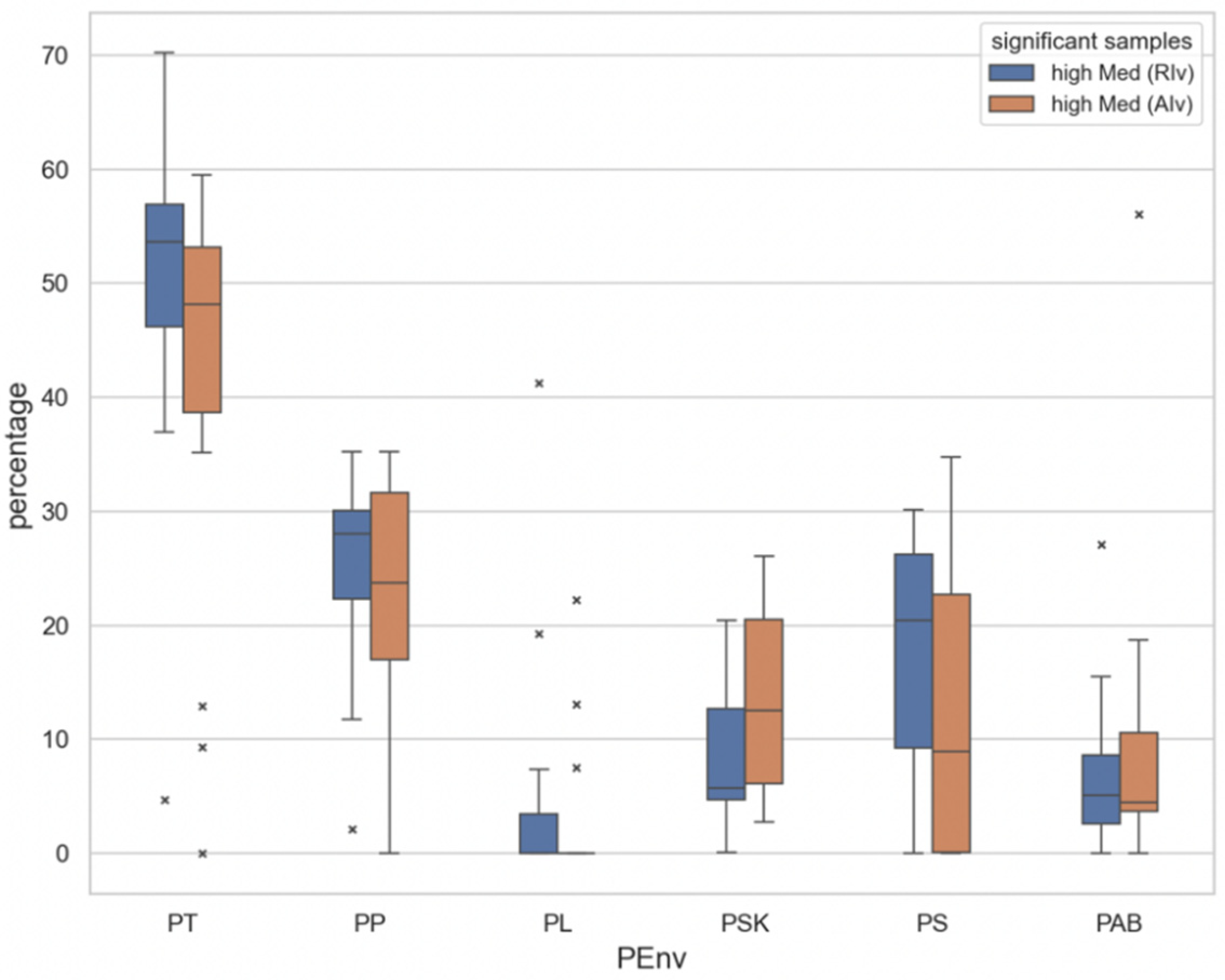
We selected the top 30% of all samples, arranged in ascending order based on both Med (RIv) and Med (AIv)
, and analyzed their landscape element features by calculating their quartiles (
Figure 14). The element characteristics of the landscape samples in the high Med (RIv) group are roughly consistent with the previous overall analysis results, which is reflected in higher vegetation coverage and more natural-element paving features.
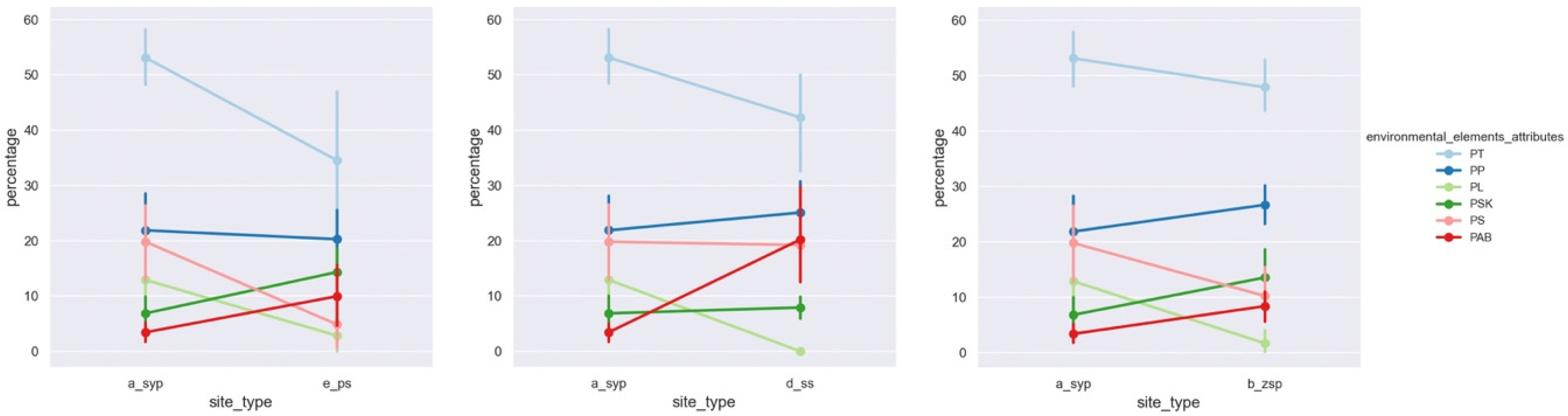
Furthermore, based on the results drawn from the analysis of psychological response differences among various environmental types in the previous chapter, we further conducted significance tests on the PEnv within a_syp-d_ss, a_syp-e_ps, a_syp-b_zsp (
Figure 15), with results were drawn from
Table 6 and
Table 7 for these three pairs. Significant differences are identified in the environmental elements of pair a_syp-d_ss, notably in the proportions of PL and PAB. With pair a_syp-e_ps, significant variations are found in PS, caused by canopy coverage and enclosure density. Additionally, differences in the proportion of PAB are observed with the pair a_syp-b_zsp (
Table 11). Additionally, we compared the PEnv values between all 10 type pairs and found that the type e_ps exhibited significant differences from the other POS categories in several aspects, excluding PL. This may be attributed to its location on the periphery of a historical preservation district, where environmental elements somewhat embody more modern features. However, no noteworthy differences were observed in evoking psychological response among locals. Thus, in conjunction with the conclusions presented in
Table 11, we can tentatively suggest that PS and PAB contribute less to perceptual differences compared to PL.
Based on the analysis of all the data presented above, it can be concluded that: (1) POSs characterized by dense vegetation coverage are conducive to enhancing local relaxation responses, particularly with traditional and ancient tree species that have strong local characteristics. (2) In terms of horizontal ground paving, the presence or absence of lawn, along with its relatively high ratio compared to hard paving, are also significant factors in increasing relaxation levels and reducing tension. (3) Conversely, increasing the visibility of the sky within the field of view, augmenting the proportion of hard-paved areas, and raising the percentage of artificial built elements tend to more readily stimulate focus and tension among locals.
5. Discussion
5.1. Physiological Response-Based Combined Spatial Preference Assessment
In the current research and inference process concerning spatial usage preferences, a series of discussions have been extended, including the definition of environmental justice [
8,
50], the comprehensive evaluation of human settlement quality [
34,
69], the identification and elimination of urban hostile spaces [
14], and traditional urban micro renewal and renovation methods [
41,
50]. In addition to the physiological findings, the questionnaire results provide an important complementary perspective for interpreting residents’ spatial experience. Following the analysis of both the correlation and consistency between subjective preference ratings and objective perception data in our experiment, it can be concluded that there exists a significant positive correlation between these two metrics to a certain extent. This correlation provides sufficient evidence to support that in spatial experiences highly preferred subjectively, the degree of relaxation, as indicated by EEG index values, is correspondingly elevated. Conversely, it is also demonstrated that EEG indicator data can effectively assess an individual’s subjective preference towards psychological response. The feasibility and accuracy of the method for evaluating spatial preference through statistical analysis of human factors data in this study are similar to current existing research [
60,
61,
78,
83,
97,
122].
Overall, subjective preference ratings exhibited a generally consistent trend with EEG-derived relaxation and attention indicators, particularly in spaces characterized by higher vegetation coverage and stronger historical symbolism. This convergence suggests that both conscious evaluations and neurophysiological responses are jointly shaped by key environmental attributes. Notably, several spaces showed partial divergence between subjective preference scores and physiological responses, indicating that conscious appraisal and implicit emotional processing do not always fully align. Such discrepancies may be attributed to the influence of long-term familiarity, cultural memory, and symbolic meaning embedded within historic environments, which can elevate subjective preference even when physiological relaxation remains moderate. This finding highlights the necessity of integrating subjective surveys and physiological measurements, as reliance on a single data source may lead to incomplete interpretations of spatial perception mechanisms.
5.2. Typology Effects and Preference–Perception Mismatch of HDPOSs
After comparing the five universally representative HDPOS types selected for this study, it was found that local communities prefer natural landscape spaces that have been renovated and designed and have fewer artificial constructions, such as Shiyashan Park (type a_syp). Other small or scattered HDPOSs within this historical community, lacking effective organic enclosure methods for artificial constructions, expose local communities to more modern environmental characteristics, causing increased tension and dislike. The above findings are consistent with the general understanding. However, the distinct case of the Kaiyuan Temple Park (type c_kytp), a traditional temple park with historical significance, emerged as particularly noteworthy due to its unique spatial symbols and cultural relevance within this local historical community. This type of HDPOS stimulates diverse environmental perceptions among locals, leading to a variety of psychological responses with somewhat indistinct feature definitions. Intriguingly, in scenarios where locals objectively experience a state opposite to relaxation, their subjective preferences often show unexpectedly positive results.
This finding contradicts our initial hypothesis, which posited a consistent positive correlation between preferences and perceptions. Beyond this descriptive inconsistency, the c_kytp results may reflect a distinct preference-formation mechanism in culturally salient settings. In this study, AIv was operationalized as an index of cognitive tension/mental load, which can increase not only under discomfort but also under intensified meaning-making and information processing. For a traditional temple park, visually prominent symbolic cues (e.g., temple facades and eaves, traditional corridors and pavilions, and ritualized spatial sequences) may prompt residents to allocate more cognitive resources to recognition, interpretation, and memory retrieval. In such cases, elevated AIv may indicate “engaged processing” rather than purely negative stress, whereas subjective preference can remain high because cultural identity, place attachment, and collective memory contribute positively to evaluative judgments. This helps explain why some c_kytp scenes can simultaneously elicit higher AIvs yet receive favorable ratings. Importantly, this decoupling suggests that the relationship between physiological indices and stated preference is not strictly monotonic in historically meaningful environments. A more rigorous explanation would benefit from additional evidence in future work, such as explicitly measuring familiarity and place attachment, incorporating eye-tracking to verify attention allocation to symbolic elements, and conducting controlled VR manipulations that selectively remove or attenuate historical cues, as well as comparing local residents with unfamiliar participants to separate immediate visual effects from memory-driven responses.
Therefore, our findings indicate that when assessing environmental quality in built environments through human performance metrics, objective data might not fully capture the true preferences of local communities regarding specific spaces. A more holistic, multimodal approach may therefore be necessary to evaluate POS preferences in historically and culturally significant communities, as reliance on a single data modality alone may be insufficient for robust statistical inference.
5.3. Historical Cultural Context and Familiarity Bias in Locals’ Psychological Responses to POSs
In our research, the study site chosen is a traditional community with a long history that is currently undergoing alternating development between old and new. As a renewed appreciation for landscape traditions emerges, vernacular elements prompt significant commentaries. A more deliberate effort is required to recapture the enduring sense of regional and aesthetic values [
47]. Related research and evidence have shown that different cultural backgrounds can affect people’s preferences for landscape environmental elements. [
54] For instance, residents in the central of Hong Kong’s urban districts tend to favor more open and expansive types of urban POSs [
55], whereas the promenade along the Iris River is instrumental in melding Amasya’s public life with the historical environment in Turkey [
21].
Based on the analysis and comparison of standardized index values from raw EEG data and the proportion of environmental elements, it is evident that landscapes within the POSs of the Quanzhou historic preservation district commonly share features such as high vegetation coverage and extensive use of brick and stone materials for hard paving, which are significant features that separately evoke the relaxation and attention psychological states of local residents. Moreover, in terms of improving perceived relaxation, increasing the horizontal vegetation coverage in space, such that locals can be under canopy cover and experience the environmental conditions of both paving and lawn areas within their field of view, their relaxation level is maintained at a relatively high level. Additionally, we found that local residents exhibit a strong perceptual dependence on specific tree species, notably the Banyan tree. In two landscape environments with comparable rates of vegetation enclosure, scenes featuring Banyan trees with broad crowns elicited higher levels of relaxation. This response is likely due to the historical symbolism of Banyan trees in local culture and their capacity to evoke shared memories among community groups.
It should be acknowledged that the use of images derived from familiar public open spaces may introduce perceptual bias associated with place attachment and collective memory. Long-term spatial exposure can shape emotional responses and spatial preferences beyond immediate sensory stimulation. In historic communities, such effects may be particularly pronounced due to strong cultural symbolism and accumulated shared memory. Consequently, participants’ responses may partially reflect long-term emotional resonance, rather than solely the visual or geometric properties of the environment. While this may introduce certain methodological uncertainties, it also represents an intrinsic dimension of authentic place-based experience, offering valuable insights into how historical continuity and cultural attachment influence residents’ perceptions. Future studies could further disentangle immediate perceptual effects from memory-driven responses through comparative experiments with unfamiliar participants or controlled manipulation of historical cues in immersive VR environments.
5.4. Limitations
Accessibility is a well-established determinant of spatial preference in real world, yet it was not explicitly modeled in our study. Our design intentionally adopted a VR-based visual exposure paradigm to control non-visual confounds and to isolate the associations between visible environmental elements and immediate psychophysiological responses. As a result, the measured preference ratings should be interpreted as visual preference under standardized exposure rather than comprehensive place preference that jointly reflects access convenience, route effort, safety along the trip, and habitual use patterns. Future work will incorporate objective accessibility metrics (e.g., network-based walking distance, connectivity, and entrance visibility) and examine how accessibility moderates the relationships between visual composition, EEG-derived indices, and stated preference.
Furthermore, the multimodal data assessment method used in our study also relatively lacks additional human factors data from other modalities, such as eye movement, which could provide more valuable perceptual information: by analyzing the regions of interest formed by gaze, we can more accurately identify the specific spatial elements that affect perception. Additionally, the process of extracting elements from landscape sample images lacks detail in summarizing their features, neglecting aspects such as color, texture, and shape. These elements could be crucial factors affecting human environmental perception and emotional feedback. Further research will supplement eye movement data analysis and focus on the same set of landscape samples, particularly on the type of POS (the type of Kaiyuan Temple Park) where significant discrepancies between preference ratings and EEG perception data were observed in this study. By conducting a more detailed analysis of the environmental composition features, the aim is to uncover the specific contributing factors that lead to these statistical discrepancies.
6. Conclusions
This study links local participation to the spatial preservation and regeneration of historic districts by exploring the impact of HDPOSs, as a special and important type of urban POS, on local residents’ spatial cognition, including their spatial preferences and resulting psychological response. The results of this study indicate that the subjective ratings provided by local residents for different types of spaces are positively correlated with the degree of relaxation measured by EEG and inversely correlated with the level of focus. However, this correlation is not significant in certain areas characterized by strong place attributes and historical significance. By contrast, within this historical community, POS that have been recently designed with prominent local natural landscape features are more favored by locals and tend to elicit higher relaxation levels. Conversely, older and more scattered POSs in the community are associated with relatively negative outcomes. Upon conducting a typological and comprehensive unclassified analysis of all landscape image samples, it was observed that spatial types featuring more organic paving, such as lawns of areas comparable to hard paving, tend to promote relaxation. An overarching analysis of all HDPOS types revealed that denser plant enclosures, both vertically and horizontally from a typical human perspective, are associated with greater relaxation. Additionally, a significant correlation was found between tree types and the spatial experience satisfaction of local residents. Banyan trees, a common and traditional species in the locality known for their thick trunks and broad canopies, are prevalent in spaces that greatly enhance relaxation. This suggests that the presence or absence of banyan trees is a critical landscape element influencing local psychological response.
The findings can be translated into actionable renewal priorities for historical district public open spaces. For community-oriented daily POSs, preserving mature and locally distinctive canopy trees (especially banyan), increasing organic ground surfaces (e.g., grass pavers) to balance hard paving, and reducing visually dominant contemporary built elements are likely to enhance residents’ relaxation and overall satisfaction. For culturally salient settings, elevated attention should not be interpreted as purely negative stress; renewal strategies should therefore protect symbolic cues and spatial sequences while controlling visual clutter, so that engaged processing can be supported without excessive cognitive load. Methodologically, the proposed VR–EEG segmentation workflow can serve as a low risk and pre-implementation evaluation tool: alternative design scenarios can be visualized in VR and assessed with both stated preference and EEG-derived indices, providing quantitative feedback for participatory decision-making and iterative design optimization. Because our controlled visual-exposure paradigm isolates visual factors, these implications should be used as a design-screening and comparison mechanism rather than a full substitute for in situ evaluation, which also depends on accessibility, safety, and habitual use patterns.
In summary, the contributions of this paper are as follows: (1) Within the context of public open spaces in historic districts, we explicitly distinguish between stated preference and cognitive tension or relaxation, and incorporate potential divergences between them into an interpretive framework, thereby avoiding a one-sided value judgment of physiological indicators; (2) we propose a reproducible multimodal variable system that establishes interpretable links between semantic segmentation derived proportions of visually perceived elements and EEG indices; and (3) under the strictly bounded conditions of a standardized visual-exposure experiment and the specific sample scope, we provide evidence-based suggestions for optimizing key elements in the renewal of historic-district public open spaces, while clearly stating the applicability boundaries and directions for further validation. Furthermore, this research contributes to academic fields by providing a foundation for future interdisciplinary studies that could further explore the complex interactions between urban environments and human psychological responses, potentially expanding environmental perception to include more sensory dimensions and deeper contextual analyses.
Author Contributions
Z.Z.: conceptualization, funding acquisition, data curation, methodology, software, investigation, writing—original draft, writing—review and editing. Z.G.: conceptualization, software, visualization, writing—original draft, writing—review and editing. X.C.: conceptualization, supervision, writing—review and editing. All authors have read and agreed to the published version of the manuscript.
Funding
This research was supported by the Humanities and Social Sciences Research Project of the Ministry of Education of China (Grant No.25YJC760026) and National Natural Science Foundation of China (Grant No.52378001).
Institutional Review Board Statement
This study was conducted in accordance with the Declaration of Helsinki, and the protocol was approved by the Biomedical Ethics Committee of Hefei University of Technology (HFUT20250806001H) on 6 August 2025.
Informed Consent Statement
Informed consent was obtained from all subjects involved in this study.
Data Availability Statement
The datasets generated during and analyzed during the current study are not publicly available due to protection of subjects’ personal information as well as their privacy. The raw data are available from the corresponding author on reasonable request.
Acknowledgments
We would like to thank all the volunteers who participated in the experiment.
Conflicts of Interest
The authors declare no conflicts of interest.
Nomenclature
| EEG | Electroencephalogram |
| POS | Public open space |
| HDPOS | Historical district public open spaces |
| QZHPD | Quanzhou historic preservation district |
| VCE | Visual cognition experiment |
| a_syp | Shiyashan Park |
| b_zsp | Zhongshan Park |
| c_kytp | Kaiyuan Temple Park |
| d_ss | Separated POS |
| e_ps | Peripheral POS |
| RIv | Relaxation index value |
| AIv | Attention index value |
| LSD | Likert-scale data |
| Med (RIv) | Median of EEG relaxation index value |
| Med (AIv) | Median of EEG attention index value |
| PEnv | Percentage of environmental elements |
| PT | Percentage of trees |
| PP | Percentage of paving |
| PL | Percentage of lawn |
| PSK | Percentage of sky |
| PS | Percentage of shade |
| PAB | Percentage of artificial built elements |
| RS | The ratio of shade area to ground area |
| TC | Tree category |
References
- Van Oers, R.; Pereira Roders, A. Historic cities as model of sustainability. J. Cult. Herit. Manag. Sustain. Dev. 2012, 2, 4–14. [Google Scholar] [CrossRef]
- Zhou, X.; Zhang, X.; Dai, Z.; Hermaputi, R.L.; Hua, C.; Li, Y. Spatial layout and coupling of urban cultural relics: Analyzing historical sites and commercial facilities in district iii of Shaoxing. Sustainability 2021, 13, 6877. [Google Scholar] [CrossRef]
- Simpson, T.A. Communication, conflict, and community in an urban industrial ruin. Commun. Res. 1995, 22, 700–719. [Google Scholar] [CrossRef]
- Sotoudeh, H.; Abdullah, W.M.Z.W. Evaluation of fitness of design in urban historical context: From the perspectives of residents. Front. Arch. Res. 2013, 2, 85–93. [Google Scholar] [CrossRef]
- Seyedrezaei, M.; Becerik-Gerber, B.; Awada, M.; Contreras, S.; Boeing, G. Equity in the built environment: A systematic review. Build. Environ. 2023, 245, 110827. [Google Scholar] [CrossRef]
- Webster, C. Property rights, public space and urban design. Town Plan. Rev. 2007, 78, 81–101. [Google Scholar] [CrossRef]
- Jian, I.Y.; Luo, J.; Chan, E.H. Spatial justice in public open space planning: Accessibility and inclusivity. Habitat Int. 2020, 97, 102122. [Google Scholar] [CrossRef]
- Jian, I.Y.; Chan, E.H.; Xu, Y.; Owusu, E.K. Inclusive public open space for all: Spatial justice with health considerations. Habitat Int. 2021, 118, 102457. [Google Scholar] [CrossRef]
- Thompson, C.W. Urban open space in the 21st century. Landsc. Urban Plan. 2002, 60, 59–72. [Google Scholar] [CrossRef]
- Francis, J.; Wood, L.J.; Knuiman, M.; Giles-Corti, B. Quality or quantity? Exploring the relationship between Public Open Space attributes and mental health in Perth, Western Australia. Soc. Sci. Med. 2012, 74, 1570–1577. [Google Scholar] [CrossRef]
- Morris, N. Health, Well-Being and Open Space; Edinburgh College of Art and Heriot-Watt University: Edinburgh, Scotland, 2003; Available online: https://www.openspace.eca.ed.ac.uk/wp-content/uploads/2015/10/Health-Well-being-and-Open-Space-literature-review.pdf (accessed on 1 July 2003).
- Wang, H.; Dai, X.; Wu, J.; Wu, X.; Nie, X. Influence of urban green open space on residents’ physical activity in China. BMC Public Health 2019, 19, 1–12. [Google Scholar] [CrossRef]
- Giles-Corti, B.; Broomhall, M.H.; Knuiman, M.; Collins, C.; Douglas, K.; Ng, K.; Lange, A.; Donovan, R.J. Increasing walking: How important is distance to, attractiveness, and size of public open space? Am. J. Prev. Med. 2005, 28, 169–176. [Google Scholar] [CrossRef] [PubMed]
- Koohsari, M.J.; Mavoa, S.; Villanueva, K.; Sugiyama, T.; Badland, H.; Kaczynski, A.T.; Owen, N.; Giles-Corti, B. Public open space, physical activity, urban design and public health: Concepts, methods and research agenda. Health Place 2015, 33, 75–82. [Google Scholar] [CrossRef] [PubMed]
- Marcus, C.C.; Francis, C. People Places: Design Guidlines for Urban Open Space; John Wiley & Sons: Hoboken, NJ, USA, 1997. [Google Scholar]
- Walsh, J.C.; High, S. Rethinking the concept of community. Hist. Soc./Soc. Hist. 1999, 32, 256–273. [Google Scholar]
- Von Gierke, O. Community in Historical Perspective; Cambridge University Press: Cambridge, UK, 2002. [Google Scholar]
- Epstein, R.A.; Patai, E.Z.; Julian, J.B.; Spiers, H.J. The cognitive map in humans: Spatial navigation and beyond. Nat. Neurosci. 2017, 20, 1504–1513. [Google Scholar] [CrossRef]
- Archibald, R. A Place to Remember: Using History to Build Community; Rowman Altamira: Lanham, MD, USA, 1999. [Google Scholar]
- Zakariya, K.; Harun, N.Z.; Mansor, M. Place meaning of the historic square as tourism attraction and community leisure space. Procedia-Soc. Behav. Sci. 2015, 202, 477–486. [Google Scholar] [CrossRef]
- Birer, E.; Adem, P.Ç. Role of public space design on the perception of historical environment: A pilot study in Amasya. Front. Arch. Res. 2022, 11, 13–30. [Google Scholar] [CrossRef]
- Hinchman, L.P.; Hinchman, S.K. Memory, Identity, Community: The Idea of Narrative in the Human Sciences; State University of New York Press: New York, NY, USA, 1997. [Google Scholar]
- Bastian, J.; Flinn, A. Community Archives, Community Spaces: Heritage, Memory and Identity; Facet Publishing: London, UK, 2019. [Google Scholar]
- Prompayuk, S.; Chairatananonda, P. Historic community preservation: The approach suitable to Thai context. Asian Soc. Sci. 2017, 13, 120. [Google Scholar] [CrossRef][Green Version]
- Xu, X.; Xue, D.; Huang, G. The Effects of Residents’ Sense of Place on Their Willingness to Support Urban Renewal: A Case Study of Century-Old East Street Renewal Project in Shaoguan, China. Sustainability 2022, 14, 1385. [Google Scholar] [CrossRef]
- Yahner, T.G.; Nadenicek, D.J. Community by design: Contemporary problems—Historic resolve. Landsc. Urban Plan. 1997, 39, 137–151. [Google Scholar] [CrossRef]
- Luo, S.; Shi, J.; Lu, T.; Furuya, K. Sit down and rest: Use of virtual reality to evaluate preferences and mental restoration in urban park pavilions. Landsc. Urban Plan. 2022, 220, 104336. [Google Scholar] [CrossRef]
- Zhang, Y.; Liu, H.; Kang, S.-C.; Al-Hussein, M. Virtual reality applications for the built environment: Research trends and opportunities. Autom. Constr. 2020, 118, 103311. [Google Scholar] [CrossRef]
- Rahman, M.M.; Sarkar, A.K.; Hossain, A.; Hossain, S.; Islam, R.; Hossain, B.; Quinn, J.M.; Moni, M.A. Recognition of human emotions using EEG signals: A review. Comput. Biol. Med. 2021, 136, 104696. [Google Scholar] [CrossRef] [PubMed]
- Hart, R.A.; Moore, G.T. The Development of Spatial Cognition: A Review; AldineTransaction: Piscataway, NJ, USA, 1973. [Google Scholar]
- Marshall, J.C.; Fink, G.R. Spatial Cognition: Where We Were and Where We Are. NeuroImage 2001, 14, S2–S7. [Google Scholar] [CrossRef]
- Zhou, X.; Cen, Q.; Qiu, H. Effects of urban waterfront park landscape elements on visual behavior and public preference: Evidence from eye-tracking experiments. Urban For. Urban Green. 2023, 82, 127889. [Google Scholar] [CrossRef]
- Bulduk, B. An Analysis of the Use of Urban Furniture in City Advertising in Terms of Aesthetic/Visual Appreciation Training: City Design. Procedia—Soc. Behav. Sci. 2012, 46, 3279–3283. [Google Scholar] [CrossRef][Green Version]
- Loo, B.P.Y.; Zhang, F. Design of public open space: Site features, playing, and physical activity. Health Place 2024, 85, 103149. [Google Scholar] [CrossRef]
- Van Hecke, L.; Ghekiere, A.; Veitch, J.; Van Dyck, D.; Van Cauwenberg, J.; Clarys, P.; Deforche, B. Public open space characteristics influencing adolescents’ use and physical activity: A systematic literature review of qualitative and quantitative studies. Health Place 2018, 51, 158–173. [Google Scholar] [CrossRef]
- Jiang, Y.; Han, Y.; Liu, M.; Ye, Y. Street vitality and built environment features: A data-informed approach from fourteen Chinese cities. Sustain. Cities Soc. 2022, 79, 103724. [Google Scholar] [CrossRef]
- Manley, E.; Filomena, G.; Mavros, P. A spatial model of cognitive distance in cities. Int. J. Geogr. Inf. Sci. 2021, 35, 2316–2338. [Google Scholar] [CrossRef]
- Anton, C.E.; Lawrence, C. Home is where the heart is: The effect of place of residence on place attachment and community participation. J. Environ. Psychol. 2014, 40, 451–461. [Google Scholar] [CrossRef]
- Bonaiuto, M.; Carrus, G.; Martorella, H.; Bonnes, M. Local identity processes and environmental attitudes in land use changes: The case of natural protected areas. J. Econ. Psychol. 2002, 23, 631–653. [Google Scholar] [CrossRef]
- White, S.E. The influence of urban residential preferences on spatial behavior. Geogr. Rev. 1981, 71, 176. [Google Scholar] [CrossRef]
- Turner, M.A. Landscape preferences and patterns of residential development. J. Urban Econ. 2005, 57, 19–54. [Google Scholar] [CrossRef]
- Ding, F.; Ren, Y.; Goudos, S.; Zhao, Y. Analysis of Public Space in Historic Districts Based on Community Governance and Neural Networks. IEEE Access 2023, 11, 81021–81032. [Google Scholar] [CrossRef]
- Liu, Z.; Wang, S.; Wang, F. Isolated or integrated? Planning and management of urban renewal for historic areas in Old Beijing city, based on the association network system. Habitat Int. 2019, 93, 102049. [Google Scholar] [CrossRef]
- Rostami, R.; Lamit, H.; Khoshnava, S.M.; Rostami, R. Successful public places: A case study of historical Persian gardens. Urban For. Urban Green. 2016, 15, 211–224. [Google Scholar] [CrossRef]
- Su, W.; Zhang, L.; Chang, Q. Nature-based solutions for urban heat mitigation in historical and cultural block: The case of Beijing Old City. Build. Environ. 2022, 225, 109600. [Google Scholar] [CrossRef]
- Liu, J.; Yang, L.; Xiong, Y.; Yang, Y. Effects of soundscape perception on visiting experience in a renovated historical block. Build. Environ. 2019, 165, 106375. [Google Scholar] [CrossRef]
- Saleh, M.A.E. Environmental cognition in the vernacular landscape: Assessing the aesthetic quality of Al-Alkhalaf village, Southwestern Saudi Arabia. Build. Environ. 2001, 36, 965–979. [Google Scholar] [CrossRef]
- Nasrollahi, N.; Hatami, Z.; Taleghani, M. Development of outdoor thermal comfort model for tourists in urban historical areas; A case study in Isfahan. Build. Environ. 2017, 125, 356–372. [Google Scholar] [CrossRef]
- Li, N.; Guo, Z.; Geng, W.; Li, L.; Li, Z. Design strategies for renovation of public space in Beijing’s traditional communities based on measured microclimate and thermal comfort. Sustain. Cities Soc. 2023, 99, 104927. [Google Scholar] [CrossRef]
- Li, G.; He, N.; Zhan, C. Evaluation of tree shade effectiveness and its renewal strategy in typical historic districts: A case study in Harbin, China. Environ. Plan. B Urban Anal. City Sci. 2022, 49, 898–914. [Google Scholar] [CrossRef]
- Deacon, B.; Donald, M. In search of community history. Fam. Community Hist. 2004, 7, 13–18. [Google Scholar] [CrossRef][Green Version]
- Oliveira, S.M. Space preference at James White Library: What students really want. J. Acad. Libr. 2016, 42, 355–367. [Google Scholar] [CrossRef]
- Meagher, B.R.; Marsh, K.L. Seeking the safety of sociofugal space: Environmental design preferences following social ostracism. J. Exp. Soc. Psychol. 2017, 68, 192–199. [Google Scholar] [CrossRef]
- Yang, B.-E.; Brown, T.J. A cross-cultural comparison of preferences for landscape styles and landscape elements. Environ. Behav. 1992, 24, 471–507. [Google Scholar] [CrossRef]
- Shulin, S.; Zhonghua, G.; Leslie, H. How does enclosure influence environmental preferences? A cognitive study on urban public open spaces in Hong Kong. Sustain. Cities Soc. 2014, 13, 148–156. [Google Scholar] [CrossRef]
- Liu, M.; Yang, C.; Fan, Z.; Yuan, C. Prediction approach on pedestrian outdoor activity preference under factors of public open space integrated microclimate. Build. Environ. 2023, 244, 110761. [Google Scholar] [CrossRef]
- Herzog, T.R. A cognitive analysis of preference for urban spaces. J. Environ. Psychol. 1992, 12, 237–248. [Google Scholar] [CrossRef]
- Manta, S.W.; Lopes, A.A.d.S.; Hino, A.A.F.; Benedetti, T.R.B.; Rech, C.R. Open public spaces and physical activity facilities: Study of systematic observation of the environment. Rev. Bras. De Cineantropometria Desempenho Hum. 2018, 20, 445–455. [Google Scholar] [CrossRef]
- Chen, Y.; Liu, T.; Liu, W. Increasing the use of large-scale public open spaces: A case study of the North Central Axis Square in Shenzhen, China. Habitat Int. 2016, 53, 66–77. [Google Scholar] [CrossRef]
- Zhang, C.; Chen, Y.; Dewancker, B.J.; Shentu, C.; Tian, H.; Liu, Y.; Wan, J.; Zhang, X.; Li, J. Emotional Landscapes in Urban Design: Analyzing Color Emotional Responses of the Elderly to Community Outdoor Spaces in Yi Jie Qu. Buildings 2024, 14, 793. [Google Scholar] [CrossRef]
- Lin, W.; Chen, Q.; Jiang, M.; Zhang, X.; Liu, Z.; Tao, J.; Wu, L.; Xu, S.; Kang, Y.; Zeng, Q. The effect of green space behaviour and per capita area in small urban green spaces on psychophysiological responses. Landsc. Urban Plan. 2019, 192, 103637. [Google Scholar] [CrossRef]
- Barbosa, O.; Tratalos, J.A.; Armsworth, P.R.; Davies, R.G.; Fuller, R.A.; Johnson, P.; Gaston, K.J. Who benefits from access to green space? A case study from Sheffield, UK. Landsc. Urban Plan. 2007, 83, 187–195. [Google Scholar] [CrossRef]
- Wang, Y.; Chang, Q. The role of urban parks in affecting health outcomes and the differences between vulnerable groups: Evidence from the central city of Beijing. Urban For. Urban Green. 2023, 89, 128110. [Google Scholar] [CrossRef]
- Middel, A.; Selover, N.; Hagen, B.; Chhetri, N. Impact of shade on outdoor thermal comfort—A seasonal field study in Tempe, Arizona. Int. J. Biometeorol. 2016, 60, 1849–1861. [Google Scholar] [CrossRef]
- Han, S.; Song, D.; Xu, L.; Ye, Y.; Yan, S.; Shi, F.; Zhang, Y.; Liu, X.; Du, H. Behaviour in public open spaces: A systematic review of studies with quantitative research methods. Build. Environ. 2022, 223, 109444. [Google Scholar] [CrossRef]
- Engelniederhammer, A.; Papastefanou, G.; Xiang, L. Crowding density in urban environment and its effects on emotional responding of pedestrians: Using wearable device technology with sensors capturing proximity and psychophysiological emotion responses while walking in the street. J. Hum. Behav. Soc. Environ. 2019, 29, 630–646. [Google Scholar] [CrossRef]
- Griffit, W.; Veitch, R. Hot and crowded: Influence of population density and temperature on interpersonal affective behavior. J. Pers. Soc. Psychol. 1971, 17, 92–98. [Google Scholar] [CrossRef]
- Li, H.; Ta, N.; Yu, B.; Wu, J. Are the accessibility and facility environment of parks associated with mental health? A comparative analysis based on residential areas and workplaces. Landsc. Urban Plan. 2023, 237, 104807. [Google Scholar] [CrossRef]
- Zhu, W.; Wang, J.; Qin, B. Quantity or quality? Exploring the association between public open space and mental health in urban China. Landsc. Urban Plan. 2021, 213, 104128. [Google Scholar] [CrossRef]
- Dunkel, A. Visualizing the perceived environment using crowdsourced photo geodata. Landsc. Urban Plan. 2015, 142, 173–186. [Google Scholar] [CrossRef]
- Koblet, O.; Purves, R.S. From online texts to Landscape Character Assessment: Collecting and analysing first-person landscape perception computationally. Landsc. Urban Plan. 2020, 197, 103757. [Google Scholar] [CrossRef]
- Rashid, M.; Wineman, J.; Zimring, C. Space, behavior, and environmental perception in open-plan offices: A prospective study. Environ. Plan. B Plan. Des. 2009, 36, 432–449. [Google Scholar] [CrossRef]
- Javadi, R.; Nasrollahi, N. Urban green space and health: The role of thermal comfort on the health benefits from the urban green space; a review study. Build. Environ. 2021, 202, 108039. [Google Scholar] [CrossRef]
- Elsadek, M.; Liu, B.; Lian, Z.; Xie, J. The influence of urban roadside trees and their physical environment on stress relief measures: A field experiment in Shanghai. Urban For. Urban Green. 2019, 42, 51–60. [Google Scholar] [CrossRef]
- Liu, Y.; Guo, Y.; Lu, S.; Chan, O.F.; Chui, C.H.K.; Ho, H.C.; Song, Y.; Cheng, W.; Chiu, R.L.H.; Webster, C.; et al. Understanding the long-term effects of public open space on older adults’ functional ability and mental health. Build. Environ. 2023, 234, 110126. [Google Scholar] [CrossRef]
- Wood, L.; Hooper, P.; Foster, S.; Bull, F. Public green spaces and positive mental health—Investigating the relationship between access, quantity and types of parks and mental wellbeing. Health Place 2017, 48, 63–71. [Google Scholar] [CrossRef]
- Müller-Eie, D.; Alvarez, A.L. An approach to perception mapping: Using maps to investigate local user perceptions of urban quality in Hillevåg, Norway. J. Urban Des. 2020, 25, 369–386. [Google Scholar] [CrossRef]
- Wasp, G.T.; Kaur-Gill, S.; Anderson, E.C.; Vergo, M.T.; Chelen, J.; Tosteson, T.; Barr, P.J.; Barnato, A.E. Evaluating Physician Emotion Regulation in Serious Illness Conversations Using Multimodal Assessment. J. Pain Symptom Manag. 2023, 66, 351–360.e1. [Google Scholar] [CrossRef] [PubMed]
- Craik, K.H. Environmental psychology. Annu. Rev. Psychol. 1973, 24, 403–422. [Google Scholar] [CrossRef]
- Gifford, R. Environmental psychology matters. Annu. Rev. Psychol. 2014, 65, 541–579. [Google Scholar] [CrossRef] [PubMed]
- Chen, J.; Kira, Z.; Cho, Y.K. Deep learning approach to point cloud scene understanding for automated scan to 3D reconstruction. J. Comput. Civ. Eng. 2019, 33, 04019027. [Google Scholar] [CrossRef]
- Ginting, N.; Septilia, T. Tourists perception toward public open space’s physical elements (case study: Cermin beach). In IOP Conference Series: Materials Science and Engineering; IOP Publishing: Glassfields, UK, 2019; Volume 505, p. 012112. [Google Scholar]
- Ma, X.; Song, L.; Hong, B.; Li, Y.; Li, Y. Relationships between EEG and thermal comfort of elderly adults in outdoor open spaces. Build. Environ. 2023, 235, 110212. [Google Scholar] [CrossRef]
- Teplan, M. Fundamentals of EEG measurement. Meas. Sci. Rev. 2002, 2, 1–11. [Google Scholar]
- Li, J.; Jin, Y.; Zhao, R.; Han, Y.; Habert, G. Using the EEG+VR+LEC evaluation method to explore the combined influence of temperature and spatial openness on the physiological recovery of post-disaster populations. Build. Environ. 2023, 243, 110637. [Google Scholar] [CrossRef]
- Shoval, N.; Schvimer, Y.; Tamir, M. Tracking technologies and urban analysis: Adding the emotional dimension. Cities 2018, 72, 34–42. [Google Scholar] [CrossRef]
- Yan, S.; He, J.; Peng, S.; Fang, Z.; Zhou, X. Assessing the thermal risks for residents and visitors in traditional Street-facing Dwellings with Eaves Gallery during an extreme heatwave event. Build. Environ. 2024, 251, 111233. [Google Scholar] [CrossRef]
- Sirvent, J.L.G.; Fernández-Sotos, D.; Sánchez-Reolid, R.; López, F.d.l.R.; Fernández-Sotos, A.; Fernández-Caballero, A. Pre-occupancy evaluation of a virtual music school classroom: Influence of color and type of lighting on music performers. Build. Environ. 2023, 246, 110989. [Google Scholar] [CrossRef]
- Deng, Z.; Dong, B.; Guo, X.; Wang, X.; Zhang, J. Assessing multi-domain impact of IAQ and noise on productivity with portable air cleaners through physiological signals. Build. Environ. 2024, 254, 111375. [Google Scholar] [CrossRef]
- Amin, U.; Nascimento, F.A.; Karakis, I.; Schomer, D.; Benbadis, S.R. Normal variants and artifacts: Importance in EEG interpretation. Epileptic Disord. 2023, 25, 591–648. [Google Scholar] [CrossRef]
- Kher, R.; Gandhi, R. Adaptive filtering based artifact removal from electroencephalogram (EEG) signals. In Proceedings of the 2016 International Conference on Communication and Signal Processing (ICCSP), Melmaruvathur, India, 6–8 April 2016; IEEE: New York, NY, USA; pp. 0561–0564. [Google Scholar]
- Noushad, S.; Ahmed, S.; Ansari, B.; Saleem, Y.; Batool, S.F. A review of the literature on the impact of acute and chronic stress upon brain waves. Ann. Psychophysiol. 2021, 8, 49–61. [Google Scholar] [CrossRef]
- Lakhan, P.; Banluesombatkul, N.; Changniam, V.; Dhithijaiyratn, R.; Leelaarporn, P.; Boonchieng, E.; Hompoonsup, S.; Wilaiprasitporn, T. Consumer grade brain sensing for emotion recognition. IEEE Sens. J. 2019, 19, 9896–9907. [Google Scholar] [CrossRef]
- Renger, R. A review of the Profile of Mood States (POMS) in the prediction of athletic success. J. Appl. Sport Psychol. 1993, 5, 78–84. [Google Scholar] [CrossRef]
- Curran, S.L.; Andrykowski, M.A.; Studts, J.L. Short form of the profile of mood states (POMS-SF): Psychometric information. Psychol. Assess. 1995, 7, 80. [Google Scholar] [CrossRef]
- Yang, C.; Zhang, Y. Public emotions and visual perception of the East Coast Park in Singapore: A deep learning method using social media data. Urban For. Urban Green. 2024, 94, 128285. [Google Scholar] [CrossRef]
- Wilson, C.J.; Soranzo, A. The use of virtual reality in psychology: A case study in visual perception. Comput. Math. Methods Med. 2015, 2015, 151702. [Google Scholar] [CrossRef]
- Florea, B.F.; Grigore, O. Reading detection based on EEG signal analysis. In Proceedings of the 2011 7th International Symposium on Advanced Topics in Electrical Engineering (ATEE), Bucharest, Romania, 12–14 May 2011; pp. 1–6. [Google Scholar]
- Alarcao, S.M.; Fonseca, M.J. Emotions recognition using EEG signals: A survey. IEEE Trans. Affect. Comput. 2017, 10, 374–393. [Google Scholar] [CrossRef]
- Kuliga, S.F.; Thrash, T.; Dalton, R.C.; Hölscher, C. Virtual reality as an empirical research tool—Exploring user experience in a real building and a corresponding virtual model. Comput. Environ. Urban Syst. 2015, 54, 363–375. [Google Scholar] [CrossRef]
- Alamirah, H.; Schweiker, M.; Azar, E. Immersive virtual environments for occupant comfort and adaptive behavior research—A comprehensive review of tools and applications. Build. Environ. 2022, 207, 108396. [Google Scholar] [CrossRef]
- Jeon, J.Y.; Jo, H.I.; Lee, K. Psycho-physiological restoration with audio-visual interactions through virtual reality simulations of soundscape and landscape experiences in urban, waterfront, and green environments. Sustain. Cities Soc. 2023, 99, 104929. [Google Scholar] [CrossRef]
- Huang, Q.; Yang, M.; Jane, H.-A.; Li, S.; Bauer, N. Trees, grass, or concrete? The effects of different types of environments on stress reduction. Landsc. Urban Plan. 2020, 193, 103654. [Google Scholar] [CrossRef]
- Shi, J.; Honjo, T.; Zhang, K.; Furuya, K. Using Virtual Reality to Assess Landscape: A Comparative Study Between On-Site Survey and Virtual Reality of Aesthetic Preference and Landscape Cognition. Sustainability 2020, 12, 2875. [Google Scholar] [CrossRef]
- Luo, J.; Zhao, T.; Cao, L.; Biljecki, F. Water View Imagery: Perception and evaluation of urban waterscapes worldwide. Ecol. Indic. 2022, 145, 109615. [Google Scholar] [CrossRef]
- Yu, M.; Chen, X.; Zheng, X.; Cui, W.; Ji, Q.; Xing, H. Evaluation of spatial visual perception of streets based on deep learning and spatial syntax. Sci. Rep. 2025, 15, 18439. [Google Scholar] [CrossRef]
- Marín-Morales, J.; Llinares, C.; Guixeres, J.; Alcañiz, M. Emotion Recognition in Immersive Virtual Reality: From Statistics to Affective Computing. Sensors 2020, 20, 5163. [Google Scholar] [CrossRef]
- Liang, L.; Gobeawan, L.; Lau, S.-K.; Lin, E.S.; Ang, K.K. Urban Green Spaces and Mental Well-Being: A Systematic Review of Studies Comparing Virtual Reality versus Real Nature. Future Internet 2024, 16, 182. [Google Scholar] [CrossRef]
- Quan, B.; Bai, Y.; Römkens, M.; Chang, K.-T.; Song, H.; Guo, T.; Lei, S. Urban land expansion in Quanzhou City, China, 1995–2010. Habitat Int. 2015, 48, 131–139. [Google Scholar] [CrossRef]
- Zou, Y.; Yang, Y.; Li, Y.; Liao, J.; Xiao, H. How do tourists’ heritage spatial perceptions affect place identity? A case study of Quanzhou, China. J. Hosp. Tour. Manag. 2023, 55, 460–470. [Google Scholar] [CrossRef]
- Pan, M. Design Guidelines and Development Policies for an Adaptable Historic Urban Street: The Case of West Street in Quanzhou, Fujian, China, 2016. Available online: https://digital.lib.washington.edu/researchworks/bitstream/handle/1773/37260/Pan_washington_0250O_16283.pdf?sequence=1 (accessed on 28 March 2016).
- Zhao, Y.; Berg, P.E.v.D.; Ossokina, I.V.; Arentze, T.A. How do urban parks, neighborhood open spaces, and private gardens relate to individuals’ subjective well-being: Results of a structural equation model. Sustain. Cities Soc. 2024, 101, 105094. [Google Scholar] [CrossRef]
- Fang, Y.; Que, Q.; Tu, R.; Liu, Y.; Gao, W. How do landscape elements affect public health in subtropical high-density city: The pathway through the neighborhood physical environmental factors. Build. Environ. 2021, 206, 108336. [Google Scholar] [CrossRef]
- Paes, D.; Arantes, E.; Irizarry, J. Immersive environment for improving the understanding of architectural 3D models: Comparing user spatial perception between immersive and traditional virtual reality systems. Autom. Constr. 2017, 84, 292–303. [Google Scholar] [CrossRef]
- Brydges, C.R. Effect Size Guidelines, Sample Size Calculations, and Statistical Power in Gerontology. Innov. Aging 2019, 3, igz036. [Google Scholar] [CrossRef]
- Schäfer, T.; Schwarz, M.A. The Meaningfulness of Effect Sizes in Psychological Research: Differences Between Sub-Disciplines and the Impact of Potential Biases. Front. Psychol. 2019, 10, 813. [Google Scholar] [CrossRef] [PubMed]
- Gaeta, L.; Brydges, C.R. An Examination of Effect Sizes and Statistical Power in Speech, Language, and Hearing Research. J. Speech Lang. Hear. Res. 2020, 63, 1572–1580. [Google Scholar] [CrossRef]
- Brysbaert, M. How Many Participants Do We Have to Include in Properly Powered Experiments? A Tutorial of Power Analysis with Reference Tables. J. Cogn. 2019, 2, 16. [Google Scholar] [CrossRef]
- Brysbaert, M.; Stevens, M. Power Analysis and Effect Size in Mixed Effects Models: A Tutorial. J. Cogn. 2018, 1, 9. [Google Scholar] [CrossRef]
- Zhang, Z.; Li, Z.; Xu, J. Study on window size and indoor color of typical residential units based on EEG measurement and semantic differential method coupling analysis. Energy Build. 2025, 342, 115855. [Google Scholar] [CrossRef]
- Zhang, Z.; Li, Z.; Guo, Z. EEG-based spatial elements optimisation design method. Arch. Intell. 2022, 1, 1–14. [Google Scholar] [CrossRef]
- Romeo, Z.; Angrilli, A.; Spironelli, C. Gender effect in affective processing: Alpha EEG source analysis on emotional slides and film-clips. Psychophysiology 2024, 61, e14568. [Google Scholar] [CrossRef]
- Xiao, S.; Youssef, N.; Zhang, Q.; Lin, X.; Qiu, Z.; Liu, W.; Meng, X.; Yu, M. High gamma EEG responses to emotional stimuli in virtual reality: Insights from local activation and distributed characteristics. Front. Hum. Neurosci. 2025, 19, 1623331. [Google Scholar] [CrossRef] [PubMed]
- Allen, I.E.; Seaman, C.A. Likert scales and data analyses. Qual. Prog. 2007, 40, 64–65. [Google Scholar]
- Muthukumaraswamy, S.D. High-frequency brain activity and muscle artifacts in MEG/EEG: A review and recommendations. Front. Hum. Neurosci. 2013, 7, 138. [Google Scholar] [CrossRef] [PubMed]
- Guo, Z.; Zhang, Z.; Li, Z.; Hu, Y.; Qian, Y.; Cheng, N.; Yuan, P.F. Brain-computer interface based generative design framework: An empirical multi-domain application exploration based on human-factors and form-generation interactive mechanisms. Arch. Intell. 2024, 3, 1–16. [Google Scholar] [CrossRef]
- Hua, Y.; Qian, Y.; Fei, T.; Chen, Z.; Zhou, W. A new method for efficient green view index quantification using remote sensing. Urban For. Urban Green. 2025, 113, 129013. [Google Scholar] [CrossRef]
- Brand, A.K.; Manandhar, A. Semantic segmentation of burned areas in satellite images using a U-net-based convolutional neural network. Int. Arch. Photogramm. Remote Sens. Spat. Inf. Sci. 2021, 43, 47–53. [Google Scholar] [CrossRef]
- Xu, Y.; Fan, X. Street View Image-Based Emotional Perception Modeling of Old Residential Communities: An Explainable Framework Integrating Random Forest and SHAP. ISPRS Int. J. Geo-Inf. 2025, 14, 471. [Google Scholar] [CrossRef]
Figure 1.
Quanzhou historic preservation area and the selected types of POA. (a) Daily resident activities in the historical district; (b) Aerial view of the urban area; (c) Regional location of the study area; (d) Boundary and internal structure of the research area; (e) Representative HDPOSs types selected for analysis.
Figure 1.
Quanzhou historic preservation area and the selected types of POA. (a) Daily resident activities in the historical district; (b) Aerial view of the urban area; (c) Regional location of the study area; (d) Boundary and internal structure of the research area; (e) Representative HDPOSs types selected for analysis.
Figure 2.
Experimental procedures.
Figure 2.
Experimental procedures.
Figure 3.
VR Experimental environment with EEG measurement device. (a) Defined field of view range; (b) Viewpoint height setting for the VR scene; (c) Example of the VR visual content from the participant’s viewpoint; (d) On site experimental setup showing a participant wearing the VR and EEG devices.
Figure 3.
VR Experimental environment with EEG measurement device. (a) Defined field of view range; (b) Viewpoint height setting for the VR scene; (c) Example of the VR visual content from the participant’s viewpoint; (d) On site experimental setup showing a participant wearing the VR and EEG devices.
Figure 4.
Box plots and medians of RIv and AIv, categories are indicated by color.
Figure 4.
Box plots and medians of RIv and AIv, categories are indicated by color.
Figure 5.
Box plots of PEnv across different POS types.
Figure 5.
Box plots of PEnv across different POS types.
Figure 6.
Scatter plot and index classification histogram of all 50 landscape samples.
Figure 6.
Scatter plot and index classification histogram of all 50 landscape samples.
Figure 7.
Scatter plots with fitted linear regression model of different POS types.
Figure 7.
Scatter plots with fitted linear regression model of different POS types.
Figure 8.
Comparison of the difference between Likert-scale rating and AIv in type c_kytp. The open circles denote outliers beyond the whisker range and red box indicate values identified for further analysis.
Figure 8.
Comparison of the difference between Likert-scale rating and AIv in type c_kytp. The open circles denote outliers beyond the whisker range and red box indicate values identified for further analysis.
Figure 9.
Frequency statistics and differences in psychological response among different types of POSs.
Figure 9.
Frequency statistics and differences in psychological response among different types of POSs.
Figure 10.
Binary histogram of EEG index value and five types of POSs.
Figure 10.
Binary histogram of EEG index value and five types of POSs.
Figure 11.
Binary histogram of EEG index value and image samples among all POS types.
Figure 11.
Binary histogram of EEG index value and image samples among all POS types.
Figure 12.
PEnv across all types of POS. The × denote outliers beyond the whisker range.
Figure 12.
PEnv across all types of POS. The × denote outliers beyond the whisker range.
Figure 13.
Correlation test of all PEnv variables and the median EEG index value.
Figure 13.
Correlation test of all PEnv variables and the median EEG index value.
Figure 14.
Box plots and medians for PEnv for significant landscape samples (30%). The × denote outliers beyond the whisker range.
Figure 14.
Box plots and medians for PEnv for significant landscape samples (30%). The × denote outliers beyond the whisker range.
Figure 15.
Comparison of environmental elements between types with significant perceptual differences.
Figure 15.
Comparison of environmental elements between types with significant perceptual differences.
Table 1.
The types and attributes of research site objects.
Table 1.
The types and attributes of research site objects.
| Site | Abbr | Type | Attributes & Features |
|---|
| Shiyashan Park | a_syp | Artificial garden | Area (hm2) | 4.4 |
| Built/Rebuilt era | 1650s/1980s |
| Paving | Material: [brick, gravel pebbles]
Color: [cold grey, cinnamon] |
| Outdoor amenities | Types: [pavilion, patio furniture] |
| Vegetation species | Tree species: [banyan tree *, cunninghamia-lanceolata *, camphor tree]
Others: [lawn, shrub] |
| Zhongshan Park | b_zsp | Comprehensive park | Area (hm2) | 6.8 |
| Built/Rebuilt era | 1650s/1930s |
| Paving | Material: [concrete, stone, brick]
Color: [warm grey, red] |
| Outdoor amenities | Types: [pavilion, patio furniture, sports spot] |
| Vegetation species | Tree species: [banyan tree, camphor tree *]
Others: [shrub] |
| Kaiyuan-temple Park | c_kytp | Historical religious park | Area (hm2) | 7.8 |
| Built/Rebuilt era | 1600s/1950s |
| Paving | Material: [grass paver, brick, gravel-pebbles]
Color: [cold grey, warm grey] |
| Outdoor amenities | Types: [seat wall, pavilion, patio furniture, pergola] |
| Vegetation species | Tree species: [banyan tree *, cunninghamia-lanceolata, camphor tree]
Others: [shrub] |
Separated
POSs | d_ss | Central of community | Area (hm2) | / |
| Built/Rebuilt era | 2000s |
| Paving | Material: [concrete, stone]
Color: [cold grey] |
| Outdoor amenities | Types: [seat wall, patio furniture] |
| Vegetation species | Tree species: [banyan tree, camphor tree *]
Others: [shrub] |
| Peripheral POSs | e_ps | Peripheral of community | Area (hm2) | / |
| Built/Rebuilt era | 2000s |
| Paving | Material: [stone, brick]
Color: [warm grey, cinnamon] |
| Outdoor amenities | Types: [seat wall, patio furniture] |
| Vegetation species | Tree species: [camphor tree *]
Others: [shrub] |
Table 2.
POS classification and landscape samples of each type.
Table 2.
POS classification and landscape samples of each type.
| Types | VCE Image Sequences Id | Thumbnail of All Landscape Sample |
|---|
| a_syp | [_1, _2, _3, _4, _5, _6, _7, _8, _9, _50] |  |
| b_zsp | [_10, _11, _12, _13, _14, _15, _16, _20, _46, _27] |  |
| c_kytp | [_17, _18, _19, _21, _22, _23, _24, _25, _26, _29] |  |
| d_ss | [_31, _32, _33, _34, _35, _36, _37, _44, _45, _47] |  |
| e_ps | [_38, _39, _40, _41, _42, _43, _48, _49, _28, _30] |  |
Table 3.
Dataset structure setting.
Table 3.
Dataset structure setting.
| Sample_Id | Site_Type | EEG | Rating | Image_Seg |
|---|
| Participant Id | Raw Data | Index Value | Likert Scale Data |
|---|
| _1 to _50 | a_syp
b_zsp
c_kytp
d_ss
e_ps | No.1 to No.20 | θ, α, β, δ, γ | relaxation index
attention index | [−2, −1, 0, 1, 2] | percentage of environmental elements |
Table 4.
Relationship between the classification of brain waves and brain activity status.
Table 4.
Relationship between the classification of brain waves and brain activity status.
| Classification | Frequency | Brain Activity | Detailed Describe |
|---|
| Beta (β) | 13–27 Hz | Tension & Anxiety
Hyperactive thinking | Beta-wave activity increases when engaging in problem-solving, judgment, and decision-making tasks [28]. |
| Alpha (α) | 8–13 Hz | Relaxation & Peace
Reduced anxiety | A decrease in alpha waves may indicate anxiety, an inability to relax, or increased cortical activity [98]. |
| Theta (θ) | 4–8 Hz | Meditation
Light sleep stages | Excessive theta waves in awake adults may be related to attention deficits, anxiety, or other neurophysiological issues. |
| Delta (δ) | 0.5–4 Hz | Deep sleep | Common in infants, reflecting early stages of brain development. Abnormal delta activity may indicate brain injuries or functional impairments. |
| Gamma (γ) | >27 Hz | Learning & Memory
Perception of consciousness | Crucial role in cognitive functions; are considered a sign of cooperative work between different regions of the brain. Abnormal gamma activity may be linked to certain types of cognitive impairments and mental illnesses. |
Table 5.
Feature segmentation of environmental elements.
Table 5.
Feature segmentation of environmental elements.
| Environmental Elements Attributes | Abbr | Color Tagging (HSB) | HSV in OpenCV |
|---|
| Percentage of trees | PT | green (126, 100, 100) | (63, 255, 255) |
| Percentage of paving | PP | white (126, 100, 100) | (0, 0, 255) |
| Percentage of lawn | PL | red (126, 100, 100) | (0, 255, 254) |
| Percentage of sky | PSK | blue (126, 100, 100) | (94, 255, 255) |
| Percentage of shade | PS | dark (126, 100, 100) | (0, 0, 0) |
| Percentage of artificial built elements | PAB | yellow (126, 100, 100) | (30, 254, 255) |
| The ratio of shade area to ground area | RS | / | / |
Table 6.
Pearson’s r for EEG_relaxation_index value and EEG_relaxation_index value.
Table 6.
Pearson’s r for EEG_relaxation_index value and EEG_relaxation_index value.
| Index Pair | All_Sample | a_syp | b_zsp | c_kytp | d_ss | e_ps |
|---|
| RIv-AIv | r = −0.905 | r = −0.915 | r = −0.879 | r = −0.923 | r = −0.893 | r = −0.904 |
Table 7.
Pearson correlation coefficient between the Likert-scale data for types and EEG index values.
Table 7.
Pearson correlation coefficient between the Likert-scale data for types and EEG index values.
| EEG Index Value | LSD(a_syp) | LSD(b_zsp) | LSD(c_kytp) | LSD(d_ss) | LSD(e_ps) | LSD(All Samples) |
|---|
| RIv | Pearson’s r | 0.308 | 0.213 | 0.236 | 0.270 | 0.358 | 0.281 |
| p-value | 0.002 *** | 0.043 ** | 0.018 ** | 0.006 *** | 0.000 *** | 0.000 *** |
| AIv | Pearson’s r | −0.268 | −0.212 | −0.163 | −0.222 | −0.259 | −0.228 |
| p-value | 0.007 *** | 0.044 ** | 0.105 | 0.026 ** | 0.009 *** | 0.001 *** |
Table 8.
t-statistics of RIv between site pairs.
Table 8.
t-statistics of RIv between site pairs.
| Types | a_syp | b_zsp | c_kytp | d_ss | e_ps |
|---|
| a_syp | Null | t = 1.913 | t = 1.612 | t = 3.032 | t = 2.017 |
| b_zsp | p = 0.057 * | Null | t = −0.363 | t = 0.910 | t = 0.006 |
| c_kytp | p = 0.108 | p = 0.717 | Null | t = −1.337 | t = 0.387 |
| d_ss | p = 0.003 *** | p = 0.364 | p = 0.182 | Null | t = −0.950 |
| e_ps | p = 0.045 ** | p = 0.996 | p = 0.699 | p = 0.343 | Null |
Table 9.
t-statistics of AIv between site pairs.
Table 9.
t-statistics of AIv between site pairs.
| Types | a_syp | b_zsp | c_kytp | d_ss | e_ps |
|---|
| a_syp | Null | t = −1.631 | t = −1.708 | t = −2.512 | t = −1.314 |
| b_zsp | p = 0.121 | Null | t = 0.035 | t = −0.832 | t = 0.199 |
| c_kytp | p = 0.104 | p = 0.972 | Null | t = −0.886 | t = 0.857 |
| d_ss | p = 0.022 ** | p = 0.417 | p = 0.387 | Null | t = 0.894 |
| e_ps | p = 0.205 | p = 0.844 | p = 0.166 | p = 0.383 | Null |
Table 10.
Pearson correlation coefficients between the proportion of environmental elements and EEG index values.
Table 10.
Pearson correlation coefficients between the proportion of environmental elements and EEG index values.
| Median of EEG|PEnv | PT | PP | PL | PSK | PS | PAB | RS | TC |
|---|
| Med (RIv) | Pearson’s r | 0.268 | 0.008 | 0.127 | −0.174 | 0.115 | −0.191 | 0.055 | 0.875 |
| p-value | 0.059 * | 0.954 | 0.379 | 0.226 | 0.425 | 0.185 | 0.702 | 0.000 *** |
| Med (AIv) | Pearson’s r | −0.219 | 0.034 | −0.081 | 0.268 | −0.113 | 0.062 | −0.096 | −0.789 |
| p-value | 0.125 | 0.813 | 0.575 | 0.06 * | 0.431 | 0.668 | 0.502 | 0.000 *** |
Table 11.
t-statistics of PEnv in site pairs with significant perceptual differences.
Table 11.
t-statistics of PEnv in site pairs with significant perceptual differences.
| Site Pair|PEnv | PT | PP | PL | PSK | PS | PAB | RS |
|---|
| a_syp-d_ss | p = 0.059 | p = 0.362 | p = 0.009 *** | p = 0.588 | p = 0.904 | p = 0.002 *** | p = 0.196 |
| a_syp-e_ps | p = 0.017 ** | p = 0.695 | p = 0.057 | p = 0.021 ** | p = 0.004 *** | p = 0.052 | p = 0.016 ** |
| a_syp-b_zsp | p = 0.165 | p = 0.068 | p = 0.032 ** | p = 0.057 | p = 0.058 | p = 0.009 *** | p = 0.094 |
| Disclaimer/Publisher’s Note: The statements, opinions and data contained in all publications are solely those of the individual author(s) and contributor(s) and not of MDPI and/or the editor(s). MDPI and/or the editor(s) disclaim responsibility for any injury to people or property resulting from any ideas, methods, instructions or products referred to in the content. |