_Su.png)
Finite Element Modeling and Experimental Study of Foam Concrete and Polystyrene Concrete

 ,
,  ,
,  ,
,  ,
,  , ,
, , 
Abstract
1. Introduction
2. Materials and Methods
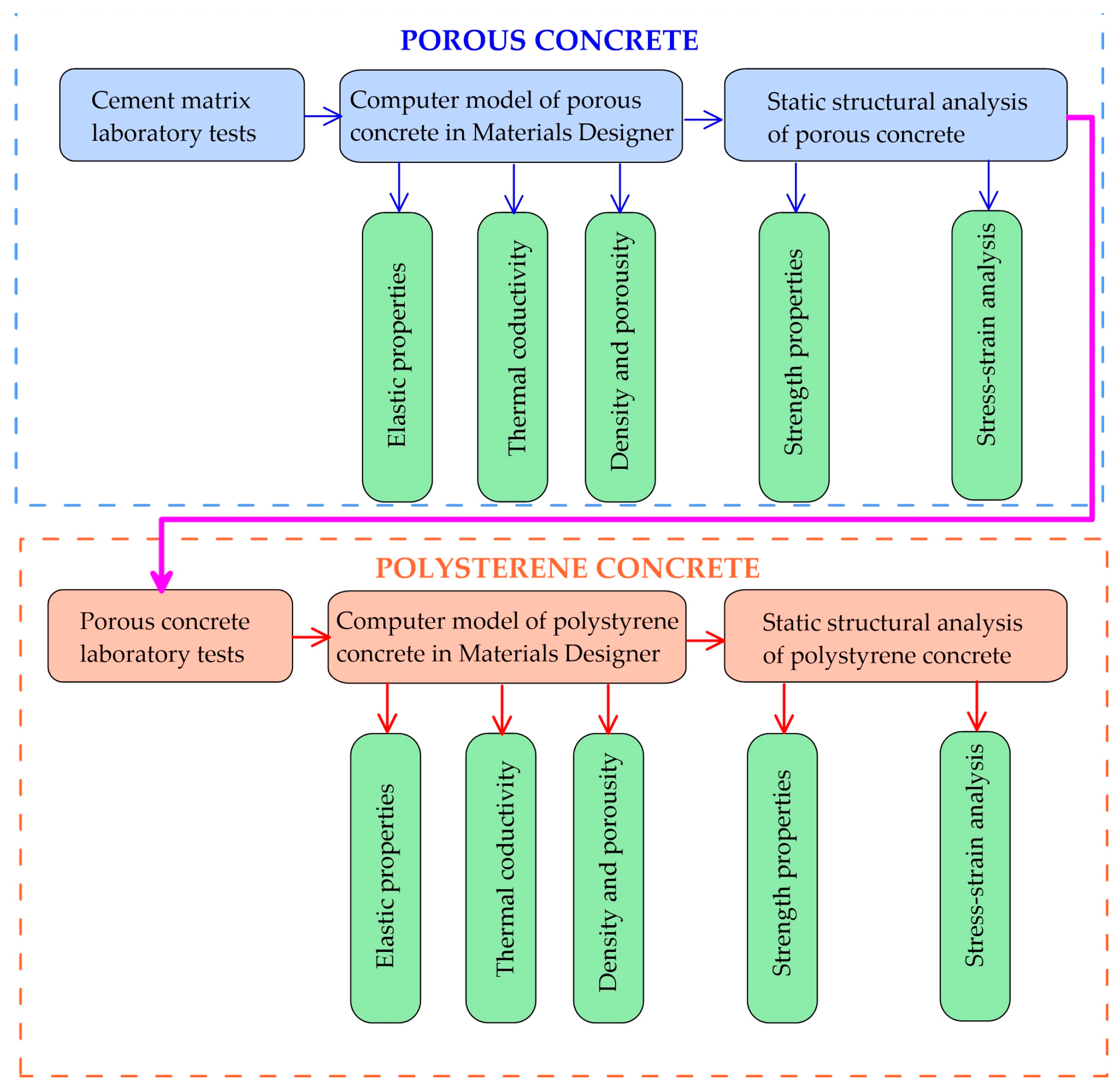
Materials and Research Sequence
3. Results
3.1. Calibration of the Parameters of the Menetrey–Willam Model
3.2. Thermal Conductivity Properties of Polystyrene Concrete Analysis
3.3. Analysis of Strength Properties of Polystyrene Concrete
4. Discussion
4.1. Dependence of Thermal Conductivity of Polystyrene Concrete on Its Physical Characteristics
4.2. Dependence of the Compressive Strength of Polystyrene Concrete on Its Physical Properties
5. Conclusions
Author Contributions
Funding
Institutional Review Board Statement
Informed Consent Statement
Data Availability Statement
Acknowledgments
Conflicts of Interest
Abbreviations
| EPS | Expanded polystyrene |
| NS | Nanosilica |
| GBFS | Granulated blast furnace slag |
| RVE | Representative volume element |
| LWAC | Lightweight aggregate concrete |
References
- Muhammed, F.Z.; Yamaguchi, K.; Handayani, K.N.; Hagishima, A. Affordable Housing in Developing Regions: A Systematic Review of Materials, Methods and Critical Success Factors with Case Insights. Buildings 2025, 15, 4015. [Google Scholar] [CrossRef]
- Shcherban’, E.M.; Stel’makh, S.A.; Mailyan, L.R.; Beskopylny, A.N.; Mailyan, A.L.; Shcherban’, N.; Chernil’nik, A.; Elshaeva, D. Composition and Properties of Lightweight Concrete of Variotropic Structure Based on Combined Aggregate and Microsilica. Buildings 2025, 15, 346. [Google Scholar] [CrossRef]
- Özkılıç’, Y.O.; Beskopylny, A.N.; Stel’makh, S.A.; Shcherban’, E.M.; Mailyan, L.R.; Meskhi, B.; Chernil’nik, A.; Ananova, O.; Aksoylu, C.; Madenci, E. Lightweight expanded-clay fiber concrete with improved characteristics reinforced with short natural fibers. Case Stud. Constr. Mater. 2023, 19, e02367. [Google Scholar] [CrossRef]
- Verified Market Research. Available online: https://www.verifiedmarketresearch.com/product/expandable-polystyrene-market/ (accessed on 11 January 2026).
- Research Nester. Available online: https://www.researchnester.com/reports/expanded-polystyrene-eps-market/5163 (accessed on 11 January 2026).
- Zhu, C.; Zhu, E.; Wang, B.; Li, J.; Yao, T.; Zhang, Z. Effect of Porosity and Pore Size on the Axial Compressive Properties of Recycled Aggregate Concrete. Materials 2025, 18, 2830. [Google Scholar] [CrossRef] [PubMed]
- Nowoświat, A.; Miros, A.; Krause, P. Change in the Properties of Expanded Polystyrene Exposed to Solar Radiation in Real Aging Conditions. Sustainability 2024, 16, 7320. [Google Scholar] [CrossRef]
- Liang, K.; Liu, C.; Lu, X.; Lun Chow, C.; Lau, D. Modified expanded polystyrene particles for alkali-activated lightweight concrete enhancement: An experimental and simulation study. J. Build. Eng. 2025, 112, 113650. [Google Scholar] [CrossRef]
- Ali, A.Y.F.; Ahmed, S.A.; El-Feky, M.S. Alkali-activated concrete with expanded polystyrene: A lightweight, high-strength solution for fire resistance and explosive protection. J. Build. Eng. 2025, 99, 111648. [Google Scholar] [CrossRef]
- Vakhshouri, B.; Rasiah, S.R.; Nejadi, S. Analytical study of the drying shrinkage in light-weight concrete containing EPS beads. Adv. Cem. Res. 2019, 31, 308–318. [Google Scholar] [CrossRef]
- Wu, Z.; Wang, X.; Chen, Z. Experimental study on Corn Straw Fiber (CSF) toughening EPS concrete. Constr. Build. Mater. 2024, 429, 136325. [Google Scholar] [CrossRef]
- Ingeli, R.; Čekon, M.; Paulovičová, L. Enhancement of the thermal performance of voided concrete slabs filled with expanded polystyrene. Case Stud. Constr. Mater. 2025, 22, e04567. [Google Scholar] [CrossRef]
- Colangelo, F.; Forcina, A.; Farina, I.; Petrillo, A. Life Cycle Assessment (LCA) of Different Kinds of Concrete Containing Waste for Sustainable Construction. Buildings 2018, 8, 70. [Google Scholar] [CrossRef]
- Václavík, V.; Ondová, M.; Dvorský, T.; Eštoková, A.; Fabiánová, M.; Gola, L. Sustainability Potential Evaluation of Concrete with Steel Slag Aggregates by the LCA Method. Sustainability 2020, 12, 9873. [Google Scholar] [CrossRef]
- Al-Gasham, T.S.; Hilo, A.N.; Alawsi, M.A. Structural behavior of reinforced concrete one-way slabs voided by polystyrene balls. Case Stud. Constr. Mater. 2019, 11, e00292. [Google Scholar] [CrossRef]
- Rajpurohit, K.; Shaikh, S.A.; Pandey, A.K.; Bagla, H.K. Synthetic polymers and nanostructured materials additives for engineered cementitious materials: Plausible route for recycled polymer utilization. Hybrid Adv. 2025, 11, 100555. [Google Scholar] [CrossRef]
- Behera, D.; Liu, K.-Y.; Rachman, F.; Worku, A.M. Innovations and Applications in Lightweight Concrete: Review of Current Practices and Future Directions. Buildings 2025, 15, 2113. [Google Scholar] [CrossRef]
- Ahmed, S.A.; Ebrahem, E.; El-Feky, M.S. Achieving sustainable performance: Synergistic effects of nano-silica and recycled expanded polystyrene in lightweight structural concrete. Sci. Rep. 2024, 14, 26648. [Google Scholar] [CrossRef]
- Saleh, A.N.; Attar, A.A.; Algburi, S.; Ahmed, O.K. Comparative study of the effect of silica nanoparticles and polystyrene on the properties of concrete. Results Mater. 2023, 18, 100405. [Google Scholar] [CrossRef]
- Ahmed, S.A.; Ebrahem, E.; El-Amir, A.A.M.; El-Feky, M.S. Developing lightweight structural concrete with enhanced thermal and durability properties through nano-silica and expanded polystyrene integration. Sci. Rep. 2025, 15, 27100. [Google Scholar] [CrossRef]
- Shcherban’, E.M.; Stel’makh, S.A.; Mailyan, L.R.; Beskopylny, A.N.; Smolyanichenko, A.S.; Chernil’nik, A.A.; Elshaeva, D.M.; Beskopylny, N.A. Structure and Properties of Variatropic Concrete Combined Modified with Nano- and Micro-silica. Constr. Mater. Prod. 2024, 7, 3. [Google Scholar] [CrossRef]
- Beskopylny, A.N.; Stel’makh, S.A.; Shcherban’, E.M.; Varavka, V.; Meskhi, B.; Mailyan, L.R.; Kovtun, M.; Kurlovich, S.; El’shaeva, D.; Chernil’nik, A. Study of the Structure and Properties of Concrete Modified with Nanofibrils and Nanospheres. Buildings 2024, 14, 3476. [Google Scholar] [CrossRef]
- Khan, M.A.; Ashraf, M.S.; Onyelowe, K.C.; Tariq, K.A.; Ahmed, M.; Ali, T.; Qureshi, M.Z. Machine learning predictions of high-strength RCA concrete utilizing chemically activated fly ash and nano-silica. Sci. Rep. 2025, 15, 10255. [Google Scholar] [CrossRef] [PubMed]
- Fu, J.; Jiang, L.; Yang, M.; Yu, D.; Shen, M.; Wang, Y. Influence of Nano-Silica and Porosity on the Strength and Permeability of Permeable Concrete: An Experimental Study. Buildings 2026, 16, 148. [Google Scholar] [CrossRef]
- Yang, Q.; Yang, Q.; Peng, X.; Xia, K.; Xu, B. A Review of the Effects of Nanomaterials on the Properties of Concrete. Buildings 2025, 15, 2363. [Google Scholar] [CrossRef]
- Canonsburg, A.D. Material Designer User’s Guide; ANSYS: Canonsburg, PA, USA, 2024; Available online: https://ansyshelp.ansys.com/public/account/secured?returnurl=/Views/Secured/corp/v242/en/acp_md/acp_md.html (accessed on 8 February 2026).
- Rayhan, S.B.; Rahman, M.M. Modeling Elastic Properties of Unidirectional Composite Materials Using Ansys Material Designer. Procedia Struct. Integr. 2020, 28, 1892–1900. [Google Scholar] [CrossRef]
- Eyri, B.; Gul, O.; Karsli, N.G.; Yilmaz, T. Modeling short fiber reinforced polymer matrix composite materials using material designer. Polym. Compos. 2025, 46, 10350–10360. [Google Scholar] [CrossRef]
- Klyuev, S.V.; Klyuev, A.V.; Ayubov, N.A.; Fediuk, R.S.; Levkina, E.V. Finite Element Design and Analysis of Sustainable Mono-Reinforced and Hybrid-Reinforced Fiber geopolymers. Adv. Eng. Res. 2025, 25, 171–185. [Google Scholar] [CrossRef]
- Bădăluţă, A.-N.; Galaţanu, S.-V.; Kováčik, J.; Marşavina, L. Multiscale Modeling and Optimization of Aluminum Foam Material Properties Under Dynamic Load. Appl. Sci. 2025, 15, 8433. [Google Scholar] [CrossRef]
- Sultana, J.; Varga, G. Design and Analysis of Natural Fiber-Reinforced Jute Woven Composite RVEs Using Numerical and Statistical Methods. J. Compos. Sci. 2025, 9, 283. [Google Scholar] [CrossRef]
- Zhangabay, N.; Chepela, D.; Tursunkululy, T.; Zhangabay, A.; Kolesnikov, A. Analysis of the effect of porosity on thermal conductivity with consideration of the internal structure of arbolite. Constr. Mater. Prod. 2024, 7, 4. [Google Scholar] [CrossRef]
- Beskopylny, A.N.; Shcherban’, E.M.; Stel’makh, S.A.; Elshaeva, D.; Chernil’nik, A.; Razveeva, I.; Panfilov, I.; Kozhakin, A.; Madenci, E.; Aksoylu, C.; et al. Porosity Analysis and Thermal Conductivity Prediction of Non-Autoclaved Aerated Concrete Using Convolutional Neural Network and Numerical Modeling. Buildings 2025, 15, 2442. [Google Scholar] [CrossRef]
- Rayhan, S.B.; Rahman, M.M.; Sultana, J.; Varga, G. Predicting the Elastic Moduli of Unidirectional Composite Materials Using Deep Feed Forward Neural Network. J. Compos. Sci. 2025, 9, 278. [Google Scholar] [CrossRef]
- Kondratieva, T.N.; Chepurnenko, A.S. Prediction of Rheological Parameters of Polymers by Machine Learning Methods. Adv. Eng. Res. 2024, 24, 36–47. [Google Scholar] [CrossRef]
- Ashrafi, E.; Farzam, M. An Experimental Approach to Lightweight Aggregate Concrete Material Modeling Parameters Under Cyclic and Biaxial Loadings. Int. J. Concr. Struct. Mater. 2025, 19, 43. [Google Scholar] [CrossRef]
- Xu, S.; Fu, P.; Liu, Y.; Huang, T.; Wang, X.; Li, Y. Experimental and 3D Simulation Research on the Mechanical Properties of Cold-Bonded Fly Ash Lightweight Aggregate Concrete Exposed to Different High Temperatures. Materials 2025, 18, 4991. [Google Scholar] [CrossRef]
- GOST 7076-87; Building Materials and Products. Method of Determination of Steady-State Thermal Conductivity and Thermal Resistance. Russian Gost: Moscow, Russia, 1987. Available online: https://www.russiangost.com/p-65031-gost-7076-87.aspx (accessed on 8 February 2026).
- ASTM C518; Standard Test Method for Steady-State Thermal Transmission Properties. ASTM International: West Conshohocken, PA, USA, 2006. Available online: https://www.intertek.com/building/standards/astm-c518/ (accessed on 8 February 2026).
- EN 12390-7:2019; Testing Hardened Concrete—Part 7: Density of Hardened Concrete. iTeh Standards: Etobicoke, ON, Canada, 2019. Available online: https://standards.iteh.ai/catalog/standards/cen/811a0cf3-55e3-495a-b06e-5c302d5f2806/en-12390-7-2019 (accessed on 14 January 2026).
- EN 12390-1:2021; Testing Hardened Concrete—Part 1: Shape, Dimensions and Other Requirements of Specimens and Moulds. iTeh Standards: Etobicoke, ON, Canada, 2021. Available online: https://standards.iteh.ai/catalog/standards/cen/d1c9ccee-2e5a-425e-a964-961da95d2f99/en-12390-1-2021 (accessed on 14 January 2026).
- EN 12390-2:2019; Testing Hardened Concrete—Part 2: Making and Curing Specimens for Strength Tests. iTeh Standards: Etobicoke, ON, Canada, 2019. Available online: https://standards.iteh.ai/catalog/standards/cen/ae7e6a86-1cbc-455e-8b2a-8964be9087f9/en-12390-2-2019 (accessed on 14 January 2026).
- EN 12390-3:2019; Testing Hardened Concrete—Part 3: Compressive Strength of Test Specimens. iTeh Standards: Etobicoke, ON, Canada, 2019. Available online: https://standards.iteh.ai/catalog/standards/cen/7eb738ef-44af-436c-ab8e-e6561571302c/en-12390-3-2019 (accessed on 14 January 2026).
- EN 12390-4:2019; Testing Hardened Concrete—Part 4: Compressive Strength—Specification for Testing Machines. iTeh Standards: Etobicoke, ON, Canada, 2019. Available online: https://standards.iteh.ai/catalog/standards/cen/10b1c613-819b-42d7-8f94-480cd37a666a/en-12390-4-2019 (accessed on 14 January 2026).
- Dmitriev, A.; Novozhilov, Y.; Mikhalyuk, D.; Lalin, V. Calibration and Validation of the Menetrey-Willam Constitutive Model for Concrete. Constr. Unique Build. Struct. 2020, 88, 8804. [Google Scholar] [CrossRef]
- Santos, L.M.; Lima, P.R.L.; Santos, G.J.B. Menetrey-Willam numerical model for analysis of fiber reinforced concrete beams. Rev. IBRACON Estrut. Mater. 2025, 18, e18211. [Google Scholar] [CrossRef]
- Shcherban’, E.M.; Beskopylny, A.N.; Stel’makh, S.A.; Mailyan, L.R.; Shilov, A.A.; Hiep, N.Q.; Song, Y.; Chernil’nik, A.A.; Elshaeva, D.M. Study of thermophysical characteristics of variatropic concretes. Constr. Mater. Prod. 2024, 7, 2. [Google Scholar] [CrossRef]
- Rosca, B. Eco-Friendly Lightweight Aggregate Concrete of Structural Grade Made with Recycled Brick Aggregate Containing Expanded Polystyrene Beads. Sustainability 2025, 17, 3050. [Google Scholar] [CrossRef]
- Zhou, J.; Lu, J.; Liu, C.; Chen, L. Preparation, pore structure and properties of uniformly porous glass-ceramics sintered from granite powder using SiC@SiO2 foaming agent. Ceram. Int. 2024, 50, 52379–52387. [Google Scholar] [CrossRef]
- Leshchenko, M.V.; Semko, V. Thermal characteristics of the external walling made of cold-formed steel studs and polystyrene concrete. Mag. Civ. Eng. 2015, 60, 44–55. [Google Scholar] [CrossRef]
- Yu, Z.; Wei-jun Yang, W. Research on thermal properties of polystyrene granular concrete under the influence of multiple factors. J. Build. Eng. 2024, 86, 108799. [Google Scholar] [CrossRef]
- Orosz, M.; Nagy, B.; Tóth, E. Hygrothermal behavior of ultra-lightweight polystyrene concrete. Int. J. Eng. Inf. Sci. 2017, 12, 53–66. [Google Scholar] [CrossRef]
- Xu, Y.; Jiang, L.; Xu, J.; Li, Y. Mechanical properties of expanded polystyrene lightweight aggregate concrete and brick. Constr. Build. Mater. 2012, 27, 32–38. [Google Scholar] [CrossRef]
- Babu, D.S.; Babu, K.G.; Wee, T.H. Effect of polystyrene aggregate size on strength and moisture migration characteristics of lightweight concrete. Cem. Concr. Compos. 2006, 28, 520–527. [Google Scholar] [CrossRef]
- Xu, Y.; Jiang, L.; Xu, J.; Chu, H.; Li, Y. Prediction of compressive strength and elastic modulus of expanded polystyrene lightweight concrete. Mag. Concr. Res. 2015, 67, 954–962. [Google Scholar] [CrossRef]
- Salahaldeen, A.S.; Al-Hadithi, A.I. The Effect of Adding Expanded Polystyrene Beads (EPS) on the Hardened Properties of Concrete. Eng. Technol. Appl. Sci. Res. 2022, 12, 9692–9696. [Google Scholar] [CrossRef]








| Granule Diameter, mm | Density, kg/m3 | Compressive Strength, MPa |
|---|---|---|
| 1…2 | 780 | 3.6 |
| 783 | 3.7 | |
| 784 | 3.2 | |
| 789 | 3.5 | |
| 782 | 3.4 | |
| 781 | 3.6 | |
| 3…5 | 875 | 4.1 |
| 870 | 4 | |
| 880 | 3.8 | |
| 876 | 4.2 | |
| 879 | 4.3 | |
| 882 | 4 |
| Title | Units | Value |
|---|---|---|
| Uniaxial compressive strength | MPa | From 9 to 47.1 |
| Uniaxial tensile strength | MPa | From 1 to 4.2 |
| Biaxial compressive strength | MPa | From 16 to 54 |
| Dilatancy angle | degree | 9 |
| Plastic strength at uniaxial compressive strength | - | 0.0012667 |
| Plastic strain at transition from power law to exponential softening | - | 0.0025067 |
| Relative stress at the start of nonlinear softening | - | 0.33 |
| Residual relative stress at transition from power law to exponential softening | - | 0.85 |
| Residual compressive relative stress | - | 0.2 |
| Mode 1 area specific fracture energy | N/m | 100 |
| Residual tensile relative stress | - | 0.1 |
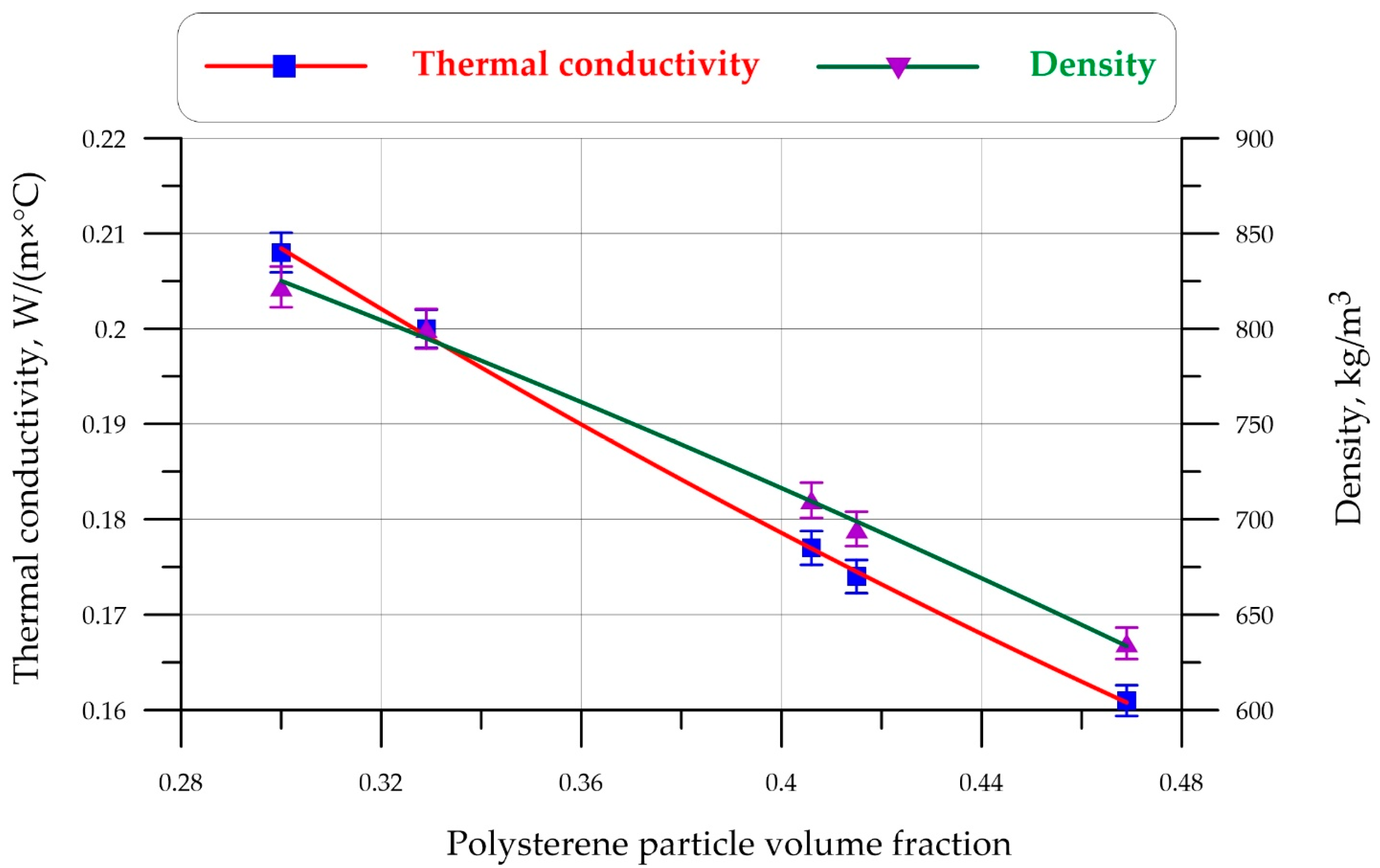
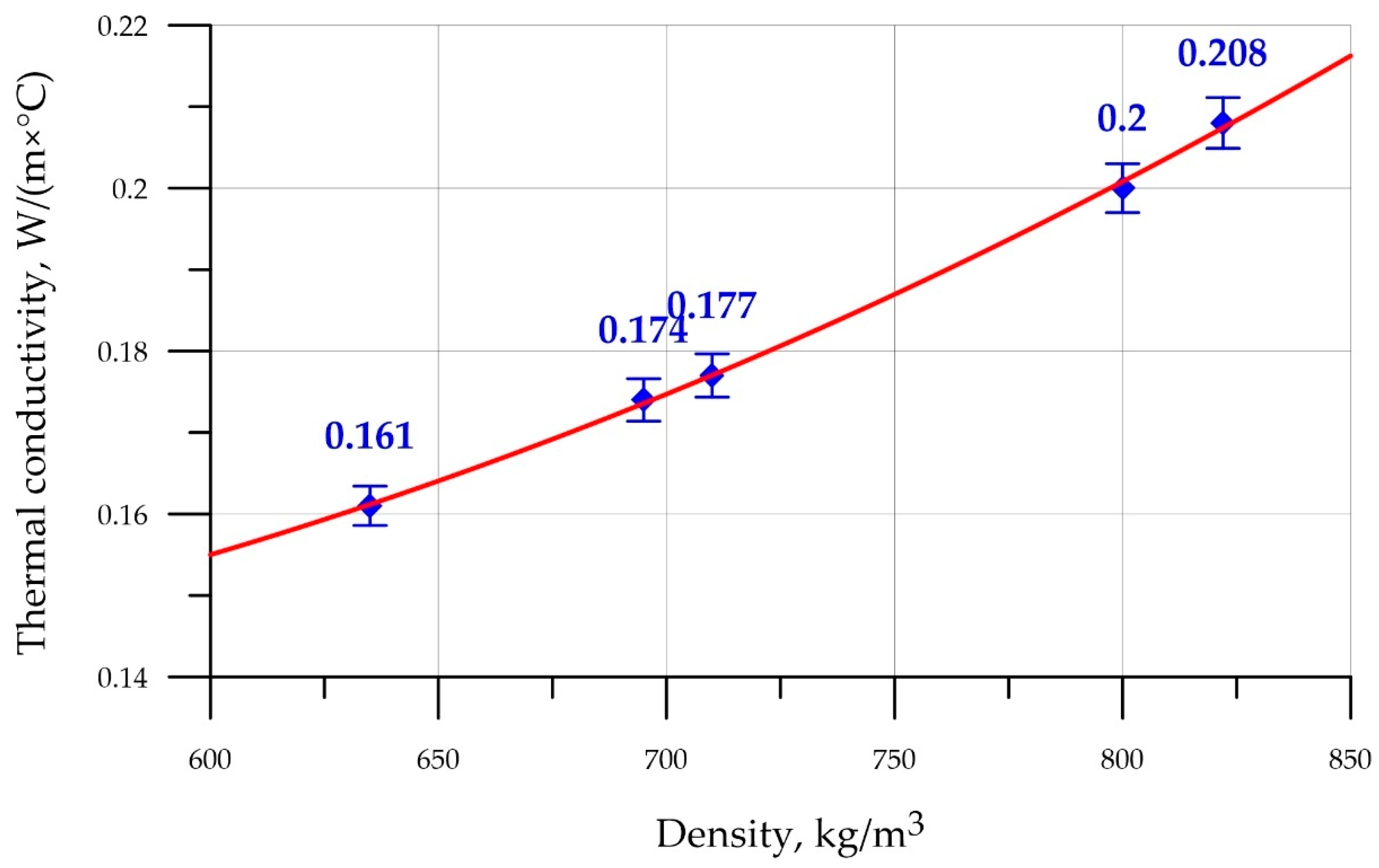
| Initial Density of Foam Concrete, kg/m3 | Polystyrene Particle Volume Fraction | Average Particle Diameter, µm | Thermal Conductivity of Polystyrene Concrete, W/(m × °C) | Polystyrene Concrete Density, kg/m3 |
|---|---|---|---|---|
| 1187 | 0.3 | 5000 | 0.208 | 822 |
| 1187 | 0.329 | 5000 | 0.2 | 800 |
| 1187 | 0.406 | 4495 | 0.177 | 710 |
| 1187 | 0.415 | 3600 | 0.174 | 695 |
| 1187 | 0.469 | 4063 | 0.161 | 635 |
Disclaimer/Publisher’s Note: The statements, opinions and data contained in all publications are solely those of the individual author(s) and contributor(s) and not of MDPI and/or the editor(s). MDPI and/or the editor(s) disclaim responsibility for any injury to people or property resulting from any ideas, methods, instructions or products referred to in the content. |
© 2026 by the authors. Licensee MDPI, Basel, Switzerland. This article is an open access article distributed under the terms and conditions of the Creative Commons Attribution (CC BY) license.
Share and Cite
Beskopylny, A.N.; Stel’makh, S.A.; Shcherban’, E.M.; Shakhalieva, D.M.; Chernil’nik, A.; Panfilov, I.; Beskopylny, N.; Özkılıç, Y.O. Finite Element Modeling and Experimental Study of Foam Concrete and Polystyrene Concrete. Buildings 2026, 16, 737. https://doi.org/10.3390/buildings16040737
Beskopylny AN, Stel’makh SA, Shcherban’ EM, Shakhalieva DM, Chernil’nik A, Panfilov I, Beskopylny N, Özkılıç YO. Finite Element Modeling and Experimental Study of Foam Concrete and Polystyrene Concrete. Buildings. 2026; 16(4):737. https://doi.org/10.3390/buildings16040737
Chicago/Turabian StyleBeskopylny, Alexey N., Sergey A. Stel’makh, Evgenii M. Shcherban’, Diana M. Shakhalieva, Andrei Chernil’nik, Ivan Panfilov, Nikita Beskopylny, and Yasin Onuralp Özkılıç. 2026. "Finite Element Modeling and Experimental Study of Foam Concrete and Polystyrene Concrete" Buildings 16, no. 4: 737. https://doi.org/10.3390/buildings16040737
APA StyleBeskopylny, A. N., Stel’makh, S. A., Shcherban’, E. M., Shakhalieva, D. M., Chernil’nik, A., Panfilov, I., Beskopylny, N., & Özkılıç, Y. O. (2026). Finite Element Modeling and Experimental Study of Foam Concrete and Polystyrene Concrete. Buildings, 16(4), 737. https://doi.org/10.3390/buildings16040737