


Abstract
Calcium sulfoaluminate–calcium oxide expansive agents (HCSA) are commonly used in mass concrete to compensate for thermal shrinkage. However, the ettringite (AFt) formed by HCSA hydration decomposes when temperatures exceed 70 °C. This study examines the synergistic effects of curing temperature (20 °C to 80 °C), fly ash (FA) content (0%, 40%), and water–binder ratio (w/b, 0.3, 0.4, 0.5) on the expansion behaviour and microstructure of HCSA–cement systems. A critical temperature threshold was identified at 60 °C. Below this limit, elevated temperatures accelerate hydration and enhance expansion, with the restrained expansion ratio peaking at 9.2 × 10⁻⁴ mm/mm under 60 °C curing. Beyond 60 °C, expansion capacity significantly diminishes due to the thermal decomposition of AFt into monosulfoaluminate (AFm), as confirmed by XRD and SEM analysis. Calculations of expansive stress reveal a critical mismatch at temperatures ≥ 40 °C, where the expansive stress exceeds the early-age tensile strength, causing microstructural damage. Furthermore, subsequent cooling to standard curing conditions triggers the reformation of AFt from AFm, leading to Delayed Ettringite Formation (DEF), which poses potential risks for late-stage cracking. AFt morphology shifted from needle-like (2–5 μm) to prismatic (5–8 μm). The incorporation of FA suppressed early-stage expansion but improved expansion stability. above 40 °C, although excessive temperatures (>70 °C) led to pore coarsening and reduced mechanical strength. These findings provide a theoretical basis for optimizing the curing regimes of HCSA-admixed mass concrete to ensure structural integrity.
1. Introduction
In mass concrete engineering, significant temperature gradients and shrinkage stresses readily develop within the structure due to cement hydration heat and external environmental restraints [1,2]. These can induce detrimental cracking, severely compromising structural integrity and durability [3,4]. Incorporating expansive agents is a widely adopted and effective measure to compensate for thermal shrinkage. Commonly used expansive agents include calcium sulfoaluminate (CSA) [5], calcium oxide–calcium sulfoaluminate (HCSA) [6], and magnesium oxide (MgO) expansive agents (MEAs) [7]. Among these, HCSA expansive agents are particularly favoured for their rapid expansion rate and high expansion efficacy [6,8,9]. Their expansion originates from a two-stage reaction: the hydration of calcium oxide generates calcium hydroxide, contributing to early-age expansion; subsequently, the sulfoaluminate components react with gypsum in the alkaline environment to form ettringite (AFt), which provides later-age expansion [5]. The chemical reactions are shown in Equations (1) and (2):
However, the efficacy of expansive agents is strongly influenced by the curing temperature [10]. Research indicates that AFt, the key expansive phase, becomes unstable at temperatures exceeding approximately 70 °C, decomposing into monosulfoaluminate (AFm), SO42−, and Al3+, which can be adsorbed by C-S-H gel [11,12,13]. When the internal concrete temperature subsequently decreases under moist conditions, AFt may re-form (Delayed Ettringite Formation, DEF), posing a potential risk of late-age expansion and cracking [14]. This presents the core challenge for HCSA application in mass concrete: during the initial placement period, the maximum internal temperature of mass concrete often reaches 70–80 °C [15], narrowly exceeding the stability threshold of AFt. This high-temperature environment may not only cause AFt decomposition, weakening the immediate shrinkage-compensation effect, but also embed long-term safety hazards due to DEF.
Despite the critical importance of temperature effects, existing research on HCSA has predominantly been conducted at curing temperatures of 60 °C or lower [5,11]. Consequently, there is insufficient theoretical guidance and safety assessment for the high-temperature conditions (70–80 °C) likely experienced within actual mass concrete structures. Furthermore, the modulating mechanisms of mineral admixtures like fly ash (FA), often used in combination with expansive agents to improve concrete performance, on the expansion behaviour and microstructure of HCSA systems under elevated temperatures remain unclear [16,17,18]. Issues such as uneven distribution of hydration products, pore coarsening, and inadequate long-term strength development [19,20] caused by accelerated hydration at high temperatures [21,22,23] further complicate the expansion behaviour of such systems.
Therefore, to ensure the safe and efficient application of HCSA expansive agents in mass concrete, it is imperative to systematically investigate their performance evolution and underlying micro-mechanisms across a wider temperature range, especially above 60 °C. The present gap in knowledge is addressed in this investigation. By examining the effects of different curing temperatures (20–80 °C), FA contents (0% and 40%), and water–binder ratios (0.3, 0.4, 0.5) on the expansion behaviour, mechanical properties, and microstructure of HCSA–cement composite systems, we seek to reveal the temperature-driven phase transformation and structural deterioration mechanisms. The findings are intended to provide a theoretical basis for formulating rational temperature control and mix design strategies for mass concrete.
2. Materials and Methods
2.1. Materials
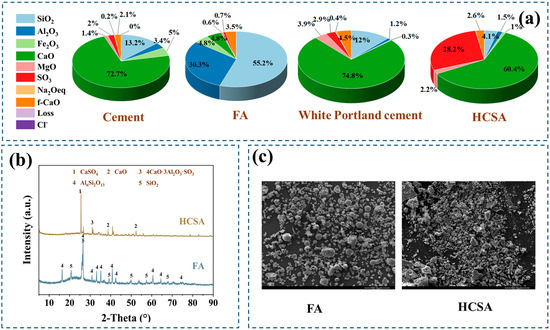
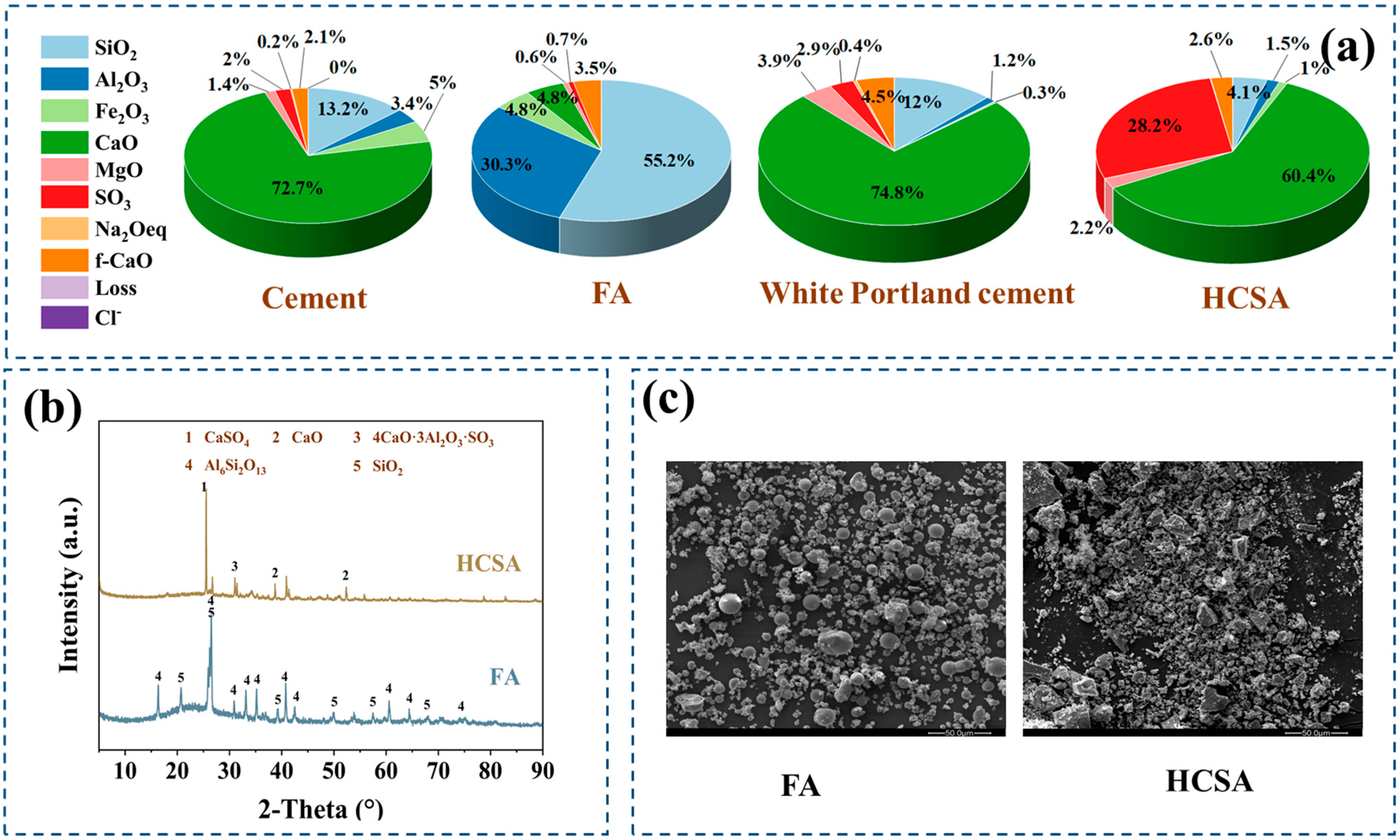
The cement employed in this study was P·I 42.5 Portland cement, manufactured by China United Cement Group Co., Ltd., Beijing, China. White Portland cement was employed specifically for LF-NMR specimens to minimize the interference of paramagnetic ions on the magnetic field, thereby ensuring higher signal resolution for pore structure analysis. FA with a specific surface area of 420 m2/kg was employed in this work. HCSA produced by TianJin BaoMing Co., Ltd., Tianjin, China was used. Figure 1a shows the chemical compositions of the raw materials. The XRD results and micro-morphology of the FA and HCSA are shown in Figure 1b,c. ISO standard sand was used.
Figure 1.
(a) Chemical composition of raw materials (wt.%); (b) XRD results of FA and HCSA; (c) micro-morphology of FA and HCSA.
2.2. Sample Preparation
The mixing proportions of the tested samples are shown in Table 1. The sand–binder ratio (s/b) of mortar samples was 2.0 according to the Chinese standard on expansive agents for concrete (GB 23439-2017) [24]. Based on previous research, incorporating an 8% HCSA admixture provided favourable shrinkage compensation and early crack resistance [6]. Therefore, this study employed an HCSA content of 8% by mass to replace cement, with FA content set at 0% and 40%. The w/b ratios of the samples were 0.3, 0.4, and 0.5.
Table 1.
Mix proportions of the ternary composite cementitious materials.
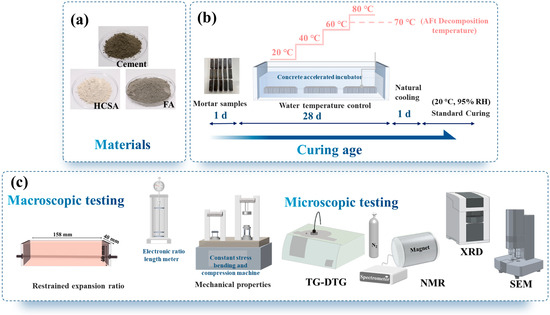
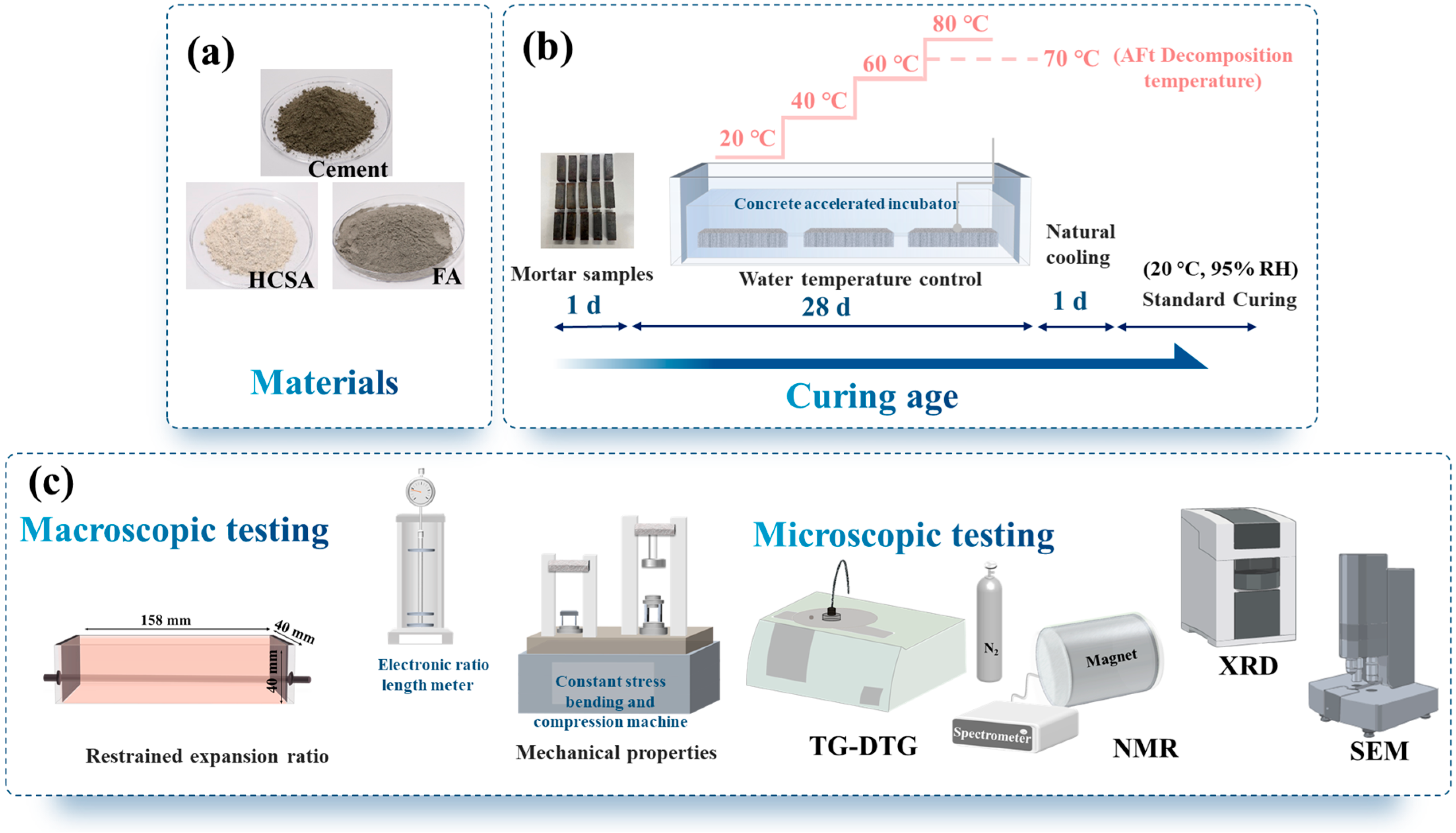
The specific process of the experiment is shown in Figure 2. After thorough mixing, the raw materials were cast and initially cured at 20 ± 2 °C. Following demoulding, the specimens were transferred to a temperature-controlled water bath and maintained at 20 °C, 40 °C, 60 °C, 70 °C, or 80 °C for 28 d. Following the high-temperature phase, we allowed the samples to cool naturally to ambient temperature for 1 d before transferring them to the standard curing environment (20 °C, 95% RH). Since DEF is a diffusion-controlled process occurring over months, the initial 24 h cooling rate is considered a secondary factor compared to the subsequent long-term moisture exposure. This study employed a method involving fixed high-temperature curing for 28 d followed by standard curing. This approach was primarily used to ensure the comparability of experimental results and to systematically investigate the effects of different temperatures on expansion behaviour.
Figure 2.
Schematic flowchart of the experimental procedure and sample preparation: (a) apparent morphology of raw materials, (b) sample preparation, (c) test methods and equipment.
2.3. Testing Procedures
2.3.1. Restrained Expansion Ratio Tests
The restrained expansion ratio was measured and calculated in accordance with the Chinese standard on expansion agents for concrete (GB 23439-2017) [24]. The lengths of samples were tested at 1 d, 3 d, 7 d, 14 d, 28 d, 56 d, 90 d, 120 d, and 150 d with the minimum scale of 0.001 mm. Each value was measured in a set of 3 samples.
2.3.2. Compressive and Flexural Strength Tests
The compressive and flexural strength experiment was carried out at curing ages of 1 d, 3 d, 7 d, 14 d, 28 d, 56 d, and 90 d according to the Chinese standard test method of cement mortar strength (ISO method) (GB/T 17671-2021) [25]. The strength of each mixture was determined by the average value obtained from testing three replicate specimens after cooling the specimens to 20 °C.
The temporal scope of this research primarily focused on short-term expansion behaviour and changes in mechanical properties, enabling a clear assessment of short-term expansion effects and associated cracking risks.
2.3.3. LF-NMR Tests
The LF-NMR instrument used the 2 MHz NMR analyzer manufactured by Limecho Ltd., China. The test samples were directly moulded cylindrical mortar samples with a diameter of 3.8 cm and a height of 6 cm. Before the test, samples were treated with vacuum saturation for 24 h using a vacuum saturation apparatus. Saturated specimens underwent surface drying treatment, after which they were tightly wrapped in polyethylene cling film to prevent mass exchange with the indoor environment. The instrument adopted a CPMG pulse sequence [26], the echo time was 60 μs, the echo count was 6000, and the number of scans was 16. The transverse magnetisation M(t) (a.u.) at time t = nτ0 (n = 1, 2, 3, …) was obtained with a signal-to-noise ratio exceeding 100. This signal may be expressed as
Here, M0 (a.u.) denotes the initial magnetization, Vw (m3) the total water volume, and T2i (s) the transverse relaxation time for the ith water reservoir of volume Vi (m3) and volume fraction fi (-). Assuming a continuous distribution of T2i, the relaxation-time spectrum fi (T2i), together with M0, can be obtained by solving Equation (3) via the Inverse Laplace Transform (ILT) algorithm [27]. Once M0 per unit bulk-water volume is determined, the total water volume Vw can be nondestructively estimated from the fitted M0, exploiting the linear proportionality between the two [28,29]. The volumetric porosity φ (-) of the saturated specimen is then calculated as
The formula for converting the transverse relaxation time T2 distribution into equivalent aperture r is as follows:
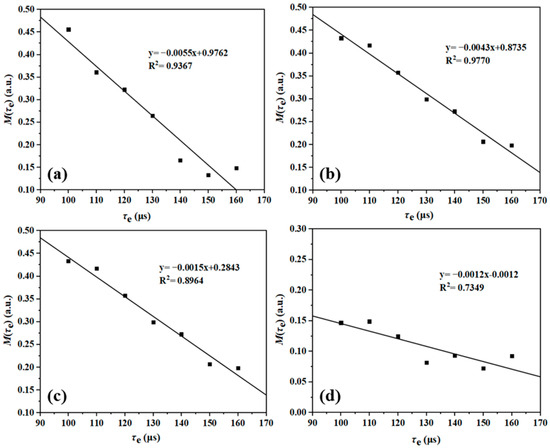
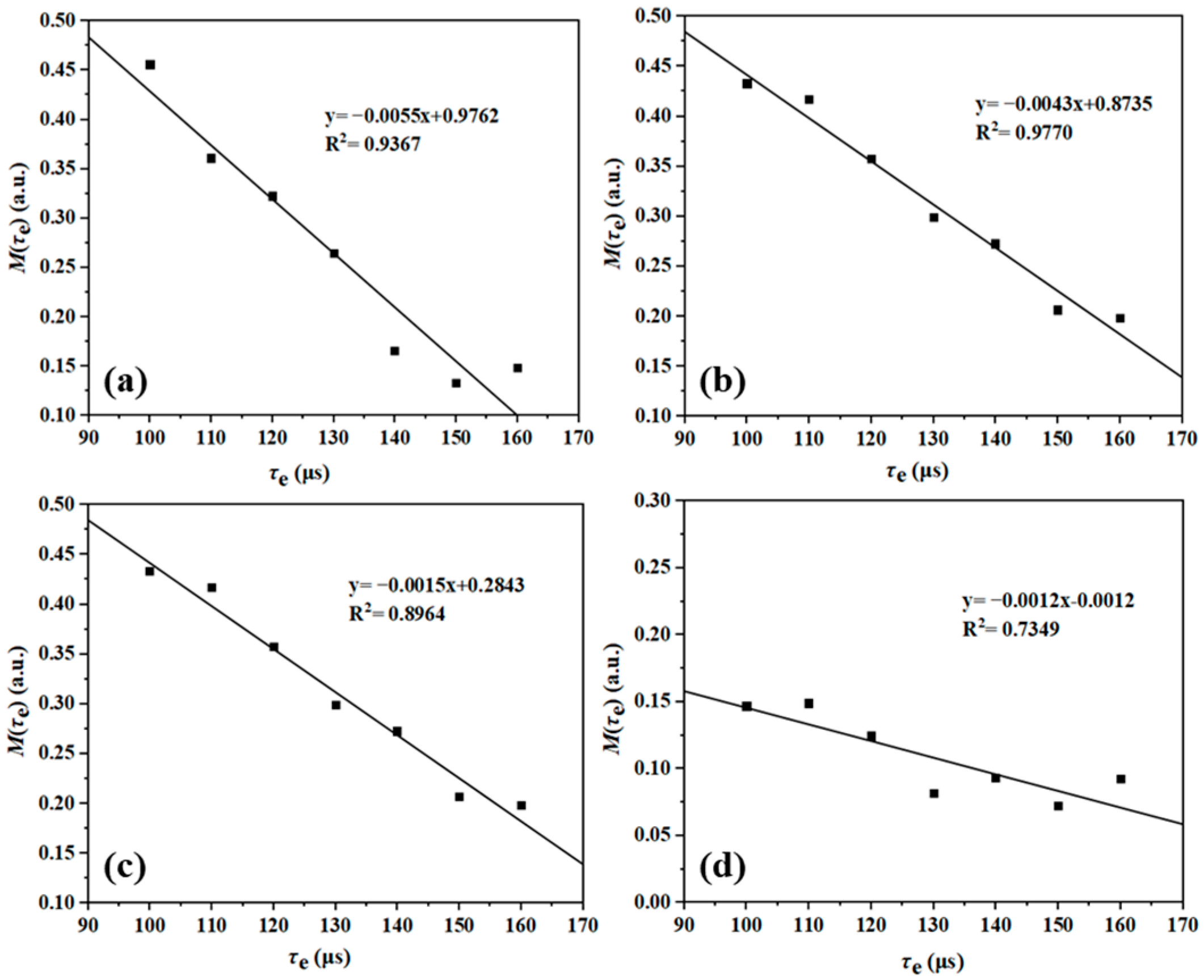
Here, ρ2 (m/s) represents the surface relaxivity, which may be determined via Hahn spin-echo measurements on a mortar sample coated with a monolayer of water molecules on its internal surface [30,31,32]. The fitted curve for the surface relaxivity is shown in Figure 3. The calculated surface relaxivity [29,32] values were 1.58, 1.37, 1.48, and 1.33 nm/ms, respectively. As the surface relaxation rate is primarily dependent on the material composition [33], an average value of 1.44 nm/ms was adopted.
Figure 3.
The determination of surface relaxation time T2S through Hahn spin-echo tests: (a) F0-0.4, (b) F40-0.3, (c) F40-0.4, (d) F40-0.5.
2.3.4. XRD Tests
To quantify the phases AFt and AFm via their strongest diffraction peaks (at 9.09° and 9.94° 2θ, respectively), XRD scans were performed from 8.5° to 10.5° 2θ with a step size of 0.01° and a 10 s dwell time. Samples were prepared by grinding the dried slices using an agate mortar to pass through a 200-mesh sieve [34].
2.3.5. TG-DTG Tests
The test employed pure paste specimens, which were immersed in isopropyl alcohol and dried in a vacuum dryer at 40 °C for 6 h prior to testing. The testing process used nitrogen gas protection with a heating rate of 10 °C/min.
This study employed the weight loss range of 380–480 °C for Ca(OH)2 dehydration in calculations [7]. As this study primarily investigates the effect of FA addition on Ca(OH)2 content, and given the proximity of the CaCO3 peaks, the calculation of the two peaks beyond 550 °C may be disregarded. The formula for calculating Ca(OH)2 content within the system is as follows:
In the formula, MassCa(OH)2 denotes the Ca(OH)2 content within the composite cementitious system. M380°C and M480°C, respectively, represent the percentage of remaining mass for the sample at 380 °C and 480 °C.
2.3.6. SEM Tests
Selected samples, approximately 1 cm3 in size, were gold-sputter-coated after being removed from the vacuum dryer. Microstructural observation was conducted using a Hitachi cold-field emission scanning electron microscope (SU 8220).
3. Results
3.1. Restrained Expansion Ratio
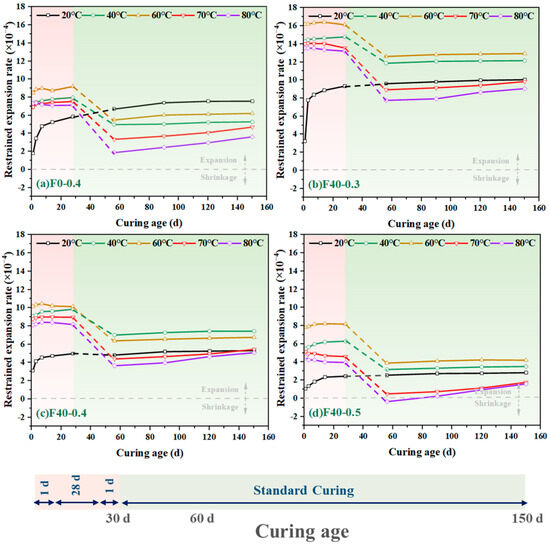
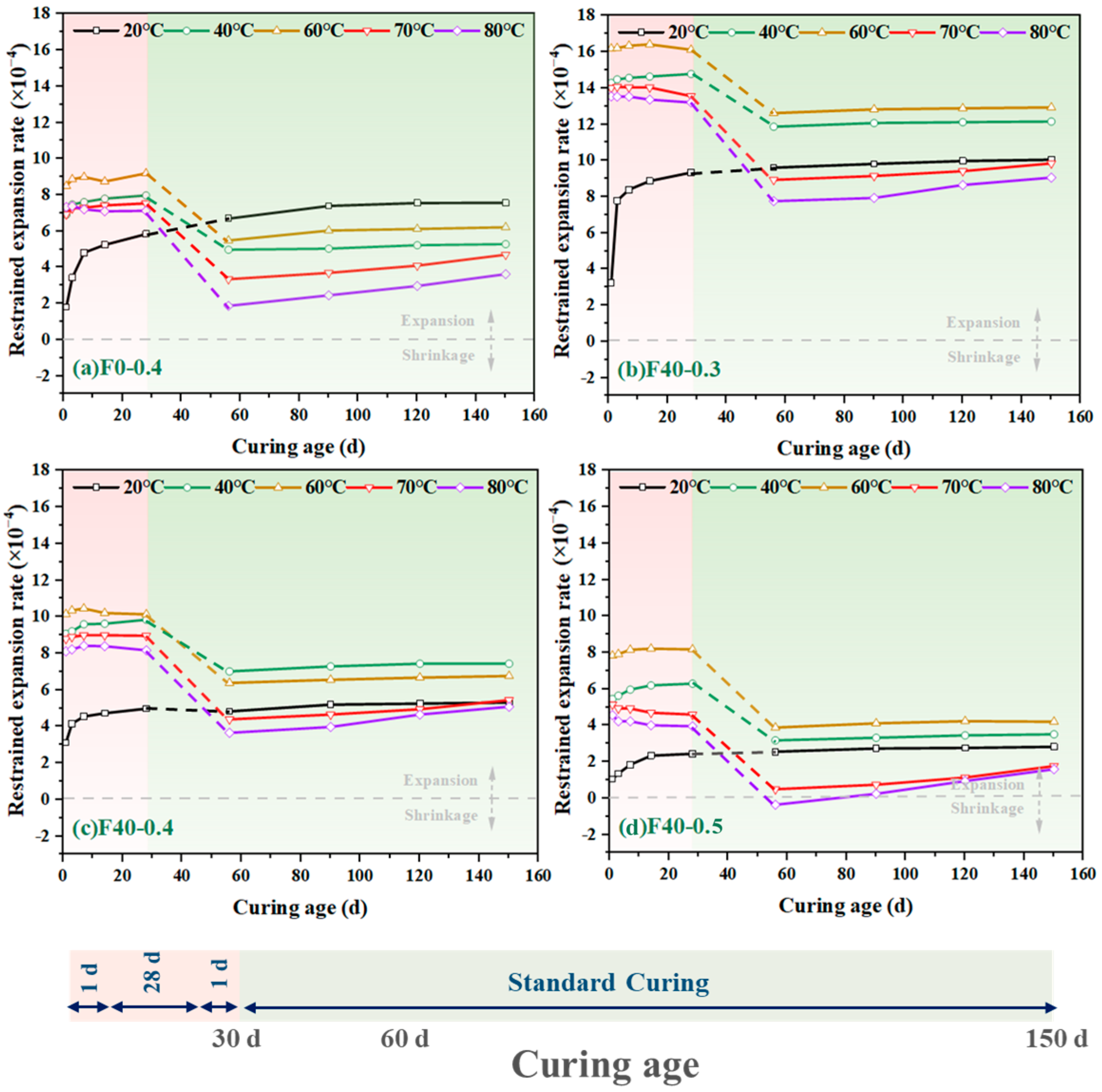
To investigate the influence of curing temperature on composite cementitious systems, experimental tests were conducted with FA additions and varying w/b values. Mixtures containing 8% HCSA and 0% or 40% FA were cured at 20 °C, 40 °C, 60 °C, 70 °C, and 80 °C, with w/b ratios of 0.3, 0.4, and 0.5. The restrained expansion ratio was measured accordingly. The results are presented in Figure 4a–d. As the transition from 28 d to 56 d is not a continuous process, the diagram employs dashed lines to connect the segments.
Figure 4.
Effect of curing temperature, FA content, and w/b ratio on the restrained expansion ratio: (a) F0-0.4, (b) F40-0.3, (c) F40-0.4, (d) F40-0.5.
The curves in Figure 4a reveal that the restrained expansion ratio first rose and then fell as the curing temperature increased. Specimens that underwent high-temperature curing followed by standard curing generally exhibited lower final expansion compared with those cured constantly at 20 °C. At 60 °C, the 28 d expansion peaked at 9.2 × 10⁻⁴ mm/mm, which was 158% of the value at 20 °C. When the temperature was further increased to 70 °C and 80 °C, the expansion ratio fell to 7.54 × 10⁻⁴ mm/mm and 7.13 × 10⁻⁴ mm/mm, respectively. After transfer to standard curing, specimens initially cured at 70 °C and 80 °C exhibited the most notable recovery of expansion. Moderate heating accelerates early AFt formation, thereby promoting expansion; however, excessive temperatures (>60 °C) may inhibit AFt stability or alter its formation pathway. The subsequent expansion recovery under standard curing is likely associated with the degree of DEF activation [35]. As the temperature increased, two concurrent factors influenced the system’s restricted expansion rate. Firstly, the addition of expansive agents increased the number of expansion sources generated through system hydration, thereby elevating the restricted expansion rate. Secondly, while higher temperatures theoretically induce greater restricted expansion, excessive heat causes the internal expansion source—calcium aluminate hydrate—to undergo thermal decomposition, consequently reducing expansion. The final restricted expansion rate reflects the coupled effect of these two mechanisms.
Comparison of Figure 4a,c indicates that the effect of FA on restrained expansion is strongly temperature-dependent. At 20 °C, FA increases early-age expansion but reduces later-age expansion; within the 40–80 °C range, it consistently enhances expansion. At 20 °C, FA increased the 3 d expansion by 24.55% but reduced the 28 d expansion by 14.73%. Between 40 and 80 °C, FA raised the 28 d expansion by 10.22% to 23.43%. Notably, the F40-0.5 group exhibited slight contraction (−0.35 × 10⁻⁴ mm/mm) at 56 d after 80 °C curing. Under ambient temperature, the filler effect and nucleation sites provided by FA promote early expansion; however, subsequent pozzolanic reaction consumes Ca(OH)2, lowering the system alkalinity and thereby suppressing later AFt formation. At elevated temperatures, the enhancing role of FA may stem from its overall modification of the hydration process and microstructure. After transfer to standard curing, FA generally restrained further expansion, suggesting that it contributes to long-term system stability [35].
From Figure 4b–d, it can be observed that a higher w/b reduces the restrained expansion ratio at all temperatures, but amplifies the expansion increase during subsequent standard curing for specimens previously cured at high temperatures (70–80 °C). As w/b increases, expansion decreases across all temperatures. During the standard curing phase, specimens initially cured at 20–60 °C showed stable expansion, whereas those initially cured at 70 °C or 80 °C exhibited more pronounced expansion growth with increasing w/b ratios. Systems with higher w/b possess greater porosity, which can accommodate more expansive stress and direct hydration products into pore-filling, thereby reducing macroscopic expansion. For specimens subjected to high-temperature curing, the more open structure at higher w/b may facilitate sulphate dissolution and redistribution, leading to more significant DEF and delayed expansion during standard curing. In contrast, the dense microstructure at lower w/b may temporarily immobilize sulphates within C-S-H gels, delaying their release and reaction [36].
3.2. Mechanical Properties
3.2.1. Compressive Strength
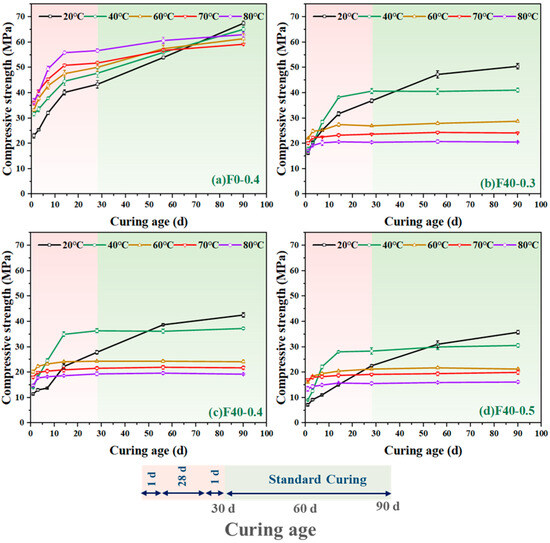
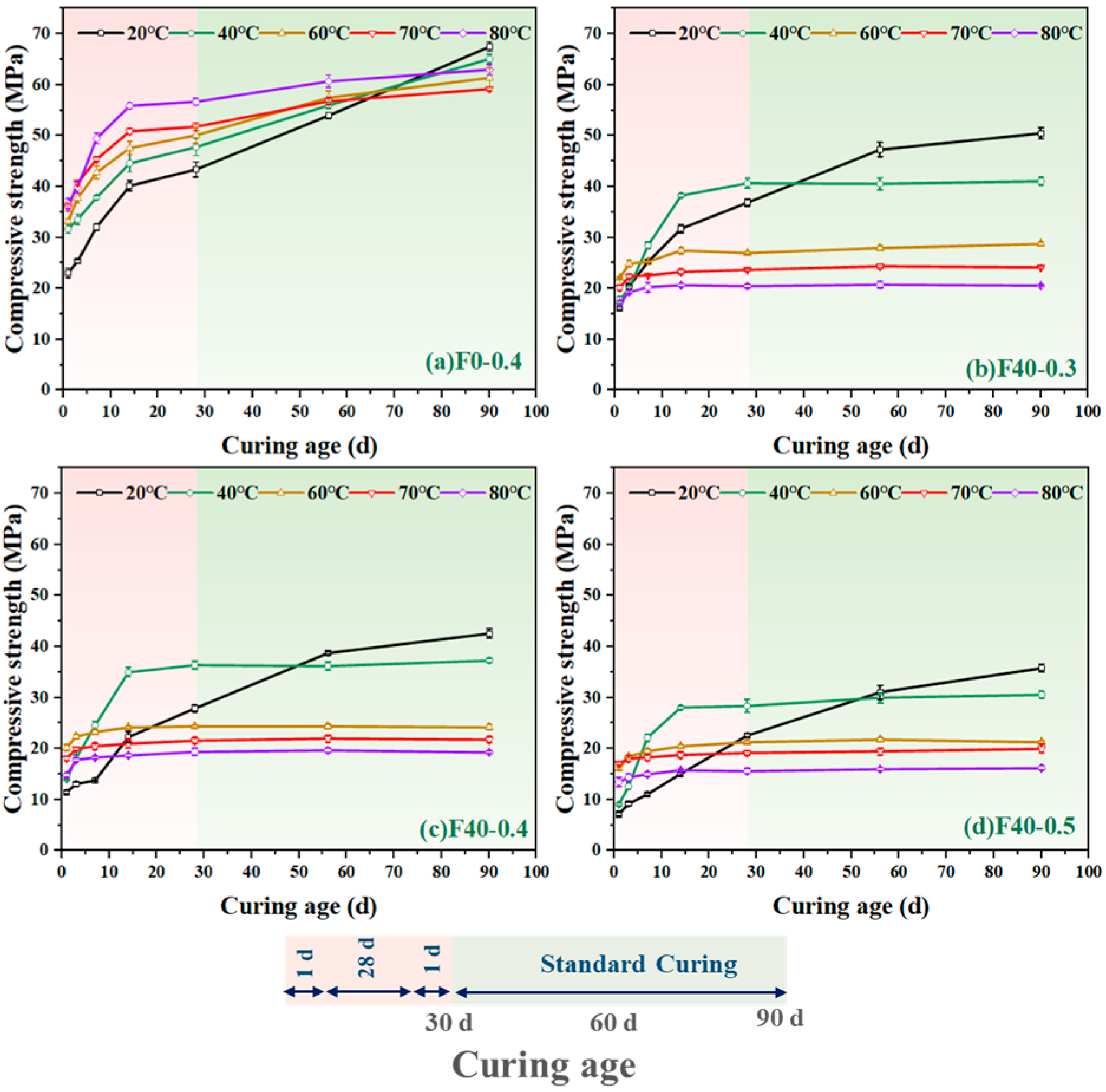
The compressive strength of specimens with varying FA contents and w/b ratios was tested at 1 d, 3 d, 7 d, 28 d, 56 d, and 90 d under curing temperatures of 20 °C, 40 °C, 60 °C, 70 °C, and 80 °C. The results are shown in Figure 5.
Figure 5.
Evolution of compressive strength at different curing ages under various temperatures: (a) F0-0.4, (b) F40-0.3, (c) F40-0.4, (d) F40-0.5.
The trends depicted in Figure 5a illustrate that increasing the curing temperature significantly accelerated early-age strength development but inhibited the subsequent long-term strength gain. Specimens transferred to standard curing after an initial high-temperature period exhibited a far lower strength increase at later ages compared to those cured constantly at 20 °C. For the plain cement system, the 1 d compressive strengths at 40 °C, 60 °C, 70 °C, and 80 °C reached 137%, 144%, 155%, and 159%, respectively, of the value obtained at 20 °C (23.1 MPa). However, after the transfer to standard curing, specimens initially cured at 80 °C showed a strength increase of only 11.11% between 28 d and 90 d, which was markedly lower than the 55.53% increase observed for specimens constantly cured at 20 °C. Moderate heating accelerates the early hydration reactions, leading to rapid strength development. The excessively rapid reaction kinetics may lead to a non-uniform distribution of hydration products and a coarser microstructure [37]; such an imperfect microstructure is less capable of supporting sustained strength growth at later ages.
Comparing Figure 5a,b, the incorporation of FA reduced the compressive strength at all ages. This weakening effect became more pronounced with increasing temperature and longer curing duration. The incorporation of FA led to a reduction in 28 d strength by 35.71%, 23.85%, 43.78%, 50.23%, and 55.30% at 20 °C to 80 °C, respectively. By 90 d, the strength reduction was further amplified; for instance, the F40-0.5 mix exhibited a strength loss of 69.35% after curing at 80 °C. The pozzolanic reaction of FA lags behind the hydration of cement clinker, and its early-age dilution effect leads to lower strength. In the long term, FA did not effectively compensate for the microstructural coarsening induced by high temperatures [35].
From Figure 5b–d, it is evident that a higher w/b systematically reduced the compressive strength under all curing conditions. An increased w/b directly raises the porosity of the system, thereby diminishing strength.
3.2.2. Flexural Strength
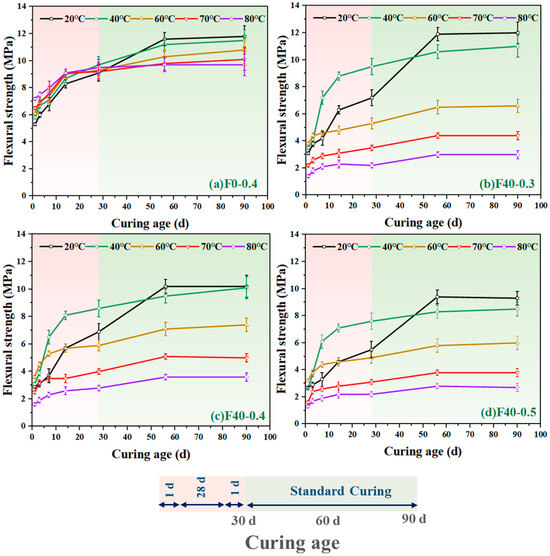
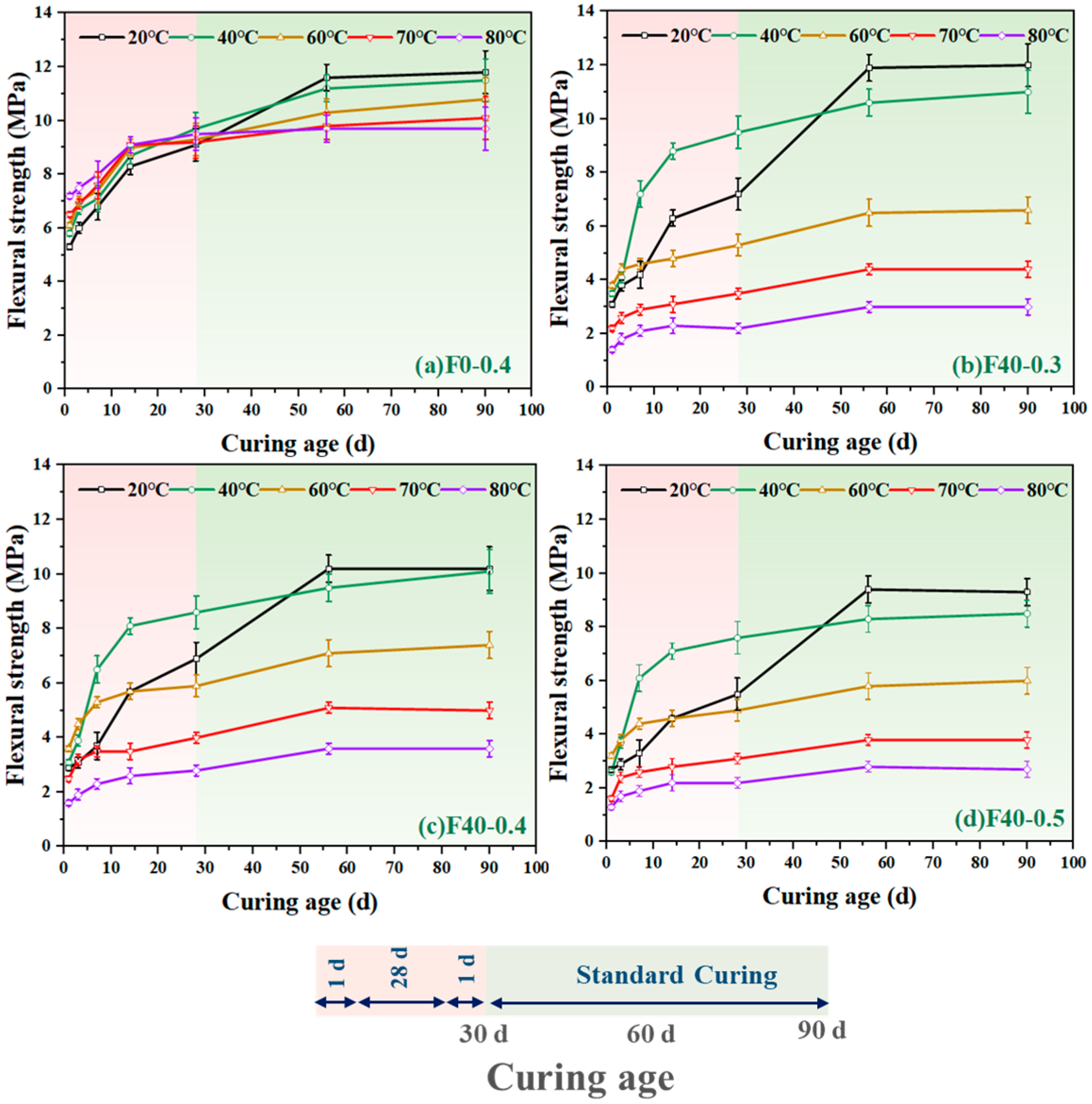
The development of flexural strength generally followed a trend similar to that of compressive strength, with one key exception. At curing temperatures of 60 °C and above, specimens with a w/b of 0.3 exhibited lower flexural strength than those with a w/b of 0.4. This phenomenon, evident in Figure 6 by the crossing of trend lines, is likely attributable to the more pronounced early-age expansion in low-w/b systems under high temperatures. This generates higher internal stress, making the material more susceptible to microcracking. Since flexural strength exhibits far greater sensitivity to microcracks than compressive strength, the flexural strength consequently diminishes.
Figure 6.
Evolution of flexural strength at different curing ages under various temperatures: (a) F0-0.4, (b) F40-0.3, (c) F40-0.4, (d) F40-0.5.
3.2.3. Expansive Stress
The evolution of the mechanical properties discussed above is closely tied to the substantial expansion generated by HCSA during early-age hydration. To clarify this relationship, the internal expansive stress and the material’s tensile strength were evaluated separately. The expansive stress σE induced by the restrained expansion was calculated using Equation (7):
where μ is the reinforcement ratio (0.79%), E is the elastic modulus of the restraining steel (2 × 10⁵ MPa), and ε represents the measured restrained expansion ratio. To compare the restricted expansion rate performance at different temperatures, the reinforcement ratio μ was maintained as a fixed value, calculated based on the actual restricted expansion skeleton used, as shown in Figure 2.
σE = μ⋅E⋅ε
Simultaneously, the tensile strength (σT) of the specimens was estimated to be approximately 7–15% of their measured compressive strength, following established empirical models [38,39]. In this study, considering the potential presence of cracks, a narrower range of 7–9% was adopted. The calculated expansive stresses and estimated tensile strengths are summarized in Table 2.
Table 2.
Calculated expansive stress σE (MPa) and estimated tensile strength σT (MPa) ranges at 1 d for various groups.
At 20 °C, the expansion and strength developed in tandem, with the expansive stress consistently remaining below the tensile strength. At 40 °C and above, a mismatch between the two emerged: the 1 d expansive stress for several mixes (e.g., F40-0.3, F40-0.4) exceeded their corresponding tensile strength. Under curing at 70 °C and 80 °C, some specimens exhibited strength retrogression after reaching a peak at 1 d. As shown in Table 2, the conditions for stress mismatch between expansion and strength development under elevated temperatures are identified. For instance, the expansive stress in groups F40-0.3 and F40-0.4 surpassed the estimated tensile strength when cured at 40 °C and above. Stress mismatch between expansion and strength development is likely to initiate microcracking, which explains the slowed long-term strength gain observed in specimens subjected to high curing temperature. At 70 °C and 80 °C, the combined effects of high expansive stress, the inherently lower early-age strength associated with high FA content, and the thermally degraded microstructure [40] led to internal damage. This damage resulted in the observed strength retrogression following the initial peak. This analysis directly links the compromised mechanical performance to internal damage induced by the uncoordinated expansion.
3.3. LF-NMR
Since the mechanical properties of cementitious systems are closely related to their pore structures, LF-NMR was employed to analyze pore size distribution under different curing temperatures. This study employs I.O.M. Butte’s pore size classification method [41], classifying pores smaller than 10 nm within and between microcrystals as gel pores. Pores ranging from 10 to 1000 nm are regarded as transition pores (10–100 nm) and capillary pores (100–1000 nm), while those exceeding 1000 nm are predominantly macropores, fissures, or defects [28,42].
3.3.1. Pore Distribution
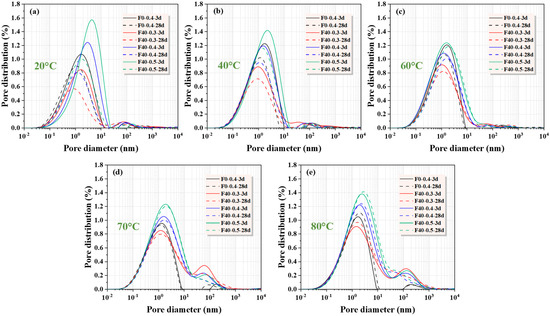
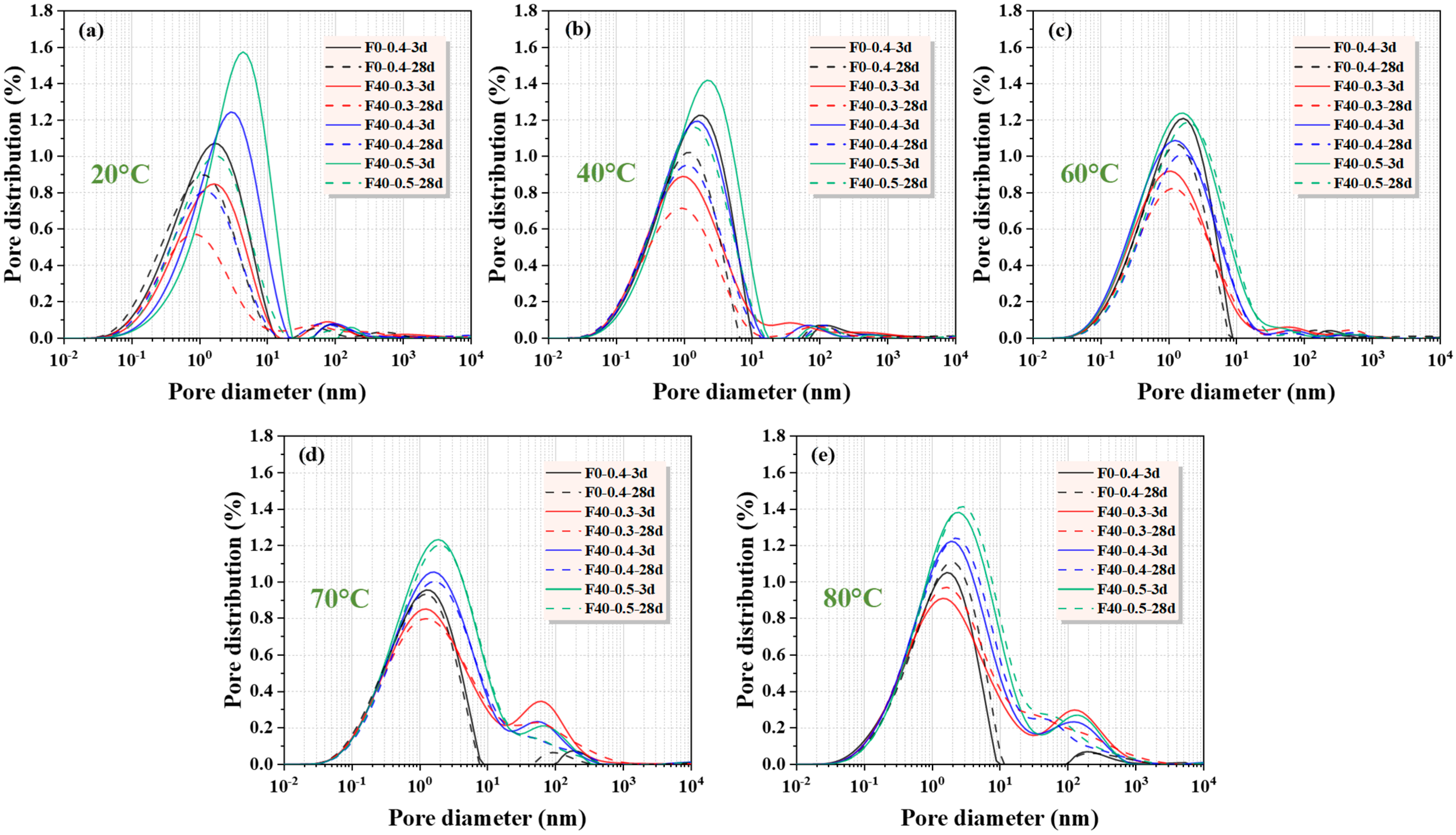
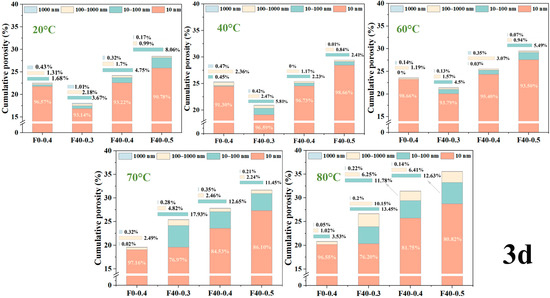
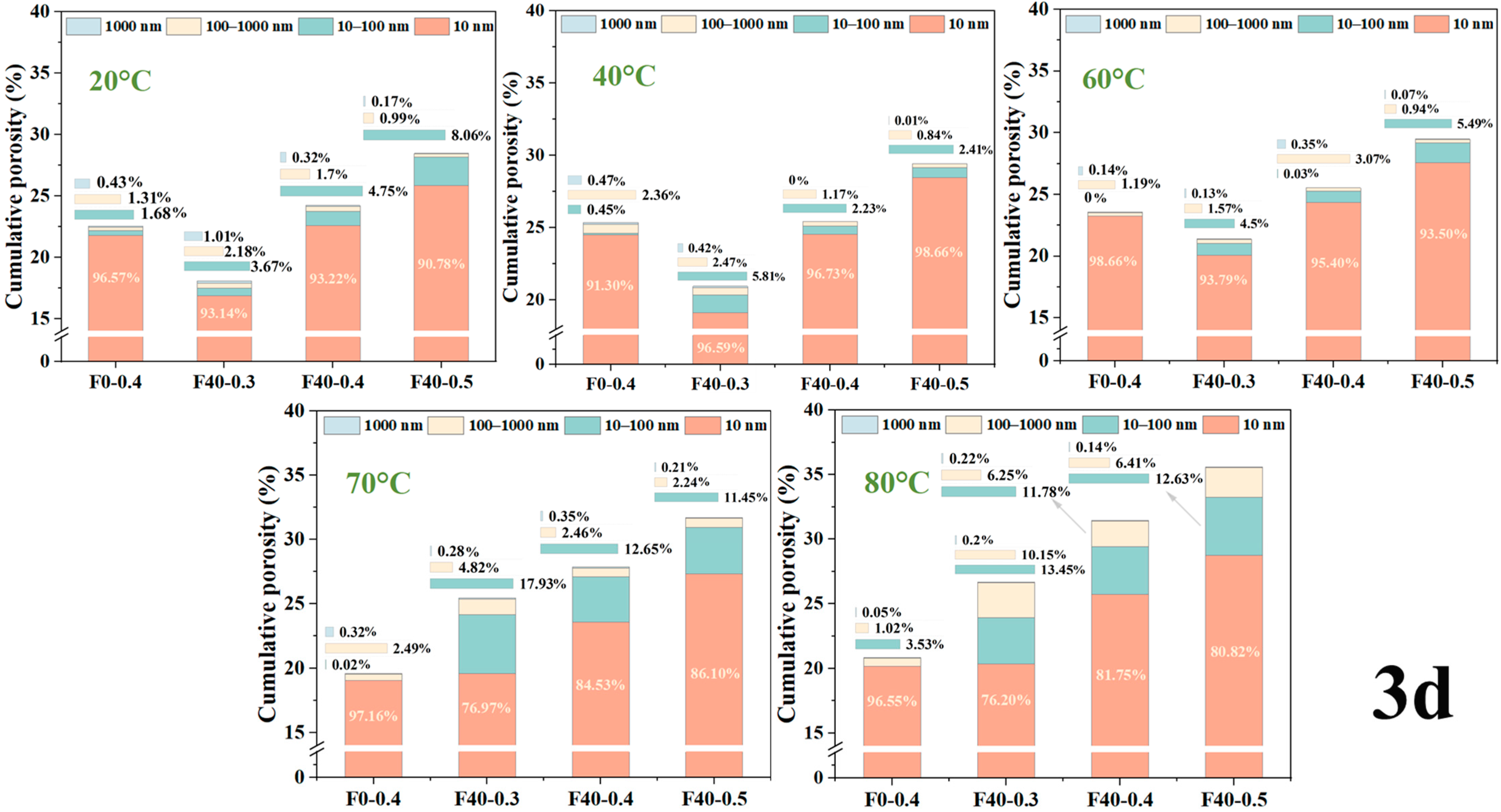
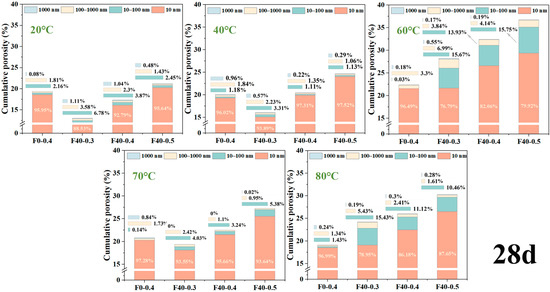
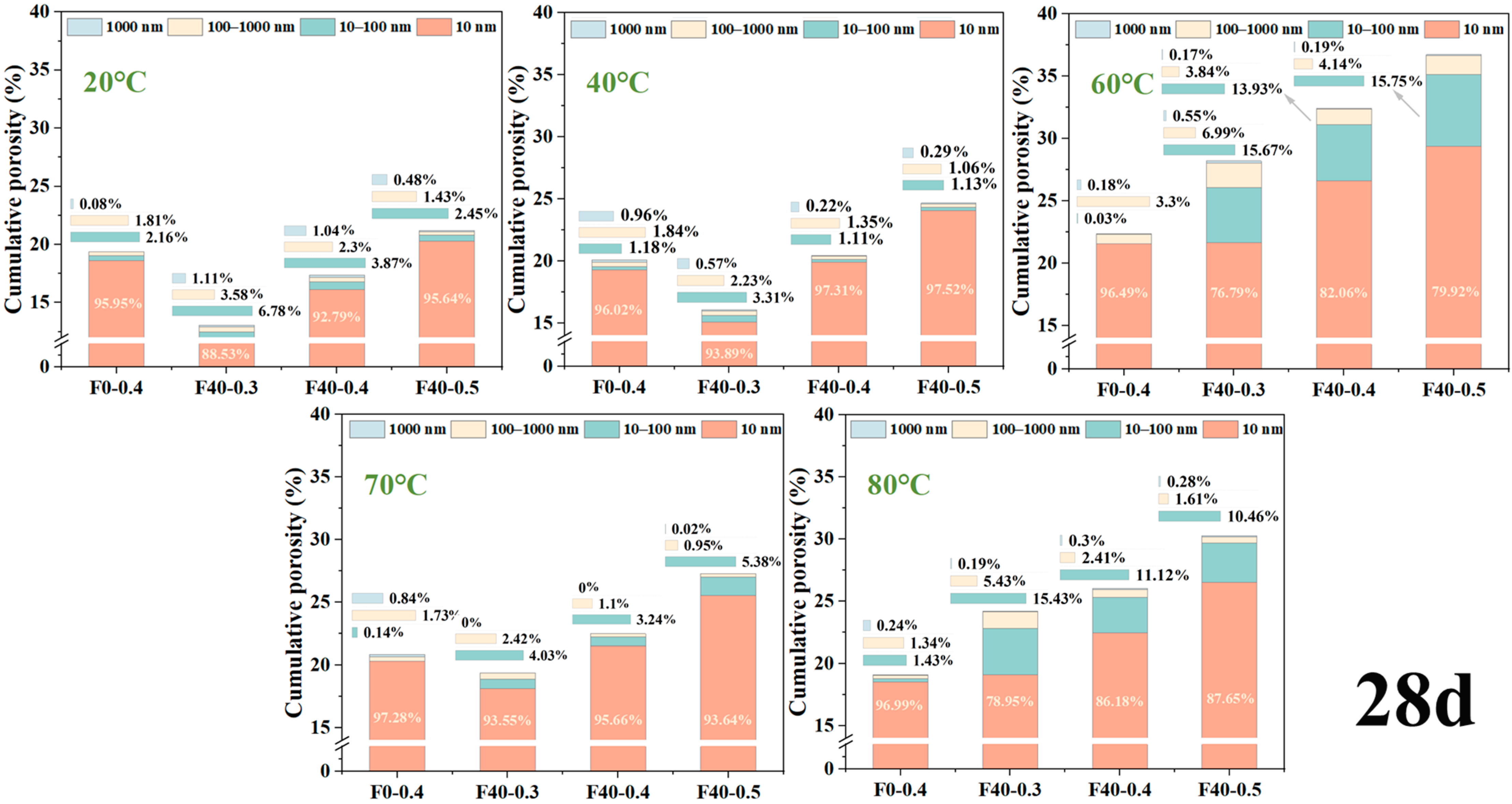
Figure 7, Figure 8 and Figure 9 present the pore size and pore volume distribution for each tested group at 3 d and 28 d under different curing temperatures. With increasing curing temperature, the content of gel pores exhibited a consistent rise. However, for larger pores (transition pores and capillary pores), the effect of temperature revealed a detrimental threshold: pore refinement was observed at 40 °C, and coarsening commenced at ≥60 °C and became more severe at ≥70 °C. Taking mix F40-0.4 as an example, the gel pore contents at 28 d were 16.04%, 19.84%, 21.26%, 22.92%, and 26.02% for curing temperatures from 20 °C to 80 °C, respectively. At 40 °C, the volumes of transition pores and capillary pores decreased to 59.04% and 79.37% of their 20 °C baseline values. In contrast, under curing at 70 °C and 80 °C, these volumes surged dramatically to 433% and 288% and 516% and 422% of the 20 °C baseline, respectively. The sharp increase in capillary porosity observed provides strong circumstantial evidence for microstructural damage, which aligns with the stress calculation results. Elevated temperature generally promotes hydration and C-S-H gel formation, thereby increasing the number of gel pores. Moderate heating (40 °C) allows hydration products to adequately fill pore spaces, leading to refinement. However, excessively high temperatures (≥60 °C) result in coarser crystallization and disordered distribution of hydration products. Early-age expansion may also create new void spaces, causing the expansion energy to be dissipated in forming a porous microstructure rather than contributing to macroscopic expansion.
Figure 7.
Pore size distributions at 3 d and 28 d under different temperatures: (a) 20 °C, (b) 40 °C, (c) 60 °C, (d) 70 °C, (e) 80 °C.
Figure 8.
Cumulative porosity and percentage of volume under different temperatures (3 d).
Figure 9.
Cumulative porosity and percentage of volume under different temperatures (28 d).
The pore-refining effect of FA diminishes and even reverses with increasing temperature. At high temperatures (≥70 °C), FA not only fails to remediate but may exacerbate microstructural damage. At 20 °C, FA contributes to pore refinement. Within the 40–60 °C range, FA reduces capillary pore volume but increases transition pore volume. At temperatures ≥ 70 °C, the combined action of FA and high temperature leads to severe pore coarsening. At ambient temperatures, the pozzolanic reaction and micro-aggregate effect of FA help optimize the pore structure. Its role becomes more complex at intermediate temperatures. Under high-temperature conditions, the synergistic hydration process between FA and cement may become misaligned; the slower reaction rate of FA cannot effectively fill the coarse pore framework formed by the rapid hydration of cement, which aligns with the lower early-age strength observed in Section 3.2.1.
Increasing the w/b systematically increases the most probable pore size and gel pore content, but its influence on other pore size ranges is inconsistent. Across all temperatures, a higher w/b led to an increase in both the most probable pore size and gel pore content. Capillary pore volume was greatest at a w/b of 0.3 and smallest at 0.4, while the volumes of transition pores and macropores showed no clear trend with varying w/b. A higher w/b implies a greater initial water-filled space, resulting in the formation of more gel pores and a larger characteristic pore size after hydration. The complex variation in capillary pore volume is likely related to a competitive mechanism between the efficiency with which they are filled by hydration products and the additional porosity created by early-age expansion.
3.3.2. Total Porosity
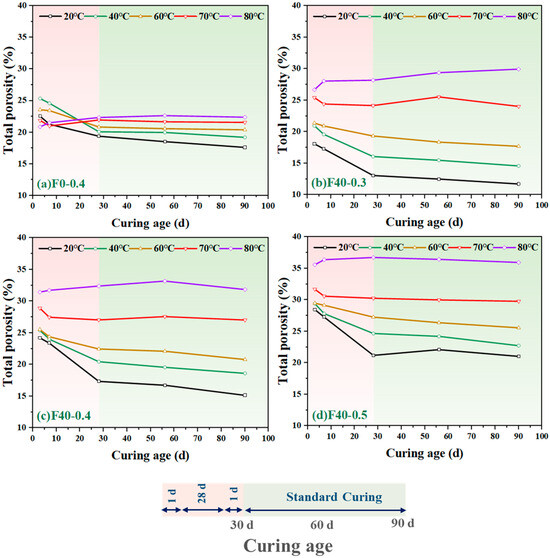
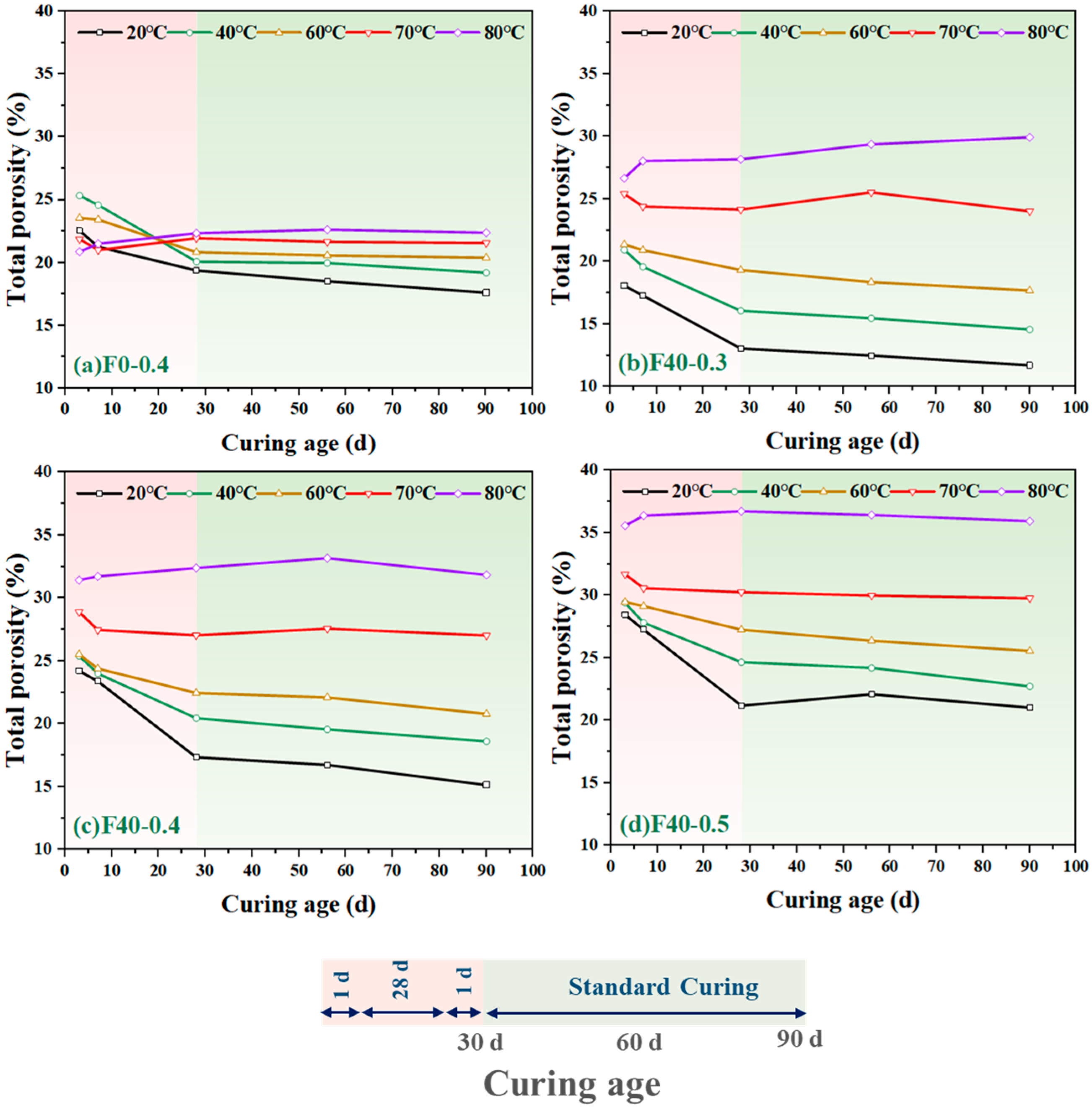
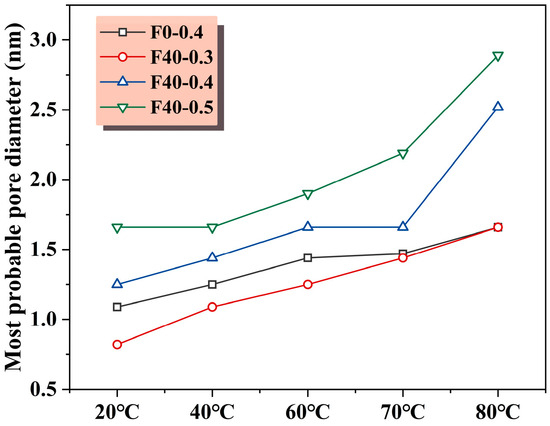
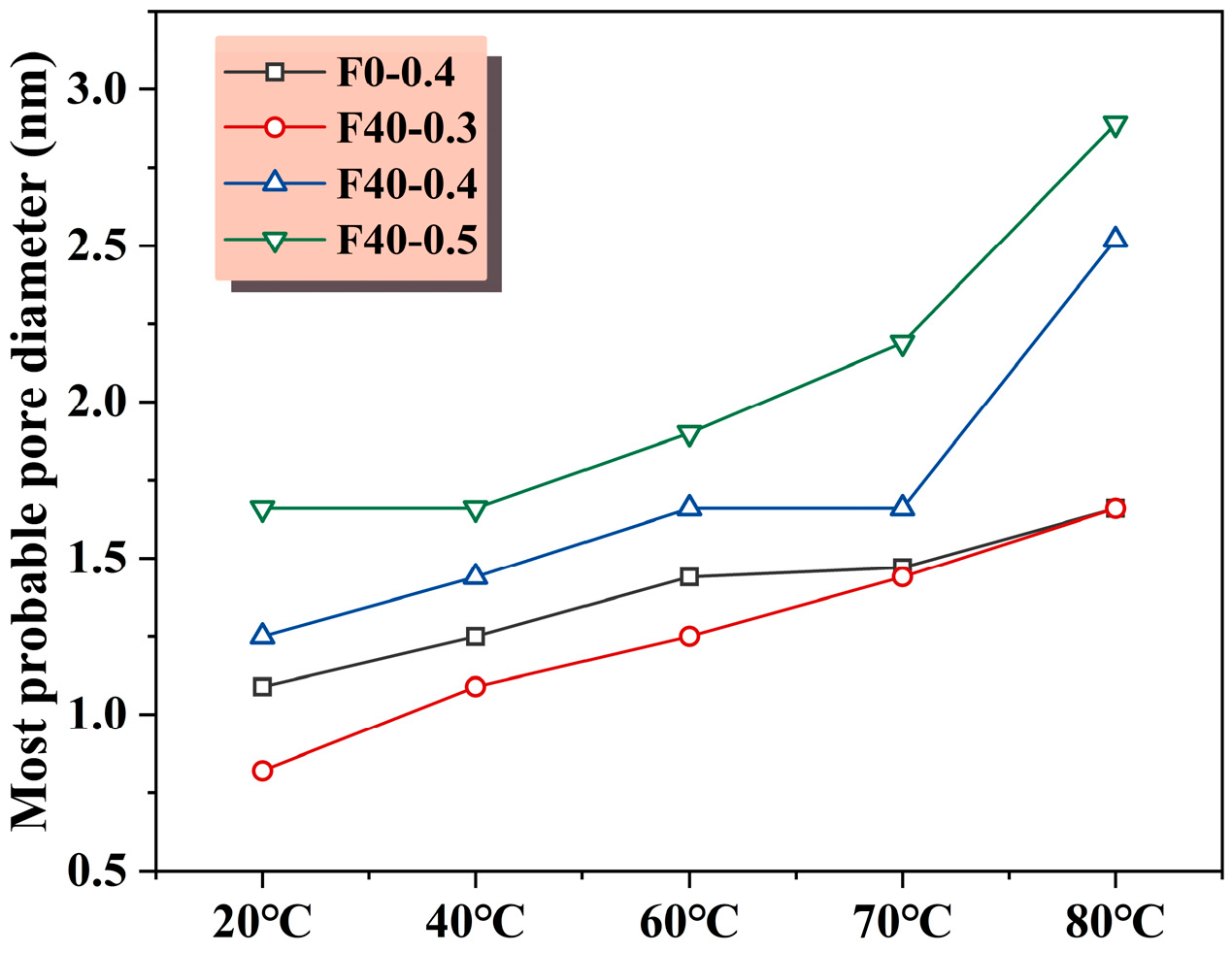
Total porosity is shown in Figure 10, while Figure 11 presents the most probable pore size at 28 d. Total porosity was predominantly influenced by temperature, with the most significant changes occurring before 28 d. For the plain cement system, porosity decreased markedly at temperatures ≤ 60 °C, but showed minimal further reduction at ≥70 °C. For systems containing FA, elevated temperatures (particularly 80 °C) slowed the early-age rate of porosity reduction and could even lead to a net increase in porosity. After 90 d of curing at 80 °C, the total porosity values for mixes F0-0.4, F40-0.3, F40-0.4, and F40-0.5 reached 22.39%, 29.96%, 31.85%, and 35.95%, respectively. For the FA-containing groups under 80 °C curing, the rate of porosity reduction before 28 d slowed with increasing temperature, and the 80 °C group exhibited an increase in porosity. In the plain cement system, excessively high temperatures (≥70 °C) cause hydration to proceed too rapidly. The hydration products prematurely rigidify the initially porous skeleton, thereby hindering subsequent continuous densification. For systems with FA, high temperatures exacerbate this effect. Furthermore, the slow reaction of FA is unable to effectively fill the coarse pores within the rapidly formed hydration framework under high temperatures, resulting in a system that retains high porosity in the long term. This trend directly corresponds to the impaired long-term strength development discussed in Section 3.2.1, confirming that the pore coarsening induced by high temperatures is one of the primary mechanisms responsible for the deterioration of mechanical properties.
Figure 10.
Total porosity results of the composite cementitious system: (a) F0-0.4, (b) F40-0.3, (c) F40-0.4, (d) F40-0.5.
Figure 11.
Variation in the most probable pore diameter at 28 d across different curing temperatures.
3.3.3. Quantitative Relationship Between Pore Distribution and Compressive Strength
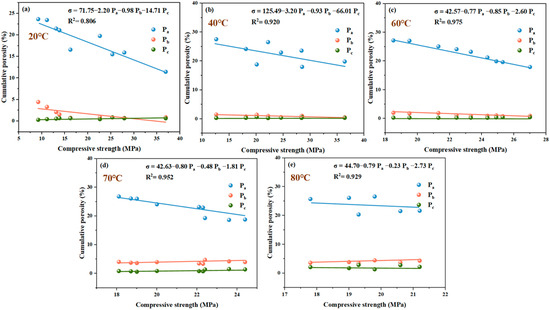
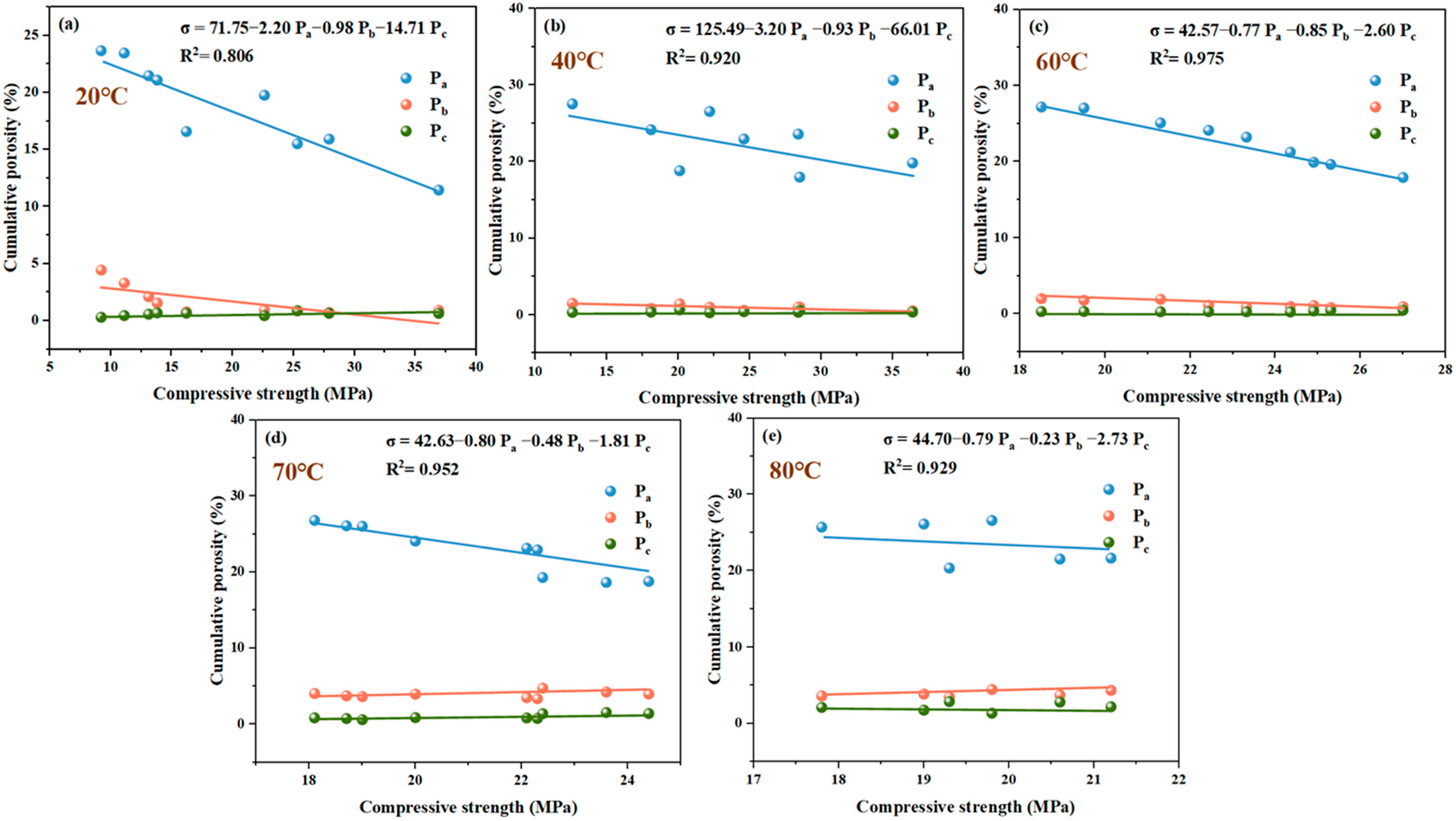
The experimental findings suggest that the reliance on porosity as the sole variable in current strength models [43] may lead to limited predictive accuracy. The variation in porosity itself constitutes the outcome of temperature effects. The model already incorporates the physical consequences arising from temperature, so temperature need not appear as an independent linear coefficient.
Even with identical total porosity, variations in pore size distribution can lead to significant differences in the compressive strength of mortar or concrete. Researchers have thus employed various methods to investigate the strength–pore size distribution relationship. To study the influence of pore size distribution on the compressive strength of mortar, this study classified pores into the following categories: gel pores Pa (<10 nm), transition pores Pb (10–100 nm), and capillary and large pores Pc (>100 nm). Based on LF-NMR test data, a multiple linear regression analysis [44] was conducted to establish an equation, as shown in Figure 12. Under each curing temperature, the content of capillary and large pores has the greatest impact on the compressive strength of mortar. Therefore, the variation in compressive strength is primarily attributable to capillary pores and large pores.
Figure 12.
Relationship between pore size distribution and compressive strength: (a) 20 °C, (b) 40 °C, (c) 60 °C, (d) 70 °C, (e) 80 °C.
3.4. XRD
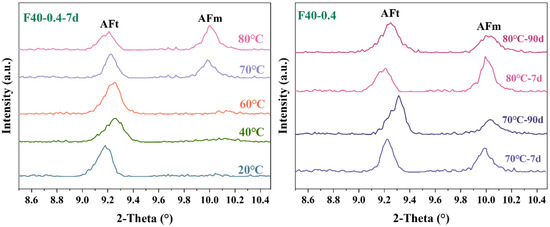
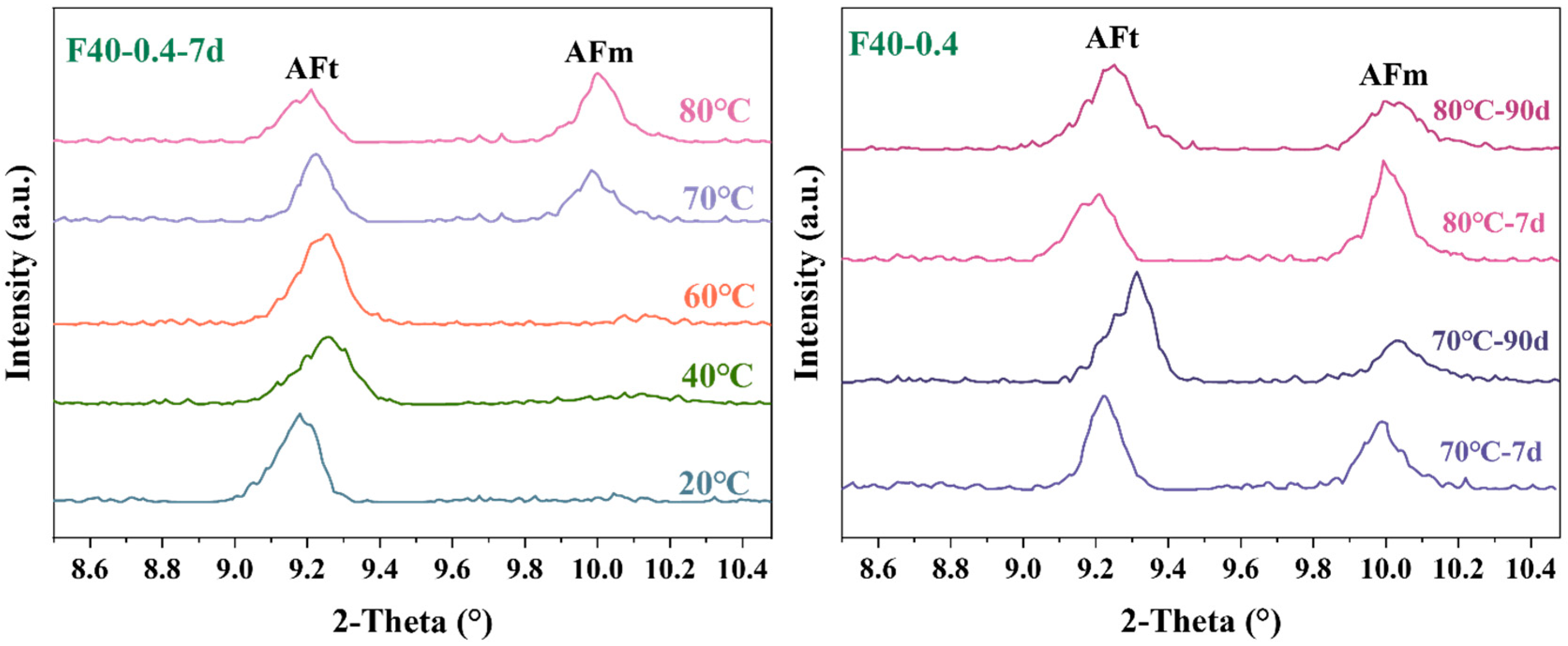
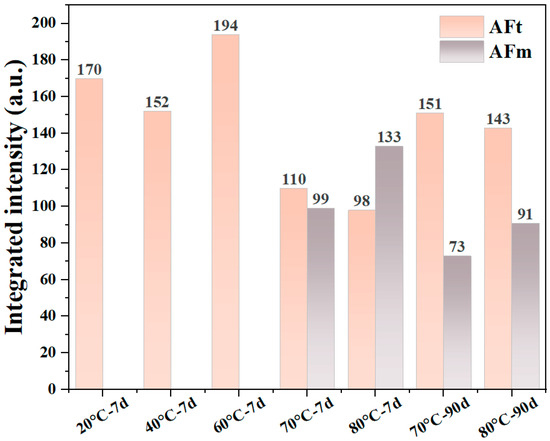
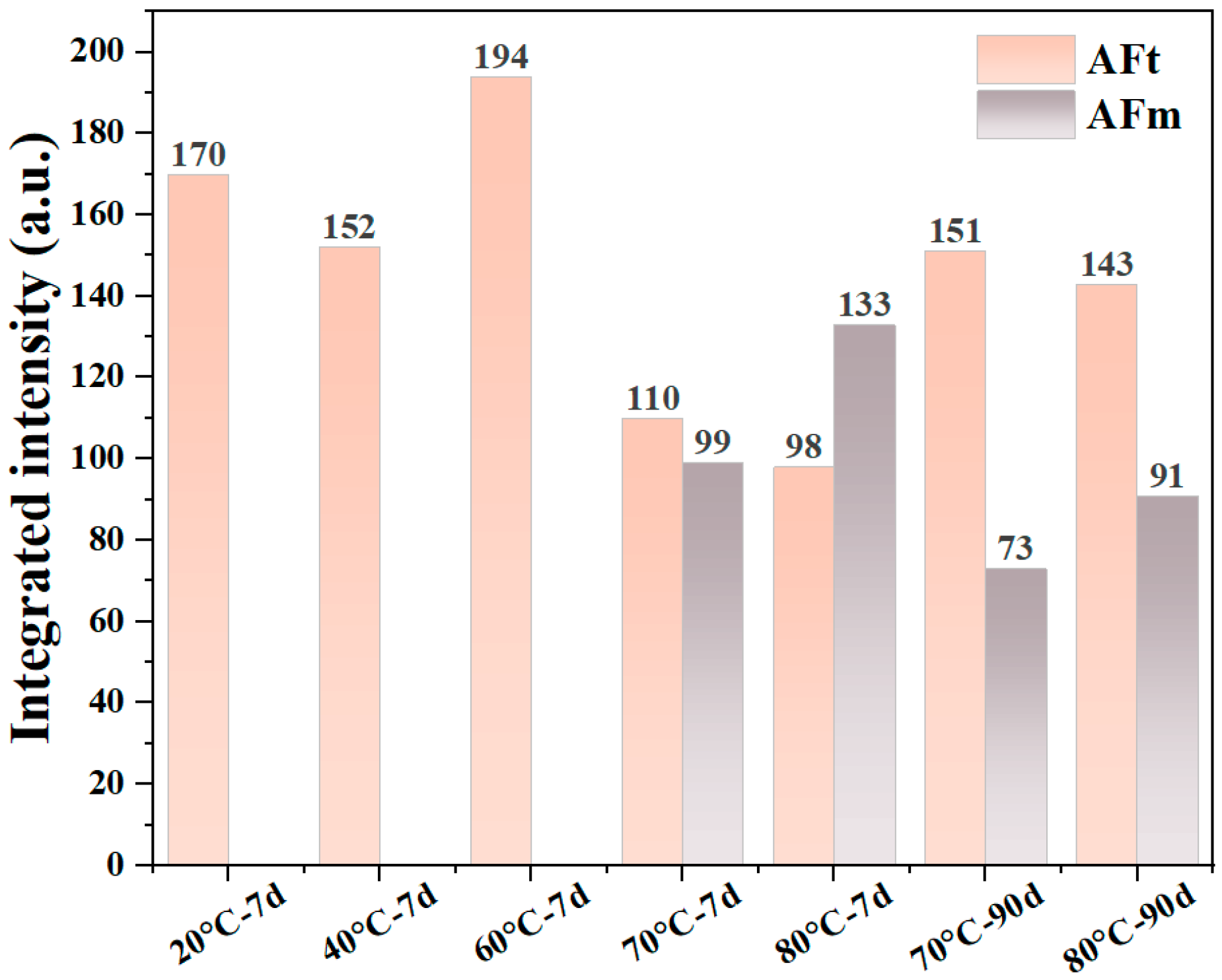
The resulting diffraction pattern of group F0-0.4 is shown in Figure 13. After background subtraction, the areas under the diffraction peaks of AFt and AFm were integrated, and the integrated intensities were used as indicators of the relative content of AFt. The analysis results are detailed in Figure 14.
Figure 13.
Step-scan XRD patterns of the F40-0.4 test group after high-temperature and transfer standard curing.
Figure 14.
Relative phase content of AFt and AFm based on integrated XRD peak areas.
The curves in Figure 13 and Figure 14 reveal that the relative content of AFt first rose and then fell as the curing temperature increased, peaking at 60 °C. Elevated temperatures (≥70 °C) led to the decomposition of AFt into AFm. Taking the F0-0.4 group as an example, the integrated intensity of the AFt diffraction peak at 40 °C was lower than that at 20 °C. A distinct maximum in AFt content was observed at 60 °C. When the temperature was increased to 70 °C and 80 °C, the intensity of the AFt peaks decreased significantly (falling below the level at 20 °C), accompanied by a corresponding increase in the intensity of AFm peaks. The apparent reduction in AFt content at 40 °C may be attributed to its dispersion within the C-S-H gel in a poorly crystalline or gel-like state (sometimes referred to as aluminosilicate-sulfate gel [31]), which is difficult to detect by conventional XRD. Nevertheless, this gel-like AFt still possesses significant expansive capacity [32]. The temperature of 60 °C appears optimal for the substantial formation and stability of AFt, which directly correlates with the peak restrained expansion ratio observed in Section 3.1. Temperatures ≥ 70 °C, however, induce the thermal decomposition of AFt into AFm, accounting for the sharp decline in expansive potential at these temperatures.
Upon transferring specimens from high-temperature curing to standard curing (up to 90 d), a reverse transformation from AFm back to AFt occurred. During the subsequent standard curing period, reduced intensity of AFm diffraction peaks was observed, concomitant with a recovery in the intensity of AFt peaks. This phase reversal phenomenon provides direct evidence of DEF. The underlying mechanism involves the reaction of sulfates in the system with AFm or other aluminum phases to reform AFt upon re-cooling and re-wetting. This mechanistically explains the expansion recovery, described in Section 3.1, observed in specimens initially subjected to high-temperature curing during their later stages. In this study, our primary focus was on short-term expansion behaviour and associated changes in mechanical properties; consequently, no quantitative evaluation of DEF was undertaken.
3.5. TG-DTG
The phase composition changes revealed by XRD help explain the expansion trends observed in Section 3.1. Specifically, the decrease in AFt content above 60 °C correlates with the decline in expansion ratio. Furthermore, TG-DTG results provide complementary evidence regarding the consumption of Ca(OH)2, which influences both AFt stability and pozzolanic activity.
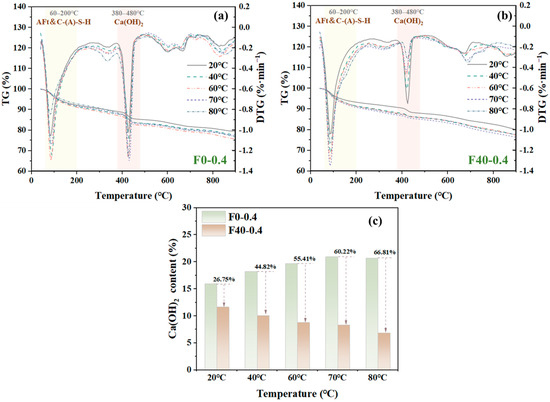
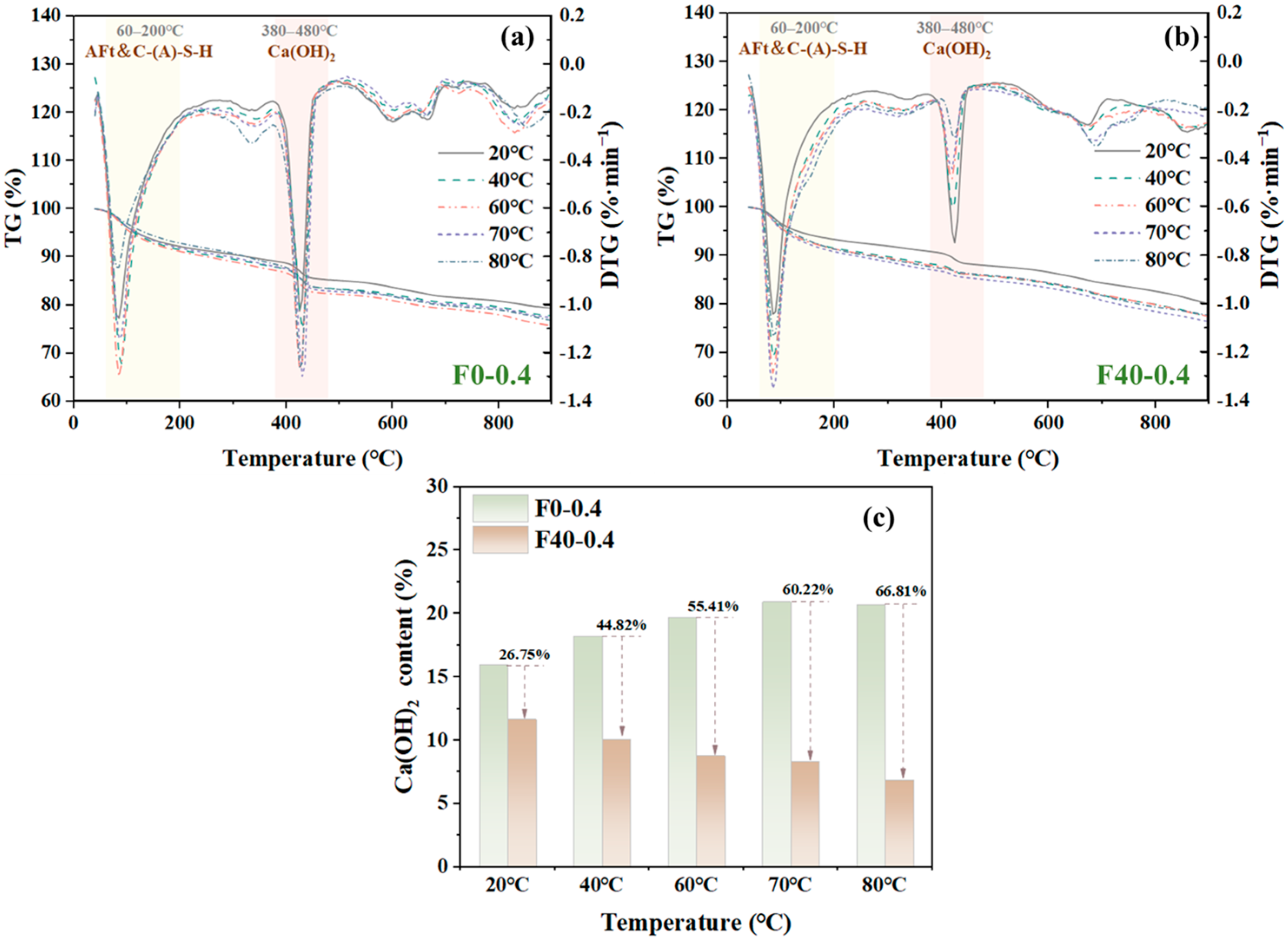
Figure 15a,b present the TG-DTG curves for test groups F0-0.4 and F40-0.4 after 7 d of curing at varying temperatures. As shown in Figure 15a,b, 60–200 °C corresponds to the decomposition of AFt and C-S-H gel; 380–480 °C represents the weight loss peak for Ca(OH)2. The two weight loss peaks after 550 °C indicate carbonate decomposition. The intensity of the weight loss peaks corresponding to AFt and C-S-H gel did not increase monotonically with temperature but showed a decline at specific high temperatures, indicating the thermal decomposition of AFt. Furthermore, the onset of a discernible decrease in the dehydration/weight loss signal associated with AFt in the TG-DTG curves occurred at a higher curing temperature in the FA system than in the plain cement system, indicating a higher apparent TG-DTG detectability threshold rather than a rigorously defined decomposition temperature. For the plain cement system, a decrease in the dehydration peak intensity was already observed for the specimen cured at 70 °C for 7 d. For the FA system, a similar decline was not observed until 80 °C, with no significant reduction noted at 70 °C. The decrease in dehydration peak intensity provides direct confirmation of AFt decomposition at high temperatures, which is consistent with the XRD findings. Accordingly, the observed difference between the plain cement and FA systems should be interpreted as an apparent shift in TG-DTG detectability of AFt decomposition, whereas XRD provides complementary evidence that is less affected by overlapping dehydration signals. This higher apparent threshold in the FA system is likely related to the enhanced pozzolanic reaction of FA at elevated temperatures, which promotes the formation of additional gel phases and increases the extent of gel-related dehydration within the same temperature interval. Because the 60–200 °C region includes overlapping dehydration contributions from both AFt and gel phases, the additional gel-related dehydration can partially compensate for the reduced AFt-related dehydration when AFt destabilization begins; therefore, the net change in peak intensity can be less visually pronounced (i.e., “masked”) at 70 °C. This “masking effect” is a qualitative interpretation of signal superposition in TG-DTG rather than a quantified threshold. It was observed that the decomposition peak of carbonates shifted to the right following the addition of fly ash. This may be attributed to two mechanisms: firstly, the filling effect resulting from fly ash incorporation leads to a denser pore structure; secondly, the pozzolanic reaction generates additional gel and alters the local chemical environment. This facilitates the dispersion of carbonates within the matrix, where they become encapsulated, potentially forming more complete crystals or a more stable calcium aluminate phase.
Figure 15.
(a,b) TG/DTG curves and (c) calculated Ca(OH)2 content of composite pastes after 7 d of curing.
As shown in Figure 15c, the influence of temperature on Ca(OH)2 content varies between systems. Its content increased with rising temperature in the plain cement system but decreased markedly in the FA system. In the F0-0.4 group, the Ca(OH)2 content increased from 20.98% at 20 °C to 25.64% at 80 °C. Conversely, in the F40-0.4 group, its content decreased substantially with increasing temperature. The results for the plain cement system reflect the acceleration of cement hydration by temperature, leading to more Ca(OH)2 generation. The results for the FA system demonstrate that elevated temperatures significantly promote the pozzolanic reaction of FA, thereby consuming large amounts of Ca(OH)2 [45].
The consumption of Ca(OH)2 by FA at high temperatures, which is typically beneficial for long-term densification, did not translate into enhanced mechanical strength (except at 40 °C), presenting an apparent contradiction to conventional understanding. As shown in Section 3.2, the mechanical strength of FA-containing systems at high temperatures was generally low, except at 40 °C. This contradiction arises because, under severe thermal conditions, negative factors become dominant. The extremely high early-age expansive stress (Section 3.2.3) and the significant coarsening of the pore structure (Section 3.3) act in concert to induce microstructural damage. This damaging effect completely overshadows the potential strength gain from the pozzolanic reaction, resulting in poor net strength performance.
3.6. SEM
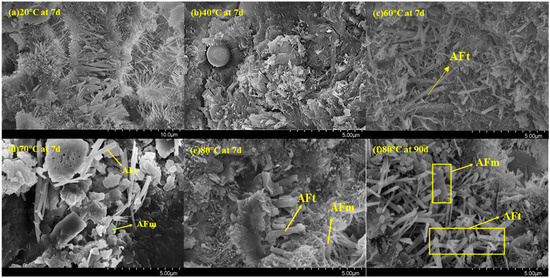
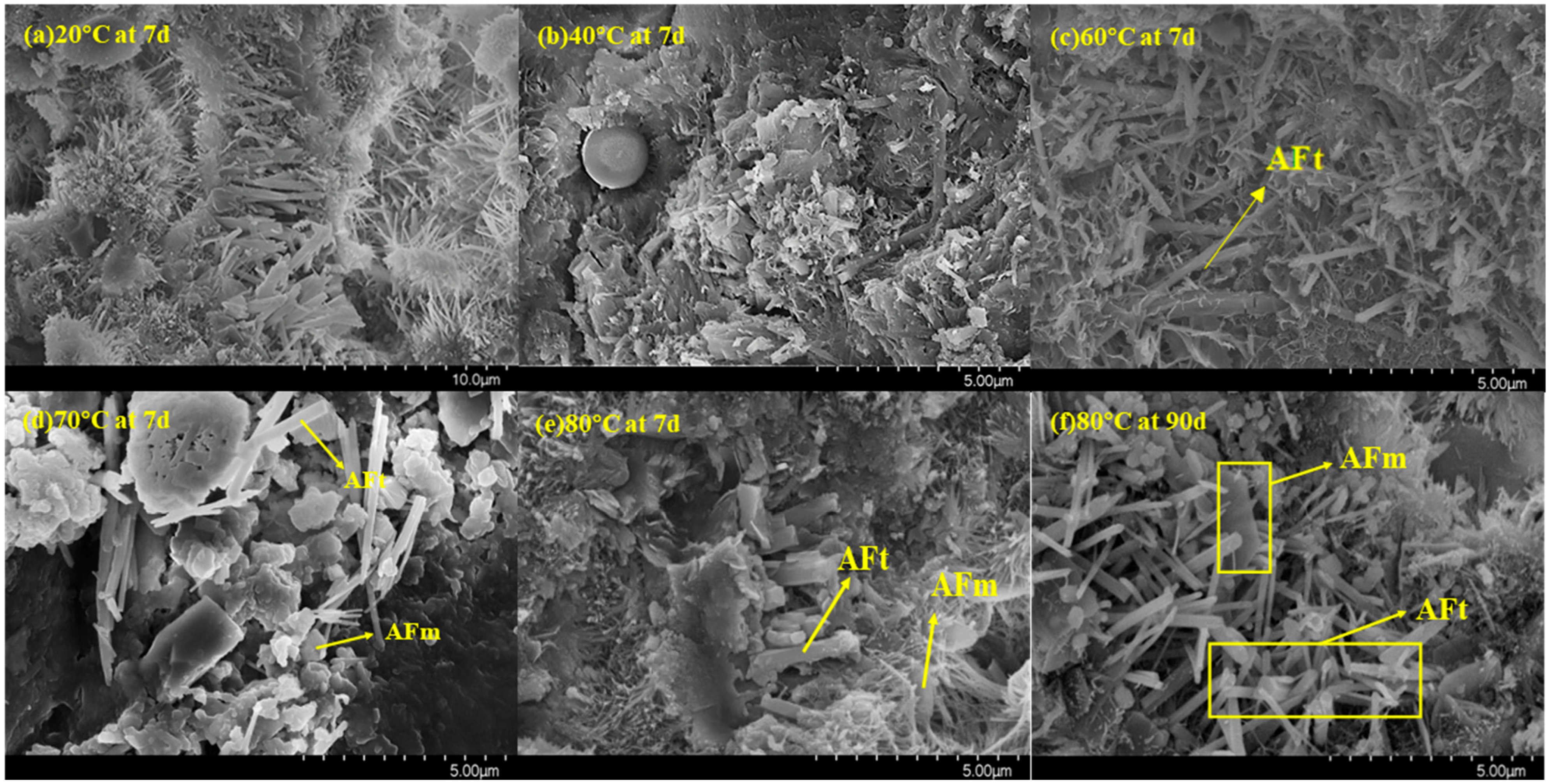
Figure 16 presents the microstructure of test group F40-0.4 after 7 d of curing at 20 °C, 40 °C, 60 °C, 70 °C, and 80 °C, as well as after subsequent transfer to standard curing for 90 d following initial curing at 80 °C. As the curing temperature increased, the crystal morphology of AFt evolved from elongated and needle-like to shorter, prismatic forms. At 20 °C, distinct, individual needle-like AFt crystals (about 2–5 μm in length) were observed, radiating from pores and cracks. At 40 °C, alongside crystalline AFt, gel-like AFt intermixed with C-S-H gel appeared. At 60 °C and 70 °C, AFt crystals remained intertwined with C-S-H gel, but their morphology transitioned to coarser, prismatic shapes (about 5–8 μm in length). The interlocking growth of needle-like AFt crystals generates internal pressure, contributing to expansion. The gel-like AFt can induce swelling through water absorption and inter-particle repulsion [46], which helps to explain the notable expansion observed at 40 °C. High temperatures promote crystal coarsening, likely related to accelerated ion migration rates and changes in crystallization driving forces.
Figure 16.
The micro-morphology of F40-0.4: (a) 20 °C at 7 d, (b) 40 °C at 7 d, (c) 60 °C at 7 d, (d) 70 °C at 7 d, (e) 80 °C at 7 d, (f) 80 °C at 90 d.
There exists a critical temperature (70 °C) beyond which partial decomposition of AFt occurs, forming AFm, with the AFm content increasing at higher temperatures. The presence of AFm was detected in the microstructure at 70 °C. At 80 °C, the AFm content increased substantially. This provides direct morphological evidence for the thermal decomposition of AFt indicated by XRD. The appearance of and increase in AFm visually explain the micro-mechanism behind the reduced expansive capacity of the material at temperatures ≥ 70 °C.
Even after transfer to long-term standard curing (up to 90 d) following initial high-temperature (80 °C) curing, AFm persisted, and the reverse transformation to AFt was incomplete. The SEM observations confirmed that residual AFm persisted in the samples that were initially cured at 80 °C for 7 d and subsequently stored under standard conditions for 90 days. The persistent presence of AFm indicates that a potential phase basis for renewed AFt formation under suitable conditions remains within the system. This, at the microstructural level, corroborates the macroscopically observed risk of sustained delayed expansion, explaining the phenomenon of limited expansion recovery during later standard curing in specimens initially subjected to high-temperature curing.
4. Discussion
This study systematically elucidates the regulatory mechanism of curing temperature on the expansion behaviour of the HCSA–cement–FA composite system through macro–micro multi-scale testing. Its core lies in temperature governing the evolution of pore structure and macroscopic mechanical response by controlling the stability and transformation pathway of the key expansion phase (AFt).
Within the temperature range below 60 °C, an increase in temperature generally promotes the development of expansion in the system. Microstructural analysis indicates that a moderate temperature rise accelerates the hydration reactions of both cement and HCSA. XRD and SEM results demonstrate that when the temperature rises to 60 °C, the formation of AFt increases significantly, and its typical needle-like crystals (2–5 μm) transition to prismatic crystals (5–8 μm). Concurrently, TG-DTG analysis confirms that within this temperature range, the Ca(OH)2 content in the system rises with increasing temperature, providing the necessary alkaline environment and sufficient calcium source for the sustained formation of AFt [47]. Pore structure data from LF-NMR analysis provide structural-level support for this mechanism: within this temperature range, particularly at 40 °C, the increased hydration products effectively fill the pores, leading to a reduction in the proportion of transition and capillary pores and a refinement of the pore size distribution [48]. Therefore, at temperatures below 60 °C, the temperature increase drives the orderly development of macroscopic expansion efficiency through the synergistic promotion of hydration reactions, an increase in the amount of the effective expansive phase (AFt), and the optimization of the pore structure. This coordinated effect allows for a favourable alignment between expansion and strength development.
When the curing temperature exceeds 70 °C, a fundamental transformation occurs in the expansive system. XRD and SEM directly observe a decrease in AFt characteristic peak intensity, coarsening of prismatic crystals, and the appearance of AFm, confirming the thermal decomposition of AFt [49]. This phase change is the direct cause of the significant attenuation in macroscopic expansion at 70–80 °C. More critically, this phase transformation process is tightly coupled with pore structure deterioration. LF-NMR data show a sharp increase in the volume of transition and capillary pores, alongside an increase in total porosity [50]. This indicates that the decomposition of AFt compromises the microstructural integrity of the matrix and induces significant pore coarsening. The coarse pore network not only weakens the matrix strength (as shown in Section 3.2) but also acts as an expansion buffer, dissipating expansive energy within the pores rather than generating effective volumetric deformation.
The AFm formed at high temperatures serves as a potential secondary expansion source during subsequent standard curing. XRD results clearly show that for specimens transferred to standard curing for 90 d after high-temperature curing, AFm peak intensity decreases while AFt peak intensity recovers. This demonstrates the conversion of AFm back to AFt (DEF). SEM observations also reveal the persistence of residual AFm even after prolonged standard curing, suggesting that the DEF process may be slow and prolonged. This mechanism explains the phenomenon observed in Section 3.1: specimens initially cured at high temperatures exhibited abnormal expansion recovery during later standard curing stages, constituting a long-term cracking risk.
The effect of FA is temperature-dependent. At low to moderate temperatures (≤60 °C), its pozzolanic reaction consumes Ca(OH)2, moderately regulating the system alkalinity and AFt formation rate, which helps improve expansion stability. However, at high temperatures (≥70 °C), the incorporation of FA exhibits a superimposed negative effect with thermal influence: on one hand, its insufficient early-age activity leads to a weaker structural skeleton; on the other hand, while high temperature accelerates its pozzolanic reaction, consuming more Ca(OH)2 (confirmed by TG-DTG), it exacerbates microstructural heterogeneity. Combined with high temperature, this promotes further pore coarsening, intensifying strength retrogression and expansion reduction. The influence of the w/b ratio is more direct. The high initial porosity from a high w/b absorbs more expansive energy, reducing expansion efficiency, but also mitigates early-age microcracking induced by concentrated expansive stress in low-w/b systems (as indicated by the anomalous flexural strength behaviour) [37].
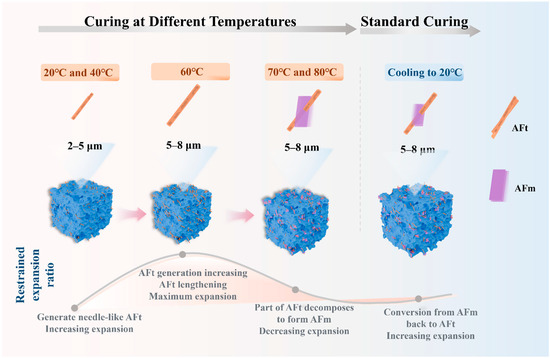
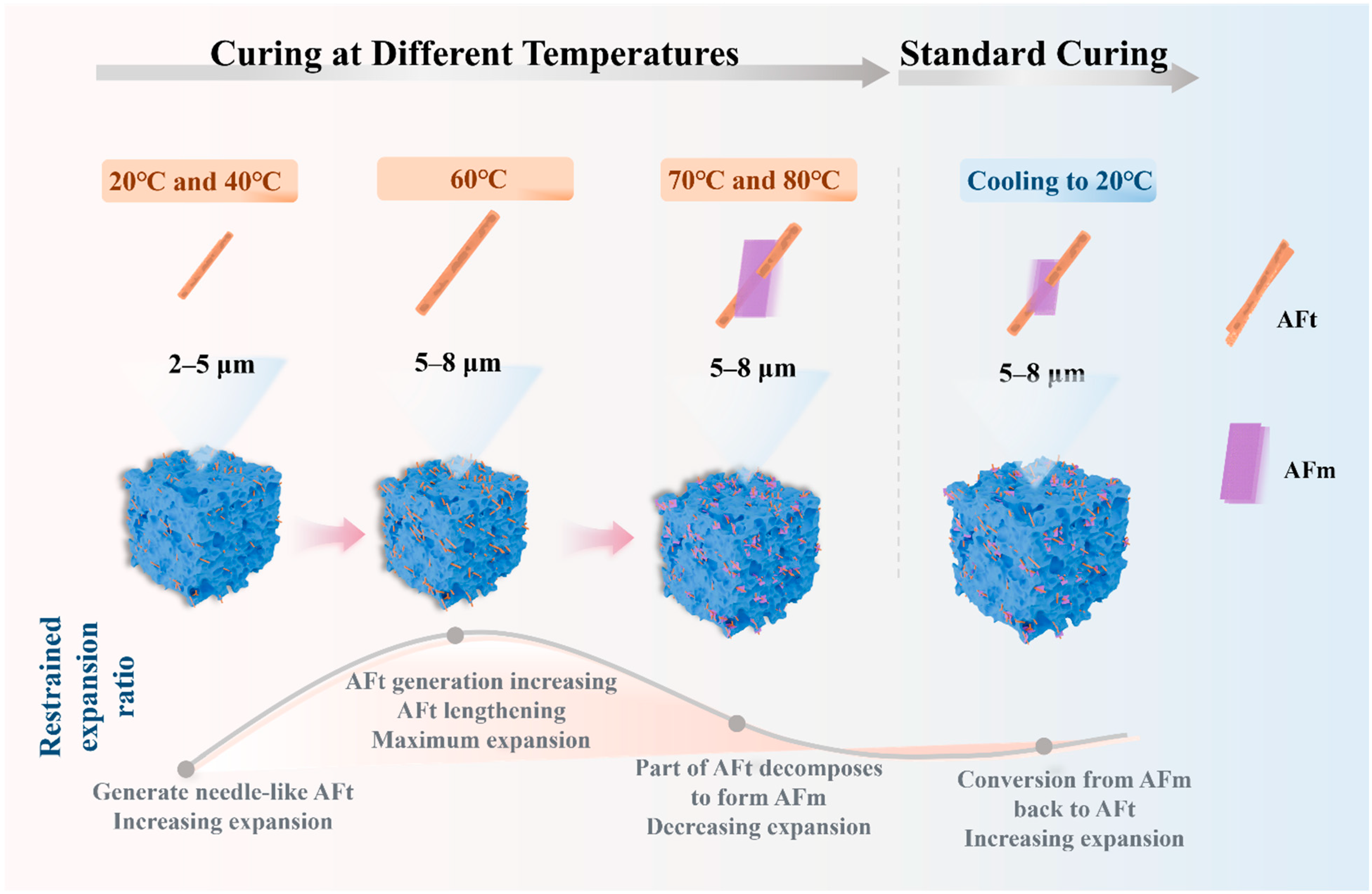
Conclusive Mechanistic Framework: In summary, the expansion mechanism of this system can be described by a temperature-governed framework: In the low-to-moderate temperature zone (≤60 °C), expansion is dominated by the stable formation and crystal growth of AFt, leading to coordinated property development. In the high-temperature zone (≥70 °C), the mechanism shifts to being dominated by AFt decomposition and AFm formation, triggering pore structure deterioration and expansive energy dissipation, accompanied later by the delayed conversion of AFm to AFt (DEF), creating long-term risk. Within this temperature framework, FA and w/b play crucial synergistic regulatory roles by influencing the reaction environment, pore characteristics, and stress levels. Although it is critical to maintain the maximum curing temperature below 60 °C to avoid the adverse effects of AFt decomposition, we acknowledge that in practical applications, especially in large-volume concrete, temperatures may exceed this threshold. In such cases, it is not recommended to completely restrict the use of HCSA. Instead, we suggest optimizing the system design by adjusting the HCSA dosage, water-to-binder ratio, or using appropriate admixtures to control the expansive behaviour and mitigate DEF risks. This approach can ensure that HCSA still provides effective shrinkage compensation and maintains structural stability under higher-temperature conditions. The expansion mechanism diagram is shown in Figure 17.
Figure 17.
Schematic illustration of the temperature-governed expansion mechanism and microstructural evolution of the HCSA–cement–FA system.
The hydration products of both HCSA and CSA expansive agents contain AFt; hence, their expansion mechanisms share similarities. The expansive effects of both primarily stem from the formation and expansion of AFt during hydration. The expansion mechanism of MgO expansive agents differs from that of HCSA and CSA expansive agents. Their expansion effect arises from the reaction of MgO with water to form Mg(OH)2, leading to expansion. Particularly at elevated temperatures, MgO expansive agents exhibit superior thermal stability. HCSA and CSA expansive agents may face AFt decomposition issues under high-temperature conditions. However, HCSA contains both CSA clinker and free CaO. The hydration of CaO (Ca(OH)2 expansion) is extremely vigorous and irreversible at high temperatures, representing a significant difference from CSA derived solely from AFt. MgO expansive agents maintain favourable expansion effects at elevated temperatures. This very characteristic constitutes the unique value of this study in investigating the high-temperature sensitivity of HCSA.
5. Conclusions
This study systematically investigates the effects of curing temperature, FA content, and w/b on the performance of this HCSA-based composite cementitious system. By closely integrating macro-scale test results with micro-scale characterization, the following core principles and mechanisms are revealed:
- (1)
- A critical performance threshold of approximately 60 °C governs expansion behaviour, fundamentally linked to the thermal stability of AFt. The restrained expansion ratio peaked at 60 °C, corresponding to the maximum AFt content measured by XRD. At temperatures ≥ 70 °C, the thermal decomposition of AFt into AFm occurred, leading to a significant attenuation of expansive capacity. This phase change was directly observed via SEM, showing the formation of AFm crystals and a morphological transition of AFt from needle-like to prismatic forms.
- (2)
- The degradation of mechanical properties results from the combined effects of early-age expansive stress and deterioration of the pore structure. While high temperatures accelerated early hydration and boosted short-term strength, they impeded long-term strength development. Calculations indicated that at temperatures ≥ 40 °C, the early-age expansive stress exceeded the material’s tensile strength, readily causing microcracks. LF-NMR analysis confirmed that curing at ≥ 70 °C caused a drastic increase (3 to 5 times the values at 20 °C) in the volumes of transition and capillary pores, indicating severe pore coarsening. This is identified as the primary microstructural cause for the stagnation and retrogression of strength.
- (3)
- DEF constitutes a major long-term risk following high-temperature curing. XRD and SEM monitoring confirmed that in specimens initially cured at 70–80 °C and subsequently transferred to standard curing, the AFm content decreased while AFt recovered, clearly demonstrating the occurrence of DEF. This process is the fundamental reason for the renewed increase in expansion rate during the later stages of standard curing for the high-temperature groups, posing a potential risk of late-age cracking.
- (4)
- FA and w/b ratio play modulating roles. FA suppressed later-age expansion at ambient temperature but could enhance expansion stability within the 40–60 °C range. However, at temperatures ≥ 70 °C, FA exacerbated pore coarsening and was detrimental to strength development. Increasing the w/b ratio generally reduced both the expansion ratio and strength but increased the resistance to DEF after high-temperature curing.
Author Contributions
Conceptualization, L.G., F.R. and J.F.; methodology, L.G., F.R. and J.F.; software, K.W., J.Q. and W.Z.; validation, L.G., F.R. and J.F.; formal analysis, L.G., F.R. and J.F.; investigation, K.W., W.Z., J.Q., J.W., X.L., F.R., L.G. and J.F.; resources, L.G., F.R. and J.F.; data curation, J.Q., L.G., F.R. and J.F.; writing—original draft preparation, K.W., W.Z., J.Q., L.G., J.W., X.L., F.R. and J.F.; writing—review and editing, K.W., W.Z., J.Q., L.G., J.W., X.L., F.R. and J.F.; visualization, K.W., W.Z., J.Q., L.G., J.W., X.L., F.R. and J.F.; supervision, L.G., J.W., X.L., F.R. and J.F.; project administration, L.G., F.R. and J.F.; funding acquisition, L.G., F.R. and J.F. All authors have read and agreed to the published version of the manuscript.
Funding
This research was funded by the National Natural Science Foundation of China (52178227, 52478263 and 52402031) and project ZR2025QC1144 supported by Shandong Provincial Natural Science Foundation.
Data Availability Statement
Data are available on request due to restrictions.
Conflicts of Interest
Author Xunmei Liang was employed by the company Shandong Road New Materials Co., Ltd. The remaining authors declare that the research was conducted in the absence of any commercial or financial relationships that could be construed as a potential conflict of interest.
References
- Liu, F.; Shen, S.-L.; Hou, D.-W.; Arulrajah, A.; Horpibulsuk, S. Enhancing behavior of large volume underground concrete structure using expansive agents. Constr. Build. Mater. 2016, 114, 49–55. [Google Scholar] [CrossRef] [Scilit]
- Cai, Y.; Wang, F.; Zhao, Z.; Lyu, Z.; Wang, Y.; Zou, P. Early-hydration heat and influencing factor analysis of large-volume concrete box girder based on equivalent age. Structures 2023, 50, 1699–1713. [Google Scholar] [CrossRef] [Scilit]
- Wu, H.; Hu, X.; Liu, J. Investigations of the hydration heat of large-volume precast concrete bent caps using layered pouring and a new temperature control measure. Case Stud. Constr. Mater. 2024, 20, e03296. [Google Scholar] [CrossRef] [Scilit]
- Ma, W.; Li, H.; Chen, X.; Wang, J.; Feng, S.; Xiao, C.; Shi, M. Large-volume dam pier concrete hygro–thermo–mechanical model for crack cause analysis and active control. Struct. Control Health Monit. 2025, 2025, 6228726. [Google Scholar] [CrossRef] [Scilit]
- Yan, P.; Qin, X. The effect of expansive agent and possibility of delayed ettringite formation in shrinkage-compensating massive concrete. Cem. Concr. Res. 2001, 31, 335–337. [Google Scholar] [CrossRef] [Scilit]
- Pan, Z.; Zhu, Y.; Zhang, D.; Chen, N.; Yang, Y.; Cai, X. Effect of expansive agents on the workability, crack resistance and durability of shrinkage-compensating concrete with low contents of fibers. Constr. Build. Mater. 2020, 259, 119768. [Google Scholar] [CrossRef] [Scilit]
- Gu, L.; Qin, X.; Feng, J. Experimental studies on the volume stability of mgo expansion agent in concrete. J. Build. Eng. 2023, 79, 107866. [Google Scholar] [CrossRef] [Scilit]
- Ji, X.; Wang, B.; Liu, M.; Zhang, W.; Ming, Y.; Ma, H. Expansion and creep of concrete with expansive agents at variable temperature. J. Build. Eng. 2024, 87, 108982. [Google Scholar] [CrossRef] [Scilit]
- Li, B.; Wu, C.; Li, Y.; Wang, S.; Jia, L.; Xia, D. Expansive behavior of high-strength self-stressing and self-compacting concrete: Experimental study and analytical model. Constr. Build. Mater. 2022, 353, 129080. [Google Scholar] [CrossRef] [Scilit]
- Mehdipour, I.; Khayat, K.H. Effect of shrinkage reducing admixture on early expansion and strength evolution of calcium sulfoaluminate blended cement. Cem. Concr. Compos. 2018, 92, 82–91. [Google Scholar] [CrossRef] [Scilit]
- Yan, P.; Zheng, F.; Peng, J.; Qin, X. Relationship between delayed ettringite formation and delayed expansion in massive shrinkage-compensating concrete. Cem. Concr. Compos. 2004, 26, 687–693. [Google Scholar] [CrossRef] [Scilit]
- Heinz, D.; Ludwig, U. Mechanism of secondary ettringite formation in mortars and concretes subjected to heat treatment. ACI Symp. Publ. 1987, 100, 2059–2072. [Google Scholar]
- Yan, P.; Qin, X.; Yang, W.; Peng, J. The semiquantitative determination and morphology of ettringite in pastes containing expansive agent cured in elevated temperature. Cem. Concr. Res. 2001, 31, 1285–1290. [Google Scholar] [CrossRef] [Scilit]
- Brown, P.W.; Bothe, J.V., Jr. The stability of ettringite. Adv. Cem. Res. 1993, 5, 47–63. [Google Scholar] [CrossRef] [Scilit]
- Feng, J.; Miao, M.; Yan, P. The effect of curing temperature on the properties of shrinkage-compensated binder. Sci. China Technol. Sci. 2011, 41, 869–875. [Google Scholar] [CrossRef] [Scilit]
- Wang, L.; Shu, C.; Jiao, T.; Han, Y.; Wang, H. Effect of assembly unit of expansive agents on the mechanical performance and durability of cement-based materials. Coatings 2021, 11, 731. [Google Scholar] [CrossRef] [Scilit]
- Yoon, S.; Choi, W.; Jeon, C. Mock-up performance evaluation study for crack reduction of blast furnace slag powder concrete mixed with expansive and swelling admixtures. Sci. Rep. 2024, 14, 2399. [Google Scholar] [CrossRef] [Scilit]
- Ayub, T.; Khan, S.U.; Memon, F.A. Mechanical characteristics of hardened concrete with different mineral admixtures: A review. Sci. World J. 2014, 2014, 875082. [Google Scholar] [CrossRef] [Scilit]
- Zou, C.; Long, G.; Xie, Y.; He, J.; Ma, C.; Zeng, X. Evolution of multi-scale pore structure of concrete during steam-curing process. Micropor. Mesopor. Mater. 2019, 288, 109566. [Google Scholar] [CrossRef] [Scilit]
- He, J.; Long, G.; Ma, K.; Xie, Y.; Ma, C. Hydration heat evolution of portland cement paste during unsteady steam curing process: Modelling and optimization. Thermochim. Acta 2020, 694, 178784. [Google Scholar] [CrossRef] [Scilit]
- Richardson, I. Tobermorite/jennite- and tobermorite/calcium hydroxide-based models for the structure of c-s-h: Applicability to hardened pastes of tricalcium silicate, β-dicalcium silicate, portland cement, and blends of portland cement with blast-furnace slag, metakaolin, or silica fume. Cem. Concr. Res. 2004, 34, 1733–1777. [Google Scholar]
- Lothenbach, B.; Winnefeld, F.; Alder, C.; Wieland, E.; Lunk, P. Effect of temperature on the pore solution, microstructure and hydration products of portland cement pastes. Cem. Concr. Res. 2007, 37, 483–491. [Google Scholar] [CrossRef] [Scilit]
- Cao, Y.; Detwiler, R.J. Backscattered electron imaging of cement pastes cured at elevated temperatures. Cem. Concr. Res. 1995, 25, 627–638. [Google Scholar] [CrossRef] [Scilit]
- GB/T 23439-2017; Expansion Agents for Concrete. Standardization Administration of China: Beijing, China, 2017.
- GB/T 17671-2021; Test Method of Cement Mortar Strength (ISO Method). Standardization Administration of China: Beijing, China, 2021.
- Chen, B.; Zhang, Y.; Chen, Q.; Yang, F.; Liu, X.; Wu, J.; Wang, P. Effect of mineral composition and w/c ratios to the growth of aft during cement hydration by in-situ powder x-ray diffraction analysis. Materials 2020, 13, 4963. [Google Scholar] [CrossRef] [Scilit]
- Venkataramanan, L.; Song, Y.Q.; Hürlimann, M.D. Solving fredholm integrals of the first kind with tensor product structure in 2 and 2.5 dimensions. Trans. Sig. Proc. 2002, 50, 1017–1026. [Google Scholar] [CrossRef] [Scilit]
- Zhou, C.; Ren, F.; Wang, Z.; Chen, W.; Wang, W. Why permeability to water is anomalously lower than that to many other fluids for cement-based material? Cem. Concr. Res. 2017, 100, 373–384. [Google Scholar] [CrossRef] [Scilit]
- Zhou, C.; Ren, F.; Zeng, Q.; Xiao, L.; Wang, W. Pore-size resolved water vapor adsorption kinetics of white cement mortars as viewed from proton nmr relaxation. Cem. Concr. Res. 2018, 105, 31–43. [Google Scholar] [CrossRef] [Scilit]
- Scrivener, K.; Snellings, R.; Lothenbach, B. A Practical Guide to Microstructural Analysis of Cementitious Materials, 1st ed.; CRC Press: Boca Raton, FL, USA, 2016. [Google Scholar]
- Blinc, R.; Burgar, M.; Lahajnar, G.; Rožmarin, M.; Rutar, V.; Kocuvan, I.; Uršič, J. Nmr relaxation study of adsorbed water in cement and c3s pastes. J. Am. Ceram. Soc. 1978, 61, 35–37. [Google Scholar] [CrossRef] [Scilit]
- Ren, F.; Chen, X.; Zeng, Q.; Zhou, C. Effects of pure carbonation on pore structure and water permeability of white cement mortars. Cement 2022, 9, 100040. [Google Scholar] [CrossRef] [Scilit]
- Xie, E.; Zhou, C.; Song, Q.; Zeng, Q.; Wang, Z. The effect of chemical aging on water permeability of white cement mortars in the context of sol–gel science. Cem. Concr. Compos. 2020, 114, 103812. [Google Scholar] [CrossRef] [Scilit]
- Miao, M. Influence of Binding Materialcomposition and Temperature on Thedeformation of Shrinkage-Compensating Concrete. Ph.D. Thesis, Tsinghua University, Beijing, China, 2012. [Google Scholar]
- Han, F.; Zhang, Z. Hydration, mechanical properties and durability of high-strength concrete under different curing conditions. J. Therm. Anal. Calorim. 2018, 132, 823–834. [Google Scholar] [CrossRef] [Scilit]
- Wang, Y.; Chen, Y.; Guo, B.; Zhang, S.; Tong, Y.; Niu, D. Study on the strength and hydration behavior of sulfate-resistant cement in high geothermal environment. Materials 2022, 15, 2790. [Google Scholar] [CrossRef] [Scilit]
- Chen, I.A.; Hargis, C.W.; Juenger, M.C.G. Understanding expansion in calcium sulfoaluminate–belite cements. Cem. Concr. Res. 2012, 42, 51–60. [Google Scholar] [CrossRef] [Scilit]
- Li, Z.; Zhou, X.; Ma, H.; Hou, D. Advanced Concrete Technology; John Wiley & Sons, Inc.: Hoboken, NJ, USA, 2011. [Google Scholar]
- Liao, W.-C.; Chen, P.-S.; Hung, C.-W.; Wagh, S.K. An innovative test method for tensile strength of concrete by applying the strut-and-tie methodology. Materials 2020, 13, 2776. [Google Scholar] [CrossRef] [Scilit]
- Gu, C.; Yao, J.; Yang, Y.; Huang, J.; Ma, L.; Ni, T.; Liu, J. The relationship of compressive strength and chemically bound water content of high-volume fly ash-cement mortar. Materials 2021, 14, 6273. [Google Scholar] [CrossRef] [Scilit]
- Lian, H.Z.; Tong, L.; Chen, A.Y. Fundamentals of Phase Research in Building Materials; Tsinghua University Press: Beijing, China, 1996. [Google Scholar]
- Barnett, S.J.; Soutsos, M.N.; Millard, S.G.; Bungey, J.H. Strength development of mortars containing ground granulated blast-furnace slag: Effect of curing temperature and determination of apparent activation energies. Cem. Concr. Res. 2006, 36, 434–440. [Google Scholar] [CrossRef] [Scilit]
- Ryshkewitch, E. Compression strength of porous sintered alumina and zirconia. J. Am. Ceram. Soc. 1953, 36, 65–68. [Google Scholar] [CrossRef] [Scilit]
- Odler, I.; Rößler, M. Investigations on the relationship between porosity, structure and strength of hydrated portland cement pastes. Ii. Effect of pore structure and of degree of hydration. Cem. Concr. Res. 1985, 15, 401–410. [Google Scholar] [CrossRef] [Scilit]
- Evju, C.; Hansen, S. The kinetics of ettringite formation and dilatation in a blended cement with β-hemihydrate and anhydrite as calcium sulfate. Cem. Concr. Res. 2005, 35, 2310–2321. [Google Scholar] [CrossRef] [Scilit]
- Zhang, G.; Wei, Q.; Ding, Q.; Wang, A.; Liu, K. Effect of curing temperature and fly ash content on the hydration and microstructure of fly ash–cement pastes. J. Sustain. Cem. Mater. 2018, 7, 372–383. [Google Scholar] [CrossRef] [Scilit]
- Park, B.; Choi, Y.C. Hydration and pore-structure characteristics of high-volume fly ash cement pastes. Con. Build. Mater. 2021, 278, 122390. [Google Scholar] [CrossRef] [Scilit]
- Fu, J.-X.; Wang, K.; Wang, J. Internal pore evolution and early hydration characterization of fly ash cement backfill. J. Build. Eng. 2023, 72, 106716. [Google Scholar] [CrossRef] [Scilit]
- Wang, C.; Jin, Z.; Li, J.; Dong, W.; Chen, R.; Yang, Y.; Chen, Y.; Wang, D.; Pang, B. Experimental study on early shrinkage and later expansion of concrete under a simulated geothermal environment. J. Build. Eng. 2023, 72, 106493. [Google Scholar] [CrossRef] [Scilit]
- Feng, J.J.; Zhou, C.L.; Wang, X.Q. Deterioration of cement-fly ash composite binder materials exposed to elevated temperature. Mater. Sci. Forum 2013, 743–744, 228–233. [Google Scholar] [CrossRef] [Scilit]

Disclaimer/Publisher’s Note: The statements, opinions and data contained in all publications are solely those of the individual author(s) and contributor(s) and not of MDPI and/or the editor(s). MDPI and/or the editor(s) disclaim responsibility for any injury to people or property resulting from any ideas, methods, instructions or products referred to in the content. |
© 2026 by the authors. Licensee MDPI, Basel, Switzerland. This article is an open access article distributed under the terms and conditions of the Creative Commons Attribution (CC BY) license.