Article

An Interpretable Hybrid Machine Learning Approach for Predicting the Compressive Strength of Internal-Curing Concrete Incorporating Recycled Roof-Tile Waste


1
Civil and Environmental Engineering Program, Graduate School of Advanced Science and Engineering, Hiroshima University, 1-4-1, Kagamiyama, Higashi-Hiroshima 739-8527, Hiroshima, Japan
2
Department of Civil Engineering, University of Transport Technology, 54 Trieu Khuc, Thanh Xuan, Hanoi 100000, Vietnam
3
Geotechnical and Artificial Intelligence Research Group, University of Transport Technology, Hanoi 100000, Vietnam
*
Author to whom correspondence should be addressed.
Buildings 2026, 16(3), 674; https://doi.org/10.3390/buildings16030674
Submission received: 25 December 2025 / Revised: 29 January 2026 / Accepted: 2 February 2026 / Published: 6 February 2026

Abstract

The use of recycled materials as internal curing (IC) agents offers substantial benefits to the concrete industry by improving performance and enhancing environmental sustainability. However, the design of IC concrete has grown intricate due to the nonlinear interactions among many input variables. Previous research on IC is mostly experimental, with only a few studies focusing on predicting the compressive strength (CS) of IC concrete. In particular, machine learning has not been applied to quantify the effect of roof-tile waste (RTW) on the CS of IC concrete. This research presents an innovative hybrid model that combines random forest and particle swarm optimization (RF-PSO) to predict the CS of IC concrete using RTW as an IC aggregate. Before model building, a comparative analysis of potential methodologies was conducted, highlighting the key characteristics, benefits, and drawbacks. RF-PSO was then chosen, achieving enhanced accuracy with a coefficient of determination (R2) of 0.961, a root mean square error (RMSE) of 5.361 MPa, and a mean absolute error (MAE) of 4.001 MPa. The RF-PSO model improved prediction accuracy by increasing R2 from 0.906 to 0.961 and reducing statistical errors by nearly 30% compared with conventional machine learning models. A Shapley Additive exPlanations (SHAP) analysis was performed to interpret the model results. The analysis identified the water-to-cement ratio and curing age as the dominant predictors, while IC water contributed a secondary, age-dependent effect. The proposed framework makes contributions: it integrates SHAP-based interpretability into a high-accuracy RF-PSO model and provides a viable tool for reducing empirical trial mixes in sustainable design workflows. Despite the limited dataset, the findings provide a reproducible baseline for future expansion and highlight the potential of combining RTW with IC to improve early and long-term strength.

1. Introduction

Concrete is a composite material composed of three primary components: water, Portland cement, and aggregates, and its widespread use is attributed to its adaptability, cost-effectiveness, and reliable mechanical performance [1,2]. Proper curing is crucial for achieving strength, durability, and performance throughout a structure’s lifecycle [1,2]. Over the past two decades, internal curing (IC) has been increasingly recognized as an effective strategy to sustain internal moisture and extend cement hydration, particularly in low water-to-cement (W/C) ratio systems. IC involves replacing a portion of the normal aggregate with pre-absorbed, porous aggregate. This aggregate gradually releases internal water, maintaining high internal relative humidity and supporting further cement hydration [3,4,5]. IC effectively minimizes autogenous shrinkage [6,7], enhances hydration [5,7], and improves both the strength and durability of concrete [8,9]. The benefits of using recycled porous materials as IC agents have sparked increasing interest, particularly in concrete applications focused on sustainability.
In addition to quality improvements, global sustainability in the concrete industry is a significant concern [10,11]. The use of high-porosity materials for pre-absorbing water allows for the incorporation of recycled materials to achieve IC effects, such as recycled concrete aggregate [12,13], recycled ceramic waste [14,15], and lightweight aggregates from industrial byproducts [16]. The potential strategies to address environmental challenges in the concrete industry include: (i) replacing Portland cement with supplementary cementitious materials, (ii) using recycled materials instead of natural resources, (iii) improving the durability and service life of structures, (iv) enhancing mechanical and functional properties to re-duce material consumption, and (v) reusing wash water in concrete production [17]. The use of recycled materials as IC agents offers several benefits, including reducing natural resource consumption, enhancing the durability and service life of structures, and improving the mechanical properties of concrete, which aligns with three of the five main strategies mentioned above. This approach not only mitigates environmental impacts from natural resource depletion and landfill waste but also reduces product costs [18,19,20].
Among recycled materials, roof-tile waste (RTW) aggregate, a ceramic waste, has demonstrated advantages as a local recycled aggregate for IC concrete. Significant long-term strength improvements have been reported when high volumes of RTW replace normal coarse aggregates in both high-performance and conventional concrete [9,14]. In particular, concrete incorporating 40% RTW replacement can achieve compressive strength (CS) that is approximately 20–40% higher than that of conventional concrete at later curing ages. Additionally, IC with RTW reduces autogenous shrinkage, helping to prevent early cracking in low W/C ratio concrete [14,21]. Enhanced durability performance at later ages, including lower carbonation rates and reduced air permeability, has also been observed in RTW concrete compared to normal concrete [9,15]. RTW can be combined with supplementary recycled cementitious materials such as fly ash [22] and slag [23] to further environmental protection. Notwithstanding these benefits, current RTW research generally examines discrete mixture designs and predetermined replacement amounts, resulting in a limited understanding of the collective impact of RTW, IC water availability, and mixture factors on CS. Moreover, the often low early-age strength observed in RTW combinations requires the incorporation of chloride accelerators; nevertheless, the quantitative relationship between IC water and accelerator dosage has not been adequately investigated [23]. To address this issue, the authors introduced a chloride accelerator to RTW concrete, resulting in enhanced performance at both early and later ages [9].
Concrete is a heterogeneous material, and incorporating waste as an IC material further complicates its properties. In concrete engineering, the CS of concrete is a crucial characteristic for structural design and stability analyses of construction projects. A strong non-linear relationship exists between the concrete mixture components and its CS. The CS of concrete with IC increases gradually over a long period due to the continuous hydration process driven by the IC water [14], unlike normal concrete, which primarily focuses on 28-d CS [24]. Thus, accurately estimating the CS of IC concrete over time is challenging. Additionally, IC lacks design standards for CS, with most mixtures designed through trial and error [8,22], making it difficult and time-consuming to determine the optimal proportion of IC material. The multiple trials also led to increased concrete waste disposal in the environment, in contrast to the sustainable use of recycled materials [25,26]. Consequently, establishing a data-driven and interpretable framework for strength prediction is crucial. Such a framework can enhance the efficiency of IC mixture design, minimize superfluous trial mixes, and clarify the relative impact of IC-related variables—such as RTW content, IC water, and accelerator dosage—on early and long-term strength development.
With advancements in computing power and data generation, artificial intelligence (AI) techniques have rapidly evolved to provide effective tools for data analysis and prediction. Machine learning (ML), a subset of AI, has gained significant interest in academia for addressing civil engineering challenges, particularly in predicting concrete CS. Initially, artificial neural networks (ANN), which simulate human brain neurons, were used to predict concrete CS [24,27]. With the increasing demand for high-performance concrete (HPC) and the incorporation of supplementary cementitious materials such as fly ash and blast furnace slag, numerous studies have focused on predicting CS for concrete with additional mineral admixtures [28,29,30,31,32,33,34,35]. Although ANN remains popular for performance analysis, newer models have been developed for CS prediction, including support vector machines (SVM) [29,30], random forests (RF) [30,35,36], decision tree regression models (M5P) [28], adaptive boosting (AdaBoost) algorithms [30,37], and decision tree (DT) algorithms [33,35]. These advanced models have enabled highly accurate prediction of CS across a broad spectrum of concrete materials. For instance, Zubarev et al. [38] employed ML techniques to predict the CS of heavy concrete under aggressive environmental conditions, achieving an exceptionally high predictive accuracy (R2 = 0.99). Similarly, numerous studies have demonstrated the strong predictive power of data-driven models for estimating the CS of lightweight concrete. Techniques such as Gaussian process regression, SVM, and ANN have reported high correlation coefficients, typically ranging from R = 0.93 to 0.98, confirming their robustness in modeling complex material behavior [39,40]. Beyond CS prediction, advanced data-driven approaches have also been successfully applied to model the shear strength and structural performance of lightweight concrete, with genetic algorithm–optimized models and gene expression programming reporting coefficients of determination between R2 = 0.93 and 0.99, underscoring the robustness of ML techniques across different strength prediction tasks [41,42,43]. In fiber-reinforced concrete, recent studies indicate that ML models can accurately capture the effects of fiber type, dosage, and matrix composition on CS. Ensemble and optimized learning strategies, including gradient boosting methods and hybrid neural network frameworks, have achieved high predictive accuracy, with reported R2 values typically ranging from approximately 0.93 to 0.99, demonstrating strong agreement between predicted and experimental results [44,45,46].
ML has also been applied to predict the CS of other building composite materials, such as aerated concrete, geopolymer concrete, foam concrete, and nano-modified concrete. For instance, Rudenko et al. applied ANN models to predict the CS of aerated concrete incorporating raw materials and ash–slag wastes, achieving high predictive performance (R = 0.96), highlighting the effectiveness of ML in modeling complex, sustainable cementitious systems [47]. Similarly, recent studies have demonstrated the strong predictive capability of AI techniques for CS in geopolymer concrete. Advanced models such as adaptive neuro-fuzzy inference systems (ANFIS), extreme gradient boosting (XGBoost), and ensemble learning approaches have reported high predictive accuracy, with coefficients of determination ranging from R2 = 0.88 to 0.98, confirming the robustness of data-driven methods for strength prediction in alternative binders [37,48,49]. ML models have also been successfully applied to foamed and conventional concrete, where optimized neural networks, gradient boosting algorithms, and ensemble frameworks have consistently achieved high predictive accuracy, with reported R2 values typically between approximately 0.95 and 0.98, indicating reliable generalization across different concrete mix designs [27,50,51]. In addition, recent investigations into nano-modified concrete reveal that ANN and ensemble learning can accurately capture the complex influence of nanomaterials on CS, with coefficients of determination commonly exceeding R2 = 0.92 [52,53,54], further validating the applicability of ML techniques to nano-engineered cementitious composites. For sustainable development, the CS of recycled aggregate concrete has been predicted using ANFIS [55] and ANN [56], while Adriana et al. used ANN to predict the CS of concrete containing construction and demolition waste [57], achieving high correlation coefficients (R2 ranging from 0.89 to 0.98). Hybrid models have also been suggested to increase prediction accuracy [58,59,60]. Although numerous ML methodologies have been used for normal concrete, HPC, and recycled aggregate concrete, research particularly addressing IC concrete utilizing RTW remains limited. Previous research on IC is largely experimental and lacks a comprehensive modeling framework that accounts for variability in RTW properties, IC water content, and curing conditions across multiple source datasets. Only a few studies have been conducted on predicting the CS of IC concrete, such as a study that found that ML models can successfully predict the CS of internally cured concretes prepared with fly ash aggregates [61]. Zhang et al. developed a predictive model for the CS of cement-based materials that includes water-absorbent polymers used for internal curing [62]. Furthermore, no previous study has investigated the impact of IC-related variables—such as RTW content, internal curing water, and accelerator dosage—on strength development at various ages using explainable, data-driven methodologies. This underscores a significant methodological and knowledge gap in modeling the mechanical behavior of RTW-based IC concrete. To the best of the authors’ knowledge, no previous research has coupled ML with Shapley Additive exPlanations (SHAP) interpretability to assess the collective impact of RTW, IC water, and chloride accelerator on strength development. This study compiles the inaugural harmonized multi-source database encompassing RTW-based IC mixes, facilitating a cohesive analysis across various binder systems, curing protocols, and mixture designs.
To address the research gaps identified above, this study aims to: (i) Construct explainable ML models for predicting the CS of concrete containing RTW as an IC aggregate. For RTW-based IC concrete, a multi-source database of 180 compressive-strength findings is first assembled and harmonized from published papers. This database covers various binder systems, mixture proportions, curing regimes, and testing ages. (ii) Develop a novel hybrid model that predicts CS of IC concrete with high accuracy. Over a broad age range, the predictive performance of a hybrid random forest–particle swarm optimization (RF–PSO) model is compared to three independent models: RF, ANN, and recurrent neural networks (RNN). (iii) Investigate the impact of IC water content and other factors on CS of IC concrete. The relative impact of mixture parameters, IC-related variables (IC water and limited accelerator data), and curing conditions on strength development is measured using SHAP, which includes stratified analyses for early-age (1–28 days) and later-age (>28 days). Lastly, the limitations of the current database and future research opportunities are described, along with the implications of the identified predictive relationships and variable importance patterns for the design and optimization of RTW-based IC concrete. All things considered, this work establishes the first predictive–interpretable hybrid modeling framework for RTW-IC concrete and provides a repeatable starting point for further mixture-design optimization and dataset expansion.

2. Database Description and Analysis

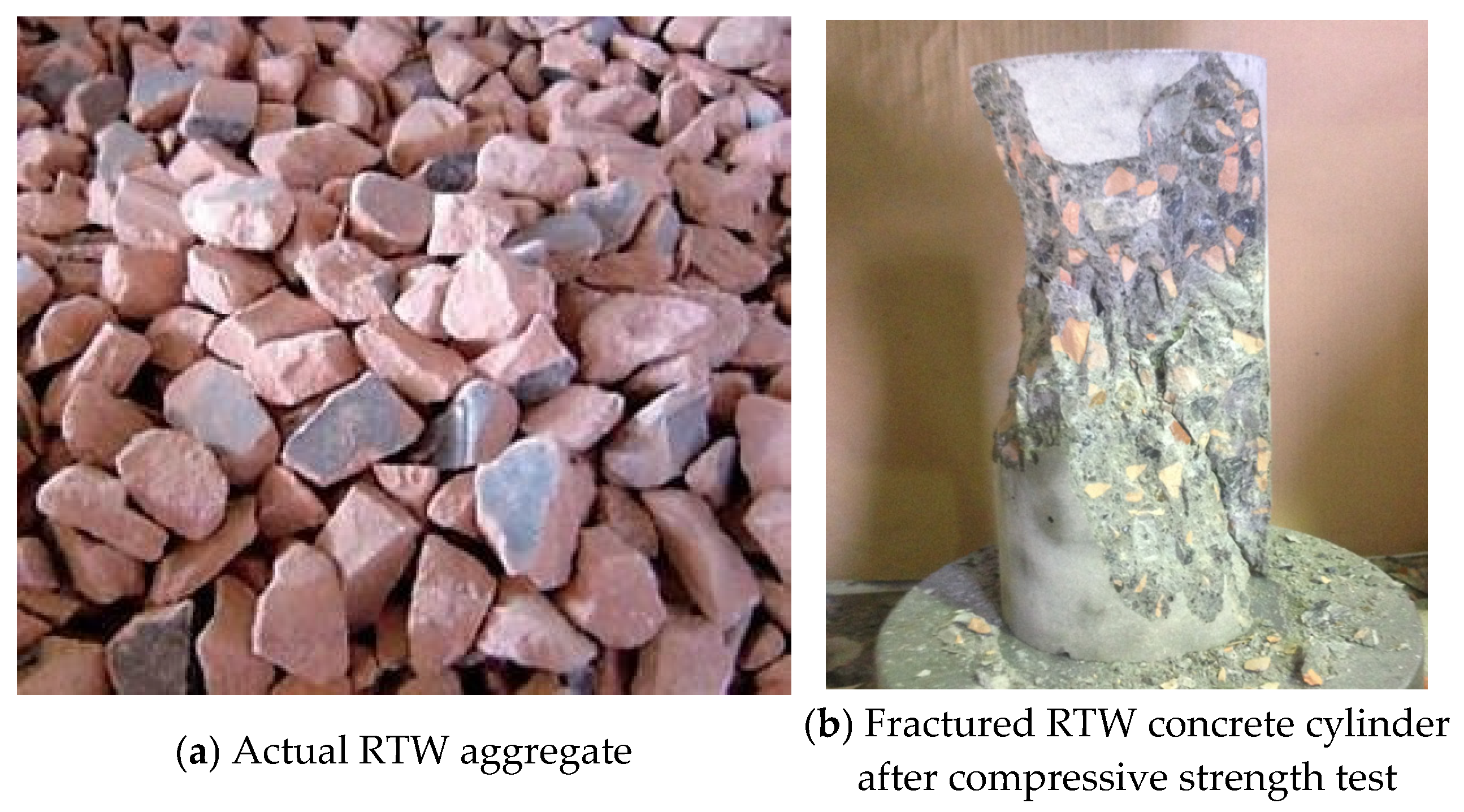
The dataset for IC concrete was collected from the authors’ experimental work [9] and published literature [15,22,23,63,64], as detailed in Table 1. In total, a harmonized database of 180 CS measurements was constructed by aggregating mixture information from six independent studies. The RTW material used across the concrete database has consistent physical properties and was sourced from locally recycled roof tile in Hiroshima, Japan. Actual RTW aggregate and Fractured RTW concrete cylinder after compressive strength test are shown in Figure 1. Because the number of available RTW-based IC mixtures in the literature is limited, the compiled database includes both RTW-replaced and non-RTW mixtures, serving as comparative baselines for evaluating the influence of IC-related variables. The additional data collected also pertained to IC using RTW material with additives such as blast furnace slag and fly ash. To ensure the dataset’s reliability, some samples with excessively long testing ages were temporarily excluded, leaving 180 measurement results for model training. It is noted that the number of studies using specifically RTW material at the moment is limited, and the data set is expected to be increased in the future.
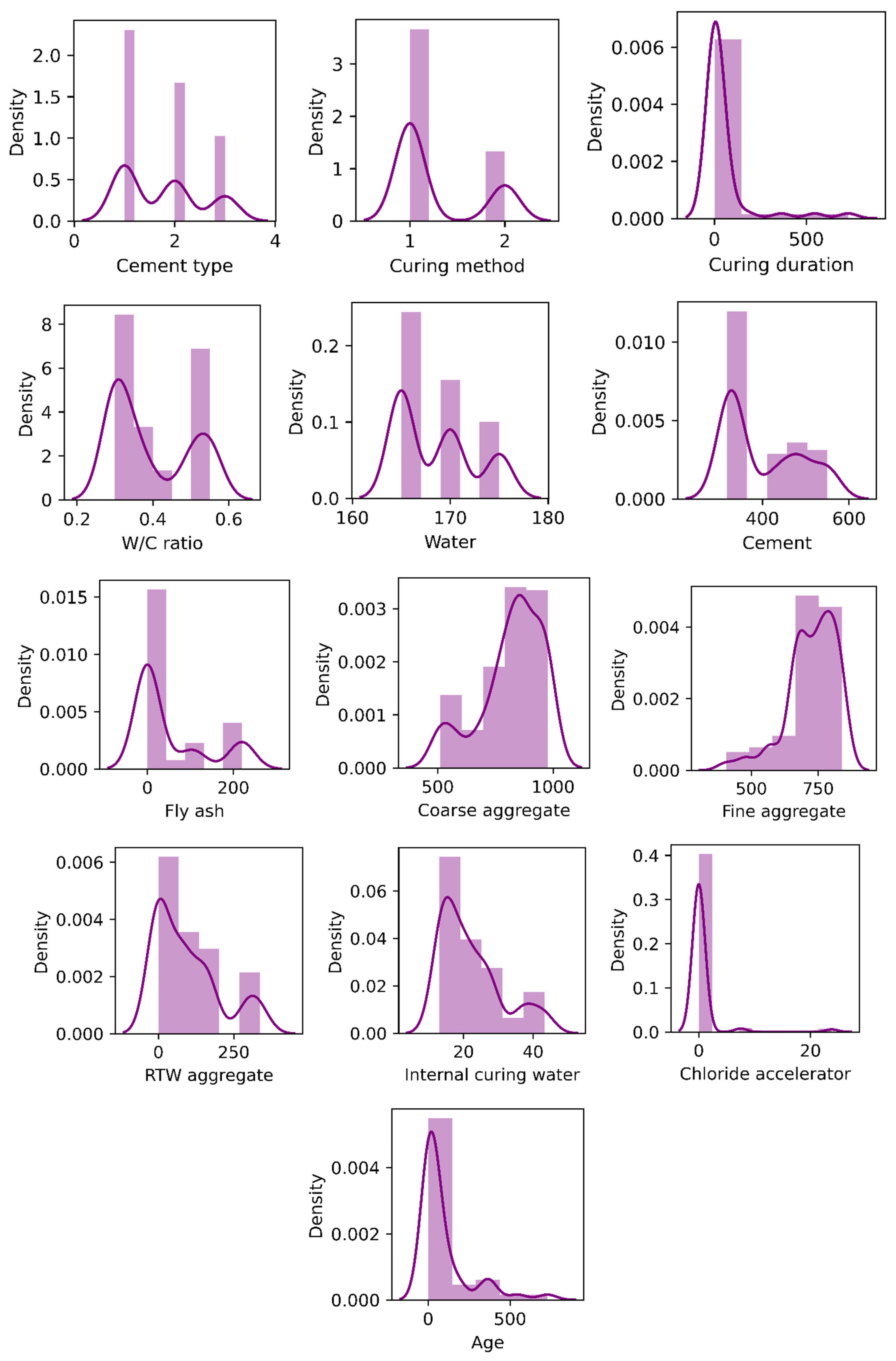
Each measurement in the dataset contained 13 input parameters: cement type, initial curing method, curing duration, W/C ratio, water content, cement content, fly ash content, coarse aggregate content, fine aggregate content, RTW aggregate content, IC water content, chloride accelerator content, and age, with the CS result at relative age as the output. Input variables were selected based on their scientific relevance to CS and IC, their consistent availability across the database, and their contribution to the model’s predictive performance. Key parameters of concrete, including water and cementitious content, aggregate content, curing conditions, and testing age, were selected as inputs for the study. Additionally, specific inputs reflecting the IC effect and the combined effect of the chloride accelerator and IC were included. While most parameters used exact values, some categorical variables were encoded for algorithm readability. Breaking down cement types into their chemical components would overcomplicate the input data; therefore, cement types were encoded as follows: blast furnace cement (BBC) as 1, high early-strength cement (HESC) as 2, and ordinary Portland cement (OPC) as 3. The same applies to the initial curing method; sealed curing was assigned a value of 1, while steam curing was assigned a value of 2. To precisely depict the IC mechanism, the IC water content was determined as the sum of absorbed water from RTW aggregates (the major source) and from conventional coarse and fine aggregates (the minor source). Absorption and IC water values were directly obtained from the relevant research; no assumed values were incorporated in the absence of absorption data, thus maintaining the experimental integrity of the dataset. The chloride accelerator content was incorporated; however, only one trial provided non-zero accelerator dosages, resulting in a significantly skewed distribution. Table 2 lists all input parameters and output variables in the test database, providing information on each parameter’s mean, standard deviation, value range, and distribution.
All input data were preprocessed prior to model development. Continuous numerical variables were normalized to eliminate scale effects and ensure balanced contributions of each feature during training. Specifically, min–max normalization was applied to rescale the input variables to a uniform range. Categorical variables were converted into numerical representations to make them compatible with the ML algorithms. These preprocessing steps were performed consistently across the dataset to enhance model stability and predictive performance.
Figure 2 presents the statistical distribution of input variables, highlighting diverse data patterns. The cement type and curing method exhibit distinct peaks, indicating a mixture of different material types. The curing duration is highly skewed, with most samples falling below 100 days and a long tail extending beyond 500 days. The age distribution follows a similar trend, with most data concentrated in the early testing periods. W/C ratio (0.3–0.55) and water content (165–175 kg/m3) exhibit bimodal trends, reflecting variations in concrete mix designs. Cement content (318–550 kg/m3) clusters around 400 kg/m3, while fly ash content is mostly zero, with some samples reaching 220 kg/m3. Coarse aggregate (780–977 kg/m3) and fine aggregate (406–838 kg/m3) are right-skewed, suggesting a preference for higher aggregate content. RTW aggregate content is bimodal, with most samples at zero and another cluster near 200 kg/m3, distinguishing conventional and IC concrete. Internal curing water (13.1–43.3 kg/m3) peaks at 22 kg/m3, reflecting the limited but consistent absorption behavior across studies. Chloride accelerator content is mostly zero, with some reaching 23.8 kg/m3. Specific information about these values and ranges is provided in Table 2.

3. Methods

3.1. Single Method

3.1.1. Artificial Neural Networks (ANN)

ANNs are computational models inspired by the neural networks of the human brain. They are fundamental to AI and ML, enabling computers to recognize patterns and solve complex problems. ANNs mimic how biological neurons signal each other, allowing machines to learn from and make decisions based on input data [65]. An ANN comprises an input layer, one or more hidden layers, and an output layer. The input layer consists of nodes representing the input variables, such as aggregate type, W/C ratio, and IC water content. The hidden layers contain computational nodes that process input data through various mathematical operations, typically involving weights and activation functions, to extract meaningful features and patterns. The output layer contains a single node representing the output variable, which in this study is the concrete’s CS. Each node (neuron) in one layer is connected to all nodes in the next layer through weight parameters. These weights are adjusted during training to minimize the error between predicted and actual outputs.

3.1.2. Recurrent Neural Networks (RNN)

RNNs are neural network architectures designed to process sequential or temporally related data. The approach of RNNs is similar to that of ANNs; however, unlike traditional ANNs, RNNs have connections that form directed cycles, enabling them to maintain the state or memory of previous inputs. While an ANN processes each input independently, an RNN processes sequences by recursively applying the same set of weights to each element in the sequence while maintaining a hidden state that captures information about previous elements. This makes RNN particularly suitable for tasks where input and output sequences can vary in length and where context or temporal dependencies are crucial, such as time-series prediction [66,67]. RNNs can process a complete series of inputs because they pass the input and hidden states from the previous time step to the current time step. At each time step, the hidden state is updated, enabling the network to track the entire sequence. RNNs have been shown to predict the stress–strain behavior of concrete [68]. Given that concrete strength also gradually changes over time, RNNs are well-suited to modeling this behavior. Therefore, in this study, an RNN model was used to minimize model error and to compare its accuracy with that of other models.

3.1.3. Random Forest (RF)

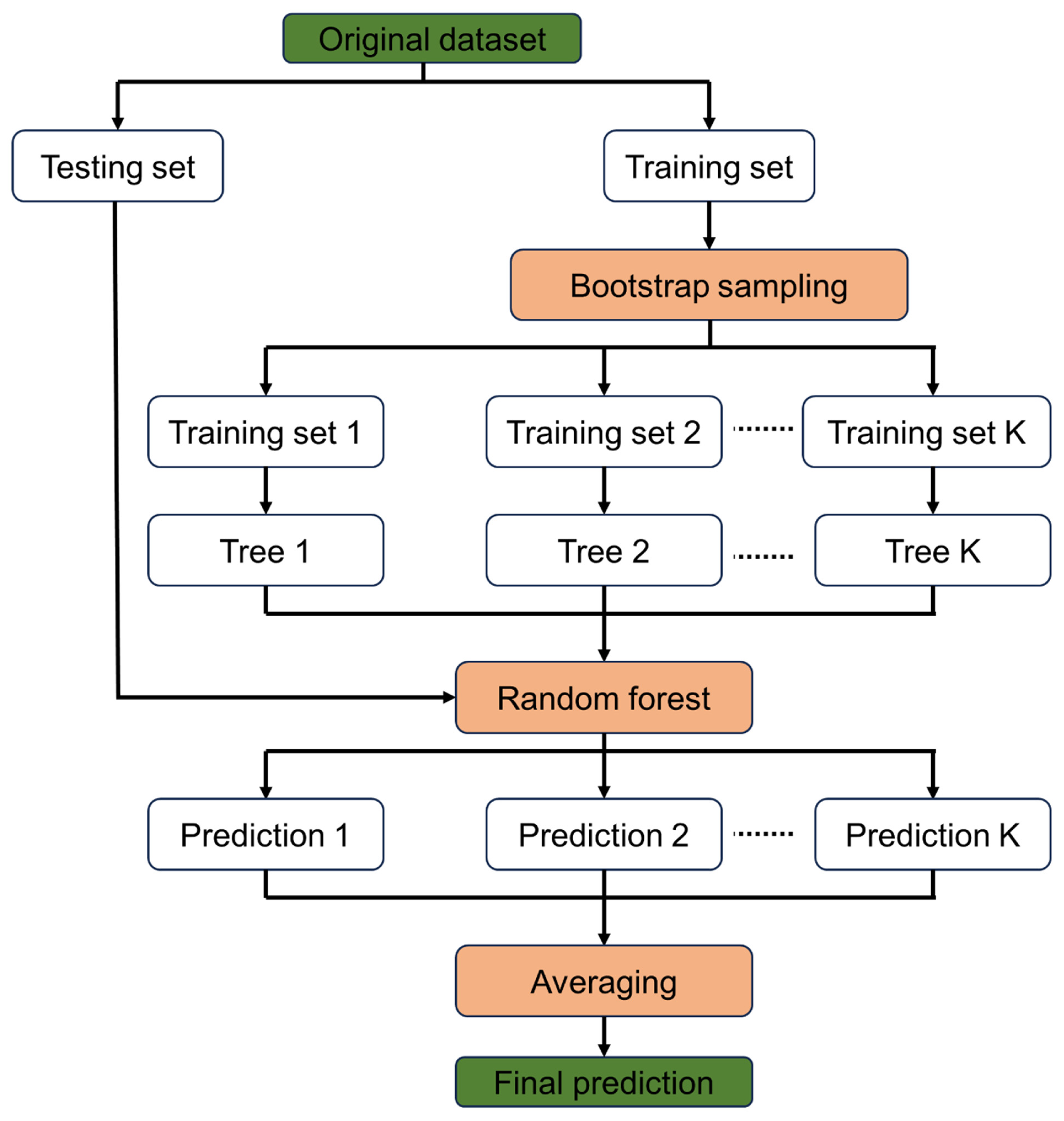
The RF algorithm is a powerful and flexible ML method widely used for both classification and regression tasks. Introduced by Breiman [69], RF has demonstrated high potential in concrete engineering, as evidenced in the literature [30,35,70]. Figure 3 presents a diagram illustrating the generation and prediction process using the RF model [70]. The general process includes (1) Bootstrap aggregation: RF begins by creating multiple decision trees using the bagging method. In bagging, multiple subsets of the original dataset are created with replacement, meaning each subset may contain duplicate entries, and some original data points may be missing from these subsets. Each subset is used to train a separate decision tree. (2) Random selection of features: When building each tree, RF introduces further randomness by selecting a random subset of features at each split in the decision tree instead of considering every possible feature. This helps make the model more robust against overfitting and increases tree diversity. (3) Building multiple trees: numerous trees are generated using the above two steps. Each tree is built to the maximum possible depth and is usually not pruned. Because of the randomness introduced in feature selection and the subset of data, each tree is slightly different from the others. (4) Aggregation of predictions: each tree predicts a value for the given input. The final output is calculated by averaging the predictions.

3.2. Hybrid Method

3.2.1. Optimization Technique: Particle Swarm Optimization (PSO)

PSO is a computational method that optimizes a problem by iteratively improving candidate solutions concerning a given quality measure [71]. PSO is widely used for problems where finding an exact solution is difficult or impossible, providing a robust method for finding optimal or near-optimal solutions within a reasonable time frame and with relatively simple implementation [72]. In concrete engineering, PSO has been applied to enhance the prediction accuracy of various ML models, such as backpropagation [73] and SVM [74].
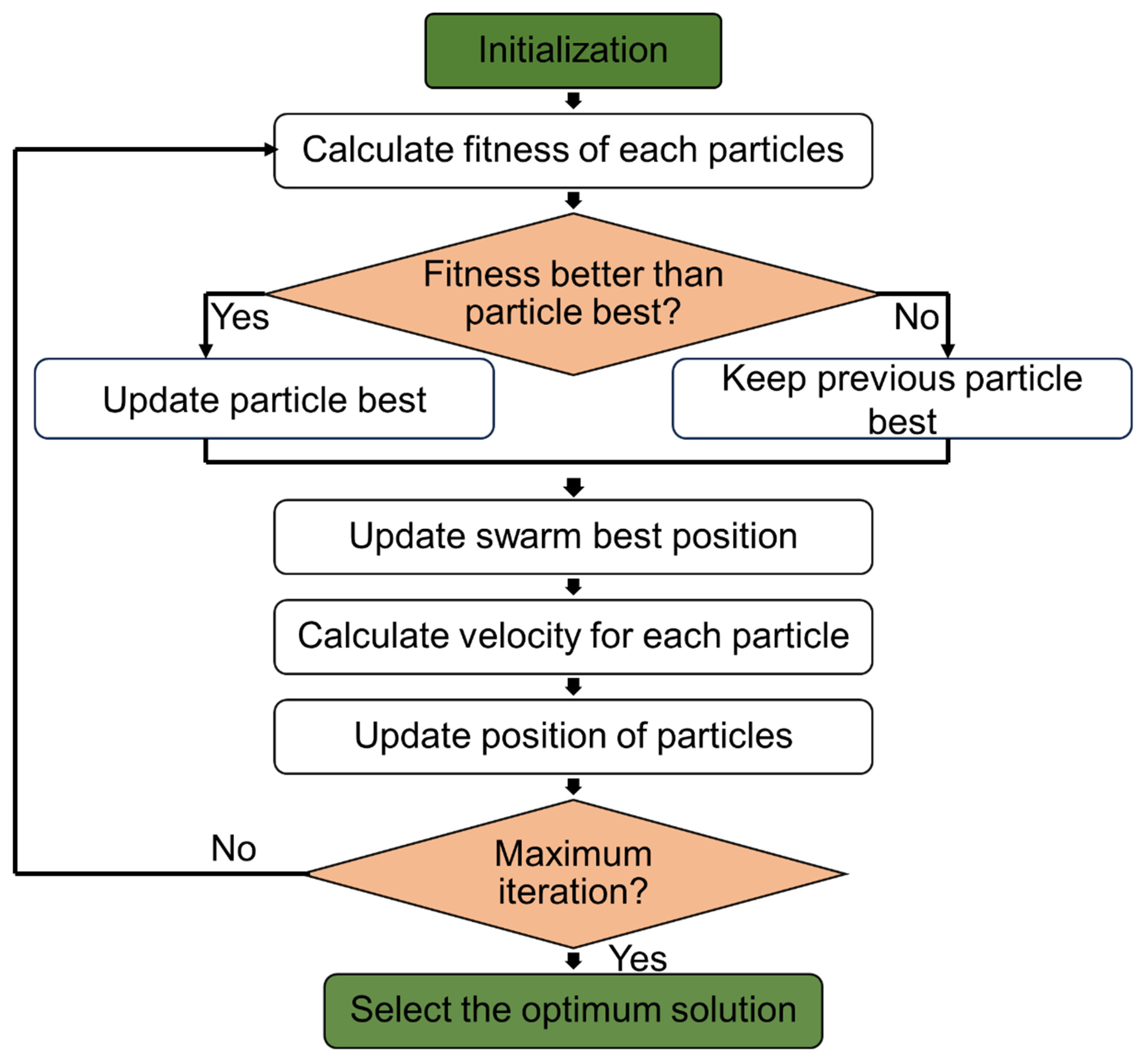
PSO operates with a swarm of candidate solutions, called particles, that move through the search space. Each particle represents a potential solution to a problem. The movement of these particles is guided by their best-known positions in the search space and the best-known positions of the entire swarm. These positions are updated as better positions are identified by the particles. Figure 4 illustrates the flowchart of PSO [32].

3.2.2. RF-PSO: Novel Hybrid Model

The integration of PSO with RF involves using PSO to search the hyperparameter space of the RF algorithm. Each particle in the swarm represents a set of hyperparameters. The position of each particle is evaluated using a predefined fitness function, typically based on model accuracy or another performance metric derived from cross-validation. As the particles explore the hyperparameter space, they update their velocities and positions based on their own experience and the experiences of their neighbors or the entire swarm, converging on the set of hyperparameters that yield the best performance.
In this study, PSO for RF hyperparameter tuning was performed as follows. First, an initial population of particles with random positions and velocities was generated, with each position corresponding to a set of hyperparameters for an RF model. For each particle, an RF model was instantiated with the hyperparameters represented by the particle’s position, and the model’s performance was evaluated using cross-validation on the training data. If a particle’s new position (set of hyperparameters) provided better performance than its previous best, its personal best position was updated. Similarly, the global best position was updated if any particle achieved better performance than the current global best. Velocities of particles were adjusted based on their own experience (personal best) and the experience of their neighbors or the entire swarm (global best). Positions were then updated based on the new velocities, guiding the particles to explore new areas of the search space or exploit known good areas. This evaluation and update process was repeated until a stopping criterion was met, such as a set number of iterations, a convergence threshold, or a time limit.

3.3. Comparative Analysis of Methods

Table 3 summarizes the main features, advantages, and disadvantages of the methods. The comparison of methods highlights their varying potential for predicting the CS of internally cured concrete based on their computational frameworks and learning capabilities. ANN and RNN offer strong predictive power for complex relationships but require large datasets and extensive computational resources, making them less efficient for rapid design adjustments in concrete [75,76]. With its ensemble learning approach, RF provides robust predictions and interpretable feature importance, making it a valuable tool for modeling CS in IC concrete. However, RF’s performance heavily depends on hyperparameter tuning, which can be challenging without optimization techniques [76,77]. As a global optimization method, PSO is well-suited for fine-tuning predictive models but lacks standalone predictive capabilities. The integration of RF and PSO (RF-PSO) enhances the predictive potential of ML by automating parameter optimization, improving generalization, and reducing overfitting. This hybrid model enables efficient and accurate CS estimation, making it practical for engineering applications where precise concrete strength prediction is crucial. Using ML in IC concrete research contributes to sustainable construction practices by reducing material waste and improving design efficiency. Future research could explore other hybrid models to enhance predictive accuracy and computational efficiency. The ability of these methods to handle non-linear, multi-variable interactions suggests that AI-driven approaches will play an increasingly important role in optimizing IC concrete formulations. This study will evaluate the application of these methods to determine their effectiveness in accurately predicting the CS of IC concrete.

3.4. SHAP Analysis

The SHAP values were derived using a game-theoretic framework to quantify the contributions of the predictions [78], a method further developed in the ML field by Lundberg et al. [79]. The analysis of explainability via SHAP values aims to determine how input variables (input features) influence a ML model’s predictions. The impact of each input feature on a prediction is quantified mathematically through the formulation of an “explanation model”. This model assesses predictions by summing the contributions from each input feature and the mean predicted value. Mathematically, the explanation model can be expressed as follows:
y = y ¯ + i φ i ,
where y is an individual prediction, y ¯ represents the average predicted value across all predictions, and φ i represents the contribution of input feature i to the prediction, known as the “SHAP value”.
Input variables with larger SHAP values were considered to have a more significant impact on a specific prediction than those with smaller SHAP values. For example, positive SHAP values indicate that a feature increases the final predicted value y, whereas negative SHAP values indicate that a feature decreases the predicted outcome. Overall, the input variable with the highest average SHAP value had the greatest influence on the model outcomes.

3.5. Validation Indicators

Several standard statistical metrics were used to evaluate the statistical performance of the ANN, RNN, RF, and RF-PSO models during both stages (training and testing). Popular validation indicators include the coefficient of determination (R2), root mean square error (RMSE), and mean absolute error (MAE). The formulas for the statistical performance metrics are as follows:
R 2 = ( k = 1 n ( e k e k ¯ ) ( p k p k ¯ ) ) 2 k = 1 n ( e k e k ¯ ) 2 k = 1 n ( p k p k ¯ ) 2 ,
R M S E = k = 1 n e k p k 2 n ,
M A E = k = 1 n e k p k n ,
where ek and pk are the kth experimental and predicted outcomes, respectively, e k ¯ and p k ¯ represent the average values of the experimental and predicted outcomes, respectively, and n is the total number of experimental entries.
Essentially, R measures the relationship between the actual and predicted outcomes. R values range from −1 to 1; higher absolute values indicate a more accurate prediction. However, R is insensitive to the division and multiplication of outcomes. Therefore, R2 was used for its unbiased estimation and its comparatively better efficacy and performance. The RMSE measures the average squared difference between the actual and predicted outputs. A lower RMSE value indicates better model performance. Consequently, the MAE was also measured, which is particularly useful for continuous, smooth data and assigns greater weight to lower error values. In short, lower-error statistical measures (MAE and RMSE) and higher-correlation statistical measures (R and R2) show better and improved model performance, and vice versa [80].

3.6. Methodology

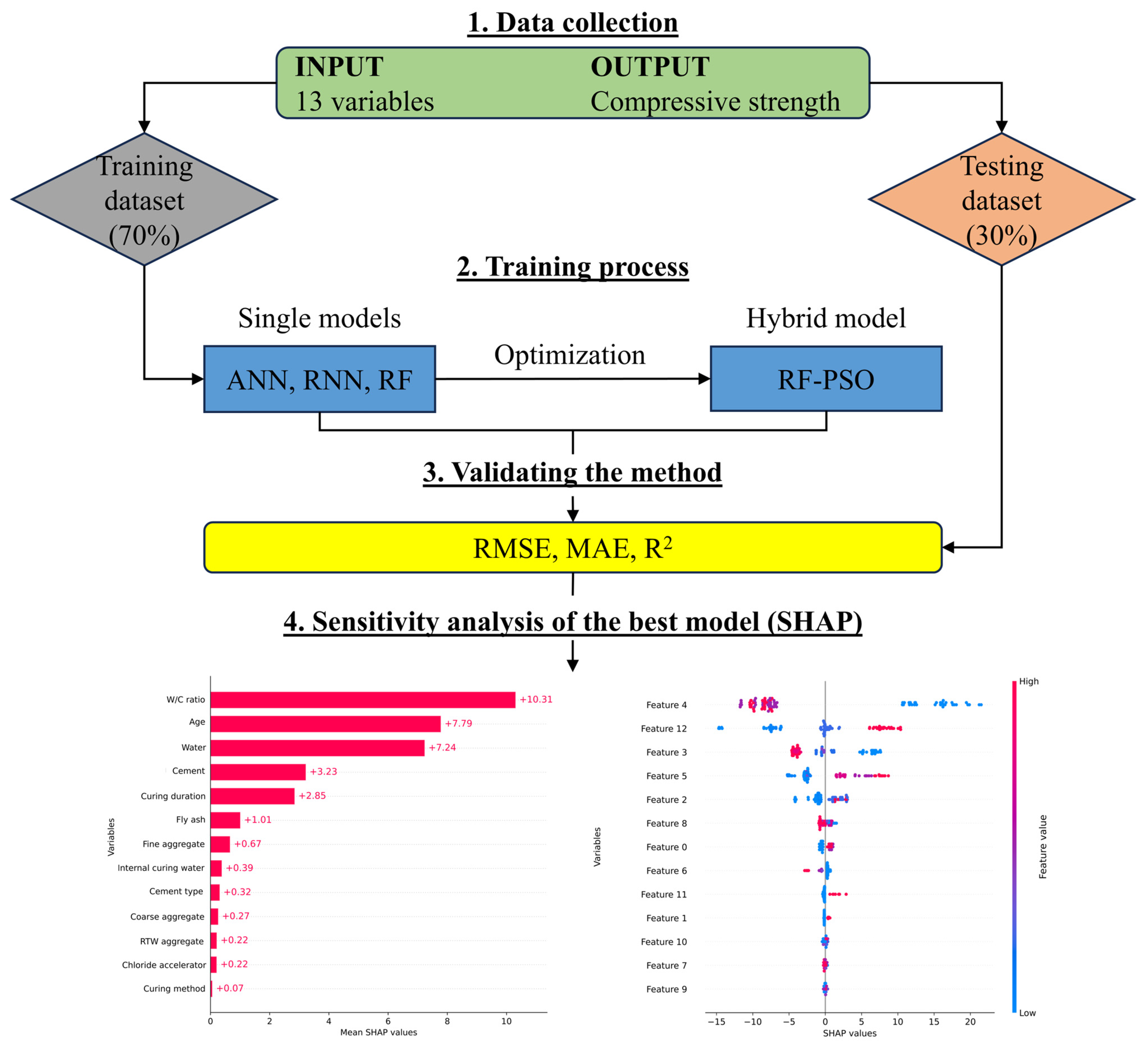
This section outlines the methodology used in this study. Figure 5 presents the fundamental process for building the ANN, RNN, RF, and RF-PSO models for predicting the CS of IC concrete. The overall framework is divided into four main stages: data collection, model training, model validation, and sensitivity analysis of the best model.
Initially, experimental data are gathered and utilized to train and evaluate ensemble ML models for predicting the CS of IC concrete. The dataset is split into two subsets: 70% for training and 30% for testing, ensuring proportional representation of early- and late-age samples. The ANN, RNN, and RF baseline models are subsequently trained exclusively on the training set. Hyperparameter optimization for the RF model is conducted using the PSO technique, in which prospective hyperparameters are evaluated via 5-fold cross-validation on the training dataset. After optimization, the RF-PSO model is retrained on the entire training dataset.
Model validation is conducted using two complementary approaches: (1) internal 5-fold cross-validation during hyperparameter optimization, and (2) performance assessment on the unseen test set. This integrated validation system guarantees reproducibility and evaluates each model’s generalization capability. The model with the highest performance, as determined by R2, RMSE, and MAE, is chosen for subsequent interpretability study.
Ultimately, SHAP analysis is utilized to measure the contribution of each input variable to the projected CS. SHAP is used for the RF and RF-PSO models, with SHAP values computed on the test set to prevent data leakage. Furthermore, SHAP analysis is categorized into early-age (1–28 days) and later-age (>28 days) subsets to investigate age-dependent sensitivity patterns.

4. Results and Discussion

4.1. Statistical Analysis

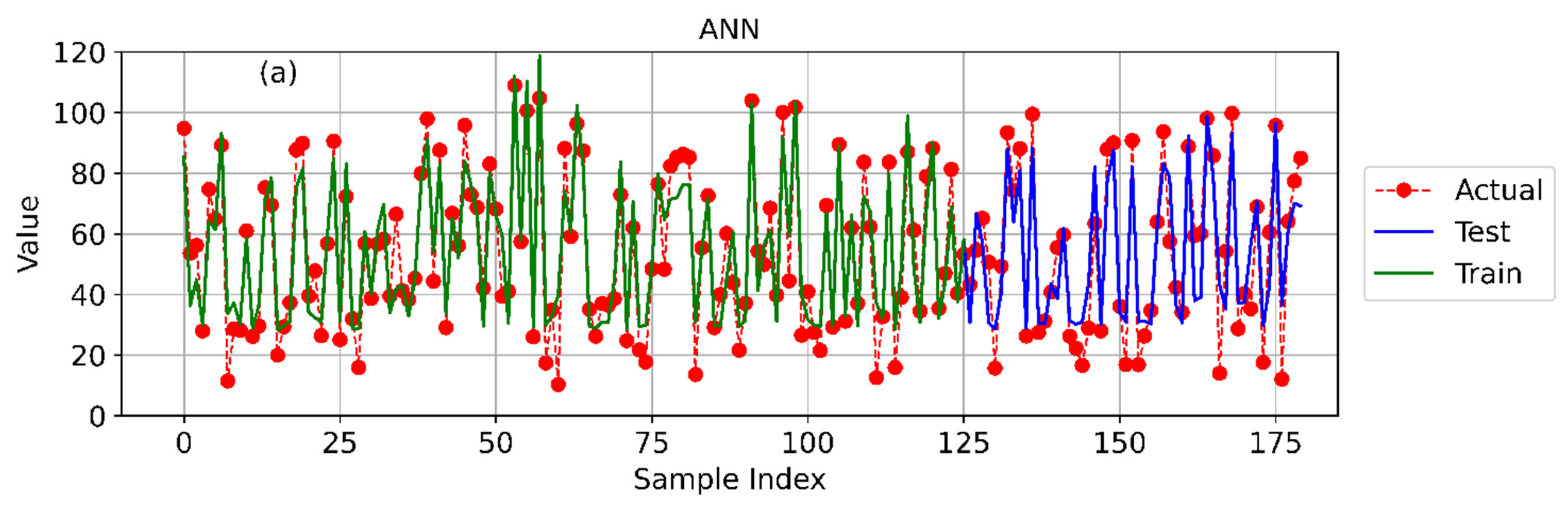
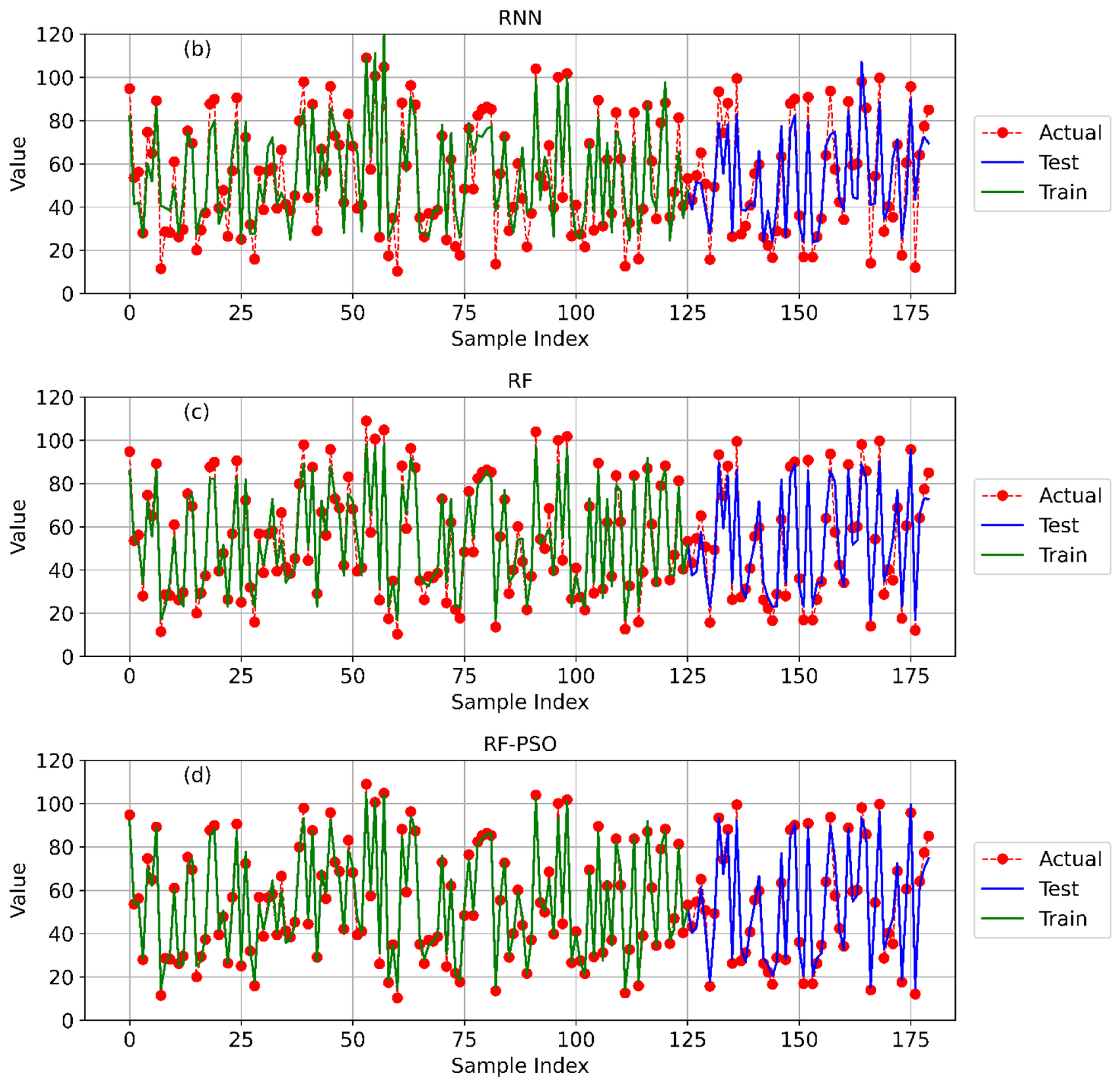
Using the training dataset, the ANN, RNN, RF, and RF-PSO models were trained to predict the CS of IC concrete. The results of the training phase are shown in Table 4, Figure 6 and Figure 7. Table 4 presents the performance of all predictive models throughout the training phase using three criteria: RMSE, MAE, and R2. The training results predominantly indicate model fitting rather than generalization; therefore, they must be analyzed alongside the cross-validation and test-set results shown in the following section.
Among the three single models, RF yielded the lowest errors (RMSE = 5.902 and MAE = 4.906), whereas RNN yielded the highest (RMSE = 10.925 and MAE = 8.862). The single ANN model performed on average between the three (RMSE = 9.312 and MAE = 7.425). The application of PSO significantly enhanced the prediction accuracy of the hybrid RF-PSO model, decreasing the training-set error to RMSE = 2.933 and MAE = 2.260. This enhancement demonstrates the efficacy of hyperparameter tuning; however, its extent must be evaluated alongside test-set results to validate generalization.
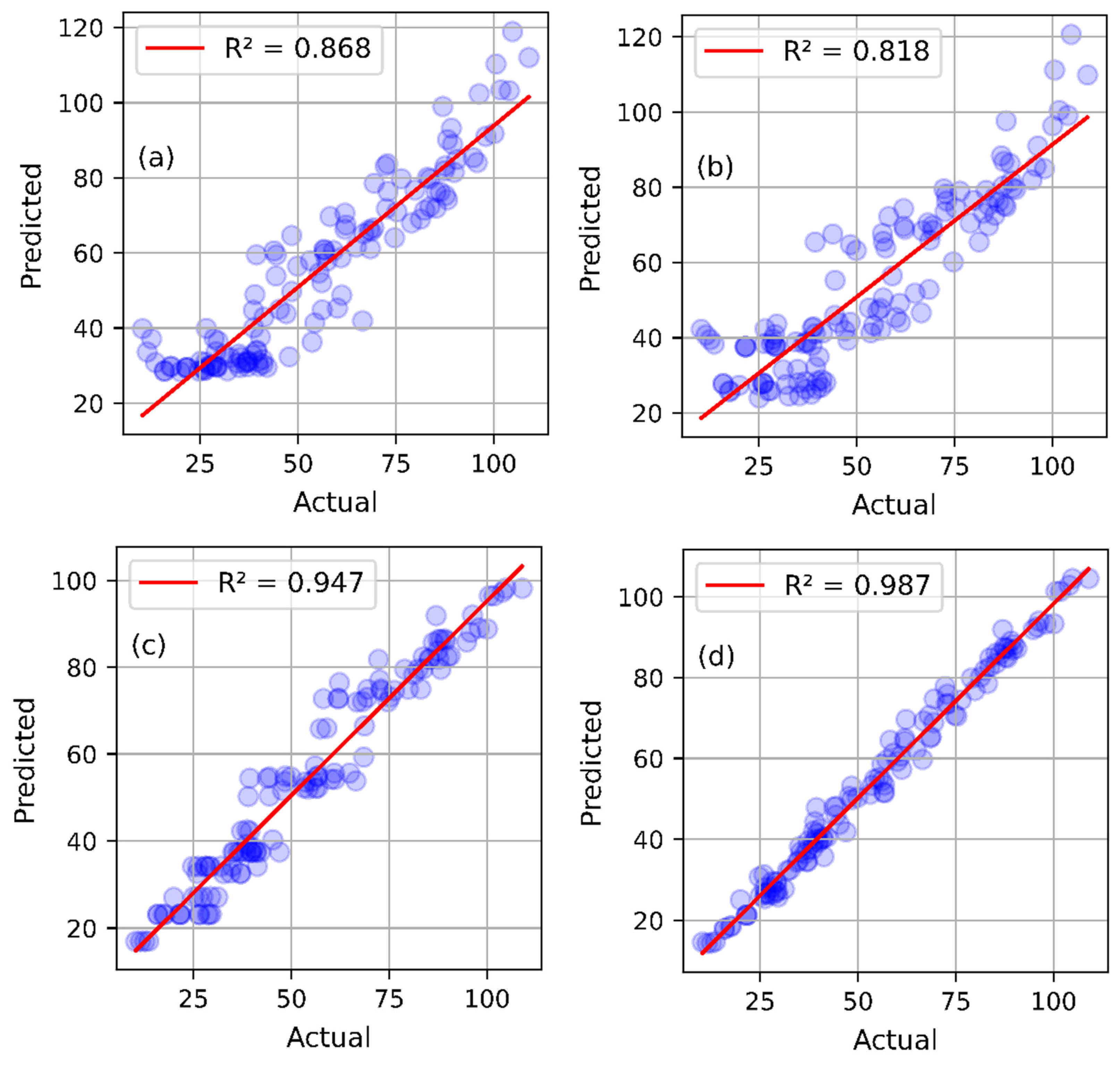
Figure 6 shows the predicted and actual values from models trained on the training dataset, indicating that the predicted CS values from all algorithms closely match the target values. Figure 7 depicts the divergence of the projected data from the ideal fit line and presents the associated R2 values for enhanced comparison. These scores indicate the goodness-of-fit for the training data rather than the ultimate generalization performance. The RF-PSO model has the highest R2 value (0.987), followed by RF (0.947), ANN (0.868), and RNN (0.818). Overall, the results of the training phase indicated that all the applied and developed models had a good fit with the data; however, the novel hybrid model performed better than the single models (RF, ANN, and RNN).
However, the training set did not provide a reliable assessment since the models were trained on known targets. Thus, the testing phase is essential to determine the most effective predictive models for the CS of concrete [81]. Using the testing dataset, the ANN, RNN, RF, and RF-PSO models were validated and verified to evaluate their predictive capability for the CS of IC concrete. The results of the testing phase are shown in Table 5, Figure 7 and Figure 8.
Table 5 shows that among the three single models, RF yielded the lowest errors (RMSE = 8.33 and MAE = 6.756), whereas RNN yielded the highest errors (RMSE = 12.124 and MAE = 9.822). The errors of the single ANN model were, on average, between the other two models (RMSE = 12.078 and MAE = 9.779). Compared with the individual models, the hybrid RF-PSO achieved significantly lower error metrics (RMSE = 5.361 and MAE = 4.001), demonstrating the advantages of PSO-directed hyperparameter tuning.
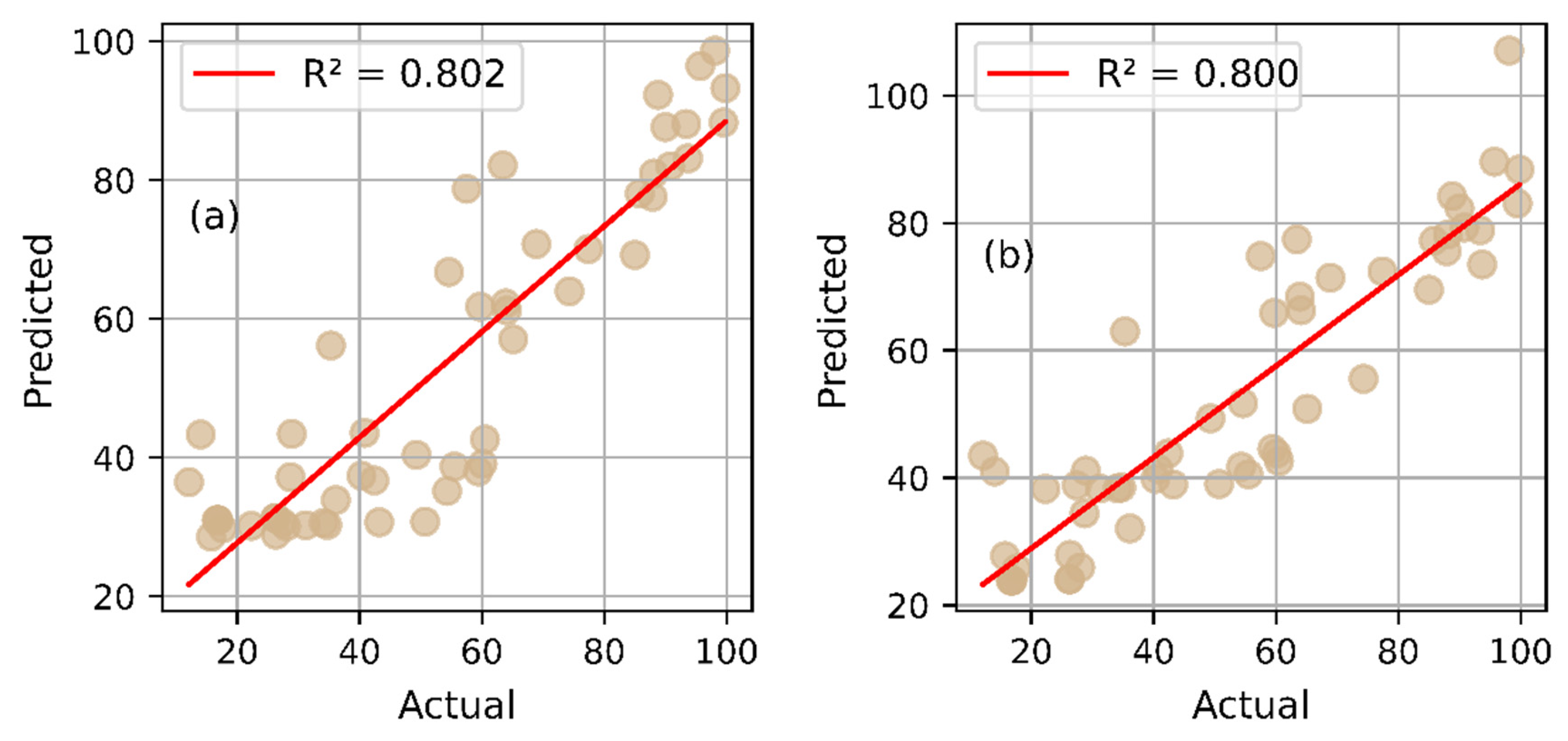
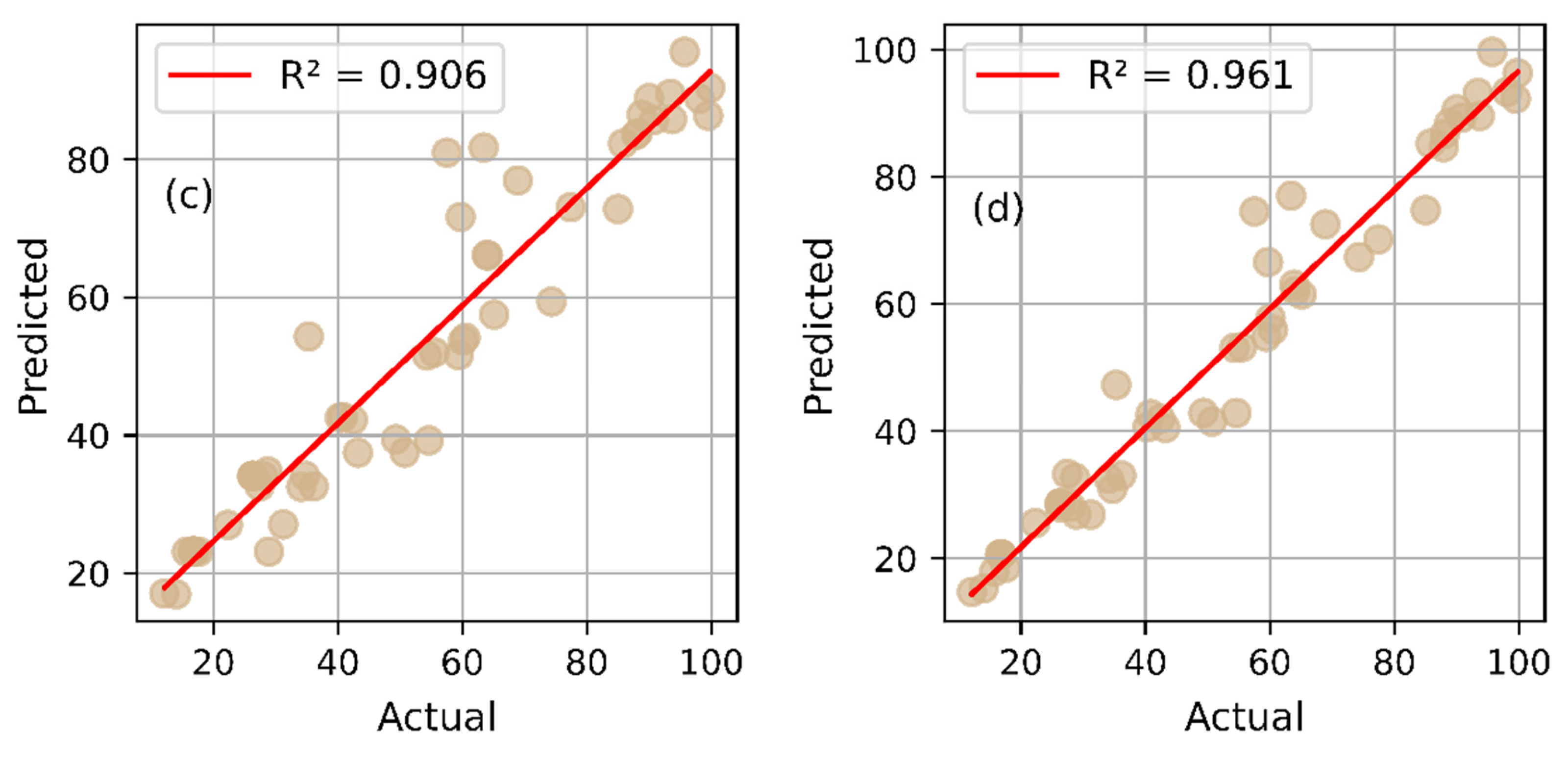
Figure 8 shows that all models demonstrated robust linearity between predicted and actual values. However, it indicates that larger deviations between predicted and measured CS predominantly occur in the low-strength range (<25 MPa), particularly for the ANN and RNN models. In this regime, both models tend to overestimate CS, which can be attributed to the limited number of low-strength samples in the dataset and the resulting imbalance toward higher-strength concretes. Neural network–based models are known to be sensitive to such imbalances, often biasing predictions toward the dominant data range. In contrast, the RF and RF-PSO models exhibit more uniformly distributed errors across the entire strength spectrum, with notably reduced dispersion at low strength levels. This improved robustness can be attributed to the tree-based structure of RF models, which partitions the input space more effectively and is less affected by skewed data distributions. To provide a clearer assessment and comparison of the four models, Figure 7 shows the deviation of the predicted data from the perfect fit, along with the coefficient of determination (R2) for the testing dataset. The RF-PSO model had the highest R2 value (0.961), followed by RF (0.906), ANN (0.802), and RNN (0.800).
Overall, the testing phase results indicated that all the applied and developed models had strong predictive capabilities for the CS of IC concrete. However, the novel hybrid model outperformed the other single models (RF, ANN, and RNN).
Across all evaluation metrics, the hybrid RF-PSO model consistently demonstrated the best predictive performance in both the training and testing phases. Figure 6 and Figure 7 show that the ANN and RNN models tend to overpredict CS values below 25 MPa, whereas the RF and RF-PSO models maintain a closer fit to the actual values. The difference is explained by the fact that tree-based models are better than neural network-based models at capturing nonlinear interactions and heterogeneous data distributions, especially when the dataset is small and unbalanced.
RF is known for its ability to handle non-linear relationships well. The RF-PSO model reduces overfitting and improves generalization to unseen data by using PSO to tune key hyperparameters, including the number of trees, maximum depth, and minimum samples per split. Additionally, optimal hyperparameter tuning using PSO helps prevent overfitting in RF models [82,83]. Table 6 provides the parameter settings for the PSO algorithm and RF model to improve the study’s reproducibility. Overfitting occurs when a model learns the training data too well, including noise and irrelevant patterns, leading to poor performance on new data. PSO-guided hyperparameter optimization aims to strike a balance that minimizes overfitting. Compared to previous studies, the results align with findings that state PSO is a state-of-the-art technique for enhancing the prediction performance of the RF model [82,83]. Through SHAP-based interpretability, a thorough analysis of variable–response interactions and the factors that influence RF-PSO’s enhanced performance is provided, offering additional insight into the behavior of IC concrete mixtures.
In addition, Table 7 compares the predictive performance of the proposed model with previously reported machine-learning approaches for estimating the CS of different types of concrete. As shown, a wide range of AI and statistical methods have been successfully applied to various concrete systems, with reported coefficients of determination ranging from 0.84 to 0.99. The proposed RF–PSO model for internally cured RTW concrete yields an R2 value of 0.96, comparable to or exceeding most reported values in the literature. This demonstrates that the proposed model achieves competitive predictive accuracy when applied to a relatively less explored concrete type. The comparison confirms the robustness of the proposed approach and supports its suitability for predicting CS of IC concrete.

4.2. Importance of Input Variables Using SHAP Analysis

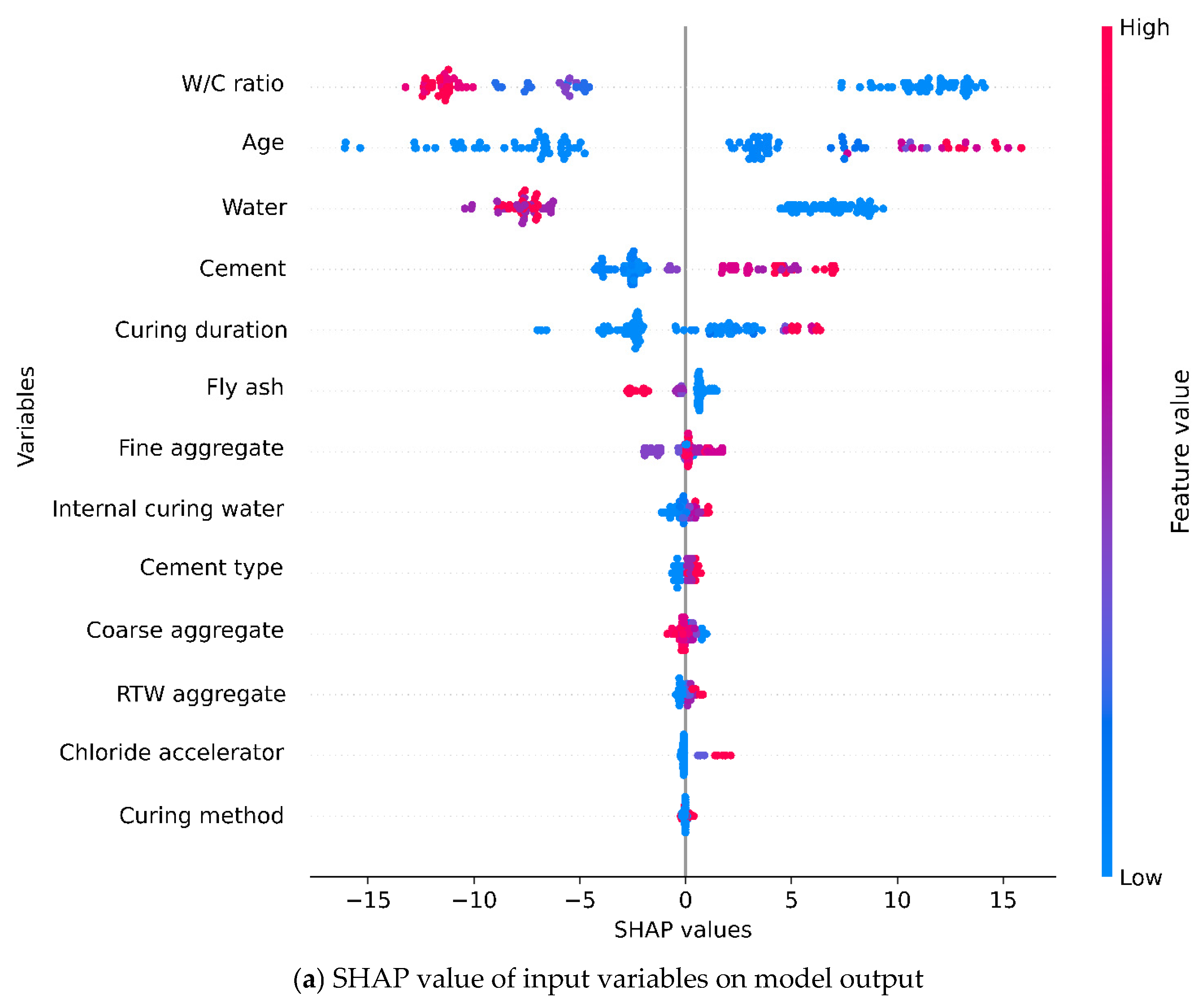
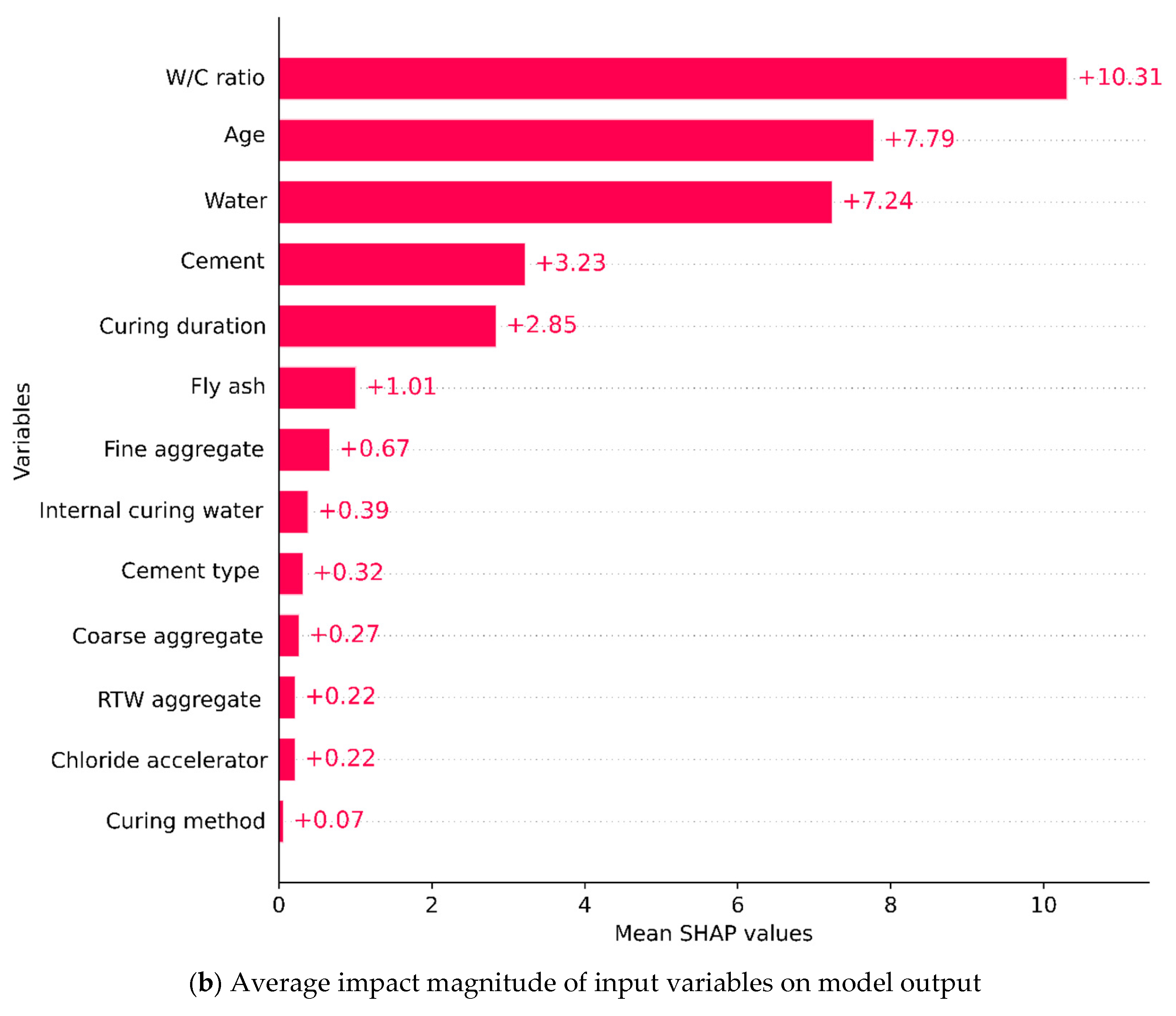
In the present study, the importance of the input variables affecting the predictive capability of the hybrid RF-PSO model was validated using SHAP analysis, and the results are shown in Figure 9. SHAP values measure the contribution of each unique input feature to the model output; hence, the important values indicate the influence of each feature within the RF-PSO model rather than physical causation. Figure 9a illustrates the relative importance of each input variable, with colored points indicating the impact of each on the RF-PSO model’s outcome. In this graph, blue points denote lower importance, whereas red points indicate higher importance. Figure 9b shows the mean SHAP values for each input variable, highlighting their influence on the model’s outcome. The input variable with the highest mean SHAP value had the greatest influence.
As depicted in Figure 9b, the W/C ratio had the strongest influence on the outcome of the RF-PSO model, followed by age, water content, cement content, curing duration, fly ash content, fine aggregate, IC water, cement type, coarse aggregate, RTW aggregate, chloride accelerator, and curing method. Thus, the W/C ratio is the most crucial variable for predicting the CS of IC concrete using the RF-PSO model.
From a practical perspective, this result is reasonable because the W/C ratio significantly affects the CS of all types of concrete [87]. Moreover, because water and cement contents are components of the W/C ratio, they also ranked highly in terms of CS influence, aligning with previous studies [30,88]. The SHAP values in Figure 9a also indicate that a lower W/C ratio increases CS, similar to water content but contrary to cement content. Additionally, the age of the specimens had a notable impact on average, surpassing that of the cement and water contents. This was significantly higher than that observed for normal concrete containing ground-granulated blast-furnace slag [89]. The CS of concrete increases over time; however, for normal concrete, CS development after 28 d is minimal, and the average testing age in this study was approximately 93 d. The strong influence of age may be due to the IC effect, which gradually releases internal water for further hydration, continuing to increase the CS over time [9,22].
Another factor that moderately and strongly affects the CS of IC concrete is curing duration. Previous studies have indicated that the initial curing time significantly affects the CS of IC concrete [9,23]. Generally, input factors below curing duration have a smaller influence than those previously discussed. The curing method (steam curing) and the chloride accelerator content had negligible impact on CS, as they increased initial CS at an early age but made no further contribution over time. Regarding aggregates, fine aggregates, coarse aggregates, and RTW aggregates were ordered from highest to lowest impact. This is reasonable because the roof tile is a porous material with lower strength than traditional aggregates. Finally, IC water content had a higher impact than cement type but a lower impact than fly ash content. However, as discussed earlier, the influence of IC water may be stronger than indicated, as it likely enhances the age factor’s impact through the IC mechanism.
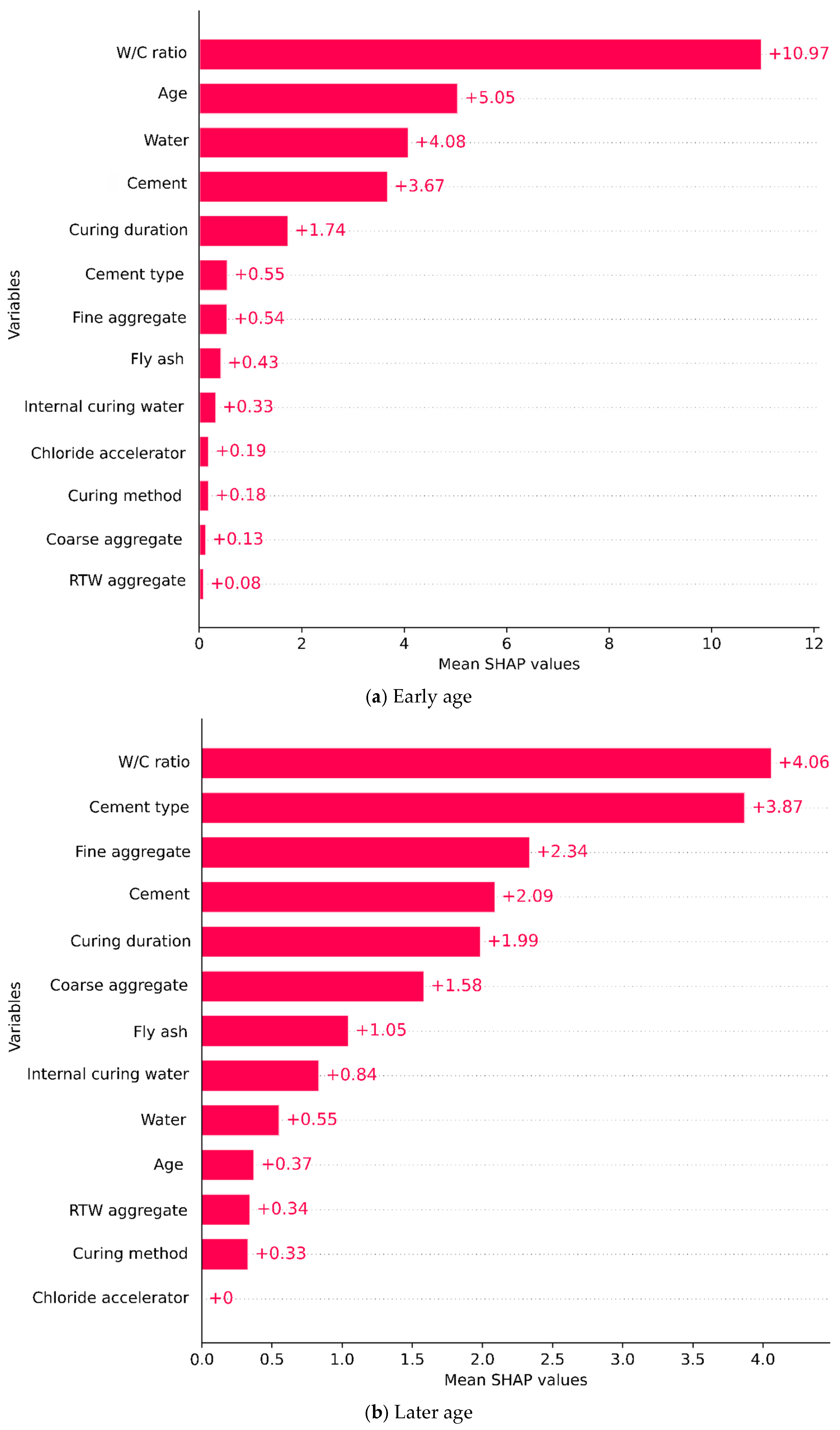
To investigate the differential effects of internal curing (IC) water and chloride accelerators across different stages of strength development, a stratified SHAP analysis was conducted using the RF-PSO model. With this method, age-specific model behavior—rather than a single aggregated response—can be reflected in the SHAP interpretation. The dataset of 180 samples was divided into two subsets: early-age (1–28 days, n = 122, Figure 10a) and later-age (>28 days, n = 58, Figure 10b). The results are summarized in Figure 10, highlighting the variable importance in predicting CS at these distinct periods.
Across both periods, the W/C ratio was the most dominant factor influencing CS. However, its SHAP value declined sharply from +10.97 at an early age to +4.06 at a later age, indicating that the W/C ratio interaction plays a crucial role in early hydration and strength development but becomes relatively less influential as hydration progresses and the system matures.
Similarly, the age of concrete, while highly impactful at early stages (+5.05), became less important at later ages, dropping to +0.37. This reflects the fact that most strength gain occurs within the first 28 days due to rapid hydration reactions, after which the incremental gains in strength diminish, and age itself becomes a less sensitive predictor. Interestingly, the influence of internal curing water (IC water) increased notably from +0.33 at early age to +0.84 at later age, underscoring its role in sustaining hydration beyond the initial period, especially in mixtures prone to self-desiccation. This aligns with previous findings that IC water supports ongoing hydration in the absence of external moisture, improving long-term strength.
Conversely, the chloride accelerator had a relatively minor yet noticeable impact at early ages (+0.19), but was negligible at later ages (+0.00). This supports its role as a setting accelerator that promotes early strength development but offers no further contribution once primary hydration phases are complete. However, only 13 samples (out of 180 total) in the dataset had a non-zero dosage of the chloride accelerator, limiting the model’s ability to reliably learn its effect on CS. As a result, the SHAP-based interpretation for this variable reflects behavior under a highly constrained data distribution and should be interpreted with caution. Future studies with more samples and a wider range of accelerator dosages are required to enable a more robust, generalizable assessment. Overall, the stratified SHAP analysis shows that the relative importance of key factors varies across hydration stages, highlighting SHAP’s usefulness for both age-dependent sensitivity assessment and global interpretability. It is important to consider these interpretations because they explain the model’s internal behavior rather than its underlying physical mechanisms.

5. Conclusions

In this study, a new hybrid ML model, RF-PSO, combining RF and PSO, was introduced and applied to estimate the CS of IC concrete. The model was developed using datasets from 180 samples, generated from experimental and literature results. RMSE, MAE, and R2 were used to assess the model’s performance, while SHAP analysis primarily assessed each input variable’s contribution within the RF-PSO model. The following conclusions were drawn from the study:
  • This study introduced a novel hybrid ML framework (RF-PSO) to enhance predictive modeling of CS in internally cured concrete. The proposed framework significantly improved predictive accuracy, increasing R2 from 0.906 to 0.961 and reducing prediction errors by approximately 30% compared to the baseline RF model, while also outperforming ANN and RNN models.
  • The integration of SHAP analysis provided quantitative interpretability of the RF-PSO model, enabling systematic evaluation of the relative contribution of input variables. The results demonstrated that the W/C ratio, curing age, and water-related parameters are the dominant factors governing CS development in internally cured concrete, while retarding agents and chloride accelerators exert comparatively limited influence within the studied dataset.
  • Stratified SHAP analysis revealed a time-dependent role of internal curing water, with its contribution increasing at later ages. This finding offers scientific insight into the mechanism of internal curing, indicating that IC water primarily supports sustained hydration beyond the early curing phase rather than significantly enhancing early-age strength.
  • From an applied engineering perspective, the results confirm that RTW can serve as an effective and environmentally advantageous internal curing material. Its primary benefit lies in promoting later-age strength development, supporting its potential use in sustainable concrete mixture design incorporating recycled construction materials.
The research results are directly applicable to the design and optimization of internally cured concrete incorporating RTW for structural and infrastructure projects where long-term strength development, shrinkage mitigation, and sustainability are critical. These include HPC elements with low W/C ratios, such as bridge decks, pavements, precast components, and durable building structures exposed to restrained curing conditions. The proposed RF–PSO model can be used today as a decision-support tool during the mixture design stage to estimate CS at various curing ages without relying on extensive trial-and-error laboratory testing. This is particularly beneficial for projects that incorporate recycled aggregates or internal curing strategies, where conventional empirical design guidelines are limited or unavailable. Furthermore, the engineering prospects of this approach extend beyond RTW-based internal curing concrete. The proposed framework is generalizable and can be adapted to other internally cured or sustainable concrete systems, such as those using lightweight aggregates, recycled ceramic materials, or superabsorbent polymers. The combination of high predictive accuracy and SHAP-based interpretability makes the method particularly suitable for practical adoption, as it supports transparent decision-making rather than black-box prediction.
The study has several shortcomings despite its efficacy. The model’s sensitivity to strength growth beyond 28 days may be affected by the dataset’s continued small size and heterogeneity, including a noticeable imbalance between early and later-age samples. Furthermore, SHAP values should be interpreted cautiously, as they represent correlations the model has learned rather than causal mechanisms. Knowing these limitations, future work should use a larger dataset obtained through both additional experimental testing and expanded data collection to better validate the proposed models. In addition, alongside CS, studying the effects of mixture compositions on concrete’s microstructural characteristics would provide a clearer understanding of how porosity and internal structure govern compressive strength. Furthermore, to evaluate the generalizability of the results, future research should add more IC materials, such as lightweight aggregates or superabsorbent polymers, to the database through controlled experimental programs that isolate the effects of IC water, RTW properties, and curing regimes. A deeper understanding of IC mechanisms and the sustainable design of high-performance IC concrete with recycled materials may result from the continued development of sophisticated ML architectures, such as gradient-boosting or hybrid deep learning models, which may improve robustness and interpretability.

Author Contributions

The authors confirm contribution to the paper as follows: study conception and design: B.T.P., M.H.N. and K.N.; data collection: D.D.K.; analysis and interpretation of results: D.D.K., D.D.N. and B.T.P.; draft manuscript preparation: D.D.K. and M.H.N. All authors have read and agreed to the published version of the manuscript.

Funding

This work was supported by the Japan Society for the Promotion of Science, JSPS KAKENHI [grant numbers: JP23K22835].

Data Availability Statement

The data that support the findings of this study are available from the corresponding author, K. Nakarai, upon reasonable request.

Acknowledgments

Some of the experimental results used for analysis were provided by the Structural Materials and Concrete Structures Laboratory of Hiroshima University with the help of Assistant Yuko Ogawa. The authors are grateful for the assistance provided.

Conflicts of Interest

The authors declare that they have no conflicts of interest to report regarding the present study.

References

  1. Aïtcin, P.C. The Durability Characteristics of High Performance Concrete: A Review. Cem. Concr. Compos. 2003, 25, 409–420. [Google Scholar] [CrossRef]
  2. Xu, F.; Lin, X.; Zhou, A. Performance of Internal Curing Materials in High-Performance Concrete: A Review. Constr. Build. Mater. 2021, 311, 125250. [Google Scholar] [CrossRef]
  3. Ghourchian, S.; Wyrzykowski, M.; Lura, P.; Shekarchi, M.; Ahmadi, B. An Investigation on the Use of Zeolite Aggregates for Internal Curing of Concrete. Constr. Build. Mater. 2013, 40, 135–144. [Google Scholar] [CrossRef]
  4. Han, Y.; Zhang, J.; Luosun, Y.; Hao, T. Effect of Internal Curing on Internal Relative Humidity and Shrinkage of High Strength Concrete Slabs. Constr. Build. Mater. 2014, 61, 41–49. [Google Scholar] [CrossRef]
  5. Ge, Z.; Feng, Y.; Zhang, H.; Xiao, J.; Sun, R.; Liu, X. Use of Recycled Fine Clay Brick Aggregate as Internal Curing Agent for Low Water to Cement Ratio Mortar. Constr. Build. Mater. 2020, 264, 120280. [Google Scholar] [CrossRef]
  6. Bentz, D.P.; Weiss, W.J. Internal Curing: A 2010 State-of-the-Art Review; NISTIR 7765; US Department of Commerce, National Institute of Standards and Technology: Gaithersburg, MD, USA, 2011; pp. 1–82. [Google Scholar] [CrossRef]
  7. Liu, J.; Shi, C.; Ma, X.; Khayat, K.H.; Zhang, J.; Wang, D. An Overview on the Effect of Internal Curing on Shrinkage of High Performance Cement-Based Materials. Constr. Build. Mater. 2017, 146, 702–712. [Google Scholar] [CrossRef]
  8. Zhutovsky, S.; Kovler, K. Effect of Internal Curing on Durability-Related Properties of High Performance Concrete. Cem. Concr. Res. 2012, 42, 20–26. [Google Scholar] [CrossRef]
  9. Khuat, D.D.; Yamanaka, S.; Nguyen, M.H.; Nakarai, K. Combined Effect of Internal Curing and Hydration Promotion on Concrete Performances: Contributions of Roof-Tile Waste Aggregate and Chloride-Based Accelerator. Constr. Build. Mater. 2024, 411, 134527. [Google Scholar] [CrossRef]
  10. Nwankwo, C.O.; Bamigboye, G.O.; Davies, I.E.E.; Michaels, T.A. High Volume Portland Cement Replacement: A Review. Constr. Build. Mater. 2020, 260, 120445. [Google Scholar] [CrossRef]
  11. de Brito, J.; Kurda, R. The Past and Future of Sustainable Concrete: A Critical Review and New Strategies on Cement-Based Materials. J. Clean. Prod. 2021, 281, 123558. [Google Scholar] [CrossRef]
  12. Yildirim, S.T.; Meyer, C.; Herfellner, S. Effects of Internal Curing on the Strength, Drying Shrinkage and Freeze-Thaw Resistance of Concrete Containing Recycled Concrete Aggregates. Constr. Build. Mater. 2015, 91, 288–296. [Google Scholar] [CrossRef]
  13. El-Hawary, M.; Al-Sulily, A. Internal Curing of Recycled Aggregates Concrete. J. Clean. Prod. 2020, 275, 122911. [Google Scholar] [CrossRef]
  14. Suzuki, M.; Seddik Meddah, M.; Sato, R. Use of Porous Ceramic Waste Aggregates for Internal Curing of High-Performance Concrete. Cem. Concr. Res. 2009, 39, 373–381. [Google Scholar] [CrossRef]
  15. Ogawa, Y.; Bui, P.T.; Kawai, K.; Sato, R. Effects of Porous Ceramic Roof Tile Waste Aggregate on Strength Development and Carbonation Resistance of Steam-Cured Fly Ash Concrete. Constr. Build. Mater. 2020, 236, 117462. [Google Scholar] [CrossRef]
  16. Balapour, M.; Zhao, W.; Garboczi, E.J.; Oo, N.Y.; Spatari, S.; Hsuan, Y.G.; Billen, P.; Farnam, Y. Potential Use of Lightweight Aggregate (LWA) Produced from Bottom Coal Ash for Internal Curing of Concrete Systems. Cem. Concr. Compos. 2020, 105, 103428. [Google Scholar] [CrossRef]
  17. Meyer, C. The Greening of the Concrete Industry. Cem. Concr. Compos. 2009, 31, 601–605. [Google Scholar] [CrossRef]
  18. Tam, V.W.Y.; Tam, C.M. A Review on the Viable Technology for Construction Waste Recycling. Resour. Conserv. Recycl. 2006, 47, 209–221. [Google Scholar] [CrossRef]
  19. Hansen, T.C. Recycled Aggregates and Recycled Aggregate Concrete Second State-of-the-Art Report Developments 1945–1985. Mater. Struct. 1986, 19, 201–246. [Google Scholar] [CrossRef]
  20. Cusson, D.; Lounis, Z.; Daigle, L. Benefits of Internal Curing on Service Life and Life-Cycle Cost of High-Performance Concrete Bridge Decks—A Case Study. Cem. Concr. Compos. 2010, 32, 339–350. [Google Scholar] [CrossRef]
  21. Xu, F.; Lin, X.; Zhou, A.; Liu, Q. feng Effects of Recycled Ceramic Aggregates on Internal Curing of High Performance Concrete. Constr. Build. Mater. 2022, 322, 126484. [Google Scholar] [CrossRef]
  22. Bui, P.T.; Ogawa, Y.; Nakarai, K.; Kawai, K.; Sato, R. Internal Curing of Class-F Fly-Ash Concrete Using High-Volume Roof-Tile Waste Aggregate. Mater. Struct./Mater. Constr. 2017, 50, 203. [Google Scholar] [CrossRef]
  23. Sato, R.; Shigematsu, A.; Nukushina, T.; Kimura, M. Improvement of Properties of Portland Blast Furnace Cement Type B Concrete by Internal Curing Using Ceramic Roof Material Waste. J. Mater. Civ. Eng. 2011, 23, 777–782. [Google Scholar] [CrossRef]
  24. Al-Salloum, Y.A.; Shah, A.A.; Abbas, H.; Alsayed, S.H.; Almusallam, T.H.; Al-Haddad, M.S. Prediction of Compressive Strength of Concrete Using Neural Networks. Comput. Concr. 2012, 10, 197–217. [Google Scholar] [CrossRef]
  25. Kisku, N.; Joshi, H.; Ansari, M.; Panda, S.K.; Nayak, S.; Dutta, S.C. A Critical Review and Assessment for Usage of Recycled Aggregate as Sustainable Construction Material. Constr. Build. Mater. 2017, 131, 721–740. [Google Scholar] [CrossRef]
  26. Sandanayake, M.; Bouras, Y.; Haigh, R.; Vrcelj, Z. Current Sustainable Trends of Using Waste Materials in Concrete—A Decade Review. Sustainability 2020, 12, 9622. [Google Scholar] [CrossRef]
  27. Ly, H.-B.; Nguyen, M.H.; Pham, B.T. Metaheuristic Optimization of Levenberg–Marquardt-Based Artificial Neural Network Using Particle Swarm Optimization for Prediction of Foamed Concrete Compressive Strength. Neural Comput. Appl. 2021, 33, 17331–17351. [Google Scholar] [CrossRef]
  28. Behnood, A.; Behnood, V.; Modiri Gharehveran, M.; Alyamac, K.E. Prediction of the Compressive Strength of Normal and High-Performance Concretes Using M5P Model Tree Algorithm. Constr. Build. Mater. 2017, 142, 199–207. [Google Scholar] [CrossRef]
  29. Yu, Y.; Li, W.; Li, J.; Nguyen, T.N. A Novel Optimised Self-Learning Method for Compressive Strength Prediction of High Performance Concrete. Constr. Build. Mater. 2018, 184, 229–247. [Google Scholar] [CrossRef]
  30. Xu, Y.; Ahmad, W.; Ahmad, A.; Ostrowski, K.A.; Dudek, M.; Aslam, F.; Joyklad, P. Computation of High-Performance Concrete Compressive Strength Using Standalone and Ensembled Machine Learning Techniques. Materials 2021, 14, 7034. [Google Scholar] [CrossRef]
  31. Naseri, H.; Jahanbakhsh, H.; Moghadas Nejad, F.; Golroo, A. Developing a Novel Machine Learning Method to Predict the Compressive Strength of Fly Ash Concrete in Different Ages. AUT J. Civ. Eng. 2020, 4, 423–436. [Google Scholar] [CrossRef]
  32. Sevim, U.K.; Bilgic, H.H.; Cansiz, O.F.; Ozturk, M.; Atis, C.D. Compressive Strength Prediction Models for Cementitious Composites with Fly Ash Using Machine Learning Techniques. Constr. Build. Mater. 2021, 271, 121584. [Google Scholar] [CrossRef]
  33. Song, H.; Ahmad, A.; Farooq, F.; Ostrowski, K.A.; Maślak, M.; Czarnecki, S.; Aslam, F. Predicting the Compressive Strength of Concrete with Fly Ash Admixture Using Machine Learning Algorithms. Constr. Build. Mater. 2021, 308, 125021. [Google Scholar] [CrossRef]
  34. Ahmad, A.; Ahmad, W.; Chaiyasarn, K.; Ostrowski, K.A.; Aslam, F.; Zajdel, P.; Joyklad, P. Prediction of Geopolymer Concrete Compressive Strength Using Novel Machine Learning Algorithms. Polymers 2021, 13, 3389. [Google Scholar] [CrossRef] [PubMed]
  35. Nazar, S.; Yang, J.; Ahmad, W.; Javed, M.F.; Alabduljabbar, H.; Deifalla, A.F. Development of the New Prediction Models for the Compressive Strength of Nanomodified Concrete Using Novel Machine Learning Techniques. Buildings 2022, 12, 2160. [Google Scholar] [CrossRef]
  36. Nguyen, M.H.; Mai, H.-V.T.; Trinh, S.H.; Ly, H.-B. A Comparative Assessment of Tree-Based Predictive Models to Estimate Geopolymer Concrete Compressive Strength. Neural Comput. Appl. 2022, 35, 6569–6588. [Google Scholar] [CrossRef]
  37. Huu Nguyen, M.; Nguyen, T.-A.; Ly, H.-B. Ensemble XGBoost Schemes for Improved Compressive Strength Prediction of UHPC. Structures 2023, 57, 105062. [Google Scholar] [CrossRef]
  38. Zubarev, K.P.; Razveeva, I.; Beskopylny, A.N.; Stel, S.A.; Shcherban, E.M.; Mailyan, L.R.; Shakhalieva, D.M.; Chernil, A.; Nikora, N.I. Predicting the Strength of Heavy Concrete Exposed to Aggressive Environmental Influences by Machine Learning Methods. Buildings 2025, 15, 3998. [Google Scholar] [CrossRef]
  39. Kumar, A.; Arora, H.C.; Kapoor, N.R.; Mohammed, M.A.; Kumar, K.; Majumdar, A.; Thinnukool, O. Compressive Strength Prediction of Lightweight Concrete: Machine Learning Models. Sustainability 2022, 14, 2404. [Google Scholar] [CrossRef]
  40. Yoon, J.Y.; Kim, H.; Lee, Y.; Sim, S. Prediction Model for Mechanical Properties of Lightweight Aggregate Concrete Using Artificial Neural Network. Materials 2019, 12, 2678. [Google Scholar] [CrossRef]
  41. Ma, K.; Qiao, L.; Lin, G.; Xing, G. Prediction of the Shear Strength of Lightweight Concrete Beams without Web Reinforcement Based on a Machine Learning Model Optimized by a Genetic Algorithm. Structures 2024, 65, 106738. [Google Scholar] [CrossRef]
  42. Hussain, F.; Khan, S.A.; Khushnood, R.A.; Hamza, A.; Rehman, F. Machine Learning-Based Predictive Modeling of Sustainable Lightweight Aggregate Concrete. Sustainability 2023, 15, 641. [Google Scholar] [CrossRef]
  43. Hosseini, S.A.; Toulabi, H.M. Presenting a Novel Approach for Predicting the Compressive Strength of Structural Lightweight Concrete Based on Pattern Recognition and Gene Expression Programming. Arab. J. Sci. Eng. 2023, 48, 14169–14181. [Google Scholar] [CrossRef]
  44. Mai, H.-V.T.; Nguyen, M.H.; Ly, H.-B. Development of Machine Learning Methods to Predict the Compressive Strength of Fiber-Reinforced Self-Compacting Concrete and Sensitivity Analysis. Constr. Build. Mater. 2023, 367, 130339. [Google Scholar] [CrossRef]
  45. Liu, J.; Zhang, B.; Li, Y.; Zhao, B.; Deng, Y. Modeling and Analysis of Fiber-Reinforced High-Performance Concrete Strength Prediction Based on Nonlinear Programming. Constr. Build. Mater. 2022, 322, 126421. [Google Scholar] [CrossRef]
  46. Alahmari, T.S.; Ashraf, J.; Rahman, H.; Alhaz, S. Predicting the Compressive Strength of Fiber—Reinforced Self—Consolidating Concrete Using a Hybrid Machine Learning Approach. Innov. Infrastruct. Solut. 2024, 9, 446. [Google Scholar] [CrossRef]
  47. Rudenko, O.; Galkina, D.; Sadenova, M.; Beisekenov, N.; Kulisz, M.; Begentayev, M. Modelling the Properties of Aerated Concrete on the Basis of Raw Materials and Ash-and-Slag Wastes Using Machine Learning Paradigm. Front. Mater. 2024, 11, 1481871. [Google Scholar] [CrossRef]
  48. Cao, R.; Fang, Z.; Jin, M.; Shang, Y. Application of Machine Learning Approaches to Predict the Strength Property of Geopolymer Concrete. Materials 2022, 15, 2400. [Google Scholar] [CrossRef]
  49. Abdellatief, M.; Hassan, Y.M.; Elnabwy, M.T.; Sing, L. Investigation of Machine Learning Models in Predicting Compressive Strength for Ultra-High-Performance Geopolymer Concrete: A Comparative Study. Constr. Build. Mater. 2024, 436, 136884. [Google Scholar] [CrossRef]
  50. Van Dao, D.; Ly, H.B.; Vu, H.L.T.; Le, T.T.; Pham, B.T. Investigation and Optimization of the C-ANN Structure in Predicting the Compressive Strength of Foamed Concrete. Materials 2020, 13, 1072. [Google Scholar] [CrossRef]
  51. Salami, B.A.; Iqbal, M.; Abdulraheem, A.; Jalal, F.E.; Alimi, W.; Jamal, A.; Tafsirojjaman, T.; Liu, Y.; Bardhan, A. Estimating Compressive Strength of Lightweight Foamed Concrete Using Neural, Genetic and Ensemble Machine Learning Approaches. Cem. Concr. Compos. 2022, 133, 104721. [Google Scholar] [CrossRef]
  52. Murad, Y. Case Studies in Construction Materials Compressive Strength Prediction for Concrete Modified with Nanomaterials. Case Stud. Constr. Mater. 2021, 15, e00660. [Google Scholar] [CrossRef]
  53. Zeyad, A.M.; Mahmoud, A.A.; El-sayed, A.A.; Aboraya, A.M.; Fathy, I.N.; Zygouris, N.; Asteris, P.G.; Agwa, I.S. Compressive Strength of Nano Concrete Materials under Elevated Temperatures Using Machine Learning. Sci. Rep. 2024, 14, 24246. [Google Scholar] [CrossRef] [PubMed]
  54. Fan, R.; Tian, A.; Li, Y.; Gu, Y.; Wei, Z. Research Progress on Machine Learning Prediction of Compressive Strength of Nano-Modified Concrete. Appl. Sci. 2025, 15, 4733. [Google Scholar] [CrossRef]
  55. Khademi, F.; Jamal, S.M.; Deshpande, N.; Londhe, S. Predicting Strength of Recycled Aggregate Concrete Using Artificial Neural Network, Adaptive Neuro-Fuzzy Inference System and Multiple Linear Regression. Int. J. Sustain. Built Environ. 2016, 5, 355–369. [Google Scholar] [CrossRef]
  56. Naderpour, H.; Rafiean, A.H.; Fakharian, P. Compressive Strength Prediction of Environmentally Friendly Concrete Using Artificial Neural Networks. J. Build. Eng. 2018, 16, 213–219. [Google Scholar] [CrossRef]
  57. Dantas, A.T.A.; Batista Leite, M.; De Jesus Nagahama, K. Prediction of Compressive Strength of Concrete Containing Construction and Demolition Waste Using Artificial Neural Networks. Constr. Build. Mater. 2013, 38, 717–722. [Google Scholar] [CrossRef]
  58. Chou, J.S.; Pham, A.D. Enhanced Artificial Intelligence for Ensemble Approach to Predicting High Performance Concrete Compressive Strength. Constr. Build. Mater. 2013, 49, 554–563. [Google Scholar] [CrossRef]
  59. Nunez, I.; Marani, A.; Flah, M.; Nehdi, M.L. Estimating Compressive Strength of Modern Concrete Mixtures Using Computational Intelligence: A Systematic Review. Constr. Build. Mater. 2021, 310, 125279. [Google Scholar] [CrossRef]
  60. Hamdia, K.M.; Zhuang, X.; Rabczuk, T. An Efficient Optimization Approach for Designing Machine Learning Models Based on Genetic Algorithm. Neural Comput. Appl. 2021, 33, 1923–1933. [Google Scholar] [CrossRef]
  61. Sowjanya, G.V.; Anadinni, S.B.; Mahadevaiah, T. Application and Validation of Internally Cured Concrete Strength Characteristics by Machine Learning. Mater. Today Proc. 2024; in press. [Google Scholar] [CrossRef]
  62. Zhang, X.; Song, Z.; Ding, Y. Predicting Compressive Strength of Cement-Based Materials Containing Water-Absorbent Polymers Considering the Internal-Curing Region. Constr. Build. Mater. 2022, 360, 129594. [Google Scholar] [CrossRef]
  63. Kawai, K.; Shigeta, A.; Ogawa, Y. Microscopic Investigation on Concrete Cured Internally by Using Porous Ceramic Roof-Tile Waste Aggregate. MATEC Web Conf. 2018, 195, 01004. [Google Scholar] [CrossRef]
  64. Kawai, K.; Okamoto, K.; Huynh, P.T.; Ogawa, Y. Microscopic Investigation on Interfacial Transition Zone in Fly Ash Cement Hydrates Using Roof-Tile Waste Aggregate. Lect. Notes Civ. Eng. 2021, 268, 517–525. [Google Scholar] [CrossRef]
  65. Lorrentz, P. Chapter 7: Neural Networks. In Artificial Neural Systems: Principle and Practice; Bentham Science Publishers: Sharjah, United Arab Emirates, 2015. [Google Scholar] [CrossRef]
  66. Hüsken, M.; Stagge, P. Recurrent Neural Networks for Time Series Classification. Neurocomputing 2003, 50, 223–235. [Google Scholar] [CrossRef]
  67. Hewamalage, H.; Bergmeir, C.; Bandara, K. Recurrent Neural Networks for Time Series Forecasting: Current Status and Future Directions. Int. J. Forecast. 2021, 37, 388–427. [Google Scholar] [CrossRef]
  68. Tanhadoust, A.; Yang, T.Y.; Dabbaghi, F.; Chai, H.K.; Mohseni, M.; Emadi, S.B.; Nasrollahpour, S. Predicting Stress-Strain Behavior of Normal Weight and Lightweight Aggregate Concrete Exposed to High Temperature Using LSTM Recurrent Neural Network. Constr. Build. Mater. 2023, 362, 129703. [Google Scholar] [CrossRef]
  69. Breiman, L. Random Forests. Mach. Learn. 2001, 45, 5–32. [Google Scholar] [CrossRef]
  70. Han, Q.; Gui, C.; Xu, J.; Lacidogna, G. A Generalized Method to Predict the Compressive Strength of High-Performance Concrete by Improved Random Forest Algorithm. Constr. Build. Mater. 2019, 226, 734–742. [Google Scholar] [CrossRef]
  71. Eberhart, R.; Kennedy, J. A New Optimizer Using Particle Swarm Theory. In Proceedings of the MHS’95. Sixth International Symposium on Micro Machine and Human Science, Nagoya, Japan, 4–6 October 1995; IEEE: Nagoya, Japan, 1995; pp. 39–43. [Google Scholar] [CrossRef]
  72. Tharwat, A.; Schenck, W. A Conceptual and Practical Comparison of PSO-Style Optimization Algorithms. Expert Syst. Appl. 2021, 167, 114430. [Google Scholar] [CrossRef]
  73. Han, I.J.; Yuan, T.F.; Lee, J.Y.; Yoon, Y.S.; Kim, J.H. Learned Prediction of Compressive Strength of GGBFS Concrete Using Hybrid Artificial Neural Network Models. Materials 2019, 12, 3708. [Google Scholar] [CrossRef]
  74. Safarzadegan Gilan, S.; Bahrami Jovein, H.; Ramezanianpour, A.A. Hybrid Support Vector Regression—Particle Swarm Optimization for Prediction of Compressive Strength and RCPT of Concretes Containing Metakaolin. Constr. Build. Mater. 2012, 34, 321–329. [Google Scholar] [CrossRef]
  75. Dinesh, A.; Anitha Selvasofia, S.D.; Datcheen, K.S.; Rakhesh Varshan, D. Machine Learning for Strength Evaluation of Concrete Structures—Critical Review. Mater. Today Proc. 2023; in press. [Google Scholar] [CrossRef]
  76. Luo, D.; Wang, K. Artificial Intelligence in the Design, Optimization, and Performance Prediction of Concrete Materials: A Comprehensive Review. npj Mater. Sustain. 2025, 3, 14. [Google Scholar] [CrossRef]
  77. Gayathri, R.; Rani, S.U.; Čepová, L.; Rajesh, M.; Kalita, K. A Comparative Analysis of Machine Learning Models in Prediction of Mortar Compressive Strength. Processes 2022, 10, 1387. [Google Scholar] [CrossRef]
  78. Štrumbelj, E.; Kononenko, I. Explaining Prediction Models and Individual Predictions with Feature Contributions. Knowl. Inf. Syst. 2014, 41, 647–665. [Google Scholar] [CrossRef]
  79. Lundberg, S.M.; Lee, S.-I. A Unified Approach to Interpreting Model Predictions Scott. In Proceedings of the 31st Conference on Neural Information Processing Systems, Long Beach, CA, USA, 4–9 December 2017; Volume 16, pp. 426–430. [Google Scholar] [CrossRef]
  80. Khan, M.A.; Aslam, F.; Javed, M.F.; Alabduljabbar, H.; Deifalla, A.F. New Prediction Models for the Compressive Strength and Dry-Thermal Conductivity of Bio-Composites Using Novel Machine Learning Algorithms. J. Clean. Prod. 2022, 350, 131364. [Google Scholar] [CrossRef]
  81. Hameed, M.M.; Abed, M.A.; Al-Ansari, N.; Alomar, M.K. Predicting Compressive Strength of Concrete Containing Industrial Waste Materials: Novel and Hybrid Machine Learning Model. Adv. Civ. Eng. 2022, 2022, 5586737. [Google Scholar] [CrossRef]
  82. Zhang, P.; Yin, Z.Y.; Jin, Y.F.; Chan, T.H.T. A Novel Hybrid Surrogate Intelligent Model for Creep Index Prediction Based on Particle Swarm Optimization and Random Forest. Eng. Geol. 2020, 265, 105328. [Google Scholar] [CrossRef]
  83. Wang, M.; Zhao, G.; Liang, W.; Wang, N. A Comparative Study on the Development of Hybrid SSA-RF and PSO-RF Models for Predicting the Uniaxial Compressive Strength of Rocks. Case Stud. Constr. Mater. 2023, 18, e02191. [Google Scholar] [CrossRef]
  84. Kang, M.; Yoo, D.; Gupta, R. Machine Learning-Based Prediction for Compressive and Flexural Strengths of Steel Fiber-Reinforced Concrete. Constr. Build. Mater. 2021, 266, 121117. [Google Scholar] [CrossRef]
  85. Van Dao, D.; Ly, H.B.; Trinh, S.H.; Le, T.T.; Pham, B.T. Artificial Intelligence Approaches for Prediction of Compressive Strength of Geopolymer Concrete. Materials 2019, 12, 983. [Google Scholar] [CrossRef]
  86. Kursuncu, B.; Gencel, O.; Bayraktar, O.Y.; Shi, J.; Nematzadeh, M.; Kaplan, G. Optimization of Foam Concrete Characteristics Using Response Surface Methodology and Artificial Neural Networks. Constr. Build. Mater. 2022, 337, 127575. [Google Scholar] [CrossRef]
  87. Piasta, W.; Zarzycki, B. The Effect of Cement Paste Volume and w/c Ratio on Shrinkage Strain, Water Absorption and Compressive Strength of High Performance Concrete. Constr. Build. Mater. 2017, 140, 395–402. [Google Scholar] [CrossRef]
  88. Kashem, A.; Das, P. Compressive Strength Prediction of High-Strength Concrete Using Hybrid Machine Learning Approaches by Incorporating SHAP Analysis. Asian J. Civ. Eng. 2023, 24, 3243–3263. [Google Scholar] [CrossRef]
  89. Tran, V.Q.; Mai, H.V.T.; Nguyen, T.A.; Ly, H.B. Investigation of ANN Architecture for Predicting the Compressive Strength of Concrete Containing GGBFS. PLoS ONE 2021, 16, e0260847. [Google Scholar] [CrossRef]
Figure 1. RTW aggregate (a) and RTW concrete specimen after compressive strength testing (b).
Buildings 16 00674 g001
Figure 2. Statistical distribution of inputs.
Buildings 16 00674 g002
Figure 3. RF process of generation and prediction.
Buildings 16 00674 g003
Figure 4. PSO algorithm flowchart.
Buildings 16 00674 g004
Figure 5. Fundamental workflow of this study.
Buildings 16 00674 g005
Figure 6. Model prediction using training dataset: (a) ANN, (b) RNN, (c) RF, and (d) RF-PSO.
Buildings 16 00674 g006
Figure 7. Predicted and actual values of models using training and testing datasets: (a) ANN, (b) RNN, (c) RF, and (d) RF-PSO.
Buildings 16 00674 g007aBuildings 16 00674 g007b
Figure 8. Model prediction using testing dataset: (a) ANN, (b) RNN, (c) RF, and (d) RF-PSO.
Buildings 16 00674 g008aBuildings 16 00674 g008b
Figure 9. Importance of variables with RF-PSO using SHAP analysis.
Buildings 16 00674 g009aBuildings 16 00674 g009b
Figure 10. Importance of variables with RF-PSO using SHAP analysis at two different periods.
Buildings 16 00674 g010
Table 1. Dataset sources.
No.Data SourceW/C Ratio% RTW ReplacementNumber of Experimental Samples
1Khuat et al. [9]0.504026
2Ogawa et al. [15]0.3010–2048
3Bui et al. [22]0.304028
4Sato et al. [23]0.5510–2036
5Kawai et al. [63]0.3510–2030
6Kawai et al. [64]0.401012
Table 2. Input variables in this study (StD: Standard Deviation).
No.ParameterUnitMeanStDMinMax
Input
1Cement type-1.70.813
2Curing method-1.30.412
3Curing durationd491421728
4W/C ratio-0.390.100.300.55
5Waterkg/m3168.63.9165175
6Cementkg/m3400.687.1318550
7Fly ashkg/m352.985.40220
8Coarse aggregatekg/m3819.3135.3780977
9Fine aggregatekg/m3725.692.6406838
10RTW aggregatekg/m395.5107.70336
11Internal curing waterkg/m322.08.813.143.3
12Chloride acceleratorkg/m30.63.2023.8
13Aged931581728
Output
14Compressive strengthMPa54.226.210.3109
Table 3. Summary of main features, advantages, and disadvantages of the used methods [75,76,77].
MethodMain FeaturesAdvantagesDisadvantages
ANNFeedforward neural network with a layered structure- Captures complex nonlinear patterns
- Flexible architecture
- Requires large datasets
- Prone to overfitting
- Computationally intensive
RNNNeural network with recurrent connections for sequence modeling- Suitable for time series and sequential data
- Memory of past inputs
- Vanishing/exploding gradient problems
- Difficult to train on long sequences
RFEnsemble of decision trees using bagging and random feature selection- High accuracy
- Robust to overfitting
- Handles missing data well
- Can be a black box
- Poor at modeling sequential or time-dependent patterns
PSOSwarm intelligence-based optimization inspired by the social behavior of birds- Simple and easy to implement
- Good at global optimization
- May converge prematurely
- Not inherently a learning algorithm
RF-PSOHybrid: PSO used to optimize hyperparameters
or the structure of RF
- Enhanced accuracy
- Optimized model structure
- Increased training time
- More complex to implement
Table 4. Assessing the performance of each suggested model: training set.
No.Statistical IndicatorsANNRNNRFRF-PSO
1RMSE9.31210.9255.9022.933
2MAE7.4258.8624.9062.260
3R20.8680.8180.9470.987
Table 5. Assessing the performance of each suggested model: testing set.
No.Statistical IndicatorsANNRNNRFRF-PSO
1RMSE12.07812.1248.3305.361
2MAE9.7799.8226.7564.001
3R20.8020.8000.9060.961
Table 6. Parameter settings for the RF-PSO model.
No.Algorithm/ModelParameter Settings
1RFn_estimators = 1000, max_depth = 14, max_features = 10,
min_samples_split = 2, min_samples_leaf = 2
2PSOPopSize (number of particles) = 25, MaxIter (iterations) = 3, c1 = 1.4, c2 = 1.4
w (inertia weight) = 1.0, wdamp = 0.99
Table 7. Performance evaluation of different ML models in CS prediction for different concrete types.
ReferenceType of ConcreteMost Accurate ML ModelCoefficient of Determination (R2)
Current studyRTW IC concreteRF-PSO0.96
Zubarev et al. [38]Heavy concreteRF0.99
Kumar et al. [39]Lightweight concreteGaussian progress regression (GPR)0.96
Yoon et al. [40]Lightweight concreteANN0.87
Ma [41]Lightweight concreteRF0.93
Hussain et al. [42]Lightweight concreteGPR0.99
Hosseini et al. [43]Lightweight concreteGenetic expression programming (GEP)0.99
Kang et al. [84]Fiber-reinforced concreteXGBoost0.99
Liu et al. [45]Fiber-reinforced concreteMultiple linear regression (MLR)0.99
Alahmari et al. [46]Fiber-reinforced concreteANN0.93
Rudenko et al. [47]Aerated concreteANN0.92
Dao et al. [85]Geopolymer concreteANFIS0.88
Cao et al. [48]Geopolymer concreteXGBoost0.98
Abdellatief et al. [49]Geopolymer concreteXGBoost0.84
Dao et al. [50]Foamed concreteANN0.97
Salami et al. [51]Foamed concreteXGBoost0.95
Kursuncu et al. [86]Foamed concreteANN0.98
Murad et al. [52]Nano-modified concreteGEP0.94
Zeyad et al. [53]Nano-modified concreteWater cycle algorithm (WCA)0.98
Fan et al. [54]Nano-modified concreteANN0.94
Disclaimer/Publisher’s Note: The statements, opinions and data contained in all publications are solely those of the individual author(s) and contributor(s) and not of MDPI and/or the editor(s). MDPI and/or the editor(s) disclaim responsibility for any injury to people or property resulting from any ideas, methods, instructions or products referred to in the content.