Review

Systematic Mapping of Artificial Intelligence Applications in Finite-Element-Based Structural Engineering


Department of Structural Engineering, Norwegian University of Science and Technology, 7491 Trondheim, Norway
*
Author to whom correspondence should be addressed.
Buildings 2026, 16(3), 644; https://doi.org/10.3390/buildings16030644
Submission received: 23 December 2025 / Revised: 19 January 2026 / Accepted: 30 January 2026 / Published: 3 February 2026

Abstract

This study systematically maps how artificial intelligence (AI) has been applied within finite-element (FE)-based structural engineering. A corpus of 5995 unique English-language publications was compiled and classified by discipline, with 3345 relevant papers further categorized by application group. A representative subset of 372 studies underwent detailed full-text classification across seven analytical dimensions covering AI methods, element formulations, materials, and structural objects. The analysis reveals rapid growth after 2015, including a pronounced expansion of surrogate modeling and data-driven prediction methods. The disciplinary composition of the literature has also evolved, with structural engineering studies becoming more prominent in recent years relative to earlier decades. Optimization & Design remains the largest application area across the full dataset, while Structural Performance Prediction and FEM Acceleration/Surrogate Modeling show the fastest growth, reflecting increasing emphasis on predictive, solver-efficient, and hybrid physics–data approaches. These findings indicate a maturing field in which AI is increasingly embedded across all stages of FE-based analysis and design. This study provides a structured overview of methodological patterns, identifies emerging hybrid strategies, and highlights opportunities for future research and industrial integration.

1. Introduction

1.1. Motivation

The digitalization of construction and engineering has evolved from an innovation trend into an economic imperative. In an increasingly competitive and sustainability-driven market, productivity gains determine not only profitability but the very viability of firms. Automation, data-driven design, and integrated digital workflows have emerged as key enablers of this transition, redefining how projects are conceived and executed. At the same time, the shift toward AI-assisted and automated processes affects the skilled labor force that once formed the foundation of the industry, raising questions about the redistribution of expertise and the long-term role of human designers [1,2].

1.2. Artificial Intelligence in Structural Design

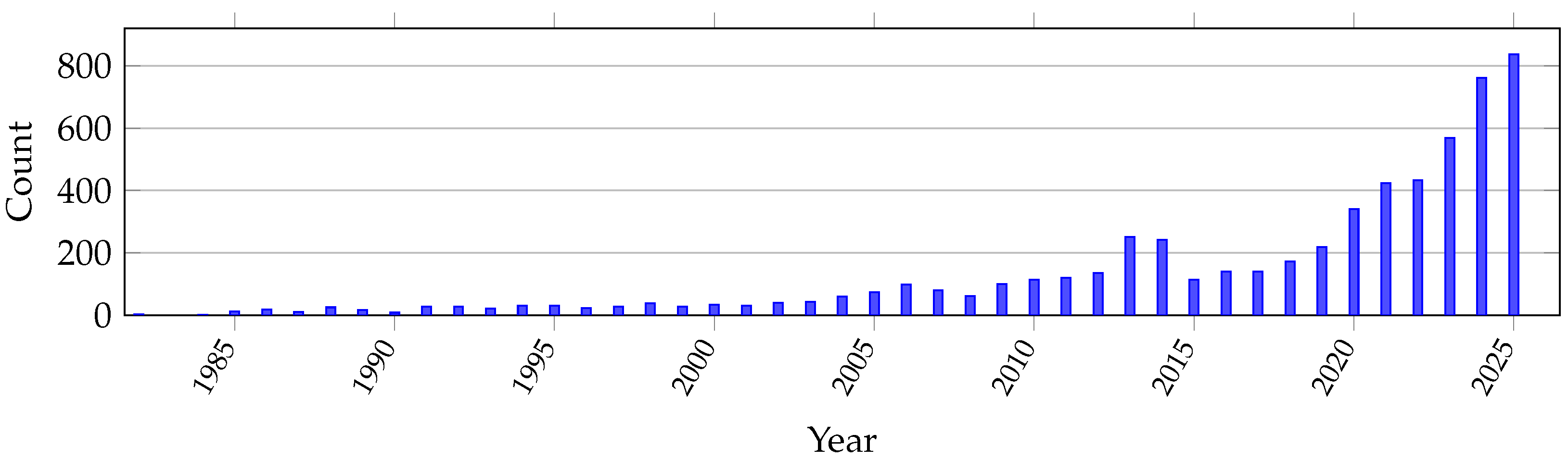
Artificial intelligence (AI) in structural engineering has attracted growing academic attention, as reflected in the publication record shown in Figure 1. For several decades, only a limited number of studies appeared each year, and progress was gradual. From around 2015 onward, however, the number of publications increased markedly, coinciding with wider developments in machine learning (ML) and the ongoing digital transformation of the construction industry [3].
The sharp rise in research output highlights the need for a systematic mapping study, as AI is now being explored across a wide range of structural-analysis and design tasks.
AI has become an influential component of emerging digital workflows in structural engineering. AI methods are increasingly used to approximate nonlinear relationships, automate modeling and analysis procedures, and generate or evaluate alternative design solutions [4,5].
Structural engineering has long relied on the FE method as the primary tool for analyzing structural behavior under diverse loading conditions. FEM is widely trusted for its accuracy and flexibility, which explains its central role in both research and professional practice [6]. At the same time, the increasing complexity of modern design tasks—together with the growing use of parametric modeling, uncertainty analysis, and large-scale simulation—has amplified the computational cost associated with FEM [7]. These pressures help explain why the recent growth of AI research in structural engineering has coincided with a search for methods that can complement or accelerate conventional finite-element (FE) workflows. AI-based surrogate models, optimization frameworks, and automated data pipelines are therefore not separate from FEM, but directly motivated by its practical limitations.

1.3. Opportunities Through CAD, BIM, and AAD

In parallel with developments in finite-element methods, advances in computer-aided design (CAD), Building Information Modeling (BIM), and algorithm-aided design (AAD) have created new opportunities for applying AI in structural engineering. These environments provide structured geometric and semantic information that can be exploited by machine learning models for automated analysis, design generation, and decision support, enabling tighter coupling between geometry definition and structural evaluation.
Their impact is most evident in workflows that link structural analysis with architectural design intent, particularly in early-stage and parametric design contexts. Here, AI methods are increasingly used to explore large design spaces, learn relationships between geometric parameters and structural response, and support rapid evaluation of design alternatives within integrated digital pipelines.
Recent industry-driven developments demonstrate the feasibility of such approaches in practice. Data-driven models have been applied to learn effective stiffness properties of structural components and connections directly from parametric finite-element analyses, allowing simplified structural models to be informed by high-fidelity simulations without repeated analysis. In steel-building and portal-frame contexts, this enables early-stage assessment that bridges detailed FEM and reduced-order design representations [8].
By enabling geometric, material, and performance data to move seamlessly between disciplines, CAD, BIM, and AAD platforms support performance-driven and generative design workflows in which finite-element analysis and AI-based prediction operate as interconnected processes rather than isolated steps [9,10].

1.4. Steps in FEM Workflows

The typical finite-element method (FEM) workflow can be divided into three main: pre-processing, solving, and post-processing [11]. Pre-processing includes defining geometry, discretizing the structure into finite elements, assigning material models, and applying boundary conditions and loads. Modeling choices made at this stage—such as element type, mesh density, exploitation of structural or load symmetry, and the selection of master and slave degrees of freedom—directly determine the total number of degrees of freedom (DOFs) and, consequently, the size and complexity of the resulting numerical problem.
The solver stage involves assembling and solving the global system of equations to obtain displacements, internal forces, and reaction quantities. For linear problems with symmetry or reduced DOF formulations, computational cost can often be managed efficiently. However, as the number of elements and total DOFs increases—particularly in nonlinear, dynamic, or optimization-driven analyses—the solver stage becomes the dominant computational bottleneck. Repeated analyses, such as those required in design-space exploration, uncertainty quantification, or iterative optimization, further amplify this cost, even when reduced or master DOF formulations are employed.
Post-processing focuses on extracting and interpreting response quantities such as stresses, strains, deformations, stability measures, and response envelopes, which are then evaluated against design criteria. For large parametric studies or high-dimensional models, this stage often involves handling and interpreting large volumes of data, making manual assessment increasingly impractical.
Each stage of the FEM workflow therefore presents distinct opportunities for AI integration. Machine learning methods have been applied to assist pre-processing tasks, including geometry parameterization, mesh generation, and identification of effective reduced representations. During the solver stage, surrogate models and reduced-order approaches are increasingly used to approximate FEM responses, mitigating the computational cost associated with high DOF counts and repeated analyses. In post-processing, AI-based techniques support response prediction, pattern recognition, and decision-making by filtering and synthesizing large result datasets [3,12].

1.5. Optimization in Structural Design

Optimization has long been recognized as a central theme in structural engineering, offering pathways to achieve lighter and more efficient structures. Beyond purely performance-oriented goals, optimization is increasingly used within design workflows to balance additional criteria such as constructability, cost, and sustainability, supporting closer integration between structural and architectural considerations [12].
Within this field, three principal categories of optimization are commonly distinguished. Topology optimization seeks to determine the optimal distribution of material within a prescribed design domain; shape optimization refines the external boundaries and contours of structural forms; and size optimization adjusts cross-sectional dimensions or material properties. Each approach has proven effective in specific contexts, yet their application to large-scale finite-element models remains constrained by substantial computational demands [13].
Recent developments indicate that optimization has been most extensively applied to multi-story buildings, where efficiency gains translate directly into material and cost savings. In contrast, spatial structures and more unconventional building typologies have received comparatively less attention, despite their potential to benefit significantly from advanced optimization methods. This imbalance suggests promising directions for further exploration [12].
Equally important is the recognition that optimization cannot be understood in isolation from design practice. Meaningful implementation requires close collaboration between architects and engineers, ensuring that structural efficiency and design intent are pursued in parallel. When embedded in such interdisciplinary workflows, optimization becomes a vehicle for both technical refinement and design exploration. AI further enhances this potential by enabling rapid evaluation of alternative design solutions and reducing the computational barriers that have traditionally limited the use of optimization in everyday structural design practice [12].

1.6. Research Questions

To make sense of how AI has been applied in structural engineering, this mapping study seeks to answer the following research questions:
  • What types of research have been conducted on AI in structural design?
  • In what ways has AI been used to support pre-processing, in-solver acceleration, and post-processing of structural models and design?
  • What patterns, challenges, and opportunities can be identified from the literature?
These questions aim not only to describe the current body of work but also to uncover where AI applications are concentrated and where gaps remain.

1.7. Application Groups

To structure the mapping, the reviewed literature is classified into seven broad application groups. Each article is assigned to one primary group, allowing recurring research themes to be compared in a consistent manner. Together, these groups capture the diversity of ways in which artificial intelligence has been applied within finite-element-based structural engineering.
The Optimization & Design group comprises studies in which AI is used to improve structural form, layout, or performance through search, learning, or hybrid optimization strategies. The Material & Mix Design group includes contributions where AI supports the development, characterization, or performance prediction of construction materials. Studies focusing on data-driven estimation of structural response, strength, durability, or service life are classified under Structural Performance Prediction.
The FEM Acceleration/Surrogate Modeling group covers approaches that approximate, replace, or accelerate finite-element analyses, including surrogate models and reduced-order formulations. Cross-domain Engineering Applications refers to work that connects structural AI applications to adjacent fields such as architecture, energy, or building performance simulation. Papers that synthesize existing research or introduce methodological frameworks are classified as Review and Methodology. Finally, studies that do not fit clearly into the preceding categories but remain relevant for understanding AI applications in structural engineering are grouped under Other.

1.8. Contribution of This Study

This study systematically classifies and analyzes existing publications, offering a structured overview of how AI has been applied in structural design. By mapping the research across the application groups, it identifies dominant approaches, recurring challenges, and gaps in the current landscape. The resulting synthesis provides a consolidated reference point for both researchers and practitioners, supporting a clearer understanding of current capabilities and emerging directions for AI-driven structural engineering.

1.9. Outlook

The remainder of this paper presents the methodology, classification scheme, and results of the systematic mapping. Rather than prescribing specific solutions, this study aims to clarify the state of the field and outline areas where further investigation is warranted. The insights presented here can inform subsequent methodological development and support efforts to connect emerging AI techniques with practical structural-engineering workflows.

2. Methodology

2.1. Search Strategy

This study follows systematic mapping principles to provide a structured overview of research at the intersection of finite-element analysis (FEA) and AI in engineering, with emphasis on transparency, reproducibility, and coverage [14,15]. We queried three major bibliographic databases with broad engineering coverage—Scopus, Engineering Village, and the Web of Science Core Collection—using the search string below, applied without time limits:
(FEA OR "Finite element") AND (AI OR "Artificial intelligence")
AND (Engineering)
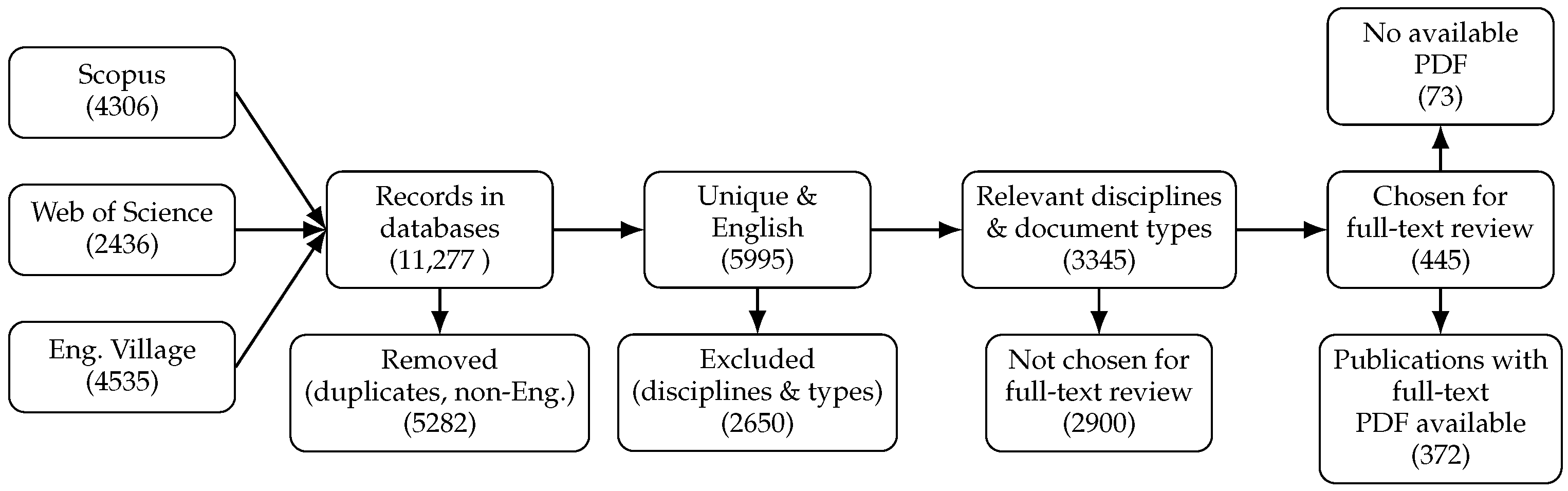
The database search returned 4306 records from Scopus, 2436 from Web of Science, and 4535 from Engineering Village (total n = 11 , 277 ). The searches were executed and the corresponding bibliographic records were downloaded on 15 October 2025, defining a fixed snapshot of the databases used for all subsequent analyses.
The inclusion criteria comprised peer-reviewed journal articles and conference papers written in English that explicitly address artificial intelligence methods applied within finite-element-based engineering contexts. Exclusion criteria included non-English publications, non-peer-reviewed documents, duplicate records, and papers not related to FEM-based analysis or design. Following database querying, records were deduplicated and filtered by discipline, after which relevance screening and full-text availability checks were applied for the subset subjected to detailed classification.

2.2. Article Selection and Categorization

After removing duplicates and non-English publications in a single automated step, n = 5995 unique records remained. This set was further reduced by applying restrictions on document type and discipline. Only items indexed as articles or conference papers were retained, and only those associated with a subset of disciplines considered directly relevant to this study were included (Table 1). Applying these restrictions resulted in n = 3345 records, while n = 2650 were excluded. The successive screening and filtering steps applied to the literature corpus are summarized in Figure 2.
These 3345 records formed the basis for subsequent mapping and categorization. Each record was assigned to categories along complementary dimensions, beginning with the following:
  • Application group: Each study was assigned to one of the seven application groups introduced in the Introduction. These groups capture recurring themes in how AI is applied within structural engineering and provide the framework for comparative analysis in this mapping.
Categorization was carried out using the OpenAI API, which analyzed article titles, abstracts, and keywords according to predefined definitions. A selected subset of papers—primarily those of particular relevance to the mapping objectives—was manually checked to verify that the automated assignments were coherent and aligned with the intended category definitions. To avoid overlap, each article was placed in a single application group based on its primary focus, representing the best fit for the study’s scope. In line with the objectives of systematic mapping, the focus was on characterizing the scope and distribution of research activity rather than appraising methodological quality [15]. The automated screening and classification workflow was executed through multiple sequential classification passes, corresponding to the different categorization dimensions applied in this study. The complete process was completed in approximately four hours. Across all stages of the pipeline— including title, abstract, keyword, and full-text analysis—the workflow processed approximately 59.5 million tokens. The majority of the computational effort was associated with full-text classification of the retained publications, while the initial filtering and categorization steps based on bibliographic metadata accounted for a comparatively smaller share.

2.3. Data Processing and Visualization

All data handling and analysis steps were implemented in Python 3.13. Custom scripts automated duplicate detection, language filtering, and the formatting of bibliographic metadata. The OpenAI API was used for large-scale categorization of records into disciplines and application groups, with results exported for verification and analysis. All descriptive statistics and visualizations were generated within a fully script-based workflow to ensure consistency and reproducibility across the analysis. This integration of automated text mining, AI-assisted categorization, and reproducible visualization provides a transparent methodological basis for the analyses presented in the Results Section [12,16].

2.4. Full-Text Categorization of Articles

Following the initial screening based on titles, keywords, and abstracts (Section 2), we performed a second-stage, model-assisted categorization on full-text PDFs. The objective was to assign each paper a single, consistent label across several dimensions relevant to structural engineering research.

2.4.1. Taxonomy

Each paper was classified along up to seven dimensions (one label per dimension):
  • Object (Beam, Column, Floor, Bridge, Slab, Wall, Frame, Truss, Building)—the main structural object under study (not merely mentioned).
  • Object group (Structural Element, Structural System, Connection, Large Infrastructure, Advanced Materials and Composites, Special Structures, Geotechnical Structures, Other)—a higher-level classification describing the structural scale or type of system investigated; while Object refers to a specific component (e.g., beam, wall), Object group captures whether the study targets individual elements, full systems, or specialized structural categories.
  • AI Algorithm (Artificial Neural Network (ANN), Convolutional Neural Network (CNN), Deep Neural Network (DNN), Graph Neural Network (GNN), Support Vector Machine (SVM), Random Forest, Extreme Gradient Boosting (XGBoost), Gradient Boosting, Genetic Algorithm (GA), Reinforcement Learning, Ensemble Learning, Transfer Learning, No AI or ML Used, etc.)—the primary AI/ML method implemented or evaluated; synonyms are mapped to the closest category.
  • Material (Reinforced Concrete, Plain Concrete, Prestressed Concrete, Steel, Steel–Concrete Composite, Other Composite, Timber, Engineered Wood, Masonry, Aluminium, Other Metals, Generic Material, Multi-Material, Not Specified)—the principal material investigated or modeled.
  • Analysis (Static, Dynamic, Seismic, Thermal, Buckling, Fatigue, Fracture, Other)—the primary analysis type; if several are present, the type emphasized in the results or conclusions is selected.
  • AI usage (Pre-processing, In-solver, Post-processing, Pre- and Post-processing, Other)—how AI is applied relative to FEM.

2.4.2. Model-Assisted Labeling Pipeline

A configurable Python pipeline (GeneralClassifier) automated large-scale categorization. It parses Bib T E X entries, extracts metadata and full-text content from local PDFs, and applies structured prompt templates through the OpenAI API. Each classification dimension is processed in a separate pass using predefined label sets and explicit tie-break rules to ensure single, unambiguous outputs. All prompt templates and label definitions are available in the project repository.

2.4.3. Parallel Processing and Data Management

Classification tasks were executed in parallel to handle thousands of records efficiently. The pipeline monitors token usage, manages API rate limits, and retries interrupted calls. Results are written back to the source Bib T E X files and aggregated into per-folder and global CSV summaries used for analysis and visualization.

2.4.4. Consistency and Validation

Consistency was supported through the use of fixed vocabularies, synonym mapping, and structured prompt templates, which ensured that the model received stable and unambiguous instructions across all classification tasks. Only records with accessible full-text PDFs were included in the full-text stage of categorization. A targeted manual review of selected studies was performed to confirm that the assigned labels aligned with the central focus of those papers.

2.4.5. Limitations and Reproducibility

Accuracy is influenced by the quality of PDF text and clarity of reported methods. To mitigate variation, all prompts, label sets, and scripts are version-controlled, enabling exact reproduction of classification results from the same corpus and code commit.

2.4.6. Accuracy of Categorization

The accuracy of the mapping was evaluated through a targeted manual review of a representative set of studies. Each article in this set was revisited to verify that the assigned categories reflected the main analytical formulation, structural object, and use of AI as described in the paper. The mapping assigned exactly one label per dimension, selecting the category that best represented the study’s primary emphasis, even when individual studies engaged with several analytical levels or methodological approaches.
Overall, the mapping performed well and proved robust across the reviewed cases. The classification of structural objects and analytical elements was generally straightforward, as most papers stated clearly whether the analysis addressed individual members, subsystems, or complete building structures. In multi-scale studies that combined element-level modeling with global building analysis, the assigned label corresponded to the level considered most central to the study’s objectives. Materials and structural typologies were also handled consistently, distinguishing concrete, steel, and composite systems and clearly separating frame-type models from solid or shell formulations.
More interpretive judgement was sometimes required for fields related to the use of AI. Many papers applied several AI algorithms or combined roles—such as a surrogate model coupled with an optimization routine. In these cases, selecting a single representative algorithm inevitably involved simplification. The chosen label therefore reflects the algorithm judged to play the primary role in the workflow, rather than an exhaustive list of all techniques used. This approach ensures comparability across the dataset while acknowledging the diversity of emerging hybrid methods.
In summary, the mapping demonstrates strong overall accuracy and internal consistency. It captures the main analytical and methodological intent of each study while maintaining coherence across categories. Remaining uncertainties arise primarily from the inherent overlap of research scopes—particularly in studies that operate simultaneously at multiple structural levels or employ several AI techniques in parallel. These cases were documented during review to support transparent interpretation of the aggregated results.

3. Results and Discussion

3.1. Convergence

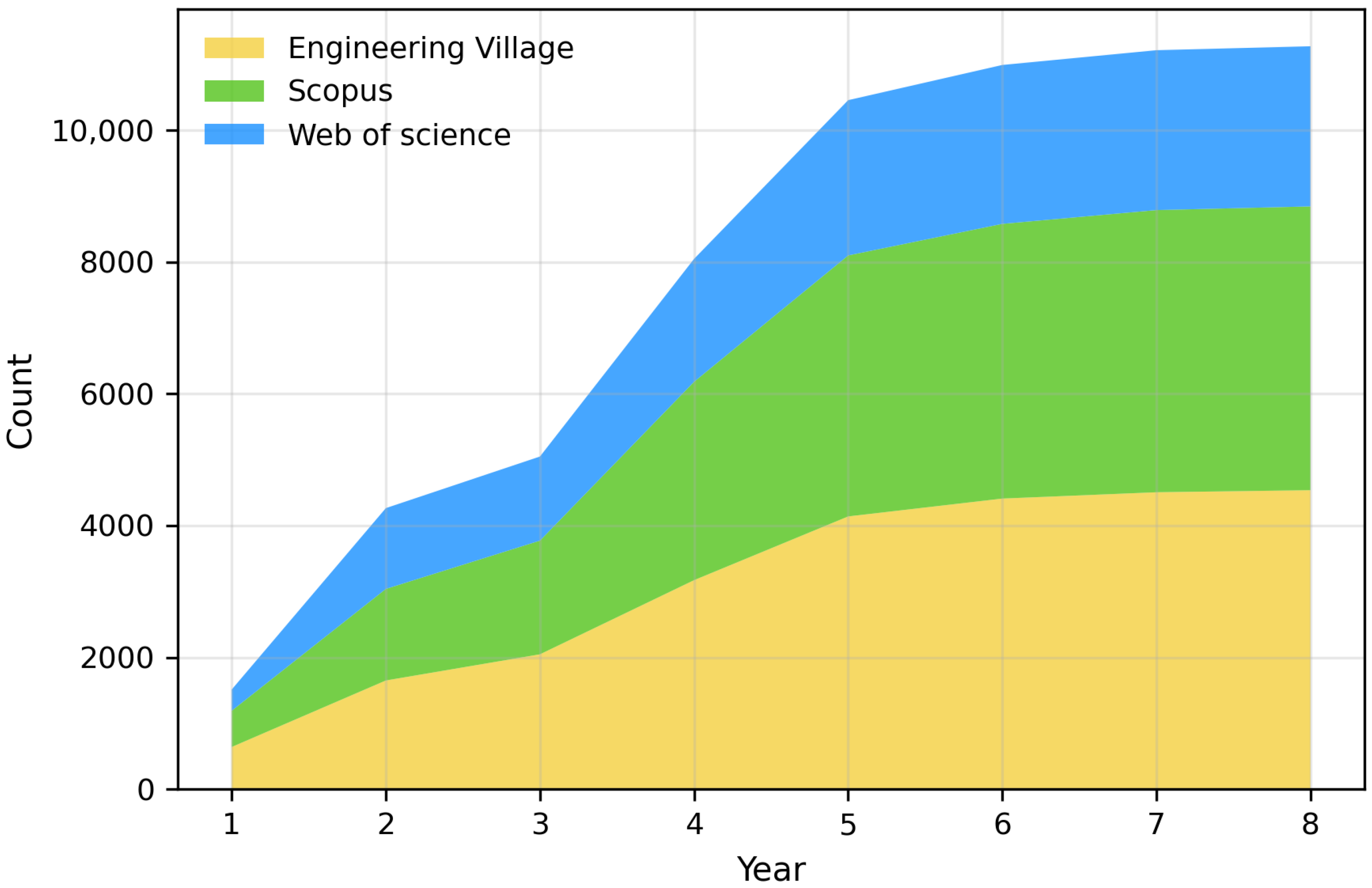
Figure 3 illustrates the cumulative number of publications retrieved from Engineering Village, Scopus, and Web of Science as successive AI-related keywords were added to the search query. Eight search iterations (Searches 1–8; Table 2) were performed to progressively broaden coverage of AI within the finite-element engineering domain. The first query focused on the general overlap between finite-element analysis (FEA) and AI; subsequent searches incrementally introduced additional AI paradigms, including machine learning, deep learning, neural networks, genetic algorithms, swarm optimization, expert systems, and reinforcement learning. The steady increase in the total number of retrieved papers indicates a growing breadth of AI applications in engineering-oriented finite-element research.
Convergence is reached in the final search stages: Searches 7 and 8 add only a small number of additional records, indicating that the combined query captures the dominant AI terminology used in finite-element engineering.

3.2. Publication Trends and Dataset Overview

Figure 4 presents the temporal distribution of all retrieved publications (n = 5995) following duplicate removal. The dataset, covering all entry types, disciplines, and languages from the cumulative searches, represents the complete corpus prior to any refinement. Temporal trends show a clear acceleration in research activity during the last decade: only about one third of the papers (1827; ≈30%) were published before 2015, whereas nearly seventy percent (4168; ≈70%) appeared in the following years. The yearly output increased from roughly 36 papers per year before 2010 to more than 480 per year after 2020. This pattern aligns with recent systematic reviews, which report a sharp rise in AI-based structural design research since 2021, driven by the adoption of deep learning and generative design methods that have lowered the barrier to applying AI in Engineering [4]. These growth rates are calculated from the full dataset (n = 5995) and reflect the broader increase in AI and machine learning applications across engineering disciplines. In the subsequent analysis, a refined subset of 3345 papers directly related to finite-element-based structural engineering is examined in detail.
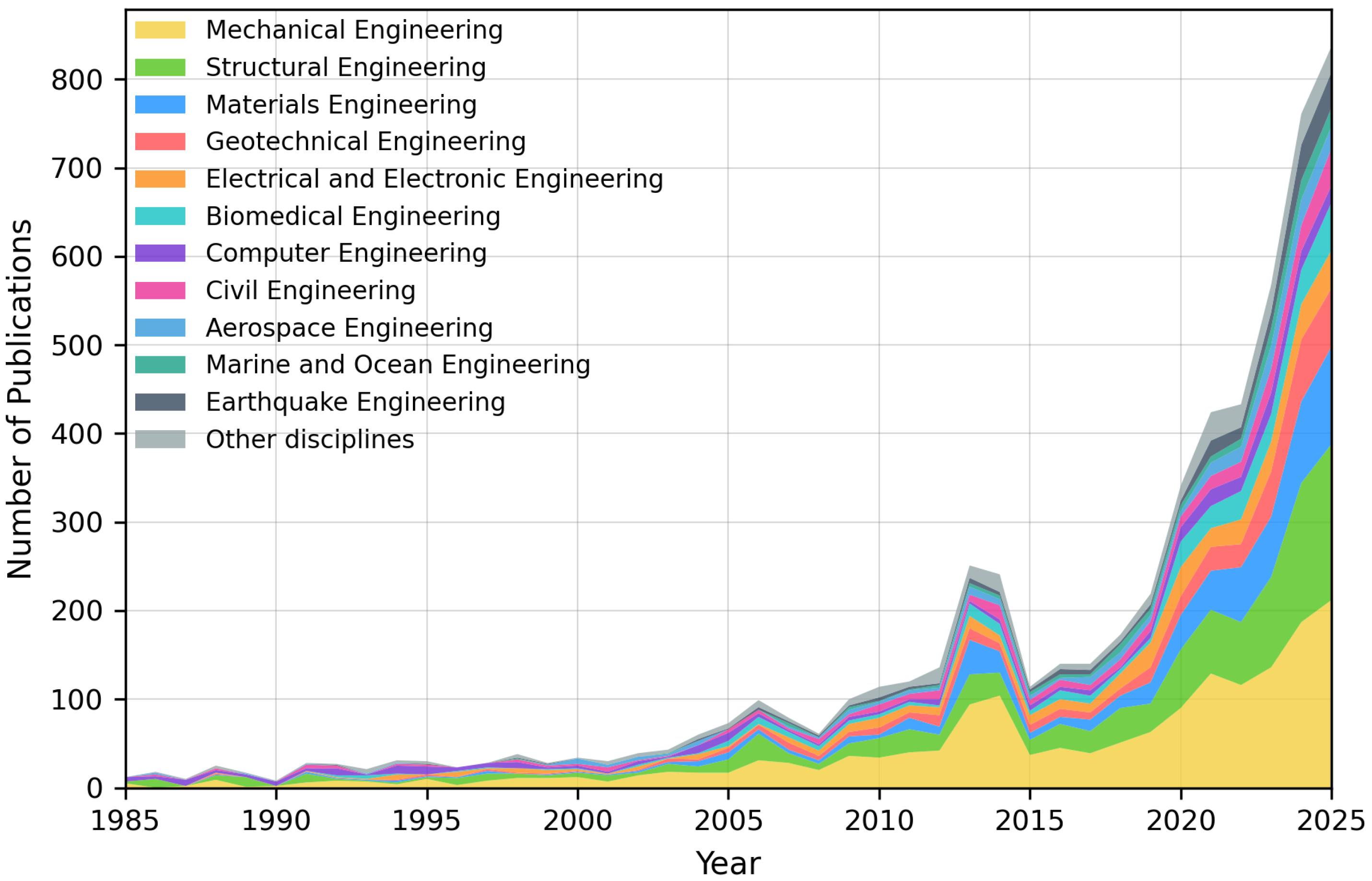
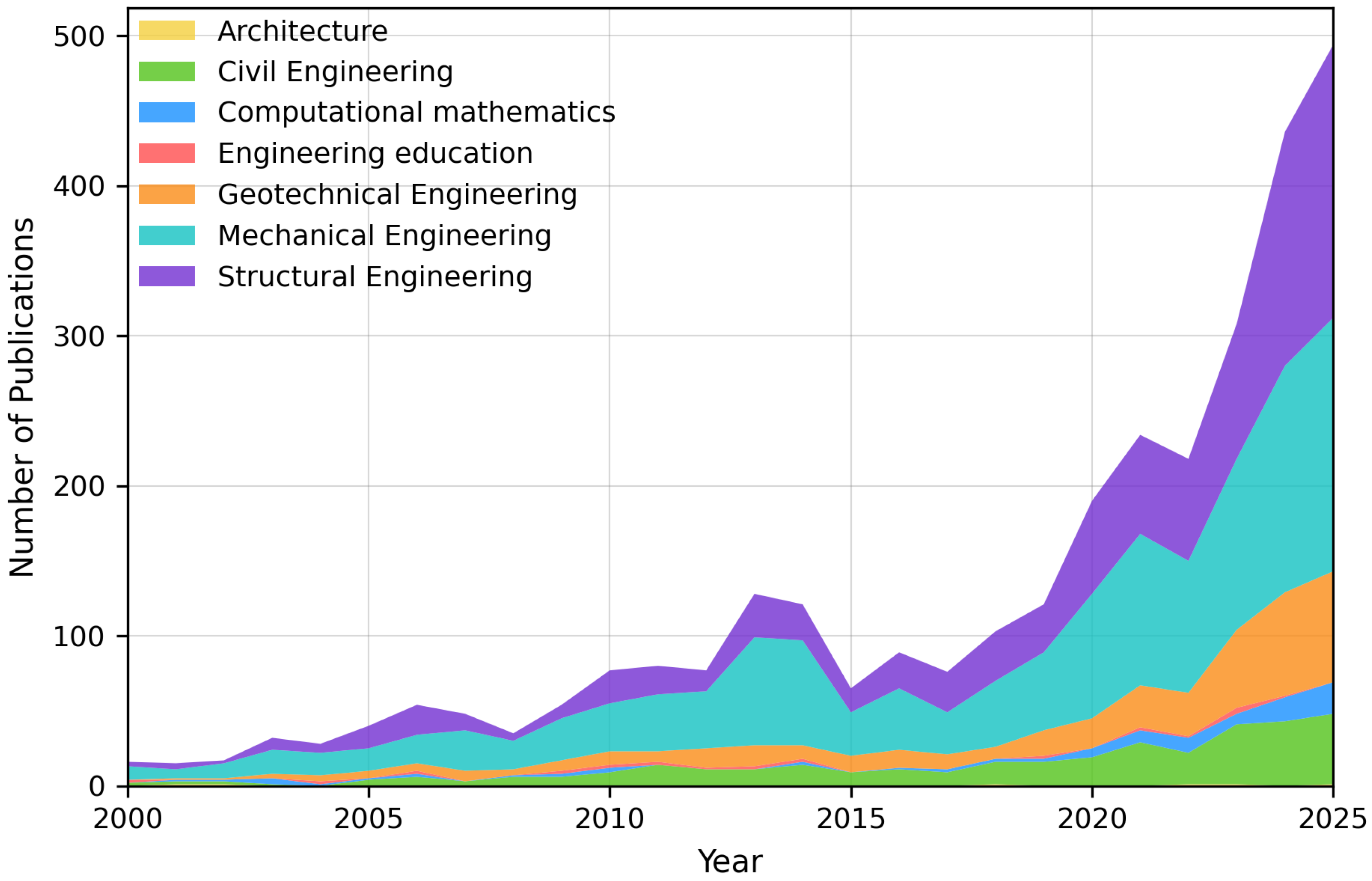
The disciplinary distribution (Figure 5) shows that most publications are associated with Mechanical Engineering, Structural Engineering, and Materials Engineering. The group “Other disciplines” aggregates smaller fields with fewer than 100 publications. All major disciplines exhibit steady growth after 2015, with a pronounced rise after 2020. Disciplines such as Architecture, Computational Mathematics, and Engineering Education occur only sporadically in the dataset. A limited number of publications are classified under Earthquake Engineering, accounting for approximately 3.2,% of the full corpus. These studies are closely aligned with Structural Engineering, Civil Engineering, and Geotechnical Engineering in terms of modeling approach and analytical scope, and are therefore treated as integrated contributions within these broader disciplines in the subsequent analyses.
The temporal and disciplinary distributions together indicate a clear shift in research focus over time. Before 2015, the literature was dominated by mechanical engineering studies ( 49 % of all publications), with smaller contributions from structural engineering (25%) and geotechnical engineering (7%). After 2020, structural engineering contributions increased to roughly 33% of all studies, while mechanical engineering papers decreased to about 38%. This redistribution highlights how AI research has transitioned from general mechanics problems toward domain-specific applications in structural design and analysis.
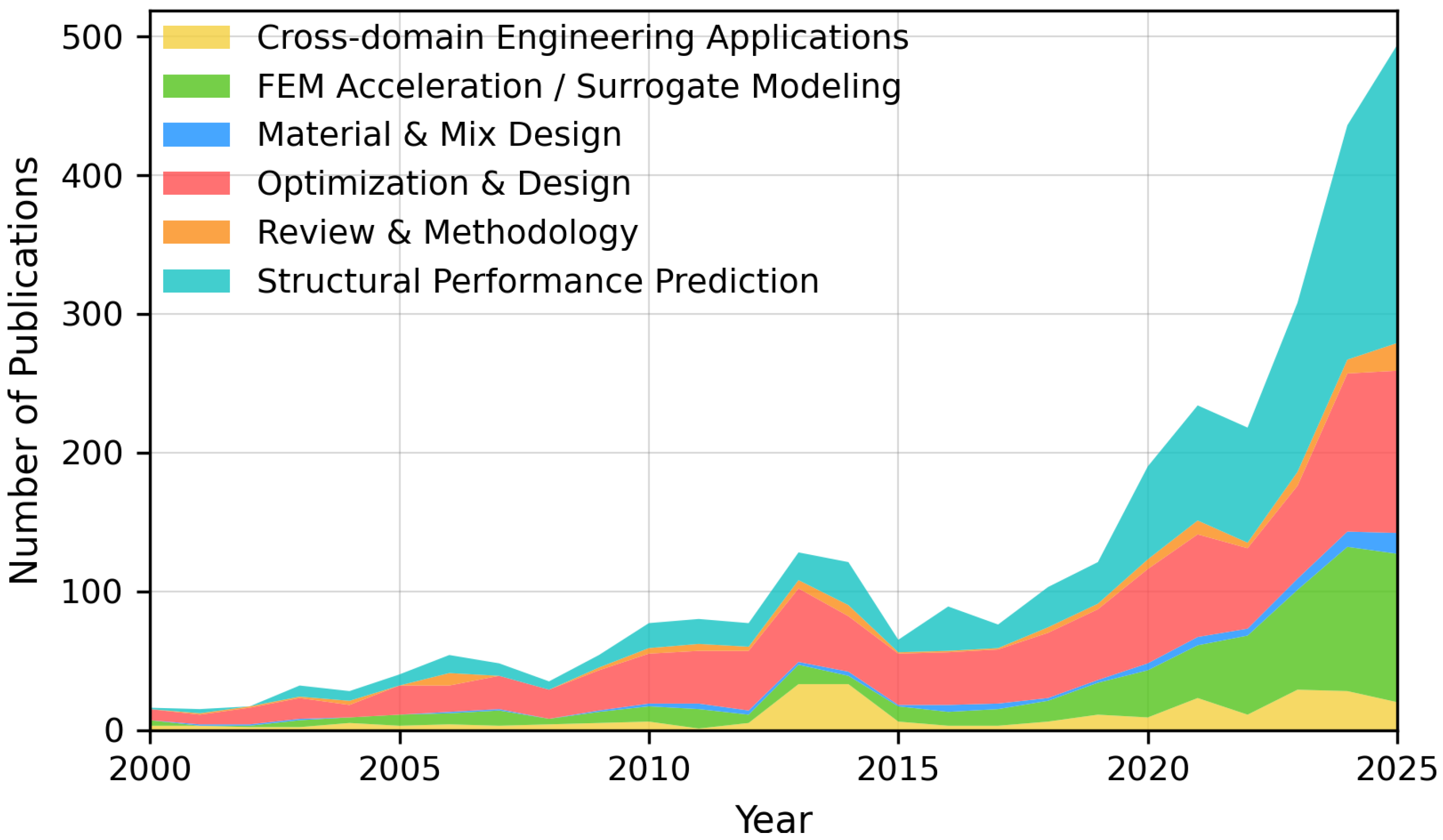
Figure 6 presents the yearly distribution of publications by application group. Optimization & Design and Structural Performance Prediction represent the largest categories throughout the period, both showing substantial growth after 2020. FEM Acceleration/Surrogate Modeling also increases noticeably in recent years, while Material & Mix Design, Cross-domain Engineering Applications, and Review and Methodology remain smaller but stable categories. Among the 3345 finite-element-related studies analyzed in detail, the distribution of focus areas has changed significantly over time: before 2015, Optimization & Design accounted for 43%, Structural Performance Prediction for 20%, and Cross-domain Applications for 14%; after 2020, the shares shifted to 26%, 39%, and 22%, respectively. This evolution reflects a methodological progression from search-based optimization toward predictive and surrogate-modeling paradigms.
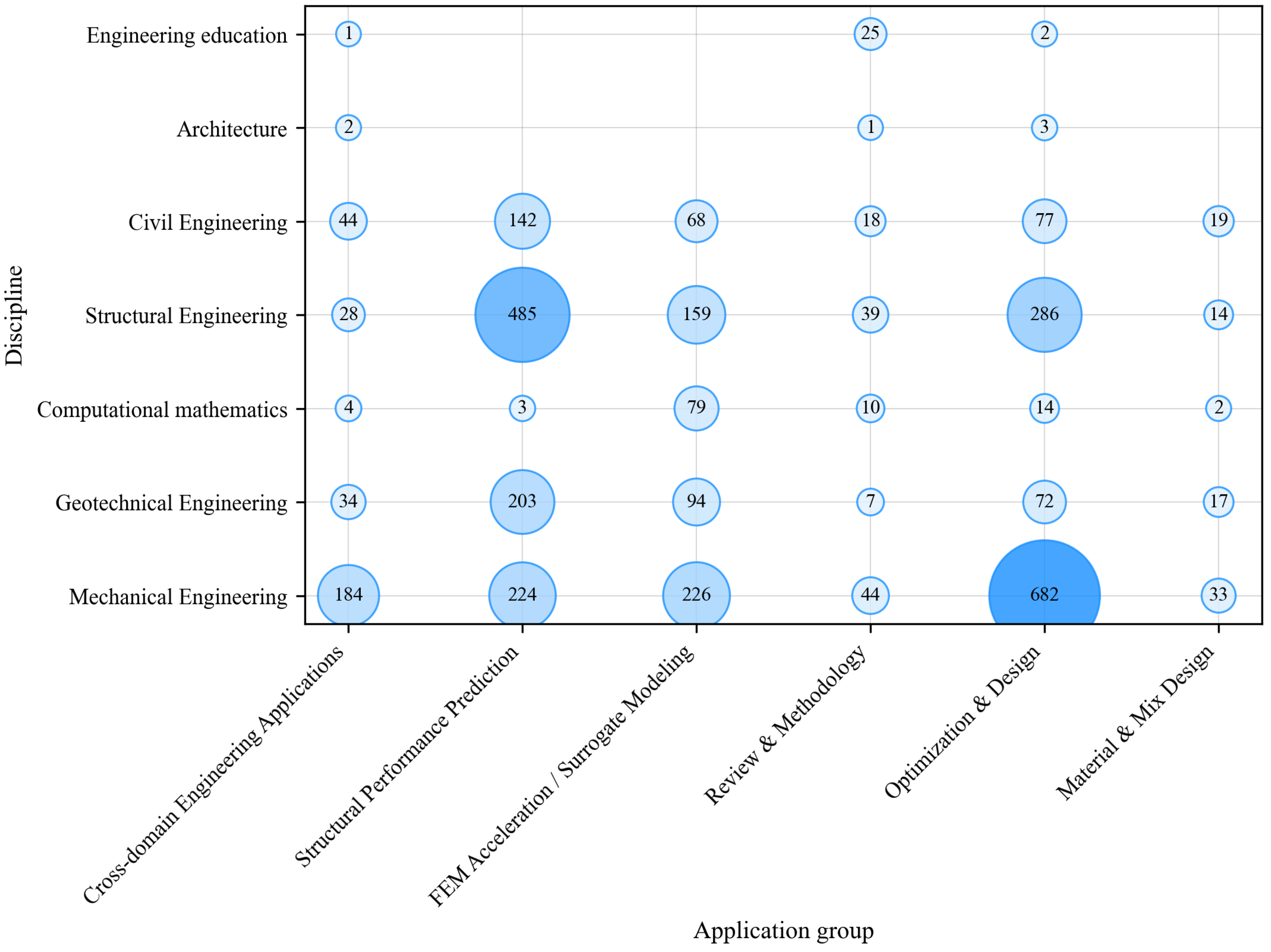
Figure 7 shows the intersection between disciplines and application groups. The largest overlap occurs in Mechanical Engineering—Optimization & Design, followed by Structural Engineering—Structural Performance Prediction and Structural Engineering—Optimization & Design. Mechanical Engineering also shows substantial activity in FEM Acceleration/Surrogate Modeling, Structural Performance Prediction, and Cross-domain Engineering Applications, each exceeding the corresponding counts for Structural Engineering—FEM Acceleration/Surrogate Modeling. Geotechnical Engineering contributes primarily to Optimization & Design, while smaller clusters appear across other combinations. Although the intersection Structural Engineering—FEM Acceleration/Surrogate Modeling is comparatively smaller, it is selected—together with Structural Engineering—Optimization & Design—for detailed analysis in the following subsections, as these categories align most closely with the study’s focus on finite-element applications in structural engineering. Combinations with very low publication counts—most notably those involving Architecture—should not be interpreted as a lack of interest in these areas, but rather as a consequence of the search strategy: architectural AI research rarely includes explicit finite-element modeling, and therefore appears sparsely in this engineering-focused corpus.
In addition to the dominant combinations discussed above, the distribution pattern across disciplines reveals clear differences in emphasis. Civil Engineering, Structural Engineering, and Geotechnical Engineering show broadly similar profiles, with a strong concentration in Structural Performance Prediction and a secondary presence in FEM Acceleration/Surrogate Modeling. In contrast, Mechanical Engineering displays a distinct pattern, with Optimization & Design representing the largest share of publications in that discipline. These differences reflect how research activity within each discipline is distributed across application groups, as seen in Figure 7.

Citation Distribution and High-Impact Publications

In addition to publication counts, citation data were examined to contextualize highly visible studies within the refined corpus. The analysis is restricted to the discipline- and document-type-filtered subset ( n = 3345 ) to ensure consistency with the subsequent analyses and to focus on literature that is directly relevant to structural engineering and closely related disciplines in which finite-element modeling plays a central role.
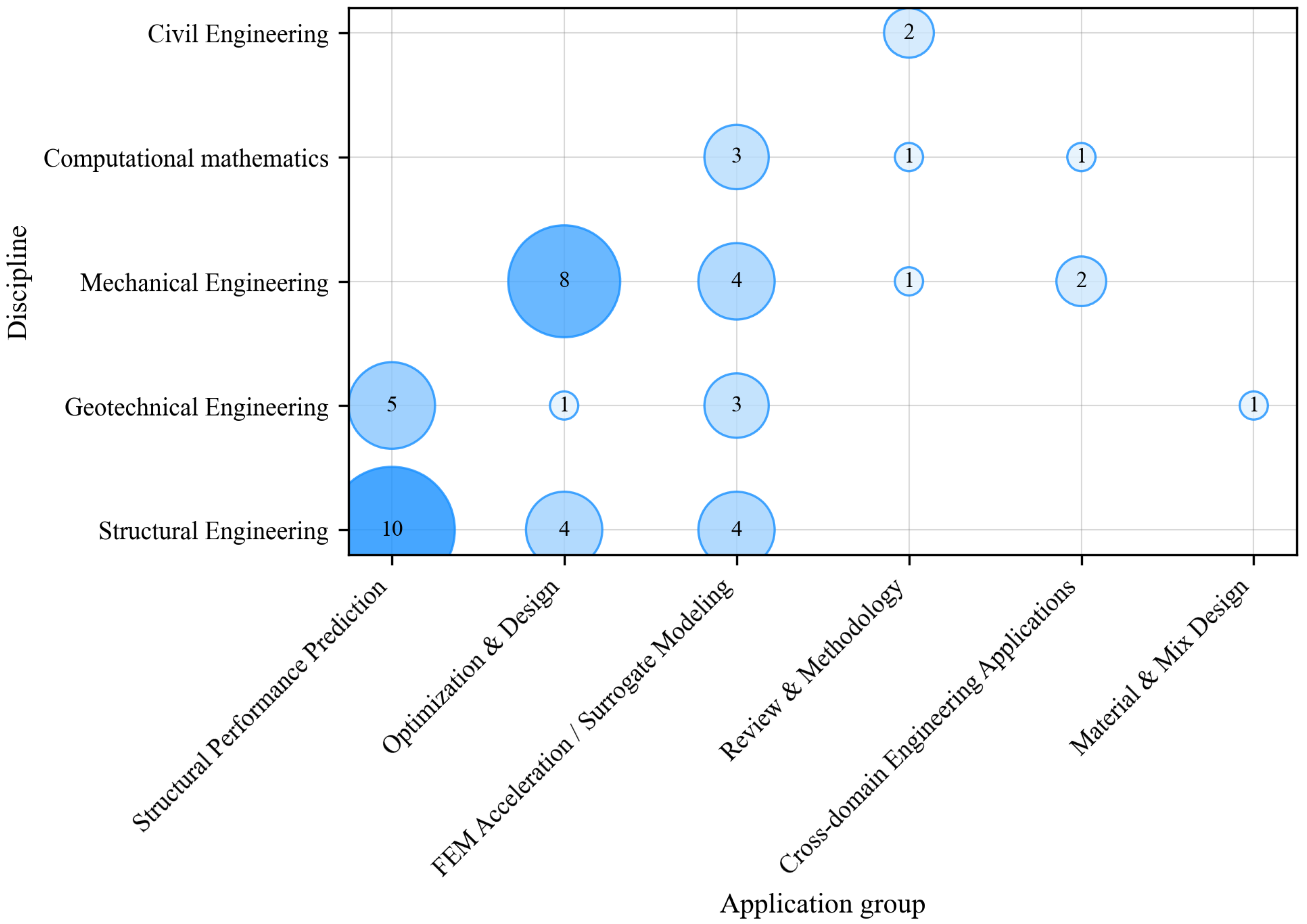
Figure 8 indicates that highly cited publications largely occur within the same discipline–application group combinations that dominate in terms of publication volume. The strongest concentration of citations appears in Structural Performance Prediction within Structural Engineering, which represents the single largest cluster among the top-cited studies. The second-largest concentration is observed in Optimization & Design within Mechanical Engineering, despite this application group having a higher overall publication count than Structural Performance Prediction.
Surrogate modeling and FEM acceleration studies also exhibit a relatively high citation presence relative to their publication volume, suggesting strong visibility and reuse of foundational contributions in this area. In contrast, Optimization & Design shows a more proportional relationship between publication count and citation frequency, consistent with a mature and widely distributed research field. Overall, citation patterns broadly mirror publication trends, reinforcing that the most intensively researched discipline–application group combinations also tend to produce the most visible and frequently referenced contributions.

3.3. Optimization and Design in Structural Engineering

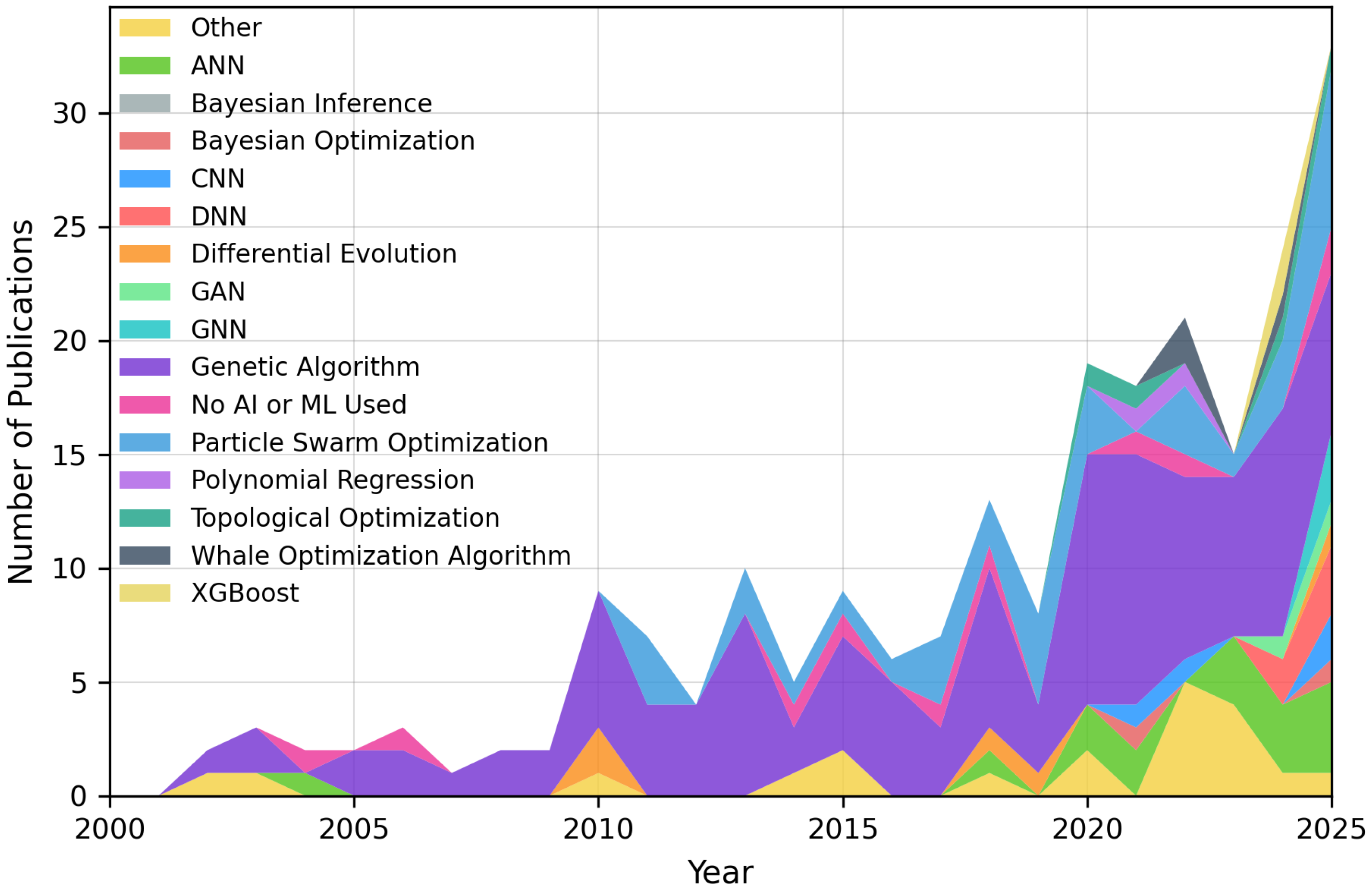
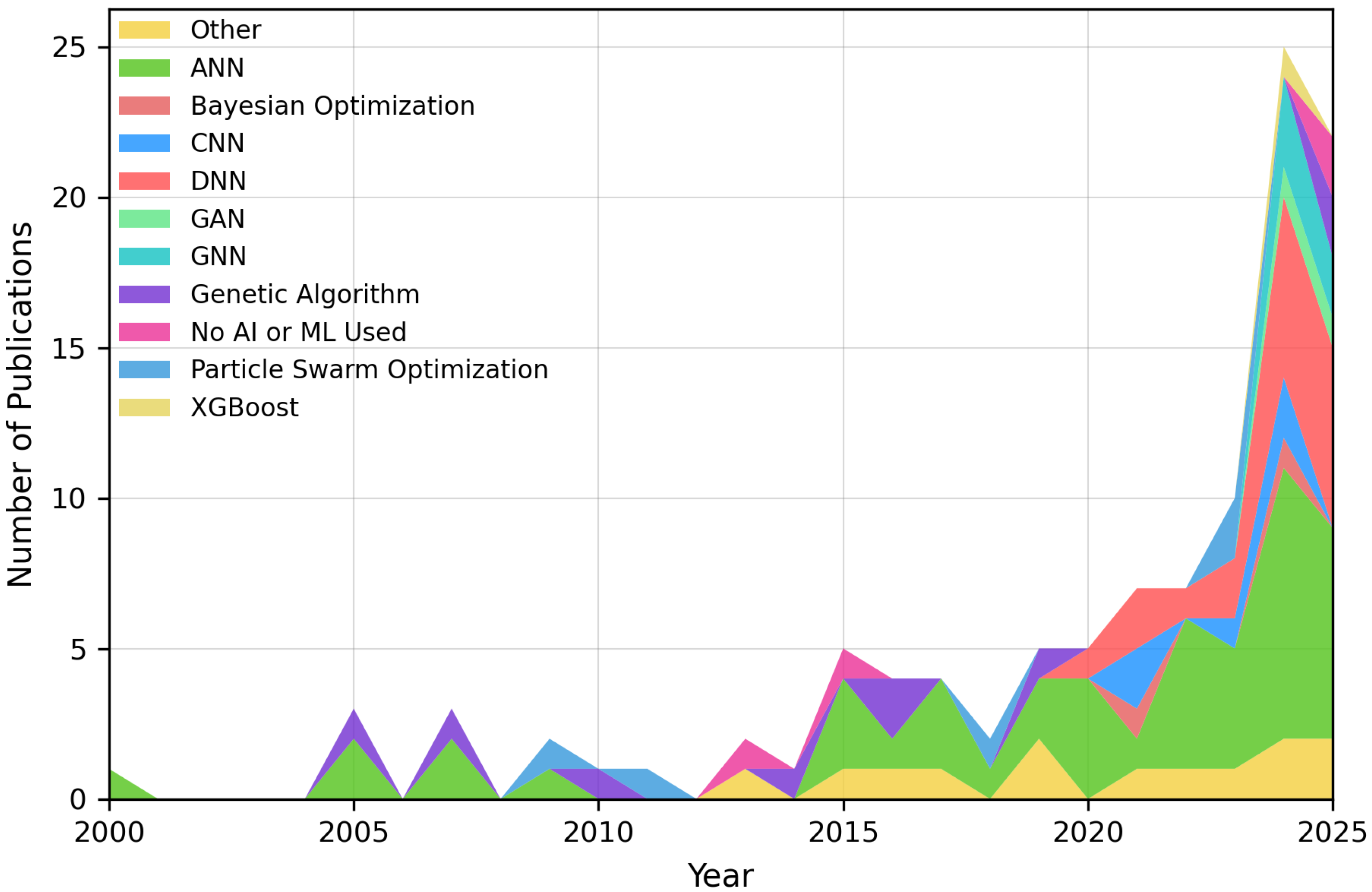
Figure 9 presents the yearly distribution of publications by algorithm within the Optimization & Design group. The data indicate a gradual expansion of research activity through the 2010s, with a broader range of optimization methods appearing in recent years. GA remains the most frequently applied method, often appearing alone or in hybrid form with other metaheuristics or neural network surrogates. They are consistently used for sizing, shape, and topology optimization of trusses, frames, bridges, canopies, and connection details [17,18,19,20,21,22,23]. These studies typically minimize weight or strain energy while satisfying displacement, stress, and buckling constraints, with each candidate solution evaluated through finite-element (FE) analysis.The GA–FEM loop is implemented using scripted or parametric environments such as Dynamo–Robot [24,25], Grasshopper–OpenSees [26,27], or Python–Abaqus [28,29], where the optimization cycle regenerates geometry, analyzes responses, and applies penalty terms for constraint violations.
Other evolutionary and swarm-based algorithms are also represented, including Particle Swarm Optimization (PSO) [30], Differential Evolution (DE) [31], Black Widow Optimization (BWO) [32], and Improved Stochastic Ranking Evolution Strategy [33].
These methods are applied to problems such as thermal and local buckling of thin-walled members [34,35], stiffness and load-carrying efficiency in cold-formed steel sections [36,37], and reinforcement layout or bracing configuration in bridges and buckling-restrained braces [38,39]. The objectives commonly include weight reduction, stiffness improvement, or increased buckling resistance under predefined load cases.
A subset of the studies integrate surrogate or neural network models directly into the optimization loop to reduce the computational cost of repeated FE evaluations. Examples include GA and PSO workflows coupled with response-surface, radial-basis-function, or Gaussian-process surrogates, as well as hybrid implementations where artificial neural networks (ANNs) approximate FE responses [40,41,42,43]. In these cases, the surrogate is trained on a limited set of FE simulations and used for intermediate evaluations during the optimization, while periodic retraining or selective high-fidelity analyses maintain accuracy. Reported applications include optimization of composite shell structures, steel joints, and dynamic model updating. These hybrid approaches remain part of the optimization workflow rather than separate surrogate-modeling studies.
Figure 9 also includes publications classified as No AI or ML Used, corresponding to deterministic approaches such as Sequential Quadratic Programming (SQP), optimality-criteria methods, and trust-region or response-surface techniques [44,45,46]. These studies rely on direct FE sensitivities or analytical gradients rather than data-driven models and are typically applied to continuous or mixed-variable sizing problems.
The distribution in Figure 9 illustrates that research on structural optimization encompasses a broad range of algorithmic approaches. GAs and related metaheuristics account for the largest share, while PSO, DE, and other heuristic methods appear across specific structural applications. The inclusion of surrogate-assisted and classical mathematical-programming approaches indicates methodological diversity within the Optimization & Design group, combining heuristic exploration with physics-based parameter optimization in finite-element workflows.
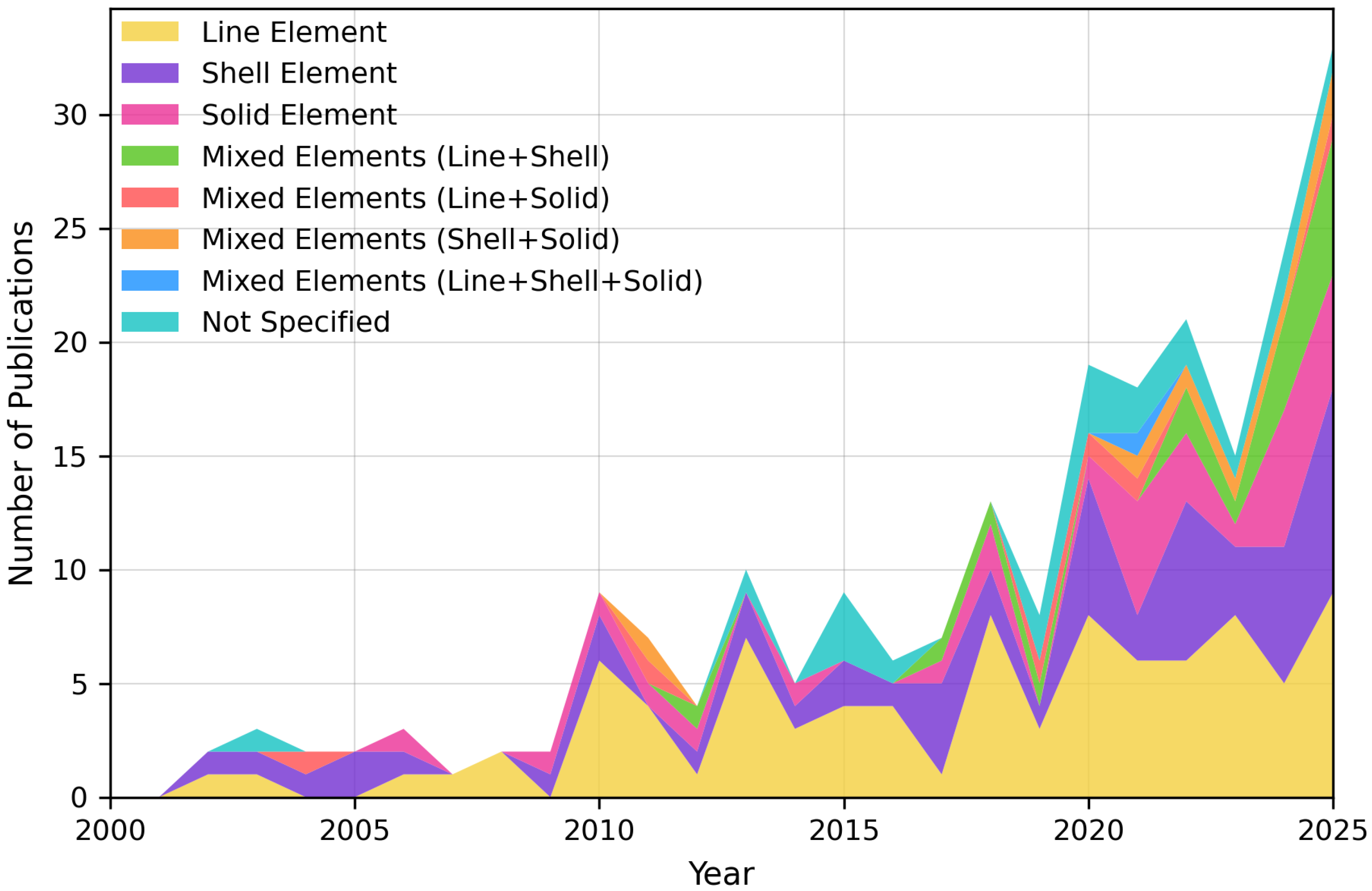
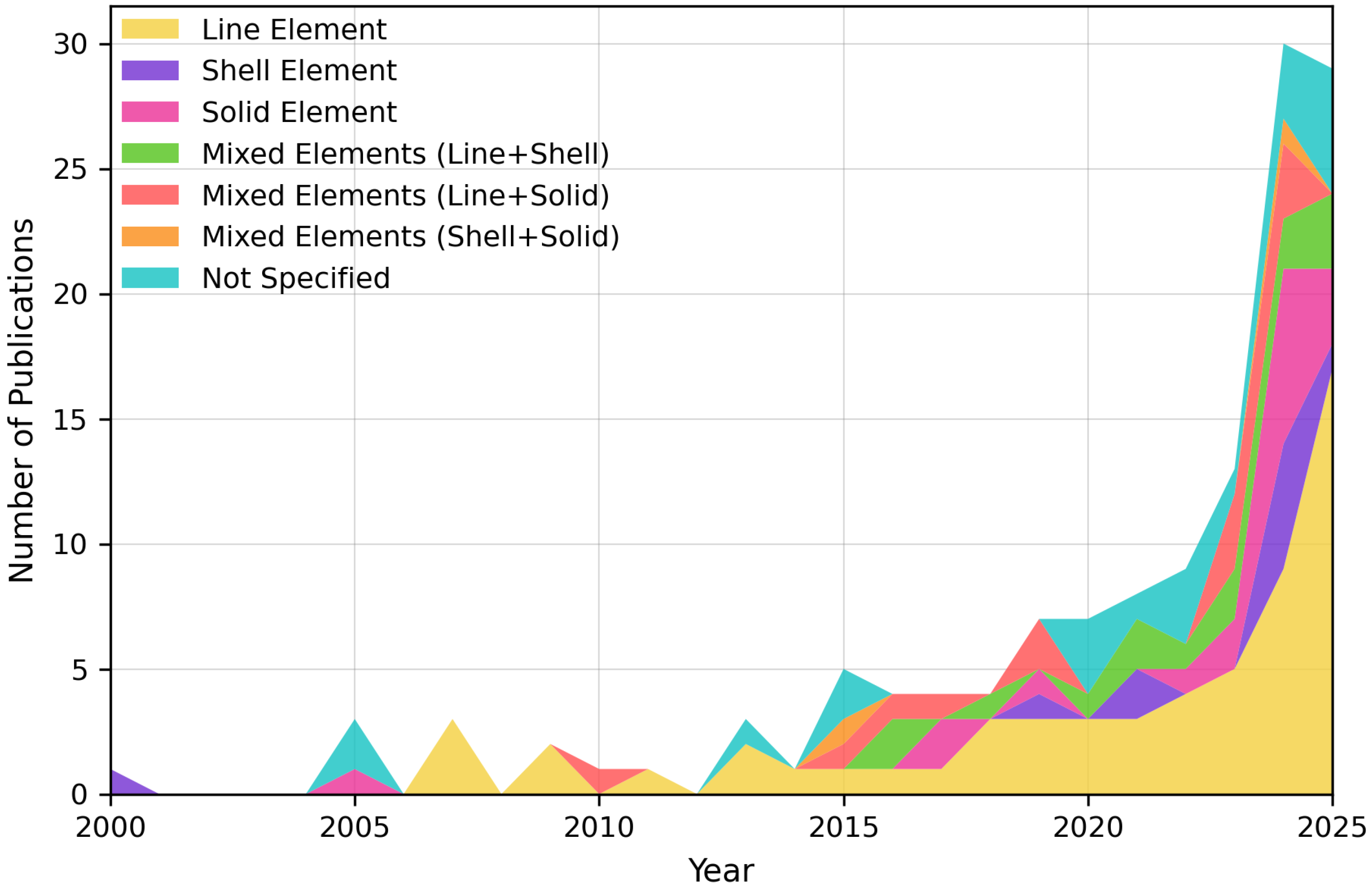
Figure 10 presents the number of publications per year by analytical element type within the Optimization & Design group. Most studies use line or shell elements, while solid and mixed-element formulations appear in more specific cases. Line elements are typically used in truss and frame models, where optimization targets include weight reduction, cross-section assignment, or reliability-constrained sizing under code-based stress, displacement, and buckling limits. These formulations allow large design spaces to be explored efficiently, since each individual in the optimization loop (for example in GA, PSO, or DE) can be evaluated quickly through repeated one-dimensional frame or truss analyses and checked against design rules [17,47,48].
Shell elements are frequently used for thin-walled or surface-dominated systems, such as cold-formed steel columns, stiffened plates, metallic panels under thermal loading, and free-form reinforced-concrete shells [34,49,50,51]. In these studies, the optimization objective is often formulated in terms of resistance-to-weight ratio, critical buckling load or temperature, or deformation control. Authors note that shell formulations are chosen because they can represent membrane and bending behavior, local/distortional buckling, and mode interaction with fewer degrees of freedom than a full solid model, which makes iterative evaluation feasible within the optimization loop [34,49]. Shell elements are also used in cutout and stiffener layout optimization for plates, where local stress measures or failure indices are part of the objective or constraints [50,52].
Solid-element models appear mainly in studies that optimize steel joints, brackets, and other local connection details, where contact, bolt pretension, plastic strain, and local instability govern performance [23]. In these cases, three-dimensional brick elements are used to capture nonlinear behavior, joint rotation capacity, and buckling factors, and the optimization problem typically includes explicit limits on equivalent plastic strain or local instability. Several of these studies report alternative, reduced models (for example shell elements for plates combined with beam elements for bolts) that are calibrated against the full solid model in order to reduce analysis time while preserving stiffness and ultimate load within a small deviation [23,52].
Mixed formulations, including line–shell and shell–solid combinations, are used where different components of the same structure require different levels of fidelity. Reported examples include strut-and-tie modeling of reinforced concrete, where truss (line) elements are used to represent tensile load paths and shell or continuum elements are used to represent compression fields; and buckling-restrained braces and connection regions, where shells are used for plate components and solids for local contact or confinement [39,53]. Mixed models are also employed in wind-turbine towers and large civil structures, where beam or shell elements are used for the global system and solid elements are reserved for zones with complex stress states or curved geometry [54]. In these studies, the combination of element types is described as a way to maintain local accuracy in critical regions while keeping the global model computationally tractable for iterative optimization.
The Not Specified group includes publications where optimization is described in terms of global stiffness, stability, or energy measures without explicitly stating whether the FE model uses line, shell, or solid elements. Overall, the distribution in Figure 10 indicates that most optimization workflows rely on one- or two-dimensional formulations (line and shell elements) for efficiency, while solid- and mixed-element models are applied in cases where local three-dimensional behavior, contact, or stability of connections is central to the design objective.
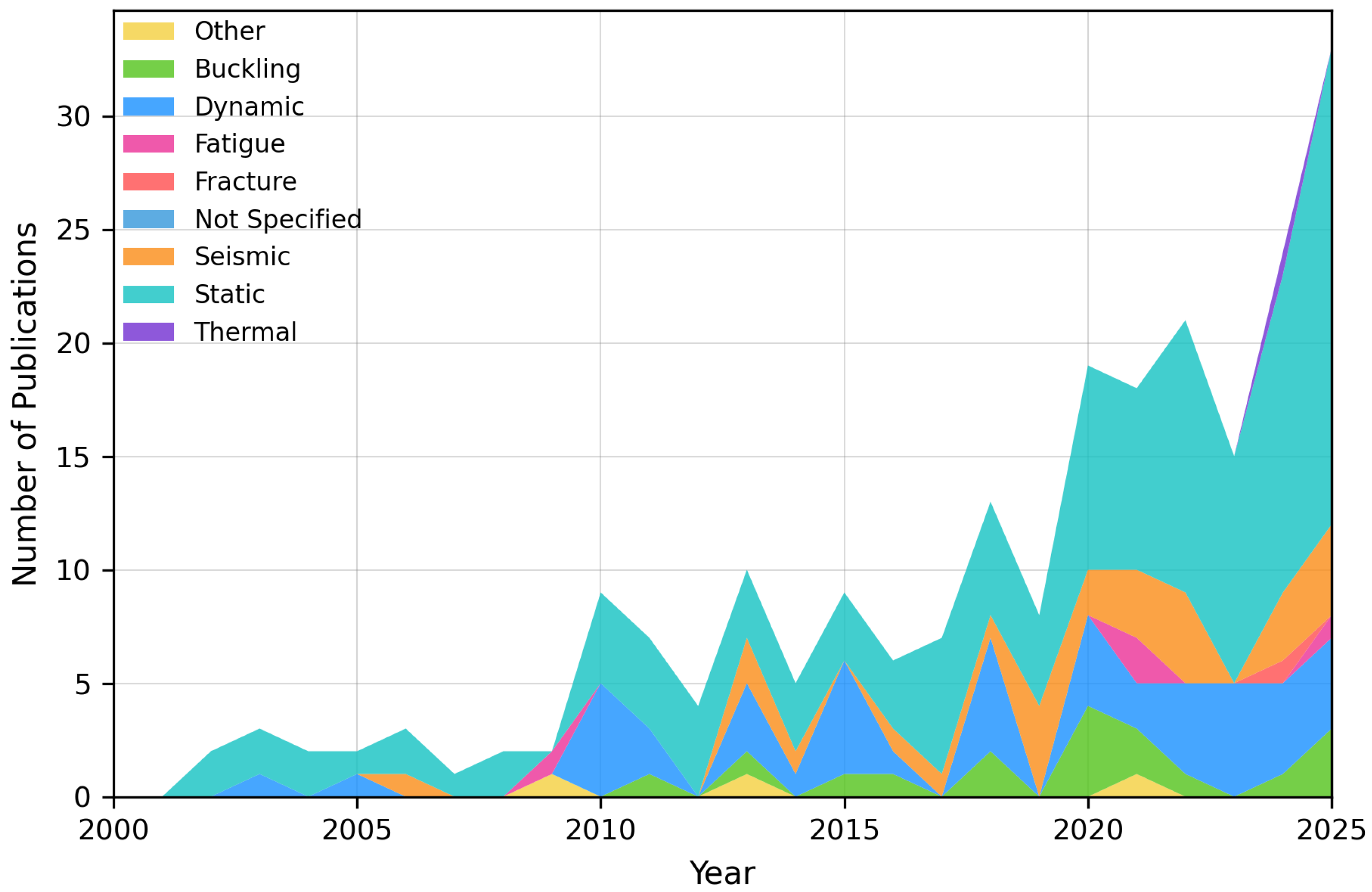
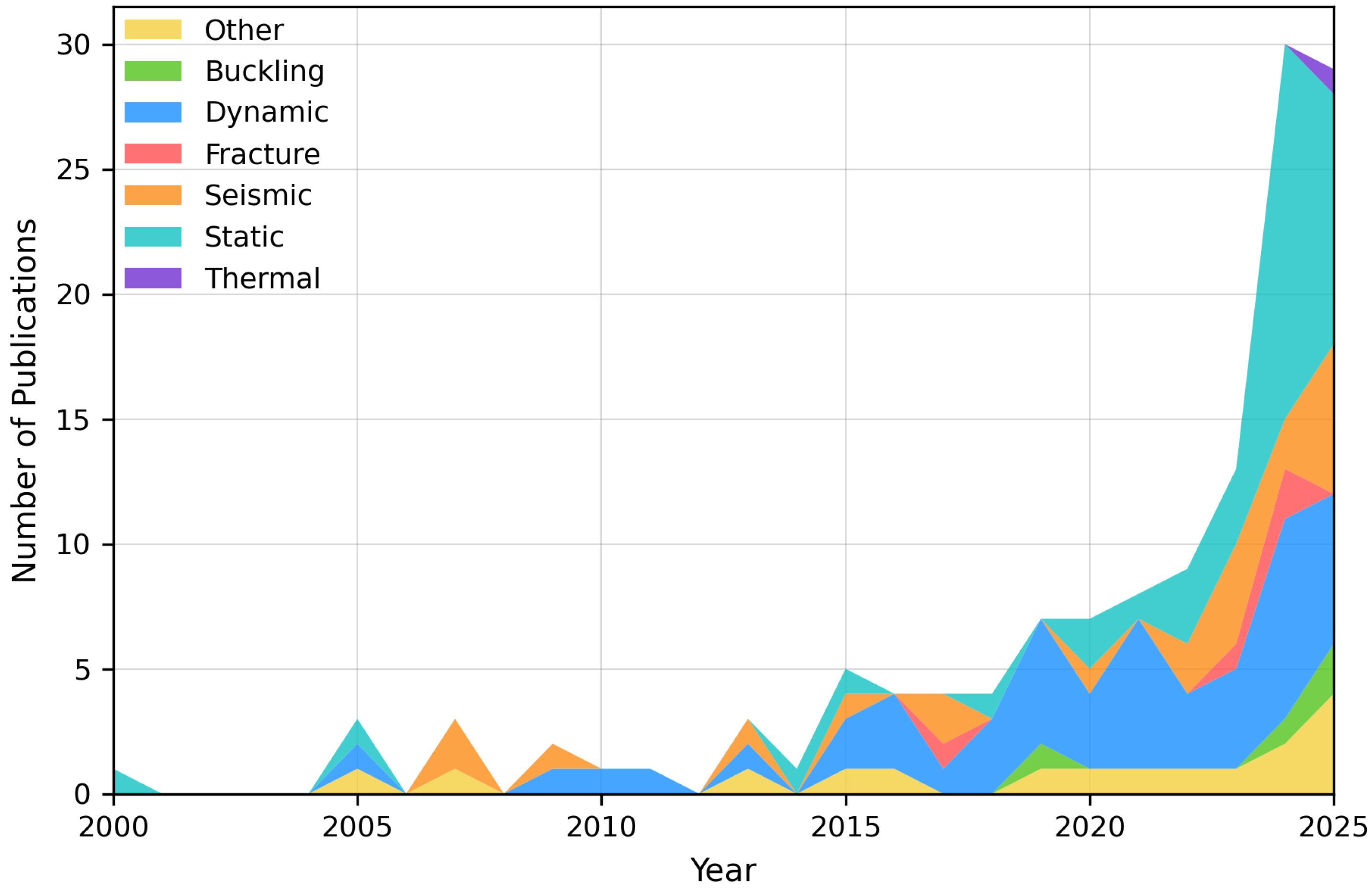
Figure 11 presents the yearly distribution of optimization studies categorized by the type of finite-element (FE) analysis used. Static analyses form the largest portion and are applied in weight or cost minimization of trusses, frames, shells, and connections, typically through iterative evaluation of stress, displacement, or serviceability limits under prescribed loads. Buckling analyses are used where stability governs, especially for thin-walled and shell members; most workflows employ eigenvalue buckling to estimate critical load factors efficiently within optimization loops, while nonlinear post-buckling or Riks (arc-length) procedures are reserved for validation of selected designs [34,35,49]. Dynamic and seismic analyses appear in studies seeking to reduce structural response or energy dissipation demands. These include nonlinear time-history optimization of damping devices or base-isolation parameters, as well as hybrid or performance-based frameworks where earthquake records are pre-selected to balance computational effort and model realism [39,55,56]. Thermal analyses occur mainly in stability problems such as thermal buckling or post-buckling of metallic panels, where temperature-dependent eigenvalue and Riks procedures provide the governing performance measures. Fatigue and fracture analyses are less frequent but address local stress cycles and crack-growth behavior in steel details, often coupled with metamodels or heuristic search to reduce the cost of repeated load-cycle evaluations. Across these categories, authors consistently report that the analysis type is chosen to reflect the governing limit state while maintaining computational tractability: linear static and eigenvalue analyses are used for rapid iteration, and nonlinear or transient simulations are applied selectively where material or geometric nonlinearity must be captured within the optimization process.
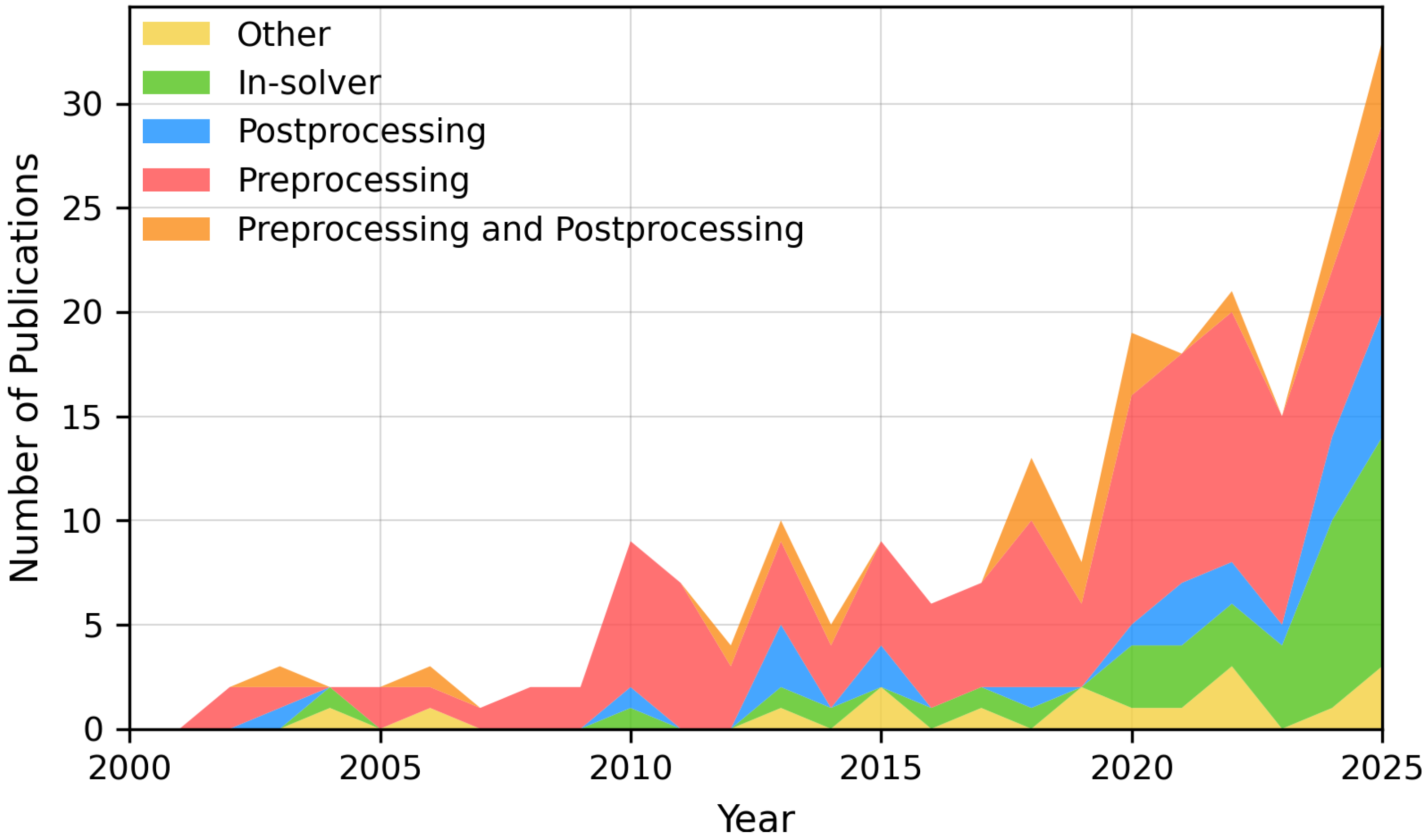
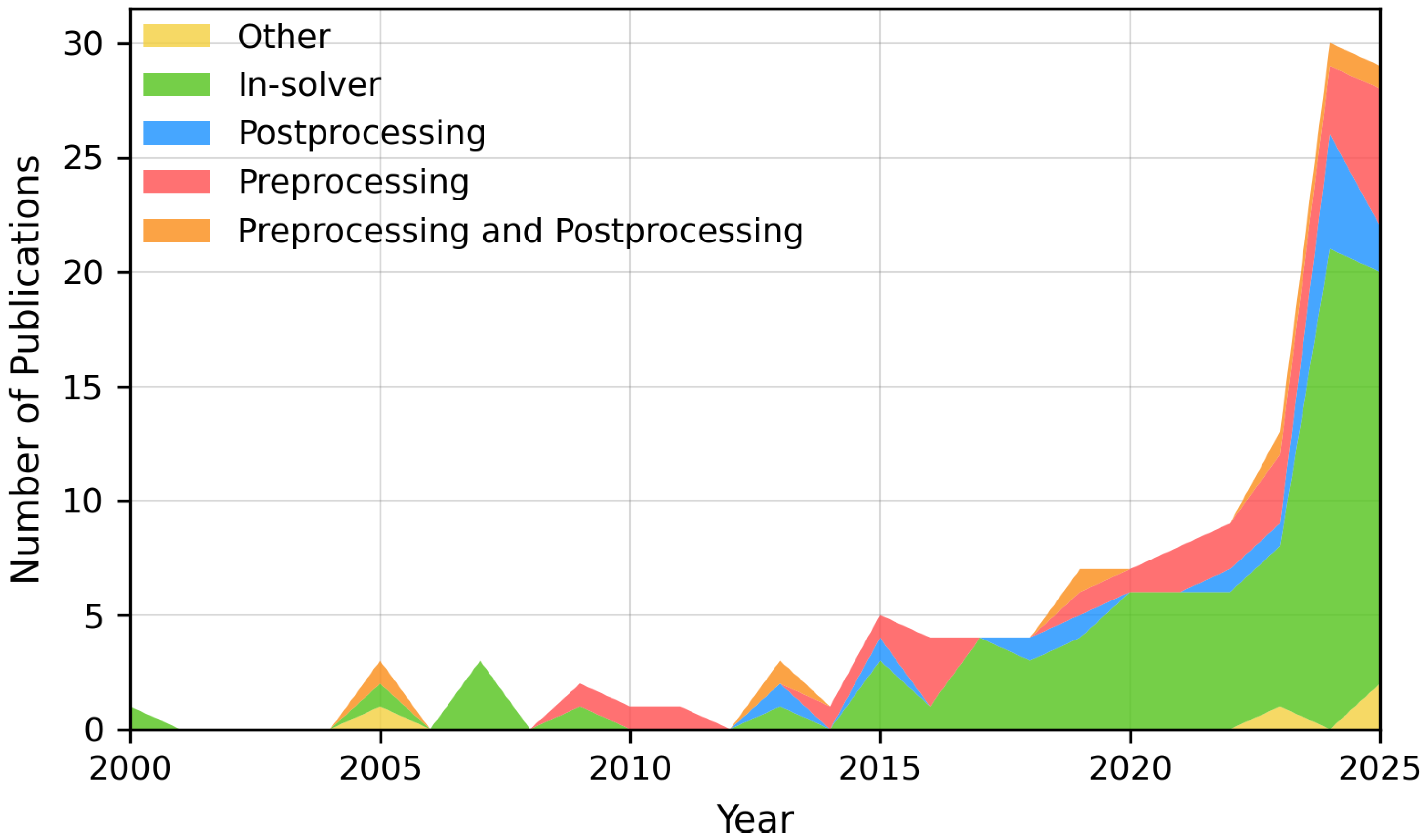
In optimization (Figure 12), AI is used in three main roles: before analysis, during the optimization loop, and after analysis. The most common use is before FE analysis, where AI or ML is applied to generate candidate designs, define design variables, and plan sampling. Examples include visual-programming and BIM-based workflows that parameterize truss or steel joint geometries and automatically export boundary conditions and constraint sets so that only AI-generated candidates are sent to analysis [41,57]. Similar pre-analysis strategies apply design-of-experiments (DOE) and Latin Hypercube Sampling (LHS) to define training points and restrict the FE workload to selected samples, rather than exploring the full space directly [45,58,59]. Recent studies also report the use of large language models to propose FE-ready geometry and load parameter sets under strength and manufacturability constraints ahead of any full simulation [60].
During the optimization loop, AI is embedded directly in the solver. One group of studies replaces repeated FE evaluations with in-loop surrogate models, such as multi-fidelity neural networks or SVM regressors, while population-based optimizers (e.g., Non-dominated Sorting Genetic Algorithm II (NSGA-II), GAs, PSO) continue to drive the design search [40,41,43]. Surrogate-assisted trust-region and SQP formulations also appear, where local polynomial or radial-basis-function approximations are updated each iteration to reduce the number of FE calls on benchmark truss and plate problems [46]. Other work combines GAs with neural network response predictors in reliability-constrained design so that candidate layouts are evaluated against approximate limit states instead of running full Monte Carlo simulations at every step [61,62]. More recent approaches integrate physics-informed or differentiable operators directly into the loop, for example by learning condensed stiffness or compliance fields and reusing these learned operators in topology or inverse optimization, or by using neural operator surrogates as drop-in replacements for linear static solves [63,64,65]. Generative models have also been coupled with evolutionary search, where a Generative Adversarial Network (GAN) proposes feasible topologies or shell layouts and NSGA-II performs multi-objective selection [66,67]. Bayesian and multi-fidelity Gaussian-process strategies similarly embed surrogate and acquisition logic in each iteration to steer the search toward cost- or code-constrained designs [40,68].
After the analysis, AI is used to interpret and filter results. Several studies perform explicit Pareto-front assessment and ranking: for example, multi-objective optimization of composite shells and mechanical frames uses quantitative front metrics (spread, convergence, distance to the ideal solution) to select a final design from a non-dominated set rather than relying on visual inspection alone [43,59]. In steel joint design, SVM surrogates trained on parametric FE studies are used to evaluate performance, manufacturability, and cost, and then to down-select candidate joints directly within a BIM environment [41]. Post-analysis workflows also include iterative surrogate retraining and active learning: radial-basis-function or Kriging models are refined around promising regions, and reliability-oriented methods such as active learning Kriging with Subset Simulation concentrate new FE evaluations near estimated limit-state boundaries to estimate failure probabilities efficiently [69,70]. In addition, hyperparameter optimization of regression models (e.g., ANN, SVM, Gaussian process (GP)) is carried out after initial simulations to improve predictive accuracy before final decision-making in design under uncertainty [71,72]. Overall, Figure 12 shows that AI is used not only to generate and structure design candidates up front, but also to act inside the optimization loop and to interpret, rank, and refine solutions after the analyses are run.

3.4. Surrogate Modeling and Prediction in Structural Engineering

Figure 13 presents the number of publications per year by algorithm within the FEM Acceleration/Surrogate Modeling group, with artificial neural networks (ANNs) constituting a consistently large share of the studies throughout the entire period. In these publications, ANNs are typically trained to reproduce global structural responses obtained from FE models, such as displacements, limit-state capacities, or load–deflection behavior, and are then used in place of repeated FE evaluations for parametric studies, reliability assessment, or sensitivity analysis [73,74]. Training data are most often generated by sampling input variables using DOE strategies such as LHS, and model quality is checked with cross-validation or leave-one-out error measures.
Several other supervised regression methods also appear in the figure. GP regression and related Kriging-style surrogates are used to approximate structural demand parameters and fragility measures under seismic or dynamic loading, particularly for reinforced-concrete frames and bridge-type systems [74,75]. Polynomial response surfaces and polynomial chaos expansions (PCE) are used in a similar role for static problems, especially in beams and prestressed concrete bridge elements, where they provide closed-form estimates of mean response, variability, and sensitivity indices without further FE analysis [73]. These approaches, along with support vector regression and gradient-boosted tree models such as XGBoost, are included either explicitly in the legend or grouped under Other in Figure 13.
More recent publications describe deep learning architectures such as DNN, CNN, and recurrent or sequence-based models. Convolutional networks are used to infer stress fields or displacement maps directly from geometric or load descriptions, treating the FE result as an “image-like” output of the structure under static load [76]. Recurrent networks (e.g., Long Short-Term Memory (LSTM), Gated Recurrent Unit) and related temporal models are applied to seismic and dynamic analysis, where the surrogate predicts time-history response measures such as inter-story drift or peak floor acceleration for building frames subjected to earthquake records, thereby reducing the number of nonlinear time-history simulations [77,78]. GNNs and physics-informed neural networks extend this idea by embedding structural topology or equilibrium relations in the model. These are used, for example, to estimate drift demands in shear-wall buildings or to recover displacement fields in truss-like systems while enforcing compatibility and static admissibility [79,80]. Publications in this group often report that the surrogate is calibrated on a limited number of high-fidelity FE analyses and then evaluated on new loading scenarios or geometries.
Figure 13 also includes algorithm families such as Bayesian Optimization and PSO. In the FEM Acceleration/Surrogate Modeling context, these methods are not only used as optimizers but also as sampling or update strategies around the surrogate itself. Typical workflows combine a surrogate model (for example, a GP or multi-fidelity neural network) with an acquisition or selection step that identifies a small number of new FE simulations to refine areas of interest, such as the vicinity of a performance constraint or Pareto-optimal design set in structural components [43,68]. This procedure is common in applications related to seismic performance of shear-wall systems, model updating of large structures, and component-level detailing.
A recurring feature across the studies is that the surrogate is explicitly validated before it is used in place of further FE runs. Reported procedures include k-fold cross-validation and Q 2 scores to confirm predictive accuracy on withheld samples, comparisons of surrogate-predicted and FE-computed displacement or stress fields, and checks of median and dispersion of seismic demand parameters against nonlinear time-history analyses [73,74,75,77]. In some cases, the surrogate is retrained iteratively: new FE evaluations are added near critical responses (e.g., peak drift, buckling load factor, or failure probability), and the updated model is then reused in reliability estimation or parametric design. Taken together, Figure 13 indicates that surrogate modeling in structural engineering is mainly applied to approximate FE responses in static, dynamic, and seismic analyses, and that a wide range of learning-based and statistical models are being used for this purpose.
Figure 14 shows the number of publications per year by analytical element type in the FEM Acceleration/Surrogate Modeling group. Most studies build surrogates on top of structural models discretized with line elements, while shells, solids, and mixed formulations appear in more specific contexts. Solid-element models appear only occasionally before 2022 but increase clearly in recent years. In 2024, seven studies—about 23% of the surrogate model papers of that year—employed finite-element solid-element models, marking the first substantial use of full three-dimensional formulations in this category. Line-element models are commonly used for frame and truss systems, where the surrogate approximates global response quantities such as displacements, inter-story drift ratio, peak floor acceleration, or member stresses [74,77,81,82]. In these studies, Gaussian process regression (GPR), ANN, or ensemble regressors are trained on results from repeated finite-element analyses and then used in place of full simulations to estimate structural response under static loading or earthquake excitation. Authors note that this approach allows quantities such as drift demand or floor acceleration to be evaluated efficiently for uncertainty quantification and reliability studies, which would otherwise require a large number of nonlinear time-history analyses [74,77].
Shell-element models appear in studies involving thin-walled or plate-like structures, including composite shells and stiffened panels. Here, the surrogate typically predicts vibration characteristics, buckling resistance, or stress fields [43,50,76,83]. Multi-fidelity strategies are common: coarse shell meshes are used to generate large, inexpensive datasets, and DNN learn corrections to approximate the behavior of higher-fidelity shell models. This allows frequency or stability measures to be approximated without repeatedly solving the full shell formulation [43]. CNN are also applied to shell-based models of plates and beamlike components to predict stress distributions directly from geometric and loading parameters, reducing the need for repeated FE stress evaluation during design studies [76].
Solid-element models are mainly used in calibration and model-updating studies for large civil structures or detailed components, where three-dimensional stress states and realistic mass–stiffness distributions are important [60,75]. In these cases, response-surface models, support vector regression, or radial-basis-function networks are trained to reproduce global dynamic properties (such as natural frequencies and modal characteristics) or local response quantities. Because full 3D analyses are computationally expensive, sampling strategies such as central composite or Box–Behnken designs are used to limit the number of high-fidelity simulations required to build the surrogate [75]. Similar strategies are reported in bracket and connection studies, where locally refined solid models are used to generate training data for regression-based surrogates that approximate stresses and deformations across different geometries and materials [60]. Together, purely solid-element models and mixed line+solid formulations represent about 33% of all surrogate-modeling studies published in 2024, with the mixed line+solid category alone accounting for roughly 10%.
Mixed formulations, including combinations of line, shell, and solid elements, are applied where different parts of a structure require different levels of fidelity. Examples include global–local approaches in which a global frame or shell model is retained for efficiency while local three-dimensional submodels are introduced only in regions with high stress gradients or nonlinear behavior [84,85]. In other cases, physics-informed or FEM-constrained neural networks embed equilibrium relations from the FE system directly into the surrogate model and are trained on meshes containing multiple element types. These models learn to predict nodal displacements or other structural responses without repeated full solves and have been reported to accelerate reliability or design assessment by several orders of magnitude while remaining consistent with the governing equations [80].
The Not Specified category includes studies that develop and evaluate surrogate models for structural response but do not explicitly report the underlying FE discretization used to generate the training data. Overall, surrogate modeling in structural engineering is predominantly based on simplified line- or shell-element formulations for global response prediction, while solid and mixed formulations are increasingly adopted in applications that require local three-dimensional behavior, contact, or nonlinear effects.
Figure 15 shows the yearly distribution of surrogate-modeling studies in the library grouped by the type of FEA used to generate training or validation data for the surrogate. Across the full dataset, dynamic analyses are the most common overall (35%), followed by static (30%) and seismic (16%). Before 2020, surrogate models were almost exclusively trained on dynamic or seismic simulations, with only occasional use of static analysis. Between 2020 and 2023, dynamic analyses dominated (43%) while static analyses represented about 24%. In 2024, however, this trend reversed: static analyses rose sharply to 50% of all new studies, while dynamic cases declined to 27%.
The most common form of static analysis involves linear or mildly nonlinear FE models evaluated under prescribed loads to obtain displacements, stresses, or limit-state quantities such as service deflection and ultimate capacity. These responses are then learned by regression-type surrogates (e.g., feed-forward neural networks [86], sparse PCE [87], Gaussian-process regression [88]), which are later used in place of further FE solves to perform sensitivity studies, reliability estimates, or rapid design screening [89]. Reported applications include trusses and frame-type structures, where nodal displacements and member stresses are predicted directly, and prestressed concrete bridges, where load effects and limit states are approximated for stochastic assessment using relatively small Latin Hypercube or DOE samples [90] in place of large batches of full FE simulations [73,81]. Several studies also describe physics-constrained surrogates that embed the FE equilibrium relation in the network loss, allowing displacement fields for linear structures to be evaluated at for large numbers of Monte Carlo samples without repeatedly solving the FE system [80,91].
Dynamic and seismic response analyses form a major group, together accounting for about 51% overall (35% dynamic, 16% seismic); their combined share was 62% in 2020–2023 but fell to 33% in 2024 as static analyses surged. In these works, nonlinear time-history FE models of building frames, shear-wall systems, or bridges are run under suites of recorded or synthetically generated ground motions. The resulting peak inter-story drift ratios, floor accelerations, and related demand measures are used to train data-driven surrogates such as DNN, Gaussian-process models, or recurrent/sequence models (e.g., LSTM). Once trained, these surrogates are queried in place of new nonlinear dynamic analyses when estimating seismic demand, constructing fragility-type relationships, or performing incremental dynamic analysis. Authors note that this substitution primarily addresses the high computational cost of repeated nonlinear time-history analyses required for uncertainty or optimization studies [56,74,77,78].
A smaller subset of studies employs FE buckling or thermal analyses as the training data source. These works focus on thin-walled or shell-like members where instability governs performance. Imperfection-sensitive eigenvalue or nonlinear buckling analyses are sampled (often with geometric imperfections represented as spatial random fields), and the resulting critical load factors or critical temperatures are learned by neural network surrogates. The stated goal is typically to enable probabilistic or reliability-style assessment of stability, which would otherwise require large Monte Carlo loops of geometrically nonlinear FE models. Related thermal studies couple eigenvalue buckling with post-buckling tracing to quantify temperature-dependent stability limits, and then use those FE results to fit reduced-order predictors that can be queried repeatedly without re-running the full shell model [34,83].
Fracture and damage-related analyses appear less frequently but address cases where local nonlinear behavior drives performance. Here, detailed FE simulations (for example, cyclic response of masonry or connection regions) are used to generate quantities such as maximum displacement, crack-growth indicators, or energy dissipation. Those responses are then approximated by metamodels (e.g., bootstrapped neural networks, support vector regression, or hybrid physics–data surrogates), which are later used to construct fragility curves or to identify boundary and connection stiffness parameters without repeatedly solving the high-fidelity 3D model [92,93].
Overall, Figure 15 shows that while dynamic and seismic analyses dominate the field in absolute numbers, static analyses have rapidly gained prominence in recent years and are now the leading choice in newly published surrogate-modeling studies. Across all analysis types, the motivation remains the same: FE simulations provide the reference data, but once a surrogate is trained—often on a compact, space-filling sample set or using a multi-fidelity workflow—subsequent parametric studies, reliability assessments, or design evaluations can be performed without rerunning large numbers of costly FE analyses.
In surrogate modeling (Figure 16), AI and ML are applied in three stages across frames, shells, bridges, and shear-wall buildings. The overarching motivation is to reduce the computational burden of direct high-fidelity simulation.
First, many papers report AI-driven pre-processing before any large batch of FEA is run. Instead of sampling the design or uncertainty space arbitrarily, authors define a structured experimental design up front, most often with LHS, optimal/maximin Latin Hypercube variants, or other space-filling DOE schemes [42,59,73,74]. The goal is to generate a compact but representative training set and then run FEA only at those selected points. This is documented, for example, in stochastic assessments of prestressed concrete bridges and fixed beams, where PCEs and ANN are trained on LHS-generated samples, and model quality is monitored using leave-one-out Q 2 and sensitivity measures such as Spearman rank correlation against the corresponding FEA responses [73]. Similar sampling strategies are used for reinforced-concrete moment frames under seismic loading, where GPR, neural networks, and other surrogates are trained on FEA data generated from parameter sets drawn by LHS; in that work, cross-validation and Bayesian hyperparameter tuning are applied to pick the most reliable surrogate for uncertainty propagation [74]. Other studies construct the input space parametrically or with augmentation before analysis: ground motions are compressed into low-dimensional bases using singular value decomposition, then resampled to generate synthetic but realistic earthquake inputs for nonlinear time-history simulations of building frames [77]; in truss problems, geometric and loading features are encoded in a generic way so that one ANN can generalize across multiple topologies [81]. Across these examples, AI is used at the “setup” stage to define which designs, loads, or uncertainties are worth simulating, rather than to interpret results afterward.
Second, several studies embed surrogate models directly in the loop with FEA or optimization. One line of work replaces repeated high-fidelity evaluations with multi-fidelity or adaptive surrogates. In multi-objective optimization of composite shell structures, low-fidelity and high-fidelity FE models are blended into DNN surrogates that are queried by the optimizer instead of calling the full finite-element solver at every iteration [43]. After each optimization round, new high-fidelity samples are added near the current Pareto set and the surrogate is retrained (a curriculum-style refinement), which improves Pareto-front quality metrics and reduces the number of expensive analyses needed in later iterations. Other studies embed physics constraints directly into the surrogate so that it can act almost like a fast solver. A “fem-constrained” neural network surrogate enforces global equilibrium in its loss function and learns to predict displacements without requiring labeled data from full analyses; because equilibrium residuals drive training, the resulting model can be evaluated quickly inside reliability calculations for truss-type structures while remaining consistent with the governing FE equations [80]. Surrogate-assisted model updating adopts a similar idea in a different context: Kriging (Gaussian process), response surfaces, or support vector regression models are fit to sampled FEA results and then iteratively refined, and these surrogates are used in place of full FEA to calibrate large structural models such as bridge towers or high-rise buildings against measured modal data [75,94,95]. Hybrid physics–data surrogates are also reported. For reinforced-concrete shear-wall buildings, GNNs are combined with simplified flexural–shear mechanics models to estimate inter-story drift demands within fractions of a second, which allows the surrogate to be used in seismic design iterations in place of full nonlinear time-history analysis [56]. Ensemble surrogates are another variant: for steel frame displacements under static loading, multiple regressors (response surface, support vector regression, radial basis functions, boosted trees, random forests) are combined using jackknife model averaging, and the resulting ensemble is then queried instead of running new static FEA during what-if studies [82].
Third, many studies emphasize post-analysis validation, retraining, and uncertainty quantification, where the surrogate is checked against FEA (or updated based on it) before being trusted for decision-making. Cross-validation, error metrics, and held-out FEA comparisons are standard. For reinforced-concrete frame models under seismic loading, surrogate predictions (e.g., peak floor accelerations, drift demands) are compared against large Latin Hypercube FEA test sets and scored using fold-based cross-validation; GPR and neural networks show the highest accuracy at the lowest cost, and error distributions relative to the FEA benchmark are explicitly reported [74]. For bridge-scale and beam-scale problems, ANN and PCE surrogates are validated by comparing not just point predictions but also global statistics (means, coefficients of variation) to the underlying FEA, and any mismatch in higher-order moments is used as a signal to introduce new simulations and retrain [73]. In seismic response surrogates for building frames, temporal neural networks and data-augmented deep models are tested on “unseen” ground motions, with reported median errors on peak responses relative to nonlinear dynamic FEA to show whether the surrogate generalizes beyond the training events [77]. Reliability-focused work uses active learning: Kriging-type surrogates are iteratively enriched near the evolving limit-state surface so that probability-of-failure estimates can be obtained with far fewer full simulations, and convergence is demonstrated by comparing the final surrogate-based reliability estimate with direct simulation [96,97]. Finally, Bayesian model updating and model calibration for large structures such as bridge towers and aerospace frames replace repeated full FE solves with surrogate evaluations during inference; in these cases, the surrogates are validated continuously against FEA responses or measured modal data as part of the updating loop [75,98].
Taken together, the figure shows that surrogate modeling in structural engineering is not limited to “black-box regression.” Instead, AI is used (a) to design the data before simulation, by defining what to sample; (b) to stand in for, or work alongside, the FE solver during optimization, model updating, or seismic assessment; and (c) to verify, retrain, and quantify uncertainty after analysis so that the surrogate can be used for decision support in reliability, calibration, or design ranking [43,56,73,74,75,80,82].

3.5. Comparative Analysis of Modeling Strategies

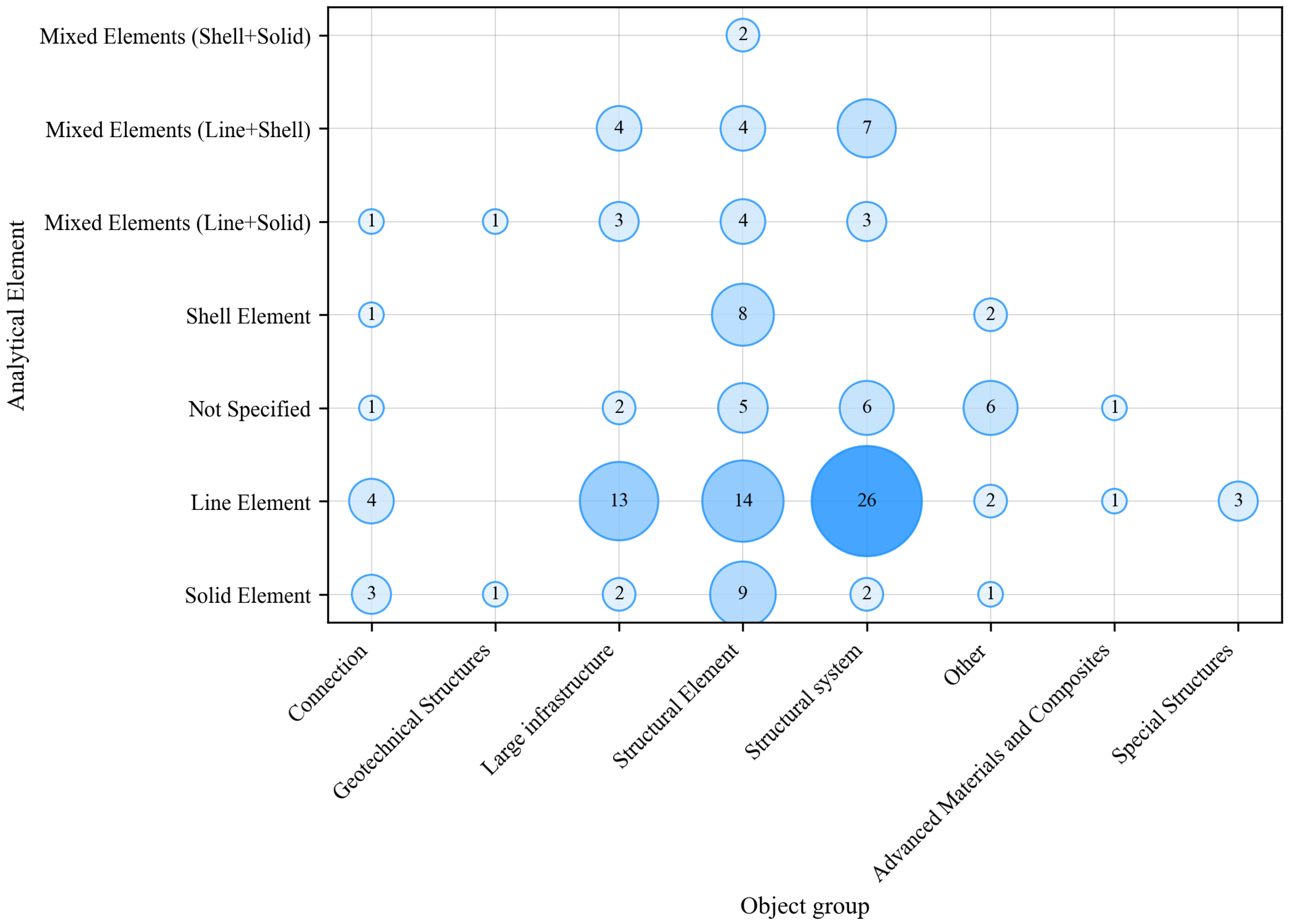
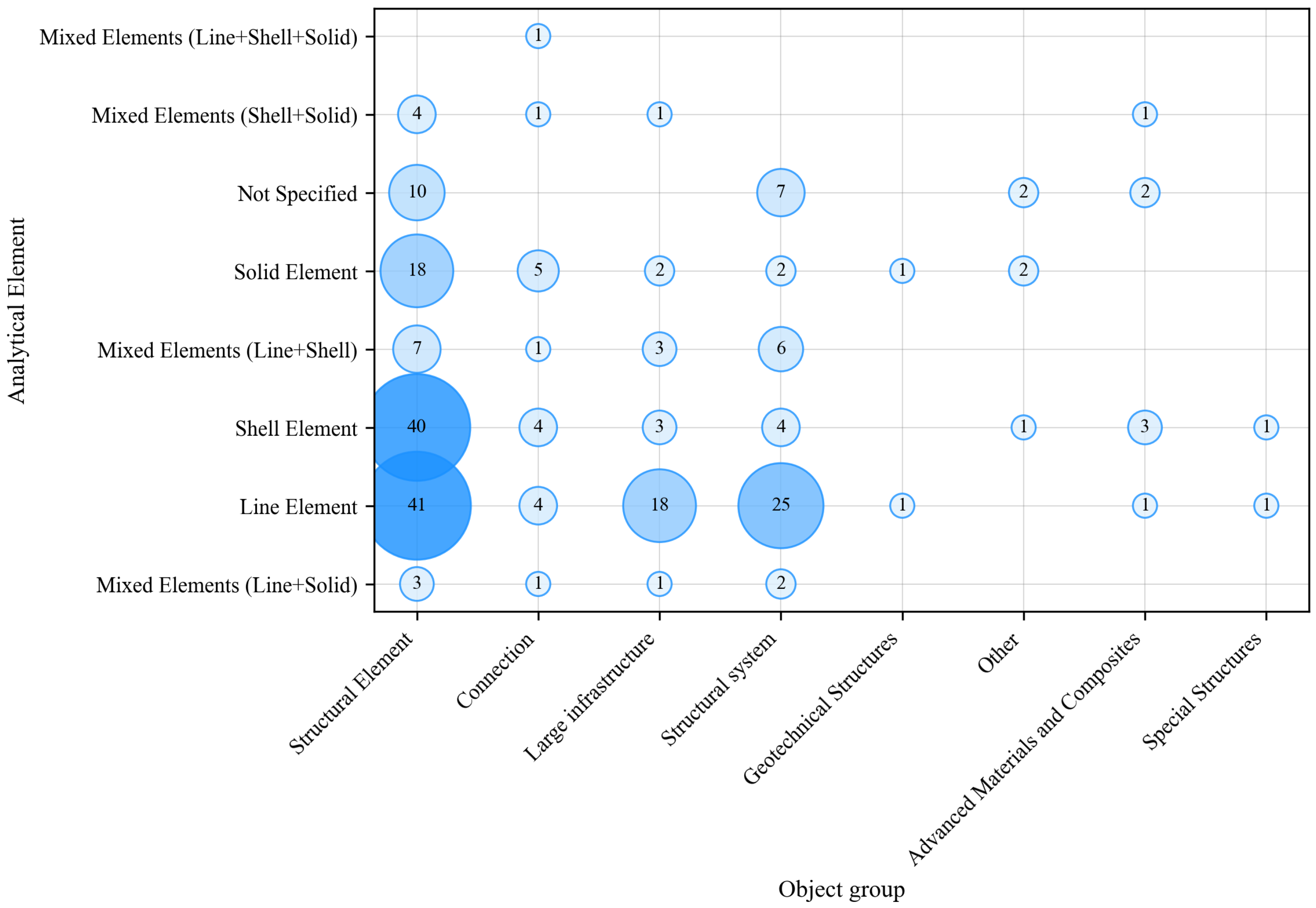
Figure 17 maps the analytical element type used in each study (line, shell, solid, or mixed formulations) against the structural object group being optimized (e.g., structural elements, connections, large infrastructure, structural systems). The marker size indicates the number of publications for a given combination.
Among the 230 Optimization & Design studies, line-element formulations dominate ( 40 % ), followed by shell ( 24 % ) and solid ( 13 % ) models. Mixed configurations—primarily line+shell or line+solid combinations—together account for about 14%, while roughly 9% of studies do not specify the FE type.
Studies classified under Structural Element and Structural System most frequently use line- or shell-element models. Line-element formulations (beams, frames, trusses) are widely adopted for sizing and topology optimization of steel frames, trusses, and canopy-like reticulated structures, where the objectives typically include weight reduction, serviceability (deflection, drift), and compliance with code-based stress and stability checks. Authors emphasize that frame/truss idealizations allow thousands of candidate designs to be evaluated within GA or PSO loops, because they avoid expensive meshing and directly expose section forces and displacements for penalty functions and code checks.
Shell elements are common when the optimized object is thin-walled or plate-like, such as cold-formed steel columns, stiffened panels, inflatable or free-form shells, and tower cans. In these cases, the goals often include improving buckling resistance or stiffness at fixed mass, or controlling strain energy and deformation under load. Shell formulations are selected because they capture local and distortional buckling, membrane-bending interaction, and stress flow across curved or slender surfaces with fewer degrees of freedom than a full 3D solid mesh. Several studies report sensitivity to mesh density and numerical stabilization choices, including the use of four-node shell elements with full or reduced integration (e.g., S4 and S4R formulations) and implicit quasi-static solution procedures to trace nonlinear equilibrium paths, as well as damping control to maintain numerical robustness during optimization while still resolving local instability modes.
Solid elements appear most clearly in the Connection group and other highly localized components. For bolted end-plates, T-stubs, and similar joints, nonlinear 3D solid FE models (including surface contact, bolt pretension, plasticity, and large deformation) are used to evaluate candidate designs. These analyses support objectives such as maximizing rotational stiffness or load capacity while limiting plastic strain and avoiding premature local buckling. Because repeated 3D analyses are computationally expensive, several studies introduce simplified alternatives in which plates and stiffeners are modeled with shell elements and bolts with beam or spring elements. These reduced models are calibrated against the full solid model (and, in some cases, experiments) and then used inside the optimization loop to lower runtime while preserving the relevant joint response metrics. This explains why the “Connection” column in Figure 17 includes contributions from both “Solid Element” and “Mixed Elements” categories.
Mixed formulations (line+shell, shell+solid, or line+shell+solid) are reported in two recurring situations. First, in multi-component systems such as wind-turbine towers, concrete or thick regions may be modeled with solid elements, while surrounding steel cans are modeled with shells. This combination is described as sufficient to capture global stability and local stress while keeping the model size manageable. Second, in reinforced-concrete load-path optimization (e.g., strut-and-tie formulations), truss or line elements are used to represent tension ties, and shell or continuum elements are used to represent compression struts and nodal zones. These hybrid approaches are motivated by both physics (different kinematic behavior in different subregions) and efficiency (faster convergence than treating the entire detail as a uniform 3D continuum).
Overall, Figure 17 shows that the FE idealization chosen in Optimization & Design studies generally follows the physical role of the object group and the stated design objective: line elements are used for global member sizing, weight, and drift constraints in frames, trusses, bridges, and larger systems; shell elements are used for thin-walled stability, stress redistribution, and shape control in plates, stiffened panels, and shell structures; solid elements are used where 3D contact and plasticity govern connection behavior; and mixed formulations are adopted either to model different subcomponents with appropriate kinematics, or to replace high-cost solid models with calibrated reduced models during iterative optimization.
Some combinations in Figure 17 appear only sparsely, but these patterns are consistent with how optimization workflows are typically structured in practice. Global frames, trusses, and larger systems are most often optimized using line-element models, while thin-walled or surface-dominated components rely on shell formulations, and fully solid models are mainly used where local three-dimensional behavior is essential, particularly in connection regions. Because each analytical formulation naturally corresponds to specific structural objects, certain pairings do not appear in the literature. These empty or low-frequency combinations therefore reflect standard modeling choices in optimization studies rather than neglected or unexplored research areas.
Figure 18 presents the same classification of analytical element type versus object group, but for 142 studies that develop surrogate or reduced-order models from FE data. Here, the bubbles indicate how surrogate-modeling work is distributed across global structural systems (e.g., buildings, towers, bridges), local structural elements, connections, and advanced material or composite components.
Line-element formulations dominate this group (44%), followed by solid (13%) and shell (8%) models. Mixed configurations—mostly line+shell or line+solid combinations—represent about 21% of all studies, while roughly 15% do not specify the FE formulation used to generate surrogate-training data.
For Structural System–level studies (multi-story buildings, shear-wall systems, bridge towers), most training datasets for the surrogate are generated using line-element or mixed line+shell (or line+spring) models. Frame-based surrogates for buildings and bridge-like systems are typically trained on nonlinear time-history or static FE analyses of beam–column line models with added joint springs, panel-zone elements, base-spring or dashpot representations of support and soil, and similar idealizations. The resulting surrogates (GPR, neural networks, recurrent/temporal models, GNNs) are then used to predict global response measures such as peak inter-story drift ratio, peak floor acceleration, displacement envelopes, or dominant modal frequencies. Authors consistently state that these simplified frame or frame+spring models are selected because they are fast enough to generate hundreds to thousands of simulations under varying ground motions, load patterns, or parameter sets—a requirement for surrogate training that would be prohibitive with full 3D solid models.
When the surrogate targets local stress fields, buckling loads of imperfect panels, or vibration characteristics of thin-walled components, the FE training data are instead generated with shell or solid elements. Composite laminates, stiffened plates, and other thin-walled components are modeled with layered shell elements at multiple fidelities (coarse versus fine meshes); the surrogate then predicts quantities such as natural frequencies or critical buckling measures. Studies explain that shell elements are necessary to capture bending–shear coupling, local plate instabilities, and stress redistribution in panels and shells. Multi-fidelity sampling is often reported in this context: many low-cost simulations with a coarse mesh are combined with a smaller number of high-fidelity simulations on a refined mesh to train the surrogate, reducing data-generation cost while still anchoring the model to the high-fidelity response.
Continuum solid elements (hexahedral or tetrahedral) are used to build datasets for surrogates that learn full 3D stress distributions, nonlinear large-deformation response, or joint behavior. Examples include bridge towers modeled with 3D solids to obtain modal frequencies for model-updating surrogates, and localized connection regions modeled with contact, bolt pretension, and plasticity to supply training data for reduced joint models. In these cases, solids are justified by the need to represent 3D stress states, contact, or inelastic behavior. Computational cost is managed through structured sampling (Latin Hypercube, central composite, or Box–Behnken designs), reduced-order modeling or substructuring (e.g., component mode synthesis), and explicit multi-fidelity strategies in which a small set of high-fidelity solid simulations is used to calibrate a lower-order representation that is then used more broadly.
Connection-focused surrogate studies, which appear under “Connection” or “Structural Element” in Figure 18, often rely on this multi-fidelity workflow. A limited number of detailed 3D solid/contact simulations of a joint are treated as the reference data, and those results are used to calibrate a lower-order representation (beam, shell, link, or spring elements) or a learned surrogate for the joint stiffness and mass contribution. That calibrated reduced model is then embedded back into a global line-element structural model for rapid system-level updating or design assessment. Authors point out that this approach preserves the rotational stiffness, slip, and load-transfer characteristics of the joint without re-running the full solid-contact model for every parameter change.
In summary, Figure 18 indicates that surrogate-modeling studies tend to pair each object group with the least expensive FE idealization that still produces the response quantity of interest. Building- and bridge-scale surrogates are trained on line or mixed line+spring/shell models to learn global drifts, accelerations, or modal features from many simulations. Shell models (often in multi-fidelity form) are used when the surrogate needs to learn frequencies, stiffness, or buckling behavior of thin-walled or composite components. Solid models are used when the surrogate targets local 3D behavior such as joint rotation capacity, stress fields, or nonlinear large-deformation response, and these are typically coupled with DOE sampling, model reduction, or multi-fidelity correction to limit the number of high-cost simulations required.
Together, these observations highlight how the analytical fidelity, computational strategy, and learning objective are co-optimized across studies, forming a continuum between traditional FE analysis and data-driven modeling—an aspect further discussed in the concluding section.
Some combinations in Figure 18 occur only occasionally, but the overall pattern aligns with typical modeling requirements for surrogate construction. Global structural systems rely primarily on line-element or mixed line+shell models because they allow many simulations to be generated efficiently for training. Shell formulations appear where thin-walled or plate-like behavior governs, while solid elements are used mainly in studies targeting three-dimensional stress states, local nonlinear response, or detailed component behavior. The distribution therefore reflects the modeling demands of the underlying FE problems rather than gaps or omissions in the literature.

4. Conclusions

This study set out to map and analyze how AI has been applied within FE-based structural engineering. By systematically categorizing publications across disciplines, application areas, and analytical formulations, the mapping provides a comprehensive overview of methodological developments and research trends in this rapidly evolving field. The discussion below addresses the three research questions defined in the introduction.

4.1. Research Question 1

What types of research have been conducted on AI in structural design?
This mapping synthesizes a corpus of 5995 retrieved records and 3345 papers analyzed in detail. Within this body of work, the field’s center of gravity has shifted markedly. Optimization & Design decreased from 43% (pre-2015) to 26% (post-2020), while Structural Performance Prediction increased from 20% to 39%, and FEM Acceleration/Surrogate Modeling from 14% to 22%. Disciplinary proportions evolved in parallel: before 2015, mechanical engineering studies represented the largest share (49%), but by 2020 and beyond, structural engineering papers accounted for 33% of the literature—evidence of a steady move toward domain-specific structural applications. This mirrors a disciplinary shift from a mechanical engineering majority toward structural engineering focus, reflecting the field’s increasing orientation toward design-driven and performance-based modeling. This transition illustrates how AI has evolved from an auxiliary search or optimization technique toward a predictive and integrative component of structural modeling. Hybrid approaches combining learning-based response prediction with traditional FEA or gradient-based optimization are now characteristic of the field, emphasizing complementarity rather than replacement of established numerical methods.

4.2. Research Question 2

In what ways has AI been used to support pre-processing, in-solver acceleration, and post-processing of structural models and design?
Across the mapped studies, AI contributes to every stage of the FE workflow. In pre-processing, algorithms automate geometry generation, meshing, boundary-condition assignment, and sampling strategies, reducing manual effort and improving reproducibility in parametric or BIM-integrated environments. Within the solver stage, AI plays its most transformative role: surrogate and reduced-order models approximate structural responses, accelerating convergence and reducing computational cost during iterative analyses. The rise of such studies—from about 14% of publications before 2015 to over 22% after 2020—quantifies this shift toward simulation acceleration. Physics-informed neural networks, multi-fidelity surrogates, and neural operators embed equilibrium and compatibility constraints directly into learning architectures, allowing prediction and analysis to merge in a single framework.
In post-processing, AI supports interpretation and decision-making by extracting performance patterns and guiding design iteration. Machine learning classifiers, regression models, and clustering methods are used to rank alternatives, identify governing parameters, and quantify uncertainty. Reinforcement learning and Bayesian optimization further automate design refinement by balancing multiple objectives across large search spaces. Together, these applications demonstrate how AI acts as a connective layer linking geometric modeling, numerical simulation, and design evaluation in an adaptive, data-driven cycle.
Collectively, these developments demonstrate a progressive integration of AI throughout the FE workflow, establishing the foundation for broader trends discussed below.

4.3. Research Question 3

What patterns, challenges, and opportunities can be identified from the literature?
A clear pattern observed across the dataset is the rapid expansion of research output over the last decade. About 30% of the studies were published before 2015, compared with nearly 70% in the years after, illustrating a sustained and substantial growth of the field. The yearly publication output increased from roughly 36 papers per year before 2010 to more than 480 papers per year after 2020—a thirteen-fold rise that underscores the accelerating pace of research in this domain. This surge coincides with the rise of deep learning and generative design methods, which lowered the entry barrier for applying AI in computational mechanics and structural optimization. This redistribution highlights how AI research has transitioned from general mechanics problems toward domain-specific applications in structural design and analysis.
Within surrogate modeling, the results reveal a distinct trend toward higher analytical fidelity and solver-efficient formulations. By 2024, studies using solid and mixed (including solid) FE formulations accounted for approximately 33% of publications in this category, with solid-only models representing about 23%. At the same time, static analyses became the predominant training and validation source for surrogate models—rising from roughly 24% of studies in 2020–2023 to 50% in 2024—while dynamic analyses declined from 43% to 27%. Together, these shifts indicate growing emphasis on local three-dimensional behavior and on computationally efficient static simulations, often coupled with multi-fidelity or DOE sampling to manage cost.
Persistent challenges remain. Data availability and quality continue to limit the development of robust models, especially for proprietary or large-scale structures. Integration with commercial software and design standards is still partial, and standardized benchmarks for accuracy and efficiency are seldom reported. Ethical and interpretability concerns arise when AI contributes to safety-critical design decisions. Nevertheless, the growing proportion of Review and Methodology papers (about 3–7 % of recent publications) indicates a maturing discipline that increasingly emphasizes transparency, validation, and reproducibility. Emerging best practices—including open-data generation, hybrid physics–data modeling, and open-source computational frameworks—suggest that these challenges are actively being addressed.

4.4. Limitations

Although the mapping provides a broad and data-driven overview of the field, several limitations should be acknowledged. First, the corpus was restricted to English-language publications, which may exclude relevant regional research or studies published in national engineering journals. Second, the use of model-assisted categorization introduces the possibility of large-language-model bias, particularly in borderline cases where small differences in wording can influence label assignment. These effects were mitigated through fixed vocabularies, structured prompts, and targeted manual checking of representative samples, but some residual misclassification remains possible. Third, the full-text-based dimensions depend on automatic PDF text extraction and on how clearly methods and modeling choices are described in the original papers; variation in document structure and writing style can therefore affect classification quality. Finally, publication metadata and database indexing conventions differ across sources, which may influence the precise disciplinary proportions reported. These limitations should be kept in mind when interpreting fine-grained statistics, but do not alter the main trends identified in the mapping.

4.5. Future Work

Overall, this systematic mapping demonstrates that AI has moved from peripheral experimentation to a central role in FE-based structural engineering. The integration of optimization, surrogate modeling, and predictive analysis is reshaping how structures are modeled and designed, bridging the gap between numerical simulation and intelligent decision support. The convergence of methods across disciplines and application domains points to a new generation of computational workflows in which AI acts simultaneously as accelerator and interpreter.
Future research should prioritize the creation of open benchmark datasets, standardized reporting of performance–effort trade-offs, and systematic validation of surrogate and hybrid FE formulations. Coordinated benchmarking initiatives and open-source frameworks will be crucial for ensuring comparability, reliability, and reproducibility of results. Such developments will enhance transparency, foster interdisciplinary collaboration, and accelerate the safe adoption of AI-driven methods in structural design automation.
An important direction for further investigation is the application of AI-assisted finite-element workflows to large-scale infrastructure with high geometrical complexity and degrees of freedom, such as arch dams and long-span bridges. Recent studies demonstrate that machine learning-based surrogate models and shape-optimization strategies can substantially reduce the computational cost of repeated FEM analyses for such systems while maintaining sufficient accuracy for design and assessment, highlighting significant potential for extending AI-enabled FEM approaches to these demanding structural applications [99].

Author Contributions

Conceptualization, V.V. and M.L.; methodology, V.V. and M.L.; software, V.V.; validation, V.V., L.O.T. and M.L.; formal analysis, V.V.; investigation, V.V., L.O.T. and M.L.; resources, M.L., A.R. and D.M.; data curation, V.V.; writing—original draft preparation, V.V.; writing—review and editing, V.V., L.O.T., M.L., A.R. and D.M.; visualization, V.V.; supervision, M.L.; project administration, M.L. All authors have read and agreed to the published version of the manuscript.

Funding

This research received no external funding.

Data Availability Statement

The data supporting the findings of this study are available in a public GitHub repository. The repository contains the final filtered BibTeX dataset resulting from the literature screening process, as well as the Python scripts used for automated metadata filtering, classification, and data cleaning. The repository is available at: https://github.com/villemev/Structural_Mapping (accessed on 29 January 2026).

Conflicts of Interest

The authors declare no conflict of interest.

Abbreviations

AADAlgorithm-Aided Design
AIArtificial Intelligence
ANNArtificial Neural Network
BIMBuilding Information Modeling
CNNConvolutional Neural Network
DEDifferential Evolution
DOEDesign-of-Experiments
DNNDeep Neural Network
FEFinite Element
FEAFinite-Element Analysis
GAGenetic Algorithm
GANGenerative Adversarial Network
GNNGraph Neural Network
GPGaussian Process
GPRGaussian Process Regression
LHSLatin Hypercube Sampling
LSTMLong Short-Term Memory
MLMachine Learning
NSGA-IINon-dominated Sorting Genetic Algorithm II
PCEPolynomial Chaos Expansion
PSOParticle Swarm Optimization
SQPSequential Quadratic Programming
SVMSupport Vector Machine

References

  1. Oesterreich, T.D.; Teuteberg, F. Understanding the implications of digitisation and automation in the context of Industry 4.0: A triangulation approach and elements of a research agenda for the construction industry. Comput. Ind. 2016, 83, 121–139. [Google Scholar] [CrossRef]
  2. McKinsey Global Institute. Reinventing Construction: A Route to Higher Productivity; Technical Report; McKinsey Global Institute: New York, NY, USA, 2017. [Google Scholar]
  3. Thai, H.T. Machine learning for structural engineering: A state-of-the-art review. Structures 2022, 38, 448–491. [Google Scholar] [CrossRef]
  4. Xie, H.; Mei, Q.; Chui, Y.H. AI applications for structural design automation. Autom. Constr. 2025, 179, 106496. [Google Scholar] [CrossRef]
  5. Cheng, X.; Gilbert, B.P.; Guan, H.; Underhill, I.D.; Karampour, H. Experimental dynamic collapse response of post-and-beam mass timber frames under a sudden column removal scenario. Eng. Struct. 2021, 233, 111918. [Google Scholar] [CrossRef]
  6. Bathe, K.J. Finite Element Procedures; Prentice Hall: Englewood Cliffs, NJ, USA, 1995. [Google Scholar]
  7. Cottrell, J.A.; Bazilevs, Y.; Hughes, T.J.R. Isogeometric Analysis: Toward Integration of CAD and FEA, 1st ed.; Wiley: Chichester, UK, 2009. [Google Scholar] [CrossRef]
  8. Helminen, J.; Tuori, J.; Laasonen, M.; Farinha, R. Automated Generation of Steel Connections of BIM by Machine Learning. In Proceedings of the Conference on Computing in Civil Engineering (ASCE), Tampere, Finland, 5–7 June 2018. [Google Scholar]
  9. Sacks, R.; Girolami, M.; Brilakis, I. Building Information Modelling, Artificial Intelligence and Construction Tech. Dev. Built Environ. 2020, 4, 100011. [Google Scholar] [CrossRef]
  10. Nagy, D. Project Discover: An Application of Generative Design for Architectural Space Planning. In SIMAUD ’17: Proceedings of the Symposium on Simulation for Architecture and Urban Design; Association for Computing Machinery: New York, NY, USA, 2017. [Google Scholar] [CrossRef]
  11. Cook, R.D.; Malkus, D.S.; Plesha, M.E.; Witt, R.J. (Eds.) Concepts and Applications of Finite Element Analysis, 4th ed.; Wiley: New York, NY, USA, 2002. [Google Scholar]
  12. Izumi, B.; Luczkowski, M.; Labonnote, N.; Manum, B.; Rønnquist, A. A Systematic Mapping Study and a Review of the Optimization Methods of Structures in Architectural Design. Buildings 2024, 14, 3511. [Google Scholar] [CrossRef]
  13. Bendsøe, M.P.; Sigmund, O. Topology Optimization; Springer: Berlin/Heidelberg, Germany, 2004. [Google Scholar] [CrossRef]
  14. Petersen, K.; Feldt, R.; Mujtaba, S.; Mattsson, M. Systematic mapping studies in software engineering. In Proceedings of the 12th International Conference on Evaluation and Assessment in Software Engineering, EASE’08, Swindon, UK, 26–27 June 2008; pp. 68–77. [Google Scholar]
  15. Kitchenham, B.; Charters, S. Guidelines for Performing Systematic Literature Reviews in Software Engineering; EBSE Technical Report EBSE-2007-01; Keele University: Keele, UK; Durham University: Durham, UK, 2007. [Google Scholar]
  16. Haakonsen, S.M.; Rønnquist, A.; Labonnote, N. Fifty years of shape grammars: A systematic mapping of its application in engineering and architecture. Int. J. Archit. Comput. 2023, 21, 5–22. [Google Scholar] [CrossRef]
  17. Annicchiarico, W.D.; Cerrolaza, M.E. Structural optimization approach and software based on genetic algorithms and finite elements. Eng. Optim. 1999, 32, 1–31. [Google Scholar] [CrossRef]
  18. Balea, I.D.; Hulea, R.; Stavroulakis, G.E. Implementation of eurocode load cases in optimization problems of steel frames, based on genetic algorithms. Appl. Mech. Mater. 2013, 310, 609–613. [Google Scholar] [CrossRef]
  19. Mroginski, J.L.; Beneyto, P.A.; Gutierrez, G.J.; Di Rado, A. A selective genetic algorithm for multiobjective optimization of cross sections in 3D trussed structures based on a spatial sensitivity analysis. Multidiscip. Model. Mater. Struct. 2016, 12, 423–435. [Google Scholar] [CrossRef]
  20. Delyova, I.; Frankovsky, P.; Bocko, J.; Trebua, P.; ivak, J.; Schurger, B.; Janigova, S. Sizing and topology optimization of trusses using genetic algorithm. Materials 2021, 14, 715. [Google Scholar] [CrossRef]
  21. Korus, K.; Salamak, M.; Jasiski, M. Optimization of geometric parameters of arch bridges using visual programming FEM components and genetic algorithm. Eng. Struct. 2021, 241, 112465. [Google Scholar] [CrossRef]
  22. Dasari, S.K.; Fantuzzi, N.; Trovalusci, P.; Panei, R.; Pingaro, M. Optimal Design of a Canopy Using Parametric Structural Design and a Genetic Algorithm. Symmetry 2023, 15, 142. [Google Scholar] [CrossRef]
  23. Grubits, P.; Balogh, T.; Movahedi Rad, M. A Nonlinear Computational Framework for Optimizing Steel End-Plate Connections Using the Finite Element Method and Genetic Algorithms. Algorithms 2025, 18, 460. [Google Scholar] [CrossRef]
  24. Dynamo BIM Community and Autodesk. Dynamo BIM, Autodesk: San Francisco, CA, USA, 2025.
  25. Autodesk Inc. Robot Structural Analysis Professional; Autodesk Inc.: San Francisco, CA, USA, 2025. [Google Scholar]
  26. Robert McNeel and Associates. Grasshopper 3D, Robert McNeel & Associates: Seattle, WA, USA, 2025.
  27. Pacific Earthquake Engineering Research Center. OpenSees: Open System for Earthquake Engineering Simulation; University of California: Berkeley, CA, USA, 2025. [Google Scholar]
  28. Python Software Foundation. Python, Python Software Foundation: Wilmington, DE, USA, 2025.
  29. Dassault Systèmes. Abaqus Unified FEA, Dassault Systèmes: Vélizy-Villacoublay, France, 2025.
  30. Kennedy, J.; Eberhart, R. Particle swarm optimization. In Proceedings of the ICNN’95—International Conference on Neural Networks, Perth, WA, Australia, 27 November–1 December 1995; IEEE: New York, NY, USA, 1995; Volume 4, pp. 1942–1948. [Google Scholar] [CrossRef]
  31. Storn, R.; Price, K. Differential Evolution—A simple and efficient heuristic for global optimization over continuous spaces. J. Glob. Optim. 1997, 11, 341–359. [Google Scholar] [CrossRef]
  32. Hayyolalam, V.; Kazem, A.A.P. Black Widow Optimization Algorithm: A novel metaheuristic approach for solving engineering optimization problems. Eng. Appl. Artif. Intell. 2020, 87, 103249. [Google Scholar] [CrossRef]
  33. Runarsson, T.; Yao, X. Stochastic ranking for constrained evolutionary optimization. IEEE Trans. Evol. Comput. 2000, 4, 284–294. [Google Scholar] [CrossRef]
  34. Wang, C.; Xu, Y.; Du, J. Study on the thermal buckling and post-buckling of metallic sub-stiffening structure and its optimization. Mater. Struct. Constr. 2016, 49, 4867–4879. [Google Scholar] [CrossRef]
  35. Avecillas, J.A.; Eatherton, M.R. Controlling Out-of-Plane Buckling in Shear-Acting Structural Fuses through Topology Optimization. J. Struct. Eng. 2020, 146. [Google Scholar] [CrossRef]
  36. Kumar, P.S.; Dhamodhara Kannan, G. Optimization of CFS sections under flexure using Genetic Algorithm; Optimización de secciones CFS bajo flexión usando el Algoritmo Genético. Inf. Constr. 2021, 73, e399. [Google Scholar] [CrossRef]
  37. Wang, L.; Jiang, X.; Guo, W.; Lyu, F. Intelligent design of web-stiffened cold-formed steel channel beam section oriented by load-carrying efficiency. Structures 2025, 74, 108571. [Google Scholar] [CrossRef]
  38. Chikahiro, Y.; Ario, I.; Pawlowski, P.; Graczykowski, C.; Holnicki-Szulc, J. Optimization of reinforcement layout of scissor-type bridge using differential evolution algorithm. Comput.-Aided Civ. Infrastruct. Eng. 2019, 34, 523–538. [Google Scholar] [CrossRef]
  39. Tunca, O. Design of buckling restrained steel braces using application programming interface between simulation and discrete optimization. Structures 2022, 43, 752–766. [Google Scholar] [CrossRef]
  40. Werner, Y.; van Hout, T.; Gopalan, V.S.R.; Vietor, T. Test and Validation of the Surrogate-Based, Multi-Objective GOMORS Algorithm against the NSGA-II Algorithm in Structural Shape Optimization. Algorithms 2022, 15, 46. [Google Scholar] [CrossRef]
  41. Lai, Y.; Ke, K.; Wang, L.; Wang, L. BIM-based intelligent optimization of complex steel joints using SVM and NSGA-II. J. Constr. Steel Res. 2024, 223, 109086. [Google Scholar] [CrossRef]
  42. Yang, C.; Yang, J.; Qin, Y. Research on Comparative of Multi-Surrogate Models to Optimize Complex Truss Structures. KSCE J. Civ. Eng. 2024, 28, 2268–2278. [Google Scholar] [CrossRef]
  43. Miller, B.; Ziemiański, L. Accelerating Multi-Objective Optimization of Composite Structures Using Multi-Fidelity Surrogate Models and Curriculum Learning. Materials 2025, 18, 1469. [Google Scholar] [CrossRef]
  44. Schevenels, M.; McGinn, S.; Rolvink, A.; Coenders, J. An optimality criteria based method for discrete design optimization taking into account buildability constraints. Struct. Multidiscip. Optim. 2014, 50, 755–774. [Google Scholar] [CrossRef]
  45. Liu, D.; Liu, C.; Zhang, C.; Xu, C.; Du, Z.; Wan, Z. Efficient hybrid algorithms to solve mixed discrete-continuous optimization problems: A comparative study. Eng. Comput. 2018, 35, 979–1002. [Google Scholar] [CrossRef]
  46. Dong, G.; Liu, C.; Liu, Y.; Wu, L.; Mao, X.; Liu, D. Computationally Efficient Approximations Using Adaptive Weighting Coefficients for Solving Structural Optimization Problems. Math. Probl. Eng. 2021, 2021, 1743673. [Google Scholar] [CrossRef]
  47. Plevris, V.; Batavanis, A.; Papadrakakis, M. Optimum design of steel structures with the particle swarm optimization method based on EC3. In Proceedings of the ECCOMAS Thematic Conference—COMPDYN 2011: 3rd International Conference on Computational Methods in Structural Dynamics and Earthquake Engineering: An IACM Special Interest Conference, Programme, Corfu, Greece, 25–28 May 2011. [Google Scholar]
  48. Yavan, F.; Maalek, R.; Toan, V. Structural Optimization of Trusses in Building Information Modeling (BIM) Projects Using Visual Programming, Evolutionary Algorithms, and Life Cycle Assessment (LCA) Tools. Buildings 2024, 14, 1532. [Google Scholar] [CrossRef]
  49. Laim, L.; Mendes, J.; Craveiro, H.D.; Santiago, A.; Melo, C. Structural optimization of closed built-up cold-formed steel columns. J. Constr. Steel Res. 2022, 193, 107266. [Google Scholar] [CrossRef]
  50. Liu, Y.; Jin, F.; Li, Q. A strength-based multiple cutout optimization in composite plates using fixed grid finite element method. Compos. Struct. 2006, 73, 403–412. [Google Scholar] [CrossRef]
  51. Cui, G.; Cui, C. Shape optimization and mechanical properties analysis of the free-form surface. Sci. Rep. 2025, 15, 27585. [Google Scholar] [CrossRef]
  52. Zhao, X.; Huang, H.; Chen, S.; Sun, L.; Feng, M. Simultaneous outline shape and size optimization for stiffeners in practical engineering structures. Acta Astronaut. 2022, 191, 216–226. [Google Scholar] [CrossRef]
  53. Isikli, Y. Strut and Tie Modeling of Reinforced Concrete Structures With Dual-System Optimization. Doctoral Dissertation, Middle East Technical University, Ankara, Türkiye, 2025. [Google Scholar]
  54. de Lana, J.A.; Junior, P.A.A.M.; Magalhaes, C.A.; Magalhaes, A.L.M.A.; de Andrade Junior, A.C.; de Barros Ribeiro, M.S. Behavior study of prestressed concrete wind-turbine tower in circular cross-section. Eng. Struct. 2021, 227, 111403. [Google Scholar] [CrossRef]
  55. Zhang, R.; Phillips, B.M. Cyber-physical approach to the optimization of semiactive structural control under multiple earthquake ground motions. Comput.-Aided Civ. Infrastruct. Eng. 2019, 34, 402–414. [Google Scholar] [CrossRef]
  56. Fei, Y.; Liao, W.; Zhao, P.; Lu, X.; Guan, H. Hybrid surrogate model combining physics and data for seismic drift estimation of shear-wall structures. Earthq. Eng. Struct. Dyn. 2024, 53, 3093–3112. [Google Scholar] [CrossRef]
  57. Yavan, F.; Maalek, R. Reliability-Constrained Structural Design Optimization Using Visual Programming in Building Information Modeling (BIM) Projects. Appl. Sci. 2025, 15, 1025. [Google Scholar] [CrossRef]
  58. Yin, H.; Fang, H.; Wang, Q.; Wen, G. Design optimization of a MASH TL-3 concrete barrier using RBF-based metamodels and nonlinear finite element simulations. Eng. Struct. 2016, 114, 122–134. [Google Scholar] [CrossRef]
  59. Wu, J.; Wang, C.; Su, C.; Tian, M.; Wang, T.; Li, Y.; He, X.; Zhang, Y. Structural Optimization of Turntable Frame Based on Improved Latin Hypercube Design and Hybrid Surrogate Model. In Proceedings of the 15th Global Reliability and Prognostics and Health Management Conference, PHM-Beijing, Beijing, China, 11–13 October 2024. [Google Scholar] [CrossRef]
  60. Chien, C.T.; Chien, C.H. Hybrid AI-Driven Computer-Aided Engineering Optimization: Large Language Models Versus Regression-Based Models Validated Through Finite-Element Analysis. Appl. Sci. 2025, 15, 10123. [Google Scholar] [CrossRef]
  61. Cheng, J. Hybrid genetic algorithms for structural reliability analysis. Comput. Struct. 2007, 85, 1524–1533. [Google Scholar] [CrossRef]
  62. Jasiski, M.; Salamak, M.; Gerges, M. Tendon layout optimization in statically indeterminate structures using neural networks and genetic algorithm. Eng. Struct. 2024, 305, 117713. [Google Scholar] [CrossRef]
  63. Huang, M.; Cui, T.; Liu, C.; Du, Z.; Zhang, J.; He, C.; Guo, X. A Problem-Independent Machine Learning (PIML) enhanced substructure-based approach for large-scale structural analysis and topology optimization of linear elastic structures. Extrem. Mech. Lett. 2023, 63, 102041. [Google Scholar] [CrossRef]
  64. Jeong, H.; Bai, J.; Batuwatta-Gamage, C.; Rathnayaka, C.; Zhou, Y.; Gu, Y. A Physics-Informed Neural Network-based Topology Optimization (PINNTO) framework for structural optimization. Eng. Struct. 2023, 278, 115484. [Google Scholar] [CrossRef]
  65. Vemparala, B.; Yang, M.; Soghrati, S. Deep learning-driven domain decomposition (DLD3): A generalizable AI-driven framework for structural analysis. Comput. Methods Appl. Mech. Eng. 2024, 432, 117446. [Google Scholar] [CrossRef]
  66. Pereira, L.; Driemeier, L. Wasserstein generative adversarial networks for topology optimization. Structures 2024, 67, 106924. [Google Scholar] [CrossRef]
  67. Fang, Z.; Wang, X.; Sun, Y.; Adibhashimi, M.A. Accelerating multi-objective optimization of concrete thin shell structures using graph-constrained GANs and NSGA-II. Sci. Rep. 2025, 15, 16090. [Google Scholar] [CrossRef]
  68. Concha, F.; Perdikaris, P.; Sahli Costabal, F. Multi-fidelity Bayesian optimization of shear-wall building costs. Eng. Comput. 2025, 41, 3847–3869. [Google Scholar] [CrossRef]
  69. Wang, Q.; Schmotzer, L.; Kim, Y. An adaptive rbf method for design optimization of building structures. In Proceedings of the 3rd European and Mediterranean Structural Engineering and Construction Conference 2020, Euro-Med-Sec 2020, Limassol, Cyprus, 22–27 June 2020. [Google Scholar] [CrossRef]
  70. Huang, X.; Chen, J.; Zhu, H. Assessing small failure probabilities by AK-SS: An active learning method combining Kriging and Subset Simulation. Struct. Saf. 2016, 59, 86–95. [Google Scholar] [CrossRef]
  71. Du, X.; Xu, H.; Zhu, F. Understanding the Effect of Hyperparameter Optimization on Machine Learning Models for Structure Design Problems. CAD Comput. Aided Des. 2021, 135, 103013. [Google Scholar] [CrossRef]
  72. Alesmael, A.; Ekmen, A.B. Artificial intelligence supported optimization of piled raft foundations based on three-dimensional finite element analyses. Structures 2025, 77, 109210. [Google Scholar] [CrossRef]
  73. Lehky, D.; Novak, L.; Novak, D. Surrogate Modeling for Stochastic Assessment of Engineering Structures. In Machine Learning, Optimization, and Data Science, Proceedings of the International Conference on Machine Learning, Optimization, and Data Science, Certosa di Pontignano, Italy, 18–22 September 2022; Lecture Notes in Computer Science (Including Subseries Lecture Notes in Artificial Intelligence and Lecture Notes in Bioinformatics); Springer: Cham, Switzerland, 2023; Volume 13811, pp. 388–401. [Google Scholar] [CrossRef]
  74. Gao, J.; Du, K.; Qi, J. Quantifying the Uncertainty of Structural Parameters Using Machine Learning-Based Surrogate Models. ASCE-ASME J. Risk Uncertain. Eng. Syst. Part A Civ. Eng. 2025, 11, 04025023. [Google Scholar] [CrossRef]
  75. Cheng, X.X.; Fan, J.H.; Xiao, Z.H. Finite element model updating for the Tsing Ma Bridge tower based on surrogate models. J. Low Freq. Noise Vib. Act. Control 2022, 41, 500–518. [Google Scholar] [CrossRef]
  76. Lee, M.; Tao, C.; Shah, K.J.; Choi, S. Predicting Structural System Behavior via a Deep Surrogate Modeling Framework with Imbalanced Feature Learning; American Society of Mechanical Engineers (ASME): New York, NY, USA, 2024; Volume 2A-2024. [Google Scholar] [CrossRef]
  77. Parida, S.S.; Bose, S.; Butcher, M.; Apostolakis, G.; Shekhar, P. SVD enabled data augmentation for machine learning based surrogate modeling of non-linear structures. Eng. Struct. 2023, 280, 115600. [Google Scholar] [CrossRef]
  78. Nguyen, T.T.; Dang, H.V. Probabilistic incremental dynamic analysis of structures using temporal surrogate model. Appl. Intell. 2023, 53, 15011–15026. [Google Scholar] [CrossRef]
  79. Parisi, F.; Ruggieri, S.; Lovreglio, R.; Fanti, M.P.; Uva, G. On the use of mechanics-informed models to structural engineering systems: Application of graph neural networks for structural analysis. Structures 2024, 59, 105712. [Google Scholar] [CrossRef]
  80. Zhang, C.; Yu, J. Fem-constrained neural network-based surrogate model (FCNN-SM) for rapid structural response prediction: Algorithm framework and reliability analysis applications. Int. J. Solids Struct. 2025, 321, 113556. [Google Scholar] [CrossRef]
  81. Nourbakhsh, M.; Irizarry, J.; Haymaker, J. Generalizable surrogate model features to approximate stress in 3D trusses. Eng. Appl. Artif. Intell. 2018, 71, 15–27. [Google Scholar] [CrossRef]
  82. Zhao, Z.; Wang, J.; Wu, N. Machine Learning-Based Surrogate Ensemble for Frame Displacement Prediction Using Jackknife Averaging. Buildings 2025, 15, 2872. [Google Scholar] [CrossRef]
  83. Schweizer, M.; Fina, M.; Wagner, W.; Freitag, S. Artificial neural networks for random fields to predict the buckling load of geometrically imperfect structures. Comput. Mech. 2025, 76, 181–204. [Google Scholar] [CrossRef]
  84. Mehrkash, M. Engineer-Friendly Synergetic Methodology for Surrogate Modeling of Complex Connections by Modal-Based Low-Fidelity Finite Element Model Updating Approach. Doctoral Dissertation, University of New Hampshire, Durham, NH, USA, 2024. [Google Scholar]
  85. Jaque-Zurita, M.; Hinojosa, J.; Castillo-Ibarra, E.; Fuenzalida-Henriquez, I.; Farid, F.; Ahamed, F.; Elkhodr, M. Discriminant Analysis Based on the Patch Length and Crack Depth to Determine the Convergence of Global-Local Non-Intrusive Analysis with 1D-to-3D Coupling. Symmetry 2023, 15, 2068. [Google Scholar] [CrossRef]
  86. Hornik, K.; Stinchcombe, M.; White, H. Multilayer feedforward networks are universal approximators. Neural Netw. 1989, 2, 359–366. [Google Scholar] [CrossRef]
  87. Sudret, B. Global sensitivity analysis using polynomial chaos expansions. Reliab. Eng. Syst. Saf. 2008, 93, 964–979. [Google Scholar] [CrossRef]
  88. Rasmussen, C.E.; Williams, C.K.I. Gaussian Processes for Machine Learning; MIT Press: Cambridge, MA, USA, 2006. [Google Scholar]
  89. Forrester, A.I.J.; Sóbester, A.; Keane, A.J. Engineering Design via Surrogate Modelling: A Practical Guide; Wiley: Hoboken, NJ, USA, 2008. [Google Scholar] [CrossRef]
  90. McKay, M.D.; Beckman, R.J.; Conover, W.J. A Comparison of Three Methods for Selecting Values of Input Variables in the Analysis of Output from a Computer Code. Technometrics 1979, 21, 239–245. [Google Scholar] [CrossRef] [PubMed]
  91. Raissi, M.; Perdikaris, P.; Karniadakis, G.E. Physics-informed neural networks: A deep learning framework for solving forward and inverse problems involving nonlinear partial differential equations. J. Comput. Phys. 2019, 378, 686–707. [Google Scholar] [CrossRef]
  92. Ferrario, E.; Pedroni, N.; Zio, E.; Lopez-Caballero, F. Application of metamodel-based techniques for the efficient seismic analysis of structural systems. In Proceedings of the Safety and Reliability of Complex Engineered Systems—25th European Safety and Reliability Conference, ESREL 2015, Zurich, Switzerland, 7–10 September 2015; pp. 1193–1200. [Google Scholar]
  93. Xie, K.; Liang, D.; Qin, Y.; Wang, Q.; Li, H. Method for identifying boundary conditions of CFST arches using physically enhanced machine learning. Mech. Syst. Signal Process. 2024, 213, 111335. [Google Scholar] [CrossRef]
  94. Dessena, G.; Ignatyev, D.I.; Whidborne, J.F.; Zanotti Fragonara, L. A global–local meta-modelling technique for model updating. Comput. Methods Appl. Mech. Eng. 2024, 418, 116511. [Google Scholar] [CrossRef]
  95. Wang, Y.; Zhao, D.; Li, H. Finite Element Model Updating Technique for Super High-Rise Building Based on Response Surface Method. Buildings 2025, 15, 126. [Google Scholar] [CrossRef]
  96. Wang, J.; Su, G.; Hao, J. A dynamic Gaussian process surrogate model based on the grasshopper optimization algorithm for non-probabilistic reliability analysis of complex structures. Struct. Infrastruct. Eng. 2025, 21, 616–627. [Google Scholar] [CrossRef]
  97. Guo, H.; Luo, C.; Zhu, S.P.; You, X.; Yan, M.; Liu, X. Machine learning-based enhanced Monte Carlo simulation for low failure probability structural reliability analysis. Structures 2025, 74, 108530. [Google Scholar] [CrossRef]
  98. Patelli, E.; Broggi, M.; Govers, Y.; Mottershead, J.E. Model Updating Strategy of the DLR-AIRMOD Test Structure. In Procedia Engineering; Romeo, F., Gattulli, V., Vestroni, F., Eds.; Elsevier Ltd.: Amsterdam, The Netherlands, 2017; Volume 199, pp. 978–983. [Google Scholar] [CrossRef]
  99. Liu, R.; Ma, G.; Kong, F.; Ai, Z.; Xiong, K.; Zhou, W.; Wang, X.; Chang, X. Pareto-guided active learning for accelerating surrogate-assisted multi-objective optimization of arch dam shape. Eng. Struct. 2025, 326, 119541. [Google Scholar] [CrossRef]
Figure 1. Annual number of publications on AI in structural engineering from 1985 to 2025. The data show early sporadic contributions, followed by a pronounced increase after 2015.
Buildings 16 00644 g001
Figure 2. Record flow from database searches.
Buildings 16 00644 g002
Figure 3. Cumulative publications retrieved across Searches 1–8.
Buildings 16 00644 g003
Figure 4. Annual publication counts by discipline for the full deduplicated, English-language corpus ( n = 5995 unique records) retrieved across the combined Search 1–8 queries, prior to applying the discipline and document-type restrictions used to form the refined subset.
Buildings 16 00644 g004
Figure 5. Number of publications per year by discipline in the discipline-filtered dataset ( n = 3345 ).
Buildings 16 00644 g005
Figure 6. Number of publications per year by application group in the discipline-filtered dataset.
Buildings 16 00644 g006
Figure 7. Number of publications per year by AI algorithm in the discipline-filtered dataset. Circle size and color intensity are proportional to the number of publications in each discipline–application group combination, while the numeric labels indicate the exact publication counts.
Buildings 16 00644 g007
Figure 8. Distribution of the 50 most highly cited publications in the discipline- and document-type-filtered dataset ( n = 3345 ), classified by application group and discipline. Circle size and color intensity are proportional to the number of publications in each discipline–application group combination, while the numeric labels indicate the exact publication counts.
Buildings 16 00644 g008
Figure 9. Number of publications per year by AI Algorithm in Optimization.
Buildings 16 00644 g009
Figure 10. Number of publications per year by Analytical Element in Optimization.
Buildings 16 00644 g010
Figure 11. Number of publications per year by Analysis in Optimization.
Buildings 16 00644 g011
Figure 12. Number of publications per year by AI usage in Optimization.
Buildings 16 00644 g012
Figure 13. Number of publications per year by AI Algorithm in Surrogate modeling.
Buildings 16 00644 g013
Figure 14. Number of publications per year by Analytical Element in Surrogate modeling.
Buildings 16 00644 g014
Figure 15. Number of publications per year by Analysis in Surrogate Modeling (n = 142). Static analyses rise from 24% of studies in 2020–2023 to 50% in 2024, while dynamic analyses fall from 43% to 27%.
Buildings 16 00644 g015
Figure 16. Number of publications per year by AI usage in Surrogate modeling.
Buildings 16 00644 g016
Figure 17. Number of publications by Object group and Analytical Element in Optimization & Design. Circle size and color intensity are proportional to the number of publications in each discipline–application group combination, while the numeric labels indicate the exact publication counts.
Buildings 16 00644 g017
Figure 18. Number of publications by Object group and Analytical Element in Surrogate Modeling. Circle size and color intensity are proportional to the number of publications in each discipline–application group combination, while the numeric labels indicate the exact publication counts.
Buildings 16 00644 g018
Table 1. Subset of disciplines included in the publication selection process.
DisciplineDiscipline
Structural Eng.Mechanical Eng.
Civil Eng.Geotechnical Eng.
ArchitectureComputational Math.
Engineering Education
Table 2. Incremental search definitions for identifying AI-related publications in FE engineering.
SearchAdded AI-Related Keywords
1AI, Artificial Intelligence
2+ Machine Learning
3+ Deep Learning
4+ Neural Network
5+ Genetic Algorithm
6+ Particle Swarm Optimization
7+ Expert Systems
8+ Reinforcement Learning
Disclaimer/Publisher’s Note: The statements, opinions and data contained in all publications are solely those of the individual author(s) and contributor(s) and not of MDPI and/or the editor(s). MDPI and/or the editor(s) disclaim responsibility for any injury to people or property resulting from any ideas, methods, instructions or products referred to in the content.