1. Introduction
Accurate layout verification and concrete placement are among the most critical and error prone stages in construction projects. These activities directly affect structural integrity, safety, and long term performance. Conventional inspection practices rely largely on manual measurements, visual checks, and frequent physical site presence, which are time consuming and susceptible to human error, miscommunication, and environmental constraints such as poor visibility or adverse weather conditions [
1,
2]. Errors at these stages often lead to costly rework, project delays, and latent structural risks.
Mixed Reality (MR) has emerged as a digital technology with the potential to support these inspection intensive construction tasks. Unlike Augmented Reality (AR), which overlays limited digital information onto the physical environment, or Virtual Reality (VR), which immerses users in a fully virtual setting, MR enables the interactive integration of three dimensional digital models with the real world environment in real time. This interaction allows users to perceive, manipulate, and align virtual building components directly within the physical construction context [
3,
4]. In construction, MR can support layout verification, concrete placement inspection, and coordination by superimposing design models onto the built environment, thereby enabling immediate comparison between planned and executed work [
5].
Recent applications of MR in construction have demonstrated its potential to improve visualisation accuracy, facilitate remote collaboration, and support real time decision making. For example, MR systems have been used to verify structural layouts prior to concrete pouring, detect misalignments early, and enable off site experts to assist on-site teams without physical travel [
6,
7,
8]. These capabilities suggest that MR may contribute to reducing errors and improving inspection efficiency, particularly in complex construction environments where precise spatial understanding is required.
Despite these potential advantages, the adoption of MR in construction practice remains limited. Many construction organisations face challenges related to high implementation costs, limited technical expertise, integration with existing digital tools such as Building Information Modelling (BIM), and uncertainty regarding the practical value of MR beyond pilot projects [
9]. While previous research has extensively explored AR and VR applications in the architecture, engineering, and construction (AEC) sector, empirical evidence focusing specifically on MR adoption, particularly for critical tasks such as layout verification and concrete placement remains scarce.
Existing studies often emphasise the technical capabilities of immersive technologies but provide limited quantitative insight into how construction professionals perceive MR benefits and barriers, and whether these perceptions translate into actual usage. Moreover, few studies empirically examine MR adoption across different professional roles and geographic contexts using survey based data. As a result, there is limited understanding of the factors that may explain the gap between the perceived potential of MR and its relatively low level of practical implementation.
To address this gap, the present study adopts an exploratory quantitative approach to investigate the current level of MR adoption in construction, with a specific focus on layout verification and concrete placement inspection. Using a cross sectional survey of construction professionals from multiple regions [
10], the study examines perceived benefits and barriers associated with MR and evaluates whether these perceptions are associated with the reported frequency of MR usage. Rather than aiming to generalize globally, the study seeks to provide empirical insight into emerging adoption patterns and highlight factors that may not be captured by perception based adoption models alone.
Accordingly, the study addresses the following research objectives:
- (1)
To assess the current level of Mixed Reality (MR) adoption in construction activities related to layout verification and concrete placement.
- (2)
To identify key perceived benefits and barriers influencing MR adoption among construction professionals.
- (3)
To examine whether perceived benefits and barriers are associated with the reported frequency of MR usage in construction projects.
By clarifying the scope and positioning the study as exploratory, this research contributes empirical evidence on the disconnect between perceived advantages of MR and its practical use in construction. The findings aim to inform future research and support the development of more comprehensive adoption frameworks that incorporate organisational, technical, and contextual factors relevant to digital construction technologies.
2. Literature Review
Mixed Reality (MR) has emerged as a breakthrough in construction by merging physical and virtual environments to enhance visualisation, precision, and interaction [
11,
12]. Its relevance is particularly evident in tasks such as layout inspection and concrete placement, where accuracy is essential for structural integrity and design compliance [
13]. MR reduces errors, supports collaboration, and accelerates decision making, thereby improving efficiency and safety. This review synthesises prior research on Mixed Reality applications in construction, situating MR within the broader landscape of immersive and digital inspection technologies while highlighting research gaps related to adoption and implementation [
14].
2.1. Evolution of MR in Construction
Mixed Reality has been increasingly explored in construction as a means of integrating virtual and physical environments. Mixed reality technology utilises both physical and digital properties to ensure more accurate and faster task performance in construction [
15]. MR has even continued to be used by construction companies in a manner conducive to the growth of software and hardware support, such that the digitised images flow seamlessly into the constructed environment. The evolution of MR technology in construction work has progressed from the simplest picture viewers to tools used for construction, encompassing the initial stages of design through to the completion of the construction work. At the beginning of the MR application, it attracted the attention of people who were ready to understand what could be 3D modelled but not presented in 2D sketches and conventional material in books [
16]. Modern MR Systems have advanced to the stage where they are now used for in the moment teamwork and making definite measurements in mapping building spaces and checking system installations [
17].
Early work on MR study enhancement in electrical construction design communications was shown by [
18]. Their study demonstrated that MR helps teams significantly reduce mistakes and better understand big electrical projects as they are designed. To ensure more stakeholder collaboration and enhance project planning, MR was applied to engineering teams as they incorporated electrical system designs into actual building spaces [
19]. The significance of MR to building was demonstrated when the researchers solved the issue of aligning virtual designs with the actual work on the building site [
20]. These studies indicate that MR has progressed beyond basic visualisation applications and is increasingly explored for interactive coordination and alignment tasks in construction settings, although its use remains uneven and often limited to specific pilot implementations [
18].
2.2. MR Applications in Construction Inspection and Monitoring
Ref. [
21] states that Mixed Reality (MR) can immensely enhance the design communication within electrical construction projects. In their study, they found that MR contributed to decreasing errors, increasing the team’s understanding of the intricate systems, and facilitating easy coordination between engineers and stakeholders by translating virtual designs into actual construction plans [
22]. The findings saw MR as an application to bridge the virtual and real world implementation.
Recent studies have explored the use of immersive and mixed reality based approaches for construction inspection and monitoring [
23]. For example, MR supported inspection systems integrated with BIM have been developed to assist inspectors in comparing as built conditions with design intent in real time, particularly in infrastructure applications such as bridge monitoring [
24,
25]. These systems demonstrate the potential of MR to enhance spatial understanding and facilitate collaborative decision making, although many implementations remain experimental or context specific. This type of integration contributed to making the decision easier, simplifying the maintenance work process, and promoting collaboration among engineering departments. The type of accuracy achieved through the assistance of BIM-MR integration also improved communication and provided more realistic controls for managing the infrastructure [
26].
These case studies illustrate the emerging role of MR in construction inspection and monitoring, offering increased precision and efficiency, although their predictive capabilities in real world construction settings remain limited. Such applications have been explored across a range of projects, from electrical systems to large scale infrastructure. With further development, MR is likely to be increasingly integrated with digital tools such as BIM, suggesting its potential relevance for future construction inspection and management practices.
2.3. MR for Concrete Placement and Site Management
Three dimensional visualisation and Mixed Reality (MR) have gradually become part of the modernisation of concrete placement and site management, specifically the combination of MR and 4D building information modelling (BIM) [
2]. Convergence enhances the accuracy of construction in projects with high concrete displacement and improves the accuracy of joint layout.
The article by [
27] investigated the innovative application of 4D-BIM and MR in the development of an automated plan for concrete joint placements. The researchers found that their study enables project managers and site workers to visualise concrete joint placements in real time on the physical job site by adding MR to 4D-BIM models. A wet cast allows the concrete pour to be observed, enabling mistakes to be identified and corrected immediately. By identifying problems early on, we avoid wasting materials, working on unnecessary tasks, and our construction plans becoming overly complex and complicated, which can cause our teams to lose synchronisation and result in damaged buildings. This training assists new hires in visualising the interior of complex building plans on a virtual model, helping them become well versed in construction steps and processes [
26].
Recent studies have explored the integration of immersive visualisation technologies and digital twins to support concrete planning and execution. While not all such studies explicitly employ Mixed Reality, they highlight the growing interest in combining real time data with digital construction models to improve alignment, coordination, and decision making during concrete placement [
1,
2,
3,
4,
5,
6,
7,
8,
9,
10,
11,
12,
13,
14,
15,
16,
17,
18,
19,
20,
21,
22,
23,
24,
25,
26,
27,
28]. These developments provide important contextual background for MR based approaches.
The study examines the impact of MR on concrete placement and construction site management by workers. The MR method helps employees complete work correctly the first time, saving time and addressing common building issues, such as budget limitations and scheduling delays. Overall, existing studies suggest that MR has the potential to support concrete placement and site management tasks by improving visualisation and coordination. However, most reported applications remain exploratory, and broader implementation requires further empirical validation. This highlights the need for additional research examining MR deployment under real project constraints.
2.4. Challenges and Opportunities
The shift towards mixed reality (MR) as a type of construction is a promising prospect, but it will not be successful until we find ways to solve the complicated problems that stand in the path. According to [
9], most reasons for the low adoption of MR are primarily attributed to the cost of technology and the need for significant infrastructure upgrades. The current construction workforce often lacks sufficient training and experience to effectively use complex MR systems. Introducing digital devices to construction sites poses severe data privacy and security issues, which prevent their widespread adoption by construction workers [
9].
MR has significant potential to enhance the safety and efficiency of the construction process, which is highly significant in an industry notorious for its disheartening accident rates and ineffective project schedules [
29,
30]. Immersive technologies, including VR and MR based systems, have been explored as tools to support safety training and risk awareness in construction contexts [
31,
32]. While these approaches demonstrate potential benefits, their direct translation to on site MR based inspection and management remains an open research area. These applications may also improve worker preparedness and confidence during high risk construction activities. MR can be used to enhance project management, as it enables tracking progress in relation to digital plans with high accuracy in real time. This aspect enables real time changes, ensuring the effectiveness of resources, minimising waste, and delivering more projects within a short period [
27].
2.5. Future Directions in MR Technology
MR presents significant opportunities for the construction industry due to rapid advances in hardware and software. According to [
33], As construction activities are executed and monitored, MR will become more of an action tool than a visualization tool. Devices are also expected to be more convenient and environmentally friendly, in addition to being more efficient to operate under the harsh conditions of construction sites [
25]. These combinations would facilitate the development of smarter MR systems that can self update digital models in real time and enable them to make better quality control and informed decisions. The functions of MR may also be expanded to measure material performance and structural conditions, thereby improving safety and reliability with the aid of better sensors and enhanced data analytics [
34].
Multiple users can share a virtual environment regardless of their geographical location via collective MR applications. This could substantially transform remote collaboration practices, as professionals worldwide could work on various projects in a manner that does not require them to be physically present, thereby saving both time and transportation costs. [
35] Suggest that, in the light of increasing affordability of MR and increasing popularity, small and medium sized construction companies will have increased access. Such democratisation of technology will likely intensify competition and lead to ongoing innovation in construction practices. As a result of these advancements, efficiency and safety will be improved, while resource use will be optimised and new methods of completing projects will be encouraged.
3. Methodology
3.1. Research Design
This study employed an exploratory, cross sectional quantitative research design to examine the adoption of Mixed Reality (MR) technology in construction, with a specific focus on layout verification and concrete placement inspection. Given the early stage of MR diffusion within the construction industry, an exploratory approach is appropriate for capturing current usage patterns and practitioner perceptions rather than testing a fully established causal adoption model [
4,
5,
6,
7,
8,
9,
10,
11,
12,
13,
14,
15,
16,
17,
18,
19,
20,
21,
22,
23,
24,
25,
26,
27,
28,
29,
30,
31,
32,
33,
34,
35,
36].
The study focuses on individual level perceptions of MR benefits and barriers and examines whether these perceptions are associated with reported usage frequency. The research design does not aim to establish causal relationships or provide statistically representative global estimates. Instead, it provides empirical insight into emerging adoption trends and highlights potential gaps between perceived value and practical implementation. This positioning aligns with the scope and limitations of the survey based methodology and supports cautious interpretation of the findings. Three research questions guided the analysis:
RQ1: What is the current level of MR adoption in construction activities related to layout verification and concrete placement?
RQ2: What is the underlying factor structure of perceived MR benefits and barriers?
RQ3: Are perceived benefits and barriers associated with the reported frequency of MR usage?
This study is explicitly designed as an exploratory, survey based investigation to examine associations among perceived benefits, perceived barriers, and reported Mixed Reality (MR) usage in construction practice. The research design does not seek to establish causal relationships or produce statistically generalisable results. Instead, it provides indicative empirical insight appropriate for an emerging technology context, where adoption remains limited and fragmented.
3.2. Survey Instrument Development
The survey instrument was developed based on an extensive review of literature related to Mixed Reality (MR), digital inspection technologies, and Building Information Modelling (BIM) in construction [
37,
38]. The questionnaire consisted of four structured sections:
Demographic and professional background, including job role, geographic region of professional activity, education level, and years of experience.
Experience with MR and inspection related activities, focusing on respondents’ exposure to layout verification and concrete placement tasks.
Perceived benefits of MR, measured using eleven Likert scale items capturing aspects such as visualisation accuracy, collaboration, safety, and decision support.
Perceived barriers to MR adoption, measured using five Likert scale items addressing financial, technical, infrastructural, and integration related constraints.
All perception based items were measured using a five point Likert scale ranging from 1 (Strongly Disagree) to 5 (Strongly Agree).
Content validity was established through expert review involving three academic researchers and two construction industry professionals familiar with digital construction technologies. A pilot test with five practitioners resulted in minor wording refinements to improve clarity and reduce ambiguity [
39]. Reliability and construct validity were subsequently assessed using Cronbach’s alpha and exploratory factor analysis, as reported in
Section 4.
3.3. Participants and Data Collection
A purposive sampling strategy was adopted to target construction professionals with potential exposure to digital construction tools, including architects, engineers, project managers, researchers, and site supervisors. The survey was distributed online using Google Forms through academic mailing lists, professional LinkedIn groups, and architecture, engineering, and construction (AEC) industry networks.
Data were collected over a two month period (February–March 2025), resulting in 125 responses. After excluding incomplete submissions through listwise deletion, 105 valid responses were retained for analysis. Participants reported professional activity across multiple geographic regions, including Asia, Europe, North America, Australia, and other regions. In this study, the term “region” refers to the respondent’s primary location of professional practice rather than cultural background or organisational affiliation.
The sample was intentionally diverse but not regionally balanced, reflecting the exploratory nature of the study and the uneven global diffusion of MR technologies. As such, regional comparisons are interpreted with caution and are not intended to support statistically generalisable conclusions.
A priori power analysis indicated that a sample size of 105 provides sufficient statistical power (1 − β = 0.80) to detect small to moderate associations (f2 = 0.10) at a 5% significance level with two main predictors. Ethical considerations were addressed through informed consent, voluntary participation, and full anonymity of responses.
3.4. Data Preparation and Coding
Survey data was exported from Google Forms and analysed using IBM SPSS Statistics (Version 26). Likert scale items measuring perceived benefits and barriers were coded numerically from 1 to 5. Composite variables representing average perceived benefits and average perceived barriers were computed by averaging the respective items.
Data cleaning procedures included consistency checks, removal of incomplete cases, and screening for extreme outliers using standardised z scores and boxplots. No cases exceeded the threshold for exclusion. To assess potential common method bias, Harman’s single factor test was conducted, with the first factor accounting for less than 50% of total variance, indicating no substantial common method bias
3.5. Statistical Analysis
Descriptive statistics were used to summarise respondent characteristics and MR usage frequency. Reliability of the benefit and barrier constructs was assessed using Cronbach’s alpha. Exploratory factor analysis (EFA) using Principal Component Analysis (PCA) with varimax rotation was conducted to examine the underlying structure of the perceived benefit items.
Multiple linear regression analysis was applied to examine whether perceived benefits and perceived barriers were associated with MR usage frequency [
40]. Although MR usage frequency was measured on an ordinal five point scale, it was treated as approximately interval level for analytical purposes, consistent with common practice in exploratory technology adoption research. The regression analysis is intended to examine associative relationships rather than causal or predictive effects.
Chi square tests were conducted to explore associations between MR usage frequency and geographic region. Due to small subgroup sizes and sparse expected cell counts, these results are interpreted as indicative rather than conclusive. Where appropriate, results are discussed with explicit acknowledgement of statistical limitations.
All analyses were conducted at a 95% confidence level (
p < 0.05). The methodological choices and analytical limitations are addressed in the Discussion section. Both descriptive and inferential techniques were applied to address the research objectives as discussed in
Table 1.
3.6. Ethical Considerations
Ethical standards were maintained throughout the study. Participation was voluntary, informed consent was obtained, and no personal or sensitive information was collected. Responses were anonymised, and data were accessed only by the research team. Given the noninvasive nature of the survey and the absence of identifiable data, formal institutional ethical approval was not required, consistent with standard academic practice for anonymous questionnaire based research.
4. Results
4.1. Descriptive Statistics
The demographic and usage of information provide a clear understanding of the respondents and their involvement in the MR technology within the construction industry. Most participants are project managers (24%), followed by those in academia/research (22.4%), indicating a high representation of both practical and theoretical domains. The sample is geographically diverse, with most respondents located in Asia (48.8%), followed by Europe and North American countries (both 13.6%).
According to
Table 2, regarding education, almost 50% of the respondents hold a master’s degree (47.2%), and the same percentage have a bachelor’s or doctoral degree (24% each), indicating a highly qualified workforce. Experience distribution is relatively even, with 11–15 years (24.8%) and 6–10 years (24%) being the most common, suggesting a mid career dominance in the sample. In terms of MR usage, the technology is still not fully mainstream. 40.8% report using it rarely, and 24% only occasionally. This indicates that although there are some awareness and adoption of MR, consistent and advanced use remains limited across the industry.
4.2. Reliability Analysis
The internal consistency of the survey instruments was evaluated using Cronbach’s Alpha, as mentioned in
Table 3. For the construction measuring Perceived Benefits of Mixed Reality (MR) in concrete placement, which comprised 11 Likert scale items, the Cronbach’s Alpha was found to be 0.935. This value exceeds the generally accepted threshold of 0.9, indicating excellent reliability and suggesting that the items are highly consistent in measuring participants’ perceptions of MR benefits.
The construct assessing Adoption Barriers to MR consisted of 5 items and yielded a Cronbach’s Alpha of 0.762, which is above the minimum acceptable threshold of 0.7. This indicates that internal consistency is adequate, meaning that the scale items are sufficiently correlated to be used for further analysis. The psychometric properties of both constructs are good. As a result, the scales were retained for subsequent statistical procedures, including factor analysis and regression modelling, to explore the relationships between perceived benefits, barriers, and MR usage in construction settings [
41].
4.3. Exploratory Factor Analysis (EFA)
To evaluate the underlying structure of the perceived benefits of MR technology, EFA was conducted using Principal Component Analysis (PCA) with Varimax rotation.
According to
Table 4, the Kaiser–Meyer–Olkin (KMO) Measure of Sampling Adequacy was 0.932, which exceeds the recommended threshold of 0.6, indicating that the sample size was highly suitable for factor analysis. Bartlett’s Test of Sphericity yielded a Chi Square value of 918.493 with 55 degrees of freedom and a significance level of
p < 0.001. This confirms that the correlation matrix is not an identity matrix, thus justifying the use of EFA.
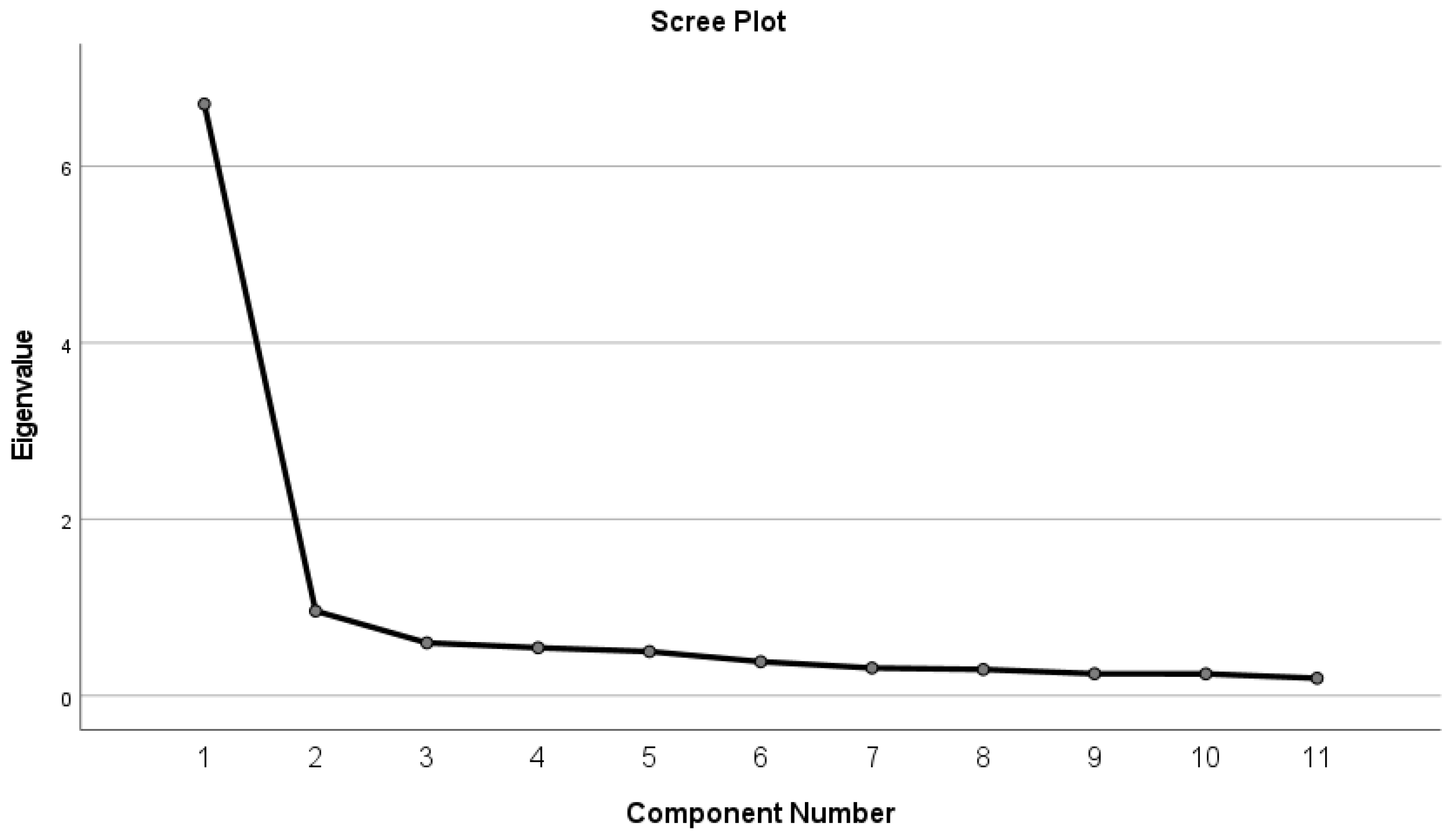
Figure 1 provides an illustrative overview of the factor structure, followed by a sharp drop, indicating a unidimensional structure. This suggests that the 11 items measure a single construct, the perceived benefits of MR in concrete placement, confirming a unidimensional structure and suitability for exploratory regression analysis.
4.4. Regression Analysis
To examine whether perceived benefits and barriers to Mixed Reality (MR) influence its usage frequency, a multiple linear regression was conducted, as shown in
Table 5.
The model yielded an R2 value of 0.011, indicating that only 1.1% of the variance in MR usage frequency is explained by the predictors (perceived benefits and barriers). The F-test [F (2, 122) = 0.673, p = 0.512] showed that the model was not statistically significant, suggesting no reliable explanatory strength.
According to
Table 6, the ANOVA test evaluates whether the regression model significantly explains variation in the dependent variable (MR usage frequency). The F-statistics are 0.673 with a
p-value of 0.512, indicating that the model is not statistically significant.
Thus, when the independent variables are combined (average perceived benefits and barriers), the combined effect does not significantly explain variation in MR usage in this dataset compared with the independent variables separately.
As mentioned in
Table 7, the coefficients reveal that neither average perceived benefits nor average were significantly associated with MR technology usage. The coefficient for avg. benefits (β = −0.127,
p = 0.259) indicates a weak, negative but non significant relationship. The average barriers (β = 0.098,
p = 0.382) show a weak, positive, and non significant association. Both predictors have VIF = 1.558, indicating no multicollinearity. These results suggest that other unmeasured factors may influence MR adoption more strongly, and that perceived benefits or barriers alone are insufficient to explain usage frequency in this sample. Further research with broader variables may be needed to enhance explanatory power.
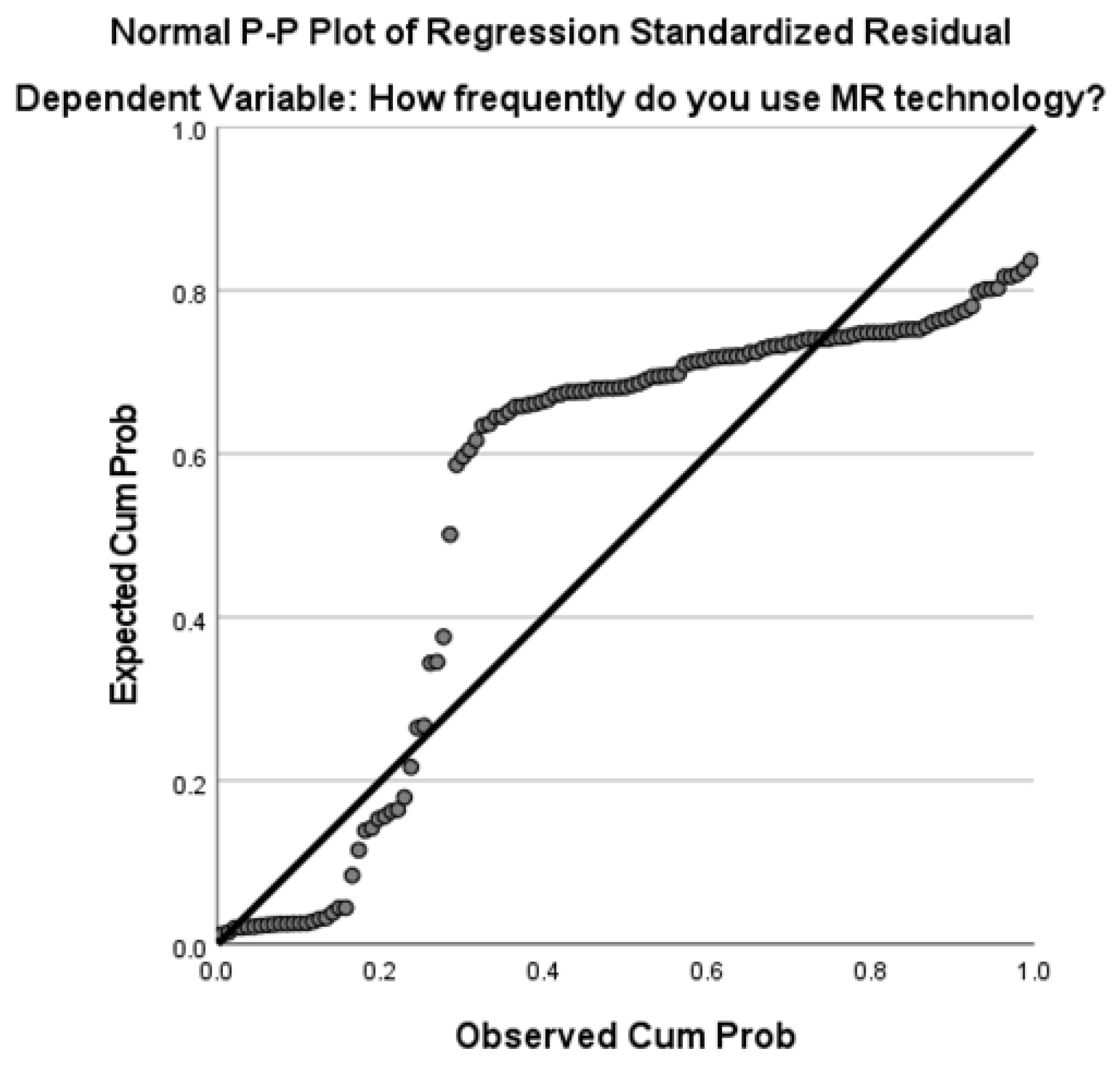
Figure 2 is presented to visually assess the normality assumption of regression residuals. Ideally, the observed values should align closely with the diagonal line, indicating that the residuals are normally distributed. In this plot, noticeable deviations, especially at the lower and upper tails, suggest that the residuals are not perfectly normal. This lack of normality could weaken the reliability of statistical inferences in the regression model. Moderate deviations are often acceptable in larger samples. While some deviation is observed, such patterns are not uncommon in exploratory survey based studies and are therefore interpreted with caution.
4.5. Chi Square Analysis
According to
Table 8, the Chi square test was conducted to determine whether the frequency of MR (Mixed Reality) technology usage varies significantly across different regions of residence among construction professionals. This supports the conclusion that MR adoption does not significantly differ across regions.
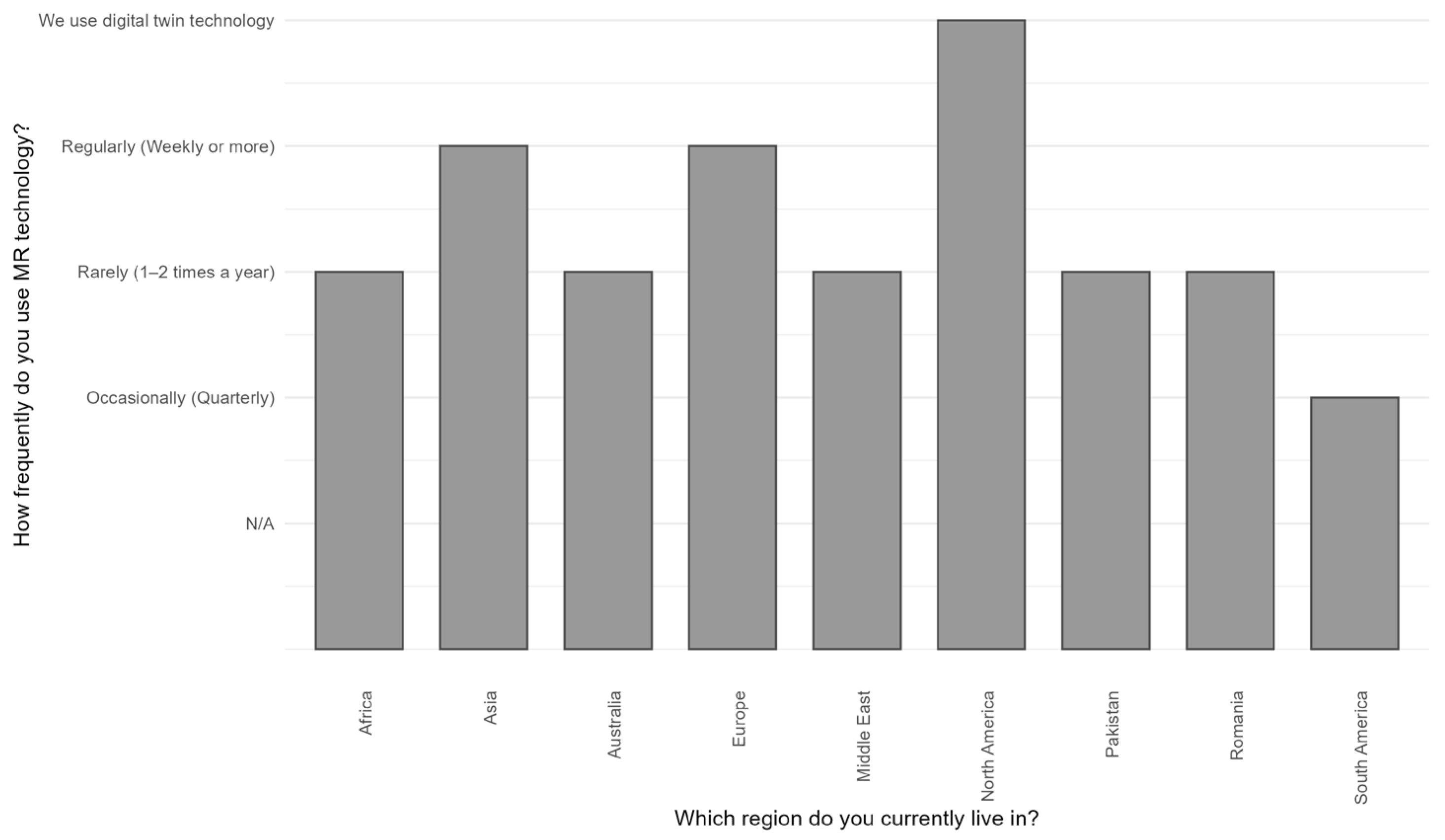
The Pearson Chi square value was χ2 (136) = 115.4 with a p-value of 0.899, which is well above the commonly accepted threshold of 0.05 for statistical significance. This suggests that there is no significant correlation between geographic regions and the frequency with which respondents reported using MR technology. In other words, MR usage patterns appear to be relatively uniform across regions like Asia, Europe, North America, Australia, and others within the sample.
Figure 3 shows only the descriptive illustration. No statistically significant regional differences were identified. However, the Chi square test’s reliability is limited because 96.9% of expected counts were below 5, likely due to small subgroup sizes and fragmented responses. Although the results suggest regional independence, they should be interpreted with caution. Future studies should consider larger, more balanced samples and alternative statistical techniques for greater robustness.
5. Discussion
This study examined the adoption of Mixed Reality (MR) technology for layout verification and concrete placement inspection in the construction industry, with a focus on perceived benefits, perceived barriers, and reported usage frequency. The results reveal a clear discrepancy between the recognised potential of MR and its actual level of practical use. Although respondents generally acknowledged the benefits of MR, including enhanced visualisation, collaboration, and inspection accuracy, these perceptions were not significantly associated with the frequency of MR usage. The findings should therefore be interpreted within the scope of an exploratory analysis, reflecting current practitioner experiences rather than definitive adoption determinants.
The descriptive results indicate that MR adoption remains at an early stage. Most respondents reported rare or occasional use of MR, despite having substantial professional experience and high educational qualifications. This suggests that awareness and technical competence alone are insufficient to drive regular MR implementation. These findings align with previous research indicating that construction technologies often remain confined to pilot applications or experimental use due to organisational, financial, and workflow related constraints [
38,
39,
40,
41,
42].
The regression analysis showed that perceived benefits and perceived barriers explained only a small proportion of the variation in MR usage frequency. Rather than interpreting this outcome as a methodological weakness, it highlights a critical theoretical insight: perception based variables alone may be insufficient to explain technology use in complex project based industries such as construction. Unlike consumer oriented technologies, MR adoption requires coordinated organisational investment, integration with existing digital systems (e.g., BIM), and alignment with project delivery processes. As a result, individual perceptions of usefulness or difficulty may not translate directly into frequent use.
Interestingly, perceived benefits exhibited a weak negative association with MR usage frequency, although this relationship was not statistically significant. One possible explanation is that professionals with greater exposure to MR may also have more realistic expectations of its current limitations, including hardware constraints, usability challenges, and integration difficulties. As MR transitions from experimental trials to practical deployment, early adopters may become more critical of its performance relative to initial expectations. This finding suggests that benefit perception measures may not fully capture the operational realities of MR implementation at higher levels of use.
The lack of a significant association between perceived barriers and usage frequency further supports the notion that barriers such as cost or technical complexity are necessary but not sufficient explanations for low adoption. In many construction organisations, decisions regarding digital technology adoption are driven by organisational strategy, leadership support, project scale, and contractual arrangements rather than individual user preferences. These factors were not directly captured in the present survey and represent an important direction for future research.
From a theoretical perspective, the findings challenge the applicability of traditional technology adoption models such as the Technology Acceptance Model (TAM) and Diffusion of Innovation (DOI) when applied to MR in construction. These models emphasise perceived usefulness and ease of use as primary drivers of adoption. However, the present results suggest that, in the context of construction, adoption is influenced by a broader set of organisational and contextual factors that extend beyond individual perceptions. This indicates a need for more comprehensive adoption frameworks that integrate organisational readiness, technological maturity, and project based decision making processes.
The chi square analysis did not reveal significant regional differences in MR usage frequency. However, this result should be interpreted cautiously due to uneven regional representation and sparse expected cell counts. While the findings suggest that MR adoption challenges may be broadly similar across regions, future studies with larger and more balanced samples are required to draw robust conclusions regarding geographic variation.
Overall, the results contribute empirical evidence to an emerging body of literature highlighting the gap between digital technology potential and practical implementation in construction. By demonstrating that perceived benefits and barriers alone do not adequately explain MR usage, this study underscores the importance of moving beyond perception based models and toward multi level adoption analyses that reflect the realities of construction practice.
6. Conclusions & Limitations
This study examined the adoption of Mixed Reality (MR) technology in the construction industry, with a specific focus on layout verification and concrete placement inspection. Using an exploratory, survey based approach, the research assessed current usage levels, identified perceived benefits and barriers, and examined whether these perceptions were associated with reported MR usage frequency. The findings indicate that, despite widespread recognition of MR’s potential advantages, regular and frequent use of MR in construction practice remains limited.
The results show that perceived benefits and perceived barriers, although reliably measured, were not significantly associated with MR usage frequency. This suggests that individual level perceptions alone are insufficient to explain MR adoption behaviour in construction. Instead, the findings point toward the importance of broader organisational, technological, and contextual factors that shape decision making in project based environments. In this sense, the study contributes empirical evidence highlighting a disconnect between the perceived value of MR and its practical implementation.
From a practical perspective, the findings suggest that increasing awareness of MR benefits may not be sufficient to drive adoption. Construction organisations may need to focus on organisational readiness, integration of MR with existing digital tools such as BIM, and alignment of MR deployment with project workflows. Pilot projects, targeted training, and strategic investment may help bridge the gap between experimentation and sustained use. The authors acknowledge that the study is based on limited sample size and perception based survey data, which constrains the depth and generalisability of the findings. While a psychological approach is appropriate for exploratory research objectives, future studies employing larger samples, mixed methods design, or longitudinal data collection would be required to validate and extend the conclusions presented here.
This study has several limitations that should be acknowledged. First, the sample size was modest and regionally uneven, limiting the ability to draw statistically generalisable conclusions or conduct robust regional comparisons. Second, the study relied on self reported survey data, which may be subject to response bias and cannot fully capture organisational decision making processes. Third, the analysis focused on perception based variables and did not include organisational level factors such as leadership support, digital strategy, budget allocation, or technological infrastructure maturity.
Future research should address these limitations by adopting mixed methods approaches that combine quantitative surveys with qualitative interviews or case studies. Incorporating organisational and project level variables may provide a more comprehensive understanding of MR adoption mechanisms. Longitudinal studies could further explore how perceptions, implementation challenges, and usage patterns evolve as MR technologies mature. Despite its limitations, this study provides exploratory empirical insight into MR adoption in construction and highlights the need for more holistic frameworks to support the effective integration of immersive technologies in practice.
Author Contributions
Conceptualization, S.H.K., S.M., K.I.A.K. and X.S.; Methodology, S.H.K., S.M., K.I.A.K., A.S., N.A. and X.S.; Software, S.H.K., A.S. and N.A.; Validation, S.H.K. and N.A.; Formal analysis, S.H.K. and N.A.; Investigation, S.H.K., A.S., N.A. and X.S.; Resources, S.H.K., S.M. and X.S.; Data curation, S.H.K.; Writing—original draft, S.H.K., A.S. and N.A.; Writing—review & editing, K.I.A.K. and X.S.; Visualization, S.H.K., S.M. and K.I.A.K.; Supervision, S.M. and X.S.; Project administration, S.H.K., S.M. and K.I.A.K.; Funding acquisition, S.M. All authors have read and agreed to the published version of the manuscript.
Funding
This research received no external funding.
Data Availability Statement
Conflicts of Interest
The authors declare no conflicts of interest.
References
- Agnisarman, S.; Lopes, S.; Madathil, K.C.; Piratla, K.; Gramopadhye, A. A survey of automation-enabled human-in-the-loop systems for infrastructure visual inspection. Autom. Constr. 2019, 97, 52–76. [Google Scholar] [CrossRef]
- Getuli, V.; Capone, P.; Bruttini, A.; Sorbi, T. A smart objects library for BIM-based construction site and emergency management to support mobile VR safety training experiences. Constr. Innov. 2022, 22, 504–530. [Google Scholar] [CrossRef]
- Carbonari, A.; Franco, C.; Naticchia, B.; Spegni, F.; Vaccarini, M. A mixed reality application for the on-site assessment of building renovation: Development and testing. Sustainability 2022, 14, 13239. [Google Scholar] [CrossRef]
- Mirshokraei, M.; De Gaetani, C.I.; Migliaccio, F. A web-based BIM–AR quality management system for structural elements. Appl. Sci. 2019, 9, 3984. [Google Scholar] [CrossRef]
- Wang, X.; Liang, C.J.; Menassa, C.C.; Kamat, V.R. Interactive and immersive process-level digital twin for collaborative human–robot construction work. J. Comput. Civ. Eng. 2021, 35, 04021023. [Google Scholar] [CrossRef]
- Chi, H.L.; Kim, M.K.; Liu, K.Z.; Thedja, J.P.P.; Seo, J.; Lee, D.E. Rebar inspection integrating augmented reality and laser scanning. Autom. Constr. 2022, 136, 104183. [Google Scholar] [CrossRef]
- May, K.W.; Kc, C.; Ochoa, J.J.; Gu, N.; Walsh, J.; Smith, R.T.; Thomas, B.H. The identification, development, and evaluation of BIM-ARDM: A BIM-based AR defect management system for construction inspections. Buildings 2022, 12, 140. [Google Scholar] [CrossRef]
- Ogunseiju, O.O.; Akanmu, A.A.; Bairaktarova, D. Mixed reality based environment for learning sensing technology applications in construction. J. Inf. Technol. Constr. 2021, 26, 863–885. [Google Scholar] [CrossRef]
- Turner, C.J.; Oyekan, J.; Stergioulas, L.; Griffin, D. Utilizing industry 4.0 on the construction site: Challenges and opportunities. IEEE Trans. Ind. Inform. 2020, 17, 746–756. [Google Scholar] [CrossRef]
- García-Avilés, J.A. Diffusion of innovation. In The International Encyclopedia of Media Psychology; John Wiley & Sons: Hoboken, NJ, USA, 2020; Volume 1, pp. 1–8. [Google Scholar]
- Kwiatek, C.; Sharif, M.; Li, S.; Haas, C.; Walbridge, S. Impact of augmented reality and spatial cognition on assembly in construction. Autom. Constr. 2019, 108, 102935. [Google Scholar] [CrossRef]
- Xu, M.; Nie, X.; Li, H.; Cheng, J.C.; Mei, Z. Smart construction sites: A promising approach to improving on-site HSE management performance. J. Build. Eng. 2022, 49, 104007. [Google Scholar] [CrossRef]
- Harikrishnan, A.; Abdallah, A.S.; Ayer, S.K.; El Asmar, M.; Tang, P. Feasibility of augmented reality technology for communication in the construction industry. Adv. Eng. Inform. 2021, 50, 101363. [Google Scholar] [CrossRef]
- You, Z.; Feng, L. Integration of industry 4.0 related technologies in construction industry: A framework of cyber-physical system. IEEE Access 2022, 8, 122908–122922. [Google Scholar] [CrossRef]
- Halder, S.; Afsari, K.; Serdakowski, J.; DeVito, S.; Ensafi, M.; Thabet, W. Real-time and remote construction progress monitoring with a quadruped robot using augmented reality. Buildings 2022, 12, 2027. [Google Scholar] [CrossRef]
- Eilola, S.; Jaalama, K.; Kangassalo, P.; Nummi, P.; Staffans, A.; Fagerholm, N. 3D visualisations for communicative urban and landscape planning: What systematic mapping of academic literature can tell us of their potential? Landsc. Urban Plan. 2023, 234, 104716. [Google Scholar] [CrossRef]
- El Ammari, K.; Hammad, A. Remote interactive collaboration in facilities management using BIM-based mixed reality. Autom. Constr. 2019, 107, 102940. [Google Scholar] [CrossRef]
- Chalhoub, J.; Ayer, S.K. Using Mixed Reality for electrical construction design communication. Autom. Constr. 2018, 86, 1–10. [Google Scholar] [CrossRef]
- Alizadehsalehi, S.; Hadavi, A. Synergies of lean, BIM, and extended reality (LBX) for project delivery management. Sustainability 2023, 15, 4969. [Google Scholar] [CrossRef]
- Hajirasouli, A.; Banihashemi, S.; Sanders, P.; Rahimian, F. BIM-enabled virtual reality (VR)-based pedagogical framework in architectural design studios. Smart Sustain. Built Environ. 2024, 13, 1490–1510. [Google Scholar] [CrossRef]
- Dai, F.; Olorunfemi, A.; Peng, W.; Cao, D.; Luo, X. Can mixed reality enhance safety communication on construction sites? An industry perspective. Saf. Sci. 2021, 133, 105009. [Google Scholar] [CrossRef]
- Al-Khiami, M.I.; Lindhard, S.M.; Wandahl, S. Integrating exoskeletons in the construction sector: A systematic review of empirical evaluation tools and future directions. Eng. Constr. Archit. Manag. 2024. [Google Scholar] [CrossRef]
- Hsu, S.H.; Hung, H.T.; Lin, Y.Q.; Chang, C.M. Defect inspection of indoor components in buildings using deep learning object detection and augmented reality. Earthq. Eng. Eng. Vib. 2023, 22, 41–54. [Google Scholar] [CrossRef]
- Martins, A.C.P.; Castellano, I.R.; Júnior, K.M.L.C.; de Carvalho, J.M.F.; Bellon, F.G.; de Oliveira, D.S.; Ribeiro, J.C.L. BIM-based mixed reality application for bridge inspection. Autom. Constr. 2024, 168, 105775. [Google Scholar] [CrossRef]
- Shufrin, I.; Pasternak, E.; Dyskin, A. Environmentally friendly smart construction—Review of recent developments and opportunities. Appl. Sci. 2023, 13, 12891. [Google Scholar] [CrossRef]
- Khan, A.; Sepasgozar, S.; Liu, T.; Yu, R. Integration of BIM and immersive technologies for AEC: A scientometric-SWOT analysis and critical content review. Buildings 2021, 11, 126. [Google Scholar] [CrossRef]
- Sheikhkhoshkar, M.; Rahimian, F.P.; Kaveh, M.H.; Hosseini, M.R.; Edwards, D.J. Automated planning of concrete joint layouts with 4D-BIM. Autom. Constr. 2019, 107, 102943. [Google Scholar] [CrossRef]
- Chacón, R.; Posada, H.; Ramonell, C.; Jungmann, M.; Hartmann, T.; Khan, R.; Tomar, R. Digital twinning of building construction processes. Case study: A reinforced concrete cast-in structure. J. Build. Eng. 2024, 84, 108522. [Google Scholar] [CrossRef]
- Chan, A.P.C.; Chiang, Y.H.; Wong, F.K.W.; Liang, S.; Abidoye, F.A. Work–life balance for construction manual workers. J. Constr. Eng. Manag. 2020, 146, 04020031. [Google Scholar] [CrossRef]
- Khairadeen Ali, A.; Lee, O.J.; Lee, D.; Park, C. Remote indoor construction progress monitoring using extended reality. Sustainability 2021, 13, 2290. [Google Scholar] [CrossRef]
- Rauh, S.; Koller, M.; Schäfer, P.; Meixner, G.; Bogdan, C.; Viberg, O. MR on-SeT: A mixed reality occupational health and safety training for world-wide distribution. Int. J. Emerg. Technol. Learn. 2021, 16, 163–185. [Google Scholar] [CrossRef]
- Zhang, Z.; Wong, M.O.; Pan, W. Virtual reality enhanced multi-role collaboration in crane-lift training for modular construction. Autom. Constr. 2023, 150, 104848. [Google Scholar] [CrossRef]
- Zhao, X.; Zhang, M.; Fan, X.; Sun, Z.; Li, M.; Li, W.; Huang, L. Extended Reality for Safe and Effective Construction Management: State-of-the-Art, Challenges, and Future Directions. Buildings 2023, 13, 155. [Google Scholar] [CrossRef]
- Sami Ur Rehman, M.; Abouelkhier, N.; Shafiq, M.T. Exploring the effectiveness of immersive virtual reality for Project Scheduling in Construction Education. Buildings 2023, 13, 1123. [Google Scholar] [CrossRef]
- Halder, S.; Afsari, K. Robots in inspection and monitoring of buildings and infrastructure: A systematic review. Appl. Sci. 2023, 13, 2304. [Google Scholar] [CrossRef]
- Bougie, R.; Sekaran, U. Research Methods for Business: A Skill Building Approach; John Wiley & Sons: Hoboken, NJ, USA, 2019. [Google Scholar]
- Leite, F.L. BIM for Design Coordination: A Virtual Design and Construction Guide for Designers, General Contractors, and MEP Subcontractors; John Wiley & Sons: Hoboken, NJ, USA, 2019. [Google Scholar]
- Suprun, E.; Sahin, O.; Anthony Stewart, R.; Panuwatwanich, K. Examining transition pathways to construction innovation in Russia: A system dynamics approach. Int. J. Constr. Manag. 2022, 22, 556–578. [Google Scholar] [CrossRef]
- Grover, P.; Kar, A.K.; Janssen, M.; Ilavarasan, P.V. Perceived usefulness, ease of use and user acceptance of blockchain technology for digital transactions–insights from user-generated content on Twitter. Enterp. Inf. Syst. 2019, 13, 771–800. [Google Scholar] [CrossRef]
- Shurrab, J.; Hussain, M. An empirical study of the impact of lean on the performance of the construction industry in UAE. J. Eng. Des. Technol. 2018, 16, 694–710. [Google Scholar] [CrossRef]
- Georgiadou, M.C. An overview of benefits and challenges of building information modelling (BIM) adoption in UK residential projects. Constr. Innov. 2019, 19, 298–320. [Google Scholar] [CrossRef]
- Yu, R.; Gu, N.; Lee, G.; Khan, A. A systematic review of architectural design collaboration in immersive virtual environments. Designs 2022, 6, 93. [Google Scholar] [CrossRef]
| Disclaimer/Publisher’s Note: The statements, opinions and data contained in all publications are solely those of the individual author(s) and contributor(s) and not of MDPI and/or the editor(s). MDPI and/or the editor(s) disclaim responsibility for any injury to people or property resulting from any ideas, methods, instructions or products referred to in the content. |




 ,
,