Systematic Mapping of Artificial Intelligence Applications in Finite-Element-Based Structural Engineering


Abstract
1. Introduction
1.1. Motivation
1.2. Artificial Intelligence in Structural Design
1.3. Opportunities Through CAD, BIM, and AAD
1.4. Steps in FEM Workflows
1.5. Optimization in Structural Design
1.6. Research Questions
- What types of research have been conducted on AI in structural design?
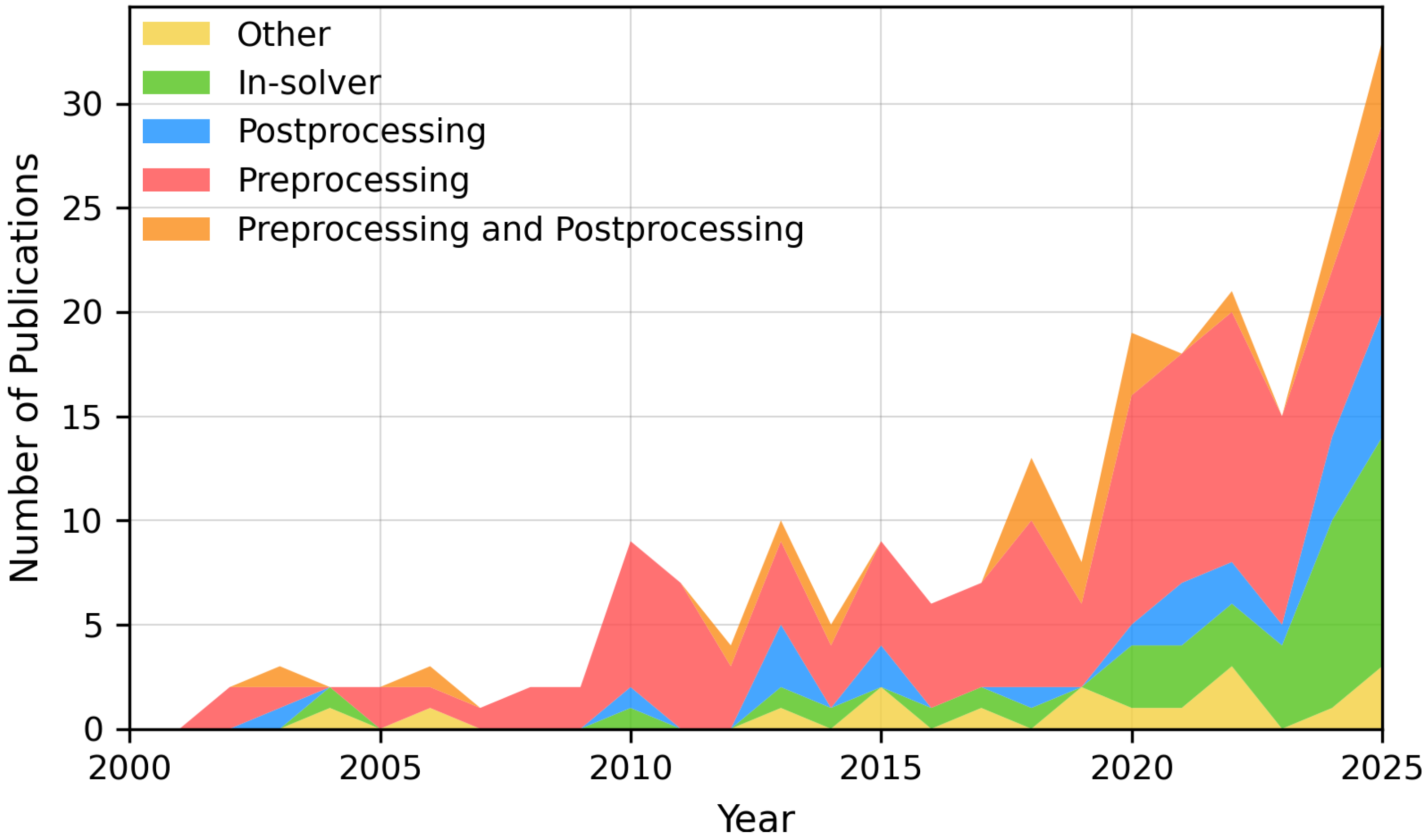
- In what ways has AI been used to support pre-processing, in-solver acceleration, and post-processing of structural models and design?
- What patterns, challenges, and opportunities can be identified from the literature?
1.7. Application Groups
1.8. Contribution of This Study
1.9. Outlook
2. Methodology
2.1. Search Strategy
(FEA OR "Finite element") AND (AI OR "Artificial intelligence")
AND (Engineering)
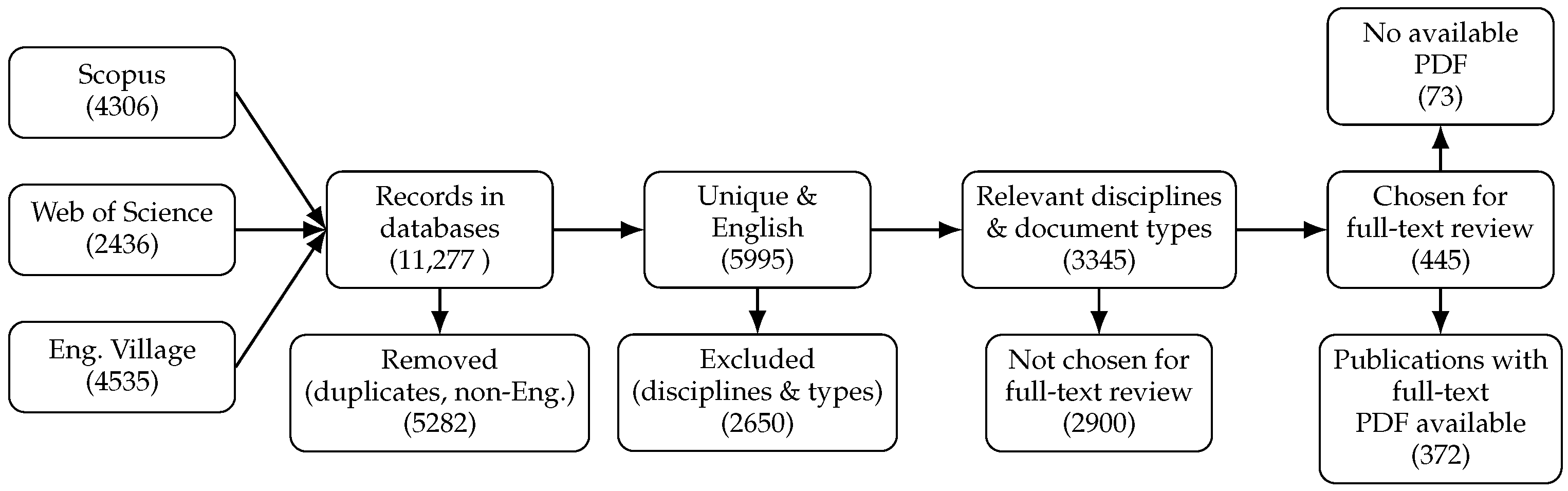
2.2. Article Selection and Categorization
- Application group: Each study was assigned to one of the seven application groups introduced in the Introduction. These groups capture recurring themes in how AI is applied within structural engineering and provide the framework for comparative analysis in this mapping.
2.3. Data Processing and Visualization
2.4. Full-Text Categorization of Articles
2.4.1. Taxonomy
- Object (Beam, Column, Floor, Bridge, Slab, Wall, Frame, Truss, Building)—the main structural object under study (not merely mentioned).
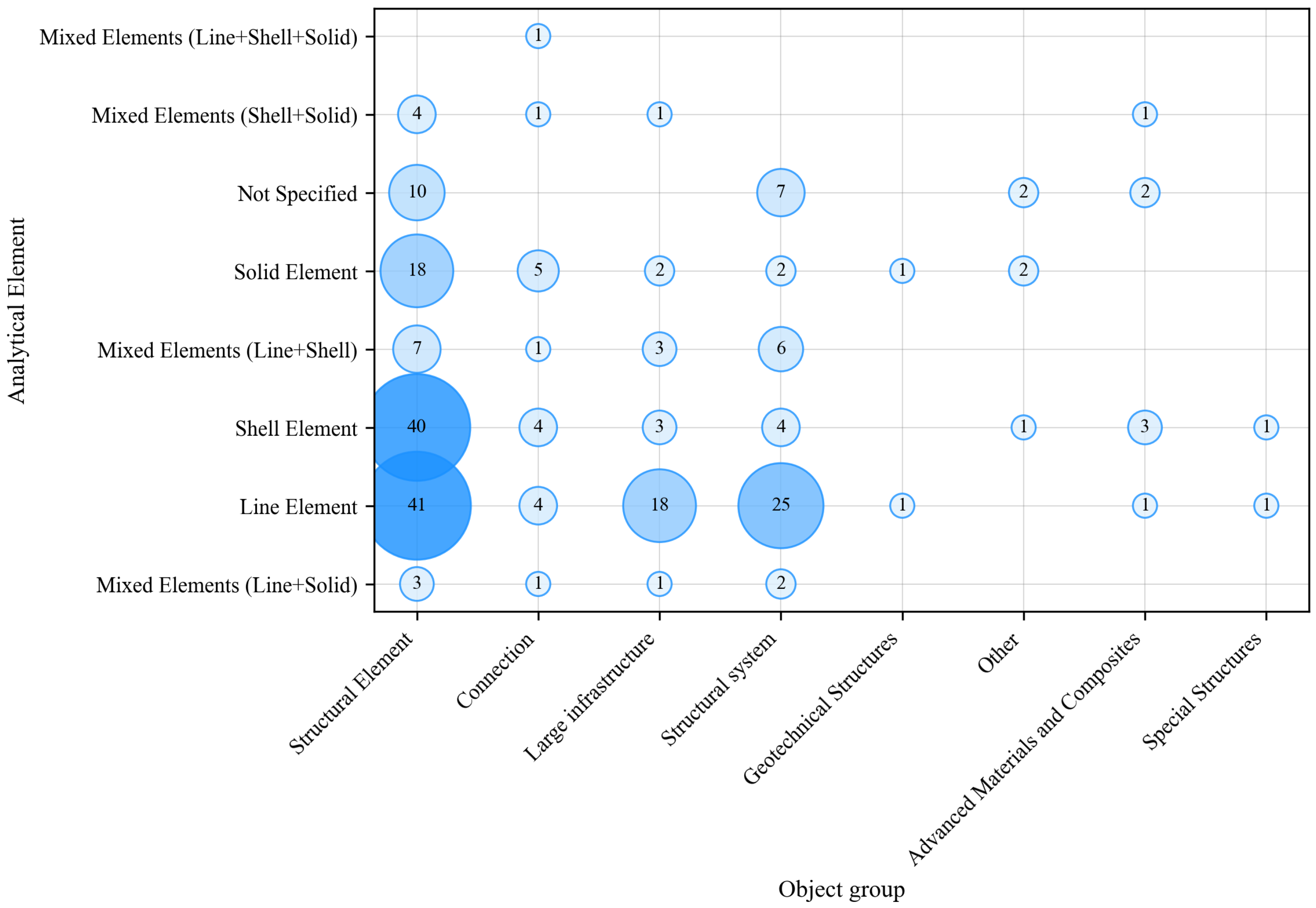
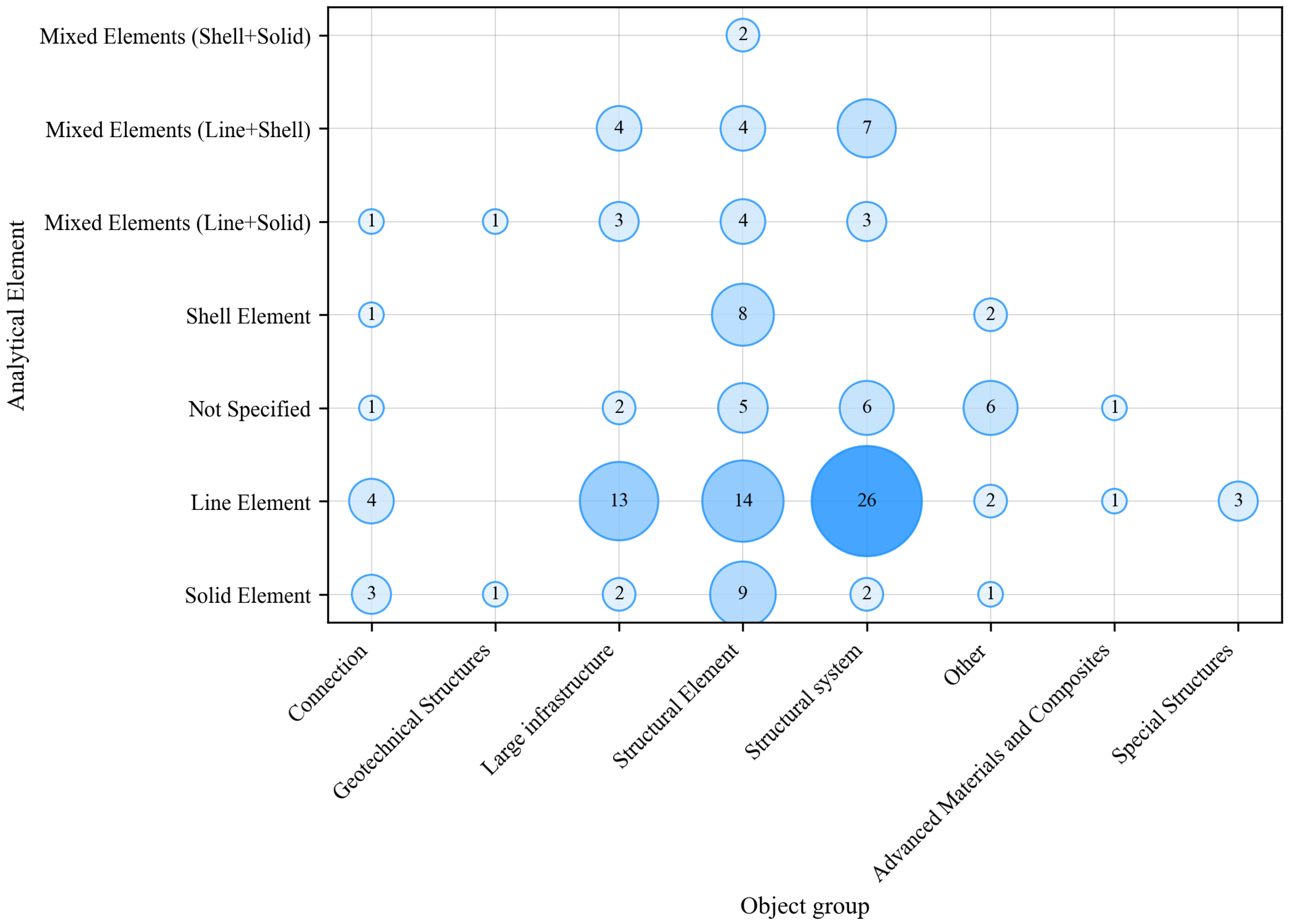
- Object group (Structural Element, Structural System, Connection, Large Infrastructure, Advanced Materials and Composites, Special Structures, Geotechnical Structures, Other)—a higher-level classification describing the structural scale or type of system investigated; while Object refers to a specific component (e.g., beam, wall), Object group captures whether the study targets individual elements, full systems, or specialized structural categories.
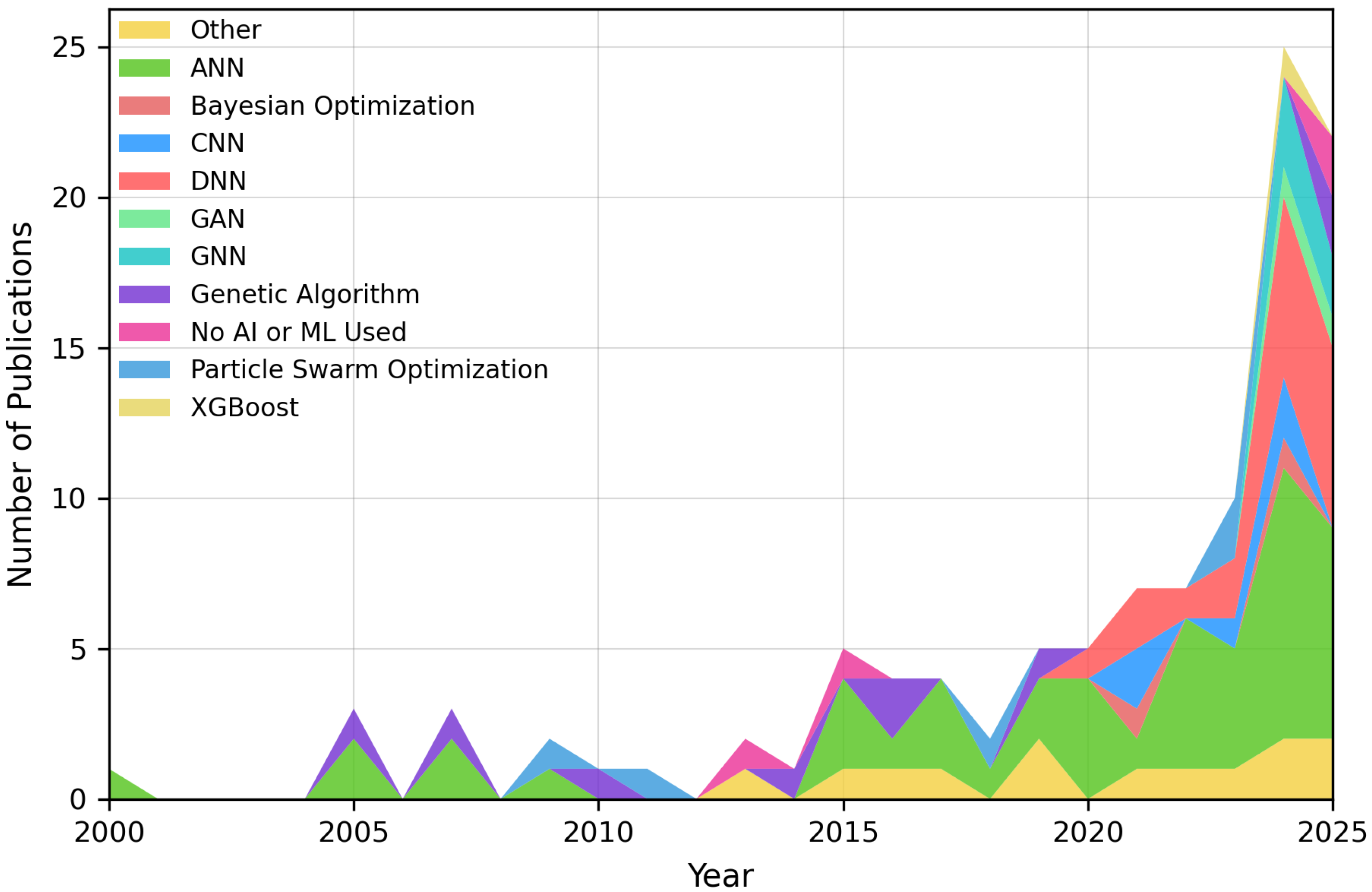
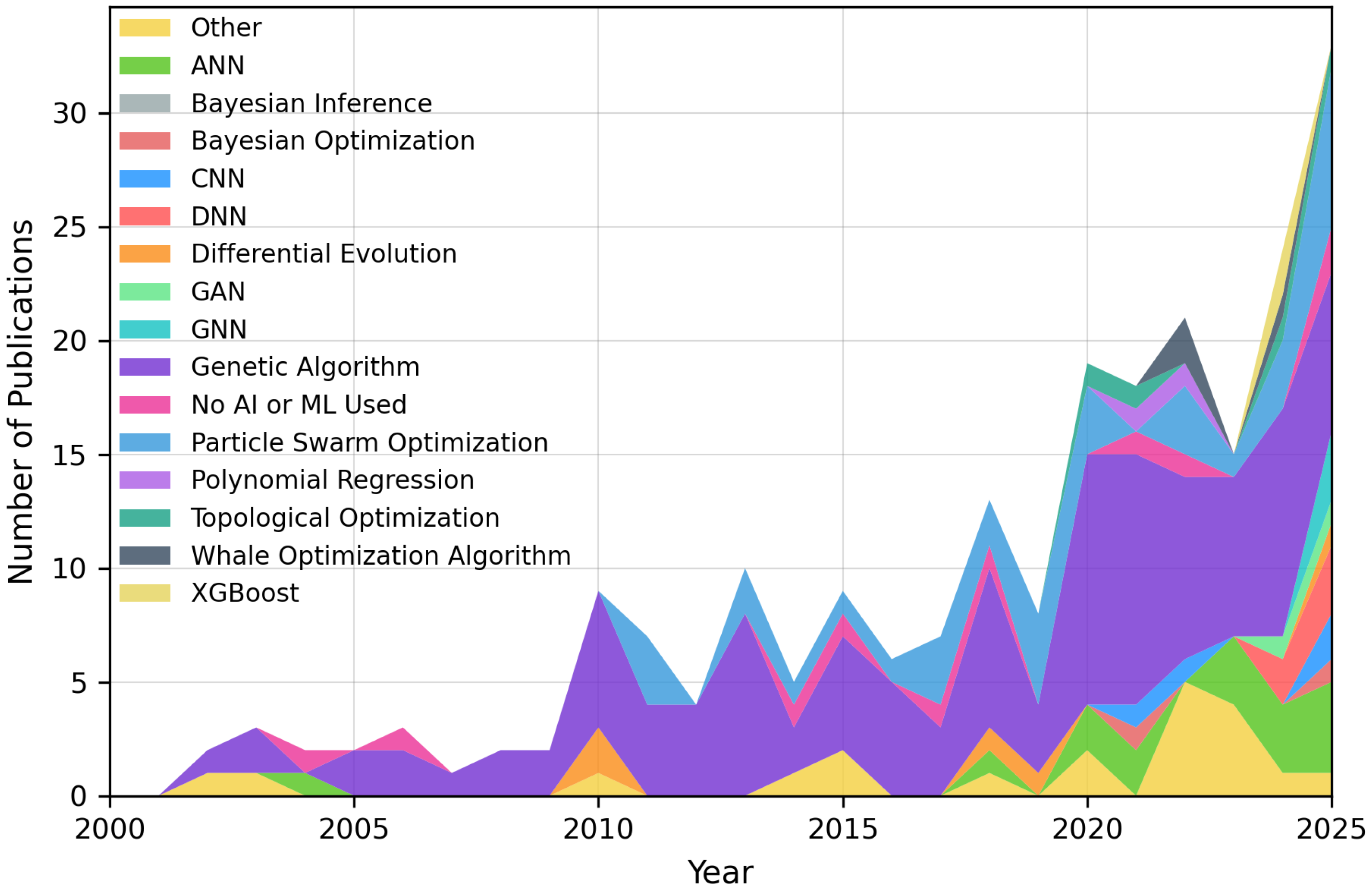
- AI Algorithm (Artificial Neural Network (ANN), Convolutional Neural Network (CNN), Deep Neural Network (DNN), Graph Neural Network (GNN), Support Vector Machine (SVM), Random Forest, Extreme Gradient Boosting (XGBoost), Gradient Boosting, Genetic Algorithm (GA), Reinforcement Learning, Ensemble Learning, Transfer Learning, No AI or ML Used, etc.)—the primary AI/ML method implemented or evaluated; synonyms are mapped to the closest category.
- Material (Reinforced Concrete, Plain Concrete, Prestressed Concrete, Steel, Steel–Concrete Composite, Other Composite, Timber, Engineered Wood, Masonry, Aluminium, Other Metals, Generic Material, Multi-Material, Not Specified)—the principal material investigated or modeled.
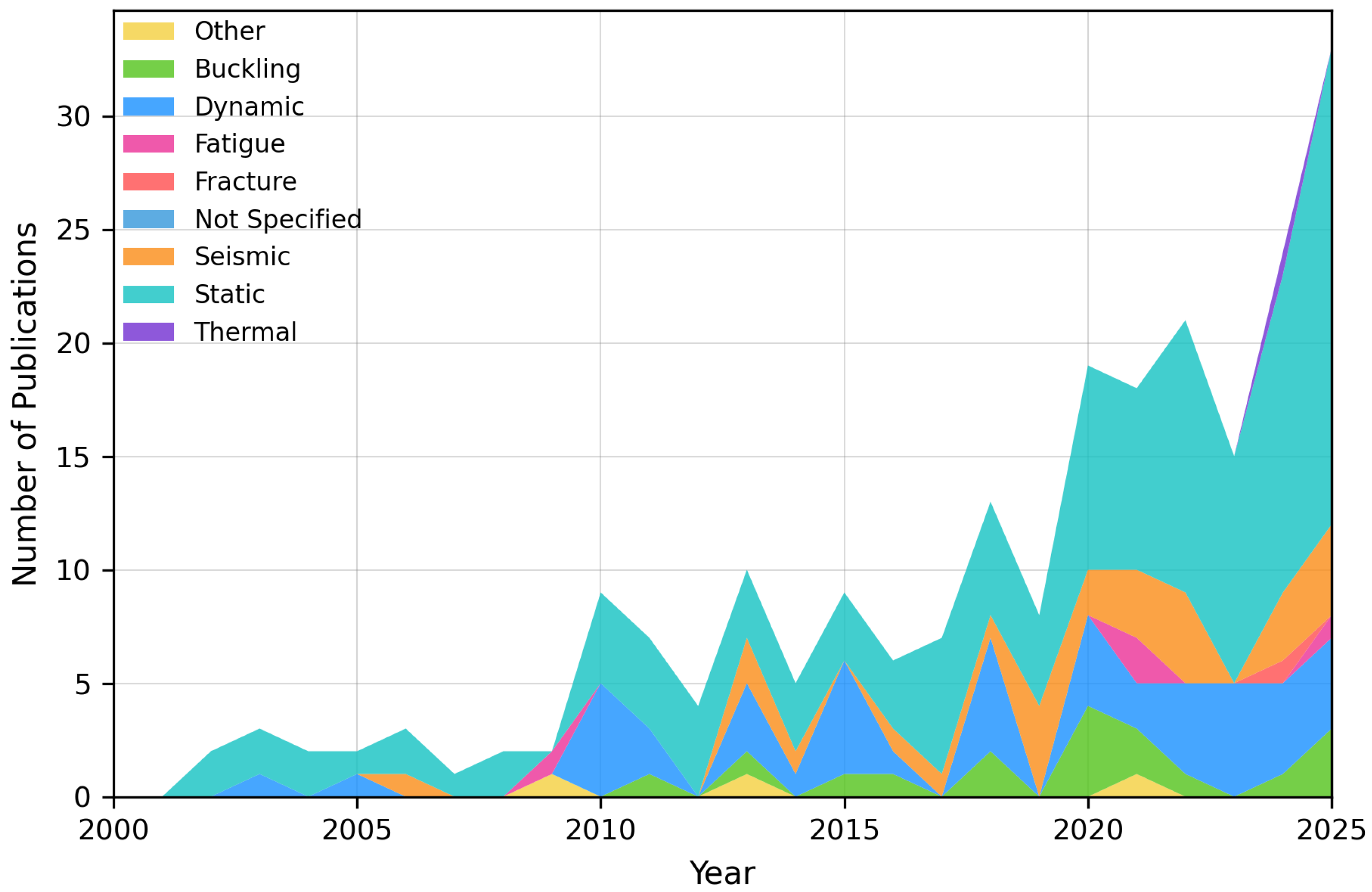
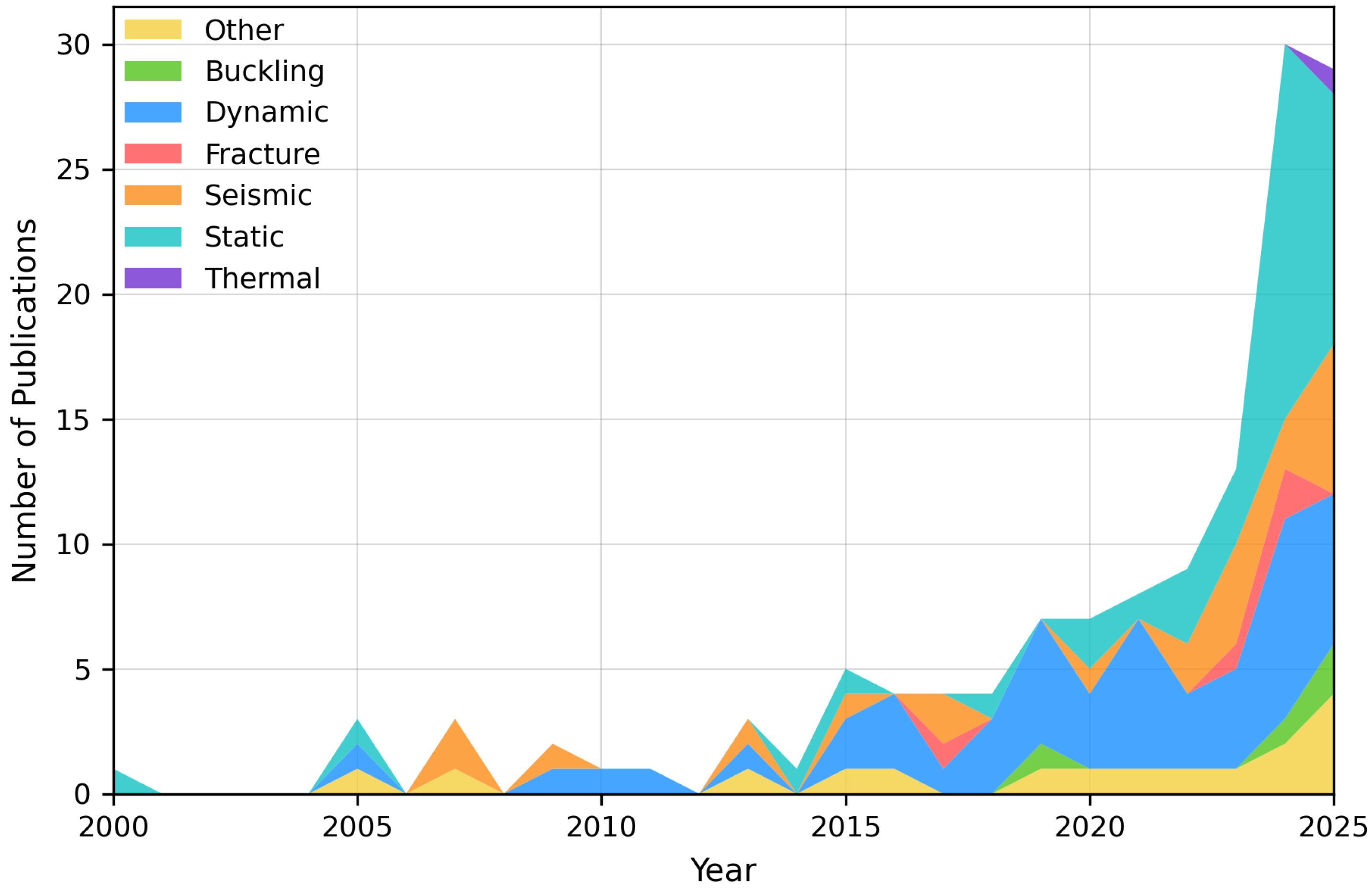
- Analysis (Static, Dynamic, Seismic, Thermal, Buckling, Fatigue, Fracture, Other)—the primary analysis type; if several are present, the type emphasized in the results or conclusions is selected.
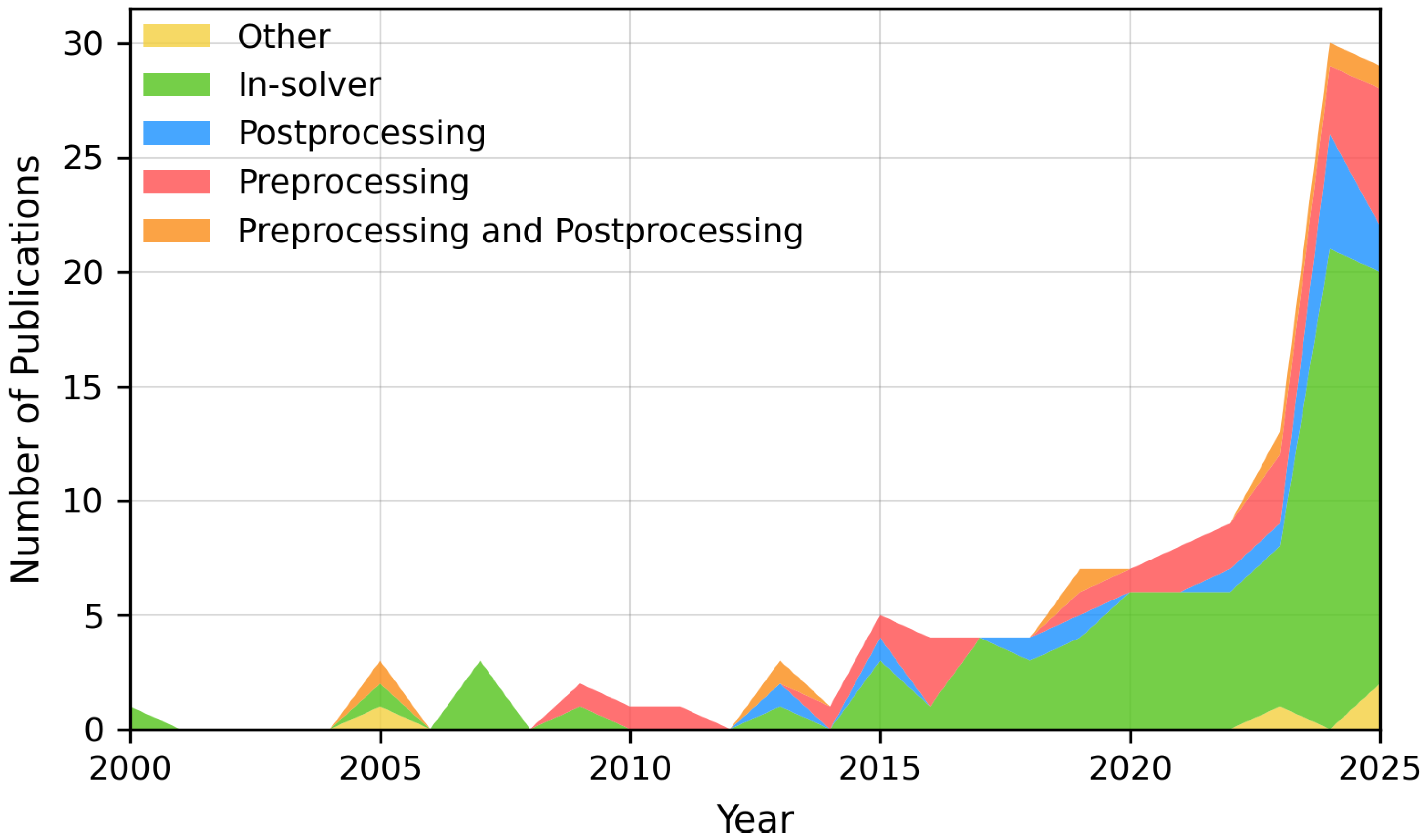
- AI usage (Pre-processing, In-solver, Post-processing, Pre- and Post-processing, Other)—how AI is applied relative to FEM.
2.4.2. Model-Assisted Labeling Pipeline
2.4.3. Parallel Processing and Data Management
2.4.4. Consistency and Validation
2.4.5. Limitations and Reproducibility
2.4.6. Accuracy of Categorization
3. Results and Discussion
3.1. Convergence
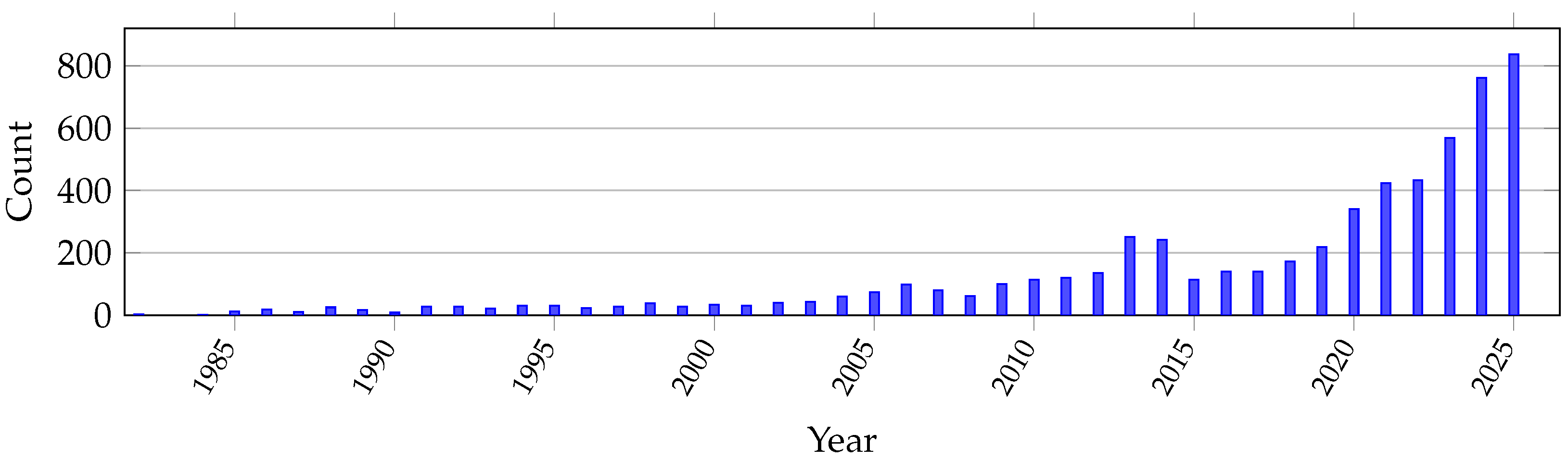
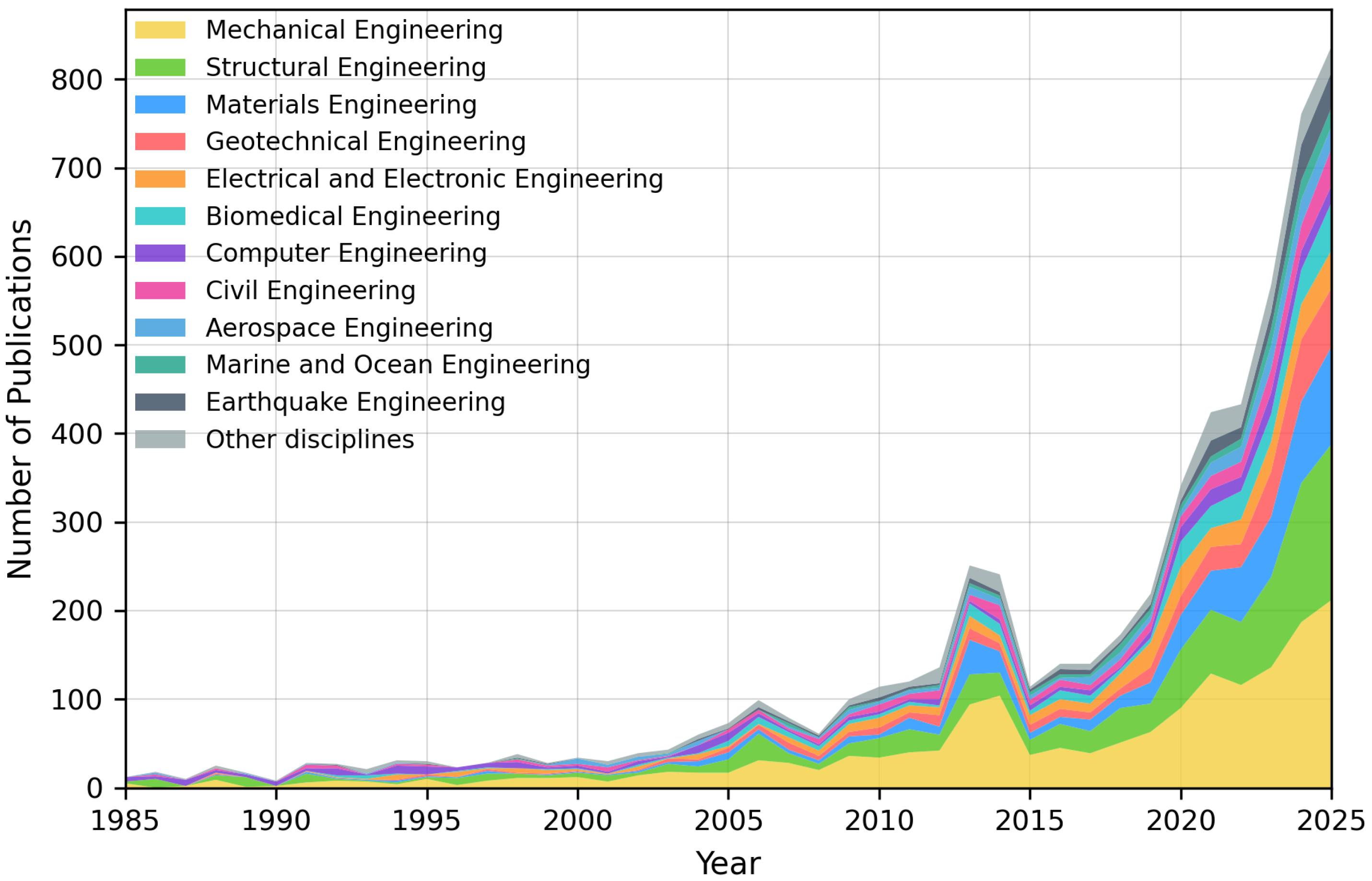
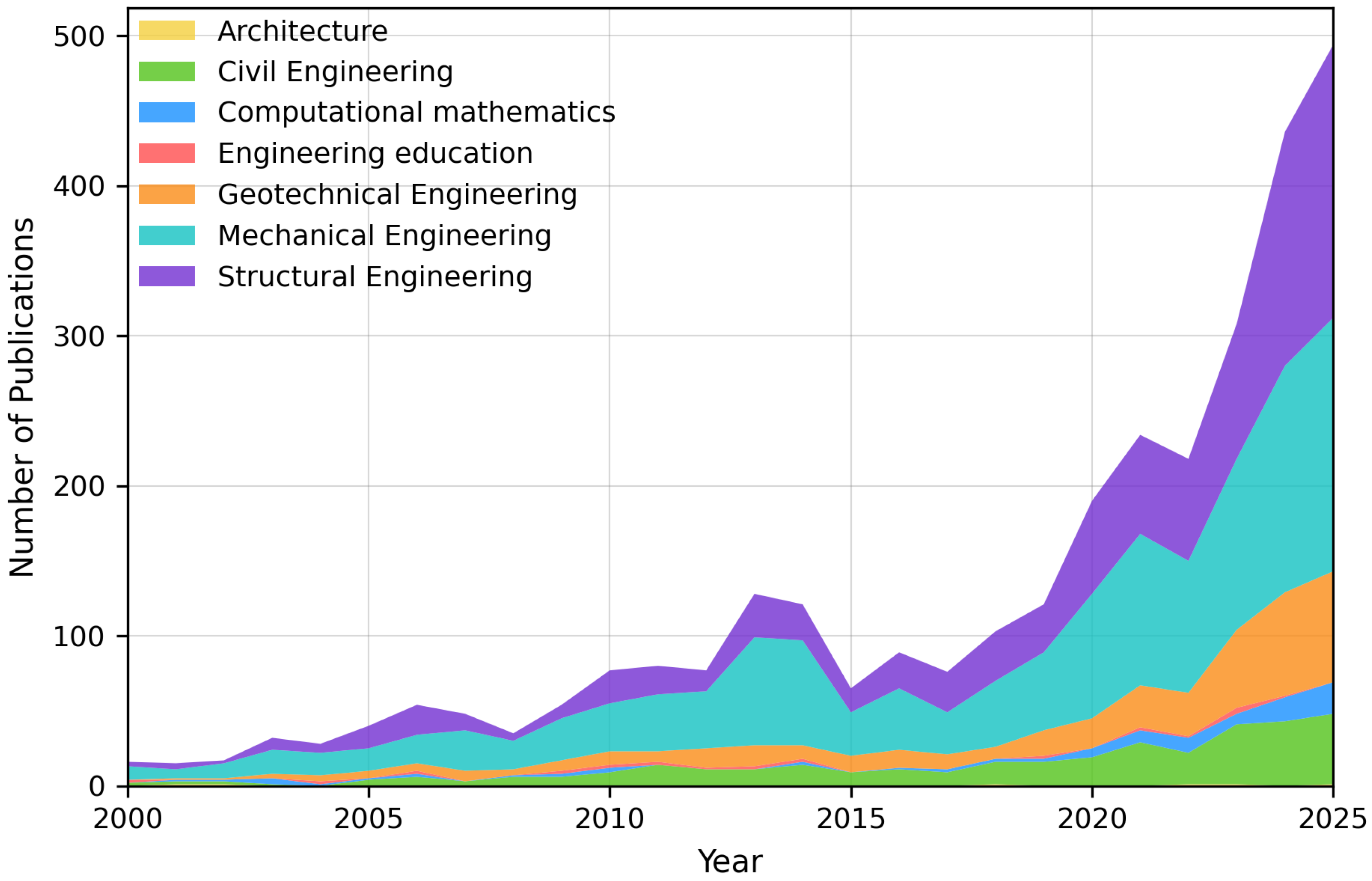
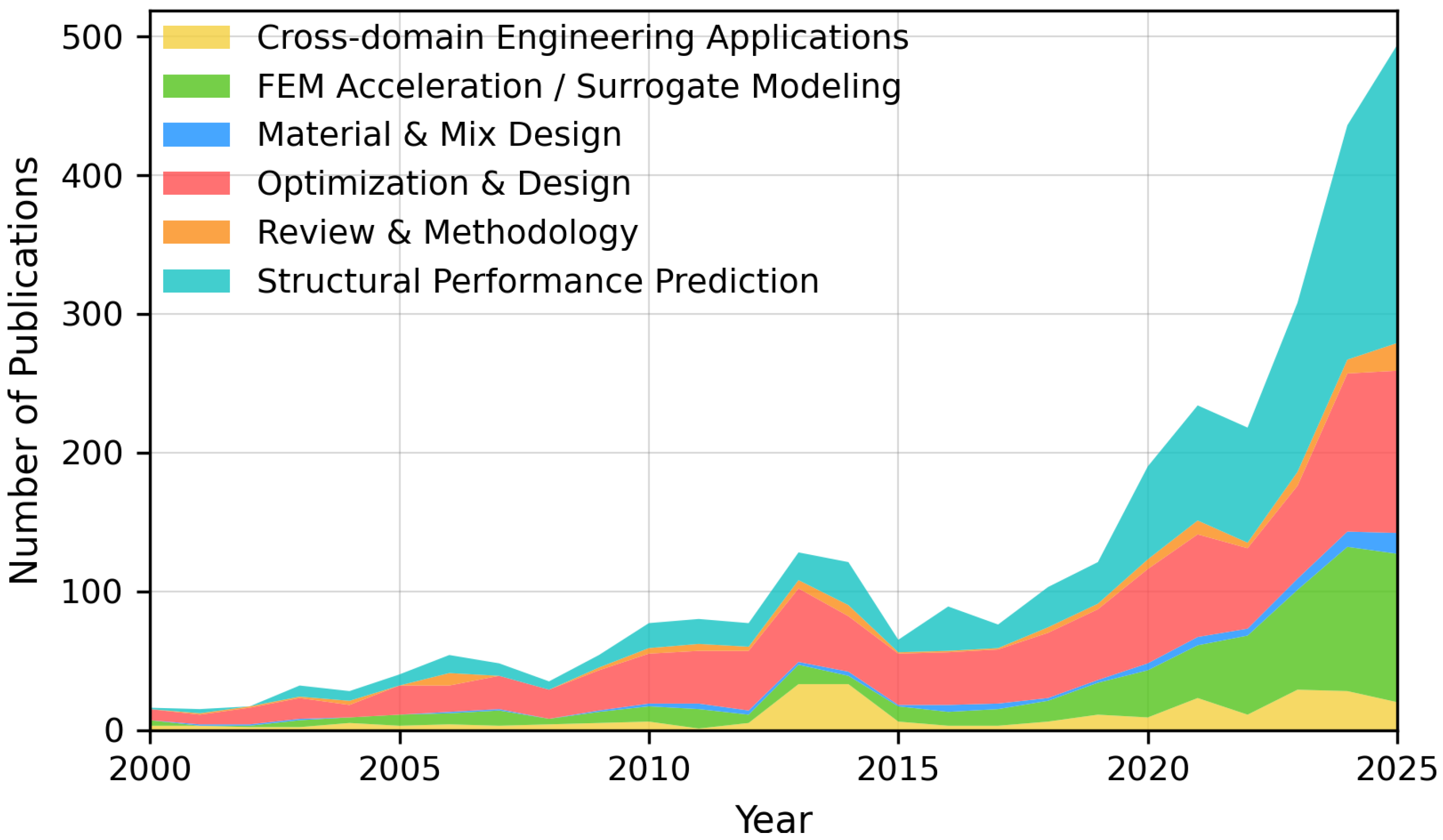
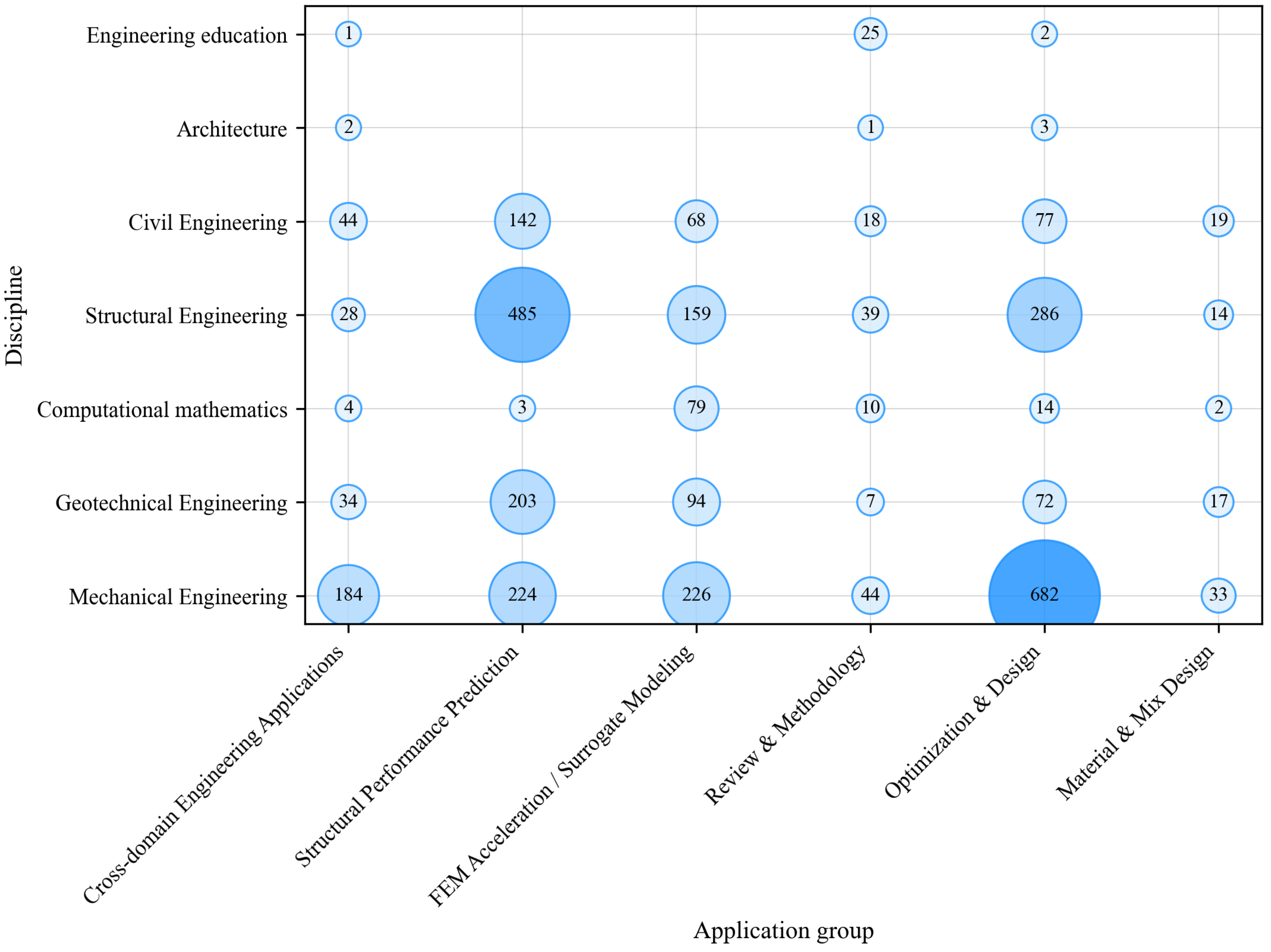
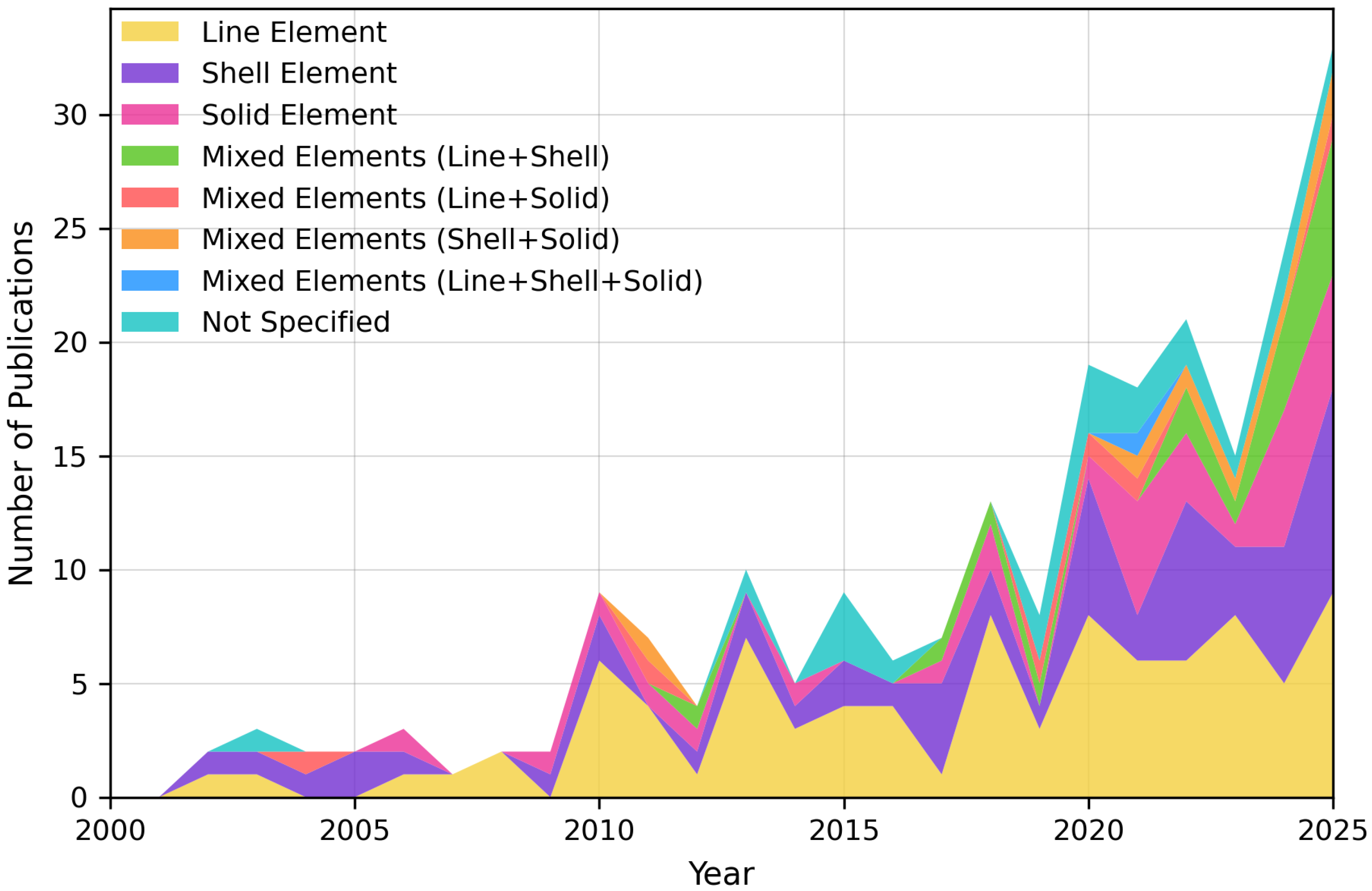
3.2. Publication Trends and Dataset Overview
Citation Distribution and High-Impact Publications
3.3. Optimization and Design in Structural Engineering
3.4. Surrogate Modeling and Prediction in Structural Engineering
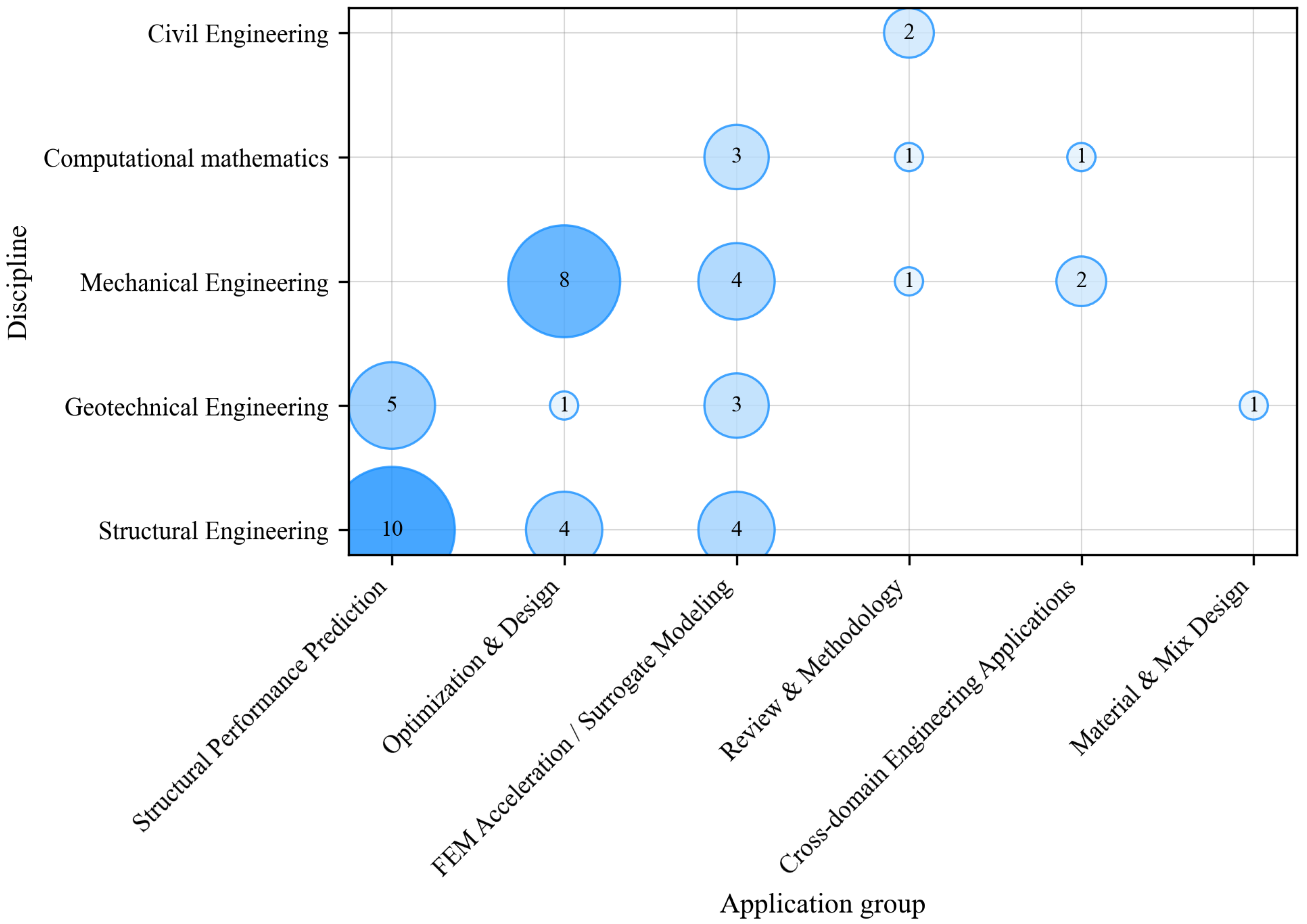
3.5. Comparative Analysis of Modeling Strategies
4. Conclusions
4.1. Research Question 1
4.2. Research Question 2
4.3. Research Question 3
4.4. Limitations
4.5. Future Work
Author Contributions
Funding
Data Availability Statement
Conflicts of Interest
Abbreviations
| AAD | Algorithm-Aided Design |
| AI | Artificial Intelligence |
| ANN | Artificial Neural Network |
| BIM | Building Information Modeling |
| CNN | Convolutional Neural Network |
| DE | Differential Evolution |
| DOE | Design-of-Experiments |
| DNN | Deep Neural Network |
| FE | Finite Element |
| FEA | Finite-Element Analysis |
| GA | Genetic Algorithm |
| GAN | Generative Adversarial Network |
| GNN | Graph Neural Network |
| GP | Gaussian Process |
| GPR | Gaussian Process Regression |
| LHS | Latin Hypercube Sampling |
| LSTM | Long Short-Term Memory |
| ML | Machine Learning |
| NSGA-II | Non-dominated Sorting Genetic Algorithm II |
| PCE | Polynomial Chaos Expansion |
| PSO | Particle Swarm Optimization |
| SQP | Sequential Quadratic Programming |
| SVM | Support Vector Machine |
References
- Oesterreich, T.D.; Teuteberg, F. Understanding the implications of digitisation and automation in the context of Industry 4.0: A triangulation approach and elements of a research agenda for the construction industry. Comput. Ind. 2016, 83, 121–139. [Google Scholar] [CrossRef]
- McKinsey Global Institute. Reinventing Construction: A Route to Higher Productivity; Technical Report; McKinsey Global Institute: New York, NY, USA, 2017. [Google Scholar]
- Thai, H.T. Machine learning for structural engineering: A state-of-the-art review. Structures 2022, 38, 448–491. [Google Scholar] [CrossRef]
- Xie, H.; Mei, Q.; Chui, Y.H. AI applications for structural design automation. Autom. Constr. 2025, 179, 106496. [Google Scholar] [CrossRef]
- Cheng, X.; Gilbert, B.P.; Guan, H.; Underhill, I.D.; Karampour, H. Experimental dynamic collapse response of post-and-beam mass timber frames under a sudden column removal scenario. Eng. Struct. 2021, 233, 111918. [Google Scholar] [CrossRef]
- Bathe, K.J. Finite Element Procedures; Prentice Hall: Englewood Cliffs, NJ, USA, 1995. [Google Scholar]
- Cottrell, J.A.; Bazilevs, Y.; Hughes, T.J.R. Isogeometric Analysis: Toward Integration of CAD and FEA, 1st ed.; Wiley: Chichester, UK, 2009. [Google Scholar] [CrossRef]
- Helminen, J.; Tuori, J.; Laasonen, M.; Farinha, R. Automated Generation of Steel Connections of BIM by Machine Learning. In Proceedings of the Conference on Computing in Civil Engineering (ASCE), Tampere, Finland, 5–7 June 2018. [Google Scholar]
- Sacks, R.; Girolami, M.; Brilakis, I. Building Information Modelling, Artificial Intelligence and Construction Tech. Dev. Built Environ. 2020, 4, 100011. [Google Scholar] [CrossRef]
- Nagy, D. Project Discover: An Application of Generative Design for Architectural Space Planning. In SIMAUD ’17: Proceedings of the Symposium on Simulation for Architecture and Urban Design; Association for Computing Machinery: New York, NY, USA, 2017. [Google Scholar] [CrossRef]
- Cook, R.D.; Malkus, D.S.; Plesha, M.E.; Witt, R.J. (Eds.) Concepts and Applications of Finite Element Analysis, 4th ed.; Wiley: New York, NY, USA, 2002. [Google Scholar]
- Izumi, B.; Luczkowski, M.; Labonnote, N.; Manum, B.; Rønnquist, A. A Systematic Mapping Study and a Review of the Optimization Methods of Structures in Architectural Design. Buildings 2024, 14, 3511. [Google Scholar] [CrossRef]
- Bendsøe, M.P.; Sigmund, O. Topology Optimization; Springer: Berlin/Heidelberg, Germany, 2004. [Google Scholar] [CrossRef]
- Petersen, K.; Feldt, R.; Mujtaba, S.; Mattsson, M. Systematic mapping studies in software engineering. In Proceedings of the 12th International Conference on Evaluation and Assessment in Software Engineering, EASE’08, Swindon, UK, 26–27 June 2008; pp. 68–77. [Google Scholar]
- Kitchenham, B.; Charters, S. Guidelines for Performing Systematic Literature Reviews in Software Engineering; EBSE Technical Report EBSE-2007-01; Keele University: Keele, UK; Durham University: Durham, UK, 2007. [Google Scholar]
- Haakonsen, S.M.; Rønnquist, A.; Labonnote, N. Fifty years of shape grammars: A systematic mapping of its application in engineering and architecture. Int. J. Archit. Comput. 2023, 21, 5–22. [Google Scholar] [CrossRef]
- Annicchiarico, W.D.; Cerrolaza, M.E. Structural optimization approach and software based on genetic algorithms and finite elements. Eng. Optim. 1999, 32, 1–31. [Google Scholar] [CrossRef]
- Balea, I.D.; Hulea, R.; Stavroulakis, G.E. Implementation of eurocode load cases in optimization problems of steel frames, based on genetic algorithms. Appl. Mech. Mater. 2013, 310, 609–613. [Google Scholar] [CrossRef]
- Mroginski, J.L.; Beneyto, P.A.; Gutierrez, G.J.; Di Rado, A. A selective genetic algorithm for multiobjective optimization of cross sections in 3D trussed structures based on a spatial sensitivity analysis. Multidiscip. Model. Mater. Struct. 2016, 12, 423–435. [Google Scholar] [CrossRef]
- Delyova, I.; Frankovsky, P.; Bocko, J.; Trebua, P.; ivak, J.; Schurger, B.; Janigova, S. Sizing and topology optimization of trusses using genetic algorithm. Materials 2021, 14, 715. [Google Scholar] [CrossRef]
- Korus, K.; Salamak, M.; Jasiski, M. Optimization of geometric parameters of arch bridges using visual programming FEM components and genetic algorithm. Eng. Struct. 2021, 241, 112465. [Google Scholar] [CrossRef]
- Dasari, S.K.; Fantuzzi, N.; Trovalusci, P.; Panei, R.; Pingaro, M. Optimal Design of a Canopy Using Parametric Structural Design and a Genetic Algorithm. Symmetry 2023, 15, 142. [Google Scholar] [CrossRef]
- Grubits, P.; Balogh, T.; Movahedi Rad, M. A Nonlinear Computational Framework for Optimizing Steel End-Plate Connections Using the Finite Element Method and Genetic Algorithms. Algorithms 2025, 18, 460. [Google Scholar] [CrossRef]
- Dynamo BIM Community and Autodesk. Dynamo BIM, Autodesk: San Francisco, CA, USA, 2025.
- Autodesk Inc. Robot Structural Analysis Professional; Autodesk Inc.: San Francisco, CA, USA, 2025. [Google Scholar]
- Robert McNeel and Associates. Grasshopper 3D, Robert McNeel & Associates: Seattle, WA, USA, 2025.
- Pacific Earthquake Engineering Research Center. OpenSees: Open System for Earthquake Engineering Simulation; University of California: Berkeley, CA, USA, 2025. [Google Scholar]
- Python Software Foundation. Python, Python Software Foundation: Wilmington, DE, USA, 2025.
- Dassault Systèmes. Abaqus Unified FEA, Dassault Systèmes: Vélizy-Villacoublay, France, 2025.
- Kennedy, J.; Eberhart, R. Particle swarm optimization. In Proceedings of the ICNN’95—International Conference on Neural Networks, Perth, WA, Australia, 27 November–1 December 1995; IEEE: New York, NY, USA, 1995; Volume 4, pp. 1942–1948. [Google Scholar] [CrossRef]
- Storn, R.; Price, K. Differential Evolution—A simple and efficient heuristic for global optimization over continuous spaces. J. Glob. Optim. 1997, 11, 341–359. [Google Scholar] [CrossRef]
- Hayyolalam, V.; Kazem, A.A.P. Black Widow Optimization Algorithm: A novel metaheuristic approach for solving engineering optimization problems. Eng. Appl. Artif. Intell. 2020, 87, 103249. [Google Scholar] [CrossRef]
- Runarsson, T.; Yao, X. Stochastic ranking for constrained evolutionary optimization. IEEE Trans. Evol. Comput. 2000, 4, 284–294. [Google Scholar] [CrossRef]
- Wang, C.; Xu, Y.; Du, J. Study on the thermal buckling and post-buckling of metallic sub-stiffening structure and its optimization. Mater. Struct. Constr. 2016, 49, 4867–4879. [Google Scholar] [CrossRef]
- Avecillas, J.A.; Eatherton, M.R. Controlling Out-of-Plane Buckling in Shear-Acting Structural Fuses through Topology Optimization. J. Struct. Eng. 2020, 146. [Google Scholar] [CrossRef]
- Kumar, P.S.; Dhamodhara Kannan, G. Optimization of CFS sections under flexure using Genetic Algorithm; Optimización de secciones CFS bajo flexión usando el Algoritmo Genético. Inf. Constr. 2021, 73, e399. [Google Scholar] [CrossRef]
- Wang, L.; Jiang, X.; Guo, W.; Lyu, F. Intelligent design of web-stiffened cold-formed steel channel beam section oriented by load-carrying efficiency. Structures 2025, 74, 108571. [Google Scholar] [CrossRef]
- Chikahiro, Y.; Ario, I.; Pawlowski, P.; Graczykowski, C.; Holnicki-Szulc, J. Optimization of reinforcement layout of scissor-type bridge using differential evolution algorithm. Comput.-Aided Civ. Infrastruct. Eng. 2019, 34, 523–538. [Google Scholar] [CrossRef]
- Tunca, O. Design of buckling restrained steel braces using application programming interface between simulation and discrete optimization. Structures 2022, 43, 752–766. [Google Scholar] [CrossRef]
- Werner, Y.; van Hout, T.; Gopalan, V.S.R.; Vietor, T. Test and Validation of the Surrogate-Based, Multi-Objective GOMORS Algorithm against the NSGA-II Algorithm in Structural Shape Optimization. Algorithms 2022, 15, 46. [Google Scholar] [CrossRef]
- Lai, Y.; Ke, K.; Wang, L.; Wang, L. BIM-based intelligent optimization of complex steel joints using SVM and NSGA-II. J. Constr. Steel Res. 2024, 223, 109086. [Google Scholar] [CrossRef]
- Yang, C.; Yang, J.; Qin, Y. Research on Comparative of Multi-Surrogate Models to Optimize Complex Truss Structures. KSCE J. Civ. Eng. 2024, 28, 2268–2278. [Google Scholar] [CrossRef]
- Miller, B.; Ziemiański, L. Accelerating Multi-Objective Optimization of Composite Structures Using Multi-Fidelity Surrogate Models and Curriculum Learning. Materials 2025, 18, 1469. [Google Scholar] [CrossRef]
- Schevenels, M.; McGinn, S.; Rolvink, A.; Coenders, J. An optimality criteria based method for discrete design optimization taking into account buildability constraints. Struct. Multidiscip. Optim. 2014, 50, 755–774. [Google Scholar] [CrossRef]
- Liu, D.; Liu, C.; Zhang, C.; Xu, C.; Du, Z.; Wan, Z. Efficient hybrid algorithms to solve mixed discrete-continuous optimization problems: A comparative study. Eng. Comput. 2018, 35, 979–1002. [Google Scholar] [CrossRef]
- Dong, G.; Liu, C.; Liu, Y.; Wu, L.; Mao, X.; Liu, D. Computationally Efficient Approximations Using Adaptive Weighting Coefficients for Solving Structural Optimization Problems. Math. Probl. Eng. 2021, 2021, 1743673. [Google Scholar] [CrossRef]
- Plevris, V.; Batavanis, A.; Papadrakakis, M. Optimum design of steel structures with the particle swarm optimization method based on EC3. In Proceedings of the ECCOMAS Thematic Conference—COMPDYN 2011: 3rd International Conference on Computational Methods in Structural Dynamics and Earthquake Engineering: An IACM Special Interest Conference, Programme, Corfu, Greece, 25–28 May 2011. [Google Scholar]
- Yavan, F.; Maalek, R.; Toan, V. Structural Optimization of Trusses in Building Information Modeling (BIM) Projects Using Visual Programming, Evolutionary Algorithms, and Life Cycle Assessment (LCA) Tools. Buildings 2024, 14, 1532. [Google Scholar] [CrossRef]
- Laim, L.; Mendes, J.; Craveiro, H.D.; Santiago, A.; Melo, C. Structural optimization of closed built-up cold-formed steel columns. J. Constr. Steel Res. 2022, 193, 107266. [Google Scholar] [CrossRef]
- Liu, Y.; Jin, F.; Li, Q. A strength-based multiple cutout optimization in composite plates using fixed grid finite element method. Compos. Struct. 2006, 73, 403–412. [Google Scholar] [CrossRef]
- Cui, G.; Cui, C. Shape optimization and mechanical properties analysis of the free-form surface. Sci. Rep. 2025, 15, 27585. [Google Scholar] [CrossRef]
- Zhao, X.; Huang, H.; Chen, S.; Sun, L.; Feng, M. Simultaneous outline shape and size optimization for stiffeners in practical engineering structures. Acta Astronaut. 2022, 191, 216–226. [Google Scholar] [CrossRef]
- Isikli, Y. Strut and Tie Modeling of Reinforced Concrete Structures With Dual-System Optimization. Doctoral Dissertation, Middle East Technical University, Ankara, Türkiye, 2025. [Google Scholar]
- de Lana, J.A.; Junior, P.A.A.M.; Magalhaes, C.A.; Magalhaes, A.L.M.A.; de Andrade Junior, A.C.; de Barros Ribeiro, M.S. Behavior study of prestressed concrete wind-turbine tower in circular cross-section. Eng. Struct. 2021, 227, 111403. [Google Scholar] [CrossRef]
- Zhang, R.; Phillips, B.M. Cyber-physical approach to the optimization of semiactive structural control under multiple earthquake ground motions. Comput.-Aided Civ. Infrastruct. Eng. 2019, 34, 402–414. [Google Scholar] [CrossRef]
- Fei, Y.; Liao, W.; Zhao, P.; Lu, X.; Guan, H. Hybrid surrogate model combining physics and data for seismic drift estimation of shear-wall structures. Earthq. Eng. Struct. Dyn. 2024, 53, 3093–3112. [Google Scholar] [CrossRef]
- Yavan, F.; Maalek, R. Reliability-Constrained Structural Design Optimization Using Visual Programming in Building Information Modeling (BIM) Projects. Appl. Sci. 2025, 15, 1025. [Google Scholar] [CrossRef]
- Yin, H.; Fang, H.; Wang, Q.; Wen, G. Design optimization of a MASH TL-3 concrete barrier using RBF-based metamodels and nonlinear finite element simulations. Eng. Struct. 2016, 114, 122–134. [Google Scholar] [CrossRef]
- Wu, J.; Wang, C.; Su, C.; Tian, M.; Wang, T.; Li, Y.; He, X.; Zhang, Y. Structural Optimization of Turntable Frame Based on Improved Latin Hypercube Design and Hybrid Surrogate Model. In Proceedings of the 15th Global Reliability and Prognostics and Health Management Conference, PHM-Beijing, Beijing, China, 11–13 October 2024. [Google Scholar] [CrossRef]
- Chien, C.T.; Chien, C.H. Hybrid AI-Driven Computer-Aided Engineering Optimization: Large Language Models Versus Regression-Based Models Validated Through Finite-Element Analysis. Appl. Sci. 2025, 15, 10123. [Google Scholar] [CrossRef]
- Cheng, J. Hybrid genetic algorithms for structural reliability analysis. Comput. Struct. 2007, 85, 1524–1533. [Google Scholar] [CrossRef]
- Jasiski, M.; Salamak, M.; Gerges, M. Tendon layout optimization in statically indeterminate structures using neural networks and genetic algorithm. Eng. Struct. 2024, 305, 117713. [Google Scholar] [CrossRef]
- Huang, M.; Cui, T.; Liu, C.; Du, Z.; Zhang, J.; He, C.; Guo, X. A Problem-Independent Machine Learning (PIML) enhanced substructure-based approach for large-scale structural analysis and topology optimization of linear elastic structures. Extrem. Mech. Lett. 2023, 63, 102041. [Google Scholar] [CrossRef]
- Jeong, H.; Bai, J.; Batuwatta-Gamage, C.; Rathnayaka, C.; Zhou, Y.; Gu, Y. A Physics-Informed Neural Network-based Topology Optimization (PINNTO) framework for structural optimization. Eng. Struct. 2023, 278, 115484. [Google Scholar] [CrossRef]
- Vemparala, B.; Yang, M.; Soghrati, S. Deep learning-driven domain decomposition (DLD3): A generalizable AI-driven framework for structural analysis. Comput. Methods Appl. Mech. Eng. 2024, 432, 117446. [Google Scholar] [CrossRef]
- Pereira, L.; Driemeier, L. Wasserstein generative adversarial networks for topology optimization. Structures 2024, 67, 106924. [Google Scholar] [CrossRef]
- Fang, Z.; Wang, X.; Sun, Y.; Adibhashimi, M.A. Accelerating multi-objective optimization of concrete thin shell structures using graph-constrained GANs and NSGA-II. Sci. Rep. 2025, 15, 16090. [Google Scholar] [CrossRef]
- Concha, F.; Perdikaris, P.; Sahli Costabal, F. Multi-fidelity Bayesian optimization of shear-wall building costs. Eng. Comput. 2025, 41, 3847–3869. [Google Scholar] [CrossRef]
- Wang, Q.; Schmotzer, L.; Kim, Y. An adaptive rbf method for design optimization of building structures. In Proceedings of the 3rd European and Mediterranean Structural Engineering and Construction Conference 2020, Euro-Med-Sec 2020, Limassol, Cyprus, 22–27 June 2020. [Google Scholar] [CrossRef]
- Huang, X.; Chen, J.; Zhu, H. Assessing small failure probabilities by AK-SS: An active learning method combining Kriging and Subset Simulation. Struct. Saf. 2016, 59, 86–95. [Google Scholar] [CrossRef]
- Du, X.; Xu, H.; Zhu, F. Understanding the Effect of Hyperparameter Optimization on Machine Learning Models for Structure Design Problems. CAD Comput. Aided Des. 2021, 135, 103013. [Google Scholar] [CrossRef]
- Alesmael, A.; Ekmen, A.B. Artificial intelligence supported optimization of piled raft foundations based on three-dimensional finite element analyses. Structures 2025, 77, 109210. [Google Scholar] [CrossRef]
- Lehky, D.; Novak, L.; Novak, D. Surrogate Modeling for Stochastic Assessment of Engineering Structures. In Machine Learning, Optimization, and Data Science, Proceedings of the International Conference on Machine Learning, Optimization, and Data Science, Certosa di Pontignano, Italy, 18–22 September 2022; Lecture Notes in Computer Science (Including Subseries Lecture Notes in Artificial Intelligence and Lecture Notes in Bioinformatics); Springer: Cham, Switzerland, 2023; Volume 13811, pp. 388–401. [Google Scholar] [CrossRef]
- Gao, J.; Du, K.; Qi, J. Quantifying the Uncertainty of Structural Parameters Using Machine Learning-Based Surrogate Models. ASCE-ASME J. Risk Uncertain. Eng. Syst. Part A Civ. Eng. 2025, 11, 04025023. [Google Scholar] [CrossRef]
- Cheng, X.X.; Fan, J.H.; Xiao, Z.H. Finite element model updating for the Tsing Ma Bridge tower based on surrogate models. J. Low Freq. Noise Vib. Act. Control 2022, 41, 500–518. [Google Scholar] [CrossRef]
- Lee, M.; Tao, C.; Shah, K.J.; Choi, S. Predicting Structural System Behavior via a Deep Surrogate Modeling Framework with Imbalanced Feature Learning; American Society of Mechanical Engineers (ASME): New York, NY, USA, 2024; Volume 2A-2024. [Google Scholar] [CrossRef]
- Parida, S.S.; Bose, S.; Butcher, M.; Apostolakis, G.; Shekhar, P. SVD enabled data augmentation for machine learning based surrogate modeling of non-linear structures. Eng. Struct. 2023, 280, 115600. [Google Scholar] [CrossRef]
- Nguyen, T.T.; Dang, H.V. Probabilistic incremental dynamic analysis of structures using temporal surrogate model. Appl. Intell. 2023, 53, 15011–15026. [Google Scholar] [CrossRef]
- Parisi, F.; Ruggieri, S.; Lovreglio, R.; Fanti, M.P.; Uva, G. On the use of mechanics-informed models to structural engineering systems: Application of graph neural networks for structural analysis. Structures 2024, 59, 105712. [Google Scholar] [CrossRef]
- Zhang, C.; Yu, J. Fem-constrained neural network-based surrogate model (FCNN-SM) for rapid structural response prediction: Algorithm framework and reliability analysis applications. Int. J. Solids Struct. 2025, 321, 113556. [Google Scholar] [CrossRef]
- Nourbakhsh, M.; Irizarry, J.; Haymaker, J. Generalizable surrogate model features to approximate stress in 3D trusses. Eng. Appl. Artif. Intell. 2018, 71, 15–27. [Google Scholar] [CrossRef]
- Zhao, Z.; Wang, J.; Wu, N. Machine Learning-Based Surrogate Ensemble for Frame Displacement Prediction Using Jackknife Averaging. Buildings 2025, 15, 2872. [Google Scholar] [CrossRef]
- Schweizer, M.; Fina, M.; Wagner, W.; Freitag, S. Artificial neural networks for random fields to predict the buckling load of geometrically imperfect structures. Comput. Mech. 2025, 76, 181–204. [Google Scholar] [CrossRef]
- Mehrkash, M. Engineer-Friendly Synergetic Methodology for Surrogate Modeling of Complex Connections by Modal-Based Low-Fidelity Finite Element Model Updating Approach. Doctoral Dissertation, University of New Hampshire, Durham, NH, USA, 2024. [Google Scholar]
- Jaque-Zurita, M.; Hinojosa, J.; Castillo-Ibarra, E.; Fuenzalida-Henriquez, I.; Farid, F.; Ahamed, F.; Elkhodr, M. Discriminant Analysis Based on the Patch Length and Crack Depth to Determine the Convergence of Global-Local Non-Intrusive Analysis with 1D-to-3D Coupling. Symmetry 2023, 15, 2068. [Google Scholar] [CrossRef]
- Hornik, K.; Stinchcombe, M.; White, H. Multilayer feedforward networks are universal approximators. Neural Netw. 1989, 2, 359–366. [Google Scholar] [CrossRef]
- Sudret, B. Global sensitivity analysis using polynomial chaos expansions. Reliab. Eng. Syst. Saf. 2008, 93, 964–979. [Google Scholar] [CrossRef]
- Rasmussen, C.E.; Williams, C.K.I. Gaussian Processes for Machine Learning; MIT Press: Cambridge, MA, USA, 2006. [Google Scholar]
- Forrester, A.I.J.; Sóbester, A.; Keane, A.J. Engineering Design via Surrogate Modelling: A Practical Guide; Wiley: Hoboken, NJ, USA, 2008. [Google Scholar] [CrossRef]
- McKay, M.D.; Beckman, R.J.; Conover, W.J. A Comparison of Three Methods for Selecting Values of Input Variables in the Analysis of Output from a Computer Code. Technometrics 1979, 21, 239–245. [Google Scholar] [CrossRef] [PubMed]
- Raissi, M.; Perdikaris, P.; Karniadakis, G.E. Physics-informed neural networks: A deep learning framework for solving forward and inverse problems involving nonlinear partial differential equations. J. Comput. Phys. 2019, 378, 686–707. [Google Scholar] [CrossRef]
- Ferrario, E.; Pedroni, N.; Zio, E.; Lopez-Caballero, F. Application of metamodel-based techniques for the efficient seismic analysis of structural systems. In Proceedings of the Safety and Reliability of Complex Engineered Systems—25th European Safety and Reliability Conference, ESREL 2015, Zurich, Switzerland, 7–10 September 2015; pp. 1193–1200. [Google Scholar]
- Xie, K.; Liang, D.; Qin, Y.; Wang, Q.; Li, H. Method for identifying boundary conditions of CFST arches using physically enhanced machine learning. Mech. Syst. Signal Process. 2024, 213, 111335. [Google Scholar] [CrossRef]
- Dessena, G.; Ignatyev, D.I.; Whidborne, J.F.; Zanotti Fragonara, L. A global–local meta-modelling technique for model updating. Comput. Methods Appl. Mech. Eng. 2024, 418, 116511. [Google Scholar] [CrossRef]
- Wang, Y.; Zhao, D.; Li, H. Finite Element Model Updating Technique for Super High-Rise Building Based on Response Surface Method. Buildings 2025, 15, 126. [Google Scholar] [CrossRef]
- Wang, J.; Su, G.; Hao, J. A dynamic Gaussian process surrogate model based on the grasshopper optimization algorithm for non-probabilistic reliability analysis of complex structures. Struct. Infrastruct. Eng. 2025, 21, 616–627. [Google Scholar] [CrossRef]
- Guo, H.; Luo, C.; Zhu, S.P.; You, X.; Yan, M.; Liu, X. Machine learning-based enhanced Monte Carlo simulation for low failure probability structural reliability analysis. Structures 2025, 74, 108530. [Google Scholar] [CrossRef]
- Patelli, E.; Broggi, M.; Govers, Y.; Mottershead, J.E. Model Updating Strategy of the DLR-AIRMOD Test Structure. In Procedia Engineering; Romeo, F., Gattulli, V., Vestroni, F., Eds.; Elsevier Ltd.: Amsterdam, The Netherlands, 2017; Volume 199, pp. 978–983. [Google Scholar] [CrossRef]
- Liu, R.; Ma, G.; Kong, F.; Ai, Z.; Xiong, K.; Zhou, W.; Wang, X.; Chang, X. Pareto-guided active learning for accelerating surrogate-assisted multi-objective optimization of arch dam shape. Eng. Struct. 2025, 326, 119541. [Google Scholar] [CrossRef]







| Discipline | Discipline |
|---|---|
| Structural Eng. | Mechanical Eng. |
| Civil Eng. | Geotechnical Eng. |
| Architecture | Computational Math. |
| Engineering Education |
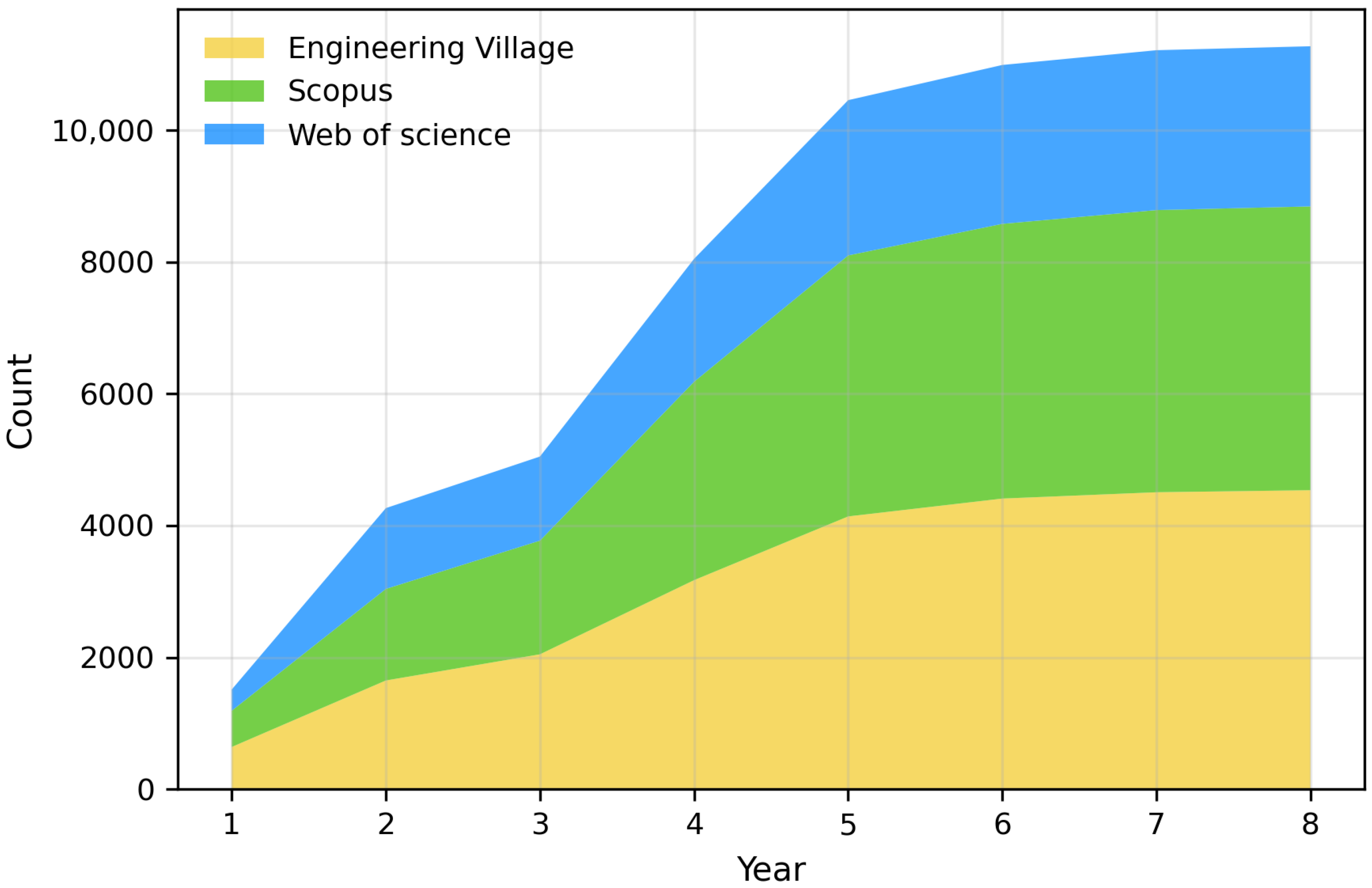
| Search | Added AI-Related Keywords |
|---|---|
| 1 | AI, Artificial Intelligence |
| 2 | + Machine Learning |
| 3 | + Deep Learning |
| 4 | + Neural Network |
| 5 | + Genetic Algorithm |
| 6 | + Particle Swarm Optimization |
| 7 | + Expert Systems |
| 8 | + Reinforcement Learning |
Disclaimer/Publisher’s Note: The statements, opinions and data contained in all publications are solely those of the individual author(s) and contributor(s) and not of MDPI and/or the editor(s). MDPI and/or the editor(s) disclaim responsibility for any injury to people or property resulting from any ideas, methods, instructions or products referred to in the content. |
© 2026 by the authors. Licensee MDPI, Basel, Switzerland. This article is an open access article distributed under the terms and conditions of the Creative Commons Attribution (CC BY) license.
Share and Cite
Vaktskjold, V.; Toppe, L.O.; Luczkowski, M.; Rønnquist, A.; Morin, D. Systematic Mapping of Artificial Intelligence Applications in Finite-Element-Based Structural Engineering. Buildings 2026, 16, 644. https://doi.org/10.3390/buildings16030644
Vaktskjold V, Toppe LO, Luczkowski M, Rønnquist A, Morin D. Systematic Mapping of Artificial Intelligence Applications in Finite-Element-Based Structural Engineering. Buildings. 2026; 16(3):644. https://doi.org/10.3390/buildings16030644
Chicago/Turabian StyleVaktskjold, Villem, Lars Olav Toppe, Marcin Luczkowski, Anders Rønnquist, and David Morin. 2026. "Systematic Mapping of Artificial Intelligence Applications in Finite-Element-Based Structural Engineering" Buildings 16, no. 3: 644. https://doi.org/10.3390/buildings16030644
APA StyleVaktskjold, V., Toppe, L. O., Luczkowski, M., Rønnquist, A., & Morin, D. (2026). Systematic Mapping of Artificial Intelligence Applications in Finite-Element-Based Structural Engineering. Buildings, 16(3), 644. https://doi.org/10.3390/buildings16030644