Article

Research on the Systematic Analysis of Safety Risk in Metro Deep Foundation Pit Construction

1
School of Civil Engineering and Architecture, Wuhan University of Technology, Wuhan 430070, China
2
Department of Construction Management, Louisiana State University, Baton Rouge, LA 70803, USA
3
Sanya Science and Education Innovation Park, Wuhan University of Technology, Sanya 572025, China
*
Author to whom correspondence should be addressed.
Buildings 2026, 16(3), 634; https://doi.org/10.3390/buildings16030634
Submission received: 5 December 2025 / Revised: 25 January 2026 / Accepted: 30 January 2026 / Published: 3 February 2026

Abstract

With its advantages such as large capacity, punctuality and low environmental impact, the metro has become one of the primary means of alleviating urban traffic congestion. However, safety accidents still occur frequently during the construction of metro deep foundation pits. A review of domestic and international studies reveals that safety risk management for metro deep foundation pit construction remains insufficient, particularly in terms of comprehensive risk identification, analysis of risk interrelationships and systematic risk assessment. To improve the level of safety risk management in metro deep foundation pit construction, this study analyzes safety risk factors using Chinese word segmentation, AHP, ISM, and MICMAC methods. Based on text mining and literature review, a case database comprising 156 metro deep foundation pit construction safety accidents reports was established and integrated into a unified text corpus. Chinese word segmentation was then performed on the corpus, and through risk interpretation combined with relevant standards and codes, 29 safety risk factors were identified and classified into five categories: technology, management, material, personal and environment. On this basis, 22 main safety risk factors were extracted using the AHP method. The results indicate that management-related factors constitute the most critical type of safety risk. Subsequently, the ISM method was employed to identify the interactions among the main safety risk factors and to construct a five-level hierarchical model, in which the top level contains nine safety risk factors, while the bottom level consists of two factors. Through MICMAC analysis, the safety risk factors were classified into three categories, based on which a safety risk management framework for metro deep foundation pit construction was established, and specific control measures were proposed for six representative safety risk factors.

1. Introduction

Since the beginning of the twenty-first century, Chinese urbanization has been advancing steadily, and the number of people living and working in large cities has been increasing year by year. With the continuous growth of the urban population, traditional ground transportation modes have become increasingly unable to meet the rapidly rising travel demand. In order to alleviate the traffic pressure brought about by urbanization, city planners have sought to divert traffic demand from surface roads by developing three-dimensional transportation systems and urban metro networks. As a new mode of urban mass transit for easing traffic congestion, the metro offers advantages such as high safety, large passenger capacity, low energy consumption and emissions, and high operating speed, and has gradually become one of the main measures for mitigating urban traffic pressure. By the end of 2023, according to statistics from the China Association of Metros, 58 cities in mainland China had opened urban rail transit lines, with a total operating mileage of 12,160.77 km. Among these, metro lines accounted for 9306.09 km, representing as much as 76.53% of the total mileage, and the annual operating mileage has been increasing at a rate of more than 10%.
Chinese metro construction has developed for only just over fifty years. Compared with the century-long development history of metro systems in many developed countries in Europe and North America, Chinese metro construction is still at a relatively early stage, and problems such as a shortage of specialized professionals and incomplete engineering databases remain. As a critical component of metro projects, metro stations are typically constructed through deep foundation pit works characterized by large excavation depths, complex geological conditions, a high degree of concealment and long construction periods. These features greatly increase the uncertainty of construction safety and have led to the frequent occurrence of safety accidents during construction [1]. Over the past decade, according to incomplete statistics, more than 100 safety accidents have occurred during metro deep foundation pit construction in China, resulting in substantial economic losses and casualties, as well as generating serious negative social impacts. As an important component of metro projects, deep foundation pit construction is closely influenced by local hydrogeological conditions, adopted construction methods and the layout of underground utilities. During the construction process, irregular operations and improper command by technical and managerial personnel may also occur. The interaction among these factors further increases the likelihood of safety accidents, ultimately leading to human casualties and significant economic losses [2].
Metro deep foundation pit projects are characterized by complex construction features. Their safety risk management involves numerous safety risk factors and highly intricate interaction relationships, which jointly give rise to considerable and hardly predictable uncertainties in the construction process. The safety of metro deep foundation pit construction is influenced by multiple risk factors that exhibit varying degrees of dependence and interactive feedback effects. Conventional linear analysis models have inherent limitations in addressing these characteristics and therefore fail to provide a comprehensive analysis of metro deep foundation pits as a complex system. Based on an extensive review of the literature related to this topic, two key issues are identified that still warrant further investigation:
  • What are the main factors affecting the safety risks in metro deep foundation pit construction?
  • What are the interrelationships among these main safety risk factors?
This research aims to identify the risk factors affecting the safety of metro deep foundation pit construction, extract the main safety risk factors, and explore the interrelationships among these factors. This study also conducts a classification of these factors and proposes targeted response strategies to improve the safety risk management level of metro deep foundation pit construction. The structure of the article is as follows: Section 1 presents the background of the research and the existing problems. Section 2 provides an overview of the literature related to safety risks in metro deep foundation pit construction. Section 3 elaborates on the research framework and methodology adopted in this study. Section 4 analyzes the research data. Section 5 discusses the research results and safety risk response strategies. Section 6 concludes this study.

2. Related Work

2.1. Related Studies on Safety Risk Identification

Risk management originated in the United States and was initially applied in corporate management and the insurance industry. In 1974, Professor Einstein in the United States introduced risk management into tunnel engineering. Subsequently, risk management began to flourish in the fields of underground and tunnel engineering, yielding fruitful research results. With the rapid construction and development of urban rail transit systems worldwide, construction accidents have caused severe casualties and substantial losses, and the issue of construction safety in metro projects has attracted increasing attention. A large number of scholars have carried out studies on risk identification for metro deep foundation pit construction, mainly determining safety risk factors through questionnaire surveys, expert interviews, literature reviews and accident statistics. For example, Zhang et al. conducted questionnaire surveys and expert interviews with five stakeholder groups involved in metro construction and identified eight major safety risk factors affecting metro construction [3]. Xing made the knowledge of safety risks in metro construction explicit by developing a domain ontology (SRI-Onto) and, using a five-step ontology construction method, classified the knowledge into seven categories, thereby providing a structured knowledge base for safety risk identification [4]. Liu, based on fault tree analysis, identified the causal factors of safety accidents in metro deep foundation pit construction, which improved the accuracy of hazard analysis for such projects [5].
Li employed a back-propagation (BP) neural network to identify safety risk factors in metro construction and categorized them into groups such as human-related factors and management-related factors [6]. Zhang established a dynamic risk factor identification model that can, among numerous potential risk factors, identify possible safety risks in real time and, by using real-time construction data, rank the risk levels of metro construction safety risk factors at specific points in time [7]. Seo took underground construction projects in Korea as the research object and used safety checklists to identify safety risk factors in the construction process [8]. A Canadian infrastructure report constructed a risk indicator system for metro construction from multiple perspectives, including structural, economic and social dimensions [9]. Xu extracted 37 safety risk factors from 221 metro construction accident reports by refining the feature parameters used in text mining, and the results showed that employing TF-H as the feature parameter could significantly improve the performance of word segmentation [10]. Tang applied text-mining techniques to analyze on-site inspection reports of Wuhan metro projects, used TF-IDF as the feature parameter to screen high-frequency terms and, in combination with local codes, established a set of safety risk factors for metro construction [11]. Deng adopted data-mining methods to identify 13 accident types and 48 causal factors from 274 metro safety accidents in China and extracted 204 causal relationships among them [12]. Based on a dataset of 562 metro construction accidents, Liang designed a domain-specific named entity recognition model to identify safety risk factors in the metro construction process [13]. Integrating knowledge management with BIM, Chen proposed a safety risk identification method for deep foundation pit construction, in which the topological relationships among BIM objects are extracted and visualized in the form of a knowledge graph [14]. Zhang proposed an automatic safety risk identification method based on a semantic data model using BIM and the IFC standard, and tested the construction risk identification prototype within a BIM environment [15]. Hao identified 23 major risk factors in metro deep foundation pit construction on the basis of six main types of risk accidents, and determined the weights of the risk indicators by calculating the centrality of each factor using the Grey-DEMATEL method [16].

2.2. Related Studies on Risk Analysis and Assessment

In the field of safety risk analysis and assessment, most studies have adopted a variety of methods to conduct qualitative and/or quantitative evaluations, including the analytic hierarchy process (AHP), fault tree analysis (FTA), interpretive structural modeling (ISM), system dynamics (SD), Bayesian networks (BN), fuzzy set theory, finite element simulation and machine learning algorithms. Huang established a safety risk factor system for metro deep foundation pit construction and developed a safety risk coupling network model using coupling mechanism analysis and complex network theory. The key risk factor nodes were identified through network efficiency measurement, and corresponding response measures were proposed [17]. Wu proposed a multi-source data fusion approach based on the cloud model (CM) and an improved Dempster–Shafer evidence theory, which enables accurate assessment of collapse risks in metro deep foundation pits [18]. Shen developed a comprehensive risk assessment index system for metro deep foundation pit construction based on a three-stage fuzzy comprehensive evaluation model and applied this system to the Qingdao Metro Line 3 project [19]. By integrating actual monitoring data, Shi and Yu employed MIDAS GTS/NX to analyze the evolution of displacement and structural deformation during metro deep foundation pit construction, thereby further evaluating and predicting the safety state of the construction process [20,21]. Valipour, based on the SWARA–COPRAS method, developed a risk assessment framework for deep foundation pit construction and validated it using an actual project in Iran. The results demonstrate that this framework overcomes the limitations of traditional methods and improves the accuracy of risk assessment [22].
Zhou developed a Bayesian network model for safety risks in metro deep foundation pit construction and conducted dynamic safety risk assessments by integrating real-time on-site data [23]. Wei proposed a safety risk evaluation method for metro deep foundation pit construction grounded in fuzzy evidential reasoning. In this method, the expected levels of risk are first defined; then a fuzzy analytic hierarchy process is applied to determine the weights of safety risk factors, and the overall safety risk level of the project is evaluated by aggregating probability mass and adopting a belief redistribution scheme [24]. Samantra employed fuzzy set theory to analyze rail transit construction projects, classified risk factors using a risk matrix and related tools, and quantified the risk level in terms of the likelihood of occurrence and the severity of consequences [25]. Patapova established a safety risk evaluation model for metro deep foundation pit construction based on a cascade model, with the aim of improving the accuracy of safety risk assessment and providing support for safety management decision-making [26]. By combining rough set theory with the catastrophe progression method, He constructed a safety risk evaluation model for metro deep foundation pit construction that calculates the probability of accident occurrence while explicitly considering the interactions among safety risk factors, and performed probability estimation through an actual engineering case study [27]. Zhou developed a safety status prediction model for metro deep foundation pit construction based on the random forest algorithm. To improve the model’s effectiveness, real-time monitoring data were used as inputs to explore the unknown relationship between the monitoring values and the safety risks within the pit [28]. Dong integrated the Delphi survey method with machine learning techniques to establish a water inrush risk evaluation model for metro construction [29]. Shen employed the TF-IDF algorithm and TextRank algorithm to extract the causes of accidents from the reports. The NBN and TAN were then improved for inference to identify the key risk factors [30]. Fu developed a general modeling and analysis program for the interaction of safety risks in metro deep foundation pit construction, based on association rule mining and weighted network theory [31]. Huang systematically analyzed the interactions among risk factors by applying complex network theory [32]. Zhou used a support vector machine (SVM) to identify potential safety risks that may arise during metro deep foundation pit construction and verified the accuracy of this method through a case study [33]. Li took simultaneously excavated foundation pits as the research object and analyzed the deformation patterns of metro deep foundation pit construction under different conditions, thereby providing a reference for subsequent research [34]. Fu constructed an interaction network of safety risk factors for metro deep foundation pit projects by integrating association rule mining and link prediction methods [17]. Zhang developed a numerical model to quantitatively evaluate the impacts of cut-and-cover construction on adjacent structures, predicted ground surface settlement during construction through numerical simulation, and proposed preventive measures to mitigate foundation pit safety accidents [35]. Zhou accounted for the randomness and fuzziness of safety risk factors in metro foundation pits and proposed an improved CRITIC–Cloud model by integrating variation-based weighting coefficients, absolute correlation adjustment, and multidimensional cloud modeling with evidence theory, thereby achieving more accurate risk assessment results [36].

3. Methodology

The research presented in this paper consists of three main parts: identification of safety risk factors in metro deep foundation pit construction, extraction of main safety risk factors, and systematic analysis of the interactions among safety risk factors. With respect to the identification of safety risk factors, traditional studies generally rely on literature reviews to extract relevant risks. However, risk factors identified in this manner are highly subjective and may suffer from omissions. Therefore, this study identifies safety risk factors based on accident investigation reports. Safety risks extracted from accident reports are relatively objective, and on this basis, the subsequent extraction of main safety risk factors and the systematic analysis of their interactions are more convincing and reliable. To achieve the research objectives, this paper investigates the safety risks associated with metro deep foundation pit construction by integrating a literature review, web crawling, Chinese word segmentation, AHP, ISM and MICMAC analysis. First, a safety risk corpus is established through literature retrieval and web crawling, and a set of safety risk factors is constructed by performing Chinese word segmentation in combination with relevant technical standards and specifications. Second, the main safety risk factors are extracted using AHP. Subsequently, ISM is employed to explore the interaction relationships among these main safety risk factors. MICMAC was used to classify the main safety risk factors, and corresponding management strategies were proposed. Compared with the current state-of-the-art studies, the integrated application of web crawling, Chinese word segmentation, AHP, ISM, and MICMAC enables a more objective and efficient system-level analysis of safety risks in metro deep foundation pit. The technical path of this study is shown in Figure 1.

3.1. Chinese Word Segmentation

Chinese word segmentation transforms unstructured text into a sequence of discrete lexical items. In general, segmentation methods can be categorized into three main types: dictionary-based algorithms (e.g., FMM, RMM), statistics-based algorithms (e.g., HMM, ME) and semantics-based algorithms (e.g., RNN, LSTM) [11]. Through a comparative analysis of various segmentation tools and a review of related studies, it was found that the Jieba segmentation package offers relatively high segmentation speed and satisfactory segmentation performance, is well suited to the Python language, and allows users to customize dictionaries for segmentation and statistical analysis. Therefore, this study adopts the Jieba package as the segmentation tool. The Chinese word segmentation procedure in this study consists of the following four steps:
(1)
Construction of the safety risk corpus: On the basis of accident reports collected through literature review and web crawling, textual descriptions related to the accident process were manually selected and obvious errors were corrected. These texts were then consolidated into a single document to establish a safety risk corpus for metro deep foundation pit construction.
(2)
Development and application of the safety risk lexicon: When using the default dictionary of the Jieba segmentation package, the segmentation performance was unsatisfactory, and some domain-specific terms were improperly split, which would affect the accuracy of subsequent risk identification. Therefore, to ensure the accuracy of Chinese word segmentation, it is necessary to develop a safety risk lexicon.
(3)
Feature parameter calculation: Feature parameters are used to filter the segmented keywords. In this study, three main feature parameters are adopted, namely Term Frequency, (Inverse) Document Frequency and Term Frequency–Inverse Document Frequency. Let the segmented safety risk corpus for metro deep foundation pit construction be denoted by D, an individual accident report by Di, and a risk term by wi, then:
D = D 1 , D 2 , D 3 , , D j , , D m
D i = w 1 , w 2 , w 3 , , w i , , w n
1. Term Frequency (TF)
The term frequency indicates how often a given risk term appears in an accident report and can be expressed as:
T F i = n i k = 1 K n k
where ni denotes the frequency with which the safety risk term wi appears in the accident report, and K represents the total number of safety risk terms contained in that report. Given that this study focuses on the occurrence frequency of safety risk terms in the entire corpus, all accident reports are treated as a whole, and the TF value is thus revised to represent the frequency with which a safety risk term appears in the corpus:
T F i = n i
2. Document Frequency/Inverse Document Frequency (DF/IDF)
To account for the influence of differences in accident report length and other factors on the frequency of safety risk terms, document frequency is introduced to describe the number of texts in which a given safety risk term appears. Denoted by DF, it is defined as:
D F i = i = 1 M x j x j = 1 ,     w i D j 0 ,     w i D j
The fewer times a safety risk term appears across different accident reports, the smaller its document frequency and the greater its distinctiveness. Following related studies, the IDF is commonly used to characterize the degree of distinctiveness of safety risk terms and is defined as:
I D F i = ln D D F i
where |D| denotes the total number of safety accident reports in the corpus.
3. Term Frequency-Inverse Document Frequency (TFIDF)
For safety risk terms, the combination of TF and IDF allows them to be classified into four categories: feature terms with high TF and high IDF, high-frequency terms with high TF and low IDF, common terms with low TF and high IDF, and low-frequency terms with low TF and low IDF. TFIDF is a commonly used weighting scheme in current research; essentially, it is obtained by multiplying the TF value by the IDF value and is defined as:
T F I D F i = T F i × I D F i
(4)
Feature term selection and construction of the safety risk factor set
In this study, TF–IDF is adopted as the feature parameter for selecting characteristic terms. First, high-frequency terms are filtered according to their TF–IDF values. Then, through manual screening, high-frequency terms that embody safety risk semantics in the context of metro deep foundation pit construction are extracted, and an initial set of safety risk factors is established based on semantic interpretation.

3.2. Analytic Hierarchy Process

The analytic hierarchy process (AHP) is an operations research method proposed in 1971 by Professor T. L. Saaty of the University of Pittsburgh, which applies hierarchical weighting to support decision-making [37]. The fundamental idea of AHP is to decompose a complex problem into several constituent factors and group these factors according to their dominance relationships, thereby forming an ordered hierarchical structure. On this basis, qualitative judgments are converted into quantitative weights to determine the relative importance of each factor within its level, and the overall weights are obtained through aggregation. The basic procedure of AHP consists of the following four steps:
(1)
Construct the hierarchical analysis model: Based on an analysis of the factors that influence the research objectives, the evaluation criteria are decomposed from top to bottom, identifying the corresponding criterion-level and indicator-level factors to form a progressive hierarchical structure.
(2)
Construct the judgment matrix: The judgment matrix represents the results of pairwise comparisons of the relative importance of the factors at the criterion-level or the indicator-level factors within the same criterion layer. Using the “1–9 scale method,” experts assign scores to determine the relative importance of each pair of indicators. Typically, the judgment matrix D is constructed by calculating the average score given by each expert.
D = d i j i , j = 1 , 2 , , n
(3)
Calculation of relative weights: The judgment matrix is normalized by columns, and the sum is calculated to obtain the standard matrix F. The standard matrix is then row-sum and normalized to obtain the weight matrix W, which provides the relative weights of the factors within the same level.
F = f i j = i = 1 n d i j i , j = 1 , 2 , , n
W = w i i , j = 1 , 2 , , n
(4)
Consistency test: Since the process of pairwise comparisons and scoring is inevitably influenced by subjective factors, a consistency test is required to ensure the rationality of the results. Typically, the consistency ratio (CR) is used for this purpose. If the CR value is less than 0.1, the results are considered valid.
C R = C I R I = λ max n ( n 1 ) R I
where λmax represents the maximum eigenvalue of the judgment matrix, and the value of RI is related to the order of the matrix.
(5)
Actual weight calculation: By calculating the judgment matrices for the criterion layer and the corresponding indicator layers under each criterion, the weight of the criterion factors and the relative weights of the factors at different indicator layers can be determined. The actual weights of each indicator factor are then obtained through weighted calculation, as follows:
w i j a = w i a w i j r
where wa represents the actual weight, and wr represents the relative weight.

3.3. Interpretative Structural Modeling

Interpretive Structural Modeling (ISM) is an analytical model developed by Professor Warfield in 1973 that uses an intuitive system with well-defined structural relationships to explain complex socio-economic issues [38]. Interpretive Structural Modeling (ISM) is a type of conceptual model used to combine both quantitative and qualitative methods for analyzing the structure of complex systems. It can transform fuzzy system concepts that are difficult to measure directly into a system structure that is more suitable for analysis. ISM is applicable across various fields and, by leveraging human experiential knowledge and computational capabilities, it decomposes a complex system into different subsystems. It then analyzes the direct and indirect relationships among the elements, constructing a multi-level hierarchical model based on directed graphs and matrix structures. Generally, ISM includes the following six steps:
(1)
Formation of the expert panel: The panel typically consists of 5 to 10 members, and it is important that the members are actively engaged with the problem at hand. Experts with diverse perspectives should be included to ensure a broad range of viewpoints.
(2)
Identification of system elements: The key elements of the system are determined through methods such as literature review and questionnaire surveys. In this study, the key system elements are the main safety risk factors in metro deep foundation pit construction, which were selected through AHP analysis.
S = S i i = 1 , 2 , , n
where Si represents the i-th element in the system.
(3)
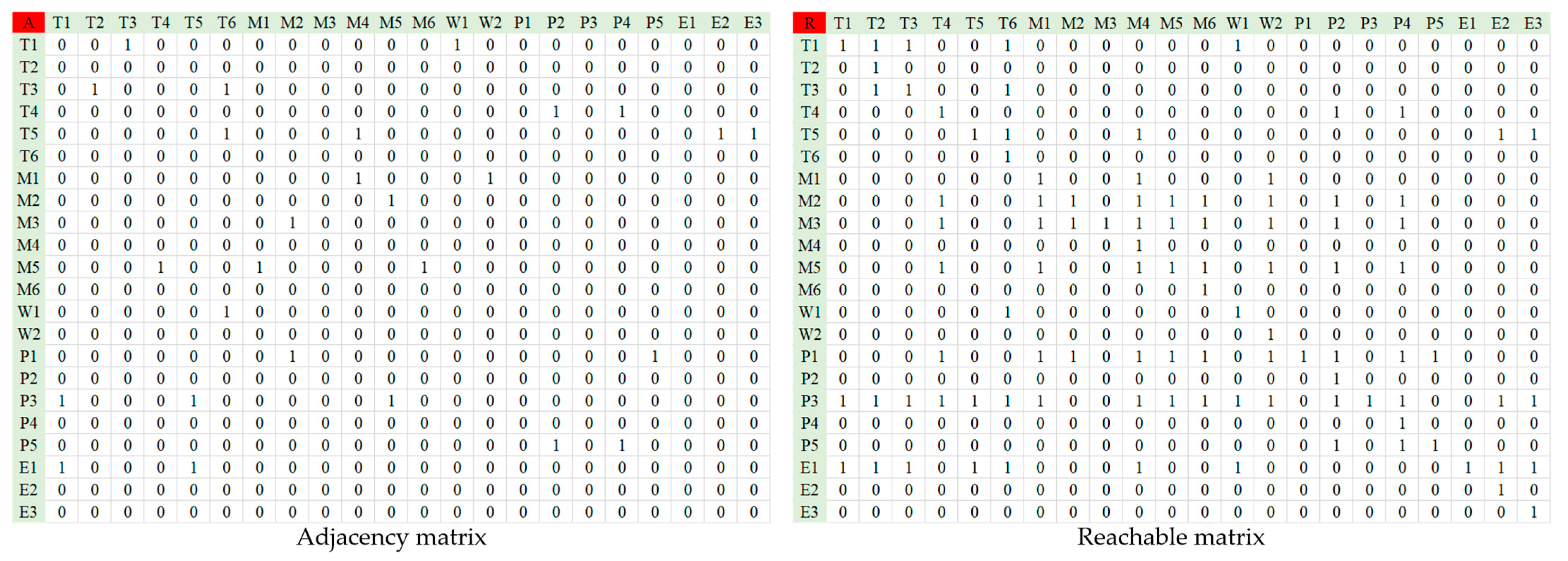
Matrix operations: Each member of the expert panel evaluates the direct relationships between the elements, determining whether a direct relationship exists between each pair of elements, and constructs the adjacency matrix A. The adjacency matrix A is then added to the identity matrix I to obtain the product matrix B. Finally, Boolean algebra operations are applied to the product matrix to derive the final reachability matrix R.
A = a i j = 0     o r     1 i , j = 1 , 2 , , n
B = ( A + I ) ( A + I ) 2 ( A + I ) k 1 = ( A + I ) k = R
In this matrix, a value of aij = 0 indicates that factor Si does not directly influence factor Sj, while a value of aij = 1 indicates that factor Si directly influences factor Sj.
(4)
Parameter calculation and region partitioning: For each system element, the reachability set (R(Si)) and the antecedent set ((A(Si)) are calculated. The reachability set refers to the set of elements that can be reached by a given element, corresponding to the elements in the row of the reachability matrix for that particular element. The antecedent set refers to the set of elements that can reach a given element, corresponding to the elements in the column of the reachability matrix for that element. Based on the calculation of the reachability and antecedent sets for each system element, their intersection is determined. If the intersection equals the antecedent set, the system element is considered part of the common set. The intersection of the reachability sets of all common set elements is then calculated; if the intersection is non-empty, it indicates that the system has only one connected domain.
(5)
Hierarchy division: Before performing the hierarchy division, the concept of the highest-level element must be introduced. A highest-level element is defined as one for which no higher-level element can reach it, as follows:
H = S i N R S i A S i = R S i
Using the definition of the highest-level element, the highest-level elements in the system are identified. Then, the rows and columns corresponding to the highest-level elements are crossed out in the reachability matrix. The definition of the highest-level element is applied again to determine the next highest-level element, and this process continues until the hierarchy of all system elements is determined.
(6)
Structure model construction: After determining the hierarchy of system elements, strongly connected elements at the same level are merged, and the reduced reachability matrix is sorted. Directed arrows are then drawn from lower-level elements to higher-level elements according to the relationships in the reachability matrix. It is important to note that there may be directional relationships spanning multiple levels. If there are already directed arrows from adjacent levels pointing to a multi-level element, additional arrows for cross-level relationships do not need to be drawn.

3.4. Matrice D’Impacts Croisés–Multiplication Appliquée à Un Classement

MICMAC (Matrice d’Impacts Croisés–Multiplication Appliquée à un Classement) is a system analysis method developed by Duperrin et al. in 1973 for analyzing the interrelationships among system elements [39]. This method classifies the driving power and dependence power of different factors through the principle of matrix multiplication, and studies the degree of influence among these factors by examining the reachability paths and hierarchical cycles of their relationships. In ISM analysis, the reachability matrix is derived from the adjacency matrix using the matrix multiplication principle, making the MICMAC method a common complement to the ISM approach. Driving power refers to the number of other elements that a system element can reach, represented in the reachability matrix as the sum of the elements in the corresponding row, as shown in Equation (17). Dependence refers to the number of elements that can reach a given system element, represented in the reachability matrix as the sum of the elements in the corresponding column, as shown in Equation (18).
D i = j = 1 n r i j
D j = i = 1 n r i j
Through MICMAC analysis, and based on the magnitude of driving power and dependence, the system elements can be classified into four types: autonomous elements, which have weak interactions with other system elements; linkage elements, which have strong interactions with other system elements; dependent elements, which are strongly influenced by other factors; and driving factors, which exert a strong influence on other elements.

4. Results and Analysis

4.1. Identification of Initial Safety Risk Factors Based on Chinese Word Segmentation

This study collected safety accident reports on metro deep foundation pit construction by combining literature review and web crawling, and, after preprocessing, established a safety risk corpus for metro deep foundation pit construction. In accordance with the Regulations on the Reporting, Investigation, and Handling of Production Safety Accidents and related provisions, main safety accident reports concerning metro deep foundation pit construction are primarily disclosed on the official websites of governmental authorities such as the Ministry of Emergency Management and the Ministry of Housing and Urban–Rural Development, while relevant information is also disseminated through news media platforms. In addition, a substantial body of research on construction safety risk management in urban rail transit projects has been conducted, and detailed safety accident case information can also be obtained from academic publications indexed in databases such as CNKI and Wanfang.
Considering that accident reports released on official government websites are less prone to bias and provide relatively objective descriptions of accident facts, this study selected the official websites of the Ministry of Emergency Management, the Ministry of Housing and Urban–Rural Development, and the Safety Management Network as the primary target sources. Keywords such as “urban rail transit,” “metro deep foundation pit,” “safety risk,” and “metro construction safety accident” were used to retrieve relevant reports published after the year 2000. In addition, databases including CNKI and Wanfang were searched using the same keywords. Relevant articles were identified through keyword retrieval and manual screening. After downloading the selected publications, accident information was manually extracted from the appendices of the papers. Furthermore, specific accident reports related to metro deep foundation pit construction were obtained through supplementary searches conducted via the “Baidu” search engine.
In total, 156 accident cases were obtained and used as the case base for safety risk analysis. Some representative accident reports are listed in Table 1. On this basis, textual descriptions related to the accident process were manually extracted, obvious errors were corrected and the processed texts were merged into a single document to form the safety risk corpus for metro deep foundation pit construction.
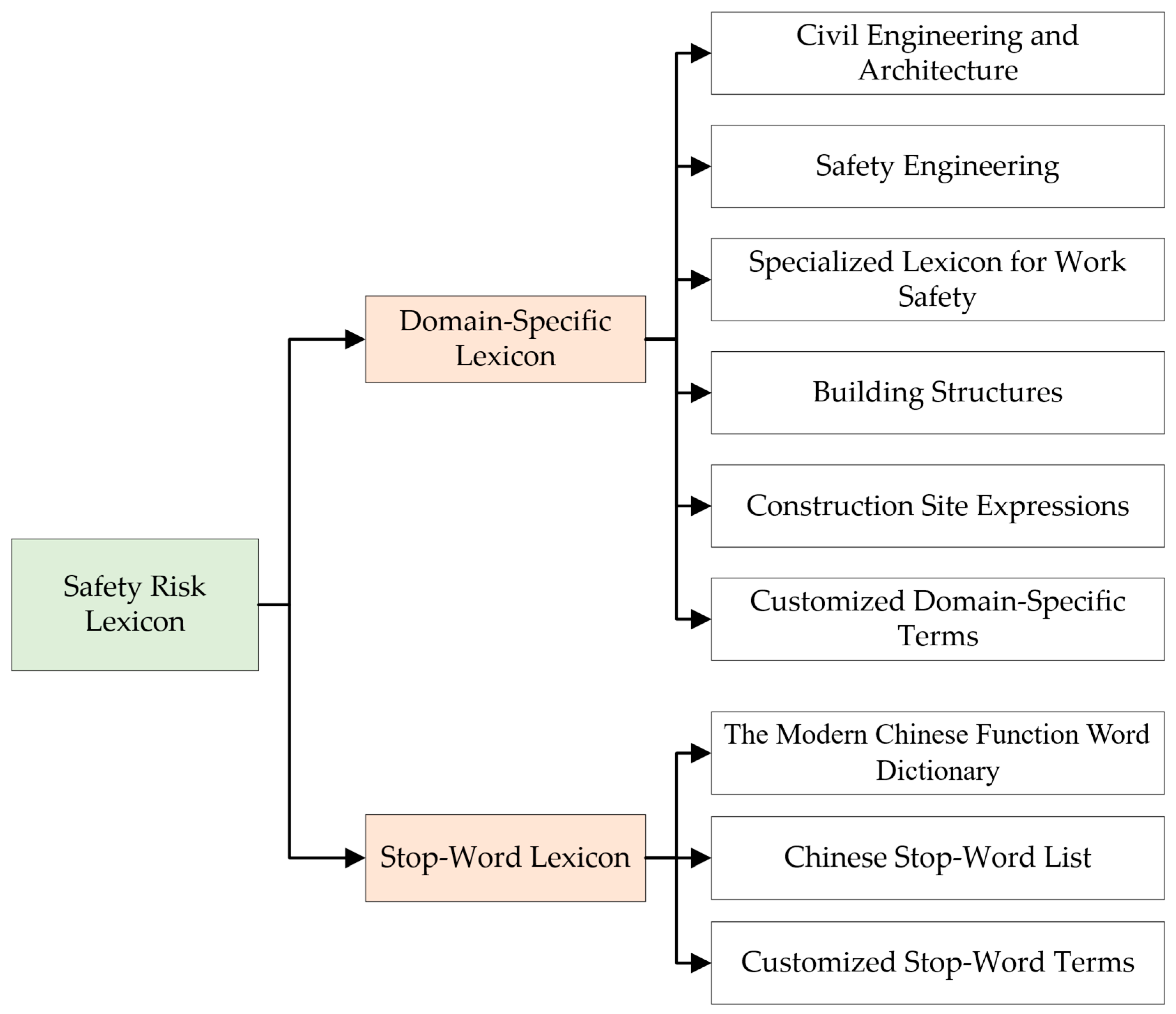
The safety risk lexicon for metro deep foundation pit construction mainly consists of two parts, namely a safety risk domain-specific lexicon and a safety risk stop-word lexicon, as shown in Figure 2. The “Civil Engineering and Architecture” general dictionary was downloaded from Google input-method, and the “Safety Engineering”, “Specialized Lexicon for Work Safety”, “Building Structures” and “Construction Site Expressions” dictionaries were downloaded from the Sogou input-method lexicon. These resources together constitute the basic vocabulary for the domain-specific safety risk lexicon for metro deep foundation pit construction. In addition, given the characteristics of safety risk management for metro deep foundation pit construction, certain domain-specific terms, fixed collocations and combined line names are not covered by existing dictionaries, and some new terms can be formed by combining basic words. Based on the results of the default segmentation, these terms are supplemented and recombined to define customized domain-specific vocabulary items, as shown in Supplementary Materials. The downloaded and self-defined terms are then converted into a “.txt” file to construct the specialized safety risk lexicon “FXZY_dict.txt”, which serves as the domain-specific safety risk lexicon for metro deep foundation pit construction and improves the performance of word segmentation.
The Modern Chinese Function Word Dictionary and a Chinese Stop-Word List were downloaded. In combination with related studies, some descriptive terms were manually defined as stop words. To reduce the influence of information related to stations and lines, the names of cities, lines and stations appearing in the corpus were also treated as stop words, as shown in Supplementary Materials. The downloaded and customized terms were then converted into a “.txt” file to construct the safety risk stop-word lexicon “FXTY_word.txt”, which serves as the stop-word lexicon for metro deep foundation pit construction safety risk analysis and improves the effectiveness of word segmentation.
By incorporating the safety risk lexicon, the accuracy of Chinese word segmentation is improved. Taking a sample sentence from the corpus as an example, the segmentation results under different lexicon configurations are presented in Table 2.
After performing Chinese word segmentation with the aid of the safety risk lexicon, 2206 candidate feature terms were obtained, and their TF, IDF and TFIDF values were calculated according to the corresponding feature parameter formulas. In this study, TFIDF is adopted as the feature selection criterion. To extract high-frequency terms, the ABC classification method is applied to identify key terms whose cumulative importance accounts for 90% of the total. Accordingly, a cumulative TFIDF approach is employed to determine high-frequency terms, and the TFIDF value of the term at the 90% threshold is taken as the cutoff for defining high-frequency terms. The cumulative TFIDF is denoted by ACTF–IDF and is defined as:
A C T F I D F k = i = 1 k T F i × I D F i i = 1 n T F i × I D F i
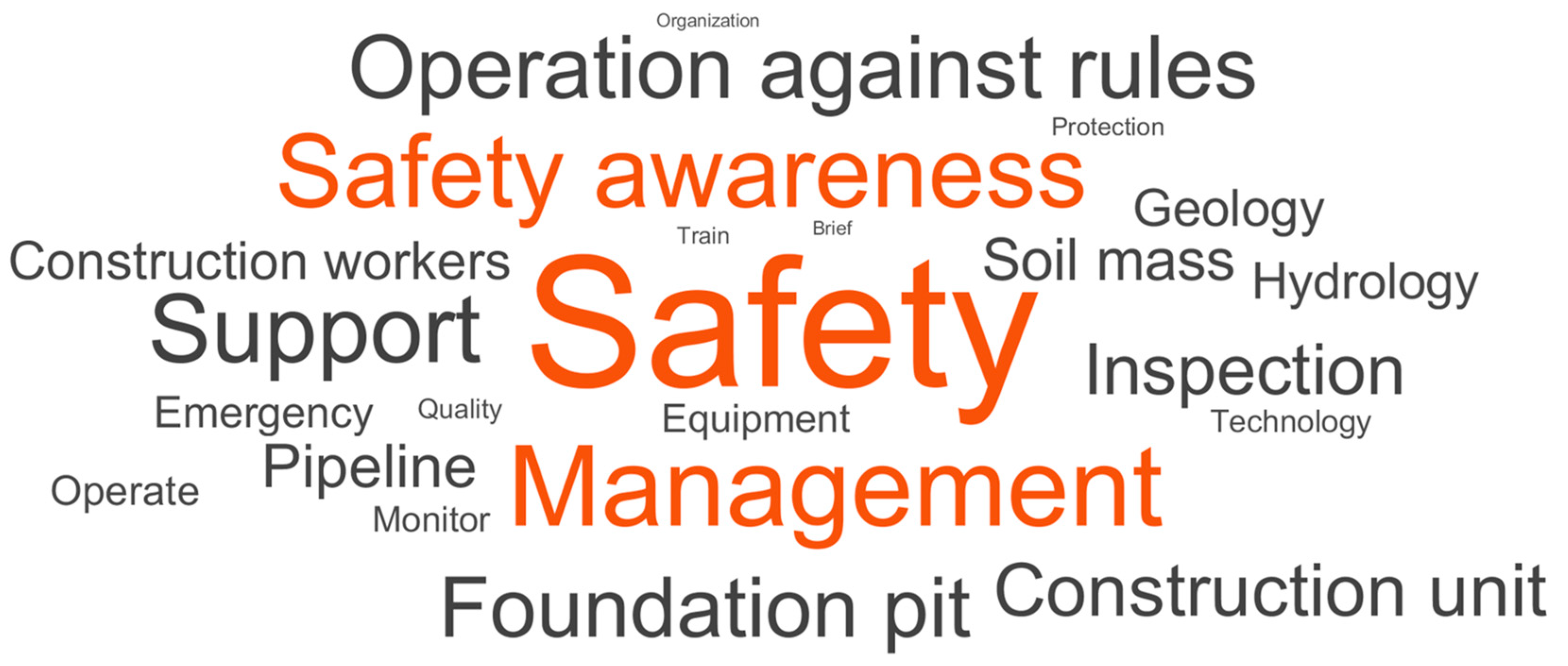
Based on the ACTF–IDF values, 204 high-frequency terms were selected from the 2206 candidate feature terms, as shown in Table 3. A word cloud was then generated using the feature parameters to provide an intuitive visual representation, as illustrated in Figure 3.
Based on the accident reports of metro deep foundation pit construction, the 204 high-frequency terms extracted through feature selection were manually examined to identify those containing explicit safety-risk semantics. A total of 30 high-frequency terms associated with safety risks were retained and subsequently interpreted as corresponding safety risk factors. With reference to the Code for Risk Management of Underground Works in Urban Rail Transit (GB 50652-2011) and the Standard for Construction Safety Assessment of Metro Engineering (GB 50715-2011), several overlapping or closely related safety risk factors were merged [40,41]. Ultimately, 29 safety risk factors for metro deep foundation pit construction were obtained and categorized into five groups: technology, management, material, personal, environment. The initial list of safety risk factors is presented in Table 4.

4.2. Extraction of Main Safety Risk Factors Based on AHP

Based on the initial set of safety risk factors for metro deep foundation pit construction, AHP was used to extract the main safety risk factors. To determine the weights, a survey was designed to compare the importance of the safety risk factors in metro deep foundation pit construction. Experts provided their scores using the “1–9 scale method.” In this study, 36 questionnaires were distributed via “Wenjuanxing,” and all were successfully returned. Research indicates that to minimize subjectivity, the number of experts in AHP should be no fewer than five [42]. The basic information of the experts is shown in Table 5. It can be seen that experts from different fields were included, with more than three experts from each field to avoid any biases. Additionally, only two experts had less than one year of work experience. Upon inquiry, it was found that these two experts had just graduated from university, and while their work experience was limited, they had participated in metro-related projects during their academic tenure, so their scoring results were retained.
Based on the initial set of safety risk factors for metro deep foundation pit construction, the safety risk factors are classified into five categories: technology, management, personal, material and environment. Expert opinions were collected, and the average values were calculated to obtain six judgment matrices. Using the AHP calculation process, the weights of each factor were determined. Taking the criterion layer as an example, the judgment matrix is shown in Table 6. Through matrix operations, the weights and consistency check results are obtained, as presented in Table 7.
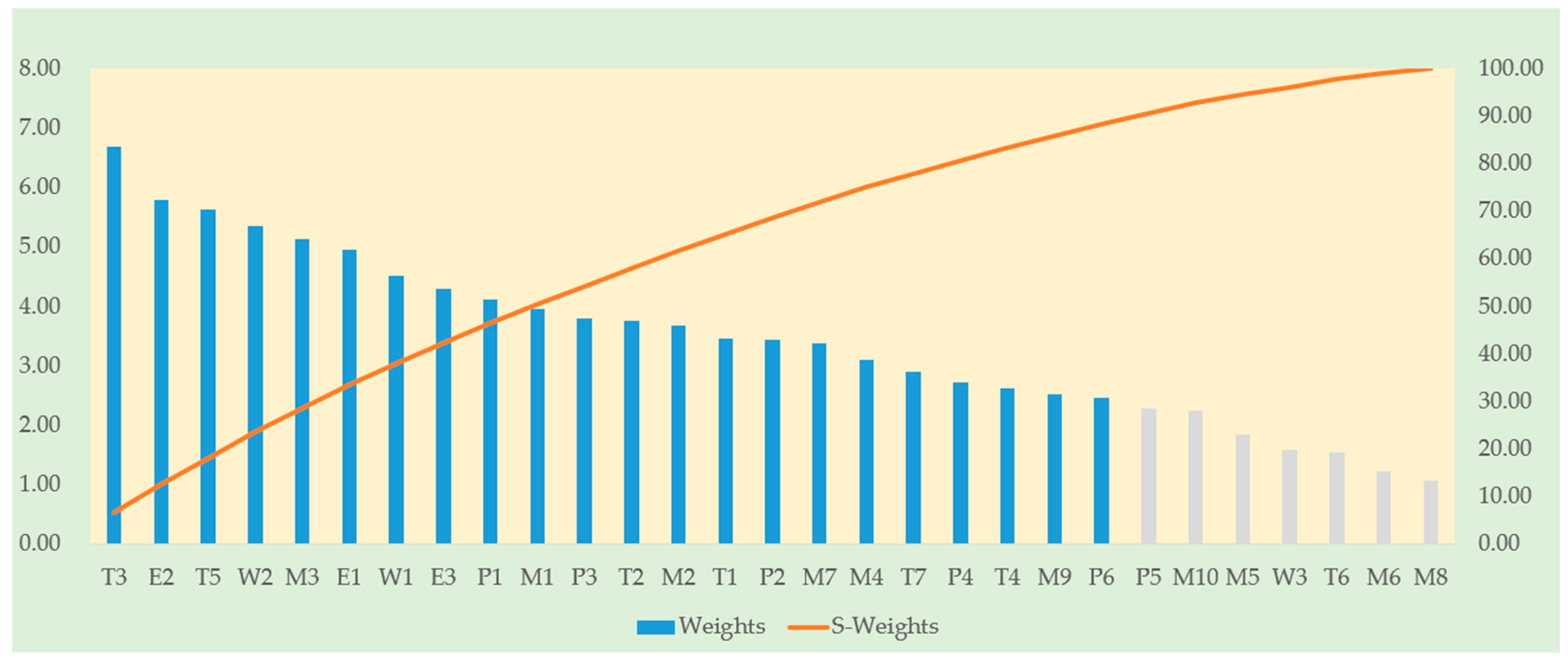
Combining the criterion layer weights with the relative weights of the indicator layers under different criterion layers, the actual weights are shown in Table 8. When performing system analysis, it is unnecessary to consider all element relationships, as there are factors with relatively low influence. Additionally, when using ISM for system analysis, the number of elements should not be excessive. Based on the ABC classification method, the system elements are ranked according to their importance. This study identifies the risk factors that account for 90% of the cumulative weight as the main safety risk factors for metro deep foundation pit construction [43], as shown in Figure 4. Based on the AHP calculation results, it can be observed that management-related factors have the highest weight, accounting for 28.12% of the total, followed by technology factors with a weight of 26.59%. Personal, material, and environment factors have relatively lower weights. Among the indicator-level factors, the one with the highest weight is “Unscientific construction plan”, with a weight of 6.69%, while the one with the lowest weight is “Inadequate organizational coordination”, with a weight of 1.07%. After ranking the factors by their weights and excluding the bottom 10%, the factors “P5, M10, M5, W3, T6, M6, M8” were removed from the list of main safety risk factors for metro deep foundation pit construction.
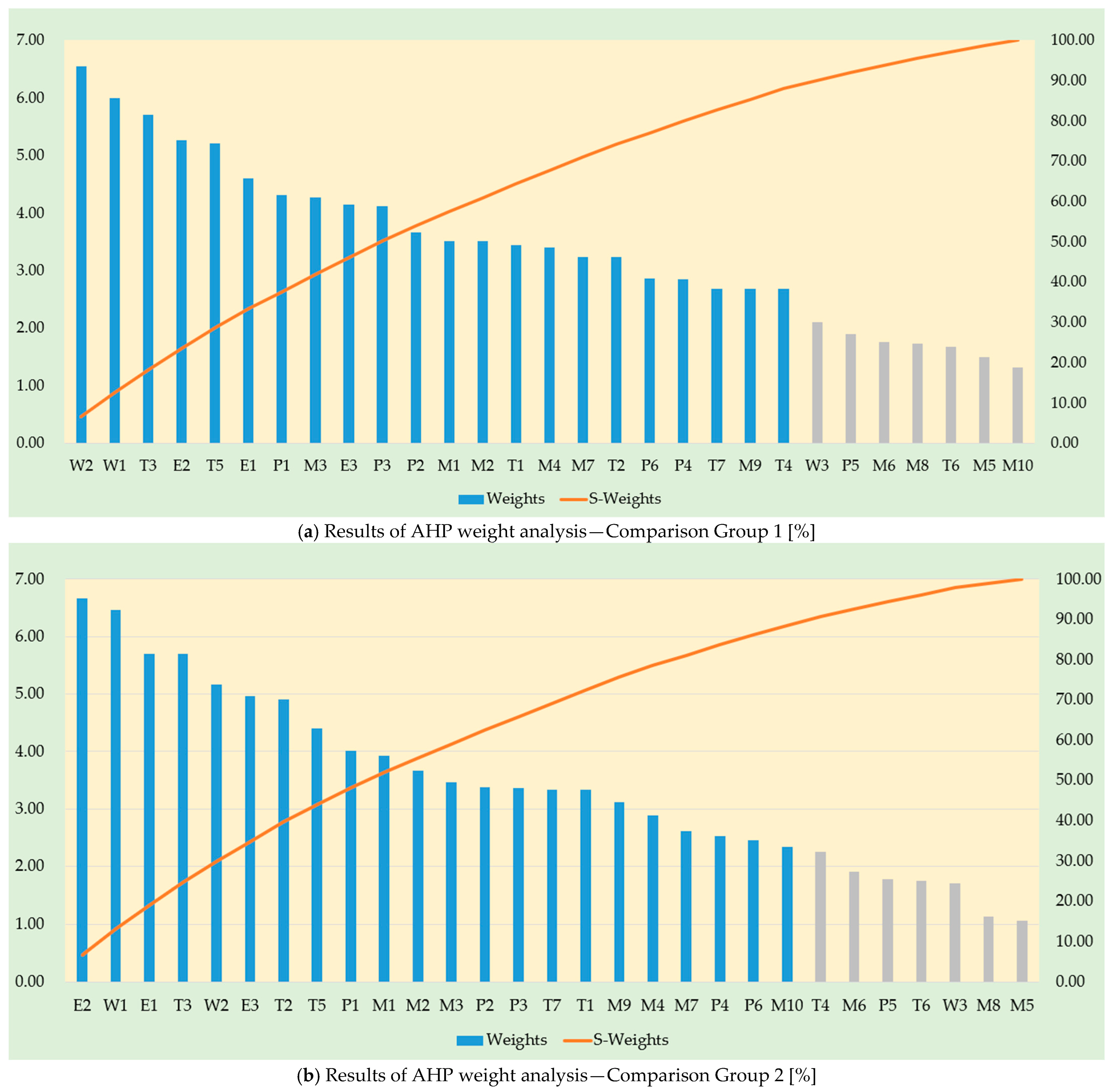
Since construction units are the stakeholders most directly exposed to safety accidents, they were set as the primary target group in the questionnaire survey. However, this sampling strategy may introduce potential bias. Considering that approximately one third of the collected questionnaires were from construction enterprises, a sensitivity analysis was conducted to mitigate this concern. In Comparison Group 1, the responses from three experts affiliated with construction units were removed, and the AHP analysis was recalculated. The results are shown in Figure 5a. Although the weight values changed to some extent, the ranking of the bottom 10% factors remained consistent. In Comparison Group 2, the responses from six construction units were excluded, and the AHP analysis was performed again. The results are presented in Figure 5b. In this case, slight differences appeared in the ranking of the bottom 10% factors. “M10” was identified as a main safety risk factor, whereas “T4” was regarded as a relatively unimportant factor.
To further clarify this discrepancy, follow-up emails were sent to relevant experts, requesting them to select the more important factor between “M10” and “T4”. Most experts ultimately selected “T4”. The main reason provided was that safety technical briefings during metro deep foundation pit construction are sometimes conducted in a perfunctory manner, whereas regulatory requirements and policy supervision are less likely to be neglected in practice.

4.3. Determination of Interrelationships Between Safety Risk Factors Based on ISM

The list of main safety risk factors for metro deep foundation pit construction, including 22 factors, was obtained using the AHP method as shown in Table 9. Based on this, this study further identified the interrelationships among these safety risk factors through ISM. From the AHP expert panel, 20 experts with strong professional expertise were selected and contacted via email. Five experts agreed to participate in interviews. The number of experts is sufficient to meet the basic requirements for ISM model analysis [44]. Semi-structured interviews were conducted via “Tencent Meeting V3.41.2”, during which two professors from relevant fields interviewed five experts to determine their judgments on the pairwise relationships among the factors. After consolidating their opinions, an adjacency matrix describing the direct relationships among the safety risk factors was obtained. Based on the adjacency matrix, Boolean operations were performed using Matlab to derive the reachability matrix as shown in Figure 6.
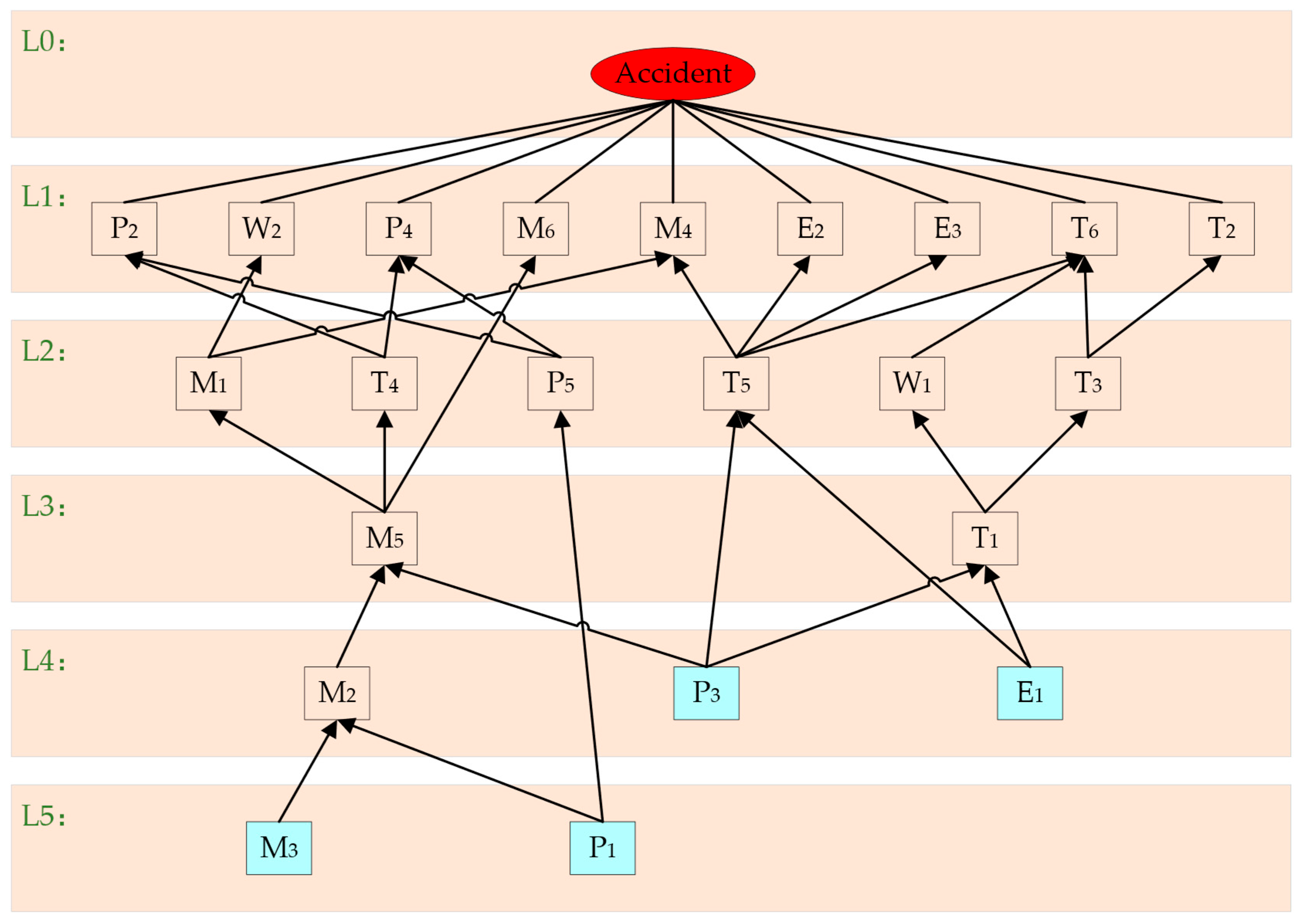
First, the common set T = {M3,P1,P3,E1} is obtained through parameter calculations. Since R(M3) ∩ R(P1) ∩ R(P3) ∩ R(E1) ≠ Ø, all safety risk factors are located within the same connected domain. Based on the reachability matrix and using the definition of the highest-level element, the hierarchy of system elements is determined. The hierarchical division is shown in Table 10. On this basis, a multi-level hierarchical structure model of safety risk factors for metro deep foundation pit construction is created, as shown in Figure 6.
Based on Table 10 and Figure 7, the interaction of 22 safety risk factors for metro deep foundation pit construction forms a safety risk system consisting of five levels. Level 1 consists of direct factors, which directly lead to safety risk accidents at metro deep foundation pit construction sites. These include “Defect of the support system (T2)”, “Defect of the structural quality (T6)”, “Insufficient safety protection (M4)”, “Insufficient emergency management capabilities (M6)”, “Equipment failure (W2)”, “Violation of work regulations (P2)”, “Improper operation of the equipment (P4)”, “Insufficient protection of underground pipelines (E2)” and “Insufficient protection of surrounding buildings (E3)”. It can be observed that the safety risk factors at the first level encompass five categories: technology, management, material, personal and environment. Each category’s safety risk factors can directly cause safety accidents in metro deep foundation pit construction, highlighting the complexity of the safety system in such projects.
Level 5 consists of the bottom factors, including “Incomplete safety management organization (M3)” and “Insufficient safety awareness (P1).” Together with “Insufficient professional and technical proficiency (P3)” and “Complex hydrogeological conditions (E1),” these factors form the fundamental elements of the model, representing the root causes of safety risk accidents at metro deep foundation pit construction sites. In addition to the direct and fundamental factors, other factors act as intermediate elements in the system, playing a role in risk transmission. Among them, factors with stronger transmission effects include “Inadequate safety training (M5)” and “Inadequate investigation (T1).”

4.4. Classification of Safety Risk Factors Based on MICMAC

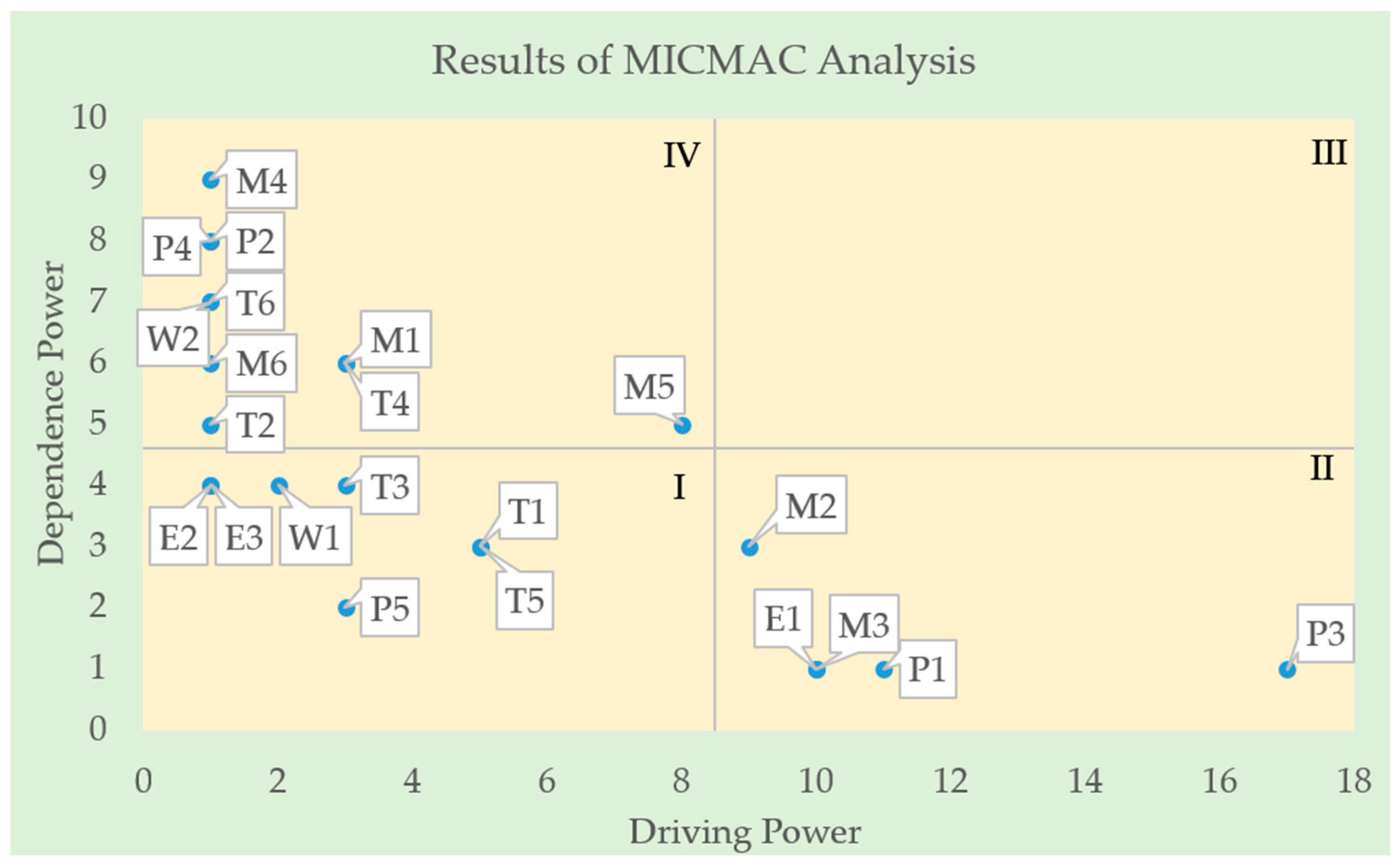
MICMAC analysis, which is based on the reachability matrix, serves as a complement to ISM analysis. By calculating driving power and dependence power, the safety risk factors for metro deep foundation pit construction are classified into four categories. The calculation results are presented in Table 11, with a visual representation shown in Figure 8.
The factors located in the first quadrant, including “T1, T3, T5, W1, P5, E2, E3,” are autonomous factors with relatively low driving power and dependence power. These factors have small values on both the horizontal and vertical axes, indicating that their risk impact is relatively isolated and generally driven by external or self-initiated factors. Such factors are mostly positioned in the middle of the model, and the focus of control should be placed on resource utilization and autonomous improvement.
The factors located in the second quadrant, including “M2, M3, P1, P3, E1,” are driving factors with high driving power but low dependence power. These factors represent the fundamental safety risk elements in the ISM model. Among them, “Insufficient professional and technical proficiency (P3)” has the highest driving power. The focus should be on strengthening the control and optimization of these factors to ensure they effectively drive the development of the system. It is crucial to ensure that these factors continue to exert a positive influence, promoting the system toward its intended goals.
The factors located in the third quadrant are linkage factors with both high driving power and dependence power. These factors require special attention due to their high degree of interdependence within the system. Based on the MICMAC analysis results, it can be observed that there are no linkage factors in the model, indicating that it is difficult to significantly improve the safety risk level of metro deep foundation pit construction by controlling only a few safety risk factors. This further confirms the complexity of the safety risk system in metro deep foundation pit construction.
The factors located in the fourth quadrant, including “T2, T4, T6, M1, M4, M5, M6, W2, P2, P4,”, are dependent factors with low driving power but high dependence power. Among these, “Insufficient safety protection (M4)” has the highest dependence. The focus should be on reducing the dependence of these factors, enhancing their autonomy, or ensuring that they remain stable under the influence of external factors. The performance of these factors can be improved by minimizing the interference of external factors. It should be noted that although “Inadequate safety training (M5)” exhibits a relatively high dependence power, its driving power is also comparatively high, placing it in an intermediate position within the system model. However, since its driving power does not exceed half of the maximum driving power, it is still classified as a dependent factor.

5. Discussion and Recommendations

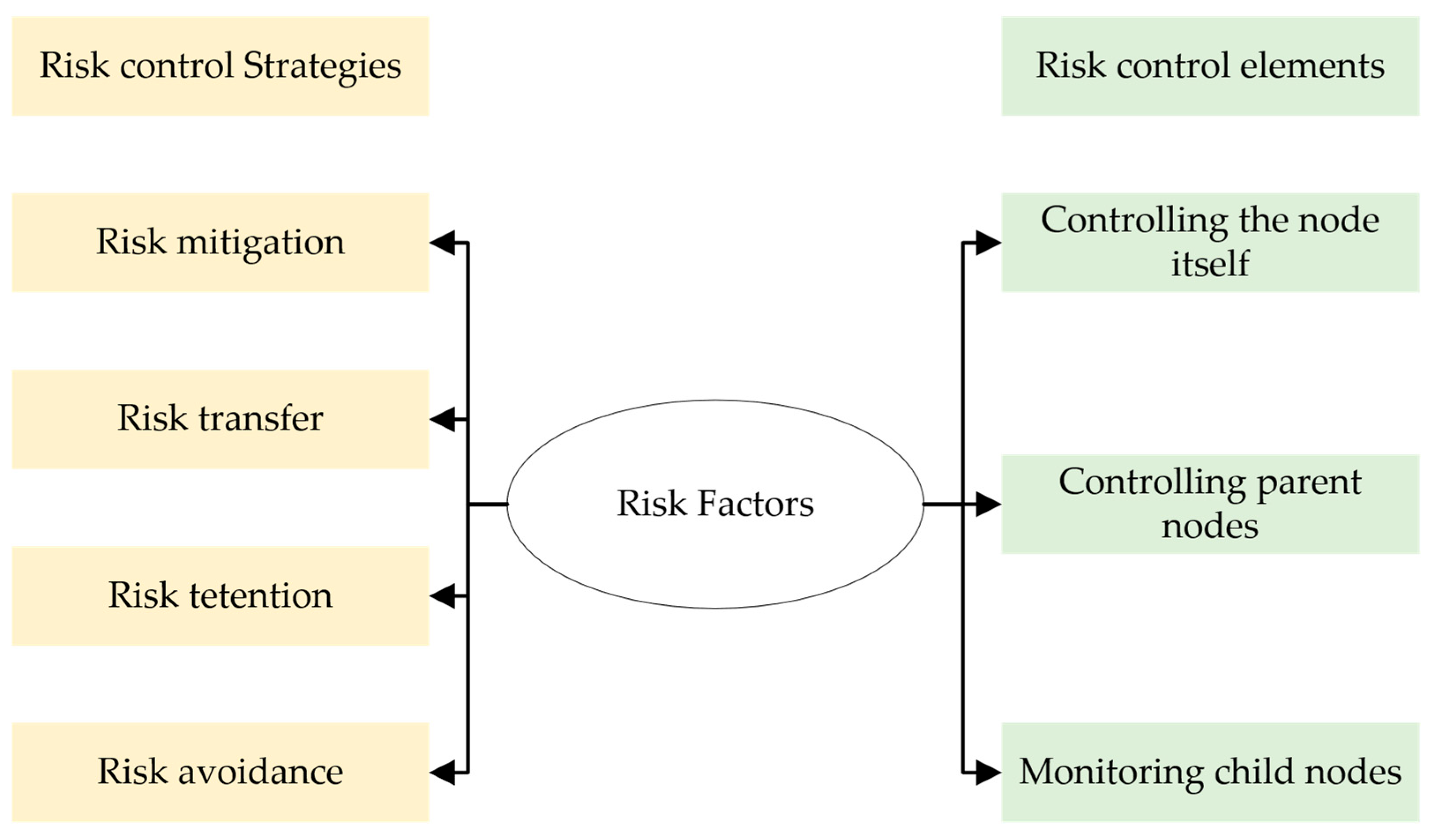
This study identified an initial list of 29 safety risk factors for metro deep foundation pit construction by combining Chinese word segmentation with semantic interpretation. These factors were categorized into five types: technology, management, personal, material and environmental. Using AHP, the weights of all factors were calculated and 22 main safety risk factors were determined. Subsequently, ISM was applied to construct a relational model among the main risk factors, and MICMAC analysis was used to classify the factors at the system level. The results indicate that management and technology risks account for a relatively large proportion, among which “Unscientific construction plan (T3)” is the factor with the highest weight. This study proposes a safety risk management framework for metro deep foundation pit construction, as illustrated in Figure 9. The safety risk control strategies include risk mitigation, risk avoidance, risk retention, and risk transfer, while the specific risk control factors involve the node itself, its parent nodes, and its child nodes.
The safety risk system model for metro deep foundation pit construction reveals the mechanisms underlying accident occurrence, and the multi-level hierarchical structure model provides a solid foundation for safety risk management. For the dependent factors, which act as the direct causes of safety accidents in metro deep foundation pit construction, immediate measures should be taken to eliminate or mitigate the risks as far as possible. Special emergency plans for safety risks should be formulated and implemented, and the actual risk conditions should be continuously monitored and followed up. The response measures need to be adjusted in a timely manner according to the evolving situation until the safety risks are reduced to an acceptable level. For the driving factors, which represent the fundamental causes of safety accidents, early intervention is essential. Priority should be given to addressing those safety risk factors with high driving power so that these factors can be effectively controlled within an acceptable range. For the autonomous factors, a selective control strategy can be adopted, and cost–benefit analysis can be used to maximize the efficiency of safety risk management. At the same time, a risk-retention strategy should be implemented, with regular monitoring to ensure that these safety risk factors remain within a controllable range. Based on the above safety risk response strategies, this study proposes specific countermeasures for each safety risk factor; due to space limitations, only representative countermeasures are presented here.
(1)
For “Unscientific construction plan (T3)”, which has the highest weight in the AHP analysis and is located in the upper layers of the ISM model, priority attention should be given to targeted risk mitigation. Risk control can be achieved through coordinated management of this factor and its parent node (T1). Control at the node level mainly involves inviting multiple stakeholders to participate in the formulation of construction plans and conducting expert consultations to enhance scientific decision-making. Control of “T1” focuses on increasing both the number and frequency of site investigations, thereby providing sufficient support for the timely revision and optimization of construction plans.
(2)
For “Inadequate safety training (M5)”, which exhibits relatively high driving power and dependence, priority should be given to targeted interventions. Risk mitigation can be achieved through coordinated control of this factor and its parent nodes (M2 and P3). Control at the node level primarily involves increasing the frequency of safety training and strengthening on-site supervision. With respect to the parent nodes, mitigating “P3” can be achieved by engaging instructors with advanced professional and technical qualifications, while controlling “M2” requires the implementation of incentive and penalty mechanisms for safety training management.
(3)
For “Defect of the structural quality (T6)”, the occurrence probability of this factor can be reduced by controlling its parent nodes (T3, T5, and W1). Control of “W1” mainly refers to appropriate material selection based on specific construction conditions. Control of “T3” focuses on strengthening mechanical analysis to ensure the scientific validity of design and construction schemes, while control of “T5” emphasizes strict compliance with construction specifications by workers and an increased monitoring frequency to prevent control indicators from exceeding threshold values.
(4)
For “Improper operation of the equipment (P4)”, the risk can be mitigated by reducing the occurrence probability of this factor and its parent nodes (P5 and T4). Control of “T4” involves enhancing the depth and effectiveness of safety technical briefings, while control of “P5” is achieved through the implementation of a shift rotation system to ensure appropriate physical conditions of workers.
(5)
For “Inadequate security checks (M1)”, mitigation measures should focus on controlling the occurrence probability of this factor and its parent node (M5), while monitoring the status of its child nodes (W2 and M4). Control at the node level includes strengthening safety inspections through regular and unscheduled safety patrols to reduce the likelihood of occurrence. Controlling “M5” involves expanding both the frequency and coverage of safety training. Monitoring of child nodes mainly refers to the periodic inspection and statistical tracking of failures in mechanical equipment and HVAC and lighting systems.
(6)
For “Complex hydrogeological conditions (E1)”, considering the variability and concealment of hydrogeological conditions, a risk retention strategy is primarily adopted. Continuous monitoring of groundwater levels is required to ensure that safety risks remain within an acceptable and controllable range.

6. Conclusions

The metro has gradually become one of the major means of alleviating urban traffic congestion; however, safety accidents still occur frequently during metro construction. Owing to the complex construction characteristics of deep foundation pits, metro deep foundation pit projects are subject to considerable and hardly predictable uncertainties. To comprehensively identify the safety risk factors involved in metro deep foundation pit construction, to explore the interaction relationships among these factors and to evaluate their relative importance, this study integrates Chinese word segmentation, AHP, ISM and MICMAC analysis. Previous studies on safety risk factor identification have largely relied on expert experience, which may lead to incomplete risk identification. To address this limitation, this study employed web crawling to collect accident reports and applied Chinese word segmentation to extract safety risk factors from the reports, thereby ensuring the comprehensiveness of risk identification. Considering that system analysis of safety risks should not involve an excessive number of elements, AHP was adopted to retain the main safety risk factors for subsequent ISM-based system modeling and MICMAC analysis. By integrating web crawling, Chinese word segmentation, AHP, ISM, and MICMAC, this study enables a more objective system-level analysis of safety risks in metro deep foundation pit construction compared with existing state-of-the-art approaches.
(1)
This study established an initial list of safety risk factors for metro deep foundation pit construction through Chinese word segmentation and identified 29 factors across five categories: technology, management, personal, material and environment. To extract the main risk factors, a questionnaire survey was conducted to evaluate the relative importance of each factor, and AHP was employed to determine their weights. A total of 22 main safety risk factors were ultimately identified. Among them, “Unscientific construction plan” had the highest weight, whereas factors such as “Unscientific design plan” were deemed insignificant and were excluded from the final list.
(2)
Based on the identification of the main safety risk factors for metro deep foundation pit construction, ISM was applied to analyze the interaction relationships among these factors and to organize them into five hierarchical levels. Two underlying factors are located at Level 5, eleven intermediate factors are distributed across Levels 2–4 and nine direct factors are positioned at the top level. In addition, the two bottom-level factors, together with two intermediate factors that are not influenced by any other factors, constitute the fundamental safety risk factors in metro deep foundation pit construction. These four factors represent the root causes of safety accidents in metro deep foundation pit projects.
(3)
The MICMAC analysis classified the risk factors according to their driving power and dependence into eight autonomous factors, four driving factors and ten dependent factors. This study proposes a safety risk management framework for metro deep foundation pit construction, in which appropriate control strategies and control elements are formulated for each category of factors, and targeted response measures are proposed for six representative safety risk factors.
This study provides methodological guidance for safety risk management in metro deep foundation pit construction. The identification of safety risk factors through Chinese word segmentation offers a more systematic and objective approach. On this basis, the subsequent extraction of main safety risk factors and the systematic analysis of interrelationships among these factors demonstrate enhanced reliability, which constitutes a key novelty of this research. In addition, the questionnaire survey involved participants from multiple stakeholders across the supply chain, thereby further ensuring the validity of the results. Nevertheless, this study still has certain limitations. First, the data source for Chinese word segmentation in this study is primarily accident reports obtained from official government websites, which may not cover all metro deep foundation pit construction accidents. Future studies could expand the range of data sources by including additional platforms. Moreover, since Chinese word segmentation relies on accident reports written in Chinese, the analysis of accident reports in other languages also warrants further investigation. Second, the number of experts participating in the survey is relatively limited, and the data sources are comparatively narrow, which may introduce a certain degree of subjectivity into the results. Future research could broaden the scope of expert participation to enhance the objectivity and robustness of the findings. Third, the results obtained in this study are difficult to validate directly. Future research may consider incorporating the geotechnical mechanisms of deep foundation pit, further accounting for structural failure modes and surrounding environmental conditions, and conducting case-based validation by integrating finite element methods, Bayesian approaches, or other probabilistic techniques. Finally, the transferability of risks is also identified as a potential direction for future research.

Supplementary Materials

The following supporting information can be downloaded at: https://www.mdpi.com/article/10.3390/buildings16030634/s1, Customized domain-specific terms and stop-words.

Author Contributions

Conceptualization, S.H.; methodology, C.S. and G.G.; software, C.S.; validation C.T.; formal analysis, C.T.; investigation, C.T. and G.G.; resources, C.T.; data curation, G.G. and C.S.; writing—original draft preparation, C.S. and G.G.; writing—review and editing, S.H. and G.G.; visualization, C.T.; supervision, C.T.; project administration, C.S.; funding acquisition, C.S. All authors have read and agreed to the published version of the manuscript.

Funding

This research was funded by the Hainan Provincial Department of Science and Technology, grant number ZDKJ2021024 (Hainan Province Science and Technology Special Fund).

Data Availability Statement

All data generated or analyzed during the study are available from the corresponding author by request.

Acknowledgments

The authors would express their thanks to everyone who helped with this research.

Conflicts of Interest

The authors declare no conflicts of interest.

References

  1. Gnoni, M.G.; Andriulo, S.; Maggio, G.; Nardone, P. “Lean occupational” safety: An application for a Near-miss Management System design. Saf. Sci. 2013, 53, 96–104. [Google Scholar] [CrossRef]
  2. Wang, Q.; Kang, X.; Zhu, K. Coupling Evaluation Method of the Construction Risk for Subway Deep Foundation Pit. J. Northeast. Univ. (Nat. Sci.) 2021, 42, 1152–1158. [Google Scholar]
  3. Zhang, S.; Sunindijo, R.Y.; Loosemore, M.; Wang, S.; Gu, Y.; Li, H. Identifying critical factors influencing the safety of Chinese subway construction projects. Eng. Constr. Archit. Manag. 2021, 28, 1863–1886. [Google Scholar] [CrossRef]
  4. Xing, X.; Zhong, B.; Luo, H.; Li, H.; Wu, H. Ontology for safety risk identification in metro construction. Comput. Ind. 2019, 109, 14–30. [Google Scholar] [CrossRef]
  5. Liu, H.; Liu, L.; Ji, X. Identification and Analysis of Metro Foundation Construction Safety Risk Based on Fault Tree Analysis. Chem. Eng. Trans. 2016, 51, 979–984. [Google Scholar]
  6. Li, M.; Wang, J. Intelligent Recognition of Safety Risk in Metro Engineering Construction Based on BP Neural Network. Math. Probl. Eng. 2021, 20, 5587027. [Google Scholar] [CrossRef]
  7. Zhang, S.; Shang, C.; Wang, C.; Song, R.; Wang, X.H. Real-Time Safety Risk Identification Model during Metro Construction Adjacent to Buildings. J. Constr. Eng. Manag. 2019, 145, 04019034. [Google Scholar] [CrossRef]
  8. Seo, J.W.; Choi, H.H. Risk-Based Safety Impact Assessment Methodology for Underground Construction Projects in Korea. J. Constr. Eng. Manag. 2008, 134, 72–81. [Google Scholar] [CrossRef]
  9. Abouhamad, M.; Zayed, T. Fuzzy Preference Programming Framework for Functional Assessment of Subway Networks. Algorithms 2020, 13, 220. [Google Scholar] [CrossRef]
  10. Na, X.U.; Ling, M.A.; Liu, Q.; Wang, L.; Deng, Y. An improved text mining approach to extract safety risk factors from construction accident reports. Saf. Sci. 2021, 138, 105216. [Google Scholar] [CrossRef]
  11. Tang, C.; Shen, C.X.; Zhang, J.J.; Guo, Z. Identification of Safety Risk Factors in Metro Shield Construction. Buildings 2024, 14, 492. [Google Scholar] [CrossRef]
  12. Deng, Y.L.; Liu, Z.D.; Song, L.L.; Ni, G.D.; Xu, N. Exploring the metro construction accidents and causations for improving safety management based on data mining and network theory. Eng. Constr. Archit. Manag. 2023, 6, 3508–3532. [Google Scholar] [CrossRef]
  13. Liang, Y.X.; Xu, N.; Chang, H.; Qian, S.; Liu, Y. Automatic construction of risk transmission network about subway construction based on deep learning models. Sci. Rep. 2025, 15, 16383. [Google Scholar] [CrossRef]
  14. Chen, D.W.; Zhou, J.L.; Duan, P.S.; Zhang, J.Q. Integrating knowledge management and BIM for safety risk identification of deep foundation pit construction. Eng. Constr. Archit. Manag. 2023, 30, 3242–3258. [Google Scholar] [CrossRef]
  15. Zhang, Y.C.; Xing, X.J.; Antwi-Afari, M.F. Semantic IFC Data Model for Automatic Safety Risk Identification in Deep Excavation Projects. Appl. Sci. 2021, 11, 9958. [Google Scholar] [CrossRef]
  16. Hao, H.; Jian, H.; Liu, P.L.; Cong, Z. Identification and evaluation of deep foundation pit construction risks based on Grey-DEMATEL-Fuzzy comprehensive evaluation method. PLoS ONE 2024, 19, e0304095. [Google Scholar] [CrossRef]
  17. Huang, J.Y.; Fang, J.; Wang, J.C. Risk Coupling Analysis of Metro Deep Foundation Pit Construction Based on Complex Networks. Buildings 2024, 14, 1953. [Google Scholar] [CrossRef]
  18. Wu, B.; Zeng, J.; Zhu, R.; Yang, F.; Liu, C.; Xie, Y. A collapse risk assessment method for subway foundation pit based on cloud model and improved Dempster-Shafer evidence theory. Sci. Rep. 2024, 14, 2653. [Google Scholar] [CrossRef] [PubMed]
  19. Shen, Y.S.; Wang, P.; Li, M.P.; Mei, Q.W. Application of Subway Foundation Pit Engineering Risk Assessment: A Case Study of Qingdao Rock Area, China. KSCE J. Civ. Eng. 2019, 23, 4621–4630. [Google Scholar] [CrossRef]
  20. An, X.; Zheng, F.; Wang, Z.; Li, Z.; Jiao, Y.; An, H. Dynamic Risk Assessment Approach for Deep Foundation Pit Construction Based on the Integration of Multisource Data Using D-S Evidence Theory. J. Constr. Eng. Manag. 2025, 151, 04025155. [Google Scholar] [CrossRef]
  21. Yu, Y.; Wu, K.; Cui, S.; Zhang, Q.; Zhao, J.; Zhang, Z. Deformation Characteristics Analysis of Supporting Structure Caused by Deep Excavation of Large-Span Subway Parking Lot in Deep Silt Stratum. Indian Geotech. J. 2019, 12, 519–530. [Google Scholar] [CrossRef]
  22. Valipour, A.; Yahaya, N.; Md Noor, N.; Antucheviciene, J.; Tamosaitiene, J. Hybrid SWARA-COPRAS method for risk assessment in deep foundation excavation project: An Iranian case study. J. Civ. Eng. Manag. 2017, 23, 524–532. [Google Scholar] [CrossRef]
  23. Zhou, Y.; Li, C.; Zhou, C.; Luo, H. Using Bayesian network for safety risk analysis of diaphragm wall deflection based on field data. Reliab. Eng. Syst. Saf. 2018, 180, 152–167. [Google Scholar] [CrossRef]
  24. Wei, D.; Xu, D.; Zhang, Y. A fuzzy evidential reasoning-based approach for risk assessment of deep foundation pit. Tunn. Undergr. Space Technol. 2020, 97, 103232. [Google Scholar] [CrossRef]
  25. Samantra, C.; Datta, S.; Mahapatra, S.S. Fuzzy based risk assessment module for metropolitan construction project: An empirical study. Eng. Appl. Artif. Intell. 2017, 65, 449–464. [Google Scholar] [CrossRef]
  26. Potapova, E. General problems of geotechnical risk management in terms of construction of vertical shafts in the Moscow subway. Min. Informational Anal. Bull. 2019, 10, 44–54. [Google Scholar] [CrossRef]
  27. Jian, H. Construction Risk of Foundation Pit of Subway Station Based on Rough Set Theory and Catastrophe Progression Method. Electron. J. Geotech. Eng. 2016, 4, 1615–1628. [Google Scholar]
  28. Zhou, Y.; Li, S.; Zhou, C.; Luo, H. Intelligent Approach Based on Random Forest for Safety Risk Prediction of Deep Foundation Pit in Subway Stations. J. Comput. Civ. Eng. 2019, 33, 05018004. [Google Scholar] [CrossRef]
  29. Dong, L.; Wang, Q.; Zhang, W.; Zhang, Y.; Li, X.; Liu, F. Risk assessment of tunnel water inrush based on Delphi method and machine learning. Front. Earth Sci. 2025, 13, 1555493. [Google Scholar] [CrossRef]
  30. Shen, J.H.; Liu, S.P.; Zhang, J. Using Text Mining and Bayesian Network to Identify Key Risk Factors for Safety Accidents in Metro Construction. J. Constr. Eng. Manag. 2024, 150, 04024052. [Google Scholar] [CrossRef]
  31. Fu, L.P.; Wang, X.Q.; Zhao, H.; Li, M.N. Interactions among safety risks in metro deep foundation pit projects: An association rule mining-based modeling framework. Reliab. Eng. Syst. Saf. 2022, 221, 108381. [Google Scholar] [CrossRef]
  32. Fu, L.; Li, X.; Wang, X.; Li, M. Safety risk propagation in complex construction projects: Insights from metro deep foundation pit projects. Reliab. Eng. Syst. Saf. 2025, 257, 110858. [Google Scholar] [CrossRef]
  33. Zhou, Y.; Su, W.J.; Ding, L.Y.; Luo, H.B.; Love, P.E.D. Predicting Safety Risks in Deep Foundation Pits in Subway Infrastructure Projects: Support Vector Machine Approach. J. Comput. Civ. Eng. 2017, 31, 04017052. [Google Scholar] [CrossRef]
  34. Hui, L.I. Mutual Influence Analysis of Simultaneous Excavation of Subway and Adjacent Block Deep Foundation Pits. J. Railw. Eng. Soc. 2019, 36, 65–69. [Google Scholar]
  35. Zhang, X.; Zhao, D.; Shi, X.; Gao, X.; Zhang, Y.; Wang, S. Investigation into the Impacts of Cover-and-Cut Top-Down Metro Station Construction on Adjacent Buildings: A Case Study. Buildings 2025, 15, 4149. [Google Scholar] [CrossRef]
  36. Zhou, W.; Abdullah, A.; Xu, X. Safety Risk Assessment of Deep Excavation for Metro Stations Using the Second Improved CRITIC Cloud Model. Buildings 2025, 15, 1342. [Google Scholar] [CrossRef]
  37. Durdyev, S.; Ashour, M.; Connelly, S.; Mahdiyar, A. Barriers to the implementation of Building Information Modelling (BIM) for facility management. J. Build. Eng. 2022, 46, 103736. [Google Scholar] [CrossRef]
  38. Warfield, J.N. On Arranging Elements of a Hierarchy in Graphic Form. IEEE Trans. Syst. Man Cybern. 1973, SMC-3, 121–132. [Google Scholar] [CrossRef]
  39. Duperrin, J.C.; Godet, M. Method for Hierarchizing the Elements of a System: Essai de Prospective du Système de L’énergie Nucléaire dans son Contexte Societal; CEA-Rapport économique R-45-41; CEA: Paris, France, 1973. [Google Scholar]
  40. GB50652-2011; The Code for Risk Management of Underground Works in Urban Rail Transit. China Architecture & Building Press: Beijing, China, 2011.
  41. GB50715-2011; The Standard for Construction Safety Assessment of Metro Engineering. China Planning Press: Beijing, China, 2011.
  42. Lee, S. Determination of Priority Weights under Multiattribute Decision-Making Situations: AHP versus Fuzzy AHP. J. Constr. Eng. Manag. 2015, 141, 05014015. [Google Scholar] [CrossRef]
  43. Wang, Q.; Shen, C.; Guo, Z.; Zhu, K.; Zhang, J.; Huang, M. Research on the Barriers and Strategies to Promote Prefabricated Buildings in China. Buildings 2023, 13, 1200. [Google Scholar] [CrossRef]
  44. Thomas, D.; Khanduja, D. ISM-ANP hybrid approach to prioritize the barriers in green lean Six Sigma implementation in construction sector. Int. J. Lean Six Sigma 2022, 13, 502–520. [Google Scholar] [CrossRef]
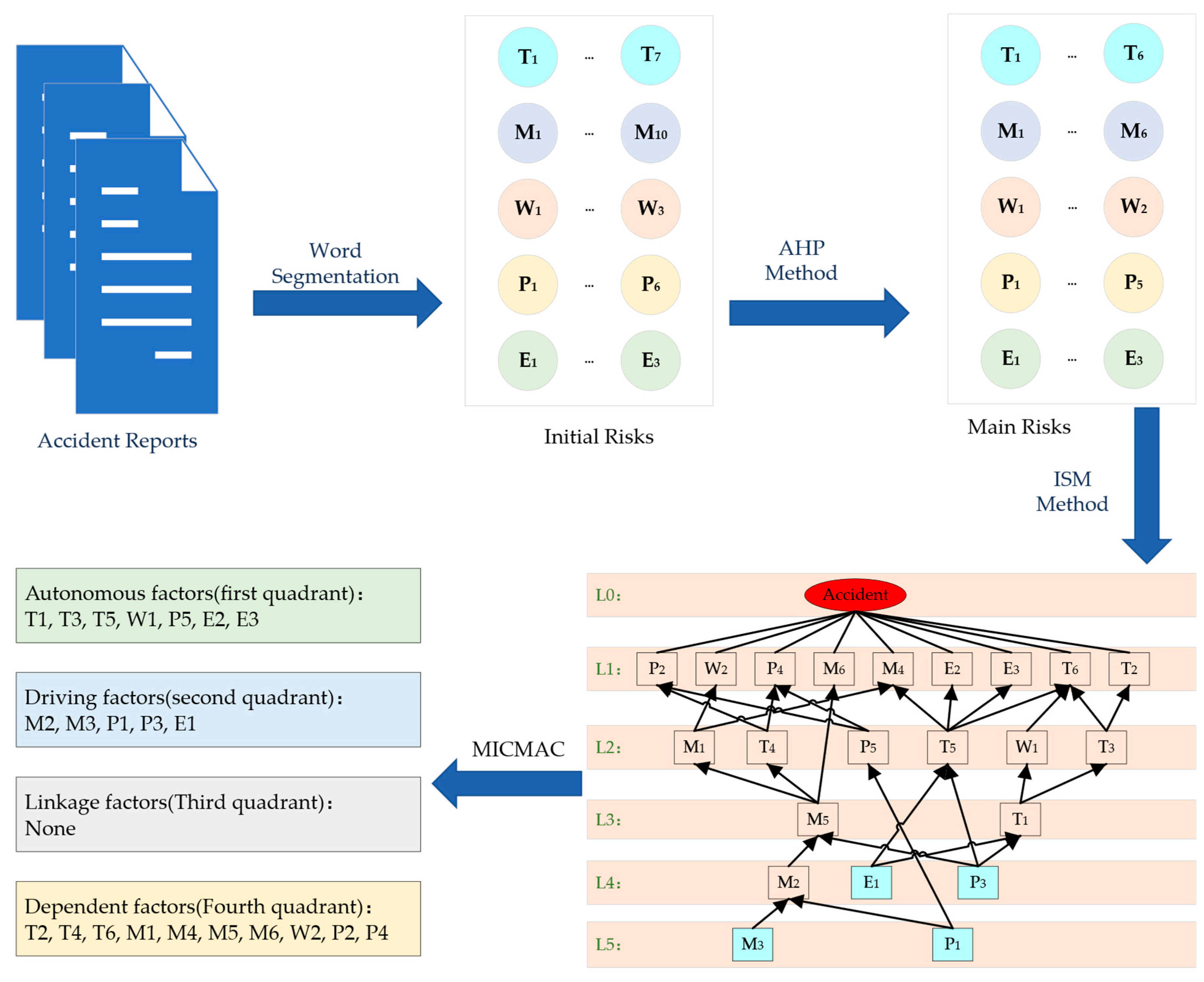
Figure 1. Research technical path.
Buildings 16 00634 g001
Figure 2. Composition of the safety risk lexicon.
Buildings 16 00634 g002
Figure 3. Word cloud of safety risk terms in metro deep foundation pit construction.
Buildings 16 00634 g003
Figure 4. Results of AHP weight analysis [%].
Buildings 16 00634 g004
Figure 5. Results of sensitivity analysis.
Buildings 16 00634 g005
Figure 6. Matrix operation.
Buildings 16 00634 g006
Figure 7. ISM model for risk factors.
Buildings 16 00634 g007
Figure 8. Visual representation of MICMAC analysis.
Buildings 16 00634 g008
Figure 9. Safety risk management framework for metro deep foundation pit construction.
Buildings 16 00634 g009
Table 1. Case base of safety accidents (partial).
No.TimeLocationDOI of Accident Report
14 July 2019Qingdao Metro Line 1 Shengliqiao Stationhttp://www.safehoo.com/News/News/China/201907/1570206.shtml (accessed on 12 November 2025)
227 August 2019Shenzhen Metro Line 10 Mugu Stationhttp://www.safehoo.com/News/News/China/201908/1576031.shtml (accessed on 12 November 2025)
37 December 2020Nanjing Metro Line 7 Fujian Road Stationhttp://js.people.com.cn/gb/n2/2020/1207/c360303-34460377.html (accessed on 12 November 2025)
Table 2. Example of word segmentation results.
No.DOI of Accident Report
Original sentenceThe construction workers have weak safety awareness and illegally enter the dangerous hoisting area when the crane is hoisting mortar.
Jieba segmentationThe/construction/workers/have/weak/safety/awareness/and/illegally/enter/the/dangerous/hoisting/area/when/the/crane/is/hoisting/mortar/./
Jieba segmentation +
Domain-Specific lexicon
The construction workers/have/weak/safety awareness/and/illegally/enter/the/dangerous/hoisting/area/when/the/crane/is/hoisting/mortar/./
Jieba segmentation + Domain-Specific
lexicon + Stop-Word lexicon
The construction workers/weak/safety awareness/illegally/enter/dangerous/hoisting/area/crane/hoisting/mortar/
Table 3. High-frequency terms (partial).
No.High-Frequency TermsTF–IDFNo.High-Frequency TermsTF–IDF
1Safety238.22Management153.6
3Safety awareness143.34Support135.7
5Operation against rules129.16Foundation pit125.3
7Construction unit115.78Inspection112.9
9Pipeline103.510Soil mass102.1
11Construction workers97.812Geology96.2
13Hydrology95.314Emergency89.4
15Operate87.516Equipment86.3
17Monitoring83.118Technology79.7
19Quality76.5
Table 4. Initial list of safety risk factors.
CategoryCodeHigh-Frequency TermsRisk Factors
TechnologyT1InvestigationInadequate investigation
T2SupportDefect of the support system
T3Construction planUnscientific construction plan
T4BriefingInsufficient safety and technical briefings
T5MonitorInadequate monitoring
T6Design planUnscientific design plan
T7QualityDefect of the structural quality
ManagementM1CheckInadequate security checks
M2ManagementChaotic on-site management
M3OrganizationIncomplete safety management organization
M4ProtectionInsufficient safety protection
M5SubcontractInsufficient subcontracting management
M6SystemImperfect safety management system
M7Safety trainingInadequate safety training
M8CoordinationInadequate organizational coordination
M9EmergencyInsufficient emergency management capabilities
M10SupervisionInadequate safety supervision
MaterialW1MaterialIncorrect use of materials
W2FailureEquipment failure
W3Equipment selectionIncorrect equipment selection
PersonalP1Safety awarenessInsufficient safety awareness
P2ViolationViolation of work regulations
P3TechnologyInsufficient professional and technical proficiency
P4OperationImproper operation of the equipment
P5CommandIllegal command
P6FatigueWorker fatigue
EnvironmentE1Hydrologic, GeologicalComplex hydrogeological conditions
E2PipelineInsufficient protection of underground pipelines
E3BuildingInsufficient protection of surrounding buildings
Table 5. The basic information for AHP experts.
CharacteristicCategoriesNo.Percentage
Type of EmployerUniversity822.22%
Research institution616.67%
Investment unit616.67%
Design unit411.11%
Construction unit1233.33%
Educational QualificationsBachelor and Lower2261.11%
Master 822.22%
Doctoral and Higher616.67%
Work Experience<1 years25.56%
1–3 years1336.11%
3–5 years1438.89%
>5 years719.44%
Table 6. Judgment matrix of criterion layer.
CategoriesTechnologyManagementMaterialPersonalEnvironment
Technology1.00001.00002.25001.25002.0000
Management1.00001.00002.50001.50002.0000
Material0.44440.40001.00000.75000.5833
Personal0.80000.66671.33331.00001.3750
Environment0.50000.50001.71430.72731.0000
Table 7. Weights and consistency test results of criterion layer.
CateroriesTechnologyManagementMaterialPersonalEnvironment
Weight0.26590.28120.11440.18820.1503
λmax5.0845CR0.0189ConsistencyPass
Table 8. Weights of safety risk factors.
CategoriesWeightSafety Risk FactorsRelative Weight [%]Actual Weight [%]
Personal18.82%Insufficient safety awareness21.894.12
Violation of work regulations18.323.45
Insufficient professional and technical proficiency20.203.80
Improper operation of the equipment14.432.72
Illegal command12.122.28
Worker fatigue13.042.45
Material11.44%Incorrect use of materials39.444.51
Equipment failure46.725.34
Incorrect equipment selection13.841.58
Technology26.59%Inadequate investigation12.993.46
Defect of the support system14.103.75
Unscientific construction plan25.166.69
Insufficient safety and technical briefings9.882.63
Inadequate monitoring21.155.63
Unscientific design plan5.821.55
Defect of the structural quality10.892.90
Management28.12%Inadequate security checks14.063.95
Chaotic on-site management13.043.67
Incomplete safety management organization18.255.13
Insufficient safety protection11.043.10
Insufficient subcontracting management6.541.84
Imperfect safety management system4.341.22
Inadequate safety training12.023.38
Inadequate organizational coordination3.801.07
Insufficient emergency management capabilities8.962.52
Inadequate safety supervision7.952.24
Environment15.03%Complex hydrogeological conditions32.924.95
Insufficient protection of underground pipelines38.475.78
Insufficient protection of surrounding buildings28.614.30
Table 9. List of main risk factors.
CategoriesCodeSafety Risk Factors
TechnologyT1Inadequate investigation
T2Defect of the support system
T3Unscientific construction plan
T4Insufficient safety and technical briefings
T5Inadequate monitoring
T6Defect of the structural quality
ManagementM1Inadequate security checks
M2Chaotic on-site management
M3Incomplete safety management organization
M4Insufficient safety protection
M5Inadequate safety training
M6Insufficient emergency management capabilities
MaterialW1Incorrect use of materials
W2Equipment failure
PersonP1Insufficient safety awareness
P2Violation of work regulations
P3Insufficient professional and technical proficiency
P4Improper operation of the equipment
P5Worker fatigue
EnvironmentE1Complex hydrogeological conditions
E2Insufficient protection of underground pipelines
E3Insufficient protection of surrounding buildings
Table 10. The results of level partitioning.
LevelSafety Risk Factors
1T2, T6, M4, M6, W2, P2, P4, E2
2T3, T4, T5, M1, W1, P5
3T1, M5
4M2, E1, P3
5M3, P1
Table 11. Calculation results of MICMAC parameter.
Safety Risk FactorsDriving PowerDependence Power
T153
T215
T334
T436
T553
T617
M136
M293
M3101
M419
M585
M616
W124
W217
P1111
P218
P3171
P418
P532
E1101
E214
E314
Disclaimer/Publisher’s Note: The statements, opinions and data contained in all publications are solely those of the individual author(s) and contributor(s) and not of MDPI and/or the editor(s). MDPI and/or the editor(s) disclaim responsibility for any injury to people or property resulting from any ideas, methods, instructions or products referred to in the content.