Article

A Refined Method for Inspecting the Verticality of Thin Tower Structures Using the Marching Square Algorithm


School of Geomatics and Urban Spatial Information, Beijing University of Civil Engineering and Architecture, Beijing 102616, China
*
Authors to whom correspondence should be addressed.
Buildings 2026, 16(3), 604; https://doi.org/10.3390/buildings16030604
Submission received: 31 December 2025 / Revised: 27 January 2026 / Accepted: 28 January 2026 / Published: 2 February 2026

Abstract

Conducting regular verticality inspections for thin tower structures is essential for ensuring structural safety, extending service life, and optimizing operation and maintenance strategies. However, the traditional theodolite inspection method, as a commonly used technique for verticality assessment, still has certain limitations, including strict requirements for station setup, the need for high-altitude contact-based operations, and difficulty in accurately resolving the tilt azimuth of the central axis. More importantly, the conventional method provides insufficient understanding of the overall verticality geometric characteristics of thin tower structures, particularly lacking in systematic approaches for characterizing the axis morphology under non-contact, full three-dimensional (3D) perception conditions. Therefore, this study proposes a refined method for inspecting the verticality of thin tower structures using the Marching Square algorithm. The tower body of a tower crane was selected as the experimental subject. Firstly, ground-based LiDAR was employed to scan and acquire the raw point cloud data of the tower crane. After point cloud registration and denoising, high-precision and valid point cloud data of the tower body were obtained. Secondly, a cross-sectional slicing segmentation strategy was designed for the point cloud of the tower body standard sections, and a slice-polygon-contour extraction method based on the Marching Square algorithm was proposed to extract the contour vertices and compute the coordinates of the contour centroids. Finally, a spatial line-fitting algorithm based on the least squares method was proposed to fit a 3D line to the coordinates of the contour centroids, thereby determining the direction vector of the central axis. The direction vector was then subjected to vector operations with the x-axis and z-axis in the station-center space coordinate system to derive the tilt azimuth and tilt angle of the central axis, thereby providing the verticality inspection results of the tower crane. The experimental results indicate that the four cross-section slicing segmentation schemes designed using the proposed method in this study yielded tower crane verticality values of 2.45‰, 2.35‰, 2.20‰, and 2.18‰. All verticality values meet the verticality requirement of no more than 4‰ specified in GB/T 5031-2019 (Tower Cranes). This verifies that the proposed method is feasible and effective, providing a novel, high-precision, and non-contact inspection method for inspecting the anti-overturning stability of thin tower structures.

1. Introduction

With the rapid advancement of urbanization, thin tower structures, including communication towers [1], power transmission towers [2,3,4,5,6], and tower cranes [7,8,9,10,11], have been extensively constructed. Against the background of an extended service period and increasingly complex operating environments for thin tower structures, the effective inspection and safety assessment of the structural condition have become critical issues of common concern across multiple disciplines, such as structural engineering, engineering surveying, and structural health monitoring [12,13,14,15,16,17]. Thin tower structures are characterized by considerable structural height, slender components, complex load-bearing behavior, and frequently varying operating conditions, and they play a crucial role in modern engineering construction and major infrastructure systems [18,19,20,21]. During long-term service, these structures are subjected to external factors, such as wind loads, uneven foundation settlement, and cumulative structural damage, which can readily induce geometric deformations, primarily manifested as deviations of the central axis and verticality deviations [22,23]. If the central axis of a thin tower structure exhibits a certain degree of inclination and fails to be effectively monitored and timely corrected, it may lead to severe safety accidents, such as the overturning of a tower crane [24,25,26,27,28]. Traditional verticality inspection methods, including theodolites, plumb lines, and tape-based measurements, generally exhibit inherent limitations, such as restricted measurement accuracy, low inspection efficiency, and discrete deployment [29,30,31,32,33,34]. Consequently, these methods are no longer adequate to meet the practical demands of safety inspection and risk early warning for modern thin tower structures. Therefore, by integrating existing sensing technologies with high-precision data processing methods, a refined method for inspecting the verticality of thin tower structures is proposed. This method enables high-accuracy, non-contact, and holistic perception of structural verticality, and is of significant importance for structural safety inspection and risk early warning of thin tower structures.
Currently, research on verticality inspection mainly focuses on two aspects. The first aspect concerns the diversification of detection technologies, whereby multiple verticality acquisition pathways are established by introducing different measurement principles and sensing modalities, enabling multi-scale and multi-precision inspection of verticality information. The second aspect centers on the optimization of data processing and solution algorithms, in which more robust and high-accuracy verticality estimation methods are investigated through improved modeling of observational data, feature extraction, and parameter estimation, thereby enhancing the accuracy and reliability of verticality inspection.
With respect to the diversification of inspection technologies, Zhou et al. [35,36] applied GNSS technology to tower-crane verticality monitoring. By jointly deploying a tower-top receiver and a ground reference station, they achieved continuous observations of the tower body’s lateral verticality and full-circle verticality. Liu et al. [37] adopted a contact-based monitoring approach integrating a laser plummet and an inclinometer to perform real-time monitoring and analysis of borehole verticality during foundation construction for transmission line towers. Wang et al. [38] investigated overhead transmission line towers and proposed a sensor-data-driven tilt monitoring and early-warning method. Zhang et al. [39] developed a multi-sensor cooperative detection and correction approach based on inertial sensors, targeting tower attitude tilt and foundation condition. Through mean-filter preprocessing and a complementary-filter fusion algorithm for real-time sensor-data processing, they reported a relative tilt-angle measurement accuracy of 1.03%. Ngabo et al. [40] rigidly mounted triaxial accelerometer nodes on transmission towers and computed tilt angles from the acceleration components using analytical formulas. Gao et al. [41] proposed a fiber-optic-sensing-based monitoring scheme by incorporating the structural characteristics of transmission lines and a mathematical tilt model of pole–tower structures. They used OPGW cables to build a fiber-networking system and deployed sensing units at critical locations prone to load-induced inclination, enabling long-distance online monitoring of tower tilt angles. Gemayel et al. [42] presented an online verticality monitoring method for transmission towers based on an Arduino platform and an IMU inclinometer sensor, enabling the acquisition of the attitude angles of transmission line towers. Although existing studies have made initial progress in the verticality inspection of thin tower structures, several limitations remain. First, current data acquisition is still dominated by discrete, sensor-based layouts, and a full-field modeling paradigm capable of characterizing the tower body’s continuous global geometry has not been fully established. Second, verticality determination is often derived from local geometric cues, and a unified framework for 3D central axis representation and quantitative verticality evaluation has yet to be developed. With the rapid development of non-contact techniques, such as oblique photogrammetry and 3D laser scanning, Li et al. [43] and Yang et al. [44] employed terrestrial laser scanning to monitor and analyze the inclination status of ancient towers. Li et al. [45] developed a UAV-photogrammetry-centered workflow integrating automated 3D reconstruction and centroid computation; taking the brick-and-stone pagoda of the Dule Temple in Tianjin as the study object, they conducted an accurate assessment of the tower’s tilt and deformation. Hong et al. [46] proposed a non-contact tower-tilt monitoring method based on video photogrammetry, in which planar fitting was performed, and the tilt angle was derived through subsequent estimation and analysis. Liang et al. [47] and Shen et al. [48] analyzed point cloud data of transmission towers to assess their inclination, enabling non-contact 3D monitoring with visualization. Lu et al. [49] presented an inclination assessment method for transmission towers based on dense UAV-borne LiDAR point clouds. Their approach performs adaptive point cloud segmentation and extracts feature-plane contours, fits the tower centerline under contour constraints, and calculates the tilt angle from the angle between the fitted centerline and the theoretical vertical axis to complete condition assessment. Liu et al. [50] proposed an online inclination monitoring method using point clouds generated from UAV inspection imagery; with transmission towers as the target, they conducted online analysis and evaluation of tilt angles under different wind conditions. Yao et al. [51] developed a non-contact rapid inspection method using a reflectorless total station for large industrial chimneys, establishing a measurement workflow based on free-station resection. Kregar et al. [52] proposed a tilt determination method for tall industrial chimneys by combining TPS and TLS point clouds, where the chimney centerline is reconstructed via least squares fitting of a cylindrical model, and the tilt horizontal displacement is then computed. Barazzetti et al. [53] used terrestrial laser scanning point clouds together with a non-contact verticality measurement approach based on circular fitting of horizontal slices, extracting multi-level sectional centers and performing least squares parameter estimation with precision statistics to reliably characterize chimney axis inclination. Zhang et al. [54] proposed a transmission tower tilt detection method that integrates BeiDou positioning with UAV inspection imagery; they performed image-based tower recognition and computed the corresponding verticality condition. Although the above studies have addressed the tilt and verticality behavior of thin tower structures, they have seldom investigated geometric shape variations from the cross-sectional perspective. Consequently, the extraction of verticality-related parameters still requires further improvement in terms of repeatability, stability, and scale consistency.
With respect to the optimization of data processing and solution algorithms, Jiang et al. [55] proposed a large-deformation reconstruction method for variable-cross-section beams based on shape awareness and rotational angle approximation (RAA), in which the overall deformation shape is reconstructed by inverting surface strains to estimate the axial rotation angles. Ji et al. [56] computed strain-induced displacements via strain modal superposition and introduced multi-rate Kalman filtering by incorporating acceleration measurements, enabling high-accuracy reconstruction of the dynamic displacement of flexible tower structures. Wang et al. [57] investigated the tilt and deformation monitoring of ancient towers using multi-source data fusion and reported that integrating GPS, inclinometers, and TLS data can improve deformation identification accuracy. Xue et al. [58] proposed a centroid-fitting approach that iteratively combines numerical simulation with least squares fitting to estimate tower offset patterns and verticality. Chen et al. [59] developed a non-contact automatic method for measuring the tilt angle of pole–tower structures by fusing 2D images and 3D point clouds. Using urban utility poles as the study object, they performed pole skeleton segmentation with an improved Mask R-CNN, point cloud feature extraction with PointNet, and segment-wise RANSAC-based cylindrical fitting with least squares centerline modeling. Wu et al. [60] proposed a non-contact monitoring method for transmission tower top tilt displacement based on a modified and improved D-InSAR framework, including interferometric phase separation between the upper and lower parts of the tower and multi-temporal filtering inversion for tilt displacement estimation. Yu et al. [61] proposed a real-time detection algorithm based on computer vision for tower crane verticality, performing image recognition and edge extraction to demonstrate real-time identification and dynamic monitoring of tower crane verticality. Bian et al. [62] presented a binocular-stereo-vision-based health monitoring method for wind turbine towers, which automatically extracts the tower centerline from structural information in images and adopts RANSAC to improve axis fitting, thereby achieving geometric posture modeling and state perception of the entire tower. Pleterski et al. [63] treated the target as multiple independent segmented components, processed narrow-band point clouds at selected height intervals, removed outliers using RANSAC, and then fitted sectional centers via least squares to obtain the structural central axis. Although the aforementioned algorithm-enhanced verticality computation methods have achieved satisfactory inspection performance, they generally lack an explicit mathematical formulation and corresponding constraint mechanism to enforce the intrinsic properties of cross-sectional contours, namely topological continuity and geometric closure.
To address the aforementioned issues, this study proposes a refined method for inspecting the verticality of thin tower structures using the Marching Square algorithm and validates its effectiveness through on-site experimental testing. The main contributions of this study are as follows: (1) Verticality inspection of thin tower structures for continuous, global geometric modeling: traditional verticality inspection methods are largely based on discrete measurement points or local observations. Ground-based LiDAR point clouds are organized via cross-sectional slicing in this study, and the Marching Square algorithm is employed to extract closed contours of cross-sections at different heights on a 2D plane, enabling a continuous representation of the overall tower body geometry for verticality analysis. (2) A 3D geometric axis representation and verticality inspection method based on cross-sectional detail scale: given the pronounced cross-sectional geometric characteristics of thin tower structures in engineering practice, this study develops a spatial association mechanism among multi-section contour center features from the cross-sectional detail scale, thereby establishing a unified framework for 3D central axis representation and verticality inspection, and improving the repeatability, stability, and scale consistency of verticality parameter extraction. (3) Incorporation of constraints on contour topological continuity and geometric closure: the Marching Square algorithm employs iso-contour tracing to explicitly enforce the topological consistency and geometric integrity of cross-sectional contours, effectively mitigating the impacts of noise and local data voids on contour reconstruction and axis fitting. (4) On-site experimental validation and unified performance evaluation: taking a tower crane as the study object, the verticality results obtained using the Marching Cubes algorithm are adopted as reference values. Comparative analysis is conducted using relative error metrics to verify the feasibility of the proposed method for verticality inspection.
The structure of this paper is organized as follows: Section 2 introduces the methods and materials. Section 3 details the experimental design, data preprocessing procedures, and cross-sectional slicing strategies. Section 4 reports the verticality results. Section 5 provides a discussion and analysis of the results. Finally, Section 6 summarizes the conclusions and outlines future research directions.

2. Methods and Materials

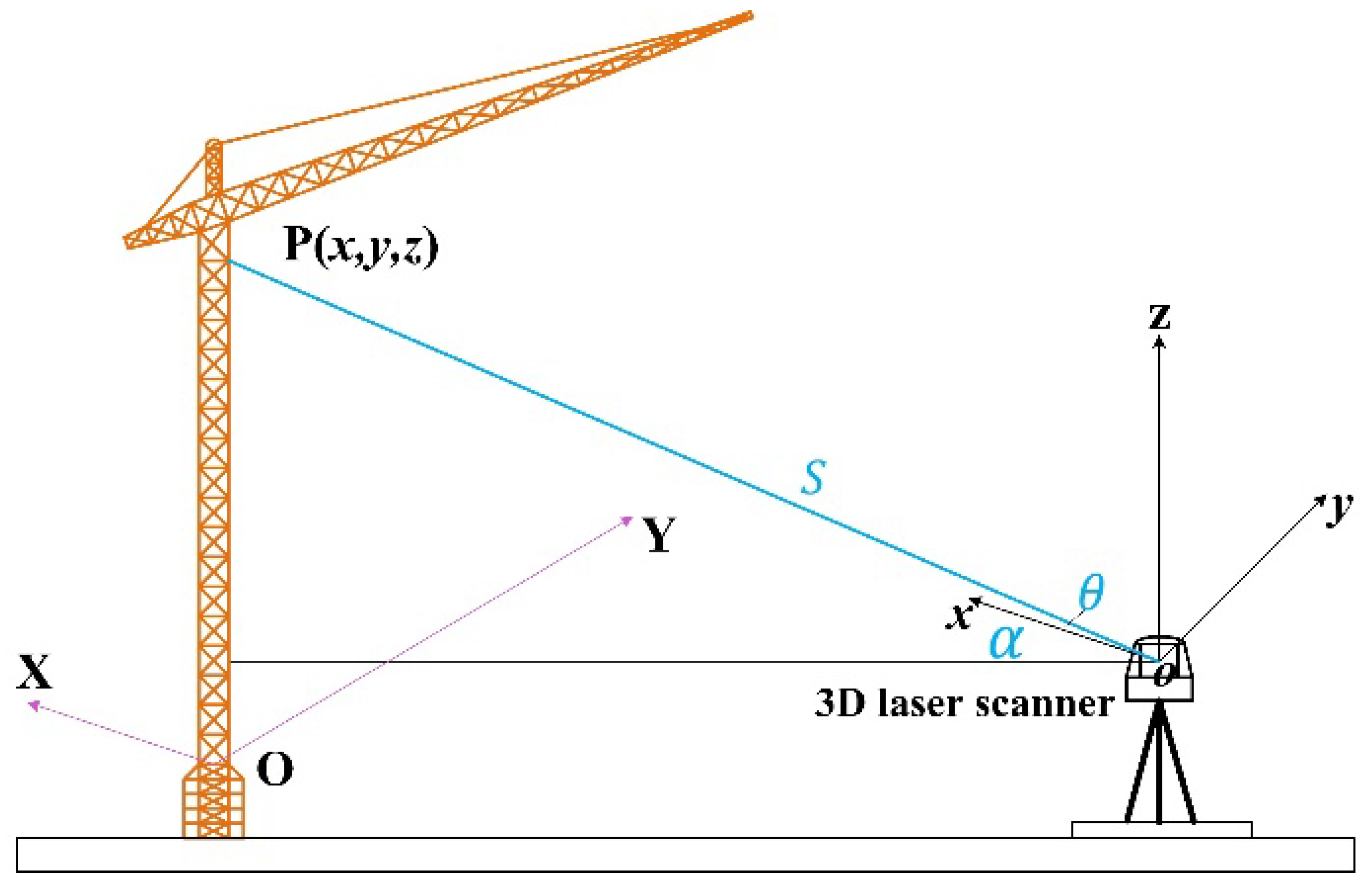
A refined method for inspecting the verticality of thin tower structures using the Marching Square algorithm enables non-contact measurement using point cloud data. The distance from the ground-based LiDAR to the surface of the thin tower structure and the deflection angles in the horizontal and vertical directions are measured during ground-based LiDAR scanning. The point cloud data are then processed and obtained in the station-center space coordinate system (O-XYZ) [64,65,66], as shown in Equation (1).
P = ( x P , y P , z P ) = ( S cos θ cos α , S cos θ sin α , S sin θ )
where S is the distance measured from the ground-based LiDAR to the surface point on the thin tower structure, α is the horizontal deviation angle, and θ is the deviation angle in the longitudinal direction.
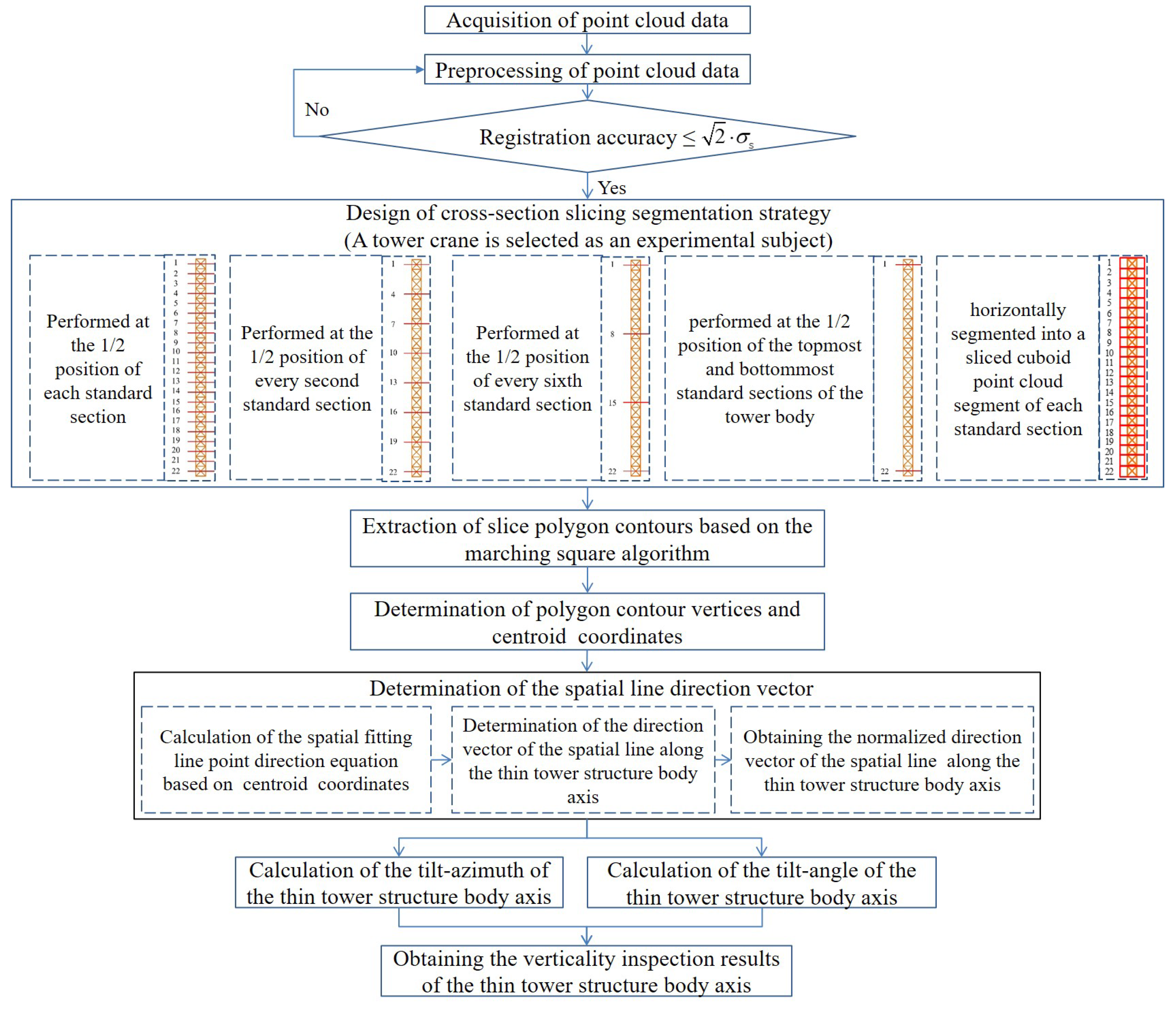
The basic idea of the refined method for inspecting the verticality of thin tower structures using the Marching Square algorithm is as follows: First, raw point cloud data of the thin tower structure are acquired through ground-based laser scanning. Point cloud registration is performed using at least three reliable corresponding points between two stations, followed by denoising and redundancy removal, to obtain high-precision, effective point cloud data. Subsequently, a slicing polygon contour extraction method based on the marching square algorithm is proposed, and the vertex coordinates of the polygon contours and the corresponding centroid coordinates are computed. Furthermore, a 3D straight line is fitted to the centroid coordinates using the least squares method to determine the direction vector of the tower central axis. Finally, in the station-center space coordinate system, vector operations with respect to the x-axis and the z-axis are performed to derive the azimuth of inclination and the inclination angle of the tower central axis, thereby yielding the verticality inspection results of the thin tower structure. The workflow of the refined method for inspecting the verticality of thin tower structures using the Marching Square algorithm is illustrated in Figure 1.

2.1. Acquisition of High-Precision Point Cloud Data

  • Acquisition of raw point cloud data. The ground-based LiDAR measurement equipment is set up at a suitable location facing the thin tower structures to ensure clear visibility and stable positioning. A full circumferential scan is then performed to collect the raw point cloud data.
  • Acquisition of high-precision and valid point cloud data. Point cloud registration is performed using at least three reliable corresponding points between two stations, followed by denoising and redundancy removal, to ensure that the inter-station registration and stitching accuracy meet 2 σ s (where σ s denotes the nominal 3D coordinate measurement accuracy of the terrestrial laser scanner), and to obtain high-precision, valid point cloud data [67] of the thin tower structures in the same station-center space coordinate system.

2.2. Extraction of Slice Polygon Contours and Corresponding Centroid Coordinates

  • Cross-sectional slicing and point cloud projection. In the station-center space coordinate system (O-XYZ), the preprocessed tower body point cloud is horizontally sliced along the z-axis at a predefined height interval to generate slice point cloud datasets. To meet the input requirement of the Marching Square algorithm for a 2D scalar field on a regular grid and to simplify cross-sectional contour extraction, the 3D point cloud within each slice is projected onto the x–y plane. Specifically, for the point cloud belonging to the same slice, the 3D coordinates ( x t , y t , z t ) retain only the planar components ( x t , y t ) , while the height variation along the z-axis is ignored, thereby forming a projected point cloud dataset of the slice on the plane. This planar projection point cloud dataset is defined by Equation (2).
L j = l t = x t , y t
where L j denotes the planar projection point cloud set of the j slice, and l t denotes the t projected planar point within that slice.
2.
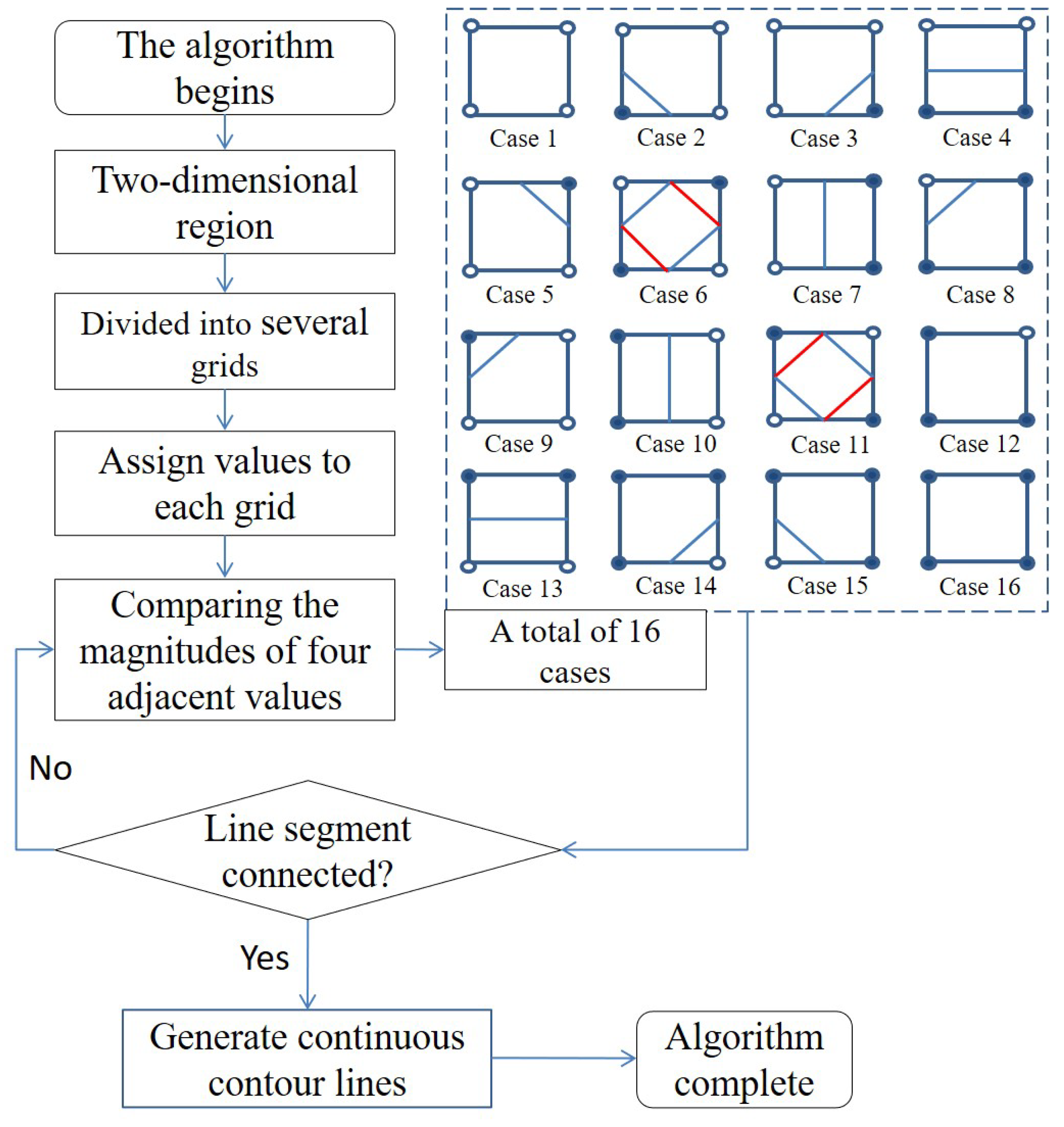
Extraction of slice polygon contours. A slice-polygon-contour extraction method based on the Marching Square algorithm [68,69,70] is proposed for different cross-section slicing segmentation schemes in Figure 2.
First, construct a regular grid and define the resolution. After obtaining the planar projection of the slice point cloud, a 2D regular grid is constructed on the x–y plane using the minimum bounding rectangle of the point cloud as the boundary. The grid cell size (resolution) is determined by jointly considering the point cloud density and the tower body scale. In practice, it is typically set to 1–2 times the mean point spacing within the slice to balance contour extraction accuracy and computational efficiency.
Second, construct a 2D scalar field and define the contour threshold. To meet the input requirements of the Marching Square algorithm for a regular grid scalar field, the projected slice point cloud is transformed into a 2D distance scalar field. The scalar value of each grid node is defined as its Euclidean distance to the nearest point in the cloud. The contour threshold is adaptively set according to the statistical characteristics of the distance scalar field. In practice, it is set as a fraction of the maximum distance field value or a multiple of the mean point spacing within the sliced point cloud. This distinguishes the tower cross-section from non-target regions, ensuring the integrity and closure of the contour lines.
Finally, the Marching Square algorithm generates the contour. The Marching Square algorithm traverses the entire 2D regular grid to process the four vertices of each 2 × 2 cell. It determines the contour intersection points using a lookup table and applies linear interpolation to compute the exact positions of the contour segments. Finally, the contour segments from all grid cells are connected to generate a complete and continuous polygonal contour for each slice.
During practical ground-based LiDAR scanning, limited viewing angles, component self-occlusion, and non-uniform point cloud density may lead to local voids or occluded regions within a cross-sectional slice. To address this, low scalar values are assigned to sparse or missing regions when constructing the 2D scalar field, so that these areas do not contribute to contour generation. Among all closed contours extracted by the Marching Square algorithm, only the outer contour with the largest enclosed area is retained as the valid slice polygon, while secondary closed contours caused by internal voids or occlusions are automatically removed. Since the core of verticality inspection for thin tower structures is the stable extraction of the geometric center of the outer contour, internal voids and occlusions within a slice have a negligible impact on the fitted central axis. Therefore, this approach ensures the reliability of contour extraction.
3.
Area-weighted centroid calculation for polygon contours. Because the vertices on a polygon contour are often non-uniformly distributed, using the arithmetic mean of the vertex coordinates as the centroid may not accurately represent the true center position. Therefore, this study adopts an area-weighted centroid method to compute the centroid of the polygon contour. Specifically, the centroid coordinates are estimated by using the polygon interior area as weights. This method effectively mitigates the influence of non-uniform vertex distribution, making the computed centroid more representative of the overall geometry of the polygon contour. The specific computational steps are as follows:
First, the coordinates of all vertices on the polygon contour are obtained from the contour, as shown in Equation (3).
p i = ( x i , y i )
where p i denotes the coordinate of the i vertex on the polygon contour in the 2D planar coordinate system, i = 1 , 2 , , n , n is the number of vertices on the polygon contour. It is assumed that the polygon contour vertices are ordered sequentially in either clockwise or counterclockwise direction. Since the contour is closed, it is defined that ( x n + 1 , y n + 1 ) = ( x 1 , y 1 ) .
Second, the area of the polygon contour is computed. The signed area of the region enclosed by the polygon contour can be calculated from the vertex coordinates using a cross-product formulation, as shown in Equation (4).
A = 1 2 i = 1 n ( x i y i + 1 x i + 1 y i )
where A denotes the area of the region enclosed by the polygon contour, and x i y i + 1 x i + 1 y i represents the signed area contribution associated with two adjacent vertices p i and p i + 1 , when the vertices are ordered counterclockwise, A > 0; when they are ordered clockwise, A < 0.
Then, the centroid coordinates of the polygon contour are computed using an area-weighted formulation. The geometric centroid of the region enclosed by the polygon contour is defined as the ratio of the first-order area moments to the area. Accordingly, the centroid coordinates can be expressed by Equation (5).
o j = ( x j , y j ) = 1 6 A i = 1 n ( x i + x i + 1 ) ( x i y i + 1 x i + 1 y i ) , 1 6 A i = 1 n ( y i + y i + 1 ) ( x i y i + 1 x i + 1 y i )
where o j = ( x j , y j ) denotes the centroid coordinates of the j polygon contour, with j = 1 , 2 , , m , and m is the total number of polygon contours. The coefficient 1 6 A is a normalization factor used to convert the first-order area moments into centroid coordinates.
Finally, the 2D centroid coordinates are mapped back to 3D space. The z-coordinate of the contour centroid is obtained as the arithmetic mean of the z-coordinates of all vertices on the polygon contour, thereby yielding the 3D coordinates of the polygon contour centroid, as shown in Equation (6).
o j = ( x j , y j , z j ) = 1 6 A i = 1 n ( x i + x i + 1 ) ( x i y i + 1 x i + 1 y i ) , 1 6 A i = 1 n ( y i + y i + 1 ) ( x i y i + 1 x i + 1 y i ) , z ¯
Therefore, m polygon contours yield m centroids, which can be represented as a set in Equation (7).
O = o 1 , o 2 , , o j , , o m
where O denotes the set of centroids of the m polygon contours.

2.3. Determination of the Spatial Line Equation and Direction Vector of the Axis

For the average coordinate set O of the centroids of the polygonal contour lines, a spatial line is fitted using the least squares method [71] to determine its direction vector based on the m centroids in O . The specific algorithm is as follows:
Firstly, the point-direction equation of the spatial line representing the thin tower structure’s central axis is given by Equation (8).
x x 0 p 1 = y y 0 p 2 = z z 0 p 3
where p 1 , p 2 , and p 3 are the three direction vectors of the spatial line representing the thin tower structure’s central axis, and ( x 0 , y 0 , z 0 ) is the coordinate of an arbitrary known point on the spatial line of the thin tower structure’s central axis. An equivalent transformation of Equation (8) yields Equation (9).
x = p 1 p 3 ( z z 0 ) + x 0 = k 1 z + b 1 y = p 2 p 3 ( z z 0 ) + y 0 = k 2 z + b 2
where k 1 = p 1 p 3 , b 1 = x 0 p 1 p 3 z 0 , k 2 = p 2 p 3 , and b 2 = y 0 p 2 p 3 z 0 .
Next, let x j = k 1 z j + b 1 and y j = k 2 z j + b 2 represent the approximated values ( x j , y j ) obtained from Equation (9), and the squared sum of the differences between these approximated values and the measured values ( x j , y j ) is computed, as shown in Equation (10).
Q 1 = j = 1 m ( x j x j ) 2 = j = 1 m ( x j k 1 z j b 1 ) 2 Q 2 = j = 1 m ( y j y j ) 2 = j = 1 m ( y j k 2 z j b 2 ) 2
According to the fitting principle of the least squares method, to minimize the values of Q 1 and Q 2 , the derivatives of k 1 , b 1 , k 2 , and b 2 in Equation (10) are taken and set to zero to obtain their minimum values, as shown in Equation (11).
b 1 m + k 1 j = 1 m z j = j = 1 m x j ,   b 1 j = 1 m z j + k 1 j = 1 m z j 2 = j = 1 m x j z j b 2 m + k 2 j = 1 m z j = j = 1 m y j ,   b 2 j = 1 m z j + k 2 j = 1 m z j 2 = j = 1 m y j z j
The values of k 1 , b 1 , k 2 , and b 2 are obtained from Equation (11), as shown in Equation (12)
k 1 = m j = 1 m x j z j j = 1 m x j j = 1 m z j m j = 1 m z j 2 j = 1 m z j j = 1 m z j ,   b 1 = j = 1 m x j k 1 j = 1 m z j m k 2 = m j = 1 m y j z j j = 1 m y j j = 1 m z j m j = 1 m z j 2 j = 1 m z j j = 1 m z j ,   b 2 = j = 1 m y j k 2 j = 1 m z j m
where ( x j , y j , z j ) is the coordinates of the centroid of the j slicing polygon contours. Finally, for z 0 value, the corresponding x 0 and y 0 are calculated using k 1 , b 1 , k 2 , and b 2 from Equation (12). Similarly, for the p 3 value, the corresponding p 1 and p 2 are determined using k 1 and k 2 from Equation (9). Thus, the point-direction equation of the spatial fitting line is obtained, which determines the direction vector of the spatial line representing the thin tower structure’s central axis, as shown in Equation (13):
M = p 1 , p 2 , p 3
where M is the direction vector of the spatial straight-line axis of the thin tower structures.
The direction vector M from Equation (13) is normalized to obtain the normalized direction vector of the spatial line representing the thin tower structure’s central axis, as shown in Equation (14).
M 0 = p 1 0 , p 2 0 , p 3 0
where M 0 is the normalized direction vector of the spatial straight-line axis of the thin tower structures, with p 1 0 = p 1 / ( p 1 ) 2 + ( p 2 ) 2 + ( p 3 ) 2 , p 2 0 = p 2 / ( p 1 ) 2 + ( p 2 ) 2 + ( p 3 ) 2 , and p 3 0 = p 3 / ( p 1 ) 2 + ( p 2 ) 2 + ( p 3 ) 2 .

2.4. Calculation of the Tilt Posture Parameters of the Axis

  • Calculation of the tilt azimuth of the thin tower structure’s central axis. The unit vector of the x-axis in the station-center space coordinate system is X = 1 , 0 , 0 . Therefore, the tilt azimuth β of the thin tower structure’s central axis is the horizontal angle between vector M 0 and vector X , which is obtained through vector operations, as shown in Equation (15).
β = arc cos X M 0 X M 0
2.
Calculation of the tilt angle of the thin tower structure’s central axis. The unit vector of the z-axis in the station-center space coordinate system is Z = 0 , 0 , 1 . Therefore, the tilt angle φ of the thin tower structure’s central axis is the longitudinal angle between vector M 0 and vector Z , which is obtained through vector operations, as shown in Equation (16).
φ = arc cos Z M 0 Z M 0
3.
Obtaining the verticality inspection results of the thin tower structures. According to the definition of verticality, the verticality value I of the thin tower structures can be obtained from Equation (16), as shown in Equation (17).
I = tan ( φ )

2.5. Materials

The Marching Square algorithm employed in this study is well-suited for thin tower structures with polygonal external cross-sections, particularly demonstrating strong performance in preserving topological continuity and geometric closure of cross-sectional contours. A large tower crane of a Chinese brand at the construction site of a (super) high-rise building in Beijing was selected as the study object. The tower body of a tower crane is composed of multiple standard sections, each featuring a regular quadrilateral cross-section defined by four main nodes. This geometric regularity not only facilitates the slicing and contour reconstruction of cross-sectional point clouds but also provides ideal input data for subsequent central axis fitting and verticality computation. This study validates the proposed method using a tower crane with a quadrilateral cross-section as an example; in principle, the proposed algorithm is also applicable to structures with triangular cross-sections (e.g., the Linglong Tower from the Beijing Olympics) or other polygonal cross-sections (e.g., traditional pagoda structures), indicating good potential for extension.
In addition, during lifting operations, tower cranes are frequently subjected to complex working conditions, such as lifting loads, wind loads, and rotational torques. These factors can induce structural tilting and node displacement, leading to changes in geometric posture. The verticality status of the tower body is directly related to construction safety and equipment stability. Therefore, selecting the tower crane body as the experimental object and data source for this study not only ensures well-defined geometric features but also provides a representative scenario to validate the effectiveness and engineering applicability of the proposed verticality inspection method.

3. Experiment

3.1. Experimental Design

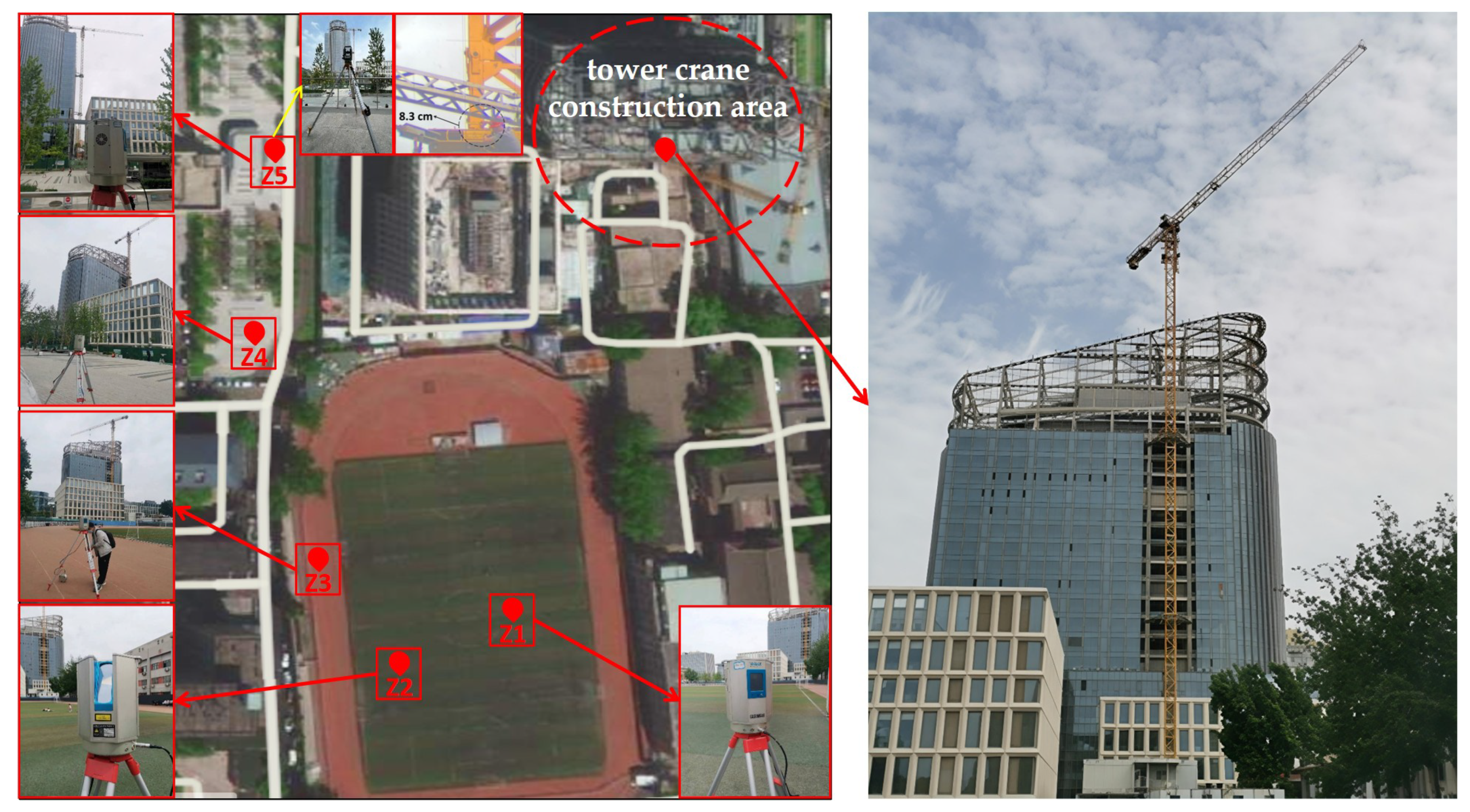
To verify and analyze the correctness and feasibility of the refined method for inspecting the verticality of thin tower structures, this study followed the principles and implementation steps of the method and developed a corresponding data processing module using MATLAB R2024b. Field tests were conducted on a tower crane at a high-rise building construction site. Specifically, terrestrial laser scanning was used to acquire point cloud data (Figure 3), and the tower body verticality was inspected by traditional scale-based theodolite. The locations of the instrument stations at the test site are shown in Figure 4. An HS1200 3D laser scanner manufactured by a Chinese companywith a ranging accuracy of 5 mm, vertical and horizontal angle resolutions of 0.001°) was used to set up stations at five suitable locations around 200 to 350 m from the tower crane, where a clear line of sight to the tower body was available. An automatic leveling device built into the HS1200 3D laser scanner ensured precise leveling of the instrument at each station (with the instrument’s Z-axis aligned to the plumb line direction). At each station, the HS1200 was set to perform complete circumferential scanning to acquire the raw point cloud data. The upper right corner of Figure 4 shows the location of the tower crane, which is in an unloaded state; Z1 to Z5 show the scanning site of five stations. The tower body verticality was measured using the traditional theodolite inspection method with a DJ6 theodolite after performing precise leveling at Z5 (with the instrument’s Z-axis aligned to the plumb line direction). The average value from multiple measurements at a height of 27.50 m on the scale was 8.3 cm. The standard section height of the tower body was 1.25 m, and the total number of standard sections was 22. Therefore, the tilt angle obtained using the traditional theodolite inspection method was 0°10′22″, corresponding to a tower body verticality value of 3.02‰.

3.2. LiDAR-Based Point Cloud Data Preprocessing

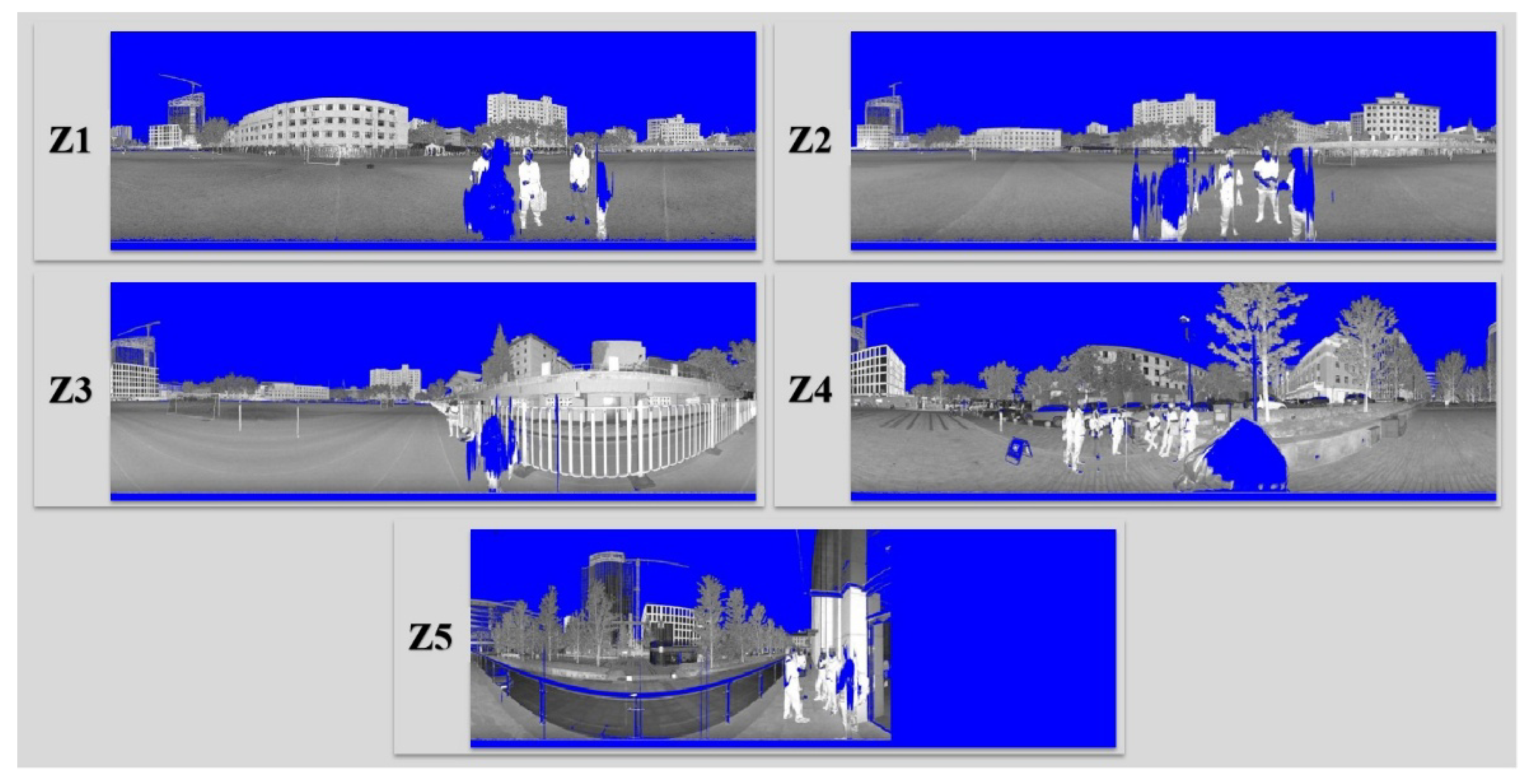
LiDAR point cloud data were collected for a tower crane through five stations. The raw point cloud data obtained from each station are shown in Figure 5.
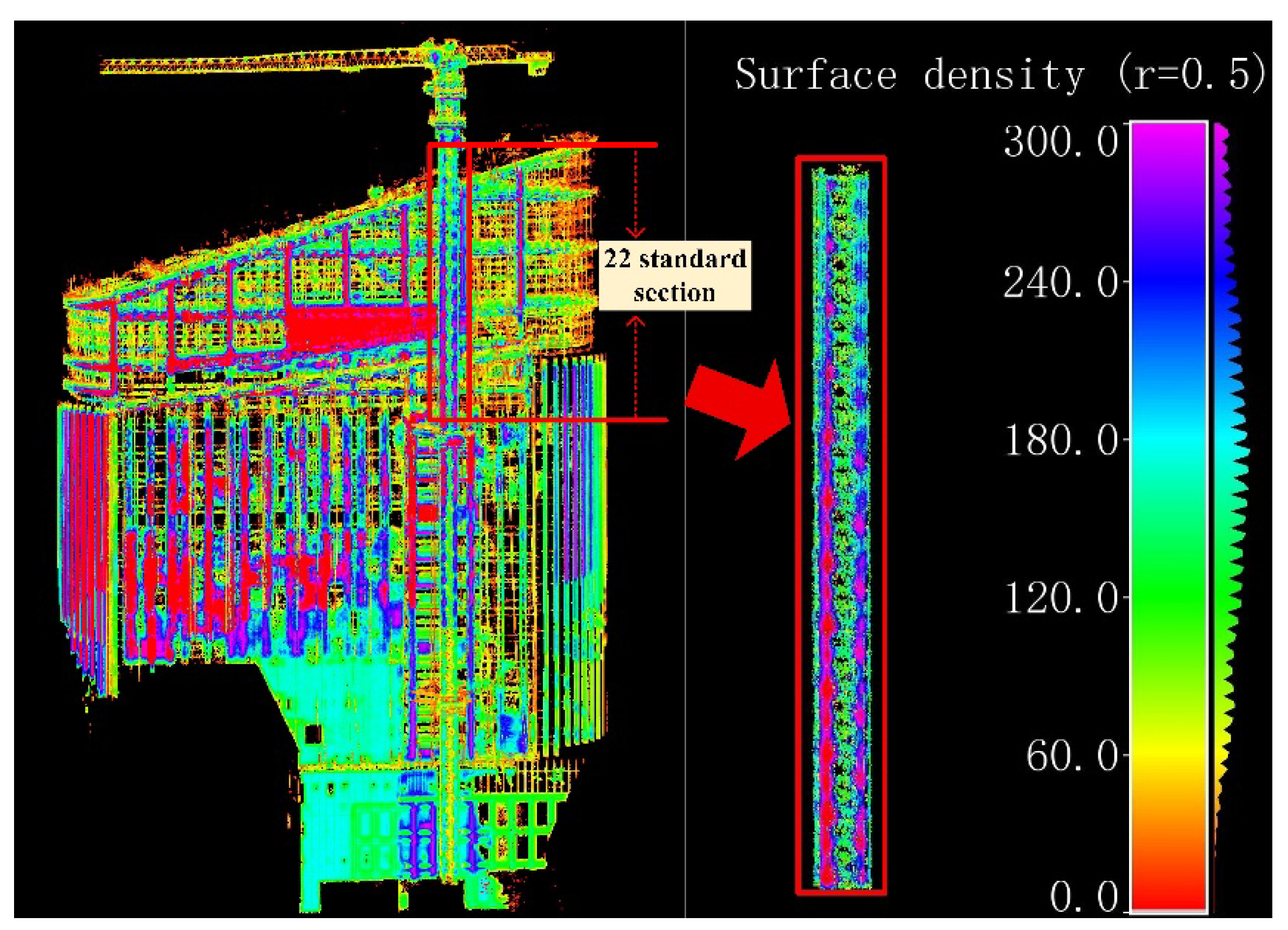
As shown in Figure 5, the original point cloud data from five scanning stations were processed using the supporting software for the HS1200 3D laser scanner (HD TLS Scene) for registration and denoising, and then exported in LAS format. During the registration process, three stable natural feature points were selected as corresponding points to achieve unified coordinate alignment across multiple stations. Given that the nominal 3D coordinate measurement accuracy of the HS1200 within a range of 200–350 m is approximately 1.5–2.7 cm, this study considers the registration quality to be satisfactory when the point cloud registration accuracy meets 2 σ s (i.e., 2.12–3.82 cm). Finally, the valid point cloud data of the tower crane body under the station-center space coordinate system (O-XYZ) were obtained, as shown in Figure 6.
As shown in Figure 6, prior to preprocessing, the tower crane point cloud still contained environmental noise, such as the jib and surrounding buildings. Subsequently, the high-precision point cloud data stored in LAS format were imported into CloudCompare v 2.13.2 (EDF R&D, France, Île-de-France region) for point cloud segmentation, and the valid tower body point cloud was extracted. Finally, the valid tower body point cloud comprising 22 standard sections was obtained.

3.3. Cross-Section Slicing Segmentation Strategy Design

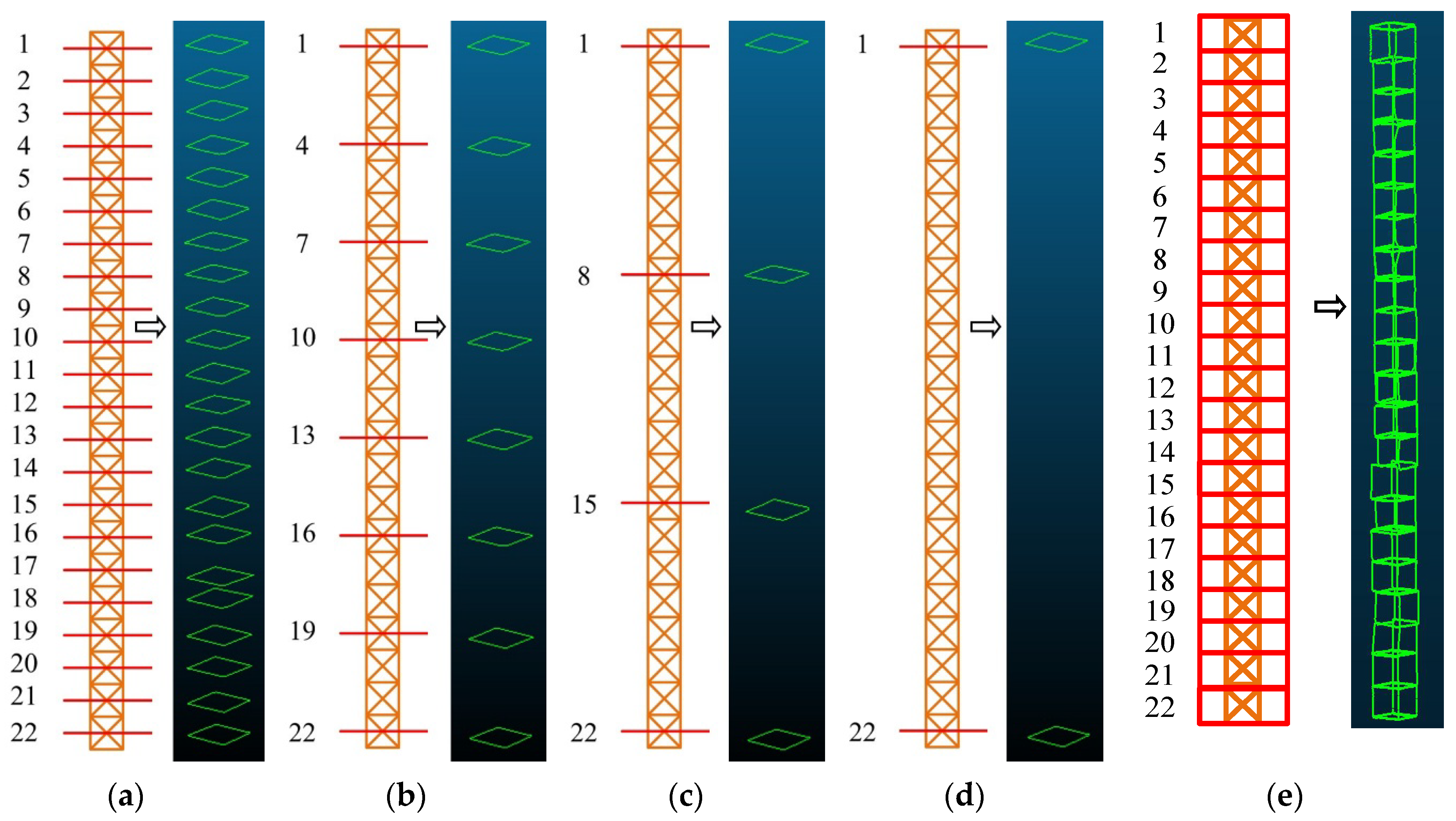
To comparatively analyze the impact of different cross-sectional slicing schemes on the verticality inspection results of the tower body, this study designed five schemes in CloudCompare v 2.13.2 according to the number of standard sections in the tower body.
  • Scheme A: The cross-section slicing is performed at the 1/2 position of each standard section, obtaining cross-section slices at the 1/2 position of standard sections 1 to 22. The centroid coordinates of the corresponding slice polygon contours are extracted and used to fit the spatial line of the central axis, and its direction vector is then calculated.
  • Scheme B: The cross-section slicing is performed at the 1/2 position of every second standard section, obtaining cross-section slices at the 1/2 positions of standard sections 1, 4, 7, 10, 13, 16, 19, and 22. The centroid coordinates of the corresponding slice polygon contours are extracted and used to fit the spatial line of the central axis, and its direction vector is then calculated.
  • Scheme C: The cross-section slicing is performed at the 1/2 position of every sixth standard section, obtaining cross-section slices at the 1/2 positions of standard sections 1, 8, 15, and 22. The centroid coordinates of the corresponding slice polygon contours are extracted and used to fit the spatial line of the central axis, and its direction vector is then calculated.
  • Scheme D: The cross-section slicing is performed at the 1/2 position of the topmost and bottommost standard sections of the tower body, obtaining cross-section slices at the 1/2 positions of standard sections 1 and 22. The centroid coordinates of the corresponding slice polygon contours are extracted and used to directly calculate the direction vector of the spatial line of the central axis.
  • Scheme E: Using the method reported in reference [66], each standard section is horizontally segmented into a sliced cuboid point cloud segment, obtaining 22 cuboid segments of sections 1 to 22. The centroid coordinates of the corresponding cuboid point cloud contours are extracted and used to fit the spatial line of the central axis, and its direction vector is then calculated.
The five cross-section slicing segmentation schemes and their corresponding results are shown in Figure 7.
Scheme A, shown in Figure 7a, consists of cross-section slices at the 1/2 position of standard sections 1 to 22, resulting in 22 cross-section slices. A total of 22 slice polygon contours are extracted, and 22 centroids are determined. Scheme B, shown in Figure 7b, consists of cross-section slices at the 1/2 positions of standard sections 1, 4, 7, 10, 13, 16, 19, and 22, resulting in 8 cross-section slices. A total of 8 slice polygon contours are extracted, and 8 centroids are determined. Scheme C, shown in Figure 7c, consists of cross-section slices at the 1/2 positions of standard sections 1, 8, 15, and 22, resulting in 4 cross-section slices. A total of 4 slice polygon contours are extracted, and 4 centroids are determined. Scheme D, shown in Figure 7d, consists of cross-section slices at the 1/2 positions of standard sections 1 and 22, resulting in 2 cross-section slices. A total of 2 slice polygon contours are extracted, and 2 centroids are determined. Scheme E, shown in Figure 7e, involves the cube point clouds of standard sections 1 to 22, from which 22 cube point cloud contours are extracted, and 22 centroids are determined.

4. Results

4.1. Verticality Results

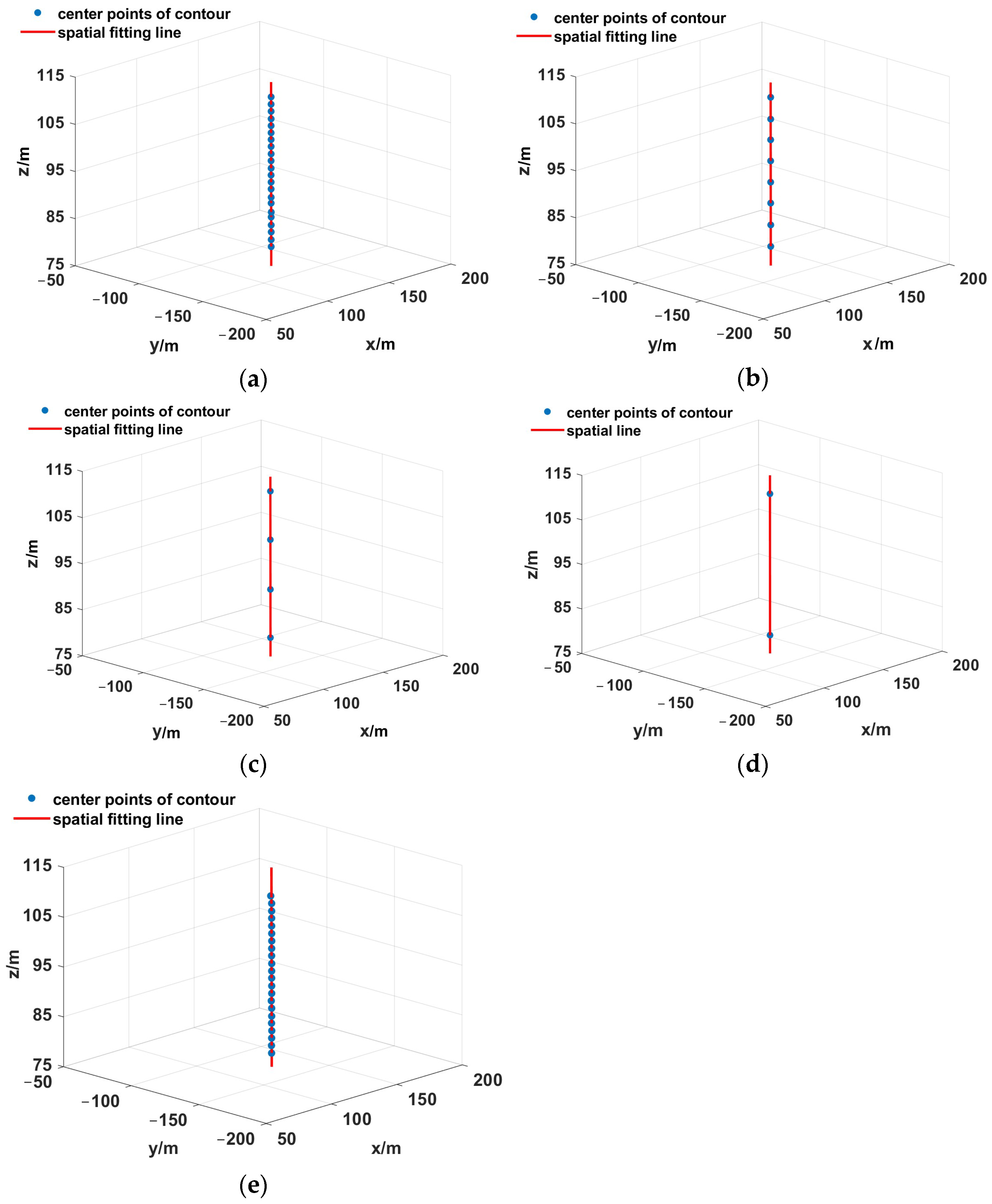
The vertices of each polygonal contour in Schemes A–D were computed via ten repeated samplings to obtain the averaged centroid coordinates. A spatial line was then fitted using the least squares method to derive the tower body central axis for each scheme. Using the method in reference [66], the averaged centroid coordinates of the cube point cloud contour were calculated, and a spatial line was fitted using the least squares method to obtain the tower body central axis for the corresponding scheme. The tower body central axes derived from the five schemes are shown in Figure 8.
The spatial lines of the central axis corresponding to the five schemes are used to determine their direction vectors, as shown in Figure 8. These vectors are then subjected to vector operations with the x-axis and z-axis in the station-center space coordinate system to obtain the tilt azimuth, tilt angle, and verticality values of the central axis. The verticality inspection results for the five schemes are shown in Table 1.
As shown in Table 1, Scheme A, using the proposed method, results in 22 cross-section slices, 22 polygon contours, 22 corresponding centroids, and the tower body verticality is 2.45‰ with a tilt angle of 0°08′25″ and a tilt azimuth of 89°55′05″. Scheme B, using the proposed method, results in 8 cross-section slices, 8 polygon contours, 8 corresponding centroids, and the tower body verticality is 2.35‰ with a tilt angle of 0°08′05″ and a tilt azimuth of 89°54′33″. Scheme C, using the proposed method, results in 4 cross-section slices, 4 polygon contours, 4 corresponding centroids, and the tower body verticality is 2.20‰ with a tilt angle of 0°07′33″ and a tilt azimuth of 89°56′13″. Scheme D, using the proposed method, results in 2 cross-section slices, 2 polygon contours, 2 corresponding centroids, and the tower body verticality is 2.18‰ with a tilt angle of 0°07′30″ and a tilt azimuth of 89°55′50″. Scheme E, using the method in reference [66], results in 22 transversely segmented cube point clouds, 22 cube point cloud contours, 22 corresponding centroids, and the tower body verticality is 2.51‰ with a tilt angle of 0°07′38″and tilt azimuth angle of 90°04′13″. This indicates that the workload of Scheme A is 2.75 times that of Scheme B, 5.5 times that of Scheme C, and 11 times that of Scheme D. The workload of Scheme B is two times that of Scheme C and four times that of Scheme D. The workload of Scheme C is two times that of Scheme D.

4.2. Accuracy Analysis of Verticality Results

The five cross-section slicing segmentation schemes designed in this study achieved satisfactory verticality inspection results for the tower body. To further evaluate and compare the accuracy of the verticality inspection results of different schemes, the verticality result of Scheme E was taken as the reference value. Relative error metrics were used to analyze the verticality accuracy for each scheme, with the corresponding analysis results shown in Table 2. The calculation formula for the relative error metric is given in Equation (18).
R = X X ˜ X ˜ × 100 %
where R is the relative error, X is the measurement value, and X ˜ is the reference value.
As shown in Table 2, the proposed method yields a mean tilt azimuth of 89°55′25″ (with a relative error of 0.17%), a mean tilt angle of 0°07′53″ (with a relative error of 4.75%), and a mean verticality value of 2.30‰ (with a relative error of 8.57%) across the four schemes. This indicates that the verticality results obtained using the proposed method are close to those from the method in [66], with small differences. This supports the feasibility of the proposed approach. However, relative errors of 0.17% in tilt azimuth, 4.75% in tilt angle, and 8.57% in verticality still exist between the two methods. This discrepancy is mainly attributed to the different sensitivities of contour extraction strategies to point cloud data quality and completeness. The Marching Cubes algorithm, used for extracting the cuboidal contours of standard sections, requires high-quality and uniformly distributed point cloud data on all sides of the structure. When the data quality is insufficient or occlusions are present, the method is more susceptible to errors. In contrast, the Marching Square algorithm employed in this study only targets the cross-sectional slices of the standard sections. As long as the quality of the cross-sectional point cloud is maintained, the contour reconstruction can be effectively performed, making this method less demanding on the overall data completeness and more robust to local data imperfections. The verticality value of 2.30‰ obtained using the proposed method satisfies the technical requirement of not exceeding 4‰, as specified in the national standard GB/T 5031-2019 (Tower Cranes) [72]. This indicates that the measured verticality of the experimental tower crane meets the current construction safety inspection standards, reflecting good structural stability and operational safety.

5. Discussions

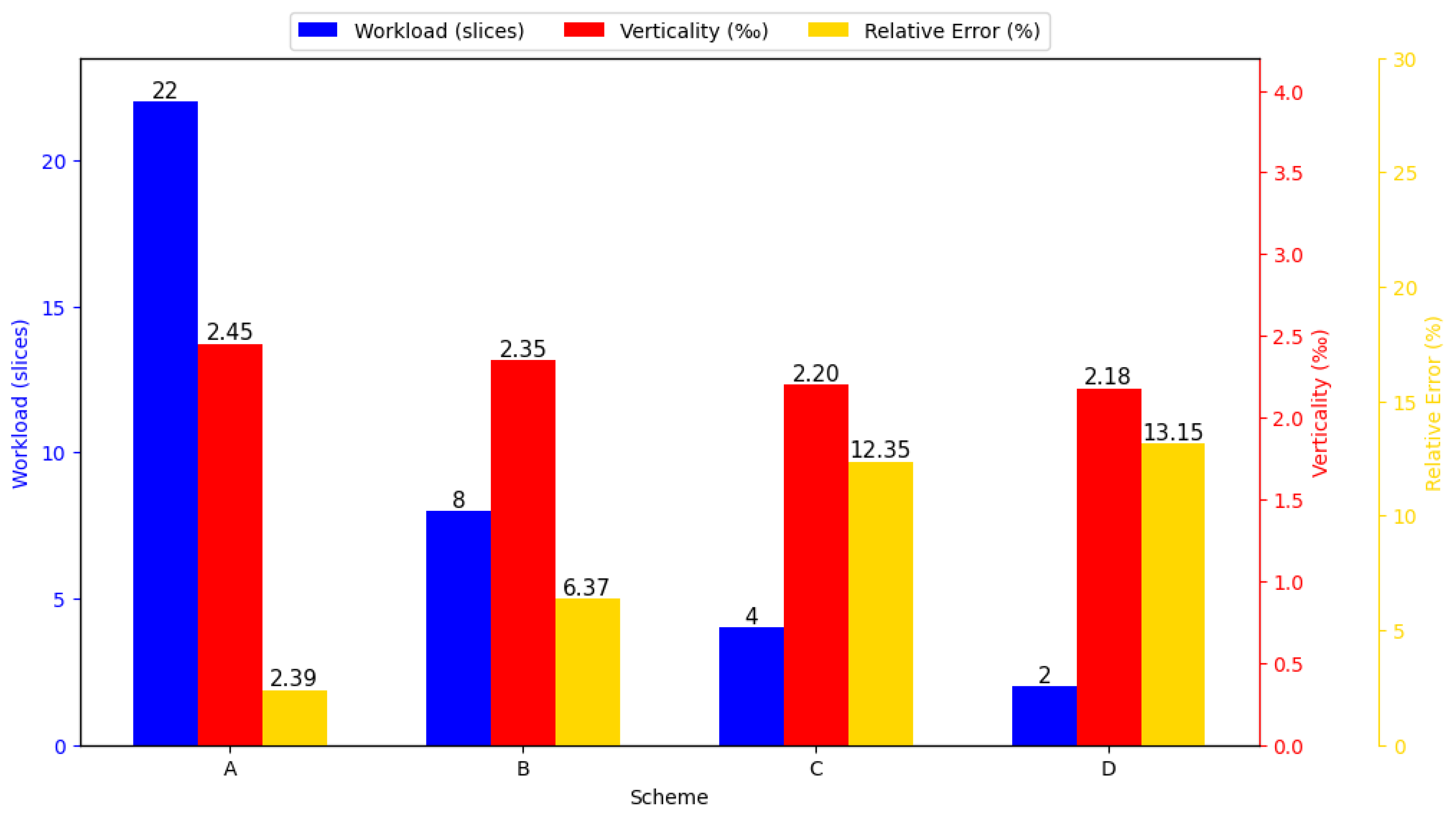
As shown in Figure 9, in the tower body verticality inspection, the results obtained with different numbers of sampling repetitions exhibit a clear accuracy trend. In terms of accuracy comparison, under the experimental conditions in this study, as the number of slices decreases, the relative error between the estimated and reference values gradually increases. The relative errors of Schemes A, B, C, and D are 2.39%, 6.37%, 12.35%, and 13.15%, respectively, indicating that the number of redundant observations can affect measurement accuracy. Scheme A is closest to the reference value. This is mainly because Scheme A uses the largest number of cross-sectional slices and thus yields the most cross-sectional centroid points, providing higher observational redundancy for the least squares spatial line fitting. As a result, the axis estimation becomes more stable and more resistant to random errors. In contrast, schemes with fewer slices (especially Scheme D, which uses only the centroid points at the top and bottom ends) provide insufficient redundancy. As a result, they are more sensitive to estimation errors in individual cross-sectional centroids and show larger deviations from the reference value. Based on the above analysis, under the experimental conditions of this study, Scheme A is considered to yield the most accurate results.
It is worth noting that, among the four cross-section slicing segmentation schemes, the advantage of Scheme A is that it uses all available data, resulting in the largest set of observations. Accordingly, it provides the greatest redundancy in observations. It is closest to Scheme E (relative error: 2.39%) and offers the highest reliability. However, it also requires the largest workload, resulting in the lowest efficiency. Compared with Scheme A, Scheme B reduces the workload by 2.75 times. However, it also reduces the number of redundant observations, which in turn decreases reliability. Accordingly, its closeness with Scheme E decreases (relative error: 6.37%). Based on Scheme B, Schemes C and D further reduce the workload by approximately 2 times and 4 times, respectively. This comes at the expense of a substantial reduction in redundancy, which further decreases reliability and increases the deviation from Scheme E (relative errors: 12.35% and 13.15%, respectively).
Although Schemes A–D differ by several-fold in overall workload, most of the workload is concentrated in extracting the contour-vertex coordinates. This step still relies heavily on manual operations at present, leaving limited room for efficiency improvement. Therefore, for practical engineering applications, the recommended segmentation principle is as follows: when workload is not a concern, extracting verticality from the full dataset offers the highest reliability; when workload needs to be reduced, a down-sampling strategy can be adopted, i.e., extracting contour geometric features and fitting verticality at intervals of one to three standard sections, which can still maintain good reliability and accuracy.
The experiments in this study were conducted using data from a single tower crane, and the standard section of the investigated structure has a quadrilateral cross-section. Due to the limited sample size and the use of a single structural configuration, this study primarily reflects the feasibility of the proposed method for this type of thin tower structure under the current measurement conditions. Claims regarding its general applicability to all thin tower structures warrant further validation. Nevertheless, the proposed workflow is built upon a general framework of slice projection, contour reconstruction, and axis fitting; in principle, it could be extended to thin tower structures with regular or approximately polygonal cross-sections. However, such an extension still needs to be examined through experiments on multiple structure types, different cross-sectional shapes, and datasets collected under diverse operating conditions.

6. Conclusions and Outlook

This study proposes a refined method for inspecting the verticality of thin tower structures using the Marching Square algorithm. The main conclusions are as follows:
  • The proposed refined method for verticality inspection of thin tower structures using the Marching Square algorithm enables high-precision modeling of the spatial morphology of the main axis. It also enables accurate extraction of 3D verticality. This method establishes a generalized technical framework for verticality computation through point cloud slicing, contour reconstruction, and axis fitting, providing a universal approach for extracting geometric posture parameters of complex thin tower structures. By applying the Marching Square algorithm to extract cross-sectional contours with topological continuity and geometric closure, the method ensures the completeness and repeatability of the reconstructed contours. It also enhances the stability of verticality calculations under noise interference and improves adaptability in real engineering scenarios, thereby offering reliable support for non-contact safety inspection of thin tower structures.
  • The proposed method was validated through a field experiment conducted at a construction site involving a tower crane. Four cross-sectional slicing strategies for point cloud data were designed, and the corresponding verticality values of the tower crane were measured as 2.18‰, 1.75‰, 1.69‰, and 1.44‰, respectively. These results are close to the reference value of 2.51‰ obtained using the method in [66], and all values comply with the verticality requirement of no more than 4‰ specified in the GB/T 5031-2019 (Tower Cranes). This demonstrates that the verticality of the tested tower crane satisfies current construction safety inspection standards, indicating good structural stability and operational safety.
  • For practical engineering applications of the proposed algorithm, the recommended segmentation strategy can be summarized as follows: if computational workload is not a primary concern, using the full point cloud dataset to extract verticality provides the highest reliability. If the workload needs to be reduced, a “thinning” strategy can be adopted, i.e., extracting contour-based geometric features and fitting verticality at intervals of one to three standard sections. This approach can still maintain satisfactory reliability and accuracy.
  • The verticality inspection method proposed in this study was validated using a standard tower body structure, demonstrating its effectiveness and feasibility in extracting the structural axis and characterizing verticality.
Future work will be organized around three main directions: engineering applicability validation, system-level integration, and algorithmic robustness enhancement. First, the proposed method will be extended to a broader range of real-world engineering scenarios, and comparative validations will be conducted under different structural configurations and loading conditions to systematically evaluate its generality and robustness. Second, the application focus will evolve from “method verification” toward “system implementation” by integrating high-precision BeiDou positioning and 5G high-speed communication to develop a continuous, non-contact online verticality monitoring system capable of dynamic state perception and real-time early warning. Third, at the data-processing and algorithm levels, we will improve both accuracy and automation in key steps. Contour reconstruction and axis modeling will be strengthened by coupling RANSAC fitting with filtering optimization to improve noise robustness and stabilize principal-axis fitting. In addition, joint modeling of lateral and circumferential verticality will be investigated to quantify how different verticality definitions affect detection accuracy and to establish a unified evaluation framework for multi-scenario, multi-scale monitoring. Finally, to further improve practicality and scalability, we will promote end-to-end automation of contour extraction and center estimation and reduce efficiency gaps among different slicing strategies. We will also perform point-density sensitivity analyses (e.g., the influence of graded down-sampling on verticality indices) to enhance applicability and reliability across varying point-cloud densities.

Author Contributions

Conceptualization, M.Z. and G.W.; methodology, M.Z., G.W. and P.Y.; software, G.W., Z.Z. and L.Q.; formal analysis, Y.Q., Q.S. and S.L. (Shiqi Lin); data curation, Y.Q., Q.S. and S.L. (Shiqi Lin); writing—original draft preparation, G.W., S.L. (Shufa Li)and L.Q.; writing—review and editing, M.Z., G.W. and P.Y.; visualization, M.Z., G.W., Z.Z. and S.L. (Shufa Li); supervision, project administration, and funding acquisition, M.Z. All authors have read and agreed to the published version of the manuscript.

Funding

This research was funded by the Supply-Demand Matching Employment and Education Program of the Ministry of Education of the People’s Republic of China, grant number [2023122666177]; and the 2023 Beijing Higher Education Undergraduate Teaching Reform and Innovation Project, grant number [202310016001]; and the 2024 Key Educational Science Research Project of Beijing University of Civil Engineering and Architecture, grant number [Y2402].

Data Availability Statement

The data presented in this study are available in the article. Further inquiries can be directed to the corresponding author.

Conflicts of Interest

The authors declare no conflicts of interest.

References

  1. Antunes, P.; Travanca, R.; Varum, H.; André, P. Dynamic Monitoring and Numerical Modelling of Communication Towers with FBG Based Accelerometers. J. Constr. Steel Res. 2012, 74, 58–62. [Google Scholar] [CrossRef]
  2. Bel-Hadj, Y.; Weil, M.; Weijtjens, W.; Devriendt, C. Experimental Validation of Automated OMA and Mode Tracking for Structural Health Monitoring of Transmission Towers. Struct. Health Monit. 2025, 24, 1272–1291. [Google Scholar] [CrossRef]
  3. Xiao, Q.; Wang, H.; Liu, Z.; Zhang, X.; Ma, B.; Lin, C.; Liu, C.; Nie, J.; Li, X.; Huang, Y. Intelligent Control and Monitoring of AI-Driven Landing Double Rocker Arm Holding Systems in Mountainous Power Grid Construction. In Proceedings of the 2025 8th International Conference on Computer Information Science and Artificial Intelligence, Wuhan, China, 12 September 2025; ACM: New York, NY, USA; pp. 875–881. [Google Scholar]
  4. Lu, B.; Yang, Z.; Ding, M.; Ma, J.; Sun, D.; Li, W.; Zhao, X. Vision-Based Transmission Tower Strain Monitoring Using Industrial Camera Module and Slider Strain Sensing Mechanism. J. Civ. Struct. Health Monit. 2025, 15, 2419–2432. [Google Scholar] [CrossRef]
  5. Wang, Z.; Zhang, T. Discussion and Research on Tilt Prevention and Control Techniques for Transmission Line Steel Towers in Mined-Out Areas. Electron. World 2014, 17, 94–95. [Google Scholar]
  6. Wang, G.; Wei, Y.; Cao, B.; Zheng, C. Research on tower of power grid monitoring based on Beidou satellite. Energy Environ. Prot. 2017, 39, 102–106. [Google Scholar]
  7. Syazwin, A.; Ramli, L.; Lazim, I.M. A Review of Anti-Swing Control for Cranes. Semarak Proc. Appl. Sci. Eng. Technol. 2025, 1, 121–125. [Google Scholar] [CrossRef]
  8. Muddassir, M.; Zayed, T.; Ali, A.H.; Elrifaee, M.; Abdulai, S.F.; Yang, T.; Eldemiry, A. Automation in Tower Cranes over the Past Two Decades (2003–2024). Autom. Constr. 2025, 170, 105889. [Google Scholar] [CrossRef]
  9. Jiang, W.; Ding, L.; Zhou, C. Digital Twin: Stability Analysis for Tower Crane Hoisting Safety with a Scale Model. Autom. Constr. 2022, 138, 104257. [Google Scholar] [CrossRef]
  10. Zhang, Z.; Pan, W. Lift Planning and Optimization in Construction: A Thirty-Year Review. Autom. Constr. 2020, 118, 103271. [Google Scholar] [CrossRef]
  11. Ali, A.H.; Zayed, T.; Wang, R.D.; Kit, M.Y.S. Tower Crane Safety Technologies: A Synthesis of Academic Research and Industry Insights. Autom. Constr. 2024, 163, 105429. [Google Scholar] [CrossRef]
  12. Ni, Y.; Zhou, H. Guangzhou New TV Tower: Integrated Structural Health Monitoring and Vibration Control. In Proceedings of the Structures Congress 2010, Orlando, FL, USA, 18 May 2010; American Society of Civil Engineers: Reston, VA, USA; pp. 3155–3164. [Google Scholar]
  13. D’Amato, M.; Sulla, R. Investigations of Masonry Churches Seismic Performance with Numerical Models: Application to a Case Study. Arch. Civ. Mech. Eng. 2021, 21, 161. [Google Scholar] [CrossRef]
  14. Formisano, A.; Marzo, A. Simplified and Refined Methods for Seismic Vulnerability Assessment and Retrofitting of an Italian Cultural Heritage Masonry Building. Comput. Struct. 2017, 180, 13–26. [Google Scholar] [CrossRef]
  15. Artese, S.; Nico, G. TLS and GB-RAR Measurements of Vibration Frequencies and Oscillation Amplitudes of Tall Structures: An Application to Wind Towers. Appl. Sci. 2020, 10, 2237. [Google Scholar] [CrossRef]
  16. Guo, L.; Xie, Y.; Yu, Q.; You, Y.; Wang, X.; Li, X. Displacements of Tower Foundations in Permafrost Regions along the Qinghai–Tibet Power Transmission Line. Cold Reg. Sci. Technol. 2016, 121, 187–195. [Google Scholar] [CrossRef]
  17. Ren, R. Research on Damage Identification of Transmission Tower Structures Based on Support Vector Machine. Master’s Thesis, Northeast Electric Power University, Jilin, China, 2025. [Google Scholar]
  18. Hussein, M.; Zayed, T. Crane Operations and Planning in Modular Integrated Construction: Mixed Review of Literature. Autom. Constr. 2021, 122, 103466. [Google Scholar] [CrossRef]
  19. Chen, Y.; Zeng, Q.; Zheng, X.; Shao, B.; Jin, L. Safety Supervision of Tower Crane Operation on Construction Sites: An Evolutionary Game Analysis. Saf. Sci. 2022, 152, 105578. [Google Scholar] [CrossRef]
  20. Fu, Y.; Bu, J.; Lin, J.; Liu, J.; Zhang, C. Selection and Layout Optimization of Double Tower Cranes. Buildings 2024, 14, 1705. [Google Scholar] [CrossRef]
  21. Zhu, A.; Zhang, Z.; Pan, W. Technologies, Levels and Directions of Crane-Lift Automation in Construction. Autom. Constr. 2023, 153, 104960. [Google Scholar] [CrossRef]
  22. Dutta, S.; Cai, Y.; Huang, L.; Zheng, J. Automatic Re-Planning of Lifting Paths for Robotized Tower Cranes in Dynamic BIM Environments. Autom. Constr. 2020, 110, 102998. [Google Scholar] [CrossRef]
  23. Lu, Y.; Gao, M.; Liang, T.; He, Z.; Feng, F.; Pan, F. Wind-Induced Vibration Assessment of Tower Cranes Attached to High-Rise Buildings under Construction. Autom. Constr. 2022, 135, 104132. [Google Scholar] [CrossRef]
  24. Spirina, A.; Mironov, A.; Datkhuzheva, R.; Maksimov, A.; Belova, N. Analysis of Occupational Injuries in Construction and Offer of a Technical Solution Increasing Tower Crane Stability. Transp. Res. Procedia 2023, 68, 559–565. [Google Scholar] [CrossRef]
  25. Kim, S.-K.; Kim, J.-Y.; Lee, D.-H.; Ryu, S.-Y. Automatic Optimal Design Algorithm for the Foundation of Tower Cranes. Autom. Constr. 2011, 20, 56–65. [Google Scholar] [CrossRef]
  26. Hu, S.; Fang, Y.; Bai, Y. Automation and Optimization in Crane Lift Planning: A Critical Review. Adv. Eng. Inform. 2021, 49, 101346. [Google Scholar] [CrossRef]
  27. Yin, J.; Wang, H.; Li, J.; Zhang, Z.; Cai, S.; Liu, W. Dispatching Rule Design for Tower Crane Scheduling in Prefabricated Construction via Genetic Programming. Autom. Constr. 2024, 165, 105588. [Google Scholar] [CrossRef]
  28. Cao, Y.; Li, T. Review of Antiswing Control of Shipboard Cranes. IEEE/CAA J. Autom. Sin. 2020, 7, 346–354. [Google Scholar] [CrossRef]
  29. Pan, Z.; Cheng, X.; Cheng, O.; Wang, T.; Ou, Y.; Zou, J.; Wang, C. Digital Topographic Surveying, 2nd ed.; Wuhan University Press: Wuhan, China, 2015. [Google Scholar]
  30. Zhang, Z. Engineering Surveying, 2nd ed.; Wuhan University Press: Wuhan, China, 2013. [Google Scholar]
  31. Zhou, M.; Luo, D.; Ding, K.; Zhou, L.; Wang, J. GNSS accurate positioning-point and setting-out of hoisting operation for construction tower crane. Bull. Surv. Mapp. 2019, 11, 60–63. [Google Scholar]
  32. Song, J.; Song, H.; Jiang, Y.; Hou, L. Measurement on the Inclination of Power Pole and Tower Erected on Special Landform. Power Syst. Technol. 2010, 34, 219–222. [Google Scholar]
  33. Huang, X.; Liao, M.; Xu, G.; Zhu, Y.; Zhao, L. Stress monitoring method applying FBG sensor for transmission line towers. Electr. Power Autom. Equip. 2016, 36, 68–72. [Google Scholar]
  34. Song, H. Measurement of Gradient of Pole Tower with Flat Mirror Method. Anhui Archit. 2008, 15, 196–197. [Google Scholar]
  35. Zhou, M.; Bao, H.; Zhang, W.; Ma, B. GNSS-based lateral perpendicularity intelligent detection for construction tower crane. J. Build. Eng. 2021, 42, 26–31. [Google Scholar]
  36. Zhou, M.; Ma, B.; Bao, H.; Shi, W.; Luo, D. GNSS—Based Verticality Intelligent Detection in Rounds for Construction Tower Crane. J. Build. Eng. 2020, 35, 223–230. [Google Scholar]
  37. Liu, F. Research on the Application of Drilling Verticality Monitoring Instrument Based on Laser Plumb Bob and Inclinometer in Transmission Tower Foundation Construction. Instrum. Meter Users 2025, 32, 127–129. [Google Scholar]
  38. Wang, D.; Ma, Y.; Zhou, C.; Pan, H. Research on Monitoring and Early Warning Method of Transmission Line Tower Inclination Based on Sensor Data. In Proceedings of the 2021 8th International Forum on Electrical Engineering and Automation (IFEEA), Xi’an, China, 3–5 September 2021; IEEE: New York, NY, USA; pp. 317–321. [Google Scholar]
  39. Zhang, G.; Liu, M.; Cheng, S.; Wang, M.; Zhao, C.; Zhao, H.; Zhong, G. Research on Transmission Line Tower Tilting and Foundation State Monitoring Technology Based on Multi-Sensor Cooperative Detection and Correction. Energy Eng. 2024, 121, 169–185. [Google Scholar] [CrossRef]
  40. Ngabo, C.I.; El Beqqali, O. 3D Tilt Sensing by Using Accelerometer-Based Wireless Sensor Networks: Real Case Study: Application in the Smart Cities. In Proceedings of the 2018 International Conference on Intelligent Systems and Computer Vision (ISCV), Fez, Morocco, 2–4 April 2018; IEEE: New York, NY, USA; pp. 1–8. [Google Scholar]
  41. Gao, M.; Zhao, Z.; Li, Y.; Xu, X.; Li, C.; Zhang, J. Monitoring and research on tilt of transmission line tower based on optical fiber sensing. J. Electron. Meas. Instrum. 2018, 32, 51–59. [Google Scholar]
  42. Gemayel, A.; Irvandy, D.; Kusmiyanto, A.; Prabowo, L.; Muslim, J.; Yudhistira, P.A. Verticality Online Monitoring (VENOM): An Advance Method for Transmission Tower Tilt Assessment Based on Arduino. In Proceedings of the 2024 10th International Conference on Automation, Robotics and Applications (ICARA), Athens, Greece, 22 February 2024; IEEE: New York, NY, USA; pp. 365–369. [Google Scholar]
  43. Li, W.; Jiawei, Z.; Hongsen, W.; Dapeng, J. Deformation monitoring of ancient towers based on 3D laser scanning technology. Bull. Surv. Mapp. 2020, 7, 120–124+129. [Google Scholar]
  44. Yang, Y.; Yang, C.; Pang, D.; Zhu, H.; Ma, T.; Zhao, Y.; Wang, S. Deformation monitoring of Wanshou temple tower based on 3D laser scanning. Bull. Surv. Mapp. 2020, 5, 119–122. [Google Scholar]
  45. Li, Z.; Zhou, C.; Yan, Y.; Liu, Y. Practical Application of Low-Altitude Aerial Photogrammetry and 3D Data Processing in the Surveying and Mapping of Ancient Pagodas: A Case Study of the Dule Temple Pagoda in Tianjin. China Cult. Herit. 2016, 3, 61–67. [Google Scholar]
  46. Hong, Z.; Yang, F.; Pan, H.; Zhou, R.; Zhang, Y.; Han, Y.; Wang, J.; Yang, S.; Xu, L.; Luan, K. Tilt Monitoring of Tower Based on Video-Photogrammetry. Sens. Mater. 2021, 33, 4475. [Google Scholar] [CrossRef]
  47. Liang, H.; Yuan, J.; Wang, Y.; Liu, X. Deformation Monitoring of Transmission Towers Using 3D Laser Scanning Technology. Bull. Surv. Mapp. 2017, 7, 156–157. [Google Scholar]
  48. Shen, X.; Du, Y.; Wang, R.; Zhao, K.; Qin, Q. Inclination measurement of transmission line tower based on terrestrial 3D lidar. J. Electron. Meas. Instrum. 2017, 31, 516–521. [Google Scholar]
  49. Lu, Z.; Gong, H.; Jin, Q.; Hu, Q.; Wang, S. A Transmission Tower Tilt State Assessment Approach Based on Dense Point Cloud from UAV-Based LiDAR. Remote Sens. 2022, 14, 408. [Google Scholar] [CrossRef]
  50. Liu, R.; Pei, H.; Chen, C.; Tian, Z.; Hao, C. Research on Inclination Monitoring Technology of Transmission Tower Based on UAV. J. Phys. Conf. Ser. 2021, 2030, 012076. [Google Scholar] [CrossRef]
  51. Yao, D. A Non-Contact Rapid Detection Method for the Verticality of Large-Scale Chimneys. Urban Constr. Theory Res. Ed. 2020, 5, 40–41. [Google Scholar]
  52. Kregar, K.; Ambrožič, T.; Kogoj, D.; Vezočnik, R.; Marjetič, A. Determining the Inclination of Tall Chimneys Using the TPS and TLS Approach. Measurement 2015, 75, 354–363. [Google Scholar] [CrossRef]
  53. Barazzetti, L.; Previtali, M.; Roncoroni, F. The Use of Terrestrial Laser Scanning Techniques to Evaluate Industrial Masonry Chimney Verticality. Int. Arch. Photogramm. Remote Sens. Spat. Inf. Sci. 2019, XLII-2/W11, 173–178. [Google Scholar] [CrossRef][Green Version]
  54. Zhang, X.; Yang, M.; Wang, D.; Chen, B.; Song, K. A Transmission Line Tower Tilt Detection Method Based on BeiDou Positioning Signals and UAV Inspection Images. J. Radiat. Res. Appl. Sci. 2024, 17, 101192. [Google Scholar] [CrossRef]
  55. Jiang, T.; Lv, P.; Li, D. A New Shape Reconstruction Method for Monitoring the Large Deformations of Offshore Wind Turbine Towers. Ocean Eng. 2024, 312, 119253. [Google Scholar] [CrossRef]
  56. Ji, X.; Ren, L.; Fu, X.; Zhang, Q.; Li, H. Deformation Monitoring of Monopole Communication Towers Based on Multi-Source Data Fusion. Buildings 2023, 13, 2709. [Google Scholar] [CrossRef]
  57. Wang, G.; Wu, G.; Wang, M.; Guo, M.; Zhao, J.; Gao, C. Deformation Monitoring of Ancient Pagoda with Multi-source Data. J. Geomat. Sci. Technol. 2018, 20, 496–504. [Google Scholar]
  58. Xue, Z.; Li, Y.; Liu, L.; Du, Y.; Zhao, S. Application of 3D laser scanning technology in verticality detection of ancient tower architecture. Beijing Surv. Mapp. 2025, 39, 986–992. [Google Scholar]
  59. Chen, L.; Chang, J.; Xu, J.; Yang, Z. Automatic Measurement of Inclination Angle of Utility Poles Using 2D Image and 3D Point Cloud. Appl. Sci. 2023, 13, 1688. [Google Scholar] [CrossRef]
  60. Wu, B.; Tong, L.; Chen, Y. Revised Improved DINSAR Algorithm for Monitoring the Inclination Displacement of Top Position of Electric Power Transmission Tower. IEEE Geosci. Remote Sens. Lett. 2018, 15, 877–881. [Google Scholar] [CrossRef]
  61. Yu, W.; Cao, T. A Real Time Monitoring Algorithm Based on Computer Vision for Perpendicularity of Tower Crane. Mech. Eng. Autom. 2016, 6, 162–164. [Google Scholar]
  62. Bian, Y.; Zhao, H.; Liu, Z.; Su, Z.; Guan, B.; Zhang, D.; Yu, Q. Stereo Vision-Based Health Monitoring Method for Wind Turbine Towers. Measurement 2024, 226, 114148. [Google Scholar] [CrossRef]
  63. Pleterski, Ž.; Rak, G.; Kregar, K. Determination of Chimney Non-Verticality from TLS Data Using RANSAC Method. Remote Sens. 2024, 16, 4541. [Google Scholar] [CrossRef]
  64. Zhou, M.; Qin, Y.; Xie, Q.; Song, Q.; Lin, S.; Qin, L.; Zhou, Z.; Wu, G.; Yan, P. Tilt Monitoring of Super High-Rise Industrial Heritage Chimneys Based on LiDAR Point Clouds. Buildings 2025, 15, 3046. [Google Scholar] [CrossRef]
  65. Arayici, Y. An Approach for Real World Data Modelling with the 3D Terrestrial Laser Scanner for Built Environment. Autom. Constr. 2007, 16, 816–829. [Google Scholar] [CrossRef]
  66. Zhou, M.; Qin, Y.; Meng, Q.; Xu, X. A LiDAR inspection method of tower verticality based on Marching Cubes algorithm. Geomat. Sci. 2025, 50, 123–131. [Google Scholar]
  67. Xie, Z.; Xu, S.; Li, X. A High-Accuracy Method for Fine Registration of Overlapping Point Clouds. Image Vis. Comput. 2010, 28, 563–570. [Google Scholar] [CrossRef]
  68. Bobrowski, P. Estimation of Systematic Errors of Discrete Line Approximation by Triangular Tessellation and Marching Squares Algorithm. Micron 2021, 141, 102966. [Google Scholar] [CrossRef]
  69. Muñoz, J.; López, B.; Quevedo, F.; Garrido, S.; Monje, C.A.; Moreno, L.E. Gaussian Processes and Fast Marching Square Based Informative Path Planning. Eng. Appl. Artif. Intell. 2023, 121, 106054. [Google Scholar] [CrossRef]
  70. Mantz, H.; Jacobs, K.; Mecke, K. Utilizing Minkowski Functionals for Image Analysis: A Marching Square Algorithm. J. Stat. Mech. Theory Exp. 2008, 2008, P12015. [Google Scholar] [CrossRef]
  71. Ding, F. Least Squares Parameter Estimation and Multi-Innovation Least Squares Methods for Linear Fitting Problems from Noisy Data. J. Comput. Appl. Math. 2023, 426, 115107. [Google Scholar] [CrossRef]
  72. GB/T 5031-2019; Standardization Administration of China. China National Standards Press: Beijing, China, 2019.
Figure 1. The flowchart of the proposed method.
Buildings 16 00604 g001
Figure 2. The flowchart of the slice-polygon-contour extraction method. (The red lines in case 6 and 11 are illustrative segments used at the algorithm level to show how contour lines are connected in ambiguous cases).
Buildings 16 00604 g002
Figure 3. Schematic diagram of the experimental test.
Buildings 16 00604 g003
Figure 4. Schematic diagram of the experimental station setup. Point cloud data is scanned at Z1, Z2, Z3, Z4, and Z5, while traditional theodolite inspection is performed at Z5.
Buildings 16 00604 g004
Figure 5. Raw point cloud data.
Buildings 16 00604 g005
Figure 6. Effective point cloud data of tower body.
Buildings 16 00604 g006
Figure 7. Segmentation schemes and extraction results for Schemes A–E: (ad) Slicing schemes and extraction results for Schemes A, B, C, and D, respectively; (e) cube point cloud segmentation and extraction results of Scheme E.
Buildings 16 00604 g007
Figure 8. The spatial line of the central axis. (a) The central axis obtained through fitting using Scheme A; (b) the central axis obtained through fitting using Scheme B; (c) the central axis obtained through fitting using Scheme C; (d) the central axis obtained through directly connecting two points using Scheme D; (e) the central axis obtained through fitting using Scheme E.
Buildings 16 00604 g008
Figure 9. Comparison of workload, verticality, and relative error (relative to Scheme E) for Schemes A–D.
Buildings 16 00604 g009
Table 1. Tower body verticality inspection results.
IndicatorScheme AScheme BScheme CScheme DScheme E
Number of cross-section slices (body)2284222
Number of polygon contours2284222
Number of centroids of the contours2284222
Direction vector of the spatial fitting line0.0042972,0.0045039,0.0033030,0.0036295,−0.0036828,
−0.0059550,−0.0054366,−0.0057018,−0.0054443,0.0065712
−2.9999910,−2.9999916−2.9999928−2.99999292.9999904
Normalized direction vector of
the central axis
0.0014324,0.0015013,0.0011010,0.0012098,−0.0012276
−0.0019850, −0.0018122, −0.0019006,−0.0018148,0.0021904
−0.9999970−0.9999972−0.9999976−0.99999760.9999968
Tilt azimuth β of the central axis89°55′05″89°54′33″89°56′13″89°55′50″90°04′13″
Tilt angle φ of the central axis0°08′25″0°08′05″0°07′33″0°07′30″0°07′38″
Verticality value I of the tower body2.45‰2.35‰2.20‰2.18‰2.51‰
Table 2. Accuracy analysis results of the tower body verticality.
IndicatorScheme AScheme BScheme CScheme D
Tilt azimuth and its mean value89°55′05″89°54′33″89°56′13″89°55′50″
89°55′25″
Reference value of the tilt azimuth90°04′13″
Relative error (%) of the tilt azimuth and its mean value0.170.180.150.16
0.17
Tilt angle and its mean value0°08′25″0°08′05″0°07′33″0°07′30″
0°07′53″
Reference value of the tilt angle0°07′38″
Relative error (%) of the tilt angle and its mean value10.265.901.091.75
4.75
Verticality and its mean value (‰)2.452.352.202.18
2.30
Reference value of verticality (‰)2.51
Relative error (%) of verticality and its mean value2.396.3712.3513.15
8.57
Disclaimer/Publisher’s Note: The statements, opinions and data contained in all publications are solely those of the individual author(s) and contributor(s) and not of MDPI and/or the editor(s). MDPI and/or the editor(s) disclaim responsibility for any injury to people or property resulting from any ideas, methods, instructions or products referred to in the content.