1. Introduction
Currently, buildings are a critical focal point for global energy sustainability, accounting for approximately 35% of total energy consumption as well as nearly three-quarters of global greenhouse gas emissions [
1]. Buildings have consumed most of their energy during the operational phase, with Heating, Ventilation, and Air Conditioning (HVAC) systems representing more than 50% of total building energy to maintain occupants’ thermal comfort [
2]. Consequently, the implementation of data-driven Building Energy Management Systems (BEMSs) has become essential for achieving carbon neutrality and optimizing energy efficiency [
3]. Recently, data-driven modeling techniques leveraging Artificial Neural Networks (ANNs) have advanced significantly to overcome the inherent complexity of traditional physics-based simulation models [
4]. Data-driven modeling approaches generally aim to learn the relationship between external boundary conditions, internal operational factors, and the resulting building energy demand without explicitly formulating complex physical equations. From a building physics perspective, such models can be interpreted as empirical mappings that capture how variations in weather conditions and internal heat gains influence cooling loads during building operation. Although Multi-Layer Perceptrons (MLPs) have exhibited superior performance in learning non-linear and complex building load patterns, their predictive accuracy in real-world applications fluctuates considerably depending on the optimization level of the training algorithm and the degree of input data refinement [
5]. More recently, advanced temporal and deep learning models, including hybrid LSTM architectures, spatio-temporal feature fusion networks, and transformer-based forecasting frameworks, have been increasingly applied to cooling load and building energy prediction, demonstrating improved sequence learning and generalization capabilities [
6,
7,
8]. However, these models often require large volumes of high-quality sequential data and substantial computational resources, which may limit their direct applicability in practical building operation environments.
Previous studies have primarily focused on structural design and hyperparameter optimization to enhance predictive accuracy. Lee et al. (2023) proposed optimal network structures by analyzing the impact of hidden layer depths and node counts on prediction errors [
9], while Afzal et al. (2023) attempted to resolve initial weight setting problems in ANNs by integrating optimization techniques such as Genetic Algorithms (GAs) [
10]. Additionally, Deb et al. (2017) conducted a study on selecting input parameters through correlation analysis of meteorological variables [
11], and Somu et al. (2021) continued efforts to reflect time-series characteristics by applying advanced deep learning techniques such as LSTM and CNN [
12]. Recent studies have adopted more multifaceted approaches to ensure model robustness; Zhang et al. (2023) mitigated overfitting issues using ensemble techniques [
13], and Chen et al. (2025) systematically analyzed the impact of data partitioning and sampling strategies on generalized performance [
14]. Furthermore, Yin et al. (2024) improved computational efficiency through feature extraction using Principal Component Analysis (PCA) [
15], Wei and Bai. (2022) demonstrated the utility of hybrid neural networks that learn distinct patterns between weekdays and weekends [
16], and Ozak et al. (2024) proposed an automated tuning framework utilizing Bayesian optimization [
17]. Building upon these advancements, Guo et al. (2024) demonstrated that a consolidated ANN paradigm significantly enhances the reliability of early-stage energy performance analysis, providing a more robust framework for heating and cooling load prediction compared to single-model approaches [
18]. Despite these efforts, comparative analyses focusing on the convergence behavior and stability of different training algorithms under the same network structure and dataset remain limited.
Through the literature review, distinct research gaps have been identified in two key areas. First, most studies have relied on specific training algorithms, failing to investigate the performance variations that different algorithms with diverse convergence mechanisms may exhibit depending on data characteristics. Second, the numerical distortion effect has been largely overlooked during neural network training. Such unrefined data can bias weight updates, serving as a critical factor that degrades predictive accuracy during peak daytime hours when actual cooling loads occur. In particular, the impact of prolonged zero-load periods on numerical stability and learning dynamics during ANN training has not been sufficiently quantified in existing cooling load prediction studies.
To overcome these limitations, this study proposes a data-quality-centric optimization framework for cooling load prediction in office buildings. From an operational perspective, prediction accuracy during active cooling periods is particularly critical, as these periods dominate HVAC energy consumption and directly influence control decisions. Accordingly, this study conducts a systematic benchmarking of ten neural network training algorithms with distinct weight update mechanisms to examine the relationship between convergence stability and prediction accuracy. In addition, the independent and combined effects of data preprocessing strategies, namely data transformation and data cleaning, are quantitatively evaluated. Furthermore, this study ensures the physical validity of the prediction model by identifying numerical distortions caused by zero-load data during non-cooling periods and excluding such data from the training process. Through this controlled and systematic analysis, the study aims to clarify the role of data relevance and training dynamics in enhancing the reliability of ANN-based cooling load prediction.
Based on this framework, the objectives of this study are threefold. First, this study benchmarks ten widely used neural network training algorithms for cooling load prediction under identical network structures and data conditions to identify their relative accuracy and convergence stability. Second, this study investigates the independent and combined impacts of data preprocessing strategies on the predictive performance of an MLP-based cooling load forecasting model. Third, this study evaluates the influence of zero-load data during non-cooling periods on learning efficiency and prediction reliability. Ultimately, this research aims to provide practical, data-quality-oriented guidelines for developing robust and high-accuracy cooling load prediction models applicable to real-world building energy management systems.
3. An Evaluation of Prediction Performance by Training Algorithm Variation
3.1. Neural Network Training Algorithms
In this study, the predictive performance of ten different neural network training algorithms was compared, as summarized in
Table 3. The training algorithms applicable to the Multi-Layer Perceptron (MLP) model were selected based on the documentation provided in the Neural Network Toolbox of MATLAB R2020a [
27].
The MATLAB Neural Network Toolbox was used solely as an implementation platform for model training and evaluation. The investigated training algorithms are standard optimization methods whose convergence behavior and performance characteristics are independent of the specific software environment. Due to the space limitations, the detailed mathematical characteristics of each individual training algorithm are omitted in spite of the fact that they encompassed a diverse range of optimization techniques, including Jacobian-based and gradient-based methods. To prevent overfitting and ensure fair comparison across all training algorithms, a validation-based early stopping criterion was applied, and identical training parameters were used for all models.
3.2. Results of Prediction Performance Evaluation by Training Algorithm
To ensure the statistical reliability of the predictive models, 20 independent simulations were performed for each training algorithm. After the simulations, the outcomes were quantitatively assessed using the CvRMSE.
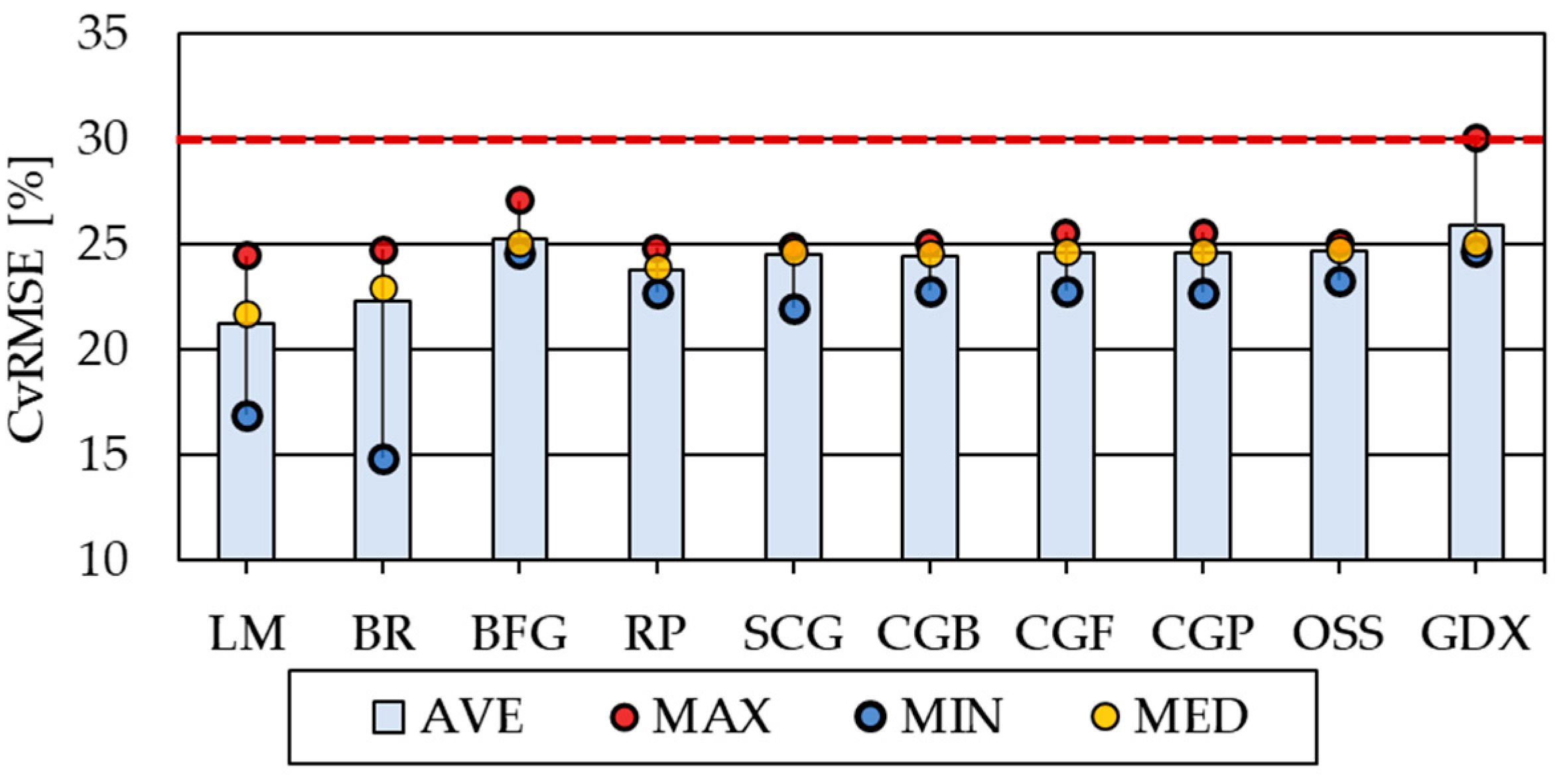
Figure 3 shows the distribution of CvRMSE values during the training period for each algorithm.
The results indicated that all ten algorithms achieved an average CvRMSE within the 30% threshold defined by the guideline, ensuring the fundamental accuracy required for building energy modeling. Among the evaluated algorithms, the Levenberg–Marquardt (LM) algorithm demonstrated the highest precision, achieving a mean CvRMSE of 21.24%. Secondly, the Bayesian Regularization (BR) algorithm resulted in a CvRMSE of 22.29%. In contrast, other algorithms including BFG, RP, SCG, CGB, CGF, CGP, OSS, and GDX showed relatively lower accuracy, with the mean CvRMSE values ranging between 23.77% and 25.88%. While the LM model recorded the lowest maximum and mean CvRMSE, the BR model showed the lowest minimum CvRMSE value across the test runs.
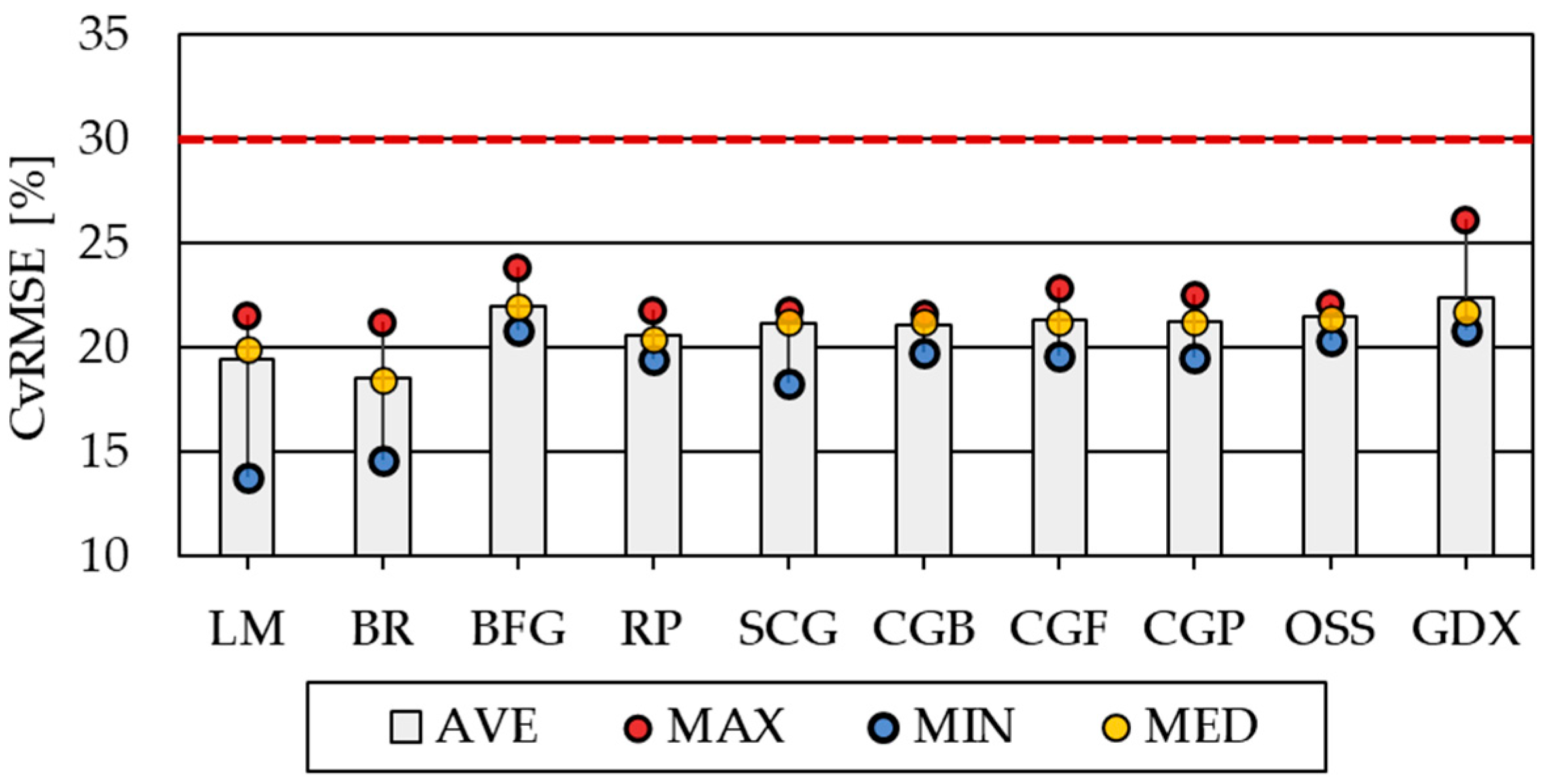
Figure 4 presents the CvRMSE results for the testing period across the evaluated training algorithms. Consistent with the training period results, the mean CvRMSE for each algorithm during the testing period remained within the 30% threshold specified by the guideline, confirming the statistical validity of the models for real-world applications. Among the various algorithms, the model utilizing the Levenberg–Marquardt (LM) algorithm achieved the highest accuracy with a mean CvRMSE of 18.56%. This was followed by the Bayesian Regularization (BR) algorithm, which yielded a mean CvRMSE of 19.39%.
The remaining algorithms—such as BFG, RP, SCG, CGB, CGF, CGP, OSS, and GDX—exhibited mean CvRMSE values ranging from 20.56% to 22.37%, indicating relatively lower predictive precision compared to the LM and BR models. Reflecting the trends observed during the training period, the LM model demonstrated the lowest maximum and mean CvRMSE values, whereas the BR model recorded the lowest minimum CvRMSE.
The results from both the training and testing periods consistently demonstrated that the Levenberg–Marquardt (LM) algorithm yielded the lowest CvRMSE, identifying it as the most stable and superior algorithm among the evaluated algorithms. Collectively, it is concluded that the LM algorithm ensured both high predictive accuracy and robust convergence stability under the specific data conditions. These findings approved a critical benchmark for selecting optimal training algorithms in building energy forecasting in the future. The comprehensive statistical metrics, including the maximum, minimum, mean, and standard deviation of CvRMSE during both the training and testing periods, are summarized in
Table 4.
4. The Impact of Data Preprocessing on Predictive Performance
This chapter analyzed the impact of data preprocessing procedures and specific methodologies on the performance of the cooling load prediction model quantitatively. In cases where data preprocessing is not implemented, reliable model training may be compromised by inherent data quality issues such as missing values, outliers, and redundant data, leading directly to a degradation in predictive accuracy. To address this, this study implemented a stepwise pre-processing strategy to enhance data quality. The variations at each stage were systematically compared and validated to evaluate the efficacy of the applied preprocessing techniques.
4.1. Data Preprocessing Methodologies
Data preprocessing is recognized as a primary stage that dictates the performance of machine-learning-based forecasting models. It involves a systematic workflow of analyzing and converting raw data into a structured format optimized for neural network training. In the context of building energy systems, raw datasets often suffer from quality degradation due to various factors such as noise from sensor measurement errors, bias resulting from uncalibrated equipment, outliers caused by atypical operational conditions, and missing values arising from data transmission failures [
28]. To mitigate these issues, specialized methodologies are required. Data Cleaning focuses on identifying and removing inconsistent or redundant entries, while Data Transformation involves scaling and normalization to balance the influence of different input features [
29]. In this study, a targeted Data Cleaning process by filtering out zero-value entries was implemented during non-operational hours which resulted in a refined dataset of 1691 samples.
The reduction in sample size mainly results from excluding zero-load data during non-cooling periods. These zero-load periods do not correspond to active cooling system operation and were therefore treated as sources of numerical distortion during model training. Their inclusion biases weight updates toward trivial solutions, which can degrade convergence stability and prediction accuracy during peak cooling periods. Although the dataset size was reduced, this process enhanced data relevance by retaining samples directly associated with active cooling operation, which is critical for operational decision-making. Although this leads to fewer samples, the retained dataset represents physically meaningful cooling operation, which is more informative for model learning than a large number of zero-load records. Although the reduced dataset consists of 1691 samples, it remains sufficient for comparative evaluation of neural network training behavior and algorithm suitability, which is the primary focus of this study. Mathematically, repeated zero-load samples bias the gradient updates toward minimizing trivial zero-output errors, thereby suppressing informative gradients associated with active cooling periods and degrading learning effectiveness under peak-load conditions. The proposed data cleaning strategy is intended to improve prediction accuracy during active cooling operation and does not aim to model cooling system on/off transitions during seasonal change periods.
Furthermore, Data Transformation was utilized to normalize the cooling load into a standardized decimal range, preventing the vanishing gradient problems as well as improving the convergence stability of the deep learning model. This transformation was applied uniformly across all cases to ensure that performance differences originated from algorithmic behavior rather than scale-related numerical effects. In this study, a min–max normalization algorithm was applied to all input and output variables, scaling each feature to the range of [0, 1] prior to training. Consequently, the influence of data preprocessing was controlled, allowing a fair comparison of training algorithm convergence and prediction accuracy.
4.2. Evaluation of Prediction Performance Based on Data Preprocessing
To analyze the impact of data preprocessing on predictive performance, a comparative evaluation was conducted by categorizing the models into four distinct cases:
Case 1: Baseline model without any data preprocessing.
Case 2: Model with Data Transformation (Normalization) only.
Case 3: Model with Data Cleaning (Filtering non-operational data) only.
Case 4: Model with both Data Transformation and Data Cleaning integrated.
To ensure a precise evaluation, the Levenberg–Marquardt (LM) algorithm was utilized for all cases. Consistent with the previous methodology, 20 independent simulations were performed for each case to account for the stochastic nature of the neural network. The predictive performance was then quantitatively assessed by calculating the CvRMSE for each scenario, allowing for a systematic comparison of the effectiveness of each preprocessing strategy.
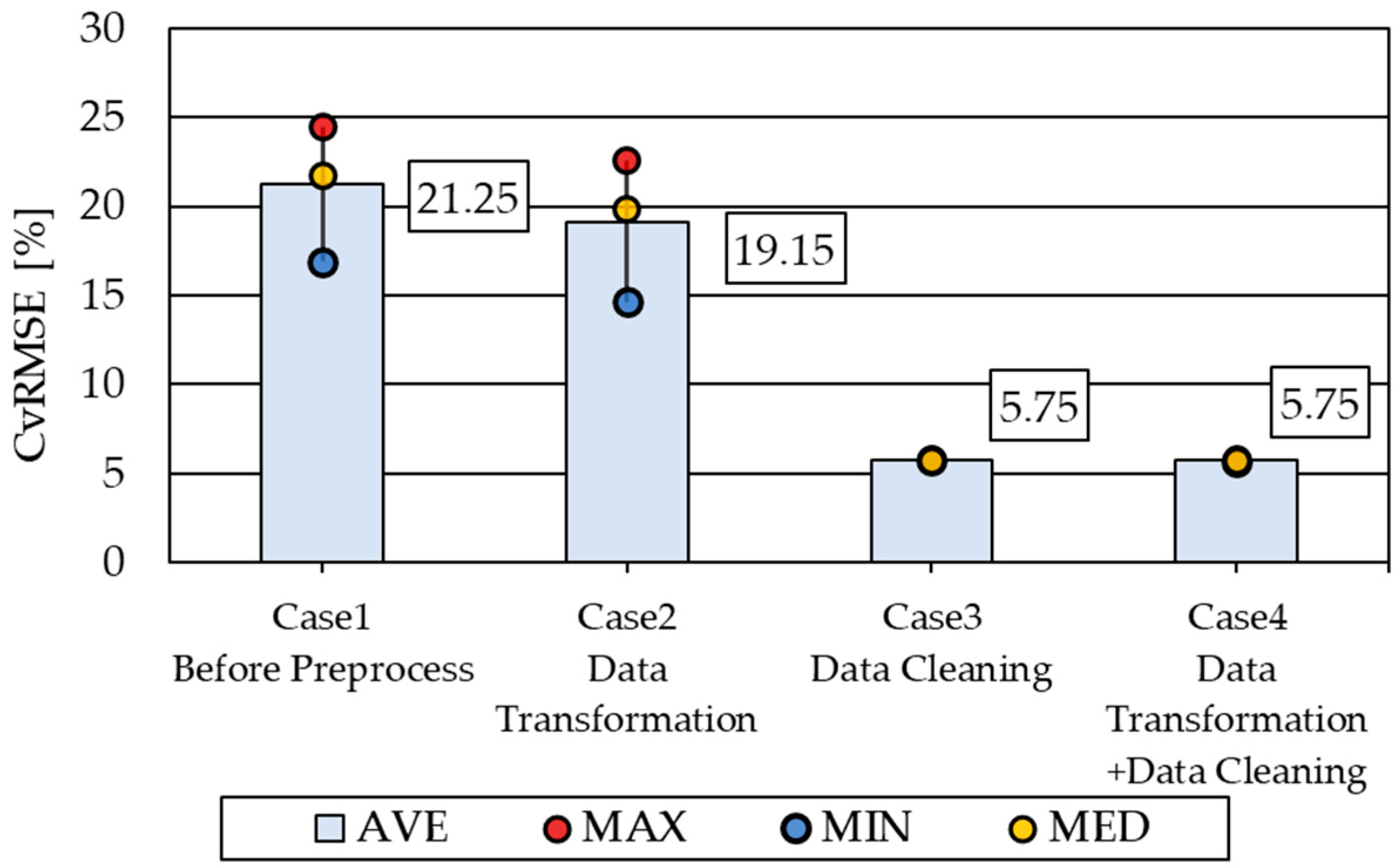
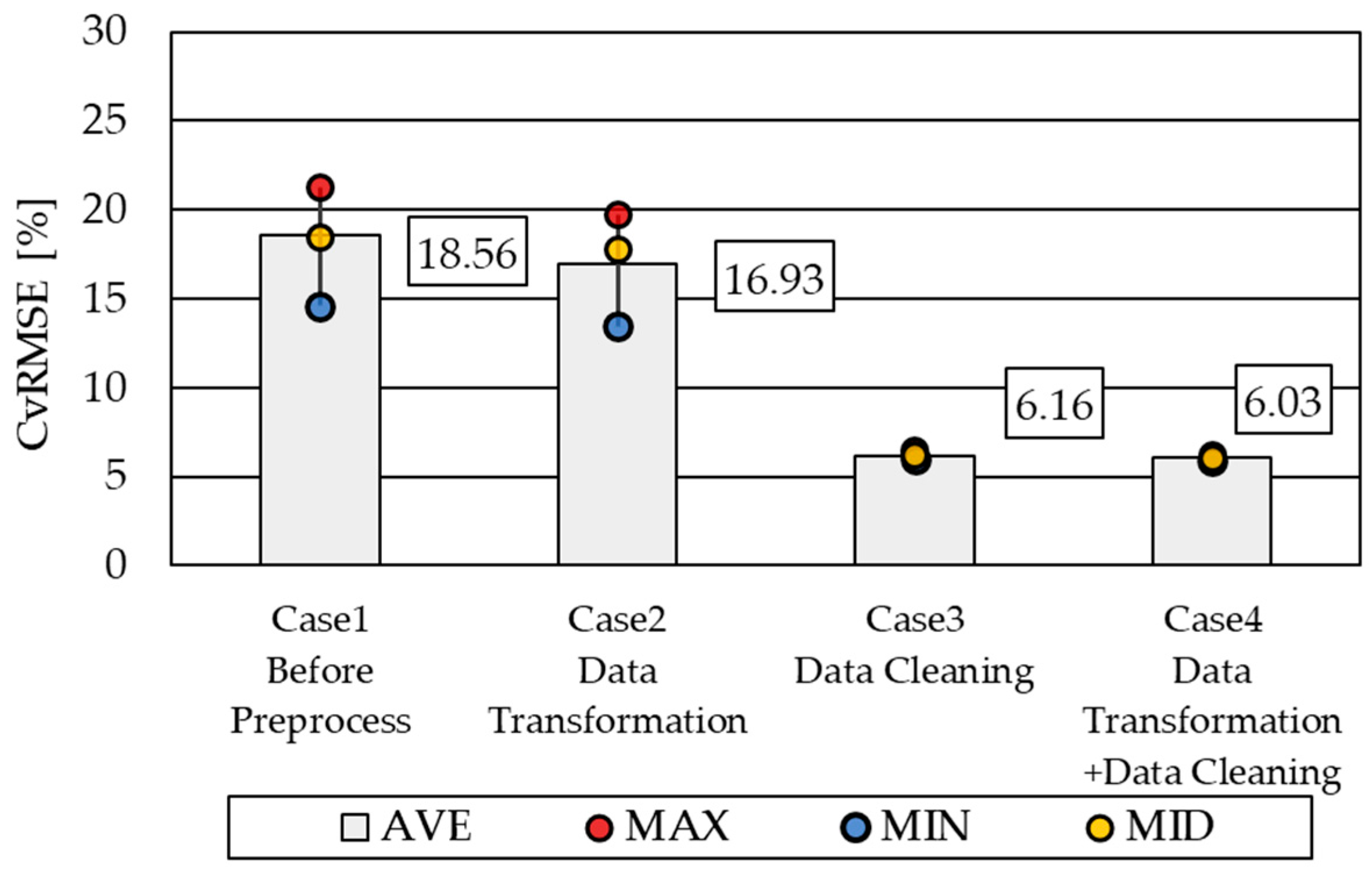
Figure 5 and
Figure 6 illustrate the comparative performance results based on the CvRMSE metric for the training and testing periods, respectively. In Case 1, the mean CvRMSE was 21.25% during the training period and 18.56% during the testing period. These results satisfied the 30% threshold stipulated by the guideline, confirming the baseline model’s reliability. For Case 2, the mean CvRMSE achieved 19.15% (training) and 16.93% (testing). Under the specific conditions of this study, it was found that dimensionality transformation had a relatively marginal impact on enhancing the predictive accuracy based on the CvRMSE.
In contrast, Case 3 showed a significant improvement, with mean CvRMSE values dropping to 5.75% (training) and 6.16% (testing). Notably, the data cleaning process reduced the total dataset size from 5136 to 2772 samples. While a reduction in the volume of training data typically leads to decreased neural network performance, this study confirmed that removing zero-load outliers eliminated redundant learning and substantially boosted accuracy effectively. Finally, Case 4 achieved the highest overall performance with a mean CvRMSE of 5.75% for training and 6.03% for testing.
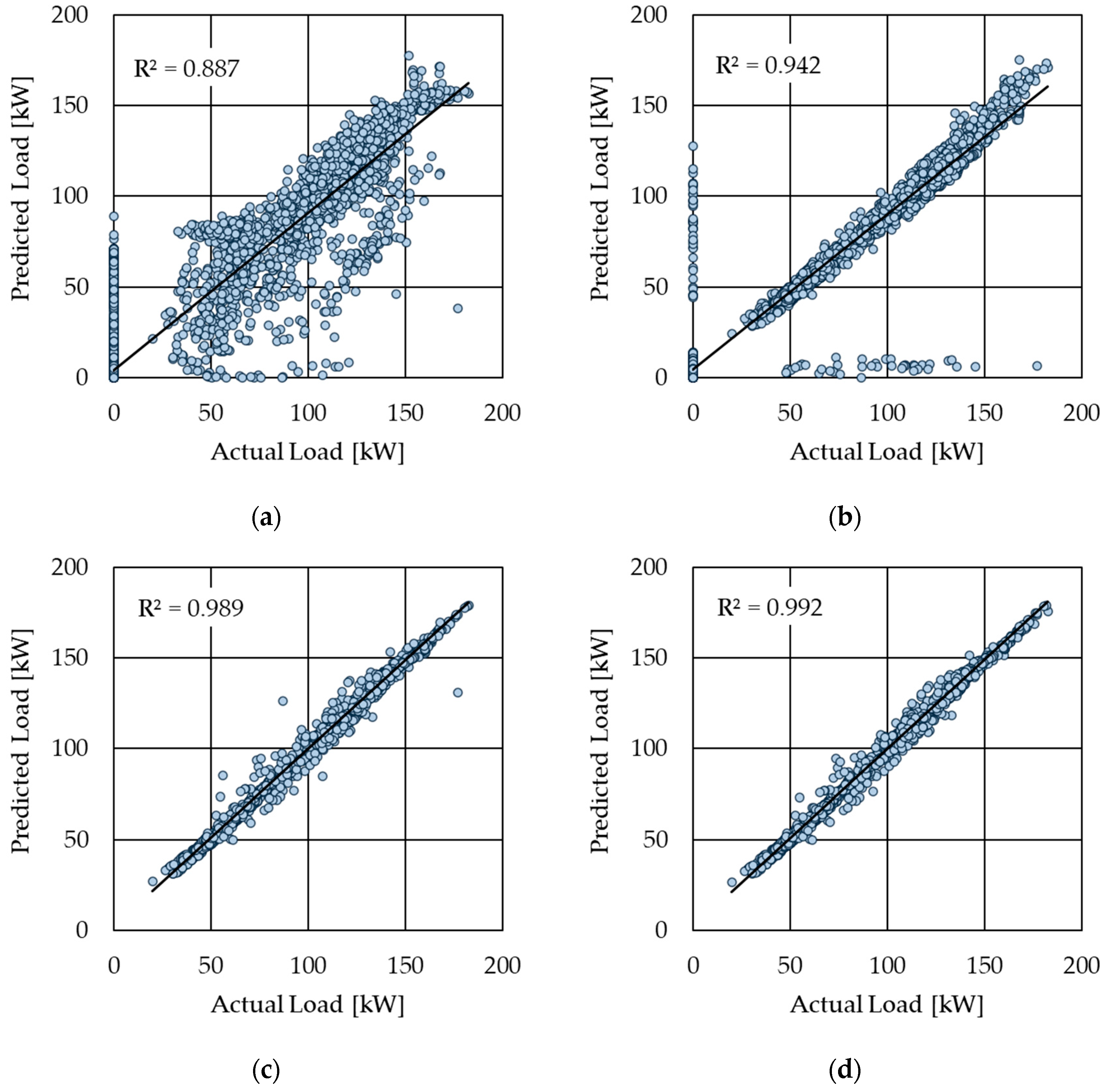
Figure 7 shows the regression analysis between actual and predicted cooling loads based on different preprocessing stages, reflecting the trends observed in previous performance metrics. In Case 1, the data points exhibited a wide dispersion around the trend line. Notably, the model failed to provide accurate predictions when the actual load was zero/In addition frequent discrepancies were observed in the high-load regions exceeding 100 kW. In Case 2, the distribution around the trend line become narrower compared to Case 1, showing a slight improvement in the high-load prediction. However, a significant limitation remained as predicted values for the low-load region (under 50 kW) tend to converge to a constant value. This phenomenon was attributed to the rescaling process where the sub-zero decimal values were reconverted into the real-scale values, leading to a loss of granularity. In Case 3, the alignment with the trend line significantly was improved. By excluding the non-operational zero-load periods, the model focuses exclusively on the active cooling durations, refining the overall distribution of predicted values. Finally, Case 4 demonstrated the enhanced accuracy in the high-load range compared to Case 3, with a more concentrated distribution along the regression line. For all cases, the Coefficient of Determination (R
2) was found to be 0.9 or higher, indicating that the predicted values possess a high explanatory power of over 90% regarding the actual load variations.
Although the proposed ANN-based model does not explicitly incorporate thermodynamic equations, it implicitly captures physically consistent relationships between boundary conditions and cooling demand. In particular, the model responds to increases in outdoor temperature, solar radiation, and internal heat gains with corresponding increases in predicted cooling loads, which is consistent with fundamental heat balance principles. This physically interpretable response is reflected in the improved prediction accuracy during high-load operating conditions, as shown in
Figure 7.
4.3. Synthesis and Implications of Preprocessing Strategies
In summary, the predictions in Case 4 demonstrated the near-perfect alignment with the measured data, while a distinct discrepancy between the actual cooling loads and predicted values was observed in Case 1. Notably, the model’s ability to predict the actual load was significantly enhanced in the high-load regions. These findings implied that the integrated preprocessing approach allowed the model to secure superior generalization performance not only during the training datasets but also when applied to the validation datasets.
The results confirmed that data preprocessing is a crucial contributor to the performance enhancement of cooling load forecasting models. Furthermore, it was verified that a holistic preprocessing strategy was more effective than implementing isolated normalization or simple data refinement. This suggests that the proposed integrated strategy is essential for developing the high-precision building energy prediction.
5. Conclusions
This study constructed an artificial neural network-based prediction model to enhance the accuracy of building cooling load forecasting as well as analyzed the effects of training algorithms and data preprocessing strategies on model performance systematically. Under the identical structural and data conditions, comparisons of ten training algorithms revealed that the Levenberg–Marquardt (LM) algorithm showed the optimal performance, providing the lowest prediction error and stable convergence. In addition, the Bayesian Regularization (BR) algorithm provided the second-optimum performance, while other algorithms showed relatively lower precision. These findings emphasized the critical importance of selecting an appropriate training algorithm when addressing highly nonlinear and time-varying problems such as cooling load forecasting. Furthermore, the evaluation of data preprocessing strategies demonstrated that predictive performance significantly degrades without pre-processing. While the individual application of either Transformation or Cleaning yielded the meaningful improvements, the integrated application of both techniques achieved the lowest CvRMSE and superior generalization capability, exhibiting the highest tracking accuracy relative to actual loads. This confirms that enhancing data quality is decisive not only for training stability but also for performance during the test period.
In particular, this study presents a systematic and controlled comparison of multiple neural network training algorithms under identical conditions, providing practical insights into algorithm selection for cooling load prediction. In addition, the results demonstrate that data-quality-oriented preprocessing, especially the exclusion of zero-load data during non-cooling periods, plays a critical role in improving prediction accuracy and learning stability. From an operational perspective, the proposed model has potential applicability as a decision-support tool within Building Energy Management Systems (BEMSs) for short-term cooling load forecasting and proactive operation planning., as model training is conducted offline and real-time implementation involves only fast forward inference with negligible computational overhead.
In conclusion, this study empirically demonstrates that the choice of neural network training algorithms and the implementation of systematic data preprocessing are key factors in substantially improving the cooling load prediction. The result provides a practical foundation for selecting algorithms as well as establishing data processing strategies in building energy modeling. The significance of this study lies in its ability to provide highly reliable predictive data reflecting diverse operational environments, enabling proactive the HVAC control, reducing operational costs, and improving peak load management. Moreover, the findings and procedures in the present study can provide information for studies about predictions of heating and cooling energy consumption by implementing multi-layer neural network approaches. Despite these valuable outcomes, this study is limited by its focus on the specific datasets and conditions. Future research will explore this framework to incorporate various climatic conditions, diverse building types, and advanced time-series. Moreover, a comparative analysis between the neural network models and physics-based models based on the data from the field measurements will be conducted for better understanding. Additionally, the findings in the present study will be validated through the development of optimal control systems integrated with real-time Building Energy Management Systems (BEMSs).