Towards a Synergistic Design Framework for Health-Promoting Schools in Hot and Humid Climates: A Systematic Review


Abstract
1. Introduction
1.1. Background
1.2. Towards a Health-Promoting School Approach (HPS)
1.3. Research Gaps
1.4. Research Objectives
2. Methodology
2.1. Materials and Methods
2.2. Primary Framework and Features Identification
2.3. Publications Search Procedure
2.4. Inclusion and Exclusion Criteria
2.5. Method for Quantifying and Synthesizing Health Impact Evidence
3. Results and Analysis
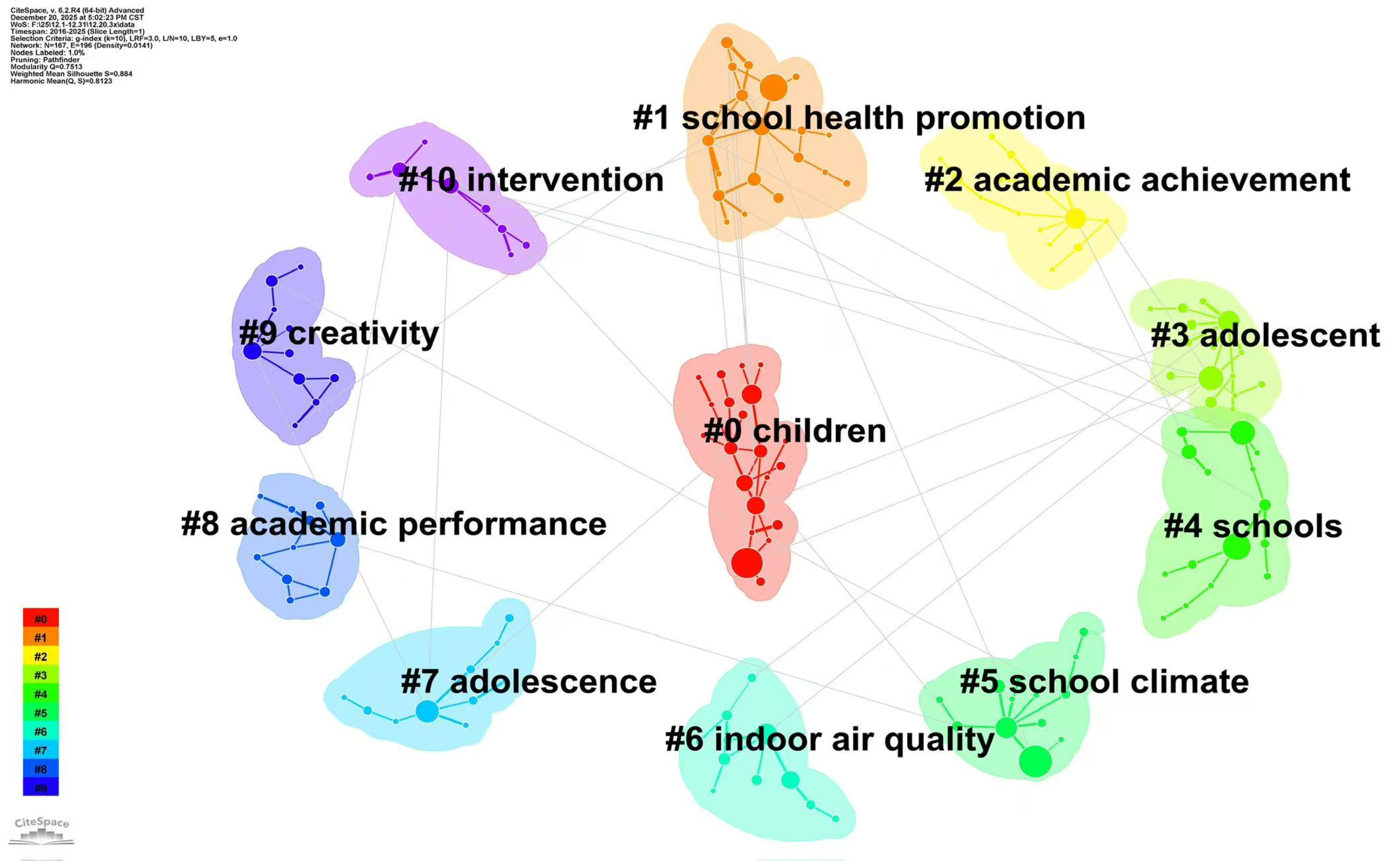
3.1. Research Trends
3.2. Records Identified and Analysis
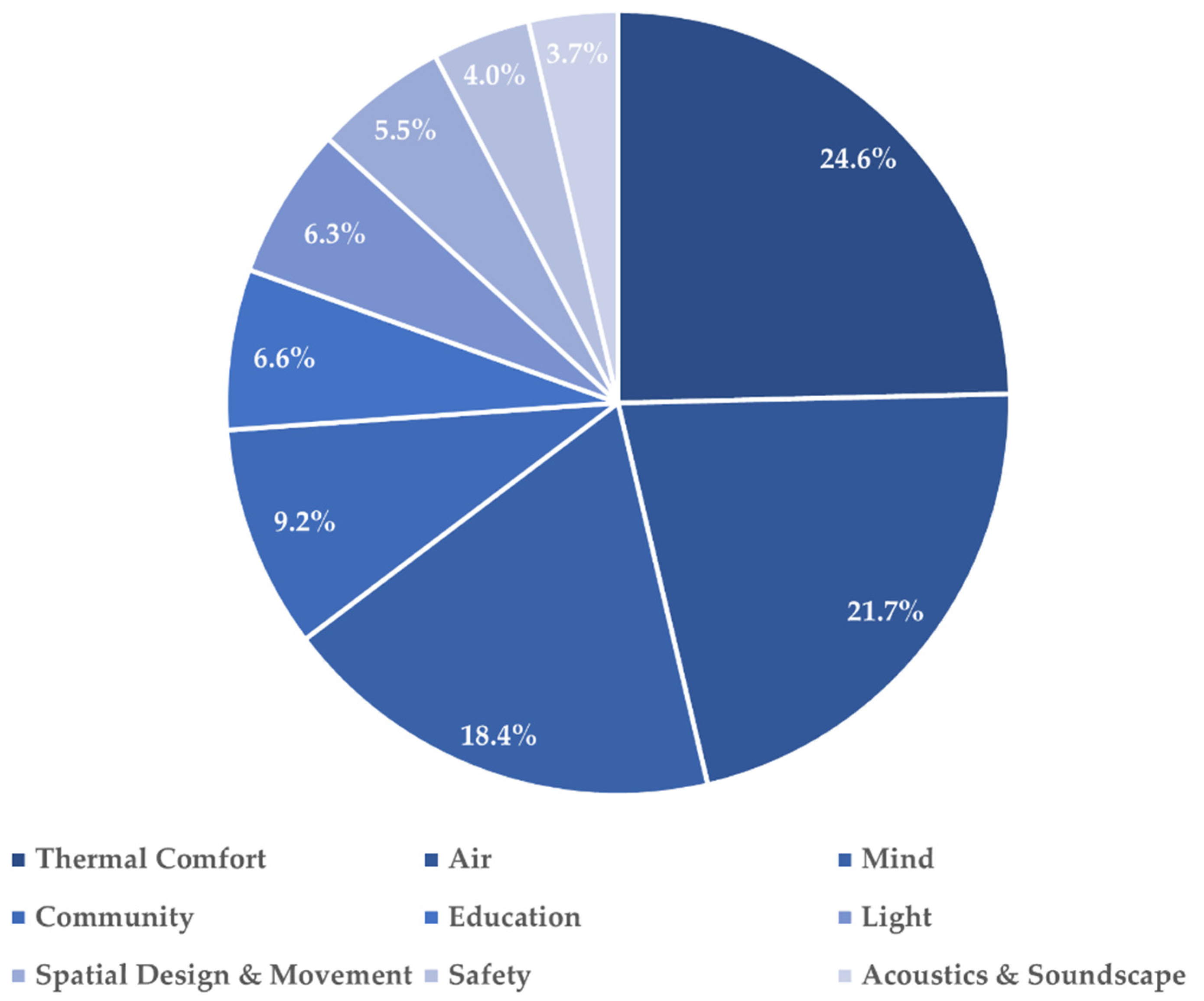
3.2.1. Quantitative Synthesis and Analysis of Evidence Fragments
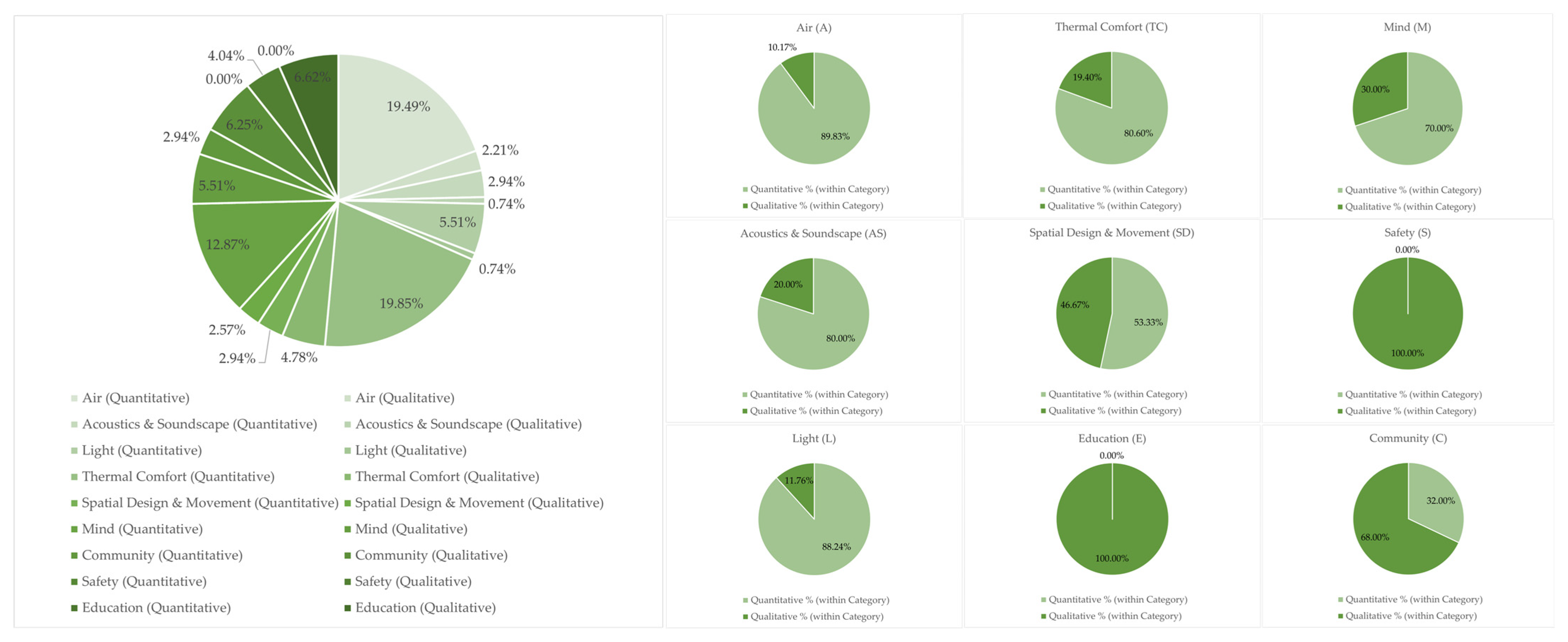
3.2.2. Quantitative and Qualitative Methods
3.2.3. Synthesis of Design Strategies by Environmental Dimension
Thermal Comfort
Air
Mind
Acoustics and Soundscape
Light
Spatial Design and Movement
Community
Safety
Education
4. Discussion
4.1. Synergistic Health Impacts
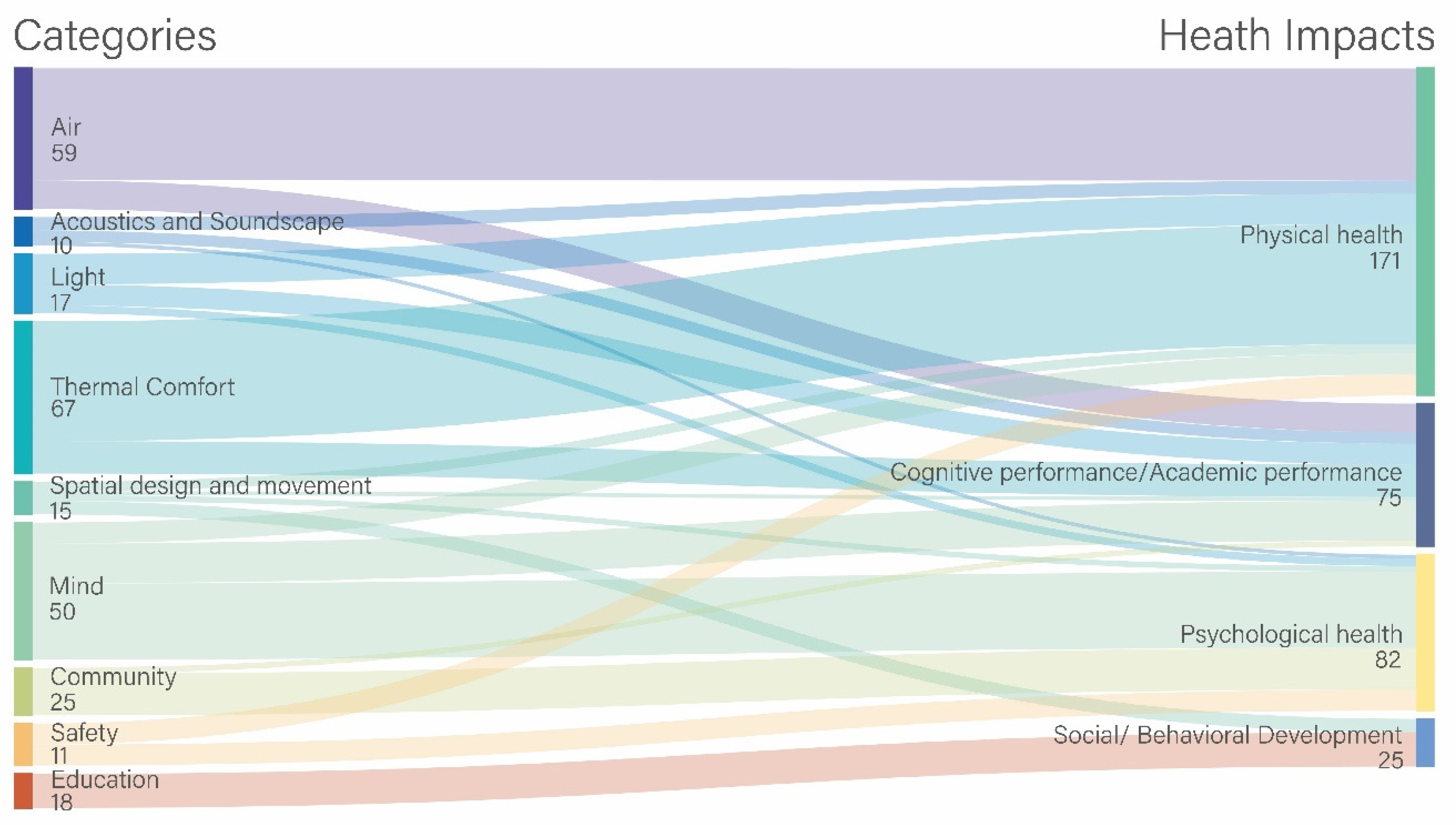
4.1.1. Mapping of Categories of Design Strategies and Health Impacts
4.1.2. The Impact of Indicators of Evidence-Based Design Strategies on Health
4.2. Positioning and Contribution Relative to Existing Standards
4.3. Implications for Research and Practice
4.4. Limitations and Future Research
5. Conclusions
Supplementary Materials
Author Contributions
Funding
Data Availability Statement
Conflicts of Interest
Appendix A. Categories and Evidence-Based Design Strategies Identified and Summarized
| Categories (Counts of Fragments) | Year | (No. of Evidence Fragments) Evidence-Based Design Strategies or Intervention | Key Findings | Health Impacts | Methods | Ref. |
Air (n = 59) | 2025 | (1) Monitoring indoor and outdoor PM2.5 concentrations (2) Identifying pollution sources using (3) Positive Matrix Factorization (PMF) (4) Assessing health risks associated with trace elements | - Identification of key pollution sources (traffic, dust) - Confirmation that health risks were within safety thresholds in the studied context | ■ | ● ● ● ● | [9] |
| 2025 | (5) Mixed-mode ventilation (natural + air conditioning) (6) Location-specific strategies (urban vs. rural) (7) Promoting thermal adaptation | - Managing trade-offs between CO2 reduction and PM2.5 exposure - Improvement of overall indoor environmental quality (IEQ) | ■ | ● ● ● | [19] | |
| 2025 | (8) Implementing indoor green walls (IGWs) (9) Collaborative design processes (co-creation) | - Removal of particulate matter (PM) - Positive impact on indoor air quality | ■ | ● ● | [20] | |
| 2025 | (10) Implementing multifunctional indoor green walls (11) Using the “Living Lab” methodology | - Reduction in air pollution exposure risk - Improvement of indoor air quality | ■ | ○ ○ | [21] | |
| 2025 | (12) Implementing co-designed green infrastructure solutions, specifically green screens and green gates | - Achieved maximum reductions in daily concentrations of PM10 (32%), PM2.5 (10%), and PM1 (12%) | ■ | ● | [22] | |
| 2025 | (13) Deploying air purifiers to actively reduce indoor particulate matter concentrations (14) Monitoring indoor and outdoor PM2.5 and CO levels simultaneously to identify pollution sources (15) Analyzing the correlation between atmospheric turbulence intensity and particulate matter levels (16) Using mass balance equations to calculate the contribution of outdoor air to indoor pollution | - Quantified that outdoor air contributes approximately 77% to indoor PM2.5 concentrations. - Identified that indoor PM2.5 peaks follow outdoor variations with a time lag of 100–121 min - Highlighted the importance of managing external pollution infiltration to protect student respiratory health | ■ | ● ● ● ● | [23] | |
| 2025 | (17) Developing occupant behavior (OB) predictive models to understand window-opening triggers (18) Performing multi-objective optimization to balance thermal comfort and fresh air requirements | - Significant reduction in CO2 levels by up to 42.5%, improving air quality | ■ | ● ● | [24] | |
| 2024 | (19) Managing classroom occupancy and ventilation rates | - CO2 levels were predominantly influenced by classroom occupancy and ventilation rates - PM concentrations were influenced by the building’s location, design, and occupant activities | ■ | ● | [25] | |
| 2024 | (20) Energy-efficient retrofitting (envelope insulation) (21) Passive climate adaptation (increased daytime ventilation) | - Mitigation of cognitive performance loss (CPL) | ★ | ● ● | [26] | |
| 2024 | (22) Renovating interior finishing materials (flooring) and windows (23) Improving airtightness (24) Selecting durable, low-particle-generating materials (25) Implementing air purification systems | - Reduction in PM infiltration and generation - Reduced health risks (inhalation, dermal, ingestion) for children | ■ | ● ● ● ● | [27] | |
| 2023 | (26) Green infrastructure as a physical barrier | - Green infrastructure (GI) as a physical barrier can reduce PM10, NO2, O3, BC, and PNC by up to 60–77% | ■ | ● | [28] | |
| 2023 | (27) Measuring indoor air quality (IAQ) parameters (CO2, formaldehyde, particulate matter, O3, CO, NO2, TVOCs) (28) Estimating ventilation rates (29) Analyzing ventilation system types | - Identification of associations between IAQ factors (ventilation, particles, ozone, CO) and student academic scores | ★ | ● ● ● | [29] | |
| 2023 | (30) Increasing ventilation rates (31) Introducing air conditioning (32) Using Cognitive Performance Loss (CPL) as a key performance indicator (KPI) | - Mitigation of cognitive performance loss - Adaptation to future climate warming | ★ | ● ● ● | [30] | |
| 2023 | (33) Tailoring design to adolescent sensitivity (cooler temperatures; higher sensitivity to noise, light, and PM2.5) | - Promotion of physical and mental health - Improvement of classroom environmental quality suited for growing children | ■ | ● | [31] | |
| 2023 | (34) Technological interventions: air purifiers and HVAC systems with high-efficiency filters (35) Physical barriers: green infrastructure (GI) (e.g., hedges, green screens) to mitigate pollutant exposure (36) Behavioral interventions: citizen science campaigns to raise awareness and influence behavior (37) School commute interventions: promoting clean fuels, vehicle retrofits, and active travel (38) Policy and regulatory interventions: emission controls and school-zone regulations | - Reduction in pollutant concentrations: significant reductions in PM2.5, PM10, PM1, NO2, O3, BC (Black Carbon), and PNC (Particle Number Concentration) - Reduced exposure: lowered exposure to harmful indoor and outdoor air pollutants for students | ■ | ● ● ● ● ● | [28] | |
| 2023 | (39) CO2-based natural ventilation control (40) Mechanical ventilation with specific airflow patterns | - Reduction in airborne transmission of viruses - Mitigation of contagion risk among students | ■ | ● ○ | [32] | |
| 2022 | (41) Implementing rigorous natural ventilation protocols to mitigate virus transmission during the pandemic (42) Conducting detailed monitoring of CO2 levels and temperature across heating seasons to assess indoor environmental quality | - Significant improvement in air quality, with CO2 concentrations reducing by approximately 1400 ppm - Creation of safer indoor spaces supporting the continuation of face-to-face learning during health crises | ■ | ● ● | [8] | |
| 2022 | (43) Improving ventilation systems | - Reduction in respiratory diseases and student absence rates - Improvement in test scores and teaching/learning productivity | ■ | ● | [33] | |
| 2022 | (44) Implementing passive intervention strategies (e.g., natural ventilation) | - Improvement of occupant comfort and IAQ | ■ | ○ | [34] | |
| 2021 | (45) Implementing natural ventilation strategies (46) Managing occupancy rates (47) Monitoring CO2, TVOCs, and particulate matter levels | - Assurance of adequate indoor air quality - Maintenance of comfort conditions - Support for student performance and well-being | ■★ | ● ● ● | [35] | |
| 2020 | (48) Monitoring high-priority pollutants (CO2, PM, TVOCs, aldehydes) (49) Analyzing the impact of indoor activities (e.g., dust resuspension) (50) Evaluating outdoor source infiltration (traffic, industry) | - Identification of key pollutant sources - Minimization of adverse health effects - Strategy development for exposure reduction | ■ | ● ● ● | [36] | |
| 2020 | (51) Maintaining high ventilation rates (10.6 L/s per person) | - Improved processing speed (+6.6%), concentration (+8.3%), and math skills (+11.8%) | ★ | ● | [37] | |
| 2020 | (52) Using air cleaners (53) Routine cleaning to remove surface dust (54) Managing classroom occupant density | - Significant reduction in indoor PM2.5 (approx. 35%) and PM10 concentrations - Reduced exposure to respiratory health risks | ■ | ● ● ● | [38] | |
| 2017 | (55) Implementing automatic window-opening systems (56) Using adaptive control algorithms (57) Integrating IAQ and thermal comfort control triggers | - Reduction in health symptoms and improvement in student productivity - Assurance of good IAQ and thermal comfort | ■★ | ● ● ● | [39] | |
| 2016 | (58) Improving ventilation concepts (59) Reducing indoor and outdoor air pollution sources | - Mitigation of negative health effects from poor indoor air quality (e.g., high CO2, particulate matter) | ■ | ○ ○ | [40] | |
Acoustics and Soundscape (n = 10) | 2025 | (60) Conducting simultaneous monitoring of particulate matter (PM) and noise levels, alongside public perception surveys | - Successfully lowered noise levels by 5 dB(A) through green gate installation | ■ | ● | [22] |
| 2025 | (61) Integrating natural sounds into the indoor environment | - Natural sounds masked disruptive noises, fostering a calmer environment, while musical sounds elicited mixed reactions | □ | ○ | [15] | |
| 2024 | (62) Implementing noise mitigation measures for schools located near roads to reduce acute ambient noise exposure | - Identification of “annoyance” as a key mediator contributing to the deterioration of children’s cognition - Highlighting the necessity of protecting cognitive function by reducing environmental noise levels in educational settings | ■ | ● | [41] | |
| 2024 | (63) Individually controlled acoustic improvement strategies (64) Integrating acoustic design with other environmental factors (65) Incorporating EEG measurements and machine learning techniques for environmental assessment | - Improvements in student health, comfort, and performance | ■★ | ● ● ● | [42] | |
| 2023 | (66) Integrating natural sounds as a restorative acoustic element | - Negative effect of fan noise on students - Natural sounds from open windows benefited student cognitive performance | ★ | ● | [43] | |
| 2023 | (67) Mitigating noise pollution and overcrowding | - Identification of stressors (noise, crowding) | □ | ○ | [44] | |
| 2023 | (68) Integrating dose-related and building-related acoustic metrics | - Better understanding of student acoustic preferences and needs - Potential for improved well-being and performance | ■★ | ● | [45] | |
| 2023 | (69) Tailoring design to adolescent sensitivity (higher sensitivity to noise) | - Improvement of classroom environmental quality suited for growing children | ■★ | ○ | [31] | |
Light (n = 17) | 2025 | (70) Optimizing window characteristics (transmittance, window-to-floor ratio) and interior surface reflectance to balance visual and non-visual needs (71) Proposing “Circadian Frequency” (CF) as a novel metric for assessing non-visual health in school environments (72) Achieving Spatial Daylight Autonomy (sDA) of 500 lx for at least 50% of annual occupied hours | - Conducting a longitudinal field survey across three seasons (winter, spring, summer) to capture annual variations - Using simulation tools (Ladybug, Honeybee, Lark) to calculate specific daylighting and circadian metrics - Improvement in visual comfort and satisfaction, strongly correlated with spatial daylight autonomy - Enhancement of perceived productivity, which increased with better quality of external views - Support for non-visual health - Spatial Daylight Autonomy (sDA) of 500 lx for 50% of annual hours demonstrated a strong correlation with students’ daylight comfort | ■★ | ○ ● | [46] |
| 2025 | (73) Introducing illuminance gradient analysis; applying machine learning prediction models (MLP); optimizing lighting distribution with a focus on directing light toward the blackboard | - Improved prediction of lighting satisfaction - Enhanced visual comfort and potential reduction in myopia risk | ■★ | ● | [47] | |
| 2025 | (74) Implementing circadian-effective lighting design to align with students’ internal biological clocks (75) Utilizing LED technology to provide tunable artificial lighting when natural daylight is insufficient (76) Integrating interdisciplinary design approaches that address both visual and non-visual effects of light | - Regulation of circadian rhythms, leading to better sleep–wake cycles - Improvement in mood and alertness, supporting mental well-being - Enhancement of cognitive performance, directly benefiting learning outcomes | ■□★ | ● ● ● | [48] | |
| 2023 | (77) Tailoring design to adolescent sensitivity (higher sensitivity to light) | - Promotion of physical and mental health - Improvement of classroom environmental quality suited for growing children | ■□ | ○ | [31] | |
| 2021 | (78) Assessing lighting levels and glare perception (79) Applying Structural Equation Modeling (SEM) to evaluate comfort-related factors (80) Considering view satisfaction | - Improvement of overall visual comfort - Identification of key drivers for student visual perception | ■ | ● ● ● | [49] | |
| 2021 | (81) Designing photovoltaic (PV) generation systems with optimized tilt and azimuth angles to improve energy efficiency | - Achievement of an optimal indoor environment balancing daylighting and thermal comfort - Enhanced learning efficiency and student health through improved environmental quality | ■★ | ● | [50] | |
| 2020 | (82) Addressing heterogeneous light distribution | - Potential for improved vision through better lighting regulation | ■ | ● | [51] | |
| 2020 | (83) Implementing dynamic cool lighting conditions (4900 K, 750 lx) | - Improved processing speed (+6.6%), concentration (+8.3%), and math skills (+11.8%) | ★ | ● | [37] | |
| 2020 | (84) Optimizing classroom geometry (85) Dividing classrooms into independently controllable lighting zones (86) Using parametric modeling tools (Grasshopper) and environmental simulation platforms (Honeybee/Ladybug) | - Reduction in total energy demand - Improvement of occupants’ thermal and visual comfort | ■★ | ● ● ● | [52] | |
Thermal Comfort (n = 67) | 2025 | (87) Defining thermal acceptability thresholds for students aged 10–12 years (88) Controlling classroom temperatures at specific levels (26 °C, 29 °C, and 32 °C) to compare effects (89) Monitoring heart rate variability (HRV) continuously as a physiological indicator of thermal sensation (90) Room temperatures between 23 °C and 26 °C associated with relatively high cognitive performance | - Among the tested conditions, 23 °C was associated with relatively high cognitive performance, and 26 °C yielded the best performance - Subjective task load reported by participants in the 28 °C environment was higher than in other experimental conditions | ★ | ● ● ● ● | [53] |
| 2025 | (91) Using strawbale insulation (external walls and roof) (92) Orienting fibers perpendicular to heat flow (93) Optimizing building orientation (North–South preference) (94) Determining optimal insulation thickness (up to 30 cm) | - Improvement of indoor thermal comfort - Reduction in internal heat stress - Enhancement of indoor freshness | ■ | ● ● ● ● | [54] | |
| 2025 | (95) Mixed-mode ventilation (natural air conditioning) (96) Location-specific strategies (Urban vs. Rural) (97) Promoting thermal adaptation | - Improvement of overall indoor environmental quality (IEQ) | ■★ | ● ● ● | [19] | |
| 2025 | (98) Phased multi-objective optimization framework (architectural form, envelope, building components) (99) Using NSGA-II algorithms (100) Integrating adolescent-centered Indoor Environmental Quality (IEQ) standards | - Improvement in health performance (+7.2%) - Reduction in life-cycle carbon emissions (11.1%) - Enhanced indoor environmental conditions | ■ | ● ● ● | [55] | |
| 2025 | (101) Schoolyard revegetation (planting trees) | - Mitigation of overheating effects - Increase in shaded area - High satisfaction with outdoor comfort | ■ | ○ | [56] | |
| 2025 | (102) Holistic approach design methods (HAD) (103) Climate-specific interventions (temperate, tropical, dry, and cold climates) (104) Integration of multiple design strategies | - Promotion of occupant health - Enhancement of student productivity - Assurance of overall comfort | ■ | ● ● ● | [57] | |
| 2024 | (105) Proposing a bioclimatic planting design focusing on large trees and evergreens based on children’s specific preferences (106) Establishment of specific outdoor neutral UTCI benchmarks for children in humid-hot climates (25.0 °C for boys, 22.8 °C for girls) | - Conducting onsite thermal sensory questionnaires and landscape preference surveys with children - Identification of air temperature and mean radiant temperature as critical meteorological factors affecting children’s thermal sensation - Confirmation that optimized tree planting aligns with children’s preferences and improves their thermal environment | ■ | ● ● | [58] | |
| 2024 | (107) Fan-assisted naturally ventilated classrooms (when classroom temperatures remain at or below 30 °C) | - Students’ thermal comfort can be maintained at neutral temperatures with elevated air velocity | ■ | ● | [59] | |
| 2024 | (108) Naturally ventilated classrooms | - Neutral temperature measured as 25.7 °C in summer, 19.2 °C during transition periods, and 14.9 °C in winter | ■★ | ● | [60] | |
| 2024 | (109) Optimizing tree shade (110) Replacing dark and artificial materials (asphalt, artificial grass) (111) Increasing Urban Greening Factor (UGF) | - Reduction in air temperature and mean radiant temperature - Mitigation of overheating risks - Improvement of children’s wellbeing | ■★ | ● ● ● | [61] | |
| 2024 | (112) Spatial risk assessment framework (CLIMADA-based) (113) Prioritizing adaptation action for high-risk schools (114) Modeling overheating risks under global warming scenarios | - Identification of schools most at risk of overheating (internal temperatures >35 °C) - Protection of vulnerable young populations from heat stress | ■ | ● ● ● | [62] | |
| 2024 | (115) Installing sun sails with varying coverage ratios to effectively block solar radiation (116) Implementing mist-spray systems to utilize evaporative cooling effects (117) Combining shading and misting systems to maximize the reduction in air temperature | - Significant reduction in Physiological Equivalent Temperature (PET) by up to 14.43 °C - Decrease in heat stress levels by 2–3 categories, creating a safer outdoor environment | ■ | ● ● ● | [63] | |
| 2023 | (118) Using a validated simulation model to analyze net-zero energy schools (119) Passive design strategies (thermal insulation, high-performance windows) | - Maintenance of thermal comfort standards while achieving net-zero energy | ■ | ● ● | [64] | |
| 2023 | (120) Optimizing nine key indicators (noise, reverberation, illuminance, temperature, humidity, air velocity, ventilation, CO2, PM2.5) (121) Tailoring design to adolescent sensitivity (cooler temperatures, higher sensitivity to noise, light, and PM2.5) | - Promotion of physical and mental health - Improvement of classroom environmental quality suited for growing children | ■ | ○ ○ | [31] | |
| 2023 | (122) Blue measures: related to the optimum use of water, such as the introduction of water parks/games or multi-function fountains in school playgrounds to improve users’ sensation of thermal comfort (123) Green measures: involving the adaptation of predominantly paved playgrounds through the reintroduction of tree-covered areas and green façades, thereby renaturing these spaces to provide shade (124) Grey measures: related mainly to passive, bioclimatic solutions that improve the thermal sensation of playgrounds, play spaces, and school buildings, incorporating shade elements such as pergolas and awnings | - Improvement of users’ sensation of thermal comfort | ■ | ○ ○ ○ | [65] | |
| 2023 | (125) Applying Multi-Objective Optimization Genetic Algorithms (MOOGA) combined with sensitivity analysis to select optimal design parameters (126) Implementing passive mitigation measures such as highly energy-efficient envelopes, optimized window-to-wall ratios, and natural ventilation (daytime and night-time cooling) (127) Integrating adaptive shading devices like external overhangs and movable screens for future climate scenarios (128) Installing cool roofs to mitigate heat gain in medium-term climate scenarios | - Prevention of overheating risks, maintaining comfortable indoor temperatures (overheating hours <40 h), critical for student health and safety - Reduction in glare while maximizing daylight, protecting visual health and comfort - Creation of a resilient learning environment that remains safe and comfortable under extreme future climate conditions | ■ | ● ● ● ● | [66] | |
| 2022 | (129) Implementing passive intervention strategies (e.g., natural ventilation, green roofs) (130) Using climate-resilient design techniques (131) Optimizing the cost–benefit balance of passive versus active designs | - Mitigation of urban heat island effects - Improvement of occupant comfort and indoor air quality (IAQ) | ■ | ○ ○ ○ | [34] | |
| 2021 | (132) Implementing sun-sail shading strategies (133) Simulating microclimate models (ENVI-met V4.4.5, Rayman 1.2) (134) Optimizing shading coverage ratio (recommended 60%) | - Reduction in air temperature (Ta) and mean radiant temperature (Tmrt) - Improvement in Predicted Mean Vote (PMV), Physiological Equivalent Temperature (PET), and Standard Effective Temperature (SET) | ■ | ● ● ● | [67] | |
| 2020 | (135) Air-conditioning control strategies (136) Monitoring and adjusting illuminance and temperature | - Potential for improved visual and thermal comfort through better environmental regulation - Understanding children’s specific thermal preferences in hot and humid climates | ■ | ○ ○ | [51] | |
| 2020 | (137) Investigating thermal experiences and preferences of occupants (138) Comparing gender-based differences in thermal comfort (139) Assessing neutral temperature ranges and acceptability limits | - Understanding specific thermal needs for male and female students - Potential to reduce reliance on air conditioning while maintaining comfort | ■★ | ● ● ● | [68] | |
| 2020 | (140) Optimizing classroom geometry (141) Using parametric modeling (Grasshopper) and environmental simulation (Honeybee/Ladybug) | - Improvement of occupants’ thermal and visual comfort | ■ | ● ● | [52] | |
| 2017 | (142) Planting trees (143) Integrated design optimization (144) Simulation-based microclimate adjustments | - Mitigation of heat stress - Reduction in outdoor discomfort time | ■ | ● ● ● | [69] | |
| 2017 | (145) Implementing an automatic window opening system (146) Using adaptive control algorithms (147) Integrating IAQ and thermal comfort triggers | - Reduction in health symptoms - Improvement in student productivity - Assurance of good IAQ and thermal comfort | ■★ | ● ● ● | [39] | |
| 2017 | (148) Bioclimatic design strategies (149) Energy retrofitting solutions (150) Utilizing thermal inertia (151) Dynamic simulation assessment | - Decrease in indoor air temperature variation - Improvement of indoor comfort conditions | ■ | ● ● ● ● | [70] | |
| 2016 | (152) Mitigating the impacts of anthropogenic climate change (153) Adapting school infrastructure to climate-related impacts | - Protection of children’s well-being | ■ | ○ ○ | [40] | |
Spatial design and movement (n = 15) | 2025 | (154) Learning space configurations | - The innovative environment group was less satisfied with the sound environment, spatial availability, and functionality of circulation routes, and was more disturbed by environmental factors than the enclosed environment group | ☆ | ○ | [71] |
| 2025 | (155) Optimizing window views and window area (156) Adjusting seating arrangements | - Reduced stress - Improved attention and mood - Psychological restoration | □★ | ● ● | [72] | |
| 2025 | (157) Optimizing the layout of activity spaces (158) Reducing distances between classrooms and playgrounds (159) Improving the accessibility of activity areas | - Increased intensity and duration of moderate-to-vigorous physical activity (MVPA) during recess | ■ | ● ● ● | [73] | |
| 2024 | (160) The extent of school green space and playground areas | - Body mass index (BMI) was negatively associated with the extent of school green space and playground areas | ■ | ● | [74] | |
| 2023 | (161) Access to outdoor spaces | - Major challenges included vertical circulation, noise pollution, and overcrowding in corridors and staircases - Children showed a preference for terraces to access outdoor spaces and social hubs to strengthen their connection to the school community | ☆ | ○ | [44] | |
| 2021 | (162) Implementing design concepts: flexibility, horizontality, campus-like environments, transparency, accessibility, and ecological design | - Creation of child-oriented spaces - Empowerment through participation - Enhanced child–school relationships | □ | ○ | [75] | |
| 2020 | (163) Designing low-rise buildings (164) Incorporating large green gardens (165) Maximizing daylight access and spatial openness (166) Ensuring spatial flexibility and functional adaptability (167) Designing student-centered corridors and seating areas | - Alignment of school environments with student needs - Increased satisfaction with learning spaces | ☆ | ○ ○ ○ ○ ○ | [76] | |
| 2018 | (168) Designing convenient facilities for physical activity | - Physical activity acts as a mechanism through which home, school, and neighborhood environments, as well as access to convenient facilities, influence adolescents’ body weight | ■ | ● | [77] | |
Mind (n = 50) | 2025 | (169) Fostering a supportive school climate (170) Enhancing peer support (171) Providing teacher support (172) Developing growth mindset and self-efficacy | - Enhanced creativity - Improved self-efficacy and psychological growth - Positive evaluations of creativity by teachers and parents | □★ | ● ● ● ● | [12] |
| 2025 | (173) Incorporating indoor plants (174) Using appropriate wall decorations and colors | - Reduced stress - Improved attention and mood - Psychological restoration | □ | ● ● | [72] | |
| 2025 | (175) Focusing on basic psychological needs (competence, relatedness, autonomy) (176) Incorporating student voice in well-being conceptualization | - Improved understanding of factors driving student well-being (social relatedness and competence) - Strengthened positive emotional connections with schooling | □ | ○ ○ | [78] | |
| 2025 | (177) Addressing peer relationships and school environments (178) Reducing restrictive gender norms (179) Improving formal and informal support systems | - Better understanding of adolescent distress - Identification of barriers to help-seeking | □ | ○ ○ ○ | [79] | |
| 2025 | (180) Whole-school approach to well-being (181) Enhancing teacher subjective well-being (182) Promoting general self-efficacy | - Increased student subjective well-being - Positive association between teacher well-being and student well-being | □★ | ● ● ● | [13] | |
| 2025 | (183) Optimizing built and natural environmental settings (184) Balancing dynamic and passive environmental exposures (185) Considering neighborhood characteristics | - Improvement in working memory performance - Support for cognitive development | ★ | ● ● ● | [80] | |
| 2024 | (186) Classrooms with higher blackboard illuminance levels | - Higher blackboard illumination levels associated with greater positive effects | □ | ● | [81] | |
| 2024 | (187) Increasing green space (NDVI) around schools (200 m, 500 m, and 1000 m buffers) and managing recreational screen time | - Reduction in depressive symptoms and mitigation of health inequities among socioeconomically disadvantaged students | □ | ● | [82] | |
| 2024 | (188) Conducting a discrete choice experiment using digitally calibrated images to visualize different green space scenarios (189) Systematically varying environmental attributes, such as recreational infrastructure, user density, noise levels, and vegetation distance, to assess their specific impacts (190) Tailored green space management | - Adolescents prioritized recreational facilities over biophysical features compared to adults - Tailored green space management required to maximize mental health benefits (e.g., stress reduction, concentration) for different user groups | □ | ● ● ● | [83] | |
| 2023 | (191) Assessing view perception factors (content, window shape and size, shading) (192) Integrating visual representation methods | - Enhancement of psychological and physiological comfort - Improved understanding of view quality versus view quantity | ■□ | ○ ○ | [84] | |
| 2023 | (193) Increasing play-zone diversity (194) Incorporating nature-based design features (195) Providing physical separation (196) Utilizing tree shading (197) Installing balance and climbing obstacles | - Promotion of moderate-to-vigorous physical activity (MVPA) - Facilitation of prosocial interactions - Addressing obesity and urban heat island effects | ■□ | ○ ○ ○ ○ ○ | [85] | |
| 2022 | (198) Integrating high levels of vegetation (NDVI) within school environments to support cognitive function (199) Reducing distances between schools and green spaces to maximize accessibility and benefits (200) Applying multiple greenness metrics to evaluate and plan effective green infrastructure | - Normalized Difference Vegetation Index (NDVI) positively associated with school-level academic performance - Greater distance to green areas negatively associated with academic performance | ★ | ● ● ● | [86] | |
| 2022 | (201) Implementing indoor green walls (202) Using indoor plants (203) Providing nature views through classroom windows | - Immediate reduction in stress and anxiety levels - Increased well-being and positive mood | □ | ● ● ● | [87] | |
| 2022 | (204) Integrating high levels of vegetation (NDVI) within school environments to support cognitive function (205) Reducing the distance between schools and green spaces to maximize their accessibility and benefits (206) Applying multiple greenness metrics to accurately evaluate and plan effective green infrastructure | - NDVI is positively associated with school-level academic performance - Distance to green areas was negatively associated with academic performance | ★ | ● ● ● | [86] | |
| 2022 | (207) Increasing greenspace exposure (208) Utilizing vegetation indices (NDVI) for environmental assessment | - Protective effects against obesity/overweight, myopia, and respiratory conditions (e.g., asthma, allergic rhinitis) - Improvement in cognitive function and general health | ■□ | ● ● | [88] | |
| 2021 | (209) Bridging Environmentally Sustainable Design (ESD) with Biophilic Design (BD) (210) Adopting a human-centered approach | - Promotion of pro-environmental behavior - Enhancement of health and well-being through nature connectedness | ■□ | ○ ○ | [10] | |
| 2021 | (211) Landscape design elements (water features, plants, trees, and flowers) | - Improved neuropsychological indicators (emotional, cognitive, and non-symptom domains) and relaxation | □★ | ● | [89] | |
| 2020 | (212) Classrooms with indoor nature | - Indoor nature exposure improved self-reported attention and high well-being among secondary school students | ★ | ○ | [90] | |
| 2017 | (213) Increasing tree canopy on campus (214) Reducing featureless landscapes (e.g., large lawns or athletic fields) in favor of tree-dominated areas (215) Using GIS for spatial planning | - Higher academic performance (mathematics and reading scores) - Creation of healthy school environments | □★ | ● ● ● | [91] | |
| 2016 | (216) Optimizing classroom views toward green spaces (217) Providing views of green landscapes from learning spaces (218) Designing school sites to integrate natural elements | - Significantly improved performance on attention-based tests - Increased recovery from physiological stress | □★ | ● ● ● | [92] | |
Community (n = 25) | 2025 | (219) Fostering a supportive school climate (220) Enhancing peer support (221) Providing teacher support (222) Developing growth mindset and self-efficacy | - Enhanced creativity - Improved self-efficacy and psychological growth - Positive evaluation of creativity by teachers and parents | □ | ● ● ● ● | [12] |
| 2025 | (223) Addressing peer relationships and school environments (224) Reducing restrictive gender norms (225) Improving formal and informal support systems | - Better understanding of adolescent distress - Identification of barriers to help-seeking | □ | ○ ○ ○ | [79] | |
| 2025 | (226) Implementing a whole-school approach to well-being (227) Enhancing teacher subjective well-being (228) Promoting general self-efficacy | - Increased student subjective well-being - Positive association between teacher and student well-being | □ | ● ● ● | [13] | |
| 2025 | (229) Optimizing built and natural environmental settings (230) Balancing dynamic and passive environmental exposures (231) Considering neighborhood characteristics | - Improvement in working memory performance - Support for cognitive development | ★ | ○ ○ ○ | [80] | |
| 2025 | (232) Utilizing collaborative and participatory methods to engage the school community in the design process | - Improved community satisfaction, with parents perceiving a significant decrease in pollution exposure | □ | ● | [22] | |
| 2024 | (233) Building a positive school climate (234) Strengthening school identification (235) Investing in social preparedness for crisis situations | - Buffering effect against adversity during crises - Better initial coping mechanisms | □ | ○ ○ ○ | [11] | |
| 2023 | (236) Creating terraces to enhance outdoor access (237) Designing social hubs (238) Managing vertical circulation (239) Providing diverse space types | - Enhanced connections to the community - Satisfaction with spatial variety | □ | ○ ○ ○ ○ | [44] | |
| 2017 | (240) Fostering peer group belonging (241) Reducing peer victimization (242) Promoting supportive relationships with adults (243) Building a positive school social climate | - Enhanced social and emotional well-being - Development of sustainable school-based health practices | □ | ○ ○ ○ ○ | [93] | |
Safety (n = 11) | 2022 | (244) Analyzing architectural design features (245) Installing security cameras (246) Optimizing seating and aesthetics (247) Addressing vandalism (248) Identifying hotspots (classrooms, playgrounds, corridors) | - Identification of environmental features linked to bullying - Informing anti-bullying policies to reduce physical and mental harm | ■□ | ○ ○ ○ ○ ○ | [16] |
| 2021 | (249) Integrating essential health interventions into School Health Services (SHSs) (250) Health promotion and education programs (251) Immunization, screening, and general care provision | - Establishment of essential health service frameworks to support student physical and mental well-being globally | ■□ | ○ ○ ○ | [17] | |
| 2020 | (252) Establishing school-based health centers (253) Integrating health services within schools (254) Promoting health equity | - Mitigation of long-term effects of poor health - Support for school attendance - Potential promotion of educational success | ■□ | ○ ○ ○ | [94] | |
Education (n = 18) | 2025 | (255) Storytelling intervention: “The Hottest Day at School” (256) Behavioral adaptation prompts (removing clothing, moving out of the sun, drinking water) (257) Teacher-led instruction | - Enhanced thermal comfort through behavioral adaptation - Increased confidence to cope with heat | ☆ | ○ ○ ○ | [95] |
| 2025 | (258) Schoolyard revegetation (planting trees) (259) Scientific-educational strategy (260) Co-design and in situ planting activities by students | - Enhanced environmental awareness | ☆ | ○ ○ ○ | [56] | |
| 2025 | (261) Using indoor green walls (IGWs) as an educational tool | - Promotion of pro-environmental attitudes (though lower than expected) | ☆ | ○ | [20] | |
| 2025 | (262) Integrating educational programs on nature-based solutions (NbS) | - Enhancement of pro-environmental behavior | ☆ | ○ | [21] | |
| 2021 | (263) Relocating standard lessons to a green outdoor classroom for a five-week intervention period (264) Comparing student engagement, behavior, and academic grades between indoor and outdoor settings (265) Targeting students from socioeconomically disadvantaged backgrounds to assess specific benefits | - Students demonstrated significantly more “on-task” time in outdoor classrooms (an extra 20 s per teacher redirect) - Observed reduction in classroom disengagement and misbehavior during outdoor lessons - Enhanced classroom engagement, providing a more positive learning experience despite no immediate grade increase | ☆ | ○ ○ ○ | [14] | |
| 2021 | (266) Conducting eight participatory workshops involving 502 children to gather direct input on school design, employing multiple creative and evaluative techniques, including essays, drawings, model making, and post-occupancy evaluation (POE) questionnaires. Developing a “participation language” based on children’s experiences and imagination to facilitate better communication with designers (267) Identifying six key design concepts: flexibility, horizontality, campus-like environment, transparency, accessibility, and ecological design | - Creation of truly child-oriented spaces that meet the actual needs and desires of students - Empowerment of children through active involvement, fostering a sense of ownership and belonging - Development of inclusive design processes that integrate post-occupancy evaluation (POE) with creative participation, ensuring designs are both functional and inspiring | ☆ | ○ ○ | [75] | |
| 2020 | (268) Integrating health and environmental approaches (269) Adapting physical school environments (270) Developing ecologically focused school policies (271) Reorienting school culture | - Nurturing healthier and environmentally aware young people; creation of an evidence base for interdisciplinary collaboration | ☆ | ○ ○ ○ ○ | [96] | |
| 2017 | (272) Integrating environmental education pedagogies | - Significantly more pro-environmental attitudes and behaviors among children | ☆ | ○ | [97] | |
| Noted: ■ = Physical health; □ = Psychological health; ★ = Cognitive performance/Academic performance; ☆ = Social/Behavioral Development; ● = Quantitative method; ○ = Qualitative method. | ||||||
References
- Ozluk, P.; Romine, J.; Sylwestrzak, G.; Hamad, R. Effect of School Reopenings on Children’s Mental Health during COVID-19: Quasi- Experimental Evidence from California. Epidemiology 2025. [Google Scholar] [CrossRef]
- IWBI. WELL for K-12. 2025. Available online: https://education.wellcertified.com/hubfs/WELL%20for%20K-12.pdf (accessed on 11 November 2025).
- World Health Organization; United Nations Educational; United Nations Educational; Scientific and Cultural Organization. Making Every School a Health-Promoting School: Implementation Guidance; World Health Organization: Geneva, Switzerland, 2021. [Google Scholar]
- U.S. Environmental Protection Agency. Climate Change and Children’s Health and Well-Being in the United States. 2023. Available online: https://www.epa.gov/system/files/documents/2023-04/CLiME_Final%20Report.pdf (accessed on 22 January 2026).
- International WELL Building Institute. WELL Building Standard v2. 2022. Available online: https://v2.wellcertified.com/en/wellv2/overview (accessed on 22 January 2026).
- Active Design Advisors, Inc. Fitwel v3. 2024. Available online: https://helpcenter.fitwel.org/hc/en-us/categories/12672066614804-Welcome-to-Fitwel-v3 (accessed on 22 January 2026).
- Wu, C.; Eldesoky, A.H.; Morello, E. Understanding the effect of built-up and green spaces upon air quality at multiple spatial scales: A systematic literature review. Landsc. Urban Plan. 2025, 257, 105304. [Google Scholar] [CrossRef]
- Monge-Barrio, A.; Bes-Rastrollo, M.; Dorregaray-Oyaregui, S.; González-Martínez, P.; Martin-Calvo, N.; López-Hernández, D.; Arriazu-Ramos, A.; Sánchez-Ostiz, A. Encouraging natural ventilation to improve indoor environmental conditions at schools. Case studies in the north of Spain before and during COVID. Energy Build. 2022, 254, 111567. [Google Scholar] [CrossRef]
- Obradović, J.; Jovašević-Stojanović, M.; Obradović, M.; Onjia, A. Source-specific probabilistic exposure to PM2.5-bound trace elements in a school environment. Build. Environ. 2025, 270, 112509. [Google Scholar] [CrossRef]
- Wijesooriya, N.; Brambilla, A. Bridging biophilic design and environmentally sustainable design: A critical review. J. Clean. Prod. 2021, 283, 124591. [Google Scholar] [CrossRef]
- Chen, S.; Cárdenas, D.; Zhou, H.; Reynolds, K.J. Positive school climate and strong school identification as protective factors of adolescent mental health and learning engagement: A longitudinal investigation before and during COVID-19. Soc. Sci. Med. 2024, 348, 116795. [Google Scholar] [CrossRef]
- Li, Z.; Li, Q. The effects of school climate on students’ creativity:The mediating role of growth mindset and self-efficacy. Think. Ski. Creat. 2025, 57, 101851. [Google Scholar]
- Zhang, Y.; Yu, Q.; Renshaw, T.; Li, H.; Fallon, L.; Jiang, X. Happy together: Multilevel associations between adolescents’ and teachers’ school-specific subjective wellbeing. J. Sch. Psychol. 2025, 109, 101428. [Google Scholar] [CrossRef]
- Norwood, M.F.; Lakhani, A.; Kendall, E. Teaching traditional indoor school lessons in nature: The effects on student learning and behaviour. Landsc. Urban Plan. 2021, 206, 103963. [Google Scholar] [CrossRef]
- Cal, H.K.; Aletta, F.; Kang, J.; Clarke, P. Student perception of school soundscapes and wellbeing: A mixed methods examination of natural and musical sounds. Build. Environ. 2025, 277, 112946. [Google Scholar] [CrossRef]
- Francis, J.; Strobel, N.; Trapp, G.; Pearce, N.; Vaz, S.; Christian, H.; Runions, K.; Martin, K.; Cross, D. How does the school built environment impact students’ bullying behaviour? A scoping review. Soc. Sci. Med. 2022, 314, 115451. [Google Scholar] [CrossRef] [PubMed]
- Plummer, M.L.; Chan, A.; Kohl, K.; Taylor, A.B.; Baltag, V.; Saewyc, E.; Ross, D.A. Results of a Global Survey of Experts to Categorize the Suitability of Interventions for Inclusion in School Health Services. J. Adolesc. Health 2021, 69, 948–956. [Google Scholar] [CrossRef] [PubMed]
- Page, M.J.; McKenzie, J.E.; Bossuyt, P.M.; Boutron, I.; Hoffmann, T.C.; Mulrow, C.D.; Shamseer, L.; Tetzlaff, J.M.; Akl, E.A.; Brennan, S.E.; et al. The PRISMA 2020 statement: An updated guideline for reporting systematic reviews. BMJ 2021, 372, n71. [Google Scholar] [CrossRef] [PubMed]
- Hwang, R.-L.; Lu, Y.-J.; Chen, W.-A. Thermal comfort and indoor air quality challenges in mixed-mode classrooms: Year-Round field study insights from a hot-humid climate. Case Stud. Therm. Eng. 2025, 74, 107031. [Google Scholar] [CrossRef]
- Campiotti, A.; Ricciardi, E.; Spano, G.; Dominici, L.; Comino, E.; Riggio, R.; Pitasi, F.; Ribotta, L.; Barbero, S.; Sanesi, G.; et al. Indoor green walls for improving air quality and human well-being: A case study from a primary school in Turin (Italy). Nat.-Based Solut. 2025, 8, 100280. [Google Scholar] [CrossRef]
- Comino, E.; Dominici, L.; Baldacchini, C.; Barbero, S.; Ribotta, L. Multifunctional green wall in primary school. An integrated approach between academics and local governance to improve educational environment. Nat.-Based Solut. 2025, 8, 100250. [Google Scholar] [CrossRef]
- Abhijith, K.; Rawat, N.; Emygdio, A.P.M.; Le Den, C.; Collins, K.; Cartwright, P.; Alger, K.; McCallen, B.; Kumar, P. Demonstrating multi-benefits of green infrastructure to schools through collaborative approach. Sci. Total Environ. 2025, 958, 177959. [Google Scholar]
- Han, S.; Kang, J.; Park, Y.; Kim, J.; Son, Y.-S.; Kim, J.-J.; Choi, W. Contributions of ambient air, indoor activity, and an air purifier to classroom PM2.5 levels in three elementary schools. Build. Environ. 2025, 272, 112674. [Google Scholar] [CrossRef]
- Neves, L.O.; Franceschini, P.B.; Schweiker, M. Thermal comfort and perceived indoor air quality optimization with respect to occupant behaviour in naturally ventilated school buildings. Build. Environ. 2025, 283, 113330. [Google Scholar] [CrossRef]
- Branco, P.T.; Sousa, S.I.; Dudzińska, M.R.; Ruzgar, D.G.; Mutlu, M.; Panaras, G.; Papadopoulos, G.; Saffell, J.; Scutaru, A.M.; Struck, C.; et al. A review of relevant parameters for assessing indoor air quality in educational facilities. Environ. Res. 2024, 261, 119713. [Google Scholar] [CrossRef]
- Dong, J.; Schwartz, Y.; Korolija, I.; Mumovic, D. Unintended consequences of English school stock energy-efficient retrofit on cognitive performance of children under climate change. Build. Environ. 2024, 249, 111107. [Google Scholar] [CrossRef]
- Jo, H.H.; Kang, Y.; Kim, S. Synergistic approaches to elevate indoor air quality: A holistic examination of classroom refinement, air exchange optimization, and flooring material impact. Environ. Pollut. 2024, 349, 123920. [Google Scholar] [CrossRef] [PubMed]
- Rawat, N.; Kumar, P. Interventions for improving indoor and outdoor air quality in and around schools. Sci. Total Environ. 2023, 858, 159813. [Google Scholar] [CrossRef] [PubMed]
- Kabirikopaei, A.; Lau, J.; Nord, J.; Bovaird, J. Identifying the K-12 classrooms’ indoor air quality factors that affect student academic performance. Sci. Total Environ. 2021, 786, 147498. [Google Scholar] [CrossRef] [PubMed]
- Dong, J.; Schwartz, Y.; Korolija, I.; Mumovic, D. The impact of climate change on cognitive performance of children in English school stock: A simulation study. Build. Environ. 2023, 243, 110607. [Google Scholar] [CrossRef]
- Fang, Y.; Luo, X.; Lu, J. A review of research on the impact of the classroom physical environment on schoolchildren’s health. J. Build. Eng. 2023, 65, 105430. [Google Scholar] [CrossRef]
- Ferrari, S.; Blázquez, T.; Cardelli, R.; Puglisi, G.; Suárez, R.; Mazzarella, L. Ventilation strategies to reduce airborne transmission of viruses in classrooms: A systematic review of scientific literature. Build. Environ. 2022, 222, 109366. [Google Scholar] [CrossRef]
- Sadrizadeh, S.; Yao, R.; Yuan, F.; Awbi, H.; Bahnfleth, W.; Bi, Y.; Cao, G.; Croitoru, C.; de Dear, R.; Haghighat, F.; et al. Indoor air quality and health in schools: A critical review for developing the roadmap for the future school environment. J. Build. Eng. 2022, 57, 104908. [Google Scholar] [CrossRef]
- Díaz-López, C.; Serrano-Jiménez, A.; Lizana, J.; López-García, E.; Molina-Huelva, M.; Barrios-Padura, Á. Passive action strategies in schools: A scientific mapping towards eco-efficiency in educational buildings. J. Build. Eng. 2022, 45, 103598. [Google Scholar] [CrossRef]
- Gil-Baez, M.; Lizana, J.; Villanueva, J.B.; Molina-Huelva, M.; Serrano-Jimenez, A.; Chacartegui, R. Natural ventilation in classrooms for healthy schools in the COVID era in Mediterranean climate. Build. Environ. 2021, 206, 108345. [Google Scholar] [CrossRef]
- Becerra, J.A.; Lizana, J.; Gil, M.; Barrios-Padura, A.; Blondeau, P.; Chacartegui, R. Identification of potential indoor air pollutants in schools. J. Clean. Prod. 2020, 242, 118420. [Google Scholar] [CrossRef]
- Hviid, C.A.; Pedersen, C.; Dabelsteen, K.H. A field study of the individual and combined effect of ventilation rate and lighting conditions on pupils’ performance. Build. Environ. 2020, 171, 106608. [Google Scholar] [CrossRef]
- Park, J.-H.; Lee, T.J.; Park, M.J.; Oh, H.; Jo, Y.M. Effects of air cleaners and school characteristics on classroom concentrations of particulate matter in 34 elementary schools in Korea. Build. Environ. 2020, 167, 106437. [Google Scholar] [CrossRef] [PubMed]
- Stazi, F.; Naspi, F.; Ulpiani, G.; Di Perna, C. Indoor air quality and thermal comfort optimization in classrooms developing an automatic system for windows opening and closing. Energy Build. 2017, 139, 732–746. [Google Scholar] [CrossRef]
- Salthammer, T.; Uhde, E.; Schripp, T.; Schieweck, A.; Morawska, L.; Mazaheri, M.; Clifford, S.; He, C.; Buonanno, G.; Querol, X.; et al. Children’s well-being at schools: Impact of climatic conditions and air pollution. Environ. Int. 2016, 94, 196–210. [Google Scholar] [CrossRef]
- Shukla, A.; Tandel, B.N. Association of road traffic noise exposure and school childrens’ cognition: A structural equation model approach. Environ. Res. 2024, 240, 117388. [Google Scholar]
- Zhang, D.; Wong, L.-T.; Mui, K.-W.; Tang, S.-K. Acoustic comfort in educational buildings: An integrative review and new directions for future research. Build. Environ. 2024, 262, 111849. [Google Scholar] [CrossRef]
- Pellegatti, M.; Torresin, S.; Visentin, C.; Babich, F.; Prodi, N. Indoor soundscape, speech perception, and cognition in classrooms: A systematic review on the effects of ventilation-related sounds on students. Build. Environ. 2023, 236, 110194. [Google Scholar] [CrossRef]
- Aminpour, F. Child-friendly environments in vertical schools: A qualitative study from the child’s perspective. Build. Environ. 2023, 242, 110503. [Google Scholar] [CrossRef]
- Hamida, A.; Zhang, D.; Ortiz, M.A.; Bluyssen, P.M. Indicators and methods for assessing acoustical preferences and needs of students in educational buildings: A review. Appl. Acoust. 2023, 202, 109187. [Google Scholar] [CrossRef]
- Xu, J.; Gao, Y.; Wu, Y. The visual and non-visual effects of annual daylighting performance on middle school students: A longitudinal field survey of classrooms in Eastern China. Energy Build. 2025, 331, 115364. [Google Scholar] [CrossRef]
- Guan, H.; Dong, J.; Liang, P.; Liu, G.; Sun, Y.; Lu, M.; Zhang, X.; Hu, S. Research on the lighting satisfaction prediction model for elementary school classrooms based on illuminance gradient. J. Build. Eng. 2025, 111, 113611. [Google Scholar] [CrossRef]
- Çelik, M.; Didikoğlu, A.; Kazanasmaz, T. Optimizing lighting design in educational settings for enhanced cognitive performance: A literature review. Energy Build. 2025, 328, 115180. [Google Scholar] [CrossRef]
- Fakhari, M.; Vahabi, V.; Fayaz, R. A study on the factors simultaneously affecting visual comfort in classrooms: A structural equation modeling approach. Energy Build. 2021, 249, 111232. [Google Scholar] [CrossRef]
- Xu, Y.; Zhang, G.; Yan, C.; Wang, G.; Jiang, Y.; Zhao, K. A two-stage multi-objective optimization method for envelope and energy generation systems of primary and secondary school teaching buildings in China. Build. Environ. 2021, 204, 108142. [Google Scholar] [CrossRef]
- Noda, L.; Lima, A.V.; Souza, J.F.; Leder, S.; Quirino, L.M. Thermal and visual comfort of schoolchildren in air-conditioned classrooms in hot and humid climates. Build. Environ. 2020, 182, 107156. [Google Scholar] [CrossRef]
- Bakmohammadi, P.; Noorzai, E. Optimization of the design of the primary school classrooms in terms of energy and daylight performance considering occupants’ thermal and visual comfort. Energy Rep. 2020, 6, 1590–1607. [Google Scholar] [CrossRef]
- Li, Y.; Zhang, Q.; Wang, P.; Li, Y.; Yang, J.; Wang, S. Study on the effect of summer classroom temperature on cognitive performance and heart rate variability in elementary school students. Build. Environ. 2025, 285, 113618. [Google Scholar] [CrossRef]
- Rivel, S.; Nematchoua, M.K.; Chrysostôme, R.; Richard, R.S. Effect of straw bale insulation on indoor thermal comfort in school building under tropical climates. Case Stud. Therm. Eng. 2025, 75, 107161. [Google Scholar] [CrossRef]
- Luo, X.; Yang, J.; Fang, Y.; Cai, Y.; Xue, Y.; Gao, W.; Ge, J. Phased optimization of classroom units for low-carbon sustainability and occupant health. Energy 2025, 335, 138009. [Google Scholar] [CrossRef]
- Serrano-Jiménez, A.; Marques-Valderrama, I.; Jiménez-Expósito, R.A.; Díaz-López, C.; Barrios-Padura, Á.; Molina-Huelva, M.; Becerra-Villanueva, J.A.; Chacartegui, R. Schoolyard revegetation as a dual mechanism for environmental education and overheat mitigation. Environ. Dev. 2025, 54, 101144. [Google Scholar] [CrossRef]
- Khoshnaw, D.S.; Mustafa, F.A.; Katona, T.J.; Baranyai, B. Indoor environmental quality and achieving performance goals for classroom enhancement: A systematic literature review and bibliometric analysis. Results Eng. 2025, 27, 106082. [Google Scholar] [CrossRef]
- Guo, T.; Lin, Z.; Zhao, Y.; Fang, Z.; Fan, Y.; Zhang, X.; Yang, J.; Li, Y. Investigation and optimization of outdoor thermal comfort in elementary school campuses: Example from a humid-hot area in China. Build. Environ. 2024, 248, 111055. [Google Scholar] [CrossRef]
- Cen, C.; Cheng, S.; Tan, E.; Wong, N.H. Students’ thermal comfort and cognitive performance in fan-assisted naturally ventilated classrooms in tropical Singapore. Build. Environ. 2024, 260, 111689. [Google Scholar] [CrossRef]
- Wu, Z.; Wagner, A. Thermal comfort of students in naturally ventilated secondary schools in countryside of hot summer cold winter zone, China. Energy Build. 2024, 305, 113891. [Google Scholar] [CrossRef]
- Namazi, Y.; Charlesworth, S.; Montazami, A.; Taleghani, M. The impact of local microclimates and Urban Greening Factor on schools’ thermal conditions during summer: A study in Coventry, UK. Build. Environ. 2024, 262, 111793. [Google Scholar] [CrossRef]
- Dawkins, L.C.; Brown, K.; Bernie, D.J.; Lowe, J.A.; Economou, T.; Grassie, D.; Schwartz, Y.; Godoy-Shimizu, D.; Korolija, I.; Mumovic, D.; et al. Quantifying overheating risk in English schools: A spatially coherent climate risk assessment. Clim. Risk Manag. 2024, 44, 100602. [Google Scholar] [CrossRef]
- Zhao, Y.; Zhao, K.; Zhang, X.; Zhang, Y.; Du, Z. Assessment of combined passive cooling strategies for improving outdoor thermal comfort in a school courtyard. Build. Environ. 2024, 252, 111247. [Google Scholar] [CrossRef]
- Al-Saadi, A.; Al-Saadi, S.; Khan, H.; Al-Hashim, A.; Al-Khatri, H. Judicious design solutions for zero energy school buildings in hot climates. Sol. Energy 2023, 264, 112050. [Google Scholar] [CrossRef]
- Plazas, F.L.; Sánchez, E.C.; Pérez, R.L.; Albanilla, E.S. Schools as climate shelters: Design, implementation and monitoring methodology based on the Barcelona experience. J. Clean. Prod. 2023, 432, 139588. [Google Scholar] [CrossRef]
- Baba, F.M.; Ge, H.; Zmeureanu, R.; Wang, L. Optimizing overheating, lighting, and heating energy performances in Canadian school for climate change adaptation: Sensitivity analysis and multi-objective optimization methodology. Build. Environ. 2023, 237, 110336. [Google Scholar] [CrossRef]
- Elgheznawy, D.; Eltarabily, S. The impact of sun sail-shading strategy on the thermal comfort in school courtyards. Build. Environ. 2021, 202, 108046. [Google Scholar] [CrossRef]
- Al-Khatri, H.; Alwetaishi, M.; Gadi, M.B. Exploring thermal comfort experience and adaptive opportunities of female and male high school students. J. Build. Eng. 2020, 31, 101365. [Google Scholar] [CrossRef]
- Zhang, A.; Bokel, R.; van den Dobbelsteen, A.; Sun, Y.; Huang, Q.; Zhang, Q. An integrated school and schoolyard design method for summer thermal comfort and energy efficiency in Northern China. Build. Environ. 2017, 124, 369–387. [Google Scholar] [CrossRef]
- De Angelis, E.; Tagliabue, L.C.; Cecconi, F.R.; Mainini, A.G. A Simple Method for the Comparison of Bioclimatic Design Strategies Based on Dynamic Indoor Thermal Comfort Assessment for School Buildings. Procedia Eng. 2017, 180, 870–880. [Google Scholar] [CrossRef]
- Radun, J.; Keränen, J.; Rantanen, S.; Veermans, M.; Hongisto, V. Comparison of open, flexible, and enclosed learning spaces—Teaching staff’s experiences and activity sound exposure. Build. Environ. 2025, 280, 113125. [Google Scholar] [CrossRef]
- Meng, X.; Zhang, M. Effects of classroom design characteristics on children’s physiological and psychological responses: A virtual reality experiment. Build. Environ. 2025, 267, 112274. [Google Scholar] [CrossRef]
- Cui, J.; Meng, X.; Qi, S.; Fan, J.; Yu, W.; Liu, H.; Wang, X.; Zhang, Y. The impact of school activity space layout on children’s physical activity levels during recess: An agent-based model computational approach. Build. Environ. 2025, 271, 112585. [Google Scholar] [CrossRef]
- Lun, Y.; Wang, H.; Liu, Y.; Wang, Q.; Liu, T.; Han, Z. Comparison of the impact of school environment on body mass index, physical fitness, and mental health among Chinese adolescents: Correlations, risk factors, intermediary effects. Landsc. Urban Plan. 2024, 251, 105151. [Google Scholar] [CrossRef]
- Manahasa, O.; Özsoy, A.; Manahasa, E. Evaluative, inclusive, participatory: Developing a new language with children for school building design. Build. Environ. 2021, 188, 107374. [Google Scholar] [CrossRef]
- Şenyïğït, V.; Basri Memduhoğlu, H. End-user preferences in school design: A qualitative study based on student perspective. Build. Environ. 2020, 185, 107294. [Google Scholar] [CrossRef]
- Wang, J.-J.; Wang, M.; Lau, P.W.; Ainsworth, B.E.; He, G.; Gao, Y. Physical activity as a mediator of the associations between perceived environments and body mass index in Chinese adolescents. Health Place 2018, 54, 37–42. [Google Scholar] [CrossRef] [PubMed]
- Klemp, G.; Urton, K.; Krull, J.; Bosch, J.; Wilbert, J. What does well-being at school mean to primary school students? Children’s understanding of basic psychological needs. Int. J. Educ. Res. Open 2025, 8, 100442. [Google Scholar] [CrossRef]
- Fine, S.L.; Lai, J.; Baack, M.R.; De Oliveira, J.D.; Blum, R.W. Adolescents’ Reflections on Mental Health: Key Findings From a 13-Country Qualitative Study. J. Adolesc. Health 2025, 77, 436–443. [Google Scholar] [CrossRef]
- Huynh, D.C.; Fich, L.B.; Djebbara, Z. The impact of built and natural environments on working memory—A systematic literature review. J. Environ. Psychol. 2025, 107, 102763. [Google Scholar] [CrossRef]
- Zhang, X.; Tang, J.; Wang, Y.; Yang, W.; Wang, X.; Zhang, R.; Yang, J.; Lu, W.; Wang, F. Visual environment in schools and student depressive symptoms: Insights from a prospective study across multiple cities in eastern China. Environ. Res. 2024, 258, 119490. [Google Scholar] [CrossRef]
- Liu, Y.; Li, S.; Deng, T.; Li, L.; Wei, R.; Zhang, Y.; Ou, J.; Tao, F.; Wan, Y. The association between green space around schools, screen time for entertainment, and adolescent depressive symptoms: A nationwide study from China. Environ. Res. 2024, 263, 120100. [Google Scholar] [CrossRef]
- Arnberger, A.; Eder, R.; Allex, B.; Wallner, P.; Weitensfelder, L.; Hutter, H.-P. Urban green space preferences for various health-related psychological benefits of adolescent pupils, university students and adults. Urban For. Urban Green. 2024, 98, 128396. [Google Scholar] [CrossRef]
- Abd-Alhamid, F.; Kent, M.; Wu, Y. Quantifying window view quality: A review on view perception assessment and representation methods. Build. Environ. 2023, 227, 109742. [Google Scholar] [CrossRef]
- Raney, M.A.; Daniel, E.; Jack, N. Impact of urban schoolyard play zone diversity and nature-based design features on unstructured recess play behaviors. Landsc. Urban Plan. 2023, 230, 104632. [Google Scholar]
- Requia, W.J.; Adams, M.D. Green areas and students’ academic performance in the Federal District, Brazil: An assessment of three greenness metrics. Environ. Res. 2022, 211, 113027. [Google Scholar] [CrossRef] [PubMed]
- Gunn, C.; Vahdati, M.; Shahrestani, M. Green walls in schools—The potential well-being benefits. Build. Environ. 2022, 224, 109560. [Google Scholar] [CrossRef]
- Ye, T.; Yu, P.; Wen, B.; Yang, Z.; Huang, W.; Guo, Y.; Abramson, M.J.; Li, S. Greenspace and health outcomes in children and adolescents: A systematic review. Environ. Pollut. 2022, 314, 120193. [Google Scholar] [CrossRef] [PubMed]
- Allahyar, M.; Kazemi, F. Effect of landscape design elements on promoting neuropsychological health of children. Urban For. Urban Green. 2021, 65, 127333. [Google Scholar] [CrossRef]
- Bogerd, N.v.D.; Dijkstra, S.C.; Tanja-Dijkstra, K.; de Boer, M.R.; Seidell, J.C.; Koole, S.L.; Maas, J. Greening the classroom: Three field experiments on the effects of indoor nature on students’ attention, well-being, and perceived environmental quality. Build. Environ. 2020, 171, 106675. [Google Scholar] [CrossRef]
- Kweon, B.-S.; Ellis, C.D.; Lee, J.; Jacobs, K. The link between school environments and student academic performance. Urban For. Urban Green. 2017, 23, 35–43. [Google Scholar] [CrossRef]
- Li, D.; Sullivan, W.C. Impact of views to school landscapes on recovery from stress and mental fatigue. Landsc. Urban Plan. 2016, 148, 149–158. [Google Scholar] [CrossRef]
- Barry, M.M.; Clarke, A.M.; Dowling, K. Promoting social and emotional well-being in schools. Health Educ. 2017, 117, 434–451. [Google Scholar] [CrossRef]
- Thomas, C.L.; Price, O.A.; Phillippi, S.; Wennerstrom, A. School-based health centers, academic achievement, and school discipline: A systematic review of the literature. Child. Youth Serv. Rev. 2020, 118, 105467. [Google Scholar] [CrossRef]
- James, P.; Gao, Y.; Chater, M.; Montazami, A.; Gauthier, S.; Turner, P.; Aragon, V.; Teli, D.; Mittal, T.; Manfren, M. Preliminary findings of storytelling in schools as a pre-heatwave intervention to enhance children’s behaviour to improve thermal comfort. Build. Environ. 2025, 268, 112337. [Google Scholar] [CrossRef]
- Proctor, R.; Guell, C.; Wyatt, K.; Williams, A.J. What is the evidence base for integrating health and environmental approaches in the school context to nurture healthier and more environmentally aware young people? A systematic scoping review of global evidence. Health Place 2020, 64, 102356. [Google Scholar] [CrossRef]
- Tucker, R.; Izadpanahi, P. Live green, think green: Sustainable school architecture and children’s environmental attitudes and behaviors. J. Environ. Psychol. 2017, 51, 209–216. [Google Scholar] [CrossRef]



| Standard | Version | Year of Launched | Concepts/Categories | |
|---|---|---|---|---|
| 1 | WELL Building Standard | V2 | 2020 | 10 Concepts: Air; Water; Nourishment; Light; Movement; Thermal Comfort; Sound; Materials; Mind; Community |
| 2 | Fitwel | V3 | 2024 | 7 Categories: Community health; Morbidity and absenteeism; Social equity for vulnerable populations; Instills feelings of wellbeing; Enhances access to healthy foods; Promotes occupant safety; Increases physical activity |
| Category | Total (No.) | Quantitative Methods (No.) | Qualitative Methods (No.) | Quantitative % of Total | Qualitative % of Total | Quantitative % (Within Category) | Qualitative % (Within Category) |
|---|---|---|---|---|---|---|---|
| Air (A) | 59 | 53 | 6 | 19.49% | 2.21% | 89.83% | 10.17% |
| Acoustics and Soundscape (AS) | 10 | 8 | 2 | 2.94% | 0.74% | 80.00% | 20.00% |
| Light (L) | 17 | 15 | 2 | 5.51% | 0.74% | 88.24% | 11.76% |
| Thermal Comfort (TC) | 67 | 54 | 13 | 19.85% | 4.78% | 80.60% | 19.40% |
| Spatial Design and Movement (SD) | 15 | 8 | 7 | 2.94% | 2.57% | 53.33% | 46.67% |
| Mind (M) | 50 | 35 | 15 | 12.87% | 5.51% | 70.00% | 30.00% |
| Community (C) | 25 | 8 | 17 | 2.94% | 6.25% | 32.00% | 68.00% |
| Safety (S) | 11 | 0 | 11 | 0.00% | 4.04% | 0.00% | 100.00% |
| Education (E) | 18 | 0 | 18 | 0.00% | 6.62% | 0.00% | 100.00% |
| Total | 272 | 181 | 91 | 66.54% | 33.46% | - | - |
| Category | Primary Spatial Focus | Building Lifecycle | Group of Indicators | Indicators | Health Impacts | Research Methods |
|---|---|---|---|---|---|---|
Air (A) | Classroom, Envelope | P + D | A.1 Ventilation Strategies | Natural/mixed-mode ventilation design, climate-responsive envelopes | Improved air quality, thermal comfort | Simulation, field study |
| Classroom, HVAC | R + C/O + M | A.2 Pollution Monitoring and Control | Installing air purifiers, high-efficiency filters, PM2.5/CO2 monitoring, window operation protocols, occupancy management | Respiratory health, cognitive performance, Ongoing health protection, adaptive comfort | Experimental, case study, Monitoring, modeling, surveys | |
| Classroom, Envelope | P + D/O + M | A.3 Greening and Barriers | Indoor Green Walls (IGWs), green screens and green gates | Removal of Particulate Matter (PM) | Experimental, case study, surveys | |
Acoustics and Soundscape (AS) | School Boundary, Classroom | P + D/R + C | AS.1 Noise Mitigation Design | Roadside noise barriers, acoustic material selection, space layout for sound | Mental health, cognitive performance | Simulation, field measurement |
| Classroom | O + M | AS.2 Soundscape Management | Introducing natural sounds, managing equipment noise | Attention restoration, psychological comfort | Experimental, surveys | |
Light (L) | Classroom | P + D | L.1 Daylighting and Visual Design | Window optimization, shading design, surface reflectance | Visual health, psychological comfort | Simulation, field study |
| R + C | L.2 Non-Visual Light Effects | Circadian-effective LED systems, tunable lighting installation | Sleep quality, mood, cognitive performance | Experimental, simulation | ||
Thermal Comfort (TC) | Building Envelope, Schoolyard | P + D | TC.1 Passive Design Strategies | Building orientation, insulation specification, shading design (sails, trees) | Heat stress reduction, energy efficiency | Simulation, case studies |
| Envelope, Outdoor Space | R + C | TC.2 Adaptive Interventions | Adding insulation (e.g., strawbale), installing misting systems, revegetation | Improved thermal comfort, outdoor usability | Experimental, case study | |
| Classroom, HVAC system | O + M | TC.3 Thermal Control | Temperature setpoint management, fan use, adaptive behavior promotion | Cognitive performance, immediate comfort | Field monitoring, experiments, surveys | |
Spatial Design and Movement (SD) | Overall Layout | P + D | SD.1 Space Layout and Activity Promotion | Optimizing classroom-playground distance, activity space layout, circulation design | Physical activity, social interaction | Simulation (ABM), observation |
| Social/Outdoor Spaces | R + C | SD.2 Child Participatory Design | Co-designing hubs, terraces, flexible furnishings | Sense of belonging, mental well-being | Participatory workshops, interviews | |
Mind (M) | Views, Interiors | P + D/R + C | M.1 Mental Health-Supportive Environments | Integrating green views, plants, restorative landscapes, colors | Stress reduction, attention restoration | Surveys, psychological measures |
| Whole School Climate | O + M | M.2 Psychosocial Support Systems | Fostering supportive climate, teacher/peer support programs | Mental health, academic engagement | Mixed methods, longitudinal studies | |
Community (C) | Whole School, Social Spaces | O + M | C.1 Participatory Planning and Co-design | Collaborative design workshops, student/parent involvement in decision-making, co-creation of spaces | Empowerment, ownership, alignment with user needs | Whole School, Social Spaces |
| Social Hubs, Terraces, Corridors | P + D/R + C | C.2 Social Infrastructure and Connectivity | Creating social hubs, terraces for gathering, managing vertical movement, providing varied space types | Enhanced social interaction, sense of community, belonging | Case studies, observation, POE | |
| School Climate, Classrooms | O + M | C.3 Social-Emotional Support Systems | Fostering supportive school climate, strengthening school identification, peer/teacher support systems | Mental health, resilience, coping during crises | Mixed methods, longitudinal studies, surveys | |
Safety (S) | Corridors, Playgrounds, Classrooms (Hotspots) | P + D/R + C | S.1 Physical Safety and Injury Prevention | Analyzing design features (visibility, lighting), optimizing seating, addressing vandalism, identifying hotspots | Prevention of accidents, bullying, and physical harm | Case studies, spatial analysis, observation |
| School Clinic/Health Room | O + M | S.2 Health Service Integration and Access | Establishing school-based health centers, integrating immunization/screening, providing general care | Physical and mental health maintenance, health equity, attendance support | Policy analysis, program evaluation, case studies | |
| Whole School Environment | O + M | S.3 Psycho-Social Safety and Bullying Prevention | Creating positive social climate, reducing peer victimization, promoting supportive adult relationships | Emotional security, mental well-being, reduction in harm | Surveys, intervention studies, mixed methods | |
Education (E) | Schoolyard, Green Infrastructure | O + M | E.1 Environmental Education and Behavior Guidance | Outdoor classrooms, green wall living labs, storytelling interventions | Environmental awareness, behavior change | Experimental intervention, participatory observation |
| Health Impact Domain | Associated Strategy Characteristics | Examples of Evidence-Based Design Strategies |
|---|---|---|
| Physical Health | Reduced respiratory symptoms, heat stress; increased physical activity; lower obesity risk | Air purification and green barriers; Shading and cooling interventions; Activity-promoting layouts |
| Psychological Well-being | Reduced stress, anxiety, depressive symptoms; enhanced mood, resilience, subjective well-being | Biophilic design elements; Supportive school climate; Restorative soundscapes |
| Cognitive and Academic Performance | Improved attention, processing speed, memory, test scores | Optimized thermal comfort; Enhanced IAQ; Access to green views |
| Social and Behavioral Development | Enhanced pro-social interaction; increased environmental awareness; reduced bullying | Participatory design processes; Nature-based education; Spatial design for safety and visibility |
| Category | Group of Indicators | Impact of Indicators of Evidence-Based Design Strategies on Health | N. | ||
|---|---|---|---|---|---|
| Negative | Various | Positive | |||
Air | A.1 Ventilation Strategies | 0% | 0% |  48% 48% | 25 |
| A.2 Pollution Monitoring and Control | 0% | 0% |  38.5% 38.5% | 20 | |
| A.3 Greening and Barriers | 0% | 0% |  13.5% 13.5% | 7 | |
Acoustics and Soundscape | AS.1 Noise Mitigation Design | 0% | 0% |  75.0% 75.0% | 6 |
| AS.2 Soundscape Management | 0% | 0% |  25.0% 25.0% | 2 | |
Light | L.1 Daylighting and Visual Design | 0% | 0% |  94.0% 94.0% | 15 |
| L.2 Non-Visual Light Effects | 0% | 0% |  6.0% 6.0% | 1 | |
Thermal Comfort | TC.1 Passive Design Strategies | 0% | 0% |  53.2% 53.2% | 33 |
| TC.2 Adaptive Interventions | 0% | 0% |  19.4% 19.4% | 14 | |
| TC.3 Thermal Control | 1.6%  | 1.6% |  21% 21% | 15 | |
Spatial Design and Movement | SD.1 Space Layout and Activity Promotion | 0% | 7.1% |  71.4% 71.4% | 11 |
| SD.2 Child Participatory Design | 0% | 0% |  21.4% 21.4% | 3 | |
Mind | M.1 Mental Health-Supportive Environments | 0% | 0% |  78.6% 78.6% | 33 |
| M.2 Psychosocial Support Systems | 0% | 0% |  21.4% 21.4% | 9 | |
Community | C.1 Participatory Planning and Co-design | 0% | 0% |  4.8% 4.8% | 1 |
| C.2 Social Infrastructure and Connectivity | 0% | 0% |  42.8% 42.8% | 9 | |
| C.3 Social-Emotional Support Systems | 0% | 0% |  52.4% 52.4% | 11 | |
Safety | S.1 Physical Safety and Injury Prevention | 0% | 0% |  25% 25% | 2 |
| S.2 Health Service Integration and Access | 0% | 0% |  50% 50% | 4 | |
| S.3 Psycho-Social Safety and Bullying Prevention | 0% | 0% |  25% 25% | 2 | |
Education | E.1 Environmental Education and Behavior Guidance | 0% | 23% |  77% 77% | 13 |
Disclaimer/Publisher’s Note: The statements, opinions and data contained in all publications are solely those of the individual author(s) and contributor(s) and not of MDPI and/or the editor(s). MDPI and/or the editor(s) disclaim responsibility for any injury to people or property resulting from any ideas, methods, instructions or products referred to in the content. |
© 2026 by the authors. Licensee MDPI, Basel, Switzerland. This article is an open access article distributed under the terms and conditions of the Creative Commons Attribution (CC BY) license.
Share and Cite
Lei, Q.; Huang, S.; Di, J.; Wu, J. Towards a Synergistic Design Framework for Health-Promoting Schools in Hot and Humid Climates: A Systematic Review. Buildings 2026, 16, 508. https://doi.org/10.3390/buildings16030508
Lei Q, Huang S, Di J, Wu J. Towards a Synergistic Design Framework for Health-Promoting Schools in Hot and Humid Climates: A Systematic Review. Buildings. 2026; 16(3):508. https://doi.org/10.3390/buildings16030508
Chicago/Turabian StyleLei, Qinghua, Shanjing Huang, Jiucheng Di, and Jun Wu. 2026. "Towards a Synergistic Design Framework for Health-Promoting Schools in Hot and Humid Climates: A Systematic Review" Buildings 16, no. 3: 508. https://doi.org/10.3390/buildings16030508
APA StyleLei, Q., Huang, S., Di, J., & Wu, J. (2026). Towards a Synergistic Design Framework for Health-Promoting Schools in Hot and Humid Climates: A Systematic Review. Buildings, 16(3), 508. https://doi.org/10.3390/buildings16030508