A Study on Super-Low-Energy Building Design Strategies Based on the Quantification of Passive Climate Adaptation Mechanisms



Abstract
1. Introduction
2. Methodology
2.1. Study Object and Case Representativeness
2.2. Monitoring Scheme and Data Acquisition
2.2.1. Measurement Point Layout and Sensor Parameters
2.2.2. Monitoring Schedule and Synchronization
2.2.3. Building Occupancy and Control
2.3. Data Analysis Methods
2.3.1. Time-Series Analysis and Statistical Distribution Test
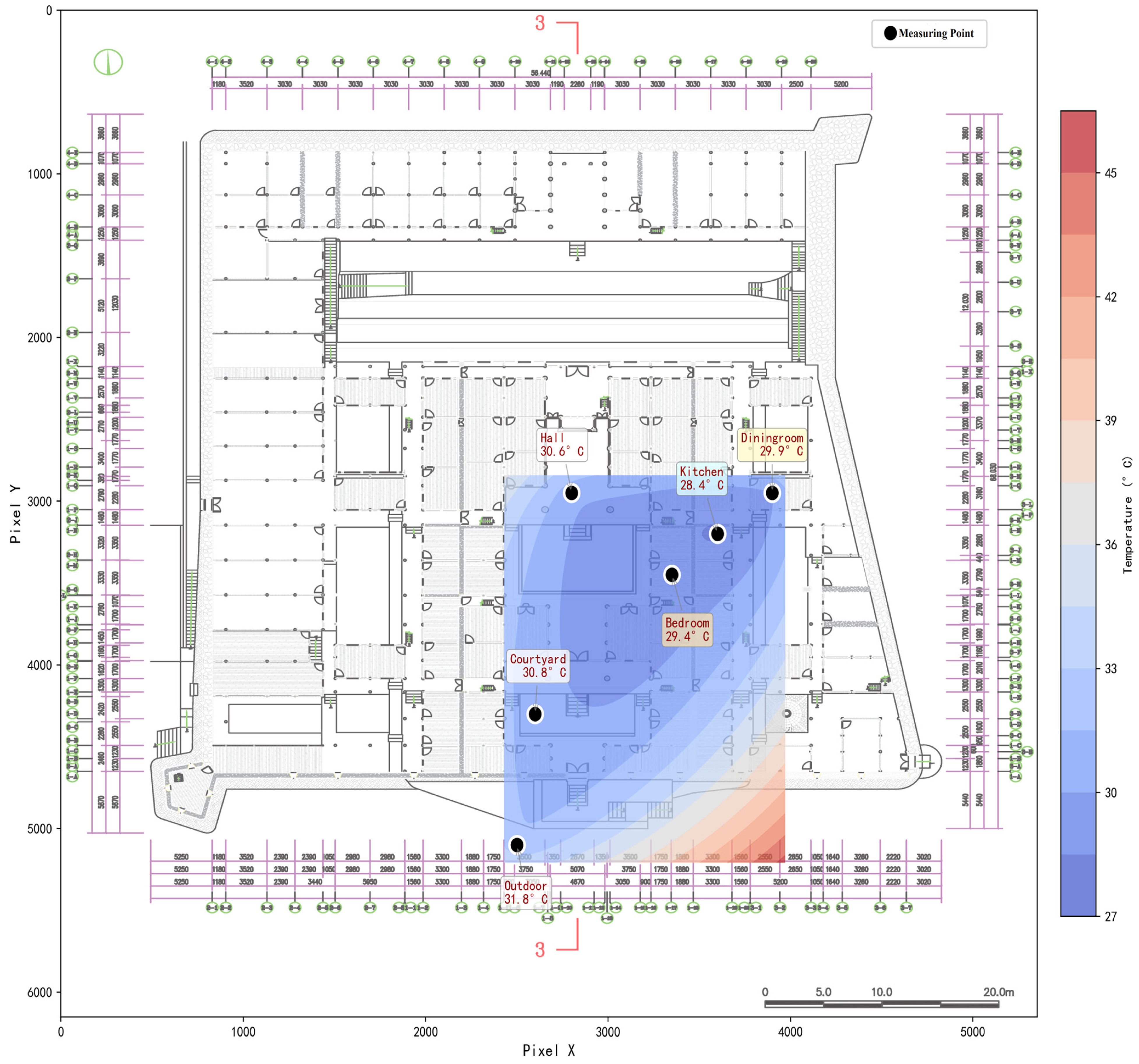
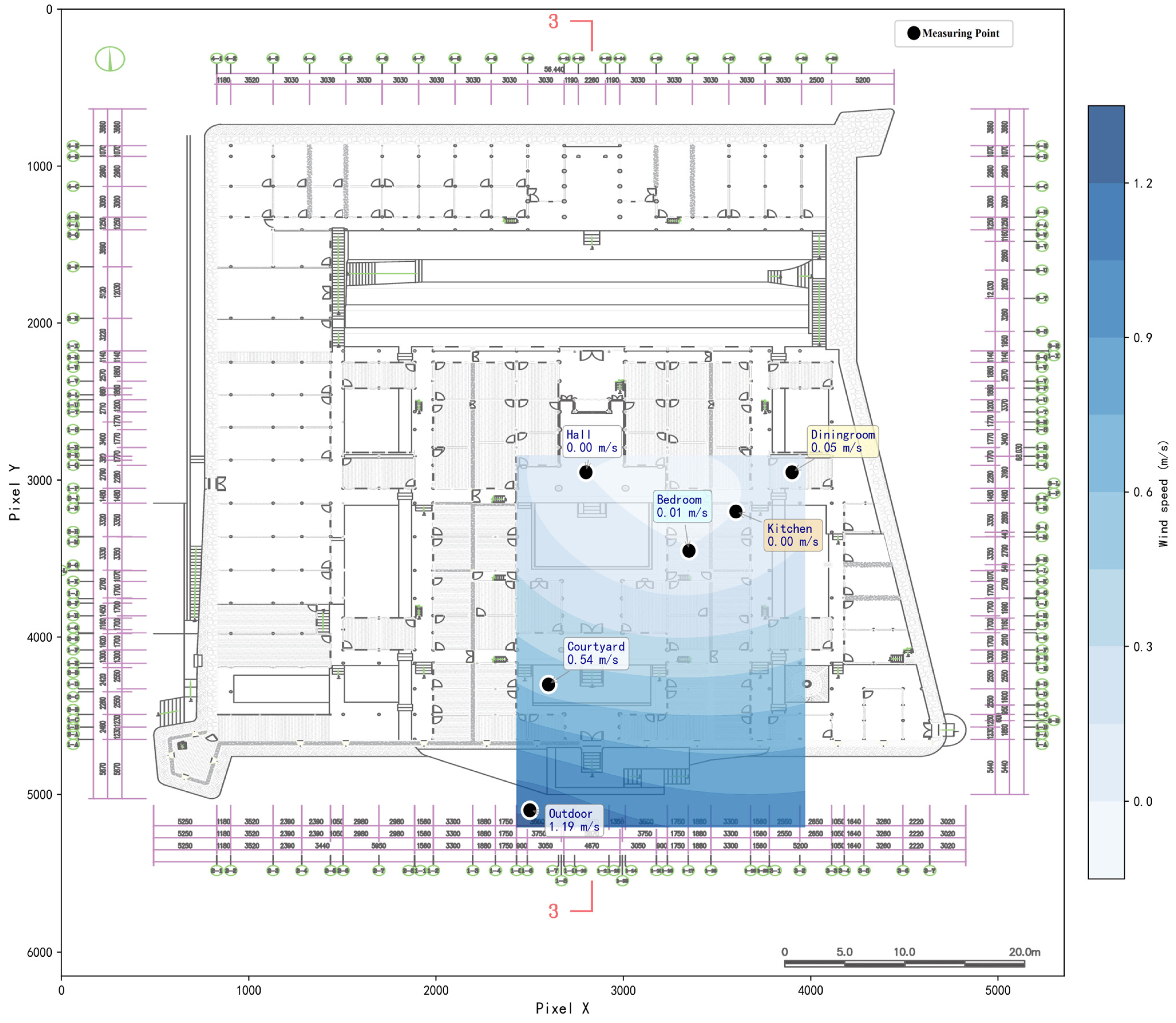
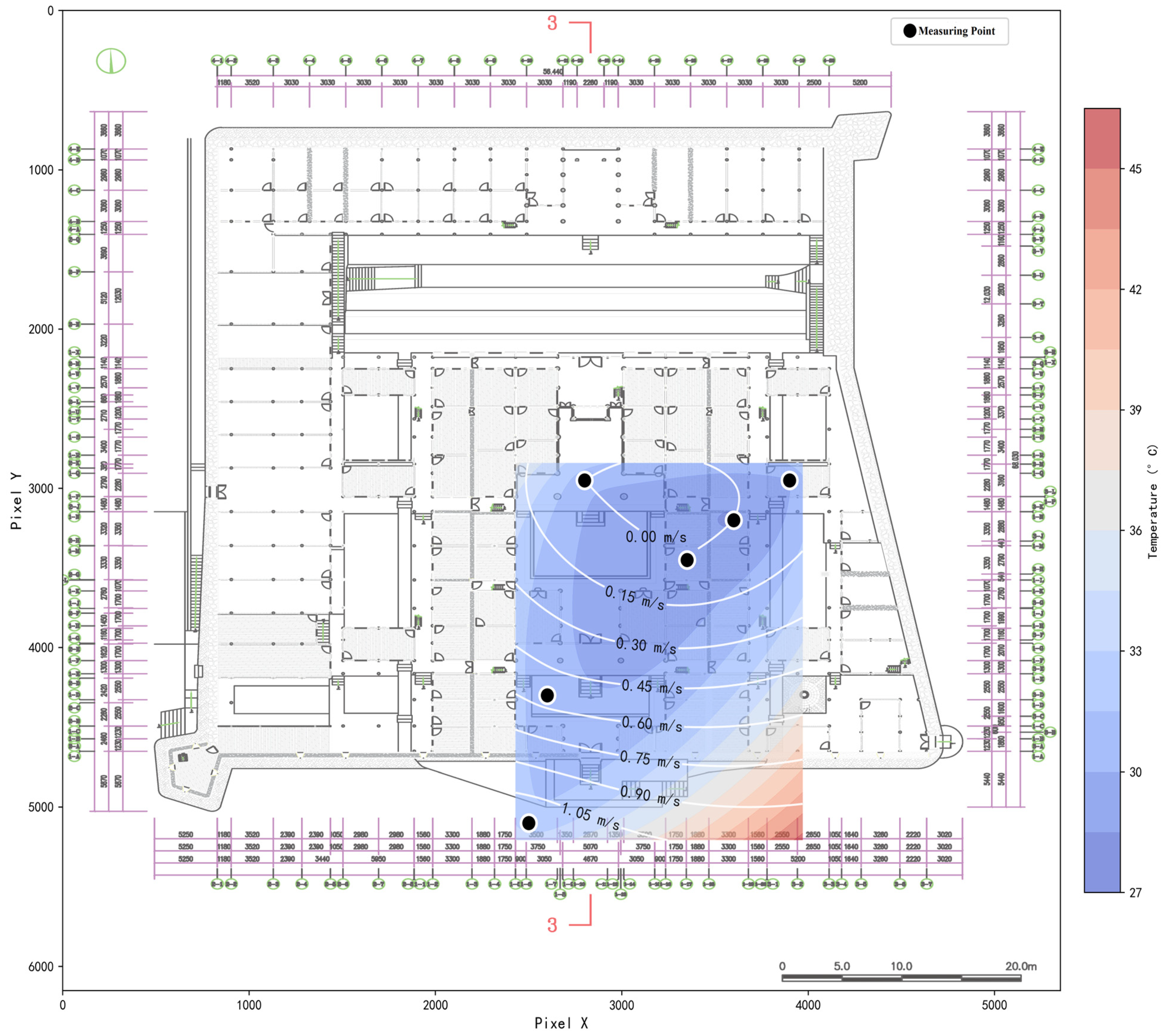
2.3.2. Spatial Interpolation and Thermal Environment Visualization
2.3.3. Quantification of Thermal Buffering Efficiency and Ventilation Efficacy
3. Results
3.1. Comparison of Indoor and Outdoor Thermal Environmental Performance
3.2. K–S Test: Statistical Verification of Distribution Differences and Passive Regulatory Efficacy
3.3. Internal Spatial Gradients and Synergistic Mechanisms
3.4. Combined Effects of Materials and Layout
4. Discussion
4.1. Dialogue with Existing Research: From Qualitative Description to Systematic Quantification
4.2. Systematic Analysis and Attribution of the “Gradient-Buffering-and-Dynamic-Adjustment” Mechanism
4.3. Strategic Implications and Translation Pathways for Contemporary Super-Low-Energy Building Design
5. Conclusions
5.1. Main Research Findings
5.2. Research Contributions and Significance
5.3. Research Limitations and Future Prospects
Author Contributions
Funding
Data Availability Statement
Conflicts of Interest
Abbreviations
| SLEBs | Super-Low-Energy Buildings |
| SD | Standard Deviation |
References
- Moazami, A.; Nik, V.M.; Carlucci, S.; Geving, S. Impacts of future weather data typology on building energy performance—Investigating long-term patterns of climate change and extreme weather conditions. Appl. Energy 2019, 238, 696–720. [Google Scholar] [CrossRef]
- Loh, J.R.; Bellam, S. Towards Net Zero: Evaluating Energy Security in Singapore Using System Dynamics Modelling. Appl. Energy 2024, 358, 122537. [Google Scholar] [CrossRef]
- Sougkakis, V.; Lymperopoulos, K.; Nikolopoulos, N.; Margaritis, N.; Giourka, P.; Angelakoglou, K. An Investigation on the Feasibility of Near-Zero and Positive Energy Communities in the Greek Context. Smart Cities 2020, 3, 362–384. [Google Scholar] [CrossRef]
- Tagliabue, L.C.; Di Giuda, G.M.; Villa, V.; De Angelis, E.; Ciribini, A.L.C. Techno-economical analysis based on a parametric computational evaluation for decision process on envelope technologies and configurations evaluation for decision process of envelope technologies and configurations. Energy Build. 2018, 158, 736–749. [Google Scholar] [CrossRef]
- Shepherd, A.; Batty, W. Fuzzy control strategies to provide cost and energy efficient high quality indoor environments in buildings with high occupant densities. Build. Serv. Eng. Res. Technol. 2003, 24, 35–45. [Google Scholar] [CrossRef]
- Li, D.; Qi, Z.; Zhou, Y.; Elchalakani, M. Machine Learning Applications in Building Energy Systems: Review and Prospects. Buildings 2025, 15, 648. [Google Scholar] [CrossRef]
- Zhai, Z.; Previtali, J.M. Ancient vernacular architecture: Characteristics categorization and energy performance evaluation. Energy Build. 2010, 42, 357–365. [Google Scholar] [CrossRef]
- Zhong, W.; Schrder, T.; Bekkering, J. Biophilic design in architecture and its contributions to health, well-being, and sustainability: A critical review. Front. Archit. Res. 2022, 11, 114–141. [Google Scholar] [CrossRef]
- Miri, P.; Babakhani, P. On the failure of the only vernacular windcatcher in the mountainous region of Western Iran: Opportunities for energy-efficient buildings. J. Clean. Prod. 2021, 295, 126383. [Google Scholar] [CrossRef]
- El Azhary, K.; Ouakarrouch, M.; Laaroussi, N.; Garoum, M. Energy Efficiency of a Vernacular Building Design and Materials in Hot Arid Climate: Experimental and Numerical Approach. Int. J. Renew. Energy Dev. 2021, 10, 481–494. [Google Scholar] [CrossRef]
- Du, X. Passive Cooling Techniques; Delft University of Technology: Delft, The Netherlands, 2019. [Google Scholar] [CrossRef]
- Li, J. Self-Renewal Under the Defensive Wall: The Case Study of Zhuangzhai in Eastern Fujian. Master’s Thesis, China Academy of Art, Hangzhou, China, 2021. [Google Scholar]
- Wang, J. Low-Carbon Oriented Study and Practice on Space Morphology of Rural Residence of Northern Zhejiang. Master’s Thesis, Zhejiang University, Hangzhou, China, 2015. [Google Scholar]
- Hong, X.; Ji, X. A Study on Traditional Wisdom of Passive Ultra-low-energy Green Building Energy Saving. Chin. Overseas Archit. 2019, 44–46. [Google Scholar] [CrossRef]
- Lilliefors, H. On the Kolmogorov-Smirnov Test for Normality with Mean and Variance Unknown. J. Am. Stat. Assoc. 1967, 62, 399–402. [Google Scholar] [CrossRef]
- Nguyen, M. Foundations of Data Analysis; Springer: Cham, Switzerland, 2025; Volume 1. [Google Scholar] [CrossRef]
- Bodach, S.; Lang, W.; Hamhaber, J. Climate responsive building design strategies of vernacular architecture in Nepal. Energy Build. 2014, 81, 227–242. [Google Scholar] [CrossRef]
- He, W.; Wu, Z.; Jin, R.; Liu, J. Organization and evolution of climate responsive strategies, used in Turpan vernacular buildings in arid region of China. Front. Archit. Res. 2023, 12, 556–574. [Google Scholar] [CrossRef]
- Yang, Y.; Wang, X.; Luo, S.; Wang, Y.; Wen, X.; Ni, N.; Wang, L.; Jiang, W.; Cai, J.; Xu, G.; et al. Study on the Impact of Courtyard Proportions in Kunming’s Vernacular One-Seal Dwellings (Yikeyin) on Architectural Climatic Adaptability. Sustainability 2025, 17, 3066. [Google Scholar] [CrossRef]
- Moscoso-García, P.; Quesada-Molina, F. Analysis of Passive Strategies in Traditional Vernacular Architecture. Buildings 2023, 13, 1984. [Google Scholar] [CrossRef]
- Xia, B.; Zhao, H.; Zhou, S.; Zhang, X.; Kang, Y. Analysis and Retrofitting of the Thermal Environment in Traditional Residences in Xihaigu Region. Build. Energy Effic. 2025, 53, 128–136. [Google Scholar]
- Hao, S.; Yu, C.; Xu, Y.; Song, Y. The Effects of Courtyards on the Thermal Performance of a Vernacular House in a Hot-Summer and Cold-Winter Climate. Energies 2019, 12, 1042. [Google Scholar] [CrossRef]
- Yao, R.; Zhang, S.; Du, C.; Schweiker, M.; Hodder, S.; Olesen, B.; Toftum, J.; d’Ambrosio, F.; Gebhardt, H.; Zhou, S.; et al. Evolution and performance analysis of adaptive thermal comfort models—A comprehensive literature review. Build. Environ. 2022, 217, 109020. [Google Scholar] [CrossRef]



| Item | Details |
|---|---|
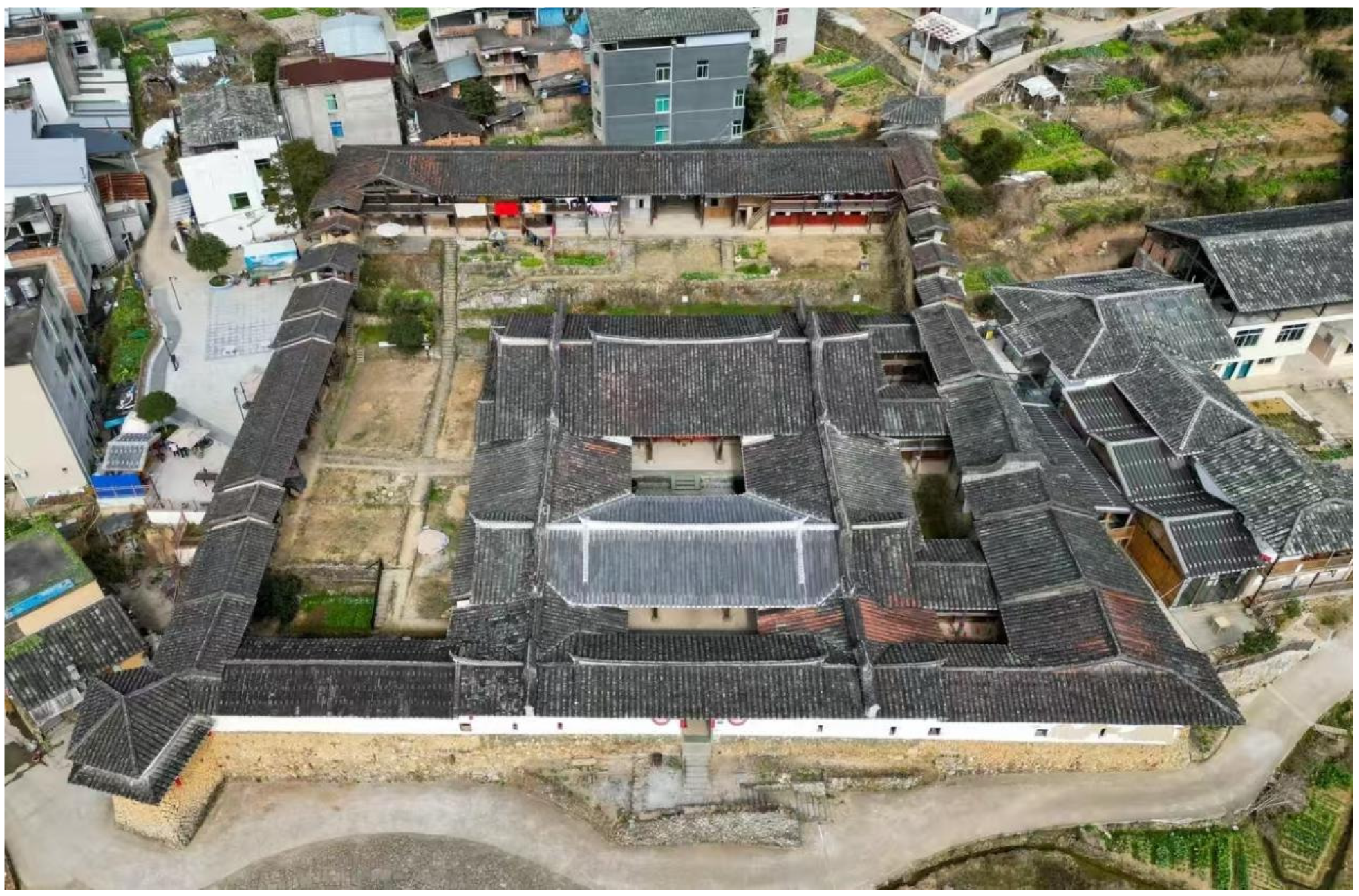
| Geographical location | It is located in Yongtai County, Fujian Province. |
| Construction time | Qing Dynasty. |
| Building area | About 3200 square meters. |
| Main structural materials | Peripheral load-bearing wall: rammed-earth construction. Internal structure: wooden frame. |
| Maintained structural features | Thick rammed-earth wall, double-slope tile roof, and transparent wooden doors and windows. |
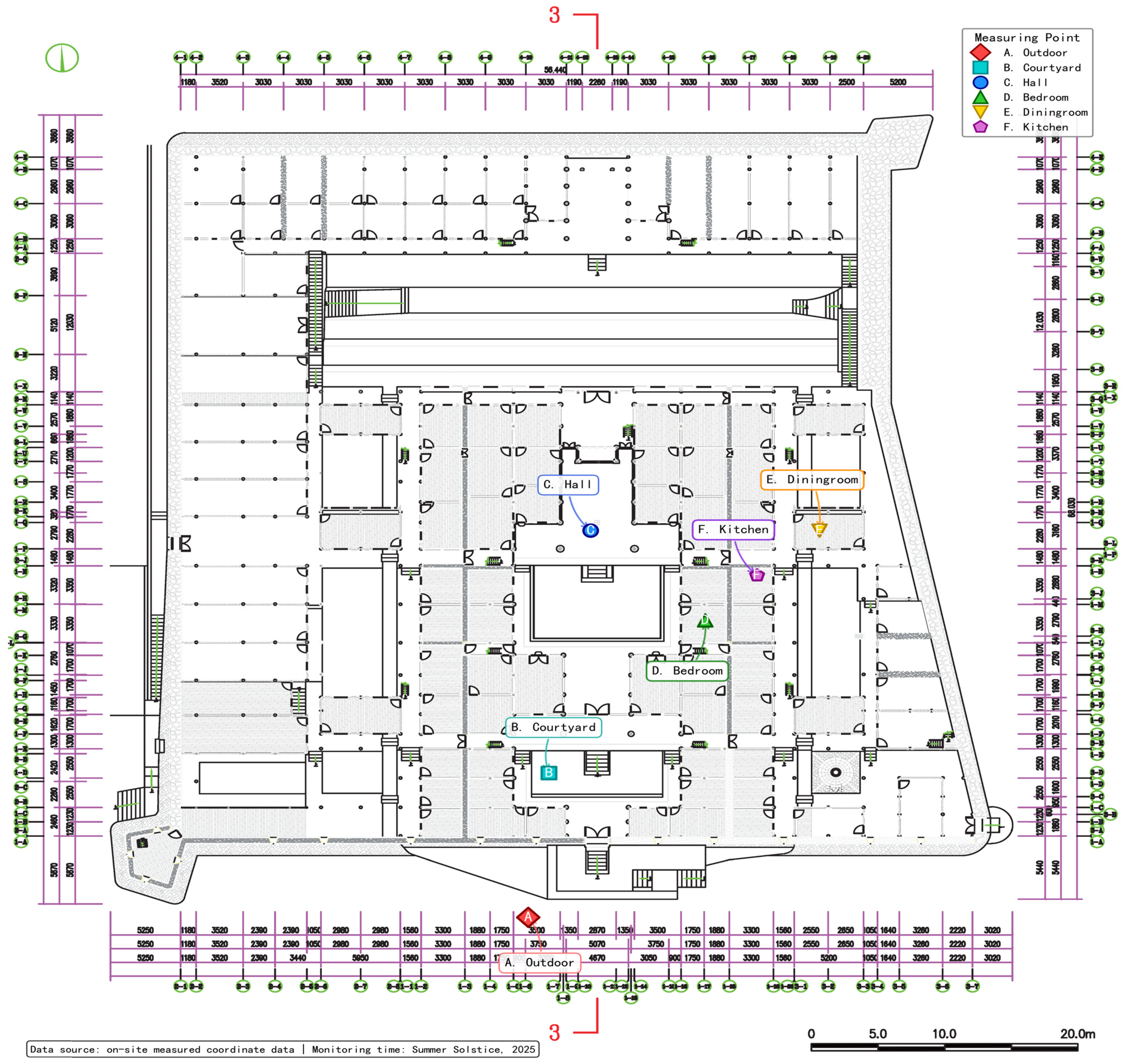
| Spatial layout | Symmetrical axis and inward-facing courtyard with a clear gradient of “Public–Private” space. |
| Recent renovation history | Since the 2010s, protective repairs (structural reinforcement and tile surface restoration) have been carried out without changing the original materials and spatial layout. |
| Heating/cooling method | No centralized or split-type active heating and air conditioning system. Relies on natural ventilation and passive thermal regulation. |
| Energy consumption data | Due to its role as a protective building and lack of active systems, there is no energy consumption data in the traditional sense. The aim of this study is to quantify the potential for reducing theoretical energy consumption through passive regulation. |
| Measuring Point | Maximum Temperature (°C) | Maximum Temperature Time | Minimum Temperature (°C) | Minimum Temperature Time | Temperature Difference (°C) | 25% Percentile (°C) | Median (°C) | 75% Percentile (°C) | Temperature Range |
|---|---|---|---|---|---|---|---|---|---|
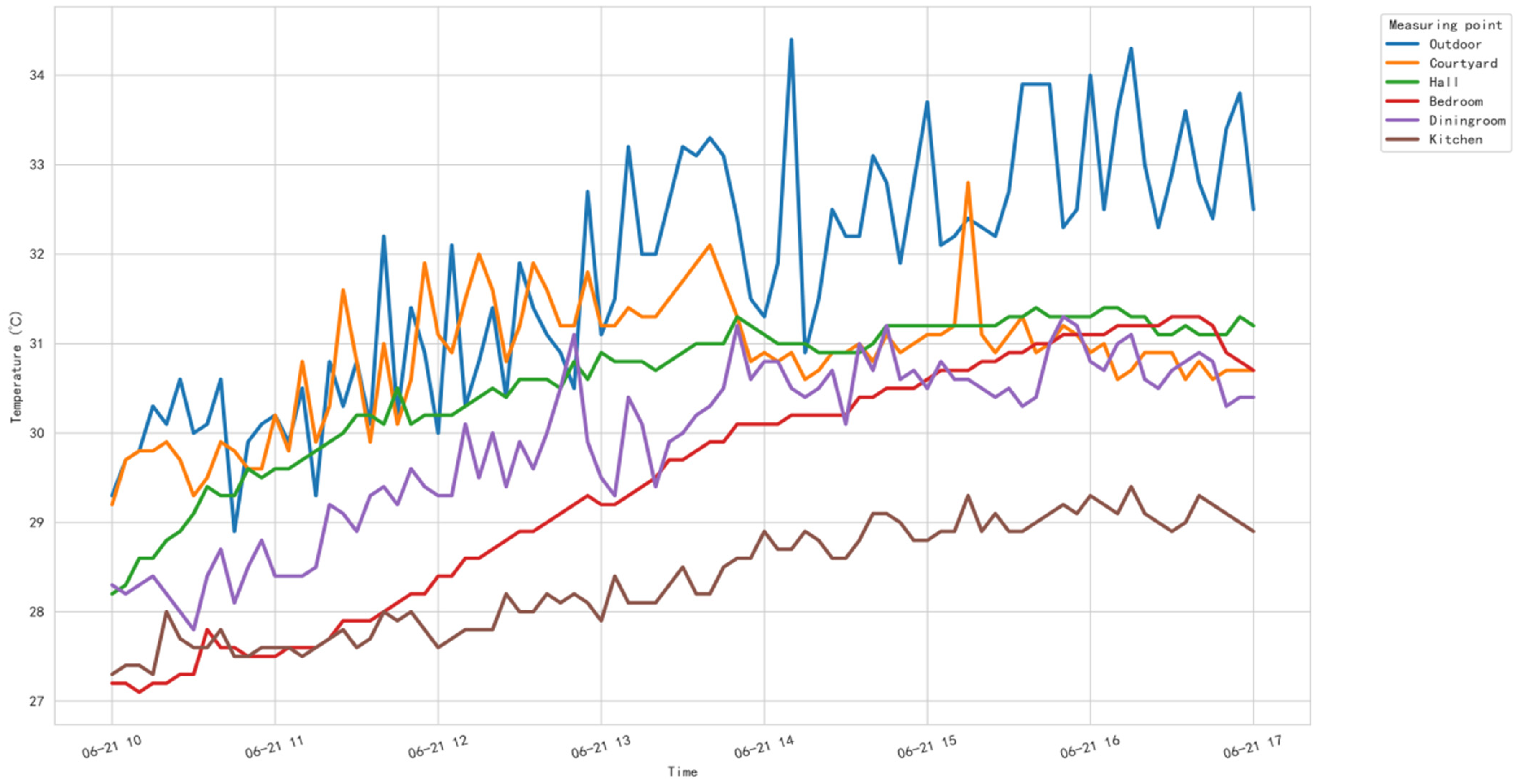
| Outdoor | 34.4 | 14:10 | 28.9 | 10:45 | 5.5 | 30.6 | 32 | 32.8 | 28.9–34.4 |
| Courtyard | 32.8 | 15:15 | 29.2 | 10:00 | 3.6 | 30.6 | 30.9 | 31.2 | 29.2–32.8 |
| Hall | 31.4 | 15:40 | 28.2 | 10:00 | 3.2 | 30.2 | 30.9 | 31.2 | 28.2–31.4 |
| Bedroom | 31.3 | 16:30 | 27.1 | 10:10 | 4.2 | 28.1 | 29.7 | 30.7 | 27.1–31.3 |
| Dining room | 31.3 | 15:50 | 27.8 | 10:30 | 3.5 | 29.3 | 30.3 | 30.6 | 27.8–31.3 |
| Kitchen | 29.4 | 16:15 | 27.3 | 10:00 | 2.1 | 27.8 | 28.3 | 28.9 | 27.3–29.4 |
| Indoor Space | Indoor Mean ± SD (°C) | Outdoor Mean ± SD (°C) | Mean Difference (°C) | K–S Statistic | p Value | Significance |
|---|---|---|---|---|---|---|
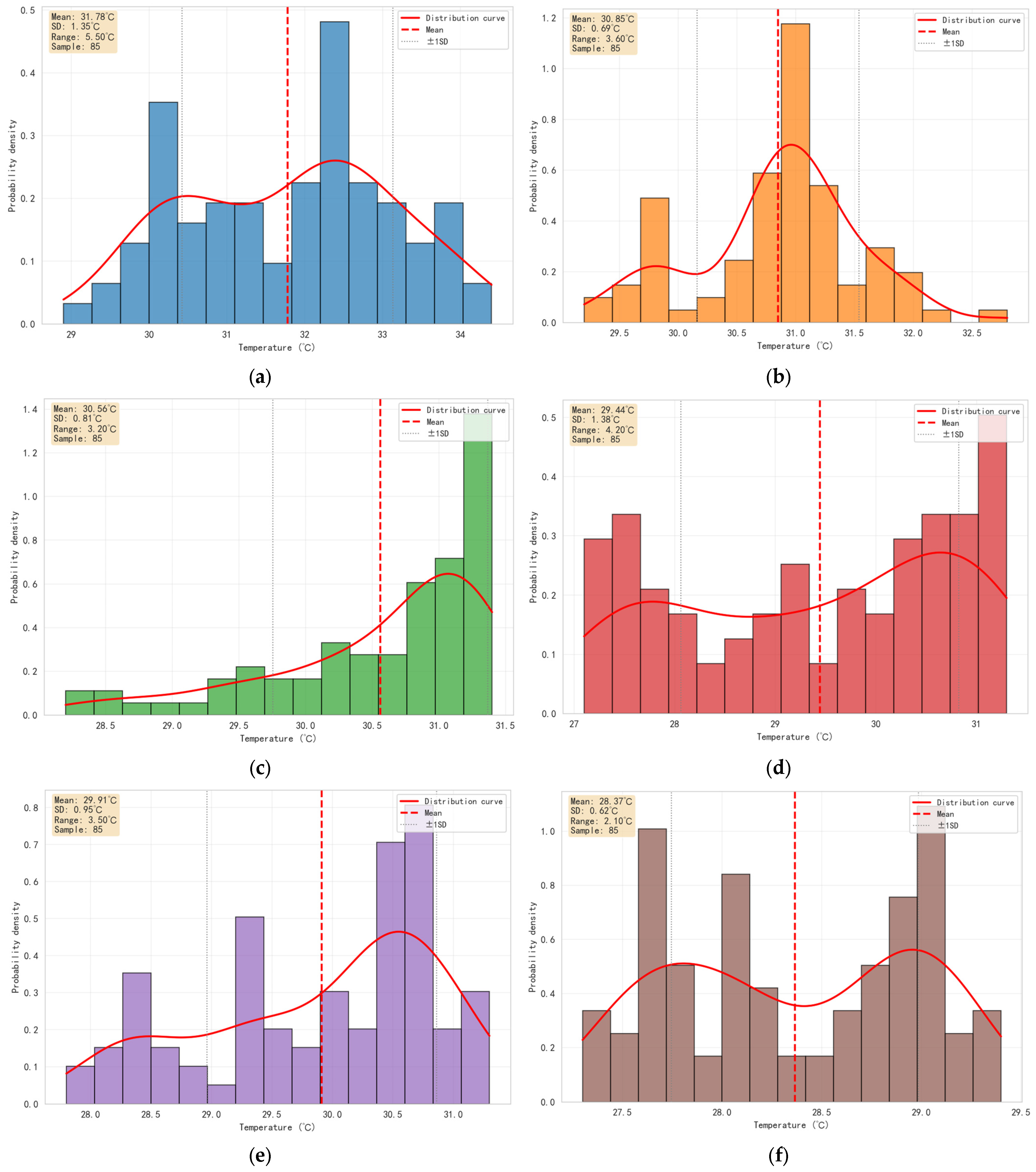
| Courtyard | 30.85 ± 0.69 | 31.78 ± 1.35 | −0.93 | 0.4824 | 0 | *** |
| Hall | 30.56 ± 0.81 | 31.78 ± 1.35 | −1.22 | 0.5882 | 0 | *** |
| Bedroom | 29.44 ± 1.38 | 31.78 ± 1.35 | −2.34 | 0.6235 | 0 | *** |
| Dining room | 29.91 ± 0.95 | 31.78 ± 1.35 | −1.87 | 0.6235 | 0 | *** |
| Kitchen | 28.37 ± 0.62 | 31.78 ± 1.35 | −3.41 | 0.9647 | 0 | *** |
| Indoor Space | Outdoor Peak Time | Outdoor Peak Temperature (°C) | Indoor Peak Time | Indoor Peak Temperature (°C) | (hour) | Outdoor Daily Range (°C) | Indoor Daily Range (°C) | Decay Rate (%) |
|---|---|---|---|---|---|---|---|---|
| Courtyard | 14:10 | 34.4 | 15:15 | 32.8 | 1.1 | 5.5 | 3.6 | 34.5 |
| Hall | 14:10 | 34.4 | 15:40 | 31.4 | 1.5 | 5.5 | 3.2 | 41.8 |
| Bedroom | 14:10 | 34.4 | 16:30 | 31.3 | 2.3 | 5.5 | 4.2 | 23.6 |
| Dining room | 14:10 | 34.4 | 15:50 | 31.3 | 1.7 | 5.5 | 3.5 | 36.4 |
| Kitchen | 14:10 | 34.4 | 16:15 | 29.4 | 2.1 | 5.5 | 2.1 | 61.8 |
Disclaimer/Publisher’s Note: The statements, opinions and data contained in all publications are solely those of the individual author(s) and contributor(s) and not of MDPI and/or the editor(s). MDPI and/or the editor(s) disclaim responsibility for any injury to people or property resulting from any ideas, methods, instructions or products referred to in the content. |
© 2026 by the authors. Licensee MDPI, Basel, Switzerland. This article is an open access article distributed under the terms and conditions of the Creative Commons Attribution (CC BY) license.
Share and Cite
Cheng, J.; Zhang, Y.; Liu, X.; Ding, R. A Study on Super-Low-Energy Building Design Strategies Based on the Quantification of Passive Climate Adaptation Mechanisms. Buildings 2026, 16, 456. https://doi.org/10.3390/buildings16020456
Cheng J, Zhang Y, Liu X, Ding R. A Study on Super-Low-Energy Building Design Strategies Based on the Quantification of Passive Climate Adaptation Mechanisms. Buildings. 2026; 16(2):456. https://doi.org/10.3390/buildings16020456
Chicago/Turabian StyleCheng, Jiaohua, Yuanyi Zhang, Xiaohuan Liu, and Rui Ding. 2026. "A Study on Super-Low-Energy Building Design Strategies Based on the Quantification of Passive Climate Adaptation Mechanisms" Buildings 16, no. 2: 456. https://doi.org/10.3390/buildings16020456
APA StyleCheng, J., Zhang, Y., Liu, X., & Ding, R. (2026). A Study on Super-Low-Energy Building Design Strategies Based on the Quantification of Passive Climate Adaptation Mechanisms. Buildings, 16(2), 456. https://doi.org/10.3390/buildings16020456