Evaluating the Resilience of Ventilation Strategies in Low-Energy Irish Schools


Abstract
1. Introduction
- 1.
- To calibrate a building simulation model to accurately predict indoor thermal conditions and assess the comfort levels of occupants under future extreme weather conditions.
- 2.
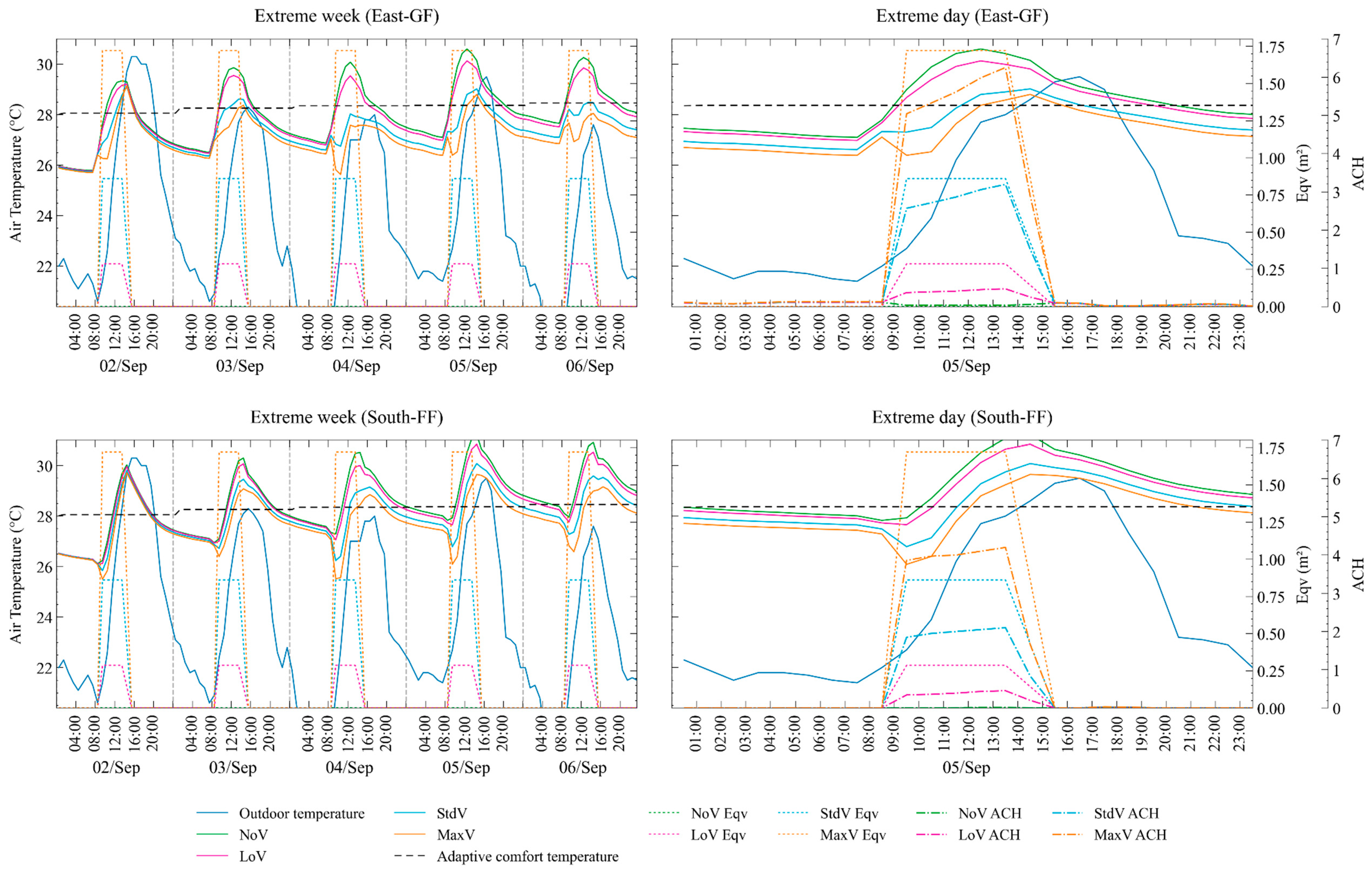
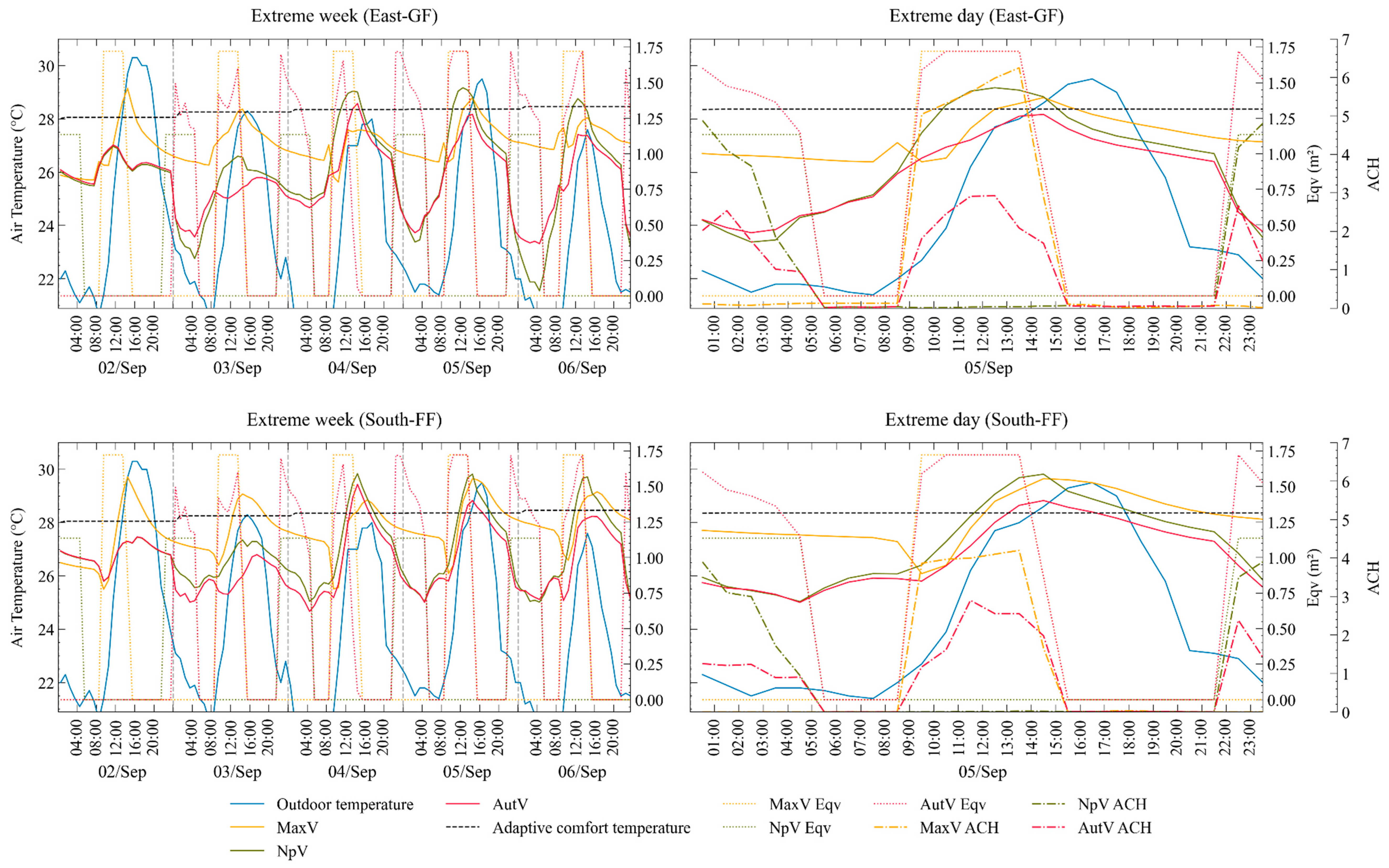
- To investigate the potential resilient and low-cost ventilative strategies in mitigating overheating risks in the studied NV low-energy school building through a methodical approach.
- 3.
- To assess the impact of future extreme weather conditions on the cognitive performance of children in case study classrooms and explore the effectiveness of VC in mitigating the adverse effects.
- 4.
- To evaluate the potential of the studied school to serve as a climate shelter during the summer, providing a comfortable environment for vulnerable people.
2. Materials and Method
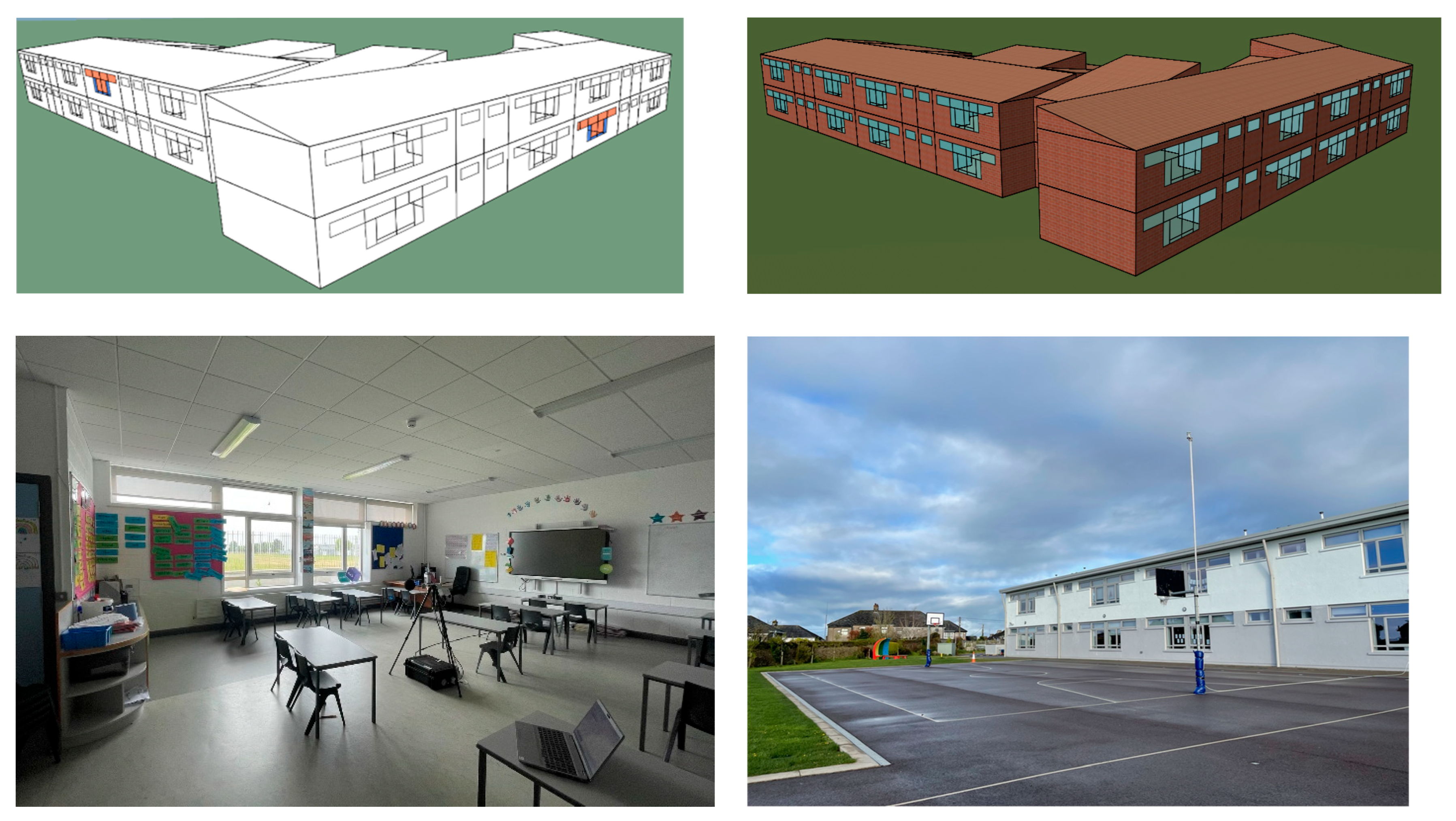
2.1. Case Study
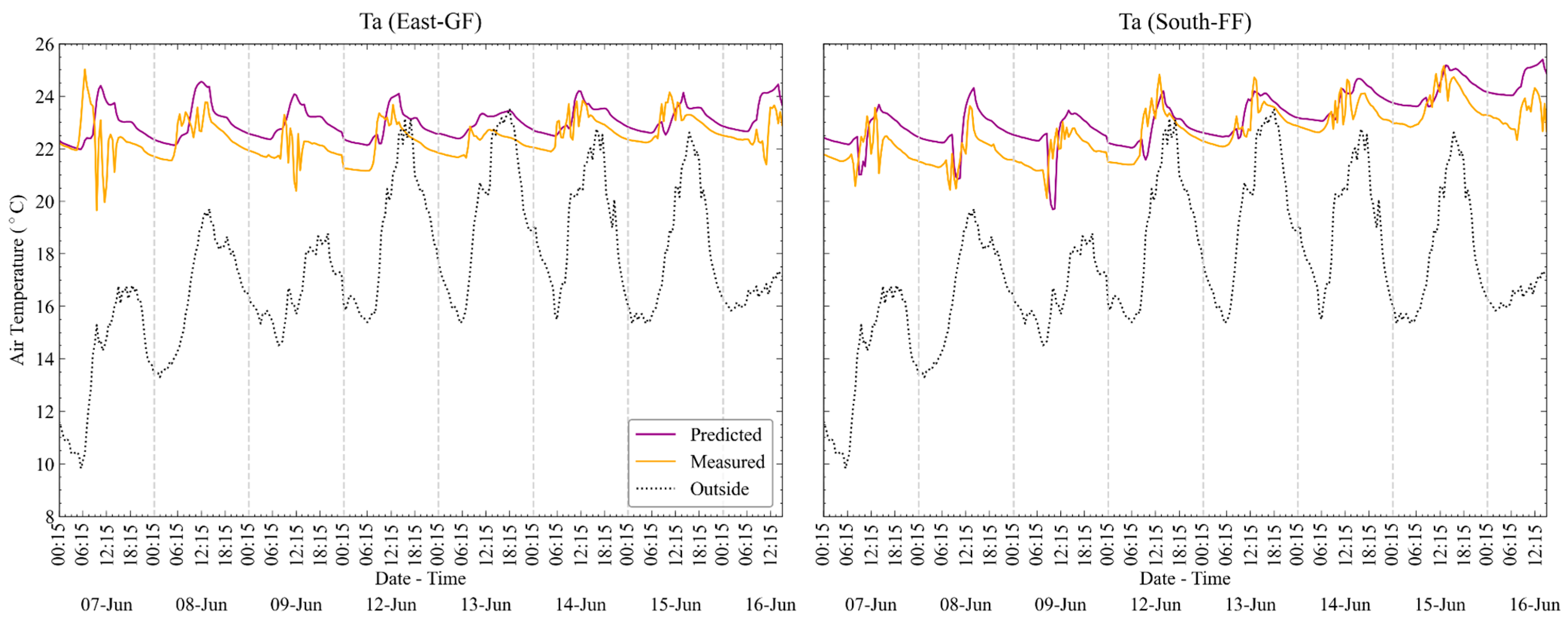
2.2. Model Calibration and Validation
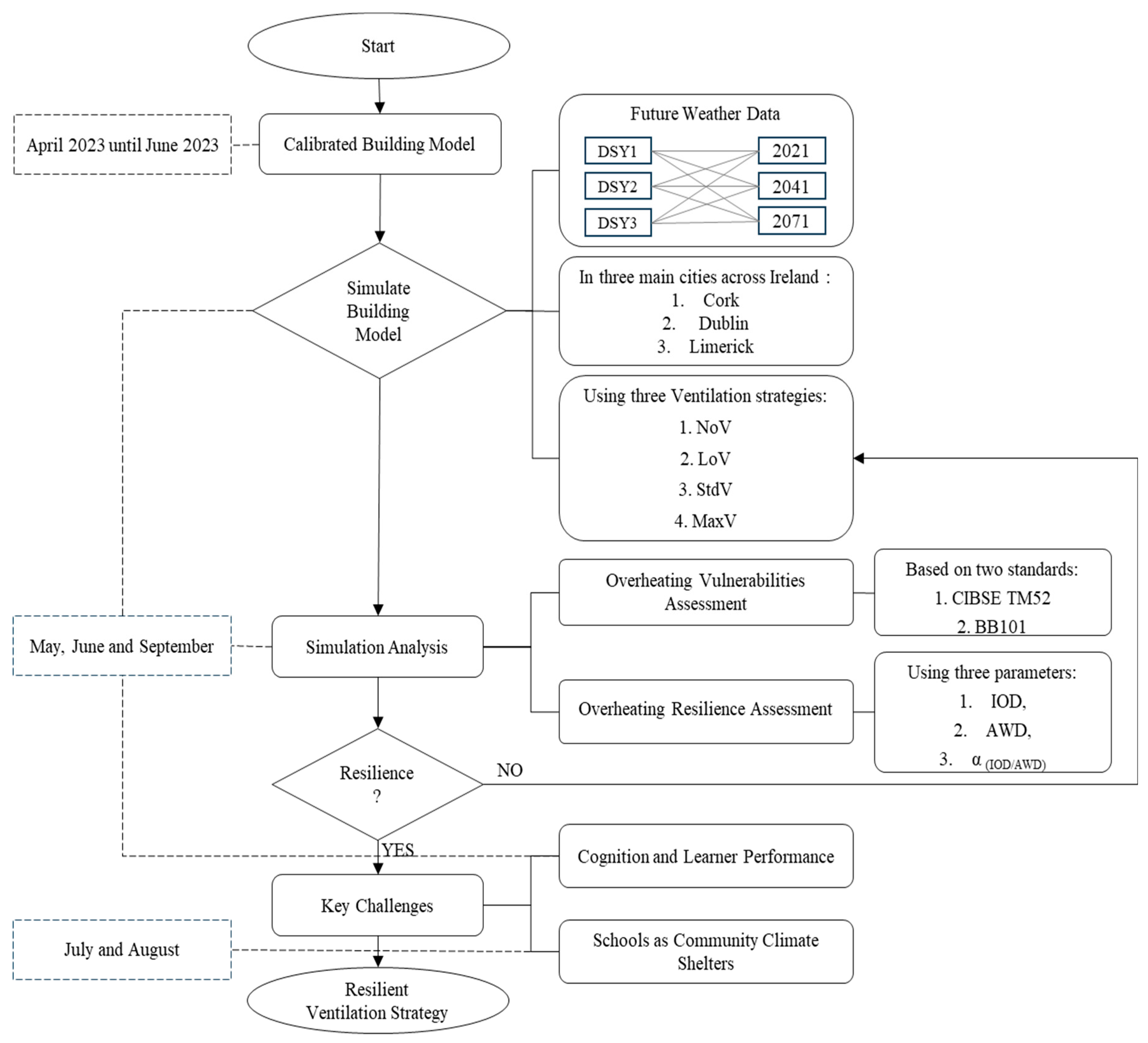
2.3. Future Building Modelling and Simulation
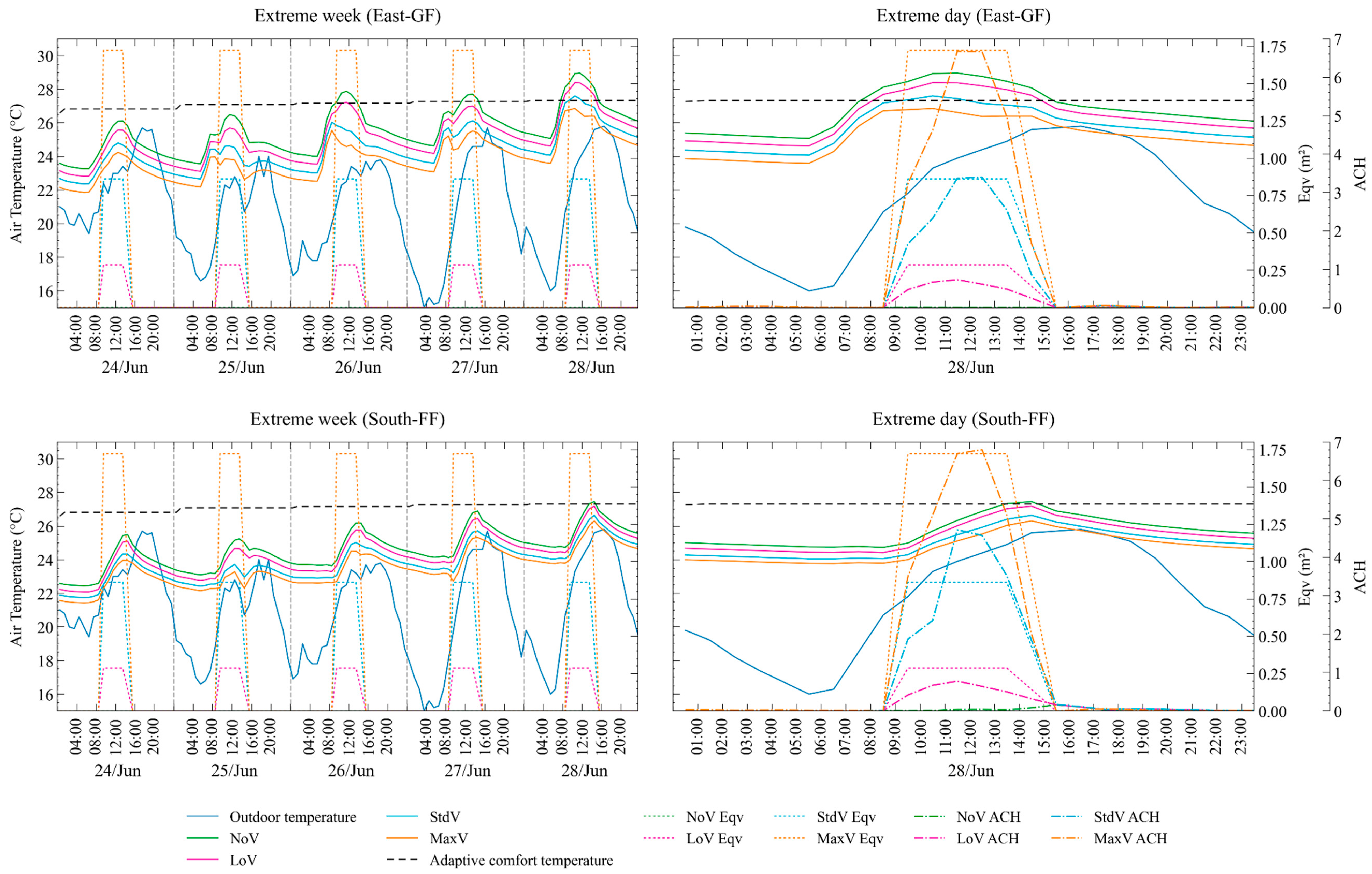
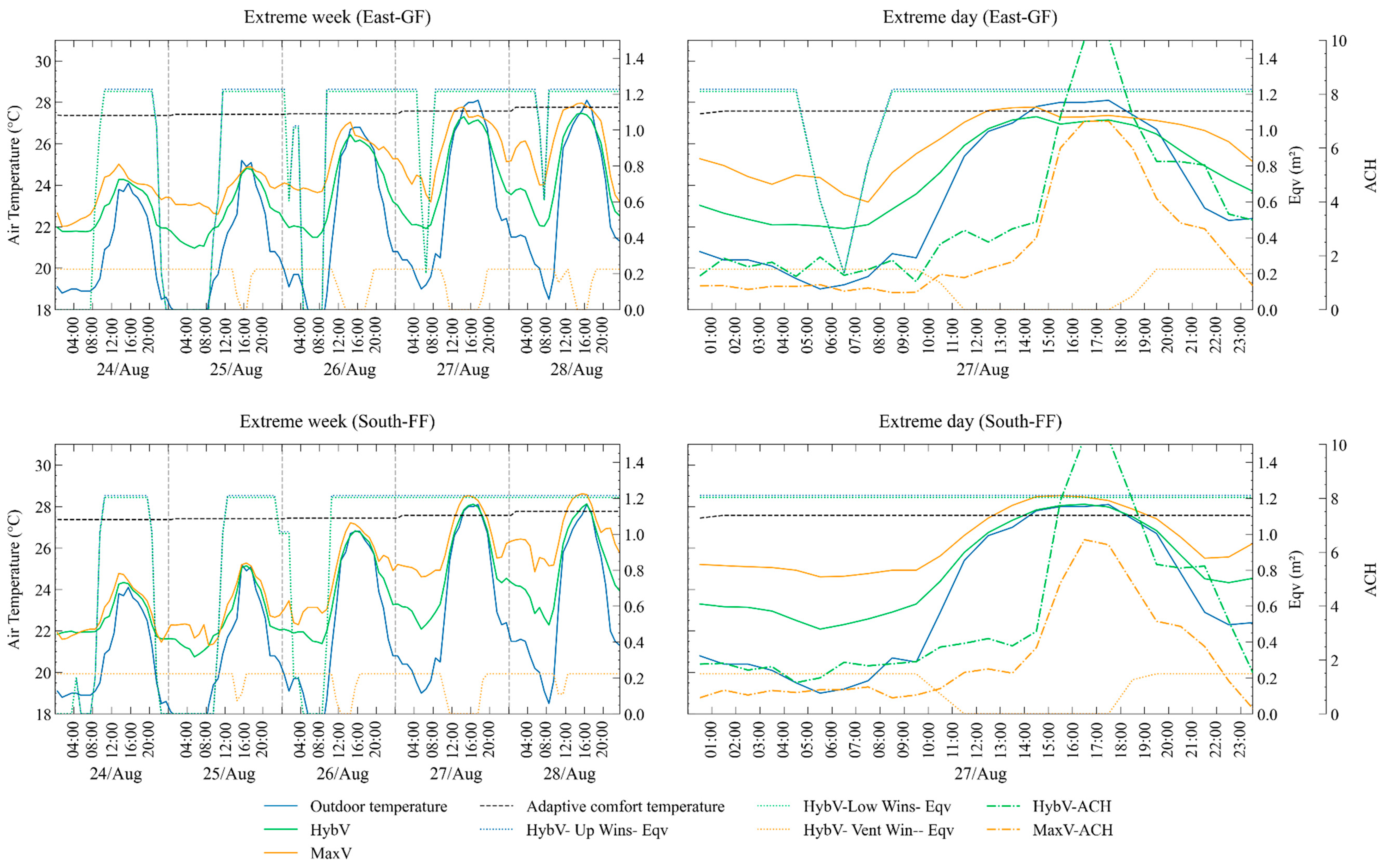
3. Ventilation Strategies
4. Results
4.1. Overheating Vulnerability Assessment
4.2. Resilience Assessment
4.3. Cognition and Learner Performance
4.4. Schools as Community Climate Shelters
5. Discussion
6. Conclusions, Limitations, and Future Work
- The model was calibrated for both occupied and unoccupied conditions to evaluate the impact of physical construction and occupant behaviour separately, but may not fully capture the range of occupant behaviours during the non-heating season.
- Occupancy patterns and window opening schedules were derived from teacher surveys, introducing potential inaccuracies due to manual reporting.
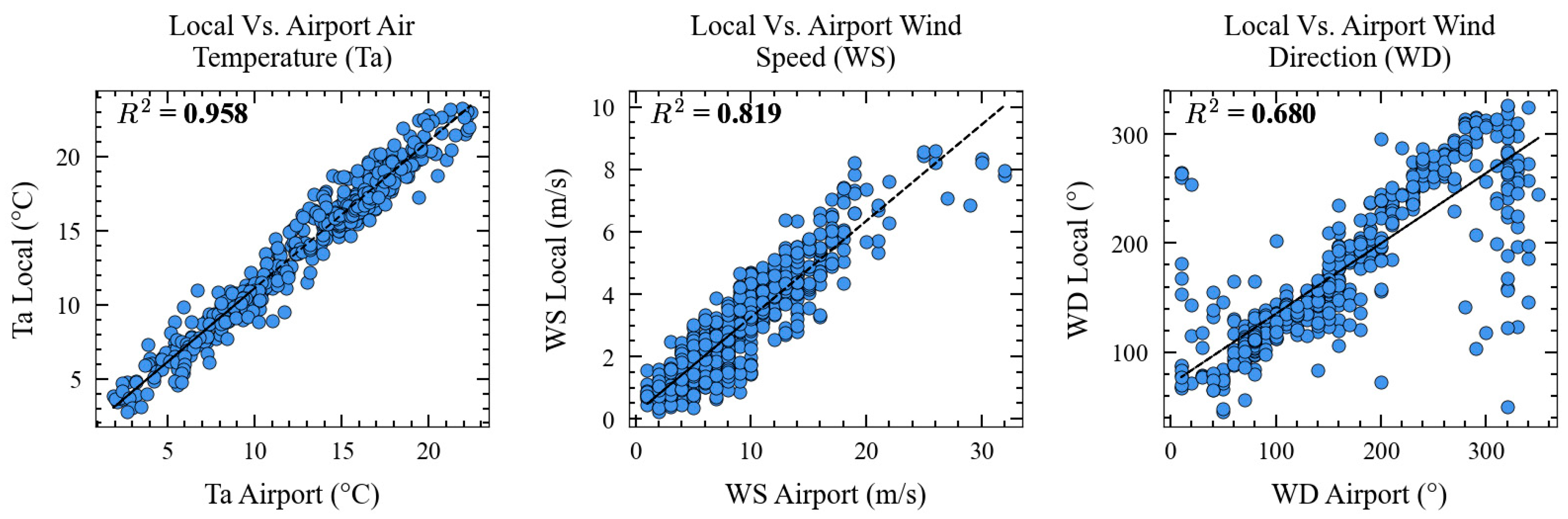
- A mismatch between wind speed and direction data from the local and Cork weather stations led to an overestimation of air change rates.
- Ventilation effectiveness in natural ventilation scenarios depends heavily on weather conditions. While dynamic modelling was used, airflow rates were not directly measured and real-time variability may affect performance. This represents a key limitation of the study.
- The resilience assessment focused on three criteria, vulnerability, resistance, and robustness, excluding the fourth criterion of recoverability after thermal failure.
- The study does not explicitly model urban heat island effects or microclimatic variations, which may influence overheating risk, particularly in more urbanised areas like Dublin. Future work should consider these factors to refine the accuracy of climate-based performance assessments.
- Future research should incorporate automated monitoring, airflow quantification, expanded building typologies, and refined climate projections to improve reliability and applicability.
- The accuracy of simulations strongly relies on weather data inputs. It is recommended that local weather data be prioritised over airport weather data for building performance simulations. This will ensure a more accurate representation of the microclimates and urban heat islands directly influencing school buildings.
- Occupancy modelling in building simulations often involves simplifications due to the complexity of human behaviour. Future work could benefit from more sophisticated occupancy models that capture occupant activities, preferences, and interactions with the built environment for more accurate predictions. This may include the integration of machine learning approaches for more accurate predictions.
- The findings of this study are based on specific geographical and climatic conditions. The proposed recommendations in this paper may not universally apply to all regions. Future research should explore the development of guidelines and recommendations to ensure the resilience of low-energy school designs across diverse climates and future projections.
Author Contributions
Funding
Data Availability Statement
Conflicts of Interest
Abbreviations
| IEQ | Indoor environmental quality | AD | Adjustments |
| IAQ | Indoor air quality | DR | Date range |
| NZEBs | Nearly zero emission buildings | GoF | Goodness of fit |
| VC | Ventilative cooling | CVRMSE | Coefficient of variation of the root mean square error (%) |
| NV | Natural ventilation | RMSE | Root mean square error (°C) |
| POF | Percentage of opening-to-floor area (%) | NMBE | Normalised mean bias error (%) |
| UHI | Urban heat islands | Ta | Air temperature (°C) |
| DSY | Design summer years | To | Outdoor air temperature (°C) |
| IOD | Indoor overheating degree | Tc | Comfort temperature (°C) |
| AWD | Ambient warmness degree | Tmax | Maximum comfort temperature (°C) |
| αIOD/AWD | Overheating escalator factor | Tlim | Category range limit of comfort (°C) |
| NoV | No ventilation (0% POF) | Trm | Running mean temperature (°C) |
| LoV | Low ventilation (1.5% POF) | Top | Operative temperature (°C) |
| StdV | Standard ventilation (4.8% POF) | Eqv | Opening equivalent area (m2) |
| MaxV | Maximum ventilation (9.6% POF) | CPL | Cognition performance loss (%) |
| NpV | Night-purge ventilation | IESVE | Integrated environmental solutions Virtual environment |
| AutV | Auto ventilation | HybV | Hybrid ventilation |
| ACH | Air change rate per hour |
Appendix A




| Number of Occupied Hours from May to September When Value Exceeds the Acceptable Threshold | |||||||||||||||||||||||||
|---|---|---|---|---|---|---|---|---|---|---|---|---|---|---|---|---|---|---|---|---|---|---|---|---|---|
| Ventilation Strategies | Years | Cork | Dublin | Limerick | |||||||||||||||||||||
| CIBSE TM52 | CIBSE TM52 BB101 | CIBSE TM52 BB101 | BB101 | CIBSE TM52 | CIBSE TM52 BB101 | CIBSE TM52 BB101 | BB101 | CIBSE TM52 | CIBSE TM52 BB101 | CIBSE TM52 BB101 | BB101 | ||||||||||||||
| Criteria (CRI) | CRI 1 | CRI 2 | CRI 3 | CRI 1 | CRI 1 | CRI 2 | CRI 3 | CRI 1 | CRI 1 | CRI 2 | CRI 3 | CRI 1 | |||||||||||||
| Threshold | (To > Tcomf) ≤ 3% Occ HRS (~11) | (To > Tcomf) ≤ 6 h on any Day | (To − Tcomf) ≤ 4 | (To > Tcomf) ≤ 40 h | (To > Tcomf) ≤ 3% Occ HRS (~11) | (To > Tcomf) ≤ 6 h on any Day | (To − Tcomf) ≤ 4 | (To > Tcomf) ≤ 40 h | (To > Tcomf) ≤ 3% Occ HRS (~11) | (To > Tcomf) ≤ 6 h on any Day | (To − Tcomf) ≤ 4 | (To > Tcomf) ≤ 40 h | |||||||||||||
| Class | C7 (GF) | C11 (FF) | C7 (GF) | C11 (FF) | C7 (GF) | C11 (FF) | C7 (GF) | C11 (FF) | C7 (GF) | C11 (FF) | C7 (GF) | C11 (FF) | C7 (GF) | C11 (FF) | C7 (GF) | C11 (FF) | C7 (GF) | C11 (FF) | C7 (GF) | C11 (FF) | C7 (GF) | C11 (FF) | C7 (GF) | C11 (FF) | |
| NoV | 2021 | 0 | 0 | 0 | 0 | 0 | 0 | 0 | 0 | 7 | 2 | 0 | 0 | 0 | 0 | 7 | 2 | 6 | 1 | 0 | 0 | 0 | 0 | 6 | 1 |
| 2041 | 6 | 10 | 0 | 0 | 0 | 0 | 6 | 10 | 13 | 0 | 0 | 0 | 0 | 0 | 13 | 0 | 0 | 0 | 0 | 0 | 0 | 0 | 0 | 0 | |
| 2071 | 54 | 51 | 4 | 5 | 0 | 0 | 54 | 51 | 18 | 2 | 1 | 0 | 0 | 0 | 18 | 2 | 5 | 0 | 0 | 0 | 0 | 0 | 5 | 0 | |
| LoV | 2021 | 0 | 0 | 0 | 0 | 0 | 0 | 0 | 0 | 0 | 2 | 0 | 0 | 0 | 0 | 0 | 2 | 5 | 1 | 0 | 0 | 0 | 0 | 5 | 1 |
| 2041 | 0 | 7 | 0 | 0 | 0 | 0 | 0 | 7 | 10 | 0 | 0 | 0 | 0 | 0 | 10 | 0 | 0 | 0 | 0 | 0 | 0 | 0 | 0 | 0 | |
| 2071 | 42 | 37 | 4 | 5 | 0 | 0 | 42 | 37 | 10 | 0 | 1 | 0 | 0 | 0 | 10 | 0 | 2 | 0 | 0 | 0 | 0 | 0 | 2 | 0 | |
| StdV | 2021 | 0 | 0 | 0 | 0 | 0 | 0 | 0 | 0 | 0 | 0 | 0 | 0 | 0 | 0 | 0 | 0 | 3 | 1 | 0 | 0 | 0 | 0 | 3 | 1 |
| 2041 | 0 | 1 | 0 | 0 | 0 | 0 | 0 | 1 | 7 | 0 | 0 | 0 | 0 | 0 | 7 | 0 | 0 | 0 | 0 | 0 | 0 | 0 | 0 | 0 | |
| 2071 | 23 | 23 | 0 | 4 | 0 | 0 | 23 | 23 | 4 | 0 | 0 | 0 | 0 | 0 | 4 | 0 | 2 | 1 | 0 | 0 | 0 | 0 | 2 | 1 | |
| MaxV | 2021 | 0 | 0 | 0 | 0 | 0 | 0 | 0 | 0 | 0 | 0 | 0 | 0 | 0 | 0 | 0 | 0 | 1 | 1 | 0 | 0 | 0 | 0 | 1 | 1 |
| 2041 | 0 | 1 | 0 | 0 | 0 | 0 | 0 | 1 | 1 | 0 | 0 | 0 | 0 | 0 | 1 | 0 | 0 | 0 | 0 | 0 | 0 | 0 | 0 | 0 | |
| 2071 | 10 | 20 | 0 | 2 | 0 | 0 | 10 | 20 | 3 | 0 | 0 | 0 | 0 | 0 | 3 | 0 | 2 | 1 | 0 | 0 | 0 | 0 | 2 | 1 | |
| Number of Occupied Hours from May to September When Value Exceeds the Acceptable Threshold | |||||||||||||||||||||||||
|---|---|---|---|---|---|---|---|---|---|---|---|---|---|---|---|---|---|---|---|---|---|---|---|---|---|
| Ventilation Strategies | Years | Cork | Dublin | Limerick | |||||||||||||||||||||
| CIBSE TM52 | CIBSE TM52 BB101 | CIBSE TM52 BB101 | BB101 | CIBSE TM52 | CIBSE TM52 BB101 | CIBSE TM52 BB101 | BB101 | CIBSE TM52 | CIBSE TM52 BB101 | CIBSE TM52 BB101 | BB101 | ||||||||||||||
| Criteria (CRI) | CRI 1 | CRI 2 | CRI 3 | CRI 1 | CRI 1 | CRI 2 | CRI 3 | CRI 1 | CRI 1 | CRI 2 | CRI 3 | CRI 1 | |||||||||||||
| Threshold | (To > Tcomf) ≤ 3% Occ HRS (~11) | (To > Tcomf) ≤ 6 h on any Day | (To − Tcomf) ≤ 4 | (To > Tcomf) ≤ 40 h | (To > Tcomf) ≤ 3% Occ HRS (~11) | (To > Tcomf) ≤ 6 h on any Day | (To − Tcomf) ≤ 4 | (To > Tcomf) ≤ 40 h | (To > Tcomf) ≤ 3% Occ HRS (~11) | (To > Tcomf) ≤ 6 h on any Day | (To − Tcomf) ≤ 4 | (To > Tcomf) ≤ 40 h | |||||||||||||
| Class | C7 (GF) | C11 (FF) | C7 (GF) | C11 (FF) | C7 (GF) | C11 (FF) | C7 (GF) | C11 (FF) | C7 (GF) | C11 (FF) | C7 (GF) | C11 (FF) | C7 (GF) | C11 (FF) | C7 (GF) | C11 (FF) | C7 (GF) | C11 (FF) | C7 (GF) | C11 (FF) | C7 (GF) | C11 (FF) | C7 (GF) | C11 (FF) | |
| NoV | 2021 | 0 | 0 | 0 | 0 | 0 | 0 | 0 | 0 | 0 | 0 | 0 | 0 | 0 | 0 | 0 | 0 | 0 | 0 | 0 | 0 | 0 | 0 | 0 | 0 |
| 2041 | 7 | 0 | 0 | 0 | 0 | 0 | 7 | 0 | 1 | 0 | 0 | 0 | 0 | 0 | 1 | 0 | 0 | 0 | 0 | 0 | 0 | 0 | 0 | 0 | |
| 2071 | 11 | 0 | 0 | 0 | 0 | 0 | 11 | 0 | 22 | 0 | 0 | 0 | 0 | 0 | 22 | 0 | 0 | 0 | 0 | 0 | 0 | 0 | 0 | 0 | |
| LoV | 2021 | 0 | 0 | 0 | 0 | 0 | 0 | 0 | 0 | 0 | 0 | 0 | 0 | 0 | 0 | 0 | 0 | 0 | 0 | 0 | 0 | 0 | 0 | 0 | 0 |
| 2041 | 0 | 0 | 0 | 0 | 0 | 0 | 0 | 0 | 0 | 0 | 0 | 0 | 0 | 0 | 0 | 0 | 0 | 0 | 0 | 0 | 0 | 0 | 0 | 0 | |
| 2071 | 3 | 0 | 0 | 0 | 0 | 0 | 3 | 0 | 12 | 0 | 0 | 0 | 0 | 0 | 12 | 0 | 0 | 0 | 0 | 0 | 0 | 0 | 0 | 0 | |
| StdV | 2021 | 0 | 0 | 0 | 0 | 0 | 0 | 0 | 0 | 0 | 0 | 0 | 0 | 0 | 0 | 0 | 0 | 0 | 0 | 0 | 0 | 0 | 0 | 0 | 0 |
| 2041 | 0 | 0 | 0 | 0 | 0 | 0 | 0 | 0 | 0 | 0 | 0 | 0 | 0 | 0 | 0 | 0 | 0 | 0 | 0 | 0 | 0 | 0 | 0 | 0 | |
| 2071 | 0 | 0 | 0 | 0 | 0 | 0 | 0 | 0 | 2 | 0 | 0 | 0 | 0 | 0 | 2 | 0 | 0 | 0 | 0 | 0 | 0 | 0 | 0 | 0 | |
| MaxV | 2021 | 0 | 0 | 0 | 0 | 0 | 0 | 0 | 0 | 0 | 0 | 0 | 0 | 0 | 0 | 0 | 0 | 0 | 0 | 0 | 0 | 0 | 0 | 0 | 0 |
| 2041 | 0 | 0 | 0 | 0 | 0 | 0 | 0 | 0 | 0 | 0 | 0 | 0 | 0 | 0 | 0 | 0 | 0 | 0 | 0 | 0 | 0 | 0 | 0 | 0 | |
| 2071 | 0 | 0 | 0 | 0 | 0 | 0 | 0 | 0 | 0 | 0 | 0 | 0 | 0 | 0 | 0 | 0 | 0 | 0 | 0 | 0 | 0 | 0 | 0 | 0 | |
References
- Perkins, S.E.; Alexander, L.V.; Nairn, J.R. Increasing frequency, intensity and duration of observed global heatwaves and warm spells. Geophys. Res. Lett. 2012, 39, L20714. [Google Scholar] [CrossRef]
- Duran, Ö.; Lomas, K.J. Retrofitting post-war office buildings: Interventions for energy efficiency, improved comfort, productivity and cost reduction. J. Build. Eng. 2021, 42, 102746. [Google Scholar] [CrossRef]
- European Commission Joint Research Centre. Global Warming and Human Impacts of Heat and Cold Extremes in the EU; Publications Office of the European Union: Luxembourg, 2020. [Google Scholar] [CrossRef]
- Robine, J.; Lan, S.; Cheung, K.; Le, S.; Van Oyen, H.; Griffiths, C.; Michel, J.; Richard, F. Death toll exceeded 70,000 in Europe during the summer of 2003. C. R. Biol. 2008, 331, 171–178. [Google Scholar] [CrossRef] [PubMed]
- Amaripadath, D.; Levinson, R.; Rawal, R.; Attia, S. Multi-criteria decision support framework for climate change-sensitive thermal comfort evaluation in European buildings. Energy Build. 2024, 303, 113804. [Google Scholar] [CrossRef]
- Met Éireann. Annual Climate Statement for 2023; Irish National Meteorological Service: Dublin, Ireland, 2023. Available online: https://www.met.ie/annual-climate-statement-for-2023 (accessed on 7 January 2026).
- García-león, D.; Masselot, P.; Mistry, M.N.; Gasparrini, A.; Motta, C.; Feyen, L.; Ciscar, J. Articles Temperature-related mortality burden and projected change in 1368 European regions: A modelling study. Lancet Public Health 2024, 9, 644–653. [Google Scholar] [CrossRef]
- López Plazas, F.; Crespo Sánchez, E.; Llorca Pérez, R.; Santacana Albanilla, E. Schools as climate shelters: Design, implementation and monitoring methodology based on the Barcelona experience. J. Clean. Prod. 2023, 432, 139588. [Google Scholar] [CrossRef]
- Zomorodian, Z.S.; Tahsildoost, M.; Hafezi, M. Thermal comfort in educational buildings: A review article. Renew. Sustain. Energy Rev. 2016, 59, 895–906. [Google Scholar] [CrossRef]
- Heraclous, C.; Michael, A.; Savvides, A.; Hayles, C.; Michael, A.; Savvides, A.; Hayles, C. Climate change resilience of school premises in Cyprus: An examination of retrofit approaches and their implications on thermal and energy performance. J. Build. Eng. 2021, 44, 103358. [Google Scholar] [CrossRef]
- Mohamed, S.; Rodrigues, L.; Omer, S.; Calautit, J. Overheating and indoor air quality in primary schools in the UK. Energy Build. 2021, 250, 111291. [Google Scholar] [CrossRef]
- Harlan, S.L.; Chowell, G.; Yang, S.; Petitti, D.B.; Butler, E.J.M.; Ruddell, B.L.; Ruddell, D.M. Heat-related deaths in hot cities: Estimates of human tolerance to high temperature thresholds. Int. J. Environ. Res. Public Health 2014, 11, 3304–3326. [Google Scholar] [CrossRef]
- Zinzi, M.; Pagliaro, F.; Agnoli, S.; Bisegna, F.; Iatauro, D. Assessing the overheating risks in Italian existing school buildings renovated with nZEB. Energy Procedia 2017, 142, 2517–2524. [Google Scholar] [CrossRef]
- Wargocki, P.; Porras-salazar, J.A.; Contreras-espinoza, S. The relationship between classroom temperature and children’s performance in school. Build. Environ. 2019, 157, 197–204. [Google Scholar] [CrossRef]
- Korsavi, S.S.; Montazami, A. Children’s thermal comfort and adaptive behaviours; UK primary schools during non-heating and heating seasons. Energy Build. 2020, 214, 109857. [Google Scholar] [CrossRef]
- Wargocki, P.; Wyon, D.P. Ten questions concerning thermal and indoor air quality effects on the performance of office work and schoolwork. Build. Environ. 2017, 112, 359–366. [Google Scholar] [CrossRef]
- Santamouris, M. Cooling the buildings—Past, present and future. Energy Build. 2016, 128, 617–638. [Google Scholar] [CrossRef]
- European Commission. Communication from the Commission: A Roadmap for Moving to a Competitive Low Carbon Economy in 2050; COM(2011) 112 Final; European Commission: Brussels, Belgium, 2011; Available online: https://eur-lex.europa.eu/legal-content/EN/TXT/?uri=CELEX:52011DC0112 (accessed on 7 January 2026).
- Liang, X.; Wang, Y.; Royapoor, M.; Wu, Q.; Roskilly, T. Comparison of building performance between Conventional House The 15th International Symposium on District Heating and Cooling and Passive House in the UK. Energy Procedia 2017, 142, 1823–1828. [Google Scholar] [CrossRef]
- Rohdin, P.; Molin, A.; Moshfegh, B. Experiences from nine passive houses in Sweden e Indoor thermal environment and energy use. Build. Environ. 2014, 71, 176–185. [Google Scholar] [CrossRef]
- Yang, L.; Yan, H.; Lam, J.C. Thermal comfort and building energy consumption implications—A review. Appl. Energy 2014, 115, 164–173. [Google Scholar] [CrossRef]
- Díaz-L’opez, C.; Serrano-Jim’enez, A.; Lizana, J.; L’opez-García, E.; Molina-Huelva, M.; Barrios-Padura, A. Passive action strategies in schools: A scientific mapping towards eco-efficiency in educational buildings. J. Build. Eng. 2022, 45, 103598. [Google Scholar] [CrossRef]
- Tong, Z.; Chen, Y.; Malkawi, A.; Liu, Z.; Freeman, R.B. Energy saving potential of natural ventilation in China: The impact of ambient air pollution. Appl. Energy 2016, 179, 660–668. [Google Scholar] [CrossRef]
- Hamdy, M.; Carlucci, S.; Hoes, P.; Hensen, J.L.M. The impact of climate change on the overheating risk in dwellings d A Dutch case study. Build. Environ. 2017, 122, 307–323. [Google Scholar] [CrossRef]
- Yin, C.; Brien, W.O.; Touchie, M.; Armstrong, M.; Laouadi, A.; Gaur, A.; Jandaghian, Z.; Macdonald, I. Evaluating thermal resilience of building designs using building performance simulation—A review of existing practices. Build. Environ. 2023, 234, 110124. [Google Scholar] [CrossRef]
- Camacho-Montano, S.C.; Cook, M.; Wagner, A. Avoiding overheating in existing school buildings through optimized passive measures. Build. Res. Inf. 2020, 48, 349–363. [Google Scholar] [CrossRef]
- O’ Donovan, A.; O’ Sullivan, P.D.; Murphy, M.D. Predicting air temperatures in a naturally ventilated nearly zero energy building: Calibration, validation, analysis and approaches. Appl. Energy 2019, 250, 991–1010. [Google Scholar] [CrossRef]
- Tavakoli, E.; Donovan, A.O.; Kolokotroni, M.; Sullivan, P.D.O. Evaluating the indoor thermal resilience of ventilative cooling in non-residential low energy buildings: A review. Build. Environ. 2022, 222, 109376. [Google Scholar] [CrossRef]
- O’Donnavan, A.; Belleri, A.; Flourentzou, F.; Zhang, G.-Q.; da Graca, G.C.; Breesch, H.; Justo-Alonso, M.; Kolokotroni, M.; Pomianowski, M.; O’Sullivan, P.; et al. Ventilative Cooling Design Guide Energy in Buildings and Communities Programme; IEA-EBC Annex 62; International Energy Agency: Paris, France, 2018; p. 122. Available online: https://www.iea-ebc.org/Data/publications/EBC_Annex_62_Design_Guide.pdf (accessed on 7 January 2026).
- Hu, Y.; Liu, Z.; Ai, Z.; Zhang, G. Performance evaluation of ventilative cooling systems for buildings under different control parameters and strategies. J. Build. Eng. 2023, 65, 105627. [Google Scholar] [CrossRef]
- Congedo, P.M.; Palmieri, A.; Baglivo, C. Climate resilience strategies for schools in mediterranean areas: Is it feasible to condition air merely with ventilation? Energy Effic. 2025, 18, 24. [Google Scholar] [CrossRef]
- Ramakrishnan, S.; Wang, X.; Sanjayan, J.; Wilson, J. Thermal performance of buildings integrated with phase change materials to reduce heat stress risks during extreme heatwave events. Appl. Energy 2017, 194, 410–421. [Google Scholar] [CrossRef]
- Guo, Z.; Zhang, W.; Deng, G.; Guan, Y. The impact of window opening behavior on the indoor thermal environment and coping strategies in passive houses. Energy Built Environ. 2025, 6, 930–940. [Google Scholar] [CrossRef]
- O’Sullivan, P.D.; O’ Donovan, A.; Zhang, G.; Graça, G.C. Design and Performance of Ventilative Cooling: A Review of Principals, Strategies and Components from International Case Studies. In Proceedings of the 38th AIVC Conference “Ventilating Healthy Low-Energy Buildings”, Nottingham, UK, 13–14 September 2017; Available online: https://www.researchgate.net/publication/320170665 (accessed on 7 January 2026).
- Breesch, H.; Bossaer, A.; Janssens, A. Passive cooling in a low-energy office building. Sol. Energy 2005, 79, 682–696. [Google Scholar] [CrossRef]
- Martin, A.J.; Fletcher, J. Night Cooling Control Strategies; Final Report 11621/4; Building Services Research and Information Association (BSRIA): Berkshire, UK, 1996. [Google Scholar]
- Schulze, T.; Gürlich, D.; Eicker, U. Performance assessment of controlled natural ventilation for air quality control and passive cooling in existing and new office type buildings. Energy Build. 2018, 172, 265–278. [Google Scholar] [CrossRef]
- Burman, E.; Mumovic, D. The impact of ventilation strategy on overheating resilience and energy performance of schools against climate change: The evidence from two UK secondary schools. In Proceedings of the International Building Physics Conference (IBPC), Syracuse, NY, USA, 23–26 September 2018; Available online: https://discovery.ucl.ac.uk/id/eprint/10055059/ (accessed on 7 January 2026).
- Laouadi, A.; Ji, L.; Jandaghian, Z.; Lacasse, M.A.; Wang, L. The development of health-based overheating limit criteria for school buildings. Buildings 2024, 14, 165. [Google Scholar] [CrossRef]
- Kohl, T.; Schranz, T.; Hofmann, E.; Corcoran, K.; Schweiger, G. Introducing “the comfort performance gap” in new educational buildings—A case study. arXiv 2024. [Google Scholar] [CrossRef]
- O’Donovan, A.; Murphy, M.D.; Sullivan, P.D.O. Passive Control Strategies for Cooling a Non-Residential Nearly Zero Energy Office: Simulated Comfort Resilience Now and in the Future. Energy Build. 2020, 231, 110607. [Google Scholar] [CrossRef]
- Department of Education & Skills. Technical Guidance Document TGD—022: Primary School Design Guidelines. 2013. Available online: https://www.education.ie/en/School-Design/Technical-Guidance-Documents/TGD-022-Primary-School-Design-Guidelines-Revision-3-February-2013-.pdf (accessed on 7 January 2026).
- Met Éireann. Climate Data for Thermal Modelling of Buildings; Irish National Meteorological Service: Dublin, Ireland, 2023. Available online: https://www.met.ie/climate/available-data/climate-data-for-thermal-modelling-of-buildings (accessed on 7 January 2026).
- Tavakoli, E.; Donovan, A.O.; Sullivan, P.D.O. Evaluating the Resilience of VC + Low Energy Primary Schools to Climate Change. In Proceedings of the 42nd AIVC—10th TightVent—8th Venticool Conference, Rotterdam, The Netherlands, 5–6 October 2022; Available online: https://www.aivc.org/resource/evaluating-resilience-vc-low-energy-primary-schools-climate-change (accessed on 7 January 2026).
- European Commission. European School Calendars—Data and Visuals. In Eurydice; European Commission, Education, Audiovisual and Culture Executive Agency (EACEA): Brussels, Belgium, 2023; Available online: https://eurydice.eacea.ec.europa.eu/data-and-visuals/european-school-calendars (accessed on 7 January 2026).
- Citizens Information Centre. School Terms in Primary and Post-Primary School; Government of Ireland: Dublin, Ireland, 2024. Available online: https://www.citizensinformation.ie/en/education/primary-and-post-primary-education/attendance-and-discipline-in-schools/school-terms-in-primary-and-postprimary/ (accessed on 7 January 2026).
- Integrated Environmental Solutions Ltd. IES-VE Software Simulation; Integrated Environmental Solutions Ltd.: Glasgow, UK, 2022; Available online: https://www.iesve.com (accessed on 7 January 2026).
- Zuhaib, S.; Manton, R.; Griffin, C.; Hajdukiewicz, M.; Keane, M.M.; Goggins, J. An Indoor Environmental Quality (IEQ) assessment of a partially-retrofitted university building. Build. Environ. 2018, 139, 69–85. [Google Scholar] [CrossRef]
- Big Ladder Software. Elements: Weather File Editor for Building Energy Modeling, version 1.0.6.; Big Ladder Software: Denver, CO, USA, 2016. Available online: https://bigladdersoftware.com/projects/elements/ (accessed on 7 January 2026).
- Ren, Z.; Wang, X.; Chen, D.; Wang, C.; Thatcher, M. Constructing weather data for building simulation considering urban heat island. Build. Serv. Eng. Res. Technol. 2014, 35, 69–81. [Google Scholar] [CrossRef]
- Czachura, A.; Gentile, N.; Kanters, J.; Wall, M. Selection of Weather Files and Their Importance for Building Performance Simulations in the Light of Climate Change and Urban Heat Islands. In Proceedings of the ISES Solar World Congress, Virtual, 25–29 October 2021; International Solar Energy Society: Freiburg, Germany, 2022; pp. 1218–1227. [Google Scholar] [CrossRef]
- Lsi-Lastem. Sensors for Weather Observations; Lsi-Lastem: Milan, Italy, 2023; Available online: https://www.lsi-lastem.com/applications/weather/weather-observations/ (accessed on 7 January 2026).
- Johra, H.; Heiselberg, P. Influence of internal thermal mass on the indoor thermal dynamics and integration of phase change materials in furniture for building energy storage: A review. Renew. Sustain. Energy Rev. 2017, 69, 19–32. [Google Scholar] [CrossRef]
- Lim, M. Thermal Mass Performance in Commercial Office Buildings; Steel Construction Institute: Bracknell, UK, 2007. [Google Scholar]
- Chong, A.; Gu, Y.; Jia, H. Calibrating building energy simulation models: A review of the basics to guide future work. Energy Build. 2021, 253, 111533. [Google Scholar] [CrossRef]
- Chen, Y.; Deng, Z.; Hong, T. Automatic and rapid calibration of urban building energy models by learning from energy performance database. Appl. Energy 2020, 277, 115584. [Google Scholar] [CrossRef]
- Fabrizio, E.; Monetti, V. Methodologies and advancements in the calibration of building energy models. Energies 2015, 8, 2548–2574. [Google Scholar] [CrossRef]
- Murphy, M.D.; O’sullivan, P.D.; da Graça, G.C.; O’Donovan, A. Development, calibration and validation of an internal air temperature model for a naturally ventilated nearly zero energy building: Comparison of model types and calibration methods. Energies 2021, 14, 871. [Google Scholar] [CrossRef]
- Raftery, P.; Keane, M.; Costa, A. Calibrating whole building energy models: Detailed case study using hourly measured data. Energy Build. 2011, 43, 3666–3679. [Google Scholar] [CrossRef]
- Mateus, N.M.; Simões, N.; Lúcio, C.; Carrilho, G. Comparison of measured and simulated performance of natural displacement ventilation systems for classrooms. Energy Build. 2016, 133, 185–196. [Google Scholar] [CrossRef]
- Ascione, F.; Bianco, N.; Kaltenbrunner, R. Vanoli Net zero-energy buildings in Germany: Design, model calibration and lessons learned from a case-study in Berlin. Energy Build. 2016, 133, 688–710. [Google Scholar] [CrossRef]
- IES Development Team. How to Implement Natural Ventilation (MacroFlo) in IESVE-WindowMaster. 2025. Available online: https://www.windowmaster.com/resources/engineering-software-guides/iesve-macroflo/ (accessed on 7 January 2026).
- Department of Education. Rules for National Schools; The Stationery Office: Dublin, Ireland, 1965. [Google Scholar]
- Griffin, S.; Mateus, C.; Lambkin, K. Climate Data for Use in Building Design—Past and Future Weather Files for Overheating Risk Assessment; no. 21; Met Éireann and Department of Housing, Local Government and Heritage: Dublin, Ireland, 2023. [Google Scholar]
- Escandón, R.; Calama-González, C.M.; Alonso, A.; Suárez, R.; León-Rodríguez, Á.L. How Do Different Methods for Generating Future Weather Data Affect Building Performance Simulations ? A Comparative Analysis of Southern Europe. Buildings 2023, 13, 2385. [Google Scholar] [CrossRef]
- Dunne, S.; Hanafin, J.; Lynch, P.; McGrath, R.; Nishimura, E.; Nolan, P.; Ratnam, J.V.; Semmler, T.; Sweeney, C.; Wang, S. Ireland in a Warmer World Scientific Predictions of the Irish Climate; Community Climate Change Consortium for Ireland (C4I): Dublin, Ireland, 2008. [Google Scholar]
- Walther, C.A.; García, C.; Dwyer, N.; Gault, J. Climate Status Report for Ireland 2020; EPA Research Report 386; Environmental Protection Agency: Dublin, Ireland, 2020.
- Nicol, F. The Limits of Thermal Comfort: Avoiding Overheating in European Buildings; CIBSE TM52; The Chartered Institution of Building Services Engineers: London, UK, 2013; pp. 1–25. [Google Scholar]
- Daniels, R. Guidelines on Ventilation Thermal Comfort and Indoor Air Quality in Schools: BB101; Education and Skills Funding Agency (ESFA): Coventry, UK, 2018. [Google Scholar]
- BS EN 16798; Energy Performance of Buildings. Ventilation for Buildings—Indoor Environmental Input Parameters for Design and Assessment of Energy Performance of Buildings Addressing Indoor Air Quality, Thermal Environment, Lighting and Acoustics. European Committee for Standardization: Brussels, Belgium, 2019.
- Rahif, R.; Amaripadath, D.; Attia, S. Review on Time-Integrated Overheating Evaluation Methods for Residential Buildings in Temperate Climates of Europe. Energy Build. 2021, 252, 111463. [Google Scholar] [CrossRef]
- Attia, S.; Rahif, R.; Corrado, V.; Levinson, R.; Laouadi, A.; Wang, L.; Sodagar, B.; Machard, A.; Gupta, R.; Olesen, B.; et al. Framework to Evaluate the Resilience of Different Cooling Technologies; Sustainable Building Design Lab: Liege, Belgium, 2021. [Google Scholar] [CrossRef]
- Attia, S.; Levinson, R.; Ndongo, E.; Holzer, P.; Berk Kazanci, O.; Homaei, S.; Zhang, C.; Olesen, B.W.; Qi, D.; Hamdy, M.; et al. Resilient cooling of buildings to protect against heat waves and power outages: Key concepts and definition. Energy Build. 2021, 239, 110869. [Google Scholar] [CrossRef]
- Santamouris, M. Ventilation Information Night Ventilation Strategies; AIVC: Prague, Czech Republic, 2004; Available online: https://www.aivc.org/sites/default/files/members_area/medias/pdf/VIP/VIP04.Night%20ventilation.pdf (accessed on 7 January 2026).
- Najafi, N.; Cook, M.J.; Freidooni, F.; Sullivan, P.D.O. The role of near-façade flow in wind-dominant single-sided natural ventilation for an isolated three-storey building: An LES study. Build. Environ. 2023, 235, 110210. [Google Scholar] [CrossRef]
- Yuan, Y.; Yajima, M.; Lee, J.; Walsh, K.H.; Tong, B.; Main, L.; Bolton, L.; Fabian, M.P. Estimating air exchange rates in thousands of elementary school classrooms using commercial CO2 sensors and machine learning. Indoor Environ. 2025, 2, 100083. [Google Scholar] [CrossRef]
- Ferrari, S.; Bl’azquez, T.; Cardelli, R.; De Angelis, E.; Puglisi, G.; Escand, R.; Suarez, R. Air change rates and infection risk in school environments: Monitoring naturally ventilated classrooms in a northern Italian urban context. Heliyon 2023, 9, e19120. [Google Scholar] [CrossRef]
- Holzer, P.; Hofer, G. IIEA-EBC Annex 80: Resilient Cooling for Residential and Small Non-Residential Buildings; International Energy Agency, Energy in Buildings and Communities Programme: London, UK, 2019. [Google Scholar]
- Rahif, R.; Hamdy, M.; Homaei, S.; Zhang, C.; Holzer, P.; Attia, S. Simulation-based framework to evaluate resistivity of cooling strategies in buildings against overheating impact of climate change. Build. Environ. 2021, 208, 108599. [Google Scholar] [CrossRef]
- Dong, J.; Schwartz, Y.; Korolija, I.; Mumovic, D. The impact of climate change on cognitive performance of children in English school stock: A simulation study. Build. Environ. 2023, 243, 110607. [Google Scholar] [CrossRef]
- CIBSE. Guide A: Environmental Design Appendix A10: Algorithm for the Calculation of Cooling Loads by Means of the Admittance Method; no. 9; Chartered Institution of Building Services: London, UK, 1999. [Google Scholar]
- Cartalis, C. The Climate Shelters Project Journal N° 1; The Urban Lab of Europe: Barcelona, Spain, 2020; pp. 1–22. Available online: https://www.uia-initiative.eu/sites/default/files/2020-05/Barcelona_GBGAS2C_Journal.pdf (accessed on 7 January 2026).
- Carlos, J.S. Optimal window geometry factors for elementary school buildings in Portugal. J. Green Build. 2018, 13, 185–197. [Google Scholar] [CrossRef]
- Huang, K.; Hwang, R. I ndoor and Built Parametric study on energy and thermal performance of school buildings with natural ventilation, hybrid ventilation and air conditioning. Indoor Built Environ. 2016, 25, 1148–1162. [Google Scholar] [CrossRef]
- IES Development Team. Monodraught HTM® Virtual Environment User Guide; Integrated Environmental Solutions Ltd.: Glasgow, UK, 2021; Available online: https://www.iesve.com/software/virtual-environment/applications/monodraught-htm (accessed on 7 January 2026).
- Gamero-salinas, J.; Monge-barrio, A.; Kishnani, N.; López-, J.; Sánchez-ostiz, A. Passive cooling design strategies as adaptation measures for lowering the indoor overheating risk in tropical climates. Energy Build. 2021, 252, 111417. [Google Scholar] [CrossRef]
- Poortinga, W.; Jiang, S.; Grey, C.; Tweed, C.; Grey, C. Impacts of energy-efficiency investments on internal conditions in low-income households. Build. Res. Inf. 2018, 46, 653–667. [Google Scholar] [CrossRef]
- Zhai, Z.J.; Johnson, M.; Krarti, M. Assessment of natural and hybrid ventilation models in whole-building energy simulations. Energy Build. 2011, 43, 2251–2261. [Google Scholar] [CrossRef]
- Heracleous, C.; Michael, A. Climate Change and Thermal Comfort in Educational Buildings of Southern Europe: The Case of Cyprus. Energy 2018, 165, 1228–1239. [Google Scholar] [CrossRef]
- Wang, C.; Zhang, F.; Wang, J.; Doyle, J.K.; Hancock, P.A.; Ming, C.; Liu, S. How indoor environmental quality affects occupants’ cognitive functions: A systematic review. Build. Environ. 2021, 193, 107647. [Google Scholar] [CrossRef]
- Tavakoli, E.; Donovan, A.O.; Sullivan, P.D.O. Are Irish Low Energy School Designs Resilient Against Overheating? In Proceedings of the 44th AIVC—12th TightVent—10th Venticool Conference, Dublin, Ireland, 9–10 October 2024; Available online: https://www.aivc.org/resource/are-irish-low-energy-school-designs-resilient-against-overheating (accessed on 7 January 2026).
- Mba, E.J.; Oforji, P.I.; Okeke, F.O.; Ozigbo, I.W.; Onyia, C.D.F.; Ozigbo, C.A.; Ezema, E.C.; Awe, F.C.; Nnaemeka-okeke, R.C.; Onyia, S.C. Assessment of Floor-Level Impact on Natural Ventilation and Indoor Thermal Environment in Hot—Humid Climates: A Case Study of a Mid-Rise Educational Building. Buildings 2025, 15, 686. [Google Scholar] [CrossRef]
- Lee, K.Y.; Mak, C.M. Indoor and Built Effects of different wind directions on ventilation of surrounding areas of two generic building configurations in Hong Kong. Indoor Built Environ. 2021, 31, 414–434. [Google Scholar] [CrossRef]
- Darmanis, M.; Çakan, M.; Moustris, K.P.; Kavadias, K.A.; Nikas, K.-S.P. Utilisation of Mass and Night Ventilation in Decreasing Cooling Load Demand. Sustainability 2020, 12, 7826. [Google Scholar] [CrossRef]
- Shaviv, E.; Yezioro, A.; Capeluto, I.G. Thermal mass and night ventilation as passive cooling design strategy. Renew. Energy 2001, 24, 445–452. [Google Scholar] [CrossRef]
- Song, J.; Huang, X.; Shi, D.; Lin, W.E.; Fan, S.; Linden, P.F. Natural ventilation in London: Towards energy-efficient and healthy buildings. Build. Environ. 2021, 195, 107722. [Google Scholar] [CrossRef]
- Santamouris, M.; Sfakianaki, A.; Pavlou, K. On the efficiency of night ventilation techniques applied to residential buildings. Energy Build. 2010, 42, 1309–1313. [Google Scholar] [CrossRef]
- Psomas, T.; Fiorentini, M.; Kokogiannakis, G.; Heiselberg, P. Ventilative cooling through automated window opening control systems to address thermal discomfort risk during the summer period: Framework, simulation and parametric analysis. Energy Build. 2017, 153, 18–30. [Google Scholar] [CrossRef]
- Paranunzio, R.; Dwyer, E.; Fitton, J.M.; Alexander, P.J.; Dwyer, B.O. Urban Climate Assessing current and future heat risk in Dublin city, Ireland. Urban Clim. 2021, 40, 100983. [Google Scholar] [CrossRef]
- Irish Fiscal Advisory Council. Long-Term Sustainability Report—Fiscal Challenges and Risks 2025–2050; Irish Fiscal Advisory Council: Dublin, Ireland, 2020. Available online: https://www.fiscalcouncil.ie (accessed on 7 January 2026).
- Population and Labour Force Projections: Working Paper No. 1; Technical Sub-Committee on Population and Labour Force, Department of Finance: Dublin, Ireland, 2021.
- Frost, D. Where Will Future Population Growth Occur? Western Development Commission: Ballaghaderreen, Ireland, 2014; pp. 1–13. [Google Scholar]



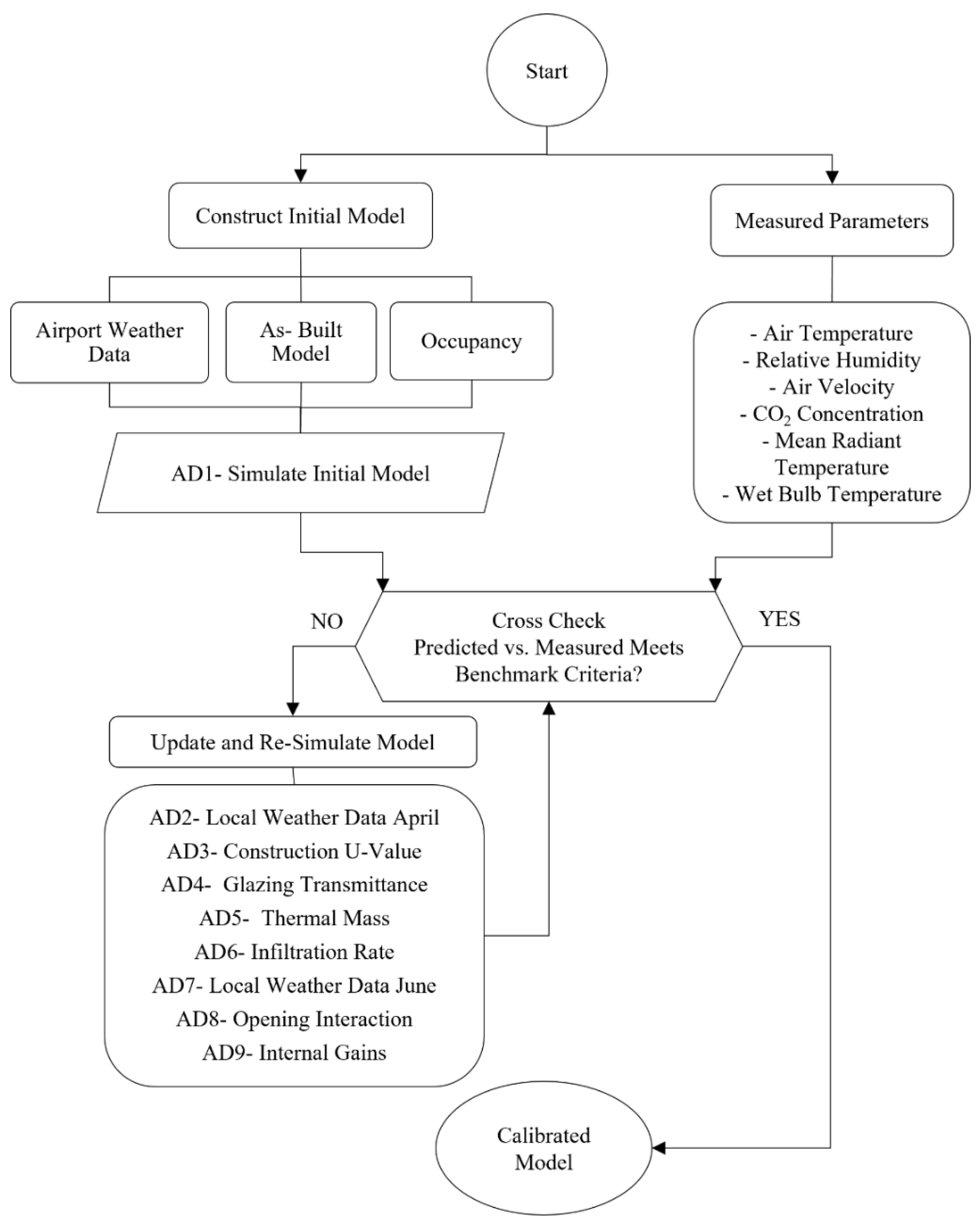
| ID | Name | Procedure |
|---|---|---|
| AD1 | AD-ASB | As-built scheduled openings + airport weather data |
| AD2 | AD-EPW | AD1+ local weather data in April |
| AD3 | AD-CON | AD2+ construction’s thickness and U-value |
| AD4 | AD-GTR | AD3+ glazing transmittance |
| AD5 | AD-MAS | AD4+ thermal mass |
| AD6 | AD-INF | AD5+ infiltration rate (final model from April) |
| AD7 | AD-APR | AD6+ local weather data in June |
| AD8 | AD-OPI | AD7+ openings interaction |
| AD9 | AD-ING | AD8+ internal gains (final model from June) |
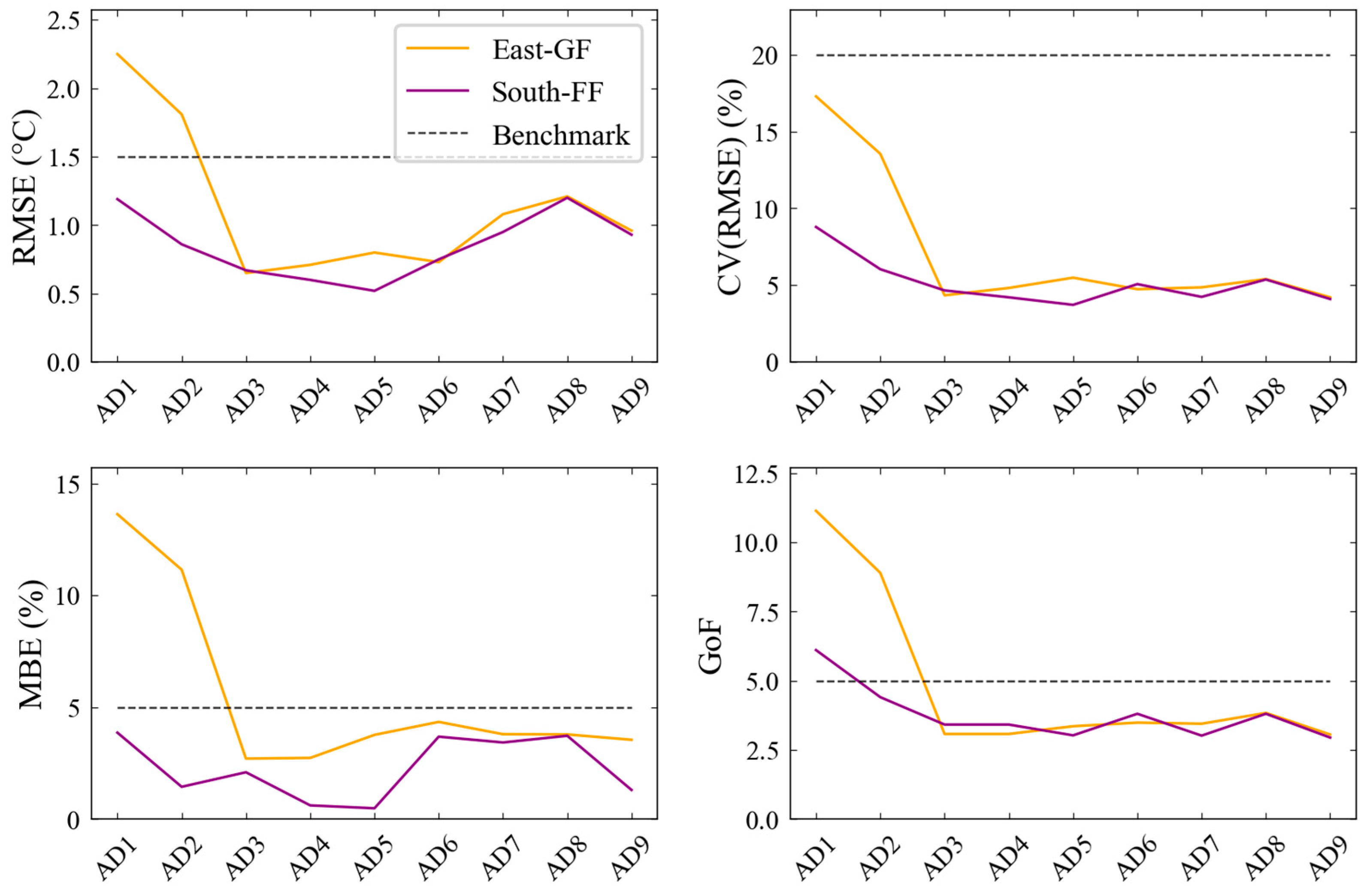
| Criteria | Benchmark | Ref. | AD6-Unoccupied | AD9-Occupied | ||
|---|---|---|---|---|---|---|
| Classroom 7 | Classroom 11 | Classroom 7 | Classroom 11 | |||
| RMSE (°C) | <1.5 | [57] | 0.7 | 0.7 | 0.9 | 0.9 |
| CV(RMSE) (%) | <±20 | [57] | 4.7 | 5.0 | 4.2 | 4.1 |
| NMBE (%) | <±5 | [58] | 4.3 | 3.6 | 3.5 | 1.3 |
| Pearson’s | +0.5 < r <+1 | [27] | 0.5 | 0.7 | 0.4 | 0.6 |
| GoF | <+5 | [55] | 3.4 | 3.0 | 3.0 | 2.9 |
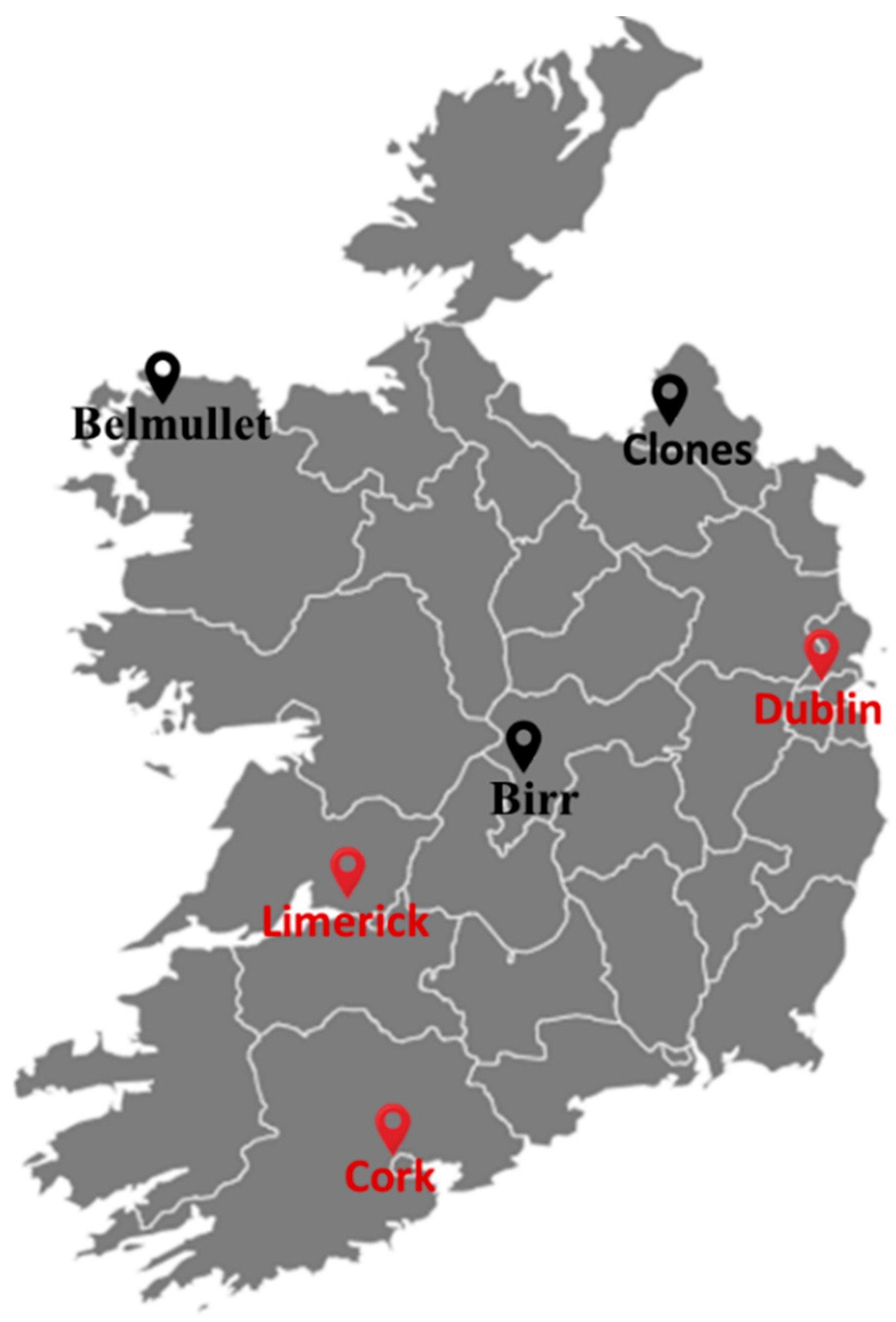
| DSYs | Year | Belmullet | Cork | Birr | Clones | Dublin | Limerick |
|---|---|---|---|---|---|---|---|
| Max Ta (°C) | Max Ta (°C) | Max Ta (°C) | Max Ta (°C) | Max Ta (°C) | Max Ta (°C) | ||
| DSY1 | 2021 | 27.9 | 27 | 29.9 | 27.4 | 27.2 | 31.2 |
| 2041 | 28.8 | 28.2 | 30.6 | 28.4 | 27.6 | 32 | |
| 2071 | 30.7 | 30.3 | 32.7 | 30.5 | 29.7 | 33.9 | |
| DSY2 | 2021 | 28.8 | 29.9 | 31.8 | 31.5 | 28.7 | 31.5 |
| 2041 | 29.4 | 30.6 | 32.4 | 32.2 | 29.5 | 32.2 | |
| 2071 | 30.9 | 32.2 | 34 | 34.2 | 31.4 | 34.4 | |
| DSY3 | 2021 | 28.7 | 29.2 | 31.1 | 29.7 | 29 | 31.4 |
| 2041 | 29.3 | 30 | 31.8 | 30.4 | 29.7 | 32.1 | |
| 2071 | 30.9 | 29.7 | 34 | 32.4 | 31.9 | 34 |
| No | NV Strategy | Season | Time/Date | Condition | Air Flow (ACH) | Variables | Function | |||
|---|---|---|---|---|---|---|---|---|---|---|
| Min | Mean | Max | Std | |||||||
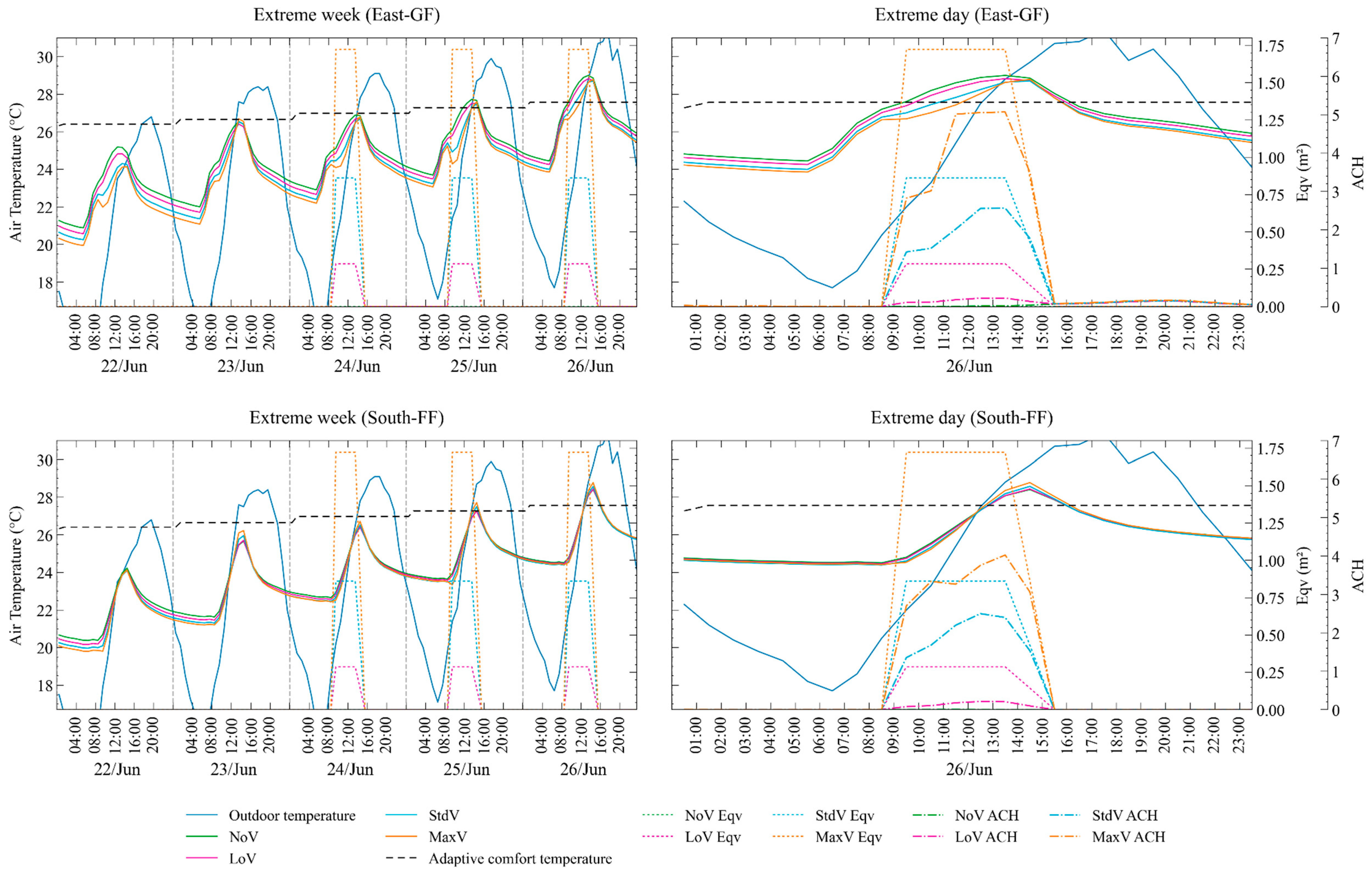
| 1 | NoV (Base) | Oct to Apr | 09:00–14:30 | 0% POF | 0 | 0.01 | 0.03 | 0.02 | - | All windows/Closed |
| May, June, Sep | 09:00–14:30 | 0% POF | 0 | 0.01 | 0.02 | 0.01 | ||||
| 2 | LoV | Oct to Apr | 09:00–14:30 | 1.5% POF (1/2 Lower Windows) If To > 12 °C and If To < Ta | 0 | 0.04 | 0.04 | 0.1 | Air Temperature | Ramp (Ta,21,0,24,1) |
| May, June, Sep | 09:00–14:30 | 1.5% POF (1/2 Lower Windows) | 0 | 0.3 | 0.9 | 0.2 | Time | 09:00: 1 14:30: 0 | ||
| 3 | StdV | Oct to Apr | 09:00–14:30 | 4.8% POF (1/2 All Windows) If To > 12 °C and If To < Ta | 0 | 0.08 | 0.05 | 0.3 | Air Temperature | Ramp (Ta,21,0,24,1) |
| May, June, Sep | 09:00–14:30 | 4.8% POF (1/2 All Windows) | 0 | 1.5 | 4 | 0.9 | Time | 09:00: 1 14:30: 0 | ||
| 4 | MaxV | Oct to Apr | 09:00–14:30 | 9.6% POF (All Windows) | 0 | 0.1 | 0.05 | 0.4 | Air Temperature | Ramp (Ta,21,0,24,1) |
| May, June, Sep | 09:00–14:30 | 9.6% POF (All Windows) | 0 | 3 | 7 | 1.8 | Time | 09:00: 1 14:30: 0 | ||
| Number of Occupied Hours from May to September When Value Exceeds the Acceptable Threshold | |||||||||||||||||||||||||
|---|---|---|---|---|---|---|---|---|---|---|---|---|---|---|---|---|---|---|---|---|---|---|---|---|---|
| Ventilation Strategies | Years | Cork | Dublin | Limerick | |||||||||||||||||||||
| CIBSE TM52 | CIBSE TM52 BB101 | CIBSE TM52 BB101 | BB101 | CIBSE TM52 | CIBSE TM52 BB101 | CIBSE TM52 BB101 | BB101 | CIBSE TM52 | CIBSE TM52 BB101 | CIBSE TM52 BB101 | BB101 | ||||||||||||||
| Criteria (CRI) | CRI 1 | CRI 2 | CRI 3 | CRI 1 | CRI 1 | CRI 2 | CRI 3 | CRI 1 | CRI 1 | CRI 2 | CRI 3 | CRI 1 | |||||||||||||
| Threshold | (Top > Tcomf) ≤ 3% Occ HRS (~11) | (Top > Tcomf) ≤ 6 h on any Day | (Top − Tcomf) ≤ 4 | (Top > Tcomf) ≤ 40 h | (Top > Tcomf) ≤ 3% Occ HRS (~11) | (Top > Tcomf) ≤ 6 h on any Day | (Top − Tcomf) ≤ 4 | (Top > Tcomf) ≤ 40 h | (Top > Tcomf) ≤ 3% Occ HRS (~11) | (Top > Tcomf) ≤ 6 h on any Day | (Top − Tcomf) ≤ 4 | (Top > Tcomf) ≤ 40 h | |||||||||||||
| Class | East-GF | South-FF | East-GF | South-FF | East-GF | South-FF | East-GF | South-FF | East-GF | South-FF | East-GF | South-FF | East-GF | South-FF | East-GF | South-FF | East-GF | South-FF | East-GF | South-FF | East-GF | South-FF | East-GF | South-FF | |
| NoV | 2021 | 0 | 0 | 0 | 0 | 0 | 0 | 0 | 0 | 0 | 0 | 0 | 0 | 0 | 0 | 0 | 0 | 14 | 1 | 0 | 0 | 0 | 0 | 14 | 1 |
| 2041 | 0 | 0 | 0 | 0 | 0 | 0 | 0 | 0 | 0 | 0 | 0 | 0 | 0 | 0 | 0 | 0 | 22 | 6 | 2 | 0 | 0 | 0 | 22 | 6 | |
| 2071 | 85 | 15 | 2 | 0 | 0 | 0 | 85 | 15 | 0 | 0 | 0 | 0 | 0 | 0 | 0 | 0 | 102 | 15 | 3 | 0 | 0 | 0 | 102 | 15 | |
| LoV | 2021 | 0 | 0 | 0 | 0 | 0 | 0 | 0 | 0 | 0 | 0 | 0 | 0 | 0 | 0 | 0 | 0 | 9 | 0 | 0 | 0 | 0 | 0 | 9 | 0 |
| 2041 | 0 | 0 | 0 | 0 | 0 | 0 | 0 | 0 | 0 | 0 | 0 | 0 | 0 | 0 | 0 | 0 | 20 | 6 | 0 | 0 | 0 | 0 | 20 | 6 | |
| 2071 | 32 | 2 | 0 | 0 | 0 | 0 | 32 | 2 | 0 | 0 | 0 | 0 | 0 | 0 | 0 | 0 | 53 | 10 | 1 | 0 | 0 | 0 | 53 | 10 | |
| StdV | 2021 | 0 | 0 | 0 | 0 | 0 | 0 | 0 | 0 | 0 | 0 | 0 | 0 | 0 | 0 | 0 | 0 | 0 | 0 | 0 | 0 | 0 | 0 | 0 | 0 |
| 2041 | 0 | 0 | 0 | 0 | 0 | 0 | 0 | 0 | 0 | 0 | 0 | 0 | 0 | 0 | 0 | 0 | 10 | 5 | 0 | 0 | 0 | 0 | 10 | 5 | |
| 2071 | 5 | 0 | 0 | 0 | 0 | 0 | 5 | 0 | 0 | 0 | 0 | 0 | 0 | 0 | 0 | 0 | 21 | 9 | 1 | 0 | 0 | 0 | 21 | 9 | |
| MaxV | 2021 | 0 | 0 | 0 | 0 | 0 | 0 | 0 | 0 | 0 | 0 | 0 | 0 | 0 | 0 | 0 | 0 | 0 | 0 | 0 | 0 | 0 | 0 | 0 | 0 |
| 2041 | 0 | 0 | 0 | 0 | 0 | 0 | 0 | 0 | 0 | 0 | 0 | 0 | 0 | 0 | 0 | 0 | 5 | 5 | 0 | 0 | 0 | 0 | 5 | 5 | |
| 2071 | 1 | 0 | 0 | 0 | 0 | 0 | 1 | 0 | 0 | 0 | 0 | 0 | 0 | 0 | 0 | 0 | 17 | 9 | 0 | 0 | 0 | 0 | 17 | 9 | |
| Room Name | Air Temperature (°C) | Peak Space Sensible (kW) | Airflow (L/s) | Engineering Checks | ||
|---|---|---|---|---|---|---|
| Supply | Return | W/m2 | (L/s·m2) | |||
| East-GF | 21.72 | 32.83 | 2.69 | 199 | 36.86 | 2.71 |
| South-FF | 17.13 | 28.24 | 2.15 | 159 | 29.64 | 2.18 |
| No | NV Strategies | Season | Time/Date | Condition | Air Flow (ACH) | Variables | Function | |||
|---|---|---|---|---|---|---|---|---|---|---|
| Min | Mean | Max | Std | |||||||
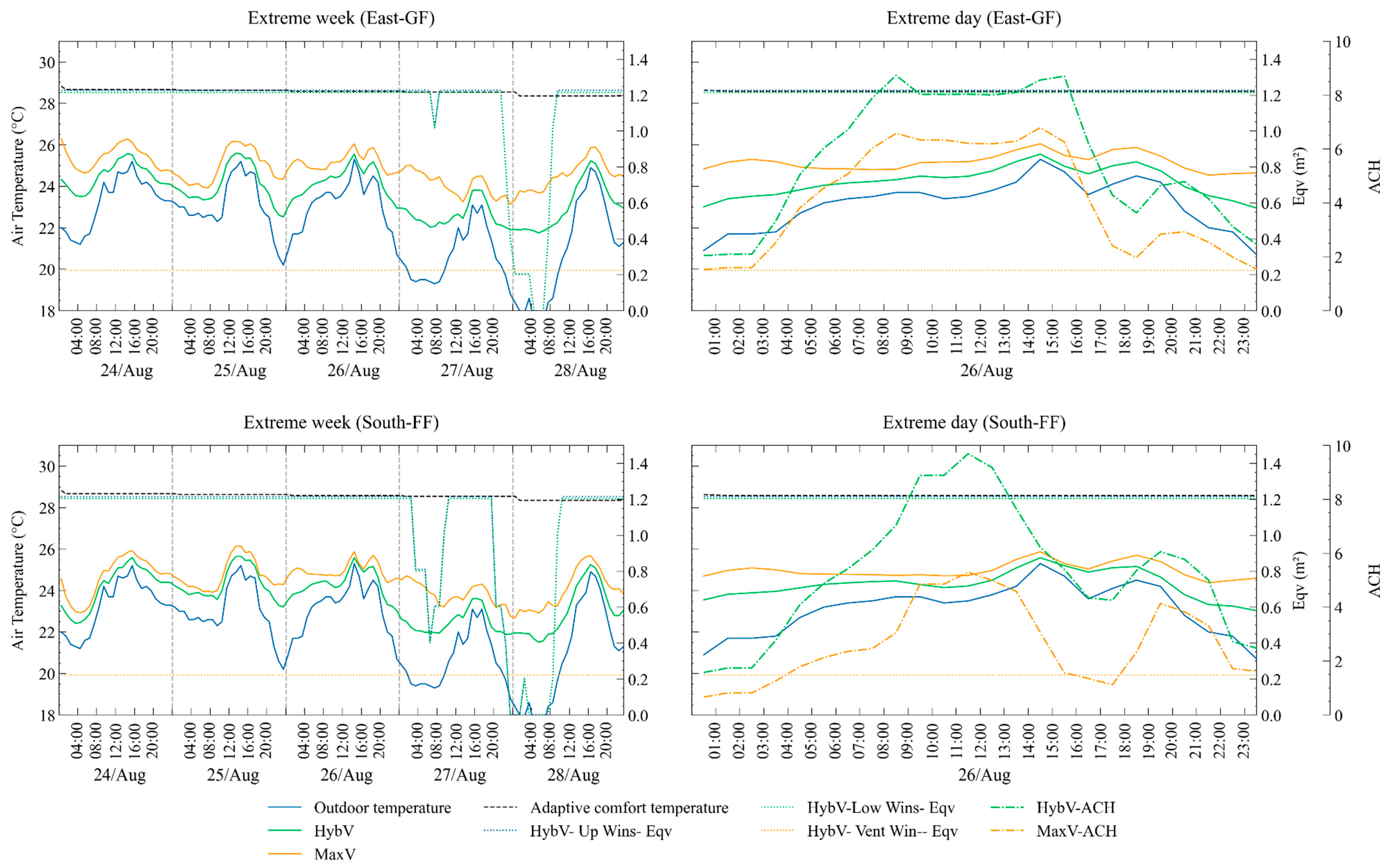
| 5 | MaxV + 24 h | July and August | 24 h | Optimum POF (max) | 0 | 2.3 | 7 | 1.9 | Time | 00:00: 1 24:00: 1 |
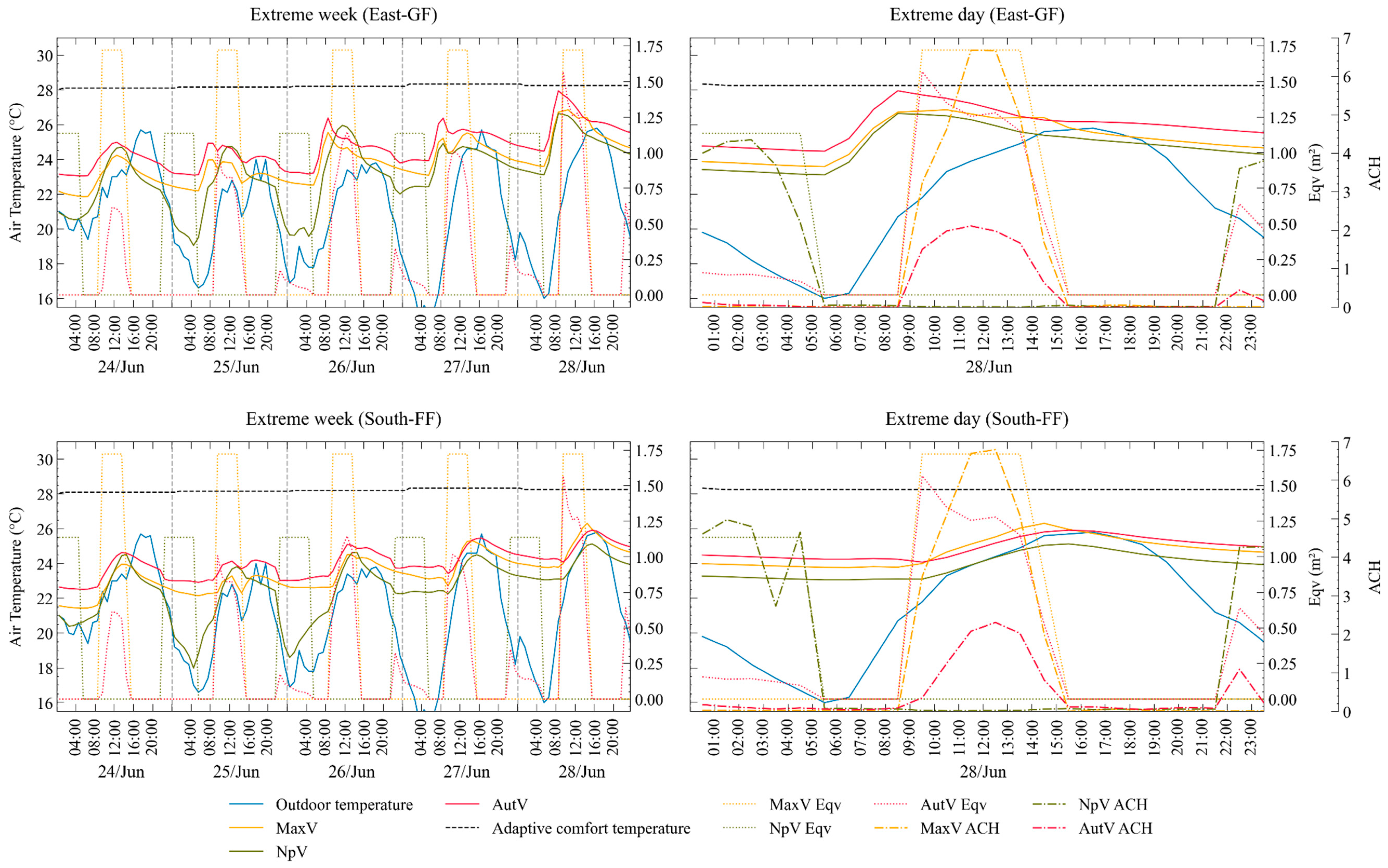
| 6 | HybV | July and August | 24 h | If To > 15 °C and If To < Ta and If Ta > 18 | 0 | 3.2 | 10 | 2.7 | Air Temperature | gt * (Ta,23,3) |
| No | NV Strategies | Season | Time/Date | Condition | Air Flow (ACH) | Variables | Function | |||
|---|---|---|---|---|---|---|---|---|---|---|
| Min | Mean | Max | Std | |||||||
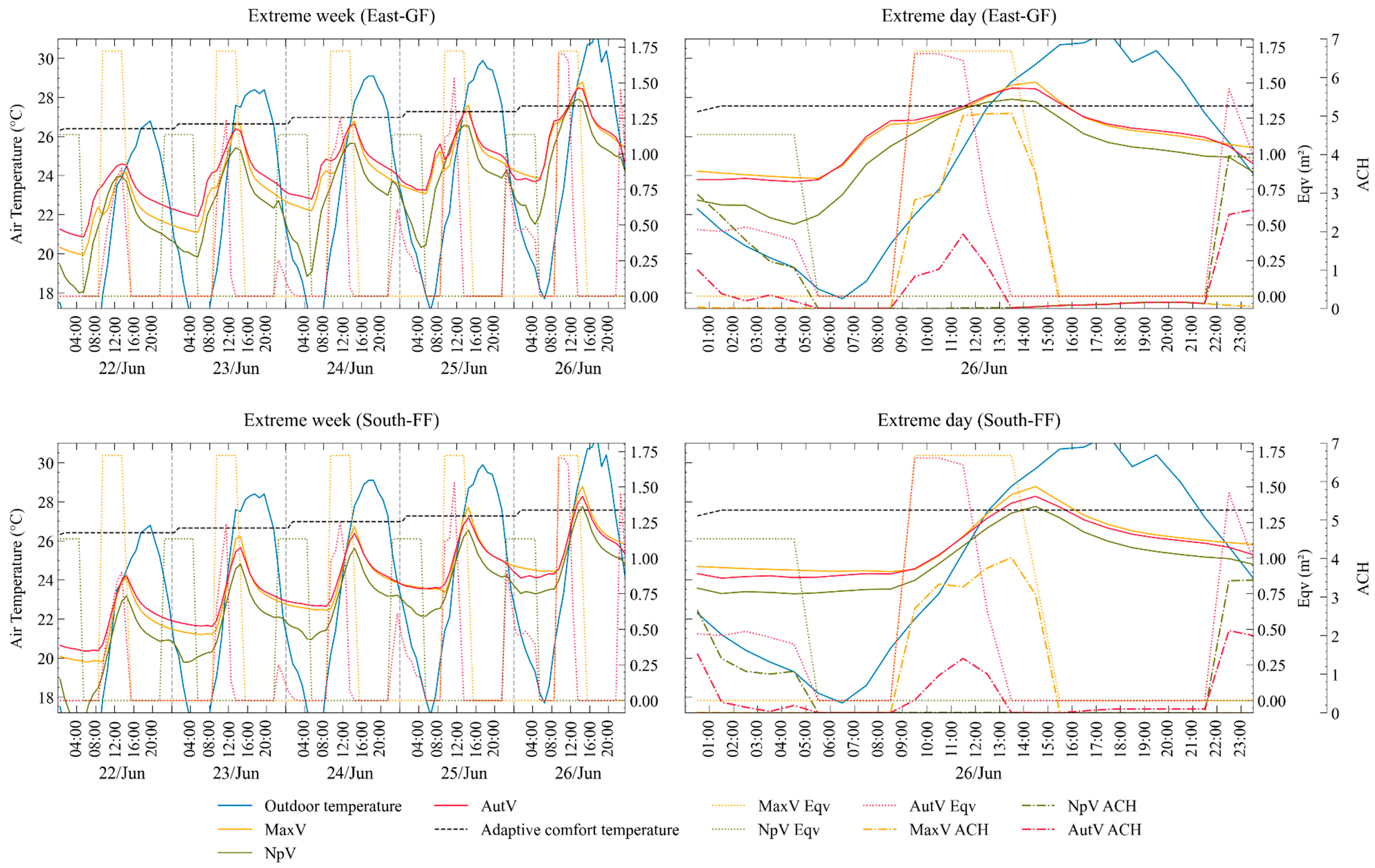
| 7 | NpV | Oct to Apr | 09:00–14:30 | If To > 15 °C and If To < Ta | 0 | 0.2 | 0.06 | 0.5 | Air Temperature | Ramp (Ta,21,0,24,1) |
| May, June, Sep | 22:00–05:00 | Upper Windows Open | 0 | 1.3 | 4.6 | 2.5 | Time | 22:00: 1 05:00: 0 | ||
| 8 | AutV | Oct to Apr | 09:00–14:30 | If To > 15 °C and If To < Ta | 0 | 0.2 | 0.06 | 0.5 | Air Temperature | Ramp (Ta,21,0,24,1) |
| May, June, Sep | 09:00–14:30 22:00–05:00 | If To > 15 °C and If To < Ta | 0 | 0.5 | 2 | 0.7 | Air Temperature | Ramp (Ta,23,0,26,1) | ||
Disclaimer/Publisher’s Note: The statements, opinions and data contained in all publications are solely those of the individual author(s) and contributor(s) and not of MDPI and/or the editor(s). MDPI and/or the editor(s) disclaim responsibility for any injury to people or property resulting from any ideas, methods, instructions or products referred to in the content. |
© 2026 by the authors. Licensee MDPI, Basel, Switzerland. This article is an open access article distributed under the terms and conditions of the Creative Commons Attribution (CC BY) license.
Share and Cite
Tavakoli, E.; O’Donovan, A.; O’Sullivan, P.D. Evaluating the Resilience of Ventilation Strategies in Low-Energy Irish Schools. Buildings 2026, 16, 452. https://doi.org/10.3390/buildings16020452
Tavakoli E, O’Donovan A, O’Sullivan PD. Evaluating the Resilience of Ventilation Strategies in Low-Energy Irish Schools. Buildings. 2026; 16(2):452. https://doi.org/10.3390/buildings16020452
Chicago/Turabian StyleTavakoli, Elahe, Adam O’Donovan, and Paul D. O’Sullivan. 2026. "Evaluating the Resilience of Ventilation Strategies in Low-Energy Irish Schools" Buildings 16, no. 2: 452. https://doi.org/10.3390/buildings16020452
APA StyleTavakoli, E., O’Donovan, A., & O’Sullivan, P. D. (2026). Evaluating the Resilience of Ventilation Strategies in Low-Energy Irish Schools. Buildings, 16(2), 452. https://doi.org/10.3390/buildings16020452