Article

Empirical Evaluation of Bridge Aging Trends in Indonesia: A Comparative Analysis of National Inspection Data

by
Liyanto Eddy
1,*,
Leonardo Yonatan Tan
2,
Theresita Herni Setiawan
1,
Patrick Nicholas Hadinata
3,
Kohei Nagai
4 and
Risma Putra Pratama Sastrawiria
5
1
Centre of Excellence in Urban Infrastructure Development, Parahyangan Catholic University, Ciumbuleuit 94, Bandung 40141, West Java, Indonesia
2
Department of Civil Engineering, Parahyangan Catholic University, Ciumbuleuit 94, Bandung 40141, West Java, Indonesia
3
Civil and Environmental Engineering Department, University of California Los Angeles, Los Angeles, CA 90095, USA
4
Faculty of Engineering, Hokkaido University, Kita 13, Nishi 8, Kita-ku, Sapporo 060-8628, Hokkaido, Japan
5
Department of Infrastructure Engineering, Kochi University of Technology, 6-28 Eikokujicho, Kochi City 780-0844, Kochi, Japan
*
Author to whom correspondence should be addressed.
Buildings 2026, 16(2), 424; https://doi.org/10.3390/buildings16020424
Submission received: 20 November 2025 / Revised: 13 January 2026 / Accepted: 15 January 2026 / Published: 20 January 2026
(This article belongs to the Section Building Materials, and Repair & Renovation)

Abstract

The Indonesian government has collected bridge inspection data since 2019. This data reveals the deterioration trend of existing bridges. These findings help to evaluate the current deterioration curve and can inform more efficient inspection and maintenance methods, which have not been updated since 1993. The first purpose is to evaluate the current deterioration of the Bridge Management System (BMS) model by comparing it with a trend developed from existing conditions. A secondary objective is to compare deterioration trends derived from Indonesian inspection data using the BMS with those from Florida using NBIS. The deterioration trend is found by correlating soundness and bridge age. This study shows that none of the inspection-based trends align with the typical BMS deterioration curve. The real deterioration trends are faster. Many factors influence the trendline, such as bridge type, construction material, and length. There is a clear disparity in the deterioration trends of the superstructure, deck, waterway/embankment, and substructure based on inspection data from Indonesian bridges. The superstructure deteriorates faster and more quickly than the deck, even though both are in the same section. The waterway/embankment deteriorates faster than the deck. The bridges deteriorate faster in the first 10 years. In contrast, consistent deterioration trends across all components are found in Florida bridges. In Florida, bridge components deteriorate at a rate of 0.0447 to 0.056 per year in condition score during the first 20 years. After this period, the deterioration rate declines, as indicated by a reduced slope in the trend line. Ultimately, this study directly compares trends in bridge deterioration between Indonesia and Florida using large-scale inspection data. The results evaluate Indonesia’s Bridge Management System empirically and reveal how different inspection and maintenance practices affect bridge deterioration.

1. Introduction

Bridge deterioration is caused by several factors, including traffic loading, material deterioration, environmental factors, and variations in climate, temperature, and moisture, which cause a gradual, continuous, and slow process of bridge failure [1,2]. Nevertheless, bridge collapse could be prevented by performing periodic inspections and maintenance, thereby increasing the bridge’s service life. Periodic inspection and maintenance are cheaper and more effective than reconstruction or replacement. Consequently, regular inspection and maintenance are now essential [3,4]. In Indonesia, approximately 14% of bridges were considered to be in an unhealthy condition [5]. There is growing public awareness of the need for bridge maintenance. Yet inspections must be scheduled to assess the bridges’ condition and develop effective maintenance plans. However, the increasing number of deteriorated structures, complex locations, limited budgets, and other factors make maintenance more challenging [6,7]. To address these problems, it is important to consider recent developments in structural health monitoring. This approach provides a real-time assessment of bridge condition [8]. Advanced methods [9,10,11] help identify localized damage that may not be visible during routine manual inspection. Mao et al. [9] performed a damage-sensitivity analysis and optimized sensor placement for damage identification in a steel truss bridge. They concluded that positioning strain gauges at the most sensitive measurement locations enables accurate damage detection. Additionally, Xiao et al. [10] introduced a partial-model-based damage identification method for long-span steel truss bridges utilizing a stiffness preparation model. This approach effectively avoids the limitations of an overall structural model and reduces the complexity of damage identification in large-scale structures. However, the current Indonesian Bridge Management System (BMS) still relies on manual visual inspections.
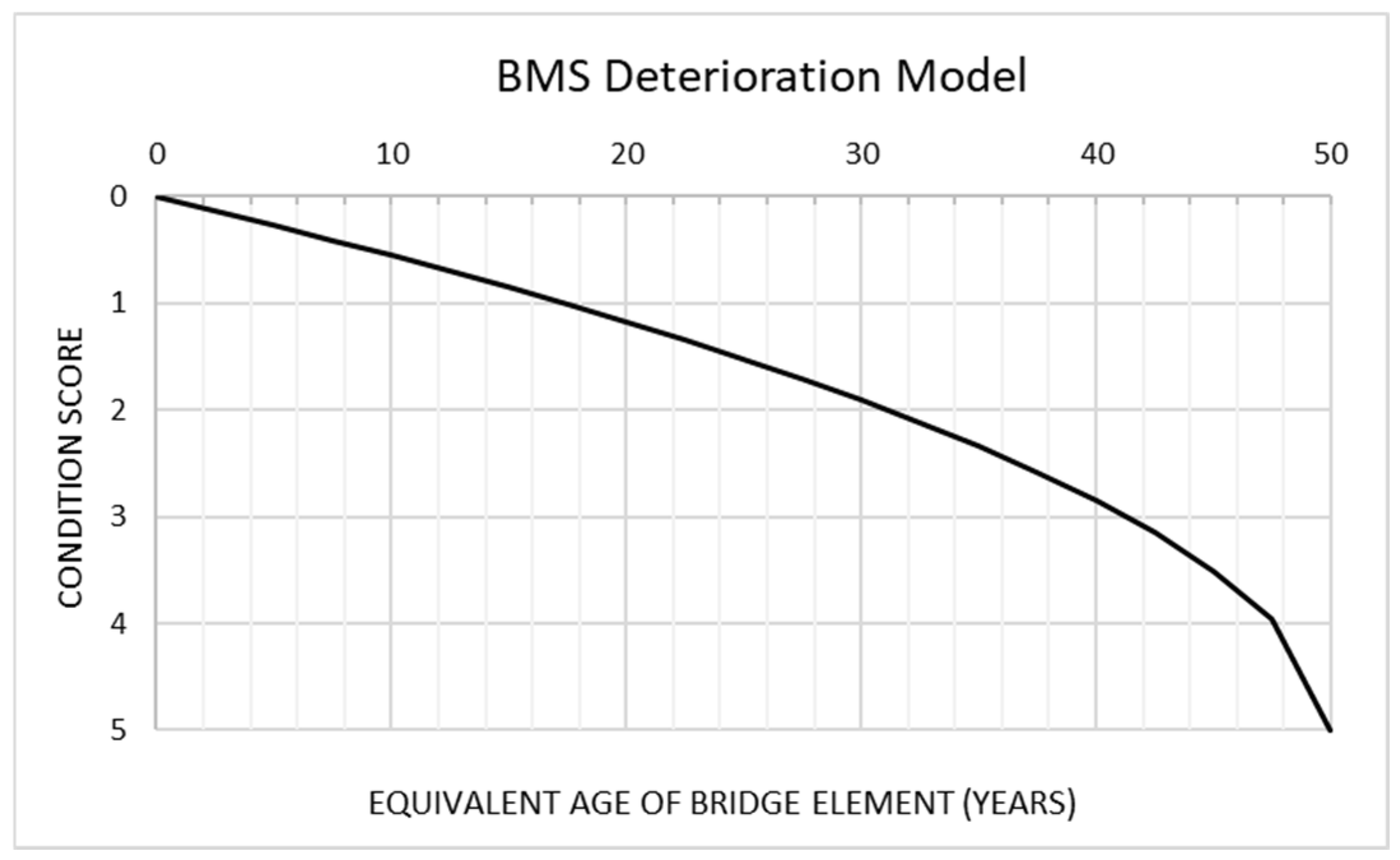
The number of aging bridges in Indonesia is increasing rapidly. Of the country’s approximately 18,000 national bridges, most were built before 1990. In 1993, the Indonesian and Australian Governments introduced a Bridge Management System (BMS) manual for bridge inspection and maintenance. The manual details inspection and assessment procedures and includes a deterioration curve for predicting bridge condition by construction year, as shown in Figure 1. This curve assumes a bridge will no longer function near its design lifespan due to normal use. However, the manual has not been updated, though it was referenced in inspection manuals from 2011 and 2022 [12,13,14]. Since 2019, the Indonesian government has inspected national bridges, assigned condition scores, and developed a bridge management system through the mobile application INVI-J [15]. These data could help evaluate the existing deterioration curve and inform more efficient inspection and maintenance methods. In the United States, the National Bridge Inspection Standard (NBIS) is used for bridge inspection standards. It was established in 1968 and published in 1971, becoming the first nationally coordinated bridge inspection program [16]. Unfortunately, this manual has become incapable of detailed inspection, especially element-level inspection. To accommodate element-level inspection, the Federal Highway Administration (FHWA) and Caltrans developed the “Pontis Bridge Management System” in 1991, which was later updated in 1993 and renamed “Commonly Recognized (CoRe) Element”. In 1995, the American Association of State Highway and Transportation Officials (AASHTO) adopted the manual and published the “CoRe Element Manual” [17,18]. In 2010, AASHTO published the “Guide Manual for Bridge Element Inspection, First Edition” (MBEI) to renew the previous manual. The second edition was published in 2019 using the same title. The manual is used as the reference for the NBIS, especially for bridge element inspection. The history of the bridge inspection manual in the US indicates the US Government’s efforts to update it. Each update is driven by many factors, including incidents, research, and additional improvements.
Numerous methodologies have been employed to model bridge deterioration and identify the principal factors influencing it. Previous research [19,20,21,22,23] demonstrates that machine learning techniques can effectively model bridge deck deterioration. For example, Huang [24] identified 11 factors associated with deck deterioration in Wisconsin using an Artificial Neural Network. Similarly, Souza et al. [25] found that machine learning models capture interactions among key variables, such as bridge age, traffic volume, and environmental conditions. Bu et al. [26] introduced the Backward Prediction Model (BPM) and a Markov-based procedure for predicting bridge deterioration, which provides performance predictions regardless of inspection data quality or quantity. Collins et al. [27] applied a stochastic approach, focusing on Markovian models, while Lu et al. [28] showed that reliability analysis based on the generalized gamma distribution achieves high accuracy in modeling bridge deck deterioration. Li et al. [29] proposed a Bayesian Updating Model that incorporates both complete and incomplete inspection data. Ilbeigi and Meimand [30] conducted an ordinal regression analysis using NBI data from over 28,000 Ohio bridges, concluding that bridge characteristics, including age, average daily traffic (ADT), deck area, structural and deck materials, structural system, maximum span length, and current condition, are statistically significant. Guo et al. [31] reported that entire bridges and deck systems deteriorate more rapidly than other components. Shan et al. [32] further demonstrated, through regression analysis, that multiple factors, including age, traffic load, design load, material type, and maximum span length, influence deterioration. Koike & Nagai [33] used inspection data from Niigata Prefecture to categorize bridges by material and length, revealing that bridge deterioration trends are valuable for understanding the tendencies. The steel bridges exhibit a linear aging trend, whereas the concrete bridges show significant variation. The present study uses a curve-fitting approach to describe trends in bridge deterioration. This approach is chosen for its simplicity and its capacity to incorporate all inspection data, thereby highlighting potential subjectivity in the inspection process.
This research has two purposes. The government has been collecting the bridge inspection data since 2019. It could show the deterioration trend of existing bridges and be used to evaluate the deterioration model of the BMS, as shown in Figure 1. Therefore, the first purpose is to evaluate the BMS deterioration model by comparing it with a deterioration trend developed from the deterioration of the existing condition. The study also examines the factors contributing to deterioration in bridge performance using Pearson’s and Spearman’s correlation coefficients.
The inspection assessment procedures for bridges in Indonesia are based on the 2011 manual. Compared to NBIS, NBIS has periodically updated the inspection manual. Therefore, the accuracy of the deterioration trend developed from inspection data in Indonesia may be debatable. Previous studies have shown that the inspection procedure needs improvement due to several factors, including insufficient human resources [5] and the need for quality assurance and quality control [34]. The Federal Highway Administration (FHWA) provides online inspection data for each state in the United States, dating back to the 1990s, which facilitates the generation of deterioration trends. In this study, inspection data for bridges in Florida, comprising over 12,000 records, are selected. A secondary objective is to compare deterioration trends derived from Indonesian inspection data using the Bridge Management System (BMS) with those from Florida using the NBIS. Florida is selected for its leadership in collecting element-level data and for its use of a large-scale inspection dataset. Extensive research on bridge deterioration has also been conducted in Florida [35,36]. The bridge inspection and maintenance procedures in Indonesia have not been updated since 1993, whereas in Florida, research and updates are ongoing. This comparison points out the differences between Indonesia and Florida. This study uses a large-scale dataset to compare trends in bridge deterioration between Indonesia and Florida and to investigate the BMS model in Indonesia, which has remained unchanged since 1993, and the effects of differing bridge maintenance strategies.

2. Overview of Inspection Data and Analysis Method

2.1. Inspection Procedures in Indonesia

According to the inspection manual [12,13,14], there are four types of inspection: inventory inspection, detail inspection, routine inspection, and special inspection. Inventory inspection is conducted to gather administrative data on bridges, including their location, ownership, type, material, dimensions, and traffic load. A detailed inspection is done at least once every 5 years, or if the bridge condition warrants it. This inspection records all existing damage to bridge components and assigns a condition score. The overall bridge’s condition score is determined by the maximum score across all its components. A routine inspection is conducted annually to check whether the bridge’s main components function properly and whether the bridge is in a safe and secure condition. The routine inspection is carried out between the detailed inspection. A special inspection is a more detailed observation conducted as a follow-up to visual damage observations. This inspection is carried out using specialized tools to obtain more accurate data on damage to bridge components.
The condition score for the overall bridge and its components is assigned during the detailed inspection. The condition score of each bridge component is determined based on the sum of the scores of “Structure”, “Damage”, “Quantity”, “Function”, and “Influence” as shown in Table 1. This score produces six levels of soundness as shown in Table 2. A higher score shows worse bridge condition.

2.2. Overview of Inspection Data in Indonesia

In Indonesia, 18649 bridges built between 1900 and 2019 were inspected in 2019. Bridge condition data updates were conducted simultaneously in 2019 following a change from conventional inspection methods to the digital INVI-J inspection system. This data digitization process was carried out in 2019, resulting in a large-scale update of data for all national bridges. In 2020–2022, the government focused its budget on handling COVID-19, which disrupted inspections during these years. Since 2022, the inspections have been started and conducted gradually, especially on critical bridges with a Condition Score of 3. Only 15,556 bridges have their construction year. Several data, such as name, location, length, width, superstructure type, material, construction year, and inspection scores, were recorded in a database by the national bureau, Bina Teknik Jalan dan Jembatan, under the Ministry of Public Works. The bridges were inspected and scored according to six levels of soundness, as shown in Table 1. In this study, bridges are classified by type, material, and length, as shown in Table 3.

2.3. Aging Trend Anaysis

It is well known that the bridges deteriorate as they age. The inspection data could be used to construct the deterioration trend and evaluate the bridge deterioration model. The deterioration trend is simply obtained from the correlation between soundness and bridge age. The bridge age is calculated by subtracting the inspection year from the construction year. The method proposed by Koike and Nagai [33] is used. In this study, no records are discarded from the raw dataset to ensure a holistic representation of the bridge deterioration in Indonesia. Inconsistent values are retained to allow the model to expose noise, which may be caused by subjectivity in manual inspection, providing an honest reflection of the data quality in the bridge management system.
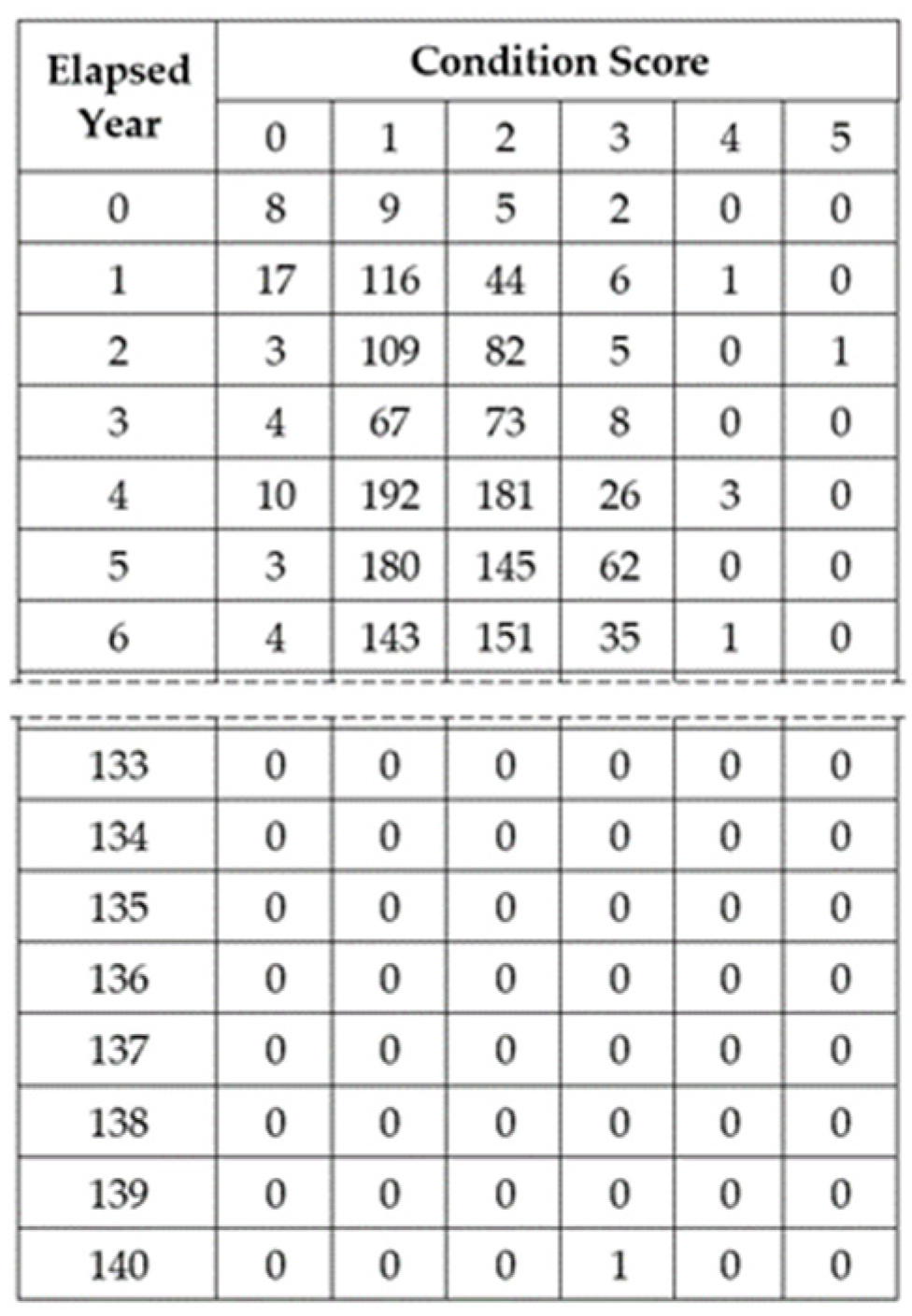
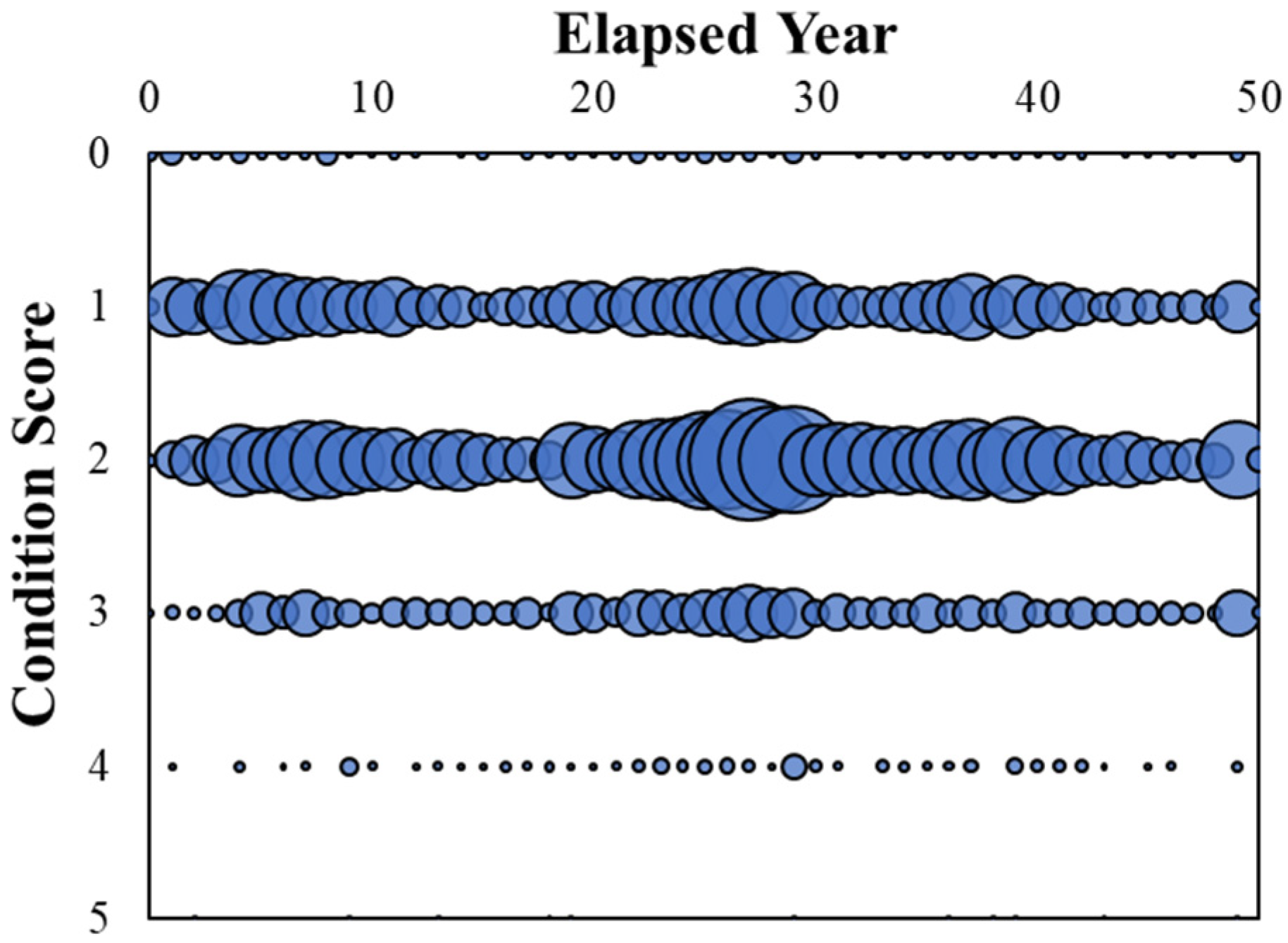
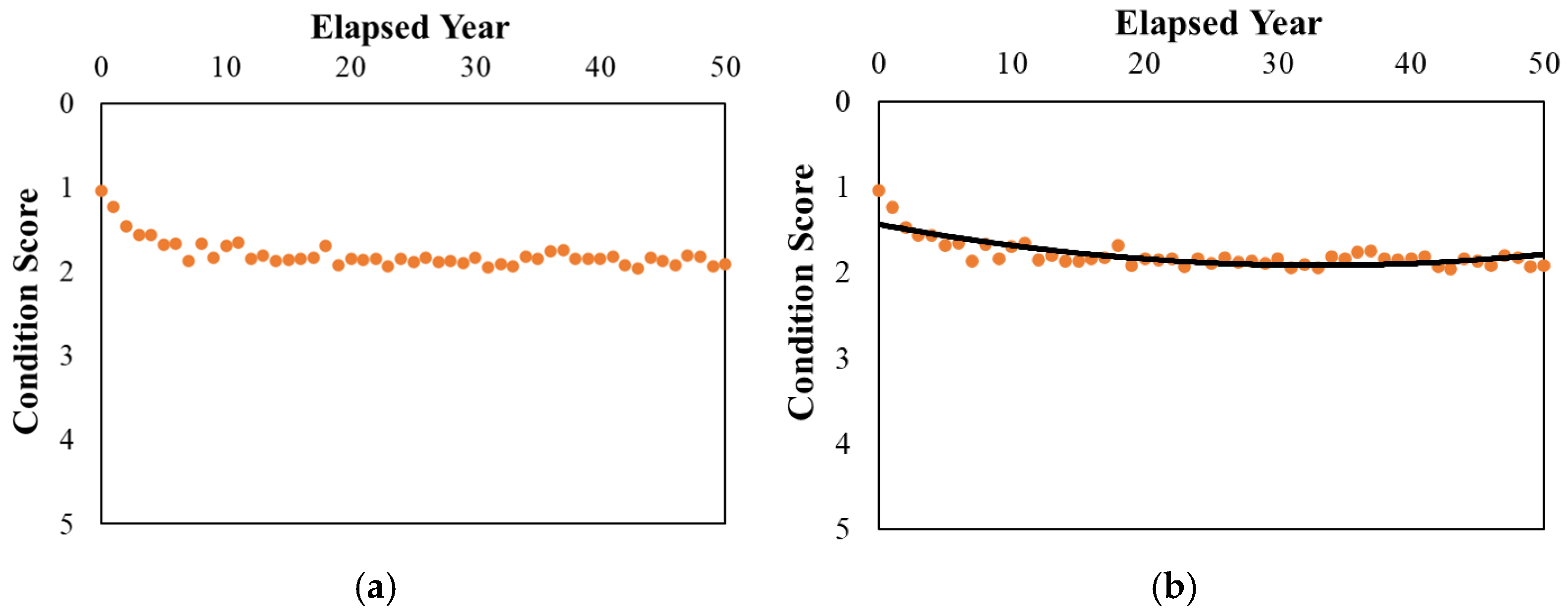
First, the number of bridges with the same elapsed year and condition score is calculated. Figure 2 illustrates the distribution of the number of bridges based on the elapsed year and condition score. This distribution is shown in a bubble chart, with the elapsed year and condition score as shown in Figure 3. The size of the bubble indicates the number of bridges with the same elapsed year and condition score. However, if the data volume is too large, it is difficult to show the trend, as illustrated in Figure 3. Therefore, the weighted average of the condition score is calculated for each elapsed year. In calculating the weighted average of the condition score for each year, the number of bridges is used as the weighting factor. The weighted average of the condition score for each year, C ¯ s t , is calculated based on Equation (1)
C ¯ s ( t ) = i = 0 5 ( C i   ×   n i ) n i
where C i is the specific condition score, and n i is the bridge number exhibiting that specific condition score at year t.
Figure 4a shows the weighted average of the condition score for each elapsed year. A two-order polynomial trendline is constructed to depict the deterioration trend as shown in Figure 4b. A second-order polynomial trendline is selected based on a comparison of goodness-of-fit metrics, as it yields a higher R2 value than other models. This model also accounts for the non-linear acceleration of deterioration, which drops sharply and then holds steady until a certain point is reached.

2.4. Pearson Correlation

Factors that affect the deterioration of the bridges may differ. In this study, the relationship between factors could be investigated by calculating the Pearson correlation coefficient. It could be used to determine the relationship between factors. Pearson correlation coefficient (r) ranges from −1 to +1. The coefficient could be calculated by using Equation (2).
r = ( x i x ¯ ) ( y i y ¯ ) ( x i x ¯ ) 2 ( y i y ¯ ) 2
where x i is the independent variable (elapsed year/age, length, width, material, type, etc.), x ¯ is the mean of the independent variable, y i is the dependent variable (condition score), and y ¯ is the average of the dependent variable.
Table 4 is the conventional approach to interpreting the result of the correlation coefficient. The higher the absolute value of the correlation coefficient, the stronger the relationship [37]. Previous studies [38,39,40] have shown that Pearson Correlation could determine the relationship between factors affecting the bridge deterioration.

3. Status of Managed Bridges in Indonesia

3.1. Number of Bridges by Elapsed Year

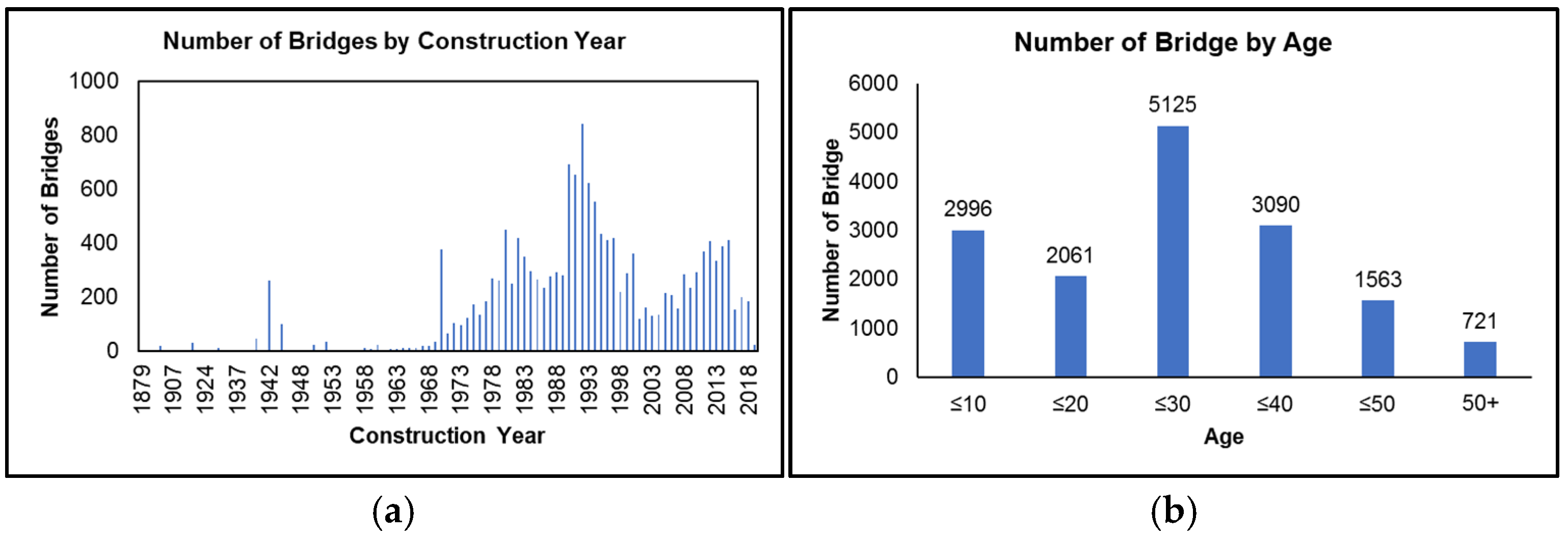
Figure 5a presents a bar graph depicting the distribution of bridges based on their construction year, while Figure 5b presents the number of bridges by age. The bridges are mostly in the age groups of 21 to 30 years (5125 bridges) and 31 to 40 years (3090 bridges). On the other hand, many new bridges had been built, with 2996 bridges in the age group of 0 to 10 years and 2061 bridges in the age group of 11 to 20 years. There are 1563 bridges in the 41 to 50-year age group, and 721 bridges that are over 50 years old. This indicates that there are 2284 bridges, or about 14.68% of all inspected bridges, that will require significant maintenance in the next 10 years. Based on Figure 1, a 40-year-old bridge will reach Condition Score 3, as described in Table 2, indicating the need for future monitoring and maintenance. Based on their construction year, a considerable number of bridges will require significant improvements or replacement in the coming years, or even face the risk of collapse [12,13,14].

3.2. Number of Bridges by Type

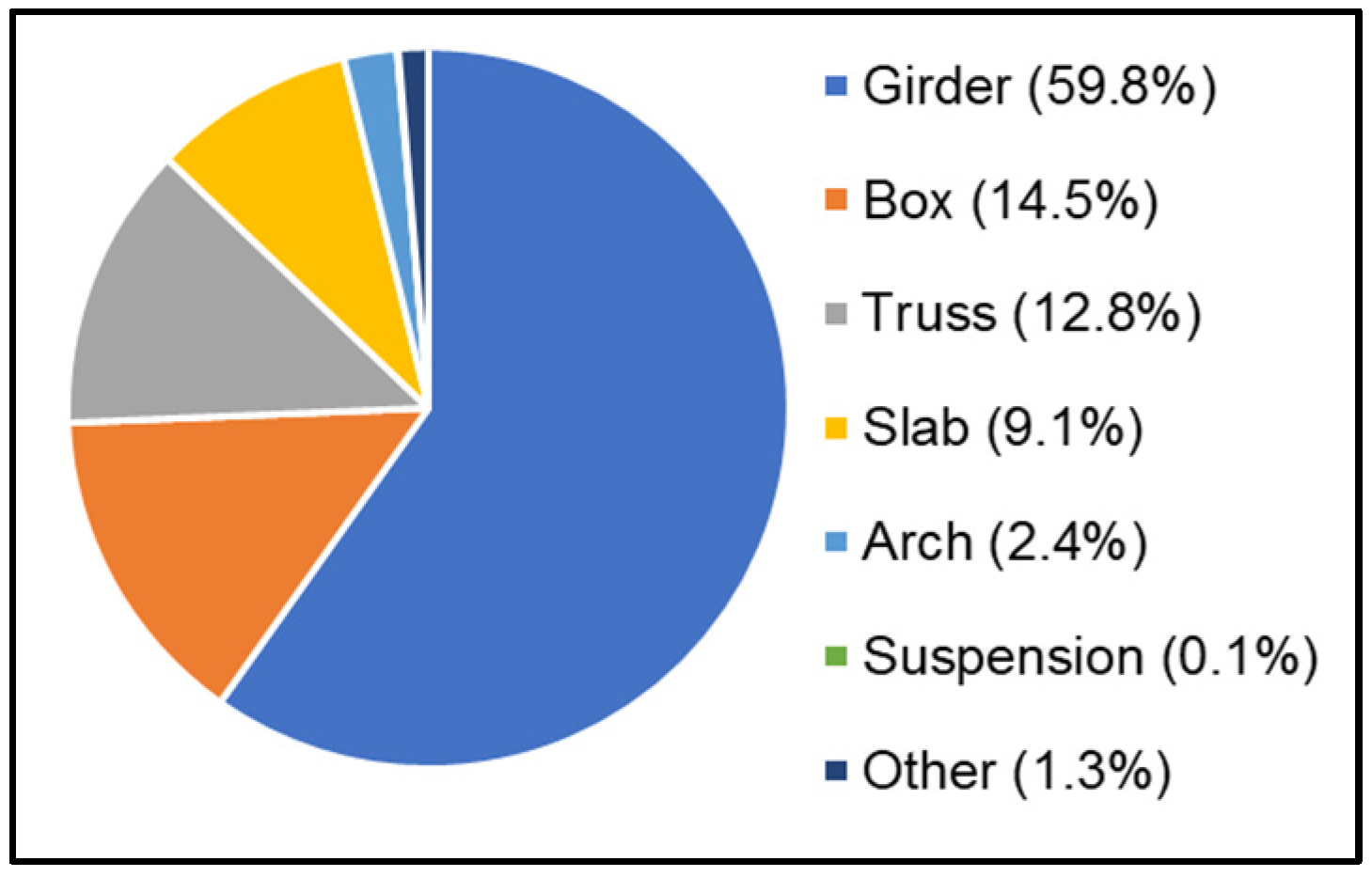
Figure 6 displays the distribution of bridges by type, with seven subcategories as described in Table 3. Based on the graph, the most common type is girder bridges, which account for roughly 60% of the total bridges in the inspection database, or about 9302 out of 15,556 bridges. 15% of bridges are categorized as box type, 13% as truss type, 10% as slab type, and 2.5% as arch type. The proportion of suspension bridges is small, roughly 0.1% of the inspected bridges, or approximately 150 bridges, indicating a relatively small number compared to the overall inspected bridges. For the purpose of deterioration trend analysis, only bridge types such as girder, box, truss, slab, and arch will be considered.

3.3. Number of Bridges by Material

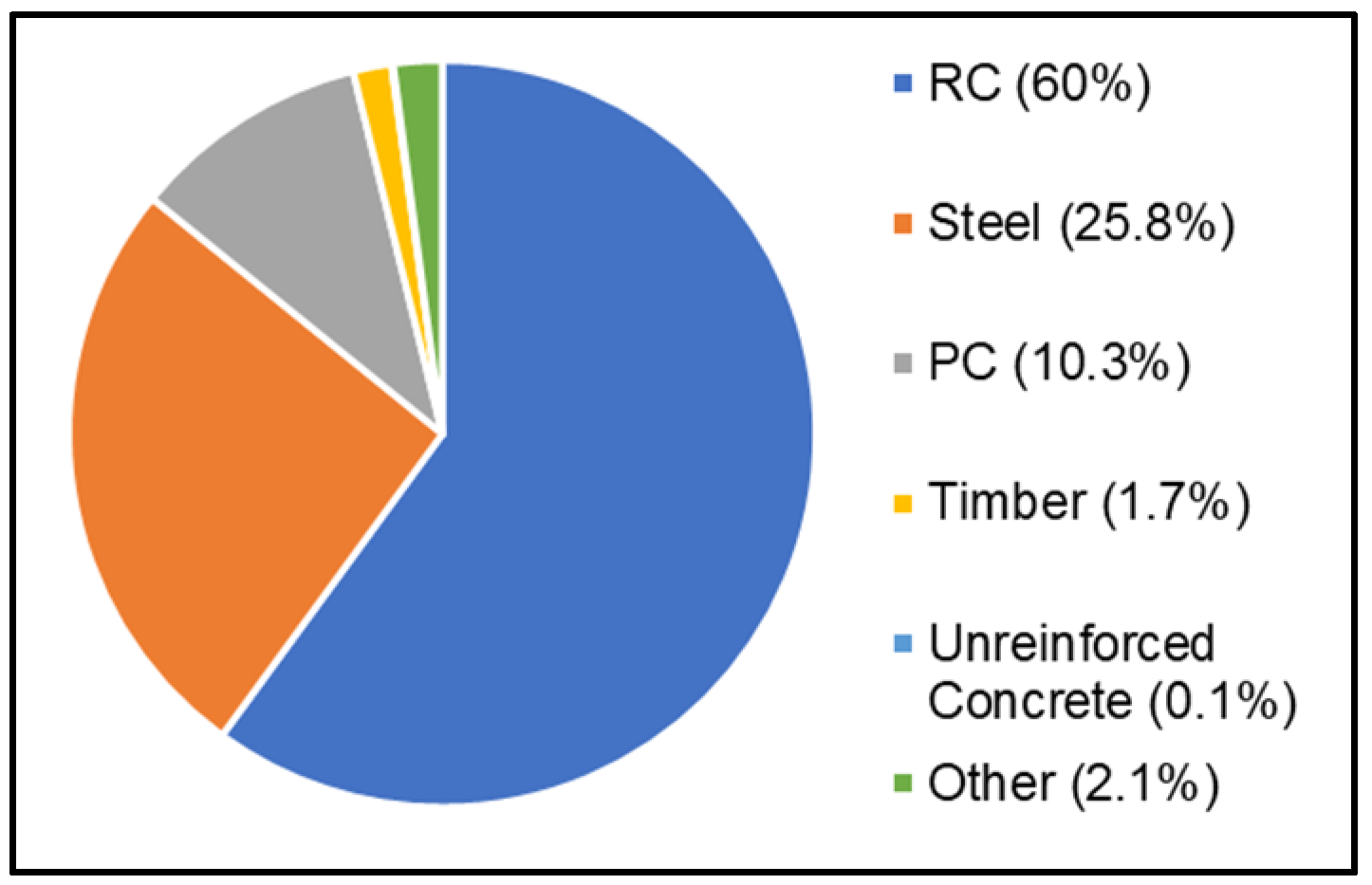
Figure 7 provides the bridge distribution by construction material, including unreinforced concrete, reinforced concrete, prestressed concrete, steel, and timber. Some bridges are constructed using a combination of materials, although their presence is not significant. Based on the graph, reinforced concrete (RC) is the most commonly used material among the inspected bridges. Approximately 60% the total 15,556 bridges employ reinforced concrete. More than a quarter of the inspected bridges, over 25%, are constructed using steel. Prestressed concrete (PC) is the third-most widely used bridge material, accounting for about 10% of all bridges. In contrast, bridges made of wood and unreinforced concrete constitute only 1.7% and less than 0.1% of the bridges in the database, respectively. Therefore, further analyses will focus solely on bridges constructed with RC, steel, PC, and timber materials.

3.4. Number of Bridges by Length

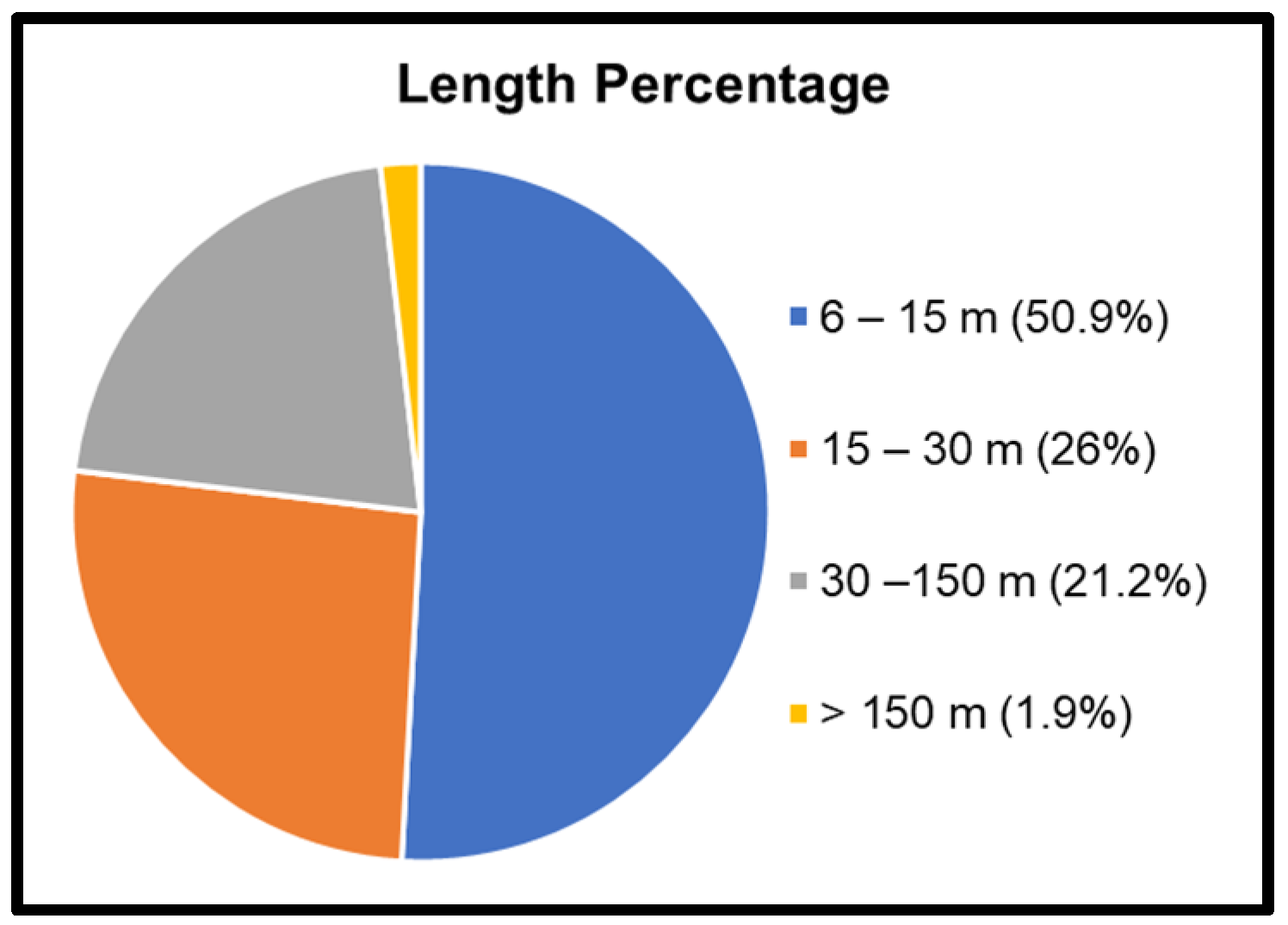
Figure 8 illustrates the distribution of bridges based on their lengths. Approximately 51% of the 15,556 inspected bridges are less than 15 m long. 25% or more are bridges with lengths ranging from 15 to 30 m, and 21% have lengths between 30 and 150 m. Bridges exceeding 150 m in length comprise less than 2% of the entire database. Simply, based on bridge length, there is a breakpoint at 15 m, resulting in two bridge categories: less than 15 m and greater than 15 m.

4. Results and Discussion

4.1. Deterioration Trend Based on Inspection Data in Indonesia

The national bureau in Indonesia inspected various bridges. It is believed that the reasons for their deterioration differ. Each bridge is expected to show a particular aging trend.

4.1.1. Deterioration Trend by Type

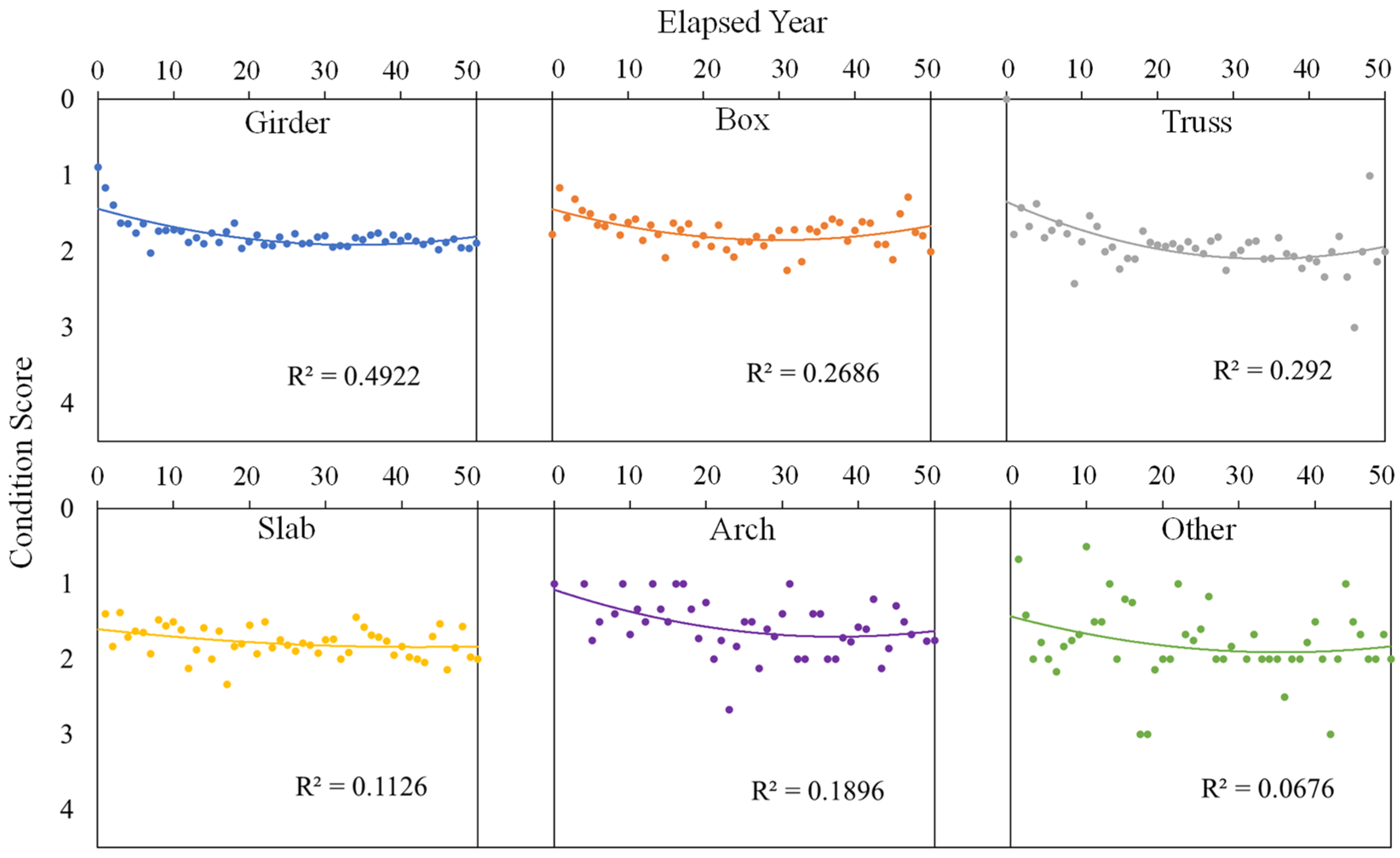
Figure 9 shows the weighted-average condition scores and the regression lines, which highlight the deterioration trend of the overall bridge by type. The R2 value indicates how well the regression line fits the data for each bridge type. Higher values indicate a stronger correlation. Girder-type bridges have the highest R2 value of 0.4922, meaning the trend line fits their condition scores better, while other bridges have the lowest R2 value of 0.0676, indicating a much weaker fit. There are two possible reasons for the lower value of R2. The first reason is the sample size. As shown in Figure 6, the most common bridge type is girder, and the least common is other types. This suggests that fewer bridges of a particular type may lead to lower R2 values. The poor performance of the trend line may be due to the small sample sizes for certain bridge types. The second reason is that the randomness in the data may be caused by differences in daily traffic, environmental conditions, or subjectivity during inspection.
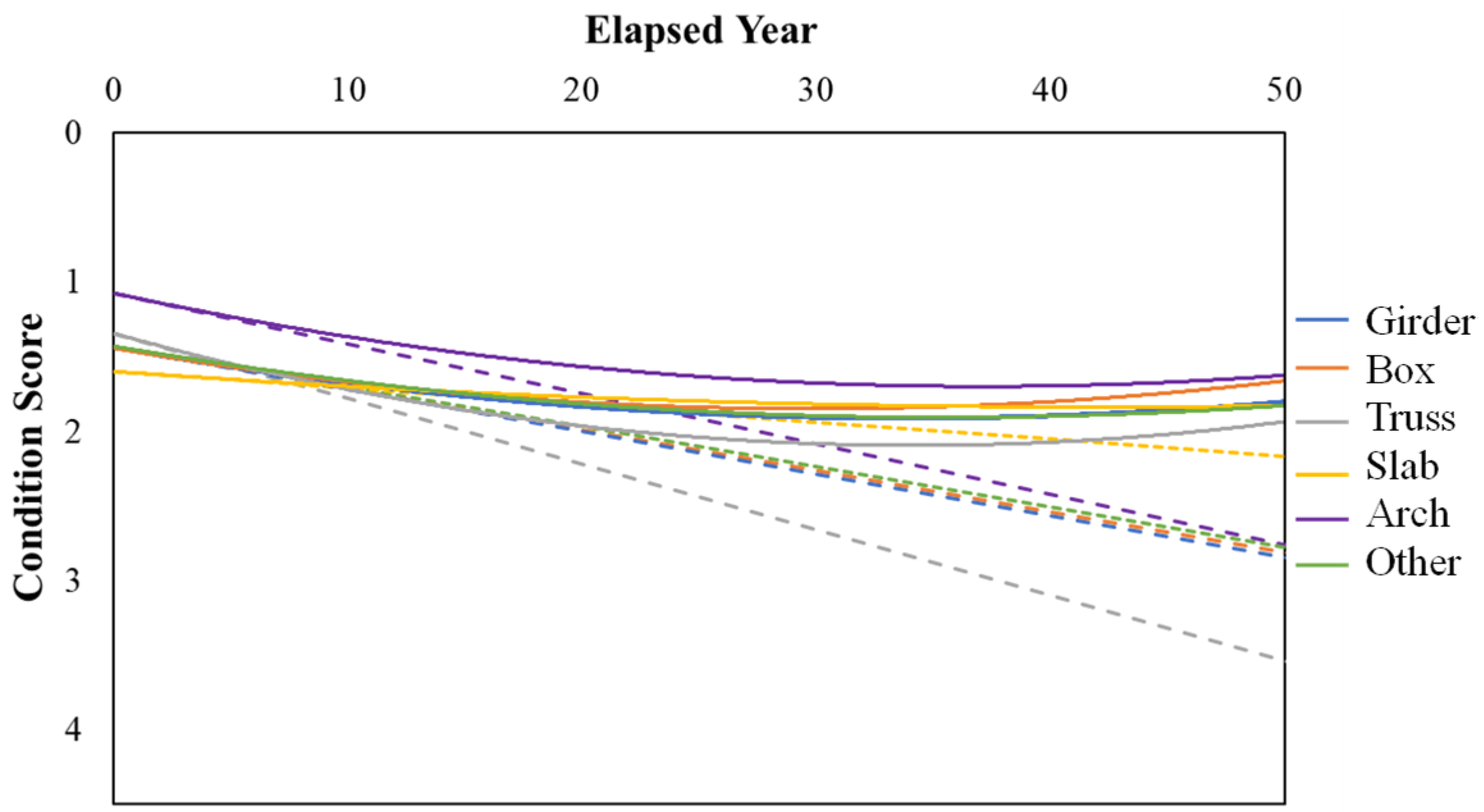
Figure 10 shows the comparison of the deterioration trend lines for the overall bridge by type. The dashed line shows the slope of the deterioration trend lines. Based on the data, arch bridges exhibit better initial condition values than other bridge types. Arch bridges have an initial condition score below 1. Other bridges have a condition score above 1. Over time, Girder, Box, and Slab bridges show almost the same slope of deterioration trend lines.
In contrast, truss bridges show a worse condition score at the 20-year mark. Notably, none of the types begins with a condition score close to 0. As shown by the figures, all type of bridges deteriorates faster in their first 10 years. After 10 years, the deterioration is slower as indicated by the change in slope of the deterioration lines relative to the dashed line. None of the bridges has a condition score more than 3. This may be caused by the immediate maintenance activity. If the bridge’s condition score is 3, it requires attention within 1 year, as shown in Table 2. It will be repaired immediately.
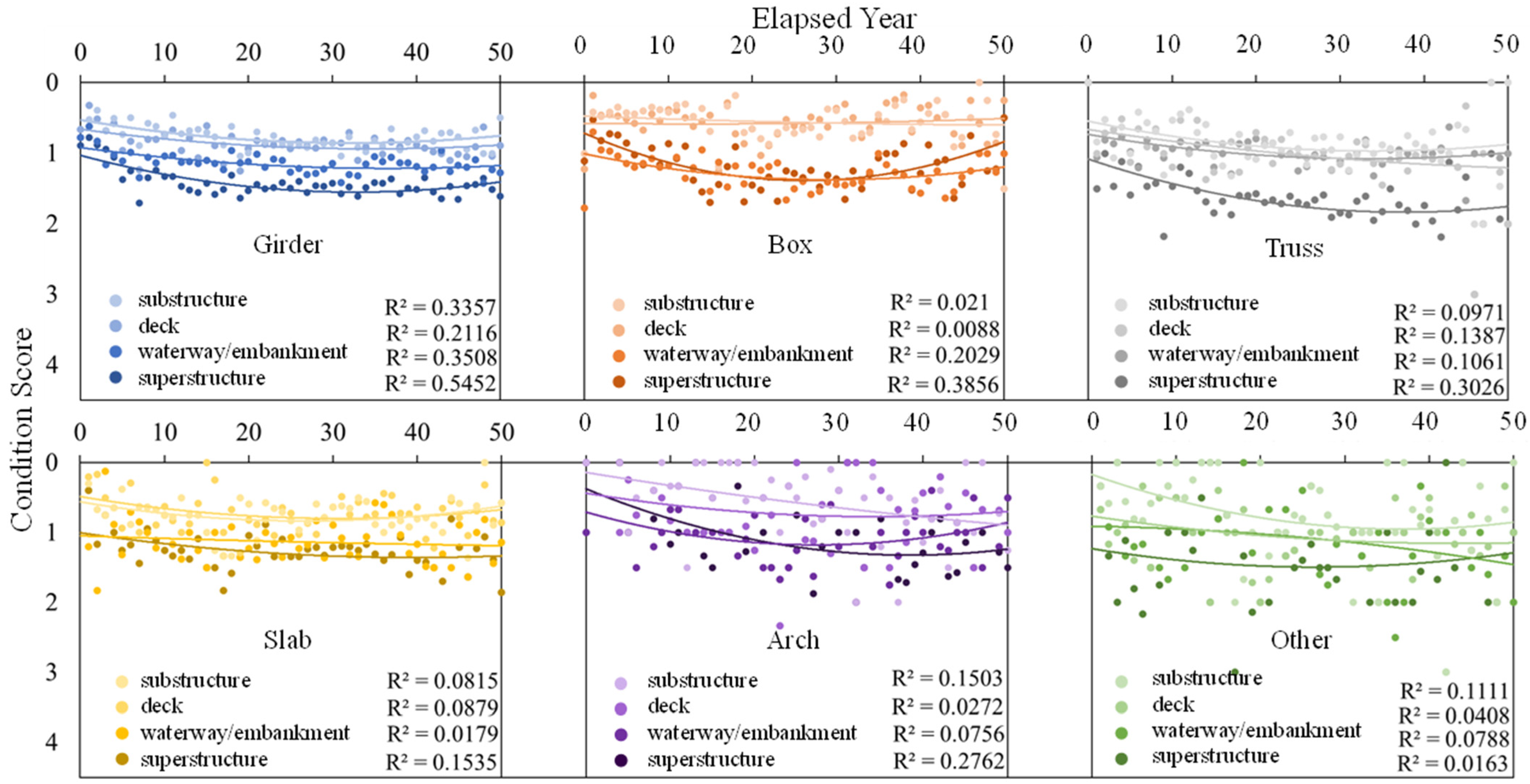
Figure 11 shows the weighted-average condition scores and deterioration lines for bridge components by bridge type. As described earlier, the overall bridge condition score is determined by the maximum score across all its components. Almost all types of bridges exhibit the same tendency that the superstructure component has the highest value of R2. In girder, box, and arch bridges, the deck component has the lowest R2 value, whereas in truss bridges, the substructure component has the lowest R2 value. It may indicate that the data contains substantial inherent randomness, or “noise”.
There is a disparity in the deterioration trends of the superstructure, deck, waterway/embankment, and substructure components, which remains consistent across bridge types. Among these, the superstructure deteriorates the fastest. Specifically, the superstructure degrades more quickly than the deck, even though both are part of the same section. Notably, by the 30-year mark, the condition score of the superstructure surpasses the score of 1, unlike the deck component. The waterway/embankment component deteriorates faster than the deck component. The substructure component deteriorates the slowest of all components. These trends indicate that the superstructure requires special maintenance attention. In most cases, the superstructure’s condition score determines the overall bridge’s condition score.
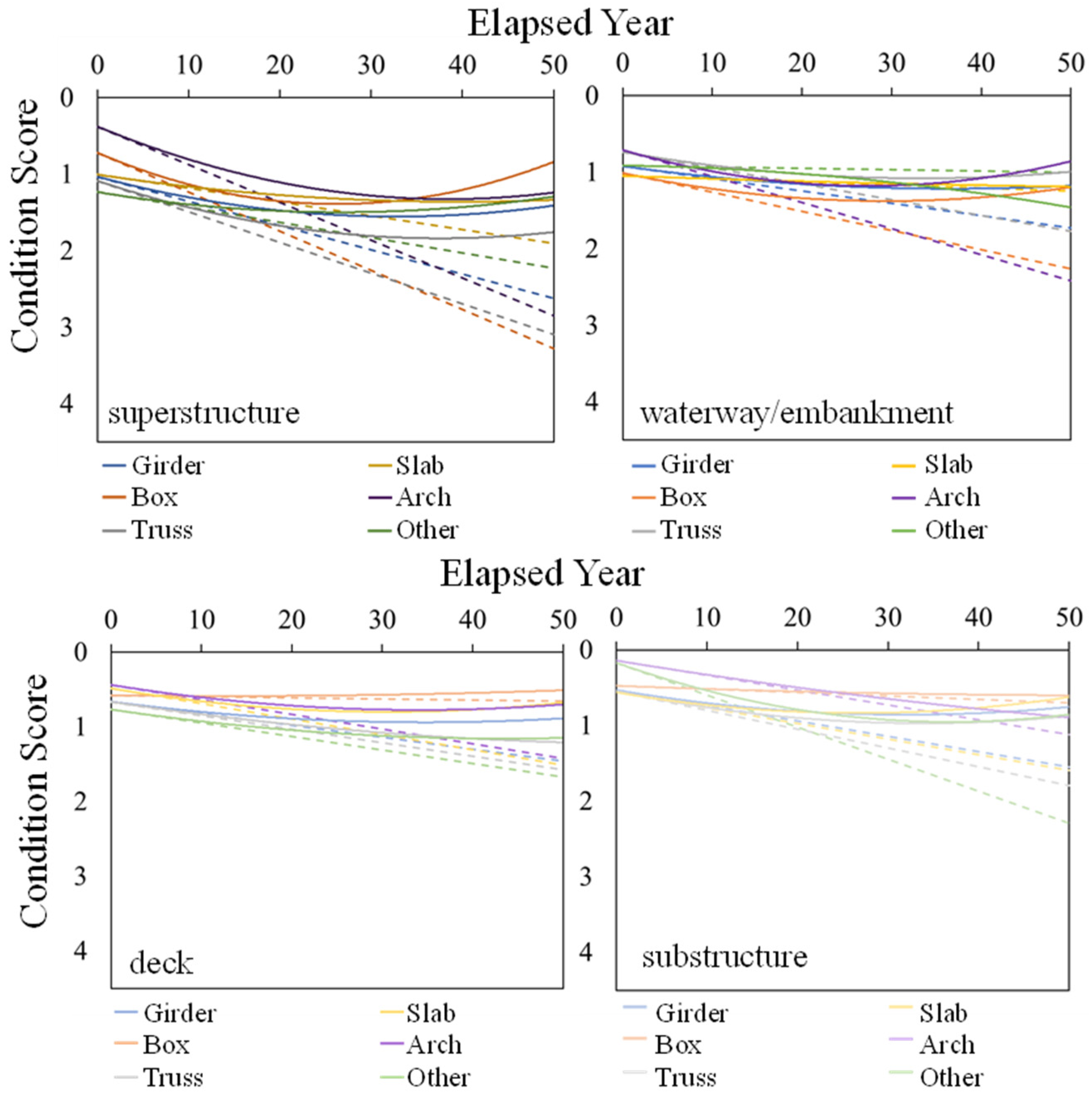
Figure 12 shows the comparative trends in bridge components across different bridge types. The dashed lines show the trend lines’ slopes. For the superstructure component, box bridges, truss bridges, and arch bridges deteriorate faster compared to other types of bridges, indicated by the steeper slope of the deterioration lines. For the waterway/embankment component, box bridges and arch bridges deteriorate faster than other types. There are almost no discrepancies in deterioration rates among deck components across all bridges, shown by almost the same slope of the deterioration lines. The deterioration trend of substructure components shows that arch bridges are in better condition than other bridge types. Girder bridges, truss bridges, and slab bridges show almost a similar deterioration trend. It indicates that the worst deterioration trend in truss bridges is driven by the superstructure, and the superstructure of truss bridges warrants attention during maintenance. There is also a tendency for components to deteriorate faster in the first 10 years, and after 10 years, deterioration slows, as indicated by the change in slope of the deterioration lines relative to the dashed line.

4.1.2. Deterioration Trend by Material

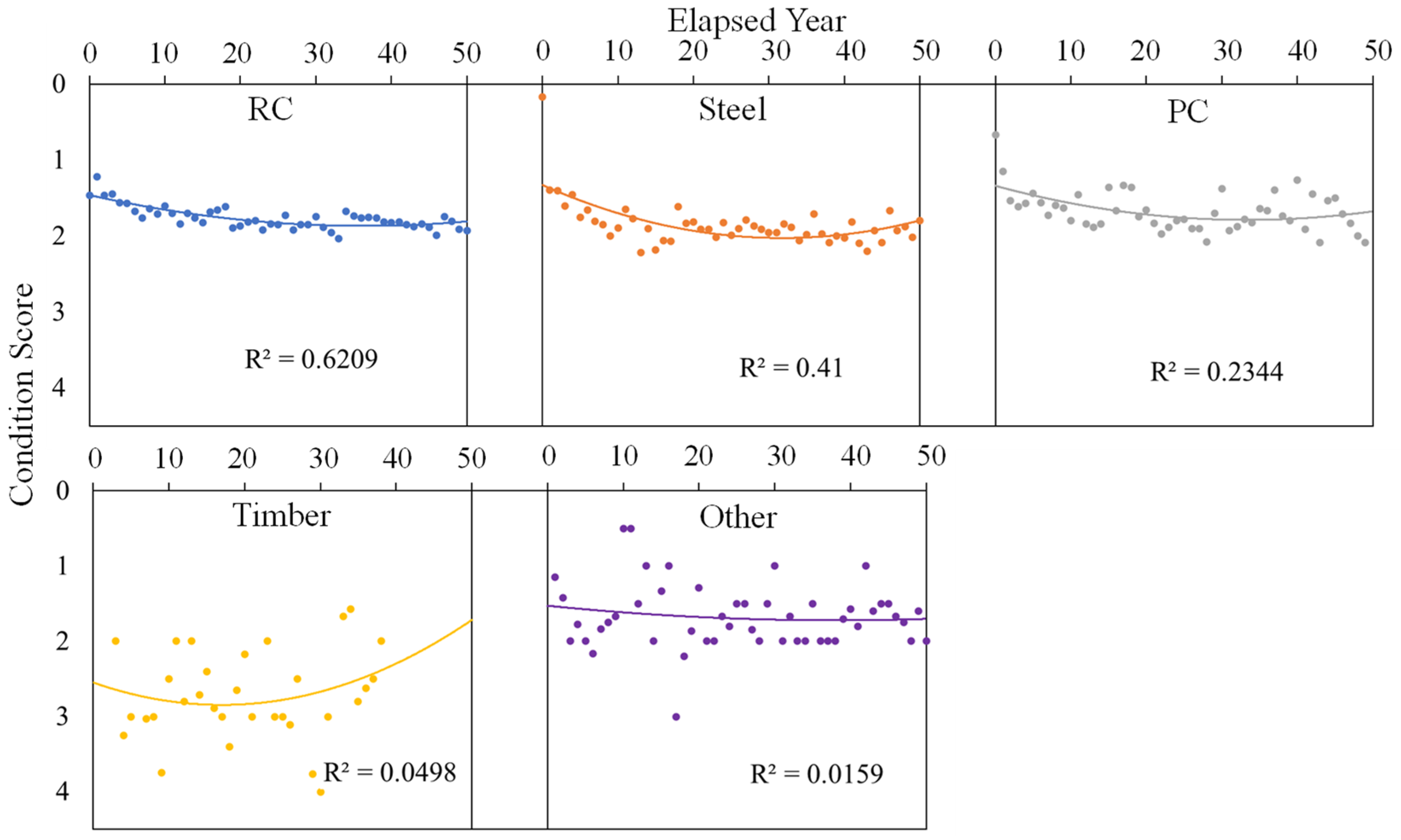
Figure 13 shows the weighted-average condition scores and the regression lines, which highlight the deterioration trend of the overall bridge by material. The same deterioration trend observed in overall bridges by type is also evident, and the poor performance of the trend line may be due to small sample sizes for certain bridge materials. RC bridges have the highest R2 value (0.6209), since they have the largest population. Steel bridges, having the second-highest R2 value, also show the second-largest population. Meanwhile, because the timber bridges have the fewest, they show the smallest R2 value. Randomness in the data might also be caused by differences in daily traffic, environmental conditions, or subjectivity during inspection.
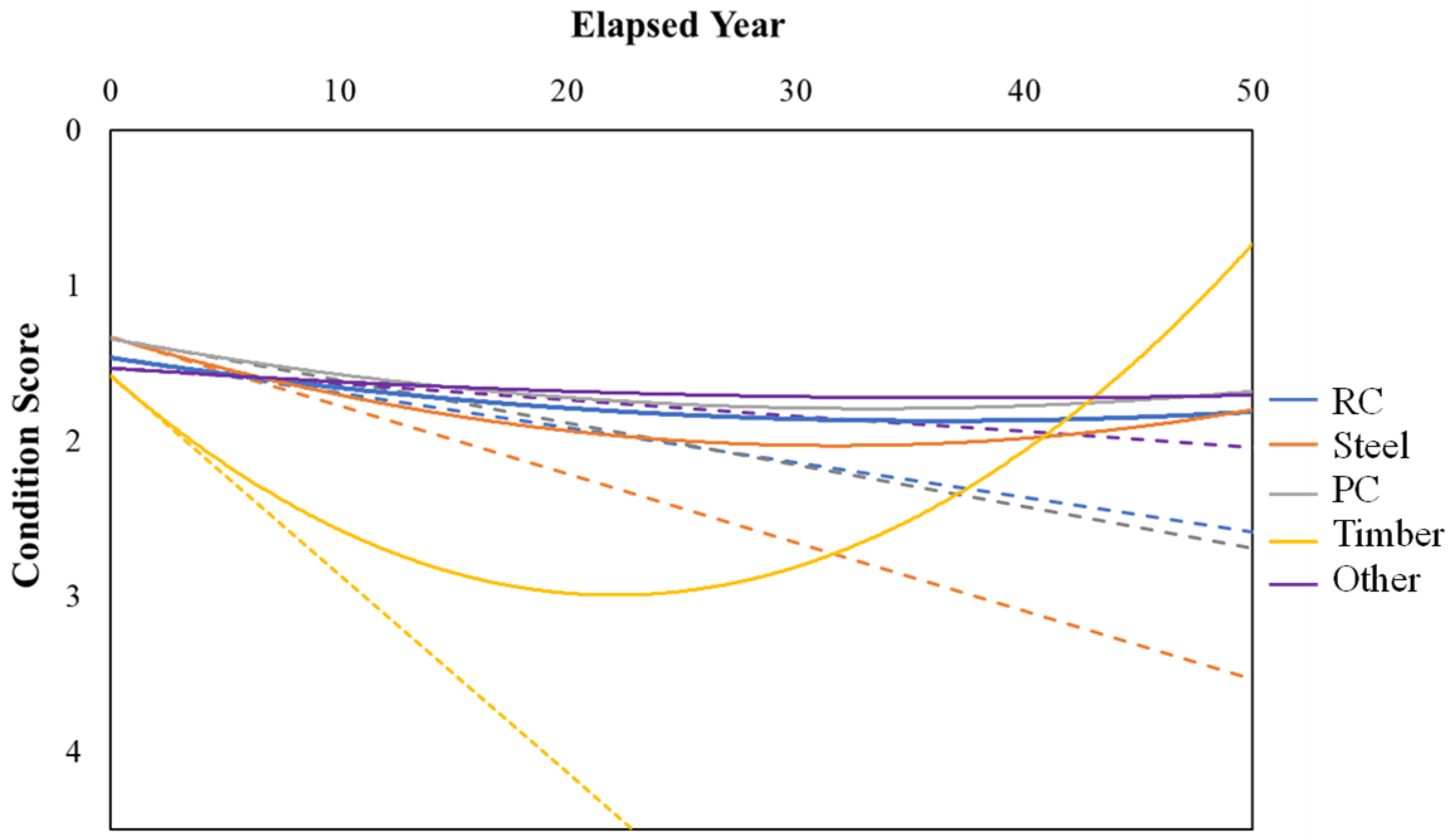
Figure 14 shows the comparison of the deterioration trend lines for the overall bridge by material. The dashed line shows the slope of the deterioration trend lines. Nearly all bridges begin with a condition score greater than 0 at the start of their service life, indicating minor defects. Based on the material used, timber bridges show the worst deterioration, followed by steel bridges. Bridges constructed with reinforced and prestressed concrete exhibit slightly better performance than those constructed with steel, indicated by the steeper slope of the deterioration line in the case of steel bridges. As described before, none of the bridges has a condition score more than 3. It is because of the immediate maintenance activity. If the condition score of the bridge is 3, except for timber bridges, the bridge requires attention within 1 year, as shown in Table 2, and will be repaired immediately.
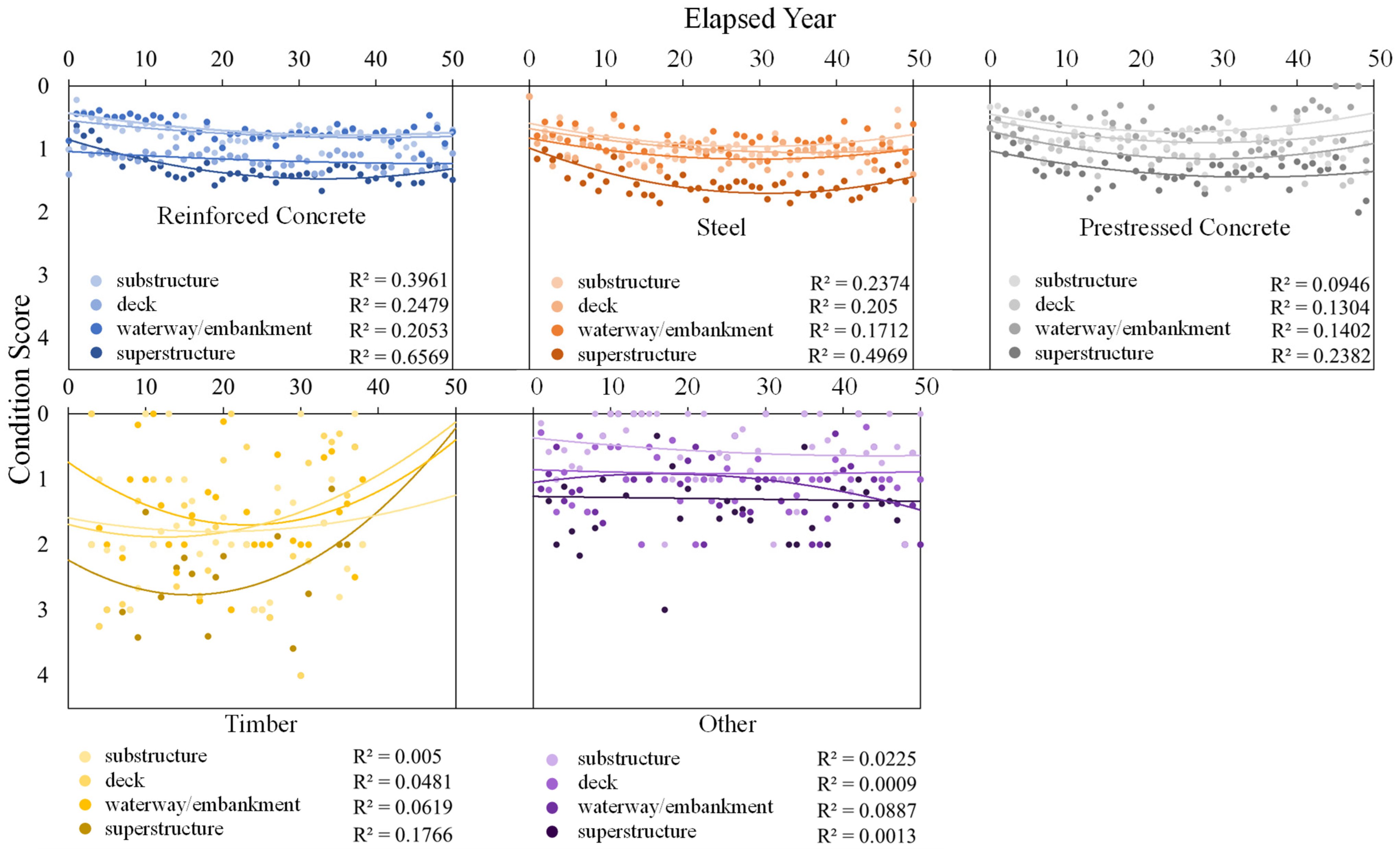
Figure 15 shows the weighted-average condition scores and deterioration lines for bridge components by the bridge material. The same deterioration trend observed in overall bridges by type is also evident. Firstly, the superstructure component has the highest R2 value. Lower value of R2 for other components may be caused by the substantial inherent randomness, or “noise”. Secondly, there is a disparity in the deterioration trends of the superstructure, deck, waterway/embankment, and substructure components. The superstructure deteriorates the fastest and degrades more quickly than the deck, even though both are part of the same section. The waterway/embankment component deteriorates faster than the deck component. The substructure component deteriorates the slowest of all components. The condition score for the overall bridge is mostly governed by the condition score of superstructure components.
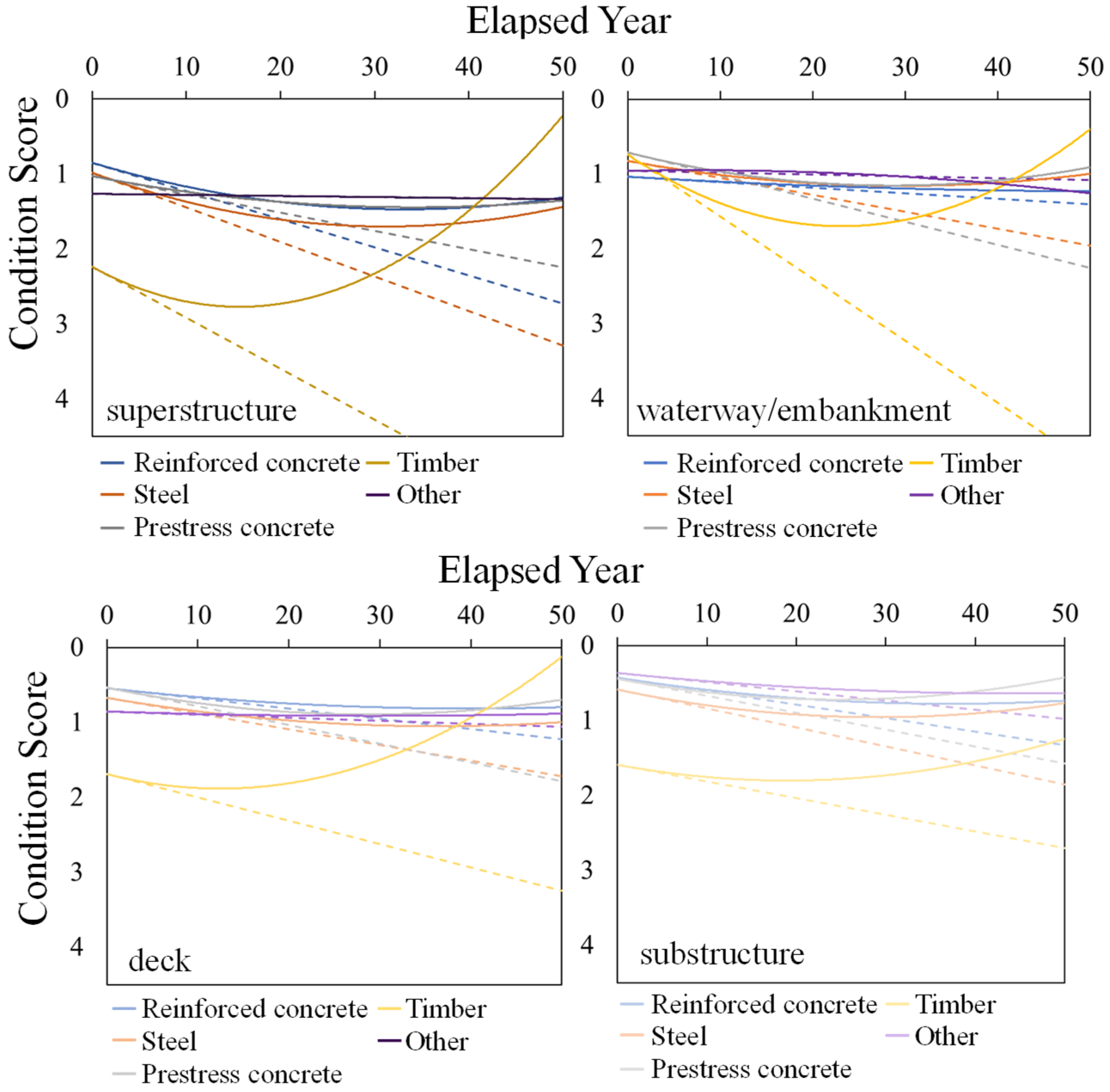
Figure 16 shows the comparative trends in bridge components across different bridge materials. Timber bridges show the worst deterioration trend for all components. The superstructure, deck, and substructure components of steel bridges deteriorate faster than those of reinforced concrete bridges and prestressed concrete bridges, shown by a steeper slope of the deterioration line. The superstructure of the prestressed concrete bridge is slightly better than that of the reinforced concrete bridge, while the waterway, deck, and substructure components of the reinforced concrete bridge are better than those of the prestressed concrete bridge. Accelerated deterioration during the initial 10 years of operation is also observed, indicated by the change in slope of the deterioration lines relative to the dashed line after 10 years.

4.1.3. Deterioration Trend by Length

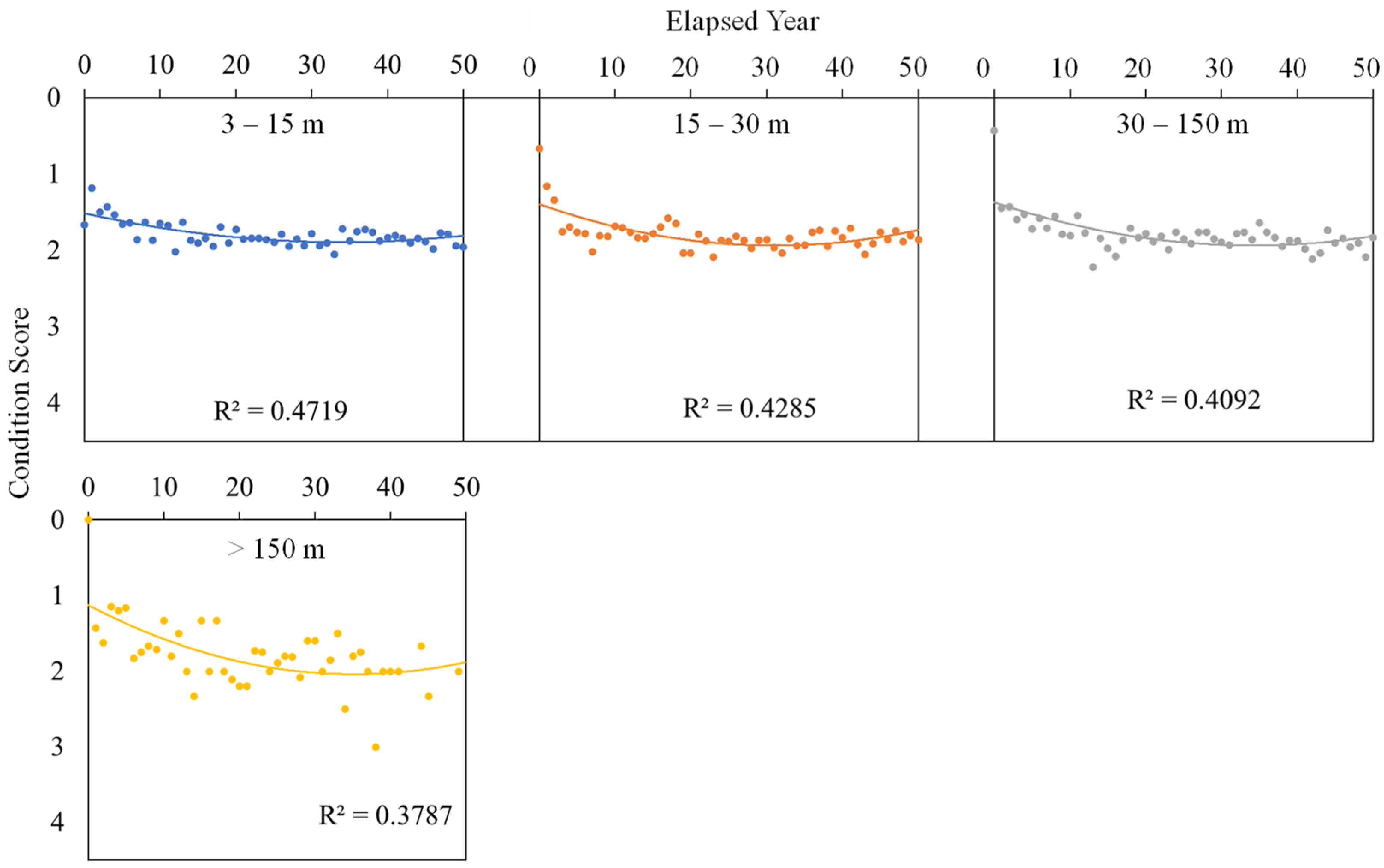
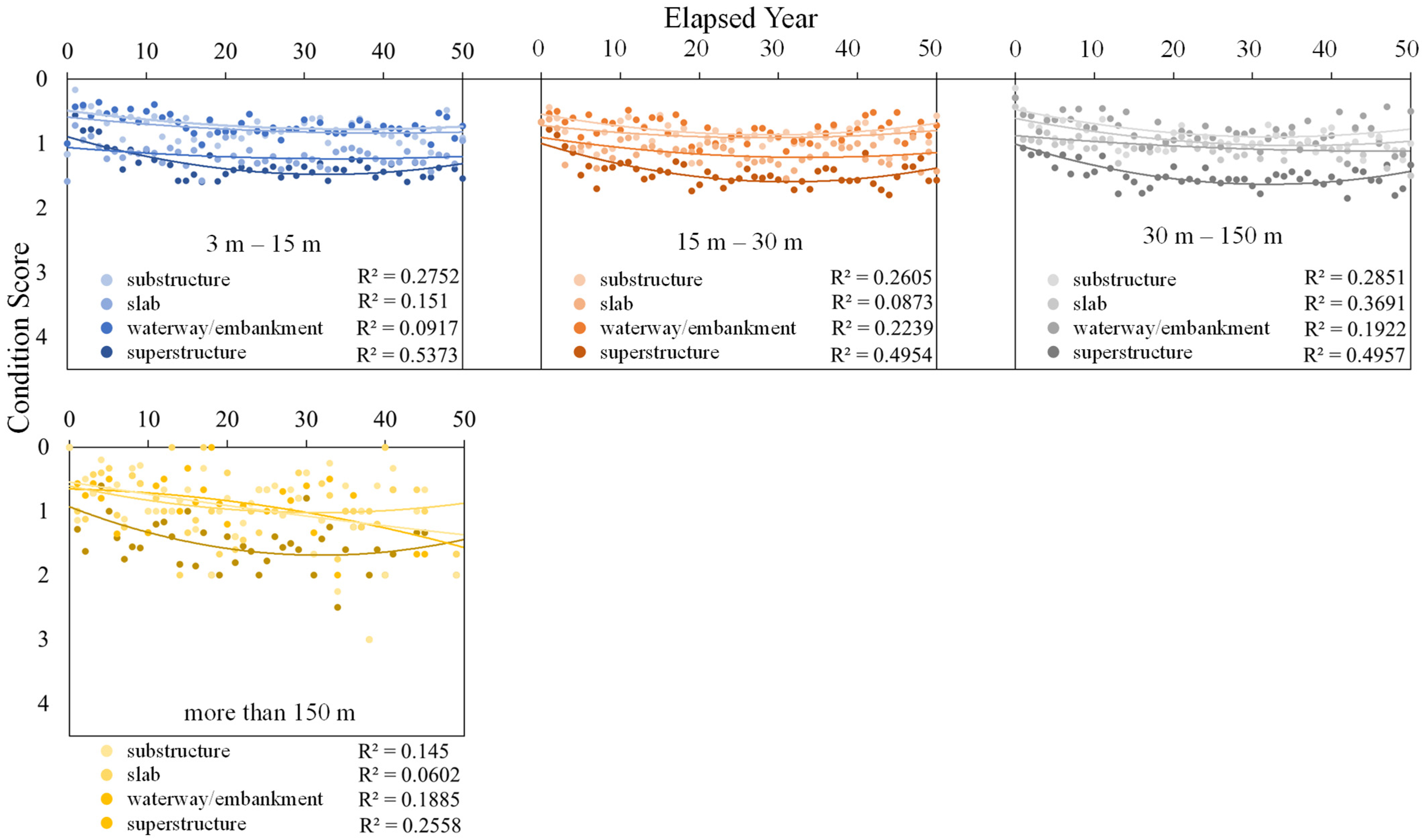
Figure 17 shows the weighted-average condition scores and deterioration lines for bridge components by bridge length. Based on the bridge length, the difference in R2 values across the length category does not differ significantly compared to the bridge type and material categories in the previous subsection. However, a smaller sample size yields a lower R2 value. The shortest bridge shows the highest R2 value. As shown in Figure 8, shorter bridges have more samples compared to the longest bridge.
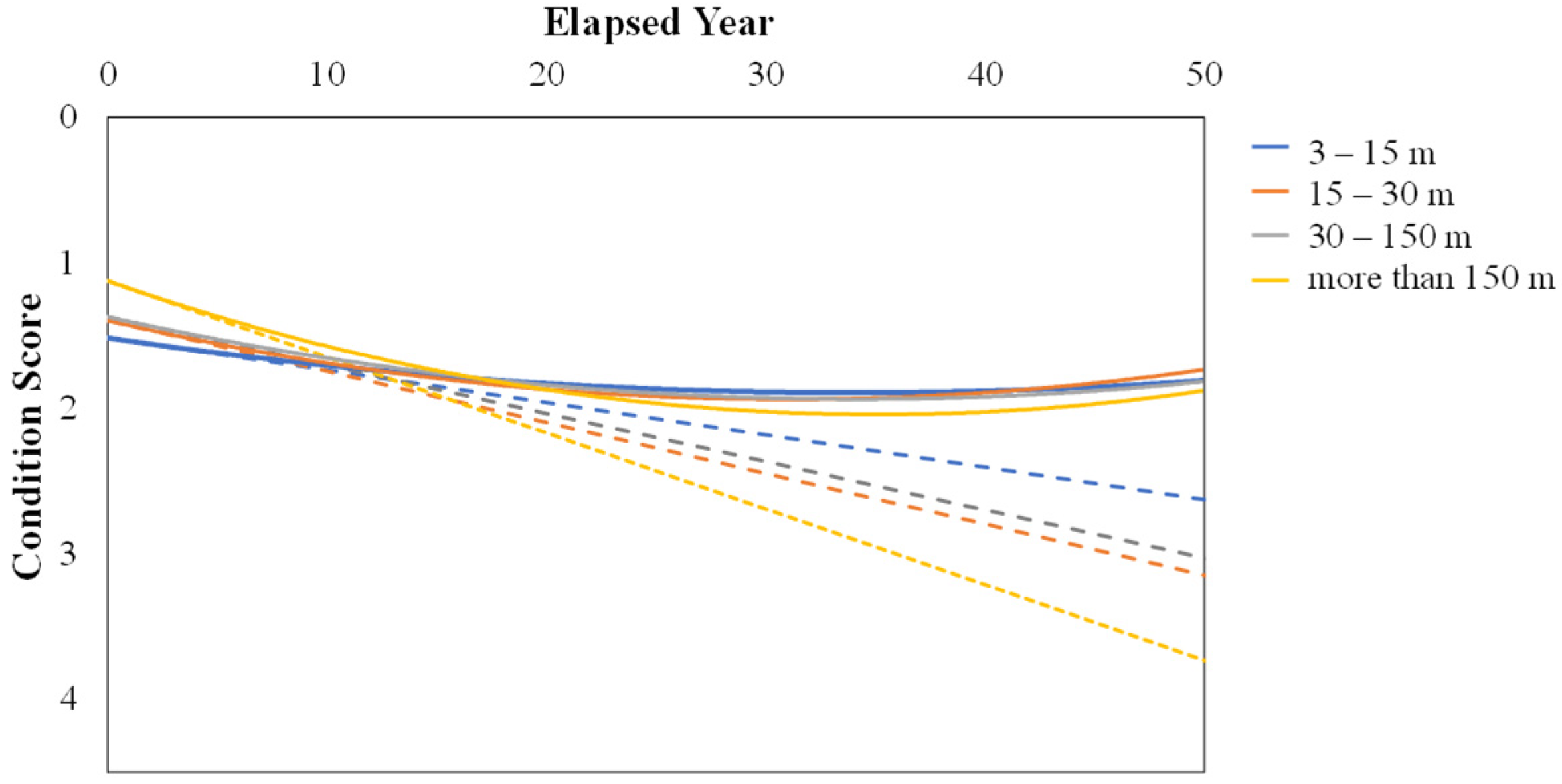
Figure 18 shows the comparison of the deterioration trend lines for the overall bridge by length. The dashed line shows the slope of the deterioration trend lines. It shows that the longer the bridges, the faster their deterioration, shown by the steeper deterioration trend line. Shorter bridges begin with a slightly higher condition score at the start of their service life, indicating minor defects.
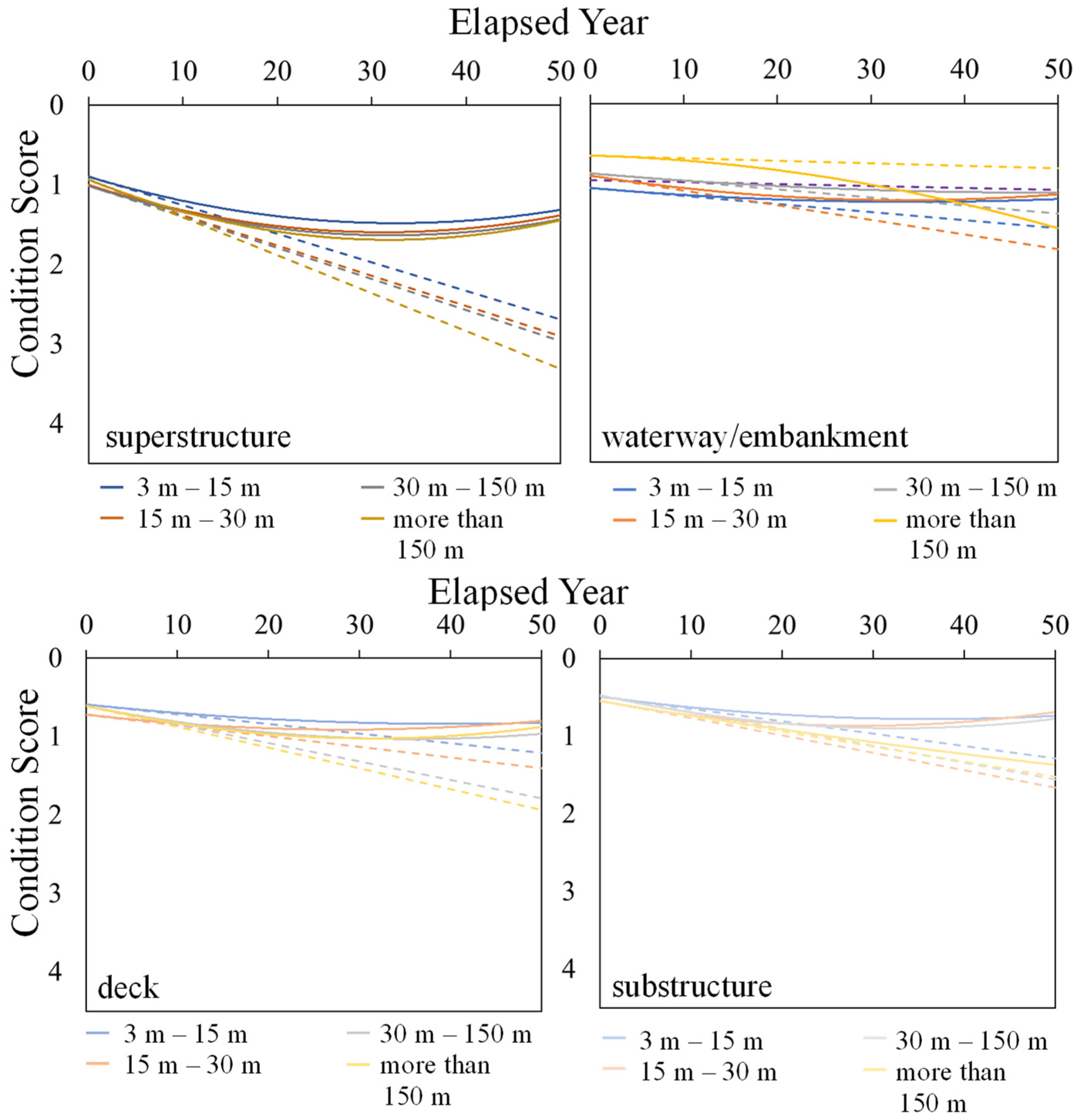
Figure 19 shows weighted-average condition scores and deterioration lines for bridge components by length. The superstructure shows the highest R2 value. The superstructure deteriorates faster than the deck, even though both belong to the same section. The waterway/embankment deteriorates faster than the deck. The substructure deteriorates the slowest overall. Figure 20 shows the comparative trends in bridge components across different bridge lengths. The superstructure, decks, and substructure components of longer bridges deteriorate slightly faster compared to those of shorter bridges. Conversely, the waterway/embankment components of shorter bridges deteriorate faster than those of longer bridges.

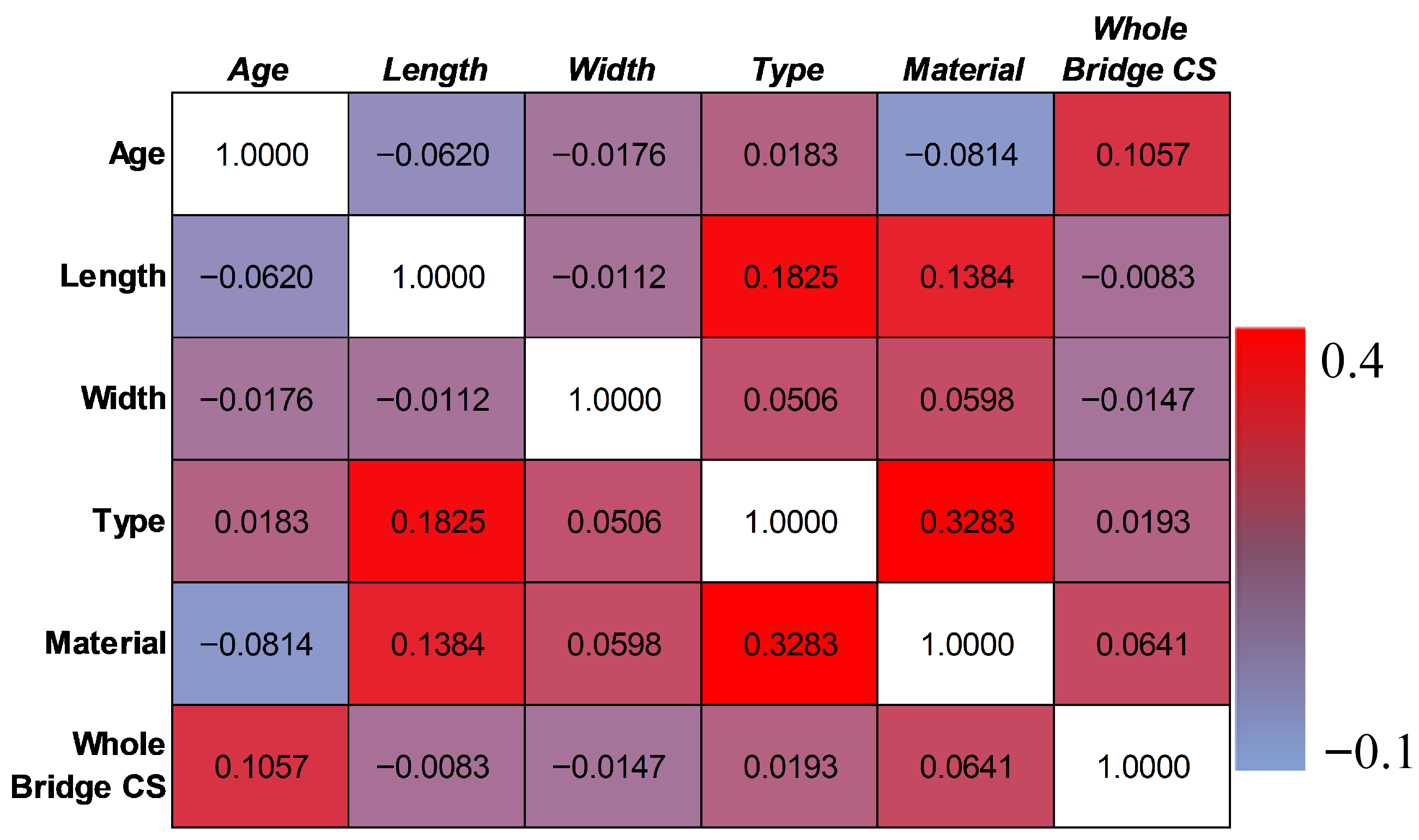
4.2. The Condition Score Correlation

Srikanth & Arockiasamy [38] emphasized that the age of the bridge exhibits the strongest correlation with the deck condition, with a Pearson correlation coefficient of 0.78. This study further presents a heatmap of Pearson correlation coefficients for various variables, including bridge length, width, age, type, material, and whole-bridge condition score, which represents the bridge’s overall condition. Figure 21 depicts a heatmap of up to 50-year bridges, with darker colours indicating lower correlation and lighter colours indicating higher correlation. Towards the right side of the heatmap, bridge age exhibits the highest absolute correlation value of 0.1057, followed by material, type, width, and length. Nevertheless, as indicated in Table 4, the correlation value of 0.1057 is still considered relatively weak. The weak correlation may be due to several factors. As described in the previous section, there is randomness or noise in the Indonesian data that might be caused by the differences in daily traffic, environmental conditions, and subjectivity during inspection. The second factor is the maintenance reset condition, which states that if the bridge’s condition is 3, the bridge will be repaired within 1 year.

4.3. Comparison to BMS Deterioration Model

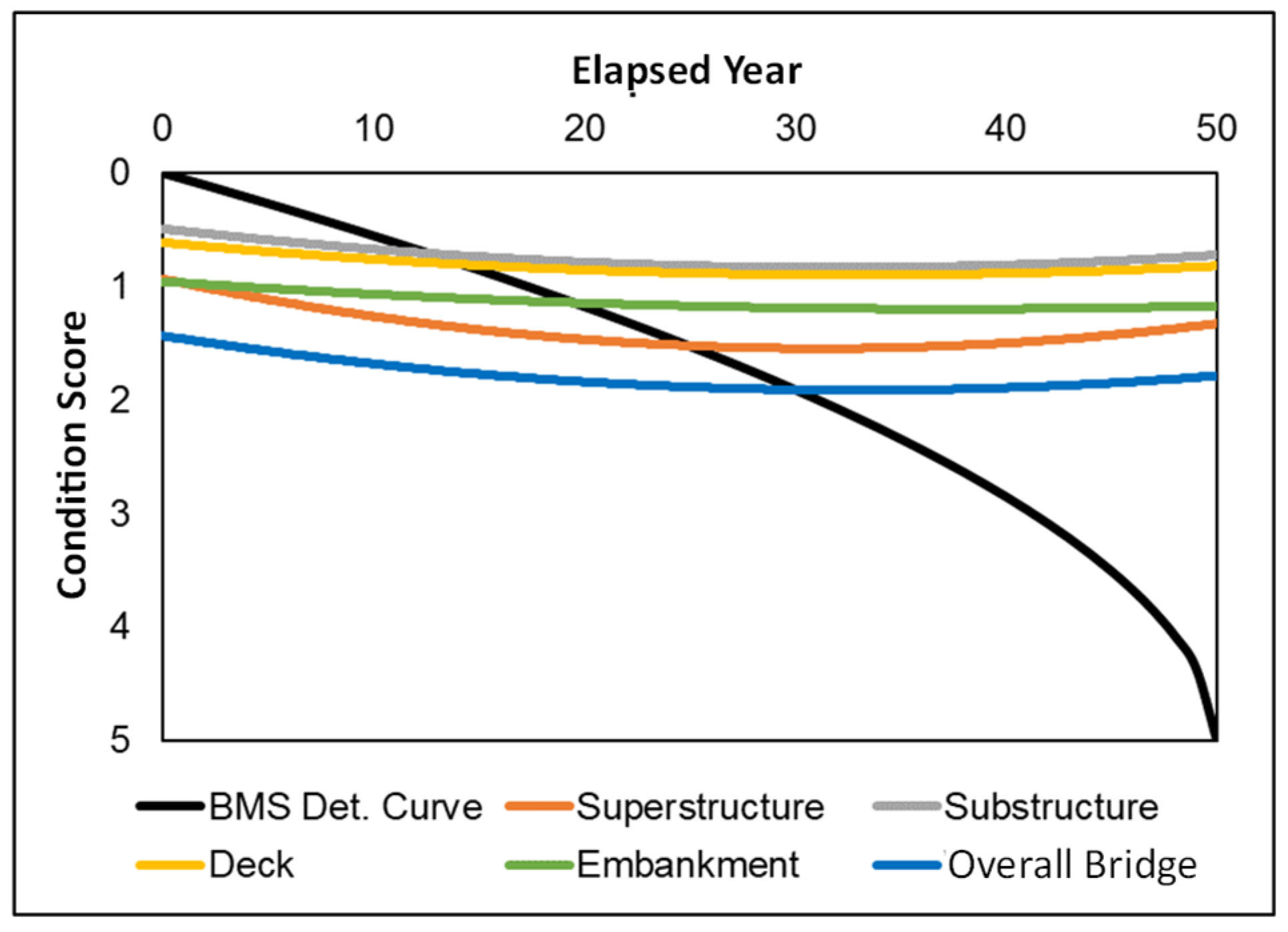
As stated in Section 1, the deterioration model provided by the Indonesia Bridge Management System (BMS) is used to estimate the bridge’s condition. Subsequently, the typical deterioration model from the BMS is compared to the inspection condition scores, as shown in Figure 22. Upon examining the figure, it becomes evident that none of the trends derived from the inspection data align with the typical deterioration curve in the BMS. Consequently, the need to update the BMS model is open to discussion. As shown in Figure 22, the superstructure components deteriorate faster than other components, as described before.

4.4. Comparison to Bridge Inspection Data in Florida

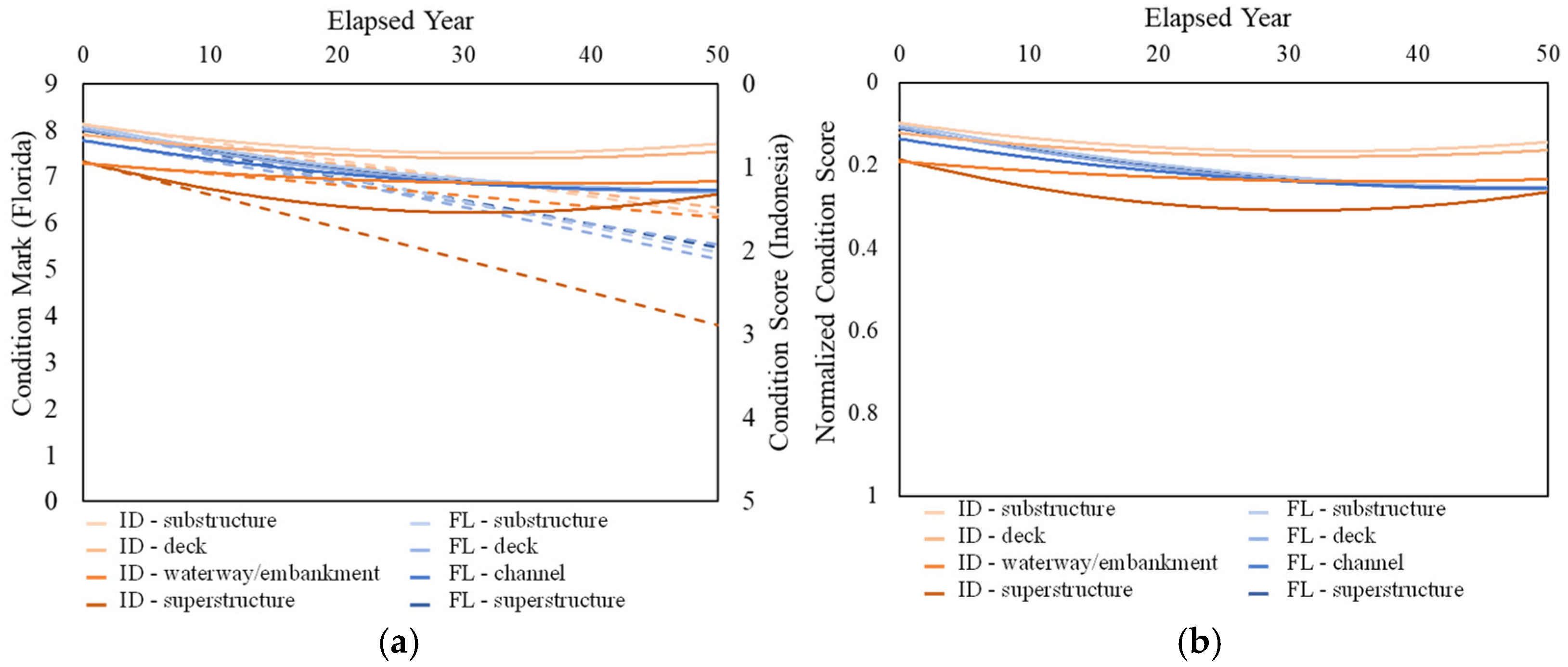
FHWA offers online inspection data for each state in America dating back to the 1990s, which can be utilized to generate a deterioration model that can be compared to the Indonesian data. For this study, the Florida bridge inspection data, consisting of over 12,000 bridge records, including inspection scores, has been chosen. However, it is important to note that the inspection data employs a 10-level (0 to 9) soundness rating system to evaluate bridge components, where a condition rating of 9 signifies a very healthy bridge, while a rating of 0 indicates bridge failure. Therefore, the graph utilized two separate y-axes, one for the Indonesian data and one for the Florida data.
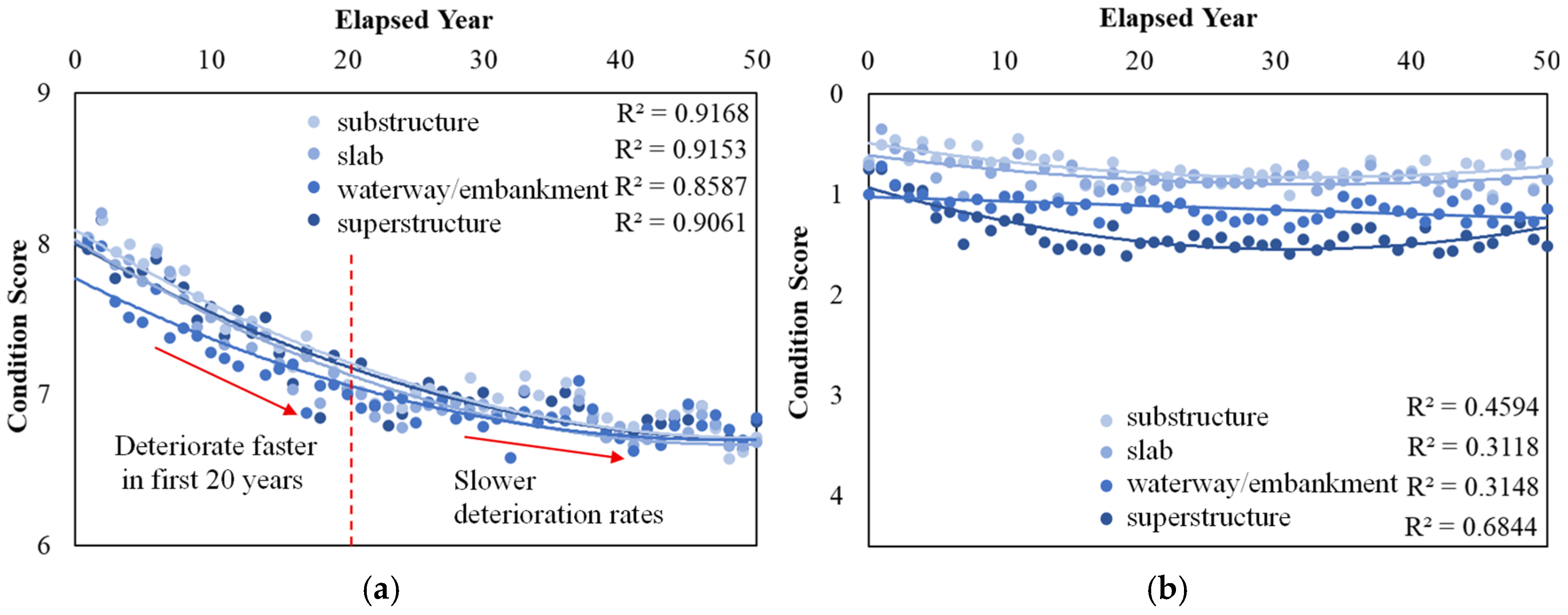
Figure 23 compares deterioration trends of bridge components in Indonesia and Florida using the same methodology. The bridge components in Florida show high R2 values, indicating that the regression line fits the data well. Substructural components have the highest R2 (0.9168), while waterway/embankment components have the lowest (0.8587). The small difference in R2 values (0.8587 to 0.9168) indicates that Florida bridge deterioration trends demonstrate reliable data collection. The R2 values of Indonesian bridges are much lower than those of Florida bridges, indicating the presence of randomness or noise in the Indonesian data. Superstructure components in Indonesian bridges have the highest R2 value (0.6844), while the slab components in Indonesian bridges have the lowest R2 value (0.3118). The difference in R2 values between the Indonesian components is relatively large (from 0.3118 to 0.6844). The randomness might be caused by differences in daily traffic, environmental conditions, or subjective inspection, which require attention.
Figure 24 shows the comparative trends in bridge components between Florida and Indonesia. The dashed lines show the slope of the deterioration trend lines. Relatively similar deterioration trends are observed across all components for bridges in Florida, whereas there are large discrepancies in slopes for all components in Indonesia. The components of Florida bridges deteriorate at a rate of 0.0447–0.056/year in terms of condition score over the first 20 years. The deterioration rate of the deck, substructure, superstructure, and channel is 0.056, 0.0547, 0.0508, and 0.0447 of condition score/year, respectively. It means that the condition score decreases by 1 between 17 and 22 years. After 20 years, the slope of the deterioration trend line has decreased, indicating slower deterioration rates. Different trends are observed in the components of Indonesian bridges. Superstructure components have the highest condition score, followed by the embankment/waterway component and the deck component. The substructure component has the smallest condition score. Compared to Florida bridges, Indonesian bridges deteriorate more rapidly during their first 10 years of operation.
Based on these findings, several points need to be considered in Indonesia’s future inspection and maintenance system. The first point is that Average Daily Traffic (ADT), axle load statistics, and environmental conditions currently are not recorded for each bridge in the national database. Including these factors in future maintenance strategies and database updates would help ensure more precise analysis. The second point is that there may be subjectivity during the inspection. A more detailed, quantitative measurement of inspection that reduces subjectivity is needed. A digital twin could be one way to reduce the subjectivity during the inspection. More efficient, advanced bridge management systems enabled by digital twin shift from conventional visual scoring to proactive structural health monitoring [41,42]. This creates a realistic digital representation of a bridge that is continuously updated with performance data from its physical world. The digital models are constructed from design specifications, bridge plans, and inspection reports, and are then integrated with real-time sensor data from the physical site. By analyzing this data using Artificial Intelligence and advanced simulations, the system can interpret current conditions and predict future performance.

5. Conclusions

Analysis of inspection data and correlations between bridge condition scores highlight the need to update the BMS deterioration model. Comparing Indonesia and Florida data also reveals patterns in bridge performance. The study reaches the following conclusion:
  • Based on inspection data in Indonesia, the deterioration trendline is influenced by many factors. These include the type of bridge, the construction material, and the bridge’s length. Truss bridges deteriorate slightly faster than other types of bridges. Timber bridges show the worst deterioration, followed by steel bridges. Reinforced and prestressed concrete bridges perform slightly better than steel. Longer bridges deteriorate faster over time.
  • There is a disparity in the deterioration trends of the superstructure, deck, waterway/embankment, and substructure components in Indonesian bridges. The superstructure deteriorates the fastest and degrades more quickly than the deck, even though both are part of the same section. The waterway/embankment component deteriorates faster than the deck component. The substructure component deteriorates the slowest of all components.
  • The analysis of inspection data shows that the bridge deterioration trends are most reliable in categories with large sample sizes, such as girder bridges and reinforced concrete bridges. The superstructure consistently shows a higher R2 value than other components. The lower R2 values might be due to differences in daily traffic, environmental conditions, or subjectivity during inspection.
  • Bridges in Indonesia deteriorate faster during their first 10 years. After 10 years, the deterioration is slower. None of the bridges has a condition score more than 3. This may be caused by the immediate maintenance activity. If the bridge’s condition score is 3, it requires attention within 1 year.
  • Based on the Pearson Correlation analysis, it is evident that bridge age exhibits the highest absolute correlation value of 0.1057, followed by material, type, width, and length. Age affects the most the deterioration of the bridge the most, followed by the material, type, and dimension of the bridges, respectively.
  • A comparative analysis of bridge inspection data from Indonesia and Florida reveals consistent deterioration trends across all components in Florida, while significant discrepancies in deterioration rates are evident among components in Indonesia. In Florida, bridge components deteriorate at a rate of 0.0447 to 0.056 per year in condition score during the first 20 years. After this period, the deterioration rate declines, as indicated by a reduced slope in the trend line. In contrast, Indonesian bridges exhibit a different pattern, with components deteriorating more rapidly within the first 10 years of operation.
  • Several considerations are essential for the development of Indonesia’s future bridge inspection and maintenance system. Currently, Average Daily Traffic (ADT), axle load statistics, and environmental conditions are not recorded for each bridge in the national database. Incorporating these factors into future maintenance strategies and database updates would enable more precise analysis. Additionally, the inspection process may involve subjectivity. Implementing more detailed and quantitative inspection measurements is necessary to minimize subjectivity.

Author Contributions

Conceptualization, L.E. and K.N.; methodology, K.N.; analysis, L.Y.T. and P.N.H.; investigation, L.Y.T. and P.N.H.; resources, R.P.P.S.; data curation, R.P.P.S. and L.Y.T.; writing—original draft preparation, L.Y.T.; writing—review and editing L.E. and K.N.; visualization, L.Y.T.; supervision, L.E. and T.H.S.; project administration, T.H.S. All authors have read and agreed to the published version of the manuscript.

Funding

This research received no external funding.

Data Availability Statement

The data presented in this study are available upon request from the corresponding author. The data are not publicly available due to institutional restrictions, as the dataset contains proprietary information managed by national bridge authority that is subjected to confidentially agreements.

Conflicts of Interest

The authors declare no conflicts of interest.

Abbreviations

The following abbreviations are used in this manuscript:
AASHTOAmerican Association of State Highway and Transportation Officials
BMSBridge Management System
FHWAFederal Highway Administration
NBISNational Bridge Inspection Standard

References

  1. Sampat Wakchaure, S.; Neeraj Jha, K. Modeling of post-construction failure factors of bridges. J. Adv. Manag. Res. 2011, 8, 246–262. [Google Scholar]
  2. Mauch, M.; Madanat, S. Semiparametric hazard rate models of reinforced concrete bridge deck deterioration. J. Infrastruct. Syst. 2001, 7, 49–57. [Google Scholar] [CrossRef]
  3. Rens, K.L.; Nogueira, C.L.; Transue, D.J. Bridge management and nondestructive evaluation. J. Perform. Constr. Facil. 2005, 19, 3–16. [Google Scholar] [CrossRef]
  4. Yang, Y.N.; Kumaraswamy, M.M. Towards life-cycle focused infrastructure maintenance for concrete bridges. Facilities 2011, 29, 577–590. [Google Scholar] [CrossRef]
  5. Puspitasari, S.D.; Harahap, S.; Astuti, P. A Critical Review of Bridge Management System in Indonesia. In International Conference on Rehabilitation and Maintenance in Civil Engineering; Springer Nature: Singapore, 2021; pp. 381–389. [Google Scholar]
  6. Liu, C.; Itoh, Y. Information technology applications for bridge maintenance management. Logist. Inf. Manag. 2001, 14, 393–400. [Google Scholar] [CrossRef]
  7. Frangopol, D.M.; Bocchini, P. Bridge network performance, maintenance and optimisation under uncertainty: Accomplishments and challenges. Struct. Infrastruct. Eng. 2012, 8, 341–356. [Google Scholar] [CrossRef]
  8. Deng, Z.; Huang, M.; Wan, N.; Zhang, J. The Current Development of Structural Health Monitoring for Bridges: A Review. Buildings 2023, 13, 1360. [Google Scholar] [CrossRef]
  9. Mao, Y.; Xiao, F.; Tian, G.; Xiang, Y. Sensitivity analysis and sensor placement for damage identification of steel truss bridge. Structures 2025, 73, 108310. [Google Scholar] [CrossRef]
  10. Xiao, F.; Mao, Y.; Tian, G.; Chen, G.S. Partial-Model Based Damage Identification of Long-Span Steel Truss Bridge Based on Stiffness Separation Method. Struct. Control Health Monit. 2024, 2024, 5530300. [Google Scholar]
  11. Niyirora, R.; Ji, W.; Masengesho, E.; Munyaneza, J.; Niyonyungu, F.; Nyirandayisabye, R. Intelligent damage diagnosis in bridges using vibration-based monitoring approaches and machine learning: A systematic review. Results Eng. 2022, 16, 100761. [Google Scholar] [CrossRef]
  12. Directorate General of Highway. Bridge Management System: Bridge Inspection Manual; Ministry of Public Work: Jakarta, Indonesia, 1993. [Google Scholar]
  13. Directorate General of Highway. Bridge Maintenance Guidelines; Ministry of Public Work: Jakarta, Indonesia, 2011. [Google Scholar]
  14. Directorate General of Highway. Bridge Maintenance Guidelines; Ministry of Public Work: Jakarta, Indonesia, 2022. [Google Scholar]
  15. Ramadhan, F.; Riantini, L.S.; Isvara, W. The Implementation of INVI-J to Ensure the Sustainability of Bridge Infrastructure in Indonesia. In Proceedings of the 3rd Asia Pacific Conference on Research in Industrial and System Engineering, Depok, Indonesia, 16–17 June 2020. [Google Scholar]
  16. Happy 50th Anniversary—National Bridge Inspection Standards. Available online: https://www.fhwa.dot.gov/highwayhistory/national_bridge_inspection_standards.cfm (accessed on 19 November 2025).
  17. Thompson, P.D.; Shepard, R.W. AASHTO Commonly-recognized bridge elements. In Proceedings of the Materials for National Workshop on Commonly Recognized Measures for Maintenance, Scottsdale, AZ, USA, 5–7 June 2000. [Google Scholar]
  18. Hartle, R.A.; Ryan, T.W.; Mann, E.; Danovich, L.J.; Sosko, W.B.; Bouscher, J.W. Bridge Inspector’s Reference Manual: Volume 1 and Volume 2; Federal Highway Administration: Washington, DC, USA, 2020. [Google Scholar]
  19. Assaad, R.; El-Adaway, I.H. Bridge infrastructure asset management system: Comparative computational machine learning approach for evaluating and predicting deck deterioration conditions. J. Infrastruct. Syst. 2020, 26, 04020032. [Google Scholar] [CrossRef]
  20. Althaqafi, E.; Chou, E. Developing bridge deterioration models using an artificial neural network. Infrastructures 2022, 7, 101. [Google Scholar] [CrossRef]
  21. Rashidi Nasab, A.; Elzarka, H. Optimizing machine learning algorithms for improving prediction of bridge deck deterioration: A case study of Ohio Bridges. Buildings 2023, 13, 1517. [Google Scholar] [CrossRef]
  22. Liu, K.; El-Gohary, N. Deep learning-based analytics of multisource heterogeneous bridge data for enhanced data-driven bridge deterioration prediction. J. Comput. Civ. Eng. 2022, 36, 04022023. [Google Scholar] [CrossRef]
  23. Zhang, C.; Lei, X.; Xia, Y. Enhancing bridge inspection data quality using machine learning. Autom. Constr. 2025, 175, 106182. [Google Scholar] [CrossRef]
  24. Huang, Y.H. Artificial neural network model of bridge deterioration. J. Perform. Constr. Facil. 2010, 24, 597–602. [Google Scholar] [CrossRef]
  25. Souza, C.A.; de Carvalho, J.M.F.; Ribeiro, M.H.; Martins, A.C.; Bellon, F.G.; Andrade, M.S.; Oliveira, D.S.; Ribeiro, J.C.L.; Cesar, K.M.L., Jr.; Matos, J.C. Bridge deterioration prediction models using artificial intelligence in a missing data scenario. Structures 2025, 77, 109112. [Google Scholar] [CrossRef]
  26. Bu, G.; Lee, J.; Guan, H.; Blumenstein, M.; Loo, Y.C. Development of an integrated method for probabilistic bridge-deterioration modeling. J. Perform. Constr. Facil. 2014, 28, 330–340. [Google Scholar] [CrossRef][Green Version]
  27. Collins, J.; Weidner, J. Comparison of Markovian-based bridge deterioration model approaches. J. Bridge Eng. 2023, 28, 04023047. [Google Scholar] [CrossRef]
  28. Lu, M.; Hydock, J.; Radlińska, A.; Guler, S.I. Reliability analysis of bridge deck utilizing generalized gamma distribution. J. Bridge Eng. 2022, 27, 04022006. [Google Scholar] [CrossRef]
  29. Li, M.; Jia, G. Bayesian updating of bridge condition deterioration models using complete and incomplete inspection data. J. Bridge Eng. 2020, 25, 0402007. [Google Scholar] [CrossRef]
  30. Ilbeigi, M.E.M.M.; Ebrahimi Meimand, M. Statistical forecasting of bridge deterioration conditions. J. Perform. Constr. Facil. 2020, 34, 04019104. [Google Scholar] [CrossRef]
  31. Guo, X.; Chen, Z.; Sun, L.; Ji, W. Deterioration analysis and forecasting model of urban bridges. In Proceedings of the 17th COTA International Conference of Transportation Professionals, Shanghai, China, 7–9 July 2017. [Google Scholar]
  32. Shan, Y.; Contreras-Nieto, C.; Lewis, P. Using data analytics to characterize steel bridge deterioration. In Proceedings of the Construction Research Congress, San Juan, Puerto Rico, 31 May–2 June 2016. [Google Scholar]
  33. Koike, M.; Nagai, K. Analysis aging degradation trend using the bridge inspection data in Niigata Prefecture Municipalities. In Proceedings of the JCI Annual Convention, Chiba, Japan, 14–16 July 2015; Available online: https://pub.confit.atlas.jp/en/event/jci2015/presentation/2224 (accessed on 13 January 2026). (In Japanese)
  34. Wahyudi, A.; Satyarno, I.; Suparma, L.B.; Mulyono, A.T. Quality Assurance Dan Quality Control of Bridge Inspection using Invi-J. J. Transp. 2021, 21, 81–92. (In Indonesian) [Google Scholar]
  35. Sobanjo, J. Determination Deterioration Models Using Inspection Data in Florida; Florida State University: Tallahassee, FL, USA, 2011. [Google Scholar]
  36. Campbell, L.E.; Perry, C.N.; Connor, R.J.; Lloyd, J.B. Element Level Bridge Inspection: Benefits and Use of Data for Bridge Management; Purdue University: West Lafayette, IN, USA, 2016. [Google Scholar]
  37. Schober, P.; Boer, C.; Schwarte, L.A. Correlation coefficients: Appropriate use and interpretation. Anesth. Analg. 2018, 126, 1763–1768. [Google Scholar] [CrossRef] [PubMed]
  38. Srikanth, I.; Arockiasamy, M. Deterioration models for prediction of remaining useful life of timber and concrete bridges: A review. J. Traffic Transp. Eng. 2020, 7, 152–173. [Google Scholar] [CrossRef]
  39. Chen, C.L.; Hung, C.C.; Zhang, W.Y. Establishing severe deterioration and maintenance rules of bridge components: An empirical study in Taiwan. Case Stud. Constr. Mater. 2025, 22, e04907. [Google Scholar] [CrossRef]
  40. Kim, Y.J.; Yoon, D.K. Identifying critical sources of bridge deterioration in cold regions through the constructed bridges in North Dakota. J. Bridge Eng. 2010, 15, 542–552. [Google Scholar] [CrossRef]
  41. Dobashi, H. Infrastructure data platform for digital twin and future prospects. Artif. Intell. Data Sci. 2023, 4, 1–12. (In Japanese) [Google Scholar] [CrossRef]
  42. Kaewunruen, S.; AbdelHadi, M.; Kongpuang, M.; Pansuk, W.; Remennikov, A.M. Digital twins for managing railway bridge maintenance, resilience, and climate change adaptation. Sensors 2023, 23, 252. [Google Scholar] [CrossRef]
Figure 1. The Deterioration Model of the Bridge Management System (BMS) in Indonesia.
Buildings 16 00424 g001
Figure 2. Example of the distribution of the number of bridges based on the elapsed year and condition score.
Buildings 16 00424 g002
Figure 3. Deterioration trend for all bridges.
Buildings 16 00424 g003
Figure 4. Deterioration trend for all bridges: (a) using weighted average; (b) two-order polynomial trendline.
Buildings 16 00424 g004
Figure 5. Number of bridges in Indonesia: (a) by construction year; (b) by age.
Buildings 16 00424 g005
Figure 6. Bridge percentage by type.
Buildings 16 00424 g006
Figure 7. Bridge percentage by material.
Buildings 16 00424 g007
Figure 8. Bridge percentage by length.
Buildings 16 00424 g008
Figure 9. Deterioration trend of the overall bridge by type.
Buildings 16 00424 g009
Figure 10. Comparison of the deterioration trend line of the overall bridge by type.
Buildings 16 00424 g010
Figure 11. Deterioration trend of the bridge components by the bridge type.
Buildings 16 00424 g011
Figure 12. Comparative deterioration trends in bridge components across different bridge types.
Buildings 16 00424 g012
Figure 13. Deterioration trend of the overall bridge by material.
Buildings 16 00424 g013
Figure 14. Comparison of the deterioration trend line of the overall bridge by material.
Buildings 16 00424 g014
Figure 15. Deterioration trend of the bridge components by bridge material.
Buildings 16 00424 g015
Figure 16. Comparative deterioration trends in bridge components across different bridge materials.
Buildings 16 00424 g016
Figure 17. Deterioration trend of the overall bridge by length.
Buildings 16 00424 g017
Figure 18. Comparison of the deterioration trend line of the overall bridge by length.
Buildings 16 00424 g018
Figure 19. Deterioration trend of the bridge components by bridge length.
Buildings 16 00424 g019
Figure 20. Comparative deterioration trends in bridge components across different bridge lengths.
Buildings 16 00424 g020
Figure 21. Pearson correlation heatmap of variables and overall bridge condition score.
Buildings 16 00424 g021
Figure 22. Comparison of the deterioration model of the BMS model and the deterioration trend based on the inspection data.
Buildings 16 00424 g022
Figure 23. Deterioration trend comparison of the bridge components: (a) Florida; (b) Indonesia.
Buildings 16 00424 g023
Figure 24. Comparative deterioration trends in bridge components between Florida and Indonesia: (a) based on condition score; (b) based on normalized condition score.
Buildings 16 00424 g024
Table 1. Criteria to determine condition score.
Rating SystemCriteriaScore
Structure
(S)
Dangerous
Not Dangerous
1
0
Damage
(R)
Severe
Not Severe
1
0
Quantity
(K)
More than x %
Less than x %
x = 30% for structural components and x = 50% for non-structural components
1
0
Function
(F)
The component could not be functioned
The component could be functioned
1
0
Effect
(P)
Affects another component
Does not affect another component
1
0
Condition Score (NK)NK = S + R + K + F + P0–5
Table 2. Condition rating for the bridge based on BMS.
Condition ScoreMeaning
0As new with no defects
1Very minor defects
2Defects which require monitoring and maintenance in the future
3Defects which require attention soon (within 1 year)
4Critical condition which leads to failure
5Component broken or no longer functioning
Table 3. Inspection data classification.
Bridge TypeBridge MaterialBridge Length
ArchReinforced Concrete (RC)6–15 m
BoxPrestressed Concrete (PC)15–30 m
GirderSteel30–150 m
TrussTimber>150 m
SuspensionOther
Slab
Other
Table 4. Interpretation of Pearson correlation.
Absolute Value of Correlation CoefficientInterpretation
0.00–0.10Negligible correlation
0.10–0.39Weak correlation
0.40–0.69Moderate correlation
0.70–0.89Strong correlation
0.90–1.00Very strong correlation
Disclaimer/Publisher’s Note: The statements, opinions and data contained in all publications are solely those of the individual author(s) and contributor(s) and not of MDPI and/or the editor(s). MDPI and/or the editor(s) disclaim responsibility for any injury to people or property resulting from any ideas, methods, instructions or products referred to in the content.