1. Introduction
Construction projects are inherently exposed to high levels of risk, often resulting in delays, cost overruns, scope creep, and quality deficiencies that can compromise overall project success and lead to wasted resources [
1,
2]. Risks in construction arise from multiple sources, including technical complexity, coordination challenges among numerous stakeholders, dynamic operating conditions, and uncertainties in regulatory, financial, and socio-political environments. When these risks are not managed effectively, projectors are more likely to experience failure, incur excessive costs, miss deadlines, and suffer from reduced stakeholder confidence, underscoring the critical need for systematic risk management practices [
3].
Globally, the construction sector is a major contributor to economic development and employment. For instance, it accounts for approximately 10% of GDP and employs nearly 7% of the labor force in the European Union [
1]. Similarly, in Jordan, the construction industry plays a pivotal role in economic growth and infrastructure development, providing employment opportunities and driving urban expansion [
4]. However, Jordan’s construction sector is characterized by regulatory variability, limited technical and financial resources, high competition, and exposure to socio-political and market uncertainties [
2]. These factors intensify project risks and make effective risk management not only desirable but essential.
Risk management in construction is a multi-dimensional practice that affects scope, time, cost, and quality throughout the project lifecycle [
5]. Effective risk management enables project teams to anticipate potential threats, allocate resources efficiently, and make informed decisions under uncertainty [
3,
4]. Contemporary project management literature emphasizes that risk management should not be treated as an isolated or reactive activity; rather, it must be fully integrated into planning, execution, and control processes [
5]. Beyond reactive responses, embedding risk-informed decision-making throughout all project phases—from design and procurement to execution and handover—allows organizations to improve operational efficiency, foster innovation, protect strategic investments, and leverage uncertainty as a source of competitive advantage [
6,
7]. Additionally, robust risk management supports regulatory compliance, contractual transparency, and stakeholder confidence, reinforcing its role as a core organizational competency [
8,
9].
Despite the recognized importance of risk management, there remains a lack of empirical evidence on how these practices are systematically implemented in emerging economies, including Jordan. Specifically, Hiyassat et al. [
10] and Alawneh et al. [
11] have highlighted deficiencies in understanding how organizations operationalize risk management processes across project and organizational levels, particularly in planning, control, and monitoring. Furthermore, the practical barriers (e.g., lack of structured programs, limited knowledge, insufficient experience) and enabling factors that influence adoption remain underexplored [
10]. Addressing these gaps is crucial because context-specific evidence can guide the development of tailored frameworks that reflect Jordan’s regulatory, economic, and socio-political realities [
11].
To bridge these gaps, this study aims to empirically examine the perception-based implementation of risk management practices in Jordanian construction projects. The study focuses on:
Assessing the perceived extent of implementation of risk management planning, control, and monitoring practices at the project and organizational levels.
Identifying stakeholders perceived advantages and perceived project-performance-related outcomes associated with the adoption of risk management practices.
Examining the main organizational and contextual barriers and enablers affecting the systematic implementation of risk management practices.
Providing evidence-based recommendations to inform the development of context-specific risk management frameworks suitable for the Jordanian construction sector.
It is emphasized that this study examines stakeholders’ perceptions of risk management implementation and its associated outcomes, rather than objectively measuring the actual impact or effectiveness of these practices on project performance.
By explicitly linking theoretical perspectives on risk management with practical implementation challenges, this study contributes both empirical evidence and actionable insights for construction practitioners and researchers. The findings are expected to guide organizations in institutionalizing structured risk management processes, improving project outcomes, and reducing uncertainty. The remainder of the article is organized as follows.
Section 2 presents a literature review on construction risk management in Jordan and the broader Middle East region.
Section 3 details the research methodology.
Section 4 and
Section 5 present and discuss the results, respectively.
Section 6 concludes and highlights key managerial and research implications.
2. Literature Review
2.1. Risk Characteristics in Construction Projects
Construction projects are widely recognized as high-risk undertakings due to their technical complexity, fragmented supply chains, multiple stakeholders, and exposure to regulatory, environmental, and market uncertainties [
9]. Empirical evidence consistently demonstrates that cost and schedule risks dominate construction projects, with international studies reporting that 60–80% of projects experience cost overruns and over 70% suffer schedule delays, often due to design changes, inaccurate cost estimation, and coordination failures [
9,
12,
13]. Quality and safety risks, although reported less frequently, tend to have disproportionately high impacts, with accident-related disruptions affecting approximately 20–30% of large-scale projects in developing and emerging economies. This contrast between risk frequency and severity indicates that while cost and time risks receive primary attention, high-impact safety and environmental risks are often underrepresented in formal risk assessments. These findings reinforce the need for structured, lifecycle-oriented risk management approaches that systematically address risk identification, assessment, and mitigation across planning, execution, and monitoring phases, rather than treating risks as isolated or reactive events.
2.2. Construction Risk Management in the Middle East
Research on construction risk management in the Middle East highlights both convergence and divergence in regional practices. Studies conducted in Qatar and Saudi Arabia consistently rank cost, time, and contractual risks among the top three risk categories, accounting for more than 65% of critical risk rankings reported by contractors and project managers [
14,
15,
16]. Quantitative surveys in Saudi Arabia further indicate that while over 70% of firms acknowledge the importance of formal risk management, fewer than 40% apply structured analytical tools, such as probabilistic modeling or quantitative risk analysis, relying instead on expert judgment and experience-based methods [
15,
16]. This reveals a contradiction between conceptual awareness and practical implementation. While several studies propose adaptive and technology-enabled risk management frameworks, empirical findings suggest that their adoption remains uneven and project-specific. Moreover, most Middle Eastern studies focus on identifying and ranking individual risks rather than evaluating systematic, lifecycle-wide implementation, limiting the comparability and generalizability of their findings across projects and organizational contexts.
2.3. Risk Management in Jordanian Construction Projects
In Jordan, empirical studies emphasize organizational and coordination-related challenges as primary contributors to project risk. Research indicates that ineffective communication and unclear risk allocation mechanisms contribute to project delays and performance shortfalls in approximately 50–60% of construction projects [
17,
18]. Infrastructure-related risks, particularly those associated with underground utility lines in road projects, have been shown to result in cost overruns ranging between 20% and 30% of original project budgets, underscoring the financial consequences of weak risk planning and coordination [
19]. While analytical techniques such as the Analytic Hierarchy Process (AHP) have been successfully applied to improve risk prioritization in renewable energy projects, their use remains largely confined to specific sectors, with adoption reported in less than one-third of surveyed projects [
20]. These findings complement regional evidence by confirming the availability of risk management tools, yet they also highlight a contradiction: despite methodological advances, risk management in Jordan remains fragmented and focused on isolated risks rather than integrated across planning, control, and monitoring phases. Consequently, organizational, and contextual barriers continue to limit systematic implementation.
2.4. Lessons from Other Sectors and Technological Innovations
Insights from non-construction sectors provide valuable benchmarks for strengthening construction risk management frameworks. In the Jordanian banking sector, internal auditing and formal risk governance mechanisms have been associated with improvements in operational and compliance risk control in over 70% of audited units, demonstrating the effectiveness of institutionalized risk oversight structures [
21,
22]. Similarly, oil and gas projects employing quantitative risk management frameworks report measurable improvements in managing complex and high-uncertainty environments. In construction, technological innovations such as Building Information Modeling (BIM), simulation tools, and digital twins have demonstrated quantifiable benefits, including reductions in schedule deviations by 10–25% and improvements in safety performance by 15–30% in Gulf-region projects [
23,
24]. However, adoption rates in developing contexts remain limited, often below 40%—due to skill gaps, regulatory weaknesses, and organizational resistance [
25,
26,
27]. This contradiction between proven technological benefits and low implementation highlights that technological readiness alone is insufficient without supportive institutional frameworks, training, and regulatory enforcement.
2.5. Critical Synthesis and Research Gap
The reviewed literature demonstrates that construction risk management is a multidimensional and context-dependent practice, with growing recognition of its strategic value across regions. Quantitative evidence from developed and Gulf countries suggests that structured risk management practices are implemented in approximately 50–70% of large construction projects, whereas evidence from Jordan and similar developing contexts indicates more fragmented adoption, often limited to selected tools or project phases. While prior studies provide valuable insights into individual risk factors, analytical techniques, and sector-specific applications, few empirically assess the systematic implementation of risk management across planning, control, and monitoring processes. Moreover, limited attention has been given to the combined influence of organizational barriers, enabling factors, and perceived advantages on adoption. Comparative analyses between developing and developed countries remain scarce, constraining understanding of best-practice transferability. This study directly addresses these gaps by offering a perception-based, empirical assessment of risk management implementation in Jordanian construction projects, explicitly measuring planning, control, and monitoring practices while linking them to perceived advantages and implementation barriers.
3. Methodology
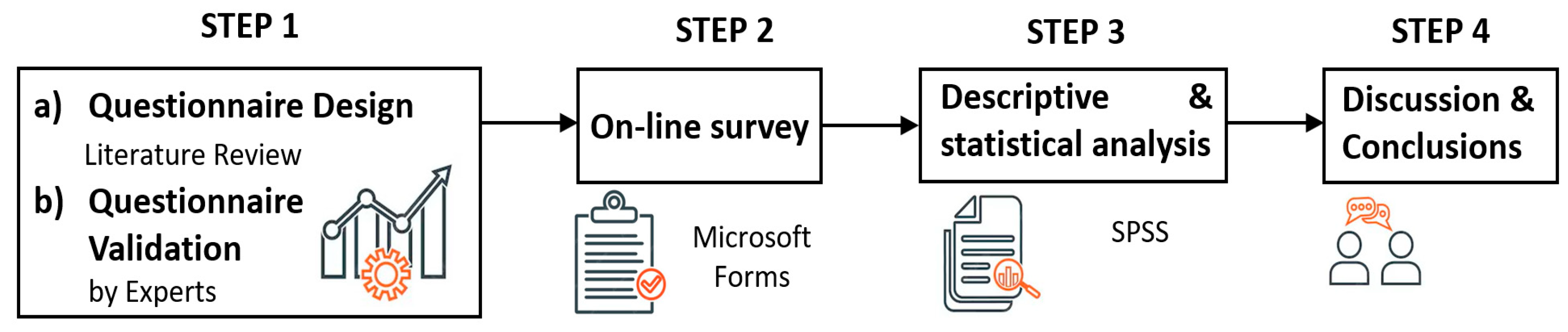
This study employed a quantitative, survey-based research design to evaluate the implementation of risk management practices in construction projects in Jordan. The methodology is summarized conceptually in
Figure 1, which outlines the key stages from questionnaire development to statistical analysis.
A purposive sampling approach was adopted to target professionals with direct experience in construction projects. The sampling frame included engineers, project managers, supervisory officers, technical staff, and personnel from engineering offices actively involved in project planning, execution, or risk management activities.
A total of 280 questionnaires were distributed via Microsoft Forms between May and November 2024, with the extended period chosen to ensure adequate responses across diverse organizations and project types. Out of these, 232 valid responses were obtained, representing a response rate of 82.9%. The sample is considered representative due to respondents’ diverse professional backgrounds, years of experience, sector types (public and private), and project involvement, ensuring coverage across multiple organizational levels.
The questionnaire was developed in four main domains: (1) risk management planning, (2) risk management control and monitoring, (3) perceived advantages of risk management, and (4) barriers to implementation. These domains were theoretically grounded based on a comprehensive literature review [
28,
29,
30,
31,
32,
33], ensuring alignment with recognized risk management constructs in construction project management.
Closed-ended questions were employed using a five-point Likert scale (1 = strongly disagree to 5 = strongly agree) to facilitate response consistency and efficient data analysis [
28,
30]. Section 1 captured respondents’ demographics, professional experience, education, and project involvement. Section 1 focused on perceptions and experiences related to risk management practices, including the use of software, learning interest, and perceived project impact.
To ensure content validity, the questionnaire was reviewed by four experts in construction project management and risk management. Suggestions from these experts were incorporated, and minor revisions were applied. A pilot test was conducted with 15 professionals to evaluate clarity, comprehension, and timing, confirming that the instrument was suitable for the target population.
Construct validity was further assessed using Exploration Factor Analysis (EFA) to confirm the alignment of items within each domain. The Kaiser-Meyer-Olkin measure of sampling adequacy exceeded 0.70, and Bartlett’s test of sphericity was significant (p < 0.001), indicating appropriateness for factor extraction.
Data were analyzed using descriptive and inferential statistics. Internal consistency of the scales was measured using Cronbach’s alpha, with values above 0.70 indicating acceptable reliability [
28,
34,
35]. Scale-level analyses, including “Scale Mean if Item Deleted” and “Corrected Item-Total Correlation,” were used to assess the contribution of individual items to each construct.
To assess whether respondents’ perceptions significantly differed from a neutral position, one-sample t-tests were conducted for each of the four domains, with the test value set at 3 (midpoint of the Likert scale). Although Likert-scale data are ordinal, the sample size (n = 232) supports the use of t-tests due to the Central Limit Theorem, and normality test, confirming approximate normal distribution for all domains (p > 0.05). Non-parametric alternatives were considered but deemed unnecessary.
Beyond mean comparisons, relationships between respondent characteristics (e.g., experience level, professional role, and sector type) and perceptions of risk management practices were explored using ANOVA and independent-sample t-tests to provide additional insights into implementation patterns.
The study was conducted in accordance with ethical research standards. Participation was voluntary, and informed consent was obtained from all respondents prior to completing the survey. Responses were anonymized, and confidentiality was maintained throughout the study. No identifiable personal information was collected, ensuring compliance with data protection regulations. Ethical approval was obtained from the Ethical Committee of the Universitat Politècnica de València (Ref. Code: P12_27_01_2023; Approval Date: 22 March 2023).
4. Results
This section presents the empirical findings of the study based on survey responses collected from construction professionals in Jordan. The results are organized into three major subsections: respondent profile, descriptive statistics of risk management practices, and inferential analyses. The emphasis is placed on descriptive and comparative insights, with interpretations and explanations reserved for the
Section 5.
4.1. Respondent Profile
A total of 232 valid responses were obtained from professionals working in the Jordanian construction sector. The sample is predominantly male (69%), reflecting the typical gender composition observed in the industry. Respondents’ ages ranged from 25 to over 40 years, with the largest proportion in the 25–30 age group (42.2%), followed by the 36–40 (19.8%), 31–35 (18.5%), and above 40 years (19.4%) groups. Educational qualifications varied, with most respondents holding a bachelor’s degree (57.3%), followed by master’s degrees (31%), while diplomas and doctoral degrees represented smaller proportions.
The current positions of respondents covered a wide spectrum of roles. Civil engineers constituted the largest group (30.6%), followed by project managers (15.1%), safety engineers (13.4%), mechanical engineers (9.9%), and electrical engineers (8.2%). Architects, planners/designers, and other designations collectively accounted for 32.7% of the samples, reflecting diverse professional roles.
Respondents reported experience in public (21.1%), private (50.4%), and both sectors (28.4%), indicating broad coverage of the construction industry landscape. Work experience ranged from 0–5 years (36.2%), 6–10 years (35.8%), 11–15 years (15.9%), and over 15 years (12.1%). A notable proportion (42.2%) had participated in projects outside Jordan, primarily in the Middle East (85.3%), with limited exposure to Europe and the USA. The number of international projects undertaken ranged from none (29.7%) to more than six (16.8%), suggesting varying degrees of international exposure and experience.
Table 1 summarizes the demographic and professional characteristics of respondents.
4.2. Application of Risk Management Practices
Survey results indicate that 82.3% of respondents reported applying risk management (RM) techniques in construction projects. Among them, the majority rated their experience as moderate (44.8%), followed by low (36.2%), high (16.4%), and very high (2.6%). Respondents also expressed their interest in acquiring further knowledge of risk management, with 12.1% indicating very high interest, 39.7% high interest, 40.1% moderate interest, and only 8.2% low interest.
RM tools and software use were prevalent in practice. Respondents largely agreed on the importance of using software for RM, with 31% strongly agreeing and 56% agreeing. Checklist analysis (141 responses) and document reviews (88 responses) emerged as the most frequently applied RM techniques, followed by SWOT analysis (50) and assumptions analysis (49).
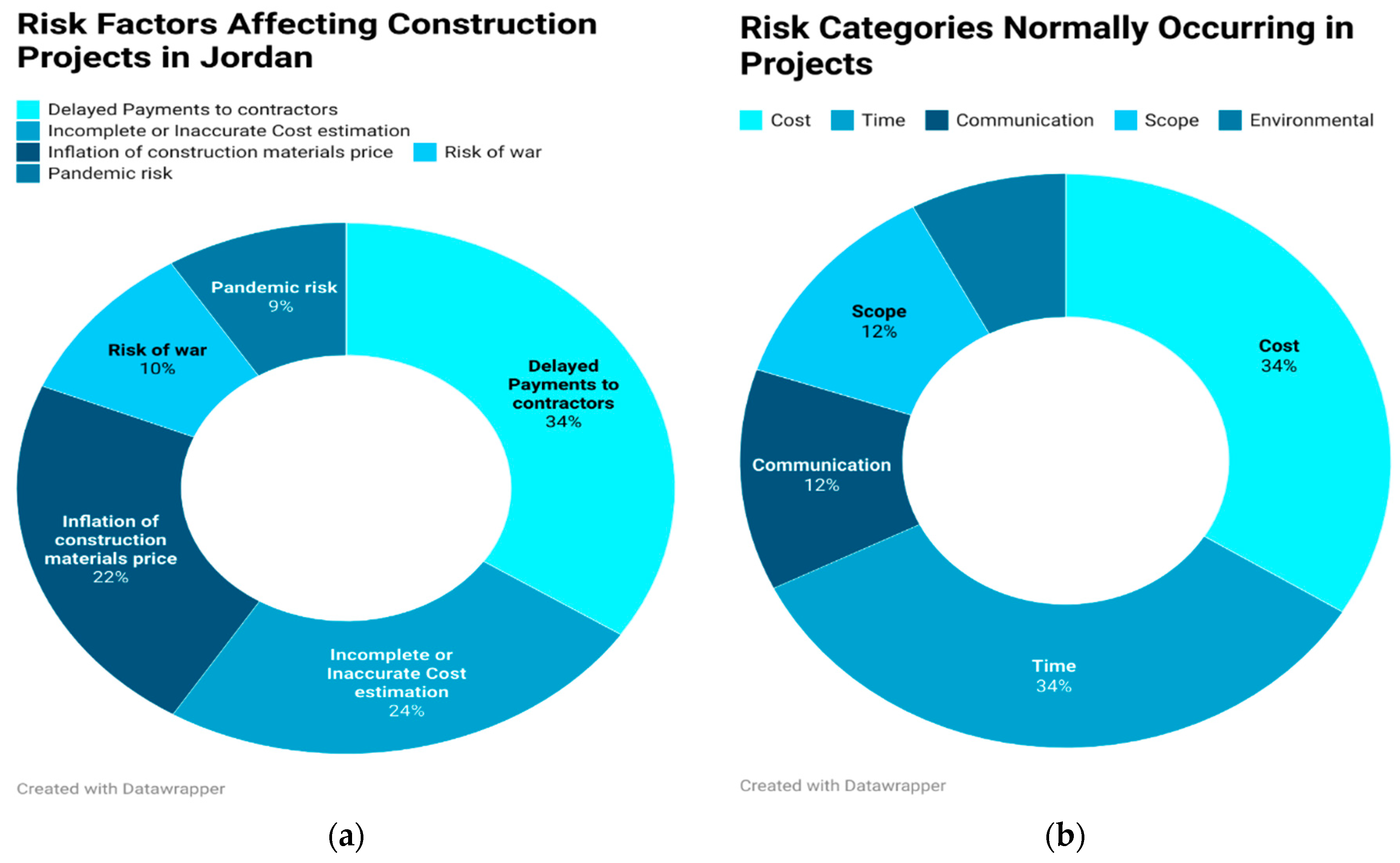
Figure 2 summarizes the perceived risk factors and typical risk categories in Jordanian construction projects. Professionals identified several challenges, such as design changes, delays in contractor payments, inaccurate cost estimates, and material price inflation, alongside less frequent but critical risks like war and pandemics. Regarding risk categories, cost and time-related risks dominated, with fewer respondents citing risks associated with resources, communication, scope creep, and environmental concerns.
4.3. Descriptive Statistics of Risk Management Domains
The survey assessed perceptions of four RM domains: planning, control and monitoring, advantages, and barriers. Cronbach’s alpha coefficients indicated acceptable internal consistency for each domain, confirming suitability for descriptive analysis.
Table 2 presents summary statistics for the four RM domains. Mean scores ranged from 3.84 to 4.13 on a five-point scale, reflecting generally positive perceptions. RM advantages scored the highest, while RM barriers scored the lowest, signaling awareness of challenges in implementing RM practices.
4.4. Comparative Analyses
To provide a more robust descriptive analysis of risk management (RM) implementation across professional subgroups in Jordanian construction projects, the survey data were examined by experience level, job title, and sector type, with attention to mean scores across the four RM domains: planning, control and monitoring, advantages, and barriers. Professionals with more than 10 years of experience consistently reported higher mean scores than their less experienced counterparts, particularly in RM planning (4.18 vs. 4.01) and perceived advantages (4.21 vs. 4.07)—while also indicating lower perceptions of barriers (3.76 vs. 3.90). This pattern suggests that accumulated on-the-job exposure enhances not only familiarity with RM processes but also confidence in their value and feasibility, reinforcing the notion that practical experience functions as an informal but powerful conduit for RM capacity development in the absence of formal training programs.
Differences by job title further illustrate how RM practices are unevenly distributed across professional roles. Project managers reported the highest RM application rate (91.4%) and strongest mean scores in planning (4.26) and control & monitoring (4.11), followed closely by civil engineers (84.5% application rate; planning mean = 4.18). In contrast, electrical engineers exhibited notably lower engagement (73.7% application rate; planning mean = 3.92), reflecting a narrower operational scope that may exclude holistic project risk oversight. These findings align with the functional responsibilities inherent to each role, where those directly accountable for overall project delivery—such as project managers and civil engineers—are more likely to integrate RM into daily workflows. This underscores the need for role-specific RM protocols and training modules to bridge the implementation gap among technical specialists who may not perceive RM as central to their duties.
Sectoral comparisons reveal a consistent advantage for private-sector organizations, where RM adoption (87.2%) and mean scores for planning (4.15) and control & monitoring (4.05) outpace those in the public sector (76.5% adoption; planning mean = 3.94). Public-sector respondents also reported significantly higher barrier scores (4.01 vs. 3.72), particularly citing the absence of structured RM programs and low organizational motivation. This divergence likely stems from differing incentive structures: private firms, operating under tighter financial scrutiny and contractual obligations, are more inclined to institutionalize RM as a means of safeguarding profit margins and reputation, whereas public entities may lack equivalent performance pressures or suffer from bureaucratic inertia.
Together, these cross-group analyses highlight that RM implementation in Jordan is not uniform but shaped by professional seniority, role-specific responsibilities, and organizational context. This evidence points to clear opportunities for targeted interventions—such as mentorship initiatives for junior staff, RM integration into engineering curricula, and public-sector reform policies—to advance systematic, sector-wide adoption of risk management practices.
4.5. Inferential Analyses: One-Sample t-Test
A one-sample
t-test was conducted to assess whether respondents’ perceptions differed significantly from the neutral midpoint of the Likert scale (test value = 3). All four RM domains showed statistically significant deviations (
p < 0.001) as shown in the
Table 3.
RM Advantages, Planning, and Control & Monitoring exhibited positive deviations, indicating strong recognition and application of these practices.
RM Barriers also deviated significantly from the midpoint, which represents awareness of obstacles rather than a positive evaluation. This clarification ensures the interpretation aligns conceptually with the scale: a score above 3 reflects recognition of existing barriers, not satisfaction or approval.
4.6. Summary of Survey Items by Domain
4.6.1. Risk Management Planning
The analysis of individual survey items within each risk management domain reveals nuanced patterns of perception and practice among Jordanian construction professionals. In the domain of Risk Management Planning, the eight items (
Table 4) demonstrate strong internal consistency (Cronbach’s α = 0.836), but item-level performance highlights subtle yet meaningful gaps between conceptual understanding and operational execution. Notably, the item “Risks are identified, analyzed, responded to, and controlled in each project” (Item 1) registered the lowest corrected item-total correlation (r = 0.462), suggesting that while professionals endorse RM as a cyclical process in theory, its consistent implementation across all projects remains inconsistent. Similarly, “Once the project risks and opportunities have been identified, response strategies are developed and implemented” (Item 6; r = 0.511) scored lower than strategic or policy-oriented items such as defining risk thresholds (Item 4; r = 0.614) or embedding a clear RM methodology in the project management plan (Item 5; r = 0.640). This pattern indicates that foundational procedural steps, particularly those requiring iterative action and cross-functional coordination, are less routinely practiced than high-level planning principles.
4.6.2. Risk Management Control and Monitoring
In contrast, the Risk Management Control and Monitoring domain (
Table 5), comprising four items, exhibited modest internal consistency (α = 0.690), reflecting greater variability in how these practices are applied. While respondents generally affirmed the monitoring of risk triggers (Item 1; r = 0.543) and the existence of fallback plans (Item 2; r = 0.538), the item concerning “workaround actions for unexpected or passively accepted risks” (Item 3) showed the highest scale mean if deleted, indicating that its inclusion contributes less to the internal consistency of the scale compared to the other items. However, its corrected item–total correlation (r = 0.535) remains within an acceptable range, suggesting that the item is conceptually aligned with the construct. The observed pattern points to greater dispersion in respondents’ ratings of reactive, real-time problem-solving practices, implying that such practices are less consistently applied than pre-planned contingencies. This suggests that while structured responses are documented, adaptive capacity during unforeseen events is perceived to be unevenly developed in an environment prone to volatility.
4.6.3. Risk Management Advantages
Turning to Risk Management Advantages (
Table 6; α = 0.828), respondents perceived RM as being associated with significant project- and organizational-level benefits. The highest item–total correlations were observed for “RM minimizes losses” (Item 2; r = 0.632), “RM improves the reputation of the company” (Item 3; r = 0.628), and “RM strategies implementation minimizes the impact of problems that arise in project execution” (Item 4; r = 0.630), indicating that respondents view RM primarily as a protective and value-enhancing function. Items related to strategic planning and stakeholder integration—such as “RM contributes to determining the project’s feasibility during the planning phase” (Item 7; r = 0.509) and “RM helps with improving communication between stakeholders” (Item 8; r = 0.529)—still demonstrated acceptable to moderate correlations but were weaker relative to the highest-performing items. This pattern, together with their comparatively lower mean scores reported in
Table 5, suggests that respondents place greater emphasis on RM’s operational risk-control benefits than on its role in front-end decision-making and collaborative governance, indicating potential underutilization of RM in strategic and integrative project functions.
4.6.4. Risk Management Barriers
Finally, the Risk Management Barriers domain (
Table 7; α = 0.815) clearly identifies systemic challenges rather than logistical constraints as the primary impediments to RM implementation. The strongest barrier was “Absence of a structured and strong RM program for analyzing and evaluating” (Item 2; r = 0.696)—the highest correlation across all survey items—followed closely by “Lack of knowledge of RM” (Item 1; r = 0.624) and “A lack of relevant experience in RM” (Item 4; r = 0.617). In contrast, resource-related concerns such as “The time and expense for developing a RM plan” (Item 3; r = 0.524) and “Absence of trust in RM on the part of the client and the contractor” (Item 6; r = 0.544) were comparatively less emphasized. This confirms that the core obstacles are institutional and educational, not financial or temporal, pointing to a critical need for formal frameworks, professional training, and leadership commitment to embed RM as a standard practice rather than an ad hoc exercise. Together, these item-level insights from
Table 4,
Table 5,
Table 6 and
Table 7 provide a diagnostic map of where RM is well established, where it is emerging, and where targeted interventions are most urgently needed.
5. Discussion
This study provides comprehensive insights into construction professionals’ perceptions of risk management (RM) practices in Jordan, highlighting the degree to which RM is recognized, applied, and valued across four key domains: planning, control and monitoring, perceived advantages, and implementation barriers.
5.1. Risk Management Planning
The study revealed that construction professionals in Jordan generally hold positive perceptions of risk management (RM) planning, with high mean scores across survey items related to risk identification, analysis, response strategy development, and the use of formal RM methodologies. This conceptual alignment mirrors the principles outlined in the PMBOK
® Guide [
6] and Hillson’s proactive RM framework [
12], confirming that Jordanian practitioners recognize RM planning as a foundational pillar of project success. However, item-level analysis (
Table 4) exposes a critical implementation gap: while strategic concepts like defining risk thresholds (Item 4) or embedding RM in project plans (Item 5) are well endorsed, the routine execution of core cyclical practices—such as consistently identifying, analyzing, and responding to risks in every project (Item 1, r = 0.462)—is less robust. This pattern closely echoes the findings of Ward and Chapman [
8], who argued that RM is often formally acknowledged but inconsistently enacted, particularly in complex, multi-stakeholder environments where coordination falters.
Notably, this operational shortfall resonates with recent empirical work in the Jordanian context. Alawneh et al. [
11] observed a similar disconnect in sustainable construction projects, where RM awareness was high but systematic application—especially in maintaining updated risk registers or implementing response strategies—remained limited. Our data corroborate this insight, reinforcing that RM planning in Jordan is conceptually institutionalized but operationally fragmented. The influence of professional role and experience further contextualizes this gap: project managers and respondents with over 10 years of experience reported greater familiarity with RM planning, consistent with Hatamleh et al. [
4], who linked RM maturity to leadership involvement and cross-functional oversight. This suggests that RM knowledge is often acquired informally through experience rather than through standardized training—a finding that underscores the need for role-based capacity-building initiatives [
5,
11].
At the same time, the growing emphasis on structured tools like risk thresholds and Risk Breakdown Structures (RBS) signals an emerging shift toward proactive, integrated RM frameworks [
5,
12], aligning Jordan with global trends in risk-informed decision-making. Yet, as Hiyassat et al. [
10] and Alawneh et al. [
11] caution, without formal policies, organizational accountability, and training, such conceptual advances may remain confined to senior roles or select organizations. In essence, while RM planning in Jordan reflects strong theoretical grounding, its operational consistency still lags—highlighting a clear need for institutional mechanisms that translate awareness into practice across all project levels.
5.2. Risk Management Control and Monitoring
Perceptions of risk management (RM) control and monitoring were generally positive but consistently weaker than those for planning—a pattern also noted by Hatamleh et al. [
4] in their study of risk practices among Jordanian contractors. Survey responses (
Table 5) indicate that professionals recognize core monitoring functions: paying attention to risk triggers, maintaining fallback plans, and using workaround actions for unexpected events. These findings reflect a conceptual grasp of adaptive project management and early-warning logic, consistent with the integrated RM philosophy advanced by Ward and Chapman [
8], who advocate continuous feedback and dynamic response over static risk registers.
However, the modest internal consistency of this domain (Cronbach’s α = 0.690) and the relatively low item-total correlation for “workaround actions for unexpected or passively accepted risks” (Item 3, r = 0.535) suggest that real-time, adaptive responses are less institutionalized than pre-planned contingencies. This gap between awareness and enactment mirrors the experience documented by Alawneh et al. [
11] in Jordanian sustainable construction projects, where RM monitoring was often limited to documentation rather than active oversight. Similarly, Hiyassat et al. [
10] observed in public infrastructure projects that while risk logs existed, they were rarely updated during execution, leading to delayed or ineffective mitigation.
The variability in responses further appears tied to organizational context. As Hatamleh et al. [
4] and Hiyassat et al. [
10] both noted, private-sector firms—driven by tighter contractual and financial accountability—tend to implement more systematic monitoring than public entities, where risk absorption is often diffuse. This sectoral disparity reinforces that RM monitoring in Jordan is emerging but fragmented, shaped more by project governance structures than by universal standards.
Critically, the bottleneck lies not in awareness but in organizational infrastructure. Many firms lack standardized escalation protocols, integrated communication channels, or digital tools to track risk evolution—issues also highlighted by Abu Kwaik et al. [
23] in their analysis of industrial risk governance in Jordan. Without such mechanisms, even well-identified early warnings may not translate into action, especially in large, multi-stakeholder projects where coordination delays are common—a challenge emphasized by Alawneh et al. [
11] and Hatamleh et al. [
5].
These findings align with the PMBOK
® Guide’s [
6] emphasis on continuous risk monitoring as an iterative process embedded throughout the project lifecycle. Yet, as Marcelino-Sádaba et al. [
19] have argued in sustainability-focused project contexts, such continuity requires more than individual competence—it demands formalized workflows, clear accountability, and supporting systems. In Jordan, the transition from reactive firefighting to proactive control is underway but incomplete. As Taipale [
9] and Fuentes-Bargues et al. [
19] suggest, institutionalizing monitoring through dashboards, standardized reporting templates, and role-specific checklists could bridge this operational gap.
Thus, while RM control and monitoring in Jordan reflect growing awareness, their systematic implementation remains uneven. The path forward lies not in more training alone—but in building organizational routines that embed monitoring into daily project rhythms, ensuring that early risk signals consistently lead to timely, coordinated responses.
5.3. Perceived Advantages of Risk Management
Respondents consistently recognized risk management (RM) as a driver of both project-level success and broader organizational value. High mean scores across all eight advantage-related items (
Table 6)—particularly for loss minimization (Item 2, r = 0.632), reputation enhancement (Item 3, r = 0.628), and problem mitigation during execution (Item 4, r = 0.630)—confirm that RM is viewed not merely as a defensive tool but as a strategic enabler. This aligns with contemporary project management literature that positions RM as a value-creating function capable of improving decision quality, protecting resources, and building stakeholder confidence [
36,
37].
Notably, professionals in Jordan also linked RM to upstream strategic considerations, such as project feasibility assessment and long-term organizational resilience—dimensions that go beyond immediate threat response. This broader conceptualization resonates with the perspective advanced by Marcelino-Sádaba et al. [
19], who frame RM as integral to sustainable project governance, and with Taipale’s [
9] emphasis on embedding risk-aware thinking into strategic planning. The fact that even items with lower correlations—such as “RM contributes to determining project feasibility” (Item 7, r = 0.509)—still received strong mean agreement (above 4.0) suggests an emerging shift in mindset: RM is increasingly seen as a prerequisite for sound investment decisions, not just a post-approval control mechanism.
This strategic recognition is further evidenced by the high levels of interest in RM training: over 90% of respondents expressed moderate to very high interest in expanding their RM knowledge. This signals a self-perceived gap between understanding RM’s potential and confidently applying it tension also noted in studies on professional development in emerging economies [
38,
39]. Rather than indicating resistance, this gap reflects readiness for institutional support. As Taipale [
9] and others have argued, when professionals already value a practice, the path to implementation lies in structured capacity-building: integrating RM into professional certification pathways, onboarding protocols, and continuous learning systems.
Collectively, these findings suggest that in Jordan, RM is no longer viewed as a bureaucratic formality or reactive compliance exercise. Instead, it is increasingly understood as a strategic investment—one that strengthens project delivery, safeguards reputation, and aligns operational decisions with long-term organizational goals [
12]. Such awareness is a critical foundation for sector-wide change; conceptual buy-in must precede—and enable—the adoption of formal RM frameworks, standardized tools, and accountability mechanisms across the construction industry.
5.4. Barriers to Risk Management Implementation
Despite generally positive perceptions of risk management (RM), the study identifies deep-rooted structural and institutional barriers that hinder its consistent application in Jordanian construction projects. Item-level analysis (
Table 7) reveals that the most salient obstacles are not logistical but systemic: “absence of a structured and strong RM program” (Item 2, r = 0.696) emerged as the strongest barrier—indeed, the highest-correlating item across the entire survey—followed closely by “lack of RM knowledge” (Item 1, r = 0.624) and “lack of relevant experience” (Item 4, r = 0.617). In contrast, operational concerns such as “time and expense for developing an RM plan” (Item 3, r = 0.524) were notably less emphasized, suggesting that resistance to RM stems not from resource scarcity but from gaps in institutional capacity and organizational culture.
This pattern aligns closely with findings by Alawneh et al. [
11], who, in their study of sustainable construction projects in Jordan, identified weak RM infrastructure—not budget—as the primary constraint. Similarly, Hiyassat et al. [
10] observed that public-sector projects often lack clear risk allocation protocols and formal RM mandates, leading to ad hoc responses despite high awareness. These regional studies collectively confirm a recurring theme: RM in Jordan is under-institutionalized. The absence of standardized frameworks, ambiguous accountability structures, and inconsistent leadership support—issues also noted by Abu Kwaik et al. [
10] in Jordanian industrial firms—create an environment where RM remains optional rather than embedded.
Importantly, this challenges a common assumption in global literature that RM adoption in developing contexts is primarily limited by financial or time constraints [
22]. Our data suggest otherwise: professionals are willing (82.3% report using RM) and interested (over 90% express moderate to high interest in further training), yet they operate in organizations that lack the scaffolding—policies, roles, feedback mechanisms—to sustain practice. This insight reframes the problem: it is not about motivating individuals to adopt RM, but about enabling organizations to support it systematically.
Consequently, solutions must go beyond technical training. While enhancing RM knowledge through professional education and mentorship remains essential, particularly to address the experience gap noted by Hatamleh et al. [
4]—long-term progress depends on leadership commitment and institutional design. As Taipale [
9] and Marcelino-Sádaba et al. [
19] argue in broader sustainability contexts, formalizing RM through standardized procedures, integrating it into project governance, and creating cross-functional risk communication channels are prerequisites for scaling practice beyond isolated champions.
For policymakers and professional bodies in Jordan, this underscores a strategic opportunity: rather than focusing on awareness campaigns, efforts should prioritize the development of national RM guidelines, accreditation requirements, or sector-wide templates that standardize risk registers, escalation paths, and review cycles. Such institutional levers can transform RM from a discretionary competence into an expected norm—thereby closing the persistent gap between recognition and routine.
5.5. Institutionalization and Organizational Strategies
Taken together, the findings confirm a recurring pattern in Jordan’s construction sector: risk management (RM) is conceptually recognized and strategically valued yet operationally fragmented across projects and organizations. This duality echoes Alawneh et al. [
11], who observed strong RM awareness in Jordanian sustainable construction projects but noted inconsistent documentation and follow-through—particularly in updating risk registers or implementing response strategies. Our data extend this insight by showing that while strategic elements like risk thresholds (Item 4,
Table 4) and RM integration into project plans (Item 5) are well endorsed, the cyclical execution of core RM processes (e.g., “risks are identified, analyzed, and responded to in every project,” Item 1, r = 0.462) remains weaker. This suggests that RM in Jordan has moved beyond mere awareness but has not yet matured into a standardized practice.
The gap between recognition and routine points to a pressing need for formal institutionalization—not just at the project level, but across the sector. As Hiyassat et al. [
10] argued in their study of public infrastructure projects, the absence of enforceable RM protocols and clear accountability mechanisms allows practices to remain discretionary. Our findings reinforce this: although 82.3% of respondents apply RM, implementation varies significantly by role (e.g., project managers vs. technical engineers) and sector (private vs. public), reflecting the lack of unified standards. This aligns with Hatamleh et al.’s [
5] calls for stronger organizational integration of RM through communication and cross-functional coordination—yet our data show that even basic risk communication networks (Item 4,
Table 5, r = 0.544) are inconsistently established, underscoring the implementation shortfall.
Effective institutionalization thus requires multi-level organizational strategies. Capacity-building must be role-specific: while project managers demonstrate higher RM engagement, civil and electrical engineers report lower application, suggesting a need for tailored training that connects RM to discipline-specific workflows—as recommended by Hatamleh et al. [
4]. Mentorship programs could further bridge the experience gap: respondents with over 10 years of experience reported higher RM planning scores, indicating that practical knowledge is acquired informally rather than through structured learning. Embedding RM into continuous professional development, as Marcelino-Sádaba et al. [
19] advocate in sustainability-oriented project governance, would systematize this transfer.
Digital tools such as Building Information Modeling (BIM) and risk analytics—highlighted in global literature [
38,
39] as enablers of dynamic risk monitoring—are still underutilized in Jordan. While our respondents acknowledged the value of RM software (87% agree or strongly agree), actual use remains limited to basic techniques like checklists and document reviews. This confirms that technology alone cannot drive RM maturity without parallel investments in process design, training, and leadership support—a point emphasized by Taipale [
9] and Fuentes-Bargues et al. [
19] in the context of sustainable project delivery. A coordinated “people-process-technology” approach is essential.
Finally, sector-wide interventions are critical to scaling RM beyond isolated champions. The development of national RM guidelines, industry certification requirements, or accreditation-linked RM competencies—as piloted in Gulf countries [
40,
41,
42,
43,
44,
45,
46,
47]—could provide the scaffolding Jordan currently lacks. Such measures would operationalize the strategic vision already present among professionals and align Jordan with global best practices. In this way, the study moves beyond documenting awareness—as earlier work by Hatamleh [
4] and Alawneh [
11] largely did—and offers a roadmap for institutionalizing RM through policy, organization, and education, ensuring that conceptual alignment translates into consistent, measurable practice across the construction sector.
6. Conclusions
This study examined the implementation of risk management (RM) practices in construction projects in Jordan by analyzing the perceptions of construction professionals across four key domains: risk management planning, control and monitoring, perceived advantages, and implementation barriers. By providing empirical evidence from a developing-country context, this research contributes to understanding both the conceptualization and operational challenges of RM in emerging construction markets.
The main scientific contribution of this study lies in highlighting the gap between awareness and systematic implementation of RM practices. While Jordanian construction professionals demonstrate strong recognition of RM’s strategic value—particularly in planning and perceived advantages such as project success, loss mitigation, and improved organizational reputation—the study reveals persistent deficiencies in monitoring, control, and organizational integration. This conceptual–operational gap constitutes a key insight for both theory and practice, emphasizing that knowledge of RM alone is insufficient to ensure its effective application in project delivery.
The study further contributes to theory by situating RM practices within the context of a developing country. Unlike in mature markets, where RM is often fully institutionalized and supported by standardized frameworks, the findings demonstrate that institutional, educational, and governance factors in Jordan significantly shape RM adoption. This underscores the need for theoretical frameworks to account for contextual variability in RM maturity, especially in emerging economies. By providing empirical evidence on the interplay between professional awareness, organizational structures, and sector-specific challenges, the study offers a nuanced perspective that complements global RM literature.
From a practical standpoint, the findings yield several actionable recommendations:
Organizational Training and Capacity Building: Establish targeted RM training programs for project managers, engineers, and technical staff to enhance knowledge and practical skills in risk identification, analysis, and mitigation strategies. Training should emphasize operational implementation, not just theoretical concepts, and include scenario-based exercises or workshops.
Standardization of RM Frameworks: Develop and adopt sector-wide RM guidelines and templates, including structured risk registers, risk thresholds, and monitoring dashboards. Organizations should integrate these frameworks into project workflows to ensure consistency across phases.
Leadership and Institutional Support: Encourage organizational leadership to formalize RM responsibilities, establish accountability mechanisms, and provide incentives for consistent application. Policy-level interventions could involve national guidelines or industry standards to foster sector-wide institutionalization.
Integration of Digital Tools: Leverage technology such as Building Information Modeling (BIM), data analytics, and risk management software to improve risk monitoring, reporting, and predictive analysis. This should be complemented by professional training to ensure effective adoption.
Focus on Sustainability and Resilience: Align RM practices explicitly with project sustainability and organizational resilience objectives. Risk assessments should incorporate environmental, social, and long-term operational factors to enhance the robustness of project outcomes.
The study also acknowledges several limitations that provide direction for future research:
Self-reported perceptions: The reliance on survey responses may introduce bias due to subjective interpretations, social desirability, or recall errors. Future research could integrate observational or document-based data to triangulate findings.
Cross-sectional design: The study captures a single snapshot of RM practices, limiting insights into their evolution over the project lifecycle. Longitudinal studies or repeated measures could assess changes in RM maturity and the impact of interventions over time.
Geographic scope: The focus on Jordan constrains the generalizability of results to other contexts. Comparative studies across Middle Eastern countries or emerging economies could provide broader insights.
Limited exploration of digital integration: While respondents recognized the potential of BIM and analytics, the current study does not measure the effectiveness of these tools in operational RM. Future research could employ case studies or experimental designs to assess digital tool adoption and performance outcomes.
In conclusion, this study demonstrates that while Jordanian construction professionals are aware of the strategic importance of RM, significant gaps remain in operational implementation, monitoring, and organizational integration. Bridging these gaps requires a combination of targeted training, standardized frameworks, institutional support, and technological integration. By addressing these challenges, construction organizations in Jordan can enhance project performance, resilience, and sustainability, thereby maximizing the strategic value of RM.
Ultimately, this research provides both theoretical and practical insights, highlighting that in emerging markets, RM is not only a technical requirement but a strategic enabler of project success and sectoral development.
Author Contributions
Conceptualization, S.M.A.Q. and J.L.F.-B.; methodology, S.M.A.Q. and P.S.F.-G.; software, S.M.A.Q.; validation, J.L.F.-B., P.S.F.-G. and H.N.A.-A.; formal analysis, S.M.A.Q.; investigation, S.M.A.Q.; resources, S.M.A.Q.; data curation, S.M.A.Q.; writing—original draft preparation, S.M.A.Q.; writing—review and editing, J.L.F.-B., P.S.F.-G., H.N.A.-A. and A.S.-L.; visualization, S.M.A.Q.; supervision, J.L.F.-B. and P.S.F.-G.; project administration, S.M.A.Q.; funding acquisition, S.M.A.Q. All authors have read and agreed to the published version of the manuscript.
Funding
This research received no external funding.
Institutional Review Board Statement
The study was conducted in accordance with the Declaration of Helsinki, and the protocol was approved by the Research Ethics Committee of the Universitat Politècnica de València (P12_27_01_2023) on 22 May 2023.
Informed Consent Statement
The study was conducted as non-interventional survey-based research involving construction professionals in Jordan. The data were collected anonymously via a structured questionnaire, and no personally identifiable information was gathered.
Data Availability Statement
The data supporting the findings of this study are available from the corresponding author upon reasonable request. Due to privacy and ethical considerations, the data are not publicly archived.
Acknowledgments
The authors gratefully acknowledge the participation of construction professionals in Jordan who contributed their time and insights to this study. The authors also thank the PRINS Research Center [Universitat Politècnica de València] for its academic support. During the preparation of this manuscript, the authors used artificial intelligence–The analysis and visualization were conducted using AI tools, including ChatGPT (GPT-5.2), and the figure was created with Datawrapper (version 2.1) in 2025 to enhance grammar, clarity, and language fluency. The authors have reviewed and edited the output and take full responsibility for the content of this publication.
Conflicts of Interest
The authors declare no conflicts of interest.
Abbreviations
The following abbreviations are used in this manuscript:
| RBS | Risk Breakdown Structure |
| BIM | Building Information Modeling |
| AHP | Analytic Hierarchy Process |
| RM | Risk Management |
References
- Samal, C.G.; Biswal, D.R.; Pradhan, S.K.; Pasayat, A.K. Data-Driven Assessment of Construction and Demolition Waste Causes and Mitigation Using Machine Learning. Constr. Mater. 2025, 5, 88. [Google Scholar] [CrossRef]
- Ameha, A.; Larsen, H.O.; Lemenih, M. Participatory forest management in Ethiopia: Learning from pilot projects. Environ. Manag. 2014, 53, 838–854. [Google Scholar] [CrossRef]
- Tepic, M.; Kemp, R.; Omta, O.; Fortuin, F. Complexities in innovation management in companies from the European industry: A path model of innovation project performance determinants. Eur. J. Innov. Manag. 2013, 16, 517–550. [Google Scholar] [CrossRef]
- Hatamleh, M.T.; Moynihan, G.P.; Batson, R.G.; Alzarrad, A.; Ogunrinde, O. Risk assessment and ranking in the developing countries’ construction industry: The case of Jordan. Eng. Constr. Archit. Manag. 2023, 30, 1344–1364. [Google Scholar] [CrossRef]
- Hatamleh, M.T.; Alzarrad, A.; Alghossoon, A.; Alhusban, M.; Ogunrinde, O. Strategies for improving project risk management via communication and integration: The case of Jordan. Eng. Constr. Archit. Manag. 2025, 32, 7006–7031. [Google Scholar] [CrossRef]
- PMI [Project Management Institute]. A Guide to the Project Management Body of Knowledge [PMBOK® Guide], 7th ed.; Project Management Institute: Newtown Square, PA, USA, 2021. [Google Scholar]
- Mir, F.A.; Pinnington, A.H. Exploring the value of project management: Linking project management performance and project success. Int. J. Proj. Manag. 2014, 32, 202–217. [Google Scholar] [CrossRef]
- Ward, S.; Chapman, C. Transforming project risk management into project uncertainty management. Int. J. Proj. Manag. 2003, 21, 97–105. [Google Scholar] [CrossRef]
- Taipale, K. From light green to sustainable buildings. In State of the World 2012—Moving Toward Sustainable Prosperity; The Worldwatch Institute: Washington, DC, USA, 2012; pp. 129–136. [Google Scholar]
- Hiyassat, M.A.; Alkasagi, F.; El-Mashaleh, M.; Sweis, G.J. Risk allocation in public construction projects: The case of Jordan. Int. J. Constr. Manag. 2022, 22, 1478–1488. [Google Scholar] [CrossRef]
- Alawneh, R.; Jannoud, I.; Rabayah, H.; Asaad, S.; Almasaeid, H.; Imam, R.; Ghazali, F.E.M. Development of a New Method for Assessing Project Risks in Sustainable Building Construction Projects in Developing Countries: The Case of Jordan. Buildings 2024, 14, 1573. [Google Scholar] [CrossRef]
- Hillson, D. Managing Risk in Projects; Gower Publishing: Farnham, UK, 2009. [Google Scholar]
- Zou, P.X.W.; Zhang, G.; Wang, J. Understanding the key risks in construction projects in China. Int. J. Proj. Manag. 2007, 25, 601–614. [Google Scholar] [CrossRef]
- Aven, T. Risk assessment and risk management: Review of recent advances on their foundation. Eur. J. Oper. Res. 2016, 253, 1–13. [Google Scholar] [CrossRef]
- Rahimi, N.; Moselhi, O.; Bagchi, A. Integrated risk management framework for construction projects. J. Constr. Eng. Manag. 2022, 148, 04021183. [Google Scholar]
- Al-Qudah, S.M.A.; Fuentes-Bargues, J.L.; Ferrer-Gisbert, P.S. Bibliometric analysis of the literatura on risk management in the construction sector: Exploring current and future trends. Ain Shams Eng. J. 2024, 15, 102843. [Google Scholar] [CrossRef]
- Zhao, X.; Hwang, B.G.; Low, S.P. Critical Success Factors for Enterprise Risk Management in Chinese Construction Companies. Constr. Manag. Econ. 2010, 28, 365–375. [Google Scholar] [CrossRef]
- Alyami, M.S.; Rezgui, Y.; Kwan, A. Empirical study of risk management in construction projects in Saudi Arabia. Int. J. Constr. Manag. 2021, 21, 455–469. [Google Scholar]
- Marcelino-Sádaba, S.; González-Jaen, L.F.; Pérez-Ezcurdia, A. Using project management as a way to sustainability. From a comprehensive review to a framework definition. J. Clean. Prod. 2014, 85, 1–16. [Google Scholar] [CrossRef]
- Jarkas, A.M.; Haupt, T.C. Major construction risk factors considered by general contractors in Qatar. J. Eng. Des. Technol. 2015, 13, 165–194. [Google Scholar] [CrossRef]
- Algahtany, M.; Alhammadi, Y.; Kashiwagi, D. Introducing a new risk management model to the Saudi Arabian construction industry. Procedia Eng. 2016, 145, 940–947. [Google Scholar] [CrossRef]
- Oke, A.E.; Adetoro, P.E.; Stephen, S.S.; Aigbavboa, C.O.; Oyewobi, L.O.; Aghimien, D.O. Risk Management Practice in Saudi Arabia. In Risk Management Practices in Construction: A Global View; Springer Nature: Cham, Switzerland, 2023; pp. 45–58. [Google Scholar]
- Abu Kwaik, N.; Sweis, R.; Allan, B.; Sweis, G. Factors affecting risk management in industrial companies in Jordan. Adm. Sci. 2023, 13, 132. [Google Scholar] [CrossRef]
- Alkhawaja, A.A.S.D.I.; Varouqa, I.F. Risks management of infrastructure line services and their impact on the financial costs of road projects in Jordan. Meas. Sens. 2023, 25, 100647. [Google Scholar] [CrossRef]
- Alkhalidi, A.; Tahat, S.; Smadi, M.; Migdady, B.; Kaylani, H. Risk assessment using the analytic hierarchy process while planning and prior to constructing wind projects in Jordan. Wind Eng. 2020, 44, 282–293. [Google Scholar] [CrossRef]
- Abdullatif, M.; Kawuq, S. The role of internal auditing in risk management: Evidence from banks in Jordan. J. Econ. Adm. Sci. 2015, 31, 30–50. [Google Scholar] [CrossRef]
- Ibrahim, Y.E. Seismic risk analysis of multistory reinforced concrete structures in Saudi Arabia. Case Stud. Constr. Mater. 2018, 9, e00192. [Google Scholar] [CrossRef]
- Alsulamy, S. Predicting construction delay risks in Saudi Arabian projects: A comparative analysis of CatBoost, XGBoost, and LGBM. Expert Syst. Appl. 2025, 268, 126268. [Google Scholar] [CrossRef]
- Sanni-Anibire, M.O.; Mahmoud, A.S.; Hassanain, M.A.; Salami, B.A. A risk assessment approach for enhancing construction safety performance. Saf. Sci. 2020, 121, 15–29. [Google Scholar] [CrossRef]
- Ahmed, A.M.; Sayed, W.; Asran, A.; Nosier, I. Identifying barriers to the implementation and development of sustainable construction. Int. J. Constr. Manag. 2023, 23, 1277–1288. [Google Scholar] [CrossRef]
- Al-Kawari, M.S.; Hushari, M. Doses and radiation risks estimation of adding steel slag to asphalt for road construction in Qatar. Constr. Build. Mater. 2019, 228, 116741. [Google Scholar] [CrossRef]
- Khadem, M.M.R.K.; Piya, S.; Shamsuzzoha, A. Quantitative risk management in gas injection project: A case study from Oman oil and gas industry. J. Ind. Eng. Int. 2018, 14, 637–654. [Google Scholar] [CrossRef]
- Sekaran, U.; Bougie, R. Research Methods for Business: A Skill Building Approach; John Wiley & Sons: Hoboken, NJ, USA, 2016. [Google Scholar]
- Salciuviene, L.; Auruskeviciene, V.; Lydeka, Z. An assessment of various approaches for cross-cultural consumer research. Probl. Perspect. Manag. 2005, 3, 147–159. [Google Scholar]
- Hair, J.F.; Sarstedt, M.; Ringle, C.M.; Mena, J.A. An assessment of the use of partial least squares structural equation modeling in marketing research. J. Acad. Mark. Sci. 2012, 40, 414–433. [Google Scholar] [CrossRef]
- Chen, Z.; Etakali, A. An ontological risk management model for adopting the Modern Methods of Construction [MMC] through agile lean construction. In Proceedings of the International Post Graduate Research Conference [IPGRC] 2022: Resilience in Research and Practice, Salford, UK, 4–6 April 2022. [Google Scholar]
- Rastogi, N.; Trivedi, M.K. PESTLE technique–a tool to identify external risks in construction projects. Int. Res. J. Eng. Technol. [IRJET] 2016, 3, 384–388. [Google Scholar]
- Vazdani, S.; Sabzghabaei, G.; Dashti, S.; Cheraghi, M.; Alizadeh, R.; Hemmati, A. FMEA techniques used in environmental risk assessment. Environ. Ecosyst. Sci. [EES] 2017, 1, 16–18. [Google Scholar] [CrossRef]
- Cohen, R.J.; Swerdlik, M.E.; Sturman, E.D. Psychological Testing and Assessment: An Introduction to Tests and Measurement, 8th ed.; McGraw-Hill Education: New York, NY, USA, 2013. [Google Scholar]
- Field, A. Discovering Statistics Using IBM SPSS Statistics, 5th ed.; Sage Publications: London, UK, 2018. [Google Scholar]
- Hair, J.F. Successful strategies for teaching multivariate statistics. In Proceedings of the 7th International Conference on Teaching Statistics, Salvador, Brazil, 2–7 July 2006; pp. 1–5. [Google Scholar]
- El-Sayegh, S.M. Project risk management practices in the UAE construction industry. Int. J. Proj. Organ. Manag. 2014, 6, 121–137. [Google Scholar] [CrossRef]
- Zou, Y.; Kiviniemi, A.; Jones, S.W. A review of risk management through BIM and BIM-related technologies. Saf. Sci. 2017, 97, 88–98. [Google Scholar] [CrossRef]
- Liu, N.; Guo, D.; Song, Z.; Zhong, S.; Hu, R. BIM-based digital platform and risk management system for mountain tunnel construction. Sci. Rep. 2023, 13, 34525. [Google Scholar] [CrossRef] [PubMed]
- Al-Anbari, S.; Khalina, A.; Alnuaimi, A.; Normariah, A.; Yahya, A. Risk assessment of safety and health [RASH] for building construction. Process Saf. Environ. Prot. 2015, 94, 149–158. [Google Scholar] [CrossRef]
- Kartam, N.A.; Kartam, S.A. Risk and its management in the Kuwaiti construction industry: A contractors’ perspective. Int. J. Proj. Manag. 2001, 19, 325–335. [Google Scholar] [CrossRef]
- Fahad Al-Azemi, K.; Bhamra, R.; Salman, A.F. Risk management framework for build, operate and transfer [BOT] projects in Kuwait. J. Civ. Eng. Manag. 2014, 20, 415–433. [Google Scholar] [CrossRef]
| Disclaimer/Publisher’s Note: The statements, opinions and data contained in all publications are solely those of the individual author(s) and contributor(s) and not of MDPI and/or the editor(s). MDPI and/or the editor(s) disclaim responsibility for any injury to people or property resulting from any ideas, methods, instructions or products referred to in the content. |




 ,
,