Article

Numerical Analysis of the Impact of Air Conditioning Operating Parameters on Thermal Comfort in a Classroom in Hot Climate Regions


by
Guillermo Efren Ovando-Chacon
1,*,
Enrique Cruz-Octaviano
1,*,
Abelardo Rodriguez-Leon
1,
Sandy Luz Ovando-Chacon
2 and
Ricardo Francisco Martinez-Gonzalez
1
1
Tecnológico Nacional de México, Instituto Tecnológico de Veracruz, Calzada Miguel Ángel de Quevedo 2779, Veracruz 91860, Mexico
2
Tecnológico Nacional de México, Instituto Tecnológico de Tuxtla Gutiérrez, Carretera Panamericana km 1080, Tuxtla Gutierrez 29000, Mexico
*
Authors to whom correspondence should be addressed.
Buildings 2026, 16(2), 400; https://doi.org/10.3390/buildings16020400

Submission received: 18 December 2025 / Revised: 16 January 2026 / Accepted: 16 January 2026 / Published: 18 January 2026
(This article belongs to the Section Building Energy, Physics, Environment, and Systems)

Abstract

Achieving adequate thermal comfort in classrooms in hot cities in southern Mexico is challenging. A heterogeneous distribution of air conditioning flow leads to thermal discomfort, affecting occupants’ academic performance and increasing energy consumption. This study evaluates the thermal comfort of occupants in an air conditioned classroom using computational fluid dynamics. We determined the effects of variations in air conditioning operating parameters (supply angle, velocity, and temperature) on PMV and modified PMV indices. An operating configuration of 60°, 3 m/s, and 22 °C ensures that thermal comfort remains within regulations while optimizing energy consumption, in contrast to the original PMV model. Using the modified PMV model, the values are 0.38 for students and 0.31 for the teacher, with percentages of dissatisfied individuals of 10% and 7.7%, respectively. This study demonstrates the importance of analyzing air conditioning operating parameters to enhance thermal comfort while reducing energy consumption.

1. Introduction

High temperatures are becoming increasingly frequent due to climate change; a significant portion of the Mexican territory experiences a hot climate. Thus, maintaining the thermal welfare of population sectors, such as that of education, is a major challenge. Factors such as external conditions, solar radiation, thermal bridges in the room, heat sources, and the occupants’ thermal load can cause discomfort. This situation impacts the performance of academic activities. Although air conditioning (AC) systems are standard in these environments to cool classrooms, their design and operation often result in high energy consumption. Moreover, cold-air distribution is not always uniform, creating unwanted air streams or heat islands within the classroom that can affect users’ comfort.
Thermal comfort is a determining factor in the design of living, working, or academic spaces. Accordingly, various studies have analyzed this phenomenon through the PMV (Predicted Mean Vote) and PPD (Predicted Percentage of Dissatisfied) indices, aiming to keep these levels within the ranges recommended by international standards such as ASHRAE 55 [1] and ISO 7730 [2]. Experimental methods and numerical simulations have been employed for this purpose. These studies have enabled evaluation of thermal responses across different ventilation systems, in various indoor spaces, and under diverse weather conditions.
Regarding ventilation, various studies have evaluated thermal comfort in indoor spaces with natural ventilation. These studies have highlighted the importance of the configuration of openings or windows [3,4,5] and the orientation of airflow to achieve a pleasant thermal sensation [4,6,7]. Other studies, such as those by [8,9], have analyzed systems that rely on solar radiation to condition specific indoor spaces. Similarly, thermal comfort has been studied in indoor spaces with mechanical ventilation, such as AC systems [10,11,12,13,14,15,16,17,18,19] or fan coil units [20]. Other studies have evaluated more advanced techniques, such as displacement ventilation systems [14,21], mixing ventilation systems [14,22,23], or underfloor air distribution systems (UFAD) [24]. Furthermore, innovative configurations such as tunnel ventilation [25] and an impinging-jet ventilation system [26] have also been studied.
Thermal comfort has been studied in numerous indoor environments by analyzing the PMV and PPD indices. For instance, due to their intensive use and direct impact on work productivity, office spaces [3,4,10,14,17] have been extensively studied regarding thermal well-being. Classrooms [21,23,27] and theaters [13], where occupancy density is high and usage patterns are variable, have also been evaluated. Other studies have analyzed apartments [7] and bedrooms [9,18], which present particular challenges related to isolation and cross-ventilation.
On the other hand, thermal comfort has been analyzed in commercial spaces such as restaurant kitchens, retail spaces, airport terminals, and mosques, with transiting users in mind. Some studies [28,29] found that kitchens have high thermal loads and significant levels of pollutants. In commercial premises [12] and airport terminals [30], studies reported that external climate variability and spatial morphology required specific climatization strategies. In large open areas such as mosques [6], it was identified that openings promote pleasant thermal conditions.
Some studies have analyzed thermal comfort in spaces with specialized functions, such as the cabin of an airplane [31], a train [32], an agricultural tractor [11], or a spacecraft [15]. Other authors have studied spaces where thermal conditions must be adjusted to users’ levels of physical effort, such as workshops [33], indoor squash courts [16], and indoor swimming pools [34]. In these locations, it was necessary to both control air temperature and ensure the uniform distribution of fresh air.
Weather conditions play an essential role in occupants’ perception of thermal comfort. That is why various authors have evaluated both warm [21,23,26] and cold [3,4,18] climates. Likewise, some studies have analyzed comfort during summer [7,24,30], winter [8,9,12], or both seasons [16,33,34,35].
In Mexico, studies such as [36] have evaluated thermal comfort in outdoor public spaces, whereas [37,38] have analyzed thermal comfort in indoor environments through measurements, data logging, questionnaire administration, and the calculation of thermal sensation indices. The literature review reveals a shortage of studies on the calculation of the PMV and PPD indices to analyze thermal sensation among occupants in indoor spaces in Mexico.
Computational fluid dynamics (CFD) can be used to assess and enhance thermal comfort in indoor spaces. Numerical simulations enable the analysis of key variables, such as temperature distribution, air speed, and airflow direction, allowing the identification of discomfort zones and the proposal of solutions to improve ventilation and air distribution. In this regard, various investigations [3,4,7,8,9,10,11,12,13,14,15,16,18,20,39] have applied CFD techniques to obtain velocity and temperature fields, from which PMV and PPD indices have been calculated.
The present study aimed to evaluate and enhance thermal comfort for classroom occupants in Tuxtepec, Mexico, using CFD simulations. This region in southwestern Mexico is characterized by hot weather, with temperatures exceeding 33 °C for most of the year. The study analyzed the effects of varying AC operating parameters—such as temperature, speed, and cold air supply angle—on the PMV and PPD indices. The modified comfort indices were additionally evaluated to avoid overestimating the original model. This approach enables the identification of the optimal configuration that ensures the most neutral and comfortable thermal comfort conditions for occupants. Additionally, it supports environmental protection, as sustainable AC reduces energy consumption.
The novelty of this work lies in the use of three-dimensional numerical CFD simulations to obtain modified thermal comfort indices, a topic the literature has seldom explored. In addition, the study was conducted in a hot region of southern Mexico, where such research is lacking. In contrast to previous studies based on CFD simulations, this research incorporates a detailed representation of skin temperature, leading to more accurate and realistic predictions.

2. Materials and Methods

2.1. Physical Description of the Problem

This study evaluates the thermal comfort behavior in a classroom measuring 6 m in width, 8 m in length, and 2.9 m in height in the city of Tuxtepec, Mexico. The west, east, and north walls, as well as the roof, receive direct solar radiation, increasing heat transfer into the classroom and causing the occupants to experience thermal discomfort. The southern wall, on the other hand, adjoins another classroom, which reduces its exposure to external heat. To counteract these effects, the classroom is equipped with an AC system that mitigates heat and maintains a comfortable environment, thereby ensuring optimal conditions for academic activities. The dimensions of the classroom door and its windows are presented in Table 1.
Before the study, temperature measurements were taken at regular intervals from 06:00 to 18:00 h during the first semester of 2025. These measurements allowed the identification of the date with the highest temperature in Tuxtepec. Consequently, the results presented correspond to 20 May 2025, at 3:00 PM, when the hottest environmental conditions were observed during the analyzed period. Indoor air temperature was monitored using a HOBO UX100-003 data logger; Onset Computer Corporation, Bourne, MA, USA. The sensor was verified against a reference thermometer to ensure deviations remained within the manufacturer-specified accuracy limits. The combined standard uncertainty of the temperature measurements is estimated at ±0.21 °C.
The study models a classroom with heat transfer through the envelope (walls, windows, and roof) and 16 individuals. Occupants are modeled as simplified rectangular parallelepipeds with dimensions of 0.3 m (length), 0.2 m (width), and 0.7 m (height) to represent seated students. Additionally, an internal metabolic rate of 58.1 W/m2 and clothing insulation of 0.5 clo are considered for the human body. A temperature of 41 °C is assigned to the west and east windows, 36 °C to the north wall, and 44 °C to the roof. The south wall is modeled as adiabatic, while a no-slip condition is imposed on all surfaces. The current operating parameters of the AC unit are 19 °C for the cold-air supply temperature, 1.5 m/s for the velocity, and 20° for the inclination angle. This setup served as a reference case for experimental comparisons.
Simulations were conducted for various operating configurations of the AC system, introducing variations in temperature, velocity, and the discharge angle of the cold air from the AC. The numerical experimental design is a full factorial type with 96 combinations, evaluating AC outlet angles (0°, 20°, 40°, 60°), velocities (1.5, 2.0, 2.5, 3.0 m/s), and temperatures (18, 19, 20, 21, 22, 23 °C). Table 2 shows the grouping of cases.
In this work, a CFD approach is adopted to overcome the spatial resolution limitations of point sensors, which detect irregular flows driven by thermal stratification and spatial variations in the cold-air jet. The use of sensors does not allow mapping the entire study volume; conversely, simulations do allow characterizing the three-dimensional flow field and identifying critical zones directly impacting occupant thermal comfort (PMV/PPD), which cannot be captured through experimental monitoring.

2.2. Conservation Equations

The geometry used to study thermal comfort in a classroom is three-dimensional. The equations governing the turbulent flow of an incompressible fluid in this space are the equations of mass conservation, momentum, energy transport, and mass transport.
ρ u i u j x j = p x i + x j μ u i x j + u j x i ρ u i u j ¯ + F i ,
u i x i = 0 ,
ρ U j T x j = 1 C p x j λ T x j ρ C p u j T ¯ ,
( ρ u j C ) x j = x j ρ D C x j ρ u j C ¯ ,
In the above equations, ui and xi are the i-component of velocity and spatial coordinate, respectively. Furthermore, ρ is the density, p is the pressure, μ is the dynamic viscosity, Fi is the i component of the external body force, T is the temperature, D is the diffusion coefficient, C is the concentration, λ is the thermal conductivity, and Cp is the specific heat.
The Reynolds stress tensor, the turbulent heat flux, and the turbulent mass flux in Equations (1)–(4) are calculated as follows:
ρ u i u j ¯ = μ t u i x j + u j x i + 2 3 ρ K δ i j ,
ρ u j T ¯ = μ t σ t T x i ,
ρ u j C ¯ = μ t S c t C x i ,
where Sct is the turbulent Schmidt number.
Turbulent kinetic energy K and turbulent kinetic energy dissipation ε can be approximated by:
ρ u i K x i = x i μ + μ t σ K K x i + P K + G K ρ ε ,
ρ u i ϵ x i = x i μ + μ t σ ε ε x i + C ϵ 1 ϵ K P K + C ϵ 3 G K C ϵ 2 ρ ε 2 K ,
In these equations, PK is the kinetic energy production rate, Gk represents turbulence generation or destruction, and µt is the turbulent viscosity.

2.3. Numerical Discretization

Because the governing equations are coupled partial differential equations, numerical methods must be used to solve them. In this work, the finite volume method is used to discretize the conservation Equations (1)–(9) [40,41]. The general convection-diffusion equation in steady state that enables the simulation of flow within a classroom is given by:
x i ρ u i = x i Γ x i + S ,
Equation (10) is integrated over a control volume V to obtain the following integral form:
V ρ u i n i d A = V Γ x i n i d A + V S d V ,
where S is the source term, Γ is the diffusion coefficient, φ is the variable to be discretized, ni is the unit normal vector, and A is the area. Simulations are performed using OpenFOAM v2212, employing the SIMPLE algorithm for pressure-velocity coupling and the standard k-epsilon turbulence model. To ensure numerical accuracy, second-order discretization schemes are used.

2.4. Convergence

To ensure that the results obtained are mesh-independent, Table 3 shows an example of temperature convergence at two different points in the classroom for the current case. The temperature differences between the meshes of 7,912,500 and 8,635,240 nodes do not exceed 1%. In the simulations, meshes consisting of 7,912,500 nodes are used. The maximum non-orthogonality of the mesh is 42.4°, with a volume-weighted average of 9.2° and a maximum skewness of 1.35. The area-weighted average of y+ on the surfaces is 48, with minimum and maximum values of 32 and 115, respectively.

2.5. Validation

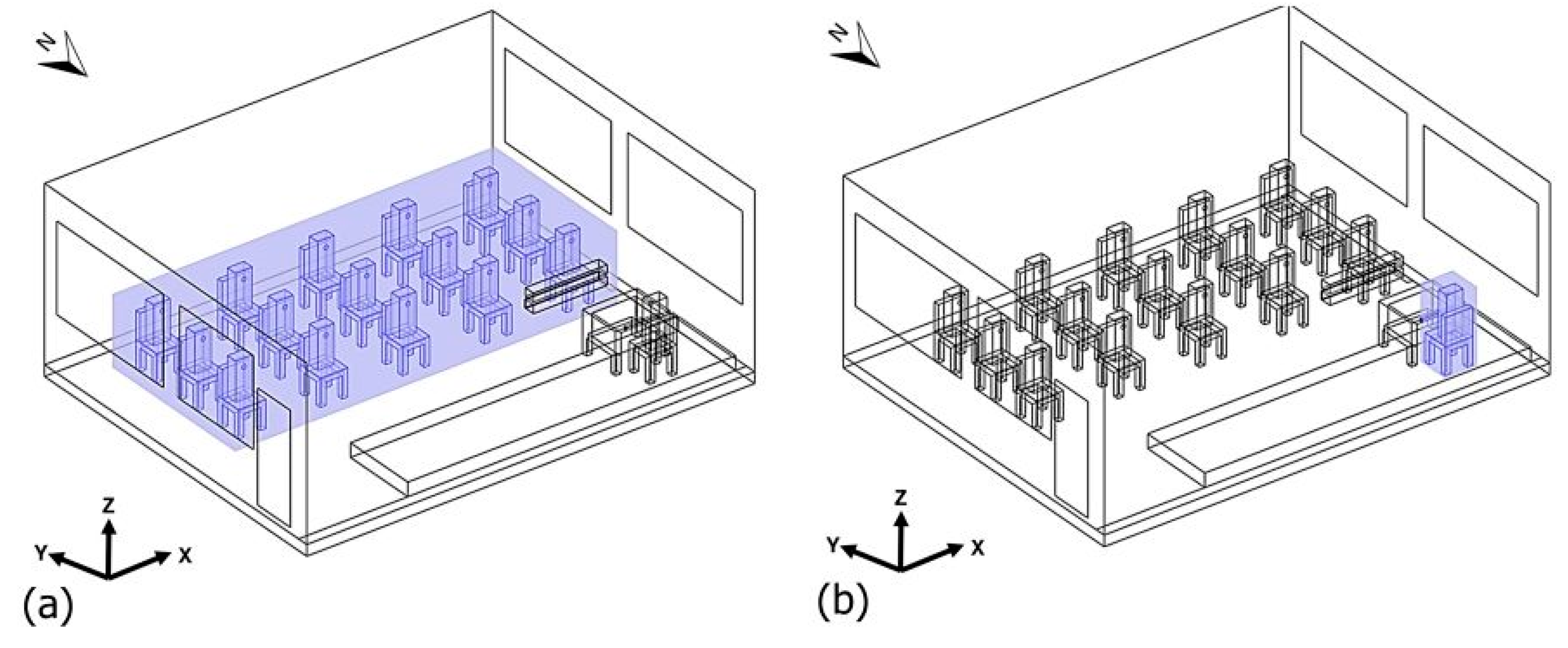
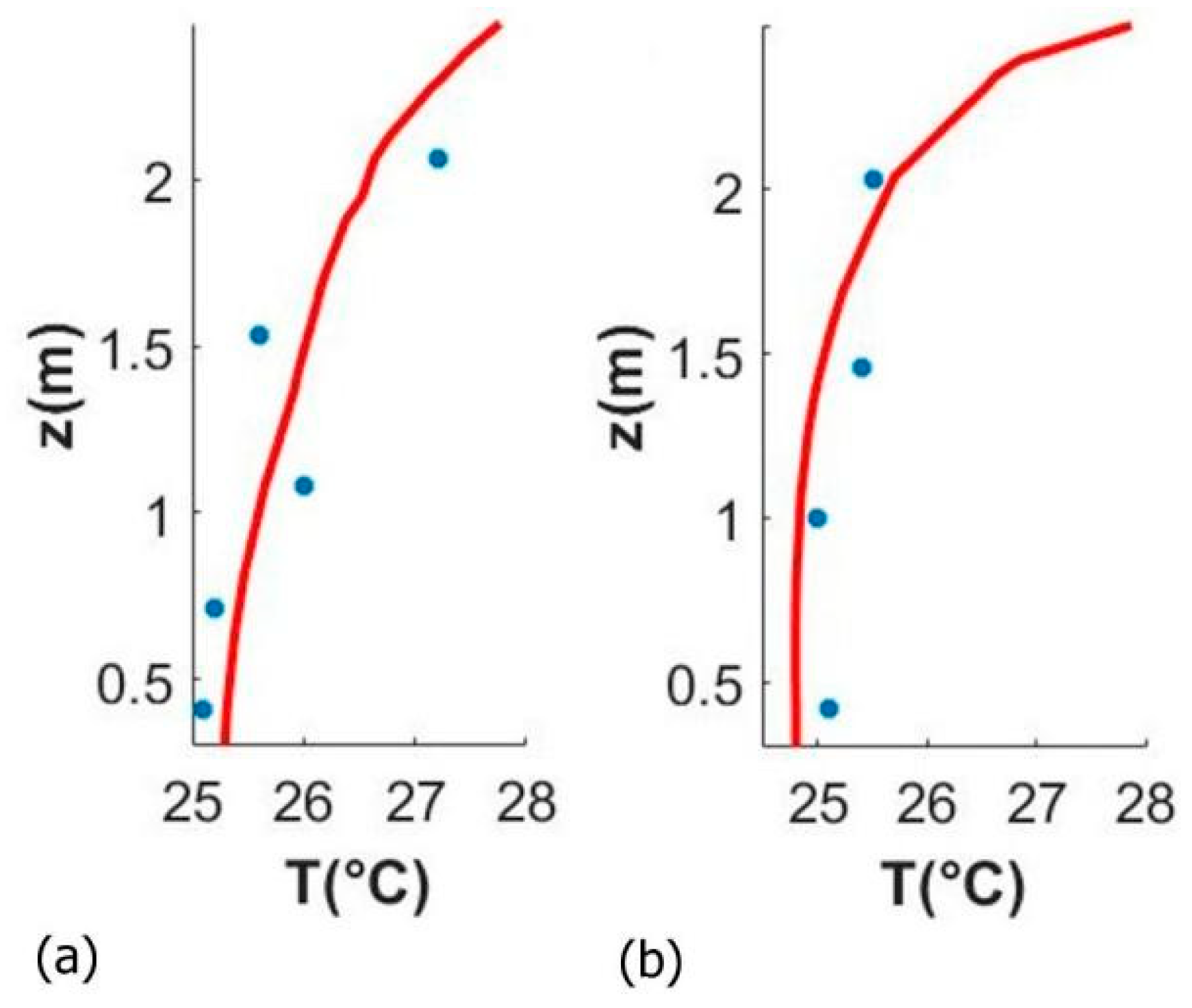
The numerical code was validated by measuring temperatures at different heights in the classroom. Figure 1a,b compare the numerically computed temperature profiles with measurements at different points along two lines parallel to the z-axis. These profiles correspond to the current case. The maximum difference between the measured and simulated temperature values is 2%.

2.6. Thermal Comfort Indices

The analysis of thermal comfort in indoor spaces requires consideration of both physical environmental variables and occupants’ subjective perceptions. In this study, thermal comfort is evaluated using indicators recognized by international standards: the Predicted Mean Vote (PMV) and the Predicted Percentage of Dissatisfied (PPD), as established by ASHRAE Standard 55:2020 [1] and ISO 7730:2005 [2]. The Predicted Mean Vote (PMV) is an index developed by Povl Ole Fanger. It predicts the average thermal sensation of a group of people, expressed on a seven-point scale ranging from −3 (very cold) to +3 (very hot), with 0 representing the neutral thermal condition. Fanger’s original model is based on the balance between the human body’s metabolic heat production and heat loss to the environment, accounting for variables such as air temperature, mean radiant temperature, air velocity, relative humidity, metabolic activity level, and clothing thermal insulation [42].
Ref. [2] proposes Equation (12) to calculate the PMV for a specific environment.
P M V = 0.303 e 0.036 M + 0.028 M W 3.05 × 10 3 5733 6.99 M W P a 0.42 M W 58.15   1.7 10 5 M 5867 P a 0.0014 M 34 t a 3.96 10 8 f c l ( t c l + 273 ) 4 ( T r m t + 273 ) 4 f c l h c ( t c l t a ) ,
where M is the metabolic rate, W is the effective mechanical power, Pa is the partial pressure of water vapor in the air, ta is the air temperature, and fcl is the ratio between the area of the clothed and unclothed body and it is given by
f c l = 1.00 + 1.29 I c l f o r I c l 0.5 c l o 1.05 + 0.645 I c l f o r I c l > 0.5 c l o ,
On the other hand, Icl is the clothing’s thermal resistance, tcl is the temperature of the clothing, garment, or surface of the occupants, and it is obtained by
t c l = 35.7 0.028 M W I c l 3.936 10 8 f c l ( t c l + 273 ) 4 ( T r m t + 273 ) 4 + f c l h c ( t c l t a ) ,
In this equation, Tmrt is the mean radiant temperature, hc is the convection coefficient between the human body and the air, and it is calculated by
h c = 2.38 t c l t a 0.25 f o r 2.38 t c l t a 0.25 > 12.1 v a r 12.1 v a r f o r 2.38 t c l t a 0.25 < 12.1 v a r ,
where var is the relative air velocity.
The Predicted Percentage of Dissatisfied (PPD) is an index that complements the PMV. This index estimates the percentage of people who are likely dissatisfied with thermal conditions, even when the mean (PMV) indicates neutrality. Its calculation is based on a non-linear function of PMV and reflects inter-individual variability in thermal comfort perception (Equation (16)).
P P D = 100 95 e 0.03353 P M V 4 0.2179 0 P M V 2

3. Results

3.1. Thermal Comfort with Current AC Operating Conditions

In hot climates, studying thermal comfort is important to ensure a comfortable environment for classroom occupants. To mitigate the high classroom temperatures, an AC unit on the north wall is used. Under current operating conditions, the AC system supplies cold air at 19 °C, an exit velocity of 1.5 m/s, and an inclination angle of 20°.
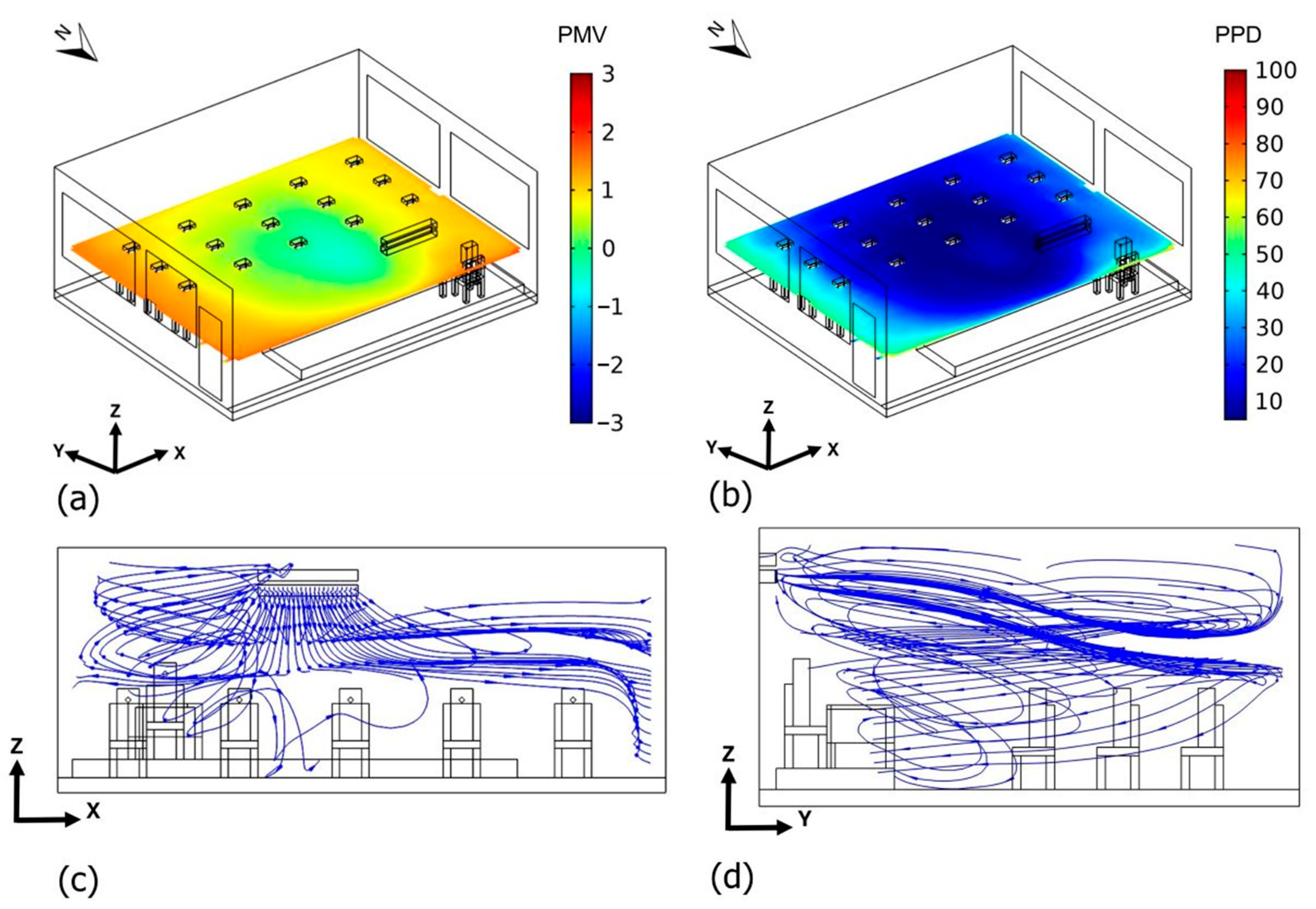
Figure 2a,b display the PMV and PPD fields, respectively, calculated on an xy plane of the classroom for the current operating conditions. For the PMV index (see Figure 2a), a small area in the center of the classroom shows values near 0, indicating conditions close to thermal comfort. This is due to the flow of cold air from the AC, which is directed toward the classroom’s central area, reducing the temperature. Positive PMV values between 1 and 2 are observed toward the sides of the classroom and at the four corners, indicating a slightly warm sensation for the occupants in those areas. This increase in PMV on the lateral walls is caused by the windows, which act as thermal bridges that enhance heat transfer in the surrounding areas, thereby affecting occupants’ thermal comfort.
When evaluating the PPD index (see Figure 2b), most of the occupied zone shows values between 30% and 50%, indicating that many occupants are dissatisfied with the AC’s current operating conditions. Areas near the walls and corners exhibit values of 60% or higher, indicating high thermal discomfort. The central area has relatively lower PPD values (20% to 30%), yet is still far from the recommended limit (<10%) according to [2].
The airflow behavior under current operating conditions in the ZX and ZY planes is shown in Figure 2c and Figure 2d, respectively. In the ZX plane (Figure 2c), the flow exits the AC with little inclination without descending to the floor. The cold air remains above the students’ heads, leading to stratification in this area and affecting thermal comfort, as shown in Figure 2a. Furthermore, because the flow of cold air does not affect the east and west walls, there is no heat exchange to lower the temperature. This behavior is consistent with the high PPD values present around the side walls (Figure 2b).
Figure 2d illustrates the airflow movement in the ZY plane within the classroom. In this diagram, the streamlines indicate that the cold air flows over the teacher and then moves over the students until it collides with the south wall. Subsequently, the air follows a path towards the AC return, and a vortex forms in the central part of the classroom. This occurs in the space between the teacher and the students, increasing heat transfer. For this reason, the values of the PMV and PPD indices are better in this region, as shown in Figure 2a and Figure 2b, respectively.

3.2. Fields of PMV and PPD for Different Simulated Operating Conditions

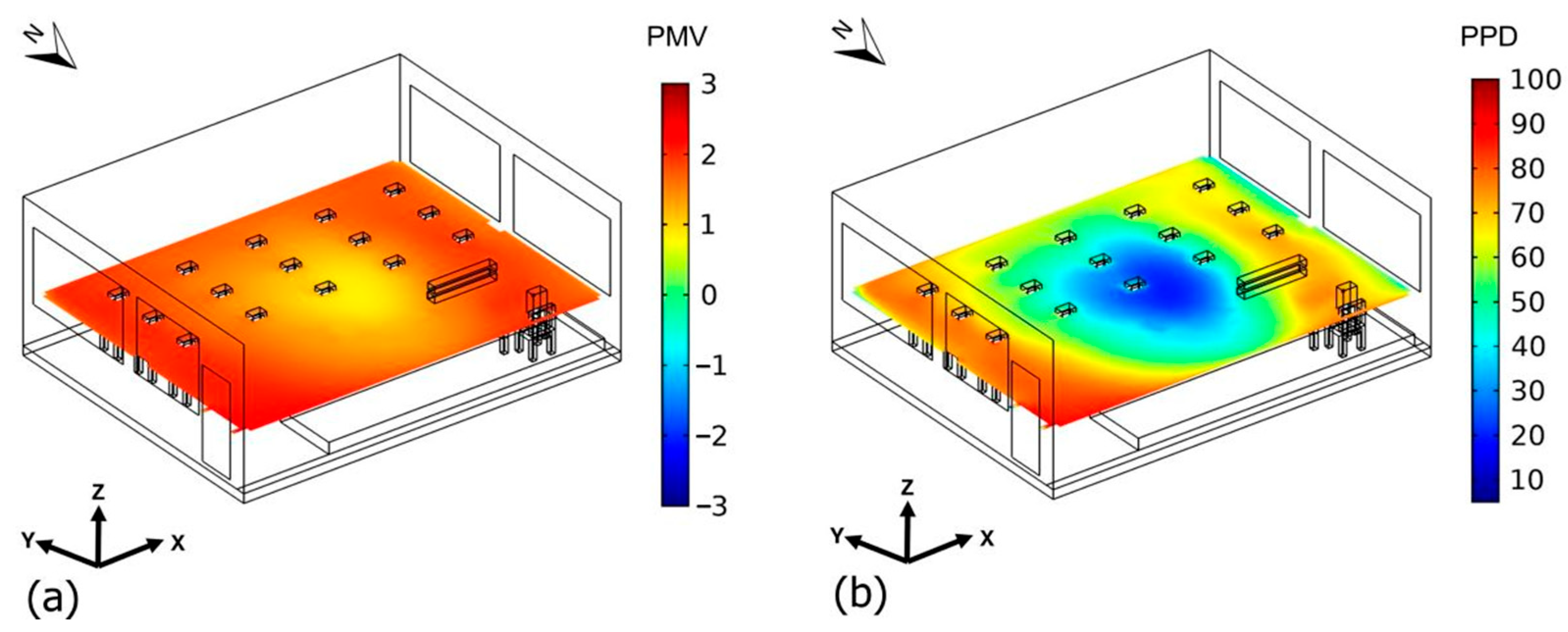
The current operating conditions of the AC system result in a non-uniform distribution of cold air, leading to areas with high PMV and PPD indices exceeding permissible values, creating a thermal discomfort environment with a sensation of warmth, mainly in the lateral areas of the classroom near the windows. To enhance thermal comfort in the classroom and meet the recommended ranges, the behavior of PMV and PPD is analyzed for different values of the AC system’s angle, speed, and operating temperature. Figure 3 and Figure 4 present the fields of PMV and PPD behavior in the classroom for case A1.5 (AC temperature of 23 °C) and case D3.0 (AC temperature of 19 °C), respectively.
Figure 3 shows the PMV and PPD maps for case A1.5 with an AC operating temperature of 23 °C. The PMV field (Figure 3a) ranges from 1 to 2.5, exceeding normative values. Values close to 1 are present in the central area of the classroom. Meanwhile, in the lateral regions, PMV values can reach 2.5 due to thermal bridges, such as windows or the door. The high PMV values are due to the operating conditions of the AC in case A1.5 (1.5 m/s velocity and 0° at the AC outlet) with a high operating temperature of 23 °C. These conditions hinder the distribution of cold airflow, resulting in unfavorable thermal conditions inside the classroom. On the other hand, Figure 3b shows high PPD gradients. In the central region of the classroom, PPD values predominantly range between 20% and 30%. Values exceeding 75% are observed on the east wall and at the classroom entrance, reaching 100% in the northeast corner. This implies a greater thermal dissatisfaction. A PPD of 70% can be observed in the teacher’s area. In general, it is observed that the zero inclination, low velocity, and high operating temperature of the AC flow do not properly condition the space inside the classroom. Consequently, high PMV and PPD values are reached, which do not comply with the standards and directly affect occupants’ thermal comfort.
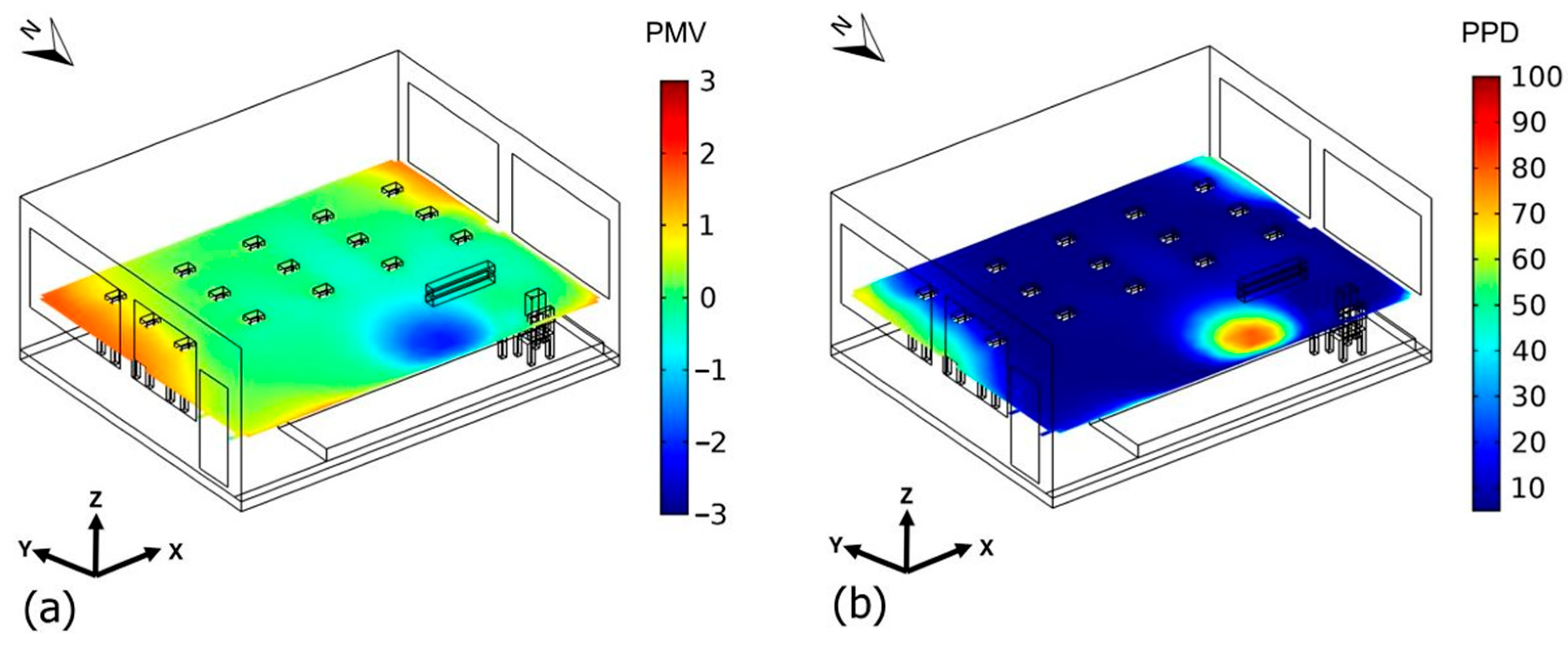
Figure 4 shows the thermal comfort index maps for case D3.0 with an AC temperature of 19 °C. Figure 4a shows that most of the classroom has PMV values close to zero, which corresponds to thermal sensations of neutrality experienced by the teacher and a significant portion of the students. However, on the east wall and the southwest corner, values exceed 1, indicating a sensation of heat. Negative PMV values are identified on the north wall, near the AC. This implies the presence of a cold zone due to the 60° inclination of the AC flow, which directly impacts that area. The PPD field (Figure 4b) shows values below the regulatory limit (10%) across most of the classroom, indicating widespread comfort. On the other hand, in the areas near the east lateral wall and in the southwest corner, the values exceed 50%. Meanwhile, in the immediate vicinity of the AC, the values exceed 40%, indicating a specific area of thermal dissatisfaction due to the constant 60° airflow from the AC. Both fields indicate that an angle of 60°, a velocity of 3.0 m/s, and an operating temperature of 19 °C maintain the PMV and PPD indices within regulatory standards throughout most of the interior space. In this case, the areas of thermal discomfort are localized and do not significantly affect nearby occupants. It is important to emphasize that these thermal comfort conditions correspond to the original Fanger model, which is achieved at a relatively low AC operating temperature.

3.3. Spatially Averaged PMV and PPD Profiles

As observed in Section 3.2, different AC operating conditions create regions with varying thermal conditions within the classroom. The AC system does not provide completely homogeneous comfort in the classroom; instead, areas with varying thermal satisfaction result from how cold air is supplied and distributed. The PMV and PPD fields evaluated throughout the space are important for diagnosing the entire classroom volume. This is because thermal gradients, stratification, and hot spots—including in unoccupied zones—can be visualized. To avoid overestimating discomfort and inefficient AC use, the spatial-average PMV and PPD are evaluated in the occupied zones.
Figure 5a shows the zone occupied by the students, while Figure 5b shows the zone occupied by the teacher. The study includes the simulation of the cases presented in Table 2. For each case, six cold air outlet temperatures are evaluated in the range of 18 °C to 23 °C.
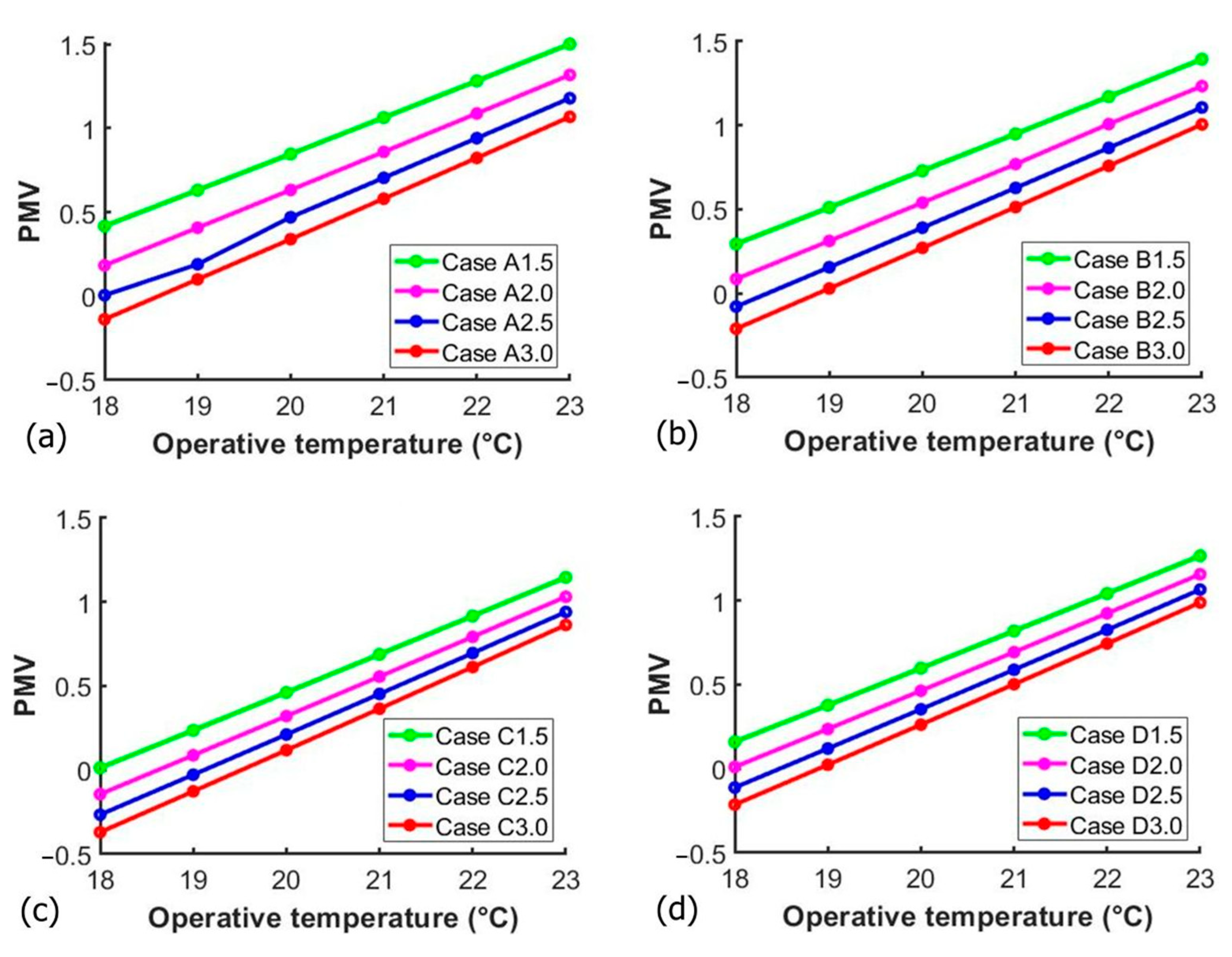
Figure 6 shows the variation in the average PMV index across the zone occupied by the students. In general, the PMV exhibits a linear relationship with the AC operating temperature. The lower the cold-air outlet temperature, the lower the PMV value. Additionally, the higher the AC air exit velocities, the lower the PMV values.
When the AC is supplied in parallel to the ceiling (Figure 6a), the average PMV in the zone occupied by the students increases with rising temperature, regardless of the flow velocity. This is expected, as higher temperatures lead to a greater thermal sensation. Lower flow velocities (case A1.5) result in higher PMV values, indicating greater heat sensation and reduced comfort. As airflow velocity increases, PMV decreases, approaching a more comfortable sensation because increased air movement enhances heat exchange, conditioning the classroom. In general, the average PMV values range from −0.13 (case A3.0 with 18 °C AC) to 1.5 (case A1.5 with 23 °C AC).
In Figure 6b, the behavior of the average PMV is presented when the supply of cold air is inclined at 20°, a trend similar to that in Figure 6a. The PMV value increases with temperature and decreases with air flow velocity. However, a slight improvement in comfort is observed when comparing PMV values with those at 0°. At a given temperature and flow velocity, the PMV values are slightly lower than in the 0° configuration. This suggests that a slight inclination in the air supply can enhance air distribution. For cases B1.5 and B2.0, the AC operating temperatures of 18 °C and 19 °C meet the recommended values. For cases B2.5 and B3.0, the admissible values are achieved at AC temperatures from 18 °C to 20 °C.
A more noticeable improvement in the thermal comfort of the zone occupied by the students is observed with an air supply inclination angle of 40° (Figure 6c). The PMV values are lower than those at 0° and 20°, indicating that 40° is more effective at distributing AC to achieve a more neutral or comfortable thermal sensation in the zone occupied by the students. The reduction in PMV values is evident across all combinations of temperature and velocity due to improved air mixing that dissipates occupant heat more efficiently. For cases C1.5 and C2.0, AC operating temperatures of 18 °C and 19 °C, respectively, yield PMV values very close to neutrality, whereas for cases C2.5 and C3.0, AC temperatures from 18 °C to 21 °C yield comfort values within recommended standards. Nonetheless, with temperatures of 18 °C and 19 °C, slightly cold thermal sensations are observed in the zone occupied by the students.
In Figure 6d (60° inclination at the AC outlet), the PMV values are low compared to the 0° and 20° angles. However, the PMV tends to increase slightly for all speeds and temperatures compared to the 40° incline. This behavior is due to the cold airflow being directed almost immediately to the ground, primarily cooling this area. Therefore, the air near the zone occupied by the students remains warmer, increasing the PMV value. For this angle, cases D2.0, D2.5, and D3.0 remain within comfort values with operating temperatures ranging from 18 °C to 20 °C. In contrast, for case D1.5, the acceptable range is achieved with AC temperatures of 18 °C and 19 °C.
In general, as the AC supply inclination angle increases from 0° to 40°, the PMV index decreases. As the inclination level continues to increase, the PMV values begin to rise slightly.
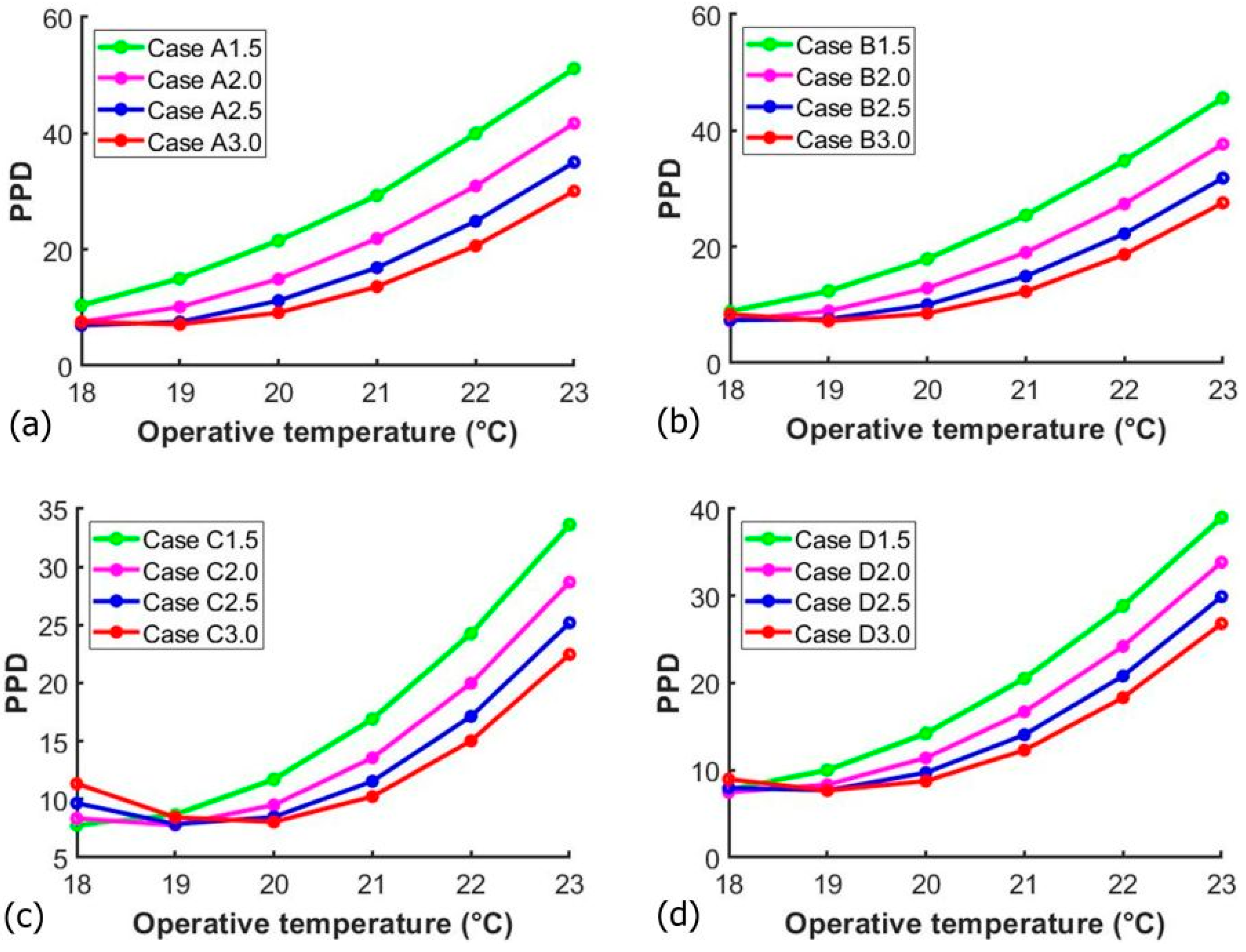
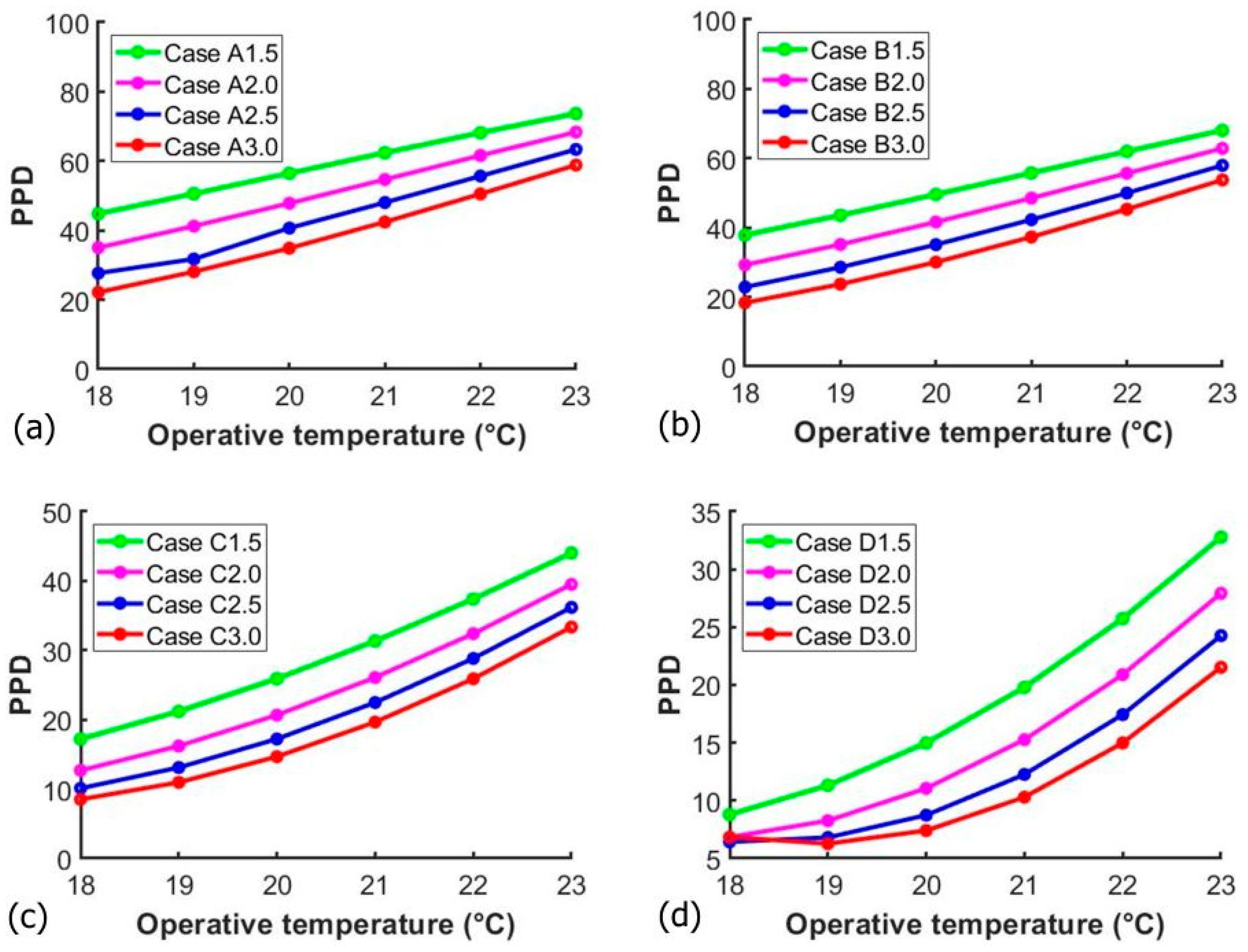
The variation in the average PPD index across the zone occupied by the students for the configurations in Table 2 is shown in Figure 7. In Figure 7a, the AC is supplied without any inclination (0°). The PPD increases with the temperature of the supplied air, from approximately 6.94% at 18 °C (case A2.5) to about 51.14% at 23 °C (case A1.5). This indicates that, at higher AC operating temperatures, a greater percentage of individuals feel dissatisfied. On the other hand, an increase in air flow velocity reduces the PPD at the same temperature.
When evaluating a 20° inclination in the cold AC supply (Figure 7b), the PPD value increases with increasing temperature and decreases with increasing airflow velocity, as in the previous case. A slight improvement in PPD values is observed when compared with Figure 7a. The B2.5 and B3.0 cases remain within the regulations with AC temperatures ranging from 18 °C to 20 °C. For the B1.5 and B2.0 cases, operating temperatures above 18 °C exceed the recommended dissatisfaction percentage.
When the angle is 40° (Figure 7c), the average PPD values in the zone occupied by the students exhibit a more pronounced quadratic behavior than at 0° and 20° in all cases. At low temperatures (18 °C), the PPD is higher for cases C2.5 and C3.0 compared to cases C1.5 and C2.0. This is because at higher speeds (2.5 m/s and 3.0 m/s), the cool sensation is intensified. The cold airflow collides more directly and rapidly over the students, increasing dissatisfaction due to drafts. At 18 °C, case C3.0 has the highest PPD (11.34%), while case C1.5 has the lowest (7.78%). At high temperatures (20–23 °C), the average PPD behavior is reversed. Cases C2.5 and C3.0 show significantly lower PPD values for each operating temperature. At 23 °C, the PPD for C3.0 is 22.47%, whereas for C1.5 and C2.0, it exceeds 28%.
With an angle of 60° at the AC outlet (Figure 7d), cases D1.5 and D2.0 comply with the PPD standards when the AC operates at 18 °C or 19 °C. On the other hand, cases D2.5 and D3.0 also meet the recommended PPD values at an AC temperature of 20 °C or lower.
It is important to note that when the inclination angle of the AC supply increases from 0° to 20°, the PPD index decreases for the same temperature and flow rate configurations. Inclination angles of 0° and 20° at the AC outlet are less efficient at distributing cold air throughout the classroom interior. The aforementioned leads to considerably higher levels of dissatisfaction, especially at elevated temperatures, aligning with the behavior of the PMV.
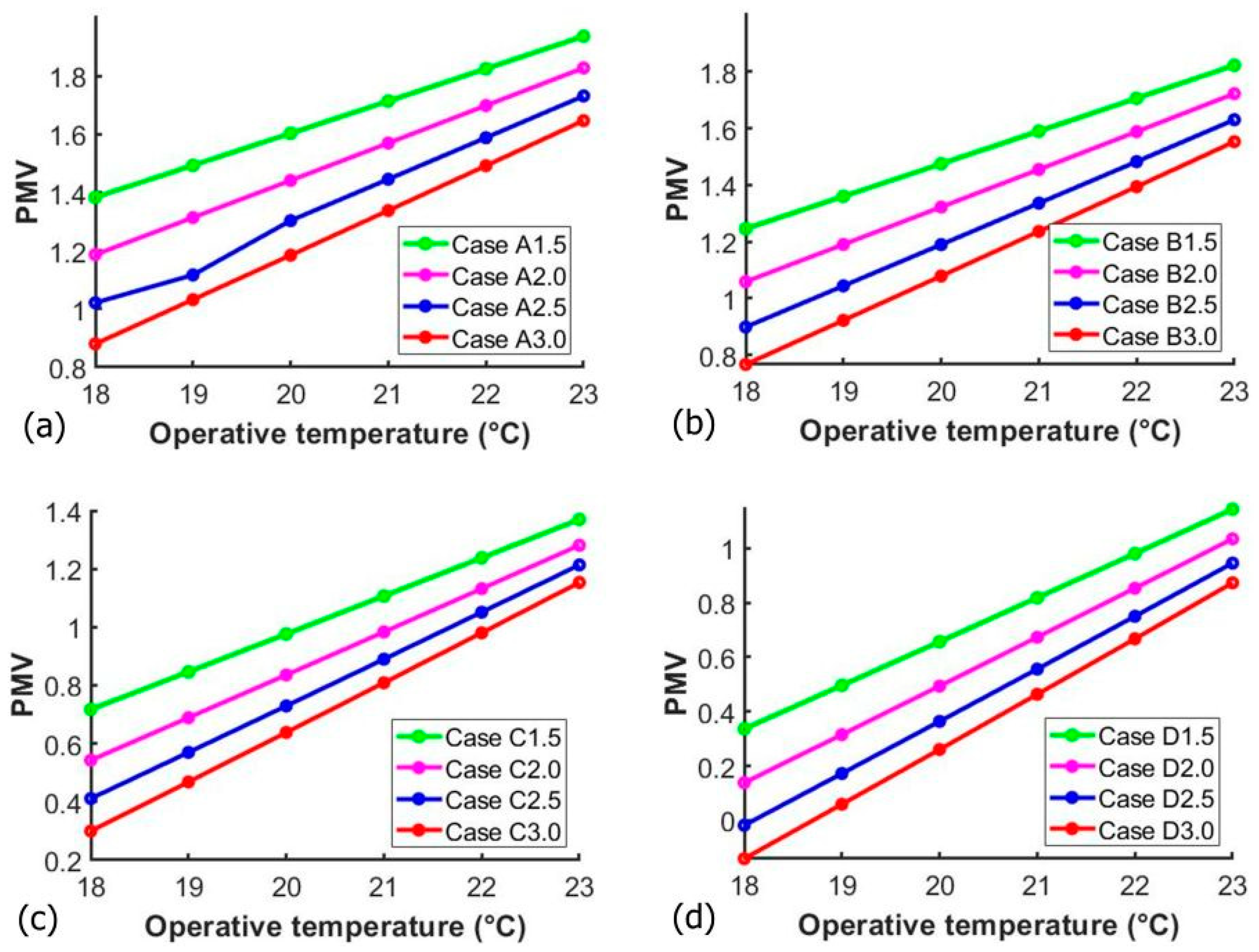
Figure 8 shows the average PMV behavior for the zone occupied by the teacher. As with the zone occupied by students, the PMV is directly related to the AC’s operating temperature. The higher the cold-air exit temperature, the higher the PMV value. Furthermore, at lower air outlet velocities of the AC, the PMV values increase.
When the cold airflow is directed parallel to the ceiling (Figure 8a), the average PMV increases with temperature and decreases with increasing AC speed, with higher values at low AC speeds. The PMV values range from 0.88 (case A3.0 and 18 °C) to 1.93 (case A1.5 and 23 °C). The same trend is observed at a 20° inclination (Figure 8b), although comfort improves slightly compared to the horizontal supply. The PMV range decreases, with the lowest value of 0.76 (case B3.0 at 18 °C) and the highest of 1.82 (case B1.5 at 23 °C). At 40° (Figure 8c), the improvement is more significant, and the PMV values decrease across all combinations of temperature and velocity. A PMV of 0.29 is achieved at the highest speed (case C3.0) and the lowest AC temperature (18 °C). The highest PMV value (1.36) is observed under the operating conditions of case C1.5, with an operating temperature of 23 °C. When evaluating the effect of a 60° angle in the AC supply (Figure 8d), the lowest PMV values are obtained, as the AC flow is directed straight toward the area near the teacher’s zone, resulting in a more neutral thermal sensation. The PMV values in the zone occupied by the teacher range from −0.14 (case D3.0 and 18 °C) to 1.14 (case D1.5 and 23 °C).
In general, the results indicate that a greater inclination angle of the AC supply enhances thermal comfort in the zone occupied by the teacher. For each tilt angle, higher supply velocities reduce PMV, regardless of the AC’s operating temperature.
The average PPD index values, calculated within the teacher’s zone for the configurations in Table 2, are presented in Figure 9. The PPD increases proportionally with the AC temperature and decreases with increasing air velocity in all configurations. This behavior is consistent with that of the PMV in the same zone.
When supplying AC flow at 0° and 20° (Figure 9a,b), the PPD values in the zone occupied by the teacher exceed the acceptable thermal comfort range. The PPD values for these angles range between 18% (case B3.0 and 18 °C) and 73% (case A1.5 and 23 °C). For an angle of 40° (Figure 9c), a considerable reduction in PPD values is observed for each given case and temperature. However, the only operating condition that complies with the regulations is case C3.0 with an operating temperature of 18 °C. By increasing the AC inclination to 60° (Figure 9d), the lowest levels of dissatisfaction are achieved, and the PPD value is reduced to 6.27%, which occurs under the operating conditions of case D3.0 with an operating temperature of 19 °C.
When evaluating both thermal comfort indices in the occupied zones, the operating configuration that provides the best thermal comfort for the teacher is case D3.0 (60° inclination and 3.0 m/s), with an operating temperature of 19 °C. The PMV value approaches zero (0.05); the PPD value (6.27%) is the lowest, complying with the standards. This suggests that an angle of 60° is the most effective for distributing AC, as it directly benefits the teacher without causing discomfort from strong air streams or excessive cooling. On the other hand, under the same operating conditions (case D3.0 at 19 °C), the students’ thermal comfort indices fall within the comfort range, with a PMV of 0.02 and a PPD of 7.6%.

3.4. Assessment of Thermal Comfort Using the Modified PMV

A precise analysis of thermal comfort is essential to creating comfortable learning environments that support optimal performance by students and teachers. The PMV index is recognized internationally as a standard for assessing thermal comfort. This is evaluated based on empirical relationships among the metabolic rate during the activity, the mean skin temperature, and heat loss by evaporation under comfort conditions. However, some studies indicate that the PMV index may have some limitations when applied across different scenarios. For this reason, some authors suggest a modified PMV [43,44,45,46].
To improve the precision of the PMV, this study also evaluates the modified PMV as reported in [43]. In the calculation of the occupants’ surface temperature (tcl), Equation (14), the simplified skin temperature is replaced by the skin temperature (tsk) Equation (18).
t c l = t s k I c l 3.936 10 8 f c l ( t c l + 273 ) 4 ( T r m t + 273 ) 4 + f c l h c ( t c l t a )
t s k = t c r M W 0.0014 M 34 t a + 1.7 10 5 M 5867 P a 5.28 + 1.163 b + h c + h r
where tcr is the core body temperature, b is the fraction of blood flow to the skin, hc and hr are the convection and radiation coefficients, respectively.
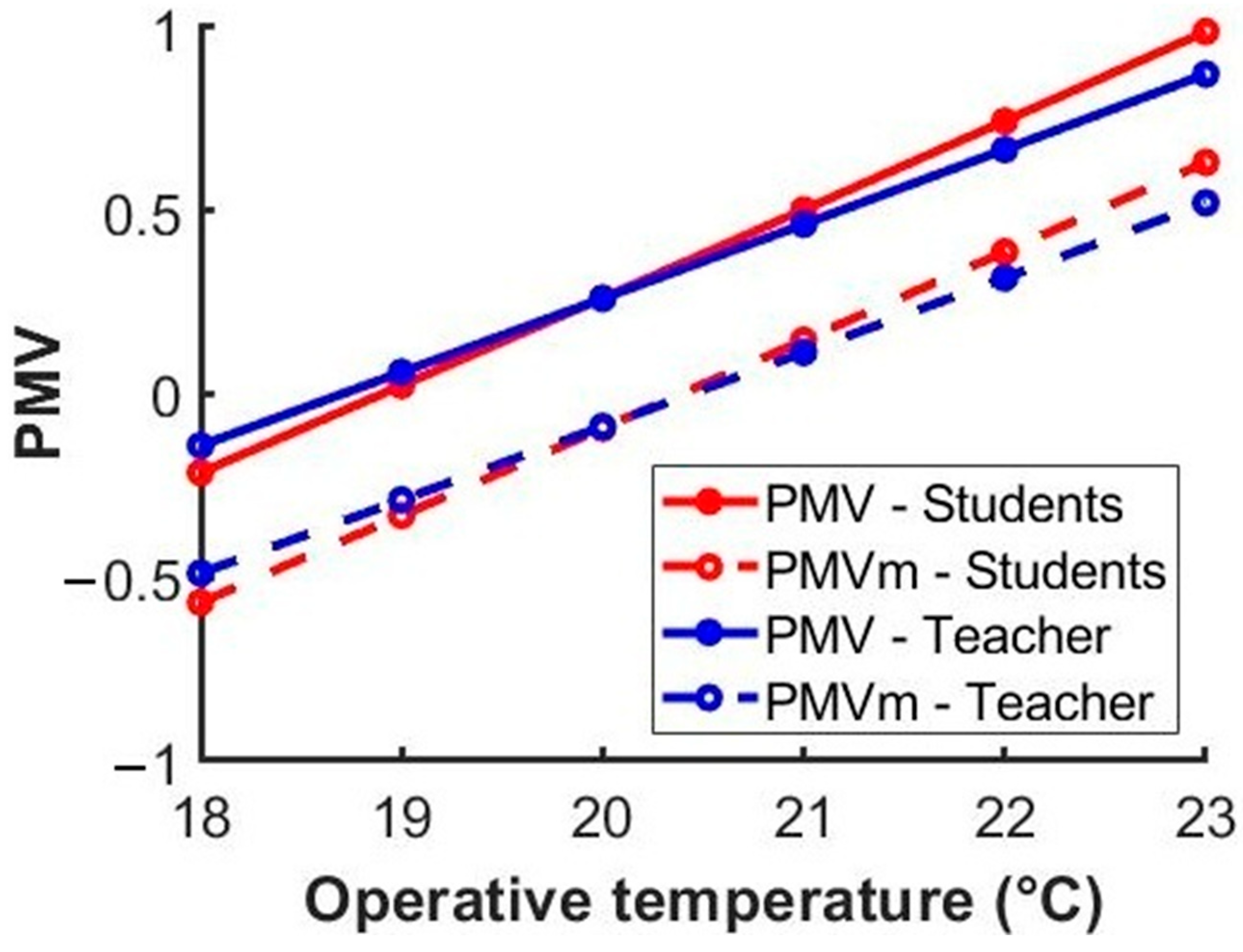
In Figure 10, the behavior of the original PMV and the modified PMV (PMVm) is compared in the zones occupied by the students and the teacher, for the operating conditions of case D3.0 with different AC operating temperatures. In general, the original PMV overestimates the sensation of warmth in each occupied zone and the evaluated temperature. Regardless of the evaluated operating temperature, the average PMVm is lower than the PMV. For the student and teacher zones, the average PMVm values decrease by approximately 0.35 for each evaluated operating temperature. It is important to note that the PMVm values remain within the normative limits of thermal comfort in the operating temperature range of 18 °C to 22 °C. Within this range, occupants experience thermal comfort. In Case D3.0, with an operating temperature of 20 °C, a PMVm of −0.09 for students and −0.08 for the teacher is achieved; these values are very close to the sensation of neutrality.
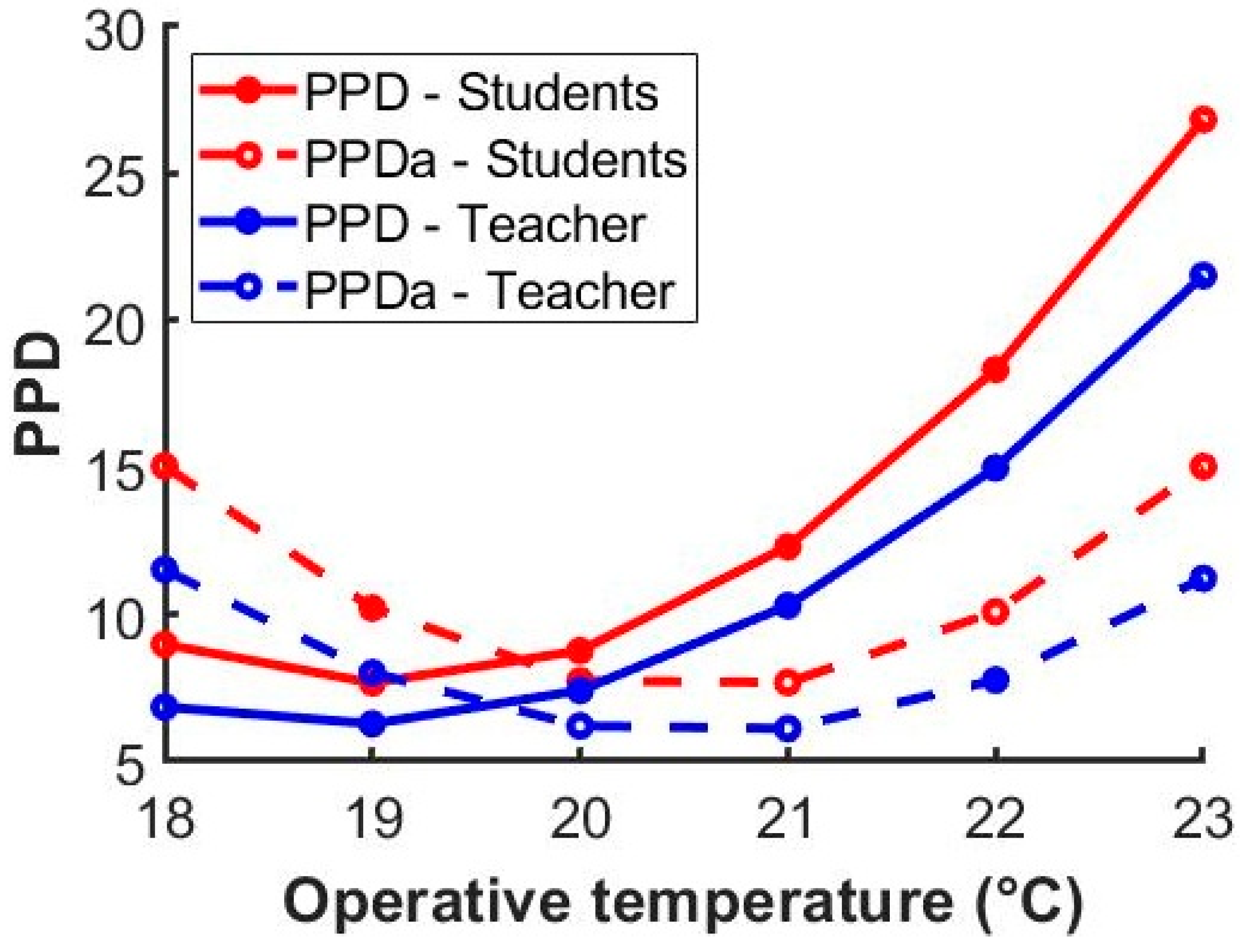
Figure 11 presents the average values of the PPD and the adjusted PPD (PPDa). This final parameter is calculated using the PMVm values in the zones occupied by students and the teacher, under the operating conditions of case D3.0, for different AC operating temperatures. For the zone occupied by students, with AC set to 18 °C, 19 °C, and 23 °C, the average PPD exceeds the recommended comfort value. In contrast, with temperatures ranging from 20 °C to 22 °C, the PPD value remains within the recommended 10%. On the other hand, for the zone occupied by the teacher, operating temperatures of 18 °C and 23 °C exceed 11% of PPDa. Meanwhile, at temperatures between 19 °C and 22 °C, the PPDa values remain within the range specified by the standard. Case D3.0, with an operating temperature of 21 °C, achieves the lowest average PPDa values: 7.6% for students and 6.1% for the teacher. It is worth noting that the PPD and PPDa graphs exhibit a slightly quadratic trend because these cases include both negative and positive PMV values, minimizing the estimated percentage of dissatisfied. The lower the PMV value, the steeper the curve will be in the graph.
As shown in Figure 10 and Figure 11, the PMVm and PPDa indices, calculated from skin temperature, reach recommended values for AC operating temperatures of 20–22 °C. Meanwhile, with the original PMV index, the recommended values are achieved with AC operating temperatures of 18 °C to 20 °C, confirming an overestimation of heat sensation among occupants. The modified PMV enhances the precision of thermal comfort calculations by accounting for two physical mechanisms: (i) directional forced convection, and (ii) spatial variations of the cold air jet on the skin.

4. Discussion

The study of thermal comfort in the classroom is crucial to ensure a comfortable environment for the occupants. This is particularly important when the classroom is located in a hot climate. In Mexico, high classroom temperatures are often reduced with AC systems. However, there are no studies that ensure the efficient use of these devices. In the present study, the occupants’ comfort in the studied classroom is assessed using CFD simulations. The analysis aims to improve comfort conditions with the least possible impact on the institution’s finances by varying only the operating parameters of the installed AC. Currently, the AC supplies cold air at 19 °C, a velocity of 1.5 m/s, and an inclination angle of 20°. These conditions lead to a non-uniform distribution of cold air, resulting in areas with high PMV and PPD indices exceeding permissible values.
In a first stage, the PMV and PPD fields (according to the original Fanger model) within the classroom are analyzed under different AC operating conditions. These maps demonstrate that variation in AC operating parameters can lead to both extensive zones of discomfort and dissatisfaction and regions with adequate thermal comfort. In other words, the AC’s different operating conditions do not guarantee uniform thermal comfort throughout the classroom. Conversely, the fields indicate areas with sensations of cold, heat, or neutrality, which can result in comfort or dissatisfaction depending on the AC’s operating parameters. The results suggest that the direction and the velocity of the airflow generated by the AC directly influence the thermal perception of the occupants, as reported in [7,10,16,18].
There are unoccupied zones in the classroom, such as the region near the AC outlet and the vicinity of the walls and windows. Studying and optimizing thermal comfort in these areas may yield insignificant results and increase the AC’s workload. Due to the above, and to enhance the accuracy of the thermal comfort analysis, in a second phase of the study, the average indices PMV and PPD are specifically evaluated in the zones occupied by students and the teacher. The results obtained are consistent with those reported in other studies [8,11], where fields are calculated throughout the entire study space. However, the thermal comfort criterion is based solely on index values around occupants or in occupied zones.
In the occupied zones, the average PMV shows a proportional relationship: as the AC temperature decreases, the index also decreases. Although some operating conditions, with supply angles of 0° or 20°, achieve acceptable PMV values in the zone occupied by the students, they are unfavorable in the teacher’s zone. This behavior demonstrates that an adjustment favoring one type of occupant may compromise comfort for another, underscoring the need for more balanced operating conditions. In contrast, the analysis of cases with angles of 40° and 60° shows that the configuration of case D3.0 at 19 °C reaches PMV values very close to thermal neutrality in both occupied zones: 0.02 for the students and 0.05 for the teacher. These results corroborate the importance of the inclination of the cold-air supply, along with operating temperature and velocity, for improving occupants’ thermal comfort.
On the other hand, the average PPD behavior underscores the importance of analyzing AC operating conditions in occupied zones. Angles of 0° and 20° show a similar trend in the zone occupied by the students, where higher AC temperatures correspond to higher dissatisfaction values. In comparison, at 40° and 60°, high supply velocities (2.5 and 3 m/s) increase dissatisfaction at low temperatures but become more effective at high temperatures, reducing the PPD compared to less inclined configurations. This indicates that larger inclination angles offer greater adaptability at higher temperatures. In the zone occupied by the teacher, the PPD increases with increasing operating temperature, suggesting heightened sensitivity due to its location. However, as with students, certain operating conditions with an AC supply at a 60° angle can mitigate dissatisfaction, demonstrating that an airflow with a greater inclination distributes air more effectively. Again, the most balanced configuration is case D3.0 at 19 °C, as the average PPD levels fall within the regulatory range for both zones (7.6% for students, 6.2% for the teacher). Nevertheless, it should be noted that the AC consumes a high amount of energy at this operating temperature.
Usually, the PMV calculation is based on a simplified skin temperature that considers only the occupants’ activity level. That is, the effects of clothing insulation and environmental parameters are disregarded. Therefore, in a third stage, this work also evaluates thermal comfort using a PMV model modified in a manner similar to that reported in [43]. The analysis is conducted to determine the optimal operating configuration of the AC from the previously analyzed cases (case D3.0 with different operating temperatures).
The comparison between the PMV and PMVm indices reveals that the original model overestimates the occupants’ thermal sensation. On average, the PMVm shows a reduction of 0.35 for all occupied zones compared to the original PMV. This result challenges the use of the original PMV, which tends to overestimate heat perception at high index values, as reported in [43,44,45,46]. This implies maintaining the AC functioning at lower temperatures than strictly necessary. On the other hand, the PPDa analysis confirms this behavior. The evaluation conducted in the occupied zones shows that students experience acceptable PPDa values when the AC temperature is between 20 °C and 22 °C, whereas teachers experience acceptable PPDa values at 19 °C to 22 °C.
The D3.0 case, with operating temperatures ranging from 20 °C to 22 °C, maintains average PMVm and PPDa within regulatory limits. Nevertheless, to make efficient use of electrical energy by reducing consumption, the AC operating temperature should be set to minimize the system’s workload, as indicated in [14]. Therefore, the D3.0 case, with an AC temperature of 22 °C, is the optimal configuration, as it maintains thermal comfort while also saving energy, thus having a positive impact on environmental conservation. In this case, the PMVm is 0.38 for the students and 0.31 for the teacher, with PPDa values of 10% and 7.7%, respectively.
It is important to note that the optimal case occurs at a velocity of 3 m/s with a discharge angle of 60°. Under these conditions, the airflow from the AC is initially directed towards the floor, specifically into the classroom’s unoccupied zone. This means the cold air does not flow directly toward the occupants; instead, it first impinges on the floor, reducing its velocity significantly. For these optimal conditions, the maximum vertical temperature difference is 1.7 °C. According to ASHRAE Standard 55 [1], this falls within the permissible range of 0 °C to 3 °C, ensuring thermal comfort for the occupants.
The present research shows that the studied classroom’s thermal comfort indices fail to comply with the regulations. Thus, it is of utmost importance to analyze the effects of AC operating parameters, such as speed, tilt, and the temperature of the flow exiting the AC, since selecting them correctly can achieve thermal comfort. In addition to the analysis of thermal comfort fields, the present study evaluates the average PMV and PPD indices in the occupied zones, as suggested in [8,11,15,31,39]. This approach allows identification of operating parameters that comply with regulations, prioritizing locations where occupants are situated. On the other hand, the modified PMV is used to avoid overestimating heat-related discomfort that may occur with the original PMV when conducting analyses in hot climates [43,44,45,46]. This type of analysis is highly relevant, as it enables the determination of operating conditions to achieve thermal comfort with the lowest possible energy consumption, thereby contributing to the development of thermally comfortable and energy-efficient educational spaces. Several studies strongly support the energy benefits of increasing the AC operating temperature. For example, ref. [47] reported 20% energy savings when the AC temperature was increased by 3 °C. These results align with those of [48], who observed an 18–21% reduction in energy consumption across various spaces when raising the setpoint from 20 °C to 23 °C. On the other hand, the inherent limitations of the mathematical model are acknowledged. Since it is considered a steady-state model, it does not describe the temporal evolution of turbulent flow; that is, the velocity and temperature fields are time-independent.

5. Conclusions

This study analyzes the effects of variations in air conditioning operating parameters on thermal comfort indices (PMV and PPD) in a classroom in a city with a very hot climate. In particular, the velocity, inclination angle, and temperature of the AC outlet flow are identified as parameters that enhance thermal comfort while simultaneously improving energy efficiency. The analysis includes the maps and average comfort indices in the occupied zones, as well as the calculation of modified PMV.
The following conclusions can be drawn.
  • The spatial analysis of PMV and PPD fields reveals that, by varying the AC operating parameters, admissible values of these indices can be achieved in the occupied zones.
  • With the original model, the results show that, in case D3.0 with a supply temperature of 19 °C, average PMV values close to thermal neutrality are achieved: 0.02 for the students and 0.05 for the teacher.
  • Under these same conditions, the lowest average PPD values are recorded: 7.6% for the students and 6.27% for the teacher.
  • The optimal operating configuration of the AC, obtained with the modified model, is case D3.0 (60° and 3 m/s) with an AC temperature of 22 °C.
  • The results show that, when skin temperature is considered without simplification using the modified model, there is an operating condition in which the AC consumes less energy than estimated by the original PMV.
  • The optimal configuration is achieved with a PMVm of 0.38 for students and 0.31 for the teacher.
  • The PPDa values associated with the optimal configuration are 10% and 7.7% for the students and the teacher, respectively.
This study demonstrates that solely adjusting the AC operating temperature does not guarantee thermal comfort; rather, the airflow direction and velocity have a decisive impact on comfort. Moreover, the use of PMVm provides a more realistic estimate of thermal comfort and avoids the bias of the original PMV, which can lead to overcooling. This approach is of utmost importance, as it has a positive impact on the environment by helping to save energy through optimal climatization of educational spaces.

Author Contributions

Conceptualization, G.E.O.-C. and E.C.-O.; methodology, G.E.O.-C. and E.C.-O.; validation, A.R.-L. and S.L.O.-C.; formal analysis, G.E.O.-C., E.C.-O. and A.R.-L.; investigation G.E.O.-C. and R.F.M.-G.; writing—original draft preparation, G.E.O.-C., E.C.-O. and S.L.O.-C.; writing—review & editing, G.E.O.-C., A.R.-L. and S.L.O.-C.; visualization, E.C.-O., S.L.O.-C. and R.F.M.-G.; Supervision A.R.-L. and R.F.M.-G. All authors have read and agreed to the published version of the manuscript.

Funding

This research received no external funding.

Institutional Review Board Statement

Not applicable.

Informed Consent Statement

Not applicable.

Data Availability Statement

The original contributions presented in this study are included in the article. Further inquiries can be directed to the corresponding authors.

Acknowledgments

The authors gratefully acknowledge the support provided by Tecnológico Nacional de México—Instituto Tecnológico de Veracruz, Tecnológico Nacional de México—Instituto Tecnológico de Tuxtla Gutiérrez, and PRODEP. E.C.-O. thanks the scholarship awarded by SECIHTI (CONAHCyT).

Conflicts of Interest

The authors declare no conflicts of interest.

References

  1. ASHRAE Standard 55-2020; Thermal Environmental Conditions for Human Occupancy. American Society of Heating, Refrigerating and Air-Conditioning Engineers: Atlanta, GA, USA, 2020.
  2. ISO 7730:2005; Ergonomics of the Thermal Environment—Analytical Determination and interpretation of Thermal Comfort Using Calculation of the PMV and PPD Indices and Local Thermal Comfort Criteria. International Organization for Standardization: Geneva, Switzerland, 2005.
  3. Ganesh, G.A.; Sinha, S.L.; Panchore, V.; Verma, T.N. CFD analysis of natural ventilation’s role in modulating transient metabolic rate and enhancing indoor comfort. Energy Sources A Recovery Util. Environ. Eff. 2025, 47, 4941–4958. [Google Scholar] [CrossRef]
  4. Moallemi Khiavi, N.; Minaei, A.; Rouhi, M. Evaluation of Natural Ventilation Performance in Providing Local Thermal Comfort and Indoor Air Quality in an Office Room. Iran. J. Energy Environ. 2025, 16, 413–425. [Google Scholar] [CrossRef]
  5. Abid, H.; Djebali, R.; Faraji, H.; Lajnef, M.; Driss, Z.; Bessrour, J. Impact of Geometrical Parameters on Indoor Environments with Single-Sided Ventilation: Experimental and Numerical Study. J. Appl. Comput. Mech. 2024, 11, 12–22. [Google Scholar] [CrossRef]
  6. Azmi, N.A.; Baharun, A.; Arıcı, M.; Ibrahim, S.H. Improving thermal comfort in mosques of hot-humid climates through passive and low-energy design strategies. Front. Archit. Res. 2023, 12, 361–385. [Google Scholar] [CrossRef]
  7. Yu, X.; Cheng, M. Simulation of the effect of horizontal airflow channel on natural ventilation in apartments. E3S Web Conf. 2024, 528, 02013. [Google Scholar] [CrossRef]
  8. Li, J.; Wu, K.; Ma, M.; Zhu, J.; Novakovic, V. Conception and verification of flexible space partition heating with solar energy. Renew. Energy 2025, 240, 122179. [Google Scholar] [CrossRef]
  9. Dhahri, M.; Yüksel, A.; Aouinet, H.; Wang, D.; Arıcı, M.; Sammouda, H. Efficiency Assessment on Roof Geometry and Trombe Wall Shape for Improving Buildings’ Heating Performance. Buildings 2024, 14, 1297. [Google Scholar] [CrossRef]
  10. Hoang, K.V.V.; Quoc, T.H.; Thi, M.H.N. Utilizing computational fluid dynamics (CFD) for simulating airflow and heat distribution to enhance thermal comfort in enclosed space. J. Phys. Conf. Ser. 2025, 2949, 012049. [Google Scholar] [CrossRef]
  11. Riaz, M.; Mahmood, M.H.; Ashraf, M.N.; Sultan, M.; Sajjad, U.; Riaz, F.; Farooq, M.; Zhang, Z. Experimental study of an air-conditioned tractor cabin using CFD analysis for primary and secondary tillage operations in Pakistan. Results Eng. 2025, 26, 104540. [Google Scholar] [CrossRef]
  12. Yan, P.; Yu, F.; Cui, S.; Ma, J.; Zhu, Z.; Cai, Y.; Zhou, X.; Sun, C. Approach on enhancing the air conditioning system to improve the winter thermal environment in Eastern China Region’s airport terminals. Energy Built Environ. 2024. [Google Scholar] [CrossRef]
  13. Gyurova, L. The fluid flow simulation of the thermal comfort in theatre. Environ. Technol. Resour. 2024, 3, 75–78. [Google Scholar] [CrossRef]
  14. Lee, H.; Rim, D.; Ahn, H. Evaluation of local thermal comfort during demand response. Energy 2025, 320, 135085. [Google Scholar] [CrossRef]
  15. Weng, M.; Zhang, Y.; Liu, F.; Liu, A.; Zhang, H. Optimization of airflow organization in the passenger cabin of special vehicles based on human thermal sensation. Case Stud. Therm. Eng. 2025, 65, 105678. [Google Scholar] [CrossRef]
  16. Abd Elfatah, M.G.; Fouad, M.A.; Halawa, T.; Aly, M. Investigation of Airflow Characteristics and Thermal Comfort in Indoor Squash Court. Int. J. Eng. Appl. Sci.-Oct 6 Univ. 2024, 1, 374256. [Google Scholar] [CrossRef]
  17. Kanchwala, H. Energy efficiency and thermal comfort evaluation of rooms built using different insulating materials. Energy Rep. 2025, 13, 1571–1589. [Google Scholar] [CrossRef]
  18. Wang, H.; Tang, Q.; Liu, D. A comprehensive evaluation index for indoor thermal comfort and energy utilization. Case Stud. Therm. Eng. 2024, 63, 105335. [Google Scholar] [CrossRef]
  19. AbdelAziz, A.M.; Razik, K.R.M.A.E.L. Numerical Investigation of Air Quality Improvement in Mechanically Ventilated Green Buildings. Int. J. Smart Sustain. Intell. Comput. 2025, 2, 50–64. [Google Scholar] [CrossRef]
  20. Kyere, E.B.; Jen, T.-C.; Tartibu, L. Analysis of the Influence of Chilled Water Temperature Setpoint on Thermal Comfort and Energy Consumption. Arabian J. Sci. Eng. 2023, 49, 10409–10429. [Google Scholar] [CrossRef]
  21. Guo, L.; Dai, L.; Peng, J. Effects of different ventilation modes on thermal comfort and contaminant removal effectiveness in ship cabin. In Proceedings of the Fifth International Conference on Green Energy, Environment, and Sustainable Development (GEESD 2024), Mianyang, China, 28–30 June 2024. [Google Scholar] [CrossRef]
  22. Sabr, A.H.; Mahdi, A.A.; Aljibory, M.W. Experimental and numerical study for assessment indoor air quality by adopting mixing ventilation with different occupants’ density in Iraq hot climates. J. Therm. Eng. 2024, 10, 430–446. [Google Scholar] [CrossRef]
  23. Jastaneyah, Z.; Kamar, H.M.; Hashmi, A.; Ghaleb, F.A.; Al Garalleh, H. The influence of zonal air supply on thermal comfort in a classroom located in a hot and humid environment: A case study from Jeddah—Saudi Arabia. Discov. Sustain. 2024, 5, 526. [Google Scholar] [CrossRef]
  24. Kanaan, M.; Amine, S.; Gazo-Hanna, E. Optimizing supply conditions and use of return air in UFAD system: Assessment of IAQ, thermal comfort and energy performance. Results Eng. 2024, 24, 103426. [Google Scholar] [CrossRef]
  25. Gao, T.; Li, M.; Zhang, S.; Wu, Y.; Zhang, Y.; Wang, X.; Zeng, X.; Huang, S.; Yang, W. The Application and Optimization of a New Tunnel Ventilation Method for the Control Room of Electric Submersible Pump Systems on Jack-Up Offshore Platforms. Buildings 2025, 15, 325. [Google Scholar] [CrossRef]
  26. Almohammadi, B.A.; Hussein, E.; Almohammadi, K.M.; Refaey, H.A.; Karali, M.A. Energy Saving for Impinging Jet Ventilation System by Employing Various Supply Duct Locations and Return Grill Elevation. Buildings 2024, 14, 3716. [Google Scholar] [CrossRef]
  27. Hanafi, A.M.; Abdo, T.A.; Abbass, N.A.; Abdelfattah, M.G.; Diab, Y.M.; Ibrahim, M.A. Optimizing Thermal Comfort and Air Quality in University Classrooms: A CFD-Based Comparative Analysis of HVAC Configurations. Int. J. Eng. Appl. Sci.-Oct 6 Univ. 2025, 2, 17–31. [Google Scholar] [CrossRef]
  28. Xin, J.; Shi, X.; Ye, F.; Zhenlei, C.; Yin, P.; Miao, B. Evaluation of the air quality and the thermal comfort in the kitchen fume environment under the fresh air supplement. Results Eng. 2024, 23, 102681. [Google Scholar] [CrossRef]
  29. Zhang, C.; Yang, F.; Liu, H.; Xia, Y.; He, L.; Yu, Y.; Zeng, L.; Cao, C.; Gao, J. Energy savings of commercial kitchen ventilation and air conditioning systems based on cooking oil control and thermal comfort. Energy Build. 2024, 315, 114317. [Google Scholar] [CrossRef]
  30. Hu, R.; Wang, H.; Liang, J.; Li, X.; Zheng, W.; Liu, G. Thermal Environment Analysis and Optimization for Large Space Buildings with Radiant Cooling Floors: A Case Study of Xianyang International Airport. Buildings 2024, 14, 1355. [Google Scholar] [CrossRef]
  31. Li, X.; Chen, Z.; Tang, Y.; Yan, Y.; Shang, B.; Xu, S.; Tu, J. An integrated CFD and machine learning analysis on pilots in-flight thermal comfort and productivity. Eng. Appl. Comput. Fluid Mech. 2024, 18, 2421002. [Google Scholar] [CrossRef]
  32. Ogundiran, J.O.; Nyembwe, J.P.K.B.; Ribeiro, A.S.N.; Silva, M.G. Indoor Environmental Quality Assessment of Train Cabins and Passenger Waiting Areas: A Case Study of Nigeria. Sustainability 2023, 15, 16533. [Google Scholar] [CrossRef]
  33. Kumar, S.; Singh, M.K.; Mathur, A.; Košir, M. Occupant’s Thermal Comfort Expectations in Naturally Ventilated Engineering Workshop Building: A Case Study at High Metabolic Rates. Energy Build. 2020, 217, 109970. [Google Scholar] [CrossRef]
  34. Mohamed, H.M.; Sadeq, A.M.; Sleiti, A.K.; Ahmed, S.F. Thermal Comfort Assessment of an Indoor Swimming Pool in a Hot Climate: A CFD and HAP Simulation Study. Indoor Air 2025, 2025, 4502431. [Google Scholar] [CrossRef]
  35. Sogbaike, S.O.; Badiee, A.; Gulzar, M.; Sohani, B.; Elseragy, A.; Elnokaly, A.; Mishra, R.; Aliyu, A.M. Optimal thermal comfort quantification in domestic indoor spaces under varying ambient and seasonal conditions—A numerical approach. Adv. Build. Energy Res. 2025, 19, 718–745. [Google Scholar] [CrossRef]
  36. Urias-Barrera, H.E. Comparativa y calibración de índices de confort para la temporada cálida en una ciudad semi-árida del noroeste de México. Rev. Hábitat Sust. 2024, 14, 20–31. [Google Scholar] [CrossRef]
  37. González Cetz, M.M.; Ancona Martínez, L.d.R.; Canto Cetina, R. Confort térmico en salas de espera de hospital en clima cálido húmedo. Ing. Investig. Tecnol. 2023, 24, 1–12. [Google Scholar] [CrossRef]
  38. Espejel-Blanco, D.F.; Hoyo-Montaño, J.A.; Arau, J.; Valencia-Palomo, G.; García-Barrientos, A.; Hernández-De-León, H.R.; Camas-Anzueto, J.L. HVAC Control System Using Predicted Mean Vote Index for Energy Savings in Buildings. Buildings 2022, 12, 38. [Google Scholar] [CrossRef]
  39. Su, L.; Yan, Q.; Cui, Y.; Xiong, Z.; Wang, E.; Zhang, C. Experimental and numerical analysis of thermal comfort in high-geothermal tunnel rest rooms. Case Stud. Therm. Eng. 2025, 72, 106308. [Google Scholar] [CrossRef]
  40. Guzmán, F.S. Numerical Methods for Initial Value Problems in Physics; Springer Nature: Cham, Switzerland, 2023. [Google Scholar] [CrossRef]
  41. Moukalled, F.; Mangani, L.; Darwish, M. The Finite Volume Method in Computational Fluid Dynamics: An Advanced Introduction with OpenFOAM® and Matlab; Springer International Publishing: Cham, Switzerland, 2016. [Google Scholar] [CrossRef]
  42. Fanger, P.O. Thermal Comfort: Analysis and Applications in Environmental Engineering; McGraw-Hill: New York, NY, USA, 1970. [Google Scholar]
  43. Zhang, S.; Lin, Z. Predicted Mean Vote with skin temperature from standard effective temperature model. Build. Environ. 2020, 183, 107133. [Google Scholar] [CrossRef]
  44. Omidvar, A.; Kim, J. Modification of sweat evaporative heat loss in the PMV/PPD model to improve thermal comfort prediction in warm climates. Build. Environ. 2020, 176, 106868. [Google Scholar] [CrossRef]
  45. Zhang, S.; Cheng, Y.; Oladokun, M.O.; Wu, Y.; Lin, Z. Improving predicted mean vote with inversely determined metabolic rate. Sustain. Cities Soc. 2020, 53, 101870. [Google Scholar] [CrossRef]
  46. Zhang, S.; Lin, Z. Extended predicted mean vote of thermal adaptations reinforced around thermal neutrality. Indoor Air 2021, 31, 1227. [Google Scholar] [CrossRef]
  47. Phelan, P.E.; Phelan, B.E.; Sharma, A. The value of air conditioning. Front. Energy Effic. 2024, 2, 1471628. [Google Scholar] [CrossRef]
  48. Amoabeng, K.O.; Opoku, R.; Boahen, S.; Obeng, G.Y. Analysis of indoor set-point temperature of split-type ACs on thermal comfort and energy savings for office buildings in hot-humid climates. Energy Built Environ. 2023, 4, 368–376. [Google Scholar] [CrossRef]
Figure 1. Comparison of simulated temperature profiles with measured temperature values at different heights for two monitoring lines: (a) x = 6 m, y = 2 m, z; (b) x = 4.25 m, y = 3.75 m, z.
Buildings 16 00400 g001
Figure 2. Thermal comfort parameters inside the classroom with the current AC operating conditions. Fields of (a) PMV, (b) PPD. Streamlines of cold airflow in the (c) ZX plane, (d) ZY plane.
Buildings 16 00400 g002
Figure 3. Maps of thermal comfort indices inside the classroom for case A1.5 with an AC temperature of 23 °C. (a) PMV, (b) PPD.
Buildings 16 00400 g003
Figure 4. Maps of thermal comfort indices inside the classroom for case D3.0 with an AC temperature of 19 °C. (a) PMV, (b) PPD.
Buildings 16 00400 g004
Figure 5. Occupied zones within the classroom. (a) Zone occupied by the students, (b) Zone occupied by the teacher.
Buildings 16 00400 g005
Figure 6. Variation in the average PMV index calculated in the zone occupied by students as a function of the AC temperature (18–23 °C), for different flow velocities (1.5, 2.0, 2.5, and 3.0 m/s) with varying angles of inclination of the AC supply: (a) 0°, (b) 20°, (c) 40°, (d) 60°.
Buildings 16 00400 g006
Figure 7. Variation in the average PPD index calculated in the zone occupied by students as a function of the AC temperature (18–23 °C), for different flow velocities (1.5, 2.0, 2.5, and 3.0 m/s) with different angles of inclination of the AC supply: (a) 0°, (b) 20°, (c) 40°, (d) 60°.
Buildings 16 00400 g007
Figure 8. Variation in the average PMV index calculated in the zone occupied by the teacher as a function of the AC temperature (18–23 °C), for different flow velocities (1.5, 2.0, 2.5, and 3.0 m/s) with different AC supply inclination angles: (a) 0°, (b) 20°, (c) 40°, (d) 60°.
Buildings 16 00400 g008
Figure 9. Variation in the average PPD index calculated in the zone occupied by the teacher as a function of the AC temperature (18–23 °C), for different flow velocities (1.5, 2.0, 2.5, and 3.0 m/s) with different AC supply inclination angles: (a) 0°, (b) 20°, (c) 40°, (d) 60°.
Buildings 16 00400 g009
Figure 10. Behavior of the original PMV and the modified PMV (PMVm) for the different occupied zones, with the operating conditions of case D3.0, with different AC operating temperatures.
Buildings 16 00400 g010
Figure 11. Behavior of the original PPD and the adjusted PPD (PPDa) for the different occupied zones, with the operating conditions of case D3.0 with different AC operating temperatures.
Buildings 16 00400 g011
Table 1. Dimensions of classroom elements.
ElementsOrientationLength X (m)Height Z (m)
Window 1West side2.61.6
Window 2West side2.81.6
Window 3East side2.61.6
Window 4East side1.61.6
DoorEast side12.2
Table 2. Case studies.
CaseAC Supply Angle (°)AC Exit Velocity (m/s)
A1.501.5
A2.002.0
A2.502.5
A3.003.0
B1.5201.5
B2.0202.0
B2.5202.5
B3.0203.0
C1.5401.5
C2.0402.0
C3.5402.5
C3.0403.0
D1.5601.5
D2.0602.0
D2.5602.5
D3.0603.0
Table 3. Convergence of temperature at two different points in the classroom.
Mesh Nodes2,260,5404,085,7705,297,3606,190,5007,070,5007,912,5008,635,240
x = 6 m, y = 2 m, z = 0.6 m
T (°C)22.4119.1522.1224.1025.1925.3725.22
x = 4.25 m, y = 3.75 m, z = 1 m
T (°C)20.2122.4224.1125.3224.5924.8325.12
Disclaimer/Publisher’s Note: The statements, opinions and data contained in all publications are solely those of the individual author(s) and contributor(s) and not of MDPI and/or the editor(s). MDPI and/or the editor(s) disclaim responsibility for any injury to people or property resulting from any ideas, methods, instructions or products referred to in the content.