Article

Personality–Cognition Pathways to Safety Behavior: Mediating Effects of Risk Cognition Across Groups

1
School of Resources and Safety Engineering, Central South University, Changsha 410083, China
2
School of Design, South China University of Technology, Guangzhou 510641, China
*
Author to whom correspondence should be addressed.
Buildings 2026, 16(2), 386; https://doi.org/10.3390/buildings16020386
Submission received: 19 December 2025 / Revised: 11 January 2026 / Accepted: 14 January 2026 / Published: 16 January 2026
(This article belongs to the Special Issue Safety and Health in the Building Lifecycle)

Abstract

Personality traits are well-established predictors of safety behavior in construction, yet the cognitive mechanisms through which these traits influence such behavior remain poorly understood. In particular, hazard recognition and risk perception are underexamined cognitive mediators that elucidate how personality traits shape safety behavior. Moreover, the mediating effects of these cognitive processes are likely to vary across individuals, reflecting heterogeneity in background characteristics. Neglecting these mediating processes and their differentiated effects not only limits theoretical understanding of the pathways linking personality traits to safety behavior but also undermines the effectiveness of safety interventions. To address this gap, this study develops a framework incorporating cognitive mediators to examine how personality traits influence safety behavior (safety compliance and participation). The hypothesized cognitive-mediation pathways were tested using structural equation modeling based on offline questionnaire data collected from 213 site managers and workers. The findings reveal distinct cognitive pathways through which personality traits shape safety behavior. Extraversion and openness indirectly reduced safety compliance and safety participation by weakening hazard recognition and risk perception, either independently or sequentially. In contrast, agreeableness and conscientiousness enhanced safety behavior by strengthening these same cognitive processes. Higher education levels positively moderated certain mediating effects, whereas extensive work experience exerted mixed influences on specific pathways, facilitating some and inhibiting others depending on context. These findings deepen understanding of the internal mechanisms through which personality traits influence safety behavior via risk cognition. By identifying differentiated pathways across groups, this study further refines the theoretical framework explaining construction workers’ safety behavior. In addition, the theoretical insights generated by this study offer proactive and effective directions for safety practice, including improving person–job fit, designing targeted risk cognition training, and implementing stratified safety management strategies.

1. Introduction

The construction industry, a pillar of national economies, exhibits a disproportionately high fatality rate [1]. In 2022, the United States recorded 1069 construction-related fatalities, representing an 8.24% increase from the previous year and accounting for nearly 20% of all occupational deaths [2,3]. Comparatively, China reported 2806 fatalities in the construction sector during the same period—2.62 times the U.S. figure [4]. These alarming statistics underscore the persistent and significant safety challenges confronting the construction industry, particularly in China. Extensive research has consistently identified unsafe behavior as a major cause of construction accidents [5,6]. However, passive control approaches that primarily focus on eliminating unsafe behavior have demonstrated limited effectiveness in reducing accident rates [7]. In contrast, preventive interventions that emphasize activating and reinforcing workers’ proactive safety behavior are more conducive to shifting safety management from reactive control toward upstream prevention and anticipatory risk mitigation [8]. Therefore, systematically uncovering the mechanisms and pathways underlying construction workers’ proactive safety behavior is critical for both theoretical advancement and practical interventions.
Personality traits capture enduring individual differences across situations, serving as important predictors of safety behavior [9,10]. The Big Five personality model, with its strong theoretical foundation, robust cross-cultural applicability, and systematic characterization of individual differences, provides a unified framework for examining the relationships between personality and behavioral outcomes [9]. Research grounded in the Big Five model has consistently shown that conscientiousness is one of the strongest predictor of safety behavior across multiple industries [11]. Within the construction sector, conscientiousness and agreeableness facilitate safety behavior, whereas extraversion and neuroticism tend to exert inhibitory effects [12]. Xia et al. (2021) [13] further distinguished safety behavior into safety compliance and safety participation, identifying conscientiousness as the strongest and most consistent positive predictor among the five traits. However, systematic explanations of the mechanisms through which personality traits shape workers’ safety behavior remain poorly understood.
From the perspective of behavioral formation mechanisms, hazard recognition and risk perception constitute the primary cognitive processes underlying safety behavior [14]. Numerous studies have shown that failures in hazard recognition or biases in risk perception can significantly impair safety behavior [5,15]. In particular, hazard recognition, as the first step in processing risk-related information, exerts a foundational influence on behavioral outputs [16]. At the same time, personality traits have been shown to shape attention allocation, visual search strategies, and the processing of risk information, thereby influencing how individuals identify and perceive risk [17,18]. Consequently, risk cognition is likely to serve as a key mediating mechanism linking personality traits to safety behavior [14,19]. However, the overall structural pathway underlying this relationship has not yet been systematically examined. Moreover, evidence indicates that risk cognitive abilities vary across worker groups. For instance, less experienced or lower-educated workers are more prone to errors in hazard recognition [20], and cognitive ability generally tends to decline with increasing age [21]. Although previous studies commonly collect such socio-demographic information, few have systematically incorporated it to examine variations in the personality–risk cognition–behavior pathway. As a result, existing research cannot determine whether these mechanisms operate similarly across different worker groups or whether the mediating role of risk cognition is moderated by group characteristics.
In summary, existing research on personality traits and safety behavior exhibits three limitations. First, previous studies have typically examined the effects of personality traits or risk cognition on safety behavior separately, treating them as conceptually parallel antecedents rather than integrating them within a unified explanatory framework. As a result, the mechanisms through which personality traits shape safety behavior remain insufficiently specified. Second, although hazard recognition and risk perception have each been identified as important cognitive factors, they have rarely been conceptualized or tested as a sequential cognitive process linking personality traits to behavioral outcomes. Consequently, the role of risk cognition as a staged translation mechanism from stable personality characteristics to safety behavior re-mains underexplored. Third, given the stability of personality traits, research focusing solely on their direct effects provides limited guidance for developing actionable safety interventions. Without incorporating modifiable cognitive processes, such as risk cognition, it remains difficult to translate personality-based findings into targeted safety management strategies. To address these gaps, this study develops and tests a multi-stage cognitive model that integrates personality traits, hazard recognition, risk perception, and safety behavior within a single framework. By examining both direct and sequentially mediated pathways, and by assessing the selective moderating roles of education level and work experience, this study clarifies how personality traits influence safety behavior through structured cognitive processes and under specific boundary conditions. The findings advance theoretical understanding of safety behavior formation and support the development of modifiable, targeted cognitive interventions for proactive and individualized construction safety management.

2. Literature Review and Hypothesis Development

Based on the personality–risk cognition–safety behavior analytical framework, this section systematically synthesizes relevant theoretical and empirical studies to develop and test the proposed model. Focusing on the core constructs of personality traits, safety behavior, as well as hazard recognition and risk perception, it reviews existing research and formulates hypotheses to construct a theoretical model that illustrates how personality traits influence safety behavior through risk cognition.

2.1. Personality Trait

Personality traits refer to individuals’ stable tendencies in thinking, feeling, and behaving, manifested as consistent patterns of behavior across time and situations [22]. To describe individual differences in psychological characteristics, researchers have proposed various personality models. Among these, the Big Five personality model has been widely adopted in construction safety owing to its solid theoretical foundation and robust cross-cultural applicability [12,23]. The five dimensions include extraversion, which reflects the breadth and depth of an individual’s engagement with the external world and is often associated with talkativeness, sensation-seeking, and confidence; agreeableness captures a general concern for social harmony and the needs of others, typically expressed through altruism, trust, and cooperativeness; conscientiousness refers to an individual’s tendency to be careful, self-disciplined, and responsible when striving to achieve goals; neuroticism represents a tendency to experience negative emotions, often manifesting as anxiety, anger, and depression; lastly, openness denotes the breadth, depth, and permeability of consciousness, characterized by imagination, intellectual curiosity, and a preference for variety [9,22,24].

2.2. Safety Behavior

Based on its observable forms and underlying motivations, safety behavior is categorized into safety compliance and safety participation [25]. Safety compliance refers to workers’ adherence to required safety protocols while performing tasks, such as the wearing of protective equipment and following standard operating procedures. Safety compliance is directly linked to the safe execution of tasks and reflects the fulfillment of job responsibilities [13]. In contrast, safety participation involves voluntary actions taken by workers to promote a safer work environment, including reporting hazards or suggesting improvements. Although such behavior may not have an immediate effect on task safety, it plays a critical role in fostering a safety climate across the organization [13]. Within the construction industry, safety compliance helps mitigate immediate hazards through protective measures, whereas safety participation contributes to breaking potential accident chains by improving safety practices and organizational processes. Collectively, these two dimensions form a dual-control mechanism for effective safety management within construction sites [26]. Thus, clarifying the dimensions of safety behavior is essential for achieving more precision and systemic safety management in construction projects.
In the highly dynamic construction industry, workers’ personality traits are stable behavioral tendencies that critically shape their safety behavior. For example, highly extraverted workers, driven by a desire for stimulation and social interactions, tend to disregard safety rules or become distracted, undermining safety participation and safety compliance [12,27]. Workers high in agreeableness, characterized by altruism and cooperativeness, are generally more willing to comply with safety requirements and proactively avoid hazards that could endanger others, promoting both safety compliance and safety participation [12,13]. Similarly, highly conscientious workers, with strong self-discipline and responsibility, are more likely to follow safety procedures and engage in safety activities, enhancing their safety participation and safety compliance [12,13,27]. In contrast, workers high in neuroticism are more susceptible to negative emotions, which can reduce attention or slow decision-making, diminishing their safety behavior [12,28]. Moreover, workers high in openness, owing to their curiosity and a preference for variety, tend to question established norms or deviate from safety requirements, negatively impacting their compliance and participation behavior [27,29]. Accordingly, we formulated the following hypothesis:
H1. 
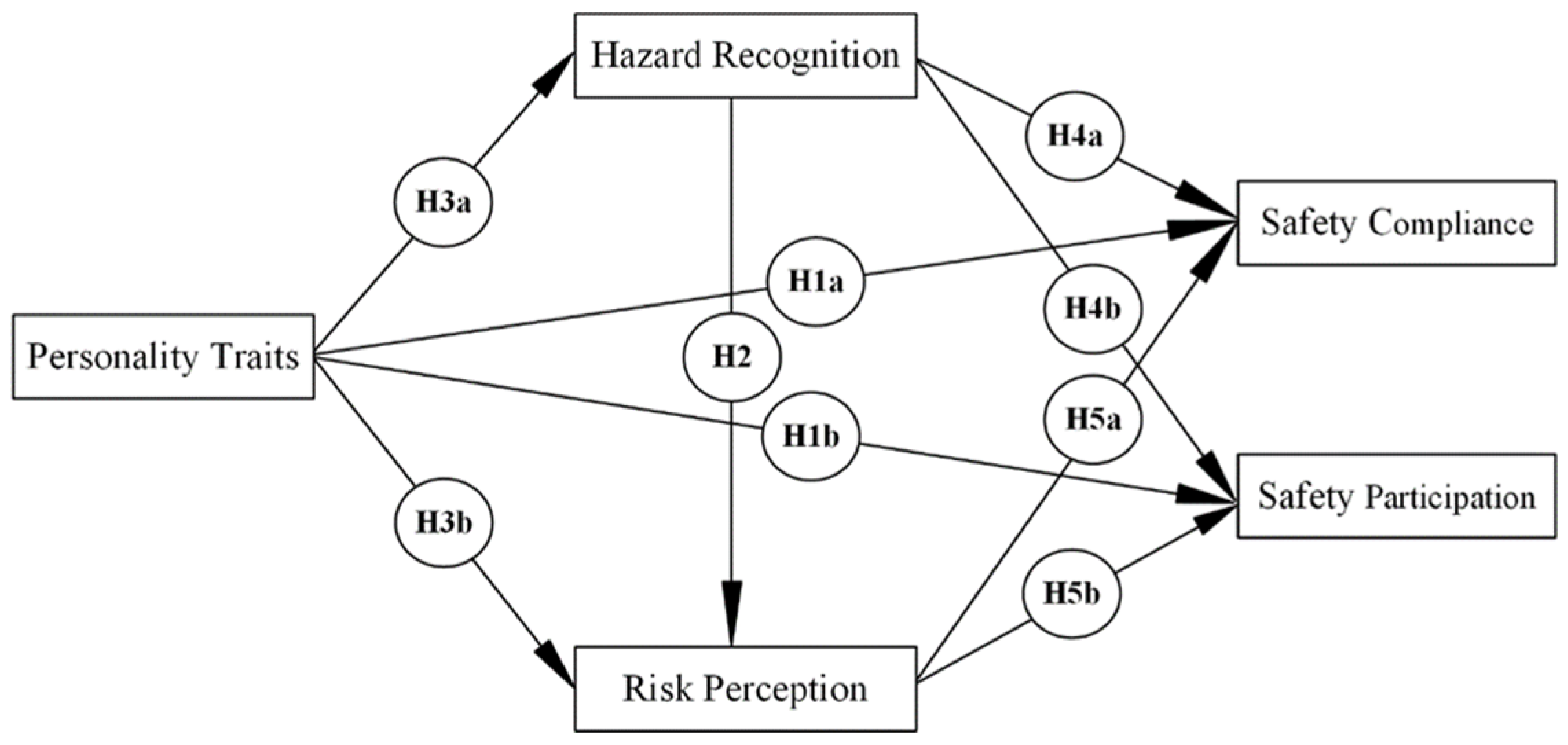
Extraversion, neuroticism, and openness negatively influence safety compliance (H1a) and safety participation (H1b), whereas agreeableness and conscientiousness have positive effects.

2.3. Hazard Recognition and Risk Perception

Hazard recognition refers to individuals’ capacity to detect potential hazards in the work environment, whereas risk perception involves individuals’ intuitive judgments about identified hazards [30,31]. Although closely linked, hazard recognition emphasizes early information gathering and analysis, whereas risk perception reflects workers’ contextual interpretation and intuitive response based on identified hazards. In the construction environment, effective hazard recognition provides essential hazard information, enabling workers to better understand hazards and uncertainties inherent in their tasks, thereby facilitating more accurate risk assessments [19,32]. Together, hazard recognition and risk perception form core components of risk cognition, offering essential cognitive support for effective risk management. Accordingly, we formulated the following hypothesis:
H2. 
Hazard recognition has a positive influence on risk perception.
Personality traits are critical factors influencing how individuals process risk information, affecting both hazard recognition and risk perception. Highly extraverted workers, driven by their preference for social interaction and stimulation, tend to overlook potential hazards and show greater tolerance for known hazards, leading to weaker hazard recognition and risk perception [18,33]. Workers high in agreeableness, characterized by altruism and cooperative, pay more attention to hazards threatening others and objectively assess risk, demonstrating better hazard recognition and risk perception abilities [33,34]. Conscientious workers, marked by responsibility and carefulness, often take initiative in recognizing hazards and rationally assessing consequences, enhancing their hazard recognition and risk perception [18,33]. In contrast, those high in neuroticism tend to experience anxiety that distracts attention and impairs focus on key risk cues for effectively evaluating the consequences and uncertainties of risk, weakening their hazard recognition and risk perception [35]. Workers high in openness, driven by curiosity and preference for variety, experience a greater cognitive load when processing complex risk information and tend to underestimate risk consequences, negatively affecting their hazard recognition and risk perception [36,37]. Accordingly, we hypothesized as follows:
H3. 
Extraversion, neuroticism, and openness negatively influence hazard recognition (H3a) and risk perception (H3b), whereas agreeableness and conscientiousness have positive effects.
Hazard recognition and risk perception are key cognitive processes that underpin and facilitate the development of safety behavior [38]. Accurate hazard recognition enables workers to promptly engage in prescribed or proactive risk-avoidance actions, whereas heightened risk perception improves the precision of protective behavior and effectiveness of active participation in safety management [39]. Conversely, deficiencies or biases in hazard identification and risk perception are regarded as major cognitive barriers that impede the development of safety behavior [16]. When workers fail to effectively recognize or perceive risk, they typically struggle to implement timely and appropriate safety interventions [40,41]. Similarly, poor risk perception can weaken compliance with safety protocols and willingness to participate in safety activities. Accordingly, we hypothesized as follows:
H4. 
Hazard recognition has positive effects on both safety compliance (H4a) and safety participation (H4b).
H5. 
Risk perception has positive effects on both safety compliance (H5a) and safety participation (H5b).
Personality traits also significantly influence two critical cognitive processes: hazard recognition and risk perception [12,18,33]. Both are acknowledged as critical cognitive antecedents of safety behavior [14] and may serve as mediating mechanisms through which personality traits affect safety performances. However, the specific mechanisms and pathways underlying these mediating effects remain underexplored and insufficiently understood. Therefore, we hypothesized as follows:
H6. 
Extraversion, neuroticism, and openness negatively influence safety compliance (H6a) and safety participation (H6b) through hazard recognition, whereas agreeableness and conscientiousness have positive effects via the same pathway.
H7. 
Extraversion, neuroticism, and openness negatively influence safety compliance (H7a) and safety participation (H7b) through risk perception, whereas agreeableness and conscientiousness positively influence both via this mediator.
H8. 
Extraversion, neuroticism, and openness negatively influence safety compliance (H8a) and safety participation (H8b) through a chain of mediators of hazard recognition and risk perception, whereas agreeableness and conscientiousness exert positive effects through this dual pathway.
Based on the preceding literature review and proposed hypothesis, this study developed a theoretical model that could systematically illustrate the underlying mechanisms linking personality traits, hazard recognition, risk perception, and safety behavior, as shown in Figure 1.

3. Research Methods

3.1. Procedures

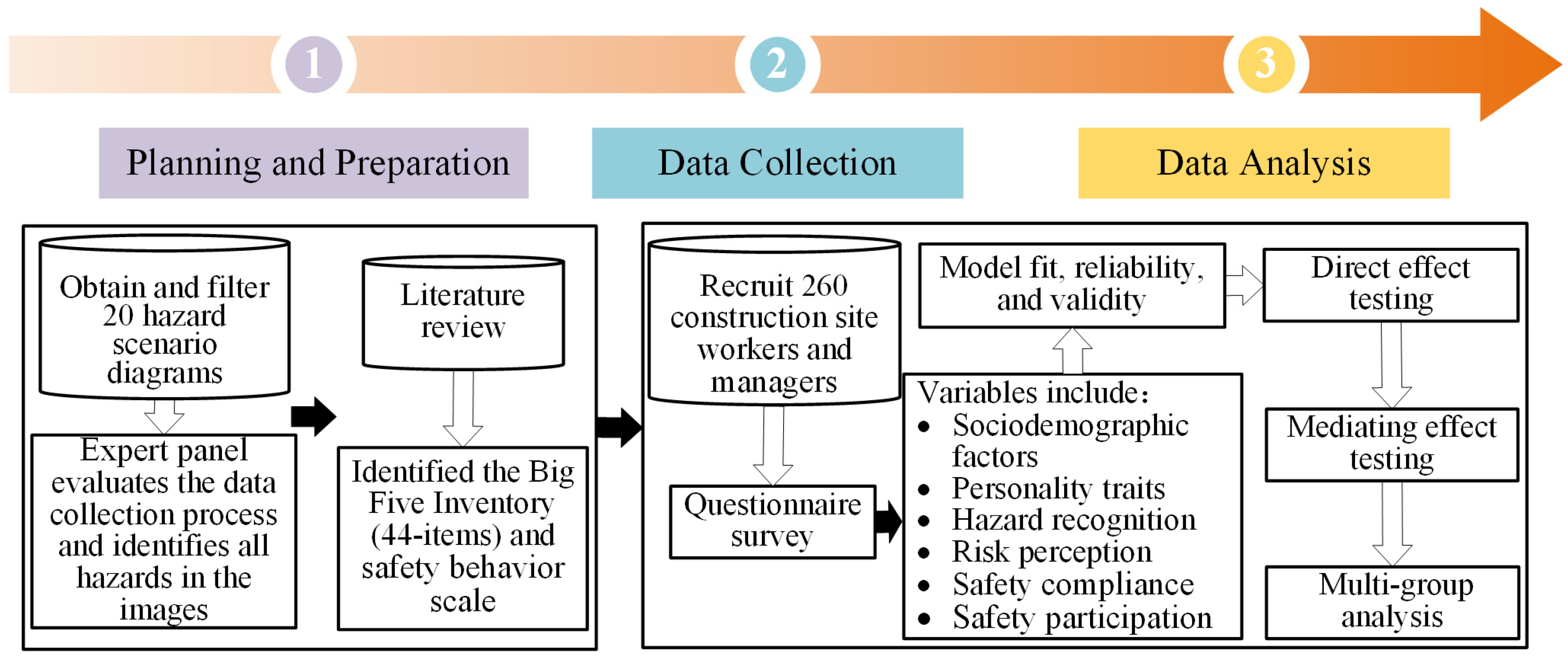
This study followed a three-phase process: planning and preparation, data collection, and data analysis (Figure 2). In the first phase, measurement approaches for each variable were identified. Given their advantages in standardization and quantitative analysis, questionnaires were used to collect data on participants’ personality traits and safety behavior. In addition, to enhance the objectivity and situational realism of hazard recognition and risk perception assessment, a scenario-based evaluation method was conducted using images of representative construction site scenarios.

3.2. Measurements

Personality traits were measured using the Big Five Inventory, a widely validated instrument developed from the Big Five Personality Traits [12,36]. To balance measurement efficiency and contextual applicability, this study employed the 44-item version of the Big Five Inventory, with extraversion, agreeableness, conscientiousness, neuroticism, and openness assessed using 8, 9, 9, 8, and 10 items, respectively [12]. Participants responded to each item on a five-point Likert scale from strong disagreement (1) to strong agreement (5). To reduce potential social desirability bias, the scale incorporated 16 reverse-coded items. Scores for the five personality dimensions were computed by aggregating responses from both standard and reverse-coded items.
To mitigate potential social desirability bias, the safety behavior scale in this study was revised based on the classical instrument developed by Neal and Griffin (2006) [26] and supplemented with items from Gao et al. (2020) [12] Two additional reverse-coded items, “I don’t follow safety rules that I consider unnecessary” and “I don’t report safety issues that I observe to my supervisor,” were incorporated to enhance the authenticity and validity of the measurements. The final safety behavior scale consisted of eight items, with safety compliance and safety participation both assessed using four items each. Participants responded using a five-point Likert scale from strong disagreement (1) to strong agreement (5). Dimension-specific scores were computed by aggregating responses from both standard and reverse-coded items.
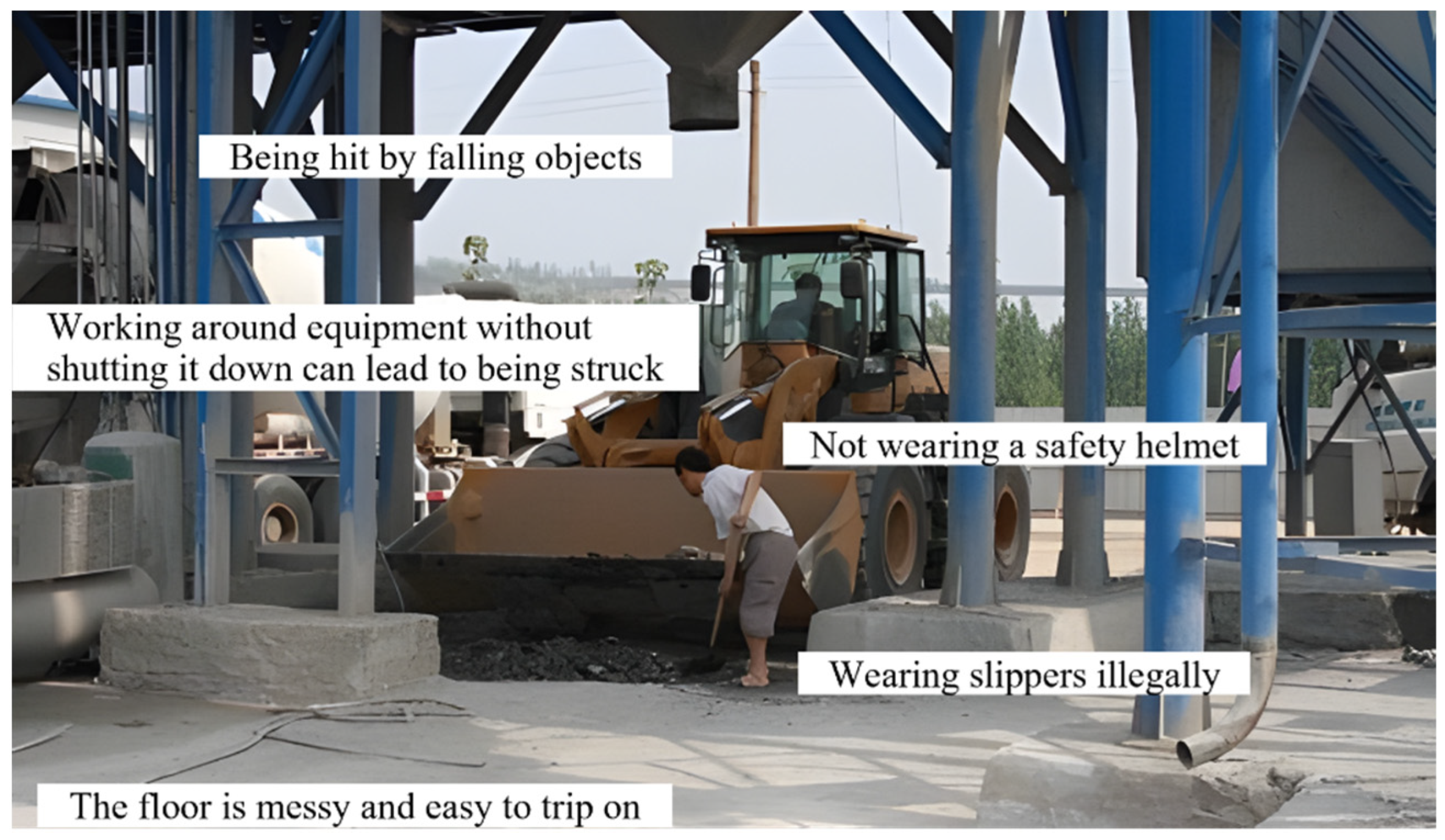
To assess participants’ hazard recognition ability, this study employed 20 representative construction images depicting a variety of typical accident types and risk scenarios, including falls from heights, struck-by objects, collapses, lifting injuries, mechanical injuries, electrocution, and compound hazards [42,43]. Before the assessment, an expert panel of seven members conducted group discussions to identify all hazards in each image (e.g., Figure 3). To reduce potential bias owing to task familiarity, the images were randomly divided into two equal sets based on hazard type. Participants were randomly assigned to one set and then instructed to independently identify all hazards within each image. The results showed that participants did not recognize any additional hazards beyond those identified by the expert panel. Each participant’s hazard recognition performance was calculated using Equation (1).
H R p a r t i c i p a n t i = j = 1 10 H R i j j = 1 10 H R j
where HRparticipanti = hazard recognition performance for participanti; HRij = number of hazards recognized by participanti in imagej; HRj = number of hazards recognized by the expert panel in imagej.
Following the hazard recognition assessment, participants’ risk perception was measured using the same set of construction images [44]. Participants were required to comprehend the definitions of the five injury outcomes listed in Table 1. They were then asked to assess the potential injuries that could result from their assigned images, using the frequency and severity scores provided in Table 2. For instance, if a participant judged that a given image could result in three types of injury outcomes (with frequencies)—medical case (once per year), first aid (twice per month), and discomfort/pain (three times per week)—the risk perception score would be calculated as: 6.40 × 10⁻² + 0.27 × 2 + 0.19 × 3 = 1.174. Subsequently, the score was standardized using Equation (2). The participant’s average standardized risk perception score across all assigned images was computed using Equation (3) to represent their level of risk perception.
S R P i j = R P i j R P j ¯ σ j
S R P i = j = 1 10 SRP i j 10
where SRPij = standardized risk perception of participanti for imagej; RPij = risk perception of participanti for imagej; R P j ¯ = average of risk perception for imagej; σj = standard deviation of risk perception for imagej; SRPi = average of standardized risk perception of participanti.

3.3. Participants

Before data collection, permission was obtained from managers of 10 highway construction projects in the Guangxi Zhuang Autonomous Region, China. To ensure clarity of measurement, a pilot study was conducted. The expert panel comprising seven experienced frontline managers and workers was invited to review the measurement content. Revisions were then made based on their feedback. Formal data collection took place between March and May 2023. To reduce potential reporting bias, participants were informed that the researchers were independent of project management. The participants were also assured that their data would remain anonymous and be used only for academic research. A total of 260 managers and workers participated in the study. After excluding responses with missing data or showing patterned or invalid responses, 213 valid responses were retained (effective response rate = 81.92%). Table 3 presents the participants’ demographic characteristics.

3.4. Data Analysis

Given the advantages of structural equation modeling (SEM) in simultaneously analyzing multiple variables and examining direct and indirect effects, this study employed SPSS 26 and AMOS 26 for SEM analysis [45]. The analysis was carried out in three stages: measurement model validation, structural model testing, and multi-group SEM analysis. First, to evaluate the internal consistency reliability of each construct, Cronbach’s alpha was used [46]. Confirmatory factor analysis (CFA) was conducted to test the measurement model and assess the constructs’ reliability and validity. The fit of the measurement model was evaluated using five indices: chi-squared/degrees of freedom ratio (χ2/df), comparative fit index (CFI), Tucker–Lewis index (TLI), root mean square error of approximation (RMSEA), and standardized root mean square residual (SRMR) [47]. Convergent validity was assessed based on standardized factor loadings (SFLs), composite reliability (CR), and average variance extracted (AVE). Discriminant validity was examined by comparing the square root of each construct’s AVE with its correlations with other constructs. Second, the structural model was estimated to examine the direct effects among constructs, with indirect effects tested via the bootstrap method [48]. Third, multi-group SEM analysis was utilized to explore whether the hypothesized paths differed significantly across demographic subgroups [20].

4. Results

4.1. Reliability and Validity Testing

The measurement model was evaluated in terms of reliability and validity. Cronbach’s alpha values in Table 4 ranged from 0.859 to 0.934, with all values above the recommended value of 0.70, indicating satisfactory internal consistency across all constructs [49]. Convergent validity was supported by multiple indicators. All SFLs ranged from 0.700 to 0.854, meeting the recommended value of 0.70. In addition, the AVE values for all constructs exceeded the suggested threshold of 0.50, and CR values were above 0.70 (Table 4), providing evidence of acceptable convergent validity [49,50]. Discriminant validity was also established, as evidenced by the square root of each construct’s AVE being larger than the associated inter-construct correlations, as presented in Table 4. Furthermore, the CFA results (Table 5) indicated an acceptable measurement model fit [50]. As show, all five commonly reported fit indices met recommended criteria: the χ2/df ratio (χ2/df = 1.066) was well below 3.0, the RMSEA value (RMSEA = 0.018) was below 0.06, both incremental fit indices (CFI = 0.987; TLI = 0.986) exceeded the recommended threshold of 0.90, and the SRMR value (SRMR = 0.045) remained below 0.08 [50]. Collectively, these results demonstrate that the measurement model exhibits satisfactory reliability and validity, supporting its suitability for subsequent SEM analyses.
Cronbach’s alpha values in Table 4 ranged from 0.859 to 0.934, which all exceed the recommended value of 0.70, indicating satisfactory internal consistency across all constructs [49]. All fit indices from the CFA met the recommended values (Table 5), indicating an acceptable measurement model fit [50]. All constructs had SFLs ranging from 0.7 to 0.854. Their AVE exceeded the suggested value of 0.50, and CR values were above 0.70 (Table 4), demonstrating acceptable convergent validity [49,50]. Furthermore, the square root of each construct’s AVE shown in Table 4 exceeded the corresponding inter-construct correlations, supporting discriminant validity. Collectively, these results confirmed that the measurement model demonstrated satisfactory reliability and validity, supporting its suitability for SEM analysis.

4.2. Hypothesis Testing

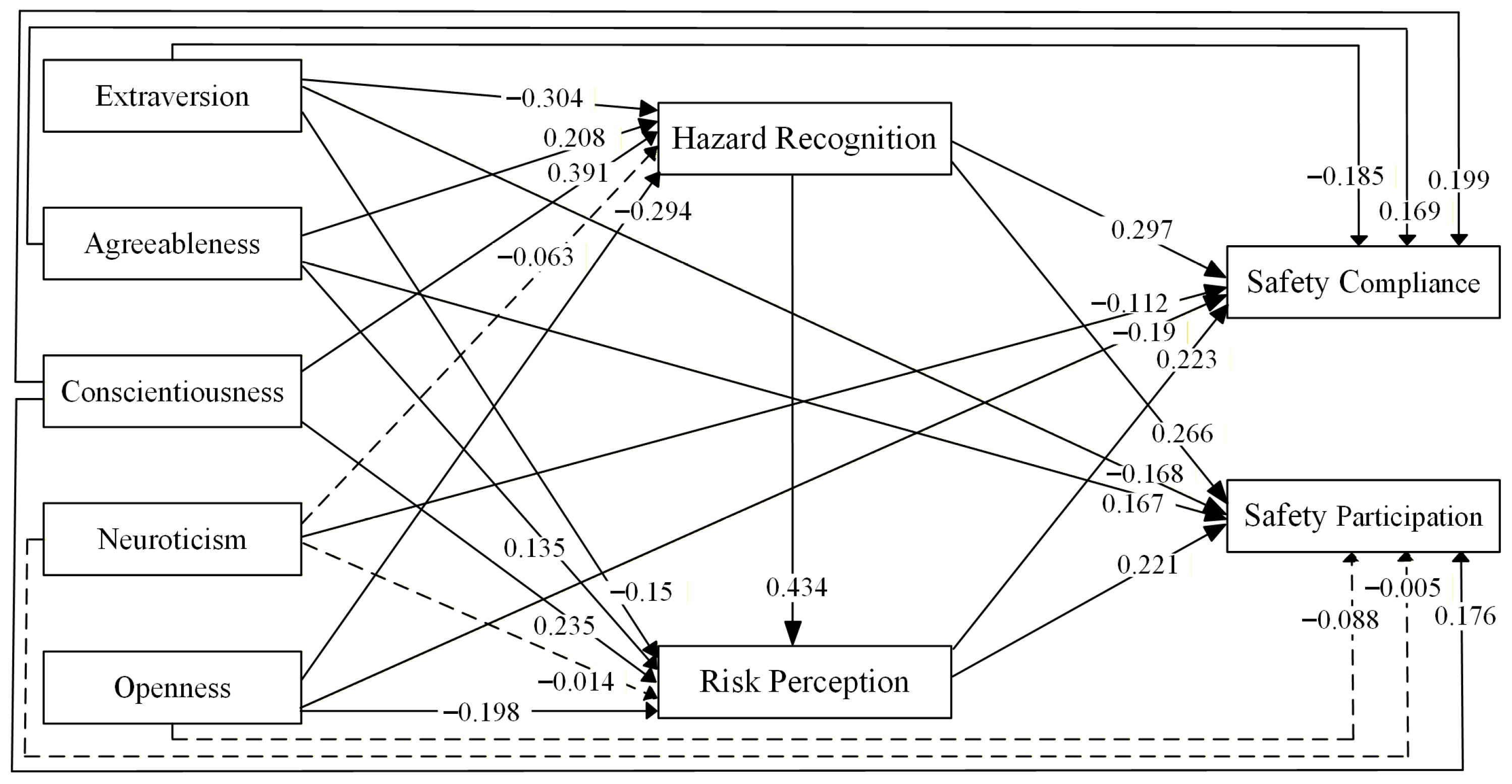
Based on the validated measurement model, SEM was employed to test the research hypotheses. The structural model presented a satisfactory fit. As reported in Table 5, all five commonly reported fit indices met the recommended criteria: the χ2/df ratio (χ2/df = 1.066) was well below 5.0, the RMSEA value (RMSEA = 0.018) was below 0.08, both incremental fit indices (CFI = 0.987; TLI = 0.986) exceeded the recommended threshold of 0.90, and the SRMR value (SRMR = 0.045) remained below 0.08. Taken together, these indices provide consistent evidence that the pro-posed structural model fits the data well [50]. The hypothesis tests for direct effects (Figure 4) indicated that the path coefficients from neuroticism and openness to safety participation, as well as from neuroticism to hazard recognition and risk perception, did not reach statistical significance (p > 0.05). In contrast, the estimated coefficients for all other hypothesized paths were statistically significant (p < 0.05). Overall, Hypotheses 1b, H3a, and H3b were partially supported, whereas all other hypotheses were fully supported. Specifically, extraversion was negatively associated with hazard recognition, risk perception, safety compliance, and safety participation. In contrast, the same four variables were positively influenced by agreeableness and conscientiousness. Neuroticism showed a negative association with only safety compliance, whereas openness had negative effects on hazard recognition, risk perception, and safety compliance. In addition, hazard recognition showed a positive correlation with risk perception, both of which were positively linked to safety compliance and safety participation.
As presented in Table 6, the indirect effects of neuroticism on safety compliance and safety participation, whether operating through a single mediator or through a sequential mediation pathway involving hazard recognition and risk perception, had 95% bootstrap confidence intervals that included zero, indicating non-significant effects. In contrast, the 95% bootstrap confidence intervals for all other hypothesized in-direct effects did not include zero, indicating significant mediation. Specifically, extraversion and openness exerted negative indirect effects on safety compliance and safety participation through single or sequential pathways involving hazard recognition and risk perception. Conversely, agreeableness and conscientiousness demonstrated positive indirect effects on both types of safety behavior through the same mediating pathways. In addition, the structural model explained a substantial proportion of variance in the safety outcomes, accounting for 62% of the variance in safety compliance and 47% in safety participation.

4.3. Multi-Group Analysis

Multi-group analyses were employed to investigate whether sociodemographic variables influenced the hypothesized relations. Among the variables tested, only education level and working experience produced significant between-group differences in the structural paths. Prior to invariance testing, single-group SEM models were estimated for each subgroup. As reported in Table 7, all subgroup models demonstrated acceptable fit, with χ2/df values close to 1 and RMSEA values consistently below the commonly recommended threshold of 0.08. Although some CFI values were modest, this pattern is not uncommon in complex SEMs with limited subgroup sample sizes [51,52], and similar levels of model fit have been re-ported in prior construction safety research [39]. To formally assess group differences and ensure estimation robustness, a series of nested multi-group models were subsequently compared, including an unconstrained model (M1), a measurement weight–constrained model (M2), and a structural weight–constrained model (M3) [53,54]. Measurement invariance was supported, whereas significant chi-square differences emerged when structural paths were constrained, indicating that education level and working experience moderated specific relationships in the proposed model (Table 7). Importantly, examination of the subgroup-specific parameter estimates further indicated that key structural paths remained directionally consistent and statistically significant across groups, with no sign reversals observed. Although the magnitude of certain coefficients varied between subgroups, the overall pattern of results was stable, suggesting that the observed group differences reflect substantive moderation effects rather than instability in parameter estimation due to limited subgroup sample sizes.
Participants were categorized into two groups based on education level: middle school or below (n = 108) and high school or above (n = 105). The comparison between the unconstrained model (M1) and the structural weight–constrained model (M3) revealed a significant chi-square difference (p < 0.05), indicating that education level moderated one or more structural relationships (Table 7). The specific paths exhibiting significant between-group differences are presented in Table 8. Substantively, higher education strengthened the positive association between hazard recognition and risk perception, while attenuating the negative effects of extraversion and openness on hazard recognition, as well as the negative effect of open-ness on risk perception. In contrast, the effect of conscientiousness on hazard recognition remained invariant across education groups, suggesting a stable relationship regardless of educational background.
Next, participants were categorized into two groups based on work experience: six years or less (n = 123) and more than six years (n = 90). The comparison between the unconstrained model (M1) and the structural weight–constrained model (M3) revealed a significant chi-square difference (p < 0.001), indicating that working experience moderated one or more structural relationships (Table 7). The specific paths demonstrating significant between-group differences are summarized in Table 9. Substantively, greater work experience amplified the negative effects of extraversion on both hazard recognition and safety compliance, as well as weakened the positive association between hazard recognition and risk perception. Conversely, it strengthened the positive effects of agreeableness on safety compliance, conscientiousness and hazard recognition on safety participation, and attenuated the negative effects of openness on both hazard recognition and risk perception. Similarly to the education-based analysis, the effect of conscientiousness on hazard recognition remained invariant across experience groups, indicating a stable and robust relationship.

5. Discussion

5.1. Comparison of Findings with Prior Studies

Systematic comparison with prior studies allows for both the identification of convergent evidence and a more precise interpretation of divergent findings, particularly those arising from differences in risk context, measurement design, and organizational conditions. Such comparison helps to clarify how and under what conditions personality traits are translated into risk cognition and safety behavior, and provides a clearer basis for interpreting the theoretical and practical implications of the proposed personality–cognition–behavior framework.
Consistent with prior meta-analytic and empirical evidence, the influence of personality traits on safety behavior in this study largely aligns with findings reported by Beus et al. (2015) [9] and Gao et al. (2020) [12]. However, partial divergence is observed when compared with Xia et al. (2021) [13]. Specifically, this study identified negative effects of extraversion, neuroticism, and openness on safety compliance, as well as a negative influence of extraversion on safety participation, while agreeableness positively influenced both outcomes. Such discrepancies may be attributed to contextual factors, including specific risk environments and organizational climate, which can differentially activate personality-driven responses. In this study, risk perception was assessed using images depicting typical high-risk scenarios at construction sites as situational stimuli, immersing individuals in contexts characterized by both salient threat cues and strong normative constraints. Within such settings, these situational signals selectively activate the core motivational mechanisms associated with different personality traits. For example, high-risk settings may elicit sensation-seeking in extraverts, anxiety in neurotic individuals, altruistic tendencies in agreeable workers, and curiosity in those high in openness [55]. Likewise, a strict safety climate—such as one enforcing disciplinary measures for non-compliance with protective equipment—may reinforce norm adherence among agreeable individuals but provoke resistance in workers high in openness [40]. These findings indicate that personality traits influence safety behavior through context-sensitive activation mechanisms, whereby specific risk environments and normative conditions shape the expression of personality-driven tendencies.
With respect to risk cognition, the present findings reveal a differentiated pattern of personality effects on hazard recognition and risk perception that both extends and refines prior research. Consistent with Hasanzadeh et al. (2019) [33] and Wang et al. (2016) [18], agreeableness was found to promote hazard recognition, whereas openness exerted a negative influence on risk perception. These effects may reflect the interaction between personality traits and contextual cues: a positive organizational climate may heighten risk awareness among agreeable individuals, while information-rich or ambiguous environments may encourage individuals high in openness to reinterpret risk from novel perspectives, thereby attenuating perceived risk [33,55].
In contrast, neuroticism does not exhibit significant effects on either hazard recognition or risk perception. This finding suggests that the influence of neuroticism is less likely to operate through the acquisition and cognitive processing of risk-related information, and may instead manifest primarily in reactions and decision-making processes under stress. This interpretation is consistent with prior studies by Hasanzadeh et al. (2019) [33], Hasanzadeh et al. (2018) [56], and Wang et al. (2016) [18], all of which reported non-significant effects of neuroticism on hazard recognition or risk perception. In addition, Doerr (2020) [57] found that neuroticism is negatively associated with safety motivation, and Barańczuk (2021) [58] reported a stable negative relationship between neuroticism and self-efficacy. Together, these findings indicate that the effects of neuroticism on safety behavior are more likely to operate through affective reactivity and stress-related decision-making mechanisms, rather than through systematic risk cognition pathways.

5.2. Theoretical Implications

This study provides robust theoretical support for the role of personality traits as foundational psychological determinants of safety behavior in construction contexts. By demonstrating distinct and non-uniform effects of the Big Five traits on safety compliance and safety participation, the findings move beyond a generalized “personality–safety” as-sociation and highlight trait-specific behavioral pathways. In particular, conscientiousness and agreeableness consistently promote both forms of safety behavior, whereas extraversion exerts a suppressing effect, and neuroticism and openness selectively undermine safety compliance. Theoretically, these results reinforce a shift in construction safety research from an exclusive emphasis on external control and enforcement mechanisms toward a more nuanced understanding of internal dispositional drivers. Safety behavior is thus conceptualized not merely as a response to rules and supervision, but as an outcome of stable psychological tendencies that shape how individuals approach risk and responsibility in hazardous work environments.
Beyond behavioral outcomes, this study advances theory by clarifying the role of personality traits in shaping risk cognition, specifically hazard recognition and risk perception. The findings indicate that agreeableness and conscientiousness enhance individuals’ capacity to detect hazards and to appraise risk more accurately, whereas extraversion and openness are associated with attenuated hazard recognition or reduced perceived risk. In contrast, neuroticism does not exhibit significant effects on either hazard recognition or risk perception. These findings suggest that personality traits systematically influence how workers attend to, interpret, and cognitively process hazard-related information, rather than exerting direct effects on behavior alone. From a theoretical perspective, risk cognition emerges as a critical cognitive interface through which personality traits are translated into safety-relevant action. This conceptualization positions hazard recognition and risk perception as core cognitive ex-pressions of individual differences, providing an essential foundation for under-standing variability in safety-related decision-making and behavior.
Furthermore, the findings demonstrate that hazard recognition and risk perception positively influence both safety compliance and participation, underscoring their pivotal role within the cognitive framework of safety behavior. Hazard recognition constitutes the initial detection of risk cues, while risk perception involves a subjective evaluation that integrates rational judgment with affective responses. Together, they form a cognitive sequence enabling individuals to respond effectively to workplace hazards and constitute critical psychological prerequisites for normative and proactive safety behavior. Elevated risk perception increases awareness of potential consequences and responsibility, motivating consistent compliance and participation. Thus, hazard recognition and risk perception not only form the cognitive basis of safety behavior but also reflect the internalization of safety values, providing essential theoretical anchors for understanding the motivation and regulation of safety behavior.
This study also clarifies how specific personality traits influence safety behavior through hazard recognition and risk perception, offering deeper insight into the development of safety behavior in construction. Specifically, agreeableness and conscientiousness enhance safety compliance and safety participation via hazard recognition and risk perception, either independently or sequentially, whereas extraversion and openness negatively affect safety behavior through these pathways. In contrast, indirect effects associated with neuroticism are not support within the proposed framework. These findings indicate that personality traits shape safety behavior by influencing how workers attend to, interpret, and cognitively process hazard-related in-formation, rather than exerting uniform effects across all personality trait dimensions. By identifying hazard recognition and risk perception as cognitive mediators linking specific personality traits to safety behavior, this study extends prior research that has largely examined personality traits or risk cognition in isolation [12,16,18,33] and offers a systematic theoretical framework for understanding safety behavior in construction. Overall, the results provide a foundation for future theoretical refinement and the development of cognition-based interventions in construction safety.
Finally, this study reveals that education level and work experience moderate the effects of personality traits on safety behavior through risk cognition in a selective rather than uniform manner, thereby enriching the theoretical understanding of individual differences in construction safety. Specifically, higher educational attainment primarily enhances the translation of hazard-related information into risk appraisal, strengthening the cognitive link between hazard recognition and risk perception, while mitigating certain dispositional constraints in early-stage cognitive processing. In contrast, work experience exhibits more multifaceted and sometimes countervailing in-fluences across personality-driven cognitive pathways. While accumulated experience may attenuate some negative dispositional tendencies in hazard processing [20], it can also reinforce familiarity-driven biases that dampen risk sensitivity, indicating that its moderating role is not uniform across cognitive pathways [20,59,60]. Together, these findings suggest that background characteristics shape safety-related cognition by selectively influencing specific cognitive translations rather than altering the fundamental structure of the personality–cognition–behavior framework.

5.3. Practical Implications

Drawing on the study’s findings, several forward-looking and targeted safety interventions are proposed to enhance safety behavior on construction sites. First, organizations are encouraged to integrate standardized personality assessments into recruitment and workforce management as a proactive tool. Currently, many companies assign workers based on their trade categories without considering personality traits in task or role assignments. Future strategies should integrate personality traits with task characteristics and associated risk levels to optimize job assignments. For instance, high-risk tasks could be allocated to individuals with higher conscientiousness; roles requiring teamwork to those high in agreeableness; and innovation-oriented positions to workers with greater openness [61,62]. Such personalized allocation can improve person–job fit and promote safer behavior from the outset.
Second, considering the distinct risk cognition patterns associated with different personality traits, it is recommended to implement scenario-based, group-specific training using immersive technologies, such as augmented and virtual reality, to enhance proactive risk cognition among workers [63]. At present, safety training in the construction industry is predominantly delivered through centralized lectures, which often lack contextual realism and fail to account for individual cognitive differences [30]. As a result, workers may understand safety protocols in theory but remain ill-prepared to respond effectively to real-world hazards. Immersive technologies can replicate realistic construction scenarios-such as working in confined spaces, at heights, or near machinery-enabling workers to identify hazards and practice decision-making in dynamic settings. Scenario-based training that requires rapid responses under simulated high-risk conditions can produce differentiated outcomes depending on personality traits. For instance, highly extraverted workers may strengthen impulse control by experiencing the virtual consequences of risky decisions. Additionally, repeated exposure to varied risk scenarios may help disrupt ingrained work habits and reduce complacency, shifting hazard recognition from a reactive to a proactive cognitive process [64]. By tailoring training content and delivery methods to cognitive and personality traits, immersive scenario-based training offers a more effective approach for cultivating risk-sensitive, safety-oriented behavior on construction sites.
Finally, in light of the selective rather than uniform moderating effects of education level and work experience, a stratified approach to safety management is recommended rather than a one-size-fits-all intervention strategy. For experienced workers who may exhibit reduced risk sensitivity owing to familiarity, reinforcing risk re-education and scenario-based training can help maintain vigilance and prevent complacency. In contrast, workers with less experience and lower educational level should receive training focused on foundational safety knowledge and essential operational skills to strengthen their hazard response capabilities and overall safety performance. These differentiated interventions should be systematically implemented and periodically evaluated. Training content, delivery methods, and intensity should be dynamically adjusted to reflect workers’ evolving competencies, role transitions, and insights drawn from accident analyses. Such a responsive and differentiated strategy ensures that safety interventions remain precisely aligned with the unique and changing needs of diverse worker groups, thereby enhancing the overall effectiveness of construction site safety management.

5.4. Limitations and Future Research

Although this study advances understanding at both the theoretical and practical levels, several limitations should be acknowledged. First, this study relies on cross-sectional data, with all variables measured at a single point in time. Such a design primarily captures static associations among variables and limits the ability to characterize the temporal evolution of risk cognition and safety behavior, as well as their potential bidirectional feedback processes. Future research could adopt longitudinal designs to systematically track changes in relevant variables over time, thereby enabling a more accurate identification of temporal dynamics and lagged effects, and providing a more robust basis for the continuous optimization and adaptive adjustment of safety intervention strategies. Second, this study operationalized hazard recognition using an equal-weighted aggregation of different hazards. Although this approach is consistent with prior research, it does not explicitly account for differences in hazard severity, which may reduce measurement sensitivity and limit the precision of cognitive pathway estimation. Future studies could adopt severity-weighted or stratified measures of hazard recognition to better capture variations in risk salience and further refine the estimation of risk cognition processes. Third, this study focused on two cognitive factors, without ac-counting for other potentially influential psychological constructs, such as safety motivation and safety attitudes, that may also exert significant effects on safety behavior. Future studies could incorporate a broader range of psychological variables to achieve a more comprehensive understanding of the psychological mechanisms underlying construction safety behavior. Finally, the data were collected from construction projects in a single province in China, which may limit the generalizability of the findings across different risk levels, cultural contexts, or stages of economic development. Therefore, future work conducted in more diverse settings would help to enhance the generalizability of the conclusions.

6. Conclusions

Construction workers’ safety behavior is directly linked to on-site risk management, with the mechanisms underlying the behavior being crucial for transitioning safety management from reactive control to proactive, precise, and individualized interventions. However, existing research has largely relied on statistical associations of behavioral outcomes, which neither systematically reveal how personality traits influence safety behavior through cognitive processing nor explain how individual background differences translate into behavioral variation. To address this gap, this study adopts a cognitive processing perspective to construct and test a multi-stage model linking personality traits, hazard recognition, risk perception, and safety behavior. The model systematically delineates how stable personality traits influence safety behavior via plastic cognitive processes and examines the moderating effects of sociodemographic variables, providing both theoretical and practical insights.
The results indicate that (1) all personality trait dimensions exert significant effects on at least one type of safety behavior; (2) hazard recognition and risk perception were significantly influenced by extraversion, agreeableness, conscientiousness, and openness, and, in turn, significantly enhance workers’ safety compliance and participation; (3) extraversion and openness indirectly diminish safety behavior through single and sequential mediation pathways involving hazard recognition and risk perception, whereas agreeableness and conscientiousness indirectly promote safety behavior through the same pathways; (4) education level positively moderates certain model paths, whereas work experience exhibits both facilitating and inhibiting effects across different relations. These findings demonstrate that personality traits shape individual differences in safety behavior by influencing how risk information is identified, interpreted, and integrated. Moreover, group differences associated with education and work experience significantly modify these cognitive processes, amplifying or attenuating their effects on safety behavior. On this basis, the study distinguishes between two mechanisms underlying the formation of safety behavior: one driven primarily by relatively stable personality traits and characterized by persistent behavioral tendencies, and the other operating through risk cognition processes and exhibiting greater potential for targeted intervention.
At the practical level, this distinction between trait-driven and cognition-driven mechanisms provides a clear framework for safety management. On the one hand, aligning workers’ personality traits with job-specific risk characteristics can improve person–job fit. On the other hand, safety interventions can be designed around the key cognitive pathways of hazard recognition and risk perception, through proactive, personality-informed risk cognition training, combined with stratified management strategies tailored to workers’ educational backgrounds and levels of work experience. Such targeted approaches are likely to enhance construction workers’ capacity to respond to risk and, overall, to improve safety behavior performance on construction sites.

Author Contributions

Writing—original draft preparation, formal analysis, validation, J.S.; conceptualization, supervision, writing—review and editing, F.C.; supervision, resources, software, Z.Z.; writing—review and editing, investigation, formal analysis, S.-S.M. All authors have read and agreed to the published version of the manuscript.

Funding

This research was supported by the Hunan Provincial Natural Science Foundation of China, grant number 2023JJ40719.

Institutional Review Board Statement

The study was conducted in accordance with the Declaration of Helsinki, and approved by School of Resources and Safety Engineering, Central South University (NIL 23 February 2023).

Informed Consent Statement

Informed consent was obtained from all subjects involved in the study.

Data Availability Statement

The raw data supporting the conclusions of this article will be made available by the authors on request.

Acknowledgments

The authors thank all the respondents who answered the questionnaire. The authors would also like to express their gratitude to the editor and anonymous reviewers of this paper for their work and contributions.

Conflicts of Interest

The authors declare no conflicts of interest.

References

  1. Xu, J.; Cheung, C.; Manu, P.; Ejohwomu, O.; Too, J. Implementing safety leading indicators in construction: Toward a proactive approach to safety management. Saf. Sci. 2023, 157, 105929. [Google Scholar] [CrossRef]
  2. U.S. Bureau of Labor Statistics. National Census of Fatal Occupational Injuries in 2021; CFOI Reports; U.S. Department of Labor: Washington, DC, USA, 2022.
  3. U.S. Bureau of Labor Statistics. National Census of Fatal Occupational Injuries in 2022; CFOI Reports; U.S. Department of Labor: Washington, DC, USA, 2023.
  4. Ministry of Emergency Management of the People’s Republic of China. China’s Emergency Management Work Safety Yearbook 2022; Emergency Management Press: Beijing, China, 2023. [Google Scholar]
  5. Man, S.; Chan, A.H.; Wong, H. Risk-taking behaviors of Hong Kong construction workers—A thematic study. Saf. Sci. 2017, 98, 25–36. [Google Scholar] [CrossRef]
  6. Yang, J.; Ye, G.; Xiang, Q.; Kim, M.; Liu, Q.; Yue, H. Insights into the mechanism of construction workers’ unsafe behaviors from an individual perspective. Saf. Sci. 2021, 133, 105004. [Google Scholar] [CrossRef]
  7. Zhang, Z.; Li, H.; Guo, H.; Wu, Y.; Luo, Z. Causal inference of construction safety management measures towards workers’ safety behaviors: A multidimensional perspective. Saf. Sci. 2024, 172, 106432. [Google Scholar] [CrossRef]
  8. Golabchi, H.; Pereira, E.; Lefsrud, L.; Mohamed, Y. Proposal of a safety maturity framework in construction: Implementing leading indicators for proactive safety management. J. Saf. Sustain. 2025, 2, 207–221. [Google Scholar] [CrossRef]
  9. Beus, J.M.; Dhanani, L.Y.; Mccord, M.A. A Meta-Analysis of Personality and Workplace Safety: Addressing Unanswered Questions. J. Appl. Psychol. 2015, 100, 481–498. [Google Scholar] [CrossRef]
  10. Tong, R.; Wang, X.; Wang, L.; Hu, X. A dual perspective on work stress and its effect on unsafe behaviors: The mediating role of fatigue and the moderating role of safety climate. Process Saf. Environ. Prot. 2022, 165, 929–940. [Google Scholar] [CrossRef]
  11. Postlethwaite, B.; Robbins, S.; Rickerson, J.; McKinniss, T. The moderation of conscientiousness by cognitive ability when predicting workplace safety behavior. Personal. Individ. Differ. 2009, 47, 711–716. [Google Scholar] [CrossRef]
  12. Gao, Y.; González, V.A.; Yiu, T.W. Exploring the relationship between construction workers’ personality traits and safety behavior. J. Constr. Eng. Manag. 2020, 146, 04019111. [Google Scholar] [CrossRef]
  13. Xia, N.; Tang, Y.; Li, D.; Pan, A. Safety Behavior among Construction Workers: Influences of Personality and Leadership. J. Constr. Eng. Manag. 2021, 147, 04021019. [Google Scholar] [CrossRef]
  14. Fang, D.; Zhao, C.; Zhang, M. A cognitive model of construction workers’ unsafe behaviors. J. Constr. Eng. Manag. 2016, 142, 04016039. [Google Scholar] [CrossRef]
  15. Choudhry, R.M.; Fang, D. Why operatives engage in unsafe work behavior: Investigating factors on construction sites. Saf. Sci. 2008, 46, 566–584. [Google Scholar] [CrossRef]
  16. Xiang, Q.; Liu, Y.; Goh, Y.M.; Ye, G.; Safiena, S. Investigating the Impact of Hazard Perception Failure on Construction Workers’ Unsafe Behavior: An Eye-Tracking and Thinking-Aloud Approach. J. Constr. Eng. Manag. 2024, 150, 04024066. [Google Scholar] [CrossRef]
  17. Hasanzadeh, S.; Esmaeili, B.; Dodd, M.D. Impact of construction workers’ hazard identification skills on their visual attention. J. Constr. Eng. Manag. 2017, 143, 04017070. [Google Scholar] [CrossRef]
  18. Wang, C.M.; Xu, B.B.; Zhang, S.J.; Chen, Y.Q. Influence of personality and risk propensity on risk perception of Chinese construction project managers. J. Proj. Manag. 2016, 34, 1294–1304. [Google Scholar] [CrossRef]
  19. Xia, N.; Wang, X.; Griffin, M.A.; Wu, C.; Liu, B. Do we see how they perceive risk? An integrated analysis of risk perception and its effect on workplace safety behavior. Accid. Anal. Prev. 2017, 106, 234–242. [Google Scholar] [CrossRef]
  20. Deng, S.; Zhu, H.; Cai, Y.; Pan, Y. Group cognitive characteristics of construction Workers ‘ unsafe behaviors from personalized management. Saf. Sci. 2024, 175, 106492. [Google Scholar] [CrossRef]
  21. Guo, S.; Zheng, X.-Y. New evidence of trends in cognitive function among middle-aged and older adults in China, 2011–2018: An age-period-cohort analysis. BMC Geriatr. 2023, 23, 498. [Google Scholar] [CrossRef]
  22. Costa, P.T., Jr.; Mccrae, R.R. Revised NEO Personality Inventory and NEO Five-Factor Inventory: Professional Manual; Psychological Assessment Resources: Lutz, FL, USA, 1992. [Google Scholar]
  23. Hu, Z.; Chan Weng, T.; Hu, H. Personalized Construction Safety Interventions Considering Cognitive-Related Factors. J. Constr. Eng. Manag. 2023, 149, 04023137. [Google Scholar] [CrossRef]
  24. John, O.P.; Srivastava, S. The Big Five Trait taxonomy: History, measurement, and theoretical perspectives. In Handbook of Personality: Theory and Research, 2nd ed.; Guilford Press: New York, NY, USA, 1999. [Google Scholar]
  25. Griffin, M.A.; Neal, A. Perceptions of safety at work: A framework for linking safety climate to safety performance, knowledge, and motivation. J. Occup. Health Psychol. 2000, 5, 347–358. [Google Scholar] [CrossRef]
  26. Neal, A.; Griffin, M.A. A study of the lagged relationships among safety climate, safety motivation, safety behavior, and accidents at the individual and group levels. J. Appl. Psychol. 2006, 91, 946–953. [Google Scholar] [CrossRef] [PubMed]
  27. Zhang, J.; Xiang, P.; Zhang, R.; Chen, D.; Ren, Y. Mediating Effect of Risk Propensity between Personality Traits and Unsafe Behavioral Intention of Construction Workers. J. Constr. Eng. Manag. 2020, 146, 04020023. [Google Scholar] [CrossRef]
  28. Lauriola, M.; Levin, I.P. Personality traits and risky decision-making in a controlled experimental task: An exploratory study. Personal. Individ. Differ. 2001, 31, 215–226. [Google Scholar] [CrossRef]
  29. Hu, Z.; Chan, W.T.; Hu, H. Characterizing the relationship between personality traits and safety motivation among construction workers. Heliyon 2023, 9, e20370. [Google Scholar] [CrossRef]
  30. Sun, J.; Chang, F.; Zhou, Z.; Man, S.-S.; Chan, A.H.S. A systematic review of hazard recognition and risk perception research in the construction industry. Saf. Sci. 2025, 186, 106813. [Google Scholar] [CrossRef]
  31. Man, S.S.; Chan, A.H.S.; Alabdulkarim, S. Quantification of risk perception: Development and validation of the construction worker risk perception (CoWoRP) scale. J. Saf. Res. 2019, 71, 25–39. [Google Scholar] [CrossRef]
  32. Pandit, B.; Albert, A.; Patil, Y.; Al-Bayati, A.J. Impact of safety climate on hazard recognition and safety risk perception. Saf. Sci. 2019, 113, 44–53. [Google Scholar] [CrossRef]
  33. Hasanzadeh, S.; Dao, B.; Esmaeili, B.; Dodd, M.D. Role of personality in construction safety: Investigating the relationships between personality, attentional failure, and hazard identification under fall-hazard conditions. J. Constr. Eng. Manag. 2019, 145, 04019052. [Google Scholar] [CrossRef]
  34. Clarke, S.; Robertson, I.T. A meta-analytic review of the Big Five personality factors and accident involvement in occupational and non-occupational settings. J. Occup. Organ. Psychol. 2005, 78, 355–376. [Google Scholar] [CrossRef]
  35. Sadeh, N.; And Bredemeier, K. Individual differences at high perceptual load: The relation between trait anxiety and selective attention. Cogn. Emot. 2011, 25, 747–755. [Google Scholar] [CrossRef]
  36. Aroke, O.; Hasanzadeh, S.; Esmaeili, B.; Dodd, M.D.; Brock, R. Using worker characteristics, personality, and attentional distribution to predict hazard identification performance: A moderated mediation analysis. J. Constr. Eng. Manag. 2022, 148, 04022033. [Google Scholar] [CrossRef]
  37. Man, S.S.; Chan, A.H.S. Influence of Personality and Safety Climate on Risk Perception of Hong Kong Construction Workers. In Proceedings of the International MultiConference of Engineers and Computer Scientists, Hong Kong, China, 14–16 March 2018; Volume II, pp. 921–926. [Google Scholar]
  38. Xia, N.; Xie, Q.; Hu, X.; Wang, X.; Meng, H. A dual perspective on risk perception and its effect on safety behavior: A moderated mediation model of safety motivation, and supervisor’s and coworkers’ safety climate. Accid. Anal. Prev. 2020, 134, 105350. [Google Scholar] [CrossRef] [PubMed]
  39. Liu, Y.; Wang, X.; Wang, D. How leaders and coworkers affect construction workers’ safety behavior: An integrative perspective. J. Constr. Eng. Manag. 2021, 147, 04021176. [Google Scholar] [CrossRef]
  40. Man, S.S.; Alabdulkarim, S.; Chan, A.H.S.; Zhang, T. The acceptance of personal protective equipment among Hong Kong construction workers: An integration of technology acceptance model and theory of planned behavior with risk perception and safety climate. J. Saf. Res. 2021, 79, 329–340. [Google Scholar] [CrossRef] [PubMed]
  41. Wong, T.K.M.; Man, S.S.; Chan, A.H.S. Exploring the acceptance of PPE by construction workers: An extension of the technology acceptance model with safety management practices and safety consciousness. Saf. Sci. 2021, 139, 105239. [Google Scholar] [CrossRef]
  42. Namian, M.; Taherpour, F.; Ghiasvand, E.; Turkan, Y. Insidious safety threat of fatigue: Investigating construction workers’ risk of accident due to fatigue. J. Constr. Eng. Manag. 2021, 147, 04021162. [Google Scholar] [CrossRef]
  43. Perlman, A.; Sacks, R.; Barak, R. Hazard recognition and risk perception in construction. Saf. Sci. 2014, 64, 13–21. [Google Scholar] [CrossRef]
  44. Namian, M.; Albert, A.; Zuluaga, C.M.; Behm, M. Role of safety training: Impact on hazard recognition and safety risk perception. J. Constr. Eng. Manag. 2016, 142, 04016073. [Google Scholar] [CrossRef]
  45. Anderson, J.C.; Gerbing, D.W. Structural equation modeling in practice: A review and recommended two-step approach. Psychol. Bull. 1988, 103, 411. [Google Scholar] [CrossRef]
  46. Man, S.S.; Chang, F.; Chan, A.H.S. Affective risk perception index as a screening tool for construction workers. Saf. Sci. 2024, 175, 106527. [Google Scholar] [CrossRef]
  47. Taylor, J.A.; Davis, A.L.; Shepler, L.J.; Lee, J.; Cannuscio, C.; Zohar, D.; Resick, C. Development and validation of the fire service safety climate scale. Saf. Sci. 2019, 118, 126–144. [Google Scholar] [CrossRef]
  48. Preacher, K.J.; Hayes, A.F. Asymptotic and resampling strategies for assessing and comparing indirect effects in multiple mediator models. Behav. Res. Methods 2008, 40, 879–891. [Google Scholar] [CrossRef] [PubMed]
  49. Fornell, C.; Larcker, D.F. Structural equation models with unobservable variables and measurement error: Algebra and statistics. J. Mark. Res. 1981, 18, 382–388. [Google Scholar] [CrossRef]
  50. Kline, R.B. Principles and Practice of Structural Equation Modeling; Guilford Press: New York, NY, USA, 2015. [Google Scholar]
  51. Hu, L.-T.; Bentler, P.M. Cutoff criteria for fit indexes in covariance structure analysis: Conventional criteria versus new alternatives. Struct. Equ. Model. 1999, 6, 1–55. [Google Scholar] [CrossRef]
  52. Chen, F.F. Sensitivity of Goodness of fit indexes to lack of measurement invariance. Struct. Equ. Model. 2007, 14, 464–504. [Google Scholar] [CrossRef]
  53. Salanova, M.; Schaufeli, W.B. A cross-national study of work engagement as a mediator between job resources and proactive behaviour. Int. J. Hum. Resour. Manag. 2008, 19, 116–131. [Google Scholar] [CrossRef]
  54. Quinones, C.; Rodríguez-Carvajal, R.; Griffiths, M.D. Testing a eustress-distress emotion regulation model in British and Spanish front-line employees. Int. J. Stress Manag. 2017, 24, 1–28. [Google Scholar] [CrossRef]
  55. Barrick, M.R.; Mount, M.K.; Li, N. The theory of purposeful work behavior: The role of personality, higher-order goals, and job characteristics. Acad. Manag. Rev. 2013, 38, 132–153. [Google Scholar] [CrossRef]
  56. Hasanzadeh, S.; Esmaeili, B.; Dodd, M. Examining the Relationship between Personality Characteristics and Worker’s Attention under Fall and Tripping Hazard Conditions. In Proceedings of the Construction Research Congress 2018, New Orleans, LA, USA, 2–4 April 2018; ASCE: Reston, VA, USA, 2018; pp. 412–422. [Google Scholar]
  57. Doerr, A.J. When and how personality predicts workplace safety: Evaluating a moderated mediation model. J. Saf. Res. 2020, 75, 275–283. [Google Scholar] [CrossRef]
  58. Barańczuk, U. The Five-Factor Model of personality and generalized self efficacy: A meta-analysis. J. Individ. Differ. 2021, 42, 183–193. [Google Scholar] [CrossRef]
  59. Zhou, X.; Liao, P.-C.; Xu, Q. Reinvestigation of the psychological mechanisms of construction experience on hazard recognition performance. Hum. Factors 2024, 66, 221–233. [Google Scholar] [CrossRef]
  60. Meng, X.; Chan, A.H. Demographic influences on safety consciousness and safety citizenship behavior of construction workers. Saf. Sci. 2020, 129, 104835. [Google Scholar] [CrossRef]
  61. Fleming, P.; England, H. Anchor-based goals and personality effects on hazard identification in risk assessment. J. Risk Anal. Crisis Response 2020, 10, 113–118. [Google Scholar] [CrossRef]
  62. Yiu, T.W.; Lee, H.K. How Do Personality Traits Affect Construction Dispute Negotiation? Study of Big Five Personality Model. J. Constr. Eng. Manag. 2011, 137, 169–178. [Google Scholar] [CrossRef]
  63. Wolf, M.; Teizer, J.; Wolf, B.; Bükrü, S.; Solberg, A. Investigating hazard recognition in augmented virtuality for personalized feedback in construction safety education and training. Adv. Eng. Inform. 2022, 51, 101469. [Google Scholar] [CrossRef]
  64. Ayough, A.; Farhadi, F.; Zandieh, M. The job rotation scheduling problem considering human cognitive effects: An integrated approach. Assem. Autom. 2021, 41, 221–236. [Google Scholar] [CrossRef]
Figure 1. Conceptual model proposed in this study.
Buildings 16 00386 g001
Figure 2. Research procedure and methodology.
Buildings 16 00386 g002
Figure 3. Pictures of risk scenarios with identified hazards.
Buildings 16 00386 g003
Figure 4. Results of direct hypothesis testing (solid lines represent significance effects, dashed lines represent non-significance effects).
Buildings 16 00386 g004
Table 1. Definition of injury outcomes.
Injury OutcomeDefinition
Discomfort/painIncidents causing temporary or lasting pain without hindering workers’ ability to perform normal work
First aidIncidents involving treatment for minor injuries like cuts and scratches, after which workers can immediately resume work
Medical caseWorkplace injuries or illnesses requiring medical treatment beyond first aid, in which the worker can return to regular duties without restrictions
Lost work timeWorkplace injuries or illnesses causing absence from work on the following day
Permanent disablement or fatalityWorkplace injuries or illnesses causing lasting disability or death
Note: Injury outcome metrics and definition adapted from Namian et al. (2016) [44].
Table 2. Measurement tool and values for risk perception.
Injury OutcomesSeverity ScoreFrequency
Once per WeekOnce per MonthOnce per YearOnce per Ten Years
Discomfort/pain7.50.190.043.75 × 10−33.75 × 10⁻⁴
First aid45.251.130.272.26 × 10−22.26 × 10⁻³
Medical case1283.200.776.40 × 10−26.40 × 10⁻³
Lost work time2566.401.531.28 × 10−11.28 × 10⁻²
Permanent disablement or fatality13,619340.4881.556.816.81 × 10−1
Note: Data from Namian et al. (2016) [44].
Table 3. Demographic details of the participants.
VariableItemsPercentage (%)
AgeBelow 207 (3.29%)
21–3058 (27.23%)
31–4054 (25.35%)
41–5050 (23.47%)
51–6042 (19.72%)
Above 602 (0.94%)
GenderFemale21 (9.86%)
Male192 (90.14%)
Educational levelPrimary school or below39 (18.31%)
Middle school69 (32.39%)
High school63 (29.58%)
Junior college or above42 (19.72%)
Work Experience (years)<129 (13.62%)
1–343 (20.19%)
3–651 (23.94%)
6–1057 (26.76%)
>1033 (15.49%)
Table 4. Results of convergent validity, descriptive statistics, and correlations among constructs.
ConstructsCronbach’s AlphaCRAVEMeanSD78910111213
1. Age-----−0.016−0.028−0.136 *0.0450.123−0.073−0.098
2. Gender-----−0.145 *0.0420.303 **0.039−0.1110.332 **0.215 **
3. Educational level-----−0.202 **0.0260.311 **−0.151 *−0.1270.270 **0.251 **
4. Work experience-----−0.222 **0.163 *0.380 **−0.0640.1210.424 **0.229 **
5. Hazard recognition---36.1859.359−0.398 **0.249 **0.455 **−0.141 *0.385 **0.663 **0.595 **
6. Risk perception---0.0930.517−0.388 **0.265 **0.467 **−0.1240.410 **0.650 **0.587 **
7. Extraversion0.9210.9210.5933.0091.6540.770------
8. Agreeableness0.9300.9300.5973.1241.666−0.0920.773-----
9. Conscientiousness0.9180.9190.5583.3831.558−0.138 *0.0870.747----
10. Neuroticism0.9210.9210.5922.8651.6840.0920.016−0.1110.769---
11. Openness0.9340.9340.5862.8071.5500.204 **−0.027−0.155 *0.0800.766--
12. Safety compliance0.8690.8600.6053.4121.260−0.412 **0.291 **0.446 **−0.199 **−0.414 **0.778-
13. Safety participation0.8590.8690.6243.4841.137−0.370 **0.284 **0.406 **−0.099−0.312 **0.529 **0.790
Note: Bold diagonal values are square roots of average variance extracted. * p < 0.05; ** p < 0.01.
Table 5. Results of model fit indices for measurement model.
Model Fit IndicesValuesRecommended Values
χ2/df1.066<5
CFI0.987≥0.9
TLI0.986≥0.9
RMSEA0.018<0.08
SRMR0.045<0.08
Table 6. Results of indirect effect testing for the hypotheses.
Indirect
Hypotheses
Indirect Effectp95% CI Indirect HypothesesIndirect Effectp95% CI
LowerUpperLowerUpper
H6aE → HR → SC−0.090.001−0.161−0.044H7bE → RP → SP−0.0330.011−0.088−0.007
A → HR → SC0.0620.0010.0270.122 A → RP → SP0.030.0180.0030.084
C → HR → SC0.1160.0010.0530.201 C → RP → SP0.0520.0190.0060.126
N → HR → SC−0.0190.21−0.0680.012 N → RP → SP−0.0030.691−0.0410.019
O → HR → SC−0.0870.001−0.154−0.039 O → RP → SP−0.0440.018−0.104−0.005
H6bE → HR → SP−0.0810.000−0.144−0.037H8aE → HR → RP → SC−0.0290.012−0.066−0.006
A → HR → SP0.0550.0010.0190.118 A → HR → RP → SC0.020.0120.0030.051
C → HR → SP0.1040.0010.0430.187 C → HR → RP → SC0.0380.0120.0080.081
N → HR → SP−0.0170.223−0.0710.01 N → HR → RP → SC−0.0060.166−0.0310.002
O → HR → SP−0.0780.001−0.157−0.027 O → HR → RP → SC−0.0280.014−0.066−0.005
H7aE → RP → SC−0.0330.009−0.083−0.007H8bE → HR → RP → SP−0.0290.008−0.065−0.007
A → RP → SC0.030.0080.0070.071 A → HR → RP → SP0.020.0080.0040.048
C → RP → SC0.0520.0050.0180.108 C → HR → RP → SP0.0380.0070.0120.088
N → RP → SC−0.0030.72−0.0310.021 N → HR → RP → SP−0.0060.304−0.0260.005
O → RP → SC−0.0440.006−0.093−0.012 O → HR → RP → SP−0.0280.02−0.055−0.004
Note: E = Extraversion; A = Agreeableness; C = Conscientiousness; N = Neuroticism; O = Openness; HR = hazard recognition; RP = risk perception; SC = safety compliance; SP = safety participation.
Table 7. Multi-group invariance tests across working experience and educational level.
Modelχ2dfχ2/dfCFIRMSEAΔχ2 (Δdf)p
educational level ≤ middle school1624.60313541.2000.9270.043--
educational level ≥ high school1659.44113541.2260.9100.047--
M1: unconstrained3284.05527081.2130.9190.032--
M2: Measurement weights3352.86627631.2130.9170.03268.811 (55)0.100
M3: Structural weights3384.67227781.2180.9140.03231.806 (15)0.010
working experience ≤ 6 years1596.75513541.1790.9410.038--
working experience > 6 years1795.59913541.3260.8620.061--
M1: unconstrained3393.45227081.2530.9050.035--
M2: Measurement weights3456.69027631.2510.9030.03463.238 (55)0.208
M3: Structural weights3508.71527781.2630.8990.03552.025 (15)0.001
Table 8. Multi-group SEM results: Common significant paths across educational level groups.
HypothesisModel 1: Educational Level
≤ Middle School
Model 2: Educational Level
≥ High School
Path CoefficientpPath Coefficientp
H2Hazard recognition → risk perception0.2910.0040.53<0.001
H3aExtraversion → hazard recognition−0.296<0.001−0.2610.004
Conscientiousness → hazard recognition0.332<0.0010.332<0.001
Openness → hazard recognition−0.417<0.001−0.2010.025
H3bOpenness → risk perception−0.2550.004−0.2260.002
Table 9. Multi-group SEM results: Common significant paths across work experience groups.
HypothesisModel 1: Working
Experience ≤ 6 Years
Model 2: Working
Experience > 6 Years
Path CoefficientpPath Coefficientp
H1aExtraversion → safety compliance−0.1830.008−0.3580.009
Agreeableness → safety compliance0.1890.0080.2770.018
H1bConscientiousness → safety participation0.1750.0430.3350.01
H2Hazard recognition → risk perception0.334<0.0010.311<0.001
H3aExtraversion → hazard recognition−0.1710.022−0.38<0.001
Conscientiousness → hazard recognition0.285<0.0010.2830.006
Openness → hazard recognition−0.493<0.001−0.2740.004
H3bOpenness → risk perception−0.389<0.001−0.1720.036
H4bHazard recognition → safety participation0.280.0090.2940.012
Disclaimer/Publisher’s Note: The statements, opinions and data contained in all publications are solely those of the individual author(s) and contributor(s) and not of MDPI and/or the editor(s). MDPI and/or the editor(s) disclaim responsibility for any injury to people or property resulting from any ideas, methods, instructions or products referred to in the content.