Article

A Justified Plan Graph Analysis of a Typical Apartment in China: Focusing on Interior Traffic Spaces and a Binary Filtration System for Neural Network


School of Architecture, Xiamen University Tan Kah Kee College, Zhangzhou 363123, China
Buildings 2026, 16(2), 364; https://doi.org/10.3390/buildings16020364
Submission received: 25 November 2025 / Revised: 8 January 2026 / Accepted: 10 January 2026 / Published: 15 January 2026

Abstract

In the situation of shifting urban residential needs in China, existing studies overlook both interior space redesign of ordinary apartments and the integration methodology of space syntax and artificial intelligence in this domain. This study aims to optimize residential space utilization and advance AI-driven design by analyzing interior traffic spaces. It applies the justified plan graph (JPG) method of space syntax to a typical three-bedroom apartment with its seven configurations and introduces a binary filtration system for AI, identifying an L-shaped multifunctional core interior traffic space and filtering valid designs from all possible binary ones. Findings show that integrating JPG and binary filtration offers novel insights for AI deep learning in spatial design.

1. Introduction

1.1. Research Background and Status

Over decades, China’s rapid socioeconomic growth has advanced infrastructure and driven unprecedented urbanization [1,2]. Currently, with infrastructure development peaking [3], residential markets saturating [4], fertility declining [5], and aging deepening, China faces a critical transition in urban residential development [6,7,8]. As the world’s most populous developing country, China is experiencing shifts in family structures driven by policy adjustments, such as family planning reforms and two- or three-child policies, as well as growing aging problems [9,10]. These trends call for a rethink of whether existing residential environments can meet evolving needs, highlighting the urgency of optimizing residential spaces [11,12].
Amid commercial residential expansion, most apartment layouts appear diverse but are actually profit-driven developer designs condensed into 20 or 30 basic prototypes, restricting residents’ real choices [13,14]. Tensions between these prototypes, constrained floor areas, and dynamic household changes such as multi-child or multi-generational families have intensified emphasizing the need for scientific and feasible renovation methodologies. Existing research, however, focuses on macro policy or famous heritage cases and lacks systematic universal strategies for diverse household needs [15,16]. This gap in combining quantitative spatial analysis with evidence-based design to address demand mismatches renders scientific renovation a key academic and practical imperative.
Against this background, a three-bedroom apartment is chosen as the typical research subject for its greater universality than its one-, two-, or four-bedroom counterparts [17]. Aligned with China’s mainstream “high-quality housing” concept, it has a rational, widely adopted layout and strong flexibility to meet the dynamic needs of most Chinese families across life stages, such as reconfigurable bedrooms for newlyweds and balanced sitting rooms for intergenerational households [13,14]. Its typicality and universality in covering mainstream needs and design market make it ideal for studying residential circulation optimization, functional zoning, and evolving living needs [12,18,19,20], laying a solid foundation for applying space syntax and a proposed binary filtration system of artificial intelligence.
While space syntax has been applied to quantitative research on Chinese housing, existing studies focus on large urban areas, iconic buildings, or heritages, rarely covering the ordinary apartments of daily life [21,22]. Notably, research on market representative cases is scarce, limiting its practical value for residential renovation [23]. Additionally, though AI has been used in apartment redesign, its interdisciplinary integration with space syntax remains underexplored [24].
Insufficient systematic combined study on their similar mathematical fundamentals (e.g., space syntax’s justified plan graph method) hinders a theoretically sound and practically viable technical framework [25,26]. More critically, existing studies overlook the scalability of space syntax’s topological processing. In large urban models, traffic spaces are simplified to connectivity attributes (e.g., streets as linear topological segments) instead of independent functional spaces [27]. By contrast, such spaces occupy a much larger share in small-sized apartment layouts, with non-negligible functional value [28].
Directly applying the topologizing method of large-scale urban areas and public buildings to small-sized apartments will distort spatial performance evaluations, which provide no scientific basis for renovation design. Without quantitative tools, ordinary apartment renovation depends on empirical judgments, failing to meet today China’s rapid and extensive demand renovation needs [29]. Insufficient mathematical research and the space syntax–AI divide hold back data-driven solutions for extensive renovation projects. Thus, targeted research into integrating space syntax with artificial intelligence for ordinary apartments in China is academically and practically imperative.

1.2. Research Objective and Scope

This study uses space syntax to analyze an ordinary apartment in China, reclassifying transportation spaces as functional rooms instead of transitional zones [30]. This redefinition is justified by China’s floor area-based pricing and space scarcity, which require full utilization of auxiliary spaces; transportation ones also serve as hubs linking core functional zones (living rooms, dining rooms, etc.) [31].
For space syntax calculations, one original plan and six redesigned configurations were selected for a typical Chinese apartment, each meeting distinct family structure needs. Comparative data analysis explored correlations between different configurations in renovations, especially for inter-transportation spaces. Single-case sampling limits and broader cross-typology comparisons are needed to strengthen robustness. However, the selected apartment represents mainstream ordinary Chinese residences, ensuring the binary filtration system derived from the case shows potential universality for analogous renovation scenarios.
Based on the selected case, this paper conducts three research aspects as follows: First, space syntax quantitatively analyzes the apartment and its multiple renovation plans. Combined with functional requirements and layout data comparison, core spaces for focus are identified, along with topologizing of apartment plans using space syntax. Second, drawing on apartment topological modeling and space syntax data, this study retrospects space syntax’s basic mathematical principles, which will be correlated with AI algorithms and neural network thinking modes. It aims to generate valuable insights or at least cover some research gaps. Third, core spaces influencing apartment layout renovation are pinpointed; an AI-integrated approach, a proposed binary filtration system, is formulated, expanded, and verified. Subsequent research is expected to overcome this paper’s limitations and refine and promote the method. It will ultimately integrate space syntax and other quantitative tools with AI to renovate China’s residential apartments and other buildings worldwide.

2. Methodology

2.1. Space Syntax and the Justified Plan Graph

Space syntax and its method, the justified plan graph (JPG), analyzes diverse spatial types across architecture, planning, and landscape, requiring extensive calculations [32,33,34]. Most studies simplify traffic spaces as lines instead of nodes to reduce data volume in large-scale exterior analyses [35,36]. However, by treating traffic spaces as nodes, it will simplify calculations for small-scale interiors like apartments, especially core traffic areas. This paper’s reverse approach helps solve complex spatial data problems and reveals spatial mathematical essence, with growing value for future research.
Here, we review the definition and significance of space syntax JPG’s vital mathematics. Then, these graphs can be mathematically analyzed to determine the values of the variables: Total Depth, Mean Depth, Relative Asymmetry, Integration, Connectivity and Control [37,38,39].
Total Depth (TD) is the cumulative distance from one node to all others in a network. To find TD for a specific node, the distances to every other node should be added up, considering the topological depth of each connection. A core space syntax indicator for spatial accessibility cost, which means the sum of a node’s shortest path steps to all others, reflecting remoteness. The smaller the TD, the closer to the core and the stronger the accessibility and centrality [40].
T D = 0 × n x + 1 × n x + 2 × n x + + ( X × n x )
Mean Depth (MD) is the average level of connection a node has with others in a network. A node with a depth above the mean is more isolated than one below the mean. MD is calculated by dividing the TD by the total number of nodes minus one, excluding the node itself. It quantifies the average accessibility cost of a node, derived by normalizing Total Depth (TD) to eliminate the impact of research size and scale. Similarly to TD, a smaller MD indicates the node is closer to the core, with lower average accessibility cost and stronger centrality [40].
M D = T D K 1
K represents the total number of spaces in a model plan being analyzed. To compare the TD and MD of one building with another, especially when they have different numbers of rooms, the results must be normalized [40,41]. This normalized measure is called Relative Asymmetry (RA), which scales the results in a range between 0.0 and 1.0. RA, using a specific node as a reference, and is calculated by a specific formula, as follows:
R A = 2 ( M D 1 ) K 2
Hillier and Hanson’s theory [42] posits that an ideal spatial layout would have an RA value close to 0.00, indicating a shallow and symmetric arrangement. In contrast, a linear layout would have an RA value near 1.00. RA quantifies a space’s relative isolation and the depth of a system in comparison to its symmetrical or balanced counterpart of the same system. The integration (i) of a node in a plan graph, which reflects its connectivity, is the reciprocal of its RA. Higher integration indicates stronger accessibility of the node and a more central hub position in the spatial system; the opposite means greater remoteness and isolation. So, if we want to find out how well-connected an exterior space is, we can calculate its i value as follows:
i = 1 R A
Connectivity (NC) is a measure of how many spaces are directly linked to a given space. Control (CV) assesses the options available for movement from each space to its immediate neighbors. Every space divides its CV equally among its neighbors, and the sum of these portions received gives the CV value for each space. Spaces with higher CV values exert more influence, while those with lower values have less. For instance, a corridor typically has strong control because it connects to many single-entry rooms [40,41].
C V ( a ) = D ( a , b ) = 1 1 V a l ( b )
Adopting Ostwald’s methodology [40,41], we can derive data for subsequent detailed analysis and comparative study. Formulas and algorithms above present an in-depth understanding of the mathematical principles involved according to Ostwald’s [43]. As following, we utilize the JPG methodology to calculate and analyze a series of renovation configurations of a typical apartment in China. With traffic spaces as the focal point for data review, it presents a novel approach to simplifying spatial model data and enhancing the JPG methodology.

2.2. Seven Configurations of the Typical Apartment in China

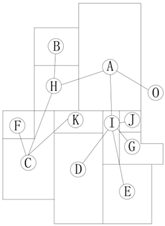
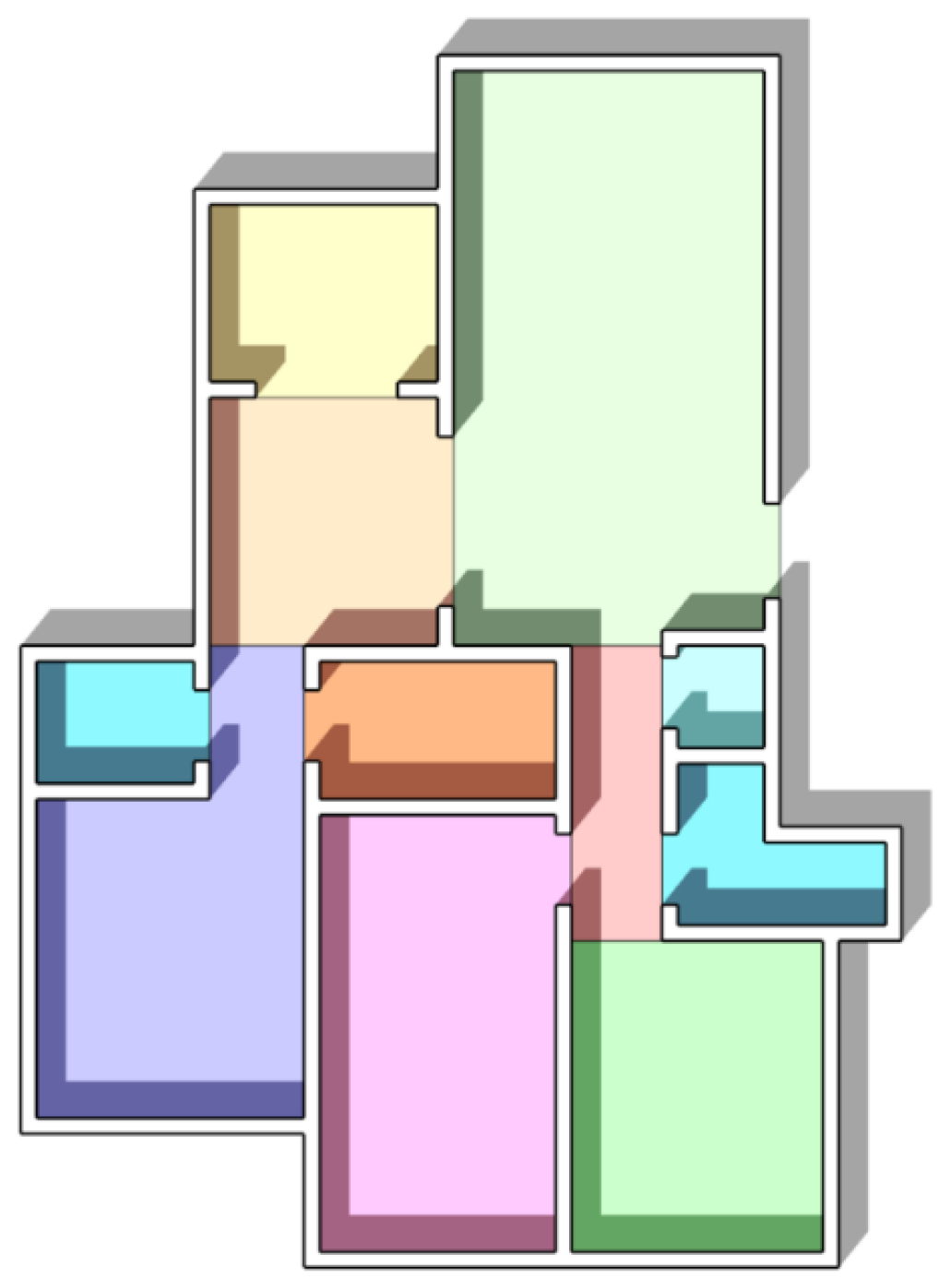
A typical Chinese apartment, as Figure 1 shows below, is selected for its alignment with Chinese family needs, common layout, and market comparability. Its flexibility suits diverse life stages: a study or guest room for newlyweds, balanced intergenerational or child-focused spaces for small families, and independent zones plus connected public areas for multi-generational households. Its L-shaped (K and I) core traffic space may optimize lighting and ventilation for large-depth designs, breaking conventional logic and making it worth studying. In addition, due to the L-shape, this apartment has a relatively large depth dimension, and the attendant issue of ventilation and daylighting in the central area of the apartment is also a key point that is unique to this type of apartment, which requires research and renovation.
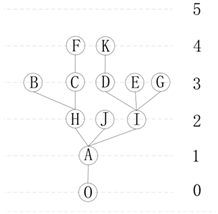
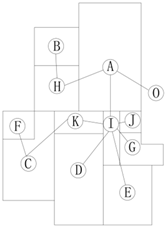
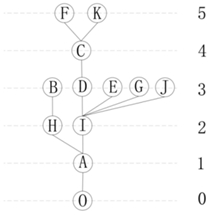
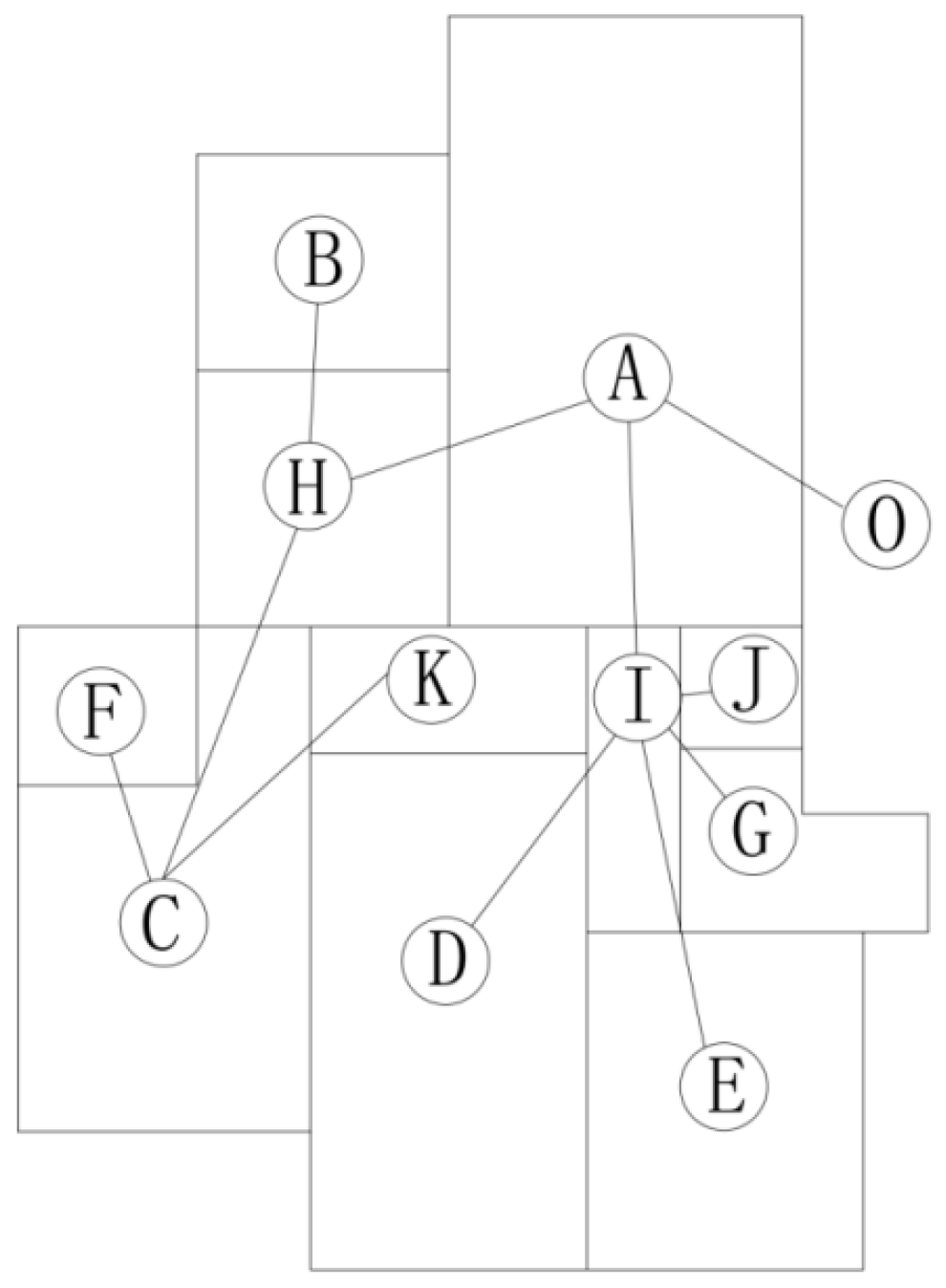
Thus, we focus on conducting in-depth research on common and typical Chinese apartments, which often face challenges in designing more rational and cost-effective traffic spaces. Take the original apartment named Configuration1 (Figure 1 and Figure 2) as an example. It consists of three bedrooms, two bathrooms, two storage areas, two balconies, one dining room, one kitchen, and one living room. This layout is highly representative in the Chinese housing market and can accommodate families of different sizes, catering to diverse lifestyles. Table 1 uses labels O and A–K to denote different rooms in this apartment.
Indoor spaces can be de-hierarchized into convex spaces based on rooms and their functions. Contrary to considering outdoor traffic spaces as segments, indoor ones can be re-mapped and calculated as nodes. The partitioning of convex spaces within an apartment is determined by the distinct rooms and their intended functions. Among the rooms in this apartment, the L-shaped space requires particularly careful de-hierarchization. This is not based on subjective assumptions, but rather on the unique characteristics inherent to this specific L-shaped area. The question of whether space K and space I should be considered a single convex space is a matter of debate.
In this paper, however, space K and I are partitioned as two separate convex spaces. The rationale behind this separation lies in the fact that, across various possible floor plans and designs, space K and I are earmarked for different functions. In different floor plan configurations, the rooms adjacent to space K and I also differ. Typically, space I serves as a corridor. In contrast, K’s function can vary; it may be utilized as a storage room, a corridor passage, or a combination of both, depending on the specific layout plan and the analysis of JPG depicting different layout plans.
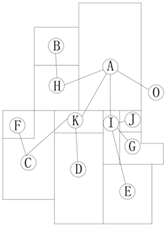
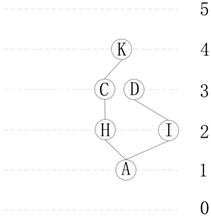
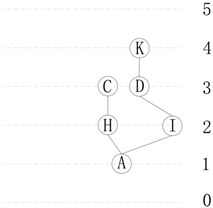
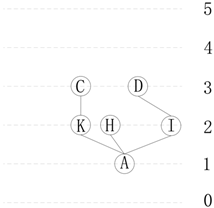
Configuration1 (Images 1 to 3), namely, the original apartment layout, is a standard configuration with three bedrooms, one living rooms, one dining room, two bathrooms, one kitchen, and two storage rooms. We downsize the master bedroom C and expand the area of room D by reallocating storage K to obtain Configuration2 (Images 4 to 6). Room D can be used either as a study or a spacious bedroom suitable for two children. All the renovation plans, from Configuration3 (Images 7 to 9) to Configuration7 (Images 19 to 21), are devised with the intention of preventing the master bedroom C from having a direct view of the dining room H and the kitchen B. In Configuration3, space K is transformed into a storage-corridor, allowing for a direct path from space I to the master bedroom C. Configuration4 (Images 10 to 12) also converts space K into a hallway; however, this time, K is a little hallway establishing a connection between the master bedroom C and the secondary bedroom (or study) D. In Configuration5 (Images 13 to 15), bedrooms C and D are merged to form a suite, while space K continues to serve as a storage for the master bedroom C. Configuration6 (Images 16 to 18) features a direct connection from the living room A to the master bedroom C via a corridor K, which is also equipped with a storage function. In Configuration7 (Images 19 to 21), there is a direct route from the living room A to space K, and then to room D. Space K functions as a hallway and is also connected to the master bedroom C.
Among the seven feasible and distinct designed configurations selected in this paper, the topological graphs are mostly dendritic but asymmetric. This is mainly because the original plan design structure of this apartment is asymmetric as well. There are relatively few topological graphs with this kind of diamond symmetry. For the convenience of horizontal comparison, all the configurations and topological views of the justified plan graph (exterior carrier) are listed in Table 2.

3. Results

3.1. JPG Data Calculations for the Seven Configurations of the Apartment

The design of Configuration2 (Image 4) is based on Configuration1 (Image 1), and the differences between these two is a change in the corridor I and bedroom C as well as two storages (K and J). Among the two plans above and their corresponding JPG, there are two differences between them, of which link rooms K and J, respectively. The answer is that C links K in Configuration1; meanwhile, D links K in Configuration2. Also, J links I in Configuration1, while J links A in Configuration2. C has been taken as a master bedroom with a belonging bathroom F and a wardrobe K in Configuration1, and D has been given more space as a larger multifunctional bedroom with a closet K in Configuration2. According to different needs, though Configuration1 and Configuration2 are similar, we could notice the importance of K.
Configuration2 represents a relatively minor modification based on Configuration1, the original one. In this iteration, the function of space K is transformed. It shifts from being the auxiliary storage for the master bedroom C to becoming the storage for room D. Additionally, the connection of storage J is reconfigured. Instead of being linked to space I, it is now directly connected to the living area A. Notably, both Configuration1 and Configuration2 share a common feature: there is a direct connection from the dining room H to the master bedroom C. Configuration2 has several distinct impacts, which downsizes the original master bedroom C of Configuration1, simultaneously expanding the area and diversifying the functions of room D by reallocating storage K. Moreover, it also alters the usage characteristics of storage J, from storage to shoe closet.
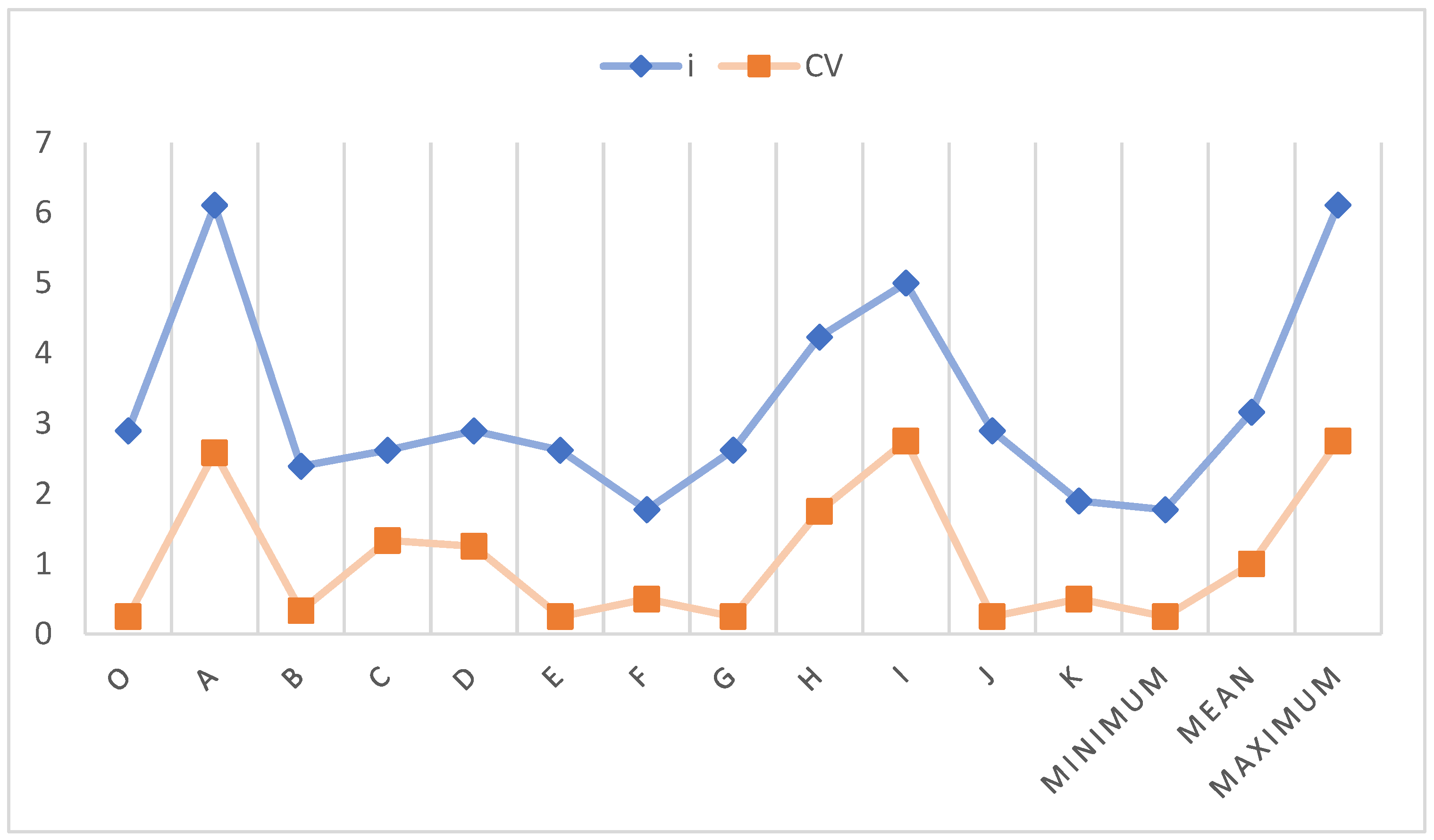
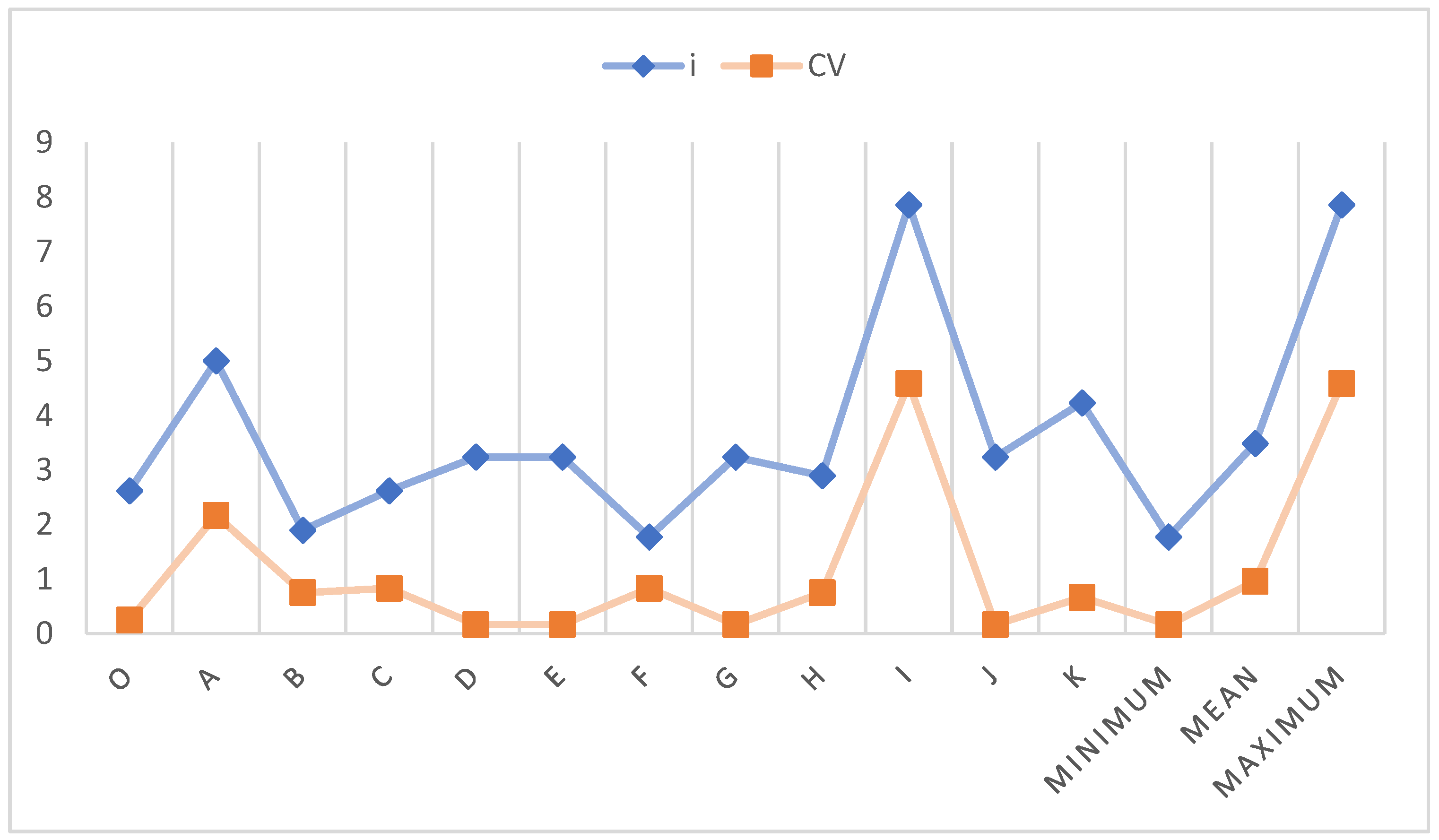
Also, corridor I links J in Configuration1, which gives more depth steps than that of A linking J in Configuration2, based on what kind of storage J is: a hidden storage or a shoe closet. Comparing each JPG data mean value in Table 3 and Table 4, Configuration1 has more depth steps than Configuration2. The data in these two tables unfold a meaningful influence of corridor I as a traffic one in the two types of the apartment layout, because of the highest CV and NC value of corridor I. Space K as a storage, though it is in the central area of the apartment, has the second-highest value of MD and RA, compared with the lowest one F, which inspires space K marginalization indeed.
The design of Configuration3 (Image 7) is quite similar to that of Configuration4 (Image 10), of which plans are shown. An obvious point of difference between the JPG of Configuration3 and Configuration4 is which space connects K here, designed as a traffic one. In Configuration3, K only links C and I, but links C, I, and D in that of Configuration4. So, K in Configuration4 has more connection and control values than that of Configuration3. In addition, whether or not K links D decides K’s function as well as how pivotal corridor I is. Namely, in Configuration3, K is a corridor with storage, but corridor I is in a more centrally connected position. In the meantime, in Configuration4, K is more centrally connected than I in Configuration3.
From Table 5 and Table 6, similar data is shown on MD that means a similar complexity of reaching each room in Configuration3 and Configuration4. However, Configuration3 has more NC values than Configuration4 does, because of more connected rooms to corridor I in Configuration3. From Table 3, Table 4, Table 5 and Table 6, meaning from Configuration1 to Configuration4, NC and CV values of K progressively increase. Since which rooms K is connected to will affect which rooms I is connected to, the increase in K value will lead to a change in I value. Then, continue with the following calculation and analysis to see more.
In Configuration3, space K is transformed into a passageway connecting corridor I to the master bedroom C. Should K possess sufficient width, it could also doubly function as storage space. In this design, the direct connection from dining room H to master bedroom C is severed. Configuration4 bears a strong resemblance to Configuration3. The key distinction lies in the fact that space K in Configuration4 functions not only as a passageway from space I to C but also as a route connecting space I to D. At this juncture, K essentially serves as a small hallway. With the addition of a door providing access to D, space K loses the space and boundary walls necessary for it to function as storage as well as the lack of size and space.
There is a suite design in Configuration5 (Image 13), since the designs of K and I will determine how to use C and D as two bedrooms or maybe one suite. Configuration5 has more depth steps than Configuration6 (Image 16) and Configuration7 (Image 19), due to its C and D suite. So, Table 7 shows a more TD and MD value than that in Table 8 and Table 9. Additionally, K in Configuration6 has less connections value than that of K in Configuration7. Configuration5 is similar to Configuration1, the original one, but it cuts the linking between H and C and create a cut-through from I to D to C as a suite. Meanwhile, Configuration6 resembles Configuration3, whereas A connects K and I in Configuration6 instead of connecting only I in Configuration3. And for a sake of an interior scene forming, Configuration7 designs a cut-through from A to K to D, compared with Configuration4.
Consequently, from Configuration1 to Configuration7, we could confirm the importance of traffic spaces K and I, which determine the whole topological scheme of the apartment designs. Having compared data in Table 7 with data in Table 9, we could see obvious differences among them, due to Configuration5’s different cut-through direction from that of Configuration7. The CV value of K in Table 6 and Table 9 is the highest among the seven tables, reaching 3, along with the reducing CV value of I.
Looking at the seven different configurations of the same apartment, since it is difficult to conduct a holistic comparison, we will first discuss the differences and connections between these configurations. When compared to Configuration1, Configuration5 severs the connection between the master bedroom C and the dining room H. In contrast to Configuration4, in Configuration5, K continues to function as a storage room for the master bedroom C. Nevertheless, in Configuration5, the access route to C is shifted from K, as in Configuration4, to room D. This transformation effectively combines C and D into a suite.
Configuration6 bears a resemblance to Configuration3. The main difference lies in the routing. In Configuration5, the path is from space I to K and then to C, while in Configuration6, it is from the living area A to K and then to C. In Configuration6, K could be utilized as both a passageway and storage space. However, due to its relatively narrow and congested, space K is more advisable to use it solely as a corridor passage. Compared with Configuration5, Configuration6 breaks the connection of the C-D suite and instead establishes a connection between A and K.
Configuration7 is similar to both Configuration6 and Configuration4. The difference between Configuration7 and Configuration6 is that in Configuration7, one accesses room D from K, whereas in Configuration6, one enters room D from corridor I. The commonality between Configuration7 and Configuration4 is that K provides access to both C and D. The difference is that in the Configuration7, the starting point is living room A leading to K, while in Configuration4, it is corridor I leading to K.
The most prominent distinction between Configuration3, Configuration4, Configuration5, Configuration6, and Configuration7, as opposed to Configuration1 and Configuration2, lies in the connection between the dining room H and the master bedroom C. In Configuration1, there is a direct access route from the dining room H to the master bedroom C, enabling seamless movement between the two areas. However, in other configurations, this connection has been deliberately severed. This change not only redefines the spatial relationship but also influences the overall functionality and flow within the living space.

3.2. JPG Data Analysis for the Seven Configurations of the Apartment

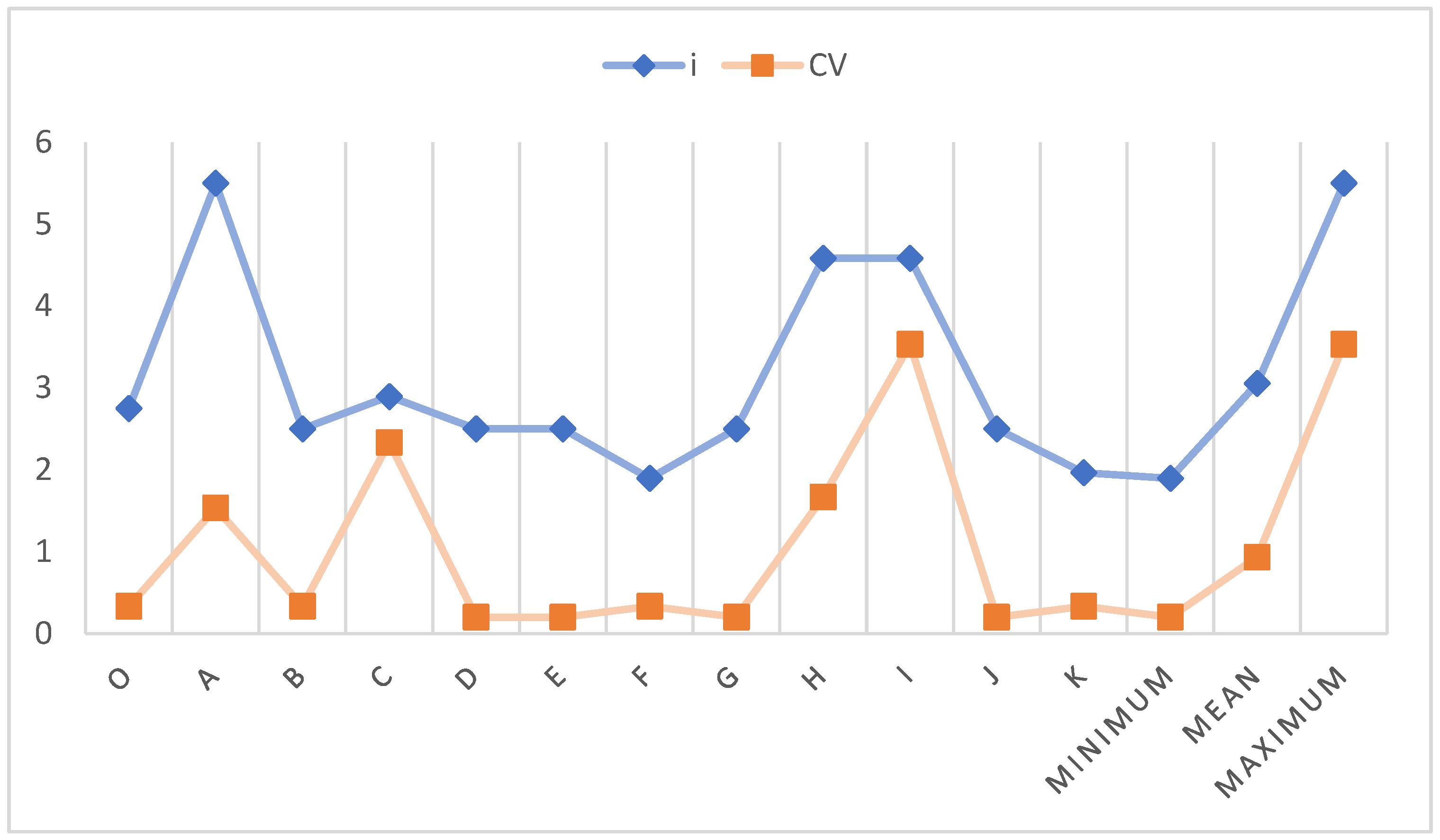
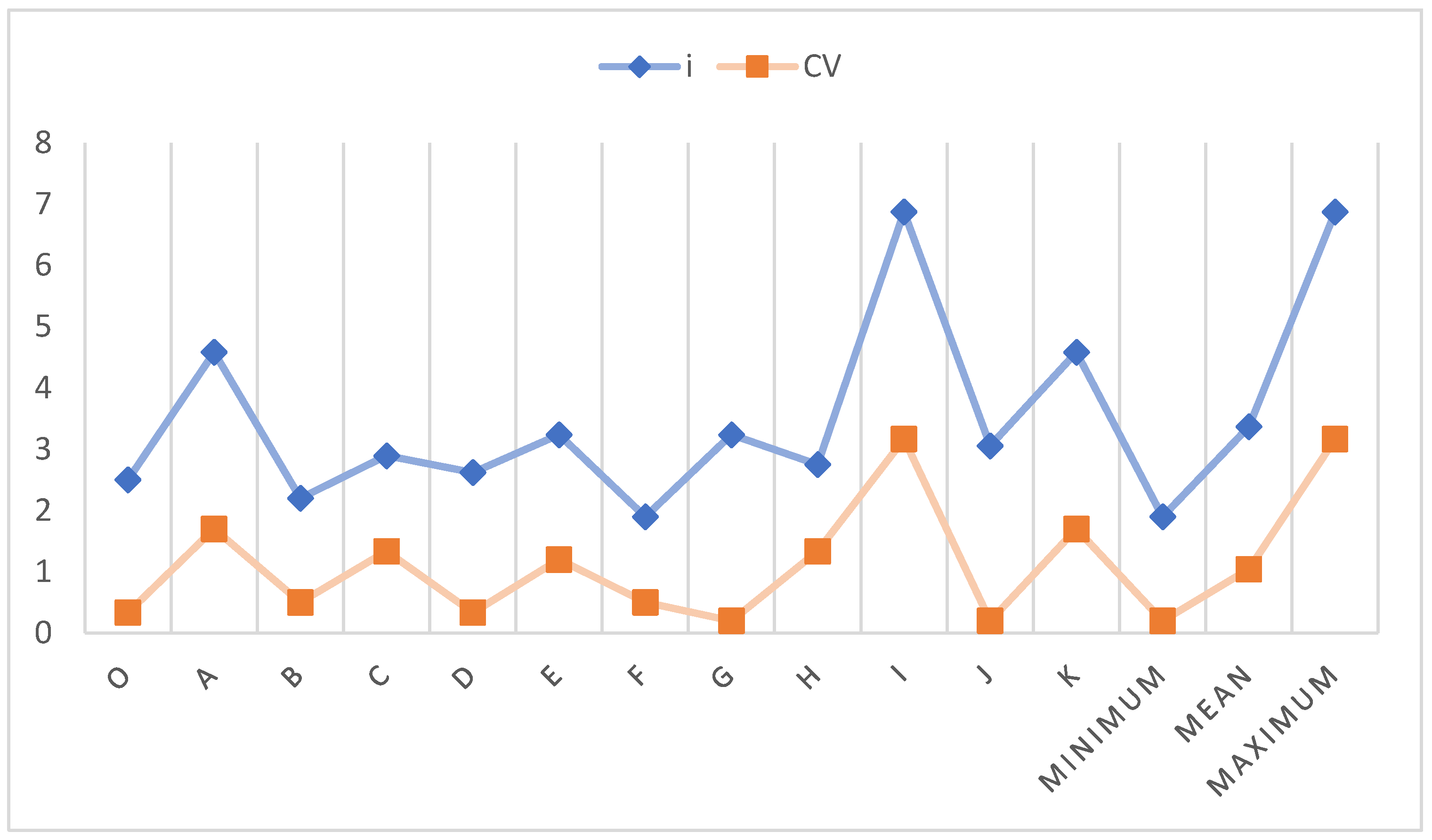
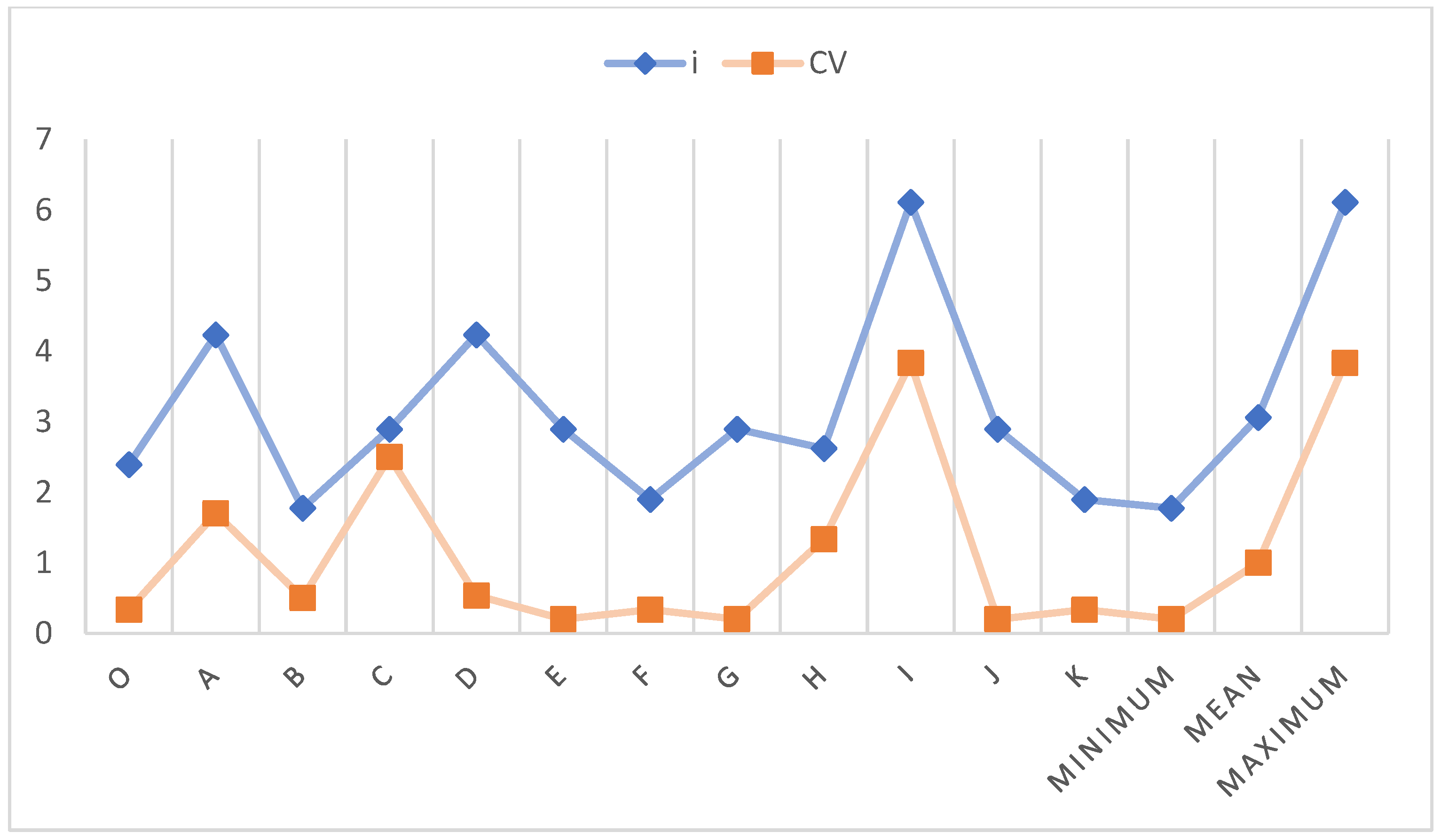
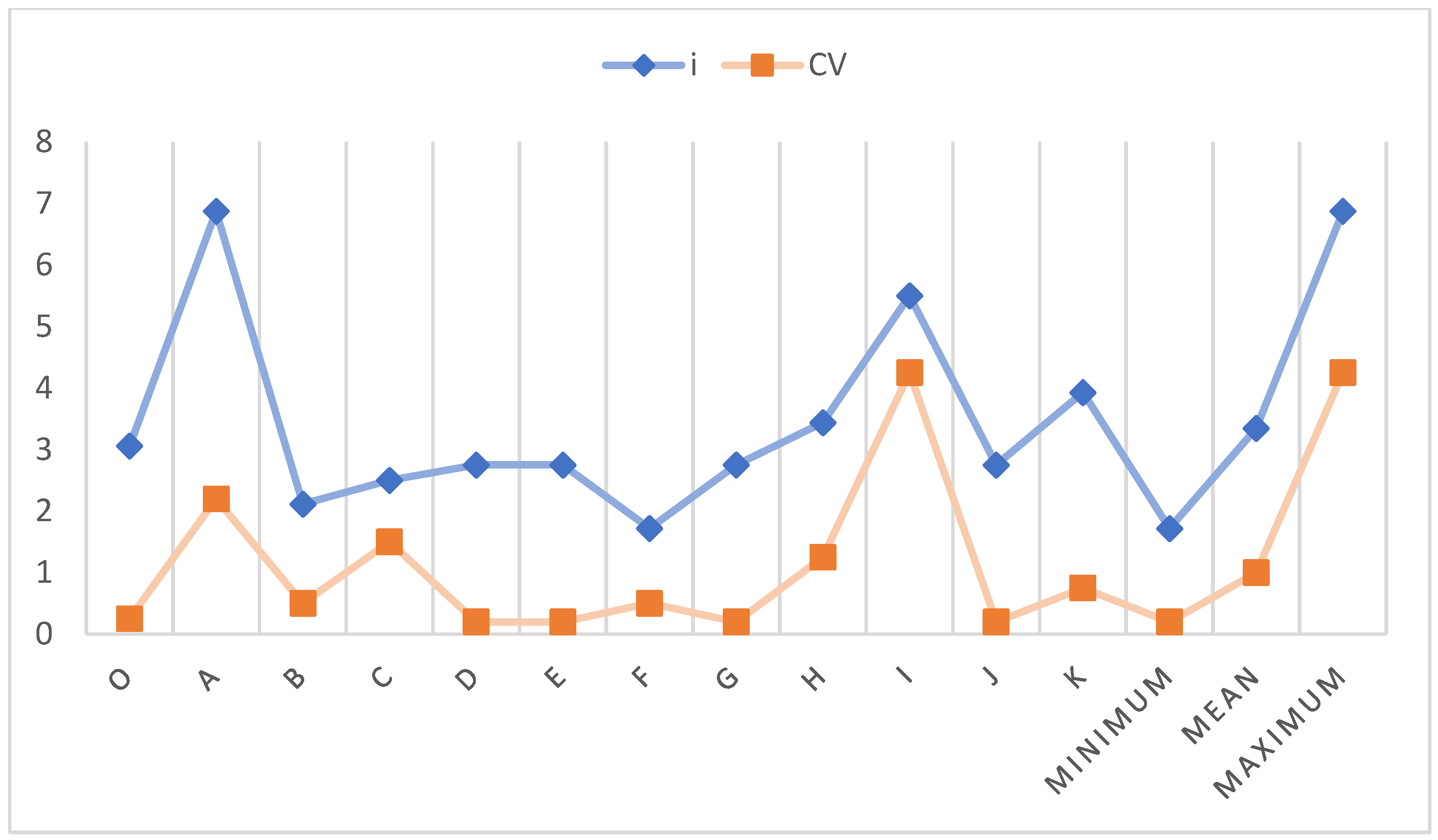
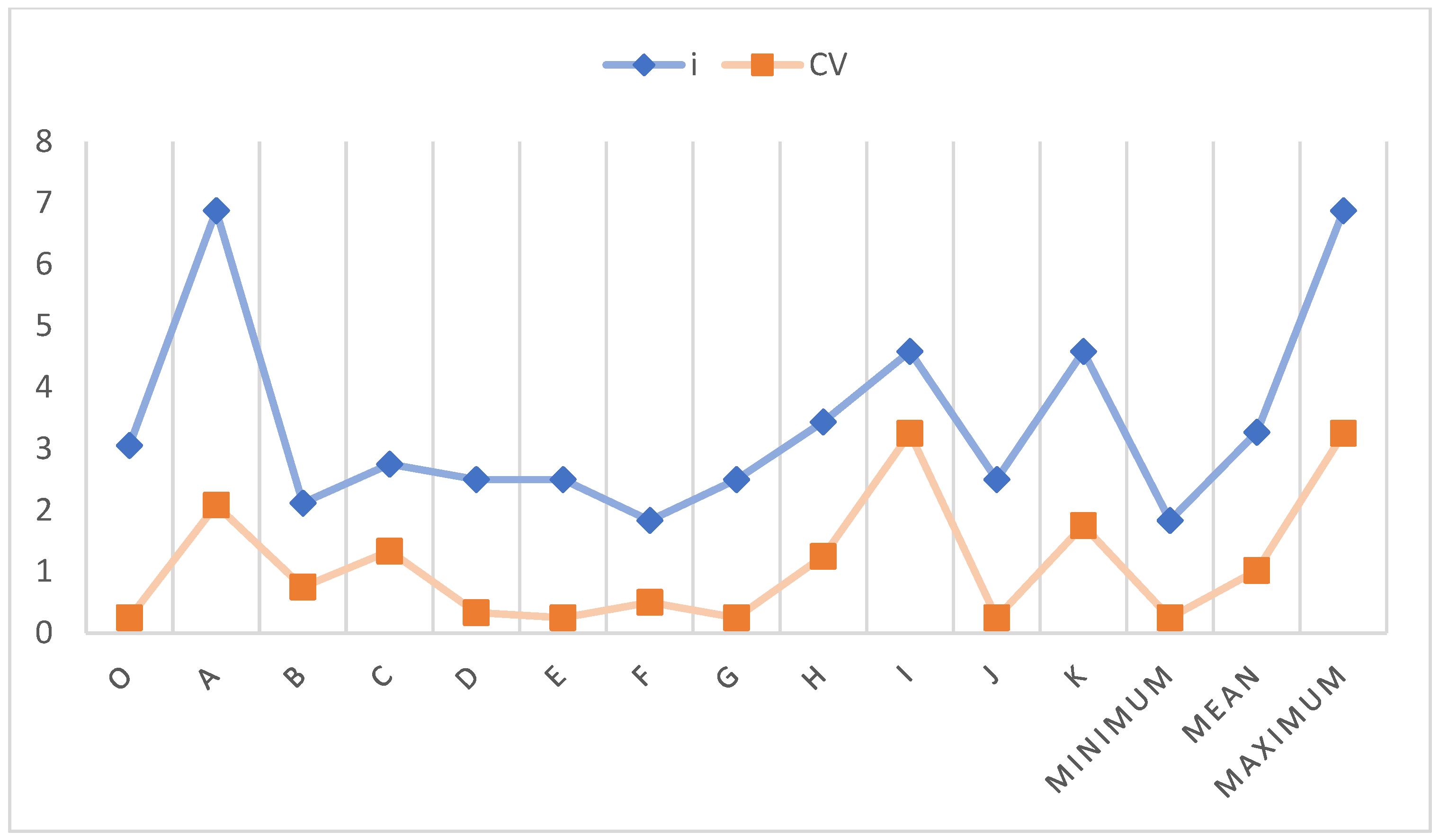
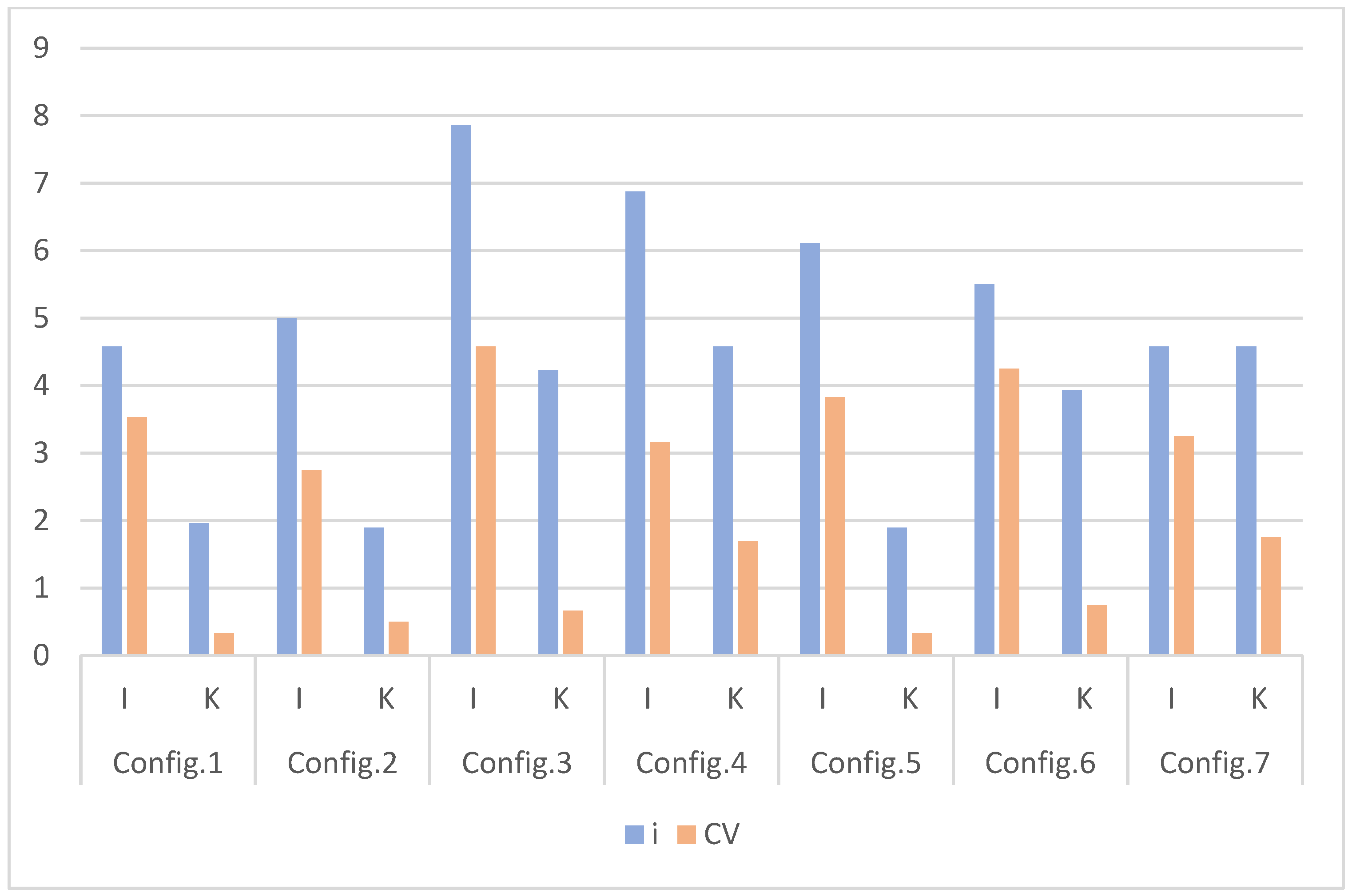
From Figure 3, Figure 4, Figure 5, Figure 6, Figure 7, Figure 8 and Figure 9, data of i and CV above, analysis and discussions will be stated, based on the trend of data in the line graphs. The i (integration value) denotes a space’s level of accessibility to the central area: a higher i value indicates greater proximity to the center and consequently higher accessibility, while a lower value corresponds to greater distance from the center and thus lower accessibility. The CV (control value), by contrast, quantifies the degree of influence exerted by a given space, with the magnitude of influence being positively correlated with the CV value—i.e., the higher the CV value, the stronger the influence, and vice versa. Except that the i value of living room A is sometimes relatively high, after all, it is a living room; Space I is basically the space with the highest CV value and the highest i value. Notably, space K deviates significantly from other spaces. Despite its visually prominent central location in the apartment, its i value exhibits drastic fluctuations. Evidently, spaces K and I serve as the apartment’s core circulation zones, representing key research priorities for addressing challenges in the renovation and optimization of the apartment’s floor plan. Figure 10 shows that, though multifunctional space K has less CV value than that of corridor I, based on different functional modes, K’s CV and i values have a large variation. And in some configurations, the i values for both are close or even the same. Moreover, the CV and NC values of K and I show a trade-off trend.
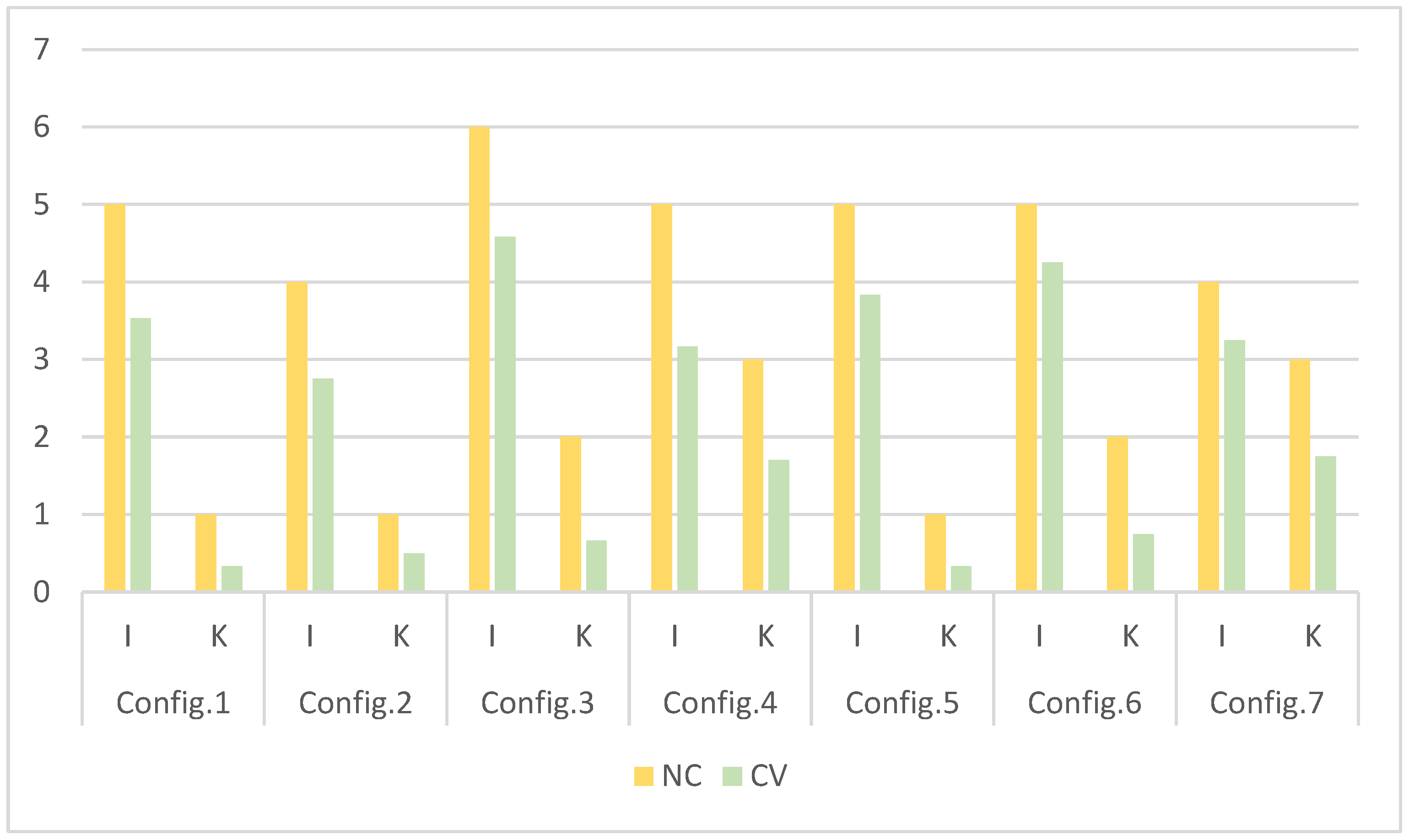
From Figure 11, we could find that in Configuration1, Configuration2, and Configuration5, space K serves as a dedicated storage room. In this configuration, its connection value NC is determined to be 1, indicating a relatively straightforward and singular connection pattern. Regarding Configuration3 and Configuration6, K functions primarily as a corridor passage or hallway. However, depending on the specific dimensions and practical requirements of the space, it has the potential to be utilized as a storage area as well. Given its dual-functionality and more complex connection nature, the connection value NC of K in these layouts is set at 2. In the Configuration4 and Configuration7, K is strictly designated as a corridor passage or hallway. Owing to the restricted area of K and the relatively short length of its walls, when multiple doors are present in the layout, it becomes extremely challenging to allocate space for storage functions. As a result, in these layouts, the connection value NC of K is 3, signifying a more intricate and high-traffic connection state.

3.3. Binary Filtration System

3.3.1. Binary Equation and Traffic Spaces

From the calculation and analysis above, we could find that the crucial elements are traffic space (K and I) in the apartment, which should be critically calculated based on space syntax methods combined with a binary system we propose below. Corridor I is used as traffic space, but space K could be used as either a traffic or storage one. Based on the above content, the spaces A, H, C, and D connected to K and I have undergone the most changes during the renovation of K and I to meet the needs of different families. To concentrate and simplify the analysis of this apartment is to find out and deal with these central vital spaces properly, such as K, I, C, D, A and H in the apartment. The six core spaces mentioned above should be divided into three different types of space groups, namely, A and H (beginning group for sitting and dinning), C and D (ending group for bedrooms), and K and I (passing group for traffic and storage).
X = 2 n
As a core mathematical principal equation of the binary filtration system proposed, the variable definitions of Formula 6 can be clearly mapped to their practical physical meanings as follows: n represents the number of all potential connectivity relationships in the system. Each relationship has two mutually exclusive binary states: connected and disconnected, which constitute the fundamental premise of binary filtering. X represents the total number of connectivity combinations due to the system constraints after calculation according to the binary filtering rules.
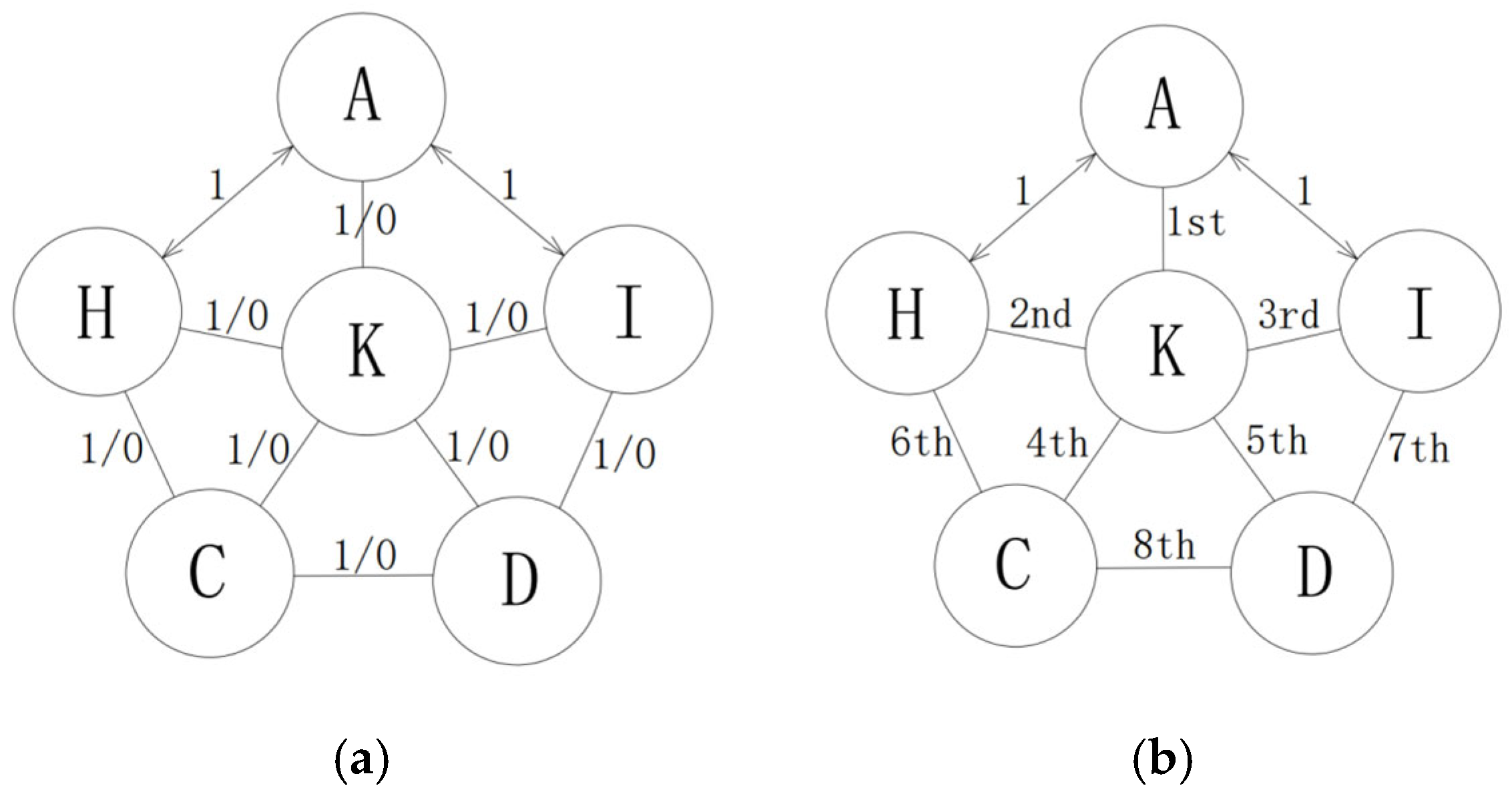
There is a topological graph; Figure 12a below shows the connected possibilities of the six core spaces (A, H, C, D, K, I), in which 1 means connected and 0 means unconnected; thus, a binary system has been proposed based on the either/or design logic. According to the three types of spaces and the six rooms (A, H, C, D, K, I) linking conditions, practical situations of this apartment could be designed as 28 = 256 different types of plan models, which could be calculated based on Formula 6 above. From Figure 12b, based on the binary system, there are eight blanks that could be designed as 1 or 0, which give an eight-bit binary sequence and a statistical method to deal with graphic problems.

3.3.2. Binary Filtration and Renovated Configurations

Next, filtrated these 256 types of plans, we could take out over repeated linking types or unable passing types neither. To summarize, there should be 48 types remained, which are of propriety and utility including that of Configuration1 to Configuration7, showed as images 22–28. From this methodology, we could apply filtrated methods according to various practical situations to pick out more critical design plans for buildings. Through binary choosing approaches, we have produced 27 one-way types based on core spaces connections from 256 ones stated above. Moreover, we have obtained 21 round-trip types as well. The binary proportion for effective design plans is (27 + 21)/256 = 3/16. Therefore, explanations of one-way and round-trip type would be given as followings; one-way type here means there is no superfluous door in a room, especially when it comes to the two bedrooms space C and D. As a contrast, round-trip type means there would be a suite between bedrooms C and D; yet, the chosen types must be appropriate and functional, which fulfill different families’ needs.
The filtrating method being cumbersome, only its three core principles are briefly outlined below. Derived from the aforementioned binary system and mapped onto floor plans, values 1 and 0 denote the presence or absence of designed connectivity between spaces. The first principle is to eliminate over-connected configurations—i.e., rooms (excluding suites) with excessive door openings, where basic accessibility and functionality suffice. The second principle is to identify potentially appropriate suites. The third is to screen renovation designs tailored to special functions for diverse demands. This phase can be designed as a sophisticated research module in subsequent work to formulate various filtrating mechanisms. Combined with the mid-stage AI computing process, this remains a conceptual framework at present, and further elaboration of its research design is anticipated.
As detailed in the above analysis, by introducing the binary theory and further advancing the computer-aided neural network design for AI deep learning, we have proposed the new mathematical method filtration system. Table 10 shows the design renovation and core space connection of the seven different apartment configurations above, under the feedback verification of the binary filtering system. The seven configurations each have its binary eight-digit sequence of numbers, which stand for connections or disconnections of the six core rooms that are shown below. From the above results, the proposed binary filtration system can efficiently generate numerous apartment renovation schemes via space syntax’s JPG method for configuration analysis, with further efficiency gains from AI assistance.

4. Discussion

At present, almost all studies applying space syntax to residential architecture focus on well-known types of traditional residential heritage buildings [44,45,46]. AI-assisted research and design in residential architecture also mostly emphasize the directions of energy conservation, emission reduction, and green low-carbon environmental protection in overall community planning [47]. However, architectural research that combines space syntax with AI has also concentrated on facade design renovation [48], structural design construction, and technical calculation [49]. By contrast, existing research lacks the application of space syntax analysis and AI-assisted design to the renovation of configurations for ordinary residential apartments in developing countries. The research conducted in this paper is based on a series of calculations via JPG of space syntax and derives corresponding results, so as to identify the core spaces for the renovation of typical Chinese apartments. Furthermore, it puts forward a method combining the binary pre-filtering system with AI to assist in design, which can address the large-scale stock renovation of residential buildings in China and meet the changing daily needs of residents. It is entirely feasible to extract fundamental mathematical principles for application and integrate them with AI to enable rapid batch design, based on the quantitative research on the renovation of typical common apartment floor plans in China mentioned at the outset of this paper. A fundamental understanding of the functions of each room is crucial. Initially, the core rooms are identified through the space syntax JPG method. Subsequently, a more in-depth filtration process is carried out, also relying on space syntax and the proposed binary filtration system.
A limitation of this paper is that the research is confined to a single apartment and has not been extended to more diverse apartment types. Furthermore, the binary filtration system integrating space syntax with AI-aided design derived from this research remains in the conceptual design. Future work and prospects are as follows: Human needs can be further broken down into more specific elements. For example, the composition of the population, living and working requirements, and work-rest habits. All these factors can be incorporated as weight parameters in the final filtrating process, ensuring that the resulting design is not only functional but also tailored to the end users’ lifestyle and practical demands. This process is not merely about training AI. It also involves integrating the underlying logic of neural networks to achieve innovative and unexpected design outcomes. In the final filtrating stage, the design is determined based on human needs. These needs include aspects such as the functional utilization of the space, the activity level, and the visibility of movement lines and sight lines, which feedback to space syntax and quantitative research.
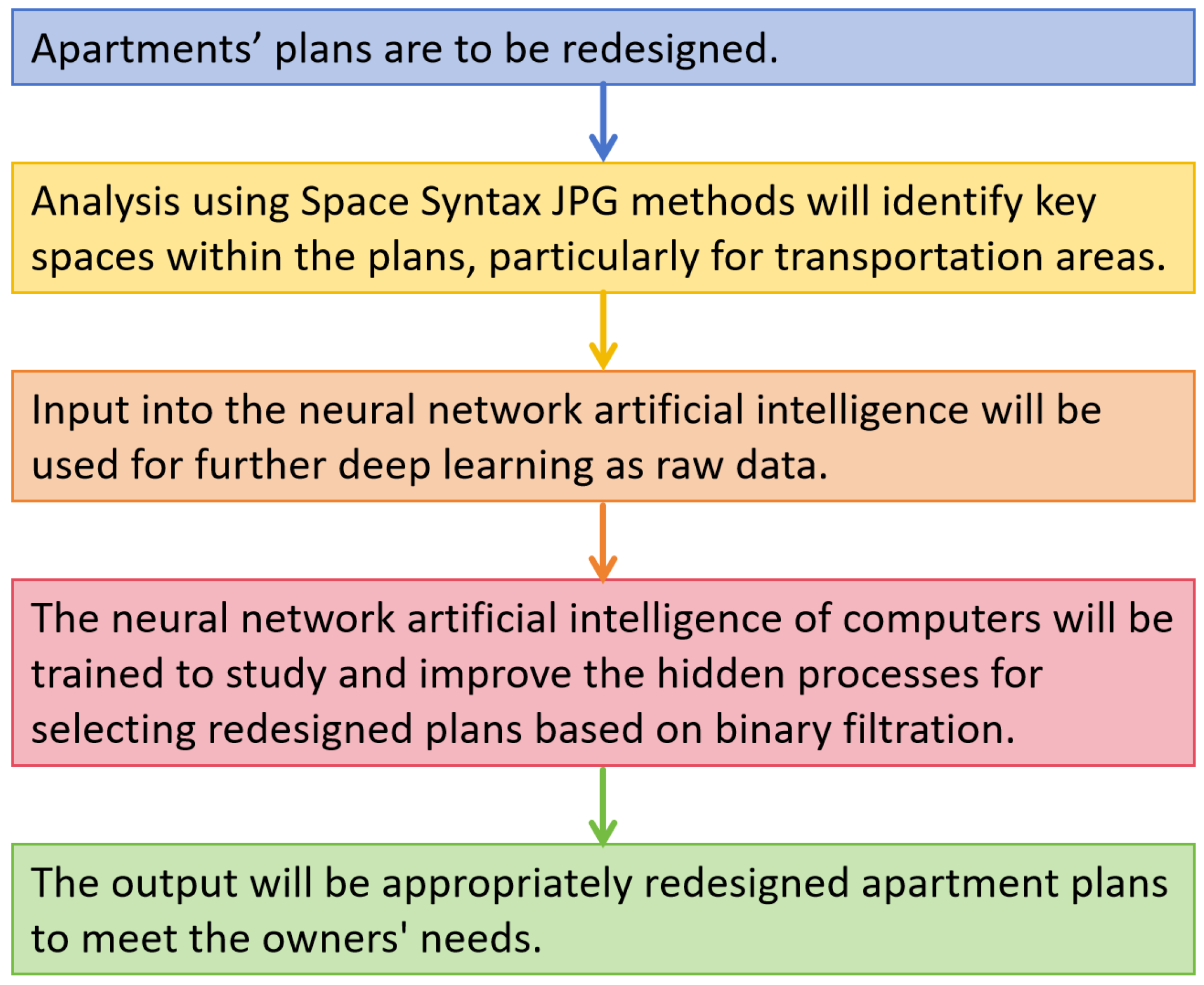
According to the neural network model, the apartment renovation could be designed as a process of three parts. First, the input process means signal information reception, including 2n possibilities (1 means linking and 0 means unlinking, which stand for binary filtration system). Second, the hidden process is the most complicated calculating process and the framework of this part (Figure 13) is drawn below. In this process, the filtrated system is foremost; in fact, it can also be called a pre-filtering mechanism, in which social needs as calculated weights for filtrating would help us to make proper choices from the 2n new design possibilities. Third is the output one; we gain newly designed plans of this apartment satisfying various needs.

5. Conclusions

Facing advancing AI and interdisciplinary needs, this study develops optimized renovation strategies for Chinese ordinary apartments to address mismatches between homogenizing configuration and demands from family changes. We take a universal three-bedroom apartment as the prototype and propose reclassifying transportation spaces as independent functional zones justified by China’s floor-area pricing that challenges their conventional auxiliary positioning. We use space syntax’s JPG method to analyze one original and six family-tailored layouts, focusing on spatial topology, renovation performance, and traffic spaces’ optimization. The study clarifies links between space syntax’s JPG and AI’s neural networks with residential configurations, which is an exploration that lays the basis for the proposed binary filtration system integrating space syntax and AI and bridges architectural analysis with intelligent design. The research confirms the integration’s feasibility, a verification that identifies core nodes like the L-shaped interior traffic space as key targets and validates the system’s scalability for ordinary apartments to enable efficient batch design that replaces traditional inefficient workflows. Additionally, this paper integrates architecture, computer science, and math to respond to interdisciplinary calls in residential design, providing an evidence-based paradigm for China’s apartment renovations.
To augment this study’s practical utility and academic significance, future research will prioritize three pathways to enhance generalizability, usability, and methodological rigor for global residential optimization. First, expand the sample pool beyond three-bedroom apartments to diverse typologies to validate the binary filtration system and extend applicability to China’s housing stock and global markets. Second, translate the conceptual system into a practical, user-centric tool, refined via real renovation projects. Pilot tests will assess its efficiency in narrowing AI design solutions, with stakeholder feedback optimizing usability to meet China’s renovation demands. Third, deepen interdisciplinary collaboration to integrate advanced methods: machine learning for demand prediction, space syntax–AI synergy for automated renovation, and cross-regional studies to establish global relevance. Ultimately, these efforts will transform the research into a scalable, evidence-based framework, addressing China’s housing challenges and informing global sustainable residential design.
In conclusion, this study not only fills the existing research gap—which includes the lack of quantitative studies on ordinary apartment renovations and the limited integration of space syntax with AI at the domestic scale—but also makes tangible contributions to both academic discourse and practical application. Academically, it strengthens the theoretical link between space syntax and AI in the context of residential design, advancing interdisciplinary knowledge. Practically, it aims to provide a scientific, scalable, and context—appropriate solution to meet China’s growing apartment renovation demands. Furthermore, by addressing universal challenges in residential space optimization, this research offers a valuable global reference for scholars and practitioners working in the field of urban housing design and renovation.

Funding

This research received no external funding.

Data Availability Statement

The data presented in this study are available from the author upon reasonable request.

Conflicts of Interest

The author declares that they have no conflict of interest.

References

  1. Zhang, X.; Xie, Y. Four Decades of Urban and Regional Development and Planning in China. In Urban and Regional Planning and Development; Springer International Publishing: Cham, Switzerland, 2020; pp. 61–81. [Google Scholar] [CrossRef]
  2. Hu, Y.; Connor, D.S.; Stuhlmacher, M.; Peng, J.; Ii, B.L.T. More Urbanization, More Polarization: Evidence from Two Decades of Urban Expansion in China. npj Urban Sustain. 2024, 4, 33. [Google Scholar] [CrossRef]
  3. Fu, C.; Deng, T.; Zhang, Y. Boosted Efficiency and Unsaturated Material Stock Growth in Chinas Megacities: Accelerating as Urbanization Approaches 80%. Resour. Conserv. Recycl. 2024, 203, 107417. [Google Scholar] [CrossRef]
  4. Bai, X.; Wu, W.; Liu, L.; Shang, W.; Dong, H. Spatio-Temporal Evolution and Implications of Urban Residential Space Based on the New Commercial Housing in Xi’an, China, 2006–2022. Sustainability 2024, 16, 8495. [Google Scholar] [CrossRef]
  5. Zhai, Z.; Jin, G. China’s Family Planning Policy and Fertility Transition. Chin. J. Sociol. 2023, 9, 479–496. [Google Scholar] [CrossRef]
  6. Li, F.; Lynam, A.; Huang, H.; Wei, J. Institutional Co-Production at Neighbourhood Scale: Cases of Urban Renewal for Shanghai’s Ageing Population. Habitat Int. 2024, 144, 103000. [Google Scholar] [CrossRef]
  7. Mou, X.; Li, X.; Dong, J. The Impact of Population Aging on Housing Demand in China Based on System Dynamics. J. Syst. Sci. Complex. 2021, 34, 351–380. [Google Scholar] [CrossRef]
  8. Zeng, Y.; Yang, H.; Wang, Z.; Li, L. Impacts of Family Household Dynamics on Residential Energy Demands in Hebei Province of China. Genus 2021, 77, 35. [Google Scholar] [CrossRef]
  9. Zhang, F.; Fang, Y.; Han, C.; Wu, Z. Housing Prices and Family Fertility Decision-Making in China: Effect and Mechanism. Int. Sociol. 2024, 40, 137–162. [Google Scholar] [CrossRef]
  10. Liu, J.; Liu, H. Understanding the Shift of Family Planning in China from the Economic Perspective. Int. J. Popul. Stud. 2025, 11, 138. [Google Scholar] [CrossRef]
  11. Wu, W.; Divigalpitiya, P. Availability and Adequacy of Facilities in 15 Minute Community Life Circle Located in Old and New Communities. Smart Cities 2023, 6, 2176–2195. [Google Scholar] [CrossRef]
  12. Ma, W.; Jiang, G.; Zhou, T.; Zhang, R. Mixed Land Uses and Community Decline: Opportunities and Challenges for Mitigating Residential. Vacancy in Peri-Urban Villages of China. Front. Environ. Sci. 2022, 10, 887988. [Google Scholar] [CrossRef]
  13. Cheshmehzangi, A.; Butters, C. Sustainable Cities: Reconsidering China’s Urban Residential Policies. Curr. Urban Stud. 2022, 10, 136–155. [Google Scholar] [CrossRef]
  14. Cheshmehzangi, A.; Dawodu, A. Towards a Sustainable Energy Planning Strategy: The Utilisation of Floor Area Ratio for Residential Community Planning and Design in China. Front. Sustain. Cities 2021, 3, 687895. [Google Scholar] [CrossRef]
  15. Zheng, X.; Oh, D. An Economic Impact Assessment of Urban Renewal Policies in China -Focusing on Elevator Installations in Old Residential Areas of Beijing. Northeast Asia Econ. Assoc. Korea 2024, 36, 173–204. [Google Scholar] [CrossRef]
  16. Xi, J.; Wang, J.; Gu, Z. Effects of the planning and implementation of housing reconstruction on community resilience in China. Int. J. Disaster Risk Reduct. 2022, 80, 103233. [Google Scholar] [CrossRef]
  17. Antwi-Afari, P.; Ng, S.T.; Hossain, M.U. A Review of the Circularity Gap in the Construction Industry through Scientometric Analysis. J. Clean. Prod. 2021, 298, 126870. [Google Scholar] [CrossRef]
  18. Yao, Y.; Lu, L.; Fu, Z.; Chen, F.; Wang, R.; Li, Q. Land Use Carbon Emission Projections in Shared Socioeconomic and Representative Concentration Pathways: Relationship with Urbanization in Chinese Megacities. Land Use Policy 2025, 157, 107659. [Google Scholar] [CrossRef]
  19. Vinczeová, Z.; Tóth, A. Urban Green Spaces and Collective Housing: Spatial Patterns and Ecosystem Services for Sustainable Residential Development. Sustainability 2025, 17, 2538. [Google Scholar] [CrossRef]
  20. Boguniewicz-Zabłocka, J.; Łukasiewicz, E. Blue–Green Infrastructure Effectiveness for Urban Stormwater Management: A Multi-Scale Residential Case Study. Land 2025, 14, 1340. [Google Scholar] [CrossRef]
  21. Jia, Y.; Zheng, Z.; Zhang, Q.; Li, M.; Liu, X. Associations of Spatial Aggregation between Neighborhood Facilities and the Population of Age Groups Based on Points-of-Interest Data. Sustainability 2020, 12, 1692. [Google Scholar] [CrossRef]
  22. Safizadeh, M. Simulation of the Circulation Complexity in Student Residence Buildings Using Space Syntax Analyses (Case Studies: Highland Hall, Rita Atkinson, Rutgers University and Tooker Residences, USA). Archit. Eng. Des. Manag. 2024, 20, 741–760. [Google Scholar] [CrossRef]
  23. Lee, H. A Study on the Characteristics of New Towns and the Redevelopment of Project-Canceled Areas: A Case Study of Seoul, South Korea. Sustainability 2019, 11, 5733. [Google Scholar] [CrossRef]
  24. Yang, J.; Feng, X.; Li, Y.; He, C.; Wang, S.; Li, F. How Does Urban Scale Influence Carbon Emissions? Land 2024, 13, 1254. [Google Scholar] [CrossRef]
  25. Askarizad, R.; Daudén, P.J.L.; Garau, C. The Application of Space Syntax to Enhance Sociability in Public Urban Spaces: A Systematic Review. ISPRS Int. J. Geo-Inf. 2024, 13, 227. [Google Scholar] [CrossRef]
  26. Mohamed, A.A.; van der Laag Yamu, C. Space Syntax has Come of Age: A Bibliometric Review from 1976 to 2023. J. Plan. Lit. 2023, 39, 203–217. [Google Scholar] [CrossRef]
  27. Heitz, A. The Logistics Dualization in Question: Evidence from the Paris Metropolitan Area. Cities 2021, 119, 103407. [Google Scholar] [CrossRef]
  28. Li, Y.; Ran, Q.; Yao, S.; Ding, L. Evaluation and Optimization of the Layout of Community Public Service Facilities for the Elderly: A Case Study of Hangzhou. Land 2023, 12, 629. [Google Scholar] [CrossRef]
  29. Mitincu, C.-G.; Ioja, I.-C.; Hossu, C.-A.; Artmann, M.; Nita, A.; Nita, M.-R. Licensing Sustainability Related Aspects in Strategic Environmental Assessment. Evidence from Romania’s Urban Areas. Land Use Policy 2021, 108, 105572. [Google Scholar] [CrossRef]
  30. Elizondo, L. A Justified Plan Graph Analysis of Social Housing in Mexico (1974–2019): Spatial Transformations and Social Implications. Nexus Netw. J. 2022, 24, 25–53. [Google Scholar] [CrossRef]
  31. Peng, C.-W.; Tsai, I.-C. The long- and short-run influences of housing prices on migration. Cities 2019, 93, 253–262. [Google Scholar] [CrossRef]
  32. Yamu, C.; van Nes, A.; Garau, C. Bill Hillier’s Legacy: Space Syntax—A Synopsis of Basic Concepts, Measures, and Empirical Application. Sustainability 2021, 13, 3394. [Google Scholar] [CrossRef]
  33. Guo, P.; Sang, Y.; Li, F.; Lyu, T.; Liu, T. Harmony Between Ritual and Residential Spaces in Traditional Chinese Courtyards: A Space Syntax Analysis of Prince Kung’s Mansion in Beijing. Buildings 2025, 15, 3815. [Google Scholar] [CrossRef]
  34. Hu, L.; Yang, T. Landed and Rooted: A Comparative Study of Traditional Hakka Dwellings (Tulous and Weilong Houses) Based on the Methodology of Space Syntax. Buildings 2023, 13, 2644. [Google Scholar] [CrossRef]
  35. Hu, Q.; He, X.; Wei, T.; Yuan, Y. A Spatio-Temporal Overlap Narrative Experience Model for Archaeological Site Museums: A Case Study of the Panlongcheng Archaeological Site Museum. Buildings 2025, 15, 3956. [Google Scholar] [CrossRef]
  36. Zhou, K.; Wu, W.; Dai, X.; Li, T. Quantitative Estimation of the Internal Spatio–Temporal Characteristics of Ancient Temple Heritage Space with Space Syntax Models: A Case Study of Daming Temple. Buildings 2023, 13, 1345. [Google Scholar] [CrossRef]
  37. Hillier, B.; Hanson, J. The Social Logic of Space; Cambridge University Press: Cambridge, UK, 1984. [Google Scholar]
  38. Hillier, B. Space is the Machine; Cambridge University Press: Cambridge, UK, 1995. [Google Scholar]
  39. Hanson, J. Decoding Homes and Houses; Cambridge University Press: Cambridge, UK, 1998. [Google Scholar]
  40. Ostwald, M.J. The Mathematics of Spatial Configuration: Revisiting, Revising and Critiquing Justified Plan Graph Theory. Nexus Netw. J. 2011, 13, 445–470. [Google Scholar] [CrossRef]
  41. Ostwald, M.J. A Justified Plan Graph Analysis of the Early Houses (1975–1982) of Glenn Murcutt. Nexus Netw. J. 2011, 13, 37–76. [Google Scholar] [CrossRef]
  42. Harary, F. Some Historical and Intuitive Aspects of Graph Theory. SIAM Rev. 1960, 2, 123–131. [Google Scholar] [CrossRef]
  43. Hillier, B.; Burdett, R.; Peponis, J.; Penn, A. Creating Life: Or, Does Architecture Determine Anything? Archit. Comport. Archit. Behav. 1986, 3, 233–250. [Google Scholar]
  44. Dong, T.; Tadi, M.; Tesfaye, S.T. Unveiling Hidden Green Corridors: An Agent-Based Simulation (ABS) of Urban Green Continuity for Ecosystem Services and Climate Resilience. Smart Cities 2025, 8, 163. [Google Scholar] [CrossRef]
  45. Chen, Y.; Xu, K.; Liu, P.; Jiang, R.; Qiu, J.; Ding, K.; Fukuda, H. Space as Sociocultural Construct: Reinterpreting the Traditional Residences in Jinqu Basin, China from the Perspective of Space Syntax. Sustainability 2021, 13, 9004. [Google Scholar] [CrossRef]
  46. Goriel, W.A.S.; Molnár, T.; Zoltán, E.S. Examining the Hashim Chalbi House’s Spatial Aspects in Erbil Citadel: Understanding the Museum’s Configuration Potential via Depthmap Analysis. Buildings 2025, 15, 2134. [Google Scholar] [CrossRef]
  47. Afonso, F. Study of the Compositional Rules of Design in Chaoshan Traditional House: A Computational Approach. In Proceedings of the 10th International Conference on Digital and Interactive Arts (ARTECH’21), Aveiro, Portugal, 13–15 October 2021; Association for Computing Machinery: New York, NY, USA, 2022; pp. 1–8. [Google Scholar] [CrossRef]
  48. Ostwald, M.J. Fabrication-Informed and AI-Adaptive Design. Nexus Netw. J. 2025, 27, 687–690. [Google Scholar] [CrossRef]
  49. Guardigli, L.; Prati, D.; Namvar, N. Performance-Driven Design of a Residential Unit with the Use of Genetic Algorithms. In Proceedings of the 11th International Conference of Ar.Tec. (Scientific Society of Architectural Engineering), Palermo, Italy, 12–15 June 2025; Lecture Notes in Civil Engineering; Corrao, R., Campisi, T., Colajanni, S., Saeli, M., Vinci, C., Eds.; Springer: Cham, Switzerland, 2025; Volume 612. [Google Scholar] [CrossRef]
Figure 1. A plan graph of Configuration1 (Image 1), the original one.
Buildings 16 00364 g001
Figure 2. A plan graph of Configuration1 (Image 2), the original one, with abbreviations of each room and their interconnection relationships.
Buildings 16 00364 g002
Figure 3. The i and CV values for Configuration1.
Buildings 16 00364 g003
Figure 4. The i and CV values for Configuration2.
Buildings 16 00364 g004
Figure 5. The i and CV values for Configuration3.
Buildings 16 00364 g005
Figure 6. The i and CV values for Configuration4.
Buildings 16 00364 g006
Figure 7. The i and CV values for Configuration5.
Buildings 16 00364 g007
Figure 8. The i and CV values for Configuration6.
Buildings 16 00364 g008
Figure 9. The i and CV values for Configuration7.
Buildings 16 00364 g009
Figure 10. The i and CV values of space K and space I in the seven configurations.
Buildings 16 00364 g010
Figure 11. The CV and NC values of space K and space I in the seven configurations.
Buildings 16 00364 g011
Figure 12. (a) The core spaces (A, H, C, D, K, I), view of topological connection possibilities graph; (b) A view of the eight-bit binary sequence corresponding to the core spaces connection status graph.
Buildings 16 00364 g012
Figure 13. The framework of the binary system based on artificial intelligence.
Buildings 16 00364 g013
Table 1. The general abbreviations used for rooms in the apartment.
NO.Convex SpaceRoom
0OOutside Entry Door
1ALiving Room
2BKitchen
3CBedroom 1
4DBedroom 2
5EBedroom 3
6FBathroom 1
7GBathroom 2
8HDining Room
9ICorridor
10JStorage
11KWardrobe
Table 2. The plan graphs of Configurations1–7 and their views of justified plan graphs.
NO.The Plan Graphs of the ConfigurationsThe Views of Justified Plan Graphs (Exterior Carrier)
Configuration1Buildings 16 00364 i001
Image 1
Buildings 16 00364 i002
Image 2
Buildings 16 00364 i003
Image 3
Configuration2Buildings 16 00364 i004
Image 4
Buildings 16 00364 i005
Image 5
Buildings 16 00364 i006
Image 6
Configuration3Buildings 16 00364 i007
Image 7
Buildings 16 00364 i008
Image 8
Buildings 16 00364 i009
Image 9
Configuration4Buildings 16 00364 i010
Image 10
Buildings 16 00364 i011
Image 11
Buildings 16 00364 i012
Image 12
Configuration5Buildings 16 00364 i013
Image 13
Buildings 16 00364 i014
Image 14
Buildings 16 00364 i015
Image 15
Configuration6Buildings 16 00364 i016
Image 16
Buildings 16 00364 i017
Image 17
Buildings 16 00364 i018
Image 18
Configuration7Buildings 16 00364 i019
Image 19
Buildings 16 00364 i020
Image 20
Buildings 16 00364 i021
Image 21
Table 3. The data summary of JPG for Configuration1, the typical apartment in China.
Config.1SpaceTDMDRAiNCCV
0O312.81820.36362.75001.00000.3333
1A211.90910.18185.50003.00001.5333
2B333.00000.40002.50001.00000.3333
3C302.72730.34552.89473.00002.3333
4D333.00000.40002.50001.00000.2000
5E333.00000.40002.50001.00000.2000
6F403.63640.52731.89661.00000.3333
7G333.00000.40002.50001.00000.2000
8H232.09090.21824.58333.00001.6667
9I232.09090.21824.58335.00003.5333
10J333.00000.40002.50001.00000.2000
11K393.54550.50911.96431.00000.3333
Minimum211.90910.18181.89661.00000.2000
K = 12Mean312.81820.36363.05601.83330.9333
Maximum403.63640.52735.50005.00003.5333
Table 4. The data summary of JPG for Configuration2, the typical apartment in China.
Config.2SpaceTDMDRAiNCCV
0O302.72730.34552.89471.00000.2500
1A201.81820.16366.11114.00002.5833
2B343.09090.41822.39131.00000.3333
3C322.90910.38182.61902.00001.3333
4D302.72730.34552.89472.00001.2500
5E322.90910.38182.61901.00000.2500
6F423.81820.56361.77421.00000.5000
7G322.90910.38182.61901.00000.2500
8H242.18180.23644.23083.00001.7500
9I222.00000.20005.00004.00002.7500
10J302.72730.34552.89471.00000.2500
11K403.63640.52731.89661.00000.5000
Minimum201.81820.16361.77421.00000.2500
K = 12Mean30.66672.78790.35763.16211.83331.0000
Maximum423.81820.56366.11114.00002.7500
Table 5. The data summary of JPG for Configuration3, the typical apartment in China.
Config.3SpaceTDMDRAiNCCV
0O322.90910.38182.61901.00000.2500
1A222.00000.20005.00004.00002.1667
2B403.63640.52731.89662.00000.7500
3C322.90910.38182.61902.00000.8333
4D282.54550.30913.23531.00000.1667
5E282.54550.30913.23531.00000.1667
6F423.81820.56361.77422.00000.8333
7G282.54550.30913.23531.00000.1667
8H302.72730.34552.89472.00000.7500
9I181.63640.12737.85716.00004.5833
10J282.54550.30913.23531.00000.1667
11K242.18180.23644.23082.00000.6667
Minimum181.63640.12731.77421.00000.1667
K = 12Mean29.33332.66670.33333.48612.08330.9583
Maximum423.81820.56367.85716.00004.5833
Table 6. The data summary of JPG for Configuration4, the typical apartment in China.
Config.4SpaceTDMDRAiNCCV
0O333.00000.40002.50001.00000.3333
1A232.09090.21824.58333.00001.7000
2B363.27270.45452.20001.00000.5000
3C302.72730.34552.89472.00001.3333
4D322.90910.38182.61901.00000.3333
5E282.54550.30913.23532.00001.2000
6F403.63640.52731.89661.00000.5000
7G282.54550.30913.23531.00000.2000
8H312.81820.36362.75002.00001.3333
9I191.72730.14556.87505.00003.1667
10J292.63640.32733.05561.00000.2000
11K232.09090.21824.58333.00001.7000
Minimum191.72730.14551.89661.00000.2000
K = 12Mean29.33332.66670.33333.36901.91671.0417
Maximum403.63640.52736.87505.00003.1667
Table 7. The data summary of JPG for Configuration5, the typical apartment in China.
Config.5SpaceTDMDRAiNCCV
0O343.09090.41822.39131.00000.3333
1A242.18180.23644.23083.00001.7000
2B423.81820.56361.77421.00000.5000
3C302.72730.34552.89473.00002.5000
4D242.18180.23644.23082.00000.5333
5E302.72730.34552.89471.00000.2000
6F403.63640.52731.89661.00000.3333
7G302.72730.34552.89471.00000.2000
8H322.90910.38182.61902.00001.3333
9I201.81820.16366.11115.00003.8333
10J302.72730.34552.89471.00000.2000
11K403.63640.52731.89661.00000.3333
Minimum201.81820.16361.77421.00000.2000
K = 12Mean31.33332.84850.36973.06081.83331.0000
Maximum423.81820.56366.11115.00003.8333
Table 8. The data summary of JPG for Configuration6, the typical apartment in China.
Config.6SpaceTDMDRAiNCCV
0O292.63640.32733.05561.00000.2500
1A191.72730.14556.87504.00002.2000
2B373.36360.47272.11541.00000.5000
3C333.00000.40002.50002.00001.5000
4D312.81820.36362.75001.00000.2000
5E312.81820.36362.75001.00000.2000
6F433.90910.58181.71881.00000.5000
7G312.81820.36362.75001.00000.2000
8H272.45450.29093.43752.00001.2500
9I211.90910.18185.50005.00004.2500
10J312.81820.36362.75001.00000.2000
11K252.27270.25453.92862.00000.7500
Minimum191.72730.14551.71881.00000.2000
K = 12Mean29.83332.71210.34243.34421.83331.0000
Maximum433.90910.58186.87505.00004.2500
Table 9. The data summary of JPG for Configuration7, the typical apartment in China.
Config.7SpaceTDMDRAiNCCV
0O292.63640.32733.05561.00000.2500
1A191.72730.14556.87504.00002.0833
2B373.36360.47272.11541.00000.7500
3C312.81820.36362.75002.00001.3333
4D333.00000.40002.50001.00000.3333
5E333.00000.40002.50001.00000.2500
6F413.72730.54551.83331.00000.5000
7G333.00000.40002.50001.00000.2500
8H272.45450.29093.43752.00001.2500
9I232.09090.21824.58334.00003.2500
10J333.00000.40002.50001.00000.2500
11K232.09090.21824.58333.00001.7500
Minimum191.72730.14551.83331.00000.2500
K = 12Mean30.16672.74240.34853.26952.00001.0208
Maximum413.72730.54556.87504.00003.2500
Table 10. The connection status for the core spaces of Configuration1–7.
NO.The Views of Justified Plan Graphs
for the Core Spaces of Configurations
The Connection Status for the Core Spaces of Configurations
Configuration1Buildings 16 00364 i022
Image 22
Binary eight-digit sequence of numbers: 00010110
SpaceAHIKCD
A011000
H100010
I100001
K000010
C010100
D001000
Configuration2Buildings 16 00364 i023
Image 23
Binary eight-digit sequence of numbers: 00001110
SpaceAHIKCD
A011000
H100010
I100001
K000001
C010000
D001100
Configuration3Buildings 16 00364 i024
Image 24
Binary eight-digit sequence of numbers: 00110010
SpaceAHIKCD
A011000
H100000
I100101
K001010
C000100
D001000
Configuration4Buildings 16 00364 i025
Image 25
Binary eight-digit sequence of numbers: 00111000
SpaceAHIKCD
A011000
H100000
I100100
K001011
C000100
D000100
Configuration5Buildings 16 00364 i026
Image 26
Binary eight-digit sequence of numbers: 00010011
SpaceAHIKCD
A011000
H100000
I100001
K000010
C000101
D001010
Configuration6Buildings 16 00364 i027
Image 27
Binary eight-digit sequence of numbers: 10010010
SpaceAHIKCD
A011100
H100000
I100001
K100010
C000100
D001000
Configuration7Buildings 16 00364 i028
Image 28
Binary eight-digit sequence of numbers: 10011000
SpaceAHIKCD
A011100
H100000
I100000
K100011
C000100
D000100
Images 22–28: The core spaces of Configuration1–7, view of justified plan graphs.
Disclaimer/Publisher’s Note: The statements, opinions and data contained in all publications are solely those of the individual author(s) and contributor(s) and not of MDPI and/or the editor(s). MDPI and/or the editor(s) disclaim responsibility for any injury to people or property resulting from any ideas, methods, instructions or products referred to in the content.