1. Introduction
The global shortage of adequate housing has become one of the most urgent humanitarian and environmental challenges of the twenty-first century. According to UN-Habitat, more than one billion people currently reside in informal settlements, a number expected to double by 2030 as rapid urbanization continues across the Global South. As these environments expand, they manifest both the structural inequities that limit access to formal housing and the remarkable adaptive capacities through which communities negotiate constraints. Although informal settlements often arise from economic precarity, infrastructural deficits, and regulatory exclusion, they also exhibit sophisticated spatial configurations, embedded cultural logics, and forms of collective organization. Scholars such as Dovey et al. [
1] and Atkinson [
2] argue that informal urbanism should therefore be understood not merely as a failure of planning but as an emergent spatial process shaped by everyday practices, negotiation, and incremental growth. These dynamics signal an urgent need for pedagogical frameworks that prepare future designers to engage with complexity, uncertainty, and the lived realities of marginalized urban environments.
Traditional architectural education has long emphasized individual authorship, formal experimentation, and the production of visually compelling outcomes. While such approaches contribute important design skills, they often underrepresent the socioeconomic, cultural, and political forces that shape built environments, particularly in underserved contexts. Engaging meaningfully with informal settlements instead requires models of design reasoning that integrate analytic rigor, cultural understanding, and participatory engagement. This shift demands tools that help students recognize how spatial patterns emerge, how communities adapt building typologies over time, and how local knowledge systems influence both form and use. Contemporary scholarship [
3,
4,
5,
6,
7,
8,
9] increasingly highlights the potential of computational design to support this work by advancing relational thinking, rule-based reasoning, and iterative decision-making. When framed as an epistemic instrument rather than a representational technique, computation becomes a powerful method for understanding socio-spatial processes.
The design studio examined in this article, ARC 4025 Architectural Design V at the O’More College of Architecture and Design, Belmont University, integrates computational reasoning with service-learning principles to explore informal settlement planning. The pedagogical framework is built upon four interrelated components: (1) pattern language, (2) shape grammars, (3) parametric logic, and (4) service learning. Pattern language [
10] provides an entry point for identifying recurring spatial and behavioral structures that underlie community life. Shape grammars, rooted in the foundational work of Stiny [
11] and expanded by other scholars [
12,
13], offer a formalized method for translating these patterns into generative rules. Coupled with parametric modeling, these rules allow students to construct adaptive systems capable of producing multiple design variations from a shared logic. Service-learning positions these computational tools within human narratives and ethical considerations, ensuring that algorithmic reasoning remains grounded in lived experience and community agency.
Ahmedabad, India, provides an especially instructive context for this pedagogical experiment. As one of India’s fastest-growing metropolitan regions, the city exhibits extreme socioeconomic contrasts and a diverse range of settlement typologies. Informal settlements such as Ramapir no Tekro demonstrate many of the challenges common to rapidly urbanizing regions—high density, limited infrastructure, constrained open space, and climate vulnerabilities—while also offering a rich morphological vocabulary of dwelling patterns, block structures, and cultural practices. These characteristics make Ahmedabad an ideal setting for teaching how computational methods can reveal, respect, and extend the logics embedded in informal urban fabric. Students are encouraged not to impose formal ideals derived from Western planning paradigms but to observe, interpret, and translate the settlement’s existing spatial intelligence. Within this framework, computation becomes a method of observation, translation, and synthesis.
This pedagogical methodology has evolved over multiple iterations of the studio and builds on earlier research conducted in partnership with Duarte, Beirão, Verniz, and others [
14,
15]. While existing literature has explored computational modeling, informal urbanism, and service-learning practices independently, there remains limited scholarship on frameworks that integrate these domains into a coherent generative workflow. Few studies examine how computational tools such as shape grammars and parametric logic can be embedded within ethically grounded, community-oriented learning environments. This study addresses that gap by demonstrating how a computational–service-learning model enhances students’ ability to analyze and design within informal settlement contexts by linking rule-based generative systems with real social narratives.
The remainder of this article is structured as follows:
Section 2 reviews the relevant scholarship on computational design pedagogy, informal urbanism, and service-learning frameworks.
Section 3 outlines the six-phase course methodology.
Section 4 presents the Community at Scale case study.
Section 5 discusses the pedagogical implications of integrating computational tools with service learning.
Section 6 concludes with recommendations for future research and applications.
2. Literature Review
The intersection of computational design, informal settlement research, and service-learning pedagogies has expanded significantly over the past two decades. Yet, these domains have rarely been brought into conversation within architectural education in a systematic and mutually reinforcing way. This literature review situates the pedagogical approach presented in this paper within three primary bodies of scholarship: (1) computational and generative design methods, including shape grammars and parametric modeling; (2) research on the morphology, governance, and spatial logics of informal settlements; and (3) service-learning pedagogies related to community engagement, urban inequality, and socially responsive architectural education. Together, these strands highlight an evolving disciplinary discourse that recognizes computation not simply as a technical skill, but as a cognitive, cultural, and ethical framework through which to understand and intervene in complex social environments.
2.1. Computational Design: From Parametric Logic to Generative Urban Systems
Computational design in architecture has undergone rapid conceptual and methodological expansion. Early foundational work positioned computational systems as generative tools capable of formal exploration, abstraction, and rule-based creativity. Stiny and Gips [
11,
16,
17,
18] introduced shape grammars as a method of producing spatial artifacts through rule-based transformations, establishing a framework for the algorithmic generation of form that has since informed computational design, urban analysis, and architectural pedagogy. Building on this legacy, contemporary scholars have argued for greater clarity in defining the spectrum of computational approaches, including parametric, generative, and algorithmic models, while emphasizing their epistemological implications [
8,
13,
19,
20,
21].
Within architectural education, emerging work explores how these tools support cognitive development, design reasoning, and creative exploration. Zhang, Mo, and Li [
22] highlight the role of web-based computational tools in enhancing studio workflows and collaborative learning, underscoring accessibility and scalability as key benefits for pedagogy. Similarly, Al-Rqaibat, Al-Nusair, and Bataineh [
23] demonstrate that hybrid digital tools—particularly those combining scripting, parametric modeling, and immersive environments—can enhance students’ cognitive flexibility while strengthening their iterative problem-solving skills.
Computational modeling has also broadened to include performance-oriented workflows. Bohm [
24], for example, calls for integrating building performance simulation as a “sense-making” tool that bridges empirical evaluation and conceptual design, suggesting that computation can simultaneously serve analytical and reflective roles. The increasing integration of VR within computational frameworks adds additional layers of spatial understanding and validation, with studies such as Maksoud et al. [
25] showing that VR-based optimization workflows enhance design feedback loops and improve decision-making.
Across these works, a shared theme emerges: computational design should not be reduced to the pursuit of geometric complexity or visual novelty. Rather, it offers structured methodologies for analyzing context, formalizing patterns, and generating responsive design alternatives. This shift—from computation as aesthetic generator to computation as epistemic instrument—forms a critical foundation for applying generative methods to socially complex environments such as informal settlements.
2.2. Shape Grammars and Urban Morphogenesis in Informal Settlements
The use of generative systems to study informal settlements has gained traction as scholars seek methods capable of engaging with the adaptive, incremental, and self-organizing nature of these environments–qualities long emphasized within urban morphology and historic–geographical approaches. Informal settlements are increasingly understood not as anomalous urban conditions, but as morphogenetic systems shaped by cumulative spatial transformations, everyday practices, and negotiated forms of governance.
Dovey et al. [
1] describe informal settlements as dynamic, decentralized environments governed by incremental spatial decisions rather than top-down planning. This characterization resonates with process-oriented scholarship that frames urban form as the outcome of long-term, incremental transformations across plots, blocks, and urban tissues. From this perspective, informal settlements represent intensified and highly visible manifestations of broader morphogenetic processes, where change occurs through accretion, adaptation, and reuse rather than comprehensive redevelopment. Such insights call for analytical tools capable of capturing spatial logic and transformation processes without reducing informal urbanism to static typologies or purely descriptive mappings.
Within this broader morphological discourse, shape-grammar-based research offers a promising avenue for formalizing process-based urban reasoning. Dias [
26] applied shape-grammar methods to identify and encode recurring spatial patterns in informal settlements, demonstrating how rule-based frameworks can articulate morphological structures through transformation sequences rather than fixed forms. Unlike traditional typological classification, shape grammars specify generative rules that describe how spatial configurations emerge, mutate, and adapt over time, an approach closely aligned with process–typological interpretations of urban form.
Pedagogical extensions of this work further illustrate its relevance for architectural education. Lima and Duarte [
15] advanced the World Studio model, employing shape grammars and parametric methods to help students translate settlement analysis into explicit rule systems. This approach does not seek to replace historic–geographical analysis, but rather to operationalize its process-oriented insights through computational workflows that can be tested, iterated, and critically examined within a design studio context. In doing so, students engage urban morphology not only as a descriptive framework, but as an active design logic.
Recent scholarship has expanded this conversation through hybrid and cross-scalar approaches. Wang et al. [
27] examined vernacular housing across diverse cultural contexts using shape grammars, highlighting the capacity of rule-based systems to translate culturally embedded spatial practices into computational frameworks. Similarly, Yang [
28] proposed a generative design methodology that combines shape grammars with Alexander’s pattern language, demonstrating how qualitative spatial principles (such as social interaction, access, and hierarchy) can be encoded alongside quantitative rules. These hybrid approaches reinforce the compatibility between urban morphology’s concern with socio-cultural processes and computational modeling’s ability to formalize relational structures.
At the urban scale, research has also emphasized the complex relationship between informality, everyday practices, and governance. Atkinson [
2] reframes informal settlements through the lens of public administration, calling for governance models that recognize the legitimacy and agency of informal spatial practices rather than treating them as failures of planning. Together, this body of scholarship portrays informal settlements as sites of creative adaptation, socio-spatial intelligence, and iterative design, while cautioning against purely technocratic or solution-driven interventions.
Despite the maturity of morphogenetic and typological approaches within urban morphology, their translation into explicit computational and pedagogical frameworks remains uneven. In particular, there is limited documentation of how students can be guided to convert morphological insight into rule-based and parametric systems while maintaining ethical awareness and contextual sensitivity. The present study situates itself within this gap. Rather than claiming novelty in the analysis of informal settlements per se, it contributes a documented pedagogical workflow that operationalizes morphogenetic reasoning through shape grammars, pattern languages, and parametric modeling, while integrating service-learning as an evaluative and ethical framework. In doing so, the study remains in dialogue with process–typological urban morphology, positioning computation as a means of mediating between empirical observation, design reasoning, and socially responsible architectural education.
2.3. Service Learning, Community Engagement, and Architectural Pedagogy
Service learning has become increasingly central to architectural education as programs respond to global calls for socially responsible and community-engaged design practices. Recent scholarship emphasizes that service-learning frameworks deepen students’ understanding of equity, cultural context, and social impact by positioning design as a collaborative process grounded in community needs. García Cervantes [
29] identifies both the opportunities and the challenges of implementing service-learning experiences within informal settlements, arguing that such work requires intentional pedagogical structuring to avoid extractive or superficial engagement. When properly framed, service learning cultivates empathy, ethical awareness, and critical reflection—attributes essential for working in environments shaped by inequality and contested spatial rights. This emphasis on empathy and well-being aligns with emerging research showing that students develop more socially attuned design reasoning when they engage directly with community narratives and real-world contexts [
30,
31,
32].
Özgür [
33] reinforces this perspective by highlighting the importance of cross-cultural dialogue, participatory methods, and interdisciplinary collaboration in contemporary urban design education. These themes resonate strongly with the studio model presented in this article, which situates design exploration within the socio-spatial realities of a partner community and evolves iteratively across multiple academic years. Additional contributions from recent service-learning scholarship further demonstrate how community-engaged design processes foster student growth in cultural sensitivity, ethical responsibility, and collaborative problem solving—qualities central to this pedagogical approach.
Within the broader field of design education, service-learning frameworks often emphasize reciprocal knowledge exchange, reflective practice, and shared authorship. These principles align closely with contemporary perspectives on computational design, where computation is increasingly understood as a method for inquiry and co-production rather than as a tool for producing formal complexity. Boeva and Noel [
34], for instance, argue for a critical computational stance that interrogates the social, political, and ethical implications of generative methods, suggesting that computational systems can support—not substitute—meaningful engagement with communities and spatial contexts.
Integrating service learning with computational techniques, therefore, offers considerable pedagogical value: computation structures the analysis of spatial patterns and generative rules, while service learning anchors the design process in cultural, ethical, and community-based considerations. Yet, despite this complementarity, relatively few architectural studios bring these approaches together, particularly in informal settlement contexts, where such integration is most urgently needed.
2.4. Synthesis: Toward a Pedagogy of Computational Engagement with Informal Urbanism
Taken together, these bodies of literature establish a clear rationale for the pedagogical model developed in this study. Computational design, whether through shape grammars, parametric modeling, or hybrid generative systems, provides powerful tools for analyzing and synthesizing spatial patterns in informal environments. Research on informal settlements underscores the need for methods that respect their emergent logics, socio-cultural structures, and modes of everyday spatial production. Meanwhile, service-learning scholarship highlights the importance of ethical engagement, reciprocity, and reflective practice when working with real communities and global inequities.
Despite their conceptual alignment, these areas of scholarship rarely intersect in architectural education. The present study addresses this gap by offering a studio model that integrates:
Rule-based computational reasoning (shape grammars, parametric modeling);
Critical spatial analysis of informal settlement patterns;
Service-learning principles emphasizing social awareness and reflective engagement.
This triangulation positions computation not as a detached act of formal manipulation but as a method for understanding social complexity, amplifying local knowledge, and exploring participatory strategies for urban resilience. In doing so, it contributes to a growing discourse that seeks to reorient computational design toward ethical, context-responsive, and socially engaged forms of practice.
3. Studio Framework, Site Features, and Pedagogical Context
The ARC 4025 Architectural Design V studio at O’More College of Architecture and Design builds on generative urban design frameworks developed by Duarte and Beirão [
12]. It extends a research–teaching lineage that integrates pattern languages, shape grammars, and parametric reasoning within architectural education [
14,
15]. Earlier iterations of this pedagogical model emphasized shape-grammar analysis and rule-based urban design as computationally informed design strategies. Beginning in 2022, the studio was deliberately restructured to clarify how qualitative settlement analysis could be translated into explicit computational rules and iterative design logic, while also strengthening the integration of service-learning principles in response to Belmont University’s mission-driven context as a liberal arts, faith-based institution.
Within this expanded vision, computational design was framed not as a formal or representational technique, but as a method of reasoning about social complexity, environmental constraints, and spatial relationships. The studio explicitly resisted form-first or solution-driven approaches in favor of rule-based workflows in which urban form emerges as the material outcome of relational and incremental design logic. This positioning aligns the studio with process-based traditions in urban morphology, where urban form is understood as the outcome of relational logics and incremental transformations rather than predetermined plans.
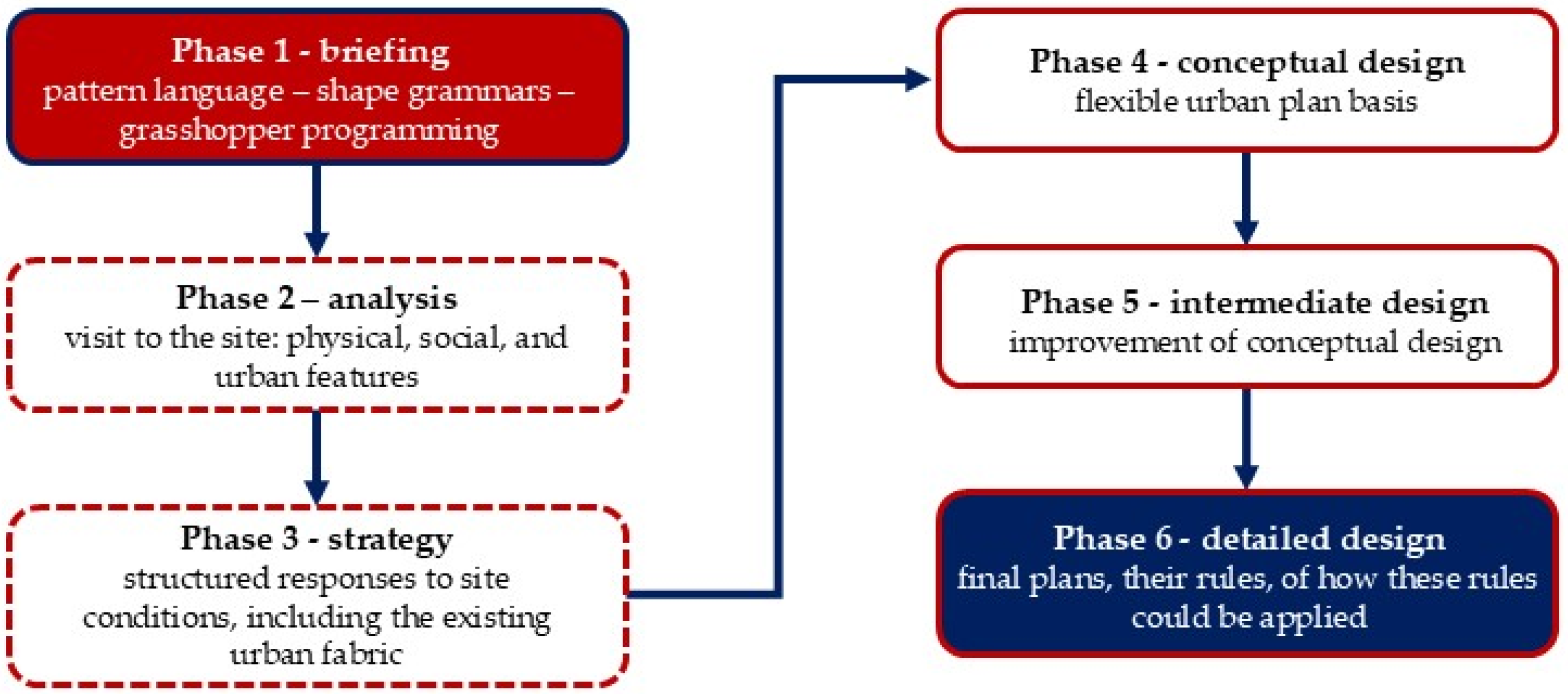
To structure this work and support methodological transparency, the semester followed a six-phase workflow adapted from Duarte and Beirão [
12]: (1) briefing, (2) analysis, (3) strategy, (4) conceptual design, (5) intermediate design, and (6) detailed design. Although presented sequentially, these phases were understood as overlapping and iterative, allowing insights gained through computational testing to inform earlier analytical assumptions, as depicted in
Figure 1.
3.1. Phase 1: Briefing-Acquisition of Basic Skills
This first phase ran in parallel with the early analytical stages and focused on establishing a shared methodological foundation. Three targeted workshops on pattern languages, shape grammars, and Rhino/Grasshopper introduced students to the theoretical and operational principles underpinning the studio’s design approach. Rather than prioritizing software proficiency alone, these sessions emphasized “computation without computers,” encouraging students to first articulate design logic through diagrams, rule sets, and manual transformations before implementing them digitally. This pedagogical sequencing helped students understand algorithms as conceptual structures rather than as purely technical scripts.
3.2. Phase 2: Analysis and Discovery
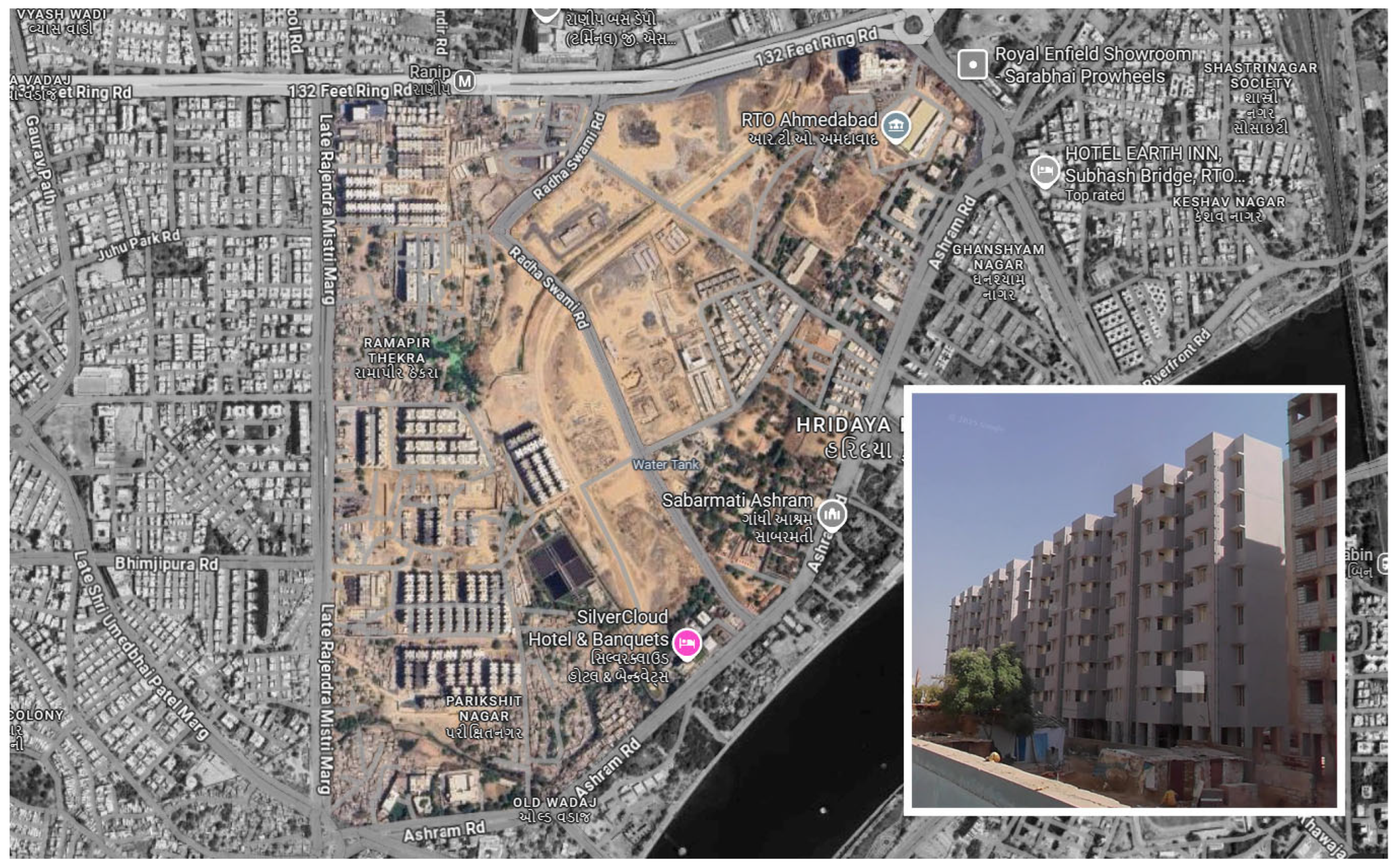
The discovery phase focused on acquiring foundational knowledge of both the theoretical framework and the design context. Students conducted multi-scalar analyses of Ramapir no Tekro, an informal settlement in Ahmedabad, India, (
Figure 2) addressing social, spatial, environmental, and infrastructural dimensions. Analytical outputs included diagrammatic mappings of dwelling aggregation, access hierarchies, public–private gradients, density variation, and environmental vulnerabilities, synthesized through plans, sections, and relational diagrams at scales ranging from 1:1000 to 1:500. These analyses foregrounded the socio-spatial intelligence embedded in everyday practices, such as flexible thresholds, mixed-use dwellings, incremental vertical expansion, and the use of micro-courtyards for domestic and economic activities.
The analysis phase focused on Ramapir no Tekro in Ahmedabad, India—one of the city’s densest and most socioeconomically vulnerable informal settlements. Home to approximately 15,000 residents living within roughly 8500 dwellings, the settlement displays significant density fluctuations, chronic infrastructural limitations, and an acute scarcity of accessible public space. Seasonal flooding along the central drainage corridor further disrupts mobility, public health, and everyday activities. Despite these challenges, current upgrading interventions deployed in the area rely on a standardized, repetitive housing solution that lacks contextual customization, spatial variation, or sensitivity to existing social dynamics.
In contrast, the students’ proposals began by documenting the settlement’s embedded spatial patterns—such as row-house configurations, courtyard clusters, and mixed-use edge conditions—while also examining the temporal rhythms of daily life. They observed flexible thresholds that shift between retail and domestic functions, the use of improvised shading systems, and the presence of micro-courtyards supporting cooking, gathering, and small-scale commerce. This analysis foregrounded the socio-spatial intelligence already present in the settlement and provided the foundation for the generative design strategies developed in subsequent phases.
3.3. Phase 3: Strategy
In the strategy phase, students abstracted analytical observations into preliminary design guidelines intended for computational encoding. Rather than prescribing fixed solutions, these guidelines articulated relational principles governing settlement structure, including circulation hierarchies, density targets, adjacency between housing and civic programs, and constraints related to flooding and access to public space. This phase marked a critical transition from descriptive analysis to rule-based reasoning, preparing students to shift from documenting form to defining generative logic.
During this, these observations were converted into rule-based systems. Using pattern-language techniques and shape grammars, students cataloged dwelling types, adjacency logics, access relationships, and rules for incremental expansion. Shape-grammar reasoning enabled them to formalize everyday spatial behaviors into generative mechanisms capable of producing multiple design outcomes rather than fixed solutions. This shift from designing forms to designing rules introduced a new mode of authorship—one centered on understanding processes rather than imposing predetermined shapes.
Parametric modeling extended this rule-based logic into computational simulations. Students created Grasshopper scripts that modeled variations in dwelling units, cluster organization, block formations, and neighborhood-scale circulation. Adjustable parameters—including lot dimensions, street widths, density targets, and environmental constraints—allowed students to visualize how small rule changes could produce cascading effects across scales. These simulations helped them assess walkability, solar access, ventilation patterns, and the distribution of public spaces across generative iterations.
3.4. Phase 4: Conceptual Design
The conceptual design phase introduced explicit rule-based and parametric implementation. Students formalized their strategies as shape-grammar systems, specifying transformation rules, adjacency conditions, and sequencing instructions capable of generating multiple urban configurations. These rule sets were then implemented in Rhino and Grasshopper as parametric relationships controlling dwelling units, housing clusters, neighborhood blocks, and circulation networks. Parameters governing lot dimensions, street widths, density ranges, and environmental constraints were adjusted iteratively, enabling students to generate, compare, and critique families of design outcomes rather than refining a single proposal. Iteration occurred through cycles of rule modification, parameter adjustment, and visual evaluation, reinforcing a process-based understanding of urban form.
3.5. Phase 5: Intermediate Design
During the intermediate design phase, students selected representative generative outcomes for further development and testing. Computational models were refined to address infrastructural integration, public space definition, and environmental responsiveness while maintaining their parametric structure. Design work focused on clarifying spatial relationships, material strategies, and the articulation of public and semi-public spaces at scales ranging from 1:250 to 1:100. Importantly, the models remained adjustable, allowing continued exploration of variation and trade-offs.
3.6. Phase 6: Detailed Design
The detailed design phase emphasized coherence across scales and the communication of generative intent. Students developed multiscalar outputs ranging from parametric dwelling families to block typologies, mixed-use corridors, and open-space networks. Representational techniques included grammar diagrams, typological matrices, environmental assessments, and perspective renderings. These outputs prioritized methodological legibility—making the underlying rules and relationships visible—over construction-level resolution.
Throughout all phases, service-learning principles functioned as an evaluative and ethical framework rather than as a mechanism for direct co-authorship of design rules. Community engagement occurred through sustained collaboration with an Ahmedabad-based architectural practice, including virtual dialogues, interviews, and an in-person lecture. These interactions provided contextual insight that informed how students interpreted analytical data and assessed the social implications of generative rules. Students were encouraged to reflect critically on how computational decisions could empower or marginalize residents, foregrounding questions of equity, access, and cultural respect.
Together, this studio framework establishes a pedagogical model in which computational design, urban morphology, and service learning are tightly integrated. By sequencing analysis, rule definition, computational implementation, and ethical evaluation, the studio provides students with a structured yet adaptable methodology for engaging complex informal urban contexts. This framework sets the stage for the case study presented in the following section, which demonstrates how these principles were operationalized within a single student project.
4. Case Study: “The Community at Scale” Design
While the case study is presented as a proof of method, the generated masterplans, blocks, and dwelling systems constitute explicit morphological products through which the underlying generative logic is evaluated and discussed.
Community at Scale is presented as a methodological walkthrough illustrating how the computational and service-learning framework described in
Section 3 was operationalized within a single student project; the intent is not to foreground the project itself, but to make the pedagogical structure, sequencing, and decision-making logic legible through a concrete example. Rather than representing a finalized design proposal, the case functions as a proof of method, demonstrating how empirical settlement analysis was translated into rule-based and parametric systems across multiple urban scales. The emphasis is placed on the generative logic and decision-making process rather than on a singular formal outcome.
The project begins with the construction of an urban grammar derived directly from the analytical phase. Observations of Ramapir no Tekro—including street hierarchy, density gradients, land-use clustering, access sequencing, and flood-related constraints—were abstracted into a set of relational rules governing permissible spatial transformations. These rules did not prescribe fixed geometries; instead, they defined relationships and constraints capable of accommodating incremental growth and adaptation. Implemented in Rhino and Grasshopper, the grammar enabled the generation and comparison of multiple masterplan variants rather than the optimization of a single configuration.
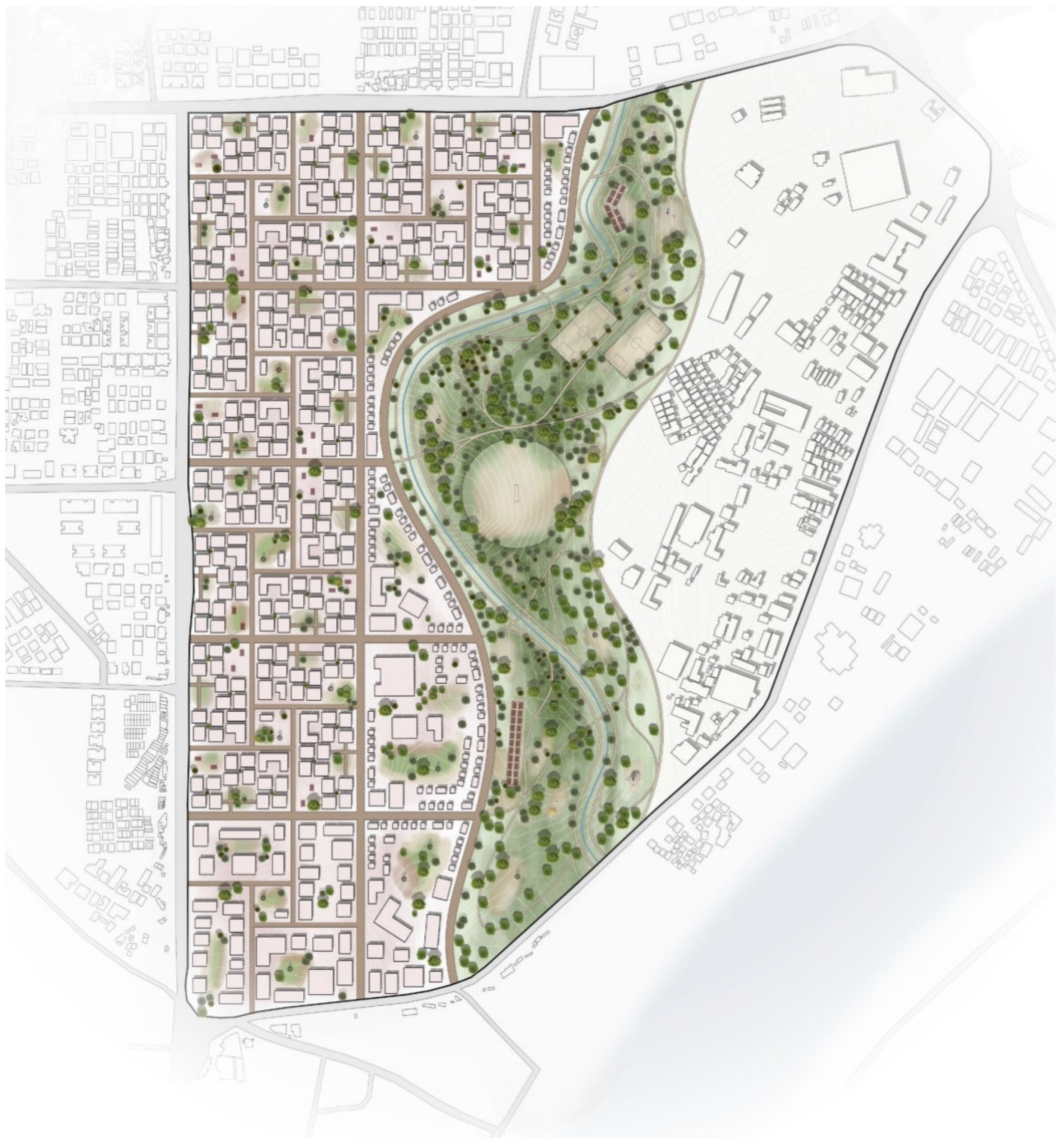
At the settlement scale, the masterplan is structured around a central landscape corridor aligned with the site’s existing drainage channel (
Figure 3). This corridor emerged from rule-based constraints that limited built density within flood-prone areas while reserving contiguous open space for water management and public use. Parametric controls regulated the corridor’s width, continuity, and connectivity, balancing hydraulic capacity with pedestrian accessibility. By encoding flood behavior as a spatial constraint rather than treating it as a post-design mitigation, the project transforms an environmental vulnerability into an organizing element of the urban system.
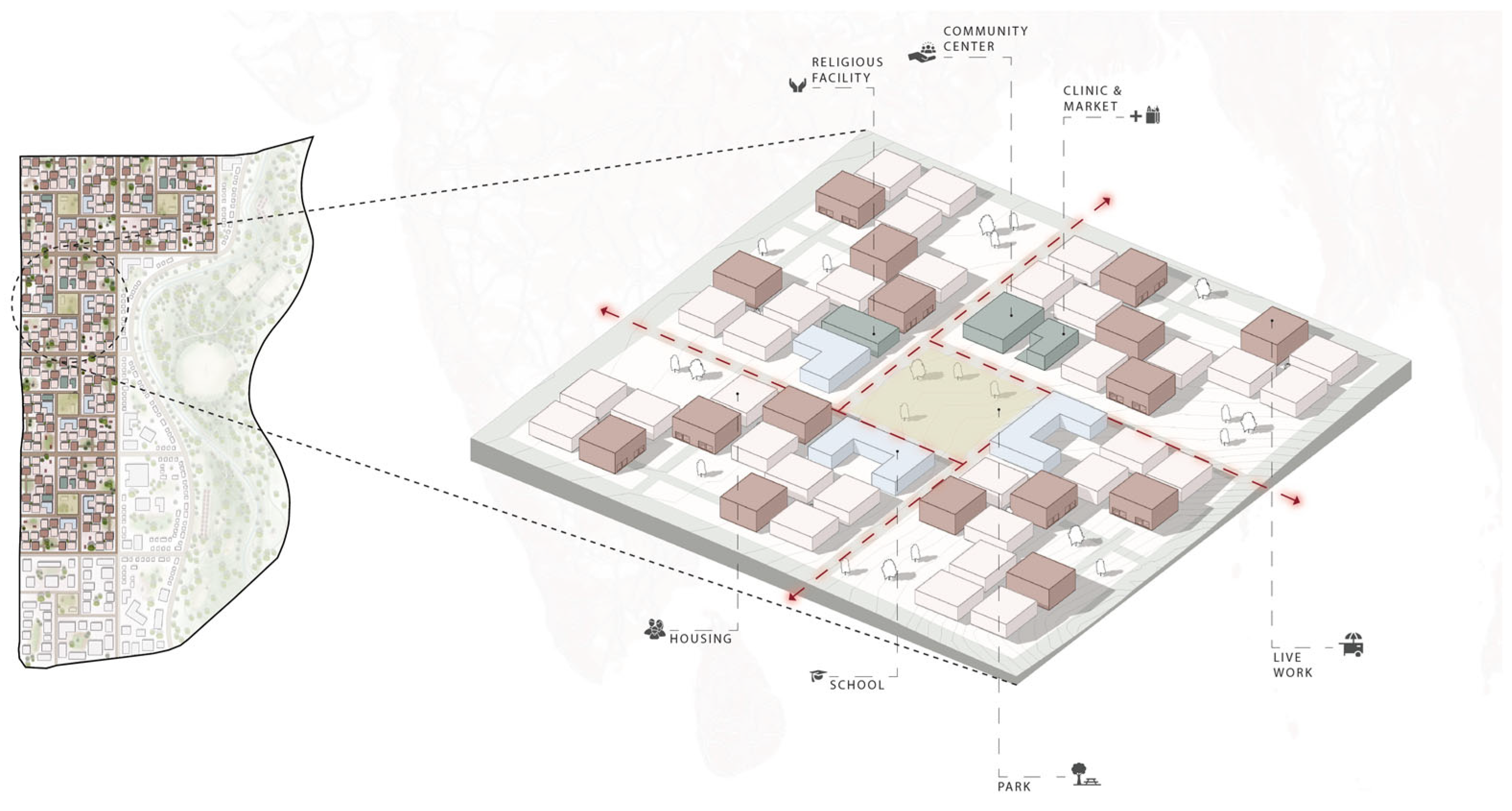
From this macro-scale framework, the neighborhood block operates as the primary generative unit through which the urban grammar is instantiated. Blocks were developed within an approximately 800-foot by 800-foot framework, a dimension that emerged through iterative testing of walkability thresholds, program adjacency, and circulation logic rather than from predetermined planning standards. The block diagram (
Figure 4) illustrates how civic anchors, internal courtyards, and circulation routes are distributed according to rules governing public–private gradients and permeability. Each block functions as a complete micro-urban system while remaining compatible with adjacent blocks.
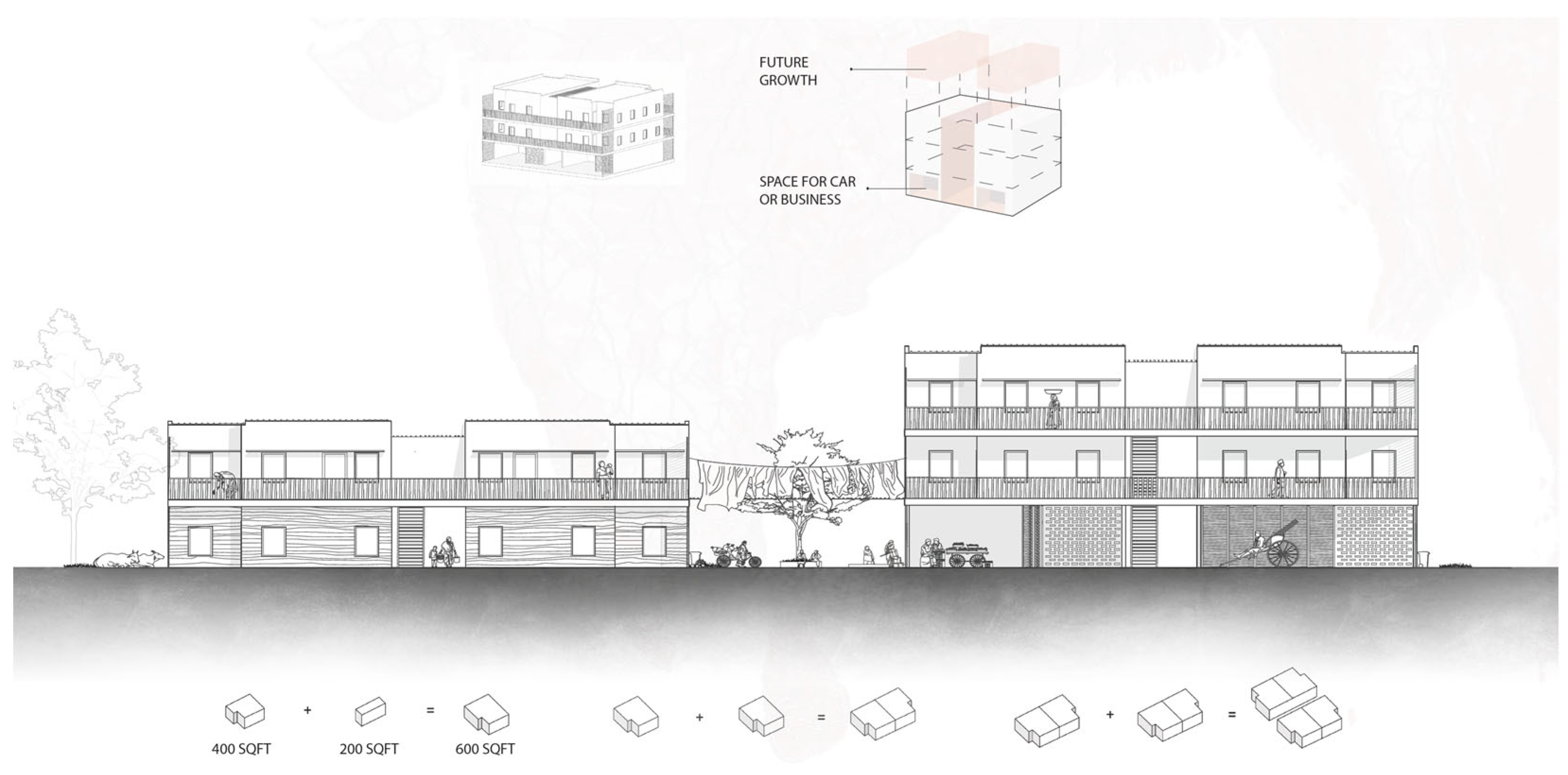
Within these blocks, building groups are organized through a hybrid generative strategy combining shape-grammar rules with parametric adjustment. Shape grammars define allowable aggregation patterns, vertical stacking sequences, and threshold conditions, while parametric controls adjust unit dimensions, spacing, and orientation in response to site conditions and programmatic needs. The resulting building assemblies (
Figure 5) demonstrate how rule-consistent variation supports porosity, shading, and communal thresholds. Ground floors remain intentionally flexible to accommodate live–work uses, while upper levels allow incremental vertical expansion consistent with growth patterns observed in the settlement analysis.
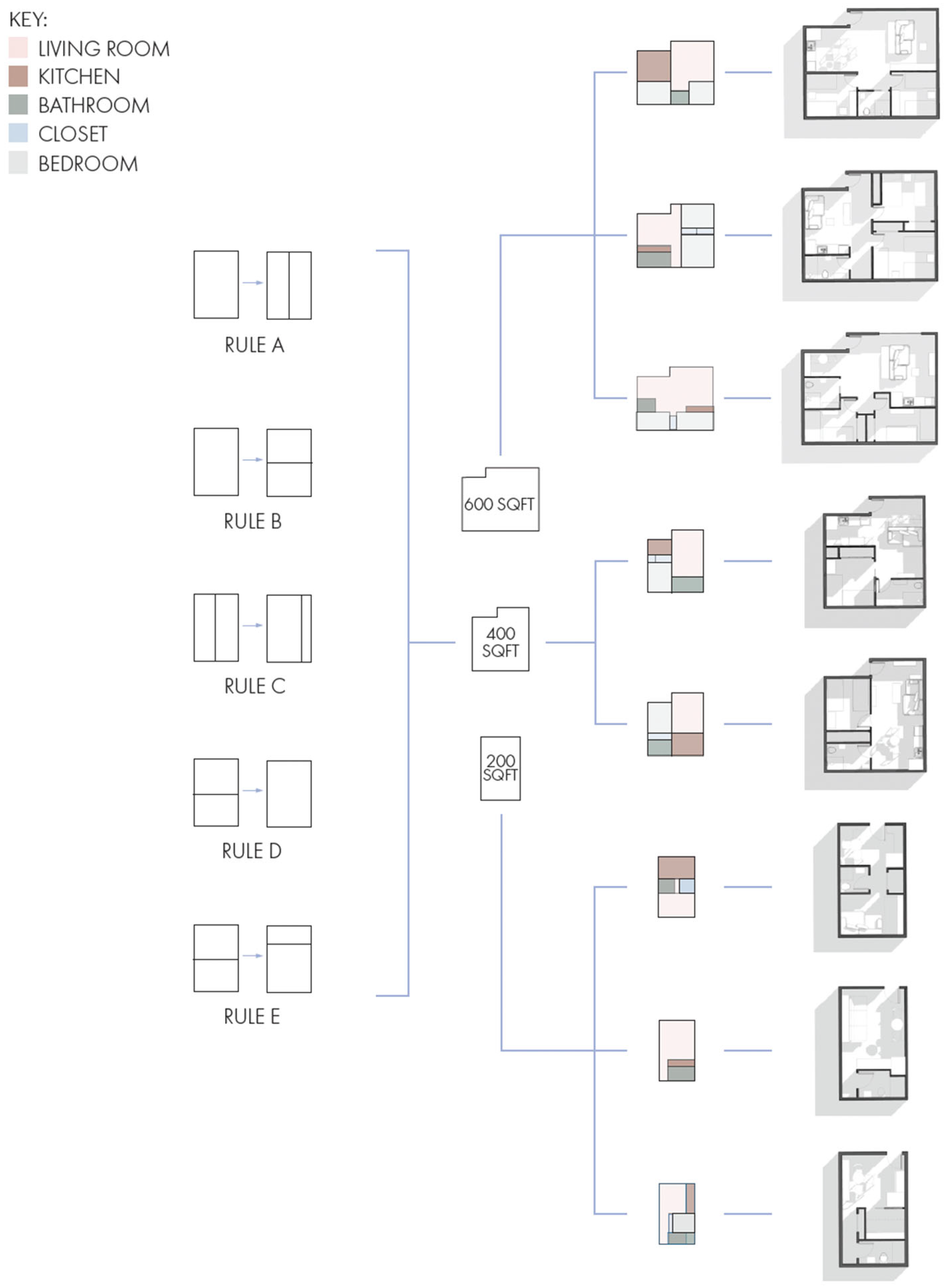
At the dwelling scale, the project formalizes housing units as the smallest generative elements within the system. Each unit originates from one of three base footprints—200, 400, or 600 square feet—and is transformed through a defined set of grammar rules governing expansion, subdivision, reorientation, and aggregation. The shape-grammar diagram (
Figure 6) illustrates how these rules generate multiple floor-plan variations while preserving functional relationships, access logic, and infrastructural coherence. Housing is thus conceptualized as an adaptable system rather than a fixed commodity.
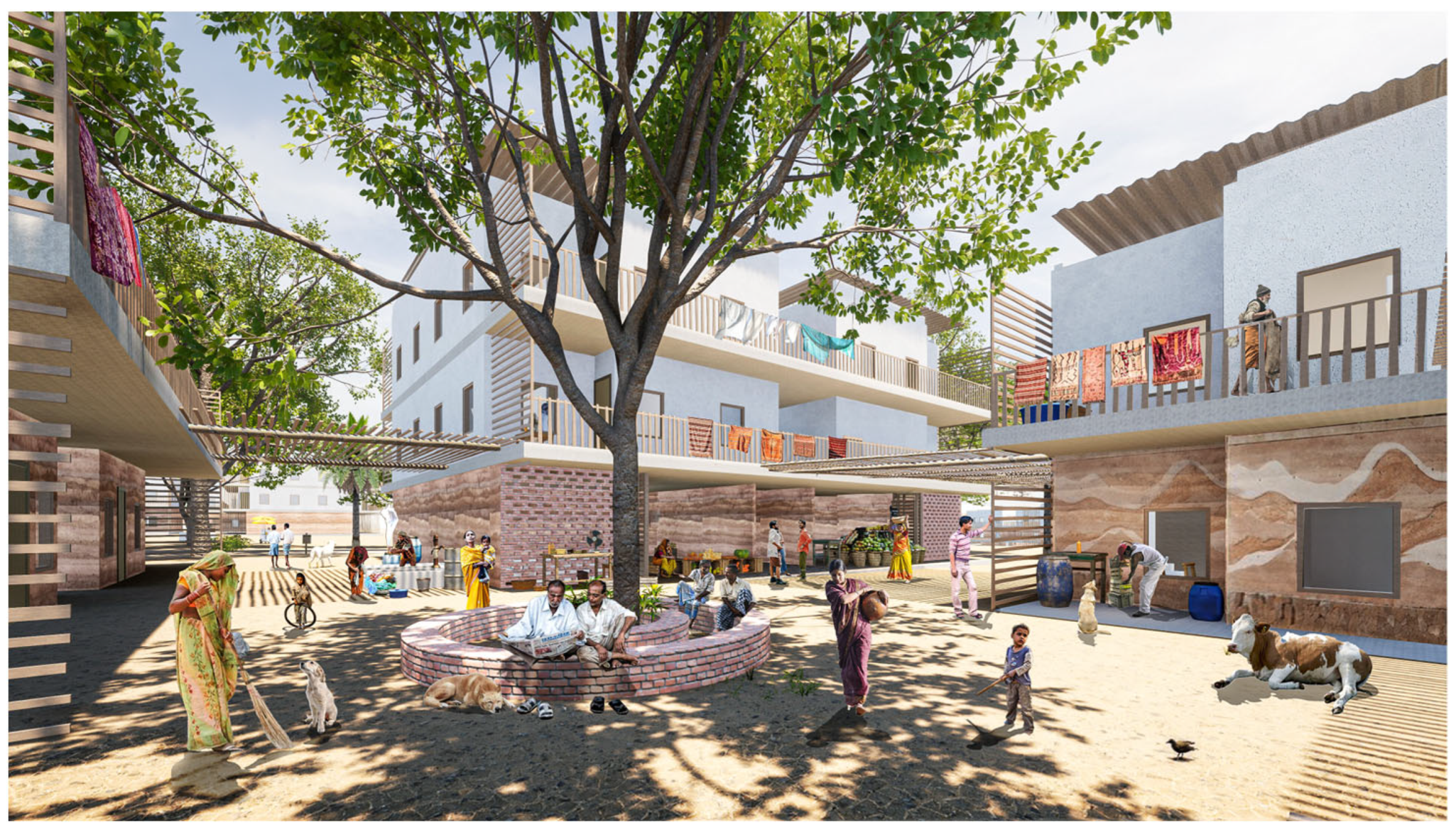
Representational outputs are used to evaluate the spatial and experiential implications of the generative logic rather than to depict construction-ready solutions. Interior courtyard renderings (
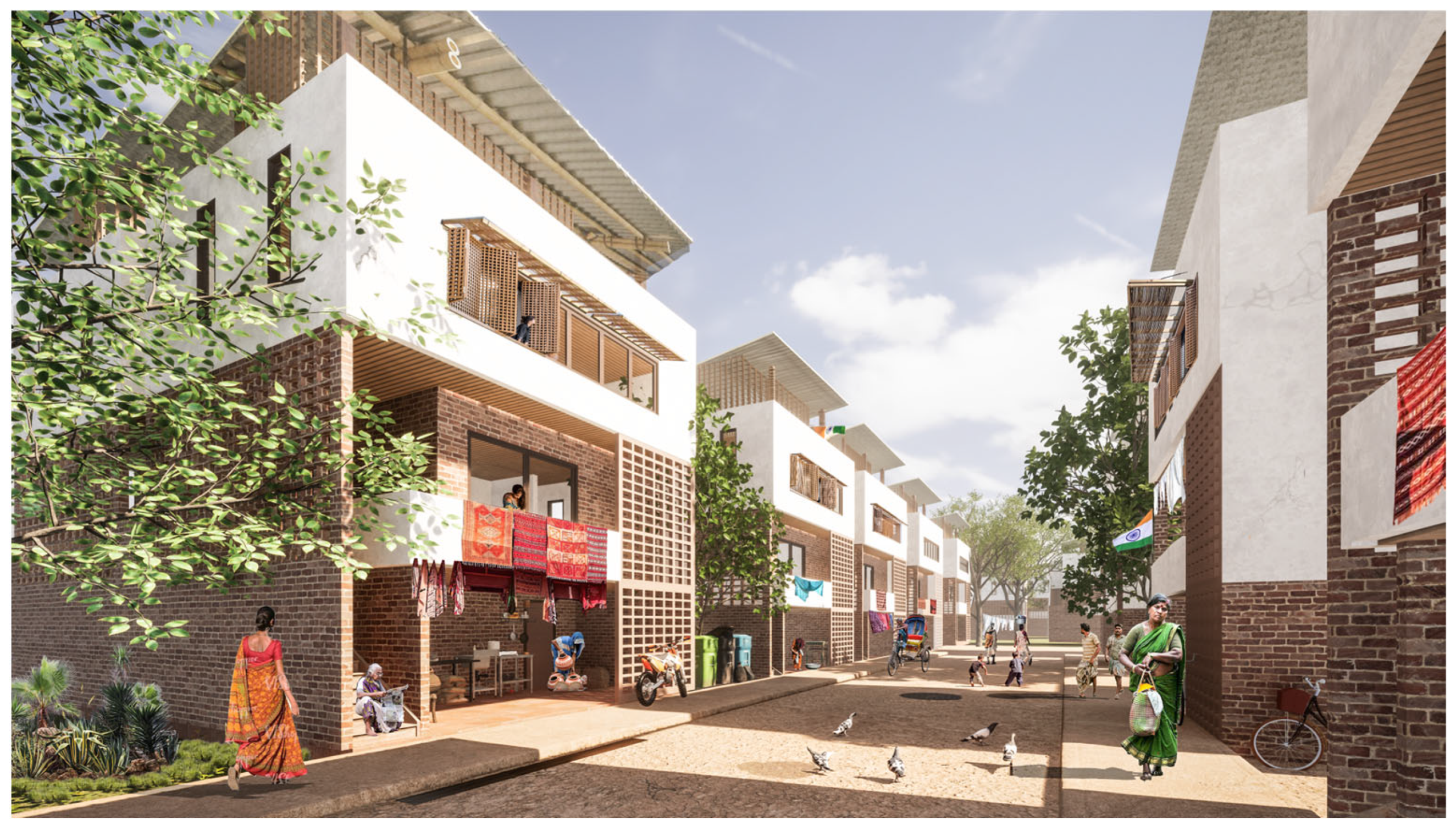
Figure 7) illustrate semi-public spaces where domestic, social, and economic activities intersect, reflecting spatial practices common in informal settlements. A mixed-use street perspective (
Figure 8) demonstrates how incremental architectural variation activates primary circulation routes without formal uniformity. The rendering highlights how the spatial logic derived from grammar rules creates opportunities for organic social life rather than constraining it.
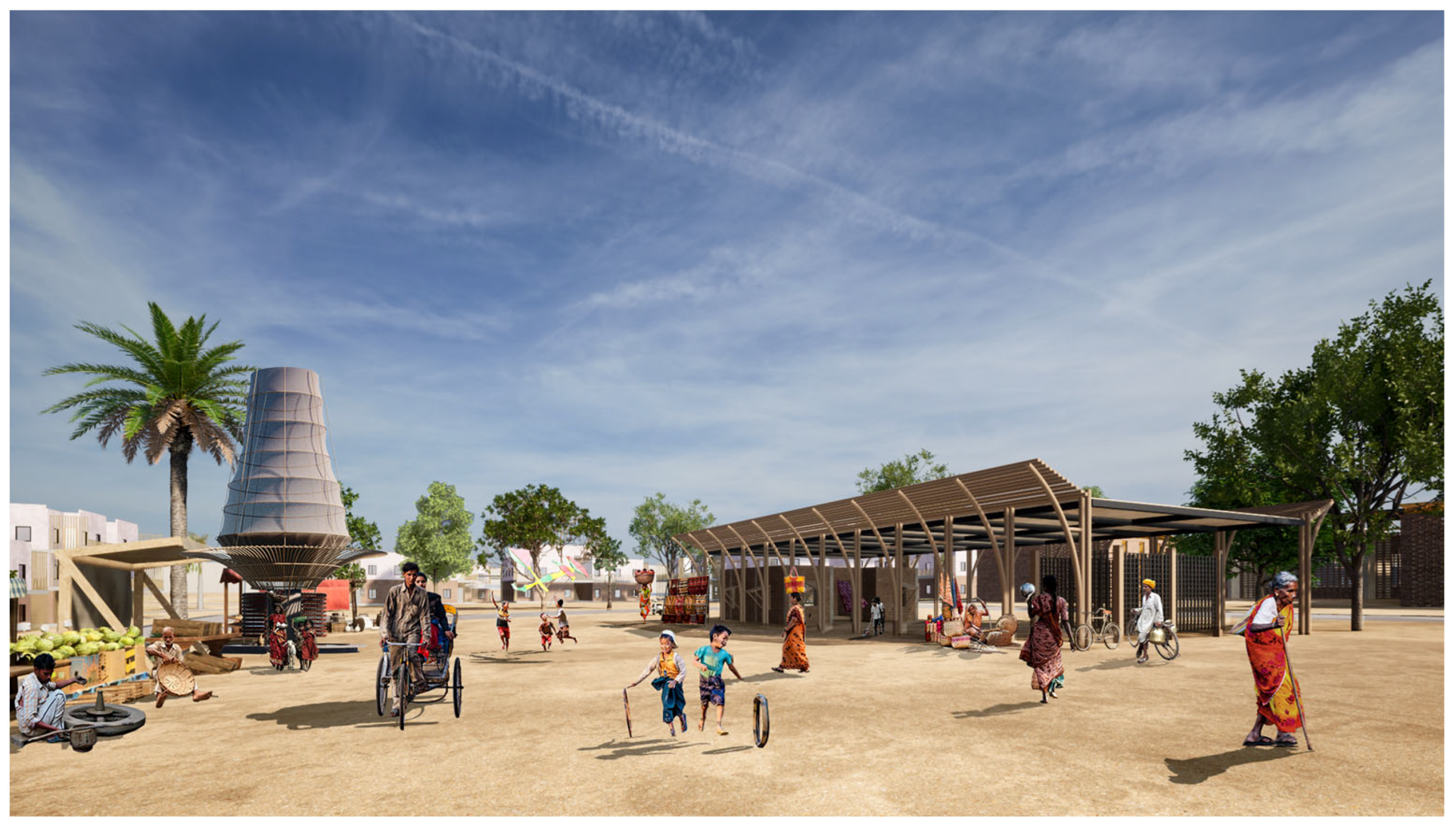
At the civic scale, the neighborhood square (
Figure 9) operates as a social and infrastructural node, integrating water-harvesting infrastructure, shaded gathering areas, and flexible market space. Finally, the riverside park (
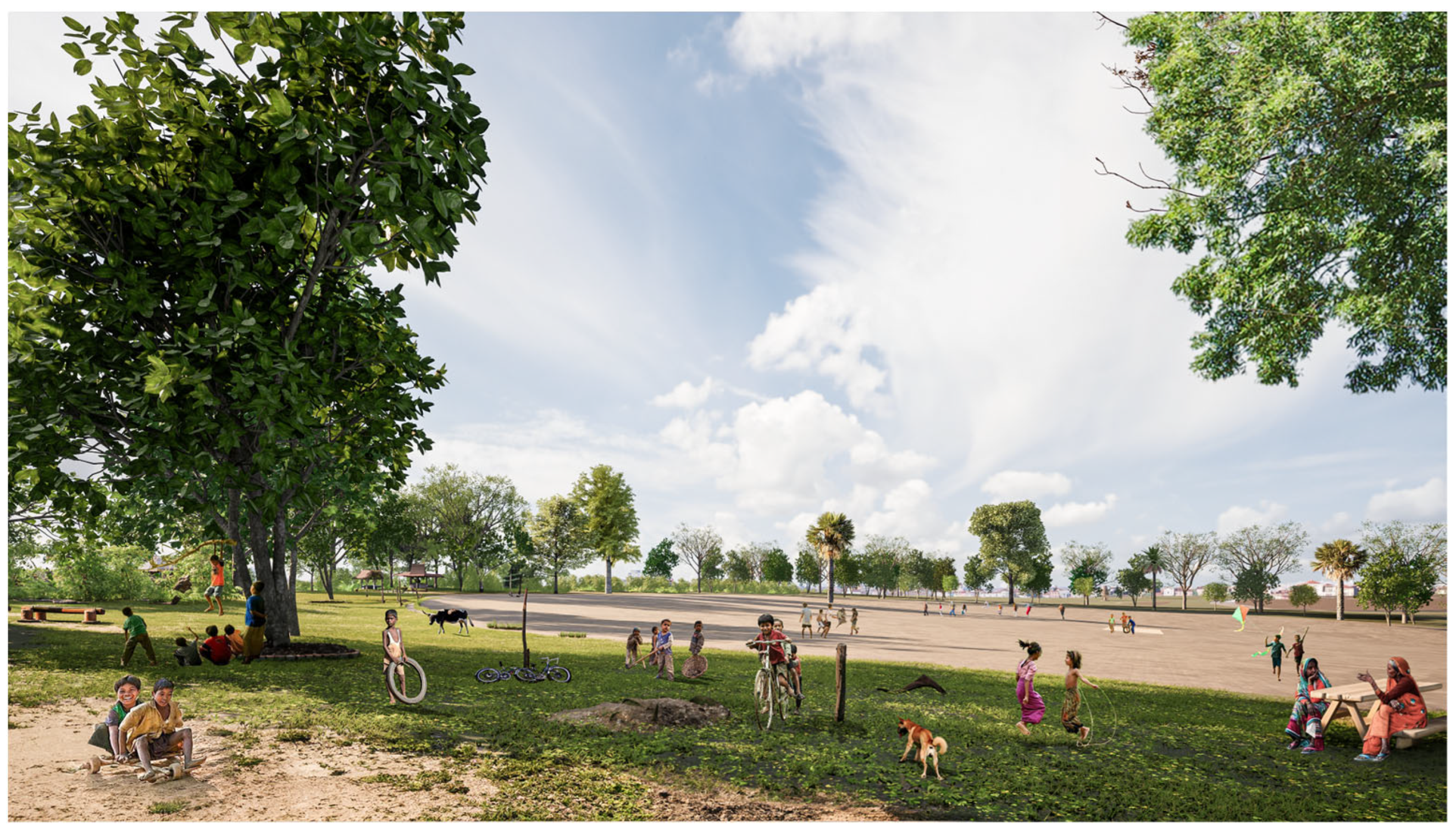
Figure 10) illustrates how flood-resilient landscape systems function simultaneously as environmental buffers and communal amenities. Together, these visualizations serve as evaluative tools for assessing whether the generative framework supports everyday life, accessibility, and social interaction.
Overall, Community at Scale demonstrates how a rule-based, computationally mediated workflow can translate empirical observations of informal urbanism into adaptable design systems. By explicitly documenting the sequence from analysis to rule definition, parametric implementation, iteration, and evaluation, the case study illustrates how computational design can mediate between morphogenetic urban theory, pedagogical practice, and ethical engagement. While limited to a single project, the case establishes a clear methodological precedent for future comparative studies without claiming universal applicability or definitive validation.
As such, the value of the case study lies not in the specific formal outcome but in its capacity to clarify how the proposed pedagogical framework structures analysis, rule definition, iteration, and ethical evaluation within a studio setting.
5. Discussion
The primary contribution of this study is the pedagogical framework outlined in
Section 3, which integrates computational design and service-learning principles to support architectural education in informal settlement contexts; the case study in
Section 4 functions as an illustrative testbed for this framework rather than as a project-centered outcome.
The pedagogical framework presented in this study, in turn, demonstrates how computational design, when integrated with service-learning principles, can reorient architectural education toward engaging social complexity rather than privileging formal novelty or technical performance alone. The ARC 4025 studio illustrates that computational workflows, such as pattern extraction, shape grammars, and parametric modeling, can function as analytical and generative tools that mediate between empirical observation, design reasoning, and ethical reflection. This discussion elaborates on the broader pedagogical implications of the model, focusing on three interrelated themes: computation as relational reasoning, generative design as a pathway to contextual intelligence, and service learning as an evaluative framework grounding computational work in lived experience.
First, the studio underscores the importance of repositioning computation within architectural education as a mode of relational understanding. In many curricula, computational tools are introduced through abstract geometric exercises or optimization problems detached from real-world contexts. While such approaches may build technical proficiency, they often obscure the social, environmental, and cultural dimensions of design decision-making. By contrast, ARC 4025 situates computation within the socio-spatial realities of informal settlements, requiring students to engage with interdependencies among circulation, density, access, environmental vulnerability, and everyday practices. Through this framing, algorithms are understood not as engines of complexity, but as structured representations of relationships and constraints shaping urban life.
Within this context, shape grammars and parametric models become instruments for articulating processes of change rather than static forms. Students learn to express how dwellings expand incrementally, how public and semi-public spaces emerge from adjacency logic, and how circulation hierarchies influence social interaction. Parametric iteration enables students to visualize how small changes in rules or parameters propagate across scales, revealing trade-offs embedded in decisions about density, access, and program distribution. In this way, computational design fosters systems thinking, encouraging students to view informal settlements as living environments shaped by adaptive, rule-based behavior rather than as disordered or deficient urban conditions.
Second, the use of generative design, particularly through hybrid shape-grammar and parametric workflows, offers a methodological response to the uncertainty and incremental growth that characterize informal settlements. A key pedagogical contribution of the studio lies in shifting students from deterministic masterplanning toward the construction of open-ended systems capable of producing families of coherent outcomes. Rather than converging on a single “optimal” solution, students design rules that accommodate variation, personalization, and long-term transformation. This approach aligns with process-typological traditions in urban morphology and equips students to engage contexts defined by uncertainty, negotiation, and incremental change.
The Community at Scale case study illustrates this shift. Its logic is grounded in rule-making: urban blocks are generated through adjacency and access rules; building groups evolve through aggregation and vertical extension rules; dwellings adapt through transformation operations that preserve functional relationships. Through this process, students develop fluency in modeling change over time, gaining tools for engaging urban contexts where uncertainty, negotiation, and adaptation are the norm. This capacity to reason through change, rather than to resolve form, constitutes a central pedagogical outcome of the studio.
Third, the integration of service learning enriches computational reasoning by embedding ethical evaluation within the design process. Without this grounding, generative systems risk reinforcing technocratic or top-down planning paradigms that abstract communities into datasets or parameters. In the ARC 4025 studio, service learning operates as a framework for accountability rather than as a claim of participation or co-authorship. Engagements with Ahmedabad-based practitioners and community narratives inform how students interpret analytical data, define rules, and assess the social implications of their generative systems. Students are encouraged to question whose interests are prioritized by specific rules, how spatial decisions may affect livelihoods or access, and what forms of agency are enabled or constrained by computational logic.
This integration reveals a productive pedagogical synergy. Computational design benefits from the reflexivity fostered by service learning, while service-learning gains analytical depth when paired with explicit rule-based reasoning. Together, they encourage students to recognize that algorithms are not neutral tools, but carry assumptions about order, hierarchy, and value. Making these assumptions explicit enables critical discussion and alignment with local priorities, reinforcing the role of architects as reflective practitioners rather than neutral problem-solvers.
Finally, the iterative development of the studio itself reflects the principles it seeks to teach. Across multiple academic cycles, the framework has evolved in response to student feedback, institutional context, and deepening relationships with external partners. This adaptability mirrors the incremental and responsive nature of informal settlements, reinforcing the studio’s emphasis on learning through iteration, reflection, and adjustment. As such, the pedagogical model remains open-ended, capable of being refined and adapted to different contexts rather than replicated as a fixed formula.
6. Conclusions
This study advances a pedagogical framework that integrates computational design and service-learning principles to support architectural education in addressing the complex challenges of informal settlement planning. By situating computational reasoning within the lived realities of communities such as Ramapir no Tekro in Ahmedabad, the ARC 4025 studio demonstrates how generative design methods can foster analytical rigor, social awareness, and ethical reflection among architecture students. Rather than treating computation as a purely technical or formal pursuit, the framework positions it as a means of reasoning through socio-spatial complexity and environmental constraint.
Three overarching contributions emerge from this work. First, the study demonstrates that computational design—when understood as a cognitive and analytical framework—can illuminate the underlying structures, patterns, and adaptive strategies embedded in informal settlements. Shape grammars and parametric modeling enable students to decode the logic of incremental construction, spatial clustering, and everyday practice, revealing the intelligence embedded in self-organized urban environments. This perspective challenges deficit-based interpretations of informality and reframes informal settlements as sources of design knowledge rather than problems to be corrected.
Second, the framework highlights the pedagogical value of shifting from form-making to rule-making. By designing generative systems rather than singular solutions, students are able to explore families of possible futures that remain coherent while accommodating variation, growth, and long-term transformation. This approach aligns with process-typological traditions in urban morphology and equips students to engage contexts defined by uncertainty, negotiation, and incremental change. The Community at Scale case study exemplifies how multiscalar rule-based systems can balance environmental logic, infrastructural needs, and cultural specificity without resorting to deterministic masterplanning.
Third, the study underscores the essential role of service learning in grounding computational methods in ethical and cultural responsibility. Engagement with community narratives—mediated through partnerships with local practitioners—ensures that computational models remain connected to human needs and aspirations. Service-learning fosters reflexivity, encouraging students to consider how design rules shape access, livelihoods, and social interaction. When paired with computational design, this ethical grounding helps prevent technocratic abstraction and reinforces architecture’s responsibility to support dignity, equity, and agency.
Taken together, these contributions illustrate the potential of a computational–service-learning model to advance architectural education in both conceptual and practical terms. The framework equips students with a hybrid skill set that bridges technical proficiency and ethical sensitivity, preparing them to work within interdisciplinary teams and to engage complex urban environments shaped by rapid urbanization and climate vulnerability. By treating computation as a tool for engaging uncertainty and modeling relational systems, the studio prepares future architects to operate within evolving and contested urban conditions.
Limitations and Replicability Boundaries
This study documents a pedagogical workflow and a single student project as a proof of method rather than as a validation of built outcomes. While community engagement informed interpretation and ethical evaluation, community members did not directly co-author generative rules or design decisions. As such, the framework should not be interpreted as a participatory planning model, but as an educational approach that integrates contextual insight into computational reasoning.
Replicability of the framework depends on several factors, including instructional scaffolding, faculty expertise in computational methods, access to contextual knowledge, and institutional support for service-learning initiatives. While the six-phase structure and rule-based logic are transferable, their implementation must be adapted to local pedagogical conditions and community contexts. The study also focuses on a single case, limiting comparative assessment across different student approaches or settlement types.
Future research could strengthen the evidence base by documenting multiple student projects, comparing variations in rule definition and generative outcomes, and assessing how students apply rule-based reasoning and ethical frameworks in subsequent academic or professional contexts. Additional inquiry might explore the integration of complementary evaluation tools—such as environmental simulation, agent-based modeling, or immersive visualization—to enrich understanding of spatial performance and lived experience. Despite these limitations, the framework offers a transparent and adaptable model for integrating computational design, urban morphology, and service learning within architectural education, contributing to the development of socially attuned and computationally literate designers.