

Next Article in Journal
Computational Design and Service Learning in Informal Settlement Planning: A Pedagogical Model for Architectural Education
Previous Article in Journal
An Instrumented Drop-Test Analysis of the Impact Behavior of Commercial Laminated Flooring Brands
Previous Article in Special Issue
Application of Resistometric Sensors in Investigation of Zinc Corrosion in Simulated Concrete Environments
error_outline You can access the new MDPI.com website here. Explore and share your feedback with us.
 
 
Review

Mechanisms and Protection Strategies for Concrete Degradation Under Magnesium Salt Environment: A Review

1
Department of Ecological Protection and Environmental Engineering, Shandong Urban Construction Vocational College, Jinan 250103, China
2
School of Material Science and Engineering, Shandong Jianzhu University, Jinan 250101, China
3
School of Civil Engineering and Architecture, East China Jiaotong University, Nanchang 330013, China
*
Author to whom correspondence should be addressed.
Buildings 2026, 16(2), 264; https://doi.org/10.3390/buildings16020264
Submission received: 8 December 2025 / Revised: 30 December 2025 / Accepted: 5 January 2026 / Published: 7 January 2026

Abstract

Concrete structures suffering from Mg2+ environments may suffer severe damage, which mainly has something to do with the coupled effect among Cl, SO42−, and Mg2+. Based on a systematic review of Web of Science and Scopus database (2000–2025), we first summarized the migration behavior, reaction paths, and interaction mechanism of Cl, SO42−, and Mg2+ in cementitious matrices. Secondly, from the perspective of Cl cyclic adsorption–desorption breaking the passivation film of steel bars, SO42− generating expansion products leads to crack expansion, then Mg2+ decalcifies C-S-H and transforms into M-S-H; we analyzed the main damage mechanisms, respectively. In addition, under the coexistence conditions of three kinds of ions, the “fixation–substitution–redissolution” process and “crack–transport” coupling positive feedback mechanism further increase the development rate of damage. Then, some anti-corrosion measures, such as mineral admixtures, functional chemical admixtures, fiber reinforcements, surface coatings, and new binder systems, are summarized, and the pros and cons of different anti-corrosion technologies are compared and evaluated. Lastly, from two aspects of simulation prediction for the coupled corrosion damage mechanism and service life prediction, respectively, we have critically evaluated the advances and problems existing in the current research on the aspects of ion migration-reaction coupled models, multi-physics coupled frameworks, phase-field methods, etc. We found that there is still much work to be conducted in three respects: deepening mechanism understanding, improving prediction precision, and strengthening the connection between laboratory test results and actual projects, so as to provide theoretical basis and technical support for the durability design and anti-corrosion strategies of concrete in complex Mg2+ environments.

1. Introduction

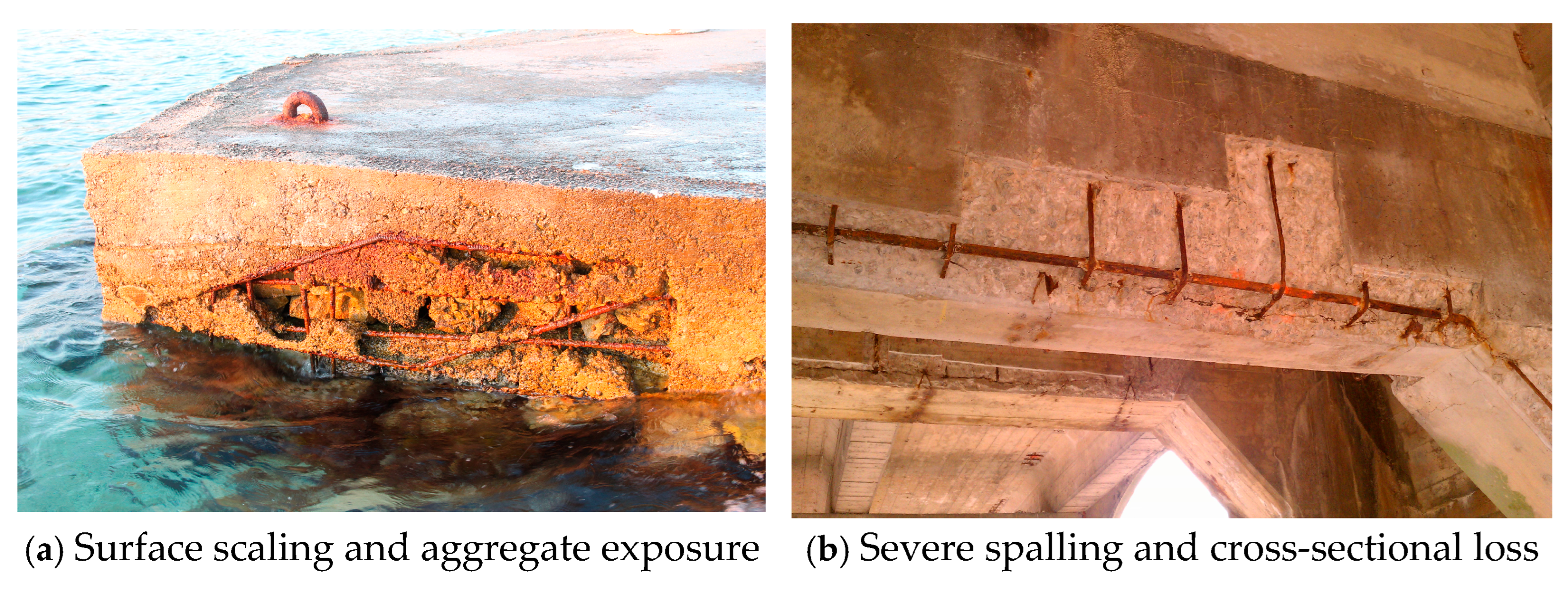
Magnesium salts refer to the magnesium cations (Mg2+) combined with chloride ions (Cl), sulfate ions (SO42−), carbonate ions (CO32−) and so on. They are commonly found in the intertidal zone of the ocean, salt lake basins, underground brine mines, permafrost regions subjected to repeated freeze–thaw cycles and other areas where large-scale concrete structures can be used for long periods [1,2,3]. Here, the corrosion damage of concrete from magnesium salts exhibits high complexity and time dependence. Magnesium salts themselves might cause corrosion damage to concrete, or they might coexist with Cl and SO42−, thereby forming multivalent ions that lead to longer-term and even greater corrosion damage. On the one hand, the characteristics of “intrusion from the outside”, “accumulation inside” and “decreased performance” occur in the long-term development of magnesium salt corrosion [4,5,6]. According to research results from site-cured concrete specimens [7,8], it was found that after long-term exposure to a magnesium salt environment, most concrete structures exhibited severe surface peeling and porous destruction (Figure 1), accompanied by crazing, deterioration of compressive strength, and steel bar corrosion. The load-carrying capacity of members was reduced, as well as their design service life.
In recent years, researchers worldwide have paid more and more attention to the clarification of the corrosion mechanisms of chloride, sulfate, and magnesium salts, which has significantly advanced our understanding of the corrosion mechanisms of individual salt species. Cl has a higher migration rate in concrete and can destroy the passivation film on the surface of reinforcement through a cycle adsorption/desorption process, thereby inducing corrosion [9,10,11,12]; SO42− promotes the generation of expansive products such as ettringite, gypsum, and aggravate cracking [13]; Mg2+ reacts with cement hydration products and reduces the compactness and stability of the cement matrix [14]. Previous researchers mainly focused their studies on the conditions of a single ion environment, without a uniform opinion on the interaction mechanism between Cl, SO42−, and Mg2+. In terms of the improvement and repair of durability properties, research on various remedial treatments (blended cementitious materials, functional cementitious systems, surface sealing treatment) is relatively mature. As for the durability prediction model, although some models have been established based on diffusion theory, coupled transport–reaction models, kinetic reaction models, etc., there are still many problems in multi-physics coupling modeling, parameter determination, and so forth.
According to the above analysis, unlike previous review articles that mainly describe single-salt corrosion qualitatively, we summarize the quantitative coupling mechanism and synergetic protection strategy under the Mg2+-SO42−-Cl environment. In view of the deficiency of quantitative basis in previous studies, the novelty of our work is reflected in two aspects: (1) Critical synthesis of coupled mechanisms: Different from the simple description before, we quantitatively summarize how the ion concentration ratio affects the “fixation–substitution–redissolution” process, and evaluate the critical threshold and the promotion effect of the corrosion rate under the “crack–transport” positive feedback based on the existing theoretical models. (2) Synergetic protection strategies: Rather than considering each technology individually, we analyze the compatibility among different levels of protection systems (mineral admixture, surface coating, and new binder system) to put forward a more efficient path for durability design under complex marine conditions. Finally, some current research hotspots in multiphysical simulation and lifespan prediction are discussed. In order to intuitively show the logical relationship between related contents, Table 1 shows the conceptual framework from micro-mechanisms to structural durability.

2. Study on the Damage Mechanism of Concrete Under Magnesium Salt Attack

2.1. Magnesium Chloride Attack

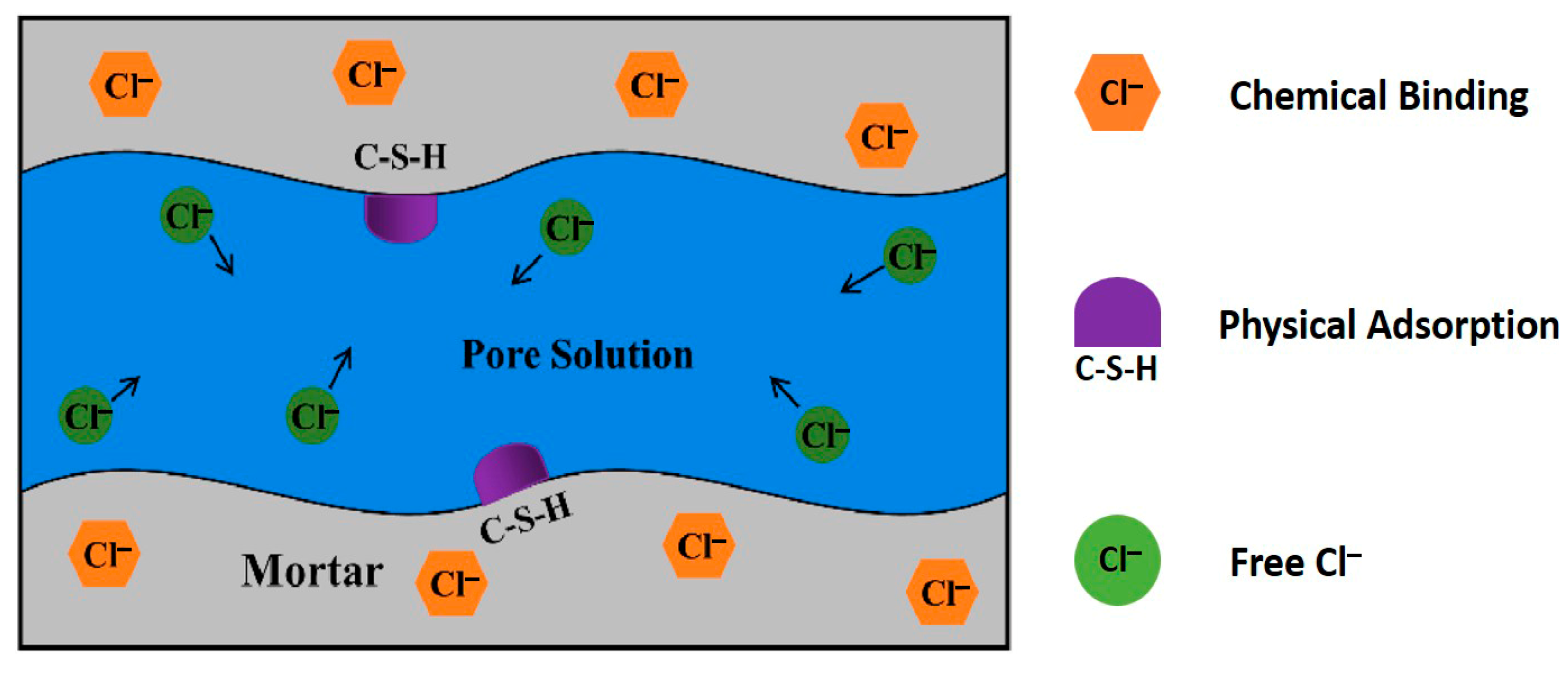
Chloride ions in concrete exist mainly in two forms in concrete’s pore system (Figure 2) [15,16], i.e., they exist freely in the pore solution or they are fixed on the solid matrix because of physical adsorption at the C-S-H surface or chemical interaction with CAH and the formation of chloride-aluminate phases such as AFm-Cl (Friedel’s salt). The degradation mechanism of concrete subjected to chloride salt environments mainly results from the good mobility and chemical activity of chloride ions: the chloride ions will rapidly migrate along the interconnected pores, reach the surface of the reinforcing bar and destroy the protective passive film; simultaneously, they react with different hydrated products, change the microstructure, and induce further corrosion reactions. Compared with other types of salt corrosion damage, the characteristics of chloride corrosion damage belong to “penetration quickly” and “corrode quickly.” It is easy to cause early damage phenomena such as cover spalling, crack expansion, and rapid corrosion development. Therefore, it is important to understand the migration path and fixation behavior of Cl in cement-based materials and its effect on the passivation film of steel bars to reveal the degradation mechanisms of concrete under MgCl2 corrosion.

2.1.1. Chloride Ion Transport Mechanism

Chloride ions (Cl) are the most aggressive species in natural seawater, possessing the highest concentration of approximately 1.94% [17]. Their small ionic radius and high hydrophilicity facilitate rapid penetration into pore structures to initiate corrosion. Generally, four mechanisms describe this migration [17].
(1)
Unlike Na+ in NaCl solutions, Mg2+ reacts with C-S-H gels to form porous M-S-H. This decalcification process increases pore connectivity and reduces tortuosity. Consequently, chloride diffusivity is significantly higher in magnesium-rich environments than in standard conditions [17,18].
(2)
The development of cracks is another distinctive feature unique to Mg attack. The crystallization pressure produced by Mg salts causes internal micropores/cracks to form inside concrete; such pores/cracks then become ‘highways’ along which ingress occurs. Studies have shown [19,20] that once the crack width exceeds 0.07 mm, the rate of Cl migration increases dramatically in a nonlinear fashion compared with pure diffusion without cracking.
(3)
Under wet–dry cycles, “pump effect” is further enhanced by magnesium-induced surface degradation: the magnesium salts attack causes surface scaling/spalling (physical removal of the protective layer), which in turn decreases the resistance to capillary uptake, thus favoring a faster accumulation and inward migration of chloride ions during wet phases [21].
(4)
Permeation and electromigration are further promoted by chemical effects: unlike what happens in NaCl solutions (where the pore fluid stays highly alkaline), the hydrolysis of Mg2+ leads to precipitation of Mg(OH)2, with a strong decrease in pH. Acidification destabilizes the electrostatic potential of the pore wall and decreases its capacity of repelling and binding Cl, thereby enhancing their entry inside the specimen [22,23].
Table 2 shows the typical structure example of concrete in different exposure zones in the marine environment. It summarizes the main migration mechanisms of chloride ions in each zone, respectively, which provides a visual reference for understanding the paths of chloride ion invasion into concrete under different conditions of the sea environment.

2.1.2. Mechanism of Magnesium Chloride Attack

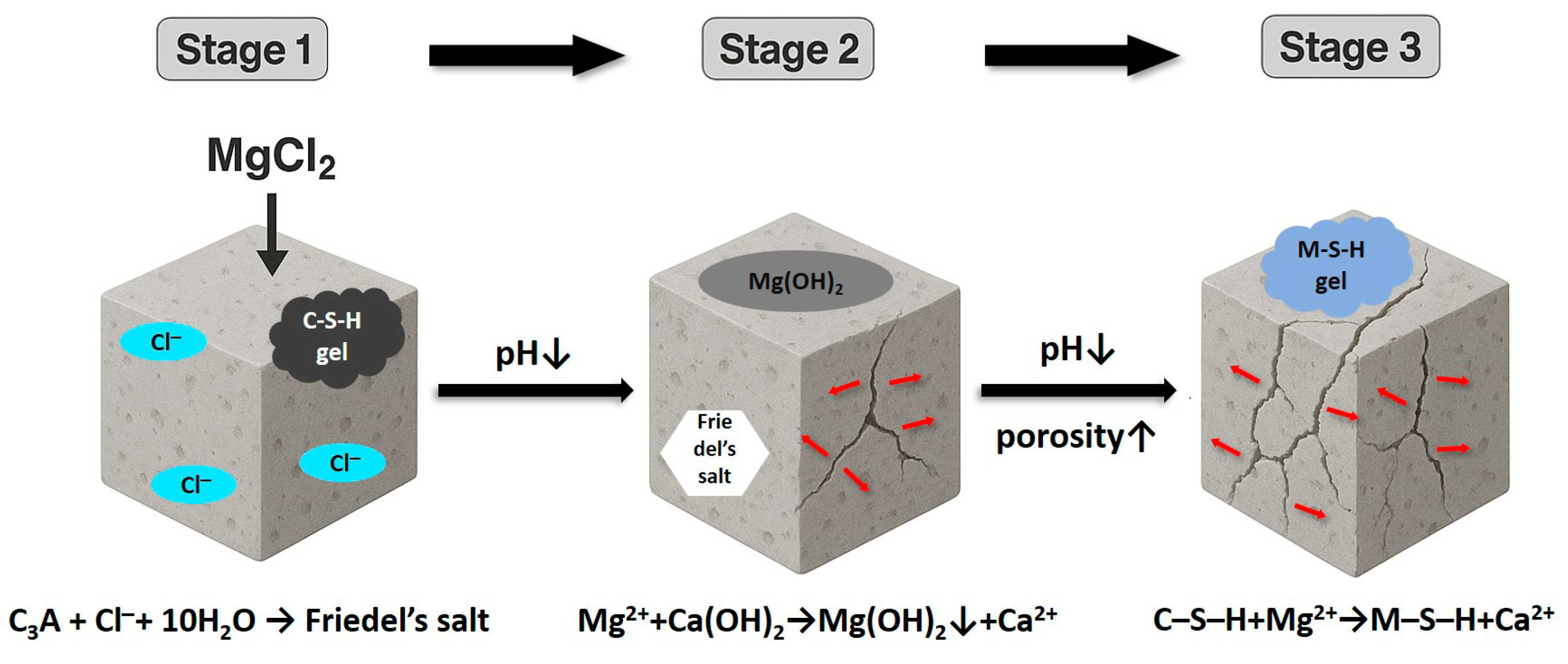
After the chloride ions enter into the matrix, the chloride ions (Cl) react chemically with the hydration product of cementitious materials, change its microstructure, accumulate corrosion products, produce cracks, etc., continuously promoting their own corrosion and damage evolution. The degradation mechanism was defined as a “Binding–Damage–Feedback” process, and developed through three different stages (as shown in Figure 3):
(1)
Stage I—Ion-binding and sequestration effect. At the early stage, part of the entering Cl is fixed by the cement matrix through chemical binding with aluminates to generate Friedel’s salt (3CaO·Al2O3·CaCl2·10H2O), and physical adsorption on C-S-H gels. Such fixation effects can temporarily “fix” free Cl, forming a “buffer” effect which slows the rise in Cl concentration in the pore solution [27,28,29].
(2)
Stage II-Critical threshold and depassivation. Once the binding capacity of concrete has been saturated, free chlorides will build up at the steel–concrete interface. Studies have shown that if the molar ratio of Cl/OH exceeds its critical threshold (usually between 0.6 and 1) [30,31], the protective passive film of the rebars would be unstable and destroyed. The threshold is not a fixed value but changes with the porosity, as well as the density of ITZ, as was reported by Sui et al. [32].
(3)
Stage III: Propagation and Positive Feedback Loop. After corrosion is initiated, the produced rust product has a volumetric expansion of about 6–10 times higher than steel, which will produce internal tensile stresses to crack the concrete cover [33,34,35]. These cracks develop into the shortcut path for migration, greatly increase the chloride diffusion coefficient (especially at the early stage of corrosion) [27], form another self-reinforced “corrosion–crack–migration” positive feedback loop, and cause the quick collapse of structures.
To synthesize these mechanisms, we have visually summarized the complete degradation pathway in Figure 3, which shows the path-dependent progression from “outside intrusion” at the beginning to “performance degradation” in the end, with emphasis on how the microchemical changes in Stages I and II finally cause macrophysical fracture in Stage III, indicating that it is not a linear but a coupled chemophysical damage-driven positive feedback loop.
Although the degradation mechanism mentioned above seems reasonable from a conceptual point of view, there has not yet been a unified scientific view. Although it has already been agreed that the formation of Friedel’s salt and migration of Cl through the pores has occurred, there have not yet been any consistent values reported for the critical concentration of Cl leading to the breakdown of the protective passive film. Recently, it was discovered that this value may vary according to interface conditions. After all, the corrosion rate mainly depends on how much Mg2+ displaces Ca2+ and modifies the porosity.
In summary, current research has well established the formation of Friedel’s salt and the migration paths of chloride ions. However, the critical chloride threshold for steel depassivation remains debated. For engineering practice, the most critical factor is the magnesium-induced decalcification. This process coarsens the pore structure and accelerates chloride ingress, posing a greater threat than chloride diffusion alone.

2.2. Magnesium Sulfate Attack

In addition to the above-mentioned ion migration mechanisms, there is another effect that is caused by the corrosion product that should not be neglected. What exactly are its effects on the cementitious matrix? We know that magnesium sulfate is the main corrosive active species that causes damage when the concrete specimen is immersed in seawater. Compared with the corrosion effects produced when the concrete is separately immersed in Na2SO4 solution and MgCl2 solution, magnesium sulfate can produce more complex chemical reactions and coupling degradation effects during the corrosion process; thus, it causes more serious damage and consequences. In order to further explain what is different among them in terms of reaction mechanism, product, and structural damage features, we compare and analyze them together as shown below in Table 3. Note: for clear comparison in damage severity, “dominant damage mechanism” here means the microscopic chemical reaction and/or phase transformation (such as decarbonating reaction/crystallization), and “characteristic feature of structural effect” means the macroscopic physical damage phenomenon (such as cracking/softening/increase in porosity) it produces afterwards.
It can be understood from Table 3 that magnesium sulfate, compared with sodium sulfate and magnesium chloride, has a more complicated corrosion mechanism. There are two reasons for its destruction of concrete: First, it not only leads to the expansion of the surface products, but also results in widespread decalcification of C-S-H and the generation of M-S-H gel, so as to destroy the concrete structure layer by layer, from outside to inside. Secondly, different from sodium sulfate, which has a single expansion route, magnesium sulfate has multiple routes: expansion, decalcification, colloid transformation, etc. Compared with magnesium chloride, it emphasizes both the chemical reaction product effect and the physical effect of crystal growth. Therefore, the damage caused by magnesium sulfate to concrete is usually continuous and coupled damage, which will be explained separately below, from a chemical and physical perspective.

2.2.1. Chemical Corrosion Mechanism of Magnesium Sulfate

Hydration products of cement are mainly: calcium silicate hydrate (C-S-H), calcium hydroxide (CH), calcium aluminate hydrate (C-A-H), ettringite (AFt), monosulfate (AFm) and a small amount of other phases. The above products are mainly poorly thermally stable solids and easy to decompose under the magnesium sulfate environment with both SO42− and Mg2+ [40]. Santhanam et al. [41] found that the corrosion evolution process of concrete under the attack of magnesium sulfate can be divided into several development stages. In the initial stage, the reaction was dominated by the thermodynamic stabilization reaction. Because the solubility of magnesium hydroxide [Mg(OH)2] is lower than that of calcium hydroxide [Ca(OH)2], Mg2+ in pore solution replaced Ca2+ and the reaction belongs to cation exchange reaction. This caused in situ precipitation of Mg(OH)2 (Equation (1)), and then continuous outward migration of Ca2+ occurred, and Ca(OH)2 was consumed. With the consumption of Ca(OH)2 phase, the pH value of pore solution decreased, and the alkalinity of the system weakened, causing the instability of C-S-H and C-A-H, the occurrence of decalcification phenomena, and the occurrence of phase transformation.
C a O H 2 + M g S O 4 C a S O 4 + M g O H 2
In the later stage, the penetrated SO42− reacts with Ca2+ and Al3+, respectively, generating gypsum (CaSO4·2H2O) and ettringite (AFt) via Reactions (2) and (3). The generated hydration products will produce volume expansion, depositing inside pores and ITZ and inducing high-concentration stress. In addition, parts of AFm phases (monosulfate) are unstable and transform from AFm to AFt, further promoting the expansion effect.
C a O H 2 + S O 4 2 + 2 H 2 O C a S O 4 · 2 H 2 O
3 C a O · A l 2 O 3 · C a S O 4 · 12 H 2 O + C a S O 4 · 2 H 2 O + 16 H 2 O 3 C a O · A l 2 O 3 · 3 C a S O 4 · 32 H 2 O
Finally, in the last stage, the continuous replacement of Ca2+ in C-S-H by Mg2+ will form amorphous M-S-H gel (Equation (4)). And such conversion is strictly dominated by the chemistry conditions of pore solution. It has been reported in previous research that the stability of C-S-H may be destroyed as long as the pH is lower than around 12.5 because of the dissolution of portlandite. Then, it would induce the conversion into M-S-H once the pH continued decreasing to 9.0–10.5 [14,42]. In addition, the conversion rate is also affected by the ionic strength: higher concentration of MgSO4 solution (>5 wt%) could greatly promote the speed of the decalcification reaction, resulting in a quick decrease in adhesion strength on the surface layers [39].
C - S - H + M g S O 4 M - S - H + C a S O 4
For all reaction formulas mentioned above, gypsum and ettringite are two common expansive degradation products in a sulfuric acid corrosion environment. Magnesium hydroxide [Mg(OH)2] and poorly bound SiO2·xH2O gel are unique degradation products under MgSO4 system. Although there are still disputes on how these products (e.g., gypsum) affect the damage level of the concrete specimen, according to previous studies, it has been recognized by most researchers that these products would alter the pore characteristics and bonding property of cement paste dramatically and then accelerate concrete damage evolution [43].
From the results of the analysis from XRD and SEM-EDS by Liu et al. [39], it can be seen that both the kind and amount of corrosion products are related to the concentration of sulfates and time of immersion. If it is immersed in a low-concentration solution or for a short time, the corrosion product has a “filling–strengthening” effect on the internal structure, and if it is immersed in a high-concentration solution or for a long time, the corrosion product continues to deposit into the pore channels, expand in volume, develop cracks, and lose cementitious material successively, so that the macroscopic performance indicators of concrete specimens further decrease. The chemical corrosion behavior of MgSO4 solution shows an interesting mechanism of staged, path-wise, coupled evolution, kinetic conversion from protective film formation to deep damage evolution, and diversity in the expansion and cementitious loss risk of some reaction products. This brings great difficulties for concrete’s durability design under marine environments.

2.2.2. Physical Erosion Mechanism of Magnesium Sulfate

In addition to the above-mentioned chemical degradation mechanism, magnesium sulfate corrosion also suffers from obvious physical damage effects when the concentration is high and there are repeated wetting/drying actions. Under this environment, when the salt repeatedly dissolves and crystallizes/recrystallizes inside the pore, the crystallization cycle pressure will produce a certain stress effect on the pore wall, leading to the occurrence and expansion of micro-cracks, and directly destroy them. Meanwhile, it also has an interactive promotion effect on chemical corrosion and promotes connection between pores and cracks. Currently, the understanding of physical damage is largely derived from crystallization pressure theories originally developed for sodium sulfate (Na2SO4) systems [44]. The classical hydration pressure model established by Scherer describes the stress generated when an anhydrous salt converts to a hydrated phase under humid conditions (Equation (5)),
P c P e = R T V H V A ln K A K H + α H 2 O ln R H
where Pc is the equilibrium pressure (Pa), Pe is the generated pressure (Pa), R is the gas constant (7.314 J·mol−1·K−1), T is the absolute temperature (K). VH and VA are the molar volumes of hydrated salt and anhydrous salt, respectively; αH2O is the number of molecules of H2O in the hydrate crystal product; KA/KH represents the equilibrium constant ratio; and RH is the ambient relative humidity.
However, directly applying this Na2SO4-based model to magnesium sulfate (MgSO4) requires a clear distinction.
(1)
Theoretical Limitations: Equation (5) assumes a distinct phase transition driven by humidity (like Thenardite → Mirabilite). Applying this to MgSO4 is partially speculative. Unlike sodium sulfate, magnesium sulfate exhibits multiple metastable hydration states (e.g., kieserite, hexahydrite, epsomite) rather than a single direct transition. This complexity makes it difficult to accurately determine the specific volume change (VH-VA) and thermodynamic parameters in a real fluctuating environment [45].
(2)
Validated MgSO4 Mechanisms: Distinct from the theoretical assumptions based on sodium salts, experimental evidence has confirmed specific physical damage pathways for magnesium salts. The primary validated mechanism is the multi-step hydration expansion. MgSO4 hydrates evolve through various forms (MgSO4·nH2O, where n = 1, 6, 7). The transformation between these phases generates significant volume expansion. Furthermore, recent studies confirm that in the presence of sodium ions [46], the crystallization of double salts (specifically Na2Mg(SO4)2·4H2O) generates local stresses exceeding 28 MPa, acting as a key driver for surface scaling and micro-cracking in marine environments.
Recent studies show that MgSO4 damage is more complex than traditional Na2SO4 mechanisms [44,47]. First, repeated crystallization and dissolution generate fluctuating pressure inside pores, initiating cracks. Second, phase transitions between hydrate forms (MgSO4·nH2O; n = 1, 6, 7) during wet–dry cycles induce substantial volume changes. This exerts high stress on pore walls.
Experimental results from Chen et al. [48] align with this mechanism. They found that concrete subjected to wet–dry cycles in 8% MgSO4 solution suffered a damage coefficient 2.4 times higher than in a 3% solution, accompanied by a dense crack network. SEM analysis further revealed the crystallization of “double salts” (Na2Mg(SO4)2·4H2O) on the partially immersed surface. The growth of these crystals generates local stresses up to 28 MPa, exceeding the tensile strength required for microcracking. Consequently, crystallization stress drives rapid crack development, explaining the faster spalling rates observed in the splash zone compared to the full immersion zone. Lin et al. [49] performed wetting–drying cyclic tests and found that in the early stages of the test, the elastic modulus increased by approximately 20.6%, possibly due to the initial formation of corrosion products causing a short-term “filling effect”.
The above coupled chemical-physical mechanism continuously destroys the strength properties of concrete material and changes the pore structure characteristics, which in turn seriously affects the long-term service performance of marine concrete structures in the future. Although, from a macro perspective, it has been identified, the mechanism underneath still needs further discussion. The mechanism of C-S-H decalcification has been clearly understood; however, the direct use of the sodium-based thermodynamic model for magnesium salts, due to their complex hydrated species, is still controversial. So is the physical effect: at low concentrations, it may be temporarily filled into pores, but when it is too high, it will cause rapid expansion crazing.
To summarize, it is well established that crystallization stress causes rapid cracking and spalling, particularly in splash zones. However, the theoretical modeling of this mechanism remains uncertain. Specifically, applying sodium-based thermodynamic models to magnesium salts is controversial due to the complexity of magnesium’s hydrated states. From an engineering perspective, protection strategies must prioritize the splash zone. In this zone, physical destruction driven by wetting–drying cycles develops significantly faster than chemical corrosion in fully immersed areas.

2.3. Coupled Corrosion of Magnesium Chloride and Magnesium Sulfate

Under complex environments such as coast, salt lake, underground brine zone, etc., concrete structures are usually in the coexistence situation of several kinds of harmful ions (Cl, SO42−, Mg2+); therefore, its corrosion rate is much higher than that of those in single-salt conditions, and has obvious non-linear property and stage-evolutionary features.
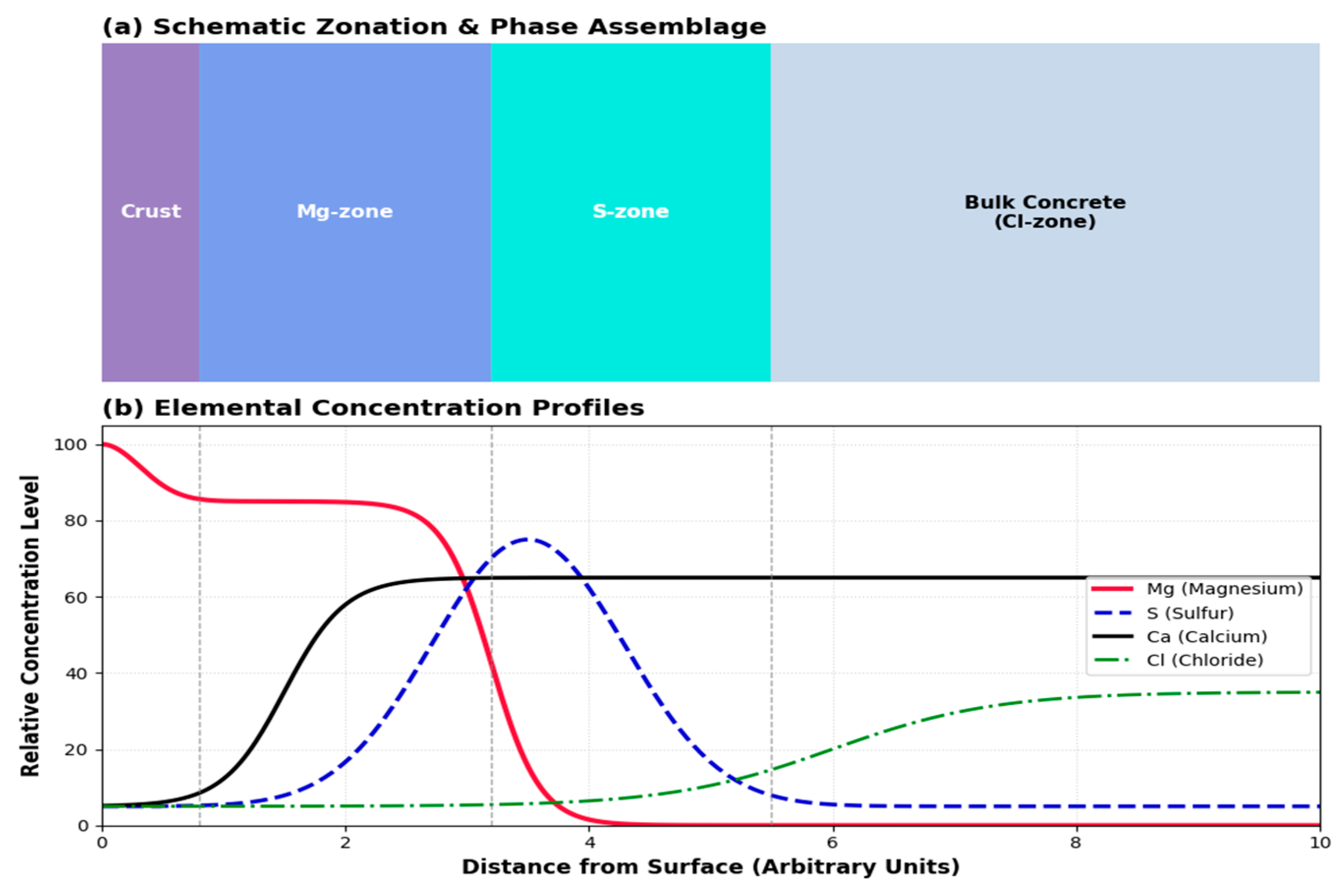
In order to reveal the characteristics of spatial distribution of coupled corrosion in mixed salts environments, Jakobsen [50] put forward the typical eroded profile model. The four characteristic corroded zones, from outside towards inside, were defined as: shell layer; magnesium salts corrosion zone [Mg-zone]; sulfate corrosion zone [S-zone]; chloride front zone [Cl-zone]. Based on this theoretical model, the schematic zonation and corresponding elemental profiles are illustrated in Figure 4.
It should be noted, though, that this zoning is not fixed; its development and thickness depend largely on the mixture proportions, e.g., a lower W/B will result in a compact matrix that will prevent further penetration of the ions [51]. Appropriate curing will provide a dense surface ‘skin,’ which would be mainly responsible for preventing the formation of the outer ‘Mg zone.’.
This layered distribution was further verified by observation under an optical microscope and SEM–EDX analysis: the migration distance of Cl is farthest, SO42− is mainly distributed in the middle layer, and Mg2+ still accumulates near the surface. This kind of “zonal invasion–competitive reaction–synergetic destruction” of Cl, SO42−, and Mg2+ in cementitious materials pores (the three ions co-intrusion and co-corrosion way) has been shown clearly. Therefore, compared with the corrosion damage caused solely by chlorides or sulfates, the joint attack of magnesium chloride and magnesium sulfate is more harmful and more difficult to study; it will bring new challenges for the durability design and evaluation of marine concrete structures.

2.3.1. Mechanisms of Coupled Corrosion

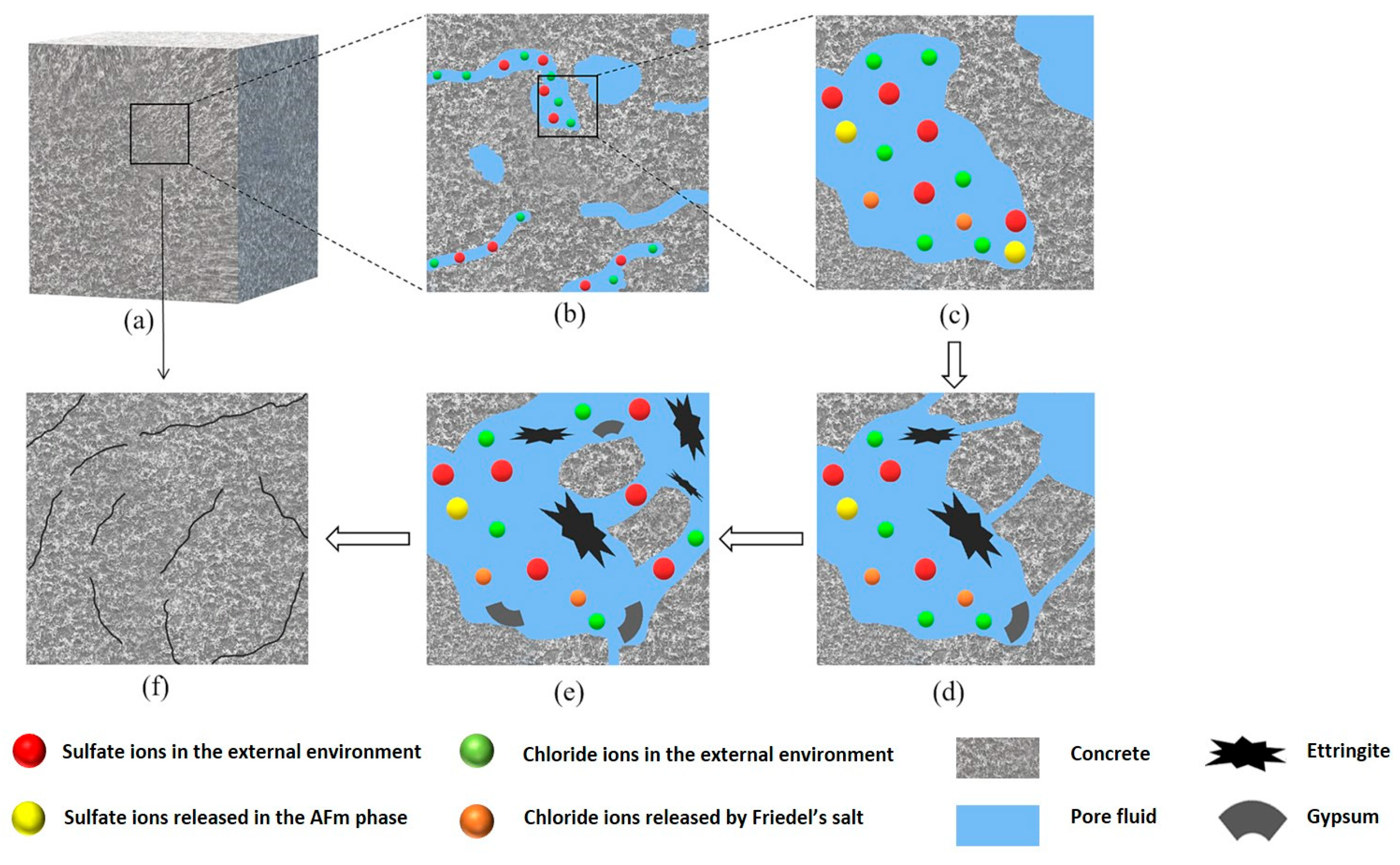
Under the coexistence conditions of Cl, SO42−, Mg2+ in the mixed salt solution environment, due to differences in migration capacity, reaction sequence, product generation, and so on, of these three kinds of ions, they are intertwined together in spatial distribution and interaction mechanisms and finally produce coupled damage effects. Jin et al. [52] considered that when concrete was subjected to multispecies ions, Cl has a higher migration ability and rapidly diffuses into the concrete matrix in the early stage of corrosion, reacts with AFm phase first, generates Friedel’s salt, and forms local diffusion barriers. Subsequently, when SO42− invades the system and exchanges anions with Cl fixed by the barrier film, it will cause Cl to detach from the barrier and migrate deeper, forming a “fixed-replaced-released” cycle. At the same time, Mg2+ continuously leaches Ca2+ from C-S-H gel, which may promote the formation of M-S-H phase with poor binding ability. Li et al. [51] believed that the synergistic corrosion mechanism among them is mainly dominated by concrete’s porosity, ITZ’s density, W/B ratio, etc. Then, Zhang et al. [53] proposed that the M-S-H phases produced by Mg2+ not only reduce the migration resistance against Cl/SO42− diffusion but also increase the number of connected micro-cracks, thereby inducing degradation processes: competition for cation coordination, disruption of the original network structure, extension of corrosion paths. The pore evolution process caused by the coupled erosion of sulfate ions and chloride ions, i.e., from the filling of expansion products to the final triggering of expansion cracking, is shown in Figure 5.

2.3.2. Modeling Analysis of Coupled Corrosion

In order to predict the coupled corrosion behaviors involving ion migration, reaction kinetics, structure evolution, and so on, many kinds of modeling methods have been proposed. Instead of taking them separately, it is necessary to compare the different modeling frameworks from the perspective of the trade-off between physical faithfulness and engineering application.
(1) Ion Transport-Reaction Coupling Models
This framework, primarily rooted in Fick’s second law, represents the most engineering-oriented approach due to its high parameter identifiability. Models like the one proposed by Chen et al. [55] introduce kinetic terms (Reaction rate R, binding coefficient K1) into the diffusion equation to describe the “migration–adsorption–redesorption” cycle,
C f t = x D c × 1 1 + K 1 × R × 1 K 1 × K z × q 2 × C f x
Here, Cf is the free chloride concentration at depth x. The standard diffusion coefficient Dc is modified by the reactivity parameter R, the sulfate reaction fraction q, and the filling coefficient Kz. While this approach offers low computational cost and simple inputs suitable for rapid engineering estimation, its physical realism is limited. It often treats complex thermodynamic coupling as simplified empirical coefficients, making it less accurate for strongly coupled multi-ion environments.
(2) Multiphysics Coupled Model (PNP-Thermodynamics-Damage)
To address the theoretical limitations of Fickian models, frameworks based on the Nernst–Planck–Poisson (PNP) equations offer higher physical realism. Yu et al. [56] derived a set of equations coupling electrical charges, ion concentrations, and film potentials, incorporating a reactive damage function HD(Cd) to dynamically characterize diffusivity changes,
H D C d = 1 + 32 9 C d + D p
where HD acts as the diffusion coefficient multiplier, determined dynamically by the crack density Cd and the crack-width dependent diffusivity Dp. This framework provides a rigorous theoretical basis for capturing electric field coupling and thermodynamic equilibrium. However, it suffers from low parameter identifiability; input parameters such as microscopic ion mobilities and reaction rate constants are difficult to measure in situ, limiting its engineering applicability primarily to detailed mechanism analysis rather than routine service life design.
(3) Chemomechanical-Structural Feedback Model
Representing the frontier of physical realism, phase-field methods (PFM) coupled with dual-porosity mechanics, as developed by Wang et al. [57], can visually simulate the “corrosion–cracking” feedback loop. The pore evolution is explicitly modeled as,
φ t = m a x φ 0 φ p ,   0
where the time-dependent porosity φ t is updated by subtracting the volume of expansive products φ p (e.g., Friedel’s salt, gypsum) from the initial porosity φ 0 . The primary strength of this approach lies in its ability to explicitly simulate the complex topology of crack propagation and its feedback on ion transport. However, this method has significant limitations. It requires high computational costs and involves complex mathematical formulations. Consequently, it is currently unsuitable for large-scale structural predictions. Nevertheless, it remains an invaluable tool for theoretical verification at the micro-scale.
(4) Solution Methods and Frontier Developments
The finite element method (FEM) and finite difference method (FDM) are still two mainstream numerical simulation technologies at present. For example, Yin et al. [37] developed a coupled finite element model of the diffusion of chlorides, corrosion of steel bars, propagation of cracks and so on based on FEM, realized the unified simulation for the chemical–mechanical coupling process; Chen [58] put forward a two-dimensional variable coefficient finite difference scheme, tracked the migration front of Friedel’s salt during migration as well as development process of the SO42− reaction zone, and controlled the relative error between the simulation results and experimental data within 23.5%.
Although many mathematical models have been developed, the maturity level of different models is quite different: early theoretical models can give quick predictions but rarely receive strict examination when multi-ion reactions couple together; while some numerical reactive transport models show good performance. Especially those combining chemical equilibrium calculation with ion fluxes predict reasonable evolutions of phase assemblage and swelling strain rate in comparison with long-term laboratory experiments [59]. But up to now, most verifications are still based on the results from laboratory accelerated tests instead of long-term site inspection under true seashore conditions. The development of verified models according to site monitoring results is still very limited in future studies.
Recently, Peridynamic (PD) methods [59], and MPFM (Multiphysics Phasefield Model) [60,61,62], etc., were proposed for efficiently simulating the coupling evolution process of corrosion–cracking coupling processes, which will be used in further research on multi-factor coupled degradation mechanism under the coupled Cl–SO42−–Mg2+ corrosion environment. In addition, very recently, Chen et al. [63] proposed a new “TCTD” coupled model from the point of view of the coupling relation among mechanisms: (a) Ion migration; (b) electrochemical corrosion; (c) release amount/concentration of Ca2+; and (d) pore formation evolution process considering the effect of temperature field. The output of this model is the spatial distribution image of Friedel’s salt, AFt, gypsum, etc. Thus, it can predict the durability performance under the coupled environment of multiple types of ions. Recently, the numerical study [64] by Bastidas-Arteaga et al. takes COMSOL Multiphysics® as the numerical analysis tool to consider the time-dependent diffusion coefficient coupled with surface chloride accumulation, and the predicted results showed that a prediction deviation lower than 15% can be obtained.
It is crucial to distinguish “engineer tool” and “academic tool.” In terms of this point, it has been acknowledged that the analytical model is the unique and feasible option for engineer application since its input (diffusion coefficient) can be obtained through common site inspection. Otherwise, the multiphysics model is only feasible for academics because some microstructure parameters cannot be measured under real situations. Yet, the absolute credibility of any framework is still under debate due to no long-term verification up to now. Therefore, we need to choose according to different situations: using the analytical model for service life prediction or adopting the numerical tool for fundamental study. The specific comparison can be found in Table 4.
To provide a clear comparison of the applicability and limitations of these frameworks, a critical evaluation is summarized in Table 4. Regarding the trade-off between predictive accuracy and practical usability, it is well established that numerical methods offer superior precision for multi-field coupling, whereas analytical models provide computational efficiency for quick estimates. However, the absolute reliability of all current frameworks remains controversial, strictly limited by the ‘time-scale gap’ between short-term lab parameters and decades-long field exposure.
From a practical perspective, it is crucial to distinguish between these models based on their utility. Empirical and semi-analytical models (e.g., Fick’s law variants) are computationally efficient and robust, making them highly suitable for engineering service-life prediction and standard design codes. Conversely, complex coupled models (such as the thermodynamic and phase-field approaches discussed above) serve primarily as academic tools. Their value lies in the theoretical verification of micro-mechanisms and understanding topological evolution, rather than widespread application in large-scale structural engineering due to their high computational demand.

3. Anti-Corrosion Measures

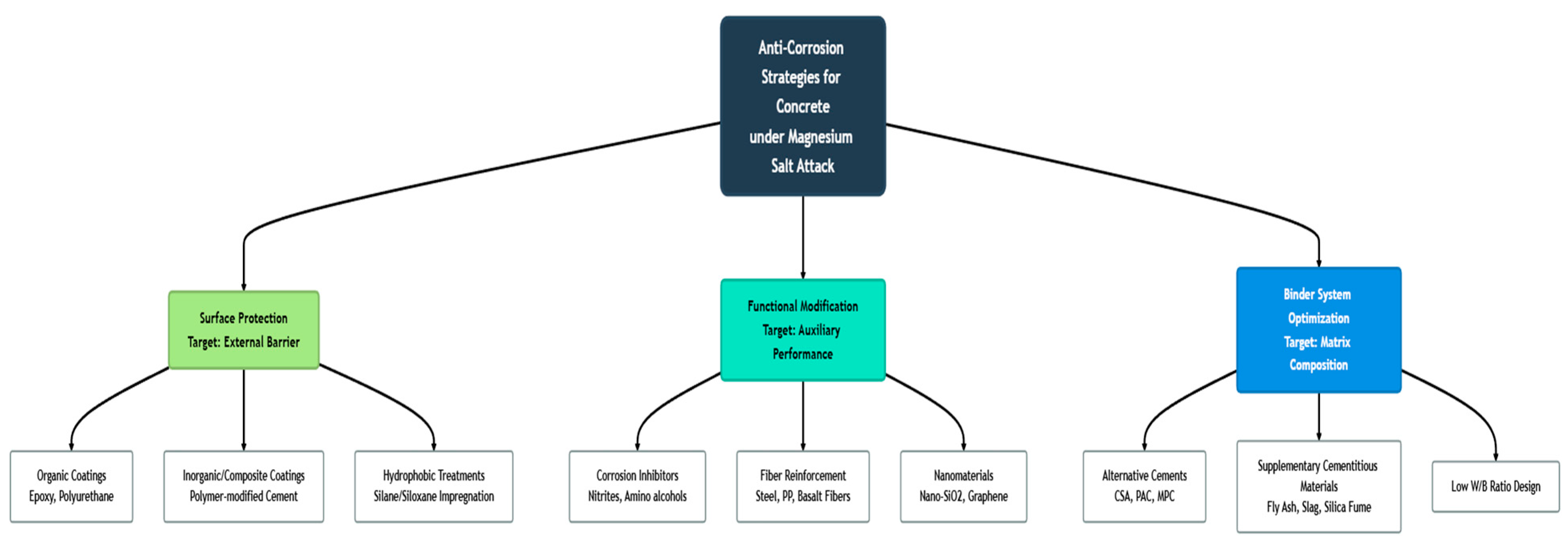
In view of the above problems caused by the magnesium cations, in recent studies, researchers have paid more attention to how to improve the denseness of microstructures, block the entry channels of harmful media, and stabilize the interface zone. In this paper, in order to make a systematic summary of all kinds of protection measures proposed so far, we divide them into three categories: material optimal configuration, surface coating treatment, and cement matrix regulation (Figure 6). When it comes to co-corrosion of multiple cations (Cl, SO42−, and Mg2+), these three measures cooperate with each other from the aspects of external barriers, internal corrosion inhibitors, and matrix reinforcement, respectively, to form an integrated three-dimensional protection system.
In summary, the whole protection measures mainly involve the following three aspects: material modification and reinforcement (nano-SiO2, metakaolin, hydrophobic admixture, etc.), surface film treatment (PAC coating and organic/inorganic hybrid film), cement matrix regulation (CSA, magnesium phosphate binder system, low water/binder ratio design), which can jointly enhance concrete’s micromorphology compactness, resist ion migration capacity, and interface stability, etc., preventing Cl-SO42−-Mg2+ coupled corrosion from occurring. According to the above idea, in the following sections, we will successively discuss the exact anti-corrosion mechanism and application performance of each measure in material aspect, surface protection aspect, and cementitious system aspect.
Thus, the protection strategies introduced hereafter are described based on three aspects according to the above degradation mechanism analysis in Section 2: material modification (in Section 3.1) against Mg2+-induced chemical decalcification (in Section 2.1); interface control (in Section 3.2) against coupled Cl diffusion (in Section 2.3); and matrix densification (in Section 3.3) against SO42− crystallization expansion (in Section 2.2).

3.1. Material Anti-Corrosion Design

Mainly through the coupled use of mineral admixture improvements, Li et al. [65] found that UFA could react secondarily with Ca(OH)2 to generate more C-S-H gel, refine pore structure, improve microstructure compactness, and restrain ettringite generated under SO42− environment. Metakaolin (MK) has high aluminosilicate activity and may promote C-A-S-H gel formation, increase the amount of fixed Cl; GGBS can regulate the Ca/Si molar ratio and solution pH value of pores, stabilize C-S-H gel, prevent the transformation of M-S-H under Mg2+ condition, etc. From another point of view, “MK + slag”, “UFA + MK” blended systems show better synergetic effects of resisting Cl, SO42−, and Mg2+ attack; however, the amount of addition and pH adjustment are also quite crucial—too much MK content (>30% mass fraction) will lead to a more compacted microstructure, but too low pH will have bad effects on both strength development and subsequent long-term performance [66].
In addition, for the alumina-rich mineral admixture (high-alumina slag/Class C FA) applied under the magnesium salt environment containing sulfate: On one side, the higher aluminates content can effectively bind more chlorides by the generation of Friedel’s salt to block the migration path of chloride ion migration [67]; on the other side, it also brings about a “trade-off”. When there are MgSO4, the aluminates in the cement matrix will react with sulfate ions to produce expansive ettringite. In addition, the initially fixed Friedel’s salts may become unstable and release free chlorides again if the pH decreases due to Mg attack or sulfate concentration increases (“chloride release”) [68]. Thus, the amount of alumina-rich admixtures should be reasonably adjusted so that the balance between the ability of fixing chlorides and resisting sulfate is reached.
The functional chemical admixture also shows good performance in multi-salt systems. It was found by Zhang et al. [69] that when SBT-TIA bifunctional hydrophilic-hydrophobic anti-corrosion agents were added into OPC-SF systems under high SO42− conditions, the strength of mortars can still be maintained at about 79%. This might be because the hydrophilic group has a chelating effect on Ca2+ to produce nanoscale barrier films, thereby blocking the migration path of SO42−. Meanwhile, the hydrophobic group can reduce capillary adsorption and finally achieve physical isolation together with chemical sustained-release protection effects.
The future development strategy of new materials needs to be combined with microstructure (dense), reaction regulation, and crack control, to build a multifunctional “win-win” protection system. Careful choices must be made to achieve this balance: the effect of mineral admixture on fine-tuning the pore structure has been recognized, but there is still controversy about whether it will cause the secondary expansion when using an alumina-rich precursor under a sulfuric acid attack environment; therefore, it depends on specific situations and we need to find a good balance between the two aspects—chloride binding ability vs. anti-sulfate performance [70,71].

3.2. Interface Protection Strategies

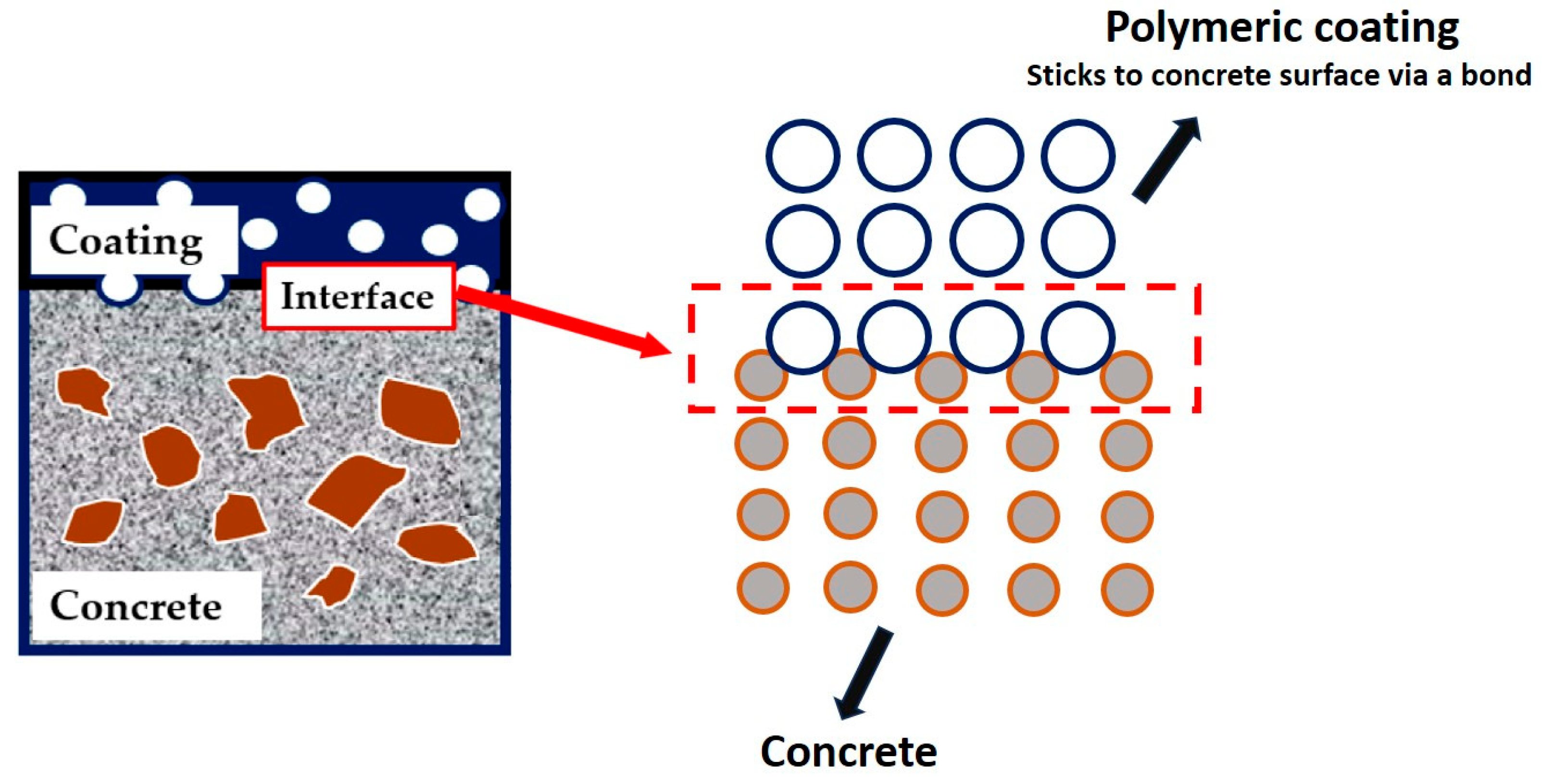
Constructing a stable, dense, well-adhered surface protection film is another important way to improve its service performance. Polyurethane, acrylic resin and epoxy resin coatings are all high-density, deformable films with good resistance against chloride ion attack [21], as shown in Figure 7. According to Yin et al. [72], the permeability coefficient of chloride ions through the polyurethane coating could be reduced by roughly 86%, and after three years of immersion testing, the penetration depth was less than 20 mm. Due to the good adhesion properties of acrylic resins, they were more suitable for the parts where stress concentration easily occurred on bridges. Epoxy resins have high cross-linked structure characteristics, which can intercept both chloride ions and oxygen migration coupling pathways at the same time, delaying the passivation time of steel bars’ films. But under the environment of high temperature and humidity changes and so forth, cementitious coatings had better performance than organic coatings. Adding styrene-acrylates and a small amount of TiO2 can effectively increase their adhesion strength and retain the properties after UV aging treatment [19].
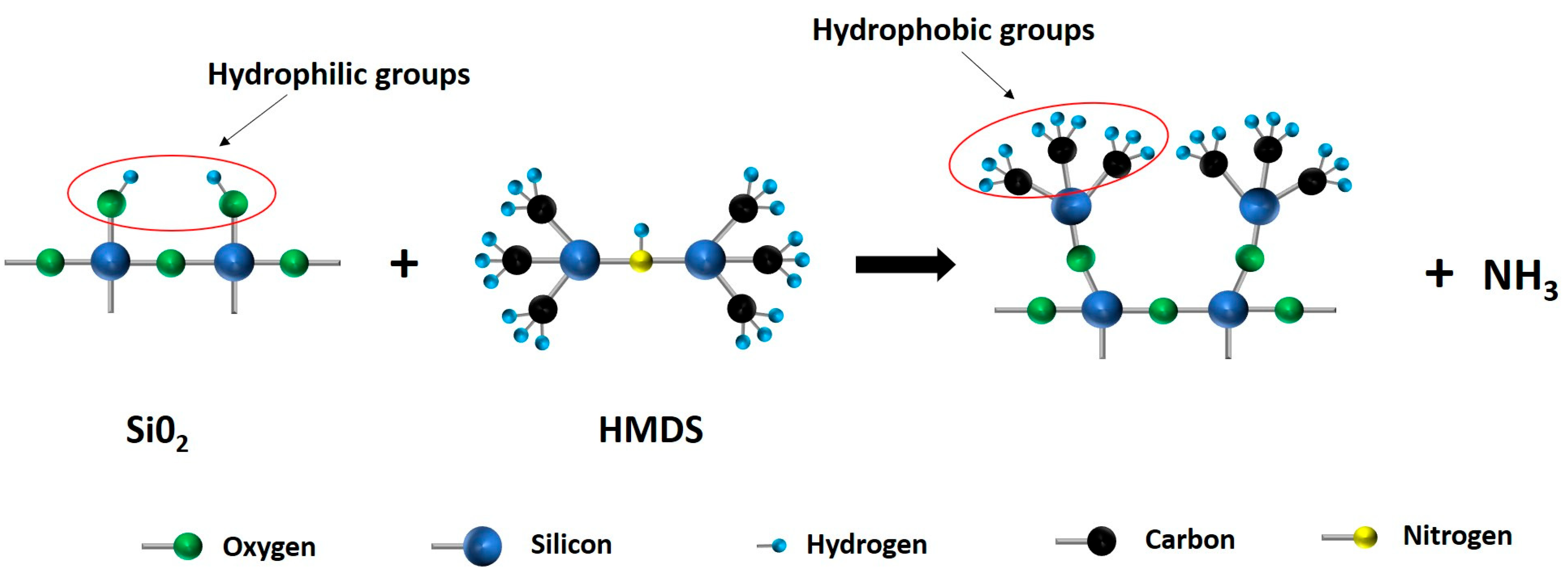
Recently, the damage caused by erosion was reduced by the modification of silica. In this process [73], hydrogen methyl silane (HMDS) is used as the modifier. The -Si(CH3)3 groups in HMDS react chemically with the -OH groups on the surface of silica, thereby allowing the highly active -Si(CH3)3 groups in HMDS to bond with the surface of silica. As a result, the content of -OH decreases, and the surface of silica changes from hydrophilic to hydrophobic, increasing its service life by nearly 80%. The reaction equation is shown in Figure 8.The silane/clay nanocomposites can decrease the surface chloride content below 92% under harsh environments with good impermeability, and multilayer gradient coatings (such as ZrO2/TiO2/Al2O3) have good anti-thermal shock properties, wear-resistance, and corrosion protection performance and are applied in some special equipment like offshore wind turbines and wharf facilities [70]. And the other biomimetic superhydrophobic coating imitates some natural structures (like oyster shells). The stable film formed in this way can prevent water intrusion even when the environment is salty.
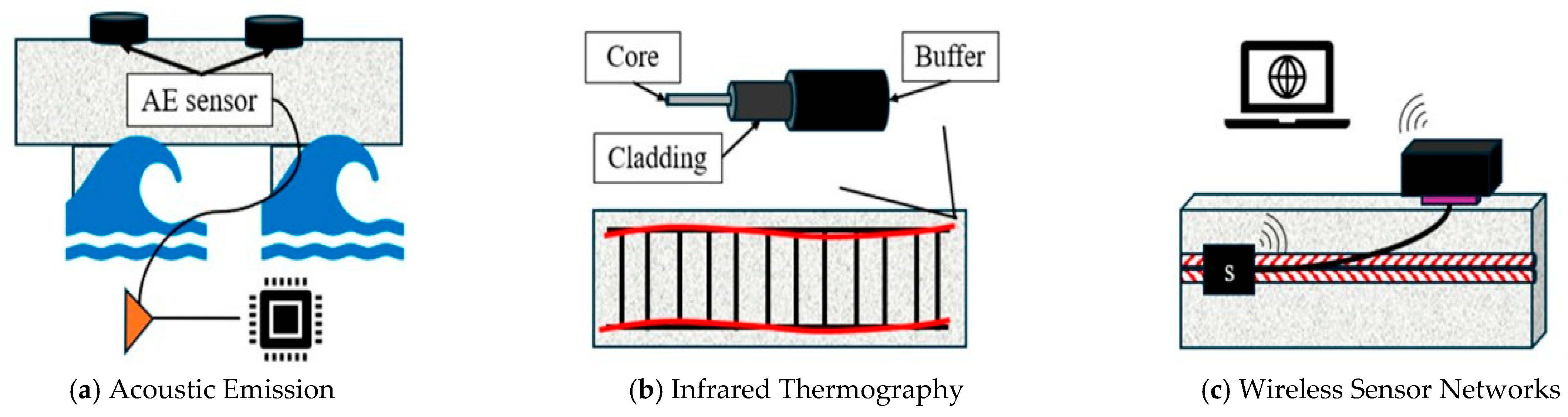
The effectiveness of the coating is not only related to its own material properties, but also closely related to the treatment of the interface before adhesion and monitoring during use. As shown in Figure 9, non-destructive testing methods, such as the acoustic emission method and the infrared thermography method are able to detect delamination and aging in advance and guarantee long-term protective effectiveness. Research on protection technology for the interface is pursuing development from the current single barrier toward the direction of densification + function + inspection integrated design and providing more stable external protection for the cementitious structure under the complex marine environment.
The barrier efficiency of coatings against ion ingress is well established. Yet, their long-term adhesion to moist concrete substrates remains controversial and prone to failure. The actual protective service life is therefore context-dependent, relying heavily on the quality of surface preparation and environmental exposure conditions.

3.3. Anti-Corrosion Cementitious Materials

In conclusion, non-silicate cementitious materials and functionally modified measures are two effective means to enhance corrosion resistance properties. Phosphate aluminate cement (PAC) and calcium sulfoaluminate cement (CSA) are two kinds of low-alkali, dense hydrated structure cements, which have excellent chemical stability in Cl and SO42−-rich environments. As reported by Liang et al. [74], after soaking in a NaCl solution at a concentration of 10% for 120 days, the PAC coating penetration depth was detected by the chloride diffusion coefficient test, which is only 33.24 μm. Compared with ordinary Portland cement systems, this value is significantly lower. Additionally, the water absorption of CSA after being soaked in water for 72 h is only 6.10%, indicating that the pores have little connectivity and water permeability.
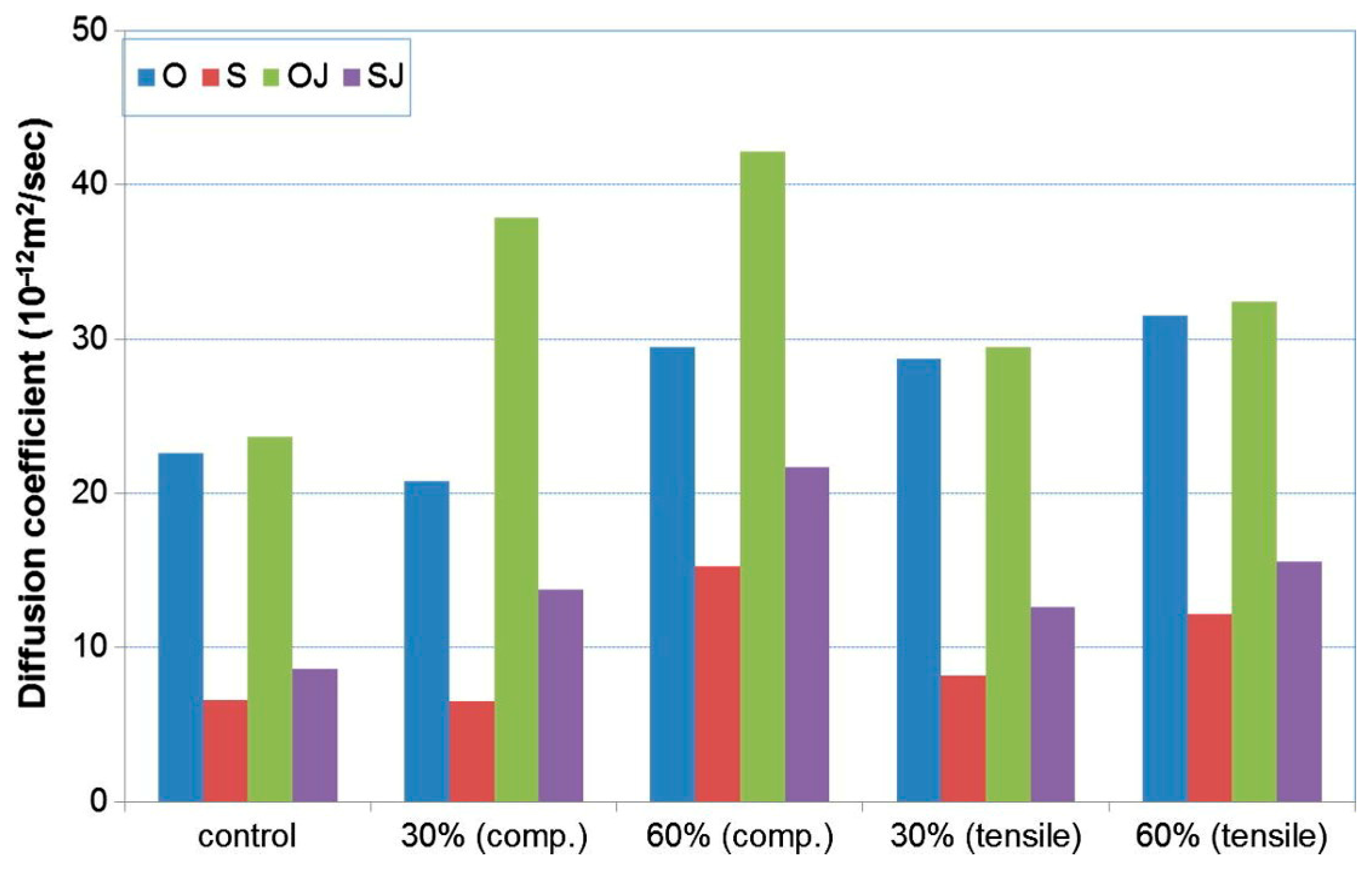
The polymer-modified cementitious system has a good modification effect as well. Adding acrylic emulsion or epoxy resin to ordinary Portland cement does not reduce its strength, but increases its bond strength by 16.67%, meanwhile it also increases its toughness and self-healing capacity [75,76]. Adding other additives such as nanometer TiO2 can adjust its pore structure, further improving its water impermeability performance and compressive performance, etc. The CAC system, which is an easy to produce phase transition during later periods, leads to a decrease in material’s strength with time going on. Recent studies mainly concentrate on how to stabilize hydration products. Yoo et al. [29] found that GGBFS had the best resistance against chloride penetration among all blended cements tested, and GGBFS not only had a good effect on sound specimens, but also on cold joints specimens. The results of the chloride diffusion coefficients of 91-day-old samples are shown in Figure 10. Under no load and cold joints effects, the lowest diffusion coefficient of GGBFS concrete is 6.6 × 10⁻¹² m2/s, which is only 27.8% of the diffusion coefficient of OPC concrete.
While all the above-mentioned strategies showed good performance under laboratory conditions, they differ greatly concerning practicability from an engineering point of view. This is due to different issues related to upscaling and failure mechanisms of both surface protection concepts, which may debond due to hydrostatic pressure when aged [77], and new nanomaterials, which are still costly and difficult to disperse homogeneously at larger scale [78]. In terms of “critical synthesis,” this results in clear precedence of approaches: modification of binders (low w/b mixed with SCMs) was found to be the most robust and easily scalable main barrier; whereas, the long-term reliability of external coatings/new materials alone is still under debate. Thus, in practice, we believe that the solution should be based on the circumstances: take a hierarchical approach—first form a compact cementitious bulk and then apply surface treatment—to achieve long-term resistance against attack from MgSO4 solution. A comparison of all anti-corrosion measures is summarized in Table 5.

4. Discussion and Future Directions

4.1. Discussion

Although there is a good understanding of degradation mechanisms for concrete under magnesian environments, important knowledge still needs to be bridged from basic study to practical application, i.e., existing knowledge mainly comes from research within one single salt solution instead of realistic multispecies solutions. Under actual marine or hypersaline lake conditions, chlorides, sulfates, and magnesium coexist; therefore, complicated “competition reactions” and “layer-by-layer invasion” effects occur, which cannot be found when studying only one type of interaction.
As for service life prediction, however, the current research is mostly based on the diffusion-reaction model; although some new tools, such as the phase-field method and PNP model, were proposed recently, these two models highly depend on many empirical parameters, which cannot be obtained easily in practice. In addition, they also ignore the positive feedback effect of cracks connection and corrosion products on ion migration, causing the predicted degradation rate to be much higher than the actual value.
In terms of material protection strategy, successful experience under single salt conditions cannot be directly applied into coupled environments. Taking high alumina mineral admixture for example, although it has good ability to capture Cl, it can induce thaumasite sulphate attack under Mg2+-rich circumstance; another typical case is related to surface coating/hydrophobic treatments, which show excellent performance at early ages, but age, crack and even debond after being immersed for a long time, so it cannot be regarded as a reliable barrier alone in long-term service.

4.2. Future Directions

In order to solve the above problems, it is necessary to transform the research direction of future studies from “single-mechanism protection” to “systematic synergetic effect”; in particular, in view of how to improve the predictive foresight of the model, we need to change the current fixed laboratory fitting method into iterative online calibrations based on field monitoring information. By taking advantage of inverse analysis technology (Bayesian inversion, etc.), it will become possible to continuously calibrate important model parameters (diffusion coefficient, etc.) according to limited field detection data; at the same time, monitor-based verification can connect the numerical model with the real-time acquisition sensor signals (Figure 9), so as to correct the prediction trajectory in real time during the simulation process, thereby reducing the prediction uncertainty of long-term forecast.
In addition to model optimization, future designs should focus on building an integrated multi-functional protection system against multi-ion co-corrosion. This involves not only matching graded mineral admixtures to balance the Ca/Si ratio but also developing bio-mimetic multi-layer coatings for smart barrier performance. A multi-level defense strategy must be constructed to simultaneously resist chloride diffusion, sulfate expansion, and magnesium-induced decalcification.
In conclusion, in terms of the development of the research itself, it will continue to advance towards the construction of a cross-scale research system that can quantitatively connect chemical changes at the micrometer level with the performance of the structure at the macroscopic scale. Take the RVE analysis method based on the homogeneous model as an example, further mapping the kinetic parameters describing phase change at the micrometer level (such as M-S-H generation) into damage evolution at the mesoscale (such as crack density), which would continuously reduce the macroscopic transport tensor used for predicting the life of the structure, establishing a multi-physical field simulation analysis tool coupled with an in situ monitoring database, which could realize the prediction of concrete performance from the material to the structural level.

5. Conclusions

In summary, this review highlights that in-depth study of the coupled degradation mechanism and reasonable formulation of the synergetic protection strategy are important ways to improve the durability performance and prolong the service time of concrete material under magnesium salts environments. Based on this work, some main conclusions could be obtained, as follows:
(1)
Magnesium salts environments multi-component cation coupling damage mechanism. Concrete damage under magnesium salts action is a coupled reaction process among various cations, Cl migrates into the interior of concrete by diffusion, capillary suction, and electromigration, combines with the AFm and C-S-H phase to form Friedel’s salt, destabilizes the passivation film on steel rebars and causes local pitting corrosion. SO42− reacts with Ca2+ and Al3+ in the pores to produce gypsum and ettringite, a kind of expansive hydration product that produces expansive stress and propagates cracks. Mg2+ reacts with CH and causes the decalcification transformation of C-S-H into non-cementitious M-S-H, destroying the strength skeleton. In the presence of different cations, the destruction effect will be strengthened by the “fixation–displacement–releasing” cyclic dynamic changes among them and positive feedback between crack development and penetration.
(2)
The spatial-temporal development of ion controls the damage pattern. In multi-salt environments, the spatial distribution and sequence of time of the ions controls the mode of deterioration, i.e., Cl locates at the deepest penetrating front, SO42− concentrates at the middle layer of concrete as an expansive product, while Mg2+ is mainly located at the concrete surface as Mg(OH)2 and promotes decalcification and M-S-H phases. Moreover, together with the effects of the wet–dry cycle, salt crystallization/thawing stress, and initial cracks, the coupled physicochemical damage is triggered, which has nonlinearity and coupling characteristics. Different model frameworks based on diffusion-reaction equation (D-R), Nernst-Planck-Poisson (NPP), phase field method (PFM) or multiphysical field method (such as TCTD) have been proposed for quantitative description of coupled mechanisms between ion migration, binding/substitution reactions with mineral particles, and pore-crack evolution.
(3)
Hierarchical and synergetic material strategies. The measures for mitigating magnesium sulfate corrosion damage based on materials have hierarchically interacted and produced a synergetic effect. Taking mineral admixture as an example, ultrafine fly ash, metakaolin, and ground granulated blast furnace slag can not only reduce ion diffusion rate but also improve C-S-H gel stability by pozzolanic reaction (pozzolanic effect) and fine pore structure. But attention must be paid to the proportion of mineral admixture and the total alkali degree of the system so that adverse change caused by Ca/Si ratio is avoided. For functional admixtures with dual functions of hydrophilicity, hydrophobicity, and anti-corrosion agents, such as amine and nitrite corrosion inhibitors, they can effectively inhibit SO42− exudation amount and increase the anti-corrosion potential value of reinforcement. In addition, the indirect way of increasing fiber dosage and decreasing W/B ratio can block crack connectivity and reduce ion migration speed.
(4)
Surface/interface protection and improvement of cementitious matrix. The high-density surface coating (polyurethane, epoxy, acrylic, and nanocomposite coatings), as well as some types of water-repellent or crystallization admixtures, can effectively block surface water invasion and ion migration rates; CSA, PAC, modified polymer, or nanocomposite binder with functional groups can effectively reduce porosity and change the hydration products to resist the attack from SO42−/Mg2+.
(5)
Based on the complex degradation mechanisms, practical durability design in magnesium-rich environments should prioritize material optimization. Specifically, the incorporation of Supplementary Cementitious Materials (SCMs), such as fly ash or silica fume, is highly recommended. These materials consume calcium hydroxide to mitigate M-S-H formation while refining the pore structure to slow ion diffusion. Furthermore, maintaining a low water-to-binder ratio and ensuring adequate curing are critical to creating a dense surface skin that acts as the primary barrier against magnesium and chloride penetration. Finally, durability assessment must transition from single-salt models to multi-ion coupling frameworks to avoid underestimating the structural service life.

Author Contributions

Conceptualization, X.S. and X.Y.; methodology, X.S.; validation, L.P. and J.D.; formal analysis, X.S.; investigation, X.S., L.P. and J.D.; resources, X.Y.; data curation, X.S.; writing—original draft preparation, X.S.; writing—review and editing, X.Y.; visualization, X.S.; supervision, X.Y.; project administration, X.Y.; funding acquisition, X.Y. All authors have read and agreed to the published version of the manuscript.

Funding

This research was funded by the Department of Housing and Urban-Rural Development of Shandong Province, China, grant number 20230139.

Data Availability Statement

Not appliable.

Conflicts of Interest

The authors declare no conflicts of interest.

References

  1. Gu, Y.; Martin, R.-P.; Omikrine Metalssi, O.; Fen-Chong, T.; Dangla, P. Pore Size Analyses of Cement Paste Exposed to External Sulfate Attack and Delayed Ettringite Formation. Cem. Concr. Res. 2019, 123, 105766. [Google Scholar] [CrossRef]
  2. Chen, E.; Leung, C.K.Y. A Coupled Diffusion-Mechanical Model with Boundary Element Method to Predict Concrete Cover Cracking Due to Steel Corrosion. Corros. Sci. 2017, 126, 180–196. [Google Scholar] [CrossRef]
  3. Feng, P.; Miao, C.; Bullard, J.W. A Model of Phase Stability, Microstructure and Properties during Leaching of Portland Cement Binders. Cem. Concr. Compos. 2014, 49, 9–19. [Google Scholar] [CrossRef]
  4. Yu, C.; Sun, W.; Scrivener, K. Mechanism of Expansion of Mortars Immersed in Sodium Sulfate Solutions. Cem. Concr. Res. 2013, 43, 105–111. [Google Scholar] [CrossRef]
  5. De Weerdt, K.; Justnes, H. The Effect of Sea Water on the Phase Assemblage of Hydrated Cement Paste. Cem. Concr. Compos. 2015, 55, 215–222. [Google Scholar] [CrossRef]
  6. Zhao, H.; Xiong, R.; Guan, B.W. Fatigue Damage Property of Cement Concrete under Magnesium Sulfate Corrosion Condition. Appl. Mech. Mater. 2014, 638–640, 1153–1157. [Google Scholar] [CrossRef]
  7. Nehdi, M.L.; Suleiman, A.R.; Soliman, A.M. Investigation of Concrete Exposed to Dual Sulfate Attack. Cem. Concr. Res. 2014, 64, 42–53. [Google Scholar] [CrossRef]
  8. Muthulingam, S.; Rao, B.N. Non-Uniform Time-to-Corrosion Initiation in Steel Reinforced Concrete under Chloride Environment. Corros. Sci. 2014, 82, 304–315. [Google Scholar] [CrossRef]
  9. Ma, X. Study on Chloride Ion Transport Mechanism and Service Life Prediction of Coastal Concrete Structures under Multi-Factor Coupling. Jinan Univ. 2024, 6, 96. [Google Scholar] [CrossRef]
  10. Zhang, M.; Li, H. Pore Structure and Chloride Permeability of Concrete Containing Nano-Particles for Pavement. Constr. Build. Mater. 2011, 25, 608–616. [Google Scholar] [CrossRef]
  11. Ali, M.; Shams, M.A.; Bheel, N.; Almaliki, A.H.; Mahmoud, A.S.; Dodo, Y.A.; Benjeddou, O. A Review on Chloride Induced Corrosion in Reinforced Concrete Structures: Lab and in Situ Investigation. RSC Adv. 2024, 14, 37252–37271. [Google Scholar] [CrossRef]
  12. DorMohammadi, H.; Pang, Q.; Murkute, P.; Árnadóttir, L.; Isgor, O.B. Investigation of Chloride-Induced Depassivation of Iron in Alkaline Media by Reactive Force Field Molecular Dynamics. Npj Mater. Degrad. 2019, 3, 19. [Google Scholar] [CrossRef]
  13. Wang, Q.; Liu, J.; Wang, P.; Liu, J.; Sun, M. Effect of Sulfate Attack on the Expansion Behavior of Cement-Treated Aggregates. Materials 2024, 17, 660. [Google Scholar] [CrossRef]
  14. Bernard, E.; Lothenbach, B.; Le Goff, F.; Pochard, I.; Dauzères, A. Effect of Magnesium on Calcium Silicate Hydrate (C-S-H). Cem. Concr. Res. 2017, 97, 61–72. [Google Scholar] [CrossRef]
  15. Zhang, M.; Sun, S.; Liu, K.; Li, T.; Yang, H. Research on the Critical Chloride Content of Reinforcement Corrosion in Marine Concrete—A Review. J. Build. Eng. 2023, 79, 107838. [Google Scholar] [CrossRef]
  16. Liu, Q.; Shen, X.; Šavija, B.; Meng, Z.; Tsang, D.C.W.; Sepasgozar, S.; Schlangen, E. Numerical Study of Interactive Ingress of Calcium Leaching, Chloride Transport and Multi-Ions Coupling in Concrete. Cem. Concr. Res. 2023, 165, 107072. [Google Scholar] [CrossRef]
  17. Chang, H.; Feng, P.; Lyu, K.; Liu, J. A Novel Method for Assessing C-S-H ChlorideAdsorption in Cement Pastes. Constr. Build. Mater. 2019, 225, 324–331. [Google Scholar] [CrossRef]
  18. Zhao, G.; Shi, M.; Fan, H.; Cui, J.; Xie, F. The Influence of Multiple Combined Chemical Attack on Cast-in-Situ Concrete: Deformation, Mechanical Development and Mechanisms. Constr. Build. Mater. 2020, 251, 118988. [Google Scholar] [CrossRef]
  19. Wang, H.-L.; Dai, J.-G.; Sun, X.-Y.; Zhang, X.-L. Characteristics of Concrete Cracks and Their Influence on Chloride Penetration. Constr. Build. Mater. 2016, 107, 216–225. [Google Scholar] [CrossRef]
  20. Bao, J.; Wang, L. Combined Effect of Water and Sustained Compressive Loading on Chloride Penetration into Concrete. Constr. Build. Mater. 2017, 156, 708–718. [Google Scholar] [CrossRef]
  21. Lee, T.; Kim, D.; Cho, S.; Kim, M.O. Advancements in Surface Coatings and Inspection Technologies for Extending the Service Life of Concrete Structures in Marine Environments: A Critical Review. Buildings 2025, 15, 304. [Google Scholar] [CrossRef]
  22. Omikrine Metalssi, O.; Quiertant, M.; Jabbour, M.; Baroghel-Bouny, V. New Methods for Assessing External Sulfate Attack on Cement-Based Specimens. Appl. Sci. 2024, 14, 1410. [Google Scholar] [CrossRef]
  23. Wilson, W.; Georget, F.; Scrivener, K. Unravelling Chloride Transport/Microstructure Relationships for Blended-Cement Pastes with the Mini-Migration Method. Cem. Concr. Res. 2021, 140, 106264. [Google Scholar] [CrossRef]
  24. Alexander, M.; Beushausen, H. Durability, Service Life Prediction, and Modelling for Reinforced Concrete Structures—Review and Critique. Cem. Concr. Res. 2019, 122, 17–29. [Google Scholar] [CrossRef]
  25. Wu, J.; Li, H.; Wang, Z.; Liu, J. Transport Model of Chloride Ions in Concrete under Loads and Drying-Wetting Cycles. Constr. Build. Mater. 2016, 112, 733–738. [Google Scholar] [CrossRef]
  26. Meira, G.R.; Andrade, C.; Alonso, C.; Borba, J.C., Jr.; Padilha, M., Jr. Durability of Concrete Structures in Marine Atmosphere Zones—The Use of Chloride Deposition Rate on the Wet Candle as an Environmental Indicator. Cem. Concr. Compos. 2010, 32, 427–435. [Google Scholar] [CrossRef]
  27. Xu, H.; Chen, J. Coupling Effect of Corrosion Damage on Chloride Ions Diffusion in Cement Based Materials. Constr. Build. Mater. 2020, 243, 118225. [Google Scholar] [CrossRef]
  28. Smyl, D.; Rashetnia, R.; Seppänen, A.; Pour-Ghaz, M. Can Electrical Resistance Tomography Be Used for Imaging Unsaturated Moisture Flow in Cement-Based Materials with Discrete Cracks? Cem. Concr. Res. 2017, 91, 61–72. [Google Scholar] [CrossRef]
  29. Yoo, S.-W.; Kwon, S.-J. Effects of Cold Joint and Loading Conditions on Chloride Diffusion in Concrete Containing GGBFS. Constr. Build. Mater. 2016, 115, 247–255. [Google Scholar] [CrossRef]
  30. Wang, Y.; Cao, Y.; Zhang, P.; Ma, Y.; Zhao, T.; Wang, H.; Zhang, Z. Water Absorption and Chloride Diffusivity of Concrete under the Coupling Effect of Uniaxial Compressive Load and Freeze–Thaw Cycles. Constr. Build. Mater. 2019, 209, 566–576. [Google Scholar] [CrossRef]
  31. Luo, D.; Zhou, M.; Li, F.; Niu, D. Chloride Ion Transport in Coral Aggregate Concrete Subjected to Coupled Erosion by Sulfate and Chloride Salts in Drying-Wetting Cycles; Elsevier BV: Amsterdam, The Netherlands, 2024. [Google Scholar]
  32. Sui, S.; Wilson, W.; Georget, F.; Maraghechi, H.; Kazemi-Kamyab, H.; Sun, W.; Scrivener, K. Quantification Methods for Chloride Binding in Portland Cement and Limestone Systems. Cem. Concr. Res. 2019, 125, 105864. [Google Scholar] [CrossRef]
  33. Van Steen, C.; Nasser, H.; Verstrynge, E.; Wevers, M. Acoustic Emission Source Characterisation of Chloride-Induced Corrosion Damage in Reinforced Concrete. Struct. Health Monit. 2021, 21, 1266–1286. [Google Scholar] [CrossRef]
  34. Pepenar, I. Chloride-Induced Corrosion Damage of Reinforced Concrete Structures: Case Studies and Laboratory Research. Mater. Today: Proc. 2022, 58, 1588–1593. [Google Scholar] [CrossRef]
  35. Hemstad, P.; Machner, A.; De Weerdt, K. The Effect of Artificial Leaching with HCl on Chloride Binding in Ordinary Portland Cement Paste. Cem. Concr. Res. 2020, 130, 105976. [Google Scholar] [CrossRef]
  36. Liu, P.; Chen, Y.; Yu, Z.; Lu, Z. Effect of Sulfate Solution Concentration on the Deterioration Mechanism and Physical Properties of Concrete. Constr. Build. Mater. 2019, 227, 116641. [Google Scholar] [CrossRef]
  37. Yin, G.-J.; Shan, Z.-Q.; Miao, L.; Tang, Y.-J.; Zuo, X.-B.; Wen, X.-D. Finite Element Analysis on the Diffusion-Reaction-Damage Behavior in Concrete Subjected to Sodium Sulfate Attack. Eng. Fail. Anal. 2022, 137, 106278. [Google Scholar] [CrossRef]
  38. Xie, N.; Dang, Y.; Shi, X. New Insights into How MgCl2 Deteriorates Portland Cement Concrete. Cem. Concr. Res. 2019, 120, 244–255. [Google Scholar] [CrossRef]
  39. Liu, P.; Chen, Y.; Wang, W.; Yu, Z. Effect of Physical and Chemical Sulfate Attack on Performance Degradation of Concrete under Different Conditions. Chem. Phys. Lett. 2020, 745, 137254. [Google Scholar] [CrossRef]
  40. Mangat, P.S.; Ojedokun, O.O. Bound Chloride Ingress in Alkali Activated Concrete. Constr. Build. Mater. 2019, 212, 375–387. [Google Scholar] [CrossRef]
  41. Santhanam, M.; Cohen, M.D.; Olek, J. Mechanism of Sulfate Attack: A Fresh Look. Cem. Concr. Res. 2002, 32, 915–921. [Google Scholar] [CrossRef]
  42. Lothenbach, B.; Nied, D.; L’Hôpital, E.; Achiedo, G.; Dauzères, A. Magnesium and Calcium Silicate Hydrates. Cem. Concr. Res. 2015, 77, 60–68. [Google Scholar] [CrossRef]
  43. Yoshida, S.; Elakneswaran, Y.; Nawa, T. Electrostatic Properties of C-S-H and C-A-S-H for Predicting Calcium and Chloride Adsorption. Cem. Concr. Compos. 2021, 121, 104109. [Google Scholar] [CrossRef]
  44. Flatt, R.J.; Scherer, G.W. Hydration and Crystallization Pressure of Sodium Sulfate: A Critical Review. MRS Proc. 2002, 712, II2-2. [Google Scholar] [CrossRef]
  45. Scherer, G.W. Stress from Crystallization of Salt. Cem. Concr. Res. 2004, 34, 1613–1624. [Google Scholar] [CrossRef]
  46. Thaulow, N.; Sahu, S. Mechanism of Concrete Deterioration Due to Salt Crystallization. Mater. Charact. 2004, 53, 123–127. [Google Scholar] [CrossRef]
  47. Guo, J.-J.; Liu, P.-Q.; Wu, C.-L.; Wang, K. Effect of Dry–Wet Cycle Periods on Properties of Concrete under Sulfate Attack. Appl. Sci. 2021, 11, 888. [Google Scholar] [CrossRef]
  48. Chen, J.; Jiang, M.; Zhu, J. Damage Evolution in Cement Mortar Due to Erosion of Sulphate. Corros. Sci. 2008, 50, 2478–2483. [Google Scholar] [CrossRef]
  49. Lin, J.; Zhao, Y.; Liang, Z.; Hu, E.; Liu, Z. Mechanical and Damage Characteristics Study of Concrete under Repeated Sulfate Erosion. Alex. Eng. J. 2024, 109, 831–840. [Google Scholar] [CrossRef]
  50. Jakobsen, U.H.; De Weerdt, K.; Geiker, M.R. Elemental Zonation in Marine Concrete. Cem. Concr. Res. 2016, 85, 12–27. [Google Scholar] [CrossRef]
  51. Li, G.; Li, H.; Qiu, G. Research Progress on Coupled Chloride–Sulfate Erosion Mechanism, Modeling, and Numerical Simulation of Concrete. Bull. Silic. 2024, 43, 1001–1652. [Google Scholar] [CrossRef]
  52. Jin, Z.; Zhao, X.; Zhao, T.; Liu, Y. Corrosion Behavior of Steel Bar and Corrosive Cracking of Concrete Induced by Magnesium-Sulfate-Chloride Ions. J. Adv. Concr. Technol. 2016, 14, 172–182. [Google Scholar] [CrossRef]
  53. Zhang, S.; Zhang, W.; Liu, J. Research Progress on Concrete Durability under Chloride Erosion and Multi-Factor Coupling. China Build. Mater. Sci. Technol. 2019, 28, 39–42. [Google Scholar]
  54. Dong, Q.; Zheng, H.; Zhang, L.; Sun, G.; Yang, H.; Li, Y. Numerical Simulation on Diffusion-Reaction Behavior of Concrete Under Sulfate-Chloride Coupled Attack; Elsevier BV: Amsterdam, The Netherlands, 2023. [Google Scholar]
  55. Chen, Z.; Wu, L.; Bindiganavile, V.; Yi, C. Coupled Models to Describe the Combined Diffusion-Reaction Behaviour of Chloride and Sulphate Ions in Cement-Based Systems. Constr. Build. Mater. 2020, 243, 118232. [Google Scholar] [CrossRef]
  56. Yu, Y.; Gao, W.; Feng, Y.; Castel, A.; Chen, X.; Liu, A. On the Competitive Antagonism Effect in Combined Chloride-Sulfate Attack: A Numerical Exploration. Cem. Concr. Res. 2021, 144, 106406. [Google Scholar] [CrossRef]
  57. Wang, P.; Mo, R.; Zhou, X.; Xu, J.; Jin, Z.; Zhao, T. A Chemo-Thermo-Damage-Transport Model for Concrete Subjected to Combined Chloride-Sulfate Attack Considering the Effect of Calcium Leaching. Constr. Build. Mater. 2021, 306, 124918. [Google Scholar] [CrossRef]
  58. Chen, Z.; Yu, J.; Bindiganavile, V.; Yi, C.; Shi, C.; Hu, X. Time and Spatially Dependent Transient Competitive Antagonism during the 2-D Diffusion-Reaction of Combined Chloride-Sulphate Attack upon Concrete. Cem. Concr. Res. 2022, 154, 106724. [Google Scholar] [CrossRef]
  59. Sarkar, S.; Mahadevan, S.; Meeussen, J.C.L.; van der Sloot, H.; Kosson, D.S. Numerical Simulation of Cementitious Materials Degradation under External Sulfate Attack. Cem. Concr. Compos. 2010, 32, 241–252. [Google Scholar] [CrossRef]
  60. Fang, X.; Pan, Z.; Ma, R.; Chen, A. A Multi-Phase Multi-Species Phase Field Model for Non-Uniform Corrosion and Chloride Removal in Concrete. J. Build. Eng. 2024, 82, 108214. [Google Scholar] [CrossRef]
  61. Fang, X.; Pan, Z.; Chen, A. Phase Field Modeling of Concrete Cracking for Non-Uniform Corrosion of Rebar. Theor. Appl. Fract. Mech. 2022, 121, 103517. [Google Scholar] [CrossRef]
  62. Li, W.; Guo, L. Peridynamic Investigation of Chloride Diffusion in Concrete under Typical Environmental Factors. Ocean Eng. 2021, 239, 109770. [Google Scholar] [CrossRef]
  63. Chen, D.; Guo, W.; Chen, D.; Guo, L.; Cai, B.; Ye, T. Mechanistic Modeling for Coupled Chloride-Sulfate Attack in Cement-Based Materials. Constr. Build. Mater. 2024, 455, 139231. [Google Scholar] [CrossRef]
  64. Bastidas-Arteaga, E.; Bressolette, P.; Chateauneuf, A.; Sánchez-Silva, M. Probabilistic Lifetime Assessment of RC Structures under Coupled Corrosion–Fatigue Deterioration Processes. Struct. Saf. 2009, 31, 84–96. [Google Scholar] [CrossRef]
  65. Li, F. Study on the Corrosion Mechanism of Cast-in-Situ Concrete Modified by Calcined Metakaolin under Composite Salt Attack. Tarim Univ. 2024, 4, 130. [Google Scholar] [CrossRef]
  66. Maraghechi, H.; Avet, F.; Wong, H.; Kamyab, H.; Scrivener, K. Performance of Limestone Calcined Clay Cement (LC3) with Various Kaolinite Contents with Respect to Chloride Transport. Mater. Struct. 2018, 51, 125. [Google Scholar] [CrossRef]
  67. Zibara, H.; Hooton, R.D.; Thomas, M.D.A.; Stanish, K. Influence of the C/S and C/A Ratios of Hydration Products on the Chloride Ion Binding Capacity of Lime-SF and Lime-MK Mixtures. Cem. Concr. Res. 2008, 38, 422–426. [Google Scholar] [CrossRef]
  68. De Weerdt, K.; Justnes, H.; Geiker, M.R. Changes in the Phase Assemblage of Concrete Exposed to Sea Water. Cem. Concr. Compos. 2014, 47, 53–63. [Google Scholar] [CrossRef]
  69. Zhang, Y.; Tang, Z.; Liu, X.; Zhou, X.; He, W.; Zhou, X. Study on the Resistance of Concrete to High-Concentration Sulfate Attack: A Case Study in Jinyan Bridge. Materials 2024, 17, 3388. [Google Scholar] [CrossRef]
  70. Chen, X.; Sun, Z.; Pang, J. A Research on Durability Degradation of Mineral Admixture Concrete. Materials 2021, 14, 1752. [Google Scholar] [CrossRef]
  71. Li, G.; Hu, W.; Cui, H.; Zhou, J. Long-Term Effectiveness of Carbonation Resistance of Concrete Treated with Nano-SiO2 Modified Polymer Coatings. Constr. Build. Mater. 2019, 201, 623–630. [Google Scholar] [CrossRef]
  72. Yin, B.; Xu, T.; Hou, D.; Zhao, E.; Hua, X.; Han, K.; Zhang, Y.; Zhang, J. Superhydrophobic Anticorrosive Coating for Concrete through In-Situ Bionic Induction and Gradient Mineralization. Constr. Build. Mater. 2020, 257, 119510. [Google Scholar] [CrossRef]
  73. Zhao, Z.; Qu, X.; Li, J. Application of Polymer Modified Cementitious Coatings (PCCs) for Impermeability Enhancement of Concrete. Constr. Build. Mater. 2020, 249, 118769. [Google Scholar] [CrossRef]
  74. Liang, C.; Zhao, P.; Gong, X.; Liu, H.; Yang, L.; Li, Q.; Lu, L. Investigation on the Mechanical Properties of CSA Cement-Based Coating and Its Application. Constr. Build. Mater. 2021, 305, 124724. [Google Scholar] [CrossRef]
  75. Guo, S.Y.; Zhang, X.; Chen, J.Z.; Mou, B.; Shang, H.S.; Wang, P.; Zhang, L.; Ren, J. Mechanical and interface bonding properties of epoxy resin reinforced Portland cement repairing mortar. Constr. Build. Mater. 2020, 264, 120715. [Google Scholar] [CrossRef]
  76. Dong, J.L.; Tu, Z.; Shang, X.P.; Xu, C.J.; Zhuang, Y.; Wu, H.; Hu, J.; Xie, S.; Li, C.M.; Zhang, T.T. Development of Sustainable Alkali-Activated Red Mud Composite Cement: Mechanical Properties, Hydration Mechanisms, and Environmental Benefits. Constr. Build. Mater. 2025, 499, 144089. [Google Scholar]
  77. Pan, X.; Shi, Z.; Shi, C.; Ling, T.-C.; Li, N. A Review on Concrete Surface Treatment Part I: Types and Mechanisms. Constr. Build. Mater. 2017, 132, 578–590. [Google Scholar] [CrossRef]
  78. Sanchez, F.; Sobolev, K. Nanotechnology in Concrete—A Review. Constr. Build. Mater. 2010, 24, 2060–2071. [Google Scholar] [CrossRef]
Figure 1. Concrete structural distresses in marine environments: (a) severe surface scaling and peeling of concrete piles; (b) extensive erosion and material loss at the base of bridge piers.
Buildings 16 00264 g001
Figure 2. Form of Cl in concrete.
Buildings 16 00264 g002
Figure 3. Schematic of the degradation mechanism under MgCl2 attack, illustrating the three-stage progression from initial ion diffusion (Stage I) to pore structure modification by M-S-H formation (Stage II), and final structural disintegration (Stage III). The red arrows indicate the expansion stress generated by corrosion products.
Buildings 16 00264 g003
Figure 4. Schematic illustration of the deterioration mechanism in concrete subjected to magnesium attack: (a) microstructural zonation and phase assemblage; (b) corresponding elemental concentration profiles versus depth.
Buildings 16 00264 g004
Figure 5. Evolution process of the filling of concrete pores from expanded products to expansion cracking under the sulfate–chloride ions coupled attack. (a) Concrete matrix; (b) Coupled diffusion of sulfate–chloride; (c) Chemical reaction with concrete under sulfate–chloride coupled attack; (d) Sulfate ions and chloride ions react in the pores of concrete to produce attack products; (e) Attack products fill pores; (f) Concrete expansion cracking [54]. The arrows indicate the direction of ion migration and the progression of the chemical reaction.
Buildings 16 00264 g005
Figure 6. Classification of anti-corrosion strategies based on distinct protection targets and functional scopes.
Buildings 16 00264 g006
Figure 7. Schematic representation of polymeric coatings applied to a concrete surface (Adapted from Ref. [21]).
Buildings 16 00264 g007
Figure 8. Reaction equation for silica modification.
Buildings 16 00264 g008
Figure 9. Schematic diagram of non-destructive testing methods: (a) Acoustic Emission; (b) Infrared Thermography; (c) Wireless Sensor Networks (Adapted from Ref. [21]).
Buildings 16 00264 g009
Figure 10. Test results of chloride diffusion coefficient considering cold joint, loading level, and GGBFS (averages). O: OPC, S: GGBFS, OJ: OPC with Cold Joint, SJ: GGBFS with Cold Joint [29].
Buildings 16 00264 g010
Table 1. Conceptual framework of coupled deterioration mechanisms in magnesium–sulfate–chloride environments.
StageSpecific Deterioration MechanismKey Chemo-Physical ProcessCorresponding Section
I. IntrusionMulti-Species Transport Coupling
(Mg2+-SO42−-Cl Interaction)
(1)
Electrostatic Coupling: High-valent Mg2+ changes the pore solution potential and slows down Cl migration.
(2)
Activity Correction: Ionic strength variations affect the thermodynamic activity of species.
Section 2.3.1
(Transport Models)
II. Reaction
(1)
Magnesium Attack (Decalcification)
(2)
Sulfate Attack (Expansion)
(3)
Chloride Attack (Depassivation)
(1)
Isomorphic Substitution: Mg2+ replaces Ca2+ in C-S-H, forming non-cementitious M-S-H (Ca/Si↓).
(2)
Thermodynamic Instability: Decrease in pH results in decomposition of Friedel’s salt.
(3)
Mineral Precipitation: Expansive Gypsum/Ettringite and pore-blocking Brucite formation.
Section 2.1 and Section 2.2
(Reaction Pathways)
III. DamageChemo-Mechanical Damage Evolution
(1)
Confinement Crystallization: The crystal growth pressure is larger than the tensile strength of the pore wall.
(2)
Pore Structure Destruction: Enlargement of capillary pores leads to an increase in permeability.
(3)
Macro-Cracking: The coalescence of micro-cracks causes surface spalling and exposure of the reinforcement.
Section 2.2.2 and Section 2.3.2
(Damage Models)
IV. ResponseSynergistic Protection and Prediction
(1)
Controlled Phase Matching: Control Al/Si ratio to prevent the generation of metastable phases.
(2)
Calibrate Model: Bayesian update of service life models based on field inspection data.
Section 3 and Section 4
(Strategies and Outlook)
Table 2. Chloride (Cl) transport mechanisms for different zones within marine concrete.
Exposure ZoneStructural ExamplesChloride Ion Transport MechanismsReferences
Full Submersion ZoneStructures Submerged in SeawaterPermeation, Diffusion, Electrochemical Migration[18,22,24]
Tidal Zone of Marine StructuresComponents in the Upper and Lower Tidal ZonesCapillary Absorption, Diffusion[17,21,25]
Splash ZoneWave-Impacted Structural ComponentsCapillary Absorption, Diffusion[9,25,26]
Atmospheric Zone of Marine StructuresCoastal Structures Not Directly Exposed to SeawaterCapillary Absorption[9,26]
Table 3. Comparison analysis of magnesium sulfate and common sulfate salts on concrete corrosion mechanism.
Aggressive MediumIons Involved in Primary ReactionsKey Reaction ProductsDominant Damage MechanismCharacteristics of Structural ImpactReferences
Na2SO4SO42−AFt, GypsumExpansion and Crystallization: Formation of expansive products and salt crystallization pressureCracking: Surface expansion, spalling, and micro-cracking[36,37]
MgCl2Cl, SO42−Friedel’s Salt,
Mg(OH)2,
M-S-H
Decalcification and Binding: Transformation of C-S-H to M-S-H; Reaction of Cl to form Friedel’s saltPore Coarsening: Increased porosity, surface softening, and pitting corrosion of steel[14,27,38]
MgSO4SO42−, Mg2+Mg(OH)2,
M-S-H,
AFt
Coupled Attack: Simultaneous decalcification of C-S-H and formation of expansive productsDisintegration: Loss of binder cohesion (mushy surface) combined with internal cracking[1,39]
Table 4. Critical evaluation of modeling frameworks for coupled corrosion.
Modeling FrameworkStrengthsLimitationsApplicabilityReferences
Analytical Models (Diffusion-Reaction)High computational efficiency; Simple inputs; Analytical solutions availableIgnores thermodynamic equilibrium; Low accuracy for multi-ion couplingRapid service life estimation for simple geometries[55,64]
Multiphysics Models (PNP-Damage)High accuracy; Rigorous theoretical basis; Captures electric field couplingRequires extensive input parameters; Sensitive to boundary conditions.Detailed durability design for critical infrastructure[56]
Chemo-Mechanical Models (Phase-Field)Visually simulates crack propagation; Captures “corrosion-cracking” feedbackExtremely high computational cost; Difficult to simulate large-scale structuresTheoretical research and mechanism verification[57,61]
Numerical Schemes (FEM/FDM)Flexible for complex geometries; Mature commercial software support (e.g., COMSOL)Mesh-dependency issues; Long-term validation data is often lackingEngineering applications with complex boundary conditions[37,58]
Table 5. Comparative analysis of major anti-corrosion measures.
Category of MeasuresPrimary MechanismAdvantagesLimitations
Mineral Admixtures (e.g., Fly Ash, Slag, Silica Fume, etc.)Dilution effect and pozzolanic reaction to refine pore structure and reduce ion diffusion rateCost-effective, utilizes industrial by-products; significantly reduces Cl diffusion and SO42− reactionsLimited reactivity, lower early-age strength; restricted inhibition of Mg2+-induced decalcification
Functional Cementitious Materials (e.g., CSA, Magnesium-Based Binders, etc.)Rapid formation of ettringite/other non-expansive products to mitigate sulfate attack; strong Mg2+ binding capacityHighly targeted; significantly enhances resistance to SO42− and Mg2+ attackRelatively high cost; limited compatibility with ordinary cement systems
Surface Protectives/Coatings (Hydrophobic Agents, Penetrating Crystallization Agents, Polymer Coatings)Barrier effect to reduce water and ion penetration; some coatings possess self-healing propertiesEasy to apply, rapid effect; particularly effective against Cl-induced corrosionLimited durability; potential for cracking or delamination; requires periodic maintenance
Composite Material Systems (Nanomaterials, Graphene, Fiber-Reinforced Systems)Enhances microstructural density, improves mechanical toughness, adsorbs/fixes part of the aggressive ionsSimultaneously improves mechanical performance and durability; suitable for complex coupled corrosion environmentsHigh cost; large-scale application remains limited
Structural and Design Optimization (High-Performance Concrete, Low Water-to-Binder Ratio, Protective Layer Thickness Design)Reduces ion transport pathways and penetration efficiency through design measuresCan be combined with material optimization for synergistic effects; high engineering feasibilityRequires optimization based on environmental conditions; still limited under extreme environments
Disclaimer/Publisher’s Note: The statements, opinions and data contained in all publications are solely those of the individual author(s) and contributor(s) and not of MDPI and/or the editor(s). MDPI and/or the editor(s) disclaim responsibility for any injury to people or property resulting from any ideas, methods, instructions or products referred to in the content.