Next Article in Journal
Mechanisms and Protection Strategies for Concrete Degradation Under Magnesium Salt Environment: A Review
Previous Article in Journal
Analysis of Smoke Confinement in Underground Buildings: Design of Air Curtains Against Tunnel Fire
error_outline You can access the new MDPI.com website here. Explore and share your feedback with us.
 
 
Article

An Instrumented Drop-Test Analysis of the Impact Behavior of Commercial Laminated Flooring Brands


by
Alexandru Viorel Vasiliu
1,
Constantin Tudurache
1,
George Cătălin Cristea
2,*,
Mario Constandache
1,
Valentin Azamfirei
1,
Marian Claudiu Martin
1,
George Ghiocel Ojoc
3 and
Lorena Deleanu
1,4,*
1
Polymer Processing Research Center, “Dunarea de Jos” University of Galati, 111 Domneasca, 800201 Galati, Romania
2
National Institute for Aerospace Research (INCAS) “Elie Carafoli”, 220 Iuliu Maniu, 061126 Bucharest, Romania
3
Autonomous Flight Technologies, 1 Aeroportului, 077060 Clinceni, Romania
4
Technical Sciences Academy of Romania, 26 Dacia, 010413 Bucharest, Romania
*
Authors to whom correspondence should be addressed.
Buildings 2026, 16(2), 259; https://doi.org/10.3390/buildings16020259
Submission received: 27 November 2025 / Revised: 16 December 2025 / Accepted: 5 January 2026 / Published: 7 January 2026
(This article belongs to the Section Building Materials, and Repair & Renovation)

Abstract

Laminate flooring is widely used due to its affordable cost, easy installation, and pleasant esthetics. It is subjected to significant mechanical stress, necessitating a rigorous assessment of its impact resistance. Current standards typically rely on simple methods, such as free fall of a metal ball, not providing information on how the stratified material behaves during impact. This study proposes a modern approach, using an instrumented impact test machine. Tests were carried out with impact energies of 2 J, 3 J, and 5 J. Three tests were performed for statistical relevance. The monitored parameters were maximum force, maximum displacement, impact duration, absorbed energy, indentation diameter. Discussion was focused on influence of flooring thickness and traffic class. The tested materials were commercial brands. Regarding traffic classes, differences became more evident at higher impact energies: class C33 parquet showed larger indentations, while C31 and C32 had smaller values, suggesting that the protective layer in C33 leads to different behavior under impact points. The relevance of this study stems from the fact that, unlike most previous work, the entire testing campaign was conducted using an instrumented impact system, enabling precise and repeatable data acquisition.

1. Introduction

Laminate flooring was developed in 1977 by the Swedish company Perstorp and introduced to the market under the Pergo brand [1,2]. The product was launched on the European market in 1984 and later, in 1994, it also reached the United States. Subsequently, Perstorp separated its flooring division, forming the company Pergo, which today is a subsidiary of Mohawk Industries [3]. Although Pergo is the best-known manufacturer of laminate flooring, the Pergo trademark is not synonymous with all types of laminate flooring. Glueless laminate flooring was introduced in 1996 by the Swedish company Välinge Aluminium (now Välinge Innovation [4,5]) and marketed under the names Alloc and Fiboloc. At the same time, the Belgian company Unilin developed a similar system for joining panels, launched in 1997 under the Quick-Step flooring brand [6]. The two companies have been involved in numerous legal disputes over the years. Currently, most, if not all, types of laminate flooring with glue-free jointing systems are produced under license from Välinge, Unilin, or even using a combination of both technologies [7]. Installing laminate flooring is much simpler than installing solid or handcrafted flooring [8,9,10].
The laminated parquet is a stratified material [11,12,13,14,15], with several layers, including the following:
-
The wear layer—A transparent protective layer, with high resistance to scratches, abrasion, impacts, liquid penetration, minor mechanical stresses, and other minor everyday “disasters”, serving to maintain its original appearance.
-
Decorative layer—High-resolution printed layer that faithfully reproduces the appearance of natural materials. It can imitate a wide range of finishes, including wood, ceramic tiles, marble, natural stone, concrete, or other custom designs.
-
Based layer (made of wood)—The main structural component of laminate flooring, made of wood fibers compressed at high temperature and pressure, providing strength, dimensional stability, and durability without deformation.
-
Backing layer—An additional layer of protection, usually made of melamine or other moisture-resistant materials, which improves structural stability and provides protection against moisture, maintaining the appearance of the floor in any climate.
-
Support/insulation layer—Foundation layer for installing the flooring, which helps to correct unevenness in the substrate, reduce walking noise, and increase walking comfort. It may include a moisture barrier for protection in areas exposed to water.
Table 1 presents a classification matrix for laminate flooring with characteristics for assessing its quality (adapted from [16,17,18,19,20,21,22,23,24,25,26,27,28,29,30,31,32]). It is organized by the authors using qualitative usage categories commonly referenced in technical materials provided by laminate flooring manufacturers (e.g., Swiss Krono [33], Pergo [34], Quick Step [35]), and aligned with the general principles of EN 13329 [19] and NALFA LF-01 classifications [16].
Technical characteristics of laminated flooring and methods for evaluating them could be found in norms elaborated by professional associations [16,17], and in standards [18,19,20]: classifications for these characteristics could be structured on the following criteria: board geometrical parameters (thickness, wideness and length), edge type, shape of the board, mechanical resistance and functionality parameters, abrasion class [19], impact resistance [16,21,22,23,24], stain resistance [25,26,27,28,29], water and humidity resistance [30,31,32], statical load resistance, level of use ([16,19]), life durability, mounting parameters, compatibility with floor heating, phonic performance [36,37], thermal resistance, esthetics.
What is the optimal thickness for laminate flooring? Laminate flooring planks are available in various thicknesses, and the choice depends on the user’s requirements and preferences. Thicker planks offer better impact resistance and are recommended for areas with heavy traffic or a high risk of objects being dropped. They also provide better stability and reduce noise transmission. Thinner planks can offer satisfactory performance when used in conjunction with a suitable underlay. The Dresden Institute for Wood Technology (Institut für Holztechnologie Dresden—IHD) is active in the field of research into the testing and evaluation of parquet flooring and has developed new methods, for example, for determining the wear resistance and aging resistance of surfaces, for evaluating the long-term stability of non-adhesive jointing systems, measuring walking noise emissions, and checking the quality of parquet bonding. The field of activity includes solid wood and laminate flooring, veneered flooring, as well as elastic and semi-rigid flooring, and the associated floor structures and underlay materials. Among the tests performed by this institute is one that determines small ball impact resistance. To improve the reproducibility of the test, a new test device based on the falling mass principle was developed, using the following parameters: 10 mm ball and 100 g mass (interchangeable). New values (drop height, in mm) were established for the existing impact classes IC1–IC4, which correlate very well with the old classes [38].
Acuña L. et al. [39] performed dynamic tests on samples of solid wood and laminated wood flooring made from the hardwoods Eucalyptus globulus Labill. and Eucalyptus grandis W. Hill ex Maiden, given that these fast-growing species are currently underutilized in this field. Two hardwood species widely used in the production of wood flooring were also tested for this study: Quercus robur L. and Hymenaea courbaril L. To compare their mechanical properties, an impact test was designed, involving striking the surface of the parquet with steel balls of different diameters and from varying drop heights. A total of 120 samples of solid wood flooring and 120 samples of laminated wood flooring were manufactured, corresponding to the four species analyzed. The tests were performed with three steel balls with diameters of 30 mm, 40 mm, and 50 mm, respectively, dropped from five different heights (0.6 m, 0.75 m, 0.9 m, 1.05 m, and 1.2 m). The impact generated a visible mark on the surface of the samples, and the dimensions of the mark formed after the ball fell were measured with a digital caliper, including the diameter (FD) and the depth of the indentation (ID). The impact energy ranged from 0.65 J to 5.99 J.
Research carried out by authors from Spain and Argentina [39] included 3000 samples in 120 experimental groups (4 species × 3 ball diameters × 5 drop heights × 2 floor types). The results indicated significantly greater variability in indentation depth (coefficient of variation between 19.25 and 25.61%) compared to indentation diameter (coefficient of variation between 6.72 and 7.91%). In terms of fast-growing species, Eucalyptus globulus performed comparably to Quercus robur, a species traditionally used in Europe for solid wood flooring, indicating high potential for industrial exploitation. In contrast, Eucalyptus grandis performed worse in all test configurations compared to traditional hardwoods. Under these conditions, significant differences between groups are difficult to identify. Indentation diameter values showed much higher homogeneity, providing a more sensitive response to variations in test conditions.
Lunguleasa A. et al. [40] tested four beech parquet flooring structures in order to identify the optimal solutions for sports activities. Each structure, with an area of 1 m × 1 m, includes beech parquet with slats glued together with vinyl adhesive, fixed on a different support: A—20 mm thick longitudinal spruce slats, B—spruce wood frame, C—spruce frame and beech shock absorbers, D—spruce frame and rubber shock absorbers. The test results showed clear advantages for type B structures, type C structures with a large number of beech shock absorbers, and type D structures with a small number of rubber shock absorbers. All tests were performed based on the antagonism between the elasticity and rigidity properties of beech wood.
Sydor M. et al. [41] assumed that indentation depth recovery increases with increasing flooring material hardness. The research was conducted on ten lignocellulosic flooring materials: merbau, oak, maple, red oak, laminated HDF (high-density fiberboard), laminated plywood, beech, pine, aspen, and iroko. Hardness was determined using the Brinell method. The elastic indentation of the penetrator during the hardness test was also measured. The permanent (plastic) and temporary (elastic) components of the total deformation were determined. Although the test is quasi-static, the information on the relationship between hardness and indentation depth is useful in selecting a material based on a comparison of the results for several materials that would be suitable for the application. The results showed differences in recovery capacity: the harder the materials, the higher the percentage of elastic indentation in the total indentation depth. It was found that measuring the indentation diameter in wood materials is characterized by a high degree of uncertainty, while measurements based on indentation depth are clearer and have greater practical significance, especially in testing hard lignocellulosic materials used in flooring.
Based on these studies and reports [16] and in conjunction with the capabilities of the testing equipment available (Instron CEAST 9350 [42,43], at the Advanced Materials and Tribology Laboratory, Elie Carafoli National Institute for Aerospace Research INCAS Bucharest), the range of impact energy value was selected from 2 J to 5 J, taking into account the sensitivity threshold of the machine, with a minimum energy of 0.59 J.
This research study makes a significant contribution by using an instrumented impact test method for laminate flooring, which allows accurate recording of several parameters, not just the height from which no crack occurs: force, time, impactor velocity, and transferred energy. This approach provides a much more detailed picture of the behavior of laminate flooring, going beyond the qualitative assessments limited to visual observation of cracks, as provided for in current standards.

2. Standard and Non-Standard Tests for Impact Resistance of Laminated Flooring

In the flooring industry, which includes both solid and engineered wood flooring as well as laminate flooring, standardization plays an essential role in ensuring product quality and safety and market access. For a product to be considered compliant and competitive on the market, it must meet a set of clearly defined technical criteria, established by industry-specific standards [44,45,46,47,48,49,50] or/and European (EN) [51,52], international (ISO) standards [53,54]. Many standards, particularly those developed by ISO and CEN [55], are adopted by both organizations. These standards serve to harmonize the manufacturing process and apply good practice in production and testing, facilitate comparison between products, and guarantee consumers that the materials they purchase meet minimum quality and performance requirements.
Among the most important standardized tests applied to flooring are those for mechanical resistance (to verify hardness, scratch resistance, or impact resistance) [18,56,57], wear resistance (to evaluate performance in high-traffic areas), and dimensional stability (to ensure that the material does not deform under conditions of humidity or temperature variations) [16,53]. Slip tests are performed for user safety, as well as volatile substance emission tests to ensure that the materials do not affect indoor air quality. Acoustic aspects are developed for all building components in [54].
At the European level, standards, such as EN 13329 (for laminate flooring) [19], EN 13489 (for multi-layer parquet) [57] and EN 13629 (for solid parquet) [56] define testing methods, traffic classes and minimum performance levels for laminate and parquet flooring.
At the same time, international standards, such as ISO 9001 for quality management [58] or ISO 14001 for environmental management [59], help manufacturers maintain a controlled and sustainable process and environmentally friendly solutions [60].
Compliance with these standards brings multiple benefits: for manufacturers, it means efficiency and credibility in the market; for distributors and installers, it guarantees predictability and compatibility between products; for consumers, it provides assurance that their investment is protected in the long term. Furthermore, in the context of international trade, standardization simplifies exports and imports, as the same testing and certification criteria are recognized worldwide.
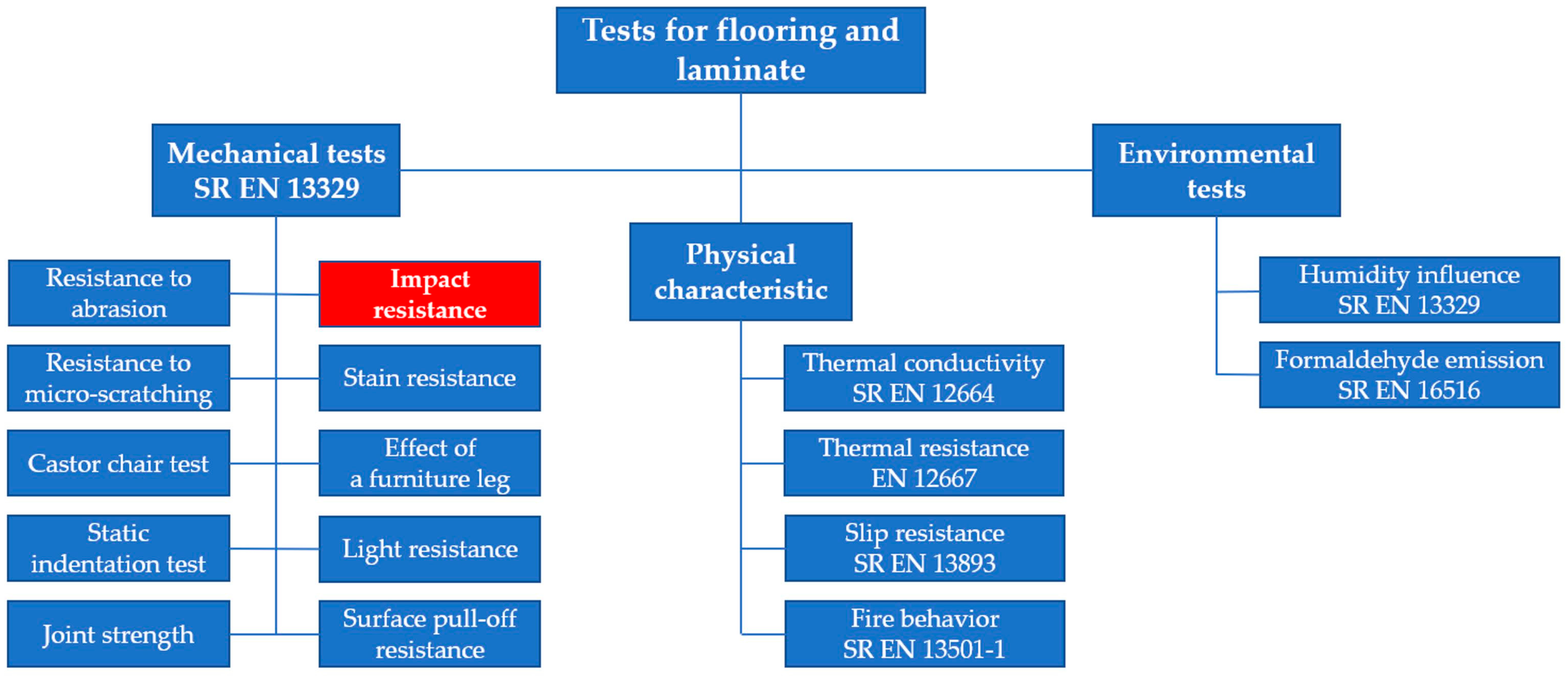
The diagram in Figure 1 illustrates the main standardized tests applied to flooring and laminate flooring, in accordance with European and international standards, some of which have also been adopted as Romanian standards.
These tests are essential for assessing quality, strength, and durability of products, ensuring that they meet the technical requirements necessary for use in real-world conditions. The tests are divided into two main categories: mechanical tests, which check the physical resistance of the flooring to wear, impact, or other stresses, and environmental tests, which evaluate the behavior of the product under various conditions of humidity or chemical emissions. In addition, the physical characteristics of the materials are also analyzed, such as thermal conductivity and resistance, surface adhesion, or fire behavior. Compliance with these standards not only guarantees the safety and comfort of users, but also increases the competitiveness of products on the market. Thus, standardized tests become an essential tool for manufacturers, installers, and consumers, helping to maintain high levels of quality and performance in the flooring industry.
The impact of layered structures with an object (not very large) at low speed occurs when objects are accidentally dropped on that structure. This condition is best replicated using a falling weight impact test [16,61,62,63]. Direct comparisons between different materials, geometries, and environmental parameters are often very complex, and direct conclusions are difficult to draw. Drop weight impact tests and gas gun tests offer representative approaches for evaluating the impact behavior of these materials. The increasingly frequent use of instrumented impactors (impact test machines with high-performance monitoring and measurement devices and dedicated software) contributes to a deeper understanding of the processes of energy absorption and dissipation in composite materials.
The evaluation of the impact behavior of wood-based or composite flooring is a fundamental criterion in the analysis of the mechanical performance and durability of the product. Impact resistance is directly related to the layered structure of the material (wear layer, HDF/MDF or laminated wood support, elastic substrate) and how the kinetic energy generated by accidentally dropped objects is dissipated.
The standardized methods set out in EN 13329 [19] (for laminate flooring) and EN 14354 [51] (for engineered flooring) define point impact tests carried out by dropping a calibrated mass from specified heights. The measured parameters—indentation diameter, integrity of the decorative layer, presence of cracks or detachments—are used to classify the product according to its performance level. These methods have the advantage of reproducibility and comparability of results between different types of flooring, but their static nature does not fully capture the dynamic phenomena that occur in real-life conditions, where the impact energy and speed of the object vary significantly.
For an advanced characterization, non-standard methods could be used, such as testing on drop-test machines such as Instron platforms. These systems allow precise control of parameters (mass, speed, height, impact energy, number of cycles) and monitoring of mechanical response through force sensors, accelerometers, and extensometers. This approach allows detailed data on the energy absorption, the elastic versus plastic behavior of the tested material, microcrack initiation thresholds, and the evolution of degradation under repeated stress. The results obtained in the literature and in internal experimental campaigns highlight the fact that parameters such as the stiffness of the wear layer, the density and thickness of the substrate, and the presence of intermediate elastic layers significantly influence impact resistance. For example, laminate flooring classified for heavy traffic (C33) may be highly sensitive to point impact due to the rigidity of the protective layer, while products with more elastic substrates or integrated cushioning technologies have a greater capacity to dissipate energy.
Therefore, the integration of standardized and non-standardized methods provides a more complete characterization of impact performance, correlating laboratory data with real-world usage scenarios. This hybrid approach is essential both in optimizing product design and in establishing selection criteria for residential, commercial, or industrial applications, especially in areas with high mechanical stress.

3. Materials, Methods and Equipment

The characteristics of the impactor Instron C-7529-324 are as follows: hemispherical shape, diameter of 25.4 mm, hardness 60–62 HRC, instrumented for velocity, impactor height and force.
A total of 45 tests were performed on the Instron 9350 machine (at Advanced Materials and Tribology Laboratory, National Institute for Aerospace Research “Elie Carafoli” INCAS Bucharest). A group of tests with a specific impact energy value and a specific brand of parquet flooring consisted of three samples (grouped as follows: one batch from the same supplier and of the same brand, but of different thicknesses, the other batch of the same thickness, but of different traffic class). The AQ brand is used to assess the influence of traffic class and the thickness of the parquet mark. Table 2 presents the codification of the tested brands, and Table 3 presents the tests carried out for this study.
The tests were performed for three energy levels: 2 J, 3 J, and 5 J. To provide a clearer understanding of the magnitude of these impact energy levels from the perspective of everyday household objects dropped from approximately 1 m, it can be considered that
  • 2 J is roughly equivalent to the impact energy of dropping a mobile phone,
  • 3 J corresponds to dropping a ceramic mug,
  • 5 J corresponds to dropping a 0.5 L bottle of water.
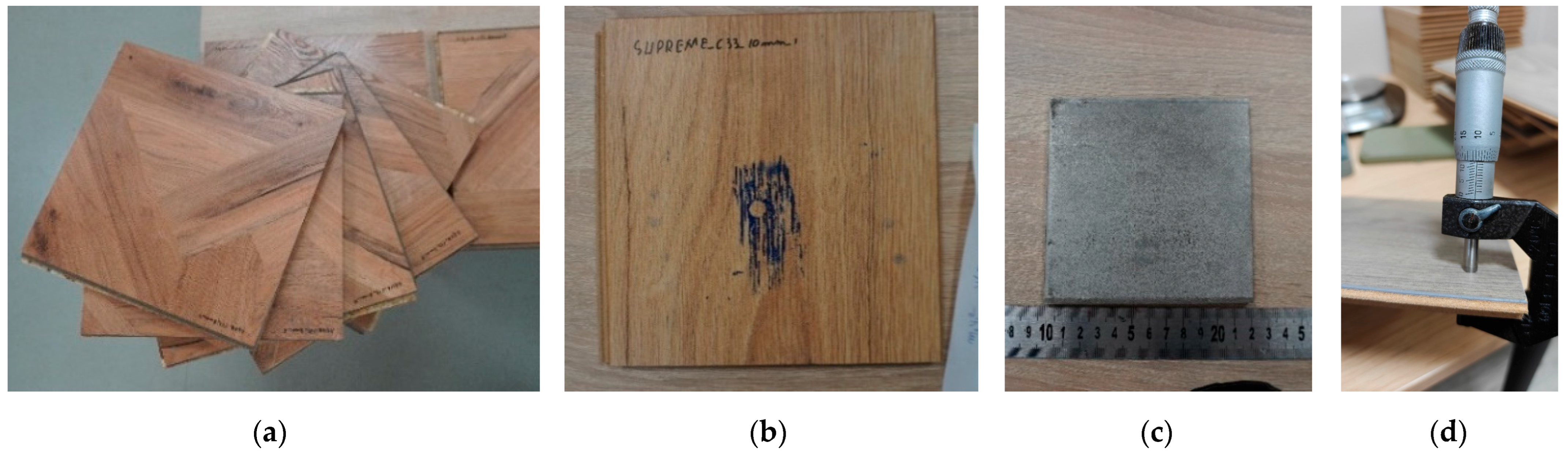
A set of three samples was tested under the same conditions (Figure 2a). Each sample has its own OSB (oriented strand board) plate of 8 mm [70], and to simulate the base floor (possibly concrete), a hardened steel plate was added (Figure 2c) under each set of tested laminated flooring and OSB. After each test, a carbon paper was slightly pressed with the help of a soft roller and the indentation becomes visible as in Figure 2b. Figure 2d presents how the thickness of laminate floor board and the set composed of laminate board sample + OBS + metal sheet are measured with the help of a micrometer.
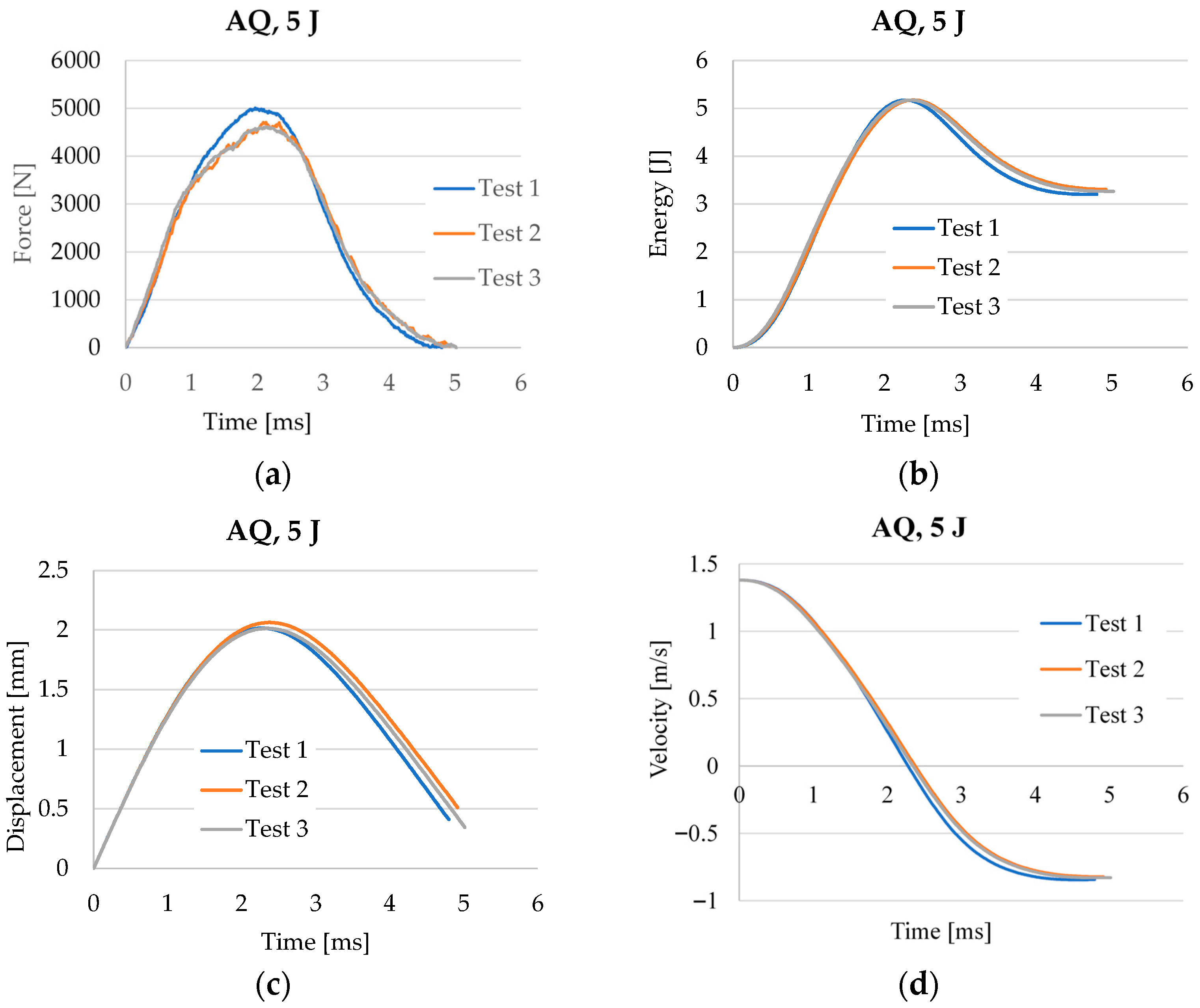
The repeatability has a good quality, as shown in Figure 3 only for one brand, AQ and one level of energy (5 J). For all tests, the average values of measured impact energy are given in Table 3 and one may notice the small values of standard deviation, implying high accuracy in adjusting this test parameter.
Based on the available documentation, the authors elaborated the methodology for measuring the indentation diameter using indigo paper.
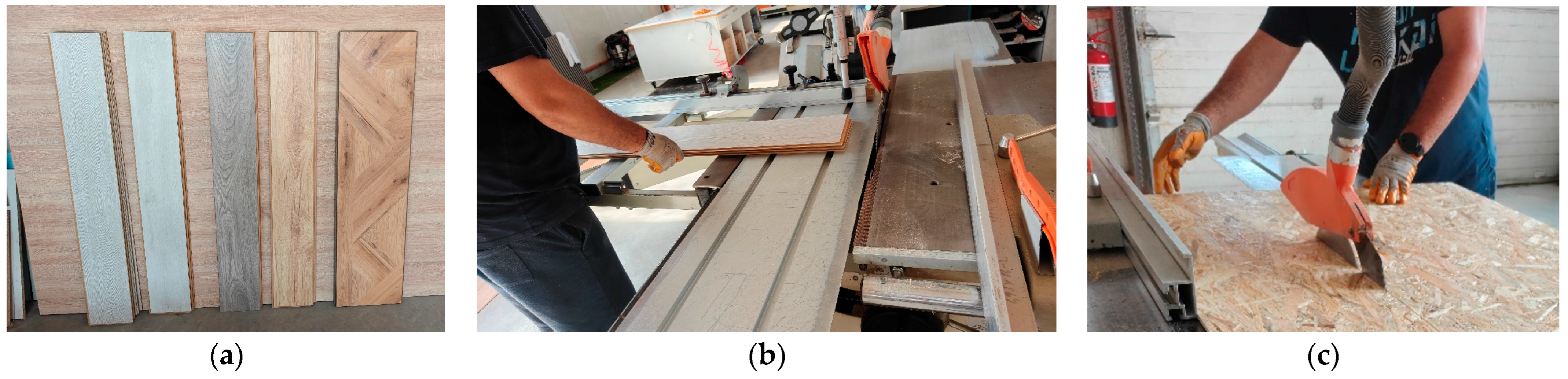
Figure 4 presents (a) the laminated flooring planks, (b) the cutting process for planks and (c) the cutting process for OSB (oriented strand board).

4. Results

4.1. Parameters Resulted from the Instrumented Test

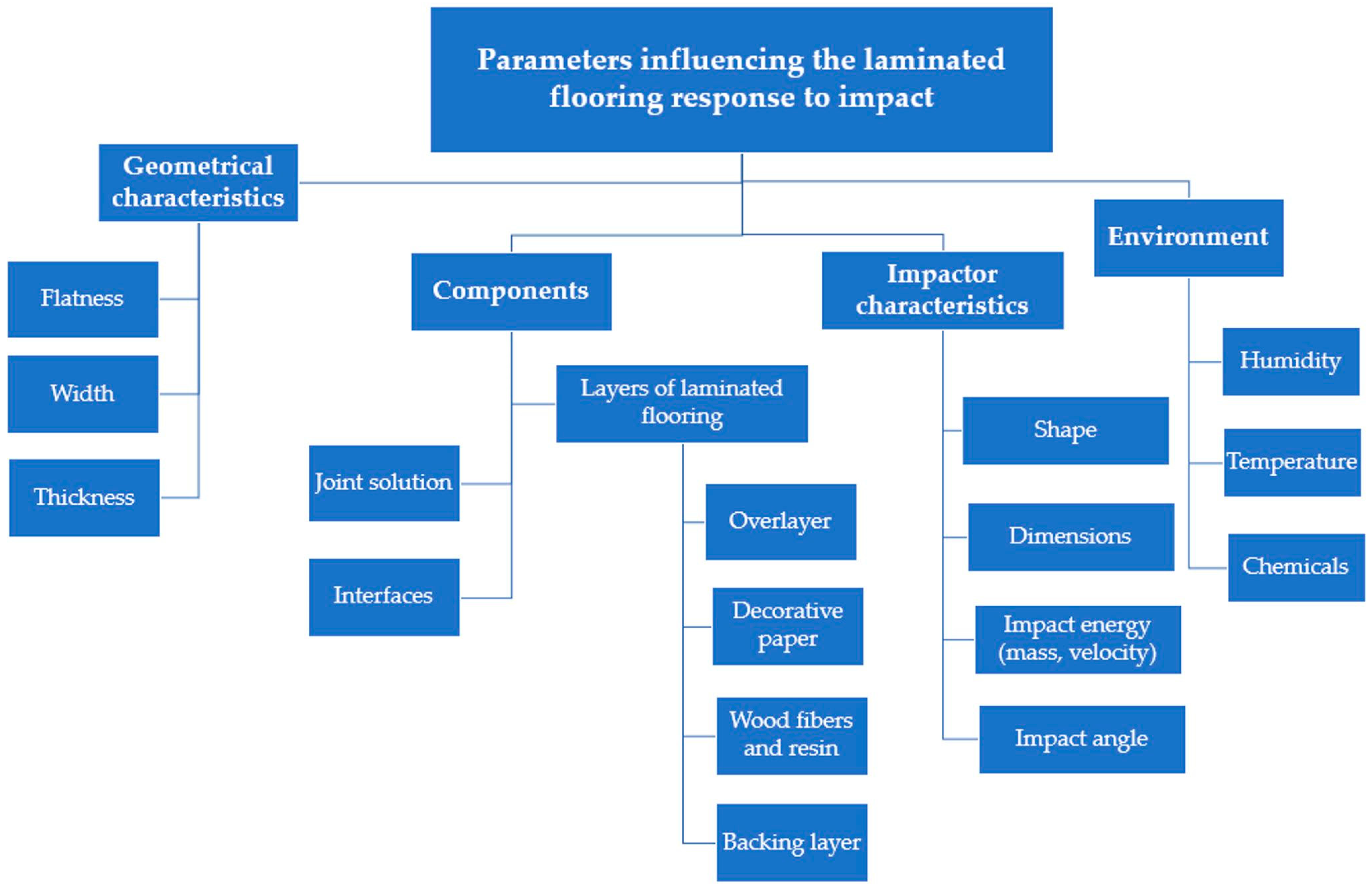
The impact behavior of laminated materials [70,71,72,73,74], and also parquet-type materials (which can also be considered composites in the case of laminated parquet), is evaluated on the basis of documentation and performance tests, which were listed in the previous chapter, including the ball impact test. Important factors influencing the impact response and damage of composite materials are illustrated in Figure 5, according to [75,76,77].
Studies conducted to date have generated an understanding of the factors that influence the initiation and propagation of impact damage. The mechanical and chemical characteristics of the constituents, films or matrices and the interface between them influence how the flooring deforms and cracks. The impact response of layered materials is also affected by parameters such as the geometry and thickness of the components, the properties of the impactor, and environmental conditions (temperature, humidity).
For this study, the following parameters were measured:
-
Fmax—The peak value of the measured force, during the impact,
-
t(Fmax)—Time to the peak force (from the last recorded value F = 0), till Fmax,
-
tf—Impact duration, from t(F=0) till the measured force reaches the null value again, after an evolution till Fmax,
-
Emax—Maximum measured impact energy (the total energy transferred when the impactor stops (v = 0), i.e., all kinetic energy has been absorbed by the sample, after which part of this energy is returned to the impactor in the form of kinetic energy (recoil)),
-
dmax—The maximum displacement of the impactor and the maximum deformation of the sample (plastic deformation + elastic deformation),
-
vmax—The maximum velocity, considered when the impactor touches the sample (meaning the same moment when the last value zero is measured for the force; after that the force is constantly increasing till Fmax).
The arithmetic average and the standard deviation were calculated for each parameter. The percentage of standard deviation reported to the average value of the parameter was also calculated:
SD %   =   ( SD / x ¯ ) · 100   [ % ]
The formula for standard deviation (SD) for samples of the same material and tested under the same conditions, is
S D = 1 n 1 i = 1 n ( x i x ¯ ) 2
where xi are the individual values, from each sample, x ¯ is the average value of xi values, and n is the number of values (for this study, n = 3).

4.2. Influence of Impact Energy on Each Tested Brands

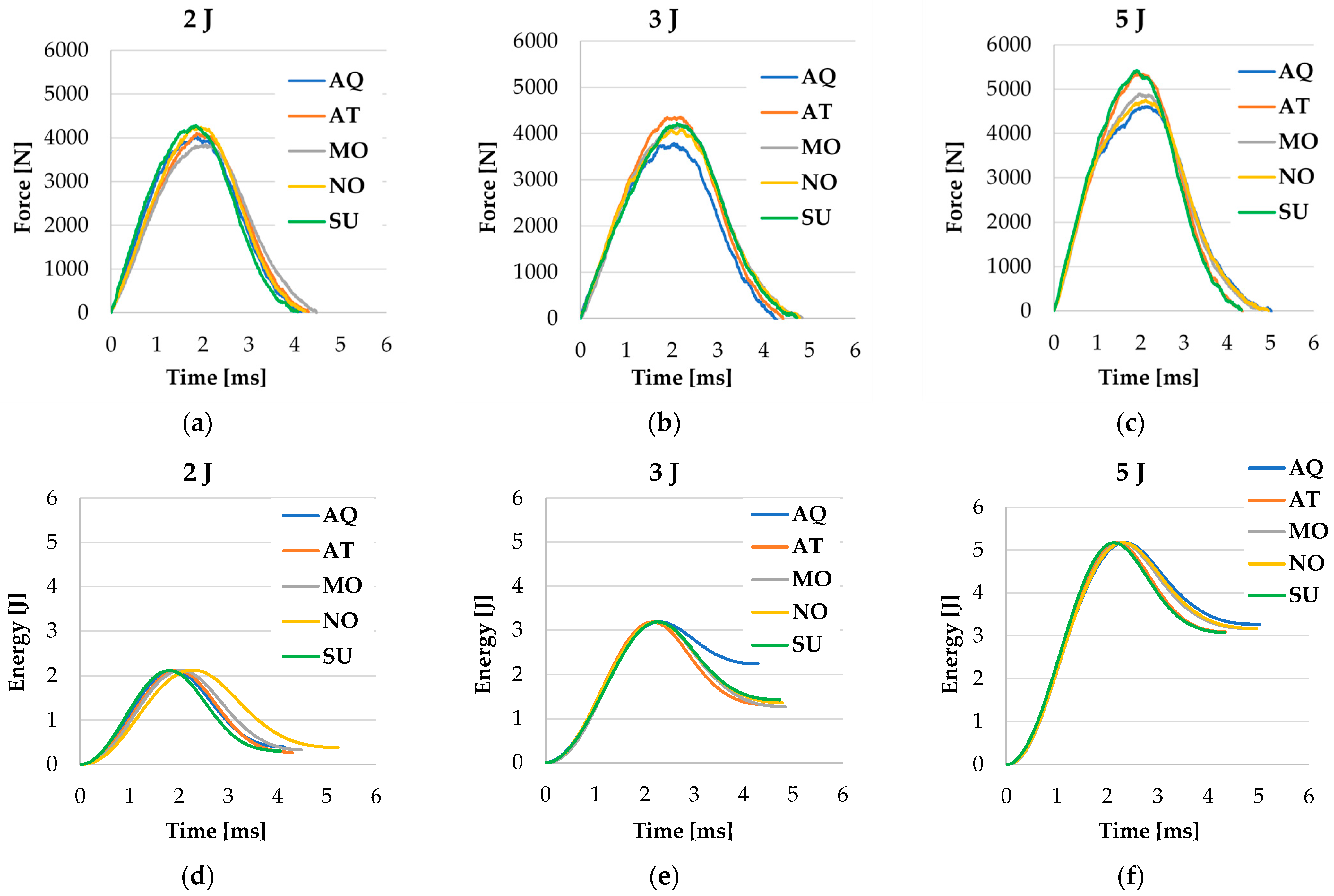
Presenting the experimental data as in Figure 6, by selecting a typical curve for each brand, at the same level of the tested impact energy, one may notice the following:
-
At 2 J and 3 J, the differences are small for Fmax (Figure 6a,b);
-
At 5 J, the curves are more clearly grouped. The higher values for Fmax were obtained for the brands SU and AT (Figure 6c).
At the impact energy of 2 J, the curves have different slopes (Figure 6d). The energy–time curves are crowded together for 3 J and 5 J (Figure 6e,f). Three zones could be identified on these curves: one starting with a curved line, followed by an almost linear fragment, the peak zone with an ascendent short zone, the peak point and the descendent zone; the last zone of this curve is a clearly a descendent one, during which the energy is re-transferred to the impactor. This zone ends with a plateau, with barely visible descendent slope, meaning the impactor consumes a very small energy because of air friction. Because of the differentiated nature of the laminated flooring samples, including the OSB support, the energy–time curves are more spaced in the third zone.
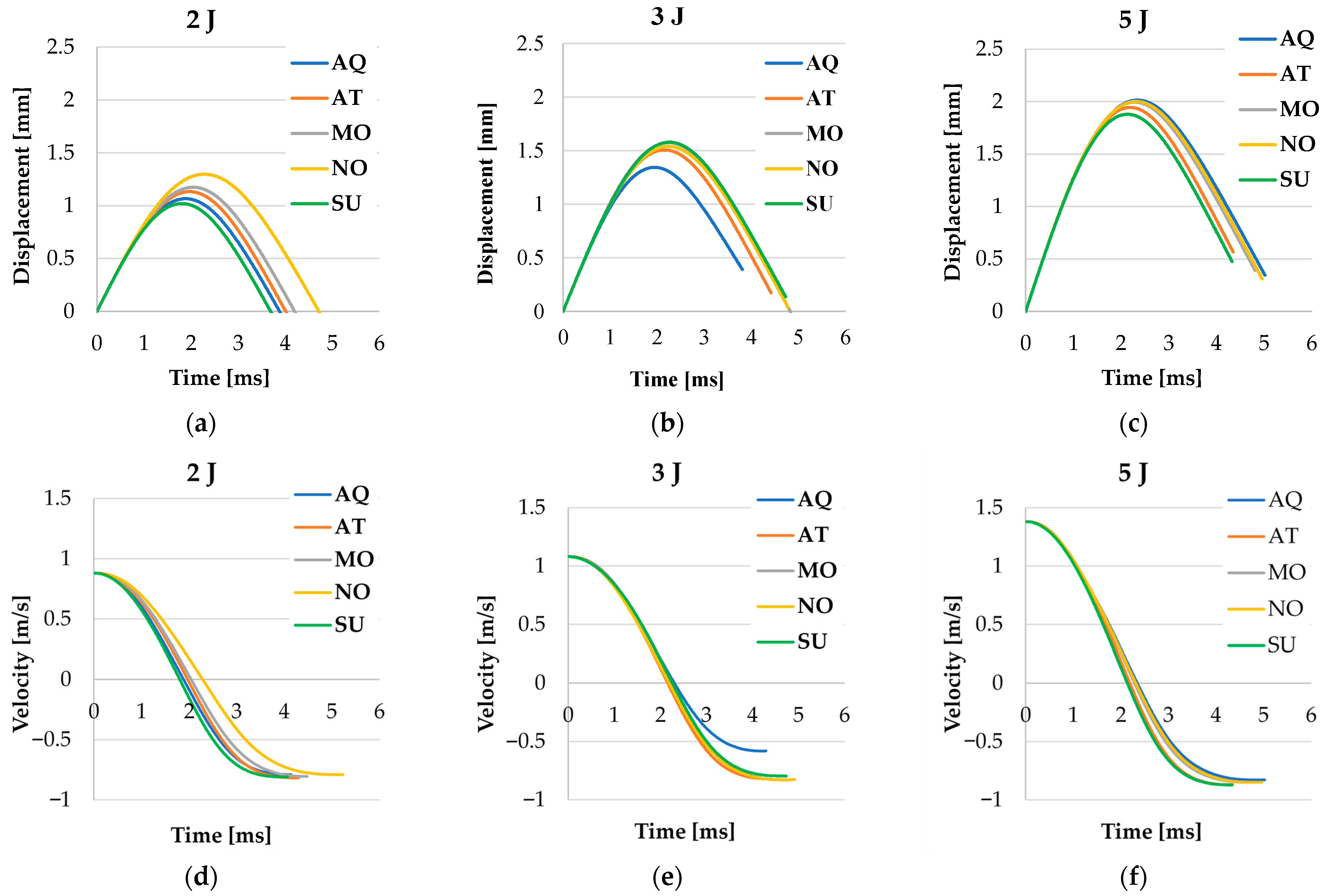
The graphs in Figure 7a–c highlight the displacement of the impactor over time, from the moment it hits the sample (implicitly, the deformation of the sample over time). The higher values at 5 J, for the AQ and NO brands, show greater elasticity, but also a higher potential for permanent deformation at high energies. This behavior is specific to the tested energy range. Future comments on larger energy range have to be supported by experimental results. Figure 7d–f present velocity–time curves, one for each brand. The distribution of the curves suggests that at low energies the differences are small, but at high energies clear differences appear, which helps to classify materials according to their impact resistance.
These comments apply only to the tested brands.

4.3. Influence of Thickness of the Laminated Flooring

The influence of thickness will be analyzed based on experimental data for the brands: AQ with 8 mm thickness, SU with 10 mm and AT with 12 mm.
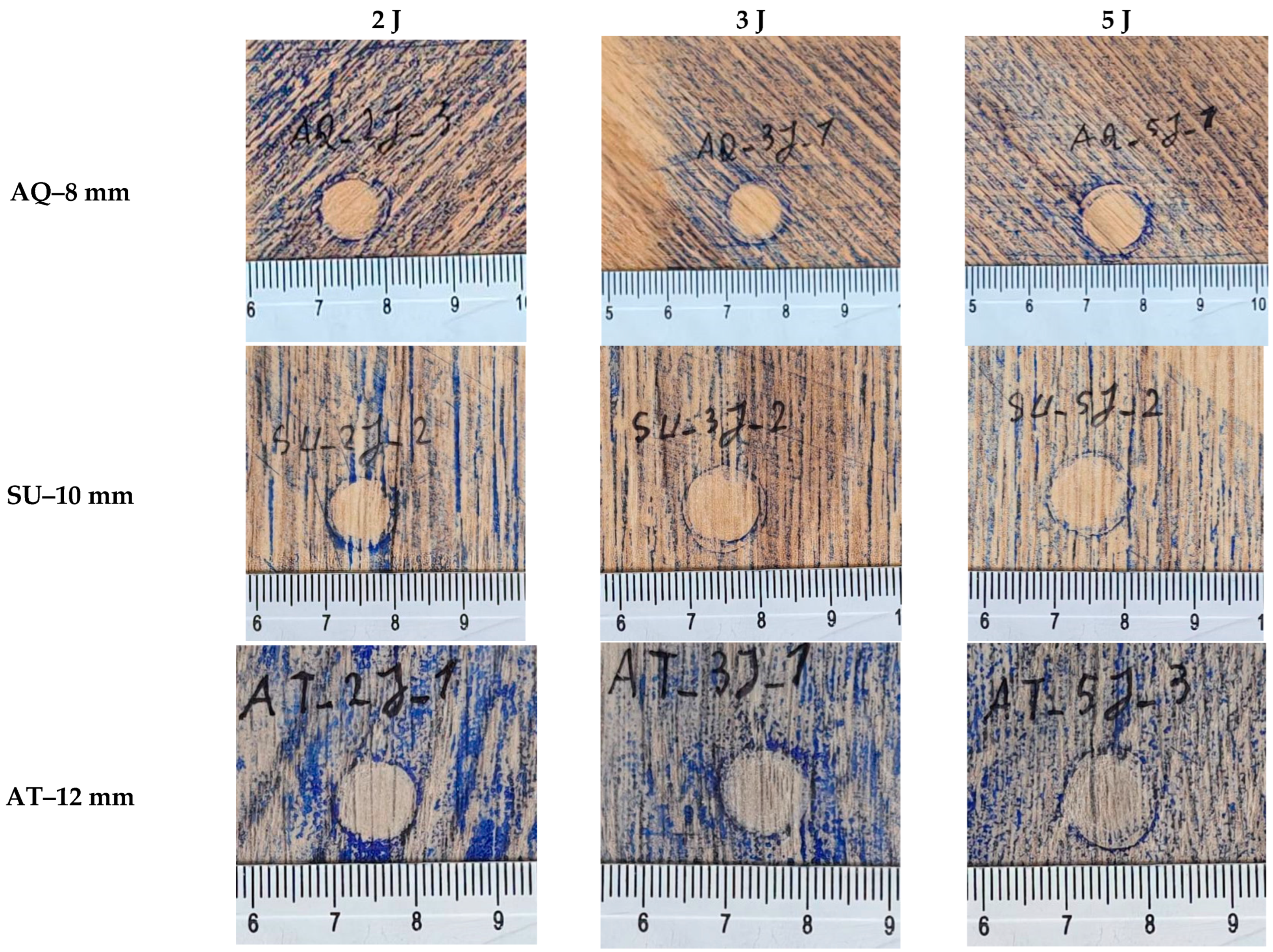
A qualitative presentation of typical indentations of these brands of different thicknesses is given in Figure 8.
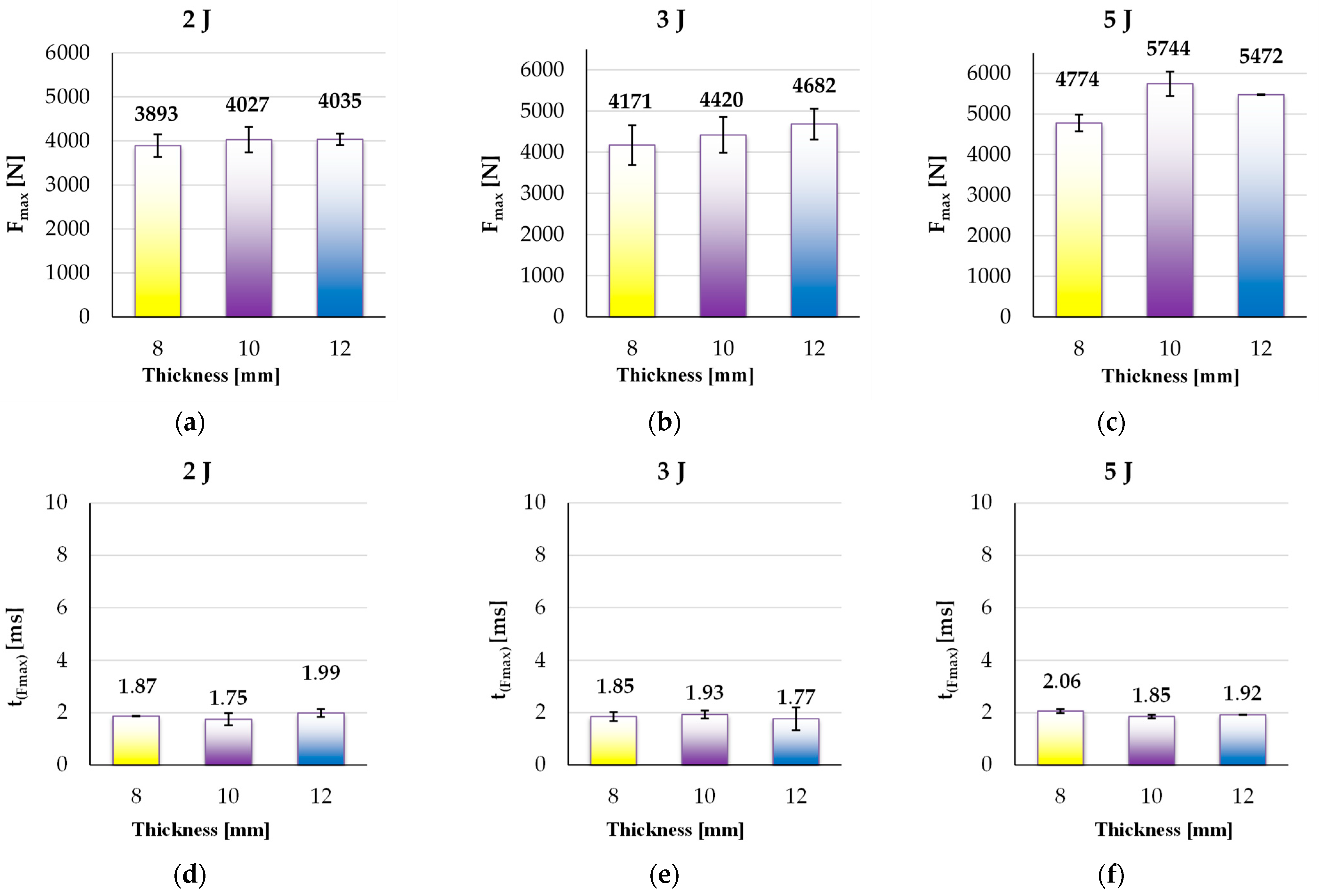
Figure 9 shows the average value of the maximum force Fmax and the standard deviation of the results obtained for each type of flooring tested and for each selected impact energy level, 2, 3, and 5 J, respectively.
For impact energy levels of 2 J and 3 J, there is a slight proportionality between thickness and maximum force recorded. For 5 J, the SU brand has the highest value. However, only three tests were performed.
The time to Fmax, t(Fmax) (Figure 9d–f), is given under the graphs for Fmax. At 2 J, the difference between the recorded values was 0.24 ms, at 3 J it was 0.16 ms, and, at 5 J, it was 0.21 ms. These are very small values, and it is not possible to formulate a dependence of t(Fmax) on thickness for each energy level. However, if we analyze the value of this parameter for the same thickness but different energy levels, we observe a slight increase for the 8 mm thickness. The parameter evolution is within a range of 0.31 ms, which is too small to establish a dependence. If we compare this value to the highest recorded value (2.06 ms), it represents only 15%, obtainable from the measurement device error and the variation in sample quality. If only the impact test of 5 J for the SU brand is excluded, the upward trend in Fmax is maintained for the 8 mm and 12 mm brands.
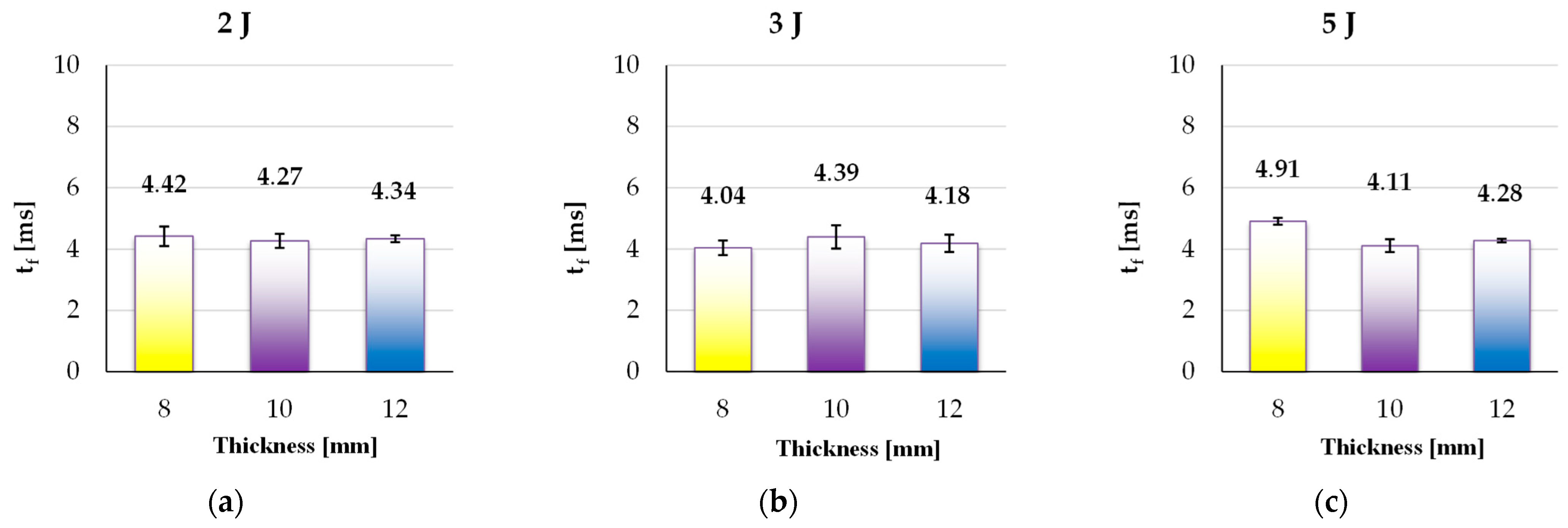
Figure 10 shows the duration of the impact, measured from the last zero value of the force on the rising part of the force–time graph to the first zero value after Fmax. If we compare the values at 2 J with those at 5 J, a downward trend in the duration of the impact is obvious, with the highest value being obtained for the AQ parquet brand with 8 mm thickness.
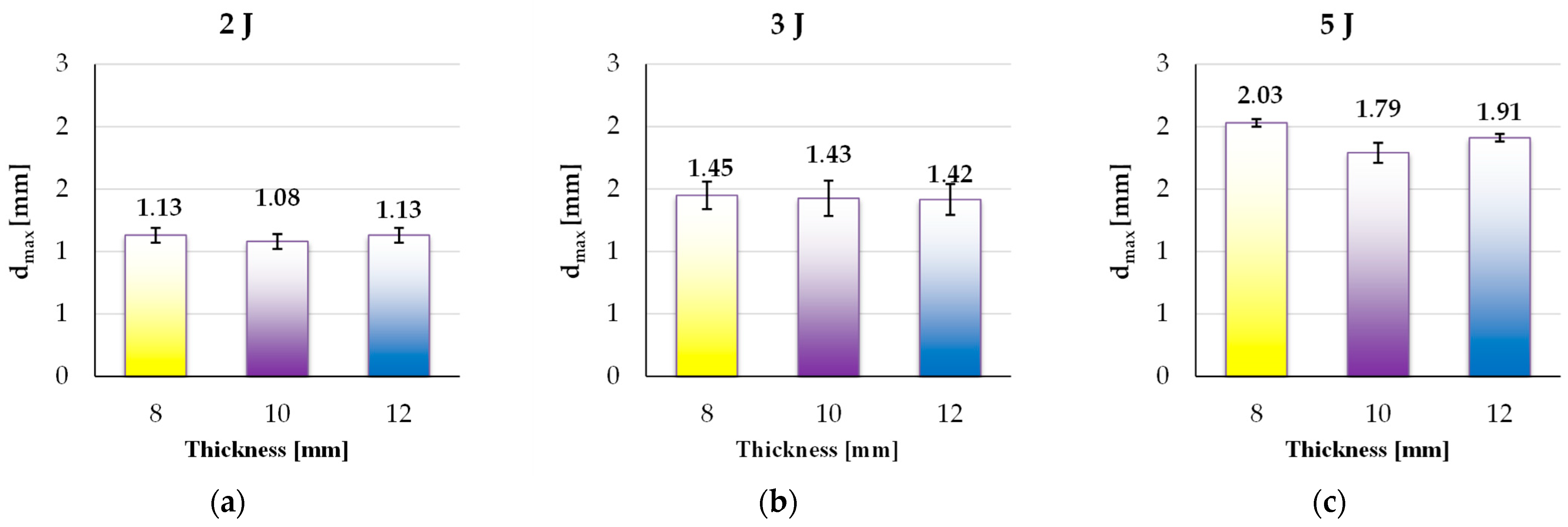
Figure 11 shows the average values and standard deviations for the indenter displacement during the test. For the laminated flooring brands included in this study, the following can be observed:
-
For 2 J and 3 J, the variation is not sensitive to thickness, but it can be seen that although the values are within a very small range, those for 3 J are slightly higher, which was to be expected,
-
For 5 J, the values suggest a slight decrease with thickness, and the size of the footprint is slightly inversely proportional to the thickness of the parquet.
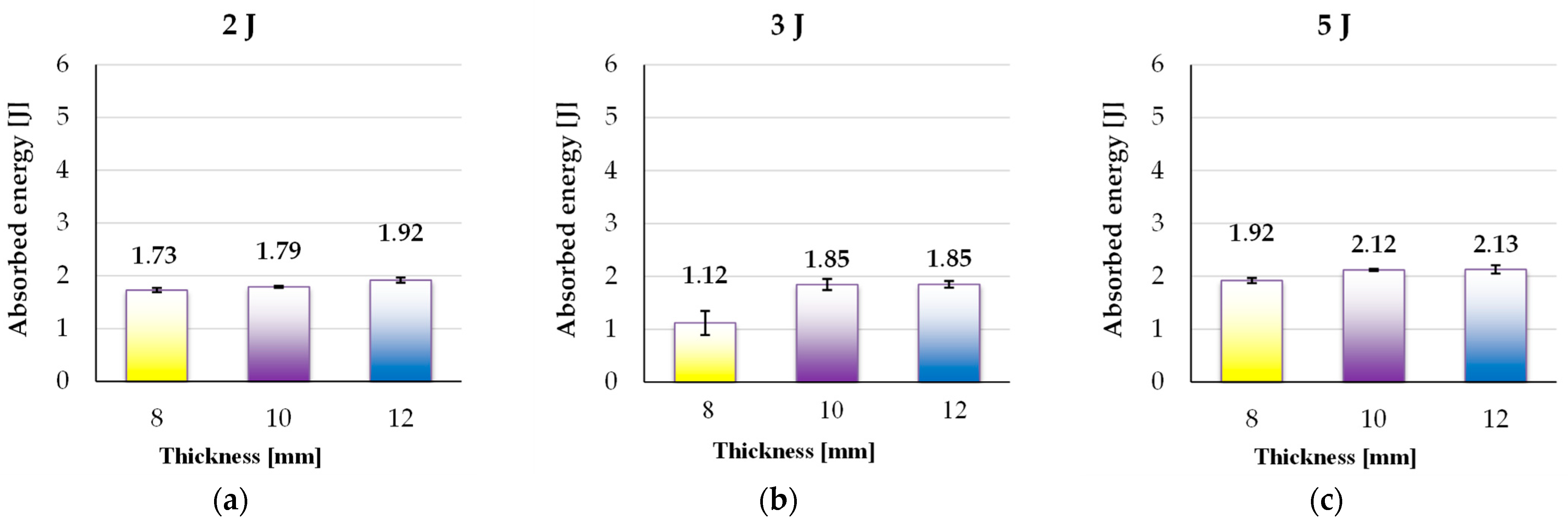
Analyzing the values for absorbed energy (Figure 12) (as difference between maximum impact energy and kinetic energy regained by the impactor after hitting the sample), the following could be pointed out. For 2 J, the absorbed energy increases from 8 mm to 12 mm by 0.19 J, which represents 9.89% of the highest value, 1.92 J.
At the impact energy of 3 J, the upward trend in absorbed energy continues, but a low value was recorded for the 8 mm parquet, which would require additional testing for this brand of parquet and this energy level. For the other two thicknesses, the trend is the same as the trends at 2 and 5 J. The low value can also be attributed to the local quality of the sample.
At 5 J, the absorbed energy is higher than the energies absorbed at 2 J and 3 J. A ratio of interest to users would be the ratio between the effective (measured) impact energy (denoted Emax) and the absorbed energy, expressed as a percentage. The quality of the tests is also reflected in the small variation in effective energy compared to the nominal energy (5 J). Table 4 shows that at greater thicknesses (10 mm and 12 mm), the brands tested absorb more energy, but the difference between 3 J and 5 J was small. These differences are small and refer only to the present dataset.
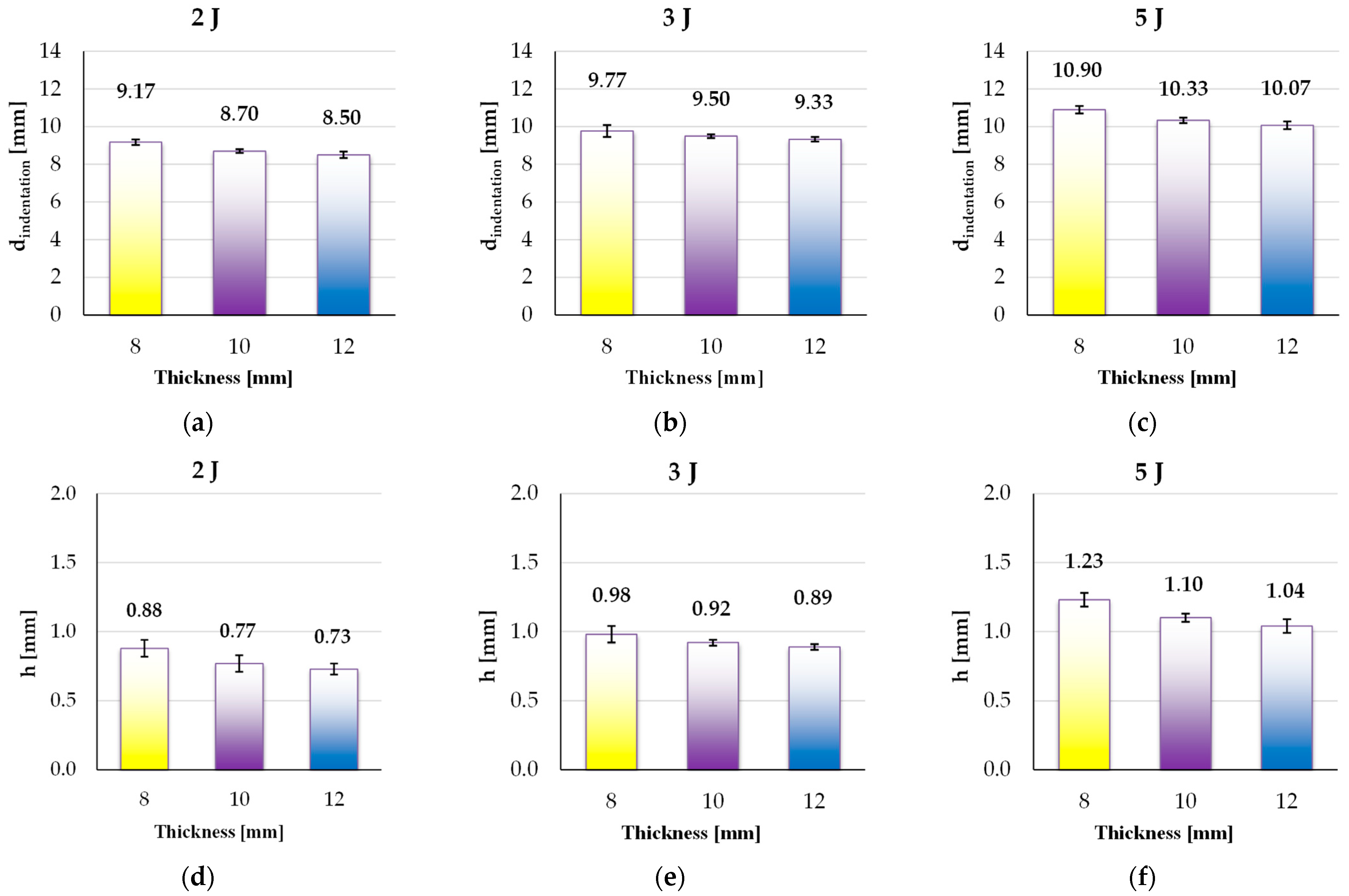
Figure 13 presents two geometrical characteristics of the indentation, measured diameter and calculated depth, considering the indentation a spherical cap. It can be seen that the highest value was obtained for an impact energy of 5 J.
Therefore, a greater thickness of the parquet results in a smaller footprint diameter. For any of the impact energy levels, a decrease in the diameter of the footprint was observed with an increase in thickness.
A percentage comparison of indentation diameter, for each impact energy level, is given in Table 5. The percentage value was calculated as
d i n d e n t a t i o n = d i n d e n t a t i o n ( 12 ) d i n d e n t a t i o n ( 8 ) d i n d e n t a t i o n ( 12 ) · 100   [ % ]
where d i n d e n t a t i o n ( 12 ) is the indentation diameter for the thickness of 12 mm and d i n d e n t a t i o n ( 8 ) is the indentation diameter for the thickness of 8 mm, for the same impact energy level.
One may notice that the highest value was obtained for the impact energy of 5 J. Thus, a greater thickness of the laminated flooring produces a smaller value of the indentation diameter.
The depth of the indentation, calculated using the diameter of the indentation, will have the same trend. It should be noted that it is easier to measure the diameter of the footprint (in millimeters) than to measure its depth, which is an order of magnitude smaller (Figure 13).

4.4. Influence of Traffic Class of the Tested Brands

This analysis is performed for three brands of laminate flooring from the same company, with a thickness of 8 mm, but with different traffic classes: NO for traffic class C31, MO for traffic class C32, and AQ for traffic class C33. In all the graphs in this subchapter, the traffic class is listed in descending order, i.e., C33 is the class for heavy traffic (commercial spaces, public buildings), C32 is the class for general residential use (dining rooms, hallways), C31 is for light domestic traffic (bedrooms).
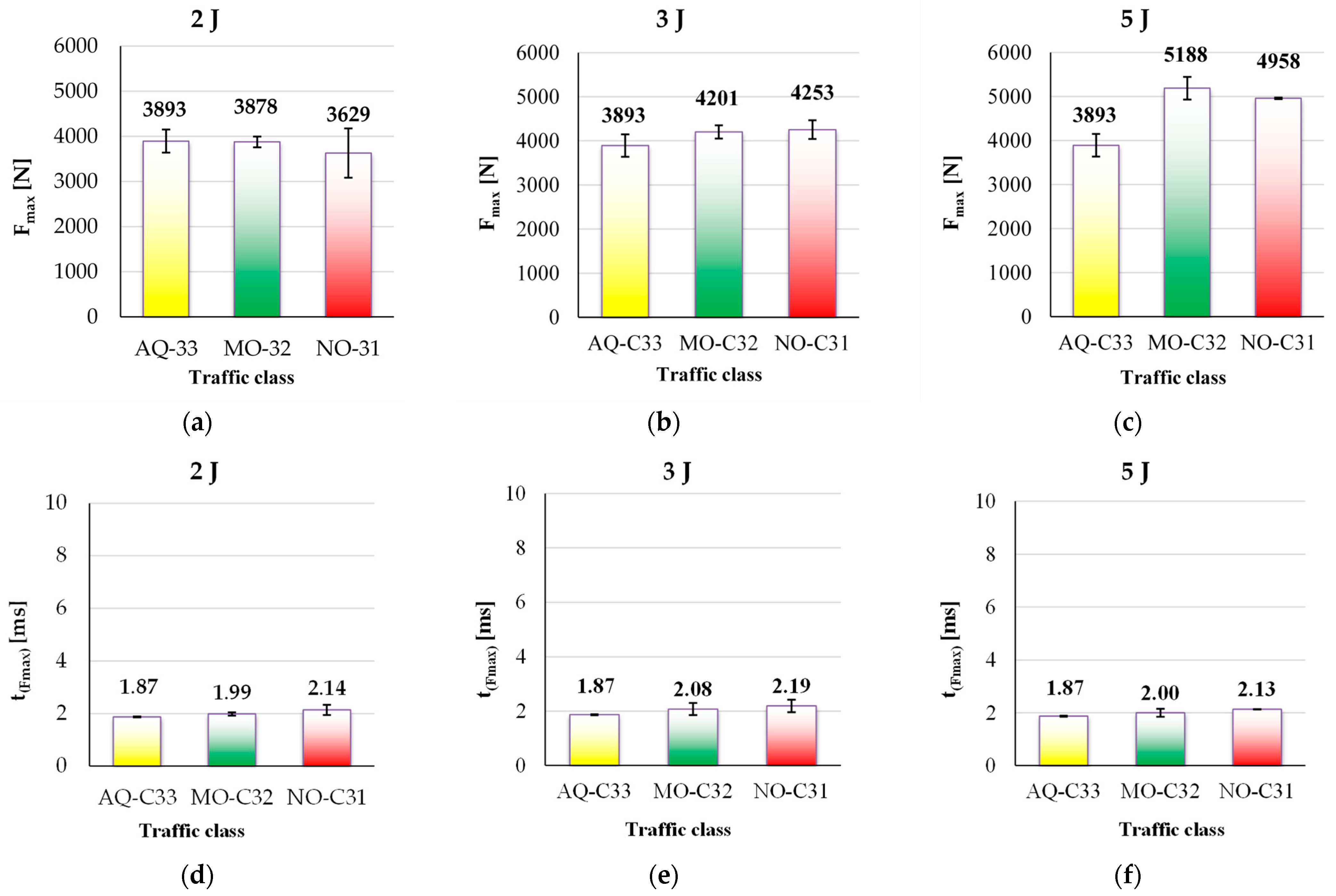
Figure 14 shows the average values and standard deviation for Fmax for brands with different traffic classes. Except for the 2 J impact energy level, for the 3 J and 5 J levels there is a slight increase in force from class C33 (for heavy traffic) to C31 (for light residential traffic). It can be observed that
-
At 2 J, the minimum value for Fmax was obtained for the NO brand (class C31), with the other two brands having very similar values for this parameter,
-
At 3 J, there is a clear upward trend in Fmax, to 4253 N,
-
At 5 J, Fmax increases from 3893 N for class C33 to 4958 N for class C31.
The value for C32 could be explained by differences in local quality in the samples. This variation may reflect brand-specific construction rather than traffic class.
The time till Fmax is a parameter sensitive to traffic class, having a slight increase from traffic class C33 to C31. But this parameter seems to be insensitive to the impact energy level, at least for these three tested brands.
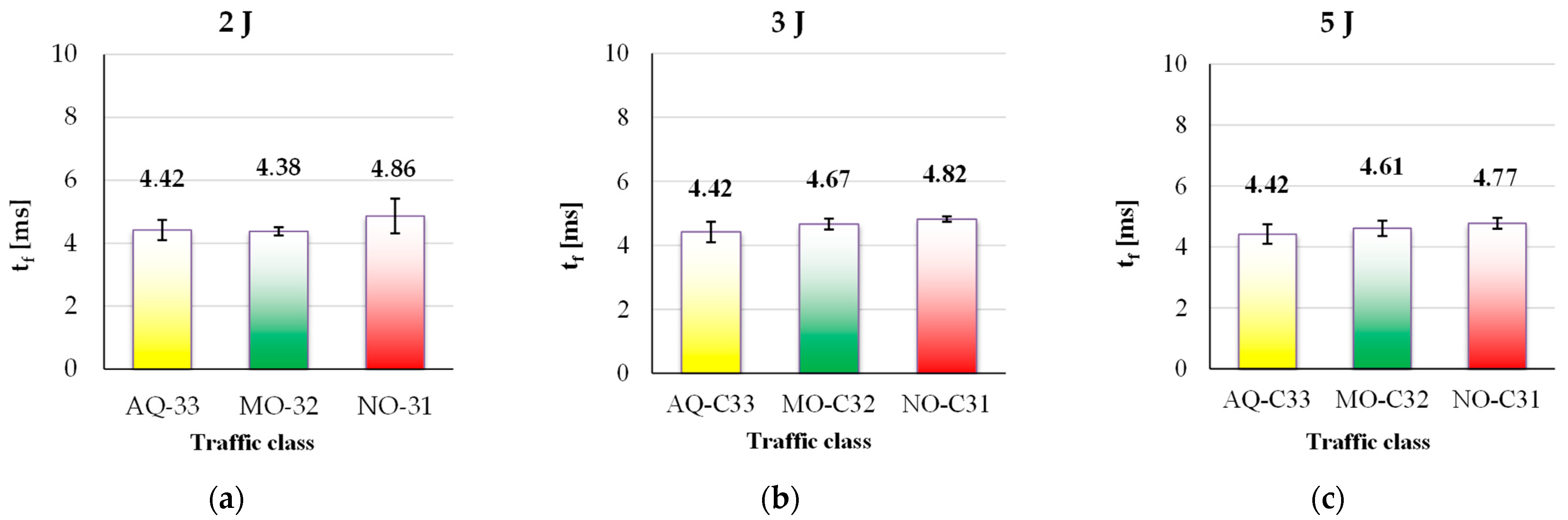
For the duration of the impact, tf (Figure 15) shows very little variation, between 4.42 ms and 4.86 ms for all tests performed. It can be concluded that this parameter is not very sensitive to the energy level, but has a slight upward trend from C33 to C31 for all energy levels tested.
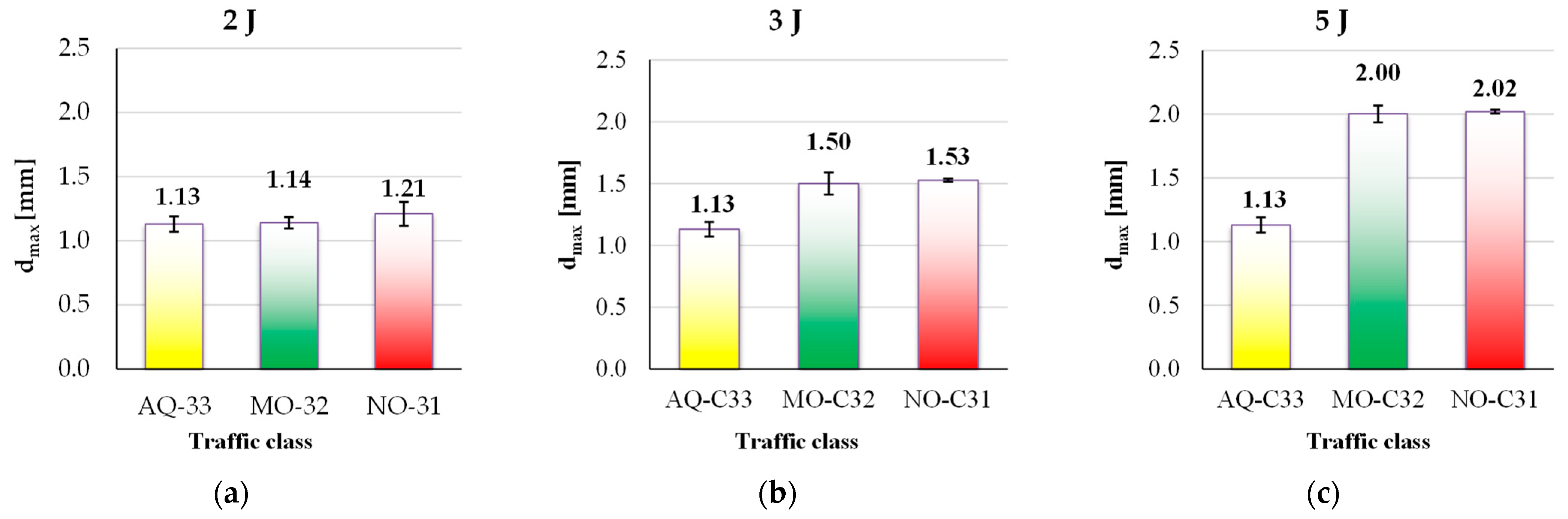
Figure 16 shows the average values and standard deviation for the maximum displacement recorded, dmax. This parameter has proven to be much more sensitive to the variable parameters of the impact test (impact energy, traffic class, and thickness of the flooring brand) and can be useful in comparing the quality of different brands. The following can be observed:
-
At 2 J, dmax increased from 1.13 mm to 1.21 mm, a small difference,
-
At 3 J, the difference was greater, from 1.13 mm to 1.53 mm,
-
At 5 J, the largest difference for dmax was obtained, measuring 0.89 mm, from 1.13 mm to 2.02 mm.
For traffic class C33 (AQ brand), the lowest values were obtained (indicating that this brand is more rigid). For classes C31 and C32, the values were very close, the traffic classes being difficult to rank by this parameter. This interpretation holds only for the tested brand batches.
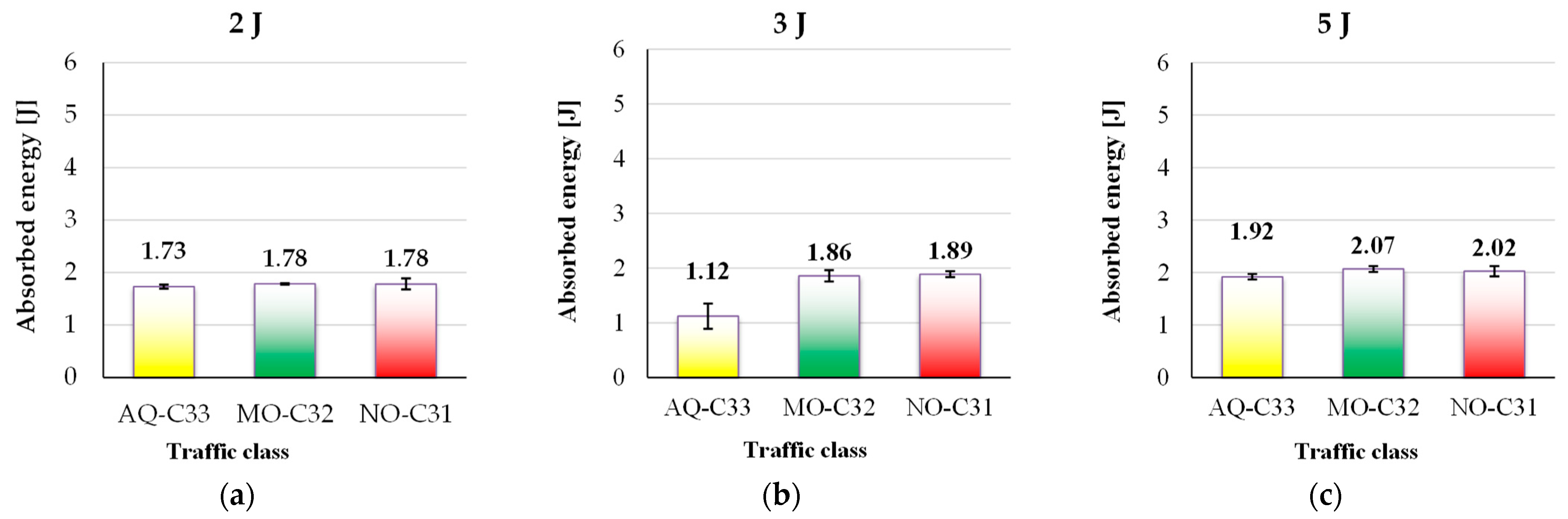
Over the analyzed impact energy range (Figure 17), the absorbed energy has the following characteristics:
-
At 2 J, although the minimum value was obtained for class C33, 1.73 J, the difference from the other traffic classes is too small to highlight a dependence on the traffic class, at least for these brands,
-
At 3 J, low values were obtained for class C33, which could be explained by local variations in the quality of the flooring or/and by the increased rigidity of this brand,
-
At 5 J, the difference between traffic class C33 and traffic class C31 is only 0.15 J, which represents only 7.8% of the energy absorbed by the brand of traffic class C33.
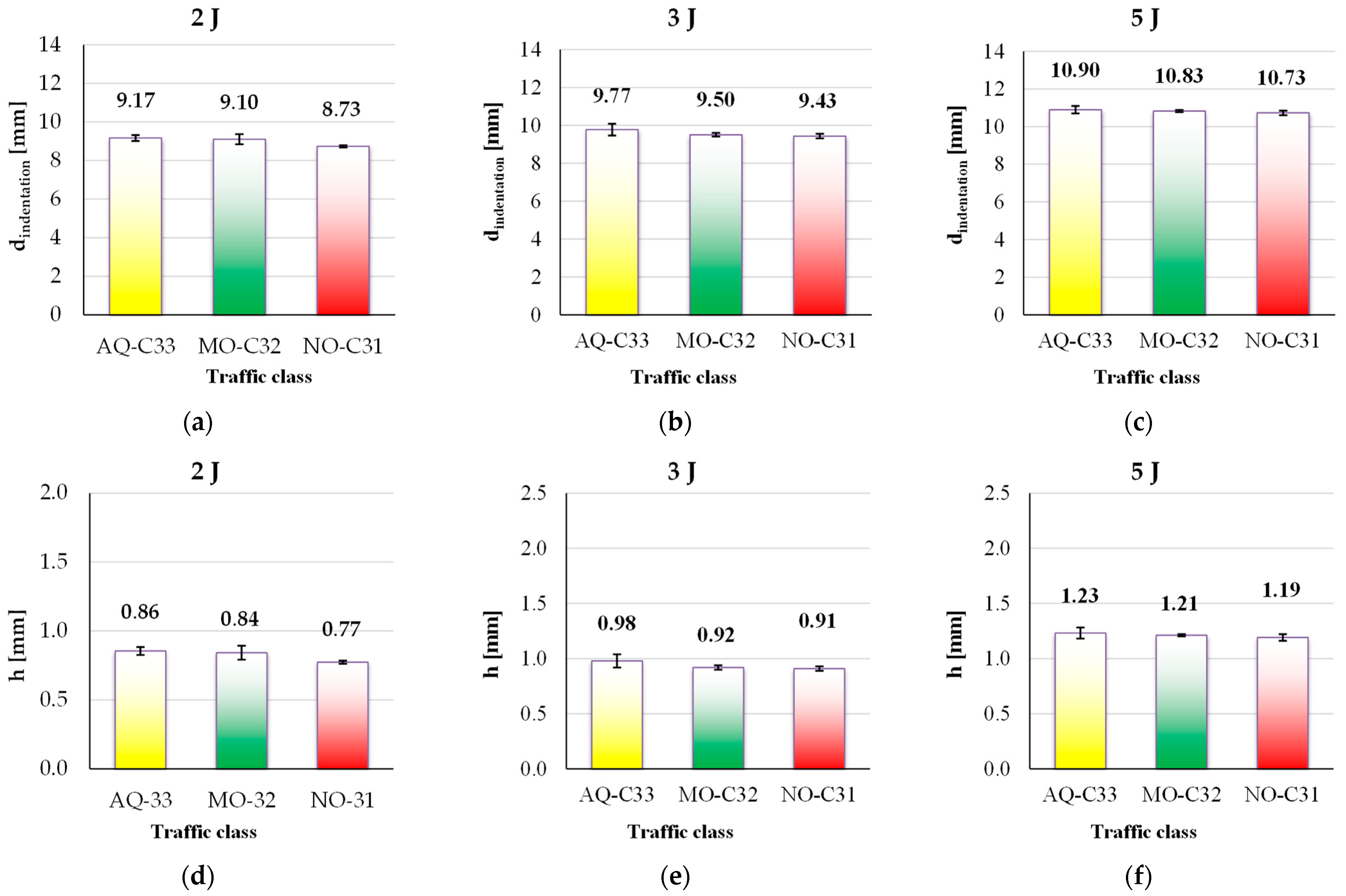
Figure 18 shows the average values and standard deviations for the indentation diameter ((a), (b) and (c)) and the indentation depth ((d), (e) and (f)).
The indention diameter has proven to be much more sensitive to the variable parameters of this study (impact energy, traffic class, and thickness) and can be useful in comparing the quality of different brands.
The difference between the values for indentation diameter, for class C33 and C31, is
-
0.44 mm at an impact energy of 2 J,
-
0.34 mm at an impact energy of 3 J,
-
0.23 mm at an impact energy of 5 J.
This reflects a similar quality, regardless of the traffic class, a quality ensured by the components of the laminated flooring, especially the top layer, so that the indentation is almost the same for all traffic classes. This similarity refers only to the brands that we tested.
Given that the depth of the indentation is calculated by considering it the height of a spherical cap with a diameter equal to the indentation diameter, the conclusion remains the same for this parameter as for the diameter of the indentation.
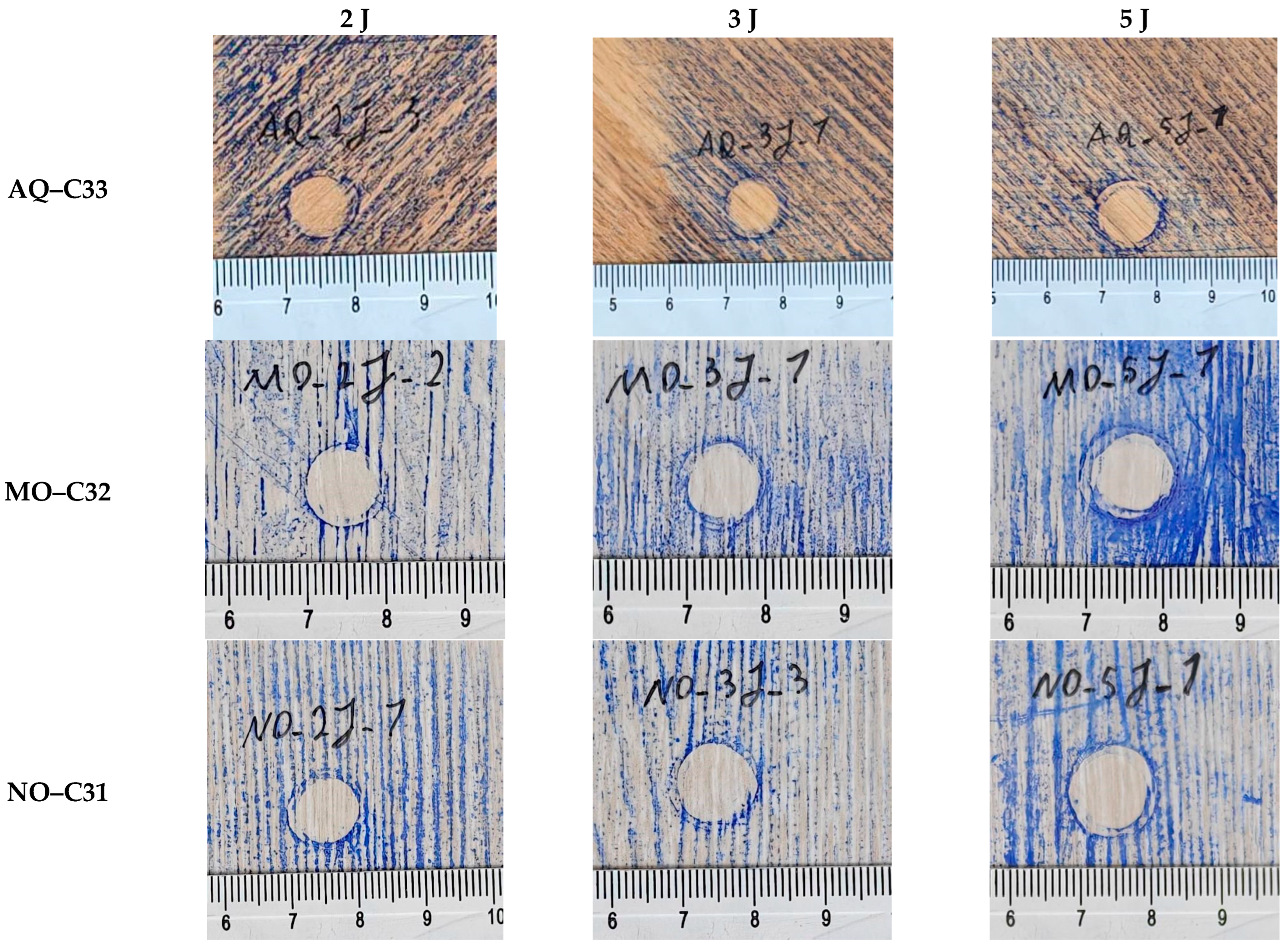
The photographs of the indentations highlighted with indigo paper qualitatively point out this fact (Figure 19). When selecting a brand of laminate flooring, other criteria besides the impact indentation diameter will also be taken into account, at least for the three tested brands.

5. Discussions

Table 6 presents comparative values of measured parameters (average values), highlighting the influence of thickness at a nominal impact energy of 5 J. This type of experimental data synthesis quickly highlights the differences between the tested brands.
Table 7 shows comparative average values for several parameters of interest for tests performed on brands with different traffic class. This suggests how brands can be classified or recommended based on experimental results taking into account several impact parameters:
-
Brands with higher rigidity → recommended for heavy traffic, commercial spaces,
-
Brands with better energy dissipation capacity → useful for areas where accidental impact is more likely (e.g., children’s rooms, workshops).
The authors present several arguments to point out that the obtained results have significant practical value:
  • They allow objective comparison of performance between brands and traffic classes;
  • They can support manufacturers in optimizing recipes and technological processes;
  • They provide consumers and designers with clear information for selecting the adequate materials according to the usage scenario—residential, commercial, or industrial traffic;
  • They can form the basis for improving current standards by integrating quantifiable parameters, not just visual assessments.
Through this method, impact tests become not only a tool for verifying compliance, but also a comparative performance guide, useful in the development and selection of superior quality products.
Based on the data obtained, we proposed grouping the studied parameters according to their sensitivity to impact energy. The conclusions are valid for the 2–5 J range, which is nevertheless significant for assessing the impact resistance):
-
Parameters sensitive to the impact energy are as follows:
-
Indentation diameter, dindentation, increases visibly with impact energy (the best discriminator between brands and thicknesses), the indentation depth, h, derives from dindentation, maintains the same trend;
-
Absorbed energy, Eabsorbed, tends to increase with the impact energy; more visible for ranking at 5 J;
-
Maximum force, Fmax, generally increases with the impact energy (moderate sensitivity, but relevant at 5 J, for the tested brands).
-
Less sensitive/almost independent parameters are as follows:
-
Impact duration, tf—Small variations in the 2–5 J range,
-
Time to Fmax, t(Fmax)—Small differences between energies.

6. Conclusions

Although the standards for assessing the impact resistance of laminate flooring require only the use of a simple device with a free-falling ball, this study proposes the use of an impact testing machine, equipped to measure force, time, velocity, and with the possibility of fine adjustment of impact energy and/or impact velocity.
This type of study can be useful in assessing the quality of a particular flooring model and in recommending brands for specific applications. Laminate flooring offers strength and affordable esthetics, but impact, wear, and moisture tests are essential to guarantee its quality and durability.
Based on these experimental results, the conclusions on the influence of laminate flooring thickness could be formulated as following for the tested brands.
  • At low energies (2 J and 3 J), the maximum force (Fmax) increases with the thickness of the board, confirming a better impact response for the thicker boards.
  • At 5 J energy, the general trend is maintained, but there are small deviations, which can be attributed to the limited number of tests or local variations in sample quality.
  • The diameter of the indentation decreases with increasing thickness, indicating better resistance to local deformation for the tested samples—the percentage differences were the greatest at 5 J (over 9%).
  • The absorbed energy increases slightly with thickness (up to ~41% for 10–12 mm plates, at 5 J), confirming a slightly improved energy-dissipation ability within the tested thickness range.
Conclusions on the influence of traffic class are the followings, at least for the tested brands.
  • At the low impact energy level of 2 J, the differences between the traffic classes are minimal or even negligible. However, at impact energy levels of 3 J and 5 J, a slight increasing trend in the maximum impact force can be observed, from the higher class (C33) toward the lower class (C31).
  • For the higher impact energy levels (3 J and 5 J), a modest increase in maximum impact force was recorded from the upper traffic class C33 (heavy commercial) toward the lower class C31 (light residential), suggesting that class-related differences are limited for the tested specimens.
  • The time-related parameters (impact duration and the time to reach Fmax) exhibit only minor variations, with a slight increase from C33 to C31. This pattern suggests a slightly stiffer impact response for C33 within the tested range.
  • The indentation diameter proved to be the most sensitive indicator; nevertheless, the differences among the classes (C33, C32, C31) were small, reflecting a comparable performance level among the tested brands. This similarity is likely attributable to similarities in the protective top layer used by the analyzed brands, whose formulation is legally protected.
  • The difference in indentation diameter, from the impact energy 2 J to 5 J, is 1.73 mm for C33 and C32 brands and 2.00 mm for the class C31, meaning that the selection should include other parameters required by the particular aspects of usage. Although C33 is designed for heavy-duty traffic, under impact loading it exhibited larger indentations compared with C31 and C32. This finding indicates that impact resistance does not depend only on the declared traffic class, but also on brand-specific multilayer construction. The influence of impact energy level on tested brand for class traffic pointed out that the absorbed energy differs very low among classes (maximum 7–8% at 5 J, between C33 and C31), suggesting a very similar quality level for the designated traffic classes, likely influenced by the formulation of the upper protective layer.
This study contributes to the evaluation of laminate flooring impact performance by employing instrumented testing rather than relying solely on visual assessment, as required in current standards. Instead of simple visual assessment, limited to determine the height from which no crack appears—according to current standards—the carried out tests allowed for the precise measurement of the force, time, speed, and energy absorbed during impact. This approach provides a much more detailed and comparable picture between different brands and thicknesses of flooring.

Author Contributions

Conceptualization, C.T. and L.D.; methodology, A.V.V., C.T., G.C.C., G.G.O. and L.D.; software, A.V.V., G.C.C., M.C. and V.A.; validation, G.C.C. and L.D.; formal analysis, C.T., M.C.M. and L.D.; investigation, A.V.V., C.T., V.A. and M.C.M.; resources, A.V.V., C.T. and L.D.; data curation, A.V.V., G.C.C. and L.D.; writing—original draft preparation, A.V.V., C.T., M.C. and G.G.O.; writing—review and editing, A.V.V., G.C.C. and L.D.; visualization, A.V.V., V.A. and G.G.O.; supervision, A.V.V., G.C.C. and L.D.; project administration, C.T., M.C. and L.D.; funding acquisition, A.V.V., G.C.C. and L.D. All authors have read and agreed to the published version of the manuscript.

Funding

This research received no external funding.

Data Availability Statement

The original contributions presented in this study are included in the article. Further inquiries can be directed to the corresponding authors.

Acknowledgments

The authors have reviewed and edited the output and take full responsibility for the content of this publication.

Conflicts of Interest

Author George Ghiocel Ojoc was employed by the company Autonomous Flight Technologies. The remaining authors declare that the research was conducted in the absence of any commercial or financial relationships that could be construed as a potential conflict of interest.

References

  1. Floorcovering Certified Inspection Service—CA. Available online: http://www.inspectorfloors.com/laminate/ (accessed on 14 June 2025).
  2. Wikipedia. Laminate Flooring. Available online: https://en.wikipedia.org/wiki/Laminate_flooring (accessed on 19 April 2025).
  3. Laminate Flooring. Available online: https://mohawkind.com/products.php#laminate (accessed on 14 June 2025).
  4. Brief History of Parquet Flooring. Available online: https://www.solidfloor.co.uk/journal-posts/brief-history-of-parquet-flooring?utm_source=chatgpt.com (accessed on 1 September 2025).
  5. Our History. Available online: https://valinge.com/about-us/history/ (accessed on 1 September 2025).
  6. Quick-Step Laminate Flooring. Available online: https://flooringking.co.uk/laminate-flooring/quickstep-laminate/ (accessed on 1 September 2025).
  7. Unilin Reaches Agreements with Välinge & Beaulieu. Available online: https://www.floordaily.net/floorfocus/unilin-reaches-agreements-with-vlinge--beaulieu- (accessed on 1 September 2025).
  8. Zhou, K.; Cheng, J.; Fan, M. Study on Innovative Laminated Flooring with Resin-Impregnated Paper. Buildings 2024, 14, 3250. [Google Scholar] [CrossRef]
  9. Different Laminate Flooring Patterns. Available online: https://elephantfloors.net/blog/different-laminate-flooring-patterns/?utm_source=chatgpt.com (accessed on 5 September 2025).
  10. Chevron & Herringbone: History of These Popular Parquet Wood Flooring Patterns. Available online: https://anthologywoods.com/aw-blog/chevrons-herringbone-history-of-these-popular-wood-flooring-patternsand?utm_source=chatgpt.com (accessed on 10 August 2025).
  11. The Layers of Laminate. Available online: https://www.contractinteriorsflooring.com/products/product-articles/laminate/the-layers-of-laminate?utm_source=chatgpt.com (accessed on 10 August 2025).
  12. Unveiling the Layers: What Are Laminate Floors Made Of? Available online: https://www.diverseflooring.ca/blog/articles/unveiling-the-layers-what-are-laminate-floors-made-of?utm_source=chatgpt.com (accessed on 10 August 2025).
  13. What is Laminate Flooring: A Complete Guide. Available online: https://horizonbespokejoinery.ie/blog/what-is-laminate-flooring/?utm_source=chatgpt.com (accessed on 15 August 2025).
  14. Weldon, J. Parquetry Floors. Available online: https://www.buildingconservation.com/articles/parquetry/parquetry.htm?utm_source=chatgpt.com (accessed on 29 April 2025).
  15. What Exactly is Laminate Flooring? Available online: https://nalfa.com/what-is-laminate/?utm_source=chatgpt.com (accessed on 29 April 2025).
  16. North American Laminate Flooring Association. NALFA Standards Publication LF 01-2003; North American Laminate Flooring Association: Washington, DC, USA, 2003; Available online: https://www.floorreports.com/images/technotes_files/45.pdf?utm_source=chatgpt.com (accessed on 10 August 2025).
  17. AC Rating. Available online: https://www.envirobuild.com/indoor-flooring/laminate/ac-rating (accessed on 10 August 2025).
  18. ANSI Standards. Performance Testing Standards. Available online: https://web.archive.org/web/20120511105151/http://nalfa.com/ansi_standards.php (accessed on 29 April 2025).
  19. EN 13329; Laminate Floor Coverings—Elements with a Surface Layer Based on Aminoplastic Thermosetting Resins. CEN: Brussels, Belgium, 2000.
  20. Product Certification Standards. Available online: https://nalfa.com/product-certification-standards/ (accessed on 29 April 2025).
  21. ISO 24335:2022; Laminate Floor Coverings—Determination of Impact Resistance. ISO: Geneva, Switzerland, 2022.
  22. EN 17368:2020; Laminate Floor Coverings—Determination of Impact Resistance with Small Ball. ISO: Geneva, Switzerland, 2020.
  23. ASTM F1265; Standard Test Method for Resistance to Impact for Resilient Floor. ASTM International: West Conshohocken, PA, USA, 2024.
  24. ASTM D2794; Standard Test Method for Resistance of Organic Coatings to the Effects of Rapid Deformation (Impact). ASTM International: West Conshohocken, PA, USA, 1968.
  25. EN 13696; Wood Flooring—Test Methods to Determine Elasticity and Resistance to Wear and Impact Resistance. CEN: Brussels, Belgium, 2009.
  26. EN 14342:2013; Wood Flooring and Parquet-Characteristics, Evaluation of Conformity and Marking. CEN: Brussels, Belgium, 2013.
  27. EN 438-2:2016; High-Pressure Decorative Laminates (HPL)-Sheets Based on Thermosetting Resins (Usually Called Laminates)-Part 2: Determination of Properties. CEN: Brussels, Belgium, 2016.
  28. EN 16511:2023; Modular Mechanical Locked Floor Coverings (MMF)-Specification, Requirements and Test Method for Multilayer Modular Panels for Floating Installation. CEN: Brussels, Belgium, 2023.
  29. EN ISO 26987:2012; Resilient Floor Coverings-Determination of Staining and Resistance to Chemicals. CEN: Brussels, Belgium, 2012.
  30. ISO 4898; Rigid Cellular Plastics—Thermal Insulation Products for Buildings—Specifications. ISO: Geneva, Switzerland, 2019.
  31. EN ISO 846:2019; Plastics—Evaluation of the Action of Microorganisms. CEN: Brussels, Belgium, 2019.
  32. ISO 4611:2019; Resistance to Humid Aging. ISO: Geneva, Switzerland, 2019.
  33. Swiss Krono. Flooring. Available online: https://www.swisskrono.com/global-en/about-us/swiss-krono-group/ (accessed on 14 April 2025).
  34. Pergo Laminate Floors. Beautiful, Elegant Floors for Tough Living. Available online: https://int.pergo.com/en/laminate?page=1&page_size=15&sort=commercialrangename&sort_type=asc&view_size=15 (accessed on 10 August 2025).
  35. Laminate Flooring. Combining the Best in Performance and Beauty. Quick Step Floor Designers. Available online: https://int.quick-step.com/en/laminate (accessed on 11 April 2025).
  36. Arenas, J.P. Impact Sound Insulation of a Lightweight Laminate Floor Resting on a Thin Underlayment Material above a Concrete Slab. J. Build. Eng. 2022, 45, 103537. [Google Scholar] [CrossRef]
  37. Roseby, T.; Shearer, A. Investigation of Impact Isolation of Flooring Products and Resilient Underlays. In Proceedings of the AASNZ Acoustics Conference 2016, Brisbane, QLQ, Australia, 9–11 November 2016. [Google Scholar]
  38. Services for Floorings/Sports Areas and Deckings. Available online: https://www.ihd-dresden.com/fileadmin/user_upload/pdf/IHD/wissensportal/Broschueren/Bodenbel%C3%A4ge/BroschuereBodenbelaege_E.pdf (accessed on 1 August 2025).
  39. Acuña, L.; Sepliarsky, F.; Spavento, E.; Martínez, R.D.; Balmori, J.-A. Modelling of Impact Falling Ball Test Response on Solid and Engineered Wood Flooring of Two Eucalyptus Species. Forests 2020, 11, 933. [Google Scholar] [CrossRef]
  40. Lunguleasa, A.; Spirchez, C.; Radulescu, L.; Diaconu, M.T. The Ball Response on the Beech Parquet Floors Used for Basketball Halls. Appl. Sci. 2021, 11, 7816. [Google Scholar] [CrossRef]
  41. Sydor, M.; Pinkowski, G.; Jasińska, A. The Brinell Method for Determining Hardness of Wood Flooring Materials. Forests 2020, 11, 878. [Google Scholar] [CrossRef]
  42. Instron CEAST 9350—Universal Testing Systems. Available online: https://www.instron.us/en-us/products/testing-systems (accessed on 4 January 2026).
  43. WB1268C; CEAST 9300 Series—Droptower Impact Systems. Illinois Tool Works Inc.: Glenview, IL, USA, 2009. Available online: https://www.instron.com/wp-content/uploads/2024/07/ceast-9300-series-2.pdf (accessed on 4 January 2026).
  44. Taber Abraser (Abrader). Available online: https://www.taberindustries.com/taber-rotary-abraser (accessed on 4 January 2026).
  45. Germany’s DIN 51130 Slip Test: What’s It Good For? Available online: https://safetydirectamerica.com/germanys-din-51130-slip-test-whats-it-good-for/?srsltid=AfmBOoqqZC4RKCgkSJq53BpvI2IeG4Xs11-SM6L31V-a1tGnrdNQqI_p&utm_source=chatgpt.com (accessed on 4 January 2026).
  46. EOTA TR 001:2003; Determination of Impact Resistance of Panels and Panel Assemblies. European Organisation for Technical Assessment (EOTA): Brussels, Belgium, 2003. Available online: https://www.eota.eu/sites/default/files/uploads/Technical%20reports/trb001.pdf (accessed on 24 July 2025).
  47. ETAG 004:2013; Guideline for European Technical Approval of External Thermal Insulation Composite Systems. European Organisation for Technical Assessment (EOTA): Brussels, Belgium, 2013. Available online: https://www.eota.eu/sites/default/files/uploads/ETAGs/etag-004-february-2013.pdf (accessed on 14 April 2025).
  48. Underlay Materials Under Laminate Floor Coverings—Test Standards and Performance Indicators. Available online: https://eplf.com/storage/files/tb_-_eplf_underlay_materials_under_laminate_floor_coverings_2019-02_en_.pdf (accessed on 4 January 2026).
  49. E03C—Material Guides—Flooring, Canada. Available online: https://www.floorcoveringreferencemanual.com/e03c-flooring.html (accessed on 10 August 2025).
  50. OETI Services Overview—Laminate and Wood Floorcoverings. Available online: https://www.oeti.biz/uploads/oeti/downloads/flooring/Flooring_brochure-range-of-services-laminate-and-wood-floor-coverings_EN.pdf (accessed on 10 August 2025).
  51. EN 14354:2017; Wood-Based Panels—Wood Veneer Floor Coverings. CEN: Brussels, Belgium, 2017.
  52. EN 1534; Wood Flooring—Determination of Resistance to Indentation (Brinell). CEN: Brussels, Belgium, 2020.
  53. ISO 24338; Resilient Floor Coverings—Determination of Dimensional Stability and Curling after Exposure to Heat. ISO: Geneva, Switzerland, 2019.
  54. ISO 10140-3; Acoustics—Laboratory Measurement of Sound Insulation of Building Elements. Part 3: Measurement of Impact Sound Insulation. ISO: Geneva, Switzerland, 2019.
  55. Vienna Agreement—Agreement on Technical Co-Operation Between ISO and CEN. Available online: https://boss.cen.eu/media/CEN/ref/vienna_agreement.pdf (accessed on 7 May 2025).
  56. EN 13629:2020; Wood Flooring—Solid Individual and Pre-Assembled Hardwood Boards. CEN: Brussels, Belgium, 2020.
  57. EN 13489:2017; Wood Flooring and Parquet—Multi-Layer Parquet Elements. CEN: Brussels, Belgium, 2017.
  58. ISO 9001:2015; Quality Management Systems—Requirements. ISO: Geneva, Switzerland, 2015.
  59. ISO 14001:2019; Environmental Management Systems—Requirements with Guidance for Use. ISO: Geneva, Switzerland, 2019.
  60. Pimiento, N.N. Laminated Wood and Chipboard Flooring towards Environmentally Friendly Alternatives. Electron. Vis. 2014, 7, 206–220. [Google Scholar]
  61. SR EN 438-4:2016; Stratificate Decorative de Înaltă Presiune (HPL)—Plăci pe Bază de Rășini Termorigide. Partea 4: Clasificare și Specificații Pentru Stratificate Compacte ≥ 2 mm. ASRO: Bucharest, Romania, 2016.
  62. SR EN 13893:2004; Acoperiri Rezistente la Șoc, Stratificate și Textile Pentru Pardoseală—Determinarea Coeficientului Dinamic de Frecare pe Suprafața Uscată. ASRO: Bucharest, Romania, 2004.
  63. ISO 6603-2:2023; Plastics—Determination of Puncture Impact Behaviour of Rigid Plastics. Part 2: Instrumented Impact Testing. ISO: Geneva, Switzerland, 2023.
  64. Parchet Laminat 12 mm Krono Original Atlantic K476PP, Inca V, Class 33. Available online: https://www.dedeman.ro/ro/parchet-laminat-12-mm-krono-original-atlantic-k476pp-inca-v-clasa-33/p/4026652 (accessed on 16 November 2025).
  65. AQUApro Select TILE 8.0 Sm. Available online: https://cdn.dedeman.ro/media/catalog/product/fise-tehnice/Fisa_tehnica_AQUApro_Select_TILE_8.0_Sm_RO.pdf (accessed on 16 November 2025).
  66. Parchet Laminat 10 mm Krono Original Supreme K419, Armoury Oak, Class 33. Available online: https://www.dedeman.ro/ro/parchet-laminat-10-mm-krono-original-supreme-k419-armoury-oak-clasa-33/p/4027199 (accessed on 16 November 2025).
  67. Parchet Laminat 8 mm Krono Original Novella K337, Hayloft Oak, Class 31. Available online: https://www.dedeman.ro/ro/parchet-laminat-8-mm-krono-original-novella-k337-hayloft-oak-clasa-31/p/4027517 (accessed on 16 November 2025).
  68. Parchet Laminat 10 mm Krono Original Modera Plus 5985, Sherwood Oak, Class 32. Available online: https://www.dedeman.ro/ro/parchet-laminat-10-mm-krono-original-modera-plus-5985-sherwood-oak-clasa-32/p/4023997 (accessed on 16 November 2025).
  69. OSB3; Load Bearing Boards for Use in Humid Conditions OSB3. KronoSpan Trading SRL: Sebeș, Romania, 2006. Available online: https://kronospan.com/ro_RO/products/view/kronobuild/osb/osb-3/osb-3-699/ (accessed on 16 September 2025).
  70. Özen, M. Influence of Stacking Sequence on the Impact and Postimpact Bending Behavior of Hybrid Sandwich Composites. Mech. Compos. Mater. 2017, 52, 759–766. [Google Scholar] [CrossRef]
  71. Yang, F.J.; Cantwell, W.J. Impact Damage Initiation in Composite Materials. Compos. Sci. Technol. 2010, 70, 336–342. [Google Scholar] [CrossRef]
  72. Nassir, N.A.; Guan, Z.W.; Birch, R.S.; Cantwell, W.J. Damage Initiation in Composite Materials under Off-Centre Impact Loading. Polym. Test. 2018, 69, 456–461. [Google Scholar] [CrossRef]
  73. Kalaycıoğlu, H. Evaluation of Surface Characteristics of Laminated Flooring. Surf. Coat. Technol. 2006, 200, 7053–7058. [Google Scholar]
  74. Tita, V.; de Carvalho, J.; Vandepitte, D. Failure Analysis of Low Velocity Impact on Thin Composite Laminates: Experimental and Numerical Approaches. Compos. Struct. 2008, 83, 413–428. [Google Scholar] [CrossRef]
  75. Jefferson, A.J.; Arumugam, V.; Santulli, C.; Jennifers, A.; Poorani, M. Failure Modes of GFRP after Multiple Impacts Determined by Acoustic Emission and Digital Image Correlation. J. Eng. Technol. 2015, 6, 29–51. [Google Scholar]
  76. Tiberkak, R.; Bachene, M.; Rechak, S.; Necib, B. Damage Prediction in Composite Plates Subjected to Low Velocity Impact. Compos. Struct. 2008, 83, 73–82. [Google Scholar] [CrossRef]
  77. Cristea, G.C.; Deleanu, L.; Chiracu, I.G.; Boțan, M.; Ojoc, G.G.; Vasiliu, A.V.; Cantaragiu Ceoromila, A. Influence of Resin Grade and Mat on Low-Velocity Impact on Composite Applicable in Shipbuilding. Polymers 2025, 17, 355. [Google Scholar] [CrossRef] [PubMed]
Figure 1. Tests for laminated flooring and parquet.
Buildings 16 00259 g001
Figure 2. Images of the materials and measuring device: (a) a set of samples; (b) the indentation evidenced with carbon paper, on a tested sample; (c) the metallic sheet, used at every test; (d) micrometer for thickness measurements.
Buildings 16 00259 g002
Figure 3. An example of three tests carried out under the same conditions and for the same laminated flooring brand, Aqua (AQ): (a) force–times curves; (b) energy–time curves; (c) displacement–time curves and (d) velocity–time curves.
Buildings 16 00259 g003
Figure 4. Laminated flooring planks (a) and cutting the samples of laminated flooring (b) and OSB (c).
Buildings 16 00259 g004
Figure 5. Factors influencing the flooring (laminated or not) response to impact.
Buildings 16 00259 g005
Figure 6. Influence of the laminated flooring brand, for each level of test impact energy: 2 J, 3 J and 5 J for the measured force: (ac), and for measured energy: (df).
Buildings 16 00259 g006
Figure 7. Influence of the laminated flooring brand, for each level of test impact energy: 2 J, 3 J and 5 J for indenter displacement: (ac), and for indenter velocity: (df).
Buildings 16 00259 g007
Figure 8. Indentations on brands with different thicknesses and for each level of impact energy.
Buildings 16 00259 g008
Figure 9. Influence of laminated flooring thickness on Fmax: (a) 2 J; (b) 3 J and (c) 5 J and time to Fmax, t(Fmax), for the tested energy levels: (d) 2 J; (e) 3 J and (f) 5 J.
Buildings 16 00259 g009
Figure 10. Average values and standard deviation of impact duration, tf, as a function of thickness, for the test impact energy: (a) 2 J; (b) 3 J and (c) 5 J.
Buildings 16 00259 g010
Figure 11. The average values and their standard deviations for the maximum displacement, dmax, depending on sample thickness: (a) 2 J; (b) 3 J and (c) 5 J.
Buildings 16 00259 g011
Figure 12. Average values and standard deviations for the absorbed energy, depending on average thickness of the samples: (a) 2 J; (b) 3 J and (c) 5 J.
Buildings 16 00259 g012
Figure 13. Average values and standard deviations of the indentation diameter as a function of the laminated parquet thickness: (a) 2 J; (b) 3 J and (c) 5 J and for calculated depth of the indentation, h: (d) 2 J; (e) 3 J and (f) 5 J.
Buildings 16 00259 g013
Figure 14. Average values and standard deviations of each traffic class, for maximum force, Fmax, for (a) 2 J; (b) 3 J; (c) 5 J and for time to Fmax, t(Fmax): (d) 2 J; (e) 3 J and (f) 5 J.
Buildings 16 00259 g014
Figure 15. Impact duration, tf for laminated flooring brands with different traffic class and for different impact energy levels: (a) 2 J; (b) 3 J; (c) 5 J.
Buildings 16 00259 g015
Figure 16. Average values and standard deviations for maximum displacement, dmax for each traffic class and level of energy: (a) 2 J; (b) 3 J; (c) 5 J.
Buildings 16 00259 g016
Figure 17. Average values and standard deviations for absorbed energy, for each traffic class and level of energy: (a) 2 J; (b) 3 J; (c) 5 J.
Buildings 16 00259 g017
Figure 18. Average values and standard deviations for indentation parameters, the diameter, dindentation, and the calculated indentation depth, h, for each traffic class and level of energy: (a) 2 J; (b) 3 J; (c) 5 J and for the calculated indentation depth, h: (d) 2 J; (e) 3 J and (f) 5 J.
Buildings 16 00259 g018
Figure 19. Indentations of laminated parquet brands of different traffic class.
Buildings 16 00259 g019
Table 1. Classification matrix for laminate flooring (based on [16,17,18,19,20,21,22,23,24,25,26,27,28,29,30,31,32]).
ParameterTypical ValuesLight Residential (Bedrooms, Guest Rooms)High-Traffic
Areas (Living Rooms, Halls)
Commercial Spaces (Offices, Small Shops)High Commercial Activity (Public Spaces, Large
Retails)
Light Industrial (Technical Areas)
Plank thickness6–7 mm
8 mm
10–12 mm
Abrasion classAC3✔ LimitedAC3
AC4
AC5
AC6
Level of use
(EN 13329) [19]
21–23
31–32
33–34
Resistance to
humidity
Standard✔ ** ✔ **
Resistant to
humidity
Impermeable
Phonic insolation (dB)<17 dB
≥18 dB
Compatible with floor heatingYes
No✔ (No)
✔ recommended; – not recommended for this application; ** controlled dryness.
Table 2. Tested laminated flooring brands and load bearing board.
BrandCodificationThickness (mm)Traffic ClassProducer
Krono Original Atlantic K476PP, Inca V [64]AT1233Kronospan Trading SRL,
Brasov, Romania
AQUApro Select TILE 8.0 Sm [65]AQ833Kaindl Flooring, Salzburg, Austria
Krono Original Supreme K419 [66]SU1033Kronospan Trading SRL,
Brasov, Romania
Krono Original Novella K337 [67]NO831Kronospan Trading SRL,
Brasov, Romania
Krono Original Modera Plus 5985 [68]MO832Kronospan Trading SRL,
Brasov, Romania
Load Bearing Board (OSB3) [69]-8-Kronospan Trading SRL,
Brasov, Romania
Table 3. Nominal impact energy and the average measured values.
Nominal Impact
Energy [J]
Average
Maximum Value [J]
Standard
Deviation [J]
Standard
Deviation (%)
Ratio
Emax/Enominal
22.1200.0040.2158461.060
33.1800.00650.2058661.060
55.1710.00630.1237481.034
Table 4. Energy parameters depending on sample thickness (at nominal impact energy of 5 J).
AQ (8 mm)SU (10 mm)AT (12 mm)
Emax [J]5.185.165.16
Eabsorbed [J]1.922.122.13
Percentage ratio for Eabsorbed/Emax37.0641.041.2
Table 5. Variation in the indentation diameter, calculated with relationship (3).
Energy Level [J] d i n d e n t a t i o n [%]
2 −7.88
3 −4.71
5 −9.17
Table 6. Average values of measured or calculated parameters, influenced by thickness samples, at a nominal impact energy of 5 J.
Parameter, at 5 JAQ (8 mm)SU (10 mm)AT (12 mm)Observations
Fmax [N]4774.205743.605472.00Increase with thickness, but with small local variations
dindentation [mm]10.9010.3310.07Smaller values at greater thicknesses
Eabsorbed [J]1.922.122.13Light increase with thickness
Table 7. Average values of measured parameters, highlighting the influence of traffic class, at a nominal impact energy of 5 J.
Parameter, at 5 JAQ-C33 (8 mm)MO-C32 (8 mm)NO-C31 (8 mm)Observations
Fmax [N]4774.205188.014958.12Increase from class C33 to class C31, but with local variations.
dindentation [mm]10.9010.8310.73Tendency to decrease from class C33 to class C31.
Eabsorbed [J]1.922.072.02A better absorbing energy capacity for traffic classes C32 and C31.
Ratio Eabs/Emax [%]37.06%40.0%39.07%Light increase from the traffic class C33 to C31.
Impact duration, tf [ms]4.914.614.77Light decrease with traffic class (from C33 to C31), but with small differences.
Time to Fmax, t(Fmax) [ms]2.062.002.13Very small differences.
Disclaimer/Publisher’s Note: The statements, opinions and data contained in all publications are solely those of the individual author(s) and contributor(s) and not of MDPI and/or the editor(s). MDPI and/or the editor(s) disclaim responsibility for any injury to people or property resulting from any ideas, methods, instructions or products referred to in the content.