Finite Element Study of Shape Memory Alloy Butterfly Spring Tie Beam Joints in Double-Column Piers

 ,
,
Abstract
1. Introduction
2. Design of Joint Configuration
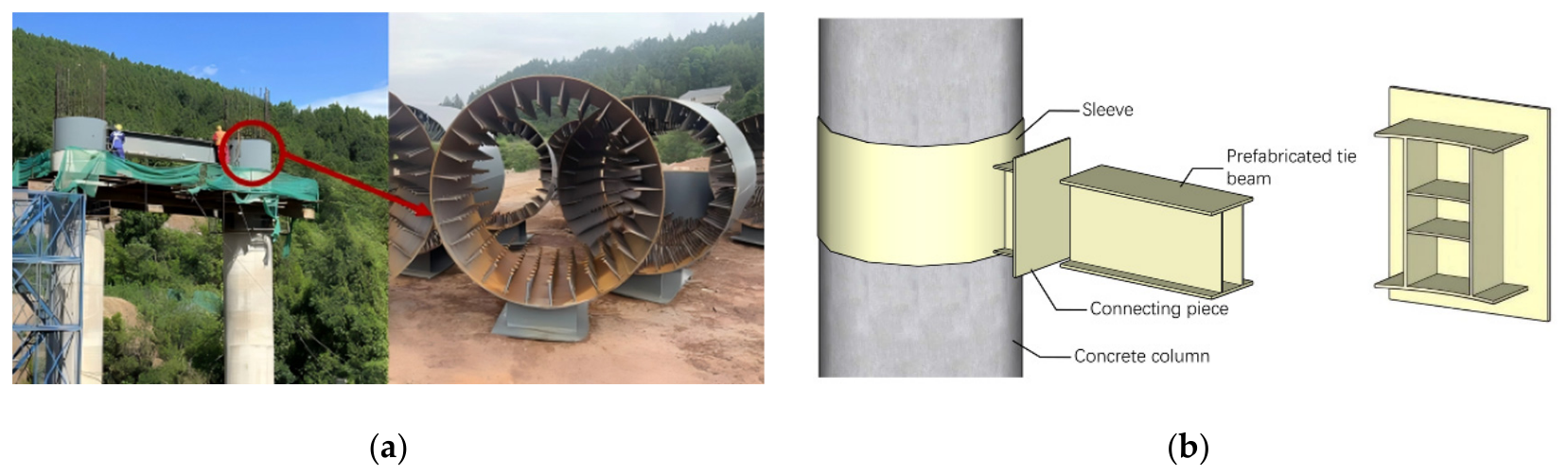
2.1. Engineering Background
2.2. Design of the Tie Beam Joint in Double-Column Piers
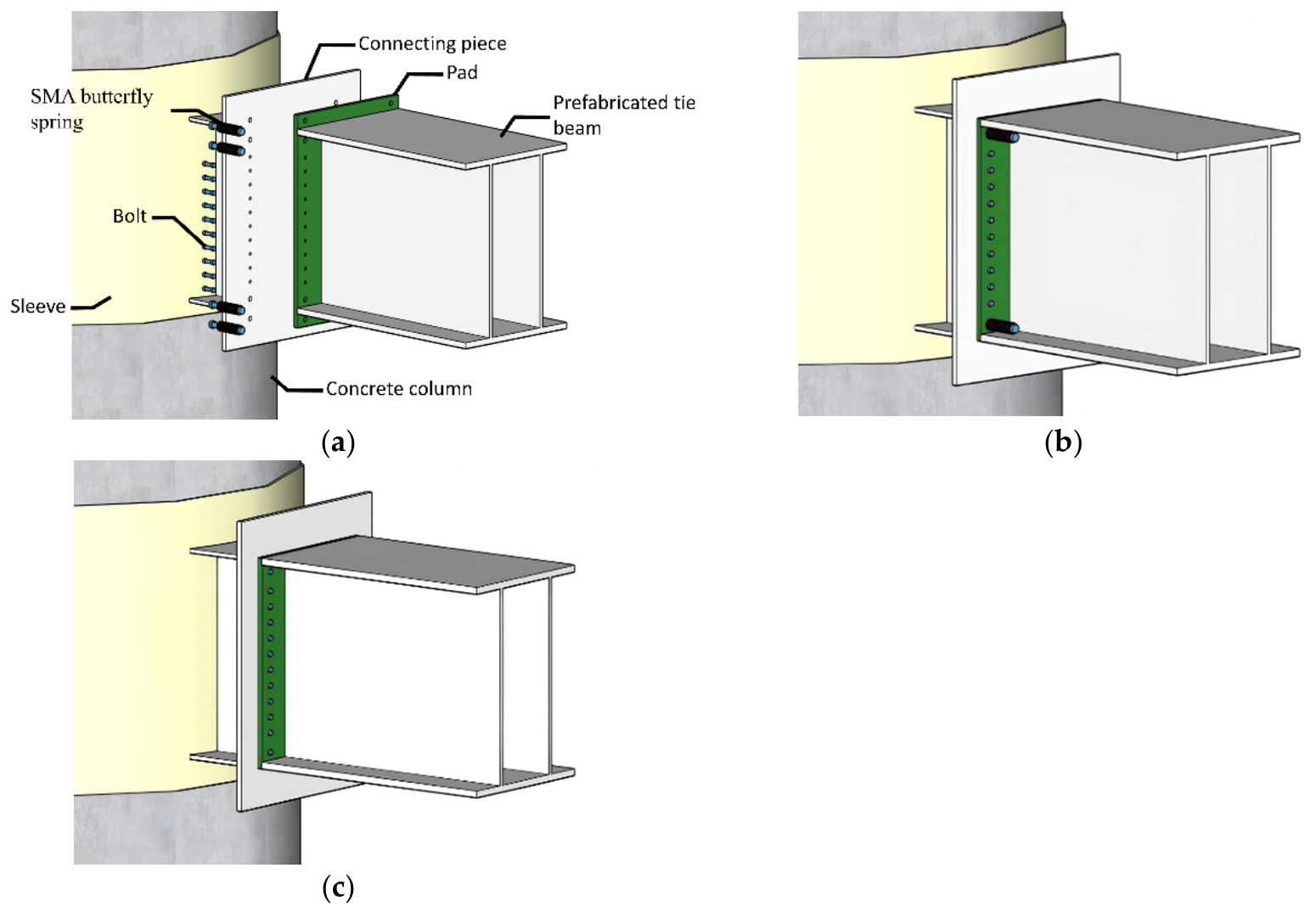
2.2.1. Dual-Row SMA Joint Design
2.2.2. Single-Row SMA Joint Design
2.2.3. Design of the Non-SMA Bolted Reference Joint
3. Finite Element Numerical Simulation of Joints
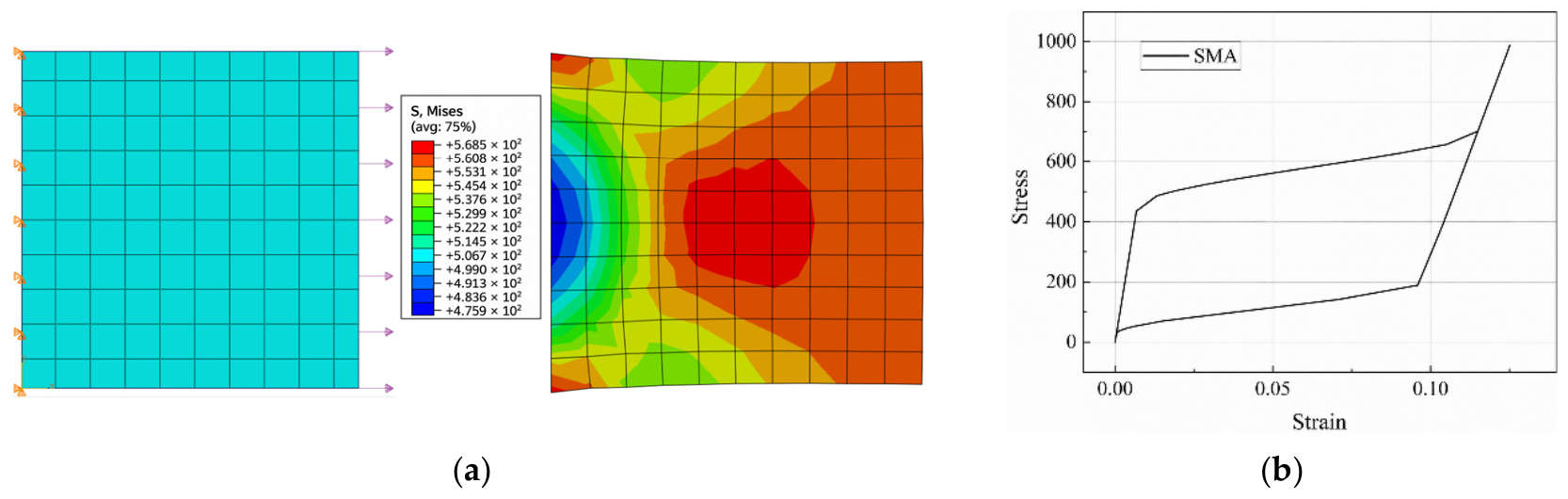
3.1. SMA Superelastic Constitutive Model
- (1)
- For the forward transformation from austenite to martensite ()
- (2)
- Martensite variant reorientation ()
3.2. Finite Element Model
3.2.1. Contact and Constraint Definitions
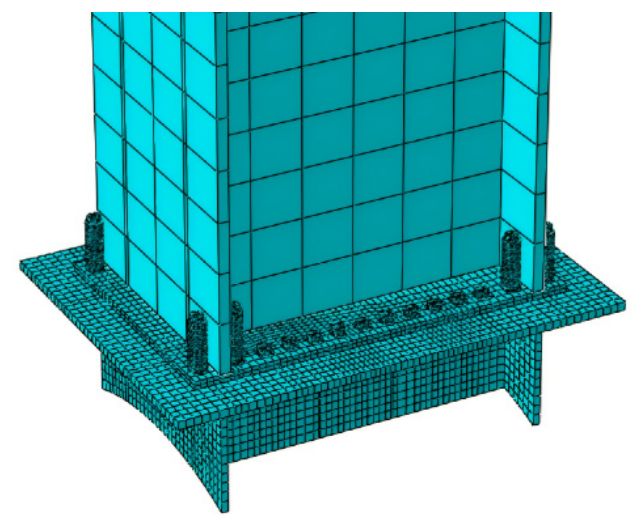
3.2.2. Mesh Discretization
3.2.3. Boundary Conditions
4. Results and Discussion of Joint Seismic Performance
4.1. Stress and Strain Analysis
4.1.1. Stress Distribution
- (1)
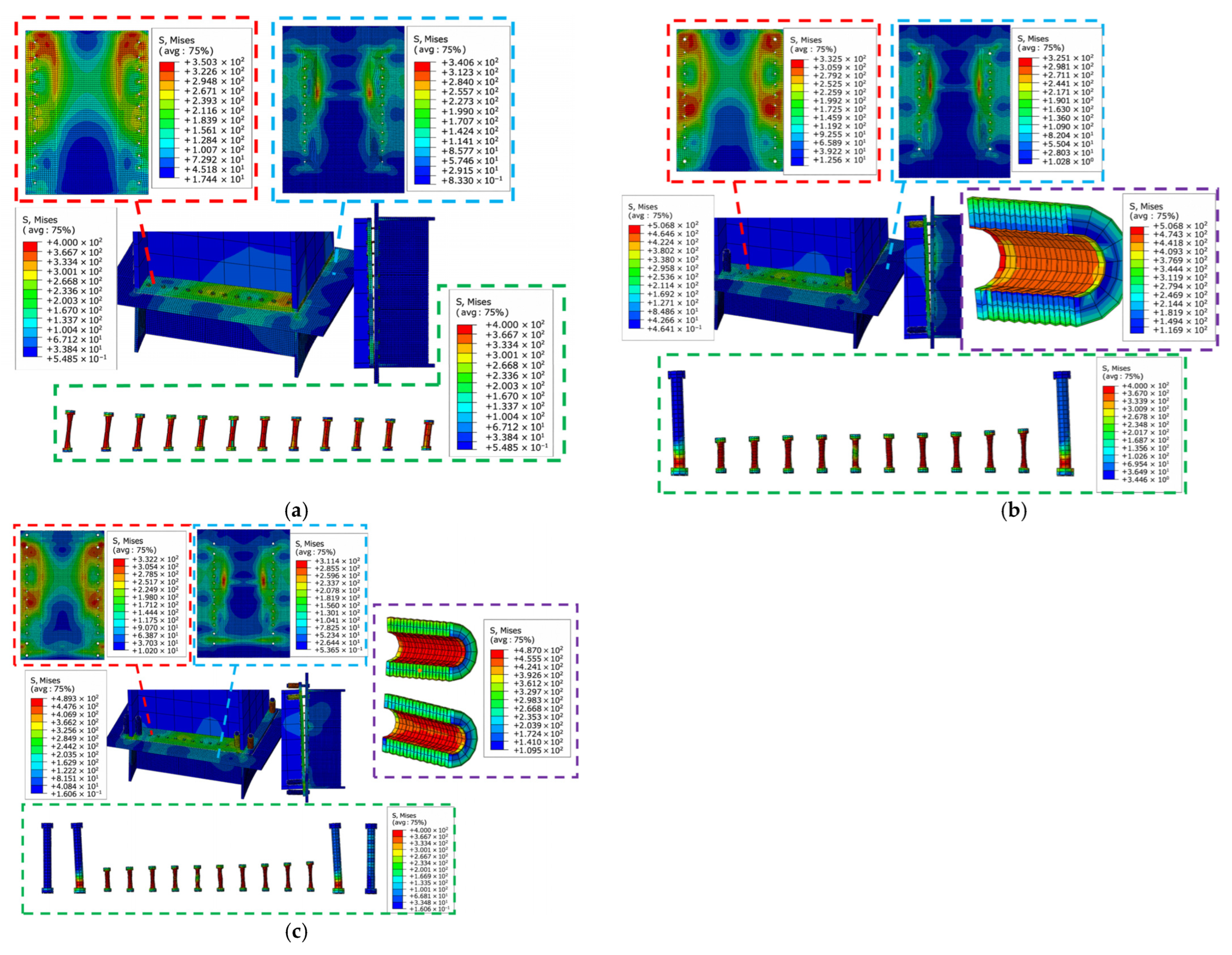
- Relative to the non-SMA reference joint, the SMA-enabled configurations show a modest reduction in the peak stress of the key plates, with reductions of approximately 4.7–4.9%, indicating a tendency toward local stress redistribution associated with the SMA-enabled detailing.
- (2)
- The dual-row layout further reduces the peak stress of the connecting plate by approximately , indicating that the increased use of SMA butterfly spring devices contributes to a load-sharing tendency.
4.1.2. Cumulative Plastic Strain Distribution
- (1)
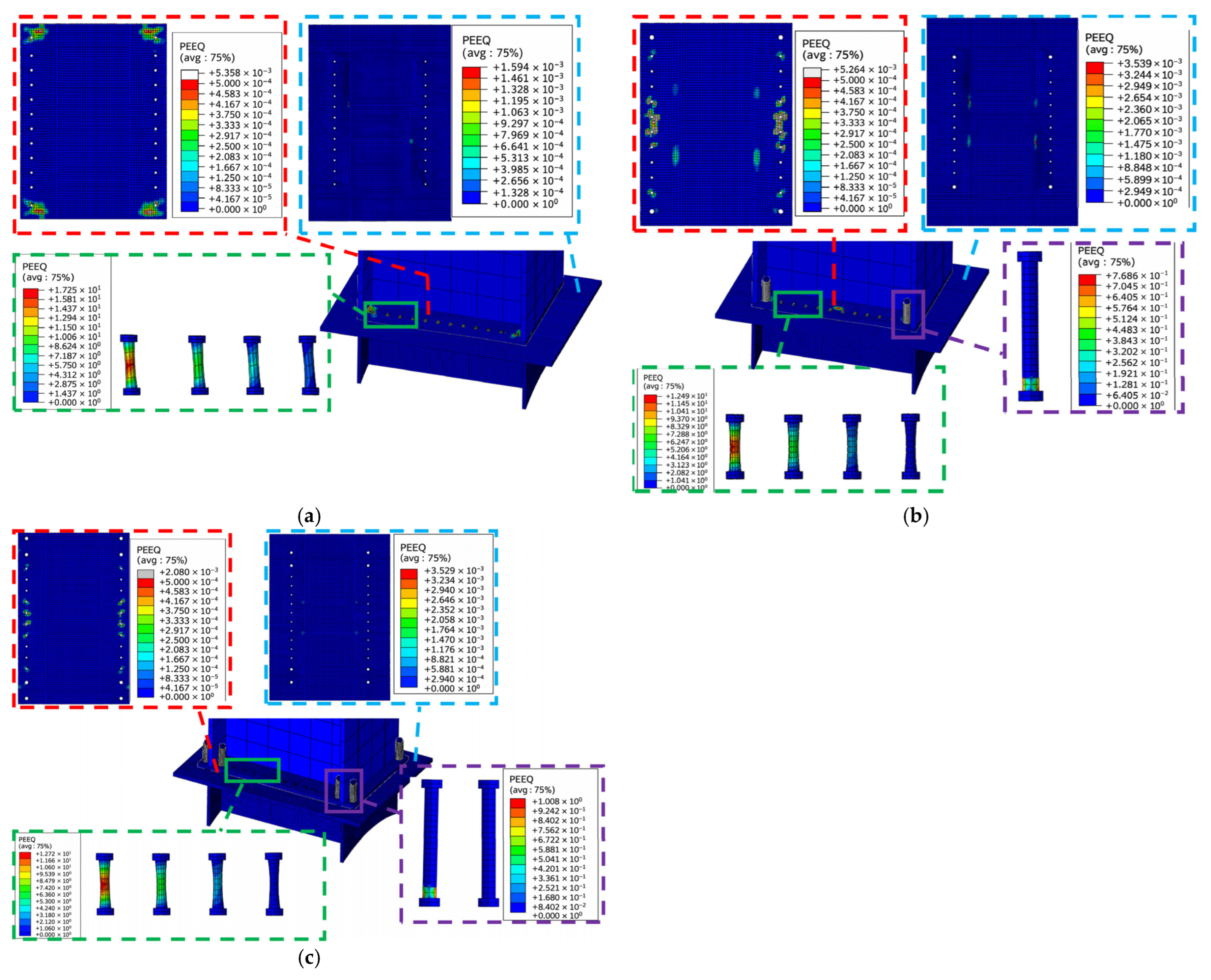
- Changes in the opening and closing amplitude of the tie beam pad alter the location of local plastic accumulation.
- (2)
- Within the adopted no-fracture finite element framework, the introduction of SMA components reduced the relative peak PEEQ indicator by , thereby alleviating the plastic localization tendency observed in the non-SMA reference joint.
4.2. Analysis of Energy Dissipation Capacity
4.3. Backbone Response Analysis
4.4. Cumulative Energy Dissipation Analysis
4.5. Stiffness Degradation Analysis
- (1)
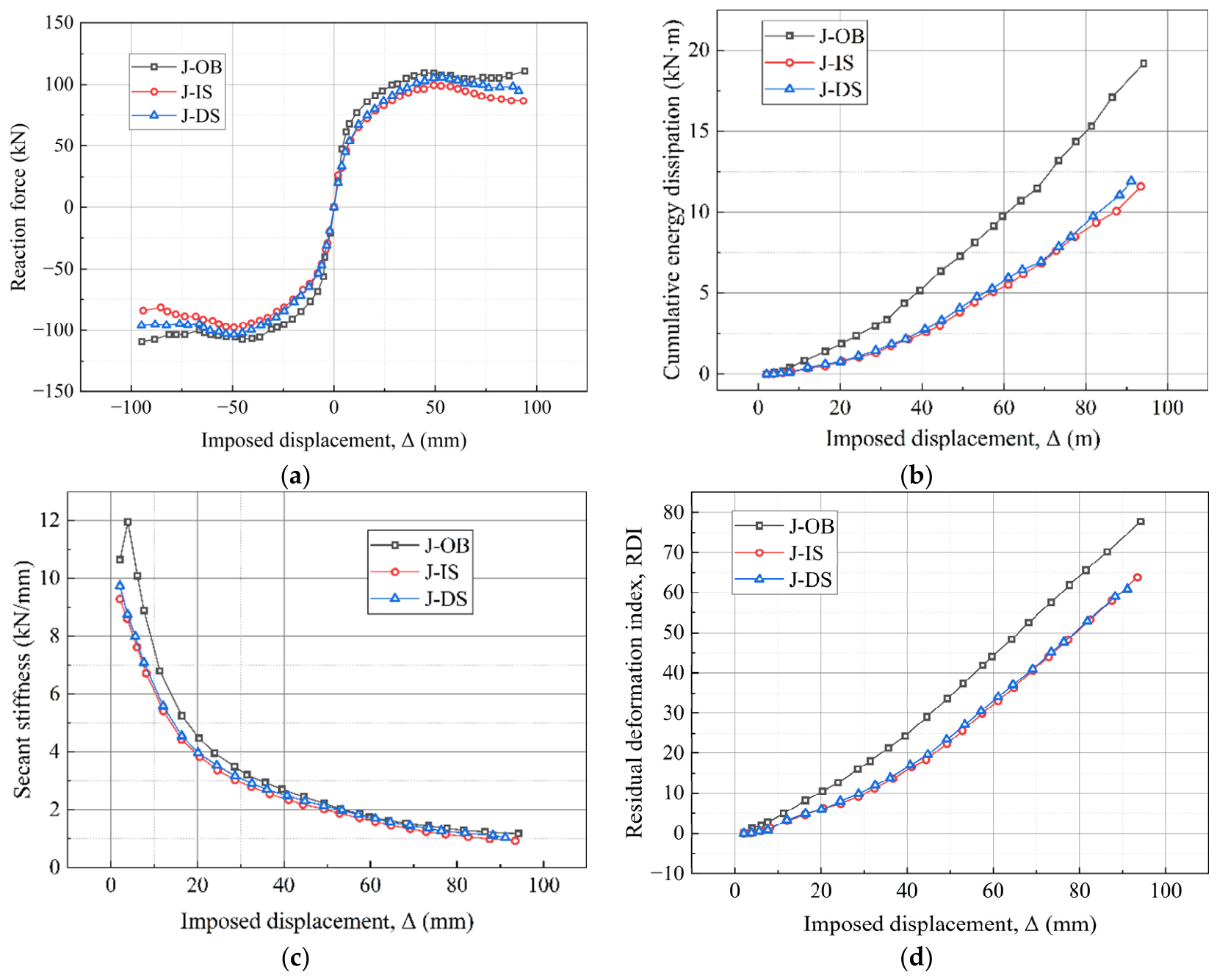
- J-OB consistently exhibited a secant stiffness that was 0.2–1.1 kN/mm higher than that of the two SMA joints, reflecting the higher initial restraint of the non-SMA reference configuration under the adopted modeling framework.
- (2)
- Despite its higher initial stiffness, the bolted joint exhibited a faster reduction in secant stiffness with increasing displacement amplitude than the SMA joints, with the calculated reduction rate being about higher. This trend is associated with greater local plastic accumulation at the connection interface under the present single-cycle numerical protocol.
- (3)
- The stiffness degradation curves of the dual-row and single-row SMA joints are very similar. The maximum difference in stiffness between them was only , suggesting that the number of SMA components has a limited influence on the stiffness degradation path.
4.6. Residual Deformation Response
4.7. Design Implications and Repair-Oriented Interpretation
5. Conclusions
- (1)
- SMA butterfly springs modified the local stress distribution in key connection plates. Relative to J-OB, J-IS showed a modest peak stress reduction of about 4.7–4.9%. Within the SMA configurations, the dual-row arrangement further reduced the peak stress in the connecting plate from to and lowered the maximum SMA stress demand from about to . These results indicate a tendency toward local stress redistribution rather than a substantial improvement in strength.
- (2)
- The SMA joints modified the local plastic strain distribution in critical connection regions. Within the adopted no-fracture finite element framework, the raw peak PEEQ indicator decreased from 17.25 in J-OB to 12.49 in J-IS, corresponding to a relative reduction of . These high local PEEQ values were interpreted as indicators of plastic localization rather than as fracture-free strain capacities of the bolts. In J-DS, the outer long bolts remained elastic throughout loading and did not exhibit cumulative plastic accumulation.
- (3)
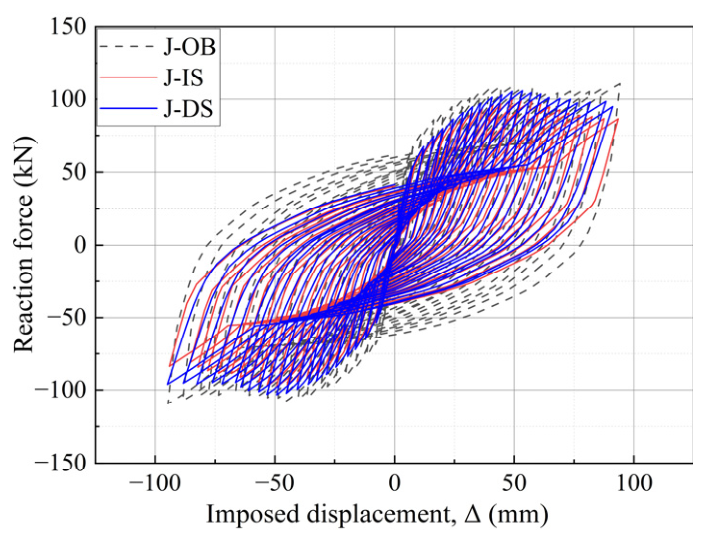
- J-OB exhibited higher cumulative hysteretic energy, whereas the SMA joints showed more pinched hysteretic loops with a clearer self-centering tendency under the adopted loading protocol. At the reported comparison point, the cumulative energy dissipation of J-DS was lower than that of J-OB. This value represents a difference in joint-level hysteretic loop area under the adopted numerical framework and should not be interpreted as a calibrated comparison of frictional energy dissipation. Therefore, the proposed SMA-enabled joints should not be regarded as maximum-dissipation devices. Within the SMA configurations, J-DS provided about higher cumulative energy dissipation than J-IS at , suggesting that greater SMA engagement can moderately improve dissipation while maintaining self-centering behavior.
- (4)
- The SMA joints provided improved residual deformation control under the adopted numerical framework. At the maximum displacement level, the RDI values of J-DS and J-OB were and , respectively, corresponding to a reduction of about . With the reference yield displacement , the corresponding residual displacements were approximately and . This result indicates that the proposed detail has potential for improving joint-level residual deformation control and facilitating post-earthquake inspection and repair.
Author Contributions
Funding
Institutional Review Board Statement
Informed Consent Statement
Data Availability Statement
Conflicts of Interest
References
- McCormick, J.; Aburano, H.; Ikenaga, M.; Nakashima, M. Permissible residual deformation levels for building structures considering both safety and human elements. In Proceedings of the 14th World Conference on Earthquake Engineering, Beijing, China, 12–17 October 2008. [Google Scholar]
- Xie, L.; Sha, H.; Chong, X.; Jia, J. Seismic performance comparison between reinforced concrete frame structures with and without energy dissipating cladding panel system: Shaking table test and numerical simulation. J. Build. Eng. 2022, 62, 105414. [Google Scholar] [CrossRef] [Scilit]
- Long, X.; Chen, Z.; Li, P. Seismic performance of corroded ecc-gfrp spiral-confined reinforced-concrete column. Polymers 2024, 16, 2110. [Google Scholar] [CrossRef] [Scilit] [PubMed]
- Rinaldin, G.; Amadio, C.; Fragiacomo, M. Effects of seismic sequences on structures with hysteretic or damped dissipative behaviour. Soil Dyn. Earthq. Eng. 2017, 97, 205–215. [Google Scholar] [CrossRef] [Scilit]
- Oyguc, E.; Oyguc, R.; Hayir, A.; Seker, O.; Shen, J.; Akbas, B. Seismic retrofitting of substandard rc frames using tube-in-tube buckling-restrained braces: Shake table evaluation and field insights. Bull. Earthq. Eng. 2025, 23, 4565–4608. [Google Scholar] [CrossRef] [Scilit]
- Eilbeigi, S.; Tavakkolizadeh, M.; Masoodi, A.R. Enhancing mechanical behavior and energy dissipation in fiber-reinforced polymers through shape memory alloy integration: A numerical study on sma-frp composites under cyclic tensile loading. Materials 2023, 16, 5695. [Google Scholar] [CrossRef] [Scilit] [PubMed]
- Zhan, M.; Liu, J.; Wang, D.; Chen, X.; Zhang, L.; Wang, S. Optimized neural network prediction model of shape memory alloy and its application for structural vibration control. Materials 2021, 14, 6593. [Google Scholar] [CrossRef] [Scilit] [PubMed]
- Chancellor, N.; Eatherton, M.; Roke, D.; Akbaş, T. Self-centering seismic lateral force resisting systems: High performance structures for the city of tomorrow. Buildings 2014, 4, 520–548. [Google Scholar] [CrossRef] [Scilit]
- DesRoches, R.; Smith, B. Shape memory alloys in seismic resistant design and retrofit: A critical review of their potential and limitations. J. Earthq. Eng. 2004, 8, 415–429. [Google Scholar] [CrossRef] [Scilit]
- DesRoches, R.; McCormick, J.; Delemont, M. Cyclic properties of superelastic shape memory alloy wires and bars. J. Struct. Eng. 2004, 130, 38–46. [Google Scholar] [CrossRef] [Scilit]
- Roh, H.; Reinhorn, A.M. Hysteretic behavior of precast segmental bridge piers with superelastic shape memory alloy bars. Eng. Struct. 2010, 32, 3394–3403. [Google Scholar] [CrossRef] [Scilit]
- Liew, K.M.; Kitipornchai, S.; Ng, T.Y.; Zou, G.P. Multi-dimensional superelastic behavior of shape memory alloys via nonlinear finite element method. Eng. Struct. 2002, 24, 51–57. [Google Scholar] [CrossRef] [Scilit]
- Sultana, P.; Youssef, M.A. Seismic performance of steel moment resisting frames utilizing superelastic shape memory alloys. J. Constr. Steel Res. 2016, 125, 239–251. [Google Scholar] [CrossRef] [Scilit]
- Dolce, M.; Cardone, D.; Marnetto, R. Implementation and testing of passive control devices based on shape memory alloys. Earthq. Eng. Struct. Dyn. 2000, 29, 945–968. [Google Scholar]
- Ocel, J.; DesRoches, R.; Leon, R.T.; Hess, W.G.; Krumme, R.; Hayes, J.R.; Sweeney, S. Steel beam-column connections using shape memory alloys. J. Struct. Eng. 2004, 130, 732–740. [Google Scholar] [CrossRef] [Scilit]
- Speicher, M.S.; DesRoches, R.; Leon, R.T. Experimental results of a niti shape memory alloy (sma)-based recentering beam-column connection. Eng. Struct. 2011, 33, 2448–2457. [Google Scholar] [CrossRef] [Scilit]
- Abolmaali, A.; Treadway, J.; Aswath, P.; Lu, F.K.; McCarthy, E. Hysteresis behavior of t-stub connections with superelastic shape memory fasteners. J. Constr. Steel Res. 2006, 62, 831–838. [Google Scholar] [CrossRef] [Scilit]
- Ma, H.; Wilkinson, T.; Cho, C. Feasibility study on a self-centering beam-to-column connection by using the superelasticbehavior of smas. Smart Mater. Struct. 2007, 16, 1555. [Google Scholar] [CrossRef] [Scilit]
- Yam, M.C.; Fang, C.; Lam, A.C.; Zhang, Y. Numerical study and practical design of beam-to-column connections with shape memory alloys. J. Constr. Steel Res. 2015, 104, 177–192. [Google Scholar] [CrossRef] [Scilit]
- Dou, C.; Ru, Y.; Xu, L. Cyclic loading behavior of earthquake-resilient disc-spring self-centering beam-column joints: An experimental study. Eng. Struct. 2025, 335, 120366. [Google Scholar] [CrossRef] [Scilit]
- Akbarnezhad, M.; Salehi, M.; DesRoches, R. Seismic design and numerical assessment of shape memory alloy-restrained rocking precast concrete bridge columns. Adv. Struct. Eng. 2022, 25, 2803–2829. [Google Scholar] [CrossRef] [Scilit]
- Katsimpini, P.; Papagiannopoulos, G.; Hatzigeorgiou, G. A thorough examination of innovative supplementary dampers aimed at enhancing the seismic behavior of structural systems. Appl. Sci. 2025, 15, 1226. [Google Scholar] [CrossRef] [Scilit]
- Chen, S.; An, W.; Fu, H.; Shan, Y.; Xi, F.; Wen, Y.; Nazri, F.M.; Chin, C.; Ma, C. Review of dynamic response and pier damage mechanisms in girder bridges under bidirectional seismic excitations: Critical role of vertical components in near-field effects. Buildings 2025, 15, 4393. [Google Scholar] [CrossRef] [Scilit]
- Rahman, J.; Billah, A.H.M.M. Seismic performance evaluation of shape memory alloy (sma) reinforced concrete bridge bents under long-duration motion. Front. Built Environ. 2020, 6, 601736. [Google Scholar] [CrossRef] [Scilit]
- Oyguc, R.; Bozan, A.B. Enhancing seismic repairability of precast rc frames through an innovative replaceable plastic hinge technology. Appl. Sci. 2025, 15, 5629. [Google Scholar] [CrossRef] [Scilit]
- Neupane, S.; Pantelides, C.P. Seismic design and fragility of self-centering bridge bent with replaceable stretch length anchors. Earthq. Eng. Struct. Dyn. 2025, 54, 1433–1453. [Google Scholar] [CrossRef] [Scilit]
- Chen, J.; Liang, D.; You, X.; Liang, H. Performance-based assessment of bridges with novel sma-washer-based self-centering rocking piers. Materials 2022, 15, 6589. [Google Scholar] [CrossRef] [Scilit] [PubMed]
- Qian, H.; Ye, Y.; Yan, C.; Jin, G.; Li, C.; Shi, Y. Experimental study on the seismic performance of self-centering bridge piers incorporating ecc and superelastic sma bars in the plastic hinge regions. Structures 2022, 46, 1955–1967. [Google Scholar] [CrossRef] [Scilit]
- Huynh, T.; Dang, N.; Kim, J. Preload monitoring in bolted connection using piezoelectric-based smart interface. Sensors 2018, 18, 2766. [Google Scholar] [CrossRef] [Scilit] [PubMed]
- Auricchio, F.; Taylor, R.L. Shape-memory alloys: Modelling and numerical simulations of the finite-strain superelastic behavior. Comput. Methods Appl. Mech. Eng. 1997, 143, 175–194. [Google Scholar] [CrossRef] [Scilit]
- Huang, J.; Zhao, H.; Gao, Y.; Shi, G. Finite element analysis and design of triple grades hybrid high-performance steel structure (tghss). Eng. Struct. 2025, 330, 119909. [Google Scholar] [CrossRef] [Scilit]
- Huang, J.; Zhao, H.; Gao, Y.; Shi, G. Numerical study on cyclic behaviour of triple grades hybrid high-performance steel structure. Eng. Struct. 2025, 327, 119605. [Google Scholar] [CrossRef] [Scilit]
- Shi, G.; Hou, L.; Zhao, H. Numerical study on the seismic behaviour of high-strength steel moment-resisting frames: Multi-scale modelling and validation. Thin-Walled Struct. 2025, 208, 112807. [Google Scholar] [CrossRef] [Scilit]
- Ahmadi, H.M.; De Matteis, G. Cyclic behaviour of steel shear walls with beam-only connection shear panels. In Proceedings of the 10th International Conference on Behaviour of Steel Structures in Seismic Areas; Lecture Notes in Civil Engineering; Springer: Cham, Switzerland, 2022; pp. 659–666. [Google Scholar]
- Zhao, G.; Zhu, L.; Liu, W.; Zhao, J.; Huo, J. Numerical study on the effect of interface dynamic damage of steel–concrete composite beam bridge caused by high–frequency impact load. Buildings 2023, 13, 545. [Google Scholar] [CrossRef] [Scilit]
- Schwer, L.E. An overview of the ptc 60/v&v 10: Guide for verification and validation in computational solid mechanics. Eng. Comput. 2007, 23, 245–252. [Google Scholar] [CrossRef] [Scilit]
- Pisarciuc, C.; Dan, I.; Cioară, R. The influence of mesh density on the results obtained by finite element analysis of complex bodies. Materials 2023, 16, 2555. [Google Scholar] [CrossRef] [Scilit] [PubMed]
- Shi, G.; Zhang, N.; Bao, L.; Chen, X.; Zhou, F.; Jiang, S.; Zhao, H. Experimental investigation on local connection behaviour of thick-flange steel beam to cfst column joints under cyclic loadings. Eng. Struct. 2025, 343, 121206. [Google Scholar] [CrossRef] [Scilit]
- Shi, G.; Jiang, S.; Zhang, N.; Hou, L.; Zhao, H. Seismic performance of double-sided plate-reinforced connections between steel beams and built-up box columns. Thin-Walled Struct. 2025, 208, 112872. [Google Scholar] [CrossRef] [Scilit]
- Liu, L.; Lei, S.; Wu, F.; Lin, W.; Peng, K.; Fan, X. Experimental study on seismic performance of precast columns repaired with cfrp fabrics. Materials 2022, 15, 7443. [Google Scholar] [CrossRef] [Scilit] [PubMed]



| Component | Density (kg/m3) | Elastic Modulus (MPa) | Poisson’s Ratio | Yield Strength (MPa) | Ultimate Strength (MPa) |
|---|---|---|---|---|---|
| Connecting plate | 7800 | 2.0 × 10⁵ | 0.30 | 345 | 450 |
| Pad plate | 7800 | 2.0 × 10⁵ | 0.30 | 345 | 450 |
| Tie beam | 7800 | 2.0 × 10⁵ | 0.30 | 345 | 450 |
| Bolt | 7800 | 2.0 × 10⁵ | 0.30 | 320 | 400 |
Disclaimer/Publisher’s Note: The statements, opinions and data contained in all publications are solely those of the individual author(s) and contributor(s) and not of MDPI and/or the editor(s). MDPI and/or the editor(s) disclaim responsibility for any injury to people or property resulting from any ideas, methods, instructions or products referred to in the content. |
© 2026 by the authors. Licensee MDPI, Basel, Switzerland. This article is an open access article distributed under the terms and conditions of the Creative Commons Attribution (CC BY) license.
Share and Cite
Wei, Z.; Ma, Z.; Zhang, J.; Jia, S.; Zhou, H.; Huang, Y.; Feng, Y. Finite Element Study of Shape Memory Alloy Butterfly Spring Tie Beam Joints in Double-Column Piers. Buildings 2026, 16, 3699. https://doi.org/10.3390/buildings16183699
Wei Z, Ma Z, Zhang J, Jia S, Zhou H, Huang Y, Feng Y. Finite Element Study of Shape Memory Alloy Butterfly Spring Tie Beam Joints in Double-Column Piers. Buildings. 2026; 16(18):3699. https://doi.org/10.3390/buildings16183699
Chicago/Turabian StyleWei, Zhaolan, Ziteng Ma, Jiangchuan Zhang, Shaomin Jia, Hang Zhou, Yuzhi Huang, and Yulin Feng. 2026. "Finite Element Study of Shape Memory Alloy Butterfly Spring Tie Beam Joints in Double-Column Piers" Buildings 16, no. 18: 3699. https://doi.org/10.3390/buildings16183699
APA StyleWei, Z., Ma, Z., Zhang, J., Jia, S., Zhou, H., Huang, Y., & Feng, Y. (2026). Finite Element Study of Shape Memory Alloy Butterfly Spring Tie Beam Joints in Double-Column Piers. Buildings, 16(18), 3699. https://doi.org/10.3390/buildings16183699