Interpretable Ensemble Learning with Effective Binder Formalism, Hyperbolic Hydration Kinetics, and Fickian Service-Life Projection for Grey Relational Pareto Optimization of Quaternary SCBA–GGBS–Zeolite–Nano-Silica Cementitious Systems


Abstract
1. Introduction
2. Materials and Methodology
2.1. Materials
2.2. Mix Proportioning
2.3. Mixing, Casting and Curing
2.4. Test Methods
2.5. Machine Learning and Explainability Framework
2.6. Analytical and Statistical Framework
3. Results and Discussion
3.1. Compressive Strength
3.2. Flexural Strength
3.3. Analytical Modelling of Strength Development
3.3.1. Strength Development Kinetics
3.3.2. Information Theoretic Discrimination Among Competing Kinetic Laws
3.3.3. Flexural–Compressive Power Law and Design-Code Comparison
3.3.4. Response Surface Model and Analytic Optimum Nano-Silica Dosage
3.3.5. Cementing Efficiency (k-Value) Analysis
3.4. Durability Performance
3.4.1. Rapid Chloride Penetration
3.4.2. Acid Attack Resistance
3.4.3. Durability–Strength Coupling
3.4.4. Latent-Variable (Principal Component) Analysis of the Multiresponse Dataset
3.4.5. Fickian Service-Life Projection from RCPT-Derived Diffusion Coefficients
3.5. Sustainability Assessment and Multi-Criteria Optimization
3.5.1. Embodied CO2 and Eco-Strength Efficiency
3.5.2. Grey Relational Multi-Criteria Ranking
3.6. Machine Learning Prediction of Compressive Strength
3.6.1. Model Performance Based on R2 and RMSE
3.6.2. Uncertainty Quantification of the Best Model
3.7. Explainable AI Analysis
3.7.1. SHAP Force Plot Interpretation
3.7.2. Global SHAP Importance and Dependence Structure
3.7.3. Sobol Global Sensitivity Analysis
3.8. Limitations and Future Work
4. Conclusions
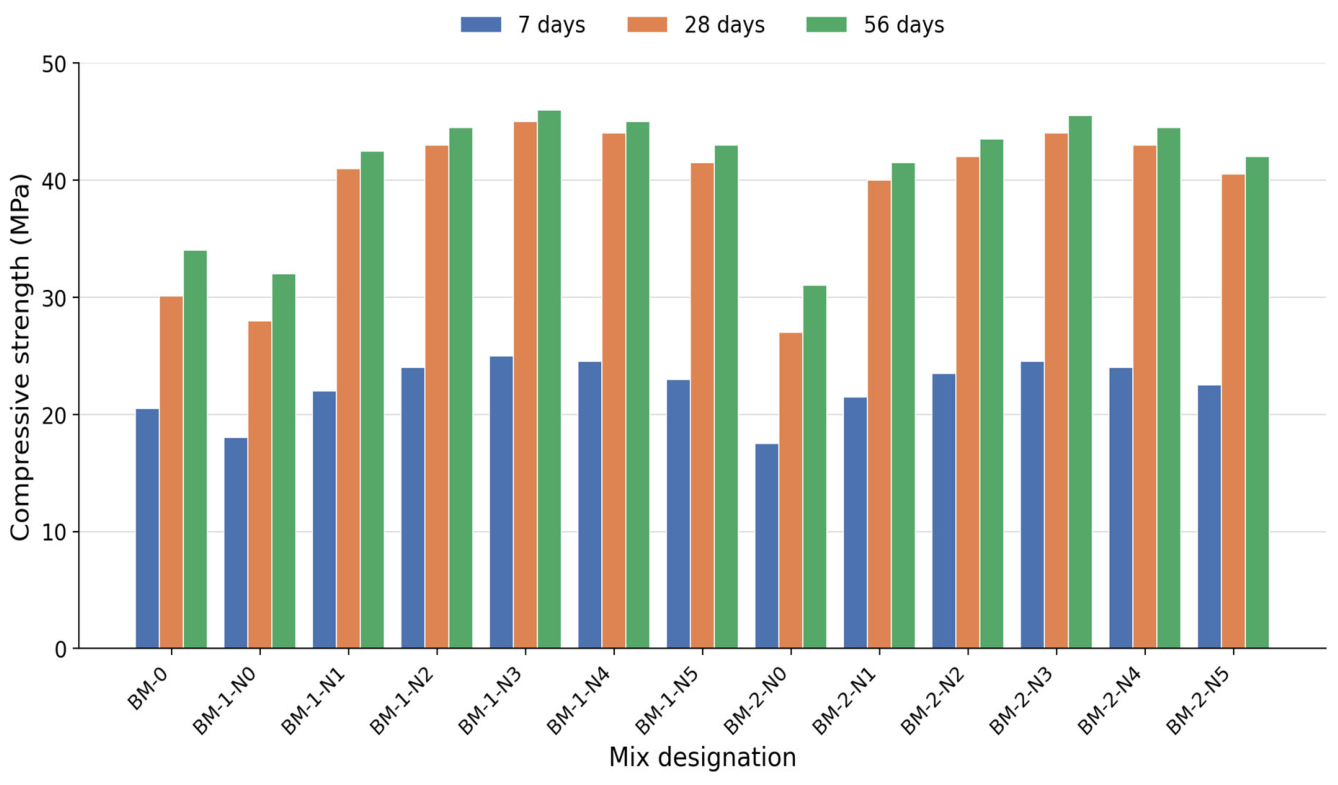
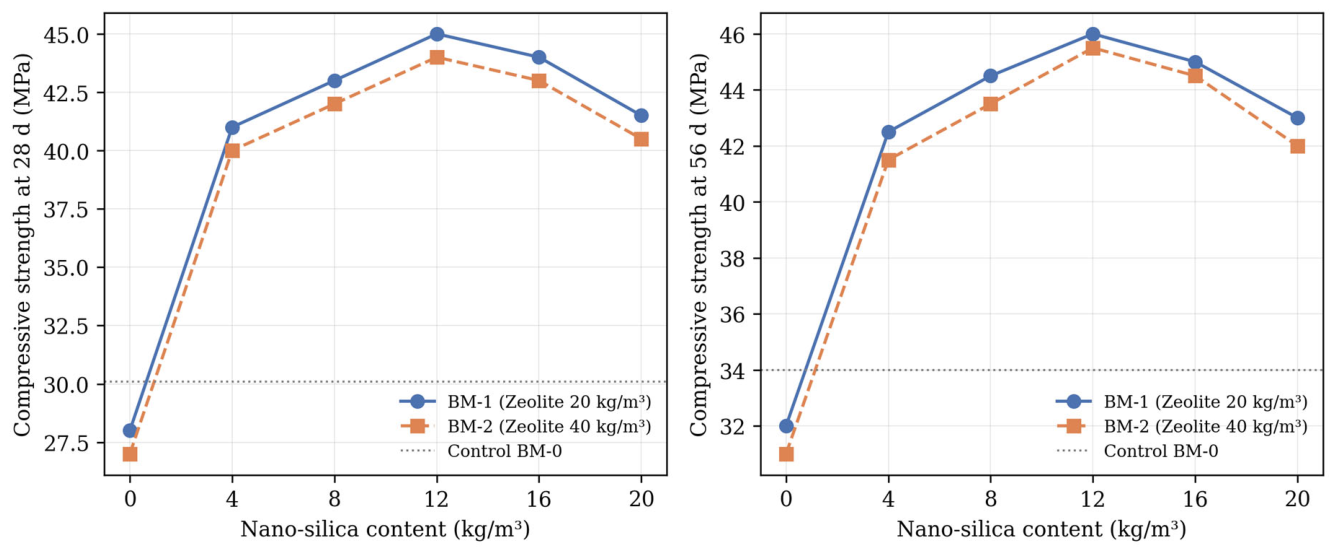
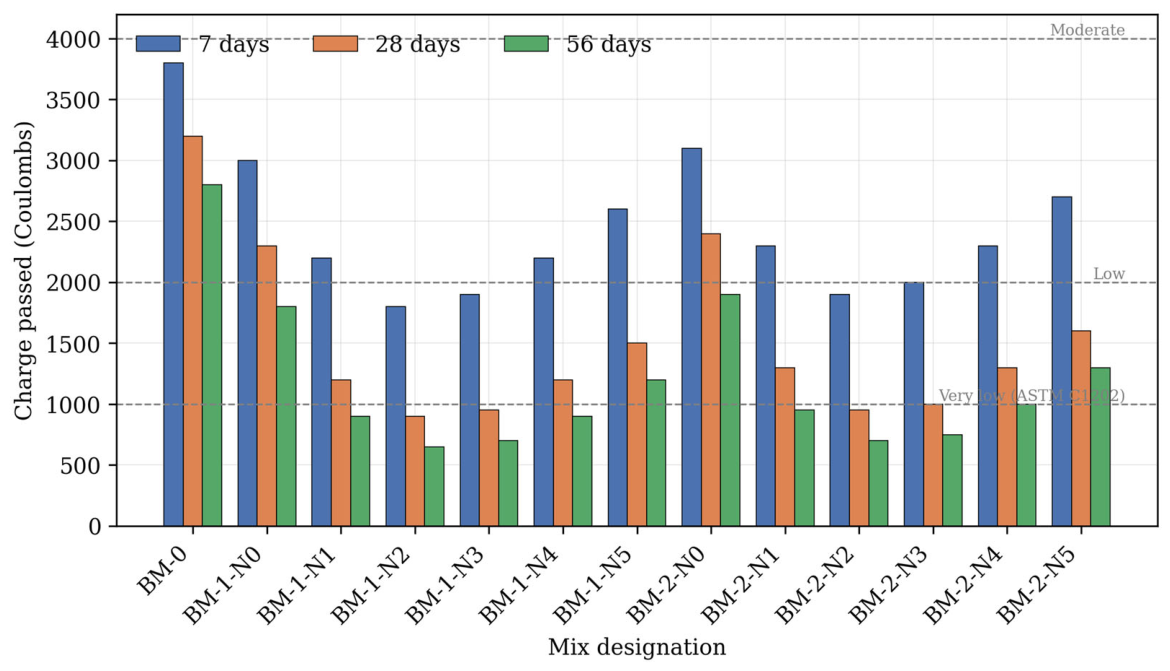
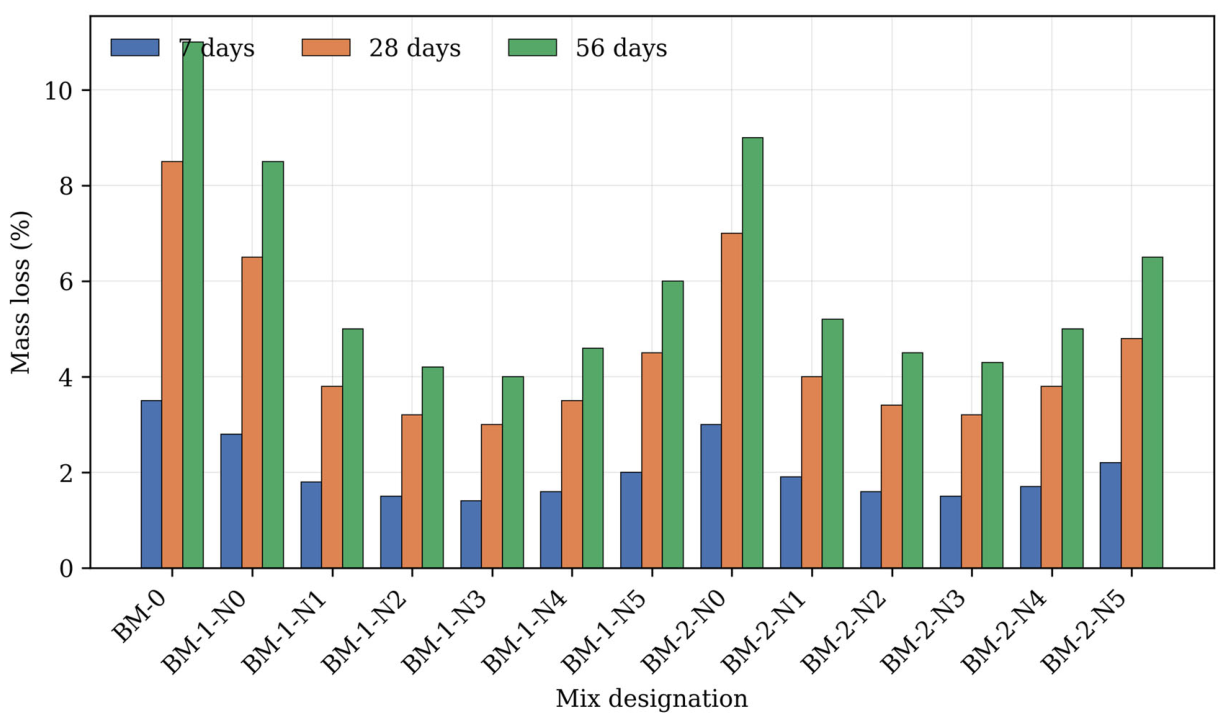
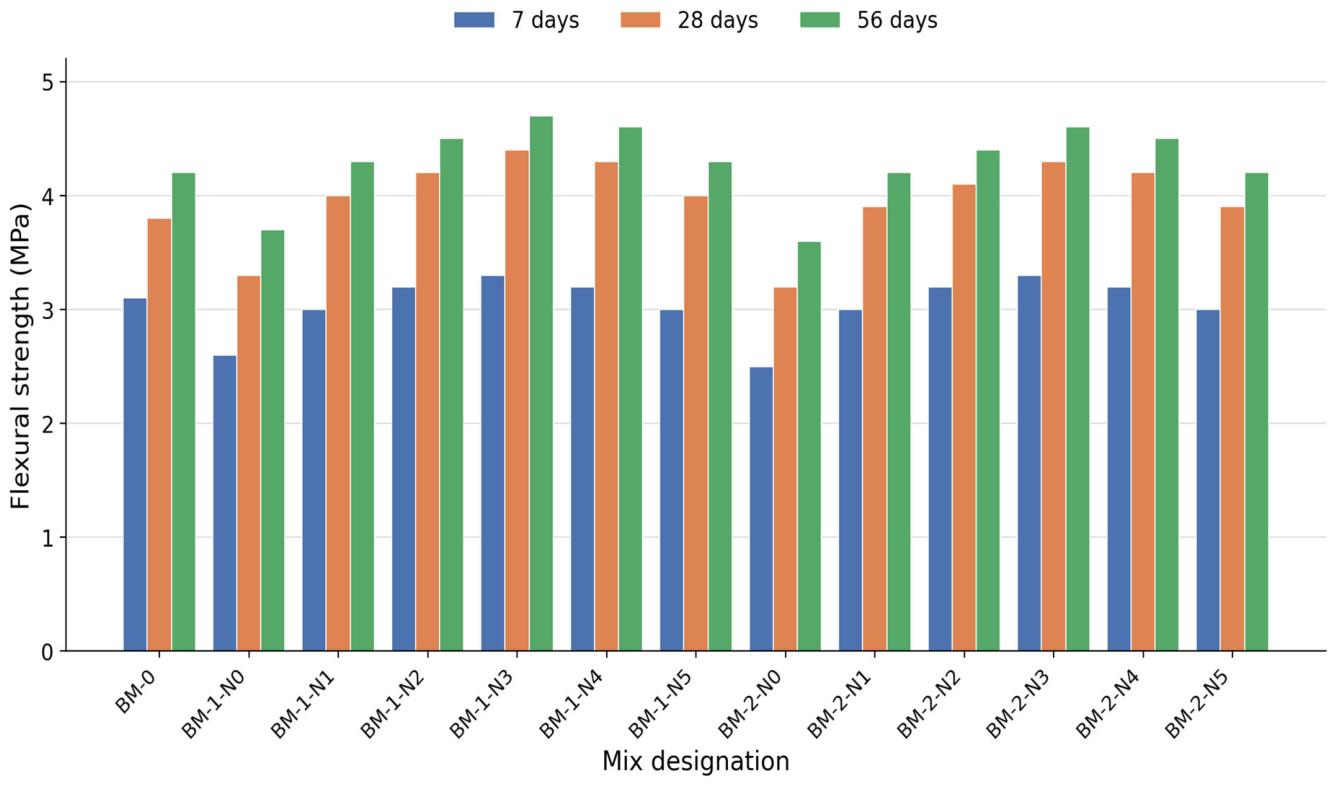
- The optimum mix (BM-1-N3, 12 kg/m3 nano-silica, 20 kg/m3 zeolite) reached 45.0 MPa at 28 days—49.5% above the OPC control—with corresponding gains in flexural strength (4.4 vs. 3.8 MPa), a 70% reduction in RCPT charge (950 vs. 3200 C, ASTM C1202 ‘very low’ class) and a 65% reduction in 28-day acid mass loss.
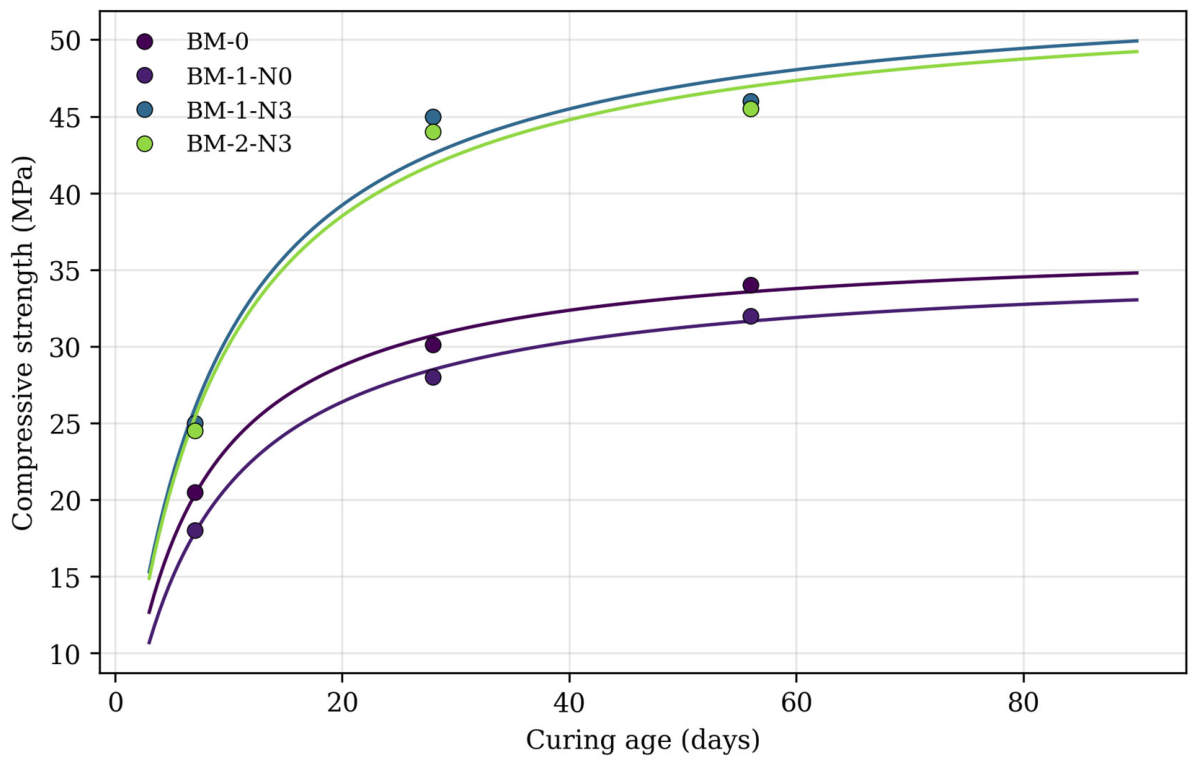
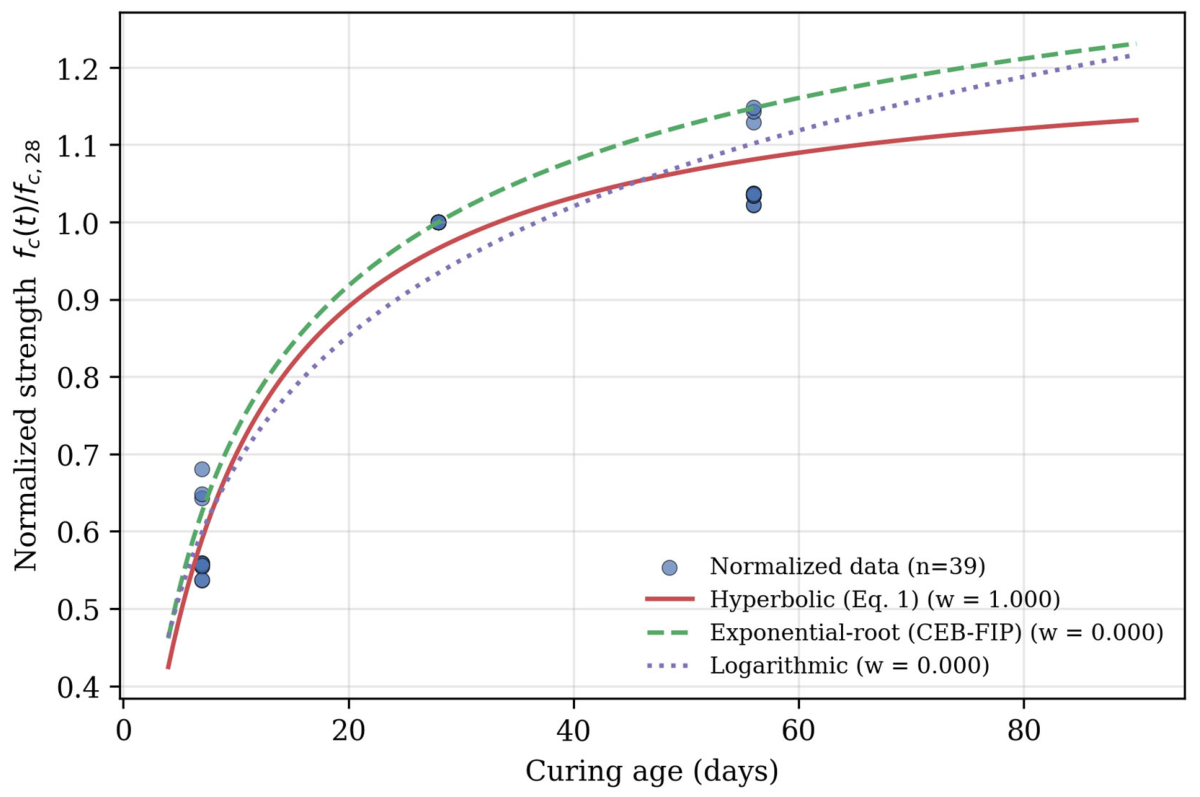
- Information theoretic discrimination among three candidate hydration kinetics laws selects the hyperbolic rate model with an Akaike weight of 1.000 (ΔAICc > 23 against both competitors), reflecting the finite pozzolanic reservoir of the system. The fitted kinetics (Equation (1), per-mix R2 ≥ 0.966) show the blend raises the projected ultimate strength by 46% (37.0 → 54.1 MPa) while delaying the half-strength age by only about two days; nano-silica maximizes the early strength rate index .
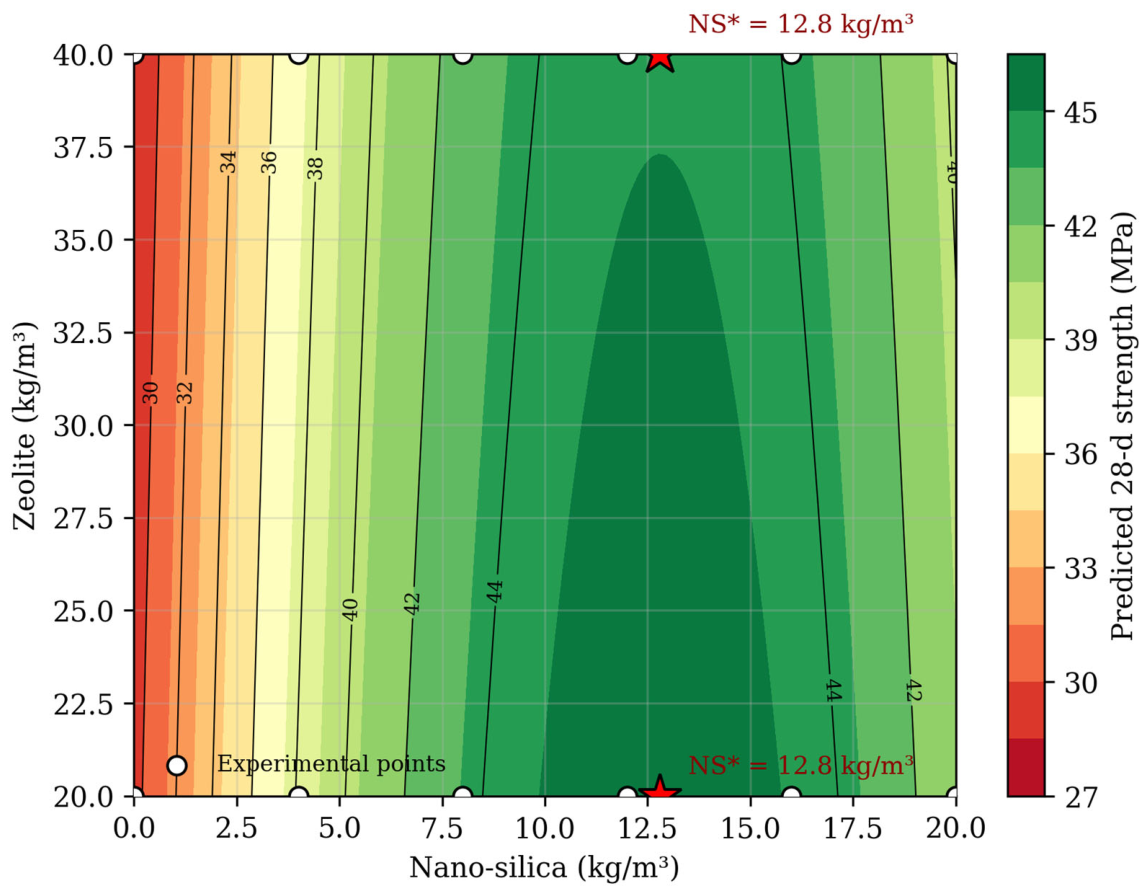
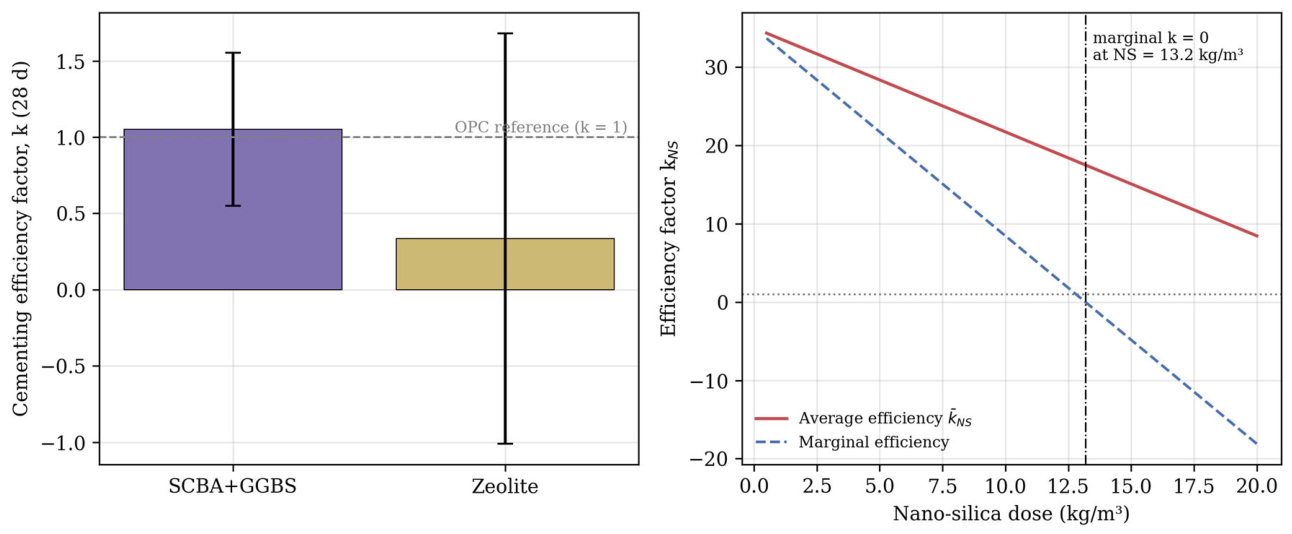
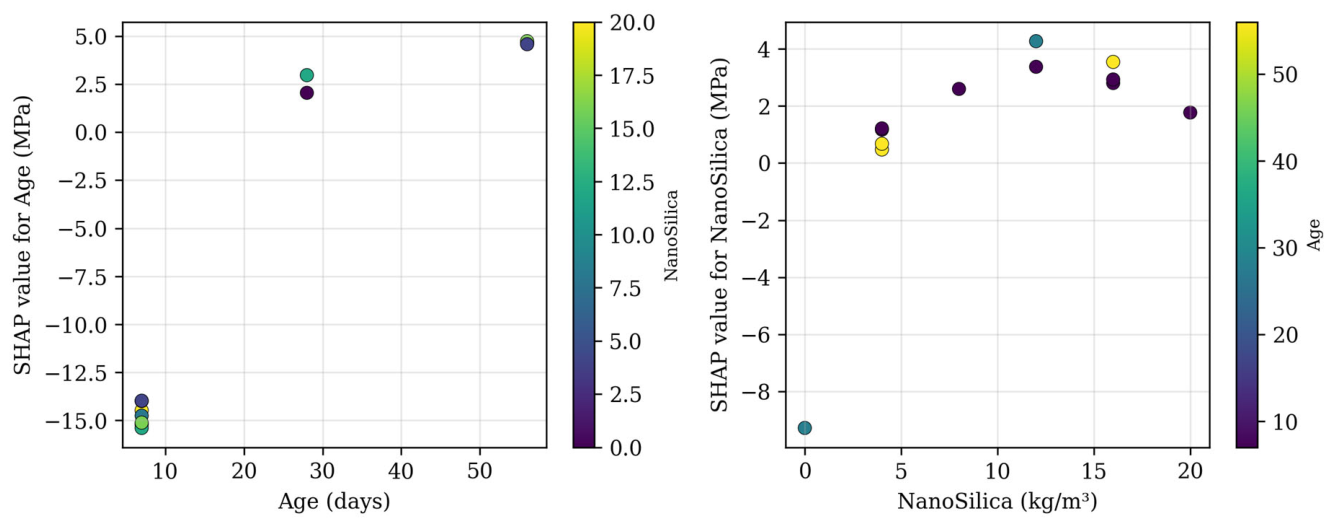
- Three independent mathematical routes—the experimental peak (12 kg/m3), the response surface stationary point (12.8 kg/m3, Equation (4)) and the dose at which the marginal cementing efficiency of nano-silica vanishes (13.2 kg/m3, Equation (5))—converge on an optimum nano-silica dosage of 3.0–3.3% of binder, and the statistically null NS × Z interaction shows this optimum is insensitive to the zeolite level.
- Effective binder analysis in the k-value formalism shows the SCBA + GGBS fraction replaces clinker one-for-one in 28-day strength terms (k = 1.05 ± 0.26), and within this dataset, nano-silica shows a high dose-dependent cementing efficiency at low dose (a dataset-specific estimate requiring external validation, not a general mass equivalence relationship).
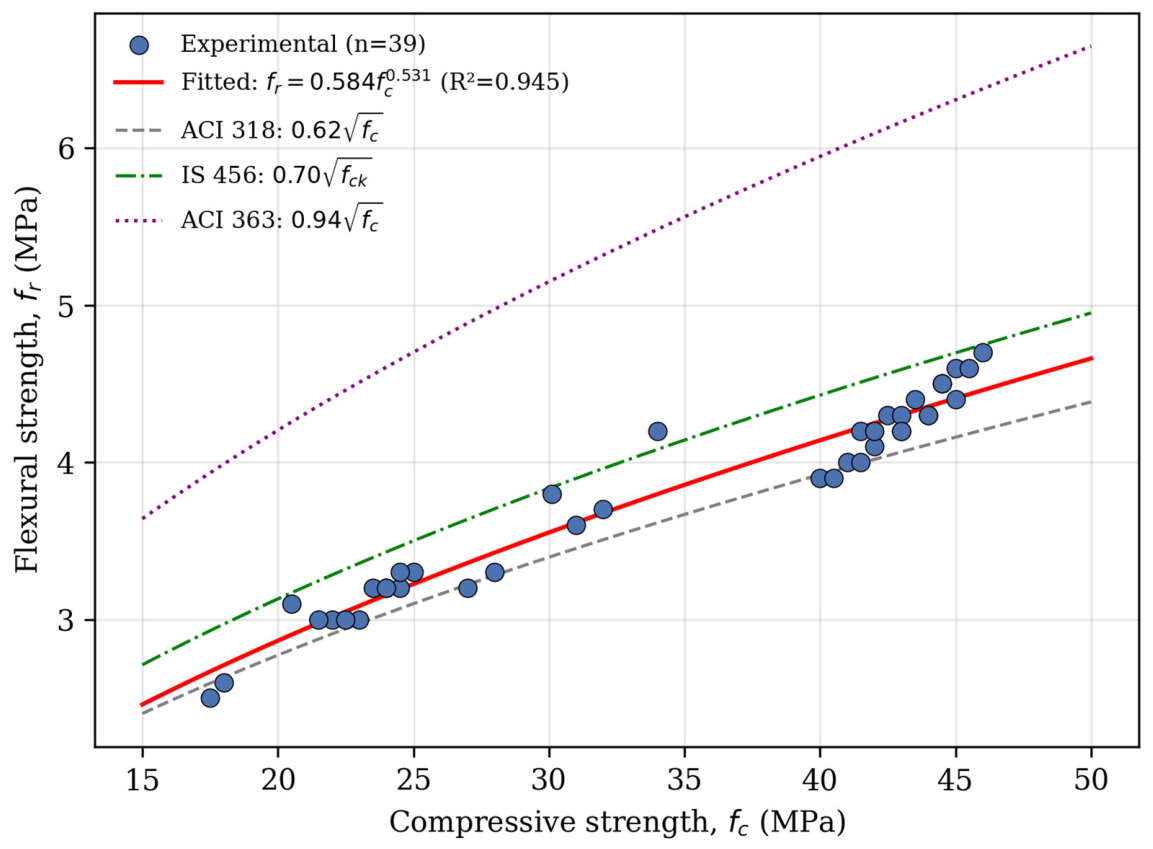
- The flexural–compressive relationship = 0.584· (R2 = 0.945) is statistically consistent with the square-root form of design codes and lies between the ACI 318 and IS 456 expressions, indicating that existing code equations remain applicable to this multi-blended system.
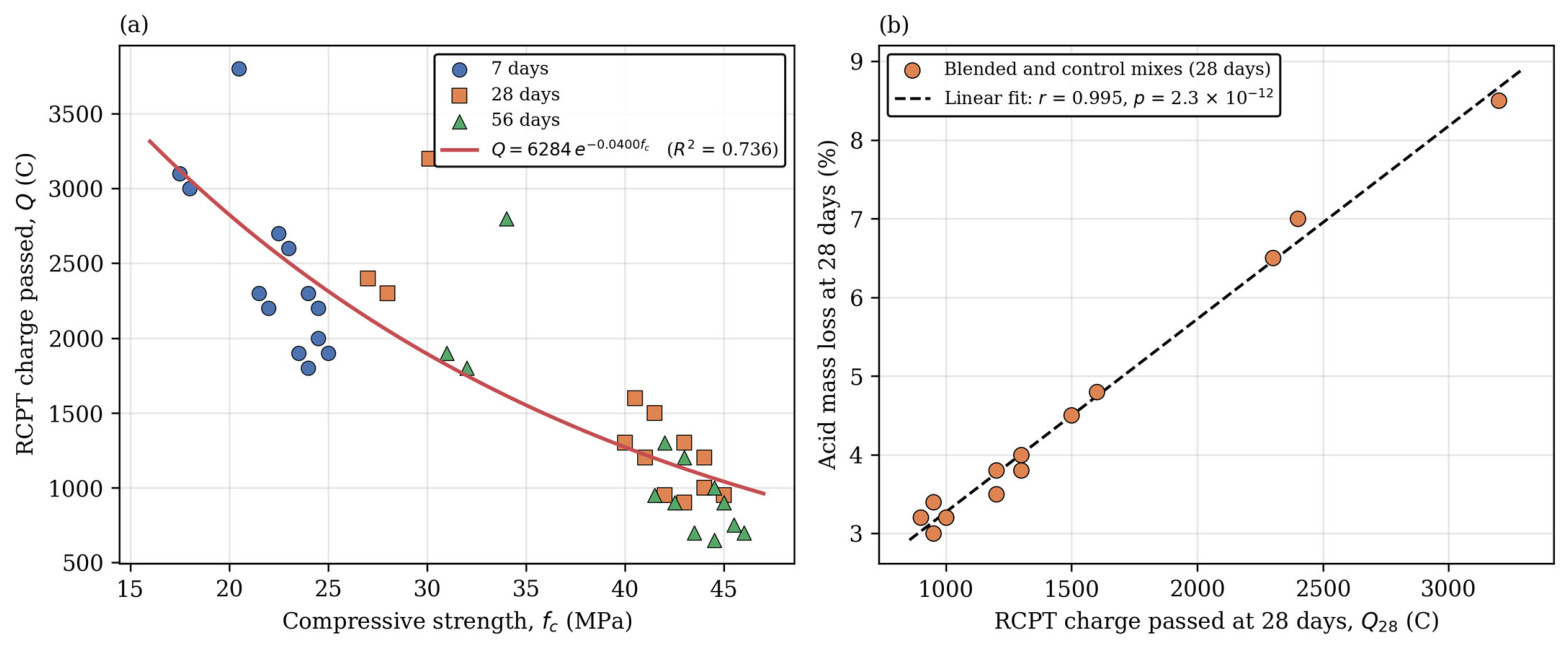
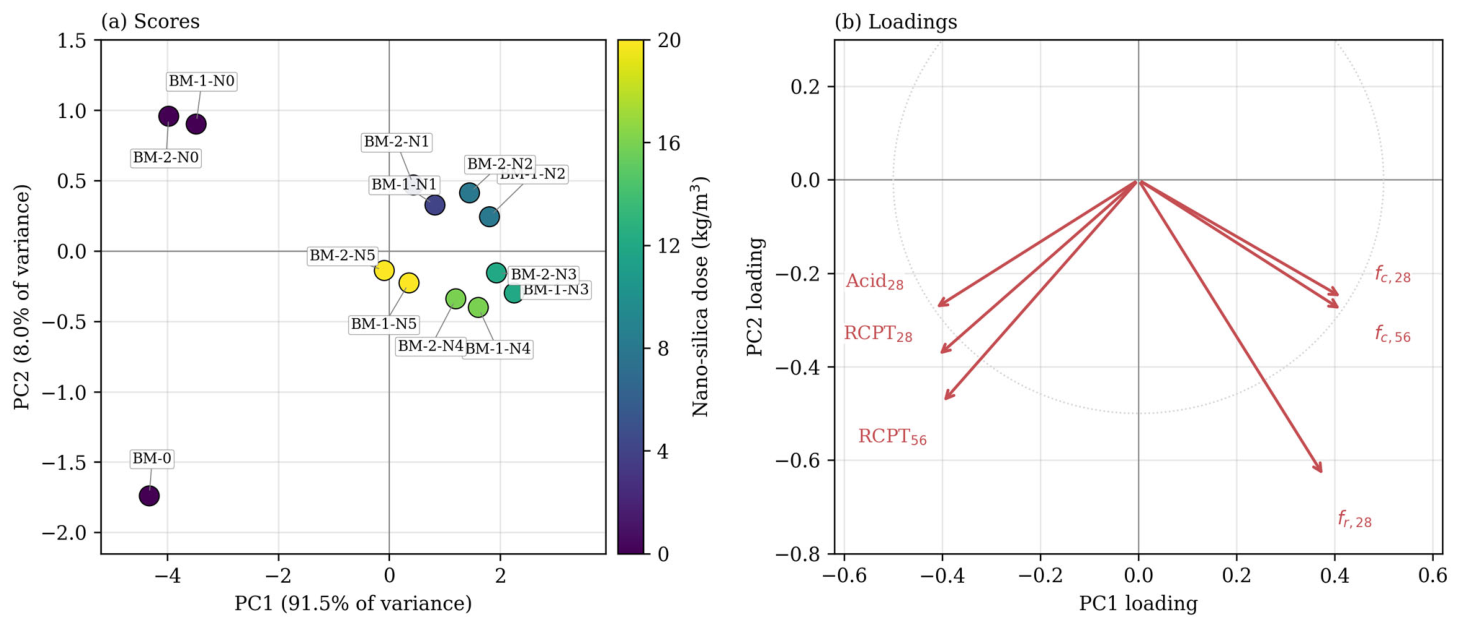
- RCPT charge and acid mass loss are near-perfectly collinear at 28 days (r = 0.995), and principal component analysis shows that a single latent statistical component accounts for 91.5% of the variance of the six-dimensional strength–durability response (this dominant component is interpreted as an indicator of pore connectivity, which was not directly measured): strength, chloride resistance and acid resistance are coupled manifestations of one microstructural state variable, not independent design objectives.
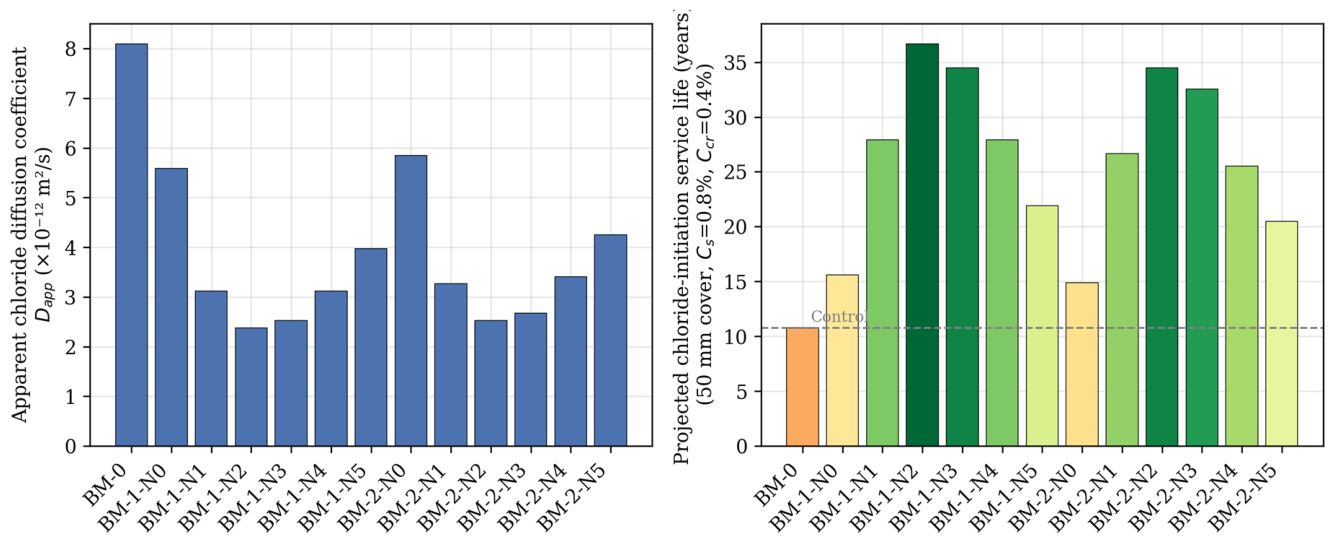
- Fickian service-life projection, seeded by Berke–Hicks conversion of the 56-day RCPT charge to apparent diffusion coefficients (Equations (7) and (8)), indicates a conservative 3.4-fold extension of the chloride-initiation period at 50 mm cover (36.7 versus 10.8 years) for the optimized blends.
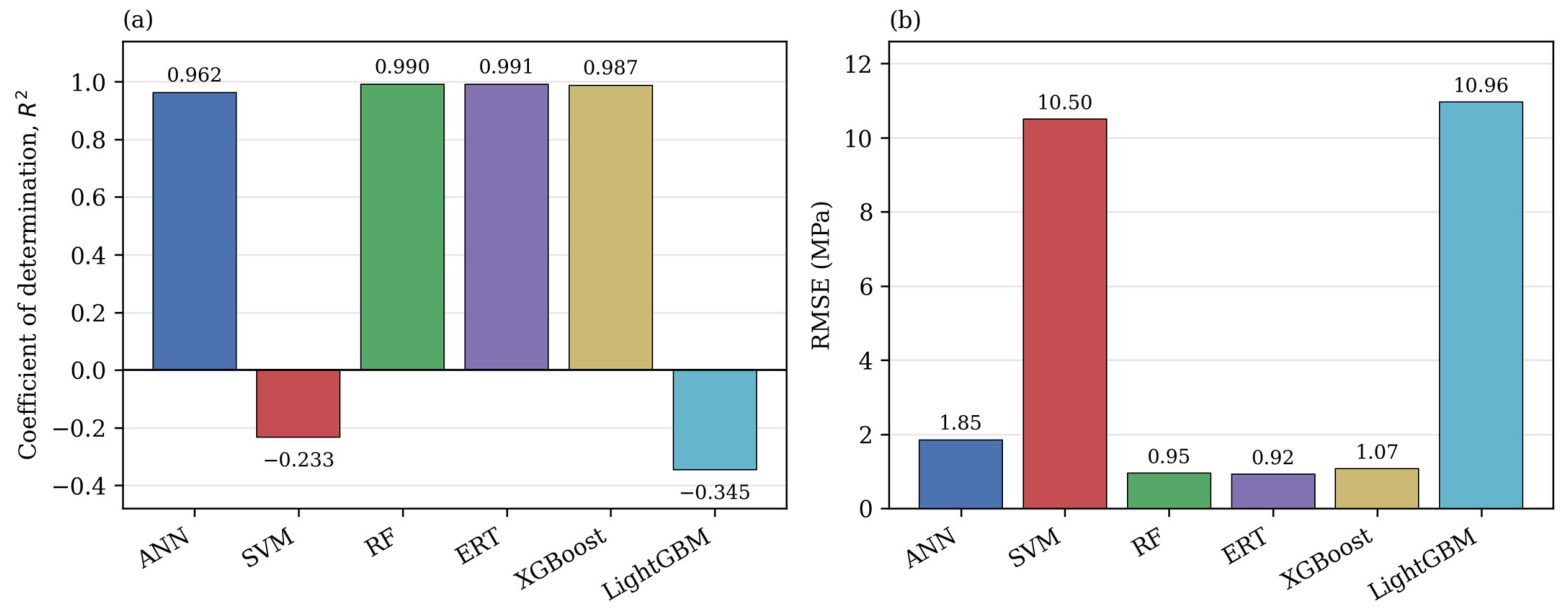
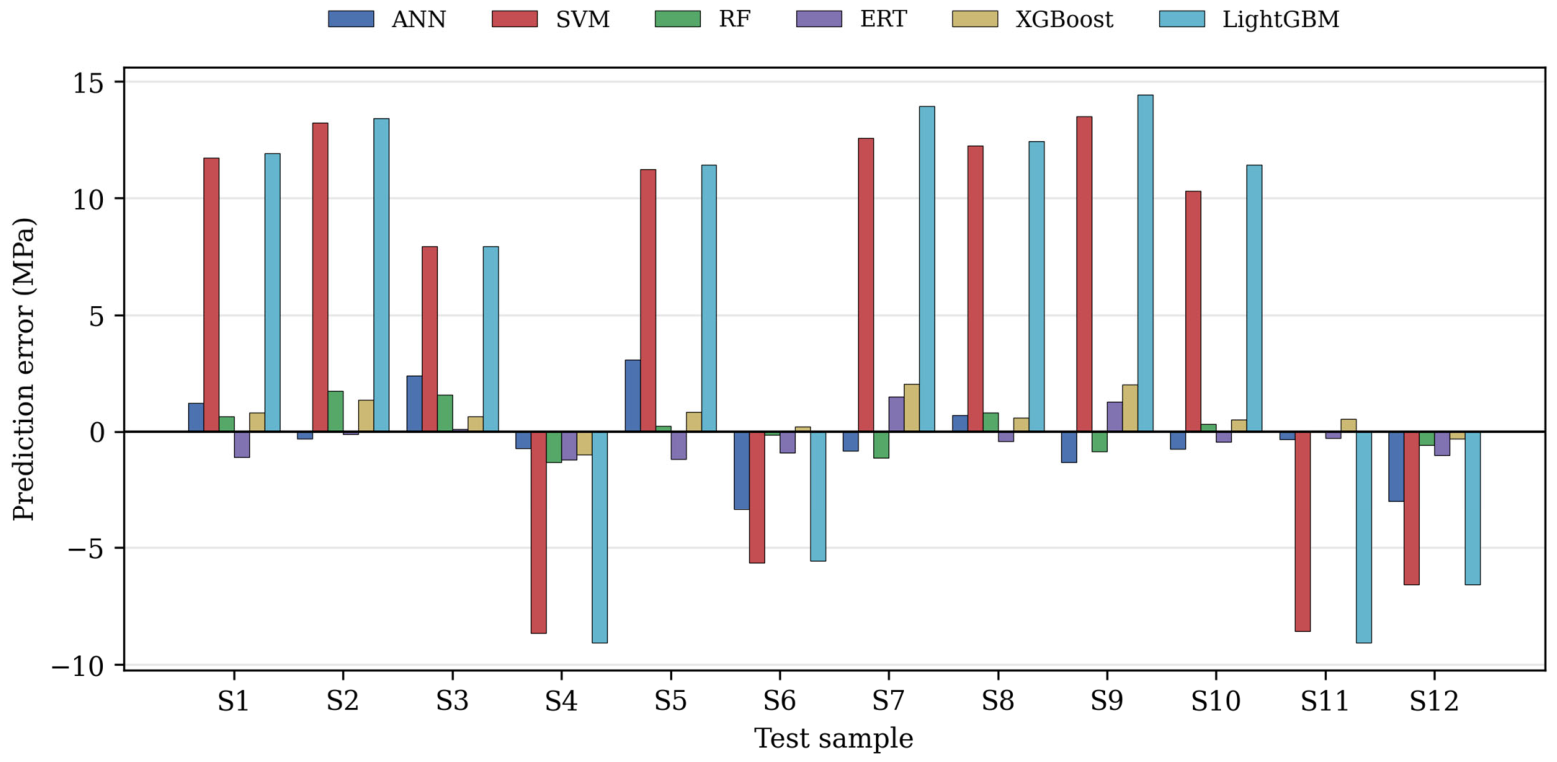
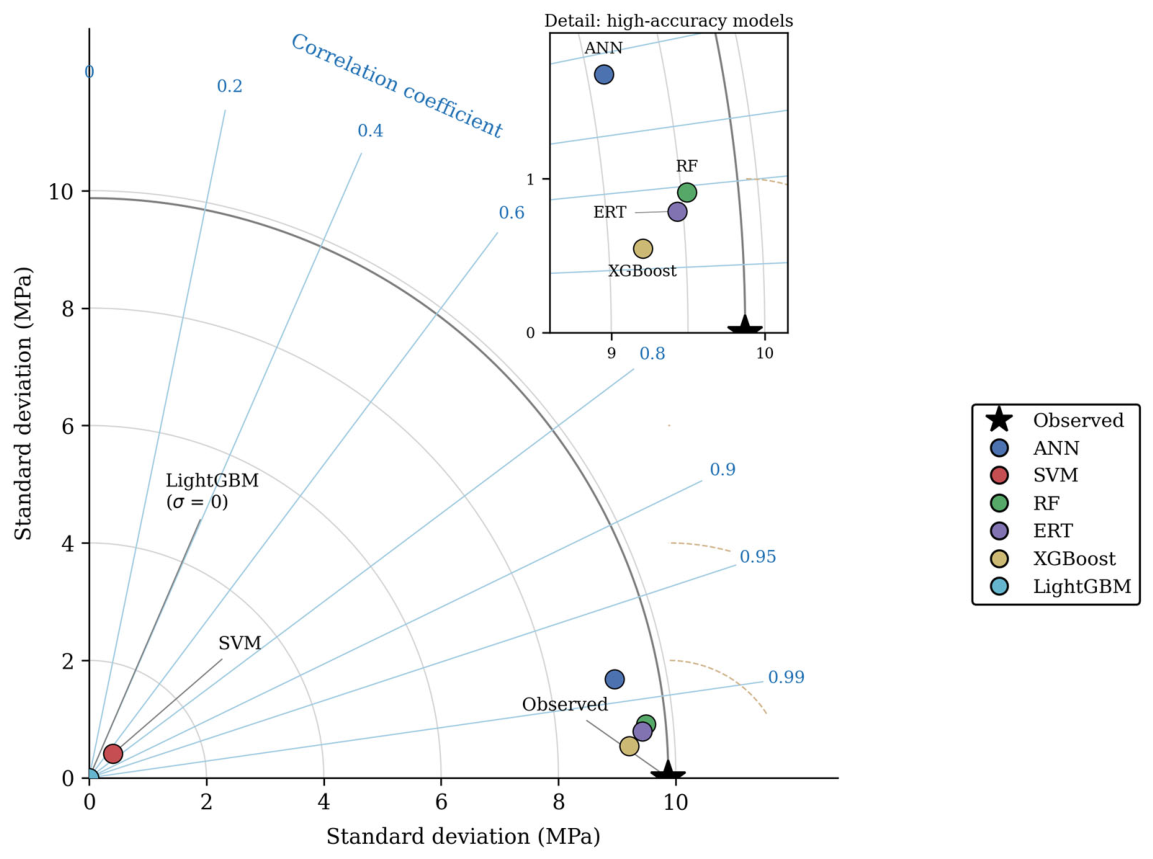
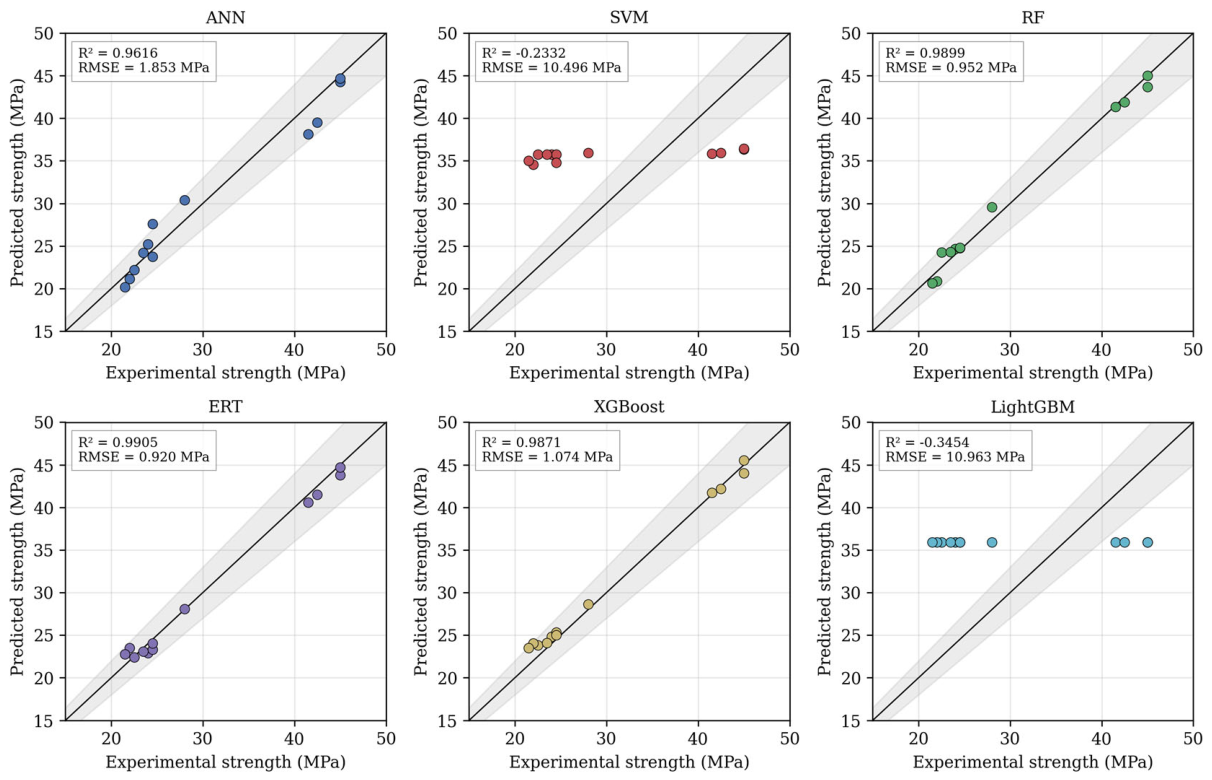
- Among six ML models, extremely randomized trees performed best (R2 = 0.9905, RMSE = 0.920 MPa), followed by RF and XGBoost; SVM and LightGBM failed on this dataset (negative R2, near-constant predictions). Bootstrap 95% confidence intervals (R2 ∈ [0.981, 0.996]) and leave-one-out cross-validation (R2 = 0.986, RMSE = 1.15 MPa) confirm that the ERT accuracy is robust and not split-dependent.
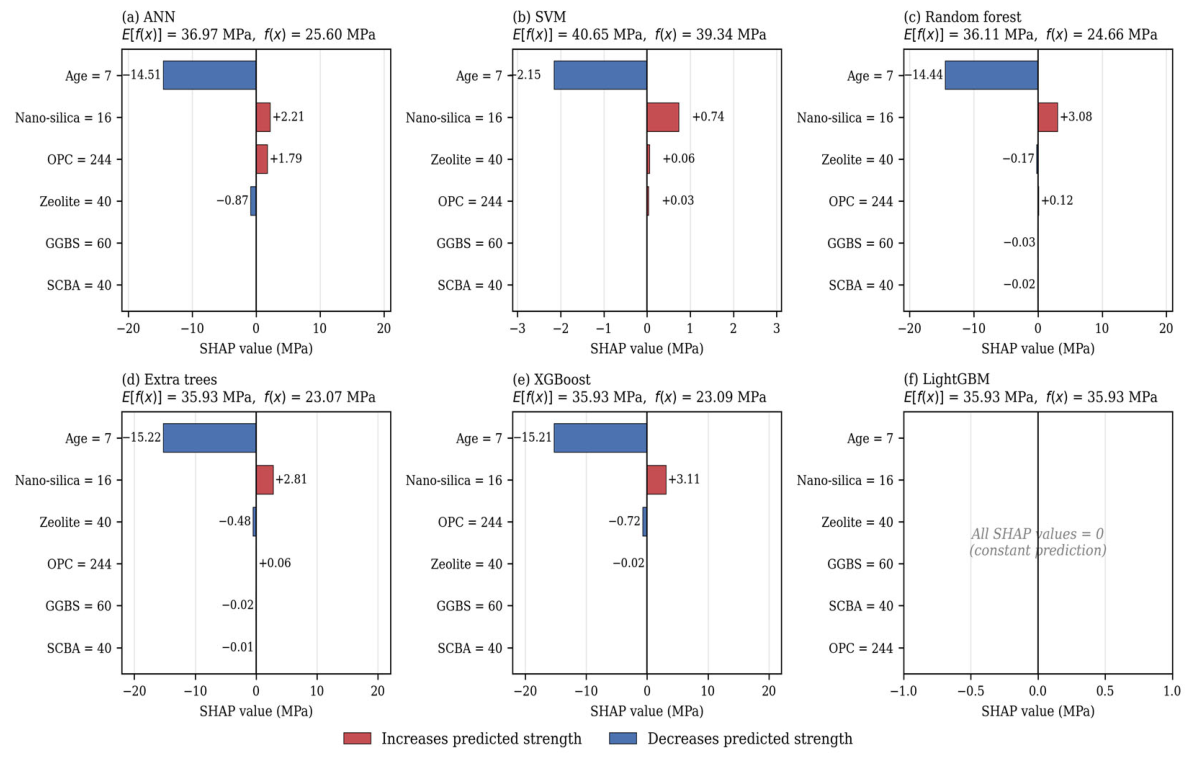
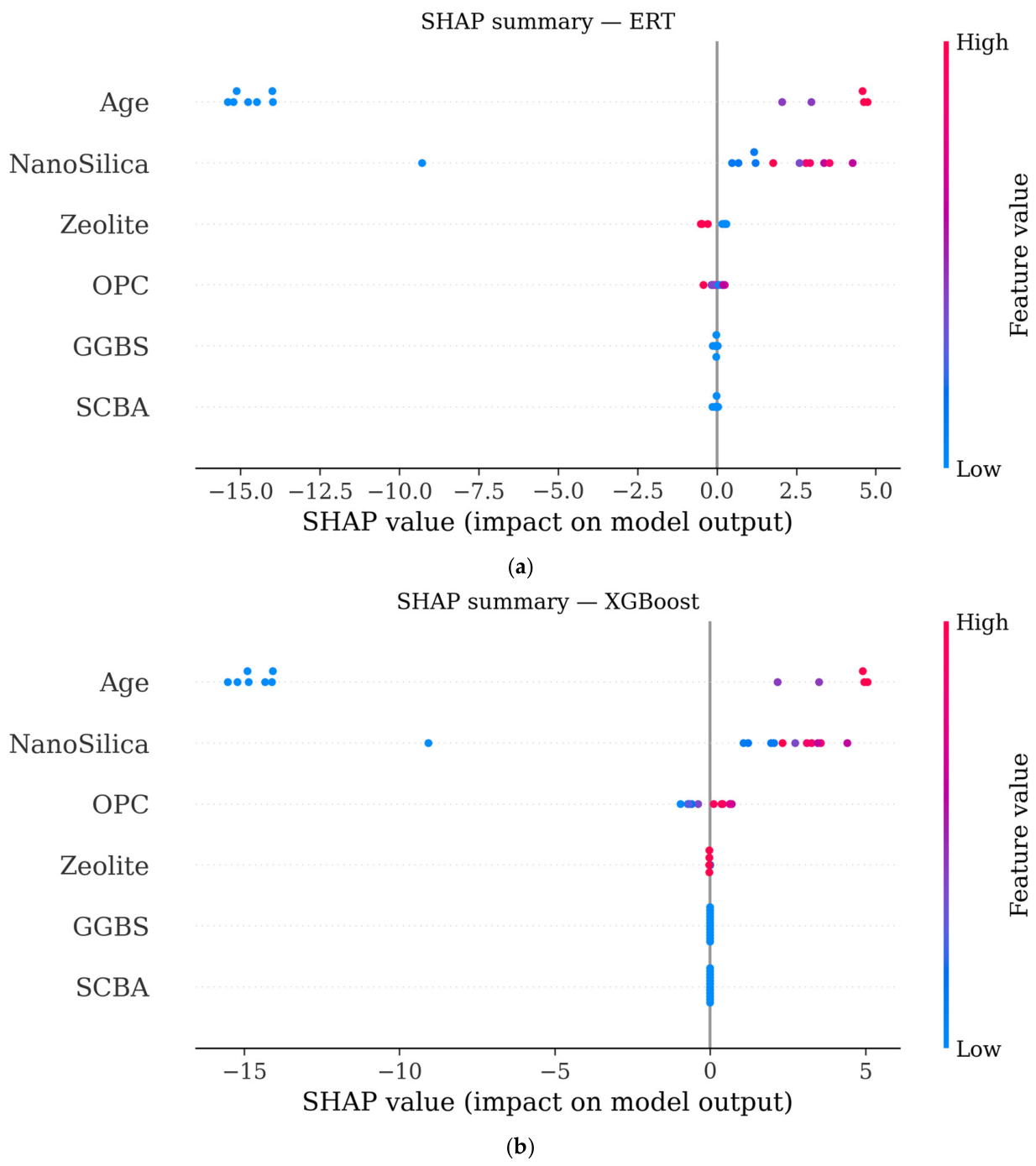
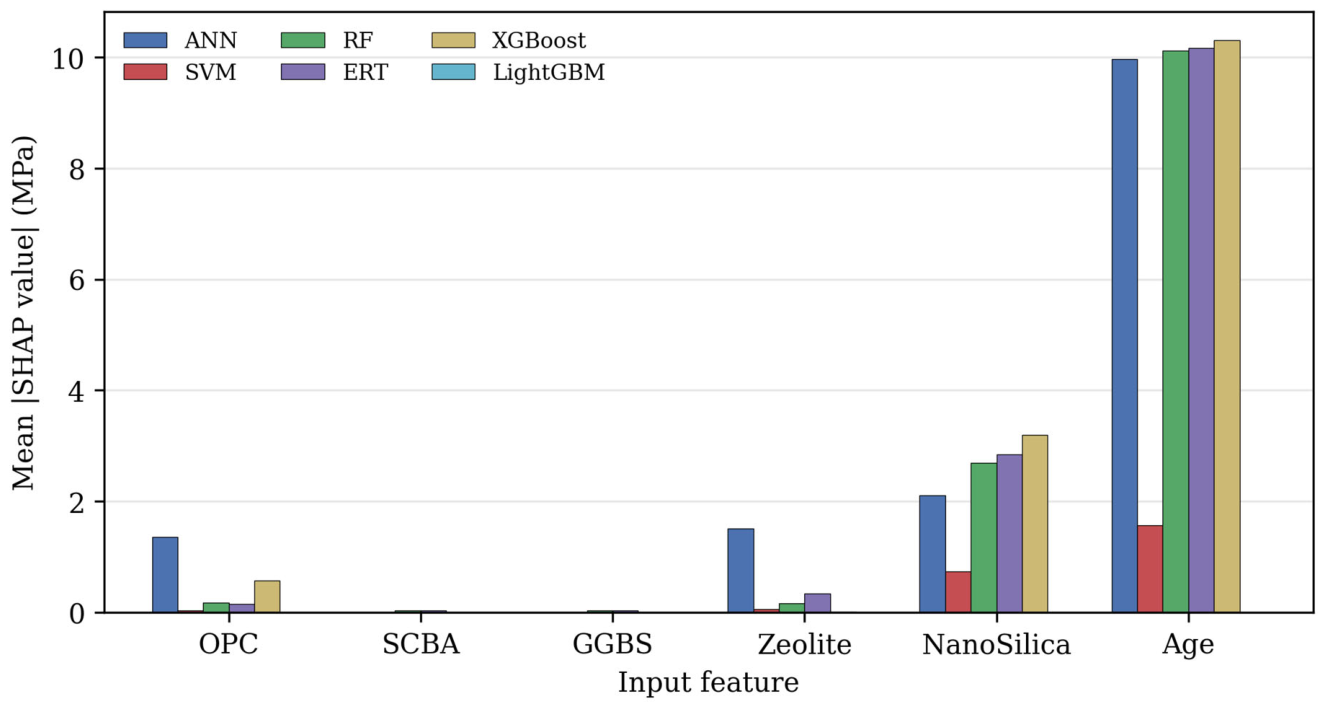
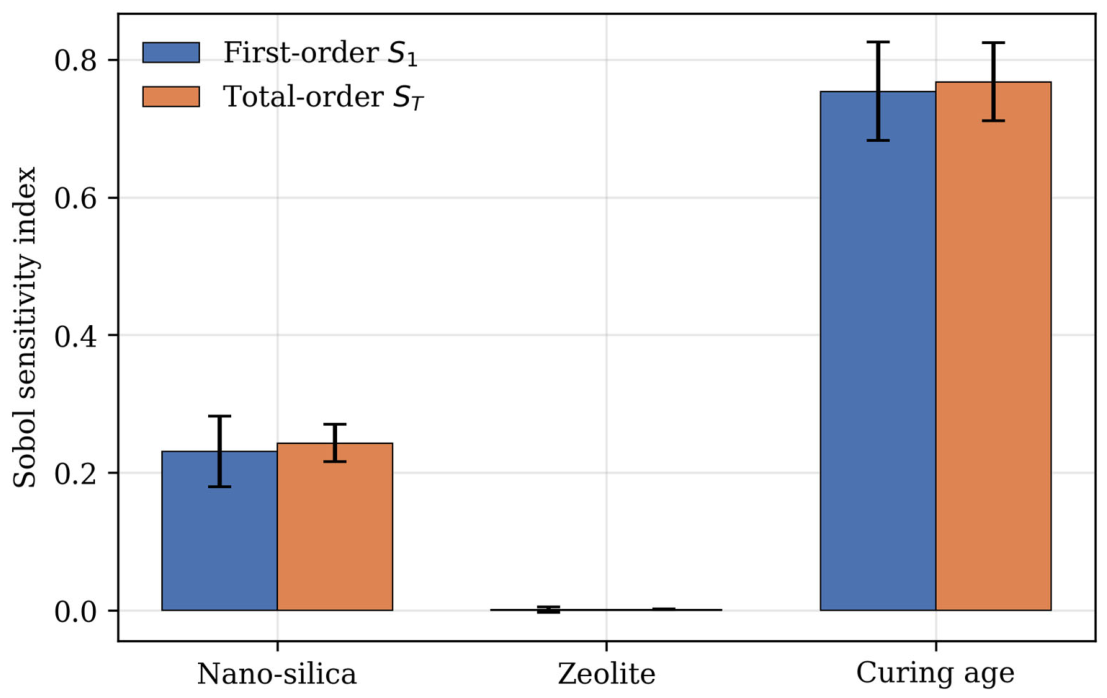
- SHAP force plots, beeswarm summaries and dependence plots agree with response surface significance tests and Sobol global sensitivity indices (age 75.4%, nano-silica 23.1% of variance; negligible interactions): a triangulated explainability result in which the data-driven attributions reproduce the closed-form dose–response and kinetic laws.
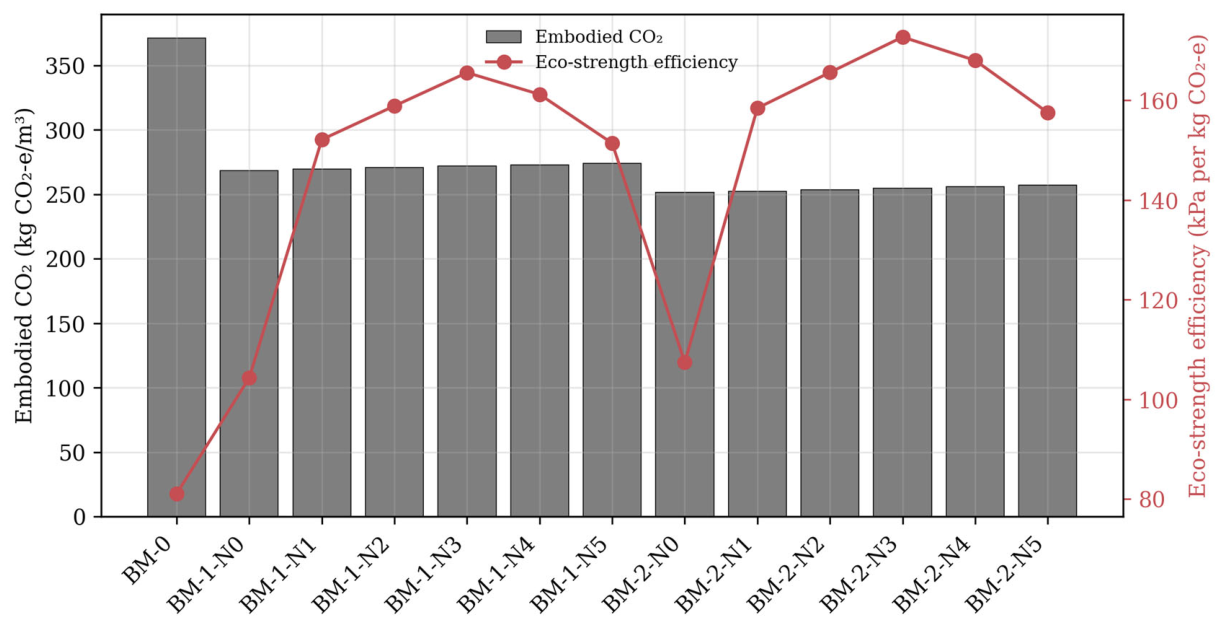
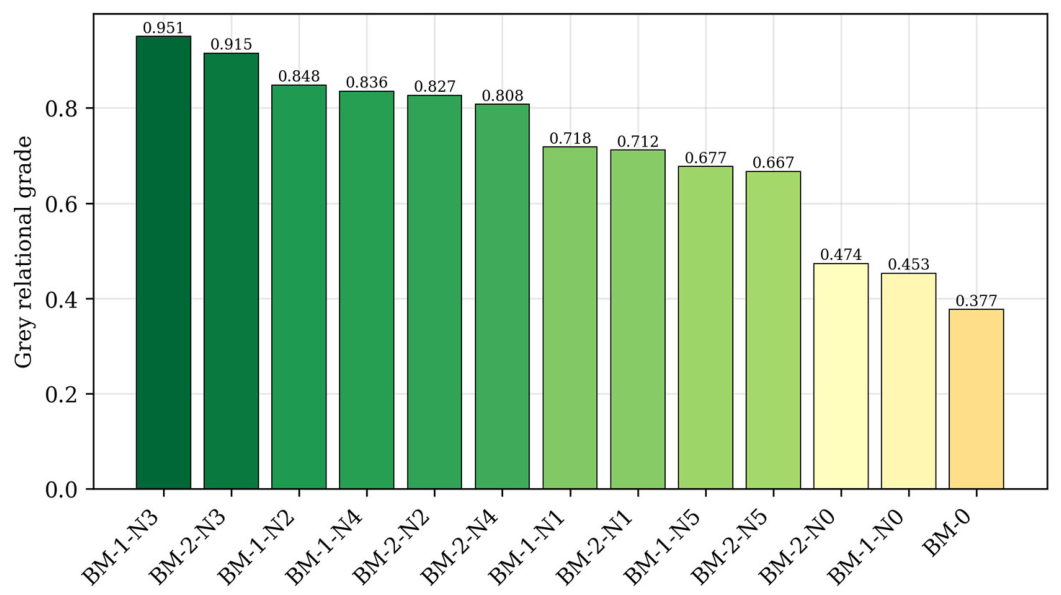
- The blended mixes cut embodied CO2 by 26–32% and improve eco-strength efficiency 2.1-fold; grey relational analysis over six strength, durability and carbon criteria ranks BM-1-N3 first, with BM-2-N3 being a near-equivalent lower-carbon alternative.
- The unified framework—experimental testing, information theoretic kinetic model selection, effective binder formalism, diffusion theoretic service-life projection, latent variable compression, interpretable ML with uncertainty quantification, and sustainability accounting—provides a transparent, physically validated template for the design of multi-blended sustainable concretes.
Author Contributions
Funding
Institutional Review Board Statement
Informed Consent Statement
Data Availability Statement
Conflicts of Interest
References
- Andrew, R.M. Global CO2 emissions from cement production. Earth Syst. Sci. Data 2018, 10, 195–217. [Google Scholar] [CrossRef] [Scilit]
- Xu, Q.; Chen, D.; Tang, S.; Wen, Y.; Yang, C.; Xiong, J.; Zhou, Y. A residue-modified magnesium oxysulfate cement composite: Tailoring and efficacy for loess reinforcement. Constr. Build. Mater. 2026, 519, 145916. [Google Scholar] [CrossRef] [Scilit]
- Ullah, M.F.; Tang, H.; Ullah, A.; Toth, Z.; Ahmad, M.; Alzlfawi, A. Mechanical and environmental performance of sugarcane bagasse ash from Khyber Pakhtunkhwa in sustainable concrete. Sci. Rep. 2025, 15, 24571. [Google Scholar] [CrossRef] [Scilit] [PubMed]
- Jha, P.; Sachan, A.K.; Singh, R.P. Agro-waste sugarcane bagasse ash (ScBA) as partial replacement of binder material in concrete. Mater. Today Proc. 2021, 44, 419–427. [Google Scholar] [CrossRef] [Scilit]
- Sankeeth, S.; Prabhath, A.A.N.; Damruwan, H.G.H.; Herath, H.M.S.T.; Priyadarshana, H.V.V.; Kumara, S.P.S.N.B.S.; Lewangamage, C.S.; Koswattage, K.R. Optimizing mechanical properties of concrete using sugarcane bagasse ash. Results Eng. 2025, 27, 105968. [Google Scholar] [CrossRef] [Scilit]
- Bahurudeen, A.; Santhanam, M. Performance evaluation of sugarcane bagasse ash-based cement for durable concrete. In Proceedings of the 4th International Conference on Durability of Concrete Structures, Lafayette, Indiana, 24–26 July 2014; Purdue University: West Lafayette, IN, USA, 2014. [Google Scholar]
- Kirthiga, R.; Elavenil, S. Synergistic effects of bagasse ash and silica fume on strength and durability properties of sustainable cement mortars. Eng. Res. Express 2025, 7, 035109. [Google Scholar] [CrossRef] [Scilit]
- Bahurudeen, A.; Kanraj, D.; Dev, V.G.; Santhanam, M. Performance evaluation of sugarcane bagasse ash blended cement in concrete. Cem. Concr. Compos. 2015, 59, 77–88. [Google Scholar] [CrossRef] [Scilit]
- Xu, Q.; Ji, T.; Gao, S.J.; Yang, Z.; Wu, N. Characteristics and applications of sugar cane bagasse ash waste in cementitious materials. Materials 2018, 12, 39. [Google Scholar] [CrossRef] [Scilit] [PubMed]
- Deepika, S.; Anand, G.; Bahurudeen, A.; Santhanam, M. Construction products with sugarcane bagasse ash binder. J. Mater. Civ. Eng. 2017, 29, 04017189. [Google Scholar] [CrossRef] [Scilit]
- Tabish, M.; Zaheer, M.M.; Baqi, A. Age dependent properties of concrete incorporating mechanically processed ultra-fine sugarcane bagasse ash. Constr. Build. Mater. 2025, 494, 143509. [Google Scholar] [CrossRef] [Scilit]
- Pandey, S.; Gandhi, S.; Murthy, Y.I. Effect of addition of sugarcane bagasse ash on half-cell potential of cathodically protected RCC structures subjected to chloride ingress. Mater. Today Proc. 2023, in press. [Google Scholar] [CrossRef] [Scilit]
- Chen, J.W.; Liao, Y.S.; Ma, F.; Tang, S.W. Effect of ground granulated blast furnace slag on hydration characteristics of ferrite-rich calcium sulfoaluminate cement in seawater. J. Cent. South Univ. 2025, 32, 189–204. [Google Scholar] [CrossRef] [Scilit]
- Liao, Y.; Cai, Z.; Deng, F.; Ye, J.; Wang, K.; Tang, S. Hydration behavior and thermodynamic modelling of ferroaluminate cement blended with steel slag. J. Build. Eng. 2024, 97, 110833. [Google Scholar] [CrossRef] [Scilit]
- Özbay, E.; Erdemir, M.; Durmuş, H.İ. Utilization and efficiency of ground granulated blast furnace slag on concrete properties—A review. Constr. Build. Mater. 2016, 105, 423–434. [Google Scholar] [CrossRef] [Scilit]
- Kumar, R.; Mehta, P.K.; Pal, P.R.; Ashiq, T.M. Relation among mechanical properties of ground granulated blast furnace slag concrete. Int. J. Civ. Eng. Technol. 2017, 8, 123–130. [Google Scholar]
- Saranya, P.; Nagarajan, P.; Shashikala, A.P. Eco-friendly GGBS concrete: A state-of-the-art review. IOP Conf. Ser. Mater. Sci. Eng. 2018, 330, 012057. [Google Scholar] [CrossRef] [Scilit]
- Ramezanianpour, A.A.; Kazemian, A.; Radaei, E.; AzariJafari, H.; Moghaddam, M.A. Influence of Iranian low-reactivity GGBFS on the properties of mortars and concretes by Taguchi method. Comput. Concr. 2014, 13, 423–436. [Google Scholar] [CrossRef] [Scilit]
- Teng, S.; Lim, T.Y.D.; Divsholi, B.S. Durability and mechanical properties of high strength concrete incorporating ultra fine ground granulated blast-furnace slag. Constr. Build. Mater. 2013, 40, 875–881. [Google Scholar] [CrossRef] [Scilit]
- Joshi, R.A.; Joshi, S.G.; Londhe, S.N.; Kunte, U. Influence of calcium nitrate on the development of compressive strength and carbonation resistance of GGBS concrete. Innov. Infrastruct. Solut. 2025, 10, 293. [Google Scholar] [CrossRef] [Scilit]
- Gholampour, A.; Zheng, J.; Ozbakkaloglu, T. Development of waste-based concretes containing foundry sand, recycled fine aggregate, ground granulated blast furnace slag and fly ash. Constr. Build. Mater. 2021, 267, 121004. [Google Scholar] [CrossRef] [Scilit]
- Kallimani, R.; Minde, P. Investigation on combined use of biochar and ground granulated blast furnace slag as a supplementary admixture in concrete. Environ. Sci. Pollut. Res. 2025, 32, 8201–8218. [Google Scholar] [CrossRef] [Scilit] [PubMed]
- Majhi, R.K.; Nayak, A.N.; Mukharjee, B.B. Development of sustainable concrete using recycled coarse aggregate and ground granulated blast furnace slag. Constr. Build. Mater. 2018, 159, 417–430. [Google Scholar] [CrossRef] [Scilit]
- Cahyani, R.A.T.; Rusdianto, Y. An overview of behaviour of concrete with granulated blast furnace slag as partial cement replacement. IOP Conf. Ser. Earth Environ. Sci. 2021, 933, 012006. [Google Scholar] [CrossRef] [Scilit]
- Akintayo, B.D.; Olanrewaju, O.A. Utilizing industrial waste for sustainable concrete: A critical analysis of ground granulated blast furnace slag in cement production. In Proceedings of the 2024 IEEE International Conference on Industrial Engineering and Engineering Management (IEEM), Bangkok, Thailand, 15–18 December 2024; pp. 1432–1438. [Google Scholar]
- Gautam, A.; Tung, S. Advancing sustainability in concrete construction: Enhancing thermal resilience and structural strength with ground granulated blast furnace slag. Asian J. Civ. Eng. 2024, 25, 6119–6129. [Google Scholar] [CrossRef] [Scilit]
- AzariJafari, H.; Shekarchi, M.; Berenjian, J.; Ahmadi, B. Enhancing workability retention of concrete containing natural zeolite by superplasticizers’ combination. Spec. Publ. 2015, 302, 416–424. [Google Scholar] [CrossRef] [Scilit]
- Tran, Y.T.; Lee, J.; Kumar, P.; Kim, K.H.; Lee, S.S. Natural zeolite and its application in concrete composite production. Compos. Part B 2019, 165, 354–364. [Google Scholar] [CrossRef] [Scilit]
- Shekarchi, M.; Ahmadi, B.; Najimi, M. Use of natural zeolite as pozzolanic material in cement and concrete composites. In Handbook of Natural Zeolites; Bentham Science Publishers: Hilversum, The Netherlands, 2012; pp. 665–694. [Google Scholar]
- Markiv, T.; Sobol, K.; Franus, M.; Franus, W. Mechanical and durability properties of concretes incorporating natural zeolite. Arch. Civ. Mech. Eng. 2016, 16, 554–562. [Google Scholar] [CrossRef] [Scilit]
- Najimi, M.; Sobhani, J.; Ahmadi, B.; Shekarchi, M. An experimental study on durability properties of concrete containing zeolite as a highly reactive natural pozzolan. Constr. Build. Mater. 2012, 35, 1023–1033. [Google Scholar] [CrossRef] [Scilit]
- Zhu, D.; Wen, A.; Mu, D.; Tang, A.; Jiang, L.; Yang, W. Investigation into compressive property, chloride ion permeability, and pore fractal characteristics of the cement mortar incorporated with zeolite powder. Constr. Build. Mater. 2024, 411, 134522. [Google Scholar] [CrossRef] [Scilit]
- Derogar, S. Effect of zeolite on dewatering, mechanical properties and durability of cement mortar. Adv. Cem. Res. 2017, 29, 174–182. [Google Scholar] [CrossRef] [Scilit]
- Ahmadi, B.; Shekarchi, M. Use of natural zeolite as a supplementary cementitious material. Cem. Concr. Compos. 2010, 32, 134–141. [Google Scholar] [CrossRef] [Scilit]
- Xu, J.; Li, Y.; Lu, L.; Cheng, X.; Li, L. Strength and durability of marine cement-based mortar modified by colloidal nano-silica with epoxy silane for low CO2 emission. J. Clean. Prod. 2023, 382, 135281. [Google Scholar] [CrossRef] [Scilit]
- Ekanayake, I.U.; Meddage, D.P.P.; Rathnayake, U. A novel approach to explain the black-box nature of machine learning in compressive strength predictions of concrete using Shapley additive explanations (SHAP). Case Stud. Constr. Mater. 2022, 16, e01059. [Google Scholar] [CrossRef] [Scilit]
- Abdulalim Alabdullah, A.; Iqbal, M.; Zahid, M.; Khan, K.; Nasir Amin, M.; Jalal, F.E. Prediction of rapid chloride penetration resistance of metakaolin based high strength concrete using Light GBM and XGBoost models by incorporating SHAP analysis. Constr. Build. Mater. 2022, 345, 128296. [Google Scholar] [CrossRef] [Scilit]
- Feng, D.C.; Liu, Z.T.; Wang, X.D.; Chen, Y.; Chang, J.Q.; Wei, D.F.; Jiang, Z.M. Machine learning-based compressive strength prediction for concrete: An adaptive boosting approach. Constr. Build. Mater. 2020, 230, 117000. [Google Scholar] [CrossRef] [Scilit]
- Lundberg, S.M.; Lee, S.I. A unified approach to interpreting model predictions. Adv. Neural Inf. Process. Syst. 2017, 30, 4765–4774. [Google Scholar]
- Sobol, I.M. Global sensitivity indices for nonlinear mathematical models and their Monte Carlo estimates. Math. Comput. Simul. 2001, 55, 271–280. [Google Scholar] [CrossRef] [Scilit]
- Saltelli, A. Making best use of model evaluations to compute sensitivity indices. Comput. Phys. Commun. 2002, 145, 280–297. [Google Scholar] [CrossRef] [Scilit]
- Papadakis, V.G.; Tsimas, S. Supplementary cementing materials in concrete. Part I: Efficiency and design. Cem. Concr. Res. 2002, 32, 1525–1532. [Google Scholar]
- Papadakis, V.G.; Antiohos, S.; Tsimas, S. Supplementary cementing materials in concrete. Part II: A fundamental estimation of the efficiency factor. Cem. Concr. Res. 2002, 32, 1533–1538. [Google Scholar]
- Akaike, H. A new look at the statistical model identification. IEEE Trans. Autom. Control 1974, 19, 716–723. [Google Scholar] [CrossRef] [Scilit]
- Berke, N.S.; Hicks, M.C. Estimating the life cycle of reinforced concrete decks and marine piles using laboratory diffusion and corrosion data. In Corrosion Forms and Control for Infrastructure; ASTM International: West Conshohocken, PA, USA, 1992; pp. 207–231. [Google Scholar]
- Tuutti, K. Corrosion of Steel in Concrete; Swedish Cement and Concrete Research Institute: Stockholm, Sweden, 1982. [Google Scholar]
- Efron, B.; Tibshirani, R.J. An Introduction to the Bootstrap; Chapman & Hall: New York, NY, USA, 1993. [Google Scholar]
- Jolliffe, I.T. Principal Component Analysis, 2nd ed.; Springer: New York, NY, USA, 2002. [Google Scholar]
- Zhang, S.; Zheng, S.; Wang, E.; Dai, H. Grey model study on strength and pore structure of self-compacting concrete with different aggregates based on NMR. J. Build. Eng. 2023, 64, 105560. [Google Scholar] [CrossRef] [Scilit]
- IS 516 (Part 1/Sec 1): 2021; Hardened Concrete—Methods of Test, Part 1: Testing of Strength of Hardened Concrete, Section 1: Compressive, Flexural and Split Tensile Strength, 1st Revision. Bureau of Indian Standards: New Delhi, India, 2021.
- ASTM C78/C78M-22; Standard Test Method for Flexural Strength of Concrete (Using Simple Beam with Third-Point Loading). ASTM International: West Conshohocken, PA, USA, 2022.
- ASTM C1202-19; Standard Test Method for Electrical Indication of Concrete’s Ability to Resist Chloride Ion Penetration. ASTM International: West Conshohocken, PA, USA, 2019.
- ASTM C267-20; Standard Test Methods for Chemical Resistance of Mortars, Grouts, and Monolithic Surfacings and Polymer Concretes. ASTM International: West Conshohocken, PA, USA, 2020.
- Cortes, C.; Vapnik, V. Support-vector networks. Mach. Learn. 1995, 20, 273–297. [Google Scholar] [CrossRef] [Scilit]
- Breiman, L. Random forests. Mach. Learn. 2001, 45, 5–32. [Google Scholar] [CrossRef] [Scilit]
- Geurts, P.; Ernst, D.; Wehenkel, L. Extremely randomized trees. Mach. Learn. 2006, 63, 3–42. [Google Scholar] [CrossRef] [Scilit]
- Chen, T.; Guestrin, C. XGBoost: A scalable tree boosting system. In Proceedings of the 22nd ACM SIGKDD International Conference on Knowledge Discovery and Data Mining, San Francisco, CA, USA, 13–17 August 2016; pp. 785–794. [Google Scholar]
- Ke, G.; Meng, Q.; Finley, T.; Wang, T.; Chen, W.; Ma, W.; Ye, Q.; Liu, T.-Y. LightGBM: A highly efficient gradient boosting decision tree. Adv. Neural Inf. Process. Syst. 2017, 30, 3146–3154. [Google Scholar]
- Carino, N.J. The maturity method: Theory and application. Cem. Concr. Aggreg. 1984, 6, 61–73. [Google Scholar] [CrossRef] [Scilit]
- Chen, D.; Xu, Q.; Tang, S.; Xiong, J.; Ma, L.; Dong, S.; Sun, Y.; He, X.; Hai, C.; Zhou, Y. Sustainable stabilization of loess via multi-solid waste-modified magnesium oxysulfate cement: Microstructure, mechanics, and environmental impact. Chem. Eng. J. 2026, 545, 179396. [Google Scholar] [CrossRef] [Scilit]
- Hammond, G.P.; Jones, C.I. Inventory of Carbon and Energy (ICE), version 2.0; Sustainable Energy Research Team, University of Bath: Bath, UK, 2011.
- Francioso, V.; Lopez-Arias, M.; Moro, C.; Jung, N.; Velay-Lizancos, M. Impact of curing temperature on the life cycle assessment of sugarcane bagasse ash as a partial replacement of cement in mortars. Sustainability 2023, 15, 142. [Google Scholar] [CrossRef] [Scilit]
- Mostafaei, H.; Bahmani, H. Sustainable high-performance concrete using zeolite powder: Mechanical and carbon footprint analyses. Buildings 2024, 14, 3660. [Google Scholar] [CrossRef] [Scilit]
- Raveendran, N.; Krishnan, V. Engineering performance and environmental assessment of sustainable concrete incorporating nano silica and metakaolin as cementitious materials. Sci. Rep. 2025, 15, 1482. [Google Scholar] [CrossRef] [Scilit] [PubMed]









| Mix | OPC | SCBA | GGBS | Zeolite | Nano-Silica | Water | Fine agg. | Coarse agg. |
|---|---|---|---|---|---|---|---|---|
| BM-0 | 400 | 0 | 0 | 0 | 0 | 180 | 659.89 | 1144.8 |
| BM-1-N0 | 280 | 40 | 60 | 20 | 0 | 180 | 659.89 | 1144.8 |
| BM-1-N1 | 276 | 40 | 60 | 20 | 4 | 180 | 659.89 | 1144.8 |
| BM-1-N2 | 272 | 40 | 60 | 20 | 8 | 180 | 659.89 | 1144.8 |
| BM-1-N3 | 268 | 40 | 60 | 20 | 12 | 180 | 659.89 | 1144.8 |
| BM-1-N4 | 264 | 40 | 60 | 20 | 16 | 180 | 659.89 | 1144.8 |
| BM-1-N5 | 260 | 40 | 60 | 20 | 20 | 180 | 659.89 | 1144.8 |
| BM-2-N0 | 260 | 40 | 60 | 40 | 0 | 180 | 659.89 | 1144.8 |
| BM-2-N1 | 256 | 40 | 60 | 40 | 4 | 180 | 659.89 | 1144.8 |
| BM-2-N2 | 252 | 40 | 60 | 40 | 8 | 180 | 659.89 | 1144.8 |
| BM-2-N3 | 248 | 40 | 60 | 40 | 12 | 180 | 659.89 | 1144.8 |
| BM-2-N4 | 244 | 40 | 60 | 40 | 16 | 180 | 659.89 | 1144.8 |
| BM-2-N5 | 240 | 40 | 60 | 40 | 20 | 180 | 659.89 | 1144.8 |
| Mix | (MPa) | k (Days) | R2 | (MPa/Day) |
|---|---|---|---|---|
| BM-0 | 37.0 | 5.76 | 0.994 | 6.42 |
| BM-1-N0 | 35.6 | 6.99 | 0.996 | 5.10 |
| BM-1-N1 | 50.6 | 8.47 | 0.971 | 5.97 |
| BM-1-N2 | 52.3 | 7.75 | 0.974 | 6.75 |
| BM-1-N3 | 54.1 | 7.61 | 0.966 | 7.11 |
| BM-1-N4 | 52.9 | 7.58 | 0.966 | 6.98 |
| BM-1-N5 | 50.6 | 7.89 | 0.974 | 6.41 |
| BM-2-N0 | 34.4 | 6.92 | 0.995 | 4.97 |
| BM-2-N1 | 49.4 | 8.46 | 0.972 | 5.84 |
| BM-2-N2 | 51.0 | 7.72 | 0.974 | 6.61 |
| BM-2-N3 | 53.5 | 7.78 | 0.973 | 6.88 |
| BM-2-N4 | 52.3 | 7.75 | 0.974 | 6.75 |
| BM-2-N5 | 49.4 | 7.87 | 0.974 | 6.28 |
| Model | Parameters | R2 | AICc | ΔAICc | Akaike Weight |
|---|---|---|---|---|---|
| Hyperbolic (Equation (1)) | 2 | 0.9579 | −235.9 | 0.0 | 1.000 |
| Exponential root (CEB-FIP) | 1 | 0.8980 | −203.7 | 32.2 | 0.000 |
| Logarithmic | 2 | 0.9235 | −212.5 | 23.3 | 0.000 |
| Term | β | SE | t | p |
|---|---|---|---|---|
| 1 | 30.4821 | 3.1836 | 9.57 | <0.001 |
| NS | 2.5585 | 0.3769 | 6.79 | <0.001 |
| Z | −0.0500 | 0.0979 | −0.51 | 0.625 |
| NS2 | −0.0999 | 0.0138 | −7.22 | <0.001 |
| NS × Z | 0.0000 | 0.0081 | 0.00 | 1.000 |
| Parameter | Value | SE |
|---|---|---|
| a_MPa_per_B/W | 13.545 | — |
| 1.051 | 0.256 | |
| 0.336 | 0.687 | |
| _linear | 35.000 | 3.585 |
| _quadratic | −1.327 | 0.172 |
| Response | PC1 Loading | PC2 Loading |
|---|---|---|
| fc28 | 0.418 | −0.254 |
| fr28 | 0.380 | −0.637 |
| RCPT28 | −0.412 | −0.379 |
| Acid28 | −0.418 | −0.278 |
| fc56 | 0.417 | −0.281 |
| RCPT56 | −0.402 | −0.480 |
| Mix | Q56 (C) | (×10−12 m2/s) | (Years) | Extension vs. Control |
|---|---|---|---|---|
| BM-0 | 2800 | 8.10 | 10.8 | 1.00× |
| BM-1-N0 | 1800 | 5.59 | 15.6 | 1.45× |
| BM-1-N1 | 900 | 3.12 | 27.9 | 2.59× |
| BM-1-N2 | 650 | 2.38 | 36.7 | 3.41× |
| BM-1-N3 | 700 | 2.53 | 34.5 | 3.20× |
| BM-1-N4 | 900 | 3.12 | 27.9 | 2.59× |
| BM-1-N5 | 1200 | 3.98 | 21.9 | 2.04× |
| BM-2-N0 | 1900 | 5.85 | 14.9 | 1.39× |
| BM-2-N1 | 950 | 3.27 | 26.7 | 2.48× |
| BM-2-N2 | 700 | 2.53 | 34.5 | 3.20× |
| BM-2-N3 | 750 | 2.68 | 32.5 | 3.02× |
| BM-2-N4 | 1000 | 3.41 | 25.5 | 2.38× |
| BM-2-N5 | 1300 | 4.25 | 20.5 | 1.91× |
| Mix | CO2 (kg CO2-e/m3) | (MPa) | Eco-Efficiency (kPa per kg CO2-e) | CO2 Reduction (%) |
|---|---|---|---|---|
| BM-0 | 371 | 30.1 | 81.1 | 0.0 |
| BM-1-N0 | 268 | 28.0 | 104.3 | 27.7 |
| BM-1-N1 | 270 | 41.0 | 152.1 | 27.4 |
| BM-1-N2 | 271 | 43.0 | 158.8 | 27.1 |
| BM-1-N3 | 272 | 45.0 | 165.5 | 26.8 |
| BM-1-N4 | 273 | 44.0 | 161.2 | 26.5 |
| BM-1-N5 | 274 | 41.5 | 151.4 | 26.1 |
| BM-2-N0 | 251 | 27.0 | 107.4 | 32.3 |
| BM-2-N1 | 253 | 40.0 | 158.4 | 32.0 |
| BM-2-N2 | 254 | 42.0 | 165.6 | 31.7 |
| BM-2-N3 | 255 | 44.0 | 172.7 | 31.4 |
| BM-2-N4 | 256 | 43.0 | 168.0 | 31.1 |
| BM-2-N5 | 257 | 40.5 | 157.5 | 30.7 |
| Rank | Mix | GRG |
|---|---|---|
| 1 | BM-1-N3 | 0.9506 |
| 2 | BM-2-N3 | 0.9154 |
| 3 | BM-1-N2 | 0.8483 |
| 4 | BM-1-N4 | 0.8356 |
| 5 | BM-2-N2 | 0.8268 |
| 6 | BM-2-N4 | 0.8078 |
| 7 | BM-1-N1 | 0.7182 |
| 8 | BM-2-N1 | 0.7116 |
| 9 | BM-1-N5 | 0.6772 |
| 10 | BM-2-N5 | 0.6671 |
| 11 | BM-2-N0 | 0.4736 |
| 12 | BM-1-N0 | 0.4529 |
| 13 | BM-0 | 0.3769 |
| S | Actual | ANN | Err % | SVM | Err % | RF | Err % | ERT | Err % | XGB | Err % | LGBM | Err % |
|---|---|---|---|---|---|---|---|---|---|---|---|---|---|
| 1 | 24.00 | 25.22 | −5.10 | 35.74 | −48.92 | 24.65 | −2.71 | 22.90 | 4.60 | 24.82 | −3.40 | 35.93 | −49.71 |
| 2 | 22.50 | 22.19 | 1.38 | 35.74 | −58.85 | 24.24 | −7.72 | 22.39 | 0.47 | 23.85 | −5.98 | 35.93 | −59.69 |
| 3 | 28.00 | 30.40 | −8.58 | 35.94 | −28.35 | 29.59 | −5.66 | 28.09 | −0.33 | 28.65 | −2.32 | 35.93 | −28.32 |
| 4 | 45.00 | 44.28 | 1.60 | 36.35 | 19.23 | 43.68 | 2.93 | 43.80 | 2.67 | 44.02 | 2.18 | 35.93 | 20.16 |
| 5 | 24.50 | 27.58 | −12.58 | 35.74 | −45.88 | 24.75 | −1 | 23.33 | 4.79 | 25.33 | −3.38 | 35.93 | −46.65 |
| 6 | 41.50 | 38.14 | 8.10 | 35.85 | 13.62 | 41.36 | 0.33 | 40.60 | 2.17 | 41.71 | −0.51 | 35.93 | 13.42 |
| 7 | 22.00 | 21.16 | 3.80 | 34.56 | −57.11 | 20.87 | 5.14 | 23.48 | −6.74 | 24.05 | −9.30 | 35.93 | −63.32 |
| 8 | 23.50 | 24.21 | −3.03 | 35.74 | −52.09 | 24.30 | −3.40 | 23.09 | 1.73 | 24.09 | −2.51 | 35.93 | −52.89 |
| 9 | 21.50 | 20.17 | 6.18 | 35.00 | −62.79 | 20.64 | 3.98 | 22.77 | −5.92 | 23.52 | −9.39 | 35.93 | −67.11 |
| 10 | 24.50 | 23.77 | 2.98 | 34.81 | −42.08 | 24.83 | −1.34 | 24.07 | 1.77 | 25.01 | −2.09 | 35.93 | −46.65 |
| 11 | 45.00 | 44.67 | 0.74 | 36.43 | 19.04 | 45.01 | −0.02 | 44.72 | 0.63 | 45.53 | −1.17 | 35.93 | 20.16 |
| 12 | 42.50 | 39.52 | 7.02 | 35.93 | 15.46 | 41.92 | 1.38 | 41.49 | 2.39 | 42.19 | 0.72 | 35.93 | 15.46 |
| Factor | S1 | 95% CI | S_T | 95% CI |
|---|---|---|---|---|
| NanoSilica | 0.231 | ±0.051 | 0.243 | ±0.027 |
| Zeolite | 0.002 | ±0.004 | 0.002 | ±0.000 |
| Age | 0.754 | ±0.072 | 0.767 | ±0.057 |
Disclaimer/Publisher’s Note: The statements, opinions and data contained in all publications are solely those of the individual author(s) and contributor(s) and not of MDPI and/or the editor(s). MDPI and/or the editor(s) disclaim responsibility for any injury to people or property resulting from any ideas, methods, instructions or products referred to in the content. |
© 2026 by the authors. Licensee MDPI, Basel, Switzerland. This article is an open access article distributed under the terms and conditions of the Creative Commons Attribution (CC BY) license.
Share and Cite
Dhami, K.S.; Thaloor Ramesh, P. Interpretable Ensemble Learning with Effective Binder Formalism, Hyperbolic Hydration Kinetics, and Fickian Service-Life Projection for Grey Relational Pareto Optimization of Quaternary SCBA–GGBS–Zeolite–Nano-Silica Cementitious Systems. Buildings 2026, 16, 3573. https://doi.org/10.3390/buildings16183573
Dhami KS, Thaloor Ramesh P. Interpretable Ensemble Learning with Effective Binder Formalism, Hyperbolic Hydration Kinetics, and Fickian Service-Life Projection for Grey Relational Pareto Optimization of Quaternary SCBA–GGBS–Zeolite–Nano-Silica Cementitious Systems. Buildings. 2026; 16(18):3573. https://doi.org/10.3390/buildings16183573
Chicago/Turabian StyleDhami, Kavindra Singh, and Praveenkumar Thaloor Ramesh. 2026. "Interpretable Ensemble Learning with Effective Binder Formalism, Hyperbolic Hydration Kinetics, and Fickian Service-Life Projection for Grey Relational Pareto Optimization of Quaternary SCBA–GGBS–Zeolite–Nano-Silica Cementitious Systems" Buildings 16, no. 18: 3573. https://doi.org/10.3390/buildings16183573
APA StyleDhami, K. S., & Thaloor Ramesh, P. (2026). Interpretable Ensemble Learning with Effective Binder Formalism, Hyperbolic Hydration Kinetics, and Fickian Service-Life Projection for Grey Relational Pareto Optimization of Quaternary SCBA–GGBS–Zeolite–Nano-Silica Cementitious Systems. Buildings, 16(18), 3573. https://doi.org/10.3390/buildings16183573