Article

The Characteristics of Kitsch in the Architectural Propaganda of the Third Reich

by
Tomasz Omieciński
Faculty of Civil Engineering, Architecture and Environmental Engineering, Lodz University of Technology, ul. Żeromskiego 116, 90-924 Łódź, Poland
Buildings 2026, 16(17), 3522; https://doi.org/10.3390/buildings16173522
Submission received: 21 July 2026 / Revised: 28 August 2026 / Accepted: 1 September 2026 / Published: 3 September 2026
(This article belongs to the Section Architectural Design, Urban Science, and Real Estate)

Abstract

The aim of this article is to examine the use of kitsch elements in architecture as a tool of propaganda in the totalitarian regime of the Third Reich. The study employs a historical-interpretative research method. It begins by outlining the mechanisms through which kitsch was utilised within totalitarian systems, before proceeding to a detailed analysis of the role of kitsch in the state’s official architecture. The findings indicate that, although the architecture of the Third Reich was generally characterised by conventional architectural standards, it exhibited features of kitsch only to a marginal extent or in respects intrinsic to the architecture of political power. These features include a lack of artistic ambition, exaggerated monumentality and excessive repetition, clarity and unambiguity of message, and deliberate distortion of reality. The article also explains the purpose served by the incorporation of kitsch as a component of the propaganda embedded in the official architecture of the Third Reich.

1. Introduction

For many years, public awareness has been raised regarding the manipulative techniques employed in advertising and politics. The problem of falsifying visual communication has taken on an entirely new dimension since the advent of AI technology. Until recently, the medium itself—whether a photograph or a film—lent an image the status of fact; today, however, such material may be an entirely fabricated construct whose authenticity can quite openly be called into question. This makes it all the more important to preserve architecture as a domain independent of ideology—as a discipline that is not virtual but material and tangible. Architecture is an art form that exists within the same reality as ourselves. It belongs to the same physical world that we inhabit. The material substance of buildings lends them a particular sense of authenticity, leading us to perceive them as exceptionally “real”. It is precisely in this domain that resistance to the falsification of reality may find one of its strongest bastions. Yet the authenticity of architecture does not preclude its use as an instrument of information warfare. Through their form, buildings can communicate social and ideological messages. Party posters can be torn down, propagandistic sculptures relocated to museums and accompanied by appropriate historical interpretation, but architecture created in the service of a morally discredited regime can only be demolished. The problems of such an approach are exemplified by the adaptive reuse of the architectural heritage of the Third Reich and the ongoing discussion on the future of the Palace of Culture and Science in Warsaw, a relic of the communist regime.
Those who disseminate messages do not always employ the most sophisticated techniques. While kitsch has long been recognised in advertising and has only more recently been identified in politics, its presence in architecture appears to be even less evident. The author has therefore sought to examine whether, just as elements of kitsch can be identified in the propagandistic works of the visual arts produced under a totalitarian regime, similar features can also be found in its architecture.
From the earliest attempts to define the concept of kitsch (from around 1860 to the beginning of the twentieth century, for example, by Friedrich Schiller and Johann Wolfgang von Goethe) to the Nazi regime, approximately the same amount of time elapsed as has passed from that regime to the present day. Times have changed, as has the understanding of kitsch itself. The history of kitsch outlined in the following passages focuses on those aspects of the phenomenon that are central to the subject of the article.
Serious critical reflection on kitsch emerged only in the years following the Second World War. The foundations for the study of the phenomenon had been laid by Clement Greenberg in his essay Avant-Garde and Kitsch (1939), in which he characterised kitsch as work intended for an undemanding audience seeking easy gratification through contact with culture. At the time, a defining feature of kitsch was the elevation of an inept or inferior object to the status of an outstanding work of art. It was through the lens of pretension and falsification that kitsch was discussed by Hermann Broch (in writings from the 1930s to the 1950s, he argues that kitsch’s greatest sin was the confusion of values: an extreme concentraion on aestheticisation at the expense of truth, the substitution of the merely pretty for the beautiful, and the subordination of the work to the judgement of the widest possible audience), Theodor W. Adorno and Max Horkheimer (1947), and, later, Ludwig Giesz (1973), Matei Călinescu (1977) and Gabriela Żuchowska (2013; kitsch as a work devoid of originality).
A somewhat different perspective on kitsch emerged in the second half of the twentieth century, with the emergence of fissures in the modernist doctrine, which placed a premium on originality and sincerity. This article does not draw on the work of theorists and historians concerned with postmodernism, as this style does not communicate with a mass audience in the same way as natural kitsch. Postmodernism incorporates elements of kitsch, but operates at the level of high, avant-garde art, requiring the viewer to engage in interpretation. Nevertheless, the emergence of Pop Art, with its appropriations and collages, and the ubiquity of television, which helped to erode social and generational distinctions, cannot be overlooked. From the perspective of this article, what is significant is the cultural phenomenon whereby individual, elite tastes were displaced by a homogenised mass opinion, as well as the extension of the definition of kitsch beyond the domain of art. The aesthetics of ordinary objects is addressed in Umberto Eco’s early work (The Structure of Bad Taste, from his first monograph on the aesthetics of popular culture, published in 1964 under the title Apocalittici e integrati). Abraham Mole examined kitsch in the applied arts (1977), devoting considerable attention to its visual characteristics and mode of existence and describing it as the art of happiness. Tomáš Kulka (1988) considered kitsch across almost every artistic field, defining it as an aesthetic category. The latter two authors also devoted a small part of their reflections on architecture.
At the turn of the twenty-first century, kitsch began to lose its unequivocally negative connotations (Celeste Olalquiaga, 1998), and even acquired outspoken advocates (Odd Nerdrum, 2001; kitsch in the Romantic tradition, sentimental and non-innovative; Erik Anderson, 2010). An aesthetic deliberately built around pastel colours, pink, plush, porcelain, cheesiness and attributes of carefree living became one of the openly acceptable aesthetic choices. Kitsch understood in this way lies outside the scope of this article and will not be addressed in the remainder of the study. An analysis of the dangers of kitsch in propaganda requires a return to the earlier dimensions of the phenomenon—its ethical and social dimensions.

2. Research Objectives and Structure of the Article

The aim of this article is to determine whether—and, if so, in what ways—Nazism employed kitsch in architectural design for its own purposes. The intersection of these two aspects—the propaganda of a totalitarian regime and the kitsch aesthetics serving it—has not yet been thoroughly examined in the context of architecture.
The state under examination is Nazi Germany. Section 4 (devoted to artistic fields other than architecture) provides a sequential discussion of the reasons behind the shift of state-sponsored art towards kitsch; the themes of official art; the techniques employed within it; and the methods used to bring art to the masses. It includes only those issues that are relevant to the subsequent discussion of architecture. Their further development is presented in the section devoted to architecture, namely, Section 5. This section begins with a table comparing the characteristics of Third Reich kitsch art with the features of kitsch identified by other scholars. It then proceeds to analyse examples of kitsch elements found in buildings constructed in Germany during that period.

3. Research Methods and Techniques

The research was conducted using a historical-interpretative method. The study presents the historical background and cultural context of Nazi propaganda activities that incorporated elements of kitsch. This is followed by an interpretation of these activities from the perspective of architecture. The study examined buildings whose construction was, to the greatest possible extent, attributable to the state. The focus was on projects in which the authorities controlled a substantial proportion of the process, including approval of the regional plan, the urban and architectural designs, as well as commissioning and supervising construction. Projects that had reached a sufficiently advanced stage of completion to allow their overall design to be inferred were also examined. The research process consisted of collecting data from existing sources and subsequently interpreting the findings. As the visual dimension is the subject of the study, the researcher’s approach involved an analytical examination of visual stimuli. The aforementioned buildings were observed with a specific objective: to identify individual characteristics, either more instinctively (particularly Characteristics II and III) or through a more reflective process (primarily Characteristics I, IV, V and VI). The study belongs to the field of engineering and technology, within the discipline of architecture and urban planning; however, its scope also extends into the fields of arts and social sciences, particularly the discipline of sociology.

4. Kitsch in the Official Art of the Third Reich

4.1. The Rejection of the Avant-Garde

Despite Hitler’s personal aversion to modern art [1] (p. 662), the Nazi regime initially adopted a markedly favourable attitude towards it and invested considerable hopes in its potential. Joseph Goebbels himself—an avid collector of contemporary German art—initially expressed strong admiration for Expressionism, regarding it as an inherently Nordic and Germanic artistic style: “We are all Expressionists today: people who seek to shape the world around them through their inner world” [2] (p. 231). Expressionism was closely associated with Italian Futurism but, more importantly, represented a reaction against materialism and a return to primitivism.
It remains unclear why the official cultural policy of the Third Reich ultimately turned against Expressionism, although Hitler himself appears to have played a decisive role. For some time, he had been denouncing the “artistic and cultural prattle of the Cubists, Futurists, and Dadaists” [2] (p. 236). In Hitler’s view, it was the Romantic painters of the past who most faithfully embodied the authentic spirit of the German nation [3]. For Hermann Broch, by contrast, Romanticism constituted the intellectual movement that paved the way for the emergence of kitsch [4] (p. 287). It did so by abandoning the attempt to represent the infinite through finite works of art and instead elevating the earthly and finite to the status of the infinite.
A second factor was the attitude adopted by avant-garde artists, who proclaimed: “we are mentally ill, socially marginalised, and beyond the reach of established institutions.” In a state that demanded perfection and was founded on discipline and obedience, it was therefore easy for their work to be labelled “degenerate art” [5]. Hitler’s personal hostility towards modern art and the artists’ deliberate nonconformity had been well known long before 1937. However, it was only once the regime recognised that the cynical instrumentalisation of Expressionism was no longer politically expedient—a third factor—that it was excluded from the officially sanctioned sphere of culture. Following Goebbels’s reversal of policy on Expressionism, no departure from naturalism was any longer tolerated, even when it could claim an unequivocally Germanic pedigree.
Describing the worldview of the individual living under a totalitarian regime, Marek Hendrykowski writes: “This ‘order’ is characterised by crude simplicity and unambiguous transparency as a coercively imposed system—qualities intrinsic to that which is presented as self-evident and entirely unequivocal. As a result, the world appears perfectly comprehensible, having been ‘illuminated’ and interpreted through the prism of ideology” [6] (p. 146) (see also [7] (p. 608)). Critical reflection, as manifested in art, introduces the possibility of doubt and encourages people to view familiar objects and situations from alternative perspectives. For the ordinary citizen—neither a philosopher nor a political scientist, and whose access to information is confined to officially sanctioned newspapers—such questioning of everyday reality may become one of the pathways towards recognising the dangers inherent in totalitarianism. It is precisely this disposition that is profoundly unwelcome in a regime founded upon the expectation of absolute obedience.
From the perspective of totalitarianism, the principal defect of the avant-garde art of the early twentieth century lay not merely in its critical engagement with reality, but, more importantly, in its inability to function as an effective vehicle for ideological dissemination. The totalitarian regimes of the first half of the twentieth century—Fascism, National Socialism, and Stalinism—were unable to raise the educational level of their populations within a short period. Instead, they opted to lower national art—and, by extension, the dictator as the symbolic father of the nation—to the level of the ordinary citizen’s comprehension. This was the principal reason why the Third Reich promoted an art that was unambiguous, readily intelligible, and immediately accessible. As Adolf Hitler himself declared, “Propaganda must begin at the highest level of the social ladder and be directed downwards to the masses” [8] (p. 281). The marginalisation of the avant-garde, which had flourished in Germany before the Second World War, was therefore not primarily a consequence of its originality, critical spirit, or artistic freedom. Rather, modern art was relegated to the margins because it possessed only limited capacity to communicate and disseminate propagandistic messages. Art that was difficult to understand could not effectively capture the minds and loyalties of the masses. As early as 1909, Maurice Denis observed: “Works of modern art never extend beyond a small circle of initiates. […] A work of art, however, ought to touch and move all people” [9] (pp. 85–86) (however, he goes on to argue that the qualities of universality and absoluteness should characterise all works aspiring to be regarded as masterpieces: “[…] these formulas become classical insofar as they express that [divine] order with the greatest force of conviction and clarity. A great man—says André Gide—has only one concern: to become as human as possible, or, rather, to become banal […]” [9] (p. 86)).

4.2. The Rejection of the Present

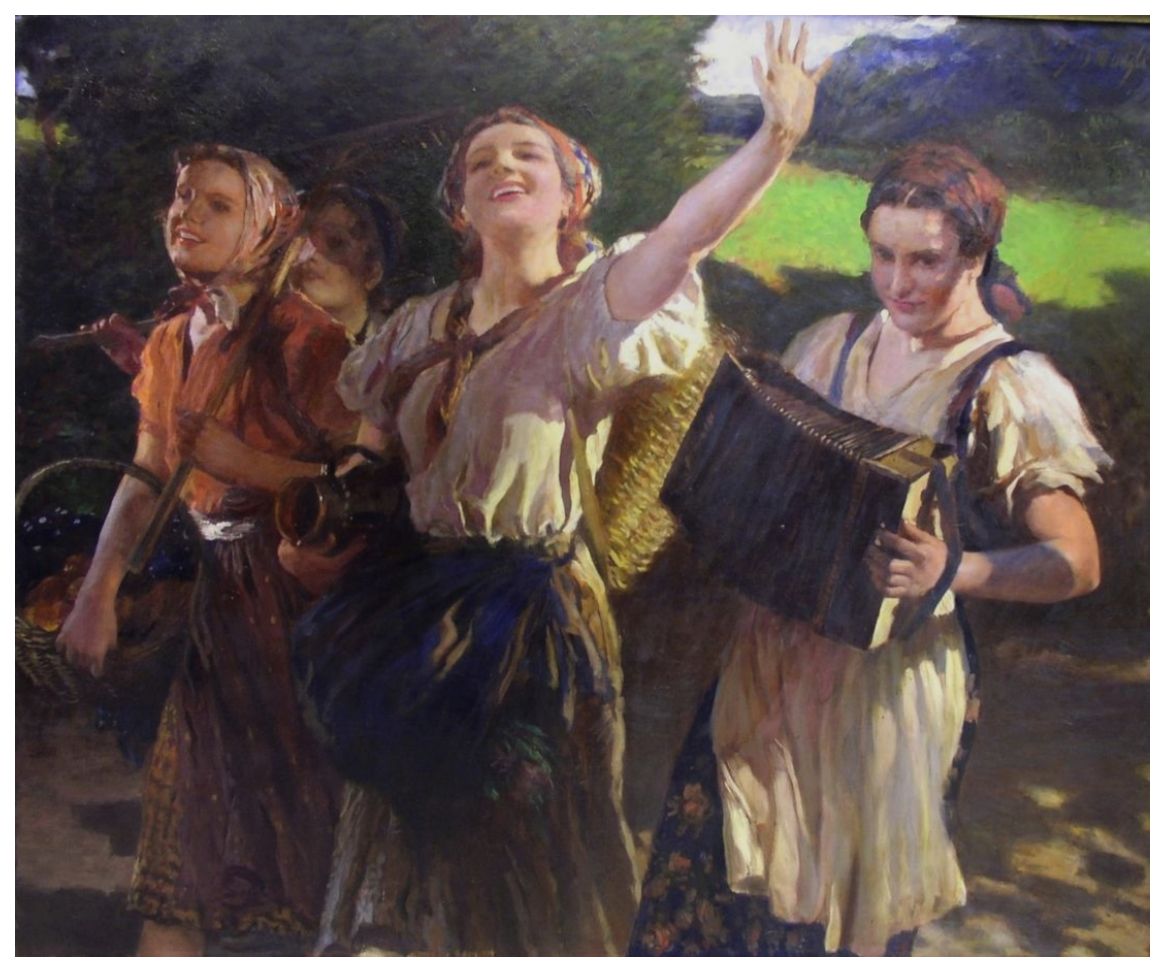
Nazi art rejected not only the future—represented by the avant-garde—but also its own present. To establish a common cultural language with the ordinary citizen, the technologically advanced German state subjected its artistic imagery to deliberate anachronisation. Although the Third Reich was expanding its motorway network and promoting motorisation, its paintings increasingly portrayed Germany as a land of horse-drawn carts and blacksmiths’ anvils (Figure 1). For many industrial workers, the idyllic Germany depicted in these kitsch images evoked a falsified memory of a pastoral past, which they contrasted with the hardships of life in modern, chaotic cities (Figure 2) [3]. “The image of unspoilt nature comes into being only through corruption, as its antithesis. […] What, in the context of bourgeois delusion, is called ‘nature’ is nothing more than the scar of social mutilation” [10] (pp. 38–48).
Hitler harboured a profound hostility towards the decadent art of the great cities, which he regarded as degenerate, capitalist, and international in character. National Socialism appealed instead to the bonds of blood and to the land, rather than to the intellect, which it viewed with deep suspicion [2] (p. 225). For Hitler, the antithesis of the refined Aryan spirit was the Jew, portrayed as devoid of creative capacity and culture, and concerned solely with the pursuit of material gain and bourgeois self-interest [3]. By rejecting urbanity, the official art of the Third Reich not only ceased to move forward but actually began to regress. An important architectural question to consider is whether the architecture of the Third Reich represented a deliberate retreat from modernity.

4.3. Subject Matter

The repetitive agricultural labour depicted in paintings that ignored mechanisation assumed the character of a quasi-religious ritual [3]. They depicted a world shaped through the force of human labour. Collective work during the harvest served as a powerful example of mobilisation and of the almost militaristic organisation of entire families functioning as labour units (for example, in Georg Ehmig’s Weinbergsarbeiterinnen (1935), Oskar Martin-Amorbach’s Erntetag (1938), and Hans Schroedter’s Schintter (1938)). Goebbels argued that art was a symbol of strength and security, as well as an expression of the nation’s immutable will. Symmetry, synchronised movements, and carefully staged gestures were intended to embody the stability and universal validity of such a way of life [3]. Henryk Kiereś writes of the use of such representations in the ideological manipulation of societies: “It may be observed that the greater the artistic truth—whether understood subjectively or objectively—the stronger the illusion of reality and, consequently, the greater the tendency towards a spontaneous, though at times naïve, acceptance of the truths present within represented worlds as truths concerning the real world itself” [11] (p. 69). The role of such a potential transfer is easy to understand. Similar to the halo effect—the tendency to attribute a range of positive qualities to an individual on the basis of a single observed positive trait—technically accomplished art could encourage the projection of its own qualities onto other aspects of reality, creating the impression that the German political system had already achieved its final and perfected form of social order. Kitsch is a mixture of truth and falsehood that obstructs access to a work’s essence [12] (p. 50). At the opening of the House of German Art in Munich, Hitler rejected eighty works as incomplete. In art, as in politics, only those who demonstrated effectiveness were granted legitimacy, whereas imperfection was subject to exclusion [3]. The ideal of flawless art also functioned as a means of diverting public attention from the regime’s increasingly frequent acts of violence.
In Adolf Ziegler’s triptych The Four Elements, four women are shown seated upon a stone bench, evoking the appearance of figures on an altar and suggesting their symbolic consecration to the nation. The work received exceptional recognition from Hitler himself, who displayed it above the fireplace in his residence [3]. The women represented in Nazi art were entirely devoid of individuality: they appeared either as robust peasant women (as in the paintings of Sepp Hilz), passive and expressionless mothers (Richard Heymann, Wolfgang Willrich), or as nude objects of eroticised display (in a pornographic mode, as in the works of Walter Einbeck, Wilhelm Hempfing, Ernst Kretschmann, Gisbert Palmié, and Robert Schwarz). Men, too, were reduced to the role of excessively muscular athletes devoid of inner life. These were realistic poses that were easy for the viewer to comprehend [3]. This was precisely what the few Expressionists who remained in the Reich opposed when they declared: “We will not paint skin.” They sought to create “psychological” portraits because they were not interested in outward appearance, but in the inner self [5]—in other words, in truth.
Artists who sought to avoid explicit praise of Nazism turned instead to conventional landscape painting, often incorporating the adjective “German” into their titles, as in German Soil and German Oak [3]. In this way, kitsch-like landscapes could secure state approval. Painting thereby ceased to engage with the world’s deeper essence. During the early years of the war, art encouraged people to march together behind the Führer. Later, as the tide of the war began to turn, images of heroic soldiers served to strengthen German morale, encouraging sacrifice and a willingness to die for the leader [3]. The most expensive film produced during the war years, The Great King (1942), begins as a blissful vision of idyllic German villages but concludes with a call to collective suicide. The initial pictorial clichés drawn from landscape painting—the mill, the cottage, the mother and child [3]—give way to a scene of mass slaughter following the rejection of the terms of surrender.
A question requiring further investigation in the context of architecture is whether the architecture of the Third Reich was designed to be understood on a purely superficial level, leaving no room for alternative interpretations, ambiguity, or change.

4.4. Reaching the Masses

None of these images could have influenced the attitudes of the ordinary citizen of Nazi Germany had they not reached their intended audience. Art could no longer remain the preserve of elites alone. As Clement Greenberg described: “Kitsch keeps a dictator in closer contact with the ‘soul’ of the people” [13] (p. 539). Workers were offered discounted train fares, as well as reduced-price admission to museums and concerts; orchestras were brought into factories to perform works by Beethoven, Brahms, and Wagner for industrial workers [13] (p. 539); and theatre groups brought performances to small towns that did not possess their own theatrical institutions. Kurt Heynicke even wrote two plays specifically designed for open-air performances aimed at popular audiences [2] (p. 233). Many artists at the time endorsed the state’s new approach to art, which sought to move away from elitism and towards broader accessibility [3]. They appreciated the opportunity to once again engage with a living audience. Once the art market had understood what was expected to be produced, further directives concerning artistic practice were no longer necessary—the opportunism of artists had already accomplished its purpose [3].
New technological developments ensured that propaganda reached the consciousness of an ever-growing number of workers and peasants, including within the privacy of their own homes. Germany was among the first countries to introduce television broadcasting [3]. As early as 1936, the Olympic Games were broadcast, while subsidies for radio receivers resulted in their presence in 70 per cent of households across the country [14] (p. 132). In the Third Reich, radio news broadcasts were deliberately infused with elements of entertainment by featuring prominent public figures, especially female singers, who were invited to appear regularly [8] (p. 277). Former stars who had fled the country, such as Marlene Dietrich, were replaced by others. Beyond their participation in making news from around the world more appealing to listeners (intellect alone was considered insufficient), they also performed promoted popular songs, such as “A Miracle May Still Happen” and “This Is Not the End of the World”, which were intended to strengthen public morale towards the end of the war (through emotional appeal). In Mein Kampf, Hitler identified the key point to which official communication should appeal: “Propaganda should primarily appeal to the emotions and only to a very limited extent to so-called intellect. […] The masses’ capacity to absorb political ideas is very limited, and their ability to understand them is slight” [8] (pp. 276–277). In the case of architecture, an analogous strategy may be found in the desire to evoke a superficial impression of engagement with high art and a sense of stability, rather than to encourage genuine reflection.

4.5. The Aestheticisation of Politics

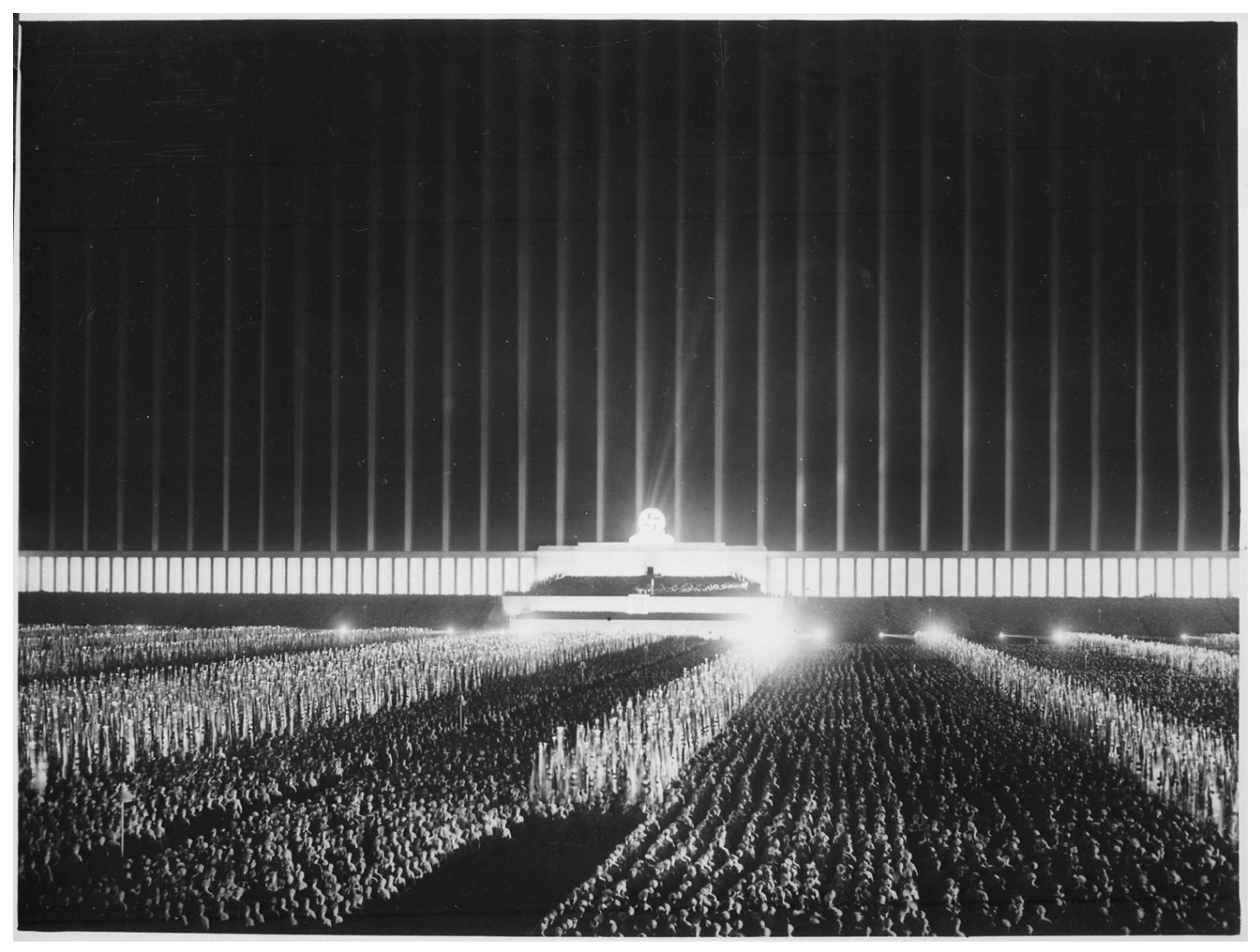
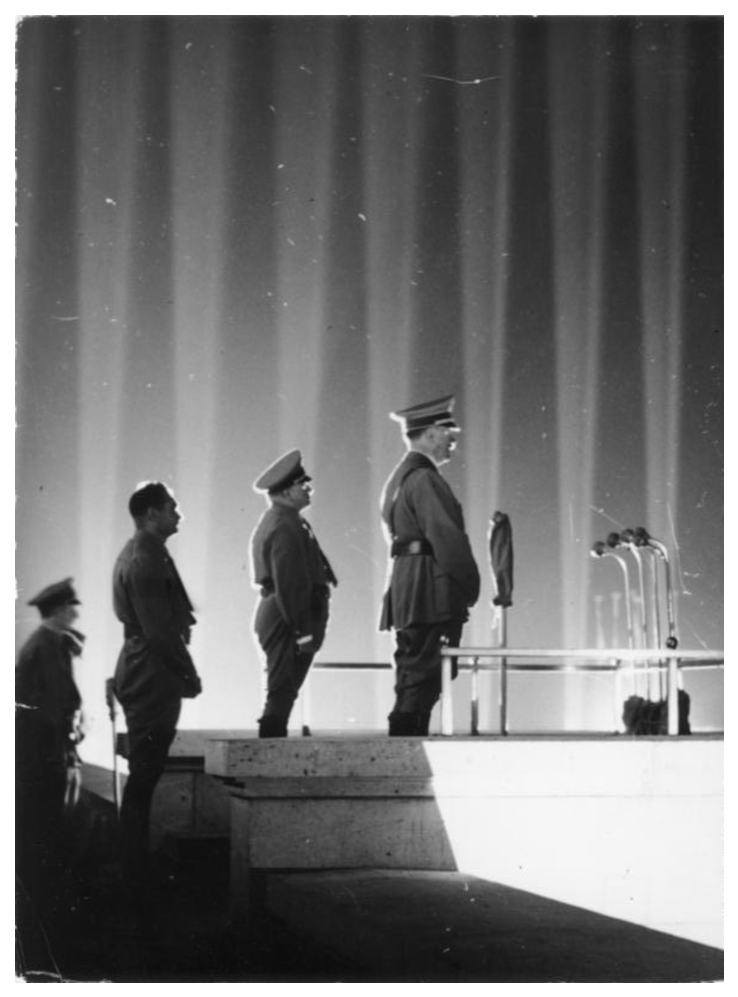
Both Hitler and Mussolini attached great importance to the visual and performative dimensions of their public speeches. The meticulously choreographed movements of mass formations of soldiers, combined with Hitler’s oratory, resembled a monstrous ballet (Figure 3) [3]. Geometric and symbolic formations were composed from marching troops, tanks, and even aircraft manoeuvring in the shape of a swastika [3]. Such spectacles required an appropriate architectural setting. Architecture was designed specifically to serve as their backdrop. Albert Speer, Hitler’s personal architect, designed monumental searchlights that created a theatrical setting around the Führer, reminiscent of a stage production (Figure 4) [15] (p. 40). The mechanisms of popular cinema were thoroughly understood by the architects of propaganda, and nowhere did the relationship between politics and film become more closely intertwined than under the Nazi and Fascist regimes. The spectacles staged at the Nazi Party rallies combined elements of Catholic religious ritual with the left-wing Expressionist interplay of form, light, and shadow for which German experimental cinema of the period had become renowned [14] (p. 201). Step by step, political debate became increasingly aestheticised, gradually transforming into a public spectacle in which crowds erupted simultaneously into enthusiastic applause at Hitler’s dramatic gestures and even warm laughter at the sight of Mussolini flexing his muscles. As Walter Benjamin famously observed, “Fascism aestheticises politics; communism politicises art” [16] (p. 51). In her analysis of mass culture, Hannah Arendt identified a connection between aesthetic taste and political opinion [17] (p. 538). Both require a certain degree of persuasion and are concerned not with immutable truths but with opinions about the shared world and its future.
Within the avant-garde, one finds a distinct current that would have been particularly well suited to incorporation into the vision of total propaganda. Happenings and forms of participatory art that transform spectators into active participants appear almost tailor-made for quasi-religious ceremonies, and it was precisely this ritualistic character that Nazi parades displayed. The aim of this new art is no longer the contemplation of beauty but the creation of an experience that was almost religious in nature—often brutal and primitive, and, most importantly, stripped of any supernatural dimension while glorifying physical strength [18] (p. 417).
In a stable state with a continuous historical development, public ceremonies evolve over many decades. Rituals require their own forms of representation; however, once external form becomes more important than the essence of the ritual itself, the conditions for kitsch begin to emerge [12] (p. 50). The originally complex embodiment and expression of an idea is replaced by the mere act of representation itself (“fallen allegory” according to Margaret Cohen) [7] (pp. 606–607). Parades were rituals that Hitler had to recreate from the ground up in the Third Reich. Unconstrained by tradition and drawing upon the latest technologies, they proved to be remarkably modern. The research of Boris Lomov demonstrates that a concept reaches the human mind through an image seven times faster than through words and is also six times more powerful in its impact [19] (p. 212). Architecture played a significant role in the process of reaching citizens and unifying German society, serving as a setting for mass events. Hitler himself famously referred to architecture as “words in stone” [20] (p. 142).

5. Kitsch in the Official Architecture of the Third Reich

5.1. Kitsch in Architecture

According to Broch, the following characteristics of kitsch may be identified: the pursuit of approval from the widest possible audience; the avoidance of extremes (including a lack of recognition for unconventional opinions); superficiality of stimuli; a lack of subtlety in expression—an emphasis on the maximal intensity of experience, its extremity, and “operatic” quality; expressive force intended to liberate form from profound content; and the mediocrity and immediacy of the effect produced (after Gabriela Żuchowska [21] (p. 136)).
Abraham Moles (following Engelhardt and Walther Killy) identifies five principles of kitsch: inadequacy (the deviation of form from its intended purpose); accumulation (excess, or “over-elaboration”); synaesthesia (the stimulation of the greatest possible number of senses); mediocrity (conformity, imitation, and the averaging of preferences); and comfort (the pursuit of well-being and pleasant experience) [22] (pp. 76–81). Writing directly about kitsch in architecture, Moles identifies the following tendencies: “neo” tendencies combined with stylistic eclecticism; and overloading, including excessive ornamentation [22] (pp. 112–118).
Tomáš Kulka defined as kitsch those works of art that possess just three characteristics (but necessarily all three simultaneously): a subject matter generally regarded as beautiful or capable of evoking positive emotions; an immediate and effortless readability of the work; and a conventional, non-enhancing representation of the subject matter [23] (pp. 4–9). This poses a problem for architecture because it is a non-denotative art form. In other words, it does not have a subject in the same sense as works belonging to most other artistic disciplines. However, because the present study considers architecture as a tool of propaganda, and thus as a means of disseminating ideas, the author includes this criterion in the analysis. “Pure” architecture (if such a thing were to exist) would be non-representational art. Kulka recognises the difficulty of achieving abstract kitsch [24] (p. 32). In architecture, he identifies two ways in which kitsch can manifest itself [24] (pp. 104–106). The first is the imitation of historical styles. The second is buildings that literally adopt the forms of other objects, such as naval vessels or hamburgers.
Table 1 juxtaposes all of the above characteristics with the issues discussed in Section 4. The final column proposes a probable architectural context. In the subsequent part of the article, Roman ordinal numbers corresponding to the characteristics identified in the architecture of the Third Reich are provided in square brackets at the end of paragraphs.

5.2. The Official Architecture of the Third Reich

The architecture of the Third Reich, apart from the monumental style considered appropriate for the regime, also encompassed other tendencies. This pluralism, however, was motivated by nothing other than the desire to generate minor conflicts among architects. Hitler intended the representatives of different tendencies to compete with one another for his favour, ensuring that no single group acquired a monopoly that could diminish the decisive, almost consecrating role of the Führer in the selection of designs [15] (p. 49). He permitted stylistic diversity within official architecture: Neoclassicism in state administrative buildings (such as the projects of Paul Ludwig Troost in Munich), Modernism in functional Luftwaffe buildings (the Volkel air base in the Netherlands, 1942), and a pseudo-rural style in military residences (the guest house at Ottens Hof, 1937; Hermann Göring’s hunting lodge, Carinhall, 1933). Philip Johnson, an architect and architectural critic, even referred to one of the styles of Nazi Germany as the “kitsch of [Paul] Schultze-Naumburg” [15] (p. 118). Traditional, vernacular architecture is the first to come under examination.

5.2.1. A Sense of the Familiarity

Just as the avant-garde in art was rejected, so too did modernist architecture fall into disfavour with the Nazis. It was associated with the allegedly Semitic tendencies they despised, while the preferred architectural language was intended to evoke a desire to return to the Heimat (one’s native region), which was to be protected from external influences [3]. Its very name—the “International Style”—as it gained increasing popularity, could not have escaped Hitler’s attention [15] (p. 50). Modernism therefore had to give way in Germany under the new, derogatory label of “rootless cosmopolitanism” [15] (p. 46). Schultze-Naumburg believed that only architecture rooted in the Heimat and derived from the models of German villages, castles, and the Biedermeier style could resist the negative effects of rapidly advancing industrialisation [25] (p. 1227). This architecture “expressed his [Hitler’s] opposition to the bourgeois individualism of the modern city” [15] (p. 69). Set against the urban environment, the countryside presents the modesty of noble architecture as being offset by the enchanting beauty of the German natural landscape [26] (p. 146). It was a style closely aligned with the idyllic vision of the country promoted by the propaganda discussed in Section 4.
The German peasant homestead, with its thatched roof and timber framing, served as the model for the Berchtesgaden guards’ barracks [15] (pp. 46–47). Although the traditional cottage is not kitsch in itself, its context alters the way it is perceived. It is the insincere and naïve attitude towards a work, as well as its detachment from reality, that determines whether it may be considered partially kitsch [27] (p. 163). Kitsch is simultaneously familiar and inauthentic. Kurt W. Forster identified precisely this aspect—the deliberate and insistent evocation of idyll—as a defining characteristic of kitsch in architecture:
“In my opinion this notion […] refers to the illusion that everything is great and lovely. It involves pretending that the world is like a fairy-tale […] and that such idyll exists in everyday life, whereas it simply is not true. As a desire or an illusion, such thinking can be easily transferred into an architectural form, full of dreaminess and naïveté. Such buildings are created either by or for people who do not sport the courage to look at the world realistically and see it maturely for what it really is in its complexity accessible for our perception” [27] (p. 162).
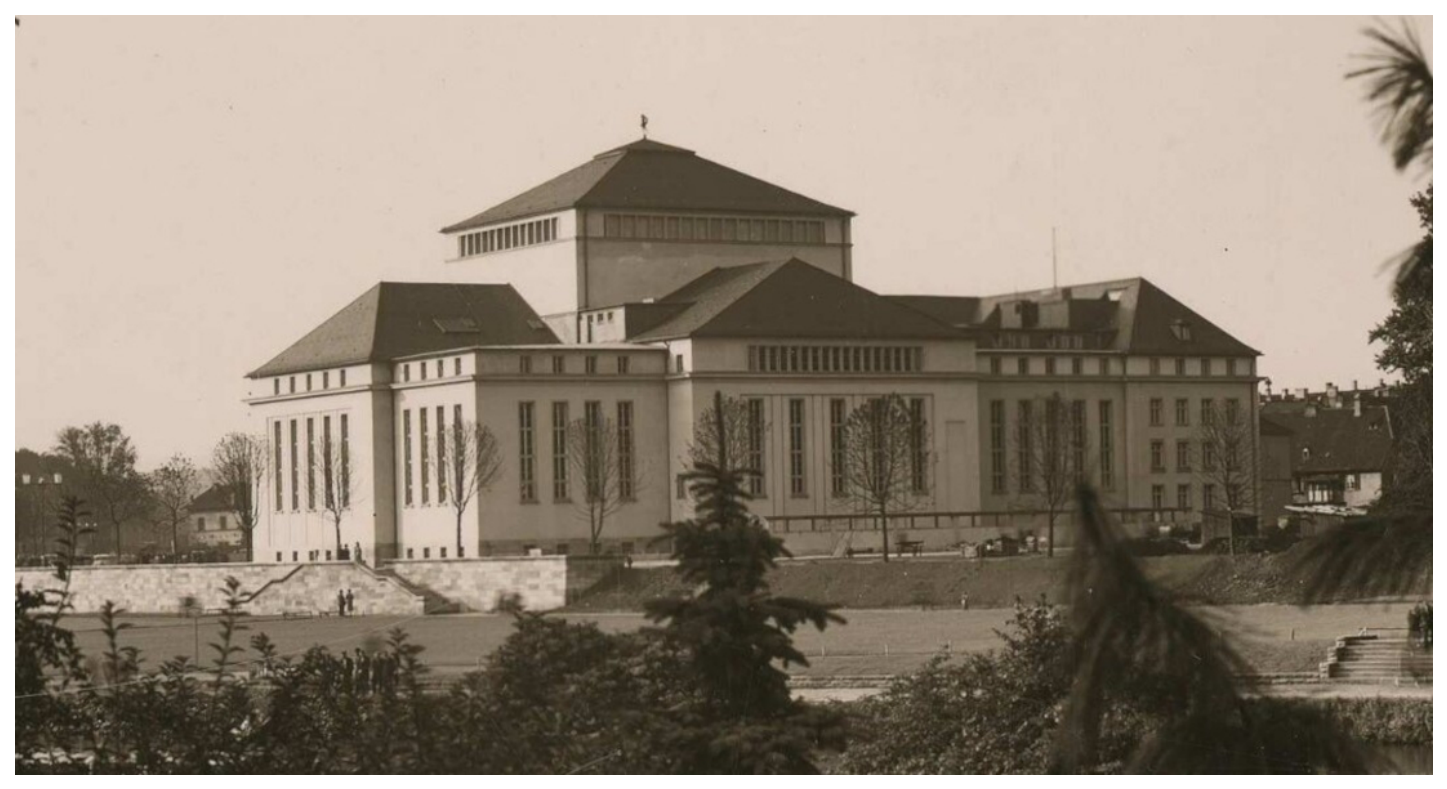
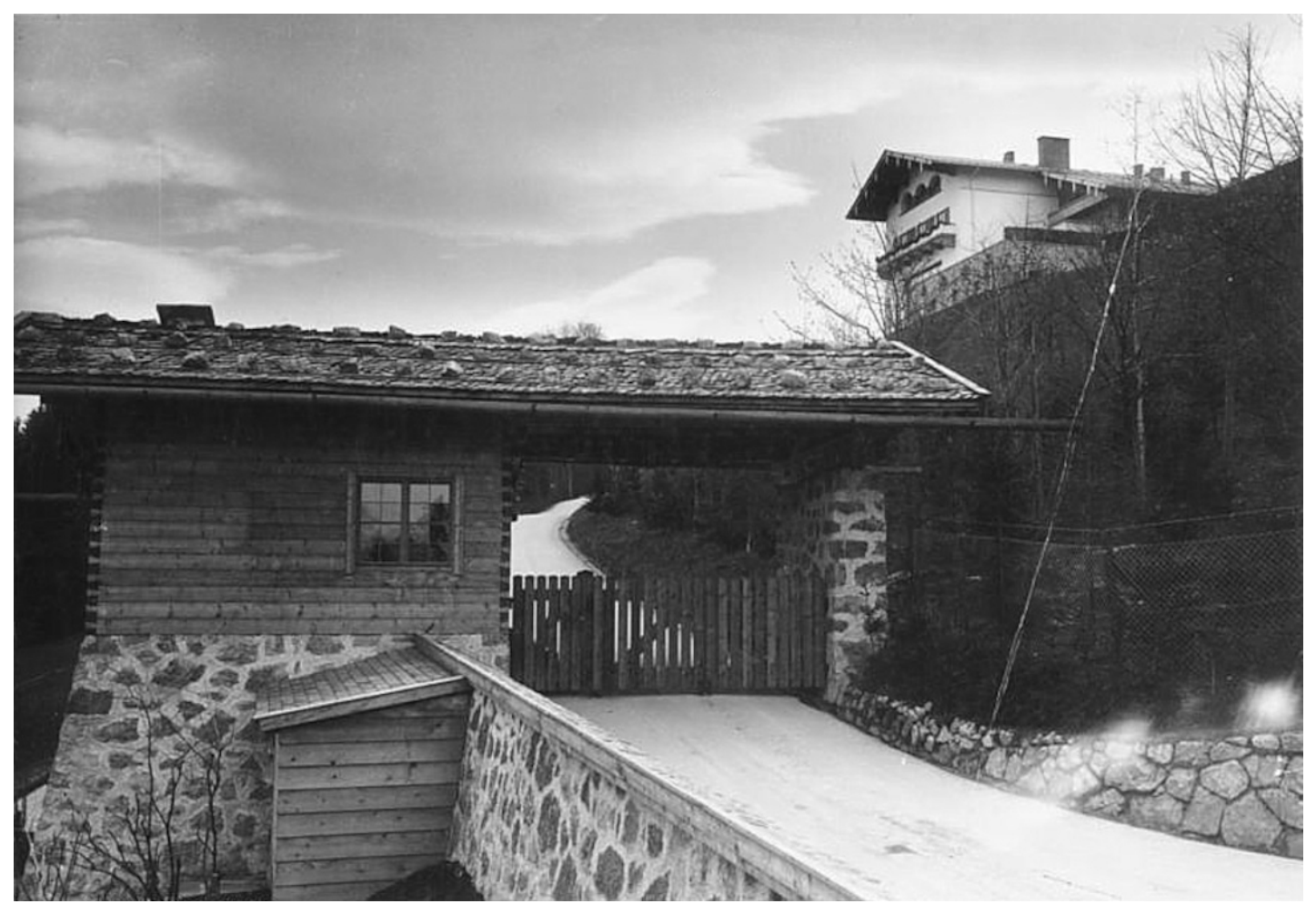
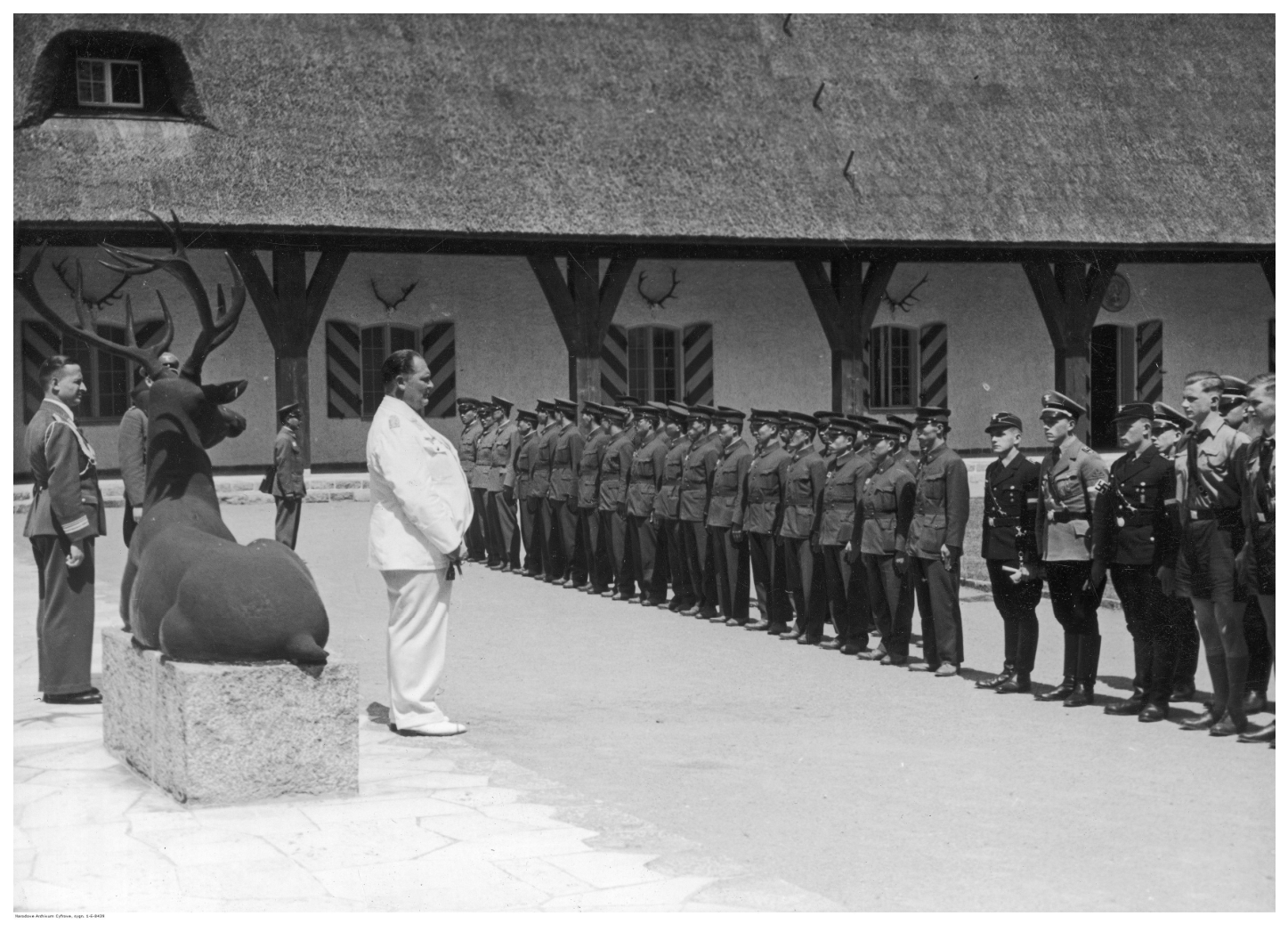
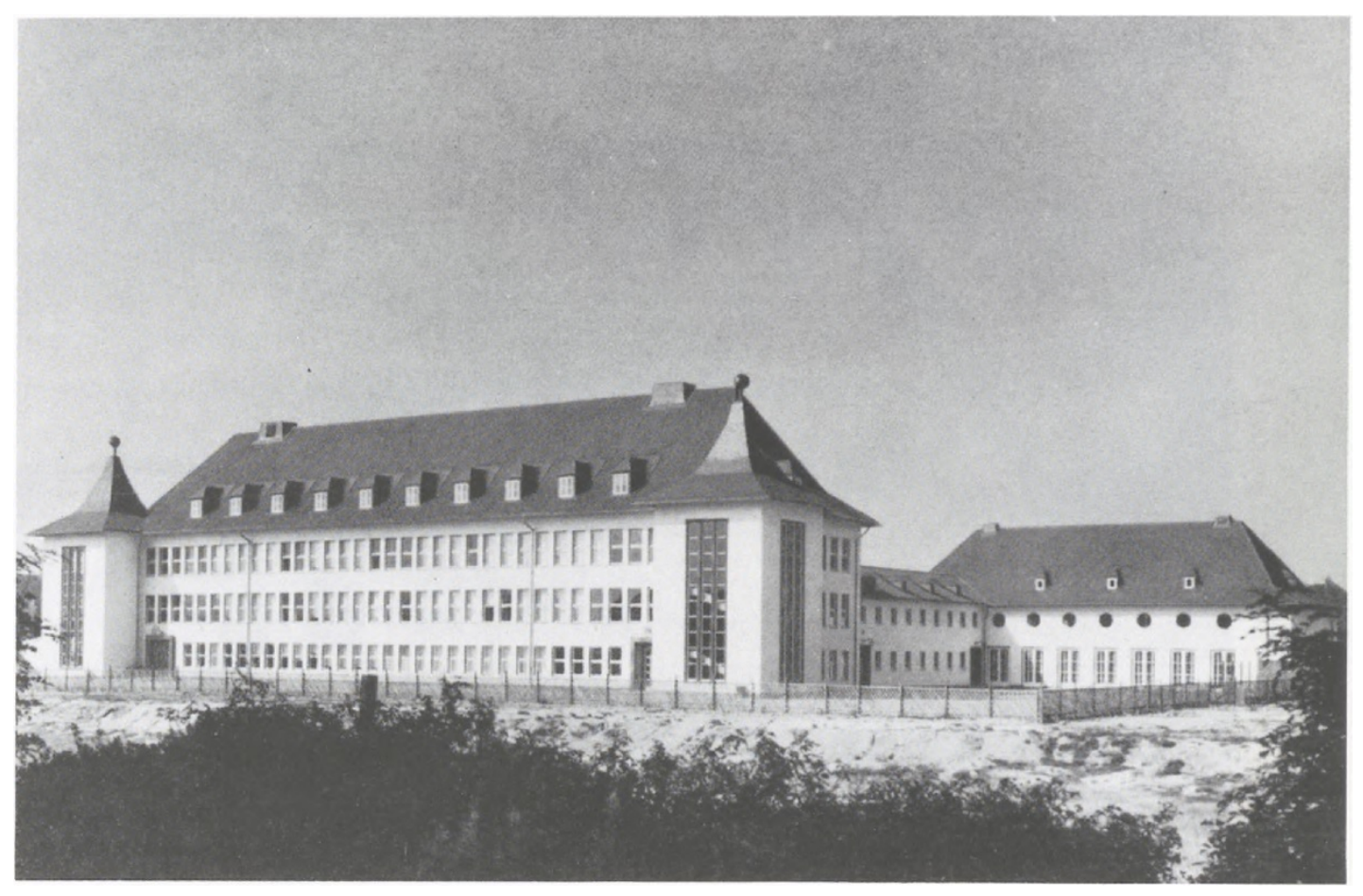
In Berchtesgaden, the fairy-tale image of domestic hearth and home conceals the reality of the hardships of barrack-like accommodation, while in the case of the theatre in Saarbrücken (Figure 5), the small-town character of the form serves to mask the vast scale and complexity of the theatrical complex. How different is the role of the Berghof complex’s guardhouse (Figure 6), which resembles a rural cottage, from that of an actual rural dwelling, where every weary traveller is warmly welcomed. In the case of residences, their traditional appearance alone does not constitute grounds for accusing them of kitsch. Rather, it is the discrepancy between modesty and luxury that suggests a kitsch-like incongruity and a form of gentle embellishment. Hermann Göring decorated the spacious, art-filled interiors of his villa at Carinhall with German architectural elements (fireplaces and ceilings) and decorative motifs (uniformly arranged, identical hunting trophies), creating a striking collage of native familiarity and grandiosity (Figure 7 and Figure 8). A similar sense of dissonance could have been experienced by anyone crossing the threshold of Goebbels’s rustic villa at Bogensee (1939) and entering one of its seventy rooms. Kitsch may be said to occur when a copy of an earlier work is clearly incompatible with its intended function and with the historical period in which it appears (Figure 9) [27] (pp. 170–171), when we perceive a clear discrepancy between the creator’s intention and an execution that fails to live up to it. A residential building should assume a different appearance when its purpose is to provide simple shelter than when its intention is to create a magnificent villa [I, IV, V, VI].

5.2.2. The Cult of Old Germanness

Designs based on agricultural layouts, rural settings, and small-town environments could draw upon vernacular architecture; however, intervention in significant monuments and larger cities had to proceed differently. The influence of history on society was present in conceptions of the propagandistic role of public space. Schultze-Naumburg was a co-founder of a preservation organisation whose aims also included the organisation of tourism [25] (p. 1227), additionally subsidised for those with limited financial means.
Monuments from the period of Germany’s greatness were restored as though history had come to a standstill after their construction. In both their policies and their rhetoric, authorities and conservationists even attacked the historical periods that separated the First Reich from the Third [29] (pp. 170–173). The restorations and reconstructions carried out in the centre of Nuremberg during the 1930s and 1940s focused on the medieval aesthetic associated with the period of Germany’s former greatness—the Holy Roman Empire (962–1806, commonly referred to as the First German Reich). At the Renaissance-era Wewelsburg Castle, the plaster was removed (although it had most likely been part of the building from the outset), and a new moat was constructed around the castle in order to give it a more medieval appearance. From 1933, when the NSDAP came to power in Gdańsk, a pre-Nazi plan was implemented to remove the Art Nouveau “clutter” from the façades, through which “the subordination of the whole was lost, as each [building or its owner] sought to outshout the others at the expense of a living harmony and rhythm” [30] (pp. 320–321). Kitsch avoids producing an individual aesthetic experience; instead, it preserves stereotypical emotions through established forms. It relies on proven solutions and avoids risk. The grand axis extending from the newly constructed Nazi Party Rally Grounds outside Nuremberg (where the mass ceremonies depicted in Figure 3 took place) was intended to lead directly towards the Imperial Castle. Through this literal spatial connection, the Nazi authorities sought to create, in the public imagination, an association with former glory. The past was not used as material for the creation of a new visual language; rather, it was applied in a literal, even stereotypical and distorted manner. Even the intricate stylistic plurality of history was to be simplified and unified—reduced to a banal form [V, VI].

5.2.3. Classical Antiquity

Very often, a ruler with imperial aspirations seeks to leave behind a monument in the form of significant architecture. Such architecture is intended to demonstrate the greatness of the state. When the architect’s primary objective becomes the production of an overwhelming effect, and when the appearance of the work is pursued with excessive concern for immediate impact, the result may descend into kitsch. In kitsch, the criteria of evaluation are reduced, and the opinion of the viewer becomes the predominant measure of value [21] (p. 133). Hitler justified the scale of the planned reconstruction of Berlin by referring to its propagandistic function: “Our enemies may be able to infer this, but our supporters must know it” [15] (pp. 56–57). When looking at the city, he did not perceive it as an organism shaped by processes emerging from below, but as a monumental and immutable manifestation of power. He declared that: “Berlin, as the capital of the world, can only be compared with ancient Egypt, Babylon, or Rome! What is London in comparison with it, what is Paris!” [28] (p. 68) Considering himself the builder of another German empire, he was interested almost exclusively in monumental architecture [28] (p. 67). He devoted particular attention to public buildings, as expressed in the following words: “Even the splendour of the later Roman Empire was not constituted by the villas and palaces of individual citizens, but by temples, baths, stadiums, arenas, aqueducts, basilicas, and so forth, which belonged to the state and therefore to the entire people” [15] (p. 56). Public buildings of a supra-local character do not form part of the everyday lives of ordinary people. They are visited on exceptional occasions and are often additionally adorned for special events. Such architecture can sometimes affect people in a manner similar to theatrical scenery; its artificiality does not appear disturbing, but is consciously accepted [27] (pp. 164–165). Its representational character, monumentality, and use of familiar styles do not evoke a sense of encountering kitsch, provided that they do not lapse into bad taste. The architecture of public buildings in the Third Reich is, in most cases, architecture that was competently designed.
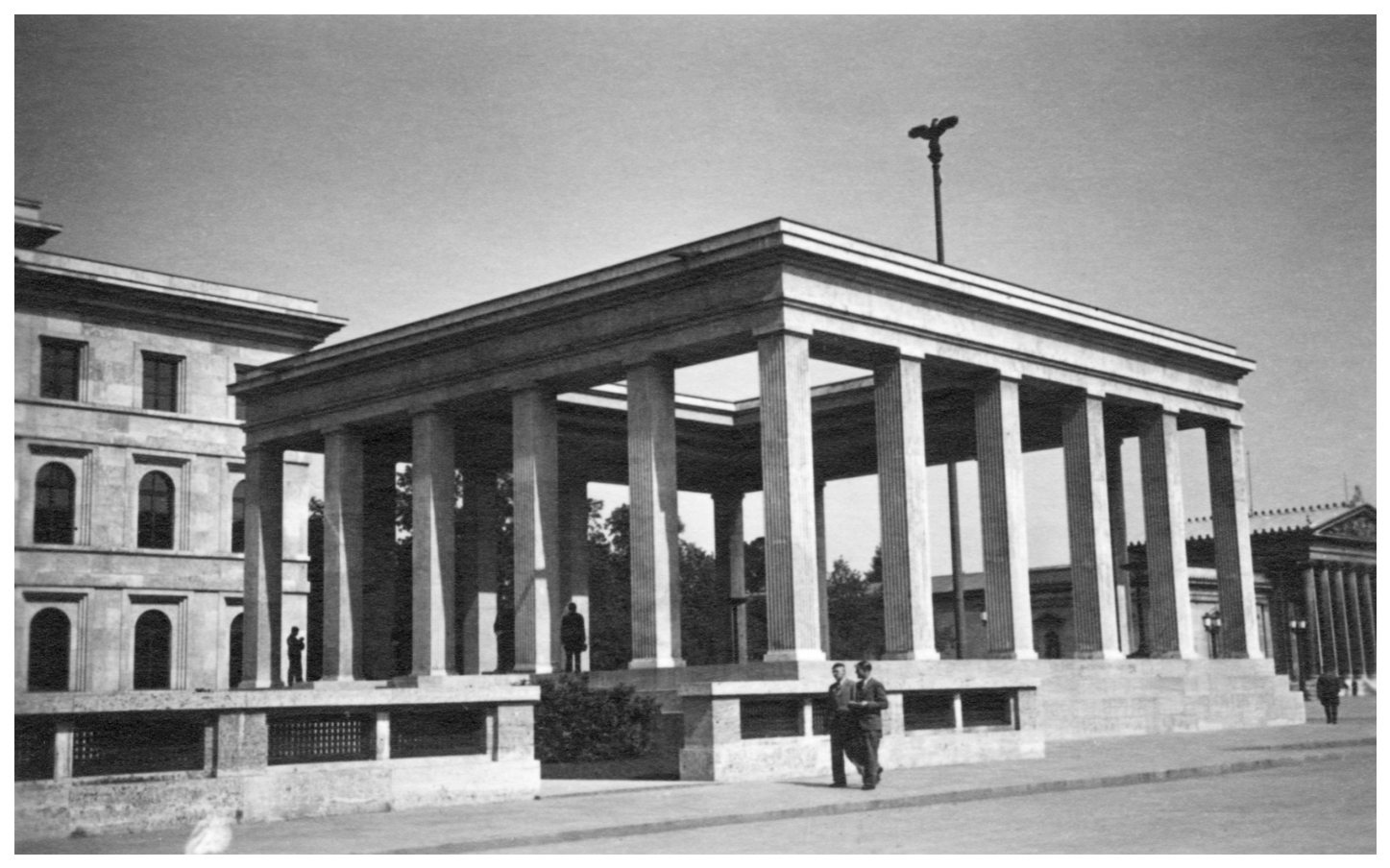
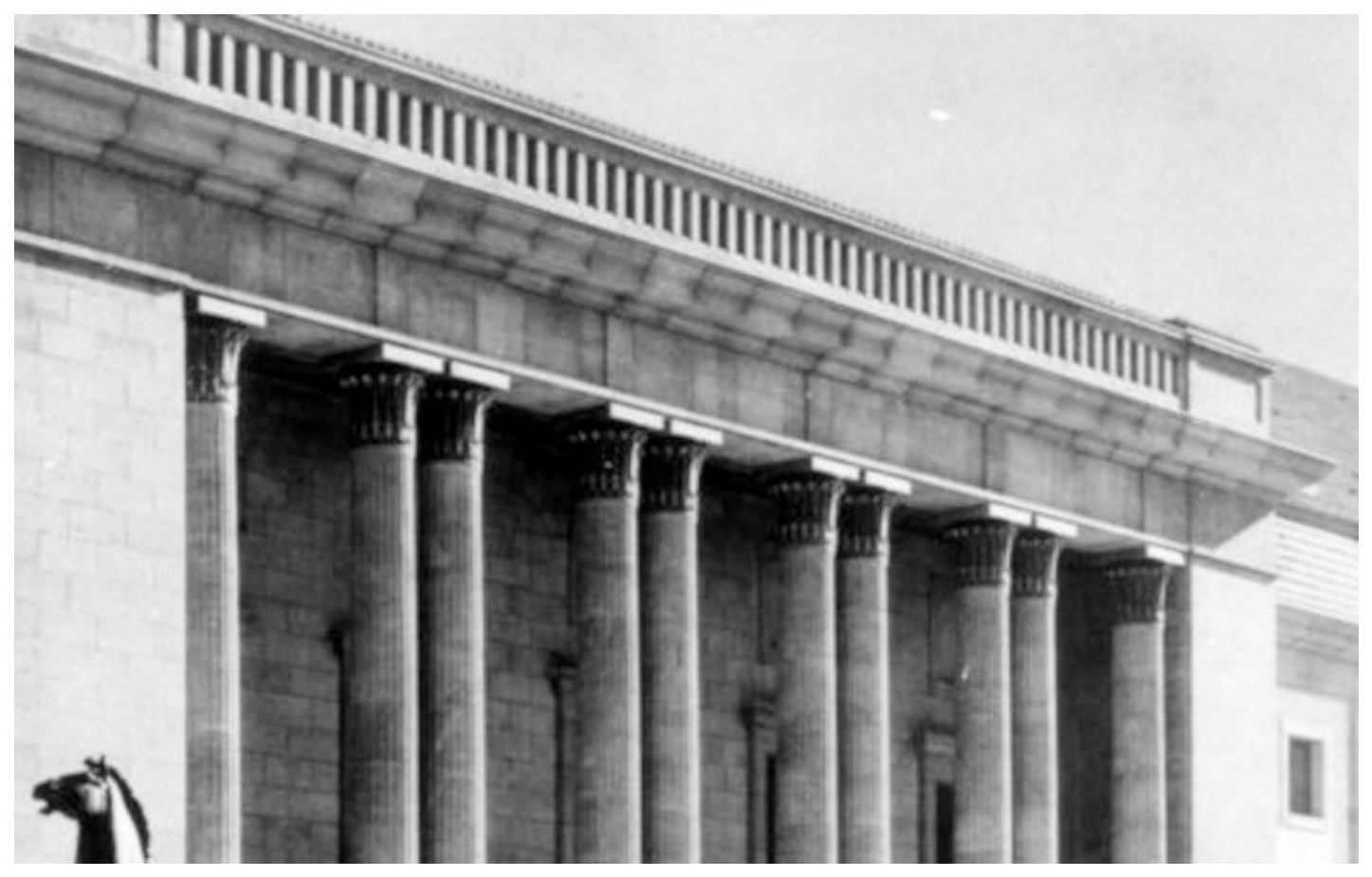
Public buildings of the Third Reich conveyed their messages through easily recognisable, and at times artificial, costumes of continuity with tradition—medieval and Renaissance (through the use of existing castles), classical (the Temple of Honour, Munich, 1935 (Figure 10)), and even Egyptian (the Reich Chancellery, Berlin, 1938 (Figure 11)) [3]. In some cases, Roman architectural forms were eclectically combined with Greek sculptural traditions [20] (p. 148). All of this was accompanied by an added element of Germanness. Andrzej Jakimowicz identifies kitsch in “the disruption of regional and cultural authenticity and the adoption of the standards of a foreign mass culture” [21] (p. 137). The very word kitsch, originating as it does in nineteenth-century Germany, has—apart from denoting cheapness aimed at those seeking easily accessible aesthetic gratification—a second meaning: to imitate furniture in such a way that it appears antique. Kitsch pursues an easily achieved sentimental effect that reinforces conformity. The problem arises when the term is applied to something that, despite its artificiality or theatricality, is beautiful. By genuinely moving us, it becomes true art [27] (p. 168). What some may regard as a flaw—the Third Reich architects’ ready recourse to the costume of Classical Antiquity—is in fact a characteristic frequently associated with public buildings intended to serve as the legacy of a self-assured ruler. The prefix neo- signifies that nothing fundamentally new is being created; rather, an existing repertoire of historical forms is being revisited. Such forms are not necessarily inappropriate. They may possess a timeless quality, and this was undoubtedly the aspiration of the Nazi regime (the classical style, associated with civic virtue, had already been employed in Germany since the nineteenth century [20] (p. 140)). The high quality of craftsmanship displayed by the buildings discussed here places them within the established tradition of the classical orders, leaving only limited scope for elements of kitsch [VI].
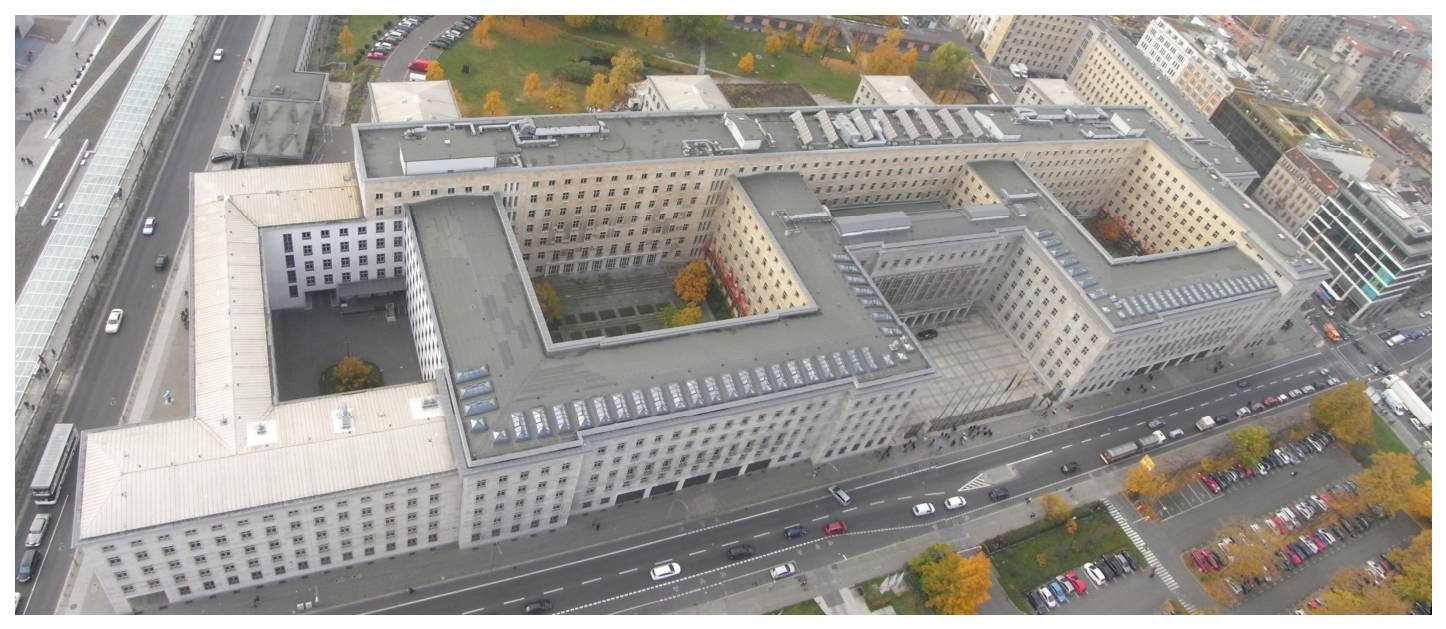
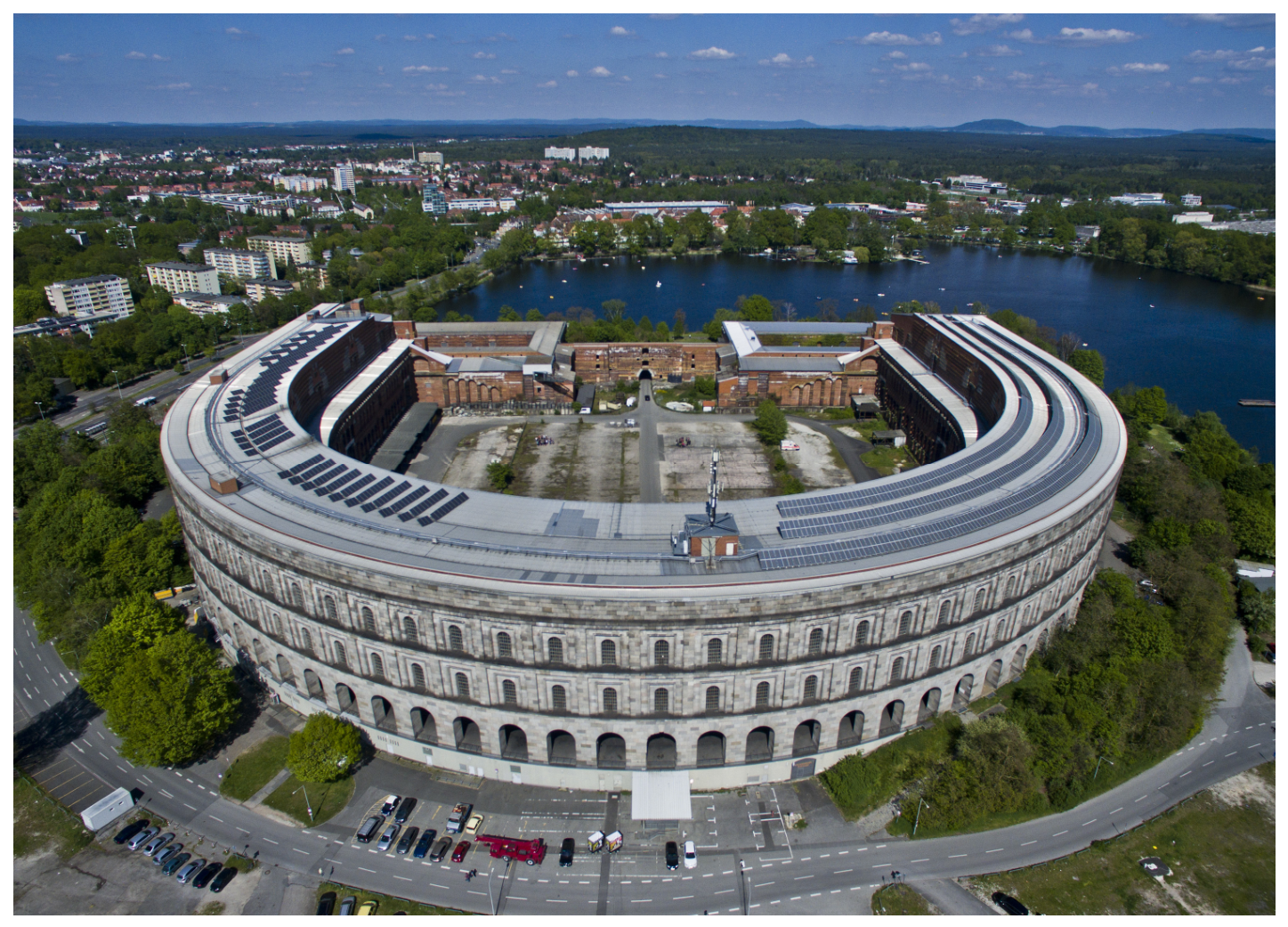
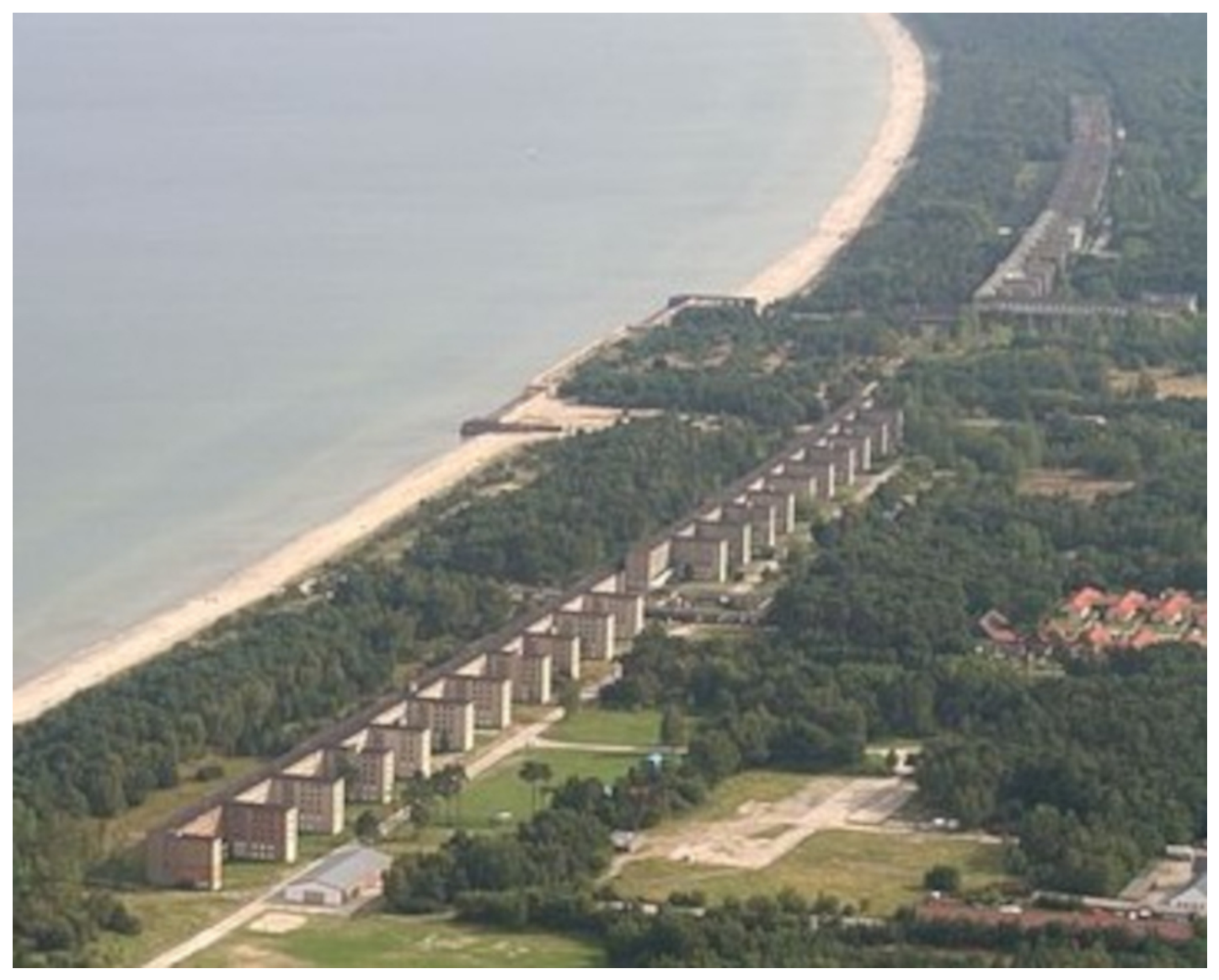
Some of the regime’s buildings were conceived on such an immense functional scale that it is difficult to identify a rational architectural size for them. Designs included a 500-m gallery-corridor in the Führer Palace, a 214.5-m column, a 117-m Triumphal Arch, the world’s largest airport (Tempelhof), the largest steel-framed building ever proposed (the Munich Central Railway Station), the tallest skyscraper (250 m), and the world’s largest building (the Great Hall, designed to accommodate 180,000 people) [28] (pp. 69–70,77,79). Błażej Prośniewski argues that “open, untamed space may evoke a sense of threat, danger, and a place of conflict” [31] (p. 11). Within oversized architectural spaces, it becomes difficult for the individual to locate oneself. Among the realised projects, those that appear particularly oversized and monotonous owing to the repetitive treatment of their façades include the Reich Ministry of Aviation, Berlin, 1939 (Figure 12), and the unfinished Congress Hall in Nuremberg (Figure 13). Just as soldiers marched in their thousands during military parades, so too do these buildings sometimes display a grotesquely large number of columns—for example, Hitler’s grandstand at the Zeppelin Field (Nuremberg, 1935–1937) featured thirty-eight columns (including the terminal engaged half-columns) in each wing (Figure 3). These vast projects leave little room for any notion of the chaotic, organic movement of urban life. Instead, they embody the ideals of perfection, synchronisation, and symmetry discussed in Section 4.3. Symmetry, in particular, greatly restricts the potential for future expansion. A symmetrical building appears complete and self-contained. In this way, totalitarian ideology effectively projected an image of organisational perfection (Figure 14). Despite their maximalism of scale and repetition, these buildings do not generally appear ridiculous. At most, one may occasionally sense their façade-like, scenographic character [II].
The word order—which carries clear associations with discipline—was also adopted to denote systems of formal proportion in architecture (as in the expression “the Doric order”). One of the principal virtues of the established architectural orders was the ease with which they could be employed by the ordinary builder [32] (p. 106). In Nazi Germany, the architectural orders were further simplified, both in building massing and in architectural detail [20] (p. 149). This austere architecture stood in contradiction to its own prototype. The diverse architecture of so-called “democratic” Greece became the model for the monotonous architecture of “totalitarian” Germany, which impressed upon the individual citizen his own insignificance. A prerequisite for the emergence of kitsch is the existence of a mature culture from which it can draw. Kitsch appropriates its themes, techniques, and motifs, transforming them into a rigid system while stripping them of their essential meaning [17] (p. 539). The use of neo- styles in architecture may resemble the act of “painting only the skin” when the architect’s attention is focused primarily on outward appearance—on the costume alone [IV].
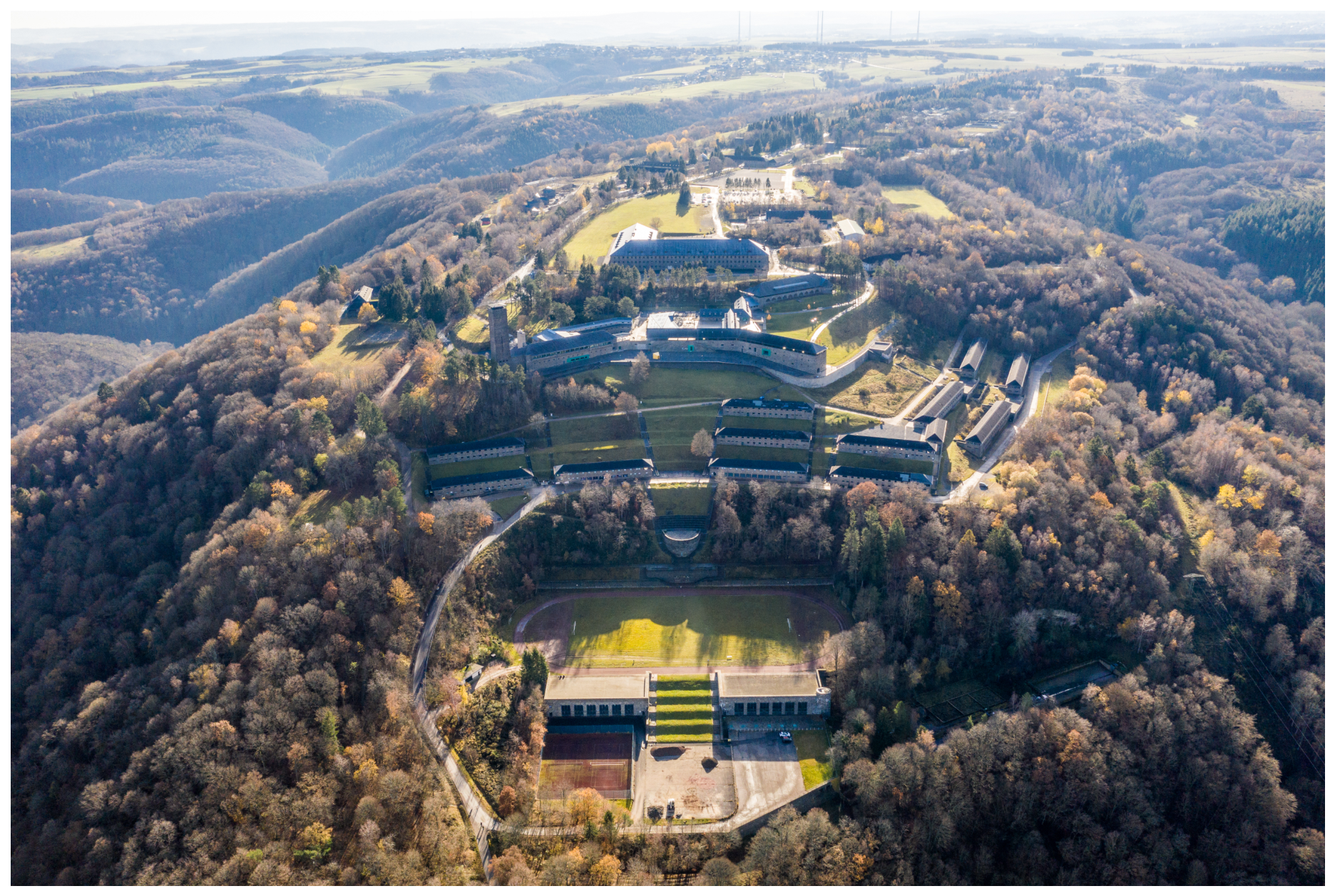
Just as traditional forms were promoted in the arts (folk dances, encouraged through films and public ceremonies, were Hitler’s response to the urban nightclubs where the prohibited jazz music was performed [3]), similarly, German architecture placed emphasis on traditional materials. Buildings were constructed of stone (or had their façades merely clad in stone), while interiors were finished with wood at a time when concrete had become the leading material in architecture worldwide. In this way, they created the appearance of honest, craft-based workmanship in projects that were often produced through industrial methods. The buildings imitated medieval fortresses—symbols of stability, defensiveness, and eternal values (Figure 15)—while the appearance of their future ruins was additionally orchestrated: structures made of stone were intended to age with greater dignity [28] (pp. 61–64). Entirely new structures were even constructed in imitation of ancient Germanic sacred sites—Thingstätte [I, VI].
The rebirth of Aryan Germany—a fabricated political construct—was to be legitimised through references to classical antiquity and the early Germanic past in architecture. Hitler’s regime, which was highly modern in many respects, was represented architecturally as a direct continuation of local traditions and former greatness.

6. Results

In conclusion, the architecture of the German Reich was generally successful, and the characteristics of kitsch can be identified within it only to a marginal degree or in aspects that are understandable within the context of the architecture of power. The art of shaping space has, since time immemorial, served to create desired effects for the theatre of human activity. Looking at the Germans’ loyalty to their leader, one might venture to suggest that Nazi architecture effectively fulfilled its intended purposes. Nevertheless, to a limited extent it was kitsch-like, much like the regime’s other artistic production: artistically unambitious [IV], oversized and reliant on excessive repetition [II], clear and unambiguous in its message [V], and at the same time deceptive [I, VI]. It must be acknowledged, however, that all these characteristics touch upon the problem of kitsch only to a minimal extent. The first two features are visible and correlate with kitsch only to a limited degree, while the remaining ones do so even less.
Regarding I, IV, VI—In the art of this modern political system, one can observe at a certain point a retreat from creatively rich solutions towards simpler ones. A similar process occurred in architecture: aesthetics shifted from a modern character towards a pseudo-rural or pseudo-historical one—classical or medieval. While living in Vienna, Hitler appeared not to perceive the city’s modern Viennese Secession, but rather only its historic Baroque heritage. He never held an admiration for living, new, creative art [15] (p. 51). None of the architectural styles of Nazi Germany was innovative—the monumental style was based on the well-established tradition of Neoclassicism, while the rural style drew upon the Arts and Crafts movement [3]. Recognisable motifs were employed, a neutral mass taste was targeted, and immediate acceptance was sought rather than creative originality commensurate with the scale of the transformations that were planned. It is difficult to identify buildings from this period that can today be appreciated for their formal innovation. The reliability of their execution and the seriousness with which the architectural task was approached do not place these works on a par with kitsch as it is commonly understood.
Regarding II—The formal language of architecture was likewise simple; rather than relying on meticulously elaborated ornament, this architecture employed the general expressive qualities of its volumes—simple, austere, and solid [28] (pp. 65–66). Symmetry was employed very frequently, further simplifying perception—one need only examine one half of the composition and glance at the other. The choice of such a brutal aesthetic corresponds with a political system founded on violence. The only characteristic of kitsch that occasionally emerged as a result was accumulation. The compositions were legible and consisted of only a few elements, which led to excessive simplicity, overscaling, or excessive multiplication. This does not, however, provoke a condescending smile; rather, contrary to the intended effect, it evokes sadness and a sense of the individual’s insignificance. For this reason, it is difficult to describe the final result as kitsch.
Regarding V—Falsehood and the refusal to acknowledge the complexity of life in favour of a clear and coherent vision constitute another aspect of the art of Germany at that time that possesses, to a certain extent, a kitsch-like quality. The Nazis cannot be accused of lacking faith in their vision of the empire they sought to build. Nor can one reasonably assume that official architecture would in any way challenge the authority of the regime. After the stock market crash of 1929, many states (regardless of their political systems, as in the cases of the United States, France, and Italy) sought to demonstrate their stability and strength to their citizens through architecture that was simultaneously modern and classical, universal and national [33] (pp. VI–VII). In such cases, we should speak of propaganda, perhaps even deception, but rather not of kitsch.
Ultimately, it must be acknowledged that the architecture of the Third Reich possessed only incidental characteristics of kitsch; however, through the seriousness of its approach and the quality of its execution, it elevated these characteristics beyond kitsch in its common understanding. Kitsch was transformed from a phenomenon associated with the comic into an instrument of propaganda. By drawing upon history and employing simple architectural solutions, the regime created both a support and a veil for its criminal actions. In his reflections published under the title The Power of Kitsch, Marian Piłka warns that art oriented towards pure visual effect is often precisely kitsch, as it neglects moral and cognitive dimensions [34]. The architecture of Hitlerism bore too evident a mark of social engineering for it to be discussed in such terms.

7. Conclusions

When examining the new architecture that surrounds us, it is worth considering what message it seeks to convey and what impression it attempts to create. Why do rapidly expanding cities undergo such profound transformations of character? What happens to buildings located in zones of conflict? Perhaps these changes are not always natural or spontaneous processes. Perhaps the forces shaping them are consciously directed. Even the most inconspicuous motivations and actions may not be entirely innocent. Kitsch, supposedly disarmed by widely accessible culture and fashion, still contains seeds of conformity, absolute certainty, and megalomania—qualities that may become highly effective in times of information bubbles. Its danger lies in the fact that it remains a powerful language of mass aesthetic communication [22] (p. 83). Kitsch provides inexpensive, pre-established conceptual and interpretative frameworks for the reality it represents [4] (p. 282). For these reasons, kitsch may continue to serve as an instrument of manipulation and a means of obscuring the underlying nature of ideas.
Translated by Małgorzata Giełzakowska.

Funding

This research received no external funding.

Data Availability Statement

The original data presented in the study are openly available. Sources provided in the references.

Conflicts of Interest

The author declares no conflicts of interest.

References

  1. Barr, A.H., Jr. Is Modern Art Communistic? In Art in Theory. 1900–1990: An Anthology of Changing Ideas; Harrison, C., Wood, P., Eds.; Blackwell Publishers: Cambridge, UK, 1993. [Google Scholar]
  2. Willett, J. Ekspresjonizm; Kluk, M., Translator; Wydawnictwa Artystyczne i Filmowe: Warsaw, Poland, 1976. [Google Scholar]
  3. Adam, P. (Director) Art in the Third Reich; BBC: London, UK, 1990. [Google Scholar]
  4. McBride, P.C. The Value of Kitsch: Hermann Broch and Robert Musil on Art and Morality. Stud. 20th 21st Century Lit. 2005, 29, 282–301. [Google Scholar] [CrossRef] [Scilit]
  5. Grubin, D. (Director) Degenerate Art; David Grubin Production Inc.: New York, NY, USA, 1993. [Google Scholar]
  6. Hendrykowski, M. Twarz totalitarna. Teksty Drugie 2015, 1, 161–177. Available online: http://rcin.org.pl/Content/62375/WA248_80845_P-I-2524_hendryk-twarz_o.pdf (accessed on 6 November 2017). [CrossRef] [Scilit]
  7. Skradol, N. Fascism and Kitsch: The Nazi Campaign against Kitsch. Ger. Stud. Rev. 2011, 34, 595–612. Available online: https://www.jstor.org/stable/41303800?read-now=1&seq=4#page_scan_tab_contents (accessed on 11 April 2025).
  8. Pratkanis, A.; Aronson, E. Wiek Propagandy. Używanie i Nadużywanie Perswazji na co Dzień; Radzicki, J.; Szuster, M., Translators; PWN: Warszawa, Poland, 2008. [Google Scholar]
  9. Denis, M. Od Gaugina i van Gogha do klasycyzmu. In Artyści o sztuce; Grabska, E., Morawska, H., Eds.; Morawska, H., Translator; PWN: Warsaw, Poland, 1969. [Google Scholar]
  10. Adorno, T.; After Rogucki, J. Trywialność piękna–kicz. DYSKURS Pismo Nauk.-Artyst. ASP Wrocławiu 2004, 2, 38–48. Available online: http://www.asp.wroc.pl/dyskurs/Dyskurs2/JacekRogucki (accessed on 9 February 2018).
  11. Kiereś, K. Co Zagraża Sztuce? Fundacja Servire Veritati Instytut Edukacji Narodowej: Lublin, Poland, 2004. [Google Scholar]
  12. Mihăilescu, C.-A. Ritual At The Birth Of Kitsch. Comparatist 1997, 21, 49–67. Available online: https://www.jstor.org/stable/44366958?read-now=1&seq=1#page_scan_tab_contents (accessed on 10 February 2025). [CrossRef] [Scilit]
  13. Greenberg, C. Avant-Garde and Kitsch. In Art in Theory. 1900–1990: An Anthology of Changing Ideas; Harrison, C., Wood, P., Eds.; Blackwell Publishers: Cambridge, UK, 1993. [Google Scholar]
  14. Eatwell, R. Faszyzm. Historia; Oljasz, T., Translator; Rebis: Poznań, Poland, 1999. [Google Scholar]
  15. Sudjic, D. Kompleks Gmachu. Architektura Władzy; Rasmus-Zgorzelska, A., Translator; Fundacja Centrum Architektury: Warsaw, Poland, 2015. [Google Scholar]
  16. Marzec, S. Sztuka, Czyli Wszystko. Krajobraz po Postmodernizmie; Towarzystwo Naukowe KUL & Lubelskie Towarzystwo Zachęty Sztuk Pięknych: Lublin, Poland, 2008. [Google Scholar]
  17. Riout, D. Kitsch; Princeton University Press: Princeton, NJ, USA, 2014; Available online: https://assets.press.princeton.edu/chapters/s2_10097.pdf (accessed on 26 February 2026).
  18. Eco, U. (Ed.) Historia Piękna; Kuciak, A., Translator; Rebis: Poznań, Poland, 2014. [Google Scholar]
  19. Kwiatkowski, S. Słowo i Emocje w Propagandzie; Książka i Wiedza: Warsaw, Poland, 1974. [Google Scholar]
  20. Grzeszczuk-Brendel, H. Antyk–germańskość: Dwie tradycje nazizmu? Collect. Philol. 2024, 27, 139–152. [Google Scholar] [CrossRef] [Scilit]
  21. Żuchowska, G. Kicz—Przegląd koncepcji teoretycznych i propozycja definicji do celów badawczych. Kultur. Społecz. 2013, 1, 131–151. [Google Scholar] [CrossRef] [Scilit]
  22. Moles, A. Kicz, Czyli Sztuka Szczęścia; Szczepańska, A.; Wende, W., Translators; Państwowy Instytut Wydawniczy: Warsaw, Poland, 1978.
  23. Ortlieb, S.A.; Carbon, C.-C. Kitsch and Perception: Towards a New ‘Aesthetic from Below’. Art. Percept. 2019, 7, 1–26. [Google Scholar] [CrossRef] [Scilit]
  24. Kulka, T. Sztuka a Kicz; Dudzic, K.; Wanik, A., Translators; Galeria Miejska we Wrocławiu: Wrocław, Poland, 2013. [Google Scholar]
  25. Cupers, K. Bodenständigkeit: The environmental epistemology of modernism. J. Archit. 2016, 21, 1226–1252. [Google Scholar] [CrossRef] [Scilit]
  26. Biegański, R. Architektura. Sztuka Kształtowania Przestrzeni; Wydawnictwa Artystyczne i Filmowe: Warsaw, Poland, 1974. [Google Scholar]
  27. Stec, B. Notes on Kitsch in Architecture. An Illusion or an Ersatz of Happiness? Cult. Stud. Append. Engl. Issue 2019, 1, 161–172. [Google Scholar] [CrossRef] [Scilit]
  28. Krakowski, P. Sztuka Trzeciej Rzeszy; Międzynarodowe Centrum Kultury: Kraków, Poland, 1994. Available online: https://polona.pl/preview/9f0eb275-8943-4234-86cd-055746747572 (accessed on 7 February 2026).
  29. Hagen, J.; Ostergren, R. Spectacle, architecture and place at the Nuremberg Party Rallies: Projecting a Nazi vision of past, present and future. Cult. Geogr. 2006, 13, 157–181. [Google Scholar] [CrossRef] [Scilit]
  30. Załęska-Kaczko, J. Wybrane inwestycje architektoniczne w Gdańsku i w Sopocie jako przedmiot propagandy w dzienniku “Danziger Neueste Nachrichten” (1933–1939). In Kłopotliwe Dziedzictwo? Architektura Trzeciej Rzeszy w Polsce; Komar, Ż., Purchla, J., Eds.; Międzynarodowe Centrum Kultury: Kraków, Poland, 2020. [Google Scholar]
  31. Prośniewski, B. Gust nasz pospolity; Fundacja Nowej Kultury Bęc Zmiana: Warsaw, Poland, 2014. [Google Scholar]
  32. Wujek, J. Mity i Utopie Architektury XX Wieku; Arkady: Warsaw, Poland, 1986. [Google Scholar]
  33. Stern, R.A.M. Foreword. In Albert Speer Architecture 1932–1942; Krier, L., Ed.; The Monacelli Press: New York, NY, USA, 2013. [Google Scholar][Green Version]
  34. Piłka, M. Potęga Kiczu; Prawica Rzeczypospolitej: Warszawa, Poland, 2013; Available online: http://archiwum.prawicarzeczypospolitej.org/aktualnosci,pokaz,1450 (accessed on 7 February 2026).
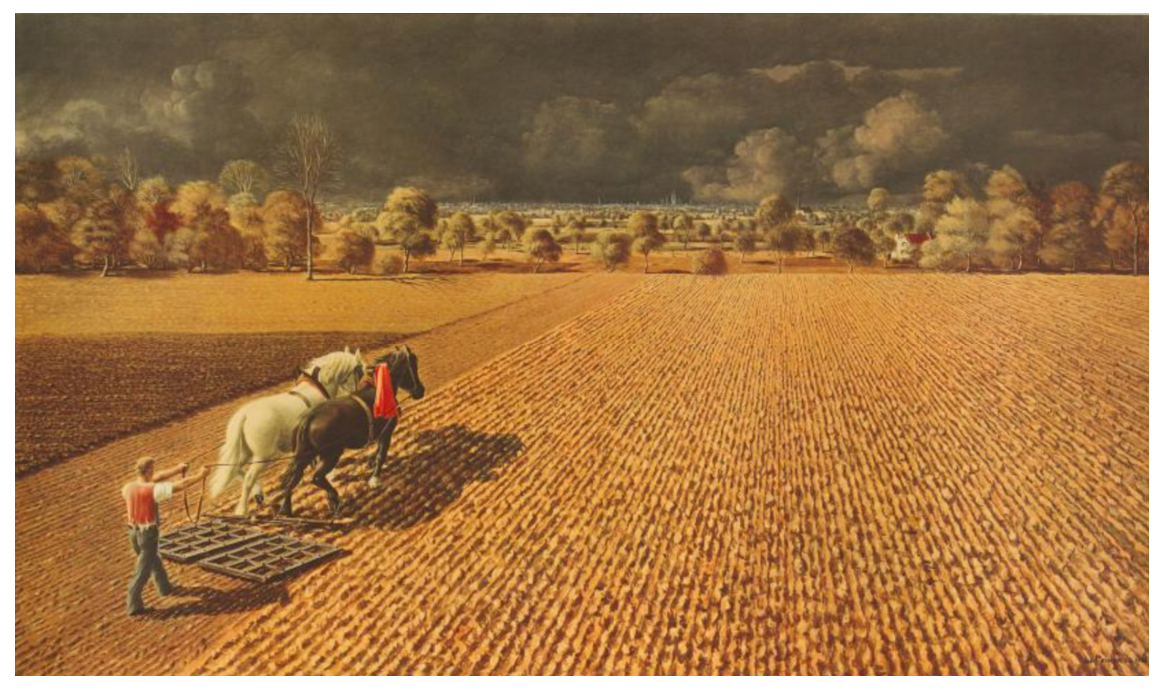
Figure 1. Werner Peiner, Deutsche Erde, 1933. A vision of a world relentlessly ordered and shaped by human will. Public domain US; available online: https://www.wikiart.org/en/werner-peiner/german-soil-1940/ (accessed on 12 February 2026).
Buildings 16 03522 g001
Figure 2. Leopold Schmutzler, Arbeitsmaiden vom Felde heimkehrend, 1940. An idyllic vision of rural life that was contrasted with the hardships of urban existence. Public domain, via Wikimedia Commons; available online: https://commons.wikimedia.org/wiki/File:Schmutzler-Maidens.jpg (accessed on 13 February 2026).
Buildings 16 03522 g002
Figure 3. The NSDAP rally in Nuremberg, illustrating the aestheticisation of politics, 1937. Architect: Albert Speer. Photographer unknown, National Archives at College Park, public domain, via Wikimedia Commons; available online: https://commons.wikimedia.org/wiki/File:Reichsparteitag._Der_grosse_Appell_der_Politischen_Leiter_auf_der_von_Scheinwerfern_berstrahlten_Zeppelinwiese_in..._-_NARA_-_532605.tif (accessed on 14 February 2026).
Buildings 16 03522 g003
Figure 4. Lighting effects reminiscent of those used in Expressionist cinema, NSDAP Rally, Nuremberg, 1937. Architect: Albert Speer. Photographer unknown, Bundesarchiv, Bild 183-2006-0329-502/CC-BY-SA 3.0, CC BY-SA 3.0 DE, via Wikimedia Commons; available online: https://commons.wikimedia.org/wiki/File:Bundesarchiv_Bild_183-2006-0329-502,_Nürnberg,_Reichsparteitag,_Adolf_Hitler_vor_Lichtdom.jpg (accessed on 14 February 2026).
Buildings 16 03522 g004
Figure 5. The Gautheater Westmark, Saarbrücken, Germany, 1936–1938. Architect: Paul Baumgarten. A theatre designed to resemble a block of residential buildings. The actual houses on either side reveal the overscaling of the architectural form. The enormous, simple roofs are topped by a very small sculpture placed on the ridge. Photo by Emil Leitner, Architekturmuseum der TU Berlin, Inv. Nr. TBS 252,16, CC0 1.0 Universal; cropped by the author of the article; available online: https://www.deutsche-digitale-bibliothek.de/item/K4EME5EVZA6WVWGZGILKCRWLZXRQBYMB (accessed on 18 February 2026).
Buildings 16 03522 g005
Figure 6. Main entrance to the Berghof complex, Bavarian Alps, 1933. Architect unknown. An example of the principle of incongruity in kitsch—the entrance passage and guardhouse designed to resemble a rural cottage. Photo by Heinrich Hoffmann, Bundesarchiv, Bild 183-1999-0412-502, CC-BY-SA 3.0, CC BY-SA 3.0 DE, via Wikimedia Commons; available online: https://commons.wikimedia.org/wiki/File:Bundesarchiv_Bild_183-1999-0412-502,_Obersalzberg,_Berghof_von_Adolf_Hitler.jpg (accessed on 12 February 2026).
Buildings 16 03522 g006
Figure 7. Carinhall, Germany, 1933–1940 (photo from 1938). Architect: Werner March. A display of rusticity on the exterior: a large deer sculpture on a rough stone pedestal, a flagstone floor, wooden posts supporting a shingle roof, and antlers above each window. Photographer unknown, public domain; available online: https://www.szukajwarchiwach.gov.pl/jednostka/-/jednostka/5918474/obiekty/246335#opis_obiektu (accessed on 31 August 2026).
Buildings 16 03522 g007
Figure 8. Carinhall, Germany, 1933–1940 (photo from c. 1938). Architect: Werner March. A gallery in the residence revealing the opulence of the collection. Photographer unknown, public domain; available online: https://loc.getarchive.net/media/carinhall-festhalle (accessed on 23 February 2026).
Buildings 16 03522 g008
Figure 9. The school in Düsseldorf-Westen, 1935–1937. Architect: Fritz Becker. An example of pseudorural overscaling and monotony. Photographer unknown, open license, from: [28] (p. 56); available online: https://polona.pl/item-view/9f0eb275-8943-4234-86cd-055746747572?page=57 (accessed on 18 February 2026).
Buildings 16 03522 g009
Figure 10. Ehrentempel (Temple of Honour), Munich, 1935 (photo from c. 1937). Architect: Paul Ludwig Troost. The ancient costume of architecture. Photographer unknown, uploaded by Willi Ude, CC BY-SA 3.0, via Wikimedia Commons; available online: https://commons.wikimedia.org/wiki/File:Ehrentempel_und_Führerbau_auf_dem_Königsplatz.jpg (accessed on 23 February 2026).
Buildings 16 03522 g010
Figure 11. New Reich Chancellery, Berlin, 1939. Architect: Albert Speer. An example of stylistic arbitrariness—the use of Egyptian column capitals. Photographer unknown, Bundesarchiv, Bild 146-1985-064-24A, CC-BY-SA 3.0, CC BY-SA 3.0 DE, via Wikimedia Commons; cropped by the author of the article; available online: https://commons.wikimedia.org/wiki/File:Bundesarchiv_Bild_146-1985-064-24A,_Berlin,_Neue_Reichskanzlei,_Gartenfront.jpg (accessed on 14 February 2026).
Buildings 16 03522 g011
Figure 12. View of the former Reich Ministry of Aviation building, Berlin, 1935–1936. Architect: Ernst Sagebiel. The building has survived to the present day unchanged. It is an example of oversized scale and architectural monotony. Photo by Hans G. Oberlack, Bundesarchiv, Bild 183-1999-0412-502, CC BY-SA 3.0, via Wikimedia Commons; available online: https://commons.wikimedia.org/wiki/File:Luftaufnahme_Detlev-Rohwedder_Haus.jpg (accessed on 17 February 2026).
Buildings 16 03522 g012
Figure 13. Congress Hall, Nuremberg. Construction began in 1935. Architects: Ludwig Ruff and Franz Ruff. An example of oversized scale and architectural monotony. Photo by Indigma, CC BY-SA 4.0, via Wikimedia Commons; available online: https://commons.wikimedia.org/wiki/File:Kongresshalle_Dutzendteich_Nürnberg_MW01.jpg (accessed on 17 February 2026).
Buildings 16 03522 g013
Figure 14. KdF Prora Holiday Resort, Binz, Germany, 1936–1939. Architects: Clemens Klotz and Erich Putlitz. An example of repetition and architectural monotony. Photo by Chris, CC BY-SA 2.0, via Wikimedia Commons; cropped by the author of the article; available online: https://commons.wikimedia.org/wiki/File:Prora-_ehemaliges_KdF-Seebad-_Luftaufnahme_2008_(Seebad_Prora,_WW2_KdF_holiday_camp,_aerial_2008)_-_geo.hlipp.de_-_29770.jpg (accessed on 19 February 2026).
Buildings 16 03522 g014
Figure 15. Ordensburg Vogelsang cadet training centre, 1934–1935. Architect: Clemens Klotz. An example of a pseudomedieval, castle-inspired architectural complex. Photo: © Raimond Spekking & Elke Wetzig/CC BY-SA 4.0, via Wikimedia Commons; available online: https://commons.wikimedia.org/wiki/File:NS-Ordensburg_Vogelsang_-_Gesamtansicht,_Luftaufnahme-0183.jpg (accessed on 19 February 2026).
Buildings 16 03522 g015
Table 1. Characteristics of kitsch architecture. Author’s own elaboration based on Hermann Broch (after Gabriela Żuchowska), Abraham Moles and Tomáš Kulka.
No.Characteristics of Kitsch According to BrochCharacteristics of Kitsch According to MolesCharacteristics of Kitsch Architecture According to MolesCharacteristics of Kitsch According to KulkaCharacteristics of Kitsch Architecture According to KulkaThe Question of Kitsch in the Art of the Third ReichPossible Manifestation in the Realm of Architecture:
I-incongruity--extra-architectural denotation-
  • buildings that literally adopt the forms of other objects;
  • a building form associated with a different function. Conceptual distortion;
  • a building element whose form evokes a function other than its actual one. Conceptual contrivance;
IImaximisation of effectaccumulationvisual overload---
  • excessive scale;
  • repetitive excess;
  • excessive decoration;
  • excessive dramatisation;
III-synesthesia----
-
(not found)
IVsuperficiality, avoidance of controversymediocrity-conventionality-typicality of technique, simplicity
  • systematisation, schematicity;
  • economy of expressive means;
Vsubordination to general approvalcomfort-positive valence, identifiability-clarity of expression, passivity of communication
  • vernacularity;
  • architecture affirming the established order;
VI--“neo” tendencies-historical imitationrejection of modernity
  • uncritical and decontextualised use of historical styles;
  • avoidance of contemporary technical solutions;
  • neglect of contemporary aesthetic currents;
Disclaimer/Publisher’s Note: The statements, opinions and data contained in all publications are solely those of the individual author(s) and contributor(s) and not of MDPI and/or the editor(s). MDPI and/or the editor(s) disclaim responsibility for any injury to people or property resulting from any ideas, methods, instructions or products referred to in the content.