Systematic Review

Immersive Technologies and Digital Twins in Architectural Heritage: A Scientometric Review of Knowledge Structures and Application Pathways (2007–2025)

School of Arts, Suzhou University of Science and Technology, Suzhou 215009, China
*
Author to whom correspondence should be addressed.
Buildings 2026, 16(15), 3064; https://doi.org/10.3390/buildings16153064
Submission received: 26 June 2026 / Revised: 21 July 2026 / Accepted: 30 July 2026 / Published: 2 August 2026
(This article belongs to the Section Architectural Design, Urban Science, and Real Estate)

Abstract

Immersive technologies and digital twins have provided new opportunities for the documentation, interpretation, and conservation of architectural heritage. However, the knowledge structure and evolutionary pathways of this interdisciplinary field remain insufficiently understood. This study conducts a scientometric analysis of 273 articles published between 2007 and 2025 using CiteSpace to investigate publication trends, collaboration networks, co-citation structures, and keyword evolution. The results demonstrate that research on immersive technologies and digital twins in architectural heritage has evolved from digital documentation and visualization toward integrated information management and intelligent conservation. The knowledge foundation of this field is mainly constructed around three interconnected areas: three-dimensional data acquisition, Historic Building Information Modeling (HBIM), and digital twin-supported conservation management. Collaboration and co-citation analyses reveal an interdisciplinary knowledge base spanning architectural conservation, construction informatics, remote sensing, computer science, and human–computer interaction, but also indicate a comparatively fragmented collaboration structure. Keyword evolution further indicates a transition from photogrammetry and virtual reality toward HBIM, extended reality, Internet of Things, and digital twin applications. Based on these findings, this study proposes a preliminary Cross-Domain Technology Adaptation Framework to organize potential relationships among data acquisition, semantic information modeling, immersive interaction, digital-twin analytics, and heritage-oriented applications. The framework represents a conceptual synthesis rather than a validated technology-transfer model and provides directions for future empirical research and sustainable architectural-heritage conservation.

1. Introduction

Architectural heritage encompasses historic and traditional buildings, vernacular architecture, archeological remains, heritage structures, and the spatial, material, and construction knowledge embodied within them. These assets constitute an important record of architectural history, regional identity, engineering knowledge, and cultural continuity. However, they are increasingly threatened by material deterioration, structural aging, environmental change, natural hazards, urban transformation, and the gradual loss of traditional construction knowledge. Conventional documentation methods, including two-dimensional drawings, photographs, written records, and static archives, remain fundamental to heritage conservation, but they are often insufficient for representing complex geometries, time-dependent conditions, construction sequences, spatial relationships, and embodied craft knowledge. Consequently, digital technologies capable of supporting more detailed documentation, interpretation, monitoring, and conservation decision-making have become increasingly important in architectural heritage research and practice [1,2,3].
The digital transformation of architectural heritage involves several complementary but conceptually distinct technological layers. Photogrammetry, terrestrial laser scanning, unmanned aerial vehicles, and point-cloud processing support the geometric capture and condition recording of heritage assets. Historic Building Information Modeling (HBIM) organizes geometric, semantic, historical, and material information within structured digital models. Immersive technologies—including virtual reality (VR), augmented reality (AR), mixed reality (MR), and extended reality (XR)—provide interactive interfaces through which users can visualize, navigate, interpret, and engage with heritage environments. Digital twins extend these capabilities by establishing a continuing relationship between a physical heritage asset and a data-enabled digital representation through state updating, monitoring, analysis, prediction, and, in more mature implementations, feedback or decision support [4,5,6,7,8]. These technologies may be integrated within the same heritage project, but they should not be treated as interchangeable. In particular, a static three-dimensional model or a one-time immersive visualization does not, by itself, constitute a digital twin.
Applications of these technologies have expanded across high-precision documentation, scan-to-HBIM, virtual reconstruction, structural and environmental monitoring, preventive conservation, risk assessment, restoration planning, public interpretation, tourism, education, and craft-oriented learning [9,10,11,12,13,14,15,16,17,18]. Research at this intersection now spans architecture, civil engineering, remote sensing, computer science, archeology, heritage studies, education, and environmental engineering. Nevertheless, the resulting body of literature remains conceptually and methodologically fragmented. Immersive interfaces, information models, simulation platforms, and digital twins are frequently grouped under a broad category of “digital technologies”, despite their different technical functions and evidential requirements. Similarly, evaluation indicators such as geometric accuracy, semantic completeness, structural performance, usability, presence, learning achievement, and conservation effectiveness are sometimes discussed together even though they represent fundamentally different dimensions of performance.
Construction-related crafts, including timber framing, joinery, carpentry, masonry, and component assembly, constitute an important but more specialized subdomain of architectural heritage digitalization. They fall within the scope of the present study only when they are directly connected to the documentation, interpretation, conservation, maintenance, or transmission of built heritage. This boundary is necessary because the broader field of intangible cultural heritage includes many practices that are unrelated to architectural construction. Although immersive technologies offer considerable potential for representing construction sequences and supporting situated learning, the extent to which such approaches have been empirically evaluated and systematically integrated with HBIM or digital-twin systems remains unclear.
Scientometric analysis and scientific knowledge mapping provide effective methods for examining the development of complex and interdisciplinary research fields. By analyzing publication trends, collaboration networks, co-citation relationships, keyword structures, and thematic evolution, these methods can identify influential contributors, intellectual foundations, major research communities, and emerging areas of inquiry. Scientometric analyses and knowledge-mapping visualizations were conducted using CiteSpace 7.0.R0 (64-bit Advanced; Chaomei Chen, Philadelphia, PA, USA). It supports network visualization, co-citation clustering, temporal mapping, and burst detection [19]. Existing reviews and knowledge-mapping studies have examined immersive technologies, HBIM, digital twins, or broader digital-heritage research separately [9,20]. However, an integrated scientometric assessment of immersive technologies and digital twins specifically within architectural heritage remains limited. Moreover, broad search strategies may introduce unrelated studies from medicine, manufacturing, clothing, generic education, or non-architectural cultural heritage, thereby obscuring the knowledge structure of the architectural heritage domain.
A further methodological issue concerns the interpretation of scientometric networks. Co-occurrence, co-citation, and clustering can reveal intellectual associations, thematic proximity, and emerging research communities, but they do not independently demonstrate that a technology has been successfully transferred, adapted, and validated in a heritage context. Technology adaptation should instead be supported by traceable evidence concerning the original method, its heritage-specific modification, the application context, and the corresponding evaluation results. Accordingly, the present study replaces the stronger notion of validated “cross-domain technology adaptation” with the more cautious concept of application pathways, referring to the relationships through which data acquisition, semantic information modeling, immersive interaction, digital-twin analytics, and heritage-oriented outcomes may be connected.
This study makes three principal contributions. First, it provides a more transparent and reproducible scientometric workflow based on a revised search strategy, relevance screening, metadata cleaning, author-name standardization, and explicitly reported CiteSpace parameters. Second, it distinguishes the functional roles of immersive technologies, HBIM, static digital models, and digital twins, thereby reducing conceptual ambiguity in the existing literature. Third, it develops a preliminary application-pathway synthesis linking data acquisition, semantic information modeling, immersive interaction, digital-twin monitoring and analytics, and architectural-heritage outcomes. This synthesis is intended to organize the available evidence and identify future research opportunities; it is not presented as an externally validated theoretical framework.
The remainder of this article is organized as follows. Section 2 defines the conceptual scope, data sources, search and screening procedures, data-cleaning methods, and scientometric parameters. Section 3 presents the results concerning publication development, disciplinary distribution, collaboration networks, co-citation structures, keyword patterns, and thematic evolution. Section 4 discusses the principal knowledge structures, differentiates the roles of immersive technologies, HBIM, and digital twins, develops the preliminary application-pathway synthesis, and examines implications, evidence gaps, and study limitations. Section 5 summarizes the main conclusions and proposes priorities for future architectural-heritage research.

2. Data and Methodology

2.1. Data Source and Selection Process

Bibliographic records were retrieved from the Web of Science Core Collection (Clarivate Plc, London, UK) on 16 July 2026. The Web of Science Core Collection was selected because it provides standardized bibliographic metadata, institutional and author information, cited-reference fields, and document-level identifiers that are compatible with scientometric and co-citation analysis [21]. The final dataset contained records indexed in the Science Citation Index Expanded (SCI-EXPANDED), Emerging Sources Citation Index (ESCI), Arts and Humanities Citation Index (A and HCI), and Social Sciences Citation Index (SSCI). Because individual journals may be indexed in more than one database, the corresponding index counts were not mutually exclusive.
The document type was restricted to Article. No language restriction was imposed during retrieval, in order to avoid excluding regionally significant architectural-heritage research published in languages other than English. The retrieval window was initially set to 2006–2025. However, no eligible article was published in 2006; therefore, the effective analytical period represented in this review is 2007–2025.
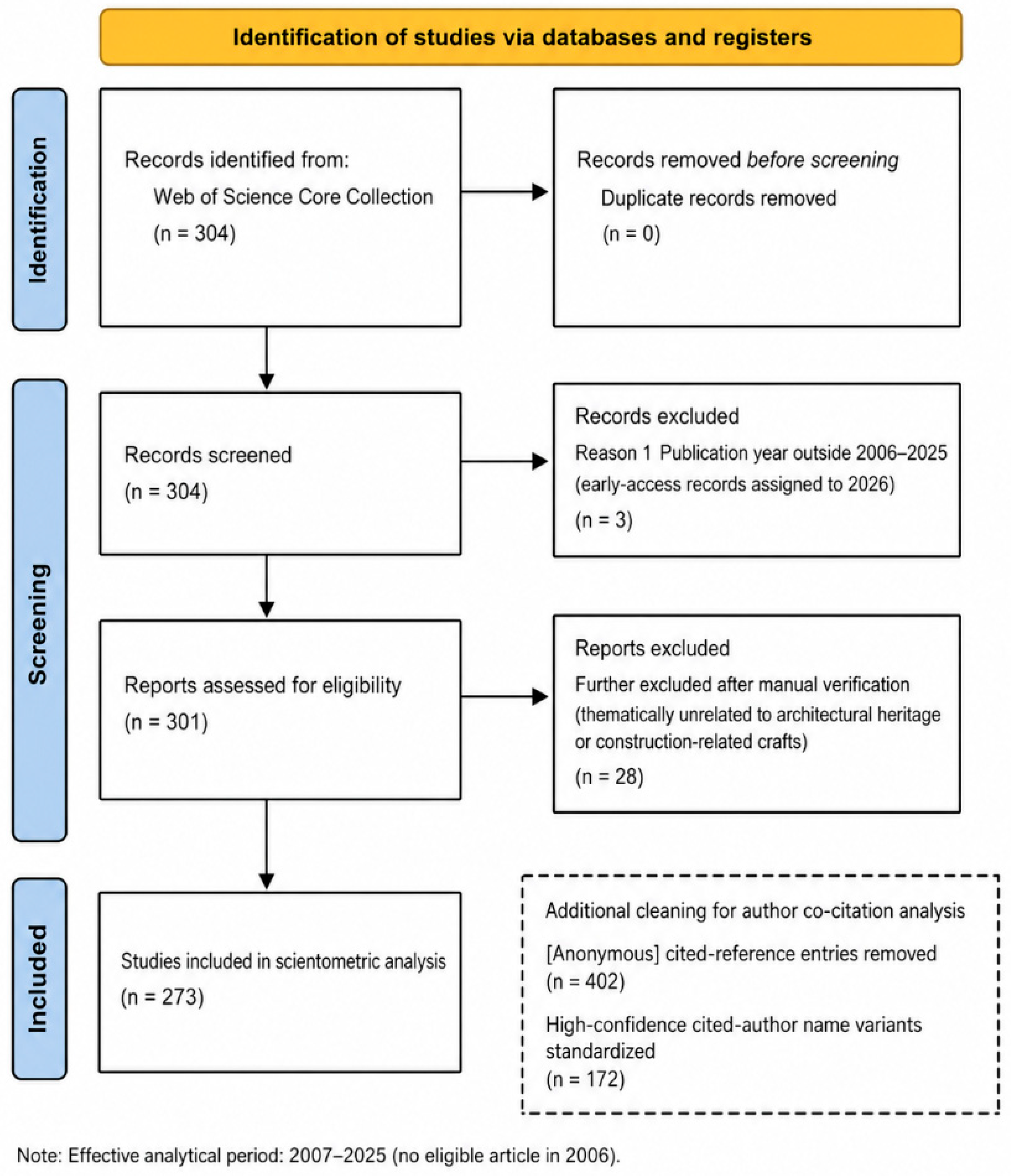
To align the dataset with the revised scope of the study, the search strategy required every record to contain at least one immersive-technology or digital-twin term and at least one architectural-heritage term. The final topic query was formulated as follows: TS = ((“virtual reality” OR “virtual environment*” OR “augmented reality” OR “mixed reality” OR “extended reality” OR “digital twin*” OR “immersive technolog*”) AND (“architectural heritage” OR “built heritage” OR “historic building*” OR “historical building*” OR “heritage building*” OR “heritage architecture” OR “traditional building*” OR “traditional architecture” OR “vernacular architecture” OR “historic structure*” OR “historical structure*” OR HBIM OR (“intangible cultural heritage” OR “traditional craft*” OR “construction craft*” OR “building craft*” OR “architectural craftsmanship”) AND (“timber frame*” OR “timber structure*” OR “timber joint*” OR “mortise and tenon” OR “mortise-and-tenon” OR dougong OR carpentry OR masonry OR “wood construction” OR “building assembly” OR “traditional construction” OR “architectural construction”)) The identification and screening process was documented using a PRISMA-style workflow to ensure transparency and reproducibility. Bibliographic data were retrieved from the Web of Science Core Collection on 16 July 2026, with the initial timespan set from 2006 to 2025. The search yielded 304 source records. The following screening and cleaning procedures were subsequently applied:
1. Duplicate Check: DOI fields, Web of Science accession numbers, and normalized titles were compared to identify duplicate publications. No exact duplicate source records were detected.
2. Timeframe Verification: Three early-access records assigned to 2026 were excluded because they fell outside the predefined publication period.
3. Scope Screening: Titles, abstracts, author keywords, and Keywords Plus were manually reviewed to assess thematic relevance. Twenty-eight records unrelated to architectural heritage, historic or traditional buildings, heritage structures, or construction-related crafts were excluded.
Following these procedures, 273 articles were retained for the final scientometric analysis. Although the initial search period began in 2006, no eligible article was published in that year; therefore, the effective analytical period was 2007–2025. The complete metadata and cited references of the 273 included articles were exported in plain-text format for descriptive analysis and CiteSpace processing.
Additional cleaning was conducted for the author co-citation analysis. A total of 402 cited-reference entries attributed to “[Anonymous]” were removed without deleting the source articles in which they appeared. Furthermore, 172 high-confidence cited-author name variants were standardized to reduce fragmentation caused by differences in initials, punctuation, and spelling. Ambiguous authors sharing the same surname and initials were not merged without sufficient evidence. The initial relevance screening was conducted by the first author and subsequently reviewed by the second author. Disagreements were resolved through discussion. Because the screening was not conducted independently in parallel, an inter-rater agreement statistic was not calculated. The completed PRISMA 2020 checklist is provided in Supplementary Table S2 (Figure 1).

2.2. Research Methods

Following the screening process described in Section 2.1, which was conducted according to the PRISMA 2020 statement for systematic reviews [22], the final dataset of 273 articles was subjected to data cleaning and preprocessing to improve metadata consistency and ensure the reliability of subsequent scientometric analyses. The characteristics of the 273 studies included in the systematic review are summarized in Supplementary Table S1. This procedure focused on reducing structural noise in bibliographic information rather than further refining the thematic scope of the dataset.
First, the completeness and consistency of essential metadata, including authors, affiliations, publication years, keywords, source journals, and cited references, were examined. DOI information, Web of Science accession numbers, and article titles were cross-checked to ensure record consistency. No duplicate records were identified. Author names and institutional affiliations were subsequently standardized to reduce fragmentation caused by differences in initials, abbreviations, and naming formats.
Second, keyword normalization was conducted to improve semantic coherence in co-occurrence analysis. Variations in singular/plural forms, abbreviations, spelling differences, and closely related expressions were unified when appropriate, while conceptually distinct terms such as virtual reality, HBIM, and digital twins were retained separately to avoid misleading conceptual merging.
Third, additional cleaning was performed for author co-citation analysis. A total of 402 cited-reference entries attributed to “[Anonymous]” were removed because they could not be reliably assigned to identifiable authors. Meanwhile, 172 high-confidence cited-author name variants were standardized to reduce author fragmentation. Ambiguous author identities were not merged without sufficient evidence. The cleaned dataset was then imported into CiteSpace for subsequent collaboration, co-citation, and keyword analyses.
To reveal the knowledge structures, evolutionary patterns, and emerging research trends of immersive technologies and digital twins in architectural heritage, this study employed CiteSpace 7.0.R0 (64-bit, Advanced edition) as the primary scientometric analysis tool. CiteSpace was selected because it integrates multiple bibliometric functions, including collaboration network analysis, co-citation analysis, keyword co-occurrence analysis, temporal evolution visualization, and citation burst detection, enabling systematic investigation of intellectual structures and research frontiers within interdisciplinary fields.

2.3. Bibliometric Analysis Tool: CiteSpace

The analysis was conducted using the cleaned dataset of 273 publications published between 2007 and 2025. The common parameters were configured as follows: the time slicing period was set from 2007 to 2025 with one year per slice; the node selection criterion was set to Top 50 per slice; and the pruning method Pathfinder was applied to simplify network complexity while preserving essential structural relationships. The analyzed node types included Country/Region, Institution, Author, Cited Reference, Cited Author, Cited Journal, and Keyword.
For network interpretation, collaboration analyses were conducted to identify major contributors and cooperative relationships among countries, institutions, and authors. Co-citation analyses were performed to reveal the intellectual foundations and influential knowledge sources of the field. Keyword co-occurrence, timeline, timezone, and burst detection analyses were applied to identify research hotspots, thematic evolution, and emerging directions.
Cluster labels were generated using the Log-Likelihood Ratio (LLR) algorithm and were subsequently reviewed based on representative articles and high-frequency terms within each cluster. Network characteristics were evaluated using structural indicators, including network density, modularity Q, and weighted mean silhouette. These indicators were interpreted as descriptive measures of network organization and cluster consistency under the selected CiteSpace parameters rather than statistical tests of significance or external validity.
The combination of collaboration, co-citation, and keyword-based analyses provided a comprehensive mapping of the development trajectory, knowledge structure, and application pathways of immersive technologies and digital twins in architectural heritage research.

3. Results

3.1. Publication Statistics

3.1.1. Publication Volume Analysis

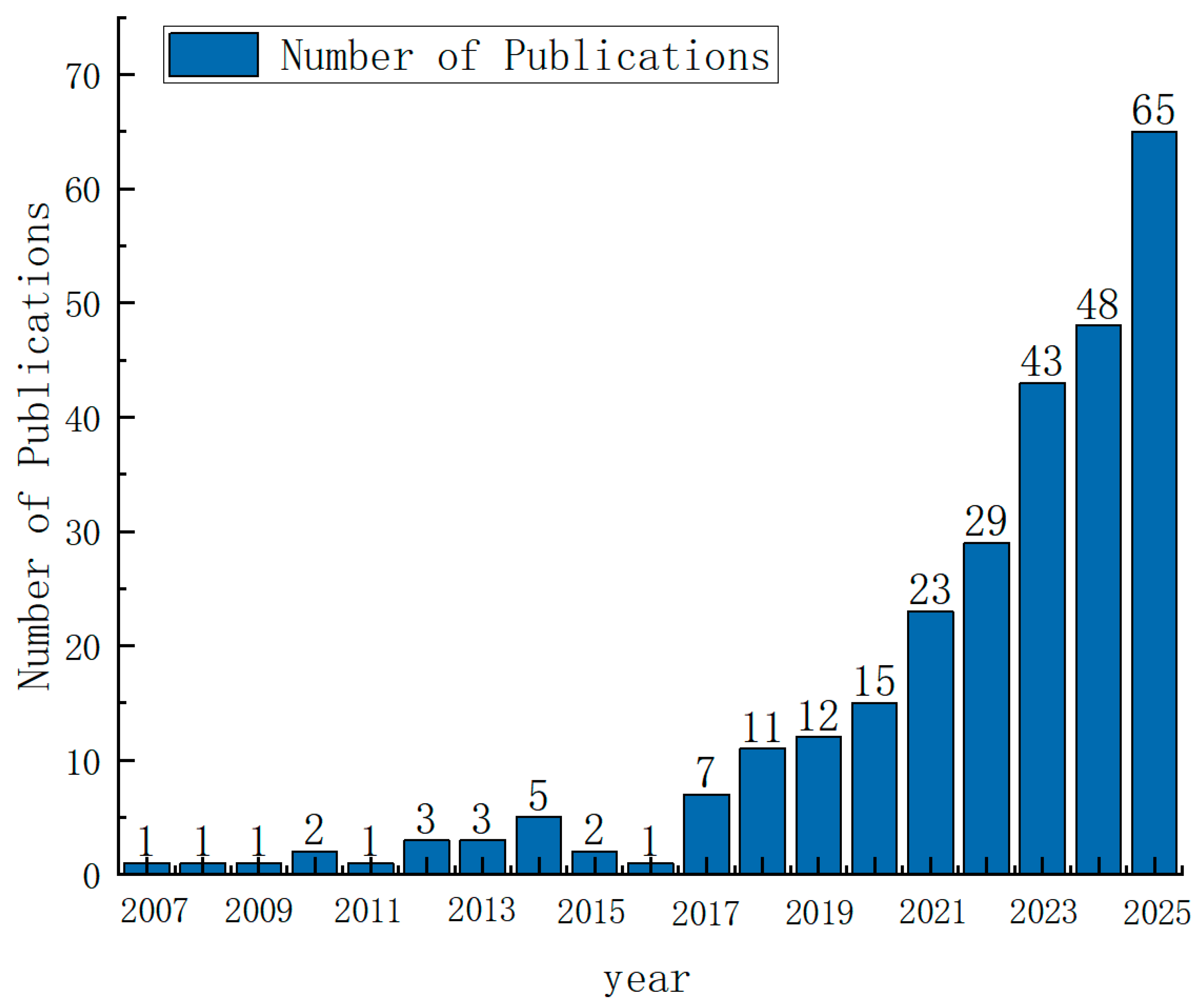
Figure 2 presents the annual publication output of research on immersive technologies and digital twins in architectural heritage from 2007 to 2025. Overall, the publication trend shows a gradual increase, indicating the expanding research interest in the integration of digital technologies with architectural heritage conservation. For descriptive purposes, the publication trajectory can be divided into four phases according to changes in annual publication output.
Stage 1 (2007–2016): Initial Exploration Stage. During this period, the number of publications remained relatively low, with annual outputs generally ranging from 1 to 5 papers. Research mainly focused on the preliminary application of digital visualization, virtual reconstruction, and three-dimensional documentation in heritage contexts. The limited publication output reflects the early exploration of digital approaches for architectural heritage documentation and representation.
Stage 2 (2017–2020): Gradual Growth Stage. From 2017 to 2020, annual publications increased from 7 to 15 papers. This growth corresponds with the increasing application of technologies such as HBIM, virtual reality, photogrammetry, and digital modeling in heritage studies. Research during this period gradually expanded from digital representation toward information management and interactive visualization.
Stage 3 (2021–2023): Rapid Expansion Stage. Publication output increased significantly after 2021, reaching 23 papers in 2021, 29 papers in 2022, and 43 papers in 2023. This growth reflects the increased integration of immersive technologies, HBIM, and digital twin concepts within architectural heritage research. Studies during this stage covered digital documentation, virtual reconstruction, conservation assessment, and heritage information management.
Stage 4 (2024–2025): Continued Development Stage. The publication volume continued to increase, reaching 48 papers in 2024 and 65 papers in 2025. Instead of reaching a stable plateau, the field maintained a growth trend, suggesting that research activities are still expanding. Recent studies have increasingly focused on integrating data acquisition, semantic modeling, immersive interaction, and digital-twin-based monitoring approaches.
In summary, research on immersive technologies and digital twins in architectural heritage has developed from early technical exploration toward broader interdisciplinary applications. The continuous increase in publications after 2021 indicates growing academic attention to the relationship between digital technologies and heritage conservation. Future research may further investigate standardized data frameworks, interoperability between HBIM and digital twins, and evaluation methods for practical heritage applications.

3.1.2. Publication Category Analysis

Table 1 presents the top 15 publication categories from 2007 to 2025. The distribution of categories indicates that this research field involves multiple disciplines, including engineering, architecture, remote sensing, archeology, and computer science.
Among the identified categories, Engineering, Civil ranked first with 71 publications, followed by Construction & Building Technology (62 publications) and Architecture (44 publications), indicating that engineering and architectural disciplines constitute the main knowledge foundations of this field. These categories are closely associated with heritage documentation, HBIM development, structural assessment, and digital information management [23,24].
Humanities-related categories, including Humanities, Multidisciplinary (43 publications) and Archeology (19 publications), demonstrate the cultural and historical dimensions of immersive heritage research. Studies in these areas mainly focus on heritage interpretation, virtual representation, and public engagement.
Technology-oriented categories, such as Remote Sensing, Computer Science, Interdisciplinary Applications, and Computer Science, Information Systems, highlight the increasing role of data acquisition, computational methods, and digital modeling. Photogrammetry, laser scanning, and three-dimensional reconstruction provide important technical support for heritage documentation and modeling [25].
Meanwhile, categories related to Materials Science, Environmental Sciences, and Green & Sustainable Science & Technology indicate the extension of digital heritage research toward material conservation, environmental evaluation, and sustainable management. Overall, the category distribution confirms that immersive technologies and digital twins in architectural heritage represent an interdisciplinary research field integrating engineering, architecture, heritage studies, and information technologies.

3.2. Collaboration Networks

Collaboration analysis was conducted to examine the cooperative relationships among institutions, countries, and authors in the field of immersive technologies and digital twins in architectural heritage. By visualizing collaboration networks, this analysis identifies major contributors, knowledge exchange patterns, and the distribution characteristics of research activities across different regions and organizations.

3.2.1. Institutional Collaboration Analysis

Table 2 presents the top 15 institutions in the institutional collaboration network, including publication counts, betweenness centrality values, and the year of first appearance. The results show that research activities are distributed across Europe and Asia, with several institutions forming active collaboration nodes in the field.
The Polytechnic University of Milan ranked first with 18 publications, followed by the University of Sevilla (8 publications), University of Bologna (7 publications), and Universitat Politècnica de València (7 publications). These institutions demonstrate substantial participation in immersive technologies, digital documentation, HBIM, and heritage conservation research. Italian and Spanish universities account for a considerable proportion of the highly ranked institutions, reflecting the strong involvement of European research groups in architectural heritage digitization.
Chinese institutions also show increasing participation in this field. The Beijing University of Civil Engineering and Architecture ranked fifth with 7 publications, while the Hong Kong University of Science and Technology and Tongji University appeared among the top 15 institutions. Their research activities mainly focus on digital documentation, three-dimensional reconstruction, structural assessment, and information-based heritage conservation.
In terms of betweenness centrality, several institutions, including the Hong Kong University of Science and Technology (0.03) and Universidade do Minho (0.03), show relatively higher network connectivity, indicating their potential role in connecting different collaboration groups. However, the overall centrality values remain relatively low, suggesting that institutional collaboration in this field is still distributed rather than concentrated around a small number of dominant hubs.
Overall, the institutional collaboration network demonstrates a geographically diverse research structure involving European and Asian institutions. Current collaboration patterns mainly focus on the integration of digital modeling, immersive visualization, and heritage conservation practices, while broader international cooperation remains an important direction for future development.
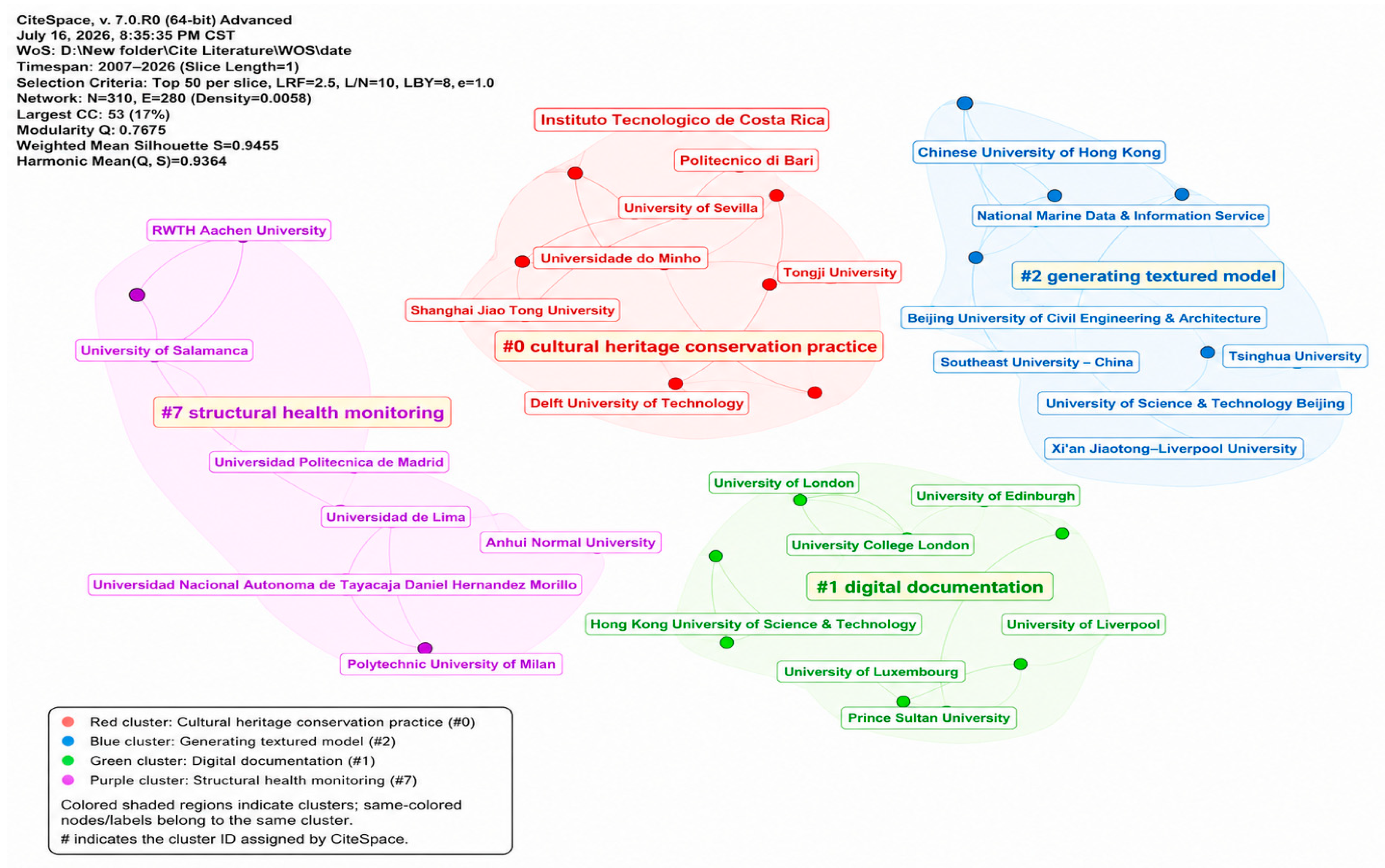
The institutional collaboration network was constructed to identify the cooperation patterns and thematic structures among research organizations in the field of immersive technologies and digital twins in architectural heritage. As shown in Figure 3, the network presents a clear clustering structure, with a modularity Q value of 0.9275 and a weighted mean silhouette value of 0.9364, indicating strong separation among clusters and high internal consistency.
The institutional collaboration network reveals several research communities with distinct thematic orientations. “Cultural heritage conservation practice” (#0) represents the application-oriented direction of immersive technologies in heritage conservation. Institutions such as the University of Sevilla, Tongji University, Shanghai Jiao Tong University, and Politecnico di Bari contribute to this cluster, focusing on the integration of digital methods into heritage documentation, restoration support, and conservation management. This cluster reflects the transition of digital technologies from visualization tools toward practical conservation workflows.
“Digital documentation” (#1) focuses on the acquisition, organization, and representation of heritage information. Institutions including the University of London, University College London, University of Edinburgh, and Hong Kong University of Science and Technology are associated with this research direction, emphasizing three-dimensional recording, digital modeling, and information-based representation of historic buildings. These studies provide essential data foundations for subsequent immersive visualization and digital twin applications.
“Generating textured model” (#2) highlights the role of three-dimensional reconstruction and visual modeling in architectural heritage research. Institutions such as the Chinese University of Hong Kong, Beijing University of Civil Engineering and Architecture, Tsinghua University, and Southeast University contribute to this cluster, focusing on textured model generation, digital reconstruction, and visualization techniques for representing complex heritage environments.
“Structural health monitoring” (#7) represents the integration of digital technologies with structural assessment and performance evaluation. Institutions including RWTH Aachen University, University of Salamanca, and Polytechnic University of Milan are involved in this cluster, exploring approaches related to structural monitoring, condition assessment, and data-supported conservation decisions for heritage structures.
Overall, the institutional collaboration network indicates that current research activities are organized around four major pathways: heritage conservation practice, digital documentation, three-dimensional model generation, and structural health monitoring. These clusters demonstrate different emphases in technology development and application scenarios. Future research may benefit from strengthening connections among these communities by integrating digital documentation, immersive interaction, structural monitoring, and digital twin-based management into more comprehensive heritage conservation workflows.

3.2.2. Regional Collaboration Analysis

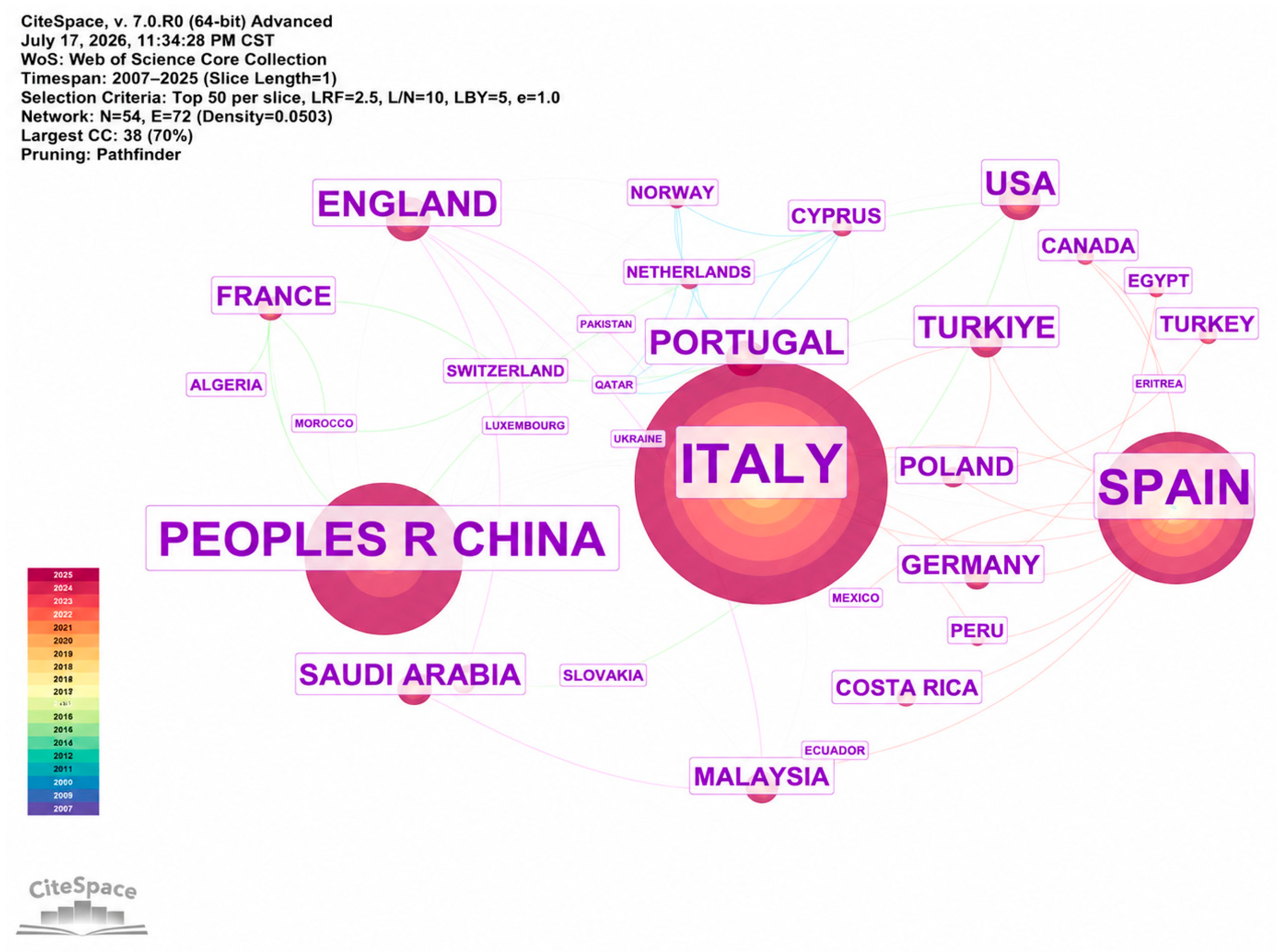
Figure 4 presents the country/region collaboration network for research on immersive technologies and digital twins in architectural heritage. The network is characterized by a strong European presence, accompanied by active contributions from Asia, North America, and the Middle East. Node size represents publication output, whereas betweenness centrality indicates the potential bridging position of a country or region within the collaboration network.
As shown in Table 3, Italy produced the largest number of publications (72), followed by Spain and China, with 45 publications each. Italy’s high output reflects its sustained involvement in HBIM, digital documentation, virtual visualization, and conservation-oriented information management. Representative studies include the integration of HBIM with virtual tools for historic-building management and the development of digital-twin approaches for heritage construction [3,26].
Spain combines a relatively high publication output with substantial betweenness centrality (0.49). Spanish studies cover immersive reconstruction, HBIM-based information repositories, real-time heritage diagnosis, and interdisciplinary conservation management [27]. This combination suggests that Spain is both a major contributor and an important connector between research groups.
China also contributed 45 publications, although its centrality value was zero under the selected CiteSpace parameters. Its contribution is therefore more evident in publication volume than in network brokerage. Representative research involving Chinese institutions has explored digital-twin-supported architectural archeology by integrating laser scanning, oblique photogrammetry, BIM, geometric data, and semantic information, as demonstrated by the Xuanluo Hall case in Sichuan [28].
England recorded fewer publications (14) but the highest centrality value in the network (0.62), while Portugal showed a similarly prominent bridging position (centrality = 0.56) with 11 publications. These values suggest that both countries may connect otherwise separated collaboration groups. Studies involving British and Portuguese researchers have particularly examined structural-integrity protection, condition monitoring, and the evaluation of heritage digital twins [29,30]. Saudi Arabia also occupied a noticeable intermediary position (centrality = 0.24), despite a comparatively smaller publication output.
Overall, publication volume and network centrality reveal different aspects of regional participation. Italy, Spain, and China represent the principal publication contributors, whereas England, Portugal, and Spain occupy stronger bridging positions within the collaboration structure. The results indicate an internationally distributed but uneven network, in which high research output does not necessarily correspond to high collaborative centrality. Broader cooperation among highly productive and highly connected regions may support the integration of documentation, immersive interpretation, structural monitoring, and digital-twin-based heritage management.

3.2.3. Author Collaboration Analysis

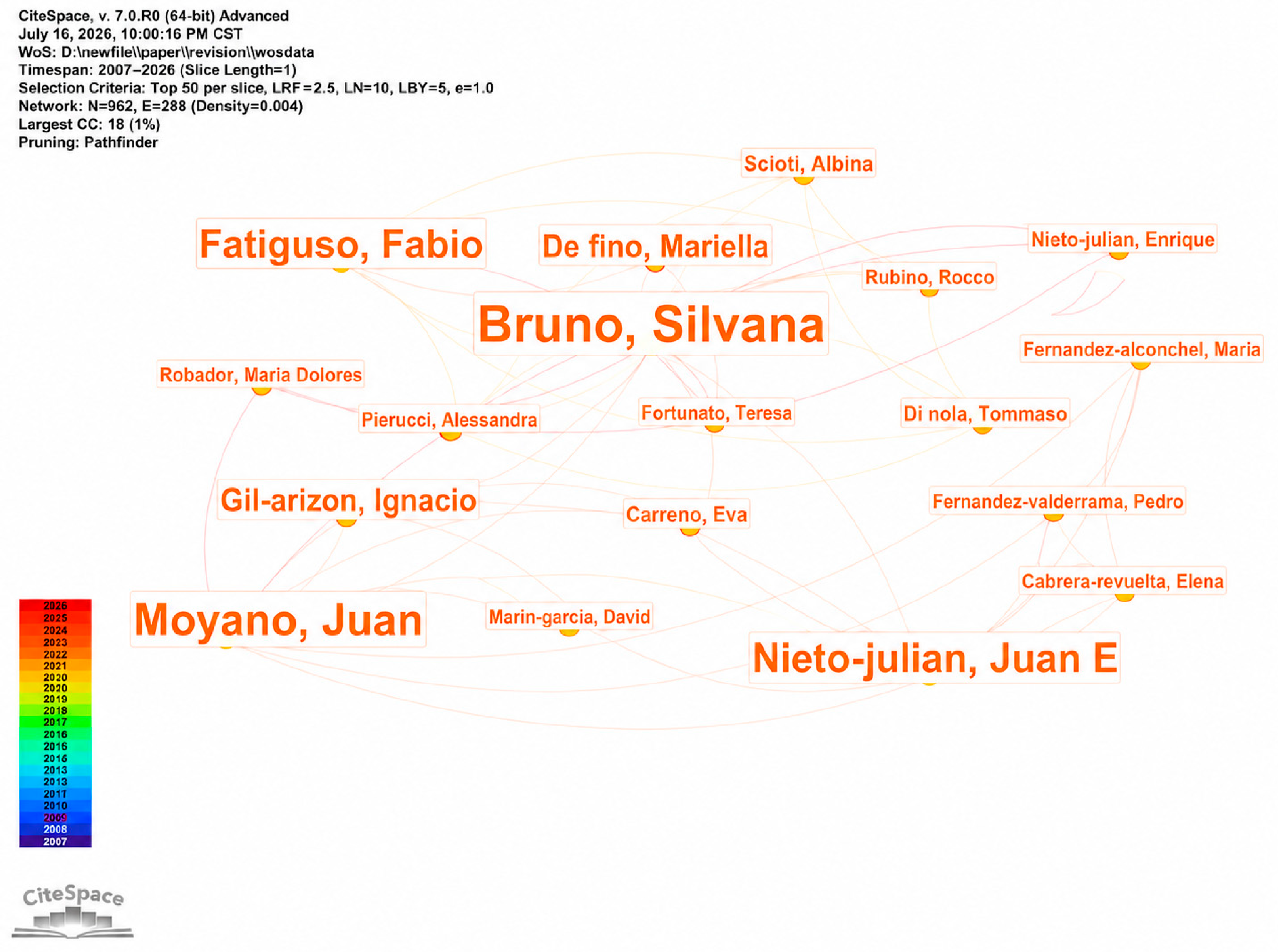
Figure 5 presents the author collaboration network in the field of immersive technologies and digital twins in architectural heritage. The network density is 0.004, indicating a relatively sparse and decentralized collaboration structure. The results suggest that current research activities are mainly organized around several specialized author groups rather than a highly interconnected global collaboration network.
A prominent collaboration cluster is formed around Bruno, Silvana, Moyano, Juan, De Fino, Mariella, and Fatiguso, Fabio. This group mainly focuses on HBIM development, digital documentation, and information management workflows for architectural heritage. Their research contributes to the integration of structured digital information and conservation-oriented decision-making processes in historic buildings [31].
Another active collaboration group includes Nieto-Julian, Juan E, Gil-Arizon, Ignacio, and related researchers, whose work emphasizes HBIM generation, digital reconstruction, and the application of structured information models in restoration projects. These studies provide methodological support for linking geometric data, semantic information, and conservation processes [27].
Overall, the author collaboration network demonstrates that research in this field is characterized by specialized collaborative groups with strong internal connections but limited interaction between different communities. Future research may benefit from strengthening cooperation among researchers working on digital documentation, immersive visualization, structural analysis, and digital twin applications.
Table 4 presents the top 10 collaborative authors in the field of immersive technologies and digital twins in architectural heritage. The results show that research collaboration is mainly concentrated within several author groups, with key contributors focusing on digital documentation, HBIM development, and heritage information management.
Banfi, Fabrizio ranks first with 13 publications, followed by Stanga, Chiara (6 publications), Bruno, Silvana (5 publications), and Moyano, Juan (4 publications). These highly collaborative authors have contributed substantially to the development of digital heritage workflows, including scan-to-BIM processes, HBIM-based information integration, and virtual representation of historic buildings [32].
Among these contributors, Banfi and related researchers have explored the integration of three-dimensional survey technologies, informative models, and extended reality approaches for architectural heritage documentation and visualization. Bruno and Moyano have focused on HBIM methodologies, emphasizing the organization of geometric information, semantic data, and conservation knowledge within heritage management frameworks.

3.3. Co-Citation Status

3.3.1. Author Co-Citation Analysis

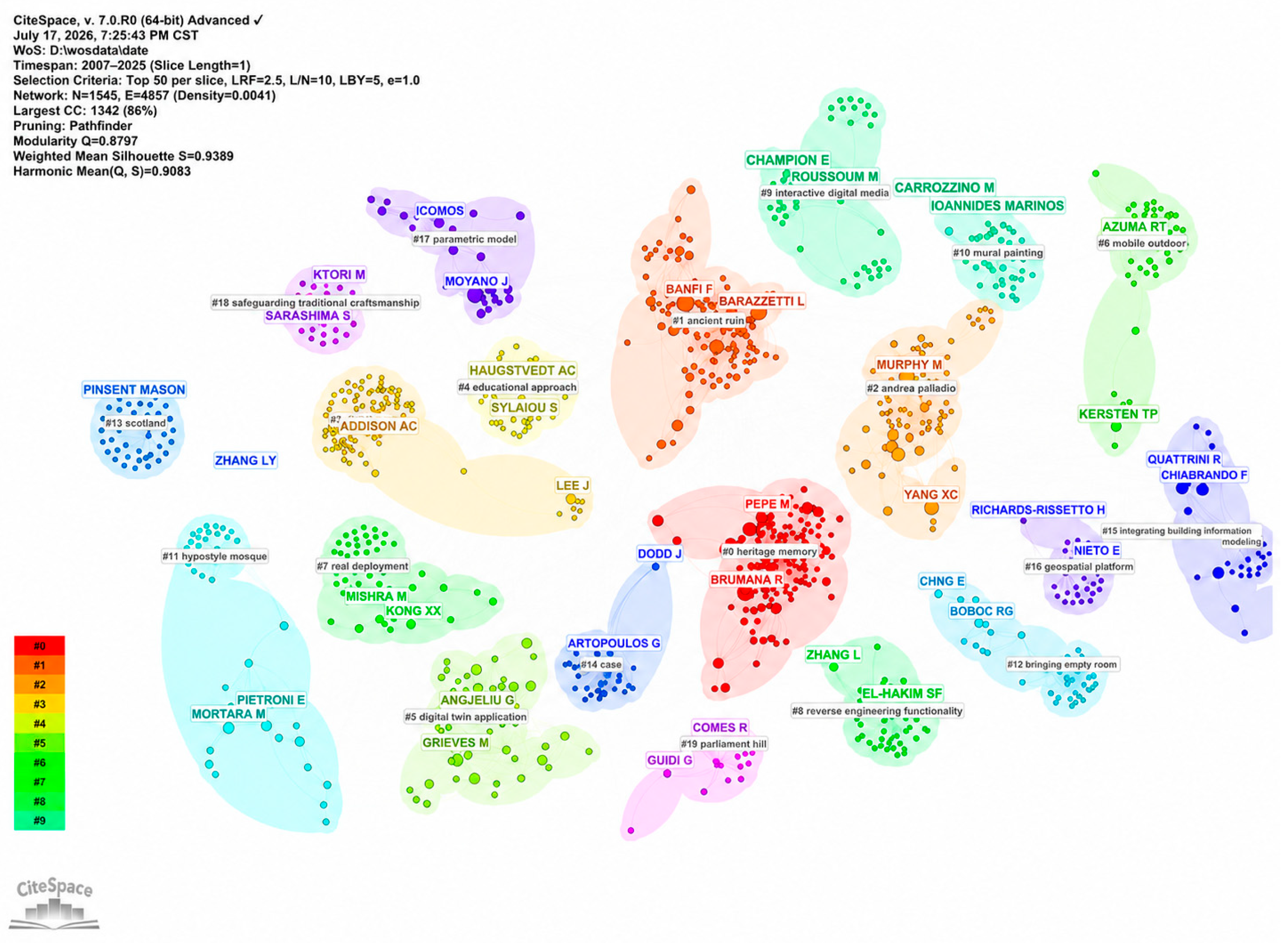
Figure 6 presents the author co-citation network in the field of immersive technologies and digital twins in architectural heritage. The network consists of 1545 nodes and 4857 links, with a modularity value of Q = 0.8797 and a weighted mean silhouette value of S = 0.9083, indicating a clear clustering structure and strong internal consistency among the identified knowledge groups.
The cluster “cultural heritage conservation practice” (#0) reflects the application-oriented knowledge base of the field. Research within this cluster focuses on the integration of digital technologies with heritage documentation, conservation processes, and historical building management. These studies provide theoretical support for combining digital models, spatial information, and conservation knowledge in heritage applications [33,34].
The cluster “digital documentation” (#1) highlights the importance of data acquisition, three-dimensional reconstruction, and information organization in heritage research. UAV photogrammetry, point-cloud processing, and parametric modeling provide reliable geometric foundations for heritage documentation, condition assessment, and subsequent digital analysis [35,36].
Clusters “digital application” (#4), “geospatial platform” (#16), and “digital cultural heritage” (#17) reflect the growing integration of spatial data, HBIM, sensing technologies, and analytical platforms. These developments indicate a transition from isolated digital representation toward more integrated information management, monitoring, and decision-support environments [37,38].
The author co-citation network reveals that immersive technologies and digital twins in architectural heritage are supported by interdisciplinary knowledge structures involving virtual reality, digital documentation, heritage conservation, and spatial information technologies. The identified clusters illustrate the evolution from digital representation toward integrated heritage information management and intelligent conservation.
Table 5 presents the top 15 most co-cited authors in the field of immersive technologies and digital twins in architectural heritage. The co-citation results reveal the main knowledge contributors and theoretical foundations supporting current research. The highly cited authors are mainly associated with HBIM, digital documentation, three-dimensional reconstruction, and heritage information management.
(1) Banfi F ranks first with 43 co-citations, followed by Murphy M, Brumana R, and Moyano J. Their prominence reflects the central role of HBIM, semantic information organization, immersive interaction, and conservation-oriented modeling in the knowledge structure of this field. Representative studies have extended HBIM from geometric documentation toward interactive visualization and structural information management [39,40].
(2) Barazzetti L, Pepe M, and Remondino F are strongly associated with the methodological stream of three-dimensional surveying and digital reconstruction. This stream emphasizes UAV photogrammetry, point-cloud acquisition, geometric processing, and parametric modeling as foundations for heritage documentation and analysis.
(3) Angjeliu G and Moyano J are associated with the growing connection between heritage information models and structural assessment. Recent studies further demonstrate the integration of HBIM, finite-element modeling, camera-based monitoring, modal analysis, and earthquake simulation in conservation-oriented digital-twin applications [38,41,42].
Overall, the author co-citation network indicates that the knowledge foundation of immersive technologies and digital twins in architectural heritage is primarily constructed around three interconnected areas: HBIM and information modeling, three-dimensional digital documentation, and structural analysis of historic buildings. These knowledge domains provide the theoretical and methodological basis for the transition from digital recording toward intelligent heritage conservation.

3.3.2. Journal Co-Citation Analysis

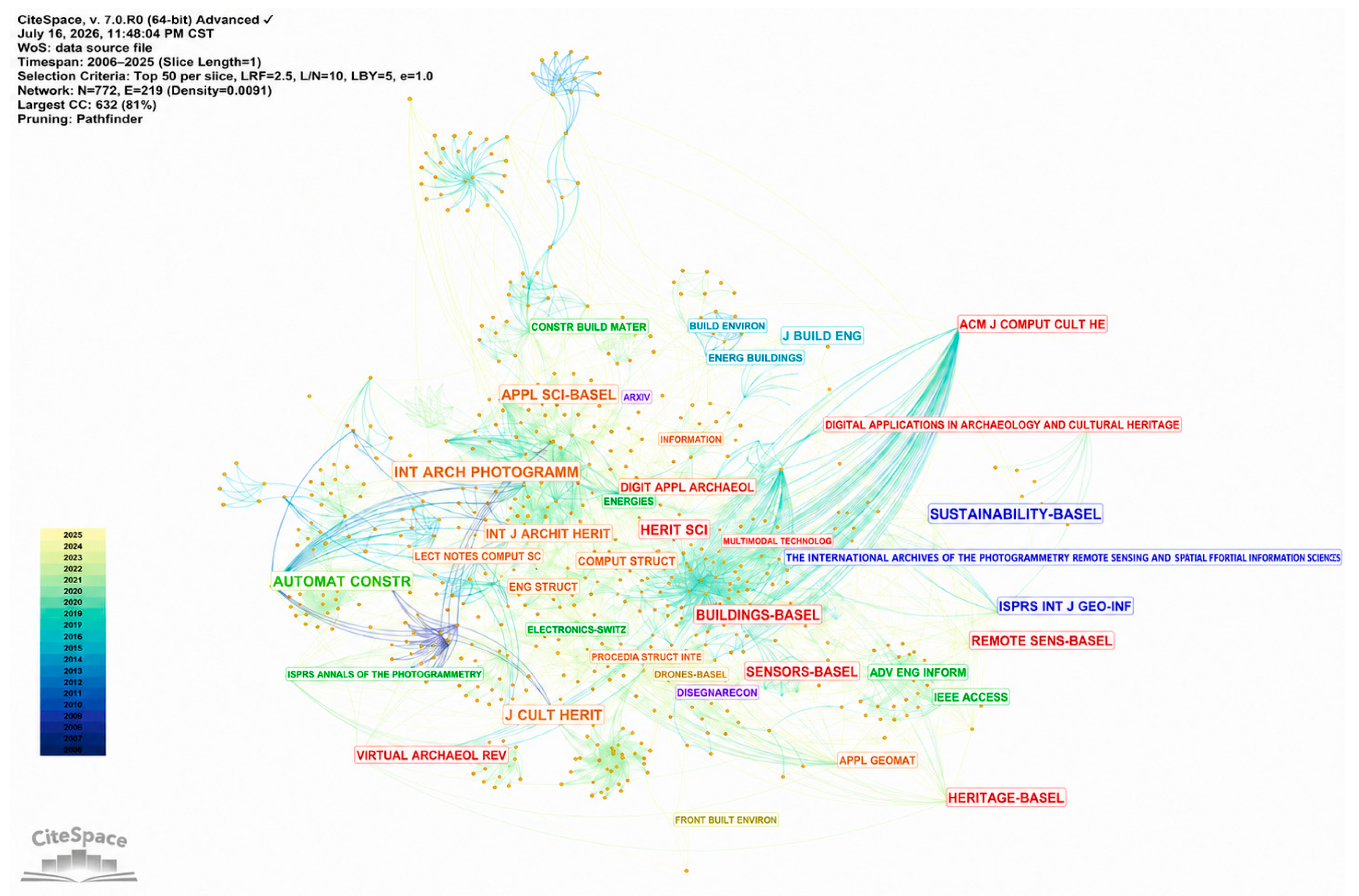
Figure 7 presents the journal co-citation network, consisting of 772 nodes and 2719 links. The network reveals the major publication sources and knowledge foundations supporting research on immersive technologies and digital twins in architectural heritage.
The left blue/green cluster, centered around Virtual Real-London and Comput Hum Behav, represents the core technical foundation and human–computer interaction (HCI) layer of this domain, focusing on virtual reality algorithmic architectures, interactive graphics engines, user experience (UX) metrics, and computer-assisted engineering workflows.
The journal co-citation structure demonstrates the interdisciplinary characteristics of this research field. Journals related to photogrammetry, remote sensing, and spatial information sciences form an important knowledge foundation, represented by The International Archives of the Photogrammetry, Remote Sensing and Spatial Information Sciences and ISPRS International Journal of Geo-Information. These journals contribute methodological support for three-dimensional data acquisition, spatial reconstruction, and geographic information-based heritage documentation.
Meanwhile, journals focusing on construction, architecture, and heritage conservation, including Automation in Construction, Buildings, and Journal of Cultural Heritage, provide the theoretical and technical basis for HBIM, digital modeling, and conservation-oriented applications. Research published in these journals has promoted the integration of building information models, digital surveying, and heritage management workflows.
The presence of journals such as Sustainability and Remote Sensing indicates the increasing connection between digital heritage technologies and sustainable conservation practices. Current research is gradually extending from digital representation toward long-term monitoring, preventive conservation, and lifecycle-oriented management of historic buildings.
Table 6 lists the top 15 most co-cited journals in the dataset. The distribution of highly cited journals confirms that immersive technologies and digital twins in architectural heritage are supported by multiple disciplinary fields, including remote sensing, construction informatics, heritage science, and sustainability research.
Journal of Cultural Heritage ranks first with 99 citations, indicating its important role in providing theoretical and methodological foundations for heritage documentation, conservation strategies, and cultural heritage management. Journals related to photogrammetry and spatial information sciences, including The International Archives of the Photogrammetry, Remote Sensing and Spatial Information Sciences and ISPRS International Journal of Geo-Information, occupy high positions in the citation network, highlighting the importance of three-dimensional surveying, spatial data processing, and digital reconstruction methods in heritage research [43].
Engineering-oriented journals, particularly Automation in Construction and Journal of Building Engineering, represent the technical foundation for integrating BIM, digital twins, and computational approaches into the built environment. Research published in these journals has promoted the development of HBIM workflows, digital modeling methods, and performance-based analysis for historic buildings [44].
Meanwhile, journals such as Sustainability, Buildings, Sensors, and Remote Sensing demonstrate the increasing connection between digital heritage technologies and sustainable conservation, environmental monitoring, and sensor-based data acquisition. These studies indicate that current research is gradually extending from digital documentation toward intelligent monitoring and lifecycle-oriented heritage management. The presence of ACM Journal on Computing and Cultural Heritage further reflects the contribution of computer science and interactive technologies to heritage representation and user-oriented digital experiences. Overall, the journal co-citation structure demonstrates that immersive technologies and digital twins in architectural heritage are supported by a multidisciplinary knowledge system integrating heritage conservation, spatial information science, construction informatics, and digital technologies.

3.3.3. Reference Co-Citation Analysis

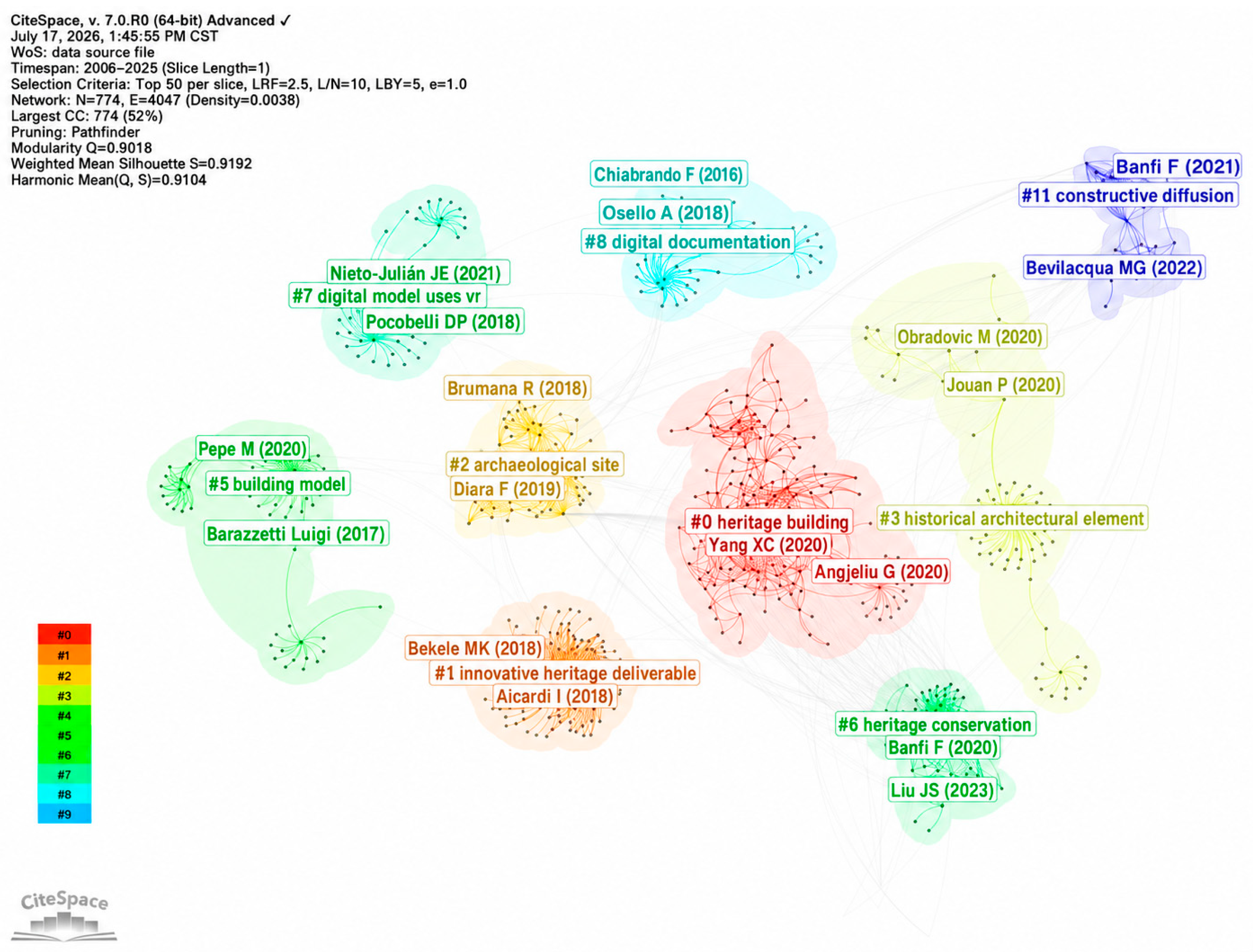
Figure 8 presents the reference co-citation network, consisting of 1461 nodes and 4047 links. The network shows a modularity value of Q = 0.9018 and a weighted mean silhouette value of S = 0.9192, indicating a well-structured clustering pattern with clear thematic separation. The identified clusters reflect the main knowledge foundations and evolutionary pathways of immersive technologies and digital twins in architectural heritage.
Cluster “heritage building” (#0) represents the central knowledge domain of the field. References within this cluster mainly focus on the digital representation, documentation, and management of historic buildings. These studies establish the foundation for integrating geometric information, semantic data, and conservation knowledge into digital heritage workflows. Clusters ”archaeological site” (#2) and ”digital documentation” (#4) emphasize data acquisition and representation technologies. Photogrammetry, laser scanning, and three-dimensional reconstruction methods provide accurate spatial information for recording historic structures and generating digital models, forming an essential technical basis for HBIM and digital twin applications. Cluster “historical architectural element” (#3) and cluster “building model” (#5) highlight the transition from digital recording toward information-based analysis and model-driven conservation. Research in these areas focuses on the integration of building components, structural information, and parametric modeling approaches for heritage management.
Clusters “heritage conservation” (#6) and “digital model uses” (#7) demonstrate the increasing application of digital technologies in conservation decision-making, virtual representation, and knowledge transmission. These studies indicate that digital heritage research is gradually expanding from documentation toward interactive applications and intelligent management.
Overall, the reference co-citation network reveals that the intellectual structure of immersive technologies and digital twins in architectural heritage is built upon three interconnected dimensions: digital documentation, information modeling, and heritage conservation applications. The evolution of these clusters reflects the transition from three-dimensional recording toward integrated digital management and intelligent heritage preservation.
Table 7 presents the top 15 most co-cited references in the dataset, representing the key knowledge foundations of immersive technologies and digital twins in architectural heritage. The highly cited references mainly focus on digital documentation, HBIM, virtual representation, and structural analysis of historic buildings.
The most frequently co-cited reference is Angjeliu et al. (2020) [12], with 23 co-citations and a centrality value of 0.06. This study proposed a simulation framework for digital twin applications in historical masonry buildings by integrating numerical and experimental approaches, providing an important methodological basis for connecting digital models with structural assessment.
The second and third highly cited references are Yang et al. (2020) [40] and Jouan and Hallot (2020) [8]. These studies emphasize digital documentation and digital twin frameworks for heritage conservation, demonstrating the transition from traditional recording methods toward data-driven monitoring and preventive conservation strategies.
Several highly co-cited studies focus on digital representation and information modeling. Bekele et al. (2018) provided a comprehensive review of augmented, virtual, and mixed reality applications in cultural heritage, establishing a theoretical foundation for immersive heritage visualization [9]. Moyano et al. (2022) [14] and Funari et al. (2021) [13] further advanced HBIM and Digital Twin workflows by integrating geometric information, semantic modeling, and structural analysis approaches.
Recent highly cited references, including Lucchi (2023) [46] and other studies published after 2020, indicate that research attention has gradually shifted from digital documentation toward intelligent monitoring, automated analysis, and lifecycle management of historic buildings. Overall, the reference co-citation structure demonstrates that the intellectual evolution of this field is driven by three interconnected directions: digital data acquisition, information-based modeling, and Digital Twin-supported heritage conservation.

3.4. Co-Occurrence Evolution

3.4.1. Keyword Co-Occurrence Analysis

Keyword co-occurrence analysis identifies the dominant research themes and their evolutionary relationships by examining the frequency and connection patterns of keywords extracted from the bibliographic dataset. This approach enables the visualization of thematic structures, emerging research directions, and knowledge evolution within a research field.
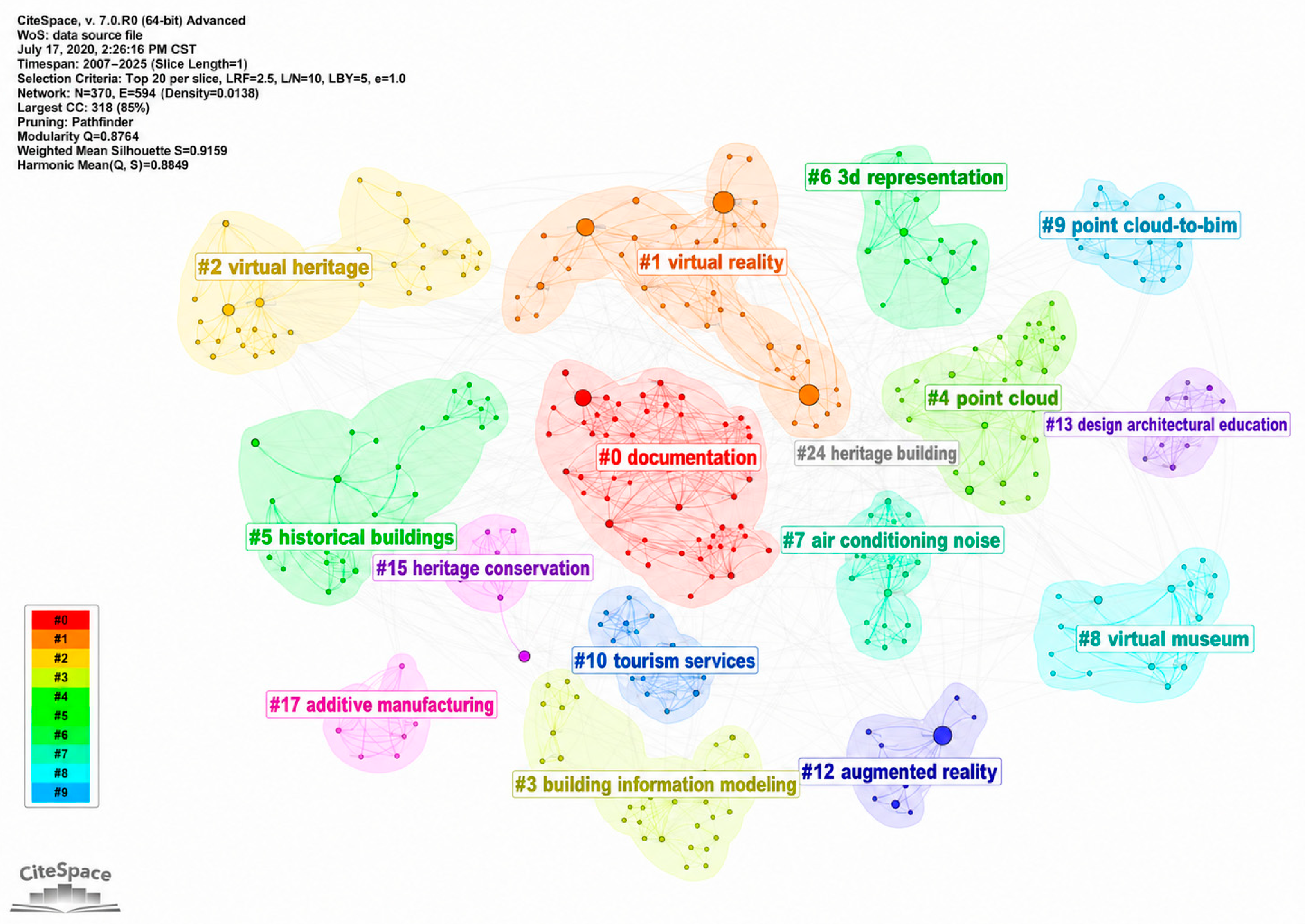
Figure 9 presents the keyword co-occurrence network, which contains 490 nodes and 1648 links. The network reveals a broad thematic network with a connected core and multiple specialized clusters, indicating that immersive technologies and digital twins in architectural heritage have developed through the integration of digital documentation, three-dimensional modeling, virtual environments, and heritage conservation applications.
(1) Digital documentation and three-dimensional reconstruction as the technical foundation.
The largest cluster “documentation” (#0) represents the fundamental research direction of the field. Related studies mainly focus on digital recording, spatial information acquisition, and geometric reconstruction of historic structures. Photogrammetry, laser scanning, and point-cloud processing technologies provide accurate geometric data for generating digital representations of architectural heritage and establishing subsequent information management frameworks.
The clusters “point cloud” (#4), “3D representation” (#6), and “point cloud-to-BIM” (#9) further demonstrate the continuous evolution from geometric data acquisition toward semantic information modeling. Recent studies have emphasized automated point-cloud processing, object recognition, and the integration of surveying data with BIM environments, enabling more efficient documentation and conservation workflows [52,53].
(2) Virtual reality and virtual heritage as major application directions.
The cluster “virtual reality” (#1) and “virtual heritage” (#2) constitute the main technological application domains. These studies investigate immersive visualization, virtual environments, and interactive experiences for presenting historical buildings and cultural resources.
Virtual heritage research has gradually shifted from simple digital visualization toward interactive learning, virtual exhibitions, and knowledge transmission. The combination of immersive environments and heritage narratives provides new approaches for improving public engagement and supporting cultural education [54,55].
Meanwhile, the emergence of “virtual museum” (#8) indicates that digital heritage applications are expanding beyond physical conservation sites toward online and immersive cultural dissemination platforms. These developments demonstrate the increasing importance of user experience and interactive interpretation in heritage preservation [56].
(3) Integration of BIM, HBIM, and digital twin technologies.
The cluster “building information modeling” (#3) represents the transition from digital documentation toward information-based heritage management. BIM- and HBIM-related studies increasingly integrate geometric models with historical records, diagnostic data, semantic information, and conservation requirements.
Compared with conventional three-dimensional models, HBIM provides a structured and updatable environment for organizing building components, archival sources, previous interventions, diagnostic results, and restoration information. Such platforms can support interdisciplinary collaboration, condition assessment, and restoration planning, while also providing a data foundation for more advanced digital-twin applications [57].
(4) Emerging interdisciplinary applications and future directions.
The keyword network also reveals several application-oriented clusters, including “augmented reality” (#12) and “historical buildings” (#5). Augmented reality can support heritage interpretation and restoration management by overlaying digital information onto physical settings and improving access to project information during conservation-related activities [58].
Furthermore, the growing connection among digital twins, HBIM, sensing technologies, and predictive models suggests an expansion from static digital representation toward condition monitoring, preventive conservation, and data-supported decision-making. Recent heritage-oriented digital-twin models have integrated physical assets, digital representations, monitoring data, and predictive analysis to support proactive conservation strategies [59].
Complementing this cluster-based interpretation, Table 8 summarizes the top 15 most frequent keywords between 2007 and 2025 according to occurrence frequency, betweenness centrality, and year of first appearance.
Table 8 summarizes the top 15 most frequently occurring keywords from 2007 to 2025. Among these keywords, “cultural heritage” (60 occurrences), “virtual reality” (58 occurrences), “augmented reality” (46 occurrences), and “digital twin” (40 occurrences) represent the dominant conceptual foundations of this research field. Meanwhile, “photogrammetry” shows the highest betweenness centrality (0.31), indicating its important bridging role between digital acquisition technologies and heritage information modeling.
Overall, the keyword evolution demonstrates that research on immersive technologies and digital twins in architectural heritage has progressed through three main stages:
(1) Digital documentation and three-dimensional data acquisition;
(2) Immersive visualization and virtual heritage experience;
(3) Integrated information management and intelligent conservation supported by digital twins.
This evolutionary pathway reflects the transformation of architectural heritage research from static digital recording toward dynamic, interactive, and data-driven conservation systems.

3.4.2. Research Hotspot Analysis

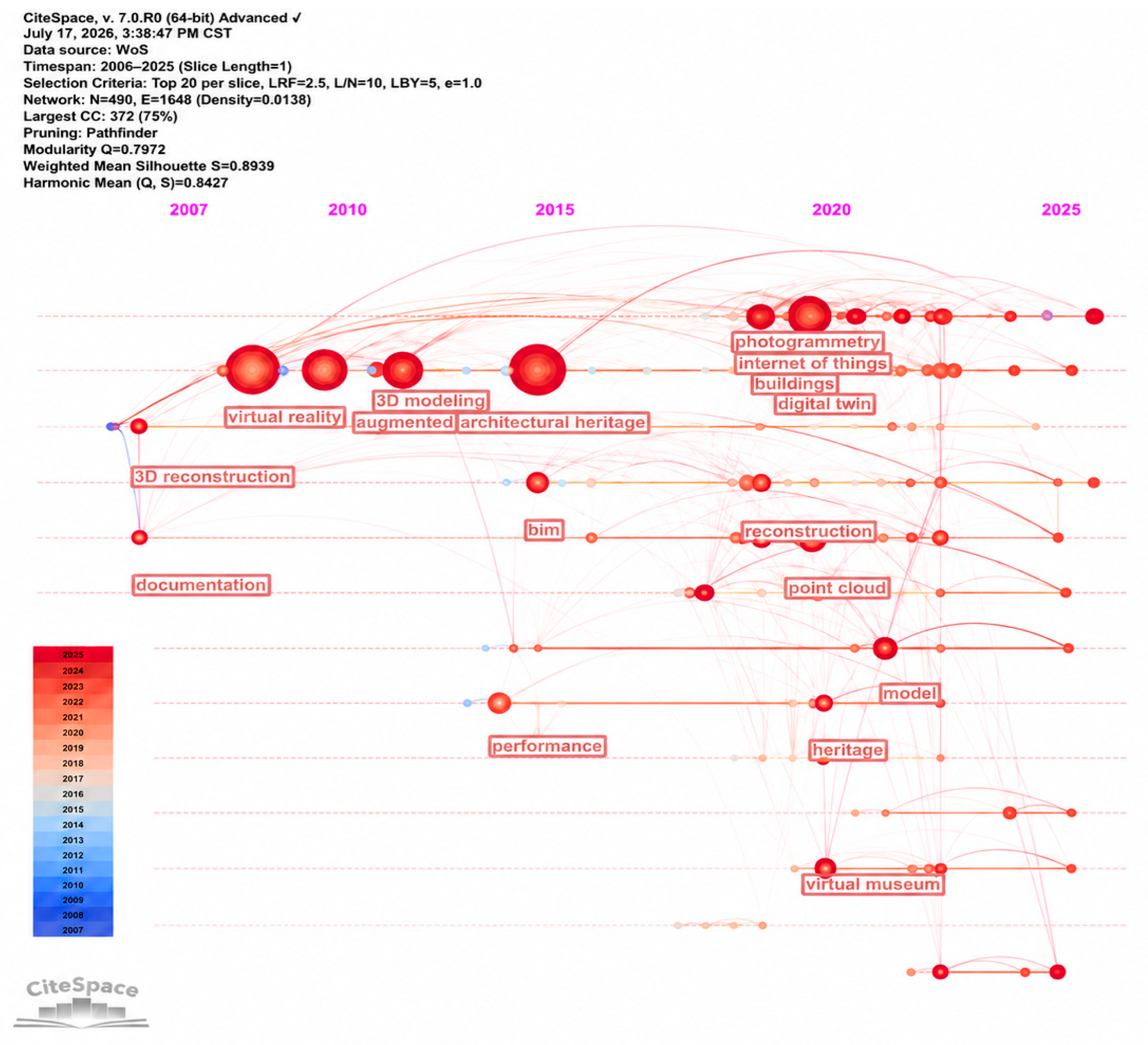
Figure 10 presents the keyword time-zone map, illustrating the temporal evolution of research topics in immersive technologies and digital twins for architectural heritage. The network contains 490 nodes and 1648 links, with a density of 0.0138, indicating the progressive development and interconnection of research themes. The temporal distribution reveals a transition from fundamental digital visualization technologies toward integrated information management and intelligent heritage conservation.
(1) Initial Phase (2007–2013): Digital Reconstruction and Immersive Visualization. During the early stage, research mainly focused on virtual reality, augmented reality, documentation, and three-dimensional modeling. Early studies explored image-based reconstruction, reverse engineering, three-dimensional visualization, and virtual environments for documenting and interpreting historical buildings [60,61].
Laser scanning and related three-dimensional acquisition technologies further improved the geometric recording of heritage environments. The integration of laser-scanned point clouds with virtual environments also supported accessibility assessment and digital analysis of historic sites [62].
(2) Development Phase (2014–2019): From 2014 to 2019, research gradually shifted from digital representation toward structured information management. Keywords such as “building information modeling,” “point cloud,” “historical buildings,” and “heritage conservation” became increasingly prominent.
During this period, survey data and BIM-based information models were increasingly combined within conservation workflows. Researchers began integrating geometric information, semantic descriptions, and conservation requirements into unified digital models, supporting more systematic management of historical buildings [63,64].
Meanwhile, virtual museum and digital heritage concepts emerged during this stage, indicating that immersive technologies were increasingly applied not only for documentation but also for cultural communication, education, and public interaction [65].
(3) Recent Phase (2020–2025): After 2020, the keyword evolution demonstrates a transition toward intelligent and integrated heritage management. Emerging keywords including “internet of things,” “point cloud-to-BIM,” and “digital twin” indicate that research has expanded from static modeling toward dynamic monitoring and data-driven decision support.
The integration of IoT sensing systems, BIM platforms, and digital twin frameworks provides new possibilities for real-time condition assessment, preventive conservation, and lifecycle management of historical buildings [66]. In addition, keywords related to architectural education and virtual museums suggest that immersive technologies are increasingly used for knowledge transmission and interactive learning environments [67].
This evolutionary pathway demonstrates that architectural heritage digitization is gradually moving from digital recording toward integrated, dynamic, and intelligent management systems.

3.4.3. Keyword Burst Analysis

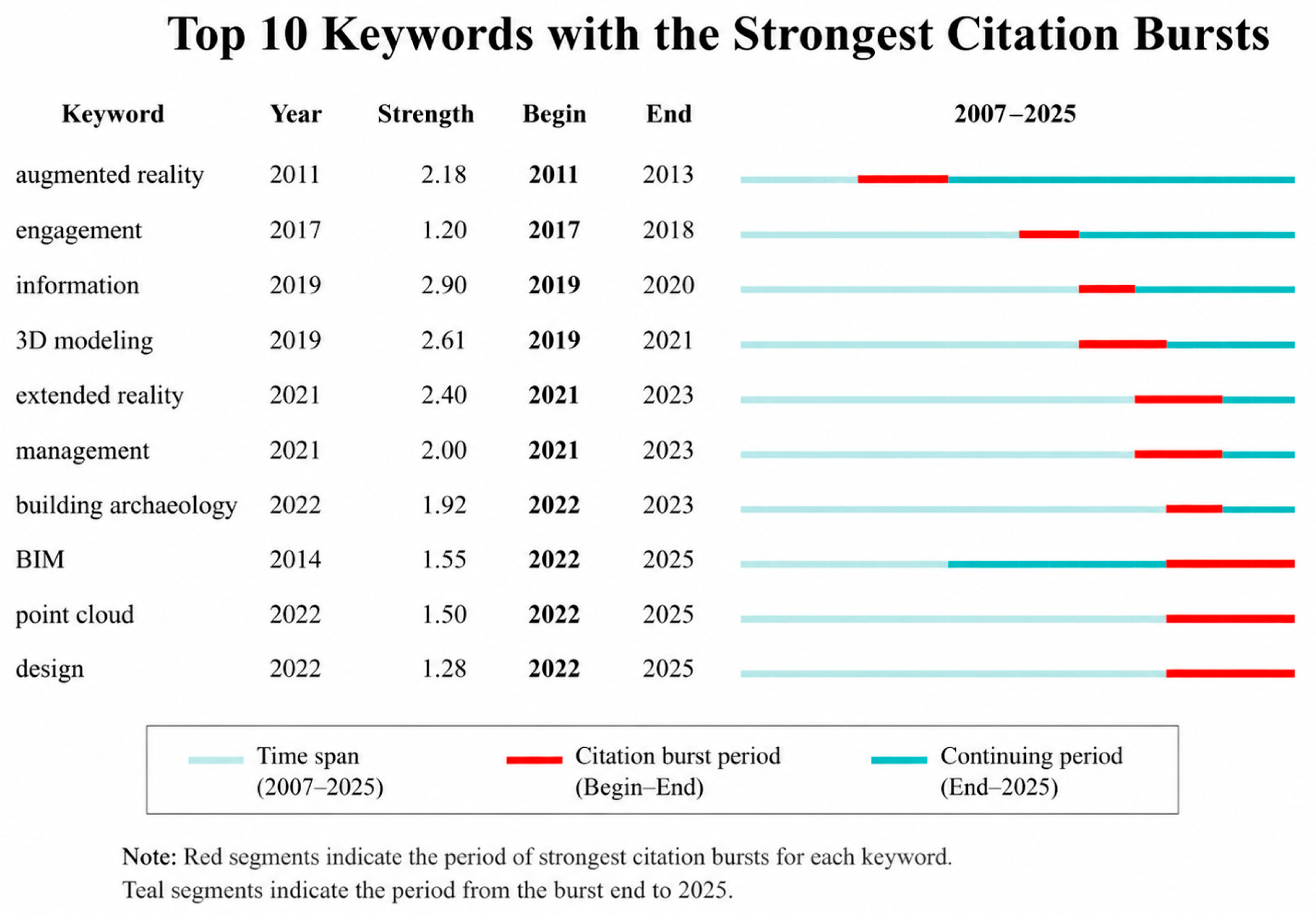
Figure 11 presents the top 10 keywords with the strongest citation bursts. Keyword bursts indicate temporary increases in scholarly attention rather than the overall frequency or long-term importance of a topic. The results reveal four successive but overlapping thematic periods.
(1) Early Augmented-Reality Exploration. “Augmented reality” was the earliest burst keyword, with a strength of 2.18 between 2011 and 2013. This indicates that early research explored the use of digital overlays to communicate architectural information and enhance the interpretation of physical heritage environments. Initial applications mainly focused on visual communication and the presentation of digitally reconstructed architectural elements within real-world settings [68].
(2) Engagement and Information-Oriented Modeling. The burst of “engagement” between 2017 and 2018 reflects increasing attention to user experience, educational participation, and interaction with digitally represented heritage. Studies during this period began evaluating immersive technologies not only as visualization tools but also as media for architectural learning and visitor engagement [69].
This user-oriented direction was followed by the bursts of “information” from 2019 to 2020 and “3D modeling” from 2019 to 2021. “Information” exhibited the highest burst strength in the figure (2.90), while “3D modeling” reached a strength of 2.61. Together, these keywords suggest a shift from isolated visual representations toward interactive three-dimensional environments that combine geometric models, point-cloud data, historical documents, material information, and heritage-management content [70].
(3) Extended Reality, Management, and Building Archeology. “Extended reality” and “management” both showed bursts from 2021 to 2023, with strengths of 2.40 and 2.00, respectively. This period reflects the increasing integration of scan-to-BIM models, immersive interfaces, and interactive information environments. XR applications were used to connect digital survey results and semantic models with heritage interpretation, communication, and management tasks [71].
“Building archeology” subsequently emerged between 2022 and 2023. Related studies integrated architectural stratigraphy, historical interpretation, photogrammetry, point clouds, BIM, and XR to examine the temporal transformation of archeological structures and communicate otherwise fragmented historical evidence [72,73].
(4) Sustained BIM, Point-Cloud, and Design Research. The keywords “BIM,” “point cloud,” and “design” all exhibit bursts extending from 2022 to 2025. Unlike the shorter earlier bursts, their continuation to the end of the analysis period indicates that they remain active research fronts.
The concurrent development of these topics suggests increasing attention to the conversion of survey data into structured information models and to the use of BIM-supported environments in conservation planning, design exploration, adaptive reuse, and building management. Recent studies have also connected BIM with generative design, IoT-enabled monitoring, and digital-twin-oriented management systems [74].
Overall, the burst sequence indicates a layered thematic development: from early augmented-reality visualization, through user engagement and information-oriented 3D modeling, toward XR-supported management and building archeology, followed by sustained attention to BIM, point clouds, and design. These stages should not be interpreted as a simple linear replacement of technologies. Instead, they reflect the gradual accumulation and integration of visualization, information modeling, heritage interpretation, and management functions.

4. Discussion

4.1. Current Challenges

The scientometric analysis demonstrates that immersive technologies and digital twins for architectural heritage have evolved into a highly interdisciplinary research field, integrating knowledge from architectural conservation, information modeling, computer science, engineering simulation, and human–computer interaction. However, despite significant technological advances, several challenges remain before these approaches can be widely implemented in heritage conservation practices.
(1) The balance between digital fidelity and practical accessibility.
High-precision digital documentation based on photogrammetry, laser scanning, and HBIM provides reliable geometric and semantic information for heritage preservation. However, such approaches usually involve complex data acquisition processes, large computational requirements, and specialized technical expertise, which restrict their application in small-scale heritage projects and public-oriented dissemination.
Conversely, lightweight immersive applications provide broader accessibility but often simplify geometric details and historical information. Therefore, future research should focus on developing adaptive digital heritage systems that balance model accuracy, computational efficiency, and user accessibility.
(2) The challenge of cultural authenticity and knowledge.
The keyword and reference evolution analysis indicates that current research has gradually shifted from simple digital reconstruction toward knowledge-based heritage management. Nevertheless, authenticity remains a critical issue in immersive heritage applications.
Digital models can accurately reproduce geometric characteristics of historic buildings; however, they may not fully represent construction logic, craftsmanship knowledge, historical context, and cultural meanings embedded in traditional architecture. Future digital heritage platforms should therefore integrate geometric information with semantic knowledge, craftsmanship processes, and historical narratives to achieve a more comprehensive representation of heritage values.
(3) The limitation of interdisciplinary integration.
The collaboration analysis reveals that current research is mainly organized around specialized academic communities, including HBIM researchers, computer scientists, heritage scholars, and visualization experts. Although these groups contribute valuable knowledge, effective integration between technical development and heritage conservation practice remains insufficient.

4.2. Illustrative Application Scenario: Xiangshan Group Craftsmanship Digitalization Pipeline

This section presents a prospective application scenario rather than an implemented or externally validated case study. To further demonstrate the practical implications of the potential technology adaptation pathways, this study selects Xiangshan traditional architectural craftsmanship in Suzhou classical gardens as a representative application scenario.
Xiangshan craftsmanship contains complex knowledge systems involving timber structures, joinery techniques, spatial organization, and construction experience. Much of this knowledge is embodied in craftsmen’s practical skills and is difficult to preserve through conventional documentation methods. Therefore, immersive technologies and digital twin approaches provide potential solutions for recording, transmitting, and managing such intangible construction knowledge.
Based on the technology evolution identified in the scientometric analysis, three potential adaptation pathways are outlined.
(1) Parametric reconstruction and structural knowledge representation.
Technologies originating from digital engineering and manufacturing domains, including three-dimensional scanning, parametric modeling, and information-based modeling, can be adapted into heritage documentation workflows.
For Xiangshan wooden structures, complex components such as mortise-and-tenon joints and timber frames can be digitally reconstructed through HBIM-based approaches. By integrating geometric information, historical records, and structural attributes, these models can support the documentation, analysis, and conservation management of traditional construction systems.
(2) Craftsmanship knowledge capture and immersive learning.
The keyword evolution analysis indicates increasing attention toward immersive learning and human-centered interaction. Technologies such as motion capture, interactive visualization, and multi-user virtual environments provide new possibilities for recording traditional craftsmanship.
In the Xiangshan context, craftsmen’s operation processes, assembly sequences, and spatial working methods can be transformed into interactive learning environments. Such systems do not replace traditional apprenticeship but provide supplementary tools for knowledge transmission and educational applications.
(3) Context-aware heritage experience and public engagement.
Recent research trends show a transition from digital representation toward user participation and heritage experience. By combining virtual environments with spatial narratives, users can experience not only architectural forms but also the cultural logic behind traditional construction.
For classical garden heritage, immersive platforms can integrate structural components, spatial sequences, and historical narratives, allowing users to understand the relationship between construction techniques, environmental adaptation, and cultural values.

4.3. Synthesis of Cross-Domain Technology Adaptation Pathways

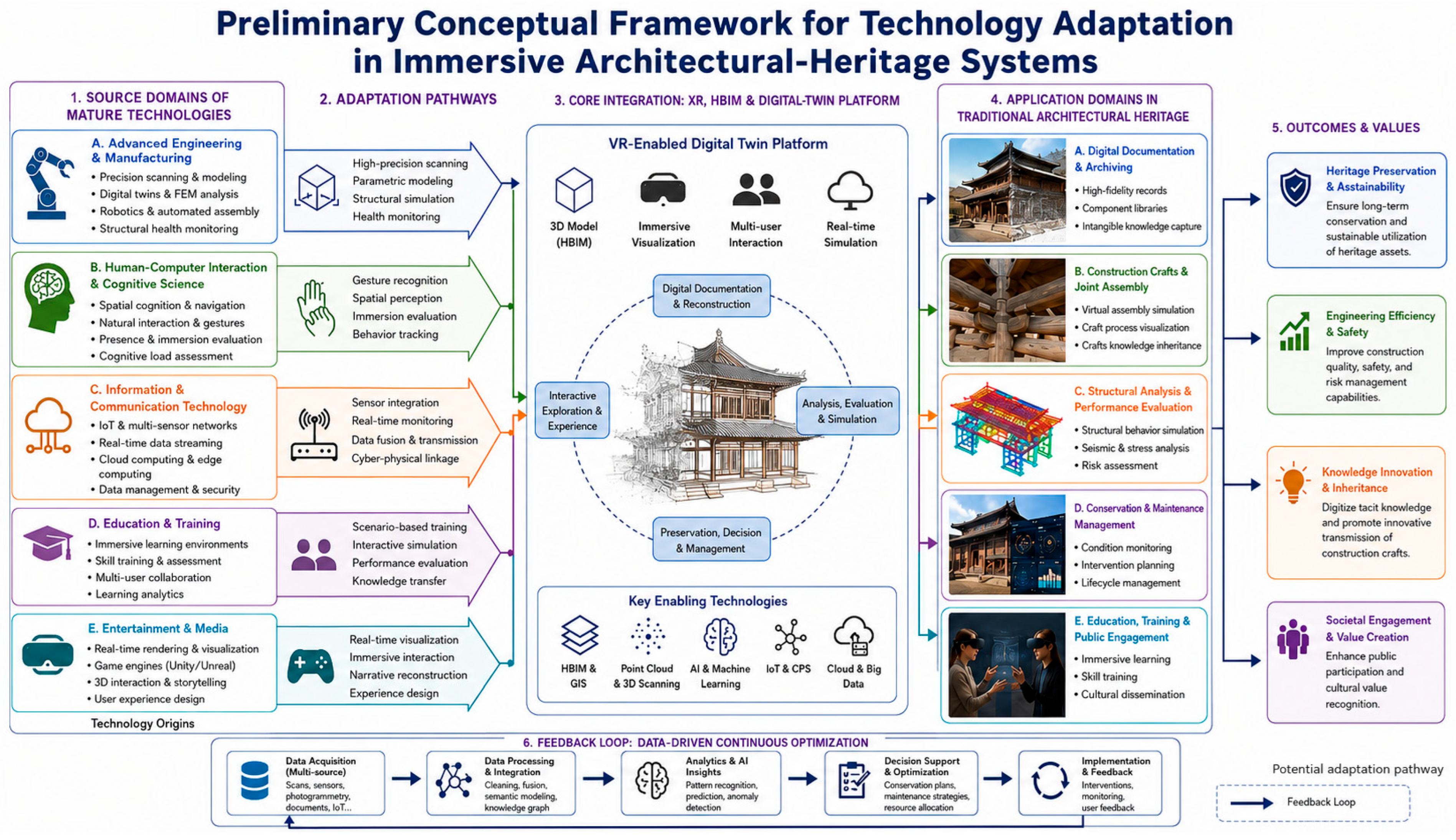
Based on the co-citation, keyword, and thematic evolution results, this study proposes a preliminary Cross-Domain Technology Adaptation Framework for VR-enabled traditional architectural heritage (Figure 12). The framework does not claim that these technologies have already been successfully transferred or validated; rather, it summarizes potential adaptation relationships identified in the literature.
As illustrated in Figure 12, the framework contains five interconnected layers. The first identifies potential source domains, including engineering, manufacturing, human–computer interaction, information technology, digital education, and interactive media. The second presents possible adaptation pathways involving 3D scanning, parametric modeling, sensing, artificial intelligence, and immersive interaction.
The third layer describes a digital integration environment connecting HBIM, 3D reconstruction, structural information, immersive visualization, and collaborative interaction. Depending on the level of physical–digital connectivity, these applications may range from static digital models to more advanced digital-twin systems.
The fourth layer summarizes potential heritage applications, including digital documentation, craftsmanship interpretation, structural assessment, conservation planning, immersive education, and public engagement. The fifth introduces a prospective feedback process linking data acquisition, analysis, decision support, implementation, and system updating.
Overall, the framework organizes the scientometric findings into a preliminary conceptual structure rather than a validated theoretical model. Further case studies and expert evaluation are required to verify the proposed adaptation pathways.

4.4. Limitations

This study has several limitations. First, relying on the Web of Science Core Collection may exclude relevant books, conference papers, technical reports, Scopus-indexed records, and local-language publications. This limitation is particularly important for virtual reality and computer-graphics research, where conference proceedings are major publication channels. Second, the restriction to journal articles may underrepresent emerging technical applications. Third, manual screening and metadata standardization involve a degree of subjective judgment, and no independent inter-reviewer agreement statistic was available. Fourth, recent publications may be affected by citation lag. Finally, CiteSpace networks reveal associations and thematic proximity but cannot independently establish causal technology transfer or practical effectiveness. The proposed framework therefore requires further validation through case studies, expert assessment, and comparative evaluation.

5. Conclusions

This study conducted a scientometric analysis of 273 articles on immersive technologies, HBIM, and digital twins in architectural heritage published between 2007 and 2025. The results show a substantial increase in publication activity after 2021 and reveal an interdisciplinary knowledge base spanning architectural conservation, civil engineering, remote sensing, construction informatics, computer science, and human–computer interaction. However, collaboration remains relatively fragmented across institutions and author groups.
The intellectual development of the field can be interpreted as a cumulative progression from three-dimensional data acquisition and digital documentation toward HBIM-based information organization, immersive interaction, and selected digital-twin applications for monitoring, assessment, and conservation decision support. These technologies perform distinct functions: immersive technologies provide interactive interfaces, HBIM organizes geometric and semantic information, and digital twins require continuing connections between physical assets and data-enabled digital representations.
Based on the scientometric findings, this study proposes a preliminary technology adaptation framework that organizes potential relationships among source technologies, heritage-specific adaptation processes, digital integration environments, application scenarios, and feedback mechanisms. The framework is intended as a conceptual synthesis rather than a validated causal model. Future research should strengthen independent screening, data and platform interoperability, task-specific evaluation, empirical case studies, and expert validation to support more reliable and sustainable digital conservation of architectural heritage.


Supplementary Materials

The following supporting information can be downloaded at: https://www.mdpi.com/article/10.3390/buildings16153064/s1, Table S1: Table_S1_Characteristics_of_273_Studies.xlsx, Table S2: Table_S2_PRISMA_2020_Checklist.xlsx.

Author Contributions

J.W.: Conceptualization, Methodology, Data curation, Formal analysis, Writing—original draft, Visualization, Project administration; Y.H.: Supervision, Writing—review and editing, Correspondence management. All authors have read and agreed to the published version of the manuscript.

Funding

This research was supported by the Jiangsu Provincial Social Science Fund Project, grant number 22YSD008.

Data Availability Statement

The dataset supporting the findings of this study—including the source images and annotated metadata—is available from the corresponding author upon reasonable request.

Acknowledgments

Finally, we extend our heartfelt thanks to all institutions and individuals who contributed to this research.

Conflicts of Interest

The authors declare that they have no competing interests.

References

  1. Kong, X.; Hucks, R.G. Preserving our heritage: A photogrammetry-based digital twin framework for monitoring deteriorations of historic structures. Autom. Constr. 2023, 152, 104928. [Google Scholar] [CrossRef]
  2. Khalil, A.; Stravoravdis, S.; Backes, D. Categorisation of building data in the digital documentation of heritage buildings. Appl. Geomat. 2021, 13, 29–54. [Google Scholar] [CrossRef]
  3. Osello, A.; Lucibello, G.; Morgagni, F. HBIM and virtual tools: A new chance to preserve architectural heritage. Buildings 2018, 8, 12. [Google Scholar] [CrossRef]
  4. Kritzinger, W.; Karner, M.; Traar, G.; Henjes, J.; Sihn, W. Digital Twin in manufacturing: A categorical literature review and classification. IFAC-PapersOnLine 2018, 51, 1016–1022. [Google Scholar] [CrossRef]
  5. Jones, D.; Snider, C.; Nassehi, A.; Yon, J.; Hicks, B. Characterising the Digital Twin: A systematic literature review. CIRP J. Manuf. Sci. Technol. 2020, 29, 36–52. [Google Scholar] [CrossRef]
  6. Boje, C.; Guerriero, A.; Kubicki, S.; Rezgui, Y. Towards a semantic Construction Digital Twin: Directions for future research. Autom. Constr. 2020, 114, 103179. [Google Scholar] [CrossRef]
  7. Banfi, F.; Brumana, R.; Stanga, C. Extended reality and informative models for the architectural heritage: From scan-to-BIM process to virtual and augmented reality. Virtual Archaeol. Rev. 2019, 10, 14–30. [Google Scholar] [CrossRef]
  8. Jouan, P.; Hallot, P. Digital Twin: Research framework to support preventive conservation policies. ISPRS Int. J. Geo-Inf. 2020, 9, 228. [Google Scholar] [CrossRef]
  9. Bekele, M.K.; Pierdicca, R.; Frontoni, E.; Malinverni, E.S.; Gain, J. A survey of augmented, virtual, and mixed reality for cultural heritage. ACM J. Comput. Cult. Herit. 2018, 11, 7. [Google Scholar] [CrossRef]
  10. Banfi, F. HBIM, 3D drawing and virtual reality for archaeological sites and ancient ruins. Virtual Archaeol. Rev. 2020, 11, 16–33. [Google Scholar] [CrossRef]
  11. Soto-Martín, O.; Fuentes-Porto, A.; Martín-Gutiérrez, J. A digital reconstruction of a historical building and virtual reintegration of mural paintings to create an interactive and immersive experience in virtual reality. Appl. Sci. 2020, 10, 597. [Google Scholar] [CrossRef]
  12. Angjeliu, G.; Coronelli, D.; Cardani, G. Development of the simulation model for Digital Twin applications in historical masonry buildings: The integration between numerical and experimental reality. Comput. Struct. 2020, 238, 106282. [Google Scholar] [CrossRef]
  13. Funari, M.F.; Hajjat, A.E.; Masciotta, M.G.; Oliveira, D.V.; Lourenço, P.B. A parametric scan-to-FEM framework for the Digital Twin generation of historic masonry structures. Sustainability 2021, 13, 11088. [Google Scholar] [CrossRef]
  14. Moyano, J.; Carreño, E.; Nieto-Julián, J.E.; Gil-Arizón, I.; Bruno, S. Systematic approach to generate Historical Building Infor-mation Modelling (HBIM) in architectural restoration project. Autom. Constr. 2022, 143, 104551. [Google Scholar] [CrossRef]
  15. Bacco, M.; Barsocchi, P.; Cassará, P.; Germanese, D.; Gotta, A.; Leone, G.R.; Moroni, D.; Pascali, M.A.; Tampucci, M. Monitoring ancient buildings: Real deployment of an IoT system enhanced by UAVs and virtual reality. IEEE Access 2020, 8, 50131–50148. [Google Scholar] [CrossRef]
  16. Ni, Z.; Liu, Y.; Karlsson, M.; Gong, S. Enabling preventive conservation of historic buildings through cloud-based Digital Twins: A case study in the City Theatre, Norrköping. IEEE Access 2022, 10, 90924–90939. [Google Scholar] [CrossRef]
  17. Cheng, J.C.P.; Zhang, J.; Kwok, H.H.L.; Tong, J.C.K. Thermal performance improvement for residential heritage building preservation based on digital twins. J. Build. Eng. 2024, 82, 108283. [Google Scholar] [CrossRef]
  18. Hang, Y.; Wang, H.; Sang, Z.; Huang, R.; Ye, L. The impact of mixed reality serious games on mortise and tenon learning in college students. Comput. Educ. X Real. 2023, 3, 100042. [Google Scholar] [CrossRef]
  19. Chen, C. CiteSpace II: Detecting and visualizing emerging trends and transient patterns in scientific literature. J. Am. Soc. Inf. Sci. Technol. 2006, 57, 359–377. [Google Scholar] [CrossRef]
  20. Wang, H.; Du, J.; Li, Y.; Zhang, L.; Li, X. Grand challenges in immersive technologies for cultural heritage. Int. J. Hum.–Comput. Interact. 2025, 41, 13682–13703. [Google Scholar] [CrossRef]
  21. Pranckutė, R. Web of Science (WoS) and Scopus: The titans of bibliographic information in today’s academic world. Publications 2021, 9, 12. [Google Scholar] [CrossRef]
  22. Page, M.J.; McKenzie, J.E.; Bossuyt, P.M.; Boutron, I.; Hoffmann, T.C.; Mulrow, C.D.; Shamseer, L.; Tetzlaff, J.M.; Akl, E.A.; Brennan, S.E.; et al. The PRISMA 2020 statement: An updated guideline for reporting systematic reviews. BMJ 2021, 372, n71. [Google Scholar] [CrossRef] [PubMed]
  23. Bruno, S.; De Fino, M.; Fatiguso, F. Historic Building Information Modelling: Performance assessment for diagnosis-aided in-formation modelling and management. Autom. Constr. 2018, 86, 256–276. [Google Scholar] [CrossRef]
  24. Murphy, M.; McGovern, E.; Pavia, S. Historic Building Information Modelling (HBIM). Struct. Surv. 2009, 27, 311–327. [Google Scholar] [CrossRef]
  25. Remondino, F. Heritage recording and 3D modeling with photogrammetry and 3D scanning. Remote Sens. 2011, 3, 1104–1138. [Google Scholar] [CrossRef]
  26. Banfi, F.; Brumana, R.; Stanga, C. A content-based immersive experience of Basilica of Sant’Ambrogio in Milan: From 3D survey to virtual reality. Int. Arch. Photogramm. Remote Sens. Spat. Inf. Sci. 2019, XLII-2/W11, 159–166. [Google Scholar] [CrossRef]
  27. del Blanco García, F.L.; González Cruz, A.J.; Amengual Menéndez, C.; Sanz Arauz, D.; Aira Zunzunegui, J.R.; Palma Crespo, M.; García Morales, S.; Sánchez-Aparicio, L.J. A Unified Virtual Model for Real-Time Visualization and Diagnosis in Architectural Heritage Conservation. Buildings 2024, 14, 3396. [Google Scholar] [CrossRef]
  28. Tan, J.; Leng, J.; Zeng, X.D.; Feng, D.; Yu, P.L. Digital Twin for Xiegong’s Architectural Archaeological Research: A Case Study of Xuanluo Hall, Sichuan, China. Buildings 2022, 12, 1053. [Google Scholar] [CrossRef]
  29. Vuoto, A.; Funari, M.F.; Lourenço, P.B. On the Use of the Digital Twin Concept for the Structural Integrity Protection of Archi-tectural Heritage. Infrastructures 2023, 8, 86. [Google Scholar] [CrossRef]
  30. Andriasyan, M.; Moyano, J.; Nieto-Julián, J.E.; Antón, D. From point cloud data to building information modelling: An automatic parametric workflow for heritage. Remote Sens. 2020, 12, 1094. [Google Scholar] [CrossRef]
  31. De Luca, L.; Véron, P.; Florenzano, M. A generic formalism for the semantic modeling and representation of architectural ele-ments. Vis. Comput. 2007, 23, 181–205. [Google Scholar] [CrossRef]
  32. Champion, E.M. (Ed.) Virtual Heritage: A Guide; Ubiquity Press: London, UK, 2021. [Google Scholar] [CrossRef]
  33. Quattrini, R.; Pierdicca, R.; Frontoni, E.; Barcaglioni, R. Virtual reconstruction of lost architectures: From the TLS survey to AR visualization. Int. Arch. Photogramm. Remote Sens. Spat. Inf. Sci. 2016, XLI-B5, 383–390. [Google Scholar] [CrossRef]
  34. Dore, C.; Murphy, M. Current state of the art historic building information modelling. Int. Arch. Photogramm. Remote Sens. Spat. Inf. Sci. 2017, XLII-2/W5, 185–192. [Google Scholar] [CrossRef]
  35. Yigit, A.Y.; Uysal, M. Detection of cracks in cultural heritage buildings using UAV photogrammetry-based Digital Twin. ACM J. Comput. Cult. Herit. 2025, 18, 13. [Google Scholar] [CrossRef]
  36. Sousa, M.N.P.O.; Correa, F.R. Towards digital twins for heritage buildings: A workflow proposal. Int. J. Archit. Comput. 2023, 21, 712–729. [Google Scholar] [CrossRef]
  37. Yang, X.; Grussenmeyer, P.; Koehl, M.; Macher, H.; Murtiyoso, A.; Landes, T. Review of built heritage modelling: Integration of HBIM and other information techniques. J. Cult. Herit. 2020, 46, 350–360. [Google Scholar] [CrossRef]
  38. Serbouti, I.; Chenal, J.; Tazi, S.A.; Baik, A.; Hakdaoui, M. Digital transformation in African heritage preservation: A Digital Twin framework for a sustainable Bab Al-Mansour in Meknes City, Morocco. Smart Cities 2025, 8, 29. [Google Scholar] [CrossRef]
  39. Banfi, F. The evolution of interactivity, immersion and interoperability in HBIM: Digital model uses, VR and AR for built cultural heritage. ISPRS Int. J. Geo-Inf. 2021, 10, 685. [Google Scholar] [CrossRef]
  40. Moyano, J.; Gil-Arizón, I.; Nieto-Julián, J.E.; Marín-García, D. Analysis and management of structural deformations through parametric models and HBIM workflow in architectural heritage. J. Build. Eng. 2022, 45, 103274. [Google Scholar] [CrossRef]
  41. Duman, C.; Aslan, T.; Haciefendioglu, K.; Gultop, T. Evaluating aftershock-induced collapse mechanisms of the Fatih Büyük Mosque’s historic masonry minaret using Digital Twin simulation. Earthq. Eng. Eng. Vib. 2025, 24, 1015–1034. [Google Scholar] [CrossRef]
  42. Aslan, T.; Haciefendioglu, K.; Duman, C. Multiple camera-based Digital Twin creation and dynamic earthquake simulation of historical masonry minarets. J. Comput. Civ. Eng. 2025, 39, 04025046. [Google Scholar] [CrossRef]
  43. Forte, M.; Dell’Unto, N.; Issavi, J.; Onsurez, L.; Lercari, N. 3D Archaeology at Çatalhöyük. Int. J. Herit. Digit. Era 2012, 1, 351–378. [Google Scholar] [CrossRef]
  44. Volk, R.; Stengel, J.; Schultmann, F. Building Information Modeling (BIM) for existing buildings—Literature review and future needs. Autom. Constr. 2014, 38, 109–127. [Google Scholar] [CrossRef]
  45. Rocha, G.; Mateus, L.; Fernández, J.; Ferreira, V. A Scan-to-BIM methodology applied to heritage buildings. Heritage 2020, 3, 47–67. [Google Scholar] [CrossRef]
  46. Lucchi, E. Digital twins for the automation of the heritage construction sector. Autom. Constr. 2023, 156, 105073. [Google Scholar] [CrossRef]
  47. López, F.J.; Lerones, P.M.; Llamas, J.; Gómez-García-Bermejo, J.; Zalama, E. A review of Heritage Building Information Mod-eling (H-BIM). Multimodal Technol. Interact. 2018, 2, 21. [Google Scholar] [CrossRef]
  48. Liu, J.; Azhar, S.; Willkens, D.; Li, B. Static terrestrial laser scanning (TLS) for Heritage Building Information Modeling (HBIM): A systematic review. Virtual Worlds 2023, 2, 90–114. [Google Scholar] [CrossRef]
  49. Boboc, R.G.; Băutu, E.; Gîrbacia, F.; Popovici, N.; Popovici, D.-M. Augmented reality in cultural heritage: An overview of the last decade of applications. Appl. Sci. 2022, 12, 9859. [Google Scholar] [CrossRef]
  50. Li, Y.; Du, Y.; Yang, M.; Liang, J.; Bai, H.; Li, R.; Law, A. A review of the tools and techniques used in the digital preservation of architectural heritage within disaster cycles. Herit. Sci. 2023, 11, 199. [Google Scholar] [CrossRef]
  51. Pepe, M.; Costantino, D.; Restuccia Garofalo, A. An efficient pipeline to obtain 3D model for HBIM and structural analysis purposes from 3D point clouds. Appl. Sci. 2020, 10, 1235. [Google Scholar] [CrossRef]
  52. Pan, X.; Lin, Q.; Ye, S.; Li, L.; Guo, L.; Harmon, B. Deep learning-based approaches from semantic point clouds to semantic BIM models for heritage digital twin. Herit. Sci. 2024, 12, 65. [Google Scholar] [CrossRef]
  53. Pang, B.; Yang, J.; Xia, T.; Zhang, A.; Zhang, K.; Xu, Q.; Wang, F. Automated heritage building component recognition and modelling based on local features. J. Cult. Herit. 2025, 71, 252–264. [Google Scholar] [CrossRef]
  54. Rafeiro, J.; Tomé, A.; Nazário, M. Immersive learning for lost architectural heritage: Interweaving the past and present, physical and digital in the Monastery of Madre de Deus. Sustainability 2024, 16, 1156. [Google Scholar] [CrossRef]
  55. Roggio, D.S.; Shokrollahi, S.; Forte, A.; Bitelli, G. Exploring historical changes to architectural heritage through reality-based 3D modeling and virtual reality: A case study. ISPRS Int. J. Geo-Inf. 2025, 14, 353. [Google Scholar] [CrossRef]
  56. Ferretti, U.; Quattrini, R.; D’Alessio, M. A comprehensive HBIM to XR framework for museum management and user experience in Ducal Palace at Urbino. Heritage 2022, 5, 1551–1571. [Google Scholar] [CrossRef]
  57. Morero, L.; Visone, F.; Abate, N.; Amodio, A.M.; Prodomo, M.; Sileo, M.; Masini, N. The use of a Heritage Building Information Model as an effective tool for planning restoration and diagnostic activities: The example of the Troia Cathedral rose window. Acta IMEKO 2023, 12, 15. [Google Scholar] [CrossRef]
  58. Bulgarelli Bolaños, J.P. The potential of augmented reality in the management of restoration of heritage buildings. Tecnol. Marcha 2019, 32, 27–36. [Google Scholar] [CrossRef]
  59. Guo, M.; Shang, X.; Zhao, J.; Shi, Y.; Sun, M.; Huang, M.; Wang, G.; Liao, L. Digital twin models for architectural heritage con-servation. J. Build. Eng. 2025, 112, 113792. [Google Scholar] [CrossRef]
  60. Styliadis, A.D. Historical photography-based computer-aided architectural design: Demolished buildings information modeling with reverse engineering functionality. Autom. Constr. 2008, 18, 51–69. [Google Scholar] [CrossRef]
  61. Hrozek, F.; Sobota, B.; Szabó, C. Digital preservation of historical buildings using virtual reality technologies. Open Comput. Sci. 2012, 2, 272–282. [Google Scholar] [CrossRef]
  62. Biere Arenas, R.M.; Egusquiza Ortega, A. Herramienta para el diagnóstico de la accesibilidad en entornos de patrimonio histó-rico, en base a escaneado láser y realidad virtual: Acc3De 1.0. ACE Archit. City Environ. 2010, 5, 61–90. [Google Scholar] [CrossRef]
  63. Napolitano, R.K.; Scherer, G.; Glisic, B. Virtual tours and informational modeling for conservation of cultural heritage sites. J. Cult. Herit. 2018, 29, 123–129. [Google Scholar] [CrossRef]
  64. Lee, J.; Kim, J.; Ahn, J.; Woo, W. Context-aware risk management for architectural heritage using Historic Building Information Modeling and virtual reality. J. Cult. Herit. 2019, 38, 242–252. [Google Scholar] [CrossRef]
  65. Navarro, I.; de Reina, O.; Fonseca, D.; Gómez, M.; Ferrer, Á. Virtual reality using smart-devices in educational frameworks: Case study: Museum Casa Batlló. Int. J. Technol. Hum. Interact. 2017, 13, 50–61. [Google Scholar] [CrossRef]
  66. Pocobelli, D.P.; Boehm, J.; Bryan, P.; Still, J.; Grau-Bové, J. BIM for heritage science: A review. Herit. Sci. 2018, 6, 30. [Google Scholar] [CrossRef]
  67. Mystakidis, S. Metaverse. Encyclopedia 2022, 2, 486–497. [Google Scholar] [CrossRef]
  68. Tunzi, P. Augmented image for the improvement of ancient architectonic heritage. Disegnarecon 2012, 5, 201–206. [Google Scholar]
  69. Fonseca, D.; Navarro, I.; de Renteria, I.; Moreira, F.; Ferrer, A.; de Reina, O. Assessment of wearable virtual reality technology for visiting World Heritage buildings: An educational approach. J. Educ. Comput. Res. 2018, 56, 940–973. [Google Scholar] [CrossRef]
  70. Baik, A. The use of interactive virtual BIM to boost virtual tourism in heritage sites, Historic Jeddah. ISPRS Int. J. Geo-Inf. 2021, 10, 577. [Google Scholar] [CrossRef]
  71. Banfi, F.; Previtali, M. Human–computer interaction based on scan-to-BIM models, digital photogrammetry, visual program-ming language and eXtended Reality (XR). Appl. Sci. 2021, 11, 6109. [Google Scholar] [CrossRef]
  72. Banfi, F.; Brumana, R.; Landi, A.G.; Previtali, M.; Roncoroni, F.; Stanga, C. Building archaeology informative modelling turned into 3D volume stratigraphy and extended reality time-lapse communication. Virtual Archaeol. Rev. 2022, 13, 1–21. [Google Scholar] [CrossRef]
  73. Stanga, C.; Banfi, F.; Roascio, S. Enhancing building archaeology: Drawing, UAV photogrammetry and scan-to-BIM-to-VR pro-cess of ancient Roman ruins. Drones 2023, 7, 521. [Google Scholar] [CrossRef]
  74. Cascone, S.; Parisi, G.; Caponetto, R. BIM-based strategies for the revitalization and automated management of buildings: A case study. Sustainability 2024, 16, 6720. [Google Scholar] [CrossRef]
Figure 1. PRISMA-style flow diagram showing the identification, screening and data-cleaning process for the scientometric review.
Buildings 16 03064 g001
Figure 2. Annual publication statistics.
Buildings 16 03064 g002
Figure 3. Institution collaboration network.
Buildings 16 03064 g003
Figure 4. Regional collaboration network.
Buildings 16 03064 g004
Figure 5. Author collaboration network.
Buildings 16 03064 g005
Figure 6. Author co-citation network.
Buildings 16 03064 g006
Figure 7. Journal co-citation network.
Buildings 16 03064 g007
Figure 8. Reference co-citation network.
Buildings 16 03064 g008
Figure 9. Keyword co-occurrence network.
Buildings 16 03064 g009
Figure 10. Keyword time zone chart.
Buildings 16 03064 g010
Figure 11. Top 10 keywords with the strongest citation bursts.
Buildings 16 03064 g011
Figure 12. Preliminary conceptual framework and potential cross-domain technology adaptation pathways for VR-enabled traditional architectural heritage.


Buildings 16 03064 g012
Table 1. Publication category statistics.
RankingCountCategory
171Engineering, Civil
262Construction & Building Technology
344Architecture
443Humanities, Multidisciplinary
527Materials Science, Multidisciplinary
627Multidisciplinary Sciences
726Engineering, Multidisciplinary
822Environmental Sciences
920Remote Sensing
1019Archaeology
1118Green & Sustainable Science & Technology
1217Physics, Applied
1317Computer Science, Interdisciplinary Applications
1416Chemistry, Multidisciplinary
1515Computer Science, Information Systems
Table 2. Top 15 institutions in the collaboration network.
RankingCountCentralityYearInstitution
1180.012019Polytechnic University of Milan
280.012018University of Sevilla
3702017University of Bologna
4702019Universitat Politecnica de Valencia
570.022024Beijing University of Civil Engineering & Architecture
6602020Universidad de Extremadura
7602018Politecnico di Bari
860.032022Hong Kong University of Science & Technology
950.032021Universidade do Minho
10502018Universita Mediterranea di Reggio Calabria
1150.012021Universidad Politecnica de Madrid
12502010Universitat Politecnica de Catalunya
13502020Consiglio Nazionale delle Ricerche (CNR)
14402019Instituto Tecnologico de Costa Rica
15402021Tongji University
Table 3. Top 15 collaboration regions.
RankingCountCentralityYearRegion
17202007Italy
2450.492010Spain
34502014China
4140.622009England
5120.052017USA
6110.562018Portugal
7902023Turkiye
880.242018Saudi Arabia
9802019Australia
1070.052017Germany
1160.052008Greece
12602010Republic of Korea
1360.12014France
1460.052016Malaysia
1560.12020Poland
Table 4. Top 10 collaborative authors.
RankingCountYearAuthor
1132019Banfi, Fabrizio
262019Stanga, Chiara
352020Bruno, Silvana
442022Moyano, Juan
542024Guo, Ming
632019Champion, Erik
732022Ni, Zhongjun
832022Landi, Angelo Giuseppe
932017Navarro, Isidro
1032022Kwok, Helen H L
Table 5. Top 15 most co-cited authors.
RankingCountCentralityYearAuthor
1430.032019Banfi F.
23402018Murphy M.
3290.032018Brumana R.
42802022Moyano J.
5260.052018Barazzetti L.
6250.032018Pepe M.
72402018Dore C.
8230.032020Angjeliu G.
92202021Yang X.C.
10200.022019Bekele M.K.
11180.012020Bruno S.
12170.052018Chiabrando F.
131702022Jouan P.
14160.062019Quattrini R.
15160.042018Remondino F.
Table 6. Top 15 most co-cited journals.
RankingCount5-Year IFJournal
1995.1J. Cult. Herit.
29211Int. Arch. Photogramm.
3872.5Appl. Sci.-Basel
4869.6Autom. Constr.
5843.3Sustainability-Basel
6763.1Buildings-Basel
7644.3Sensors-Basel
8602.9ISPRS Int. J. Geo-Inf.
95910.2The International Archives of the Photogrammetry, Remote Sensing
10590.7Heritage-Basel
11583.0Int. J. Archit. Herit.
12574.2Remote Sens.-Basel
13546.3J. Build. Eng.
14433.1ACM J. Comput. Cult. Herit.
15410.1Herit. Sci.
Table 7. Top 15 most co-cited references.
RankingCountCentralityYearReference
1230.062020 [12] Angjeliu G, 2020, COMPUT STRUCT, V238, P0, DOI 10.1016/j.compstruc.2020.106282
2180.012020[40] Yang XC, 2020, J CULT HERIT, V46, P350, DOI 10.1016/j.culher.2020.05.008
3150.072020[8] Jouan P, 2020, ISPRS INT J GEO-INF, V9, P0, DOI 10.3390/ijgi9040228
41102018[9] Bekele MK, 2018, ACM J COMPUT CULT HE, V11, P0, DOI 10.1145/3145534
51102020[45] Rocha G, 2020, HERITAGE-BASEL, V3, P47, DOI 10.3390/heritage3010004
61002023[46] Lucchi E, 2023, AUTOMAT CONSTR, V156, P0, DOI 10.1016/j.autcon.2023.105073
71002022[14] Moyano J, 2022, J BUILD ENG, V45, P0, DOI 10.1016/j.jobe.2021.103274
890.012020[10] Banfi F, 2020, VIRTUAL ARCHAEOL REV, V11, P16, DOI 10.4995/var.2020.12416
9902018[47] López FJ, 2018, MULTIMODAL TECHNOLOG, V2, P21, DOI 10.3390/mti2020021
10902022[41] Moyano J, 2022, AUTOMAT CONSTR, V143, P0, DOI 10.1016/j.autcon.2022.104551
1180.022021[13] Funari MF, 2021, SUSTAINABILITY-BASEL, V13, P0, DOI 10.3390/su131911088
1280.012023[48] Liu JS, 2023, VIRTUAL WORLDS-BASEL, V2, P90, DOI 10.3390/virtualworlds2020006
1380.032022[49] Boboc RG, 2022, APPL SCI-BASEL, V12, P0, DOI 10.3390/app12199859
14802023[50] Li Y, 2023, HERIT SCI, V11, P0, DOI 10.1186/s40494-023-01035-x
15802020[51] Pepe M, 2020, APPL SCI-BASEL, V10, P0, DOI 10.3390/app10041235
Table 8. Top 15 most co-occurring keywords.
RankingCountCentralityYearKeyword
1600.122014cultural heritage
2580.032010virtual reality
3460.072011augmented reality
4400.112019digital twin
5380.132012architectural heritage
6180.072014bim
7160.152019hbim
8110.182008documentation
9110.182018buildings
10100.122019heritage
1190.312018photogrammetry
1290.132021point cloud
1390.052018built heritage
1480.072018reconstruction
15802022digital heritage
Disclaimer/Publisher’s Note: The statements, opinions and data contained in all publications are solely those of the individual author(s) and contributor(s) and not of MDPI and/or the editor(s). MDPI and/or the editor(s) disclaim responsibility for any injury to people or property resulting from any ideas, methods, instructions or products referred to in the content.