A Semantic Scan-to-IFC Pipeline for Automated Generation of BEM-Ready Building Models from Mobile Indoor Scanning Data


Abstract
1. Introduction
2. Literature Review
2.1. Building Energy Model
2.2. Applicability of BIM to Existing Buildings
2.3. BIM Enrichment for Energy Analysis
2.4. Research Gaps and Proposed Approach
3. Materials and Methods
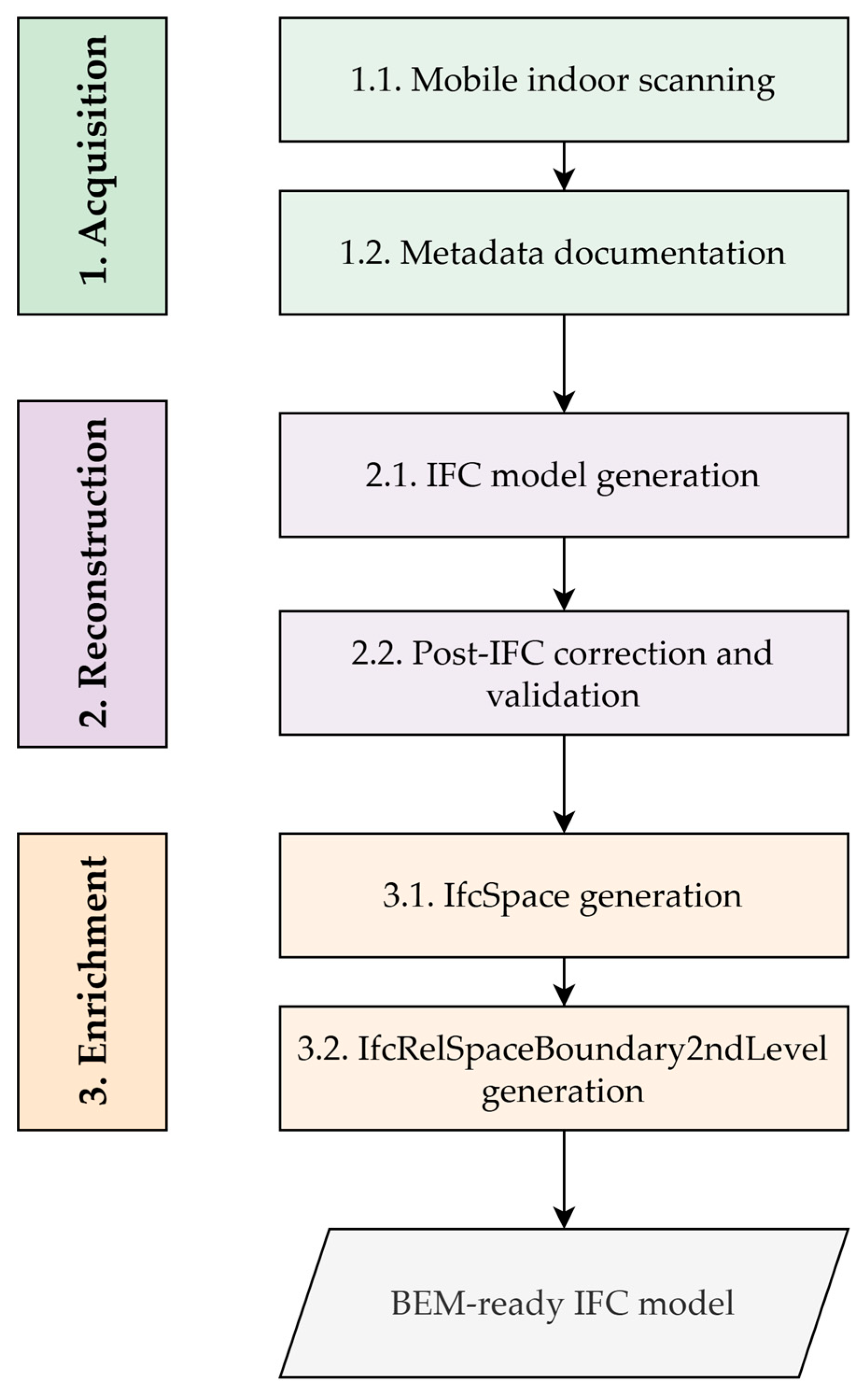
3.1. Acquisition
3.1.1. Mobile Indoor Scanning
3.1.2. Metadata Documentation
3.2. Reconstruction
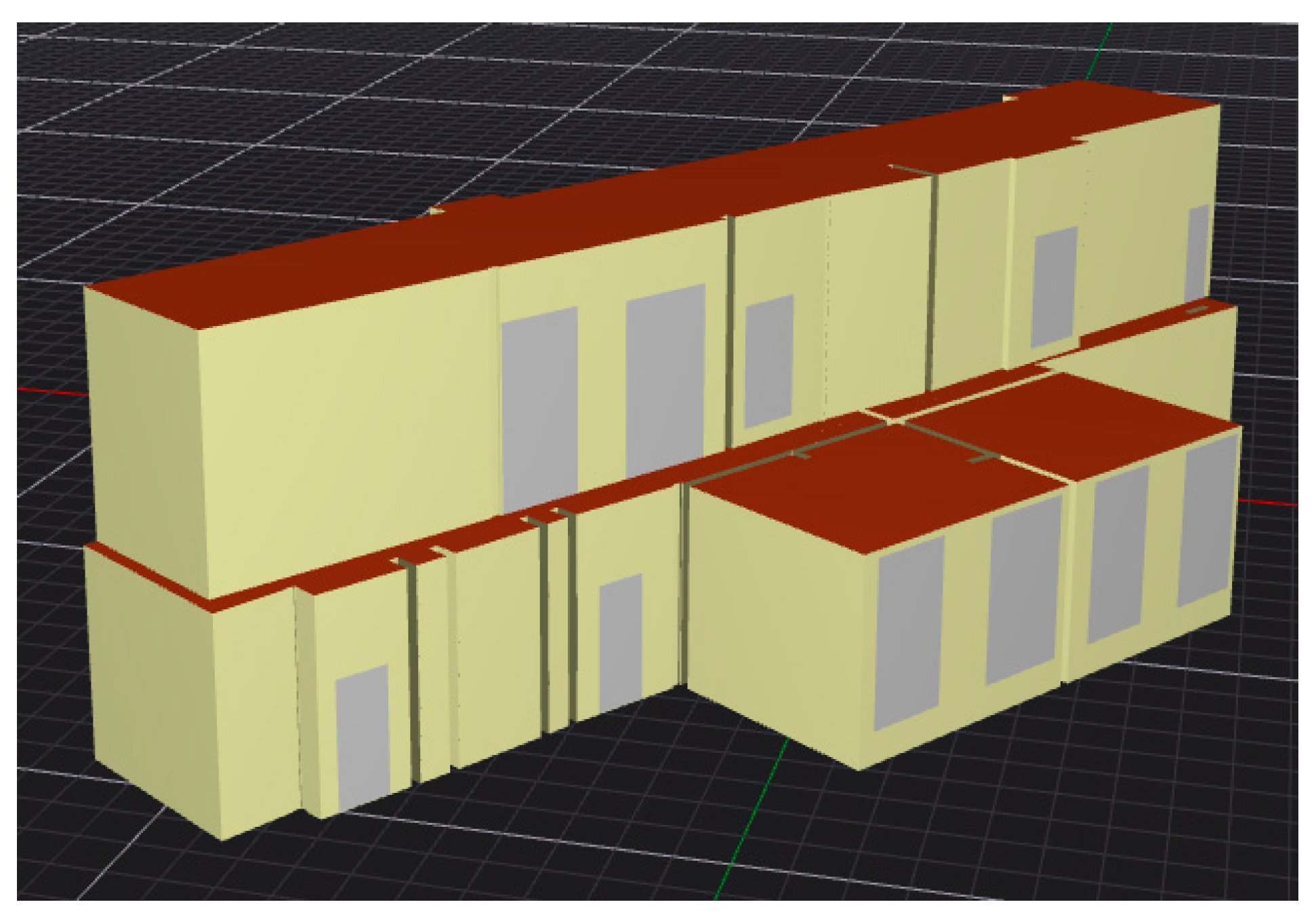
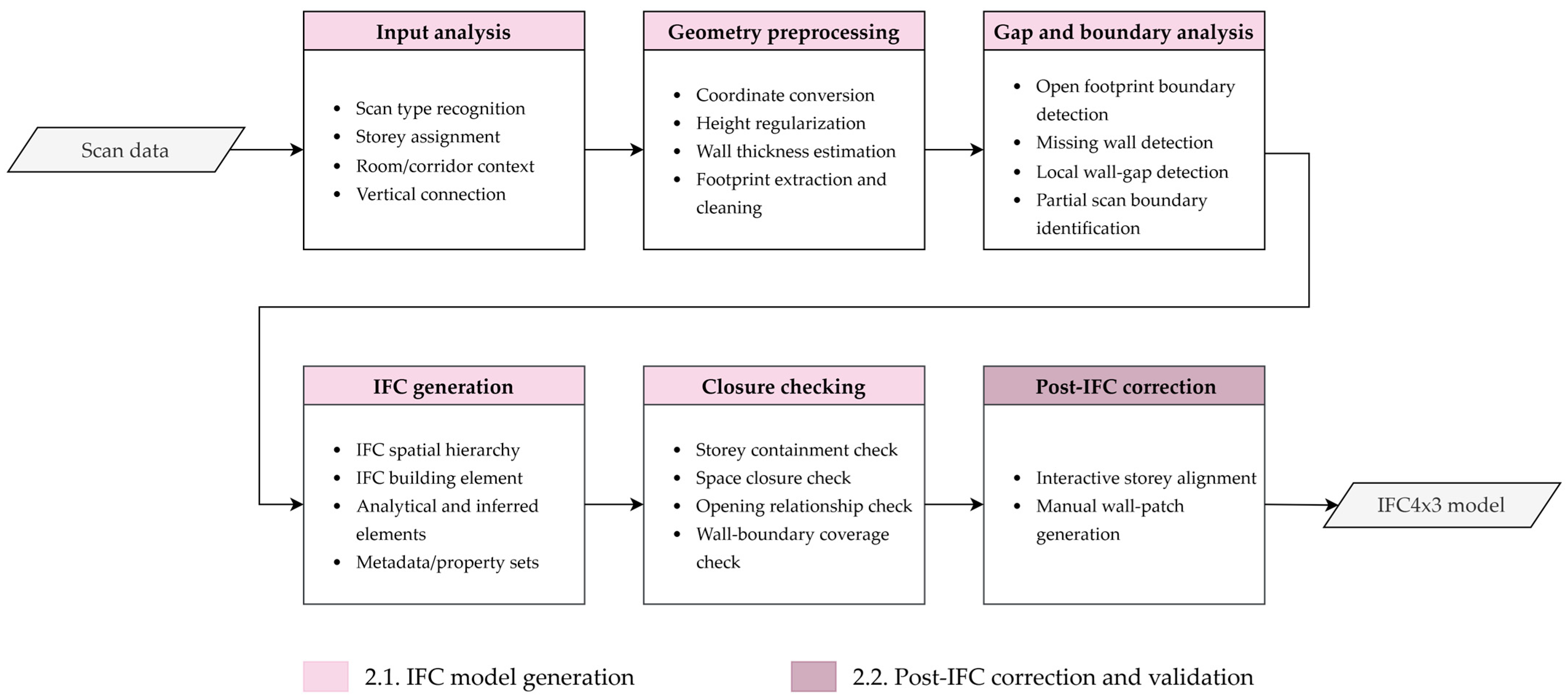
3.2.1. IFC Model Generation
3.2.2. Post-IFC Correction and Validation
3.3. Enrichment
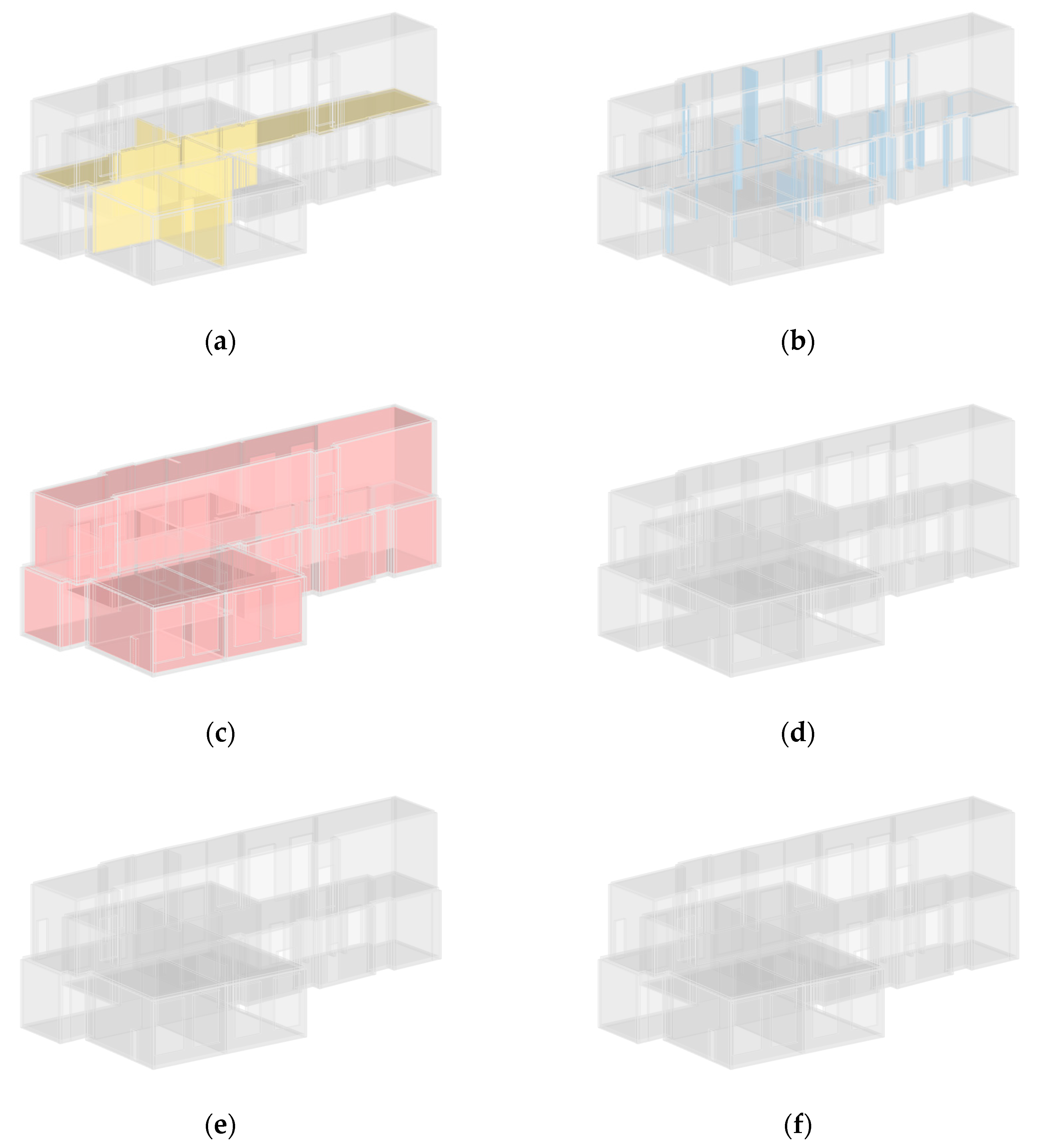
3.3.1. IfcSpace Generation
- Geometry extraction;
- Volumetric conflict resolution;
- Face matching;
- Free surface identification;
- Topological grouping;
- IfcSpace instantiation.
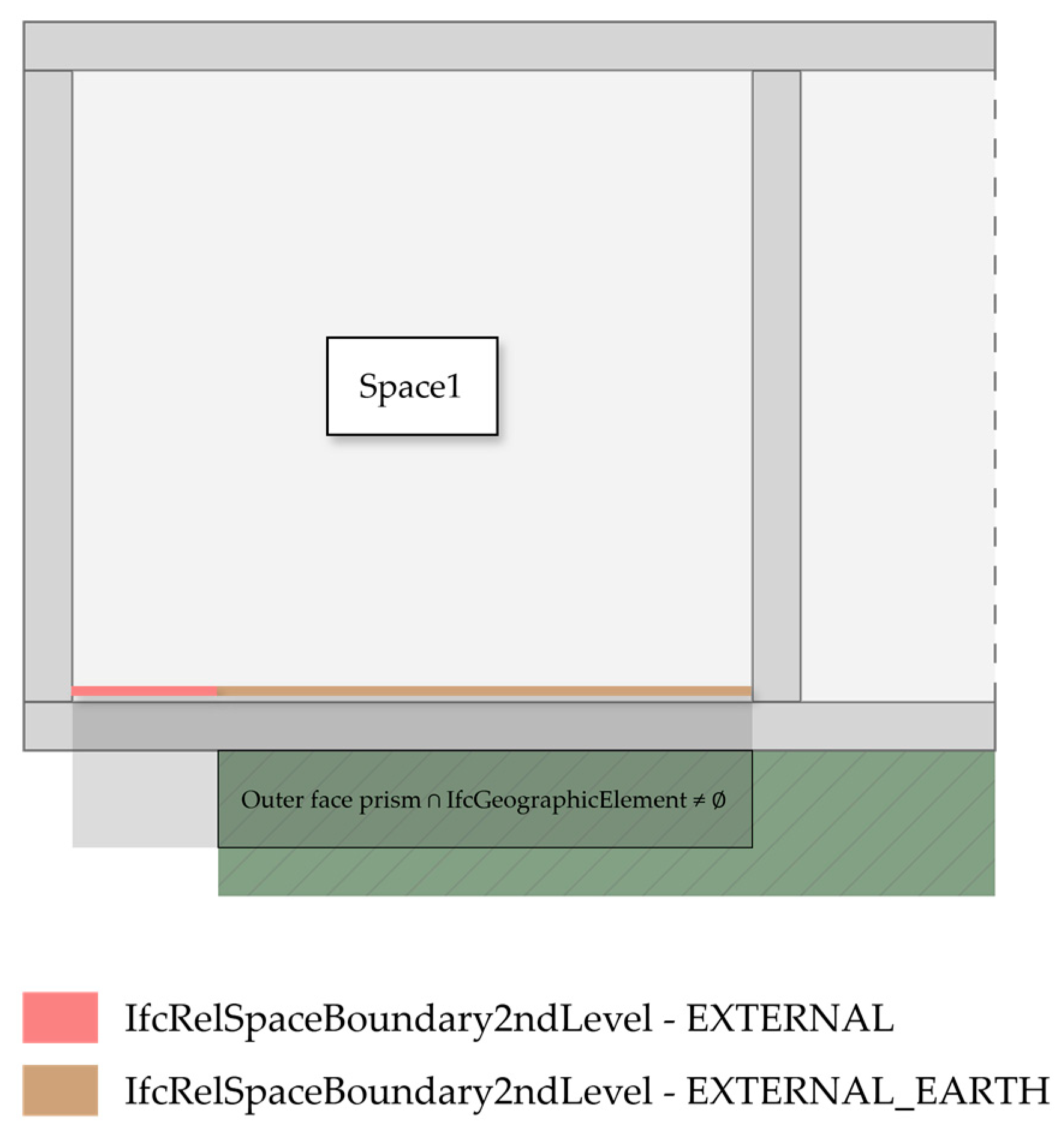
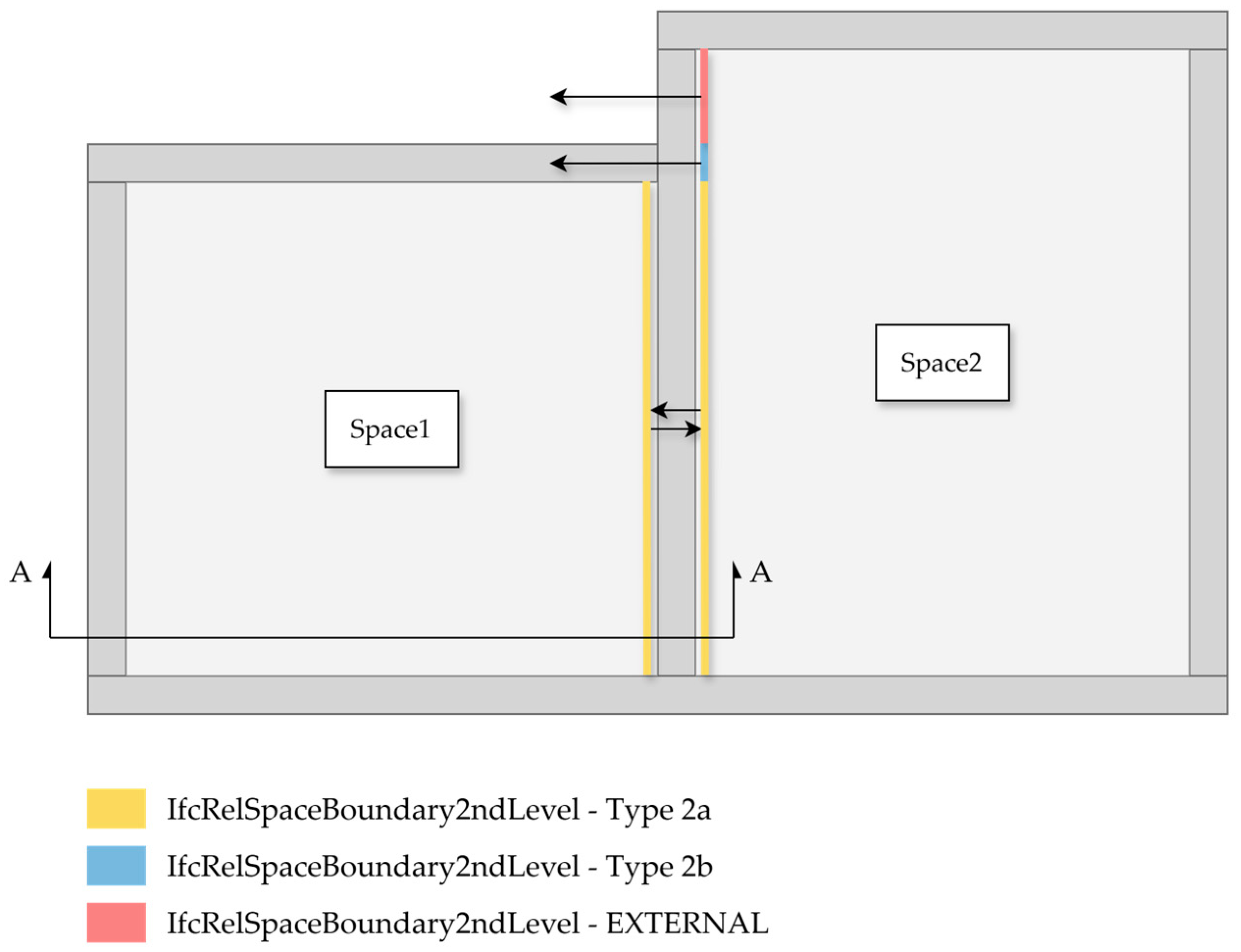
3.3.2. IfcRelSpaceBoundary2ndLevel Generation
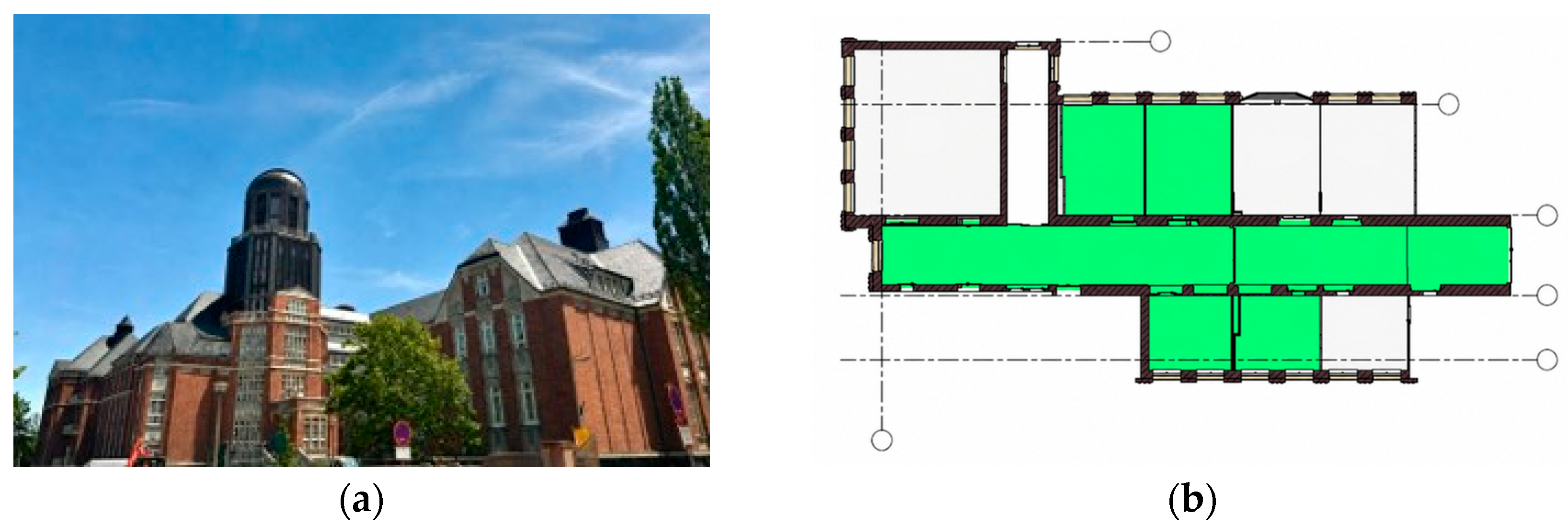
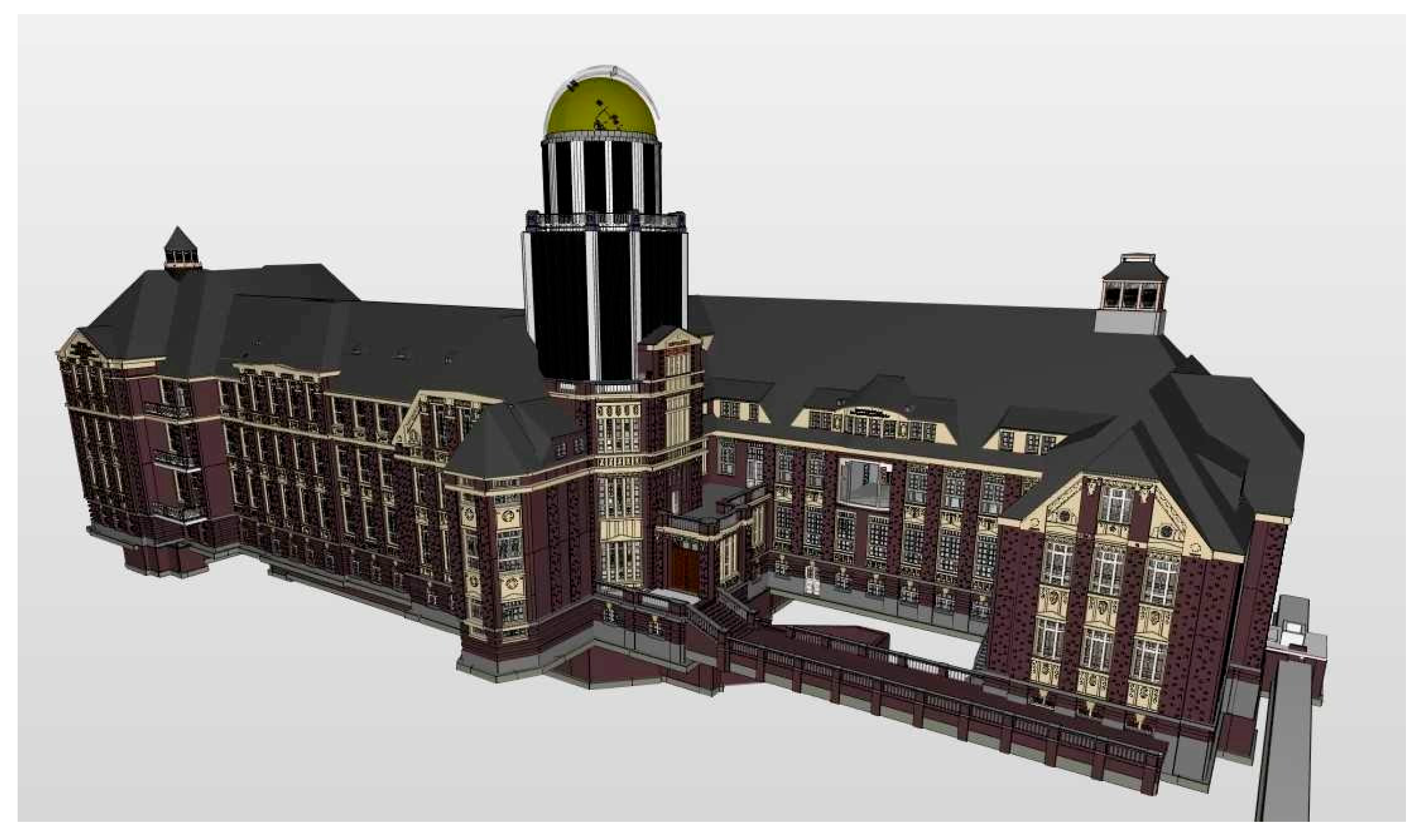
3.4. Case Study
3.5. AI-Assisted Software Development
4. Results
5. Discussion
5.1. Feasibility of Mobile Scanning as BEM Input
5.2. Space and Boundary Generation on Scan-Derived Input
5.3. Geometric Comparison with the Revit Reference Model
5.4. Integration into VICUS and Pipeline Completeness
5.5. Energy Comparison with the Revit Reference Model
5.6. Practical Applicability for Renovation Workflows
5.7. Limitations and Future Work
6. Conclusions
Author Contributions
Funding
Data Availability Statement
Acknowledgments
Conflicts of Interest
Abbreviations
| AI | Artificial Intelligence |
| ASG | Automatic Space Generation |
| BEM | Building Energy Model |
| BIM | Building Information Model/Modelling |
| BIP | Boundary Intersection Projection |
| BPS | Building Performance Simulation |
| B-rep | Boundary Representation |
| CBIP | Common Boundary Intersection Projection |
| DE | Deutschland |
| DL | Deep Learning |
| gbXML | Green Building Extensible Markup Language |
| HVAC | Heating, Ventilation and Air Conditioning |
| IFC | Industry Foundation Classes |
| JSON | JavaScript Object Notation |
| MVD | Model View Definition |
| RGB-D | Red, Green, Blue-Depth |
| SQL | Structured Query Language |
| TU | Technische Universität |
References
- European Parliament and Council of the European Union. Directive (EU) 2024/1275 of the European Parliament and of the Council of 24 April 2024 on the Energy Performance of Buildings (Recast). Available online: https://eur-lex.europa.eu/legal-content/EN/TXT/?uri=OJ:L_202401275 (accessed on 10 April 2026).
- Shen, Z.; Jensen, W.; Wentz, T.; Fischer, B. Teaching Sustainable Design Using BIM and Project-Based Energy Simulations. Educ. Sci. 2012, 2, 136–149. [Google Scholar] [CrossRef] [Scilit]
- Aste, N.; Buzzetti, M.; Caputo, P.; Corgnati, S.P.; Causone, F.; Poli, T.; Zangheri, P. Energy Efficiency in Buildings: The Gap Between Energy Certification Methods and Real Performances. Energies 2025, 18, 6015. [Google Scholar] [CrossRef] [Scilit]
- Pinheiro, S.; Wimmer, R.; O’Donnell, J.; Muhic, S.; Bazjanac, V.; Maile, T.; Frisch, J.; van Treeck, C. MVD based information exchange between BIM and building energy performance simulation. Autom. Constr. 2018, 90, 91–103. [Google Scholar] [CrossRef] [Scilit]
- Andriamamonjy, A.; Saelens, D.; Klein, R. A combined scientometric and conventional literature review to grasp the entire BIM knowledge and its integration with energy simulation. J. Build. Eng. 2019, 22, 513–527. [Google Scholar] [CrossRef] [Scilit]
- United States General Services Administration (GSA). GSA BIM Guide 05–Energy Performance; GSA: Washington, DC, USA, 2015. [Google Scholar]
- Gao, H.; Koch, C.; Wu, Y. Building information modelling based building energy modelling: A review. Appl. Energy 2019, 238, 320–343. [Google Scholar] [CrossRef] [Scilit]
- Xia, Z.; Rüppel, U. LoD2BIM: A New Workflow for Reconstructing and Converting LoD2 Model to Information-rich IFC Model for Existing Building. ISPRS Ann. Photogramm. Remote Sens. Spat. Inf. Sci. 2024, X-4/W5-2024, 325–332. [Google Scholar] [CrossRef] [Scilit]
- Kamel, E.; Memari, A.M. Review of BIM’s application in energy simulation: Tools, issues, and solutions. Autom. Constr. 2019, 97, 164–180. [Google Scholar] [CrossRef] [Scilit]
- Yang, Y.; Pan, Y.; Zeng, F.; Lin, Z.; Li, C. A gbXML Reconstruction Workflow and Tool Development to Improve the Geometric Interoperability between BIM and BEM. Buildings 2022, 12, 221. [Google Scholar] [CrossRef] [Scilit]
- ISO 16739-1:2024; Industry Foundation Classes (IFC) for Data Sharing in the Construction and Facility Management Industries. ISO: Geneva, Switzerland, 2024.
- Green Building XML (gbXML) Schema. Available online: https://www.gbxml.org/index.html (accessed on 15 March 2026).
- Kone, V.; Mahesh, G. An ontology-driven bi-directional workflow for integrating project management data into the IFC standard. J. Inf. Technol. Constr. 2025, 30, 1768. [Google Scholar] [CrossRef] [Scilit]
- Bastos Porsani, G.; Del Valle De Lersundi, K.; Sánchez-Ostiz Gutiérrez, A.; Fernández Bandera, C. Interoperability between Building Information Modelling (BIM) and Building Energy Model (BEM). Appl. Sci. 2021, 11, 2167. [Google Scholar] [CrossRef] [Scilit]
- Noack, F.; Katranuschkov, P.; Scherer, R.; Dimitriou, V.; Firth, S.K.; Hassan, T.M.; Ramos, N.; Pereira, P.; Malo, P.; Fernando, T. Technical challenges and approaches to transfer building information models to building energy. In eWork and eBusiness in Architecture, Engineering and Construction, Proceedings of the 11th European Conference on Product and Process Modelling (ECPPM 2016), Limassol, Cyprus, 7–9 September 2016; Christodoulou, S., Scherer, R., Eds.; CRC Press: Boca Raton, FL, USA, 2016. [Google Scholar]
- Ciccozzi, A.; De Rubeis, T.; Paoletti, D.; Ambrosini, D. BIM to BEM for Building Energy Analysis: A Review of Interoperability Strategies. Energies 2023, 16, 7845. [Google Scholar] [CrossRef] [Scilit]
- Miller, J.; Bazjanac, V.; Maile, T.; O’Donnell, J.; Frisch, J.; van Treeck, C.; Hauer, M.; Wimmer, R. Enhancing Interoperability Between Building Information Modeling and Building Energy Modeling: Alphanumerical Information Exchange for Energy Optimization in Early Design Stages. Appl. Sci. 2025, 15, 5789. [Google Scholar] [CrossRef] [Scilit]
- Gourlis, G.; Kovacic, I. Building Information Modelling for analysis of energy efficient industrial buildings—A case study. Renew. Sustain. Energy Rev. 2017, 68, 953–963. [Google Scholar] [CrossRef] [Scilit]
- Fichter, E.; Richter, V.; Frisch, J.; Van Treeck, C. Automatic generation of second level space boundary geometry from IFC models. In Proceedings of the 17th IBPSA Conference, Bruges, Belgium, 1–3 September 2021. [Google Scholar] [CrossRef] [Scilit]
- Volk, R.; Stengel, J.; Schultmann, F. Building Information Modeling (BIM) for existing buildings—Literature review and future needs. Autom. Constr. 2014, 38, 109–127. [Google Scholar] [CrossRef] [Scilit]
- Tang, P.; Huber, D.; Akinci, B.; Lipman, R.; Lytle, A. Automatic reconstruction of as-built building information models from laser-scanned point clouds: A review of related techniques. Autom. Constr. 2010, 19, 829–843. [Google Scholar] [CrossRef] [Scilit]
- Wang, Q.; Guo, J.; Kim, M.-K. An Application Oriented Scan-to-BIM Framework. Remote Sens. 2019, 11, 365. [Google Scholar] [CrossRef] [Scilit]
- Perez-Perez, Y.; Golparvar-Fard, M.; El-Rayes, K. Scan2BIM-NET: Deep Learning Method for Segmentation of Point Clouds for Scan-to-BIM. J. Constr. Eng. Manag. 2021, 147, 04021107. [Google Scholar] [CrossRef] [Scilit]
- Armeni, I.; Sener, O.; Zamir, A.R.; Jiang, H.; Baber, I.; Fischer, M.; Savarese, S. 3D Semantic Parsing of Large-Scale Indoor Spaces. In Proceedings of the IEEE Conference on Computer Vision and Pattern Recognition (CVPR), Las Vegas, NV, USA, 27–30 June 2016; pp. 1534–1543. [Google Scholar] [CrossRef] [Scilit]
- Ikehata, S.; Yang, H.; Furukawa, Y. Structured Indoor Modeling. In Proceedings of the IEEE International Conference on Computer Vision (ICCV), Santiago, Chile, 7–13 December 2015; pp. 1323–1331. [Google Scholar] [CrossRef] [Scilit]
- Chen, J.; Liu, C.; Wu, J.; Furukawa, Y. Floor-SP: Inverse CAD for Floorplans by Sequential Room-Wise Shortest Path. In Proceedings of the IEEE/CVF International Conference on Computer Vision (ICCV), Seoul, Republic of Korea, 27 October–2 November 2019; pp. 2661–2670. [Google Scholar] [CrossRef] [Scilit]
- Yue, Y.; Kontogianni, T.; Schindler, K.; Engelmann, F. Connecting the Dots: Floorplan Reconstruction Using Two-Level Queries. In Proceedings of the IEEE/CVF Conference on Computer Vision and Pattern Recognition (CVPR), Vancouver, BC, Canada, 17–24 June 2023; pp. 845–854. [Google Scholar] [CrossRef] [Scilit]
- Yang, F.; Su, Z.; Yao, W.; Xing, X.; Stilla, U. Semantic decomposition and recognition of indoor spaces with structural constraints for 3D indoor modelling. Autom. Constr. 2019, 106, 102913. [Google Scholar] [CrossRef] [Scilit]
- Yang, J.; Kang, Z.; Zeng, L.; Akwensi, P.H.; Sester, M. Semantics-guided reconstruction of indoor navigation elements from 3D colorized points. ISPRS J. Photogramm. Remote Sens. 2021, 173, 238–261. [Google Scholar] [CrossRef] [Scilit]
- Liu, G.; Wei, S.; Zhong, S.; Huang, S.; Zhong, R. Reconstruction of Indoor Navigation Elements for Point Cloud of Buildings with Occlusions and Openings by Wall Segment Restoration from Indoor Context Labeling. Remote Sens. 2022, 14, 4275. [Google Scholar] [CrossRef] [Scilit]
- Ochmann, S.; Vock, R.; Klein, R. Automatic reconstruction of fully volumetric 3D building models from oriented point clouds. ISPRS J. Photogramm. Remote Sens. 2019, 151, 251–262. [Google Scholar] [CrossRef] [Scilit]
- Bassier, M.; Vergauwen, M. Topology Reconstruction of BIM Wall Objects from Point Cloud Data. Remote Sens. 2020, 12, 1800. [Google Scholar] [CrossRef] [Scilit]
- Mediavilla, A.; Elguezabal, P.; Lasarte, N. Graph-Based methodology for Multi-Scale generation of energy analysis models from IFC. Energy Build. 2023, 282, 112795. [Google Scholar] [CrossRef] [Scilit]
- Jansen, D.; Richter, V.; Maier, L.; Frisch, J.; Van Treeck, C.; Müller, D. Open-source framework for automated generation of building energy performance simulation models and beyond from BIM Data. Autom. Constr. 2025, 179, 106427. [Google Scholar] [CrossRef] [Scilit]
- Martens, J.; Blankenbach, J. VOX2BIM+—A Fast and Robust Approach for Automated Indoor Point Cloud Segmentation and Building Model Generation. PFG—J. Photogramm. Remote Sens. Geoinf. Sci. 2023, 91, 273–294. [Google Scholar] [CrossRef]
- Zbirovský, S.; Nežerka, V. Open-source automatic pipeline for efficient conversion of large-scale point clouds to IFC format. Autom. Constr. 2025, 177, 106303. [Google Scholar] [CrossRef] [Scilit]
- Mehranfar, M.; Vega-Torres, M.A.; Braun, A.; Borrmann, A. Automated data-driven method for creating digital building models from dense point clouds and images through semantic segmentation and parametric model fitting. Adv. Eng. Inform. 2024, 62, 102643. [Google Scholar] [CrossRef] [Scilit]
- Bazjanac, V. Space boundary requirements for modeling of building geometry for energy and other performance simulation. In Proceedings of the CIB W78 2010—Applications of IT in the AEC Industry, Cairo, Egypt, 16–18 November 2010. [Google Scholar]
- Lilis, G.N.; Katsigarakis, K.; Rovas, D. Automatic IFC data enrichment with space geometries for Building Energy Performance Simulations. In Proceedings of the 17th IBPSA Conference, Bruges, Belgium, 1–3 September 2021. [Google Scholar] [CrossRef] [Scilit]
- Rose, C.M.; Bazjanac, V. An algorithm to generate space boundaries for building energy simulation. Eng. Comput. 2015, 31, 271–280. [Google Scholar] [CrossRef] [Scilit]
- Lilis, G.N.; Giannakis, G.I.; Rovas, D.V. Automatic generation of second-level space boundary topology from IFC geometry inputs. Autom. Constr. 2017, 76, 108–124. [Google Scholar] [CrossRef] [Scilit]
- Lilis, G.N.; Giannakis, G.I.; Katsigarakis, K.; Rovas, D. Space Boundary Topology Simplification for Building Energy Performance Simulation Speedup. In Proceedings of the IBPSA Building Simulation Conference, Rome, Italy, 2–4 September 2019. [Google Scholar]
- Ying, H.; Lee, S. An Algorithm to Facet Curved Walls in IFC BIM for Building Energy Analysis. Autom. Constr. 2019, 103, 80–103. [Google Scholar] [CrossRef] [Scilit]
- Ying, H.; Lee, S. A rule-based system to automatically validate IFC second-level space boundaries for building energy analysis. Autom. Constr. 2021, 127, 103724. [Google Scholar] [CrossRef] [Scilit]
- Noardo, F.; Arroyo Ohori, K.; Krijnen, T.; Stoter, J. An Inspection of IFC Models from Practice. Appl. Sci. 2021, 11, 2232. [Google Scholar] [CrossRef] [Scilit]
- Apple Inc. RoomPlan. Available online: https://developer.apple.com/augmented-reality/roomplan/ (accessed on 4 March 2026).
- IfcOpenShell. Available online: https://ifcopenshell.org/ (accessed on 20 January 2026).
- NumPy. Available online: https://numpy.org/ (accessed on 20 January 2026).
- Anaconda. Miniconda. Available online: https://www.anaconda.com/docs/getting-started/miniconda/main (accessed on 20 January 2026).
- Paviot, T. Pythonocc-Core. Available online: https://github.com/tpaviot/pythonocc-core (accessed on 22 January 2026).
- Open-Cascade-SAS. Open CASCADE Technology. Available online: https://github.com/Open-Cascade-SAS/OCCT (accessed on 22 January 2026).
- ISO 10303-42:2025; Industrial Automation Systems and Integration—Product data Representation and Exchange. ISO: Geneva, Switzerland, 2025.
- buildingSMART. F.2 IFC4ADD1. Available online: https://standards.buildingsmart.org/IFC/RELEASE/IFC4/ADD1/HTML/annex/annex-f/ifc4add1/ (accessed on 25 March 2026).
- VICUS Software GmbH. VICUS Buildings. Available online: https://vicus-software.com/en/vicus-buildings/ (accessed on 18 February 2026).
- Bock, B.S.; Eder, F. ifcSQL-Database. Available online: https://github.com/IfcSharp/IfcSQL (accessed on 21 December 2025).






| Building Element | Layers (Exterior–Interior) | Thickness [cm] | Thermal Conductivity [W/mK] | U-Value [W/m2K] |
|---|---|---|---|---|
| Exterior wall | Brick/Plaster | 58.5/1.5 | 0.745/0.14 | 0.974 |
| Internal wall | Plaster/Brick/Plaster | 1.5/22/1.5 | 0.14/0.745/0.14 | 1.471 |
| Floor | Concrete | 25 | 1.20 | 2.643 |
| Roof | Concrete | 25 | 1.20 | 2.643 |
| Workflow Stage | Mode | Duration |
|---|---|---|
| Mobile Scanning | Manual | 16 min 32 s |
| RoomPlan JSON and Scan Manifest Export | Automatic | 4 s |
| RoomPlan-to-IFC Reconstruction | Automatic | 11 s |
| Post-IFC Storey Alignment | User-supervised | 31 s |
| Manual Wall-patch Correction | User-supervised | 5 s |
| IfcSpace Generation | Automatic | 2 min 49 s |
| IfcRelSpaceBoundary2ndLevel Generation | Automatic | 11 s |
| VICUS Buildings Import | Automatic | 39 s |
| Total | - | 21 min 2 s |
| IfcSpace.Name | IfcBuildingStorey.Name | Area [m2] | Volume [m3] |
|---|---|---|---|
| Office 111 | Storey 1 | 25.77 | 111.38 |
| Office 112 | Storey 1 | 25.44 | 109.95 |
| Office 118 | Storey 1 | 35.98 | 155.51 |
| Office 119 | Storey 1 | 38.20 | 165.10 |
| Corridor segment 1 | Storey 1 | 56.16 | 242.72 |
| Corridor segment 2 | Storey 1 | 74.07 | 320.13 |
| Corridor segment 3 | Storey 2 | 119.04 | 435.69 |
| Type | Description | Count | Area [m2] |
|---|---|---|---|
| 2a | Surfaces shared between two adjacent spaces | 43 | 538.96 |
| 2b | Adiabatic surfaces | 192 | 98.80 |
| EXTERNAL | Surfaces exposed to outdoor environment | 90 | 1249.05 |
| EXTERNAL_EARTH | Surfaces in contact with the ground | 0 | 0.00 |
| VIRTUAL | Openings between spaces without physical separator | 0 | 0.00 |
| UNRESOLVED | Boundaries with undetermined physical role | 0 | 0.00 |
| Total | 325 | 1886.81 |
| IfcSpace.Name | IfcBuildingStorey.Name | Peak Heating Load [w] | Heating Demand [kWh] |
|---|---|---|---|
| Office 111 | Storey 1 | 1178 | 5989 |
| Office 112 | Storey 1 | 1272 | 6470 |
| Office 118 | Storey 1 | 1868 | 9502 |
| Office 119 | Storey 1 | 1730 | 8800 |
| Corridor segment 1 | Storey 1 | 2705 | 13,757 |
| Corridor segment 2 | Storey 1 | 3554 | 18,076 |
| Corridor segment 3 | Storey 2 | 5438 | 27,083 |
| Total | - | - | 89,677 |
| Category | Object Type | Count | Percentage [%] |
|---|---|---|---|
| Scanned RoomPlan walls | {scanId}_Wall_{RoomPlan_UUID} | 66 | 88.0 |
| Inferred missing room walls | INFERRED_MISSING_ROOM_WALL | 7 | 9.3 |
| Inferred corridor-end closure wall | INFERRED_CORRIDOR_END_CLOSURE_WALL | 1 | 1.3 |
| Manual wall patch | MANUAL_INFERRED_WALL_PATCH | 1 | 1.3 |
| IfcSpace.Name | Scan Area [m2] | Revit Area [m2] | Δ Area [m2] | Δ Area [%] | Scan Volume [m3] | Revit Volume [m3] | Δ Volume [m3] | Δ Volume [%] |
|---|---|---|---|---|---|---|---|---|
| Office 111 | 25.77 | 25.83 | −0.06 | −0.2 | 111.38 | 121.40 | −10.02 | −8.3 |
| Office 112 | 25.44 | 26.02 | −0.58 | −2.2 | 109.95 | 122.25 | −12.30 | −10.1 |
| Office 118 | 35.98 | 37.93 | −1.95 | −5.1 | 155.51 | 178.27 | −22.76 | −12.8 |
| Office 119 | 38.20 | 40.38 | −2.18 | −5.4 | 165.10 | 189.79 | −24.69 | −13.0 |
| Corridor segment 1 | 56.16 | 48.57 | 7.59 | 15.6 | 242.72 | 228.28 | 14.44 | 6.3 |
| Corridor segment 2 | 74.07 | 67.49 | 6.58 | 9.7 | 320.13 | 317.20 | 2.93 | 0.9 |
| Corridor segment 3 | 119.04 | 109.79 | 9.25 | 8.4 | 435.69 | 401.83 | 33.86 | 8.4 |
| IfcSpace.Name | Scan Peak Load [W] | Revit Peak Load [W] | Δ Peak [%] | Scan Heating Demand [kWh] | Revit Heating Demand [kWh] | Δ Demand [%] |
|---|---|---|---|---|---|---|
| Office 111 | 1178 | 1275 | −7.6 | 5989 | 6190 | −3.2 |
| Office 112 | 1272 | 1280 | −0.6 | 6470 | 6137 | 5.4 |
| Office 118 | 1868 | 1860 | 0.4 | 9502 | 9229 | 3.0 |
| Office 119 | 1730 | 1997 | −13.4 | 8800 | 9908 | −11.2 |
| Corridor segment 1 | 2705 | 2448 | 10.5 | 13,757 | 11,947 | 15.2 |
| Corridor segment 2 | 3554 | 3263 | 8.9 | 18,076 | 15,464 | 16.9 |
| Corridor segment 3 | 5438 | 5421 | 0.3 | 27,083 | 25,900 | 4.6 |
| Total | - | - | - | 89,677 | 84,775 | 5.8 |
Disclaimer/Publisher’s Note: The statements, opinions and data contained in all publications are solely those of the individual author(s) and contributor(s) and not of MDPI and/or the editor(s). MDPI and/or the editor(s) disclaim responsibility for any injury to people or property resulting from any ideas, methods, instructions or products referred to in the content. |
© 2026 by the authors. Licensee MDPI, Basel, Switzerland. This article is an open access article distributed under the terms and conditions of the Creative Commons Attribution (CC BY) license.
Share and Cite
Rossi, F.; Hu, H.; Menzel, K.; Zanchetta, C. A Semantic Scan-to-IFC Pipeline for Automated Generation of BEM-Ready Building Models from Mobile Indoor Scanning Data. Buildings 2026, 16, 3036. https://doi.org/10.3390/buildings16153036
Rossi F, Hu H, Menzel K, Zanchetta C. A Semantic Scan-to-IFC Pipeline for Automated Generation of BEM-Ready Building Models from Mobile Indoor Scanning Data. Buildings. 2026; 16(15):3036. https://doi.org/10.3390/buildings16153036
Chicago/Turabian StyleRossi, Federico, Hanwen Hu, Karsten Menzel, and Carlo Zanchetta. 2026. "A Semantic Scan-to-IFC Pipeline for Automated Generation of BEM-Ready Building Models from Mobile Indoor Scanning Data" Buildings 16, no. 15: 3036. https://doi.org/10.3390/buildings16153036
APA StyleRossi, F., Hu, H., Menzel, K., & Zanchetta, C. (2026). A Semantic Scan-to-IFC Pipeline for Automated Generation of BEM-Ready Building Models from Mobile Indoor Scanning Data. Buildings, 16(15), 3036. https://doi.org/10.3390/buildings16153036