Influence of Aggregate Type and SCM Combinations on the Fresh and Mechanical Properties of Ultra-High Performance Concrete

Abstract
1. Introduction
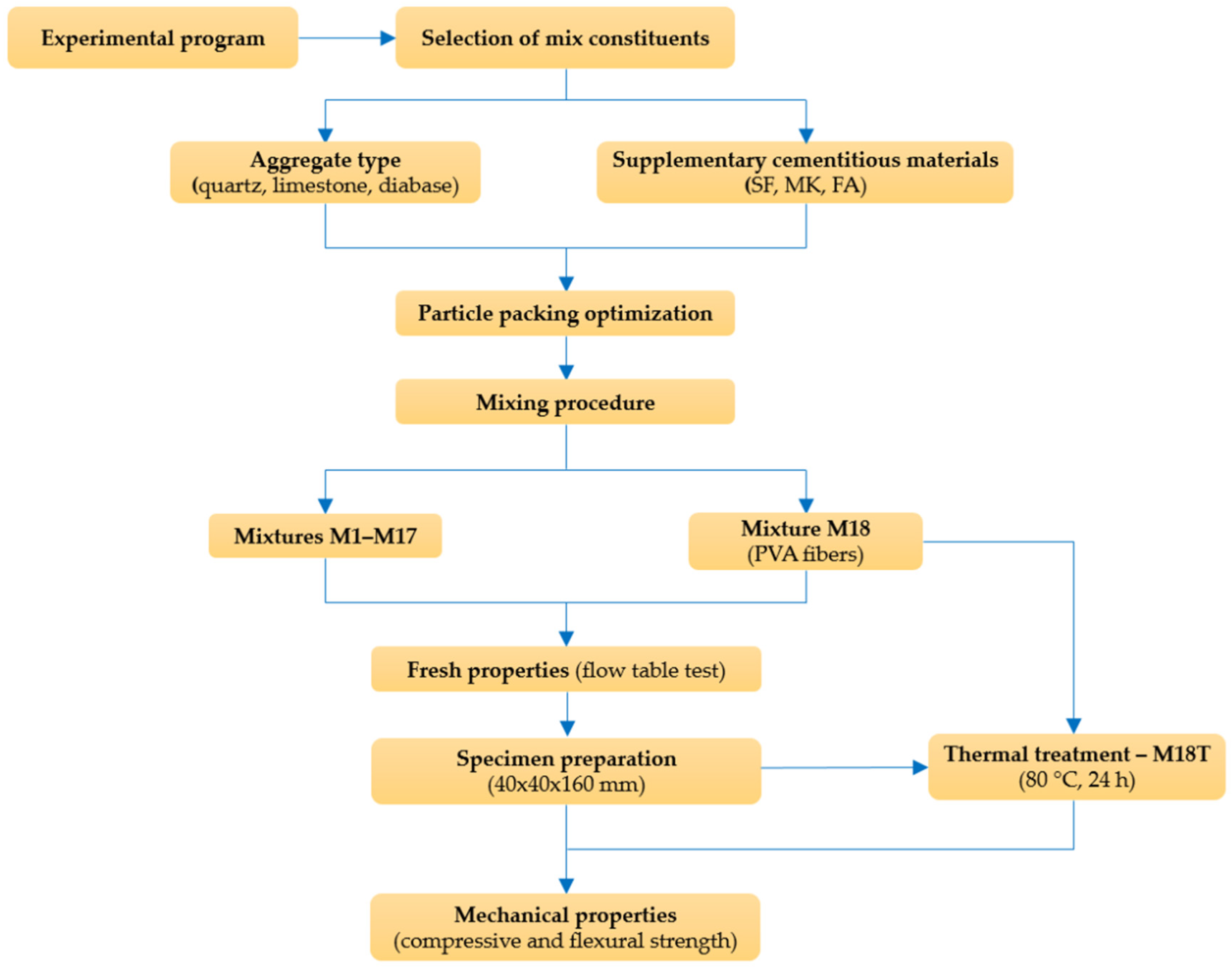
2. Experimental Program
2.1. Materials
2.2. Mixing and Curing
3. Results and Discussion
3.1. Fresh UHPC Properties
3.2. Mechanical Properties of UHPC
3.2.1. Compressive Strength
3.2.2. Flexural Strength
3.2.3. Effect of Thermal Treatment and PVA Fiber Addition
4. Conclusions
- (1)
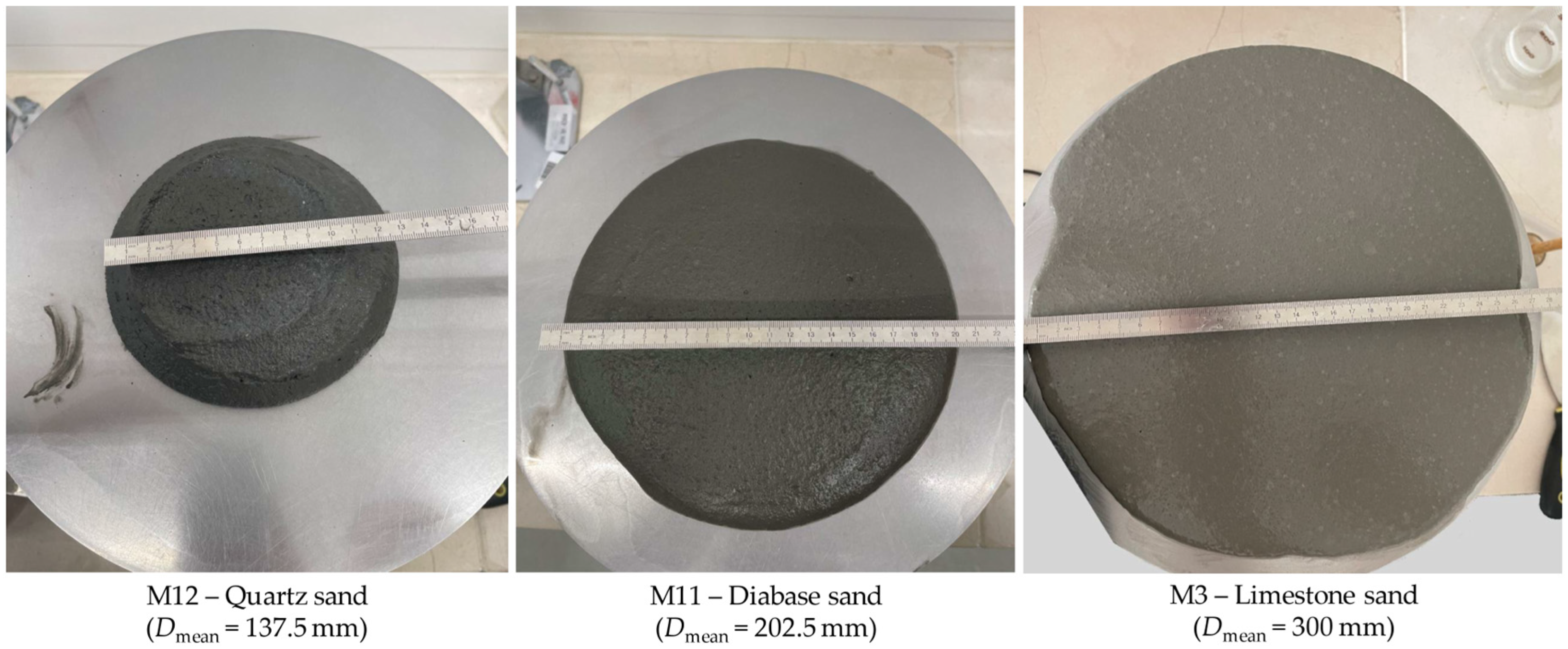
- Most mixtures exhibited spread diameters greater than 200 mm, indicating fluid consistency. Mixtures containing limestone and FA (M3 and M10) showed higher spread values compared to those with MK (mix M2), which can be attributed to the spherical shape and lower water demand of FA particles.
- (2)
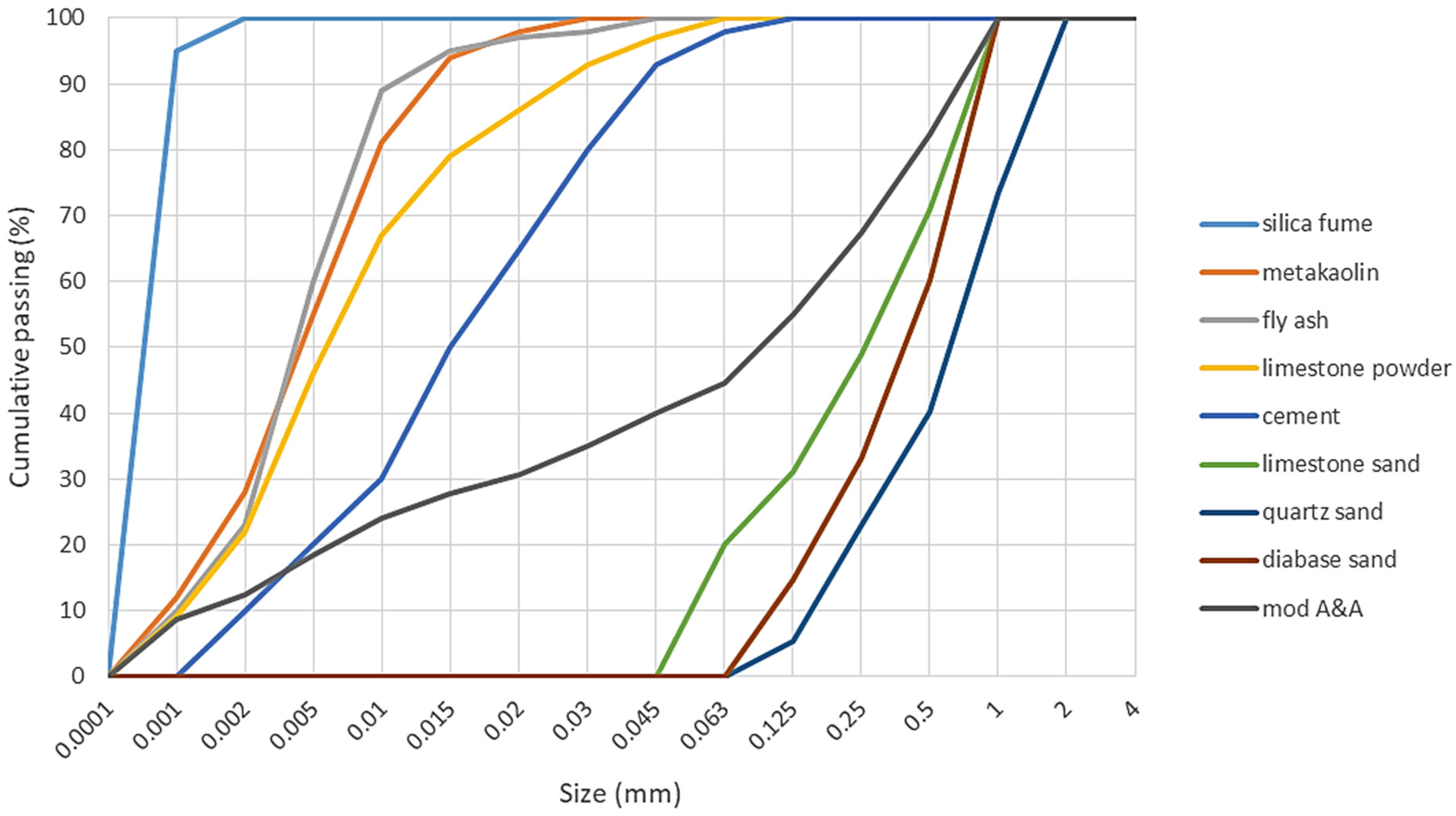
- The M12 mixture with the highest particle packing density and the closest match to the modified Andreasen and Andersen curve had the smallest spread diameter of all the mixtures. Although optimal particle packing improves mechanical performance and density, it may reduce workability by increasing mixture viscosity.
- (3)
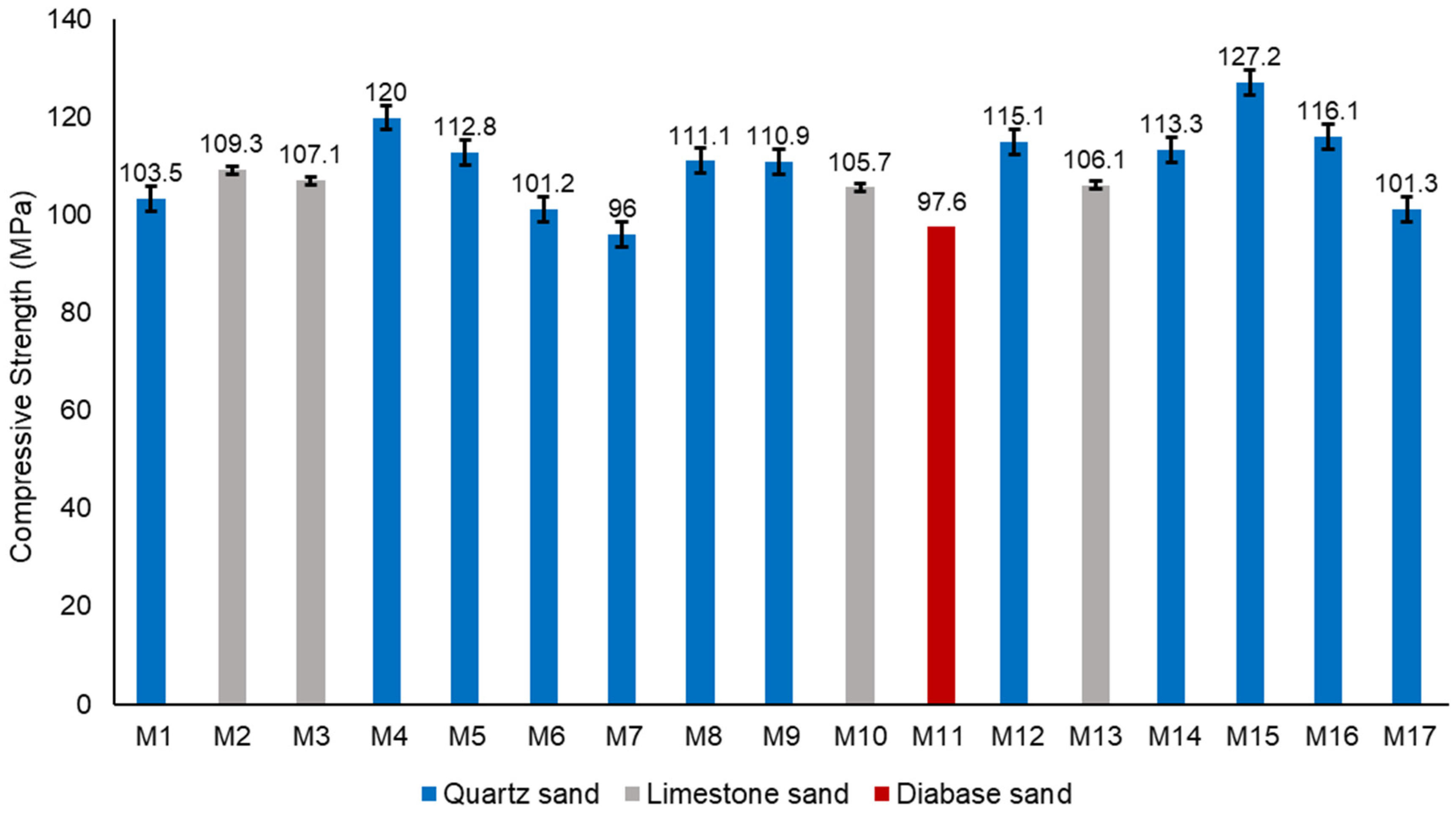
- The highest compressive strengths were obtained on specimens with quartz sand (average 110 MPa), while specimens with limestone showed slightly lower strengths (average 107 MPa). These results indicate the higher porosity of limestone while quartz is almost impermeable, which prevents water absorption from the mixture and ensures the designed water-to-cement ratio.
- (4)
- The highest 28-day compressive strengths were obtained in mixtures M15 and M4, which contained approximately 20% MK relative to the total binder content. This superior performance is attributed to the high pozzolanic reactivity of MK, which promotes the creation of additional C-S-H and C-A-S-H phases and contributes to the development of a denser microstructure.
- (5)
- The M12 mixture with optimal particle distribution and the lowest amount of cement (500 kg/m3) showed one of the highest compressive strengths. These results demonstrate that particle packing density can be more influential than cement content, indicating that increasing cement dosage does not necessarily lead to higher compressive strength.
- (6)
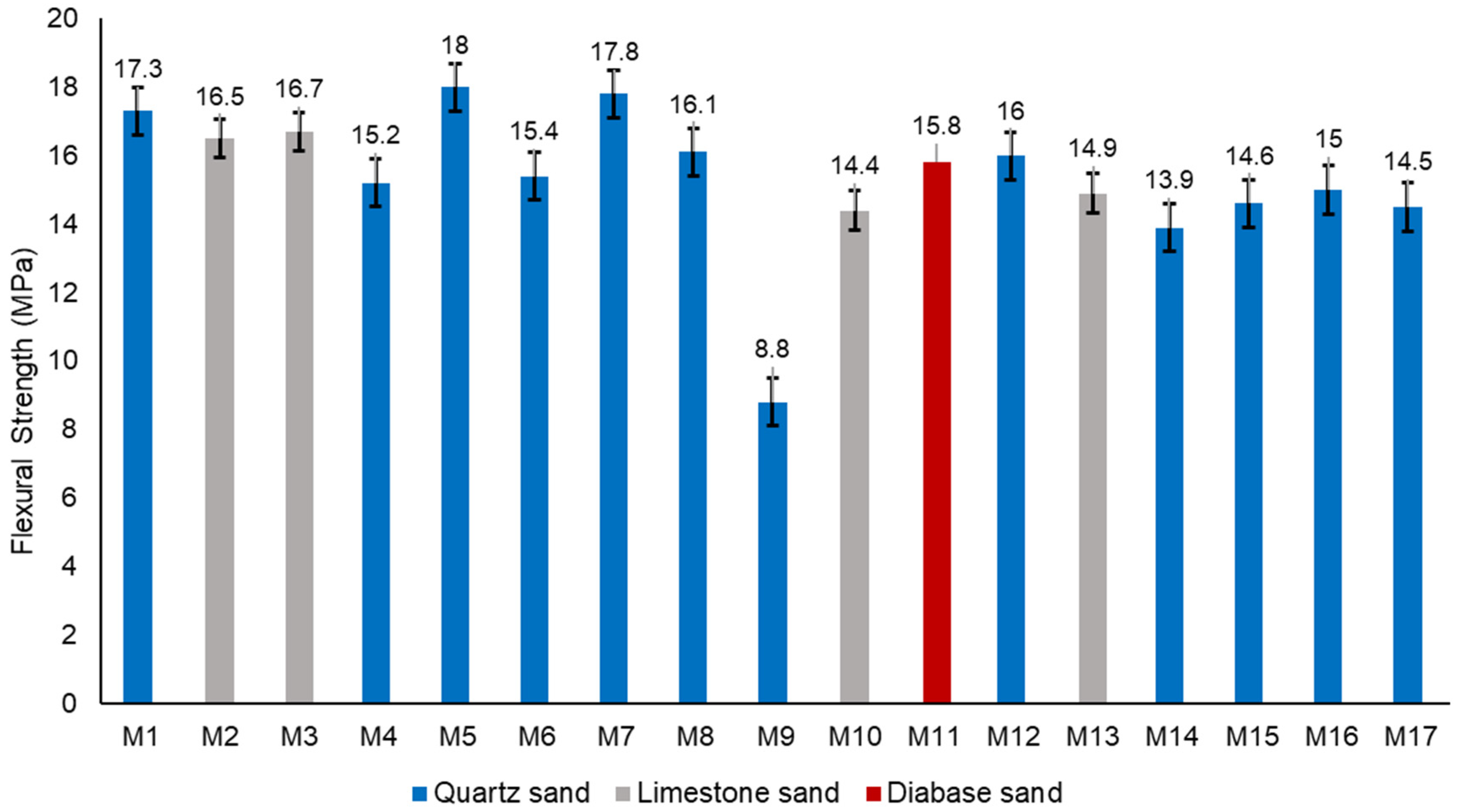
- The results of flexural strengths followed trends similar to those observed for compressive strength, with mixtures containing quartz sand generally achieving the highest values. In addition, the mixtures that showed the highest compressive strengths did not necessarily correspond to those with the highest flexural strengths, which is a typical characteristic of fiber-free UHPC systems. Furthermore, the type of SCM had a less pronounced influence on flexural behavior than the aggregate type.
- (7)
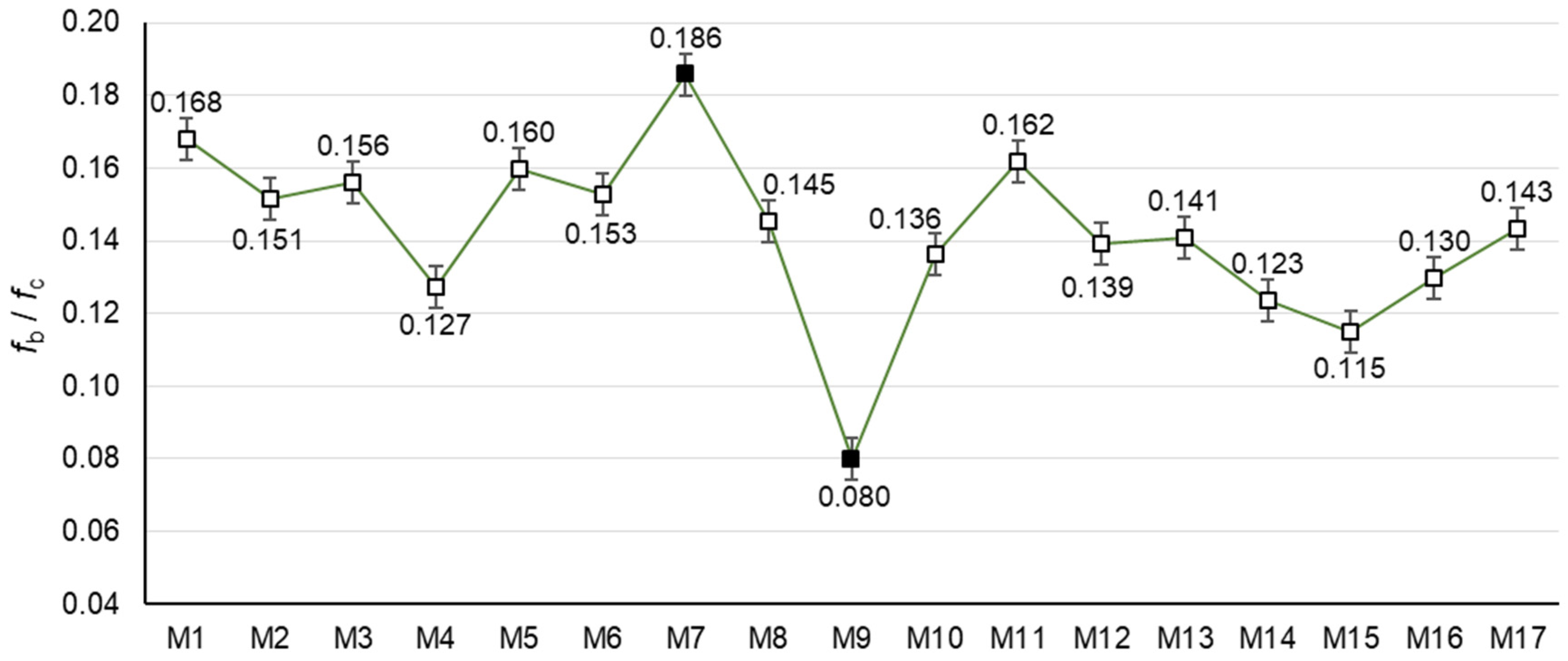
- The ratio of flexural-to-compressive strength (fb/fc) for most mixtures was in the range of 0.13 to 0.17, so considering these values, the compressive strength of fiber-free UHPC can be approximately estimated as fc ≈ 7·fb for similar mixtures.
- (8)
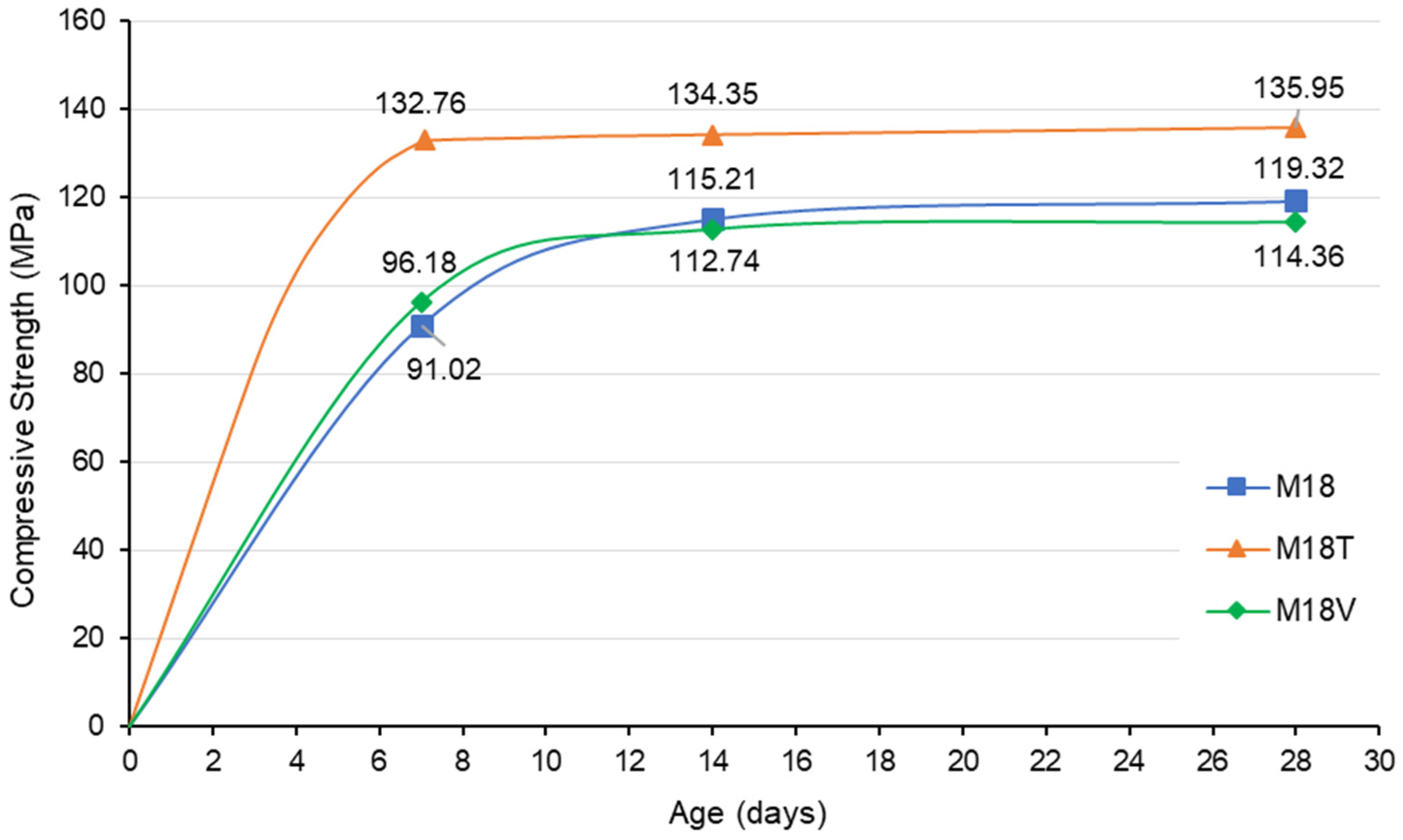
- Thermal treatment of UHPC specimens at 80 °C for 24 h significantly accelerated the development of compressive strength. After 7 days, the M18T specimens almost reached their maximum compressive strength, exhibiting a 45% higher strength compared to the reference mixture (M18). After 28 days, this difference decreased to approximately 14%. In contrast, the addition of PVA fibers (M18V) resulted in a slight reduction in compressive strength (about 4%) compared to the reference mixture, confirming that their primary role is not to enhance compressive strength.
Author Contributions
Funding
Data Availability Statement
Conflicts of Interest
References
- Akca, K.R.; Ipek, M. Effect of different fiber combinations and optimisation of an ultra-high performance concrete (UHPC) mix applicable in structural elements. Constr. Build. Mater. 2022, 315, 125777. [Google Scholar] [CrossRef] [Scilit]
- Ocelić, A.; Baričević, A.; Smrkić, M.F. Synergistic integration of waste fibres and supplementary cementitious materials to enhance sustainability of ultra-high-performance concrete (UHPC). Case Stud. Constr. Mater. 2024, 20, e02772. [Google Scholar] [CrossRef] [Scilit]
- Azmee, N.M.; Shafiq, N. Ultra-high performance concrete: From fundamental to applications. Case Stud. Constr. Mater. 2018, 9, e00197. [Google Scholar] [CrossRef] [Scilit]
- Ullah, R.; Qiang, Y.; Ahmad, J.; Vatin, N.I.; El-Shorbagy, M.A. Ultra-High-Performance Concrete (UHPC): A State-of-the-Art Review. Materials 2022, 15, 4131. [Google Scholar] [CrossRef] [Scilit] [PubMed]
- Fédération Internationale du Béton. Fib Model Code for Concrete Structures 2020; Ernst & Sohn: Berlin, Germany, 2023. [Google Scholar]
- Abbas, S.; Nehdi, M.L.; Saleem, M.A. Ultra-High Performance Concrete: Mechanical Performance, Durability, Sustainability and Implementation Challenges. Int. J. Concr. Struct. Mater. 2016, 10, 271–295. [Google Scholar] [CrossRef] [Scilit]
- Lin, H.; Jiang, Y.; Li, S.; Li, W.; Zhu, D.; Chen, J.; Teng, T.; Xue, Y.; Cao, Z. In situ study on high-temperature performance and structural deterioration mechanism of concrete. Processes 2026, 14, 1753. [Google Scholar] [CrossRef] [Scilit]
- Yang, I.; Park, J. Mechanical and thermal properties of UHPC exposed to high-temperature thermal cycling. Adv. Mater. Sci. Eng. 2019, 2019, 1–12. [Google Scholar] [CrossRef] [Scilit]
- Ha, N.S.; Marundrury, S.S.; Pham, T.M.; Pournasiri, E.; Shi, F.; Hao, H. Effect of grounded blast furnace slag and rice husk ash on performance of ultra-high-performance concrete (UHPC) subjected to impact loading. Constr. Build. Mater. 2022, 329, 127213. [Google Scholar] [CrossRef] [Scilit]
- Richard, P.; Cheyrezy, M. Reactive powder concretes with high ductility and 200–800 MPa compressive strength. ACI Spec. Publ. 1993, 144, 507–518. [Google Scholar]
- Zhu, L.; Wang, J.J.; Li, X.; Zhao, G.Y.; Huo, X.J. Experimental and numerical study on creep and shrinkage effects of ultra high performance concrete beam. Compos. Part B Eng. 2020, 184, 107713. [Google Scholar] [CrossRef] [Scilit]
- Mo, Z.; Wang, R.; Gao, X. Hydration and mechanical properties of UHPC matrix containing limestone and different levels of metakaolin. Constr. Build. Mater. 2020, 256, 119454. [Google Scholar] [CrossRef] [Scilit]
- Wang, S.; Wang, B.; Zhu, H.; Chen, G.; Li, Z.; Yang, L.; Zhang, Y.; Zhou, X. Ultra-high performance concrete: Mix design, raw materials and curing regimes-A review. Mater. Today Commun. 2023, 35, 105468. [Google Scholar] [CrossRef] [Scilit]
- Xi, J.; Liu, J.; Yang, K.; Zhang, S.; Han, F.; Sha, J.; Zheng, X. Role of silica fume on hydration and strength development of ultra-high performance concrete. Constr. Build. Mater. 2022, 338, 127600. [Google Scholar] [CrossRef] [Scilit]
- Lin, Y.; Yan, J.; Wang, Z.; Fan, F.; Zou, C. Effect of silica fumes on fluidity of UHPC: Experiments, influence mechanism and evaluation methods. Constr. Build. Mater. 2019, 210, 451–460. [Google Scholar] [CrossRef] [Scilit]
- He, Z.; Jiang, Y.; Shi, J.; Qin, J.; Liu, D.; Yalçınkaya, Ç.; He, Y. Effect of silica fume on the performance of high-early-strength UHPC prepared with magnesium ammonium phosphate cement. Case Stud. Constr. Mater. 2024, 20, e03351. [Google Scholar] [CrossRef] [Scilit]
- Ma, J.; Schneider, H. Properties of ultra-high performance concrete. Leipz. Annu. Civ. Eng. Rep. (LACER) 2002, 7, 25–32. [Google Scholar]
- Chan, Y.; Chu, S. Effect of silica fume on steel fibre bond characteristics in reactive powder concrete. Cem. Concr. Res. 2004, 34, 1167–1172. [Google Scholar] [CrossRef] [Scilit]
- Wu, Z.; Shi, C.; Khayat, K.H. Influence of silica fume content on microstructure development and bond to steel fiber in ultra-high strength cement-based materials (UHSC). Cem. Concr. Compos. 2016, 71, 97–109. [Google Scholar] [CrossRef] [Scilit]
- Wu, Z.; Khayat, K.H.; Shi, C. Changes in rheology and mechanical properties of ultra-high performance concrete with silica fume content. Cem. Concr. Res. 2019, 123, 105786. [Google Scholar] [CrossRef] [Scilit]
- Xu, D.; Tang, J.; Hu, X.; Zhou, Y.; Yu, C.; Han, F.; Liu, J. Influence of silica fume and thermal curing on long-term hydration, microstructure and compressive strength of ultra-high performance concrete (UHPC). Constr. Build. Mater. 2023, 395, 132370. [Google Scholar] [CrossRef] [Scilit]
- Bahedh, M.A.; Jaafar, M.S. Ultra high-performance concrete utilizing fly ash as cement replacement under autoclaving technique. Case Stud. Constr. Mater. 2018, 9, e00202. [Google Scholar] [CrossRef] [Scilit]
- Jing, R.; Liu, Y.; Yan, P. Uncovering the effect of fly ash cenospheres on the macroscopic properties and microstructure of ultra high-performance concrete (UHPC). Constr. Build. Mater. 2021, 286, 122977. [Google Scholar] [CrossRef] [Scilit]
- Dong, P.S.; Tuan, N.V.; Thanh, L.T.; Thang, N.C.; Cu, V.H.; Mun, J.H. Compressive strength development of high-volume fly ash ultra-high-performance concrete under heat curing condition with time. Appl. Sci. 2020, 10, 7107. [Google Scholar] [CrossRef] [Scilit]
- Chen, T.; Gao, X.; Ren, M. Effects of autoclave curing and fly ash on mechanical properties of ultra-high performance concrete. Constr. Build. Mater. 2018, 158, 864–872. [Google Scholar] [CrossRef] [Scilit]
- Ferdosian, I.; Camões, A.; Ribeiro, M. High-volume fly ash paste for developing ultra-high performance concrete (UHPC). Cienc. Tecnol. Mater. 2017, 29, e157–e161. [Google Scholar] [CrossRef] [Scilit]
- Song, Q.; Yu, R.; Wang, X.; Rao, S.; Shui, Z. A novel Self-Compacting Ultra-High Performance Fibre Reinforced Concrete (SCUHPFRC) derived from compounded high-active powders. Constr. Build. Mater. 2018, 158, 883–893. [Google Scholar] [CrossRef] [Scilit]
- Mohamed, A.M.; Tayeh, B.A. Metakaolin in ultra-high-performance concrete: A critical review of its effectiveness as a green and sustainable admixture. Case Stud. Constr. Mater. 2024, 21, e03967. [Google Scholar] [CrossRef] [Scilit]
- Zhan, P.; Xu, J.; Wang, J.; Jiang, C. Multi-scale study on synergistic effect of cement replacement by metakaolin and typical supplementary cementitious materials on properties of ultra-high performance concrete. Constr. Build. Mater. 2021, 307, 125082. [Google Scholar] [CrossRef] [Scilit]
- Tafraoui, A.; Escadeillas, G.; Lebaili, S.; Vidal, T. Metakaolin in the formulation of UHPC. Constr. Build. Mater. 2009, 23, 669–674. [Google Scholar] [CrossRef] [Scilit]
- Norhasri, M.S.; Hamidah, M.S.; Fadzil, A.M.; Megawati, O. Inclusion of nano metakaolin as additive in ultra high performance concrete (UHPC). Constr. Build. Mater. 2016, 127, 167–175. [Google Scholar] [CrossRef] [Scilit]
- Oh, T.; Chun, B.; Lee, S.K.; Kim, G.W.; Banthia, N.; Yoo, D.Y. Effect of high-volume substituted nanosilica on the hydration and mechanical properties of Ultra-High-Performance Concrete (UHPC). Cem. Concr. Res. 2024, 175, 107379. [Google Scholar] [CrossRef] [Scilit]
- Tran, T.M.; Trinh, H.T.M.K.; Nguyen, D.; Tao, Q.; Mali, S.; Pham, T.M. Development of sustainable ultra-high-performance concrete containing ground granulated blast furnace slag and glass powder: Mix design investigation. Constr. Build. Mater. 2023, 397, 132358. [Google Scholar] [CrossRef] [Scilit]
- Xu, Y.; Liu, J.; Liu, J.; Zhang, P.; Zhang, Q.; Jiang, L. Experimental studies and modeling of creep of UHPC. Constr. Build. Mater. 2018, 175, 643–652. [Google Scholar] [CrossRef] [Scilit]
- Teng, L.; Meng, W.; Khayat, K.H. Rheology control of ultra-high-performance concrete made with different fiber contents. Cem. Concr. Res. 2020, 138, 106222. [Google Scholar] [CrossRef] [Scilit]
- Yu, R.; Spiesz, P.; Brouwers, H.J.H. Effect of nano-silica on the hydration and microstructure development of Ultra-High Performance Concrete (UHPC) with a low binder amount. Constr. Build. Mater. 2014, 65, 140–150. [Google Scholar] [CrossRef] [Scilit]
- Chen, H.J.; Yu, Y.L.; Tang, C.W. Mechanical properties of Ultra-High Performance Concrete before and after exposure to high temperatures. Materials 2020, 13, 770. [Google Scholar] [CrossRef] [Scilit] [PubMed]
- Danha, L.S.; Abdul-Hussien, Z.A.; Abduljabbar, M.S.; Yassin, L.A.G. Flexural behavior of hybrid ultra-high-performance concrete. IOP Conf. Ser. Mater. Sci. Eng. 2020, 737, 012008. [Google Scholar] [CrossRef] [Scilit]
- Wang, L.; Xue, Y.; Wang, X.; Zhu, L.; Cao, X.; Ge, R. Effect of aggregate gradation on pore structure evolution and mechanical performance of coal gangue-fly ash cemented backfill: Insights from NMR. Powder Technol. 2026, 482, 122775. [Google Scholar] [CrossRef] [Scilit]
- Mosaberpanah, M.A.; Eren, O. Effect of quartz powder, quartz sand and water curing regimes on mechanical properties of UHPC using response surface modeling. Adv. Concr. Constr. 2017, 5, 481–492. [Google Scholar] [CrossRef]
- Abbas, S.; Soliman, A.M.; Nehdi, M.L. Exploring mechanical and durability properties of ultra-high performance concrete incorporating various steel fiber lengths and dosages. Constr. Build. Mater. 2015, 75, 429–441. [Google Scholar] [CrossRef] [Scilit]
- Burroughs, J.F.; Shannon, J.; Rushing, T.S.; Yi, K.; Gutierrez, Q.B.; Harrelson, D.W. Potential of finely ground limestone powder to benefit ultra-high performance concrete mixtures. Constr. Build. Mater. 2017, 141, 335–342. [Google Scholar] [CrossRef] [Scilit]
- Sharma, Y.; Yeluri, M.; Allena, S.; Owusu-Danquah, J. Incorporating Limestone Powder and Ground Granulated Blast Furnace Slag in Ultra-high Performance Concrete to Enhance Sustainability. Int. J. Concr. Struct. Mater. 2024, 18, 79. [Google Scholar] [CrossRef] [Scilit]
- Du, J.; Meng, W.; Khayat, K.H.; Bao, Y.; Guo, P.; Lyu, Z.; Abu-obeidah, A.; Nassif, H.; Wang, H. New development of ultra-high-performance concrete (UHPC). Compos. Part B Eng. 2021, 224, 109220. [Google Scholar] [CrossRef] [Scilit]
- Kang, S.H.; Jeong, Y.; Tan, K.H.; Moon, J. High-volume use of limestone in ultra-high performance fiber-reinforced concrete for reducing cement content and autogenous shrinkage. Constr. Build. Mater. 2019, 213, 292–305. [Google Scholar] [CrossRef] [Scilit]
- Kozul, R.; Darwin, D. Effects of Aggregate Type, Size, and Content on Concrete Strength and Fracture Energy; SM Report No. 43; University of Kansas: Lawrence, KS, USA, 1997. [Google Scholar]
- Kishore, I.S.; Mounika, L.; Prasad, C.M.; Krishna, B.H. Experimental study on the use of basalt aggregate in concrete mixes. Int. J. Civ. Eng. 2015, 2, 39–42. [Google Scholar] [CrossRef] [Scilit]
- Szcześniak, A.; Siwiński, J.; Stolarski, A. Effect of aggregate type on properties of ultra-high-strength concrete. Materials 2022, 15, 5072. [Google Scholar] [CrossRef] [Scilit] [PubMed]
- Peng, Y.; Wu, H.; Fang, Q.; Liu, J.Z.; Gong, Z.M. Impact resistance of basalt aggregated UHP-SFRC/fabric composite panel against small caliber arm. Int. J. Impact Eng. 2016, 88, 201–213. [Google Scholar] [CrossRef] [Scilit]
- EN 1097-6:2022; Tests for Mechanical and Physical Properties of Aggregates—Part 6: Determination of Particle Density and Water Absorption. European Committee for Standardization: Brussels, Belgium, 2022.
- EN 993-1:2012; Tests for Geometrical Properties of Aggregates—Part 1: Determination of Particle Size Distribution—Sieving Method. European Committee for Standardization: Brussels, Belgium, 2012.
- EN 197-1:2011; Cement—Part 1: Composition, Specifications and Conformity Criteria for Common Cements. European Committee for Standardization: Brussels, Belgium, 2011.
- Andreasen, A.H.M.; Andersen, J. Über die Beziehungen zwischen Kornabstufungen und Zwischenraum in Produkten aus losen Körnern (mit einigen Experimenten). Kolloid-Zeitschrift 1930, 50, 217–228. [Google Scholar] [CrossRef] [Scilit]
- Wilson, W.; O’Flaherty, T. Development and localisation of ultra high performance concrete using a particle packing model. Civ. Eng. Res. Irel. 2020, 4, 131–136. [Google Scholar]
- EN 1015-3:1999; Methods of Test for Mortar for Masonry—Part 3: Determination of Consistence of Fresh Mortar (by Flow Table). European Committee for Standardization: Brussels, Belgium, 1999.
- Feng, Q.; Hu, W.; Liu, L.; Luo, J. State-of-art on workability and strength of ultra-high-performance fiber-reinforced concrete: Influence of fiber geometry, material type, and hybridization. Struct. Durab. Health Monit. 2025, 19, 1589–1605. [Google Scholar] [CrossRef] [Scilit]
- EN 196-1:2016; Methods of Testing Cement—Part 1: Determination of Strength. European Committee for Standardization: Brussels, Belgium, 2016.
- Shourabia, F.N.; Mirzabozorg, H.; Zhuge, Y. Optimization of UHPC based on reactive powder concrete: Box-Behnken Design, analysis of variance, components interaction effects and sensitivity analysis. J. Build. Eng. 2024, 98, 111291. [Google Scholar] [CrossRef] [Scilit]
- Hassan, K.E.; Cabrera, J.G.; Maliehe, R.S. The effect of mineral admixtures on the properties of high-performance concrete. Cem. Concr. Compos. 2000, 22, 267–271. [Google Scholar] [CrossRef] [Scilit]
- Papadakis, V.G. Effect of fly ash on Portland cement systems: Part I. Low-calcium fly ash. Cem. Concr. Res. 1999, 29, 1727–1736. [Google Scholar] [CrossRef] [Scilit]
- Hossain, K.M.A.; Lachemi, M.; Sammour, M.; Sonebi, M. Strength and fracture energy characteristics of self-consolidating concrete incorporating polyvinyl alcohol, steel and hybrid fibres. Constr. Build. Mater. 2013, 45, 20–29. [Google Scholar] [CrossRef] [Scilit]
- Afroughsabet, V.; Biolzi, L.; Ozbakkaloglu, T. High-performance fiber-reinforced concrete: A review. J. Mater. Sci. 2016, 51, 6517–6551. [Google Scholar] [CrossRef] [Scilit]
- Noushini, A.; Samali, B.; Vessalas, K. Effect of polyvinyl alcohol (PVA) fibre on dynamic and material properties of fibre reinforced concrete. Constr. Build. Mater. 2013, 49, 374–383. [Google Scholar] [CrossRef] [Scilit]




| Reference | Constituents | Quantity [kg/m3] | Main Findings |
|---|---|---|---|
| [12] | Cement Metakaolin Limestone Quartz sand Superplasticizer Water/binder ratio (w/b) | 553.4–774.8 0–221.4 332 1106.8 4.9–27.6 0.2 | The addition of 15% MK (by binder mass) resulted in the highest compressive and flexural strength of UHPC mortar. |
| [32] | Cement Silica flour Silica sand Nanosilica Silica fume Superplasticizer Steel fiber Water/binder ratio (w/b) | 788.5 236.6 867.4 19.7–98.6 98.6–197.1 25.0–38.0 2% 0.18–0.19 | Replacing SF with 10% nanosilica improved the tensile performance and compressive strength of UHPFRC, while the lowest porosity was achieved with a 20% nanosilica replacement. |
| [22] | Cement Fly ash Quarry dust Superplasticizer Water/binder ratio (w/b) | 394.2–657 0–262.8 1050 40 0.24 | The workability of concrete improved as the FA content increased from 0% to 40%. |
| [29] | Cement Silica fume Metakaolin Sand Superplasticizer Water/binder ratio (w/b) | 840–1020 120 60–240 780 37–41 0.15 | Replacing cement with 10% MK reduced the drying shrinkage of UHPC, while increasing its elastic modulus, compressive and flexural strength, the resistance to water and chloride penetration. |
| [33] | Cement GGBS Glass powder Silica sand Silica fume Superplasticizer Steel fiber Water/binder ratio (w/b) | 424–850 0–22.5 0–538 1215 113–225 50–67 157 0.18 | The combined use of glass powder and GGBS improved the workability and mechanical performance of UHPC while reducing its environmental impact. |
| [34] | Cement Ultra-fine mineral admixture Nature sand Crushed basalt stone Steel fiber Water/binder ratio (w/b) | 589–619 196–206 743 782 0–2% 0.16–0.22 | Increasing the steel fiber content from 0% to 2% gradually increased the compressive strength of specimens subjected to both standard and steam curing. |
| [35] | Cement Welan gun powder Silica fume Fly ash Steel fiber Water/binder ratio (w/b) | 642–662 0.18–0.27% 41–42 401–413 1–3% 0.2 | The highest flexural characteristics were achieved at the optimum plastic viscosity of UHPC mortar. |
| [11] | Cement Silica fume Coarse sand Medium sand Fine sand Steel fiber Water/binder ratio (w/b) | 706 160 359 717 179 2% 0.14 | Simplified equations for calculating the shrinkage strain and creep coefficient of UHPC were proposed. |
| [36] | Cement Limestone Quartz Microsand Sand Nanosilica Superplasticizer Steel fiber Water/binder ratio (w/b) | 417.5–439.5 263.7 175.9 218.7 1054.7 0–22.0 43.9 2.5% 0.18 | UHPC with a binder content as low as 440 kg/m3 was successfully produced using the modified Andreasen and Andersen particle packing model. |
| [37] | Cement Ultra-fine silica powder Silica fume Polypropylene fiber Steel fiber Viscous agent Superplasticizer Water/binder ratio (w/b) | 737–1005 0–31 0–191 0–78 0–0.8 1 25 0.195 | UHPC maintained high mechanical performance up to 500 °C, while significant strength degradation occurred after exposure to 600 °C. |
| [38] | Cement Sand Silica fume Superplasticizer Steel fiber Water/binder ratio (w/b) | 750 1000 250 6.0–6.3% 0–234 0.2 | Increasing the steel fiber content from 0% to 3% resulted in a higher bending failure load of UHPC specimens. |
| Material | SiO2 | Al2O3 | Fe2O3 | CaO | MgO | Na2O | K2O | SO3 |
|---|---|---|---|---|---|---|---|---|
| Cement | 19.47 | 4.75 | 3.43 | 63.16 | 1.43 | 0.28 | 0.62 | 2.64 |
| SF | 86–96 | 0.4–1 | 0.1–1.5 | 0.1–0.5 | 0.3–2 | 0.4–0.5 | 0.3–3 | <2.0 |
| MK | 52–54 | 41–44 | <1.5 | <0.5 | <0.4 | <0.1 | <2.0 | − |
| FA | 52 | 25 | 7 | 5 | − | − | − | − |
| Mixes | Materials (kg/m3) | |||||||||||
|---|---|---|---|---|---|---|---|---|---|---|---|---|
| Cement | SF | MK | FA | Limestone Powder | Water | Superplasticizer | W/C | Quartz Sand | Limestone Sand | Diabase Sand | PVA Fibers | |
| M1 | 790 | 197.5 | − | − | 229.1 | 201.7 | 48.6 | 0.25 | 917.9 | − | − | − |
| M2 | 770 | 103.9 | 115.5 | − | 223.3 | 196.3 | 48.5 | 0.25 | − | 892.4 | − | − |
| M3 | 770 | 103.9 | − | 115.5 | 223.3 | 192.5 | 48.5 | 0.25 | − | 899.8 | − | − |
| M4 | 708.9 | − | 218 | − | 288.1 | 191.4 | 48.6 | 0.27 | 909 | − | − | − |
| M5 | 710 | − | 190 | 50 | 250 | 184.6 | 48 | 0.26 | 941.5 | − | − | − |
| M6 | 700 | − | − | 250 | 250 | 175 | 48 | 0.25 | 960.5 | − | − | − |
| M7 | 877.5 | 122.5 | − | − | 200 | 204.2 | 48 | 0.23 | 953 | − | − | − |
| M8 | 700 | − | 250 | 50 | 200 | 182 | 48 | 0.26 | 944.9 | − | − | − |
| M9 | 800 | − | 200 | − | 300 | 176 | 52 | 0.22 | 870.2 | − | − | − |
| M10 | 800 | 80 | − | 100 | 220 | 200 | 48 | 0.25 | − | 902.6 | − | − |
| M11 | 800 | 80 | − | 100 | 220 | 190 | 48 | 0.24 | − | − | 955.6 | − |
| M12 | 500 | 182.8 | − | − | 157.7 | 165 | 33.6 | 0.33 | 1388 | − | − | − |
| M13 | 800 | − | 200 | − | 200 | 176 | 48 | 0.22 | − | 978.4 | − | − |
| M14 | 810 | 202.5 | − | − | 243 | 191.4 | 49.6 | 0.23 | 909.9 | − | − | − |
| M15 | 750 | − | 195 | − | 240 | 180 | 47.4 | 0.24 | 977.9 | − | − | − |
| M16 | 900 | 225 | − | − | 225 | 181 | 54 | 0.2 | 811.1 | − | − | − |
| M17 | 850 | − | 212.5 | − | 212.5 | 187 | 51 | 0.22 | 874 | − | − | − |
| M18 | 750 | − | 187.5 | − | 187.5 | 172.5 | 39.3 | 0.23 | 1077 | − | − | − |
| M18V | 750 | − | 187.5 | − | 187.5 | 172.5 | 39.3 | 0.23 | 1077 | − | − | 35 |
| Mixes | Temperature (°C) | Diameter D1 (mm) | Diameter D2 (mm) | Diameter Dmean (mm) |
|---|---|---|---|---|
| M1 | 29.9 | 170 | 175 | 172.5 |
| M2 | 29.6 | 245 | 240 | 242.5 |
| M3 | 28.4 | 300 | 300 | 300 |
| M4 | 30.6 | 300 | 300 | 300 |
| M5 | 31.1 | 265 | 280 | 272.5 |
| M6 | 34.6 | 225 | 230 | 227.5 |
| M7 | 27.8 | 220 | 225 | 222.5 |
| M8 | 33.3 | 190 | 200 | 195 |
| M9 | 38.3 | 175 | 180 | 177.5 |
| M10 | 32.3 | 290 | 300 | 295 |
| M11 | 32.8 | 200 | 205 | 202.5 |
| M12 | 29.4 | 135 | 140 | 137.5 |
| M13 | 35.4 | 240 | 250 | 245 |
| M14 | 30.3 | 300 | 300 | 300 |
| M15 | 31.6 | 300 | 300 | 300 |
| M16 | 28.5 | 300 | 300 | 300 |
| M17 | 34.4 | 300 | 300 | 300 |
| M18 | 33.4 | 275 | 280 | 277.5 |
| M18V | 33.9 | 210 | 215 | 212.5 |
| Mixes | Aggregate | fc,mean (MPa) | SD (MPa) | CV (%) |
|---|---|---|---|---|
| M1 | Quartz sand | 103.50 | 8.08 | 7.81 |
| M2 | Limestone | 109.32 | 7.08 | 6.48 |
| M3 | Limestone | 107.15 | 12.85 | 12.00 |
| M4 | Quartz sand | 120.00 | 7.17 | 5.97 |
| M5 | Quartz sand | 112.86 | 9.89 | 8.76 |
| M6 | Quartz sand | 101.22 | 8.86 | 8.75 |
| M7 | Quartz sand | 96.04 | 14.96 | 15.58 |
| M8 | Quartz sand | 111.14 | 18.74 | 16.86 |
| M9 | Quartz sand | 110.94 | 4.20 | 3.79 |
| M10 | Limestone | 105.73 | 3.51 | 3.32 |
| M11 | Diabase | 97.65 | 9.67 | 9.90 |
| M12 | Quartz sand | 115.15 | 3.85 | 3.34 |
| M13 | Limestone | 106.14 | 9.94 | 9.36 |
| M14 | Quartz sand | 113.30 | 6.31 | 5.57 |
| M15 | Quartz sand | 127.26 | 3.69 | 2.90 |
| M16 | Quartz sand | 116.14 | 5.90 | 5.08 |
| M17 | Quartz sand | 101.33 | 16.33 | 16.11 |
| Mixes | Aggregate | fb,mean (MPa) | SD (MPa) | CV (%) |
|---|---|---|---|---|
| M1 | Quartz sand | 17.37 | 1.11 | 6.36 |
| M2 | Limestone | 16.56 | 1.23 | 7.43 |
| M3 | Limestone | 16.72 | 0.36 | 2.12 |
| M4 | Quartz sand | 15.25 | 1.21 | 7.95 |
| M5 | Quartz sand | 18.02 | 0.32 | 1.76 |
| M6 | Quartz sand | 15.48 | 0.93 | 5.98 |
| M7 | Quartz sand | 17.83 | 0.60 | 3.39 |
| M8 | Quartz sand | 16.16 | 1.28 | 7.91 |
| M9 | Quartz sand | 8.86 | 2.83 | 31.89 |
| M10 | Limestone | 14.40 | 1.14 | 7.94 |
| M11 | Diabase | 15.80 | 0.73 | 4.62 |
| M12 | Quartz sand | 16.03 | 0.41 | 2.53 |
| M13 | Limestone | 14.95 | 1.47 | 9.80 |
| M14 | Quartz sand | 13.98 | 1.00 | 7.12 |
| M15 | Quartz sand | 14.63 | 0.90 | 6.16 |
| M16 | Quartz sand | 15.08 | 0.32 | 2.14 |
| M17 | Quartz sand | 14.51 | 1.72 | 11.84 |
Disclaimer/Publisher’s Note: The statements, opinions and data contained in all publications are solely those of the individual author(s) and contributor(s) and not of MDPI and/or the editor(s). MDPI and/or the editor(s) disclaim responsibility for any injury to people or property resulting from any ideas, methods, instructions or products referred to in the content. |
© 2026 by the authors. Licensee MDPI, Basel, Switzerland. This article is an open access article distributed under the terms and conditions of the Creative Commons Attribution (CC BY) license.
Share and Cite
Redžić, N.; Grgić, N.; Baloević, G.; Filipović, M. Influence of Aggregate Type and SCM Combinations on the Fresh and Mechanical Properties of Ultra-High Performance Concrete. Buildings 2026, 16, 3035. https://doi.org/10.3390/buildings16153035
Redžić N, Grgić N, Baloević G, Filipović M. Influence of Aggregate Type and SCM Combinations on the Fresh and Mechanical Properties of Ultra-High Performance Concrete. Buildings. 2026; 16(15):3035. https://doi.org/10.3390/buildings16153035
Chicago/Turabian StyleRedžić, Nermin, Nikola Grgić, Goran Baloević, and Mario Filipović. 2026. "Influence of Aggregate Type and SCM Combinations on the Fresh and Mechanical Properties of Ultra-High Performance Concrete" Buildings 16, no. 15: 3035. https://doi.org/10.3390/buildings16153035
APA StyleRedžić, N., Grgić, N., Baloević, G., & Filipović, M. (2026). Influence of Aggregate Type and SCM Combinations on the Fresh and Mechanical Properties of Ultra-High Performance Concrete. Buildings, 16(15), 3035. https://doi.org/10.3390/buildings16153035