Bridging BIM and Stochastic Simulation: A Conceptual Framework and Illustrative Application



Abstract
1. Introduction
1.1. Background and Research Gap
1.2. Research Contributions and Scientific Novelty

| Study | BIM–Simulation Coupling | Stochastic Duration Modeling | Execution-Phase EVA Control Loop | Primary Focus and Gap Relative to the Present Framework |
|---|---|---|---|---|
| Wang et al. [20] | ✓ | ✓ | — | BIM quantity takeoffs feed a Stroboscope operations simulation with three-point durations and Monte Carlo sampling to generate a construction schedule; the approach is confined to pre-construction planning and lacks an execution-phase control loop. |
| Rafid et al. [6] | ✓ | — | Partial | Re-simulation of schedules from progress data using discrete-event simulation; a lack of stochastic duration propagation from BIM quantities and no EVA-linked control loop. |
| Madihi et al. [41] | ✓ | ✓ | — | Probabilistic cash-flow forecasting via 5D-BIM and a Bayesian belief network; oriented to cost rather than execution-phase schedule control. |
| Zhao and Na [42] | — | — | — | Schedule-level semantic data integration; addresses interoperability without stochastic simulation or a control loop. |
| Shim et al. [43] | — | — | — | Collaborative BIM-based coordination modeling (exCPM/Petri-nets) during the construction phase; process coordination without stochastic simulation or an execution-phase control loop. |
| Abdelmegid et al. [7] | Review | Review | Review | Systematic review of construction simulation; identifies input-data complexity and limited execution-phase uptake as persistent barriers. |
| Ayman et al. [40] | ✓ | ✓ | Partial | Couples 4D BIM (Autodesk Revit/Navisworks) with Monte Carlo duration sampling (Crystal Ball) and periodic EDM-based updating; addresses schedule duration, with cost integration noted as future work. |
| Pajares & López-Paredes [38]; Acebes et al. [39] | — | ✓ | Partial | Foundational EVM–Monte Carlo integration (Cost/Schedule Control Indices) using generic risk-simulation software on illustrative activity networks; flags whether deviations exceed expected variability but does not evaluate corrective-action scenarios or couple to BIM/4D data. |
| Present framework | ✓ | ✓ | ✓ | Governed BIM-to-simulation pipeline coupling stochastic activity durations with an execution-phase, EVA-linked proactive control loop. |
2. Materials and Methods
2.1. Research Methodology
- (1)
- Conceptual Framework Design
- (2)
- System Development
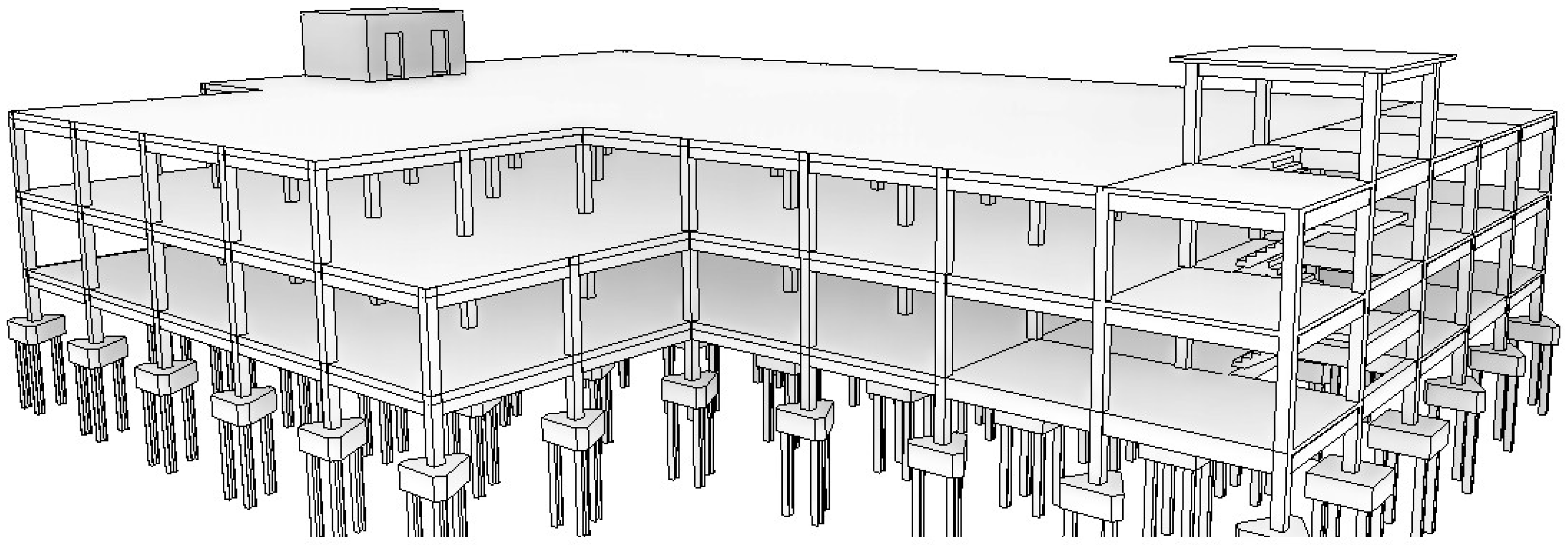
- Autodesk Revit 2024 (Autodesk, Inc., San Francisco, CA, USA), for virtual building model—executing BIM, visualization, and construction material quantity estimation.
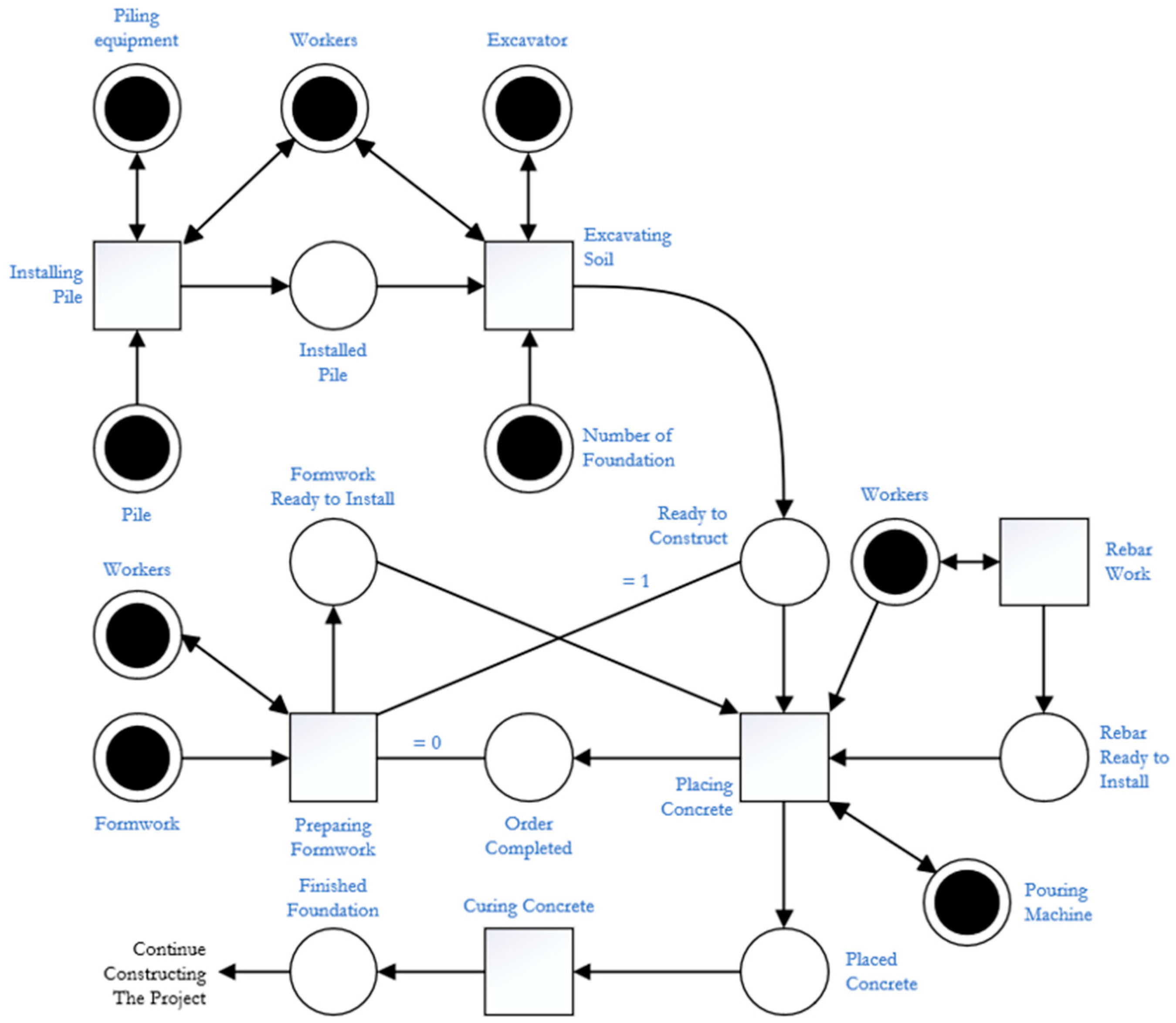
- COSMOS Simulator 2026.7 (research software developed by the corresponding author, Thailand), for virtual construction model—facilitating construction process modeling, simulation, optimization, and scheduling.
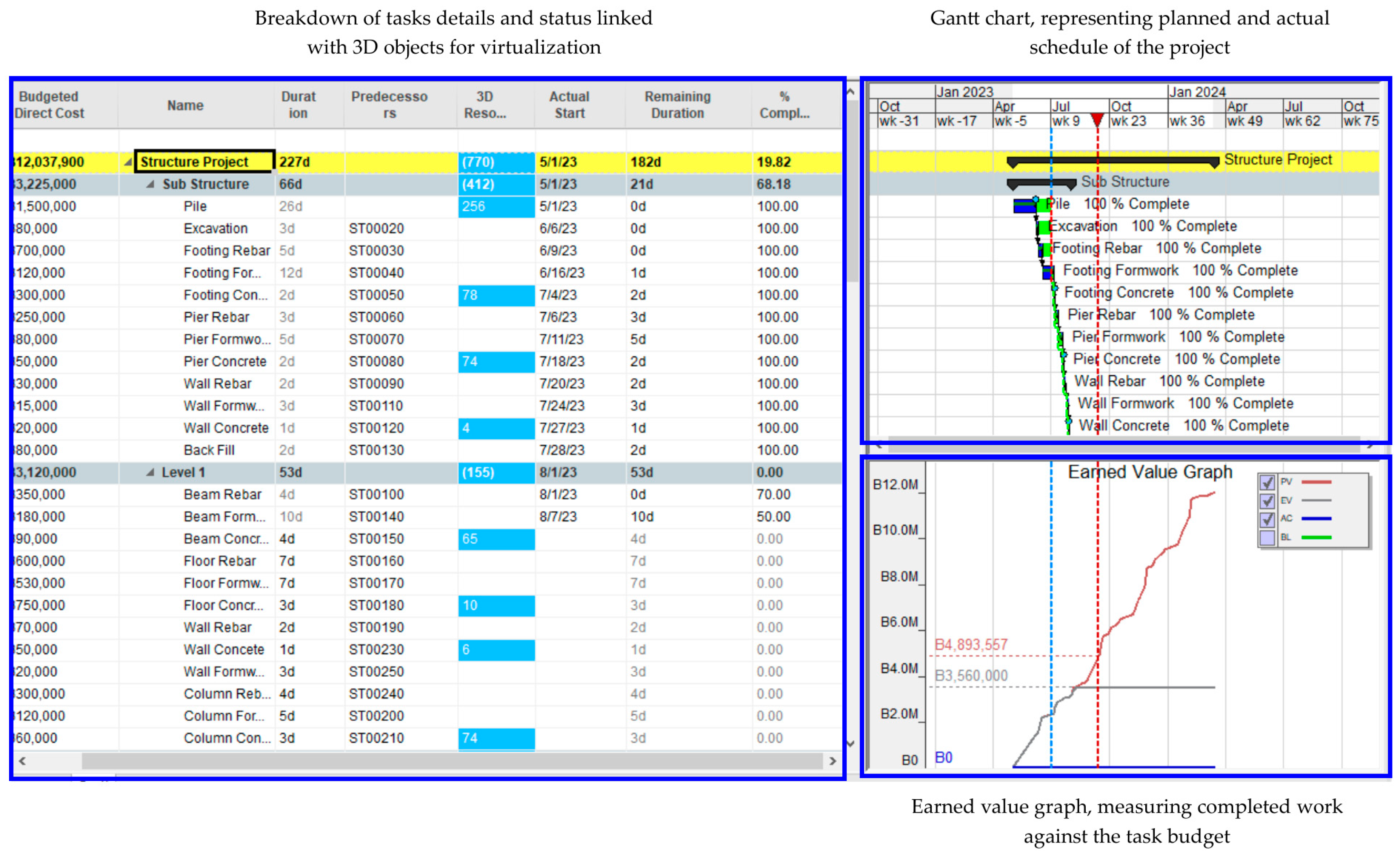
- Synchro 4D Pro 2023 (Bentley Systems, Inc., Exton, PA, USA), for 3D construction management—managing planning and scheduling, visualization, and construction control.
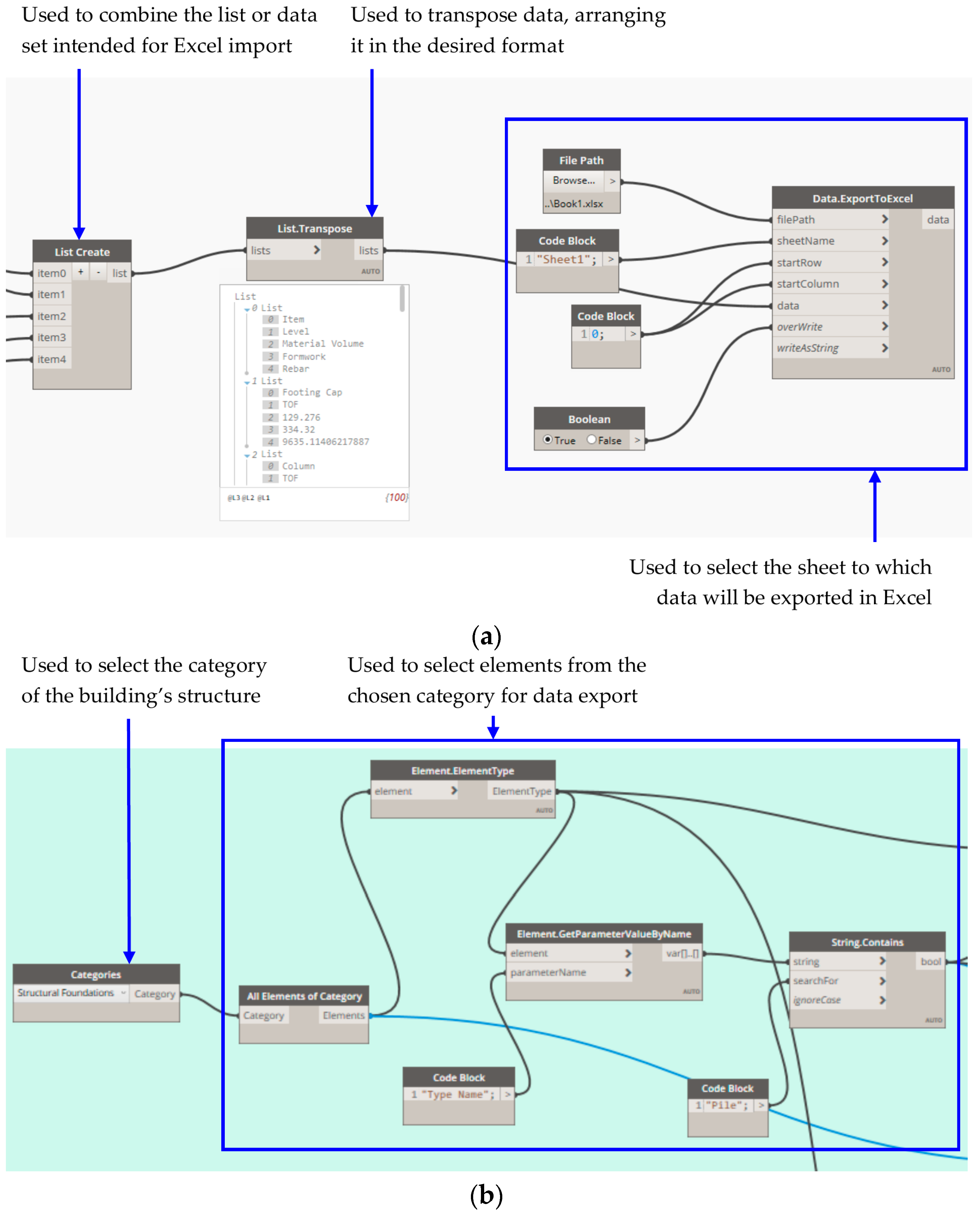
- Dynamo BIM 2.19.3 (Autodesk, Inc., San Francisco, CA, USA), for linkage—extracting BIM information to spreadsheets, creating custom scripts, and automating workflows.
- Microsoft Excel for Microsoft 365 (Microsoft Corporation, Redmond, WA, USA), for linkage, databases, and analysis—interfacing process information to a virtual construction model, recording and storing information, and analysis.
- (3)
- Case Study Implementation
- (4)
- Comparative Evaluation with Conventional Construction Management Approach:
2.2. Validation and Practical Applicability of the COSMOS Simulator
- Comparison with Arena: In simulations involving concrete placement and tunnel excavation earthmoving operations, the results from COSMOS demonstrated strong consistency with those from Arena. Statistical hypothesis testing confirmed no significant differences in key performance metrics, and in the case of tunnel excavation, the total process duration from both simulators matched precisely [44].
- Comparison with MicroCYCLONE: When evaluating an Auger Horizontal Earth-Boring (HEB) process, COSMOS was tested against the domain-specific MicroCYCLONE software. The deterministic simulations yielded identical completion times (1107 min), while stochastic simulations across 40 independent runs produced statistically equivalent mean durations (1096 min for COSMOS versus 1092 min for MicroCYCLONE) [34].
- Comparison with PROMODEL: In modeling complex concreting and waste-handling operations, COSMOS exhibited a minimal deviation of only 0.6% in resource utilization rates when compared to PROMODEL. By incorporating advanced COSMOS-specific resource allocation elements—such as headers, buffers, and end arcs—this deviation was further reduced to just 0.1% [34].
3. Proposed Framework and Illustrative Application
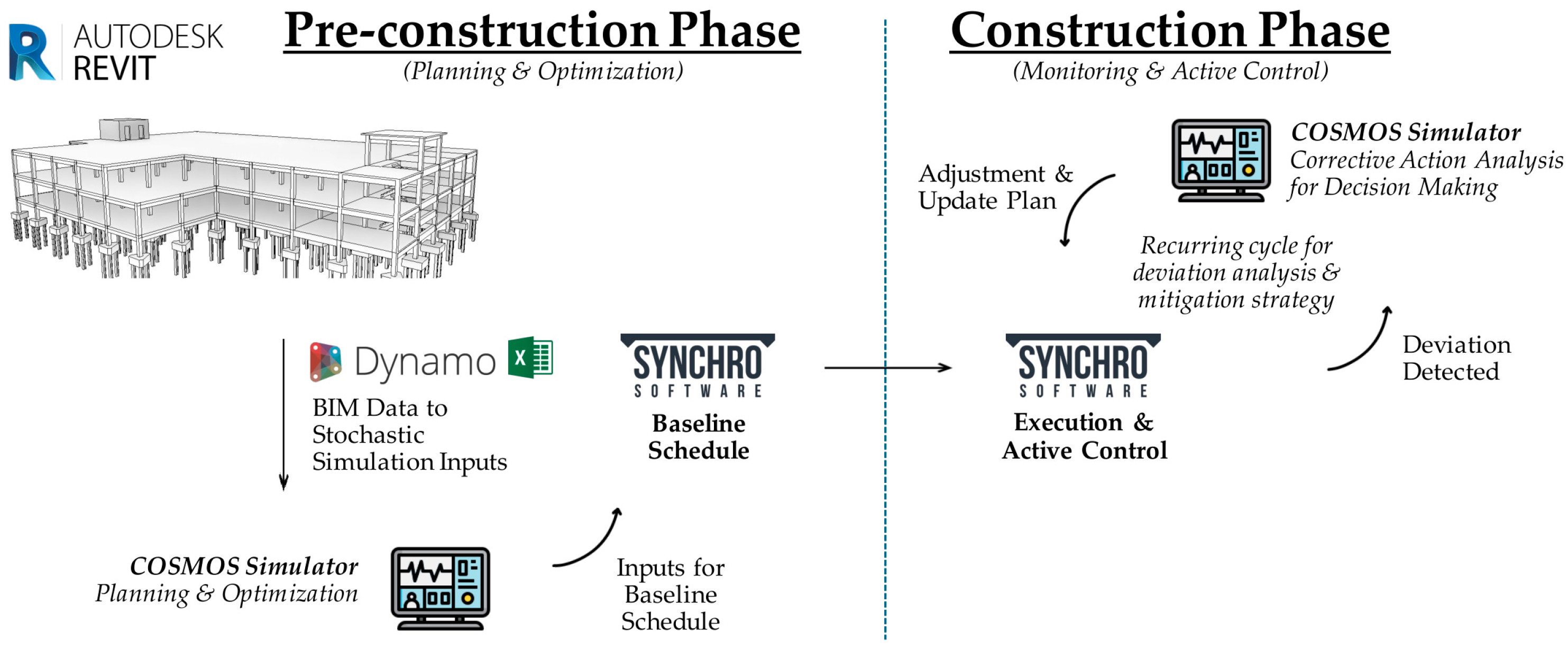
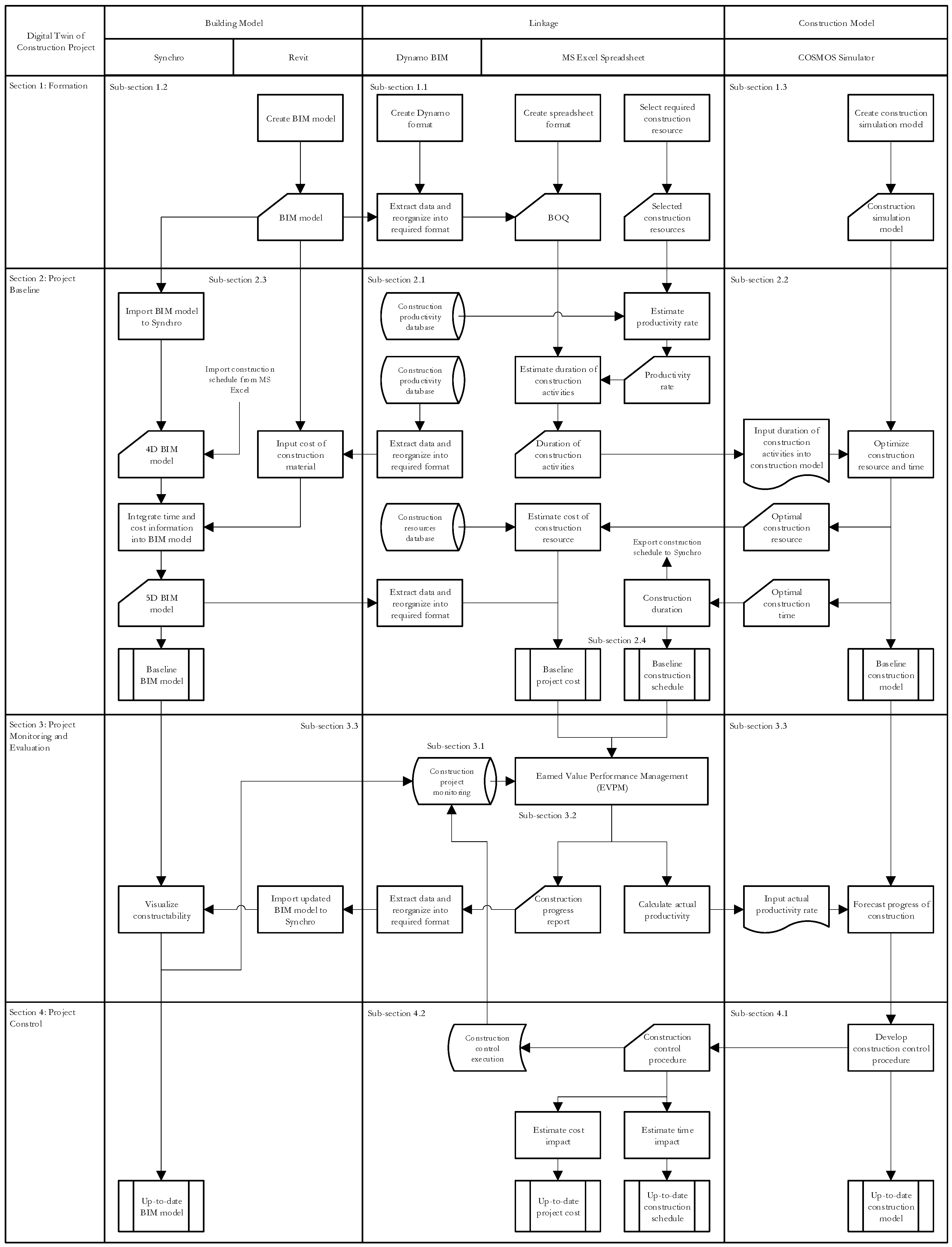
3.1. Proposed Framework
3.1.1. Formation
3.1.2. Project Baseline
3.1.3. Project Monitoring and Evaluation
3.1.4. Project Control
3.2. Illustrative Application
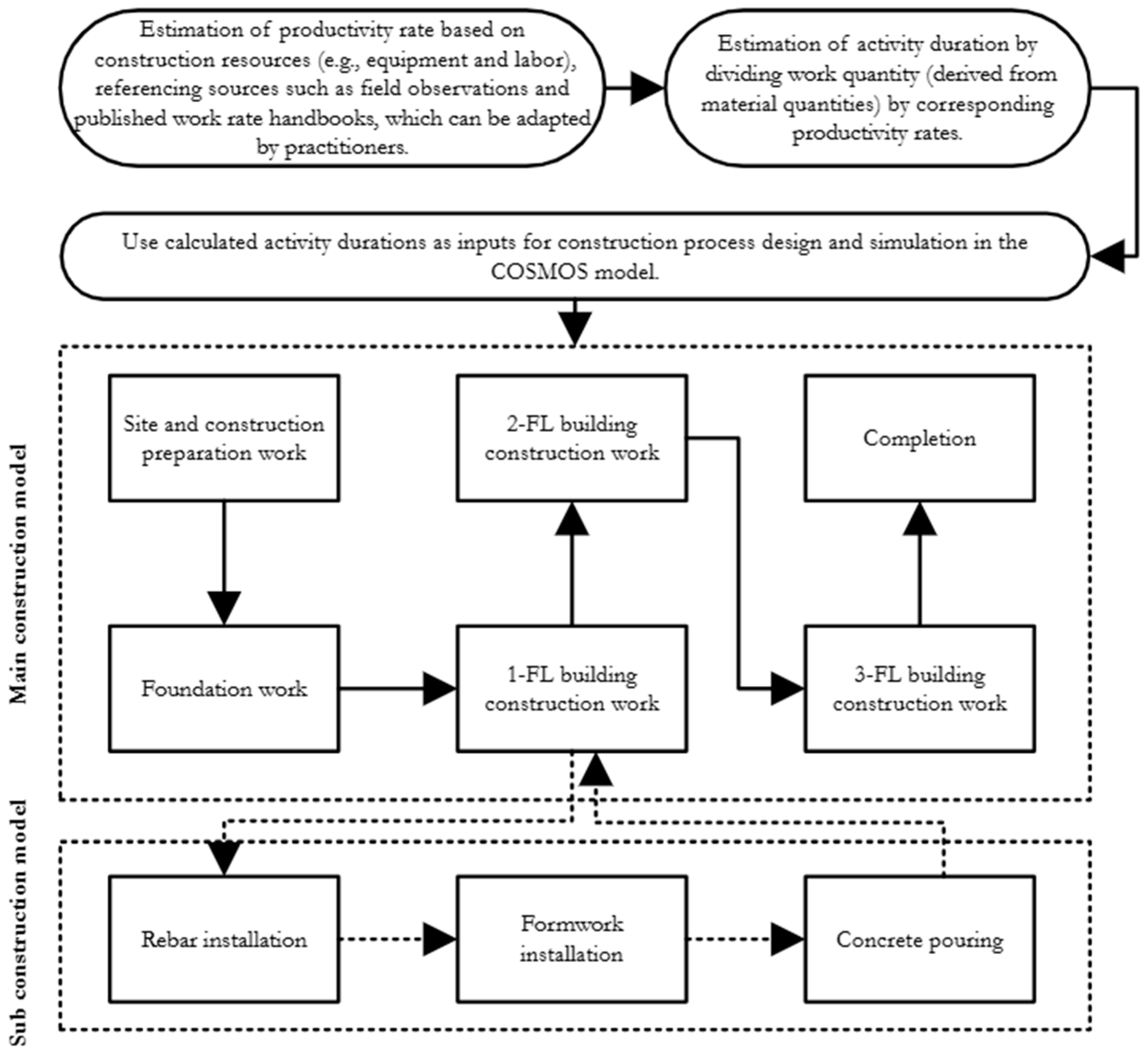
3.2.1. Formation and Baseline Scheduling (Pre-Construction Phase)
- Creating the building and construction models
- (1)
- Activity decomposition—the construction process was divided into discrete activities: site preparation, excavation, foundation work, and column and beam construction.
- (2)
- Sequencing—logical sequences and dependencies between tasks were defined to reflect real-world construction workflows. This ensured that each task was accurately linked to its predecessors and successors, creating a coherent and realistic sequence of activities.
- (3)
- Duration definition—the duration of each construction activity was determined using quantity data extracted from Autodesk Revit (e.g., concrete volume, rebar weight, and formwork area) combined with predefined productivity rates. Durations were modeled as either deterministic values or probabilistic distributions, depending on the nature of the productivity inputs.
- 2.
- Determining the construction activity duration
- 3.
- Developing the construction plan and schedule.
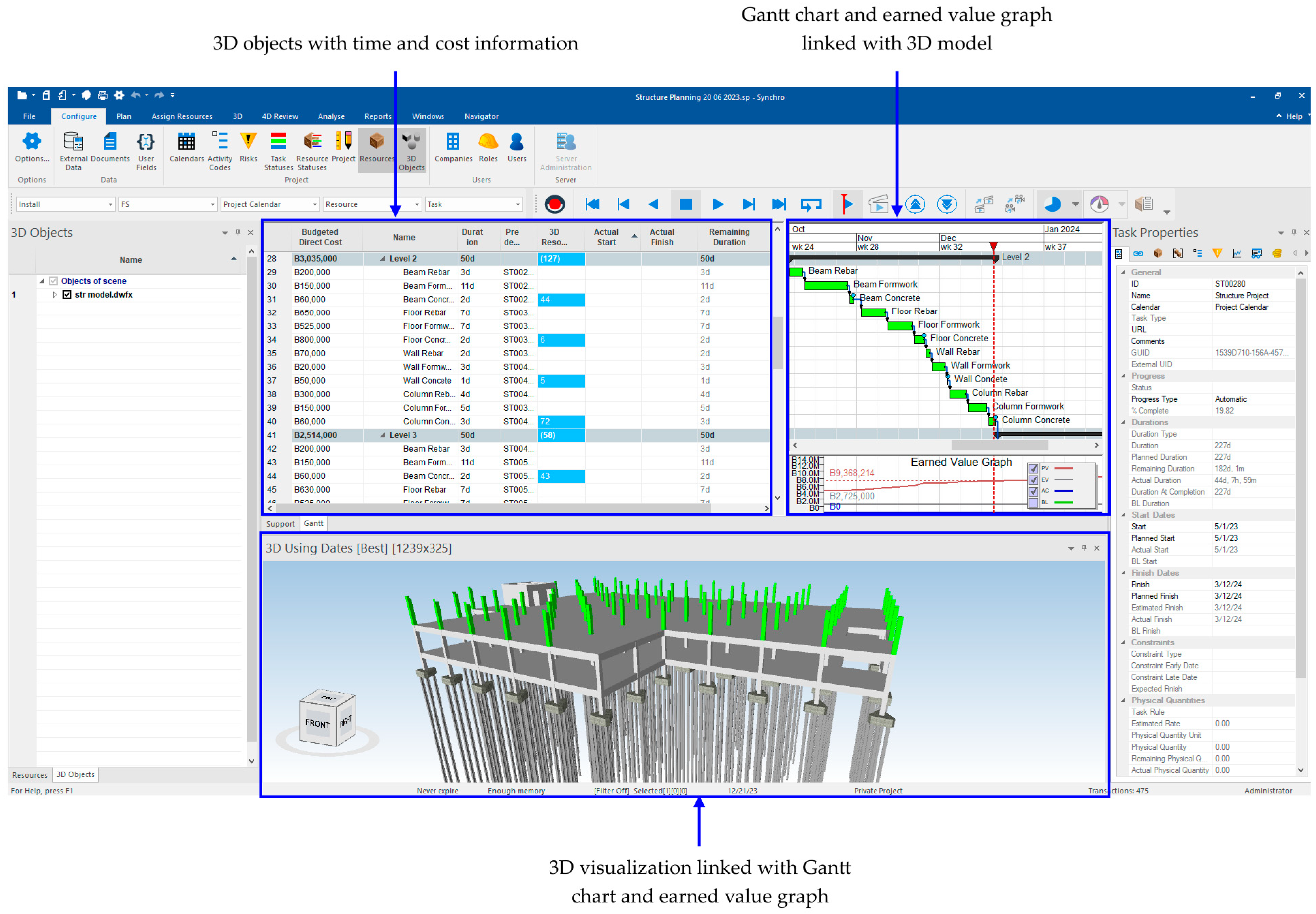
3.2.2. Project Monitoring and Evaluation (Construction Phase)
- Monitoring construction progress
- 2.
- Determining project progress and status
- 3.
- Forecasting project status
3.2.3. Proactive Construction Control
- Identifying countermeasures for deviations
- 2.
- Estimating the impacts and rescheduling
3.2.4. Platform Interconnection and Data Lineage
4. Results
4.1. Analytical Evaluation of Data Integration Capabilities
4.2. Workflow Automation and Quality Assurance
4.3. Overcoming Deterministic Constraints Through Stochastic Simulation
4.4. Monitoring and Proactive Control Outcomes
5. Discussion
5.1. Comparative Analysis with Recent BIM Integrations in the Built Environment
5.2. Scalability and Usability
5.3. Comparison with Current Practices
5.4. Lessons Learned from Framework Implementation
5.5. Managerial Implications for Project Management
5.6. Limitations and Future Research Directions
6. Conclusions
Author Contributions
Funding
Data Availability Statement
Conflicts of Interest
References
- Visartsakul, B.; Damrianant, J. A review of Building Information Modeling and simulation as virtual representations under the Digital Twin concept. Eng. J. 2023, 27, 11–27. [Google Scholar] [CrossRef] [Scilit]
- Torres, K.; Sánchez, O.; Castañeda, K.; Noguera, M.; Carrasco-Beltrán, D.; Vidal-Méndez, S.; Lozano-Ramírez, N.E. Exploring the knowledge structure of building information modeling (BIM) adoption in construction scheduling: A bibliometric analysis from 2008 to 2024. Ain Shams Eng. J. 2025, 16, 103446. [Google Scholar] [CrossRef] [Scilit]
- Halpin, D.W. Cyclone—Method for modeling of job site processes. J. Constr. Div. 1977, 103, 489–499. [Google Scholar] [CrossRef] [Scilit]
- Ahmed, T.; Hossain, S.M.; Hossain, M.A. Reducing completion time and optimizing resource use of resource-constrained construction operation by means of simulation modeling. Int. J. Constr. Manag. 2021, 21, 404–415. [Google Scholar] [CrossRef] [Scilit]
- Bokor, O.; Florez, L.; Osborne, A.; Gledson, B.J. Overview of construction simulation approaches to model construction processes. Organ. Technol. Manag. Constr. 2019, 11, 1853–1861. [Google Scholar] [CrossRef] [Scilit]
- Rafid, M.F.; Hague, S.; AbouRizk, S.; Stroulia, E. Simulation as a decision-support tool in construction project management: Simphony-Dynamic-as-a-Service. Autom. Constr. 2025, 175, 106198. [Google Scholar] [CrossRef] [Scilit]
- Abdelmegid, M.A.; González, V.A.; Poshdar, M.; O’Sullivan, M.; Walker, C.G.; Ying, F. Barriers to adopting simulation modelling in construction industry. Autom. Constr. 2020, 111, 103046. [Google Scholar] [CrossRef] [Scilit]
- Cheng, J.C.P.; Lu, Q. A review of the efforts and roles of the public sector for BIM adoption worldwide. J. Inf. Technol. Constr. 2015, 20, 442–478. [Google Scholar]
- Nederveen, G.A.; Tolman, F.P. Modelling multiple views on buildings. Autom. Constr. 1992, 1, 215–224. [Google Scholar] [CrossRef] [Scilit]
- Alsofiani, M.A. Digitalization in infrastructure construction projects: A PRISMA-based review of benefits and obstacles. arXiv 2024. [Google Scholar] [CrossRef] [Scilit]
- Eastman, C.; Teicholz, P.; Sacks, R.; Liston, K. BIM Handbook: A Guide to Building Information Modeling for Owners, Managers, Designers, Engineers, and Contractors; John Wiley & Sons: Hoboken, NJ, USA, 2011. [Google Scholar]
- Pishdad, P.; Onungwa, I.O. Analysis of 5D BIM for cost estimation, cost control and payments. J. Inf. Technol. Constr. 2024, 29, 525–548. [Google Scholar] [CrossRef] [Scilit]
- Khosrowshahi, F. Building Information Modelling (BIM) a paradigm shift in construction. In Building Information Modelling, Building Performance, Design and Smart Construction; Springer: Cham, Switzerland, 2017; pp. 47–64. [Google Scholar] [CrossRef] [Scilit]
- Kumar, S.S.; Cheng, J.C.P. A BIM-based automated site layout planning framework for congested construction sites. Autom. Constr. 2015, 59, 24–37. [Google Scholar] [CrossRef] [Scilit]
- Liu, H.; Al-Hussein, M.; Lu, M. BIM-based integrated approach for detailed construction scheduling under resource constraints. Autom. Constr. 2015, 53, 29–43. [Google Scholar] [CrossRef] [Scilit]
- Osorio-Sandoval, C.A.; Tizani, W.; Pereira, E.; Ninić, J.; Koch, C. Framework for BIM-Based Simulation of Construction Operations Implemented in a Game Engine. Buildings 2022, 12, 1199. [Google Scholar] [CrossRef] [Scilit]
- Oliveira, E.; Júnior, C.F.; Correa, F. Simulation of Construction Processes as a Link Between BIM Models and Construction Progression On-site. In Advances in Informatics and Computing in Civil and Construction Engineering; Springer: Cham, Switzerland, 2019. [Google Scholar] [CrossRef] [Scilit]
- Jeong, W.; Chang, S.; Son, J.; Yi, J. BIM-integrated construction operation simulation for just-in-time production management. Sustainability 2016, 8, 1106. [Google Scholar] [CrossRef] [Scilit]
- Wu, C.; Jiang, R.; Li, X. Integration of BIM and computer simulations in modular construction, a case study. In Proceedings of the 2016 MOC Summit, Edmonton, AB, Canada, 29 September–1 October 2016. [Google Scholar] [CrossRef] [Scilit]
- Wang, W.; Weng, S.; Wang, S.; Chen, C. Integrating building information models with construction process simulations for project scheduling support. Autom. Constr. 2014, 37, 68–80. [Google Scholar] [CrossRef] [Scilit]
- Hosamo, H.H.; Imran, A.; Cardenas-Cartagena, J.; Svennevig, P.R.; Svidt, K.; Nielsen, H.K. A Review of the Digital Twin Technology in the AEC-FM Industry. Adv. Civ. Eng. 2022, 2022, 2185170. [Google Scholar] [CrossRef] [Scilit]
- Nguyen, T.D.; Adhikari, S. The role of BIM in integrating Digital Twin in building construction: A literature review. Sustainability 2023, 15, 10462. [Google Scholar] [CrossRef] [Scilit]
- Lydon, G.P.; Caranovic, S.; Hischier, I.; Schlueter, A. Coupled simulation of thermally active building systems to support a digital twin. Energy Build. 2019, 202, 109298. [Google Scholar] [CrossRef] [Scilit]
- Angjeliu, G.; Coronelli, D.; Cardani, G. Development of the simulation model for Digital Twin applications in historical masonry buildings. Comput. Struct. 2020, 238, 106282. [Google Scholar] [CrossRef] [Scilit]
- Kosse, S.; Betker, V.; Hagedorn, P.; König, M.; Schmidt, T. A semantic digital twin for the dynamic scheduling of Industry 4.0-based production of precast concrete elements. Adv. Eng. Inform. 2024, 62, 102677. [Google Scholar] [CrossRef] [Scilit]
- Kaewunruen, S.; Lian, Q. Digital twin aided sustainability-based lifecycle management for railway turnout systems. J. Clean. Prod. 2019, 228, 1537–1551. [Google Scholar] [CrossRef] [Scilit]
- Sacks, R.; Brilakis, I.; Pikas, E.; Xie, H.S.; Girolami, M. Construction with digital twin information systems. Data-Centric Eng. 2020, 1, E14. [Google Scholar] [CrossRef] [Scilit]
- Yang, Z.; Tang, C.; Zhang, T.; Zhang, Z.; Doan, D.T. Digital Twins in Construction: Architecture, Applications, Trends and Challenges. Buildings 2024, 14, 2616. [Google Scholar] [CrossRef] [Scilit]
- Liu, X.; Antwi-Afari, M.F.; Li, J.; Zhang, Y.; Manu, P. BIM, IoT, and GIS integration in construction resource monitoring. Autom. Constr. 2025, 174, 106149. [Google Scholar] [CrossRef] [Scilit]
- Sepasgozar, S.M.E.; Khan, A.A.; Smith, K.; Romero, J.G.; Shen, X.; Shirowzhan, S.; Li, H.; Tahmasebinia, F. BIM and Digital Twin for Developing Convergence Technologies as Future of Digital Construction. Buildings 2023, 13, 441. [Google Scholar] [CrossRef] [Scilit]
- Tuhaise, V.V.; Tah, J.H.M.; Abanda, F.H. Technologies for digital twin applications in construction. Autom. Constr. 2023, 152, 104931. [Google Scholar] [CrossRef] [Scilit]
- Damrianant, J.; Meklersuewong, S. Features, practical applications, and validation of COSMOS Simulator: A construction-process simulation tool. Int. J. Adv. Softw. 2025, 18, 36–50. [Google Scholar]
- Meklersuewong, S.; Damrianant, J. COSMOS Simulator: A software tool for construction-process modelling and simulation. In Proceedings of the 16th International Conference Advances in System Modeling and Simulation (SIMUL 2024), Venice, Italy, 29 September 2024. [Google Scholar]
- Meklersuewong, S.; Damrianant, J. Evaluating the COSMOS Software Ecosystem for Domain-Specific Construction Process Simulation. Int. Rev. Model. Simul. 2022, 15, 179–188. [Google Scholar] [CrossRef] [Scilit]
- Boje, C.; Guerriero, A.; Kubicki, S.; Rezgui, Y. Towards a semantic construction digital twin: Directions for future research. Autom. Constr. 2020, 114, 103179. [Google Scholar] [CrossRef] [Scilit]
- Valinejadshoubi, M.; Moselhi, O.; Iordanova, I.; Valdivieso, F.; Bagchi, A. Automated system for high-accuracy quantity takeoff using BIM. Autom. Constr. 2024, 157, 105155. [Google Scholar] [CrossRef] [Scilit]
- Valinejadshoubi, M.; Moselhi, O.; Iordanova, I.; Valdivieso, F.; Shakibabarough, A.; Bagchi, A. The Development of an Automated System for a Quality Evaluation of Engineering BIM Models: A Case Study. Appl. Sci. 2024, 14, 3244. [Google Scholar] [CrossRef] [Scilit]
- Pajares, J.; López-Paredes, A. An extension of the EVM analysis for project monitoring: The Cost Control Index and the Schedule Control Index. Int. J. Proj. Manag. 2011, 29, 615–621. [Google Scholar] [CrossRef] [Scilit]
- Acebes, F.; Pajares, J.; Galán, J.M.; López-Paredes, A. A new approach for project control under uncertainty. Going back to the basics. Int. J. Proj. Manag. 2014, 32, 423–434. [Google Scholar] [CrossRef] [Scilit]
- Ayman, H.M.; Mahfouz, S.Y.; Alhady, A. Integrated EDM and 4D BIM-Based Decision Support System for Construction Projects Control. Buildings 2022, 12, 315. [Google Scholar] [CrossRef] [Scilit]
- Madihi, M.H.; Tafazzoli, M.; Shirzadi Javid, A.A.; Nasirzadeh, F. Probabilistic Cash Flow Analysis Considering Risk Impacts by Integrating 5D-Building Information Modeling and Bayesian Belief Network. Buildings 2025, 15, 1774. [Google Scholar] [CrossRef] [Scilit]
- Zhao, T.; Na, R. Semantic Mapping and Cross-Model Data Integration in BIM: A Lightweight and Scalable Schedule-Level Workflow. Buildings 2026, 16, 1347. [Google Scholar] [CrossRef] [Scilit]
- Shim, J.-H.; Ham, N.-H.; Kim, J.-J. Collaborative BIM-Based Construction Coordination Progress Modeling Using Extended Collaborative Process Modeling (exCPM). Buildings 2024, 14, 358. [Google Scholar] [CrossRef] [Scilit]
- Suri, N.; Damrianant, J. Comparing construction process simulation between the Arena and COSMOS programs. Eng. J. Res. Dev. 2019, 30, 89–104. (In Thai) [Google Scholar]
- Damrianant, J. Optimisation of supply trains in tunnel boring operation using tunnel boring machines. In Proceedings of the Sixth International Conference on Advances in Civil, Structural and Mechanical Engineering (CSM 2018), Zurich, Switzerland, 28–29 April 2018; Institute of Research Engineers and Doctors (IRED): New York, NY, USA, 2018; pp. 8–12. [Google Scholar]
- Damrianant, J.; Panrangsri, T. Resource management using COSMOS modelling and simulation system to lessen concrete-placing duration. Thai J. Sci. Techol. 2018, 7, 553–566. (In Thai) [Google Scholar] [CrossRef]
- Liu, L.; Huang, Y.; Jiang, Y.; Gao, Z. Integrating Building Information Modeling with Logistic Chain: A Case Study of a Material Management System for Modular Construction. Buildings 2026, 16, 1064. [Google Scholar] [CrossRef] [Scilit]
- Chen, Y.; Arif, M.A.; Zhang, L.; Nazim, N. Assessing Stakeholder Readiness for IoT-Enhanced BIM Safety Systems: Empirical Evidence from Pakistan Based on an Integrated TAM–TOE Model. Buildings 2026, 16, 2017. [Google Scholar] [CrossRef] [Scilit]
- Sadeghineko, F.; Lawani, K.; Tong, M. Practicalities of Incorporating 3D Laser Scanning with BIM in Live Construction Projects: A Case Study. Buildings 2024, 14, 1651. [Google Scholar] [CrossRef] [Scilit]
- Zhang, X.; Ding, Y.; Zhao, H.; Yi, L.; Guo, T.; Li, A.; Zou, Y. Mixed Skewness Probability Modeling and Extreme Value Predicting for Physical System Input–Output Based on Full Bayesian Generalized Maximum-Likelihood Estimation. IEEE Trans. Instrum. Meas. 2024, 73, 2504516. [Google Scholar] [CrossRef] [Scilit]
- Zhao, H.; Zhang, X.; Ding, Y.; Guo, T.; Li, A.; Soh, C.-K. Probabilistic mixture model driven interpretable modeling, clustering, and predicting for physical system data. Eng. Appl. Artif. Intell. 2025, 160, 112069. [Google Scholar] [CrossRef] [Scilit]





| Initiators | Receivers | Transferred Data | Process Outcome |
|---|---|---|---|
| Autodesk Revit | Dynamo BIM | Raw construction material quantity | Structured construction material quantity data |
| Dynamo BIM | Microsoft Excel | Structured construction material quantity | Calculated construction durations |
| Microsoft Excel | COSMOS Simulator | Construction durations | Optimized simulation model |
| Autodesk Revit | Synchro | 3D model of the Building | Visual building model |
| Microsoft Excel | Synchro | Project cost and schedule | 4D/5D BIM integration (3D + time + cost) |
| Synchro | Microsoft Excel | Actualized cost and time information | Progress control reports and schedule updates |
| Data Date | PV | EV | AC | SPI | CPI | Status |
|---|---|---|---|---|---|---|
| Week 8 | 3.2 | 3.07 | 3.14 | 0.96 | 0.98 | On track |
| Week 10 | 4.0 | 3.68 | 3.83 | 0.92 | 0.96 | Watch |
| Week 12 | 4.8 | 4.08 | 4.34 | 0.85 | 0.94 | Loop triggered |
| Scenario | Action | Completion Forecast | Δ vs. Baseline | Added Cost (THB) |
|---|---|---|---|---|
| Deterministic | Point estimate | Day 259 | +32 d | — |
| S0 | Continue baseline (no intervention) | Day 264 | +37 d | 0.5 M |
| S1 | Crew rebalancing to critical zone | Day 253 | +26 d | 0.24 M |
| S2 | Temporary crew + shift extension | Day 245 | +18 d | 0.64 M |
| S3 | Resequence pours + formwork turnover | Day 249 | +22 d | 0.33 M |
| S4 | Full acceleration (multi-shift, added crews) | Day 227 | 0 d | 1.9 M |
| Productivity Uncertainty | Triangular (Min, Mode, Max) | P50 | P80 | P90 | Tail (P80−P50) |
|---|---|---|---|---|---|
| Low (±10%) | (256, 260, 264) | Day 259 | Day 261 | Day 262 | 2 d |
| Base (±20%) | (253, 260, 283) | Day 264 | Day 271 | Day 274 | 7 d |
| High (±30%) | (250, 260, 293) | Day 266 | Day 276 | Day 281 | 10 d |
| Aspect | Baseline Practice | Proposed Framework |
|---|---|---|
| Source of record | Discipline spreadsheets with ad-hoc CPM links; some data in emails/slides/diaries. | Versioned Microsoft Excel parameter store (productivities, calendars, costs, progress); upstream Autodesk Revit/Dynamo BIM, downstream COSMOS Simulator/Synchro; external artifacts referenced, not re-keyed. |
| Identifiers & units | Textual element refs; unit fixes at hand-off; modeled vs. purchased quantities sometimes mixed. | Revit UniqueId as key; WBS, Level, project Zone required; internal → SI conversion in Dynamo; rebar via dedicated schedules/parameters. |
| Hand-offs & quality assurance | Manual exports/copy-paste; late spot checks; changes ripple through files. | Defined chain Autodesk Revit → Dynamo BIM → Microsoft Excel → (COSMOS Simulator/Synchro); in-flow checks (presence/unit/range/ID); parameter store carries version meta. |
| Schedule logic | CPM precedence only; resource feasibility implied or checked post hoc. | COSMOS Simulator encodes sequences/overlaps, resource limits, and calendars (e.g., crane windows, formwork reuse). |
| Scenario handling | CPM “what-if” copies/baselines; assumptions discussed but rarely captured for reuse. | Scenario playbook: named options with explicit assumptions/constraints; feasible plans generated from the COSMOS model and retained as precedent. |
| Control view & EV | EV tracked at activity/WBS in CPM or spreadsheets; reported as tables/charts. | 4D EV: task-level EV visualized on linked model elements/zones in Synchro, localizing variances for targeted actions. |
| Decision provenance & change traceability | Decisions recorded in minutes/CPM notebooks; linkage to specific model objects/assumptions is implicit. | Decisions cite UniqueId/WBS and adopted scenario logic; scripts/parameter store versioned; schema/ID alignment keeps joins stable across tools. |
Disclaimer/Publisher’s Note: The statements, opinions and data contained in all publications are solely those of the individual author(s) and contributor(s) and not of MDPI and/or the editor(s). MDPI and/or the editor(s) disclaim responsibility for any injury to people or property resulting from any ideas, methods, instructions or products referred to in the content. |
© 2026 by the authors. Licensee MDPI, Basel, Switzerland. This article is an open access article distributed under the terms and conditions of the Creative Commons Attribution (CC BY) license.
Share and Cite
Visartsakul, B.; Damrianant, J. Bridging BIM and Stochastic Simulation: A Conceptual Framework and Illustrative Application. Buildings 2026, 16, 3012. https://doi.org/10.3390/buildings16153012
Visartsakul B, Damrianant J. Bridging BIM and Stochastic Simulation: A Conceptual Framework and Illustrative Application. Buildings. 2026; 16(15):3012. https://doi.org/10.3390/buildings16153012
Chicago/Turabian StyleVisartsakul, Bunnapub, and Jirawat Damrianant. 2026. "Bridging BIM and Stochastic Simulation: A Conceptual Framework and Illustrative Application" Buildings 16, no. 15: 3012. https://doi.org/10.3390/buildings16153012
APA StyleVisartsakul, B., & Damrianant, J. (2026). Bridging BIM and Stochastic Simulation: A Conceptual Framework and Illustrative Application. Buildings, 16(15), 3012. https://doi.org/10.3390/buildings16153012